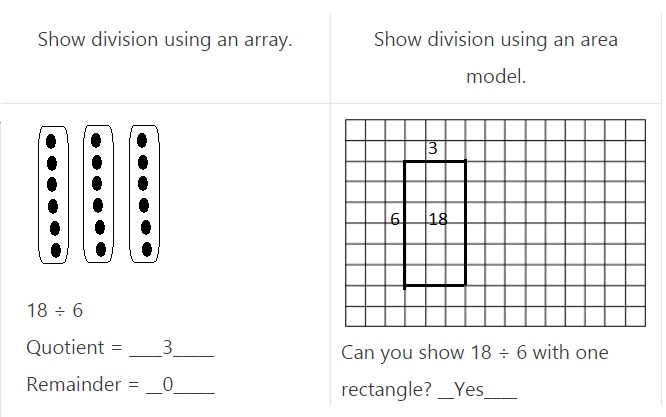
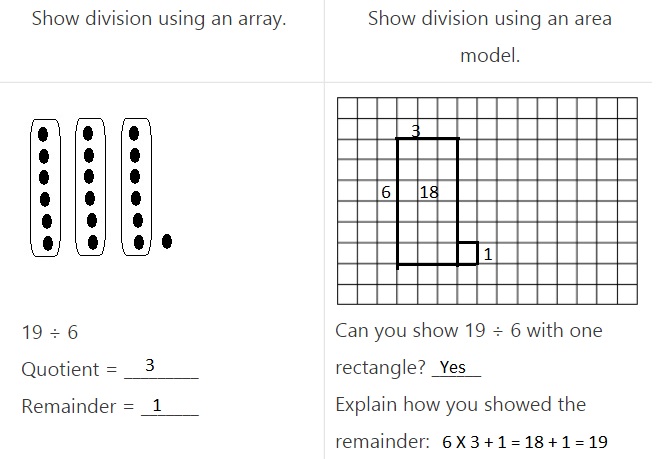
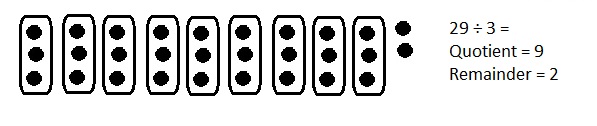
Eureka Math Grade 5 Module 6 Lesson 6 Answer Key

Engage NY Eureka Math 5th Grade Module 6 Lesson 6 Answer Key

Eureka Math Grade 5 Module 6 Lesson 6 Problem Set Answer Key

Question 1.
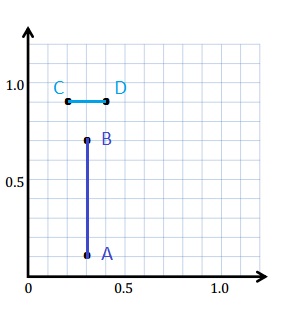
Plot the following points, and label them on the coordinate plane.
Engage NY Math Grade 5 Module 6 Lesson 6 Problem Set Answer Key 1
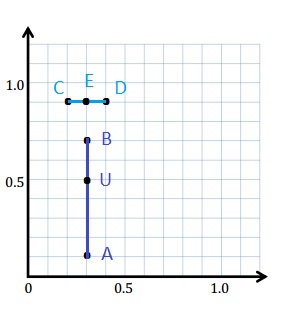
A: (0.3, 0.1)
B: (0.3, 0.7)
C: (0.2, 0.9)
D: (0.4, 0.9)
a. Use a straightedge to construct line segments \(\overline{A B}\) and \(\overline{C D}\).
b. Line segment _________ is parallel to the x-axis and is perpendicular to the y-axis.
c. Line segment _________ is parallel to the y-axis and is perpendicular to the x-axis.
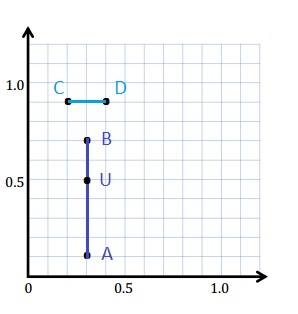
d. Plot a point on line segment \(\overline{A B}\) that is not at the endpoints, and name it U. Write the coordinates. U ( _____ , _____ )
e. Plot a point on line segment \(\overline{C D}\) and name it V. Write the coordinates. V ( _____ , _____ )
Answer:
a.
Engage-NY-Eureka-Math-5th-Grade-Module-6-Lesson-6-Answer-Key-Eureka-Math-Grade-5-Module-6-Lesson-6-Problem-Set-Answer-Key-Question-1
b. Line segment \(\overline{C D}\) is parallel to the x-axis and is perpendicular to the y-axis.
c. Line segment \(\overline{A B}\) is parallel to the y-axis and is perpendicular to the x-axis.
d. The coordinates. U ( 0.3 , 0.5 )
Engage-NY-Eureka-Math-5th-Grade-Module-6-Lesson-6-Answer-Key-Eureka-Math-Grade-5-Module-6-Lesson-6-Problem-Set-Answer-Key-Question-1-d
e. The coordinates. V ( 0.3 , 0.9 )
Engage-NY-Eureka-Math-5th-Grade-Module-6-Lesson-6-Answer-Key-Eureka-Math-Grade-5-Module-6-Lesson-6-Problem-Set-Answer-Key-Question-1-E

Question 2.
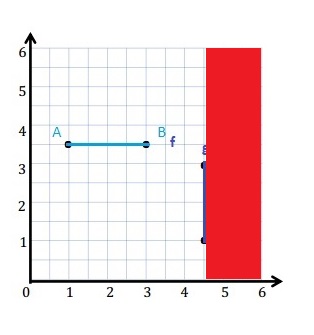
Construct line f such that the y-coordinate of every point is 3\(\frac{1}{2}\), and construct line g such that the x-coordinate of every point is 4\(\frac{1}{2}\).
Engage NY Math Grade 5 Module 6 Lesson 6 Problem Set Answer Key 2
a. Line f is ________ units from the x-axis.
b. Give the coordinates of the point on line f that is \(\frac{1}{2}\) unit from the y-axis. ________
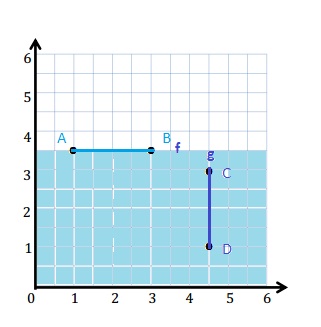
c. With a blue pencil, shade the portion of the grid that is less than 3\(\frac{1}{2}\) units from the x-axis.
d. Line g is _________ units from the y-axis.
e. Give the coordinates of the point on line g that is 5 units from the x-axis. ________
f. With a red pencil, shade the portion of the grid that is more than 4\(\frac{1}{2}\) units from the y-axis.
Answer:
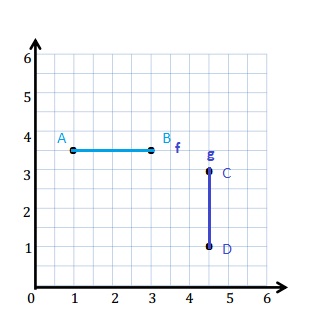
Line f is drawn with points A and B with the y-coordinate of every point is 3\(\frac{1}{2}\) .
A : (1, 3\(\frac{1}{2}\))
B : (3,  3\(\frac{1}{2}\))
Line g is drawn with points C and D with the x-coordinate of every point is 4\(\frac{1}{2}\) .
C : (4\(\frac{1}{2}\) , 3 )
D : ( 4\(\frac{1}{2}\) , 1)
Engage-NY-Eureka-Math-5th-Grade-Module-6-Lesson-6-Answer-Key-Eureka-Math-Grade-5-Module-6-Lesson-6-Problem-Set-Answer-Key-Question-2
a. Line f is 4\(\frac{1}{2}\) units from the x-axis.
Explanation :
Distance between f and x-axis is the y-coordinate .

b. The coordinate of the point is ( \(\frac{1}{2}\) , 3\(\frac{1}{2}\) )
c.
Engage-NY-Eureka-Math-5th-Grade-Module-6-Lesson-6-Answer-Key-Eureka-Math-Grade-5-Module-6-Lesson-6-Problem-Set-Answer-Key-Question-2-c
d. Line g is 4\(\frac{1}{2}\) units from the y-axis.
Explanation :
Distance between g and y-axis is the x-coordinate .
e. The coordinates of the point on line g that is 5 units from the x-axis is ( 4\(\frac{1}{2}\) , 5 )
f.
Engage-NY-Eureka-Math-5th-Grade-Module-6-Lesson-6-Answer-Key-Eureka-Math-Grade-5-Module-6-Lesson-6-Problem-Set-Answer-Key-Question-2-f

Question 3.
Complete the following tasks on the plane below.
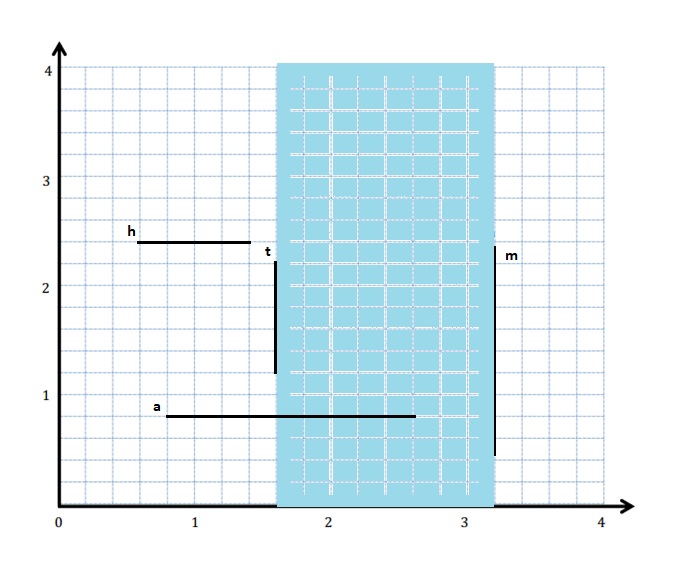
a. Construct a line m that is perpendicular to the x-axis and 3.2 units from the y-axis.
b. Construct a line a that is 0.8 unit from the x-axis.
c. Construct a line t that is parallel to line m and is halfway between line m and the y-axis.
d. Construct a line h that is perpendicular to line t and passes through the point (1.2, 2.4).
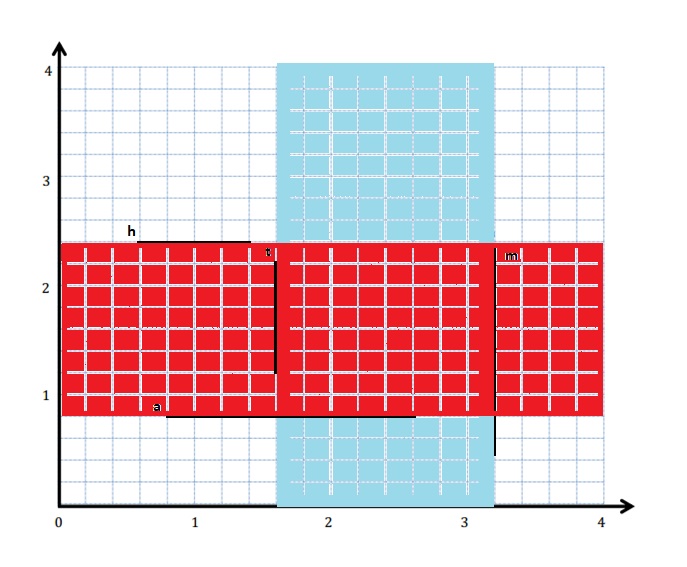
e. Using a blue pencil, shade the region that contains points that are more than 1.6 units and less than 3.2 units from the y-axis.
f. Using a red pencil, shade the region that contains points that are more than 0.8 unit and less than 2.4 units from the x-axis.
g. Give the coordinates of a point that lies in the double-shaded region.
Engage NY Math Grade 5 Module 6 Lesson 6 Problem Set Answer Key 3
Answer:
Engage-NY-Eureka-Math-5th-Grade-Module-6-Lesson-6-Answer-Key-Eureka-Math-Grade-5-Module-6-Lesson-6-Problem-Set-Answer-Key-Question-3
g. The coordinates of a point that lies in the double-shaded region is (1, 2)

Eureka Math Grade 5 Module 6 Lesson 6 Exit Ticket Answer Key

Eureka Math 5th Grade Module 6 Lesson 6 Exit Ticket Answer Key 1
Question 1.
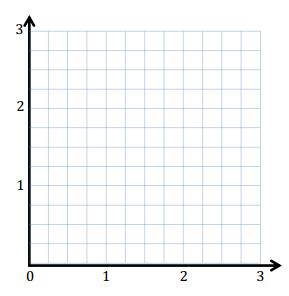
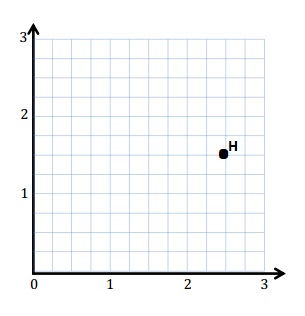
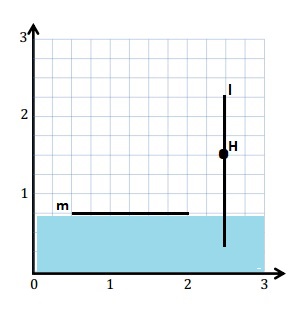
Plot the point H (2\(\frac{1}{2}\), 1\(\frac{1}{2}\)).
Answer:
Engage-NY-Eureka-Math-5th-Grade-Module-6-Lesson-6-Answer-Key-Eureka-Math-Grade-5-Module-6-Lesson-6-Exit-Ticket-Answer-Key-Question-1

Question 2.
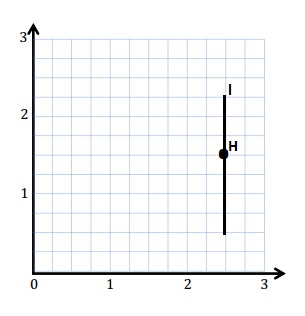
Line l passes through point H and is parallel to the y-axis. Construct line l.
Answer:
Engage-NY-Eureka-Math-5th-Grade-Module-6-Lesson-6-Answer-Key-Eureka-Math-Grade-5-Module-6-Lesson-6-Exit-Ticket-Answer-Key-Question-2

Question 3.
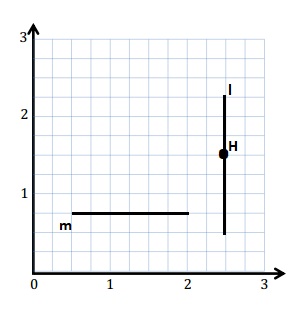
Construct line m such that the y-coordinate of every point is \(\frac{3}{4}\).
Answer:
Engage-NY-Eureka-Math-5th-Grade-Module-6-Lesson-6-Answer-Key-Eureka-Math-Grade-5-Module-6-Lesson-6-Exit-Ticket-Answer-Key-Question-2
Explanation :
For same y -coordinate of every point is \(\frac{3}{4}\) then draw a line from \(\frac{3}{4}\) from x-axis .

Question 4.
Line m is ________ units from the x-axis.
Answer:
Line m is \(\frac{3}{4}\) units from the x-axis.
Explanation :
It is represented by y-coordinate of line m .

Question 5.
Give the coordinates of the point on line m that is \(\frac{1}{2}\) unit from the y-axis.
Answer:
The coordinates of the point on line m that is \(\frac{1}{2}\) unit from the y-axis is (\(\frac{1}{2}\) , \(\frac{3}{4}\) ).

Question 6.
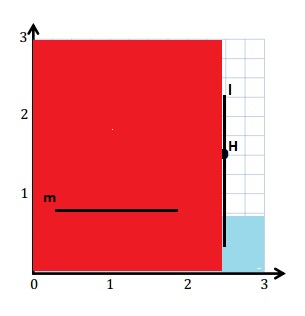
With a blue pencil, shade the portion of the plane that is less than \(\frac{3}{4}\) unit from the x-axis.
Answer:
Engage-NY-Eureka-Math-5th-Grade-Module-6-Lesson-6-Answer-Key-Eureka-Math-Grade-5-Module-6-Lesson-6-Exit-Ticket-Answer-Key-Question-6

Question 7.
With a red pencil, shade the portion of the plane that is less than 2\(\frac{1}{2}\) units from the y-axis.
Answer:
Engage-NY-Eureka-Math-5th-Grade-Module-6-Lesson-6-Answer-Key-Eureka-Math-Grade-5-Module-6-Lesson-6-Exit-Ticket-Answer-Key-Question-7

Question 8.
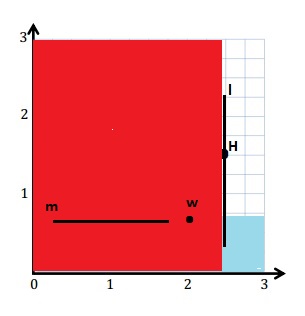
Plot a point that lies in the double-shaded region. Give the coordinates of the point.
Answer:
The point that lies in the double-shaded region is W ( 2 , \(\frac{1}{2}\) )
Engage-NY-Eureka-Math-5th-Grade-Module-6-Lesson-6-Answer-Key-Eureka-Math-Grade-5-Module-6-Lesson-6-Exit-Ticket-Answer-Key-Question-7

Eureka Math Grade 5 Module 6 Lesson 6 Homework Answer Key

Question 1.
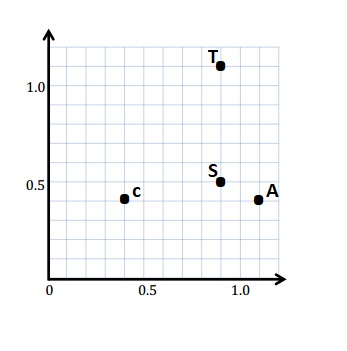
Plot and label the following points on the coordinate plane.
Eureka Math Grade 5 Module 6 Lesson 6 Homework Answer Key 1
C: (0.4, 0.4)
A: (1.1, 0.4)
S: (0.9, 0.5)
T: (0.9, 1.1)
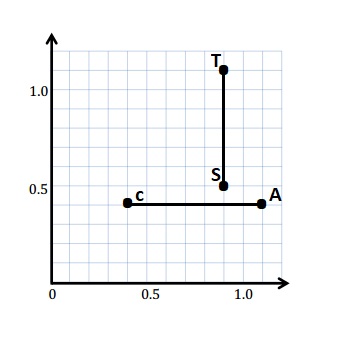
a. Use a straightedge to construct line segments \(\overline{C A}\) and \(\overline{S T}\).
b. Name the line segment that is perpendicular to the x-axis and parallel to the y-axis. _________
c. Name the line segment that is parallel to the x-axis and perpendicular to the y-axis. _________
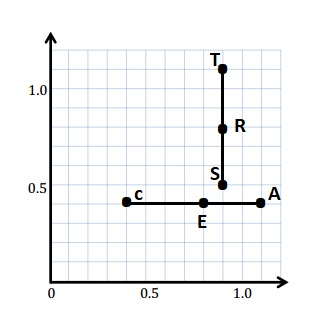
d. Plot a point on \(\overline{C A}\), and name it E. Plot a point on line segment \(\overline{S T}\), and name it R.
e. Write the coordinates of points E and R.
E ( ____ , ____ ) R ( ____ , ____ )
Answer:
Engage-NY-Eureka-Math-5th-Grade-Module-6-Lesson-6-Answer-Key-Eureka-Math-Grade-5-Module-6-Lesson-6-Homework-Answer-Key-Question-1
a.
Engage-NY-Eureka-Math-5th-Grade-Module-6-Lesson-6-Answer-Key-Eureka-Math-Grade-5-Module-6-Lesson-6-Homework-Answer-Key-Question-1-A
c. The line segment that is perpendicular to the x-axis and parallel to the y-axis is \(\overline{S T}\)
d. The line segment that is parallel to the x-axis and perpendicular to the y-axis is \(\overline{C A}\)
e.
Engage-NY-Eureka-Math-5th-Grade-Module-6-Lesson-6-Answer-Key-Eureka-Math-Grade-5-Module-6-Lesson-6-Homework-Answer-Key-Question-1-d
f. The coordinates of points E and R.
E ( 0.8 , 0.4 ) R ( 0.9 , 0.8 )

Question 2.
Construct line m such that the y-coordinate of every point is 1\(\frac{1}{2}\), and construct line n such that the x-coordinate of every point is 5\(\frac{1}{2}\).
Eureka Math Grade 5 Module 6 Lesson 6 Homework Answer Key 2
a. Line m is ________ units from the x-axis.
b. Give the coordinates of the point on line m that is 2 units from the y-axis. ________
c. With a blue pencil, shade the portion of the grid that is less than 1\(\frac{1}{2}\) units from the x-axis.
d. Line n is _________ units from the y-axis.
e. Give the coordinates of the point on line n that is 3\(\frac{1}{2}\) units from the x-axis.
f. With a red pencil, shade the portion of the grid that is less than 5\(\frac{1}{2}\) units from the y-axis.
Answer:
Line m is drawn with points A and B with the y-coordinate of every point is 1\(\frac{1}{2}\) .
A : (1, 1\(\frac{1}{2}\))
B : (3,  1\(\frac{1}{2}\))
Line n is drawn with points C and D with the x-coordinate of every point is 5\(\frac{1}{2}\) .
C : (5\(\frac{1}{2}\) , 3 )
D : ( 5\(\frac{1}{2}\) , 6)
Engage-NY-Eureka-Math-5th-Grade-Module-6-Lesson-6-Answer-Key-Eureka-Math-G2rade-5-Module-6-Lesson-6-Homework-Answer-Key-Question-2
a. a. Line m is 1\(\frac{1}{2}\) units from the x-axis.
Explanation :
Distance between x-axis and line m is the y coordinate .

b. The coordinates of the point on line m that is 2 units from the y-axis is ( 2, 1\(\frac{1}{2}\) )
c.
Engage-NY-Eureka-Math-5th-Grade-Module-6-Lesson-6-Answer-Key-Eureka-Math-G2rade-5-Module-6-Lesson-6-Homework-Answer-Key-Question-2
d. Line n is 5\(\frac{1}{2}\) units from the y-axis.
Explanation :
Explanation :
Distance between y-axis and line n is the x – coordinate .

e. The coordinates of the point on line n that is 3\(\frac{1}{2}\) units from the x-axis is (5\(\frac{1}{2}\) , 3\(\frac{1}{2}\))
f.
Engage-NY-Eureka-Math-5th-Grade-Module-6-Lesson-6-Answer-Key-Eureka-Math-G2rade-5-Module-6-Lesson-6-Homework-Answer-Key-Question-2

Question 3.
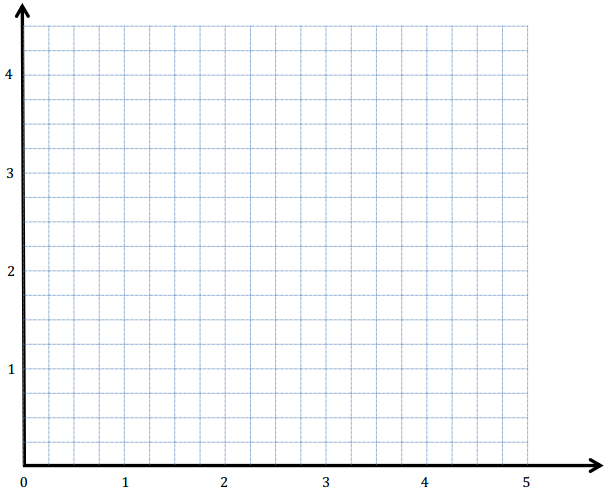
Construct and label lines e, r, s, and o on the plane below.
a. Line e is 3.75 units above the x-axis.
b. Line r is 2.5 units from the y-axis.
c. Line s is parallel to line e but 0.75 farther from the x-axis.
d. Line o is perpendicular to lines s and e and passes through the point (3\(\frac{1}{4}\), 3\(\frac{1}{4}\)).
Answer:
Engage-NY-Eureka-Math-5th-Grade-Module-6-Lesson-6-Answer-Key-Eureka-Math-G2rade-5-Module-6-Lesson-6-Homework-Answer-Key-Question-3

Question 4.
Complete the following tasks on the plane.
a. Using a blue pencil, shade the region that contains points that are more than 2\(\frac{1}{2}\) units and less than 3\(\frac{1}{4}\) units from the y-axis.
b. Using a red pencil, shade the region that contains points that are more than 3\(\frac{3}{4}\) units and less than 4\(\frac{1}{2}\) units from the x-axis.
c. Plot a point that lies in the double-shaded region, and label its coordinates.
Eureka Math Grade 5 Module 6 Lesson 6 Homework Answer Key 3
Answer:
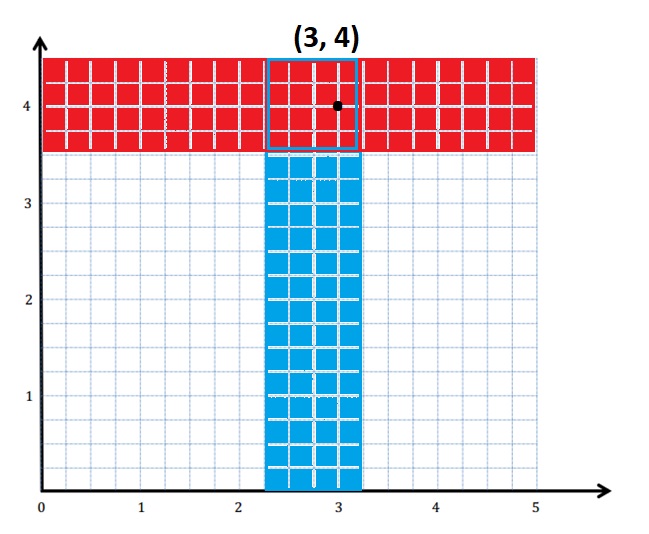
Engage-NY-Eureka-Math-5th-Grade-Module-6-Lesson-6-Answer-Key-Eureka-Math-G2rade-5-Module-6-Lesson-6-Homework-Answer-Key-Question-4
Explanation :
In double shaded (3,4 ) is a point that is marked as shown in above figure .

Eureka Math Grade 5 Module 6 Lesson 4 Answer Key

Engage NY Eureka Math 5th Grade Module 6 Lesson 4 Answer Key

Eureka Math Grade 5 Module 6 Lesson 4 Problem Set Answer Key

Battleship Rules

Goal: To sink all of your opponent’s ships by correctly guessing their coordinates.
Materials

  • 1 grid sheet (per person/per game)
  • Red crayon/marker for hits
  • Black crayon/marker for misses
  • Folder to place between players

Ships

  • Each player must mark 5 ships on the grid.
    • Aircraft carrier—plot 5 points.
    • Battleship—plot 4 points.
    • Cruiser—plot 3 points.
    • Submarine—plot 3 points.
    • Patrol boat—plot 2 points

Setup

    • With your opponent, choose a unit length and fractional unit for the coordinate plane.
    • Label the chosen units on both grid sheets.
    • Secretly select locations for each of the 5 ships on your My Ships grid.
    • All ships must be placed horizontally or vertically on the coordinate plane.
    • Ships can touch each other, but they may not occupy the same coordinate.

Play

    • Players take turns firing one shot to attack enemy ships.
    • On your turn, call out the coordinates of your attacking shot. Record the coordinates of each attack shot.
    • Your opponent checks his/her My Ships grid. If that coordinate is unoccupied, your opponent says, “Miss.” If you named a coordinate occupied by a ship, your opponent says, “Hit.”
    • Mark each attempted shot on your Enemy Ships grid. Mark a black ✖ on the coordinate if your opponent says, “Miss.” Mark a red ✓ on the coordinate if your opponent says, “Hit.”
    • On your opponent’s turn, if he/she hits one of your ships, mark a red ✓on that coordinate of your My Ships grid. When one of your ships has every coordinate marked with a ✓, say, “You’ve sunk my [name of ship].”

Victory

    • The first player to sink all (or the most) opposing ships, wins.
      Engage NY Math Grade 5 Module 6 Lesson 4 Problem Set Answer Key 1
      Aircraft carrier—5 points
      Battleship—4 points
      Cruiser—3 points
      Submarine—3 points
      Patrol boat—2 points

Draw a red ✓over any coordinate your opponent hits.
Once all of the coordinates of any ship have been hit, say, “You’ve sunk my [name of ship].”

Attack Shots
Record the coordinates of each shot below and whether it was a ✓(hit) or an ✖ (miss).
( _____ , _____ ) ( _____ , _____ )
( _____ , _____ ) ( _____ , _____ )
( _____ , _____ ) ( _____ , _____ )
( _____ , _____ ) ( _____ , _____ )
( _____ , _____ ) ( _____ , _____ )
( _____ , _____ ) ( _____ , _____ )
( _____ , _____ ) ( _____ , _____ )
( _____ , _____ ) ( _____ , _____ )
Enemy Ships

  • Draw a black ✖ on the coordinate if your opponent says, “Miss.”
  • Draw a red ✓ on the coordinate if your opponent says, “Hit.”
  • Draw a circle around the coordinates of a sunken ship.
    Engage NY Math Grade 5 Module 6 Lesson 4 Problem Set Answer Key 2

Eureka Math Grade 5 Module 6 Lesson 4 Exit Ticket Answer Key

Fatima and Rihana are playing Battleship. They labeled their axes using just whole numbers.
a. Fatima’s first guess is (2, 2). Rihana says, “Hit!” Give the coordinates of four points that Fatima might guess next.
b. Rihana says, “Hit!” for the points directly above and below (2, 2). What are the coordinates that Fatima guessed?
Answer:

Eureka Math Grade 5 Module 6 Lesson 4 Homework Answer Key

Your homework is to play at least one game of Battleship with a friend or family member. You can use the directions from class to teach your opponent. You and your opponent should record your guesses, hits, and misses on the sheet as you did in class.
When you have finished your game, answer these questions.
Question 1.
When you guess a point that is a hit, how do you decide which points to guess next?
Answer:

Question 2.
How could you change the coordinate plane to make the game easier or more challenging?
Answer:

Question 3.
Which strategies worked best for you when playing this game?
Answer:

Eureka Math Grade 5 Module 6 Lesson 2 Answer Key

Engage NY Eureka Math 5th Grade Module 6 Lesson 2 Answer Key

Eureka Math Grade 5 Module 6 Lesson 2 Problem Set Answer Key

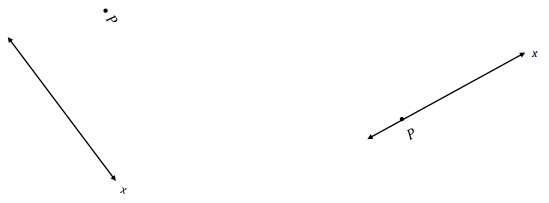
Question 1.
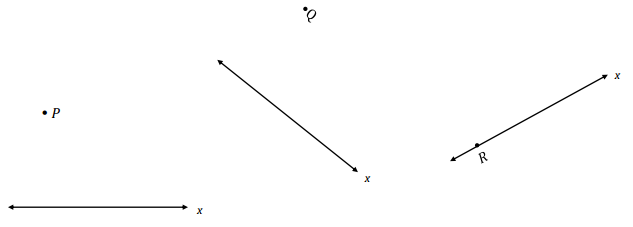
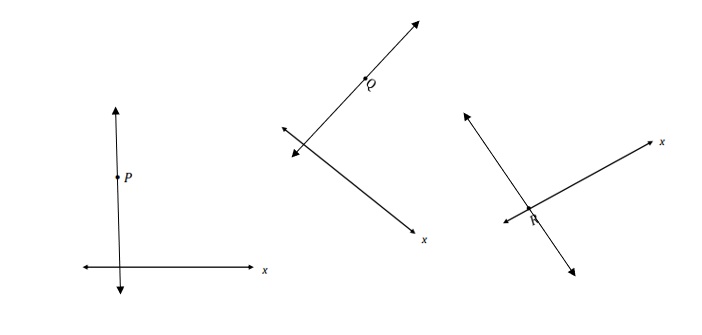
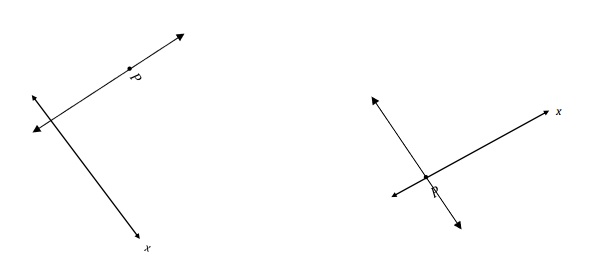
a. Use a set square to draw a line perpendicular to the x-axes through points P, Q, and R. Label the new line as the y-axis.
Engage NY Math Grade 5 Module 6 Lesson 2 Problem Set Answer Key 1
Answer :
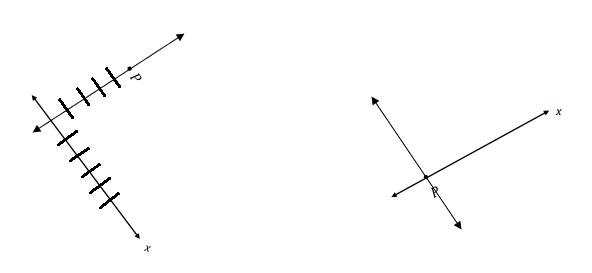
Engage-NY-Eureka-Math-5th-Grade-Module-6-Lesson-2-Answer-Key-Eureka-Math-Grade-5-Module-6-Lesson-2-Problem-Set-Answer-Key-Question-1
Explanation :
A line is said to be perpendicular to another line if the two lines intersect at a right angle.

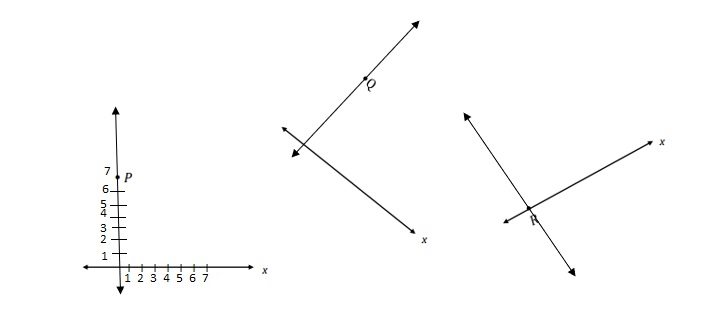
b. Choose one of the sets of perpendicular lines above, and create a coordinate plane. Mark 7 units on each axis, and label them as whole numbers.
Answer:
Engage-NY-Eureka-Math-5th-Grade-Module-6-Lesson-2-Answer-Key-Eureka-Math-Grade-5-Module-6-Lesson-2-Problem-Set-Answer-Key-Question-1-b
Explanation :
7 units are marked on the first figure on both the axes .

Question 2.
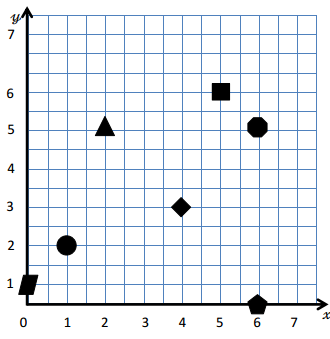
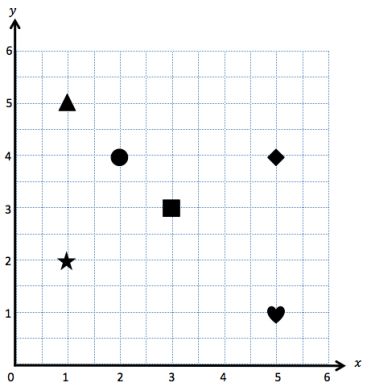
Use the coordinate plane to answer the following.
Engage NY Math Grade 5 Module 6 Lesson 2 Problem Set Answer Key 2
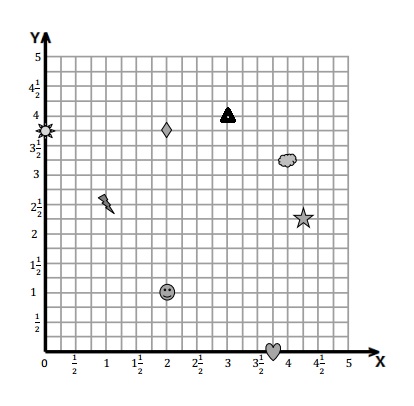
a. Name the shape at each location.

x-coordinate

y-coordinate

Shape

25
12
56
65

Answer :
Engage-NY-Eureka-Math-5th-Grade-Module-6-Lesson-2-Answer-Key-Eureka-Math-Grade-5-Module-6-Lesson-2-Problem-Set-Answer-Key-Question-2

b. Which shape is 2 units from the y-axis?
Answer :
Circle is 2 units from y – axis .
c. Which shape is 1 units from the y-axis?
Answer :
Parallelogram is 1 units from the y-axis

d. Which shape is 4 units from the y-axis and 3 units from the x-axis?
Answer:
Diamond is 4 units from the y-axis and 3 units from the x-axis

Question 3.
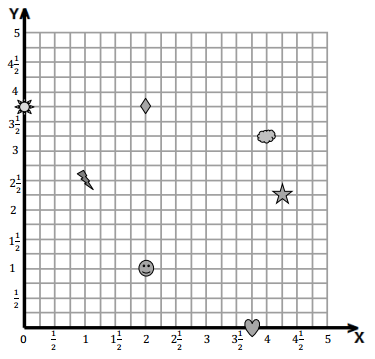
Use the coordinate plane to answer the following.
Engage NY Math Grade 5 Module 6 Lesson 2 Problem Set Answer Key 3
a. Fill in the blanks.

Shapex-coordinate

y-coordinate

Smiley Face21
Diamond23 \(\frac{3}{4}\)
Sun03 \(\frac{3}{4}\)
Heart3 \(\frac{3}{4}\)0

b. Name the shape whose x-coordinate is \(\frac{1}{2}\) more than the value of the heart’s x-coordinate.
Answer :
Star shape

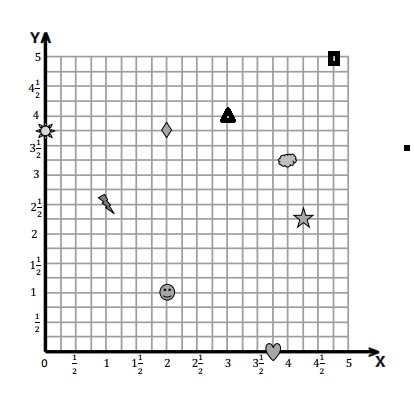
c. Plot a triangle at (3, 4).
Answer :
Engage-NY-Eureka-Math-5th-Grade-Module-6-Lesson-2-Answer-Key-Eureka-Math-Grade-5-Module-6-Lesson-2-Problem-Set-Answer-Key-Question-3-c
Explanation :
X- coordinate = 3
Y-coordinate = 4 .

d. Plot a square at (4 \(\frac{3}{4}\), 5).
Answer :
Engage-NY-Eureka-Math-5th-Grade-Module-6-Lesson-2-Answer-Key-Eureka-Math-Grade-5-Module-6-Lesson-2-Problem-Set-Answer-Key-Question-3-d
Explanation :
X- coordinate = 4 \(\frac{3}{4}\)
Y- coordinate = 5

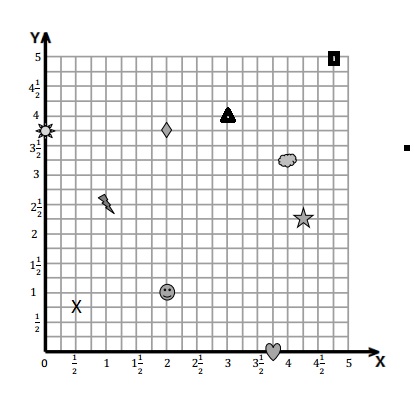
e. Plot an X at (\(\frac{1}{2}\), \(\frac{3}{4}\)).
Answer:
Engage-NY-Eureka-Math-5th-Grade-Module-6-Lesson-2-Answer-Key-Eureka-Math-Grade-5-Module-6-Lesson-2-Problem-Set-Answer-Key-Question-3-e
Explanation :
X – Coordinate  = (\(\frac{1}{2}\)
Y- Coordinate  = \(\frac{3}{4}\)).

Question 4.
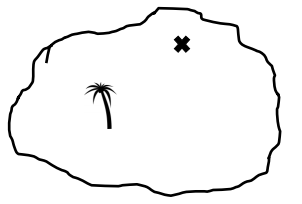
The pirate’s treasure is buried at the X on the map. How could a coordinate plane make describing its location easier?
Engage NY Math Grade 5 Module 6 Lesson 2 Problem Set Answer Key 4
Answer:
It would give you the exact location when you describe the position with x and y axis .
It would you draw x- axis along the island and y axis along the left side and mark the point for  x then the location would be exactly clear to find easier .

Eureka Math Grade 5 Module 6 Lesson 2 Exit Ticket Answer Key

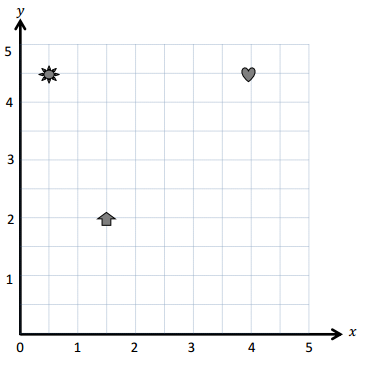
Question 1.
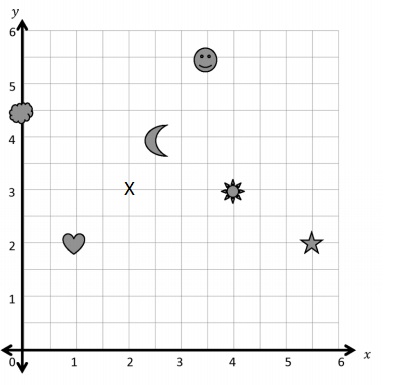
Name the coordinates of the shapes below.

Shape-coordinate

-coordinate

Sun
Arrow
Heart

Eureka Math 5th Grade Module 6 Lesson 2 Exit Ticket Answer Key 1
Answer:

Shapex -coordinate

y -coordinate

Sun\(\frac{1}{2}\)4\(\frac{1}{2}\)
Arrow1\(\frac{1}{2}\)2
Heart44\(\frac{1}{2}\)

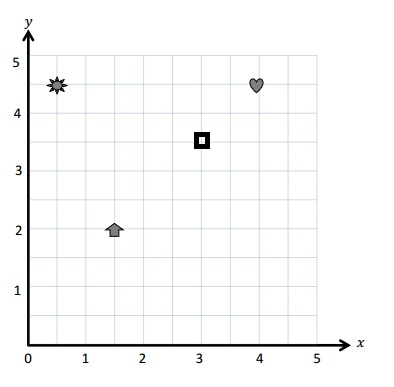
Question 2.
Plot a square at (3, 3\(\frac{1}{2}\)).
Answer:
Engage-NY-Eureka-Math-5th-Grade-Module-6-Lesson-2-Answer-Key-Eureka-Math-Grade-5-Module-6-Lesson-2-Exit-Ticket-Answer-Key-Question-2

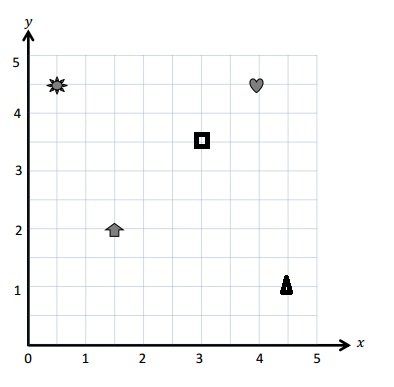
Question 3.
Plot a triangle at (4\(\frac{1}{2}\), 1).
Answer:
Engage-NY-Eureka-Math-5th-Grade-Module-6-Lesson-2-Answer-Key-Eureka-Math-Grade-5-Module-6-Lesson-2-Exit-Ticket-Answer-Key-Question-3

Eureka Math Grade 5 Module 6 Lesson 2 Homework Answer Key

Question 1.
a. Use a set square to draw a line perpendicular to the x-axis through point P. Label the new line as the y-axis.
Eureka Math Grade 5 Module 6 Lesson 2 Homework Answer Key 1
Answer a :
Engage-NY-Eureka-Math-5th-Grade-Module-6-Lesson-2-Answer-Key-Eureka-Math-Grade-5-Module-6-Lesson-2-Homework-Answer-Key-Question-1
b. Choose one of the sets of perpendicular lines above, and create a coordinate plane. Mark 5 units on each axis, and label them as whole numbers.
Answer:
Engage-NY-Eureka-Math-5th-Grade-Module-6-Lesson-2-Answer-Key-Eureka-Math-Grade-5-Module-6-Lesson-2-Homework-Answer-Key-Question-1-b
Explanation :
In First figure the x-axis and y-axis is divided into 5 parts as shown in above figure .

Question 2.
Use the coordinate plane to answer the following.
Eureka Math Grade 5 Module 6 Lesson 2 Homework Answer Key 2
a. Name the shape at each location.

-coordinate

-coordinate

Shape

24
54
15
51

Answer :

x -coordinate

y -coordinate

Shape

24Circle
54Diamond
15Triangle
51Heart

b. Which shape is 2 units from the x-axis?
Answer :
Star

c. Which shape has the same x- and y-coordinate?
Answer:
Square it is located at (3,3)

Question 3.
Use the coordinate plane to answer the following.
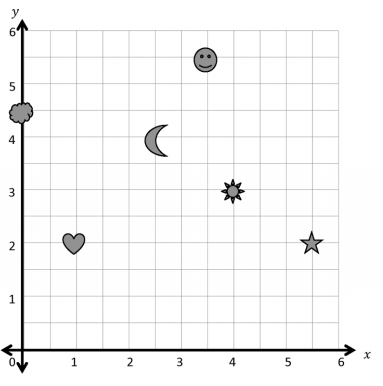
Eureka Math Grade 5 Module 6 Lesson 2 Homework Answer Key 3
a. Name the coordinates of each shape.

Shape-coordinate

-coordinate

Moon
Sun
Heart
Cloud
Smiley Face

Answer :

shape.

Shapex -coordinate

y -coordinate

Moon2\(\frac{1}{2}\)4
Sun43
Heart12
Cloud04\(\frac{1}{2}\)
Smiley Face3\(\frac{1}{2}\)5\(\frac{1}{2}\)

b. Which 2 shapes have the same y-coordinate?
Answer :
Heart and star have same y – coordinate as 2

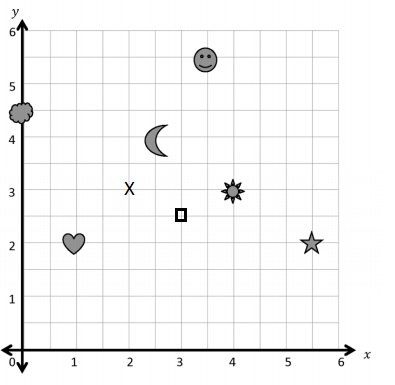
c. Plot an X at (2, 3).
Answer :
Engage-NY-Eureka-Math-5th-Grade-Module-6-Lesson-2-Answer-Key-Eureka-Math-Grade-5-Module-6-Lesson-2-Homework-Answer-Key-Question-3-c
d. Plot a square at (3, 2\(\frac{1}{2}\)).
Answer :
Engage-NY-Eureka-Math-5th-Grade-Module-6-Lesson-2-Answer-Key-Eureka-Math-Grade-5-Module-6-Lesson-2-Homework-Answer-Key-Question-3-d
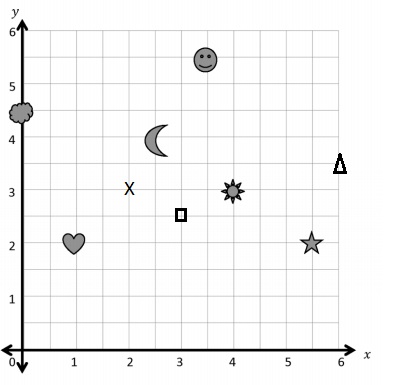
e. Plot a triangle at (6, 3\(\frac{1}{2}\)).
Answer:
Engage-NY-Eureka-Math-5th-Grade-Module-6-Lesson-2-Answer-Key-Eureka-Math-Grade-5-Module-6-Lesson-2-Homework-Answer-Key-Question-3-d

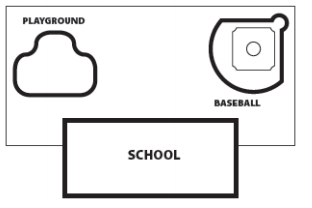
Question 3.
Mr. Palmer plans to bury a time capsule 10 yards behind the school. What else should he do to make naming the location of the time capsule more accurate?
Eureka Math Grade 5 Module 6 Lesson 2 Homework Answer Key 4
Answer:
If Palmer drew an x-axis and y-axis and a scale he would have the exact location of the time capsule .

Eureka Math Grade 5 Module 6 Lesson 1 Answer Key

Engage NY Eureka Math 5th Grade Module 6 Lesson 1 Answer Key

Eureka Math Grade 5 Module 6 Lesson 1 Problem Set Answer Key

Question 1.
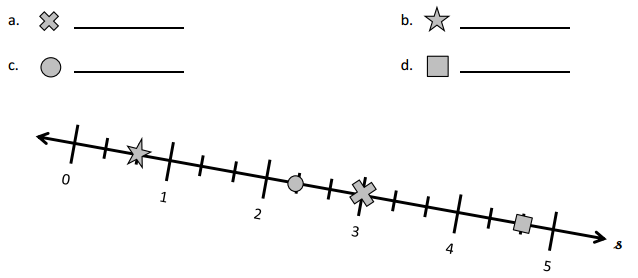
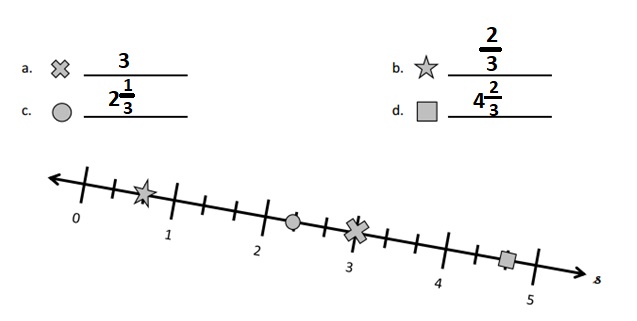
Each shape was placed at a point on the number line s. Give the coordinate of each point below.
Engage NY Math Grade 5 Module 6 Lesson 1 Problem Set Answer Key 1
Answer:
Engage-NY-Eureka-Math-5th-Grade-Module-6-Lesson-1-Answer-Key-Eureka-Math-Grade-5-Module-6-Lesson-1-Problem-Set-Answer-Key-Question-1
Explanation :
The given number line is divided into 3 equals parts from 0-1,1-2 and so on.
Fraction of each part is \(\frac{1}{3}\).
So, the coordinates of each point located is written in above figure .

Question 2.
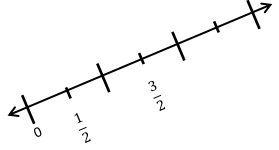
Plot the points on the number lines.
a.
Engage NY Math Grade 5 Module 6 Lesson 1 Problem Set Answer Key 2
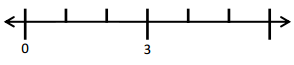
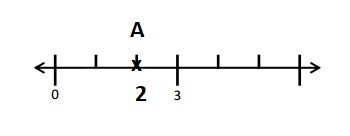
Plot A so that its distance from the origin is 2.
Answer :
Engage-NY-Eureka-Math-5th-Grade-Module-6-Lesson-1-Answer-Key-Eureka-Math-Grade-5-Module-6-Lesson-1-Problem-Set-Answer-Key-Question-2-a
Explanation :
The given Number line is divided into 3 parts from 0 -3 that means each unit is 1 .
Point A is marked at 2 and is shown in above figure .

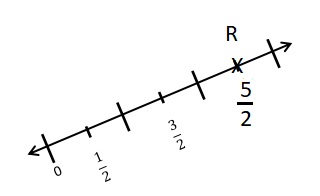
b.
Engage NY Math Grade 5 Module 6 Lesson 1 Problem Set Answer Key 3
Plot R so that its distance from the origin is \(\frac{5}{2}\).
Answer :
Engage-NY-Eureka-Math-5th-Grade-Module-6-Lesson-1-Answer-Key-Eureka-Math-Grade-5-Module-6-Lesson-1-Problem-Set-Answer-Key-Question-2-b
Explanation :
The Each part of the above number line is \(\frac{1}{2}\).
R is plotted at \(\frac{5}{2}\). and is shown in above figure .

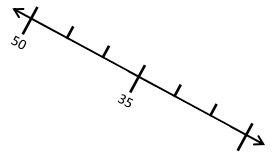
c.
Engage NY Math Grade 5 Module 6 Lesson 1 Problem Set Answer Key 4
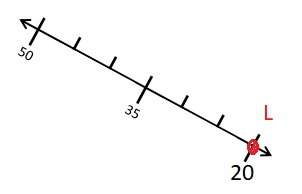
Plot L so that its distance from the origin is 20.
Answer :
Engage-NY-Eureka-Math-5th-Grade-Module-6-Lesson-1-Answer-Key-Eureka-Math-Grade-5-Module-6-Lesson-1-Problem-Set-Answer-Key-Question-2-c
Explanation :
The Each part of the above number line is 5 .
The representation of number line is in decreasing order of 5 . so L is plotted below 35
L is plotted at 20 and is shown in above figure .

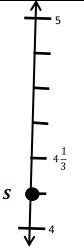
d.
Engage NY Math Grade 5 Module 6 Lesson 1 Problem Set Answer Key 5
Plot a point T so that its distance from the origin is \(\frac{2}{3}\) more than that of S.
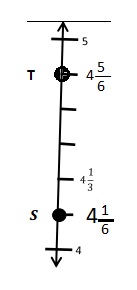
Answer:
Engage-NY-Eureka-Math-5th-Grade-Module-6-Lesson-1-Answer-Key-Eureka-Math-Grade-5-Module-6-Lesson-1-Problem-Set-Answer-Key-Question-2-d
Explanation :
The given Number line is divided into 6 Equal parts from 4 – 5 that means each unit is \(\frac{1}{6}\).
Point S is marked at  4\(\frac{1}{6}\) and is shown in above figure .
point T so that its distance from the origin is \(\frac{2}{3}\) more than that of S.
Point T = 4\(\frac{1}{6}\) + \(\frac{2}{3}\) = \(\frac{25}{6}\) + \(\frac{4}{6}\)
= \(\frac{29}{6}\) = 4 \(\frac{5}{6}\)
Point T = 4 \(\frac{5}{6}\)  . is marked and is shown in above figure .

Question 3.
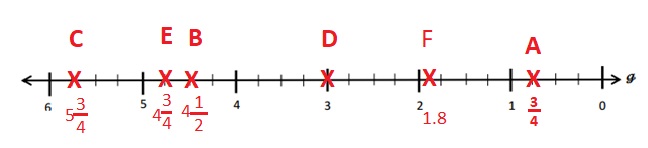
Number line g is labeled from 0 to 6. Use number line g below to answer the questions.
Engage NY Math Grade 5 Module 6 Lesson 1 Problem Set Answer Key 6
a. Plot point A at \(\frac{3}{4}\).
b. Label a point that lies at 4\(\frac{1}{2}\) as B.
c. Label a point, C, whose distance from zero is 5 more than that of A.
The coordinate of C is _______.
d. Plot a point, D, whose distance from zero is 1\(\frac{1}{2}\) less than that of B.
The coordinate of D is ________.
e. The distance of E from zero is 1\(\frac{3}{4}\) more than that of D. Plot point E.
f. What is the coordinate of the point that lies halfway between A and D? _______ Label this point F.

Answer c :
Point A = \(\frac{3}{4}\)
Point C = 5 + \(\frac{3}{4}\)=5 \(\frac{3}{4}\)
Answer d :
Point B = 4\(\frac{1}{2}\)
Point D = 1\(\frac{1}{2}\) less than that of B = 4\(\frac{1}{2}\)  – 1\(\frac{1}{2}\) = 3 .
Answer e :
Point D = 3
Point E = 1\(\frac{3}{4}\) more than that of D = 3 + 1\(\frac{3}{4}\) = 4\(\frac{3}{4}\).
Answer f :
The Coordinate of the point that lies halfway between A and D = Point F = 1.875
Engage-NY-Eureka-Math-5th-Grade-Module-6-Lesson-1-Answer-Key-Eureka-Math-Grade-5-Module-6-Lesson-1-Problem-Set-Answer-Key-Question-3

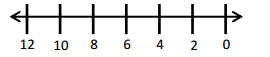
Question 4.
Mrs. Fan asked her fifth-grade class to create a number line. Lenox created the number line below:
Engage NY Math Grade 5 Module 6 Lesson 1 Problem Set Answer Key 7
Parks said Lenox’s number line is wrong because numbers should always increase from left to right. Who is correct? Explain your thinking.
Answer:
Lenox is right .
Explanation :
Any Orientation is acceptable .

Question 5.
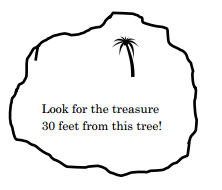
A pirate marked the palm tree on his treasure map and buried his treasure 30 feet away. Do you think he will be able to easily find his treasure when he returns? Why or why not? What might he do to make it easier to find?
Engage NY Math Grade 5 Module 6 Lesson 1 Problem Set Answer Key 8
Answer:
No,
Explanation :
Because point or location will help to find the treasure easily .

Eureka Math Grade 5 Module 6 Lesson 1 Exit Ticket Answer Key

Question 1.
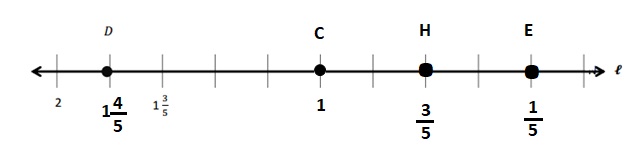
Use number line l to answer the questions.
Eureka Math 5th Grade Module 6 Lesson 1 Exit Ticket Answer Key 1
a. Plot point C so that its distance from the origin is 1.
b. Plot point E \(\frac{4}{5}\) closer to the origin than C. What is its coordinate? _________
c. Plot a point at the midpoint of C and E. Label it H.
Answer:
a .Point C is plotted .
b .Point E = \(\frac{4}{5}\)closer to the origin than C. = 1 – \(\frac{4}{5}\) = \(\frac{1}{5}\) .
c. Point H = the midpoint of C and E = 1 + \(\frac{1}{5}\) = \(\frac{6}{5}\)/2 =\(\frac{6}{10}\) = \(\frac{2}{3}\) .
Engage-NY-Eureka-Math-5th-Grade-Module-6-Lesson-1-Answer-Key-Eureka-Math-Grade-5-Module-6-Lesson-1-Exit-Ticket-Answer-Key-Question-1

Eureka Math Grade 5 Module 6 Lesson 1 Homework Answer Key

Question 1.
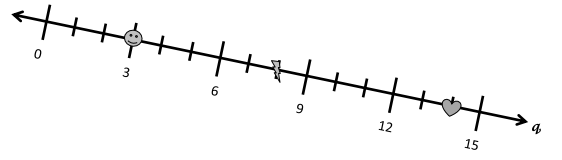
Answer the following questions using number line q below.
a. What is the coordinate, or the distance from the origin, of the Eureka Math Grade 5 Module 6 Lesson 1 Homework Answer Key 1? ___________
b. What is the coordinate of the Eureka Math Grade 5 Module 6 Lesson 1 Homework Answer Key 2 ? _________
c. What is the coordinate of the Eureka Math Grade 5 Module 6 Lesson 1 Homework Answer Key 3? __________
d. What is the coordinate at the midpoint of the Eureka Math Grade 5 Module 6 Lesson 1 Homework Answer Key 2 and the Eureka Math Grade 5 Module 6 Lesson 1 Homework Answer Key 3? __________
Eureka Math Grade 5 Module 6 Lesson 1 Homework Answer Key 4
Answer:
a the coordinate, or the distance from the origin, of the Eureka Math Grade 5 Module 6 Lesson 1 Homework Answer Key 1 is 3
b the coordinate of the Eureka Math Grade 5 Module 6 Lesson 1 Homework Answer Key 2 is  8
c the coordinate of the Eureka Math Grade 5 Module 6 Lesson 1 Homework Answer Key 3is 14
d the coordinate at the midpoint of the Eureka Math Grade 5 Module 6 Lesson 1 Homework Answer Key 2 and the Eureka Math Grade 5 Module 6 Lesson 1 Homework Answer Key 3is (8 + 14)/2 = 11
Explanation :
The number line is divided into 3 parts from 0-3,3-6 and so on . . . .
So Each unit is 1 .

Question 2.
Use the number lines to answer the questions.
Eureka Math Grade 5 Module 6 Lesson 1 Homework Answer Key 5
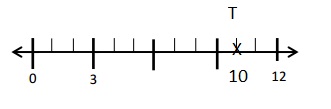
a Plot T so that its distance from the origin is 10.

Eureka Math Grade 5 Module 6 Lesson 1 Homework Answer Key 6
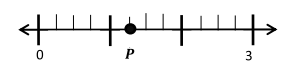
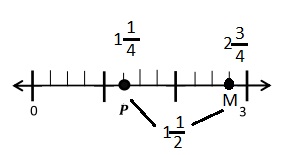
b Plot M so that its distance is \(\frac{11}{4}\) from the origin. What is the distance from P to M?

Eureka Math Grade 5 Module 6 Lesson 1 Homework Answer Key 7
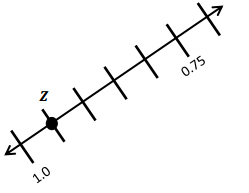
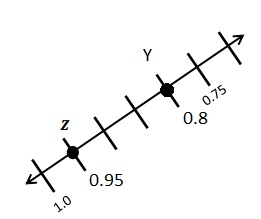
c Plot a point that is 0.15 closer to the origin than Z.

Eureka Math Grade 5 Module 6 Lesson 1 Homework Answer Key 8
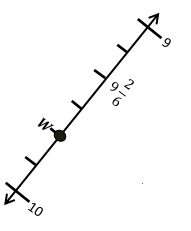
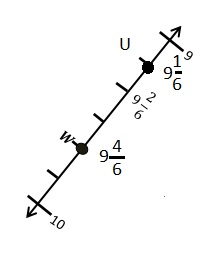
d Plot U so that its distance from the origin is \(\frac{3}{6}\) less than that of W.
Answer a :
Engage-NY-Eureka-Math-5th-Grade-Module-6-Lesson-1-Answer-Key-Eureka-Math-Grade-5-Module-6-Lesson-1-Homework-Answer-Key-Question-2-a
Explanation :
The each part of the above number line is 1 unit .
T is plotted at 11 and is shown in above figure .

Answer b :
Engage-NY-Eureka-Math-5th-Grade-Module-6-Lesson-1-Answer-Key-Eureka-Math-Grade-5-Module-6-Lesson-1-Homework-Answer-Key-Question-2-b
Explanation :
The each part of the above number line is \(\frac{1}{4}\) unit .
Point P = 1\(\frac{1}{4}\) = \(\frac{5}{4}\)
Point M= \(\frac{11}{4}\)
Distance between P and M =\(\frac{11}{4}\) – \(\frac{5}{4}\) = \(\frac{6}{4}\)

Answer c :
Engage-NY-Eureka-Math-5th-Grade-Module-6-Lesson-1-Answer-Key-Eureka-Math-Grade-5-Module-6-Lesson-1-Homework-Answer-Key-Question-2-C
Explanation :
Point Z = 0.95
Point Y = point that is 0.15 closer to the origin than Z. = 0.95- 0.15 = 0.8
Point Y is plotted .

Answer d :
Engage-NY-Eureka-Math-5th-Grade-Module-6-Lesson-1-Answer-Key-Eureka-Math-Grade-5-Module-6-Lesson-1-Homework-Answer-Key-Question-2-d
Explanation :
Point W = 9 \(\frac{4}{6}\)
Plot U so that its distance from the origin is \(\frac{3}{6}\) less than that of W
Point U = 9\(\frac{4}{6}\) – \(\frac{3}{6}\) = 9 \(\frac{1}{6}\).
Point U is plotted .

Question 3.
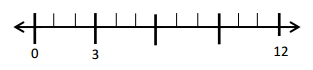
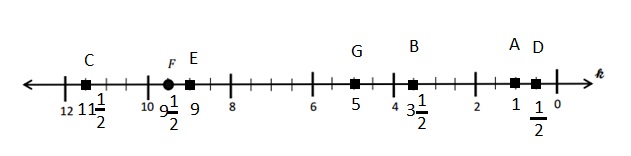
Number line k shows 12 units. Use number line k below to answer the questions.
Eureka Math Grade 5 Module 6 Lesson 1 Homework Answer Key 9
a. Plot a point at 1. Label it A.
b. Label a point that lies at 3\(\frac{1}{2}\) as B.
c. Label a point, C, whose distance from zero is 8 units farther than that of B.
The coordinate of C is __________.
d. Plot a point, D, whose distance from zero is \(\frac{6}{2}\) less than that of B.
The coordinate of D is __________.
e. What is the coordinate of the point that lies \(\frac{17}{2}\) farther from the origin than D? Label this point E.
f. What is the coordinate of the point that lies halfway between F and D? Label this point G.
Answer:
All the points are plotted and shown in the below figure .
Engage-NY-Eureka-Math-5th-Grade-Module-6-Lesson-1-Answer-Key-Eureka-Math-Grade-5-Module-6-Lesson-1-Homework-Answer-Key-Question-3
Explanation :
a Point A = 1
b Point B = 3\(\frac{1}{2}\)
c Point C = 8 units farther than that of B = 8 + 3\(\frac{1}{2}\) = 11 \(\frac{1}{2}\)
The coordinate of C is 11 \(\frac{1}{2}\)
d Point D = \(\frac{6}{2}\) less than that of B = 3\(\frac{1}{2}\) – \(\frac{6}{2}\)
= \(\frac{7}{2}\) – \(\frac{6}{2}\)  = \(\frac{1}{2}\)
The coordinate of D is \(\frac{1}{2}\)
e Point E = \(\frac{17}{2}\) farther from the origin than D = \(\frac{1}{2}\)  + \(\frac{17}{2}       \)  = \(\frac{18}{2}\) = 9
f  Point F = 9 \(\frac{1}{2}\)
Point G = halfway between F and D =( 9 \(\frac{1}{2}\) + \(\frac{1}{2}\) )/2 = 10/2 = 5

Question 4.
Mr. Baker’s fifth-grade class buried a time capsule in the field behind the school. They drew a map and marked the location of the capsule with an X so that his class can dig it up in ten years. What could Mr. Baker’s class have done to make the capsule easier to find?
Eureka Math Grade 5 Module 6 Lesson 1 Homework Answer Key 10
Answer:
The Location of the capsule is marked with x in the map. but to find easier he could add the number of feet’s from the school or a land mark or depth of the time capsule buried etc if given will help to find the time capsule easier even after ten years .

Eureka Math Grade 4 Module 5 Lesson 2 Answer Key

Students of Grade 4 can get a strong foundation on mathematics concepts by referring to the Eureka Math Book. It was developed by highly professional mathematics educators and the solutions prepared by them are in a concise manner for easy grasping. To achieve high scores in Grade 4, students need to solve all questions and exercises included in Eureka’s Math Grade 4 Book.

Engage NY Eureka Math 4th Grade Module 5 Lesson 2 Answer Key

Eureka Math Answer Key for Grade 4 aids teachers to differentiate instruction, building, and reinforcing foundational mathematics skills that alter from the classroom to real life.
With the help of the Eureka Primary School Grade 4 Answer Key, You can think deeply regarding what you are learning, and you will really learn math easily just like that. So teachers and students can find this Eureka Answer Key for Grade 4 more helpful in raising students’ scores and supporting teachers to educate the students.

Eureka Math Grade 4 Module 5 Lesson 2 Problem Set Answer Key

Question 1.
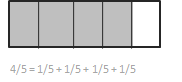
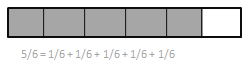
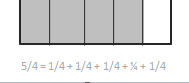
Step 1: Draw and shade a tape diagram of the given fraction.
Step 2: Record the decomposition as a sum of unit fractions.
Step 3: Record the decomposition of the fraction two more ways.
(The first one has been done for you.)
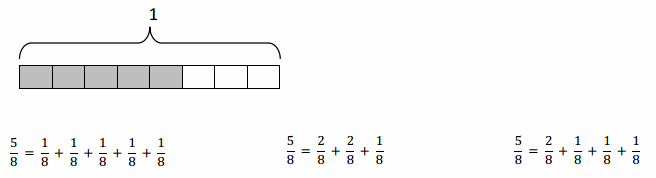
a. \(\frac{5}{8}\)
Eureka Math Grade 4 Module 5 Lesson 2 Problem Set Answer Key 1
b. \(\frac{9}{10}\)

Answer:
9/10 = 1/10 + 2/10 + 2/10 + 3/10 + 1/10.

Explanation:
In the above-given question,
given that,
draw and shade a tape diagram.
9/10 = 1/10 + 2/10 + 2/10 + 3/10 + 1/10.
9/10 = 5 /10 + 4 /10 + 1/10.
9/10 = 3/10 + 2/10 + 3/10 + 1/10.
Eureka-Math-Grade-4-Module-5-Lesson-2-Answer Key-1

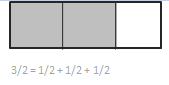
c. \(\frac{3}{2}\)

Answer:
3/2 = 1/2 + 2/2.

Explanation:
In the above-given question,
given that,
draw and shade a tape diagram.
3/2 = 1/2 + 2/2.
3/2 = 1/2 + 1/2 + 1/2.
Eureka-Math-Grade-4-Module-5-Lesson-2-Answer Key-2

Question 2.
Step 1: Draw and shade a tape diagram of the given fraction.
Step 2: Record the decomposition of the fraction in three different ways using number sentences.
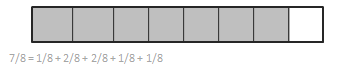
a. \(\frac{7}{8}\)

Answer:
7/8 = 1/8 + 2/8 + 2/8 + 1/8 + 1/8.

Explanation:
In the above-given question,
given that,
draw and shade a tape diagram.
7/8 = 1/8 + 2/8 + 2/8 + 1/8 + 1/8.
7/8 = 1 /8 + 4 /10 + 2/8.
7/8 = 1/8 + 2/8 + 3/8 + 1/8.
Eureka-Math-Grade-4-Module-5-Lesson-2-Answer Key-3
b. \(\frac{5}{3}\)

Answer:
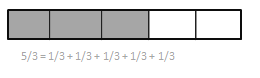
5/3 = 1/3 + 1/3 + 1/3 + 1/3 + 1/3.

Explanation:
In the above-given question,
given that,
draw and shade a tape diagram.
5/3 = 1/3 + 1/3 + 1/3 + 1/3 + 1/3.
5/3 = 1 /3 + 2/3 + 2/3.
5/3 = 1/3 + 2/3 + 1/3 + 1/3.
Eureka-Math-Grade-4-Module-5-Lesson-2-Answer Key-4

c. \(\frac{7}{5}\)

Answer:
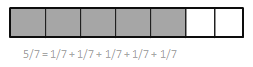
5/7 = 1/7 + 1/7 + 1/7 + 1/7 + 1/7.

Explanation:
In the above-given question,
given that,
draw and shade a tape diagram.
5/7 = 1/7 + 1/7 + 1/7 + 1/7 + 1/7.
5/7 = 1 /7 + 2/7 + 2/7.
5/7 = 1/7 + 1/7 + 2/7 + 1/7.
Eureka-Math-Grade-4-Module-5-Lesson-2-Answer Key-5

d. 1\(\frac{1}{3}\)

Answer:
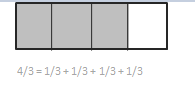
4/3 = 1/3 + 1/3 + 1/3 + 1/3.

Explanation:
In the above-given question,
given that,
draw and shade a tape diagram.
4/3 = 1/3 + 1/3 + 1/3 + 1/3.
4/3 = 1 /3 + 2/3 + 1/3.
4/3 = 1/3 + 1/3 + 2/3.
Eureka-Math-Grade-4-Module-5-Lesson-2-Answer Key-6

Eureka Math Grade 4 Module 5 Lesson 2 Exit Ticket Answer Key

Step 1: Draw and shade a tape diagram of the given fraction.
Step 2: Record the decomposition of the fraction in three different ways using number sentences.
\(\frac{4}{7}\)

Answer:
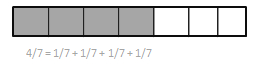
4/7 = 1/7 + 1/7 + 1/7 + 1/7.

Explanation:
In the above-given question,
given that,
draw and shade a tape diagram.
4/7 = 1/7 + 1/7 + 1/7 + 1/7.
4/7 = 1 /7 + 2/7 + 1/7.
4/7 = 1/7 + 1/7 + 2/7.

Eureka-Math-Grade-4-Module-5-Lesson-2-Answer Key-7

Eureka Math Grade 4 Module 5 Lesson 2 Homework Answer Key

Question 1.
Step 1: Draw and shade a tape diagram of the given fraction.
Step 2: Record the decomposition as a sum of unit fractions.
Step 3: Record the decomposition of the fraction two more ways.
(The first one has been done for you.)
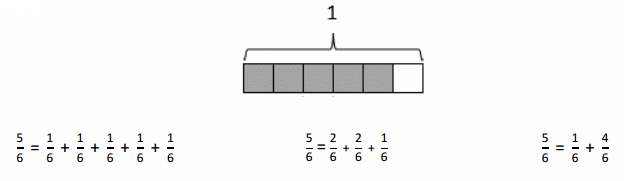
a. \(\frac{5}{6}\)
Eureka Math 4th Grade Module 5 Lesson 2 Homework Answer Key 5
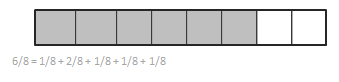
b. \(\frac{6}{8}\)

Answer:
6/8 = 1/8 + 1/8 + 1/8 + 1/8 + 1/8 + 1/8.

Explanation:
In the above-given question,
given that,
draw and shade a tape diagram.
6/8 = 1/8 + 1/8 + 1/8 + 1/8 + 1/8 + 1/8.
6/8 = 1 /8 + 2/8 + 2/8 + 1/8.
6/8 = 1/8 + 2/8 + 3/8.
Eureka-Math-Grade-4-Module-5-Lesson-2-Answer Key-8

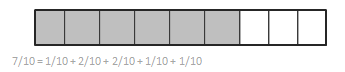
c. \(\frac{7}{10}\)

Answer:
7/10 = 1/10 + 2/10 + 2/10 + 1/10 + 2/10 + 2/10.

Explanation:
In the above-given question,
given that,
draw and shade a tape diagram.
7/10 = 1/10 + 2/10 + 2/10 + 1/10 + 2/10 + 2/10.
7/10 = 1 /10 + 2/10 + 4/10 + 3/10.
7/10 = 1/10 + 2/10 + 7/10.
Eureka-Math-Grade-4-Module-5-Lesson-2-Answer Key-9

Question 2.
Step 1: Draw and shade a tape diagram of the given fraction.
Step 2: Record the decomposition of the fraction in three different ways using number sentences.
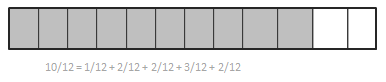
a. \(\frac{10}{12}\)

Answer:
10/12 = 1/12 + 2/12 + 3/12 + 1/12 + 2/12 + 1/12.

Explanation:
In the above-given question,
given that,
draw and shade a tape diagram.
10/12 = 1/12 + 2/12 + 3/12 + 1/12 + 2/12 + 1/12.
10/12 = 1 /12 + 2/12 + 4/12 + 3/12.
10/12 = 1/12 + 2/12 + 7/12.

Eureka-Math-Grade-4-Module-5-Lesson-2-Answer Key-10
b. \(\frac{5}{4}\)

Answer:
5/4 = 1/4 + 2/4 + 1/4 + 1/4.

Explanation:
In the above-given question,
given that,
draw and shade a tape diagram.
5/4 = 1/4 + 2/4 + 1/4 + 1/4.
5/4 = 1 /4 + 24 + 1/4 + 1/4.
5/4 = 1/4 + 2/4 + 1/4.
Eureka-Math-Grade-4-Module-5-Lesson-2-Answer Key-11

c. \(\frac{6}{5}\)

Answer:
5/6 = 1/6 + 2/6 + 1/6 + 1/6.

Explanation:
In the above-given question,
given that,
draw and shade a tape diagram.
5/6 = 1/6 + 2/6 + 1/6 + 1/6.
5/6 = 1 /6 + 2/6+ 1/6 + 1/6.
5/6 = 1/6 + 2/6 + 2/6.
Eureka-Math-Grade-4-Module-5-Lesson-2-Answer Key-12

d. 1\(\frac{1}{4}\)

Answer:
5/4 = 1/4 + 1/4 + 1/4 + 1/4 + 1/4.

Explanation:
In the above-given question,
given that,
draw and shade a tape diagram.
5/4 = 1/4 + 1/4 + 1/4 + 1/4 + 1/4.
5/4 = 1 /4 + 2/4 + 1/4 + 1/4.
5/4 = 1/4 + 2/4 + 2/4.
Eureka-Math-Grade-4-Module-5-Lesson-2-Answer Key-13

Eureka Math Grade 4 Module 6 Lesson 15 Answer Key

Students of Grade 4 can get a strong foundation on mathematics concepts by referring to the Eureka Math Book. It was developed by highly professional mathematics educators and the solutions prepared by them are in a concise manner for easy grasping. To achieve high scores in Grade 4, students need to solve all questions and exercises included in Eureka’s Math Grade 4 Book.

Engage NY Eureka Math 4th Grade Module 6 Lesson 15 Answer Key

Eureka Math Answer Key for Grade 4 aids teachers to differentiate instruction, building, and reinforcing foundational mathematics skills that alter from the classroom to real life.
With the help of the Eureka Primary School Grade 4 Answer Key, You can think deeply regarding what you are learning, and you will really learn math easily just like that. So teachers and students can find this Eureka Answer Key for Grade 4 more helpful in raising students’ scores.

Eureka Math Grade 4 Module 6 Lesson 15 Problem Set Answer Key

Engage NY Math Grade 4 Module 6 Lesson 15 Problem Set Answer Key 1
Question 1.
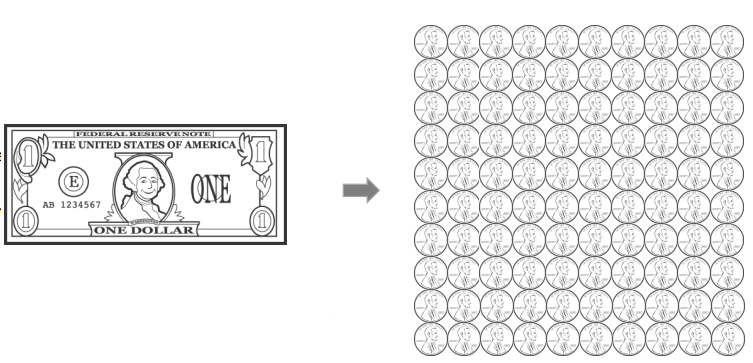
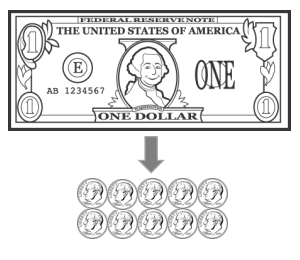
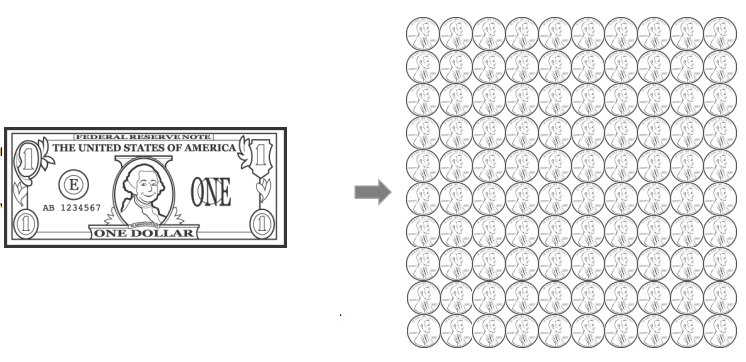
100 pennies = $___.______ 100₵ = \(\frac{}{100}\) dollar
Answer:

Question 2.
1 penny = $___.______ 1₵ = \(\frac{}{100}\) dollar
Answer:

Question 3.
6 pennies = $___.______ 6₵ = \(\frac{}{100}\) dollar
Answer:

Question 4.
10 pennies = $___.______ 10₵ = \(\frac{}{100}\) dollar
Answer:

Question 5.
26 pennies = $___.______ 26₵ = \(\frac{}{100}\) dollar
Answer:

Engage NY Math Grade 4 Module 6 Lesson 15 Problem Set Answer Key 2
Question 6.
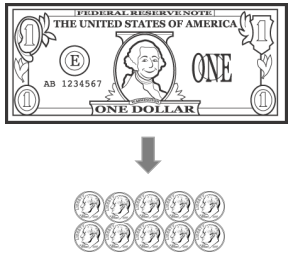
10 dimes = $___.______ 100₵ = \(\frac{}{10}\) dollar
Answer:

Question 7.
1 dime = $___.______ 10₵ = \(\frac{}{10}\) dollar
Answer:

Question 8.
3 dimes = $___.______ 30₵ = \(\frac{}{10}\) dollar
Answer:

Question 9.
5 dimes = $___.______ 50₵ = \(\frac{}{10}\) dollar
Answer:

Question 10.
6 dimes = $___.______ 60₵ = \(\frac{}{10}\) dollar
Answer:

Engage NY Math Grade 4 Module 6 Lesson 15 Problem Set Answer Key 3
Question 11.
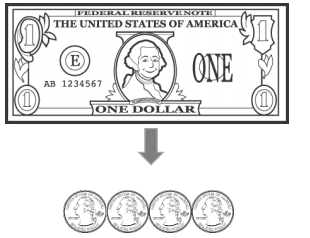
4 quarters = $___.______ 100₵ = \(\frac{}{100}\) dollar
Answer:

Question 12.
1 quarter = $___.______ 25₵ = \(\frac{}{100}\) dollar
Answer:

Question 13.
2 quarters = $___.______ 50₵ = \(\frac{}{100}\) dollar
Answer:

Question 14.
3 quarters = $___.______ 75₵ = \(\frac{}{100}\) dollar
Answer:

Solve. Give the total amount of money in fraction and decimal form.
Question 15.
3 dimes and 8 pennies
Answer:

Question 16.
8 dimes and 23 pennies
Answer:

Question 17.
3 quarters 3 dimes and 5 pennies
Answer:

Question 18.
236 cents is what fraction of a dollar?
Answer:

Solve. Express the answer as a decimal.
Question 19.
2 dollars 17 pennies + 4 dollars 2 quarters
Answer:

Question 20.
3 dollars 8 dimes + 1 dollar 2 quarters 5 pennies
Answer:

Question 21.
9 dollars 9 dimes + 4 dollars 3 quarters 16 pennies
Answer:

Eureka Math Grade 4 Module 6 Lesson 15 Exit Ticket Answer Key

Solve. Give the total amount of money in fraction and decimal form.
Question 1.
2 quarters and 3 dimes
Answer:

Question 2.
1 quarter 7 dimes and 23 pennies
Answer:

Solve. Express the answer as a decimal.
Question 3.
2 dollars 1 quarter 14 pennies + 3 dollars 2 quarters 3 dimes
Answer:

Eureka Math Grade 4 Module 6 Lesson 15 Homework Answer Key

Eureka Math Grade 4 Module 6 Lesson 15 Homework Answer Key 1
Question 1.
100 pennies = $___.______ 100₵ = \(\frac{}{100}\) dollar
Answer:

Question 2.
100 pennies = $___.______ 100₵ = \(\frac{}{100}\) dollar
Answer:

Question 3.
3 pennies = $___.______ 3₵ = \(\frac{}{100}\) dollar
Answer:

Question 4.
20 pennies = $___.______ 20₵ = \(\frac{}{100}\) dollar
Answer:

Question 5.
37 pennies = $___.______ 37₵ = \(\frac{}{100}\) dollar
Answer:

Eureka Math Grade 4 Module 6 Lesson 15 Homework Answer Key 2
Question 6.
10 dimes = $___.______ 100₵ = \(\frac{}{10}\) dollar
Answer:

Question 7.
2 dimes = $___.______ 20₵ = \(\frac{}{10}\) dollar
Answer:

Question 8.
4 dimes = $___.______ 40₵ = \(\frac{}{10}\) dollar
Answer:

Question 9.
6 dimes = $___.______ 60₵ = \(\frac{}{10}\) dollar
Answer:

Question 10.
9 dimes = $___.______ 90₵ = \(\frac{}{10}\) dollar
Answer:

Eureka Math Grade 4 Module 6 Lesson 15 Homework Answer Key 3
Question 11.
3 quarters = $___.______ 75₵ = \(\frac{}{100}\) dollar
Answer:

Question 12.
2 quarters = $___.______ 50₵ = \(\frac{}{100}\) dollar
Answer:

Question 13.
4 quarters = $___.______ 100₵ = \(\frac{}{100}\) dollar
Answer:

Question 14.
1 quarter = $___.______ 25₵ = \(\frac{}{100}\) dollar
Answer:

Solve. Give the total amount of money in fraction and decimal form.
Question 15.
5 dimes and 8 pennies
Answer:

Question 16.
3 quarters and 13 pennies
Answer:

Question 17.
3 quarters 7 dimes and 16 pennies
Answer:

Question 18.
187 cents is what fraction of a dollar?
Answer:

Solve. Express the answer in decimal form.
Question 19.
1 dollar 2 dimes 13 pennies + 2 dollars 3 quarters
Answer:

Question 20.
2 dollars 6 dimes + 2 dollars 2 quarters 16 pennies
Answer:

Question 21.
8 dollars 8 dimes + 7 dollars 1 quarter 8 dimes
Answer:

Eureka Math Grade 4 Module 3 Lesson 19 Answer Key

Engage NY Eureka Math 4th Grade Module 3 Lesson 19 Answer Key

Eureka Math Grade 4 Module 3 Lesson 19 Sprint Answer Key

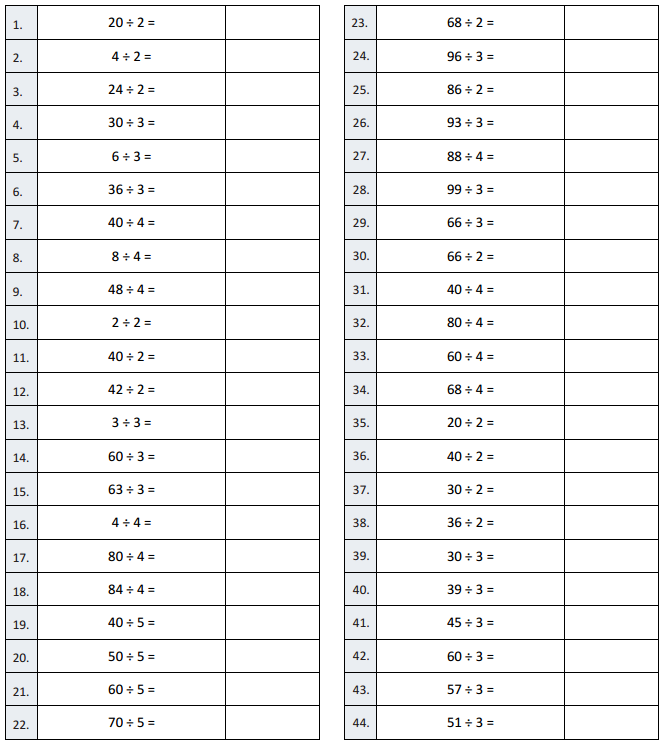
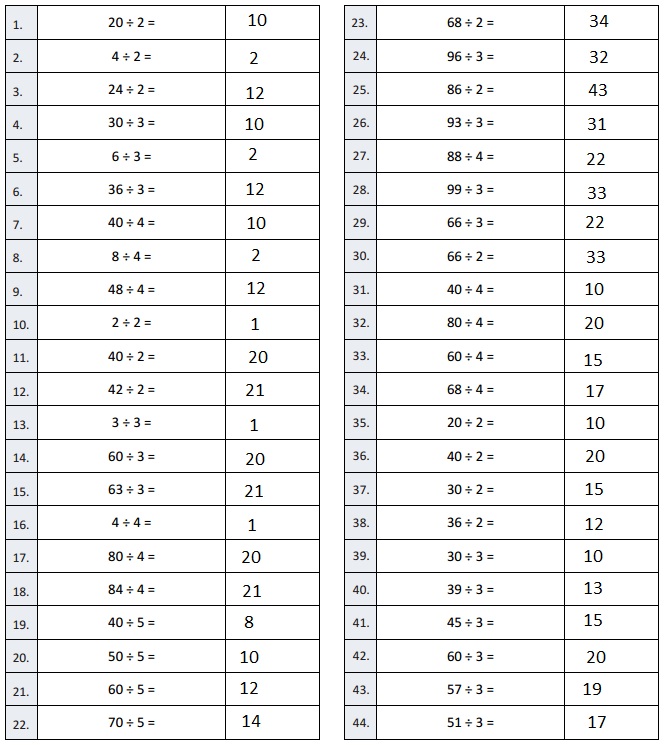
Mental Division
Eureka Math Grade 4 Module 3 Lesson 19 Sprint Set Answer Key 1
Eureka Math Grade 4 Module 3 Lesson 19 Answer Key-1

Question 1.
20 ÷ 2 =
Answer:
20 ÷ 2 = 10,

Explanation :
Given expression 20 ÷ 2  when 20 is divided by 2
we get 10, So quotient is 10 and remainder is 0 and
(2 X 10 = 20).

Question 2.
4 ÷ 2 =
Answer:
4 ÷ 2 = 2,

Explanation :
Given expression 4 ÷ 2  when 4 is divided by 2
we get 2, So quotient is 2 and remainder is 0 and
(2 X 2 = 4).

Question 3.
24 ÷ 2 =
Answer:
24 ÷ 2 = 12,

Explanation :
Given expression 24 ÷ 2  when 24 is divided by 2
we get 12, So quotient is 12 and remainder is 0 and
(2 X 12 = 24).

Question 4.
30 ÷ 3 =
Answer:
30 ÷ 3 = 10,

Explanation :
Given expression 30 ÷ 3  when 30 is divided by 3
we get 10, So quotient is 10 and remainder is 0 and
(3 X 10 = 30).

Question 5.
6 ÷ 3 =
Answer:
6 ÷ 3 = 2,

Explanation :
Given expression 6 ÷ 3  when 6 is divided by 3
we get 2, So quotient is 2 and remainder is 0 and
(3 X 2 = 6).

Question 6.
36 ÷ 3 =
Answer:
36 ÷ 3 = 12,

Explanation :
Given expression 36 ÷ 3  when 6 is divided by 3
we get 12, So quotient is 12 and remainder is 0 and
(3 X 12 = 36).

Question 7.
40 ÷ 4 =
Answer:
40 ÷ 4 = 10,

Explanation :
Given expression 40 ÷ 4  when 40 is divided by 4
we get 10, So quotient is 10 and remainder is 0 and
(4 X 10 = 40).

Question 8.
8 ÷ 4 =
Answer:
8 ÷ 4 = 2,

Explanation :
Given expression 40 ÷ 4  when 40 is divided by 4
we get 10, So quotient is 10 and remainder is 0 and
(4 X 10 = 40).

Question 9.
48 ÷ 4 =
Answer:
48 ÷ 4 = 12,

Explanation :
Given expression 48 ÷ 4  when 48 is divided by 4
we get 12, So quotient is 12 and remainder is 0 and
(4 X 12 = 46).

Question 10.
2 ÷ 2 =
Answer:
2 ÷ 2 = 1,

Explanation :
Given expression 2 ÷ 2  when 2 is divided by 2
we get 1, So quotient is 1 and remainder is 0 and
(2 X 1 = 2).

Question 11.
40 ÷ 2 =
Answer:
40 ÷ 2 = 20,

Explanation :
Given expression 40 ÷ 2  when 40 is divided by 2
we get 20, So quotient is 20 and remainder is 0 and
(2 X 20 = 40).

Question 12.
42 ÷ 2 =
Answer:
42 ÷ 2 = 21,

Explanation :
Given expression 42 ÷ 2  when 42 is divided by 2
we get 21, So quotient is 21 and remainder is 0 and
(2 X 21 = 42).

Question 13.
3 ÷ 3 =
Answer:
3 ÷ 3 = 1,

Explanation :
Given expression 3 ÷ 3 when 1 is divided by 3
we get 3, So quotient is 1 and remainder is 0 and
(3 X 1 = 3).

Question 14.
60 ÷ 3 =
Answer:
60 ÷ 3 =20,

Explanation :
Given expression 60 ÷ 3 when 60 is divided by 3
we get 20, So quotient is 20 and remainder is 0 and
(3 X 20 = 60).

Question 15.
63 ÷ 3 =
Answer:
63 ÷ 3 = 21,

Explanation :
Given expression 63 ÷ 3 when 63 is divided by 3
we get 21, So quotient is 21 and remainder is 0 and
(3 X 21 = 63).

Question 16.
4 ÷ 4 =
Answer:
4 ÷ 4 = 1,

Explanation :
Given expression 4 ÷ 4 when 4 is divided by 4
we get 1, So quotient is 1 and remainder is 0 and
(4 X 1 = 4).

Question 17.
80 ÷ 4 =
Answer:
80 ÷ 4 = 20,

Explanation :
Given expression 80 ÷ 4 when 80 is divided by 4
we get 20, So quotient is 20 and remainder is 0 and
(4 X 20 = 80).

Question 18.
84 ÷ 4 =
Answer:
84 ÷ 4 = 21,

Explanation :
Given expression 84 ÷ 4 when 84 is divided by 4
we get 21, So quotient is 21 and remainder is 0 and
(4 X 21 = 84).

Question 19.
40 ÷ 5 =
Answer:
40 ÷ 5 = 8,

Explanation :
Given expression 40 ÷ 5 when 40 is divided by 5
we get 8, So quotient is 8 and remainder is 0 and
(5 X 8 = 40).

Question 20.
50 ÷ 5 =
Answer:
50 ÷ 5 = 10,

Explanation :
Given expression 50 ÷ 5 when 50 is divided by 5
we get 10, So quotient is 10 and remainder is 0 and
(5 X 10 = 50).

Question 21.
60 ÷ 5 =
Answer:
60 ÷ 5 = 12,

Explanation :
Given expression 60 ÷ 5 when 60 is divided by 5
we get 12, So quotient is 12 and remainder is 0 and
(5 X 12 = 60).

Question 22.
70 ÷ 5 =
Answer:
70 ÷ 5 = 14,

Explanation :
Given expression 70 ÷ 5 when 70 is divided by 5
we get 14, So quotient is 14 and remainder is 0 and
(5 X 14 = 70).

Question 23.
68 ÷ 2 =
Answer:
68 ÷ 2 = 34,

Explanation :
Given expression 68 ÷ 2 when 68 is divided by 2
we get 34, So quotient is 34 and remainder is 0 and
(2 X 34 = 68).

Question 24.
96 ÷ 3 =
Answer:
96 ÷ 3 = 32,

Explanation :
Given expression 96 ÷ 3 when 96 is divided by 3
we get 32, So quotient is 32 and remainder is 0 and
(3 X 32 = 96).

Question 25.
86 ÷ 2 =
Answer:
86 ÷ 2 = 43,

Explanation :
Given expression 86 ÷ 2 when 86 is divided by 2
we get 43, So quotient is 43 and remainder is 0 and
(2 X 43 = 86).

Question 26.
93 ÷ 3 =
Answer:
93 ÷ 3 = 31,

Explanation :
Given expression 93 ÷ 3 when 93 is divided by 3
we get 31, So quotient is 31 and remainder is 0 and
(3 X 31 = 93).

Question 27.
88 ÷ 4 =
Answer:
88 ÷ 4 = 22,

Explanation :
Given expression 88 ÷ 4 when 88 is divided by 4
we get 22, So quotient is 22 and remainder is 0 and
(4 X 22 = 88).

Question 28.
99 ÷ 3 =
Answer:
99 ÷ 3 = 33,

Explanation :
Given expression 99 ÷ 3 when 99 is divided by 3
we get 33, So quotient is 33 and remainder is 0 and
(3 X 33 = 99).

Question 29.
66 ÷ 3 =
Answer:
66 ÷ 3 = 22,

Explanation :
Given expression 66 ÷ 3 when 66 is divided by 3
we get 22, So quotient is 22 and remainder is 0 and
(22 X 3 = 66).

Question 30.
66 ÷ 2 =
Answer:
66 ÷ 2 = 33,

Explanation :
Given expression 66 ÷ 2 when 66 is divided by 2
we get 33, So quotient is 33 and remainder is 0 and
(33 X 2 = 66).

Question 31.
40 ÷ 4 =
Answer:
40 ÷ 4 = 10,

Explanation :
Given expression 40 ÷ 4 when 40 is divided by 4
we get 10, So quotient is 10 and remainder is 0 and
(4 X 10 = 40).

Question 32.
80 ÷ 4 =
Answer:
80 ÷ 4 = 20,

Explanation :
Given expression 80 ÷ 4 when 80 is divided by 4
we get 20, So quotient is 20 and remainder is 0 and
(4 X 20 = 80).

Question 33.
60 ÷ 4 =
Answer:
60 ÷ 4 = 15,

Explanation :
Given expression 60 ÷ 4 when 60 is divided by 4
we get 15, So quotient is 15 and remainder is 0 and
(4 X 15 = 60).

Question 34.
68 ÷ 4 =
Answer:
68 ÷ 4 = 17,

Explanation :
Given expression 68 ÷ 4 when 68 is divided by 4
we get 17, So quotient is 17 and remainder is 0 and
(4 X 17 = 68).

Question 35.
20 ÷ 2 =
Answer:
20 ÷ 2 = 10,

Explanation :
Given expression 20 ÷ 2 when 20 is divided by 2
we get 10, So quotient is 10 and remainder is 0 and
(2 X 10 = 20).

Question 36.
40 ÷ 2 =
Answer:
40 ÷ 2 = 20,

Explanation :
Given expression 40 ÷ 2 when 40 is divided by 2
we get 20, So quotient is 20 and remainder is 0 and
(2 X 20 = 40).

Question 37.
30 ÷ 2 =
Answer:
30 ÷ 2 = 15,

Explanation :
Given expression 30 ÷ 2 when 30 is divided by 2
we get 15, So quotient is 15 and remainder is 0 and
(2 X 15 = 30).

Question 38.
36 ÷ 2 =
Answer:
36 ÷ 2 = 18,

Explanation :
Given expression 36 ÷ 2 when 36 is divided by 2
we get 18, So quotient is 18 and remainder is 0 and
(2 X 18 = 36).

Question 39.
30 ÷ 3 =
Answer:
30 ÷ 3 = 10,

Explanation :
Given expression 30 ÷ 3 when 30 is divided by 3
we get 10, So quotient is 10 and remainder is 0 and
(3 X 10 = 30).

Question 40.
39 ÷ 3 =
Answer:
39 ÷ 3 = 13,

Explanation :
Given expression 39 ÷ 3 when 39 is divided by 3
we get 13, So quotient is 13 and remainder is 0 and
(3 X 13 = 39).

Question 41.
45 ÷ 3 =
Answer:
45 ÷ 3 = 15,

Explanation :
Given expression 45 ÷ 3 when 45 is divided by 3
we get 15, So quotient is 15 and remainder is 0 and
(3 X 15 = 45).

Question 42.
60 ÷ 3 =
Answer:
60 ÷ 3 = 20,

Explanation :
Given expression 60 ÷ 3 when 60 is divided by 3
we get 20, So quotient is 20 and remainder is 0 and
(3 X 20 = 60).

Question 43.
57 ÷ 3 =
Answer:
57 ÷ 3 = 19,

Explanation :
Given expression 57 ÷ 3 when 57 is divided by 3
we get 19, So quotient is 19 and remainder is 0 and
(3 X 19 = 57).

Question 44.
51 ÷ 3 =
Answer:
51 ÷ 3 = 17,

Explanation :
Given expression 51 ÷ 3 when 51 is divided by 3
we get 17, So quotient is 17 and remainder is 0 and
(3 X 17 = 51).

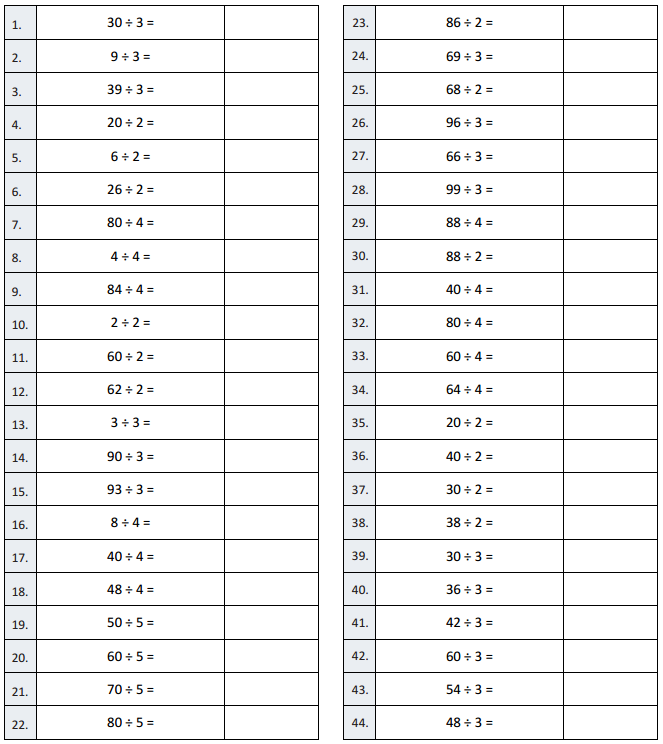
Mental Division
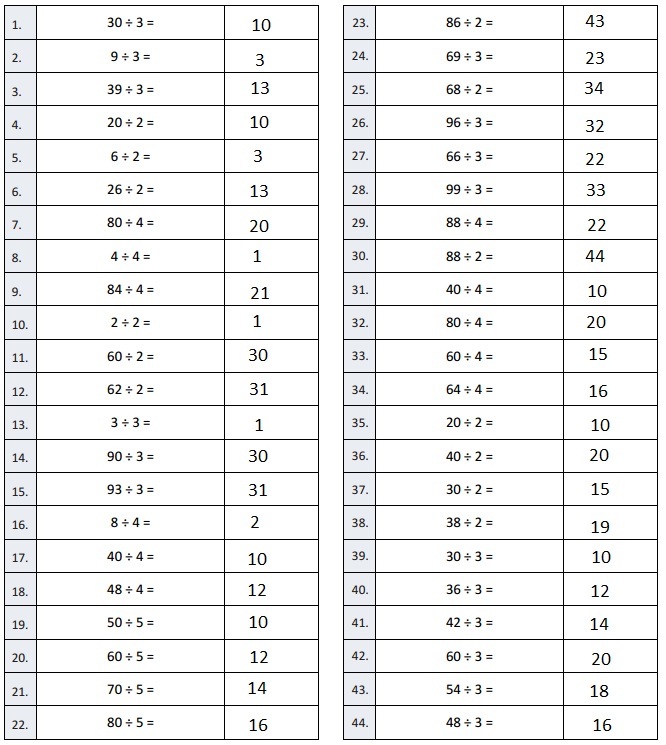
Eureka Math Grade 4 Module 3 Lesson 19 Sprint Set Answer Key 2

Eureka Math Grade 4 Module 3 Lesson 19 Answer Key-2

Question 1.
30 ÷ 3 =
Answer:
30 ÷ 3 = 10,

Explanation :
Given expression 30 ÷ 3 when 30 is divided by 3
we get 10, So quotient is 10 and remainder is 0 and
(3 X 10 = 30).

Question 2.
9 ÷ 3 =
Answer:
9 ÷ 3 = 3,

Explanation :
Given expression 9 ÷ 3 when 9 is divided by 3
we get 3, So quotient is 3 and remainder is 0 and
(3 X 3 = 9).

Question 3.
39 ÷ 3 =
Answer:
39 ÷ 3 = 13,

Explanation :
Given expression 39 ÷ 3 when 39 is divided by 3
we get 13, So quotient is 13 and remainder is 0 and
(3 X 13 = 39).

Question 4.
20 ÷ 2 =
Answer:
20 ÷ 2 = 10,

Explanation :
Given expression 20 ÷ 2 when 20 is divided by 2
we get 10, So quotient is 10 and remainder is 0 and
(2 X 10 = 20).

Question 5.
6 ÷ 2 =
Answer:
6 ÷ 2 = 3,

Explanation :
Given expression 6 ÷ 2 when 6 is divided by 2
we get 3, So quotient is 3 and remainder is 0 and
(2 X 3 = 6).

Question 6.
26 ÷ 2 =
Answer:
26 ÷ 2 = 13,

Explanation :
Given expression 26 ÷ 2 when 26 is divided by 2
we get 13, So quotient is 13 and remainder is 0 and
(2 X 13 = 26).

Question 7.
80 ÷ 4 =
Answer:
80 ÷ 4 = 20,

Explanation :
Given expression 80 ÷ 4 when 80 is divided by 4
we get 20, So quotient is 20 and remainder is 0 and
(4 X 20 = 80).

Question 8.
4 ÷ 4 =
Answer:
4 ÷ 4 = 1,

Explanation :
Given expression 4 ÷ 4 when 4 is divided by 4
we get 1, So quotient is 4 and remainder is 0 and
(4 X 1 = 4).

Question 9.
84 ÷ 4 =
Answer:
84 ÷ 4 = 21,

Explanation :
Given expression 84 ÷ 4 when 84 is divided by 4
we get 21, So quotient is 21 and remainder is 0 and
(4 X 21 = 84).

Question 10.
2 ÷ 2 =
Answer:
2 ÷ 2 = 1,

Explanation :
Given expression 2 ÷ 2 when 2 is divided by 2
we get 1, So quotient is 1 and remainder is 0 and
(2 X 1 = 2).

Question 11.
60 ÷ 2 =
Answer:
60 ÷ 2 = 30,

Explanation :
Given expression 60 ÷ 2 when 60 is divided by 2
we get 30, So quotient is 30 and remainder is 0 and
(2 X 30 = 60).

Question 12.
62 ÷ 2 =
Answer:
62 ÷ 2 = 31,

Explanation :
Given expression 62 ÷ 2 when 62 is divided by 2
we get 31, So quotient is 31 and remainder is 0 and
(2 X 31 = 62).

Question 13.
3 ÷ 3 =
Answer:
3 ÷ 3 = 1,

Explanation :
Given expression 3 ÷ 3 when 3 is divided by 3
we get 1, So quotient is 1 and remainder is 0 and
(3 X 1 = 3).

Question 14.
90 ÷ 3 =
Answer:
90 ÷ 3 = 30,

Explanation :
Given expression 90 ÷ 3 when 90 is divided by 3
we get 30, So quotient is 30 and remainder is 0 and
(3 X 30 = 90).

Question 15.
93 ÷ 3 =
Answer:
93 ÷ 3 = 31,

Explanation :
Given expression 93 ÷ 3 when 93 is divided by 3
we get 31, So quotient is 31 and remainder is 0 and
(3 X 31 = 93).

Question 16.
8 ÷ 4 =
Answer:
8 ÷ 4 = 2,

Explanation :
Given expression 8 ÷ 4 when 8 is divided by 4
we get 2, So quotient is 2 and remainder is 0 and
(4 X 2 = 8).

Question 17.
40 ÷ 4 =
Answer:
40 ÷ 4 = 10,

Explanation :
Given expression 40 ÷ 4 when 40 is divided by 4
we get 10, So quotient is 10 and remainder is 0 and
(4 X 10 = 40).

Question 18.
48 ÷ 4 =
Answer:
48 ÷ 4 = 12,

Explanation :
Given expression 48 ÷ 4 when 48 is divided by 4
we get 12, So quotient is 12 and remainder is 0 and
(4 X 12 = 48).

Question 19.
50 ÷ 5 =
Answer:
50 ÷ 5 = 10,

Explanation :
Given expression 50 ÷ 5 when 50 is divided by 5
we get 10, So quotient is 10 and remainder is 0 and
(5 X 10 = 50).

Question 20.
60 ÷ 5 =
Answer:
60 ÷ 5 = 12,

Explanation :
Given expression 60 ÷ 5 when 60 is divided by 5
we get 12, So quotient is  and remainder is 0 and
(5 X 12 = 60).

Question 21.
70 ÷ 5 =
Answer:
70 ÷ 5 = 14,

Explanation :
Given expression 70 ÷ 5 when 70 is divided by 5
we get 14, So quotient is 14 and remainder is 0 and
(5 X 14 = 70).

Question 22.
80 ÷ 5 =
Answer:
80 ÷ 5 = 16,

Explanation :
Given expression 80 ÷ 5 when 80 is divided by 5
we get 16, So quotient is 16 and remainder is 0 and
(5 X 16 = 80).

Question 23.
86 ÷ 2 =
Answer:
86 ÷ 2 = 43,

Explanation :
Given expression 86 ÷ 2 when 86 is divided by 2
we get 43, So quotient is 43 and remainder is 0 and
(2 X 43 = 86).

Question 24.
69 ÷ 3 =
Answer:
69 ÷ 3 = 23,

Explanation :
Given expression 69 ÷ 3 when 69 is divided by 3
we get 23, So quotient is 23 and remainder is 0 and
(3 X 23 = 69).

Question 25.
68 ÷ 2 =
Answer:
68 ÷ 2 = 34,

Explanation :
Given expression 68 ÷ 2 when 68 is divided by 2
we get 34, So quotient is 34 and remainder is 0 and
(2 X 34 = 68).

Question 26.
96 ÷ 3 =
Answer:
96 ÷ 3 = 32,

Explanation :
Given expression 96 ÷ 3 when 96 is divided by 3
we get 32, So quotient is 32 and remainder is 0 and
(3 X 32 = 96).

Question 27.
66 ÷ 3 =
Answer:
66 ÷ 3 = 22,

Explanation :
Given expression 66 ÷ 3 when 66 is divided by 3
we get 22, So quotient is 22 and remainder is 0 and
(3 X 22 = 66).

Question 28.
99 ÷ 3 =
Answer:
99 ÷ 3 = 33,

Explanation :
Given expression 99 ÷ 3 when 99 is divided by 3
we get 33, So quotient is 33 and remainder is 0 and
(3 X 33 = 99).

Question 29.
88 ÷ 4 =
Answer:
88 ÷ 4 = 22,

Explanation :
Given expression 88 ÷ 4 when 88 is divided by 4
we get 22, So quotient is 22 and remainder is 0 and
(4 X 22 = 88).

Question 30.
88 ÷ 2 =
Answer:
88 ÷ 2 = 44,

Explanation :
Given expression 88 ÷ 2 when 88 is divided by 2
we get 44, So quotient is 44 and remainder is 0 and
(2 X 44 = 88).

Question 31.
40 ÷ 4 =
Answer:
40 ÷ 4 = 10,

Explanation :
Given expression 40 ÷ 10 when 40 is divided by 4
we get 10, So quotient is 10 and remainder is 0 and
(4 X 10 = 40).

Question 32.
80 ÷ 4 =
Answer:
80 ÷ 4 = 20,

Explanation :
Given expression 80 ÷ 4 when 80 is divided by 4
we get 20, So quotient is 20 and remainder is 0 and
(4 X 20 = 80).

Question 33.
60 ÷ 4 =
Answer:
60 ÷ 4 = 15,

Explanation :
Given expression 60 ÷ 4 when 60 is divided by 4
we get 15, So quotient is 15 and remainder is 0 and
(4 X 15 = 60).

Question 34.
64 ÷ 4 =
Answer:
64 ÷ 4 = 16,

Explanation :
Given expression 64 ÷ 4 when 64 is divided by 4
we get 16, So quotient is 16 and remainder is 0 and
(4 X 16 = 64).

Question 35.
20 ÷ 2 =
Answer:
20 ÷ 2 = 10,

Explanation :
Given expression 20 ÷ 2 when 20 is divided by 2
we get 10, So quotient is 10 and remainder is 0 and
(2 X 10 = 20).

Question 36.
40 ÷ 2 =
Answer:
40 ÷ 2 = 20,

Explanation :
Given expression 40 ÷ 2 when 40 is divided by 2
we get 20, So quotient is 20 and remainder is 0 and
(2 X 20 = 40).

Question 37.
30 ÷ 2 =
Answer:
30 ÷ 2 = 15,

Explanation :
Given expression 30 ÷ 2 when 30 is divided by 2
we get 15, So quotient is 15 and remainder is 0 and
(2 X 15 = 30).

Question 38.
38 ÷ 2 =
Answer:
38 ÷ 2 = 19,

Explanation :
Given expression 38 ÷ 2 when 38 is divided by 2
we get 19, So quotient is 19 and remainder is 0 and
(2 X 19 = 38).

Question 39.
30 ÷ 3 =
Answer:
30 ÷ 3 = 10,

Explanation :
Given expression 30 ÷ 3 when 30 is divided by 3
we get 10, So quotient is 10 and remainder is 0 and
(3 X 10 = 30).

Question 40.
36 ÷ 3 =
Answer:
36 ÷ 3 = 12,

Explanation :
Given expression 36 ÷ 3 when 36 is divided by 3
we get 12, So quotient is 12 and remainder is 0 and
(3 X 12 = 36).

Question 41.
42 ÷ 3 =
Answer:
42 ÷ 3 = 14,

Explanation :
Given expression 42 ÷ 3 when 42 is divided by 3
we get 14, So quotient is 14 and remainder is 0 and
(3 X 14 = 42).

Question 42.
60 ÷ 3 =
Answer:
60 ÷ 3 = 20,

Explanation :
Given expression 60 ÷ 3 when 60 is divided by 3
we get 20, So quotient is 20 and remainder is 0 and
(3 X 20 = 60).

Question 43.
54 ÷ 3 =
Answer:
54 ÷ 3 = 18,

Explanation :
Given expression 54 ÷ 3 when 54 is divided by 3
we get 18, So quotient is 18 and remainder is 0 and
(3 X 18 = 54).

Question 44.
48 ÷ 3 =
Answer:
48 ÷ 3 = 16,

Explanation :
Given expression 48 ÷ 3 when 48 is divided by 3
we get 16, So quotient is 16 and remainder is 0 and
(3 X 16 = 48).

Eureka Math Grade 4 Module 3 Lesson 19 Problem Set Answer Key

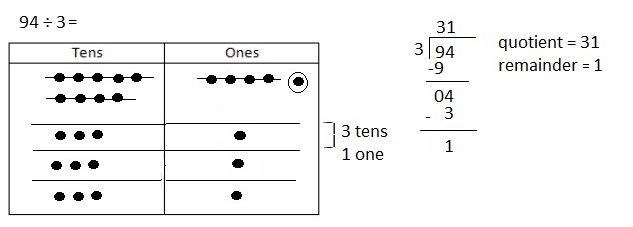
Question 1.
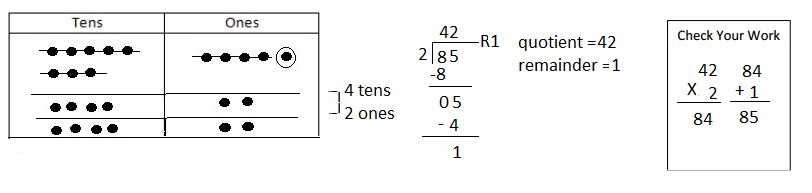
When you divide 94 by 3, there is a remainder of 1.
Model this problem with place value disks. In the place
value disk model, how did you show the remainder?
Answer:
Eureka Math Grade 4 Module 3 Lesson 19 Answer Key-3

I showed my remainder by circling the remaining one
in the ones place.

Explanation:
When we divide 94 by 3, there is a remainder of 1.
Modeled the problem with place value disks. In the place
value disk model, showed the remainder by circling the
remaining one in the ones place.

Question 2.
Cayman says that 94 ÷ 3 is 30 with a remainder of 4.
He reasons this is correct because (3 × 30) + 4 = 94.
What mistake has Cayman made? Explain how he can
correct his work.
Answer:
Cayman mistake is that his remainder is greater than
his divisor means he can divide more.
Instead of 30 groups he can make 31 groups.

Explanation:
Given Cayman says that 94 ÷ 3 is 30 with a remainder of 4.
He reasons this is correct because (3 × 30) + 4 = 94.
Instead of 30 groups he can make 31 groups,
94 ÷ 3 when 94 is divided by 3
we get 31 as quotient and remainder is 1.

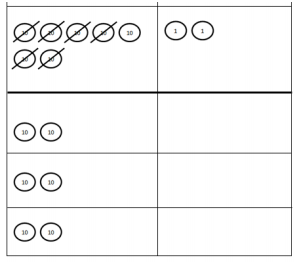
Question 3.
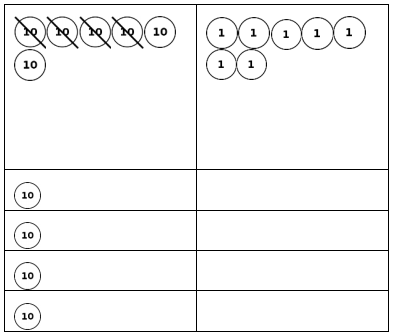
The place value disk model is showing 72 ÷ 3.
Complete the model. Explain what happens to the
1 ten that is remaining in the tens column.
Eureka Math Grade 4 Module 3 Lesson 19 Problem Set Answer Key 3
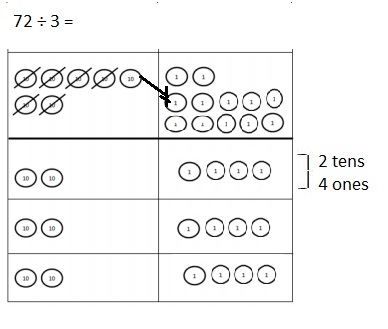
Answer:
The 1 ten remaining gets decomposed into
10 ones column,
Eureka Math Grade 4 Module 3 Lesson 19 Answer Key-4
Explanation:
Given the place value disk model is showing 72 ÷ 3.
Completed the model. Explained what happens to the
1 ten that is remaining in the tens column gets decomposed
into10 ones column as shown above.

Question 4.
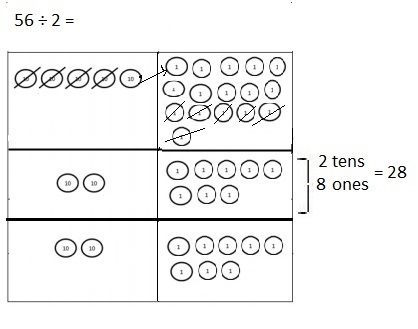
Two friends evenly share 56 dollars.
a. They have 5 ten-dollar bills and 6 one-dollar bills.
Draw a picture to show how the bills will be shared.
Will they have to make change at any stage?
Answer:
Yes, they will have to make change for 1 dollar bill.
Eureka Math Grade 4 Module 3 Lesson 19 Answer Key-5
Explanation:
In order to share its the ten dollar bill needs to be decomposed
into one dollar bills.
Drawn a picture to show how the bills will be shared
and have to make changes as shown above.

b. Explain how they share the money evenly.
Answer:
Each friend gets 2 ten dollar bills and 8 one dollar bills,

Explanation:
Given two friends evenly share 56 dollars,
they have 5 ten-dollar bills and 6 one-dollar bills,
they shared the money evenly as 2 ten dollar bills and
8 one dollar bills.

Question 5.
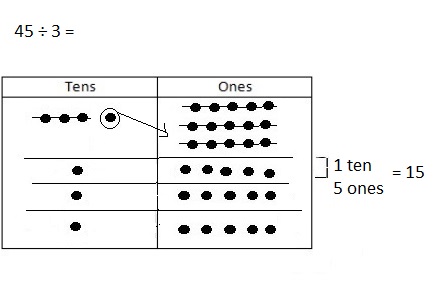
Imagine you are filming a video explaining the
blem 45 ÷ 3 to new fourth graders. Create a script to
explain how you can keep dividing after getting a
remainder of 1 ten in the first step.
Answer:

Eureka Math Grade 4 Module 3 Lesson 19 Answer Key-6
Explanation:
Watch as I solve 45 ÷ 3 using a place value chart.
First I divide my tens, Each of the 3 groups can equally
have 1 ten. There is 1 ten remaining, We can continue
dividing by decomposing the 1 ten into 10 ones. Watch as
I show this on my chart. Now I have 15 ones that can be
equally distributed into our 3 groups. Each group will get
5 ones. Now we can see that 45 ÷ 3 is 1 ten 5 ones or 15.

Eureka Math Grade 4 Module 3 Lesson 19 Exit Ticket Answer Key

Question 1.
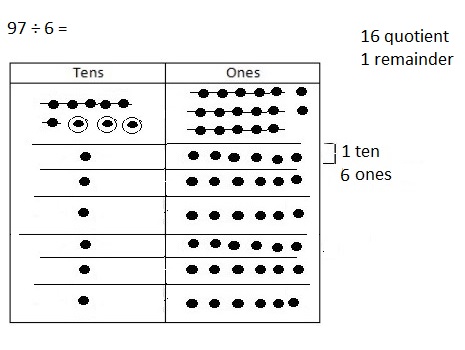
Molly’s photo album has a total of 97 pictures.
Each page of the album holds 6 pictures.
How many pages can Molly fill? Will there be any
pictures left? If so, how many? Use place value disks to solve.
Answer:
Molly can fill 16 pages,
Yes, there will be 1 picture left,
Eureka Math Grade 4 Module 3 Lesson 19 Answer Key-7

Explanation:
Given Molly’s photo album has a total of 97 pictures.
Each page of the album holds 6 pictures, So number of
pages can Molly fill are 97 ÷ 6 = 16 quotient and 1 remainder
means Molly can fill 16 pages and there will be 1 picture left
as shown above using place value disks.

Question 2.
Marti’s photo album has a total of 45 pictures.
Each page holds 4 pictures. She said she can only
fill 10 pages completely. Do you agree? Explain why or why not.
Answer:
No, I don’t agree, why because she can fill 11 pages completly
with 1 picture left,

Explanation:
Marti’s photo album has a total of 45 pictures.
Each page holds 4 pictures. She said she can only
fill 10 pages completely, I don’t agree because
if we divide 45 pictures by 4 we get 11 pages but she
said she can only fill 10 pages completely so disagree.

Eureka Math Grade 4 Module 3 Lesson 19 Homework Answer Key

Question 1.
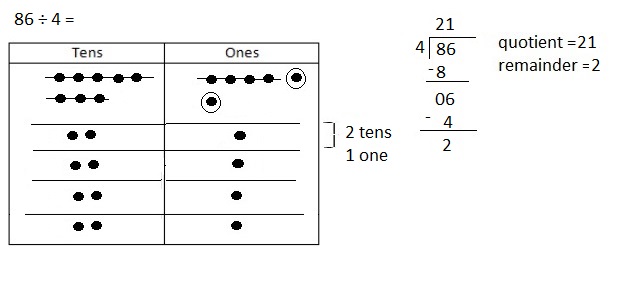
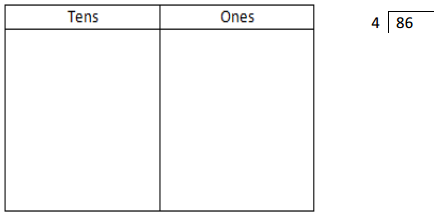
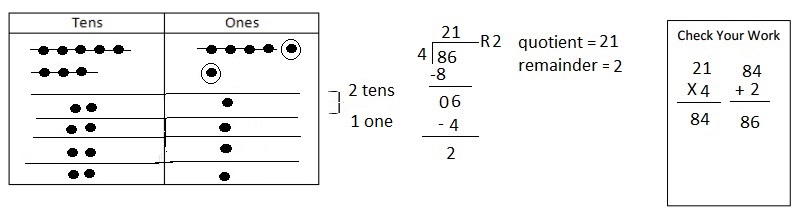
When you divide 86 by 4, there is a remainder of 2.
Model this problem with place value disks. In the
place value disk model, how can you see that there is a remainder?
Answer:
I showed my remainder by circling the remaining two
in the ones place,
Eureka Math Grade 4 Module 3 Lesson 19 Answer Key-8

Explanation:
When we divide 86 by 4, there is a remainder of 2.
Modeled the problem with place value disks. In the place
value disk model, showed the remainder by circling the
remaining two in the ones place.

Question 2.
Francine says that 86 ÷ 4 is 20 with a remainder of 6.
She reasons this is correct because (4 × 20) + 6 = 86.
What mistake has Francine made? Explain how she can
correct her work.
Answer:
Francine mistake is that her remainder is greater than
his divisor means he can divide more.
Instead of 20 groups he can make 21 groups,

Explanation:
Given Francine says that 86 ÷ 4 is 20 with a remainder of 6.
Her reasons this is correct because (4 X 20) + 6 = 86.
Instead of 20 groups he can make 21 groups,
86 ÷ 4 when 86 is divided by 4
we get 21 as quotient and remainder is 2.

Question 3.
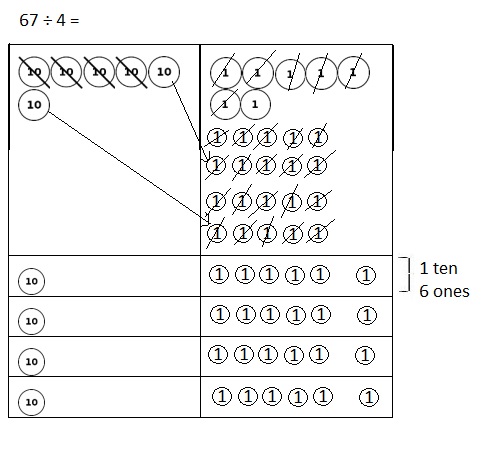
The place value disk model is showing 67 ÷ 4.
Complete the model. Explain what happens to
the 2 tens that are remaining in the tens column.
Eureka Math Grade 4 Module 3 Lesson 19 Problem Set Answer Key 4
Answer:
The 2 tens remaining gets decomposed into
20 ones column,
Eureka Math Grade 4 Module 3 Lesson 19 Answer Key-9

Explanation:
Given the place value disk model is showing 67 ÷ 4.
Completed the model. Explained what happens to the
2 tens that is remaining in the tens column gets decomposed
into 20 ones column as shown above.

Question 4.
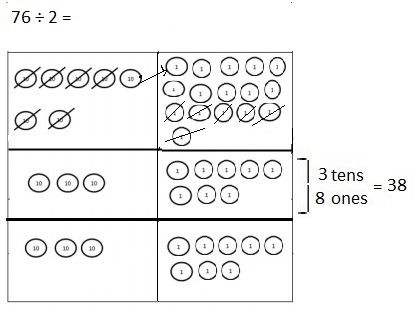
Two friends share 76 blueberries.
a. To count the blueberries, they put them into small
bowls of 10 blueberries. Draw a picture to show how the
blueberries can be shared equally. Will they have to split
apart any of the bowls of 10 blueberries when they share them?
Answer:
Yes, they will have to make change for 1 bowl,
Eureka Math Grade 4 Module 3 Lesson 19 Answer Key-10

Explanation:
In order to share it the 10 blueberries needs to be decomposed
into ones blueberries.
Drawn a picture to show how the blueberries will be shared
and have to make changes as shown above.

b. Explain how the friends can share the blueberries fairly.
Answer:
Each friend gets 3 ten blueberries and 8 blueberries,

Explanation:
Given two friends can share 76 blueberries,
they have 3 ten-blueberries and 8 one-blueberries,
Each friend shared 3 ten blueberries and 8 blueberries.

Question 5.
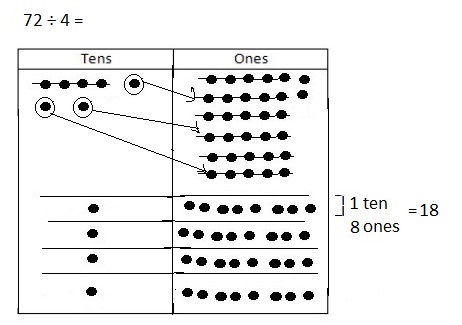
Imagine you are drawing a comic strip showing how to
solve the problem 72 ÷ 4 to new fourth graders. Create a
script to explain how you can keep dividing after getting a
remainder of 3 tens in the first step.
Answer:
Eureka Math Grade 4 Module 3 Lesson 19 Answer Key-11

Explanation:
Created a script as I solve 72 ÷ 4 using a place value chart.
First I divide my tens into 4 groups I get 4 tens into 1 group,
There are 3 tens remaining, We can continue
dividing by decomposing the tens into 30 ones. Watch as
I show this on my chart. Now I have 32 ones that can be
equally distributed into our 4 groups. Each group will get
8 ones. Now we can see that 72 ÷ 4 is 1 ten 8 ones or 18.

Eureka Math Grade 4 Module 3 Lesson 18 Answer Key

Engage NY Eureka Math 4th Grade Module 3 Lesson 18 Answer Key

Eureka Math Grade 4 Module 3 Lesson 18 Problem Set Answer Key

Solve using the standard algorithm. Check your quotient and
remainder by using multiplication and addition.

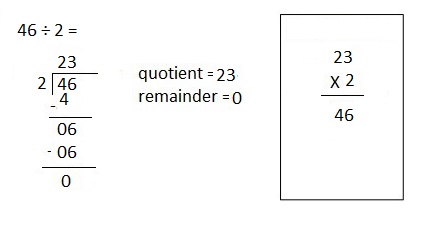
Question 1.
46 ÷ 2
Answer:
Eureka Math Grade 4 Module 3 Lesson 18 Answer Key-1
Explanation:
Solved 46 ÷ 2 using the standard algorithm.
Checked quotient and remainder by using multiplication as
shown above, quotient = 23, remainder = 0.

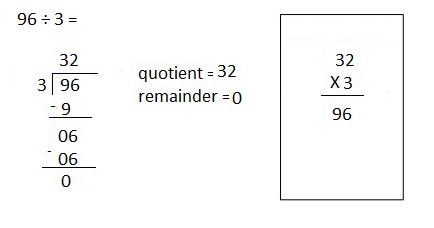
Question 2.
96 ÷ 3
Answer:
Eureka Math Grade 4 Module 3 Lesson 18 Answer Key-2
Explanation:
Solved 96 ÷ 3 using the standard algorithm.
Checked quotient and remainder by using multiplication as
shown above, quotient = 32, remainder = 0.

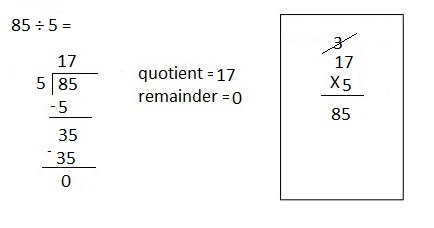
Question 3.
85 ÷ 5
Answer:
Eureka Math Grade 4 Module 3 Lesson 18 Answer Key-3
Explanation:
Solved 85 ÷ 5 using the standard algorithm. Checked quotient
and remainder by using multiplication and addition as
shown above, quotient = 17, remainder = 0.

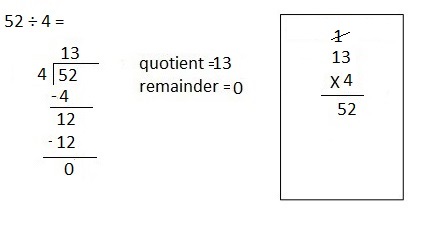
Question 4.
52 ÷ 4
Answer:
Eureka Math Grade 4 Module 3 Lesson 18 Answer Key-4
Explanation:
Solved 52 ÷ 4 using the standard algorithm. Checked quotient
and remainder by using multiplication and addition as
shown above, quotient = 13, remainder = 0.

Question 5.
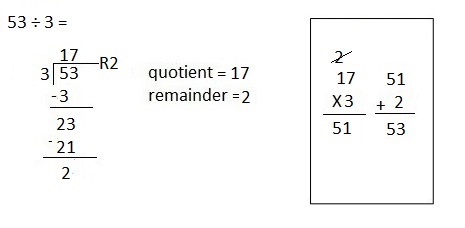
53 ÷ 3
Answer:
Eureka Math Grade 4 Module 3 Lesson 18 Answer Key-5
Explanation:
Solved 53 ÷ 3 using the standard algorithm. Checked quotient
and remainder by using multiplication and addition as
shown above, quotient = 17, remainder = 2.

Question 6.
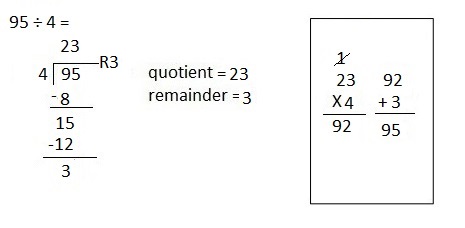
95 ÷ 4
Answer:
Eureka Math Grade 4 Module 3 Lesson 18 Answer Key-6
Explanation:
Solved 95 ÷ 4 using the standard algorithm. Checked quotient
and remainder by using multiplication and addition as
shown above, quotient = 23, remainder = 3.

Question 7.
89 ÷ 6
Answer:
Eureka Math Grade 4 Module 3 Lesson 18 Answer Key-7
Explanation:
Solved 89 ÷ 6 using the standard algorithm. Checked quotient
and remainder by using multiplication and addition as
shown above, quotient = 14, remainder = 5.

Question 8.
96 ÷ 6
Answer:

Explanation:
Solved 96 ÷ 6 using the standard algorithm.
Checked quotient and remainder by using multiplication as
shown above, quotient = 16, remainder = 0.

Question 9.
60 ÷ 3
Answer:
Eureka Math Grade 4 Module 3 Lesson 18 Answer Key-9
Explanation:
Solved 60 ÷ 3 using the standard algorithm.
Checked quotient and remainder by using multiplication as
shown above, quotient = 20, remainder = 0.

Question 10.
60 ÷ 4
Answer:
Eureka Math Grade 4 Module 3 Lesson 18 Answer Key-10
Explanation:
Solved 60 ÷ 4 using the standard algorithm.
Checked quotient and remainder by using multiplication as
shown above, quotient =15, remainder = 0.

Question 11.
95 ÷ 8
Answer:
Eureka Math Grade 4 Module 3 Lesson 18 Answer Key-11
Explanation:
Solved 95 ÷ 8 using the standard algorithm. Checked quotient
and remainder by using multiplication and addition as
shown above, quotient = 11, remainder = 7.

Question 12.
95 ÷ 7
Answer:
Eureka Math Grade 4 Module 3 Lesson 18 Answer Key-12
Explanation:
Solved 95 ÷ 7 using the standard algorithm. Checked quotient
and remainder by using multiplication and addition as
shown above, quotient =13, remainder = 4.

Eureka Math Grade 4 Module 3 Lesson 18 Exit Ticket Answer Key

Solve using the standard algorithm. Check your quotient and remainder by using multiplication and addition.

Question 1.
93 ÷ 7
Answer:
Eureka Math Grade 4 Module 3 Lesson 18 Answer Key-13
Explanation:
Solved 93 ÷ 7 using the standard algorithm. Checked quotient
and remainder by using multiplication and addition as
shown above, quotient =13, remainder = 2.

Question 2.
99 ÷ 8
Answer:
Eureka Math Grade 4 Module 3 Lesson 18 Answer Key-14
Explanation:
Solved 99 ÷ 8 using the standard algorithm. Checked quotient
and remainder by using multiplication and addition as
shown above, quotient =12, remainder = 3.

Eureka Math Grade 4 Module 3 Lesson 18 Homework Answer Key

Solve using the standard algorithm. Check your quotient and remainder by using multiplication and addition.

Question 1.
84 ÷ 2
Answer:
Eureka Math Grade 4 Module 3 Lesson 18 Answer Key-15
Explanation:
Solved 84 ÷ 2 using the standard algorithm.
Checked quotient and remainder by using multiplication as
shown above, quotient =42, remainder = 0.

Question 2.
84 ÷ 4
Answer:
Eureka Math Grade 4 Module 3 Lesson 18 Answer Key-16
Explanation:
Solved 84 ÷ 4 using the standard algorithm.
Checked quotient and remainder by using multiplication as
shown above, quotient =21, remainder = 0.

Question 3.
48 ÷ 3
Answer:
Eureka Math Grade 4 Module 3 Lesson 18 Answer Key-17
Explanation:
Solved 48 ÷ 3 using the standard algorithm.
Checked quotient and remainder by using multiplication as
shown above, quotient =16, remainder = 0.

Question 4.
80 ÷ 5
Answer:
Eureka Math Grade 4 Module 3 Lesson 18 Answer Key-18
Explanation:
Solved 80 ÷ 5 using the standard algorithm.
Checked quotient and remainder by using multiplication as
shown above, quotient =16, remainder = 0.

Question 5.
79 ÷ 5
Answer:
Eureka Math Grade 4 Module 3 Lesson 18 Answer Key-19
Explanation:
Solved 79 ÷ 5 using the standard algorithm. Checked quotient
and remainder by using multiplication and addition as
shown above, quotient =15, remainder = 4.

Question 6.
91 ÷ 4
Answer:
Eureka Math Grade 4 Module 3 Lesson 18 Answer Key-20
Explanation:
Solved 91 ÷ 4 using the standard algorithm. Checked quotient
and remainder by using multiplication and addition as
shown above, quotient =22, remainder = 3.

Question 7.
91 ÷ 6
Answer:
Eureka Math Grade 4 Module 3 Lesson 18 Answer Key-21
Explanation:
Solved 91 ÷ 6 using the standard algorithm. Checked quotient
and remainder by using multiplication and addition as
shown above, quotient =15, remainder = 1.

Question 8.
91 ÷ 7
Answer:
Eureka Math Grade 4 Module 3 Lesson 18 Answer Key-22
Explanation:
Solved 91 ÷ 7 using the standard algorithm.
Checked quotient and remainder by using multiplication as
shown above, quotient =13, remainder = 0.

Question 9.
87 ÷ 3
Answer:
Eureka Math Grade 4 Module 3 Lesson 18 Answer Key-23
Explanation:
Solved 87 ÷ 3 using the standard algorithm.
Checked quotient and remainder by using multiplication as
shown above, quotient = 29, remainder = 0.

Question 10.
87 ÷ 6
Answer:
Eureka Math Grade 4 Module 3 Lesson 18 Answer Key-24
Explanation:
Solved 87 ÷ 6 using the standard algorithm. Checked quotient
and remainder by using multiplication and addition as
shown above, quotient =14, remainder = 3.

Question 11.
94 ÷ 8
Answer:
Eureka Math Grade 4 Module 3 Lesson 18 Answer Key-25
Explanation:
Solved 94 ÷ 8 using the standard algorithm. Checked quotient
and remainder by using multiplication and addition as
shown above, quotient =11, remainder = 6.

Question 12.
94 ÷ 6
Answer:
Eureka Math Grade 4 Module 3 Lesson 18 Answer Key-26
Explanation:
Solved 94 ÷ 6 using the standard algorithm. Checked quotient
and remainder by using multiplication and addition as
shown above, quotient =15, remainder = 4.

Eureka Math Grade 4 Module 3 Lesson 17 Answer Key

Engage NY Eureka Math 4th Grade Module 3 Lesson 17 Answer Key

Eureka Math Grade 4 Module 3 Lesson 17 Problem Set Answer Key

Show the division using disks. Relate your model to long division. Check your quotient and remainder by using multiplication and addition.

Question 1.
5 ÷ 2
Eureka Math Grade 4 Module 3 Lesson 17 Problem Set Answer Key 1
Eureka Math Grade 4 Module 3 Lesson 17 Problem Set Answer Key 2
quotient = ____2______
remainder = __1________
Answer:
Eureka Math Grade 4 Module 3 Lesson 17 Answer Key-1
Explanation:
Shown the division 5 ÷ 2 using disks. Related my work on the
place value chart to long division. Checking my quotient and
remainder by using multiplication and addition as shown above.

Question 2.
50 ÷ 2
Eureka Math Grade 4 Module 3 Lesson 17 Problem Set Answer Key 3
Eureka Math Grade 4 Module 3 Lesson 17 Problem Set Answer Key 4
quotient = _____25_____
remainder = ____0______
Answer:
50 ÷ 2 =
Eureka Math Grade 4 Module 3 Lesson 17 Answer Key-2
Explanation:
Shown the division 5 ÷ 2 using disks. Related my work on the
place value chart to long division. Checking my quotient and
remainder by using multiplication and addition as shown above.

Question 3.
7 ÷ 3
Eureka Math Grade 4 Module 3 Lesson 17 Problem Set Answer Key 5
Eureka Math Grade 4 Module 3 Lesson 17 Problem Set Answer Key 4
quotient = _____2_____
remainder = ____1______
Answer:
7 ÷ 3 =
Eureka Math Grade 4 Module 3 Lesson 17 Answer Key-3
Explanation:
Shown the division 7 ÷ 3 using disks. Related my work on the
place value chart to long division. Checking my quotient and
remainder by using multiplication and addition as shown above.

Question 4.
75 ÷ 3
Eureka Math Grade 4 Module 3 Lesson 17 Problem Set Answer Key 6
Eureka Math Grade 4 Module 3 Lesson 17 Problem Set Answer Key 4
quotient = ____25____
remainder = ___0____
Answer:
75 ÷ 3 =
Eureka Math Grade 4 Module 3 Lesson 17 Answer Key-4
Explanation:
Shown the division 75 ÷ 3 using disks. Related my work on the
place value chart to long division. Checking my quotient and
remainder by using multiplication and addition as shown above.

Question 5.
9 ÷ 4
Eureka Math Grade 4 Module 3 Lesson 17 Problem Set Answer Key 7
Eureka Math Grade 4 Module 3 Lesson 17 Problem Set Answer Key 4
quotient = ___2_______
remainder = ____1______
Answer:
9 ÷ 4 =
Eureka Math Grade 4 Module 3 Lesson 17 Answer Key-5
Explanation:
Shown the division 9 ÷ 4 using disks. Related my work on the
place value chart to long division. Checking my quotient and
remainder by using multiplication and addition as shown above.

Question 6.
92 ÷ 4
Eureka Math Grade 4 Module 3 Lesson 17 Problem Set Answer Key 8
Eureka Math Grade 4 Module 3 Lesson 17 Problem Set Answer Key 4
quotient = ____23____
remainder = ___0_____
Answer:
92 ÷ 4 =
Eureka Math Grade 4 Module 3 Lesson 17 Answer Key-6
Explanation:
Shown the division 9 ÷ 4 using disks. Related my work on the
place value chart to long division. Checking my quotient and
remainder by using multiplication and addition as shown above.

Eureka Math Grade 4 Module 3 Lesson 17 Exit Ticket Answer Key

Show the division using disks. Relate your model to long division.
Check your quotient by using multiplication and addition.

Question 1.
5 ÷ 4
Eureka Math Grade 4 Module 3 Lesson 17 Exit Ticket Answer Key 9
Eureka Math Grade 4 Module 3 Lesson 17 Exit Ticket Answer Key 10
quotient = ____1______
remainder = ____1______
Answer:
5 ÷ 4 =
Eureka Math Grade 4 Module 3 Lesson 17 Answer Key-7
Explanation:
Shown the division 5 ÷ 4 using disks. Related my work on the
place value chart to long division. Checking my quotient and
remainder by using multiplication and addition as shown above.

Question 2.
56 ÷ 4
Eureka Math Grade 4 Module 3 Lesson 17 Exit Ticket Answer Key 11
Eureka Math Grade 4 Module 3 Lesson 17 Exit Ticket Answer Key 10
quotient = ____14______
remainder = ____0______
Answer:
Eureka Math Grade 4 Module 3 Lesson 17 Answer Key-8
Explanation:
Shown the division 56 ÷ 4 using disks. Related my work on the
place value chart to long division. Checking my quotient and
remainder by using multiplication and addition as shown above.

Eureka Math Grade 4 Module 3 Lesson 17 Homework Answer Key

Show the division using disks. Relate your model to long division.
Check your quotient by using multiplication and addition.

Question 1.
7 ÷ 2
Eureka Math Grade 4 Module 3 Lesson 17 Homework Answer Key 12
Eureka Math Grade 4 Module 3 Lesson 17 Homework Answer Key 13
quotient = ____3_____
remainder = ___1_______
Answer:
7 ÷ 2 =
Eureka Math Grade 4 Module 3 Lesson 17 Answer Key-9
Explanation:
Shown the division 7 ÷ 2 using disks. Related my work on the
place value chart to long division. Checking my quotient and
remainder by using multiplication and addition as shown above.

Question 2.
73 ÷ 2
Eureka Math Grade 4 Module 3 Lesson 17 Homework Answer Key 14
Eureka Math Grade 4 Module 3 Lesson 17 Homework Answer Key 13
quotient = ____24______
remainder = ___1_______
Answer:
73 ÷ 2 =
Eureka Math Grade 4 Module 3 Lesson 17 Answer Key-10
Explanation:
Shown the division 73 ÷ 2 using disks. Related my work on the
place value chart to long division. Checking my quotient and
remainder by using multiplication and addition as shown above.

Question 3.
6 ÷ 4
Eureka Math Grade 4 Module 3 Lesson 17 Homework Answer Key 15
Eureka Math Grade 4 Module 3 Lesson 17 Homework Answer Key 13
quotient = ____1______
remainder = ____2______
Answer:
Eureka Math Grade 4 Module 3 Lesson 17 Answer Key-11
Explanation:
Shown the division 6 ÷ 4 using disks. Related my work on the
place value chart to long division. Checking my quotient and
remainder by using multiplication and addition as shown above.

Question 4.
62 ÷ 4
Eureka Math Grade 4 Module 3 Lesson 17 Homework Answer Key 16
Eureka Math Grade 4 Module 3 Lesson 17 Homework Answer Key 13
quotient = _____15_____
remainder = ____2______
Answer:
Eureka Math Grade 4 Module 3 Lesson 17 Answer Key-12
Explanation:
Shown the division 62 ÷ 4 using disks. Related my work on the
place value chart to long division. Checking my quotient and
remainder by using multiplication and addition as shown above.

Question 5.
8 ÷ 3
Eureka Math Grade 4 Module 3 Lesson 17 Homework Answer Key 17
Eureka Math Grade 4 Module 3 Lesson 17 Homework Answer Key 13
quotient = ____2______
remainder = ____2______
Answer:
Eureka Math Grade 4 Module 3 Lesson 17 Answer Key-13
Explanation:
Shown the division 8 ÷ 3 using disks. Related my work on the
place value chart to long division. Checking my quotient and
remainder by using multiplication and addition as shown above.

Question 6.
84 ÷ 3
Eureka Math Grade 4 Module 3 Lesson 17 Homework Answer Key 18
Eureka Math Grade 4 Module 3 Lesson 17 Homework Answer Key 13
quotient = ____28______
remainder = ____3______
Answer:
84 ÷ 3 =
Eureka Math Grade 4 Module 3 Lesson 17 Answer Key-14
Explanation:
Shown the division 84 ÷ 3 using disks. Related my work on the
place value chart to long division. Checking my quotient and
remainder by using multiplication and addition as shown above.

Eureka Math Grade 4 Module 3 Lesson 16 Answer Key

Engage NY Eureka Math 4th Grade Module 3 Lesson 16 Answer Key

Eureka Math Grade 4 Module 3 Lesson 16 Problem Set Answer Key

Show the division using disks. Relate your work on the
place value chart to long division. Check your quotient and
remainder by using multiplication and addition.

Question 1.
7 ÷ 2
Eureka Math Grade 4 Module 3 Lesson 16 Problem Set Answer Key 1

Eureka Math Grade 4 Module 3 Lesson 16 Problem Set Answer Key 2
quotient = ____3______
remainder = ___1_______
Answer:
7 ÷ 2 =
Eureka Math Grade 4 Module 3 Lesson 16 Answer Key-1
Explanation:
Shown the division 7 ÷ 2 using disks. Related my work on the
place value chart to long division. Checking my quotient and
remainder by using multiplication and addition as shown above.

Question 2.
27 ÷ 2
Eureka Math Grade 4 Module 3 Lesson 16 Problem Set Answer Key 3

Eureka Math Grade 4 Module 3 Lesson 16 Problem Set Answer Key 4
quotient = ____13______
remainder = ____1______
Answer:
27 ÷ 2 =
Eureka Math Grade 4 Module 3 Lesson 16 Answer Key-2
Explanation:
Shown the division 27 ÷ 2 using disks. Related my work on the
place value chart to long division. Checking my quotient and
remainder by using multiplication and addition as shown above.

Question 3.
8 ÷ 3
Eureka Math Grade 4 Module 3 Lesson 16 Problem Set Answer Key 4

Eureka Math Grade 4 Module 3 Lesson 16 Problem Set Answer Key 4
quotient = ___2______
remainder = ____2______
Answer:
8 ÷ 3  =
Eureka Math Grade 4 Module 3 Lesson 16 Answer Key-3
Explanation:
Shown the division 8 ÷ 3 using disks. Related my work on the
place value chart to long division. Checking my quotient and
remainder by using multiplication and addition as shown above.

Question 4.
38 ÷ 3
Eureka Math Grade 4 Module 3 Lesson 16 Problem Set Answer Key 5

Eureka Math Grade 4 Module 3 Lesson 16 Problem Set Answer Key 4
quotient = ____12______
remainder = ____2______
Answer:
38 ÷ 3 =
Eureka Math Grade 4 Module 3 Lesson 16 Answer Key-4
Explanation:
Shown the division 38 ÷ 3 using disks. Related my work on the
place value chart to long division. Checking my quotient and
remainder by using multiplication and addition as shown above.

Question 5.
6 ÷ 4
Eureka Math Grade 4 Module 3 Lesson 16 Problem Set Answer Key 6

Eureka Math Grade 4 Module 3 Lesson 16 Problem Set Answer Key 4
quotient = ____1___
remainder = ___2____
Answer:
6 ÷ 4 =
Eureka Math Grade 4 Module 3 Lesson 16 Answer Key-5

Explanation:
Shown the division 6 ÷ 4 using disks. Related my work on the
place value chart to long division. Checking my quotient and
remainder by using multiplication and addition as shown above.

Question 6.
86 ÷ 4
Eureka Math Grade 4 Module 3 Lesson 16 Problem Set Answer Key 7

Eureka Math Grade 4 Module 3 Lesson 16 Problem Set Answer Key 4
quotient = ____21______
remainder = ___2_______
Answer:
86 ÷ 4 =
Eureka Math Grade 4 Module 3 Lesson 16 Answer Key-6
Explanation:
Shown the division 86 ÷ 4 using disks. Related my work on the
place value chart to long division. Checking my quotient and
remainder by using multiplication and addition as shown above.

Eureka Math Grade 4 Module 3 Lesson 16 Exit Ticket Answer Key

Show the division using disks. Relate your work on the place value chart to long division. Check your quotient and remainder by using multiplication and addition.

Question 1.
5 ÷ 3
Eureka Math Grade 4 Module 3 Lesson 16 Exit Ticket Answer Key 8

Eureka Math Grade 4 Module 3 Lesson 16 Exit Ticket Answer Key 11
quotient = ____1______
remainder = ___2_______
Answer:
5 ÷ 3 =
Eureka Math Grade 4 Module 3 Lesson 16 Answer Key-7
Explanation:
Shown the division 5 ÷ 3 using disks. Related my work on the
place value chart to long division. Checking my quotient and
remainder by using multiplication and addition as shown above.

Question 2.
65 ÷ 3
Eureka Math Grade 4 Module 3 Lesson 16 Exit Ticket Answer Key 9

Eureka Math Grade 4 Module 3 Lesson 16 Exit Ticket Answer Key 11
quotient = ____21______
remainder = ____2______
Answer:
65 ÷ 3 =
Eureka Math Grade 4 Module 3 Lesson 16 Answer Key-8
Explanation:
Shown the division 65 ÷ 3 using disks. Related my work on the
place value chart to long division. Checking my quotient and
remainder by using multiplication and addition as shown above.

Eureka Math Grade 4 Module 3 Lesson 16 Homework Answer Key

Show the division using disks. Relate your work on the
place value chart to long division. Check your quotient and
remainder by using multiplication and addition.

Question 1.
7 ÷ 3
Eureka Math Grade 4 Module 3 Lesson 16 Homework Answer Key 10

Eureka Math Grade 4 Module 3 Lesson 16 Homework Answer Key 13
quotient = ____2______
remainder = ___1_______
Answer:
7 ÷ 3 =
Eureka Math Grade 4 Module 3 Lesson 16 Answer Key-9
Explanation:
Shown the division 7 ÷ 3 using disks. Related my work on the
place value chart to long division. Checking my quotient and
remainder by using multiplication and addition as shown above.

Question 2.
67 ÷ 3
Eureka Math Grade 4 Module 3 Lesson 16 Homework Answer Key 11

Eureka Math Grade 4 Module 3 Lesson 16 Homework Answer Key 15
quotient = ____22______
remainder = ____1______
Answer:
67 ÷ 3=
Eureka Math Grade 4 Module 3 Lesson 16 Answer Key-10
Explanation:
Shown the division 67 ÷ 3 using disks. Related my work on the
place value chart to long division. Checking my quotient and
remainder by using multiplication and addition as shown above.

Question 3.
5 ÷ 2
Eureka Math Grade 4 Module 3 Lesson 16 Homework Answer Key 13

Eureka Math Grade 4 Module 3 Lesson 16 Homework Answer Key 15
quotient = ____2______
remainder = ___1_______
Answer:
5 ÷ 2 =
Eureka Math Grade 4 Module 3 Lesson 16 Answer Key-11
Explanation:
Shown the division 5 ÷ 2 using disks. Related my work on the
place value chart to long division. Checking my quotient and
remainder by using multiplication and addition as shown above.

Question 4.
85 ÷ 2
Eureka Math Grade 4 Module 3 Lesson 16 Homework Answer Key 13

Eureka Math Grade 4 Module 3 Lesson 16 Homework Answer Key 15
quotient = ___42_______
remainder = ___1_______
Answer:
85 ÷ 2 =
Eureka Math Grade 4 Module 3 Lesson 16 Answer Key-12
Explanation:
Shown the division 85 ÷ 2 using disks. Related my work on the
place value chart to long division. Checking my quotient and
remainder by using multiplication and addition as shown above.

Question 5.
5 ÷ 4
Eureka Math Grade 4 Module 3 Lesson 16 Homework Answer Key 14

Eureka Math Grade 4 Module 3 Lesson 16 Homework Answer Key 15
quotient = ____1______
remainder = ____1______
Answer:
5 ÷ 4 =
Eureka Math Grade 4 Module 3 Lesson 16 Answer Key-13
Explanation:
Shown the division 5 ÷ 4 using disks. Related my work on the
place value chart to long division. Checking my quotient and
remainder by using multiplication and addition as shown above.

Question 6.
85 ÷ 4
Eureka Math Grade 4 Module 3 Lesson 16 Homework Answer Key 15

Eureka Math Grade 4 Module 3 Lesson 16 Homework Answer Key 15
quotient = ___21_______
remainder = ____1______
Answer:
85 ÷ 4 =
Eureka Math Grade 4 Module 3 Lesson 16 Answer Key-14
Explanation:
Shown the division 85 ÷ 4 using disks. Related my work on the
place value chart to long division. Checking my quotient and
remainder by using multiplication and addition as shown above.

Eureka Math Grade 4 Module 3 Lesson 16 Template Set Answer Key

Eureka Math Grade 4 Module 3 Lesson 16 Template Answer Key 16

_______________________________________________________
tens place value chart
Eureka Math Grade 4 Module 3 Lesson 16 Answer Key-15
Explanation:
In math, every digit in a number has a place value.
Place value can be defined as the value represented by
a digit in a number on the basis of its position in the number.
In above example 42, 2 is at ones place and 4 is at tens place
as shown above.

Eureka Math Grade 4 Module 3 Lesson 15 Answer Key

Engage NY Eureka Math 4th Grade Module 3 Lesson 15 Answer Key

Eureka Math Grade 4 Module 3 Lesson 15 Problem Set Answer Key

Question 1.

Show division using an array.Show division using an area model.
 

18 ÷ 6
Quotient = ____3_____
Remainder = __0_____

Eureka Math Grade 4 Module 3 Lesson 15 Problem Set Answer Key 1
Can you show 18 ÷ 6 with one rectangle? __Yes____

Answer:
Eureka Math Grade 4 Module 3 Lesson 15 Answer Key-1
Explanation:
Shown division using an array as shown above,
18 ÷ 6 = Quotient = 3 and Remainder = 0,
Shown division using an area model above,
Yes, shown 18 ÷ 6 with one rectangle above.

Question 2.

Show division using an array.Show division using an area model.
19 ÷ 6
Quotient = ____3_____
Remainder = ___1____
Eureka Math Grade 4 Module 3 Lesson 15 Problem Set Answer Key 2
Can you show 19 ÷ 6 with one rectangle? ___Yes___
Explain how you showed the remainder:

Answer:
Eureka Math Grade 4 Module 3 Lesson 15 Answer Key-2
Explanation:
Shown division using an array as shown above,
19 ÷ 6 = Quotient = 3 and Remainder = 1,
Show division using an area model above,
Yes, shown 19 ÷ 6 with one rectangle above and showed
remainder as one square as shown above as.

Question 3.
29 ÷ 3
a.
Answer:
Eureka Math Grade 4 Module 3 Lesson 15 Answer Key-3
Explanation:
Shown division using an array as shown above,
29 ÷ 3 = Quotient = 9 and Remainder = 2.

b.
Answer:
Eureka Math Grade 4 Module 3 Lesson 15 Answer Key-4
Explanation:
Shown division 29 ÷ 3 using an area model above.

Question 4.
22 ÷ 5
a.
Answer:
Eureka Math Grade 4 Module 3 Lesson 15 Answer Key-5
Explanation:
Shown division using an array as shown above,
22 ÷ 5 = Quotient = 4 and Remainder = 2.

b.
Answer:
Eureka Math Grade 4 Module 3 Lesson 15 Answer Key-6
Explanation:
Shown division 22 ÷ 5 using an area model above.

Question 5.
43 ÷ 4
a.
Answer:
Eureka Math Grade 4 Module 3 Lesson 15 Answer Key-7
Explanation:
Shown division using an array as shown above,
43 ÷ 4 = Quotient = 10 and Remainder = 3.

b.
Answer:
Eureka Math Grade 4 Module 3 Lesson 15 Answer Key-8
Explanation:
Shown division 43 ÷ 4 using an area model above.

Question 6.
59 ÷ 7
a.
Answer:
Eureka Math Grade 4 Module 3 Lesson 15 Answer Key-9
Explanation:
Shown division using an array as shown above,
59 ÷ 7 = Quotient = 8 and Remainder = 3.

b.
Answer:
Eureka Math Grade 4 Module 3 Lesson 15 Answer Key-10
Explanation:
Shown division 59 ÷ 7 using an area model above.

Eureka Math Grade 4 Module 3 Lesson 15 Exit Ticket Answer Key

Solve using an array and area model.

Question 1.
27 ÷ 5
a.
Answer:
Eureka Math Grade 4 Module 3 Lesson 15 Answer Key-11
Explanation:
Shown division using an array as shown above,
27 ÷ 5 = Quotient = 5 and Remainder = 2.

b.
Answer:
Eureka Math Grade 4 Module 3 Lesson 15 Answer Key-12
Explanation:
Shown division 27 ÷ 5 using an area model above.

Question 2.
32 ÷ 6
a.
Answer:
Eureka Math Grade 4 Module 3 Lesson 15 Answer Key-13
Explanation:
Shown division using an array as shown above,
32 ÷ 6 = Quotient = 5 and Remainder = 2.

b.
Answer:
Eureka Math Grade 4 Module 3 Lesson 15 Answer Key-14
Explanation:
Shown division 32 ÷ 6 using an area model above.

Eureka Math Grade 4 Module 3 Lesson 15 Homework Answer Key

Question 1.

Show division using an array.Show division using an area model.
24 ÷ 4
Quotient = ____6_____
Remainder = ___0____
Eureka Math Grade 4 Module 3 Lesson 15 Homework Answer Key 3
Can you show 24 ÷ 4 with one rectangle? ___yes___

Answer:
Eureka Math Grade 4 Module 3 Lesson 15 Answer Key-15
Explanation:
Shown division using an array as shown above,
24 ÷ 4 = Quotient = 6 and Remainder = 0,
Shown division using an area model above,
Yes, shown 24 ÷ 4 with one rectangle above.

Question 2.

Show division using an array.Show division using an area model.
25 ÷ 4

Quotient = _________
Remainder = _______

Eureka Math Grade 4 Module 3 Lesson 15 Homework Answer Key 4
Can you show 25 ÷ 4 with one rectangle? ______
Explain how you showed the remainder:

Answer:
Eureka Math Grade 4 Module 3 Lesson 15 Answer Key-16

Shown division using an array as shown above,
25 ÷ 4 = Quotient = 6 and Remainder = 1,
Shown division using an area model above,
Yes, shown 25 ÷ 4 with one rectangle above and showed
remainder as one square as shown above as.

Question 3.
44 ÷ 7
a.
Answer:
Eureka Math Grade 4 Module 3 Lesson 15 Answer Key-17
Explanation:
Shown division using an array as shown above,
44 ÷ 7 = Quotient = 6 and Remainder = 2.

b.
Answer:
Eureka Math Grade 4 Module 3 Lesson 15 Answer Key-18
Explanation:
Shown division 44 ÷ 7 using an area model above.

Question 4.
34 ÷ 6
a.
Answer:
Eureka Math Grade 4 Module 3 Lesson 15 Answer Key-19
Explanation:
Shown division using an array as shown above,
34 ÷ 6 = Quotient = 5 and Remainder = 4.

b.
Answer:
Eureka Math Grade 4 Module 3 Lesson 15 Answer Key-20
Explanation:
Shown division 34 ÷ 6 using an area model above.

Question 5.
37 ÷ 6
a.
Answer:
Eureka Math Grade 4 Module 3 Lesson 15 Answer Key-21
Explanation:
Shown division using an array as shown above,
37 ÷ 6 = Quotient = 6 and Remainder = 1.

b.
Answer:
Eureka Math Grade 4 Module 3 Lesson 15 Answer Key-22
Explanation:
Shown division 34 ÷ 6 using an area model above.

Question 6.
46 ÷ 8
a.
Answer:
Eureka Math Grade 4 Module 3 Lesson 15 Answer Key-23
Explanation:
Shown division using an array as shown above,
46 ÷ 8 = Quotient = 5 and Remainder = 6.

b.
Answer:
Eureka Math Grade 4 Module 3 Lesson 15 Answer Key-24
Explanation:
Shown division 46 ÷ 8 using an area model above.

Eureka Math Grade 4 Module 3 Lesson 14 Answer Key

Engage NY Eureka Math 4th Grade Module 3 Lesson 14 Answer Key

Eureka Math Grade 4 Module 3 Lesson 14 Problem Set Answer Key

Use the RDW process to solve the following problems.

Question 1.
There are 19 identical socks. How many pairs of socks are there?
Will there be any socks without a match? If so, how many?
Answer:
9 pair of socks are there, 1 sock without a match,
Eureka Math Grade 4 Module 3 Lesson 14 Answer Key-1

Explanation:
Given there are 19 identical socks, number of pairs of
socks are there are 19 ÷ 2 = 9 quotient (2 X 9 = 18) and
remainder 1, means there are 9 pair of socks are there,
1 sock without a match,
Solved the problems using RDW process as shown above.

Question 2.
If it takes 8 inches of ribbon to make a bow, how many bows can
be made from 3 feet of ribbon (1 foot = 12 inches)?
Will any ribbon be left over? If so, how much?
Answer:
4 bows can be made from 3 feet of ribbon,
Left over ribbon will be 4 inches,
Eureka Math Grade 4 Module 3 Lesson 14 Answer Key-2

Explanation
Given If it takes 8 inches of ribbon to make a bow,
So how many bows can be made from 3 feet of ribbon
(1 foot = 12 inches) are 3 X 12 = 36 inches ÷ 8 inches =
4 quotient (8 X 4 = 32) and 4 inches remainder means|
4 bows can be made from 3 feet of ribbon,
Left over ribbon will be 4 inches,
Solved the problems using RDW process as shown above.

Question 3.
The library has 27 chairs and 5 tables. If the same number of chairs is
placed at each table, how many chairs can be placed at each table?
Will there be any extra chairs? If so, how many?
Answer:
5 chairs can be placed at each table and there will be 2 extra chairs,
Eureka Math Grade 4 Module 3 Lesson 14 Answer Key-3

Explanation:
Given the library has 27 chairs and 5 tables. If the same
number of chairs is placed at each table, how many chairs
can be placed at each table are 27 ÷ 5 = 5 quotient (5 X 5 = 25)
and 2 remainder means 5 chairs can be placed at
each table and there will be 2 extra chairs,
Solved the problems using RDW process as shown above.

Question 4.
The baker has 42 kilograms of flour. She uses 8 kilograms each day.
After how many days will she need to buy more flour?
Answer:
She needs to buy more flour after 5 days,
Eureka Math Grade 4 Module 3 Lesson 14 Answer Key-4

Explanation:
Given the baker has 42 kilograms of flour. She uses
8 kilograms each day.
After number of days will she need to buy more
flour is 42 ÷ 8 = 5 quotient (8 X 5 = 40) and
2 remainder it means that she needs to buy
more flour after 5 days,
Solved the problems using RDW process as shown above.

Question 5.
Caleb has 76 apples. He wants to bake as many pies as he can.
If it takes 8 apples to make each pie, how many apples will he use?
How many apples will not be used?
Answer:
Caleb uses 72 apples, 4 apples will not be used,
Eureka Math Grade 4 Module 3 Lesson 14 Answer Key-5
Explanation:
Given Caleb has 76 apples. He wants to bake as
many pies as he can. If it takes 8 apples to make each pie,
number of apples will he uses are
76 ÷ 8 = 9 quotient (8 X 9 = 72), 4 remainder it means
number of apples used are
8 X 9 = 72 apples and apples not used are 4,
Solved the problems using RDW process as shown above.

Question 6.
Forty-five people are going to the beach. Seven people can ride in each van.
How many vans will be required to get everyone to the beach?
Answer:
7 vans are required to get everyone to the beach,
Eureka Math Grade 4 Module 3 Lesson 14 Answer Key-6

Explanation:
Given Forty-five people are going to the beach.
Seven people can ride in each van.
Number of vans will be required to get everyone to the
beach are 45 ÷ 7 = 6 quotient (7 X 6 = 42), 3 remainder
it means 6 vans full and 3 people remaining therefore
7 vans are required to get everyone to the beach,
Solved the problems using RDW process as shown above.

Eureka Math Grade 4 Module 3 Lesson 14 Exit Ticket Answer Key

Use the RDW process to solve the following problem.

Fifty-three students are going on a field trip. The students are divided into
groups of 6 students. How many groups of 6 students will there be?
If the remaining students form a smaller group, and one chaperone
is assigned to every group, how many total chaperones are needed?
Answer:
8 groups of 6 students will be there and 1 chaperones are needed,
Eureka Math Grade 4 Module 3 Lesson 14 Answer Key-7
Explanation:
Given Fifty-three students are going on a field trip.
The students are divided into groups of 6 students.
Number of groups of 6 students will there be are
53 ÷ 6 = 8 quotient (6 X 8 = 48), 5 remainder it means
that 8 groups of 6 students will be there
and If the remaining students form a smaller group,
and one chaperone is assigned to every group,
number of chaperones are needed is 1 as
5 students form one smaller group,
Solved the problems using RDW process as shown above.

Eureka Math Grade 4 Module 3 Lesson 14 Homework Answer Key

Use the RDW process to solve the following problems.

Question 1.
Linda makes booklets using 2 sheets of paper.
She has 17 sheets of paper.
How many of these booklets can she make?
Will she have any extra paper?How many sheets?
Answer:
Linda can make 8 booklets, Yes, she will have
extra paper, 1 sheet,
Eureka Math Grade 4 Module 3 Lesson 14 Answer Key-8
Explanation:
Given Linda makes booklets using 2 sheets of paper.
She has 17 sheets of paper. Number of these booklets
can she make are 17 ÷ 2 = 8 quotient (2 X 8 = 16),
1 remainder means Linda can make 8 booklets,
Yes, she will have extra paper, 1 sheet,
Solved the problems using RDW process as shown above.

Question 2.
Linda uses thread to sew the booklets together.
She cuts 6 inches of thread for each booklet.
How many booklets can she stitch with 50 inches of thread?
Will she have any unused thread after stitching up
the booklets? If so, how much?
Answer:
Linda can stitch 8 booklets with 50 inches of thread,
Yes, she will have any unused thread after stitching up
the booklets, 2 inches of the thread,
Eureka Math Grade 4 Module 3 Lesson 14 Answer Key-9

Explanation:
Given Linda uses thread to sew the booklets together.
She cuts 6 inches of thread for each booklet.
Number of booklets can she stitch with 50 inches of thread is
50 inches ÷ 6 inches = 8 quotient (6 X 8 = 48),
2 remainder means Linda can stitch 8 booklets
with 50 inches of thread,
Yes, she will have any unused thread after stitching up
the booklets, 2 inches of the thread,
Solved the problems using RDW process as shown above.

Question 3.
Ms. Rochelle wants to put her 29 students into groups of 6.
How many groups of 6 can she make?
If she puts any remaining students in a smaller group,
how many students will be in that group?
Answer:
Ms.Rochelle can make 4 groups of 6 students,
In smaller group there will be 5 students,
Eureka Math Grade 4 Module 3 Lesson 14 Answer Key-10Explanation:
Given Ms. Rochelle wants to put her 29 students
into groups of 6. Number of groups she can make
are 29 ÷ 6 = 4 quotient (6 X 4 = 24) and 5 remainder means
Ms.Rochelle can make 4 groups of 6 students,
In smaller group there will be 5 students,
Solved the problems using RDW process as shown above.

Question 4.
A trainer gives his horse, Caballo, 7 gallons of water
every day from a 57-gallon container.
How many days will Caballo receive his full portion
of water from the container?
On which number day will the trainer need to
refill the container of water?
Answer:
Number of days Caballo receive his full portion of
water from the container is 8 days,
On day 9th the trainer need to refill the conatiner of water,
Eureka Math Grade 4 Module 3 Lesson 14 Answer Key-11

Explanation:
Given a trainer gives his horse, Caballo, 7 gallons of water
every day from a 57-gallon container.
Number of days Caballo receive his full portion of
water from the container is 57 ÷ 7 = 8 quotient (7 X 8 = 56)
and 1 remainder means 8 days and on day 9th the
trainer need to refill the conatiner of water,
Solved the problems using RDW process as shown above.

Question 5.
Meliza has 43 toy soldiers. She lines them up in
rows of 5 to fight imaginary zombies.
How many of these rows can she make?
After making as many rows of 5 as she can,
she puts the remaining soldiers in the last row.
How many soldiers are in that row?
Answer:
Meliza makes 8 number of rows of 5 fight imaginary zombies,
In the last row number of soldiers are 3,
Eureka Math Grade 4 Module 3 Lesson 14 Answer Key-12

Explanation:
Given Meliza has 43 toy soldiers. She lines them up in
rows of 5 to fight imaginary zombies.
So number of rows she can make are 43 ÷ 5 =
8 quotient (5 X 8 = 40) and 3 remainder means
Meliza makes 8 number of rows of 5 fight imaginary zombies,
In the last row number of soldiers are 3,
Solved the problems using RDW process as shown above.

Question 6.
Seventy-eight students are separated into groups of 8
for a field trip.
How many groups are there? The remaining students form
a smaller group of how many students?
Answer:
There are 9 groups of 8 students for a field trip and in
smaller group there are 6 students,
Eureka Math Grade 4 Module 3 Lesson 14 Answer Key-13

Explanation:
Given Seventy-eight students are separated into groups of 8
for a field trip. So number of groups are 78 ÷ 8 =
9 quotient (8 X 9 = 72) and 6 remainder means
there are 9 groups of 8 students for a field trip and in
smaller group there are 6 students,
Solved the problems using RDW process as shown above.

Eureka Math Grade 4 Module 3 Lesson 13 Answer Key

Engage NY Eureka Math 4th Grade Module 3 Lesson 13 Answer Key

Eureka Math Grade 4 Module 3 Lesson 13 Sprint Answer Key

Mental Multiplication
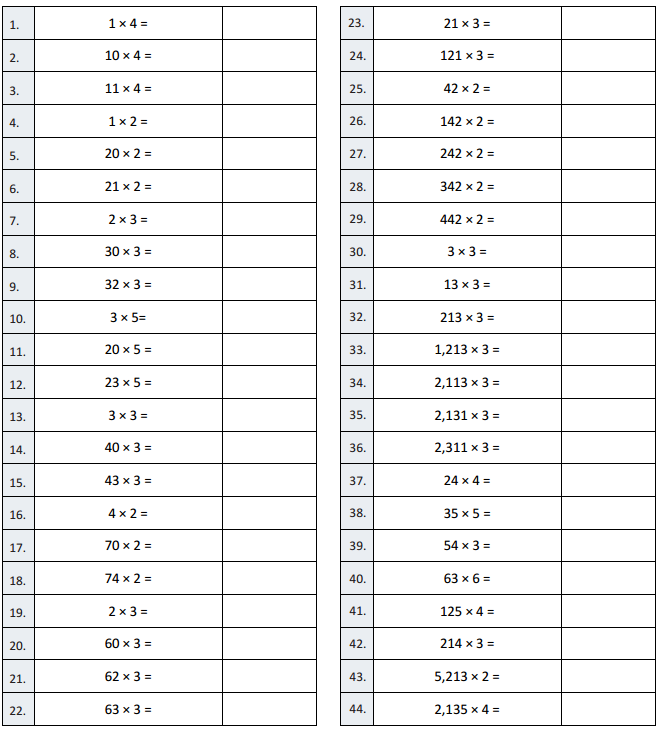
Eureka Math Grade 4 Module 3 Lesson 13 Sprint Answer Key 1

Eureka Math Grade 4 Module 3 Lesson 13 Answer Key-1

Question 1.
1 × 4 =
Answer:
1 X 4 = 4,

Explanation:
Given expression as 1 X 4, multiplying 1 with 4
we get 4, So 1 X 4 = 4.

Question 2.
10 × 4 =
Answer:
10 X 4 = 40,

Explanation:
Given expression as 10 X 4, multiplying 10 with 4
we get 40, So 10 X 4 = 40.

Question 3.
11 × 4 =
Answer:
11 X 4 = 44,

Explanation:
Given expression as 11 X 4, multiplying 11 with 4
we get 44, So 11 X 4 = 44.

Question 4.
1 × 2 =
Answer:
1 X 2 = 2,

Explanation:
Explanation:
Given expression as 1 X 2, multiplying 1 with 2
we get 2, So 1 X 2 = 2.

Question 5.
20 × 2 =
Answer:
20 X 2 = 100,

Explanation:
Given expression as 20 X 2, multiplying 20 with 2
we  get 40, So 20 X 2 = 40.

Question 6.
21 × 2 =
Answer:
21 X 2 = 42,

Explanation:
Given expression as 21 X 2, multiplying 21 with 2
we  get 42, So 21 X 2 = 42.

Question 7.
2 × 3 =
Answer:
2 X 3 = 6,

Explanation:
Given expression as 2 X 3, multiplying 2 with 3
we get 6, So 2 X 3 = 6.

Question 8.
30 × 3 =
Answer:
30 X 3 = 90,

Explanation:
Given expression as 30 X 3, multiplying 30 with 3
we get 90, So 30 X 3 = 90.

Question 9.
32 × 3 =
Answer:
32 X 3 = 96,

Explanation:
Given expression as 32 X 3, multiplying 32 with 3
we get 96, So 32 X 3 = 96.

Question 10.
3 × 5=
Answer:
3 X 5 = 15,

Explanation:
Given expression as 3 X 5, multiplying 3 with 5
we get 15, So 3 X 5 = 15.

Question 11.
20 × 5 =
Answer:
20 X 5 = 100,

Explanation:
Given expression as 20 X 5, multiplying 20 with 5
we get 100, So 20 X 5 = 100.

Question 12.
23 × 5 =
Answer:
23 X 5 = 115,

Explanation:
Given expression as 23 X 5, multiplying 23 with 5
we get 115, So 23 X 5 = 115.

Question 13.
3 × 3 =
Answer:
3 X 3 = 9,

Explanation:
Given expression as 3 X 3, multiplying 3 with 3
we get 9, So 3 X 3 = 9.

Question 14.
40 × 3 =
Answer:
40 X 3 = 120,

Explanation:
Given expression as 40 X 3, multiplying 40 with 3
we get 120, So 40 X 3 = 120.

Question 15.
43 × 3 =
Answer:
43 X 3 = 129,

Explanation:
Given expression as 43 X 3, multiplying 43 with 3
we get 129, So 43 X 3 = 129.

Question 16.
4 × 2 =
Answer:
4 X 2 = 8,

Explanation:
Given expression as 4 X 2, multiplying 4 with 2
we get 8, So 4 X 2 = 8.

Question 17.
70 × 2 =
Answer:
70 X 2 = 140,

Explanation:
Given expression as 70 X 2, multiplying 70 with 2
we  get 140, So 70 X 2 = 140.

Question 18.
74 × 2 =
Answer:
74 X 2 = 148,

Explanation:
Given expression as 74 X 2, multiplying 74 with 2
we get 148, So 74 X 2 = 148.

Question 19.
2 × 3 =
Answer:
2 X 3 = 6,

Explanation:
Given expression as 2 X 3, multiplying 2 with 3
we get 6, So 2 X 3 = 6.

Question 20.
60 × 3 =
Answer:
60 X 3 = 180,

Explanation:
Given expression as 60 X 3, multiplying 60 with 3
we get 180, So 60 X 3 = 180.

Question 21.
62 × 3 =
Answer:
62 X 3 = 186,

Explanation:
Given expression as 62 X 3 , multiplying 62 with 3
we get 186, So 62 X 3 = 186.

Question 22.
63 × 3 =
Answer:
63 X 3 = 189,

Explanation:
Given expression as 63 X 3, multiplying 63 with 3
we get 189, So 63 X 3 = 189.

Question 23.
21 × 3 =
Answer:
21 X 3 = 63,

Explanation:
Given expression as 21 X 3, multiplying 21 with 3
we get 63, So 21 X 3 = 63.

Question 24.
121 × 3 =
Answer:
121 X 3 = 363,

Explanation:
Given expression as 121 X 3, multiplying 121 with 3
we get 363, So 121 X 3 = 363.

Question 25.
42 × 2 =
Answer:
42 X 2 = 84,

Explanation:
Given expression as 42 X 2, multiplying 42 with 2
we get 84, So 42 X 2 = 84.

Question 26.
142 × 2 =
Answer:
142 X 2 = 284,

Explanation:
Given expression as 142 X 2, multiplying 142 with 2
we get 284, So 142 X 2 = 284.

Question 27.
242 × 2 =
Answer:
242 X 2 = 484,

Explanation:
Given expression as 242 X 2, multiplying 242 with 2
we get 484, So 242 X 2 = 484.

Question 28.
342 × 2 =
Answer:
342 X 2 = 684,

Explanation:
Given expression as 342 X 2, multiplying 342 with 2
we get 684, So 342 X 2 = 684.

Question 29.
442 × 2 =
Answer:
442 X 2 = 884,

Explanation:
Given expression as 442 X 2, multiplying 442 with 2
we get 884, So 442 X 2 = 884.

Question 30.
3 × 3 =
Answer:
3 X 3 = 9,

Explanation:
Given expression as 3 X 3, multiplying 3 with 3
we get 9, So 3 X 3 = 9.

Question 31.
13 × 3 =
Answer:
13 X 3 = 39,

Explanation:
Given expression as 13 X 3, multiplying 13 with 3
we get 39, So 13 X 3 = 39.

Question 32.
213 × 3 =
Answer:
213 X 3 =639,

Explanation:
Given expression as 213 X 3, multiplying 213 with 3
we get 639, So 213 X 3 = 639.

Question 33.
1,213 × 3 =
Answer:
1,213 X 3 = 3,639,

Explanation:
Given expression as 1,213 X 3, multiplying 1,213 with 3
we get 1,213, So 1,213 X 3 = 3,639.

Question 34.
2,113 × 3 =
Answer:
2,113 X 3 = 6,339,

Explanation:
Given expression as 2,113 X 3, multiplying 2,113 with 3
we get 6,339, So 2,113 X 3 = 6,339.

Question 35.
2,131 × 3 =
Answer:
2,131 X 3 = 6,393,
Explanation:
Given expression as 2,131 X 3, multiplying 2,131 with 3
we get 6,393, So 2,131 X 3 = 6,393.

Question 36.
2,311 × 3 =
Answer:
2,311 X 3 = 6,933,

Explanation:
Given expression as 2,311 X 3, multiplying 2,311 with 3
we get 6,933, So 2,311 X 3 = 6,933.

Question 37.
24 × 4 =
Answer:
24 X 4 = 96,

Explanation:
Given expression as 24 X 4, multiplying 24 with 4
we get 96, So 24 X 4 = 96.

Question 38.
35 × 5 =
Answer:
35 X 5 = 175,

Explanation:
Given expression as 35 X 5, multiplying 35 with 5
we get 175, So 35 X 5 = 175.

Question 39.
54 × 3 =
Answer:
54 X 3 = 162,

Explanation:
Given expression as 54 X 3, multiplying 54 with 3
we get 162, So 54 X 3 = 162.

Question 40.
63 × 6 =
Answer:
63 X 6 = 378,

Explanation:
Given expression as 63 X 6, multiplying 63 with 6
we get 378, So 63 X 6 = 378.

Question 41.
125 × 4 =
Answer:
125 X 4 = 500,

Explanation:
Given expression as 125 X 4, multiplying 125 with 4
we get 500, So 125 X 4 = 500.

Question 42.
214 × 3 =
Answer:
214 X 3 = 642,

Explanation:
Given expression as 214 X 3, multiplying 214 with 3
we get 642, So 214 X 3 = 642.

Question 43.
5,213 × 2 =
Answer:
5,213 X 2 = 10,426,

Explanation:
Given expression as 5,213 X 2, multiplying 5,213 with 2
we get 10,426, So 5,213 X 2 = 10,426.

Question 44.
2,135 × 4 =
Answer:
2,135 X 4 = 8,540,

Explanation:
Given expression as 2,135 X 4, multiplying 2,135 with 4
we get 8,540, So 2,135 X 4 = 8,540.

Mental Multiplication
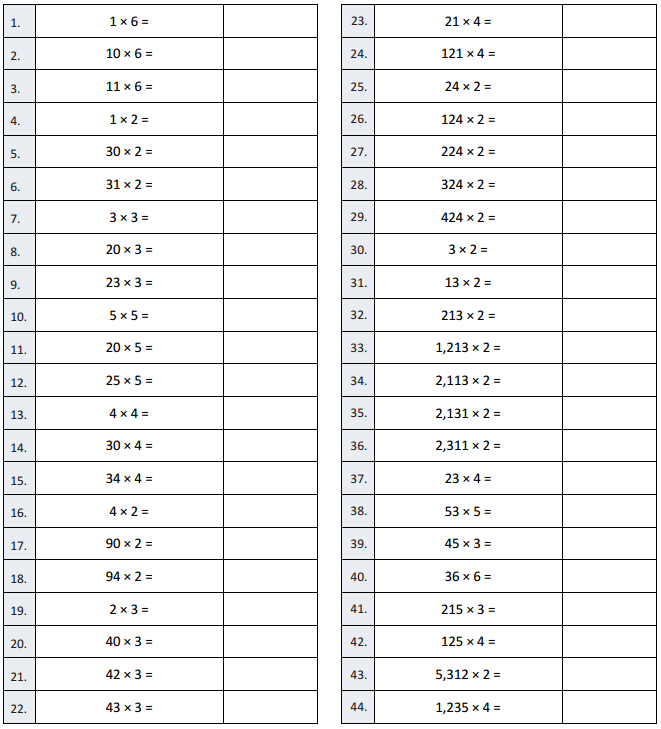
Eureka Math Grade 4 Module 3 Lesson 13 Sprint Answer Key 2

Eureka Math Grade 4 Module 3 Lesson 13 Answer Key-2

Question 1.
1 × 6 =
Answer:
1 X 6 = 6,

Explanation:
Given expression as 1 X 6, multiplying 1 with 6
we get 6, So 1 X 6 = 6.

Question 2.
10 × 6 =
Answer:
10 X 6 = 60,

Explanation:
Given expression as 10 X 6, multiplying 10 with 6
we get 60, So 10 X 6 = 60.

Question 3.
11 × 6 =
Answer:
11 X 6 = 66,

Explanation:
Given expression as 11 X 6, multiplying 11 with 6
we get 66, So 11 X 6 = 66.

Question 4.
1 × 2 =
Answer:
1 X 2 = 2,

Explanation:
Given expression as 1 X 2, multiplying 1 with 2
we get 2, So 1 X 2 = 2.

Question 5.
30 × 2 =
Answer:
30 X 2 = 60,

Explanation:
Given expression as 30 X 2, multiplying 30 with 2
we get 60, So 30 X 2 = 60.

Question 6.
31 × 2 =
Answer:
31 X 2 = 62,

Explanation:
Given expression as 31 X 2, multiplying 31 with 2
we get 62, So 31 X 2 = 62.

Question 7.
3 × 3 =
Answer:
3 X 3 = 9,

Explanation:
Given expression as 3 X 3, multiplying 3 with 3
we get 9, So 3 X 3 = 9.

Question 8.
20 × 3 =
Answer:
20 X 3 = 60,

Explanation:
Given expression as 20 X 3, multiplying 20 with 3
we get 60, So 20 X 3 = 60.

Question 9.
23 × 3 =
Answer:
23 X 3 = 69,

Explanation:
Given expression as 23 X 3, multiplying 23 with 3
we get 69, So 23 X 3 = 69.

Question 10.
5 × 5 =
Answer:
5 X 5 = 25,

Explanation:
Given expression as 5 X 5, multiplying 5 with 5
we get 25, So 5 X 5 = 25.

Question 11.
20 × 5 =
Answer:
20 X 5 = 100,

Explanation:
Given expression as 20 X 5, multiplying 20 with 5
we get 100, So 20 X 5 = 100.

Question 12.
25 × 5 =
Answer:
25 X 5 = 125,

Explanation:
Given expression as 25 X 5, multiplying 25 with 5
we get 125, So 25 X 5 = 125.

Question 13.
4 × 4 =
Answer:
4 X 4 = 16,

Explanation:
Given expression as 4 X 4, multiplying 4 with 4
we get 16, So 4 X 4 = 16.

Question 14.
30 × 4 =
Answer:
30 X 4 = 120,

Explanation:
Given expression as 30 X 4, multiplying 30 with 4
we get 120, So 30 X 4 = 120.

Question 15.
34 × 4 =
Answer:
34 X 4 = 136,
Explanation:
Given expression as 34 X 4, multiplying 34 with 4
we get 136, So 34 X 4 = 136.

Question 16.
4 × 2 =
Answer:
4 X 2 = 8,

Explanation:
Given expression as 4 X 2, multiplying 4 with 2
we get 8, So 4 X 2 = 8.

Question 17.
90 × 2 =
Answer:
90 X 2 = 180,

Explanation:
Given expression as 90 X 2, multiplying 90 with 2
we get 180, So 90 X 2 = 180.

Question 18.
94 × 2 =
Answer:
94 X 2 = 188,

Explanation:
Given expression as 94 X 2, multiplying 94 with 2
we get 188, So 94 X 2 = 188.

Question 19.
2 × 3 =
Answer:
2 X 3 = 6,

Explanation:
Given expression as 2 X 3, multiplying 2 with 3
we get 6, So 2 X 3 = 6.

Question 20.
40 × 3 =
Answer:
40 X 3 = 120,

Explanation:
Given expression as 40 X 3, multiplying 40 with 3
we get 120, So 40 X 3 = 120.

Question 21.
42 × 3 =
Answer:
42 X 3 = 126,

Explanation:
Given expression as 42 X 3, multiplying 42 with 3
we get 126, So 42 X 3 = 126.

Question 22.
43 × 3 =
Answer:
43 X 3 = 129,

Explanation:
Given expression as 43 X 3, multiplying 43 with 3
we get 129, So 43 X 3 = 129.

Question 23.
21 × 4 =
Answer:
21 X 4 = 84,

Explanation:
Given expression as 21 X 4, multiplying 21 with 4
we get 84, So 21 X 4 = 84.

Question 24.
121 × 4 =
Answer:
121 X 4 = 484,

Explanation:
Given expression as 121 X 4, multiplying 121 with 4
we get 484, So 121 X 4 = 484.

Question 25.
24 × 2 =
Answer:
24 X 2 = 48,

Explanation:
Given expression as 24 X 2, multiplying 24 with 2
we get 48, So 24 X 2 = 48.

Question 26.
124 × 2 =
Answer:
124 X 2 = 248,

Explanation:
Given expression as 124 X 2, multiplying 124 with 2
we get 248, So 124 X 2 = 248.

Question 27.
224 × 2 =
Answer:
224 X 2 = 448,

Explanation:
Given expression as 224 X 2, multiplying 224 with 2
we get 448, So 224 X 2 = 448.

Question 28.
324 × 2 =
Answer:
324 X 2 = 648,

Explanation:
Given expression as 324 X 2, multiplying 324 with 2
we get 648, So 324 X 2 = 648.

Question 29.
424 × 2 =
Answer:
424 X 2 = 848,

Explanation:
Given expression as 424 X 2, multiplying 424 with 2
we get 848, So 424 X 2 = 848.

Question 30.
3 × 2 =
Answer:
3 X 2 = 6,

Explanation:
Given expression as 3 X 2, multiplying 3 with 2
we get 6, So 3 X 2 = 6.

Question 31.
13 × 2 =
Answer:
13 X 2 =

Explanation:
Given expression as 13 X 2, multiplying 13 with 2
we get 26, So 13 X 2 = 26.

Question 32.
213 × 2 =
Answer:
213 X 2 = 426,

Explanation:
Given expression as 213 X 2, multiplying 213 with 2
we get 426, So 213 X 2 = 426.

Question 33.
1,213 × 2 =
Answer:
1,213 X 2 = 2,426,

Explanation:
Given expression as 1,213 X 2, multiplying 1,213 with 2
we get 2,426, So 1,213 X 2 = 2,426.

Question 34.
2,113 × 2 =
Answer:
2,113 X 2 = 4,226,

Explanation:
Given expression as 2,113 X 2, multiplying 2,113 with 2
we get 4,226, So 2,113 X 2 = 4,226.

Question 35.
2,131 × 2 =
Answer:
2,131 X 2 = 4,262,

Explanation:
Given expression as 2,131 X 2, multiplying 4,262 with 2
we get 4,262, So 2,131 X 2 = 4,262.

Question 36.
2,311 × 2 =
Answer:
2,311 X 2 = 4,262,

Explanation:
Given expression as 2,311 X 2, multiplying 2,311 with 2
we get 4,262, So 2,311 X 2 = 4,262.

Question 37.
23 × 4 =
Answer:
23 X 4 = 92,

Explanation:
Given expression as 23 X 4, multiplying 23 with 4
we get 92, So 23 X 4 = 92.

Question 38.
53 × 5 =
Answer:
53 X 5 = 265,

Explanation:
Given expression as 53 X 5, multiplying 53 with 5
we get 265, So 53 X 5 = 265.

Question 39.
45 × 3 =
Answer:
45 X 3 = 135,

Explanation:
Given expression as 45 X 3, multiplying 45 with 3
we get 135, So 45 X 3 = 135.

Question 40.
36 × 6 =
Answer:
36 X 6 = 216,

Explanation:
Given expression as 36 X 6, multiplying 36 with 6
we get 216, So 36 X 6  = 216.

Question 41.
215 × 3 =
Answer:
215 X 3 = 645,

Explanation:
Given expression as 215 X 3, multiplying 215 with 3
we get 645, So 215 X 3 = 645.

Question 42.
125 × 4 =
Answer:
125 X 4 = 500,

Explanation:
Given expression as 125 X 4, multiplying 125 with 4
we get 500, So 125 X 4 = 500.

Question 43.
5,312 × 2 =
Answer:
5,312 X 2 = 10,624,

Explanation:
Given expression as 5,312 X 2, multiplying 5,312 with 2
we get 10,624, So 5,312 X 2 = 10,624.

Explanation:
Given expression as 5,312 X 2, multiplying 5,312 with 2
we get 10,624, So 5,312 X 2 = 10,624.

Question 44.
1,235 × 4 =
Answer:
1,235 X 4 = 4,940,

Explanation:
Given expression as 1,235 X 4, multiplying 1,234 with 4
we get 4,940 So 1,235 X 4 = 4,940.

Eureka Math Grade 4 Module 3 Lesson 13 Problem Set Answer Key

Solve using the RDW process.

Question 1.
Over the summer, Kate earned $180 each week for 7 weeks.
Of that money, she spent $375 on a new computer and
$137 on new clothes. How much money did she have left?
Answer:
Kate is left with money of $748,
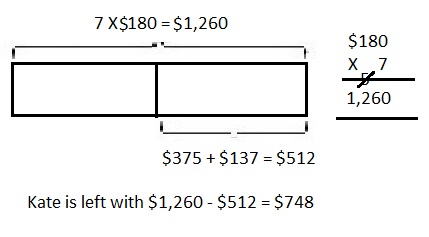
Eureka Math Grade 4 Module 3 Lesson 13 Answer Key-3
Explanation:
Given over the summer, Kate earned $180 each week for 7 weeks.
So Kate earned $180 X 7 =
   5
$180
X   7
$1,260

Of that money, she spent $375 on a new computer and
$137 on new clothes. So Kate has spent $375 + $137 = $512,
Now money did Kate have left with is $1,260 – $512 = $748,
Solved using the RDW process as shown above.

Question 2.
Sylvia weighed 8 pounds when she was born.
By her first birthday, her weight had tripled.
By her second birthday, she had gained 12 more pounds.
At that time, Sylvia’s father weighed 5 times as much as she did.
What was Sylvia and her dad’s combined weight?
Answer:
Sylvia and her dad’s combined weight is 216 pounds,
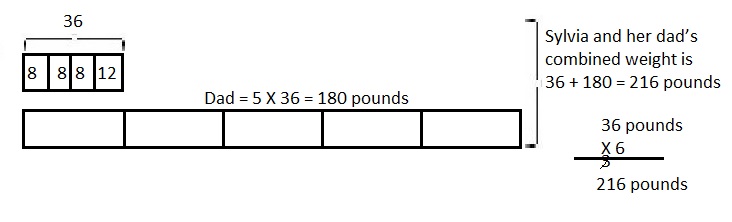
Eureka Math Grade 4 Module 3 Lesson 13 Answer Key-4

Explanation:
Given Sylvia weighed 8 pounds when she was born.
By her first birthday, her weight had tripled, So Sylvia
weighed on her first birthday is 8 pounds X 3 = 24 pounds,
By her second birthday, she had gained 12 more pounds means
24 pounds + 12 pounds = 36 pounds,
At that time, Sylvia’s father weighed 5 times as much as she did,
So 36 pounds X 5 =
3
36
X5
180 pounds
therefore, Sylvia and her dad’s combined weight is
180 ponds + 36 pounds = 216 pounds.
Solved using the RDW process as shown above.

Question 3.
Three boxes weighing 128 pounds each and one
box weighing 254 pounds were loaded onto the back
of an empty truck. A crate of apples was then loaded onto
the same truck. If the total weight loaded onto the truck
was 2,000 pounds, how much did the crate of apples weigh?

Answer:
The crate of apples weigh 1,362 pounds,
Eureka Math Grade 4 Module 3 Lesson 13 Answer Key-5

Explanation:
Given Three boxes weighing 128 pounds each so weight
of 3 boxes are 128 pounds X 3 =
2
128
X 3
384 pounds and one box weighing 254 pounds were
loaded onto the back of an empty truck. So now weight is
384 pounds + 254 pounds =
384 pounds
+254 pounds
638 pounds,
A crate of apples was then loaded onto the same truck.
If the total weight loaded onto the truck was 2,000 pounds,
therefore crate of apples weigh is
2,000 pounds
– 638 pounds
1,362 pounds.
Solved using the RDW process as shown above.

Question 4.
In one month, Charlie read 814 pages. In the same month,
his mom read 4 times as many pages as Charlie,
and that was 143 pages more than Charlie’s dad read.
What was the total number of pages read by Charlie and his parents?
Answer:
Total number of pages Charlie and his parents read are 7,183,
Eureka Math Grade 4 Module 3 Lesson 13 Answer Key-6

Explanation:
Given In one month, Charlie read 814 pages. In the same month,
his mom read 4 times as many pages as Charlie,
means Charlie’s mom read 814 X 4 =
1
814
X 4
3,256 pages,
Charlie’s dad read 3,256 pages – 143 pages =
3,256
– 143
3,113 pages
Now total number of pages Charlie and his parents read are
814 + 3,256 + 3,113 =
814
3,256
+3,113
7,183 pages,
Solved using the RDW process as shown above.

Eureka Math Grade 4 Module 3 Lesson 13 Exit Ticket Answer Key

Solve using the RDW process.

Question 1.
Michael earns $9 per hour. He works 28 hours each week.
How much does he earn in 6 weeks?
Answer:
Michael earns in 6 weeks is $1,512,
Eureka Math Grade 4 Module 3 Lesson 13 Answer Key-7

Explanation:
Given Michael earns $9 per hour. He works 28 hours each week,
means Michael earns in each week is 28 hours X $9 = $252,
Now in 6 weeks Michael earns $252 X 6 = $1,512.
Solved using the RDW process as shown above.

Question 2.
David earns $8 per hour. He works 40 hours each week.
How much does he earn in 6 weeks?
Answer:
David earns in 6 weeks is $1,920,
Eureka Math Grade 4 Module 3 Lesson 13 Answer Key-8
Explanation:
Given David earns $8 per hour. He works 40 hours each week,
means David earns in each week is 40 hours X $8 = $320,
Now in 6 weeks David earns $320 X 6 = $1,920.
Solved using the RDW process as shown above.

Question 3.
After 6 weeks, who earned more money?
How much more money?
Answer:
David earned more $408,
Eureka Math Grade 4 Module 3 Lesson 13 Answer Key-9
Explanation:
We got Michael earns in 6 weeks is $1,512 and
David earns in 6 weeks is $1,920 so more amount is earned
by David by $1,920 – $1,512 = $408 as shown above.

Eureka Math Grade 4 Module 3 Lesson 13 Homework Answer Key

Solve using the RDW process.

Question 1.
A pair of jeans costs $89. A jean jacket costs twice as much.
What is the total cost of a jean jacket and 4 pairs of jeans?
Answer:
The total cost of a Jean jacket and 4 pairs of jeans is $534,
Eureka Math Grade 4 Module 3 Lesson 13 Answer Key-10

Explanation:
Given a pair of jeans costs $89. A jean jacket costs twice as much,
So jean jcket costs 2 X $89 = $178,
The total cost of a jean jacket and 4 pairs of jeans is
$178 + 4 x $89 = $178 + $356 = $534.

Question 2.
Sarah bought a shirt on sale for $35. The original price
of the shirt was 3 times that amount. Sarah also bought a
pair of shoes on sale for $28. The original price of the
shoes was 5 times that amount. Together, how much money
did the shirt and shoes cost before they went on sale?
Answer:
Together,the shirt and shoes cost before they
went on sale is $245,
Eureka Math Grade 4 Module 3 Lesson 13 Answer Key-11

Explanation:
Given Sarah bought a shirt on sale for $35. The original price
of the shirt was 3 times that amount means the original price of
the shirt is 3 X $35 =
 1
$35
X 3
$105

Sarah also bought a pair of shoes on sale for $28.
The original price of the shoes was 5 times that amount means
5 X $28 =
4
$28
X 5
$140,
Together,the shirt and shoes cost before they went on sale is
$105 + $140 = $245 as shown above.

Question 3.
All 3,000 seats in a theater are being replaced.
So far, 5 sections of 136 seats and a sixth section
containing 348 seats have been replaced. How many more
seats do they still need to replace?
Answer:
Total more 1,972 seats needs to be still replaced,
Eureka Math Grade 4 Module 3 Lesson 13 Answer Key-12

Explanation:
Given all 3,000 seats in a theater are being replaced,
So far, 5 sections of 136 seats and a sixth section
containing 348 seats have been replaced means
5 X 136 seats + 348 seats are replaced = 680 + 348 = 1,028 seats
are replaced, So more seats needed to be still replaced are
3,000 seats – 1,028 seats = 1,972 seats as shown above.

Question 4.
Computer Depot sold 762 reams of paper. Paper Palace
sold 3 times as much paper as Computer Depot and
143 reams more than Office Supply Central.
How many reams of paper were sold by all three stores combined?
Answer:
Total 5,191 reams of paper were sold by all three stores combined,
Eureka Math Grade 4 Module 3 Lesson 13 Answer Key-13
Explanation:
Given Computer Depot sold 762 reams of paper. Paper Palace
sold 3 times as much paper as Computer Depot means
3 X 762 reams =
1
762
X 3
2,286 reams
sold by Paper Palace,
Now 2,286 reams – 143 reams = 2,143 reams
by Office Supply Central, therefore all three stores combinedly
sold 762 + 2,286 + 2,143 = 5,191 reams of paper as shown above.

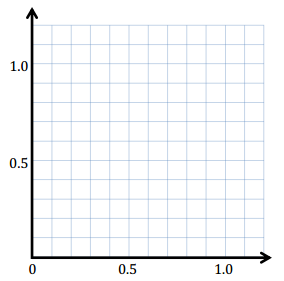
Eureka Math Grade 4 Module 3 Lesson 11 Answer Key

Engage NY Eureka Math 4th Grade Module 3 Lesson 11 Answer Key

Eureka Math Grade 4 Module 3 Lesson 11 Problem Set Answer Key

Question 1.
Solve the following expressions using the standard algorithm, the partial products method, and the area model.
a. 4 2 5 × 4
Eureka Math Grade 4 Module 3 Lesson 11 Problem Set Answer Key 1
4 (400 + 20 + 5)
(4 × __400___ ) + (4 × _20____ ) + (4 × __5___ )
Answer:
425 X 4 =
Standard Algorithm =
 1,2
425
X 4
1,700
Partial Products =
425
X 4
  20
80
+ 1600
1,700

Area Model =
Eureka Math Grade 4 Module 3 Lesson 11 Answer Key-1
425 X 4 = 1,700,

Explanation:
Solved the following expression 425 X 4 using
the standard algorithm =
we add same time of multiplying
1,2
425
X 4
1,700
(4 X 5 ones = 20 ones )+ (4 X 2 tens = 8 tens) +
(4 X 4 hundreds = 16 hundreds) = 20 + 80 + 1,600 = 1,700,
partial products =
425
X 4
  20— 4 X 5
80—-4 X 20
+ 1600–4 X 400
1,700
and the area model is as shown in the picture above,
So 425 X 4 = 1,700.

b. 5 3 4 × 7
Eureka Math Grade 4 Module 3 Lesson 11 Problem Set Answer Key 2
7 ( __500_ + _30___ + _4___ )
( _7_ × __500___ ) + ( 7__ × __30___ ) + ( 7__ × _4___ )
Answer:
534  X 7 =
Standard Algorithm =
 2,2
534
X 7
3,738
Partial Products =
534
X 7
  28
210
+3500
3,738

Area Model =
Eureka Math Grade 4 Module 3 Lesson 11 Answer Key-2
534  X 7 = 3,738,

Explanation:
Solved the following expression 534 X 7 using
the standard algorithm =
we add same time of multiplying
2,2
534
X 7
3,738
(7 X 4 ones = 28 ones )+ (7 X 3 tens = 21 tens) +
(7 X 5 hundreds = 35 hundreds) = 28 + 210 + 3,500 = 3,738,
partial products =
534
X 7
  28— 7 X 4
210—-7 X 30
+3500–7 X 500
3,738
and the area model is as shown in the picture above
So 534 X 7 = 3,738.

c. 2 0 9 × 8
Eureka Math Grade 4 Module 3 Lesson 11 Problem Set Answer Key 3
8__ ( _200___ + _9___ )
( _8_ × _200____ ) + ( _8_ × __9___ )
Answer:
209  X 8 =
Standard Algorithm =
 7,
209
X 8
1,672
Partial Products =
209
X 8
  72
0000
+1600
1,672

Area Model =
Eureka Math Grade 4 Module 3 Lesson 11 Answer Key-3
209  X 8 = 1,672,

Explanation:
Solved the following expression 209 X 8 using
the standard algorithm =
we add same time of multiplying
7
209
X 8
1,672
(8 X 9 ones = 72 ones )+ (8 X 0 tens = 0 tens) +
(8 X 2 hundreds = 16 hundreds) = 72 + 0 + 1,600 = 1,672,
partial products =
209
X 8
  72— 8 X 9
000—-8 X 0
+1600–8 X 200
1,672
and the area model is as shown in the picture above
So 209 X 8 = 1,672.

Question 2.
Solve using the partial products method.
Cayla’s school has 258 students. Janet’s school has 3 times as many students as Cayla’s. How many students are in Janet’s school?
Answer:
There are in Janet’s school are 774 students,

Explanation:
Given Cayla’s school has 258 students. Janet’s school has
3 times as many students as Cayla’s.
So there are number of students in Janet’s school are
3 X 258 students =
Partial Products =
258
X 3
024
150
+600
774
So there are in Janet’s school are 774 students.

Question 3.
Model with a tape diagram and solve.
4 times as much as 467
Answer:
Eureka Math Grade 4 Module 3 Lesson 11 Answer Key-4
4 X 467 = 1,868,

Explanation:
Modeled with a tape diagram as shown above and
4 times as much as 467 is 4 X 467 =
2,2
467
X 4
1,868
So, 4 X 467 = 1,868.

Solve using the standard algorithm, the area model, the distributive property, or the partial products method.

Question 4.
5,131 × 7
Answer:
Standard algorithm:
5,131
X    7
35,917

Explanation:
Given expression as 5,131 X 7 solving using standard algorithm
method as
2
5,131
X    7
35,917
First we multiply (7 X 1 one = 7 ones) + (7 X 3 tens = 21 tens) +
(7 X 1 hundred = 7 hundreds) + (7 X 5 thousands = 35 thousands),
So 7 X 5,131 = 35,917.

Question 5.
3 times as many as 2,805,

Answer:
3 X 2,805 = 8,415,

Explanation:
Given to find 3 times as many as 2,805 using the
distributive property as shown below
3 X 2,000 + 3 X 800 + 3 X 0 + 3 X 5 =
6,000 + 2,400 + 0 + 15 = 8,415,
So 3 times as many as 2,805 = 8,415.

Question 6.
A restaurant sells 1,725 pounds of spaghetti and
925 pounds of linguini every month. After 9 months,
how many pounds of pasta does the restaurant sell?
Answer:
Eureka Math Grade 4 Module 3 Lesson 11 Answer Key-5
23,850 pounds of pasta the restaurant saled in 9 months,

Explanation:
Given a restaurant sells 1,725 pounds of spaghetti and
925 pounds of linguini every month. After 9 months,
number of pounds of pasta does the restaurant sell is
9 X (1,725 +925) pounds = 9 X 2,650 =
  5,4
2,650
X    9
23,850
Solved using the area model as shown above.
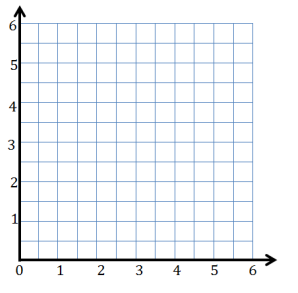
Eureka Math Grade 4 Module 3 Lesson 11 Exit Ticket Answer Key

Question 1.
Solve using the standard algorithm, the area model, the distributive property, or the partial products method.
2,809 × 4
Answer:
2,809
X 4
11,236
2,809 X 4 = 11,236,

Explanation:
Solved using the distributive property as shown below
(4 X 2,000) + (4 X 800) + (4 X 0) + (4 X 9) =
8,000 + 3,200 + 0 + 36 =11,236,
So, 2,809 X 4 = 11,236.

Question 2.
The monthly school newspaper is 9 pages long.
Mrs. Smith needs to print 675 copies.
What will be the total number of pages printed?
Answer:
Total number of pages printed are 6,075,

Explanation:
Given the monthly school newspaper is 9 pages long.
and Mrs. Smith needs to print 675 copies,
So the total number of pages printed are 9 X 6,075,
Solving using Partial Products as shown below
6,075
X  9
45—9  X 5
630–9 X 7
000– 9 X 0
5400–9 X 6
6,075

therefore, total number of pages printed are 6,075.

Eureka Math Grade 4 Module 3 Lesson 11 Homework Answer Key

Question 1.
Solve the following expressions using the standard algorithm, the partial products method, and the area model.
a. 3 0 2 × 8
Eureka Math Grade 4 Module 3 Lesson 11 Homework Answer Key 4
8 (300 + 2)
(8 × _300____ ) + (8 × __2___ )
Answer:
302 X 8 =
Standard Algorithm =
 1
302
X 8
2,416
Partial Products =
302
X 8
  16
00
+2400
2,416

Area Model =
Eureka Math Grade 4 Module 3 Lesson 11 Answer Key-6
302 X 8 = 2,416,

Explanation:
Solved the following expression 302 X 8 using
the standard algorithm =
we add same time of multiplying
 1
302
X 8
2,416
(8 X 2 ones = 16 ones )+ (8 X 0 tens = 0 tens) +
(8 X 3 hundreds = 24 hundreds) = 16 + 0 + 2,400 = 2,416,
partial products =
302
X 8
16
00
+2400
2,416
and the area model is as shown in the picture above,
So 302 X 8 = 2,416.

b. 2 1 6 × 5
Eureka Math Grade 4 Module 3 Lesson 11 Homework Answer Key 5
5 ( _200___ + _10___ + _6___ )
( 5__ × __200___ ) + ( _5_ × __10___ ) + ( 5__ × _6___ )
Answer:
216 X 5 =
Standard Algorithm =
 3
216
X 5
1,080
Partial Products =
216
X 5
  30
50
+1000
1,080

Area Model =
Eureka Math Grade 4 Module 3 Lesson 11 Answer Key-7
216 X 5 = 1,080,

Explanation:
Solved the following expression 302 X 8 using
the standard algorithm =
we add same time of multiplying
 3
216
X 5
1,080
(5 X 6 ones = 30 ones )+ (5 X 1 tens = 5 tens) +
(5 X 2 hundreds = 10 hundreds) = 30 + 50 + 1,000 = 1,080,
partial products =
216
X 5
  30
50
+1000
1,080
and the area model is as shown in the picture above,
So 216 X 5 = 1,080.

c. 5 9 3 × 9
Eureka Math Grade 4 Module 3 Lesson 11 Homework Answer Key 6
_9_ ( _500___ + _90___ + _3___ )
( _9_ × __500___ ) + ( _9_ × __90___ ) + ( _9_ × __3__ )
Answer:
593 X 9 =
Standard Algorithm =
 8,2
593
X 9
5,337
Partial Products =
593
X 9
  27
810
+4500
5,337

Area Model =
Eureka Math Grade 4 Module 3 Lesson 11 Answer Key-8
593 X 9 = 5,337,

Explanation:
Solved the following expression 593 X 9 using
the standard algorithm =
we add same time of multiplying
8,2
593
X 9
5,337
(9 X 3 ones = 27 ones )+ (9 X 9 tens = 81 tens) +
(9 X 5 hundreds = 45 hundreds)= 27 + 810 + 4,500 = 5,337,
partial products =
593
X 9
  27
810
+4500
5,337
and the area model is as shown in the picture above,
So 593 X 9 = 5,337.

Question 2.
Solve using the partial products method.
On Monday, 475 people visited the museum.
On Saturday, there were 4 times as many visitors
as there were on Monday. How many people
visited the museum on Saturday?
Answer:
Number of people visited the museum on
Saturday are 1,900,
Partial Products =
475
X 4
  20
280
+1600
1,900

Explanation:
Given to solve using the partial products method.
On Monday, 475 people visited the museum.
On Saturday, there were 4 times as many visitors
as there were on Monday.
475
X 4
20
280
+1600
1,900
Number of people visited the museum on Saturday are 1,900.

Question 3.
Model with a tape diagram and solve.
6 times as much as 384
Answer:
Eureka Math Grade 4 Module 3 Lesson 11 Answer Key-9
6 X 384 = 2,304,

Explanation:
Modeled with a tape diagram as shown above and
6 times as much as 384 is 4 X 467 =
5,2
384
X 6
2,304
So, 4 X 467 = 2,304.

Solve using the standard algorithm, the area model,
the distributive property, or the partial products method.

Question 4.
6,253 × 3
Answer:
6,253 X 3 = 18,759,

Explanation:
Given expression 6,253 X 3 using the distributive property method
we solve
6000 X 3 + 200 X 3 + 50 X 3 + 3 X 3 =
18,000 + 600 + 150 + 9 = 18,759,
theerfore 6,253 X 3 = 18,759.

Question 5.
7 times as many as 3,073
Answer:
7 times as many as 3,073 is 21,511,

Explanation:
We solve 7 times as many as 3,073 the partial products method as
3,073
X   7
  21—- 7 x 3
490—–7 X 70
0000—- 7 X 0
21000—-7 X 3,000
21,511
So, 7 times as many as 3,073 is 21,511.

Question 6.
A cafeteria makes 2,516 pounds of white rice and
608 pounds of brown rice every month. After 6 months,
how many pounds of rice does the cafeteria make?
Answer:
After 6 months 18,744 pounds of rice the cafeteria make,

Explanation:
Given a cafeteria makes 2,516 pounds of white rice and
608 pounds of brown rice every month. Total number of
pounds of rice every month is 2,516 + 608 = 3,124 pounds,
Now number of pounds of rice does the cafeteria make after
6 months is 6 X 3,124 using the standard algorithm we solve as
1,2
3,124
X    6
18,744

First we multiply 6 X 4 ones = 24 ones, 6 X 2 tens = 12 tens,
6 X 1 hundred = 6 hundreds, 6 X 3 thousands = 18 thousands,
24 + 120 + 600 + 1,8000 = 18,744,
therefore, after 6 months 18,744 pounds of rice the cafeteria make.

Eureka Math Grade 4 Module 3 Lesson 12 Answer Key

Engage NY Eureka Math 4th Grade Module 3 Lesson 12 Answer Key

Eureka Math Grade 4 Module 3 Lesson 12 Problem Set Answer Key

Use the RDW process to solve the following problems.

Question 1.
The table shows the cost of party favors. Each party guest receives a bag with 1 balloon, 1 lollipop, and 1 bracelet. What is the total cost for 9 guests?

ItemCost
1 balloon26¢
1 lollipop14¢
1 bracelet33¢

Answer:
The total cost for 9 guests is 657¢,
Eureka Math Grade 4 Module 3 Lesson 12 Answer Key-1

Explanation:
Given each party guest receives a bag with 1 balloon,
1 lollipop, and 1 bracelet, So each guest costs
26¢ + 14¢ + 33 ¢ = 73¢, Now the total cost for 9 guests is
9 X 73¢ = 657¢ as shown in the picture above.

Question 2.
The Turner family uses 548 liters of water per day.
The Hill family uses 3 times as much water per day.
How much water does the Hill family use per week?
Answer:
The Hill family uses 11,508 liters of water per week,
Eureka Math Grade 4 Module 3 Lesson 12 Answer Key-2

Explanation:
Given the Turner family uses 548 liters of water per day.
The Hill family uses 3 times as much water per day,
So per day Hill family uses 3 X 548 liters = 1,644 liters,
So number of liters of water does the Hill family use per week is
7 X 1,644 liters = 11,508 liters as shown in the picture above.

Question 3.
Jayden has 347 marbles. Elvis has 4 times as many as Jayden.
Presley has 799 fewer than Elvis.
How many marbles does Presley have?
Answer:
Number of marbles Presley have are 589,
Eureka Math Grade 4 Module 3 Lesson 12 Answer Key-3

Explanation:
Given Jayden has 347 marbles. Elvis has 4 times as many as Jayden.
So Elvis have 4 X 347 marbles = 1,388 marbles,
Now Presley has 799 fewer than Elvis means number
of marbles Presley have are 1,388 – 799 = 589 marbles
as shown in the picture above.

Question 4.
a. Write an equation that would allow someone to find the value of R.
Eureka Math Grade 4 Module 3 Lesson 12 Problem Set Answer Key 1
Answer:
R + $239 = $1,167 X 3,
R = ($1,167 X 3) – $239,

Explanation:
Wrote an equation that would allow someone to
find the value of R as R + $239 = $1,167 X 3,
R = ($1,167 X 3) – $239.

b. Write your own word problem to correspond
to the tape diagram, and then solve
Answer:
Joy brought 3 books each of cost $1,167,
all the 3 books cost $239 more than her existing books,
What is the cost of existing books?
Joy’s existing books cost $3,262,

Explanation:
Wrote my own word problem to correspond
to the tape diagram, and then solved as below,
Joy brought 3 books each of cost $1,167,
all the 3 books cost $239 more than her existing books,
What is the cost of existing books?
Solution :
       2,2
$1,167
X     3
$3,501
Now $3,501 – $239 = $3,262,
So Joy’s existing books cost $3,262.

Eureka Math Grade 4 Module 3 Lesson 12 Exit Ticket Answer Key

Use the RDW process to solve the following problem.

Jennifer has 256 beads. Stella has 3 times as many
beads as Jennifer. Tiah has 104 more beads than Stella.
How many beads does Tiah have?
Answer:
Tiah have 872 beads,
Eureka Math Grade 4 Module 3 Lesson 12 Answer Key-4

Explanation:
Given Jennifer has 256 beads. Stella has 3 times as many
beads as Jennifer. So stella have 3 X 256 beads = 768 beads,
Now Tiah has 104 more beads than Stella,
So number of beads does Tiah have are 768 beads + 104 beads =
872 beads as shown above.
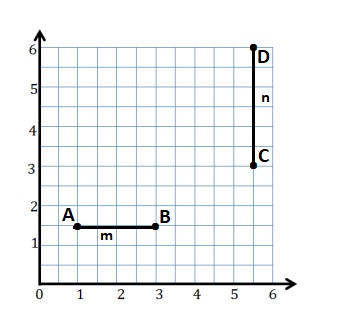
Eureka Math Grade 4 Module 3 Lesson 12 Homework Answer Key

Use the RDW process to solve the following problems.

Question 1.
The table shows the number of stickers of various
types in Chrissy’s new sticker book. Chrissy’s
six friends each own the same sticker book.
How many stickers do Chrissy and her six friends have altogether?

Type of StickerNumber of Stickers
flowers32
smiley faces21
hearts39

Answer:
644 stickers does Chrissy and her six friends have altogether,
Eureka Math Grade 4 Module 3 Lesson 12 Answer Key-5
Explanation:
Given the number of stickers of various
types in Chrissy’s new sticker book.
Chrissy’s new sticker book has flowers + smiley faces + hearts =
32 + 21 + 39 = 92 stickers,
given six friends each own the same sticker book.
So number of  stickers does Chrissy and her six friends
have altogether are 92 stickers X 7 =
1
92
x 7
644 stickers as shown above.
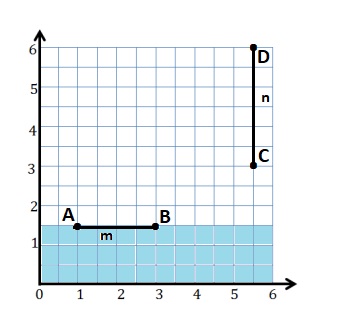
Question 2.
The small copier makes 437 copies each day.
The large copier makes 4 times as many copies each day.
How many copies does the large copier make each week?
Answer:
12,236 copies does the the large copier make each week,
Eureka Math Grade 4 Module 3 Lesson 12 Answer Key-6
Explanation:
Given the small copier makes 437 copies each day.
The large copier makes 4 times as many copies each day.
So each day the large copier makes are
4 X 437 copies =
  1,2
437
X 4
1,748
copies, Now number of copies does the large
copier make each week are 1,748 copies X 7 =
5,3,5
1,748
X   7
12,236
copies as shown above.
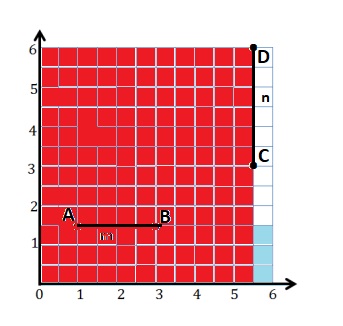
Question 3.
Jared sold 194 Boy Scout chocolate bars. Matthew sold
three times as many as Jared. Gary sold 297 fewer than
Matthew. How many bars did Gary sell?
Answer:
Gary sells 285 Boy Scout chocolate bars,
Eureka Math Grade 4 Module 3 Lesson 12 Answer Key-7

Explanation:
Given Jared sold 194 Boy Scout chocolate bars.
Matthew sold three times as many as Jared.
So Matthew sold 194 X 3 =
   2,1
194
X 3
582,
Now Gary sold 297 fewer than Matthew.
So number of bars did Gary sell are 582 – 297 = 285,
therefore Gary sells 285 Boy Scout chocolate bars as shown above.
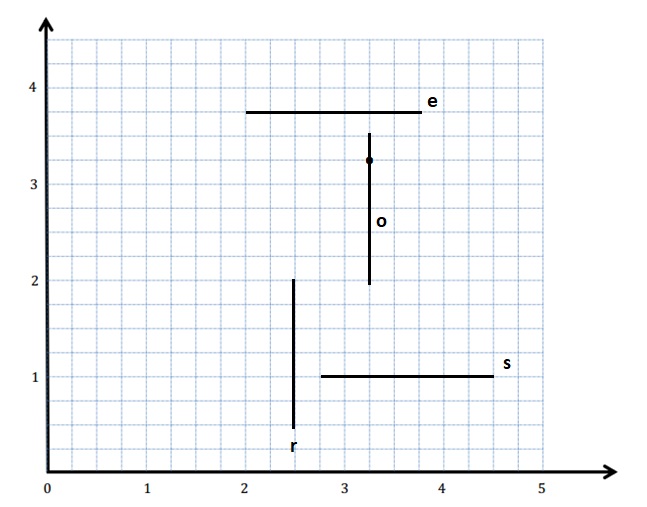
Question 4.
a. Write an equation that would allow someone to find the value of M.
Eureka Math Grade 4 Module 3 Lesson 12 Homework Answer Key 2
Answer:
M = (723 meters X 3) +  973 meters,

Explanation:
Wrote an equation that would allow someone to
find the value of M as M = (723 meters X 3) +  973 meters.

b. Write your own word problem to correspond to
the tape diagram, and then solve.

Answer:
Peter has 2 rope pieces of one piece of length 973 meters and
other 3 times 723 meters of length altogether howm much
length of rope in meters do Peter have?
Peter have altogether rope of length 3,142 meters,

Explanation:
Wrote my own word problem to correspond
to the tape diagram, and then solved as below,
Peter has 2 rope pieces of one piece of length 973 meters and
other 3 times 723 meters of length altogether howm much
length of rope in meters do Peter have?
Solution :
One piece of length is 723 meters X 3 =
723
X 3
2,169 meters,

Now adding this to other piece of length 973 meters ,
2,169 + 973 = 3,142 meters,
therefore Peter have altogether rope of length 3,142 meters.