Factorization Definition, Formula | How do you Factorize Expressions?

Factorization is nothing but the breaking down an entity (a number, a matrix, or a polynomial) into the product of another entity or factors. When you multiply the product of the factors, you will get the original number or matrix. Difficult algebraic or quadratic equations can reduce into small forms using the Factorization method. The factors of equations can be a variable, an integer, or an algebraic expression itself.

In simple words, Factorization can be explained as the reverse process of multiplication.

Examples:
(i) Product: 4x (3x – 6y) = 12x² – 24xy; Factorization: 12x² – 24xy = 4x (3x – 6y)
(ii) Product: (x + 4)(x – 3) = x² + x – 12; Factorization: x² + x – 12 = (x + 4)(x – 3
(iii) Product: (4a + 6b)(4a – 6b) = 16a2 – 36b2; Factorization: 16a2 – 36b2 = (4a + 6b)(4a – 6b)

Maths Factorization

Find out different Factorization concepts and concern links below. You can learn each individual concept with a clear explanation with the help of the below links. We have explained every topic details separately with the solved examples. Therefore, students can easily get a grip on Factorization concepts by referring to our detailed concepts.

Simple Factorization

Simple Factorization can be easily understood by the below examples.

(i) HCF of two or more monomials = (HCF of their numerical coefficients) × (HCF of their literal coefficients)
(ii) HCF of literal coefficients = product of each common literal raised to the lowest power.

Factor

The factor is something that is to be multiplied.
Sum = term + term
Product = factor × factor
For example, x = m(n + 1); m and n + 1 are the factors.

Examples:

1. Factorize 4x²y² – 2xy

Solution:
Firstly, find the HCF of both given terms.
HCF of their numerical coefficients 4 and 2 is 2.
HCF of literal coefficients:
The lowest power of x is 1
The lowest power of y is 1
Therefore, the HCF of literal coefficients is xy.
HCF of two or more monomials = (HCF of their numerical coefficients) × (HCF of their literal coefficients)
HCF of 4x²y² – 2xy is 2xy.
Multiply and divide each term of the given expression 4x²y² – 2xy with 2xy
2xy((4x²y²/2xy) – (2xy/2xy)) = 2xy (2xy – 1)

The final answer is 2xy (2xy – 1)

2. Find the HCF of 24a3b2c3 and 27a4bc4.

Solution:
Firstly, find the HCF of both given terms.
HCF of their numerical coefficients 24 and 27 is 3.
HCF of literal coefficients:
The lowest power of a is 3.
The lowest power of b is 1.
And, the lowest power of c is 3.
Therefore, the HCF of literal coefficients is a³bc³.
HCF of two or more monomials = (HCF of their numerical coefficients) × (HCF of their literal coefficients)
HCF of 24a3b2c3 and 27a4bc4 is 3a³bc³.

The final answer is 3a³bc³

3. Find the HCF of 2a2bc, 4a3b and 14bc.

Solution:
Firstly, find the HCF of both given terms.
HCF of their numerical coefficients 2, 4, and 14 is 2.
HCF of literal coefficients:
The lowest power of a is 0.
The lowest power of b is 1.
And, the lowest power of c is 0.
Therefore, the HCF of literal coefficients is b.
HCF of two or more monomials = (HCF of their numerical coefficients) × (HCF of their literal coefficients)
HCF of 2a2bc, 4a3b and 14bc is 2b.

The final answer is 2b.

Factorization Solved Examples

1. Factorize 4y3 – 24y5

Solution:
Firstly, find the HCF of both given terms.
HCF of their numerical coefficients 4 and 24 is 4.
HCF of literal coefficients:
The lowest power of y is 3
Therefore, the HCF of literal coefficients is y³.
HCF of two or more monomials = (HCF of their numerical coefficients) × (HCF of their literal coefficients)
HCF of 4y3 – 24y5 is 4y³.
Multiply and divide each term of the given expression 4y3 – 24y5 with 4y³
4y³((4y3/4y³) – (24y5 /4y³) = 4y³(1 – 6y²)

The final answer is 4y³(1 – 6y²)

2. Factorize 21m2n5 – 7mn2 + 28m5n

Solution:
Firstly, find the HCF of both given terms.
HCF of their numerical coefficients 21, 7, and 28 is 7.
HCF of literal coefficients:
The lowest power of m is 1
The lowest power of n is 1
Therefore, the HCF of literal coefficients is mn.
HCF of two or more monomials = (HCF of their numerical coefficients) × (HCF of their literal coefficients)
HCF of 21m2n5 – 7mn2 + 28m5n is 7mn.
Multiply and divide each term of the given expression 21m2n5 – 7mn2 + 28m5n with 7mn
7mn((21m2n5 /7mn) – (7mn2 /7mn) + (28m5n/7mn)) = 7mn(3mn4 – n + 4m4)

The final answer is 7mn(3mn4 – n + 4m4)

3. Factorize 3m(d + 5e) – 3n(d + 5e)

Solution:
Firstly, find the HCF of both given terms.
HCF of their numerical coefficients 3 and 3 is 3.
HCF of literal coefficients:
The lowest power of m is 0
The lowest power of n is 0
Therefore, the HCF of literal coefficients is d+ 5e.
HCF of two or more monomials = (HCF of their numerical coefficients) × (HCF of their literal coefficients)
HCF of 3m(d + 5e) – 3n(d + 5e) is 3(d + 5e).
Multiply and divide each term of the given expression 3m(d + 5e) – 3n(d + 5e) with 3(d + 5e)
3(d + 5e)((3m(d + 5e)/3(d + 5e)) – (3n(d + 5e)/3(d + 5e))) = 3(d + 5e)(m – n)

The final answer is 3(d + 5e)(m – n)

For any details or queries feel free to contact us. Connect us through the comment section available below. Bookmark our website for immediate updates.

Quadratic Equations Formulas, Tricks |How to Solve Quadratic Equations?

Quadratic Equation is a second-degree polynomial equation with one variable x. The graph of quadratic equations makes nice curves. For every equation, we have two values of the variables called the roots. Get the formula and simple step by step process to solve the roots of any quadratic equation in the following sections.

Quadratic Equation Definition

The quadratic equation is an equation where the highest exponent of the variable is square. The standard form of quadratic equations is ax² + bx + c = 0. Where x is the variable, a, b, c are the constants and a should not be equal to zero. The power of x should not be negative and must be 2.

Quadratic Equation Formula

The formulas to find the solution or roots of the quadratic equation are given below:

(α, β) = [-b ± √(b² – 4ac)] / 2a

The values of the variable satisfying the given quadratic equation are called its roots. The roots of the quadratic equation details are mentioned here.

  • Both roots of the equation are zero when b and c are zero.
  • One of the roots of the quadratic equation is zero and the other is -b/a if c = 0
  • The two roots are reciprocal to each other when the coefficients a and c are equal.

Nature of Roots of Quadratic Equation

In the quadratic equation formula, the term (b² – 4ac) is called the discriminant of the equation and it gives information about the nature of the roots. Below listed are the conditions that define the nature of roots.

  • If the discriminant value is zero, then the equation will have equal roots i.e α = β = -b/2a.
  • If the discriminant value is greater than zero, then the equation will have real roots.
  • If the discriminant value is less than zero, then the equation will have imaginary roots.
  • If the discriminant is greater than zero and it is a perfect square, then the equation will have rational roots.
  • If the discriminant is greater than zero and it is not a perfect square, then the equation will have irrational roots.
  • If the discriminant is greater than zero, perfect square, and a = 1, b, c are integers, then the equation will have integral roots.

How to Solve Quadratic Equations?

By solving the quadratic equations, you will get two roots that satisfy the equation. The easy steps to solve the quadratic equation roots are given here. The two ways to find the quadratic equations roots are the algebraic method and the graphical method. Here, we will learn about those methods.

Algebraic Method:

  • Convert the given equation in the form of ax² + bx + c = 0, get a, b, c values.
  • Substitute the values in the quadratic formula.
  • Perform all the required calculations and find the roots.
  • Another simple way is by factorizing the quadratic equation.
  • The obtained factors are the roots.

Graphical Method:

  • Plot the graph for the random values of x.
  • The points where the curve meets the x-axis are the roots.

Examples of Quadratic Equations

(i) 5x² + 3x + 2 = 0 is a quadratic equation.

(ii) x – (1/x) = 6 is a quadratic equation

On solving this, we get x * x – 1 = 6 * x

x² – 1 = 6x

x² – 6x – 1 = 0

(iii) x² + √2x + 7 = 0 is not a quadratic equation.

(iv) x² + 5 = 0 is a quadratic equation.

(v) x² = 0,√ x² + 2x + 1 are quadratic equations.

Solved Examples on Finding Roots of the Equation

Example 1.

Solve the roots of equation 3x² – 22x – 16 by factorization?

Solution:

Given the quadratic equation is 3x² – 22x – 16

= 3x² – 24x + 2x – 16

= 3x(x – 8) + 2(x – 8)

= (x – 8) (3x + 2)

x – 8 = 0 and 3x + 2 = 0

x = 8 and 3x = -2, x = -2/3

The roots of the equation are α = 8, β = -2/3.

Therefore, solution set (8, -2/3)

Example 2.

Solve 9x² + 25x + 10 = 0 by using the quadratic formula.

Solution:

Given that,

9x² + 25x + 10 = 0

Roots of equation formula is (α, β) = [-b ± √(b² – 4ac)] / 2a

In the equation, a = 9, b = 25, and c = 10

Substitute these values in the equation.

α = [-b + √(b² – 4ac)] / 2a

= [-9 + √(9² – 4 (9) (10)] / 2 (9)

= [-9 + √(81 – 360)] / 18

= [-9 + √(-279)] / 18

= [-9 + √(279i²)] / 18

= [-9 + 16.70i] / 18

β = [-b – √(b² – 4ac)] / 2a

= [-9 – √(9² – 4 (9) (10)] / 2 (9)

= [-9 – √(81 – 360)] / 18

= [-9 – √(-279)] / 18

= [-9 – √(279i²)] / 18

= [-9 – 16.70i] / 18

Roots are α = [-9 + 16.70i] / 18, β = [-9 – 16.70i] / 18

Therefore, solution set ([-9 + 16.70i] / 18, [-9 – 16.70i] / 18)

Example 3.

Find the roots of the equation 1/(x + 4) – 1/(x – 7) = 11/30.

Solution:

Given that,

1/(x + 4) – 1/(x – 7) = 11/30

[(x – 7) – (x + 4)] / (x + 4) (x – 7) = 11/30

[x – 7 -x – 4] / (x² + 4x – 7x – 28) = 11/30

(-11) / (x² – 3x – 28) = 11/30

-1/ (x² – 3x – 28) = 1/30

-30 = x² – 3x – 28

x² – 3x – 28 + 30 = 0

x² – 3x + 2 = 0

x² – 2x – x + 2 = 0

x(x – 2) -1(x – 2) = 0

(x – 1) (x – 2) = 0

(x – 1) = 0 and (x – 2) = 0

x = 1, x = 2

The roots of quadratic equation is α = 1, β = 2.

Therefore, the solution set is (1, 2)

Example 4.

Find the values of a for which the quadratic expression (x – a) (x – 10) + 1 = 0 has integral roots.

Solution:

Given that,

(x – a) (x – 10) + 1 = 0

x² – ax – 10x + 10a + 1 = 0

x² – (a + 10)x + 10a + 1 = 0

Discriminant = b² – 4ac = (a + 10)² – 4 . 1. (10a + 1)

= a² + 20a + 100 – 40a – 4

= a² – 20a + 100 – 4

= (a – 10)² – 4

The quadratic equation will have integral roots, if the value of discriminant > 0, D is a perfect square, a = 1 and b and c are integers.

(a – 10)² – Discriminant = 4

Since discriminant is a perfect square. Hence, the difference of two perfect square in R.H.S will be 4 only when D = 0 and (a – 10)² = 4.

(a – 10) = ± 2

a = 2 + 10 or a = -2 + 10

= 12 and 8

Therefore, values of a are 8, 12.

Frequently Asked Questions on Quadratic Equations

1. What are the uses of the quadratic equations?

The quadratic equations can be used in calculating the area of rooms, speed of an object, determining product profit in the business. It can also be used in athletics and sports.

2. Write the differences between quadratic expression and quadratic equation?

The quadratic equation is a polynomial of degree 2 or any equation where quadratic expression is in the form of ax² + bx + c for equation or expression a ≠ 0. The quadratic formula is used to solve the roots of the equation.

3. What is the simplest form of a quadratic equation?

The standard form of a quadratic equation is ax² + bx + c – 0, where a ≠ 0. The coefficients a, b, c are real numbers.

4. Describe the nature of the roots?

The discriminant b² – 4ac > 0, roots are real, unequal and distinct. In case the discriminant = 0, roots are real, equal, and coincident. If the discriminant < 0, then roots are imaginary and unequal.

Practice Test on Linear Inequations | Linear Inequality Questions and Answers

Practice Test on Linear Inequation has different types of questions. Students can test their skills and knowledge on linear inequations problems by solving all the provided questions on this page. The questions are mainly related to inequalities and finding the solution to the given inequation and draw a graph for the obtained solution set. You can easily draw a graph on a numbered line.

1. Write the equality obtained?

(i) On subtracting 1 from each side 3 > 7

(ii) On adding 3 to each side 12 < 5

(iii) On multiplying (-2) to each side 11 < 4

(iv) On multiplying 4 to each side 15 > 2

Solution:

(i) 3 – 1 > 7 – 1

2 > 6

(ii) 12 + 3 < 5 + 3

15 < 8

(iii) 11 x (-2)  4 x (-2)

-22 < -8

22 > 8

(iv) 15 x 4 > 2 x 4

60 > 8

2. Write the word statement for the following?

(i) x ≥ 15

(ii) x < 2

(iii) x ≤ -5

(iv) x > 16

(v) x ≠ 6

Solution:

(i) The variable x is greater than equal to 15. The possible values of x are 15 and more than 15.

(ii) The variable x is less than 2. The possible values of x are less than 2.

(iii) The variable x is less than and equal to -5. The possible values of x are less than -5.

(iv) The variable x is greater than 16. The possible values of x are more than 16.

(v) The variable x is not equal to 6. The possible values of x are all real numbers other than 6.

3. Find the solution set for each of the following inequations. x ∈ N

(i) x + 5 < 12

(ii) x – 6 > 5

(iii) 5x + 10 ≥ 17

(iv) 2x + 3 ≤ 6

Solution:

(i) x + 5 < 12

Subtract 5 from both sides.

x + 5 – 5 < 12 – 5

x < 7

Replacement set = {1, 2, 3, 4, 5 . .}

Solution set S = {1, 2, 3, 4, 5, 6}

(ii) x – 6 > 5

Add 6 to both sides.

x – 6 + 6 > 5 + 6

x > 11

Replacement set = {1, 2, 3, 4, 5 . .}

Solution set S = {12, 13, 14, 15, . . . }

(iii) 5x + 10 ≥ 17

Subtract 10 from both sides.

5x + 10 – 10 ≥ 17 – 10

5x ≥ 7

Divide 5 by each side.

5x/5 ≥ 7/5

x ≥ 1.4

Replacement set = {1, 2, 3, 4, 5 . .}

Solution set S = {2, 3, 4, 5 . . .}

(iv) 2x + 3 ≤ 6

Subtract 3 from both sides of the inequation

2x + 3 – 3 ≤ 6 – 3

2x ≤ 3

Both sides of the inequation divide by 2.

2x/2 ≤ 3/2

x ≤ 1.5

Replacement set = {1, 2, 3, 4, 5 . .}

Solution set S = {1, 1.5}

4. Find the solution set for each of the following inequations and represent it on the number line.

(i) 3 < x < 10, x ∈ N

(ii) 3x + 2 ≥ 6, x ∈ N

(iii) 3x/2 < 5, x ∈ N

(iv) -4 < 2x/3 + 1 < – 2, x ∈ N

Solution:

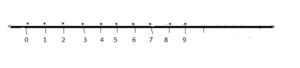
(i) 3 < x < 10, x ∈ N

The two cases are 3 < x and x < 10

It can also represent as x > 3 and x < 10

Replacement set = {1, 2, 3, 4, 5 . .}

The solution set for x > 3 is 4, 5, 6, 7 . . . i.e P = {4, 5, 6, 7 . . .}

And the solution set for x < 10 is 1, 2, 3, 4, 5, 6, 7, 8, 9 i.e Q = {1, 2, 3, 4, 5, 6, 7, 8, 9}

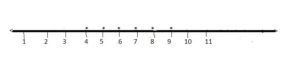
Therefore, solution set of the given inequation = P ∩ Q = {4, 5, 6, 7, 8, 9}

Let us represent the solution set graphically.

The solution set is marked on the number line by dots.

(ii) 3x + 2 ≥ 6, x ∈ N

Subtract 2 from both sides

3x + 2 – 2 ≥ 6 – 2

3x ≥ 4

Divide each side by 3

3x/3 ≥ 4/3

x ≥ 1.33

Replacement set = {1, 2, 3, 4, 5 . .}

Solution set S = {2, 3, 4, 5, . . }

Let us represent the solution set graphically.

The solution set is marked on the number line by dots.

(iii) 3x/2 < 5, x ∈ N

Multiply both sides by 2.

3x/2 x 2 < 5 x 2

3x < 10

divide both sides by 3

3x/3 < 10/3

x < 3.33

Replacement set = {1, 2, 3, 4, 5 . .}

Solution Set S = {1, 2}

Let us represent the solution set graphically.

The solution set is marked on the number line by dots.

(iv) -4 < 2x/3 + 1 < – 2, x ∈ N

The two cases are -4 < 2x/3 + 1 and 2x/3 + 1 < – 2

Case I: -4 < 2x/3 + 1

Subtract 1 from both sides

-4 – 1 < 2x/3 + 1 – 1

-5 < 2x/3

Multiply each side by 3

-5 x 3 < 2x/3 x 3

-15 < 2x

Divide each side by 2

-15/2 < 2x/2

-7.5 < x

x > 7.5

Replacement Set = {1, 2, 3, 4, 5 . .}

Solution Set P = {8, 9, 10, 11 . . . }

Case II: 2x/3 + 1 < – 2

Subtract 1 from both sides

2x/3 + 1 – 1 < – 2 – 1

2x/3 < -3

Multiply 3 to both sides

2x/3 x 3 < -3 x 3

2x < -9

Divide both sides by 2

2x/2 < -9/2

x < -4.5

4.5 > x

Replacement set = {1, 2, 3, 4, 5 . .}

Solution set Q = {1, 2, 3}

Therefore, required solution set S = P ∩ Q

S = Null

5. Find the solution set for each of the following and represent the solution set graphically?

(i) x – 6 < 4, x ∈ W

(ii) 6x + 2 ≤ 20, x ∈ W

(iii) 7x + 3 < 5x + 9, x ∈ W

(iv) 3x – 7 > 5x – 1, x ∈ I

Solution:

(i) x – 6 < 4, x ∈ W

Add 6 to both sides

x – 6 + 6 < 4 + 6

x < 10

Replacement set = {0, 1, 2, 3, 4, 5, 6, …}

Therefore, solution set S = {0, 1, 2, 3, 4, 5, 6, 7, 8, 9}

Let us represent the solution set graphically.

The solution set is marked on the number line by dots.

(ii) 6x + 2 ≤ 20, x ∈ W

Subtract 2 from both sides

6x + 2 – 2 ≤ 20 – 2

6x ≤ 18

Divide each side by 6

6x/6 ≤ 18/6

x ≤ 3

Replacement set = {0, 1, 2, 3, 4, 5, 6, …}

Therefore, solution set S = {0, 1, 2, 3}

Let us represent the solution set graphically.

The solution set is marked on the number line by dots.

(iii) 7x + 3 < 5x + 9, x ∈ W

Move variables to one side and constants to other side of inequation

7x – 5x < 9 – 3

2x < 6

Divide each side by 2

2x/2 < 6/2

x < 3

Replacement set = {0, 1, 2, 3, 4, 5, 6, …}

Therefore, solution set S = {0, 1, 2}

Let us represent the solution set graphically.

The solution set is marked on the number line by dots.

(iv) 3x – 7 > 5x – 1, x ∈ I

Move variables to one side and constants to another side of inequation

-7 + 1 > 5x – 3x

-6 > 2x

divide 2 by each side

-6/2 > 2x/2

-3 > x

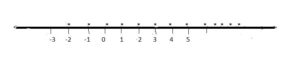
Replacement set ={ . . . -4, -3, -2, -1, 0, 1, 2, 3, . . .}

Solution set = { -2, -1, 0, 1, 2, . . . }

Let us represent the solution set graphically.

The solution set is marked on the number line by dots.

Representation of the Solution Set of a Linear Inequation |  How to find the Solution Set of a Linear Inequation?

Are you still looking for a simple procedure on how to represent the solution set of an inequation on a graph? If yes, then stay on this page. Here we are giving a detailed step by step explanation on finding Solution Set for Linear Inequations with the solved examples. So, refer to the following sections and solve the questions easily.

Graphical Representation of the Solution Set of an Inequation

We generally use a number line to represent the solution set of an inequation on a graph. Following are the steps to represent the solution set of a linear inequation on a graph.

  • At first, solve the given linear inequation and find the solution set for it.
  • Mark the solution set on a number line by putting dot.
  • If the solution set is infinite, then put three more dots to indicate infiniteness.

Questions on Finding the Solution Set of an Inequation and their Representation

Example 1.

Solve the inequation 4x – 6 < 10, x ∈ N and represent the solution set graphically?

Solution:

Given linear inequation is 4x – 6 < 10

Add 6 to the both sides of inequation

= 4x – 6 + 6 < 10 + 6

= 4x < 16

Divide both sides of the inequation by 4

= 4x/4 < 16/4

= x < 4

So, the replacement set = {1, 2, 3, 4, . . }

Therefore, the solution set S = {1, 2, 3} or S = {x : x ∈ N, x < 4}

Let us mark the solution set graphically.

The solution set is marked on the number line by dots.

Example 2.

Solve the inequation 8x + 4 > 20, x ∈ W and represent the solution set graphically?

Solution:

Given linear inequation is 8x + 4 > 20

Subtract 4 from both sides

= 8x + 4 – 4 > 20 – 4

= 8x > 16

Divide both sides by 8

= 8x/8 > 16/8

= x > 2

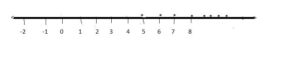
Replacement set = {0, 1, 2, 3, 4, . . . }

Therefore, solution set = {3, 4, 5, . . } or S = {x : x ∈ W, x > 2}

Let us mark the solution set graphically.

The solution set is marked on the number line by dots. We put three more dots indicate the infiniteness of the solution set.

Example 3.

Solve -2 ≥ x ≥ 5, x ∈ I, and represent the solution set graphically?

Solution:

Given linear inequation is -2 ≥ x ≥ 5

This has two inequations,

-2 ≥ x and x ≥ 5

Replacement set = {. . . -3, -2, -1, 0, 1, 2, 3 . . .}

Solution set for the inequation -2 ≥ x is -2, -1, 0, 1, 2, 3, . . i.e S = {-2, -1, 0, 1, 2, 3 . . } = P

And the solution set for the inequation x ≥ 5 is 5, 6, 7, 8 . . i.e Q = {5, 6, 7, 8 . . .}

Therefore, solution set for the given inequation = P ∩ Q

= {5, 6, 7, 8, 9 . . . }

or S = {x : x ∈ I, -2 ≥ x ≥ 5}

Let us represent the solution set graphically.

The solution set is marked on the number line by dots.

Example 4.

Solve 0 < 3x – 10 ≤ 12, x ∈ R and represent the solution set graphically.

Solution:

Given linear inequation is 0 < 3x – 10 ≤ 12

It has two cases.

Case I:

0 < 3x – 10

Add 10 to both sides

0 + 10 < 3x – 10 + 10

10 < 3x

Divide both sides by 3

10/3 < 3x/3

10/3 < x

Case II:

3x – 10 ≤ 12

Add 10 to both sides

3x – 10 + 10 ≤ 12 + 10

3x ≤ 22

Divide both sides by 3

3x/x ≤ 22/3

x ≤ 22/3

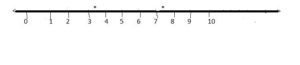
S ∩ S’ = {3.33 < x ≤ 7.33} x ∈ R

= {x : x ∈ R 3.33 < x ≤ 7.33}

Properties of Inequation or Inequalities – Definition, Solved Examples

Properties of Inequation or Inequalities page gives detailed information about six properties. Each Property is explained step by step by considering a few examples. Learn and understand the properties easily with the help of solved examples provided below. You can seek Complete Information about Linear Inequations and their definitions all on our page.

Properties of Inequation or Inequalities

The six different properties of linear inequalities or linear inequation are mentioned here. These properties describe how arithmetic operations show the effect on the linear inequations.

Property I

The inequation remains unchanged if the same quantity is added to both sides of it.

Example:

x – 3 < 4

Add 3 to the both sides

= x – 3 + 3 < 4 + 3

= x < 7

Property II:

The inequation remains unchanged if the same quantity is subtracted from the both sides of the inequation.

Example:

x + 3 < 4

Subtract 3 from both sides

x + 3 – 3 < 4 – 3

x < 1

Property III:

The inequation remains unchanged if the same positive number is multiplied to both sides of it.

Example:

x/3 > 5

multiply 3 to both sides

= x/3 x 3 > 5 x 3

= x > 15

Property IV:

The inequation changes if the same negative number is multiplied to both sides of it. Actually, it reverses.

Example:

x/5 < 6

multiply -5 to the both sides

= x/5 x (-5) < 6 x (-5)

= -x < -30

= x > 30

Property V:

The inequation remains unchanged if the same positive number is divided by both sides of the inequation.

Example:

5x > 20

dividing both sides by 5

= 5x/5 > 20/5

= x > 4

Property VI:

The inequation changes when the same negative number is divided by both sides. It reverses.

Example:

-3x < 12

Dividing both sides by -3

= -3x/-3 > 12/-3

= x > -4

Solved Examples on Properties of Linear Inequalities

Example 1.

Write the inequality obtained for each of the following statements.

(i) On subtracting 9 from both sides of 21 > 10.

(ii) On multiplying each side of 8 < 12 by -2.

Solution:

(i) We know that subtracting the same number from both sides of inequality does not change the inequality.

21 – 9 > 10 – 9

= 12 > 1

(ii) We know that multiplying each side of an inequality by the same negative number reverses that inequality.

= 8 x -2 < 12 x -2

= -16 < -24

= -16 > -24

Example 2.

Find the inequality obtained for the following statements.

(i) On adding 2 to both sides of 8 < 56

(ii) On dividing each side of 8 < 56 by -16.

Solution:

(i) We know that adding the same number to both sides of inequality does not change the inequality.

8 + 2 < 56 + 2

= 10 < 58

(ii) We know that dividing each side of an inequality by the same negative number reverses that.

8/-16 < 56/-16

= -1/2 > -7/2

Example 3.

Write the inequality obtained for the following statement.

On multiplying each side of 18 > 8 by 5.

Solution:

We know that multiplying each side of an inequality by the same positive number does not change the inequality.

18 x 5 > 8 x 5

= 90 > 40

Linear Inequality and Linear Inequations | Linear Inequalities in One Variable

On this page, we will learn about what is linear inequality and linear inequations and the steps to solve the linear inequalities problems. You will also get the properties of inequation or inequalities. Check out the representation of the solution set on the real line in the following sections. We have provided Solved Problems along with a detailed explanation so that you can better understand the concept.

What are Linear Inequation and Linear Inequalities?

Linear Inequation is a statement indicating the value of one quantity or algebraic expressions that are not exactly equal to one another.

Inequalities are nothing but the symbols enclosed between two or more algebraic expressions or quantities. The open sentence which involves <, ≤, >, ≥, and ≠ symbols are called the inequalities.

Some of the examples of Linear Inequation are listed below.

  • x < 6
  • y ≥ 25
  • x + 3 > 40
  • p ≠ 10

Linear Inequation

An inequation that contains one variable and that variable highest power is one then is known as the linear inequation in that variable. To make a linear equation into inequation, you have to replace the equal to symbol with the inequality sign. The statements of any of the forms ax + b < 0, ax + b > 0, ax + b≥ 0, ax + b ≤ 0 are the linear inequations invariable x, where a, b are real numbers and a is not equal to zero.

some of the examples of the linear inequation with variable y are included below:

  • 3y + 6 ≥ 0
  • 9 – y < 0
  • 2y > 0
  • 25 + 5y ≤ 0

Questions on Replacement Set or Domain of a Variable

Example 1.

Find the replacement set for the inequation x ≤ 9. The replacement set is a set of whole numbers?

Solution:

We know that whole numbers W = {0, 1, 2, 3 . . . }.

Replace x with some values of W. Some values of x from W satisfy the inequation and some don’t. Here, the values 0, 1, 2, 3, 4, 5, 6, 7, 8, 9 satisfy the given inequation x ≤ 9 while the other values don’t.

Thus, the set of all those values of variables that satisfy the given inequation is called the solution set of the given inequation.

Therefore, the solution set for the inequation x ≤ 9 is S = {0, 1, 2, 3, 4, 5, 6, 7, 8, 9} or S = {x : x ∈ W, x ≤ 9}

Example 2.

Find the replacement set for the inequation x > 2. Let the replacement set be the set of natural numbers?

Solution:

We know that natural numbers N = {1, 2, 3, 4, 5, 6}

Replace x with some values of N. Some values of x from N satisfy the inequation and some don’t. Here, the values 3, 4, 5, . . . satisfy the given inequation x > 2 while the other values don’t.

Thus, the set of all those values of variables that satisfy the given inequation is called the solution set of the given inequation.

Therefore, the solution set for the inequation x > 2 is S = {3 4, 5, 6, . . . }

Example 3.

Find the replacement set and the solution set for the inequation x ≥ -2 when the replacement set is an integer?

Solution:

Replacement set I = {. . . -3, -2, -1, 0, 1, 2, 3, . . . }

Solution set S = {-2, -1, 0, 1, 2, . . . } or S = { x : x ∈ I, x ≥ – 2}

Example 4.

Find the solution set for the following linear inequations.

(i) x < 5 where replacement set is {-4, -3, -2, -1, 0, 1, 2, 3, 4}

(ii) x ≥ 7 where replacement set is { 1, 2, 3, 4, 5, 6, 7, 8, 9, 10}

(iii) x ≠ 3 where replacement set is { 0, 1, 2, 3, 4, 5, 6, 7, 8, 9, 10}

Solution:

(i) Solution Set S = {-4, -3, -2, -1, 0, 1, 2, 3, 4} S = {x : x ∈ I, -4 < x ≤ 4}

(ii) Solution set S = {7, 8, 9, 10} or S = {x : x ∈ N, 7 < x < 10}

(iii) Solution set S = {0, 1, 2, 4, 5, 6, 7, 8, 9, 10} or S = {x : x ∈ N, x ≠ 3}

Frequently Asked Questions on Linear Inequality

1. What is the difference between a linear equation and a linear inequality?

The linear equation is an equation that has one or two variables and those exponents are one. Linear inequation also has one variable whose exponent is one. Between two algebraic expressions, the = symbol is enclosed in a linear equation, linear inequality signs are enclosed in a linear inequation. The graph of inequalities is a dashed line but the equation is a solid line in any situation.

2. What is linear inequality?

Linear inequality contains any symbols of inequality. It represents the data that is not equal in graph form. It involves a linear function.

Linear Inequations | How do you Solve a Linear Inequation?

Linear inequations demonstrate the value of one quantity or algebraic expression which is not equal to another. These inequations are used to compare any two quantities. Get some solved examples on linear inequations and steps to draw graphs, the system of linear inequations in the following sections of this page.

What are Linear Inequations?

Linear inequalities are the expressions where any two values are compared by the inequality symbols. These are the equations that contain all mathematical symbols except equal to (=). The values can be numerical or algebraic or a combination of both.

The inequality symbols are < (less than), > (greater than), ≤ (less than or equal to), ≥ (greater than or equal to), ≠ (not equal to). The symbols < and > shows the strict inequalities and the symbols ≤ and ≥ represents the slack inequalities.

Example:

x < 3, x ≥ 5, y ≤ 8, p > 10, m ≠ 1.

Linear Inequalities Graphing

We can plot the graph for linear inequalities like an ordinary linear function. But, for a linear function, the graph represents a line and for inequalities, the graph shows the area of the coordinate plane that satisfies the inequality condition. The linear inequalities graph divides a coordinate plane into two parts. One part of the coordinate plane is called the borderline where it represents the solutions for inequality. The borderline represents the conditions <, >, ≤ and ≥.

Students who are willing to plot a graph for the linear inequations can refer to the following steps.

  • Arrange the given linear inequation in such a way that, it should have one variable ‘y’ on the left-hand side of the symbol and the remaining equation on the right-hand side.
  • Plot the graph for linear inequation by putting the random values of x.
  • Draw a thicker and solid line for y≤ or y≥ and a dashed liner for y< or y> conditions.
  • Now, draw shades as per the linear inequalities conditions.

System of Linear Inequalities

A system of linear inequalities in two variables includes at least two inequalities in the variables. By solving the linear inequality you will get an ordered pair. So basically, the solution to all linear inequalities and the graph of the linear inequality is the graph displaying all solutions of the system.

Questions on Linear Inequations

Example 1.

Solve the inequality x + 5 < 10?

Solution:

Given that,

x + 5 < 10

Move variable x to the one side of inequation.

= x < 10 – 5

= x < 5

Replacement set = {0, 1, 2, 3, 4, 5, 6, 7 . . . }

Solution set for the inequation x + 5 < 10 is 1, 2, 3, 4

Therefore, solution set s = {. . . 1, 2, 3, 4}

Let us mark the solution set graphically.

The solution set is marked on the number line by dots. We put three more dots indicate the infiniteness of the solution set.

Example 2.

Solve the inequation 3 < y ≤ 10?

Solution:

Given that,

3 < y ≤ 10

This has two inequations,

3 < y and y ≤ 10

Replacement set = {. . . -3, -2, -1, 0, 1, 2, 3, 4, , 6, 7, . . . }

Solution set for the inequation 3 < y is 4, 5, 6, 7, . . .  i.e Q = {4, 5, 6, . . . }

Solution set for the inequation y ≤ 10 is . . . . 0, 1, 2, 3, 4, 5, 6, 7, 8, 9 i.e P = {. . . . 0, 1, 2, 3, 4, 5, 6, 7, 8, 9}

Therefore, solution set of the given inequation = P ∩ Q = {4, 5, 6, 7, 8, 9}

Let us represent the solution set graphically.

The solution set is marked on the number line by dots.

Example 3.

Solve the inequality 4 ( x + 2 ) − 1 > 5 − 7 ( 4 − x )?

Solution:

Given that,

4 ( x + 2 ) − 1 > 5 − 7 ( 4 − x )

4 x + 8 − 1 > 5 − 28 + 7 x

4 x + 7 > − 23 + 7 x

− 3 x > − 30

x < 10

Replacement Set = {1, 2, 3, 4, 5 . . . }

Solution set is 1, 2, 3, 4, 5, 6, 7, 8, 9 i.e S = {1, 2, 3, 4, 5, 6, 7, 8, 9}

Let us represent the solution set graphically.

The solution set is marked on the number line by dots.

Frequently Asked Questions on Linear Inequations

1. What is meant by linear inequations?

Linear inequations involve linear expressions in two variables by using the relational symbols like <, >, ≤, ≥, and ≠.

2. How do you solve linear inequation?

Solving linear inequations having a single variable is very easy. All you have to do is simplify both the sides of the condition and get the variable term on one side and all other terms on the other side. And them either multiply/ divide the coefficient of the variable to obtain the solution.

3. What are the examples of linear inequations?

Some of the examples of linear inequality are x < 8, y > 15, z ≠ 7 + 9, p + 1 ≤ 2, 3 ≥ (z + 15).

Practice Test on Framing the Formula | Framing the Formula Questions and Answers

Practice Test on Framing the Formula let you know about the different problems available on the Framing the Formula. Most of the below questions appear on the exam which helps you to get good marks in the exam. Practice all the questions available below and have a perfect grip on Framing the Formula Problems.

All the concepts such as formulas, framing a formula, find the value of the variable using a change of subject of formula or an equation, change the subject of the formula, and method of substitution are included in the below article. Learn Tricks to solve Formula and Framing the Formula problems easily.

1. Write the formulas for the following statements.

(a) Area of the square is equal to the square of its side (b)
(b) Area B of the rhombus is equal to half the product of its diagonals (s₁, s₂).
(c) Perimeter (p) of a parallelogram is thrice the sum of its adjacent sides.
(d) Area of four walls (D) of a room is the product of two times the sum of length (l), breadth (b) and height (h).
(e) Profit (P) is calculated by taking the difference of cost price (C) and selling price (S).

Solution:

(a) Given that Area of the square is equal to the square of its side (b)
Area of the square = A
A = b²
(b) Area B of the rhombus is equal to half the product of its diagonals (s₁, s₂).
B = s₁ × s₂
(c) Perimeter (p) of a parallelogram is thrice the sum of its adjacent sides.
sum of its adjacent sides = x
p = 3(x)
(d) Area of four walls (D) of a room is the product of two times the sum of length (l), breadth (b) and height (h).
D = 2 (l + b + h)
(e) Profit (P) is calculated by taking the difference of cost price (C) and selling price (S).
P = S – C

2. Mention the formulas for the following statements.

(a) A side of a chessboard (D) is 3.14 times the side of a board (e).
(b) The difference between the two different variables is 36.
(c) The sum (X) of all the interior angles of a regular polygon of m sides is 2 less than m times 180°.
(d) Subtracting 2/5 from a number and multiplying this difference by 4 gives two times the same number.
(e) Fourteen years from now Sam’s age will be three times her present age.

Solution:

(a) Given that A side of a chessboard (D) is 3.14 times the side of a board (e).
D = 3.14e
(b) The difference between the two different variables is 36.
Two different variables are a and b
a – b = 36
(c) The sum (X) of all the interior angles of a regular polygon of m sides is 2 less than m times 180°.
X = (m – 2) × 180°
(d) Subtracting 2/5 from a number and multiplying this difference by 4 gives two times the same number.
Let the number is X.
X = 4(X – 2/5)
(e) Fourteen years from now Sam’s age will be three times her present age.
Sam’s age is C
C + 14 = 3C

3. Change the subject of the formula and find the value of the new subject.

(a) X = 2YZ make the subject Z. X = 20, Y = 5
(b) l² = r² + h², l is the height of the cone, h is the height and r is the radius. Make the subject h when l = 12 and r = 6.
(c) M = 1/2 × b × h where M is the area of a triangle with base b and height h. Make h the subject, find h when M = 50, b = 24.
(d) D = d × q + r where D is the dividend, q is the quotient, d the divisor, and r is the remainder. Make the subject r, when D = x² – x, d = x – 2, q = x + 3.
(e) M × N = c × d, Make N as the subject where M = 2, c = 4, d = 10.

Solution:
(a) X = 2YZ make the subject Z. X = 20, Y = 5
Given that X = 2YZ
Divide both sides with 2Y
X/2Y = 2YZ/2Y
X/2Y = Z
Therefore, Z = X/2Y
Substitute the given values X = 20, Y = 5
Z = 20/2(5) = 20/10 = 2
Z = 2.

The final answer is Z = 2.

(b) l² = r² + h², l is the height of the cone, h is the height and r is the radius. Make the subject h when l = 12 and r = 6.
Given that l² = r² + h², l is the height of the cone, h is the height and r is the radius.
l² = r² + h²
Subtract r² on both sides
l² – r² = r² – r² + h²
l² – r² = h²
h = √(l² – r²)
Substitute the given values l = 12 and r = 6
h = √((12)² – (6)²) = √144 – 36 = √108

The final answer is h = √108

(c) M = 1/2 × b × h where M is the area of a triangle with base b and height h. Make h the subject, find h when M = 50, b = 24.
Given that M = 1/2 × b × h where M is the area of a triangle with base b and height h. Make h the subject, find h when M = 50, b = 24.
M = 1/2 × b × h
Divide 1/2 × b on both sides.
M/(1/2 × b) = (1/2 × b × h)/(1/2 × b)
M/(1/2 × b) = h
Therefore, h = M/(1/2 × b)
Substitute the given values M = 50, b = 24.
h = 50/(1/2 × 24)
h = 50/12

The final answer is h = 50/12

(d) D = (d × q) + r where D is the dividend, q is the quotient, d the divisor, and r is the remainder. Make the subject r, when D = x² – x, d = x – 2, q = x + 3.
Given that D = d × q + r where D is the dividend, q is the quotient, d the divisor, and r is the remainder. Make the subject r, when D = x² – x, d = x – 2, q = x + 3.
D = (d × q) + r
Subtract (d × q) on both sides
D – (d × q) = (d × q) – (d × q) + r
D – (d × q) = r
Therefore, r = D – (d × q)
Substitute the given values D = x² – x, d = x – 2, q = x + 3.
r = (x² – x) – ((x – 2)(x + 3))
r = (x² – x) – (x² + 3x – 2x – 6)
r = x² – x – x² – x + 6
r = -2x + 6

The final answer is r = -2x + 6

(e) M × N = c × d, Make N as the subject where M = 2, c = 4, d = 10.
Given that M × N = c × d
Divide M on both sides
MN/M = cd/M
N = cd/M
Substitute the given values M = 2, c = 4, d = 10
N = (4 × 10)/2
N = 40/2
N = 20

The final answer is N = 20.

3. If the base of the triangle is 3/2 times its height, then find the area of the triangle.

Solution:
Given that the base of the triangle is 3/2 times its height, then find the area of the triangle.
The base of the triangle = b
Height of the triangle = h
The area of the triangle = A
A = 1/2 × b × h
Base of the triangle is 3/2 times its height
b = 3/2 × h
A = 1/2 × 3/2 × h × h
A = 3/4 × h²

4. If ‘S’ is equal to the 3/4 of the r, then find r.

Solution:
Given that If ‘S’ is equal to the 3/4 of the r, then find r.
S = 3/4 r
Divide 3/4 on both sides.
S/(3/4) = (3/4)/(3/4) .  r
4S/3 = r

The final answer is r = 4S/3

5. If x, y, z are in continued proportion, then find the value of z.

Solution:
Given that If x, y, z are in continued proportion, then find the value of z.
x/y = y/z
x . z = y . y
xz = y²
y² = xz
y = √xz

The final answer is y = √xz

6. If y workers can build a wall in 24 days, in how many days will 16 workers take to build a same wall.

Solution: Given that y workers can build a wall in 24 days
So, find the time taken to build a wall by one worker.
y workers = 24 days
1 worker = 24y days
Now, the time taken by 16 workers to build a wall.
1 worker = 24y days
16 worker = 24y/16 = 3/4y
Therefore, The time taken to build a wall by 16 workers is 3/4y.

The final answer is 3/4y.

7. A shirt is marked $ y and the shopkeeper allows 100 rupees off as a discount on it. What is its selling price?

Solution:
Given that a shirt is marked $ y and the shopkeeper allows $100 off as a discount on it.
Subtract $100 from $y to get the selling price.
$y – $100

The selling price is $y – $100.

8. A weighs 3 kg more than B and B weighs 6 kg less than C. If the weights of A, B, C is n, find the weights of A, B, C separately.

Solution:
Given that A weighs 3 kg more than B
A = 3 + B
B weighs 6 kg less than C
B = C – 6; C = B + 6
A + B + C = n
3 + B + B + B + 6 = n
3 + 3B + 6 = n
3B + 9 = n
3B = n – 9
B = (n – 9)/3
A = 3 + B
A = 3 + (n – 9)/3
C = B + 6
C = (n – 9)/3 + 6

The values of A, B, and C is A = 3 + (n – 9)/3, B = (n – 9)/3, and C = (n – 9)/3 + 6.

9. Half of a herd of deer are grazing in the field and 2/3 of the remaining are playing nearby. The rest 8 are drinking water from the pond. Find the number of deer in the herd?

Solution:
Let the total no.of deer = y
Half of a herd = y/2
2/3 of remaining half herd = (y/2)(2/3) = y/3
remaining deer = 8
From the given information, y = (y/2) + (y/3) + 8
y = (3y + 2y)/6 + 8
y = (5y + 48)/6
Multiply 6 on both sides
6y = (5y + 48)/6 × 6
6y = 5y + 48
Move 5y to the left side
6y – 5y = 48
y = 48.

The total number of deers is 48.

10. Arun is twice as old as Sam six years ago his age was four times Shriya’s age. Find their present ages.

Solution:

Let Arun age is x and Sam age is y
Arun age is twice as old as Sam
x = 2y if it is five years ago
x – 5 = 4(y – 5)
x – 5 = 4y – 20
x – 4y + 15 = 0
Substitute x = 2y in x – 4y + 15 = 0
2y – 4y + 15 = 0
-2y + 15 = 0
2y – 15 = 0
2y = 15
y = 15/2 = 7.5
x = 2y = 2 (15/2) = 15

Arun’s age is 15 and Sam’s age is 7.5

11. A car travels 12 km at the speed of x km/hr. Find the time taken by the car to reach the destination.

Solution:
Given that a car travels 12 km at the speed of x km/hr.
We know that Speed = Distance/Time
Time = Distance/Speed
Time = 12km/x km/hr.
The time = 12 hrs.

The time taken by the car to reach the destination is 12 hrs.

12. Ram had $192 with him. He purchased x kg potatoes for $40 a kg and y kg tomatoes for $45 a kg and z kg onions at $43 a kg. Find the money left with him?

Solution:
Given that Ram had $192 with him.
He purchased x kg potatoes for $40 a kg and y kg tomatoes for $45 a kg and z kg onions at $43 a kg.
Total cost of potatoes = 40x
The total cost of tomatoes = 45y
Total cost of onions = 43z
Total amount spent = 40x + 45y + 43z.
Money left with Ram is $192 – (40x + 45y + 43z)

Total Money left with Ram is $192 – (40x + 45y + 43z).

Two Trains Passes in the Opposite Direction | Relative Speed of Two Trains Running in Opposite Direction

Learn about the concept of Two Trains Passing in Opposite Direction completely by referring to the entire article. Know How to Calculate Speed Time and Distance when Two Trains Run in Opposite Direction. Refer to the Formulas and Solved Examples on Two Trains Passes in Opposite Direction and get a good grip on it. Detailed Solutions provided for each and every problem makes it easy for you to understand the entire concept.

How to find Relative Speed while Two Trains Running in Opposite Direction?

When Two Trains Passes through a Moving Object having a certain length in the Opposite Direction

Let us assume the Length of the faster train is l meters and the length of the slower train is m meters

Speed of faster train = x km/hr

Speed of slower train = y km/hr

Relative Speed = (x+y) km/hr

Time taken by faster train to cross the slower train = (l+m) m/(x+y) km/hr

Using this Simple Formula you can calculate the measures easily when they run on parallel tracks in the opposite direction.

Solved Problems on Two Trains Running on Parallel Tracks in the Opposite Direction

1. Two trains of length 130 m and 100 m respectively are running at the speed of 52 km/hr and 40 km/hr on parallel tracks in opposite directions. In what time will they cross each other?

Solution:

Speed of faster train = 52 km/hr

Speed of slower train = 40 km/hr

Relative Speed of Trains = (52 km/hr – 40 km/hr)

= 12 km/hr

= 12*5/18

= 3.33 m/sec

Length of first train = 130 m

Length of Second Train = 100 m

Time taken by the two trains to cross each other = sum of the length of trains/relative speed of trains

= (130+100) m/12 km/hr

= 230 m/3.33 m/sec

= 69.06 sec

Therefore, Two Trains Crosses each other in 69.06 sec

2. Two trains 170 m and 145 m long are running on parallel tracks in the opposite directions with a speed of 50 km/hr and 40 km/hr. How long will it take to cross each other?

Solution:

Speed of faster train = 50 km/hr

Speed of slower train = 40 km/hr

Relative Speed of Trains = (50 km/hr +40 km/hr)

= 110 km/hr

= 110*5/18

= 30.5 m/sec

Length of first train = 170 m

Length of second train = 145 m

Time taken by two trains to cross each other = Sum of Length of Trains/Relative Speed of Trains

= (170+145) m/30.5 m/sec

= 315 m/30.5 m/sec

= 10.3 sec

3. Two trains travel in opposite directions at 50 km/hr and 30 km/hr respectively. A man sitting in the slower train passes the faster train in 12 s. The length of the faster train is?

Solution:

Speed of faster train = 50 km/hr

Speed of second train = 30 km/hr

Time taken to cross each other = 12 sec

Relative Speed of Trains = (50 Km/hr +30 Km/hr)

= 80 km/hr

Relative Speed of Trains in m/sec = 80*5/18

= 22.22 m/sec

Length of faster train = 22.22 m/sec * 12 sec

= 266.6 m

Therefore, the length of the faster train is 266.6 m

Two Trains Passes in the Same Direction | Solved Problems on Two Trains Running in the Same Direction

Get acquainted with the Concept of Two Trains Passes in the Same Direction better by going through the entire article. Refer to the Solved Problems on Two Trains running in the Same Direction along with Solutions for better understanding. Check out the Formulas for Speed Time and Distance while Two Trains Passes in the Same Direction. We have provided a detailed procedure on how to find the when Two Trains Passes a moving object in the Same Direction.

Two Trains Passes a Moving Object in the Same Direction

When two trains passes a moving object in the same direction.

Consider Length of the faster train be l meters and length of the slower train be m meters

The speed of the faster train be x km/hr

The speed of the slower train be y km/hr

Relative Speed = (x-y) km/hr

Time taken by the faster train to cross the slower train = (l+m) m/(x-y) km/hr

Solved Problems on Two Trains Running on Parallel Tracks in the Same Direction

1. Two trains 110 m and 150 m long are running on parallel tracks in the same direction with a speed of 60 km/hr and 45 km/hr. How long will it take to clear off each other from the moment they meet?

Solution:

Speed of faster train = 60 km/hr

Speed of slower train = 45 km/hr

Length of first train = 110 m

Length of second train = 150 m

Relative Speed = (60 km/hr – 45 km/hr)

= 15 km/hr

= 15*5/18 m/sec

= 4.16 m/sec

Time taken by train to clear off each other = Sum of Lengths of both the Trains/Relative Speed

= (110+150)m /4.16 m/sec

= 260 m/4.16 m/sec

= 62.5 sec

2. The two trains are running on parallel tracks in the same direction at 80 km/hr and 55 km/hr respectively. The faster train passes a man 20 seconds faster than the slower train. Find the length of the faster train?

Solution:

Relative Speed of Trains = (80 km/hr – 55 km/hr)

= 25 km/hr

Relative Speed of Trains in m/sec = 25*5/18

= 6.94 m/sec

Length of faster train = Relative Speed * Time Taken by Train to Pass

= 6.94 m/sec * 20 sec

= 138.8 m

3. Two trains are moving in the same direction at 70 km/hr and 40 km/hr. The faster train crossed a man in the slower train in 30 seconds. Find the length of the faster train?

Solution:

Speed of Faster Train = 70 km/hr

Speed of Slower Train = 40 km/hr

Relative Speed = (70 km/hr – 40 km/hr)

= 30 km/hr

Relative Speed in m/sec = 30 *5/18

= 8.33 m/sec

Time taken to cross = 30 sec

Length of faster train = Speed * Time

= 8.33 m/sec * 30 sec

= 250 m

Practice Test on Area and Perimeter of Square | Questions on Area and Perimeter of Square

Get the solutions for the Practice test on Area and Perimeter of Square here. Students can improve their math skills by solving the practice test on the area and perimeter of the square in 2D Mensuration. Scroll down this page to find the various methods to solve the problems on the Area and Perimeter of the square. Go through the questions and try to solve the problems using the area and perimeter of the square formulas.

Formula for Area and Perimeter of Square

  • Area of square = s × s = s²
  • The perimeter of the square = 4s
  • Diagonal of the square = √2 × a

Word Problems on Area and Perimeter of Square

1. Find the area of the square whose side is 6cm.

Solution:

Given,
side = 6cm
Area of square = s × s = s²
A = 6cm × 6cm
A = 36 sq.cm
Thus the area of the square is 36 sq.centimeters.

2. The side of the square is 48m. Find the area and perimeter.

Solution:

Given that,
side of the square = 48m
To find the area of the square
We know that,
Area of square = s × s = s²
A = 48m × 48m
A = 2304 sq.m
Thus the Area of the square is 2304 sq.m.
Now find the perimeter of the square
P = 4a
P = 4(48)
P = 192 cm
Therefore the perimeter of the square is 192 cm.

3. One side of the square is 7m. Find
i. Area
ii. Perimeter
iii. Diagonal

Solution:

Given,
Side of the square = 7m
i. Area:
We know that,
Area of square = s × s = s²
A = 7m × 7m
A = 49 sq. meter
Thus the area of the square is 49 sq. m.
ii. Perimeter:
We know that,
The perimeter of the square = 4a
P = 4 × 7m
P = 28m
Thus the perimeter of the square is 28 meters.
iii. Diagonal:
We know that,
Diagonal of the square = √2 × a
D = √2 × 7m
D = 9.89 meters
Thus the diagonal of the square is 9.89 meters.

4. The side of the square is 60cm. Find the perimeter of the square.

Solution:

Given,
The side of the square is 60cm.
P = 4a
P = 4 × 60cm
P = 240cm.
Therefore the perimeter of the square is 240 centimeters.

5. The Perimeter of the square is 96cm. Find the side of the square.

Solution:

Given that,
The perimeter of the square is 96cm.
P = 4a
96cm = 4a
a = 96/4
a = 24cm
Thus the side of the square is 24cm.

6. The cost of cementing a square yard at ₹ 2 per Square Metre is ₹800. Find the cost of fencing it at a rate of ₹5 per meter.

Solution:

Given,
The cost of cementing a square yard at ₹ 2 per Square Metre is ₹800.
Let the side be x meters.
Rate of cementing = ₹ 2 per m²
Total cost = 800
Area for cementing = 800/2 = 400
x² = 400
x = 20
Perimeter of the yard = 4a
P = 4 × 20m = 80m
Rate of fencing = ₹5 per meter
Total cost of fencing the square yard is 80 × 5
= ₹400
Therefore the cost of fencing it at a rate of ₹5 per meter is ₹400.

7. What is the diagonal and perimeter of the square if the side is 4cm.

Solution:

Given,
The side of the square is 4cm.
Perimeter of the square = 4a
P = 4(4cm)
P = 16cm
We know that,
Diagonal of the square = √2 × a
D = √2 × a
D = √2 × 4
D = 5.65 cm.
Thus the diagonal of the square is 5.65cm.

8. The area of the square field is 144ft². Find the side, perimeter, and diagonal of the square field.

Solution:

Given that,
The area of the square field is 144ft²
Area of square = s × s = s²
144 = s²
s² = 144
s = √144 = 12ft
Thus the side of the square field is 12 ft.
The perimeter of the square = 4a
P = 4 × 12ft = 48ft
Thus the perimeter of the square field is 48 feet.
Diagonal of the square = √2 × a
D = √2 × a
D = √2 × 12
D = 16.9 feet
Therefore the diagonal of the square is 16.9 feet.

9. The diagonal of the square is 4√2cm. Find the area and perimeter of the square?

Solution: Given,
The diagonal of the square is 4√2cm.
Area of square = s × s = s²
A = 4 × 4 = 16 sq.cm
The perimeter of the square = 4a
P = 4 × 4 = 16cm
Thus the area and perimeter of the square is 16 sq. cm and 16 cm.

10. Find the perimeter of the square whose sides are
i. 2 cm
ii. 7cm
iii. 16cm

Solution:

Given,
i. a = 2 cm
We know that,
The perimeter of the square = 4a
P = 4(2cm)
P = 8cm
Thus the perimeter of the square is 8cm.
ii. a = 7cm
We know that,
The perimeter of the square = 4a
P = 4(7cm)
P = 28 cm
Thus the perimeter of the square is 28cm.
iii. a = 16cm
We know that,
The perimeter of the square = 4a
P = 4(16cm)
P = 64cm
Thus the perimeter of the square is 64 cm.

Practice Test on Area and Perimeter of Rectangle | Questions on Area and Perimeter of Rectangle

Practice test on Area and Perimeter of Rectangle helps to enhance the math skills. Test your knowledge on mensuration by practice the problems on the Area and Perimeter of the Rectangle. Use the Area and Perimeter of the Rectangle Formula to solve the given problems. Look at the below section and start practicing now. The answers for the practice test on the Area and perimeter of the rectangle are given below.

Area and Perimeter of Rectangle Formula

  • Area = length × width
  • Perimeter = 2(l + w)
  • Diagonal = √l² + w²

Area and Perimeter Word Problems with Answers

1. Find the area of the rectangle if the length and breadth are 6m and 5m?

Solution:

Given,
l = 6m
b = 5m
We know that,
Area of the rectangle = l × b
A = 6m × 5m
A = 30 sq. m
Thus the area of the rectangle is 30 square meters.

2. Find the perimeter of the rectangle whose length and width are 15 cm and 10 cm?

Solution:

Given,
l = 15 cm
w = 10 cm
Perimeter of the rectangle = l + l + w + w
P = 15cm + 15cm + 10cm + 10cm
P = 30cm + 20cm
P = 50 cm
Thus the perimeter of the rectangle is 50 cm.

3. Find the area and perimeter of the rectangle whose length and breadth are 30cm and 25 cm?

Solution:

Given,
l = 30cm
b = 25cm
We know that,
Area of the rectangle = lb
A = 30cm × 25cm
A = 750 cm²
Perimeter of the rectangle = 2l + 2b
P = 2(30cm) + 2(25cm)
P = 60cm + 50cm
P = 110cm
Therefore the area and perimeter of the rectangle are 750 cm² and 110 cm.

4. Find the diagonal of the rectangle whose length and width are 7cm and 5cm?

Solution:

Given,
L = 7cm
W = 5cm
We know that,
Diagonal = √l² + w²
D = √7² + 5²
D = √49 + 25
D = √74
D = 8.60 cm
Thus the diagonal of the rectangle is 8.60cm.

5. The perimeter of the rectangular field is 169 cm. The length of the rectangular field is 12 cm find the breadth?

Solution:

Given that,
The perimeter of the rectangular field is 169 cm.
The length of the rectangular field is 12 cm
We know that,
Perimeter of the rectangle = 2l + 2b
169cm = 2(12cm) + 2b
169cm = 24cm + 2b
169cm – 24cm = 2b
145cm = 2b
2b = 145cm
b = 145/2 = 72.5 cm
Therefore the breadth of the rectangular field is 72.5 cm.

6. The length and breadth of a rectangular field are equal to 300 m and 200 m respectively. Find the cost of the grass to be planted in it at the rate of ₹ 2 per square meter?

Solution:

Given that,
The length and breadth of a rectangular field are equal to 300 m and 200 m.
We know that,
Area of the rectangle = lb
A = 300m × 200m
A = 60,000m²
Cost of the grass to be planted in it at the rate of ₹ 2 per square meter.
= 2 × 60,000m²
= ₹ 1,20,000
Thus the required cost is ₹ 1,20,000.

7. A rectangular piece of dimension 65mm × 63mm. Find the area of the rectangle?

Solution:

Given,
l = 65mm
w = 63mm
We know that,
Area of the rectangle = lw
A = 65mm × 63mm
A = 4095 sq. mm
Thus the area of the rectangle is 4095 sq. mm.

8. The perimeter of the rectangle is 112 cm. The width is 24cm find the length of the rectangle.

Solution:

Given,
The perimeter of the rectangle is 112 cm.
Width = 24 cm
length =?
We know that,
Perimeter of the rectangle = 2l + 2b
112 cm = 2l + 2(24cm)
112 cm – 48 cm = 2l
64 cm = 2l
l = 64/2
l = 32cm
Therefore the length of the rectangle is 32cm.

9. Given length = 42cm and breadth = 21cm. Find the area of the rectangle.

Solution:

Given,
l = 42cm
b = 21cm
We know that,
Area of the rectangle = lb
A = 42cm × 21cm
A = 882 sq.cm
Thus the area of the rectangle = 882 sq.cm.

10. The length and width of the rectangular plot is 44cm and 40cm. Find the area and perimeter of the rectangular plot.

Solution:

Given,
l = 44cm
w = 40cm
We know that,
Area of the rectangle = lb
A = 44cm × 40cm
A = 1760 sq.cm
Perimeter of the rectangle = 2l + 2b
P = 44cm + 44cm + 40cm + 40cm
P = 88cm + 80cm
P = 168 cm
Therfore the area and perimeter of the rectangular plot is 1760 sq.cm and 168 cm.

Units of Area Conversion | How to do Area Conversions?

The Units of Area Conversion helps to convert the units in Mensuration. Students can know the relationship between the various units with the help of the solved examples. Sometimes it is necessary to convert the units of area conversion to solve the problems in mensuration. Here we will discuss in detail units of area conversion. Know how to convert the area units in this article.

Units of Area Conversion

The relationship between the various units of lengths are as follows,

  • 1 meter = 100 centimeter
  • 1 meter = 10 decimeter
  • 1 hm = 100 meter
  • 1 km = 1000 meter
  • 1 dam = 10 meters
  • 1 km = 10 hm
  • 1 dm = 10 cm
  • 1 yard = 3 feet
  • 1 feet = 0.3048 meters

The units of area conversion are given below

  • 1m = 100cm, 1 m² = 10,000 cm²
  • 1m = 10 dm, 1 m² = 10 × 10 dm² = 100 dm²
  • 1 cm = 10 mm, 1 cm² = 10 × 10 mm² = 100 mm²
  • 1 km = 1000 m, 1 km² = 1000 m × 1000 m = 1,000,000m²
  • 1 hm = 100 m, 1 hm² = 100m × 100m = 10,000m²
  • 1 dam = 10 m, 1 dam² = 10m × 10m = 100 m²
  • 1 dm = 10 cm, 1 dm² = 10 cm × 10 cm = 100 cm²
  • 1 km = 10 hm, 1 km² = 10 hm × 10 hm = 100 hm²
  • 1 hectare = 100 ares
  • 1 ft² = 0.09 m²

Solved Examples on Area Conversions

Students are suggested to go through the below example problems to know in deep about the units of area conversion.

1. Convert 2 hectares to square meters?

Solution:

First, convert from hectares to square meters
1 hectare = 10000 meters²
2 hectares =?
2 × 10000 meters² = 20,000 meters²
Thus 2 hectares = 20,000 meters²

2. Convert 3 sq. km to square hectometer.

Solution:

First convert from kilometers to square hectometers.
1 km = 10 hm
3 km = ?
1 km² = 100 hm²
Therefore 3 km² = 3 × 100 hm² = 300 hm²

3. Convert 4 hectares in ares?

Solution:

Convert from hectares to ares.
1 hectare = 100 ares
4 hectares =?
4 hectares = 4 × 100 ares
Thus 4 hectares = 400 ares

4. Convert from 50 sq. cm to mm²

Solution:

Convert from cm² to mm²
1 cm = 10mm
1 cm² = 10 × 10 mm² = 100 mm²
50 cm² = 50 × 100 mm² = 5000 mm²
Thus, 50 cm² = 5000 mm²

5. Convert 50 kilometers to meters?

Solution:

Convert from kilometers to meters.
1 km = 1000 meters
50 km =?
50 × 1000 meters = 50,000 meters
Thus 50 km = 50,000 meters

6. Convert 35 square meters to dm²?

Solution:

Convert from square meters to sq. decimeters.
1 m² = 100 dm²
35 m² = 35 × 100 dm²
35 m² = 3500 dm²
Thus 35 m² = 3500 dm²

7. Convert 15 square feet into square meters.

Solution:

First convert square feet into square meters.
1 ft² = 0.09 m²
15 ft² = 15 × 0.09 m² = 1.35 sq. meters
Thus 15 square feet = 1.35 m².

FAQs on Units of Area Conversion

1. How to convert units to other units?

  1. Write the units in a fraction
  2. Multiply and cancel the units in numerator and denominator.

2. What is a conversion rate?

Conversion rate = total number of conversions/total number of sessions × 100

3. How to convert the conversion factor?

The conversion factor is the number that is used to change the unit either by multiplying or dividing.

Area of Trapezium Definition, Formula, Properties | How to find the Area of Trapezium?

The area of trapezium is the region covered by the trapezium in 2-D geometry. A trapezium is a type of quadrilateral that consists of four sides, four angles, and a set of parallel lines. The Formula Area of Trapezium is used in the concept of Mensuration in order to measure the two-dimensional figures. Let us learn the basic properties of trapezium from this article. Read this article thoroughly to know how to calculate the area of the trapezium with the help of the example problems. Also, learn the derivation of the area of the trapezium from here.

Area of Trapezium Definition

The area of trapezium is the region covered by the trapezium in two-dimensional geometry. The area of trapezium is equal to the product of half of the sum of parallel sides and distance between the parallel sides. The area of trapezium is measured in square units.

Properties of Trapezium

The properties of a trapezium are as follows,

  • The sum of the four angles is equal to 360 degrees.
  • The trapezium consists of a set of parallel sides and a set of non-parallel sides.
  • The diagonals of the trapezium bisect each other.
  • All the sides of the trapezium are not equal.

Area of Trapezium Formula

The formula for Area of Trapezium can be found by the product of half of the sum of parallel lines and distance between the parallel sides.

  • Area of Trapezium = 1/2 (a + b)h

Derivation of Area of Trapezium Formula

Area of trapezium = sum of the area of rectangles and area of the triangle.
That means,
Area of trapezium = area of rectangle + area of triangle 1 + area of triangle 2
A = a1h + bh/2 + ch/2
A = (2a1h + bh + ch)/2
Take h as common
A = (a1 + a1 + b + c)h/2
A = (a1 + (a1 + b + c)h/2
Let a2 = a1 + b + c
A = (a1 + a2)h/2

Solved Examples on Area of the Trapezium

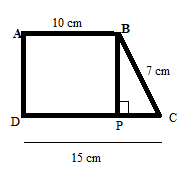
1. ABCD is a trapezium in which AB||CD, AD⊥DC, AB = 10 cm, DC = 15 cm and BC = 7 cm. Find the area of the trapezium?

Area of trapezium example-1

Solution:

Given,
AB = 10 cm
DC = 15 cm
BC = 7 cm
We know that,
Area of Trapezium = 1/2 (a + b)h
PC = DC – DP
PC = 15 cm – 10 cm
PC = 5 cm
Now area of trapezium = Area of rectangle ABPD + Area of ΔBPC
Area of ΔBPC
BC² = BP² + PC²
7² = BP² + 5²
BP² = 49 – 25
BP² = 24
BP = 4.89 cm
Now area of trapezium ABCD = Area of rectangle ABPD + Area of ΔBPC
Area of rectangle ABPD = 10 × 4.89 = 48.9 sq. cm
Area of ΔBPC = 1/2 (5) (7) = 17.5 sq. cm
Area of trapezium ABCD = 48.9 + 17.5 = 66.4 sq. cm
Thus the area of trapezium ABCD is 66.4 sq. cm

2. Given height equal to 10cm, sides equal to 6cm and 5cm. Find the area of the trapezium?

Solution:

Given,
Height = 10cm
a = 6cm
b = 5cm
We know that,
Area of Trapezium = 1/2 (a + b)h
A = 1/2 (6cm + 5cm) 10cm
A = 11cm × 5cm
A = 55 sq. cm
Therefore the area of the trapezium is 55 sq. cm.

3. The area of the trapezium is 81 sq. m, sides are 9m and 6m. Find the height of the trapezium.

Solution:

Given,
The area of the trapezium is 81 sq. m
a = 9m
b = 6m
We know that,
Area of Trapezium = 1/2 (a + b)h
81 = 1/2 (9m + 6m)h
162 = 15m × h
h = 162/15 = 10.8m
Therefore the height of the trapezium is 10.8 meters.

FAQs on Area of Trapezium

1. What is the area of a trapezium?

The area of trapezium is half of the product of the height and the sum of the parallel lines.

2. What is trapezium?

A trapezium is a geometrical shape that has four sides and one set of parallel lines. It consists of four vertices and four angles.

3. What is the area of the trapezium formula?

Formula for Area of trapezium = 1/2 (a + b)h

Area of Rhombus Formula | How to find the Area and Perimeter of a Rhombus?

The Area and Perimeter of the Rhombus are used in the basic Mensuration. In order to find the area and perimeter students must know what are the properties of the Rhombus. Here we explain the properties, formulas with examples. A rhombus is a quadrilateral which is similar to the parallelogram. The shape of the Rhombus looks like a diamond.

In this article, students can learn how to calculate the area and perimeter of the Rhombus. We have provided multiple examples to make the students understand the concept of Perimeter and Area of Rhombus. So, learn different methods to find the area and perimeter of the rhombus.

What is Area and Perimeter of a Rhombus?

Area of Rhombus – The area of the Rhombus is the space occupied by the two-dimensional figure. The Area of Rhombus Formula is equal to half of the product of two diagonals. The area of the rhombus is measured in square units.

  • A = 1/2(d1 × d2) sq. units

where d1 and d2 are diagonals of the rhombus.

Perimeter of Rhombus – The perimeter of the rhombus is the sum of lengths of the boundaries. The Perimeter of the Rhombus Formula is equal to the sum of four sides. The perimeter of the Rhombus is measured in units.

  • P = a + a + a + a = 4a units

Where a is the side of the rhombus.

Properties of Rhombus

The properties of the rhombus are given below

  • All the sides of the rhombus are equal.
  • It consists of 4 vertices and 4 edges.
  • Opposite angles of the rhombus are the same.
  • The sum of the adjacent angles is 180 degrees.
  • In Rhombus the diagonals bisect the angles.
  • Opposite sides of the rhombus are parallel.

Solved Examples on Area and Perimeter of a Rhombus

Go through the below section to know where and how to use the area and perimeter of the rhombus problems.

1. Find the area of the rhombus if the diagonals are 7m and 5m.

Solution:

Given,
d1 = 7m
d2 = 5m
We know that,
Area of the Rhombus = 1/2(d1 × d2)
A = 1/2(7m × 5m)
A = 35/2
A = 17.5 m²
Therefore the area of the rhombus is 17.5 sq. meters.

2. The area of the rhombus is 196 sq. cm. One of the diagonal is 14 cm find the other diagonal?

Solution:

Given,
The area of the rhombus is 169 sq. cm.
d1 = 14 cm
d2 = ?
We know that,
Area of the Rhombus = 1/2(d1 × d2)
196 sq. cm = 1/2 (14 cm × d2)
196 sq. cm = 7 cm × d2
d2 = 196/7 = 28 cm
Thus the length of the another diagonal is 28 cm.

3. What is the perimeter of the rhombus if the side is 6cm?

Solution:

Given,
a = 6 cm
We know that,
The perimeter of the Rhombus = 4a
P = 4(6 cm)
P = 24 cm
Thus the perimeter of the rhombus is 24 cm.

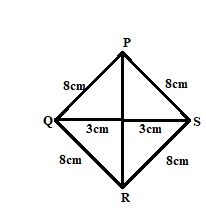
4. Find the area of the rhombus whose sides are 8 cm and diagonal is 6 cm?

Solution:

Given,

Area and perimeter of rhombus examples
PQ = QR = RS = PS = 8 cm
QS = 6 cm
In ΔPOQ,
PQ² = OQ² + OP²
8² = 3² + OP²
64 = 9 + OP²
OP² = 64 – 9
OP² = 55
OP = 7.4
PR = 2OP
PR = 7.4 × 7.4
PR = 54.76
Area of the Rhombus = 1/2(d1 × d2)
A = 1/2 (6 × 54.76)
A = 164.28 sq. cm
Therefore the area of the rhombus is 164.28 sq. cm.

5. If the perimeter of the rhombus is 52 cm then find the side of the rhombus?

Solution:

Given,
the perimeter of the rhombus is 52 cm
We know that,
Perimeter of Rhombus = 4a
52 cm = 4a
a = 52/4
a = 13 cm
Thus the side of the rhombus is 13 cm.

6. Find the height of the rhombus whose area is 169 sq. m and perimeter is 140 m?

Solution:

Given that
P = 140 m
P = 4a
140 = 4a
a = 140/4
a = 35
Now use the area of the rhombus to find the height.
169 sq. m = 35 × h
h = 169/35
h = 4.82 m
Thus the height of the rhombus is 4.82 meters.

FAQs on Area and Perimeter of Rhombus

1. What are the basic properties of the Rhombus?

  1. Opposite sides are equal
  2. The sum of the adjacent angles is 180 degrees
  3. All sides are equal in Rhombus.

2. How to find the perimeter of the rhombus?

The perimeter of the rhombus can be calculated by adding all four sides.

3. Is the area of the rhombus and square is the same?

The length of the rhombus is the same but the area of the square and rhombus are not equal.