Eureka Math Grade 8 Module 4 Lesson 28 Answer Key

Engage NY Eureka Math 8th Grade Module 4 Lesson 28 Answer Key

Eureka Math Grade 8 Module 4 Lesson 28 Example Answer Key

Example 1.
Use what you noticed about adding equivalent expressions to solve the following system by elimination:
6x – 5y = 21
2x + 5y = – 5
Answer:
Show students the three examples of adding integer equations together. Ask students to verbalize what they notice in the examples and to generalize what they observe. The goal is for students to see that they can add equivalent expressions and still have an equivalence.
Example 1: If 2 + 5 = 7 and 1 + 9 = 10, does 2 + 5 + 1 + 9 = 7 + 10?
Example 2: If 1 + 5 = 6 and 7 – 2 = 5, does 1 + 5 + 7 – 2 = 6 + 5?
Example 3: If – 3 + 11 = 8 and 2 + 1 = 3, does – 3 + 11 + 2 + 1 = 8 + 3?
Use what you noticed about adding equivalent expressions to solve the following system by elimination:
6x – 5y = 21
2x + 5y = – 5

Provide students with time to attempt to solve the system by adding the equations together. Have students share their work with the class. If necessary, use the points belows to support students.
Notice that terms – 5y and 5y are opposites; that is, they have a sum of zero when added. If we were to add the equations in the system, the y would be eliminated.
6x – 5y + 2x + 5y = 21 + ( – 5)
6x + 2x – 5y + 5y = 16
8x = 16
x = 2
Just as before, now that we know what x is, we can substitute it into either equation to determine the value of y.
2(2) + 5y = – 5
4 + 5y = – 5
5y = – 9
y = – \(\frac{9}{5}\)
The solution to the system is (2, – \(\frac{9}{5}\)).
We can verify our solution by sketching the graphs of the system.
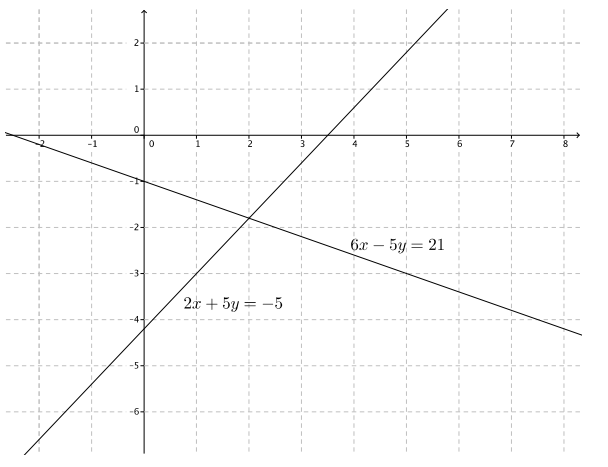
Engage NY Math 8th Grade Module 4 Lesson 28 Example Answer Key 1

Example 2.
Solve the following system by elimination:
– 2x + 7y = 5
4x – 2y = 14
Answer:
We will solve the following system by elimination:
– 2x + 7y = 5
4x – 2y = 14

In this example, it is not as obvious which variable to eliminate. It will become obvious as soon as we multiply the first equation by 2.
2( – 2x + 7y = 5)
– 4x + 14y = 10
Now we have the system Engage NY Math 8th Grade Module 4 Lesson 28 Example Answer Key 2. It is clear that when we add – 4x + 4x, the x will be eliminated. Add the equations of this system together, and determine the solution to the system.
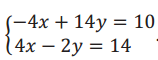
Sample student work:
– 4x + 14y + 4x – 2y = 10 + 14
14y – 2y = 24
12y = 24
y = 2

4x – 2(2) = 14
4x – 4 = 14
4x = 18
x = \(\frac{18}{4}\)
x = \(\frac{9}{2}\)
The solution to the system is (\(\frac{9}{2}\), 2).
We can verify our solution by sketching the graphs of the system.
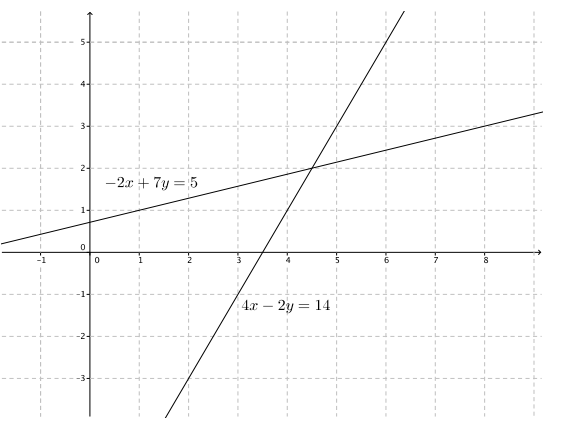
Engage NY Math 8th Grade Module 4 Lesson 28 Example Answer Key 3

Example 3.
Solve the following system by elimination:
7x – 5y = – 2
3x – 3y = 7
Answer:
We will solve the following system by elimination:
7x – 5y = – 2
3x – 3y = 7

Provide time for students to solve this system on their own before discussing it as a class.
In this case, it is even less obvious which variable to eliminate. On these occasions, we need to rewrite both equations. We multiply the first equation by – 3 and the second equation by 7.
– 3(7x – 5y = – 2)
– 21x + 15y = 6

7(3x – 3y = 7)
21x – 21y = 49
Now we have the system Engage NY Math 8th Grade Module 4 Lesson 28 Example Answer Key 4, and it is obvious that the x can be eliminated.
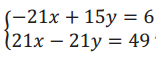
Look at the system again.
7x – 5y = – 2
3x – 3y = 7

What would we do if we wanted to eliminate the y from the system?
We could multiply the first equation by 3 and the second equation by – 5.
Students may say to multiply the first equation by – 3 and the second equation by 5. Whichever answer is given first, ask if the second is also a possibility. Students should answer yes. Then have students solve the system.
Sample student work:
– 21x + 15y = 6
21x – 21y = 49

15y – 21y = 6 + 49
– 6y = 55
y = – \(\frac{55}{6}\)
7x – 5( – \(\frac{55}{6}\)) = – 2
7x + \(\frac{275}{6}\) = – 2
7x = – \(\frac{287}{6}\)
x = – \(\frac{287}{42}\)
The solution to the system is ( – \(\frac{287}{42}\), – \(\frac{55}{6}\)).

Eureka Math Grade 8 Module 4 Lesson 28 Exercise Answer Key

Exercises
Each of the following systems has a solution. Determine the solution to the system by eliminating one of the variables. Verify the solution using the graph of the system.
Exercise 1.
6x – 7y = – 10
3x + 7y = – 8
Answer:
6x – 7y + 3x + 7y = – 10 + ( – 8)
9x = – 18
x = – 2
3( – 2) + 7y = – 8
– 6 + 7y = – 8
7y = – 2
y = – \(\frac{2}{7}\)
The solution is ( – 2, – \(\frac{2}{7}\)).
Engage NY Math Grade 8 Module 4 Lesson 28 Exercise Answer Key 1

Exercise 2.
x – 4y = 7
5x + 9y = 6
Answer:
– 5(x – 4y = 7)
– 5x + 20y = – 35

– 5x + 20y = – 35
5x + 9y = 6

– 5x + 20y + 5x + 9y = – 35 + 6
29y = – 29
y = – 1
x – 4( – 1) = 7
x + 4 = 7
x = 3
The solution is (3, – 1).
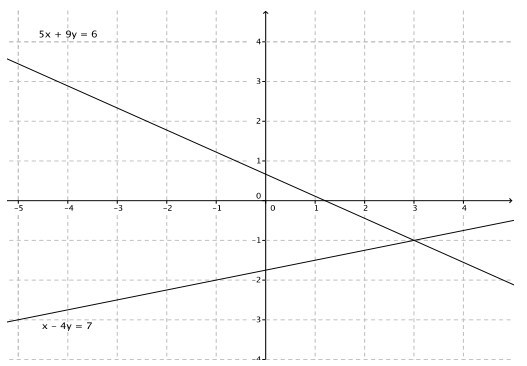
Engage NY Math Grade 8 Module 4 Lesson 28 Exercise Answer Key 2

Exercise 3.
2x – 3y = – 5
3x + 5y = 1
Answer:
– 3(2x – 3y = – 5)
– 6x + 9y = 15
2(3x + 5y = 1)
6x + 10y = 2

– 6x + 9y = 15
6x + 10y = 2

– 6x + 9y + 6x + 10y = 15 + 2
19y = 17
y = \(\frac{17}{19}\)
2x – 3(\(\frac{17}{19}\)) = – 5
2x – \(\frac{51}{19}\) = – 5
2x = – 5 + \(\frac{51}{19}\)
2x = – \(\frac{44}{19}\)
x = – \(\frac{44}{38}\)
x = – \(\frac{22}{19}\)
The solution is ( – \(\frac{22}{19}\), \(\frac{17}{19}\)).
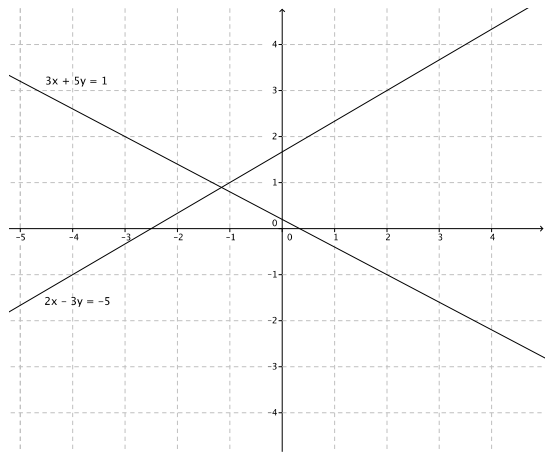
Engage NY Math Grade 8 Module 4 Lesson 28 Exercise Answer Key 3

Eureka Math Grade 8 Module 4 Lesson 28 Problem Set Answer Key

Determine the solution, if it exists, for each system of linear equations. Verify your solution on the coordinate plane.
Question 1.
\(\frac{1}{2}\) x + 5 = y
2x + y = 1
Answer:
2x + \(\frac{1}{2}\) x + 5 = 1
\(\frac{5}{2}\) x + 5 = 1
\(\frac{5}{2}\) x = – 4
x = – \(\frac{8}{5}\)
2( – \(\frac{8}{5}\)) + y = 1
– \(\frac{16}{5}\) + y = 1
y = \(\frac{21}{5}\)
The solution is ( – \(\frac{8}{5}\), \(\frac{21}{5}\)).
Eureka Math 8th Grade Module 4 Lesson 28 Problem Set Answer Key 1

Question 2.
9x + 2y = 9
– 3x + y = 2
Answer:
3( – 3x + y = 2)
– 9x + 3y = 6

9x + 2y = 9
– 9x + 3y = 6

9x + 2y – 9x + 3y = 15
5y = 15
y = 3
– 3x + 3 = 2
– 3x = – 1
x = \(\frac{1}{3}\)
The solution is (\(\frac{1}{3}\), 3).
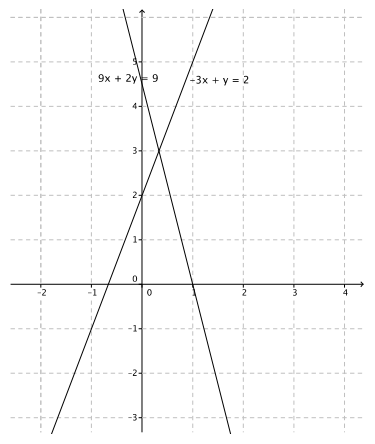
Eureka Math 8th Grade Module 4 Lesson 28 Problem Set Answer Key 2

Question 3.
y = 2x – 2
2y = 4x – 4
Answer:
These equations define the same line. Therefore, this system will have infinitely many solutions.
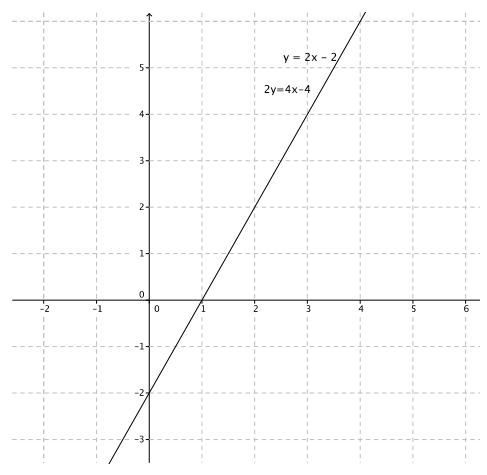
Eureka Math 8th Grade Module 4 Lesson 28 Problem Set Answer Key 3

Question 4.
8x + 5y = 19
– 8x + y = – 1
Answer:
8x + 5y – 8x + y = 19 – 1
5y + y = 18
6y = 18
y = 3
8x + 5(3) = 19
8x + 15 = 19
8x = 4
x = \(\frac{1}{2}\)
The solution is (\(\frac{1}{2}\), 3)
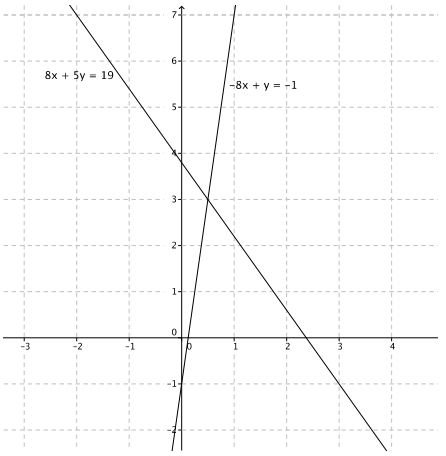
Eureka Math 8th Grade Module 4 Lesson 28 Problem Set Answer Key 4

Question 5.
x + 3 = y
3x + 4y = 7
Answer:
3x + 4(x + 3) = 7
3x + 4x + 12 = 7
7x + 12 = 7
7x = – 5
x = – \(\frac{5}{7}\)
– \(\frac{5}{7}\) + 3 = y
\(\frac{16}{7}\) = y
The solution is ( – \(\frac{5}{7}\), \(\frac{16}{7}\)).
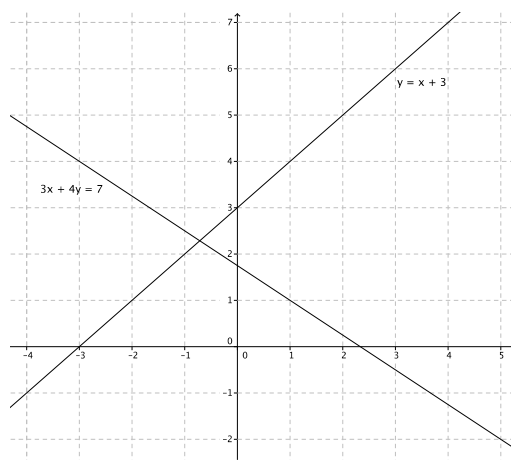
Eureka Math 8th Grade Module 4 Lesson 28 Problem Set Answer Key 5

Question 6.
y = 3x + 2
4y = 12 + 12x
Answer:
The equations graph as distinct lines. The slopes of these two equations are the same, and the y – intercept points are different, which means they graph as parallel lines. Therefore, this system will have no solution.
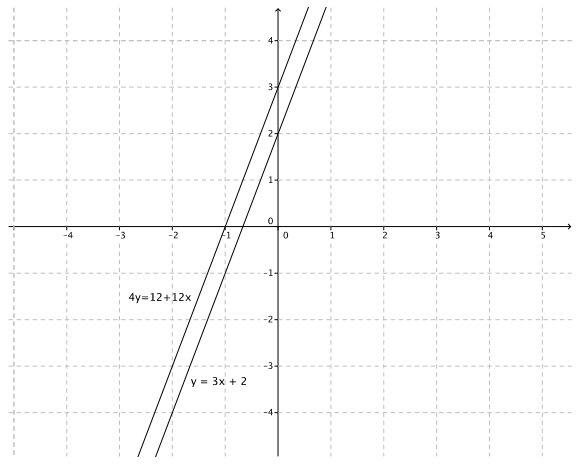
Eureka Math 8th Grade Module 4 Lesson 28 Problem Set Answer Key 6

Question 7.
4x – 3y = 16
– 2x + 4y = – 2
Answer:
2( – 2x + 4y = – 2)
– 4x + 8y = – 4

4x – 3y = 16
– 4x + 8y = – 4

4x – 3y – 4x + 8y = 16 – 4
– 3y + 8y = 12
5y = 12
y = \(\frac{12}{5}\)
4x – 3(\(\frac{12}{5}\)) = 16
4x – \(\frac{36}{5}\) = 16
4x = \(\frac{116}{5}\)
x = \(\frac{29}{5}\)
The solution is (\(\frac{29}{5}\), \(\frac{12}{5}\)).
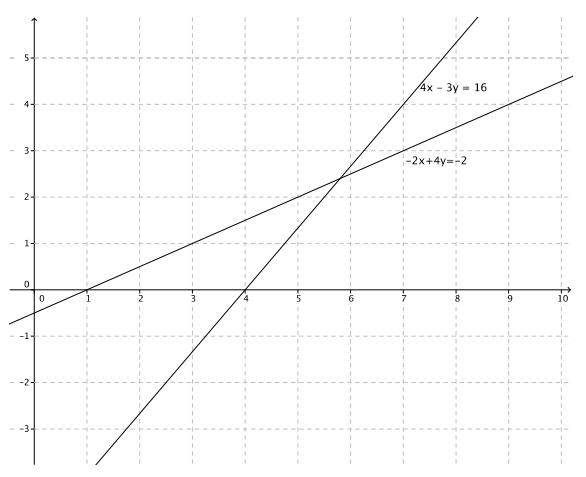
Eureka Math 8th Grade Module 4 Lesson 28 Problem Set Answer Key 7

Question 8.
2x + 2y = 4
12 – 3x = 3y
Answer:
The equations graph as distinct lines. The slopes of these two equations are the same, and the y – intercept points are different, which means they graph as parallel lines. Therefore, this system will have no solution.
Eureka Math 8th Grade Module 4 Lesson 28 Problem Set Answer Key 8

Question 9.
y = – 2x + 6
3y = x – 3
Answer:
3(y = – 2x + 6)
3y = – 6x + 18

3y = – 6x + 18
3y = x – 3

– 6x + 18 = x – 3
18 = 7x – 3
21 = 7x
\(\frac{21}{7}\) = x
x = 3
y = – 2(3) + 6
y = – 6 + 6
y = 0
The solution is (3, 0).
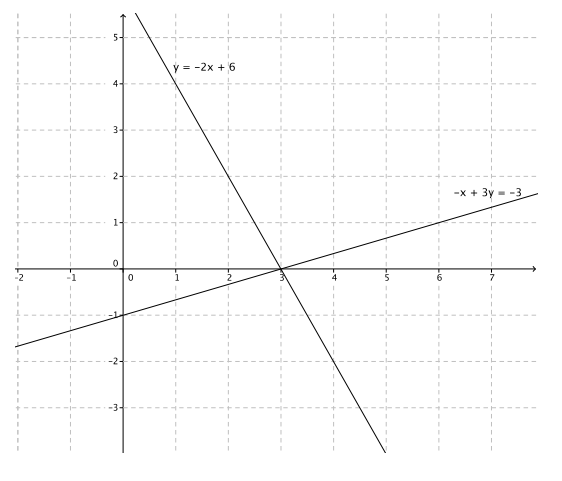
Eureka Math 8th Grade Module 4 Lesson 28 Problem Set Answer Key 9

Question 10.
y = 5x – 1
10x = 2y + 2
Answer:
These equations define the same line. Therefore, this system will have infinitely many solutions.
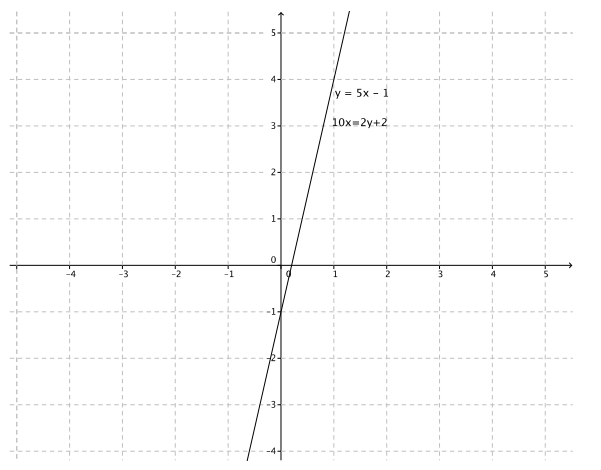
Eureka Math 8th Grade Module 4 Lesson 28 Problem Set Answer Key 10

Question 11.
3x – 5y = 17
6x + 5y = 10
Answer:
3x – 5y + 6x + 5y = 17 + 10
9x = 27
x = 3
3(3) – 5y = 17
9 – 5y = 17
– 5y = 8
y = – \(\frac{8}{5}\)
The solution is (3, – \(\frac{8}{5}\)).
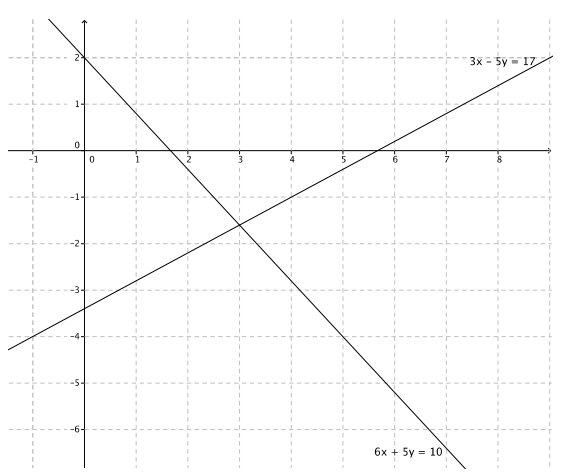
Eureka Math 8th Grade Module 4 Lesson 28 Problem Set Answer Key 11

Question 12.
y = \(\frac{4}{3}\) x – 9
y = x + 3
Answer:
\(\frac{4}{3}\) x – 9 = x + 3
\(\frac{1}{3}\) x – 9 = 3
\(\frac{1}{3}\) x = 12
x = 36
y = 36 + 3
y = 39
The solution is (36, 39).
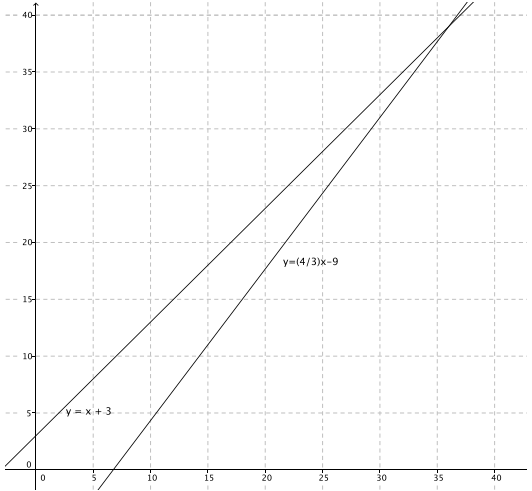
Eureka Math 8th Grade Module 4 Lesson 28 Problem Set Answer Key 12

Question 13.
4x – 7y = 11
x + 2y = 10
Answer:
– 4(x + 2y = 10)
– 4x – 8y = – 40

4x – 7y = 11
– 4x – 8y = – 40

4x – 7y – 4x – 8y = 11 – 40
– 15y = – 29
y = \(\frac{29}{15}\)
x + 2(\(\frac{29}{15}\)) = 10
x + \(\frac{58}{15}\) = 10
x = \(\frac{92}{15}\)
The solution is (\(\frac{92}{15}\), \(\frac{29}{15}\)).
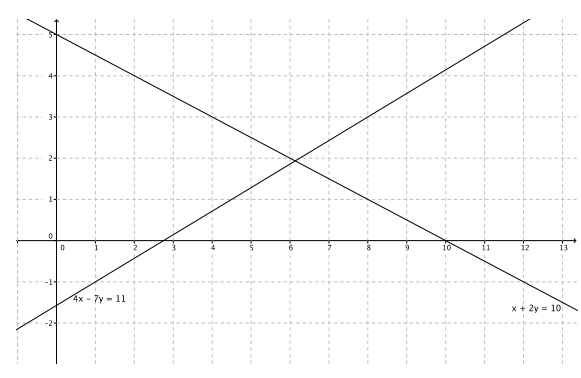
Eureka Math 8th Grade Module 4 Lesson 28 Problem Set Answer Key 13

Question 14.
21x + 14y = 7
12x + 8y = 16
Answer:
The slopes of these two equations are the same, and the y – intercept points are different, which means they graph as parallel lines. Therefore, this system will have no solution.
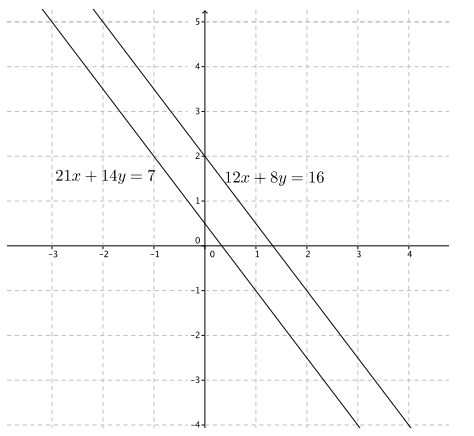
Eureka Math 8th Grade Module 4 Lesson 28 Problem Set Answer Key 14
Answer:

Eureka Math Grade 8 Module 4 Lesson 28 Exit Ticket Answer Key

Determine the solution, if it exists, for each system of linear equations. Verify your solution on the coordinate plane.
Question 1.
y = 3x – 5
y = – 3x + 7
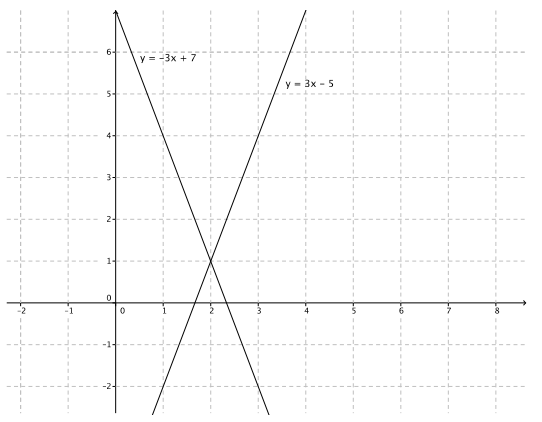
Eureka Math Grade 8 Module 4 Lesson 28 Exit Ticket Answer Key 1
Answer:
3x – 5 = – 3x + 7
6x = 12
x = 2
y = 3(2) – 5
y = 6 – 5
y = 1
The solution is (2, 1).

Question 2.
y = – 4x + 6
2x – y = 11
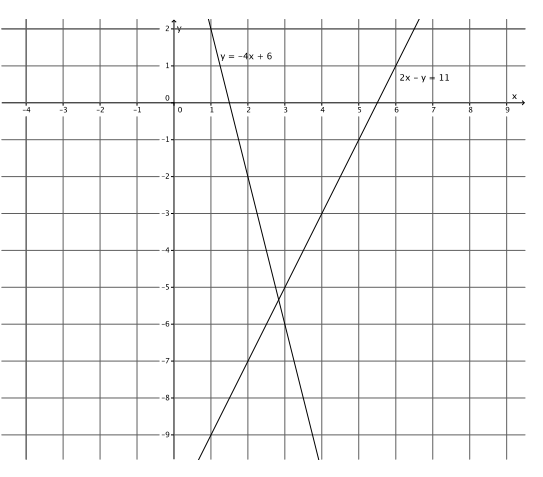
Eureka Math Grade 8 Module 4 Lesson 28 Exit Ticket Answer Key 2
Answer:
2x – ( – 4x + 6) = 11
2x + 4x – 6 = 11
6x = 17
x = \(\frac{17}{6}\)
y = – 4(\(\frac{17}{6}\)) + 6
y = – \(\frac{34}{3}\) + 6
y = – \(\frac{16}{3}\)
The solution is (\(\frac{17}{6}\), – \(\frac{16}{3}\)).
Eureka Math Grade 8 Module 4 Lesson 29 Answer Key

Engage NY Eureka Math 8th Grade Module 4 Lesson 29 Answer Key

Eureka Math Grade 8 Module 4 Lesson 29 Example Answer Key

Example 1.
The sum of two numbers is 361, and the difference between the two numbers is 173. What are the two numbers?
Answer:
→ Together, we will read a word problem and work toward finding the solution.
→ The sum of two numbers is 361, and the difference between the two numbers is 173. What are the two numbers?
Provide students time to work independently or in pairs to solve this problem. Have students share their solutions and explain how they arrived at their answers. Then, show how the problem can be solved using a system of linear equations.

→ What do we need to do first?
We need to define our variables.
→ If we define our variables, we can better represent the situation we have been given. What should the variables be for this problem?
Let x represent one number, and let y represent the other number.
→ Now that we know the numbers are x and y, what do we need to do now?
We need to write equations to represent the information in the word problem.
→ Using x and y, write equations to represent the information we are provided.
The sum of two numbers is 361 can be written as x + y = 361. The difference between the two numbers is 173 can be written as x – y = 173.

→ We have two equations to represent this problem. What is it called when we have more than one linear equation for a problem, and how is it represented symbolically?
We have a system of linear equations.
x + y = 361
x – y = 173

→ We know several methods for solving systems of linear equations. Which method do you think will be the most efficient, and why?
We should add the equations together to eliminate the variable y because we can do that in one step.
Solve the system:
x + y = 361
x – y = 173
Sample student work:
x + y = 361
x – y = 173
x + x + y – y = 361 + 173
2x = 534
x = 267
267 + y = 361
y = 94
The solution is (267, 94).
→ Based on our work, we believe the two numbers are 267 and 94. Check to make sure your answer is correct by substituting the numbers into both equations. If it makes a true statement, then we know we are correct. If it makes a false statement, then we need to go back and check our work.
Sample student work:
267 + 94 = 361
361 = 361
267 – 94 = 173
173 = 173

→ Now we are sure that the numbers are 267 and 94. Does it matter which number is x and which number is y?
Not necessarily, but we need their difference to be positive, so x must be the larger of the two numbers to make sense of our equation x – y = 173.

Example 2.
There are 356 eighth – grade students at Euclid’s Middle School. Thirty – four more than four times the number of girls is equal to half the number of boys. How many boys are in eighth grade at Euclid’s Middle School? How many girls?
Answer:
→ Again, we will work together to solve the following word problem.
→ There are 356 eighth – grade students at Euclid’s Middle School. Thirty – four more than four times the number of girls is equal to half the number of boys. How many boys are in eighth grade at Euclid’s Middle School? How many girls? What do we need to do first?
We need to define our variables.

→ If we define our variables, we can better represent the situation we have been given. What should the variables be for this problem?
Let x represent the number of girls, and let y represent the number of boys.
Whichever way students define the variables, ask them if it could be done the opposite way. For example, if students respond as stated above, ask them if we could let x represent the number of boys and y represent the number of girls. They should say that at this stage it does not matter if x represents girls or boys, but once the variable is defined, it does matter.

→ Now that we know that x is the number of girls and y is the number of boys, what do we need to do now?
We need to write equations to represent the information in the word problem.
→ Using x and y, write equations to represent the information we are provided.
There are 356 eighth – grade students can be represented as x + y = 356. Thirty – four more than four times the number of girls is equal to half the number of boys can be represented as 4x + 34 = \(\frac{1}{2}\) y.
→ We have two equations to represent this problem. What is it called when we have more than one linear equation for a problem, and how is it represented symbolically?
We have a system of linear equations.
x + y = 356
4x + 34 = \(\frac{1}{2}\) y

→ We know several methods for solving systems of linear equations. Which method do you think will be the most efficient and why?
Answers will vary. There is no obvious “most efficient” method. Accept any reasonable responses as long as they are justified.
Solve the system:
x + y = 356
4x + 34 = \(\frac{1}{2}\) y

Sample student work:
x + y = 356
4x + 34 = \(\frac{1}{2}\) y

2(4x + 34 = \(\frac{1}{2}\) y)
8x + 68 = y
x + y = 356
8x + 68 = y
x + 8x + 68 = 356
9x + 68 = 356
9x = 288
x = 32
32 + y = 356
y = 324
The solution is (32, 324).

→ What does the solution mean in context?
Since we let x represent the number of girls and y represent the number of boys, it means that there are 32 girls and 324 boys at Euclid’s Middle School in eighth grade.
→ Based on our work, we believe there are 32 girls and 324 boys. How can we be sure we are correct?
We need to substitute the values into both equations of the system to see if it makes a true statement.
32 + 324 = 356
356 = 356
4(32) + 34 = \(\frac{1}{2}\) (324)
128 + 34 = 162
162 = 162

Example 3.
A family member has some five – dollar bills and one – dollar bills in her wallet. Altogether she has 18 bills and a total of $62. How many of each bill does she have?
Answer:
→ Again, we will work together to solve the following word problem.
→ A family member has some five – dollar bills and one – dollar bills in her wallet. Altogether she has 18 bills and a total of $62. How many of each bill does she have? What do we do first?
We need to define our variables.

→ If we define our variables, we can better represent the situation we have been given. What should the variables be for this problem?
Let x represent the number of $5 bills, and let y represent the number of $1 bills.
Again, whichever way students define the variables, ask them if it could be done the opposite way.
→ Now that we know that x is the number of $5 bills and y is the number of $1 bills, what do we need to do now?
We need to write equations to represent the information in the word problem.

→ Using x and y, write equations to represent the information we are provided.
Altogether she has 18 bills and a total of $62 must be represented with two equations, the first being x + y = 18 to represent the total of 18 bills and the second being 5x + y = 62 to represent the total amount of money she has.
→ We have two equations to represent this problem. What is it called when we have more than one linear equation for a problem, and how is it represented symbolically?
We have a system of linear equations.
x + y = 18
5x + y = 62
→ We know several methods for solving systems of linear equations. Which method do you think will be the most efficient and why?
Answers will vary. Students might say they could multiply one of the equations by – 1, and then they would be able to eliminate the variable y when they add the equations together. Other students may say it would be easiest to solve for y in the first equation and then substitute the value of y into the second equation. After they have justified their methods, allow them to solve the system in any manner they choose.

→ Solve the system:
x + y = 18
5x + y = 62
Sample student work:
x + y = 18
5x + y = 62

x + y = 18
y = – x + 18

y = – x + 18
5x + y = 62

5x + ( – x) + 18 = 62
4x + 18 = 62
4x = 44
x = 11

11 + y = 18
y = 7
The solution is (11, 7).
→ What does the solution mean in context?
Since we let x represent the number of $5 bills and y represent the number of $1 bills, it means that the family member has 11 $5 bills, and 7 $1 bills.
→ The next step is to check our work.
It is obvious that 11 + 7 = 18, so we know the family member has 18 bills.
→ It makes more sense to check our work against the actual value of those 18 bills in this case. Now we check the second equation.
5(11) + 1(7) = 62
55 + 7 = 62
62 = 62

Example 4.
A friend bought 2 boxes of pencils and 8 notebooks for school, and it cost him $11. He went back to the store the same day to buy school supplies for his younger brother. He spent $11.25 on 3 boxes of pencils and 5 notebooks. How much would 7 notebooks cost?
Answer:
Solve the system:
2x + 8y = 11
3x + 5y = 11.25.
Sample student work:
2x + 8y = 11
3x + 5y = 11.25
3(2x + 8y = 11)
6x + 24y = 33
– 2(3x + 5y = 11.25)
– 6x – 10y = – 22.50

6x + 24y = 33
– 6x – 10y = – 22.50

6x + 24y – 6x – 10y = 33 – 22.50
24y – 10y = 10.50
14y = 10.50
y = \(\frac{10.50}{14}\)
y = 0.75

2x + 8(0.75) = 11
2x + 6 = 11
2x = 5
x = 2.50
The solution is (2.50, 0.75).
→ What does the solution mean in context?
It means that a box of pencils costs $2.50, and a notebook costs $0.75.
→ Before we answer the question that this word problem asked, check to make sure the solution is correct.
Sample student work:
2(2.50) + 8(0.75) = 11
5 + 6 = 11
11 = 11
3(2.50) + 5(0.75) = 11.25
7.50 + 3.75 = 11.25
11.25 = 11.25
→ Now that we know we have the correct costs for the box of pencils and notebooks, we can answer the original question: How much would 7 notebooks cost?
The cost of 7 notebooks is 7(0.75) = 5.25. Therefore, 7 notebooks cost $7.25.

→ Keep in mind that some word problems require us to solve the system in order to answer a specific question, like this example about the cost of 7 notebooks. Other problems may just require the solution to the system to answer the word problem, like the first example about the two numbers and their sum and difference. It is always a good practice to reread the word problem to make sure you know what you are being asked to do.

Eureka Math Grade 8 Module 4 Lesson 29 Exercise Answer Key

Exercises

Exercise 1.
A farm raises cows and chickens. The farmer has a total of 42 animals. One day he counts the legs of all of his animals and realizes he has a total of 114. How many cows does the farmer have? How many chickens?
Answer:
Let x represent the number of cows and y represent the number of chickens. Then:
x + y = 42
4x + 2y = 114
– 2(x + y = 42)
– 2x – 2y = – 84

– 2x – 2y = – 84
4x + 2y = 114
– 2x – 2y + 4x + 2y = – 84 + 114
– 2x + 4x = 30
2x = 30
x = 15
15 + y = 42
y = 27
The solution is (15, 27).
4(15) + 2(27) = 114
60 + 54 = 114
114 = 114
The farmer has 15 cows and 27 chickens.

Exercise 2.
The length of a rectangle is 4 times the width. The perimeter of the rectangle is 45 inches. What is the area of the rectangle?
Answer:
Let x represent the length and y represent the width. Then:
x = 4y
2x + 2y = 45
2(4y) + 2y = 45
8y + 2y = 45
10y = 45
y = 4.5
x = 4(4.5)
x = 18
The solution is (18, 4.5).
2(18) + 2(4.5) = 45
36 + 9 = 45
45 = 45
Since 18×4.5 = 81, the area of the rectangle is 81 in^2.

Exercise 3.
The sum of the measures of angles x and y is 127°. If the measure of ∠x is 34° more than half the measure of ∠y, what is the measure of each angle?
Answer:
Let x represent the measure of ∠x and y represent the measure of ∠y. Then:
x + y = 127
x = 34 + \(\frac{1}{2}\) y
34 + \(\frac{1}{2}\) y + y = 127
34 + \(\frac{3}{2}\) y = 127
\(\frac{3}{2}\) y = 93
y = 62
x + 62 = 127
x = 65
The solution is (65,62).
65 = 34 + \(\frac{1}{2}\) (62)
65 = 34 + 31
65 = 65
The measure of ∠x is 65°, and the measure of ∠y is 62°.

Eureka Math Grade 8 Module 4 Lesson 29 Problem Set Answer Key

Question 1.
Two numbers have a sum of 1,212 and a difference of 518. What are the two numbers?
Answer:
Let x represent one number and y represent the other number.
x + y = 1212
x – y = 518
x + y + x – y = 1212 + 518
2x = 1730
x = 865
865 + y = 1212
y = 347
The solution is (865, 347).
865 – 347 = 518
518 = 518
The two numbers are 347 and 865.

Question 2.
The sum of the ages of two brothers is 46. The younger brother is 10 more than a third of the older brother’s age. How old is the younger brother?
Answer:
Let x represent the age of the younger brother and y represent the age of the older brother.
x + y = 46
x = 10 + \(\frac{1}{3}\) y
10 + \(\frac{1}{3}\) y + y = 46
10 + \(\frac{4}{3}\) y = 46
\(\frac{4}{3}\) y = 36
y = 27
x + 27 = 46
x = 19
The solution is (19,27).
19 = 10 + \(\frac{1}{3}\) (27)
19 = 10 + 9
19 = 19
The younger brother is 19 years old.

Question 3.
One angle measures 54 more degrees than 3 times another angle. The angles are supplementary. What are their measures?
Answer:
Let x represent the measure of one angle and y represent the measure of the other angle.
x = 3y + 54
x + y = 180
3y + 54 + y = 180
4y + 54 = 180
4y = 126
y = 31.5
x = 3(31.5) + 54
x = 94.5 + 54
x = 148.5
The solution is ( 148.5, 31.5).
148.5 + 31.5 = 180
180 = 180
One angle measures 148.5°, and the other measures 31.5°.

Question 4.
Some friends went to the local movie theater and bought four large buckets of popcorn and six boxes of candy. The total for the snacks was $46.50. The last time you were at the theater, you bought a large bucket of popcorn and a box of candy, and the total was $9.75. How much would 2 large buckets of popcorn and 3 boxes of candy cost?
Answer:
Let x represent the cost of a large bucket of popcorn and y represent the cost of a box of candy.
4x + 6y = 46.50
x + y = 9.75
– 4(x + y = 9.75)
– 4x – 4y = – 39

4x + 6y = 46.50
– 4x – 4y = – 39
4x + 6y – 4x – 4y = 46.50 – 39
6y – 4y = 7.50
2y = 7.50
y = 3.75
x + 3.75 = 9.75
x = 6
The solution is (6, 3.75).
4(6) + 6(3.75) = 46.50
24 + 22.50 = 46.50
46.50 = 46.50
Since one large bucket of popcorn costs $6 and one box of candy costs $3.75, then
2(6) + 3(3.75) = 12 + 11.25 = 23.25, and two large buckets of popcorn and three boxes of candy will cost $23.25.

Question 5.
You have 59 total coins for a total of $12.05. You only have quarters and dimes. How many of each coin do you have?
Answer:
Let x represent the number of quarters and y represent the number of dimes.
x + y = 59
0.25x + 0.1y = 12.05

– 4(0.25x + 0.1y = 12.05)
– x – 0.4y = – 48.20

x + y = 59
– x – 0.4y = – 48.20

x + y – x – 0.4y = 59 – 48.20
y – 0.4y = 10.80
0.6y = 10.80
y = \(\frac{10.80}{0.6}\)
y = 18
x + 18 = 59
x = 41
The solution is (41,18).
0.25(41) + 0.1(18) = 12.05
10.25 + 1.80 = 12.05
12.05 = 12.05
I have 41 quarters and 18 dimes.

Question 6.
A piece of string is 112 inches long. Isabel wants to cut it into 2 pieces so that one piece is three times as long as the other. How long is each piece?
Answer:
Let x represent one piece and y represent the other.
x + y = 112
3y = x

3y + y = 112
4y = 112
y = 28
x + 28 = 112
x = 84
The solution is (84, 28).
3(28) = 84
84 = 84
One piece should be 84 inches long, and the other should be 28 inches long.

Eureka Math Grade 8 Module 4 Lesson 29 Exit Ticket Answer Key

Question 1.
Small boxes contain DVDs, and large boxes contain one gaming machine. Three boxes of gaming machines and a box of DVDs weigh 48 pounds. Three boxes of gaming machines and five boxes of DVDs weigh 72 pounds. How much does each box weigh?
Answer:
Let x represent the weight of the gaming machine box, and let y represent the weight of the DVD box. Then:
3x + y = 48
3x + 5y = 72
– 1(3x + y = 48)
– 3x – y = – 48

– 3x – y = – 48
3x + 5y = 72
3x – 3x + 5y – y = 72 – 48
4y = 24
y = 6
3x + 6 = 48
3x = 42
x = 14
The solution is (14, 6).
3(14) + 5(6) = 72
72 = 72
The box with one gaming machine weighs 14 pounds, and the box containing DVDs weighs 6 pounds.

Question 2.
A language arts test is worth 100 points. There is a total of 26 questions. There are spelling word questions that are worth 2 points each and vocabulary word questions worth 5 points each. How many of each type of question are there?
Answer:
Let x represent the number of spelling word questions, and let y represent the number of vocabulary word questions.
x + y = 26
2x + 5y = 100
– 2(x + y = 26)
– 2x – 2y = – 52

– 2x – 2y = – 52
2x + 5y = 100
2x – 2x + 5y – 2y = 100 – 52
3y = 48
y = 16
x + 16 = 26
x = 10
The solution is (10, 16).
2(10) + 5(16) = 100
100 = 100
There are 10 spelling word questions and 16 vocabulary word questions.

Eureka Math Grade 8 Module 4 Lesson 30 Answer Key

Engage NY Eureka Math 8th Grade Module 4 Lesson 30 Answer Key

Eureka Math Grade 8 Module 4 Lesson 30 Exercise Answer Key

Mathematical Modeling Exercise
(1) If t is a number, what is the degree in Fahrenheit that corresponds to t°C?
(2) If t is a number, what is the degree in Fahrenheit that corresponds to ( – t)°C?
Answer:
→ Instead of trying to answer these questions directly, let’s try something simpler. With this in mind, can we find out what degree in Fahrenheit corresponds to 1°C? Explain.
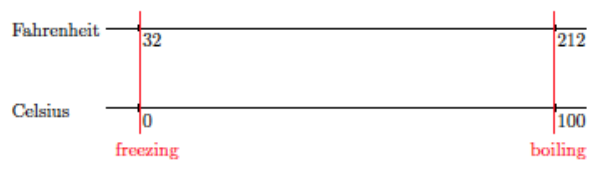
→ We can use the following diagram (double number line) to organize our thinking.

Engage NY Math Grade 8 Module 4 Lesson 30 Exercise Answer Key 1
Answer:
→ At this point, the only information we have is that 0°C = 32°F, and 100°C = 212°F. We want to figure out what degree of Fahrenheit corresponds to 1°C. Where on the diagram would 1°C be located? Be specific.

Provide students time to talk to their partners about a plan, and then have them share. Ask them to make conjectures about what degree in Fahrenheit corresponds to 1°C, and have them explain their rationale for the numbers they chose. Consider recording the information, and have the class vote on which answer they think is closest to correct.
→ We need to divide the Celsius number line from 0 to 100 into 100 equal parts. The first division to the right of zero will be the location of 1°C.

Now that we know where to locate 1°C on the lower number line, we need to figure out what number it corresponds to on the upper number line representing Fahrenheit. Like we did with Celsius, we divide the number line from 32 to 212 into 100 equal parts. The number line from 32 to 212 is actually a length of 180 units (212 – 32 = 180). Now, how would we determine the precise number in Fahrenheit that corresponds to 1°C?
Provide students time to talk to their partners and compute the answer.
→ We need to take the length 180 and divide it into 100 equal parts.
\(\frac{180}{100}\) = \(\frac{9}{5}\) = 1 \(\frac{4}{5}\) = 1.8
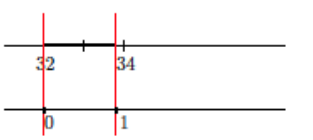
→ If we look at a magnified version of the number line with this division, we have the following diagram:
Engage NY Math Grade 8 Module 4 Lesson 30 Exercise Answer Key 2

→ Based on your computation, what number falls at the intersection of the Fahrenheit number line and the red line that corresponds to 1°C? Explain.
Since we know that each division on the Fahrenheit number line has a length of 1.8, then when we start from 32 and add 1.8, we get 33.8. Therefore, 1°C is equal to 33.8°F.

Revisit the conjecture made at the beginning of the activity, and note which student came closest to guessing 33.8°F. Ask the student to explain how he arrived at such a close answer.

→ Eventually, we want to revisit the original two questions. But first, let’s look at a few more concrete questions. What is 37°C in Fahrenheit? Explain.
Provide students time to talk to their partners about how to answer the question. Ask students to share their ideas and explain their thinking.
→ Since the unit length on the Celsius scale is equal to the unit length on the Fahrenheit scale, then 37°C means we need to multiply (37 × 1.8) to determine the corresponding location on the Fahrenheit scale. But, because 0 on the Celsius scale is 32 on the Fahrenheit scale, we will need to add 32 to our answer. In other words, 37°C = (32 + 37 × 1.8)°F = (32 + 66.6)°F = 98.6°F.

Exercises
Determine the corresponding Fahrenheit temperature for the given Celsius temperatures in Exercises 1–5.

Exercise 1.
How many degrees Fahrenheit is 25°C?
Answer:
25°C = (32 + 25 × 1.8)°F = (32 + 45)°F = 77°F

Exercise 2.
How many degrees Fahrenheit is 42°C?
Answer:
42°C = (32 + 42 × 1.8)°F = (32 + 75.6)°F = 107.6°F

Exercise 3.
How many degrees Fahrenheit is 94°C?
Answer:
94°C = (32 + 94 × 1.8)°F = (32 + 169.2)°F = 201.2°F

Exercise 4.
How many degrees Fahrenheit is 63°C?
Answer:
63°C = (32 + 63 × 1.8)°F = (32 + 113.4)°F = 145.4°F

Exercise 5.
How many degrees Fahrenheit is t°C?
Answer:
t°C = (32 + 1.8t)°F

Eureka Math Grade 8 Module 4 Lesson 30 Problem Set Answer Key

Question 1.
Does the equation t°C = (32 + 1.8t)°F work for any rational number t? Check that it does with t = 8 \(\frac{2}{3}\) and t = – 8 \(\frac{2}{3}\).
Answer:
(8 \(\frac{2}{3}\))°C = (32 + 8 \(\frac{2}{3}\) × 1.8)°F = (32 + 15.6)°F = 47.6°F
( – 8 \(\frac{2}{3}\))°C = (32 + ( – 8 \(\frac{2}{3}\)) × 1.8)°F = (32 – 15.6)°F = 16.4°F

Question 2.
Knowing that t°C = (32 + \(\frac{9}{5}\) t)°F for any rational t, show that for any rational number d, d°F = (\(\frac{5}{9}\) (d – 32))°C.
Answer:
Since d°F can be found by (32 + \(\frac{9}{5}\) t), then d = (32 + \(\frac{9}{5}\) t), and d°F = t°C. Substituting d = (32 + \(\frac{9}{5}\) t) into d°F, we get
d°F = (32 + \(\frac{9}{5}\) t)°F
d = 32 + \(\frac{9}{5}\) t
d – 32 = \(\frac{9}{5}\) t
\(\frac{5}{9}\) (d – 32) = t.
Now that we know t = \(\frac{5}{9}\) (d – 32), then d°F = (\(\frac{5}{9}\) (d – 32))°C.

Question 3.
Drake was trying to write an equation to help him predict the cost of his monthly phone bill. He is charged $35 just for having a phone, and his only additional expense comes from the number of texts that he sends. He is charged $0.05 for each text. Help Drake out by completing parts (a)–(f).
a. How much was his phone bill in July when he sent 750 texts?
Answer:
35 + 750(0.05) = 35 + 37.5 = 72.5
His bill in July was $72.50.

b. How much was his phone bill in August when he sent 823 texts?
Answer:
35 + 823(0.05) = 35 + 41.15 = 76.15
His bill in August was $76.15.

c. How much was his phone bill in September when he sent 579 texts?
Answer:
35 + 579(0.05) = 35 + 28.95 = 63.95
His bill in September was $63.95.

d. Let y represent the total cost of Drake’s phone bill. Write an equation that represents the total cost of his phone bill in October if he sends t texts.
Answer:
y = 35 + t(0.05)

e. Another phone plan charges $20 for having a phone and $0.10 per text. Let y represent the total cost of the phone bill for sending t texts. Write an equation to represent his total bill.
Answer:
y = 20 + t(0.10)

f. Write your equations in parts (d) and (e) as a system of linear equations, and solve. Interpret the meaning of the solution in terms of the phone bill.
Answer:
(y = 35 + t(0.05)
y = 20 + t(0.10)
35 + (0.05)t = 20 + (0.10)t
15 + (0.05)t = (0.10)t
15 = 0.05t
300 = t
y = 20 + 300(0.10)
y = 50
The solution is (300,50), meaning that when Drake sends 300 texts, the cost of his bill will be $50 using his current phone plan or the new one.

Eureka Math Grade 8 Module 4 Lesson 30 Exit Ticket Answer Key

Use the equation developed in class to answer the following questions:
Question 1.
How many degrees Fahrenheit is 11°C?
Answer:
11°C = (32 + 11 × 1.8)°F
11°C = (32 + 19.8)°F
11°C = 51.8°F

Question 2.
How many degrees Fahrenheit is – 3°C?
Answer:
– 3°C = (32 + ( – 3) × 1.8)°F
– 3°C = (32 – 5.4)°F
– 3°C = 26.6°F

Question 3.
Graph the equation developed in class, and use it to confirm your results from Problems 1 and 2.
Eureka Math Grade 8 Module 4 Lesson 30 Exit Ticket Answer Key 1
Answer:
Eureka Math Grade 8 Module 4 Lesson 30 Exit Ticket Answer Key 2
When I graph the equation developed in class, t°C = (32 + 1.8t)°F, the results from Problems 1 and 2 are on the line, confirming they are solutions to the equation.

Class Limits | How to find the Class Limits from Data? | Difference between Class Limits and Class Boundaries

Class Limits

Searching for help regarding the concept of Class Limits in Statistics? If so, you have come the right way and you will get a complete idea of the entire concept by going through this article. Check class limits definition, types, the procedure to find the class limits from data in the forthcoming modules. Get to know about the lower and upper-class limits along with the steps to solve the class limits problems. Refer to the step-by-step procedure for solving questions related to class limits. Refer to all the definitions involved in it.

Do Read:

Class Limits – Definition

To find the class limits there are numerous ways and methods to find the exact solution. There are two concepts involved in class limits. They are namely

1. Lower Class Limit

2. Upper-Class Limit

The class limits and the data values have the same accuracy rate and also have the same data values as the same number of decimal places. In this concept, the first-class interval extreme upper value and next class interval lower extreme value will not be equal. Class limits are considered as the maximum and minimum value of the class interval. Lower Class Limit is the minimum value of the interval and Upper-Class Limit is the maximum value of the interval.

How to find Class Limits?

While dealing with Class Limits in Statistics you will have two scenarios one is for overlapping groups and nonoverlapping groups. Refer to the following sections to get a complete idea of it.

1. Let the class intervals for some grouped data 10 – 15, 15 – 20, 20 – 25, 25 – 30, etc. In this case, the class intervals are overlapping and the distribution is continuous. 10, 15 are called the limits for the interval 10-15. However, 10 is the lower limit and 15 is the upper limit of the class.

In the same way, 15 and 20 are the lower and upper-class limits for the respective class interval 15-20. It is clear that the upper-class interval is the same as the lower limit for the next class interval in the case of overlapping groups.

2. Now, let us consider class intervals of grouped data to be 1-4, 5-8, 9 – 12, etc. in this the class intervals are non-overlapping and the distribution is discontinuous. 1, 4 are known as the class limits for the class interval 1-4 in which 1 is the lower class limit and 4 is the upper-class limit.

Similarly, 5 is the lower limit and 9 is the upper limit for the next interval 5-9. In this we can clearly observe that the upper limit of the class interval is not the same as a lower limit in the next class interval for nonoverlapping groups.

Class Mark or Mid Value or Midpoint

With respect to the class interval, it is defined as the average of two class boundaries or class limits. In other words, we can define it as the total or arithmetic mean of both class boundaries and class limits. Therefore, we have

Midpoint = LCL + UCL/2

= LCL + UCB/2

Class Boundaries

The class interval’s actual class limit is called the class boundary. For the classification of overlapping or classification of mutually exclusive which excludes some of the upper-class limits like 30-40,20-30,10-20 etc i.e., where the class limits and class boundaries coincide. Class boundaries are generally done for continuous variables. These are applicable for discrete variables that were mutually inclusive and non-overlapping classification which has the class limits like 20-29, 10-19, 0-9, etc.

LCB = LCL – (D/2)

UCB = UCL + (D/2)

where D is defined as the difference between the lower class limit of the next class interval and the upper-class limit of the given class interval.

Frequency Distribution

The frequency distribution divides the data and shows the number of data values that are present in each class.

Class Width

To find the class width, greatest data value – lowest data value /desired number of classes. If the value is in the decimal value, then round that value to the nearest convenient number.

Data Range for each class

LCL (Lower Class Limit) is the lowest data value that fits in the class

UCL (Upper-Class Limit) is the upper data that fits in the class

Frequency in the class

The number of values that fall in class is the frequency of the particular class.

Class Limits Example Problems with Solutions

Problem 1:

Data: 110, 122, 133 etc

ClassFrequencyClass LimitsClass BoundariesClass MarkClass size
80 – 99280, 9979.5, 99.589.520
100 – 1195100, 11999.5, 119.5109.520
120 – 13912120, 139119.5, 138.5129.520
140 – 1596140, 159138.5, 158.5149.520
25

Problem 2:

Data: 20.6, 11.7, 12.8 etc

ClassFrequencyClass LimitsClass BoundariesClass MarkClass size
19.6 – 24.51019.6, 24.519.55, 24.5522.055
24.6 – 34.52024.6, 34.524.55, 34.5539.5510
34.6 – 54.53034.6, 54.534.55, 54.5549.5520
44.6 – 64.52544.6, 64.544.55, 64.5559.5510
85

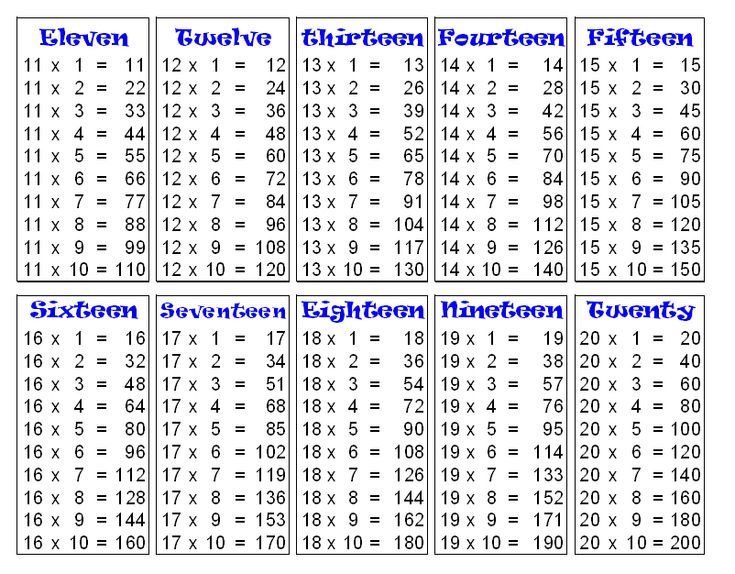
Math Tables 11 to 20 | Learn Multiplication Tables from 11 to 20 | Tables from Eleven to Twenty

Math Tables 11 to 20

Multiplication Tables from 11 to 20 help you learn the patterns and multiplication facts effortlessly. Math Tables for 11 to 20 can be quite essential for solving math problems on a quick basis. Tables of 11 to 20 are quite important for enhancing your math skills and arithmetic skills together. We have compiled the Multiplication Times Table from Eleven to Twenty both in the image and tabular format for free of cost.

Also, Check:

Tables from 11 to 20

For the sake of your comfort, we have attached the Multiplication Tables from 11 to 20 in Tabular Format. Use them as quick references and solve the math problems much efficiently and quickly. Learning the Multiplication Tables from Eleven to Twenty boosts your confidence and builds problem-solving skills in you. Make the most out of them and learn the solve the problems involving multiplication, division much simply.

Table of 11 to 15

Table of 11Table of 12Table of 13Table of 14Table of 15
11 ×‌‌ 1 = 1112 ×‌ 1 = 1213 ×‌ 1 = 1314 ×‌ 1 = 1415 ×‌ 1 = 15
11 ×‌‌ 2 = 2212 ×‌ 2 = 2413 ×‌ 2 = 2614 ×‌ 2 = 2815 ×‌ 2 = 30
11 ×‌‌ 3 = 3312 ×‌ 3 = 3613 ×‌ 3 = 3914 ×‌ 3 = 4215 ×‌ 3 = 45
11 ×‌ 4 = 4412 ×‌ 4 = 4813 ×‌ 4 = 5214 ×‌ 4 = 5615 ×‌ 4 = 60
11 ×‌ 5 = 5512 ×‌ 5 = 6013 ×‌ 5 = 6514 ×‌ 5 = 7015 ×‌ 5 = 75
11 ×‌ 6 = 6612 ×‌ 6 = 7213 ×‌ 6 = 7814 ×‌ 6 = 8415 ×‌ 6 = 90
11 ×‌ 7 = 7712 ×‌ 7 = 8413 ×‌ 7 = 9114 ×‌ 7 = 9815 ×‌ 7 = 105
11 ×‌ 8 = 8812 ×‌ 8 = 9613 ×‌ 8 = 10414 ×‌ 8 = 11215 ×‌ 8 = 120
11 ×‌ 9 = 9912 ×‌ 9 = 10813 ×‌ 9 = 11714 ×‌ 9 = 12615 ×‌ 9 = 135
11 ×‌ 10 = 11012 ×‌ 10 = 12013 ×‌ 10 = 13014 ×‌ 10 = 14015 ×‌ 10 = 150

Table of 16 to 20

Table of 16Table of 17Table of 18Table of 19Table of 20
16 ×‌ 1 = 1617 ×‌ 1 = 1718 ×‌ 1 = 1819 ×‌ 1 = 1920 ×‌ 1 = 20
16 ×‌ 2 = 3217 ×‌ 2 = 3418 ×‌ 2 = 3619 ×‌ 2 = 3820 ×‌ 2 = 40
16 ×‌ 3 = 4817 ×‌ 3 = 5118 ×‌ 3 = 5419 ×‌ 3 = 5720 ×‌ 3 = 60
16 ×‌ 4 = 6417 ×‌ 4 = 6818 ×‌ 4 = 7219 ×‌ 4 = 7620 ×‌ 4 = 80
16 ×‌ 5 = 8017 ×‌ 5 = 8518 ×‌ 5 = 9019 ×‌ 5 = 9520 ×‌ 5 = 100
16 ×‌ 6 = 9617 ×‌ 6 = 10218 ×‌ 6 = 10819 ×‌ 6 = 11420 ×‌ 6 = 120
16 ×‌ 7 = 11217 ×‌ 7 = 11918 ×‌ 7 = 12619 ×‌ 7 = 13320 ×‌ 7 = 140
16 ×‌ 8 = 12817 ×‌ 8 = 13618 ×‌ 8 = 14419 ×‌ 8 = 15220 ×‌ 8 = 160
16 ×‌ 9 = 14417 ×‌ 9 = 15318 ×‌ 9 = 16219 ×‌ 9 = 17120 ×‌ 9 = 180
16 ×‌ 10 = 16017 ×‌ 10 = 17018 ×‌ 10 = 18019 ×‌ 10 = 19020 ×‌ 10 = 200

Multiplication Table for 11 to 20

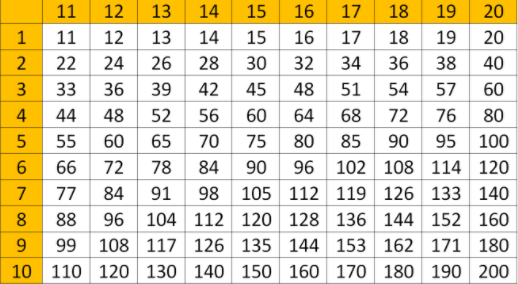
Below is the multiplication times table chart for tables 11 to 20. Use it as a reference to learn from 11 Times Table to 20 Times Table easily. It is as such

Multiplication Table Chart for 11 to 20

Tables 11 to 20 in PDF’s

Please find the below-attached Tables for 11 to 20 through the quick links provided below. Simply tap on the links and learn the entire table in no time.

Multiplication Tables for Eleven to Twenty
11 Times Table12 Times Table
13 Times Table14 Times Table
15 Times Table16 Times Table
17 Times Table18 Times Table
19 Times Table20 Times Table

FAQs on Tables from Eleven to Twenty

1. How to Memorize Tables from 11 to 20 Easily?

You can memorize the Tables from 11 to 20 easily by following the below-listed guidelines

  • Write down the Math Tables on a piece of paper.
  • Learn them orally and speak out in a loud voice.
  • Solve Problems on Multiplication as much as possible.

2. What is the Table of 13?

Table of 13 is written as follows: 13 x 1 = 13, 13 x 2 = 26, 13 x 3 =39, 13 x 4 =52, 13 x 5 =65, 13 x 6= 78, 13 x7 =91, 13 x 8 =104, 13 x9 = 117, 13 x10 = 130.

3. How to learn Multiplication Table of 15 orally?

You can learn the Multiplication Table of 15 by reading as such

Fifteen ones are 15, Fifteen twos are 30, Fifteen threes are 45, Fifteen four’s are 60, Fifteen fives are 75, Fifteen sixes are 90, Fifteen seven’s are 105, Fifteen eights are 120, Fifteen nines are 135 and Fifteen ten’s are 150.

Math Tables 1 to 12 | Printable Multiplication Chart 1 to 12 | Maths Multiplication Tables 1 to 12 PDF Download

Math Tables 1 to 12

Students are advised to go through the Multiplication Tables from 1 to 12 for faster math calculations. These Math Tables are the basic ones and help you to do mental math calculations efficiently and quickly. We have provided Multiplication Tables for 1 to 12 both in image and PDF Format. We don’t charge any amount and you can download them for free and start practicing them. Learning these Multiplication Times Tables helps you to increase your speed of solving problems.

Do Check: Math Tables 1 to 20

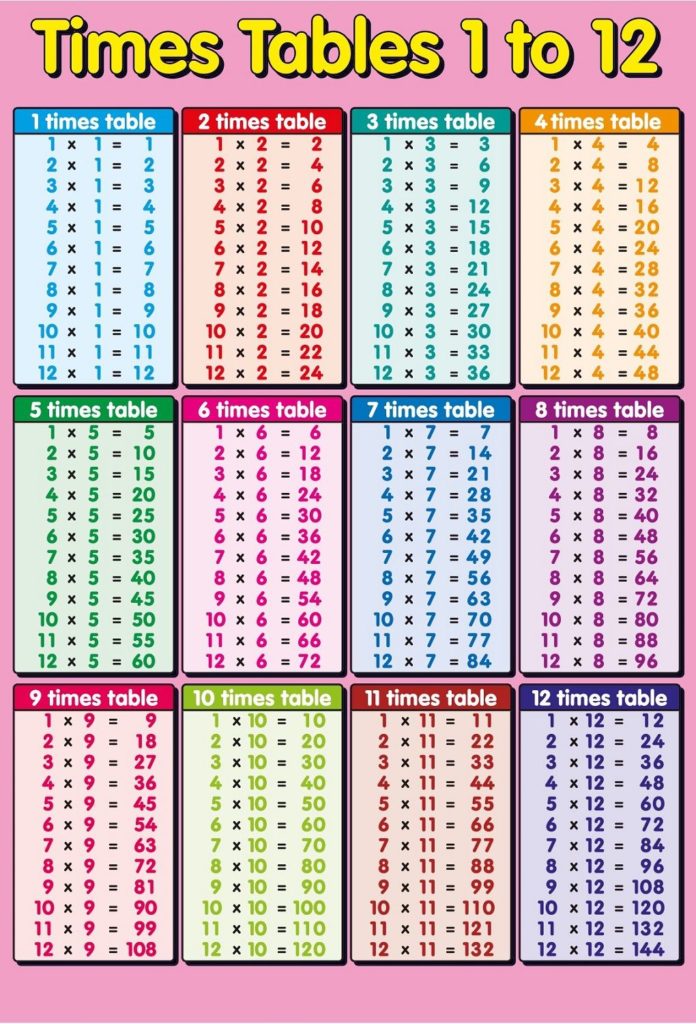
Multiplication Table Chart for One to Twelve

Maths Times Tables 1 to 12 help you to learn and practice the multiplication facts easily. Multiplication Tables for 1 to 12 can be of extreme help in performing your math calculations. For your convenience, we have added the Math Tables for 1 to 12 in image format which you can download for free of cost and prepare every now and then. Students who learn these Math Tables can solve complex problems too easily.

Times Tables 1 to 12

Math Tables from 1 to 12

Here is the list of Tables from 1 to 12 in tabular format. Primary School Students are advised to go through these Multiplication Charts for One to Twelve to solve mathematical problems involving multiplication and division much easily. These Math Tables are the foundation blocks for many arithmetic calculations.

Table of 1 to 6

Table of 1Table of 2Table of 3Table of 4Table of 5Table of 6
1 × 1 = 12 × 1 = 23 × 1 = 34 × 1 = 45 × 1 = 56 x 1 = 6
1 × 2 = 22 × 2 = 43 × 2 = 64 × 2 = 85 × 2 = 106 x 2 = 12
1 × 3 = 32 × 3 = 63 × 3 = 94 × 3 = 125 × 3 = 156 x 3 = 18
1 × 4 = 42 × 4 = 83 × 4 = 124 × 4 = 165 × 4 = 206 x 4 = 24
1 × 5 = 52 × 5 = 103 × 5 = 154 × 5 = 205 × 5 = 256 x 5 = 30
1 × 6 =62 × 6 = 123 × 6 = 184 × 6 = 245 × 6 = 306 x 6 = 36
1 × 7 = 72 × 7 = 143 × 7 = 214 × 7 = 285 × 7 = 356 x 7 = 42
1 × 8 = 82 × 8 = 163 × 8 = 244 × 8 = 325 × 8 = 406 x 8 = 48
1 × 9 = 92 × 9 = 183 × 9 = 274 × 9 = 365 × 9 = 456 x 9 = 54
1 × 10 = 102 × 10 = 203 × 10 = 304 × 10 = 405 × 10 = 506 x 10 = 60

Table of 7 to 12

Table of 7Table of 8Table of 9Table of 10Table of 11Table of 12
7 × 1 = 78 × 1 = 89 × 1 = 910 × 1 = 1011 x 1 = 1112 x 1 = 12
7 × 2 = 148 × 2 = 169 × 2 = 1810 × 2 = 2011 x 2 = 2212 x 2 = 24
7 × 3 = 218 × 3 = 249 × 3 = 2710 × 3 = 3011 x 3 = 3312 x 3 = 36
7 × 4 = 288 × 4 = 329 × 4 = 3610 × 4 = 4011 x 4 = 4412 x 4 = 48
7 × 5 = 358 × 5 = 409 × 5 = 4510 × 5 = 5011 x 5 = 5512 x 5 = 60
7 × 6 = 428 × 6 = 489 × 6 = 5410 × 6 = 6011 x 6 = 6612 x 6 = 72
7 × 7 = 498 × 7 = 569 × 7 = 6310 × 7 = 7011 x 7 = 7712 x 7 = 84
7 × 8 = 568 × 8 = 649 × 8 = 7210 × 8 = 8011 x 8 = 8812 x 8 = 96
7 × 9 = 638 × 9 = 729 × 9 = 8110 × 9 = 9011 x 9 = 9912 x 9 = 108
7 × 10 = 708 × 10 = 809 × 10 = 9010 × 10 = 10011 x 10 = 11012 x 10 = 120

Multiplication Tables Chart for 1 to 12

Below is the Multiplication Table Chart for One to Twelve Tables and they are as such

× (Times)123456789101112
1123456789101112
224681012141618202224
3369121518212427303336
44812162024283236404448
551015202530354045505560
661218243036424854606672
771421283542495663707784
881624324048566472808896
9918273645546372819099108
10102030405060708090100110120

Printable PDF’s of 1 to 12 Tables

Maths Times Tables for One to Twelve
1 Times Table2 Times Table
3 Times Table4 Times Table
5 Times Table6 Times Table
7 Times Table8 Times Table
9 Times Table10 Times Table
11 Times Table12 Times Table

FAQs on Tables from 1 to 12

1. How to Write the Table of 12?

Table of 12 is written as follows

12 x 1 =12

12 x 2 = 24

12 x 3 = 36

12 x 4 = 48

12 x 5 = 60

12 x 7 = 84

12 x 8 = 96

12 x 9 = 108

12 x 10 = 120

2. How to read 5 Times Table?

One time five is 5, two times five is 10, three times five is 15, four times five is 20, five times five is 25, six times five is 30, seven times five is 35, eight times five is 40, nine times five is 45 and ten times five is 50.

3. What is the 11 times table trick?

The trick for multiplying a single digit by 11 is to repeat the digit. For instance, to multiply 9 by 11 repeat the digit of 9 i.e. you will get 99.

Learn Math Tables 1 to 20 | Printable Multiplication Tables 1 to 20 | Tips to Memorize Tables of One to Twenty

Math Tables 1 to 20

Memorizing Multiplication Tables from 1 to 20 help you to related math calculations involving division, multiplication, fractions, algebra, taught in elementary school much simply. Without properly learning Math Tables you will feel difficulty in solving the math problems. Boost up your problem-solving skills and logical ability by memorizing the simple Math Multiplication Tables of 1 to 20 available here. Check out the Tips & Tricks to Memorize the Maths Times Tables provided in the later modules.

Multiplication Tables for One to Twenty

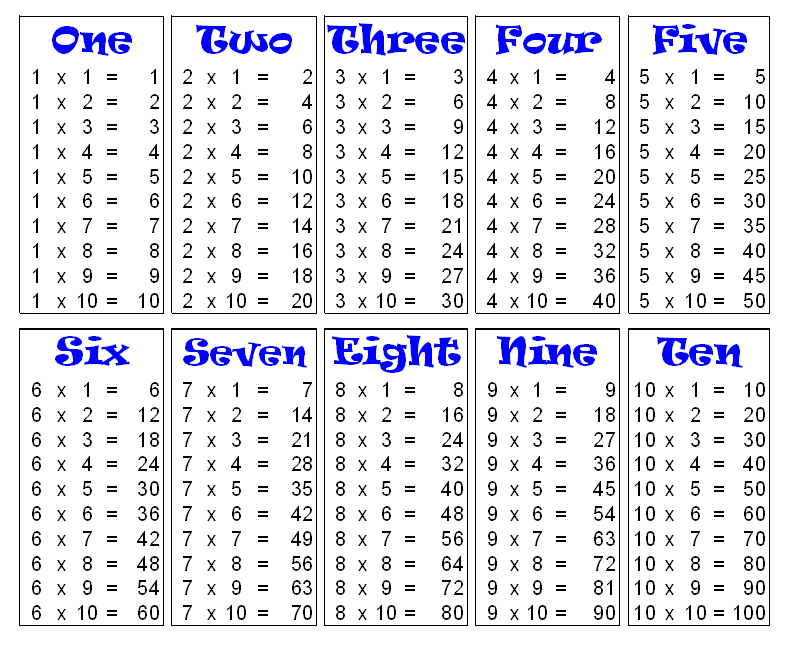
Boost up your math skills altogether by learning the Tables of 1 to 20 provided here. You can avail the Multiplication Tables from One to Twenty provided below in image format and download them free of cost. Stick it on your walls and recite it before going to bed and memorize it regularly.

Multiplication Table Charts for 1 to 10

Multiplication Tables for 11 to 20

Math Tables 1 to 20

Memorizing the Multiplication Tables one can boost their self-confidence and keep the information at one’s fingertips. Build memory in you and also enhances your problem-solving abilities. On Mastering the Multiplication Tables from 1 to 20 your speed of solving the Math Problems increases.

Tables of 2 to 10 are the most basic ones and play a crucial role in performing the arithmetic operations. If you are strong enough with the Math Tables of 2 to 10 you can recall or memorize the Tables from 11 to 20 much simply. It helps you to solve complex problems too easily and can save you a great deal of time. Thus, you are advised to learn them by heart so that you can do fundamental estimations.

While learning the Math Tables you will get to see some examples like 4×5 = 20, 5×4 = 20. On seeing such examples you can get to know the patterns and understand the logic like a number multiplied by another number will result in the same product if the numbers are multiplied the other way.

Table of 1Table of 2Table of 3Table of 4Table of 5
1 × 1 = 12 × 1 = 23 × 1 = 34 × 1 = 45 × 1 = 5
2 × 1 = 22 × 2 = 43 × 2 = 64 × 2 = 85 × 2 = 10
3 × 1 = 32 × 3 = 63 × 3 = 94 × 3 = 125 × 3 = 15
4 × 1 = 42 × 4 = 83 × 4 = 124 × 4 = 165 × 4 = 20
5 × 1 = 52 × 5 = 103 × 5 = 154 × 5 = 205 × 5 = 25
6 × 1 =62 × 6 = 123 × 6 = 184 × 6 = 245 × 6 = 30
7 × 1 = 72 × 7 = 143 × 7 = 214 × 7 = 285 × 7 = 35
8 × 1 = 82 × 8 = 163 × 8 = 244 × 8 = 325 × 8 = 40
9 × 1 = 92 × 9 = 183 × 9 = 274 × 9 = 365 × 9 = 45
10 × 1 = 102 × 10 = 203 × 10 = 304 × 10 = 405 × 10 = 50

Table of 6 to 10

Table of 6Table of 7Table of 8Table of 9Table of 10
6 × 1 = 67 × 1 = 78 × 1 = 89 × 1 = 910 × 1 = 10
6 × 2 = 127 × 2 = 148 × 2 = 169 × 2 = 1810 × 2 = 20
6 × 3 = 187 × 3 = 218 × 3 = 249 × 3 = 2710 × 3 = 30
6 × 4 = 247 × 4 = 288 × 4 = 329 × 4 = 3610 × 4 = 40
6 × 5 = 307 × 5 = 358 × 5 = 409 × 5 = 4510 × 5 = 50
6 × 6 = 367 × 6 = 428 × 6 = 489 × 6 = 5410 × 6 = 60
6 × 7 = 427 × 7 = 498 × 7 = 569 × 7 = 6310 × 7 = 70
6 × 8 = 487 × 8 = 568 × 8 = 649 × 8 = 7210 × 8 = 80
6 × 9 = 547 × 9 = 638 × 9 = 729 × 9 = 8110 × 9 = 90
6 × 10 = 607 × 10 = 708 × 10 = 809 × 10 = 9010 × 10 = 100

Table of 11 to 15

Table of 11Table of 12Table of 13Table of 14Table of 15
11 × 1 = 1112 × 1 = 1213 × 1 = 1314 × 1 = 1415 × 1 = 15
11 × 2 = 2212 × 2 = 2413 × 2 = 2614 × 2 = 2815 × 2 = 30
11 × 3 = 3312 × 3 = 3613 × 3 = 3914 × 3 = 4215 × 3 = 45
11 × 4 = 4412 × 4 = 4813 × 4 = 5214 × 4 = 5615 × 4 = 60
11 × 5 = 5512 × 5 = 6013 × 5 = 6514 × 5 = 7015 × 5 = 75
11 × 6 = 6612 × 6 = 7213 × 6 = 7814 × 6 = 8415 × 6 = 90
11 × 7 = 7712 × 7 = 8413 × 7 = 9114 × 7 = 9815 × 7 = 105
11 × 8 = 8812 × 8 = 9613 × 8 = 10414 × 8 = 11215 × 8 = 120
11 × 9 = 9912 × 9 = 10813 × 9 = 11714 × 9 = 12615 × 9 = 135
11 × 10 = 11012 × 10 = 12013 × 10 = 13014 × 10 = 14015 × 10 = 150

Table of 16 to 20

Table of 16Table of 17Table of 18Table of 19Table of 20
16 × 1 = 1617 × 1 = 1718 × 1 = 1819 × 1 = 1920 × 1 = 20
16 × 2 = 3217 × 2 = 3418 × 2 = 3619 × 2 = 3820 × 2 = 40
16 × 3 = 4817 × 3 = 5118 × 3 = 5419 × 3 = 5720 × 3 = 60
16 × 4 = 6417 × 4 = 6818 × 4 = 7219 × 4 = 7620 × 4 = 80
16 × 5 = 8017 × 5 = 8518 × 5 = 9019 × 5 = 9520 × 5 = 100
16 × 6 = 9617 × 6 = 10218 × 6 = 10819 × 6 = 11420 × 6 = 120
16 × 7 = 11217 × 7 = 11918 × 7 = 12619 × 7 = 13320 × 7 = 140
16 × 8 = 12817 × 8 = 13618 × 8 = 14419 × 8 = 15220 × 8 = 160
16 × 9 = 14417 × 9 = 15318 × 9 = 16219 × 9 = 17120 × 9 = 180
16 × 10 = 16017 × 10 = 17018 × 10 = 18019 × 10 = 19020 × 10 = 200

Important Points to Remember Regarding the Math Tables 1 to 20

Below are the key points to be remembered regarding the Multiplication Tables One to Twenty. They are as under

  • Each and Every Number in the Multiplicaton Table from 1 to 20 is a Whole Number.
  • A number multiplied by itself results in the square of a number.
  • Adding a number n times is the same as multiplying it with n. Adding 5 10 times is the same as multiplying 5 by 10 and gives the result 50.

Multiplication Table Chart

Below is the Multiplication Chart for Tables 1 to 10. They are in the following fashion

× (Times)12345678910
112345678910
22468101214161820
336912151821242730
4481216202428323640
55101520253035404550
66121824303642485460
77142128354249566370
88162432404856647280
99182736455463728190
10102030405060708090100

Benefits of learning Multiplication Table Charts for 1 to 20

Learning Maths Multiplication Tables 1 to 20 provides numerous advantages and boosts your learning abilities. Some of them are outlined as follows

  • Helps you to solve math problems much quicker.
  • You can avoid mistakes while doing calculations in mind.
  • Reciting 1 to 20 Multiplication Tables helps you to understand the patterns among multiples of a number.

Printable Multiplication Tables for 1 to 20 PDF Download

For the sake of your comfort, we have provided the Maths Times Tables from 1 to 20 via quick links available. Simply, tap on them and learn entirely regarding the particular table in no time.

Maths Times Tables for One to Twenty
1 Times Table2 Times Table
3 Times Table4 Times Table
5 Times Table6 Times Table
7 Times Table8 Times Table
9 Times Table10 Times Table
11 Times Table12 Times Table
13 Times Table14 Times Table
15 Times Table16 Times Table
17 Times Table18 Times Table
19 Times Table20 Times Table

FAQs on Multiplication Tables

1. How do you memorize multiplication tables up to 20?

The fastest way to memorize the Multiplication Tables from 1 to 20 is to master the tips & tricks for each and individual table accordingly. Another way to remember the Tables is through Addition. The number of times a number is multiplied by another number it means that it has been added to itself for the same number of times. For Example, 3 Times 3 is 3+3+3

2. How to Learn Math Tables easily?

Prepare a Multiplication Chart for each and every table and paste it on your walls of the room and try to recite it regularly so that you can remember them for a long time.

3. Why is it important to Learn Multiplication Tables?

  • Students are advised to learn Math Tables to perform their mental math calculations quickly.
  • Enhances your Problem Solving Abilities and helps you to solve math problems much faster.
  • Boosts your arithmetic capabilities of a student.

Properties of Division- Closure, Commutative, Associative, Distributive | Basic Division Properties with Examples

Properties of Division

Properties of Division definition is here. Check the formulae, various properties of division, and how they work on various problems. Know the basics regarding the division and also the division property of equality. Follow the various operators with examples and concepts. Get the expression form and also step by step procedure to solve the problems. Division rule follows many properties and those are important in solving various problems. Check the below sections to know the complete details regarding properties of division, formulae, rules, examples, etc.

Also, Read:

Properties of Division

Of the four basic arithmetic operations, the division is the one. In the operation of division, we distribute or share the number or a group of things into equal parts. Division operation defines the fair result of sharing. It is the inverse property of multiplication. Division operation has five properties which are discussed in the below sections. The division is defined as the most complicated part of the arithmetic functions. But will be easy if you have a clear idea of all the methods, concepts, rules, and formulae along with a clear understanding of its usage.

Representation of Division Operator

The notation of the division operator is a short horizontal line with 2 dots one above the line and the other below the line.

Notation:

The division is represented with the notation “÷”

Basic Terms Used in Division

Various parts involving in the division rule have a special name.

Dividend – Dividend is the term that is being divided.

Divisor – The term which is being divided by the dividend is called the divisor

Quotient – The term quotient is defined as the result that is obtained in the division process

Remainder – The term remainder is defined as the leftover portion after the division process

Rules of Division

  • The first division rule is when the number is divided by zero, then the result is always 0. For suppose, 0 ÷ 4 = 0, i.e., 0 chocolates are shared among 4 pupils and each one gets 0 chocolates.
  • No number can be divided with zero, the result gives the undefined value. For suppose, 4 ÷ 0. You have 4 chocolates but no pupil to distribute it, hence you cannot divide it by 0.
  • On dividing the number with 1, the result is the same number with which you are dividing. For suppose, 4 ÷ 1 = 4. 4 chocolates divided among one pupil.
  • If you divide the number by 2, it means that you are halving the number. For suppose, 4 ÷ 2 = 2. 4 chocolates dividing among two pupils, each gets 2 chocolates.
  • On dividing the same number, the result value will always be one. For suppose, 4 ÷ 4 = 1. If 4 chocolates are divided among 4 pupils, then each gets one chocolate.
  • The dividend rule must be applied in a proper way because if we interchange the numbers, the result value changes. For suppose, 20 ÷ 4 = 5 and 4 ÷ 20 = 0.2. Hence, the division rule must be applied in the correct order.
  • The fractions like ¼, ½, ¾ are known as the division sums. ¼ is nothing but 1 ÷ 4, i.e., 1 chocolate is divided among 4 pupils.

Division Properties

There are various properties of a division operation. They are explained in detail by considering few examples and they are as under

Closure Property

In general closure property states that, the resultant value will be always an integer. But when it comes to the division operation, the resultant value of the division need not be an integer value always. Hence, division fundamental operation does not follow closure property. i.e., a ÷ b is not an integer always. Therefore a ÷ b does not follow closure property.

Example: 7 ÷ 3 is not an integer

If we divide 7 with 3, then the resultant value is 2.33 which is not an integer. Thus, it is proved that closure property is not applicable for division operation.

Commutative Property

In general commutative property states that, even after swapping or shifting of numbers, the resultant value will be the same. When it comes to division operation, it gives the different resultant value when the operators are shifted or swapped. Hence, division operation does not follow the commutative property. i.e., a ÷ b ≠ b ÷ a. Therefore, a ÷ b does not follow the commutative property.

Example: 10 ÷ 5 ≠ 5 ÷ 10

If we divide 7 with 3, the resultant value is 2.33. If we divide 3 with 7, the resultant value is 0.42. Therefore, both the values are not equal. Thus, it is proved that commutative property is not applicable for division operation.

Associative Property

In general associative property states that, even if the parentheses of the expression are rearranged, the resultant will not be changed. When it comes to the division operation, it gives a different value when the parentheses are rearranged. Hence, division operation does not follow the associative property. i.e., a ÷ (b ÷ c) ≠ (a ÷ b) ÷ c. Therefore, a ÷ (b ÷ c) does not follow the associative property.

Example: (16 ÷ 4) ÷ 2 ≠ 16 ÷ (4 ÷ 2)

If we solve (16 ÷ 4) ÷ 2, the resultant value is 2 and if we solve 16 ÷ (4 ÷ 2), the resultant value is 8. Therefore, both the values are not the same. Thus, it is proved that associative property is not applicable for division operation.

Distributive Property

In general distributive property states that, the resultant value is the same, even if the sum of two or more addends are multiplied or each addend multiplied separately, and then the products to be added together. When it comes to division operation, it gives different results when the addends are multiplied separately. Hence, division operation does not follow the distributive property. Therefore a ÷ (b + c) ≠ (a ÷ b) + (a ÷ c).

Example: 12 ÷ (4+ 2) ≠ (12 ÷ 4) + (12 ÷ 2)

If we solve the equation 12 ÷ (4+ 2), we get the resultant value as 2 and if we solve the equation (12 ÷ 4) + (12 ÷ 2), we get the resultant value as 9. Therefore, both the values are not similar. Thus, it is proved that commutative property is not applicable for division operation.

Division by 1

Any number that is divided by 1 gives the resultant value as the same number.

Example: 

5 ÷ 1 = 5

Example Problems on Division Properties

Problem 1: 

There are 80 chocolates. Each packet must be packed with 5 chocolates. How many packets do we need in total?

Solution:

Total number of chocolates = 80

Toffees that are to be packed in 1 packet = 5

Packets needed to pack 80 toffees = 80 ÷ 5

= 16

Therefore, we require 16 packets to pack 80 chocolates

Problem 2:

There are 100 donuts. They are equally packed in 10 packets. How many donuts are there in each box?

Solution:

Total number of donuts = 100

Total number of packets = 10

Number of donuts in each packet = 100 ÷ 10

= 10

Therefore, there are 10 donuts in each box

Problem 3:

50 bottles are placed in 5 equal trays. Find the number of bottles in each tray?

Solution:

Total no of bottles = 50

No of trays = 5

Number of bottles in each tray = 50 ÷ 5

= 10

Therefore, there are 10 bottles in each tray

Worksheet on Math Relation | Relations and Functions Worksheets with Answers

Worksheet on Math Relation

Students who are searching to get Math Relation problems can check the Worksheet on Math Relation. Our Math Relation Worksheets available improves your preparation level and are very helpful in your practice. It included various models of questions on Math Relations. Therefore, practice all the given examples and check out the answers to cross-check your method of solving. Practice different questions related to Ordered Pair, Cartesian Product of Two Sets, Relation, Domain, and Range of a Relation in Math Relation Worksheet.

See More: Sets

Relations and Functions Questions and Answers

1. Find the values of x and y, if (x + 4, y – 8) = (8, 1).

Solution:

Given that (x + 4, y – 8) = (8, 1)
Compare the elements of the given ordered pairs.
Firstly, compare the first components of the given ordered pairs.
x + 4 = 8
x = 8 – 4 = 4
So, x = 4.
Now, compare the second components of the given ordered pairs.
y – 8 = 1
y = 8 + 1 = 9
So, y = 9.

Therefore, the value of x = 4 and y = 9.


2. If (x/5 + 3, y – 5/7) = (4, 5/14), find the values of x and y.

Solution:

Given that (x/5 + 3, y – 5/7) = (4, 5/14)
Compare the elements of the given ordered pairs.
Firstly, compare the first components of the given ordered pairs.
x/5 + 3 = 4
x/5 = 4-3
Therefore, x/5 = 1
x = 1 * 5 = 5
So, x = 5.
Now, compare the second components of the given ordered pairs.
y – 5/7 = 5/14
y = 5/14 + 5/7 = 15/14
So, y = 15/14.

Therefore, the value of x = 5 and y = 15/14.


3. If X = {m, n, o} and Y = {u, v}, find X × Y and Y × X. Are the two products equal?

Solution:

Given that X = {m, n, o} and Y = {u, v},
Let’s find the X × Y
X × Y = {(m, u); (m, v); (n, u); (n, v); (o, u); (o, v)}
Now, find Y × X.
Y × X = {(u, m); (u, n); (u, o); (v, m); (v, n); (v, o)}
Compare the elements of the given ordered pairs X and Y.
X × Y not equal to Y × X

Therefore, it is clearly stated that the two products are not equal.


4. If P × Q = {(x, 7); (x, 9); (y, 7); (y, 9); (z, 7); (z, 9)}, find P and Q.

Solution:

Given that P × Q = {(x, 7); (x, 9); (y, 7); (y, 9); (z, 7); (z, 9)},
We know that P is a set of all first entries in ordered pairs in P × Q.
Q is a set of all second entries in ordered pairs in P × Q.
Therefore, P = {x, y, z}
Q = {7, 9}

Therefore, the final answer is P = {x, y, z} and Q = {7, 9}


5. If M and N are two sets, and M × N consists of 6 elements: If three elements of M × N are (8, 4) (7, 3) (6, 3). Find M × N.

Solution:

Given that M and N are two sets, and M × N consists of 6 elements: If three elements of M × N are (8, 4) (7, 3) (6, 3).
We know that M is a set of all first entries in ordered pairs in M × N.
N is a set of all second entries in ordered pairs in M × N.
Therefore, M = {8, 7, 6}, and N = {4, 3}
Now, M × N = {(8, 4); (8, 3); (7, 4); (7, 3); (6, 4); (6, 3)}

Thus, M × N contains six ordered pairs.


6. If A × B = {(m, 3); (m, 7); (m, 4); (n, 3); (n, 7); (n, 4)}, find B × A.

Solution:

Given that A × B = {(m, 3); (m, 7); (m, 4); (n, 3); (n, 7); (n, 4)},
We know that A is a set of all first entries in ordered pairs in A × B.
B is a set of all second entries in ordered pairs in A × B.
Therefore, A = {m, n}, and B = {3, 7, 4}
Now, B × A = {(3, m); (3, n); (7, m); (7, n); (4, m); (4, n)}

Therefore, the final answer is B × A = {(3, m); (3, n); (7, m); (7, n); (4, m); (4, n)}


7. If P = { 2, 1, 9} and Q = {4, 5}, then
Find: (i) P × Q (ii) Q × P (iii) P × P (iv) (Q × Q)

Solution:

Given that P = { 2, 1, 9} and Q = {4, 5}
(i) P × Q = {(2, 4); (2, 5); (1, 4); (1, 5); (9, 4); (9, 5)}
(ii) Q × P = {(4, 2); (4, 1); (4, 9); (5, 2); (5, 1); (5, 9)}
(iii) P × P = {(2, 2); (2, 1); (2, 9); (1, 2); (1, 1); (1, 9); (9, 2); (9, 1); (9, 9)}
(iv) (Q × Q) = {(4, 4); (4, 5); (5, 4); (5, 5)}


8. If P = {3, 5, 7} and Q = {2, 3, 6}, state which of the following is a relation from P to Q.
(a) R₁ = {(3, 5); (6, 7); (7, 2)} (b) R₂ = {(3, 3); (7, 6)}
(c) R₃ = {(3, 2); (5, 6); (6, 7)} (d) R₄ = {(7, 2); (7, 6); (5, 3); (3, 3), (5, 2), (5, 7)}

Solution:

Given that P = {3, 5, 7} and Q = {2, 3, 6}
Note: Every element of set P is associated with a unique element of set Q. No element of P must have more than one image.
(a) f(1) = 3 and f(1) = 5 are not possible. so, this relation is not mapping from P to Q.
(b) R₂ = {(3, 3); (7, 6)}. Every element of set P is associated with a unique element of set Q. hence, it is relation from P to Q.
(c) R₃ = {(3, 2); (5, 6); (6, 7)} it’s not relation from P to Q.
(d) R₄ = {(7, 2); (7, 6); (5, 3); (3, 3), (5, 2), (5, 7)} Every element of set P is associated with a unique element of set Q. hence, it is relation from P to Q.

Therefore, the final answer is (b) R₂ = {(3, 3); (7, 6)} and (d) R₄ = {(7, 2); (7, 6); (5, 3); (3, 3), (5, 2), (5, 7)}


9. Write the domain and range of the following relations.
(a) R₁ = {(5, 4); (7, 9); (5, 9); (1, 8); (8, 6); (1, 9)}
(b) R₂ = {(p, 3); (q, 4); (r, 3); (p, 4); (s, 5); (q, 5)}

Solution:

Given that (a) R₁ = {(5, 4); (7, 9); (5, 9); (1, 8); (8, 6); (1, 9)}
(b) R₂ = {(p, 3); (q, 4); (r, 3); (p, 4); (s, 5); (q, 5)}
(a) R₁ = {(5, 4); (7, 9); (5, 9); (1, 8); (8, 6); (1, 9)}
From the given information, the Domain = {1, 5, 7, 8} and Range = {4, 6, 8, 9}
(b) R₂ = {(p, 3); (q, 4); (r, 3); (p, 4); (s, 5); (q, 5)}
From the given information, the Domain = {p, q, r, s} and Range = {3, 4, 5}


10. Let P = {3, 4, 5, 6, 7, 8}. Define a relation R from A to A by R = {(x, y) : y = x + 1}.

  • Depict this relation using an arrow diagram.
  • Write down the domain and range of R.
Solution:

Given that P = {3, 4, 5, 6, 7, 8}. Define a relation R from A to A by R = {(x, y) : y = x + 1}.
If x = 3, y = x + 1 = 3 + 1 = 4.
x = 4, y = x + 1 = 4 + 1 = 5.
x = 5, y = x + 1 = 5 + 1 = 6.
x = 6, y = x + 1 = 6 + 1 = 7.
x = 7, y = x + 1 = 7 + 1 = 8.
x = 8, y = x + 1 = 8 + 1 = 9.
R = {(3, 4); (4, 5); (5, 6); (6, 7); (7, 8)} where P = {3, 4, 5, 6, 7, 8}.
Worksheet on Math Relation
Domain = Set of all first elements in a relation = {3, 4, 5, 6, 7}
Range = Set of all second elements in a relation = {4, 5, 6, 7, 8}


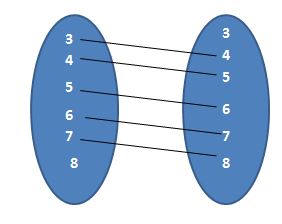
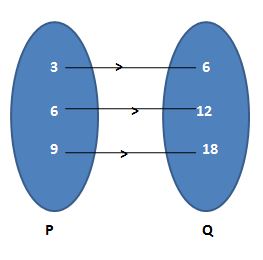
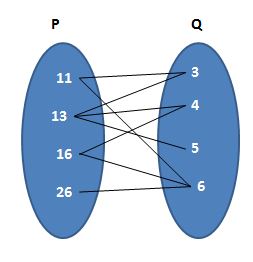
11. Adjoining figure shows a relationship between the set P and Q. Write this relation in the roster form. What are its domain and range?
Domain and Range Problems

Solution:

The relation mentioned in the figure shows, P a domain and Q as a range.
Let the relation be R.
In roster form R = {(3, 6); (6, 12); (9, 18)}
Domain = Set of all first elements in a relation = {3, 6, 9}
Range = Set of all second elements in a relation = {6, 12, 18}


12. In the given ordered pairs (2, 4); (4, 16); (5, 7); (1, 3); (6, 36); (2, 9); (1, 1), find the following relationship:
(a) Is a factor of ….
(b) Is a square root of …..
Also, find the domain and range in each case.

Solution:

Given that the ordered pairs (2, 4); (4, 16); (5, 7); (1, 3); (6, 36); (2, 9); (1, 1).
(a) Is a factor of ….
Let’s find out the factor of …. from the given order pars.
(2, 4); (4, 16); (1, 3); (6, 36); (1, 1)
Domain =  Set of all first elements in a relation = {1, 2, 4, 6}
Range = Set of all second elements in a relation = {1, 3, 4, 16, 36}
(b) Is a square root of …..
Let’s find out the square root of …. from the given order pars.
(2, 4); (4, 16); (6, 36).
Domain =  Set of all first elements in a relation = {2, 4, 6}
Range = Set of all second elements in a relation = {4, 16, 36}


13. Draw the arrow diagrams to represent the following relations.
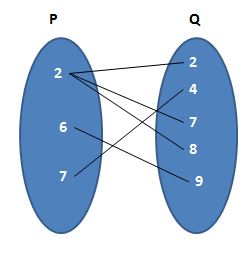
(a) R₁ = {(2, 2); (2, 7); (2, 8); (6, 9); (7, 4)}
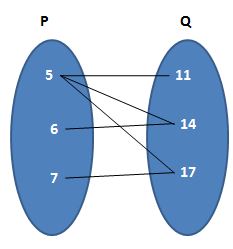
(b) R₂ = {(5, 11); (5, 14); (5, 17); (6, 14); (7, 17)}
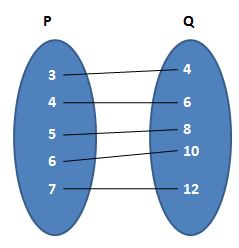
(c) R₃ = {(3, 4); (4, 6); (5, 8); (6, 10); (7, 12)}
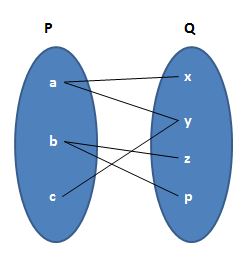
(d) R₄ = {(a, x); (a, y); (b, p); (b, z); (c, y)}

Solution:

(a) Given that R₁ = {(2, 2); (2, 7); (2, 8); (6, 9); (7, 4)}
Let the two sets are P and Q.
The required diagram is
Math Relation Worksheet
(b) Given that R₂ = {(5, 11); (5, 14); (5, 17); (6, 14); (7, 17)}
Let the two sets are P and Q.
The required diagram is
Math Relation Worksheets
(c) Given that R₃ = {(3, 4); (4, 6); (5, 8); (6, 10); (7, 12)}
Let the two sets are P and Q.
The required diagram is
Math Relation Worksheet problems
(d) Given that R₄ = {(a, x); (a, y); (b, p); (b, z); (c, y)}
Let the two sets are P and Q.
The required diagram is
Math Relation Worksheet Questions


14. Represent the following relation in the roster form.
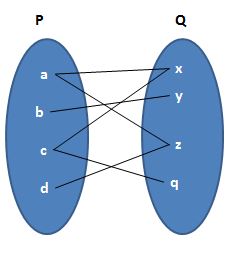
(a) Math Relation Worksheet Questions and answers
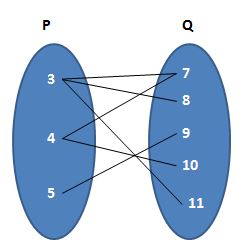
(b) Worksheet on Math Relation Problems
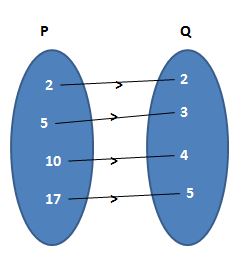
(c) Math Relation Worksheet Question and answers
(d) Math Relation Worksheet Solved Examples

Solution:

(a) R = {(a, x) (a, z) (b, y) (c, x) (c, q) (d, z)}
(b) R = {(3, 7) (3, 9) (4, 7) (4, 10) (5, 9) (3, 11)}
(c) R = {(2, 2) (5, 3) (10, 4) (17, 5)}
(d) R = {(11, 3) (11, 6) (13, 3) (13, 4) (13, 5) (16, 4) (16, 6) (26, 6)}


Conversion of Numbers to Roman Numerals – Rules, Chart, Examples | How to Convert Numbers to Roman Numerals?

Conversion of Numbers to Roman Numerals

Looking for ways on how to convert from Numbers to Roman Numerals? If so, look no further as this web page gives you entire information regarding the basics like Roman Numerals Definition, Frequently Used Roman Numerals. Furthermore, you will get acquainted with the details like Procedure on How to Convert Numbers to Roman Numerals, Rules involving the Roman Numerals Conversion, their Applications in day to day lives, etc. Also, check out the Solved Examples on Changing between Numbers to Roman Numerals for a better understanding of the concept.

Also, Read:

Roman Numerals – Definition

Romans used a special kind of numerical notations that contains Latin alphabets which signifies values. Roman alphabets are English alphabets except for J, U, and w. These are used to represent roman numbers.
For Example:
1 is written as I
2 is written as II
3 is written as III
The other letters V, X, I, C, M are easy to understand.

Commonly used Roman Numerals are listed below.

NumberRoman Numeral
5V
10X
50L
100C
500D
1000M

How to Convert Numbers into Roman Numerals?

Follow the below-listed step-by-step process to change between Numbers to Roman Numerals easily. You can get the results easily by following the Numbers to Roman Numerals Conversion procedure. They are as follows

  • Break the number into thousands, hundreds, tens, and ones and write down each conversion.
  • Remember a Letter can only be repeated three times.

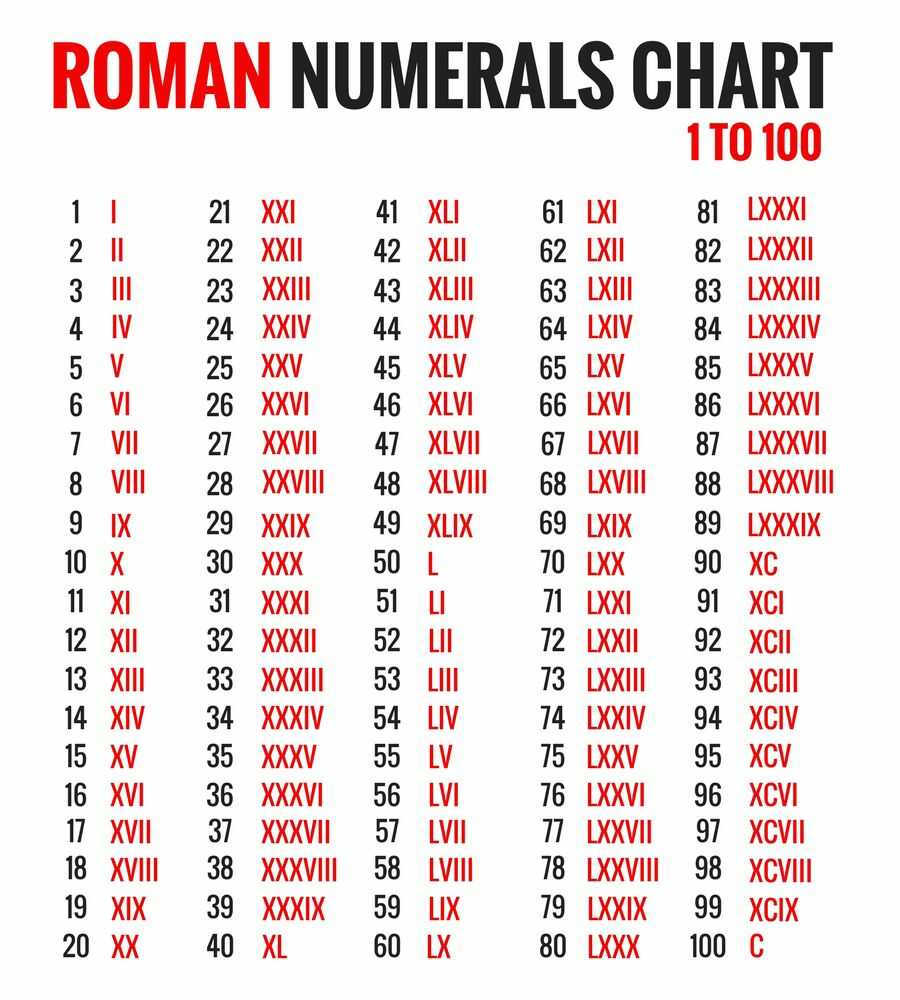
Roman Numerals Chart for 1-100 Numbers

Roman Numerals Chart for 1-100 Numbers

Rules for Converting Numbers to Roman Numerals

We can convert any number to a Roman numeral and vice versa. However, to do so we have to follow certain rules and they are explained in detail below by considering a few examples. Primary Rules for Reading and Writing the Roman Numerals are given here. They are as follows

  • A Letter can be repeated only thrice and not more than that. For instance XXX = 30, etc.
  • When a smaller numeral is placed after a larger or (equal) one it has the effect of addition. i.e., a smaller number is added to the larger number.
    For Example: VIII=V+I+I+I=5+1+1+1=8
    CXX=C=+X+X=100+10+10=120
  • When a smaller numeral is placed before a larger one it has the effect of subtraction. i.e., the smaller number is subtracted from the larger number.
    For Example: IX=X-I=10-1=9
    LIX=50-1+10=59
  • A bar placed on top of a letter or string of letters increases the numeral’s value by 1,000 times.

Solved Examples on Conversion of Numbers to Roman Numerals

1. Convert 1789 to Roman Numerals?

Solution:

Break the number into thousands, hundreds, tens, and ones and perform the individual conversion.

Given Number 1789 broken down into place values are as follows

1000=M
700=DCC
80=LXXX
9=IX
Therefore, 1789 converted MDCCLXXXIX

2. Convert 1674 to Roman Numerals?

Solution:

Break down the number into thousands, hundreds, tens, and ones and perform conversion each.

Given Number 1674 broken down into place values are as follows

1000 = M
600 = DC
70 = LXX
4 = IV

Therefore, 1674 converted to Roman Numerals is MDCLXXIV

Uses of Roman Numerals

Roman Numerals have various applications and are used in plenty of scenarios that we come across in our day-to-day lives. They are in the following fashion

  • They are used in chapters of the book, movie titles, television programs, and videos.
  • Roman Numbers used for the names of pope ships.
  • They are also used for displaying hours on analog clocks and watches.

FAQ’S on Conversion of Numbers to Roman Numerals

1. How do we write 1000 in Roman Numbers?

1000 Written in Roman Numerals is represented by the Letter ‘M’.

2. How to Convert Numbers to Roman Numbers?

You can convert numbers to Roman Numerals by simply breaking down the Thousands, Hundreds, Tens, Ones and perform each conversion adhering to the roman numeral conversion rules.

3. What does the Roman Number XV equal to?

Roman Numeral XV is expressed in numbers as 95.

Eureka Math Kindergarten Module 3 Lesson 10 Answer Key

Engage NY Eureka Math Kindergarten Module 3 Lesson 10 Answer Key

Eureka Math Kindergarten Module 3 Lesson 10 Homework Answer Key

Question 1.
Eureka Math Kindergarten Module 3 Lesson 10 Homework Answer Key 1
The golf ball is as heavy as _______ pennies.
Answer:
The golf ball is as heavy as 6 pennies.

Explanation:
In the above picture in the left side of the balance their is a golfball and in the right side of the balance there are 6 pennies.The balance shows equal weight on both sides.Therefore, 1 golfball is as heavy as 6 pennies.

Question 2.
Eureka Math Kindergarten Module 3 Lesson 10 Homework Answer Key 2
The toy train is as heavy as _______ pennies.
Answer:
The toy train is as heavy as 9 pennies.

Explanation:
In the above picture in the left side of the balance their is a Toytrain and in the right side of the balance there are 9 pennies.The balance shows equal weight on both sides.Therefore, 1 toytrain is as heavy as 9 pennies.

Question 3.
Eureka Math Kindergarten Module 3 Lesson 10 Homework Answer Key 3
Draw in the pennies so the carrot is as heavy as 5 pennies.
Answer:

Explanation:
In the above picture i drew 5 pennies as given that the carrot is as heavy as 5 pennies.

Question 4.
Eureka Math Kindergarten Module 3 Lesson 10 Homework Answer Key 4
Draw in the pennies so the book is as heavy as 10 pennies.
Answer:

Explanation:
In the above picture i drew 10 pennies as given that the book is as heavy as 10 pennies.

Eureka Math Kindergarten Module 3 Lesson 9 Answer Key

Engage NY Eureka Math Kindergarten Module 3 Lesson 9 Answer Key

Eureka Math Kindergarten Module 3 Lesson 9 Homework Answer Key

Draw something inside the box that is heavier than the object on the balance.

Question 1.
Eureka Math Kindergarten Module 3 Lesson 9 Homework Answer Key 1
Answer:

Explanation:
A bunch of flowers is heavier than a feather.So, i drew a bunch of flowers in the box.

Question 2.
Eureka Math Kindergarten Module 3 Lesson 9 Homework Answer Key 2
Answer:

Explanation:
A watermelon is heavier than an apple.So, i drew a watermelon in the box.

Draw something lighter than the object on the balance.

Question 1.
Eureka Math Kindergarten Module 3 Lesson 9 Homework Answer Key 3
Answer:

Explanation:
A balloon is lighter than a ball.So, i drew a balloon in the box.

Question 2.
Eureka Math Kindergarten Module 3 Lesson 9 Homework Answer Key 4
Answer:

Explanation:
A tomato is lighter than a pumpkin.So, i drew a tomato in the box.

Eureka Math Kindergarten Module 3 Lesson 8 Answer Key

Engage NY Eureka Math Kindergarten Module 3 Lesson 8 Answer Key

Eureka Math Kindergarten Module 3 Lesson 8 Problem Set Answer Key

Which is heavier? Circle the object that is heavier than the other.

Question 1.
Eureka Math Kindergarten Module 3 Lesson 8 Problem Set Answer Key 1
Answer:

Explanation:
I circled book because it is heavier than a scissors.

Question 2.
Eureka Math Kindergarten Module 3 Lesson 8 Problem Set Answer Key 2
Answer:

Explanation:
I circled pen because it is heavier than a paper.

Question 3.
Eureka Math Kindergarten Module 3 Lesson 8 Problem Set Answer Key 3
Answer:

Explanation:
I circled bear because it is heavier than a teddybear.

Question 4.
Eureka Math Kindergarten Module 3 Lesson 8 Problem Set Answer Key 4
Answer:

Explanation:
I circled shoe because it is heavier than a socks.

Question 5.
Eureka Math Kindergarten Module 3 Lesson 8 Problem Set Answer Key 5
Answer:

Explanation:
I circled ball because it is heavier than a balloon.

Question 6.
Eureka Math Kindergarten Module 3 Lesson 8 Problem Set Answer Key 6
Answer:

Explanation:
I circled watermelon because it is heavier than an apple.

Eureka Math Kindergarten Module 3 Lesson 8 Homework Answer Key

Draw an object that would be lighter than the one in the picture.

Question 1.
Eureka Math Kindergarten Module 3 Lesson 8 Homework Answer Key 7
Answer:

Explanation:
A balloon will be lighter than a ball.So, i drew a balloon.

Question 2.
Eureka Math Kindergarten Module 3 Lesson 8 Homework Answer Key 8
Answer:

Explanation:
An orange will be lighter than a pineapple.So, i drew an orange.

Question 3.
Eureka Math Kindergarten Module 3 Lesson 8 Homework Answer Key 9
Answer:

Explanation:
A chair will be lighter than a table.So, i drew a chair.

Question 4.
Eureka Math Kindergarten Module 3 Lesson 8 Homework Answer Key 10
Answer:

Explanation:
A book will be lighter than a bag.So, i drew a book.

Eureka Math Kindergarten Module 3 Lesson 7 Answer Key

Engage NY Eureka Math Kindergarten Module 3 Lesson 7 Answer Key

Eureka Math Kindergarten Module 3 Lesson 7 Problem Set Answer Key

These boxes represent cubes.
Eureka Math Kindergarten Module 3 Lesson 7 Problem Set Answer Key 1

Question 1.
Eureka Math Kindergarten Module 3 Lesson 7 Problem Set Answer Key 2
Answer:

Explanation:
I colored 2 cubes red and 3 cubes green.There are 5 color cubes.

Question 2.
Eureka Math Kindergarten Module 3 Lesson 7 Problem Set Answer Key 3
Answer:

Explanation:
I colored 1 cube red and 4 cubes green.There are 5 color cubes.

Question 1.
Trace a 6-stick. Find something the same length as your 6-stick.
Draw a picture of it here.
Answer:

Explanation:
I drew a 6-stick and drew a chalkpiece which is same length as 6-stick.

Question 2.
Trace a 7-stick. Find something the same length as your 7-stick.
Draw a picture of it here.
Answer:

Explanation:
I drew a 7-stick and drew a cflowervase which is same length as 7-stick.

Question 3.
Trace an 8-stick. Find something the same length as your 8-stick.
Draw a picture of it here.
Answer:

Explanation:
I drew a 8-stick and drew a marker which is same length as 8-stick.

Eureka Math Kindergarten Module 3 Lesson 7 Homework Answer Key

These boxes represent cubes.

Question 1.
Eureka Math Kindergarten Module 3 Lesson 7 Homework Answer Key 4
Color 2 cubes green. Color 3 cubes blue.
Together, my green 2-stick and blue 3-stick are the same length as 5 cubes.
Answer:

Explanation:
I colored 2 cubes green, 3 cubes blue.
Together, my green 2-stick and blue 3-stick are the same length as 5 cubes.

Question 2.
Eureka Math Kindergarten Module 3 Lesson 7 Homework Answer Key 5
Color 3 cubes blue. Color 2 cubes green.
Together, my blue 3-stick and green 2-stick are the same length as ___ cubes.
Answer:

Explanation:
I colored 3 cubes blue and 2 cubes green.
Together, my blue 3-stick and green 2-stick are the same length as 5 cubes.

Question 3.
Eureka Math Kindergarten Module 3 Lesson 7 Homework Answer Key 6
Color 1 cube green. Color 4 cubes blue.
How many did you color? ________
Answer:

Explanation:
I colored 1 cube green and 4 cubes blue.
Altogether i colored 5 cubes.

Question 4.
Eureka Math Kindergarten Module 3 Lesson 7 Homework Answer Key 7
Color 4 cubes green. Color 1 cube blue.
How many did you color? ________
Answer:

Explanation:
I colored 4 cubes green and 1 cube blue.
Altogether i colored 5 cubes.

Question 5.
Eureka Math Kindergarten Module 3 Lesson 7 Homework Answer Key 8
Color 2 cubes yellow. Color 2 cubes blue.
Together, my 2 yellow and 2 blue are the same as _____.
Answer:

Explanation:
I colored 2 cubes yellow, 2 cubes blue.
Together, my 2 yellow and 2 blue are the same as 4 cubes.

Eureka Math Kindergarten Module 3 Lesson 6 Answer Key

Engage NY Eureka Math Kindergarten Module 3 Lesson 6 Answer Key

Eureka Math Kindergarten Module 3 Lesson 6 Problem Set Answer Key

In the box, write the number of cubes there are in the pictured stick. Draw a green circle around the stick if it is longer than the object. Draw a blue circle around the stick if it is shorter than the object.

Question 1.
Eureka Math Kindergarten Module 3 Lesson 6 Problem Set Answer Key 1
Answer:

Explanation:
There are 6 cubes in the above cube.I circled the cube with blue as the stick is shorter tahn the object.

Question 2.
Eureka Math Kindergarten Module 3 Lesson 6 Problem Set Answer Key 2
Answer:

Explanation:
There are 9 cubes in the above stick.I circled it green as the stick is longer than the object.

Question 1.
Make a 3-stick. In your classroom, select a crayon, and see if your crayon is longer than or shorter than your stick.
Trace your 3-stick and your crayon to compare their lengths.
Answer:

Explanation:
I drew a 3-stick and a crayon.I traced them to compare the lengths.The crayon is longer than the 3-stick.

Question 2.
In your classroom, find a marker, and make a stick that is longer than your marker.
Trace your stick and your marker to compare their lengths.
Answer:

Explanation:
I drew a marker and a stick longer than the marker.I traced them to comapre their lengths.The stick is longer than the marker.

Question 3.
Make a 5-stick. Find something in the classroom that is longer than your 5-stick.
Trace your 5-stick and the object to compare their lengths.
Answer:

Explanation:
I drew a 5-stick and a chair from my classroom.I traced them to compare their lengths.The chair is longer than the 5-stick.

Eureka Math Kindergarten Module 3 Lesson 6 Homework Answer Key

Color the cubes to show the length of the object.

Question 1.
Eureka Math Kindergarten Module 3 Lesson 6 Homework Answer Key 3
Answer:

Explanation:
I colored the stick upto 7cubes as the object is 7-stick long.

Question 2.
Eureka Math Kindergarten Module 3 Lesson 6 Homework Answer Key 4
Answer:

Explanation:
I colored the stick upto 4 cubes as the object is 4-stick long.

Question 3.
Eureka Math Kindergarten Module 3 Lesson 6 Homework Answer Key 5
Answer:

Explanation:
I colored the stick upto 3 cubes as the object is 3-stick long.

Question 4.
Eureka Math Kindergarten Module 3 Lesson 6 Homework Answer Key 6


Answer:

Explanation:
I colored the ctick upto 4 cubes as the object is 4-stick long.