Eureka Math Grade 5 Module 6 Lesson 34 Answer Key

Engage NY Eureka Math 5th Grade Module 6 Lesson 34 Answer Key

Eureka Math Grade 5 Module 6 Lesson 34 Problem Set Answer Key

Use the chart below to evaluate your friend’s two boxes and lid. Measure and record the dimensions, and calculate the box volumes. Then, assess suitability, and suggest improvements in the adjacent columns.

Dimensions and Volume

Is the Box or Lid Suitable? Explain.

Suggestions for Improvement

 
BOX 1 dimensions:


Total volume:


BOX 2 dimensions:


Total volume:


LID dimensions:


Answer:

Dimensions and Volume

Is the Box or Lid Suitable? Explain.

Suggestions for Improvement

 
BOX 1 dimensions:19cms × 13cms  × 4cms

Total volume:
Its volume is Length × Breadth ×  Height .
v= l × b ×  h
v = 19 ×  13 ×  4 = 19 ×  52 = 988 cubic cms

Yes , it is suitable. It can be folded to make a box and uses up the entire piece of paper .None .
BOX 2 dimensions:9.5cms × 12.5cms × 3.5cms .

Total volume:


Yes , it works . It takes up about half of the box 1 and lid fits .
All the materials fits inside .
I really like how snugly the box fits in the box 1
LID dimensions:

19.5 cms × 12.5 cms × 2 cms .

It fits but not exactly the snugYou might want to make the length and width a bit smaller or you would make the height longer too .


Eureka Math Grade 5 Module 6 Lesson 34 Reflection Answer Key

What are you most looking forward to learning about in Grade 6 or in math in your future?
Answer:
Necessary computational skills. This is by far among the very important basic math skills you should be able to learn and understand. Everyday situations require you to be knowledgeable in computations of whole numbers or fractions, decimals and this should be done without any calculator.

Eureka Math Grade 5 Module 6 Lesson 33 Answer Key

Engage NY Eureka Math 5th Grade Module 6 Lesson 33 Answer Key

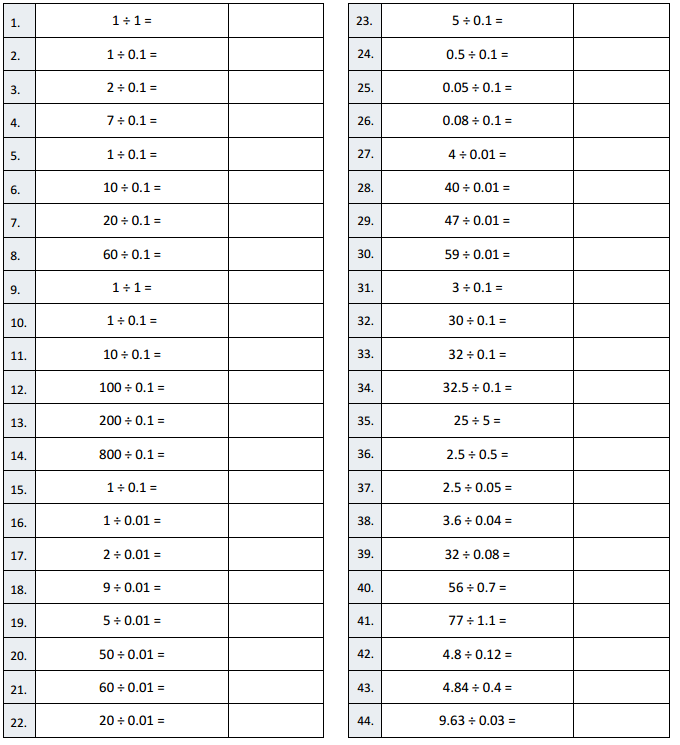
Eureka Math Grade 5 Module 6 Lesson 33 Sprint Answer Key

A
Divide Decimals
Engage NY Math 5th Grade Module 6 Lesson 33 Sprint Answer Key 1

Question 1.
1 ÷ 1 =
Answer:
1 ÷ 1 = 1

Question 2.
1 ÷ 0.1 =
Answer:
1 ÷ 0.1 = 10
Let us multiply the 0.1 by 10, which shifts the decimal point out of the way:
0.1 × 10 = 1
But we must also do it to the 1:
1× 10 = 10
So, 1 ÷ 0.1 has become 10 ÷ 1 (they are both 10 times larger):
10 ÷ 1 = 10
And So, the answer is:
1 ÷ 0.1 = 10

Question 3.
2 ÷ 0.1 =
Answer:
2 ÷ 0.1 = 20

Question 4.
7 ÷ 0.1 =
Answer:
7 ÷ 0.1 = 70

Question 5.
1 ÷ 0.1 =
Answer:
1 ÷ 0.1 = 10

Question 6.
10 ÷ 0.1 =
Answer:
10 ÷ 0.1 = 100
Explanation :
Let us multiply the 0.1 by 10, which shifts the decimal point out of the way:
0.1 × 10 = 1
But we must also do it to the 1:
10× 10 = 100
So, 10 ÷ 0.1 has become 100 ÷ 1 (they are both 10 times larger):
100 ÷ 1 = 100
And So, the answer is:
10 ÷ 0.1 = 100

Question 7.
20 ÷ 0.1 =
Answer:
20 ÷ 0.1 = 200

Question 8.
60 ÷ 0.1 =
Answer:
60 ÷ 0.1 = 600

Question 9.
1 ÷ 1 =
Answer:
1 ÷ 1 = 1

Question 10.
1 ÷ 0.1 =
Answer:
1 ÷ 0.1 = 10

Question 11.
10 ÷ 0.1 =
Answer:
10 ÷ 0.1 = 100

Question 12.
100 ÷ 0.1 =
Answer:
100 ÷ 0.1 = 1000
Explanation :
Let us multiply the 0.1 by 10, which shifts the decimal point out of the way:
0.1 × 10 = 1
But we must also do it to the 1:
100× 10 = 1000
So, 100 ÷ 0.1 has become 1000 ÷ 1 (they are both 10 times larger):
1000 ÷ 1 = 100
And So, the answer is:
100 ÷ 0.1 = 1000

Question 13.
200 ÷ 0.1 =
Answer:
200 ÷ 0.1 = 2000

Question 14.
800 ÷ 0.1 =
Answer:
800 ÷ 0.1 = 8000

Question 15.
1 ÷ 0.1 =
Answer:
1 ÷ 0.1 = 10

Question 16.
1 ÷ 0.01 =
Answer:
1 ÷ 0.01 = 100
Explanation :
Let us multiply the 0.01 by 100, which shifts the decimal point out of the way:
0.01 × 100 = 1
But we must also do it to the 1:
1× 100 = 100
So, 1 ÷ 0.01 has become 100 ÷ 1 (they are both 10 times larger):
100 ÷ 1 = 100
And So, the answer is:
1 ÷ 0.01 = 100

Question 17.
2 ÷ 0.01 =
Answer:
2 ÷ 0.01 = 200

Question 18.
9 ÷ 0.01 =
Answer:
9 ÷ 0.01 = 900

Question 19.
5 ÷ 0.01 =
Answer:
5 ÷ 0.01 = 500

Question 20.
50 ÷ 0.01 =
Answer:
50 ÷ 0.01 = 5000
Explanation :
Let us multiply the 0.01 by 100, which shifts the decimal point out of the way:
0.01 × 100 = 1
But we must also do it to the 1:
50× 100 = 5000
So, 50 ÷ 0.01 has become 5000 ÷ 1 (they are both 10 times larger):
5000 ÷ 1 = 5000
And So, the answer is:
50 ÷ 0.01 = 5000

Question 21.
60 ÷ 0.01 =
Answer:
60 ÷ 0.01 = 6000

Question 22.
20 ÷ 0.01 =
Answer:
20 ÷ 0.01 = 2000

Question 23.
5 ÷ 0.1 =
Answer:
5 ÷ 0.1 = 50

Question 24.
0.5 ÷ 0.1 =
Answer:
0.5 ÷ 0.1 = 5
Explanation :
Let us multiply the 0.1 by 10, which shifts the decimal point out of the way:
0.1 × 10 = 1
But we must also do it to the 1:
0.5 × 10 = 5
So, 0.5 ÷ 0.1has become 5 ÷ 1 (they are both 10 times larger):
5 ÷ 1= 5
And So, the answer is:
0.5 ÷ 0.1 = 5

Question 25.
0.05 ÷ 0.1 =
Answer:
0.05 ÷ 0.1 = 0.5
Explanation :
Let us multiply the 0.1 by 10, which shifts the decimal point out of the way:
0.1 × 10 = 1
But we must also do it to the 1:
0.05 × 10 = 0.5
So, 0.05 ÷ 0.1has become 0.5 ÷ 1 (they are both 10 times larger):
0.5 ÷ 1= 0.5
And So, the answer is:
0.05 ÷ 0.1 = 0.5

Question 26.
0.08 ÷ 0.1 =
Answer:
0.08 ÷ 0.1 = 0.8

Question 27.
4 ÷ 0.01 =
Answer:
4 ÷ 0.01 = 400

Question 28.
40 ÷ 0.01 =
Answer:
40 ÷ 0.01 = 4000

Question 29.
47 ÷ 0.01 =
Answer:
47 ÷ 0.01 = 4700

Question 30.
59 ÷ 0.01 =
Answer:
59 ÷ 0.01 = 5900

Question 31.
3 ÷ 0.1 =
Answer:
3 ÷ 0.1 = 30

Question 32.
30 ÷ 0.1 =
Answer:
30 ÷ 0.1 = 300

Question 33.
32 ÷ 0.1 =
Answer:
32 ÷ 0.1 = 320

Question 34.
32.5 ÷ 0.1 =
Answer:
32.5 ÷ 0.1 = 325
Explanation :
Let us multiply the 0.1 by 10, which shifts the decimal point out of the way:
0.1 × 10 = 1
But we must also do it to the 1:
32.5 × 10 = 325
So, 32.5 ÷ 0.1 has become 325 ÷ 1 (they are both 10 times larger):
325 ÷ 1 = 325
And So, the answer is:
32.5 ÷ 0.1 = 325

Question 35.
25 ÷ 5 =
Answer:
25 ÷ 5 = 5

Question 36.
2.5 ÷ 0.5 =
Answer:
2.5 ÷ 0.5 = 5

Question 37.
2.5 ÷ 0.05 =
Answer:
2.5 ÷ 0.05 = 500

Question 38.
3.6 ÷ 0.04 =
Answer:
3.6 ÷ 0.04 = 90

Question 39.
32 ÷ 0.08 =
Answer:
32 ÷ 0.08 = 400

Question 40.
56 ÷ 0.7 =
Answer:
56 ÷ 0.7 = 80

Question 41.
77 ÷ 1.1 =
Answer:
77 ÷ 1.1 = 70

Question 42.
4.8 ÷ 0.12 =
Answer:
4.8 ÷ 0.12 = 40

Question 43.
4.84 ÷ 0.4 =
Answer:
4.84 ÷ 0.4 = 12.1

Question 44.
9.63 ÷ 0.03 =
Answer:
9.63 ÷ 0.03 = 321

B
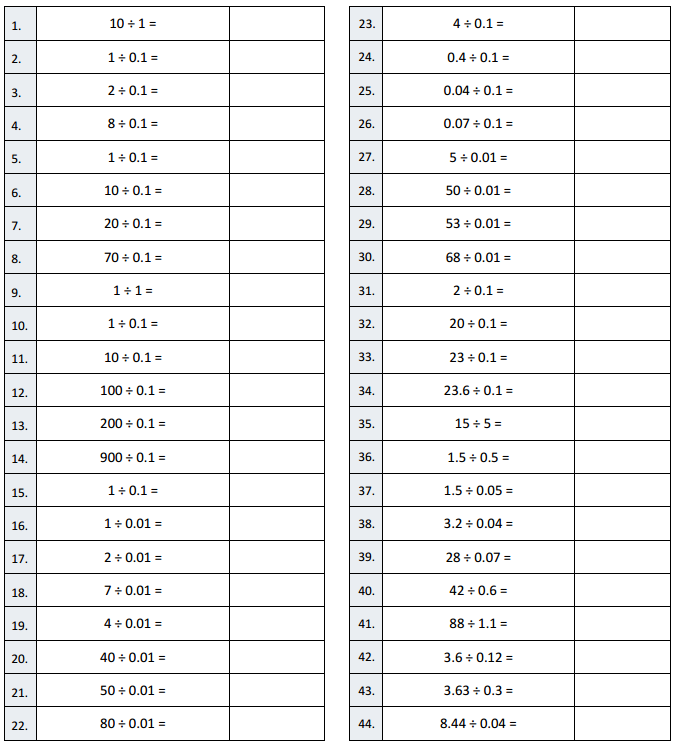
Divide Decimals
Engage NY Math 5th Grade Module 6 Lesson 33 Sprint Answer Key 2

Question 1.
10 ÷ 1 =
Answer:
10 ÷ 1 = 10

Question 2.
1 ÷ 0.1 =
Answer:
1 ÷ 0.1 = 10

Question 3.
2 ÷ 0.1 =
Answer:
2 ÷ 0.1 = 20

Question 4.
8 ÷ 0.1 =
Answer:
8 ÷ 0.1 = 80

Question 5.
1 ÷ 0.1 =
Answer:
1 ÷ 0.1 = 10

Question 6.
10 ÷ 0.1 =
Answer:
10 ÷ 0.1 = 100

Question 7.
20 ÷ 0.1 =
Answer:
20 ÷ 0.1 = 200

Question 8.
70 ÷ 0.1 =
Answer:
70 ÷ 0.1 = 700

Question 9.
1 ÷ 1 =
Answer:
1 ÷ 1 = 1

Question 10.
1 ÷ 0.1 =
Answer:
1 ÷ 0.1 = 10

Question 11.
10 ÷ 0.1 =
Answer:
10 ÷ 0.1 = 100

Question 12.
100 ÷ 0.1 =
Answer:
100 ÷ 0.1 = 1000

Question 13.
200 ÷ 0.1 =
Answer:
200 ÷ 0.1 = 2000

Question 14.
900 ÷ 0.1 =
Answer:
900 ÷ 0.1 = 9000

Question 15.
1 ÷ 0.1 =
Answer:
1 ÷ 0.1 = 10

Question 16.
2 ÷ 0.01 =
Answer:
2 ÷ 0.01 = 200

Question 17.
7 ÷ 0.01 =
Answer:
7 ÷ 0.01 = 700

Question 18.
7 ÷ 0.01 =
Answer:
7 ÷ 0.01 = 700

Question 19.
4 ÷ 0.01 =
Answer:
4 ÷ 0.01 = 400

Question 20.
40 ÷ 0.01 =
Answer:
40 ÷ 0.01 = 4000

Question 21.
50 ÷ 0.01 =
Answer:
50 ÷ 0.01 = 5000

Question 22.
80 ÷ 0.01 =
Answer:
80 ÷ 0.01 = 8000

Question 23.
4 ÷ 0.1 =
Answer:
4 ÷ 0.1 = 40

Question 24.
0.4 ÷ 0.1 =
Answer:
0.4 ÷ 0.1 = 4

Question 25.
0.04 ÷ 0.1 =
Answer:
0.04 ÷ 0.1 = 0.4

Question 26.
0.07 ÷ 0.1 =
Answer:
0.07 ÷ 0.1 = 0.7

Question 27.
5 ÷ 0.01 =
Answer:
5 ÷ 0.01 = 0.5

Question 28.
50 ÷ 0.01 =
Answer:
50 ÷ 0.01 =5000

Question 29.
53 ÷ 0.01 =
Answer:
53 ÷ 0.01 = 5300

Question 30.
68 ÷ 0.01 =
Answer:
68 ÷ 0.01 = 6800

Question 31.
2 ÷ 0.1 =
Answer:
2 ÷ 0.1 = 20

Question 32.
20 ÷ 0.1 =
Answer:
20 ÷ 0.1 = 200

Question 33.
23 ÷ 0.1 =
Answer:
23 ÷ 0.1 = 230

Question 34.
23.6 ÷ 0.1 =
Answer:
23.6 ÷ 0.1 = 236

Question 35.
15 ÷ 5 =
Answer:
15 ÷ 5 = 3

Question 36.
1.5 ÷ 0.5 =
Answer:
1.5 ÷ 0.5 = 3

Question 37.
1.5 ÷ 0.05 =
Answer:
1.5 ÷ 0.05 = 30

Question 38.
3.2 ÷ 0.04 =
Answer:
3.2 ÷ 0.04 = 80

Question 39.
28 ÷ 0.07 =
Answer:
28 ÷ 0.07 = 400

Question 40.
42 ÷ 0.6 =
Answer:
42 ÷ 0.6 = 80

Question 41.
88 ÷ 1.1 =
Answer:
88 ÷ 1.1 = 80

Question 42.
3.6 ÷ 0.12 =
Answer:
3.6 ÷ 0.12 = 30

Question 43.
3.63 ÷ 0.3 =
Answer:
3.63 ÷ 0.3 = 12.1

Question 44.
8.44 ÷ 0.04 =
Answer:
8.44 ÷ 0.04 = 2.11

Eureka Math Grade 5 Module 6 Lesson 33 Problem Set Answer Key

Record the dimensions of your boxes and lid below. Explain your reasoning for the dimensions you chose for Box 2 and the lid.
BOX 1 (Can hold Box 2 inside.)
The dimensions of Box 1 are __________ × __________ × __________ .
Its volume is __________ .

BOX 2 (Fits inside of Box 1.)
The dimensions of Box 2 are __________ × __________ × __________ .
Reasoning:

LID (Fits snugly over Box 1 to protect the contents.)
The dimensions of the lid are __________ × __________ × __________ .
Reasoning:
Answer:
BOX 1 (Can hold Box 2 inside.)
The dimensions of Box 1 are 19cms × 13cms  × 4cms .
Its volume is Length × Breadth ×  Height .
v= l × b ×  h
v = 19 ×  13 ×  4 = 19 ×  52 = 988 cubic cms .

BOX 2 (Fits inside of Box 1.)
The dimensions of Box 2 are 9.5cms × 12.5cms × 3.5cms .
Reasoning:
I need a box that is smaller box to be just with the same width and height but its length up to half of the length .

LID (Fits snugly over Box 1 to protect the contents.)
The dimensions of the lid are 19.5 cms × 12.5 cms × 2 cms .
Reasoning:
The length and width need only to be little bit longer than the box of 0.25 cms on each side . The height of the lid needs to be probably needs to be 2cms .

Question 1.
What steps did you take to determine the dimensions of the lid?
Answer:
The dimensions of Box 1 are 19cms × 13cms  × 4cms .
First I, decided to add 0.25 cms to the length and the width so, that it is  slightly bigger than the box .
Then later, I figured the edges of the lid should cover half of the height of the box.
later checked the materials to make sure 21cms ×27cms had enough material …. if done .

Question 2.
Find the volume of Box 2. Then, find the difference in the volumes of Boxes 1 and 2.
Answer:
BOX 1
The dimensions of Box 1 are 19cms × 13cms  × 4cms .
Its volume is Length × Breadth ×  Height .
v= l × b ×  h
v = 19 ×  13 ×  4 = 19 ×  52 = 988 cubic cms .
BOX 2
The dimensions of Box 1 are 9.5cms × 12.5cms  × 3.5cms .
Its volume is Length × Breadth ×  Height .
v= l × b ×  h
V = 9.5cms × 12.5cms  × 3.5cms = 9.5  × 43.75 = 415.625 cubic cms.
The Differences between Box 1 and Box 2 = 988 – 415.625 =572.375 cubic cms.

Question 3.
Imagine Box 3 is created such that each dimension is 1 cm less than that of Box 2. What would the volume of Box 3 be?
Answer:
BOX 2
The dimensions of Box 1 are 9.5cms × 12.5cms  × 3.5cms .
Box 3 : 1 cms less in each dimension
The dimensions of Box 1 are 8.5cms × 11.5cms  × 2.5cms .
Its volume is Length × Breadth ×  Height .
v= l × b ×  h
V = 8.5cms × 11.5cms  × 2.5cms = 8.5  × 28.75 = 244.375 cubic cms.

Eureka Math Grade 5 Module 6 Lesson 33 Reflection Answer Key

Today, you made a box for a special purpose. It shows one way that math is used all the time to create containers. When might there be other opportunities for you to use the math you have learned in elementary school?
Answer:
Math is an important part of learning for children in the early years because it provides vital life skills. They will help children problem solve, measure and develop their own spatial awareness, and teach them how to use and understand shapes.

Eureka Math Grade 5 Module 6 Lesson 33 Homework Answer Key

Question 1.
Find various rectangular boxes at your home. Use a ruler to measure the dimensions of each box to the nearest centimeter. Then, calculate the volume of each box. The first one is partially done for you.

ItemLengthWidthHeight

Volume

Juice Box11 cm2 cm5 cm


Answer:
Its volume is Length × Breadth ×  Height .
v= l × b ×  h

ItemLengthWidthHeight

Volume

Juice Box11 cm2 cm5 cmv = 11×2×5 v = 11 × 10 =110 cubic cms
 Book10 cm6 cm3 cmv=10 × 6 ×3
v = 180 cubic cms
 Wooden     shelf25 cm10 cm5 cmv = 25 × 10 × 5 = 1250 cubic cms
 C. p . u 12 cm5 cm15 cmv= 12×5×15
v = 900 cubic cms
 Chocolate
Box 
8 cm2 cm5 cmv= 8×2×5
v = 80 cubic cms
Bangles Box  20 cm8 cm10 cmv= 20×8×10
v=1600 cubic cms
 Pencil box 6 cm3 cm5 cmv=6×3×5
v=90 cubic cms .


Question 2.
The dimensions of a small juice box are 11 cm by 4 cm by 7 cm. The super-size juice box has the same height of 11 cm but double the volume. Give two sets of the possible dimensions of the super-size juice box and the volume.
Answer:
The Small Juice box =11 cm by 4 cm by 7 cm.
The Volume of the small juice box = Length × Breadth ×  Height .
v = 11 × 4 × 7 = 11 × 28 = 308 cubic cms.
Height = 11 cm
If height is same volume is double means
volume = 2 × 308 = 616 cubic cms .
The super juice box will have change in length or breadth
As volume is double it is multiplied by 2
616 = 11 × length × width
56 = length × width
56 = 14 × 4 or 8 × 7
Length can be 14 cm then width will be 4 cm
length can be 8 cm then width will be 7 cm .

Eureka Math Grade 5 Module 6 Lesson 32 Answer Key

Engage NY Eureka Math 5th Grade Module 6 Lesson 32 Answer Key

Eureka Math Grade 5 Module 6 Lesson 32 Problem Set Answer Key

Question 1.
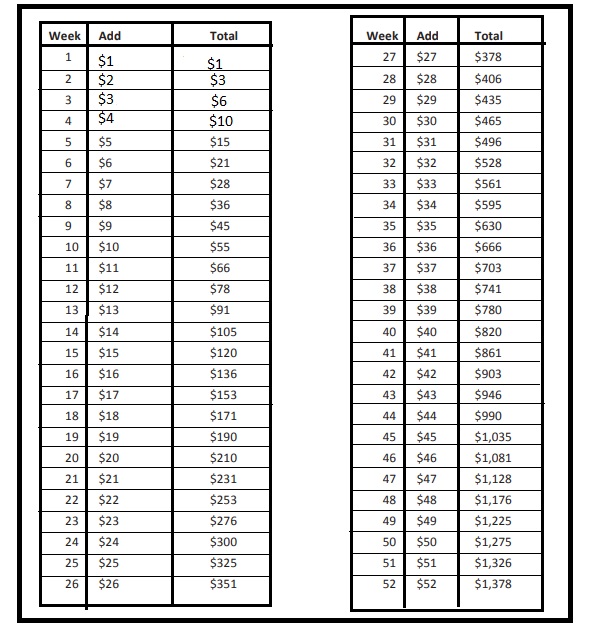
Ashley decides to save money, but she wants to build it up over a year. She starts with $1.00 and adds 1 more dollar each week. Complete the table to show how much she will have saved after a year.
Engage NY Math Grade 5 Module 6 Lesson 32 Problem Set Answer Key 1
Answer:
Engage-NY-Eureka-Math-5th-Grade-Module-6-Lesson-32-Answer-Key-Eureka-Math-Grade-5-Module-6-Lesson-32-Problem-Set-Answer-Key-Question-1
Explanation :
Amount with which ashley started = $1
Each week she adds $1 more that the previous week
So, Week she has $1 in her account
Week 2 she adds one more dollar than previous week so, that is $2 after adding her account balance is $2 +$1 = $3
Week 3 she adds one more than than previous week so, that is $3 after adding her account balance is $3 + $3 = $ 6  and so on …. till Week 52 the balance amount is calculated .

Question 2.
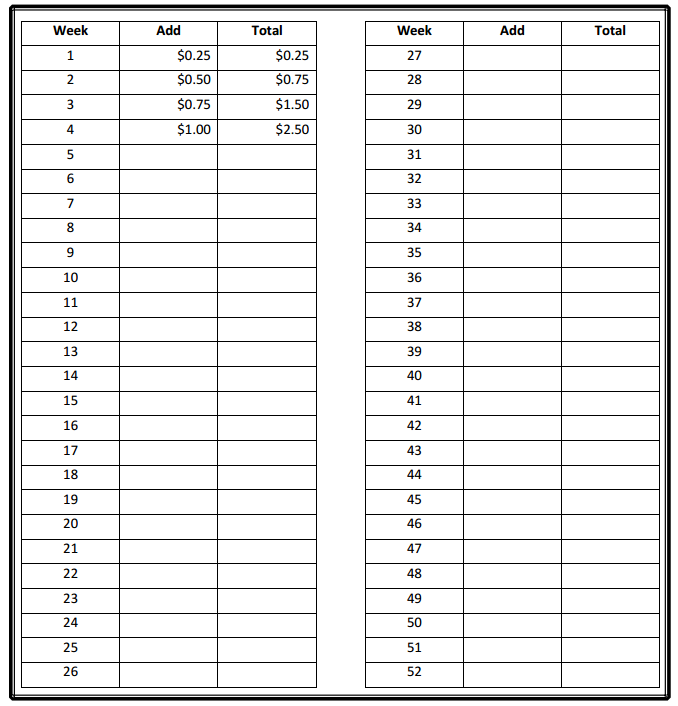
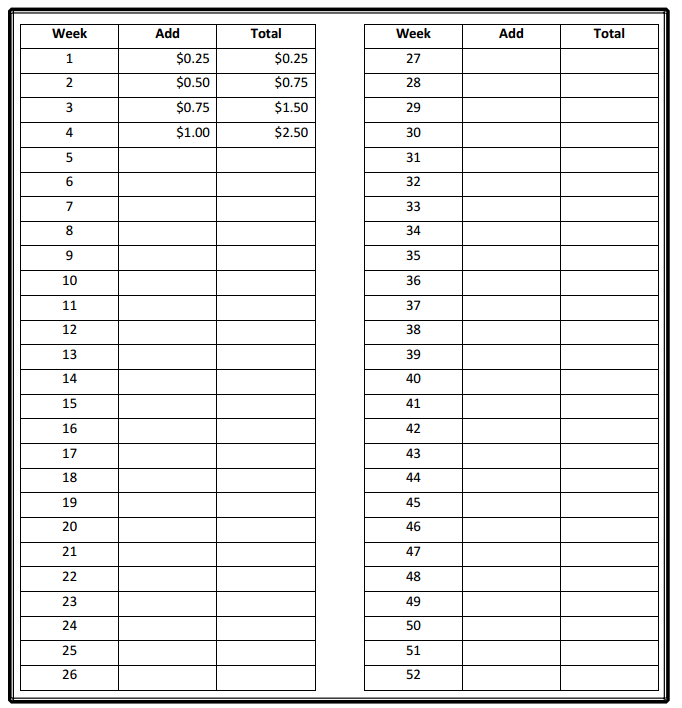
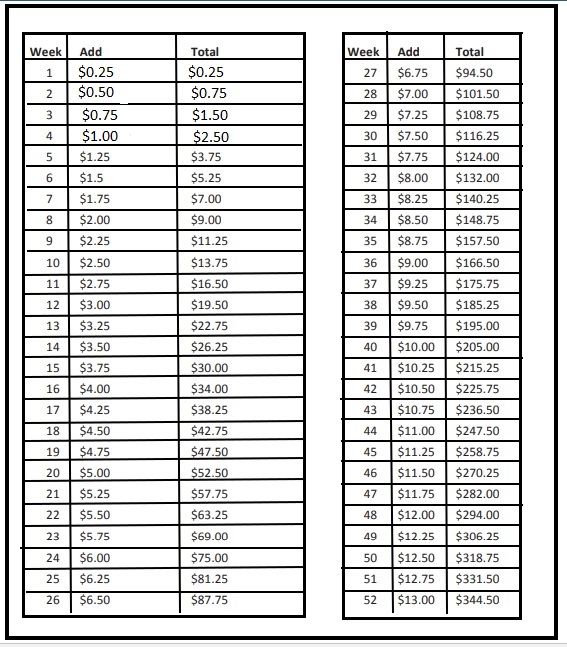
Carly wants to save money, too, but she has to start with the smaller denomination of quarters. Complete the second chart to show how much she will have saved by the end of the year if she adds a quarter more each week. Try it yourself, if you can and want to!
Engage NY Math Grade 5 Module 6 Lesson 32 Problem Set Answer Key 2
Answer:
Engage-NY-Eureka-Math-5th-Grade-Module-6-Lesson-32-Answer-Key-Eureka-Math-Grade-5-Module-6-Lesson-32-Problem-Set-Answer-Key-Question-2
Explanation :
Amount with which Carlie started = $0.25 (Quarters)
Each week she adds $0.25 more that the previous week
So, Week 1 she starts with  $0.25 in her account
Week 2 she adds one more Quarter dollar than previous week so, that is $0.50 after adding her account balance is $0.25 +$0.50 = $0.75
Week 3 she adds one more Quarter dollar than previous week so, that is $0.75 after adding her account balance is $0.75 + $0.75 = $ 1.50  and so on ….  till week 52 amount is calculated .

Question 3.
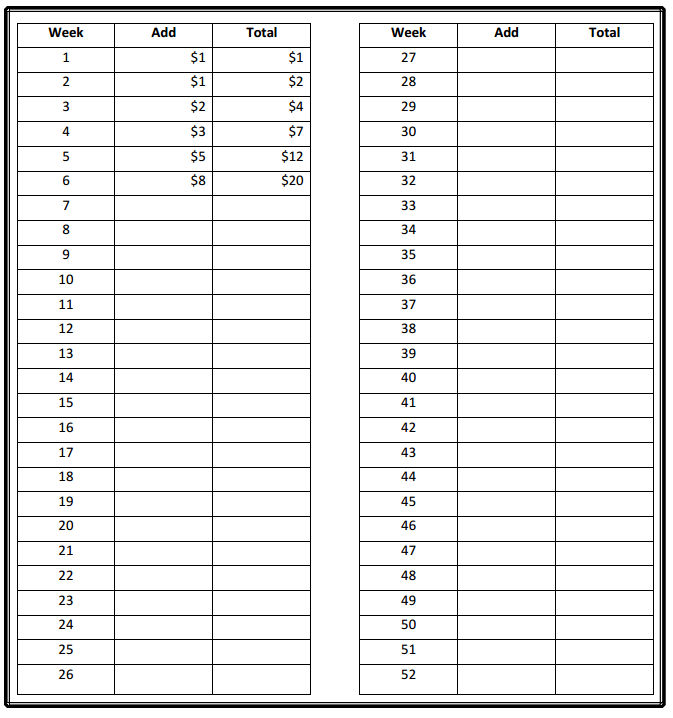
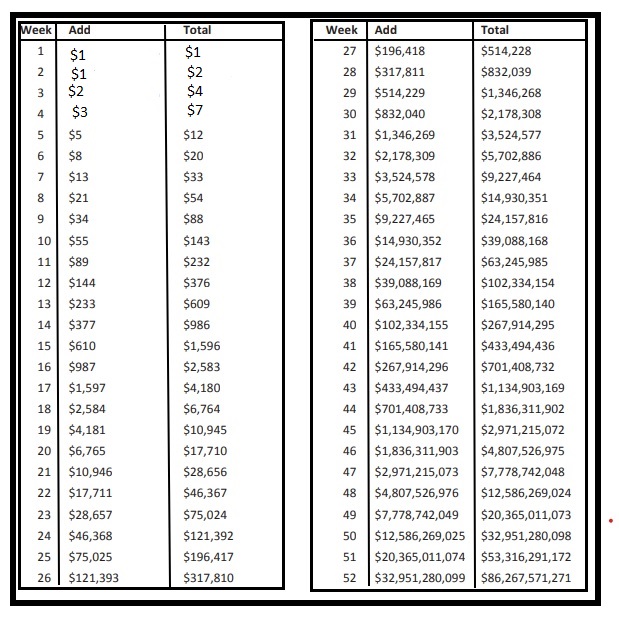
David decides he wants to save even more money than Ashley did. He does so by adding the next Fibonacci number instead of adding $1.00 each week. Use your calculator to fill in the chart and find out how much money he will have saved by the end of the year. Is this realistic for most people? Explain your answer.
Engage NY Math Grade 5 Module 6 Lesson 32 Problem Set Answer Key 3
Answer:
Engage-NY-Eureka-Math-5th-Grade-Module-6-Lesson-32-Answer-Key-Eureka-Math-Grade-5-Module-6-Lesson-32-Problem-Set-Answer-Key-Question-3
Explanation :
By end of the year he will save $86,267,571,271 .
It is not realistic because In Fibonacci number the rule is followed
So we can write the rule:
The Rule is xn = xn−1 + xn−2
where:
xn is term number “n”
xn−1 is the previous term (n−1)
xn−2 is the term before that (n−2)
In Fibonacci rule the previous term and the term before that is added to get next fibonacci number , That means the David should starts with $1 . for week he should add $1 for week1 later, he should add $1 the previous money and before that week in week 2 total is $2,
In week 3 he should add $2 that double of previous then amount becomes $4. and so on till week 52 for every week he should add nearly 2 weeks amount which will be difficulty to add. so this not realistic to follow this rule as Savings are done with smaller amounts not with huge amounts .

Eureka Math Grade 5 Module 6 Lesson 32 Reflection Answer Key

Today, we watched how savings can grow over time, but we did not discuss how the money saved was earned. Have you ever thought about how math skills might help you to earn money? If so, what are some jobs that might require strong math skills? If not, think about it now. How might you make a living using math skills?
Answer:
Money math involves many of the math skills you learn in school, such as addition, subtraction, multiplication, division, fractions, decimals, and percentages. … Handling money can help you learn how to count it. Making purchases in a store can help you become comfortable counting money.
Some jobs that might require strong math skills are in Auditor, Statistician, Actuary, Mathematician, Operations Research Analyst, Math Professor, Banking , Cashier ,

Math Matters in Everyday Life

Managing money $$$
Balancing the checkbook.
Shopping for the best price.
Preparing food.
Figuring out distance, time and cost for travel.
Understanding loans for cars, trucks, homes, schooling or other purposes.

Eureka Math Grade 5 Module 6 Lesson 32 Homework Answer Key

Question 1.
Jonas played with the Fibonacci sequence he learned in class. Complete the table he started.

12345678910
112358
11121314151617181920

Answer:

12345678910
11235813213455
11121314151617181920
891442333776109871597258441816765

Explanation :
The Fibonacci Sequence can be written as a “Rule”
First, the terms are numbered from 0 onwards like this:
So we can write the rule:
The Rule is xn = xn−1 + xn−2
where:
xn is term number “n”
xn−1 is the previous term (n−1)
xn−2 is the term before that (n−2)

x2= x2−1 + x2−2
 = x1 + x0
 = 1 + 0
 = 1

x3= x3−1 + x3−2
 = x2 + x1
 = 1 + 1
 = 2

With this rule all the terms are calculated .

Question 2.
As he looked at the numbers, Jonas realized he could play with them. He took two consecutive numbers in the pattern and multiplied them by themselves and then added them together. He found they made another number in the pattern. For example, (3 × 3) + (2 × 2) = 13, another number in the pattern. Jonas said this was true for any two consecutive Fibonacci numbers. Was Jonas correct? Show your reasoning by giving at least two examples of why he was or was not correct.
Answer:
Yes he is write .

12345678910
11235813213455
11121314151617181920
891442333776109871597258441816765

Explanation :
The Fibonacci number of 6 is 8
The Fibonacci number of 7 is  5
Taking two consecutive numbers and squaring and adding them we get,
( 3 × 3)+(5 × 5 ) = 9 + 25 = 34
34 is the Fibonacci number of 9 (4 + 5 = 9) It is true
The Fibonacci number of 6 is 8
The Fibonacci number of 7 is 13
Taking two consecutive numbers and squaring and adding them we get,
( 8 × 8 )+(13 × 13 ) = 64 + 169 =  233
233 is the Fibonacci number of 13 (6 + 7 = 13) It is true

Question 3.
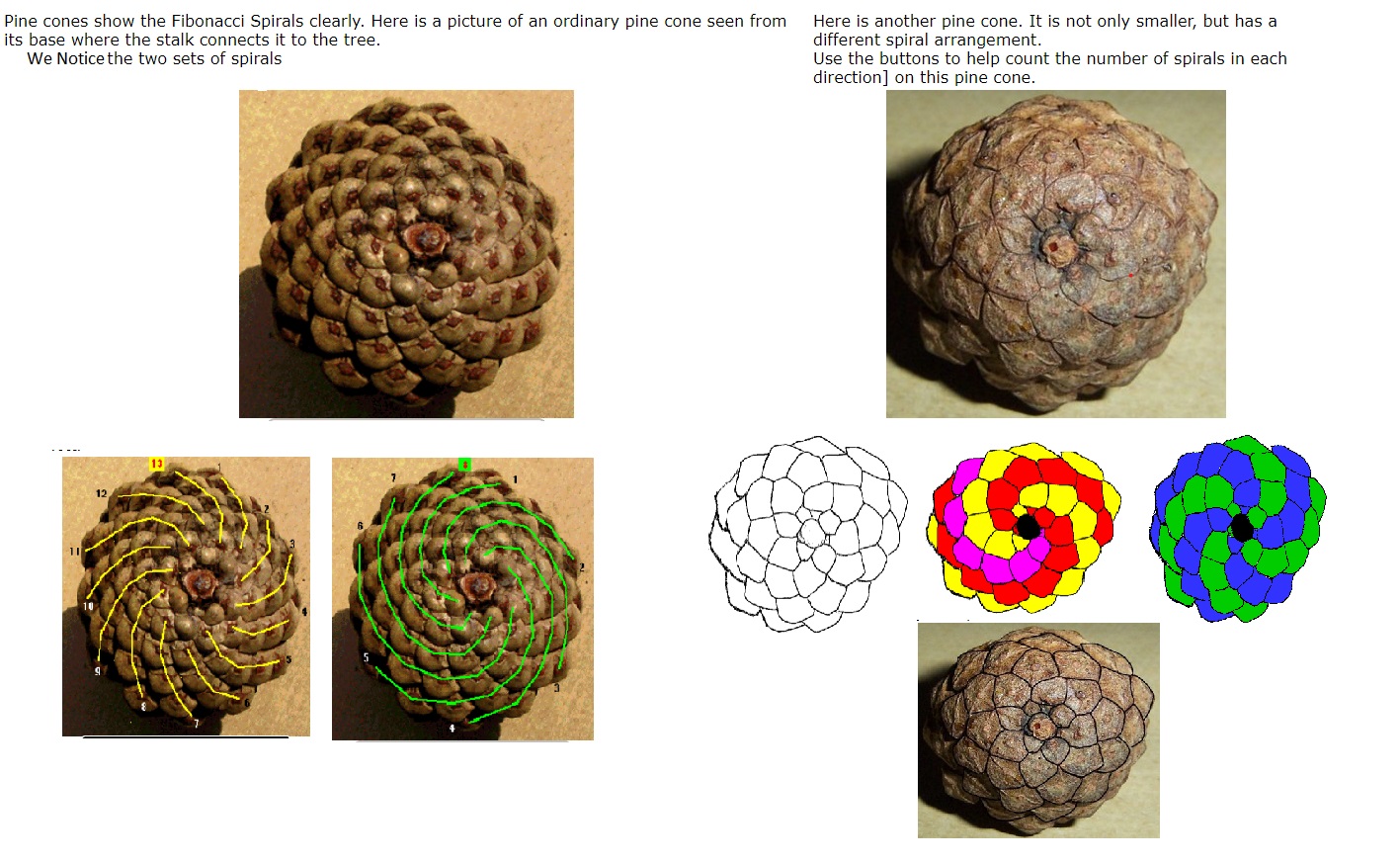
Fibonacci numbers can be found in many places in nature, for example, the number of petals in a daisy, the number of spirals in a pine cone or a pineapple, and even the way branches grow on a tree. Find an example of something natural where you can see a Fibonacci number in action, and sketch it here.
Answer:
In the below figure we see two different pine cone patterns.
In figure 1 The Fibonacci spirals are shown clearly
In Figure 2 The Fibonacci spirals of another pine cone is shown
Engage-NY-Eureka-Math-5th-Grade-Module-6-Lesson-32-Answer-Key-Eureka-Math-Grade-5-Module-6-Lesson-32-Homework-Answer-Key-Question-3

Eureka Math Grade 5 Module 6 Lesson 29 Answer Key

Engage NY Eureka Math 5th Grade Module 6 Lesson 29 Answer Key

Eureka Math Grade 5 Module 6 Lesson 29 Sprint Answer Key

A
Multiply Decimals
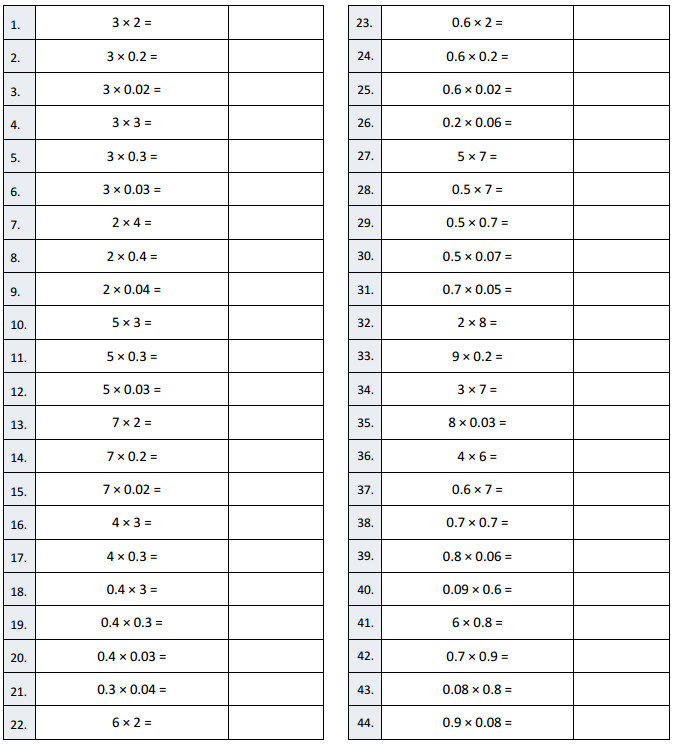
Engage NY Math 5th Grade Module 6 Lesson 29 Sprint Answer Key 1

Question 1.
3 × 2 =
Answer:
3 × 2 = 6

Question 2.
3 × 0.2 =
Answer:
3 × 0.2 = 0.6
Explanation :
Equation : 3 × 0.2
Multiply without decimals = 3 × 2 = 6
0.2 have 1 decimal places, So, the answer = 0.6

Question 3.
3 × 0.02 =
Answer:
3 × 0.02 = 0.06
Explanation :
Equation : 3 × 0.02
Multiply without decimals = 3 × 2 = 6
0.02 have 2 decimal places, So, the answer = 0.06

Question 4.
3 × 3 =
Answer:
3 × 3 = 9

Question 5.
3 × 0.3 =
Answer:
3 × 0.3 = 0.9
Explanation :
Equation : 3 × 0.3
Multiply without decimals = 3 × 3 = 9
0.3 have 1 decimal places, So, the answer = 0.9

Question 6.
3 × 0.03 =
Answer:
3 × 0.03 = 0.09
Explanation :
Equation : 3 × 0.03
Multiply without decimals = 3 × 3 = 9
0.03 have 2 decimal places, So, the answer = 0.09

Question 7.
2 × 4 =
Answer:
2 × 4 = 8

Question 8.
2 × 0.4 =
Answer:
2 × 0.4 = 0.8
Explanation :
Equation : 2 × 0.4
Multiply without decimals = 2 × 4 = 8
0.4 have 1 decimal places, So, the answer = 0.8

Question 9.
2 × 0.04 =
Answer:
2 × 0.04 = 0.08
Explanation :
Equation : 2 × 0.04
Multiply without decimals = 2 × 4 = 8
0.04 have 2 decimal places, So, the answer = 0.08

Question 10.
5 × 3 =
Answer:
5 × 3 = 15

Question 11.
5 × 0.3 =
Answer:
5 × 0.3 = 1.5
Explanation :
Equation : 5 × 0.3
Multiply without decimals = 5 × 3 = 15
15 have 1 decimal places, So, the answer = 1.5

Question 12.
5 × 0.03 =
Answer:
5 × 0.03 =0.15
Explanation :
Equation :  5 × 0.03
Multiply without decimals = 5 × 3 = 15
15have 2 decimal places, So, the answer = 0.15

Question 13.
7 × 2 =
Answer:
7 × 2 = 14

Question 14.
7 × 0.2 =
Answer:
7 × 0.2 = 1.4
Explanation :
Equation : 7 × 0.2
Multiply without decimals = 7 × 2 = 14
0.2 have 1 decimal places, So, the answer = 1.4

Question 15.
7 × 0.02 =
Answer:
7 × 0.02 = 0.14
Explanation :
Equation : 7 × 0.02
Multiply without decimals = 7 × 2 = 14
0.02 have 2 decimal places, So, the answer = 0.14

Question 16.
4 × 3 =
Answer:
4 × 3 = 12

Question 17.
4 × 0.3 =
Answer:
4 × 0.3 = 1.2
Explanation :
Equation : 4 × 0.3
Multiply without decimals = 4 × 3 = 12
0.3 have 1 decimal places, So, the answer = 1.2

Question 18.
0.4 × 3 =
Answer:
0.4 × 3 = 1.2

Question 19.
0.4 × 0.3 =
Answer:
0.4 × 0.3 = 0.12
Explanation :
Equation : 0.4 × 0.3 =
Multiply without decimals = 4 × 3 = 12
0.4 have 1 decimal places and 0.3 have 1 decimal places So, the answer have 2 decimal place= 0.12

Question 20.
0.4 × 0.03 =
Answer:
0.4 × 0.03 = 0.012
Explanation :
Equation : 0.4 × 0.03
Multiply without decimals = 4 × 3 = 12
0.4 have 1 decimal places and 0.03 have 2 decimal places So, the answer have 3 decimal place= 0.012

Question 21.
0.3 × 0.04 =
Answer:
0.3 × 0.04 =0.012
Explanation :
Equation : 0.3 × 0.04
Multiply without decimals = 3 × 4 = 12
0.3 have 1 decimal places and 0.04 have 2 decimal places, So, the answer will have 3 decimal places = 0.012

Question 22.
6 × 2 =
Answer:
6 × 2 = 12

Question 23.
0.6 × 2 =
Answer:
0.6 × 2 = 1.2
Explanation :
Equation : 0.6 × 2
Multiply without decimals = 6 × 2 = 12
0.6 have 1 decimal places, So, the answer will have 1 decimal point = 1.2

Question 24.
0.6 × 0.2 =
Answer:
0.6 × 0.2 = 0.12
Explanation :
Equation : 0.6 × 0.2
Multiply without decimals = 6 × 2 = 12
0.6 have 1 decimal places and 0.2 have 1 decimal places, So, the answer will have 2 decimal points = 0.12

Question 25.
0.6 × 0.02 =
Answer:
0.6 × 0.02 = 0.012
Explanation :
Equation : 0.6 × 0.02
Multiply without decimals = 6 × 2 = 12
0.6 have 1 decimal places and 0.02 have 2 decimal places, So, the answer will have 3 decimal points = 0.012

Question 26.
0.2 × 0.06 =
Answer:
0.2 × 0.06 = 0.012
Explanation :
Equation : 0.2 × 0.06
Multiply without decimals = 2 × 6 = 12
0.2 have 1 decimal places and 0.06 have 2 decimal places, So, the answer will have 3 decimal points = 0.012

Question 27.
5 × 7 =
Answer:
5 × 7 = 35

Question 28.
0.5 × 7 =
Answer:
0.5 × 7 = 3.5
Explanation :
Equation : 0.5 × 7
Multiply without decimals = 5 × 7 = 35
0.5 have 1 decimal place , So, the answer will have 1 decimal place = 3.5

Question 29.
0.5 × 0.7 =
Answer:
0.5 × 0.7 = 0.35
Explanation :
Equation : 0.5 × 0.7
Multiply without decimals = 5 × 7 = 35
0.5 have 1 decimal place and 0.7 have 1 decimal place , So, the answer will have 2 decimal places = 0.35

Question 30.
0.5 × 0.07 =
Answer:
0.5 × 0.07 = 0.035
Explanation :
Equation : 0.5 × 0.07
Multiply without decimals = 5 × 7 = 35
0.5 have 1 decimal place and 0.07 have 2 decimal place , So, the answer will have 3 decimal places = 0.035

Question 31.
0.7 × 0.05 =
Answer:
0.7 × 0.05 = 0.035
Explanation :
Equation : 0.7 × 0.05
Multiply without decimals = 7 × 5 = 35
0.7 have 1 decimal place and 0.05 have 2 decimal place , So, the answer will have 3 decimal places = 0.035

Question 32.
2 × 8 =
Answer:
2 × 8 = 16

Question 33.
9 × 0.2 =
Answer:
9 × 0.2 = 1.8
Explanation :
Equation : 9 × 0.2
Multiply without decimals = 9 × 2 = 18
0.2 have 1 decimal places, So, the answer will have 1 decimal place =1.8

Question 34.
3 × 7 =
Answer:
3 × 7 = 21

Question 35.
8 × 0.03 =
Answer:
8 × 0.03 = 0.24
Explanation :
Equation : 8 × 0.03
Multiply without decimals = 8 × 3 = 24
0.03 have 2 decimal places, So, the answer will have 2 decimal places = 0.24

Question 36.
4 × 6 =
Answer:
4 × 6 = 24

Question 37.
0.6 × 7 =
Answer:
0.6 × 7 = 4.2
Explanation :
Equation : 0.6 × 7
Multiply without decimals = 6 × 7 = 42
0.6 have 1 decimal place, So, the answer will have 1 decimal place= 4.2

Question 38.
0.7 × 0.7 =
Answer:
0.7 × 0.7 = 0.49
Explanation :
Equation : 0.7 × 0.7
Multiply without decimals = 7 × 7 = 49
0.7 have 1 decimal place and another 0.7 have 1 decimal place So, the answer will have 2 decimal place = 0.49

Question 39.
0.8 × 0.06 =
Answer:
0.8 × 0.06 = 0.048
Explanation :
Equation : 0.8 × 0.06
Multiply without decimals = 8 × 6 = 48
0.8 will have 1 decimal place and 0.06 have 2 decimal places, So, the answer will have 3 decimal places = 0.048

Question 40.
0.09 × 0.6 =
Answer:
0.09 × 0.6 = 0.054
Explanation :
Equation : 0.09 × 0.6
Multiply without decimals = 9 × 6 = 54
0.09 have 2 decimal places and 0.6 will have 1 decimal place So, the answer will have 3 decimal places = 0.054

Question 41.
6 × 0.8 =
Answer:
6 × 0.8 = 4.8
Explanation :
Equation : 6 × 0.8
Multiply without decimals = 6 × 8 = 48
0.8 have 1 decimal place, So, the answer will have 1 decimal place = 4.8

Question 42.
0.7 × 0.9 =
Answer:
0.7 × 0.9 = 0.63
Explanation :
Equation : 0.7 × 0.9
Multiply without decimals = 7 × 9 = 63
0.7 have 1 decimal place and 0.9 have 1 decimal place, So, the answer will have 2 decimal places = 0.63

Question 43.
0.08 × 0.8 =
Answer:
0.08 × 0.8 = 0.064
Explanation :
Equation : 0.08 × 0.8
Multiply without decimals = 8 × 8 = 64
0.08 have 2 decimal place and 0.8 have 1 decimal place , So, the answer will have 3 decimal places = 0.064

Question 44.
0.9 × 0.08 =
Answer:
0.9 × 0.08 = 0.072
Explanation :
Equation : 0.9 × 0.08
Multiply without decimals = 9 × 8 = 72
0.9 have 1 decimal place and 0.08 have 2 decimal places, So, the answer will have 3 decimal places = 0.072

B
Multiply Decimals
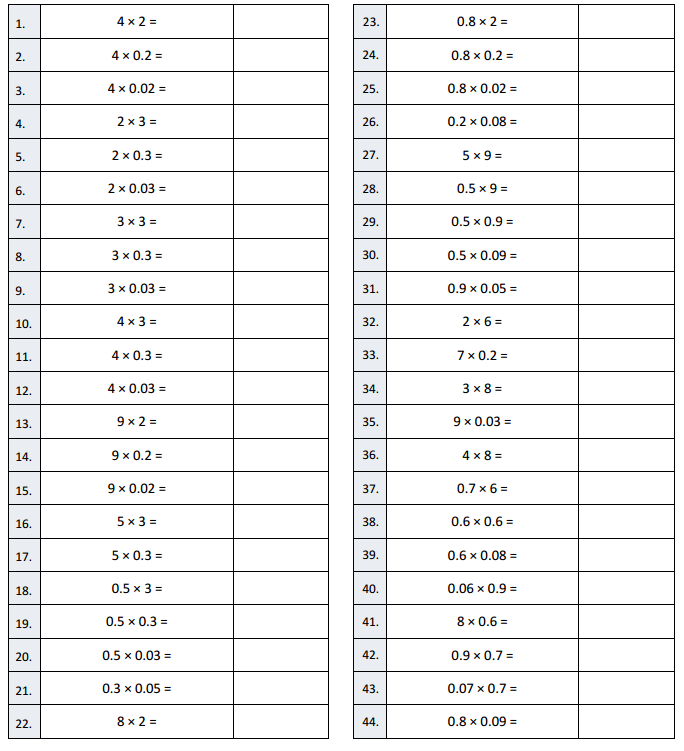
Engage NY Math 5th Grade Module 6 Lesson 29 Sprint Answer Key 2

Question 1.
4 × 2 =
Answer:
4 × 2 = 8

Question 2.
4 × 0.2 =
Answer:
4 × 0.2 = 0.8
Explanation :
Equation : 4 × 0.2
Multiply without decimals = 4× 2 = 8
0.2 have 1 decimal places, So, the answer will have 1 decimal place =0.8

Question 3.
4 × 0.02 =
Answer:
4 × 0.02 = 0.08
Explanation :
Equation : 4 × 0.02
Multiply without decimals = 4 × 2 = 8
0.02 have 2 decimal places, So, the answer will have 2 decimal places = 0.08

Question 4.
2 × 3 =
Answer:
2 × 3 = 6

Question 5.
2 × 0.3 =
Answer:
2 × 0.3 = 0.6
Explanation :
Equation : 2 × 0.3
Multiply without decimals = 2 × 3 = 6
0.3 have 1 decimal places, So, the answer will have 1 decimal place =0.6

Question 6.
2 × 0.03 =
Answer:
2 × 0.03 = 0.06
Explanation :
Equation : 2 × 0.03
Multiply without decimals = 2 × 3 = 6
0.03 have 2 decimal places, So, the answer will have 2 decimal places = 0.06

Question 7.
3 × 3 =
Answer:
3 × 3 = 9

Question 8.
3 × 0.3 =
Answer:
3 × 0.3 = 0.9
Explanation :
Equation : 3 × 0.3
Multiply without decimals = 3 × 3 = 9
0.3 have 1 decimal places, So, the answer will have 1 decimal place =0.9

Question 9.
3 × 0.03 =
Answer:
3 × 0.03 = 0.09
Explanation :
Equation : 3 × 0.03
Multiply without decimals = 3 × 3 = 9
0.03 have 2 decimal places, So, the answer will have 2 decimal places = 0.09

Question 10.
4 × 3 =
Answer:
4 × 3 = 12

Question 11.
4 × 0.3 =
Answer:
4 × 0.3 = 1.2
Explanation :
Equation : 4 × 0.3
Multiply without decimals = 4 × 3 = 12
0.3 have 1 decimal places, So, the answer will have 1 decimal place =1.2

Question 12.
4 × 0.03 =
Answer:
4 × 0.03 = 0.012
Explanation :
Equation : 4 × 0.03
Multiply without decimals = 4 × 3 = 12
0.03 have 2 decimal places, So, the answer will have 2 decimal places = 0.12

Question 13.
9 × 2 =
Answer:
9 × 2 = 18

Question 14.
9 × 0.2 =
Answer:
9 × 0.2 = 1.8
Explanation :
Equation : 9 × 0.2
Multiply without decimals = 9 × 2 = 18
0.2 have 1 decimal places, So, the answer will have 1 decimal place =1.8

Question 15.
9 × 0.02 =
Answer:
9 × 0.02 = 0.18
Explanation :
Equation : 9 × 0.02
Multiply without decimals = 9 × 2 = 18
0.02 have 2 decimal places, So, the answer will have 2 decimal places = 0.18

Question 16.
5 × 3 =
Answer:
5 × 3 = 15

Question 17.
5 × 0.3 =
Answer:
5 × 0.3 = 1.5
Explanation :
Equation : 5 × 0.3
Multiply without decimals = 5 × 3 = 15
0.3 have 1 decimal places, So, the answer will have 1 decimal place =1.5

Question 18.
0.5 × 3 =
Answer:
0.5 × 3 = 0.15
Explanation :
Equation : 0.5 × 3
Multiply without decimals = 5 × 3 = 15
0.5 have 1 decimal places, So, the answer will have 1 decimal place =0.15

Question 19.
0.5 × 0.3 =
Answer:
0.5 × 0.3 = 0.15
Explanation :
Equation : 0.5 × 0.3
Multiply without decimals = 5 × 3 = 15
0.5 have 1 decimal place and 0.3 have 1 decimal place, So, the answer will have 2 decimal places = 0.15

Question 20.
0.5 × 0.03 =
Answer:
0.5 × 0.03 = 0.015
Explanation :
Equation : 0.5 × 0.03
Multiply without decimals = 5 × 3 = 15
0.03 have 2 decimal place and 0.5 have 1 decimal place , So, the answer will have 3 decimal places = 0.015

Question 21.
0.3 × 0.05 =
Answer:
0.3 × 0.05 = 0.015
Explanation :
Equation : 0.3 × 0.05
Multiply without decimals = 5 × 3 = 15
0.05 have 2 decimal place and 0.3 have 1 decimal place , So, the answer will have 3 decimal places = 0.015

Question 22.
8 × 2 =
Answer:
8 × 2 = 16

Question 23.
0.8 × 2 =
Answer:
0.8 × 2 = 1.6
Explanation :
Equation : 0.8 × 2
Multiply without decimals = 8 × 2 = 16
0.8 have 1 decimal places, So, the answer will have 1 decimal place =1.6

Question 24.
0.8 × 0.2 =
Answer:
0.8 × 0.2 = 0.16
Explanation :
Equation : 0.8 × 0.2
Multiply without decimals = 8 × 2 = 16
0.8 have 1 decimal place and 0.2 have 1 decimal place, So, the answer will have 2 decimal places = 0.16

Question 25.
0.8 × 0.02 =
Answer:
0.8 × 0.02 = 0.016
Explanation :
Equation : 0.8 × 0.02
Multiply without decimals = 8 × 2 = 16
0.02 have 2 decimal place and 0.8 have 1 decimal place , So, the answer will have 3 decimal places = 0.016

Question 26.
0.2 × 0.08 =
Answer:
0.2 × 0.08 = 0.016
Explanation :
Equation : 0.2 × 0.08
Multiply without decimals = 2 × 8 = 16
0.08 have 2 decimal place and 0.2 have 1 decimal place , So, the answer will have 3 decimal places = 0.016

Question 27.
5 × 9 =
Answer:
5 × 9 = 45

Question 28.
0.5 × 9 =
Answer:
0.5 × 9 = 4.5
Explanation :
Equation : 0.5 × 9
Multiply without decimals = 5 × 9 = 45
0.5 have 1 decimal places, So, the answer will have 1 decimal place =4.5

Question 29.
0.5 × 0.9 =
Answer:
0.5 × 0.9 = 0.45
Explanation :
Equation : 0.5 × 0.9
Multiply without decimals = 5 × 9 = 45
0.5 have 1 decimal place and 0.9 have 1 decimal place, So, the answer will have 2 decimal places = 0.45

Question 30.
0.5 × 0.09 =
Answer:
0.5 × 0.09 = 0.045
Explanation :
Equation : 0.5 × 0.09
Multiply without decimals = 5 × 9 = 45
0.09 have 2 decimal place and 0.5 have 1 decimal place , So, the answer will have 3 decimal places = 0.045

Question 31.
0.9 × 0.05 =
Answer:
0.9 × 0.05 = 0.045
Explanation :
Equation : 0.9 × 0.05
Multiply without decimals = 9 × 5 = 0.045
0.05 have 2 decimal place and 0.9 have 1 decimal place , So, the answer will have 3 decimal places = 0.045

Question 32.
2 × 6 =
Answer:
2 × 6 = 12

Question 33.
7 × 0.2 =
Answer:
7 × 0.2 = 1.4
Explanation :
Equation : 7 × 0.2
Multiply without decimals = 7 × 2 = 14
0.2 have 1 decimal places, So, the answer will have 1 decimal place =1.4

Question 34.
3 × 8 =
Answer:
3 × 8 = 24

Question 35.
9 × 0.03 =
Answer:
9 × 0.03 = 0.27
Explanation :
Equation : 9 × 0.03
Multiply without decimals = 9 × 3 = 27
0.03 have 2 decimal places, So, the answer will have 2 decimal places = 0.27

Question 36.
4 × 8 =
Answer:
4 × 8 = 32

Question 37.
0.7 × 6 =
Answer:
0.7 × 6 = 4.2
Explanation :
Equation : 0.7 × 6
Multiply without decimals = 7 × 6 = 42
0.7 have 1 decimal places, So, the answer will have 1 decimal place =4.2

Question 38.
0.6 × 0.6 =
Answer:
0.6 × 0.6 = 0.36
Explanation :
Equation : 0.6 × 0.6
Multiply without decimals = 6 × 6 = 36
0.6 have 1 decimal place and another 0.6 have 1 decimal place, So, the answer will have 2 decimal places = 0.36

Question 39.
0.6 × 0.08 =
Answer:
0.6 × 0.08 = 0.048
Explanation :
Equation : 0.6 × 0.08
Multiply without decimals = 6 × 8 = 48
0.08 have 2 decimal place and 0.6 have 1 decimal place , So, the answer will have 3 decimal places = 0.048

Question 40.
0.06 × 0.9 =
Answer:
0.06 × 0.9 = 0.054
Explanation :
Equation : 00.06 × 0.9
Multiply without decimals = 6 × 9 = 54
0.06 have 2 decimal place and 0.8 have 1 decimal place , So, the answer will have 3 decimal places = 0.054

Question 41.
8 × 0.6 =
Answer:
8 × 0.6 = 4.8
Explanation :
Equation : 8 × 0.6
Multiply without decimals = 8 × 6 = 42
0.6 have 1 decimal places, So, the answer will have 1 decimal place =4.2

Question 42.
0.9 × 0.7 =
Answer:
0.9 × 0.7 = 0.63
Explanation :
Equation : 0.9 × 0.7
Multiply without decimals = 9 × 7 = 63
0.7 have 1 decimal place and 0.9 have 1 decimal place, So, the answer will have 2 decimal places = 0.63

Question 43.
0.07 × 0.7 =
Answer:
0.07 × 0.7 = 0.049
Explanation :
Equation : 0.07 × 0.7
Multiply without decimals = 7 × 7 = 49
0.07 have 2 decimal place and 0.7 have 1 decimal place , So, the answer will have 3 decimal places = 0.049

Question 44.
0.8 × 0.09 =
Answer:
0.8 × 0.09 = 0.072
Explanation :
Equation : 0.8 × 0.09
Multiply without decimals = 8 × 9 = 72
0.09 have 2 decimal place and 0.8 have 1 decimal place , So, the answer will have 3 decimal places = 0.072

Eureka Math Grade 5 Module 6 Lesson 29 Reflection Answer Key

It is said that the true measure of knowing something is being able to teach it to someone else. Who can you teach these terms to this summer? How will you teach these terms to your summer student?
Answer:

Eureka Math Grade 5 Module 6 Lesson 29 Homework Answer Key

Question 1.
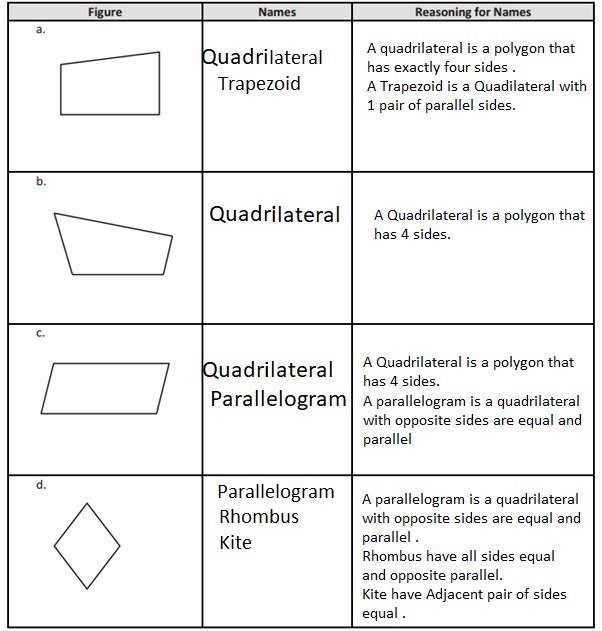
Use your ruler, protractor, and set square to help you give as many names as possible for each figure below. Then, explain your reasoning for how you named each figure.
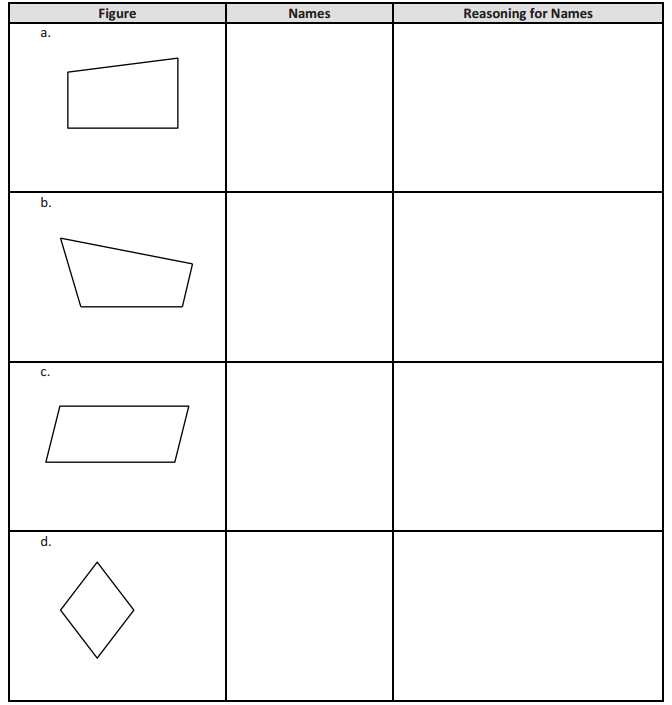
Eureka Math Grade 5 Module 6 Lesson 29 Homework Answer Key 1
Answer:
Engage-NY-Eureka-Math-5th-Grade-Module-6-Lesson-29-Answer-Key-Eureka-Math-Grade-5-Module-6-Lesson-29-Homework-Answer-Key-Question-1

Question 2.
Mark draws a figure that has the following characteristics:

  • Exactly 4 sides that are each 7 centimeters long.
  • Two sets of parallel lines.
  • Exactly 4 angles that measure 35 degrees, 145 degrees, 35 degrees, and 145 degrees.

a. Draw and label Mark’s figure below.
b. Give as many names of quadrilaterals as possible for Mark’s figure. Explain your reasoning for the names of Mark’s figure.
c. List the names of Mark’s figure in Problem 2(b) in order from least specific to most specific. Explain your thinking.
Answer:
a. The Quadrilateral ABCD is drawn in which opposite angles are equal and all sides are equal .
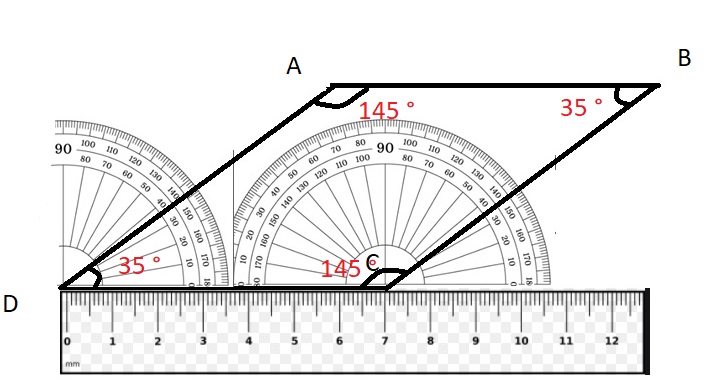
Engage-NY-Eureka-Math-5th-Grade-Module-6-Lesson-29-Answer-Key-Eureka-Math-Grade-5-Module-6-Lesson-29-Homework-Answer-Key-Question-2
b.
The different names for Above Quadrilateral are ABCD.
It is a parallelogram because A parallelogram is a quadrilateral with opposite sides are equal and parallel
It is a Rhombus because Rhombus have all sides equal and opposite are parallel.
c.
Parallelogram have opposite sides equal and parallel . It also contains opposite angles equal .
It is a Rhombus because rhombus have all sides equal and opposite angles are equal.
Rhombus is more specific because all the properties given are same as rhombus .

Eureka Math Grade 5 Module 6 Lesson 31 Answer Key

Engage NY Eureka Math 5th Grade Module 6 Lesson 31 Answer Key

Eureka Math Grade 5 Module 6 Lesson 31 Problem Set Answer Key

Engage NY Math Grade 5 Module 6 Lesson 31 Problem Set Answer Key 1
Answer :
Engage-NY-Eureka-Math-5th-Grade-Module-6-Lesson-31-Answer-Key-Eureka-Math-Grade-5-Module-6-Lesson-31-Problem-Set-Answer-Key

Eureka Math Grade 5 Module 6 Lesson 31 Reflection Answer Key

Today, when we saw a video on the Fibonacci sequence in the spiral and in nature, it may have felt a bit like “math magic.” Have you ever felt math magic in your elementary school years? If so, when did you experience it? If not, did you experience it today? Explain.
Answer:
Yes , It is math magic .
Explanation :
The Fibonacci sequence is a series of numbers where a number is the addition of the last two numbers, starting with 0, and 1. The Fibonacci Sequence: 0, 1, 1, 2, 3, 5, 8, 13, 21, 34, 55…
we look for patterns as
The brain looks for patterns and fills in the blanks. It uses patterns to understand the relationship between things—putting them in context. “The human brain is a pattern-recognition machine. … They are learning patterns and developing rules that guide their decision and make them faster and more accurate.”

Eureka Math Grade 5 Module 6 Lesson 31 Homework Answer Key

Question 1.
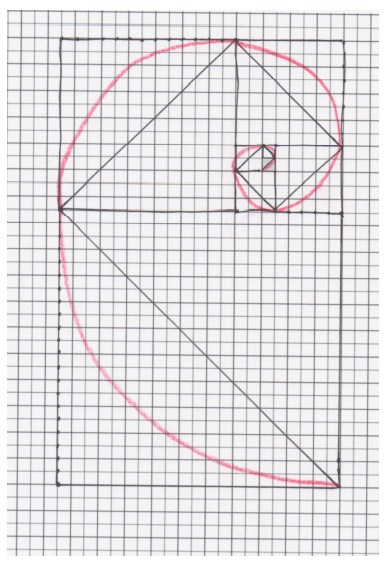
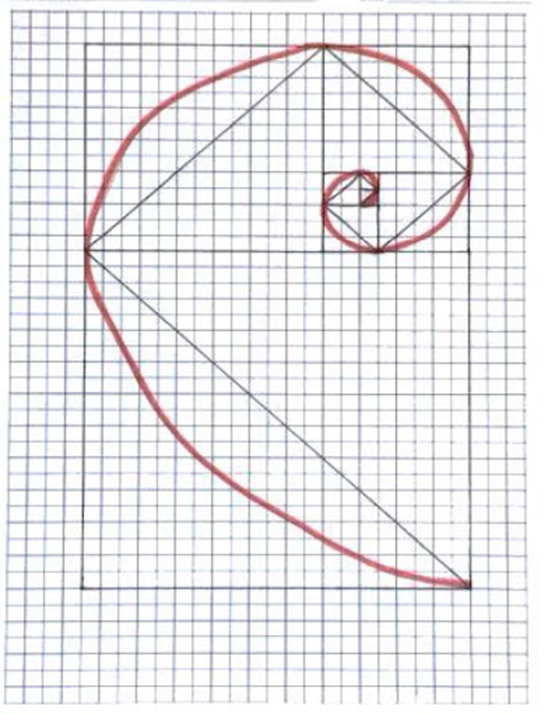
List the Fibonacci numbers up to 21, and create, on the graph below, a spiral of squares corresponding to each of the numbers you write.
Eureka Math Grade 5 Module 6 Lesson 31 Homework Answer Key 1
Answer:
Engage-NY-Eureka-Math-5th-Grade-Module-6-Lesson-31-Answer-Key-Eureka-Math-Grade-5-Module-6-Lesson-31-Homework-Answer-Key
Explanation :
The Fibonacci Sequence can be written as a “Rule
The Rule is xn = xn−1 + xn−2
First, the terms are numbered from 0 onwards like this:

n =0123456789101112131415
xn =01123581321345589144233377392

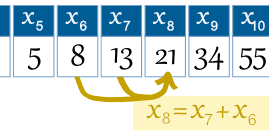
So term number 6 is called x6 (which equals 8).

Example: the 8th term is
the 7th term plus the 6th term:

x8 = x7 + x6

fibonacci rule x_8 = x_7 + x_6

So we can write the rule:
The Rule is xn = xn−1 + xn−2
where:
xn is term number “n”
xn−1 is the previous term (n−1)
xn−2 is the term before that (n−2)

Question 2.
In the space below, write a rule that generates the Fibonacci sequence.
Answer:
The Fibonacci Sequence can be written as a “Rule
The Rule is xn = xn−1 + xn−2

Question 3.
Write at least the first 15 numbers of the Fibonacci sequence.
Answer:
The Fibonacci Sequence can be written as a “Rule
The Rule is xn = xn−1 + xn−2
The first 15 numbers of the Fibonacci sequence are :

n =0123456789101112131415
xn =01123581321345589144233377392

Eureka Math Grade 5 Module 6 Lesson 30 Answer Key

Engage NY Eureka Math 5th Grade Module 6 Lesson 30 Answer Key

Eureka Math Grade 5 Module 6 Lesson 30 Reflection Answer Key

Playing math games can be a fun way to practice math skills. How will you use the games to retain these terms over the summer? Who will play with you? How can you change the games to play alone? How often will you play the games?
Answer:
Games to retain these terms over the summer

  • Math games are a fun way to practice math skills.
  • Different types of math games help with different skills.
  • Playing these games can help us feel less anxious about math.

Roll the dice. Dice can be used in so many different ways when it comes to math. ..
Play math bingo. ..
Find fun ways to teach multiplication.
Turn regular board games into math games. …
My Family Members will play with me .
Yes, I change games to play alone like online games , puzzles games …
I play daily in the evening times .

Eureka Math Grade 5 Module 6 Lesson 30 Homework Answer Key

Teach someone at home how to play one of the games you played today with your pictorial vocabulary cards. Then, answer the questions below.
Question 1.
What games did you play?
Answer:
I played chess and bingo today .

Question 2.
Who played the games with you?
Answer:
played the games with my elder sister and younger brothers . Total 4 members .

Question 3.
What was it like to teach someone at home how to play?
Answer:
Yes , I am good in Bingo . I taught my Sister the game .

Question 4.
Did you have to teach the person who played with you any of the math concepts before you could play? Which ones? What was that like?
Answer:
No , I didn’t teach any math concept .

Question 5.
When you play these games at home again, what changes will you make? Why?
Answer:
While Playing chess i make the first move from now on days so, that i will be one step ahead in my planning .

Eureka Math Grade 5 Module 6 Lesson 28 Answer Key

Engage NY Eureka Math 5th Grade Module 6 Lesson 28 Answer Key

Eureka Math Grade 5 Module 6 Lesson 28 Problem Set Answer Key

Question 1.
Answer the following questions about fluency.
a. What does being fluent with a math skill mean to you?
b. Why is fluency with certain math skills important?
c. With which math skills do you think you should be fluent?
d. With which math skills do you feel most fluent? Least fluent?
e. How can you continue to improve your fluency?
Answer:
a. Fluent in math skills means to me that to recall mathematics facts and concepts without thinking, their number sense, flexibility of thinking, appropriate and efficient responses to problems, the accuracy of their answers, and their understanding of representations in mathematics.
b. Fluent math facts mean less confusion
Math facts are important because they form the building blocks for higher-level math concepts. When a child masters his/her math facts, these concepts will be significantly easier and the student will be better equipped to solve them faster.
c.  Divisions, Multiplications, addition, Subtraction , Decimals and Fractions .
d. Most – Multiplication , and Division , Especially Mental .
Least – Volume and coordinate planes .
e.

  1. Practicing math at the grocery store while buying items.
  2. Using fractions while cooking or baking at home.
  3. Keeping math manipulatives on hand and engaging during playtime.
  4. Play family games that include math.
  5. Building a daily or nightly routine that features frequent math practice

Question 2.
Use the chart below to list skills from today’s activities with which you are fluent.

Fluent Skills


Answer:

Fluent Skills

  1.  Fractions
  2. Convert to Hundredths
  3. Add and Subtract Numbers
  4. Unit Conversions.


Question 3.
Use the chart below to list skills we practiced today with which you are less fluent.

Skills to Practice More


Answer:

Skills to Practice More

  1. Write Fractions and Mixed values .
  2. Multiply a Fractions and a whole number .
  3. Round to Nearest One
  4. Decompose Decimals


Eureka Math Grade 5 Module 6 Lesson 28 Reflection Answer Key

What math skills have you improved through our Fluency Practice this year? How do you know you’ve improved? What math skills do you need to continue to practice this summer? Why?
Answer:
The skills that have improved by Fluency practice is
Calculations of addition , subtraction, Division and Multiplication problems.
Tables .
Oral Calculations increase thinking ability .
I know that i have improved doing Calculations without using pen and paper and solving problems with different Approach .
Skills to practice more in this summer are.

  1. Write Fractions and Mixed values .
  2. Multiply a Fractions and a whole number .
  3. Round to Nearest One
  4. Decompose Decimals

Eureka Math Grade 5 Module 6 Lesson 28 Homework Answer Key

Question 1.
Use what you learned about your fluency skills today to answer the questions below.
a. Which skills should you practice this summer to maintain and build your fluency? Why?
b. Write a goal for yourself about a skill that you want to work on this summer.
c. Explain the steps you can take to reach your goal.
d. How will reaching this goal help you as a math student?
Answer:
a. Divisions, Multiplications, addition, Subtraction , Decimals and Fractions . It helps in calculations mentally and solving them helps to without any stress of formulas .
b. Fractions Set – DMAS
c. Solving all the fractions forms daily each topic and practicing more sums mentally and orally .
d. Yes , Allowing a student to write out, discuss and follow through with his or her goal math goals is a great way to contribute a sense of personal ownership to the learning process. Goals will be an integral part of your student’s math tutoring experience, but can be integrated into home life as well.

Question 2.
In the chart below, plan a new fluency activity that you can play at home this summer to help you build or maintain a skill that you listed in Problem 1(a). When planning your activity, be sure to think about the factors listed below:

  • The materials that you’ll need.
  • Who can play with you (if more than 1 player is needed).
  • The usefulness of the activity for building your skills.

Skill:
Name of Activity:
Materials Needed:
Description:
Answer:
Engage-NY-Eureka-Math-5th-Grade-Module-6-Lesson-28-Answer-Key-Eureka-Math-Grade-5-Module-6-Lesson-28-Homework-Answer-Key-Question-2-a
Engage-NY-Eureka-Math-5th-Grade-Module-6-Lesson-28-Answer-Key-Eureka-Math-Grade-5-Module-6-Lesson-28-Homework-Answer-Key-Question-2-b
Engage-NY-Eureka-Math-5th-Grade-Module-6-Lesson-28-Answer-Key-Eureka-Math-Grade-5-Module-6-Lesson-28-Homework-Answer-Key-Question-2-c
Engage-NY-Eureka-Math-5th-Grade-Module-6-Lesson-28-Answer-Key-Eureka-Math-Grade-5-Module-6-Lesson-28-Homework-Answer-Key-Question-2-d

Eureka Math Grade 5 Module 6 Lesson 27 Answer Key

Engage NY Eureka Math 5th Grade Module 6 Lesson 27 Answer Key

Eureka Math Grade 5 Module 6 Lesson 27 Problem Set Answer Key

Question 1.
Use the RDW process to solve the word problems below.
a. Julia completes her homework in an hour. She spends \(\frac{7}{12}\) of the time doing her math homework and \(\frac{1}{6}\) of the time practicing her spelling words. The rest of the time she spends reading. How many minutes does Julia spend reading?
Answer :
Time taken by Julia to complete her home work = 1 hour .
Time spent in Doing Math Homework = \(\frac{7}{12}\)
Time spent in Practicing her spelling words = \(\frac{1}{6}\)
Time spent in Reading = x .
Time spent in Doing Math Homework + Time spent in Practicing spelling words + Time spent in Reading = 1hour
\(\frac{7}{12}\) + \(\frac{1}{6}\)  + x = 1
\(\frac{7 + 2 + 12x }{12}\) = 1
9 +12x = 12
12x = 12 – 9
12x = 3
x = \(\frac{3}{12}\)
x = \(\frac{1}{4}\)  .
Therefore Time spent in Reading = \(\frac{1}{4}\) hour .

b. Fred has 36 marbles. Elise has \(\frac{8}{9}\) as many marbles as Fred. Annika has \(\frac{3}{4}\) as many marbles as Elise. How many marbles does Annika have?
Answer:
Number of Marbles with Fred = 36
Number of Marbles with Elise =\(\frac{8}{9}\)  as many marbles as Fred =\(\frac{8}{9}\) (36)= 32
Number of Marbles with Annika = \(\frac{3}{4}\) as many marbles as Elise = \(\frac{3}{4}\) (32) = 24 .
Therefore Number of marbles with Annika = 24 .

Question 2.
Write and solve a word problem that might be solved using the expressions in the chart below.

ExpressionWord Problem

Solution

\(\frac{2}{3}\) × 18


(26 + 34) × \(\frac{5}{6}\)


7 – (\(\frac{5}{12}\) + \(\frac{1}{2}\))


Answer:

ExpressionWord Problem

Solution

\(\frac{2}{3}\) × 18


John brought 18 cakes to his class . His classmates ate \(\frac{2}{3}\) of cakes. How many cakes are eaten ?\(\frac{2}{3}\) × 18
= 12 cakes.
Number of cakes eaten = 12 .
(26 + 34) × \(\frac{5}{6}\)


Ruby is having 26 chocolates. Her sister gave 34 more chocolates to her . Ruby parents ate \(\frac{5}{6}\) of chocolates. How many chocolates did Ruby parents eaten ?(26 + 34) × \(\frac{5}{6}\)
= 60 × \(\frac{5}{6}\)
= 50
Number of chocolates eaten by Ruby parents = 50 chocolates .
7 – (\(\frac{5}{12}\) + \(\frac{1}{2}\))


Tina brought 7 pizzas cut into 12 slices each .
Tina friend ate 5 slices and her Brother ate
\(\frac{1}{2}\) of pizza . What fraction of pizzas left over ?
7 – (\(\frac{5}{12}\) + \(\frac{1}{2}\))
= 7 – (\(\frac{5 + 6}{12}\))
= 7 – \(\frac{11}{12}\)
= \(\frac{84 – 11}{12}\)
= \(\frac{73}{12}\)
=6\(\frac{1}{12}\)  pizzas .


Eureka Math Grade 5 Module 6 Lesson 27 Reflection Answer Key

How did teaching other students how to solve a word problem strengthen your skills as a problem solver? What did you learn about your problem-solving skills? What are your strengths and weaknesses as a problem solver?
Answer:
Skills of a problem solver
Active listening.
Analysis.
Research.
Creativity.
Communication.
Dependability.
Decision making.
Team-building.

Problem-solving model
a. Define the problem. The system.
b. Think about it. “Let it simmer”.
c. Plan a solution. Consider possible strategies.
d. Carry out the plan. Be patient.
e. Look back. Encourage students to reflect.

Problem-Solving Strengths:
Divergent thinking
Challenges assumptions
Step-by-step approach
Seeks practical information
Builds off others’ ideas
Looks for how the solution impacts people
Looks at the big picture
Checks for connections between different problems

Problem – Solving Weakness :
Inaccurate information of question
Different approaches to solve problem
Explanation with diagrams
Clear explanation so that everyone should understand .


Eureka Math Grade 5 Module 6 Lesson 27 Homework Answer Key

Question 1.
Use the RDW process to solve the word problems below.
a. There are 36 students in Mr. Meyer’s class. Of those students, \(\frac{5}{12}\) played tag at recess, \(\frac{1}{3}\) played kickball, and the rest played basketball. How many students in Mr. Meyer’s class played basketball?
Answer :
Number of Students in Mr. Meyer’s class = 36 students.
Number of students played tag at recess = \(\frac{5}{12}\) (36 ) = 15 .
Number of students played kickball = \(\frac{1}{3}\) (36 ) = 12.
Number of students played basket ball = Total students – students who played ( recess + kickball )= 36 – (15 +12 )
= 36 – 27 = 9 students.
Therefore, Number of students played basket ball = 9 students.

b. Julie brought 24 apples to school to share with her classmates. Of those apples, \(\frac{2}{3}\) are red, and the rest are green. Julie’s classmates ate \(\frac{3}{4}\) of the red apples and \(\frac{1}{2}\) of the green apples. How many apples are left?
Answer:
Number of Apples Julie brought = 24
Number of red apples = \(\frac{2}{3}\) ( 24) = 16 .
Number of green apples = total – red apples = 24 – 16 = 8.
Number of red apples eaten = \(\frac{3}{4}\) ( 16 ) = 12 apples.
Number of green apples eaten = \(\frac{1}{2}\) ( 8 ) = 4 apples .
Number of red apples left = total red apples – number of red apples eaten = 16 – 12 = 4 apples.
Number of green apples left = total green apples – number of green apples eaten = 8 – 4 = 4 apples.
Total number of apples left = Number of left red apples left +Number of left green apples = 4 + 4 = 8 apples.

Question 2.
Write and solve a word problem for each expression in the chart below.

ExpressionWord Problem

Solution

Answer:

ExpressionWord Problem

Solution

144 × \(\frac{7}{12}\) 


Kristy is having 144 eggs. she used \(\frac{7}{12}\) of eggs to bake cakes . How many eggs are used for baking cakes?144 × \(\frac{7}{12}\)
= 84 eggs.
Number of eggs used for baking a cake = 84 eggs.
9 – (\(\frac{4}{9}\) + \(\frac{1}{23}\))


Gaurish having 9 apples cut into 9 peices.
His brother Mourish ate \(\frac{4}{9}\) and his sister ate \(\frac{1}{23}\) of apples . How many Apples are left over ?
9 – (\(\frac{4}{9}\) + \(\frac{1}{23}\))
= 9 – (\(\frac{92 – 9}{207}\))
= 9 – \(\frac{83}{207}\)
= \(\frac{1863 – 83}{207}\)
= \(\frac{1780}{207}\)
\(\frac{3}{4}\) × (36 + 12)


Gourab having 36 color pencils . His Brother gave 12 more colorpencils to him . Gourab used \(\frac{3}{4}\) color pencils to draw a picture . How many color pencils are used ?


\(\frac{3}{4}\) × (36 + 12)
= \(\frac{3}{4}\) × (48)
= 36 color pencils.
Number of color pencils used for picture = 36 color pencils .


Eureka Math Grade 5 Module 6 Lesson 26 Answer Key

Engage NY Eureka Math 5th Grade Module 6 Lesson 26 Answer Key

Eureka Math Grade 5 Module 6 Lesson 26 Problem Set Answer Key

Question 1.
For each written phrase, write a numerical expression, and then evaluate your expression.
a. Three fifths of the sum of thirteen and six
Numerical expression:
\(\frac{13}{5}\) (13 + 6 )
Solution:
\(\frac{13}{5}\) (13 + 6 ) = \(\frac{13}{5}\) (19) = \(\frac{247}{5}\)

b. Subtract four thirds from one seventh of sixty-three.
Numerical expression:
\(\frac{1}{7}\)(63) – \(\frac{4}{3}\)
Solution:
\(\frac{1}{7}\)(63) – \(\frac{4}{3}\) = 9 – \(\frac{4}{3}\) = \(\frac{27 – 4}{3}\) = \(\frac{23}{3}\) = 7\(\frac{2}{3}\)

c. Six copies of the sum of nine fifths and three
Numerical expression:
6(\(\frac{1}{5}\) + 3)
Solution:
6(\(\frac{1}{5}\) + 3) = 6(\(\frac{1 + 15 }{5}\))= 6(\(\frac{16}{5}\)) = \(\frac{96}{5}\)

d. Three fourths of the product of four fifths and fifteen
Numerical expression:
\(\frac{3}{4}\)(\(\frac{4}{5}\) (15)
Solution:
\(\frac{3}{4}\)(\(\frac{4}{5}\) (15)
= \(\frac{3}{4}\) 12
= 9

Question 2.
Write at least 2 numerical expressions for each phrase below. Then, solve.
a. Two thirds of eight
b. One sixth of the product of four and nine
Answer:
a. Numerical expression:
\(\frac{2}{3}\) (8 )or \(\frac{2}{3}\) × 8
Solution:
\(\frac{2}{3}\) × 8 = \(\frac{16}{3}\) = 5 \(\frac{1}{3}\) .
b. Numerical expression:
\(\frac{1}{6}\) (4 × 9 ) or \(\frac{1}{6}\) (9 × 4 )
Solution:
\(\frac{1}{6}\) (4 × 9 ) = \(\frac{1}{2}\) (4 × 3 ) = 2 × 3 = 6

Question 3.
Use <, >, or = to make true number sentences without calculating. Explain your thinking.
a. 217 × (42 + \(\frac{48}{5}\)) Engage NY Math Grade 5 Module 6 Lesson 26 Problem Set Answer Key 1 (217 × 42) + \(\frac{48}{5}\)
b. (687 × \(\frac{3}{16}\)) × \(\frac{7}{12}\) Engage NY Math Grade 5 Module 6 Lesson 26 Problem Set Answer Key 1 (687 × \(\frac{3}{16}\)) × \(\frac{3}{12}\)
c.  5 × 3.76 + 5 × 2.68 Engage NY Math Grade 5 Module 6 Lesson 26 Problem Set Answer Key 1 5 × 6.99

Answer:
a. 217 × (42 + \(\frac{48}{5}\)) > (217 × 42) + \(\frac{48}{5}\)
Explanation :
The left number is multiplied by greater number .
b. (687 × \(\frac{3}{16}\)) × \(\frac{7}{12}\) > (687 × \(\frac{3}{16}\)) × \(\frac{3}{12}\)
Explanation :
\(\frac{7}{2}\) is bigger than \(\frac{3}{12}\) . So, Multiplying the same factor by \(\frac{7}{2}\) will give you greater answer than multiplying by \(\frac{3}{2}\) or \(\frac{1}{4}\)
c. 5 × 3.76 + 5 × 2.68 < 5 × 6.99
Explanation :
If you add 3.76 and 2.68 its not as much as 6.99 and using the Distributive property , the first equation could be
5 ( 3.76 + 2.68 ) = 5 (6.44 ) .

Eureka Math Grade 5 Module 6 Lesson 26 Reflection Answer Key

How did the games we played today prepare you to practice writing, solving, and comparing expressions this summer? Why do you think these are important skills to work on over the summer? Will you teach someone at home how to play these games with you? What math skills will you need to teach in order for someone at home to be able to play with you?
Answer:
This Expressions help in comparing the costs of goods while doing shopping and critical thinking skills and ability to utilize math in everyday life.
It is Important to work on this skills on over summer helps in increasing the solving of problems in different approach and constantly Learning .
Yes , Teaching some one to play these games helps me to become perfect in that game .
Math skills that i need is to have patience and understanding in order to Explain clearly to all.

Eureka Math Grade 5 Module 6 Lesson 26 Homework Answer Key

Question 1.
For each written phrase, write a numerical expression, and then evaluate your expression.
a. Forty times the sum of forty-three and fifty-seven
Numerical expression:
Solution:
Answer:
Numerical expression:
40 ( 43 + 57 )
Solution:
40 ( 43 + 57 ) = 40 ( 100 ) = 4000 .

b. Divide the difference between one thousand three hundred and nine hundred fifty by four.
Numerical expression:
Solution:
Answer:
Numerical expression:
\(\frac{1300 – 950}{4}\)
Solution:
\(\frac{1300 – 950}{4}\) = \(\frac{350}{4}\) = \(\frac{175}{2}\) = 87\(\frac{1}{2}\) .

c. Seven times the quotient of five and seven
Numerical expression:
Solution:
Answer:
Numerical expression:
7×(5÷7)
Solution:
7×(5÷7) = 7 (\(\frac{5}{7}\) ) = 5

d. One fourth the difference of four sixths and three twelfths
Numerical expression:
Solution:
Answer:
Numerical expression:
\(\frac{1}{4}\)( \(\frac{4}{6}\) – \(\frac{3}{12}\))
Solution:
\(\frac{1}{4}\)( \(\frac{4}{6}\) – \(\frac{3}{12}\))
= \(\frac{1}{4}\)( \(\frac{2}{3}\) – \(\frac{1}{4}\))
= \(\frac{1}{4}\)( \(\frac{8- 3}{12}\))
= \(\frac{1}{4}\)( \(\frac{5}{12}\))
=\(\frac{5}{48}\)

Question 2.
Write at least 2 numerical expressions for each written phrase below. Then, solve.
a. Three fifths of seven
b. One sixth the product of four and eight
Answer a :
Numerical expression:
\(\frac{3}{5}\)( 7) or \(\frac{3}{5}\) × 7
Solution:
\(\frac{3}{5}\)( 7) = \(\frac{21}{5}\)

Question 3.
Use <, >, or = to make true number sentences without calculating. Explain your thinking.
a. 4 tenths + 3 tens + 1 thousandth Eureka Math Grade 5 Module 6 Lesson 26 Homework Answer Key 1 30.41
b. (5 × \(\frac{1}{10}\)) + (7 × \(\frac{1}{100}\)) Eureka Math Grade 5 Module 6 Lesson 26 Homework Answer Key 1 0.507
c. 8 × 7.20 Eureka Math Grade 5 Module 6 Lesson 26 Homework Answer Key 1 8 × 4.36 + 8 × 3.59
Answer:
a. 4 tenths + 3 tens + 1 thousandth < 30.41
Explanation :
We have thousandth in the left  that means 0.001 (43) = 0.043
b. (5 × \(\frac{1}{10}\)) + (7 × \(\frac{1}{100}\))  = 0.507
Explanation :
(5 × \(\frac{1}{10}\)) + (7 × \(\frac{1}{100}\))
= 0.5 + 0.07 = 0.57
we have only \(\frac{1}{100}\) that means only 2 points of decimals
Where as the in 0.507 we have 3 decimal points .
c.
8 × 7.20 < 8 × 4.36 + 8 × 3.59
Explanation :
If you add 4.36 and 3.59 is greater than as 7.20 and using the Distributive property , the Second equation could be
8 ( 4.36 + 3.59 ) = 8 (7.95 ) .

Eureka Math Grade 5 Module 6 Lesson 25 Answer Key

Engage NY Eureka Math 5th Grade Module 6 Lesson 25 Answer Key

Eureka Math Grade 5 Module 6 Lesson 25 Homework Answer Key

Question 1.
Fred and Ethyl had 132 flowers altogether at first. After Fred sold \(\frac{1}{2}\) of his flowers and Ethyl sold 48 of her flowers, they had the same number of flowers left. How many flowers did each of them have at first?
Answer:
Total number of flowers = 132
Number of flowers with Fred = x
Number of flowers with Ethyl = 132 – x
Number of flowers sold by Fred = \(\frac{1}{2}\) x = \(\frac{x}{2}\)
Number of flowers sold by Ethyl = 48
Number of flowers remaining with Fred = x – \(\frac{x}{2}\) = \(\frac{x}{2}\)
Number of Flowers remaining with Ethyl = 132 – x – 48 = 84 – x
Number of flowers remaining with Fred = ethyl
\(\frac{x}{2}\) = 84 – x
x + \(\frac{x}{2}\) = 84
\(\frac{3x}{2}\) = 84
3x = 168
x = 56 .
Number of flowers with Fred = x = 56
Number of flowers with Ethyl = 132 – x = 132 – 56 = 79 .

The following problems are puzzles for your enjoyment. They are intended to encourage working together and family problem-solving fun. They are not a required element of this homework assignment.
Question 2.
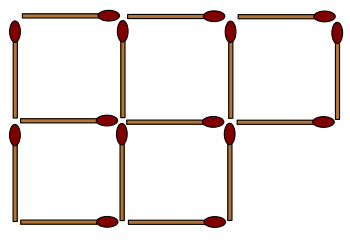
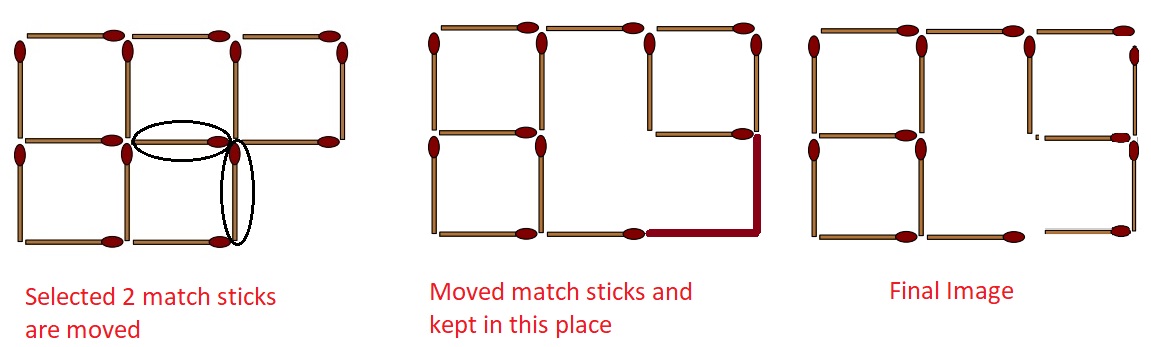
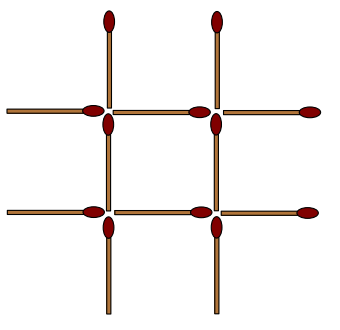
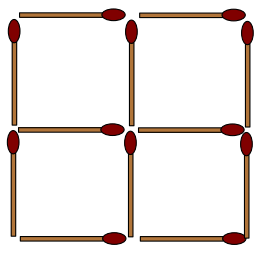
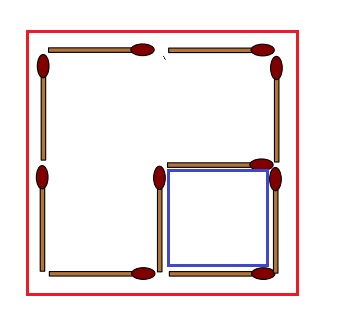
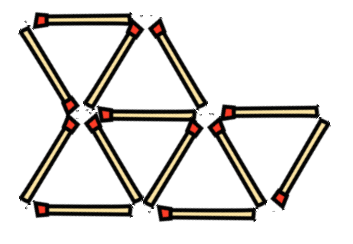
Without removing any, move 2 matchsticks to make 4 identical squares. Which matchsticks did you move? Draw the new shape.
Eureka Math Grade 5 Module 6 Lesson 25 Homework Answer Key 1
Answer:
Engage-NY-Eureka-Math-5th-Grade-Module-6-Lesson-25-Answer-Key-Eureka-Math-Grade-5-Module-6-Lesson-25-Homework-Answer-Key-Question-2

Question 3.
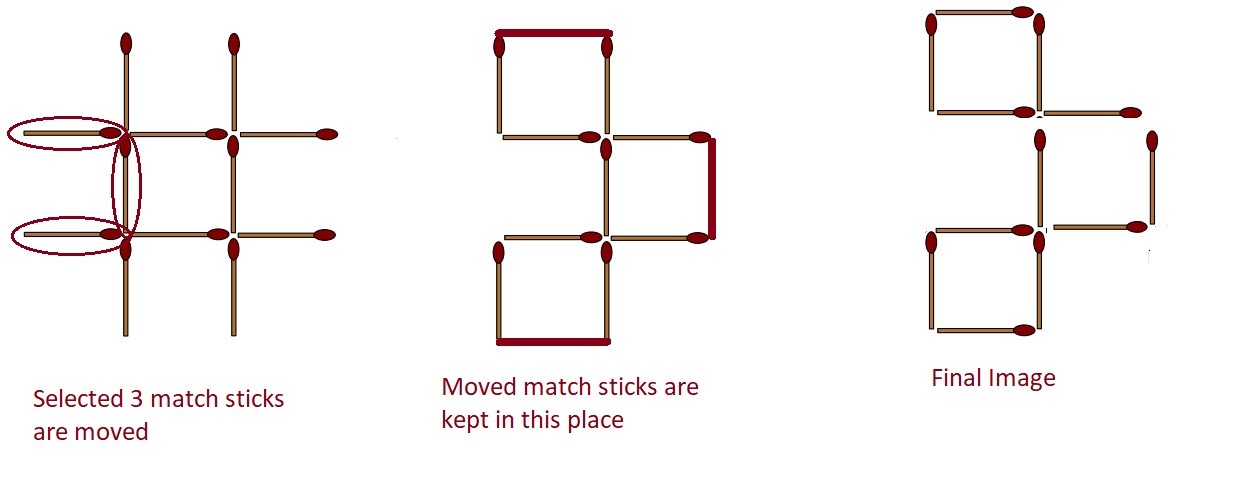
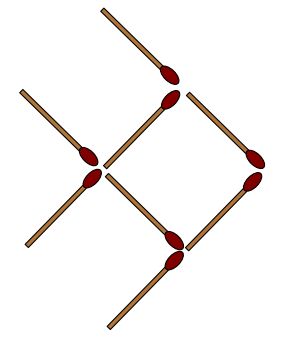
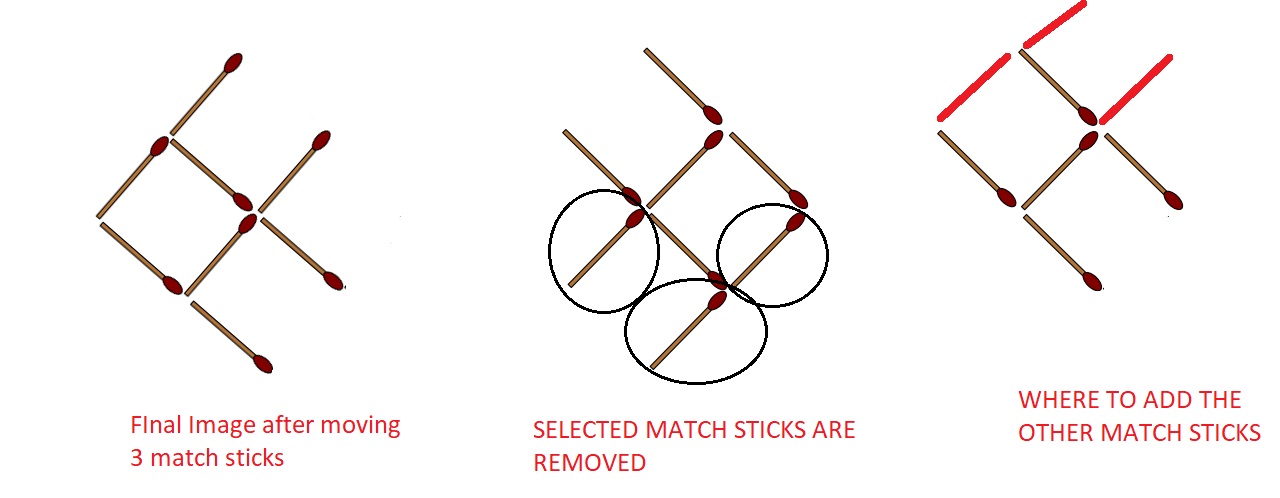
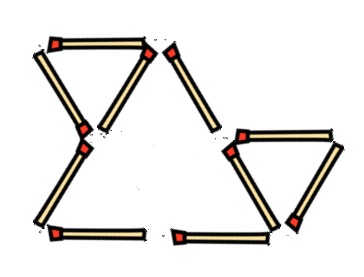
Move 3 matchsticks to form exactly (and only) 3 identical squares. Which matchsticks did you move? Draw the new shape.
Eureka Math Grade 5 Module 6 Lesson 25 Homework Answer Key 2
Answer:
Engage-NY-Eureka-Math-5th-Grade-Module-6-Lesson-25-Answer-Key-Eureka-Math-Grade-5-Module-6-Lesson-25-Homework-Answer-Key-Question-3

Eureka Math Grade 5 Module 6 Lesson 24 Answer Key

Engage NY Eureka Math 5th Grade Module 6 Lesson 24 Answer Key

Eureka Math Grade 5 Module 6 Lesson 24 Homework Answer Key

Question 1.
Pat’s Potato Farm grew 490 pounds of potatoes. Pat delivered \(\frac{3}{7}\) of the potatoes to a vegetable stand. The owner of the vegetable stand delivered \(\frac{2}{3}\) of the potatoes he bought to a local grocery store, which packaged half of the potatoes that were delivered into 5-pound bags. How many 5-pound bags did the grocery store package?
Answer:
Weight of potatoes grown in pat farm = 490 pounds
Weight of potatoes pat delivered to vegetable stand = \(\frac{3}{7}\) × 490 = 210 pounds .
Weight of potatoes vegetable stand owner to local grocery store = \(\frac{2}{3}\)  × 210 = 140 pounds .
Weight of potatoes local grocery store packed in 5 – pound bags = half of the potatoes = 140 / 2 = 70 pounds .
Number of 5-pound bags did the grocery store packed = 70 / 5 = 14 bags .

The following problems are for your enjoyment. They are intended to encourage working together and family problem-solving fun. They are not a required element of this homework assignment.
Question 2.
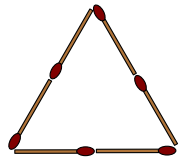
Six matchsticks are arranged into an equilateral triangle. How can you arrange them into 4 equilateral triangles without breaking or overlapping any of them? Draw the new shape.
Eureka Math Grade 5 Module 6 Lesson 24 Homework Answer Key 1
Answer:
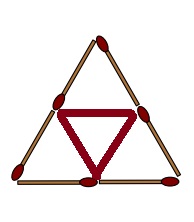
Engage-NY-Eureka-Math-5th-Grade-Module-6-Lesson-24-Answer-Key-Eureka-Math-Grade-5-Module-6-Lesson-24-Homework-Answer-Key-Question-2
By placing 3 match sticks in the middle of the triangle 4 equilateral triangles are formed is shown in the above figure .

Question 3.
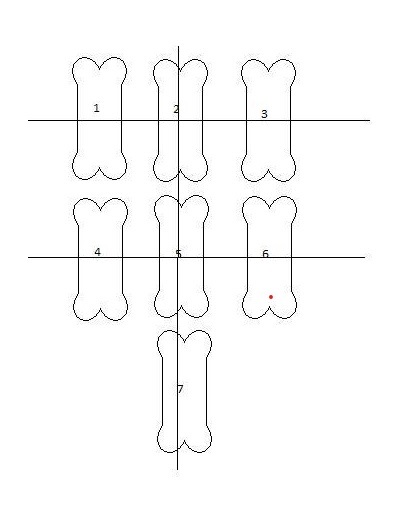
Kenny’s dog, Charlie, is really smart! Last week, Charlie buried 7 bones in all. He buried them in 5 straight lines and put 3 bones in each line. How is this possible? Sketch how Charlie buried the bones.
Answer:
Engage-NY-Eureka-Math-5th-Grade-Module-6-Lesson-24-Answer-Key-Eureka-Math-Grade-5-Module-6-Lesson-24-Homework-Answer-Key-Question-3
the possible way is shown in the above diagram

Eureka Math Grade 5 Module 6 Lesson 23 Answer Key

Engage NY Eureka Math 5th Grade Module 6 Lesson 23 Answer Key

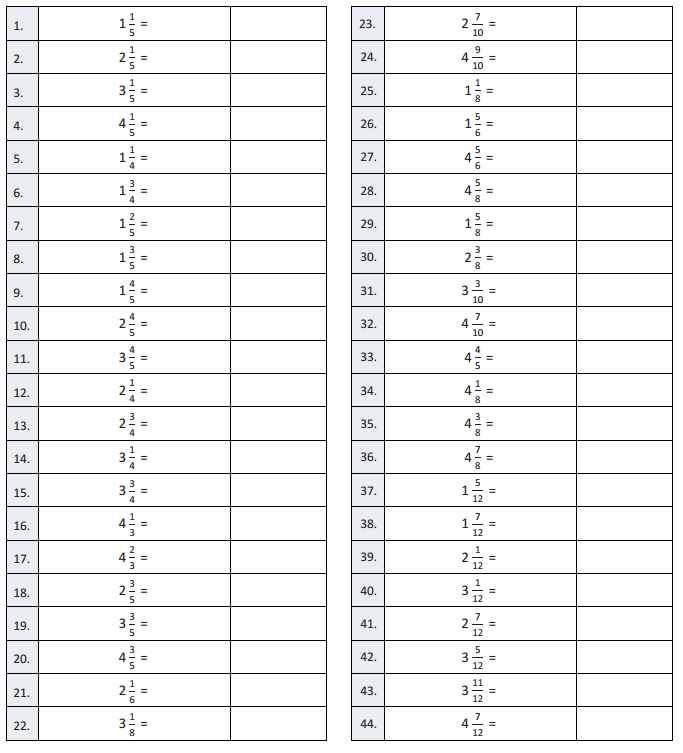
Eureka Math Grade 5 Module 6 Lesson 23 Sprint Answer Key

A
Change Mixed Numbers into Improper Fractions
Engage NY Math 5th Grade Module 6 Lesson 23 Sprint Answer Key 1

Question 1.
1\(\frac{1}{5}\) =
Answer:
1\(\frac{1}{5}\) = \(\frac{6}{5}\)

Question 2.
2\(\frac{1}{5}\) =
Answer:
2\(\frac{1}{5}\) = \(\frac{11}{5}\)

Question 3.
3\(\frac{1}{5}\) =
Answer:
3\(\frac{1}{5}\) = \(\frac{16}{5}\)

Question 4.
4\(\frac{1}{5}\) =
Answer:
4 \(\frac{1}{5}\) = \(\frac{21}{5}\)

Question 5.
1\(\frac{1}{4}\) =
Answer:
1\(\frac{1}{4}\) = \(\frac{5}{4}\)

Question 6.
1\(\frac{3}{4}\) =
Answer:
1\(\frac{3}{4}\) = \(\frac{7}{4}\)

Question 7.
1\(\frac{2}{5}\) =
Answer:
1\(\frac{2}{5}\) = \(\frac{7}{5}\)

Question 8.
1\(\frac{3}{5}\) =
Answer:
1\(\frac{3}{5}\) = \(\frac{8}{5}\)

Question 9.
1\(\frac{4}{5}\) =
Answer:
1\(\frac{4}{5}\) = \(\frac{9}{5}\)

Question 10.
2\(\frac{4}{5}\) =
Answer:
2\(\frac{4}{5}\) = \(\frac{14}{5}\)

Question 11.
3\(\frac{4}{5}\) =
Answer:
3\(\frac{4}{5}\) = \(\frac{19}{5}\)

Question 12.
2\(\frac{1}{4}\) =
Answer:
2\(\frac{1}{4}\)  = \(\frac{9}{4}\)

Question 13.
2\(\frac{3}{4}\) =
Answer:
2\(\frac{3}{4}\) = \(\frac{11}{4}\)

Question 14.
3\(\frac{1}{4}\) =
Answer:
3\(\frac{1}{4}\) = \(\frac{13}{4}\)

Question 15.
3\(\frac{3}{4}\) =
Answer:
3\(\frac{3}{4}\) = \(\frac{15}{4}\)

Question 16.
4\(\frac{1}{3}\) =
Answer:
4\(\frac{1}{3}\) = \(\frac{1}3{3}\)

Question 17.
4\(\frac{2}{3}\) =
Answer:
4\(\frac{2}{3}\) = \(\frac{14}{3}\)

Question 18.
2\(\frac{3}{5}\) =
Answer:
2\(\frac{3}{5}\) = \(\frac{13}{5}\)

Question 19.
3\(\frac{3}{5}\) =
Answer:
3\(\frac{3}{5}\) = \(\frac{18}{5}\)

Question 20.
4\(\frac{3}{5}\) =
Answer:
4\(\frac{3}{5}\) = \(\frac{23}{5}\)

Question 21.
2\(\frac{1}{6}\) =
Answer:
2\(\frac{1}{6}\) = \(\frac{1}{6}\)

Question 22.
3\(\frac{1}{8}\) =
Answer:
3\(\frac{1}{8}\) = \(\frac{25}{8}\)

Question 23.
2\(\frac{7}{10}\) =
Answer:
2\(\frac{7}{10}\) = \(\frac{27}{10}\)

Question 24.
4\(\frac{9}{10}\) =
Answer:
4\(\frac{9}{10}\) =\(\frac{49}{10}\)

Question 25.
1\(\frac{1}{8}\) =
Answer:
1\(\frac{1}{8}\)  = \(\frac{9}{8}\)

Question 26.
1\(\frac{5}{6}\) =
Answer:
1\(\frac{5}{6}\) = \(\frac{11}{6}\)

Question 27.
4\(\frac{5}{6}\) =
Answer:
4\(\frac{5}{6}\) = \(\frac{29}{6}\)

Question 28.
4\(\frac{5}{8}\) =
Answer:
4\(\frac{5}{8}\) = \(\frac{37}{8}\)

Question 29.
1\(\frac{5}{8}\) =
Answer:
1\(\frac{5}{8}\)  = \(\frac{13}{8}\)

Question 30.
2\(\frac{3}{8}\) =
Answer:
2\(\frac{3}{8}\) = \(\frac{19}{8}\)

Question 31.
3\(\frac{3}{10}\) =
Answer:
3\(\frac{3}{10}\) = \(\frac{33}{10}\)

Question 32.
4\(\frac{7}{10}\) =
Answer:
4\(\frac{7}{10}\) = \(\frac{47}{10}\)

Question 33.
4\(\frac{4}{5}\) =
Answer:
4\(\frac{4}{5}\)  = \(\frac{24}{5}\)

Question 34.
4\(\frac{1}{8}\) =
Answer:
4\(\frac{1}{8}\) = \(\frac{33}{8}\)

Question 35.
4\(\frac{3}{8}\) =
Answer:
4\(\frac{3}{8}\) = \(\frac{35}{8}\)

Question 36.
4\(\frac{7}{8}\) =
Answer:
4\(\frac{7}{8}\) = \(\frac{39}{8}\)

Question 37.
1\(\frac{5}{12}\) =
Answer:
1\(\frac{5}{12}\) = \(\frac{17}{12}\)

Question 38.
1\(\frac{7}{12}\) =
Answer:
1\(\frac{7}{12}\) = \(\frac{19}{12}\)

Question 39.
2\(\frac{1}{12}\) =
Answer:
2\(\frac{1}{12}\) = \(\frac{25}{12}\)

Question 40.
3\(\frac{1}{12}\) =
Answer:
3\(\frac{1}{12}\)= \(\frac{37}{12}\)

Question 41.
2\(\frac{7}{12}\) =
Answer:
2\(\frac{7}{12}\) = \(\frac{31}{12}\)

Question 42.
3\(\frac{5}{12}\) =
Answer:
3\(\frac{5}{12}\) = \(\frac{41}{12}\)

Question 43.
3\(\frac{11}{12}\) =
Answer:
3\(\frac{11}{12}\) = \(\frac{47}{12}\)

Question 44.
4\(\frac{7}{12}\) =
Answer:
4\(\frac{7}{12}\) = \(\frac{55}{12}\)

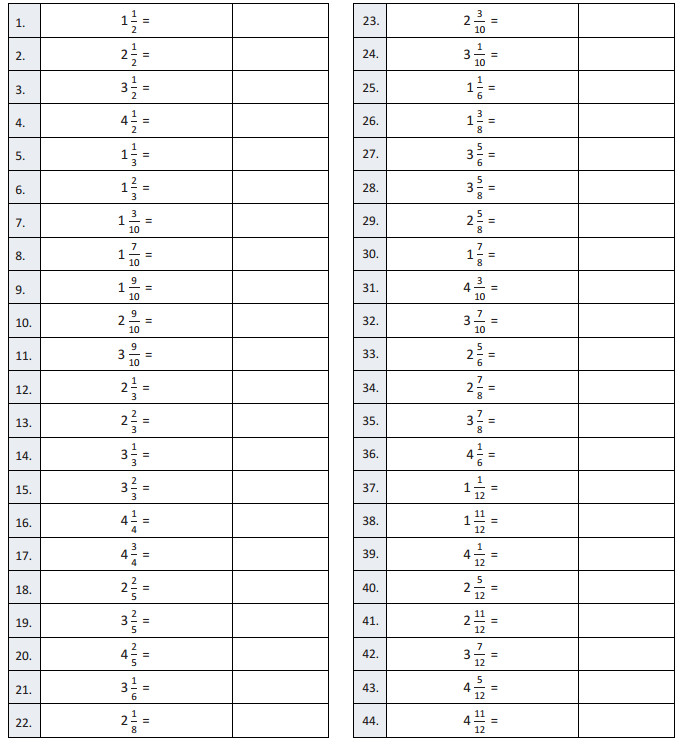
B
Change Mixed Numbers into Improper Fractions
Engage NY Math 5th Grade Module 6 Lesson 23 Sprint Answer Key 2

Question 1.
1\(\frac{1}{2}\) =
Answer:
1\(\frac{1}{2}\)  = \(\frac{3}{2}\)

Question 2.
2\(\frac{1}{2}\) =
Answer:
2\(\frac{1}{2}\)  = \(\frac{5}{2}\)

Question 3.
3\(\frac{1}{2}\) =
Answer:
3\(\frac{1}{2}\)  = \(\frac{7}{2}\)

Question 4.
4\(\frac{1}{2}\) =
Answer:
4\(\frac{1}{2}\)  = \(\frac{9}{2}\)

Question 5.
1\(\frac{1}{3}\) =
Answer:
1\(\frac{1}{3}\)  = \(\frac{4}{3}\)

Question 6.
1\(\frac{2}{3}\) =
Answer:
1\(\frac{2}{3}\)  = \(\frac{5}{3}\)

Question 7.
1\(\frac{3}{10}\) =
Answer:
1\(\frac{3}{10}\)  = \(\frac{13}{10}\)

Question 8.
1\(\frac{7}{10}\) =
Answer:
1\(\frac{7}{10}\)  = \(\frac{17}{10}\)

Question 9.
1\(\frac{9}{10}\) =
Answer:
1\(\frac{9}{10}\)  = \(\frac{19}{10}\)

Question 10.
2\(\frac{9}{10}\) =
Answer:
2\(\frac{9}{10}[/latex = [latex]\frac{29}{10}[/latex

Question 11.
3[latex]\frac{9}{10}\) =
Answer:
3\(\frac{9}{10}[/latex = [latex]\frac{39}{10}[/latex

Question 12.
2[latex]\frac{1}{3}\) =
Answer:
2\(\frac{1}{3}\) = \(\frac{7}{3}\)

Question 13.
2\(\frac{2}{3}\) =
Answer:
2\(\frac{2}{3}\) =\(\frac{8}{3}\)

Question 14.
3\(\frac{1}{3}\) =
Answer:
3\(\frac{1}{3}\) = \(\frac{10}{3}\)

Question 15.
3\(\frac{2}{3}\) =
Answer:
3\(\frac{2}{3}\) = \(\frac{11}{3}\)

Question 16.
4\(\frac{1}{4}\) =
Answer:
4\(\frac{1}{4}\)  = \(\frac{17}{4}\)

Question 17.
4\(\frac{3}{4}\) =
Answer:
4\(\frac{3}{4}\) = \(\frac{19}{4}\)

Question 18.
2\(\frac{2}{5}\) =
Answer:
2\(\frac{2}{5}\) = \(\frac{12}{5}\)

Question 19.
3\(\frac{2}{5}\) =
Answer:
3\(\frac{2}{5}\) = \(\frac{17}{5}\)

Question 20.
4\(\frac{2}{5}\) =
Answer:
4\(\frac{2}{5}\) = \(\frac{22}{5}\)

Question 21.
3\(\frac{1}{6}\) =
Answer:
3\(\frac{1}{6}\) = \(\frac{19}{6}\)

Question 22.
2\(\frac{1}{8}\) =
Answer:
2\(\frac{1}{8}\) = \(\frac{17}{6}\)

Question 23.
2\(\frac{3}{10}\) =
Answer:
2\(\frac{3}{10}\) = \(\frac{23}{10}\)

Question 24.
3\(\frac{1}{10}\) =
Answer:
3\(\frac{1}{10}\) = \(\frac{31}{10}\)

Question 25.
1\(\frac{1}{6}\) =
Answer:
1\(\frac{1}{6}\) = \(\frac{7}{6}\)

Question 26.
1\(\frac{3}{8}\) =
Answer:
1\(\frac{3}{8}\) = \(\frac{11}{8}\)

Question 27.
3\(\frac{5}{6}\) =
Answer:
3\(\frac{5}{6}\)  = \(\frac{23}{6}\)

Question 28.
3\(\frac{5}{8}\) =
Answer:
3\(\frac{5}{8}\)  = \(\frac{29}{8}\)

Question 29.
2\(\frac{5}{8}\) =
Answer:
2\(\frac{5}{8}\) = \(\frac{21}{8}\)

Question 30.
1\(\frac{7}{8}\) =
Answer:
1\(\frac{7}{8}\)  = \(\frac{15}{8}\)

Question 31.
4\(\frac{3}{10}\) =
Answer:
4\(\frac{3}{10}\) = \(\frac{43}{10}\)

Question 32.
3\(\frac{7}{10}\) =
Answer:
3\(\frac{7}{10}\) =\(\frac{37}{10}\)

Question 33.
2\(\frac{5}{6}\) =
Answer:
2\(\frac{5}{6}\)  =\(\frac{17}{6}\)

Question 34.
2\(\frac{7}{8}\) =
Answer:
2\(\frac{7}{8}\)  = \(\frac{23}{8}\)

Question 35.
3\(\frac{7}{8}\) =
Answer:
3\(\frac{7}{8}\)  =\(\frac{31}{8}\)

Question 36.
4\(\frac{1}{6}\) =
Answer:
4\(\frac{1}{6}\) = \(\frac{25}{6}\)

Question 37.
1\(\frac{1}{12}\) =
Answer:
1\(\frac{1}{12}\)  =\(\frac{13}{12}\)

Question 38.
1\(\frac{11}{12}\) =
Answer:
1\(\frac{11}{12}\)  = \(\frac{23}{12}\)

Question 39.
4\(\frac{1}{12}\) =
Answer:
4\(\frac{1}{12}\)  = \(\frac{49}{12}\)

Question 40.
2\(\frac{5}{12}\) =
Answer:
2\(\frac{5}{12}\)  = \(\frac{29}{12}\)

Question 41.
2\(\frac{11}{12}\) =
Answer:
2\(\frac{11}{12}\)  = \(\frac{35}{12}\)

Question 42.
3\(\frac{7}{12}\) =
Answer:
3\(\frac{7}{12}\) = \(\frac{43}{12}\)

Question 43.
4\(\frac{5}{12}\) =
Answer:
4\(\frac{5}{12}\) = \(\frac{53}{12}\)

Question 44.
4\(\frac{11}{12}\) =
Answer:
4\(\frac{11}{12}\)  = \(\frac{59}{12}\)

Eureka Math Grade 5 Module 6 Lesson 23 Homework Answer Key

Question 1.
In the diagram, the length of Figure S is \(\frac{1}{2}\) the length of Figure T. If S has an area of 368 cm2, find the perimeter of the figure.
Eureka Math Grade 5 Module 6 Lesson 23 Homework Answer Key 1
Answer:
Length of Figure T = x
length of Figure S = \(\frac{1}{2}\) the length of Figure T = \(\frac{x}{2}\) .
Breadth = 16 cm
Area of Figure S = 368 cm2,
Area = Length × Breadth = \(\frac{x}{2}\) × 16 = 368
\(\frac{x}{2}\) = 23
x = 24 cms.
Length of figure S = \(\frac{x}{2}\) = 23 cms .
Length of figure T = x = 46 cms .
Total Length of Figure S and T = 23 + 46 = 69 cms
Perimeter of given Figure = S +T = 2 ( l + b) = 2 ( 69 + 16 ) = 2 ( 85 ) = 170 cms .

The following problems are puzzles for your enjoyment. They are intended to encourage working together and family problem-solving fun and are not a required element of this homework assignment.
Question 2.
Take 12 matchsticks arranged in a grid as shown below, and remove 2 matchsticks so 2 squares remain. How can you do this? Draw the new arrangement.
Eureka Math Grade 5 Module 6 Lesson 23 Homework Answer Key 2
Answer:
Engage-NY-Eureka-Math-5th-Grade-Module-6-Lesson-23-Answer-Key-Eureka-Math-Grade-5-Module-6-Lesson-23-Homework-Answer-Key-Question-2
If we remove any one vertical match sticks or one horizontal match sticks in the middle then 2 squares will be remained and is shown in below figure .

Question 3.
Moving only 3 matchsticks makes the fish turn around and swim the opposite way. Which matchsticks did you move? Draw the new shape.
Eureka Math Grade 5 Module 6 Lesson 23 Homework Answer Key 3
Answer:
Engage-NY-Eureka-Math-5th-Grade-Module-6-Lesson-23-Answer-Key-Eureka-Math-Grade-5-Module-6-Lesson-23-Homework-Answer-Key-Question-3

Eureka Math Grade 5 Module 6 Lesson 21 Answer Key

Engage NY Eureka Math 5th Grade Module 6 Lesson 21 Answer Key

Eureka Math Grade 5 Module 6 Lesson 21-23 Problem Set Answer Key

Question 1.
Pierre’s Paper
Pierre folded a square piece of paper vertically to make two rectangles. Each rectangle had a perimeter of
39 inches. How long is each side of the original square? What is the area of the original square? What is the area of one of the rectangles?
Answer:
Engage-NY-Eureka-Math-5th-Grade-Module-6-Lesson-21-Answer-Key-Eureka-Math-Grade-5-Module-6-Lesson-21-23-Problem-Set-Answer-Key-Question-1
ABCD is a square.
AEFD AND EBCF are two equal rectangles of perimeter 39 inches.
Length of the rectangle = 2x
Breadth of the rectangle = x
Perimeter of a rectangle = 2 (l + b) = 2 (2x +x ) = 6x = 39
x =\(\frac{39}{6}\) =6.5
2x = 13
Area of square ABCD = Side × Side = 2x × 2x = 13 × 13 = 169 sq. inches.
Area of Rectangle AEFD = Area of Rectangle EBCF = length ×  Breadth = 2x × x = 13 × 6.5 = 84.5 sq inches .

Question 2.
Shopping with Elise
Elise saved $184. She bought a scarf, a necklace, and a notebook. After her purchases, she still had $39.50. The scarf cost three-fifths the cost of the necklace, and the notebook was one-sixth as much as the scarf. What was the cost of each item? How much more did the necklace cost than the notebook?
Answer:
Money with Elisa = $184 .
Money left after shopping = $39.50
Money spent on shopping = $184 = 39.50 = 144.50$
Cost of scarf = \(\frac{3}{5}\) cost of the necklace.
Cost of Note book = \(\frac{1}{6}\) cost of the Scarf . = \(\frac{1}{6}\)\(\frac{3}{5}\) cost of the necklace = \(\frac{1}{10}\) cost of the necklace .
cost of necklace = x
Cost of scarf + notebook + necklace = money spent on shopping
\(\frac{3}{5}\) x + \(\frac{1}{10}\) x + x = 144.50$
\(\frac{6x + 1x +10x }{10}\) = 144.5
17x = 1445
x= \(\frac{1445}{17}\)
x = 85
Cost of Necklace = 85$
Cost of Scarf = \(\frac{3}{5}\) cost of the necklace = \(\frac{3}{5}\) 85 = 39$.
Cost of Notebook = \(\frac{1}{10}\) cost of the necklace = \(\frac{1}{10}\) 85 = 8.5$ .
Money more spent on necklace than the notebook = 85 – 8.5 = 76.5$ .

Question 3.
The Hewitt’s Carpet
The Hewitt family is buying carpet for two rooms. The dining room is a square that measures 12 feet on each side. The den is 9 yards by 5 yards. Mrs. Hewitt has budgeted $2,650 for carpeting both rooms. The green carpet she is considering costs $42.75 per square yard, and the brown carpet’s price is $4.95 per square foot. What are the ways she can carpet the rooms and stay within her budget?
Answer:
Side of dining room = 12 feet
Area of dining square room = Side ×  Side = 12 × 12 = 144 sq feets .
den is in the shape of rectangle .
Length by breadth = 9 yards by 5 yards
Area of rectangle den = length × Breadth = 9 × 5 = 45 sq yards .
Cost of green carpet = $42.75 per square yard
Cost of green carpet for 45 sqyards = 45 ×$42.75 per square yard = 1923.75 $.
Cost of Brown carpet = $4.95 per square foot
Cost of Brown carpet for 144 sq foot = 144 × $4.95 = 712.8$
Total Cost of Green carpet and Brown carpet = 1923.75 $ + 712.8$ = 2645.55$
Budget for carpeting both rooms = 2650$.
She carpet green carpet to den and Brown carpet to dining Room . Then she can stay within her budget .

Question 4.
AAA Taxi
AAA Taxi charges $1.75 for the first mile and $1.05 for each additional mile. How far could Mrs. Leslie travel for $20 if she tips the cab driver $2.50?
Answer:
Cost of First mile = $1.75
Cost of second mile = $1.75 + $1.05 =$2.8
Cost of Third mile = $1.75 + $1.05 =$2.8
Cost of fourth mile = $1.75 + $1.05 =$2.8 and so on that means cost of second mile is $2.8
Money spent for travel = $20
Tip given for driver = $2.5
Money given to driver for travel = $20 – $ 2.5 = $17.5
x = number of miles traveled after 1st mile
cost of first mile + x cost of second mile = $17.5
1.75 + x (2.8) = 17.5$
2.8x = 17.5 -1.75
2.8x = 15.75 $
x = 5.625 miles
She traveled 5.625 miles

Question 5.
Pumpkins and Squash
Three pumpkins and two squash weigh 27.5 pounds. Four pumpkins and three squash weigh 37.5 pounds. Each pumpkin weighs the same as the other pumpkins, and each squash weighs the same as the other squash. How much does each pumpkin weigh? How much does each squash weigh?
Answer:
all pumpkins weights are equal = p
all Squash weights equal = s
Three pumpkins and two squash weigh 27.5 pounds
3p +2s = 27.5
Four pumpkins and three squash weigh 37.5 pounds.
4p + 3s = 37.5
Taking lcm for 4 and 3 = 12
4(3p +2s = 27.5)
3(4p + 3s = 37.5)
=12p + 8s = 110
12p + 9s = 112.5
= 9s – 8s = 112.5 – 110
s = 2.5
= 3p +2s = 27.5
3p + 2(2.5) = 27.5
3p = 27.5 – 5
p = 22.5 / 3 = 7.5
Weight of Squash =2.5 pounds.
Weight of pumpkin = 7.5 pounds .

Question 6.
Toy Cars and Trucks
Henry had 20 convertibles and 5 trucks in his miniature car collection. After Henry’s aunt bought him some more miniature trucks, Henry found that one-fifth of his collection consisted of convertibles. How many trucks did his aunt buy?
Answer:
Number of convertibles = 20
Number of trucks = 5
Number of trucks bought by Henry’s aunt = One-fifth of his collection consisted of convertibles = \(\frac{1}{5}\) y =20 = y = 100 .
100 – 20 convertibles = 80 .
80 – 5 ( 5 trucks are already with henry ) = 75 trucks .

Question 7.
Pairs of Scouts
Some girls in a Girl Scout troop are pairing up with some boys in a Boy Scout troop to practice square dancing. Two-thirds of the girls are paired with three-fifths of the boys. What fraction of the scouts are square dancing?
(Each pair is one Girl Scout and one Boy Scout. The pairs are only from these two troops.)
Answer:
Two-thirds of the girls are paired with three-fifths of the boys
\(\frac{2}{3}\) girls = \(\frac{3}{5}\) boys
\(\frac{2}{3}\) girls = \(\frac{6}{9}\)
\(\frac{3}{5}\) boys = \(\frac{6}{10}\)
Fraction of the scouts are square dancing = \(\frac{6+ 6}{9 + 10}\) = \(\frac{12}{19}\)

Question 8.
Sandra’s Measuring Cups
Sandra is making cookies that require 5\(\frac{1}{2}\) cups of oatmeal. She has only two measuring cups: a one-half cup and a three-fourths cup. What is the smallest number of scoops that she could make in order to get 5\(\frac{1}{2}\) cups?
Answer:
Measuring cups : a one-half cup and a three-fourths cup.
To make 5\(\frac{1}{2}\) cups with \(\frac{11}{2}\) cups
To make \(\frac{11}{2}\) cups we require 11 scoops .
To make 5\(\frac{1}{2}\) cups with a three-fourths cup. we require 7 Scoops with one fourth left .
So take 6 scoops of \(\frac{3}{4}\) then 1 will left so take 2 \(\frac{1}{2}\) cups.
Then we require 6 \(\frac{3}{4}\) scoops and 2 \(\frac{1}{2}\) cups.
Total fewest scoops are 6 + 2 = 8 scoops .

Question 9.
Blue Squares
The dimensions of each successive blue square pictured to the right are half that of the previous blue square. The lower left blue square measures 6 inches by 6 inches.
a. Find the area of the shaded part.
b. Find the total area of the shaded and unshaded parts.
c. What fraction of the figure is shaded?
Engage NY Math Grade 5 Module 6 Lesson 21 Problem Set Answer Key 1

Answer:
There are 3 sets of squares . 1 out of 3 sets are shaded.
c. Fraction shaded = \(\frac{1}{3}\)
b. Total Area = (12 × 12 ) – ( \(\frac{3}{8}\) \(\frac{3}{8}\))
= 144 – \(\frac{9}{64}\)
= \(\frac{9216 – 9}{64}\)
= 143 \(\frac{55}{64}\) sq inches .
a. Area Shaded = \(\frac{1}{3}\) × 143 \(\frac{55}{64}\) sq inches .
= \(\frac{1}{3}\) \(\frac{9207}{64}\)
= 47 \(\frac{61}{64}\) inches .

Eureka Math Grade 5 Module 6 Lesson 21 Homework Answer Key

Question 1.
Sara travels twice as far as Eli when going to camp. Ashley travels as far as Sara and Eli together. Hazel travels 3 times as far as Sara. In total, all four travel 888 miles to camp. How far does each of them travel?
Answer:
Distance traveled by Eli = x
Distance traveled by Sara = twice as far as Eli = 2x
Distance traveled by Ashley = Sara and Eli together. = x + 2x = 3x
Distance traveled by Hazel = 3 times Sara = 3 ( 2x) = 6x
Total distance traveled by all four = 888 miles
x+ 2x+ 3x+ 6x = 888
12x = 888
3x = 222
x = 74 miles.
Distance traveled by Eli = x = 74 miles
Distance traveled by Sara = twice as far as Eli = 2x = 2(74) = 144 miles
Distance traveled by Ashley = Sara and Eli together. = x + 2x = 3x = 3(74) = 218 miles
Distance traveled by Hazel = 3 times Sara = 3 ( 2x) = 6x = 6(74) =  444 miles

The following problem is a brainteaser for your enjoyment. It is intended to encourage working together and family problem-solving fun. It is not a required element of this homework assignment.
Question 2.
A man wants to take a goat, a bag of cabbage, and a wolf over to an island. His boat will only hold him and one animal or item. If the goat is left with the cabbage, he’ll eat it. If the wolf is left with the goat, he’ll eat it. How can the man transport all three to the island without anything being eaten?
Eureka Math Grade 5 Module 6 Lesson 21 Homework Answer Key 1
Answer:

The wolf does not eat cabbage, so the crossing can start with the goat.

The man leaves the goat and returns, puts the cabbage in the boat and takes it across. On the other bank, he leaves the cabbage but takes the goat.

He leaves the goat on the first bank and takes the wolf across. He leaves the cabbage with the wolf and rows back alone.

He takes the goat across.

Eureka Math Grade 5 Module 6 Lesson 22 Answer Key

Engage NY Eureka Math 5th Grade Module 6 Lesson 22 Answer Key

Eureka Math Grade 5 Module 6 Lesson 22 Homework Answer Key

Solve using any method. Show all your thinking.
Question 1.
Study this diagram showing all the squares. Fill in the table.
Eureka Math Grade 5 Module 6 Lesson 22 Homework Answer Key 1

Eureka Math Grade 5 Module 6 Lesson 22 Homework Answer Key 2

Figure

Area in Square Feet

11 ft2
2
3
49 ft2
5
61 ft2
7
8
9
10
11

Answer:
all sides are written in the respective square and is shown in below figure .
Engage-NY-Eureka-Math-5th-Grade-Module-6-Lesson-22-Answer-Key-Eureka-Math-Grade-5-Module-6-Lesson-22-Homework-Answer-Key-Question-1
Area of Square = Side × Side

Figure

Area in Square Feet

11 ft2
2 9 ft2
3 4 ft2
49 ft2
51 ft2
61 ft2
7 25 ft2
8 16 ft2
9 4 ft2
10 9 ft2
11 16 ft2


The following problem is a brainteaser for your enjoyment. It is intended to encourage working together and family problem-solving fun. It is not a required element of this homework assignment.
Question 2.
Remove 3 matches to leave 3 triangles.
Eureka Math Grade 5 Module 6 Lesson 22 Homework Answer Key 2
Answer:
Engage-NY-Eureka-Math-5th-Grade-Module-6-Lesson-22-Answer-Key-Eureka-Math-Grade-5-Module-6-Lesson-22-Homework-Answer-Key-Question-2
If we remove middle 3 matches then 3 triangles are remained and is shown in above figure .

Eureka Math Grade 5 Module 6 Lesson 20 Answer Key

Engage NY Eureka Math 5th Grade Module 6 Lesson 20 Answer Key

Eureka Math Grade 5 Module 6 Lesson 20 Sprint Answer Key

A
Subtracting Fractions from a Whole Number
Engage NY Math 5th Grade Module 6 Lesson 20 Sprint Answer Key 1

Question 1.
4 – \(\frac{1}{2}\) =
Answer:
4 – \(\frac{1}{2}\) = \(\frac{8 – 1 }{2}\) = \(\frac{7}{2}\)

Question 2.
3 – \(\frac{1}{2}\) =
Answer:
3 – \(\frac{1}{2}\) = \(\frac{6 – 1 }{2}\) = \(\frac{5}{2}\)

Question 3.
2 – \(\frac{1}{2}\) =
Answer:
2 – \(\frac{1}{2}\) = \(\frac{4-1}{2}\) = \(\frac{3}{2}\) = 1\(\frac{1}{2}\)

Question 4.
1 – \(\frac{1}{2}\) =
Answer:
1- \(\frac{1}{2}\) = \(\frac{2 – 1}{2}\) = \(\frac{1}{2}\)

Question 5.
1 – \(\frac{1}{3}\) =
Answer:
1 – \(\frac{1}{3}\) = \(\frac{3 – 1}{3}\) = \(\frac{2}{3}\)

Question 6.
2 – \(\frac{1}{3}\) =
Answer:
2 – \(\frac{1}{3}\) = \(\frac{6 – 1}{3}\) = \(\frac{5}{3}\) =  1\(\frac{2}{3}\)

Question 7.
4 – \(\frac{1}{3}\) =
Answer:
4 – \(\frac{1}{3}\) = \(\frac{12 – 1}{3}\) = \(\frac{11}{3}\)= 3\(\frac{2}{3}\)

Question 8.
4 – \(\frac{2}{3}\) =
Answer:
4 – \(\frac{2}{3}\) = \(\frac{12 – 2}{3}\) = \(\frac{10}{3}\) = 3\(\frac{1}{3}\)

Question 9.
2 – \(\frac{2}{3}\) =
Answer:
2 – \(\frac{2}{3}\)= \(\frac{8 -2}{3}\)

Question 10.
2 – \(\frac{1}{4}\) =
Answer:
2 – \(\frac{1}{4}\) = \(\frac{8 -1}{4}\) = \(\frac{7}{4}\) = 1\(\frac{3}{4}\)

Question 11.
2 – \(\frac{3}{4}\) =
Answer:
2 – \(\frac{3}{4}\) = \(\frac{8 – 3}{4}\)= \(\frac{5}{4}\) = 1\(\frac{1}{4}\)

Question 12.
3 – \(\frac{3}{4}\) =
Answer:
3 – \(\frac{3}{4}\)= \(\frac{9 – 3}{4}\) = \(\frac{6}{4}\)= 1\(\frac{2}{4}\)

Question 13.
3 – \(\frac{1}{4}\) =
Answer:
3 – \(\frac{1}{4}\) = \(\frac{12 – 1}{4}\)= \(\frac{11}{4}\)= 2\(\frac{3}{4}\)

Question 14.
4 – \(\frac{3}{4}\) =
Answer:
4 – \(\frac{3}{4}\) = \(\frac{16 – 3}{4}\) = \(\frac{13}{4}\)= 3\(\frac{1}{4}\)

Question 15.
2 – \(\frac{1}{10}\) =
Answer:
2 – \(\frac{1}{10}\) = \(\frac{20 – 1}{10}\) = \(\frac{19}{10}\) = 1\(\frac{9}{10}\)

Question 16.
3 – \(\frac{9}{10}\) =
Answer:
3 – \(\frac{9}{10}\) = \(\frac{30 – 9}{10}\) = \(\frac{21}{10}\) = 2\(\frac{1}{10}\)

Question 17.
2 – \(\frac{7}{10}\) =
Answer:
2 – \(\frac{7}{10}\) = \(\frac{20- 7}{10}\)= \(\frac{13}{10}\)= 1 \(\frac{3}{10}\)

Question 18.
4 – \(\frac{3}{10}\) =
Answer:
4 – \(\frac{7}{10}\)= \(\frac{40 – 7}{10}\) = \(\frac{33}{10}\)= 3 \(\frac{3}{10}\)

Question 19.
3 – \(\frac{1}{5}\) =
Answer:
3 – \(\frac{1}{5}\) = \(\frac{15 – 1}{5}\) = \(\frac{14}{5}\)= 2 \(\frac{4}{5}\)

Question 20.
3 – \(\frac{2}{5}\) =
Answer:
3 – \(\frac{2}{5}\) = \(\frac{15 – 2}{5}\) = \(\frac{13}{5}\)=2\(\frac{3}{5}\)

Question 21.
3 – \(\frac{4}{5}\) =
Answer:
3 – \(\frac{4}{5}\) = \(\frac{15 – 4}{5}\) = \(\frac{11}{5}\)= 2\(\frac{1}{5}\)

Question 22.
3 – \(\frac{3}{5}\) =
Answer:
3 – \(\frac{3}{5}\) = \(\frac{15 – 3}{5}\) = \(\frac{12}{5}\)=2 \(\frac{2}{5}\)

Question 23.
3 – \(\frac{1}{8}\) =
Answer:
3 – \(\frac{1}{8}\)= \(\frac{24 – 1}{8}\)= \(\frac{23}{8}\) =2\(\frac{7}{8}\)

Question 24.
3 – \(\frac{3}{8}\) =
Answer:
3 – \(\frac{3}{8}\) = \(\frac{24 -3}{8}\) = \(\frac{21}{8}\) = 2\(\frac{5}{8}\)

Question 25.
3 – \(\frac{5}{8}\) =
Answer:
3 – \(\frac{5}{8}\) = \(\frac{24 – 5}{8}\) =\(\frac{19}{8}\) = 2\(\frac{3}{8}\)

Question 26.
3 – \(\frac{7}{8}\) =
Answer:
3 – \(\frac{7}{8}\) =\(\frac{24 – 7}{8}\) = \(\frac{23}{8}\) =2 \(\frac{7}{8}\)

Question 27.
2 – \(\frac{7}{8}\) =
Answer:
2 – \(\frac{7}{8}\) = \(\frac{16 – 7}{8}\) = \(\frac{9}{8}\) = 1\(\frac{1}{8}\)

Question 28.
4 – \(\frac{1}{7}\) =
Answer:
4 – \(\frac{1}{7}\) = \(\frac{32 -1}{7}\) = \(\frac{31}{7}\) = 4\(\frac{3}{7}\)

Question 29.
3 – \(\frac{6}{7}\) =
Answer:
3 – \(\frac{6}{7}\) =\(\frac{21 – 6}{7}\) =\(\frac{15}{7}\) = 2 \(\frac{1}{7}\)

Question 30.
2 – \(\frac{3}{7}\) =
Answer:
2 – \(\frac{6}{7}\) = \(\frac{14 – 6}{7}\) = \(\frac{8}{7}\) = 1\(\frac{1}{7}\)

Question 31.
4 – \(\frac{4}{7}\) =
Answer:
4 – \(\frac{4}{7}\) = \(\frac{28 – 4}{7}\) = \(\frac{24}{7}\) = 3\(\frac{3}{7}\)

Question 32.
3 – \(\frac{5}{7}\) =
Answer:
3 – \(\frac{5}{7}\) = \(\frac{21 – 5}{7}\) = \(\frac{16}{7}\) = 2\(\frac{2}{7}\)

Question 33.
4 – \(\frac{3}{4}\) =
Answer:
4 – \(\frac{3}{4}\) = \(\frac{16 – 3 }{4}\) = \(\frac{13}{4}\) = 3\(\frac{1}{4}\)

Question 34.
2 – \(\frac{5}{8}\) =
Answer:
2 – \(\frac{5}{8}\) = \(\frac{16 – 5 }{8}\) = \(\frac{11}{8}\) = 1\(\frac{3}{8}\)

Question 35.
3 – \(\frac{3}{10}\) =
Answer:
3 – \(\frac{3}{10}\) = \(\frac{30 – 3}{10}\) = \(\frac{27}{10}\)= 2 \(\frac{7}{10}\)

Question 36.
4 – \(\frac{2}{5}\) =
Answer:
4 – \(\frac{2}{5}\) = \(\frac{20 – 2}{5}\) = \(\frac{18}{5}\) = 3\(\frac{3}{5}\)

Question 37.
4 – \(\frac{3}{7}\) =
Answer:
4 – \(\frac{3}{7}\) = \(\frac{28 – 3}{7}\) = \(\frac{25}{7}\) = 3\(\frac{4}{7}\)

Question 38.
3 – \(\frac{7}{10}\) =
Answer:
3 – \(\frac{7}{10}\) = \(\frac{30 – 7}{10}\) = \(\frac{21}{10}\) = 2\(\frac{1}{10}\)

Question 39.
3 – \(\frac{5}{10}\) =
Answer:
3 – \(\frac{5}{10}\) = \(\frac{30 – 5}{10}\) = \(\frac{25}{10}\) = \(\frac{5}{2}\)

Question 40.
4 – \(\frac{2}{8}\) =
Answer:
4 – \(\frac{2}{8}\) = \(\frac{32 – 2}{8}\) = \(\frac{30}{8}\) = \(\frac{15}{4}\)

Question 41.
2 – \(\frac{9}{12}\) =
Answer:
2 – \(\frac{9}{12}\) = \(\frac{24 – 9}{12}\) = \(\frac{15}{12}\) = \(\frac{5}{4}\)

Question 42.
4 – \(\frac{2}{12}\) =
Answer:
4 – \(\frac{2}{12}\) = \(\frac{48 – 2}{12}\) = \(\frac{46}{12}\) = \(\frac{23}{6}\)

Question 43.
3 – \(\frac{2}{6}\) =
Answer:
3 – \(\frac{2}{6}\) = \(\frac{18 – 2}{6}\) = \(\frac{16}{6}\) = \(\frac{8}{3}\)

Question 44.
2 – \(\frac{8}{12}\) =
Answer:
2 – \(\frac{8}{12}\) = 2 – \(\frac{2}{3}\) = \(\frac{6 – 2}{3}\) = \(\frac{4}{3}\)

B
Subtracting Fractions from a Whole Number
Engage NY Math 5th Grade Module 6 Lesson 20 Sprint Answer Key 2

Question 1.
1 – \(\frac{1}{2}\) =
Answer:
1 – \(\frac{1}{2}\) = \(\frac{2 – 1}{2}\) = \(\frac{1}{2}\)

Question 2.
2 – \(\frac{1}{2}\) =
Answer:
2 – \(\frac{1}{2}\)  = \(\frac{4 -1}{2}\) = \(\frac{3}{2}\) =1\(\frac{1}{2}\)

Question 3.
3 – \(\frac{1}{2}\) =
Answer:
3 – \(\frac{1}{2}\) = \(\frac{6 – 1}{2}\) = \(\frac{5}{2}\) = 2\(\frac{1}{2}\)

Question 4.
4 – \(\frac{1}{2}\) =
Answer:
4 – \(\frac{1}{2}\)  = \(\frac{8 -1}{2}\) = \(\frac{7}{2}\) =3\(\frac{1}{2}\)

Question 5.
1 – \(\frac{1}{4}\) =
Answer:
1 – \(\frac{1}{4}\) = \(\frac{4 – 1}{4}\) = \(\frac{3}{4}\)

Question 6.
2 – \(\frac{1}{4}\) =
Answer:
2 – \(\frac{1}{4}\) = \(\frac{8 – 1}{4}\) = \(\frac{1}{4}\)

Question 7.
4 – \(\frac{1}{4}\) =
Answer:
4 – \(\frac{1}{4}\)  = \(\frac{16 – 1}{4}\) = \(\frac{15}{4}\) = 3\(\frac{3}{4}\)

Question 8.
4 – \(\frac{3}{4}\) =
Answer:
4 – \(\frac{1}{4}\)  = \(\frac{16 – 3}{4}\) = \(\frac{13}{4}\) =3\(\frac{1}{4}\)

Question 9.
2 – \(\frac{3}{4}\) =
Answer:
2 – \(\frac{3}{4}\) = \(\frac{8 – 3}{4}\)= \(\frac{5}{4}\)= 1\(\frac{1}{4}\)

Question 10.
2 – \(\frac{1}{3}\) =
Answer:
2 – \(\frac{1}{3}\)  = \(\frac{6 – 1}{3}\) = \(\frac{5}{3}\) = 1\(\frac{2}{3}\)

Question 11.
2 – \(\frac{2}{3}\) =
Answer:
2 – \(\frac{2}{3}\) = \(\frac{6 – 2}{3}\) = \(\frac{4}{3}\)= 1\(\frac{1}{3}\)

Question 12.
3 – \(\frac{2}{3}\) =
Answer:
3 – \(\frac{2}{3}\) = \(\frac{9 -2}{3}\) =\(\frac{7}{3}\) = 2\(\frac{1}{3}\)

Question 13.
3 – \(\frac{1}{3}\) =
Answer:
3 – \(\frac{1}{3}\) = \(\frac{9 – 1}{3}\)= \(\frac{8}{3}\)= 2\(\frac{2}{3}\)

Question 14.
4 – \(\frac{2}{3}\) =
Answer:
4 – \(\frac{2}{3}\) = \(\frac{12 – 2}{3}\)= \(\frac{10}{3}\) = 3\(\frac{1}{3}\)

Question 15.
3 – \(\frac{1}{10}\) =
Answer:
3 – \(\frac{1}{10}\) = \(\frac{30 – 1}{10}\) = \(\frac{29}{10}\)

Question 16.
2 – \(\frac{9}{10}\) =
Answer:
2 – \(\frac{9}{10}\)  = \(\frac{20 – 9}{10}\) = \(\frac{11}{10}\) = 1\(\frac{1}{10}\)

Question 17.
4 – \(\frac{7}{10}\) =
Answer:
4 – \(\frac{7}{10}\) = \(\frac{40 – 7}{10}\) = \(\frac{33}{10}\) = 3\(\frac{3}{10}\)

Question 18.
3 – \(\frac{3}{10}\) =
Answer:
3 – \(\frac{3}{10}\) = \(\frac{30 – 3}{10}\)= \(\frac{27}{10}\)= 2\(\frac{7}{10}\)

Question 19.
2 – \(\frac{1}{5}\) =
Answer:
2 – \(\frac{1}{5}\) = \(\frac{10 – 1}{5}\) = \(\frac{9}{5}\) = 1\(\frac{4}{5}\)

Question 20.
2 – \(\frac{2}{5}\) =
Answer:
2 – \(\frac{2}{5}\) = \(\frac{10 – 2}{5}\) = \(\frac{8}{5}\) = 1\(\frac{3}{5}\)

Question 21.
2 – \(\frac{4}{5}\) =
Answer:
2 – \(\frac{4}{5}\) = \(\frac{10 – 2}{5}\) = \(\frac{8}{5}\) = 1\(\frac{3}{5}\)

Question 22.
3 – \(\frac{3}{5}\) =
Answer:
3 – \(\frac{3}{5}\) = \(\frac{15 – 3}{5}\) = \(\frac{12}{5}\) = 2\(\frac{2}{5}\)

Question 23.
2 – \(\frac{1}{8}\) =
Answer:
2 – \(\frac{1}{8}\)  = \(\frac{16 – 1}{8}\) = \(\frac{15}{8}\) = 1 \(\frac{7}{8}\)

Question 24.
2 – \(\frac{3}{8}\) =
Answer:
2 – \(\frac{3}{8}\)  = \(\frac{16 – 3}{8}\) = \(\frac{13}{8}\) = 1\(\frac{5}{8}\)

Question 25.
2 – \(\frac{5}{8}\) =
Answer:
2 – \(\frac{5}{8}\)  = \(\frac{16 -5}{8}\) = \(\frac{11}{8}\) = 1\(\frac{3}{8}\)

Question 26.
2 – \(\frac{7}{8}\) =
Answer:
2 – \(\frac{7}{8}\) = \(\frac{16 – 7}{8}\) = \(\frac{9}{8}\) =1\(\frac{1}{8}\)

Question 27.
4 – \(\frac{7}{8}\) =
Answer:
4 – \(\frac{7}{8}\) = \(\frac{28 – 7}{8}\) = \(\frac{21}{8}\) = 2\(\frac{5}{8}\)

Question 28.
3 – \(\frac{1}{7}\) =
Answer:
3 – \(\frac{1}{7}\) = \(\frac{21 – 1}{7}\) = \(\frac{20}{7}\) = 2\(\frac{6}{7}\)

Question 29.
2 – \(\frac{6}{7}\) =
Answer:
2 – \(\frac{6}{7}\) = \(\frac{14 – 6}{7}\) = \(\frac{8}{7}\) =1\(\frac{1}{7}\)

Question 30.
4 – \(\frac{3}{7}\) =
Answer:
4 – \(\frac{3}{7}\) = \(\frac{28 -3}{7}\) = \(\frac{25}{7}\) =3\(\frac{4}{7}\)

Question 31.
3 – \(\frac{4}{7}\) =
Answer:
3 – \(\frac{4}{7}\)  = \(\frac{21 – 4}{7}\) = \(\frac{17}{7}\) =2\(\frac{3}{7}\)

Question 32.
2 – \(\frac{5}{7}\) =
Answer:
2 – \(\frac{5}{7}\)  = \(\frac{14 – 5}{7}\) = \(\frac{9}{7}\) =1\(\frac{2}{7}\)

Question 33.
3 – \(\frac{3}{4}\) =
Answer:
3 – \(\frac{3}{4}\) = \(\frac{12 – 3}{4}\) = \(\frac{9}{4}\)= 2\(\frac{1}{4}\)

Question 34.
4 – \(\frac{5}{8}\) =
Answer:
4 – \(\frac{5}{8}\) = \(\frac{32 – 5}{8}\) = \(\frac{27}{8}\) = 3\(\frac{3}{8}\)

Question 35.
2 – \(\frac{3}{10}\) =
Answer:
2 – \(\frac{3}{10}\)  = \(\frac{20 -3}{10}\) = \(\frac{17}{10}\) = 1\(\frac{7}{10}\)

Question 36.
3 – \(\frac{2}{5}\) =
Answer:
3 – \(\frac{2}{5}\)  = \(\frac{15 – 2}{5}\) = \(\frac{13}{5}\) = 2\(\frac{3}{5}\)

Question 37.
3 – \(\frac{3}{7}\) =
Answer:
3 – \(\frac{3}{7}\) = \(\frac{21 – 3}{7}\) = \(\frac{18}{7}\) = 2\(\frac{4}{7}\).

Question 38.
2 – \(\frac{7}{10}\) =
Answer:
2 – \(\frac{7}{10}\)  = \(\frac{20 – 7}{10}\) = \(\frac{14}{10}\) = \(\frac{7}{5}\) =1\(\frac{2}{5}\)

Question 39.
2 – \(\frac{5}{10}\) =
Answer:
2 – \(\frac{5}{10}\) = \(\frac{20 – 5}{10}\) = \(\frac{15}{10}\)= \(\frac{3}{2}\) = 1\(\frac{1}{2}\)

Question 40.
4 – \(\frac{6}{8}\) =
Answer:
4 – \(\frac{6}{8}\) = \(\frac{32 – 6}{8}\) = \(\frac{28}{8}\) = \(\frac{7}{2}\)=3\(\frac{1}{2}\)

Question 41.
4 – \(\frac{3}{12}\) =
Answer:
4 – \(\frac{3}{12}\) = \(\frac{48 – 3}{12}\) = \(\frac{45}{12}\) = \(\frac{15}{4}\) = 3\(\frac{3}{4}\)

Question 42.
3 – \(\frac{10}{12}\) =
Answer:
3 – \(\frac{10}{12}\)  = \(\frac{36 -10}{12}\) = \(\frac{26}{12}\) = \(\frac{13}{6}\) = 2\(\frac{1}{6}\)

Question 43.
2 – \(\frac{4}{6}\) =
Answer:
2 – \(\frac{4}{6}\)  = \(\frac{12 -4}{6}\) = \(\frac{8}{6}\) = \(\frac{2}{3}\)

Question 44.
4 – \(\frac{4}{12}\) =
Answer:
4 – \(\frac{4}{12}\)  = \(\frac{48 -4}{12}\) = \(\frac{42}{12}\) = \(\frac{7}{2}\) =3\(\frac{1}{2}\)

Eureka Math Grade 5 Module 6 Lesson 20 Problem Set Answer Key

Question 1.
The line graph below tracks the total tomato production for one tomato plant. The total tomato production is plotted at the end of each of 8 weeks. Use the information in the graph to answer the questions that follow.
Engage NY Math Grade 5 Module 6 Lesson 20 Problem Set Answer Key 1
a. How many pounds of tomatoes did this plant produce at the end of 13 weeks?
b. How many pounds of tomatoes did this plant produce from Week 7 to Week 11? Explain how you know.
c. Which one-week period showed the greatest change in tomato production? The least? Explain how you know.
d. During Weeks 6–8, Jason fed the tomato plant just water. During Weeks 8–10, he used a mixture of water and Fertilizer A, and in Weeks 10–13, he used water and Fertilizer B on the tomato plant. Compare the tomato production for these periods of time.
Answer:
a. 10 pounds of Tomatoes were produced at the end of 13 week .
b. Number of pounds of tomatoes produced from Week 7 to Week 11 = week 11 production – week 7 production = 9 – 3 = 6 pounds.
c. Week 9 to 10 the line is steeper that means the greatest change in tomato production. In week 11- 12 the line is flat that means no        production taken place . so, least production .
d. The Water helped make tomatoes , But the fertilizer A seemed to make more tomatoes than just water. Fertilizer B didnot seem to help at all because the production in week 10-13 plant hardly increased production .

Question 2.
Use the story context below to sketch a line graph. Then, answer the questions that follow.
The number of fifth-grade students attending Magnolia School has changed over time. The school opened in 2006 with 156 students in the fifth grade. The student population grew the same amount each year before reaching its largest class of 210 students in 2008. The following year, Magnolia lost one-seventh of its fifth graders. In 2010, the enrollment dropped to 154 students and remained constant in 2011. For the next two years, the enrollment grew by 7 students each year.
Engage NY Math Grade 5 Module 6 Lesson 20 Problem Set Answer Key 2
a. How many more fifth-grade students attended Magnolia in 2009 than in 2013?
b. Between which two consecutive years was there the greatest change in student population?
c. If the fifth-grade population continues to grow in the same pattern as in 2012 and 2013, in what year will the number of students match 2008’s enrollment?
Answer:
Engage-NY-Eureka-Math-5th-Grade-Module-6-Lesson-18-Answer-Key-Eureka-Math-Grade-5-Module-6-Lesson-18-Problem-Set-Answer-Key-Question-2
a.  Number of students attended in 2009 = 180
Number of students attended in 2013 = 168 .
Number of more students attended in 2009 than 2013 = 180 -168 = 12
12 more students attended in 2009 than 2013 .
b. Between 2008 – 2009 there is greatest change in student population that is from 210 to 180 = 30 students.
c. The number students in 2008 = 210 ,
In 2012 and 2013 the number of students increased =  7 students
For one year there is a increase in 7 students
At 2013 the number of students = 168
Number of more students required = 210 – 168 = 42
Number of years required = 42  ÷  7 = 6 years
It requires more 6 years from 2013 that means by 2019 .

Eureka Math Grade 5 Module 6 Lesson 20 Exit Ticket Answer Key

Use the following information to complete the line graph below. Then, answer the questions that follow.
Harry runs a hot dog stand at the county fair. When he arrived on Wednesday, he had 38 dozen hot dogs for his stand. The graph shows the number of hot dogs (in dozens) that remained unsold at the end of each day of sales.
Eureka Math 5th Grade Module 6 Lesson 20 Exit Ticket Answer Key 1
a. How many dozen hot dogs did Harry sell on Wednesday? How do you know?
b. Between which two-day period did the number of hot dogs sold change the most? Explain how you determined your answer.
c. During which three days did Harry sell the most hot dogs?
d. How many dozen hot dogs were sold on these three days?
Answer:
a. The number of hot dogs = 38 dozens .
On Wednesday number of hot dogs left = 30 that means 38 – 30 = 8 dozens are sold .
b. Saturday and Sunday because on Saturday he started 22 and ended at 14  = 8 dozens are sold and On Sunday he started at 14 and        ended at 4 that means 10 dozens are sold .
c. Friday, Saturday and Sunday .
Friday he started at 27 and ended at 22 that means 5 dozens .
Saturday he started 22 and ended at 14  = 8 dozens are sold .
On Sunday he started at 14 and ended at 4 that means 10 dozens are sold .
d. Friday = 5
Saturday = 8
Sunday = 10
Total = 5 + 8 + 10 = 23 dozens .

Eureka Math Grade 5 Module 6 Lesson 20 Homework Answer Key

Use the graph to answer the questions.
Johnny left his home at 6 a.m. and kept track of the number of kilometers he traveled at the end of each hour of his trip. He recorded the data in a line graph.
Eureka Math Grade 5 Module 6 Lesson 20 Homework Answer Key 1
a. How far did Johnny travel in all? How long did it take?
b. Johnny took a one-hour break to have a snack and take some pictures. What time did he stop? How do you know?
c. Did Johnny cover more distance before his break or after? Explain.
d. Between which two hours did Johnny ride 4 kilometers?
e. During which hour did Johnny ride the fastest? Explain how you know.
Answer:
a. The distance traveled by Johnny = he ends at 20 – he started at 4 = 16kms
The Time taken = ends at 12 p.m  –  starts at 7 a.m = 5 hours.
b.  At 9 a.m to 10 a.m   the line is flat that means no journey has taken place so, he might have taken one hour break during this time .
c.  He took break from 9 to 10 a.m
Distance covered before break = 7 to 9 a.m= 14 – 4 = 10 kms.
Distance covered after break = 10 to 12 p.m = 20 – 14 = 6 kms .
Before break the distance covered is more .
d.  Between 7 – 8 a.m and 10 – 11 a.m John ride 4 kilometers. .
e. 8 am to 9 am because in one hour he covered 6 kilometers.