Divisibility Rules from 1 to 13 | Divisibility Test Definition, Examples

Divisibility Rules

Divisibility Rules or Tests are mentioned here to make the procedure simple and quick. Learning the Division Rules in Math helps you solve problems in an easy way.  Division Rules of Numbers 2, 3, 4, 5 can be understood easily. However, Divisibility Rules for 7, 11, 13 are a bit difficult to understand and refer to them in depth.

Solving Math Problems can be hectic for a few of us. At times, you need tricks and shortcuts to solve math problems faster and easier without lengthy calculations. Refer to the Solved Examples on Division Rules with Solutions to learn the approach for solving math problems by employing these basic rules.

Divisibility Test or Division Rules – Definition

From the name itself, we can understand that Divisibility Rules are used to test whether a number is divisible by another number or not without even performing the actual division operation. If a number is completely divisible by another number it will leave a remainder zero and quotient whole number.

However, not every number is exactly divisible and leaves a remainder other than zero. In such cases, these Division Rules will help you determine the actual divisor of a number by considering the digits of the number. Check out the Division Rules explained here in detail along with solved examples and learn the shortcuts to divide numbers easily.

List of Divisibility Rules for 1, 2, 3, 4, 5, 6, 7, 8, 9, 10, 11, 12, 13

Below is the list of divisibility rules for numbers 1 to 13 explained clearly making it easy for you to do your divisions much simply. Understand the logic behind the Divisibility Test for 1 to 13 clearly and solve the math problems easily. They are as follows

Divisibility Rule of 1

Every Number is divisible by 1 and there is no prefined rule for that. Any number divided by 1 will give the number itself irrespective of how large the number is.

For Example, 4 is divisible by 1 and 3500 is also divisible by 1.

Divisibility Rule of 2

If a number is even or last digit of the number is even i.e. 0, 2, 4, 6, 8, 10… then the number is completely divisible by 2.

Example: 204

204 is an even number and thus it is divisible by 2. To check whether it divisible or not you can refer to the following process

  • Check for the last digit of the number whether it is even or not
  • Take the last digit 4 and divide with 2
  • If the last digit 4 is divisible by 2 then the number 204 is also divisible by 2.

Divisibility Rule for 3

Divisibility Rule of 3 States that if the sum of digits of the number is divisible by 3 then the number is also divisible by 3.

Consider a number 507. to check 507 is divisible by 3 or not simply find the sum of digits i.e. (5+0+7) = 12. Check whether the sum of digits is divisible by 3 or not. If it is divisible by 3 or multiple of 3 then the number 507 is also divisible by 3.

Divisibility Rule of 4

If the last two digits of a number is a multiple of 4 then the number is exactly divisible by 4.

Example: 2124 here, last two digits are 24. since 24 is divisible by 4 the number 2124 is also exactly divisible by 4.

Divisibility Rule of 5

Numbers having 0 or 5 as the last digits are exactly divisible by 5.

Example: 20, 4560, 34570, etc.

Divisibility Rule of 6

Numbers that are divisible by both 2 and 3 are divisible by 6. It means the last digit of the given number is even and the sum of the digits is a multiple of 3 then the given number is a multiple of 6 and divisible by 6.

Example: 660

Here the last digit is 0 and is even and is divisible by 2

The Sum of digits is 6+6+0 = 12 is also divisible by 3

Thus, 660 is divisible by 6

Divisibility Rule for 7

Divisibility Rule of 7 can be a bit tedious to understand. Remove the last digit of the number and double it. Subtract the remaining number and check whether the number is zero or multiple of 7 then divide it with 7. Or else repeat the process again i.e. double the last digit of a number and then subtract from the remaining number.

Example: Is 1074 divisible by 7?

Since the last digit of the number is 4 double it and subtract from the remaining number.

107-8 = 99

Double the last digit number i.e. 9 and we get 18

Remaining Number 9-18 = -9

Since it is not divisible by 7 the given number 1074 is not divisible by 7.

Divisibility Rule for 8

If the last three digits of the number are divisible by 8 then the number is completely divisible by 8.

Example: 24328 In this last three digits are 328 since the last three digits are divisible by 8 then the given number is divisible by 8.

Divisibility Rule for 9

The Divisibility Rule of 9 is similar to the Divisibility Rule of 3. If the sum of digits is divisible by 9 then the number is completely divisible by 9.

Example: 88565 here sum of digits = 8+8+5+6+5 = 32. Since 32 is not divisible by 9 the number 88565 is not divisible by 9.

Divisibility Rule of 10

Divisibility Rule for 10 States that any Number whose last digit is 0 is divisible by 10.

Example: 100, 200, 330, 450, 670,….

Divisibility Rule of 11

If the difference of the sum of alternative digits of a number is divisible by 11 then the number is divisible by 11 completely.

To check whether a number 2134 is divisible by 11 go through the below process

  • Group the alternative digits i.e. digits in odd places and digits in eve places together. Here 23 and 14 are two different groups.
  • Find the sum of each group i.e. 2+3 = 5 and 1+4 =5
  • Find the Difference of Sums i.e. 5-5 =0
  • Here 2 is the difference and if the difference is divisible by 11 then the number is also divisible by 11. Here the difference is 0 and is divisible by 11 so the number 2134 is also divisible by 11.

Divisibility Rule of 12

Divisibility Rule of 12 states that if the number is divisible by both 3 and 4 then the number is exactly divisible by 12.

Example: 4654

The sum of digits 4+6+5+4 = 19(Not a Multiple of 3)

Last two digits = 54(Not divisible by 4)

Given number is neither divisible by 3 nor 4 so it is not divisible by 12

Divisibility Rule of 13

To check whether a given number is divisible by 13 or not simply add four times the last digit of the number to the remaining number and repeat the process until you get a two-digit number. Check if the two-digit number is divisible by 13 or not and if it is divisible then the number is exactly divisible by 13.

Example: 2045

Here the last digit is 5

Add four times the last digit of the number to the remaining number

= 204+4(5)

= 204+20

= 224

224 = 22+4(4)

= 22+16

= 38

Since 38 is not divisible by 13 the given number is not divisible by 13.

Solved Examples on Divisibility Rules

1. Check if 234 is divisible by 2?

Solution:

last digit = 4

4 is divisible by 2 so the given number is also divisible by 2.

2. Check if 164 is divisible by 4 or not?

Solution:

Last 2 digits = 64

Since the last two digits are divisible by 4 given number is also divisible by 4.

FAQs on Divisibility Rules

1. What is meant by Divisibility Rules?

Divisibility Rules are used to test whether a number is divisible by another number or not without even performing the actual division operation.

2. Write down the Divisibility Rule of 3?

If sum of the digits of the number is divisible by 3 then the given number is divisible by 3.

3. What is the divisibility rule of 10?

Any number whose last digit is 0 is divisible by 10.

Find the Equation of a Line Parallel to Y Axis | Different Forms of Equations of a Straight Line

Equation of a Line Parallel to Y Axis

Equation of a Line Parallel to Y-Axis: As we all aware of the infinite points in the coordinate plane so take an arbitrary point P(x,y) on the XY Plane and a line L. Now, finding the point that lies on the line is a very essential task for bringing an equation of straight lines into the picture in 2-D geometry.

In an equation of a straight line, terms involved in x and y. So, in case, the point P(x,y) meets the equation of the line, then the point P lies on the Line L. Now, you all will come to know about the Equation of a Line Parallel to Y-Axis, how to find it for the given point, and much more like different forms of equations of a straight line in the below modules.

Find the Equation of a Line Parallel to Y-Axis

Now, we will explain how to find the equation of Y-axis and the equation of a line parallel to Y-axis. By following this explanation, you will understand how easy to calculate and solve the equation of a straight line parallel to Y-axis. So, let’s start with the process of finding an Equation of a Line Parallel to the y-axis.

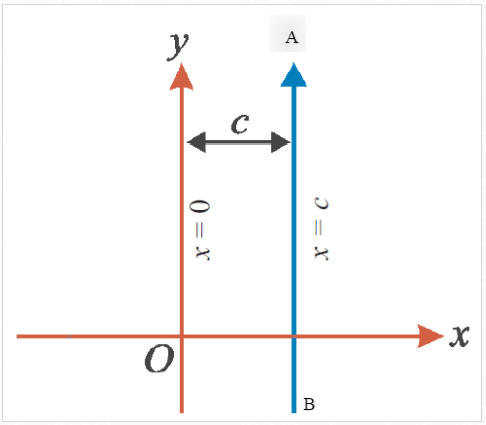
Let AB be a straight line parallel to the y-axis at some distance assume ‘a’ units from the Y-axis. From the below figure, it is clear that line L is parallel to y-axis and passing through the value ‘a’ on the x-axis. So, the equation of a line parallel to y-axis is X=a.

equation of a line parallel to y-axis figure

The equation of the y-axis is x = 0, as, the y-axis is a parallel to itself at a distance of 0 from it.

Or

If a straight line is parallel and to the left of the x-axis at a distance a, then its equation is x = -a.

Different Forms of Equations of a Straight Line

In addition to the equation of a line parallel to the y-axis, let’s have a glance at some various forms of the equation of a straight line. Here is the list of different forms of the equation of a straight line:

  • Slope intercept form
  • Point slope form
  • Two-point form
  • Intercept form
  • Normal form
  • Point-slope form

Worked-out Examples on Equation of y-axis and Equation of a line parallel to the y-axis

1. Write the equation of a line parallel to y-axis and passing through the point (−2,−4).

Solution:

As we know that the Equation of line parallel to y-axis is x=a.

The given point (−2,−4) lies on our required line, so that

⟹ x = -2

Therefore, the equation of the required line is x=−2. 

2. Calculate the equation of a straight line parallel to y-axis at a distance of 4 units on the left-hand side of the y-axis.

Solution: 

According to the statements that we know about the equation of a straight line is parallel and to the left of the x-axis at a distance a, then its equation is x = -a.

Hence, the equation of a straight line parallel to y-axis at a distance of 4 units on the left-hand side of the y-axis is x = -4, 

3. Find the equation of a line parallel to the y-axis and passing through the point (5,10)?

Solution:

A line parallel to the y-axis will be of form x=a

Given the line passes through (5,10)

So, x=5

Hence, The equation of a line is x – 5 = 0.

FAQs on Line Parallel to Y-Axis

1. What is the equation representing Y-axis?

The equation of a line which is representing the y-axis is x=0.

2. How to calculate the equation of a line?

Typically, the equation of a line is addressed as y=mx+b where m is the slope and b is the y-intercept.

3. What is the formula for point-slope form?

The formula for Point-Slope of the line by the definition is, m = \(\frac { y − y1 }{ x − x1 } \)

y − y1 = m(x − x1).

Odds and Probability Definitions | Key Difference Between Odds and Probability | Comparison Chart & Examples

Odds and Probability

Odds and Probability: In mathematical concepts, we use odds and probability calculations in many ways like while solving the Playing Cards Probability and calculating the problems like the trains may be late, it may take an hour, to reach home and so forth. Here we will be discussing Odds & Probability Topic. The definitions for both are given in this article.

However, Probability is not similar to odds, as it describes the probability that the event will occur, upon the probability that the event will not occur. So, have a look at the difference between odds and probability provided below. Also, Go through the given solved examples based on Odds and Probability to learn the concept better.

What is the Definition of Odds?

The definition of Odds in the probability of a particular event is the ratio between the number of favorable outcomes of an event to the number of unfavorable outcomes.

In short, odds are defined as the probability that a particular event will occur or not. The range of Odds is from zero to infinity, if the odds is 0, the event is not likely to occur, but if it is ∞, then it is more likely to occur.

What is the Definition of Probability?

In mathematics, the probability is the likelihood of an event or more than one event happening. It denotes the chances of obtaining certain outcomes and can be calculated with the help of simple formula. Also, you can calculate the probability with multiple events by breaking down each probability into separate single considerations and then multiplying each output together to achieve a single likely result. Probabilities constantly range between 0 and 1.

In case, odds are declared as an A to B, the chance of winning then the winning probability can be PW = A / (A + B) while the losing probability is PL = B / (A + B).

Comparison Chart of Odds and Probability

Here is the table of comparison chart to learn about odds and probability basics:

Basis for ComparisonOddsProbability
MeaningOdds refers to the possibilities in favor of the event to the chances against it.Probability refers to the likelihood of occurrence of an event.
Expressed inRatioPercent or decimal
Lies between0 to ∞0 to 1
FormulaOccurrence/Non-occurrenceOccurrence/Whole

Key Difference Between Odds & Probabilities

The key difference between odds and probability are explained here in a simple manner to understand and learn the concepts easily and quickly:

  • The term Odds is utilized to outline that if there are any possibilities of the occurrence of an event or not. Whereas the term ‘probability’ is defined as the possibility of the happening of an event, ie., how frequently the event will happen.
  • Commonly, Odds range from zero to infinity, where zero represents the impossibility of happening of an event, and infinity signifies the possibility of the event. In contrast, probability lies between zero to one. Therefore, the closer the probability to zero, the more are the possibilities of its non-occurrence, and the closer it is to one, the higher are the possibilities of the event.
  • Odds are the ratio of positive events to negative events. However, the probability can be measured by dividing the favorable event by the overall number of events.

Solved Examples on Odds & Probability

1. What is the difference between odds and probability?

Solution:

The difference between odds and probability is as illustrated below:

‘Odds’ of an event are the ratio of success to failure.

Hence, Odds = \(\frac { Success}{ Failures} \)

The ratio of the success to the amount of success and failures is known as the ‘Probability’ of an event.

Therefore, Probability = \(\frac { Success}{ (Success + Failures) } \)

2. A coin is thrown 3 times. What is the probability that at least one tail is taken?

Solution:

Let’s consider the sample space for a better understanding of the possibilities

Sample space = [HHH, HHT, HTH, THH, TTH, THT, HTT, TTT]

Total number of ways = 2 × 2 × 2 = 8.

Possible Cases for Tail = 7

P (A) = \(\frac { 7 }{ 8 } \)

OR

Probability (of getting at least one tail) = 1 – P (no tail)⇒ 1 – (\(\frac { 1 }{ 8 } \)) = \(\frac { 7 }{ 8 } \)

FAQs on Odds Vs Probability

1. How do you convert odds to probability?

For converting odds to probability, we have to divide the odds by 1 + odds. For instance, let’s convert odds of 1/9 to a probability. Now, divide 1/9  by 10/9 to get the probability of 0.10.

2. What are the odds in favor?

The Odds in favor of an event equal to the number of favorable outcomes by the number of unfavorable outcomes.

P(A) = \(\frac { Number of favorable outcomes }{  Number of unfavorable outcomes } \)

3. What is the formula for odds against?

Odds against the probability formula is,

P(A) = \(\frac { Number of unfavorable outcomes }{ Number of favorable outcomes } \)

Common Multiples Definition, Facts & Examples | How to find Common Multiples?

Common Multiples

In the earlier classes of Math, you might have heard of the concept of Common Multiples. It is an important topic and is essential to find patterns in numbers. In this article, we will help you learn all about the Definition of Common Multiples, Facts, and Examples. The Solved Examples on Common Multiples make it easy for you to understand the entire concept quickly and easily.

What are Multiples?

Multiples are the results obtained by multiplying a number with an integer.  Multiples of Whole Numbers are obtained by considering the product of counting numbers and whole numbers.

For example, we can obtain the multiples of 5, 7 by multiplying them with the numbers 1, 2, 3, 4, 5, 6, …..

Multiples of 5 are 5, 10, 15, 20, 25, 30, 35, 40, 45……

Multiples of 7 are 7, 14, 21, 28, 35, 42, 49, 56…..

Common Multiples – Definition

Common Multiple is a whole number that is a shared multiple of two or more numbers. The Multiples that are common to two or more numbers are called the Common Multiples of those Particular Numbers.

Example:

List the Common Multiples of 8, 12

Multiples of 8 are 8, 16, 24, 32, 40, 48, 56, 64, 72, 80, 88, 96,…

Multiples of 12 are 12, 24, 36, 48, 60, 72, 84, 96, 108, 120,  132, 144….

Common Multiples of 8, 12 are 24, 72, 96

How to find Common Multiples of Two or More Numbers?

Go through the below listed simple and easy steps to find out the Common Multiples of Two or More Numbers. They are in the following way

  • The first and foremost step is to assess your numbers.
  • Make a list of multiples for the given numbers.
  • Continue preparing the list until you find two or more common multiples.
  • Then, Identify the common multiples from the multiples list prepared.

Solved Examples on Common Multiples

1. List out the Common Multiples of 5 and 15?

Solution:

Given Numbers are 5 and 15

Multiples of 5 are 5, 10, 15, 20, 25, 30, 35, 40, 45, 50, 55, 60, 65, 70, 75, 80, 85, 90, ….

Multiples of 15 are 15, 30, 45, 60, 75, 90, 105, 120, 135, 150, 165, 180,….

Common Multiples of 5 and 15 are 15, 30, 45, 60,75, 90

2. Find the Common Multiples of 6 and 9?

Solution:

Multiples of 6 are 6, 12, 18, 24, 30, 36, 42, 48, 54, 60…..

Multiples of 9 are 9, 18, 27, 36, 45, 54, 63, 72, 81, 90…..

Common Multiples of 6 and 9 are 18, 36, 54

Conversion of Seconds into Hours Definitions, Formula, Examples | How to Convert Sec to Hr?

Conversion Of Seconds Into Hours

Time is written in terms of Hours, Minutes, Seconds. Time can be converted from one unit to another with the help of conversion formulas. Among all Time conversions, Conversion of Seconds into Hours is the trickest one and highly seek help by students to solve their homework or assignments. To aid your preparation and homework, we have curated the details about seconds to hours conversion like definitions, conversion formula, the procedure to convert sec to hr, and some solved examples on second to hour conversion.

Go ahead and dig deep regarding Conversion of Seconds(sec) into Hours(hr) also look at the Math Conversion Chart to learn more about length, mass, capacity conversions along Time Conversions.

Definitions of Seconds & Hours

Seconds(sec)

A Second is a Unit of Time and its symbol is ‘s or sec’. As per the SI definition, the definition of second is the duration of 9,192,631,770 periods of the radiation corresponding to the transition between the two hyperfine levels of the unperturbed ground state of the caesium 133 atoms at zero kelvins. According to the conversion base, 1 sec = 0.000277778 hr.

Hour(hr)

An Hour is a Unit of Time measurement, determined as 1/24th of a day or 60 Minutes. The Hour is the SI unit of time taken for the Metric System. The abbreviation of Hours is ‘hr’. As per the conversion base, 1 hr = 60 Minutes or 3600 Seconds.

Formula for Converting Second to Hour

Have a glance at the provided box and learn the mathematical formula which is used for converting seconds to hours:

Hours = Seconds ÷ 3,600

Second to Hour Conversion Table | Sec to Hr Conversion Chart

Here is the list of seconds converted to hours. Check out the conversion chart of sec to hrs and get some idea of How much is particular second in Hours.

SecondsHoursHours, Minutes & Seconds
10.0002780 hr 0 min 1 sec
1000.0277780 hr 1 min 40 sec
2000.0555560 hr 3 min 20 sec
3000.0833330 hr 5 min
4000.1111110 hr 6 min 40 sec
5000.1388890 hr 8 min 20 sec
6000.1666670 hr 10 min
7000.1944440 hr 11 min 40 sec
8000.2222220 hr 13 min 20 sec
9000.250 hr 15 min
1,0000.2777780 hr 16 min 40 sec
2,0000.5555560 hr 33 min 20 sec
3,0000.8333330 hr 50 min
3,60011 hr
4,0001.11111 hr 6 min 40 sec
5,0001.38891 hr 23 min 20 sec
6,0001.66671 hr 40 min
7,0001.94441 hr 56 min 40 sec
8,0002.22222 hr 13 min 20 sec
9,0002.52 hr 30 min
10,0002.77782 hr 46 min 40 sec
20,0005.55565 hr 33 min 20 sec
30,0008.33338 hr 20 min
40,00011.1111 hr 6 min 40 sec
50,00013.8913 hr 53 min 20 sec
60,00016.6716 hr 40 min
70,00019.4419 hr 26 min 40 sec
80,00022.2222 hr 13 min 20 sec
86,4002424 hr
90,0002525 hr
100,00027.7827 hr 46 min 40 sec

Conversion of Seconds into Hours Process | How to Convert Seconds(sec) to Hours(hr)?

One of the easiest methods to convert seconds to hours is to divide the number of seconds by 3,600. In order to explain the reason for this conversion, first set up the conversion tables where first convert the number of seconds to minutes, and then the number of minutes to hours. These can be helpful to convert the sec to hr easily.

If not, you may also make use of the simple conversion formula to convert seconds to hours. The formula for second to hour unit of time conversion is given here.

We know 1 second is equal to 1/3600 hour

Hence, the Seconds to Hours Conversion Formula is given as

Hours = Seconds ÷ 3,600

Once, you have the formula for conversion between sec to hr just apply the given inputs in the formula and find out the hours within less time. For more learning knowledge, please go with the Conversion Of Seconds Into Hours solved examples explained by us and learn completely how to convert Sec to Hr easily within no time.

View Related Articles

Worked-out Examples on Conversion of Seconds(sec) into Hours(hr)

1. Convert 1500 seconds into hours?

Solution:

First, we start converting seconds into minutes and then minutes into hours.

As we know the formula for conversion of sec into min, so apply it in step 1:

1500 seconds = (1500 ÷ 60) minutes (1 second = 1/60 minute)

= 25 minutes

Now, convert the minutes into hours by using the conversion formula:

= (25 ÷ 60) hours (1 minute = 1/60 hour)

= 0.416667 hours or 0 hr 25 min.

Therefore, 1500 seconds(sec) = 0 hr 25 min.

2. Convert 76 Seconds into Hours using conversion formula?

Solution:

We have 76 seconds and the conversion formula for Seconds(sec) to Hours(hr) conversion is as follows:

Hours = Seconds ÷ 3600

Now, apply the given time values in the formula and covert the sec to hr,

Hours = 76 ÷ 3600

= 0.021111 hr or 0 hr 1 min 16 sec

Hence, 76 seconds in hours is 0.021111 hr or 0 hr 1 min 16 sec. 

FAQs on Converting Seconds to Hours

1. What is the formula for converting Seconds to Hours?

The conversion formula for seconds to hours is Hours = Seconds ÷ 3600

2. How much is 15 seconds in hours? 

15 sec = 0.004167 hr or 15 sec = 0 hr 0 min 15 sec.

3. How to convert Sec to Hr?

As there are 3600 seconds in an hour to convert from Seconds to hours divide the time value by 3600.

How to Find the Percent of a Given Number? | Definition & Word Problems on Percentage

How To Find The Percent Of A Given Number

Percentages topic is widely utilized by the people in various fields like shopping for deals, buying things at veggie or fruit markets, etc. Also, it is commonly used in accounting and finance scenarios like Profits, Interest Rates, Sales, and Taxation. Moreover, the percentage is helpful for grading the student’s annual marks. So, finding percentages can be tricky but an easy mathematical process. If you have to calculate the ratio or portion of a quantity then you need help with percentages. Hence, check out this article properly and learn what is percentage, how to find the percent of a given number or quantity along with worked-out examples.

What is Percentage?

A percentage is a number or ratio as a fraction of 100. In other words, the word percent indicated one part in a hundred. Always, the number of a percentage is represented by a percent symbol (%) or simply “percent”. Here is the percentage illustration:

5 %, 10 %, 33 \(\frac { 1 }{ 6} \) %, 75 %

For example, 60 percent (or 60%) means 60 out of 100.

However, the percentage is the outcome when a particular number is multiplied by a percent. So, learn how to calculate the percentages for a given number or quantity in the below modules with solved word problems.

How to Find the Percent of a Given Number?

To calculate the % of a given number so easily, please follow the below steps:

  • Take the number, say x.
  • Let the percent as p%.
  • To find the formula is P% of x
  • Now, write these as a proportion as \(\frac { P }{ 100 } \) = \(\frac { ? }{ x } \)
  • Finally, do cross multiplication and calculate the value of the “?” mark.

Solved Examples on Percentages

1. What is 3 ⅓ of 60 km?

Solution :

Given expression is 3 ⅓ of 60 km

\(\frac { 3 ⅓ }{ 100 } \) = \(\frac { x }{ 60 } \)

Now, Convert mixed fraction to improper fraction

\(\frac { 10 }{ 3 } \)/100 = \(\frac { x }{ 60 } \)

\(\frac { 10 }{ 3 } \) x100 = \(\frac { x }{ 60 } \)

\(\frac { 10 }{ 300 } \) = \(\frac { x }{ 60 } \)

Cross multiply and find the x value

300x = 10 . 60

300x = 600

x = \(\frac { 600 }{ 300 } \)

x = 2 km.

2. Find 41% of 400.

Solution:

Given is 41% of 400

Now find the % of a given number

41% of 400 = 41 × \(\frac { 1 }{ 100 } \) × 400

= \(\frac { 41 }{ 100 } \) × 400

= \(\frac { 41 × 400 }{ 100 } \)

= \(\frac { 16400 }{ 100 } \) (Finally divide 16400 by 100 and get the result)

= 164.

3. What is the sum of the money of which 5 % of $750?

Solution:

Let the required sum of money be $m.

5 % of $m = $750

⇒ \(\frac { 5 }{ 100 } \) × m = 750

⇒ m = \(\frac { 750 × 100 }{ 5 } \)

⇒ m = 15000

Hence, sum of the money = $15000.

4. Find 17% of $4500?

Solution:

Given expression is 17% of $4500

Now, convert 17% into decimal form

Then write it as 0.17 x $4500

Multiply  17 × $4,500 = $76,500

Finally, keep the decimal point

Therefore the result for 17% of $4500 is $765.00

5. The price of a TV was reduced by 40% to $500. What was the original price?

Solution:

To find the original price,

First, determine the percentage of the actual price by subtracting 40% from 100.

Later, Product the final price by 100 ie., 500 x 100 = 50000.

Now, divide the result by the percentage computed in step 1 above.

Then, \(\frac { 50000 }{ 60 } \) = $ 833.33

The actual price of a TV is $ 833.33.

Ascending Order or Descending Order – Definition, Symbol, Ordering, Facts, and Examples

Ascending Order or Descending Order

Ascending order is arranging or placing numbers from smallest to largest. In ascending order, the numbers are in increasing order. For example, 1, 2, 3, etc are in ascending order. The reverse process of ascending order is called descending order. The decreasing order is arranging or placing numbers from largest to smallest. Examples for decreasing order are 3, 2, 1. The ascending order is represented by the less than symbol ‘<‘ where descending order is represented by the greater than symbol ‘>‘.

Ascending Order – Definition & Symbol

Ascending order is the arrangement of numbers from the lowest to the highest. In the case of Ascending Order, the Smallest Number will be on the top of the list when sorted. To represent the order of numbers we use the symbol “<”

Examples of Ascending Order

  • For numbers or amounts, the ascending order is 5, 8, 11, 18, 23, 31.
  • For words and letters, the ascending order is A, B, C, D, E……Y, Z.
  • Also, for dates, the ascending order will be from the oldest dates to recent dates.

Problems on Ascending Order

1. Arrange the below numbers in an Ascending Order

(i) 2, 14, 3, 59, 46
(ii) 25, 8, 97, 47, 3
(iii) 5, 6, 82, 31, 24
(iv) 6, 7, 35, 14, 4
(v) 24, 8, 15, 94, 119

Solution:
(i) Given numbers are 2, 14, 3, 59, 46.
Compare the values and write down the smallest number.
Write down the smallest number first, and then compare with all the remaining numbers with the same number of digits.
2, 3, 14, 46, 59.

The Ascending Order of the numbers is 2, 3, 14, 46, 59.

(ii) Given numbers are 25, 8, 97, 47, 3.
Compare the values and write down the smallest number.
Write down the smallest number first, and then compare with all the remaining numbers with the same number of digits.
3, 8, 25, 47, 97.

The Ascending Order of the numbers is 3, 8, 25, 47, 97.

(iii) Given numbers are 5, 6, 82, 31, 24.
Compare the values and write down the smallest number.
Write down the smallest number first, and then compare with all the remaining numbers with the same number of digits.
5, 6, 24, 31, 82.

The Ascending Order of the numbers is 5, 6, 24, 31, 82.

(iv) Given numbers are 6, 7, 35, 14, 4.
Compare the values and write down the smallest number.
Write down the smallest number first, and then compare with all the remaining numbers with the same number of digits.
4, 6, 7, 14, 35.

The Ascending Order of the numbers is 4, 6, 7, 14, 35.

(v) Given numbers are 24, 8, 15, 94, 119.
Compare the values and write down the smallest number.
Write down the smallest number first, and then compare with all the remaining numbers with the same number of digits.
8, 15, 24, 94, 119.

The Ascending Order of the numbers is 8, 15, 24, 94, 119.

Descending Order – Definition & Symbol

Descending Order is the arrangement of numbers from the highest to the lowest. Descending Order is the Contradictory of Ascending Order. Here Numbers are arranged from bigger to smaller. The number that is largest among the sorted list will fall at the top of the Descending Order List and the Smallest Number will be at the Last. It is denoted by the symbol  ‘>’.

Examples of Descending Order

  • For numbers or amounts, the descending order is 31, 23, 18, 11, 8, 5.
  • For words and letters, the descending order is Z, Y, X, W……B, A.
  • Also, for dates, the descending order will be from the recent dates to the oldest dates.

Problems on Descending Order

1. Arrange the below numbers in an Descending Order

(i) 2, 14, 3, 59, 46
(ii) 25, 8, 97, 47, 3
(iii) 5, 6, 82, 31, 24
(iv) 6, 7, 35, 14, 4
(v) 24, 8, 15, 94, 119

Solution:
(i) Given numbers are 2, 14, 3, 59, 46.
Compare the values and write down the highest number.
Write down the highest number first, and then compare with all the remaining numbers with the same number of digits.
59, 46, 14, 3, 2.

The Descending Order of the numbers is 59, 46, 14, 3, 2.

(ii) Given numbers are 25, 8, 97, 47, 3.
Compare the values and write down the highest number.
Write down the highest number first, and then compare with all the remaining numbers with the same number of digits.
97, 47, 25, 8, 3.

The Descending Order of the numbers is 97, 47, 25, 8, 3.

(iii) Given numbers are 5, 6, 82, 31, 24.
Compare the values and write down the highest number.
Write down the highest number first, and then compare with all the remaining numbers with the same number of digits.
82, 31, 24, 6, 5.

The Descending Order of the numbers is 82, 31, 24, 6, 5.

(iv) Given numbers are 6, 7, 35, 14, 4.
Compare the values and write down the highest number.
Write down the highest number first, and then compare with all the remaining numbers with the same number of digits.
35, 14, 7, 6, 4.

The Descending Order of the numbers is 35, 14, 7, 6, 4.

(v) Given numbers are 24, 8, 15, 94, 119.
Compare the values and write down the highest number.
Write down the highest number first, and then compare with all the remaining numbers with the same number of digits.
119, 94, 24, 15, 8.

The Descending Order of the numbers is 119, 94, 24, 15, 8.

FAQs on Ascending or Descending Order

1. What does Ascending Order mean?

When the Numbers are arranged in increasing order i.e. from smallest to largest then they are said to be in Ascending Order.

2. What does Descending Order mean?

Descending Order or Decreasing Order is the way of arranging numbers from biggest to smallest.

3. What are the signs used to represent Ascending Order and Descending Order?

Ascending order is denoted by the ‘<‘ (less than) symbol, whereas descending order is denoted using the ‘>’ (greater than) symbol.

Regular and Irregular Polygon Definition, Formula, Examples | Difference Between Regular and Irregular Polygons

Regular and Irregular Polygon

Learn Regular and Irregular Polygon Concepts and properties along with examples. Know the difference between Regular Polygons and Irregular Polygons and find out the given shape is a regular or irregular polygon. Check out the step-by-step process to find the given shape is a polygon or not? Also, we have given clear details about Regular and Irregular Polygons. Go through the Solved Examples on Regular and Irregular Polygons and learn how to solve problems on them quickly and easily.

Regular Polygon – Definition

A polygon that consists of equal sides with equal length and also by having equal angles called a regular polygon.

Examples of a Regular Polygon

Let us have a look at the different Examples of a Regular Polygon below.

Equilateral Triangle:
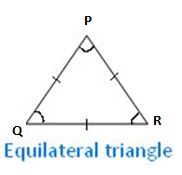
An equilateral triangle is a triangle in which all three sides have the same length and all angles are equal.
In the below figure of an equilateral triangle PQR there are three sides i.e., PQ, QR, and RP are equal and there are three angles i.e., ∠PQR, ∠QRP, and ∠RPQ are equal.
Therefore, an equilateral triangle is a regular polygon.

equilateral triangle

Square:
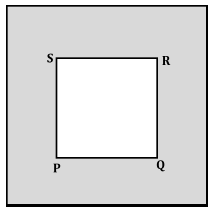
A Square is a quadrilateral that has four equal sides and four equal angles.
In the below figure of a square PQRS there are four sides i.e., PQ, QR, RS and SP are equal and there are four angles i.e., ∠PQR, ∠QRS, ∠RSP, and ∠SPQ are equal.

Therefore, a square is a regular polygon.

square 2

Regular Pentagon:
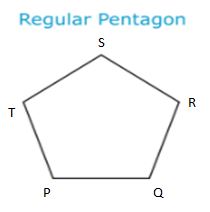
A polygon is regular when all angles are equal and all sides are equal.
In the below figure of a regular pentagon PQRST there are five sides i.e., PQ, QR, RS, ST, and TP are equal and there are five angles i.e., ∠PQR, ∠QRS, ∠RST, ∠STP, and ∠TPQ are equal.

Therefore, a regular pentagon is a regular polygon.
regular pentagon

Irregular Polygon – Definition

A polygon that consists of unequal sides with unequal lengths and also having unequal angles called an irregular polygon.

Examples of Irregular Polygon

Let us have a look at the different Examples of a Regular Polygon below.

Scalene Triangle:
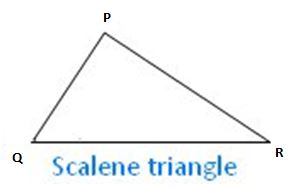
A scalene triangle is a triangle that has all three sides are in different lengths, and all three angles are of different measures.
In the adjoining figure of a scalene triangle PQR there are three sides i.e., PQ, QR, and RS are unequal and there are three angles i.e., ∠PQR, ∠RSP, and ∠SPQ are unequal.

Therefore, a scalene triangle is an irregular polygon.
Scalene triangle

Rectangle:
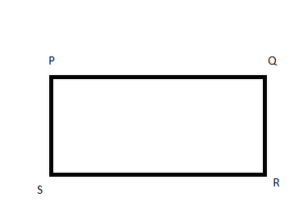
A Rectangle is a four sided-polygon, having all the internal angles equal to 90 degrees. Each angle is at right angles. The opposite sides of the rectangle are equal in length which makes it different from a square.
In the adjoining figure of a rectangle PQRS there are four sides i.e., PQ, QR, RS, and SP where the opposite sides are equal i.e., PQ = RS, and QR = PS. So, all the sides are not equal to each other.
Similarly, among the four angles i.e., ∠PQR, ∠QRS, ∠RSP, and ∠SPQ where the opposite angles are equal i.e., ∠PQR = ∠RSP and ∠QRS = ∠SPQ. So, all the angles are not equal to each other.

Therefore, a rectangle is an irregular polygon.
rectangle PQRS

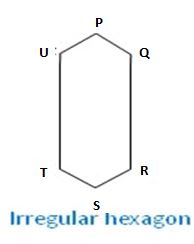
Irregular Hexagon:
An irregular hexagon is a six-sided shape whose sides are not equal.
In the adjoining figure of an irregular hexagon PQRSTU there are six sides i.e., PQ, QR, RS, ST, TU, and UP are equal and there are six angles i.e., ∠PQR, ∠QRS, ∠RST, ∠STU, ∠TUP, and ∠UPQ are equal.

Therefore, an irregular hexagon is an irregular polygon.
irregular hexagon

Rounding Decimals to the Nearest Whole Number Definition, Rules, Examples | How to Round to the Nearest Whole Number?

Rounding Decimals to the Nearest Whole Number

Rounding Decimals to the Nearest Whole Number guide is available here. Check the steps to find out the process of rounding the decimals worksheet. Make use of number lines and visual models to round decimal numbers. Know the definition, rules, and methods to round the decimal values. Follow the below sections to gather the information regarding rounding decimal values to the nearest whole numbers. Also, check the solved problems and solution procedure.

Rounding Decimals to the Nearest Whole Number – Definition

The rounding of decimal values is a process to estimate a particular number in context. The rounding of decimals refers to the gaining of accuracy to a certain degree. We can easily round the decimals to the nearest whole numbers i.e., tenths or hundreds. With the help of rounding decimals to the nearest whole numbers, you can easily estimate the solution quickly and easily. It is also used to get the average score of the pupil in the class. There are various procedures to round off the whole numbers.

Basic Rules of Rounding to Whole Numbers

While rounding to the nearest whole numbers, you have to follow a few basic rules.

  • Identify the value in the place you are rounding to. The smaller value you consider at the place value, the most accurate will be the final result.
  • Look at the next smallest number in place value is the number to the right of the place value which you are rounding to. For suppose, if you are looking to round to the nearest ten, then you would look at the one’s place.
  • If the number in the succeeding smallest place value is less than five (0, 1, 2, 3, 4 or 5), you have to leave the digit you want to round as a whole number to as in. Any digits after the tens place value (include the smallest place value you looked at) drop-off it or become zeros which are located after the decimal point. It is called rounding down.
  • If the number in the succeeding smallest place value is greater than or equal to five (5, 6, 7, 8, or 9), you have to increase the digit value you are rounding to +1 (one). As seen in the previous step, the remaining digits before the decimal point become zero, and any values after the decimal point are dropped. It is called rounding up.

Also, Read: Round off to Nearest 100

How to Round to the Nearest Whole Number?

There are a few steps to round numbers to the nearest whole number.

Step 1: First, look at the number that you want to round.

Step 2: As you have to round the number to the nearest whole number, we mark the number in the one’s place.

Step 3: Now look at the digit which is at right to the decimal point, i.e., tenth’s place

Step 4: (i) If the number in the tenth column has 0,1,2,3,4, we have to round down the digit at the ones place to the nearest whole number.

(ii) If the number in the tenths columns has 5,6,7,8 or 9, we have to round up the digit at one’s place to the nearest whole number.

Step 5: You have to remove all the numbers after the decimal point. The desired answer will be the left-out number.

Rounding to Nearest Tenths

We have to follow the given steps in rounding numbers to the nearest tenths.

Step 1: First, look at the number that you want to round.

Step 2: As you have to round the number to the nearest tenths, we mark the number in the tenths place.

Step 3: Now look at the digit which is at right to the tenth’s point, i.e., hundredth’s place

Step 4: (i) If the number in the hundredth’s column has 0,1,2,3,4, we have to round down the digit at the tenths place to the nearest tenths.

(ii) If the number in the hundredth’s column has 5,6,7,8 or 9, we have to round up the digit at the tenth’s place to the nearest tenths.

Step 5: You have to remove all the numbers after the tenths column. The desired answer will be the left out number.

Rounding to Nearest Hundredths

We have to follow the given steps in rounding numbers to the nearest hundredths

Step 1: First, look at the number that you want to round.

Step 2: As you have to round the number to the nearest hundredths, we mark the number in the hundredth’s place.

Step 3: Now look at the digit which is at right to the hundredth’s point, i.e., thousandth’s place

Step 4: (i) If the number in the thousandth’s column has 0,1,2,3,4, we have to round down the digit at the hundredth’s place to the nearest hundredth’s.

(ii) If the number in the thousandth’s column has 5,6,7,8 or 9, we have to round up the digit at the hundredth’s place to the nearest hundredth’s.

Step 5: You have to remove all the numbers after the hundredth’s column. The desired answer will be the left out number.

How to Round Decimals Using a Calculator?

Follow the below procedure to round decimals to the whole numbers.

Step 1: Enter the decimal or the number in the given input field.

Step 2: Find the button “round” and click on it to get the final result.

Step 3: You will notice the value that is displayed in the output field.

Examples on Rounding Numbers to Nearest Whole Number

Problem 1:

Consider the number 46.8. Round the digit to the nearest whole number?

Solution:

As the given number = 46.8

The number in the tenths place = 8 which is greater than 5

As the value is greater than 5, then the whole part of the number increases with 1 and the number to the right of the decimal value means the tenth’s place becomes zero.

Hence, the final value of the rounded-up = 47

Problem 2:

Consider another number 45.379. Round the digit to the nearest whole number?

Solution:

As the given number is 45.379

The ones digit in the number = 5 and tenths digit is 3

Since the value in the tenths digit is 3, then the one’s digit will remain unchanged, i.e., 45.379

Rewrite the digit by dropping the decimal point and all the digits after it.

Therefore, 45 is the final answer.

Problem 3:

Round the following digits to the nearest tenths: 0.437

Solution:

As the given number is 0.437

The hundredth’s digit is 3 and therefore the tenth digit will remain unchanged

As the hundredth’s digit is less than 5, we have to drop off the remaining digits.

The final answer is 0.4

Read a Watch or a Clock | How to Read A Time Shown in Analogue Clock or Digital Clock?

how to read a watch or a clock

Read a Watch or Clock: Reading a clock or watch is an ability to master easily in a short time and with less effort. There are various types of clocks like Analogue clock, Digital clock, electronic word clock, musical clock, etc. Analogue clocks are distributed over a circle and move the hour hand and minute hand individually. This helps people to read a time from a clock or watch.

Whereas in the digital type of clock, you can easily read the hour and minutes. Well, reading a watch or clock can be confused when it comes to Roman numerals and military time. With a bit of hard work and smart work, you guys can read a clock or watch with ease. So, practice more by viewing the below modules regarding How to Read a Watch or a Clock.

How to Read a Watch or a Clock?

There are two methods to read a watch or clock. The first method is reading an Analogue clock and the second method is reading a Digital clock. Let’s start the process of the first method and learn the concept to read a watch or clock easily.

Method 1: Reading an Analogue Clock

  • In step 1, we will discuss learning how a clock is divided. A clock is split into 12 sections. At the top, you will see the number ’12’. On the right-hand side, you will see a ‘1’ followed by 2, 3, 4, 5, ..so on up to 11 in a clockwise direction.
  • Here the numbers labelling each section are the hours.
  • The sections between the two numbers are divided into 5 divisions/segments.
  • Above we have seen the numbers arranged in the clock.
  • In a clock, there are 2 hands. A little hand indicated the hours and a big hand indicates minutes. For instance, if the little hand is showing ‘1’, then we have to read the time like this 1 o’clock.
  • Now, use the big hand and read the minutes. To read the minutes, first, take the indicated number and multiply it by 5 to get the minutes.
    • If the big hand is pointing to “3,” you’ll know that it is 15 minutes past the hour.
    • If the big hand is between “1” and “2,” note what dash it is pointing to. For example, if it is on the 3rd dash after the “1,” it is 8 minutes past the hour. (1 x 5 + the number of dashes).
  • After learning how to read hour and minutes, you can tell time easily. For instance,
    • If the little hand is pointing to “2” and the big hand is pointing to “12,” it is “two o’clock.”
    • If the little hand is pointing to “3” and the big hand is pointing to “2,” it is “3 hours 10 minutes” or “ten minutes past three.”
  • To tell AM or PM, first, we have to know the time of day. From midnight to noon the next day, the time is in AM. From noon to midnight, the time is in PM.

Method 2: Reading a Digital Clock

  • The digital clock is the opposite of the analogue clock. It displays only two numbers separated by a colon.
  • The first number on a digital clock indicates the hours. If the first number reads “7”, then it is read as 7 o’clock hour.
  • Now, come to the second number on a digital clock or watch, which is found after the colon, tells the minutes into the hour. For instance, if it displays 12, then it is read as 12 minutes into the hour.
  • Finally, put them together to read the exact time. For example, if the clock displays ‘7:12’ then it means 7 hours 12 minutes, or seven-twelve, or twelve past seven.
  • Also, to identify whether its AM or PM, some digital clocks show AM or PM directly on the clock.

Solved Examples on How to Tell Time in English?

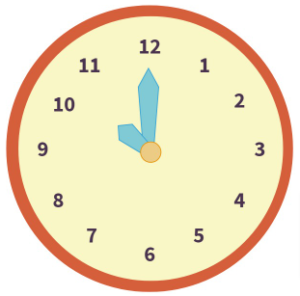
1. Read the time shown in the given clock?

reading analogue clock or watch to tell time

Solution:

In the given figure, the hour hand is showing the number 10 then 10 hours and the minute hand is showing the number 12 then 0 minutes. So, we can read it as a 10 o’clock.

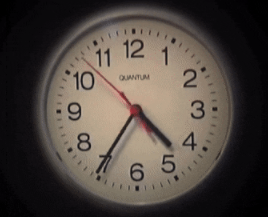
2. Read the time shown in the below clock image?

how to read a clock or watch example image

Solution:

From the given clock image, the hour hand is indicating between 4 and 5. It is almost near to 5 but for now, we will read as a 4 hour or 4 o’clock.

The minute hand is indicating 7 then 7 x 5 is 40. So, we read as 40 minutes.

By joining both together, we read it as 4 hours 40 minutes or 40 minutes past 4. 

Cardinal Number of a Set Definition, Examples | How to find the Cardinal Number of a Set?

Cardinal Number of a Set

Cardinal Numbers are Numbers that are used for counting something. They are also called the Cardinals. Cardinals are meant by how many of anything is existing in a group. In other words, cardinal numbers are a collection of ordinal numbers. Learn about the Cardinal Number of a Set Definition, Solved Examples explained in detail in the further modules.

Cardinal Number of a Set – Definition

The Number of Distinct Elements present in a finite set is called the Cardinal Number of a Set. Usually, we define the size of a set using cardinality. The Cardinal Number of a Set A is denoted as n(A) where A is any set and n(A) represents the number of members in Set A.

Consider a set of even numbers less than 15.

Set A = {2, 4, 6, 8, 10, 12, 14}

As Set A has 7 elements, the Cardinal Number of the Set is n(A) = 7

Note:

(i) Cardinal number of an infinite set is not defined.

(ii) Cardinal number of the empty set is 0 since it has no element.

Also, Check:

How to find the Cardinal Number of a Set?

1. Find the cardinal number of the following set

E = { x : x < 0, x ∈ N }

Solution:

x<0 means negative integers and they don’t fall under Natural Numbers.

Therefore, the above set will not have any elements

Cardinal Number of Set E is n(E) =0

2. Find the Cardinal Number of the Following Set

Q = { x : – 4 ≤ x ≤ 3, x ∈ Z }

Solution:

Given Q = { x : – 4 ≤ x ≤ 3, x ∈ Z }

x={-4, -3, -2, -1, 0, 1, 2, 3 }

Number of Elements in the above set is 8

Therefore, Cardinal Number of Set Q is n(Q) = 8

3. Find the Cardinal Number of the Set

A = { x : x is even prime number }

Solution:

Among all the prime numbers 2 is the only even prime number and the set has only one element

A ={2}

Cardinal Number of a Set n(A) = 1

4. Set D = {3, 4, 4, 5, 6, 7, 8, 8, 9}

Solution:

We know the cardinal number of a set is nothing but the number of distinct elements in the set

Cardinal Number of Set D is n(D) = 7

5. Find the Cardinal Number of a Set X = {letters in the word APPLE}

Solution:

Set X = {letters in the word APPLE}

We know the cardinal number of a set is nothing but the number of distinct elements in the set

x = {A, P, L, E}

Cardinal Number of Set n(X) = 4

6. Find the Cardinal Number of a Set

P = {x | x ∈ N and x2 <25}

Solution:

Given P = {x | x ∈ N and x2 <25}

Then P = {1, 2, 3, 4}

Cardinal Number of Set P is 4 and is denoted by n(P) = 4

Perimeter of a Triangle Definition, Formula & Examples | How to Find the Perimeter of a Triangle?

Perimeter of a Triangle Definition, Formula & Examples

Polygons are the most important topic among all math concepts. One of the simplest polygons is Triangle and the easiest way to work with polygons is by calculating their perimeter. The term perimeter is a path that encloses an area. It completely refers total length of the edges or sides of a given polygon or a two-dimensional figure with angles. So, make sure you move down the page till to an end and learn the perimeter of a triangle definition, formula, and how to calculate the triangle perimeter easily & quickly.

What is the Perimeter of a Triangle?

The definition of Perimeter of a Triangle is the sum of the lengths of the side of the Triangle. It denotes as,

Perimeter = Sum of the three sides

In real-life problems, a perimeter of a triangle can be useful in building a fence around the triangular parcel, tying up a triangular box with ribbon, or estimating the lace required for binding a triangular pennant, etc.

Always, the result of the triangle perimeter should be represented in units. If the side lengths of the triangle are measured in centimeters, then the final result needs to be in centimeters.

Formula to Calculate Perimeter of Triangle

The basic formula is surprisingly uncomplicated. Simply add up the lengths of all of the triangle sides and you get the perimeter value of the given triangle. In the case of the triangle, if the sides are a,b,c then the perimeter of a triangle formula is P = a + b + c.

How to Find the Perimeter of a Triangle?

Between Area and Perimeter of a Triangle calculation, finding the perimeter of the triangle is the easiest one and it has three ways to calculate the triangle perimeter. All the three ways used to find the triangle perimeter are mentioned here for your sake of knowledge and understanding the concept efficiently. The ways to find the perimeter of a triangle are as follows:

  1. The first & simple way is when side lengths are given, then we have to add them together to get the perimeter of the given triangle.
  2. If we have two sides and then solve for a missing side using the Pythagorean theorem.
  3. In case, we have the side-angle-side information in the given question, then we can solve for the missing side with the help of the Law of Cosines.

For a better explanation of the concept, we have listed out some worked-out examples of calculating the perimeter of a triangle below. Have a look at the solved examples and understand the concept behind solving the perimeter of a polygon ie., a Triangle.

Solved Examples on Finding Perimeter of a Triangle

1. Find the perimeter of the triangle where the three sides of the triangle are 20 cm, 34 cm, 15 cm?

Solution:

Given Sides of the triangle are a = 20 cm, b = 34 c, c = 15 cm

Now, use the Perimeter of Triangle Formula and find the result,

Perimeter = (a + b + c) 

= 20 + 34 + 15 = 69 cm.

2. Find the missing side whose perimeter is 40 cm and two sides of the triangles are 15 cm?

Solution:

Given,

a = 15 cm
b = 15 cm
P = 40 cm

Find c, Let’s assume c=x

Perimeter of the triangle P = a + b + c

40 cm = 15 cm + 15 cm + x

40 cm = 30 cm + x

x = 40 cm – 30 cm

x = 10 cm

Therefore, the length of the third side of the triangle is 10 cm.

FAQs on Calculating Triangle Perimeter

1. What are the types of Triangles and their perimeter formulas?

There are 4 types of triangles. They are listed below with their perimeter formulas:

  1. Equilateral triangle: Perimeter (P) = 3 x l
  2. Right triangle: Perimeter (P) = a + b + c
  3. Isosceles triangle: Perimeter (P) = 2 x l + b
  4. Scalene triangle: Perimeter (P) = b + p + h where h2 = b2 + p2

2. What is the formula of the perimeter of a triangle?

If a triangle has three sides a, b and c, then, the formula for the perimeter of a triangle is Perimeter, P = a + b +c.

3. How do you calculate the perimeter of a triangle with known sides?

If we knew the sides of a triangle, then finding the perimeter is so simple, just apply the perimeter of a triangle formula ie., P = a + b +c. and substitute all the sides and add them together.

Units for Measuring Length | Standard Metric Units of Length & Its Measurements, Definitions & Examples

Units for measuring length

In real-life mathematical tasks, we always do measuring the lengths in various situations. To learn about what is measuring length and what are the units for measuring length, this guide will help you a lot. Hence, gain knowledge about measuring length by understanding various units to measure the length from this page. Also, you may grasp some important information about units of measurements like temperature, time, mass, volume, etc. from our provided Math Conversion Chart.

What is Measuring Length?

Measuring of Length of any object includes in our daily life, we always measure the length of the cloth for dresses, wall-length for wallpapers, and many more other tasks.

You all want to know what is measuring length? Measuring length is a measurement of an object in a unit of length by using measuring tools such as scale or ruler.

For instance, the length of a pen can be measured in inches with the help of a ruler.

What is Length?

Length is determined as “Distance between two points” OR “The maximum extended dimension of an object”. Some of the tools used to measure length are Vernier caliper and Tapes.

Also Check: Units of Mass and Weight Conversion Chart 

What is a Unit of Length?

A unit of length refers any arbitrarily chosen and accepted reference standard for measurement of length. In modern use, the most common units are the metric units, which are utilized across the world. In the United States, the U.S. Customary units are also used mostly. For some purposes in the UK & other countries, British Imperial units are used. The metric system is classified into SI and non-SI units.

Units for Measuring Length

According to the metric system, the standard unit of length is a meter (m). Based upon the measuring of length, the meter can be converted into various units like millimeters (mm), centimeter (cm), and kilometer (km). In accordance with the length conversion charts, the different units of lengths and their equivalents are tabulated below:

Units of Length
10 millimeters (mm)=1 centimeter (cm)
10 centimeters=1 decimeter (dm)
10 centimeters=100 millimeters
10 decimeters=1 meter (m)
10 decimeters=1000 millimeters
10 meters=1 dekameter (dam)
10 dekameters=1 hectometer (hm)
10 dekameters=100 meters
10 hectometers=1 kilometer (km)
10 hectometers=1000 meters

See Related Articles:

Units of Length Definitions & Examples

Length describes how long a thing is from one end to the other.

Metric UnitUS Standard Unit (English or Customary Unit)
Meter (m): Used to measure big lengths.

Example: Length of a classroom.

Kilometer (km): Used to measure very long-distance or lengths.

Example: Distance between two places.

Centimeter (cm): Used to measure small lengths.

Example: Length of a pencil.

Millimeter (mm): Used to measure very short lengths or thicknesses.

Example: Length of a pencil tip.

Yard (yd): It is bigger than a foot.

Example: Length of a football field.

Inch (in): Used to measure the length of small objects.

Example: Length of a bed.

Mile (mi): Used to measure long distances.

Example: Distance between two places.

Foot (ft): Used to measure short distances and heights.

Example: Heights of buildings.

FAQs on Unit of Measuring Length

1. What is the standard unit of measuring length?

‘Meter(m)’ is the standard unit of measuring length

2. Which is the standard tool to measure the length?

The standard tool among all to measure the length of any object is a ‘Ruler’. Just by placing the ruler beside the object and measure the object from start to end with the help of readings given on the ruler or scale.

3. What are the basic units of measurements?

There are seven SI base units and they are as follows:

  • Length – meter (m)
  • Mass – kilogram (kg)
  • Temperature – kelvin (K)
  • Time – second (s)
  • Electric current – ampere (A)
  • Luminous intensity – candela (cd)
  • Amount of substance – mole (mole)

Logarithm Rules Or Log Rules | Expanding Laws of Logarithm | Formulas & Examples

Logarithm Rules Or Log Rules

In this logarithm rules or log rules guide, students and teachers will learn the presented common laws of logarithms, also called ‘log rules’. Mainly, there are four log rules that are helpful in expanding logarithms, condensing logarithms, and solving logarithmic equations. Along with this, you will also find the proofs of these four log rules and additional laws of logarithms for a better understanding of the basic logarithm concept. Whenever you get confused during homework help please check out the basic logarithm rules or log rules prevailing here in this article.

Logarithm Rules Or Log Rules

There are four following math logarithm formulas:

  • Product Rule Law: loga (MN) = loga M + loga N
  • Power Rule Law: loga Mn = n loga M
  • Quotient Rule Law: loga (M/N) = loga M – loga N
  • Change of Base Rule Law: loga M = logb M × loga b

Also Check: Convert Exponentials and Logarithms

Descriptions of Logarithm Rules

Here, we have discussed four log rules along with proofs to grasp the concepts easily and become pro in calculating the logarithm problems. Let’s start with proof 1:

1. Logarithm Product Rule:

The logarithm of the multiplication of x and y is the sum of the logarithm of x and the logarithm of y.

logb(x ∙ y) = logb(x) + logb(y)

Proof of Log Product Rule Law: 

loga(MN) = loga M + loga N

Let loga M = x ⇒ a sup>x = M

and loga N= y ⇒ ay = N

Now ax ∙ ay = MN or, ax+y = MN

Therefore from definition, we have,

loga (MN) = x + y = loga M + loga N [putting the values of x and y]

Corollary: The law is true for more than two positive factors i.e.,

loga (MNP) = loga M + loga N + loga P

since, loga (MNP) = loga (MN) + loga P = loga M+ loga N+ loga P

Therefore in general, loga (MNP ……. )= loga M + loga N + loga P + …….

So, the product logarithm of two or more positive factors to any positive base other than 1 is equal to the sum of the logarithms of the factors to the same base.

Example: Calculate log10(8 ∙ 4)?

The given expression matches the logarithm product rule.

So apply the log rule and get the result,

log10(8 ∙ 4) = log10(8) + log10(4)

2. Logarithm Power Rule:

The logarithm of x raised to the power of y is y times the logarithm of x.

logb(xy) = y ∙ logb(x)

Proof of Log Power Rule Law:

logaMn = n loga M

Let loga Mn = x ⇒ ax = Mn

and loga M = y ⇒ ay = M

Now, ax = Mn = (ay)n = any

Therefore, x = ny or, loga Mn = n loga M [putting the values of x and y].

Example: Find log10(29)?

Given log10(29) is in logarithm power rule. So, apply the log rule and calculate the output:

Hence, log10(29) = 9∙ log10(2).

3. Logarithm Quotient Rule Formula

The logarithm of the ratio of two numbers is the logarithm of the numerator minus the logarithm of the denominator.

loga(x / y) = loga(x) – loga(y)

Proof of Log Quotient Rule Formula:

Let M = ax and N = ay, then it follows that loga(M) = x and loga(N) = y,

We can now prove the quotient rule as follows:

loga (M/N) = loga (ax/ay)

= loga(ax-y)

= x – y [Put the values of x and y]

= loga M – loga N

Corollary: loga [(M × N × P)/(R × S × T)] = loga (M × N × P) – loga (R × S × T)

= loga M + loga N + loga P – (loga R + loga S + loga T)

Example: Calculate log10(10 / 5)

Now apply the log quotient rule and get the result,

Therefore, log10(10 / 5) = log10(10) – log10(5).

4. Logarithm Base Change Rule:

The logarithm of M for base b is equal to the base a log of M divided by the base a log of b.

logb M = loga M/loga b

Proof of Change of base Rule Law:

loga M = logb M × loga b

Assume loga M = x ⇒ ax = M,

logb M = y ⇒ by = M,

and loga b = z ⇒ az = b.

Now, ax= M = by – (az)y = ayz

Therefore x = yz or, loga M = logb M × loga b [putting the values of x, y, and z].

Corollary:

(i) Putting M = a on both sides of the change of base rule formula [loga M = logb M × loga b] we get,

loga a = logb a × loga b or, logb a × loga b = 1 [since, loga a = 1]

or, logb a = 1/loga b

In other words, the logarithm of a positive number a with respect to a positive base b (≠ 1) is equal to the reciprocal of logarithm of b with respect to the base a.

(ii) On the basis of the log change of base rule formula we get,

logb M = loga M/loga b

In other terms, the logarithm of a positive number M in respect of a positive base b (≠ 1) is equal to the quotient of the logarithm of the number M and the logarithm of the number b both with respect to any positive base a (≠1).

List of Some Other Logarithm Rules or Log Rules:

If M > 0, N > 0, a > 0, b > 0 and a ≠ 1, b ≠ 1 and n is any real number, then

(i) loga 1 = 0

(ii) loga a = 1

(iii) a loga M = M

(iv) loga (MN) = loga M + loga N

(v) loga (M/N) = loga M – loga N

(vi) loga Mn = n loga M

(vii) loga M = logb M × loga b

(viii) logb a × loga b = 1

(ix) logb a = 1/loga b

(x) logb M = loga M/loga b

Solved Examples of How to Apply the Log Rules or Logarithm Rules

1. Evaluate the expression ie., log2 4 + log2 8 by using log rules.

Solution:

Given expression is log2 4 + log2 8

First, express 4 and 8 as exponential numbers with a base of 2. Next, apply the logarithm power rule formula followed by the identity rule. Once you finished that, add the resulting values to find the final answer.

log2 4 + log2 8
= log2 22 + log223 [apply power rule]
= 2 log2 2 + 3 log2 2 [apply identity rule]
= 2(1) + 3(1)
= 2+3
= 5
Hence, the answer for the given expression log2 4 + log2 8 is 5.

2. Evaluate the expression with Log Rules: log3 162 – log3 6

Solution:

log3 162 – log3 6

Now, we can’t express the 162 as an exponential number with base 3. Don’t worry, we have another way of solving the expression.

It is possible by applying the log rules in the reverse process. Yes, we can also apply the logarithm rules in reverse if not solved in a direct manner.

Remember that the log expression can be stated as one or a single logarithm number via using the backward Quotient Rule Law. Sounds different right, but so easy to calculate.

Take the given expression, log3 162 – log3 6
= log3 (162/6)
= log3 (27)
= log3 (33)
= 3 log3 3
= 3(1)
= 3

By applying the rules in reverse, we get the result as 3 for the given expression log3 162 – log3 6.

Hence, log3 162 – log3 6 = 3.

Convert Exponentials and Logarithms | Relationship between Exponentials and Logarithms

Convert Exponentials and Logarithms

Are you looking for ways on how to convert from Exponential Form to Logarithmic Form? Then, don’t panic as we will discuss how to change Exponential Form to Logarithmic Form or Vice Versa. Get to know the Definitions of Exponential and Logarithmic Forms. Find Solved Examples on Converting between Exponential and Logarithmic Forms and learn the entire procedure.

Logarithmic Form – Definition

Logarithmic Functions are inverse of Exponential Functions. It tells us how many times we need to multiply a number to get another number. To give us the ability to solve the problem x = by for y

For x>0, b>0 b≠ 1, y = logb x is equivalent to by = x

Example: When asked how many times we’ll need to multiply 2 in order to get 32, the answer is the logarithm 5.

Exponential Form – Definition

Exponents are when a number is raised to a certain power that tells you how many times to repeat the multiplication of a number by itself.

by = x

How to Convert from Exponential Form to Logarithmic Form?

To convert from exponential form to logarithmic form, identify the base of the exponential equation
and move the base to the other side of the equal to sign, and add the word “log”. Do not change anything
but the base, the other numbers or variables will not change sides.

Consider the equation by = x

The equation y = logb x is said to be the Logarithmic Form

by = x is said to be Exponential Form

Two Equations are different ways of writing the same thing.

Solved Examples on Converting Between Exponential Form to Logarithmic Form

1. Convert the 103 = 1000 Exponential Form to Logarithmic Form?

Solution:

103 = 1000

log101000 = 3

In this example, the base is 10 and the base moved from the left side of the exponential equation to the right side of the logarithmic equation, and the word “log” was added.

2. Write the Exponential Equation 3x = 27 in Logarithmic Form?

Solution:

3x = 27

In this example, the base is 3 and the base moved from the left side of the exponential equation to the right side of the logarithmic equation, and the word “log” was added.

x = log327

= log333

= 3log33

= 3.1

= 3

3. Write the Exponential Equation  6y = 98 in Logarithmic Form?

Solution:

Given Equation is 6y = 98

In this example, the base is 6 and the base moved from the left side of the exponential equation to the right side of the logarithmic equation, and the word “log” was added.

y = log6 98