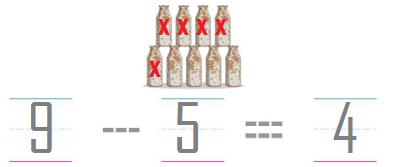
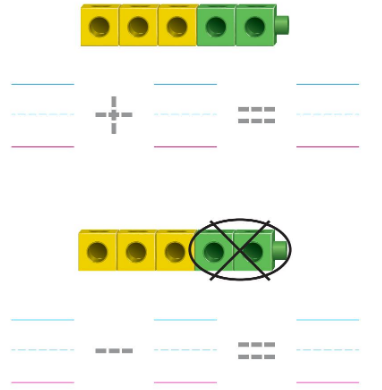
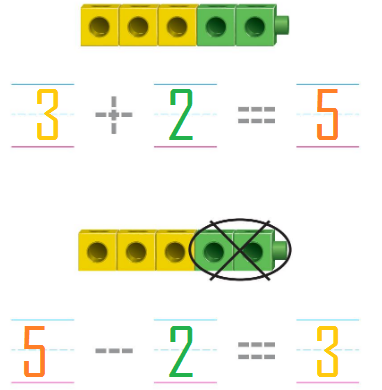
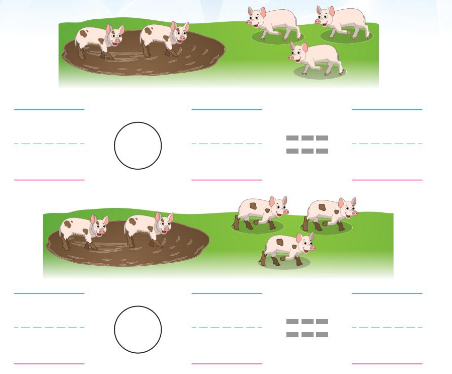
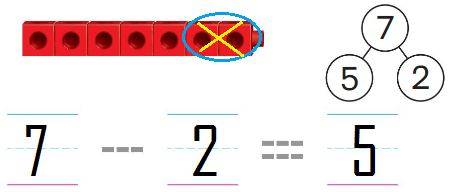
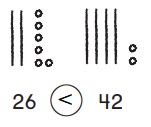
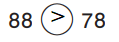
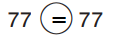
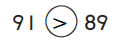
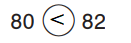
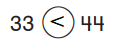
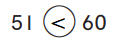
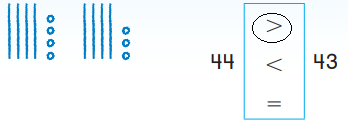
Big Ideas Math Answers Grade K Chapter 7 Subtract Numbers within 10

Big Ideas Math Answers Grade K Chapter 7 Subtract Numbers within 10

Students can learn the concepts of addition and subtraction from Big Ideas Math Answer Grade K. This is the best source for your child to improve their performance skills. Big Ideas Math Grade K Chapter 7 Subtract Numbers within 10 Answer Key is given in the pdf format so that you can prepare in the online or offline mode. They learn counting numbers, subtraction and solve problems by using those concepts. Understand the way of representing the numerical operations with the help of Big Ideas Math Answers Grade K Chapter 7 Subtract Numbers within 10.

Big Ideas Math Book Grade K Answer Key Chapter 7 Subtract Numbers within 10

Children develop strategies for subtracting the whole numbers by referring to our BIM Grade K 7th Chapter Subtract Numbers within 10. This Subtract Numbers within 10 chapter discusses the concepts like Vocabulary, Understand Subtraction, Take From, etc. We provide different methods to solve the problems by using the Big Ideas Math Answers Grade K Chapter 7 Subtract Numbers within 10. Hence Download Big Ideas Math Answer Key Grade K Chapter 7 Subtract Numbers within 10 pdf for free.

Lesson: 1 Understand Subtraction

Lesson: 2 Subtraction: Take From

Lesson: 3 Subtraction: Take Apart

Lesson: 4 Subtraction Number Patterns

Lesson: 5 Practice Subtraction

Lesson: 6 Use a Group of 5 to Subtract

Lesson: 7 Related Facts

Chapter 7: Subtract Numbers within 10

Subtract Numbers within 10 Vocabulary

Directions:
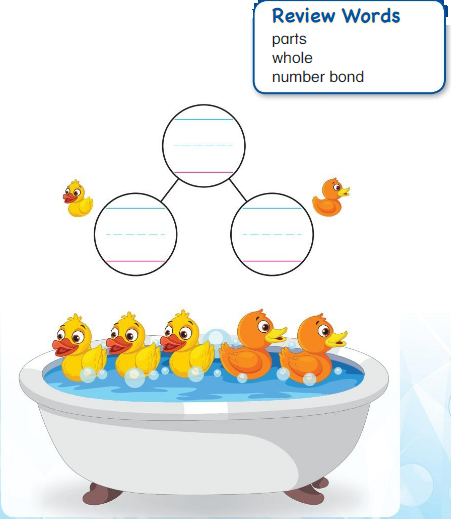
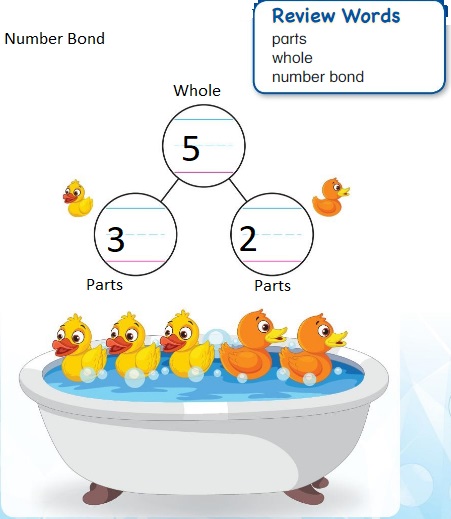
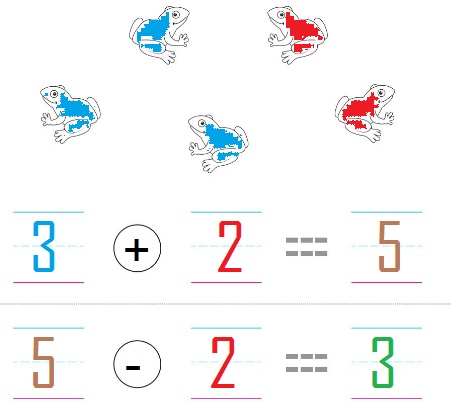
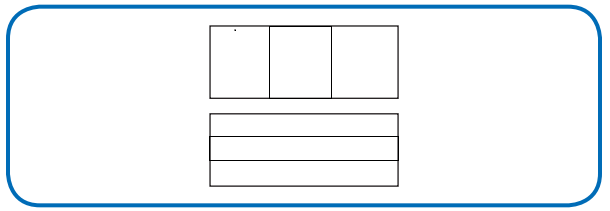
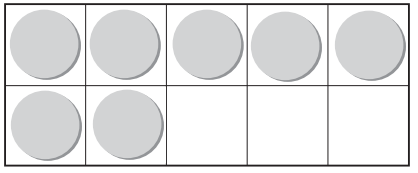
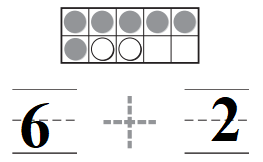
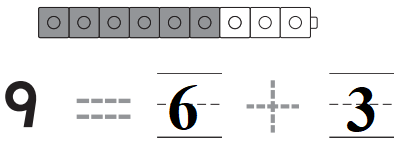
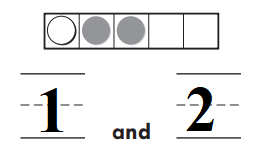
Name the parts and the whole for the group. Then complete the number bond.

Big Ideas Math Answer Key Grade K Chapter 7 Subtract Numbers within 10 v 1

Answer:
Big-Ideas-Math-Answer-Key-Grade-K-Chapter-7-Subtract-Numbers-within-10-v-1

Explanation:
Number bond:
A number bond is a simple addition of two numbers that add up to give the sum. Using number bonds, one can instantly tell the answer without the need for the actual calculation.
Whole: Here we know that 5 is a whole number. The number 3 combines with other number 2 gives the result 5.
Parts: A number can be thought of as a whole made up of different pairs, or parts, added together.

Vocabulary Cards
Big Ideas Math Answer Key Grade K Chapter 7 Subtract Numbers within 10 v 2

Big Ideas Math Answer Key Grade K Chapter 7 Subtract Numbers within 10 v 3

Lesson 7.1 Understand Subtraction

Explore and Grow

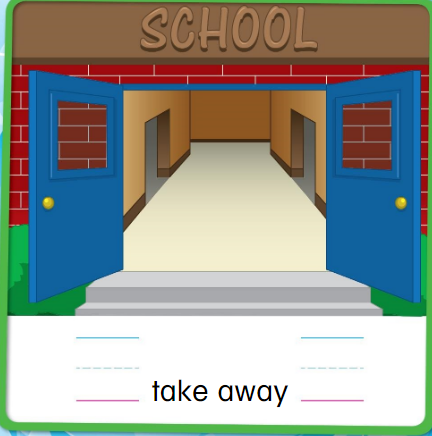
Directions: Use counters to act out the story.

  • There are 4 students in the school. Write the number.
  • 3 students leave the school. Write the number.
  • Tell how many students are left in the school.

Big Ideas Math Answer Key Grade K Chapter 7 Subtract Numbers within 10 7.1 1
Answer:
Big-Ideas-Math-Answer-Key-Grade-K-Chapter-7-Subtract-Numbers-within-10-7.1-1

Explanation:
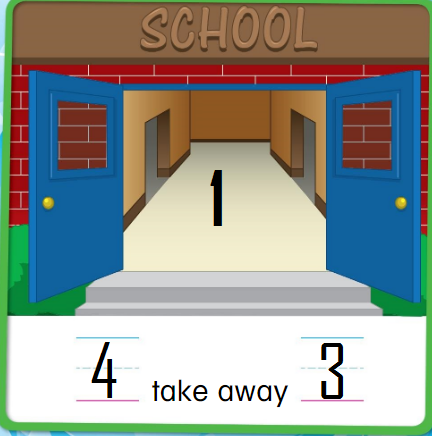
There are 4 students in the school.
In that 3 students leave the school.
Now we have to take away 3 from 4.
4 – 3 = 1
Hence 1 student is left in the school.

Think and Grow

Directions:
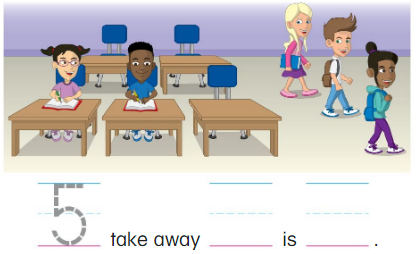
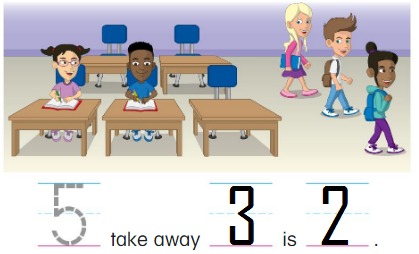
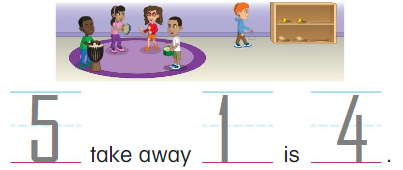
Complete the sentence to tell how many students there are in all how many are leaving, and how many are left.

Big Ideas Math Answer Key Grade K Chapter 7 Subtract Numbers within 10 7.1 2
Answer:
Big-Ideas-Math-Answer-Key-Grade-K-Chapter-7-Subtract-Numbers-within-10-7.1-2

Explanation:
There are 5 students in the class.
Out of them 3 students left the class.
Now we have to find how many students are left in the class.
Take away 3 from 5
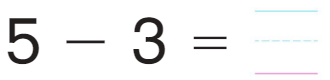
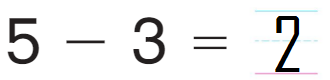
5 – 3 = 2
Thus there are 2 students in the class.

Apply and Grow: Practice

Directions:
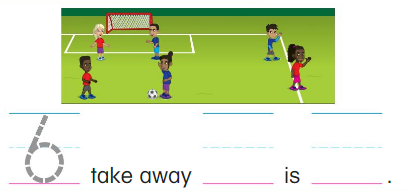
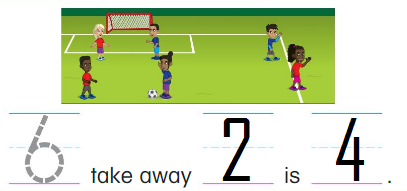
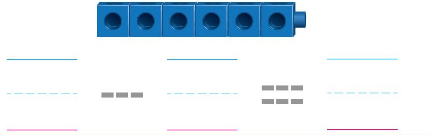
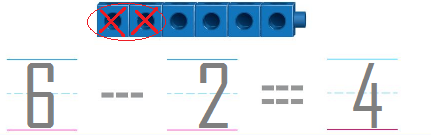
1 – 3 Complete the sentence to tell how many students there are in all, how many are leaving, and how many are left.

Question 1.
Big Ideas Math Answer Key Grade K Chapter 7 Subtract Numbers within 10 7.1 3
Answer:
Big-Ideas-Math-Answer-Key-Grade-K-Chapter-7-Subtract-Numbers-within-10-7.1-3

Explanation:
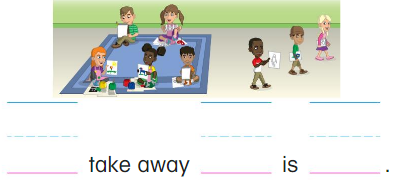
There are 6 students in the football ground.
2 students are leaving the ground.
We have to take away 2 from the total number of students.
6 – 2 = 4

Question 2.
Big Ideas Math Answer Key Grade K Chapter 7 Subtract Numbers within 10 7.1 4
Answer:
Big-Ideas-Math-Answer-Key-Grade-K-Chapter-7-Subtract-Numbers-within-10-7.1-4

Explanation:
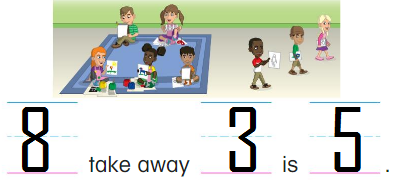
There are 8 students in the room.
Out of which 3 students left the room.
So, 8 – 3 = 5
Thus there are 5 students left in the room.

Question 3.
Big Ideas Math Answer Key Grade K Chapter 7 Subtract Numbers within 10 7.1 5
Answer:
Big-Ideas-Math-Answer-Key-Grade-K-Chapter-7-Subtract-Numbers-within-10-7.1-5

Explanation:
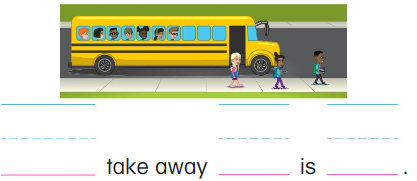
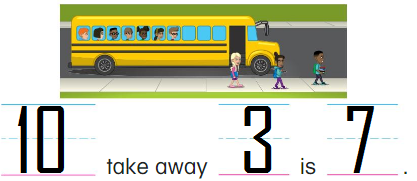
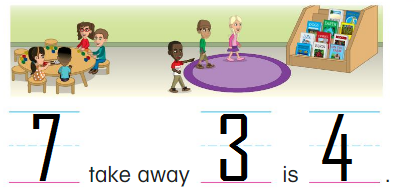
There are 10 students in the bus.
In which 3 students are getting down.
Take away 3 from 10.
10 – 3 = 7
Thus there are 7 students in the bus.

Think and Grow: Modeling Real Life

Directions:

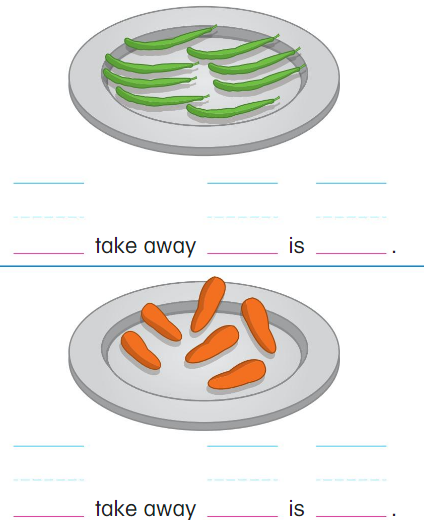
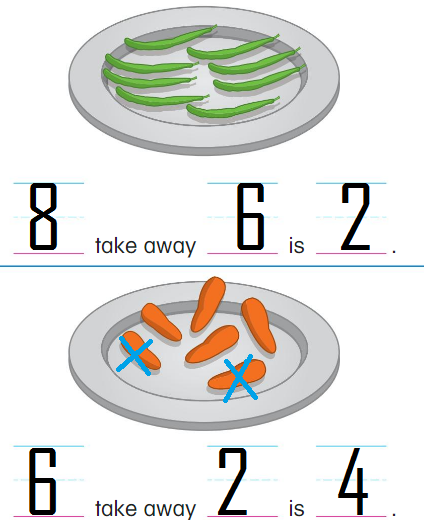
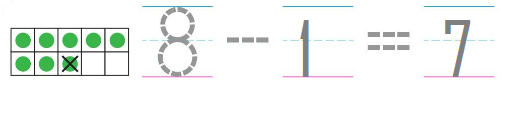
  • You have 8 green beans on your plate. You eat 6 of them. Cross out the green beans you eat. Then complete the sentence to match your picture.
  • You have 6 carrots on your plate. You eat some of them. Cross out the carrots you eat. Then complete the sentence to match your picture.

Big Ideas Math Answer Key Grade K Chapter 7 Subtract Numbers within 10 7.1 6
Answer:
Big-Ideas-Math-Answer-Key-Grade-K-Chapter-7-Subtract-Numbers-within-10-7.1-6

Explanation:
You have 8 green beans on your plate. You eat 6 of them
So, you have to subtract 6 from 8.
Takeaway 6 from 8 which gives 2.
8 – 6 = 2
Thus there are 2 green beans on your plate.
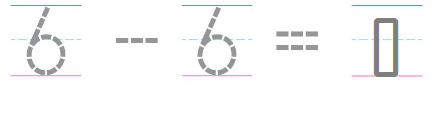
You have 6 carrots on your plate. You eat some of them.
Takeaway 2 from 6 which gives 4.
6 – 2 = 4
Thus there are 4 carrots on your plate.

Understand Subtraction Homework & Practice 7.1

Directions:
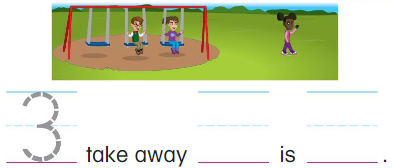
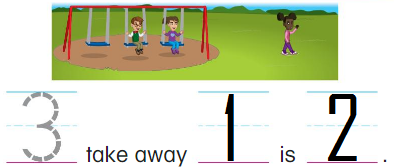
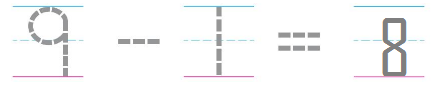
1 and 2 Complete the sentence to tell how many students there are in all, how many are leaving, and how many are left.

Question 1.
Big Ideas Math Answer Key Grade K Chapter 7 Subtract Numbers within 10 7.1 7
Answer:
Big-Ideas-Math-Answer-Key-Grade-K-Chapter-7-Subtract-Numbers-within-10-7.1-7

Explanation:
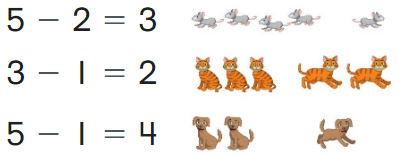
There are 3 students in the ground.
Among them 1 student leaving the ground.
So, takeaway 1 from 3
3 – 1 = 2
Thus 2 students left in the ground.

Question 2.
Big Ideas Math Answer Key Grade K Chapter 7 Subtract Numbers within 10 7.1 8
Answer:
Big-Ideas-Math-Answer-Key-Grade-K-Chapter-7-Subtract-Numbers-within-10-7.1-8

Explanation:
5 students playing the room.
In which 1 student is leaving the room.
So, takeaway 1 from 5 we get 4
5 – 1 = 4
Thus 4 students left in the room.

Directions:
3 and 4 Complete the sentence to tell how many students there are in all, how many are leaving, and how many are left. 5 You have 9 blueberries on your plate. You eat some of them. Cross out the blueberries you eat. Then complete the sentence to tell how many blueberries there are in all, how many you eat, and how many are left.

Question 3.
Big Ideas Math Answer Key Grade K Chapter 7 Subtract Numbers within 10 7.1 9
Answer:
Big-Ideas-Math-Answer-Key-Grade-K-Chapter-7-Subtract-Numbers-within-10-7.1-9

Explanation:
There are 7 students in the library.
3 students are leaving the library.
Takeaway 3 from 7.
7 – 3 = 4
Hence 4 students are left in the library.

Question 4.
Big Ideas Math Answer Key Grade K Chapter 7 Subtract Numbers within 10 7.1 10
Answer:
Big-Ideas-Math-Answer-Key-Grade-K-Chapter-7-Subtract-Numbers-within-10-7.1-10

Explanation:
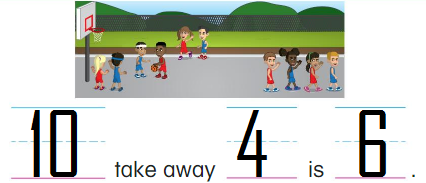
Total number of students in the playground are 10.
Of which 4 students left the playground
That means we have takeaway 4 from 10.
10 – 4 = 6
Thus 6 students are left in the playground .

Question 5.
Big Ideas Math Answer Key Grade K Chapter 7 Subtract Numbers within 10 7.1 11
Answer:
Big-Ideas-Math-Answer-Key-Grade-K-Chapter-7-Subtract-Numbers-within-10-7.1-11

Explanation:
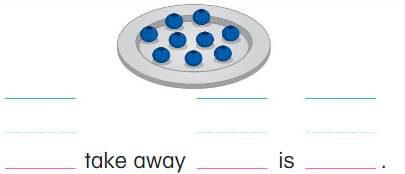
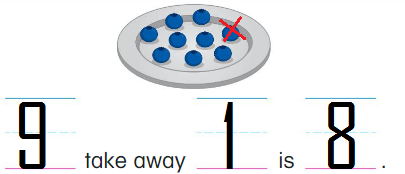
You have 9 blueberries on your plate. You eat some of them.
Takeaway 1 blueberry from your plate.
9 – 1 = 8
Thus there are 8 blueberries on your plate.

Lesson 7.2 Subtraction: Take From

Explore and Grow

Directions: Use counters to act out the story.

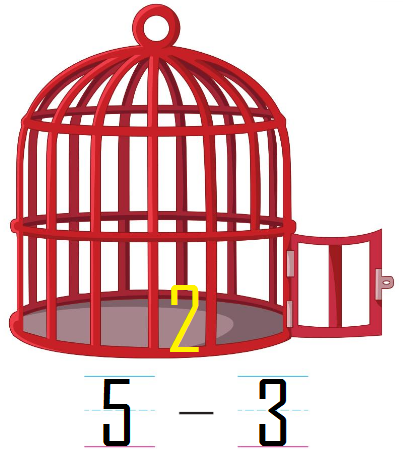
  • There are 5 birds in the cage. Write the number.
  • 3 of the birds fly away. Write the number.
  • Tell how many birds are left in the cage.

Big Ideas Math Answers Grade K Chapter 7 Subtract Numbers within 10 7.2 1
Answer:
Big-Ideas-Math-Answers-Grade-K-Chapter-7-Subtract-Numbers-within-10-7.2-1

Explanation:
There are 5 birds in the cage. In which 3 of the birds fly away.
Now we have to take away 3 from 5.
5 – 3 = 2
Thus 2 birds are left in the cage.

Think and Grow

Directions:
Complete the sentence to tell how many animals there are in all, how many are leaving, and how many are left. Then complete the subtraction sentence to match.

Big Ideas Math Answers Grade K Chapter 7 Subtract Numbers within 10 7.2 2
Answer:
Big-Ideas-Math-Answers-Grade-K-Chapter-7-Subtract-Numbers-within-10-7.2-2

Explanation:
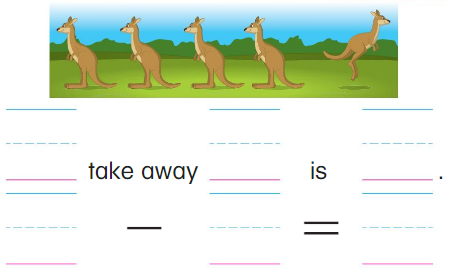
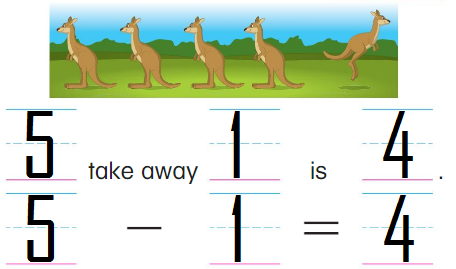
There are 5 animals on the ground.
Among them 1 animal leaving the ground.
So, take away 1 from 5
5 – 1 = 4
Thus 1 animal left in the ground.

Apply and Grow: Practice

Directions:
1 Complete the sentence to tell how many deer there are in all, how many are leaving, and how many are left. Then complete the subtraction sentence to match. 2 and 3 Complete the subtraction sentence to tell how many animals are left.

Question 1.
Big Ideas Math Answers Grade K Chapter 7 Subtract Numbers within 10 7.2 3
Answer:
Big-Ideas-Math-Answers-Grade-K-Chapter-7-Subtract-Numbers-within-10-7.2-3

Explanation:
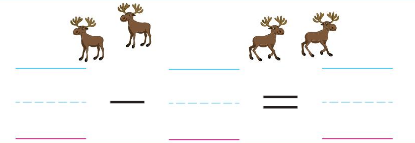
There are 5 deers in all. Among them, 4 are leaving.
So subtract 4 deers from 5. So that we can know how many deers are left.
5 – 4 = 1
Thus only 1 deer is left.

Question 2.
Big Ideas Math Answers Grade K Chapter 7 Subtract Numbers within 10 7.2 4
Answer:
Big-Ideas-Math-Answers-Grade-K-Chapter-7-Subtract-Numbers-within-10-7.2-4

Explanation:
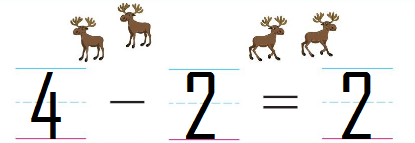
There are 4 deers in all. Among them, 2 are leaving.
So subtract 2 deers from 4. So that we can know how many deers are left.
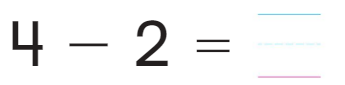
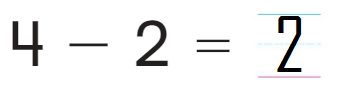
4 – 2 = 2
Thus 2 deers are left.

Question 3.
Big Ideas Math Answers Grade K Chapter 7 Subtract Numbers within 10 7.2 5
Answer:
Big-Ideas-Math-Answers-Grade-K-Chapter-7-Subtract-Numbers-within-10-7.2-5

Explanation:
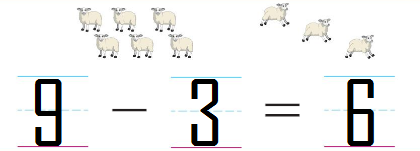
There are 9 sheep in all. Out of 9 three sheep are leaving.
9 – 3 = 6
Thus 6 sheep are left.

Think and Grow: Modeling Real Life

Directions:
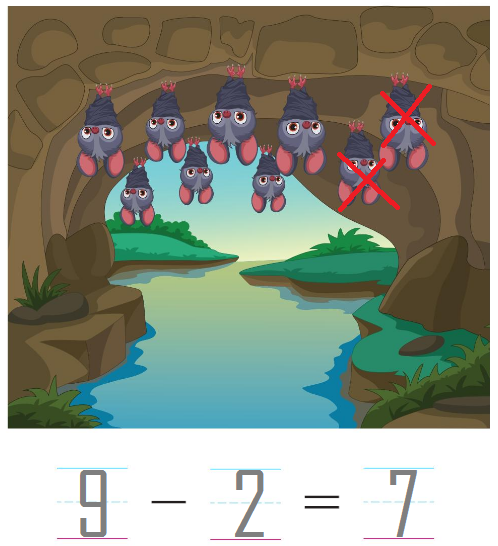
Some of the bats in a cave fly away. Cross out the bats that fly away. Then complete the subtraction sentence to tell how many are left.

Big Ideas Math Answers Grade K Chapter 7 Subtract Numbers within 10 7.2 6
Answer:
Big-Ideas-Math-Answers-Grade-K-Chapter-7-Subtract-Numbers-within-10-7.2-6

Explanation:
By seeing the figure we can say that there are 9 bats in all.
Now we have to subtract 2 bats from 9.
We get 9 – 2 = 7

Subtraction: Take From Homework & Practice 7.2

Directions:
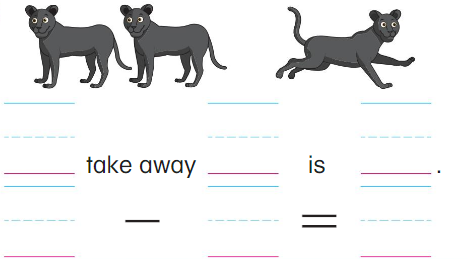
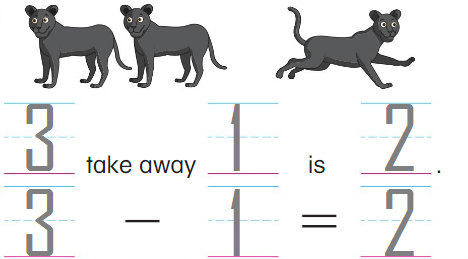
1 Complete the sentence to tell how many panthers there are in all, how many are leaving, and how many are left. Then complete the subtraction sentence to match.

Question 1.
Big Ideas Math Answers Grade K Chapter 7 Subtract Numbers within 10 7.2 7
Answer:
Big-Ideas-Math-Answers-Grade-K-Chapter-7-Subtract-Numbers-within-10-7.2-7

Explanation:
From the above figure we can see that there are 3 panthers.
In that 1 panther is leaving.
So we have to subtract 3 from 1.
3 – 1 = 2
Thus 2 panthers are left.

Directions:
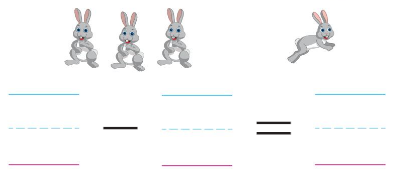
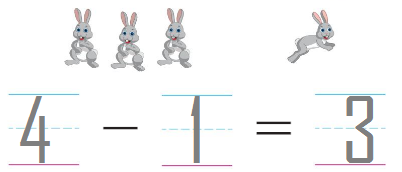
2 and 3 Complete the subtraction sentence to tell how many animals are left. 4 Some of the wolves leave the group. Cross out the wolves that leave. Then complete the subtraction sentence to tell how many wolves are left.

Question 2.
Big Ideas Math Answers Grade K Chapter 7 Subtract Numbers within 10 7.2 8
Answer:
Big-Ideas-Math-Answers-Grade-K-Chapter-7-Subtract-Numbers-within-10-7.2-8

Explanation:
There are 4 rabbits in all.
We observe that 1 rabbit is leaving.
4 – 1 = 3
Thus 3 rabbits are left.

Question 3.
Big Ideas Math Answers Grade K Chapter 7 Subtract Numbers within 10 7.2 9
Answer:
Big-Ideas-Math-Answers-Grade-K-Chapter-7-Subtract-Numbers-within-10-7.2-9

Explanation:
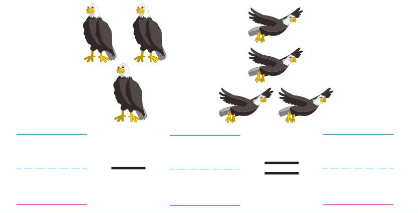
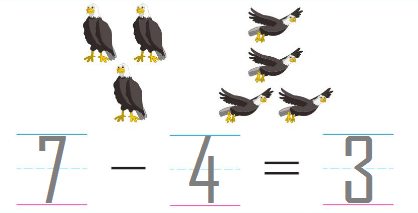
There are 7 eagles in all.
We observe that four eagles are leaving.
7 – 4 = 3
Thus 3 eagles are left.

Question 4.
Big Ideas Math Answers Grade K Chapter 7 Subtract Numbers within 10 7.2 10
Answer:
Big-Ideas-Math-Answers-Grade-K-Chapter-7-Subtract-Numbers-within-10-7.2-10

Explanation:
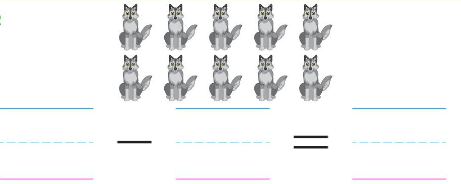
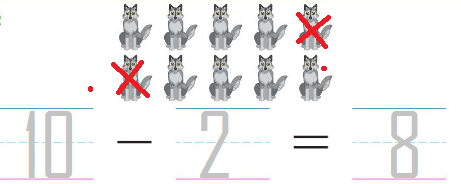
There are 10 wolves in all.
We have to subtract 2 wolves from them.
Cross any two wolves to find the subtraction equation.
10 – 2 = 8

Lesson 7.3 Subtraction: Take Apart

Explore and Grow

Directions:
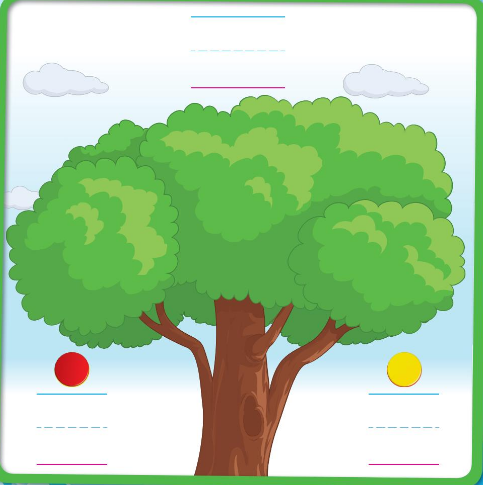
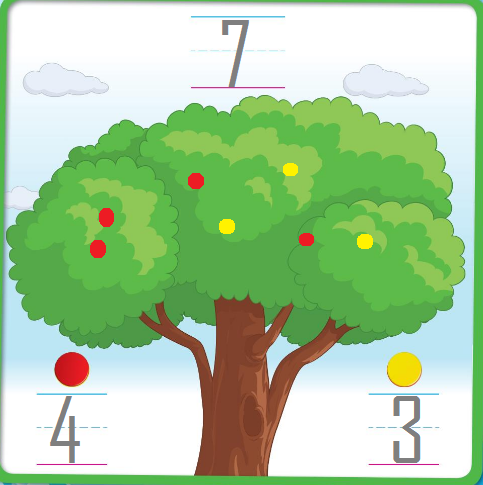
There are 7 apples in the tree. Some are red and some are yellow. Use counters to show the apples in the tree. Write the number above the tree. Take apart the group of apples by placing the red apples in one group and the yellow apples in another group. Write the numbers.

Big Ideas Math Solutions Grade K Chapter 7 Subtract Numbers within 10 7.3 1
Answer:
Big-Ideas-Math-Solutions-Grade-K-Chapter-7-Subtract-Numbers-within-10-7.3-1 (1)

Explanation:
Given that,
There are 7 apples in the tree. Some are red and some are yellow.
There are 4 apples on the tree and 3 yellow apples on the tree.
4 + 3 = 7

Think and Grow

Directions:
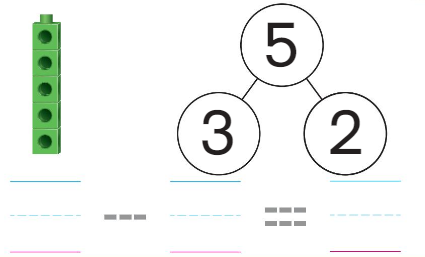
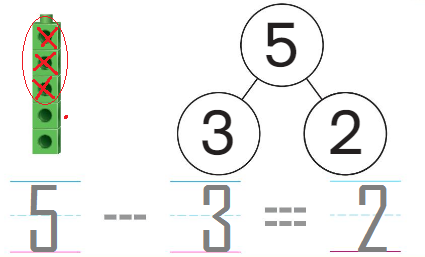
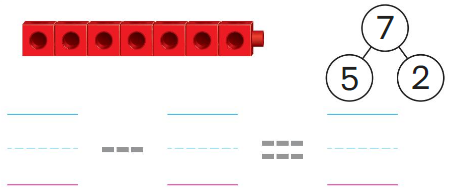
Circle the linking cubes to show the parts in the number bond. Then write a subtraction sentence by taking one of the parts from the whole. Cross out the part on the number bond that you take away.

Big Ideas Math Solutions Grade K Chapter 7 Subtract Numbers within 10 7.3 2
Answer:
Big-Ideas-Math-Solutions-Grade-K-Chapter-7-Subtract-Numbers-within-10-7.3-2

Explanation:
There are 5 cubes in all.
3 and 2 are the parts and 5 is the number bond.
Now we have to take away 3 from 5.
5 – 3 = 2

Apply and Grow

Directions:
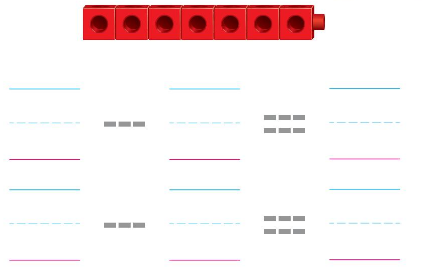
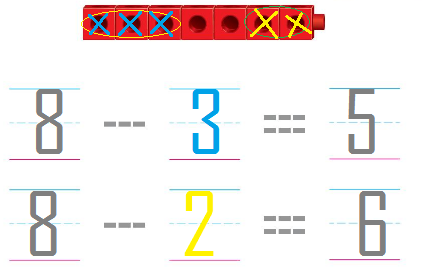
1 Circle the linking cubes to show the parts in the number bond. Then write a subtraction sentence by taking one of the parts from the whole. Cross out the part on the number bond that you take away. 2 Take apart the linking cubes. Circle the parts. Write a subtraction sentence by taking one of the parts from the whole. Then write another subtraction sentence by taking the other part from the whole.

Question 1.
Big Ideas Math Solutions Grade K Chapter 7 Subtract Numbers within 10 7.3 3
Answer:
Big-Ideas-Math-Solutions-Grade-K-Chapter-7-Subtract-Numbers-within-10-7.3-3

Explanation:
There are 8 cubes in all. Among them we have to take away 3 cubes, we get
8 – 3 = 5

Question 2.
Big Ideas Math Solutions Grade K Chapter 7 Subtract Numbers within 10 7.3 4
Answer:
Big-Ideas-Math-Solutions-Grade-K-Chapter-7-Subtract-Numbers-within-10-7.3-4

Explanation:
There are 9 cubes in all. Among them we have to take away 2 cubes, we get
9 – 2 = 7
There are 9 cubes in all. Among them we have to take away 3 cubes, we get
9 – 3 = 6

Think and Grow: Modeling Real Life

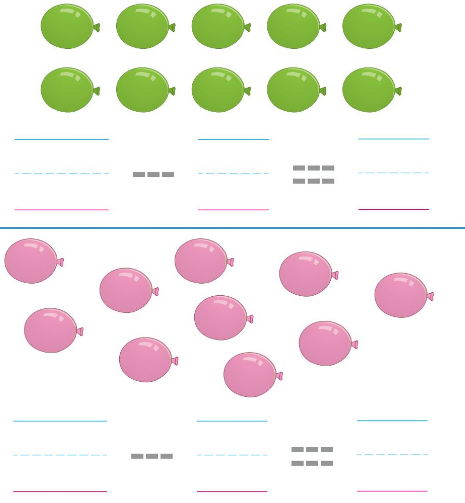
Directions: You have 10 balloons. You want to share some with your friend.

  • Put the balloons into 2 groups. Circle the groups. Then cross out the group you give to your friend. Write a subtraction sentence to match your picture. Circle the number that shows how many balloons you have left.
  • Show another way you can share the balloons. Then write a subtraction sentence to match your picture. Circle the number that shows how many balloons you have left.

Big Ideas Math Solutions Grade K Chapter 7 Subtract Numbers within 10 7.3 5
Answer:
Big-Ideas-Math-Solutions-Grade-K-Chapter-7-Subtract-Numbers-within-10-7.3-5

Explanation:
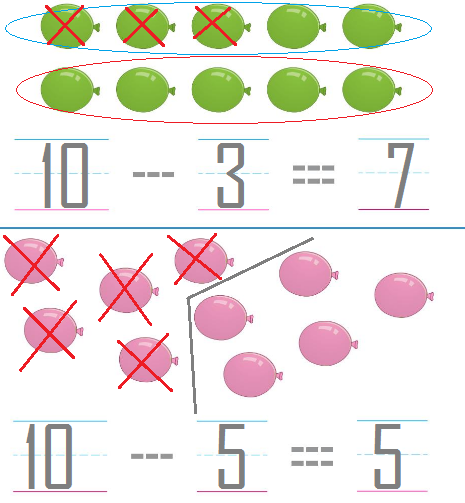
There are 10 ballons in all.
Put the balloons into 2 groups. Circle the groups. Then cross out the group you give to your friend.
From the figure, we observe that you give 3 balloons to your friend.
10 – 3 = 7
From the figure, we observe that you give 5 balloons to your friend.
10 – 5 = 5

Subtraction: Take Apart Homework & Practice 7.3

Directions:
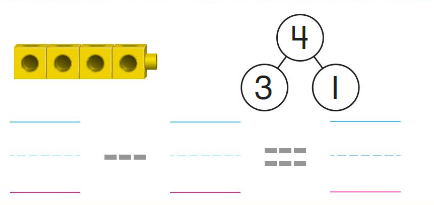
1 Circle the linking cubes to show the parts in the number bond. Then write a subtraction sentence by taking one of the parts from the whole. Cross out the part on the number bond that you take away. 2 Take apart the linking cubes. Circle the parts. Then write a subtraction sentence by taking one of the parts from the whole.

Question 1.
Big Ideas Math Solutions Grade K Chapter 7 Subtract Numbers within 10 7.3 6
Answer:
Big-Ideas-Math-Solutions-Grade-K-Chapter-7-Subtract-Numbers-within-10-7.3-6 (1)

Explanation:
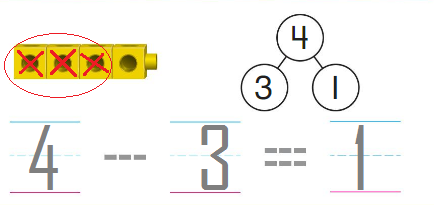
There are 4 cubes in all.
Make a group and cross 3 cubes from the total.
4 – 3 = 1

Question 2.
Big Ideas Math Solutions Grade K Chapter 7 Subtract Numbers within 10 7.3 7
Answer:
Big-Ideas-Math-Solutions-Grade-K-Chapter-7-Subtract-Numbers-within-10-7.3-7

Explanation:
There are 6 cubes in all.
Make a group and cross 2 cubes from the total.
6 – 2 = 4

Directions:
3 Take apart the linking cubes. Circle the parts. Write a subtraction sentence by taking one of the parts from the whole. Then write another subtraction sentence by taking the other part from the whole. 4 You pick 8 flowers. You want to give some to your friend. Put the flowers into 2 groups. Circle the groups. Then cross out the group you give to your friend. Write a subtraction sentence to match your picture. Circle the number that shows how many flowers you have left.

Question 3.
Big Ideas Math Solutions Grade K Chapter 7 Subtract Numbers within 10 7.3 8
Answer:
Big-Ideas-Math-Solutions-Grade-K-Chapter-7-Subtract-Numbers-within-10-7.3-8

Explanation:
There are 8 cubes in all.
Make a group and cross 3 cubes from the total.
8 – 3 = 5
There are 8 cubes in all.
Make a group and cross 2 cubes from the total.
8 – 2 = 6

Question 4.
Big Ideas Math Solutions Grade K Chapter 7 Subtract Numbers within 10 7.3 9
Answer:
Big-Ideas-Math-Solutions-Grade-K-Chapter-7-Subtract-Numbers-within-10-7.3-9

Explanation:
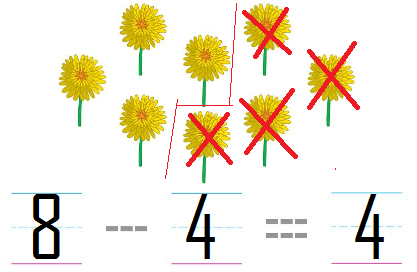
There are 8 flowers in all.
Out of which 4 flowers are crossed.
8 – 4 = 4

Lesson 7.4 Subtraction Number Patterns

Explore and Grow

Directions:
Shade the boxes to show how many there are to start. Cross out the shaded boxes to show how many are being taken away. Tell how many are left.

Big Ideas Math Answer Key Grade K Chapter 7 Subtract Numbers within 10 7.4 1
Answer:
Big-Ideas-Math-Answer-Key-Grade-K-Chapter-7-Subtract-Numbers-within-10-7.4-1

Think and Grow

Directions:
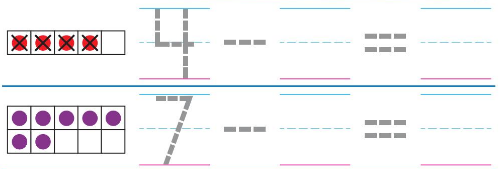
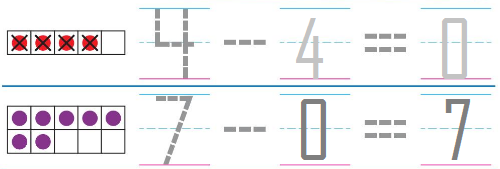
Complete the subtraction sentence to tell how many dots are left. Tell what you notice.

Big Ideas Math Answer Key Grade K Chapter 7 Subtract Numbers within 10 7.4 2
Answer:
Big-Ideas-Math-Answer-Key-Grade-K-Chapter-7-Subtract-Numbers-within-10-7.4-2

Explanation:
In the first block 4 boxes are shaded.
4 shaded blocks are crossed.
Now we have to write the subtraction equation for that
4 – 4 = 0
In the first block 7 boxes are shaded.
0 shaded blocks are crossed.
Now we have to write the subtraction equation for that
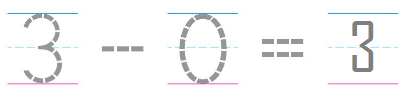
7 – 0 = 7

Apply and Grow: Practice

Directions:
1 – 3 Complete the subtraction sentence to tell how many dots are left. Tell what you notice. 4 – 6 Complete the subtraction sentence. Tell what you notice.

Question 1.
Big Ideas Math Answer Key Grade K Chapter 7 Subtract Numbers within 10 7.4 3
Answer:
Big-Ideas-Math-Answer-Key-Grade-K-Chapter-7-Subtract-Numbers-within-10-7.4-3

Explanation:
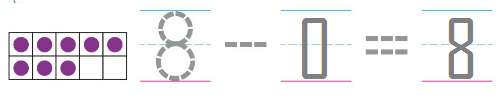
In the first block 8 boxes are shaded.
0 shaded blocks are crossed.
Now we have to write the subtraction equation for that
8 – 0 = 8

Question 2.
Big Ideas Math Answer Key Grade K Chapter 7 Subtract Numbers within 10 7.4 4
Answer:
Big-Ideas-Math-Answer-Key-Grade-K-Chapter-7-Subtract-Numbers-within-10-7.4-4

Explanation:
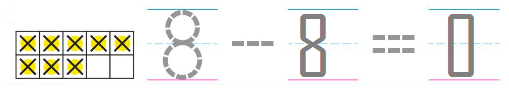
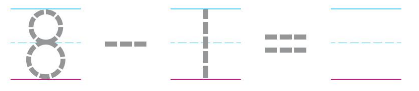
In the first block 8 boxes are shaded.
8 shaded blocks are crossed.
Now we have to write the subtraction equation for that
8 – 8 = 0

Question 3.
Big Ideas Math Answer Key Grade K Chapter 7 Subtract Numbers within 10 7.4 5
Answer:
Big-Ideas-Math-Answer-Key-Grade-K-Chapter-7-Subtract-Numbers-within-10-7.4-5

Explanation:
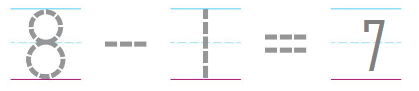
In the first block 8 boxes are shaded.
1 shaded blocks are crossed.
Now we have to write the subtraction equation for that
8 – 1 = 7

Question 4:

Big Ideas Math Answer Key Grade K Chapter 7 Subtract Numbers within 10 7.4 6
Answer:
Big-Ideas-Math-Answer-Key-Grade-K-Chapter-7-Subtract-Numbers-within-10-7.4-6

Explanation:
In the first block 6 boxes are shaded.
6 shaded blocks are crossed.
Now we have to write the subtraction equation for that
6 – 6 = 0

Question 5.
Big Ideas Math Answer Key Grade K Chapter 7 Subtract Numbers within 10 7.4 7
Answer:
Big-Ideas-Math-Answer-Key-Grade-K-Chapter-7-Subtract-Numbers-within-10-7.4-7

Explanation:
In the first block 9 boxes are shaded.
1 shaded blocks are crossed.
Now we have to write the subtraction equation for that
9 – 1 = 8

Question 6.
Big Ideas Math Answer Key Grade K Chapter 7 Subtract Numbers within 10 7.4 8
Answer:
Big-Ideas-Math-Answer-Key-Grade-K-Chapter-7-Subtract-Numbers-within-10-7.4-8

Explanation:
In the first block 10 boxes are shaded.
0 shaded blocks are crossed.
Now we have to write the subtraction equation for that
10 – 0 = 1

Think and Grow: Modeling Real Life

Directions:

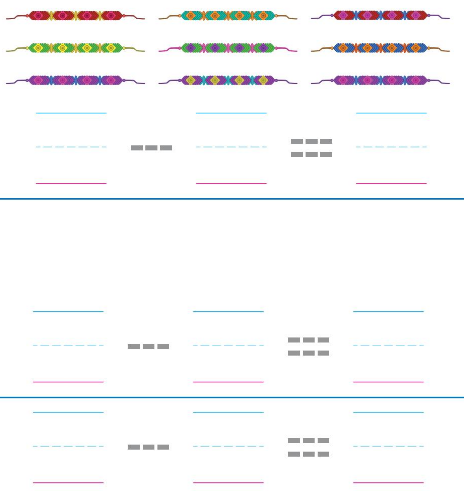
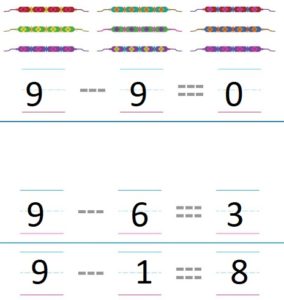
  • You make 9 bracelets. You give all of them away. Cross out the bracelets you give away. Then write a subtraction sentence to tell how many bracelets you have left.
  • Your friend makes 6 bracelets. She does not give away any of her bracelets. Draw and color your friend’s bracelets. Then write a subtraction sentence to tell how many bracelets she has left.
  • Your friend gives you a bracelet. Write a subtraction sentence to tell how many bracelets she has left now.

Big Ideas Math Answer Key Grade K Chapter 7 Subtract Numbers within 10 7.4 9
Answer:
Big-Ideas-Math-Answer-Key-Grade-K-Chapter-7-Subtract-Numbers-within-10-7.4-9

Subtraction Number Patterns Homework & Practice 7.4

Directions:
1 – 3 Complete the subtraction sentence to tell how many dots are left. Tell what you notice.

Question 1.
Big Ideas Math Answer Key Grade K Chapter 7 Subtract Numbers within 10 7.4 10
Answer:
Big-Ideas-Math-Answer-Key-Grade-K-Chapter-7-Subtract-Numbers-within-10-7.4-10

Explanation:
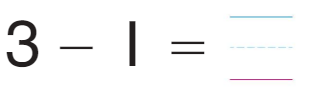
There are 3 shaded blocks.
Out of them 1 block is crossed.
3 – 1 = 2
Thus 2 are left.

Question 2.
Big Ideas Math Answer Key Grade K Chapter 7 Subtract Numbers within 10 7.4 11
Answer:
Big-Ideas-Math-Answer-Key-Grade-K-Chapter-7-Subtract-Numbers-within-10-7.4-11

Explanation:
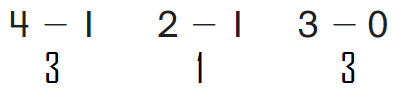
There are 3 shaded blocks.
Out of them 0 block is crossed.
3 – 0 = 3
Thus 3 are left.

Question 3.
Big Ideas Math Answer Key Grade K Chapter 7 Subtract Numbers within 10 7.4 12
Answer:
Big-Ideas-Math-Answer-Key-Grade-K-Chapter-7-Subtract-Numbers-within-10-7.4-12

Explanation:
There are 3 shaded blocks.
Out of them 3 blocks are crossed.
3 – 3 = 0
Thus 0 are left.

Directions:
4 – 6 Complete the subtraction sentence. Tell what you notice. 7 Your friend makes 10 cards. She does not give away any of her cards. Draw and color your friend’s cards. Then write a subtraction sentence to tell how many cards she has left. Your friend gives you a card. Write a subtraction sentence to tell how many cards she has left now.

Question 4.
Big Ideas Math Answer Key Grade K Chapter 7 Subtract Numbers within 10 7.4 13
Answer:
Big-Ideas-Math-Answer-Key-Grade-K-Chapter-7-Subtract-Numbers-within-10-7.4-13

Explanation:
There are 10 cards.
You give all the cards.
10 – 10 = 0

Question 5.
Big Ideas Math Answer Key Grade K Chapter 7 Subtract Numbers within 10 7.4 14
Answer:
Big-Ideas-Math-Answer-Key-Grade-K-Chapter-7-Subtract-Numbers-within-10-7.4-14

Explanation:
There are 7 cards.
You give away 1 card.
7 – 1 = 6

Question 6.
Big Ideas Math Answer Key Grade K Chapter 7 Subtract Numbers within 10 7.4 15
Answer:
Big-Ideas-Math-Answer-Key-Grade-K-Chapter-7-Subtract-Numbers-within-10-7.4-15

Explanation:
There are 9 cards.
You give away 0 card.
9 – 0 = 9

Question 7.
Big Ideas Math Answer Key Grade K Chapter 7 Subtract Numbers within 10 7.4 16
Answer:
Big-Ideas-Math-Answer-Key-Grade-K-Chapter-7-Subtract-Numbers-within-10-7.4-16

Explanation:
There are 10 cards.
You give away 0 card.
10 – 0 = 10
There are 10 cards.
You give away 1 card.
10 – 1 = 9

Lesson 7.5 Practice Subtraction

Explore and Grow

Directions:
Use counters in the five frame to show how many there are to start. Show how many counters are being taken away. Tell and write how many are left.

Big Ideas Math Answers Grade K Chapter 7 Subtract Numbers within 10 7.5 1
Answer:
Big-Ideas-Math-Answers-Grade-K-Chapter-7-Subtract-Numbers-within-10-7.5-1

Think and Grow

Directions:
Complete the subtraction sentence. Tell how you found your answer.

Big Ideas Math Answers Grade K Chapter 7 Subtract Numbers within 10 7.5 2
Answer:
Big-Ideas-Math-Answers-Grade-K-Chapter-7-Subtract-Numbers-within-10-7.5-2

Apply and Grow: Practice

Directions:
1 – 4 Complete the subtraction sentence. Tell how you found your answer. 5 Circle all of the subtraction problems that equal 3.

Question 1.
Big Ideas Math Answers Grade K Chapter 7 Subtract Numbers within 10 7.5 3
Answer:
Big-Ideas-Math-Answers-Grade-K-Chapter-7-Subtract-Numbers-within-10-7.5-3

Explanation:
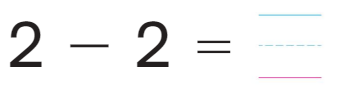
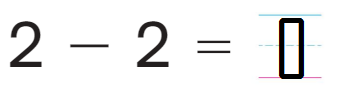
The subtraction sentence for 2 – 2 is 0.

Question 2.
Big Ideas Math Answers Grade K Chapter 7 Subtract Numbers within 10 7.5 4
Answer:
Big-Ideas-Math-Answers-Grade-K-Chapter-7-Subtract-Numbers-within-10-7.5-4

Explanation:
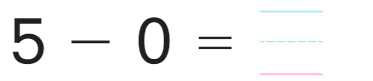
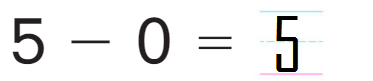
The subtraction sentence for 5 – 0 = 5

Question 3.
Big Ideas Math Answers Grade K Chapter 7 Subtract Numbers within 10 7.5 5
Answer:
Big-Ideas-Math-Answers-Grade-K-Chapter-7-Subtract-Numbers-within-10-7.5-5

Explanation:
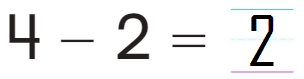
The subtraction sentence for 4 – 2 = 2

Question 4.
Big Ideas Math Answers Grade K Chapter 7 Subtract Numbers within 10 7.5 6
Answer:
Big-Ideas-Math-Answers-Grade-K-Chapter-7-Subtract-Numbers-within-10-7.5-6

Explanation:
The subtraction sentence for 5 – 3 = 2

Question 5.
Big Ideas Math Answers Grade K Chapter 7 Subtract Numbers within 10 7.5 7
Answer:
Big-Ideas-Math-Answers-Grade-K-Chapter-7-Subtract-Numbers-within-10-7.5-7

Think and Grow: Modeling Real Life

Directions: You are playing a video game.

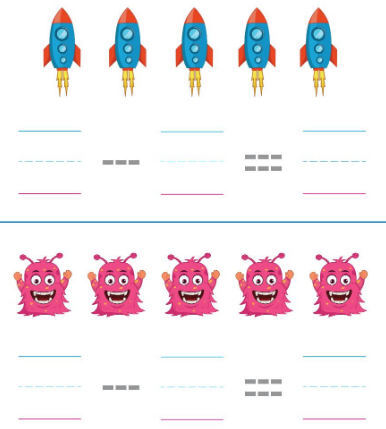
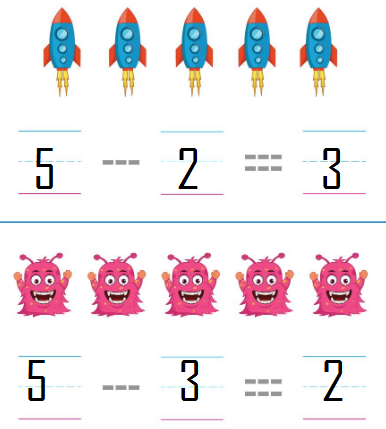
  • You have 5 spaceships. Some of them are captured. Cross out the spaceships that are captured. Then write a subtraction sentence to tell how many spaceships you have left.
  • You need to capture 5 aliens to win. You capture some aliens. Cross out the aliens that you capture. Then write a subtraction sentence to tell how many aliens you still need to capture.

Big Ideas Math Answers Grade K Chapter 7 Subtract Numbers within 10 7.5 8
Answer:
Big-Ideas-Math-Answers-Grade-K-Chapter-7-Subtract-Numbers-within-10-7.5-8

Practice Subtraction Homework & Practice 7.5

Directions:
1 – 3 Complete the subtraction sentence. Tell how you found your answer.

Question 1.
Big Ideas Math Answers Grade K Chapter 7 Subtract Numbers within 10 7.5 9
Answer:
Big-Ideas-Math-Answers-Grade-K-Chapter-7-Subtract-Numbers-within-10-7.5-9

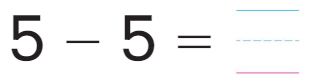
Explanation:
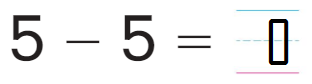
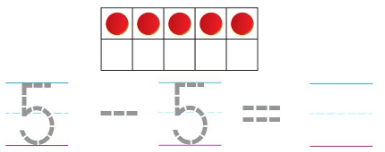
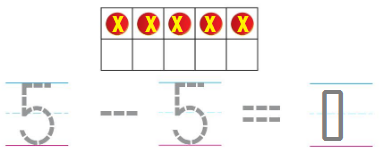
The subtraction sentence for 5 – 5 is 0.

Question 2.
Big Ideas Math Answers Grade K Chapter 7 Subtract Numbers within 10 7.5 10
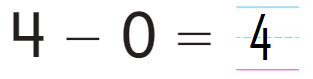
Answer: 4
Big-Ideas-Math-Answers-Grade-K-Chapter-7-Subtract-Numbers-within-10-7.5-10

Explanation:
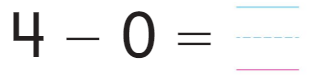
The subtraction sentence for 4 – 0 is 4.

Question 3.
Big Ideas Math Answers Grade K Chapter 7 Subtract Numbers within 10 7.5 11
Answer: 3
Big-Ideas-Math-Answers-Grade-K-Chapter-7-Subtract-Numbers-within-10-7.5-11

Explanation:
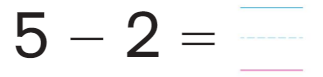
The subtraction sentence for 5 – 2 is 3.

Directions:
4 and 5 Complete the subtraction sentence. Tell how you found your answer. 6 Circle all of the subtraction problems that equal 2. 7 You are playing a video game. You need to visit 5 moons. You visit some moons. Cross out the moons you visit. Then write a subtraction sentence to tell how many moons you have left to visit.

Question 4.
Big Ideas Math Answers Grade K Chapter 7 Subtract Numbers within 10 7.5 12
Answer: 1
Big-Ideas-Math-Answers-Grade-K-Chapter-7-Subtract-Numbers-within-10-7.5-12

Explanation:
The subtraction sentence for 4 – 3 = 1

Question 5.
Big Ideas Math Answers Grade K Chapter 7 Subtract Numbers within 10 7.5 13
Answer: 2
Big-Ideas-Math-Answers-Grade-K-Chapter-7-Subtract-Numbers-within-10-chp-8

Explanation:
The subtraction sentence for 3 – 1 is 2.

Question 6.
Big Ideas Math Answers Grade K Chapter 7 Subtract Numbers within 10 7.5 14
Answer:
Big-Ideas-Math-Answers-Grade-K-Chapter-7-Subtract-Numbers-within-10-7.5-14

Question 7.
Big Ideas Math Answers Grade K Chapter 7 Subtract Numbers within 10 7.5 15
Answer:
Big-Ideas-Math-Answers-Grade-K-Chapter-7-Subtract-Numbers-within-10-7.5-15

Explanation:
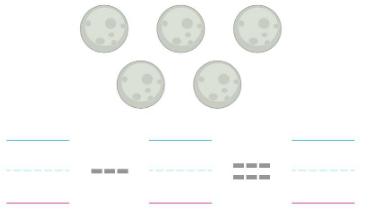
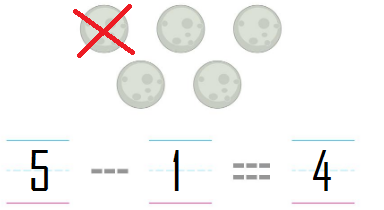
There are 5 moons.
We have to cross 1 moon from them.
The subtraction sentence for 5 – 1 is 4.

Lesson 7.6 Use a Group of 5 to Subtract

Explore and Grow

Directions:
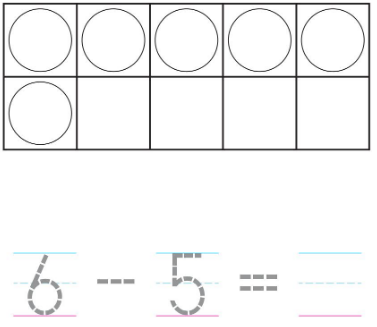
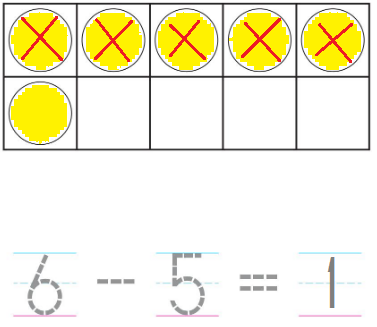
Color the counters to show how many there are in all. Cross out counters to take away 5. Complete the subtraction sentence.

Big Ideas Math Solutions Grade K Chapter 7 Subtract Numbers within 10 7.6 1
Answer:
Big-Ideas-Math-Solutions-Grade-K-Chapter-7-Subtract-Numbers-within-10-7.6-1

Explanation:
Shade the counters given in the figure.
We have to cross 5 counters.
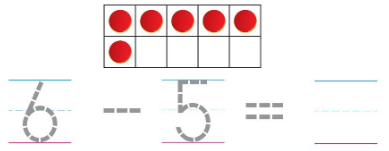
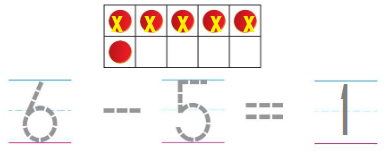
The subtraction sentence for 6 – 5 = 1

Think and Grow

Directions:
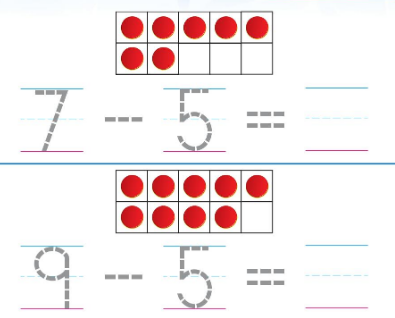
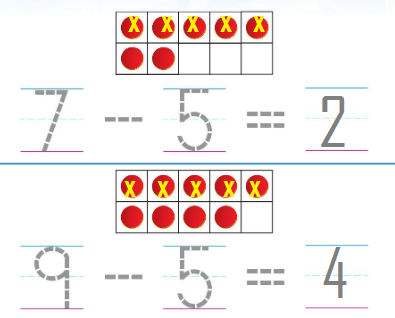
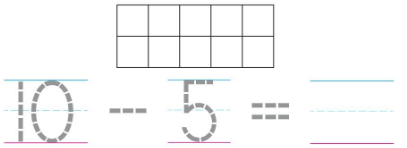
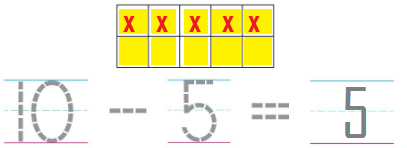
Cross out 5 counters to show how many to take away. Use the ten frame to complete the subtraction sentence.

Big Ideas Math Solutions Grade K Chapter 7 Subtract Numbers within 10 7.6 2
Answer:
Big-Ideas-Math-Solutions-Grade-K-Chapter-7-Subtract-Numbers-within-10-7.6-2

Explanation:
There are 7 counters. Among them 5 counters are crossed.
The subtraction sentence for 7 – 5 = 2
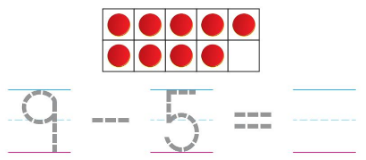
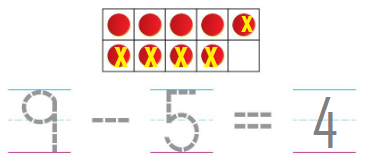
There are 9 counters. Among them 5 counters are crossed.
The subtraction sentence for 9 – 5 = 4

Apply and Grow: Practice

Directions:
1 and 2 Cross out 5 counters to show how many to take away. Use the ten frame to complete the subtraction sentence. 3 Draw 10 counters. Cross out 5 counters to show how many to take away. Use the ten frame to complete the subtraction sentence.

Question 1.
Big Ideas Math Solutions Grade K Chapter 7 Subtract Numbers within 10 7.6 3
Answer: 0
Big-Ideas-Math-Solutions-Grade-K-Chapter-7-Subtract-Numbers-within-10-7.6-3

Explanation:
There are 5 counters. Among them 5 counters are crossed.
The subtraction sentence for 5 – 5 = 0

Question 2.
Big Ideas Math Solutions Grade K Chapter 7 Subtract Numbers within 10 7.6 4
Answer: 1
Big-Ideas-Math-Solutions-Grade-K-Chapter-7-Subtract-Numbers-within-10-7.6-4

Explanation:
There are 6 counters. Among them 5 counters are crossed.
The subtraction sentence for 6 – 5 = 1

Question 3.
Big Ideas Math Solutions Grade K Chapter 7 Subtract Numbers within 10 7.6 5
Answer: 5
Big-Ideas-Math-Solutions-Grade-K-Chapter-7-Subtract-Numbers-within-10-7.6-5

Explanation:
There are 10 counters. Among them 5 counters are crossed.
The subtraction sentence for 10 – 5 = 5

Think and Grow: Modeling Real Life

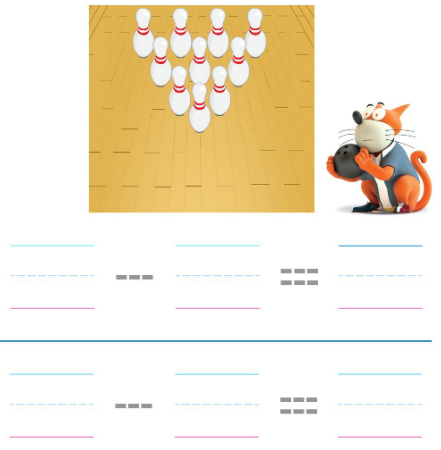
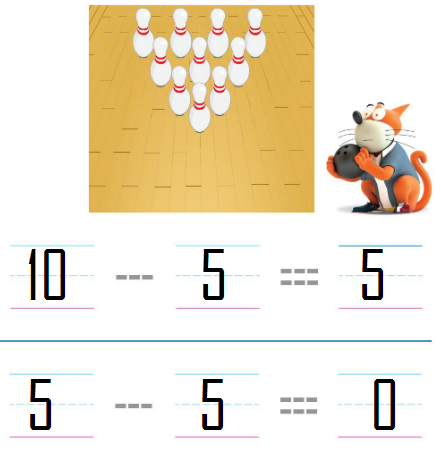
Directions: You have 2 rolls to knock down 10 bowling pins.

  • On your first roll, you knock down 5 pins. Cross out the pins you knock down. Then write a subtraction sentence to match your picture. How many pins do you need to knock down on your second roll? Circle the answer.
  • On your second roll, you knock down the pins that are left. Write a subtraction sentence to show how many pins you have left now.

Big Ideas Math Solutions Grade K Chapter 7 Subtract Numbers within 10 7.6 6
Answer:
10 – 5 = 5
5 – 5 = 0
Big-Ideas-Math-Solutions-Grade-K-Chapter-7-Subtract-Numbers-within-10-7.6-6

Use a Group of 5 to Subtract Homework & Practice 7.6

Directions:
1 and 2 Cross out 5 counters to show how many to take away. Use the ten frame to complete the subtraction sentence.

Question 1.
Big Ideas Math Solutions Grade K Chapter 7 Subtract Numbers within 10 7.6 7
Answer:
Big-Ideas-Math-Solutions-Grade-K-Chapter-7-Subtract-Numbers-within-10-7.6-3

Explanation:
There are 5 counters. Among them 5 counters are crossed.
The subtraction sentence for 5 – 5 = 0

Question 2.
Big Ideas Math Solutions Grade K Chapter 7 Subtract Numbers within 10 7.6 8
Answer: 2
Big-Ideas-Math-Solutions-Grade-K-Chapter-7-Subtract-Numbers-within-10-7.6-8

Explanation:
There are 7 counters. Among them 5 counters are crossed.
The subtraction sentence for 7 – 5 = 2

Directions:
3 Cross out 5 counters to show how many to take away. Use the ten frame to complete the subtraction sentence. 4 Draw 8 counters. Cross out 5 counters to show how many to take away. Use the ten frame to complete the subtraction sentence. 5 You have 2 throws to knock down 9 bottles. On your first throw, you knock down 5 bottles. Cross out the bottles you knockdown. Then write a subtraction sentence to match your picture. How many more bottles do you need to knock down? Circle the answer.

Question 3.
Big Ideas Math Solutions Grade K Chapter 7 Subtract Numbers within 10 7.6 9
Answer: 5
Big-Ideas-Math-Solutions-Grade-K-Chapter-7-Subtract-Numbers-within-10-7.6-9

Explanation:
There are 5 counters. Among them 5 counters are crossed.
The subtraction sentence for 5 – 5 = 0

Question 4.
Big Ideas Math Solutions Grade K Chapter 7 Subtract Numbers within 10 7.6 10
Answer: 3
Big-Ideas-Math-Solutions-Grade-K-Chapter-7-Subtract-Numbers-within-10-7.6-10

Explanation:
There are 8 counters. Among them 5 counters are crossed.
The subtraction sentence for 8 – 5 = 3

Question 5.
Big Ideas Math Solutions Grade K Chapter 7 Subtract Numbers within 10 7.6 11
Answer:
Big-Ideas-Math-Solutions-Grade-K-Chapter-7-Subtract-Numbers-within-10-7.6-11

Explanation:
There are 9 counters. Among them 5 counters are crossed.
The subtraction sentence for 9 – 5 = 4

Lesson 7.7 Related Facts

Explore and Grow

Directions:

  • You have 3 yellow linking cubes and 2 green linking cubes. How many linking cubes do you have in all? Write an addition sentence to match the picture.
  • You have 5 linking cubes. You give your friend 2 linking cubes. How many linking cubes do you have left? Write a subtraction sentence to match the picture.

Big Ideas Math Answer Key Grade K Chapter 7 Subtract Numbers within 10 7.7 1
Answer:
Big-Ideas-Math-Answer-Key-Grade-K-Chapter-7-Subtract-Numbers-within-10-7.7-1

Explanation:
There are 3 yellow linking cubes and 2 green linking cubes.
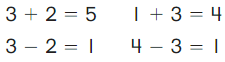
The addition sentence is 3 + 2 = 5
There are 5 linking cubes. You give your friend 2 linking cubes.
5 – 2 = 3

Think and Grow

Directions:
Tell whether the pictures show addition or subtraction. Then write addition and subtraction sentences to show the related facts.

Big Ideas Math Answer Key Grade K Chapter 7 Subtract Numbers within 10 7.7 2
Answer:
Big-Ideas-Math-Answer-Key-Grade-K-Chapter-7-Subtract-Numbers-within-10-7.7-2

Explanation:
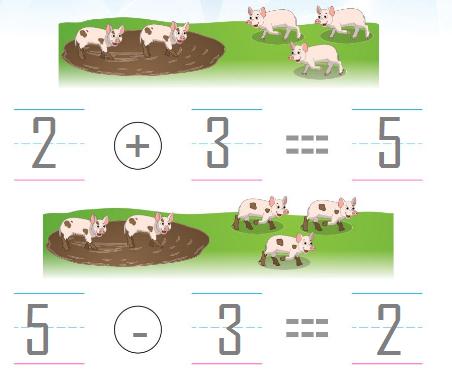
The addition sentence for the first figure is 2 + 3 = 5
The subtraction sentence for the second figure is 5 – 3 = 2

Apply and Grow: Practice

Directions:
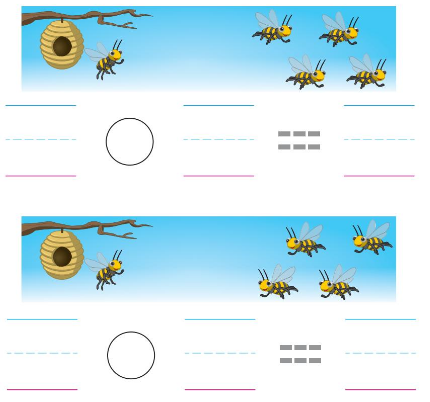
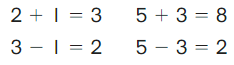
1 Tell whether the pictures show addition or subtraction. Then write addition and subtraction sentences to show the related facts. 2 and 3 Circle the addition and subtraction sentences that show related facts. Tell how you know.

Question 1.
Big Ideas Math Answer Key Grade K Chapter 7 Subtract Numbers within 10 7.7 3
Answer:
Big-Ideas-Math-Answer-Key-Grade-K-Chapter-7-Subtract-Numbers-within-10-7.7-3

Explanation:
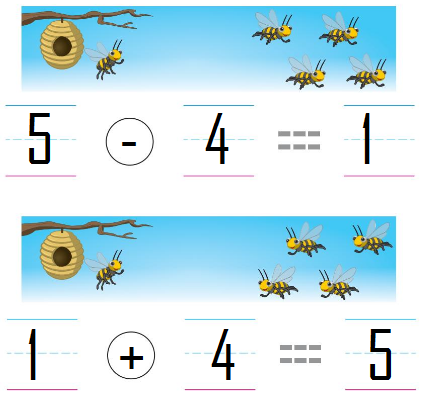
There are 5 bees in all.
4 bees are leaving.
5 – 4 = 1
There is 1 bee and 4 bees are coming.
1 + 4 = 5

Question 2.
Big Ideas Math Answer Key Grade K Chapter 7 Subtract Numbers within 10 7.7 4
Answer:
Big-Ideas-Math-Answer-Key-Grade-K-Chapter-7-Subtract-Numbers-within-10-7.7-4

Question 3.
Big Ideas Math Answer Key Grade K Chapter 7 Subtract Numbers within 10 7.7 5
Answer:
Big-Ideas-Math-Answer-Key-Grade-K-Chapter-7-Subtract-Numbers-within-10-7.7-5

Think and Grow: Modeling Real Life

Directions:

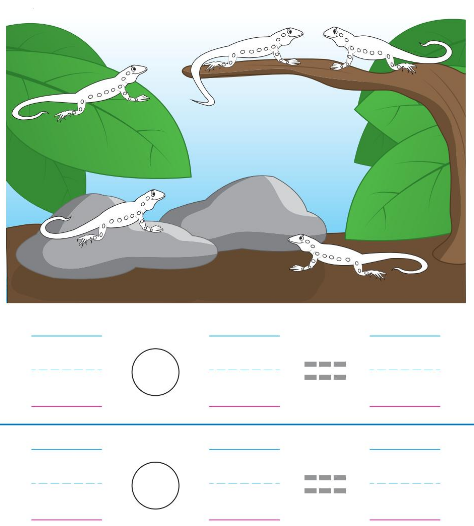
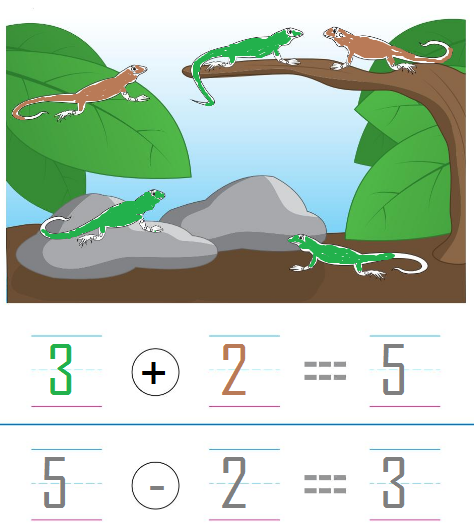
  • A zoo has 5 lizards. Some are green and some are brown. Color the lizards. Then write an addition sentence to match your picture.
  • Write a subtraction sentence that shows the related fact. Tell a story to match your subtraction sentence.

Big Ideas Math Answer Key Grade K Chapter 7 Subtract Numbers within 10 7.7 6
Answer:
3 + 2 = 5
Big-Ideas-Math-Answer-Key-Grade-K-Chapter-7-Subtract-Numbers-within-10-7.7-6

Explanation:
There are 3 green lizards and 2 brown lizards.
Additional sentence 3 + 2 = 5
There are 5 lizards in all.
subtraction sentence 5 – 2 = 3

Related Facts Homework & Practice 7.7

Directions:
1 Tell whether the pictures show addition or subtraction. Then write addition and subtraction sentences to show the related facts.

Question 1.
Big Ideas Math Answer Key Grade K Chapter 7 Subtract Numbers within 10 7.7 7
Answer:
Big-Ideas-Math-Answer-Key-Grade-K-Chapter-7-Subtract-Numbers-within-10-7.7-7

Explanation:
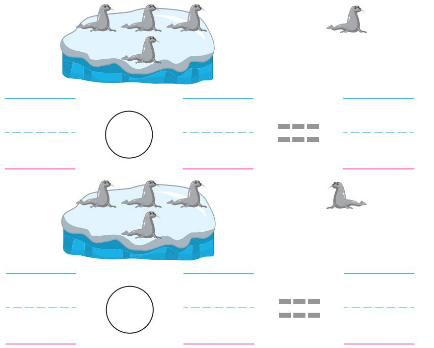
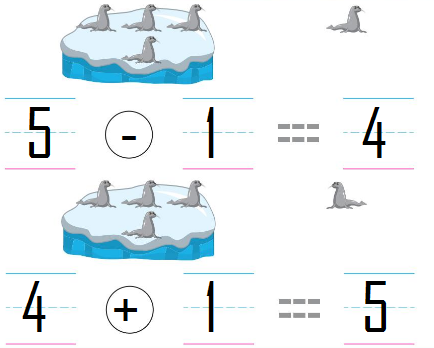
There are 5 seals and 1 seal is leaving.
The subtraction sentence is 5 – 1 = 4
There are 4 seals on the ice and 1 seal is coming.
4 + 1 = 5

Directions:
2 and 3 Circle the group of addition and subtraction sentences that shows related facts. Tell how you know. 4 A tank at a pet store has 5 tree frogs. Some are blue and some are red. Color the frogs. Then write an addition sentence to match your picture. Write a subtraction sentence that shows the related fact. Tell a story to match your subtraction sentence.

Question 2.
Big Ideas Math Answer Key Grade K Chapter 7 Subtract Numbers within 10 7.7 8
Answer:
Big-Ideas-Math-Answer-Key-Grade-K-Chapter-7-Subtract-Numbers-within-10-7.7-8

Question 3.
Big Ideas Math Answer Key Grade K Chapter 7 Subtract Numbers within 10 7.7 9
Answer:
Big-Ideas-Math-Answer-Key-Grade-K-Chapter-7-Subtract-Numbers-within-10-7.7-9

Question 4.
Big Ideas Math Answer Key Grade K Chapter 7 Subtract Numbers within 10 7.7 10
Answer:
Big-Ideas-Math-Answer-Key-Grade-K-Chapter-7-Subtract-Numbers-within-10-7.7-10

Subtract Numbers within 10 Performance Task

Big Ideas Math Answers Grade K Chapter 7 Subtract Numbers within 10 1
Directions:
1 You blow 9 bubbles in the air. There are more big bubbles than small bubbles. Draw the bubbles. Then write a subtraction sentence to tell how many small bubbles are in the air. 2 Some of the bubbles pop. Cross out the bubbles that pop. Then write a subtraction sentence to tell how many bubbles are left. 3 All of the remaining bubbles pop. Write a subtraction sentence to tell how many bubbles are left now.

Question 1.
Big Ideas Math Answers Grade K Chapter 7 Subtract Numbers within 10 2
Answer:
Big-Ideas-Math-Answers-Grade-K-Chapter-7-Subtract-Numbers-within-10-2

Explanation:
Given that,
There are 9 bubbles in the air.
There are more big bubbles than small bubbles.
9 – 4 = 5
Thus the subtraction sentence is 9 – 4 = 5

Question 2.
Big Ideas Math Answers Grade K Chapter 7 Subtract Numbers within 10 3
Answer:
Big-Ideas-Math-Answers-Grade-K-Chapter-7-Subtract-Numbers-within-10-3
Thus the subtraction sentence is 9 – 5 = 4

Question 3.
Big Ideas Math Answers Grade K Chapter 7 Subtract Numbers within 10 4
Answer:
Big-Ideas-Math-Answers-Grade-K-Chapter-7-Subtract-Numbers-within-10-4
Thus the subtraction sentence is 9 – 9 = 0

Subtract Numbers within 10 Activity

Losing Teeth
Directions:
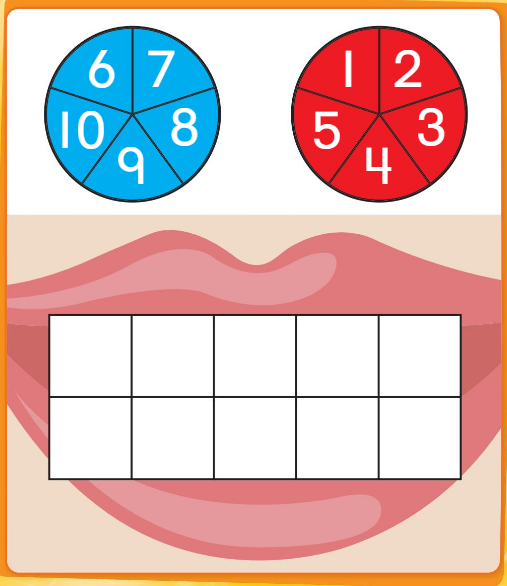
Spin the blue spinner. Put that many counters on the ten frame. Spin the red spinner. Take away that many counters from the ten frame. Tell how many counters are left. Complete the subtraction sentence on your Subtraction Recording Sheet. Repeat this process until you fill your sheet.

Big Ideas Math Answers Grade K Chapter 7 Subtract Numbers within 10 5
Answer:
10 – 4 = 6

Explanation:
Let the number in the blue spinner be 10
Let the number in the red spinner be 4
10 – 4 = 6

Subtract Numbers within 10 Chapter Practice

Directions:
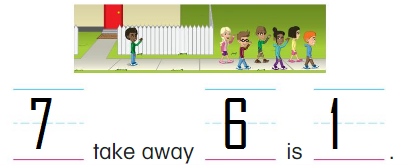
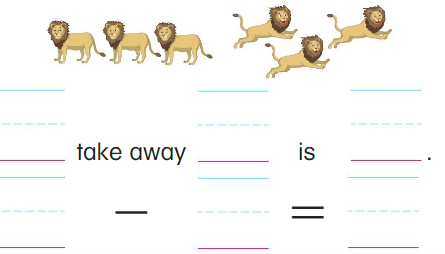
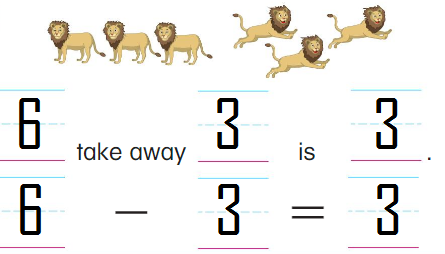
1 Complete the sentence to tell how many students there are in all, how many are leaving, and how many are left. 2 Complete the sentence to tell how many lions there are in all, how many are leaving, and how many are left. Then complete the subtraction sentence to match.

7.1 Understand Subtraction

Question 1.
Big Ideas Math Answers Grade K Chapter 7 Subtract Numbers within 10 chp 1
Answer: 7 – 6 = 1
Big-Ideas-Math-Answers-Grade-K-Chapter-7-Subtract-Numbers-within-10-chp-1

Explanation:
There are 7 students in all.
6 students are leaving.
So, we have to take away 6 from 7.
7 – 6 = 1
Thus 1 student left.

7.2 Subtraction: Take From

Question 2.
Big Ideas Math Answers Grade K Chapter 7 Subtract Numbers within 10 chp 2
Answer: 6 – 3 = 3
Big-Ideas-Math-Answers-Grade-K-Chapter-7-Subtract-Numbers-within-10-chp-2

Explanation:
There are 6 lions in all.
3 lions are leaving.
Take away 3 lions from 6
6 – 3 = 3
Thus 3 lions left.

Directions:
3 Circle the linking cubes to show the parts in the number bond. Then write a subtraction sentence by taking one of the parts from the whole. Cross out the part on the number bond that you take away. 4 You have 9 toys. You want to give some to your friend. Put the toys into 2 groups. Circle the groups. Then cross out the group you give to your friend. Write a subtraction sentence to match your picture. Circle the number that shows how many toys you have left. 5 Complete the subtraction sentence to tell how many dots are left. Tell what you notice.

7.3 Subtraction: Take Apart

Question 3.
Big Ideas Math Answers Grade K Chapter 7 Subtract Numbers within 10 chp 3
Answer: 7 – 2 = 5
Big-Ideas-Math-Answers-Grade-K-Chapter-7-Subtract-Numbers-within-10-chp-3

Explanation:
There are 7 linking cubes in all.
2 cubes are crossed.
7 – 2 = 5
Thus 5 cubes are left.

Question 4.
Big Ideas Math Answers Grade K Chapter 7 Subtract Numbers within 10 chp 4
Answer:
Big-Ideas-Math-Answers-Grade-K-Chapter-7-Subtract-Numbers-within-10-chp-4

Explanation:
There are 9 dragons in all.
9 dragons are crossed.
9 – 9 = 0

7.4 Subtraction Number Patterns

Question 5.
Big Ideas Math Answers Grade K Chapter 7 Subtract Numbers within 10 chp 5
Answer:
Big-Ideas-Math-Answers-Grade-K-Chapter-7-Subtract-Numbers-within-10-chp-5

Explanation:
There are 6 shaded blocks. In that 6 blocks are crossed.
6 – 6 = 0

Directions:
6 and 7 Complete the subtraction sentence. Tell what you notice. 8 and 9 Complete the subtraction sentence. Tell how you found your answer. 10 Circle all of the subtraction problems that equal 4.

Question 6.
Big Ideas Math Answers Grade K Chapter 7 Subtract Numbers within 10 chp 6
Answer: 3
Big-Ideas-Math-Answers-Grade-K-Chapter-7-Subtract-Numbers-within-10-chp-6

Explanation:
The subtraction sentence is 3 – 0 = 3

Question 7.
Big Ideas Math Answers Grade K Chapter 7 Subtract Numbers within 10 chp 7
Answer: 7
Big-Ideas-Math-Answers-Grade-K-Chapter-7-Subtract-Numbers-within-10-chp-7

Explanation:
The subtraction sentence is 8 – 1 = 7

7.5 Practice Subtraction

Question 8.
Big Ideas Math Answers Grade K Chapter 7 Subtract Numbers within 10 chp 8
Answer: 2
Big-Ideas-Math-Answers-Grade-K-Chapter-7-Subtract-Numbers-within-10-chp-8

Explanation:
The subtraction sentence is 3 – 1 = 2

Question 9.
Big Ideas Math Answers Grade K Chapter 7 Subtract Numbers within 10 chp 9
Answer: 2
Big-Ideas-Math-Answers-Grade-K-Chapter-7-Subtract-Numbers-within-10-chp-9

Explanation:
The subtraction sentence is 4 – 2 = 2

Question 10.
Big Ideas Math Answers Grade K Chapter 7 Subtract Numbers within 10 chp 10
Answer:
Big-Ideas-Math-Answers-Grade-K-Chapter-7-Subtract-Numbers-within-10-chp-10

Directions:
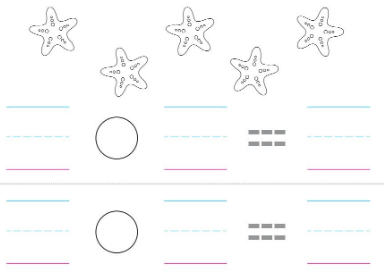
11 Cross out 5 counters to show how many to take away. Use the ten frame to complete the subtraction sentence. 12 An aquarium has 5 starfish. Some are orange and some are purple. Color the starfish. Then write an addition sentence to match your picture. Write a subtraction sentence that shows the related fact. Tell a story to match your subtraction sentence.

7.6 Use a Group of 5 to Subtract

Question 11.
Big Ideas Math Answers Grade K Chapter 7 Subtract Numbers within 10 chp 11
Answer:
Big-Ideas-Math-Answers-Grade-K-Chapter-7-Subtract-Numbers-within-10-chp-11

Explanation:
There are 9 shaded blocks. 5 blocks are grouped.
So cross 5 blocks from 9.
9 – 5 = 4

7.7 Related Facts

Question 12.
Big Ideas Math Answers Grade K Chapter 7 Subtract Numbers within 10 chp 12
Answer:
Big-Ideas-Math-Answers-Grade-K-Chapter-7-Subtract-Numbers-within-10-chp-12

Explanation:
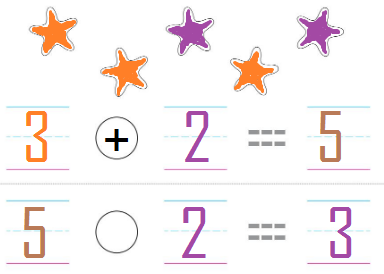
There are 3 orange stars and 2 violet stars.
The addition sentence is 3 + 2 = 5
The subtraction sentence is 5 – 2 = 3

Subtract Numbers within 10 Cumulative Practice

Directions:
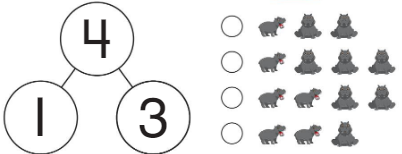
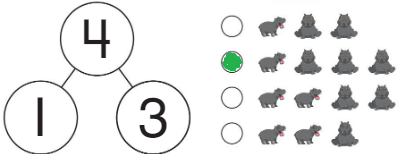
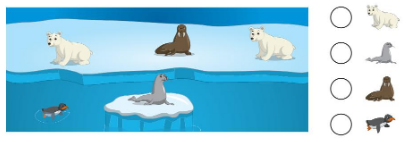
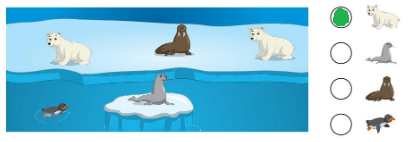
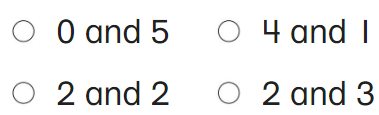
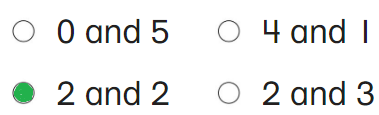
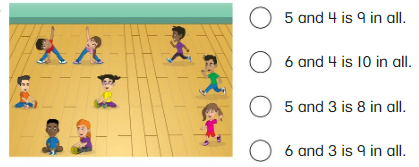
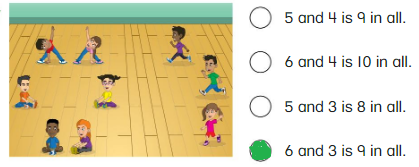
Shade the circle next to the answer. 1 Which group of animals matches the number bond? 2 Which animal is shown 2 times? 3 Which partner numbers do not make 5?

Question 1.
Big Ideas Math Solutions Grade K Chapter 7 Subtract Numbers within 10 cp 1
Answer: ii option
Big-Ideas-Math-Solutions-Grade-K-Chapter-7-Subtract-Numbers-within-10-cp-1

Explanation:
1 + 3 = 4
1 is left and 3 are leaving.
1 and 3 are the parts and 4 is the number bond.

Question 2.
Big Ideas Math Solutions Grade K Chapter 7 Subtract Numbers within 10 cp 2
Answer: i option
Big-Ideas-Math-Solutions-Grade-K-Chapter-7-Subtract-Numbers-within-10-cp-2

Explanation:
There are 2 polar bears.
Thus the answer is option i.

Question 3.
Big Ideas Math Solutions Grade K Chapter 7 Subtract Numbers within 10 cp 3
Answer: iii option
Big-Ideas-Math-Solutions-Grade-K-Chapter-7-Subtract-Numbers-within-10-cp-3

Directions:
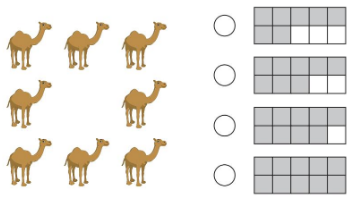
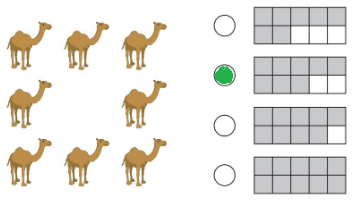
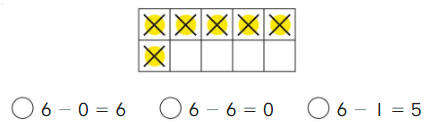
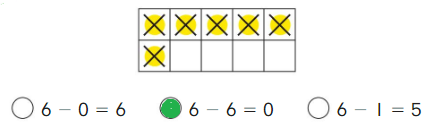
Shade the circle next to the answer. 4 Which ten frame shows the number of camels? 5 Which sentence tells how many students are in the group to start, how many join, and how many there are in all? 6 Which subtraction sentence tells how many dots are left?

Question 4.
Big Ideas Math Solutions Grade K Chapter 7 Subtract Numbers within 10 cp 4
Answer: ii option
Big-Ideas-Math-Solutions-Grade-K-Chapter-7-Subtract-Numbers-within-10-cp-4

Explanation:
There are 8 camels in all.
Now we have to match it to the tens pattern.
Option ii is the correct answer.

Question 5.
Big Ideas Math Solutions Grade K Chapter 7 Subtract Numbers within 10 cp 5
Answer: iv option
Big-Ideas-Math-Solutions-Grade-K-Chapter-7-Subtract-Numbers-within-10-cp-5

Explanation:
There are 6 students in all.
3 students are joining them.
6 + 3 = 9
Thus the correct answer is option iv.
Question 6.
Big Ideas Math Solutions Grade K Chapter 7 Subtract Numbers within 10 cp 6
Answer: ii option
Big-Ideas-Math-Solutions-Grade-K-Chapter-7-Subtract-Numbers-within-10-cp-6

Explanation:
By seeing the figure we can say that there are 6 shaded blocks among them 6 are crossed.
That means the subtraction sentence is 6 – 6 = 0
option ii is the correct answer.

Directions:
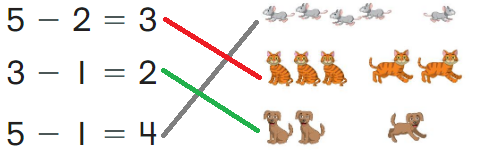
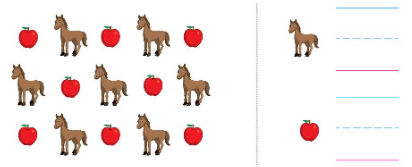
7 Match the subtraction sentences with the pictures that show how many there are in all, how many are leaving, and how many are left. 8 Count the objects in each group. Write each number. Draw a line through the number that is less than the other number. 9 Circle 2 groups of bear counters that make 10 bear counters in all. Then write an addition sentence.

Question 7.
Big Ideas Math Solutions Grade K Chapter 7 Subtract Numbers within 10 cp 7
Answer:
Big-Ideas-Math-Solutions-Grade-K-Chapter-7-Subtract-Numbers-within-10-cp-7

Question 8.
Big Ideas Math Solutions Grade K Chapter 7 Subtract Numbers within 10 cp 8
Answer:
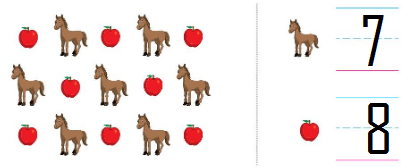
horses = 7
apples = 8
Big-Ideas-Math-Solutions-Grade-K-Chapter-7-Subtract-Numbers-within-10-cp-8

Explanation:
By seeing the figure we observe that,
There are 7 horses and 8 apples.

Question 9.
Big Ideas Math Solutions Grade K Chapter 7 Subtract Numbers within 10 cp 9
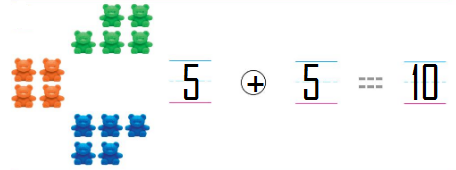
Answer: 5 + 5 = 10
Big-Ideas-Math-Solutions-Grade-K-Chapter-7-Subtract-Numbers-within-10-cp-9

Directions:
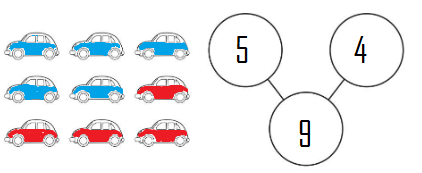
10 Color 5 cars blue and the rest red. Then complete the number bond to match your picture. 11 Draw lines between the objects in each group. Circle the group that is greater in number than the other group. 12 You are playing a video game. You need to catch 5 pigs that escaped. You catch some of the pigs. Cross out the pigs you catch. Then write a subtraction sentence to tell how many pigs you have left to catch.

Question 10.
Big Ideas Math Solutions Grade K Chapter 7 Subtract Numbers within 10 cp 10
Answer:
Big-Ideas-Math-Solutions-Grade-K-Chapter-7-Subtract-Numbers-within-10-cp-10

Question 11.
Big Ideas Math Solutions Grade K Chapter 7 Subtract Numbers within 10 cp 11
Answer: 4 > 3
Big-Ideas-Math-Solutions-Grade-K-Chapter-7-Subtract-Numbers-within-10-cp-11

Question 12.
Big Ideas Math Solutions Grade K Chapter 7 Subtract Numbers within 10 cp 12
Answer: 5 – 5 = 0
Big-Ideas-Math-Solutions-Grade-K-Chapter-7-Subtract-Numbers-within-10-cp-12

Conclusion:

We wish the Big Ideas Math Answers Grade K Chapter 7 Subtract Numbers within 10 Pdf is beneficial for you. If you have any doubts regarding the concepts you can post the comments in the below-mentioned comment box.

Big Ideas Math Answers Grade 5 Chapter 5 Multiply Decimals

Big Ideas Math Answers Grade 5 Chapter 5 Multiply Decimals

What are you searching for? If you are really on the hunt for the best source to learn the Multiply Decimals concept, then refer to Big Ideas Math Answers Grade 5 Chapter 5 Multiply Decimals. Big Ideas Math Answers Grade 5 Chapter 5 Multiply Decimals is the one-stop solution for better learning. All types of problems, practice tests, explanations, step-by-step solving processes, real-time examples are provided on our material. Therefore, students who want to become math experts can use our material and get good marks in the exam. Chapter-wise topics are given for the best practice of students. Make use of our Big Ideas Grade 5 Math Answers and learn perfectly.

Big Ideas 5th Grade Chapter 5 Multiply Decimals Math Book Answer Key

For the best practice, refer to all the links available below. Every link refers to every individual topic. On our website, we have given various methods to learn in-depth concepts. Therefore, find the best way that makes your preparation easy. never waste a single moment. Immediately start your preparation and finish all problems. Accurate learning is in your hands if you prepare with the Big Ideas Math Book 5th Grade Chapter 5 Multiply Decimals Answer Key.

Lesson: 1 Multiplication Patterns with Decimals

Lesson: 2 Estimate Products of Decimals and Whole Numbers

Lesson: 3 Use Models to Multiply Decimals and Whole Numbers

Lesson: 4 Multiply Decimals and Whole Numbers

Lesson 5.5 Use Models to Multiply Decimals

Lesson: 6 Use Partial Products to Multiply Decimals

Lesson: 7 Use Strategies to Multiply Decimals

Lesson: 8 Multiply Decimals

Lesson: 9 Problem Solving: Multiply with Money

Chapter: 5 – Multiply Decimals

Lesson 5.1 Multiplication Patterns with Decimals

Explore and Grow

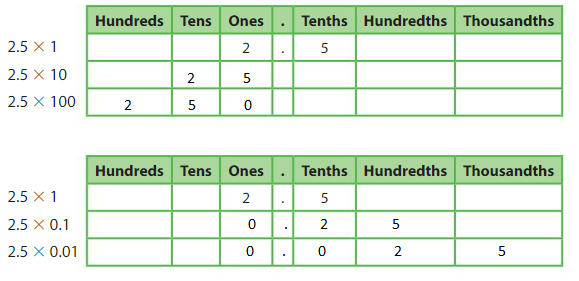
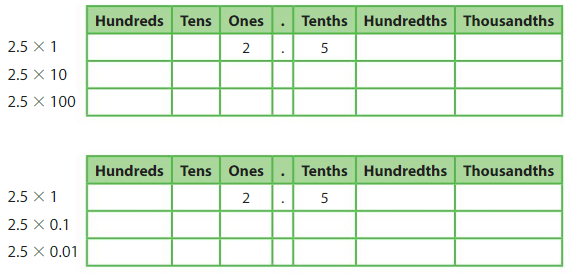
Use the relationship between positions in a place value chart to find each product.
Big Ideas Math Answer Key Grade 5 Chapter 5 Multiply Decimals 5.1 1
What patterns do you notice?
Answer:

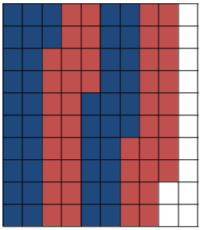
I notice that in first value chart the decimal point  shifts one place to the right and in the second value chart the decimal point shifts one place to the left.

Structure
Describe the placement of the decimal point when multiplying a decimal by 10, 100, 0.1, and 0.01.
Answer:
When we multiply 0.01with 10 the decimal point shifts one place to the right(10×0.01=0.1)
When we multiply 0.01with 100 the decimal point shifts two places to the right(100×0.01=1)
When we multiply 0.01 with 0.1 the decimal point shifts one place to the left(0.1×0.01=0.001).

Think and Grow: Use Patterns to Find Products

Example
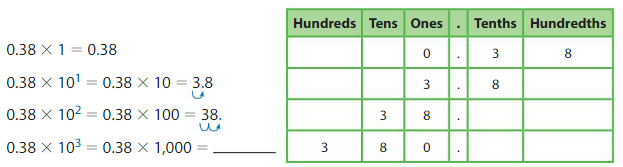
Find 0.38 × 10³.
Use place value concepts. Every time you multiply a number by 10, each digit in the number shifts one position to the left in a place value chart.
Big Ideas Math Answer Key Grade 5 Chapter 5 Multiply Decimals 5.1 2
So, 0.38 × 103 = ______.
Notice the pattern: In each product, the number of places the decimal point moves to the right is the same as the exponent.

Example
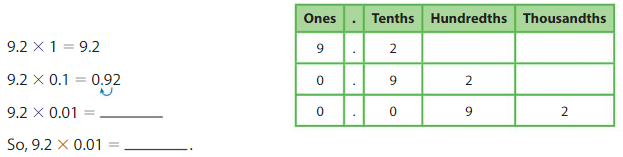
Find 9.2 × 0.01.
Use place value concepts. Every time you multiply a number by \(\frac{1}{10}\) = 0.1, 10each digit in the number shifts one position to the right in a place value chart.
Big Ideas Math Answer Key Grade 5 Chapter 5 Multiply Decimals 5.1 3
Notice the pattern: When you multiply by0.1, the decimal point moves one place to the left. When you multiply by 0.01, the decimal point moves two places to the left.

Show and Grow

Find the product.
Question 1.
2.51 × 104 = _______
Answer:
2.51×10000=25,100

Explanation:
2.51×1=2.51
2.51x 101 =2.51×10=25.1
2.51x 102 =2.51×100=251
2.51x 103 =2.51×1000=2510
2.51x 104 =2.51×10000=25100
So, 2.51x 104 =25100
When we multiply 2.51 by 104 the number of places the decimal point moves to the right is the same as the exponent ie 4 places.

Question 2.
0.7 × 0.01 = ______
Answer:
0.7 × 0.01 = 0.007

Explanation:
0.7×1=0.7
0.7×0.1=0.07
0.7×0.01=0.007
So, 0.7×0.01=0.007
When you multiply 0.7 by 0.1, the decimal point moves one place to the left. When you multiply 0.7 by 0.01, the decimal point moves two places to the left.

Apply and Grow: Practice

Find the product.
Question 3.
4.1 × 102 = _______
Answer:
4.1×100=410

Explanation:
4.1×1=4.1
4.1x 101 =4.1×10=41
4.1x 102 =4.1×100=410
So, 4.1×102 =410
When we multiply 4.1 by 102 the number of places the decimal point moves to the right is the same as the exponent ie 2.

Question 4.
7.03 × 0.1 = _______
Answer:
7.03×0.1=0.703

Explanation:
7.03×1=7.03
7.03×0.1=0.703
So, 7.03×0.1=0.703
When you multiply 7.03 by 0.1, the decimal point moves one place to the left.

Question 5.

16.579 × 104 = _______
Answer:
16.579×10000=1,65,790

Explanation:
16.579×1=16.579
16.579x 101 =16.579×10=165.79
16.579x 102 =16.579×100=1657.9
16.579x 103 =16.579×1000=16,579
16.579x 104 =16.579×10000=1,65,790
So, 16.579x 104 =1,65,790
When we multiply 16.579 by 104 the number of places the decimal point moves to the right is the same as the exponent ie 4.

Question 6.
843.7 × 0.01 = _______
Answer:
843.7×0.01=8.437

Explanation:
843.7×1=843.7
843.7×0.1=84.37
843.7×0.01=8.437
So, 843.7×0.01=8.437
When we multiply 843.7 by 0.1, the decimal point moves one place to the left.When you multiply 843.7 by 0.01, the decimal point moves two placs to the left.

Question 7.
A contractor installs a new floor of a room using 1,000 square tiles. Each tile has an area of 1.25 square feet. What is the area of the floor?
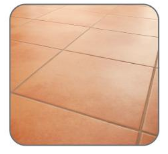
Big Ideas Math Answer Key Grade 5 Chapter 5 Multiply Decimals 5.1 4
Answer:
There are 1,000 square tiles in a room, Area of each tile is 1.25 square feet
Find the area of the floor by multiplying Area of tile by Number of tiles.
Multiplying 1.25 by 1000, shifts the digits 3 positions to the left in a place value chart.So, the decimal point moves 3 places to the right.
=1.25×1000=1,250 square feet
Therefore Area of floor is 1,250 square feet.

Reasoning
complete the equation

Question 9.
_____ × 103 = 6,209
Answer:
6.209×1000=6,209

Explanation:
Multiplying something by 1000, shifts the digits 3 positions to the left in a place value chart.So, the decimal point moves 3 places to the right.As the number 6,209 is already multiplyed by 1000 now to know the missing factor shift the decimal point 3 places to the left.
So, the number is 6.209

Question 10.
_____ × 0.01 = 1.879
Answer:
187.9=0.01=1.879

Explanation:
When you multiply by 0.1, the decimal point moves one place to the left.When you multiply by 0.01, the decimal point moves two places to the left.As the number 1.879 is already multiplied by 0.01 now to know the missing factor shift the decimal point two places to the right.
So, the number is 187.9

Question 11.
0.045 × _____ = 45
Answer:
0.045×1000=45

Explanation:
0.045×1=0.045
0.045×10=0.45
0.045×100=4.5
0.045×1000=45
When we multiply 0.045 by 1000 the decimal point moves 3 placed to the right.

Think and Grow: Modeling Real Life

Example
A flea is 1.5 millimeters long. A magnified image of the flea is 100 times as long as its actual length. How much longer is the flea in the image than its actual length?
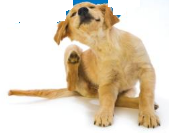
Big Ideas Math Answer Key Grade 5 Chapter 5 Multiply Decimals 5.1 5
Find the length of the flea in the image by multiplying the length of the flea by 100.
Multiplying 1.5 by 100, or 102, shifts the digits _____ positions to the left in a place value chart. So, the decimal point moves ____ places to the right.
1.5 × 100 = 1.5 × 102 = ______
The length of the flea in the image is _______ millimeters.
Subtract the length of the flea from the length of the flea in the image.
Big Ideas Math Answer Key Grade 5 Chapter 5 Multiply Decimals 5.1 6
The flea in the image is ________ millimeters longer than its actual length.

Answer:
Multiplying 1.5 by 100, or 102, shifts the digits right positions to the left in a place value chart. So, the decimal point moves left places to the right.
1.5 × 100 = 1.5 × 102 = 150
The length of the flea in the image is 150 millimeters.
150 – 1.5 = 148.5
The flea in the image is 148.5 millimeters longer than its actual length.

Show and Grow

Question 12.
The London Eye is a 443-foot-tall Ferris wheel. A model is 0.01 times as tall as the actual Ferris wheel. How much taller is the actual London Eye than the model?
Answer:
The London Eye is 443 feet tall Ferris, a model is 0.01 times tall as actual Ferris.
When we multiply 443 by 0.01 the decimal point moves 2 places to the left
443×0.01=4.43. So, the area of the model is 4.43 feet.
Subtract the area of the model from the actual area of the Ferris.
443.00‐ 4.43=438.57
The actual London Eye ferris wheel is 438.57 feet taller than a model ferris wheel.

Question 13.
Each day,you ride your bike from home to school and back. Your school is 0.9 mile from home. How far do you ride your bike in 10 days?
Answer:
My school is 0.9 mile from my home.If I ride bike from home to school and back every day then I ride 1.8(0.9×2) miles every day.
If each day I ride 1.8 miles then for 10 days i ride 1.8×10=18 miles.
When we multiply 1.8 by 10 and the decimal point moves 1 places to the right.
Therefore I ride 18 miles in 10 days.

Question 14.
DIG DEEPER!
An eel travels at a speed of 2 miles per hour. A starfish travels one hundredth the speed of the eel. A falcon travels 10,000 times as fast as the starfish. How many more miles per hour can the falcon travel than the eel?
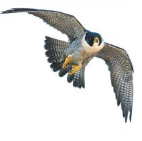
Big Ideas Math Answer Key Grade 5 Chapter 5 Multiply Decimals 5.1 7
Answer:
An eel travels at a speed of 2 miles per hour.A starfish and travels one hundredth the speed of the eel.
Speed of starfish is 2×0.01(one hundredth)=0.02miles per hour.
When we multiply 2 by 0.01 the decimal point moves 2 places to the left
A falcon travels 10,000 times as fast as the starfish.
Speed of falcon is 10,000×0.02(speed of starfish)=200 miles per hour.
When we multiply 0.02 by 10000 the decimal point moves 4 places to the right
A falcon can travel 200 miles more miles per hour than the eel.

Multiplication Patterns with Decimals Homework & Practice 5.1

Find the product.
Question 1.
5.201 × 10 = ______
Answer:
5.201 × 10 =52.01

Explanation:
5.201×1=5.201
5.201×10=52.01
So, 5.201×10=52.01
When we multiply 5.201 by 10 the decimal point moves one place to the right.

Question 2.
26.7 × 0.01 = _____
Answer:
26.7 × 0.01 =0.267

Explanation:
26.7×1=26.7
26.7×0.1=2.67
26.7×0.01=0.267
So, 26.7 × 0.01 =0.267
When we multiply 26.7 by 0.1, the decimal point moves one place to the left. When you multiply 26.7 by 0.01, the decimal point moves two places to the left.

Question 3.
0.095 × 103 = ______
Answer:
0.095 × 103 =0.095×1000=95

Explanation:
0.095×1=0.095
0.095x 101 =0.095×10=0.95
0.095x 102 =0.095×100=9.5
0.095x 103 =0.095×1000=95
So, 0.095 × 103 =95
When we multiply 0.095 by 103 the number of places the decimal point moves to the right is the same as the exponent ie 3 places.

Question 4.
37.84 × 0.1 = ______
Answer:
37.84 × 0.1 =3.784

Explanation:
37.84×1=37.84
37.84×0.1=3.784
So, 37.84×0.1=3.784
When we multiply 37.84 by 0.1, the decimal point moves one place to the left.

Question 5.
0.26 × 104 = ______
Answer:
0.26 × 104 =0.26×10000=2600

Explanation:
0.26×1=0.26
0.26x 101 =0.26×10=2.6
0.26x 102 =0.26×100=26
0.26x 103 =0.26×1000=260
0.26x 104 =0.26×10000=2600
So, 0.26x 104 =2600
When we multiply 0.26 by 104 the number of places the decimal point moves to the right is the same as the exponent ie 4 places.

Question 6.
15.9 × 0.01 = ______
Answer:
15.9 × 0.01 =0.159

Explanation:
15.9×1=15.9
15.9×0.1=1.59
15.9×0.01=0.159
So, 15.9×0.01=0.159
when we multiply 15.9 by 0.01 the decimal point moves two places to the left.

Find the product.
Question 7.
0.8 × 0.01 = ______
Answer:
0.8 × 0.01 =0.008

Explanation:
0.8×1=0.8
0.8×0.1=0.08
0.8×0.01=0.008
So, 0.8×0.01=0.008
When we multiply 0.8 by 0.1, the decimal point moves one place to the left. When you multiply 0.8 by 0.01, the decimal point moves two places to the left.

Question 8.
3.1 × 104 = ______
Answer:
3.1 × 104 =3.1×10000=31000

Explanation:
3.1×1=3.1
3.1x 101 =3.1×10=31
3.1x 102 =3.1×100=310
3.1x 103 =3.1×1000=3100
3.1x 104 =3.1×10000=31000
So, 3.1x 104 =31000
When we multiply 3.1 by 104 the number of places the decimal point moves to the right is the same as the exponent ie 4 places.

Question 9.
Writing
Explain how you can use mental math to find 5.4 × 10³ and 5.4 × 0.01.
Answer:
5.4 × 10³ and 5.4 × 0.01
5.4 × 10³
5.4 × 10 × 10 × 10
= 54 × 100
= 5400
5.4 × 0.01 = 0.054

Question 10.
DIG DEEPER!
What is Newton’s number?
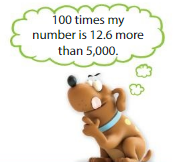
Big Ideas Math Answer Key Grade 5 Chapter 5 Multiply Decimals 5.1 8
Answer:
Newton’s number is 49.874

Explanation:
Subtract 12.6 from 5000
5000‐12.6=4987.4
Divide the balance with 100 to find Newton’s number.
4987.4×0.01=49.874
When you multiply 4987.4 by 0.01, the decimal point moves two places to the left.
Newton’s number is 49.874

Question 11.
Modeling Real Life
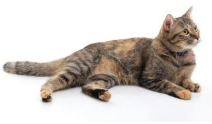
A house cat weighs 9.22 pounds. Hercules the liger is the world’s largest cat, and weighs 100 times the weight of the house cat. How much more does Hercules weigh than the house cat?
Big Ideas Math Answer Key Grade 5 Chapter 5 Multiply Decimals 5.1 9
Answer:
Hercules weigh  912.7 pounds more than the house cat.

Explanation:
A house cat weighs 9.22 pounds, Hercules the liger is the world’s largest cat and weighs 100 times more than a house cat.
The weight of Hercules is 9.22×100=922 pounds
When we multiply 9.22 by 100 the decimal point moves 2 places to the right.
Subtract weight of house cat from the weight of Hercules =922‐9.22=912.7
Hercules weigh  912.7 pounds more than the house cat.

Question 12.
DIG DEEPER!
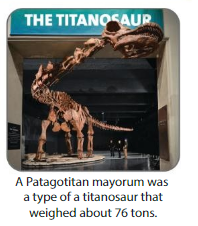
A Tyrannosaurus rex weighed about 1.4 tons more than one-tenth the weight of a Patagotitan. About how much did the mayorumTyrannosaurus rex weigh?
Big Ideas Math Answer Key Grade 5 Chapter 5 Multiply Decimals 5.1 10
Answer:
MayorumTyrannosaurus rex weigh=9 tons.

Explanation:
Weight of patagotitan mayorum is 76 tons and One‐tenth of patagotitan is 76×0.1=7.6 tons.
When you multiply 76.0 by 0.1 , the decimal point moves one places to the left.
A Tyrannosaurus rex weighed about 1.4 tons more than one-tenth the weight of a Patagotitan
Weight of Tyrannosaurus rex=1.4 tons + 7.6 tons= 9 tons
MayorumTyrannosaurus rex weigh=9 tons.

Review & Refresh

Question 13.
Newton and Descartes have a $50.00 gift card to a pet store. Newton’s total is $18.95 and Descartes’s total is $24.38. How much money do they have left on their gift card?
Answer:
Newton’s total is $18.95 and Descartes’s total is $24.38.
Total money they spent in a pet store =$18.95+$24.38 =$43.33
Newton and Descartes have a $50.00 gift card to a pet store
Subtract the money they spent in a pet store from the gift card money
$50.00‐$43.33=$6.67
Therefore , $6.67 is the amount they have left on their gift card.

Lesson 5.2 Estimate Products of Decimals and Whole Numbers

Explore and Grow

Choose an expression to estimate each product. Write the expression. You may use an expression more than once.
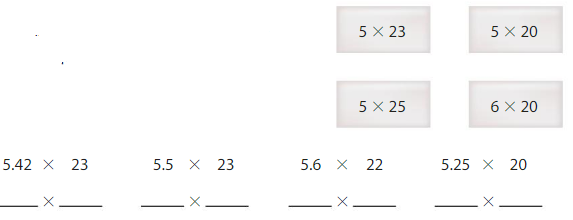
Big Ideas Math Answers 5th Grade Chapter 5 Multiply Decimals 5.2 1
Compare your answers with a partner. Did you choose the same expressions?
Answer:
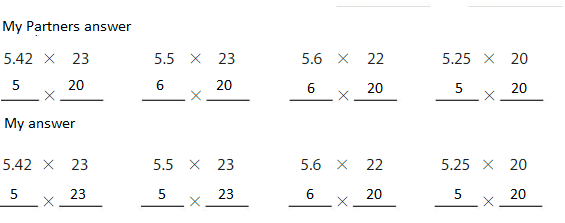
when i compared my answers with my partners answers i found that we didnot choose the same expressions.

Construct Arguments
Which estimated product do you think will be closer to the product of 2.7 and 9? Explain your reasoning.
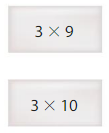
Big Ideas Math Answers 5th Grade Chapter 5 Multiply Decimals 5.2 2
Answer:
The estimated product of 3 and 9 is closer to the product of 2.7 and 9.

Explanation:
The product of 2.7 and 9 is 2.7×9=24.3
The product of 3 and 9 is 3×9=27
The product of 3 and 10 is 3×10=30
24.3 is closer to 27
Therefore the estimated product of 3 and 9 is closer to the product of 2.7 and 9.

Think and Grow: Estimate Products

Example
Estimate 3.85 × 27.
One Way: Use rounding. Round 3.85 to the nearest whole number. Then multiply.
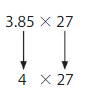
Big Ideas Math Answers 5th Grade Chapter 5 Multiply Decimals 5.2 3
4 × 27 = ______
So, 3.85 × 27 is about = ______

Answer:
4 × 27 = 108
So, 3.85 × 27 is about = 104

Another Way: Use compatible numbers.
Big Ideas Math Answers 5th Grade Chapter 5 Multiply Decimals 5.2 4
4 × 25 = ______
So, 3.85 × 27 is about = ______.

Answer:
4 × 25 = 100
So, 3.85 × 27 is about = 100.

Example
Estimate 77 × 93.6.
One Way: Use rounding. Round to the nearest ten. Then multiply.
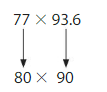
Big Ideas Math Answers 5th Grade Chapter 5 Multiply Decimals 5.2 5
80 × 90 = _____
So, 77 × 93.6 is about = ______

Answer:
80 × 90 = 7200
So, 77 × 93.6 is about = 7200

Another Way: Use compatible numbers.
Big Ideas Math Answers 5th Grade Chapter 5 Multiply Decimals 5.2 6
75 × 100 = _______
So, 77 × 93.6 is about = ______.

Answer:
75 × 100 = 7500
So, 77 × 93.6 is about = 7207.

Show and Grow

Estimate the product.
Question 1.
11.6 × 9

Answer:
Use rounding. Round 11.6 to the nearest whole number. Then multiply.
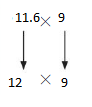
12×9=108
So, 11.6×9 is about =108
Another Way: Use compatible numbers
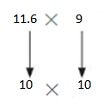
10×10=100
So, 11.6× 9 is about =100

Question 2.
159.81 × 17
Answer:
One Way: Use rounding. Round 159.81 to the nearest whole number. Then multiply.
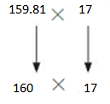
160×17=2720
So, 159.81×17 is about =2720
Another Way: Use compatible numbers
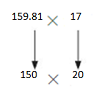
150×20=3000
So, 159.81×17 is about =3000

Apply and Grow: Practice

Estimate the product.
Question 3.
72 × 0.76
Answer:
Use rounding. Round 0.76 to the nearest whole number. Then multiply.
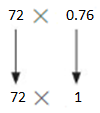
72×1 =72
So, 72×0.76 is about =72

Question 4.
6.1 × 4
Answer:
Use rounding. Round 6.1 to the nearest whole number. Then multiply.
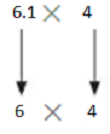
6×4=24
So, 6.1×4 is about =24

Question 5.
1.54 × 12
Answer:
Use rounding. Round 1.54 to the nearest whole number. Then multiply.
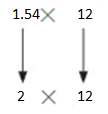
2×12=24
So, 1.54×12 is about =24

Question 6.
22 × 8.02
Answer:
Use rounding. Round 8.02 to the nearest whole number. Then multiply.
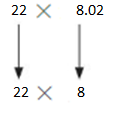
22×8=176
So, 22 × 8.02 is about = 176

Question 7.
147 × 11.6
Answer:
Use compatible numbers
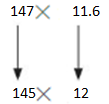
145×12=1740
So, 147×11.6 is about =1740

Question 8.
217 × 13.42
Answer:
Use compatible numbers
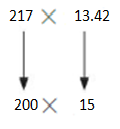
200×15=3000
So, 217×13,42 is about =3000

Question 9.
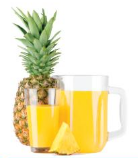
There are 1.36 liters of pineapple juice in 1 can. You buy a case of 8 cans. About how many liters of pineapple juice do you buy?
Big Ideas Math Answers 5th Grade Chapter 5 Multiply Decimals 5.2 7
Answer:
There are 1.36 liters of pineapple juice in 1 can, there are 8 cans in a case.
Number of liters of pineapple juice in a case is about 1.36×8
Use rounding. Round 1.36 to the nearest whole number. Then multiply.
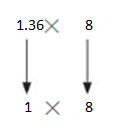
1×8=8 liters
About 8 liters of pineapple juice i shall buy.

Question 10.
Open-Ended
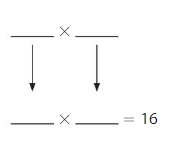
Write a decimal and a whole number that have an estimated product of 16.
Big Ideas Math Answers 5th Grade Chapter 5 Multiply Decimals 5.2 8
Answer:
Imagine the numbers as 1.9 and 8
1.9 × 8
Use rounding.Round 1.9 to the nearest whole number. Then multiply
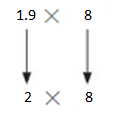
2×8=16
So, 1.9×8 is about =16.

Question 11.
Number Sense
You use 50 × 4 to estimate 45 × 3.56. Is your estimate an overestimate or an underestimate? Explain.
Answer:
My estimate is an overestimate.

Explanation:
50×4=200
45×3.56=160.2
As the product of 50 and 4 is more than the product of 45 and 3.56 so mu estimate is over estimate.

Question 12.
DIG DEEPER!
Describe a situation in which an estimate of the product of a whole number and a decimal is suffcient.
Answer:
A biscuit packet costs 4.83 rupees for a vendor and he sells 15 packets of biscuits he will earn an amount of 75 rupees(15 × 4.83=72.45).

Think and Grow: Modeling Real Life

Example
A space probe is 756,600 miles from Earth. The probe travels 9.7 miles farther from Earth each second. About how far is the space probe from Earth after 60 seconds?
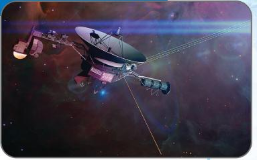
Big Ideas Math Answers 5th Grade Chapter 5 Multiply Decimals 5.2 9
Find the distance the probe travels in 60 seconds by multiplying the distance the probe travels in 1 second by60. Round 9.7 to the nearest whole number because you do not need a precise answer.
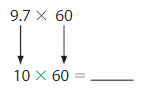
Big Ideas Math Answers 5th Grade Chapter 5 Multiply Decimals 5.2 10
The probe travels about ______ miles in 60 seconds.
Add the distance the probe is from Earth to the distance it travels in 60 seconds.
Big Ideas Math Answers 5th Grade Chapter 5 Multiply Decimals 5.2 11
The probe is about ______ miles from Earth after 60 seconds.

Answer:
10 × 60 = 600
The probe travels about 600 miles in 60 seconds.
Add the distance the probe is from Earth to the distance it travels in 60 seconds.
756,600 + 600 = 757200
The probe is about 757200 miles from Earth after 60 seconds.

Show and Grow

Question 13.
A bucket weighs 1.4 pounds. One gallon of sand weighs 13.4 pounds. About how much does the bucket and 4 gallons of sand weigh in all?
Answer:
A bucket weighs 1.4 pounds, A gallon of sand weighs 13.4 pounds.
Use rounding. Round 1.4 and 13.4 to the nearest whole number
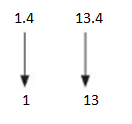
Weight of 4 gallons = 4 × weight of gallon= 4 × 13=52
The bucket and 4 gallons of sand weight=1+52=53 pounds

Question 14.
An 8.2-centimeter-tall plant grows 2.9 centimeters each month for 1 year. About how tall is the plant at the end of 1 year?
Answer:
Length of the plant now is 8.2 centimeters. If it grows about 2.9 centimeter for each month the length of the plant increased is product of 12months and the length of plant that grows each month.
Round of 8.2 and 2.9 to the nearest whole numbers
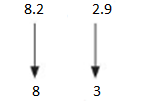
The length of the plant increased is product of 12months and the length of plant that grows each month
12×3=36
Total length= length of plant + increased length after a year=8+36 =44 centimeters
About 44 centimeters tall is the plant at the end of 1 year.

Question 15.
DIG DEEPER!
A motorcycle travels 52.3 miles using 1 gallon of gasoline. A car travels 29.8 miles using 1 gallon of gasoline. About how much farther does the motorcycle travel using 6 gallons of gasoline than the car?
Answer:
A motorcycle travels 52.3 miles using 1 gallon of gasoline and a car travels 29.8 miles using 1 gallon of gasoline
Round of 52.3 and 29.8 sto the nearest whole number.
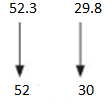
For 6 gallons of gasoline motorcycle travels    30× 6=180 miles
For 6 gallons of gasoline car travels                 52× 6=312 miles
312‐180=132 miles
About 132 miles farther the motorcycle travel using 6 gallons of gasoline than the car.

Estimate Products of Decimals and Whole Numbers Homework & Practice 5.2

Estimate the product.
Question 1.
0.8 × 36
Answer:
Use rounding. Round of 0.8 to nearest whole number. And multiply
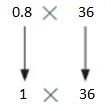
1×36=36
So, 0.8×36=36

Question 2.
2.34 × 16
Answer:
Use rounding. Round of 2.34 to the nearest whole number. And multiply
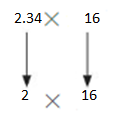
2×16=32
So, 2.34×16 is about =32

Question 3.
9 × 1.67
Answer:
Use rounding. Round of 1.67 to the nearest whole number. And multiply
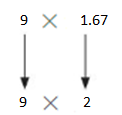
9×2=18
So, 9×1.67 is about = 18

Question 4.
105 × 4.6
Answer:
Use rounding. Round of 4.6 to the nearest whole number. And multiply
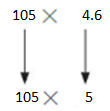
105×5=525
So, 105×4.6 is about =525

Question 5.
88 × 0.9
Answer:
Use rounding. Round of 0.9 to the nearest whole number. And multiply
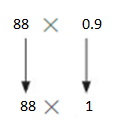
88×1=88
So, 88×0.9 is about =8

Question 6.
5.5 × 131
Answer:
Use rounding. Round of 5.5 to the nearest whole number. And multiply
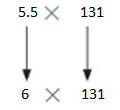
6×131=786
So, 5.5×131 is about =786

Question 7.
An athlete runs 6.23 miles in 1 hour. At this pace, about how far does the athlete run in 4 hours?
Answer:
An athlete runs 6.23 miles in 1 hour.
Use rounding.
Round of 6.23 to the nearest whole number.
6.23——6
Number of miles athlete run in 4 hours
=4× Number of miles athlete run in 1 hour
=4×6=24
About 24 miles the athlete run in 4 hours.

Question 8.
Number Sense
Which expressions are underestimates of 26.5 × 91?
20 × 90
30 × 100
30 × 90
25 × 90
Answer:
20×90 and 25×90 are the underestimates of 26.5×91 as both the estimated numbers in these expressions are less than original numbers.

Question 9.
Writing
Which strategy can you use to estimate the product of 8.02 and 106? Explain.
Answer:
I use compatible numbers strategy because numbers are near to round figures.

Question 10.
YOU BE THE TEACHER
Your friend finds the product. Is her answer reasonable? Estimate to check.?

Big Ideas Math Answers 5th Grade Chapter 5 Multiply Decimals 5.2 12
Answer:
1.06 × 103 = 109.18
Use rounding.Round 1.06 to the nearest whole number. And multiply.
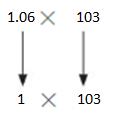
1×103 =103
So, my friend’s answer is reasonable.

Question 11.
Modeling Real Life
Newton pays for 5 pounds of pears that cost $3.75 per pound. Descartes pays$15 for 5 pounds of apples. About how much more do the 5 pounds of pears cost than the 5 pounds of apples?
Answer:
Cost of 5 pounds of pears 5×$3.75
Round 3.75 to the nearest whole number. And multiply
5×$4=$20
Descartes pays$15 for 5 pounds of apples
Subtract cost of apples from pears $20‐$15=$5
About $5 more the 5 pounds of pears cost than the 5 pounds of apples.

Question 12.
Modeling Real Life
A hospital employee works 3 days each week. The route from her house to the hospital is 9.9 miles and the route back to her house is 10.5 miles. About how many miles does she travel for work each week?
Answer:
Use rounding.Round 9.9 and 10.5 to the nearest whole numbers.
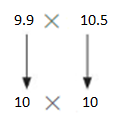
A hospital employee works 3 days each week.
So, as the route from her house to the hospital is 9.9 miles per day for 3 days it is 10×3= 30 miles
As the route back to her house is 10.5 miles per day for 3 days it is 10×3=30 miles
Total number of miles =30+30=60
Therefore About 60 miles she travel for work each week.

Review & Refresh

Question 13.
Write the number in two other forms.
Standard form:
Word form: four and twenty-six thousandths
Expanded form:
Answer:
4.26000

Lesson 5.3 Use Models to Multiply Decimals and Whole Numbers

Explore and Grow

Complete the table.
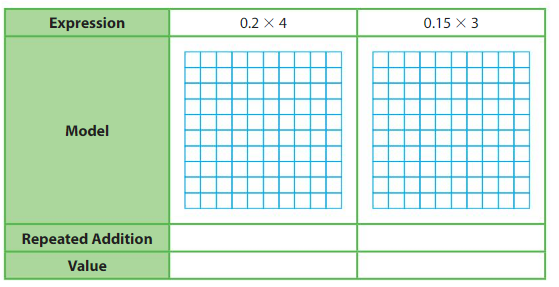
Big Ideas Math Answers Grade 5 Chapter 5 Multiply Decimals 5.3 1
Answer:

Structure
How does the relationship between addition and multiplication help you find each product?
Answer:
Addition is the process of combining a number of individual items together to form a new total.Multiplication, however, is the process of using repeated addition and combining the total number of items that make up equal-sized groups.

Think and Grow: Use Models to Multiply Decimals and Whole Numbers

Example
Find 0.23 × 3.
Use a model. Shade 3 groups of 0.23.
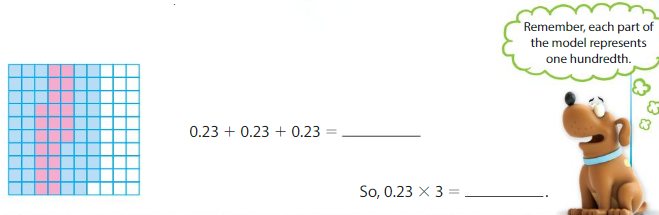
Big Ideas Math Answers Grade 5 Chapter 5 Multiply Decimals 5.3 2

Example
Find 0.48 × 4.
Use a model. Shade 4 groups of 0.48.
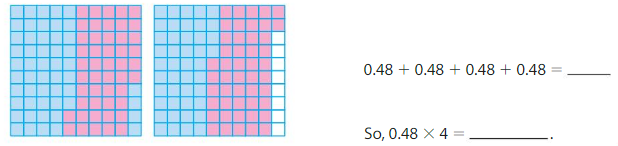
Big Ideas Math Answers Grade 5 Chapter 5 Multiply Decimals 5.3 3

Show and Grow

Find the product.
Question 1.
0.19 × 3 = _____
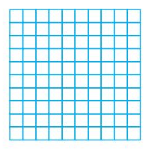
Big Ideas Math Answers Grade 5 Chapter 5 Multiply Decimals 5.3 4
Answer:


0.19+0.19+0.19=0.57
So, 0.19×3=0.57

Question 2.
0.37 × 5 = ______
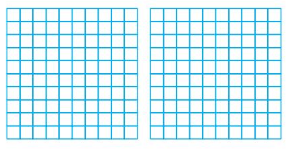
Big Ideas Math Answers Grade 5 Chapter 5 Multiply Decimals 5.3 5
Answer:


0.37+0.37+0.37+0.37+0.37=1.85
S0, 0.37×5=1.85

Apply and Grow: Practice

Find the product.
Question 3.
0.09 × 5 = _____
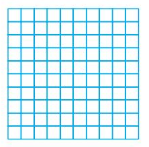
Big Ideas Math Answers Grade 5 Chapter 5 Multiply Decimals 5.3 6
Answer:


0.09+0.09+0.09+0.09+0.09=0.45
So, 0.09×5=0.45

Question 4.
8 × 0.2 = _____
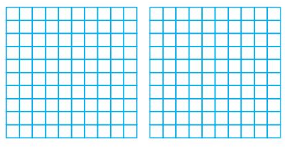
Big Ideas Math Answers Grade 5 Chapter 5 Multiply Decimals 5.3 7
Answer:


0.2+0.2+0.2+0.2+0.2+0.2+0.2=1.6
So, 8×0.2=1.6

Question 5.
7 × 0.14 = _____
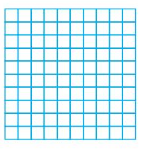
Big Ideas Math Answers Grade 5 Chapter 5 Multiply Decimals 5.3 8
Answer:


0.14+0.14+0.14+0.14+0.14+0.14+0.14=0.98
So, 7×0.14=0.98

Question 6.
0.96 × 2 = _____
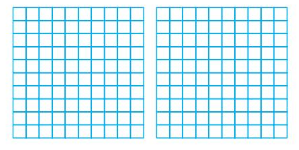
Big Ideas Math Answers Grade 5 Chapter 5 Multiply Decimals 5.3 9
Answer:

0.96+0.96=1.92
So, 0.96×2=1.92

Question 7.
A hummingbird’s heart beats once every 0.05 second. How long does it take for its heart to beat 7 times?
Big Ideas Math Answers Grade 5 Chapter 5 Multiply Decimals 5.3 10
Answer:
Given,
A hummingbird’s heart beats once every 0.05 second.
0.005 × 7 = 0.035 seconds

Question 8.
Precision
When multiplying a decimal less than one by a whole number, how does the product compare to the whole number? Is this true when multiplying two whole numbers?
Answer:
When we multiply a decimal less than one by a whole number the product will be a decimal or a whole number but when we multiply two whole numbers the product will be only a whole number.

Question 9.
DIG DEEPER!
Write two multiplication equations involving a decimal and a whole number whose product is shown.
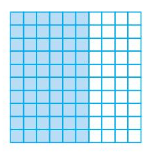
Big Ideas Math Answers Grade 5 Chapter 5 Multiply Decimals 5.3 11
Answer:
0.2×3=0.6 and 0.3×2=0.6

Think and Grow: Modeling Real Life

Example
You build the card tower shown. Each row is 0.08 meter tall. Your friend’s card tower is 0.3 meter tall. Whose tower is taller?
Big Ideas Math Answers Grade 5 Chapter 5 Multiply Decimals 5.3 12
Because your card tower has 4 rows, multiply 4 by0.08 to find the height of your tower.
Use a model. Shade 4 groups of 0.08.
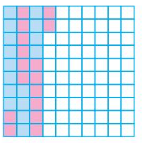
Big Ideas Math Answers Grade 5 Chapter 5 Multiply Decimals 5.3 13
0.08 + 0.08 + 0.08 + 0.08 = ______
Compare the height of your tower to the height of your friend’s tower.
So, ______ tower is taller.

Answer:
0.08 + 0.08 + 0.08 + 0.08 = 0.32
Compare the height of your tower to the height of your friend’s tower.
So, 0.32tower is taller.

Show and Grow

Question 10.
You have 1 meter of ribbon. Do you have enough ribbon to border the outside of the square picture frame?
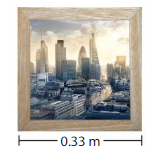
Big Ideas Math Answers Grade 5 Chapter 5 Multiply Decimals 5.3 14
Answer:
No

Explanation:
Length of side of the square picture is 0.33m.
Border of the square picture is 4 × length of side=4×0.33m=1.32m
I have 1 meter of ribbon 1.32>1
So, i don’t have enough ribbon to border the square picture.

Question 11.
Organic shaved coconut originally costs $0.34 per ounce. A baker buys 8 ounces on sale for $0.27 per ounce.How much money does the baker save?
Big Ideas Math Answers Grade 5 Chapter 5 Multiply Decimals 5.3 15
Answer:
Money the baker save is 0$2.72‐$2.16=$0.56

Explanation:
Original cost of organic shaved coconut is $0.34 per ounce
Then for 8 ounces it will be 8×$0.34=$2.72
Cost of the baker is $0.27 per ounce
Then for 8 ounces it will be 8×$0.27=$2.16
Money the baker save is 0$2.72‐$2.16=$0.56

Question 12.
DIG DEEPER!
You have 4 pennies, 3 nickels, and 2 quarters. Find the total weight and the total value of your coins.
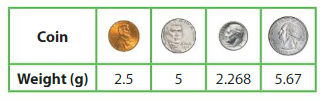
Big Ideas Math Answers Grade 5 Chapter 5 Multiply Decimals 5.3 16
Answer:
4 × 2.5 = 10
3 × 5 = 15
2 × 5.67 = 11.34
10 + 15 + 11.34 = 36.34

Use Models to Multiply Decimals and Whole Numbers Homework & Practice 5.3

Find the product.
Question 1.
0.4 × 2 = _____
Big Ideas Math Answers Grade 5 Chapter 5 Multiply Decimals 5.3 17
Answer:


0.4+0.4=0.8
So, 0.4×2=0.84

Question 2.
6 × 0.31 = _____
Big Ideas Math Answers Grade 5 Chapter 5 Multiply Decimals 5.3 18
Answer:


0.31+0.31+0.31+0.31+0.31+0.31=1.86
So, 6×0.31=1.86

Question 3.
0.54 × 3 = _____
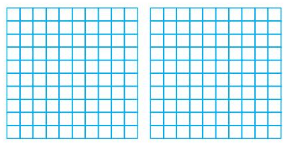
Big Ideas Math Answers Grade 5 Chapter 5 Multiply Decimals 5.3 19
Answer:


0.54+0.54+0.54=1.62
So, 0.54×3=1.62

Question 4.
0.25 × 7 = _____
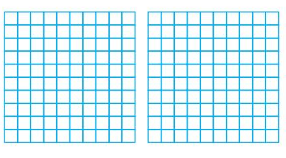
Big Ideas Math Answers Grade 5 Chapter 5 Multiply Decimals 5.3 20
Answer:


0.25+0.25+0.25+0.25+0.25+0.25+0.25=1.75
So, 0.25×7=1.75

Find the product
Question 5.
0.22 × 4 = _____
Big Ideas Math Answers Grade 5 Chapter 5 Multiply Decimals 5.3 21
Answer:


0.22+0.22+0.22+0.22=0.88
So, 0.22×4=0.88

Question 6.
5 × 0.4 = _____
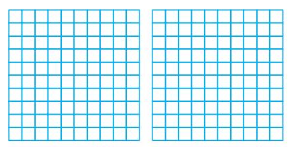
Big Ideas Math Answers Grade 5 Chapter 5 Multiply Decimals 5.3 22
Answer:


0.4+0.4+0.4+0.4+0.4=2
So, 5×0.4=2

Question 7.
A city mayor plans to build two new parks. Each park will cover 1.45 acres. How many acres will the new parks cover altogether? Explain.
Answer:
2.9 Acers

Explanation:
Acres covered by one park is 1.45 acres, A city mayor plans to build two new parks.
Acres covered by two new parks is 2×1.45=2.9acers.

Question 8.
Structure
Write an equation represented by the model.
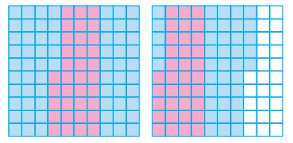
Big Ideas Math Answers Grade 5 Chapter 5 Multiply Decimals 5.3 23
Answer:
0.35+0.35+0.35+0.35+0.35=1.75
So, 0.35×5=1.75

Question 9.
DIG DEEPER!
Find the product of 0.03 and 4. How does the product change when you replace 4 with 0.4? Explain.
Answer:
The product of 0.03 and 4 is 0.03×4=0.12
The product of 0.03 and 0.4 is 0.03×0.4=0.012
When we replace the 4 with 0.4 then the product will become very small.

Question 10.
Modeling Real Life
In 1 year, you spend $1.50 on electricity to charge your tablet. In 1 month, you spend $0.02 on electricity to charge your smart phone. Which device costs more to charge in 1 year?
Answer:
In 1 year, i spend $1.50 on electricity to charge my tablet
If In 1 month, i spend $0.02 on electricity to charge my smart phone in a year i spend = 12months × electricity charge per month
=12×0.02=$0.24
$0.24<$1.50
Therefore Tablet costs more to charge in 1 year.

Question 11.
DIG DEEPER!
You have a 2-pound carton of blueberries. You eat 0.2 of the carton on Monday and 0.35 of the carton on Tuesday. How many pounds of blueberries are left?
Answer:
Weight of carton of blueberries is 2 pounds
I ate 0.2 of carton on Monday 0.2×2=0.4 pounds
I ate 0.35 of carton on Tuesday 0.35×2=0.7
Total of berries i ate is 0.4+0.7=1.1
pounds of blueberries are left=2‐1.1=0.9
Therefore 0.9 pounds of blueberries are left in the carton.

Review & Refresh

Evaluate the expression.
Question 12.
(12 ÷ 4) × 30 – 15
Answer:
(12 ÷ 4) × 30 – 15=75

Explanation:
(12 ÷ 4) × 30 – 15
=(3)×30‐15
=90‐15
=75
S0, (12 ÷ 4) × 30 – 15=75

Question 13.
(11 + 7) ÷ (3 + 5 + 1)
Answer:
(11 + 7) ÷ (3 + 5 + 1)=2

Explanation:
(11 + 7) ÷ (3 + 5 + 1)
=(18)÷(9)
=2
So, (11 + 7) ÷ (3 + 5 + 1)=2

Question 14.
35 ÷ [(153 – 139) ÷ 2]
Answer:
35 ÷ [(153 – 139) ÷ 2]=5

Explanation:
35 ÷ [(153 – 139) ÷ 2]
=35÷[(14÷2)]
=35÷7
=5
So, 35 ÷ [(153 – 139) ÷ 2]=5

Lesson 5.4 Multiply Decimals and Whole Numbers

Explore and Grow

Complete the table.
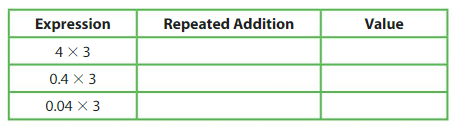
Big Ideas Math Solutions Grade 5 Chapter 5 Multiply Decimals 5.4 1
What pattern do you notice in the placement of the decimal point?
Answer:
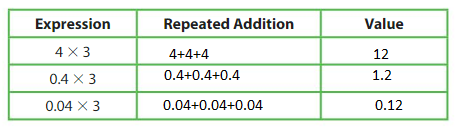

We can notice that the decimal point moves one place to the left.

Structure
How is multiplying decimals similar to multiplying whole numbers?
Answer:
Decimal multiplication is similar to the multiplication of whole numbers after decimal point the product of the numbers is the same.

Think and Grow: Multiply a Decimals and a Whole Numbers

Example
Find 5.8 × 4. Estimate ________
One Way: Multiply as you do with whole numbers. Then place the decimal point.
Find 58 × 4.
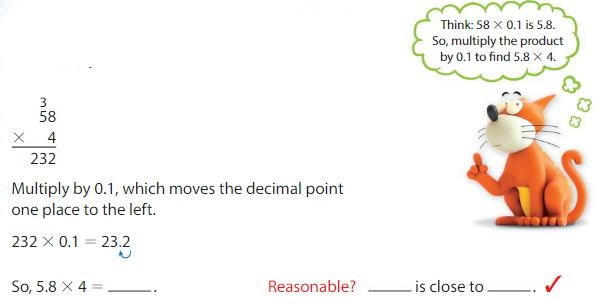
Big Ideas Math Solutions Grade 5 Chapter 5 Multiply Decimals 5.4 2

Another Way: Use place value and partial products.
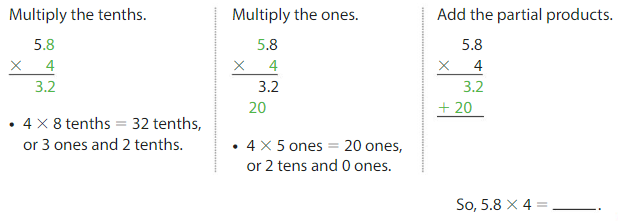
Big Ideas Math Solutions Grade 5 Chapter 5 Multiply Decimals 5.4 3
So, 5.8 × 4 = ______.

Show and Grow

Find the product. Check whether your answer is reasonable.
Question 1.
2.4 × 7 = ______
Answer:
2.4 × 7 =16.8

Explanation:
2.4 × 7
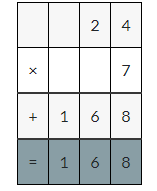
Multiply 24 with 7
24×7=168
Multiply 168 with 0.1
168×0.1=16.8 decimal point moves one place to the left.
So, 2.4 × 7 =16.8

Question 2.
8.15 × 3 = ______
Answer:
8.15 × 3 =24.45

Explanation:
8.15 × 3
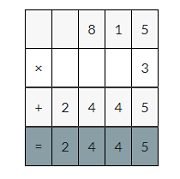
Multiply 8.15 with 3
815×4=2445
Multiply 2445 with 0.01
2445×0.01=24.45 decimal point moves two places to the left.
So, 8.15 × 3 =24.45

Apply and Grow: Practice

Find the product.
Question 3.
6 × 5.3 = _____
Answer:
6×5.3=31.8

Explanation:
6×5.3=
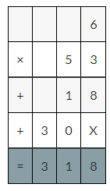
6×53=318
318 ×0.1=31.8decimal point moves one place to the left.
So,6 ×5.3=31.8

Question 4.
4.68 × 4 = ______
Answer:
4.68×4=18.72

Explanation:
4.68×4
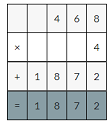
468×4=1872
1872×0.01=18.72decimal point moves two places to the left.
So, 4.68 × 4 =18.72

Question 5.
7 × 0.81 = ______
Answer:
7×0.81=5.56

Explanation:
7×0.81
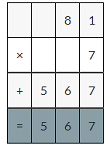
7×81=567
567×0.01=5.67decimal point moves two places to the left.
So, 7 × 0.81 =5.67

Question 6.
1.45 × 5 = _____
Answer:
1.45 × 5=7.25

Explanation:
1.45 × 5
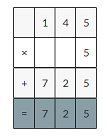
145×5=725
725×0.01=7.25decimal point moves two places to the left.
So, 1.45 × 5 =7.25

Question 7.
34 × 7.2 = _____
Answer:
34 × 7.2=244.8

Explanation:
34 × 7.2
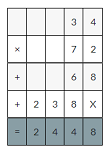
34×72=2448
2448×0.1=244.8decimal point moves one place to the left.
So, 34 × 7.2=244.8

Question 8.
23.66 × 19 = ______
Answer:
23.66 × 19=499.54

Explanation:
23.66 × 19
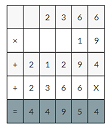
2366×19=44954
44954×0.01=449.54decimal point moves two places to the left.
So, 23.66 × 19 =449.54

Question 9.
How much do you pay for 3 pounds of grapes?
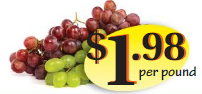
Big Ideas Math Solutions Grade 5 Chapter 5 Multiply Decimals 5.4 4
Answer:
One pound of grapes costs $1.98
3 pounds of grapes cost is 3×$1.98
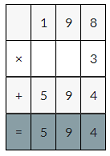
=3×198=598
598×0.01=5.98decimal point moves two places to the left.
Therefore cost of 3 pounds of grapes is 5.98

Question 10.
Which One Doesn’t Belong?
Which equation is not true?
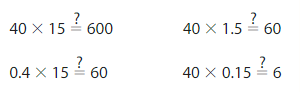
Big Ideas Math Solutions Grade 5 Chapter 5 Multiply Decimals 5.4 5
Answer:
0.4×15=60 is not correct

Explanation:
0.4×15
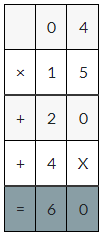
4×15=60
60×0.1=6decimal point moves one place to the left.
0.4×15=6
Therefore it is a wrong equation.

Question 11.
Number Sense
Without calculating, determine whether the product of 0.67 and 8 is greater than or less than 8. Explain.
Answer:
The product of 0.67 and 8 is less than 8.

Explanation:
We know that 0.67 is less than 1 so 0.67 when multiplied with 8 will be less than 8.

Question 12.
DIG DEEPER!
Find the missing digits. Then find the product.
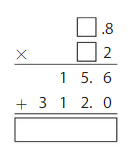
Big Ideas Math Solutions Grade 5 Chapter 5 Multiply Decimals 5.4 6
Answer:

Think and Grow: Modeling Real Life

Example
You buy a 40-pack of bottled water. Each bottle contains 16.9 fluid ounces of water. You drink 10 bottles. How many total fluid ounces of water do you have left?

Big Ideas Math Solutions Grade 5 Chapter 5 Multiply Decimals 5.4 7
Subtract 10 from the number of bottles you buy to find the number of bottles you have left.
40 – 10 = 30
To find how much water you have left, multiply the number of bottles you have left by16.9. Multiply as you do with whole numbers. Then place the decimal point.
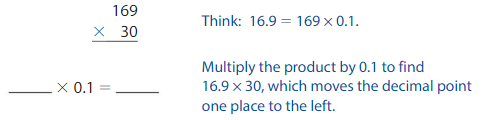
Big Ideas Math Solutions Grade 5 Chapter 5 Multiply Decimals 5.4 8
You have _______ total fluid ounces of water left.

Show and Grow

Question 13.
The stories of a residential building are 3.2 meters tall. The stories of an office building are 0.4 meter taller than the stories in the residential building. The office building has 12 stories. How tall is the office building?
Answer:
The stories of a residential building are 3.2 meters tall.The stories of an office building are 0.4 meter taller than the stories in the residential building
So stories of office building is 3.2+0.4=3.6 meter tall
Office building has 12 stories and each storey is 3.6 meters tall
So, 12×3.6=
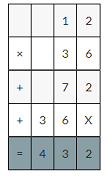
12×36=432
432×0.1=43.2decimal point moves one place to the left.
Therefore the office building is 43.2 meters tall.

Question 14.
You have3 strands of lights that are each 10.8 feet long. You buy 5 strands of lights that are each 16.25 feet long. How many feet of lights do you have in all?
Answer:
If i have3 strands of lights that are each 10.8 feet long
The length of 3 strands is 3×10.8
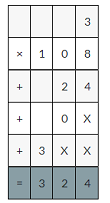
3×10.8=324×0.1 = 32.4 feet decimal point moves one place to the left.
If i buy 5 strands of lights that are each 16.25 feet long
The length of 5 strands is 5×16.25
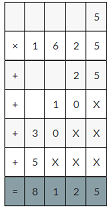
5×1625=8125
1825×0.01=81.25decimal point moves two places to the left.
Feet of lights i have in all is32.4+81.25=133.65 feet.

Question 15.
DIG DEEPER!
You stack $1 in dimes and you stack $1 in quarters. Which stack is taller? How much taller?
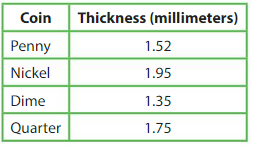
Big Ideas Math Solutions Grade 5 Chapter 5 Multiply Decimals 5.4 9
Answer:
1.35 × 1 = 1.35
1.75 × 1 = 1.75

Multiply Decimals and Whole Numbers Homework & Practice 5.4

Find the product.
Question 1.
9.8 × 2 = _____
Answer:
9.8×2=19.6

Explanation:
9.8×2
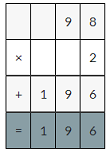
98×2=196
196×0.1=19.6 decimal point moves one place to the left.
So, 9.8×2=19.6

Question 2.
0.61 × 8 = ______
Answer:
0.61 × 8 =4.88

Explanation:
0.61×8
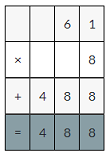
61×8=488
488×0.01=4.88decimal point moves two places to the left.
So, 0.61 × 8 =4.88

Question 3.
82 × 1.1 = ______
Answer:
82×1.1=90.2

Explanation:
82×1.1
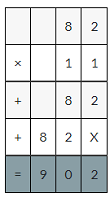
82×11=902
902×0.1=90.2decimal point moves one place to the left.
So, 82×1.1=90.2

Question 4.
43 × 0.6 = ______
Answer:
43×0.6=25.8

Explanation:
43×0.6
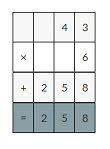
43×6=258
258×0.1=25.8decimal point moves one place to the left.
So, 43×0.6=25.8

Question 5.
2.39 × 57 = _______
Answer:
2.39×57=136.23

Explanation:
2.39×57
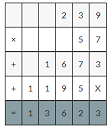
239×57=13623
13623×0.01=136.23decimal point moves two places to the left.
So, 2.39×57=136.23

Question 6.
10.75 × 24 = ______
Answer:
10.75×24=258

Explanation:
10.75×24
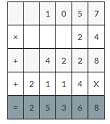
1075×24=25800
25800×0.01=258.00=258decimal point moves two places to the left.
So, 10.75×24=258

Question 7.
There are 6.3 grams of protein in a boiled egg. You eat 3 boiled eggs. How many grams of protein do you consume?
Answer:
There are 6.3 grams of protein in a boiled egg
I eat 3 boiled eggs and grams of protein i consumed=3×6.3
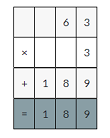
3×63=189
189×0.1=18.9decimal point moves one place to the left.
Therefore 18.9 grams of protein i consumed.

Question 8.
Reasoning
Newton says the product of 7.55 and 8 is 60.40. Descartes says the product is 60.4.Who is correct? Explain.
Answer:
Both Newton’s and Descartes answers are correct as zero at the end of a number after decimal point does not change the value of the number 60.40 and 60.4 is same.

Question 9.
Patterns
Describe and complete the pattern.
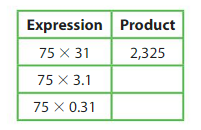
Big Ideas Math Solutions Grade 5 Chapter 5 Multiply Decimals 5.4 10
Answer


In the above table the decimal point is shifting one place to the left in each expression respectively.

Question 10.
YOU BE THE TEACHER
Your friend finds 14 × 0.82. Is your friend correct? Explain.
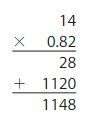
Big Ideas Math Solutions Grade 5 Chapter 5 Multiply Decimals 5.4 11
Answer:
My friend is incorrect.

Explanation:
14×0.82
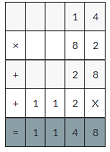
14×82=1148
1148×0.01=11.48decimal point moves two places to the left.
14×0.82=11.48.
so, my friends answer is correct.

Question 11.
Modeling Real Life
A person weighs 2.34 times as much on Jupiter as on Earth. An 85-pound student would weigh 90.1 pounds less on Saturn than on Jupiter. How much would he weigh on Saturn?
Answer:
85 pounds student weighs 2.34 times as much on Jupiter as on Earth.So, weight on jupiter is 85×2.34
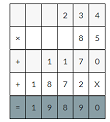
85×234=19890
19890×0.01=198.90decimal point moves two places to the left.
Weight on jupiter is 198.9
student would weigh 90.1 pounds less on Saturn than on Jupiter
So, weight on saturn = weight on Jupiter ‐ 90.1=198.9‐90.1=108.8
Therefore An 85-pound student would weigh 108.8 on saturn.

Question 12.
DIG DEEPER!
A landscaper digs a rectangular region for a garden. The length is a one-digit whole number of meters. What is the least possible area? What is the greatest possible area?
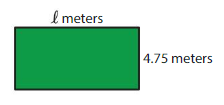
Big Ideas Math Solutions Grade 5 Chapter 5 Multiply Decimals 5.4 12
Answer:
If length of rectangular region is a one-digit whole number of meters and breadth is 4.75 meters.
Smallest 1 digit whole number is 1
The least possible area is 1×4.75 =4.75 squaremeters
Largest 1 digit whole number is 9
The greatest possible area is 9×4.75
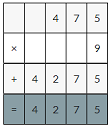
9×475=4275
4275×0.01=42.75 square meters decimal point moves two places to the left.
Therefore The least possible area and the greatest possible area is 4.75 and 42.75 square meters respectively.

Review & Refresh

Find the sum or difference.
Question 13.
0.83 – 0.14 = ______
Answer:
0.83 – 0.14=0.96

Explanation:
0.83‐0.14=
83‐14=69
69×0.01=0.69decimal point moves two places to the left.
So, 0.83 – 0.14=0.96

Question 14.
1.34 + 1.35 = _______
Answer:
1.34 + 1.35 =2.69

Explanation:
1.34 + 1.35
134+135=269
269×0.01=2.69decimal point moves two places to the left.
So, 1.34 + 1.35 =2.69

Lesson 5.5 Use Models to Multiply Decimals

Explore and Grow

A rectangle is 0.8 meter long and 0.7 meter wide.
Use a model to find the area of the rectangle.
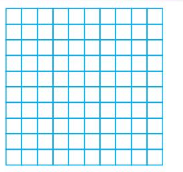
Big Ideas Math Answer Key Grade 5 Chapter 5 Multiply Decimals 5.5 1.1

Answer:

Use a model to find 0.8 × 0.7
Use a model. Shade 8 rows to represent 0.8 and shade 7 columns to represent 0.7
56 squares are shaded twice
So, 0.8 × 0.7=0.56

Use a model to find 0.8 × 1.7.
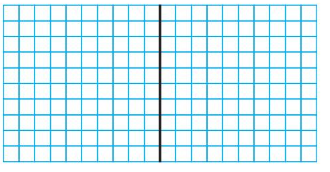
Big Ideas Math Answer Key Grade 5 Chapter 5 Multiply Decimals 5.5 1
Answer:

Use a model to find 0.8 × 1.7
Use a model. Shade 8 rows to represent 0.8 and shade 17 columns to represent 1.7
136 squares are shaded twice
So, 0.8 × 1.7 =1.36

Reasoning
When using a model to multiply decimals, how do you determine the number of rows and columns to shade?
Answer:
For a given multiplication of decimals. The multiplyer is used to determine the number of rows and the multiplicand is used to determine the number of columns.

Think and Grow: Use Models to Multiply Decimals

Example
Use a model to find 0.4 × 0.6
Use a model. Shade 4 rows to represent 0.4 and shade 6 columns to represent 0.6.
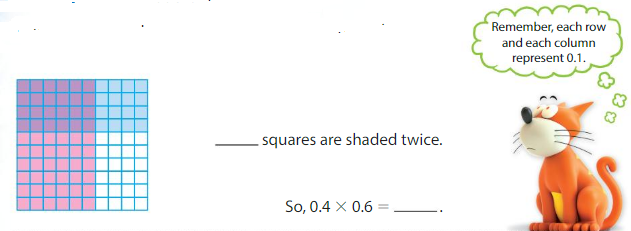
Big Ideas Math Answer Key Grade 5 Chapter 5 Multiply Decimals 5.5 2

Example
Use a model to find 0.7 × 1.4.
Use a model. Shade 7 rows to represent 0.7 and shade 14 columns to represent 1.4.
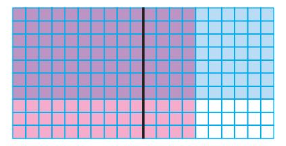
Big Ideas Math Answer Key Grade 5 Chapter 5 Multiply Decimals 5.5 3
_____ squares are shaded twice.
So, 0.7 × 1.4 = ______.

Show and Grow

Use the model to find the product.
Question 1.
0.9 × 0.2 = _____
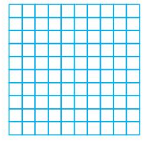
Big Ideas Math Answer Key Grade 5 Chapter 5 Multiply Decimals 5.5 4
Answer:


Use a model to find 0.9 × 0.2
Use a model. Shade 9 rows to represent 0.9 and shade 2 columns to represent 0.2
18 squares are shaded twice
So, 0.9 × 0.2 =0.18

Question 2.
0.8 × 1.5 = ______
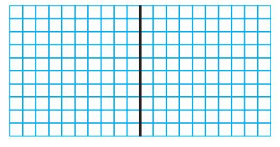
Big Ideas Math Answer Key Grade 5 Chapter 5 Multiply Decimals 5.5 5
Answer:


Use a model to find 0.8 × 1.5
Use a model. Shade 8 rows to represent 0.8 and shade 15 columns to represent 1.5
120 squares are shaded twice
So, 0.8 × 1.5 =1.2

Apply and Grow: Practice

Use the model to find the product.
Question 3.
0.4 × 0.4 = ______
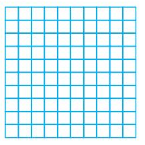
Big Ideas Math Answer Key Grade 5 Chapter 5 Multiply Decimals 5.5 6
Answer:

Use a model to find 0.4 × 0.4
Use a model. Shade 4 rows to represent 0.4 and shade 4 columns to represent 0.4
16 squares are shaded twice
So, 0.4 × 0.4 =0.16

Question 4.
0.9 × 0.9 = _______
Big Ideas Math Answer Key Grade 5 Chapter 5 Multiply Decimals 5.5 7
Answer:


Use a model to find 0.9 × 0.9
Use a model. Shade 9 rows to represent 0.9 and shade 9 columns to represent 0.9
81 squares are shaded twice
So, 0.9 × 0.9 =0.81

Question 5.
0.2 × 1.7 = ____
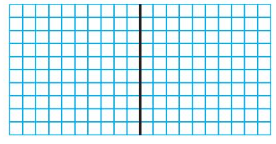
Big Ideas Math Answer Key Grade 5 Chapter 5 Multiply Decimals 5.5 8
Answer:

Use a model to find 0.2 × 1.7
Use a model. Shade 2 rows to represent 0.2 and shade 17 columns to represent 1.7
34 squares are shaded twice
So, 0.2 × 1.7 =0.34

Question 6.
0.6 × 1.6 = _______
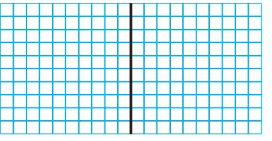
Big Ideas Math Answer Key Grade 5 Chapter 5 Multiply Decimals 5.5 9
Answer:

Use a model to find 0.6 × 1.6
Use a model. Shade 6 rows to represent 0.6 and shade 16 columns to represent 1.6
96 squares are shaded twice
So, 0.6× 1.6 =0.96

Question 7.
On Saturday, you ride your bike 1.5 miles. On Sunday, you ride your bike 0.7 times as far as you did on Saturday. How far do you ride your bike on Sunday?
Answer:
On saturday i rode my bike for 1.5 miles
On sunday i rode 0.7 times as far as i did on saturday
miles i rode bike on sunday =0.7×1.5=1.05
Therefore, 1.05miles far i rode my bike on sunday.

Question 8.
Reasoning
When multiplying 0.4 × 0.3, why is the product less than each of the factors?
Answer:
When we multiply 0.4 with 0.3 the product is less than each of their factors this is because we are finding a fractional amount of a quantity.

Question 9.
DIG DEEPER!
Shade the model to represent the product of 0.6 and 0. What is the product? Explain.
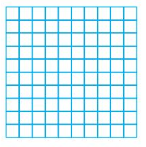
Big Ideas Math Answer Key Grade 5 Chapter 5 Multiply Decimals 5.5 11
Answer:


Use a model to find 0.6 × 0
Use a model. Shade 6 rows to represent 0.6 and shade 0 columns to represent 0
No squares are shaded twice
So, 0.6× 0=0

Think and Grow: Modeling Real Life

Example
A donkey is 0.9 meter tall. A horse is 1.7 times as tall as the donkey. How much taller is the horse than the donkey?
Big Ideas Math Answer Key Grade 5 Chapter 5 Multiply Decimals 5.5 12
Multiply 0.9 by 1.7 to find the height of the horse.
Use a model. Shade 9 rows to represent 0.9 and shade 17 columns to represent 1.7.
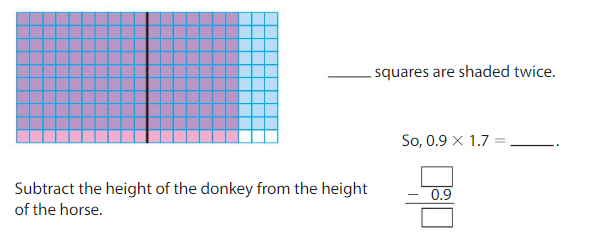
Big Ideas Math Answer Key Grade 5 Chapter 5 Multiply Decimals 5.5 13
So, the horse is ______ meter taller than the donkey.

Answer:
0.9 × 1.7 = 1.53
1.53 squares are shaded twice.
1.53 – 0.9 = 0.63
So, the horse is 0.63 meter taller than the donkey.

Show and Grow

Question 10.
On Sunday, you run 0.6 mile. On Monday, you run 1.3 times as far as you run on Sunday. How many more miles do you run on Monday than on Sunday?
Answer:
Multiply 0.6 by 1.3 to find the number of miles i run on monday.
usinga model. Shade 6 rows to represent 0.6 and shade 13 columns to represent 1.3.
78 squares are shaded twice.
So, i ran 0.78 miles on monday.
Subtract the number of miles i ran on monday from the miles i ran on sunday.
0.78‐0.6=0.72
Therefore 0.72miles i ran on Monday than on Sunday

Question 11.
A candle burns 0.2 ounce of wax each hour. A candle with 14.5 ounces of wax burns for 2.5 hours. How much wax is left?
Answer:
A candle with 14.5 ounces of wax burns for 2.5 hours and a candle burns 0.2 ounce of wax each hour.
Ounces of wax burnt in 2.5 hours is
2.5 hours × ounces of wax burns in each hour.
2.5×0.2=0.5 ounces
Ounced of Wax left=14.5‐0.5=14 ounces.

Question 12.
DIG DEEPER!
You have a bottle that contains 1.5 liters of apple juice. You drink 0.2 of the bottle on Friday, and 0.3 of the juice remaining in the bottle on Saturday. How much apple juice do you have left?
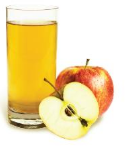
Big Ideas Math Answer Key Grade 5 Chapter 5 Multiply Decimals 5.5 14
Answer:
A bottle contains 1.5 liters of apple juice.
If i  drink 0.2 of the bottle on Friday the amount of juice left is 1.5‐(1.5×0.2)=1.5 ‐ 0.3= 1.2
If i drink 0.3 of the juice remaining in the bottle on Saturday the amount of juice left is
=1.2‐(1.2×0.3)=1.2 ‐ 0.36= 0.84
Apple juice i have left id 0.84 liters.

Use Models to Multiply Decimals Homework & Practice 5.5

Use the model to find the product.
Question 1.
0.8 × 0.9 = ______
Big Ideas Math Answer Key Grade 5 Chapter 5 Multiply Decimals 5.5 15
Answer:


Use a model to find 0.8 × 0.9
Use a model. Shade 8 rows to represent 0.8 and shade 9 columns to represent 0.9
72 squares are shaded twice
So, 0.8 × 0.9 =0.72

Question 2.
0.4 × 0.2 = _____
Big Ideas Math Answer Key Grade 5 Chapter 5 Multiply Decimals 5.5 16
Answer:


Use a model to find 0.4 × 0.2
Use a model. Shade 4 rows to represent 0.4 and shade 2 columns to represent 0.2
8 squares are shaded twice
So, 0.4 × 0.2 =0.08

Question 3.
0.6 × 1.9 = ______
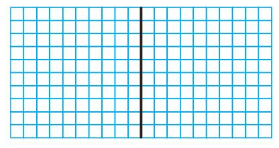
Big Ideas Math Answer Key Grade 5 Chapter 5 Multiply Decimals 5.5 17
Answer:


Use a model to find 0.6 × 1.9
Use a model. Shade 6 rows to represent 0.6 and shade 19 columns to represent 1.9
114 squares are shaded twice
So, 0.6 × 1.9 =1.14

Question 4.
0.7 × 1.2 = ______
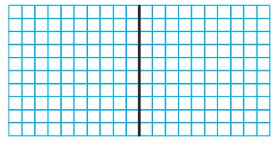
Big Ideas Math Answer Key Grade 5 Chapter 5 Multiply Decimals 5.5 18
Answer:


Use a model to find 0.7 × 1.2
Use a model. Shade 7 rows to represent 0.7 and shade 12 columns to represent 1.2
84 squares are shaded twice
So, 0.7 × 1.2 =0.84

Question 5.
One banana contains 1.3 grams of protein. How much protein is in 0.5 of a banana?
Answer:
One banana contains 1.3 grams of protein
0.5 of a banana contains 1.3×0.5=0.65 grans of proteins.

Question 6.
Reasoning
When multiplying 0.6 and 1.2, why is the product less than only one of the factors?
Answer:
When multiplying 0.6 and 1.2, the product less than only one of the factors because we are finding a fractional amount of a quantity a part of the number.

Question 7.
YOU BE THE TEACHER
Newton says that 0.2 × 0.2 = 0.36, because there are 36 squares shaded. Is he correct? Explain.
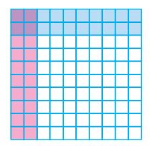
Big Ideas Math Answer Key Grade 5 Chapter 5 Multiply Decimals 5.5 19
Answer:
No

Explanation:
No, Newton’s answer is not correct as the number of squares shaded twice are 4 so, the product will be 0.4 not 0.36.

Question 8.
Structure
Write a multiplication equation that is represented by the model.
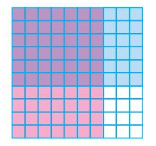
Big Ideas Math Answer Key Grade 5 Chapter 5 Multiply Decimals 5.5 20
Answer:
Number of rows shaded are 6 so, the decimal is 0.6
Number of columns shaded are 7 so, the decimal is 0.7
Number of squares shaded twice are 42 so, the product is 0.42
Therefore multiplication equation is 0.6×0.7=0.42.

Question 9.
Modeling Real Life
A pancake batter recipe calls for 0.5 cup of water. The recipe calls for 1.5 times as much pancake mix as water.How much more pancake mix is needed than water?

Big Ideas Math Answer Key Grade 5 Chapter 5 Multiply Decimals 5.5 21
Answer:
A pancake batter recipe calls for 0.5 cup of water.
The recipe calls for 1.5 times as much pancake mix as water
Amount of pancake mix is 0.5×1.5=0.75 cups
Subtract the amount of pancake mix from the amount of water
0.75‐0.5=0.70 cups
Therefore 0.70 cups more pancake mix is needed than water.

Question 10.
DIG DEEPER!
To make crafts, you buy colored paper for $1.90. You buy a pack of googly eyes that costs 0.4 times as much as the colored paper. How much money do you spend in all?
Big Ideas Math Answer Key Grade 5 Chapter 5 Multiply Decimals 5.5 22
Answer:
Cost of colored paper is $1.90
Cost of a pack of googly eyes is 0.4 times as much as the colored paper=0.4×1.90=$0.76
Add the money spent on colored paper and on googly eyes=$1.90+$0.76=$2.66
The money i spent in all is $2.66.

Review & Refresh

Write the value of the underlined digit.
Question 11.
5,120,379
Answer:
5,120,379
Value of 1 in the above number is 1 Hundred Thousands

Question 12.
400,681
Answer:
400,681
Value of 6 in the above number is 6 hundred.

Question 13.
7,245,819
Answer:
7,245,819
Value of 7 in the above number is 7 million.

Question 14.
23, 504
Answer:
23, 504
Value of  2 in the above number is 2 Ten Thousands

Lesson 5.6 Use Partial Products to Multiply Decimals

Explore and Grow

Use the area model and partial products to find 1.4 × 1.5.
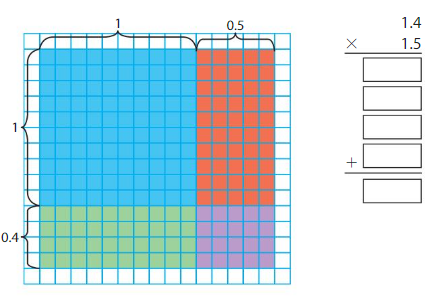
Big Ideas Math Answers 5th Grade Chapter 5 Multiply Decimals 5.6 1
Answer:
From the above grid we can note down the following expressions
1×1
1×0.4
1×0.5
0.4×0.5
Find the product of the four equations and then add their products to find the area of the model
1×1=1
1×0.4=0.4
1×0.5=0.5
0.4×0.5=0.2
Add the products of the above four equations
1+0.4+0.5+0.2=2.1

Structure
How can you use partial products to multiply decimals?
Answer:
Breaking up the number to multiply into parts, multiplying the parts separately, and then adding is called partial product.we can use partial product strategy to find the product of decimals by breaking them into parts.

Think and Grow: Use Partial Products toMultiply

Example
Use partial products to find 3.2 × 4.8. Estimate ________
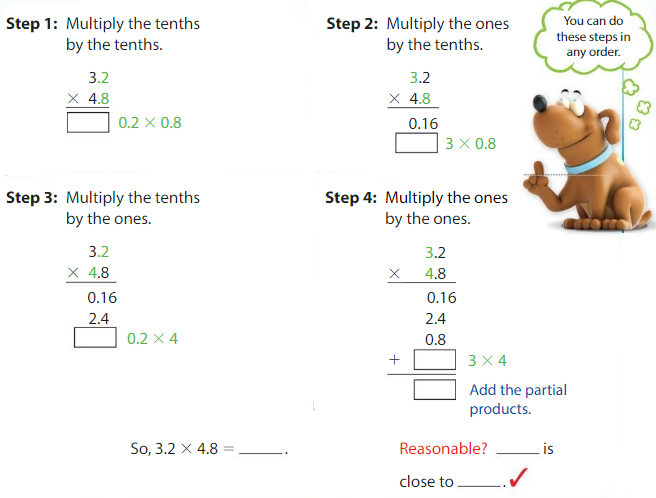
Big Ideas Math Answers 5th Grade Chapter 5 Multiply Decimals 5.6 2

Show and Grow

Find the product. Check whether your answer is reasonable.
Question 1.
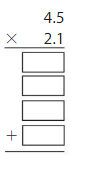
Big Ideas Math Answers 5th Grade Chapter 5 Multiply Decimals 5.6 3
Answer:
4.5×2.1
1.Multiply the tenths by tenths =0.5×0.1=0.05
2.Multiply the ones by tenths = 0.5×2=1
3.Multiply the tenths by ones = 4×0.1=0.4
4.Multiply the ones by ones =4×2=8
Add all the partial products =0.05+1+0.4+8=9.45
Therefore 4.5×2.1=9.45

Question 2.
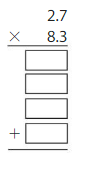
Big Ideas Math Answers 5th Grade Chapter 5 Multiply Decimals 5.6 4
Answer:
2.7×5.3
1.Multiply the tenths by tenths =0.7×0.3=0.21
2.Multiply the ones by tenths = 0.3×2=0.6
3.Multiply the tenths by ones = 5×0.7=3.5
4.Multiply the ones by ones =5×2=10
Add all the partial products =0.21+0.6+3.5+10=14.31
Therefore  2.7×5.3=14.31

Question 3.
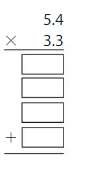
Big Ideas Math Answers 5th Grade Chapter 5 Multiply Decimals 5.6 5
Answer:
5.4×3.3
1.Multiply the tenths by tenths =0.3×0.4=0.12
2.Multiply the ones by tenths = 0.3×5=1.5
3.Multiply the tenths by ones = 4×0.3=1.2
4.Multiply the ones by ones =5×3=15
Add all the partial products=0.12+1.5+1.2+15=17.82
Therefore 5.4×3.3=17.82

Apply and Grow: Practice

Find the product. Check whether your answer is reasonable.
Question 4.
Big Ideas Math Answers 5th Grade Chapter 5 Multiply Decimals 5.6 6
Answer:
4.1×2.3
1.Multiply the tenths by tenths =0.1×0.3=0.03
2.Multiply the ones by tenths = 0.1×2=0.2
3.Multiply the tenths by ones = 4×0.3=1.2
4.Multiply the ones by ones =4×2=8
Add all the partial products=0.03+0.2+1.2+8=9.43
Therefore 4.1×2.3=9.43

Question 5.
Big Ideas Math Answers 5th Grade Chapter 5 Multiply Decimals 5.6 7
Answer:
16.7×0.4
1.Multiply the tenths by tenths =0.7×0.4=0.28
2.Multiply the ones by tenths = 0.7×0=0
3.Multiply the tenths by ones = 16×0.4=6.4
4.Multiply the ones by ones =16×0=0
Add all the partial products=0.28+6.4=6.68
Therefore 16.7×0.4=6.68

Question 6.
Big Ideas Math Answers 5th Grade Chapter 5 Multiply Decimals 5.6 8
Answer:
5.9×8.6
1.Multiply the tenths by tenths =0.9×0.6=0.54
2.Multiply the ones by tenths = 0.9×8=7.23.
Multiply the tenths by ones = 5×0.6=3
4.Multiply the ones by ones =5×8=40
Add all the partial products=0.54+7.2+3+40=50.74
Therefore 5.9×8.6=50.74

Question 7.
23.7 × 3.5 = ______
Answer:
23.7×3.5
1.Multiply the tenths by tenths =0.7×0.5=0.35
2.Multiply the ones by tenths = 0.7×3=2.1
3.Multiply the tenths by ones = 23×0.5=11.5
4.Multiply the ones by ones =23×3=69
Add all the partial products=0.35+2.1+11.5+69=82.95
Therefore 23.7×3.5=82.95

Question 8.
10.6 × 14.7 = ______
Answer:
10.6×14.7
1.Multiply the tenths by tenths =0.6×0.7=0.42
2.Multiply the ones by tenths = 0.6×14=8.4
3.Multiply the tenths by ones = 10×0.7=7
4.Multiply the ones by ones =10×14=140
Add all the partial products=0.42+8.4+9.8+140=155.82
Therefore 10.6×14.7=155.82

Question 9.
1.2 × 3.71 = ______
Answer:
1.2×3.71
1.Multiply the tenths by tenths =0.2×0.71=0.142
2.Multiply the ones by tenths = 0.2×3=0.6
3.Multiply the tenths by ones = 1×0.71=0.71
4.Multiply the ones by ones =1×3=3
Add all the partial products=0.142+0.6+0.71+3=4.452
Therefore 1.2×3.71=4.452

Question 10.
A space probe travels 643.5 miles every minute. How far does it travel in 1.5 minutes?
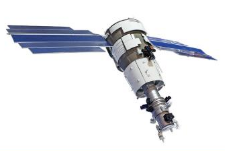
Big Ideas Math Answers 5th Grade Chapter 5 Multiply Decimals 5.6 9
Answer:
A space probe travels 643.5 miles every minute.
The distance it travel in 1.5 minutes is 643.5×1.5
643.5×1.5
1.Multiply the tenths by tenths =0.5×0.5=0.25
2.Multiply the ones by tenths = 0.5×1=0.5
3.Multiply the tenths by ones = 643×0.5=321.5
4.Multiply the ones by ones =643×1=643
Add all the partial products is=0.25+0.5+321.5+643=965.25
Therefore 643.5×1.5=965.25

Question 11.
Number Sense
Which products are greater than 20.4?
3.4 × 7.2
2.5 × 4.8
3.2 × 6.3
8.6 × 2.4
Answer:
3.4 × 7.2=24.48>20.4
2.5 × 4.8=12<20.4
3.2 × 6.3=20.16<20.4
8.6 × 2.4=2.64>20.4
The products of 3.4×7.2 and 8.6×2.4 are greater than 20.4.

Question 12.
Precision
How can you use estimation to help you place the decimal point in a product? Explain.
Answer:
You will need to multiply and then estimate the solution. Start by multiplying just as if you are multiplying whole numbers. Because the original numbers have 4 digits total after their decimal points , insert a decimal point into your answer so that it has 4 digits to its right.

Question 13.
DIG DEEPER!
Write a multiplication equation shown by the partial products.
0.14 + 0.2 + 2.1 + 3
Answer:
0.14 + 0.2 + 2.1 + 3 = 5.44

Think and Grow: Modeling Real Life

Example
A geologist has a blue geode that weighs 2.5 pounds. The geologist has a purple geode that weighs 1.6 times as much as the blue geode. What is the total weight of the geodes?
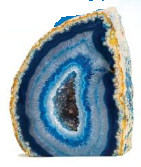
Big Ideas Math Answers 5th Grade Chapter 5 Multiply Decimals 5.6 10
Find the weight of the purple geode by multiplying the weight of the blue geode by 1.6
Big Ideas Math Answers 5th Grade Chapter 5 Multiply Decimals 5.6 11
The weight of the purple geode is ______ pounds.
Add the weights of the blue geode and the purple geode.
Big Ideas Math Answers 5th Grade Chapter 5 Multiply Decimals 5.6 12
The total weight of the geodes is ______ pounds.

Show and Grow

Question 14.
You buy 3.5 yards of yellow fabric to make a Chinese dragon. You buy 2.5 times as much red fabric as yellow fabric. How many yards of fabric do you buy in all?
Big Ideas Math Answers 5th Grade Chapter 5 Multiply Decimals 5.6 13
Answer:
Find the yards of red fabric by multiplying the yards of yellow fabric by 2.5
3.5×2.5=8.75(0.25+1.5+1+6)
8.75 yards of red fabric is required to make a dragon.
Add the yards of yellow and red fabric
3.5+8.75=12.25
Total fabric i need to buy to make a dragon is 12.25 yards.

Question 15.
An employee cleans the surface of the rectangular ice rink. What is the area of the ice rink?
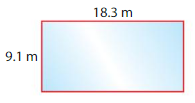
Big Ideas Math Answers 5th Grade Chapter 5 Multiply Decimals 5.6 14
Answer:
Ice rink here is in rectangular shape.
Area of a rectangle is length × breadth
Length of ice rink is 18.3 m, breadth of ice rink is 9.1 m
18.3×9.1=0.03+2.7+1.8+162
Area of ice rink is 166.53 square meters

Question 16.
There are 89.1 milligrams of Vitamin C in 1 cup of strawberries. There are 83.2 milligrams of Vitamin C in 1 cup of orange slices. You eat2.5 cups of strawberries and 1.5 cups of orange slices. How much Vitamin C do you consume?
Answer:
Multiply vitamin C in 1 cup of strawberries with 2.5
89.1×2.5=222.75
Multiply vitamin C in 1 cup of orange slices with 1.5
83.2×1.5=124.8
Add both the quantities 222.75+124.8=347.55
Total vitamin c consumed by me is 347.55 milligrams.

Use Partial Products to Multiply Decimals Homework & Practice 5.6

Find the product. Check whether your answer is reasonable.
Question 1.
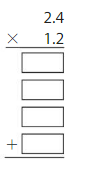
Big Ideas Math Answers 5th Grade Chapter 5 Multiply Decimals 5.6 15
Answer:
2.4×1.2=
1.Multiply the tenths by tenths =0.4×0.2=0.08
2.Multiply the ones by tenths = 0.4×1=0.4
3.Multiply the tenths by ones = 2×0.2=0.4
4.Multiply the ones by ones =2×1=2
Add all the partial products =0.08+0.4+0.4+2=2.88
Therefore 2.4×1.2=2.88

Question 2.
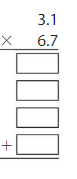
Big Ideas Math Answers 5th Grade Chapter 5 Multiply Decimals 5.6 16
Answer:
3.1×6.7
1.Multiply the tenths by tenths =0.1×0.7=0.07
2.Multiply the ones by tenths = 0.1×6=0.6
3.Multiply the tenths by ones = 3×0.7=2.1
4.Multiply the ones by ones =3×6=18
Add all the partial products =0.07+0.6+2.1+18=20.77
Therefore 3.1×6.7=20.77

Question 3.
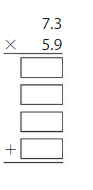
Big Ideas Math Answers 5th Grade Chapter 5 Multiply Decimals 5.6 17
Answer:
7.3×5.9=
1.Multiply the tenths by tenths =0.3×0.9=0.27
2.Multiply the ones by tenths = 0.3×5=1.5
3.Multiply the tenths by ones = 7×0.9=6.3
4.Multiply the ones by ones =7×5=35
Add all the partial products =0.27+1.5+6.3+35=42.07
Therefore 7.3×5.9=43.07

Find the product. Check whether your answer is reasonable.
Question 4.
Big Ideas Math Answers 5th Grade Chapter 5 Multiply Decimals 5.6 18
Answer:
2.8×3.7
1.Multiply the tenths by tenths =0.8×0.7=0.56
2.Multiply the ones by tenths = 0.8×3=2.4
3.Multiply the tenths by ones = 2×0.7=1.4
4.Multiply the ones by ones =2×3=6
Add all the partial products =0.56+2.4+1.4+6=10.36
Therefore 2.8×3.7=10.36

Question 5.
Big Ideas Math Answers 5th Grade Chapter 5 Multiply Decimals 5.6 19
Answer:
5.6×4.6
1.Multiply the tenths by tenths =0.6×0.6=0.36
2.Multiply the ones by tenths =0.6×4=2.4
3.Multiply the tenths by ones =0.6×5=3
4.Multiply the ones by ones =5×4=20
Add all the partial products =0.36+2.4+3+20=25.76
Therefore 5.6×4.6=25.76

Question 6.
Big Ideas Math Answers 5th Grade Chapter 5 Multiply Decimals 5.6 20
Answer:
14.5×7.8=
1.Multiply the tenths by tenths =0.5×0.8=0.4
2.Multiply the ones by tenths = 0.5×7=3.5
3.Multiply the tenths by ones = 14×0.8=11.2
4.Multiply the ones by ones =14×7=98
Add all the partial products =0.4+3.5+11.2+98=133.1
Therefore  14.5×7.8=113.1

Question 7.
21.4 × 9.3 = ______
Answer:
21.4×9.3=
1.Multiply the tenths by tenths =0.4×0.3=0.12
2.Multiply the ones by tenths = 0.4×9=3.6
3.Multiply the tenths by ones = 21×0.3=6.3
4.Multiply the ones by ones =21×9=189
Add all the partial products =0.12+3.6+6.3+189=199.02
Therefore  21.4×9.3=199.02

Question 8.
58.1 × 8.6 = ______
Answer:
58.1×8.6=
1.Multiply the tenths by tenths =0.1×0.6=0.06
2.Multiply the ones by tenths = 0.1×8=0.8
3.Multiply the tenths by ones = 58×0.6=34.8
4.Multiply the ones by ones =58×8=464
Add all the partial products =0.06+0.8+34.8+464=499.66
Therefore  58.1×8.6=499.66

Question 9.
0.6 × 1.45 = ______
Answer:
0.6×1.45=
1.Multiply the tenths by tenths =0.6×0.45=0.27
2.Multiply the ones by tenths = 0.6×1=0.6
3.Multiply the tenths by ones = 0×0.45=0
4.Multiply the ones by ones =0×1=0
Add all the partial products =0.27+0.6+0+0=0.87
Therefore  0.6×1.45=0.87

Question 10.
Writing
How is multiplying two decimals different than multiplying a whole number and a decimal?
Answer:
You have to line up the decimals in the two numbers with decimals, but the decimal and the whole numbers you don’t have to line up the decimals because there is only one number with a decimal.

Question 11.
DIG DEEPER!
Two numbers each have one decimal place. Is it possible for their product to be a whole number? Explain.
Answer:
No. When you multiply something by a decimal, you make it smaller. Since you’ve started with something smaller than a whole number, and then you make it smaller, the answer will always be less than a whole number, and thus never a whole number

Question 12.
Modeling Real Life
A red-bellied snake is 11.5 inches long. A ring-necked snake is 1.4 times as long as the red-bellied snake. How much longer is the ring-necked snake than the red-bellied snake?
Big Ideas Math Answers 5th Grade Chapter 5 Multiply Decimals 5.6 21
Answer:
To find the length of a ring‐necked snake multiply the length of red‐bellied snake by 1.4
11.5×1.4=16.1
Length of ring‐necked snake is 16.1 inches.
Subtract 11.5 from 16.1=4.6 inches.
4.6 inches much longer is the ring-necked snake than the red-bellied snake.

Question 13.
Modeling Real Life
You use 2 cans of tomato sauce with mushrooms and 1.5 cans of plain tomato sauce to make lasagna. Each can contains 10.5 ounces. How many ounces of tomato sauce are in the lasagna?
Answer:
Each can contains 10.5 ounces of tomato sauce
2 cans contains 2×10.5=21 ounces
1.5 cans of plain sauce contains
1.5×10.5=15.75 ounces of sauce
Add 21 and 15.75 to find ounces of tomato sauce in the lasagna
21+15.75=36.75 ounces.
36.75 ounces of tomato sauce are in the lasagna.

Review & Refresh

Find the product.
Question 14.
24 × 104 = ______
Answer:
24×10000=240000

Question 15.
700 × 30 = ______
Answer:
700×30=21000

Question 16.
200 × 600 = _______
Answer:
200×600=120000

Lesson 5.7 Use Strategies to Multiply Decimals

Explore and Grow

Without multiplying, determine the pairs of expressions that have the same value. Explain your reasoning.
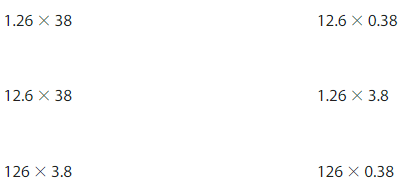
Big Ideas Math Answers 5th Grade Chapter 5 Multiply Decimals 5.7 1
Answer:

Reasoning
How do you know how many decimal places are in each product? Explain.
Answer:
The number of decimal places in each product is the sum of decimal places in the multiplyer and the multiplicand.

Think and Grow: Use Strategies to Multiply

You can use estimation and place value, or multiplication properties to multiply.

Example
Find 3.84 × 2.1. Estimate _______
Multiply 384 by21. Then place the decimal point.
Because the product should be close to your estimate, place the decimal point after the ______.
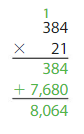
Big Ideas Math Answers Grade 5 Chapter 5 Multiply Decimals 5.7 2
So, 3.84 × 2.1 = _____.

Example
Find 0.3 × 0.7.
You can use properties to multiply.
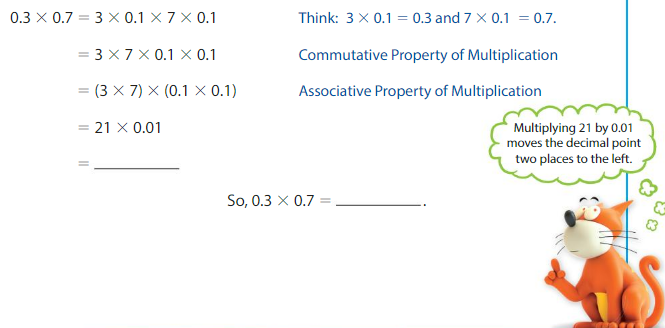
Big Ideas Math Answers Grade 5 Chapter 5 Multiply Decimals 5.7 3

Show and Grow

Find the product. Explain the strategy you used.
Question 1.
4.91 × 0.8 = _____
Answer:
Estimate:4×1=4
Multiply 491×8=3928
Then place the decimal point.
Because the product should be close to your estimate, place the decimal point after one digit ie thousands place.
3.928

Question 2.
10.2 × 5.6 = ______
Answer
Estimate:10×6=60
Multiply 102×56=5712
Then place the decimal point.
Because the product should be close to your estimate, place the decimal point after one digit ie thousands place.
57.12

Question 3.
12.03 × 4.2 = ______
Answer:
Estimate:12×4=48
Multiply 1203×43=51729
Then place the decimal point.
Because the product should be close to your estimate, place the decimal point after two digits ie thousands place.
51.729

Apply and Grow: Practice

Find the product. Explain the strategy you used.
Question 4.
0.9 × 3.2 = _____
Answer:
Estimate:1×3=3
Multiply 9×32=288
Then place the decimal point.
Because the product should be close to your estimate, place the decimal point after one digit ie hundreds place.
2.88

Question 5.
1.7 × 0.84 = ______
Answer:
Estimate:2×1=2
Multiply 17×84=1428
Then place the decimal point.
Because the product should be close to your estimate, place the decimal point after one digit ie thousands place.
1.428

Question 6.
2.4 × 2.4 = ______
Answer:
Estimate:2×3=6
Multiply 24×24=576
Then place the decimal point.
Because the product should be close to your estimate, place the decimal point after one digit ie hundreds place.
5.76

Question 7.
12.1 × 0.8 = ______
Answer:
Estimate:12×1=12
Multiply 121×8=968
Then place the decimal point.
Because the product should be close to your estimate, place the decimal point after one digit ie hundreds place.
9.68

Question 8.
0.05 × 0.9 = ______
Answer:
Think: 0.05=5×0.01 and 0.9=9×0.1
Use properties to multiply (commutative property of multiplication and associative property of multiplication)
0.05×0.9=5×0.01×9×0.1
=(5×9)×(0.1×0.01)
=45(0.001)
=0.045
Multiplying 45 by 0.001 moves the decimal point three places to  the left.
Therefore 0.05×0.9=0.045.

Question 9.
7.4 × 8.6 = ______
Answer:
Estimate:7×9=63
Multiply 74×86=6364
Then place the decimal point.
Because the product should be close to your estimate, place the decimal point after two digits ie hundreds place.
63.64

Question 10.
A newly hatched fish is 0.25 inch long. An adult fish is 7.6 times as long as the newly hatched fish. How long is the adult fish?
Big Ideas Math Answers Grade 5 Chapter 5 Multiply Decimals 5.7 4
Answer:
A newly hatched fish is 0.25 inch long, An adult fish is 7.6 times as long as the newly hatched fish.
Multiply 7.6 by 0.25
7.6×0.25=(76×25)×(0.1×0.01)=1900×0.001=1.9Therefore the adult fish is 1.9 inches long.

Question 11.
Writing

Which strategy do you prefer to use to multiply decimals? Explain.
Answer:
I prefer estimate strategy as it is very easy find the product of decimals by estimating the product of their whole numbers and placing the decimal point.

Question 12.
Structure
Your friend multiplies two decimals by rewriting the product as (56 × 3) × (0.01 ×0.1). What two decimals could she be multiplying?
Answer:
My friend multiplies two decimals by rewriting the product as (56 × 3) × (0.01 ×0.1)
Use multiplication properties.
(56 × 3) × (0.01 ×0.1)=(56×0.01)×(3×0.1)=0.56×0.3
Therefore my friend multiplied 0.56 by 0.3.

Question 13.
Precision
How many decimal places are in the unknown factor? Explain
_____ × 2.8 = 4.48
Answer:
_____ × 2.8 = 4.48
In the above equation the multiplicand in the equation has one decimal place after decimal point.
As the product has two decimal places after the decimal point the multiplyer will also have 1 digit after decimal point.
Therefore there is one decimal place is in the unknown factor.

Think and Grow: Modeling Real Life

Example
You measure the distance between Los Angeles and Anaheim on a map. Each centimeter represents 2.5 kilometers. What is the actual distance between the cities?
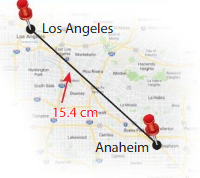
Big Ideas Math Answers Grade 5 Chapter 5 Multiply Decimals 5.7 5
Because each centimeter represents 2.5 kilometers, multiply 15.4 and 2.5 to find the actual distance.
Multiply 154 by 25. Then place the decimal point. Estimate ______
Because the product should be close to your estimate, place the decimal point after the ______
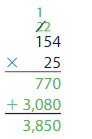
Big Ideas Math Answers Grade 5 Chapter 5 Multiply Decimals 5.7 6
15.4 × 2.5 = _______
So, the actual distance between the cities is _________ kilometers.

Show and Grow

Question 14.
You measure the height of the replica of the Lincoln statue. Each centimeter represents 2.5 meters. What is the actual height of the Lincoln statue?
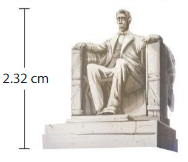
Big Ideas Math Answers Grade 5 Chapter 5 Multiply Decimals 5.7 7
Answer:
Because each centimeter represents 2.5 meters, multiply 2.32 and 2.5 to find the actual height.
Multiply 232 by 25. Then place the decimal point. Estimate 232×25
Because the product should be close to your estimate, place the decimal point after the one digit ie 3 places from the left.
232×25=5800
2.32 × 2.5 = 5.800=5.8
So, the actual height is 5.8 meters
Therefore the actual height of the Lincoln statue is 5.8 meters.

Question 15.
DIG DEEPER!
How much does the bunch of bananas cost? Explain.
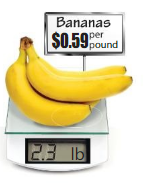
Big Ideas Math Answers Grade 5 Chapter 5 Multiply Decimals 5.7 8
Answer:
The above picture tells us that there are 2.3 pounds of bananas.
Each pound of banana costs $0.59
To find the cost of 2.3 pounds of bananas
Multiply 2.3×0.59=
Estimate
Because the product should be close to your estimate, place the decimal point after the one digit ie 3 places from the left
23×59=1357
Therefore 2.3×0.59=1.357

Question 16.
DIG DEEPER!
Your friend has a digital photograph file that is 0.25 mega byte larger than 7.5 times the file size of your photograph. What is the file size of your friend’s photograph?
Big Ideas Math Answers Grade 5 Chapter 5 Multiply Decimals 5.7 9
Answer:
File size of my photograph is 0.5 MB
My friend has a digital photograph file that is 0.25 mega byte larger than 7.5 times the file size of my photograph.
Estimate
Multiply 0.5×7.5
(5×75)×(0.1×0.1)=375×0.01=3.75 MB
Because the product should be close to your estimate, place the decimal point after the one digit ie 2 places from the left
Add 0.25 MB to 3.75 MB
=3.75+0.25=4 MB
The file size of my friend’s photograph is 4 MB.

Use Strategies to Multiply Decimals Homework & Practice 5.7

Find the product. Explain the strategy you used.
Question 1.
0.8 × 1.4 = ______
Answer:
Estimate:1×1=1
Multiply 8×14=112
Then place the decimal point.
Because the product should be close to your estimate, place the decimal point after one digit ie hundreds place.
1.12

Question 2.

1.3 × 2.9 = ______
Answer:
Estimate:1×3=3
Multiply 13×29=377
Then place the decimal point.
Because the product should be close to your estimate, place the decimal point after one digit ie hundreds place.
3.77

Question 3.
1.7 × 0.6 = ______
Answer:
Estimate:1×1=1
Multiply 17×6=102
Then place the decimal point.
Because the product should be close to your estimate, place the decimal point after one digit ie hundreds place.
1.02

Question 4.
3.86 × 2.8 = ______
Answer:
Estimate:3×3=9
Multiply 386×28=10808
Then place the decimal point.
Because the product should be close to your estimate, place the decimal point after two digits ie hundreds place.
10.808

Question 5.
0.07 × 4.5 = _______
Answer:
Estimate:0x4=0
Multiply 7×45=315
Then place the decimal point.
Because the product should be close to your estimate, place the decimal point before three digits ie hundreds
place.
0.315

Question 6.
2.56 × 6.25 = ______
Answer:
Estimate:3×6=18
Multiply 256×625=160000
Then place the decimal point.
Because the product should be close to your estimate, place the decimal point after two digits ie ten thousands place.
16.0000=16

Question 7.
1.18 × 0.8 = ______
Answer:
Estimate:1×1=1
Multiply 118×8=944
Then place the decimal point.
Because the product should be close to your estimate, place the decimal point before three digits ie hundreds place.
0.944

Question 8.
18.2 × 0.9 = ______
Answer:
Estimate:18×1=18
Multiply 182×9=1638
Then place the decimal point.
Because the product should be close to your estimate, place the decimal point after two digits ie hundreds place.
16.38

Question 9.
6.7 × 5.2 = ______
Answer:
Estimate:7×5=35
Multiply 67×52=3484
Then place the decimal point.
Because the product should be close to your estimate, place the decimal point after two digits ie hundreds place.
34.84

Question 10.
A beaker contains 0.75 liter of a solution. You use 0.1 of the solution for an experiment. How much of the solution do you use?
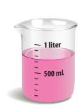
Big Ideas Math Answers Grade 5 Chapter 5 Multiply Decimals 5.7 10
Answer:
To find the amount of solution used multiply 0.75 by 0.1
0.75×0.1=0.075
0.075 litrrs of solution is used.

Question 11.
Structure
Which expressions are equivalent to 0.6 × 0.3?
(6 × 3) × (0.1 × 0.1)
(6 × 3) × (0.01 × 0.01)
(6 × 3) × (\(\frac{1}{10}\) × \(\frac{1}{10}\))
(6 × 0.1) × (3× 0.1)
Answer:
(6 × 3) × (0.1 × 0.1), (6 × 0.1) × (3× 0.1) are equivalent to 0.6×0.3 as their product is equal to the product of 0.6×0.3.

Question 12.
Number Sense
Your friend finds 0.92 × 0.3 by multiplying 92 and 3. Explain how your friend will know where to place the decimal point in the product.
Answer:
My friend finds 0.92×0.3 by multiplying 92 and 3
In 0.92 there are two digits after decimal point and in 0.3 there are three digits after decimal point so the product should have 3 digits after decimal point.
When we multiply 92 by 3 the product is 276
Therefore the decimal  point is placed before 3 digits from the left 0.276 will be the product.

Question 13.
Number Sense
When finding 75 × 0.01, where will the decimal point be placed? Explain.
Answer:
While finding the product of 75 and 0.01 the decimal point will be placed before two digits as the decimal point in 0.01 has two places after decimal.
Therefore 0.75 is the product and decimal point is placed two places from the left.

Question 14.
Modeling Real Life
A toy car designer measures the length of the actual car shown. A toy car is 0.05 times as long as the actual car. How long is the toy car?
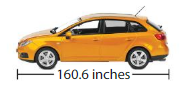
Big Ideas Math Answers Grade 5 Chapter 5 Multiply Decimals 5.7 11
Answer:
A toy car designer measures the length of the actual car shown.
Length of the actual car is 160.6 inches
A toy car is 0.05 times as long as the actual car
Multiply 160.6×0.05=8.03
Therefore Toy car is 8.03 inches long.

Question 15.
Modeling Real Life
A carpet installer measures 3 rectangular bedrooms for new carpeting. Which bedroom needs the most carpeting?
Bedroom A: 3.1 meters by3.1 meters
Bedroom B: 2.9 meters by3.2 meters
Bedroom C: 2.5 meters by3.4 meters160.6 inches
Answer:
Bedroom A: 3.1×3.1= (31×31)×(0.1×0.1)=961×0.01=9.61
Bedroom B: 2.9×3.2=(29×32)×(0.1×0.1)=928×0.01=9.28
Bedroom C: 2.5×3.4=(25×34)×(0.1×0.1)=850×0.01=8.50
Bedroom A needs the most carpeting.

Review & Refresh
Question 16.
Round 4.163
Nearest whole number: ______
Nearest tenth: ______
Nearest hundredth: ______
Answer:
Nearest whole number: 4
Nearest tenth: 4.2
Nearest hundredth: 4.16

Question 17.
Round 10.187.
Nearest whole number: ______
Nearest tenth: ______
Nearest hundredth: ______
Answer:
Nearest whole number:10
Nearest tenth: 10.2
Nearest hundredth: 10.19

Lesson 5.8 Multiply Decimals

Explore and Grow

Choose any strategy to find each product.
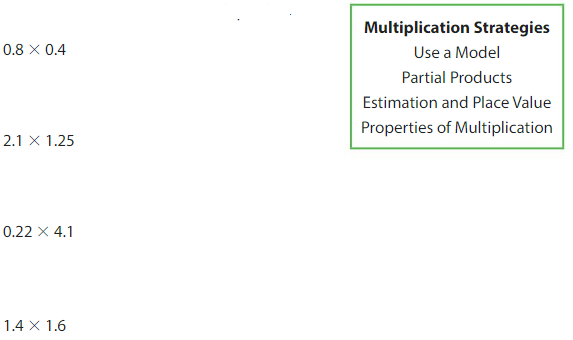
Big Ideas Math Solutions Grade 5 Chapter 5 Multiply Decimals 5.8 1
Answer:

0.8×0.4=
Estimate
=(8×4)×(0.1×0.1)
=32(0.01)
= 0.32
0.8×0.4=0.32

2.1×1.25=
Use partial products
2.1×1.25=
0 .1×0.25=0.025
0 .1×1=0.1
0 .25×2=0.5
2×1=2
2.1×1.25=0.025+0.1+0.5+2=2.625

0.22×4.5
Estimate and place value

22×45=990
There are 3 decimal places in the factors so place the decimal point before three digits ie hundreds place.
0.990=0.99
0.22×4.5=0.99

1.4×1.6
Think: 1.4=14×0.1 and 1.6=16×0.1
Use properties to multiply (commutative property of multiplication and associative property of multiplication
=1.4×1.6
=14×0.1×16×0.1
=(14×16)×(0.1×0.1)
=224(0.01)
= 2.24

Reasoning
How can you determine the number of decimal places a product will have before multiplying?
Answer:
The decimal places of the product is the sum of the decimal places of the factors.

Think and Grow: Multiply Decimals

Key Idea
To multiply decimals, multiply as you do with whole numbers. The number of decimal places in the product is equal to the sum of the number of decimal places in the factors.
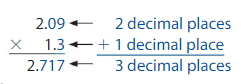
Big Ideas Math Solutions Grade 5 Chapter 5 Multiply Decimals 5.8 2
Big Ideas Math Solutions Grade 5 Chapter 5 Multiply Decimals 5.8 3

Show and Grow

Find the product.
Question 1.
Big Ideas Math Solutions Grade 5 Chapter 5 Multiply Decimals 5.8 4
Answer:
1.8×7.3
Multiply the whole numbers first and place the decimal points
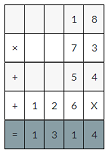
18×73=1314
There are 1 decimal place each in both the factors so the product will have 2 decimal places
Place the decimal point before 2 digits feom the left 13.14
Therefore 1.8×7.3=13.14

Question 2.
Big Ideas Math Solutions Grade 5 Chapter 5 Multiply Decimals 5.8 5
Answer:
12.41×62
Multiply the whole numbers first and place the decimal points
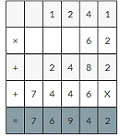
1241×62=76942
There are 2 decimal places and 1 decimal each in both the factors so the product will have 3 decimal
places
Place the decimal point before three digits from the left 76.942

Therefore 12.41×62=76.942

Question 3.
Big Ideas Math Solutions Grade 5 Chapter 5 Multiply Decimals 5.8 6
Answer:
0.14×0.7
Multiply the whole numbers first and place the decimal points
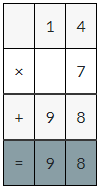
14×7=98
There are 2 decimal places and 1 decimal place each in both the factors so the product will have 3 decimal
places
Place the decimal point before three digits from the left 0.098
Therefore 0.14×0.7=0.098

Apply and Grow: Practice

Find the product.
Question 4.
Big Ideas Math Solutions Grade 5 Chapter 5 Multiply Decimals 5.8 7
Answer:
2.4×8.9
Multiply the whole numbers first and place the decimal points
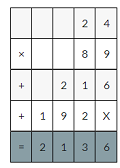
24×89=2136
There are 1 decimal places each in both the factors so the product will have 2 decimal places
Place the decimal point before two digits from the left 21.36
Therefore 2.4×8.9=21.36

Question 5.
Big Ideas Math Solutions Grade 5 Chapter 5 Multiply Decimals 5.8 8
Answer:
0.17×0.3
Multiply the whole numbers first and place the decimal points
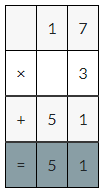
17×3=51
There are 2 decimal places and 1 decimal each in both the factors so the product will have 3 decimal
places
Place the decimal point before three digits from the left 0.051
Therefore 0.17×0.3=0.051

Question 6.

Big Ideas Math Solutions Grade 5 Chapter 5 Multiply Decimals 5.8 9
Answer:
35.4×6.2
Multiply the whole numbers first and place the decimal points
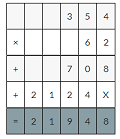
354×62=21948
There are 1 decimal place each in both the factors so the product will have 2 decimal places
Place the decimal point before two digits from the left 219.48
Therefore 35.4×62=219.48

Question 7.
Big Ideas Math Solutions Grade 5 Chapter 5 Multiply Decimals 5.8 10
Answer:
9.87×23.6
Multiply the whole numbers first and place the decimal points
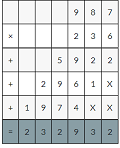
987×236=232932
There are 2 decimal places and 1 decimal each in both the factors so the product will have 3 decimal
places
Place the decimal point before three digits from the left 232.932
Therefore 9.87×23.6=232.932

Question 8.
Big Ideas Math Solutions Grade 5 Chapter 5 Multiply Decimals 5.8 11
Answer:
16.4×7.95
Multiply the whole numbers first and place the decimal points
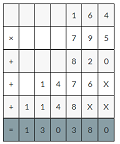
164×795=130380
There are 2 decimal places and 1 decimal each in both the factors so the product will have 3 decimal
places
Place the decimal point before three digits from the left 130.380
Therefore 16.4×79.5=130.380

Question 9.
Big Ideas Math Solutions Grade 5 Chapter 5 Multiply Decimals 5.8 12
Answer:
0.8×0.9
Multiply the whole numbers first and place the decimal points
8×9=72
There are 1 decimal place  each in both the factors so the product will have 2 decimal places
Place the decimal point before two digits from the left 0.72
Therefore 0.8×0.9=0.72

Question 10.
46.5 × 0.73 = ______
Answer:
46.5×0.73
Multiply the whole numbers first and place the decimal point
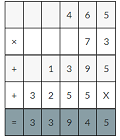
465×73=33945
There are 2 decimal places and 1 decimal each in both the factors so the product will have 3 decimal
places
Place the decimal point before three digits from the left 33.945
Therefore 46.5×0.73=33.945

Question 11.
14.8 × 9.3 = ________
Answer:
14.8×9.3
Multiply the whole numbers first and place the decimal points
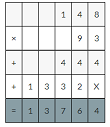
148×93=13764
There are 1 decimal place  each in both the factors so the product will have 2 decimal places
Place the decimal point before two digits from the left 137.64
Therefore 14.8×9.3×=137.64

Question 12.
1.54 × 2.6 = ______
Answer:
1.54×2.6
Multiply the whole numbers first and place the decimal points
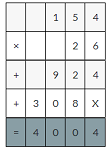
154×26=4004
There are 2 decimal places and 1 decimal each in both the factors so the product will have 3 decimal
places
Place the decimal point before three digits from the left4.004
Therefore 1.54×2.6=4.004

Question 13.
A sugar glider weighs 0.35 times the weight of the pygmy slow loris. How much does the sugar glider weigh?
Big Ideas Math Solutions Grade 5 Chapter 5 Multiply Decimals 5.8 13
Answer:
A sugar glider weighs 0.35 times the weight of the pygmy slow loris
Weight of pygmy slow loris is 14.9 ounces
Multiply 14.9 by 0.35 to find the weight of sugar glider 14.9×0.35=
149×35
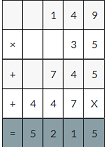
5215
There are 3 decimal places in the factors so the product will have 3 decimal places
Place the decimal point before 3 digits from the left. 5.215
Therefore 14.9×0.35=5.215

Question 14.
Structure
Use the equation to write two different multiplication expressions that have products of 28.34.
109 × 26 = 2,834
Answer:
Equation 1:10.9×2.6=28.34
Equation 2:109×26×0.1×0.1=28.34

Question 15.
DIG DEEPER!
Without calculating, explain how many decimal places are in the product 0.6 0.4 1.9. Rewrite the expression as the product of two decimals to support your answer.
Answer:
0.6 × 0.4 × 1.9
= 0.456

Think and Grow: Modeling Real Life

Example
Nutritionists recommend that fifth-graders should consume about 28 grams of fiber each day. One serving of broccoli contains 3.8 grams of fiber. You eat 4.5 servings of broccoli in 1 day. Do you consume enough fiber for the day by eating broccoli? Explain.
Big Ideas Math Solutions Grade 5 Chapter 5 Multiply Decimals 5.8 14
Multiply 3.8 by4.5 to find how many grams of fiber you consume by eating broccoli.
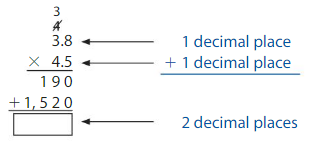
Big Ideas Math Solutions Grade 5 Chapter 5 Multiply Decimals 5.8 15
Compare the product to 28.
So, you ______ consume enough fiber for the day by eating broccoli.

Show and Grow

Question 16.
Your aunt drives a car from Cincinnati to Nashville. The car travels 30.4 miles using 1 gallon of gasoline. There are 6.5 gallons of gasoline in the tank. Can she drive the entire distance without adding more gas to the 6.5 gallons already in the tank? Explain.
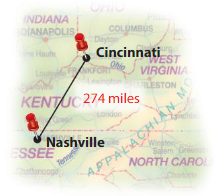
Big Ideas Math Solutions Grade 5 Chapter 5 Multiply Decimals 5.8 16
Answer:
My aunt drives a car from Cincinnati to Nashville.
The distance from cincinnati to Nashville is 274 miles
The car travels 30.4 miles using 1 gallon of gasoline, There are 6.5 gallons of gasoline in the tank.
To find the total distance that my aunt can travel by using 6.5 gallons of gasoline
Multiply 6.5×30.4=65×304
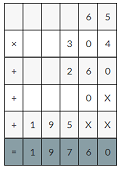
65×304=19760
Place the decimal point before 2 digits from the left 197.60 miles
197.6<274 miles
So, my aunt cannot drive the entire distance without adding more gas to the 6.5 gallons already in the tank.

Question 17.
DIG DEEPER!
The equation shows how to convert a temperature C in degrees Celsius to a temperature F in degrees Fahrenheit. Convert the temperature shown to Fahrenheit.
1.8 × C + 32 = F

Big Ideas Math Solutions Grade 5 Chapter 5 Multiply Decimals 5.8 17
Answer:
Given 1.8×C+32=F
In the above picture the temperature is 37.1°C
To find degrees in Farenheit
Multiply 1.8 by 37.1 and add 32 to the product.
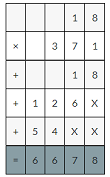
1.8×37.1=66.78+32=98.78°F
Therefore the temperature is 98.78°Farenheit.

Question 18.
DIG DEEPER!
Pennies dated 1982 or later contain about 0.06 gram of copper. Pennies dated prior to 1982 contain about 49.2 times as much copper as newer pennies. How many total grams of copper are in the pennies shown?
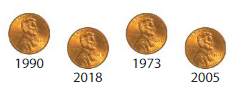
Big Ideas Math Solutions Grade 5 Chapter 5 Multiply Decimals 5.8 18
Answer:
Pennies dated 1982 or later contain about 0.06 gram of copper
There is 3 pennies which are dated after 1983
Multiply 3×0.06=0.18
Pennies dated prior to 1982 contain about 49.2 times as much copper as newer pennies
Multiply 49.2 by the copper in penny dated after 1982 ie 0.06
49.2×0.06=2.952
Multiply 49 by 6 and place the decimal point before 3 digits from the left
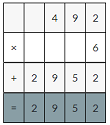
Add 0.18 to 2.952 to find the total amount of copper in all the coins
2.952+0.18=3.132 grams
The total amount of copper in all the coins is 3.132 grams.

Multiply Decimals Homework & Practice 5.8

Find the product.
Question 1.
Big Ideas Math Solutions Grade 5 Chapter 5 Multiply Decimals 5.8 19
Answer:
12.8×0.4
Multiply the whole numbers first and place the decimal points
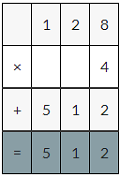

128×4=512
There are 1 decimal place  each in both the factors so the product will have 2 decimal places
Place the decimal point before two digits from the left 5.12
Therefore 12.8×0.4=512

Question 2.
Big Ideas Math Solutions Grade 5 Chapter 5 Multiply Decimals 5.8 20
Answer:
3.97×62.4
Multiply the whole numbers first and place the decimal point
397×624=247728
There are 2 decimal places and 1 decimal each in both the factors so the product will have 3 decimal
places
Place the decimal point before three digits from the left 247.728
Therefore 3.97×62.4=247.728

Question 3.
Big Ideas Math Solutions Grade 5 Chapter 5 Multiply Decimals 5.8 21
Answer:
5.2×0.9
Multiply the whole numbers first and place the decimal points
52×9=468
There are 1 decimal place  each in both the factors so the product will have 2 decimal places
Place the decimal point before two digits from the left 4.68
Therefore 5.2×0.9=4.68

Question 4.
Big Ideas Math Solutions Grade 5 Chapter 5 Multiply Decimals 5.8 22
Answer:
18.3×9.27
Multiply the whole numbers first and place the decimal point
183×927=169641
There are 2 decimal places and 1 decimal each in both the factors so the product will have 3 decimal places
Place the decimal point before three digits from the left 169.641
Therefore 18.3×9.27=169.641

Question 5.
Big Ideas Math Solutions Grade 5 Chapter 5 Multiply Decimals 5.8 23
Answer:
2.57×4.6
Multiply the whole numbers first and place the decimal point
257×46=11822
There are 2 decimal places and 1 decimal each in both the factors so the product will have 3 decimal places
Place the decimal point before three digits from the left 11.822
Therefore 2.57×4.6=11.822

Question 6.
Big Ideas Math Solutions Grade 5 Chapter 5 Multiply Decimals 5.8 24
Answer:
22.5×3.7
Multiply the whole numbers first and place the decimal point
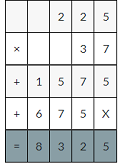
225×37=8325
There are 1 decimal place each in both the factors so the product will have 2 decimal places
Place the decimal point before 2 digits from the left 83.25
Therefore 22.5×3.7=83.25

Question 7.
0.89 × 0.3 = ______
Answer:
0.89×0.3
Multiply the whole numbers first and place the decimal point
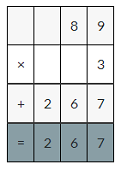
89×3=267
There are 2 decimal places and 1 decimal each in both the factors so the product will have 3 decimal
places
Place the decimal point before three digits from the left 0.269
Therefore 0.89×0.3=0.269

Question 8.
7.1 × 5.6 = ______
Answer:
7.1×5.6
Multiply the whole numbers first and place the decimal points
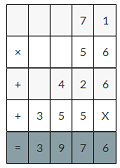
71×56=3976
There are 1 decimal place  each in both the factors so the product will have 2 decimal places
Place the decimal point before two digits from the left 39.76
Therefore 7.1×5.6=39.76

Question 9.
13.63 × 9.2 = ______
Answer:
13.63×9.2
Multiply the whole numbers first and place the decimal point
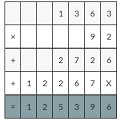
1363×92=125396
There are 2 decimal places and 1 decimal each in both the factors so the product will have 3 decimal
places
Place the decimal point before three digits from the left 125.396
Therefore 13.63×9.2=125.396

Question 10.
The Miniature pinscher weighs 0.12 times the weight of the Doberman pinscher. How much does the Miniature pinscher weigh?
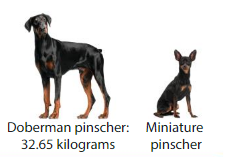
Big Ideas Math Solutions Grade 5 Chapter 5 Multiply Decimals 5.8 25
Answer:
The Miniature pinscher weighs 0.12 times the weight of the Doberman pinscher
Weight of Doberman pinscher is 32.65 kilograms
Multiply 3265 by 12 and place the decimal point before 4 digits from the left.
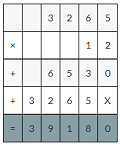
Weight of miniature pinscher is 32.65×0.12=3.918
Miniature pinscher weigh is 3.918 kilograms.

Question 11.
Reasoning
Explain how you can tell which product is greater without multiplying or estimating.
3.75 × 922 or  37.5 × 9.22
Answer:
Product of 3.75 × 922 is greater because the number contains bigger whole number when compared to the other product.

Question 12.
Modeling Real Life
Nutritionists recommend that fifth-graders should consume about 5 ounces of protein each day. One serving of yogurt contains 0.6 ounce of protein. You eat 2.5 servings of yogurt in 1 day. Do you consume enough protein for the day by eating yogurt? Explain.

Big Ideas Math Solutions Grade 5 Chapter 5 Multiply Decimals 5.8 26
Answer:
Nutritionists recommend that fifth-graders should consume about 5 ounces of protein each day.
One serving of yogurt contains 0.6 ounce of protein.
If i eat 2.5 servings of yogurt in 1 day then i consume 2.5×0.6 ounce sof protein per day
Multiply 25 by 6 and place the decimal point 2before 2 digitd from the left
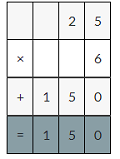
2.5×0.6=1.5 ounces of protein
Compare 1.5 with 5
1.5<5
So, i cannot consume enough protein for the day by eating yogurt.

Question 13.
DIG DEEPER!
Each 18-karat gold ring shown is a mixture of gold and other metals. One gram of 18-karat gold contains 0.75 gram of gold. How many total grams of gold are in the rings shown?
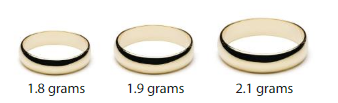
Big Ideas Math Solutions Grade 5 Chapter 5 Multiply Decimals 5.8 27
Answer:
Each 18-karat gold ring shown is a mixture of gold and other metals.
If one gram of 18-karat gold contains 0.75 gram of gold then
Multiply 18 by 75 and place the decimal point before 3 digits from the left
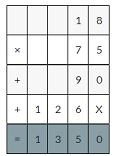
1.8 grams ring contains 1.8×0.75 grams of gold 1.8×0.75=1.35 grams of gold.
Multiply 19 by 75 and place the decimal point before 3 digits from the left
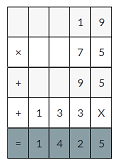
1.9 grams ring contains 1.9×0.75 grams of gold 1.9×0.75=1.425 grams of gold
Multiply 21 by 75 and place the decimal point before 3 digits from the left
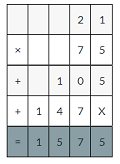
2.1 grams ring contains 2.1×0.75 grams of gold 2.1×0.75=1.575 grams of gold
Add 1.35 , 1.425 and 1.575 to find the total grams of gold 1.35+1.425+1.575=4.35
Total 4.35 grams of gold are in the rings shown.

Review & Refresh

Write the words as an expression. Then interpret the expression.
Question 14.
Subtract 10 from 50, then divide by 5
Answer:
8

Explanation:
Subtract 10 from 50=50‐10=40
divide by 5=40÷5=8

Question 15.
Add the product of 12 and 6 to the product of 6 and 8.
Answer:
120

Explanation:
product of 12 and 6=12×6=72
product of 6 and 8=6×8=48
Add the product of 12 and 6 to the product of 6 and 8=72+48=120

Lesson 5.9 Problem Solving: Multiply with Money

Explore and Grow

Explain how you would estimate the cost of 1.9 pounds of ham, 0.8 pound of turkey, and 1 pound of cheese.
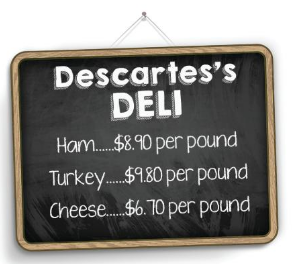
Big Ideas Math Answer Key Grade 5 Chapter 5 Multiply Decimals 5.9 1
Answer:

At Descartes’s Deli the Ham costs $8.90;per pound , Turkey costs $9.80 per pound and Cheese costs $6.70 per pound
Estimated solution
Use rounding
Cost of ham is 9, cost of turkey is 10 and cost of cheese is 7 per pound
By using rounding to find
Cost of 2 pounds of ham=2×9=18
Cost of 1 pound of turkey=10
Cost of 1 pound of cheese=7
Total =18+10+7=35
Original solution
To find the cost of
1.9 pounds of ham, Multiply 1.9×$8.9=$16.91
0.8 pound of turkey, Multiply 0.8×$9.8=$7.84
1 pound of cheese , Multiply 1×$6.7=$6.7
Therefore Total cost is $16.91+$7.84+$6.7=$31.45.

Reasoning
Is your answer an overestimate or an underestimate? Explain.
Answer:
My answer is an overestimate as it is more than the actual cost.

Think and Grow: Problem Solving: Multiply with Money

Example
Carrots cost $0.90 per pound. You buy 2.6 pounds of carrots and give the cashier $5. How much change do you receive?
Big Ideas Math Answer Key Grade 5 Chapter 5 Multiply Decimals 5.9 2
Understand the Problem
What do you know?
• Carrots cost $0.90 per pound.
• You buy 2.6 pounds of carrots.
• You pay with $5.

What do you need to find?
• You need to find the amount of change you receive.

Make a Plan
How will you solve?
Write and solve an equation: Multiply the number of pounds by the cost per pound, and subtract from $5.

Solve
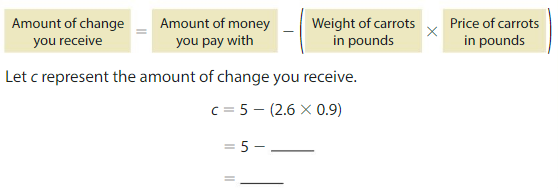
Big Ideas Math Answer Key Grade 5 Chapter 5 Multiply Decimals 5.9 3
So, you receive $ ______ in change.

Show and Grow

Question 1.
Landscaping rocks cost $0.35 per pound. A landscaper buys 86.4 pounds of rocks with $40. How much change does she receive?
Answer:
What i know is
Cost of landscaping rocks per pound is $0.35
A landscaper buys 86.4 pounds of rocks with $40
What i need to find is the change landscaper receives.
The amount of change landscaper receives =Amount spent ‐cost of rock per pound × 86.4 pounds of rock
=($40)‐($0.35×86.4)=$40‐$30.24=$9.76
$9.76 is the change landscaper receives.

Apply and Grow: Practice

Understand the problem. What do you know? What do you need to find? Explain.
Question 2.
A gallon of milk cost $0.82 in 1960. In2015, it cost $0.03 more than 4 times the cost in 1960. How much did a gallon of milk cost in 2015?
Big Ideas Math Answer Key Grade 5 Chapter 5 Multiply Decimals 5.9 4
Answer:
What we know is
The cost of gallon of milk in 1960 is $0.82
What we have find is
The Cost of gallon of milk in 2015 is
(4×$0.82)+$0.03=$3.28+$0.03=$3.31
A gallon of milk cost in 2015 is $3.31

Question 3.
A secretary earns $10.75 each hour. He works 8 hours each day,5 days each week. How much money does he earn in 1 week?
Answer:
What we know is
A secretary earns $10.75 each hour, he works 8 hours each day,5 days each week
What we have to find is
The amount he earns in a weekIf he works 8 hours each day and 5 days a week then he works for 40 hours in a week
The amount he earns in a week =Amount he earns per hour × Number of hours he work in a week.
=$10.75×40=$430
The money he earn in 1 week is $430.

Understand the problem. Then make a plan. How will you solve? Explain.
Question 4.
You download 8 songs for $1.29 each and 1 song for $0.99. How much do you pay for all of the songs?
Answer:
If i download 8 songs for $1.29 each then the money for 8 songs is number of songs multiplied by charges per
song
Ie 8×$1.29=$10.32
If i download another song for $0.99 then total charges i spent is charges of 8 songs plus charges of 1 song
$10.32+$0.99=$11.31
Therefore i pay $11.31 for all the songs.

Question 5.
Your friend buys a snack for $2.75, and a book that costs 5 times as much as the snack. He also buys a poster that costs $3.50 less than the book. How much does the poster cost?
Answer:
Cost of snack is $2.75
Book costs 5 times as much as the snack
The cost of book = 5×cost of snack
=5×$2.75=13.75
poster costs $3.50 less than the book
The cost of the poster = cost of book‐$3.50
=$13.75‐3.50=$10.25
Therefore cost of the poster is $10.25

Question 6.

A pair of shoes costs $35. Newton has a coupon topay 0.8 of the price.Descartes has a $10 off coupon. Who will pay more for the shoes?
Answer:
A pair of shoes costs $35
Newton has a coupon topay 0.8 of the price
=0.8×$35=28
Newton pays $28
Descartes has a $10 off coupon
=$35‐$10=$25
Descartes pay $25
28>25 so, Newton pays more for the pair of shoes.

Question 7.
Two friends eat at a restaurant for $34. They calculate the tip by multiplying $34 by 0.18. How much do they pay for the meal, including the tip?
Big Ideas Math Answer Key Grade 5 Chapter 5 Multiply Decimals 5.9 5
Answer:
Two friends eat at a restaurant for $34
If they calculate the tip by multiplying $34 by 0.18
Amount of tip =0.18×$34=$6.12
The money they pay for the meal, including the tip =$34+$6.12=$40.12
Therefore the money they paid is $40.12.

Think and Grow: Modeling Real Life

Example
A traveler gives a cashier 100 U.S. dollars to exchange for European euros. A $7.50 service fee is deducted from the amount given. How many European euros does the traveler receive?
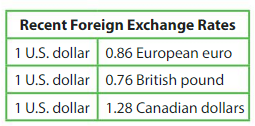
Big Ideas Math Answer Key Grade 5 Chapter 5 Multiply Decimals 5.9 6
Think: What do you know? What do you need to find? How will you solve?
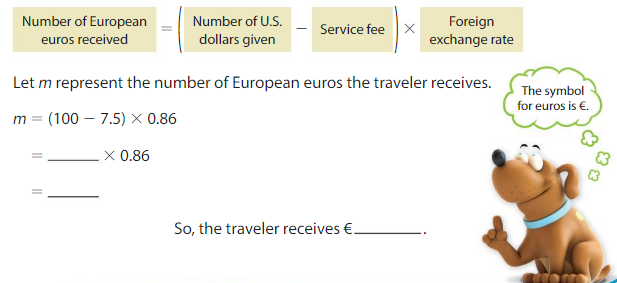
Big Ideas Math Answer Key Grade 5 Chapter 5 Multiply Decimals 5.9 7

Answer:
m = (100 – 7.5) × 0.86
92.5 × 0.86
= 79.55

Show and Grow

Use the table above.
Question 8.
DIG DEEPER!
You need 50 Canadian dollars. You give a cashier 50 U.S. dollars to exchange for Canadian dollars. A $9.50 service fee is deducted from the amount given. Do you have enough Canadian dollars? Explain.
Answer:
I need 50 canadian dollars
I gave 50 U.S. dollars for exchange and the service fee is $9.50
Exchange rate for US dollar to canadian dollar is 1.28
So, 50 US dollars ×1.28=64 canadian dollars
64>50
Therefore i have enough Canadian dollars.

Question 9.
DIG DEEPER!
In the example, the traveler decides to exchange the same number of U.S. dollars for British pounds. Without calculating, determine whether the traveler receives more European euros or British pounds. Explain.
Answer:
The traveler receives more European euros because the exchange rate of European euros ia more than the
exchange rate of British pounds.

Problem Solving: Multiply with Money Homework & Practice 5.9

Understand the problem. Then make a plan. How will you solve? Explain.
Question 1.
One gallon of gasoline costs $2.75. Your cousin fills his car with 10 gallons of gasoline each week. How much money does he spend on gasoline in 1 year?
Answer:
One gallon of gasoline costs $2.75
My friend fills his car with 10 gallons of gasoline each week
We have to find the money he spend on gasoline for a year.
An year consists of 52 weeks
So, multiply 52 by 10 to find number of gallons used in a year
52×10=520
If Cost of a gallon of gasoline is $2.75 then cost of 52p gallons is $2.75×520=$1430
$1430 is the money spend by my cousin on gasoline in 1 year.

Question 2.
Newton buys a guitar for $46 and a guitar amplifier. The amplifier costs $1.54 more than 1.26 times the cost of the guitar. How much does the amplifier cost?
Answer:
Cost of guitar is $46
The amplifier costs $1.54 more than 1.26 times the cost of the guitar
Cost of amplifier = ($46×1.26)+$1.54
=$57.96+$1.54
$59.5
Therefore the amplifier costs $59.5.

Question 3.
One pound of cheese costs $3.98. You buy a box of crackers for $3.37 and 2.5 pounds of cheese. How much do you spend in all?
Answer:
One pound of cheese costs $3.98
Cost of 2.5 pounds of cheese =2.25×$3.98=$8.955
If i  buy a box of crackers for $3.37 and 2.5 pounds of cheese
The money is spent =$3.37+$8.955=$12.325
$12.325 is the money i spend in all.
Question 4.

Writing
Write and solve a two-step word problem involving money.
Answer:
A boy buys a toy car for $3 and also a toy bike for 2.4 times as much as the cost of the toy car. Find the money spend by the boy in all.
Solution:
The cost of toy car is $3
Cost of toy bike is 2.4 × cost of toy car
=2.4×$3=$7.2
Add cost of toy car and toy bike =$3+$7.2=$10.2
The money spent by the boy in all is $10.2

Question 5.Modeling Real Life
You buy 2.75 pounds of pistachios and 2 pounds of cashews. Do you pay more for the pistachios or for the cashews? How much more?
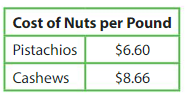
Big Ideas Math Answer Key Grade 5 Chapter 5 Multiply Decimals 5.9 8
Answer:
Cost of pistachios per pound is $6.60
If i buy 2.75 pounds of pistachios then the money spend is 2.75×$6.60=$18.15
Cost of cashews per pound is $8.66
If i buy 2 pounds of cashews then the money spend is 2×$8.66=$17.32
18.15>17.32
So, i pay more for the pistachios.

Question 6.
Modeling Real Life
You, Newton, and Descartes sell items at a craft show. You earn $34.50. Newton earns 5 times as much as you do. Descartes earns 0.1 times as much as Newton does. How much do the three of you earn in all?
Answer:
You, Newton, and Descartes sell items at a craft show
Money i earned is $34.50
Newton earns 5 times as much as i do
Money earned by Newton is 5×$34.50=$172.5
Descartes earns 0.1 times as much as Newton does
Money earned by descartes is 0.1×$172.5=$17.25
Sum of $34.5, $172.5 and $17.25 is 224.25.
$22425 is the money the three earn in all.

Question 7.
DIG DEEPER!
A daycare employee earns $10.90 per hour for the first works in 1 week. He is paid 1.5 times that rate for each additional hour that he works. How much money does he earn working for 43 hours in 1 week?
Answer:
Given,
A daycare employee earns $10.90 per hour for the first works in 1 week.
He is paid 1.5 times that rate for each additional hour that he works.
10.90 × 1.5 = 16.35
16.35 × 43 = 703.05

Review & Refresh

Find the sum. Check whether your answer is reasonable.
Question 8.
24.93 + 3.86 = ______
Answer:
24.93 + 3.86 = 28.79
Explanation:
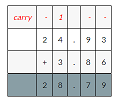
Question 9.
105.6 + 37.1 = _____
Answer:
105.6 + 37.1 = 142.7
Explanation:
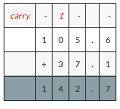
Multiply Decimals Performance Task

You study the different parts of a corn plant in science class.
Question 1.
You have a corn root sample and a corn stem sample on microscope slides. When you view the samples through a microscope, the magnification number tells you how many times larger the image will be than the actual size.You see only a portion of the enlarged image.
Big Ideas Math Answers 5th Grade Chapter 5 Multiply Decimals 1
a. The corn root sample is 0.6 millimeter wide. You magnify the image by400. What is the width of the magnifiedCorn root corn root image?

b. You magnify the corn root sample by1,200. How much wider is the image when magnified by 1,200 than by 400?

c. You have a sample of a corn stem. The corn stem sample is 9.6 times wider than the corn root sample. What is the width of the corn stem sample?
Big Ideas Math Answers 5th Grade Chapter 5 Multiply Decimals 2
Answer:

a.The corn root sample is 0.6 millimeter wide
If i  magnify the image by 400 then the magnifird width =0.6×400=240 millimeters.

b.The corn root sample is 0.6 millimeter wide
If i  magnify the image by 1200 then the magnifird width =0.6×1200=720 millimeters
Subtract 240 millimeters from 720 millimeters
480 millimeters wider is the image when magnified by 1,200 than by 400.

c.Given that the corn stem sample is 9.6 times wider than the corn root sample
The corn root sample is 0.6 millimeter wide
Width of corn stem =9.6 × width of corn root
=9.6×0.6=5.76 millimeters.

Question 3.
An ear of corn has about 16 rows of kernels. Each row has about 50 kernels of corn.
a. About 0.2 of the kernels are white and the rest are yellow. How many kernels are yellow?
Big Ideas Math Answers 5th Grade Chapter 5 Multiply Decimals 3
b. Each ear of corn has about 0.25 pound of corn kernels. How many pounds of kernels are in a dozen ears of corn?
Answer:

a.An ear of corn contains 16×50=800kernels of corn
0.2 of corn are white 0.2×800=160
Subtract 160 from total number  of kernels of corn =800‐160=640
Therefore number of yellow kernels of corn are 640.

b.Each ear of corn has about 0.25 pound of corn kernels.
Dozen corn ears contains 12×0.25 =3 pounds of corn kernels
3 pounds of kernels are in a dozen ears of corn.

Question 3.
You measure the growth of a corn stalk. The corn stalk grows about 1.75 inches each day.About how many inches does the plant growin 1 month? Justify your answer.
Answer:
The corn stalk grows about 1.75 inches each day.
If there are 30 days in a month then the length of corn stalk after month is 1.75 inches ×30=52.5 inches
Therefore, the plant grow 52.5 inches in 1 month.

Multiply Decimals Activity

Race Around the world: Multiplication
Directions:
1. Players take turns.
2. On your turn, flip a RaceAround the World: Multiplication Card and find the product.
3. Move your piece to the next number on the board that is highlighted in the product.
4. The first player to make it back to North America wins!
Big Ideas Math Answers 5th Grade Chapter 5 Multiply Decimals 4

Multiply Decimals Chapter Practice

5.1 Multiplication Patterns with Decimals

Find the product.
Question 1.
0.9 ×103 = ______
Answer:
0.9×103 =900

Explanation:
0.9×1=0.9
0.9×10=9
0.9×100=90
0.9×1000=900
So, 0.9×103 =900
When we multiply 0.9 by 1000 the number of places of decimal point moves to the right is same as the exponent ie 3.

Question 2.
612.5 × 0.1 2 = ______
Answer:
612.5 × 0.1 2 =73.5
Multiply 6125 by 12 and place the decimal places before three places from the left.
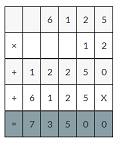
So, 612.5×0.12=73.5

Question 3.
30.1 × 102 = _____
Answer:
30.1×100=3010

Explanation:
30.1×1=30.1
30.1×10=301
30.1×100=3010
When we multiply 30.1 by 100 the number of places of decimal point moves to the right is same as the exponent ie 2.
So, 30.1×100=3010.

Question 4.
45.7 × 0.01 = ______
Answer:
45.7×0.01=0.457

Explanation:
45.7×1=45.7
45.7×0.1=4.57
45.7×0.01=0.457
When we multiply 45.7 by 0.01 the decimal point moves two places to the left
So, 45.7×0.01=0.457

Question 5.
8.6 × 10 = ______
Answer:
8.6×10=86

Explanation:
8.6×1=8.6
8.6×10=86
When we multiply 8.6 by 10 the decimal point moves 1 place to the right.
So, 8.6×10=86

Question 6.
5.24 × 0.1 = _______
Answer:
5.24×0.1=0.524

Explanation:
5.24×1=5.24
5.24×0.1=0.524
When we multiply 5.24 by 0.1 the decimal point moves one places to the left
So, 5.24×0.1=0.524

5.2 Estimate Products of Decimals and Whole Numbers

Estimate the product.
Question 7
0.99 × 45
Answer:
Use Rounding
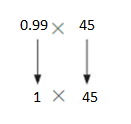
1×45=45
0.99×45 is about 45

Question 8.
3.15 × 8
Answer:
Use Rounding
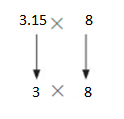
3×8=24
3.15×8 is about 24

Question 9.
17 × 1.68
Answer:
Use Rounding
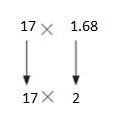
17×2=34
17×1.68 is about 34

Question 10.
95 × 5.02
Answer:
Use Rounding
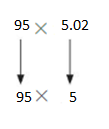
95×5=475
95×5.02  is about 475

5.3 Use Models to Multiply Decimals and Whole Numbers

Find the product.
Question 11.
0.3 × 3 = _____
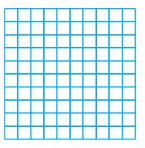
Big Ideas Math Answers 5th Grade Chapter 5 Multiply Decimals chp 11
Answer:


0.3+0.3+0.3 =0.9
Therefore 0.3×3=0.9

Question 12..
0.17 × 8 = _____
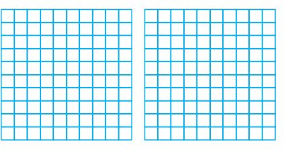
Big Ideas Math Answers 5th Grade Chapter 5 Multiply Decimals chp 12
Answer:


0.17+0.17+0.17+0.17+0.17+0.17+0.17+0.17=1.36
Question 13.
Structure
Write an equation represented by the model.
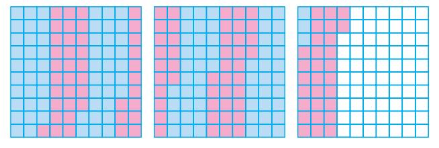
Big Ideas Math Answers 5th Grade Chapter 5 Multiply Decimals chp 13
Answer:
0.29×8=2.32

5.4 Multiply Decimals and Whole Numbers

Find the product.
Question 14.
3 × 1.64 = ______
Answer:
3×1.64=3×164
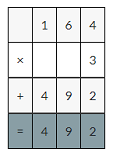
=492
Place the decimal point before 2 places from the left
4.92
Therefore 3 × 1.64 =4.92

Question 15.

2.3 × 8 = ______
Answer:
2.3×8=23×8
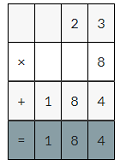
=184
Place the decimal point before 1 place from the left
18.4
Therefore 2.3×8=18.4

Question 16.
9 × 10.7 = ______
Answer:
9×10.7=9×107
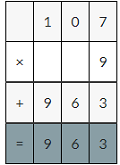
=963
Place the decimal point before 1 place from the left
96.3
Therefore 9×10.7=96.3

Question 17.
18.65 × 6 = _____
Answer:
18.65×6=1865×6
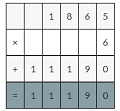
=11190
Place the decimal point before 2 places from the left
111.90
Therefore 18.65×6=111.90

5.5 Use Models to Multiply Decimals

Use the Models to find the product.
Question 18.
0.5 × 0.6 = ______
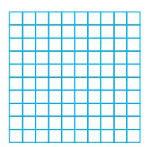
Big Ideas Math Answers 5th Grade Chapter 5 Multiply Decimals chp 18
Answer:


Shade 5 rows to represent 0.5 and 6 column to represent 0.6
30 squares are shaded twice
So, 0.5×0.6=0.30

Question 19.
1.8 × 0.9 = _____
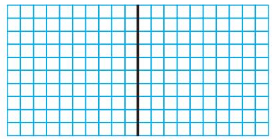
Big Ideas Math Answers 5th Grade Chapter 5 Multiply Decimals chp 19
Answer:


Shade 9 rows to represent 0.9 and 18 columns to represent 1.8
162 squares are shaded twice
So, 1.8 × 0.9= 1.62

5.6 Use Partial Products to Multiply Decimals

Find the product. Check whether your answer is reasonable.
Question 20.
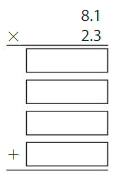
Big Ideas Math Answers 5th Grade Chapter 5 Multiply Decimals chp 20
Answer:
Step 1:0.1×0.3=0.03
Step 2:0.1×2=0.2
Step 3:8×0.3=2.4
Step 4:8×2=16
Add 0.03+0.2+2.4+16=18.63

Question 21.
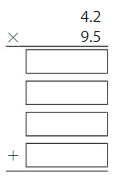
Big Ideas Math Answers 5th Grade Chapter 5 Multiply Decimals chp 21
Answer:Step 1:0.2×0.5=0.10

Step 2:
.2×9=1.8
Step 3:4×0.5=2
Step 4:4×9=36
Add 0.10+1.8+2+36=39.9

Question 22.
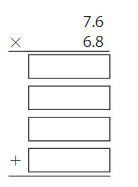
Big Ideas Math Answers 5th Grade Chapter 5 Multiply Decimals chp 22
Answer:
Step1:0.6×0.8=0.48
Step2:0.6×6=3.6
Step3:7×0.8=5.6
Step4:7×6=42
Add 0.48+3.6+5.6+42=51.68

7.6×6.8=51.68

Question 23.
0.7 × 6.5 = ______
Answer:
Step1:0.7×0.5=0.35
Step2:0.7×6=4.2
Step3:0×0.5=0
Step4:0×6=0
Add 0.35+4.2=4.55

Therefore 0.7×6.5=4.55

Question 24.
25.6 × 16.9 = ______
Answer:
Step1:0.6×0.9=0.54
step2:0.6×16=9.6
Step3:25×0.9=22.5
Step4:25×16=400
Add 0.54+9.6+22.5+400=432.64
Therefore 25.6×16.9=432.64

Question 25.
2.5 × 6.81 = _____
Answer:
Step1:0.5×0.81=0.405
Step2:0.5×6=3
Step3:2×0.81=1.62
Step4:2×6=12
Add 0.405+3+1.62+12=17.025
Therefore 2.5×6.81=17.025

5.7 Use Strategies to Multiply Decimals

Find the product. Explain the strategy you used.
Question 26.
0.4 × 0.16 = ______
Answer:
Estimate
4×16
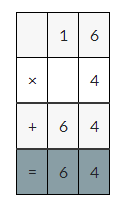
=64 place the decimal point before three places from the left
0.064
Therefore 0.4×0.16=0.064

Question 27.
0.2 × 0.8 = _______
Answer:
Estimate
2×8=16 and place the decimal point before two places from the left
0.16
Therefore 0.2×0.6=0.16

Question 28.
2.5 × 0.3 = ______
Answer:
Estimate
25×3
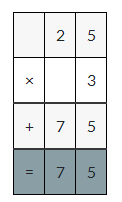
=74 and place the decimal point before two places from the left
0.74
Therefore 2.5×0.3=0.74

Question 29.
Structure
Your friend multiplies two decimals by rewriting the product as (8 × 3) × (0.1 × 0.1). What two decimals is she multiplying?
Answer:
(8×3)×(0.1×0.1)
(8×0.1)×(3×0.1)
0.8×0.3
The two decimals she is multiplying are 0.8 and 0.3

5.8 Multiply Decimals

Find the product.
Question 30.
Big Ideas Math Answers 5th Grade Chapter 5 Multiply Decimals chp 30
Answer:
Multiply 58 by 3 and place the decimal point
58×3
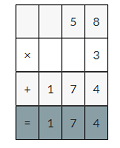
=174
Place the decimal point before two places from the left.
1.74
Therefore 5.8×0.3=1.74

Question 31.
Big Ideas Math Answers 5th Grade Chapter 5 Multiply Decimals chp 31
Answer:
Multiply 722 by 16 and place the decimal point
722×16
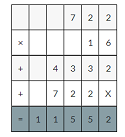
=11552
Place the decimal point before three places from the left
11.552
Therefore 7.22×1.6=11.552

Question 32.
Big Ideas Math Answers 5th Grade Chapter 5 Multiply Decimals chp 32
Answer:
Multiply 408 by 95 and place the decimal point
408×95
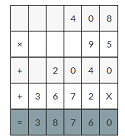
=38760
Place the decimal point before two places from the left
387.60
Therefore 40.8×9.5=387.60

5.9 Problem Solving: Multiply with Money

Question 33.
Your friend buys 4 glow sticks for $0.99 each. She pays with a $10 bill. How much change does she receive?
Answer:
My friend buys 4 glow sticks for $0.99 each
Total cost =4×$0.99=$3.96
Subtract cost from $10
$10‐$3.96=$6.04
change she receives is $6.04

Question 34.
Modeling Real Life
Descartes parks in the parking garage for 3 hours on Monday, 5 hours on Tuesday, and 10 hours on Wednesday. How much does he pay altogether?
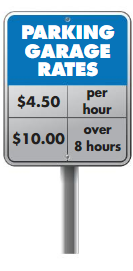
Big Ideas Math Answers 5th Grade Chapter 5 Multiply Decimals chp 34
Answer:
Descartes parks in the parking garage for 3 hours on Monday, 5 hours on Tuesday, and 10 hours on Wednesday.
parking garage rates are $4.50 per hour and $10.00 for more than 8 hours
charges on monday =3hoursx$4.50=$13.5
charges on tuesday =5hoursx$4.5=$22.5
on wednesday deacartes parks his car for more than 8 hours so, charges on wednesday are $10
Add 13.5+22.5+10=$46
Therefore Descartes pay $46 altogether.

Conclusion:

Take the help from the direct links available below and solve the problems covered in Big Ideas Math Answers Grade 5 Chapter 5 Multiply Decimals. Test your knowledge by solving the questions given at the end of the chapter. If you have any doubts regarding the concepts post the comments in the below attached comment box.

Go Math Grade 1 Answer Key Chapter 7 Compare Numbers

Do you want to get the best results in math tests? Refer to Go Math Grade 1 Chapter 7 Answer Key Compare Numbers. Get the free pdf of Go Math Grade 1 Answer Key Chapter 7 Compare Numbers now to start your practice. Just follow and grab more knowledge by referring to Go Math Grade 1 Chapter 7 Solution Key Compare Numbers.

Go Math Grade 1 Chapter 7 Answer Key Compare Numbers

Apply the math to real-time examples by learning the tricks using HMH Go Math Grade 1 Chapter 7 Answer Key Compare Numbers. The quick way of solving math problems will help the students to save time. So, students can practice more questions utilizing the time properly. If you want the best way of learning then you must use Go Math 1st Grade Chapter 7 Answer Key Compare Numbers.

Chapter 7: Compare Numbers

Lesson: 1 Algebra • Greater Than

Lesson: 2 Algebra • Less Than

Lesson: 3 Algebra • Use Symbols to Compare

Mid-Chapter Checkpoint

Lesson: 4 Problem Solving • Compare Numbers

Lesson: 5 10 Less, 10 More

Review

Compare Numbers Show What You Know

Model More
Draw lines to match.
Circle the set that has more.
Question 1.
1st Grade Go Math Answer Key Chapter 7 Compare Numbers 1.1
Answer:
1st-Grade-Go-Math-Answer-Key-Chapter-7-Compare-Numbers-1.1

Question 2.
1st Grade Go Math Answer Key Chapter 7 Compare Numbers 1.2
Answer:
1st-Grade-Go-Math-Answer-Key-Chapter-7-Compare-Numbers-1.2

More, Fewer
Question 3.
Circle the row that has more.
1st Grade Go Math Answer Key Chapter 7 Compare Numbers 1.3
Answer:
1st-Grade-Go-Math-Answer-Key-Chapter-7-Compare-Numbers-1.3

Question 4.
Circle the row that has fewer
1st Grade Go Math Answer Key Chapter 7 Compare Numbers 1.4
Answer:
1st-Grade-Go-Math-Answer-Key-Chapter-7-Compare-Numbers-1.4

Draw Equal Groups
Question 5.
Draw a ball for each glove.
1st Grade Go Math Answer Key Chapter 7 Compare Numbers 1.5
Answer:
1st-Grade-Go-Math-Answer-Key-Chapter-7-Compare-Numbers-1.5

Compare Numbers Vocabulary Builder

1st Grade Go Math Answer Key Chapter 7 Compare Numbers 1.6
Visualize It
Draw pictures in the box to show more, fewer, or the same number.
1st Grade Go Math Answer Key Chapter 7 Compare Numbers 1.7
Answer:
1st-Grade-Go-Math-Answer-Key-Chapter-7-Compare-Numbers-1.7

Understand Vocabulary
Complete the sentences with review words.
Question 1.
I see 2 white cats and 4 yellow cats. I see ______ yellow cats than white cats.
Answer: I see 2 white cats and 4 yellow cats. I see more yellow cats than white cats.

Question 2.
Dave has 9 grapes. Ann has 6 grapes. Ann has _______ grapes than Dave.
Answer: Dave has 9 grapes. Ann has 6 grapes. Ann has less grapes than Dave.

Question 3.
5 ducks and 5 swans are at the pond. There are the ______ number of ducks and swans.
Answer: 5 ducks and 5 swans are at the pond. There are the same number of ducks and swans.

Compare Numbers Game Rainy Day Bingo

Materials
1st Grade Go Math Answer Key Chapter 7 Compare Numbers 2.1
Play with a partner.

  1. Toss the 1st Grade Go Math Answer Key Chapter 7 Compare Numbers 2.3
  2. Use 1st Grade Go Math Answer Key Chapter 7 Compare Numbers 2.2 to cover one space that shows a number that is 1 more.
  3. If you do not have a space that shows the number, your turn is over.
  4. The other player takes a turn.
  5. The first player to cover all of his or her spaces wins.
    1st Grade Go Math Answer Key Chapter 7 Compare Numbers 2.4

Compare Numbers Vocabulary Game

Guess the Word
1st Grade Go Math Answer Key Chapter 7 Compare Numbers 2.5
Materials
timer
How to Play
Play with a partner.

  1. Choose a math word from the Word Box. Do not tell your partner.
  2. Set the timer.
  3. Give a one-word clue.
  4. Your partner tries to guess the secret word.
  5. Repeat with a new one-word clue until your partner guesses correctly or time runs out.
  6. Take turns.
  7. The first player to correctly guess 5 words wins.

The Write Way
Reflect
Choose one idea. Draw and write about it.

  • Write two questions you have about comparing numbers.
  • Explain how to compare 43 and 35.

Lesson 7.1 Algebra • Greater Than

Essential Question How can you compare two numbers to find which is greater?

Listen and Draw

Use 1st Grade Go Math Answer Key Chapter 7 Compare Numbers 7.1 1 or an iTool to solve. Draw quick pictures to show your work.
1st Grade Go Math Answer Key Chapter 7 Compare Numbers 7.1 2

MATHEMATICAL PRACTICES
How did you use tools to decide which number is greater?
Answer:

Share and Show

Use your MathBoard and 1st Grade Go Math Answer Key Chapter 7 Compare Numbers 7.1 1 to show each number.
1st Grade Go Math Answer Key Chapter 7 Compare Numbers 7.1 3
Answer:
1st-Grade-Go-Math-Answer-Key-Chapter-7-Compare-Numbers-7.1-3

On Your Own

MATHEMATICAL PRACTICE Use a Concrete Model Use 1st Grade Go Math Answer Key Chapter 7 Compare Numbers 7.1 1 if you need to.
1st Grade Go Math Answer Key Chapter 7 Compare Numbers 7.1 4
Answer:
1st-Grade-Go-Math-Answer-Key-Chapter-7-Compare-Numbers-7.1-4

Write or draw to solve.
Question 6.
THINK SMARTER
Pam and Jake play a game for points. Pam’s points are 1 ten 6 ones. Jake’s points are 1 one 6 ten’s. Who has the greatest number of points?
1st Grade Go Math Answer Key Chapter 7 Compare Numbers 7.1 5
________
Answer: pam=1 ten +6 ones=10+6=16
jake=1 one +6 ten’s=1+60 =61
61>16

jake’s points are greatest than pam.

Question 7.
GO DEEPER
John has 51 cards. Paul has 32 cards. George has a stack of cards greater than either Paul or John. How many cards might George have?
____________
____________
Answer: John has 51 cards.
Paul has 32 cards.
George has a number of cards greater than either paul or john.
This means Gorge does have the number of cards greater than both paul and john.
The number of cards with john is 51 and the number of cars with Pail is 32 cards.
Therefore the number of cards that george may have is in between 33 and 51.
If George has any number of cards greater than 32 and less than 52, then this number of cards is greater than cards with Paul bus less than the cards with John.
The number of cards George has is >32 but <52

Problem Solving • Applications

Question 8.
THINK SMARTER
Color the balloons that show numbers greater than 56.
1st Grade Go Math Answer Key Chapter 7 Compare Numbers 7.1 6
Answer:
1st-Grade-Go-Math-Answer-Key-Chapter-7-Compare-Numbers-7.1-6

Question 9.
THINK SMARTER
Compare. Is the math sentence true? Choose Yes or No.
1st Grade Go Math Answer Key Chapter 7 Compare Numbers 7.1 7
Answer:
1st-Grade-Go-Math-Answer-Key-Chapter-7-Compare-Numbers-7.1-7

TAKE HOME ACTIVITY • Write 38, 63, 68, and 83 on slips of paper. Show your child two numbers, and ask which number is greater. Repeat with different pairs of numbers.

Algebra • Greater Than Homework & Practice 7.1

Use 1st Grade Go Math Answer Key Chapter 7 Compare Numbers 7.1 8 if you need to.
1st Grade Go Math Answer Key Chapter 7 Compare Numbers 7.1 9
Answer:
1st-Grade-Go-Math-Answer-Key-Chapter-7-Compare-Numbers-7.1-9

Problem Solving
Question 4.
Color the blocks that show numbers greater than 47.
1st Grade Go Math Answer Key Chapter 7 Compare Numbers 7.1 10
Answer:
1st-Grade-Go-Math-Answer-Key-Chapter-7-Compare-Numbers-7.1-10

Question 5.
WRITE
Write a number that is greater than 29. Draw quick pictures to explain.
Answer: 30
1st-Grade-Go-Math-Answer-Key-Chapter-7-Compare-Numbers-7.1-10 (1)

Lesson Check
Question 1.
Circle the number that is greater than 65. Write the numbers.
37
49
56
66
_____ is greater than _____.
_____ > _____
Answer: 66
66 is greater than 65.
66 > 65

Question 2.
Circle the number that is greater than 29. Write the numbers.
19
20
28
92
_____ is greater than _____.
_____ > _____
Answer:
92 is greater than 29.
92 > 29

Spiral Review
Question 3.
What is 5 + 7? Write the sum.
5 + 7 = _____
Answer:5 + 7 = 12

Question 4.
Count forward. Write the number that is missing.
110, 111, ____, 113, 114
Answer:110, 111, 112, 113, 114

Lesson 7.2 Algebra • Less Than

Essential Question How can you compare two numbers to find which is less?

Listen and Draw

Use 1st Grade Go Math Answer Key Chapter 7 Compare Numbers 7.2 1 to solve. Draw quick pictures to show your work.
1st Grade Go Math Answer Key Chapter 7 Compare Numbers 7.2 2

MATHEMATICAL PRACTICES
Compare How does your drawing show which number is less? Explain.
Answer:

Share and Show

Use your MathBoard and 1st Grade Go Math Answer Key Chapter 7 Compare Numbers 7.2 1 to show each number.
1st Grade Go Math Answer Key Chapter 7 Compare Numbers 7.2 3
Answer:
1st-Grade-Go-Math-Answer-Key-Chapter-7-Compare-Numbers-7.2-3

On Your Own

MATHEMATICAL PRACTICE Use a Concrete Model
GO DEEPER Use 1st Grade Go Math Answer Key Chapter 7 Compare Numbers 7.2 1 if you need to.
1st Grade Go Math Answer Key Chapter 7 Compare Numbers 7.2 4
Answer:
1st-Grade-Go-Math-Answer-Key-Chapter-7-Compare-Numbers-7.2-4

Write a number to solve.
Question 8.
THINK SMARTER
Ella has 22 beads. Lauren has fewer beads than Ella. How many beads might Lauren have?
_______
Answer: 21
Ella has 22 deads
If Lauren has less than Ella
Then Lauren must have beads less than 22
21<22

Problem Solving • Applications

Write a number to solve.
Question 9.
THINK SMARTER
Nan makes the number 46. Marty makes a number that is less than 46. What could be a number Marty makes?
__________
Answer: 45
45 is less than 46.
4546

Question 10.
THINK SMARTER
Jack makes the number 92. Kit makes a number that has fewer ones than 92. What could be a number Kit makes?
1st Grade Go Math Answer Key Chapter 7 Compare Numbers 7.2 5
_________
Answer: 91
91 is less than 92.
91 < 92

Question 11.
THINK SMARTER
Write a number that is less than 67.

How do you know your number is less than 67?
Answer: 66
67=6 ten’s 7ones
66=6 ten’s 6ones
Therefore ones helps to identift the lesser number

TAKE HOME ACTIVITY • Write 47, 54, 57, and 74 on slips of paper. Show your child two numbers, and ask which number is less. Repeat with different pairs of numbers.

Algebra • Less Than Homework & Practice 7.2

Use 1st Grade Go Math Answer Key Chapter 7 Compare Numbers 7.2 6 if you need to.
1st Grade Go Math Answer Key Chapter 7 Compare Numbers 7.2 7
Answer:
1st-Grade-Go-Math-Answer-Key-Chapter-7-Compare-Numbers-7.2-7

Problem Solving
Write a number to solve.
Question 4.
Lori makes the number 74. Gabe makes a number that is less than 74. What could be a number Gabe makes?
________
Answer:73
73 is less than 74.
73 < 74

Question 5.
WRITE
Write a number that is less than 41. Draw quick pictures to explain.
Answer: 40
1st-Grade-Go-Math-Answer-Key-Chapter-7-Compare-Numbers-7.1-10 (2)

Lesson Check
Question 1.
Circle the number that is less than 52. Write the numbers.
25
52
64
88
_____ is less than _____
____ < ____
Answer:25
25 is less than 52
25 < 52

Question 2.
Circle the number that is less than 76. Write the numbers.
100
81
77
59
_____ is less than _____
____ < ____
Answer:59
59 is less than 76.
59 < 76

Spiral Review
Question 3.
Write the number. What number does the model show?
1st Grade Go Math Answer Key Chapter 7 Compare Numbers 7.2 8
_____ ten’s and ____ ones = ____
Answer: 30 ten’s and 7 ones = 37

Question 4.
Count by ten’s. Write the missing numbers.
8, 18, 28, ____, ____, 58
Answer: 8, 18, 28, 38, 48, 58

Lesson 7.3 Algebra • Use Symbols to Compare

Essential Question How can you use symbols to show how numbers compare?

Listen and Draw

Use Go Math 1st Grade Answer Key Chapter 7 Compare Numbers 7.3 1. Draw quick pictures to show your work. Write the numbers to compare.
Go Math 1st Grade Answer Key Chapter 7 Compare Numbers 7.3 2

Answer:
Go-Math-1st-Grade-Answer-Key-Chapter-7-Compare-Numbers-7.3-2

MATHEMATICAL PRACTICES
Represent Compare 47 and 32 in two ways. What two symbols do you use?
Answer: 47 is greater than 32
32 is less than 47
47>32
32<47

Share and Show

Use Go Math 1st Grade Answer Key Chapter 7 Compare Numbers 7.3 1. Draw to show each number. Write <, >, or =. Complete the sentence.
Question 1.
Go Math 1st Grade Answer Key Chapter 7 Compare Numbers 7.3 3
Answer:
Go-Math-1st-Grade-Answer-Key-Chapter-7-Compare-Numbers-7.3-3

Question 2.
Go Math 1st Grade Answer Key Chapter 7 Compare Numbers 7.3 4
Answer:
Go-Math-1st-Grade-Answer-Key-Chapter-7-Compare-Numbers-7.3-4

Question 3.
Go Math 1st Grade Answer Key Chapter 7 Compare Numbers 7.3 5
Answer:
Go-Math-1st-Grade-Answer-Key-Chapter-7-Compare-Numbers-7.3-5

Question 4.
Go Math 1st Grade Answer Key Chapter 7 Compare Numbers 7.3 6
Answer:
Go-Math-1st-Grade-Answer-Key-Chapter-7-Compare-Numbers-7.3-6

On Your Own

Go Math 1st Grade Answer Key Chapter 7 Compare Numbers 7.3 7
MATHEMATICAL PRACTICE Use Symbols
GO DEEPER Write <, >, or =. Draw a quick picture if you need to.
Question 5.
Go Math 1st Grade Answer Key Chapter 7 Compare Numbers 7.3 8
Answer:
Go-Math-1st-Grade-Answer-Key-Chapter-7-Compare-Numbers-7.3-8

Question 6.
Go Math 1st Grade Answer Key Chapter 7 Compare Numbers 7.3 9
Answer:
Go-Math-1st-Grade-Answer-Key-Chapter-7-Compare-Numbers-7.3-9

Question 7.
Go Math 1st Grade Answer Key Chapter 7 Compare Numbers 7.3 10
Answer:
Go-Math-1st-Grade-Answer-Key-Chapter-7-Compare-Numbers-7.3-10

Question 8.
Go Math 1st Grade Answer Key Chapter 7 Compare Numbers 7.3 11
Answer:
Go-Math-1st-Grade-Answer-Key-Chapter-7-Compare-Numbers-7.3-11

Question 9.
Go Math 1st Grade Answer Key Chapter 7 Compare Numbers 7.3 12
Answer:
Go-Math-1st-Grade-Answer-Key-Chapter-7-Compare-Numbers-7.3-12

Question 10.
THINK SMARTER
Gill and Rob win tokens in a game. Gill has 86 tokens. Rob has 61 tokens. 70 tokens are needed for a prize. Who has enough tokens for a prize? Write the number.
Go Math 1st Grade Answer Key Chapter 7 Compare Numbers 7.3 13
______
Answer: Gill has enough money.
Gill has 86 tokens.
Rob has 61 tokens.
The total tokens needed is 70
Gill has more than 70.
Rob has less than 70.
86>70
61<70

THINK SMARTER Write numbers to solve.
Question 11.
96 = _____
Answer: 96=96

Question 12.
53 > _____
Answer: 53 > 52

Question 13.
83 < _____
Answer: 83 < 84

Question 14.
40 < _____
Answer: 40 < 41

Question 15.
71 > ____
Answer: 71 > 70

Question 16.
29 = _____
Answer: 29 = 29

TAKE HOME ACTIVITY • Have your child show you how to write <, >, and = to compare two numbers. Ask him or her to use words to explain each comparison.

Algebra • Use Symbols to Compare Homework & Practice 7.3

Write <, >, or =. Draw a quick picture if you need to.
Question 1.
Go Math 1st Grade Answer Key Chapter 7 Compare Numbers 7.3 14
Answer:
Go-Math-1st-Grade-Answer-Key-Chapter-7-Compare-Numbers-7.3-14

Question 2.
Go Math 1st Grade Answer Key Chapter 7 Compare Numbers 7.3 15
Answer:
Go-Math-1st-Grade-Answer-Key-Chapter-7-Compare-Numbers-7.3-15

Question 3.
Go Math 1st Grade Answer Key Chapter 7 Compare Numbers 7.3 16
Answer:
Go-Math-1st-Grade-Answer-Key-Chapter-7-Compare-Numbers-7.3-16

Question 4.
Go Math 1st Grade Answer Key Chapter 7 Compare Numbers 7.3 17
Answer:
Go-Math-1st-Grade-Answer-Key-Chapter-7-Compare-Numbers-7.3-17

Question 5.
Go Math 1st Grade Answer Key Chapter 7 Compare Numbers 7.3 18
Answer:
Go-Math-1st-Grade-Answer-Key-Chapter-7-Compare-Numbers-7.3-18

Question 6.
Go Math 1st Grade Answer Key Chapter 7 Compare Numbers 7.3 19
Answer:
Go-Math-1st-Grade-Answer-Key-Chapter-7-Compare-Numbers-7.3-19

Question 7.
Go Math 1st Grade Answer Key Chapter 7 Compare Numbers 7.3 20
Answer:
Go-Math-1st-Grade-Answer-Key-Chapter-7-Compare-Numbers-7.3-20

Question 8.
Go Math 1st Grade Answer Key Chapter 7 Compare Numbers 7.3 21
Answer:
Go-Math-1st-Grade-Answer-Key-Chapter-7-Compare-Numbers-7.3-21

Problem Solving
Write <, >, or = to solve. Circle your answer.
Question 9.
Tracey has 26 shells. Heba has 29 shells. Who has a greater number of shells?
Tracey Heba
Go Math 1st Grade Answer Key Chapter 7 Compare Numbers 7.3 22
Answer:
Go-Math-1st-Grade-Answer-Key-Chapter-7-Compare-Numbers-7.3-22

Question 10.
WRITE
Choose some numbers to compare to 55. Use <, >, and =.
Answer: 55<56
55>54
55=55
55= 5 tens 5 ones
54= 5 tens 4 ones
56=5 tens 6 ones

Lesson Check
Question 1.
Compare each pair of numbers. Write <, >, or =.
Go Math 1st Grade Answer Key Chapter 7 Compare Numbers 7.3 23
Answer:
Go-Math-1st-Grade-Answer-Key-Chapter-7-Compare-Numbers-7.3-23

Question 2.
Compare each pair of numbers. Write <, >, or =
Go Math 1st Grade Answer Key Chapter 7 Compare Numbers 7.3 24
Answer:
Go-Math-1st-Grade-Answer-Key-Chapter-7-Compare-Numbers-7.3-24

Spiral Review
Question 3.
What number does the model show? Write the numbers.
Go Math 1st Grade Answer Key Chapter 7 Compare Numbers 7.3 25
____ ten’s and ____ ones = ____
Answer: 7 ten’s and 9 ones = 79

Question 4.
Use the model. Write the number three different ways.
Go Math 1st Grade Answer Key Chapter 7 Compare Numbers 7.3 26
____ ten ____ones
___ + ____
_____
Answer: 1 ten 8 ones
10 + 8
18

Compare Numbers Mid-Chapter Checkpoint

Concepts and Skills

Circle the greater number. Write the numbers.
Question 1.
38
83
____ is greater than _____.
____ > ____
Answer: 83
83 is greater than 38.
83 > 38

Circle the number that is less. Write the numbers.
Question 2.
61
29
____ is less than _____.
____ < ____
Answer: 29
29 is less than 61.
29 < 61

Question 3.
Matt scores 34 points and wins the game. Lee scores points and does not win. The number of Lee’s points is less than the number of Matt’s points. Is Lee’s score 49 or 29?
_______
Answer: 29
Matt score is 34
34= 3 tens 4 ones.
49= 4 tens 9 ones.
29= 2 tens 9 ones.
49 is greater than 34.
49>34
Therefore lee’s score must be less than 34.
29 is less than 34.
29<34.

Question 4.
THINK SMARTER
Circle the symbol that makes the math sentence true.
Go Math 1st Grade Answer Key Chapter 7 Compare Numbers 7.3 27
Answer:
Go-Math-1st-Grade-Answer-Key-Chapter-7-Compare-Numbers-7.3-27

Lesson 7.4 Problem Solving • Compare Numbers

Essential Question How can making a model help you compare numbers?

Cassidy has the number cards shown below. She gives away the cards with numbers less than 49 and greater than 53. Which number cards does Cassidy have now?

HOME CONNECTION • Your child made a model of the problem. The numbers crossed out are less than 49 and also greater than 53. The remaining numbers solve the problem.

Try Another Problem

Go Math Answer Key Grade 1 Chapter 7 Compare Numbers 7.4 1
Make a model to solve.
Question 1.
Tony has these number cards. He gives away the cards with numbers less than 16 and greater than 19. Which number cards does Tony have now?
Go Math Answer Key Grade 1 Chapter 7 Compare Numbers 7.4 2
Tony has number cards _____ .
Answer: Tony has number cards 17,18,22.

Question 2.
Carol has these number cards. She keeps the cards with numbers greater than 98 and less than 95. Circle the number cards Carol keeps.
Go Math Answer Key Grade 1 Chapter 7 Compare Numbers 7.4 3
Carol keeps number cards ______.
Answer: Carol keeps number cards 99,91,90.

MATHEMATICAL PRACTICES
Model Explain how you can find the number cards Tony has now.
Answer:

Share and Show

MATHEMATICAL PRACTICE Use Models Make a model to solve.
Question 3.
Felipe has these number cards. He gives away cards with numbers less than 60 and greater than 65. Which number cards does Felipe have now?
Go Math Answer Key Grade 1 Chapter 7 Compare Numbers 7.4 4
Felipe has number cards ______.
Answer: Felipe has number cards 58,68.

Question 4.
THINK SMARTER
Molly underlines the number cards greater than 76 and circles the number cards less than 84. Which number cards are both greater than 76 and less than 84?
Go Math Answer Key Grade 1 Chapter 7 Compare Numbers 7.4 5
Number cards ________ are both greater than 76 and less than 84.
Answer: Number cards 78 and 82 are both greater than 76 and less than 84.

On Your Own

WRITE Choose a way to solve. Draw or write to explain.
Question 5.
GO DEEPER
Some cows were in the field. 6 more cows walked there. Then there were 13 cows. How many cows were in the field before?
______ cows
Answer: 7 cows

Explanation:
Given that,
Some cows were in the field. 6 more cows walked there.
Then there were 13 cows.
6+x=13
x=13-6
x=7

Question 6.
THINK SMARTER
Ed has 6 marbles. How many marbles can he put in a red cup and how many can he put in a blue cup?
Go Math Answer Key Grade 1 Chapter 7 Compare Numbers 7.4 6
____ + ____ = 6
Answer: 3+3-6

Question 7.
THINK SMARTER+
Lani has these number cards. Write each number in the box to show less than 24 or greater than 24.
Go Math Answer Key Grade 1 Chapter 7 Compare Numbers 7.4 7
Answer:
Go-Math-Answer-Key-Grade-1-Chapter-7-Compare-Numbers-7.4-7

TAKE HOME ACTIVITY • Ask your child to tell you a number that is greater than 59 and a number less than 59.

Problem Solving • Compare Numbers Homework & Practice 7.4

Make a model to solve.
Question 1.
Ava has these number cards. She gives away cards with numbers less than 34 and greater than 38. Which number cards does Ava have now?
Go Math Answer Key Grade 1 Chapter 7 Compare Numbers 7.4 8
Ava has number cards ______.
Answer: Ava has number cards 35,37.

Question 2.
Ron has these number cards. He keeps the cards with numbers greater than 60 and less than 56. Circle the number cards Ron keeps.
Go Math Answer Key Grade 1 Chapter 7 Compare Numbers 7.4 9
Ron keeps number cards ______.
Answer: Ron keeps number cards 61,54.

Question 3.
WRITE
Write your own problem. Choose a secret number. Write clues about the number using the words is greater than and is less than.
________________
________________
Answer: x is greater than 98 and less than 100
x>98
x<100

Lesson Check
Question 1.
Juan crosses out the numbers that are less than 45 and greater than 50. Circle the numbers that are left.
Go Math Answer Key Grade 1 Chapter 7 Compare Numbers 7.4 10
Answer:
Go-Math-Answer-Key-Grade-1-Chapter-7-Compare-Numbers-7.4-10

Spiral Review
Question 2.
Count back 3. Write is the difference.
9 – 3 = _____
Answer: 9-3=6

Question 3.
Write the number to complete the related facts.
4 + 7 = 11
7 + 4 = 11
11 – 4 = 7
____ – _____ = ____
Answer: 711=4

Lesson 7.5 10 Less, 10 More

Essential Question How can you identify numbers that are 10 less or 10 more than a number?

Listen and Draw

Use Go Math Grade 1 Answer Key Chapter 7 Compare Numbers 7.5 1 to solve. Draw quick pictures to show your work.
Go Math Grade 1 Answer Key Chapter 7 Compare Numbers 7.5 2
Pat ________
Tony _____
Jan ______

MATHEMATICAL PRACTICES
What number has one less 10 than 12? Explain.
Answer: 2
We are looking for a new number which is 10 less than 12.
We will get the new number by subtracting 10 from 12.
We write it down as:
12-10=2

Model and Draw

Go Math Grade 1 Answer Key Chapter 7 Compare Numbers 7.5 3
Answer:
Go-Math-Grade-1-Answer-Key-Chapter-7-Compare-Numbers-7.5-3

Share and Show

Use mental math. Write the numbers that are 10 less and 10 more.
Question 1.
Go Math Grade 1 Answer Key Chapter 7 Compare Numbers 7.5 4
Answer:
Go-Math-Grade-1-Answer-Key-Chapter-7-Compare-Numbers-7.5-4

Question 2.
Go Math Grade 1 Answer Key Chapter 7 Compare Numbers 7.5 5
Answer:
Go-Math-Grade-1-Answer-Key-Chapter-7-Compare-Numbers-7.5-5

Question 3.
Go Math Grade 1 Answer Key Chapter 7 Compare Numbers 7.5 6
Answer:
Go-Math-Grade-1-Answer-Key-Chapter-7-Compare-Numbers-7.5-6

Question 4.
Go Math Grade 1 Answer Key Chapter 7 Compare Numbers 7.5 7
Answer:
Go-Math-Grade-1-Answer-Key-Chapter-7-Compare-Numbers-7.5-7

Question 5.
Go Math Grade 1 Answer Key Chapter 7 Compare Numbers 7.5 8
Answer:
Go-Math-Grade-1-Answer-Key-Chapter-7-Compare-Numbers-7.5-8

Question 6.
Go Math Grade 1 Answer Key Chapter 7 Compare Numbers 7.5 9
Answer:
Go-Math-Grade-1-Answer-Key-Chapter-7-Compare-Numbers-7.5-9

Question 7.
Go Math Grade 1 Answer Key Chapter 7 Compare Numbers 7.5 10
Answer:
Go-Math-Grade-1-Answer-Key-Chapter-7-Compare-Numbers-7.5-10

Question 8.
Go Math Grade 1 Answer Key Chapter 7 Compare Numbers 7.5 11
Answer:
Go-Math-Grade-1-Answer-Key-Chapter-7-Compare-Numbers-7.5-11

On Your Own

MATHEMATICAL PRACTICE Apply Use mental math. Complete the chart. Explain your method.
Go Math Grade 1 Answer Key Chapter 7 Compare Numbers 7.5 12
Answer:
Go-Math-Grade-1-Answer-Key-Chapter-7-Compare-Numbers-7.5-12 (1)

Question 16.
THINK SMARTER
Solve. I have 89 rocks. I want to collect 10 more. How many rocks will I have then?
Go Math Grade 1 Answer Key Chapter 7 Compare Numbers 7.5 13
_______ rocks
Answer: 99
89+10=99

Problem Solving • Applications

Choose a way to solve. Draw or write to show your work.
Question 17.
The plant has 4 fewer ladybugs on it than the tree. The tree has 7 ladybugs on it. How many ladybugs are on the plant?
Go Math Grade 1 Answer Key Chapter 7 Compare Numbers 7.5 14
______ lady bugs
Answer: 3 lady bugs.
Tree has 7 ladybugs on it.
Plant has 4 less than tree.
7-4=3

Question 18.
Amy has 7 ribbons. Charlotte has 9 ribbons. How many more ribbons does Charlotte have than Amy?
Go Math Grade 1 Answer Key Chapter 7 Compare Numbers 7.5 15
______ more ribbons
Answer: 2 more ribbons.
Amy has 7 ribbons.
Charlotte has 9 ribbons.
9-7=2

Question 19.
GO DEEPER
Margo has 28 stamps. Chet has 10 more stamps than Margo. Luis has 10 more stamps than Chet. How many stamps does Luis have?
Go Math Grade 1 Answer Key Chapter 7 Compare Numbers 7.5 16
_______ stamps
Answer: 48 stamps.
Margo has 28 stamps.
Chet has 10 more stamps than Margo = 28 +10 = 38.
Luis has 10 more stamps than Chet = 38 + 10 = 48.

Question 20.
THINK SMARTER+
Draw a quick picture to show a number that is 10 less than the model.
Go Math Grade 1 Answer Key Chapter 7 Compare Numbers 7.5 17
What is the new number?Go Math Grade 1 Answer Key Chapter 7 Compare Numbers 7.5 18
Answer: What is the new number?Go-Math-Grade-1-Answer-Key-Chapter-7-Compare-Numbers-7.5-18

TAKE HOME ACTIVITY • Write a two-digit number, such as 25, 40, or 81. Ask your child to identify the numbers that are ten less than and ten more than that number. Repeat with other numbers.

10 Less, 10 More Homework & Practice 7.5

Use mental math. Complete the chart.
Go Math Grade 1 Answer Key Chapter 7 Compare Numbers 7.5 19
Answer:
Go-Math-Grade-1-Answer-Key-Chapter-7-Compare-Numbers-7.5-19

Problem Solving
Choose a way to solve. Draw or write to show your work.
Question 5.
Jim has 16 books. Doug has 10 fewer books than Jim. How many books does Doug have?
______ books
Answer: Doug has 6 books.
16 – 10 = 6

Question 6.
WRITE
Choose a number from 10 to 90. Draw and write to show the numbers that are 10 less and 10 more than your number.
Answer:
Go-Math-Grade-1-Answer-Key-Chapter-7-Compare-Numbers-7.5-4

Lesson Check
Question 1.
What number is 10 less than 67. Write the number.
_______
Answer:57
67-10=57

Question 2.
What number is 10 more than 39. Write the number.
________
Answer: 49
39+10=49

Spiral Review
Question 3.
How many ten’s and ones make this number? Write how many.
Go Math Grade 1 Answer Key Chapter 7 Compare Numbers 7.5 20
____ ten ____ ones
Answer: 1 ten 8 ones.

Question 4.
Look at the model. Write the number. What number does the model show?
Go Math Grade 1 Answer Key Chapter 7 Compare Numbers 7.5 21
_____ ten’s = ____
Answer: 7 ten’s = 70.

Compare Numbers Review/Test

Question 1.
Compare. Is the math sentence true? Choose Yes or No.
Go Math Grade 1 Chapter 7 Answer Key Pdf Compare Numbers rt 1
Answer:
Go-Math-Grade-1-Chapter-7-Answer-Key-Pdf-Compare-Numbers-rt-1

Question 2.
Choose all the numbers that are less than 71.
Go Math Grade 1 Chapter 7 Answer Key Pdf Compare Numbers rt 2
Answer:
Go-Math-Grade-1-Chapter-7-Answer-Key-Pdf-Compare-Numbers-rt-2

Question 3.
Circle the symbol that makes the math sentence true.
Go Math Grade 1 Chapter 7 Answer Key Pdf Compare Numbers rt 3
Answer:
Go-Math-Grade-1-Chapter-7-Answer-Key-Pdf-Compare-Numbers-rt-3

Question 4.
Megan has these number cards. Write each number in the box to show less than 33 or greater than 33.
Go Math Grade 1 Chapter 7 Answer Key Pdf Compare Numbers rt 4
Answer:
Go-Math-Grade-1-Chapter-7-Answer-Key-Pdf-Compare-Numbers-rt-4

Question 5.
Use mental math. Complete the chart.
Go Math Grade 1 Chapter 7 Answer Key Pdf Compare Numbers rt 5
Answer:
Go-Math-Grade-1-Chapter-7-Answer-Key-Pdf-Compare-Numbers-rt-5

Question 6.
Write a number that is less than 30.
__________________
How do you know your number is less than 30?
_______________
Answer: 29
30 = 3 ten’s
29= 2 ten’s 9 ones
then’s help to know the number less than 30

Question 7.
Choose all the math sentences that are true.
Go Math Grade 1 Chapter 7 Answer Key Pdf Compare Numbers rt 7
Answer:
Go-Math-Grade-1-Chapter-7-Answer-Key-Pdf-Compare-Numbers-rt-7

Question 8.
James circles the numbers that are less than 87 or greater than 91. Which numbers does James circle?
Go Math Grade 1 Chapter 7 Answer Key Pdf Compare Numbers rt 8
James circles ______ and _____.
Answer: James circles 86 and 92.

Question 9.
THINK SMARTER+
Draw a quick picture to show a number that is 10 more than the model.
Go Math Grade 1 Chapter 7 Answer Key Pdf Compare Numbers rt 9
Answer:
Go-Math-Grade-1-Chapter-7-Answer-Key-Pdf-Compare-Numbers-rt-10

Question 10.
Compare. Is the math sentence true? Circle yes or no.
Go Math Grade 1 Chapter 7 Answer Key Pdf Compare Numbers rt 10
Answer:
Go-Math-Grade-1-Chapter-7-Answer-Key-Pdf-Compare-Numbers-rt-10

Question 11.
GO DEEPER
Write <, >, or = to compare the numbers.
Go Math Grade 1 Chapter 7 Answer Key Pdf Compare Numbers rt 11
How do the drawings help you compare the numbers?
Answer:
Straight line indicates ten’s.
Circles indicates ones.
48=4 ten’s 8 ones.
36=3 ten’s 6 ones.
Therefore ten’s helping to compare the numbers.

Question 12.
Circle the words that make the sentence true.
Go Math Grade 1 Chapter 7 Answer Key Pdf Compare Numbers rt 12
Answer:
We have to compare the two numbers 88 and 90.
88 is less than 90.
Go-Math-Grade-1-Chapter-7-Answer-Key-Pdf-Compare-Numbers-rt-12

Final Words:

We hope the details mentioned in the above pdf are helpful for all the grade 1 students. Go Math Grade 1 Answer Key Chapter 7 Compare Numbers PDF for download. Get the explanation for every problem along with practice questions. Students can easily solve any math questions in minutes with the help of Go Math Grade 1 Answer Key Ch 7 Compare Numbers.

Go Math Grade 2 Answer Key Chapter 11 Geometry and Fraction Concepts

Students who want to learn the fundamentals in Geometry and Fractions are suggest to go through the Go Math Grade 2 Answer Key Chapter 11 Geometry and Fraction Concepts. In this page we have provided the step by step expplanation for all the problems. Free Download pdf of Go Math 2nd Grade Chapter 11 Solution Key Geometry and Fraction Concepts is available here.

Go Math Grade 2 Chapter 11 Answer Key Geometry and Fraction Concepts

Quick and easy learning is possible with our Go Math Grade 2 Answer Key Chapter 11 Geometry and Fraction Concepts. We have covered all the topics as per the latest syllabus. The topics covered in Go Math Grade 2 Chapter 11 Answer Key Geometry and Fraction Concepts are Three-Dimensional Shapes, Attributes of Three-Dimensional Shapes, Partition Rectangles and so on. All you have to do is to click on the below attached links and start solving the problems.

Geometry and Fraction Concepts

Lesson: 1 Three-Dimensional Shapes

Lesson: 2 Attributes of Three-Dimensional Shapes

Lesson: 3 Build Three-Dimensional Shapes

Lesson: 4 Two-Dimensional Shapes

Lesson: 5 Angles in Two-Dimensional Shapes

Lesson: 6 Sort Two-Dimensional Shapes

Lesson: 7 Partition Rectangles

Mid-Chapter Checkpoint

Lesson: 8 Equal Parts

Lesson: 9 Show Equal Parts of a Whole

Lesson: 10 Describe Equal Parts

Lesson: 11 Problem Solving • Equal Shares

Review/Test

Geometry and Fraction Concepts Show What You Know

Equal Parts
Circle the shape that has two equal parts.
Question 1.
Go Math Grade 2 Chapter 11 Answer Key Pdf Geometry and Fraction Concepts 1.1
Answer:
Go-Math-Grade-2-Chapter-11-Answer-Key-Pdf-Geometry-and-Fraction-Concepts-1.1

Question 2.
Go Math Grade 2 Chapter 11 Answer Key Pdf Geometry and Fraction Concepts 1.2
Answer:
Go-Math-Grade-2-Chapter-11-Answer-Key-Pdf-Geometry-and-Fraction-Concepts-1.2

Identify Three-Dimensional Shapes
Question 3.
Go Math Grade 2 Chapter 11 Answer Key Pdf Geometry and Fraction Concepts 1.3
Answer:
Go-Math-Grade-2-Chapter-11-Answer-Key-Pdf-Geometry-and-Fraction-Concepts-1.3

Question 4.
Go Math Grade 2 Chapter 11 Answer Key Pdf Geometry and Fraction Concepts 1.4
Answer:
Go-Math-Grade-2-Chapter-11-Answer-Key-Pdf-Geometry-and-Fraction-Concepts-1.4

Identify Shapes
Circle all the shapes that match the shape name.
Question 5.
triangle
Go Math Grade 2 Chapter 11 Answer Key Pdf Geometry and Fraction Concepts 1.5
Answer:
Go-Math-Grade-2-Chapter-11-Answer-Key-Pdf-Geometry-and-Fraction-Concepts-1.5

Question 6.
rectangle
Go Math Grade 2 Chapter 11 Answer Key Pdf Geometry and Fraction Concepts 1.6
Answer:
Go-Math-Grade-2-Chapter-11-Answer-Key-Pdf-Geometry-and-Fraction-Concepts-1.6

Geometry and Fraction Concepts Vocabulary Builder

Go Math Grade 2 Chapter 11 Answer Key Pdf Geometry and Fraction Concepts 2.1

Visualize It
Draw pictures to complete the graphic organizer.
Go Math Grade 2 Chapter 11 Answer Key Pdf Geometry and Fraction Concepts 2.2

Answer:
Go-Math-Grade-2-Chapter-11-Answer-Key-Pdf-Geometry-and-Fraction-Concepts-2.2

Understand Vocabulary
Draw a shape to match the shape name.
Go Math Grade 2 Chapter 11 Answer Key Pdf Geometry and Fraction Concepts 2.3

Answer:
Go-Math-Grade-2-Chapter-11-Answer-Key-Pdf-Geometry-and-Fraction-Concepts-2.3

Geometry and Fraction Concepts Game: Count the Sides

Go Math Grade 2 Chapter 11 Answer Key Pdf Geometry and Fraction Concepts 2.4
2. Look for a shape that has the same number of sides as the number you tossed.
3. Put one of your counters on that shape.
4. Take turns. Cover all the shapes. The player with more counters on the board wins.
Go Math Grade 2 Chapter 11 Answer Key Pdf Geometry and Fraction Concepts 2.5

Geometry and Fraction Concept Vocabulary

Go Math Grade 2 Chapter 11 Answer Key Pdf Geometry and Fraction Concepts 3.1
Go Math Grade 2 Chapter 11 Answer Key Pdf Geometry and Fraction Concepts 3.2
Go Math Grade 2 Chapter 11 Answer Key Pdf Geometry and Fraction Concepts 3.3
Go Math Grade 2 Chapter 11 Answer Key Pdf Geometry and Fraction Concepts 3.4

Geometry and Fraction Concepts Vocabulary Game

Going to a Balloon Race
Go Math Grade 2 Chapter 11 Answer Key Pdf Geometry and Fraction Concepts 3.5
Go Math Grade 2 Chapter 11 Answer Key Pdf Geometry and Fraction Concepts 3.6
The Write Way
Reflect
Choose one idea. Write about it in the space below.

  • Draw and write about all of the words. Use a separate piece of paper for your drawings. face edge vertex
  • Choose one of these shapes. Write three things you know about it. quadrilateral pentagon hexagon
  • Explain how you know the difference between halves, thirds, and fourths. Draw pictures on a separate piece of paper if you need to.
    Go Math Grade 2 Chapter 11 Answer Key Pdf Geometry and Fraction Concepts 3.8

Lesson 11.1 Three-Dimensional Shapes

Essential Question What objects match three-dimensional shapes?

Listen and Draw
Draw a picture of an object with the same shape shown.
Go Math Grade 2 Chapter 11 Answer Key Pdf Geometry and Fraction Concepts 11.1 1

Answer:
Drawn a picture of an object with the same shape shown.
Go-Math-Grade-2-Chapter-11-Answer-Key-Pdf-Geometry-and-Fraction-Concepts-11.1-1

MATHEMATICAL PRACTICES

Appy Describe how the shapes are alike.
Describe how they are different.
Answer:
Two figures are said to be similar if they are the same shape. In more mathematical language, two figures are similar if their corresponding angles are congruent, and the ratios of the lengths of their corresponding sides are equal.

Share and Show
Circle the objects that match the shape name.
Question 1.
sphere
Go Math Grade 2 Chapter 11 Answer Key Pdf Geometry and Fraction Concepts 11.1 3
Answer:
Go-Math-Grade-2-Chapter-11-Answer-Key-Pdf-Geometry-and-Fraction-Concepts-11.1-3

Question 2.
cube
Go Math Grade 2 Chapter 11 Answer Key Pdf Geometry and Fraction Concepts 11.1 4
Answer:
Go-Math-Grade-2-Chapter-11-Answer-Key-Pdf-Geometry-and-Fraction-Concepts-11.1-4

On Your Own
Circle the objects that match the shape name.
Question 3.
cylinder
Go Math Grade 2 Chapter 11 Answer Key Pdf Geometry and Fraction Concepts 11.1 5
Answer:
Go-Math-Grade-2-Chapter-11-Answer-Key-Pdf-Geometry-and-Fraction-Concepts-11.1-5

Question 4.
rectangular prism
Go Math Grade 2 Chapter 11 Answer Key Pdf Geometry and Fraction Concepts 11.1 6
Answer:
Go-Math-Grade-2-Chapter-11-Answer-Key-Pdf-Geometry-and-Fraction-Concepts-11.1-6

Question 5.
cone
Go Math Grade 2 Chapter 11 Answer Key Pdf Geometry and Fraction Concepts 11.1 7
Answer:
Go-Math-Grade-2-Chapter-11-Answer-Key-Pdf-Geometry-and-Fraction-Concepts-11.1-7

Question 6.
GO DEEPER
Julio used cardboard squares as the flat surfaces of a cube. How many squares did he use?
______ squares
Answer: 6 squares.
Explanation: Julio used cardboard squares as the flat surfaces of a cube. How many squares did he used 6 squares

Question 7.
THINK SMARTER
Circle the shapes that have a curved surface. Draw an X on the shapes that do not have a curved surface.
Go Math Grade 2 Chapter 11 Answer Key Pdf Geometry and Fraction Concepts 11.1 8
Answer:
Go-Math-Grade-2-Chapter-11-Answer-Key-Pdf-Geometry-and-Fraction-Concepts-11.1-8

Problem Solving • Applications
Question 8.
Make Connections
Reba traced around the bottom of each block. Match each block with the shape Reba drew.
Go Math Grade 2 Chapter 11 Answer Key Pdf Geometry and Fraction Concepts 11.1 9
Answer:
Go-Math-Grade-2-Chapter-11-Answer-Key-Pdf-Geometry-and-Fraction-Concepts-11.1-8

Question 9.
THINK SMARTER
Match the shapes.
Go Math Grade 2 Chapter 11 Answer Key Pdf Geometry and Fraction Concepts 11.1 10
Answer:
Go-Math-Grade-2-Chapter-11-Answer-Key-Pdf-Geometry-and-Fraction-Concepts-11.1-10

TAKE HOME ACTIVITY • Ask your child to name an object that has the shape of a cube

Three-Dimensional Shapes Homework & Practice 11.1

Circle the objects that match the shape name.
Question 1.
cube
Go Math Grade 2 Chapter 11 Answer Key Pdf Geometry and Fraction Concepts 11.1 11
Answer:
Go-Math-Grade-2-Chapter-11-Answer-Key-Pdf-Geometry-and-Fraction-Concepts-11.1-11

Question 2.
cone
Go Math Grade 2 Chapter 11 Answer Key Pdf Geometry and Fraction Concepts 11.1 12
Answer:
Go-Math-Grade-2-Chapter-11-Answer-Key-Pdf-Geometry-and-Fraction-Concepts-11.1-12

Question 3.
rectangular prism
Go Math Grade 2 Chapter 11 Answer Key Pdf Geometry and Fraction Concepts 11.1 13
Answer:
Go-Math-Grade-2-Chapter-11-Answer-Key-Pdf-Geometry-and-Fraction-Concepts-11.1-13

Problem Solving
Question 4.
Lisa draws a circle by tracing around the bottom of a block. Which could be the shape of Lisa’s block? Circle the name of the shape.
cone cube rectangular prism
Answer: A cone, or a cylinder, Since the bottom of each 3D object is a circle compared to 2D it is a circle.
Go-Math-Grade-2-Chapter-11-Answer-Key-Pdf-Geometry-and-Fraction-Concepts

Question 5.
WRITE
Describe one way that a cube and a cylinder are alike. Describe one way they are different.
Answer:
Same: Cude and a cylinder both alike as they are 3D shapes.
Different: A cube has vertices. where a cylinder doesn’t have any vertices.

Lesson Check
Question 1.
What is the name of this shape?
Go Math Grade 2 Chapter 11 Answer Key Pdf Geometry and Fraction Concepts 11.1 14
_______
Answer: Cube
Explanation:
a cube is a three-dimensional solid object bounded by six square faces, facets, or sides, with three meetings at each vertex.
The cube is the only regular hexahedron and is one of the five Platonic solids. It has 6 faces, 12 edges, and 8 vertices

Question 2.
What is the name of this shape?
Go Math Grade 2 Chapter 11 Answer Key Pdf Geometry and Fraction Concepts 11.1 15
______
Answer: cone
Explanation:
A cone is a three-dimensional geometric shape that tapers smoothly from a flat base to a point called the apex or vertex

Spiral Review
Question 3.
The string is about 6 centimeters long. What is a reasonable estimate for the length of the crayon?
Go Math Grade 2 Chapter 11 Answer Key Pdf Geometry and Fraction Concepts 11.1 16
_____ centimeters
Answer: 8 Centimeters

Question 4.
What is the total value of this group of coins?
Go Math Grade 2 Chapter 11 Answer Key Pdf Geometry and Fraction Concepts 11.1 17
______
Answer:  16 cents
Explanation:
By observing given picture we get penny nickel and dime
10 cents + 5 cents +  1 cent = 16 cents

Question 5.
What time is shown on this clock?
Go Math Grade 2 Chapter 11 Answer Key Pdf Geometry and Fraction Concepts 11.1 18
_______
Answer: 1030.
Go-Math-Grade-2-Chapter-11-Answer-Key-Pdf-Geometry-and-Fraction-Concepts-11.1-18

Lesson 11.2 Attributes of Three-Dimensional Shapes

Essential Question How would you describe the faces of a rectangular prism and the faces of a cube?

Listen and Draw
Circle the cones. Draw an X on the sphere.
Go Math Grade 2 Answer Key Chapter 11 Geometry and Fraction Concepts 11.2 1

Answers:
Go-Math-Grade-2-Answer-Key-Chapter-11-Geometry-and-Fraction-Concepts-11.2-1

MATHEMATICAL PRACTICES
Name the other shapes on this page. Describe how they are different.
Answer:
Other common shapes are points, lines, planes, and conic sections such as ellipses, circles, and parabolas. Among the most common 3-dimensional shapes are polyhedra, which are shapes with flat faces; ellipsoids, which are egg-shaped or sphere-shaped objects, cylinder,s and cones.

Share and Show

Write how many for each.
Question 1.
Go Math Grade 2 Answer Key Chapter 11 Geometry and Fraction Concepts 11.2 2
Answer:
Go-Math-Grade-2-Answer-Key-Chapter-11-Geometry-and-Fraction-Concepts-11.2-2

Question 2.
Go Math Grade 2 Answer Key Chapter 11 Geometry and Fraction Concepts 11.2 3
Answer:
Go-Math-Grade-2-Answer-Key-Chapter-11-Geometry-and-Fraction-Concepts-11.2-3Go-Math-Grade-2-Answer-Key-Chapter-11-Geometry-and-Fraction-Concepts-11.2-3

On Your Own
Question 3.
GO DEEPER
Use dot paper. Follow these steps to draw a cube.
Go Math Grade 2 Answer Key Chapter 11 Geometry and Fraction Concepts 11.2 4
Answer:
Go-Math-Grade-2-Answer-Key-Chapter-11-Geometry-and-Fraction-Concepts-11.2-4

Question 4.
THINK SMARTER
Trace all the faces of a rectangular prism on a sheet of paper. Write to tell about the shapes that you drew.
Go Math Grade 2 Answer Key Chapter 11 Geometry and Fraction Concepts 11.2 5
Answer:
a type of prism (a three-dimensional shape where the cross-section indicates the type of prism — so a triangular prism would have a triangular cross-section, a rectangular prism would have a rectangular cross-section, a square prism would have a square cross-section, and so on). “Cross-section” is just a fancy way of saying slicing the object like you would a loaf of bread — each “slice” of a prism is identical.

Problem Solving • Applications
Question 5.
Make Connections
Marcus traced around the faces of a three-dimensional shape. Circle the name of the shape he used.
Go Math Grade 2 Answer Key Chapter 11 Geometry and Fraction Concepts 11.2 6
Answer:
Go-Math-Grade-2-Answer-Key-Chapter-11-Geometry-and-Fraction-Concepts-11.2-6

Question 6.
THINK SMARTER
Use the words on the tiles to label the parts of the cube.
Go Math Grade 2 Answer Key Chapter 11 Geometry and Fraction Concepts 11.2 7
Describe the faces of a cube.
___________________
___________________
Answer:
Go-Math-Grade-2-Answer-Key-Chapter-11-Geometry-and-Fraction-Concepts-11.2-7

A cube is a 3D shape
Cube has 6 faces
All the 6 faces are of equal dimensions

TAKE HOME ACTIVITY • Have your child tell you about the faces on a cereal box or another kind of box.

Attributes of Three-Dimensional Shapes Homework & Practice 11.2

Circle the set of shapes that are the faces of the three-dimensional shape.
Question 1.
Go Math Grade 2 Answer Key Chapter 11 Geometry and Fraction Concepts 11.2 8
Answer:
Go-Math-Grade-2-Answer-Key-Chapter-11-Geometry-and-Fraction-Concepts-11.2-8

Question 2.
Go Math Grade 2 Answer Key Chapter 11 Geometry and Fraction Concepts 11.2 9
Answer:
Go-Math-Grade-2-Answer-Key-Chapter-11-Geometry-and-Fraction-Concepts-11.2-9

Problem Solving
Question 3.
Kevin keeps his marbles in a container that has the shape of a cube. He wants to paint each face a different color. How many different paint colors does he need?
______ different paint colors
Answer: 6 different paint colors

Question 4.
WRITE
Describe a cube. Use the words, faces, edges, and vertices in your description.
______________________
______________________
Answer: A cube is a three-dimensional solid object
Cube contains of 6 faces,12 edegs and 8 vertices.
One best elample of a cube is dies.

Lesson Check
Question 1.
How many faces does a cube have?
Go Math Grade 2 Answer Key Chapter 11 Geometry and Fraction Concepts 11.2 10
______ faces
Answer: 6 faces
a cube is a three-dimensional solid object bounded by six square faces, facets, or sides, with three meetings at each vertex.
The cube is the only regular hexahedron and is one of the five Platonic solids. It has 6 faces, 12 edges, and 8 vertices

Question 2.
How many faces does a rectangular prism have?
Go Math Grade 2 Answer Key Chapter 11 Geometry and Fraction Concepts 11.2 11
________ faces
Answer: 6 faces
A rectangular prism has 8 vertices, 12 sides, and 6 rectangular faces. All the opposite faces of a rectangular prism are equal.
A rectangular prism has a rectangular cross-section.

Spiral Review
Question 3.
What time is shown on this clock?
Go Math Grade 2 Answer Key Chapter 11 Geometry and Fraction Concepts 11.2 12
Answer: 0915
Go-Math-Grade-2-Chapter-11-Answer-Key-Pdf-Geometry-and-Fraction-Concepts-11.1-18

Question 4.
Circle the cone.
Go Math Grade 2 Answer Key Chapter 11 Geometry and Fraction Concepts 11.2 13
Answer:
Go-Math-Grade-2-Answer-Key-Chapter-11-Geometry-and-Fraction-Concepts-11.2-13

Question 5.
Use the line plot. How many books are 8 inches long?
Go Math Grade 2 Answer Key Chapter 11 Geometry and Fraction Concepts 11.2 14
Answer: 2 books.
Explanation: by observing the line plot there are 2 books

Lesson 11.3 Build Three-Dimensional Shapes

Essential Question How can you build a rectangular prism?

Listen and Draw
Circle the shapes with curved surfaces. Draw an X on the shapes with flat surfaces.
Go Math Answer Key Grade 2 Chapter 11 Geometry and Fraction Concepts 11.3 1

Answer:
Go-Math-Answer-Key-Grade-2-Chapter-11-Geometry-and-Fraction-Concepts-11.3-1

HOME CONNECTION • Your child sorted the shapes on this page using the attributes of the shapes.

MATHEMATICAL PRACTICES

Name the shapes you drew an X on. Describe how they are different.
Answer: The shapes with X on them are cube and rectangular prism.
Both cube and rectangular prism has equal number of faces, edegs and vetrices.
The cube and rectangular prism are diffrent from other shapes because they have edegs and vertices where as cone cylinder and sphere doesnt.

Share and Show
Build a rectangular prism with the given number of unit cubes. Shade to show the top and front views.
Question 1.
9 unit cubes
Go Math Answer Key Grade 2 Chapter 11 Geometry and Fraction Concepts 11.3 2
Answer:
Go-Math-Answer-Key-Grade-2-Chapter-11-Geometry-and-Fraction-Concepts-11.3-2

Question 2.
16 unit cubes
Go Math Answer Key Grade 2 Chapter 11 Geometry and Fraction Concepts 11.3 3
Answer:
Go-Math-Answer-Key-Grade-2-Chapter-11-Geometry-and-Fraction-Concepts-11.3-4

On Your Own
Build a rectangular prism with the given number of unit cubes. Shade to show the top and front views.
Question 3.
24 unit cubes
Go Math Answer Key Grade 2 Chapter 11 Geometry and Fraction Concepts 11.3 4
Answer:
Go-Math-Answer-Key-Grade-2-Chapter-11-Geometry-and-Fraction-Concepts-11.3-4

Question 4.
THINK SMARTER
The top, side, and front views of a rectangular prism are shown. Build the prism. How many unit cubes are used to build the solid?
Go Math Answer Key Grade 2 Chapter 11 Geometry and Fraction Concepts 11.3 5
__________ unit cubes
Answer: 30 unit cubes

Question 5.
Analyze
Jen uses 18 cubes to build a rectangular prism. The top and front views are shown. Shade to show the side view.
Go Math Answer Key Grade 2 Chapter 11 Geometry and Fraction Concepts 11.3 6
Answer:
Go-Math-Answer-Key-Grade-2-Chapter-11-Geometry-and-Fraction-Concepts-11.3-6

Problem Solving • Applications
Solve. Write or draw to explain.
Question 6.
GO DEEPER
Tomas built this rectangular prism. How many unit cubes did he use?
Go Math Answer Key Grade 2 Chapter 11 Geometry and Fraction Concepts 11.3 7
_____ cubes
Answer: 24 cubes
Explanation: Tomas built this rectangular prismhe used 24 unit cubes

Question 7.
Look for Structure
Theo builds the first layer of a rectangular prism using 4 cubes. He adds 3 more layers of 4 cubes each. How many cubes are used for the prism?
______ cubes
Answer: 12 cubes

Explanation:
Theo builds the first layer of a rectangular prism using 4 cubes. He adds 3 more layers of 4 cubes each. cubes are used for the prism are
24  cubes

Question 8.
THINK SMARTER
Tyler built this rectangular prism using unit cubes. Then he took it apart and used all of the cubes to build two new prisms. Fill in the bubble next to the two prisms he built.
Go Math Answer Key Grade 2 Chapter 11 Geometry and Fraction Concepts 11.3 8.1
Answer:
Go-Math-Answer-Key-Grade-2-Chapter-11-Geometry-and-Fraction-Concepts-11.3-8.1

TAKE HOME ACTIVITY • Ask your child to show how he or she solved an exercise in the lesson.

Build Three-Dimensional Shapes Homework & Practice 11.3

Build a rectangular prism with the given number of unit cubes. Shade to show the top and front views.
Question 1.
Go Math Answer Key Grade 2 Chapter 11 Geometry and Fraction Concepts 11.3 8
Answer:
Go-Math-Answer-Key-Grade-2-Chapter-11-Geometry-and-Fraction-Concepts-11.3-8

Problem Solving
Solve. Write or draw to explain.
Question 2.
Rosie built this rectangular prism. How many unit cubes did she use?
_____ unit cubes
Answer: 16 unit cubes

Explanation:
Rosie built this rectangular prism he used 16 cubes

Question 3.
WRITE
Build a rectangular prism using cubes. Then, draw in your journal the top, side, and bottom views of your prism.
2nd-Grade-Go-Math-Answer-Key-Chapter-11-Geometry-and-Fraction-Concepts-img1
Answer:
2nd-Grade-Go-Math-Answer-Key-Chapter-11-Geometry-and-Fraction-Concepts-img1

Lesson Check
Question 3.
Milt builds the first layer of a rectangular prism using 3 cubes. He adds 2 more layers of 3 cubes each. How many cubes are used for the prism?
_____ cubes
Answer: 9 cubes.

Explanation:
Given Milt builds the first layer of a rectangular prism using 3 cubes. He adds 2 more layers of 3 cubes each.
then we get 9 cubes

Question 4.
Thea builds the first layer of a rectangular prism using 4 cubes. Raj adds 4 more layers of 4 cubes each. How many cubes are used for the prism?
_____ cubes
Answer: 12 cubes

Explanation:
Given Thea builds the first layer of a rectangular prism using 4 cubes. Raj adds 4 more layers of 4 cubes each.
then we get 12 cubes.

Spiral Review
Question 5.
Patti’s dance class will meet for 1 year. Her art class will meet for 32 weeks. Which is the greater amount of time?
___________
Answer: Dance class
As 1 year=356 days/366 days(leap year)=52 weeks which is more than 32 weeks.
Explanation:
Given Patti’s dance class will meet for 1 year. Her art class will meet for 32 weeks
Dance class
As 1 year=356 days/366 days(leap year)=52 weeks which is more than 32 weeks.

Question 6.
A large pack has 512 beads. A small pack has 346 beads. Estimate how many more beads the large pack has than the small pack.
about _____ more beads
Answer: about 166 more beads
Explanation:
Given A large pack has 512 beads. A small pack has 346 beads
There are 166 more beads the large pack has than the small pack.

Use the bar graph.
Go Math Answer Key Grade 2 Chapter 11 Geometry and Fraction Concepts 11.3 9
Question 7.
Which kind of fruit got the fewest votes?
_______
Answer: Apple

Question 8.
How many more votes did grape get than apple?
_____ more votes
Answer: 3 more votes

Lesson 11.4 Two-Dimensional Shapes

Essential Question What shapes can you name just by knowing the number of sides and vertices?

Listen and Draw
Use a ruler. Draw a shape with 3 straight sides. Then draw a shape with 4 straight sides.
Go Math 2nd Grade Answer Key Chapter 11 Geometry and Fraction Concepts 11.4 1

Answer:
Go-Math-2nd-Grade-Answer-Key-Chapter-11-Geometry-and-Fraction-Concepts-11.4-1

MATHEMATICAL PRACTICES
Describe how your shapes are different from the shapes a classmate drew.
Answer:

Share and Show

Write the number of sides and the number of vertices.
Question 1.
triangle
Go Math 2nd Grade Answer Key Chapter 11 Geometry and Fraction Concepts 11.4 2
_____ sides
______ vertices
Answer:
3 sides
3 vertices
A triangle is a polygon with three sides and three vertices.

Question 2.
hexagon
Go Math 2nd Grade Answer Key Chapter 11 Geometry and Fraction Concepts 11.4 3
_____ sides
______ vertices
Answer:
6 sides
6 vertices
a hexagon can be defined as a polygon with six sides. The two-dimensional shape has 6 sides, 6 vertices, and 6 angles.

Question 3.
pentagon
Go Math 2nd Grade Answer Key Chapter 11 Geometry and Fraction Concepts 11.4 4
_____ sides
______ vertices
Answer:
5 sides
5 vertices
A pentagon has five straight sides and five vertices (corners). It has five angles inside it that add up to 540°

On Your Own
Write the number of sides and the number of vertices. Then write the name of the shape.
Question 4.
Go Math 2nd Grade Answer Key Chapter 11 Geometry and Fraction Concepts 11.4 5
_____ sides
______ vertices
_______
Answer:
6 sides
6 vertices
Hexagon
a hexagon can be defined as a polygon with six sides. The two-dimensional shape has 6 sides, 6 vertices and 6 angles

Question 5.
Go Math 2nd Grade Answer Key Chapter 11 Geometry and Fraction Concepts 11.4 6
Answer:
4 sides
4 vertices
Square
A square has 4 sides and 4 vertices. All the sides of a square are equal in length. All interior angles are equal and right angles.

Question 6.
Go Math 2nd Grade Answer Key Chapter 11 Geometry and Fraction Concepts 11.4 7
Answer:
4 sides
4 vertices
Quadrilateral
A quadrilateral has 4 sides, 4 angles and 4 vertices. A quadrilateral can be regular or irregular

Question 7.
Go Math 2nd Grade Answer Key Chapter 11 Geometry and Fraction Concepts 11.4 8
Answer:
3 sides
3 vertices
Triangle
A triangle is a polygon with three edges and three vertices.

Question 8.
Go Math 2nd Grade Answer Key Chapter 11 Geometry and Fraction Concepts 11.4 9
Answer:
5 sides
5 vertices
Pentagon
A pentagon has five straight sides and five vertices (corners).

Question 9.
Go Math 2nd Grade Answer Key Chapter 11 Geometry and Fraction Concepts 11.4 10
Answer:
4 sides
4 vertices
Quadrilateral
A quadrilateral has 4 sides, 4 angles and 4 vertices. A quadrilateral can be regular or irregular

GO DEEPER
Draw more sides to make the shape.
Question 10.
pentagon
Go Math 2nd Grade Answer Key Chapter 11 Geometry and Fraction Concepts 11.4 11
Answer:
Go-Math-2nd-Grade-Answer-Key-Chapter-11-Geometry-and-Fraction-Concepts-11.4-13

Question 11.
quadrilateral
Go Math 2nd Grade Answer Key Chapter 11 Geometry and Fraction Concepts 11.4 12
Answer:
Go-Math-2nd-Grade-Answer-Key-Chapter-11-Geometry-and-Fraction-Concepts-11.4-12

Question 12.
hexagon
Go Math 2nd Grade Answer Key Chapter 11 Geometry and Fraction Concepts 11.4 13
Answer:
Go-Math-2nd-Grade-Answer-Key-Chapter-11-Geometry-and-Fraction-Concepts-11.4-11

Problem Solving • Applications

Solve. Draw or write to explain.
Question 13.
THINK SMARTER
Alex draws a hexagon and two pentagons. How many sides does Alex draw altogether?
Go Math 2nd Grade Answer Key Chapter 11 Geometry and Fraction Concepts 11.4 14.1
Answer: 6 sides.

Question 14.
Use Diagrams
Ed draws a shape that has 4 sides. It is not a square. It is not a rectangle. Draw a shape that could be Ed’s shape.
Answer:
Go-Math-2nd-Grade-Answer-Key-Chapter-11-Geometry-and-Fraction-Concepts-11.4-12

Question 15.
THINK SMARTER
Count the sides and vertices of each two-dimensional shape. Draw each shape where it belongs in the chart.
Go Math 2nd Grade Answer Key Chapter 11 Geometry and Fraction Concepts 11.4 14
Answer:
Go-Math-2nd-Grade-Answer-Key-Chapter-11-Geometry-and-Fraction-Concepts-11.4-14

TAKE HOME ACTIVITY • Ask your child to draw a shape that is a quadrilateral.

Two-Dimensional Shapes Homework & Practice 11.4

Write the number of sides and the number of vertices. Then write the name of the shape.
Question 1.
Go Math 2nd Grade Answer Key Chapter 11 Geometry and Fraction Concepts 11.4 15
______ sides
_______ vertices
Answer:
The above figure shows that there are:
3 sides
3 vertices
Triangle
A triangle is a polygon with three edges and three vertices.

Question 2.
Go Math 2nd Grade Answer Key Chapter 11 Geometry and Fraction Concepts 11.4 16
______ sides
_______ vertices
Answer:
The above figure shows that there are:
6 sides
6 vetrices.
Hexagon
a hexagon can be defined as a polygon with six sides.

Question 3.
Go Math 2nd Grade Answer Key Chapter 11 Geometry and Fraction Concepts 11.4 17
______ sides
_______ vertices
Answer:
The above figure shows that there are:
5 sides
5 vertices
Pentagon
A pentagon has five straight sides and five vertices (corners). It has five angles inside

Problem Solving
Solve. Draw or write to explain.
Question 4.
Oscar is drawing a picture of a house. He draws a pentagon shape for a window. How many sides does his window have?
______ sides
Answer: 5 sides.
house

Question 5.
WRITE
Draw and label a pentagon and a quadrilateral.
Answer:
2nd-Grade-Go-Math-Answer-Key-Chapter-11-Geometry-and-Fraction-Concepts-img1

Lesson Check
Question 1.
How many sides does a hexagon have?
Go Math 2nd Grade Answer Key Chapter 11 Geometry and Fraction Concepts 11.4 18
_____ sides
Answer:
By seeing the above figure we can say that the hexagon contains 6 sides.
a hexagon can be defined as a polygon with six sides

Question 2.
How many vertices does a quadrilateral have?
Go Math 2nd Grade Answer Key Chapter 11 Geometry and Fraction Concepts 11.4 19
______ vertices
Answer: By seeing the above figure we can say that the 4 vertices.
A quadrilateral has 4 sides, 4 angles and 4 vertices

Spiral Review
Question 3.
Use a centimeter ruler. What is the length of the ribbon to the nearest centimeter?
Go Math 2nd Grade Answer Key Chapter 11 Geometry and Fraction Concepts 11.4 20
Answer: 11 centimeters
Go-Math-2nd-Grade-Answer-Key-Chapter-11-Geometry-and-Fraction-Concepts-11.4-20

Question 4.
Look at the picture graph. How many more children chose apples than oranges?
Go Math 2nd Grade Answer Key Chapter 11 Geometry and Fraction Concepts 11.4 21
______ children
Answer: 2 more children.

Lesson 11.5 Angles in Two-Dimensional Shapes

Essential Question How do you find and count angles in two-dimensional shapes?

Listen and Draw
Use a ruler. Draw two different triangles. Then draw two different rectangles.
2nd Grade Go Math Answer Key Chapter 11 Geometry and Fraction Concepts 11.5 1

Answer:
2nd-Grade-Go-Math-Answer-Key-Chapter-11-Geometry-and-Fraction-Concepts-11.5-1

MATHEMATICAL PRACTICES
Describe a triangle and a rectangle. Tell about their sides and vertices.
Answer:
Triangle is a 3 faced shape with 3 sides and 3 vertices.
The rectangle is a 4 faces shape with 4 sides and 4 vertices.

Share and Show

Circle the angles in each shape. Write how many.
Question 1.
2nd Grade Go Math Answer Key Chapter 11 Geometry and Fraction Concepts 11.5 2
______ angles
Answer: 5 angles.
2nd-Grade-Go-Math-Answer-Key-Chapter-11-Geometry-and-Fraction-Concepts-11.5-2

Question 2.
2nd Grade Go Math Answer Key Chapter 11 Geometry and Fraction Concepts 11.5 3
_____ angles
Answer: 6 angles.
2nd-Grade-Go-Math-Answer-Key-Chapter-11-Geometry-and-Fraction-Concepts-11.5-3

Question 3.
2nd Grade Go Math Answer Key Chapter 11 Geometry and Fraction Concepts 11.5 4
_____ angles
Answer: 4 angles.
2nd-Grade-Go-Math-Answer-Key-Chapter-11-Geometry-and-Fraction-Concepts-11.5-4

Question 4.
2nd Grade Go Math Answer Key Chapter 11 Geometry and Fraction Concepts 11.5 5
_____ angles
Answer: 5 angles
2nd-Grade-Go-Math-Answer-Key-Chapter-11-Geometry-and-Fraction-Concepts-11.5-5

On Your Own
Circle the angles in each shape. Write how many.
Question 5.
2nd Grade Go Math Answer Key Chapter 11 Geometry and Fraction Concepts 11.5 6
______ angles
Answer: 3 angles.
2nd-Grade-Go-Math-Answer-Key-Chapter-11-Geometry-and-Fraction-Concepts-11.5-6

Question 6.
2nd Grade Go Math Answer Key Chapter 11 Geometry and Fraction Concepts 11.5 7
_____ angles
Answer: 4 angles
2nd-Grade-Go-Math-Answer-Key-Chapter-11-Geometry-and-Fraction-Concepts-11.5-7

Question 7.
2nd Grade Go Math Answer Key Chapter 11 Geometry and Fraction Concepts 11.5 8
_____ angles
Answer: 4 angles
2nd-Grade-Go-Math-Answer-Key-Chapter-11-Geometry-and-Fraction-Concepts-11.5-8

Question 8.
2nd Grade Go Math Answer Key Chapter 11 Geometry and Fraction Concepts 11.5 9
_____ angles
Answer: 6 angles.
2nd-Grade-Go-Math-Answer-Key-Chapter-11-Geometry-and-Fraction-Concepts-11.5-9

Question 9.
THINK SMARTER
Draw more sides to make the shape. Write how many angles.
2nd Grade Go Math Answer Key Chapter 11 Geometry and Fraction Concepts 11.5 10
Answer:
2nd-Grade-Go-Math-Answer-Key-Chapter-11-Geometry-and-Fraction-Concepts-11.5-10

Problem Solving • Applications

Question 10.
Draw two shapes that have 7 angles in all.
2nd Grade Go Math Answer Key Chapter 11 Geometry and Fraction Concepts 11.5 11
Answer:
2nd-Grade-Go-Math-Answer-Key-Chapter-11-Geometry-and-Fraction-Concepts-11.5-11

Question 11.
Use Diagrams
Ben drew 3 two-dimensional shapes that had 11 angles in all. Draw shapes Ben could have drawn.
2nd Grade Go Math Answer Key Chapter 11 Geometry and Fraction Concepts 11.5 12
Answer:
2nd-Grade-Go-Math-Answer-Key-Chapter-11-Geometry-and-Fraction-Concepts-11.5-12

Question 12.
THINK SMARTER
Fill in the bubble next to all the shapes that have 5 angles.
2nd Grade Go Math Answer Key Chapter 11 Geometry and Fraction Concepts 11.5 13
Answer:
2nd-Grade-Go-Math-Answer-Key-Chapter-11-Geometry-and-Fraction-Concepts-11.5-13

TAKE HOME ACTIVITY • Ask your child to draw a shape with 4 sides and 4 angles.

Angles in Two-Dimensional Shapes Homework & Practice 11.5

Circle the angles in each shape. Write how many.
Question 1.
2nd Grade Go Math Answer Key Chapter 11 Geometry and Fraction Concepts 11.5 14
______ angles
Answer: 4 angles.

Question 2.
2nd Grade Go Math Answer Key Chapter 11 Geometry and Fraction Concepts 11.5 15
_____ angles
Answer: 5 angles.

Problem Solving
Question 3.
Logan drew 2 two-dimensional shapes that had 8 angles in all. Draw shapes Logan could have drawn.
2nd Grade Go Math Answer Key Chapter 11 Geometry and Fraction Concepts 11.5 16
Answer:
2nd-Grade-Go-Math-Answer-Key-Chapter-11-Geometry-and-Fraction-Concepts-11.5-16

Question 4.
WRITE
Draw a two-dimensional shape with 4 angles. Circle the angles. Write the name of the two-dimensional shape you drew.
Answer: Quadrilateral
2nd-Grade-Go-Math-Answer-Key-Chapter-11-Geometry-and-Fraction-Concepts-11.5-7

Lesson Check
Question 1.
How many angles does this shape have?
2nd Grade Go Math Answer Key Chapter 11 Geometry and Fraction Concepts 11.5 17
_____ angles
Answer: 5 angles

Question 2.
How many angles does this shape have?
2nd Grade Go Math Answer Key Chapter 11 Geometry and Fraction Concepts 11.5 18
______ angles
Answer: 3 angles

Spiral Review
Question 3.
Use an inch ruler. What is the length of the string to the nearest inch?
2nd Grade Go Math Answer Key Chapter 11 Geometry and Fraction Concepts 11.5 19
Answer: 14 inch
2nd-Grade-Go-Math-Answer-Key-Chapter-11-Geometry-and-Fraction-Concepts-11.5-19

Question 4.
Look at the picture graph. How many children chose daisies?
2nd Grade Go Math Answer Key Chapter 11 Geometry and Fraction Concepts 11.5 20
_____ children
Answer: 5 childrens.

Lesson 11.6 Sort Two-Dimensional Shapes

Essential Question How do you use the number of sides and angles to sort two-dimensional shapes?

Listen and Draw
Make the shape with pattern blocks. Draw and color the blocks you used.
2nd Grade Go Math Answer Key Chapter 11 Geometry and Fraction Concepts 11.6 1

MATHEMATICAL PRACTICES
Describe how you could sort the blocks you used.
Answer:
2nd-Grade-Go-Math-Answer-Key-Chapter-11-Geometry-and-Fraction-Concepts-11.6-1

Share and Show

Circle the shapes that match the rule.
Question 1.
Shapes with 5 sides
2nd Grade Go Math Answer Key Chapter 11 Geometry and Fraction Concepts 11.6 2
Answer:
2nd-Grade-Go-Math-Answer-Key-Chapter-11-Geometry-and-Fraction-Concepts-11.6-2

Question 2.
Shapes with more than 3 angles
2nd Grade Go Math Answer Key Chapter 11 Geometry and Fraction Concepts 11.6 3
Answer:
2nd-Grade-Go-Math-Answer-Key-Chapter-11-Geometry-and-Fraction-Concepts-11.6-3

Question 3.
Shapes with fewer than 4 angles
2nd Grade Go Math Answer Key Chapter 11 Geometry and Fraction Concepts 11.6 4
Answer:
2nd-Grade-Go-Math-Answer-Key-Chapter-11-Geometry-and-Fraction-Concepts-11.6-4

Question 4.
Shapes with fewer than 5 sides
2nd Grade Go Math Answer Key Chapter 11 Geometry and Fraction Concepts 11.6 5
Answer:
2nd-Grade-Go-Math-Answer-Key-Chapter-11-Geometry-and-Fraction-Concepts-11.6-5

On Your Own
Circle the shapes that match the rule.
Question 5.
Shapes with 4 sides
2nd Grade Go Math Answer Key Chapter 11 Geometry and Fraction Concepts 11.6 6
Answer:
2nd-Grade-Go-Math-Answer-Key-Chapter-11-Geometry-and-Fraction-Concepts-11.6-6

Question 6.
Shapes with more than 4 angles
2nd Grade Go Math Answer Key Chapter 11 Geometry and Fraction Concepts 11.6 7
Answer:
2nd-Grade-Go-Math-Answer-Key-Chapter-11-Geometry-and-Fraction-Concepts-11.6-7

Question 7.
Shapes with fewer than 4 angles
2nd Grade Go Math Answer Key Chapter 11 Geometry and Fraction Concepts 11.6 8
Answer:
2nd-Grade-Go-Math-Answer-Key-Chapter-11-Geometry-and-Fraction-Concepts-11.6-8

Question 8.
Shapes with fewer than 5 sides
2nd Grade Go Math Answer Key Chapter 11 Geometry and Fraction Concepts 11.6 9
Answer:
2nd-Grade-Go-Math-Answer-Key-Chapter-11-Geometry-and-Fraction-Concepts-11.6-9

Question 9.
THINK SMARTER
Draw three shapes that match the rule. Circle them. Then draw two shapes that do not match the rule.
Shapes with fewer than 5 angles
2nd Grade Go Math Answer Key Chapter 11 Geometry and Fraction Concepts 11.6 10
Answer:
2nd-Grade-Go-Math-Answer-Key-Chapter-11-Geometry-and-Fraction-Concepts-11.6-9 (1)

Problem Solving • Applications

Question 10.
Make Connections
Sort the shapes.

  • Use red to color the shapes with more than 4 sides.
  • Use blue to color the shapes with fewer than 5 angles.
    2nd Grade Go Math Answer Key Chapter 11 Geometry and Fraction Concepts 11.6 11
    Answer:
    2nd-Grade-Go-Math-Answer-Key-Chapter-11-Geometry-and-Fraction-Concepts-11.6-11

Question 11.
Draw each shape where it belongs in the chart.
2nd Grade Go Math Answer Key Chapter 11 Geometry and Fraction Concepts 11.6 12
Answer:
2nd-Grade-Go-Math-Answer-Key-Chapter-11-Geometry-and-Fraction-Concepts-11.6-12

TAKE HOME ACTIVITY • Ask your child to draw some shapes that each have 4 angles.

Sort Two-Dimensional Shapes Homework & Practice 11.6

Circle the shapes that match the rule.
Question 1.
Shapes with fewer than 5 sides
2nd Grade Go Math Answer Key Chapter 11 Geometry and Fraction Concepts 11.6 13
Answer:
2nd-Grade-Go-Math-Answer-Key-Chapter-11-Geometry-and-Fraction-Concepts-11.6-13

Question 2.
Shapes with more than 4 sides
2nd Grade Go Math Answer Key Chapter 11 Geometry and Fraction Concepts 11.6 14
Answer:
2nd-Grade-Go-Math-Answer-Key-Chapter-11-Geometry-and-Fraction-Concepts-11.6-14

Problem Solving
Question 3.
Tammy drew a shape with more than 3 angles. It is not a hexagon. Which shape did Tammy draw?
2nd Grade Go Math Answer Key Chapter 11 Geometry and Fraction Concepts 11.6 15
Answer: pentagon
2nd-Grade-Go-Math-Answer-Key-Chapter-11-Geometry-and-Fraction-Concepts-11.6-15
Question 4.
WRITE
Think about the rules Shapes that have more than 3 angles. Draw three shapes that match this rule.
Answer:
2nd-Grade-Go-Math-Answer-Key-Chapter-11-Geometry-and-Fraction-Concepts-11.6-15

Lesson Check
Question 1.
Which shape has fewer than 4 sides?
2nd Grade Go Math Answer Key Chapter 11 Geometry and Fraction Concepts 11.6 16
Answer:
2nd-Grade-Go-Math-Answer-Key-Chapter-11-Geometry-and-Fraction-Concepts-11.6-16

Spiral Review
Question 2.
Use an inch ruler. What is the length of the pencil to the nearest inch?
2nd Grade Go Math Answer Key Chapter 11 Geometry and Fraction Concepts 11.6 17
Answer: 14 inch
2nd-Grade-Go-Math-Answer-Key-Chapter-11-Geometry-and-Fraction-Concepts-11.6-17

Question 3.
Use the tally chart. How many children chose basketball as their favorite sport?
2nd Grade Go Math Answer Key Chapter 11 Geometry and Fraction Concepts 11.6 18
_____ children
Answer: 7 children chose basketball as their favorite sport

Lesson 11.7 Partition Rectangles

Essential Question How do you find the total number of same-size squares that will cover a rectangle?

Listen and Draw
Put several color tiles together. Trace around the shape to draw a two-dimensional shape.

HOME CONNECTION • After putting together tiles, your child traced around them to draw a two-dimensional shape. This activity is an introduction to partitioning a rectangle into several same-size squares.

MATHEMATICAL PRACTICES
Is there a different shape that can be made with the same number of tiles? Explain.
Answer:

Share and Show
Use color tiles to cover the rectangle.
Trace around the square tiles. Write how many.
Question 1.
Go Math 2nd Grade Answer Key Chapter 11 Geometry and Fraction Concepts 11.7 1
Number of rows: ______
Number of columns: ______
Total: _____ square tiles
Answer:
Go-Math-2nd-Grade-Answer-Key-Chapter-11-Geometry-and-Fraction-Concepts-11.7-1
Number of rows: 4
Number of columns: 4
Total: 16 square tiles

Question 2.
Go Math 2nd Grade Answer Key Chapter 11 Geometry and Fraction Concepts 11.7 2
Number of rows: ______
Number of columns: ______
Total: _____ square tiles
Answer:
Go-Math-2nd-Grade-Answer-Key-Chapter-11-Geometry-and-Fraction-Concepts-11.7-2
Number of rows: 2
Number of columns: 6
Total: 12 square tiles

On Your Own
Use color tiles to cover the rectangle.
Trace around the square tiles. Write how many.
Question 3.
Go Math 2nd Grade Answer Key Chapter 11 Geometry and Fraction Concepts 11.7 3
Number of rows: ______
Number of columns: ______
Total: _____ square tiles
Answer:
Go-Math-2nd-Grade-Answer-Key-Chapter-11-Geometry-and-Fraction-Concepts-11.7-3
Number of rows: 3
Number of columns: 5
Total: 15 square tiles

Question 4.
Go Math 2nd Grade Answer Key Chapter 11 Geometry and Fraction Concepts 11.7 4
Number of rows: ______
Number of columns: ______
Total: _____ square tiles
Answer:
Go-Math-2nd-Grade-Answer-Key-Chapter-11-Geometry-and-Fraction-Concepts-11.7-4
Number of rows: 2
Number of columns: 4
Total: 8 square tiles

Question 5.
THINK SMARTER
Mary started to cover this rectangle with ones blocks. Explain how you would estimate the number of ones blocks that would cover the whole rectangle.
Go Math 2nd Grade Answer Key Chapter 11 Geometry and Fraction Concepts 11.7 5
Answer: 6 one blocks
Go-Math-2nd-Grade-Answer-Key-Chapter-11-Geometry-and-Fraction-Concepts-11.7-5

TAKE HOME ACTIVITY • Have your child describe what he or she did in this lesson.

Partition Rectangles Homework & Practice 11.7

Use color tiles to cover the rectangle.
Trace around the square tiles. Write how many.
Question 1.
Go Math 2nd Grade Answer Key Chapter 11 Geometry and Fraction Concepts 11.7 6
Number of rows: ______
Number of columns: ______
Total: _____ square tiles
Answer:
Go-Math-2nd-Grade-Answer-Key-Chapter-11-Geometry-and-Fraction-Concepts-11.7-6
Number of rows: 4
Number of columns: 5
Total: 20 square tiles

Question 2.
Go Math 2nd Grade Answer Key Chapter 11 Geometry and Fraction Concepts 11.7 7
Number of rows: ______
Number of columns: ______
Total: _____ square tiles
Answer:
Go-Math-2nd-Grade-Answer-Key-Chapter-11-Geometry-and-Fraction-Concepts-11.7-7
Number of rows: 2
Number of columns: 4
Total: 8 square tiles

Problem Solving
Solve. Write or draw to explain.
Question 3.
Nina wants to put color tiles on a square. 3 color tiles fit across the top of the square. How many rows and columns of squares will Nina need? How many color tiles will she use in all?
______ tiles
Number of rows: ______
Number of columns: ______
Total: _____ square tiles
Answer:
Go-Math-Answer-Key-Grade-2-Chapter-11-Geometry-and-Fraction-Concepts-11.3-2
Number of rows: 3
Number of columns: 3
Total: 9 square tiles

Question 4.
WRITE
Look at Exercise 1 above. Is there a different-shaped rectangle that you could cover with 6 tiles? Explain.
Answer:

Lesson Check
Question 1.
Use color tiles to cover the rectangle. How many tiles did you use?
Go Math 2nd Grade Answer Key Chapter 11 Geometry and Fraction Concepts 11.7 8
_____ tiles
Answer:
Go-Math-2nd-Grade-Answer-Key-Chapter-11-Geometry-and-Fraction-Concepts-11.7-8
12 tiles

Spiral Review
Question 2.
How many faces does a cube have?
Go Math 2nd Grade Answer Key Chapter 11 Geometry and Fraction Concepts 11.7 9
____ faces
Answer: 6 faces

Question 3.
How many angles does this shape have?
Go Math 2nd Grade Answer Key Chapter 11 Geometry and Fraction Concepts 11.7 10
_____ angles
Answer: 6 angles

Question 4.
Use the tally chart. How many more children chose art than reading?
Go Math 2nd Grade Answer Key Chapter 11 Geometry and Fraction Concepts 11.7 11
_____ children
Answer: 1 child

Geometry and Fraction Concepts Mid-Chapter Checkpoint

Concepts and Skills
Circle the objects that match the shape name.
Question 1.
cylinder
Go Math 2nd Grade Answer Key Chapter 11 Geometry and Fraction Concepts 11.7 12
Answer:
Go-Math-2nd-Grade-Answer-Key-Chapter-11-Geometry-and-Fraction-Concepts-11.7-12

Question 2.
cube
Go Math 2nd Grade Answer Key Chapter 11 Geometry and Fraction Concepts 11.7 13
Answer:
Go-Math-2nd-Grade-Answer-Key-Chapter-11-Geometry-and-Fraction-Concepts-11.7-13

Write the number of sides and the number of vertices.
Question 3.
quadrilateral
Go Math 2nd Grade Answer Key Chapter 11 Geometry and Fraction Concepts 11.7 14
_____ sides
______ vertices
Answer:
4 sides
4 vertices

Question 4.
pentagon
Go Math 2nd Grade Answer Key Chapter 11 Geometry and Fraction Concepts 11.7 15
_____ sides
_____ vertices
Answer:
4 sides
4 vertices

Question 5.
hexagon
Go Math 2nd Grade Answer Key Chapter 11 Geometry and Fraction Concepts 11.7 16
_____ sides
_______ vertices
Answer:
6 sides
6 vertices

Question 6.
THINK SMARTER
How many angles does this shape have?
Go Math 2nd Grade Answer Key Chapter 11 Geometry and Fraction Concepts 11.7 17
______ angles
Answer: 5 angles

Lesson 11.8 Equal Parts

Essential Question What are halves, thirds, and fourths of a whole?

Listen and Draw
Put pattern blocks together to match the shape of the hexagon. Trace the shape you made.

MATHEMATICAL PRACTICES
Compare models
Describe how the shapes you used are different from the shapes a classmate used.
Answer:
Other common shapes are points, lines, planes, and conic sections such as ellipses, circles, and parabolas. Among the most common 3-dimensional shapes are polyhedra, which are shapes with flat faces; ellipsoids, which are egg-shaped or sphere-shaped objects, cylinders, and cones.

Share and Show
Write how many equal parts there are in the whole.
Write halves, thirds, or fourths to name the equal parts.
Question 1.
Go Math Answer Key Grade 2 Chapter 11 Geometry and Fraction Concepts 11.8 1
____ equal parts
__________
Answer: 2 equal parts
Halves

Question 2.
Go Math Answer Key Grade 2 Chapter 11 Geometry and Fraction Concepts 11.8 2
____ equal parts
__________
Answer:  3 equal parts
Thirds

Question 3.
Go Math Answer Key Grade 2 Chapter 11 Geometry and Fraction Concepts 11.8 3
____ equal parts
__________
Answer: 4 equal parts
Fourths

Question 4.
Go Math Answer Key Grade 2 Chapter 11 Geometry and Fraction Concepts 11.8 4
____ equal parts
__________
Answer: 3 equal parts
Thirds

Question 5.
Go Math Answer Key Grade 2 Chapter 11 Geometry and Fraction Concepts 11.8 5
____ equal parts
__________
Answer: 2 equal parts
Halves

Question 6.
Go Math Answer Key Grade 2 Chapter 11 Geometry and Fraction Concepts 11.8 6
____ equal parts
__________
Answer: 4 equal parts
Fourths

On Your Own
Write how many equal parts there are in the whole.
Write halves, thirds, or fourths to name the equal parts.
Question 7.
Go Math Answer Key Grade 2 Chapter 11 Geometry and Fraction Concepts 11.8 7
____ equal parts
__________
Answer: 2 equal parts
Halves

Question 8.
Go Math Answer Key Grade 2 Chapter 11 Geometry and Fraction Concepts 11.8 8
____ equal parts
__________
Answer: 4 equal parts
Fourths

Question 9.
Go Math Answer Key Grade 2 Chapter 11 Geometry and Fraction Concepts 11.8 9
____ equal parts
__________
Answer: 3 equal parts
Thirds

Question 10.
Go Math Answer Key Grade 2 Chapter 11 Geometry and Fraction Concepts 11.8 10
____ equal parts
__________
Answer: 3 equal parts
Thirds

Question 11.
Go Math Answer Key Grade 2 Chapter 11 Geometry and Fraction Concepts 11.8 11
____ equal parts
__________
Answer: 4 equal parts
Fourths

Question 12.
Go Math Answer Key Grade 2 Chapter 11 Geometry and Fraction Concepts 11.8 12
____ equal parts
__________
Answer: 2 equal parts
Halves

Question 13.
THINK SMARTER
Draw to show halves. Explain how you know that the parts are halves.
Go Math Answer Key Grade 2 Chapter 11 Geometry and Fraction Concepts 11.8 13
Answer:
Go-Math-Answer-Key-Grade-2-Chapter-11-Geometry-and-Fraction-Concepts-11.8-13

Problem Solving • Applications
Question 14.
Make Connections Sort the shapes.

  • Draw an X on shapes that do not show equal parts.
  • Use red to color the shapes that show thirds.
  • Use blue to color the shapes that show fourths.
    Go Math Answer Key Grade 2 Chapter 11 Geometry and Fraction Concepts 11.8 14
    Answer:
    Go-Math-Answer-Key-Grade-2-Chapter-11-Geometry-and-Fraction-Concepts-11.8-14

Question 15.
Draw lines to show fourths three different ways.
Go Math Answer Key Grade 2 Chapter 11 Geometry and Fraction Concepts 11.8 15
Explain how you know that the parts are fourths.
___________________
____________________
Answer:

TAKE HOME ACTIVITY • Ask your child to fold one sheet of paper into halves and another sheet of paper into fourths.

Equal Parts Homework & Practice 11.8

Write how many equal parts there are in the whole.
Write halves, thirds, or fourths to name the equal parts.
Question 1.
Go Math Answer Key Grade 2 Chapter 11 Geometry and Fraction Concepts 11.8 16.1
______ equal parts
__________
Answer: 4 equal parts
Fourths

Question 2.
Go Math Answer Key Grade 2 Chapter 11 Geometry and Fraction Concepts 11.8 16
______ equal parts
__________
Answer: 2 equal parts
Halves

Question 3.
Go Math Answer Key Grade 2 Chapter 11 Geometry and Fraction Concepts 11.8 17
______ equal parts
__________
Answer: 3 equal parts
Thirds

Problem Solving
Question 4.
Sort the shapes.

  • Draw an X on the shapes that do not show equal parts.
  • Circle the shapes that show halves
    Go Math Answer Key Grade 2 Chapter 11 Geometry and Fraction Concepts 11.8 18
    Answer:
    Go-Math-Answer-Key-Grade-2-Chapter-11-Geometry-and-Fraction-Concepts-11.8-18

Question 5.
WRITE
Look at the shapes in Exercise 4. Describe the shapes that you did not put an X on or circle.
____________________
_____________________
Answer:
the shapes that you did not put an X on or circle because other images have half divided quantity

Lesson Check
Question 1.
What are the 3 equal parts of the shape called?
Go Math Answer Key Grade 2 Chapter 11 Geometry and Fraction Concepts 11.8 19
________
Answer: thirds

Question 2.
What are the 4 equal parts of the shape called?
Go Math Answer Key Grade 2 Chapter 11 Geometry and Fraction Concepts 11.8 20
_______
Answer: fourths

Spiral Review
Question 3.
What is the sum?
Go Math Answer Key Grade 2 Chapter 11 Geometry and Fraction Concepts 11.8 21
Answer: 33

Question 4.
What is the difference?
Go Math Answer Key Grade 2 Chapter 11 Geometry and Fraction Concepts 11.8 22
Answer: 44

Question 5.
Circle the quadrilateral.
Go Math Answer Key Grade 2 Chapter 11 Geometry and Fraction Concepts 11.8 23
Answer:
Go-Math-Answer-Key-Grade-2-Chapter-11-Geometry-and-Fraction-Concepts-11.8-23

Question 6.
Circle the hexagon.
Go Math Answer Key Grade 2 Chapter 11 Geometry and Fraction Concepts 11.8 24
Answer:
Go-Math-Answer-Key-Grade-2-Chapter-11-Geometry-and-Fraction-Concepts-11.8-24

Lesson 11.9 Show Equal Parts of a Whole

Essential Question How do you know if a shape shows halves, thirds, or fourths?

Listen and Draw
Circle the shapes that show equal parts.
Go Math Grade 2 Answer Key Chapter 11 Geometry and Fraction Concepts 11.9 1
Answer:
Go-Math-Grade-2-Answer-Key-Chapter-11-Geometry-and-Fraction-Concepts-11.9-1

HOME CONNECTION • Your child completed this sorting activity with shapes to review the concept of equal parts.

MATHEMATICAL PRACTICES
Does the triangle show halves? Explain.
Answer: Yes,if the triangle id divided exactly at an angle of 90 degrees then it can be cut half.

Share and Show
Draw to show equal parts.
Question 1.
thirds
Go Math Grade 2 Answer Key Chapter 11 Geometry and Fraction Concepts 11.9 2
Answer:
Go-Math-Grade-2-Answer-Key-Chapter-11-Geometry-and-Fraction-Concepts-11.9-2

Question 2.
halves
Go Math Grade 2 Answer Key Chapter 11 Geometry and Fraction Concepts 11.9 3
Answer:
Go-Math-Grade-2-Answer-Key-Chapter-11-Geometry-and-Fraction-Concepts-11.9-3

Question 3.
fourths
Go Math Grade 2 Answer Key Chapter 11 Geometry and Fraction Concepts 11.9 4
Answer:
Go-Math-Grade-2-Answer-Key-Chapter-11-Geometry-and-Fraction-Concepts-11.9-4

Question 4.
halves
Go Math Grade 2 Answer Key Chapter 11 Geometry and Fraction Concepts 11.9 5
Answer:
Go-Math-Grade-2-Answer-Key-Chapter-11-Geometry-and-Fraction-Concepts-11.9-5

Question 5.
fourths
Go Math Grade 2 Answer Key Chapter 11 Geometry and Fraction Concepts 11.9 6
Answer:
Go-Math-Grade-2-Answer-Key-Chapter-11-Geometry-and-Fraction-Concepts-11.9-6

Question 6.
thirds
Go Math Grade 2 Answer Key Chapter 11 Geometry and Fraction Concepts 11.9 7
Answer:
Go-Math-Grade-2-Answer-Key-Chapter-11-Geometry-and-Fraction-Concepts-11.9-7

On Your Own
Draw to show equal parts.
Question 7.
halves
Go Math Grade 2 Answer Key Chapter 11 Geometry and Fraction Concepts 11.9 8
Answer:
Go-Math-Grade-2-Answer-Key-Chapter-11-Geometry-and-Fraction-Concepts-11.9-8

Question 8.
fourths
Go Math Grade 2 Answer Key Chapter 11 Geometry and Fraction Concepts 11.9 9
Answer:
Go-Math-Grade-2-Answer-Key-Chapter-11-Geometry-and-Fraction-Concepts-11.9-9

Question 9.
thirds
Go Math Grade 2 Answer Key Chapter 11 Geometry and Fraction Concepts 11.9 10
Answer:
Go-Math-Grade-2-Answer-Key-Chapter-11-Geometry-and-Fraction-Concepts-11.9-10

Question 10.
thirds
Go Math Grade 2 Answer Key Chapter 11 Geometry and Fraction Concepts 11.9 11
Answer:
Go-Math-Grade-2-Answer-Key-Chapter-11-Geometry-and-Fraction-Concepts-11.9-11

Question 11.
halves
Go Math Grade 2 Answer Key Chapter 11 Geometry and Fraction Concepts 11.9 12
Answer:
Go-Math-Grade-2-Answer-Key-Chapter-11-Geometry-and-Fraction-Concepts-11.9-12

Question 12.
fourths
Go Math Grade 2 Answer Key Chapter 11 Geometry and Fraction Concepts 11.9 13
Answer:
Go-Math-Grade-2-Answer-Key-Chapter-11-Geometry-and-Fraction-Concepts-11.9-13

Question 13.
halves
Go Math Grade 2 Answer Key Chapter 11 Geometry and Fraction Concepts 11.9 14
Answer:
Go-Math-Grade-2-Answer-Key-Chapter-11-Geometry-and-Fraction-Concepts-11.9-14

Question 14.
thirds
Go Math Grade 2 Answer Key Chapter 11 Geometry and Fraction Concepts 11.9 15
Answer:
Go-Math-Grade-2-Answer-Key-Chapter-11-Geometry-and-Fraction-Concepts-11.9-15

Question 15.
fourths
Go Math Grade 2 Answer Key Chapter 11 Geometry and Fraction Concepts 11.9 16
Answer:
Go-Math-Grade-2-Answer-Key-Chapter-11-Geometry-and-Fraction-Concepts-11.9-16

Question 16.
Does this shape show thirds? Explain.
Go Math Grade 2 Answer Key Chapter 11 Geometry and Fraction Concepts 11.9 17
Answer: No,The square is divided into three but thry are not equally divided.

Problem Solving • Applications
Question 17.
Colton and three friends want to share a pizza equally. Draw to show how the pizza should be divided.
Go Math Grade 2 Answer Key Chapter 11 Geometry and Fraction Concepts 11.9 18
Answer:
Go-Math-Grade-2-Answer-Key-Chapter-11-Geometry-and-Fraction-Concepts-11.9-18

Question 18.
GO DEEPER
There are two square pizzas. Each pizza is cut into fourths. How many pieces of pizza are there?
______ pieces
Answer: 8 Pieces

Question 19.
THINK SMARTER
Fill in the bubble next to the shapes that show thirds. Explain your answer.
Go Math Grade 2 Answer Key Chapter 11 Geometry and Fraction Concepts 11.9 19
________________
________________
Answer: The bubbled shapes are equally divided into thirds.
Go-Math-Grade-2-Answer-Key-Chapter-11-Geometry-and-Fraction-Concepts-11.9-19

TAKE HOME ACTIVITY • Have your child describe how to show equal parts of a shape.

Show Equal Parts of a Whole Homework & Practice 11.9

Draw to show equal parts.
Question 1.
halves
Go Math Grade 2 Answer Key Chapter 11 Geometry and Fraction Concepts 11.9 20
Answer:
Go-Math-Grade-2-Answer-Key-Chapter-11-Geometry-and-Fraction-Concepts-11.9-20

Question 2.
fourths
Go Math Grade 2 Answer Key Chapter 11 Geometry and Fraction Concepts 11.9 21
Answer:
Go-Math-Grade-2-Answer-Key-Chapter-11-Geometry-and-Fraction-Concepts-11.9-21

Question 3.
thirds
Go Math Grade 2 Answer Key Chapter 11 Geometry and Fraction Concepts 11.9 22
Answer:
Go-Math-Grade-2-Answer-Key-Chapter-11-Geometry-and-Fraction-Concepts-11.9-22

Question 4.
thirds
Go Math Grade 2 Answer Key Chapter 11 Geometry and Fraction Concepts 11.9 23
Answer:
Go-Math-Grade-2-Answer-Key-Chapter-11-Geometry-and-Fraction-Concepts-11.9-23Go-Math-Grade-2-Answer-Key-Chapter-11-Geometry-and-Fraction-Concepts-11.9-23

Question 5.
halves
Go Math Grade 2 Answer Key Chapter 11 Geometry and Fraction Concepts 11.9 24
Answer:
Go-Math-Grade-2-Answer-Key-Chapter-11-Geometry-and-Fraction-Concepts-11.9-24

Question 6.
fourths
Go Math Grade 2 Answer Key Chapter 11 Geometry and Fraction Concepts 11.9 25
Answer:
Go-Math-Grade-2-Answer-Key-Chapter-11-Geometry-and-Fraction-Concepts-11.9-25

Problem Solving
Solve. Write or draw to explain.
Question 7.
Joe has one sandwich. He cuts the sandwich into fourths. How many pieces of sandwich does he have?
_____ pieces
Answer: 4 pieces

Question 8.
WRITE
Draw three rectangles. Then draw to show halves, thirds, and fourths. Write about each whole that you have drawn.
Answer:

Lesson Check
Question 1.
Circle the shape divided into fourths.
Go Math Grade 2 Answer Key Chapter 11 Geometry and Fraction Concepts 11.9 26
Answer:
Go-Math-Grade-2-Answer-Key-Chapter-11-Geometry-and-Fraction-Concepts-11.9-26

Spiral Review
Question 2.
How many angles does this shape have?
Go Math Grade 2 Answer Key Chapter 11 Geometry and Fraction Concepts 11.9 27
______ angles
Answer: 5 angles

Question 3.
How many faces does a rectangular prism have?
Go Math Grade 2 Answer Key Chapter 11 Geometry and Fraction Concepts 11.9 28
______ Faces
Answer: 6 faces

Question 4.
Use a centimeter ruler. Measure the length of each object. How much longer is the ribbon than the string?
Go Math Grade 2 Answer Key Chapter 11 Geometry and Fraction Concepts 11.9 29
_____ centimeter long
Answer:
5 centimeter long
Go-Math-Grade-2-Answer-Key-Chapter-11-Geometry-and-Fraction-Concepts-11.9-29

Lesson 11.10 Describe Equal Parts

Essential Question How do you find a half of, a third of, or a fourth of a whole?

Listen and Draw
Find shapes that show fourths and color them green.
Find shapes that show halves and color them red.
Go Math Grade 2 Chapter 11 Answer Key Pdf Geometry and Fraction Concepts 11.10 1
Answer:
Go-Math-Grade-2-Chapter-11-Answer-Key-Pdf-Geometry-and-Fraction-Concepts-11.10-1

HOME CONNECTION • Your child identified the number of equal parts in shapes to review describing equal parts of a whole.

MATHEMATICAL PRACTICES
Describe how the thirds in the unshaded shapes compare to each other.
Answer: In both the rectangles the thirds are equally divided but one is divided horizontally and the other is divided vertically, And the circle is equally divided into three.

Share and Show
Draw to show thirds.
Color a third of the shape.
Question 1.
Go-Math-Grade-2-Chapter-11-Answer-Key-Pdf-Geometry-and-Fraction-Concepts-11.10-2
Answer:
Go-Math-Grade-2-Chapter-11-Answer-Key-Pdf-Geometry-and-Fraction-Concepts-11.10-2

Question 2.
Go Math Grade 2 Chapter 11 Answer Key Pdf Geometry and Fraction Concepts 11.10 3
Answer:
Go-Math-Grade-2-Chapter-11-Answer-Key-Pdf-Geometry-and-Fraction-Concepts-11.10-3

Question 3.
Go Math Grade 2 Chapter 11 Answer Key Pdf Geometry and Fraction Concepts 11.10 4
Answer:
Go-Math-Grade-2-Chapter-11-Answer-Key-Pdf-Geometry-and-Fraction-Concepts-11.10-4

Draw to show fourths.
Color a fourth of the shape.
Question 4.
Go Math Grade 2 Chapter 11 Answer Key Pdf Geometry and Fraction Concepts 11.10 5
Answer:
Go-Math-Grade-2-Chapter-11-Answer-Key-Pdf-Geometry-and-Fraction-Concepts-11.10-5

Question 5.
Go Math Grade 2 Chapter 11 Answer Key Pdf Geometry and Fraction Concepts 11.10 6
Answer:
Go-Math-Grade-2-Chapter-11-Answer-Key-Pdf-Geometry-and-Fraction-Concepts-11.10-6

Question 6.
Go Math Grade 2 Chapter 11 Answer Key Pdf Geometry and Fraction Concepts 11.10 7
Answer:
Go-Math-Grade-2-Chapter-11-Answer-Key-Pdf-Geometry-and-Fraction-Concepts-11.10-7

On Your Own
Draw to show halves.
Color a half of the shape
Question 7.
Go Math Grade 2 Chapter 11 Answer Key Pdf Geometry and Fraction Concepts 11.10 8.1
Answer:
Go-Math-Grade-2-Chapter-11-Answer-Key-Pdf-Geometry-and-Fraction-Concepts-11.10-8.1

Question 8.
Go Math Grade 2 Chapter 11 Answer Key Pdf Geometry and Fraction Concepts 11.10 8.1
Answer:
Go-Math-Grade-2-Chapter-11-Answer-Key-Pdf-Geometry-and-Fraction-Concepts-11.10-8

Question 9.
Go Math Grade 2 Chapter 11 Answer Key Pdf Geometry and Fraction Concepts 11.10 9
Answer:
Go-Math-Grade-2-Chapter-11-Answer-Key-Pdf-Geometry-and-Fraction-Concepts-11.10-9Go-Math-Grade-2-Chapter-11-Answer-Key-Pdf-Geometry-and-Fraction-Concepts-11.10-9

Draw to show thirds.
Color a third of the shape.
Question 10.
Go Math Grade 2 Chapter 11 Answer Key Pdf Geometry and Fraction Concepts 11.10 10
Answer:
Go-Math-Grade-2-Chapter-11-Answer-Key-Pdf-Geometry-and-Fraction-Concepts-11.10-10

Question 11.
Go Math Grade 2 Chapter 11 Answer Key Pdf Geometry and Fraction Concepts 11.10 11
Answer:
Go-Math-Grade-2-Chapter-11-Answer-Key-Pdf-Geometry-and-Fraction-Concepts-11.10-11

Question 12.
Go Math Grade 2 Chapter 11 Answer Key Pdf Geometry and Fraction Concepts 11.10 12
Answer:
Go-Math-Grade-2-Chapter-11-Answer-Key-Pdf-Geometry-and-Fraction-Concepts-11.10-12

Draw to show fourths.
Color a fourth of the shape.
Question 13.
Go Math Grade 2 Chapter 11 Answer Key Pdf Geometry and Fraction Concepts 11.10 13
Answer:
Go-Math-Grade-2-Chapter-11-Answer-Key-Pdf-Geometry-and-Fraction-Concepts-11.10-14

Question 14.
Go Math Grade 2 Chapter 11 Answer Key Pdf Geometry and Fraction Concepts 11.10 14
Answer:
Go-Math-Grade-2-Chapter-11-Answer-Key-Pdf-Geometry-and-Fraction-Concepts-11.10-14

Question 15.
Go Math Grade 2 Chapter 11 Answer Key Pdf Geometry and Fraction Concepts 11.10 15
Answer:
Go-Math-Grade-2-Chapter-11-Answer-Key-Pdf-Geometry-and-Fraction-Concepts-11.10-15

Problem Solving • Applications
Question 16.
THINK SMARTER
Two posters are the same size. A third of one poster is red, and a fourth of the other poster is blue.
Is the red part or the blue part larger? Draw and write to explain.
Go Math Grade 2 Chapter 11 Answer Key Pdf Geometry and Fraction Concepts 11.10 16
Answer:

Question 17.
THINK SMARTER
Draw to show halves, thirds, and fourths. Color a half, a third, or a fourth of the shape.
Go Math Grade 2 Chapter 11 Answer Key Pdf Geometry and Fraction Concepts 11.10 17
Answer:
Go-Math-Grade-2-Chapter-11-Answer-Key-Pdf-Geometry-and-Fraction-Concepts-11.10-17

Describe Equal Parts Homework & Practice 11.10

Draw to show halves.
Color a half of the shape.
Question 1.
Go Math Grade 2 Chapter 11 Answer Key Pdf Geometry and Fraction Concepts 11.10 18
Answer:
Go-Math-Grade-2-Chapter-11-Answer-Key-Pdf-Geometry-and-Fraction-Concepts-11.10-18

Question 2.
Go Math Grade 2 Chapter 11 Answer Key Pdf Geometry and Fraction Concepts 11.10 19
Answer:
Go-Math-Grade-2-Chapter-11-Answer-Key-Pdf-Geometry-and-Fraction-Concepts-11.10-19

Draw to show thirds.
Color a third of the shape.
Question 3.
Go Math Grade 2 Chapter 11 Answer Key Pdf Geometry and Fraction Concepts 11.10 20
Answer:
Go-Math-Grade-2-Chapter-11-Answer-Key-Pdf-Geometry-and-Fraction-Concepts-11.10-20

Question 4.
Go Math Grade 2 Chapter 11 Answer Key Pdf Geometry and Fraction Concepts 11.10 21
Answer:
Go-Math-Grade-2-Chapter-11-Answer-Key-Pdf-Geometry-and-Fraction-Concepts-11.10-21

Problem Solving
Question 5.
Circle all the shapes that have a third of the shape shaded.
Go Math Grade 2 Chapter 11 Answer Key Pdf Geometry and Fraction Concepts 11.10 22
Answer:
Go-Math-Grade-2-Chapter-11-Answer-Key-Pdf-Geometry-and-Fraction-Concepts-11.10-22 (1)

Question 6.
WRITE
Draw pictures to show a third of a whole and a fourth of a whole. Label each picture.
Answer:

Lesson Check
Question 1.
Circle the shape that is half-shaded.
Go Math Grade 2 Chapter 11 Answer Key Pdf Geometry and Fraction Concepts 11.10 23
Answer:
Go-Math-Grade-2-Chapter-11-Answer-Key-Pdf-Geometry-and-Fraction-Concepts-11.10-23

Spiral Review
Question 2.
What is the name of this shape?
Go Math Grade 2 Chapter 11 Answer Key Pdf Geometry and Fraction Concepts 11.10 24
_________
Answer: Hexagon

Question 3.
Use a centimeter ruler. What is the length of the string to the nearest centimeter?
Go Math Grade 2 Chapter 11 Answer Key Pdf Geometry and Fraction Concepts 11.10 25
______ centimeters
Answer:

Question 4.
The clock shows the time Chris finished his homework. What time did Chris finish his homework?
Go Math Grade 2 Chapter 11 Answer Key Pdf Geometry and Fraction Concepts 11.10 26
Answer: 0610
Go-Math-Grade-2-Chapter-11-Answer-Key-Pdf-Geometry-and-Fraction-Concepts-11.10-26

Question 5.
What time is shown on this clock?
Go Math Grade 2 Chapter 11 Answer Key Pdf Geometry and Fraction Concepts 11.10 27
Answer: 0815
Go-Math-Grade-2-Chapter-11-Answer-Key-Pdf-Geometry-and-Fraction-Concepts-11.10-27

Lesson 11.11 Problem Solving • Equal Shares

Essential Question How can drawing a diagram help when solving problems about equal shares?

There are two sandwiches that are the same size. Each sandwich is divided into fourths, but the sandwiches are cut differently. How might the two sandwiches be cut?
2nd Grade Go Math Answer Key Chapter 11 Geometry and Fraction Concepts 11.11 1

Unlock the Problem
What information do
I need to use?
There are ______ sandwiches.
Each sandwich is divided into _______
Answer: There are 2 sandwiches.
Each sandwich is divided into fourths.

Show how to solve the problem.
2nd Grade Go Math Answer Key Chapter 11 Geometry and Fraction Concepts 11.11 2
Answer:
2nd-Grade-Go-Math-Answer-Key-Chapter-11-Geometry-and-Fraction-Concepts-11.11-2

HOME CONNECTION • Your child drew a diagram to represent and solve a problem about dividing a whole in different ways to show equal shares.

Try Another Problem
Draw to show your answer.
2nd Grade Go Math Answer Key Chapter 11 Geometry and Fraction Concepts 11.11 3
Question 1.
Marquis has two square sheets of paper that are the same size. He wants to cut each sheet into halves. What are two different ways he can cut the sheets of paper?
2nd Grade Go Math Answer Key Chapter 11 Geometry and Fraction Concepts 11.11 4
Answer:
2nd-Grade-Go-Math-Answer-Key-Chapter-11-Geometry-and-Fraction-Concepts-11.11-4

Question 2.
Shanice has two pieces of cloth that are the same size. She needs to divide each piece into thirds. What are two different ways she can divide the pieces of cloth?
2nd Grade Go Math Answer Key Chapter 11 Geometry and Fraction Concepts 11.11 5
Answer:
2nd-Grade-Go-Math-Answer-Key-Chapter-11-Geometry-and-Fraction-Concepts-11.11-5

Share and Show

Draw to show your answer.
Question 3.
Brandon has two pieces of toast that are the same size. What are two different ways he can divide the pieces of toast into halves?
2nd Grade Go Math Answer Key Chapter 11 Geometry and Fraction Concepts 11.11 6
Answer:
2nd-Grade-Go-Math-Answer-Key-Chapter-11-Geometry-and-Fraction-Concepts-11.11-6

Question 4.
Mr. Rivera has two small trays of pasta that are the same size. What are two different ways he can cut the pasta into fourths?
2nd Grade Go Math Answer Key Chapter 11 Geometry and Fraction Concepts 11.11 7
Answer:
2nd-Grade-Go-Math-Answer-Key-Chapter-11-Geometry-and-Fraction-Concepts-11.11-7

Question 5.
THINK SMARTER
Erin has two ribbons that are the same size. What are two different ways she can divide the ribbons into thirds?
2nd Grade Go Math Answer Key Chapter 11 Geometry and Fraction Concepts 11.11 8
Answer:
2nd-Grade-Go-Math-Answer-Key-Chapter-11-Geometry-and-Fraction-Concepts-11.11-8

Problem Solving • Applications

Solve. Write or draw to explain.
Question 6.
Use Diagrams
David needs to divide two pieces of paper into the same number of equal shares. Look at how the first paper is divided. Show how to divide the second paper a different way.
2nd Grade Go Math Answer Key Chapter 11 Geometry and Fraction Concepts 11.11 9
Answer:
2nd-Grade-Go-Math-Answer-Key-Chapter-11-Geometry-and-Fraction-Concepts-11.11-9

Question 7.
GO DEEPER
Mrs. Lee cut two sandwiches into halves. How many equal shares does she have?
_______ equal shares
Answer: 2 equal shares

Question 8.
THINK SMARTER
Emma wants to cut a piece of paper into fourths. Fill in the bubble next to all the ways she could cut the paper.
2nd Grade Go Math Answer Key Chapter 11 Geometry and Fraction Concepts 11.11 10
Answer:
2nd-Grade-Go-Math-Answer-Key-Chapter-11-Geometry-and-Fraction-Concepts-11.11-10

TAKE HOME ACTIVITY • Ask your child to draw two rectangles and show two different ways to divide them into fourths.

Problem Solving • Equal Shares Homework & Practice 11.11

Draw to show your answer.
Question 1.
Max has square pizzas that are the same size. What are two different ways he can divide the pizzas into fourths?
2nd Grade Go Math Answer Key Chapter 11 Geometry and Fraction Concepts 11.11 11
Answer:
2nd-Grade-Go-Math-Answer-Key-Chapter-11-Geometry-and-Fraction-Concepts-11.11-11

Question 2.
Lia has two pieces of paper that are the same size. What are two different ways she can divide the pieces of paper into halves?
2nd Grade Go Math Answer Key Chapter 11 Geometry and Fraction Concepts 11.11 12
Answer:
2nd-Grade-Go-Math-Answer-Key-Chapter-11-Geometry-and-Fraction-Concepts-11.11-12

Question 3.
WRITE
Draw and write to explain how you can divide a rectangle into thirds in two different ways.
Answer: We can divide or partition a rectangle into thirds in two different ways by dividing the rectangle either horizontally or vertically
Such that each partition that is created on dividing it have equal area or equal share of the original rectangle and hence the partitions are similar.

Lesson Check
Question 1.
Bree cut a piece of cardboard into thirds like this.
2nd Grade Go Math Answer Key Chapter 11 Geometry and Fraction Concepts 11.11 13
Circle the other shape that is divided into thirds.
2nd Grade Go Math Answer Key Chapter 11 Geometry and Fraction Concepts 11.11 14
Answer:
2nd-Grade-Go-Math-Answer-Key-Chapter-11-Geometry-and-Fraction-Concepts-11.11-14

Spiral Review
Question 2.
Circle the shape with three equal parts.
2nd Grade Go Math Answer Key Chapter 11 Geometry and Fraction Concepts 11.11 15
Answer:
2nd-Grade-Go-Math-Answer-Key-Chapter-11-Geometry-and-Fraction-Concepts-11.11-15

Question 3.
How many angles does this shape have?
2nd Grade Go Math Answer Key Chapter 11 Geometry and Fraction Concepts 11.11 16
______ angles
Answer: 5 angles

Question 4.
What is the best estimate for the width of a door?
_____ feet
Answer: 3 feet

Question 5.
Which is another way to write 10 minutes after 9?
_____ : _____
Answer: 0910

Geometry and Fraction Concepts Review/Test

Question 1.
Match the shapes.
Go Math 2nd Grade Answer Key Chapter 11 Geometry and Fraction Concepts rt 1
Answer:
Go-Math-2nd-Grade-Answer-Key-Chapter-11-Geometry-and-Fraction-Concepts-rt-1

Question 2.
Do the sentences describe a cube?
Choose Yes or No.
Go Math 2nd Grade Answer Key Chapter 11 Geometry and Fraction Concepts rt 2
Rewrite each sentence with a mistake to make it a true sentence.
________________________
_______________________
Answer:
Go-Math-2nd-Grade-Answer-Key-Chapter-11-Geometry-and-Fraction-Concepts-rt-2
A cube has 6 faces.
A cube has 8 vertuces.
A cube has 12 edges.
Each face of a cube is a square.

Question 3.
Draw lines to show thirds.
Go Math 2nd Grade Answer Key Chapter 11 Geometry and Fraction Concepts rt 3
Explain how you know that the parts are thirds.
__________________
_________________
Answer: Both the shaps are cut into thirds horizontally.
Go-Math-2nd-Grade-Answer-Key-Chapter-11-Geometry-and-Fraction-Concepts-rt-3

Question 4.
Will and Ana have gardens that are the same size. They divide their gardens into fourths. What are two different ways they can divide the gardens? Draw to show your answer.
Go Math 2nd Grade Answer Key Chapter 11 Geometry and Fraction Concepts rt 4
Answer:
Go-Math-2nd-Grade-Answer-Key-Chapter-11-Geometry-and-Fraction-Concepts-rt-4

Question 5.
Draw to show halves, thirds, and fourths. Color a half, a third, and a fourth.
Go Math 2nd Grade Answer Key Chapter 11 Geometry and Fraction Concepts rt 5
Answer:
Go-Math-2nd-Grade-Answer-Key-Chapter-11-Geometry-and-Fraction-Concepts-rt-5

Question 6.
Max wants to cover the rectangle with blue tiles. Explain how you would estimate the number of blue tiles he would need to cover the rectangle.
Go Math 2nd Grade Answer Key Chapter 11 Geometry and Fraction Concepts rt 6
Answer: 5 tiles

Question 7.
THINK SMARTER +
Jenna built this rectangular prism. Circle the number of unit cubes Jenna used.
Go Math 2nd Grade Answer Key Chapter 11 Geometry and Fraction Concepts rt 7
Answer:
Go-Math-2nd-Grade-Answer-Key-Chapter-11-Geometry-and-Fraction-Concepts-rt-7

Question 8.
Rachel makes a pentagon and a quadrilateral with toothpicks. She uses one toothpick for each side of a shape. How many toothpicks does Rachel need?
_____ toothpicks
Answer:
Given,
Rachel makes a pentagon and a quadrilateral with toothpicks. She uses one toothpick for each side of a shape.
Pentagon consists of 5 sides
Quadrilateral consits of 4 sides
5 + 4 = 9
Thus there are 9 toothpicks.
9 toothpicks

Question 9.
Kevin drew 2 two-dimensional shapes that had 9 angles in all. Draw the shapes Kevin could have drawn.
Go Math 2nd Grade Answer Key Chapter 11 Geometry and Fraction Concepts rt 8
Answer:
Go-Math-2nd-Grade-Answer-Key-Chapter-11-Geometry-and-Fraction-Concepts-rt-8

Question 10.
Fill in the bubble next to the shapes that show fourths.
Go Math 2nd Grade Answer Key Chapter 11 Geometry and Fraction Concepts rt 10
Answer:
Go-Math-2nd-Grade-Answer-Key-Chapter-11-Geometry-and-Fraction-Concepts-rt-10

Question 11.
GO DEEPER
Draw each shape where it belongs in the chart.
Go Math 2nd Grade Answer Key Chapter 11 Geometry and Fraction Concepts rt 11
Answer:
By using the above figure we can draw shapes with 3 and shapes with more than 3 angles in the table.
Go-Math-2nd-Grade-Answer-Key-Chapter-11-Geometry-and-Fraction-Concepts-rt-11

Conclusion:

Make use of the above links and start practicing the problems provided in Go Math Grade 2 Answer Key Chapter 11 Geometry and Fraction Concepts. Students who feel geometry as a difficult chapter can Download Grade 2 Go Math Chapter 11 Geometry and Fraction Concepts Answer key pdf for free. Share the pdf link with your friends and help them to score good marks in the exams.

Go Math Grade K Answer Key Chapter 9 Identify and Describe Two-Dimensional Shapes

Hello Students!!! Are you looking for the Go Math Answer Key for Grade K? If our guess is correct, then your weight is over. Because we provide the solutions for all the questions in a simple way in Go Math Grade K Answer Key Chapter 9 Identify and Describe Two-Dimensional Shapes. This helps teachers and parents to make their children complete homework or assignments in time.

Go Math Grade K Chapter 9 Answer Key Identify and Describe Two-Dimensional Shapes

Students must get an interest in math from childhood itself. So make your children fall in love with math by showing the Go Math Grade K Chapter 9 Answer Key Identify and Describe Two-Dimensional Shapes. By following our HMH Go Math Answer Key your child will get the knowledge slowly by seeing the solved images. So, Download Go Math Grade K Solution Key Chapter 9 Identify and Describe Two-Dimensional Shapes pdf for free.

Identify and Describe Two-Dimensional Shapes

Lesson: 1 Identify and Name Circles

Lesson: 2 Describe Circles

Lesson: 3 Identify and Name Squares

Lesson: 4 Describe Squares

Lesson: 5 Identify and Name Triangles

Lesson: 6 Describe Triangles

Mid-Chapter Checkpoint

Lesson: 7 Identify and Name Rectangles

Lesson: 8 Describe Rectangles

Lesson: 9 Identify and Name Hexagons

Lesson: 10 Describe Hexagons

Lesson: 11 Algebra • Compare Two- Dimensional Shapes

Lesson: 12 Problem Solving • Draw to Join Shapes

Review/Test

Identify and Describe Two-Dimensional Shapes Show What You Know

Shape
DIRECTIONS 1–3. Look at the shape at the beginning of the row. Mark an X on the shape that is alike. 4–6. Count and tell how many. Write the number.
Question 1.
Go Math Answer Key Grade K Chapter 9 Identify and Describe Two-Dimensional Shapes 1.1
Answer:
Go-Math-Answer-Key-Grade-K-Chapter-9-Identify-and-Describe-Two-Dimensional-Shapes-1.1

Question 2.
Go Math Answer Key Grade K Chapter 9 Identify and Describe Two-Dimensional Shapes 1.2
Answer:
Go-Math-Answer-Key-Grade-K-Chapter-9-Identify-and-Describe-Two-Dimensional-Shapes-1.2

Question 3.
Go Math Answer Key Grade K Chapter 9 Identify and Describe Two-Dimensional Shapes 1.3
Answer:
Go-Math-Answer-Key-Grade-K-Chapter-9-Identify-and-Describe-Two-Dimensional-Shapes-1.3

Count Objects
Question 4.
Go Math Answer Key Grade K Chapter 9 Identify and Describe Two-Dimensional Shapes 1.4
Answer:
Go-Math-Answer-Key-Grade-K-Chapter-9-Identify-and-Describe-Two-Dimensional-Shapes-1.4

Question 5.
Go Math Answer Key Grade K Chapter 9 Identify and Describe Two-Dimensional Shapes 1.5
Answer:
Go-Math-Answer-Key-Grade-K-Chapter-9-Identify-and-Describe-Two-Dimensional-Shapes-1.5

Question 6.
Go Math Answer Key Grade K Chapter 9 Identify and Describe Two-Dimensional Shapes 1.6
Answer:
Go-Math-Answer-Key-Grade-K-Chapter-9-Identify-and-Describe-Two-Dimensional-Shapes-1.6

Identify and Describe Two-Dimensional Shapes Vocabulary Builder

DIRECTIONS Circle the box that is sorted by green vegetables. Mark an X on the box that is sorted by purple fruit.
Go Math Answer Key Grade K Chapter 9 Identify and Describe Two-Dimensional Shapes 1.7
Answer:
Go-Math-Answer-Key-Grade-K-Chapter-9-Identify-and-Describe-Two-Dimensional-Shapes-1.7

Identify and Describe Two-Dimensional Shapes Game Number Picture

DIRECTIONS Play with a partner. Decide who goes first. Toss the number cube. Color a shape in the picture that matches the number rolled. A player misses a turn if a number is rolled and all shapes with that number are colored. Continue until all shapes in the picture are colored.

MATERIALS number cube (labeled 1, 2, 2, 3, 3, 4), crayons
Go Math Answer Key Grade K Chapter 9 Identify and Describe Two-Dimensional Shapes 1.8

Identify and Describe Two-Dimensional Shapes Vocabulary Game

DIRECTIONS Say each word. Tell something you know about the word.
Go Math Answer Key Grade K Chapter 9 Identify and Describe Two-Dimensional Shapes 1.9

DIRECTIONS Place game pieces on START. Play with a partner. Take turns. Toss the number cube. Move that many spaces. If a player can name the shape and tell something about the shape, the player moves ahead 1 space. The first player to reach FINISH wins.

MATERIALS 1 connecting cube game piece for each player, number cube
Go Math Answer Key Grade K Chapter 9 Identify and Describe Two-Dimensional Shapes 2.1
Go Math Answer Key Grade K Chapter 9 Identify and Describe Two-Dimensional Shapes 2.2

The Write Way
DIRECTIONS Choose two shapes. Draw to show what you know about the shapes. Reflect Be ready to tell about your drawing.

Lesson 9.1 Identify and Name Circles

Essential Question How can you identify and name circles?

DIRECTIONS Place two-dimensional shapes on the page. Identify and name the circles. Sort the shapes by circles and not circles. Trace and color the shapes on the sorting mat.
Go Math Answer Key Grade K Chapter 9 Identify and Describe Two-Dimensional Shapes 9.1 1
Answer:
Go-Math-Answer-Key-Grade-K-Chapter-9-Identify-and-Describe-Two-Dimensional-Shapes-9.1-1

Share and Show

DIRECTIONS 1. Mark an X on all of the circles.
Question 1.
Go Math Answer Key Grade K Chapter 9 Identify and Describe Two-Dimensional Shapes 9.1 2
Answer:
Go-Math-Answer-Key-Grade-K-Chapter-9-Identify-and-Describe-Two-Dimensional-Shapes-9.1-2

DIRECTIONS 2. Color the circles in the picture.
Question 2.
Go Math Answer Key Grade K Chapter 9 Identify and Describe Two-Dimensional Shapes 9.1 3
Answer:
Go-Math-Answer-Key-Grade-K-Chapter-9-Identify-and-Describe-Two-Dimensional-Shapes-9.1-3

Problem Solving • Applications

DIRECTIONS 3. Neville puts his shapes in a row. Which shape is a circle? Mark an X on that shape. 4. Draw to show what you know about circles. Tell a friend about your drawing.
Question 3.
Go Math Answer Key Grade K Chapter 9 Identify and Describe Two-Dimensional Shapes 9.1 4
Answer:
Go-Math-Answer-Key-Grade-K-Chapter-9-Identify-and-Describe-Two-Dimensional-Shapes-9.1-4

Question 4.
Answer: A circle has a curve shape with no sides and vertices.
Go-Math-Answer-Key-Grade-K-Chapter-9-Identify-and-Describe-Two-Dimensional-Shapes-9.1-4 (1)

HOME ACTIVITY • Have your child show you an object that is shaped like a circle.

Identify and Name Circles Homework & Practice 9.1

DIRECTIONS 1. Color the circles in the picture.
Question 1.
Go Math Answer Key Grade K Chapter 9 Identify and Describe Two-Dimensional Shapes 9.1 5
Answer:
Go-Math-Answer-Key-Grade-K-Chapter-9-Identify-and-Describe-Two-Dimensional-Shapes-9.1-5

DIRECTIONS 1. Color the circle. 2. Count forward. Trace and write the numbers in order. 3. Which number completes the addition sentence about the sets of cats? Write the number.
Lesson Check
Question 1.
Go Math Answer Key Grade K Chapter 9 Identify and Describe Two-Dimensional Shapes 9.1 6
Answer:
Go-Math-Answer-Key-Grade-K-Chapter-9-Identify-and-Describe-Two-Dimensional-Shapes-9.1-6

Spiral Review
Question 2.
Go Math Answer Key Grade K Chapter 9 Identify and Describe Two-Dimensional Shapes 9.1 7
Answer:
Go-Math-Answer-Key-Grade-K-Chapter-9-Identify-and-Describe-Two-Dimensional-Shapes-9.1-7

Question 3.
Go Math Answer Key Grade K Chapter 9 Identify and Describe Two-Dimensional Shapes 9.1 8
Answer:
Go-Math-Answer-Key-Grade-K-Chapter-9-Identify-and-Describe-Two-Dimensional-Shapes-9.1-8

Lesson 9.2 Describe Circles

Essential Question How can you describe circles?

Listen and Draw

DIRECTIONS Use your finger to trace around the circle. Talk about the curve. Trace around the curve.
Go Math Grade K Answer Key Chapter 9 Identify and Describe Two-Dimensional Shapes 9.2 1

Share and Show

DIRECTIONS 1. Use your finger to trace around the circle. Trace the curve around the circle. 2. Color the object that is shaped like a circle.
Question 1.
Go Math Grade K Answer Key Chapter 9 Identify and Describe Two-Dimensional Shapes 9.2 2
Answer:
Go-Math-Grade-K-Answer-Key-Chapter-9-Identify-and-Describe-Two-Dimensional-Shapes-9.2-2

Question 2.
Go Math Grade K Answer Key Chapter 9 Identify and Describe Two-Dimensional Shapes 9.2 3
Answer:
Go-Math-Grade-K-Answer-Key-Chapter-9-Identify-and-Describe-Two-Dimensional-Shapes-9.2-3

DIRECTIONS 3. Use a pencil to hold one end of a large paper clip on one of the dots in the center of the page. Place another pencil in the other end of the paper clip. Move the pencil around to draw a circle.
Question 3.
Go Math Grade K Answer Key Chapter 9 Identify and Describe Two-Dimensional Shapes 9.2 4
Answer:
Go-Math-Grade-K-Answer-Key-Chapter-9-Identify-and-Describe-Two-Dimensional-Shapes-9.2-4

Problem Solving • Applications

DIRECTIONS 4. I have a curve. What shape am I? Draw the shape. Tell a friend the name of the shape.
Question 4.
Answer: Circle
Go-Math-Grade-K-Answer-Key-Chapter-9-Identify-and-Describe-Two-Dimensional-Shapes-img 4

HOME ACTIVITY • Have your child describe a circle.

Describe Circles Homework & Practice 9.2

DIRECTIONS 1. Use a pencil to hold one end of a large paper clip on one of the dots in the center. Place another pencil in the other end of the paper clip. Move the pencil around to draw a circle. 2. Color the object that is shaped like a circle.
Question 1.
Go Math Grade K Answer Key Chapter 9 Identify and Describe Two-Dimensional Shapes 9.2 5
Answer:
Go-Math-Grade-K-Answer-Key-Chapter-9-Identify-and-Describe-Two-Dimensional-Shapes-9.2-5

Question 2.
Go Math Grade K Answer Key Chapter 9 Identify and Describe Two-Dimensional Shapes 9.2 6
Answer:
Go-Math-Grade-K-Answer-Key-Chapter-9-Identify-and-Describe-Two-Dimensional-Shapes-9.2-6

DIRECTIONS 1. Which shape has a curve? Color that shape. 2. Point to each set of 10 as you count by tens. Circle the number that shows how many grapes there are. 3. How many tiles are there? Write the number.
Lesson Check
Question 1.
Go Math Grade K Answer Key Chapter 9 Identify and Describe Two-Dimensional Shapes 9.2 7
Answer:
Go-Math-Grade-K-Answer-Key-Chapter-9-Identify-and-Describe-Two-Dimensional-Shapes-9.2-7

Spiral Review
Question 2.
Go Math Grade K Answer Key Chapter 9 Identify and Describe Two-Dimensional Shapes 9.2 8
Answer:
Go-Math-Grade-K-Answer-Key-Chapter-9-Identify-and-Describe-Two-Dimensional-Shapes-9.2-8

Question 3.
Go Math Grade K Answer Key Chapter 9 Identify and Describe Two-Dimensional Shapes 9.2 9
Answer:
Go-Math-Grade-K-Answer-Key-Chapter-9-Identify-and-Describe-Two-Dimensional-Shapes-9.2-9

Lesson 9.3 Identify and Name Squares

Essential Question How can you identify and name squares?

Listen and Draw

DIRECTIONS Place two-dimensional shapes on the page. Identify and name the squares. Sort the shapes by squares and not squares. Trace and color the shapes on the sorting mat.
Go Math Grade K Answer Key Chapter 9 Identify and Describe Two-Dimensional Shapes 9.3 1
Answer:
Go-Math-Grade-K-Answer-Key-Chapter-9-Identify-and-Describe-Two-Dimensional-Shapes-9.3-1

Share and Show

DIRECTIONS 1. Mark an X on all of the squares.
Question 1.
Go Math Grade K Answer Key Chapter 9 Identify and Describe Two-Dimensional Shapes 9.3 2
Answer:
Go-Math-Grade-K-Answer-Key-Chapter-9-Identify-and-Describe-Two-Dimensional-Shapes-9.3-2

DIRECTIONS 2. Color the squares in the picture.
Question 2.
Go Math Grade K Answer Key Chapter 9 Identify and Describe Two-Dimensional Shapes 9.3 3
Answer:
Go-Math-Grade-K-Answer-Key-Chapter-9-Identify-and-Describe-Two-Dimensional-Shapes-9.3-3

Problem Solving • Applications

DIRECTIONS 3. Dennis drew these shapes. Which shapes are squares? Mark an X on those shapes. 4. Draw to show what you know about squares. Tell a friend about your drawing.
Question 3.
Go Math Grade K Answer Key Chapter 9 Identify and Describe Two-Dimensional Shapes 9.3 4
Answer:
Go-Math-Grade-K-Answer-Key-Chapter-9-Identify-and-Describe-Two-Dimensional-Shapes-9.3-4

Question 4.
Answer:
a square is a regular quadrilateral, which means that it has four equal sides and four equal angles. It can also be defined as a rectangle in which two adjacent sides have equal length
Go-Math-Grade-K-Answer-Key-Chapter-9-Identify-and-Describe-Two-Dimensional-Shapes-img-1

HOME ACTIVITY • Have your child show you an object that is shaped like a square.

Identify and Name Squares Homework & Practice 9.3

DIRECTIONS 1. Color the squares in the picture.
Question 1.
Go Math Grade K Answer Key Chapter 9 Identify and Describe Two-Dimensional Shapes 9.3 5
Answer:
Go-Math-Grade-K-Answer-Key-Chapter-9-Identify-and-Describe-Two-Dimensional-Shapes-9.3-5

DIRECTIONS 1. Which shape is a square? Color the square. 2. How many tiles are there? Write the number. 3. Trace the number of puppies. Trace the number of puppies being added. Write the number that shows how many puppies there are now.
Lesson Check
Question 1.
Go Math Grade K Answer Key Chapter 9 Identify and Describe Two-Dimensional Shapes 9.3 6
Answer:
Go-Math-Grade-K-Answer-Key-Chapter-9-Identify-and-Describe-Two-Dimensional-Shapes-9.3-6

Spiral Review
Question 2.
Go Math Grade K Answer Key Chapter 9 Identify and Describe Two-Dimensional Shapes 9.3 7
Answer:
Go-Math-Grade-K-Answer-Key-Chapter-9-Identify-and-Describe-Two-Dimensional-Shapes-9.3-7

Question 3.
Go Math Grade K Answer Key Chapter 9 Identify and Describe Two-Dimensional Shapes 9.3 8
Answer:
Go-Math-Grade-K-Answer-Key-Chapter-9-Identify-and-Describe-Two-Dimensional-Shapes-9.3-8

Lesson 9.4 Describe Squares

Essential Question How can you describe squares?

Listen and Draw

DIRECTIONS Use your finger to trace around the square. Talk about the number of sides and the number of vertices. Draw an arrow pointing to another vertex. Trace around the sides.
Go Math Grade K Chapter 9 Answer Key Pdf Identify and Describe Two-Dimensional Shapes 9.4 1

Share and Show

Go Math Grade K Chapter 9 Answer Key Pdf Identify and Describe Two-Dimensional Shapes 9.4 2
DIRECTIONS 1. Place a counter on each corner, or vertex. Write how many corners, or vertices. 2. Trace around the sides. Write how many sides.
Question 1.
Go Math Grade K Chapter 9 Answer Key Pdf Identify and Describe Two-Dimensional Shapes 9.4 3
Answer:
Go-Math-Answer-Key-Grade-K-Chapter-9-Identify-and-Describe-Two-Dimensional-Shapes-9.6-3

Question 2.
Go Math Grade K Chapter 9 Answer Key Pdf Identify and Describe Two-Dimensional Shapes 9.4 4
Answer:
Go-Math-Answer-Key-Grade-K-Chapter-9-Identify-and-Describe-Two-Dimensional-Shapes-9.6-4

DIRECTIONS 3. Draw and color a square.
Question 3.
Go Math Grade K Chapter 9 Answer Key Pdf Identify and Describe Two-Dimensional Shapes 9.4 5
Answer:
Go-Math-Answer-Key-Grade-K-Chapter-9-Identify-and-Describe-Two-Dimensional-Shapes-9.6-5

Problem Solving • Applications

DIRECTIONS 4. I have 4 sides of equal length and 4 vertices. What shape am I? Draw the shape. Tell a friend the name of the shape.
Question 4.
Answer: I am a square
Go-Math-Grade-K-Answer-Key-Chapter-9-Identify-and-Describe-Two-Dimensional-Shapes-img-1

HOME ACTIVITY • Have your child describe a square.

Describe Squares Homework & Practice 9.4

DIRECTIONS 1. Draw and color a square. 2. Place a counter on each corner, or vertex, of the square that you drew. Write how many corners, or vertices. 3. Trace around the sides of the square that you drew. Write how many sides.
Question 1.
Go Math Grade K Chapter 9 Answer Key Pdf Identify and Describe Two-Dimensional Shapes 9.4 6
Answer:
Go-Math-Answer-Key-Grade-K-Chapter-9-Identify-and-Describe-Two-Dimensional-Shapes-9.6-6

Question 2.
Go Math Grade K Chapter 9 Answer Key Pdf Identify and Describe Two-Dimensional Shapes 9.4 7
Answer:
Go-Math-Answer-Key-Grade-K-Chapter-9-Identify-and-Describe-Two-Dimensional-Shapes-9.6-7

Question 3.
Go Math Grade K Chapter 9 Answer Key Pdf Identify and Describe Two-Dimensional Shapes 9.4 8
Answer:
Go-Math-Answer-Key-Grade-K-Chapter-9-Identify-and-Describe-Two-Dimensional-Shapes-9.6-8

DIRECTIONS 1. How many vertices does the square have? Write the number. 2. Count and tell how many pieces of fruit. Write the number. 3. How many tiles are there? Write the number.
Lesson Check
Question 1.
Go Math Grade K Chapter 9 Answer Key Pdf Identify and Describe Two-Dimensional Shapes 9.4 9
Answer:
Go-Math-Grade-K-Chapter-9-Answer-Key-Pdf-Identify-and-Describe-Two-Dimensional-Shapes-9.4-9

Spiral Review
Question 2.
Go Math Grade K Chapter 9 Answer Key Pdf Identify and Describe Two-Dimensional Shapes 9.4 10
Answer:
Go-Math-Grade-K-Chapter-9-Answer-Key-Pdf-Identify-and-Describe-Two-Dimensional-Shapes-9.4-10

Question 3.
Go Math Grade K Chapter 9 Answer Key Pdf Identify and Describe Two-Dimensional Shapes 9.4 11
Answer:
Go-Math-Grade-K-Chapter-9-Answer-Key-Pdf-Identify-and-Describe-Two-Dimensional-Shapes-9.4-11

Lesson 9.5 Identify and Name Triangles

Essential Question How can you identify and name triangles?

Listen and Draw

DIRECTIONS Place two-dimensional shapes on the page. Identify and name the triangles. Sort the shapes by triangles and not triangles. Trace and color the shapes on the sorting mat.
Grade K Go Math Answer Key Chapter 9 Identify and Describe Two-Dimensional Shapes 9.5 1
Answer:
Grade-K-Go-Math-Answer-Key-Chapter-9-Identify-and-Describe-Two-Dimensional-Shapes-9.5-1

Share and Show

DIRECTIONS 1. Mark an X on all of the triangles.
Question 1.
Grade K Go Math Answer Key Chapter 9 Identify and Describe Two-Dimensional Shapes 9.5 2
Answer:
Grade-K-Go-Math-Answer-Key-Chapter-9-Identify-and-Describe-Two-Dimensional-Shapes-9.5-2

DIRECTIONS 2. Color the triangles in the picture.
Question 2.
Grade K Go Math Answer Key Chapter 9 Identify and Describe Two-Dimensional Shapes 9.5 3
Answer:
Grade-K-Go-Math-Answer-Key-Chapter-9-Identify-and-Describe-Two-Dimensional-Shapes-9.5-3

Problem Solving • Applications

DIRECTIONS 3. Anita put her shapes in a row. Which shapes are triangles? Mark an X on those shapes. 4. Draw to show what you know about triangles. Tell a friend about your drawing.
Question 3.
Grade K Go Math Answer Key Chapter 9 Identify and Describe Two-Dimensional Shapes 9.5 4
Answer:
Grade-K-Go-Math-Answer-Key-Chapter-9-Identify-and-Describe-Two-Dimensional-Shapes-9.5-4

Question 4.
Answer:
Grade-K-Go-Math-Answer-Key-Chapter-9-Identify-and-Describe-Two-Dimensional-Shapes-9.5-4 (1)
A triangle is a polygon with three edges and three vertices. It is one of the basic shapes in geometry

HOME ACTIVITY • Have your child show you an object that is shaped like a triangle.

Identify and Name Triangles Homework & Practice 9.5

DIRECTIONS 1–2. Color the triangles in the picture.
Question 1.
Grade K Go Math Answer Key Chapter 9 Identify and Describe Two-Dimensional Shapes 9.5 5
Answer:
Grade-K-Go-Math-Answer-Key-Chapter-9-Identify-and-Describe-Two-Dimensional-Shapes-9.5-5

Question 2.
Grade K Go Math Answer Key Chapter 9 Identify and Describe Two-Dimensional Shapes 9.5 6
Answer:
Grade-K-Go-Math-Answer-Key-Chapter-9-Identify-and-Describe-Two-Dimensional-Shapes-9.5-6

DIRECTIONS 1. Which shape is a triangle? Color the triangle. 2. Begin with 1 and count forward to 24. What is the next number? Draw a line under that number. 3. How many more counters would you place to model a way to make 10? Draw the counters.
Lesson Check
Question 1.
Grade K Go Math Answer Key Chapter 9 Identify and Describe Two-Dimensional Shapes 9.5 7
Answer:
Grade-K-Go-Math-Answer-Key-Chapter-9-Identify-and-Describe-Two-Dimensional-Shapes-9.5-7

Spiral Review
Question 2.
Grade K Go Math Answer Key Chapter 9 Identify and Describe Two-Dimensional Shapes 9.5 8
Answer: 25
Grade-K-Go-Math-Answer-Key-Chapter-9-Identify-and-Describe-Two-Dimensional-Shapes-9.5-8

Question 3.
Grade K Go Math Answer Key Chapter 9 Identify and Describe Two-Dimensional Shapes 9.5 9
Answer: 3
Grade-K-Go-Math-Answer-Key-Chapter-9-Identify-and-Describe-Two-Dimensional-Shapes-9.5-9

Lesson 9.6 Describe Triangles

Essential Question How can you describe triangles?
Answer: A triangle is a polygon with three edges and three vertices. It is one of the basic shapes in geometry.

Listen and Draw

DIRECTIONS Use your finger to trace around the triangle. Talk about the number of sides and the number of vertices. Draw an arrow pointing to another vertex. Trace around the sides.
Go Math Answer Key Grade K Chapter 9 Identify and Describe Two-Dimensional Shapes 9.6 1

Share and Show

Go Math Answer Key Grade K Chapter 9 Identify and Describe Two-Dimensional Shapes 9.6 2
DIRECTIONS 1. Place a counter on each corner, or vertex. Write how many corners, or vertices. 2. Trace around the sides. Write how many sides.
Question 1.
Go Math Answer Key Grade K Chapter 9 Identify and Describe Two-Dimensional Shapes 9.6 3
Answer:
Go-Math-Grade-K-Chapter-9-Answer-Key-Pdf-Identify-and-Describe-Two-Dimensional-Shapes-9.4-3

Question 2.
Go Math Answer Key Grade K Chapter 9 Identify and Describe Two-Dimensional Shapes 9.6 4
Answer:
Go-Math-Grade-K-Chapter-9-Answer-Key-Pdf-Identify-and-Describe-Two-Dimensional-Shapes-9.4-4

DIRECTIONS 3. Draw and color a triangle.
Question 3.
Go Math Answer Key Grade K Chapter 9 Identify and Describe Two-Dimensional Shapes 9.6 5
Answer:
Go-Math-Grade-K-Chapter-9-Answer-Key-Pdf-Identify-and-Describe-Two-Dimensional-Shapes-9.4-5

Describe Triangles Homework & Practice 9.6

DIRECTIONS 1. Draw and color a triangle. 2. Place a counter on each corner, or vertex, of the triangle that you drew. Write how many corners, or vertices. 3. Trace around the sides of the triangle that you drew. Write how many sides.
Question 1.
Go Math Answer Key Grade K Chapter 9 Identify and Describe Two-Dimensional Shapes 9.6 6
Answer:
Go-Math-Grade-K-Chapter-9-Answer-Key-Pdf-Identify-and-Describe-Two-Dimensional-Shapes-9.4-6

Question 2.
Go Math Answer Key Grade K Chapter 9 Identify and Describe Two-Dimensional Shapes 9.6 7
Answer:
Go-Math-Grade-K-Chapter-9-Answer-Key-Pdf-Identify-and-Describe-Two-Dimensional-Shapes-9.4-7

Question 3.
Go Math Answer Key Grade K Chapter 9 Identify and Describe Two-Dimensional Shapes 9.6 8
Answer:
Go-Math-Grade-K-Chapter-9-Answer-Key-Pdf-Identify-and-Describe-Two-Dimensional-Shapes-9.4-8

DIRECTIONS 1. How many sides does the triangle have? Write the number. 2. Which number shows how many kittens are left? Write the number. 3. How many more counters would you place to model a way to make 7? Draw the counters.
Lesson Check
Question 1.
Go Math Answer Key Grade K Chapter 9 Identify and Describe Two-Dimensional Shapes 9.6 9
Answer:
Go-Math-Answer-Key-Grade-K-Chapter-9-Identify-and-Describe-Two-Dimensional-Shapes-9.6-9

Spiral Review
Question 2.
Go Math Answer Key Grade K Chapter 9 Identify and Describe Two-Dimensional Shapes 9.6 10
Answer: 3
Go-Math-Answer-Key-Grade-K-Chapter-9-Identify-and-Describe-Two-Dimensional-Shapes-9.6-10

Question 3.
Go Math Answer Key Grade K Chapter 9 Identify and Describe Two-Dimensional Shapes 9.6 11
Answer: 4
Go-Math-Answer-Key-Grade-K-Chapter-9-Identify-and-Describe-Two-Dimensional-Shapes-9.6-11

Identify and Describe Two-Dimensional Shapes Mid-Chapter Checkpoint

Concepts and Skills

DIRECTIONS 1–2. Trace around each side. Write how many sides. Place a counter on each corner or vertex. Write how many vertices. (K.G.B.4) 3. Draw lines to match the shape to its name. (K.G.A.2)
Question 1.
Go Math Answer Key Grade K Chapter 9 Identify and Describe Two-Dimensional Shapes 9.6 12
Answer:
Go-Math-Answer-Key-Grade-K-Chapter-9-Identify-and-Describe-Two-Dimensional-Shapes-9.6-12

Question 2.
Go Math Answer Key Grade K Chapter 9 Identify and Describe Two-Dimensional Shapes 9.6 13
Answer:
Go-Math-Answer-Key-Grade-K-Chapter-9-Identify-and-Describe-Two-Dimensional-Shapes-9.6-13

Question 3.
THINK SMARTER
Go Math Answer Key Grade K Chapter 9 Identify and Describe Two-Dimensional Shapes 9.6 14
Answer:
Go-Math-Answer-Key-Grade-K-Chapter-9-Identify-and-Describe-Two-Dimensional-Shapes-9.6-14

Lesson 9.7 Identify and Name Rectangles

Essential Question How can you identify and name rectangles?

Listen and Draw

DIRECTIONS Place two-dimensional shapes on the page. Identify and name the rectangles. Sort the shapes by rectangles and not rectangles. Trace and color the shapes on the sorting mat.
Go Math Grade K Answer Key Chapter 9 Identify and Describe Two-Dimensional Shapes 9.7 1
Answers:
Go-Math-Grade-K-Answer-Key-Chapter-9-Identify-and-Describe-Two-Dimensional-Shapes-9.7-1

Share and Show

DIRECTIONS 1. Mark an X on all of the rectangles.
Question 1.
Go Math Grade K Answer Key Chapter 9 Identify and Describe Two-Dimensional Shapes 9.7 2
Answer:
Go-Math-Grade-K-Answer-Key-Chapter-9-Identify-and-Describe-Two-Dimensional-Shapes-9.7-2

DIRECTIONS 2. Color the rectangles in the picture.
Question 2.
Go Math Grade K Answer Key Chapter 9 Identify and Describe Two-Dimensional Shapes 9.7 3
Answer:
Go-Math-Grade-K-Answer-Key-Chapter-9-Identify-and-Describe-Two-Dimensional-Shapes-9.7-3

Problem Solving • Applications

DIRECTIONS 3. Max looked at his shapes. Which of his shapes are rectangles? Mark an X on those shapes. 4. Draw to show what you know about rectangles. Tell a friend about your drawing.
Question 3.
Go Math Grade K Answer Key Chapter 9 Identify and Describe Two-Dimensional Shapes 9.7 4
Answer:
Go-Math-Grade-K-Answer-Key-Chapter-9-Identify-and-Describe-Two-Dimensional-Shapes-9.7-4

Question 4.
Answer: A rectangle is a  quadrilateral, which means that it has four sides and four angles.In which two adjacent sides have equal length
Go-Math-Grade-K-Answer-Key-Chapter-9-Identify-and-Describe-Two-Dimensional-Shapes-img 2

HOME ACTIVITY • Have your child show you an object that is shaped like a rectangle.

Identify and Name Rectangles Homework & Practice 9.7

DIRECTIONS 1. Color the rectangles in the picture.
Question 1.
Go Math Grade K Answer Key Chapter 9 Identify and Describe Two-Dimensional Shapes 9.7 5
Answer:
Go-Math-Grade-K-Answer-Key-Chapter-9-Identify-and-Describe-Two-Dimensional-Shapes-9.7-5

DIRECTIONS 1. Which shape is a rectangle? Color the rectangle. 2. Count by tens as you point to the numbers in the shaded boxes. Start with the number 10. What number do you end with? Draw a line under that number. 3. How many more counters would you place to model a way to make 6? Draw the counters.
Lesson Check
Question 1.
Go Math Grade K Answer Key Chapter 9 Identify and Describe Two-Dimensional Shapes 9.7 6
Answer:
Go-Math-Grade-K-Answer-Key-Chapter-9-Identify-and-Describe-Two-Dimensional-Shapes-9.7-6

Spiral Review
Question 2.
Go Math Grade K Answer Key Chapter 9 Identify and Describe Two-Dimensional Shapes 9.7 7
Answer:
Go-Math-Grade-K-Answer-Key-Chapter-9-Identify-and-Describe-Two-Dimensional-Shapes-9.7-7

Question 3.
Go Math Grade K Answer Key Chapter 9 Identify and Describe Two-Dimensional Shapes 9.7 8
Answer: 2
Go-Math-Grade-K-Answer-Key-Chapter-9-Identify-and-Describe-Two-Dimensional-Shapes-9.7-8

Lesson 9.8 Describe Rectangles

Essential Question How can you describe rectangles?

Listen and Draw

DIRECTIONS Use your finger to trace around the rectangle. Talk about the number of sides and the number of vertices. Draw an arrow pointing to another vertex. Trace around the sides.
Go Math Grade K Answer Key Chapter 9 Identify and Describe Two-Dimensional Shapes 9.8 1

Share and Show

Go Math Grade K Answer Key Chapter 9 Identify and Describe Two-Dimensional Shapes 9.8 2
DIRECTIONS 1. Place a counter on each corner, or vertex. Write how many corners, or vertices. 2. Trace around the sides. Write how many sides.
Question 1.
Go Math Grade K Answer Key Chapter 9 Identify and Describe Two-Dimensional Shapes 9.8 3
Answer:
Go-Math-Answer-Key-Grade-K-Chapter-9-Identify-and-Describe-Two-Dimensional-Shapes-9.6-3

Question 2.
Go Math Grade K Answer Key Chapter 9 Identify and Describe Two-Dimensional Shapes 9.8 4
Answer:
Go-Math-Answer-Key-Grade-K-Chapter-9-Identify-and-Describe-Two-Dimensional-Shapes-9.6-4

DIRECTIONS 3. Draw and color a rectangle.
Question 3.
Go Math Grade K Answer Key Chapter 9 Identify and Describe Two-Dimensional Shapes 9.8 5
Answer:
Go-Math-Grade-K-Answer-Key-Chapter-9-Identify-and-Describe-Two-Dimensional-Shapes-9.8-5

Problem Solving • Applications

DIRECTIONS 4. I have 4 sides and 4 vertices. What shape am I? Draw the shape. Tell a friend the name of the shape.
Question 4.
Answer: Rectangle
Go-Math-Grade-K-Answer-Key-Chapter-9-Identify-and-Describe-Two-Dimensional-Shapes-img 3

HOME ACTIVITY • Have your child describe a rectangle.

Describe Rectangles Homework & Practice 9.8

DIRECTIONS 1. Draw and color a rectangle. 2. Place a counter on each corner, or vertex, of the rectangle that you drew. Write how many corners, or vertices. 3. Trace around the sides of the rectangle that you drew. Write how many sides.
Question 1.
Go Math Grade K Answer Key Chapter 9 Identify and Describe Two-Dimensional Shapes 9.8 6
Answer:
Go-Math-Grade-K-Answer-Key-Chapter-9-Identify-and-Describe-Two-Dimensional-Shapes-9.8-6

Question 2.
Go Math Grade K Answer Key Chapter 9 Identify and Describe Two-Dimensional Shapes 9.8 7
Answer:
Go-Math-Grade-K-Answer-Key-Chapter-9-Identify-and-Describe-Two-Dimensional-Shapes-9.8-7

Question 3.
Go Math Grade K Answer Key Chapter 9 Identify and Describe Two-Dimensional Shapes 9.8 8
Answer:
Go-Math-Grade-K-Answer-Key-Chapter-9-Identify-and-Describe-Two-Dimensional-Shapes-9.8-8

DIRECTIONS 1. How many sides does the rectangle have? Write the number. 2. Complete the addition sentence to show the numbers that match the cube train. 3. Draw a set that has a number of cubes two greater than 18. Write the number.
Lesson Check
Question 1.
Go Math Grade K Answer Key Chapter 9 Identify and Describe Two-Dimensional Shapes 9.8 9
Answer:
Go-Math-Grade-K-Answer-Key-Chapter-9-Identify-and-Describe-Two-Dimensional-Shapes-9.8-9

Spiral Review
Question 2.
Go Math Grade K Answer Key Chapter 9 Identify and Describe Two-Dimensional Shapes 9.8 10
Answer:
Go-Math-Grade-K-Answer-Key-Chapter-9-Identify-and-Describe-Two-Dimensional-Shapes-9.8-10

Question 3.
Go Math Grade K Answer Key Chapter 9 Identify and Describe Two-Dimensional Shapes 9.8 11
Answer:

Lesson 9.9 Identify and Name Hexagons

Essential Question How can you identify and name hexagons?

Listen and Draw

DIRECTIONS Place two-dimensional shapes on the page. Identify and name the hexagons. Sort the shapes by hexagons and not hexagons. Trace and color the shapes on the sorting mat.
Go Math Grade K Chapter 9 Answer Key Pdf Identify and Describe Two-Dimensional Shapes 9.9 1
Answer:
Go-Math-Grade-K-Chapter-9-Answer-Key-Pdf-Identify-and-Describe-Two-Dimensional-Shapes-9.9-1

Share and Show

DIRECTIONS 1. Mark an X on all of the hexagons.
Question 1.
Go Math Grade K Chapter 9 Answer Key Pdf Identify and Describe Two-Dimensional Shapes 9.9 2
Answer:
Go-Math-Grade-K-Chapter-9-Answer-Key-Pdf-Identify-and-Describe-Two-Dimensional-Shapes-9.9-2

DIRECTIONS 2. Color the hexagons in the picture.
Question 2.
Go Math Grade K Chapter 9 Answer Key Pdf Identify and Describe Two-Dimensional Shapes 9.9 3
Answer:
Go-Math-Grade-K-Chapter-9-Answer-Key-Pdf-Identify-and-Describe-Two-Dimensional-Shapes-9.9-3

Problem Solving • Applications

DIRECTIONS 3. Ryan is looking at his shapes. Which of his shapes are hexagons? Mark an X on those shapes. 4. Draw to show what you know about hexagons. Tell a friend about your drawing.
Question 3.
Go Math Grade K Chapter 9 Answer Key Pdf Identify and Describe Two-Dimensional Shapes 9.9 4
Answer:
Go-Math-Grade-K-Chapter-9-Answer-Key-Pdf-Identify-and-Describe-Two-Dimensional-Shapes-9.9-4
Question 4.
Answer:

HOME ACTIVITY • Draw some shapes on a page. Include several hexagons. Have your child circle the hexagons.

Identify and Name Hexagons Homework & Practice 9.9

DIRECTIONS 1. Color the hexagons in the picture.
Question 1.
Go Math Grade K Chapter 9 Answer Key Pdf Identify and Describe Two-Dimensional Shapes 9.9 5
Answer:
Go-Math-Grade-K-Chapter-9-Answer-Key-Pdf-Identify-and-Describe-Two-Dimensional-Shapes-9.9-5

DIRECTIONS 1. Which shape is a hexagon? Color the hexagon. 2. Begin with 81 and count forward to 90. What is the next number? Draw a line under that number. 3. What numbers show the sets that are put together? Write the numbers and trace the symbol.
Lesson Check
Question 1.
Go Math Grade K Chapter 9 Answer Key Pdf Identify and Describe Two-Dimensional Shapes 9.9 6
Answer:
Go-Math-Grade-K-Chapter-9-Answer-Key-Pdf-Identify-and-Describe-Two-Dimensional-Shapes-9.9-6

Spiral Review
Question 2.
Go Math Grade K Chapter 9 Answer Key Pdf Identify and Describe Two-Dimensional Shapes 9.9 7
Answer:
Go-Math-Grade-K-Chapter-9-Answer-Key-Pdf-Identify-and-Describe-Two-Dimensional-Shapes-9.9-7

Question 3.
Go Math Grade K Chapter 9 Answer Key Pdf Identify and Describe Two-Dimensional Shapes 9.9 8
Answer: 8
Go-Math-Grade-K-Chapter-9-Answer-Key-Pdf-Identify-and-Describe-Two-Dimensional-Shapes-9.9-8

Lesson 9.10 Describe Hexagons

Essential Question How can you describe hexagons?

Listen and Draw

DIRECTIONS Use your finger to trace around the hexagon. Talk about the number of sides and the number of vertices. Draw an arrow pointing to another vertex. Trace around the sides.
Grade K Go Math Answer Key Chapter 9 Identify and Describe Two-Dimensional Shapes 9.10 1

Share and Show

Grade K Go Math Answer Key Chapter 9 Identify and Describe Two-Dimensional Shapes 9.10 2
DIRECTIONS 1. Place a counter on each corner, or vertex. Write how many corners, or vertices. 2. Trace around the sides. Write how many sides.
Question 1.
Grade K Go Math Answer Key Chapter 9 Identify and Describe Two-Dimensional Shapes 9.10 3
Answer:
Grade-K-Go-Math-Answer-Key-Chapter-9-Identify-and-Describe-Two-Dimensional-Shapes-9.10-3

Question 2.
Grade K Go Math Answer Key Chapter 9 Identify and Describe Two-Dimensional Shapes 9.10 4
Answer:
Grade-K-Go-Math-Answer-Key-Chapter-9-Identify-and-Describe-Two-Dimensional-Shapes-9.10-4

DIRECTIONS 3. Draw and color a hexagon.
Question 3.
Grade K Go Math Answer Key Chapter 9 Identify and Describe Two-Dimensional Shapes 9.10 5
Answer:
Grade-K-Go-Math-Answer-Key-Chapter-9-Identify-and-Describe-Two-Dimensional-Shapes-9.10-5

Problem Solving • Applications

DIRECTIONS 4. I have 6 sides and 6 vertices. What shape am I? Draw the shape. Tell a friend the name of the shape.
Question 4.
Answer: Hexagon
Go-Math-Grade-K-Answer-Key-Chapter-9-Identify-and-Describe-Two-Dimensional img 8

HOME ACTIVITY • Have your child describe a hexagon.

Describe Hexagons Homework & Practice 9.10

DIRECTIONS 1. Draw and color a hexagon. 2. Place a counter on each corner, or vertex, of the hexagon that you drew. Write how many corners, or vertices. 3. Trace around the sides of the hexagon that you drew. Write how many sides.
Question 1.
Grade K Go Math Answer Key Chapter 9 Identify and Describe Two-Dimensional Shapes 9.10 6
Answer:
Grade-K-Go-Math-Answer-Key-Chapter-9-Identify-and-Describe-Two-Dimensional-Shapes-9.10-6

Question 2.
Grade K Go Math Answer Key Chapter 9 Identify and Describe Two-Dimensional Shapes 9.10 7
Answer:
Grade-K-Go-Math-Answer-Key-Chapter-9-Identify-and-Describe-Two-Dimensional-Shapes-9.10-7

Question 3.
Grade K Go Math Answer Key Chapter 9 Identify and Describe Two-Dimensional Shapes 9.10 8
Answer:
Grade-K-Go-Math-Answer-Key-Chapter-9-Identify-and-Describe-Two-Dimensional-Shapes-9.10-8

DIRECTIONS 1. How many sides does the hexagon have? Write the number. 2. Complete the addition sentence to show the numbers that match the cube train. 3. Compare the numbers. Circle the number that is greater.
Lesson Check
Question 1.
Grade K Go Math Answer Key Chapter 9 Identify and Describe Two-Dimensional Shapes 9.10 9
Answer:
Grade-K-Go-Math-Answer-Key-Chapter-9-Identify-and-Describe-Two-Dimensional-Shapes-9.10-9

Spiral Review
Question 2.
Grade K Go Math Answer Key Chapter 9 Identify and Describe Two-Dimensional Shapes 9.10 10
Answer:
Grade-K-Go-Math-Answer-Key-Chapter-9-Identify-and-Describe-Two-Dimensional-Shapes-9.10-10

Question 3.
Grade K Go Math Answer Key Chapter 9 Identify and Describe Two-Dimensional Shapes 9.10 11
Answer:
Grade-K-Go-Math-Answer-Key-Chapter-9-Identify-and-Describe-Two-Dimensional-Shapes-9.10-11

Lesson 9.11 Algebra • Compare Two- Dimensional Shapes

Essential Question How can you use the words alike and different to compare two-dimensional shapes?

Listen and Draw

DIRECTIONS Look at the worms and the shapes. Use the words alike and different to compare the shapes. Use green to color the shapes with four vertices and four sides. Use blue to color the shapes with curves. Use red to color the shapes with three vertices and three sides.
Go Math Answer Key Grade K Chapter 9 Identify and Describe Two-Dimensional Shapes 9.11 1
Answere:
Go-Math-Answer-Key-Grade-K-Chapter-9-Identify-and-Describe-Two-Dimensional-Shapes-9.11-1

Share and Show

DIRECTIONS 1. Place two-dimensional shapes on the page. Sort the shapes by the number of vertices. Draw the shapes on the sorting mat. Use the words alike and different to tell how you sorted the shapes.
Question 1.
Go Math Answer Key Grade K Chapter 9 Identify and Describe Two-Dimensional Shapes 9.11 2
Answer:S hapes whichconsist of 3 vertices are sorted
Go-Math-Answer-Key-Grade-K-Chapter-9-Identify-and-Describe-Two-Dimensional-Shapes-9.11-3

DIRECTIONS 2. Place two-dimensional shapes on the page. Sort the shapes by the number of sides. Draw the shapes on the sorting mat. Use the words alike and different to tell how you sorted the shapes.
Question 2.
Go Math Answer Key Grade K Chapter 9 Identify and Describe Two-Dimensional Shapes 9.11 3
Answer: 3 sided shapes which are alike are sorted
Go-Math-Answer-Key-Grade-K-Chapter-9-Identify-and-Describe-Two-Dimensional-Shapes-9.11-3

Problem Solving • Applications

DIRECTIONS 3. I have a curve. What shape am I? Draw the shape. 4. Draw to show shapes sorted by curves and no curves.
Question 3.
Answer: Circle
Go-Math-Grade-K-Answer-Key-Chapter-9-Identify-and-Describe-Two-Dimensional-Shapes-img 4

Question 4.
Go Math Answer Key Grade K Chapter 9 Identify and Describe Two-Dimensional Shapes 9.11 4
Answer:
Go-Math-Answer-Key-Grade-K-Chapter-9-Identify-and-Describe-Two-Dimensional-Shapes-9.11-4

HOME ACTIVITY • Describe a shape and ask your child to name the shape that you are describing.

Algebra • Compare Two- Dimensional Shapes Homework & Practice 9.11

DIRECTIONS 1. Place two-dimensional shapes on the page. Sort the shapes by the number of sides. Draw the shapes on the sorting mat. Use the words alike and different to tell how you sorted the shapes.
Question 1.
Go Math Answer Key Grade K Chapter 9 Identify and Describe Two-Dimensional Shapes 9.11 5
Answer: Triangle has 3 sides. Triangle which are alike are sorted
Go-Math-Answer-Key-Grade-K-Chapter-9-Identify-and-Describe-Two-Dimensional-Shapes-9.11-5

DIRECTIONS 1. Look at the shape. Draw a shape that is alike in some way. Tell how the two shapes are alike. 2. Count and tell how many. Write the number. 3. How many of each color counter? Write the numbers.
Lesson Check
Question 1.
Go Math Answer Key Grade K Chapter 9 Identify and Describe Two-Dimensional Shapes 9.11 6
Answer: Both the shapes 4 vertices and 4 sides and bohe the shapers are quadrilateral with equal length and breath.
Go-Math-Grade-K-Answer-Key-Chapter-9-Identify-and-Describe-Two-Dimensional-Shapes image 7

Spiral Review
Question 2.
Go Math Answer Key Grade K Chapter 9 Identify and Describe Two-Dimensional Shapes 9.11 7
Answer:
Go-Math-Answer-Key-Grade-K-Chapter-9-Identify-and-Describe-Two-Dimensional-Shapes-9.11-7

Question 3.
Go Math Answer Key Grade K Chapter 9 Identify and Describe Two-Dimensional Shapes 9.11 8
Answer:
Go-Math-Answer-Key-Grade-K-Chapter-9-Identify-and-Describe-Two-Dimensional-Shapes-9.11-8

Lesson 9.12 Problem Solving • Draw to Join Shapes

Essential Question How can you solve problems using the strategy draw a picture?

Unlock the Problem

DIRECTIONS How can you join triangles to make the shapes? Draw and color the triangles.
Go Math Grade K Answer Key Chapter 9 Identify and Describe Two-Dimensional Shapes 9.12 1

Try Another Problem

Go Math Grade K Answer Key Chapter 9 Identify and Describe Two-Dimensional Shapes 9.12 2
DIRECTIONS 1. How can you join the two triangles to make a rectangle? Trace around the triangles to draw the rectangle. 2. How can you join the two triangles to make a larger triangle? Use the triangle shapes to draw a larger triangle.
Question 1.
Go Math Grade K Answer Key Chapter 9 Identify and Describe Two-Dimensional Shapes 9.12 3
Answer:
Go Math Grade K Chapter 9 Answer Key Identify and Describe Two-Dimensional Shapes img 3

Question 2.
Answer:
Go Math Grade K Chapter 9 Answer Key Identify and Describe Two-Dimensional Shapes img 6

Share and Show

Go Math Grade K Answer Key Chapter 9 Identify and Describe Two-Dimensional Shapes 9.12 4
DIRECTIONS 3. How can you join some of the squares to make a larger square? Use the square shapes to draw a larger square. 4. How can you join some or all of the squares to make a rectangle? Use the square shapes to draw a rectangle.
Question 3.
Answer:
Go Math Grade K Chapter 9 Answer Key Identify and Describe Two-Dimensional Shapes img 5

Question 4.
Answer:
Go Math Grade K Chapter 9 Answer Key Identify and Describe Two-Dimensional Shapes img 4

On Your Own

DIRECTIONS 5. Can you join these shapes to make a hexagon? Use the shapes to draw a hexagon. 6. Which shapes could you join to make the larger shape? Draw and color to show the shapes you used.
Question 5.
Go Math Grade K Answer Key Chapter 9 Identify and Describe Two-Dimensional Shapes 9.12 5
Answer:
Go-Math-Answer-Key-Grade-K-Chapter-9-Identify-and-Describe-Two-Dimensional-Shapes img-1

Question 6.
Go Math Grade K Answer Key Chapter 9 Identify and Describe Two-Dimensional Shapes 9.12 6
Answer:
Go-Math-Grade-K-Answer-Key-Chapter-9-Identify-and-Describe-Two-Dimensional-Shapes-9.12-6

HOME ACTIVITY • Have your child join shapes to form a larger shape, and then tell you about the shape.

Problem Solving • Draw to Join Shapes Homework & Practice 9.12

Go Math Grade K Answer Key Chapter 9 Identify and Describe Two-Dimensional Shapes 9.12 7
DIRECTIONS 1. Place triangles on the page as shown. How can you join all of the triangles to make a hexagon? Trace around the triangles to draw the hexagon. 2. How can you join some of the triangles to make a larger triangle? Trace around the triangles to draw the larger triangle.
Question 1.
Go Math Grade K Answer Key Chapter 9 Identify and Describe Two-Dimensional Shapes 9.12 8
Answer:
Go-Math-Grade-K-Answer-Key-Chapter-9-Identify-and-Describe-Two-Dimensional-Shapes-9.12-7
Go-Math-Grade-K-Answer-Key-Chapter-9-Identify-and-Describe-Two-Dimensional-Shapes-9.12-8

Question 2.
Answer:
Go Math Grade K Chapter 9 Answer Key Identify and Describe Two-Dimensional Shapes img 6

DIRECTIONS 1. Join two triangles to make the shape. Draw and color the triangles you used. 2. Count and tell how many. Write the number. 3. Count and tell how many in each set. Write the numbers. Compare the numbers. Circle the number that is less.
Lesson Check
Question 1.
Go Math Grade K Answer Key Chapter 9 Identify and Describe Two-Dimensional Shapes 9.12 9
Answer:
Go Math Grade K Chapter 9 Answer Key Identify and Describe Two-Dimensional Shapes img 3

Spiral Review
Question 2.
Go Math Grade K Answer Key Chapter 9 Identify and Describe Two-Dimensional Shapes 9.12 10
Answer:
Go-Math-Grade-K-Answer-Key-Chapter-9-Identify-and-Describe-Two-Dimensional-Shapes-9.12-10

Question 3.
Go Math Grade K Answer Key Chapter 9 Identify and Describe Two-Dimensional Shapes 9.12 11
Answer:
Go-Math-Grade-K-Answer-Key-Chapter-9-Identify-and-Describe-Two-Dimensional-Shapes-9.12-11

Identify and Describe Two-Dimensional Shapes Review/Test

DIRECTIONS 1. Is the shape a circle? Choose Yes or No. 2. Mark under all the shapes that have curves. 3. How many squares are in the picture? Write the number.
Question 1.
Go Math Grade K Answer Key Chapter 9 Identify and Describe Two-Dimensional Shapes rt 1
Answer:
Go-Math-Grade-K-Answer-Key-Chapter-9-Identify-and-Describe-Two-Dimensional-Shapes-rt-1

Question 2.
Go Math Grade K Answer Key Chapter 9 Identify and Describe Two-Dimensional Shapes rt 2
Answer:
Go-Math-Grade-K-Answer-Key-Chapter-9-Identify-and-Describe-Two-Dimensional-Shapes-rt-2

Question 3.
Go Math Grade K Answer Key Chapter 9 Identify and Describe Two-Dimensional Shapes rt 3
Answer:
Go-Math-Grade-K-Answer-Key-Chapter-9-Identify-and-Describe-Two-Dimensional-Shapes-rt-4

DIRECTIONS 4. Look at the square. Write the number of sides on a square. 5. Mark under all of the shapes that are triangles. 6. Mark an X on each shape that has 3 sides and 3 vertices.
Question 4.
Go Math Grade K Answer Key Chapter 9 Identify and Describe Two-Dimensional Shapes rt 4
Answer:
Go-Math-Grade-K-Answer-Key-Chapter-9-Identify-and-Describe-Two-Dimensional-Shapes-rt-4

Question 5.
Go Math Grade K Answer Key Chapter 9 Identify and Describe Two-Dimensional Shapes rt 5
Answer:
Go-Math-Grade-K-Answer-Key-Chapter-9-Identify-and-Describe-Two-Dimensional-Shapes-rt-5

Question 6.
THINK SMARTER+
Go Math Grade K Answer Key Chapter 9 Identify and Describe Two-Dimensional Shapes rt 6
Answer:
Go-Math-Grade-K-Answer-Key-Chapter-9-Identify-and-Describe-Two-Dimensional-Shapes-rt-6

DIRECTIONS 7. Mark an X on the shape that is not a rectangle. 8. Draw a shape that is the same as the boxcars on the train. 9. Mark an X on all of the hexagons.
Question 7.
Go Math Grade K Answer Key Chapter 9 Identify and Describe Two-Dimensional Shapes rt 7
Answer:
Go-Math-Grade-K-Answer-Key-Chapter-9-Identify-and-Describe-Two-Dimensional-Shapes-rt-7

Question 8.
THINK SMARTER+
Go Math Grade K Answer Key Chapter 9 Identify and Describe Two-Dimensional Shapes rt 8
Answer:
Go Math Grade K Chapter 9 Answer Key Identify and Describe Two-Dimensional Shapes img 2

Question 9.
Go Math Grade K Answer Key Chapter 9 Identify and Describe Two-Dimensional Shapes rt 9
Answer:
Go-Math-Grade-K-Answer-Key-Chapter-9-Identify-and-Describe-Two-Dimensional-Shapes-rt-9

DIRECTIONS 10. Match the shape to the number with that many sides. 11. Look at the shapes. Compare them to see how they are alike and how they are different. Use red to color the shapes with four sides. Use green to color the shapes with curves. Use blue to color the shapes with three vertices. 12. Draw the two shapes used to make the arrow.
Question 10.
Go Math Grade K Answer Key Chapter 9 Identify and Describe Two-Dimensional Shapes rt 10
Answer:
Go-Math-Grade-K-Answer-Key-Chapter-9-Identify-and-Describe-Two-Dimensional-Shapes-rt-10

Question 11.
Go Math Grade K Answer Key Chapter 9 Identify and Describe Two-Dimensional Shapes rt 11
Answer:
Go-Math-Grade-K-Answer-Key-Chapter-9-Identify-and-Describe-Two-Dimensional-Shapes-rt-11

Question 12.
THINK SMARTER+
Go Math Grade K Answer Key Chapter 9 Identify and Describe Two-Dimensional Shapes rt 12
Answer:
Go Math Grade K Chapter 9 Answer Key Identify and Describe Two-Dimensional Shapes img 1

Conclusion:

We believe that the information presented in this article is satisfactory for you to learn the basics from now itself. Help your kids to enhance their math skills by downloading the HMH Go Math Grade K Answer Key of all chapters. Stay tuned to get the latest updates of all Go Math Grade K Solution Keys.

Go Math Grade 2 Answer Key Chapter 9 Length in Metric Units

Hey guys!!! Are you searching for the grade 2 answer key on various websites? If yes then you can stop your search now. Here you can get detailed explanations for all the questions on this page. As per your convenience, we have provided the Go Math Grade 2 Answer Key Chapter 9 Length in Metric Units in pdf format. Hence Download HMH Go Math Grade 2 Chapter 9 Solution Key Length in Metric Units Concepts for free of cost.

Go Math Grade 2 Chapter 9 Answer Key Length in Metric Units Concepts

Check out the topics before starting your preparation for the exams. We have provided solutions for all the questions as per the textbook. Test yourself by solving the problems given in the mid-chapter checkpoint and review the test. By solving the review test problems you can know how much you have learned from this chapter. Click on the below-given links and kickstart your preparation.

Chapter: 9 – Length in Metric Units

Lesson: 1 Measure with a Centimeter Model

Lesson: 2 Estimate Lengths in Centimeters

Lesson: 3 Measure with a Centimeter Ruler

Lesson: 4 Problem Solving • Add and Subtract Lengths

Mid-Chapter Checkpoint

Lesson: 5 Centimeters and Meters

Lesson: 6 Estimate Lengths in Meters

Lesson: 7 Measure and Compare Lengths

Review/Test

Length in Metric Units Show What You Know

Compare Lengths
Question 1.
Order the strings from shortest to longest.
Write 1, 2, 3.
2nd Grade Go Math Answer Key Chapter 9 Length in Metric Units 1.1
Answer:
2nd-Grade-Go-Math-Answer-Key-Chapter-9-Length-in-Metric-Units-1.1
By seeing the above figure we can order the strings from shortest to longest.

Use Nonstandard Units to Measure Length
2nd Grade Go Math Answer Key Chapter 9 Length in Metric Units 1.2
Question 2.
2nd Grade Go Math Answer Key Chapter 9 Length in Metric Units 1.3
Answer:
about 7 cubes
2nd-Grade-Go-Math-Answer-Key-Chapter-9-Length-in-Metric-Units-1.3

Explanation:
Use the cube to measure the length of the pencil. The estimated measure of a pencil is 7

Question 3.

2nd Grade Go Math Answer Key Chapter 9 Length in Metric Units 1.4
Answer:
about 7 cubes
2nd-Grade-Go-Math-Answer-Key-Chapter-9-Length-in-Metric-Units-1.4

Explanation:
Use the cube to measure the length of the pen. The estimated measure of a pen is 7.

Measure Length Twice: Nonstandard Units
2nd Grade Go Math Answer Key Chapter 9 Length in Metric Units 1.5
Question 4.
2nd Grade Go Math Answer Key Chapter 9 Length in Metric Units 1.6
Answer: about 21 linking cubes
2nd-Grade-Go-Math-Answer-Key-Chapter-9-Length-in-Metric-Units-1.5
2nd-Grade-Go-Math-Answer-Key-Chapter-9-Length-in-Metric-Units-1.6

Question 5.
2nd Grade Go Math Answer Key Chapter 9 Length in Metric Units 1.7
Answer: about 9
2nd-Grade-Go-Math-Answer-Key-Chapter-9-Length-in-Metric-Units-1.5 (1)
2nd-Grade-Go-Math-Answer-Key-Chapter-9-Length-in-Metric-Units-1.7

Length in Metric Units Vocabulary Builder

2nd Grade Go Math Answer Key Chapter 9 Length in Metric Units 2.1

Visualize It
Fill in the graphic organizer. Think of an object and write about how you can measure the length of that object.
2nd Grade Go Math Answer Key Chapter 9 Length in Metric Units 2.2

Understand Vocabulary
Use the color tiles to estimate the length of each straw.
2nd Grade Go Math Answer Key Chapter 9 Length in Metric Units 2.3
Question 1.
2nd Grade Go Math Answer Key Chapter 9 Length in Metric Units 2.4
about _______ tiles
Answer: 6  tiles
By using the color tiles we can measure the length of the straw.
2nd-Grade-Go-Math-Answer-Key-Chapter-9-Length-in-Metric-Units-2.4

Question 2.
2nd Grade Go Math Answer Key Chapter 9 Length in Metric Units 2.5
about ______ tiles
Answer: 3 tiles
By using the color tiles we can measure the length of the straw.
2nd-Grade-Go-Math-Answer-Key-Chapter-9-Length-in-Metric-Units-2.5

Length in Metric Units Game Estimating Length

Materials
2nd Grade Go Math Answer Key Chapter 9 Length in Metric Units 2.6
Play with a partner.

  1. Take turns choosing a picture. Find the real object.
  2. Each player estimates the length of the object in cubes and then makes a cube train for his or her estimate.
  3. Compare the cube trains to the length of the object. The player with the closer estimate puts a counter on the picture. If there is a tie, both players put a counter on the picture.
  4. Repeat until all pictures are covered. The player with more counters on the board wins.
    2nd Grade Go Math Answer Key Chapter 9 Length in Metric Units 2.7

Length in Metric Units Vocabulary Game

2nd Grade Go Math Answer Key Chapter 9 Length in Metric Units 3.1
Go Fish

For 3 players
Materials

  • 4 sets of word cards

How to Play

  1. Every player is dealt 5 cards. Put the rest face-down in a draw pile.
  2. Ask another player for a word card to match a word card you have.
    • If the player has the word card, he or she gives it to you. Put both cards in front of you. Take another turn.
    • If the player does not have the word, he or she answers, “Go fish.” Take a card from the pile. If the word you get matches one you are holding, put both cards in front of you. Take another turn. If it does not match, your turn is over.
  3. The game is over when one player has no cards left. The player with the most pairs wins.
    2nd Grade Go Math Answer Key Chapter 9 Length in Metric Units 3.2

The Write Way
Reflect
Choose one idea. Write about it in the space below.

  • Compare a centimeter to a meter. Explain how they are alike and how they are different.
  • Explain how you would find the length of this crayon in centimeters.
    2nd Grade Go Math Answer Key Chapter 9 Length in Metric Units 3.3
    How would you compare the length of a door to the length of a window in meters? Draw pictures and write to explain. Use another piece of paper for your drawing.
    2nd Grade Go Math Answer Key Chapter 9 Length in Metric Units 3.4

Lesson 9.1 Measure with a Centimeter Model

Essential Question How do you use a centimeter model to measure the lengths of objects?

Listen and Draw

Use 2nd Grade Go Math Answer Key Chapter 9 Length in Metric Units 9.1 1 to measure the length.
2nd Grade Go Math Answer Key Chapter 9 Length in Metric Units 9.1 2 ______ unit cubes
Answer:  8 unit cubes
2nd-Grade-Go-Math-Answer-Key-Chapter-9-Length-in-Metric-Units-9.1-2

2nd Grade Go Math Answer Key Chapter 9 Length in Metric Units 9.1 3 ______ unit cubes
Answer:  13 unit cubes
2nd-Grade-Go-Math-Answer-Key-Chapter-9-Length-in-Metric-Units-9.1-3

2nd Grade Go Math Answer Key Chapter 9 Length in Metric Units 9.1 4 ______ unit cubes
Answer:  9 unit cubes
2nd-Grade-Go-Math-Answer-Key-Chapter-9-Length-in-Metric-Units-9.1-4

HOME CONNECTION • Your child used unit cubes as an introduction to measurement of length before using metric measurement tools.

MATHEMATICAL PRACTICES
Use Tools
Describe how to use unit cubes to measure an object’s length.
Answer:
We can measure the length of the object by locating the unit cubes in a sequence.

Share and Show

Use a unit cube. Measure the length in centimeters.
Question 1.
2nd Grade Go Math Answer Key Chapter 9 Length in Metric Units 9.1 5
about ________ centimeters
Answer: about 22 centimeters as one cube is equal to one centimeter
2nd-Grade-Go-Math-Answer-Key-Chapter-9-Length-in-Metric-Units-9.1-5

Question 2.
2nd Grade Go Math Answer Key Chapter 9 Length in Metric Units 9.1 6
about _________ centimeters
Answer: about 13 centimeters as one cube is equal to one centimeter
2nd-Grade-Go-Math-Answer-Key-Chapter-9-Length-in-Metric-Units-9.1-6

Question 3.
2nd Grade Go Math Answer Key Chapter 9 Length in Metric Units 9.1 7
about ________ centimeters
Answer: about 13 centimeters as one cube is equal to one centimeter
2nd-Grade-Go-Math-Answer-Key-Chapter-9-Length-in-Metric-Units-9.1-7

On Your Own

Use a unit cube. Measure the length in centimeters.
Question 4.
2nd Grade Go Math Answer Key Chapter 9 Length in Metric Units 9.1 8
about _________ centimeters
Answer: 7 centimeters as one cube is equal to one centimeter
2nd-Grade-Go-Math-Answer-Key-Chapter-9-Length-in-Metric-Units-9.1-8

Question 5.
2nd Grade Go Math Answer Key Chapter 9 Length in Metric Units 9.1 9
about ________ centimeters
Answer: about 18 centimeters as one cube is equal to one centimeter
2nd-Grade-Go-Math-Answer-Key-Chapter-9-Length-in-Metric-Units-9.1-9

Question 6.
2nd Grade Go Math Answer Key Chapter 9 Length in Metric Units 9.1 10
about ________ centimeters
Answer: about 14 centimeters as one cube is equal to one centimeter
2nd-Grade-Go-Math-Answer-Key-Chapter-9-Length-in-Metric-Units-9.1-10

Question 7.
2nd Grade Go Math Answer Key Chapter 9 Length in Metric Units 9.1 11
about __________ centimeters
Answer: about 10 centimeters as one cube is equal to one centimeter
2nd-Grade-Go-Math-Answer-Key-Chapter-9-Length-in-Metric-Units-9.1-11

Question 8.
2nd Grade Go Math Answer Key Chapter 9 Length in Metric Units 9.1 12
about __________ centimeters
Answer: about 17 centimeters as one cube is equal to one centimeter
2nd-Grade-Go-Math-Answer-Key-Chapter-9-Length-in-Metric-Units-9.1-12

Problem Solving • Applications

Solve. Write or draw to explain.
Question 9.
THINK SMARTER
Mrs. Duncan measured the lengths of a crayon and a pencil. The pencil is double the length of the crayon. The sum of their lengths is 24 centimeters. What are their lengths?
2nd Grade Go Math Answer Key Chapter 9 Length in Metric Units 9.1 13
crayon : _____________________
pencil : _____________
Answer:
Let the length of the crayon be x
Length of a pencil = 2x
As according to the question that the sum of their length is 24 centimeters.
So we have
x + 2x = 24
3x = 24
x = 8
Thus the length of the crayon = 8 centimeters
Length of pencil = 2x
Substitute the value of x
2 × 8 = 16
Thus the length of pencil is 16 centimeters and
length of crayons is 8 centimeters.

Question 13.
THINK SMARTER +
Marita uses unit cubes to measure the length of a straw. Circle the number in the box that makes the sentence true.
2nd Grade Go Math Answer Key Chapter 9 Length in Metric Units 9.1 14
Answer: The straw is 7 centimeters long.

TAKE HOME ACTIVITY • Have your child compare the lengths of other objects to those in this lesson.

Measure with a Centimeter Model Homework & Practice 9.1

Use a unit cube. Measure the length in centimeters.
Question 1.
2nd Grade Go Math Answer Key Chapter 9 Length in Metric Units 9.1 15
about _______ centimeters
Answer: about 8 centimeters
2nd-Grade-Go-Math-Answer-Key-Chapter-9-Length-in-Metric-Units-9.1-15

Question 2.
2nd Grade Go Math Answer Key Chapter 9 Length in Metric Units 9.1 16
about _________ centimeters
Answer: about 11 centimeters
2nd-Grade-Go-Math-Answer-Key-Chapter-9-Length-in-Metric-Units-9.1-16

Question 3.
2nd Grade Go Math Answer Key Chapter 9 Length in Metric Units 9.1 17
about ________ centimeters
Answer: about 15 centimeters
2nd-Grade-Go-Math-Answer-Key-Chapter-9-Length-in-Metric-Units-9.1-17

Problem Solving
Solve. Write or draw to explain.
Question 4.
Susan has a pencil that is 3 centimeters shorter than this string. How long is the pencil?
2nd Grade Go Math Answer Key Chapter 9 Length in Metric Units 9.1 18
about _________ centimeters
Answer: about 15 centimeters
2nd-Grade-Go-Math-Answer-Key-Chapter-9-Length-in-Metric-Units-9.1-18

Question 5.
WRITE
Write about using a unit cube to measure lengths in this lesson.
______________
_____________
Answer:
Let us say your cube has the dimensions of 3 × 4 × 5 to find the area of the cube in the cubic measure you would multiply the three dimensions together and divide by the area of the cubes.

Lesson Check
Question 1.
Sarah used unit cubes to measure the length of a ribbon. Each unit cube is about 1 centimeter long. What is a good estimate for the length of ribbon?
2nd Grade Go Math Answer Key Chapter 9 Length in Metric Units 9.1 19
_________ centimeters
Answer: 6 centimeters
2nd-Grade-Go-Math-Answer-Key-Chapter-9-Length-in-Metric-Units-9.1-19

Spiral Review
Question 2.
What is the time on this clock?
2nd Grade Go Math Answer Key Chapter 9 Length in Metric Units 9.1 20
Answer: 10 : 00
2nd-Grade-Go-Math-Answer-Key-Chapter-9-Length-in-Metric-Units-9.1-20

Question 3.
What is the time on this clock?
2nd Grade Go Math Answer Key Chapter 9 Length in Metric Units 9.1 21
Answer: 04 : 40
2nd-Grade-Go-Math-Answer-Key-Chapter-9-Length-in-Metric-Units-9.1-21

Question 4.
Dan has a paper strip that is 28 inches long. He tears 6 inches off the strip. How long is the paper strip now?
_________ inches
Answer:  22 inches.

Explanation:
Given Dan has a paper strip that is 28 inches long
He tears 6 inches off the strip
so 28 inches – 6 inches = 22 inches
22 inches long is the paper strip.

Question 5.
Rita has 1 quarter, 1 dime, and 2 pennies. What is the total value of Rita’s coins?
$ ______ or ______ cents
Answer:
Quarter = 25 cents
dime = 10 cents
2 pennies = 2 cents
25 + 10 + 2 = 37 cents
Thus the total value of Rita’s coins 37 cents.

Lesson 9.2 Estimate Lengths in Centimeters

Essential Question How do you use known lengths to estimate unknown lengths?

Listen and Draw

Find three classroom objects that are shorter than your 10-centimeter strip. Draw the objects. Write estimates for their lengths.
about ________ centimeters

about ________ centimeters

about ________ centimeters

HOME CONNECTION • Your child used a 10-centimeter strip of paper to practice estimating the lengths of some classroom objects.

MATHEMATICAL PRACTICES
Which object has a length closest to 10 centimeters? Explain.
Answer:
2nd-Grade-Go-Math-Answer-Key-Chapter-9-Length-in-Metric-Units-9.1-16 (1)

Share and Show

Question 1.
The yarn is about 5 centimeters long.
Circle the best estimate for the length of the crayon.
Go Math 2nd Grade Answer Key Chapter 9 Length in Metric Units 9.2 1
Answer: 10 centimeters
Go-Math-2nd-Grade-Answer-Key-Chapter-9-Length-in-Metric-Units-9.2-1

Question 2.
The string is about 12 centimeters long.
Circle the best estimate for the length of the straw.
Go Math 2nd Grade Answer Key Chapter 9 Length in Metric Units 9.2 2
Answer: 7 centimeters
Go-Math-2nd-Grade-Answer-Key-Chapter-9-Length-in-Metric-Units-9.2-2

On Your Own

Question 3.
The rope is about 8 centimeters long. Circle the best estimate for the length of the paper clip.
Go Math 2nd Grade Answer Key Chapter 9 Length in Metric Units 9.2 3
Answer: 4 centimeters
Go-Math-2nd-Grade-Answer-Key-Chapter-9-Length-in-Metric-Units-9.2-3

Question 4.
The pencil is about 11 centimeters long.
Circle the best estimate for the length of the chain.
Go Math 2nd Grade Answer Key Chapter 9 Length in Metric Units 9.2 4
Answer: 13 centimeters
Go-Math-2nd-Grade-Answer-Key-Chapter-9-Length-in-Metric-Units-9.2-4

Question 5.
The hair clip is about 7 centimeters long.
Circle the best estimate for the length of the yarn.
Go Math 2nd Grade Answer Key Chapter 9 Length in Metric Units 9.2 5
Answer: 10 centimeters
Go-Math-2nd-Grade-Answer-Key-Chapter-9-Length-in-Metric-Units-9.2-5

Question 6.
The ribbon is about 13 centimeters long.
Circle the best estimate for the length of the string.
Go Math 2nd Grade Answer Key Chapter 9 Length in Metric Units 9.2 6
Answer: 11 centimeters
Go-Math-2nd-Grade-Answer-Key-Chapter-9-Length-in-Metric-Units-9.2-6

Problem Solving • Applications

Question 7.
THINK SMARTER
For each question, circle the best estimate.
Go Math 2nd Grade Answer Key Chapter 9 Length in Metric Units 9.2 7
Answer:
Go-Math-2nd-Grade-Answer-Key-Chapter-9-Length-in-Metric-Units-9.2-7

Question 8.
MATHEMATICAL PRACTICE
Analyze Mr. Lott has 250 more centimeters of tape than Mrs. Sanchez. Mr. Lott has 775 centimeters of tape. How many centimeters of tape does Mrs. Sanchez have?
________ centimeters
Answer: 525 centimeters

Explanation:
Given,
Mr. Lott has 250 more centimeters of tape than Mrs. Sanchez.
Mr. Lott has 775 centimeters of tape.
To find the length of tape we have to subtract 250 from 775
775 – 250 = 525 centimeters

Question 9.
THINK SMARTER
This feather is about 7 centimeters long. Rachel says the yarn is about 14 centimeters long. Is Rachel correct? Explain.
Go Math 2nd Grade Answer Key Chapter 9 Length in Metric Units 9.2 8
________________
_________________
Answer: Yes Rachel is correct because the yarn is double length of the feather.

TAKE HOME ACTIVITY • Give your child an object that is about 5 centimeters long. Have him or her use it to estimate the lengths of some other objects.

Estimate Lengths in Centimeters Homework & Practice 9.2

Question 1.
The toothpick is about 6 centimeters long. Circle the best estimate for the length of the yarn.
Go Math 2nd Grade Answer Key Chapter 9 Length in Metric Units 9.2 9
Answer: 9 centimeters
Go-Math-2nd-Grade-Answer-Key-Chapter-9-Length-in-Metric-Units-9.2-9

Question 2.
The pen is about 11 centimeters long. Circle the best estimate for the length of the eraser.
Go Math 2nd Grade Answer Key Chapter 9 Length in Metric Units 9.2 10
Answer: 4 centimeters
Go-Math-2nd-Grade-Answer-Key-Chapter-9-Length-in-Metric-Units-9.2-10

Problem Solving
Question 3.
The string is about 6 centimeters long. Draw a pencil that is about 12 centimeters long.
Go Math 2nd Grade Answer Key Chapter 9 Length in Metric Units 9.2 11
Answer:
Go math grade 2 chapter 9 answer key img_1

Question 4.
WRITE
Choose one exercise above. Describe how you decided which estimate was the best choice.
Answer: Lesson 9.2 Estimate Lengths in Centimeters in this exercise we estimate the length of an object by comparing with the other object. So, this was the best choice.

Lesson Check
Question 1.
The pencil is about 12 centimeters long. Estimate the length of the yarn.
Go Math 2nd Grade Answer Key Chapter 9 Length in Metric Units 9.2 12
Answer: 5 centimeters

Spiral Review
Question 2.
Jeremy has 58 baseball cards. He gives 23 of them to his sister. How many baseball cards does Jeremy have left?
Go Math 2nd Grade Answer Key Chapter 9 Length in Metric Units 9.2 13
Answer: Jeremy left 35 baseball cards

Question 3.
What is the sum?
14 + 65 = ______
Answer: 79

Question 4.
Adrian has a cube train that is 13 inches long. He adds 6 inches of cubes to the train. How long is the cube train now?
_______ inches
Answer: 19 inches

Explanation:
Given,
Adrian has a cube train that is 13 inches long.
He adds 6 inches of cubes to the train.
13 + 6 = 19 inches

Question 5.
What is the total value of this group of coins?
Go Math 2nd Grade Answer Key Chapter 9 Length in Metric Units 9.2 14
$ _______, or ______ cents
Answer: 41c

Lesson 9.3 Measure with a Centimeter Ruler

Essential Question How do you use a centimeter ruler to measure lengths?

Listen and Draw

Find three small objects in the classroom.
Use unit cubes to measure their lengths.
Draw the objects and write their lengths.
Go Math Answer Key Grade 2 Chapter 9 Length in Metric Units 9.3 1

HOME CONNECTION • Your child used unit cubes to measure the lengths of some classroom objects as an introduction to measuring lengths in centimeters.

MATHEMATICAL PRACTICES
Apply. Compare
Describe how the three lengths compare. Which object is shortest?
Answer: pencil with 7 centimeters is shortest
Go-Math-Answer-Key-Grade-2-Chapter-9-Length-in-Metric-Units-9.3-1

Share and Show

Measure the length to the nearest centimeter.
Question 1.
Go Math Answer Key Grade 2 Chapter 9 Length in Metric Units 9.3 2
_______ centimeters
Answer: about 19 centimeters
Go-Math-Answer-Key-Grade-2-Chapter-9-Length-in-Metric-Units-9.3-2

Question 2.
Go Math Answer Key Grade 2 Chapter 9 Length in Metric Units 9.3 3
_______ centimeters
Answer: about 10 centimeters
Go-Math-Answer-Key-Grade-2-Chapter-9-Length-in-Metric-Units-9.3-3

Question 3.
Go Math Answer Key Grade 2 Chapter 9 Length in Metric Units 9.3 4
________ centimeters
Answer: about 15 centimeters
Go-Math-Answer-Key-Grade-2-Chapter-9-Length-in-Metric-Units-9.3-4

On Your Own

Measure the length to the nearest centimeter.
Question 4.
Go Math Answer Key Grade 2 Chapter 9 Length in Metric Units 9.3 5
________ centimeters
Answer: 18 centimeters
Go-Math-Answer-Key-Grade-2-Chapter-9-Length-in-Metric-Units-9.3-5

Question 5.
Go Math Answer Key Grade 2 Chapter 9 Length in Metric Units 9.3 6
_______ centimeters
Answer: 10 centimeters
Go-Math-Answer-Key-Grade-2-Chapter-9-Length-in-Metric-Units-9.3-6

Question 6.
Go Math Answer Key Grade 2 Chapter 9 Length in Metric Units 9.3 7
________ centimeters
Answer: 12 centimeters
Go-Math-Answer-Key-Grade-2-Chapter-9-Length-in-Metric-Units-9.3-7

Question 7.
Go Math Answer Key Grade 2 Chapter 9 Length in Metric Units 9.3 8
________ centimeters
Answer: 17 centimeters
Go-Math-Answer-Key-Grade-2-Chapter-9-Length-in-Metric-Units-9.3-8

Question 8.
GO DEEPER
A marker is almost 13 centimeters long. This length ends between which two centimeter-marks on a ruler?
____________________
_____________________
Answer:
It ends between 13 cm and 14 cm mark.

Explanation:
Since this marker in the above question is almost 13 centimeters long and definitely ends between two centimeter marks, the two centimeters that the length of this marker ends between on a ruler should be 13cm and 14 cm marks on the ruler.

Problem Solving • Applications

Question 9.
THINK SMARTER
The crayon was on the table next to the centimeter ruler. The left edge of the crayon was not lined up with the zero mark on the ruler.
Go Math Answer Key Grade 2 Chapter 9 Length in Metric Units 9.3 9
What is the length of the crayon?
Explain how you found your answer.
____________________
____________________
Answer: 8 centimeter

Explanation:
Shown in the given figure that length of the crayon is between 3 to 11 cms
hence 11-3 we get 8 centimeters

Question 10.
THINK SMARTER
This is Lee’s string. Hana’s string is 7 centimeters long. Whose string is longer? Use a centimeter ruler to find out. Explain.
Go Math Answer Key Grade 2 Chapter 9 Length in Metric Units 9.3 10
____________________
___________________
Answer: Hana’s string is longer than Lee’s string.
Go-Math-Answer-Key-Grade-2-Chapter-9-Length-in-Metric-Units-9.3-10

TAKE HOME ACTIVITY • Have your child measure the lengths of some objects using a centimeter ruler.

Measure with a Centimeter Ruler Homework & Practice 9.3

Measure the length to the nearest centimeter.
Question 1.
Go Math Answer Key Grade 2 Chapter 9 Length in Metric Units 9.3 11
_________ centimeters
Answer: 9 centimeters
Go-Math-Answer-Key-Grade-2-Chapter-9-Length-in-Metric-Units-9.3-11

Question 2.
Go Math Answer Key Grade 2 Chapter 9 Length in Metric Units 9.3 12
__________ centimeters
Answer: 12 centimeters
Go-Math-Answer-Key-Grade-2-Chapter-9-Length-in-Metric-Units-9.3-12

Problem Solving
Question 3.
Draw a string that is about 8 centimeters long.
Then use a centimeter ruler to check the length.
Answer:
Go-Math-Answer-Key-Grade-2-Chapter-9-Length-in-Metric-Units-9.3-9

Question 4.
WRITE
Measure the length of the top of your desk in centimeters.
Describe how you found the length.
___________________
___________________
Answer: 12 centimeters
by using rulers found the length of the desk

Lesson Check
Question 1.
Use a centimeter ruler. What is the length of this pencil to the nearest centimeter?
Go Math Answer Key Grade 2 Chapter 9 Length in Metric Units 9.3 13
_______ centimeters
Answer: 12 centimeters
Go-Math-Answer-Key-Grade-2-Chapter-9-Length-in-Metric-Units-9.3-13
Spiral Review
Question 2.
What is the time on this clock?
Go Math Answer Key Grade 2 Chapter 9 Length in Metric Units 9.3 13
Answer: 04 : 05
Go-Math-Answer-Key-Grade-2-Chapter-9-Length-in-Metric-Units-9.3-14

Question 3.
What is the total value of this group of coins?
Go Math Answer Key Grade 2 Chapter 9 Length in Metric Units 9.3 15
$ ______ or ______ cents
Answer: 41c

Question 4.
Use the line plot. How many pencils are 5 inches long?
Go Math Answer Key Grade 2 Chapter 9 Length in Metric Units 9.3 16
______ pencils
Answer: 2

Lesson 9.4 Problem Solving • Add and Subtract Lengths

Essential Question How can drawing a diagram help when solving problems about lengths?

Nate had 23 centimeters of string.
He gave 9 centimeters of string to Myra.
How much string does Nate have now?

Unlock the Problem
What information do
I need to use?
Nate had _________ centimeters of string.
He gave _______ centimeters of string to Myra.

Show how to solve the problem.
Go Math Grade 2 Answer Key Chapter 9 Length in Metric Units 9.4 1
Nate has ________ centimeters of string now.

Answer: Nate has 14 centimeters of string now.

HOME CONNECTION • Your child drew a diagram to represent a problem about lengths. The diagram can be used to choose the operation for solving the problem.

Try Another Problem

Go Math Grade 2 Answer Key Chapter 9 Length in Metric Units 9.4 2
Draw a diagram. Write a number sentence using a ☐ for the missing number. Then solve.
Question 1.
Ellie has a ribbon that is 12 centimeters long. Gwen has a ribbon that is 9 centimeters long. How many centimeters of ribbon do they have?
Go Math Grade 2 Answer Key Chapter 9 Length in Metric Units 9.4 3
______________
They have _________ centimeters of ribbon.
Answer:
Go-Math-Grade-2-Answer-Key-Chapter-9-Length-in-Metric-Units-9.4-3
12 + 9 = 21 cm
Thus They have 21 centimeters of ribbon.

Question 2.
A string is 24 centimeters long. Justin cuts 8 centimeters off. How long is the string now?
Go Math Grade 2 Answer Key Chapter 9 Length in Metric Units 9.4 4
___________
Now the string is _________ centimeters long.
Answer: 16 cm
Go-Math-Grade-2-Answer-Key-Chapter-9-Length-in-Metric-Units-9.4-4
24 – 8 = 16 cm
Now the string is 16 centimeters long.

MATHEMATICAL PRACTICES
Explain how your diagram shows what happened in the first problem.
Answer:

Share and Show

Draw a diagram. Write a number sentence using a ☐ for the missing number. Then solve.
Question 3.
A chain of paper clips is 18 centimeters long. Sondra adds 6 centimeters of paper clips to the chain. How long is the chain now?
Go Math Grade 2 Answer Key Chapter 9 Length in Metric Units 9.4 5
_____________
The chain is _______ centimeters long now.
Answer:
Go-Math-Grade-2-Answer-Key-Chapter-9-Length-in-Metric-Units-9.4-5
18 + 6 = 24 cm
Thus The chain is 24 centimeters long now.

Question 4.
THINK SMARTER
A ribbon was 22 centimeters long. Then Martha cut a piece off to give to Tao. Now the ribbon is 5 centimeters long. How many centimeters of ribbon did Martha give to Tao?
Go Math Grade 2 Answer Key Chapter 9 Length in Metric Units 9.4 6
Martha gave _________ centimeters of ribbon to Tao.
Answer:
Go-Math-Grade-2-Answer-Key-Chapter-9-Length-in-Metric-Units-9.4-6
Given,
A ribbon was 22 centimeters long. Then Martha cut a piece off to give to Tao. Now the ribbon is 5 centimeters long.
22 – 5 = 17 cm
Thus Martha gave 17 centimeters of ribbon to Tao.

TAKE HOME ACTIVITY • Have your child explain how he or she used a diagram to solve one problem in this lesson.

Problem Solving • Add and Subtract Lengths Homework & Practice 9.4

Draw a diagram. Write a number sentence using a ☐ for the missing number. Then solve.
Question 1.
A straw is 20 centimeters long. Mr. Jones cuts off 8 centimeters of the straw. How long is the straw now?
Go Math Grade 2 Answer Key Chapter 9 Length in Metric Units 9.4 7
________________
The straw is _______ centimeters long now.
Answer:
Go-Math-Grade-2-Answer-Key-Chapter-9-Length-in-Metric-Units-9.4-7
Given,
A straw is 20 centimeters long.
Mr. Jones cuts off 8 centimeters of the straw.
20 – 8 = 12 cm
The straw is 12 centimeters long now.

Question 2.
WRITE
Describe a diagram for a problem about the total length of two ribbons, 13 centimeters long and 5 centimeters long.
Go Math Grade 2 Answer Key Chapter 9 Length in Metric Units 9.4 8
Answer:
Go-Math-Grade-2-Answer-Key-Chapter-9-Length-in-Metric-Units-9.4-8
13 + 5 = 18 centimeters

Lesson Check
Question 1.
Tina has a paper clip chain that is 25 centimeters long. She takes off 8 centimeters of the chain. How long is the chain now?
Go Math Grade 2 Answer Key Chapter 9 Length in Metric Units 9.4 9
________ centimeters
Answer:
Go-Math-Grade-2-Answer-Key-Chapter-9-Length-in-Metric-Units-9.4-9
Given,
Tina has a paper clip chain that is 25 centimeters long. She takes off 8 centimeters of the chain.
25 – 8 = 17 centimeters
The chain is 17 centimeters long.

Spiral Review
Question 2.
What is the sum?
Go Math Grade 2 Answer Key Chapter 9 Length in Metric Units 9.4 10
Answer: 472
Go-Math-Grade-2-Answer-Key-Chapter-9-Length-in-Metric-Units-9.4-10

Question 3.
What is another way to write the time half past 7?
_____ : ______
Answer: 07 : 30

Question 4.
Molly has these coins in her pocket. How much money does she have in her pocket?
Go Math Grade 2 Answer Key Chapter 9 Length in Metric Units 9.4 11
$ ______ or ______ cents
Answer:
1 quarter = 25 cents
1 dime = 10 cents
1 dime = 10 cents
1 nickel = 5 cents
25c + 10c + 10c + 5c + 50c
= 100 cents

Length in Metric Units Mid-Chapter Checkpoint

Concepts and Skills

Use a unit cube. Measure the length in centimeters.
Question 1.
Go Math Grade 2 Answer Key Chapter 9 Length in Metric Units 9.4 12
about ______ centimeters
Answer: about 11 centimeters
Go-Math-Grade-2-Answer-Key-Chapter-9-Length-in-Metric-Units-9.4-12

Question 2.
Go Math Grade 2 Answer Key Chapter 9 Length in Metric Units 9.4 13
about ________ centimeters
Answer: about 7 centimeters

Question 3.
The pencil is about 11 centimeters long. Circle the best estimate for the length of the string.
Go Math Grade 2 Answer Key Chapter 9 Length in Metric Units 9.4 14
Answer: 7 centimeters
Go-Math-Grade-2-Answer-Key-Chapter-9-Length-in-Metric-Units-9.4-14

Question 4.
THINK SMARTER
Use a centimeter ruler. What is the length of this ribbon to the nearest centimeter?
Go Math Grade 2 Answer Key Chapter 9 Length in Metric Units 9.4 15
_______ centimeters
Answer: 16 centimeters
Go-Math-Grade-2-Answer-Key-Chapter-9-Length-in-Metric-Units-9.4-15

Lesson 9.5 Centimeters and Meters

Essential Question How is measuring in meters different from measuring in centimeters?

Listen and Draw

Draw or write to describe how you did each measurement.
1st measurement
Go-Math-Answer-Key-Grade-2-Chapter-9-Length-in-Metric-Units-9.3-11

2nd measurement
Go-Math-Answer-Key-Grade-2-Chapter-9-Length-in-Metric-Units-9.3-4

MATHEMATICAL PRACTICES
Describe how the lengths of the yarn and the sheet of paper are different.
Answer:

Share and Show

Measure to the nearest centimeter.
Then measure to the nearest meter.
Question 1.
Go Math Grade 2 Chapter 9 Answer Key Pdf Length in Metric Units Concepts 9.5 1
______ centimeters
______ meters
Answer:
100 centimeters
1 meters

Question 2.
Go Math Grade 2 Chapter 9 Answer Key Pdf Length in Metric Units Concepts 9.5 2
______ centimeters
______ meters
Answer: 2.5 meters
250 centimeters
2.5  meters

Question 3.
Go Math Grade 2 Chapter 9 Answer Key Pdf Length in Metric Units Concepts 9.5 3
______ centimeters
______ meters
Answer:
400 centimeters
4 meters

On Your Own

Measure to the nearest centimeter.
Then measure to the nearest meter.
Question 4.
Go Math Grade 2 Chapter 9 Answer Key Pdf Length in Metric Units Concepts 9.5 4
______ centimeters
______ meters
Answer: 2 meters
200 centimeters
2 meters

Question 5.
Go Math Grade 2 Chapter 9 Answer Key Pdf Length in Metric Units Concepts 9.5 5
______ centimeters
______ meters
Answer:
150 centimeters
1.5  meters

Question 6.
Go Math Grade 2 Chapter 9 Answer Key Pdf Length in Metric Units Concepts 9.5 6
______ centimeters
______ meters
Answer:
200 centimeters
2 meters

Question 7.
GO DEEPER
Write these lengths in order from shortest to longest.
Go Math Grade 2 Chapter 9 Answer Key Pdf Length in Metric Units Concepts 9.5 7
Answer:
200 centimeters
1 meter
10 meters

Problem Solving • Applications

Question 8.
THINK SMARTER
Mr. Ryan walked next to a barn. He wants to measure the length of the barn. Would the length be a greater number of centimeters or a greater number of meters? Explain your answer.
Go Math Grade 2 Chapter 9 Answer Key Pdf Length in Metric Units Concepts 9.5 8
Answer:
Meters as it is a realistic figure, centimeters would be far too small.

Question 9.
THINK SMARTER
Write the word on the tile that makes the sentence true.
Go Math Grade 2 Chapter 9 Answer Key Pdf Length in Metric Units Concepts 9.5 9
A bench is 2 _______ long.
A pencil is 15 _______ long.
A paper clip is 3 ______ long.
A bed is 3 ______ long.
Answer:
A bench is 2 meters long.
A pencil is 15 centimeters long.
A paper clip is 3 centimeters long.
A bed is 3 meters long.

TAKE HOME ACTIVITY • Have your child describe how centimeters and meters are different.

Centimeters and Meters Homework & Practice 9.5

Measure to the nearest centimeter.
Then measure to the nearest meter.
Question 1.
Go Math Grade 2 Chapter 9 Answer Key Pdf Length in Metric Units Concepts 9.5 10
______ centimeters
______ meters
Answer:
150 centimeters
1.5 meters

Question 2.
Go Math Grade 2 Chapter 9 Answer Key Pdf Length in Metric Units Concepts 9.5 11
______ centimeters
______ meters
Answer:
100 centimeters
1 meter

Problem Solving
Question 3.
Sally will measure the length of a wall in both centimeters and meters. Will there be fewer centimeters or fewer meters? Explain.
_________________
_________________
Answer:
There would be a fewer meter. Since 1 m=100 cm.
Fewer centimeters because there will be fewer centimeters

Question 4.
WRITE
Would you measure the length of a bench in centimeters or in meters? Explain your choice.
Answer: Meters

Step-by-step explanation:
Reason: Usually, the bench length is bigger than the length of the chair and the table.
So it will be measured using meters. If we use a meter it will easy to measure and accurate because it somewhat bigger in length than a chair and table.
1 meter = 100 centimeters.
The standard length of a bench will 1.5 meters to 2 meters. Usually, 3 to 4 people will sit on the bench.

Lesson Check
Question 1.
Use a centimeter ruler. What is the length of the toothbrush to the nearest centimeter?
Go Math Grade 2 Chapter 9 Answer Key Pdf Length in Metric Units Concepts 9.5 12
______ centimeters
Answer: 14 centimeters
Go-Math-Grade-2-Chapter-9-Answer-Key-Pdf-Length-in-Metric-Units-Concepts-9.5-12

Spiral Review
Question 2.
List a group of coins that equals 65 cents.
____________
_____________
Answer:
Go-Math-Grade-2-Answer-Key-Chapter-9-Length-in-Metric-Units-9.4

Question 3.
Janet has a poster that is about 3 feet long. Fill in the blanks with the word inches or feet to make the statement true.
3 ______ is longer than 12 ________.
Answer:
The measurement of feets is longer than inches.
1 feet = 12 inches
So, 3 feet is longer than 12 inches.

Question 4.
Last week, 483 children checked books out from the library. This week, only 162 children checked books out from the library. How many children checked out library books in the last two weeks?
Go Math Grade 2 Chapter 9 Answer Key Pdf Length in Metric Units Concepts 9.5 13
Answer:
Go-Math-Grade-2-Chapter-9-Answer-Key-Pdf-Length-in-Metric-Units-Concepts-9.5-13
Given,
Last week, 483 children checked books out from the library.
This week, only 162 children checked books out from the library.
483
+162
642

Question 5.
List a group of coins with a value of $1.00?
______________
_____________
Answer:
100 pennies, 20 nickels, 10 dimes, or 4 quarters

Lesson 9.6 Estimate Lengths in Meters

Essential Question How do you estimate the lengths of objects in meters?

Listen and Draw

Find an object that is about 10 centimeters long. Draw and label it.
Answer: pencil
Go-Math-Answer-Key-Grade-2-Chapter-9-Length-in-Metric-Units-9.3-13

Is there a classroom object that is about 50 centimeters long? Draw and label it.
Answer: No

MATHEMATICAL PRACTICES
Describe how the lengths of the two real objects compare.
Answer: Measure the length of an object twice, using length units of different lengths for the two measurements

Model and Draw

Estimate. About how many meter sticks will match the width of a door?
2nd Grade Go Math Answer Key Chapter 9 Length in Metric Units 9.6 1
about ______ meters
Answer: about 1 meter

Share and Show

Find the real object.
Estimate its length in meters.
Question 1.
bookshelf
2nd Grade Go Math Answer Key Chapter 9 Length in Metric Units 9.6 2
about _______ meters
Answer: 2 meters

Question 2.
bulletin board
2nd Grade Go Math Answer Key Chapter 9 Length in Metric Units 9.6 3
about _______ meters
Answer: 1 meter

On Your Own

Find the real object.
Estimate its length in meters.
Question 3.
teacher’s desk
2nd Grade Go Math Answer Key Chapter 9 Length in Metric Units 9.6 4
about _______ meters
Answer: 2.5 meters

Question 4.
wall
2nd Grade Go Math Answer Key Chapter 9 Length in Metric Units 9.6 5
about _______ meters
Answer:  4 meters

Question 5.
window
2nd Grade Go Math Answer Key Chapter 9 Length in Metric Units 9.6 6
about _______ meters
Answer: 2 meters

Question 6.
chalkboard
2nd Grade Go Math Answer Key Chapter 9 Length in Metric Units 9.6 7
about _______ meters
Answer: 2 meters

Problem Solving • Applications

Question 7.
THINK SMARTER
R In meters, estimate the distance from your teacher’s desk to the door of your classroom.
about ________ meters
2nd Grade Go Math Answer Key Chapter 9 Length in Metric Units 9.6 8
Explain how you made your estimate.
___________________
___________________
Answer: 3 meters
Explanation: by estimating the distance from your teacher’s desk to the door of your classroom
in meters we will get 3 meters by using measuring tape

Question 8.
THINK SMARTER
Estimate the length of an adult’s bicycle. Fill in the bubble next to all the sentences that are true.
2nd Grade Go Math Answer Key Chapter 9 Length in Metric Units 9.6 9
Answer:
The bicycle is about 200 centimeters long.
The bicycle is less than 1 meter long.

TAKE HOME ACTIVITY • With your child, estimate the lengths of some objects in meters.

Estimate Lengths in Meters Homework & Practice 9.6

Find the real object.
Estimate its length in meters.
Question 1.
poster
2nd Grade Go Math Answer Key Chapter 9 Length in Metric Units 9.6 10
about ________ meters
Answer: 2 meters

Question 2.
chalkboard
2nd Grade Go Math Answer Key Chapter 9 Length in Metric Units 9.6 11
about ________ meters
Answer: 2 meters

Problem Solving
Question 3.
Barbara and Luke each placed 2 meter sticks end-to-end along the length of a large table. About how long is the table?
about ________ meters
Answer: 4 meters

Question 4.
WRITE
Choose one object from above. Describe how you estimated its length.
__________________
__________________
Answer: Table
By comparing with the real world we can estimate the length of the table.

Lesson Check
Question 1.
What is the best estimate for the length of a real baseball bat?
2nd Grade Go Math Answer Key Chapter 9 Length in Metric Units 9.6 12
_______ meter
Answer: 1 meter

Question 2.
What is the best estimate for the length of a real couch?
2nd Grade Go Math Answer Key Chapter 9 Length in Metric Units 9.6 13
_______ meters
Answer: 2 meter

Spiral Review
Question 3.
Sara has two $1 bills, 3 quarters, and 1 dime. How much money does she have?
$ ____ . _____
Answer: $1 + $0.25 + $0.10 = $1.35

Question 4.
Use an inch ruler. What is the length of this straw to the nearest inch?
2nd Grade Go Math Answer Key Chapter 9 Length in Metric Units 9.6 14
_______ inches
Answer: 3 inches
2nd-Grade-Go-Math-Answer-Key-Chapter-9-Length-in-Metric-Units-9.6-14

Question 5.
Scott has this money in his pocket. What is the total value of this money?
2nd Grade Go Math Answer Key Chapter 9 Length in Metric Units 9.6 15
$ _____ . _____
Answer: $1.15

Lesson 9.7 Measure and Compare Lengths

Essential Question How do you find the difference between the lengths of two objects?

Listen and Draw

Measure and record each length.
Go Math 2nd Grade Answer Key Chapter 9 Length in Metric Units 9.7 1
_______ centimeters
Answer: 14 centimeters
Go-Math-2nd-Grade-Answer-Key-Chapter-9-Length-in-Metric-Units-9.7-1

Go Math 2nd Grade Answer Key Chapter 9 Length in Metric Units 9.7 2
_______ centimeters
Answer: 8 centimeters
Go-Math-2nd-Grade-Answer-Key-Chapter-9-Length-in-Metric-Units-9.7-2

HOME CONNECTION • Your child measured these lengths as an introduction to measuring and then comparing lengths.

MATHEMATICAL PRACTICES
Name a classroom object that is longer than the paintbrush. Explain how you know.
Answer: Chalk board
as it is 2 meters long which is more than a paint brush

Model and Draw

How much longer is the pencil than the crayon?
Go Math 2nd Grade Answer Key Chapter 9 Length in Metric Units 9.7 3
The pencil is _______ centimeters longer than the crayon.
Answer: 3 centimeters
Go-Math-2nd-Grade-Answer-Key-Chapter-9-Length-in-Metric-Units-9.7-3

Share and Show

Measure the length of each object. Complete the number sentence to find the difference between the lengths.
Question 1.
Go Math 2nd Grade Answer Key Chapter 9 Length in Metric Units 9.7 4
The string is ________ centimeters longer than the straw.
Answer: 13 – 9 = 4 centimeters
Go-Math-2nd-Grade-Answer-Key-Chapter-9-Length-in-Metric-Units-9.7-4

Question 2.
Go Math 2nd Grade Answer Key Chapter 9 Length in Metric Units 9.7 5
The paintbrush is ________ centimeters longer than the toothpick.
Answer: 15 – 5 = 10 centimeters
Go-Math-2nd-Grade-Answer-Key-Chapter-9-Length-in-Metric-Units-9.7-5

On Your Own

Measure the length of each object. Complete the number sentence to find the difference between the lengths.
Question 3.
Go Math 2nd Grade Answer Key Chapter 9 Length in Metric Units 9.7 6
The yarn is ________ centimeters longer than the crayon.
Answer: 10 – 8 = 2
Go-Math-2nd-Grade-Answer-Key-Chapter-9-Length-in-Metric-Units-9.7-6

Question 4.
Go Math 2nd Grade Answer Key Chapter 9 Length in Metric Units 9.7 7
The string is ________ centimeters longer than the paper clip.
Answer:
8 – 4 = 4 centimeters
Go-Math-2nd-Grade-Answer-Key-Chapter-9-Length-in-Metric-Units-9.7-7

Question 5.
THINK SMARTER
Use a centimeter ruler. Measure the length of your desk and the length of a book.
Go Math 2nd Grade Answer Key Chapter 9 Length in Metric Units 9.7 8
desk: ______ centimeters
book: ______ centimeters
Which is shorter? __________
How much shorter is it? __________
Answer:
book is shorter than desk.

Problem Solving • Applications

Analyze Relationships
Question 6.
Mark has a rope that is 23 centimeters long. He cuts 15 centimeters off. What is the length of the rope now?
_________ centimeters
Answer: 8 centimeters

Question 7.
The yellow ribbon is 15 centimeters longer than the green ribbon. The green ribbon is 29 centimeters long. What is the length of the yellow ribbon?
_________ centimeters
Answer: 44 centimeters

Question 8.
THINK SMARTER +
Measure the length of each object. Which object is longer? How much longer? Explain.
Go Math 2nd Grade Answer Key Chapter 9 Length in Metric Units 9.7 9
________________
__________________
Answer:  Marker is 11 centimeters
and the string is 6 centimeters
hence the marker is longer than the string
Go-Math-2nd-Grade-Answer-Key-Chapter-9-Length-in-Metric-Units-9.7-9

TAKE HOME ACTIVITY • Have your child tell you how he or she solved one of the problems in this lesson.

Measure and Compare Lengths Homework & Practice 9.7

Measure the length of each object. Write a number sentence to find the difference between the lengths.
Question 1.
Go Math 2nd Grade Answer Key Chapter 9 Length in Metric Units 9.7 10
The craft stick is ________ centimeters longer than the chalk.
Answer: 3 centimeters
Go-Math-2nd-Grade-Answer-Key-Chapter-9-Length-in-Metric-Units-9.7-10

Explanation:
The length of the craft stick is 8 centimeters
The length of chalk is 6 centimeters
11 – 8 = 3
Thus the craft stick is 3 centimeters longer than the chalk.

Problem Solving

Solve. Write or draw to explain.
Question 2.
A string is 11 centimeters long, a ribbon is 24 centimeters long, and a large paper clip is 5 centimeters long. How much longer is the ribbon than the string?
________ centimeters longer
Answer: 19 centimeters longer

Question 3.
WRITE
Suppose the lengths of two strings are 10 centimeters and 17 centimeters. Describe how the lengths of these two strings compare.
_____________________
______________________
Answer:
The length of the second string is 7 centimeters longer than the first string.

Lesson Check
Question 1.
How much longer is the marker than the paper clip? Circle the correct answer.
Go Math 2nd Grade Answer Key Chapter 9 Length in Metric Units 9.7 11
11 centimeters longer
8 centimeters longer
10 centimeters longer
5 centimeters longer
Answer: 11 centimeters
Go-Math-2nd-Grade-Answer-Key-Chapter-9-Length-in-Metric-Units-9.7-11

Spiral Review
Question 2.
What is the total value of these coins?
Go Math 2nd Grade Answer Key Chapter 9 Length in Metric Units 9.7 12
$ _______ or ______ cents
Answer: 100 cents and 1 $

Question 3.
What is a reasonable estimate for the length of a real chalkboard?
_______ feet
Answer: 5 feet

Question 4.
Cindy leaves at half past 2. At what time does Cindy leave?
___ : ___
Answer: 02:30

Length in Metric Units Review/Test

Question 1.
Michael uses unit cubes to measure the length of the yarn. Circle the number in the box that makes the sentence true.
Go Math Answer Key Grade 2 Chapter 9 Length in Metric Units rt 1
Answer: The yarn is 4 centimeters long.
Go-Math-Answer-Key-Grade-2-Chapter-9-Length-in-Metric-Units-rt-1

Question 2.
The paper clip is about 4 centimeters long. Robin says the string is about 7 centimeters long. Gale says the string is about 20 centimeters long.
Go Math Answer Key Grade 2 Chapter 9 Length in Metric Units rt 2
Which girl has the better estimate? Explain.
_______________
_______________
Answer: Robin has a better estimation.

Question 3.
GO DEEPER
Sandy’s paper chain is 14 centimeters long. Tim’s paper chain is 6 centimeters long. How many centimeters of the paper chain do they have? Draw a diagram. Write a number sentence using a ☐ for the missing number. Then solve.
Go Math Answer Key Grade 2 Chapter 9 Length in Metric Units rt 3
____________
The paper chain is _________ centimeters long now.
Answer:
Given,
Sandy’s paper chain is 14 centimeters long. Tim’s paper chain is 6 centimeters long.
14 + 6 = 20
The paper chain is 20 centimeters long now.

Question 4.
Write the word on the tile that makes the sentence true.
Go Math Answer Key Grade 2 Chapter 9 Length in Metric Units rt 4
A hallway is 4 ______ long.
A marker is 15 ______ long.
A toothpick is 5 ______ long.
A sofa is 2 _______ long.
Answer:
A hallway is 4 meters long.
A marker is 15 centimeters long.
A toothpick is 5 centimeters long.
A sofa is 2 meters long.

Question 5.
Estimate the length of a real car. Fill in the bubble next to all the sentences that are true.
Go Math Answer Key Grade 2 Chapter 9 Length in Metric Units rt 5
Answer:
The car is less than 6 meters long

Question 6.
THINK SMARTER
Measure the length of each object. Does the sentence describe the objects? Choose Yes or No.
Go Math Answer Key Grade 2 Chapter 9 Length in Metric Units rt 6
Answer: By seeing the above figure we can say that the crayon is 4 centimeters shorter than the marker.

Question 7.
Ethan’s rope is 25 centimeters long. Ethan cuts the rope and gives a piece to Hank. Ethan’s rope is now 16 centimeters long. How many centimeters of rope does Hank have?
Draw a diagram. Write a number sentence using a ☐ for the missing number. Then solve.
Go Math Answer Key Grade 2 Chapter 9 Length in Metric Units rt 7
______________
Hank has ________ centimeters of rope.
Answer:
Go-Math-Answer-Key-Grade-2-Chapter-9-Length-in-Metric-Units-rt-7
Given,
Ethan’s rope is 25 centimeters long.
Ethan cuts the rope and gives a piece to Hank.
Ethan’s rope is now 16 centimeters long.
25 – 16 = 9 centimeters
Thus Hank has 9 centimeters of rope.

Question 8.
Measure the length of the paintbrush to the nearest centimeter. Circle the number in the box that makes the sentence true.
Go Math Answer Key Grade 2 Chapter 9 Length in Metric Units rt 8
Answer: The paintbrush is about 14 centimeters long.
Go-Math-Answer-Key-Grade-2-Chapter-9-Length-in-Metric-Units-rt-8

Conclusion:

All the solutions that prevailed in the Go Math Grade 2 Answer Key Chapter 9 Length in Metric Units are prepared by the subject experts. Feel free to post your doubts in the below-mentioned comment box. Our team will try to clarify your doubts as early as possible. Keep in touch with our page to get Go Math Grade Answer Key for all the chapters.
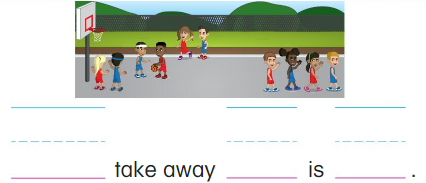
Eureka Math Grade 3 Module 5 Lesson 18 Answer Key

Engage NY Eureka Math 3rd Grade Module 5 Lesson 18 Answer Key

Eureka Math Grade 3 Module 5 Lesson 18 Problem Set Answer Key

Place the two fractions on the number line. Circle the fraction with the distance closest to 0. Then, compare using >, <, or =. The first problem is done for you.
Question 1.
Engage NY Math Grade 3 Module 5 Lesson 18 Problem Set Answer Key 1
Explanation :
Number line is divided into 4 as the denominator of the numbers is 4 .
Fractional Numbers are represented on the number line and number is which is closest to 0 is circled is shown in the above figure .
\(\frac{1}{4}\) < \(\frac{3}{4}\)

Question 2.
Engage NY Math Grade 3 Module 5 Lesson 18 Problem Set Answer Key 2
Answer:
Engage-NY-Eureka-Math-3rd-Grade-Module-5-Lesson-18-Answer Key-Eureka-Math-Grade-3-Module-5-Lesson-18-Problem-Set-Answer-Key-Question-2
Explanation :
Number line is divided into 6 as the denominator of the numbers is 6 .
Fractional Numbers are represented on the number line and number is which is closest to 0 is circled is shown in the above figure .
\(\frac{2}{6}\) < \(\frac{3}{6}\)

Question 3.
Engage NY Math Grade 3 Module 5 Lesson 18 Problem Set Answer Key 3
Answer:
Engage-NY-Eureka-Math-3rd-Grade-Module-5-Lesson-18-Answer Key-Eureka-Math-Grade-3-Module-5-Lesson-18-Problem-Set-Answer-Key-Question-3

Explanation :
Number line is divided into 4 as the denominator of the numbers is 4 .
Fractional Numbers are represented on the number line and number is which is closest to 0 is circled is shown in the above figure .
\(\frac{1}{2}\) > \(\frac{1}{4}\)

Question 4.
Engage NY Math Grade 3 Module 5 Lesson 18 Problem Set Answer Key 4
Answer:
Engage-NY-Eureka-Math-3rd-Grade-Module-5-Lesson-18-Answer Key-Eureka-Math-Grade-3-Module-5-Lesson-18-Problem-Set-Answer-Key-Question-4

Explanation :
Number line is divided into 6 parts as the denominator of the numbers is 6 .
Fractional Numbers are represented on the number line and number is which is closest to 0 is circled is shown in the above figure .
\(\frac{2}{3}\) > \(\frac{2}{6}\)

Question 5.
Engage NY Math Grade 3 Module 5 Lesson 18 Problem Set Answer Key 5
Answer:
Engage-NY-Eureka-Math-3rd-Grade-Module-5-Lesson-18-Answer Key-Eureka-Math-Grade-3-Module-5-Lesson-18-Problem-Set-Answer-Key-Question-5
Explanation :
Number line is divided into 8 parts as the denominator of the numbers is 8 .
Fractional Numbers are represented on the number line and number is which is closest to 0 is circled is shown in the above figure .
\(\frac{11}{8}\) < \(\frac{7}{4}\)

Question 6.
JoAnn and Lupe live straight down the street from their school. JoAnn walks \(\frac{5}{6}\) miles and Lupe walks \(\frac{7}{8}\) miles home from school every day. Draw a number line to model how far each girl walks. Who walks the least? Explain how you know using pictures, numbers, and words.
Answer:
Engage-NY-Eureka-Math-3rd-Grade-Module-5-Lesson-18-Answer Key-Eureka-Math-Grade-3-Module-5-Lesson-18-Problem-Set-Answer-Key-Question-6
Explanation :
Distance from Joann Home to School = \(\frac{5}{6}\)
Distance from Lupe home to School = \(\frac{7}{8}\)
\(\frac{7}{8}\) is greater than \(\frac{5}{6}\)
so, \(\frac{5}{6}\)  is lesser than \(\frac{7}{8}\) .

Question 7.
Cheryl cuts 2 pieces of thread. The blue thread is \(\frac{5}{4}\) meters long. The red thread is \(\frac{4}{5}\) meters long. Draw a number line to model the length of each piece of thread. Which piece of thread is shorter? Explain how you know using pictures, numbers, and words.
Answer:
Engage-NY-Eureka-Math-3rd-Grade-Module-5-Lesson-18-Answer Key-Eureka-Math-Grade-3-Module-5-Lesson-18-Problem-Set-Answer-Key-Question-7
Explanation :
Length of Blue Thread = \(\frac{5}{4}\)
Length of Red Thread = \(\frac{4}{5}\)
\(\frac{5}{4}\) > \(\frac{4}{5}\)
Red Thread is shorter thread . as shown in above figure.

Question 8.
Brandon makes homemade spaghetti. He measures 3 noodles. One measures \(\frac{7}{8}\) feet, the second is \(\frac{7}{4}\) feet, and the third is \(\frac{4}{2}\) feet long. Draw a number line to model the length of each piece of spaghetti. Write a number sentence using <, >, or = to compare the pieces. Explain using pictures, numbers, and words.
Answer:
Engage-NY-Eureka-Math-3rd-Grade-Module-5-Lesson-18-Answer Key-Eureka-Math-Grade-3-Module-5-Lesson-18-Problem-Set-Answer-Key-Question-8
Explanation :
Length of 1st Noodle = \(\frac{7}{8}\)  feet.
Length of 2nd Noodle = \(\frac{7}{4}\) feet.
Length of 3rd Noodle = \(\frac{4}{2}\) feet = 2 .
3 noodles are reprsented in the number line and a vertical Line is drawn from the longest Noodle to compare the shortest noodles as shown in above figure .
\(\frac{7}{8}\) <  \(\frac{7}{4}\) < \(\frac{4}{2}\) .

Eureka Math Grade 3 Module 5 Lesson 18 Exit Ticket Answer Key

Place the two fractions on the number line. Circle the fraction with the distance closest to 0. Then, compare using >, <, or =.
Question 1.
Eureka Math 3rd Grade Module 5 Lesson 18 Exit Ticket Answer Key 1
Answer:
Engage-NY-Eureka-Math-3rd-Grade-Module-5-Lesson-18-Answer Key-Eureka-Math-Grade-3-Module-5-Lesson-18-Exit-Ticket-Answer-Key-Question-1
Explanation :
Number line is divided into 5 parts as the denominator of the numbers is 5 .
Fractional Numbers are represented on the number line and number is which is closest to 0 is circled is shown in the above figure .
\(\frac{3}{5}\) > \(\frac{1}{5}\)

Question 2.
Eureka Math 3rd Grade Module 5 Lesson 18 Exit Ticket Answer Key 2
Answer:
Engage-NY-Eureka-Math-3rd-Grade-Module-5-Lesson-18-Answer Key-Eureka-Math-Grade-3-Module-5-Lesson-18-Exit-Ticket-Answer-Key-Question-2
Explanation :
Number line is divided into 4 parts as the denominator of the numbers is 4 .
Fractional Numbers are represented on the number line and number is which is closest to 0 is circled is shown in the above figure .
\(\frac{1}{2}\) < \(\frac{3}{4}\)

Question 3.
Mr. Brady draws a fraction on the board. Ken says it’s \(\frac{2}{3}\), and Dan said it’s \(\frac{3}{2}\). Do both of these fractions mean the same thing? If not, which fraction is larger? Draw a number line to model \(\frac{2}{3}\) and \(\frac{3}{2}\). Use words, pictures, and numbers to explain your comparison.
Answer:
Engage-NY-Eureka-Math-3rd-Grade-Module-5-Lesson-18-Answer Key-Eureka-Math-Grade-3-Module-5-Lesson-18-Exit-Ticket-Answer-Key-Question-3
Explanation :
Fraction said by ken = \(\frac{2}{3}\),
Fraction said by Dan = \(\frac{3}{2}\)
Both the fractions are represented with different number lines and from the greater number a vertical line is drawn to show the numbers which are least as shown in above figure .

Eureka Math Grade 3 Module 5 Lesson 18 Homework Answer Key

Place the two fractions on the number line. Circle the fraction with the distance closest to 0. Then, compare using >, <, or =.
Question 1.
Eureka Math Grade 3 Module 5 Lesson 18 Homework Answer Key 1
Answer:
Engage-NY-Eureka-Math-3rd-Grade-Module-5-Lesson-18-Answer Key-Eureka-Math-Grade-3-Module-5-Lesson-18-Homework-Answer-Key-Question-1
Explanation :
Number line is divided into 3 parts as the denominator of the numbers is 3 .
Fractional Numbers are represented on the number line and number is which is closest to 0 is circled is shown in the above figure .
\(\frac{1}{3}\) < \(\frac{2}{3}\)

Question 2.
Eureka Math Grade 3 Module 5 Lesson 18 Homework Answer Key 2
Answer:
Engage-NY-Eureka-Math-3rd-Grade-Module-5-Lesson-18-Answer Key-Eureka-Math-Grade-3-Module-5-Lesson-18-Homework-Answer-Key-Question-2
Explanation :
Number line is divided into 6 parts as the denominator of the numbers is 6 .
Fractional Numbers are represented on the number line and number is which is closest to 0 is circled is shown in the above figure .
\(\frac{4}{6}\) > \(\frac{1}{6}\)

Question 3.
Eureka Math Grade 3 Module 5 Lesson 18 Homework Answer Key 3
Answer:
Engage-NY-Eureka-Math-3rd-Grade-Module-5-Lesson-18-Answer Key-Eureka-Math-Grade-3-Module-5-Lesson-18-Homework-Answer-Key-Question-3
Explanation :
Number line is divided into 8 parts as the denominator of the numbers is 8 .
Fractional Numbers are represented on the number line and number is which is closest to 0 is circled is shown in the above figure .
\(\frac{1}{4}\) > \(\frac{1}{8}\)

Question 4.
Eureka Math Grade 3 Module 5 Lesson 18 Homework Answer Key 4
Answer:
Engage-NY-Eureka-Math-3rd-Grade-Module-5-Lesson-18-Answer Key-Eureka-Math-Grade-3-Module-5-Lesson-18-Homework-Answer-Key-Question-4
Explanation :
Number line is divided into 10 parts as the denominator of the numbers is 10 .
Fractional Numbers are represented on the number line and number is which is closest to 0 is circled is shown in the above figure .
\(\frac{4}{5}\) < \(\frac{4}{10}\)

Question 5.
Eureka Math Grade 3 Module 5 Lesson 18 Homework Answer Key 5
Answer:
Engage-NY-Eureka-Math-3rd-Grade-Module-5-Lesson-18-Answer Key-Eureka-Math-Grade-3-Module-5-Lesson-18-Homework-Answer-Key-Question-5
Explanation :
Number line is divided into 6 parts as the denominator of the numbers is 6 .
Fractional Numbers are represented on the number line and number is which is closest to 0 is circled is shown in the above figure .
\(\frac{8}{6}\) < \(\frac{5}{3}\)

Question 6.
Liz and Jay each have a piece of string. Liz’s string is \(\frac{4}{6}\) yards long, and Jay’s string is \(\frac{5}{7}\) yards long. Whose string is longer? Draw a number line to model the length of both strings. Explain the comparison using pictures, numbers, and words.
Answer:
Engage-NY-Eureka-Math-3rd-Grade-Module-5-Lesson-18-Answer Key-Eureka-Math-Grade-3-Module-5-Lesson-18-Homework-Answer-Key-Question-6
Explanation :
Length of Liz’s string = \(\frac{4}{6}\)
Length of Jay’s string = \(\frac{5}{7}\)
From the above figure we notice that \(\frac{5}{7}\) is greater than \(\frac{4}{6}\)

Question 7.
In a long jump competition, Wendy jumped \(\frac{9}{10}\) meters, and Judy jumped \(\frac{10}{9}\) meters. Draw a number line to model the distance of each girl’s long jump. Who jumped the shorter distance? Explain how you know using pictures, numbers, and words.
Answer:
Engage-NY-Eureka-Math-3rd-Grade-Module-5-Lesson-18-Answer Key-Eureka-Math-Grade-3-Module-5-Lesson-18-Homework-Answer-Key-Question-7
Explanation :
Distance covered by Wendy in long jump = \(\frac{9}{10}\)
Distance covered by Judy in long jump = \(\frac{10}{9}\)
From the above figure we notice that \(\frac{10}{9}\) is greater than \(\frac{9}{10}\)
Wendy jumped shorter distance .

Question 8.
Nikki has 3 pieces of yarn. The first piece is \(\frac{5}{6}\) feet long, the second piece is \(\frac{5}{3}\) feet long, and the third piece is \(\frac{3}{2}\) feet long. She wants to arrange them from the shortest to the longest. Draw a number line to model the length of each piece of yarn. Write a number sentence using <, >, or = to compare the pieces. Explain using pictures, numbers, and words.
Answer:
Engage-NY-Eureka-Math-3rd-Grade-Module-5-Lesson-18-Answer Key-Eureka-Math-Grade-3-Module-5-Lesson-18-Homework-Answer-Key-Question-8
Explanation :
Length of First piece = \(\frac{5}{6}\)
Length of second piece = \(\frac{5}{3}\)
Length of third piece = \(\frac{3}{2}\)
3 Yarns are represented in  number lines as shown in above figure .
\(\frac{5}{3}\) > \(\frac{3}{2}\) > \(\frac{5}{6}\) .

Eureka Math Grade 3 Module 5 End of Module Assessment Answer Key

Engage NY Eureka Math 3rd Grade Module 5 End of Module Assessment Answer Key

Eureka Math Grade 3 Module 5 End of Module Assessment Task Answer Key

Question 1.
Jerry put 7 equally spaced hooks on a straight wire so students could hang up their coats. The whole length is from the first hook to the last hook.
a. On the picture below, label the fraction of the wire’s length where each hook is located.
Engage NY Math 3rd Grade Module 5 End of Module Assessment Answer Key 1
b. At what fraction is Betsy’s coat if she hangs it at the halfway point?
c. Write a fraction that is equivalent to your answer for Part (b).
Answer a :
Engage NY Eureka Math 3rd Grade Module 5 End of Module Assessment Answer Key Eureka Math Grade 3 Module 5 End of Module Assessment Task Answer Key
Answer b :
At \(\frac{3}{6}\) fraction the Betsy’s coat hangs at half way .
Answer c :
\(\frac{3}{6}\) = \(\frac{4}{8}\)

Question 2.
Jerry used the picture below to show his son how to find a fraction equal to \(\frac{2}{3}\). Explain what Jerry might have said and done using words, pictures, and numbers.
Engage NY Math 3rd Grade Module 5 End of Module Assessment Answer Key 2
Answer:
Jerry took a rectangle strip which is divided into 3 parts equally . 2 parts are shaded and 1 part is unshaded.
It the fraction of shaded parts to total parts that is \(\frac{2}{3}\) .

Question 3.
Jerry and his son have the exact same granola bars. Jerry has eaten \(\frac{3}{6}\) of his granola bar. His son has eaten \(\frac{3}{8}\) of his own granola bar. Who has eaten more? Explain your answer using words, pictures, and numbers.
Answer:
Engage NY Eureka Math 3rd Grade Module 5 End of Module Assessment Answer Key Eureka Math Grade 3 Module 5 End of Module Assessment Task Answer Key Question 3
Explanation :
From the above figure we notice that jerry ate more granola bar than jerry’s son.

Question 4.
Jerry has a fruit roll that is 4 feet long.
a. Label the number line to show how Jerry might cut his fruit roll into pieces \(\frac{1}{3}\) of a foot long. Label every fraction on the number line, including renaming the wholes.
Engage NY Math 3rd Grade Module 5 End of Module Assessment Answer Key 3
b. Jerry cut his fruit roll into pieces that are \(\frac{1}{3}\) of a foot long. Jerry and his 2 sons each eat one piece. What fraction of the whole fruit roll is eaten? Explain your answer using words, pictures, and numbers.
c. Jerry’s son says that 1 third is the same as 2 sixths. Do you agree? Why or why not? Use words, pictures, and numbers to explain your answer.
Answer a :
Engage NY Eureka Math 3rd Grade Module 5 End of Module Assessment Answer Key Eureka Math Grade 3 Module 5 End of Module Assessment Task Answer Key Question 4
Answer b :
Engage NY Eureka Math 3rd Grade Module 5 End of Module Assessment Answer Key Eureka Math Grade 3 Module 5 End of Module Assessment Task Answer Key Question 4 b
Explanation :
Fraction of each peice = \(\frac{1}{3}\)
Jerry and his 2 sons each eat= 3 People = 3 \(\frac{1}{3}\)  = 1 whole is eaten by them .

Answer c :
Engage NY Eureka Math 3rd Grade Module 5 End of Module Assessment Answer Key Eureka Math Grade 3 Module 5 End of Module Assessment Task Answer Key Question 4 c
Explanation :
Yes , \(\frac{1}{3}\)  is equal to \(\frac{2}{6}\) .
Number line is drawn the \(\frac{1}{3}\) and \(\frac{1}{6}\)  are at the same as shown in above figure .

Eureka Math Grade 3 Module 5 Mid Module Assessment Answer Key

Engage NY Eureka Math 3rd Grade Module 5 Mid Module Assessment Answer Key

Eureka Math Grade 3 Module 5 Mid Module Assessment Task Answer Key

Eureka Math Grade 3 Module 5 Mid Module Assessment Answer Key 1
Question 1.
Natalie folded 1 whole fraction strip as pictured above.
a. How many equal parts did she divide the whole into?
b. Label each equal part with a unit fraction.
c. Identify the fraction of the strip she shaded.
d. Identify the fraction of the strip she did not shade.
Answer:
a.  The Total Number of Equal parts are 8 .
b. Engage NY Eureka Math 3rd Grade Module 5 Mid Module Assessment Answer Key Eureka Math Grade 3 Module 5 Mid Module Assessment Task Answer Key Question 1 b
c. Fraction of each shaded strip = \(\frac{1}{8}\)
Total Number of shaded strips = 3
So, Total fraction of shaded strip = \(\frac{1}{8}\) + \(\frac{1}{8}\) +\(\frac{1}{8}\) =   \(\frac{3}{8}\)
d . Fraction of each unshaded strip = \(\frac{1}{8}\)
Total Number of shaded strips = 5
So, Total fraction of unshaded strip = \(\frac{1}{8}\) + \(\frac{1}{8}\) +\(\frac{1}{8}\) +\(\frac{1}{8}\) +\(\frac{1}{8}\) =   \(\frac{}{8}[5/latex]

Question 2.
Draw 2 rectangles the same size. Each rectangle represents 1 whole.
a. Partition each rectangle into 3 equal parts. Shade and label a fraction greater than 1.
b. Draw a number bond that shows 1 whole rectangle as 3 unit fractions.
Answer:
a
Engage NY Eureka Math 3rd Grade Module 5 Mid Module Assessment Answer Key Eureka Math Grade 3 Module 5 Mid Module Assessment Task Answer Key Question 2
Explanation :
The Each Rectangle strip is divided into 3 equal parts and 4 parts are shaded as shown in above figure which is greater than 1 whole .

Answer :
b
Engage NY Eureka Math 3rd Grade Module 5 Mid Module Assessment Answer Key Eureka Math Grade 3 Module 5 Mid Module Assessment Task Answer Key Question 2 b

Question 3.
The bakery had a chocolate cake and a vanilla cake that were exactly the same size. Mr. Chu bought 1 fourth of the chocolate cake. Mrs. Ramirez bought 1 sixth of the vanilla cake. Who bought a larger piece of cake? Explain your answer using words, pictures, and numbers.
Answer:
Engage NY Eureka Math 3rd Grade Module 5 Mid Module Assessment Answer Key Eureka Math Grade 3 Module 5 Mid Module Assessment Task Answer Key Question 3
Explanation :
From the above figure we notice that the piece of chocolate cake is bigger than vanilla cake . That means Mr.chu bought larger piece cake than Ramirez .

Question 4.
Natalie explained, “My drawing shows a picture of [latex]\frac{3}{2}\).” Kosmo says, “It looks like a picture of \(\frac{3}{4}\) to me.”
a. Show and explain how they could both be correct by choosing different wholes. Use words, pictures, and numbers.
Eureka Math Grade 3 Module 5 Mid Module Assessment Answer Key 2
b. Natalie said to Kosmo, “One part can represent either 1 half or 1 fourth. That must mean \(\frac{1}{2}\) = \(\frac{1}{4}\).” Do you agree with Natalie? Use words, pictures, and numbers to explain your reasoning.
Answer a :
Engage NY Eureka Math 3rd Grade Module 5 Mid Module Assessment Answer Key Eureka Math Grade 3 Module 5 Mid Module Assessment Task Answer Key Question 4 a
Explanation :
Both are right because it depends on the consideration of 1 whole .
Answer b :
Engage NY Eureka Math 3rd Grade Module 5 Mid Module Assessment Answer Key Eureka Math Grade 3 Module 5 Mid Module Assessment Task Answer Key Question 4 b
Explanations :
Natalie is wrong because the wholes are not of identical shape and size .The wholes should be same to compare the fractions .

Eureka Math Grade 3 Module 5 Lesson 17 Answer Key

Engage NY Eureka Math 3rd Grade Module 5 Lesson 17 Answer Key

Eureka Math Grade 3 Module 5 Lesson 17 Sprint Answer Key

A
Division
Engage NY Math 3rd Grade Module 5 Lesson 17 Sprint Answer Key 1
Question 1.
3 ÷ 3 =
Answer:
3 ÷ 3 = 1

Question 2.
4 ÷ 4 =
Answer:
4 ÷ 4 = 1

Question 3.
5 ÷ 5 =
Answer:
5 ÷ 5 = 1

Question 4.
19 ÷ 19 =
Answer:
19 ÷ 19 = 1

Question 5.
0 ÷ 1 =
Answer:
0 ÷ 1 = 0

Question 6.
0 ÷ 2 =
Answer:
0 ÷ 2 = 0

Question 7.
0 ÷ 3 =
Answer:
0 ÷ 3 = 0

Question 8.
0 ÷ 19 =
Answer:
0 ÷ 19 = 0

Question 9.
6 ÷ 3 =
Answer:
6 ÷ 3 = 2

Question 10.
9 ÷ 3 =
Answer:
9 ÷ 3 = 3

Question 11.
12 ÷ 3 =
Answer:
12 ÷ 3 = 4

Question 12.
15 ÷ 3 =
Answer:
15 ÷ 3 = 5

Question 13.
4 ÷ 2 =
Answer:
4 ÷ 2 = 2

Question 14.
6 ÷ 2 =
Answer:
6 ÷ 2 =3

Question 15.
8 ÷ 2 =
Answer:
8 ÷ 2 = 4

Question 16.
10 ÷ 2 =
Answer:
10 ÷ 2 = 5

Question 17.
18 ÷ 3 =
Answer:
18 ÷ 3 = 6

Question 18.
12 ÷ 2 =
Answer:
12 ÷ 2 = 6

Question 19.
21 ÷ 3 =
Answer:
21 ÷ 3 =7

Question 20.
14 ÷ 2 =
Answer:
14 ÷ 2 =7

Question 21.
20 ÷ 10 =
Answer:
20 ÷ 10 =2

Question 22.
20 ÷ 2 =
Answer:
20 ÷ 2 = 10

Question 23.
24 ÷ 3 =
Answer:
24 ÷ 3 = 8

Question 24.
16 ÷ 2 =
Answer:
16 ÷ 2 = 8

Question 25.
30 ÷ 10 =
Answer:
30 ÷ 10 = 3

Question 26.
30 ÷ 3 =
Answer:
30 ÷ 3 = 10

Question 27.
27 ÷ 3 =
Answer:
27 ÷ 3 = 8

Question 28.
18 ÷ 2 =
Answer:
18 ÷ 2 =9

Question 29.
40 ÷ 10 =
Answer:
40 ÷ 10 = 4

Question 30.
40 ÷ 4 =
Answer:
40 ÷ 4 = 10

Question 31.
20 ÷ 4 =
Answer:
20 ÷ 4 = 5

Question 32.
20 ÷ 5 =
Answer:
20 ÷ 5 = 4

Question 33.
24 ÷ 4 =
Answer:
24 ÷ 4 = 6

Question 34.
30 ÷ 5 =
Answer:
30 ÷ 5 = 6

Question 35.
28 ÷ 4 =
Answer:
28 ÷ 4 = 7

Question 36.
40 ÷ 5 =
Answer:
40 ÷ 5 = 8

Question 37.
32 ÷ 4 =
Answer:
32 ÷ 4 = 8

Question 38.
45 ÷ 5 =
Answer:
45 ÷ 5 = 9

Question 39.
44 ÷ 4 =
Answer:
44 ÷ 4 = 11

Question 40.
36 ÷ 4 =
Answer:
36 ÷ 4 = 9

Question 41.
48 ÷ 6 =
Answer:
48 ÷ 6 = 8

Question 42.
63 ÷ 7 =
Answer:
63 ÷ 7 = 9

Question 43.
64 ÷ 8 =
Answer:
64 ÷ 8 = 8

Question 44.
72 ÷ 9 =
Answer:
72 ÷ 9 = 8

B
Division
Engage NY Math 3rd Grade Module 5 Lesson 17 Sprint Answer Key 2

Question 1.
2 ÷ 2 =
Answer:
2 ÷ 2 = 1

Question 2.
3 ÷ 3 =
Answer:
3 ÷ 3 = 1

Question 3.
4 ÷ 4 =
Answer:
4 ÷ 4 = 1

Question 4.
17 ÷ 17 =
Answer:
17 ÷ 17 = 1

Question 5.
0 ÷ 2 =
Answer:
0 ÷ 2 = 0

Question 6.
0 ÷ 3 =
Answer:
0 ÷ 3 = 0

Question 7.
0 ÷ 4 =
Answer:
0 ÷ 4 = 0

Question 8.
0 ÷ 17 =
Answer:
0 ÷ 17 = 0

Question 9.
4 ÷ 2 =
Answer:
4 ÷ 2 = 2

Question 10.
6 ÷ 2 =
Answer:
6 ÷ 2 = 3

Question 11.
8 ÷ 2 =
Answer:
8 ÷ 2 = 4

Question 12.
10 ÷ 2 =
Answer:
10 ÷ 2 = 5

Question 13.
6 ÷ 3 =
Answer:
6 ÷ 3 = 2

Question 14.
9 ÷ 3 =
Answer:
9 ÷ 3 = 3

Question 15.
12 ÷ 3 =
Answer:
12 ÷ 3 = 4

Question 16.
15 ÷ 3 =
Answer:
15 ÷ 3 = 5

Question 17.
12 ÷ 2 =
Answer:
12 ÷ 2 = 6

Question 18.
18 ÷ 3 =
Answer:
18 ÷ 3 = 6

Question 19.
14 ÷ 2 =
Answer:
14 ÷ 2 = 7

Question 20.
21 ÷ 3 =
Answer:
21 ÷ 3 = 7

Question 21.
20 ÷ 2 =
Answer:
20 ÷ 2 = 10

Question 22.
20 ÷ 10 =
Answer:
20 ÷ 10 = 2

Question 23.
16 ÷ 2 =
Answer:
16 ÷ 2 =8

Question 24.
24 ÷ 3 =
Answer:
24 ÷ 3 = 8

Question 25.
30 ÷ 3 =
Answer:
30 ÷ 3 = 10

Question 26.
30 ÷ 10 =
Answer:
30 ÷ 10 = 3

Question 27.
18 ÷ 2 =
Answer:
18 ÷ 2 = 9

Question 28.
27 ÷ 3 =
Answer:
27 ÷ 3 = 9

Question 29.
40 ÷ 4 =
Answer:
40 ÷ 4 = 10

Question 30.
40 ÷ 10 =
Answer:
40 ÷ 10 = 4

Question 31.
20 ÷ 5 =
Answer:
20 ÷ 5 = 4

Question 32.
20 ÷ 4 =
Answer:
20 ÷ 4 = 5

Question 33.
30 ÷ 5 =
Answer:
30 ÷ 5 = 6

Question 34.
24 ÷ 4 =
Answer:
24 ÷ 4 = 6

Question 35.
40 ÷ 5 =
Answer:
40 ÷ 5 = 8

Question 36.
28 ÷ 4 =
Answer:
28 ÷ 4 = 7

Question 37.
45 ÷ 5 =
Answer:
45 ÷ 5 = 9

Question 38.
32 ÷ 4 =
Answer:
32 ÷ 4 = 8

Question 39.
55 ÷ 5 =
Answer:
55 ÷ 5 = 11

Question 40.
36 ÷ 4 =
Answer:
36 ÷ 4 = 9

Question 41.
54 ÷ 6 =
Answer:
54 ÷ 6 = 9

Question 42.
56 ÷ 7 =
Answer:
56 ÷ 7 = 8

Question 43.
72 ÷ 8 =
Answer:
72 ÷ 8 = 9

Question 44.
63 ÷ 9 =
Answer:
63 ÷ 9 = 7

Eureka Math Grade 3 Module 5 Lesson 17 Problem Set Answer Key

Question 1.
Locate and label the following fractions on the number line.
Engage NY Math Grade 3 Module 5 Lesson 17 Problem Set Answer Key 1
Answer:
Engage-NY-Eureka-Math-3rd-Grade-Module-5-Lesson-17-Answer Key-Eureka-Math-Grade-3-Module-5-Lesson-17-Problem-Set-Answer-Key-Question-1
Explanation :
The Given number is divided into the fraction of \(\frac{1}{6}\) and all the given fractions are located and labeled and shown in above figure .

Question 2.
Locate and label the following fractions on the number line.
Engage NY Math Grade 3 Module 5 Lesson 17 Problem Set Answer Key 2
Answer:
Engage-NY-Eureka-Math-3rd-Grade-Module-5-Lesson-17-Answer Key-Eureka-Math-Grade-3-Module-5-Lesson-17-Problem-Set-Answer-Key-Question-2
Explanation :
The Given number is divided into the fraction of \(\frac{1}{4}\) and all the given fractions are located and labeled and shown in above figure .

Question 3.
Locate and label the following fractions on the number line.
Engage NY Math Grade 3 Module 5 Lesson 17 Problem Set Answer Key 3
Answer:
Engage-NY-Eureka-Math-3rd-Grade-Module-5-Lesson-17-Answer Key-Eureka-Math-Grade-3-Module-5-Lesson-17-Problem-Set-Answer-Key-Question-3
Explanation :
The Given number is divided into the fraction of \(\frac{1}{3}\) and all the given fractions are located and labeled and shown in above figure .

Question 4.
For a measurement project in math class, students measured the lengths of their pinky fingers. Alex’s measured 2 inches long. Jerimiah’s pinky finger was \(\frac{7}{4}\) inches long. Whose finger is longer? Draw a number line to help prove your answer.
Answer:
Engage-NY-Eureka-Math-3rd-Grade-Module-5-Lesson-17-Answer Key-Eureka-Math-Grade-3-Module-5-Lesson-17-Problem-Set-Answer-Key-Question-4
Explanation :
Length of Pinky finger of Alex = 2 inches = \(\frac{8}{4}\)
Length of pinky finger of Jerimiah’s = \(\frac{7}{4}\).
Pinky’s finger is greater than Jerimiah’s as it is right of the number .
The number which is on the right of the number is greater and the number which is on the left of the other number is lesser .

Question 5.
Marcy ran 4 kilometers after school. She stopped to tie her shoelace at \(\frac{7}{5}\) kilometers. Then, she stopped to switch songs on her iPod at \(\frac{12}{5}\) kilometers. Draw a number line showing Marcy’s run. Include her starting and finishing points and the 2 places where she stopped.
Answer:
Engage-NY-Eureka-Math-3rd-Grade-Module-5-Lesson-17-Answer Key-Eureka-Math-Grade-3-Module-5-Lesson-17-Problem-Set-Answer-Key-Question-5
Explanation :
Distance Marcy ran = 4 kilometers. = \(\frac{20}{5}\) kilometers
Distance at which marcy stopped to tie shoelace = \(\frac{7}{5}\)
Distance Marcy stopped to switch her ipod songs = \(\frac{12}{5}\) kilometers .
All the distances points are marked in the above number line figure .

Eureka Math Grade 3 Module 5 Lesson 17 Exit Ticket Answer Key

Question 1.
Locate and label the following fractions on the number line.
Eureka Math 3rd Grade Module 5 Lesson 17 Exit Ticket Answer Key 1
Answer:
Engage-NY-Eureka-Math-3rd-Grade-Module-5-Lesson-17-Answer Key-Eureka-Math-Grade-3-Module-5-Lesson-17-Exit-Ticket-Answer-Key-Question-1
Explanation :
The Given number is divided into the fraction of \(\frac{1}{3}\) and all the given fractions are located and labeled and shown in above figure .

Question 2.
Katie bought 2 one-gallon bottles of juice for a party. Her guests drank \(\frac{6}{4}\) gallons of juice. What fraction of a gallon of juice is left over? Draw a number line to show, and explain your answer.
Answer:
Engage-NY-Eureka-Math-3rd-Grade-Module-5-Lesson-17-Answer Key-Eureka-Math-Grade-3-Module-5-Lesson-17-Exit-Ticket-Answer-Key-Question-2
Explanation :
Amount of juice = 2 one-gallon bottles
Fraction of Juice drank = \(\frac{6}{4}\) = \(\frac{3}{2}\)
Fraction of juice left = 2 – \(\frac{3}{2}\)  = \(\frac{4-3}{2}\) = \(\frac{1}{2}\)
Number line drawn and the quantities are marked .

Eureka Math Grade 3 Module 5 Lesson 17 Homework Answer Key

Question 1.
Locate and label the following fractions on the number line.
Eureka Math Grade 3 Module 5 Lesson 17 Homework Answer Key 1
Answer:
Engage-NY-Eureka-Math-3rd-Grade-Module-5-Lesson-17-Answer Key-Eureka-Math-Grade-3-Module-5-Lesson-17-Homework-Answer-Key-Question-1
Explanation :
The Given number is divided into the fraction of \(\frac{1}{2}\) and all the given fractions are located and labeled and shown in above figure .

Question 2.
Locate and label the following fractions on the number line.
Eureka Math Grade 3 Module 5 Lesson 17 Homework Answer Key 2
Answer:
Engage-NY-Eureka-Math-3rd-Grade-Module-5-Lesson-17-Answer Key-Eureka-Math-Grade-3-Module-5-Lesson-17-Homework-Answer-Key-Question-2

Explanation :
The Given number is divided into the fraction of \(\frac{1}{3}\) and all the given fractions are located and labeled and shown in above figure .

Question 3.
Locate and label the following fractions on the number line.
Eureka Math Grade 3 Module 5 Lesson 17 Homework Answer Key 3
Answer:
Engage-NY-Eureka-Math-3rd-Grade-Module-5-Lesson-17-Answer Key-Eureka-Math-Grade-3-Module-5-Lesson-17-Homework-Answer-Key-Question-3
Explanation :
The Given number is divided into the fraction of \(\frac{1}{4}\) and all the given fractions are located and labeled and shown in above figure .

Question 4.
Wayne went on a 4-kilometer hike. He took a break at \(\frac{4}{3}\) kilometers. He took a drink of water at \(\frac{10}{3}\) kilometers. Show Wayne’s hike on the number line. Include his starting and finishing place and the 2 points where he stopped.
Eureka Math Grade 3 Module 5 Lesson 17 Homework Answer Key 4
Answer:
Engage-NY-Eureka-Math-3rd-Grade-Module-5-Lesson-17-Answer Key-Eureka-Math-Grade-3-Module-5-Lesson-17-Homework-Answer-Key-Question-4
Explanation :
Distance Wayne covered = 4 kilometers
Distance at which he took a break = \(\frac{4}{3}\) kilometers.
Distance at which he drank water = \(\frac{10}{3}\)
All the distances points are located on the number line and shown in above figure .

Question 5.
Ali wants to buy a piano. The piano measures \(\frac{19}{4}\) feet long. She has a space 5 feet long for the piano in her house. Does she have enough room? Draw a number line to show, and explain your answer.
Eureka Math Grade 3 Module 5 Lesson 17 Homework Answer Key 5
Answer:
Engage-NY-Eureka-Math-3rd-Grade-Module-5-Lesson-17-Answer Key-Eureka-Math-Grade-3-Module-5-Lesson-17-Homework-Answer-Key-Question-5
Explanation :
Length of Piano = \(\frac{19}{4}\) feet
Length of the room = 5 feet.
The number which is on the right of the number is greater and the number which is on the left of the other number is lesser .
The 5 feet is right of \(\frac{19}{4}\) feet so, 5 feet is greater number . so, the room is enough to out the piano .

Eureka Math Grade 3 Module 5 Lesson 16 Answer Key

Engage NY Eureka Math 3rd Grade Module 5 Lesson 16 Answer Key

Eureka Math Grade 3 Module 5 Lesson 16 Sprint Answer Key

A
Multiply and Divide by Nine
Engage NY Math 3rd Grade Module 5 Lesson 16 Sprint Answer Key 1
Question 1.
2 × 9 =
Answer:
2 × 9 = 18

Question 2.
3 × 9 =
Answer:
3 × 9 = 27

Question 3.
4 × 9 =
Answer:
4 × 9 = 36

Question 4.
5 × 9 =
Answer:
5 × 9 = 45

Question 5.
1 × 9 =
Answer:
1 × 9 = 9

Question 6.
18 ÷ 9 =
Answer:
18 ÷ 9 = 2

Question 7.
27 ÷ 9 =
Answer:
27 ÷ 9 = 3

Question 8.
45 ÷ 9 =
Answer:
45 ÷ 9 = 5

Question 9.
9 ÷ 9 =
Answer:
9 ÷ 9 = 1

Question 10.
36 ÷ 9 =
Answer:
36 ÷ 9 = 4

Question 11.
6 × 9 =
Answer:
6 × 9 = 54

Question 12.
7 × 9 =
Answer:
7 × 9 = 63

Question 13.
8 × 9 =
Answer:
8 × 9 = 72

Question 14.
9 × 9 =
Answer:
9 × 9 = 81

Question 15.
10 × 9 =
Answer:
10 × 9 = 90

Question 16.
72 ÷ 9 =
Answer:
72 ÷ 9 = 8

Question 17.
63 ÷ 9 =
Answer:
63 ÷ 9 = 7

Question 18.
81 ÷ 9 =
Answer:
81 ÷ 9 = 9

Question 19.
54 ÷ 9 =
Answer:
54 ÷ 9 = 6

Question 20.
90 ÷ 9 =
Answer:
90 ÷ 9 = 10

Question 21.
____ × 9 = 45
Answer:
6 × 9 = 45

Question 22.
____ × 9 = 9
Answer:
1 × 9 = 9

Question 23.
____ × 9 = 90
Answer:
10 × 9 = 90

Question 24.
____ × 9 = 18
Answer:
2 × 9 = 18

Question 25.
____ × 9 = 27
Answer:
3 × 9 = 27

Question 26.
90 ÷ 9 =
Answer:
90 ÷ 9 = 10

Question 27.
45 ÷ 9 =
Answer:
45 ÷ 9 = 5

Question 28.
9 ÷ 9 =
Answer:
9 ÷ 9 = 1

Question 29.
18 ÷ 9 =
Answer:
18 ÷ 9 = 2

Question 30.
27 ÷ 9 =
Answer:
27 ÷ 9 = 3

Question 31.
_____ × 9 = 54
Answer:
6 × 9 = 54

Question 32.
_____ × 9 = 63
Answer:
7 × 9 = 63

Question 33.
_____ × 9 = 81
Answer:
9 × 9 = 81

Question 34.
_____ × 9 = 72
Answer:
8 × 9 = 72

Question 35.
63 ÷ 9 =
Answer:
63 ÷ 9 = 7

Question 36.
81 ÷ 9 =
Answer:
81 ÷ 9 = 9

Question 37.
54 ÷ 9 =
Answer:
54 ÷ 9 = 6

Question 38.
72 ÷ 9 =
Answer:
72 ÷ 9 = 8

Question 39.
11 × 9 =
Answer:
11 × 9 = 99

Question 40.
99 ÷ 9 =
Answer:
99 ÷ 9 = 11

Question 41.
12 × 9 =
Answer:
12 × 9 = 108

Question 42.
108 ÷ 9 =
Answer:
108 ÷ 9 = 12

Question 43.
14 × 9 =
Answer:
14 × 9 = 126

Question 44.
126 ÷ 9 =
Answer:
126 ÷ 9 = 14

B
Multiply and Divide by Nine
Engage NY Math 3rd Grade Module 5 Lesson 16 Sprint Answer Key 2

Question 1.
1 × 9 =
Answer:
1 × 9 = 9

Question 2.
2 × 9 =
Answer:
2 × 9 = 18

Question 3.
3 × 9 =
Answer:
3 × 9 = 27

Question 4.
4 × 9 =
Answer:
4 × 9 = 36

Question 5.
5 × 9 =
Answer:
5 × 9 = 45

Question 6.
27 ÷ 9 =
Answer:
27 ÷ 9 = 3

Question 7.
18 ÷ 9 =
Answer:
18 ÷ 9 = 2

Question 8.
36 ÷ 9 =
Answer:
36 ÷ 9 = 4

Question 9.
9 ÷ 9 =
Answer:
9 ÷ 9 = 1

Question 10.
45 ÷ 9 =
Answer:
45 ÷ 9 = 5

Question 11.
10 × 9 =
Answer:
10 × 9 = 90

Question 12.
6 × 9 =
Answer:
6 × 9 = 54

Question 13.
7 × 9 =
Answer:
7 × 9 = 63

Question 14.
8 × 9 =
Answer:
8 × 9 = 72

Question 15.
9 × 9 =
Answer:
9 × 9 = 81

Question 16.
63 ÷ 9 =
Answer:
63 ÷ 9 = 7

Question 17.
54 ÷ 9 =
Answer:
54 ÷ 9 = 6

Question 18.
72 ÷ 9 =
Answer:
72 ÷ 9 = 8

Question 19.
90 ÷ 9 =
Answer:
90 ÷ 9 = 10

Question 20.
81 ÷ 9 =
Answer:
81 ÷ 9 = 9

Question 21.
_____ × 9 = 9
Answer:
1 × 9 = 9

Question 22.
_____ × 9 = 45
Answer:
5 × 9 = 45

Question 23.
_____ × 9 = 18
Answer:
2 × 9 = 18

Question 24.
_____ × 9 = 90
Answer:
10 × 9 = 90

Question 25.
_____ × 9 = 27
Answer:
3 × 9 = 27

Question 26.
18 ÷ 9 =
Answer:
18 ÷ 9 = 2

Question 27.
9 ÷ 9 =
Answer:
9 ÷ 9 = 1

Question 28.
90 ÷ 9 =
Answer:
90 ÷ 9 = 10

Question 29.
45 ÷ 9 =
Answer:
45 ÷ 9 = 5

Question 30.
27 ÷ 9 =
Answer:
27 ÷ 9 = 3

Question 31.
____ × 9 = 27
Answer:
3 × 9 = 27

Question 32.
____ × 9 = 36
Answer:
4 × 9 = 36

Question 33.
____ × 9 = 81
Answer:
9 × 9 = 81

Question 34.
____ × 9 = 63
Answer:
7 × 9 = 63

Question 35.
72 ÷ 9 =
Answer:
72 ÷ 9 = 8

Question 36.
81 ÷ 9 =
Answer:
81 ÷ 9 = 9

Question 37.
54 ÷ 9 =
Answer:
54 ÷ 9 = 6

Question 38.
63 ÷ 9 =
Answer:
63 ÷ 9 = 7

Question 39.
11 × 9 =
Answer:
11 × 9 = 99

Question 40.
99 ÷ 9 =
Answer:
99 ÷ 9 = 11

Question 41.
12 × 9 =
Answer:
12 × 9 = 108

Question 42.
108 ÷ 9 =
Answer:
108 ÷ 9 = 12

Question 43.
13 × 9 =
Answer:
13 × 9 = 117

Question 44.
117 ÷ 9 =
Answer:
117 ÷ 9 = 13

Eureka Math Grade 3 Module 5 Lesson 16 Problem Set Answer Key

Question 1.
Estimate to equally partition and label the fractions on the number line. Label the wholes as fractions, and box them. The first one is done for you.
Engage NY Math Grade 3 Module 5 Lesson 16 Problem Set Answer Key 1
Answer:
Engage-NY-Eureka-Math-3rd-Grade-Module-5-Lesson-16-Answer Key-Eureka-Math-Grade-3-Module-5-Lesson-16-Problem-Set-Answer-Key-Question-1

Question 2.
Partition each whole into fifths. Label each fraction. Count up as you go. Box the fractions that are located at the same points as whole numbers.
Engage NY Math Grade 3 Module 5 Lesson 16 Problem Set Answer Key 2
Answer:
Engage-NY-Eureka-Math-3rd-Grade-Module-5-Lesson-16-Answer Key-Eureka-Math-Grade-3-Module-5-Lesson-16-Problem-Set-Answer-Key-Question-2

Question 3.
Partition each whole into thirds. Label each fraction. Count up as you go. Box the fractions that are located at the same points as whole numbers.
Engage NY Math Grade 3 Module 5 Lesson 16 Problem Set Answer Key 3
Answer:
Engage-NY-Eureka-Math-3rd-Grade-Module-5-Lesson-16-Answer Key-Eureka-Math-Grade-3-Module-5-Lesson-16-Problem-Set-Answer-Key-Question-3

Question 4.
Draw a number line with endpoints 0 and 3. Label the wholes. Partition each whole into fourths. Label all the fractions from 0 to 3. Box the fractions that are located at the same points as whole numbers. Use a separate paper if you need more space.
Answer:
Engage-NY-Eureka-Math-3rd-Grade-Module-5-Lesson-16-Answer Key-Eureka-Math-Grade-3-Module-5-Lesson-16-Problem-Set-Answer-Key-Question-4

Eureka Math Grade 3 Module 5 Lesson 16 Exit Ticket Answer Key

Question 1.
Estimate to equally partition and label the fractions on the number line. Label the wholes as fractions, and box them.
Eureka Math 3rd Grade Module 5 Lesson 16 Exit Ticket Answer Key 1
Answer:
Engage-NY-Eureka-Math-3rd-Grade-Module-5-Lesson-16-Answer Key-Eureka-Math-Grade-3-Module-5-Lesson-16-Exit-Ticket-Answer-Key-Question-1

Question 2.
Draw a number line with endpoints 0 and 2. Label the wholes. Estimate to partition each whole into sixths, and label them. Box the fractions that are located at the same points as whole numbers.
Answer:
Engage-NY-Eureka-Math-3rd-Grade-Module-5-Lesson-16-Answer Key-Eureka-Math-Grade-3-Module-5-Lesson-16-Exit-Ticket-Answer-Key-Question-2

Eureka Math Grade 3 Module 5 Lesson 16 Homework Answer Key

Question 1.
Estimate to equally partition and label the fractions on the number line. Label the wholes as fractions, and box them. The first one is done for you.
Eureka Math Grade 3 Module 5 Lesson 16 Homework Answer Key 1
Answer:
Engage-NY-Eureka-Math-3rd-Grade-Module-5-Lesson-16-Answer Key-Eureka-Math-Grade-3-Module-5-Lesson-16-Homework-Answer-Key-Question-1

Question 2.
Partition each whole into sixths. Label each fraction. Count up as you go. Box the fractions that are located at the same points as whole numbers.
Eureka Math Grade 3 Module 5 Lesson 16 Homework Answer Key 2
Answer:
Engage-NY-Eureka-Math-3rd-Grade-Module-5-Lesson-16-Answer Key-Eureka-Math-Grade-3-Module-5-Lesson-16-Homework-Answer-Key-Question-2

Question 3.
Partition each whole into halves. Label each fraction. Count up as you go. Box the fractions that are located at the same points as whole numbers.
Eureka Math Grade 3 Module 5 Lesson 16 Homework Answer Key 3
Answer:
Engage-NY-Eureka-Math-3rd-Grade-Module-5-Lesson-16-Answer Key-Eureka-Math-Grade-3-Module-5-Lesson-16-Homework-Answer-Key-Question-3

Question 4.
Draw a number line with endpoints 0 and 3. Label the wholes. Partition each whole into fifths. Label all the fractions from 0 to 3. Box the fractions that are located at the same points as whole numbers. Use a separate paper if you need more space.
Answer:
Engage-NY-Eureka-Math-3rd-Grade-Module-5-Lesson-16-Answer Key-Eureka-Math-Grade-3-Module-5-Lesson-16-Homework-Answer-Key-Question-4

Eureka Math Grade 3 Module 5 Lesson 15 Answer Key

Engage NY Eureka Math 3rd Grade Module 5 Lesson 15 Answer Key

Eureka Math Grade 3 Module 5 Lesson 15 Problem Set Answer Key

Question 1.
Estimate to label the given fractions on the number line. Be sure to label the fractions at 0 and 1. Write the fractions above the number line. Draw a number bond to match your number line.
Engage NY Math Grade 3 Module 5 Lesson 15 Problem Set Answer Key 1
Answer:
Engage-NY-Eureka-Math-3rd-Grade-Module-5-Lesson-15-Answer Key-Eureka-Math-Grade-3-Module-5-Lesson-15-Problem-Set-Answer-Key-Question-1
Explanation :
Number line is Divided and represented with given fraction and even the number bond is drawn for every fraction as shown in above figure .

Question 2.
Draw a number line. Use a fraction strip to locate 0 and 1. Fold the strip to make 8 equal parts. Use the strip to measure and label your number line with eighths.
Count up from 0 eighths to 8 eighths on your number line. Touch each number with your finger as you count.
Answer:
Engage-NY-Eureka-Math-3rd-Grade-Module-5-Lesson-15-Answer Key-Eureka-Math-Grade-3-Module-5-Lesson-15-Problem-Set-Answer-Key-Question-2
Explanation :
Number line is represented with count from 0 eights to 8 eighths . Each Fraction strip is also represented above the number line . Each part is \(\frac{1}{8}\) fraction .

Question 3.
For his boat, James stretched out a rope with 5 equally spaced knots as shown.
Engage NY Math Grade 3 Module 5 Lesson 15 Problem Set Answer Key 2
a. Starting at the first knot and ending at the last knot, how many equal parts are formed by the 5 knots? Label each fraction at the knot.
Answer a :
Engage-NY-Eureka-Math-3rd-Grade-Module-5-Lesson-15-Answer Key-Eureka-Math-Grade-3-Module-5-Lesson-15-Problem-Set-Answer-Key-Question-3
Explanation :
With the 5 knots the given rope is divided into 4 equal parts. each part is \(\frac{1}{4}\) .
Fraction at each knot is represented as shown in above figure .

b. What fraction of the rope is labeled at the third knot?
Answer b :
The fraction at 3rd knot is \(\frac{2}{4}\) is shown in above figure .

c. What if the rope had 6 equally spaced knots along the same length? What fraction of the rope would be measured by the first 2 knots?
Answer:
The fraction at the first 2 knots is \(\frac{1}{6}\) and \(\frac{2}{6}\).
Explanation :
if the rope had 6 equally spaced knots along the same length then each part is divided with the fraction of
\(\frac{1}{6}\)  .

Eureka Math Grade 3 Module 5 Lesson 15 Exit Ticket Answer Key

Question 1.
Estimate to label the given fraction on the number line. Be sure to label the fractions at 0 and 1. Write the fractions above the number line. Draw a number bond to match your number line.
Eureka Math 3rd Grade Module 5 Lesson 15 Exit Ticket Answer Key 1
Answer:
Engage-NY-Eureka-Math-3rd-Grade-Module-5-Lesson-15-Answer Key-Eureka-Math-Grade-3-Module-5-Lesson-15-Exit-Ticket-Answer-Key-Question-1
Explanation :
The given number is marked with the given fractions.
Each part is latex]\frac{1}{5}[/latex] as the given marked fraction is latex]\frac{3}{5}[/latex] .
Number bond is

Question 2.
Partition the number line. Then, place each fraction on the number line: \(\frac{3}{6}\), \(\frac{1}{6}\), and \(\frac{5}{6}\).
Eureka Math 3rd Grade Module 5 Lesson 15 Exit Ticket Answer Key 2
Answer:
Engage-NY-Eureka-Math-3rd-Grade-Module-5-Lesson-15-Answer Key-Eureka-Math-Grade-3-Module-5-Lesson-15-Exit-Ticket-Answer-Key-Question-2
Explanation :
Number line is represented and the given line is divided into 6 equal parts . Each part is latex]\frac{1}{6}[/latex] .
Then the given fractions are marked on the number line .

Eureka Math Grade 3 Module 5 Lesson 15 Homework Answer Key

Question 1.
Estimate to label the given fractions on the number line. Be sure to label the fractions at 0 and 1. Write the fractions above the number line. Draw a number bond to match your number line. The first one is done for you.
Eureka Math Grade 3 Module 5 Lesson 15 Homework Answer Key 1
Answer:
Engage-NY-Eureka-Math-3rd-Grade-Module-5-Lesson-15-Answer Key-Eureka-Math-Grade-3-Module-5-Lesson-15-Homework-Answer-Key-Question-1
Explanation :
Number line is Divided and represented with given fraction and even the number bond is drawn for every fraction as shown in above figure .

Question 2.
Henry has 5 dimes. Ben has 9 dimes. Tina has 2 dimes.
a. Write the value of each person’s money as a fraction of a dollar:
Henry:
Ben:
Tina:
Answer :
Henry: latex]\frac{50}{100}[/latex]
Ben: latex]\frac{90}{100}[/latex]
Tina: latex]\frac{20}{100}[/latex]

b. Estimate to place each fraction on the number line.
Eureka Math Grade 3 Module 5 Lesson 15 Homework Answer Key 2
Answer:
Engage-NY-Eureka-Math-3rd-Grade-Module-5-Lesson-15-Answer Key-Eureka-Math-Grade-3-Module-5-Lesson-15-Homework-Answer-Key-Question-2

Question 3.
Draw a number line. Use a fraction strip to locate 0 and 1. Fold the strip to make 8 equal parts.
a. Use the strip to measure and label your number line with eighths.
b. Count up from 0 eighths to 8 eighths on your number line. Touch each number with your finger as you count.
Answer a :
Engage-NY-Eureka-Math-3rd-Grade-Module-5-Lesson-15-Answer Key-Eureka-Math-Grade-3-Module-5-Lesson-15-Homework-Answer-Key-Question-3
Answer b :
Engage-NY-Eureka-Math-3rd-Grade-Module-5-Lesson-15-Answer Key-Eureka-Math-Grade-3-Module-5-Lesson-15-Homework-Answer-Key-Question-3-b

Eureka Math Grade 3 Module 5 Lesson 14 Answer Key

Engage NY Eureka Math 3rd Grade Module 5 Lesson 14 Answer Key

Eureka Math Grade 3 Module 5 Lesson 14 Problem Set Answer Key

Question 1.
Draw a number bond for each fractional unit. Partition the fraction strip to show the unit fractions of the number bond. Use the fraction strip to help you label the fractions on the number line. Be sure to label the fractions at 0 and 1.
a. Halves
Engage NY Math Grade 3 Module 5 Lesson 14 Problem Set Answer Key 1
Answer :
Engage-NY-Eureka-Math-3rd-Grade-Module-5-Lesson-14-Answer Key-Eureka-Math-Grade-3-Module-5-Lesson-14-Problem-Set-Answer-Key-Question-1
Explanation :
The Number bond is drawn and the Fractional strip is divided into  2 halves . The number line is represented according to the fraction given from 0 to 1 as shown in above figure .

b. Thirds
Engage NY Math Grade 3 Module 5 Lesson 14 Problem Set Answer Key 2
Answer :
Engage-NY-Eureka-Math-3rd-Grade-Module-5-Lesson-14-Answer Key-Eureka-Math-Grade-3-Module-5-Lesson-14-Problem-Set-Answer-Key-Question-1-b
Explanation :
The Number bond is drawn and the Fractional strip is divided into 3 parts of \(\frac{1}{3}\)    . The number line is represented according to the fraction given from 0 to 1 as shown in above figure .

c. Fourths
Engage NY Math Grade 3 Module 5 Lesson 14 Problem Set Answer Key 3
Answer :
Engage-NY-Eureka-Math-3rd-Grade-Module-5-Lesson-14-Answer Key-Eureka-Math-Grade-3-Module-5-Lesson-14-Problem-Set-Answer-Key-Question-1-c
Explanation :
The Number bond is drawn and the Fractional strip is divided into 4 parts of \(\frac{1}{4}\)    . The number line is represented according to the fraction given from 0 to 1 as shown in above figure .

d. Fifths
Engage NY Math Grade 3 Module 5 Lesson 14 Problem Set Answer Key 4
Answer:
Engage-NY-Eureka-Math-3rd-Grade-Module-5-Lesson-14-Answer Key-Eureka-Math-Grade-3-Module-5-Lesson-14-Problem-Set-Answer-Key-Question-1-e
Explanation :
The Number bond is drawn and the Fractional strip is divided into 5 parts of \(\frac{1}{5}\) . The number line is represented according to the fraction given from 0 to 1 as shown in above figure .

Question 2.
Trevor needs to let his puppy outside every quarter (1 fourth) hour to potty train him. Draw and label a number line from 0 hours to 1 hour to show every 1 fourth hour. Include 0 fourths and 4 fourths hour. Label 0 hours and 1 hour, too.
Answer:
Engage-NY-Eureka-Math-3rd-Grade-Module-5-Lesson-14-Answer Key-Eureka-Math-Grade-3-Module-5-Lesson-14-Problem-Set-Answer-Key-Question-2
Explanation :
The Number Line is represented for every quarter (1 fourth) hour.
Number line is divided into 4 parts each part is of fraction \(\frac{1}{4}\) hour . and hours are labeled from 0 to 1 hours as shown in above figure .

Question 3.
A ribbon is 1 meter long. Mrs. Lee wants to sew a bead every \(\frac{1}{5}\) meter. The first bead is at \(\frac{1}{5}\) meter. The last bead is at 1 meter. Draw and label a number line from 0 meters to 1 meter to show where Mrs. Lee will sew beads. Label all the fractions, including 0 fifths and 5 fifths. Label 0 meters and 1 meter, too.
Answer:
Engage-NY-Eureka-Math-3rd-Grade-Module-5-Lesson-14-Answer Key-Eureka-Math-Grade-3-Module-5-Lesson-14-Problem-Set-Answer-Key-Question-3
Explanation :
The first bead is at \(\frac{1}{5}\) meter. The last bead is at 1 meter. that means For every \(\frac{1}{5}\) meter bead is sewed . so the meter is divided into 5 parts and beads are labled from 0 to 5th bead as shown in above figure .

Eureka Math Grade 3 Module 5 Lesson 14 Exit Ticket Answer Key

Question 1.
Draw a number bond for the fractional unit. Partition the fraction strip, and draw and label the fractions on the number line. Be sure to label the fractions at 0 and 1.
Eureka Math 3rd Grade Module 5 Lesson 14 Exit Ticket Answer Key 1
Answer:
Engage-NY-Eureka-Math-3rd-Grade-Module-5-Lesson-14-Answer Key-Eureka-Math-Grade-3-Module-5-Lesson-14-Exit-Ticket-Answer-Key-Question-1
Explanation :
The Number bond is drawn and the Fractional strip is divided into 6 parts of \(\frac{1}{6}\)    . The number line is represented according to the fraction given from 0 to 1 as shown in above figure .

Question 2.
Ms. Metcalf wants to share $1 equally among 5 students. Draw a number bond and a number line to help explain your answer.
a. What fraction of a dollar will each student get?
b. How much money will each student get?
Answer:
Engage-NY-Eureka-Math-3rd-Grade-Module-5-Lesson-14-Answer Key-Eureka-Math-Grade-3-Module-5-Lesson-14-Exit-Ticket-Answer-Key-Question-2
Answer a :
The fraction of dollar each student get = \(\frac{1}{5}\).
Answer b :
Money each student get = $0.20 .
Explanation :
Amount = $1
The fraction of dollar each student get = \(\frac{1}{5}\).
Money each student get = 1$ ÷5 = 0.20 $

Eureka Math Grade 3 Module 5 Lesson 14 Homework Answer Key

Question 1.
Draw a number bond for each fractional unit. Partition the fraction strip to show the unit fractions of the number bond. Use the fraction strip to help you label the fractions on the number line. Be sure to label the fractions at 0 and 1.
a. Halves
Eureka Math Grade 3 Module 5 Lesson 14 Homework Answer Key 1

Answer :
Engage-NY-Eureka-Math-3rd-Grade-Module-5-Lesson-14-Answer Key-Eureka-Math-Grade-3-Module-5-Lesson-14-Homework-Answer-Key-Question-1
Explanation :
The Number bond is drawn and the Fractional strip is divided into 2 parts of \(\frac{1}{2}\)    . The number line is represented according to the fraction given from 0 to 1 as shown in above figure .
b. Eighths
Eureka Math Grade 3 Module 5 Lesson 14 Homework Answer Key 2
Answer :
Engage-NY-Eureka-Math-3rd-Grade-Module-5-Lesson-14-Answer Key-Eureka-Math-Grade-3-Module-5-Lesson-14-Homework-Answer-Key-Question-1-b
Explanation :
The Number bond is drawn and the Fractional strip is divided into 8 parts of \(\frac{1}{8}\)    . The number line is represented according to the fraction given from 0 to 1 as shown in above figure .

c. Fifths
Eureka Math Grade 3 Module 5 Lesson 14 Homework Answer Key 3
Answer:
Engage-NY-Eureka-Math-3rd-Grade-Module-5-Lesson-14-Answer Key-Eureka-Math-Grade-3-Module-5-Lesson-14-Homework-Answer-Key-Question-1-c
Explanation :
The Number bond is drawn and the Fractional strip is divided into 5 parts of \(\frac{1}{5}\)    . The number line is represented according to the fraction given from 0 to 1 as shown in above figure .

Question 2.
Carter needs to wrap 7 presents. He lays the ribbon out flat and says, “If I make 6 equally spaced cuts, I’ll have just enough pieces. I can use 1 piece for each package, and I won’t have any pieces left over.” Does he have enough pieces to wrap all the presents?
Answer:
Engage-NY-Eureka-Math-3rd-Grade-Module-5-Lesson-14-Answer Key-Eureka-Math-Grade-3-Module-5-Lesson-14-Homework-Answer-Key-Question-2
Explanation :
6 cuts means 7 parts of ribbon . so, Carter will have enough wraps  for all the prsents.

Question 3.
Mrs. Rivera is planting flowers in her 1-meter long rectangular plant box. She divides the plant box into sections \(\frac{1}{9}\) meter in length, and plants 1 seed in each section. Draw and label a fraction strip representing the plant box from 0 meters to 1 meter. Represent each section where Mrs. Rivera will plant a seed. Label all the fractions.
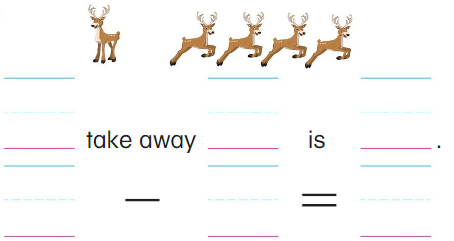
a. How many seeds will she be able to plant in 1 plant box?
b. How many seeds will she be able to plant in 4 plant boxes?
c. Draw a number line below your fraction strip and mark all the fractions.
Answer :
Engage-NY-Eureka-Math-3rd-Grade-Module-5-Lesson-14-Answer Key-Eureka-Math-Grade-3-Module-5-Lesson-14-Homework-Answer-Key-Question-3-a
Answer a :
Rivera will plant 9 seeds in 1 plant box.
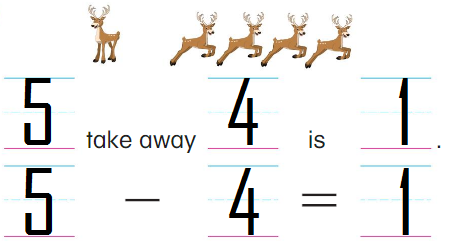
Answer b :
Number of seeds in 1 plant box = 9
Number of seeds in 4 plant boxes = 4 × 9 = 36 .
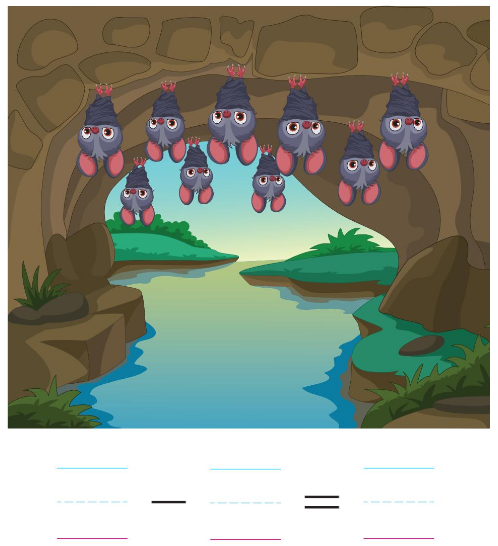
Answer c :
Engage-NY-Eureka-Math-3rd-Grade-Module-5-Lesson-14-Answer Key-Eureka-Math-Grade-3-Module-5-Lesson-14-Homework-Answer-Key-Question-3-a
Explanation :
The number line is represented according to the fraction given from 0 to 1 as shown in above figure .
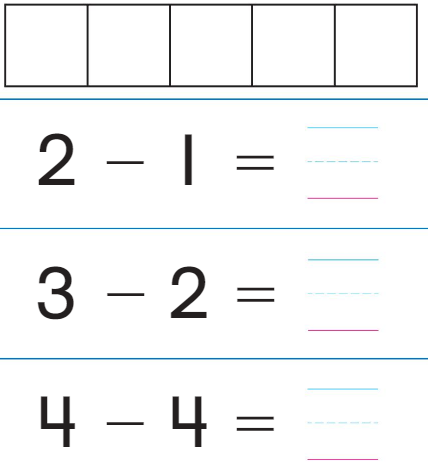
Eureka Math Grade 3 Module 5 Lesson 13 Answer Key

Engage NY Eureka Math 3rd Grade Module 5 Lesson 13 Answer Key

Eureka Math Grade 3 Module 5 Lesson 13 Problem Set Answer Key

Engage NY Math Grade 3 Module 5 Lesson 13 Problem Set Answer Key 1
Answer:
Engage-NY-Eureka-Math-3rd-Grade-Module-5-Lesson-13-Answer Key-Eureka-Math-Grade-3-Module-5-Lesson-13-Problem-Set-Answer-Key-Question-1

Question 6.
Use the diagram below to complete the following statements.
Engage NY Math Grade 3 Module 5 Lesson 13 Problem Set Answer Key 2
a. Rope ____________ is \(\frac{1}{2}\) the length of Rope B.
b. Rope ____________ is \(\frac{1}{2}\) the length of Rope A.
c. Rope C is \(\frac{1}{4}\) the length of Rope ____________.
d. If Rope B measures 1 m long, then Rope A is ____________ m long, and Rope C is ____________ m long.
e. If Rope A measures 1 m long, Rope B is ____________ m long, and Rope C is ____________ m long.
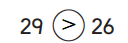
Answer:
a. Rope C is \(\frac{1}{2}\) the length of Rope B.
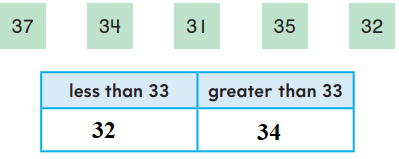
b. Rope B is \(\frac{1}{2}\) the length of Rope A.
c. Rope C is \(\frac{1}{4}\) the length of Rope A.
d. If Rope B measures 1 m long, then Rope A is 2 m long, and Rope C is \(\frac{1}{2}\) long.

e. If Rope A measures 1 m long, Rope B is\(\frac{1}{2}\)  long, and Rope C is \(\frac{1}{4}\)m long.
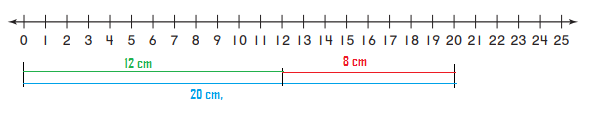
Question 7.
Ms. Fan drew the figure below on the board. She asked the class to name the shaded fraction. Charlie answered \(\frac{3}{4}\). Janice answered \(\frac{3}{2}\). Jenna thinks they’re both right. With whom do you agree? Explain your thinking.
Engage NY Math Grade 3 Module 5 Lesson 13 Problem Set Answer Key 3
Answer:
Engage-NY-Eureka-Math-3rd-Grade-Module-5-Lesson-13-Answer Key-Eureka-Math-Grade-3-Module-5-Lesson-13-Problem-Set-Answer-Key-Question-7
Explanation :
From figure one if the Big rectangle is considered as 1 whole then \(\frac{3}{4}\) is right .
From figure Two if the Small rectangle is considered as 1 whole then \(\frac{3}{2}\) is right .
It is based on the consideration of Rectangles as 1 whole .

Eureka Math Grade 3 Module 5 Lesson 13 Exit Ticket Answer Key

Ms. Silverstein asked the class to draw a model showing \(\frac{2}{3}\) shaded. Karol and Deb drew the models below. Whose model is correct? Explain how you know.
Eureka Math 3rd Grade Module 5 Lesson 13 Exit Ticket Answer Key 1
Answer :
Both the Models are correct
Explanation :
Karol’s Diagram is a rectangle box where \(\frac{2}{3}\) is shaded and in Deb;s diagram 3 rhombus are drawn and 2 are shaded even that represent \(\frac{2}{3}\) ..
So, both diagrams represent \(\frac{2}{3}\) fractions.

Eureka Math Grade 3 Module 5 Lesson 13 Homework Answer Key

Eureka Math Grade 3 Module 5 Lesson 13 Homework Answer Key 1
Answer:

Engage-NY-Eureka-Math-3rd-Grade-Module-5-Lesson-13-Answer Key-Eureka-Math-Grade-3-Module-5-Lesson-13-Homework-Answer-Key-Question-1

Question 5.
Use the pictures below to complete the following statements.
Eureka Math Grade 3 Module 5 Lesson 13 Homework Answer Key 2
a. Towel Rack ____________ is about \(\frac{1}{2}\) the length of Towel Rack C.
b. Towel Rack ____________ is about \(\frac{1}{3}\) the length of Towel Rack C.
c. If Towel Rack C measures 6 ft long, then Towel Rack B is about ____________ ft long, and Towel Rack A is about ____________ ft long.
d. About how many copies of Towel Rack A equal the length of Towel Rack C? Draw number bonds to help you.
e. About how many copies of Towel Rack B equal the length of Towel Rack C? Draw number bonds to help you.
Answer:
a. Towel Rack B is about \(\frac{1}{2}\) the length of Towel Rack C.
b. Towel Rack A is about \(\frac{1}{3}\) the length of Towel Rack C.
c. If Towel Rack C measures 6 ft long, then Towel Rack B is about 3 ft long, and Towel Rack A is about 2 ft long.
Explanation :
Towel Rack B is about \(\frac{1}{2}\) the length of Towel Rack C.
Towel Rack C = 6 ft
Towel Rack B = 6 / 2 = 3 ft.
Towel Rack A is about \(\frac{1}{3}\) the length of Towel Rack C.
Towel A = 6/3 = 2 ft .

d. 3 copies of Towel Rack A equal the length of Towel Rack C
Engage-NY-Eureka-Math-3rd-Grade-Module-5-Lesson-13-Answer Key-Eureka-Math-Grade-3-Module-5-Lesson-13-Homework-Answer-Key-Question-5

e. 2 copies of Towel Rack B equal the length of Towel Rack C
Engage-NY-Eureka-Math-3rd-Grade-Module-5-Lesson-13-Answer Key-Eureka-Math-Grade-3-Module-5-Lesson-13-Homework-Answer-Key-Question-5-e

Question 6.
Draw 3 strings—B, C, and D—by following the directions below. String A is already drawn for you.
String B is \(\frac{1}{3}\) of String A.
String C is \(\frac{1}{2}\) of String B.
String D is \(\frac{1}{3}\) of String C.
Extension: String E is 5 times the length of String D.
Eureka Math Grade 3 Module 5 Lesson 13 Homework Answer Key 3
Answer:
Engage-NY-Eureka-Math-3rd-Grade-Module-5-Lesson-13-Answer Key-Eureka-Math-Grade-3-Module-5-Lesson-13-Homework-Answer-Key-Question-6
Explanation :
String B is \(\frac{1}{3}\) of String A.
String C is \(\frac{1}{2}\) of String B.
String C is \(\frac{1}{2}\) × \(\frac{1}{3}\)  of String A
= String C is \(\frac{1}{6}\)  of String A
String D is \(\frac{1}{3}\) of String C.
String D is \(\frac{1}{3}\) × \(\frac{1}{6}\)  of String A
= String D is \(\frac{1}{18}\) of string A
Extension: String E is 5 times the length of String D.
String D is \(\frac{1}{18}\) of string A So,
String E is 5 \(\frac{1}{18}\) of string A
= String E is  \(\frac{5}{18}\) of string A

Eureka Math Grade 3 Module 5 Lesson 12 Answer Key

Engage NY Eureka Math 3rd Grade Module 5 Lesson 12 Answer Key

Eureka Math Grade 3 Module 5 Lesson 12 Sprint Answer Key

A
Multiply with Nine
Engage NY Math 3rd Grade Module 5 Lesson 12 Sprint Answer Key 1
Question 1.
9 × 1 =
Answer:
9 × 1 = 9

Question 2.
1 × 9 =
Answer:
1 × 9 = 9

Question 3.
9 × 2 =
Answer:
9 × 2 = 18

Question 4.
2 × 9 =
Answer:
2 × 9 = 18

Question 5.
9 × 3 =
Answer:
9 × 3 = 27

Question 6.
3 × 9 =
Answer:
3 × 9 = 27

Question 7.
9 × 4 =
Answer:
9 × 4 = 36

Question 8.
4 × 9 =
Answer:
4 × 9 = 36

Question 9.
9 × 5 =
Answer:
9 × 5 = 40

Question 10.
5 × 9 =
Answer:
5 × 9 = 40

Question 11.
9 × 6 =
Answer:
9 × 6 = 54

Question 12.
6 × 9 =
Answer:
6 × 9 = 54

Question 13.
9 × 7 =
Answer:
9 × 7 = 63

Question 14.
7 × 9 =
Answer:
7 × 9 = 63

Question 15.
9 × 8 =
Answer:
9 × 8 = 72

Question 16.
8 × 9 =
Answer:
8 × 9 = 72

Question 17.
9 × 9 =
Answer:
9 × 9 = 81

Question 18.
9 × 10 =
Answer:
9 × 10 = 90

Question 19.
10 × 9 =
Answer:
10 × 9 = 90

Question 20.
1 × 9 =
Answer:
1 × 9 = 9

Question 21.
10 × 9 =
Answer:
10 × 9 = 90

Question 22.
2 × 9 =
Answer:
2 × 9 = 18

Question 23.
9 × 9 =
Answer:
9 × 9 = 81

Question 24.
3 × 9 =
Answer:
3 × 9 = 27

Question 25.
8 × 9 =
Answer:
8 × 9 = 72

Question 26.
4 × 9 =
Answer:
4 × 9 = 36

Question 27.
7 × 9 =
Answer:
7 × 9 = 63

Question 28.
5 × 9 =
Answer:
5 × 9 = 45

Question 29.
6 × 9 =
Answer:
6 × 9 = 54

Question 30.
9 × 5 =
Answer:
9 × 5 = 45

Question 31.
9 × 10 =
Answer:
9 × 10 = 90

Question 32.
9 × 1 =
Answer:
9 × 1 = 9

Question 33.
9 × 6 =
Answer:
9 × 6 = 54

Question 34.
9 × 4 =
Answer:
9 × 4 = 36

Question 35.
9 × 9 =
Answer:
9 × 9 = 81

Question 36.
9 × 2 =
Answer:
9 × 2 = 18

Question 37.
9 × 7 =
Answer:
9 × 7 = 63

Question 38.
9 × 3 =
Answer:
9 × 3 = 27

Question 39.
9 × 8 =
Answer:
9 × 8 = 72

Question 40.
11 × 9 =
Answer:
11 × 9 = 99

Question 41.
9 × 11 =
Answer:
9 × 11 = 99

Question 42.
12 × 9 =
Answer:
12 × 9 = 108

Question 43.
9 × 12 =
Answer:
9 × 12 = 108

Question 44.
13 × 9 =
Answer:
13 × 9 = 117

B
Multiply with Nine
Engage NY Math 3rd Grade Module 5 Lesson 12 Sprint Answer Key 2

Question 1.
1 × 9 =
Answer:
1 × 9 = 9

Question 2.
9 × 1 =
Answer:
9 × 1 = 9

Question 3.
2 × 9 =
Answer:
2 × 9 = 18

Question 4.
9 × 2 =
Answer:
9 × 2 = 18

Question 5.
3 × 9 =
Answer:
3 × 9 = 27

Question 6.
9 × 3 =
Answer:
9 × 3 = 27

Question 7.
4 × 9 =
Answer:
4 × 9 = 36

Question 8.
9 × 4 =
Answer:
9 × 4 = 36

Question 9.
5 × 9 =
Answer:
5 × 9 = 45

Question 10.
9 × 5 =
Answer:
9 × 5 = 45

Question 11.
6 × 9 =
Answer:
6 × 9 = 54

Question 12.
9 × 6 =
Answer:
9 × 6 = 54

Question 13.
7 × 9 =
Answer:
7 × 9 = 63

Question 14.
9 × 7 =
Answer:
9 × 7 = 63

Question 15.
8 × 9 =
Answer:
8 × 9 = 72

Question 16.
9 × 8 =
Answer:
9 × 8 = 72

Question 17.
9 × 9 =
Answer:
9 × 9 = 81

Question 18.
10 × 9 =
Answer:
10 × 9 = 90

Question 19.
9 × 10 =
Answer:
9 × 10 = 90

Question 20.
9 × 3 =
Answer:
9 × 3 = 27

Question 21.
1 × 9 =
Answer:
1 × 9 = 9

Question 22.
2 × 9 =
Answer:
2 × 9 = 18

Question 23.
10 × 9 =
Answer:
10 × 9 = 90

Question 24.
9 × 9 =
Answer:
9 × 9 = 81

Question 25.
4 × 9 =
Answer:
4 × 9 = 36

Question 26.
8 × 9 =
Answer:
8 × 9 = 72

Question 27.
3 × 9 =
Answer:
3 × 9 = 27

Question 28.
7 × 9 =
Answer:
7 × 9 = 63

Question 29.
6 × 9 =
Answer:
6 × 9 = 54

Question 30.
9 × 10 =
Answer:
9 × 10 = 90

Question 31.
9 × 5 =
Answer:
9 × 5 = 45

Question 32.
9 × 6 =
Answer:
9 × 6 = 54

Question 33.
9 × 1 =
Answer:
9 × 1 = 9

Question 34.
9 × 9 =
Answer:
9 × 9 = 81

Question 35.
9 × 4 =
Answer:
9 × 4 = 36

Question 36.
9 × 3 =
Answer:
9 × 3 = 27

Question 37.
9 × 2 =
Answer:
9 × 2 = 18

Question 38.
9 × 7 =
Answer:
9 × 7 = 63

Question 39.
9 × 8 =
Answer:
9 × 8 = 72

Question 40.
11 × 9 =
Answer:
11 × 9 = 99

Question 41.
9 × 11 =
Answer:
9 × 11 = 99

Question 42.
12 × 9 =
Answer:
12 × 9 = 108

Question 43.
9 × 12 =
Answer:
9 × 12 = 108

Question 44.
13 × 9 =
Answer:
13 × 9 = 117

Eureka Math Grade 3 Module 5 Lesson 12 Problem Set Answer Key

For each of the following:

  • Draw a picture of the designated unit fraction copied to make at least two different wholes.
  • Label the unit fractions.
  • Label the whole as 1.
  • Draw at least one number bond that matches a drawing.
    Engage NY Math Grade 3 Module 5 Lesson 12 Problem Set Answer Key 1

Question 1.
Yellow strip
Answer:
Engage-NY-Eureka-Math-3rd-Grade-Module-5-Lesson-12-Answer Key-Eureka-Math-Grade-3-Module-5-Lesson-12-Problem-Set-Answer-Key-Question-1
Explanation :
The Figure is represented with 2 different unit fractions, where whole and fractions values are written.
One number bond that matches a drawing is also represented as shown in above figure .

Question 2.
Brown strip
Answer:
Engage-NY-Eureka-Math-3rd-Grade-Module-5-Lesson-12-Answer Key-Eureka-Math-Grade-3-Module-5-Lesson-12-Problem-Set-Answer-Key-Question-2

Explanation :
The Figure is represented with 2 different unit fractions, where whole and fractions values are written.
One number bond that matches a drawing is also represented as shown in above figure .

Question 3.
Orange square
Answer:
Engage-NY-Eureka-Math-3rd-Grade-Module-5-Lesson-12-Answer Key-Eureka-Math-Grade-3-Module-5-Lesson-12-Problem-Set-Answer-Key-Question-3
Explanation :
The Figure is represented with 2 different unit fractions, where whole and fractions values are written.
One number bond that matches a drawing is also represented as shown in above figure .

Question 4.
Yarn
Answer:
Engage-NY-Eureka-Math-3rd-Grade-Module-5-Lesson-12-Answer Key-Eureka-Math-Grade-3-Module-5-Lesson-12-Problem-Set-Answer-Key-Question-4
Explanation :
The Figure is represented with 2 different unit fractions, where whole and fractions values are written.
One number bond that matches a drawing is also represented as shown in above figure .

Question 5.
Water
Answer:
Engage-NY-Eureka-Math-3rd-Grade-Module-5-Lesson-12-Answer Key-Eureka-Math-Grade-3-Module-5-Lesson-12-Problem-Set-Answer-Key-Question-5
Explanation :
The Figure is represented with 2 different unit fractions, where whole and fractions values are written.
One number bond that matches a drawing is also represented as shown in above figure .

Question 6.
Clay
Answer:
Engage-NY-Eureka-Math-3rd-Grade-Module-5-Lesson-12-Answer Key-Eureka-Math-Grade-3-Module-5-Lesson-12-Problem-Set-Answer-Key-Question-6
Explanation :
The Figure is represented with 2 different unit fractions, where whole and fractions values are written.
One number bond that matches a drawing is also represented as shown in above figure .

Eureka Math Grade 3 Module 5 Lesson 12 Exit Ticket Answer Key

Each shape represents the unit fraction. Draw a picture representing a possible whole.
Question 1.
Eureka Math 3rd Grade Module 5 Lesson 12 Exit Ticket Answer Key 1
Answer:
Engage-NY-Eureka-Math-3rd-Grade-Module-5-Lesson-12-Answer Key-Eureka-Math-Grade-3-Module-5-Lesson-12-Exit-Ticket-Answer-Key-Question-1
Explanation :
With the given shape the fraction of \(\frac{1}{7}\) is represented and made as 1 whole figure as shown in the above figure .
To represent the fraction \(\frac{1}{7}\) as 1 whole the given figure is drawn for 7 times .

Question 2.
Eureka Math 3rd Grade Module 5 Lesson 12 Exit Ticket Answer Key 2
Answer:
Engage-NY-Eureka-Math-3rd-Grade-Module-5-Lesson-12-Answer Key-Eureka-Math-Grade-3-Module-5-Lesson-12-Exit-Ticket-Answer-Key-Question-2
Explanation :
With the given shape the fraction of \(\frac{1}{9}\) is represented and made as 1 whole figure as shown in the above figure .
To represent the fraction \(\frac{1}{9}\) as 1 whole the given figure is drawn for 9 times .

Question 3.
Aileen and Jack used the same triangle representing the unit fraction \(\frac{1}{4}\) to create 1 whole. Who did it correctly? Explain your answer.
Eureka Math 3rd Grade Module 5 Lesson 12 Exit Ticket Answer Key 3
Answer:
Both done correctly .
Explanation :
To represent the fraction \(\frac{1}{4}\) as 1 whole the given figure is should be drawn for 4 times .
It can be in any way but the number of triangles should be 4 of same size and shape .
Both represented the 4 triangles in different way both are correct .

Eureka Math Grade 3 Module 5 Lesson 12 Homework Answer Key

Each shape represents the given unit fraction. Estimate to draw a possible whole.
Question 1.
\(\frac{1}{2}\)
Eureka Math Grade 3 Module 5 Lesson 12 Homework Answer Key 1
Answer:
Engage-NY-Eureka-Math-3rd-Grade-Module-5-Lesson-12-Answer Key-Eureka-Math-Grade-3-Module-5-Lesson-12-Homework-Answer-Key-Question-1
Explanation :
To make the given fraction into whole number by multiplying the fraction by the same number in the denominator. In the same way draw the same number of times the given figure to make it whole figure as shown in above figure .

Question 2.
\(\frac{1}{6}\)
Eureka Math Grade 3 Module 5 Lesson 12 Homework Answer Key 2
Answer:
Engage-NY-Eureka-Math-3rd-Grade-Module-5-Lesson-12-Answer Key-Eureka-Math-Grade-3-Module-5-Lesson-12-Homework-Answer-Key-Question-2
Explanation :
To make the given fraction into whole number by multiplying the fraction by the same number in the denominator. In the same way draw the same number of times the given figure to make it whole figure as shown in above figure .

Question 3.
1 third
Eureka Math Grade 3 Module 5 Lesson 12 Homework Answer Key 3
Answer:
Engage-NY-Eureka-Math-3rd-Grade-Module-5-Lesson-12-Answer Key-Eureka-Math-Grade-3-Module-5-Lesson-12-Homework-Answer-Key-Question-3
Explanation :
To make the given fraction into whole number by multiplying the fraction by the same number in the denominator. In the same way draw the same number of times the given figure to make it whole figure as shown in above figure .

Question 4.
1 fourth
Eureka Math Grade 3 Module 5 Lesson 12 Homework Answer Key 4
Answer:
Engage-NY-Eureka-Math-3rd-Grade-Module-5-Lesson-12-Answer Key-Eureka-Math-Grade-3-Module-5-Lesson-12-Homework-Answer-Key-Question-4
Explanation :
To make the given fraction into whole number by multiplying the fraction by the same number in the denominator. In the same way draw the same number of times the given figure to make it whole figure as shown in above figure .

Each shape represents the given unit fraction. Estimate to draw a possible whole, label the unit fractions, and draw a number bond that matches the drawing. The first one is done for you.
Question 5.
\(\frac{1}{3}\)
Eureka Math Grade 3 Module 5 Lesson 12 Homework Answer Key 5
Answer:

Question 6.
\(\frac{1}{2}\)
Eureka Math Grade 3 Module 5 Lesson 12 Homework Answer Key 6
Answer:
Engage-NY-Eureka-Math-3rd-Grade-Module-5-Lesson-12-Answer Key-Eureka-Math-Grade-3-Module-5-Lesson-12-Homework-Answer-Key-Question-6

Question 7.
\(\frac{1}{5}\)
Eureka Math Grade 3 Module 5 Lesson 12 Homework Answer Key 7
Answer:
Engage-NY-Eureka-Math-3rd-Grade-Module-5-Lesson-12-Answer Key-Eureka-Math-Grade-3-Module-5-Lesson-12-Homework-Answer-Key-Question-7

Question 8.
\(\frac{1}{7}\)
Eureka Math Grade 3 Module 5 Lesson 12 Homework Answer Key 8
Answer:
Engage-NY-Eureka-Math-3rd-Grade-Module-5-Lesson-12-Answer Key-Eureka-Math-Grade-3-Module-5-Lesson-12-Homework-Answer-Key-Question-8

Question 9.
Evan and Yong used this shape Eureka Math Grade 3 Module 5 Lesson 12 Homework Answer Key 9, representing the unit fraction \(\frac{1}{3}\), to draw 1 whole. Shania thinks both of them did it correctly. Do you agree with her? Explain your answer.
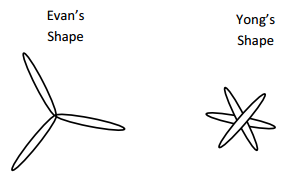
Eureka Math Grade 3 Module 5 Lesson 12 Homework Answer Key 10
Answer:
No
Explanation :
Evan’s Shape is correct because the identical given figure doesn’t over lap and represent 1 whole.
Where as  the Yong’s Shape is incorrect because Overlapping take place and doesn’t represent 1 whole