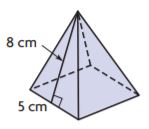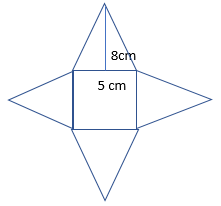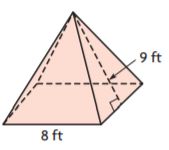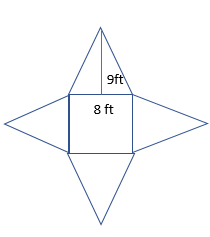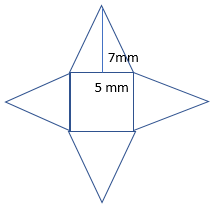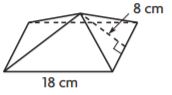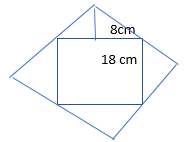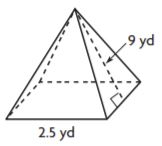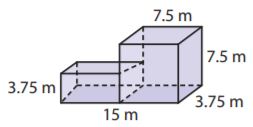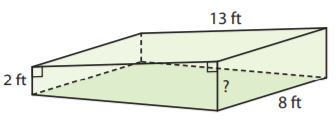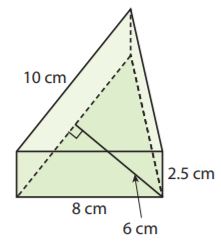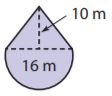
Go Math Grade 8 Answer Key Chapter 12 The Pythagorean Theorem

go-math-grade-8-chapter-12-the-pythagorean-theorem-answer-key

One has to learn the concepts if he/she wants to become a master in maths. The fundamentals in Go Math Grade 8 Answer Key Chapter 12 The Pythagorean theorem will help you to learn the subject. You need to practice from the beginning itself. We will help you to achieve your dreams by providing simple methods to solve the problems in an easy manner. Download Go Math Grade 8 Answer Key Chapter 12 The Pythagorean Theorem free pdf to help you to gain a grip over the subject.

Go Math Grade 8 Answer Key Chapter 12 The Pythagorean Theorem

Go Math Grade 8 Answer Key Chapter 12 The Pythagorean Theorem will help you to complete your homework in time without any mistakes. The main aim of the ccssmathanswers.com site is to provide quick and simple methods to all the students of 8th grade. The solutions to all the questions in Go Math Grade 8 Answer Key Chapter 12 The Pythagorean Theorem are prepared by the math experts. Tap the links and practice the problems provided in the HMH Go Math 8th Grade Solution Key Chapter 12 The Pythagorean Theorem.

Chapter 12- Lesson 1: 

Chapter 12- Lesson 2: 

Chapter 12- Lesson 3: 

Guided Practice – The Pythagorean Theorem – Page No. 378

Question 1.
Find the length of the missing side of the triangle
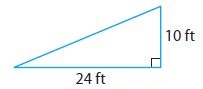
Go Math Grade 8 Answer Key Chapter 12 The Pythagorean Theorem Lesson 1: The Pythagorean Theorem img 1
a2 + b2 = c2 → 242 + ? = c2 → ? = c2
The length of the hypotenuse is _____ feet.
_____ feet

Answer: The length of the hypotenuse is 26 feet.

Explanation: According to Pythagorean Theorem, we shall consider values of a = 24ft, b = 10ft.
Therefore c = √(a2 +b2)
c = √(242 + 102)
= √(576 + 100)
= √676 = 26ft

Question 2.
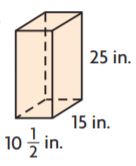
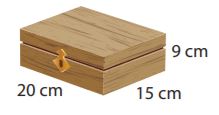
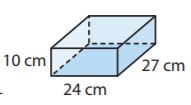
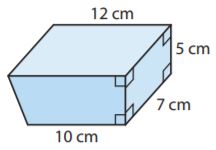
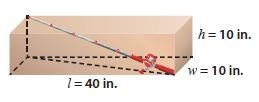
Mr. Woo wants to ship a fishing rod that is 42 inches long to his son. He has a box with the dimensions shown.
Go Math Grade 8 Answer Key Chapter 12 The Pythagorean Theorem Lesson 1: The Pythagorean Theorem img 2
a. Find the square of the length of the diagonal across the bottom of the box.
________ inches

Answer: 1700 inches.

Explanation: Here we consider the length of the diagonal across the bottom of the box as d.
Therefore, according to Pythagorean Theorem
W2 + l2 = d2
402 + 102 = d2
1600 + 100 = d2
1700 = d2

Question 2.
b. Find the length from a bottom corner to the opposite top corner to the nearest tenth. Will the fishing rod fit?
________ inches

Answer: 42.42 inches.

Explanation: We denote by r, the length from the bottom corner to the opposite top corner. We use our Pythagorean formula to find r.
h2 + s2 = r2
102 + 1700 = r2
100 + 1700 = r2
1800 = r2,    r = √1800 => 42.42 inches

ESSENTIAL QUESTION CHECK-IN

Question 3.
State the Pythagorean Theorem and tell how you can use it to solve problems.

Answer:
Pythagorean Theorem: In a right triangle, the sum of squares of the legs a and b is equal to the square of the hypotenuse c.
a2 + b2 = c2
We can use it to find the length of a side of a right triangle when the lengths of the other two sides are known.

12.1 Independent Practice – The Pythagorean Theorem – Page No. 379

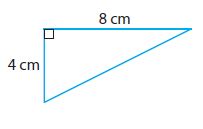
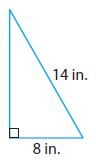
Find the length of the missing side of each triangle. Round your answers to the nearest tenth.

Question 4.
Go Math Grade 8 Answer Key Chapter 12 The Pythagorean Theorem Lesson 1: The Pythagorean Theorem img 3
________ cm

Answer: 8.9 cm.

Explanation: According to Pythagorean theorem we consider values of a = 4cm, b = 8cm.
c2 = a2 + b2
= 42 + 82
= 16 + 64
c2= 80, c= √80 => 8.944
After rounding to nearest tenth value c= 8.9cm

Question 5.
Go Math Grade 8 Answer Key Chapter 12 The Pythagorean Theorem Lesson 1: The Pythagorean Theorem img 4
________ in.

Answer: 11.5 in.

Explanation: According to Pythagorean theorem we consider values of b = 8in, c= 14in
c2 = a2 + b2
142 = a2 + 82
196 = a2 + 64
a2 = 196 – 64
a  = √132 => 11.4891
a = 11.5 in

Question 6.
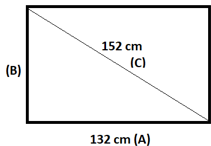
The diagonal of a rectangular big-screen TV screen measures 152 cm. The length measures 132 cm. What is the height of the screen?
________ cm

Answer: 75.4 cm

Explanation: Let’s consider the diagonal of the TV screen as C = 152cm, length as A = 132 cm, and height of the screen as B.
Go Math Grade 8 Answer Key Chapter 12 The Pythagorean Theorem
As C2 = A2 + B2
   1522 = 1322 + B2
23,104 = 17,424 + B2
B2 = 23,104 – 17,424
B = √5680 => 75.365
So the height of the screen B = 75.4cm

Question 7.
Dylan has a square piece of metal that measures 10 inches on each side. He cuts the metal along the diagonal, forming two right triangles. What is the length of the hypotenuse of each right triangle to the nearest tenth of an inch?
________ in.

Answer: 14.1in.

Explanation:
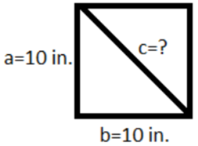
Go Math Grade 8 Answer Key Chapter 12 The Pythagorean Theorem

Using the Pythagorean Theorem, we have:
a2 + b2 = c2
102 + 102 = c2
100 + 100 = c2
200 = c2
We are told to round the length of the hypotenuse of each right triangle to the nearest tenth of an inch, therefore: c = 14.1in

Question 8.
Represent Real-World Problems A painter has a 24-foot ladder that he is using to paint a house. For safety reasons, the ladder must be placed at least 8 feet from the base of the side of the house. To the nearest tenth of a foot, how high can the ladder safely reach?
________ ft

Answer: 22.6 ft.

Explanation: Consider the below diagram. Length of the ladder C = 24ft, placed at a distance from the base B = 8ft, let the safest height be A.
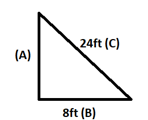
Go Math Grade 8 Answer Key Chapter 12 The Pythagorean Theorem

By using Pythagorean Theorem:
C2 = A2 + B2
242 = A2 + 82
576 = A2 + 64
A2 = 576 – 64 => 512
A = √512 => 22.627
After rounding to nearest tenth, value of A = 22.6ft

Question 9.
What is the longest flagpole (in whole feet) that could be shipped in a box that measures 2 ft by 2 ft by 12 ft?
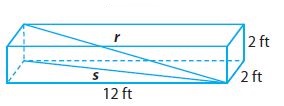
Go Math Grade 8 Answer Key Chapter 12 The Pythagorean Theorem Lesson 1: The Pythagorean Theorem img 5
________ ft

Answer: The longest flagpole (in whole feet) that could be shipped in this box is 12 feet.

Explanation: From the above diagram we have to find the value of r, which gives us the length longest flagpole that could be shipped in the box. Where width w = 2ft, height h = 2ft and length l = 12ft.

First find s, the length of the diagonal across the bottom of the box.
w2 + l2 = s2
22 + 122 = s2
4 + 144 = s2
148 = s2
We use our expression for s to find r, since triangle with sides s, r, and h also form a right-angle triangle.
h2 + s2 = r2
22 + 148 = r2
4 + 148 = r2
152 = r2
r = 12.33ft.

Question 10.
Sports American football fields measure 100 yards long between the end zones, and are 53 \(\frac{1}{3}\) yards wide. Is the length of the diagonal across this field more or less than 120 yards? Explain.
____________

Answer: The diagonal across this field is less than 120 yards.

Explanation: From the above details we will get a diagram as shown below.
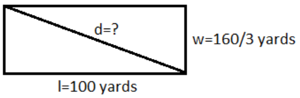
Go Math Grade 8 Answer Key Chapter 12 The Pythagorean Theorem

We are given l = 100 and w = 53  =  . If we denote with d the diagonal of the field, using the Pythagorean Theorem, we have:
l2 + w2 = d2
1002 + (160/3)2 = d2
10000 + (25600/9) = d2
9*10000 + 9*(25600/9) = 9* d2
90000 + 25600 = 9 d2
(115600/9) = d2
(340/9) = d2
d = 113.3
Hence the diagonal across this field is less than 120 yards.

Question 11.
Justify Reasoning A tree struck by lightning broke at a point 12 ft above the ground as shown. What was the height of the tree to the nearest tenth of a foot? Explain your reasoning.
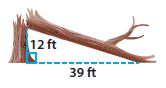
Go Math Grade 8 Answer Key Chapter 12 The Pythagorean Theorem Lesson 1: The Pythagorean Theorem img 6
________ ft

Answer: The total height of the tree was 52.8ft

Explanation:
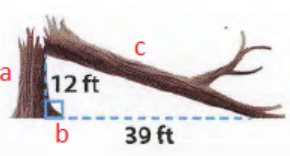
Go Math Grade 8 Answer Key Chapter 12 The Pythagorean Theorem
By using the Pythagorean Theorem
a2 + b= c2
122 + 392 = c2
144 + 1521 = c2
1665 = c2
We are told to round the length of the hypotenuse to the nearest tenth of a foot, therefore: c = 40.8ft.
Therefore, the total height of the tree was:
height = a+c
height = 12 +40.8
height = 52.8 feet

FOCUS ON HIGHER ORDER THINKING – The Pythagorean Theorem – Page No. 380

Question 12.
Multistep Main Street and Washington Avenue meet at a right angle. A large park begins at this corner. Joe’s school lies at the opposite corner of the park. Usually Joe walks 1.2 miles along Main Street and then 0.9 miles up Washington Avenue to get to school. Today he walked in a straight path across the park and returned home along the same path. What is the difference in distance between the two round trips? Explain.
________ mi

Answer: Joe walks 1.2 miles less if he follows the straight path across the park.

Explanation: Using the Pythagorean Theorem, we find the distance from his home to school following the straight path across the park:
a2 + b= c2
1.22 + 0.92 = c2
1.44 + 0.81 = c2
2.25 = c2
1.5 = c
Therefore, the distance of Joe’s round trip following the path across the park is 3 miles (dhome-school + dschool-home = 1.5 + 1.5). Usually, when he walks along Main Street and Washington Avenue, the distance of his round trip is 4.2 miles (dhome-school + dschool-home = (1.2 + 0.9) + (0.9+1.2)). As we can see, Joe walks 1.2 miles less if he follows the straight path across the park.

Question 13.
Analyze Relationships An isosceles right triangle is a right triangle with congruent legs. If the length of each leg is represented by x, what algebraic expression can be used to represent the length of the hypotenuse? Explain your reasoning.

Answer: c = x√ 2

Explanation: From the Pythagorean Theorem, we know that if a and b are legs and c is the hypotenuse, then a2 + b= c2. In our case, the length of each leg is represented by x, therefore we have:
a2 + b= c2
x2 + x2 = c2
2x2 = c2
c = x√ 2

Question 14.
Persevere in Problem Solving A square hamburger is centered on a circular bun. Both the bun and the burger have an area of 16 square inches.
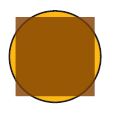
Go Math Grade 8 Answer Key Chapter 12 The Pythagorean Theorem Lesson 1: The Pythagorean Theorem img 7
a. How far, to the nearest hundredth of an inch, does each corner of the burger stick out from the bun? Explain.
________ in

Answer: Each corner of the burger sticks out 0.57 inches from the bun.

Explanation: Frist, we need to find the radius r of the circular bun. We know that its area A is 16 square inches, therefore:
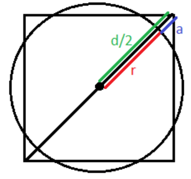
 

Go Math Grade 8 Answer Key Chapter 12 The Pythagorean Theorem

A = πr2
16 = 3.14*r2
r2 = (16/3.14)
r = 2.26

Then, we need to find the side s of the square hamburger. We know that its area A is 16 square inches, therefore:
A = s2
16 = s2
s = 4
Using the Pythagorean Theorem, we have to find diagonal d of the square hamburger:
s2 + s2 = d2
42 + 42 = d2
16 + 16 = d2
32 = d2
d = 5.66
To find how far does each corner of the burger stick out from the bun, we denote this length by a and we get:
a = (d/2) – r => (5.66/2) – 2.26
a = 0.57.
Therefore, Each corner of the burger sticks out 0.57 inches from the bun.

Question 14.
b. How far does each bun stick out from the center of each side of the burger?
________ in

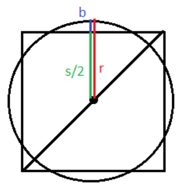
Answer: Each bun sticks out 0.26 inches from the center of each side of the burger.

Explanation:
Go Math Grade 8 Answer Key Chapter 12 The Pythagorean Theorem

We found that r = 2.26 and s = 4. To find how far does each bun stick out from the center of each side of the burger, we denote this length by b and we get:
b = r – (s/2) = 2.26 – (4/2)
b = 0.26 inches.

Question 14.
c. Are the distances in part a and part b equal? If not, which sticks out more, the burger or the bun? Explain.

Answer: The distances a and b are not equal. From the calculations, we found that the burger sticks out more than the bun.

Guided Practice – Converse of the Pythagorean Theorem – Page No. 384

Question 1.
Lashandra used grid paper to construct the triangle shown.
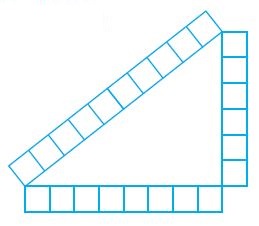
Go Math Grade 8 Answer Key Chapter 12 The Pythagorean Theorem Lesson 2: Converse of the Pythagorean Theorem img 8
a. What are the lengths of the sides of Lashandra’s triangle?
_______ units, _______ units, _______ units,

Answer: The length of Lashandra’s triangle is 8 units, 6 units, 10 units.

Question 1.
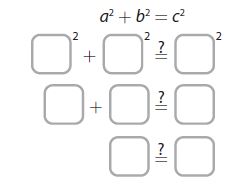
b. Use the converse of the Pythagorean Theorem to determine whether the triangle is a right triangle.
Go Math Grade 8 Answer Key Chapter 12 The Pythagorean Theorem Lesson 2: Converse of the Pythagorean Theorem img 9
The triangle that Lashandra constructed is / is not a right triangle.
_______ a right triangle

Answer: Lashandra’s triangle is right angled triangle as it satisfied Pythagorean theorem

Explanation:
Verifying with Pythagorean formula a2 + b= c2
82 + 62 = 102
64 + 36 =100
100 = 100.

Question 2.
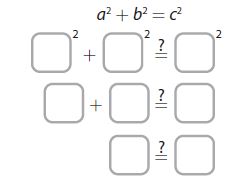
A triangle has side lengths 9 cm, 12 cm, and 16 cm. Tell whether the triangle is a right triangle.
Let a = _____, b = _____, and c = ______.
Go Math Grade 8 Answer Key Chapter 12 The Pythagorean Theorem Lesson 2: Converse of the Pythagorean Theorem img 10
By the converse of the Pythagorean Theorem, the triangle is / is not a right triangle.
_______ a right triangle

Answer: The given triangle is not a right-angled triangle

Explanation: Verifying with Pythagorean formula a2 + b= c2
92 + 122 = 162
81 + 144 = 256
225 ≠ 256.
Hence given dimensions are not from the right angled triangle.

Question 3.
The marketing team at a new electronics company is designing a logo that contains a circle and a triangle. On one design, the triangle’s side lengths are 2.5 in., 6 in., and 6.5 in. Is the triangle a right triangle? Explain.
_______

Answer: It is a right-angled triangle.

Explanation: Let a = 2.5, b = 6 and c= 6.5
Verifying with Pythagorean formula a2 + b= c2
2.52 + 62 = 6.52
6.25 + 36 = 42.25
42.25 = 42.25.
Hence it is a right-angled triangle.

ESSENTIAL QUESTION CHECK-IN

Question 4.
How can you use the converse of the Pythagorean Theorem to tell if a triangle is a right triangle?

Answer: Knowing the side lengths, we substitute them in the formula a2 + b= c2, where c contains the biggest value. If the equation holds true, then the given triangle is a right triangle. Otherwise, it is not a right triangle.

12.2 Independent Practice – Converse of the Pythagorean Theorem – Page No. 385

Tell whether each triangle with the given side lengths is a right triangle.

Question 5.
11 cm, 60 cm, 61 cm
______________

Answer: Since 112 + 602 = 612, the triangle is a right-angled triangle.

Explanation: Let a = 11, b = 60 and c= 61
Using the converse of the Pythagorean Theorem a2 + b= c2
112 + 602 = 612
121 + 3600 = 3721
3721 = 3721.
Since 112 + 602 = 612, the triangle is a right-angled triangle.

Question 6.
5 ft, 12 ft, 15 ft
______________

Answer: Since 52 + 122 ≠ 152, the triangle is not a right-angled triangle.

Explanation: Let a = 5, b = 12 and c= 15
Using the converse of the Pythagorean Theorem a2 + b= c2
 52 + 122 = 152
25 + 144 = 225
169 ≠ 225.
Since 52 + 122 ≠ 152, the triangle is not a right-angled triangle.

Question 7.
9 in., 15 in., 17 in.
______________

Answer: Since 92 + 152 ≠ 172, the triangle is not a right-angled triangle.

Explanation: Let a = 9, b = 15 and c= 17
Using the converse of the Pythagorean Theorem a2 + b= c2
92 + 152 = 172
81 + 225 = 225
306 ≠ 225.
Since 92 + 152 ≠ 172, the triangle is not a right-angled triangle.

Question 8.
15 m, 36 m, 39 m
______________

Answer: Since 152 + 362 = 392, the triangle is a right-angled triangle.

Explanation: Let a = 15, b = 36 and c= 39
Using the converse of the Pythagorean Theorem a2 + b= c2
152 + 362 = 392
225 + 1296 = 1521
1521 = 1521.
Since 152 + 362 = 392, the triangle is a right-angled triangle.

Question 9.
20 mm, 30 mm, 40 mm
______________

Answer: Since 202 + 302 ≠ 402, the triangle is not a right-angled triangle.

Explanation: Let a = 20, b = 30 and c= 40
Using the converse of the Pythagorean Theorem a2 + b= c2
202 + 302 = 402
400 + 900 = 1600
1300 ≠ 1600.
Since 202 + 302 ≠ 402, the triangle is not a right-angled triangle.

Question 10.
20 cm, 48 cm, 52 cm
______________

Answer: Since 202 + 482 = 522, the triangle is a right-angled triangle.

Explanation: Let a = 20, b = 48 and c= 52
Using the converse of the Pythagorean Theorem a2 + b= c2
202 + 482 = 522
400 + 2304 = 2704
2704 = 2704.
Since 202 + 482 = 522, the triangle is a right-angled triangle.

Question 11.
18.5 ft, 6 ft, 17.5 ft
______________

Answer: Since 62 + 17.52 = 18.52, the triangle is a right-angled triangle.

Explanation: Let a = 6, b = 17.5 and c= 18.5
Using the converse of the Pythagorean Theorem a2 + b= c2
62 + 17.52 = 18.52
36 + 306.25 = 342.25
342.5 = 342.25.
Since 62 + 17.52 = 18.52, the triangle is a right-angled triangle.

Question 12.
2 mi, 1.5 mi, 2.5 mi
______________

Answer: Since 22 + 1.52 = 2.52, the triangle is a right-angled triangle.

Explanation: Let a = 2, b = 1.5 and c= 2.5
Using the converse of the Pythagorean Theorem a2 + b= c2
 22 + 1.52 = 2.52
4 + 2.25 = 6.25
6.25 = 6.25.
Since  22 + 1.52 = 2.52, the triangle is a right-angled triangle.

Question 13.
35 in., 45 in., 55 in.
______________

Answer: Since 352 + 452 ≠ 552, the triangle is not a right-angled triangle.

Explanation: Let a = 35, b = 45 and c= 55
Using the converse of the Pythagorean Theorem a2 + b= c2
352 + 452 = 552
1225 + 2025 = 3025
3250 ≠ 3025.
Since 352 + 452 ≠ 552, the triangle is not a right-angled triangle.

Question 14.
25 cm, 14 cm, 23 cm
______________

Answer: Since  142 + 232 ≠ 252, the triangle is not a right-angled triangle.

Explanation: Let a = 14, b = 23 and c= 25 (longest side)
Using the converse of the Pythagorean Theorem a2 + b= c2
142 + 232 = 252
196 + 529 = 625
725 ≠ 625.
Since  142 + 232 ≠252, the triangle is not a right-angled triangle.

Question 15.
The emblem on a college banner consists of the face of a tiger inside a triangle. The lengths of the sides of the triangle are 13 cm, 14 cm, and 15 cm. Is the triangle a right triangle? Explain.
________

Answer: Since  132 + 142 ≠ 152, the triangle is not a right-angled triangle.

Explanation: Let a = 13, b = 14 and c= 15
Using the converse of the Pythagorean Theorem a2 + b= c2
132 + 142 = 152
169 + 196 = 225
365 ≠ 225.
Since  132 + 142 ≠ 152, the triangle is not a right-angled triangle.

Question 16.
Kerry has a large triangular piece of fabric that she wants to attach to the ceiling in her bedroom. The sides of the piece of fabric measure 4.8 ft, 6.4 ft, and 8 ft. Is the fabric in the shape of a right triangle? Explain.
________

Answer: The triangular piece of fabric that Kerry has is in the shape of a right angle since it follows the Pythagorean theorem.

Explanation: Let a = 4.8, b = 6.4 and c= 8
Using the converse of the Pythagorean Theorem a2 + b= c2
4.82 + 6.42 = 82
23.04 + 40.96 = 64
64 = 64.
Since 4.82 + 6.42 = 82, the triangle is a right-angled triangle.

Question 17.
A mosaic consists of triangular tiles. The smallest tiles have side lengths 6 cm, 10 cm, and 12 cm. Are these tiles in the shape of right triangles? Explain.
________

Answer: Since 62 + 102 ≠ 122, by the converse of the Pythagorean Theorem, we say that the tiles are not in the shape of right-angled triangle.

Explanation: Let a = 6, b = 10 and c= 12
Using the converse of the Pythagorean Theorem a2 + b= c2
 62 + 102 = 122
36 + 100 = 144
136 ≠ 144.
Since 62 + 102 ≠ 122, by the converse of the Pythagorean Theorem, we say that the tiles are not in the shape of right-angled triangle.

Question 18.
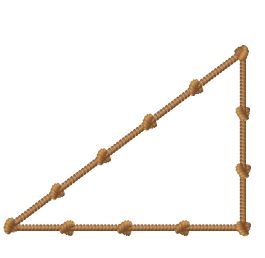
History In ancient Egypt, surveyors made right angles by stretching a rope with evenly spaced knots as shown. Explain why the rope forms a right angle.
Go Math Grade 8 Answer Key Chapter 12 The Pythagorean Theorem Lesson 2: Converse of the Pythagorean Theorem img 11

Answer: The rope has formed a right-angled triangle because the length of its sides follows Pythagorean Theorem.

Explanation: The knots are evenly placed at equal distances
The lengths in terms of knots are a=4 knots, b = 3knots, c = 5 knots
Therefore a2 + b= c2
42 + 3= 52
16+9 = 25
25 = 25.
Hence rope has formed a right-angled triangle because the length of its sides follows Pythagorean Theorem.

Converse of the Pythagorean Theorem – Page No. 386

Question 19.
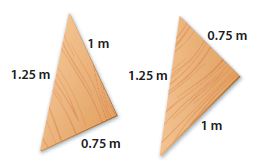
Justify Reasoning Yoshi has two identical triangular boards as shown. Can he use these two boards to form a rectangle? Explain.
Go Math Grade 8 Answer Key Chapter 12 The Pythagorean Theorem Lesson 2: Converse of the Pythagorean Theorem img 12

Answer: Since it was proved that both can form a right-angled triangle, we can form a rectangle by joining them.

Explanation: Given both triangles are identical, if both are right-angled triangles then we can surely join to form a rectangle.
Let’s consider a = 0.75, b= 1 and c=1.25.
By using converse Pythagorean Theorem a2 + b= c2
0.752 + 12 = 1.252
0.5625 + 1 = 1.5625
1.5625 = 1.5625.
Since it was proved that both can form right angled triangle, we can form a rectangle by joining them.

Question 20.
Critique Reasoning Shoshanna says that a triangle with side lengths 17 m, 8 m, and 15 m is not a right triangle because 172 + 82 = 353, 152 = 225, and 353 ≠ 225. Is she correct? Explain
_______

Answer: She is not right, A triangle with sides 15, 8, and 17 is a right-angled triangle.

Explanation: Lets consider a =15, b= 8 and c = 17 (which is long side)
We will verify by using converse Pythagorean Theorem a2 + b= c2
152 + 82 = 172
225 + 64 = 289
289 = 289.
Since the given dimensions satisfied Pythagorean Theorem, we can say it is a right-angled triangle. In the given above statement what Shoshanna did was c2 + b2 = a2, which is not the correct definition of the Pythagorean Theorem.

FOCUS ON HIGHER ORDER THINKING

Question 21.
Make a Conjecture Diondre says that he can take any right triangle and make a new right triangle just by doubling the side lengths. Is Diondre’s conjecture true? Test his conjecture using three different right triangles.
_______

Answer: Yes, Diondre’s conjecture is true. By doubling the sides of a right triangle would create a new right triangle.

Explanation: Given a right triangle, the Pythagorean Theorem holds. Therefore, a2 + b= c2
If we double the side lengths of that triangle, we get:
(2a)2 + (2b)= (2c)2
4a2 + 4b2 = 4c2
4(a2 + b2) = 4c2
a2 + b= c2                    
As we can see doubling the sides of a right triangle would create a new right triangle.We can test that by using three different right triangles.

The triangle with sides a = 6, b = 8 and c = 10 is a right triangle. We double its sides and check if the new triangle is a right triangle. After doubling value of a = 12, b = 16 and c = 20.
122 + 162 = 202
144 + 256 = 400
400 = 400
Hence proved!
Since 122 + 162 = 202, the new triangle is a right triangle by the converse of the Pythagorean Theorem.

The triangle with sides a = 3, b = 4 and c = 5 is a right triangle. We double its sides and check if the new triangle is a right triangle. After doubling value of a = 6, b = 8 and c = 10.
62 + 82 = 102
36 + 64 = 100
100 = 100
Hence proved!
Since 62 + 82 = 102, the new triangle is a right triangle by the converse of the Pythagorean Theorem.

The triangle with sides a = 12, b = 16 and c = 20 is a right triangle. We double its sides and check if the new triangle is a right triangle. After doubling value of a = 24, b = 32 and c = 40.
242 + 322 = 402
576 + 1024 = 1600
1600 = 1600
Hence proved!
Since 242 + 322 = 402, the new triangle is a right triangle by the converse of the Pythagorean Theorem.

Question 22.
Draw Conclusions A diagonal of a parallelogram measures 37 inches. The sides measure 35 inches and 1 foot. Is the parallelogram a rectangle? Explain your reasoning.
_______

Answer: Since 122 + 352 = 372, the triangle is right triangle. Therefore, the given parallelogram is a rectangle.

Explanation: A rectangle is a parallelogram where the interior angles are right angles. To prove if the given parallelogram is a rectangle, we need to prove that the triangle formed by the diagonal of the parallelogram and two sides of it, is a right triangle. Converting all the values into inches, we have a = 12, b = 35 and c = 37. Using the converse of the Pythagorean Theorem, we have:
a2 + b= c2
122 + 352 = 372
144 + 1225 = 1369
1369 = 1369.
Since 122 + 352 = 372, the triangle is right triangle. Therefore, the given parallelogram is a rectangle.

Question 23.
Represent Real-World Problems A soccer coach is marking the lines for a soccer field on a large recreation field. The dimensions of the field are to be 90 yards by 48 yards. Describe a procedure she could use to confirm that the sides of the field meet at right angles.

Answer: To confirm that the sides of the field meet at right angles, she could measure the diagonal of the field and use the converse of the Pythagorean Theorem. If a2 + b= c2 (where a = 90, b = 48 and c is the length of the diagonal), then the triangle is right triangle. This method can be used for every corner to decide if they form right angles or not.

Guided Practice – Distance Between Two Points – Page No. 390

Question 1.
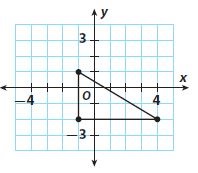
Approximate the length of the hypotenuse of the right triangle to the nearest tenth using a calculator.
Go Math Grade 8 Answer Key Chapter 12 The Pythagorean Theorem Lesson 3: Distance Between Two Points img 13
_______ units

Answer: The length of the hypotenuse of the right triangle to the nearest tenth is 5.8 units.

Explanation: From the above figure let’s take
Length of the vertical leg = 3 units
Length of the horizontal leg = 5 units
let length of the hypotenuse = c
By using Pythagorean Theorem a2 + b= c2
c2 = 32 + 52
c2 = 9 +25
c = √34 => 5.830.
Therefore Length of the hypotenuse of the right triangle to the nearest tenth is 5.8 units.

Question 2.
Find the distance between the points (3, 7) and (15, 12) on the coordinate plane.
_______ units

Answer: Distance between points on the coordinate plane is 13

Explanation: So (x1, y1) = (3,7) and  (x2, y2) = (15, 12)
distance formula d = √( x2 – x1)2 + √( y2 – y1)2
d = √(15 -3)2 + √(12 – 7)2
d = √122 + 52
d = √144 + 25
d = √169 => 13
Therefore distance between points on the coordinate plane is 13.

Question 3.
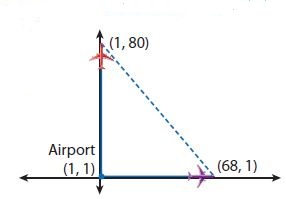
A plane leaves an airport and flies due north. Two minutes later, a second plane leaves the same airport flying due east. The flight plan shows the coordinates of the two planes 10 minutes later. The distances in the graph are measured in miles. Use the Pythagorean Theorem to find the distance shown between the two planes.
Go Math Grade 8 Answer Key Chapter 12 The Pythagorean Theorem Lesson 3: Distance Between Two Points img 14
_______ miles

Answer: The distance between the two planes is 103.6 miles.

Explanation:
Length of the vertical dv = √(80 -1)2 + √(1-1)2
= √792 => 79.
Length of the horizontal dh = √(68 -1)2 + √(1-1)2
= √672 => 67.
Distance between the two planes D = √(792 + 672)
= √(6241+4489) => √10730
= 103.5857 => 103.6 miles.

ESSENTIAL QUESTION CHECK-IN

Question 4.
Describe two ways to find the distance between two points on a coordinate plane.

Answer:

Explanation: We can draw a right triangle whose hypotenuse is the segment connecting the two points and then use the Pythagorean Theorem to find the length of that segment. We can also the Distance formula to find the length of that segment.

For example, plot three points; (1,2), (20,2) and (20,12)

Using the Pythagorean Theorem:

The length of the horizontal leg is the absolute value of the difference between the x-coordinates of the points (1,2) and (20,2).
|1 – 20| = 19
The length of the horizontal leg is 19.

The length of the vertical leg is the absolute value of the difference between the y-coordinates of the points (20,2) and (20,12).
|2 – 12| = 10
The length of the vertical leg is 10.

Let a = 19, b = 10 and let c represent the hypotenuse. Find c.
a2 + b= c2
192 + 10= c2
361 + 100 = c2
461 = c2
distance is 21.5 = c

Using the Distance formula:
d= √( x2 – x1)2 + √( y2 – y1)2
The length of the horizontal leg is between (1,2) and (20,2).
d= √( x2 – x1)2 + √( y2 – y1)2
  =  √(20 -1)2 + √(2-2)2
= √(19)2 + √(0)2
= √361 => 19
The length of the vertical leg is between (20,2) and (20,12).
d= √( x2 – x1)2 + √( y2 – y1)2
  =  √(20 -20)2 + √(12-2)2
= √(0)2 +√(10)2
= √100 => 10
The length of the diagonal leg is between (1,2) and (20,12).
d= √( x2 – x1)2 + √( y2 – y1)2
  =  √(20 -1)2 + √(12-2)2
= √(19)2 + √(10)2
= √(361+100) => √461 = 21.5

12.3 Independent Practice – Distance Between Two Points – Page No. 391

Question 5.
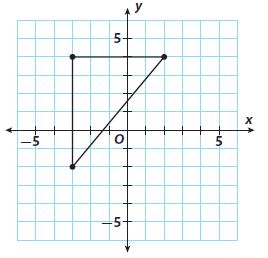
A metal worker traced a triangular piece of sheet metal on a coordinate plane, as shown. The units represent inches. What is the length of the longest side of the metal triangle? Approximate the length to the nearest tenth of an inch using a calculator. Check that your answer is reasonable.
Go Math Grade 8 Answer Key Chapter 12 The Pythagorean Theorem Lesson 3: Distance Between Two Points img 15
_______ in.

Answer: The length of the longest side of the metal triangle to the nearest tenth is 7.8 units.

Explanation: From the above figure let’s take
Length of the vertical leg = 6 units
Length of the horizontal leg = 5 units
let length of the hypotenuse = c
By using Pythagorean Theorem a2 + b= c2
c2 = 62 + 52
c2 = 36 +25
c = √61 => 7.8
Therefore Length of the longest side of the metal triangle to the nearest tenth is 7.8 units.

Question 6.
When a coordinate grid is superimposed on a map of Harrisburg, the high school is located at (17, 21) and the town park is located at (28, 13). If each unit represents 1 mile, how many miles apart are the high school and the town park? Round your answer to the nearest tenth.
_______ miles

Answer: The high school and the town park are 13.6 miles apart.

Explanation: The coordinates of the high school are said to be (17,21), where as the coordinates of the park  are (28,13). In a coordinate plane, the distance d between the points (17,21) and (28,13) is:

d= √( x2 – x1)2 + √( y2 – y1)2
  =  √(28 -17)2 + √(13-21)2
= √(11)2 + √(-8)2
= √(121+64) => √185 = 13.6014

Rounding the answer to the nearest tenth:
d = 13.6.
Taking into consideration that each unit represents 1 mile, the high school and town park are 13.6 miles apart.

Question 7.
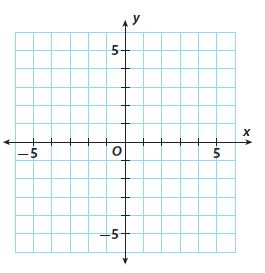
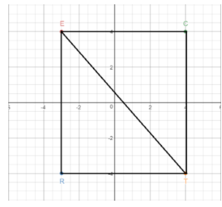
The coordinates of the vertices of a rectangle are given by R(- 3, – 4), E(- 3, 4), C (4, 4), and T (4, – 4). Plot these points on the coordinate plane at the right and connect them to draw the rectangle. Then connect points E and T to form diagonal \(\overline { ET } \).
a. Use the Pythagorean Theorem to find the exact length of \(\overline { ET } \).
Go Math Grade 8 Answer Key Chapter 12 The Pythagorean Theorem Lesson 3: Distance Between Two Points img 16

Answer: The diagonal ET is about 10.63 units long.

Explanation:
Taking into consideration the triangle TRE, the length of the vertical leg (ER) is 8 units. The length of the horizontal leg (RT) is 7 units. Let a = 8 and b =7. Let c represent the length of the hypotenuse, the diagonal ET. We use the Pythagorean Theorem to find c.
a2 + b= c2
c2 = 82 + 72
c2 = 64 +49
c = √113 => 10,63.
The diagonal ET is about 10.63 units long.

Question 7.
b. How can you use the Distance Formula to find the length of \(\overline { ET } \) ? Show that the Distance Formula gives the same answer.

Answer: The diagonal ET is about 10.63 units long. As we can see the answer is the same as the one we found using the Pythagorean Theorem.

Explanation: Using the distance formula, in a coordinate plane, the distance d between the points E(-3,4) and T(4, -4) is:
d= √( x2 – x1)2 + √( y2 – y1)2
  =  √(4 – (-3))2 + √(- 4 – 4)2
= √(7)2 + √(-8)2
= √(49+64) => √113 = 10.63.
The diagonal ET is about 10.63 units long. As we can see the answer is the same as the one we found using the Pythagorean Theorem.

Question 8.
Multistep The locations of three ships are represented on a coordinate grid by the following points: P(- 2, 5), Q(- 7, – 5), and R(2, – 3). Which ships are farthest apart?

Answer: Ships P and Q are farthest apart

Explanation: Distance Formula: In a coordinate plane, the distance d between two points (x1,y1) and (x2,y2) is:
Go Math Grade 8 Answer Key Chapter 12 The Pythagorean Theorem
d= √( x2 – x1)2 + √( y2 – y1)2
The distance d1 between the two points P(-2,5) and Q(-7,-5) is:
d1 = √( xQ – xP)2 + √( yQ – yP)2
= √(-7 – (-2))2 + √(- 5 – 5)2
= √(-5)2 + √(-10)2
= √(25+100) => √125 = 11.18

The distance d2 between the two points Q(-7,-5) and R(2,-3) is:
d3 = √( xR – xQ)2 + √( yR – yQ)2
  = √(2 – (-7))2 + √(- 3 – 5)2
= √(9)2 + √(2)2
= √(81+4) => √85 = 9.22

The distance d3 between the two points P(-2,5) and R(2,-3) is:
d3 = √( xR – xP)2 + √( yR – yP)2
= √(2 – (-2))2 + √(- 3 – 5)2
= √(4)2 + √(-8)2
= √(16+64) => √80 = 8.94.
As we can see, the greatest distance is d1 11.8, which means that ships P and Q are farthest apart.

Distance Between Two Points – Page No. 392

Question 9.
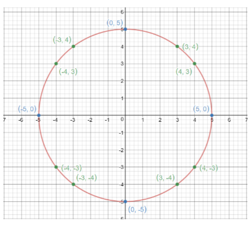
Make a Conjecture Find as many points as you can that are 5 units from the origin. Make a conjecture about the shape formed if all the points 5 units from the origin were connected.

Answer: (0,5), (3,4), (4,3),(5,0),(4,-3),(3,-4),(0,-5),(-3,-4),(-4,-3),(-5,0),(-4,3),(-3,4).

Explanation: Some of the points that are 5 units away from the origin are: (0,5), (3,4), (4,3),(5,0),(4,-3),(3,-4),(0,-5),(-3,-4),(-4,-3),(-5,0),(-4,3),(-3,4) etc, If all the points 5 units away from the origin are connected, a circle would be formed.
Go Math Grade 8 Answer Key Chapter 12 The Pythagorean Theorem

Question 10.
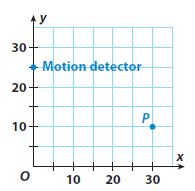
Justify Reasoning The graph shows the location of a motion detector that has a maximum range of 34 feet. A peacock at point P displays its tail feathers. Will the motion detector sense this motion? Explain.
Go Math Grade 8 Answer Key Chapter 12 The Pythagorean Theorem Lesson 3: Distance Between Two Points img 17

Answer: Considering each unit represents 1 foot, the motion detector, and peacock are 33.5 feet apart. Since the motion detector has a maximum range of 34 feet, it means that it will sense the motion of the peacock’s feathers.

Explanation: The coordinates of the motion detector are said to be (0,25), whereas the coordinates of the peacock are (30,10). In a coordinate plane, the distance d between the points (0,25) and (30,10) is:
d = √( x2 – x1)2 + √( y2 – y1)2
= √(30 – 0)2 + √(10 – 25)2
= √(30)2 + √(-15)2
= √(900+225) => √1125.
Rounding answer to the nearest tenth:
d = 33.5 feet.
Considering each unit represents 1 foot, the motion detector and peacock are 33.5 feet apart. Since the motion detector has a maximum range of 34 feet, it means that it will sense the motion of the peacock’s feathers.

FOCUS ON HIGHER ORDER THINKING

Question 11.
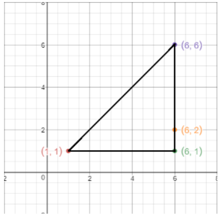
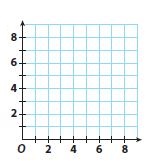
Persevere in Problem Solving One leg of an isosceles right triangle has endpoints (1, 1) and (6, 1). The other leg passes through the point (6, 2). Draw the triangle on the coordinate plane. Then show how you can use the Distance Formula to find the length of the hypotenuse. Round your answer to the nearest tenth.
Go Math Grade 8 Answer Key Chapter 12 The Pythagorean Theorem Lesson 3: Distance Between Two Points img 18

Answer: 7.1 units.

Explanation:

Go Math Grade 8 Answer Key Chapter 12 The Pythagorean Theorem

One leg of an isosceles right triangle has endpoints (1,1) and (6,1), which means that the leg is 5 units long. Since the triangle is isosceles, the other leg should be 5 units long too, therefore the endpoints of the second leg that passes through the point (6,2) are (6,1) and (6,6).
In the coordinate plane, the length of the hypotenuse is the distance d between the points (1,1) and (6,6).
d = √( x2 – x1)2 + √( y2 – y1)2
= √(6 – 1)2 + √(6 – 1)2
= √(5)2 + √(5)2
= √(25+25) => √50.
Rounding answer to nearest tenth:
d = 7.1.
The hypotenuse is around 7.1 units long.

Question 12.
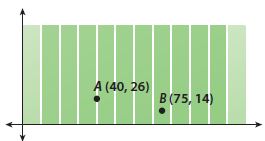
Represent Real-World Problems The figure shows a representation of a football field. The units represent yards. A sports analyst marks the locations of the football from where it was thrown (point A) and where it was caught (point B). Explain how you can use the Pythagorean Theorem to find the distance the ball was thrown. Then find the distance.
Go Math Grade 8 Answer Key Chapter 12 The Pythagorean Theorem Lesson 3: Distance Between Two Points img 19
_______ yards

Answer: The distance between point A and B is 37 yards

Explanation:
Go Math Grade 8 Answer Key Chapter 12 The Pythagorean Theorem
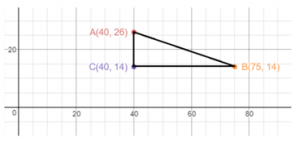
To find the distance between points A and B, we draw segment AB and label its length d. Then we draw vertical segment AC and Horizontal segment CB. We label the lengths of these segments a and b. triangle ACB is a right triangle with hypotenuse AB.
Since AC is vertical segment, its length, a, is the difference between its y-coordinates. Therefore, a = 26 – 14 = 12 units.
Since CB is horizontal segment, its length b is the difference between its x-coordinates. Therefore, b = 75 – 40 = 35units.
We use the Pythagorean Theorem to find d, the length of segment AB.
d2 = a2 + b2
d2 = 122 + 352
d2 = 144 + 1225
d2 = 1369 => d = √1369 => 37
The distance between point A and B is 37 yards

Ready to Go On? – Model Quiz – Page No. 393

12.1 The Pythagorean Theorem

Find the length of the missing side.

Question 1.
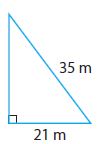
Go Math Grade 8 Answer Key Chapter 12 The Pythagorean Theorem Model Quiz img 20
________ meters

Answer: Length of missing side is 28m

Explanation: Lets consider value of a = 21 and c = 35.
Using Pythagorean Theorem a2 + b= c2
212 + b2 = 352                                            
441 + b2 = 1225
b2= 784 => b = √784 = 28.
Therefore length of missing side is 28m.

Question 2.
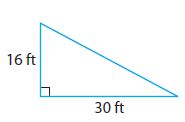
Go Math Grade 8 Answer Key Chapter 12 The Pythagorean Theorem Model Quiz img 21
________ ft

Answer: Length of missing side is 34ft

Explanation: Let’s consider value of a = 16 and b = 30.
Using Pythagorean Theorem a2 + b= c2
162 + 302 = c2                                              
256 + 900 = c2
c2= 1156 => c = √1156 = 34.
Therefore length of missing side is 34ft.

12.2 Converse of the Pythagorean Theorem

Tell whether each triangle with the given side lengths is a right triangle.

Question 3.
11, 60, 61
____________

Answer: Since 112 + 602 = 612, by the converse of the Pythagorean Theorem, we say that the given sides are in the shape of right-angled triangle.

Explanation: Let a = 11, b = 60 and c= 61
Using the converse of the Pythagorean Theorem a2 + b= c2
112 + 602 = 612
121 + 3600 = 3721
3721 = 3721
Since 112 + 602 = 612, by the converse of the Pythagorean Theorem, we say that the given sides are in the shape of right-angled triangle.                      
Question 4.
9, 37, 40
____________

Answer: Since  92 + 372 ≠ 402, by the converse of the Pythagorean Theorem, we say that the given sides are not in the shape of right-angled triangle.

Explanation: Let a = 9, b = 37 and c= 40
Using the converse of the Pythagorean Theorem a2 + b= c2
92 + 372 = 402
81 + 1369 = 1600
1450 ≠ 3721.
Since  92 + 372 ≠ 402, by the converse of the Pythagorean Theorem, we say that the given sides are not in the shape of right-angled triangle.

Question 5.
15, 35, 38
____________

Answer: Since 152 + 352 ≠ 382, by the converse of the Pythagorean Theorem, we say that the given sides are not in the shape of right-angled triangle.

Explanation: Let a = 15, b = 35 and c= 38
Using the converse of the Pythagorean Theorem a2 + b= c2
152 + 352 = 382
225 + 1225 = 1444
1450 ≠ 1444
Since 152 + 352 ≠ 382, by the converse of the Pythagorean Theorem, we say that the given sides are not in the shape of right-angled triangle.                                                                        

Question 6.
28, 45, 53
____________

Answer: Since 282 + 452 = 532, by the converse of the Pythagorean Theorem, we say that the given sides are in the shape of right-angled triangle.

Explanation: Let a = 28, b = 45 and c= 53
Using the converse of the Pythagorean Theorem a2 + b= c2
282 + 452 = 532
784 + 2025 = 2809
2809 = 2809
Since 282 + 452 = 532, by the converse of the Pythagorean Theorem, we say that the given sides are in the shape of right-angled triangle.                                
Question 7.
Keelie has a triangular-shaped card. The lengths of its sides are 4.5 cm, 6 cm, and 7.5 cm. Is the card a right triangle?
____________

Answer: Since 4.52 + 62 = 7.52, by the converse of the Pythagorean Theorem, we say that the given sides are in the shape of right-angled triangle.

Explanation: Let a = 4.5, b = 6 and c= 7.5
Using the converse of the Pythagorean Theorem a2 + b= c2
4.52 + 62 = 7.52
20.25 + 36 = 56.25
56.25= 56.25
Since 4.52 + 62 = 7.52, by the converse of the Pythagorean Theorem, we say that the given sides are in the shape of right-angled triangle.                                                                            

12.3 Distance Between Two Points

Find the distance between the given points. Round to the nearest tenth.
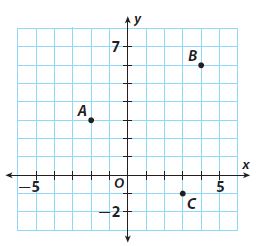
Go Math Grade 8 Answer Key Chapter 12 The Pythagorean Theorem Model Quiz img 22

Question 8.
A and B
________ units

Answer: Distance between A and B is 6.7 units

Explanation: A= (-2,3) and B= (4,6)

Distance between A and B is d = √( x2 – x1)2 + √( y2 – y1)2
= √(4 – (-2)2 + √(6 – 3)2
= √(6)2 + √(3)2
= √(36+9) => √45 = 6.7 units

Question 9.
B and C
________ units

Answer: Distance between B and C is 7.07 units

Explanation: B= (4,6) and C= (3,1)

Distance between B and C is d = √( x2 – x1)2 + √( y2 – y1)2
= √(4 – 3)2 + √(6 – (-1))2
= √(1)2 + √(7)2
= √(1+49) => √50 = 7.07 units

Question 10.
A and C
________ units

Answer: Distance between A and C is 6.403 units

Explanation: A= (-2,3) and C= (3, -1)

Distance between A and C is d = √( x2 – x1)2 + √( y2 – y1)2
= √(3 – (-2)2 + √(-1 – 3)2
= √(5)2 + √(-4)2
= √(25+16) => √41 = 6.403 units

ESSENTIAL QUESTION

Question 11.
How can you use the Pythagorean Theorem to solve real-world problems?

Answer: We can use the Pythagorean Theorem to find the length of a side of a right triangle when we know the lengths of the other two sides. This application is usually used in architecture or other physical construction projects. For example, it can be used to find the length of a ladder, if we know the height of the wall and distance on the ground from the wall of the ladder.

Selected Response – Mixed Review – Page No. 394

Question 1.
What is the missing length of the side?
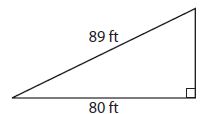
Go Math Grade 8 Answer Key Chapter 12 The Pythagorean Theorem Mixed Review img 23
A. 9 ft
B. 30 ft
C. 39 ft
D. 120 ft

Answer: C

Explanation:
Given a= 80 ft
b= ?
c= 89 ft
As a2+b2=c 2
802+b2= 892
6,400+b2= 7,921
b2= 7,921-6,400
b= √1,521
b= 39 ft.

Question 2.
Which relation does not represent a function?
Options:
A. (0, 8), (3, 8), (1, 6)
B. (4, 2), (6, 1), (8, 9)
C. (1, 20), (2, 23), (9, 26)
D. (0, 3), (2, 3), (2, 0)

Answer: D

Explanation: The value of X is the same for 2 points and 2 values of Y [(2, 3), (2, 0)]. The value of X is repeated for a function to exist, no two points can have the same X coordinates.

Question 3.
Two sides of a right triangle have lengths of 72 cm and 97 cm. The third side is not the hypotenuse. How long is the third side?
Options:
A. 25 cm
B. 45 cm
C. 65 cm
D. 121 cm

Answer: C

Explanation:
Given a= 72 cm
b= ?
c= 97 cm
As a2+b2=c 2
722+b2= 972
5,184+b2= 9,409
b2= 9,409-5,184
b= √4,225
b= 65 cm.

Question 4.
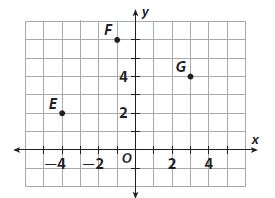
To the nearest tenth, what is the distance between point F and point G?
Go Math Grade 8 Answer Key Chapter 12 The Pythagorean Theorem Mixed Review img 24
Options:
A. 4.5 units
B. 5.0 units
C. 7.3 units
D. 20 units

Answer: A.

Explanation:
Given F= (-1,6) =(x1,y1).
G= (3,4) = (x2,y2).
The difference between F&G points is
d= √(x2-x1)2 + (y2-y1)2
=  √(3 – (-1))2 + (4 – 6)2
 = √(4)2 + (-2)2
= √16+4
= √20
= 4.471
= 4.5 units.

Question 5.
A flagpole is 53 feet tall. A rope is tied to the top of the flagpole and secured to the ground 28 feet from the base of the flagpole. What is the length of the rope?
Options:
A. 25 feet
B. 45 feet
C. 53 feet
D. 60 feet

Answer: D

Explanation:
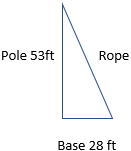
Go Math Grade 8 Answer Key Chapter 12 The Pythagorean Theorem
By Pythagorean theorem
a2+b2=c 2
532+282= C2
2,809+784= C2
C2 = 9,409-5,184
C2 = 3,593
C= √3,593
C= 59.94 feet
=60 feet.

Question 6.
Which set of lengths are not the side lengths of a right triangle?
Options:
A. 36, 77, 85
B. 20, 99, 101
C. 27, 120, 123
D. 24, 33, 42

Answer: D.

Explanation:
Check if side lengths in option A form a right triangle.
Let a= 36, b= 77, c= 85
By Pythagorean theorem
a2+b2=c 2
362+772= 852
1,296+ 5,929= 7,225
7,225= 7,225
As 362+772= 852 the triangle is a right triangle.

Check if side lengths in option B form a right triangle.
Let a= 20, b= 99, c= 101
By Pythagorean theorem
a2+b2=c 2
202+992= 1012
400+ 9,801= 10,201
10,201= 10,201
As 202+992= 1012 the triangle is a right triangle.

Check if side lengths in option B form a right triangle.
Let a= 27, b= 120, c= 123
By Pythagorean theorem
a2+b2=c 2
272+1202= 1232
729+ 14,400= 15,129
15,129= 15,129
As 272+1202= 1232 the triangle is a right triangle.

Check if side lengths in option B form a right triangle.
Let a= 27, b= 120, c= 123
By Pythagorean theorem
a2+b2=c 2
242+332= 422
576+ 1,089= 1,764.
1,665= 1,764
As 242+332 is not equal to 422 the triangle is a right triangle.

Question 7.
A triangle has one right angle. What could the measures of the other two angles be?
Options:
A. 25° and 65°
B. 30° and 15°
C 55° and 125°
D 90° and 100°

Answer: A

Explanation:
The sum of all the angles of a triangle is 180
<A+<B+<C= 180°
<A+<B+ 90°= 180°
<A+<B= 180°-90°
<A+<B= 90, here we will verify with the given options.
25°+65°= 90°
So, the measure of the other two angles are 25° and 65°

Mini-Task

Question 8.
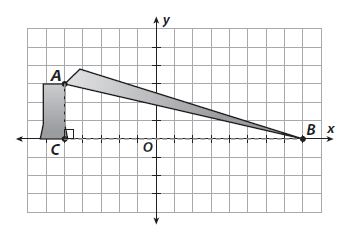
A fallen tree is shown on the coordinate grid below. Each unit represents 1 meter.
Go Math Grade 8 Answer Key Chapter 12 The Pythagorean Theorem Mixed Review img 25
a. What is the distance from A to B?
_______ meters

Answer: 13.34  m.

Explanation:
A= (-5,3)
B= (8,0)
Distance between A & B is
D= √{8-(-5)2 + (0-3)2
= √(13)2 + (-3)2
= √169+9
= √178
= 13.34  m.

Question 8.
b. What was the height of the tree before it fell?
_______ meters

Answer: 16.3 m.

Explanation:
Length of the broken part= 13.3 m
Length of vertical part= 3 m
Total Length = 13.3 m + 3 m
= 16.3 m.

Final Words

In addition to the exercise problems, we have provided the solutions for the review questions. So all the students are requested to test your knowledge and solve the problems provided at the end of this chapter. Refer HMH Go Math Grade 8 Answer Keu and try to score the highest marks in the exams. Hope you liked the explanations provided in this chapter. Stay tuned to get the solutions according to the list of the chapters of all the grades.
Go Math Grade 6 Answer Key Chapter 11 Surface Area and Volume

go-math-grade-6-chapter-11-surface-area-and-volume-answer-key

Go Math solutions for Class 6 Maths Provide detailed explanations for all the questions provided in the HMH Go Math. We provide topic wise Go Math Grade 6 Answer Key Chapter 11 Surface Area and Volume to help the students clear their doubts by offering an understanding of concepts in depth. You can practice different types of questions in Go Math Grade 6 Answer Key Chapter 11 Surface Area and Volume. 

Go Math Grade 6 Answer Key Chapter 11 Surface Area and Volume

Download HMH Go Math Grade 6 Answer Key Chapter 11 Surface Area and Volume and learn offline. With the help of these Go Math 6th Grade Solution Key Chapter 11 Surface Area and Volume, you can score good marks in the exams. The topics include 3-D figures and Nets, Explore Surface Area Using Nets, Surface Area of Prisms, and so on. This will also help to build a strong foundation of all these concepts for secondary level classes.

Lesson 1: Three-Dimensional Figures and Nets

Lesson 2: Investigate • Explore Surface Area Using Nets

Lesson 3: Algebra • Surface Area of Prisms

Lesson 4: Algebra • Surface Area of Pyramids

 Mid-Chapter Checkpoint

Lesson 5: Investigate • Fractions and Volume

Lesson 6: Algebra • Volume of Rectangular Prisms

Lesson 7: Problem Solving • Geometric Measurements

Chapter 11 Review/Test

Share and Show – Page No. 599

Identify and draw a net for the solid figure.

Question 1.
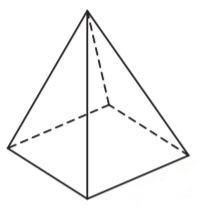
Go Math Grade 6 Answer Key Chapter 11 Surface Area and Volume img 1

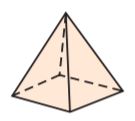
Answer: The base Square or Rectangle, and lateral faces are Triangle and the figure is a Square pyramid or Rectangular pyramid.

Explanation:
Go Math Grade 6 Answer Key Chapter 11 Surface Area and Volume

Question 2.
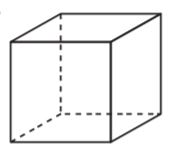
Go Math Grade 6 Answer Key Chapter 11 Surface Area and Volume img 2
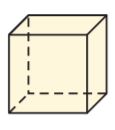
Answer: Cube or Rectangular prism.

Explanation: The base is a square or rectangle and lateral faces are squares are rectangle. The figure is a Cube or Rectangular prism.

Go Math Grade 6 Answer Key Chapter 11 Surface Area and Volume

Identify and sketch the solid figure that could be formed by the net.

Question 3.
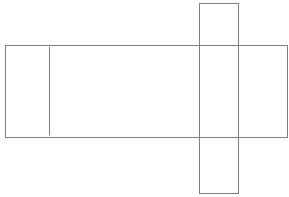
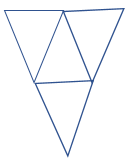
Go Math Grade 6 Answer Key Chapter 11 Surface Area and Volume img 3

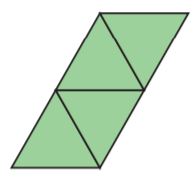
Answer: Triangular pyramid.

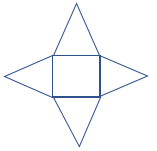
Explanation: The net has four triangles, so it is a triangular pyramid.

Go Math Grade 6 Answer Key Chapter 11 Surface Area and Volume

Question 4.
Go Math Grade 6 Answer Key Chapter 11 Surface Area and Volume img 4
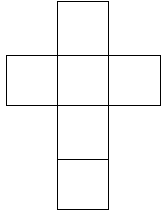
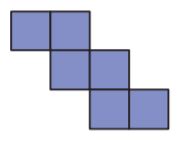
Answer: Cube

Explanation: The net has six squares.
Go Math Grade 6 Answer Key Chapter 11 Surface Area and Volume

On Your Own

Identify and draw a net for the solid figure.

Question 5.
Go Math Grade 6 Answer Key Chapter 11 Surface Area and Volume img 5

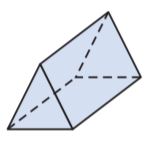
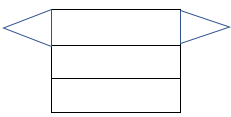
Answer: Triangular prism.

Explanation: The base is a rectangle and the lateral faces are triangle and rectangles, so it is a triangular prism.

Go Math Grade 6 Answer Key Chapter 11 Surface Area and Volume

Question 6.
Go Math Grade 6 Answer Key Chapter 11 Surface Area and Volume img 6

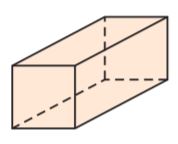
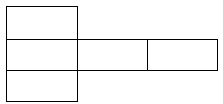
Answer:  Rectangular Prism.

Explanation: The base is a rectangle and the lateral faces are squares and rectangles. And it is a Rectangular prism.

Go Math Grade 6 Answer Key Chapter 11 Surface Area and Volume

Problem Solving + Applications – Page No. 600

Solve.

Question 7.
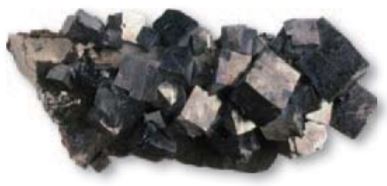
The lateral faces and bases of crystals of the mineral galena are congruent squares. Identify the shape of a galena crystal.
Go Math Grade 6 Answer Key Chapter 11 Surface Area and Volume img 7
Answer: Cube

Explanation: The shape of the galena is Cube.

Go Math Grade 6 Answer Key Chapter 11 Surface Area and Volume

Question 8.
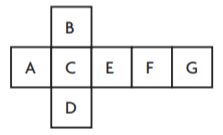
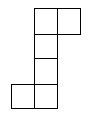
Rhianon draws the net below and labels each square. Can Rhianon fold her net into a cube that has letters A through G on its faces? Explain.
Go Math Grade 6 Answer Key Chapter 11 Surface Area and Volume img 8

Answer: No, she cannot fold her net into a cube. Rhianon’s net has seven squares but there are only six squares in a net of a cube.

Question 9.
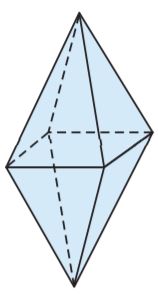
Describe A diamond crystal is shown. Describe the figure in terms of the solid figures you have seen in this lesson.
Go Math Grade 6 Answer Key Chapter 11 Surface Area and Volume img 9

Answer: We can see that Diamond crystal consists of two square pyramids with congruent bases and the pyramids are reversed and placed base to base.

Question 10.
Sasha makes a triangular prism from paper.
The bases are _____.
The lateral faces are _____.

Answer:
The bases are Triangle
The lateral faces are Rectangle

Three-Dimensional Figures and Nets – Page No. 601

Identify and draw a net for the solid figure.

Question 1.
Go Math Grade 6 Answer Key Chapter 11 Surface Area and Volume img 10

Answer: Rectangular Prism

Explanation:
Go Math Grade 6 Answer Key Chapter 11 Surface Area and Volume

Question 2.
Go Math Grade 6 Answer Key Chapter 11 Surface Area and Volume img 11

Answer: Cube, Rectangular prism

Explanation:
Go Math Grade 6 Answer Key Chapter 11 Surface Area and Volume

Question 3.
Go Math Grade 6 Answer Key Chapter 11 Surface Area and Volume img 12

Answer: Square Pyramid

Explanation:
Go Math Grade 6 Answer Key Chapter 11 Surface Area and Volume

Question 4.
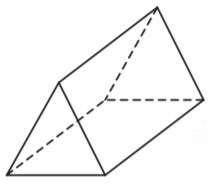
Go Math Grade 6 Answer Key Chapter 11 Surface Area and Volume img 13

Answer: Triangular Prism

Explanation:
Go Math Grade 6 Answer Key Chapter 11 Surface Area and Volume

Problem Solving

Question 5.
Hobie’s Candies are sold in triangular-pyramidshaped boxes. How many triangles are needed to make one box?

Answer: 4

Explanation: As triangled pyramids have four faces.
Go Math Grade 6 Answer Key Chapter 11 Surface Area and Volume

Question 6.
Nina used plastic rectangles to make 6 rectangular prisms. How many rectangles did she use?

Answer: 36

Explanation:
Go Math Grade 6 Answer Key Chapter 11 Surface Area and Volume

Question 7.
Describe how you could draw more than one net to represent the same three-dimensional figure. Give examples.

Answer:

Explanation:

Lesson Check – Page No. 602

Question 1.
How many vertices does a square pyramid have?

Answer: 5

Explanation:
Go Math Grade 6 Answer Key Chapter 11 Surface Area and Volume

Question 2.
Each box of Fred’s Fudge is constructed from 2 triangles and 3 rectangles. What is the shape of each box?

Answer: Triangular Prism

Explanation:
Go Math Grade 6 Answer Key Chapter 11 Surface Area and Volume

Spiral Review

Question 3.
Bryan jogged the same distance each day for 7 days. He ran a total of 22.4 miles. The equation 7d = 22.4 can be used to find the distance d in miles he jogged each day. How far did Bryan jog each day?

Answer: 3.2 miles

Explanation: As given equation 7d= 22.4,
d= 22.4÷7
= 3.2 miles.

Question 4.
A hot-air balloon is at an altitude of 240 feet. The balloon descends 30 feet per minute. What equation gives the altitude y, in feet, of the hot-air balloon after x minutes?

Answer: Y= 240- 30X.

Explanation: Given altitude Y, and the ballon was descended 30 feet per minute. So the equation is Y= 240- 30X.

Question 5.
A regular heptagon has sides measuring 26 mm and is divided into 7 congruent triangles. Each triangle has a height of 27 mm. What is the area of the heptagon?

Answer: 351 mm2

Explanation: Area of heptagon= 1/2 b×h
= 1/2 (26)×(27)
= 13×27
= 351 mm2

Question 6.
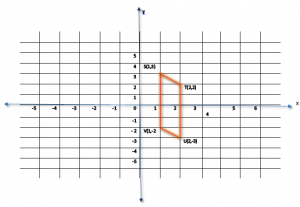
Alexis draws quadrilateral STUV with vertices S(1, 3), T(2, 2), U(2, –3), and V(1, –2). What name best classifies the quadrilateral?

Answer: Parallelogram

Explanation:
Go Math Grade 6 Answer Key Chapter 11 Surface Area and Volume

Share and Show – Page No. 605

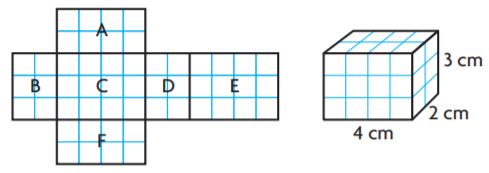
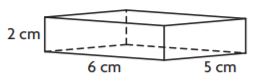
Use the net to find the surface area of the prism.

Question 1.
Go Math Grade 6 Answer Key Chapter 11 Surface Area and Volume img 14

Answer:

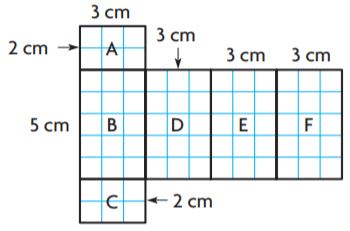
Explanation: First we must find the area of each face
A= 4×3= 12
B= 4×3= 12
C= 5×4= 20
D= 5×4= 20
E= 5×3= 15
F= 5×3= 15
So, the surface area is 12+12+20+20+15+15= 94 cm2

Find the surface area of the rectangular prism.

Question 2.
Go Math Grade 6 Answer Key Chapter 11 Surface Area and Volume img 15

Answer: 222 cm2

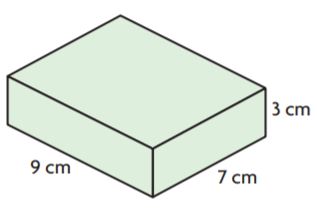
Explanation: Area of a rectangular prism is 2(wl+hl+hw) = 2(7×9+ 3×9+ 3×7)
= 2(63+27+21)
= 2(111)
= 222 cm2

Question 3.
Go Math Grade 6 Answer Key Chapter 11 Surface Area and Volume img 16

Answer:

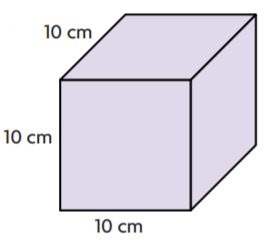
Explanation: Area of a rectangular prism is 2(wl+hl+hw) = 2(10×10+ 10×10+ 10×10)
= 2(100+100+100)
= 2(300)
= 600 cm2

Question 4.
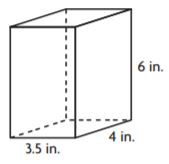
Go Math Grade 6 Answer Key Chapter 11 Surface Area and Volume img 17

Answer: 350 cm2

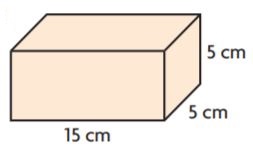
Explanation: Area of a rectangular prism is 2(wl+hl+hw) = 2(15×5+ 5×5+ 15×5)
= 2(75+25+75)
= 2(175)
= 350 cm2

Problem Solving + Applications

Question 5.
A cereal box is shaped like a rectangular prism. The box is 20 cm long by 5 cm wide by 30 cm high. What is the surface area of the cereal box?

Answer: 1700 cm2

Explanation: The length of the box is 20 cm, the wide is 5 cm and the height is 30 cm. So surface area of the cereal box is 2(wl+hl+hw)= 2(20×5+30×20+30×5)
= 2(100+600+150)
= 2(850)
= 1700 cm2

Question 6.
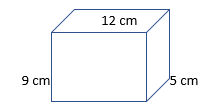
Darren is painting a wooden block as part of his art project. The block is a rectangular prism that is 12 cm long by 9 cm wide by 5 cm high. Describe the rectangles that make up the net for the prism.

Answer:

Go Math Grade 6 Answer Key Chapter 11 Surface Area and Volume

Question 7.
In Exercise 6, what is the surface area, in square meters, that Darren has to paint?

Answer: 416 cm2

Explanation: Surface area = 2(wl+hl+hw)
= 2(9×12+5×12+ 5×9)
= 2(108+60+45)
= 2(213)
= 416 cm2

What’s the Error? – Page No. 606

Question 8.
Emilio is designing the packaging for a new MP3 player. The box for the MP3 player is 5 cm by 3 cm by 2 cm. Emilio needs to find the surface area of the box.
Look at how Emilio solved the problem. Find his error.
STEP 1: Draw a net.
Go Math Grade 6 Answer Key Chapter 11 Surface Area and Volume img 18
STEP 2: Find the areas of all the faces and add them.
Face A: 3 × 2 = 6 cm2.
Face B: 3 × 5 = 15 cm2.
Face C: 3 × 2 = 6 cm2.
Face D: 3 × 5 = 15 cm2.
Face E: 3 × 5 = 15 cm2.
Face F: 3 × 5 = 15 cm2.
The surface area is 6 + 15 + 6 + 15 + 15 + 15 = 72 cm2.
Correct the error. Find the surface area of the prism.

Answer: Emilio drew the net incorrectly Face D and F should have been 2 cm by 5 cm, not 3 cm by 5 cm

Explanation:
Face A: 3×2= 6 cm2
Face B: 3×5= 15 cm2
Face C: 3×2= 6 cm2
Face D: 2×5= 10 cm2
Face E: 3×5= 15 cm2
Face F: 2×5= 10 cm2
So, the surface area of the prism area is 6+15+6+10+15+10= 62 cm2.

Question 9.
For numbers 9a–9d, select True or False for each statement.
Go Math Grade 6 Answer Key Chapter 11 Surface Area and Volume img 19
9a. The area of face A is 10 cm2.
9b. The area of face B is 10 cm2.
9c. The area of face C is 40 cm2.
9d. The surface area of the prism is 66 cm2.

9a. The area of face A is 10 cm2.

Answer: True

Explanation: The area of face A is 2×5= 10 cm2.

9b. The area of face B is 10 cm2.

Answer: False

Explanation: The area of face B is 2×8= 16  cm2.

9c. The area of face C is 40 cm2.

Answer: The area of face C is 8×5= 40 cm2.

9d. The surface area of the prism is 66 cm2.

Answer: 160 cm2.

Explanation: The surface area of the prism is
= 2×10+2×10+2×40
= 20+20+80
= 160 cm2.

Explore Surface Area Using Nets – Page No. 607

Use the net to find the surface area of the rectangular prism.

Question 1.
Go Math Grade 6 Answer Key Chapter 11 Surface Area and Volume img 20
_______ square units

Answer: 52 square units.

Explanation:
The area of face A is 6 squares.
The area of face B is 8 squares.
The area of face C is 6 squares.
The area of face D is 12 squares.
The area of face E is 8 squares.
The area of face F is 12 squares.
The surface area is 6+8+6+12+8+12= 52 square units.

Question 2.
Go Math Grade 6 Answer Key Chapter 11 Surface Area and Volume img 21
_______ square units

Answer: 112 square units.

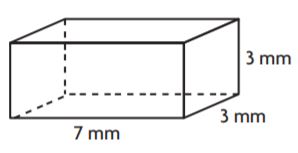
Explanation:
The area of face A is 16 squares.
The area of face B is 8 squares.
The area of face C is 32 squares.
The area of face D is 16 squares.
The area of face E is 32 squares.
The area of face F is 8 squares.
The surface area is 112 square units.

Question 3.
Go Math Grade 6 Answer Key Chapter 11 Surface Area and Volume img 22

Answer: 102 mm2

Explanation: Area= 2(wl+hl+hw)
= 2(3×7+3×7+3×3)
= 2(21+21+9)
= 2(51)
= 102 mm2

Question 4.
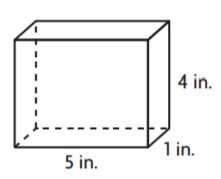
Go Math Grade 6 Answer Key Chapter 11 Surface Area and Volume img 23
_______ in.2

Answer: 58 in.2

Explanation: Area= 2(wl+hl+hw)
= 2(5×1+ 4×1+ 4×5)
= 2(5+4+20)
= 2(29)
= 58 in.2

Question 5.
Go Math Grade 6 Answer Key Chapter 11 Surface Area and Volume img 24
_______ ft2

Answer: 77 ft2

Explanation: Area= 2(wl+hl+hw)
= 2(6.5×2+3×2+3×6.5)
= 2(13+6+19.5)
= 2(38.5)
= 77 ft2

Problem Solving

Question 6.
Jeremiah is covering a cereal box with fabric for a school project. If the box is 6 inches long by 2 inches wide by 14 inches high, how much surface area does Jeremiah have to cover?
_______ in.2

Answer: 248 in.2

Explanation: Surface area of a cereal box is 2(wl+hl+hw)
= 2(2×6+14×6+14×2)
= 2(12+84+28)
= 2(124)
= 248 in.2
Go Math Grade 6 Answer Key Chapter 11 Surface Area and Volume

Question 7.
Tia is making a case for her calculator. It is a rectangular prism that will be 3.5 inches long by 1 inch wide by 10 inches high. How much material (surface area) will she need to make the case?
_______ in.2

Answer: 97 in.2

Explanation: Surface Area= 2(wl+hl+hw)
= 2(1×3.5+ 10×3.5+ 10×1)
= 2(3.5+35+10)
= 2(48.5)
= 97 in.2

Go Math Grade 6 Answer Key Chapter 11 Surface Area and Volume

Question 8.
Explain in your own words how to find the surface area of a rectangular prism.

Answer: To find the surface area we must know the width, length, and height of the prism and then we can apply the formula which is
Surface area= 2(width ×length)+ 2(length×height)+ 2(height×width)
= 2(width ×length+ length×height+ 2(height×width)

Lesson Check – Page No. 608

Question 1.
Gabriela drew a net of a rectangular prism on centimeter grid paper. If the prism is 7 cm long by 10 cm wide by 8 cm high, how many grid squares does the net cover?
_______ cm2

Answer: 412 cm2.

Explanation: Surface area is 2(wl+hl+hw)
= 2(10×7+8×7+8×10)
= 2(70+56+80)
= 2(206)
= 412 cm2.

Question 2.
Ben bought a cell phone that came in a box shaped like a rectangular prism. The box is 5 inches long by 3 inches wide by 2 inches high. What is the surface area of the box?
_______ in.2

Answer: 62 in.2

Explanation: Surface area is 2(wl+hl+hw)
= 2(3×5+2×5+2×3)
= 2(15+10+6)
= 2(31)
= 62 in.2

Spiral Review

Question 3.
Katrin wrote the inequality x + 56 < 533. What is the solution of the inequality?

Answer: X<477.

Explanation: X+56<533
= X<533-56
= X<477.

Question 4.
The table shows the number of mixed CDs y that Jason makes in x hours.
Go Math Grade 6 Answer Key Chapter 11 Surface Area and Volume img 25
Which equation describes the pattern in the table?

Answer: y= 5x

Explanation:
y/x = 10/2= 15/4= 3
y= 5x
The pattern is y is x multipled by 5.

Question 5.
A square measuring 9 inches by 9 inches is cut from a corner of a square measuring 15 inches by 15 inches. What is the area of the L-shaped figure that is formed?
_______ in.2

Answer: 144 in.2

Explanation: The area of a square A= a2, so we will find the area of each square.
Area= 92
= 9×9
= 81 in.2
And the area of another square is
A= 152
= 15×15
= 225 in.2
So the area of L shaped figure is 225-81= 144 in.2

Question 6.
Boxes of Clancy’s Energy Bars are rectangular prisms. How many lateral faces does each box have?

Answer: 4

Explanation: As Lateral faces are not included in the bases, so rectangular prism has 4.

Share and Show – Page No. 611

Use a net to find the surface area.

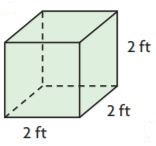
Question 1.
Go Math Grade 6 Answer Key Chapter 11 Surface Area and Volume img 26
_______ ft2

Answer: 24 ft2

Explanation: The area of each face is 2 ft×2 ft= 4 ft and the number of faces is 6, so surface area is 6×4= 24 ft2

Go Math Grade 6 Answer Key Chapter 11 Surface Area and Volume

Question 2.
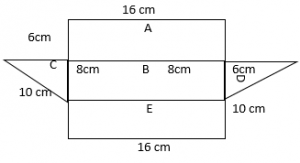
Go Math Grade 6 Answer Key Chapter 11 Surface Area and Volume img 27

Answer: 432 cm2

Explanation:
The area of face A is 16×6= 96 cm2
The area of face B is 16×8= 128 cm2
The area of face C and D is 1/2 × 6×8= 24 cm2
The area of face E is 16×10= 160 cm2
The surface 96+128+2×24+160= 432 cm2

Go Math Grade 6 Answer Key Chapter 11 Surface Area and Volume

Question 3.
Go Math Grade 6 Answer Key Chapter 11 Surface Area and Volume img 28
_______ in.2

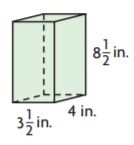
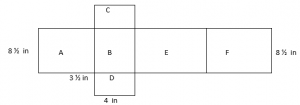
Answer: 155.5 in.2

Explanation:

Go Math Grade 6 Answer Key Chapter 11 Surface Area and Volume
The area of face A and E is  8 ½ × 3½
= 17/2 × 7/2
= 119/4
= 29.75 in.2
The area of face B and F is 8 ½×4
= 17 ½ × 4
= 34 in.2
The area of face C and D is 3 ½×4
7/2 × 4= 14 in.2
The surface area is 2×29.75+2×34+2×14
= 59.5+68+28
= 155.5 in.2

On Your Own

Use a net to find the surface area.

Question 4.
Go Math Grade 6 Answer Key Chapter 11 Surface Area and Volume img 29
_______ m2

Answer:

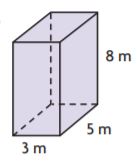
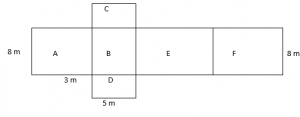
Explanation:
Go Math Grade 6 Answer Key Chapter 11 Surface Area and Volume
The area of face A and E is 8×3= 24 m2
The area of face B and F is 8×5= 40 m2
The area of face C and D is 3×5= 15 m2
The surface area is 2×24+2×40+2×15
= 48+80+30
= 158 m2

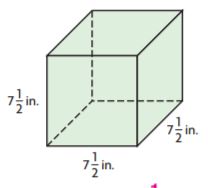
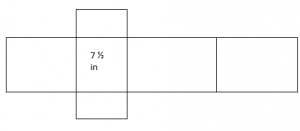
Question 5.
Go Math Grade 6 Answer Key Chapter 11 Surface Area and Volume img 30
_______ \(\frac{□}{□}\) in.2

Answer:

Explanation:

Go Math Grade 6 Answer Key Chapter 11 Surface Area and Volume

The area of each face is 7 1/2 × 7 1/2
= 15/2 × 15/2
= 225/4 in.2
The no.of faces are 6 and the surface area is 6× 225/4
= 675/4
= 337 1/2 in.2

Question 6.
Attend to Precision Calculate the surface area of the cube in Exercise 5 using the formula S = 6s2. Show your work.

Answer: 337 1/2 in.2

Explanation: As S= s2
= 6(7 1/2)2
= 6(15/2)2
= 6(225/4)
= 675/2
= 337 1/2 in.2

Unlock the Problem – Page No. 612

Question 7.
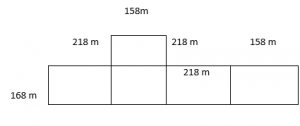
The Vehicle Assembly Building at Kennedy Space Center is a rectangular prism. It is 218 m long, 158 m wide, and 160 m tall. There are four 139 m tall doors in the building, averaging 29 m in width. What is the building’s outside surface area when the doors are open?
a. Draw each face of the building, not including the floor.

Answer:

Go Math Grade 6 Answer Key Chapter 11 Surface Area and Volume

Question 7.
b. What are the dimensions of the 4 walls?

Answer: The 2 walls measure 218 m ×160 m and 2 walls measure by 158 m×160 m.

Question 7.
c. What are the dimensions of the roof?

Answer: The dimensions of the roof are 218 m×158 m.

Question 7.
d. Find the building’s surface area (not including the floor) when the doors are closed.
_______ m2

Answer: 1,54,764 m2

Explanation:
The area of two walls is 218×160= 34,880 m2
The area of the other two walls is 158×160= 25,280 m2
The area of the roof 158×218= 34,444 m2
The surface area is 2× 34,880+ 2× 25,280+ 34,444
= 69,760+ 50,560+ 34,444
= 1,54,764 m2

Question 7.
e. Find the area of the four doors.
_______ m2

Answer: 16,124 m2

Explanation: Area of a door is 139×29 = 4031 m2
And the area of 4 doors is 4×4031= 16,124 m2

Question 7.
f. Find the building’s surface area (not including the floor) when the doors are open.
_______ m2

Answer: 1,38,640 m2

Explanation: The building’s surface area (not including the floor) when the doors are open is
1,54,764 – 16,124= 1,38,640 m2

Question 8.
A rectangular prism is 1 \(\frac{1}{2}\) ft long, \(\frac{2}{3}\) ft wide, and \(\frac{5}{6}\) ft high. What is the surface area of the prism in square inches?
_______ in.2

Answer: 808 in.2

Explanation: The area of two faces is 1 1/2× 5/6
= 3/2 × 5/6
= 5/4 cm2
The area of two faces is 2/3 × 5/6
= 5/9 ft2
The area of two faces is 1 1/2× 2/3
= 3/2 × 2/3
= 1 ft2
The surface area of the prism is 2(wl+hl+hw)
= 2(5/4 + 5/9 + 1)
= 2( 1.25+0.55+1)
= 2.5+1.1+2
= 5.61 ft2
As 1 square foot = 144 square inches
so 5.61×144 = 807.84
= 808 in.2

Question 9.
A gift box is a rectangular prism. The box measures 8 inches by 10 inches by 3 inches. What is its surface area?
_______ in.2

Answer: 268 in.2

Explanation:
The area of face A and Face E is 8×10= 80 in.2
The area of face B and Face F is 8×3= 24 in.2
The area of face C and Face D is 10×3= 30 in.2
The surface area is 2×80+2×24+2×30
= 160+48+60
= 268 in.2

Surface Area of Prisms – Page No. 613

Use a net to find the surface area.

Question 1.
Go Math Grade 6 Answer Key Chapter 11 Surface Area and Volume img 31
_______ cm2

Answer: 104 cm2

Explanation: Surface area= 2(wl+hl+hw)
= 2(6×5+2×5+2×6)
= 2(30+10+12)
= 2(52)
= 104 cm2

Question 2.
Go Math Grade 6 Answer Key Chapter 11 Surface Area and Volume img 32
_______ in.2

Answer: 118 in.2

Explanation: Surface area= 2(wl+hl+hw)
= 2(3.5×4+6×4+6×3.5)
= 2(59)
= 118 in.2

Question 3.
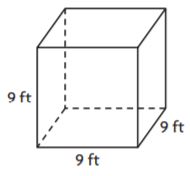
Go Math Grade 6 Answer Key Chapter 11 Surface Area and Volume img 33
_______ ft2

Answer: 486 ft2

Explanation: Surface area= 2(wl+hl+hw)
= 2(9×9+9×9+9×9)
= 2(81+81+81)
= 2(243)
= 486 ft2

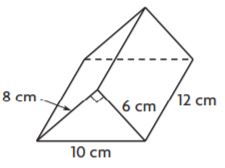
Question 4.
Go Math Grade 6 Answer Key Chapter 11 Surface Area and Volume img 34
_______ cm2

Answer: 336 cm2.

Explanation: Area = 1/2 bh
= 1/2 (6)(8)
= 3×8
= 24.
As there are 2 triangles, so 2×24= 48.
Surface Area= (wl+hl+hw)
= (6×12+8×12+12×10)
= 228
Total Surface area = 228+48
= 336 cm2

Problem Solving

Question 5.
A shoe box measures 15 in. by 7 in. by 4 \(\frac{1}{2}\) in. What is the surface area of the box?
_______ in.2

Answer: 408 in.2

Explanation:
The area of two faces is 15×7= 105 in.2
The area of two faces is 15× 4 1/2
= 15 × 9/2
= 15 × 4.5
= 67.5 in.2
The area of two faces is 7× 4 1/2
= 7× 9/2
= 7× 4.5
= 31.5 in.2
The surface area is 2×10⁵+ 2×67.5+ 2×31.5
= 210+ 135+ 63
= 408 in.2

Question 6.
Vivian is working with a styrofoam cube for art class. The length of one side is 5 inches. How much surface area does Vivian have to work with?
_______ in.2

Answer: 150 in.2

Explanation:
The area of each face is 5×5= 25 in.2
The number of faces that styrofoam cube has is 6
So the surface area is 6×25= 150 in.2

Question 7.
Explain why a two-dimensional net is useful for finding the surface area of a three-dimensional figure.

Answer: Two-dimensional net is useful because by using a two-dimensional net you can calculate the surface area of each face and add them up to find the surface area of the three-dimensional figure.

Lesson Check – Page No. 614

Question 1.
What is the surface area of a cubic box that contains a baseball that has a diameter of 3 inches?
_______ in.2

Answer: 54 in.2

Explanation:
The area of each face is 3×3= 9 in.2
The number of faces for a cubic box is 6 in.2
The surface area of box that contains a baseball is 6×9= 54 in.2

Question 2.
A piece of wood used for construction is 2 inches by 4 inches by 24 inches. What is the surface area of the wood?
_______ in.2

Answer: 304 in.2

Explanation:
The area of two faces is 4×2= 8 in.2
The area of two faces is 2×24= 48 in.2
The area of two faces is 24×4= 96 in.2
So the surface area is 2×8+ 2×48+ 2×96
= 16+96+192
= 304 in.2

Spiral Review

Question 3.
Detergent costs $4 per box. Kendra graphs the equation that gives the cost y of buying x boxes of detergent. What is the equation?

Answer: Y= 4X.

Explanation: The total price Y and the price is equal to 4 × X, and X is the number of boxes that Kendra buys. So the equation is Y=4X.

Question 4.
A trapezoid with bases that measure 8 inches and 11 inches has a height of 3 inches. What is the area of the trapezoid?
_______ in.2

Answer: 28.5 in.2

Explanation:
Area of a trapezoid is 1/2(b1+b2)h
= 1/2(8+11)3
= 1/2(19)3
= 1/2 (57)
= 28.5 in.2

Question 5.
City Park is a right triangle with a base of 40 yd and a height of 25 yd. On a map, the park has a base of 40 in. and a height of 25 in. What is the ratio of the area of the triangle on the map to the area of City Park?

Answer: 1296:1.

Explanation:
Area= 1/2 bh
= 1/2 (40)(25)
= (20)(25)
= 500 yd2
So area of city park is 500 yd2
Area= 1/2 bh
= 1/2 (40)(25)
= (20)(25)
= 500 in2
So area on the map is 500 in
as 1 yd2= 1296 in2
So 500 in2 = 500×1296
= 648,000
So, the ratio of the area of the triangle on the map to the area of City Park is 648,000:500
= 1296:1.

Question 6.
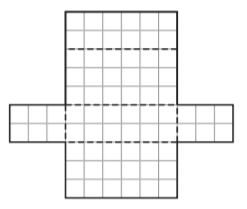
What is the surface area of the prism shown by the net?
Go Math Grade 6 Answer Key Chapter 11 Surface Area and Volume img 35
Answer: 72 square units.

Explanation:
The area of two faces is 18 squares
The area of two faces is 6 squares
The area of two faces is 12 squares
So the surface area is 2×18+ 2×6+ 2×12
= 72 square units.

Share and Show – Page No. 617

Question 1.
Use a net to find the surface area of the square pyramid.
Go Math Grade 6 Answer Key Chapter 11 Surface Area and Volume img 36
_______ cm2

Answer: 105 cm2

Explanation:

Go Math Grade 6 Answer Key Chapter 11 Surface Area and Volume
Area of the base 5×5= 25 ,
and area of one face is 1/2 × 5 × 8
= 5× 4
= 20 cm2
The surface area of a pyramid is 25+ 4×20
= 25+80
= 105 cm2

Question 2.
A triangular pyramid has a base with an area of 43 cm2 and lateral faces with bases of 10 cm and heights of 8.6 cm. What is the surface area of the pyramid?
_______ cm2

Answer: 172 cm2

Explanation:
The area of one face is 1/2×10×8.6
= 5×8.6
= 43 cm2
The surface area of the pyramid is 43+3×43
= 43+ 129
= 172 cm2

Question 3.
A square pyramid has a base with a side length of 3 ft and lateral faces with heights of 2 ft. What is the lateral area of the pyramid?
_______ ft2

Answer: 12 ft2

Explanation:
The area of one face is 1/2×3×2= 3 ft2
The lateral area of the pyramid is 4×3= 12 ft2

On Your Own

Use a net to find the surface area of the square pyramid.

Question 4.
Go Math Grade 6 Answer Key Chapter 11 Surface Area and Volume img 37
_______ ft2

Answer: 208 ft2

Explanation:
Go Math Grade 6 Answer Key Chapter 11 Surface Area and Volume
The area of the base is 8×8= 64
The area of one face is 1/2 ×8×9
= 36 ft2
The surface area of the pyramid is 64+4×36
= 64+144
= 208 ft2

Question 5.
Go Math Grade 6 Answer Key Chapter 11 Surface Area and Volume img 38
_______ cm2

Answer: 220 cm2

Explanation:

Go Math Grade 6 Answer Key Chapter 11 Surface Area and Volume
The area of base is 10×10= 100
The area of one place is 1/2×10×6
= 10×3
= 30
The surface area of the pyramid is 100+4×30
= 100+120
= 220 cm2

Question 6.
Go Math Grade 6 Answer Key Chapter 11 Surface Area and Volume img 39
_______ in.2

Answer: 264 in.2

Explanation:

Go Math Grade 6 Answer Key Chapter 11 Surface Area and Volume
The area of the base is 8×8= 64
The area of one face is 1/2×8×12.5
= 4×12.5
= 50 in.2
The surface area of the pyramid is 64+ 4×50
= 64+200
= 264 in.2

Question 7.
The Pyramid Arena is located in Memphis, Tennessee. It is in the shape of a square pyramid, and the lateral faces are made almost completely of glass. The base has a side length of about 600 ft and the lateral faces have a height of about 440 ft. What is the total area of the glass in the Pyramid Arena?
_______ ft2

Answer: 5,28,000 ft2

Explanation:
The area of one face is 1/2×600×440= 1,32,000 ft2
The surface of tha lateral faces is 4× 1,32,000= 5,28,000 ft2
So, the total area of the glass in the arena is 5,28,000 ft2

Problem Solving + Applications – Page No. 618

Use the table for 8–9.
Go Math Grade 6 Answer Key Chapter 11 Surface Area and Volume img 40

Question 8.
The Great Pyramids are located near Cairo, Egypt. They are all square pyramids, and their dimensions are shown in the table. What is the lateral area of the Pyramid of Cheops?
_______ m2

Answer: 82,800 m2

Explanation:
The area of one face is 1/2×230×180
= 230×90
= 20,700 m2
The lateral area of the pyramid of Cheops is 4×20,700= 82,800 m2

Question 9.
What is the difference between the surface areas of the Pyramid of Khafre and the Pyramid of Menkaure?
_______ m2

Answer: 93,338 m2

Explanation:
The area of the base is 215×215= 46,225
The area of one face is 1/2×215×174
= 215× 87
18,705 m2
The surface area of Pyramid Khafre is= 46,225+4×18,705
= 46,225+ 74820
= 121,045 m2
The area of the base 103×103= 10,609
The area of one face is 1/2×103×83
= 8549÷2
= 4274.4 m2
The surface area of the Pyramid of Menkaure is 10,609+4×4274.5
= 10,609+ 17,098
= 27,707 m2

The difference between the surface areas of the Pyramid of Khafre and the Pyramid of Menkaure
= 121,405-27,707
= 93,338 m2

Question 10.
Write an expression for the surface area of the square pyramid shown.
Go Math Grade 6 Answer Key Chapter 11 Surface Area and Volume img 41

Answer: 6x+9 ft2.

Explanation: The expression for the surface area of the square pyramid is 6x+9 ft2.

Question 11.
Make Arguments A square pyramid has a base with a side length of 4 cm and triangular faces with a height of 7 cm. Esther calculated the surface area as (4 × 4) + 4(4 × 7) = 128 cm2. Explain Esther’s error and find the correct surface area

Answer: 72 cm2.

Explanation: Esther didn’t apply the formula correctly, she forgot to include 1/2 in the calculated surface area.
The correct surface area is (4×4)+4(1/2 ×4×7)
= 16+4(14)
= 16+56
= 72 cm2.

Question 12.
Jose says the lateral area of the square pyramid is 260 in.2. Do you agree or disagree with Jose? Use numbers and words to support your answer.
Go Math Grade 6 Answer Key Chapter 11 Surface Area and Volume img 42

Answer: 160 in.2

Explanation: No, I disagree with Jose as he found surface area instead of the lateral area, so the lateral area is
4×1/2×10×8
= 2×10×8
= 160 in.2

Surface Area of Pyramids – Page No. 619

Use a net to find the surface area of the square pyramid.

Question 1.
Go Math Grade 6 Answer Key Chapter 11 Surface Area and Volume img 43
_______ mm2

Answer: 95 mm2

Explanation:

Go Math Grade 6 Answer Key Chapter 11 Surface Area and Volume
The area of the base is 5×5= 25 mm2
The area of one face is 1/2×5×7
= 35/2
= 17.5 mm2
The surface area is 25+4×17.5
= 25+4×17.5
= 25+70
= 95 mm2

Question 2.
Go Math Grade 6 Answer Key Chapter 11 Surface Area and Volume img 44
_______ cm2

Answer: 612 cm2

Explanation:
Go Math Grade 6 Answer Key Chapter 11 Surface Area and Volume

The area of the base is 18×18= 324 cm2
The area of one face is 1/2×18×8
= 18×4
=  72 cm2
The surface area is 324+4×72
= 25+4×17.5
= 25+70
= 612 cm2

Question 3.
Go Math Grade 6 Answer Key Chapter 11 Surface Area and Volume img 45
_______ yd2

Answer: 51.25 yd2

Explanation:
Go Math Grade 6 Answer Key Chapter 11 Surface Area and Volume

The area of the base is 2.5×2.5= 6.25  mm2
The area of one face is 1/2×2.5×9
= 22.5/2
= 11.25 yd2
The surface area is 25+4×17.5
= 6.25+4×11.25
= 6.25+45
= 51.25 yd2

Question 4.
Go Math Grade 6 Answer Key Chapter 11 Surface Area and Volume img 46
_______ in.2

Answer: 180 in2

Explanation:

Go Math Grade 6 Answer Key Chapter 11 Surface Area and Volume

The area of the base is 10×10= 100 in2
The area of one face is 1/2×4×10
= 2×10
= 20 in2
The surface area is 100+4×20
= 100+4×20
= 100+80
= 180 in2

Problem Solving

Question 5.
Cho is building a sandcastle in the shape of a triangular pyramid. The area of the base is 7 square feet. Each side of the base has a length of 4 feet and the height of each face is 2 feet. What is the surface area of the pyramid?
_______ ft2

Answer: 19 ft2

Explanation:
The area of one face is 1/2×4×2= 4 ft2
The surface area of the triangular pyramid is 7+3×4
= 7+12
= 19 ft2

Question 6.
The top of a skyscraper is shaped like a square pyramid. Each side of the base has a length of 60 meters and the height of each triangle is 20 meters. What is the lateral area of the pyramid?
_______ m2

Answer: 2400 m2

Explanation:
The area of the one face is 1/2×60×20
= 600 m2
The lateral area of the pyramid is 4×600= 2400 m2

Question 7.
Write and solve a problem finding the lateral area of an object shaped like a square pyramid.

Answer: Mary has a triangular pyramid with a base of 10cm and a height of 15cm. What is the lateral area of the pyramid?

Explanation:
The area of one face is 1/2×10×15
= 5×15
= 75 cm2
The lateral area of the triangular pyramid is 3×75
= 225 cm2

Lesson Check – Page No. 620

Question 1.
A square pyramid has a base with a side length of 12 in. Each face has a height of 7 in. What is the surface area of the pyramid?
_______ in.2

Answer: 312 in.2

Explanation:
The area of the base is 12×12= 144 in.2
The area of one face is 1/2×12×7
= 6×7
= 42 in.2
The surface area of the square pyramid is 144+4×42
= 144+ 168
= 312 in.2

Question 2.
The faces of a triangular pyramid have a base of 5 cm and a height of 11 cm. What is the lateral area of the pyramid?
_______ cm2

Answer: 82.5 cm2

Explanation:
The area of one face is 1/2×5×11
= 55/2
= 27.5 cm2
The lateral area of the triangular pyramid is 3×27.5= 82.5 cm2

Spiral Review

Question 3.
What is the linear equation represented by the graph?
Go Math Grade 6 Answer Key Chapter 11 Surface Area and Volume img 47

Answer: y=x+1.

Explanation: As the figure represents that every y value is 1 more than the corresponding x value, so the linear equation is y=x+1.

Question 4.
A regular octagon has sides measuring about 4 cm. If the octagon is divided into 8 congruent triangles, each has a height of 5 cm. What is the area of the octagon?
_______ cm2

Answer:

Explanation:
Area is 1/2bh
= 1/2× 4×5
= 2×5
= 10 cm2
So the area of each triangle is 10 cm2
and the area of the octagon is 8×10= 80 cm2

Question 5.
Carly draws quadrilateral JKLM with vertices J(−3, 3), K(3, 3), L(2, −1), and M(−2, −1). What is the best way to classify the quadrilateral?

Answer: It is a Trapezoid.

Explanation: It is a Trapezoid.
Go Math Grade 6 Answer Key Chapter 11 Surface Area and Volume

Question 6.
A rectangular prism has the dimensions 8 feet by 3 feet by 5 feet. What is the surface area of the prism?
_______ ft2

Answer: 158 ft2

Explanation:
The area of the two faces of the rectangular prism is 8×3= 24 ft2
The area of the two faces of the rectangular prism is 8×5= 40 ft2
The area of the two faces of the rectangular prism is 3×5= 15 ft2
The surface area of the rectangular prism is 2×24+2×40+2×15
= 48+80+30
= 158 ft2

Mid-Chapter Checkpoint – Vocabulary – Page No. 621

Choose the best term from the box to complete the sentence.
Go Math Grade 6 Answer Key Chapter 11 Surface Area and Volume img 48

Question 1.
_____ is the sum of the areas of all the faces, or surfaces, of a solid figure.

Answer: Surface area is the sum of the areas of all the faces, or surfaces, of a solid figure.

Question 2.
A three-dimensional figure having length, width, and height is called a(n) _____.

Answer: A three-dimensional figure having length, width, and height is called a(n) solid figure.

Question 3.
The _____ of a solid figure is the sum of the areas of its lateral faces.

Answer: The lateral area of a solid figure is the sum of the areas of its lateral faces.

Concepts and Skills

Question 4.
Identify and draw a net for the solid figure.
Go Math Grade 6 Answer Key Chapter 11 Surface Area and Volume img 49

Answer: Triangular prism

Explanation:

Go Math Grade 6 Answer Key Chapter 11 Surface Area and Volume

Question 5.
Use a net to find the lateral area of the square pyramid.
Go Math Grade 6 Answer Key Chapter 11 Surface Area and Volume img 50
_______ in.2

Answer: 216 in.2

Explanation:

Go Math Grade 6 Answer Key Chapter 11 Surface Area and Volume
The area of one face is 1/2×9×12
= 9×6
= 54 in.2
The lateral area of the square pyramid is 4×54= 216 in.2

Question 6.
Use a net to find the surface area of the prism.
Go Math Grade 6 Answer Key Chapter 11 Surface Area and Volume img 51
_______ cm2

Answer: 310 cm2

Explanation:

Go Math Grade 6 Answer Key Chapter 11 Surface Area and Volume
The area of face A and E is 10×5= 50 cm2
The area of face B and F is 10×7= 70 cm2
The area of face C and D is 7×5= 35 cm2
The surface area of the prism is 2×50+2×70+2×35
= 100+140+70
= 310 cm2

Page No. 622

Question 7.
A machine cuts nets from flat pieces of cardboard. The nets can be folded into triangular pyramids used as pieces in a board game. What shapes appear in the net? How many of each shape are there?

Answer: 4 triangles.

Explanation: There are 4 triangles.

Go Math Grade 6 Answer Key Chapter 11 Surface Area and Volume

Question 8.
Fran’s filing cabinet is 6 feet tall, 1 \(\frac{1}{3}\) feet wide, and 3 feet deep. She plans to paint all sides except the bottom of the cabinet. Find the area of the sides she intends to paint.
_______ ft2

Answer: 56 ft2

Explanation:
The two lateral face area is 6×1 1/3
= 6× 4/3
= 2×4
= 8 ft2
The area of the other two lateral faces is 6×3= 18
The area of the top and bottom is 3× 1 1/3
= 3× 4/3
= 4 ft2
The area of the sides she intends to paint is 2×8+2×18+4
= 16+36+4
= 56 ft2

Question 9.
A triangular pyramid has lateral faces with bases of 6 meters and heights of 9 meters. The area of the base of the pyramid is 15.6 square meters. What is the surface area of the pyramid?

Answer: 96.6 m2

Explanation:
The area of one face is 1/2× 6× 9
= 3×9
= 27 m2
The surface area of the triangular pyramid is 15.6+3×27
= 15.6+ 81
= 96.6 m2

Question 10.
What is the surface area of a storage box that measures 15 centimeters by 12 centimeters by 10 centimeters?
_______ cm2

Answer: 900 cm2

Explanation:
The area of two faces is 15×12= 180 cm2
The area of another two faces is 15×10= 150 cm2
The area of the other two faces is 10×12= 120 cm2
So surface area of the storage box is 2×180+2×150+2×120 cm2
= 360+300+240
= 900 cm2

Question 11.
A small refrigerator is a cube with a side length of 16 inches. Use the formula S = 6s2 to find the surface area of the cube.
_______ in.2

Answer: 1,536 in.2

Explanation:
Area = s2
= 6×(16)2
= 6× 256
= 1,536 in.2

Share and Show – Page No. 625

Question 1.
A prism is filled with 38 cubes with a side length of \(\frac{1}{2}\) unit. What is the volume of the prism in cubic units?
_______ \(\frac{□}{□}\) cubic units

Answer: 4.75 cubic units

Explanation:
The volume of the cube is S3
The volume of a cube with S= (1/2)3
= 1/2×1/2×1/2
= 1/8
= 0.125 cubic units
As there are 38 cubes so 38×0.125= 4.75 cubic units.

Question 2.
A prism is filled with 58 cubes with a side length of \(\frac{1}{2}\) unit. What is the volume of the prism in cubic units?
_______ \(\frac{□}{□}\) cubic units

Answer: 7.25 cubic units.

Explanation:
The volume of the cube is S3
The volume of a cube with S= (1/2)3
= 1/2×1/2×1/2
= 1/8
= 0.125 cubic units
As there are 58 cubes so 58×0.125= 7.25 cubic units.

Find the volume of the rectangular prism.

Question 3.
Go Math Grade 6 Answer Key Chapter 11 Surface Area and Volume img 52
_______ cubic units

Answer: 33 cubic units.

Explanation:
The volume of the rectangular prism is= Width×Height×Length
= 5 1/2 ×3×2
= 11/2 ×3×2
= 33 cubic units.

Question 4.
Go Math Grade 6 Answer Key Chapter 11 Surface Area and Volume img 53
_______ \(\frac{□}{□}\) cubic units

Answer: 91 1/8 cubic units.

Explanation:
The volume of the rectangular prism is= Width×Height×Length
= 4 1/2 ×4 1/2×4 1/2
= 9/2 ×9/2×9/2
= 729/8
= 91 1/8 cubic units.

Question 5.
Theodore wants to put three flowering plants in his window box. The window box is shaped like a rectangular prism that is 30.5 in. long, 6 in. wide, and 6 in. deep. The three plants need a total of 1,200 in.3 of potting soil to grow well. Is the box large enough? Explain.

Answer: No, the box is not large enough as the three plants need a total of 1,200 in.3 and here volume is 1,098 in.3

Explanation:
Volume= Width×Height×Length
= 30.5×6×6
= 1,098 in.3

Question 6.
Explain how use the formula V = l × w × h to verify that a cube with a side length of \(\frac{1}{2}\) unit has a volume of \(\frac{1}{8}\) of a cubic unit.

Answer: 1/8 cubic units

Explanation:
As length, width and height is 1/2′ so
Volume = Width×Height×Length
= 1/2 × 1/2 × 1/2
= 1/8 cubic units

Problem Solving + Applications – Page No. 626

Use the diagram for 7–10.
Go Math Grade 6 Answer Key Chapter 11 Surface Area and Volume img 54

Question 7.
Karyn is using a set of building blocks shaped like rectangular prisms to make a model. The three types of blocks she has are shown at right. What is the volume of an A block? (Do not include the pegs on top.)
\(\frac{□}{□}\) cubic units

Answer: 1/2 cubic units

Explanation: Volume = Width×Height×Length
= 1× 1/2 ×1
= 1/2 cubic units

Question 8.
How many A blocks would you need to take up the same amount of space as a C block?
_______ A blocks

Answer: No of blocks required to take up the same amount of space as a C block is 4 A blocks.

Explanation: Volume = Width×Height×Length
= 1×2×1
= 2 cubic unit
No of blocks required to take up the same amount of space as a C block is 1/2 ÷2
= 2×2
= 4 A blocks

Question 9.
Karyn puts a B block, two C blocks, and three A blocks together. What is the total volume of these blocks?
_______ \(\frac{□}{□}\) cubic units

Answer: 6 1/2 cubic units

Explanation: The volume of A block is
Volume = Width×Height×Length
= 1×1 ×1/2
= 1/2 cubic units.
As Karyn puts three A blocks together, so 3× 1/2= 3/2 cubic units.
The volume of B block is
Volume = Width×Height×Length
= 1×1 × 1
= 1 cubic units.
As Karyn puts only one B, so 1 cubic unit.
The volume of C block is
Volume = Width×Height×Length
= 2×1×1
= 2 cubic units.
As Karyn puts two C blocks together, so 2× 2= 4 cubic units.
So, the total volume of these blocks is 3/2 + 1+ 4
= 3/2+5
= 13/2
= 6 1/2 cubic units

Question 10.
Karyn uses the blocks to make a prism that is 2 units long, 3 units wide, and 1 \(\frac{1}{2}\) units high. The prism is made of two C blocks, two B blocks, and some A blocks. What is the total volume of A blocks used?
_______ cubic units

Answer: 3 cubic units.

Explanation:
Volume = Width×Height×Length
= 2×3×1 1/2
= 2×3× 3/2
= 9 cubic units.
The total volume of A block used is 9-(2×2)-(2×1)
= 9- 4- 2
= 9-6
= 3 cubic units.

Question 11.
Verify the Reasoning of Others Jo says that you can use V = l × w × h or V = h × w × l to find the volume of a rectangular prism. Does Jo’s statement make sense? Explain.

Answer: Yes

Explanation: Yes, Jo’s statement makes sense because by the commutative property we can change the order of the variables of length, width, height and both will produce the same result.

Question 12.
A box measures 5 units by 3 units by 2 \(\frac{1}{2}\) units. For numbers 12a–12b, select True or False for the statement.
12a. The greatest number of cubes with a side length of \(\frac{1}{2}\) unit that can be packed inside the box is 300.
12b. The volume of the box is 37 \(\frac{1}{2}\) cubic units.
12a. __________
12b. __________

Answer:
12a True.
12b True.

Explanation: The volume of the cube is S3
The volume of a cube with S= (1/2)3
= 1/2×1/2×1/2
= 1/8 cubic units
As there are 300 cubes so 300× 1/8= 75/2
= 37 1/2 cubic units.

Fractions and Volume – Page No. 627

Find the volume of the rectangular prism.

Question 1.
Go Math Grade 6 Answer Key Chapter 11 Surface Area and Volume img 55
_______ \(\frac{□}{□}\) cubic units

Answer: 6 3/4 cubic units

Explanation: Volume = Width×Height×Length
= 3× 1 1/2× 1 1/2
= 3× 3/2 × 3/2
= 27/4
= 6 3/4 cubic units

Question 2.
Go Math Grade 6 Answer Key Chapter 11 Surface Area and Volume img 56
_______ \(\frac{□}{□}\) cubic units

Answer: 22 1/2 cubic units

Explanation: Volume = Width×Height×Length
= 5×1× 4 1/2
= 5× 9/2
= 45/2
= 22 1/2 cubic units

Question 3.
Go Math Grade 6 Answer Key Chapter 11 Surface Area and Volume img 57
_______ \(\frac{□}{□}\) cubic units

Answer: 16 1/2 cubic units.

Explanation: Volume = Width×Height×Length
= 5 1/2× 1 1/2× 2
= 11/2×3/2×2
= 33/2
= 16 1/2 cubic units.

Question 4.
Go Math Grade 6 Answer Key Chapter 11 Surface Area and Volume img 58
_______ \(\frac{□}{□}\) cubic units

Answer: 28 1/8 cubic units.

Explanation: Volume = Width×Height×Length
= 2 1/2× 2 1/2 × 4 1/2
= 5/2 × 5/2 × 9/2
= 225/8
= 28 1/8 cubic units.

Problem Solving

Question 5.
Miguel is pouring liquid into a container that is 4 \(\frac{1}{2}\) inches long by 3 \(\frac{1}{2}\) inches wide by 2 inches high. How many cubic inches of liquid will fit in the container?
_______ \(\frac{□}{□}\) in.3

Answer: 31 1/2 cubic units

Explanation: Volume = Width×Height×Length
= 4 1/2 × 3 1/2 ×2
= 9/2 × 7/2 × 2
= 63/2
= 31 1/2 cubic units

Question 6.
A shipping crate is shaped like a rectangular prism. It is 5 \(\frac{1}{2}\) feet long by 3 feet wide by 3 feet high. What is the volume of the crate?
_______ \(\frac{□}{□}\) ft3

Answer: 49 1/2 ft3

Explanation: Volume = Width×Height×Length
= 5 1/2 × 3 × 3
= 11/2 ×9
= 99/2
= 49 1/2 ft3

Question 7.
How many cubes with a side length of \(\frac{1}{4}\) unit would it take to make a unit cube? Explain how you determined your answer.

Answer: There will be 4×4×4= 64 cubes and 1/4 unit in the unit cube.

Explanation:
As the unit cube has a 1 unit length, 1 unit wide, and 1 unit height
So length 4 cubes = 4× 1/4= 1 unit
width 4 cubes = 4× 1/4= 1 unit
height 4 cubes = 4× 1/4= 1 unit
So there will be 4×4×4= 64 cubes and 1/4 unit in the unit cube.

Lesson Check – Page No. 628

Question 1.
A rectangular prism is 4 units by 2 \(\frac{1}{2}\) units by 1 \(\frac{1}{2}\) units. How many cubes with a side length of \(\frac{1}{2}\) unit will completely fill the prism?

Answer: 120 cubes

Explanation:
No of cubes with a side length of 1/2 unit is
Length 8 cubes= 8× 1/2= 4 units
Width 5 cubes= 5× 1/2= 5/2= 2 1/2 units
Height 3 cubes= 3× 1/2= 3/2= 1 1/2 units
So there are 8×5×3= 120 cubes in the prism.

Question 2.
A rectangular prism is filled with 196 cubes with \(\frac{1}{2}\)-unit side lengths. What is the volume of the prism in cubic units?
_______ \(\frac{□}{□}\) cubic units

Answer: 24 1/2 cubic units.

Explanation: As it takes 8 cubes with a side length of 1/2 to form a unit cube, so the volume of the prism in the cubic units is 196÷8= 24 1/2 cubic units.

Spiral Review

Question 3.
A parallelogram-shaped piece of stained glass has a base measuring 2 \(\frac{1}{2}\) inches and a height of 1 \(\frac{1}{4}\) inches. What is the area of the piece of stained glass?
_______ \(\frac{□}{□}\) in.2

Answer: 3 1/8 in.2

Explanation: Area of a parallelogram = base×height
= 2 1/2 × 1 1/4
= 5/2 × 5/4
= 25/8
= 3 1/8 in.2

Question 4.
A flag for the sports club is a rectangle measuring 20 inches by 32 inches. Within the rectangle is a yellow square with a side length of 6 inches. What is the area of the flag that is not part of the yellow square?
_______ in.2

Answer: 604 in.2

Explanation: Area of a flag= Length×width
= 20×32
= 640 in.2
Area of the yellow square= S2
= 6
= 36 in.2
So the area of the flag that is not a part of the yellow square is 640-36= 604 in.2

Question 5.
What is the surface area of the rectangular prism shown by the net?
Go Math Grade 6 Answer Key Chapter 11 Surface Area and Volume img 59
_______ square units

Answer: 80 square units

Explanation:
Area of two faces is 12 squares
Area of other two faces is 16 squares
Area of another two faces is 12 squares
So the surface area is 2×12+2×16+2×12
= 24+32+24
= 80 square units

Question 6.
What is the surface area of the square pyramid?
Go Math Grade 6 Answer Key Chapter 11 Surface Area and Volume img 60
_______ cm2

Answer: 161 cm2

Explanation: The area of the base is 7×7= 49 cm2
And the area of one face is 1/2 × 7× 8
= 7×4
= 28 cm2
The surface area of the square pyramid is 49+4×28
= 49+112
= 161 cm2

Share and Show – Page No. 631

Find the volume.

Question 1.
Go Math Grade 6 Answer Key Chapter 11 Surface Area and Volume img 61
_______ \(\frac{□}{□}\) in.3

Answer: 3,937 1/2 in.3

Explanation: Volume= Length× wide× heght
= 10 1/2 ×15 × 25
= 11/2 × 15 × 25
= 4,125/2
= 3,937 1/2 in.3

Question 2.
Go Math Grade 6 Answer Key Chapter 11 Surface Area and Volume img 62
_______ \(\frac{□}{□}\) in.3

Answer: 27/512 in.3

Explanation: Volume= Length× wide× height
=3/8 ×3/8 × 3/8
= 27/512 in.3

On Your Own

Find the volume of the prism.

Question 3.
Go Math Grade 6 Answer Key Chapter 11 Surface Area and Volume img 63
_______ \(\frac{□}{□}\) in.3

Answer: 690 5/8in.3

Explanation: Volume= Length× wide× height
= 8 1/2 × 6 1/2 × 12 1/2
= 17/2 × 13/2× 25/2
= 5525/2
= 690 5/8in.3

Question 4.
Go Math Grade 6 Answer Key Chapter 11 Surface Area and Volume img 64
_______ \(\frac{□}{□}\) in.3

Answer: 125/4096 in.3

Explanation: Volume= Length× wide× height
= 5/16 ×5/16 × 5/16
= 125/4096 in.3

Question 5.
Go Math Grade 6 Answer Key Chapter 11 Surface Area and Volume img 65
_______ yd3

Answer: 20 yd3

Explanation:
Area= 3 1/3 yd2
So Area= wide×height
3 1/3= w × 1 1/3
10/3= w× 4/3
w= 10/3 × 3/4
w= 5/2
w= 2.5 yd
Volume= Length×width×height
= 6× 2.5× 1 1/3
= 6×2.5× 4/3
= 2×2.5×4
= 20 yd3

Question 6.
Wayne’s gym locker is a rectangular prism with a width and height of 14 \(\frac{1}{2}\) inches. The length is 8 inches greater than the width. What is the volume of the locker?
_______ \(\frac{□}{□}\) in.3

Answer: 4,730 5/8 in.3

Explanation: As length is 8 inches greater than width, so 14 1/2+ 8
= 29/2+8
= 45/2
= 22 1/2 in
Then volume= Length×width×height
= 22 1/2 × 14 1/2 × 14 1/2
= 45/2× 29/2× 29/2
= 37845/8
= 4,730 5/8 in.3

Question 7.
Abraham has a toy box that is in the shape of a rectangular prism.
Go Math Grade 6 Answer Key Chapter 11 Surface Area and Volume img 66
The volume is _____.
_______ \(\frac{□}{□}\) ft3

Answer: 33 3/4 ft3

Explanation: Volume of rectangular prism is= Length×width×height
= 4 1/2× 2 1/2× 3
= 9/2 × 5/2× 3
= 135/3
= 33 3/4 ft3

Aquariums – Page No. 632

Large public aquariums like the Tennessee Aquarium in Chattanooga have a wide variety of freshwater and saltwater fish species from around the world. The fish are kept in tanks of various sizes.
The table shows information about several tanks in the aquarium. Each tank is a rectangular prism.
Go Math Grade 6 Answer Key Chapter 11 Surface Area and Volume img 67
Find the length of Tank 1.
V = l w h
52,500 = l × 30 × 35
\(\frac{52,500}{1,050}\) = l
50 = l
So, the length of Tank 1 is 50 cm.

Solve.

Question 8.
Find the width of Tank 2 and the height of Tank 3.

Answer: Width of Tank 2= 8m, Height of the Tank 3= 10 m

Explanation:
The volume of Tank 2= 384 m3
so V= LWH
384=  12×W×4
W= 384/48
W= 8 m
So the width of Tank 2= 8m
The volume of Tank 3= 2160 m
So V= LWH
2160= 18×12×H
H= 2160/216
H= 10 m
So the height of the Tank 3= 10 m

Question 9.
To keep the fish healthy, there should be the correct ratio of water to fish in the tank. One recommended ratio is 9 L of water for every 2 fish. Find the volume of Tank 4. Then use the equivalencies 1 cm3 = 1 mL and 1,000 mL = 1 L to find how many fish can be safely kept in Tank 4.

Answer: 35 Fishes

Explanation:
Volume of Tank 4 = LWH
= 72×55×40
= 1,58,400 cm3
As 1 cm3 = 1 mL and 1,000 mL = 1 L
1,58,400 cm3 = 1,58,400 mL and 1,58,400 mL = 158.4 L
So tank can keep safely (158.4÷ 9)×2
= (17.6)× 2 = 35.2
= 35 Fishes

Question 10.
Use Reasoning Give another set of dimensions for a tank that would have the same volume as Tank 2. Explain how you found your answer.

Answer: Another set of dimensions for a tank that would have the same volume as Tank 2 is 8m by 8m by 6m.
So when we multiply the product will be 384

Volume of Rectangular Prisms – Page No. 633

Find the volume.

Question 1.
Go Math Grade 6 Answer Key Chapter 11 Surface Area and Volume img 68
_______ \(\frac{□}{□}\) m3

Answer: 150 5/16 m3

Explanation: Volume= Length×width×height
= 5× 3 1/4× 9 1/4
= 5× 13/4 × 37/4
= 2405/16
= 150 5/16 m3

Question 2.
Go Math Grade 6 Answer Key Chapter 11 Surface Area and Volume img 69
_______ \(\frac{□}{□}\) in.3

Answer: 27 1/2 in.3

Explanation: Volume= Length×width×height
= 5 1/2 × 2 1/2 × 2
= 11/2 × 5/2 × 2
= 55/2
= 27 1/2 in.3

Question 3.
Go Math Grade 6 Answer Key Chapter 11 Surface Area and Volume img 70
_______ \(\frac{□}{□}\) mm3

Answer: 91 1/8 mm3

Explanation: Volume= Length×width×height
= 4 1/2 × 4 1/2 × 4 1/2
= 9/2 × 9/2 × 9/2
= 729/8
= 91 1/8 mm3

Question 4.
Go Math Grade 6 Answer Key Chapter 11 Surface Area and Volume img 71
_______ \(\frac{□}{□}\) ft3

Answer: 112 1/2 ft3

Explanation: Volume= Length×width×height
= 7 1/2 × 2 1/2 × 6
= 15/2 × 5/2 × 6
= 225/2
= 112 1/2 ft3

Question 5.
Go Math Grade 6 Answer Key Chapter 11 Surface Area and Volume img 72
_______ m3

Answer: 36 m3

Explanation:
The area of shaded face is Length × width= 8 m2
Volume of the prism= Length×width×height
= 8 × 4 1/2
= 8 × 9/2
= 4 × 9
= 36 m3

Question 6.
Go Math Grade 6 Answer Key Chapter 11 Surface Area and Volume img 73
_______ \(\frac{□}{□}\) ft3

Answer: 30 3/8 ft3

Explanation: Volume of the prism= Length×width×height
= 2 1/4 × 6 × 2 1/4
= 9/4 × 6 × 9/4
= 243/8
= 30 3/8 ft3

Problem Solving

Question 7.
A cereal box is a rectangular prism that is 8 inches long and 2 \(\frac{1}{2}\) inches wide. The volume of the box is 200 in.3. What is the height of the box?
_______ in.

Answer: H= 10 in

Explanation: As volume = 200 in.3. So
V= LWH
200= 8 × 2 1/2 × H
200= 8 × 5/2 × H
200= 20 × H
H= 10 in

Question 8.
A stack of paper is 8 \(\frac{1}{2}\) in. long by 11 in. wide by 4 in. high. What is the volume of the stack of paper?
_______ in.3

Answer: 374 in.3

Explanation: The volume of the stack of paper= LWH
= 8 1/2 × 11 × 4
= 17/2 × 11 × 4
= 374 in.3

Question 9.
Explain how you can find the side length of a rectangular prism if you are given the volume and the two other measurements. Does this process change if one of the measurements includes a fraction?

Answer: We can find the side length of a rectangular prism if you are given the volume and the two other measurements by dividing the value of the volume by the product of the values of width and height of the prism. And the process doesn’t change if one of the measurements include a fraction.

Lesson Check – Page No. 634

Question 1.
A kitchen sink is a rectangular prism with a length of 19 \(\frac{7}{8}\) inches, a width of 14 \(\frac{3}{4}\) inches, and height of 10 inches. Estimate the volume of the sink.

Answer: 3,000 in.3

Explanation: Length = 19 7/8 as the number was close to 20 and width 14 3/4 which is close to 15 and height is 10
So Volume= LBH
= 20 × 15 × 10
= 3,000 in.3

Question 2.
A storage container is a rectangular prism that is 65 centimeters long and 40 centimeters wide. The volume of the container is 62,400 cubic centimeters. What is the height of the container?

Answer: H= 24 cm

Explanation: Volume of container= LBH
Volume= 62,400 cubic centimeters
62,400 = 65× 40 × H
62,400 = 2600 × H
H= 62,400/ 2600
H= 24 cm

Spiral Review

Question 3.
Carrie started at the southeast corner of Franklin Park, walked north 240 yards, turned and walked west 80 yards, and then turned and walked diagonally back to where she started. What is the area of the triangle enclosed by the path she walked?
_______ yd2

Answer: 9,600 yd2

Explanation:
Area of triangle= 1/2 bh
= 1/2 × 240 × 80
= 240 × 40
= 9,600 yd2

Question 4.
The dimensions of a rectangular garage are 100 times the dimensions of a floor plan of the garage. The area of the floor plan is 8 square inches. What is the area of the garage?

Answer: 80,000 in2

Explanation: As 1 in2= 10,000 in2, so area of the floor plan 8 in
= 8×10000
= 80,000 in2

Question 5.
Shiloh wants to create a paper-mâché box shaped like a rectangular prism. If the box will be 4 inches by 5 inches by 8 inches, how much paper does she need to cover the box?

Answer: 184 in2

Explanation: Area of the rectangular prism= 2(wl+hl+hw)
= 2(4×5 + 5×8 + 8×4)
= 2(20+40+32)
= 2(92)
= 184 in2

Question 6.
A box is filled with 220 cubes with a side length of \(\frac{1}{2}\) unit. What is the volume of the box in cubic units?
_______ \(\frac{□}{□}\) cubic units

Answer: 27.5 cubic units.

Explanation: The volume of a cube side is (1/2)3 = 1/8
So 220 cubes= 220× 1/8
= 27.5 cubic units.

Share and Show – Page No. 637

Question 1.
An aquarium tank in the shape of a rectangular prism is 60 cm long, 30 cm wide, and 24 cm high. The top of the tank is open, and the glass used to make the tank is 1 cm thick. How much water can the tank hold?
_______ cm3

Answer: So tank can hold 37,352 cm3

Explanation: As Volume= LBH
Let’s find the inner dimensions of the tank, so 60-2 × 30-2 × 24-1
= 58×28×23
= 37,352 cm3

Question 2.
What if, to provide greater strength, the glass bottom were increased to a thickness of 4 cm? How much less water would the tank hold?
_______ cm3

Answer: 4,872 cm3

Explanation: As the glass bottom was increased to a thickness of 4 cm, 60-2 × 30-2 × 24-4
= 58×28×20
= 32,480 cm3
So the tank can hold 37,352- 32,480= 4,872 cm3

Question 3.
An aquarium tank in the shape of a rectangular prism is 40 cm long, 26 cm wide, and 24 cm high. If the top of the tank is open, how much tinting is needed to cover the glass on the tank? Identify the measure you used to solve the problem.
_______ cm3

Answer: 4,208 cm3  tinting needed to cover the glass on the tank.

Explanation:
The lateral area of the two faces is 26×24= 624 cm2
The lateral area of the other two faces is 40×24= 960 cm2
And the area of the top and bottom is 40×26= 1040 cm2
So the surface area of the tank without the top is 2×624 + 2×960 + 1040
= 1,248+1,920+1,040
= 4,208 cm3

Question 4.
The Louvre Museum in Paris, France, has a square pyramid made of glass in its central courtyard. The four triangular faces of the pyramid have bases of 35 meters and heights of 27.8 meters. What is the area of glass used for the four triangular faces of the pyramid?

Answer: 1946 m2

Explanation: The area of one face is 1/2 × 35 × 27.8= 486.5 m2
And the area of glass used for the four triangular faces of the pyramid is 4×486.5= 1946 m2

On Your Own – Page No. 638

Question 5.
A rectangular prism-shaped block of wood measures 3 m by 1 \(\frac{1}{2}\) m by 1 \(\frac{1}{2}\) m. How much of the block must a carpenter carve away to obtain a prism that measures 2 m by \(\frac{1}{2}\) m by \(\frac{1}{2}\) m?
_______ \(\frac{□}{□}\) m3

Answer: 6 1/4 m3

Explanation: The volume of the original block= LWH
= 3 × 1 1/2 × 1 1/2
= 3× 3/2 × 3/2
= 27/4
= 6 3/4 m2
And volume of carpenter carve is 2× 1/2 × 1/2
= 1/2 m2
So, the carpenter must carve 27/4 – 1/2
= 25/2
= 6 1/4 m3

Question 6.
The carpenter (Problem 5) varnished the outside of the smaller piece of wood, all except for the bottom, which measures \(\frac{1}{2}\) m by \(\frac{1}{2}\) m. Varnish costs $2.00 per square meter. What was the cost of varnishing the wood?
$ _______

Answer: $8.50

Explanation: The area of two lateral faces are 2×1/2= 1 m2
The area of the other two lateral faces are 2×1/2= 1 m2
The area of the top and bottom is 1/2×1/2= 1/4 m2
And the surface area is 2×1 + 2×1 + 1/4
= 2+2+1/4
= 17/4
= 4.25 m2
And the cost of vanishing the wood is $2.00× 4.25= $8.50

Question 7.
A wax candle is in the shape of a cube with a side length of 2 \(\frac{1}{2}\) in. What volume of wax is needed to make the candle?
_______ \(\frac{□}{□}\) in.3

Answer:

Explanation: The Volume of wax is needed to make the candle is= LWH
= 2 1/2 × 2 1/2 × 2 1/2
= 5/2 × 5/2 × 5/2
= 125/8
= 15 5/8 in.3

Question 8.
Describe A rectangular prism-shaped box measures 6 cm by 5 cm by 4 cm. A cube-shaped box has a side length of 2 cm. How many of the cube-shaped boxes will fit into the rectangular prismshaped box? Describe how you found your answer.

Answer: 12 cube-shaped boxes

Explanation: As 6 small boxes can fit on the base i.e 6 cm by 5 cm, as height is 4cm there can be a second layer of 6 small boxes. So, there will be a total of 12 cube-shaped boxes and will fit into a rectangular prism-shaped box

Question 9.
Justin is covering the outside of an open shoe box with colorful paper for a class project. The shoe box is 30 cm long, 20 cm wide, and 13 cm high. How many square centimeters of paper are needed to cover the outside of the open shoe box? Explain your strategy
_______ cm2

Answer: 1,900 cm2

Explanation:
The area of the two lateral faces of the shoebox is 20×13= 260 cm2
The area of another two lateral faces of the shoebox is 30×13= 390 cm2
The area of the top and bottom is 30×20= 600 cm2
So, the surface area of the shoebox without the top is 2×260 + 2× 390 + 600
= 520+780+600
= 1,900 cm2

Problem Solving Geometric Measurements – Page No. 639

Read each problem and solve.

Question 1.
The outside of an aquarium tank is 50 cm long, 50 cm wide, and 30 cm high. It is open at the top. The glass used to make the tank is 1 cm thick. How much water can the tank hold?
_______ cm3

Answer: So water tank can hold 66,816 cm3

Explanation: The volume of inner dimensions of the aquarium is 50-2 × 50-2 × 30-1
= 48×48×29
= 66,816 cm3
So water tank can hold 66,816 cm3

Question 2.
Arnie keeps his pet snake in an open-topped glass cage. The outside of the cage is 73 cm long, 60 cm wide, and 38 cm high. The glass used to make the cage is 0.5 cm thick. What is the inside volume of the cage?
_______ cm3

Answer: The volume of the cage is 1,59,300 cm3

Explanation: The volume of inner dimensions is 73-1 × 60-1 × 38-0.5
= 72×59×37.5
= 1,59,300 cm3
So, the volume of the cage is 1,59,300 cm3

Question 3.
A display number cube measures 20 in. on a side. The sides are numbered 1–6. The odd-numbered sides are covered in blue fabric and the even-numbered sides are covered in red fabric. How much red fabric was used?
_______ in.2

Answer: 1200 in.2

Explanation: The area of each side of a cube is 20×20= 400 in.2, as there are 3 even-numbered sides on the cube. So there will be
3×400= 1200 in.2

Question 4.
The caps on the tops of staircase posts are shaped like square pyramids. The side length of the base of each cap is 4 inches. The height of the face of each cap is 5 inches. What is the surface area of the caps for two posts?
_______ in.2

Answer: 112 in.2

Explanation: The area of the base is 4×4= 16 in.2
The area of one face is 1/2×5×4= 10 in.2
The surface area of one cap is 16+4×10
= 16+40
= 56 in.2
And the surface area of the caps for two posts is 2×56= 112 in.2

Question 5.
A water irrigation tank is shaped like a cube and has a side length of 2 \(\frac{1}{2}\) feet. How many cubic feet of water are needed to completely fill the tank?
_______ \(\frac{□}{□}\) ft3

Answer: 15 5/8 ft3

Explanation: Volume= LWH
= 2 1/2 × 2 1/2 × 2 1/2
= 5/2 × 5/2 × 5/2
= 125/8
= 15 5/8 ft3

Question 6.
Write and solve a problem for which you use part of the formula for the surface area of a triangular prism.

Answer: In a triangular prism, the triangular end has a base of 5cm and the height is 8 cm. The length of each side is 4 cm and the height of the prism is 10 cm. What is the lateral area of this triangular prism?

Explanation: The area of two triangular faces is 1/2 × 5 × 8
= 5×4
= 20 cm2
The area of two rectangular faces is 4×10= 40 cm2
The lateral area is 2×20+2×40
= 40+80
= 120 cm2

Lesson Check – Page No. 640

Question 1.
Maria wants to know how much wax she will need to fill a candle mold shaped like a rectangular prism. What measure should she find?

Answer: Maria needs to find the volume of the mold.

Question 2.
The outside of a closed glass display case measures 22 inches by 15 inches by \(\frac{1}{2}\) inches. The glass is 12 inch thick. How much air is contained in the case?
_______ in.3

Answer: 3381 in.3

Explanation: The inner dimensions are 22-1× 15-1 × 12- 1/2
= 21 ×14×23/2
= 3381 in.3

Spiral Review

Question 3.
A trapezoid with bases that measure 5 centimeters and 7 centimeters has a height of 4.5 centimeters. What is the area of the trapezoid?
_______ cm2

Answer: 27 cm2

Explanation: Area of trapezoid= 1/2 ×(7+5)×4.5
= 6×4.5
= 27 cm2

Question 4.
Sierra has plotted two vertices of a rectangle at (3, 2) and (8, 2). What is the length of the side of the rectangle?
_______ units

Answer: 5 units.

Explanation: The length of the side of the rectangle is 8-3= 5 units.

Question 5.
What is the surface area of the square pyramid?
Go Math Grade 6 Answer Key Chapter 11 Surface Area and Volume img 74
_______ m2

Answer: 104 m2

Explanation: The area of the base 4×4= 16
The area of the one face is 1/2 × 4 × 11
= 2×11
= 22 m2
The surface area of the square pyramid is 16+4×22
= 16+88
= 104 m2

Question 6.
A shipping company has a rule that all packages must be rectangular prisms with a volume of no more than 9 cubic feet. What is the maximum measure for the height of a box that has a width of 1.5 feet and a length of 3 feet?
_______ feet

Answer: 2 feet.

Explanation: As given volume = 9 cubic feet
So 1.5×3×H < 9
4.5×H < 9
H< 9/4.5
and H<2
So maximum measure for the height of the box is 2 feet.

Chapter 11 Review/Test – Page No. 641

Question 1.
Elaine makes a rectangular pyramid from paper.
The base is a _____. The lateral faces are _____.
The base is a ___________ .
The lateral faces are ___________ .

Answer:
The base is a rectangle.
The lateral faces are triangles.

Question 2.
Darrell paints all sides except the bottom of the box shown below.
Go Math Grade 6 Answer Key Chapter 11 Surface Area and Volume img 75
Select the expressions that show how to find the surface area that Darrell painted. Mark all that apply.
Options:
a. 240 + 240 + 180 + 180 + 300 + 300
b. 2(20 × 12) + 2(15 × 12) + (20 × 15)
c. (20 × 12) + (20 × 12) + (15 × 12) + (15 × 12) + (20 × 15)
d. 20 × 15 × 12

Answer: b,c

Explanation: The expressions that show how to find the surface area is 2(20 × 12) + 2(15 × 12) + (20 × 15), (20 × 12) + (20 × 12) + (15 × 12) + (15 × 12) + (20 × 15)

Question 3.
A prism is filled with 44 cubes with \(\frac{1}{2}\)-unit side lengths. What is the volume of the prism in cubic units?
_______ \(\frac{□}{□}\) cubic unit

Answer:

Explanation:
The volume of a cube with S= (1/2)3
= 1/2×1/2×1/2
= 1/8
= 0.125 cubic units
As there are 44 cubes so 44×0.125=5.5 cubic units.

Question 4.
A triangular pyramid has a base with an area of 11.3 square meters, and lateral faces with bases of 5.1 meters and heights of 9 meters. Write an expression that can be used to find the surface area of the triangular pyramid.

Answer: 11.3+ 3 × 1/2+ 5.1×9

Explanation: The expression that can be used to find the surface area of the triangular pyramid is 11.3+ 3 × 1/2+ 5.1×9

Page No. 642

Question 5.
Jeremy makes a paperweight for his mother in the shape of a square pyramid. The base of the pyramid has a side length of 4 centimeters, and the lateral faces have heights of 5 centimeters. After he finishes, he realizes that the paperweight is too small and decides to make another one. To make the second pyramid, he doubles the length of the base in the first pyramid.
For numbers 5a–5c, choose Yes or No to indicate whether the statement is correct.
5a. The surface area of the second pyramid is 144 cm2.
5b. The surface area doubled from the first pyramid to the second pyramid.
5c. The lateral area doubled from the first pyramid to the second pyramid.
5a. ___________
5b. ___________
5c. ___________

Answer:
5a. True.
5b. False
5c. True.

Explanation:
The area of the base is 4×4= 16 cm2.
The area of one face is 1/2×4×5
= 2×5
= 10 cm2.
The surface area of the First pyramid is 16+ 4×10
= 16+40
= 56 cm2.
The area of the base is 8×8= 64
The area of one face is 1/2×8×5
= 4×5
= 20 cm2.
The surface area od the second pyramid is 64+ 4×20
= 64+80
= 144 cm2.

Question 6.
Identify the figure shown and find its surface area. Explain how you found your answer.
Go Math Grade 6 Answer Key Chapter 11 Surface Area and Volume img 76

Answer: 369 in2

Explanation:
The area of the base is 9×9= 81 in2
The area of one face is 1//2 × 16× 9
= 8×9
= 72 in2
The surface area of a square pyramid is 81+ 4× 72
= 81+ 288
= 369 in2

Question 7.
Dominique has a box of sewing buttons that is in the shape of a rectangular prism.
The volume of the box is 2 \(\frac{1}{2}\) in. × 3 \(\frac{1}{2}\) in. × _____ = _____.

Answer: 17.5 in3

Explanation: The volume of the box is 2 1/2 × 3 1/2 × 2
= 5/2 × 7/2 × 2
= 5/2 × 7
= 35/2
= 17.5 in3

Page No. 643

Question 8.
Emily has a decorative box that is shaped like a cube with a height of 5 inches. What is the surface area of the box?
_______ in.2

Answer: 150 in.2

Explanation: Surface area of the box is 6 a2
So 6 × 52
= 6×5×52
= 150 in.2

Question 9.
Albert recently purchased a fish tank for his home. Match each question with the geometric measure that would be most appropriate for each scenario.
Go Math Grade 6 Answer Key Chapter 11 Surface Area and Volume img 77

Answer:
Go Math Grade 6 Answer Key Chapter 11 Surface Area and Volume

Question 10.
Select the expressions that show the volume of the rectangular prism. Mark all that apply.
Go Math Grade 6 Answer Key Chapter 11 Surface Area and Volume img 78Options:
a. 2(2 units × 2 \(\frac{1}{2 }\) units) + 2(2 units × \(\frac{1}{2}\) unit) + 2(\(\frac{1}{2}\) unit × 2 \(\frac{1}{2}\) units)
b. 2(2 units × \(\frac{1}{2}\) unit) + 4(2 units × 2 \(\frac{1}{2}\) units)
c. 2 units × \(\frac{1}{2}\) unit × 2 \(\frac{1}{2}\) units
d. 2.5 cubic units

Answer: c, d

Explanation: 2 units ×1/2 unit × 2 1/2 units and 2.5 cubic units

Page No. 644

Question 11.
For numbers 11a–11d, select True or False for the statement.
Go Math Grade 6 Answer Key Chapter 11 Surface Area and Volume img 79
11a. The area of face A is 8 square units.
11b. The area of face B is 10 square units.
11c. The area of face C is 8 square units.
11d. The surface area of the prism is 56 square units.
11a. ___________
11b. ___________
11c. ___________
11d. ___________

Answer:
11a. True.
11b. True.
11c. False.
11d. False.

Explanation:
The area of the face A is 4×2= 8 square units
The area of the face B is 5×2= 10 square units
The area of the face C is 5×4= 20 square units
So the surface area is 2×8+2×10+2×20
= 16+20+40
= 76 square units

Question 12.
Stella received a package in the shape of a rectangular prism. The box has a length of 2 \(\frac{1}{2}\) feet, a width of 1 \(\frac{1}{2}\) feet, and a height of 4 feet.
Part A
Stella wants to cover the box with wrapping paper. How much paper will she need? Explain how you found your answer

Answer: 39.5 ft2

Explanation:
The area of two lateral faces is 4 × 2 1/2
= 4 × 5/2
= 2×5
= 10 ft2
The area of another two lateral faces is 4 × 1 1/2
= 4 × 3/2
= 2×3
= 6 ft2
The area of the top and bottom is 2 1/2 × 1 1/2
= 5/2 × 3/2
= 15/4
= 3 3/4 ft2
So Stella need 2×10+ 2×6 + 2 × 15/4
= 20+ 12+15/2
= 20+12+7.5
= 39.5 ft2

Question 12.
Part B
Can the box hold 16 cubic feet of packing peanuts? Explain how you know

Answer: The box cannot hold 16 cubic feet of the packing peanuts

Explanation: Volume = LWH
= 2 1/2 ×1 1/2 × 4
= 5/2 × 3/2 ×4
= 5×3
= 15 ft3
So the box cannot hold 16 cubic feet of the packing peanuts.

Page No. 645

Question 13.
A box measures 6 units by \(\frac{1}{2}\) unit by 2 \(\frac{1}{2}\) units.
For numbers 13a–13b, select True or False for the statement.
13a. The greatest number of cubes with a side length of \(\frac{1}{2}\) unit that can be packed inside the box is 60.
13b. The volume of the box is 7 \(\frac{1}{2}\) cubic units.
13a. ___________
13b. ___________

Answer:
13a. True
13b. True.

Explanation:
Length is 12 × 1/2= 6 units
Width is 1× 1/2= 1/2 units
Height is 5× 1/2= 5/2 units
So, the greatest number of cubes with a side length of 1/2 unit that can be packed inside the box is 12×1×5= 60
The volume of the cube is S3
The volume of a cube with S= (1/2)3
= 1/2×1/2×1/2
= 1/8
= 0.125 cubic units
As there are 60 cubes so 60×0.125= 7.5cubic units.

Question 14.
Bella says the lateral area of the square pyramid is 1,224 in.2. Do you agree or disagree with Bella? Use numbers and words to support your answer. If you disagree with Bella, find the correct answer.

Answer: 900 in2

Explanation:
Area= 4× 1/2 bh
= 4× 1/2 × 18 × 25
= 2× 18 × 25
=  900 in2
So lateral area is 900 in2, so I disagree

Question 15.
Lourdes is decorating a toy box for her sister. She will use self-adhesive paper to cover all of the exterior sides except for the bottom of the box. The toy box is 4 feet long, 3 feet wide, and 2 feet high. How many square feet of adhesive paper will Lourdes use to cover the box?
_______ ft2

Answer: 40 ft2

Explanation:
The area of two lateral faces is 4×2= 8 ft2
The area of another two lateral faces is 3×2= 6 ft2
The area of the top and bottom is 4×3= 12 ft2
So Lourdes uses to cover the box is 2×8 + 2×6 + 12
= 16+12+12
= 40 ft2

Question 16.
Gary wants to build a shed shaped like a rectangular prism in his backyard. He goes to the store and looks at several different options. The table shows the dimensions and volumes of four different sheds. Use the formula V = l × w × h to complete the table.
Go Math Grade 6 Answer Key Chapter 11 Surface Area and Volume img 80

Answer:
Length of shed 1= 12 ft
Width of shed 2= 12 ft
Height of shed 3= 6 ft
Volume of shed 4= 1200 ft3

Explanation: Volume= LWH
Volume of shed1= 960 ft
So 960= L×10×8
960= 80×L
L= 960/80
L= 12 ft
Volume of shed2= 2160 ft
So 2160= 18×W×10
960= 180×W
W= 2160/180
W= 12 ft
Volume of shed3= 288 ft
So 288= 12×4×H
288= 48×H
H= 288/48
W= 6 ft
Volume of shed2= 10×12×10
So V= 10×12×10
V= 1200 ft3

Page No. 646

Question 17.
Tina cut open a cube-shaped microwave box to see the net. How many square faces does this box have?
_______ square faces

Answer: The box has 6 square faces.

Question 18.
Charles is painting a treasure box in the shape of a rectangular prism.
Which nets can be used to represent Charles’ treasure box? Mark all that apply.
Options:
a. Go Math Grade 6 Answer Key Chapter 11 Surface Area and Volume img 81
b. Go Math Grade 6 Answer Key Chapter 11 Surface Area and Volume img 82
c. Go Math Grade 6 Answer Key Chapter 11 Surface Area and Volume img 83
d. Go Math Grade 6 Answer Key Chapter 11 Surface Area and Volume img 84

Answer: a and b can be used to represent Charle’s treasure box.

Question 19.
Julianna is lining the inside of a basket with fabric. The basket is in the shape of a rectangular prism that is 29 cm long, 19 cm wide, and 10 cm high. How much fabric is needed to line the inside of the basket if the basket does not have a top? Explain your strategy.
_______ cm2

Answer: 1511 cm2

Explanation: The surface area= 2(WL+HL+HW)
The surface area of the entire basket= 2(19×29)+2(10×29)+2(10×19)
= 2(551)+2(290)+2(190)
= 1102+580+380
= 2,062 cm2
The surface area of the top is 29×19= 551
So Julianna needs 2062-551= 1511 cm2

Conclusion

Click on the related links and begin your preparation. Make your preparation perfect by practicing the problems a number of times. We wish the info provided in the Go Math 6th Standard Answer Key Chapter 11 Surface Area and Volume is satisfactory for all of you. Keep in touch with us to get the latest updates regarding the HMH Go Math Grade 6 Answer Key.

Go Math Grade 6 Answer Key Chapter 5 Model Percents

go-math-grade-6-chapter-5-model-percents-answer-key

Go Math Grade 6 Answer Key Chapter 5 Model Percents Pdf is available here. So, the pupils who are in search of the solutions of Chapter 5 Model Percents can get them on this page along with images. Relate the questions in real-time and make your practice best. Students who are preparing for exams must have the best material. Our team will provide step by step explanations for all the questions on Go Math Grade 6 Answer Key.

Go Math Grade 6 Chapter 5 Model Percents Answer Key

Make yourself comfortable by using HMH Go math Grade 6 Answer Key Chapter 5 Model Percents. So, make use of the resources of Go Math Answer Key to score good marks in the exams. Test your skills by solving the problems given at the end of the chapter. Just click on the links and start solving the problems.

Lesson 1: Investigate • Model Percents

Lesson 2: Write Percents as Fractions and Decimals

Lesson 3: Write Fractions and Decimals as Percents

Mid-Chapter Checkpoint

Lesson 4: Percent of a Quantity

Lesson 5: Problem Solving • Percents

Lesson 6: Find the Whole from a Percent

Chapter 5 Review/Test

Share and Show – Page No. 271

Write a ratio and a percent to represent the shaded part.

Question 1.
Go Math Grade 6 Answer Key Chapter 5 Model Percents img 1
Type below:
_____________

Answer:
53% and \(\frac{53}{100}\)

Explanation:
53 squares are shaded out of 100.
So, 53% and 35/100 are the answers.

Question 2.
Go Math Grade 6 Answer Key Chapter 5 Model Percents img 2
Type below:
_____________

Answer:
1% and \(\frac{100}{100}\)

Explanation:
100 out of 100 squares are shaded
So, So, 1% and 100/100 are the answers.

Question 3.
Go Math Grade 6 Answer Key Chapter 5 Model Percents img 3
Type below:
_____________

Answer:
40% and \(\frac{40}{100}\)

Explanation:
40 squares are shaded out of 100.
So, 40% and 40/100 are the answers.

Model the percent and write it as a ratio.

Question 4.
30%
\(\frac{□}{□}\)

Answer:
grade 6 chapter 5 image 1

Explanation:
30% is 30 out of 100
30 out of 100 squares is 30/100
30% = \(\frac{30}{100}\)

Question 5.
5%
\(\frac{□}{□}\)

Answer:
grade 6 chapter 5 image 2

Explanation:
5% is 5 out of 100
5 out of 100 squares is 5/100
5% = \(\frac{5}{100}\)

Question 6.
75%
\(\frac{□}{□}\)

Answer:
grade 6 chapter 5 image 3

Explanation:
75% is 75 out of 100
75 out of 100 squares is 75/100
75% = \(\frac{75}{100}\)

Problem Solving + Applications

Question 7.
Use a Concrete Model Explain how to model 32% on a 10-by-10 grid. How does the model represent the ratio of 32 to 100?
Type below:
_____________

Answer:
grade 6 chapter 5 image 4

Question 8.
A floor has 100 tiles. There are 24 black tiles and 35 brown tiles. The rest of the tiles are white. What percent of the tiles are white?
_______ %

Answer:
41%

Explanation:
A floor has 100 tiles. There are 24 black tiles and 35 brown tiles.
24 + 35 = 59
100 – 59 = 41 tiles are white
41 tiles out of 100 are white tiles

Pose a Problem – Page No. 272

Question 9.
Javier designed a mosaic wall mural using 100 tiles in 3 different colors: yellow, blue, and red. If 64 of the tiles are yellow, what percent of the tiles are either red or blue?
Go Math Grade 6 Answer Key Chapter 5 Model Percents img 4
To find the number of tiles that are either red or blue, count the red and blue squares. Or subtract the number of yellow squares, 64, from the total number of squares, 100.
36 out of 100 tiles are red or blue.
The ratio of red or blue tiles to all tiles is \(\frac{36}{100}\).
So, the percent of the tiles that are either red or blue is 36%.
Write another problem involving a percent that can be solved by using the mosaic wall mural.
Type below:
_____________

Answer:
Sam designed a mosaic wall mural using 100 squares using two colors. She represented the squares with red and blue colors. She has 54 red tiles. What percent of other tiles she can use with blue color?
100 – 54 = 46 blue tiles.

Question 10.
Select the 10-by-10 grids that model 45%. Mark all that apply.
Options:
a. Go Math Grade 6 Answer Key Chapter 5 Model Percents img 5
b. Go Math Grade 6 Answer Key Chapter 5 Model Percents img 6
c. Go Math Grade 6 Answer Key Chapter 5 Model Percents img 7
d. Go Math Grade 6 Answer Key Chapter 5 Model Percents img 8
e. Go Math Grade 6 Answer Key Chapter 5 Model Percents img 9

Answer:
a. Go Math Grade 6 Answer Key Chapter 5 Model Percents img 5
c. Go Math Grade 6 Answer Key Chapter 5 Model Percents img 7
e. Go Math Grade 6 Answer Key Chapter 5 Model Percents img 9

Model Percents – Page No. 273

Write a ratio and a percent to represent the shaded part.

Question 1.
Go Math Grade 6 Answer Key Chapter 5 Model Percents img 10
Type below:
_____________

Answer:
31% and \(\frac{31}{100}\)

Explanation:
31 squares are shaded out of 100.
So, 31% and 31/100 are the answers.

Question 2.
Go Math Grade 6 Answer Key Chapter 5 Model Percents img 11
Type below:
_____________

Answer:
70% and \(\frac{70}{100}\)

Explanation:
70 squares are shaded out of 100.
So, 70% and 70/100 are the answers.

Question 3.
Go Math Grade 6 Answer Key Chapter 5 Model Percents img 12
Type below:
_____________

Answer:
48% and \(\frac{48}{100}\)

Explanation:
48 squares are shaded out of 100.
So, 48% and 48/100 are the answers.

Model the percent and write it as a ratio.

Question 4.
97%
\(\frac{□}{□}\)

Answer:
grade 6 chapter 5 image 5

Explanation:
97% is 97 out of 100
97 out of 100 squares is 97/100
97% = \(\frac{97}{100}\)

Question 5.
24%
\(\frac{□}{□}\)

Answer:
grade 6 chapter 5 image 6

Explanation:
24% is 24 out of 100
24 out of 100 squares is 24/100
24% = \(\frac{24}{100}\)

Question 6.
50%
\(\frac{□}{□}\)

Answer:
grade 6 chapter 5 image 7

Explanation:
50% is 50 out of 100
50 out of 100 squares is 50/100
50% = \(\frac{50}{100}\)

Problem Solving

The table shows the pen colors sold at the school supply store one week. Write the ratio comparing the number of the given color sold to the total number of pens sold. Then shade the grid.
Go Math Grade 6 Answer Key Chapter 5 Model Percents img 13

Question 7.
Black
\(\frac{□}{□}\)

Answer:
\(\frac{49}{100}\)
grade 6 chapter 5 image 8

Explanation:
The total number of pens sold = 36 + 49 + 15 = 100
Black : total number of pens sold = 49:100
49 out of 100 squares need to shade the grid

Question 8.
Not Blue
\(\frac{□}{□}\)

Answer:
\(\frac{64}{100}\)
grade 6 chapter 5 image 9

Explanation:
Not Blue = Black + Red = 49 + 15 = 64

Question 9.
Is every percent a ratio? Is every ratio a percent? Explain.
Type below:
_____________

Answer:
Every percent is a ratio but not all ratios are percent. All ratios can be expressed as percents, decimals, or fractions or in ratio form.

Lesson Check – Page No. 274

Question 1.
What percent of the large square is shaded?
Go Math Grade 6 Answer Key Chapter 5 Model Percents img 14
_______ %

Answer:
63%

Explanation:
63 squares are shaded out of 100.
So, 63% and 63/100 are the answers.

Question 2.
Write a ratio to represent the shaded part.
Go Math Grade 6 Answer Key Chapter 5 Model Percents img 15
\(\frac{□}{□}\)

Answer:
\(\frac{10}{100}\)

Explanation:
63 squares are shaded out of 100.
63/100 is the answer.

Spiral Review

Question 3.
Write a number that is less than −2 \(\frac{4}{5}\) and greater than −3 \(\frac{1}{5}\).
Type below:
_____________

Answer:
-2.9, -3.0, -3.1

Explanation:
−2 \(\frac{4}{5}\) = -14/5 = -2.8
−3 \(\frac{1}{5}\) = -16/5 = -3.2
-2.9, -3.0, -3.1 are the numbers less than −2 \(\frac{4}{5}\) and greater than −3 \(\frac{1}{5}\)

Question 4.
On a coordinate grid, what is the distance between (2, 4) and (2, –3)?
_______ units

Answer:
7 units

Explanation:
|-3| = 3
4+ 0 = 4; 0 + 3 = 3
4 + 3 = 7

Question 5.
Each week, Diana spends 4 hours playing soccer and 6 hours babysitting. Write a ratio to compare the time Diana spends playing soccer to the time she spends babysitting.
\(\frac{□}{□}\)

Answer:
\(\frac{2}{3}\)

Explanation:
Each week, Diana spends 4 hours playing soccer and 6 hours babysitting.
The ratio to compare the time Diana spends playing soccer to the time she spends babysitting is 4:6 or 4/6 = 2/3

Question 6.
Antwone earns money at a steady rate mowing lawns. The points (1, 25) and (5, 125) appear on a graph of the amount earned versus number of lawns mowed. What are the coordinates of the point on the graph with an x-value of 3?
Type below:
_____________

Answer:
(3, 75)

Explanation:
y2-y1/x2-x1.
Y2 is 125, Y1 is 25, X2 is 5, and X1 is 1.
You then plug the numbers in, 125-25=100. 5-1=4.
Then you divide 100/4, in which you get 25. So you time 25 by 3, getting 75.

Share and Show – Page No. 277

Write the percent as a fraction.

Question 1.
80%
\(\frac{□}{□}\)

Answer:
\(\frac{80}{100}\)

Explanation:
80% is 80 out of 100
80 out of 100 squares is 80/100

Question 2.
150%
______ \(\frac{□}{□}\)

Answer:
1\(\frac{1}{2}\)

Explanation:
150% is 150 out of 100
150 out of 100 squares is 150/100 = 3/2 = 1 1/2

Question 3.
0.2%
\(\frac{□}{□}\)

Answer:
\(\frac{2}{1,000}\)

Explanation:
0.2% is 0.2 out of 100
0.2 out of 100 squares is 0.2/100 = 2/1,000

Write the percent as a decimal.

Question 4.
58%
______

Answer:
0.58

Explanation:
58% is 58 out of 100
58 out of 100 squares is 58/100
58/100 = 0.58

Question 5.
9%
______

Answer:
0.09

Explanation:
9% is 9 out of 100
9 out of 100 squares is 9/100
9/100 = 0.09

On Your Own

Write the percent as a fraction or mixed number.

Question 6.
17%
\(\frac{□}{□}\)

Answer:
\(\frac{17}{100}\)

Explanation:
17% is 17 out of 100
17 out of 100 squares is 17/100

Question 7.
20%
\(\frac{□}{□}\)

Answer:
\(\frac{1}{5}\)

Explanation:
20% is 20 out of 100
20 out of 100 squares is 20/100 = 2/10 = 1/5

Question 8.
125%
______ \(\frac{□}{□}\)

Answer:
1\(\frac{1{4}\)

Explanation:
125% is 125 out of 100
125 out of 100 squares is 125/100 = 1 1/4

Question 9.
355%
______ \(\frac{□}{□}\)

Answer:
3\(\frac{11}{20}\)

Explanation:
355% is 355 out of 100
355 out of 100 squares is 355/100 = 3 11/20

Question 10.
0.1%
\(\frac{□}{□}\)

Answer:
\(\frac{1}{1,000}\)

Explanation:
0.1% is 0.1 out of 100
0.1 out of 100 squares is 0.1/100 = 1/1,000

Question 11.
2.5%
\(\frac{□}{□}\)

Answer:
\(\frac{1}{40}\)

Explanation:
2.5% is 2.5 out of 100
2.5 out of 100 squares is 2.5/100 = 25/1,000 = 1/40

Write the percent as a decimal.

Question 12.
89%
______

Answer:
0.89

Explanation:
89% is 89 out of 100
89 out of 100 squares is 89/100
89/100 = 0.89

Question 13.
30%
______

Answer:
0.3

Explanation:
30% is 30 out of 100
30 out of 100 squares is 30/100
30/100 = 0.3

Question 14.
2%
______

Answer:
0.02

Explanation:
2% is 2 out of 100
2 out of 100 squares is 2/100
2/100 = 0.02

Question 15.
122%
______

Answer:
1.22

Explanation:
122% is 122 out of 100
122 out of 100 squares is 122/100
122/100 = 1.22

Question 16.
3.5%
______

Answer:
0.035

Explanation:
3.5% is 3.5 out of 100
3.5 out of 100 squares is 3.5/100
3.5/100 = 0.035

Question 17.
6.33%
______

Answer:
0.0633

Explanation:
6.33% is 6.33 out of 100
6.33 out of 100 squares is 6.33/100
6.33/100 = 0.0633

Question 18.
Use Reasoning Write <, >, or =.
21.6% ______ \(\frac{1}{5}\)

Answer:
21.6% > \(\frac{1}{5}\)

Explanation:
1/5 × 100/100 = 100/500 = 0.2/100 = 0.2%
21.6% > 0.2%

Question 19.
Georgianne completed 60% of her homework assignment. Write the portion of her homework that she still needs to complete as a fraction.
\(\frac{□}{□}\)

Answer:
\(\frac{2}{5}\)

Explanation:
Georgianne completed 60% of her homework assignment.
60/100
She needs to complete 40% of her homework = 40/100 = 2/5

Problem Solving + Applications – Page No. 278

Use the table for 20 and 21.
Go Math Grade 6 Answer Key Chapter 5 Model Percents img 16

Question 20.
What fraction of computer and video game players are 50 years old or more?
\(\frac{□}{□}\)

Answer:
\(\frac{13}{50}\)

Explanation:
computer and video game players,
50 or more are of 26% = 26/100 = 13/50

Question 21.
What fraction of computer and video game players are 18 years old or more?
\(\frac{□}{□}\)

Answer:
\(\frac{49}{100}\)

Explanation:
18 years old or more are of 49% = 49/100

Question 22.
Box A and Box B each contain black tiles and white tiles. They have the same total number of tiles. In Box A, 45% of the tiles are black. In Box B, \(\frac{11}{20}\) of the tiles are white. Compare the number of black tiles in the boxes. Explain your reasoning.
Type below:
_____________

Answer:
In Box A, 45% of the tiles are black.
In Box B, \(\frac{11}{20}\) of the tiles are white.
11/20 = 0.55 = 55/100 = 55%
100 – 55 = 45%
Both Box A and Box B have an equal number of black tiles

Question 23.
Mr. Truong is organizing a summer program for 6th grade students. He surveyed students to find the percent of students interested in each activity. Complete the table by writing each percent as a fraction or decimal.
Go Math Grade 6 Answer Key Chapter 5 Model Percents img 17
Type below:
_____________

Answer:
Sports = 48% = 48/100 = 0.48
Cooking = 23% = 23/100
Music = 20% = 20/100
Art = 9% = 9/100 = 0.09

Write Percents as Fractions and Decimals – Page No. 279

Write the percent as a fraction or mixed number.

Question 1.
44%
\(\frac{□}{□}\)

Answer:
\(\frac{11}{25}\)

Explanation:
44% is 44 out of 100
44 out of 100 squares is 44/100 = 11/25

Question 2.
32%
\(\frac{□}{□}\)

Answer:
\(\frac{8}{25}\)

Explanation:
32% is 32 out of 100
32 out of 100 squares is 32/100 = 8/25

Question 3.
116%
______ \(\frac{□}{□}\)

Answer:
1 \(\frac{4}{25}\)

Explanation:
116% is 116 out of 100
116 out of 100 squares is 116/100 = 1 4/25

Question 4.
250%
______ \(\frac{□}{□}\)

Answer:
2\(\frac{1}{2}\)

Explanation:
250% is 250 out of 100
250 out of 100 squares is 250/100 = 2 1/2

Question 5.
0.3%
\(\frac{□}{□}\)

Answer:
\(\frac{3}{1,000}\)

Explanation:
0.3% is 0.3 out of 100
0.3 out of 100 squares is 0.3/100
3/1,000

Question 6.
0.4%
\(\frac{□}{□}\)

Answer:
\(\frac{1}{250}\)

Explanation:
0.4% is 0.4 out of 100
0.4 out of 100 squares is 0.4/100 = 4/1,000 = 1/250

Question 7.
1.5%
\(\frac{□}{□}\)

Answer:
\(\frac{3}{200}\)

Explanation:
1.5% is 1.5 out of 100
1.5 out of 100 squares is 1.5/100 = 15/1,000 = 3/200

Question 8.
12.5%
\(\frac{□}{□}\)

Answer:
\(\frac{1}{8}\)

Explanation:
12.5% is 12.5 out of 100
12.5 out of 100 squares is 12.5/100 = 125/1,000 = 25/200 = 5/40 = 1/8

Write the percent as a decimal.

Question 9.
63%
______

Answer:
0.63

Explanation:
63% is 63 out of 100
63 out of 100 squares is 63/100
63/100 = 0.63

Question 10.
110%
______

Answer:
1.1

Explanation:
110% is 110 out of 100
110 out of 100 squares is 110/100 = 1.1

Question 11.
42.15%
______

Answer:
0.4215

Explanation:
42.15% is 42.15 out of 100
42.15 out of 100 squares is 42.15/100 = 0.4215

Question 12.
0.1%
______

Answer:
0.001

Explanation:
0.1% is 0.1 out of 100
0.1 out of 100 squares is 0.1/100  = 0.001

Problem Solving

Question 13.
An online bookstore sells 0.8% of its books to foreign customers. What fraction of the books are sold to foreign customers?
\(\frac{□}{□}\)

Answer:
\(\frac{1}{125}\)

Explanation:
An online bookstore sells 0.8% of its books to foreign customers.
0.8% = 0.8/100 = 8/1,000 = 1/125

Question 14.
In Mr. Klein’s class, 40% of the students are boys. What decimal represents the portion of the students that are girls?
______

Answer:
0.4

Explanation:
In Mr. Klein’s class, 40% of the students are boys.
40/100 = 0.4

Question 15.
Explain how percents, fractions, and decimals are related. Use a 10-by-10 grid to make a model that supports your explanation.
Type below:
_____________

Answer:
Go Math Grade 6 Answer Key Chapter 5 Model Percents img 1
53 squares are shaded out of 100.
53% or \(\frac{53}{100}\) or 0.53

Lesson Check – Page No. 280

Question 1.
The enrollment at Sonya’s school this year is 109% of last year’s enrollment. What decimal represents this year’s enrollment compared to last year’s?
______

Answer:
1.09 represents this year’s enrollment compared to last year’s

Explanation:
The enrollment at Sonya’s school this year is 109% of last year’s enrollment.
109% = 109/100 = 1.09

Question 2.
An artist’s paint set contains 30% watercolors and 25% acrylics. What fraction represents the portion of the paints that are watercolors or acrylics? Write the fraction in simplest form.
\(\frac{□}{□}\)

Answer:
\(\frac{11}{20}\)

Explanation:
An artist’s paint set contains 30% watercolors and 25% acrylics.
30 + 25 = 55% = 55/100 = 11/20

Spiral Review

Question 3.
Write the numbers in order from least to greatest.
-5.25 1.002 -5.09
Type below:
_____________

Answer:
-5.25, -5.09, 1.002

Question 4.
On a coordinate plane, the vertices of a rectangle are (2, 4), (2, −1), (−5, −1), and ( −5, 4). What is the perimeter of the rectangle?
______ units

Answer:
24 units

Explanation:
(2, 4) to (2, −1) is 4 + 1 = 5
(2, −1) to (−5, −1) is 2 + 5 = 7
5 + 7 + 5 + 7 = 24

Question 5.
The table below shows the widths and lengths, in feet, for different playgrounds. Which playgrounds have equivalent ratios of width to length?
Go Math Grade 6 Answer Key Chapter 5 Model Percents img 18
Type below:
_____________

Answer:
12/20 and 16.5/27.5 are equal

Explanation:
12/20 = 0.6
15/22.5 = 0.666
20/25 = 0.8
16.5/27.5 = 0.6

Question 6.
What percent represents the shaded part?
Go Math Grade 6 Answer Key Chapter 5 Model Percents img 19
_______ %

Answer:
85%

Explanation:
85 squares are shaded out of 100.
85%

Share and Show – Page No. 283

Write the fraction or decimal as a percent.

Question 1.
\(\frac{3}{25}\)
_______ %

Answer:
12%

Explanation:
3/25 ÷ 25/25 = 0.12/1 = 12/100 = 12%

Question 2.
\(\frac{3}{10}\)
_______ %

Answer:
30%

Explanation:
3/10 ÷ 10/10 = 0.3 = 0.3 × 100/100 = 30/100 = 30%

Question 3.
0.717
_______ %

Answer:
71.7%

Explanation:
0.717 = 717/100 = 71.7%

Question 4.
0.02
_______ %

Answer:
2%

Explanation:
0.02 = 2/100 = 2%

On Your Own

Write the number in two other forms ( fraction, decimal, or percent). Write the fraction in simplest form.

Question 5.
0.01
Type below:
_____________

Answer:
1% and \(\frac{1}{100}\)

Explanation:
0.01 as a fraction 1/100
0.01 as percent 1%

Question 6.
\(\frac{13}{40}\)
Type below:
_____________

Answer:
0.325 and 32.5%

Explanation:
\(\frac{13}{40}\) as decimal 0.325
\(\frac{13}{40}\) as percent 32.5/100 = 32.5%

Question 7.
\(\frac{6}{5}\)
Type below:
_____________

Answer:
1.2 and 120%

Explanation:
\(\frac{6}{5}\) as decimal 1.2
\(\frac{6}{5}\) as percent 120/100 = 120%

Question 8.
0.08
Type below:
_____________

Answer:
8% and \(\frac{8}{100}\)

Explanation:
0.08 as a fraction 8/100
0.08 as percent 8%

The table shows the portion of Kim’s class that participates in each sport. Use the table for 9–10.
Go Math Grade 6 Answer Key Chapter 5 Model Percents img 20

Question 9.
Do more students take part in soccer or in swimming? Explain your reasoning.
Type below:
_____________

Answer:
Soccer = 1/5 = 0.2
Swimming = 0.09
0.2 > 0.09
more students take part in Soccer

Question 10.
Explain What percent of Kim’s class participates in one of the sports listed? Explain how you found your answer
_______ %

Answer:
23%

Explanation:
Kim’s class participates in Baseball that is mentioned with 23%

Question 11.
For their reading project, students chose to either complete a character study, or write a book review. \(\frac{1}{5}\) of the students completed a character study, and 0.8 of the students wrote a book review. Joia said that more students wrote a book review than completed a character study. Do you agree with Joia? Use numbers and words to support your answer
Type below:
_____________

Answer:
1/5 = 0.2
0.2 < 0.8
More students completed writing a book review.
I agree with Joia

Sand Sculptures – Page No. 284

Every year, dozens of teams compete in the U.S. Open Sandcastle Competition. Recent winners have included complex sculptures in the shape of flowers, elephants, and racing cars.

Teams that participate in the contest build their sculptures using a mixture of sand and water. Finding the correct ratios of these ingredients is essential for creating a stable sculpture.

The table shows the recipes that three teams used. Which team used the greatest percent of sand in their recipe?
Go Math Grade 6 Answer Key Chapter 5 Model Percents img 21
Convert to percents. Then order from least to greatest.
Go Math Grade 6 Answer Key Chapter 5 Model Percents img 22
From least to greatest, the percents are 75%, 84%, 95%.
So, Team B used the greatest percent of sand.
Solve.

Question 12.
Which team used the greatest percent of water in their recipe?
Type below:
_____________

Answer:
Team A used the greatest percent of water in their recipe

Explanation:
Team A, 10/10+30 = 10/40 = 0.25 = 25%
Team B, 1/20 × 5/5 = 5/100 = 5%
Team C, 0.16 = 16%

Question 13.
Some people say that the ideal recipe for sand sculptures contains 88.9% sand. Which team’s recipe is closest to the ideal recipe?
Type below:
_____________

Answer:
Team C

Question 14.
Team D used a recipe that consists of 20 cups of sand, 2 cups of flour, and 3 cups of water. How does the percent of sand in Team D’s recipe compare to that of the other teams?
Type below:
_____________

Answer:
Total number of cups together = 20 + 2+ 3 =25 cups
20/25 × 100 = 80/100 = 80%

Write Fractions and Decimals as Percents – Page No. 285

Write the fraction or decimal as a percent.

Question 1.
\(\frac{7}{20}\)
_______ %

Answer:
35%

Explanation:
7/20 = 0.35 = 35%

Question 2.
\(\frac{3}{50}\)
_______ %

Answer:
6%

Explanation:
3/50 = 0.06 = 6%

Question 3.
\(\frac{1}{25}\)
_______ %

Answer:
4%

Explanation:
1/25 = 0.04 = 4%

Question 4.
\(\frac{5}{5}\)
_______ %

Answer:
0.01%

Explanation:
5/5 = 1 = 0.01%

Question 5.
0.622
_______ %

Answer:
6.22%

Explanation:
0.622 = 6.22/100 = 6.22%

Question 6.
0.303
_______ %

Answer:
3.03%

Explanation:
0.303 = 3.03/100 = 3.03%

Question 7.
0.06
_______ %

Answer:
6%

Explanation:
0.06 = 6/100 = 6%

Question 8.
2.45
_______ %

Answer:
245%

Explanation:
2.45 × 100/100 = 245/100 = 245%

Write the number in two other forms (fraction, decimal, or percent). Write the fraction in simplest form

Question 9.
\(\frac{19}{20}\)
Type below:
_____________

Answer:
0.95 and 95%

Explanation:
\(\frac{19}{20}\) as a decimal 0.95
\(\frac{19}{20}\) as a percentage 95%

Question 10.
\(\frac{9}{16}\)
Type below:
_____________

Answer:
0.5625 and 56.25%

Explanation:
\(\frac{9}{16}\) as a decimal 0.5625
\(\frac{9}{16}\) as a percentage 56.25%

Question 11.
0.4
Type below:
_____________

Answer:
\(\frac{2}{5}\) and 40%

Explanation:
0.4 as a fraction 2/5
0.4 as a percentage 40/100 = 40%

Question 12.
0.22
Type below:
_____________

Answer:
\(\frac{11}{50}\) and 22%

Explanation:
0.22 as a fraction 11/50
0.22 as a percentage 22/100 = 22%

Problem Solving

Question 13.
According to the U.S. Census Bureau, \(\frac{3}{25}\) of all adults in the United States visited a zoo in 2007. What percent of all adults in the United States visited a zoo in 2007?
_______ %

Answer:
12%

Explanation:
According to the U.S. Census Bureau, \(\frac{3}{25}\) of all adults in the United States visited a zoo in 2007.
\(\frac{3}{25}\) = 0.12 = 12%

Question 14.
A bag contains red and blue marbles. Given that \(\frac{17}{20}\) of the marbles are red, what percent of the marbles are blue?
_______ %

Answer:
15%

Explanation:
The total number of marbles = 20
If 17 marbles are red, the remaining 3 marbles out of 20 are blue marbles
3/20 = 0.15 = 15%

Question 15.
Explain two ways to write \(\frac{4}{5}\) as a percent.
Type below:
_____________

Answer:
Decimal =0.8.
Percentage =80%

Explanation:
4/5 = 0.8 = 80/100 = 80%

Lesson Check – Page No. 286

Question 1.
The portion of shoppers at a supermarket who pay by credit card is 0.36. What percent of shoppers at the supermarket do NOT pay by credit card?
_______ %

Answer:
36%

Explanation:
The portion of shoppers at a supermarket who pay by credit card is 0.36.
0.36 = 0.36 × 100/100 = 36/100 = 36%

Question 2.
About \(\frac{23}{40}\) of a lawn is planted with Kentucky bluegrass. What percent of the lawn is planted with Kentucky bluegrass?
_______ %

Answer:
57.5%

Explanation:
About \(\frac{23}{40}\) of a lawn is planted with Kentucky bluegrass.
23/40 = 0.575 = 0.575 × 100/100 = 57.5/100 = 57.5%

Spiral Review

Question 3.
A basket contains 6 peaches and 8 plums. What is the ratio of peaches to total pieces of fruit?
Type below:
_____________

Answer:
6:14

Explanation:
total pieces of fruit 6 + 8 = 14
the ratio of peaches to total pieces of fruit is 6:14

Question 4.
It takes 8 minutes for 3 cars to move through a car wash. At the same rate, how many cars can move through the car wash in 24 minutes?
_______ cars

Answer:
9 cars

Explanation:
It takes 8 minutes for 3 cars to move through a car wash.
3/8 × 24 = 9 cars

Question 5.
A 14-ounce box of cereal sells for $2.10. What is the unit rate?
$ _______ per ounce

Answer:
$0.15 per ounce

Explanation:
$2.10/14 × 14/14 = $0.15 per ounce

Question 6.
A model railroad kit contains curved tracks and straight tracks. Given that 35% of the tracks are curved, what fraction of the tracks are straight? Write the fraction in simplest form.
\(\frac{□}{□}\)

Answer:
\(\frac{7}{20}\)

Explanation:
A model railroad kit contains curved tracks and straight tracks. Given that 35% of the tracks are curved,
35% = 35/100 = 7/20

Vocabulary – Page No. 287

Choose the best term from the box to complete the sentence.
Go Math Grade 6 Answer Key Chapter 5 Model Percents img 23

Question 1.
A _____ is a ratio that compares a quantity to 100.
Type below:
_____________

Answer:
percent

Concepts and Skills

Write a ratio and a percent to represent the shaded part.

Question 2.
Go Math Grade 6 Answer Key Chapter 5 Model Percents img 24
Type below:
_____________

Answer:
17% and \(\frac{17}{100}\)

Explanation:
17 squares are shaded out of 100.
So, 17% and 17/100 are the answers.

Question 3.
Go Math Grade 6 Answer Key Chapter 5 Model Percents img 25
Type below:
_____________

Answer:
60% and \(\frac{60}{100}\)

Explanation:
60 squares are shaded out of 100.
So, 60% and 60/100 are the answers.

Question 4.
Go Math Grade 6 Answer Key Chapter 5 Model Percents img 26
Type below:
_____________

Answer:
7% and \(\frac{7}{100}\)

Explanation:
7 squares are shaded out of 100.
So, 7% and 7/100 are the answers.

Question 5.
Go Math Grade 6 Answer Key Chapter 5 Model Percents img 27
Type below:
_____________

Answer:
11% and \(\frac{11}{100}\)

Explanation:
11 squares are shaded out of 100.
So, 11% and 11/100 are the answers.

Question 6.
Go Math Grade 6 Answer Key Chapter 5 Model Percents img 28
Type below:
_____________

Answer:
82% and \(\frac{82}{100}\)

Explanation:
82 squares are shaded out of 100.
So, 82% and 82/100 are the answers.

Question 7.
Go Math Grade 6 Answer Key Chapter 5 Model Percents img 29
Type below:
_____________

Answer:
36% and \(\frac{36}{100}\)

Explanation:
36 squares are shaded out of 100.
So, 36% and 36/100 are the answers.

Write the number in two other forms (fraction, decimal, or percent).

Write the fraction in simplest form.

Question 8.
0.04
Type below:
_____________

Answer:
\(\frac{1}{25}\) and 4%

Explanation:
0.04 as a fraction 4/100 = 1/25
0.04 as a decimal 0.04 × 100/100 = 4/100 = 4%

Question 9.
\(\frac{3}{10}\)
Type below:
_____________

Answer:
0.3 and 30%

Explanation:
\(\frac{3}{10}\) as a decimal 0.3
\(\frac{3}{10}\) as a percentage 0.3 × 100/100 = 30/100 = 30%

Question 10.
1%
Type below:
_____________

Answer:
\(\frac{1}{100}\) and 0.01

Explanation:
1% as a fraction 1/100
1% as a decimal 1/100 = 0.01

Question 11.
1 \(\frac{1}{5}\)
Type below:
_____________

Answer:
1.2 and 120%

Explanation:
1 \(\frac{1}{5}\) as a decimal = 6/5 = 1.2
1 \(\frac{1}{5}\) as a percentage 1.2 × 100/100 = 120/100 = 120%

Question 12.
0.9
Type below:
_____________

Answer:
\(\frac{90}{100}\) and 90%

Explanation:
0.9 as a fraction 0.9 × 100/100 = 90/100 = 90%

Question 13.
0.5%
Type below:
_____________

Answer:
\(\frac{5}{1,000}\) and 0.005

Explanation:
0.5% as a fraction = 0.5/100 = 5/1,000
0.5% as a decimal = 0.5/100 = 0.005

Question 14.
\(\frac{7}{8}\)
Type below:
_____________

Answer:
0.875 and 87.5%

Explanation:
\(\frac{7}{8}\) as a decimal 0.875
\(\frac{7}{8}\) as a percentage 87.5/100 = 87.5%

Question 15.
355%
Type below:
_____________

Answer:
\(\frac{71}{20}\) and 35.5

Explanation:
355% as a decimal 355/100 = 71/20 = 35.5

Page No. 288

Question 16.
About \(\frac{9}{10}\) of the avocados grown in the United States are grown in California. About what percent of the avocados grown in the United States are grown in California?
_______ %

Answer:
90%

Explanation:
About \(\frac{9}{10}\) of the avocados grown in the United States are grown in California.
9/10 × 10/10 = 90/100 = 90%

Question 17.
Morton made 36 out of 48 free throws last season. What percent of his free throws did Morton make?
_______ %

Answer:
75%

Explanation:
Morton made 36 out of 48 free throws last season.
36/48 = 0.75 = 75/100 = 75%

Question 18.
Sarah answered 85% of the trivia questions correctly. What fraction describes this percent?
\(\frac{□}{□}\)

Answer:
\(\frac{17}{20}\)

Explanation:
Sarah answered 85% of the trivia questions correctly.
85% = 85/100 = 17/20

Question 19.
About \(\frac{4}{5}\) of all the orange juice in the world is produced in Brazil. About what percent of all the orange juice in the world is produced in Brazil?
_______ %

Answer:
80%

Explanation:
About \(\frac{4}{5}\) of all the orange juice in the world is produced in Brazil.
4/5 = 0.8 × 100/100 = 80/100 = 80%

Question 20.
If you eat 4 medium strawberries, you get 48% of your daily recommended amount of vitamin C. What fraction of your daily amount of vitamin C do you still need?
\(\frac{□}{□}\)

Answer:
\(\frac{13}{25}\)

Explanation:
If you eat 4 medium strawberries, you get 48% of your daily recommended amount of vitamin C.
48% = 48/100
100 – 48 = 52
52% = 52/100 = 13/25 of your daily amount of vitamin C do you still need

Share and Show – Page No. 290

Find the percent of the quantity.

Question 1.
25% of 320
_______

Answer:
80

Explanation:
Write the percent as a rate per 100
25% = 25/100
25/100 × 320 = 80

Question 2.
80% of 50
_______

Answer:
40

Explanation:
Write the percent as a rate per 100
80% = 80/100
80/100 × 50 = 40

Question 3.
175% of 24
_______

Answer:
42

Explanation:
Write the percent as a rate per 100
175% = 175/100
175/100 × 24 = 42

Question 4.
60% of 210
_______

Answer:
126

Explanation:
Write the percent as a rate per 100
60% = 60/100
60/100 × 210 = 126

Question 5.
A jar contains 125 marbles. Given that 4% of the marbles are green, 60% of the marbles are blue, and the rest are red, how many red marbles are in the jar?
_______ marbles

Answer:
45 marbles

Explanation:
A jar contains 125 marbles.
4% of the marbles are green = 125 × 4/100 = 5
60% of the marbles are blue = 125 × 60/100 = 75
Red Marbles = Total Number of Marbles -[Number of Green Marbles + Number of Blue Marbles]
Red Marbles = 125 – (5 + 75) = 125 – 80 = 45

Question 6.
There are 32 students in Mr. Moreno’s class and 62.5% of the students are girls. How many boys are in the class?
_______ students

Answer:
12 students

Explanation:
There are 32 students in Mr. Moreno’s class
62.5% of the students are girls = 32 × 62.5/100 = 20
boys = 32 – 20 = 12

On Your Own – Page No. 291

Find the percent of the quantity.

Question 7.
60% of 90
_______

Answer:
54

Explanation:
Write the percent as a rate per 100
60% = 60/100
60/100 × 90 = 54

Question 8.
25% of 32.4
_______

Answer:
8.1

Explanation:
Write the percent as a rate per 100
25% = 25/100
25/100 × 32.4 = 8.1

Question 9.
110% of 300
_______

Answer:
330

Explanation:
Write the percent as a rate per 100
110% = 110/100
110/100 × 300 = 330

Question 10.
0.2% of 6500
_______

Answer:
13

Explanation:
Write the percent as a rate per 100
0.2% = 0.2/100
0.2/100 × 6500 = 13

Question 11.
A baker made 60 muffins for a cafe. By noon, 45% of the muffins were sold. How many muffins were sold by noon?
_______ muffins

Answer:
27 muffins

Explanation:
A baker made 60 muffins for a cafe. By noon, 45% of the muffins were sold.
60 × 45%
60 × 45/100 = 27

Question 12.
There are 30 treasures hidden in a castle in a video game. LaToya found 80% of them. How many of the treasures did LaToya find?
_______ treasures

Answer:
24 treasures

Explanation:
There are 30 treasures hidden in a castle in a video game.
LaToya found 80% of them.
30 × 80/100 = 24

Question 13.
A school library has 260 DVDs in its collection. Given that 45% of the DVDs are about science and 40% are about history, how many of the DVDs are about other subjects?
_______ DVDs

Answer:
39 DVDs

Explanation:
A school library has 260 DVDs in its collection.
45% of the DVDs are about science = 260 × 45/100 = 117
40% are about history = 260 × 40/100 = 104
other subjects = 260 – (117 + 104) = 260 – 221 = 39

Question 14.
Mitch planted cabbage, squash, and carrots on his 150-acre farm. He planted half the farm with squash and 22% with carrots. How many acres did he plant with cabbage?
_______ acres

Answer:

Explanation:
Mitch planted cabbage, squash, and carrots on his 150-acre farm.
He planted half the farm with squash 150/2 = 75
22% with carrots = 150 × 22/100 = 33
cabbage = 150 – (75 + 33) = 150 – 108 = 42

Question 15.
45% of 60 _______ 60% of 45

Answer:
45% of 60 = 60% of 45

Explanation:
45% of 60
45/100 × 60 = 27
60% of 45
60/100 × 45 = 27
45% of 60 = 60% of 45

Question 16.
10% of 90 _______ 90% of 100

Answer:
10% of 90 _______ 90% of 100

Explanation:
10% of 90
10/100 × 90 = 9
90% of 100
90/100 × 100 = 90
10% of 90 < 90% of 100

Question 17.
75% of 8 _______ 8% of 7.5

Answer:
75% of 8 > 8% of 7.5

Explanation:
75% of 8
75/100 × 8 = 6
8% of 7.5
8/100 × 7.5 = 0.6
75% of 8 > 8% of 7.5

Question 18.
Sarah had 12 free throw attempts during a game and made at least 75% of the free throws. What is the greatest number of free throws Sarah could have missed during the game?
_______ free throws

Answer:
3 free throws

Explanation:
Sarah had 12 free throw attempts during a game and made at least 75% of the free throws.
So, she missed 25% of the free throws.
12 × 25/100 = 3

Question 19.
Chrissie likes to tip a server in a restaurant a minimum of 20%. She and her friend have a lunch bill that is $18.34. Chrissie says the tip will be $3.30. Her friend says that is not a minimum of 20%. Who is correct? Explain.
Type below:
_____________

Answer:
100% = $18.34
10% = $18.34 / 10 = 1.834
20% = 1.834 × 2 = 3.66800 = $3.70
Her friend is correct because $3.70 is more than $3.30.

Unlock The Problem – Page No. 292

Question 20.
One-third of the juniors in the Linwood High School Marching Band play the trumpet. The band has 50 members and the table shows what percent of the band members are freshmen, sophomores, juniors, and seniors. How many juniors play the trumpet?
Go Math Grade 6 Answer Key Chapter 5 Model Percents img 30
a. What do you need to find?
Type below:
_____________

Answer:
The percent of the band members are freshmen, sophomores, juniors, and seniors. How many juniors play the trumpet

Question 20.
b. How can you use the table to help you solve the problem?
Type below:
_____________

Answer:
percent of the band members that are Juniors: 24%
In 50 members of the band, 50×24/100 = 12 are Juniors. One-third of them play the trumpet, which makes 12×(1/3) = 4 members.

Question 20.
c. What operation can you use to find the number of juniors in the band?
Type below:
_____________

Answer:
percent of the band members that are Juniors: 24%
In 50 members of the band, 50×24/100 = 12 are Juniors.

Explanation:

Question 20.
d. Show the steps you use to solve the problem.
Type below:
_____________

Answer:
percent of the band members that are Juniors: 24%
In 50 members of the band, 50×24/100 = 12 are Juniors. One-third of them play the trumpet, which makes 12×(1/3) = 4 members.

Question 20.
e. Complete the sentences.
The band has _____ members. There are _____ juniors in the band. The number of juniors who play the trumpet is _____.
Type below:
_____________

Answer:
The band has 50 members. There are 12 juniors in the band. The number of juniors who play the trumpet is 4.

Question 21.
Compare. Circle <, >, or =.
a. 25% of 44 Ο 20% of 50
b. 10% of 30 Ο 30% of 100
c. 35% of 60 Ο 60% of 35
25% of 44 _____ 20% of 50
10% of 30 _____ 30% of 100
35% of 60 _____ 60% of 35

Answer:
25% of 44 >  20% of 50
10% of 30 < 30% of 100
35% of 60 = 60% of 35

Explanation:
25% of 44 = 25/100 × 44 = 11
20% of 50 = 20/100 × 50 = 1000/100 = 10
25% of 44  > 20% of 50
10% of 30 = 10/100 × 30 = 3
30% of 100 = 30/100 × 100 = 30
10% of 30 < 30% of 100
35% of 60 = 35/100 × 60 = 21
60% of 35 = 60/100 × 35 = 21
35% of 60 = 60% of 35

Percent of a Quantity – Page No. 293

Find the percent of the quantity.

Question 1.
60% of 140
_____

Answer:
84

Explanation:
60% of 140
60/100 × 140 = 84

Question 2.
55% of 600
_____

Answer:
330

Explanation:
55% of 600
55/100 × 600 = 330

Question 3.
4% of 50
_____

Answer:
2

Explanation:
4% of 50
4/100 × 50 = 2

Question 4.
10% of 2,350
_____

Answer:
235

Explanation:
10% of 2,350
10/100 × 2,350 = 235

Question 5.
160% of 30
_____

Answer:
48

Explanation:
160% of 30
160/100 × 30 = 48

Question 6.
105% of 260
_____

Answer:
273

Explanation:
105% of 260
105/100 × 260 = 273

Question 7.
0.5% of 12
_____

Answer:
0.06

Explanation:
0.5% of 12
0.5/100 × 12 = 0.06

Question 8.
40% of 16.5
_____

Answer:
6.6

Explanation:
40% of 16.5
40/100 × 16.5 =  6.6

Problem Solving

Question 9.
The recommended daily amount of vitamin C for children 9 to 13 years old is 45 mg. A serving of a juice drink contains 60% of the recommended amount. How much vitamin C does the juice drink contain?
_____ mg

Answer:
27 mg

Explanation:
The recommended daily amount of vitamin C for children 9 to 13 years old is 45 mg. A serving of a juice drink contains 60% of the recommended amount.
45% of 60 = 45/100 × 60 = 27

Question 10.
During a 60-minute television program, 25% of the time is used for commercials and 5% of the time is used for the opening and closing credits. How many minutes remain for the program itself?
_____ minutes

Answer:
42 minutes

Explanation:
60 minutes of tv
25% + 5% = 30%
30%= 0.30
60 times 0.30= 18
60-18=42
inly 42 minutes are used for the program itself

Question 11.
Explain two ways you can find 35% of 700.
Type below:
_____________

Answer:
First way
700 : 100 = x : 35
x = 700 × 35 : 100
x = 245
Second way
700 : 100 × 35 =
245

Lesson Check – Page No. 294

Question 1.
A store has a display case with cherry, peach, and grape fruit chews. There are 160 fruit chews in the display case. Given that 25% of the fruit chews are cherry and 40% are peach, how many grape fruit chews are in the display case?
_____ grape fruit chews

Answer:
56 grape fruit chews

Explanation:
A store has a display case with cherry, peach, and grape fruit chews. There are 160 fruit chews in the display case. Given that 25% of the fruit chews are cherry and 40% are peach,
25% + 40% +?% = 100%
65% + ?% = 100%
?% = 35%
.35×160 = 56

Question 2.
Kelly has a ribbon that is 60 inches long. She cuts 40% off the ribbon for an art project. While working on the project, she decides she only needs 75% of the piece she cut off. How many inches of ribbon does Kelly end up using for her project?
_____ inches

Answer:
18 inches

Explanation:
Length of ribbon = 60 inches
Part of ribbon cut off for an art project = 40%
So, the Length of the ribbon remains is given by
40% of 60 = 40/100 × 60 = 24
Part of a piece she only needs from cut off = 75%
so, the Length of ribbon she need end up using in her project is given by
75/100 × 24 = 18

Spiral Review

Question 3.
Three of the following statements are true. Which one is NOT true?
|−12| > 1      |0| > −4      |20| > |−10|        6 < |−3|
Type below:
_____________

Answer:
|−12| > 1
12 > 1; True
|0| > −4
0 > -4; True
|20| > |−10|
20 > 10; True
6 < |−3|
6 < 3; False

Question 4.
Miyuki can type 135 words in 3 minutes. How many words can she expect to type in 8 minutes?
_____ words

Answer:
360 words

Explanation:
Miyuki can type 135 words in 3 minutes.
135/3 = 45
45 × 8 = 360

Question 5.
Which percent represents the model?
Go Math Grade 6 Answer Key Chapter 5 Model Percents img 31
_____ %

Answer:
63%

Explanation:
63 squares are shaded out of 100
63%

Question 6.
About \(\frac{3}{5}\) of the students at Roosevelt Elementary School live within one mile of the school. What percent of students live within one mile of the school?
_____ %

Answer:
60%

Explanation:
About \(\frac{3}{5}\) of the students at Roosevelt Elementary School live within one mile of the school.
3/5 × 100/100 = 60/100 = 60%

Share and Show – Page No. 297

Question 1.
A geologist visits 40 volcanoes in Alaska and California. 15% of the volcanoes are in California. How many volcanoes does the geologist visit in California and how many in Alaska?
Type below:
_____________

Answer:
40 volcanoes = 100% of them
100 – 15% = 85%
Number of volcanoes in California = 15% of 40 volcanoes = 0.15 x 40 = 6
Number of volcanoes in Alaska = 85% of 40 volcanoes 0.85 x 40 = 34

Question 2.
What if 30% of the volcanoes were in California? How many volcanoes would the geologist have visited in California and how many in Alaska?
Type below:
_____________

Answer:
Number of volcanoes in California = 30% of 40 = 30/100 x 40 = 12
Number of volcanoes in Alaska = 70% of 40 = 70/100 x 40 = 28

Question 3.
Ricardo has $25 to spend on school supplies. He spends 72% of the money on a backpack and the rest on a large binder. How much does he spend on the backpack? How much does he spend on the binder?
Type below:
_____________

Answer:
$18 on Backpack $7 on binder.
If you turn the percent into a decimal .72 and multiply .72 by 25 you get 18 which is the cost of the backpack.
subtract 18 from 25 and you get $7 left meaning the binder was $7

Question 4.
Kevin is hiking on a trail that is 4.2 miles long. So far, he has hiked 80% of the total distance. How many more miles does Kevin have to hike in order to complete the trail?
Type below:
_____________

Answer:
0.84 miles

Explanation:
Kevin is hiking on a trail that is 4.2 miles long. So far, he has hiked 80% of the total distance.
80% of 4.2 = 80/100 x 4.2 = 3.36
4.2 – 3.36 = 0.84 miles

On Your Own – Page No. 298

Question 5.
Jordan takes 50% of the cherries from a bowl. Then Mei takes 50% of the remaining cherries. Finally, Greg takes 50% of the remaining cherries. There are 3 cherries left. How many cherries were in the bowl before Jordan arrived?
_____ cherries

Answer:
24 cherries

Explanation:
Let total cherries in a bowl=x
Jordan takes cherries=50% of x = 50x/100
Remaining cherries = x – 50x/100 = x/2
Mei takes cherries=50% of 50x/100 = x/4
remaining cherries= x/2 – x/4 = x/4
Greg takes cherries=50% of x/4 = x/8
remaining cherries = x/4 – x/8 = x/8
Now,remaining cherries in a bowl=3
x/8 =3
x = 8 × 3 = 24

Question 6.
Each week, Tasha saves 65% of the money she earns babysitting and spends the rest. This week she earned $40. How much more money did she save than spend this week?
$ _____

Answer:
Tasha saved $26 and spent $14

Explanation:
Since 65% of 40 is 26, that’s how much Tasha saves. Then do 40 – 26 to get 14, which is how much she spends.
So Tasha saved $26 and spent $14.

Question 7.
An employee at a state park has 53 photos of animals found at the park. She wants to arrange the photos in rows so that every row except the bottom row has the same number of photos. She also wants there to be at least 5 rows. Describe two different ways she can arrange the photos
Type below:
_____________

Answer:
5 rows of 10 photos and last row with 3 photos,
6 rows of 8 photos and last row with 5 photos,
7 rows of 7 photos and last row with 4 photos,
Also, reverse the rows and photos in each row (ex 5 rows 10 photos=10 rows 5 photos) to get another 3 sets.

Question 8.
Explain a Method Maya wants to mark a length of 7 inches on a sheet of paper, but she does not have a ruler. She has pieces of wood that are 4 inches, 5 inches, and 6 inches long. Explain how she can use these pieces to mark a length of 7 inches.
Type below:
_____________

Answer:
Maya can put the 5 and 6-inch pieces together to get 11 inches. She can then subtract the length of the 4-inch piece to get 7 inches.

Question 9.
Pierre’s family is driving 380 miles from San Francisco to Los Angeles. On the first day, they drive 30% of the distance. On the second day, they drive 50% of the distance. On the third day, they drive the remaining distance and arrive in Los Angeles. How many miles did Pierre’s family drive each day? Write the number of miles in the correct box.
Go Math Grade 6 Answer Key Chapter 5 Model Percents img 32
Type below:
_____________

Answer:
76 miles

Explanation:
Pierre’s family is driving 380 miles from San Francisco to Los Angeles.
On the first day, they drive 30% of the distance. 380 × 30/100 = 114
On the second day, they drive 50% of the distance. 380 × 50/100 = 190
They traveled 80%.
On the third day, they drive the remaining distance and arrive in Los Angeles.
380 × 20/100 = 76 miles

Problem Solving Percents – Page No. 299

Read each problem and solve.

Question 1.
On Saturday, a souvenir shop had 125 customers. Sixty-four percent of the customers paid with a credit card. The other customers paid with cash. How many customers paid with cash?T
_____ costumers

Answer:
45 costumers

Explanation:
On Saturday, a souvenir shop had 125 customers. Sixty-four percent of the customers paid with a credit card.
125 × 64/100 = 80
100 – 64 = 36
125 × 36/100 = 45

Question 2.
A carpenter has a wooden stick that is 84 centimeters long. She cuts off 25% from the end of the stick. Then she cuts the remaining stick into 6 equal pieces. What is the length of each piece?
_____ cm

Answer:
10 1/2 cm

Explanation:
A carpenter has a wooden stick that is 84 centimeters long. She cuts off 25% from the end of the stick. Then she cuts the remaining stick into 6 equal pieces.
84 × 75/100 = 63
63/6 = 10 1/2

Question 3.
A car dealership has 240 cars in the parking lot and 17.5% of them are red. Of the other 6 colors in the lot, each color has the same number of cars. If one of the colors is black, how many black cars are in the lot?
_____ black cars

Answer:
33 black cars

Explanation:
number of red cars 17.5% × 240 = 42
number of cars of other colors = 240 – 42 = 198
number of black cars 1/6 × 198 = 33

Question 4.
The utilities bill for the Millers’ home in April was $132. Forty-two percent of the bill was for gas, and the rest was for electricity. How much did the Millers pay for gas, and how much did they pay for electricity?
Type below:
_____________

Answer:
Amount of money paid for gas = 132 * (42/100) dollars
= 5544/100 dollars
= 55.44 dollars
Then
The amount of money paid for electricity = (132 – 55.44) dollars
= 76.56 dollars
So the Millers paid 55.44 dollars for gas and 76.56 dollars for electricity in the month of April.

Question 5.
Andy’s total bill for lunch is $20. The cost of the drink is 15% of the total bill and the rest is the cost of the food. What percent of the total bill did Andy’s food cost? What was the cost of his food?
Type below:
_____________

Answer:
$17

Explanation:
Andy paid $20 total for his lunch (100%).
15% is for drink.
Therefore, 100 – 15 = 85% is the percent that was constituted by the food.
85% of 20 is equal to 0.85 × 20 is equal to:
17 × 20/20 = 17
Andy’s food cost $17.

Question 6.
Write a word problem that involves finding the additional amount of money needed to purchase an item, given the cost and the percent of the cost already saved.
Type below:
_____________

Answer:
Each week, Tasha saves 65% of the money she earns babysitting and spends the rest. This week she earned $40. How much more money did she save than spend this week?
Tasha saved $26 and spent $14

Lesson Check – Page No. 300

Question 1.
Milo has a collection of DVDs. Out of 45 DVDs, 40% are comedies and the remaining are action-adventures. How many actionadventure DVDs does Milo own?
_____ DVDs

Answer:
27 DVDs

Explanation:
100%-40%=60%
60/100*45=27
27 DVD’s are action-adventure

Question 2.
Andrea and her partner are writing a 12-page science report. They completed 25% of the report in class and 50% of the remaining pages after school. How many pages do Andrea and her partner still have to write?
_____ pages

Answer:
9 pages

Explanation:
first 50% + 25% = 75%
then you can do 75% of 12
75% = 0.75
of = multiplication
0.75 • 12 which should equal 9
so they have 9 pages left

Spiral Review

Question 3.
What is the absolute value of \(\frac{-4}{25}\)?
\(\frac{□}{□}\)

Answer:
\(\frac{4}{25}\)

Explanation:
|\(\frac{-4}{25}\)| = 4/25

Question 4.
Ricardo graphed a point by starting at the origin and moving 5 units to the left. Then he moved up 2 units. What is the ordered pair for the point he graphed?
Type below:
_____________

Answer:
(-5, 2)

Explanation:
In a coordinate system, the coordinates of the origin are (0, 0).
If he moves 5 units to the left, he is moving in the negative direction along the x-axis, and x takes the value -5.
If he moves up 2 units, he is moving in the positive direction along the y-axis, and y takes the value 2.
The ordered pair (x, y) is (-5, 2).

Question 5.
The population of birds in a sanctuary increases at a steady rate. The graph of the population over time has the points (1, 105) and (3, 315). Name another point on the graph.
Type below:
_____________

Answer:
You could do (2, 210) or (4, 420) or (5, 525)

Question 6.
Alicia’s MP3 player contains 1,260 songs. Given that 35% of the songs are rock songs and 20% of the songs are rap songs, how many of the songs are other types of songs?
_____ songs

Answer:
567 songs

Explanation:
Since 55% of the songs are rock and rap, 45% of the songs are other.
To find 45% of 1260 we multiply by the decimal:
1260 x 0.45 = 567
Therefore 567 of the songs are other.

Share and Show – Page No. 303

Find the unknown value.

Question 1.
9 is 25% of _____.
_____

Answer:
36

Explanation:
25/100 ÷ 25/25 = 1/4
1/4 = 9/s
1/4 × 9/9 = 9/36
the unknown value is 36

Question 2.
14 is 10% of _____.
_____

Answer:
140

Explanation:
10/100 ÷ 10/10 = 1/10
1/10 = 14/s
1/10 × 14/14 = 14/140
the unknown value is 140

Question 3.
3 is 5% of _____.
_____

Answer:
6

Explanation:
5/10 ÷ 5/5 = 1/2
1/2 × 3/3 = 3/6
the unknown value is 6

Question 4.
12 is 60% of _____.
_____

Answer:
20

Explanation:
60/100 ÷ 60/60 = 60/100
60/100 ÷ 5/5 = 12/20
the unknown value is 20

On Your Own

Find the unknown value.

Question 5.
16 is 20% of _____.
_____

Answer:
80

Explanation:
20/100 ÷ 20/20 = 1/5
1/5 × 16/16 = 16/80
the unknown value is 80

Question 6.
42 is 50% of _____.
_____

Answer:
84

Explanation:
50/100 ÷ 50/50 = 1/2
1/2 × 42/42 = 42/84
the unknown value is 84

Question 7.
28 is 40% of _____.
_____

Answer:
70

Explanation:
40/100 ÷ 40/40 = 1/2.5
1/2.5 × 28/28 = 28/70
the unknown value is 70

Question 8.
60 is 75% of _____.
_____

Answer:
80

Explanation:
75/100 ÷ 75/75 = 60/s
60 × 100 = 6000/75 = 80
the unknown value is 80

Question 9.
27 is 30% of _____.
_____

Answer:
90

Explanation:
30/100 ÷ 30/30 = 3/10
3/10 × 9/9 = 27/90
the unknown value is 90

Question 10.
21 is 60% of _____.
_____

Answer:
35

Explanation:
60/100 ÷ 60/60 = 3/5
3/5 × 7/7 = 21/35
the unknown value is 35

Question 11.
12 is 15% of _____.
_____

Answer:
80

Explanation:
15/100 ÷ 15/15 = 3/20
3/20 × 4/4 = 12/80
the unknown value is 80

Solve.

Question 12.
40% of the students in the sixth grade at Andrew’s school participate in sports. If 52 students participate in sports, how many sixth graders are there at Andrew’s school?
_____ students

Answer:
130 students

Explanation:
52/s = 40%
52/s = 40/100
s = 40/100 × 52 = 130

Question 13.
There were 136 students and 34 adults at the concert. If 85% of the seats were filled, how many seats are in the auditorium?
_____ seats

Answer:
80 seats

Explanation:
There are 170 seats filled total. 170 is 85% of 200. There are 200 seats in the auditorium.
If you were to solve for x in the equation 40% = 32/x, you would get x = 80.

Use Reasoning Algebra Find the unknown value.

Question 14.
40% = \(\frac{32}{?}\)
_____

Answer:
80

Explanation:
40/100 = 32/?
40/100 ÷ 40/40 = 2/5
2/5 × 16/16 = 32/80
the unknown value is 80

Question 15.
65% = \(\frac{91}{?}\)
_____

Answer:
140

Explanation:
65/100 = 91/?
65/100 ÷ 65/65 = 13/20
13/20 × 7/7 = 91/140
the unknown value is 140

Question 16.
45% = \(\frac{54}{?}\)
_____

Answer:
120

Explanation:
45/100 ÷ 45/45 = 9/20
9/20 × 6/6 = 54/120

Problem Solving + Applications – Page No. 304

Use the advertisement for 17 and 18.
Go Math Grade 6 Answer Key Chapter 5 Model Percents img 33

Question 17.
Corey spent 20% of his savings on a printer at Louie’s Electronics. How much did Corey have in his savings account before he bought the printer?
$ _____

Answer:
$800

Explanation:
(printer cost) = 0.20 * (savings)
(printer cost)/0.20 = (savings)
savings = 5*(printer cost)
Corey’s savings was 5 times that amount.
savings = 5 × 160 = 800

Question 18.
Kai spent 90% of his money on a laptop that cost $423. Does he have enough money left to buy a scanner? Explain.
Type below:
_____________

Answer:
$42.3

Explanation:
He spent 90% of his money. So, he left 10% of money with him.
423 × 10/100 = 42.3 left to buy a scanner

Question 19.
Maurice has completed 17 pages of the research paper he is writing. That is 85% of the required length of the paper. What is the required length of the paper?
_____ pages

Answer:
20 pages

Explanation:
Maurice has completed 17 pages of the research paper he is writing. That is 85% of the required length of the paper.
85%=17 ? what about 100%
100multiplied by 17 divided by 85% =20

Question 20.
Of 250 seventh-grade students, 175 walk to school. What percent of seventh-graders do not walk to school?
_____ %

Answer:
30%

Explanation:
it’s either 30 percent or 70. 70 percent walks to school and 30 percent DO NOT walk to school

Question 21.
What’s the Error? Kate has made 20 free throws in basketball games this year. That is 80% of the free throws she has attempted. To find the total number of free throws she attempted, Kate wrote the equation \(\frac{80}{100}=\frac{?}{20}\). What error did Kate make?
Type below:
_____________

Answer:
20 free throws is 80% of the total attempted
80% to decimal is:
80/100 = 0.8
If total attempted is x, we can say:
20 is 80% (0.8) of x
We can now write an algebraic equation:
20 = 0.8x
We simply solve this for x, that is the number of free throws she attempted:
20 = 0.8x
x = 20/0.8 = 25

Question 22.
Maria spent 36% of her savings to buy a smart phone. The phone cost $90. How much money was in Maria’s savings account before she purchased the phone? Find the unknown value.
$ _____

Answer:
$ 250

Explanation:
let her savings be A
A/Q-
36% of A = $90
36/100 of A = $90
A = 90×100/36
A= $ 250

Find the Whole from a Percent – Page No. 305

Find the Whole from a Percent

Question 1.
9 is 15% of _____.
_____

Answer:
60

Explanation:
15/100 ÷ 15/15 = 3/20
3/20 × 3/3 = 9/60
the unknown value is 60

Question 2.
54 is 75% of _____.
_____

Answer:
72

Explanation:
75/100 ÷ 75/75 = 3/4
3/4 × 18/18 = 54/72
the unknown value is 72

Question 3.
12 is 2% of _____.
_____

Answer:
600

Explanation:
2/100 = 1/50
1/50 × 12/12 = 12/600
the unknown value is 600

Question 4.
18 is 50% of _____.

Answer:
36

Explanation:
50/100 = 1/2
1/2 × 18/18 = 18/36
the unknown value is 36

Question 5.
16 is 40% of _____.
_____

Answer:
40

Explanation:
40/100 = 2/5
2/5 × 8/8 = 16/40
the unknown value is 40

Question 6.
56 is 28% of _____.
_____

Answer:
200

Explanation:
28/100 = 14/50 = 7/25
7/25 × 8/8 = 56/200
the unknown value is 200

Question 7.
5 is 10% of _____.
_____

Answer:
50

Explanation:
10/100 = 1/10
1/10 × 5/5 = 5/50
the unknown value is 50

Question 8.
24 is 16% of _____.
_____

Answer:
150

Explanation:
16/100 = 4/25
4/25 × 6/6 = 24/150
the unknown value is 150

Question 9.
15 is 25% of _____.
_____

Answer:
60

Explanation:
25/100 = 1/4
1/4 × 15/15 = 15/60
the unknown value is 60

Problem Solving

Question 10.
Michaela is hiking on a weekend camping trip. She has walked 6 miles so far. This is 30% of the total distance. What is the total number of miles she will walk?
_____ miles

Answer:
20 miles

Explanation:
Since 6mi=30%,
You should find ten percent.
This is how, divide both sides by 3, and this gives you
2m=10% (2m being 2 miles)
So, to find 100%, you need to multiply both sides by 10
20m=100%
So now, Michaela will walk 20 miles this weekend

Question 11.
A customer placed an order with a bakery for muffins. The baker has completed 37.5% of the order after baking 81 muffins. How many muffins did the customer order?
_____ muffins

Answer:
216 muffins

Explanation:
A customer placed an order with a bakery for muffins. The baker has completed 37.5% of the order after baking 81 muffins.
37.5/100=0.375 and 81/0.375=216
so the answer is 216

Question 12.
Write a question that involves finding what number is 25% of another number. Solve using a double number line and check using equivalent ratios. Compare the methods.
Type below:
_____________

Answer:
25% of 15 = 25/100 × 15 = 375/100 = 3.75

Lesson Check – Page No. 306

Question 1.
Kareem saves his coins in a jar. 30% of the coins are pennies. If there are 24 pennies in the jar, how many coins does Kareem have?
_____ coins

Answer:
80 coins

Explanation:
24=30%
find 100%
24=30%
diivde by 3
8=10%
multiply 10
80=100%
80 coins

Question 2.
A guitar shop has 19 acoustic guitars on display. This is 19% of the total number of guitars. What is the total number of guitars the shop has?
_____ guitars

Answer:
100 guitars

Explanation:
Let’s find out how much 1% is worth first.
19 guitars = 19%
therefore 19 ÷ 19 = [ 1 guitar = 1% ]
The total number of guitars is going to be 100%,
so if 1% × 100 = 100%, then 1 guitar × 100 = 100 guitars total.

Spiral Review

Question 3.
On a coordinate grid, in which quadrant is the point (−5, 4) located?
Type below:
_____________

Answer:
Quadrant II

Explanation:
(-5, 4)
-5 is the negative point of the x coordinate
4 is the positive point of the y coordinate
Quadrant II

Question 4.
A box contains 16 cherry fruit chews, 15 peach fruit chews, and 12 plum fruit chews. Which two flavors are in the ratio 5 to 4?
Type below:
_____________

Answer:
peach fruit chews and plum fruit chews are in the ratio 5 to 4

Explanation:
15 peach fruit chews, and 12 plum fruit chews
15/12 = 5/4

Question 5.
During basketball season, Marisol made \(\frac{19}{25}\) of her free throws. What percent of her free throws did Marisol make?
_____ %

Answer:
76%

Explanation:
During the basketball season, Marisol made \(\frac{19}{25}\) of her free throws.
(19 ÷ 25) × 100 = 76%. Marisol made 76% of her free throws.

Question 6.
Landon is entering the science fair. He has a budget of $115. He has spent 20% of the money on new materials. How much does Landon have left to spend?
$ _____

Answer:
$92

Explanation:
Landon has $92 left because if you divide 115/.20 you get 23 and then you subtract 115-23=92 or $92.

Chapter 5 Review/Test – Page No. 307

Question 1.
What percent is represented by the shaded part?
Go Math Grade 6 Answer Key Chapter 5 Model Percents img 34
Options:
a. 46%
b. 60%
c. 64%
d. 640%

Answer:
c. 64%

Explanation:
64 squares are shaded out of 100.
So, 64% and 64/100 are the answers.

Question 2.
Write a percent to represent the shaded part.
Go Math Grade 6 Answer Key Chapter 5 Model Percents img 35
_____ %

Answer:
42%

Explanation:
42 squares are shaded out of 100.
So, 42% and 42/100 are the answers.

Question 3.
Rosa made a mosaic wall mural using 42 black tiles, 35 blue tiles and 23 red tiles. Write a percent to represent the number of red tiles in the mural.
_____ %

Answer:
23%

Explanation:
42+35+23= 100
So plug it in.
23/100
23%
Your answer is 23%.

Question 4.
Model 39%.
Type below:
_____________

Answer:
grade 6 chapter 5 image 10

Explanation:
39 squares out of 100 need to shaded

Page No. 308

Question 5.
For 5a–5d, choose Yes or No to indicate whether the percent and the fraction represent the same amount.
5a. 50% and \(\frac{1}{2}\)
5b. 45% and \(\frac{4}{5}\)
5c. \(\frac{3}{8}\) and 37.5%
5d. \(\frac{2}{10}\) and 210%
5a. _____________
5b. _____________
5c. _____________
5d. _____________

Answer:
5a. Yes
5b. No
5c. Yes
5d. No

Explanation:
1/2 = 0.5 × 100/100 = 50/100 = 50%
4/5 = 0.8 × 100/100 = 80/100 = 80%
3/8 = 0.375 × 100/100 = 37.5/100 = 37.5%
2/10 = 0.2 × 100/100 = 20/100 = 20%

Question 6.
The school orchestra has 25 woodwind instruments, 15 percussion instruments, 30 string instruments, and 30 brass instruments. Select the portion of the instruments that are percussion. Mark all that apply.
Options:
a. 15%
b. 1.5
c. \(\frac{3}{20}\)
d. 0.15

Answer:
a. 15%
c. \(\frac{3}{20}\)
d. 0.15

Explanation:
25 + 15 + 30 + 30 = 100
15 percussion instruments = 15/100 = 15% = 0.15

Question 7.
For a science project, \(\frac{3}{4}\) of the students chose to make a poster and 0.25 of the students wrote a report. Rosa said that more students made a poster than wrote a report. Do you agree with Rosa? Use numbers and words to support your answer
Type below:
_____________

Answer:
Yes, because 3/4 is equal to 0.75 and 0.75 > 0.25
Or 0.25 is equal to 1/4, and 1/4 < 3/4

Question 8.
Select other ways to write 0.875. Mark all that apply.
Options:
a. 875%
b. 87.5%
c. \(\frac{7}{8}\)
d. \(\frac{875}{100}\)

Answer:
c. \(\frac{7}{8}\)

Explanation:
0.875 = 8.75/100 = 8.75%

Page No. 309

Question 9.
There are 88 marbles in a bin and 25% of the marbles are red.
There are _____________ red marbles in the bin.

Answer:
There are 22 red marbles in the bin.

Explanation:
88 × 25% = 88 × 25/100 = 22

Question 10.
Harrison has 30 CDs in his music collection. If 40% of the CDs are country music and 30% are pop music, how many CDs are other types of music?
_____ CDs

Answer:
9 CDs

Explanation:
Harrison has 30 CDs in his music collection. If 40% of the CDs are country music and 30% are pop music,
40 + 30 = 70
100 – 70 = 30%
30 × 30/100 = 9

Question 11.
For numbers 11a–11b, choose <, >, or =.
11a. 30% of 90 Ο 35% of 80
11b. 25% of 16 Ο 20% of 25
30% of 90 _____ 35% of 80
25% of 16 _____ 20% of 25

Answer:
30% of 90 < 35% of 80
25% of 16 < 20% of 25

Explanation:
30% of 90 = 30/100 × 90 = 27
35% of 80 = 35/100 × 80 = 28
30% of 90 < 35% of 80
25% of 16 = 25/100 × 16 = 4
20% of 25 = 20/100 × 25 = 5
25% of 16 < 20% of 25

Question 12.
There were 200 people who voted at the town council meeting. Of these people, 40% voted for building a new basketball court in the park. How many people voted against building the new basketball court? Use numbers and words to explain your answer.
Type below:
_____________

Answer:
There were 200 people who voted at the town council meeting. Of these people, 40% voted for building a new basketball court in the park.
100 – 40% = 60%
200 × 60/100 = 120 people

Page No. 310

Question 13.
James and Sarah went out to lunch. The price of lunch for both of them was $20. They tipped their server 20% of that amount. How much did each person pay if they shared the price of lunch and the tip equally?
$ _____

Answer:
$12

Explanation:
James and Sarah went out to lunch. The price of lunch for both of them was $20. They tipped their server 20% of that amount.
20% of 20 = 20/100 × 20 = 4
20 + 4 = 24
24/2 = 12
$12

Question 14.
A sandwich shop has 30 stores and 60% of the stores are in California. The rest of the stores are in Nevada.
Part A
How many stores are in California and how many are in Nevada?
Type below:
_____________

Answer:
30 × 60/100 = 18 stores in California
30 – 18 = 12 stores in Nevada

Question 14.
Part B
The shop opens 10 new stores. Some are in California, and some are in Nevada. Complete the table.
Go Math Grade 6 Answer Key Chapter 5 Model Percents img 36
Type below:
_____________

Answer:
grade 6 chapter 5 image 11

Explanation:
100 – 45 = 55%
55% of 40 = 55/100 × 40 = 22
45% of 40 = 45/100 × 40 = 18

Question 15.
Juanita has saved 35% of the money that she needs to buy a new bicycle. If she has saved $63, how much money does the bicycle cost? Use numbers and words to explain your answer
$ _____

Answer:
$180

Explanation:
Juanita has saved 35% of the money that she needs to buy a new bicycle. If she has saved $63,
35/100 = 7/20
7/20 × 9/9 = 63/180
The bicycle cost is $180

Page No. 311

Question 16.
For 16a–16d, choose Yes or No to indicate whether the statement is correct.
16a. 12 is 20% of 60.
16b. 24 is 50% of 48.
16c. 14 is 75% of 20.
16d. 9 is 30% of 30.
16a. _____________
16b. _____________
16c. _____________
16d. _____________

Answer:
16a. Yes
16b. Yes
16c. No
16d. Yes

Explanation:
20% of 60 = 20/100 × 60 = 12
50% of 48 = 50/100 × 48 = 24
75% of 20 = 75/100 × 20 = 15
30% of 30 = 30/100 × 30 = 9

Question 17.
Heather and her family are going to the grand opening of a new amusement park. There is a special price on tickets this weekend. Tickets cost $56 each. This is 70% of the cost of a regular price ticket
Part A
What is the cost of a regular price ticket? Show your work.
$ _____

Answer:
$80

Explanation:
70/100 = 56/s
s = 56 × 100/70 = 80

Question 17.
Part B
Heather’s mom says that they would save more than $100 if they buy 4 tickets for their family on opening weekend. Do you agree or disagree with Heather’s mom? Use numbers and words to support your answer. If her statement is incorrect, explain the correct way to solve it.
Type below:
_____________

Answer:
80 × 4 = 320
56 × 4 = 224
320 – 224 = 96
$96

Question 18.
Elise said that 0.2 equals 2%. Use words and numbers to explain her mistake.
Type below:
_____________

Answer:
0.2 × 100/100 = 20/100 = 2%

Page No. 312

Question 19.
Write 18% as a fraction.
\(\frac{□}{□}\)

Answer:
\(\frac{9}{50}\)

Explanation:
18% = 18/100 = 9/50

Question 20.
Noah wants to put a variety of fish in his new fish tank. His tank is large enough to hold a maximum of 70 fish.
Part A
Complete the table.
Go Math Grade 6 Answer Key Chapter 5 Model Percents img 37
Type below:
_____________

Answer:
grade 6 chapter 5 image 12

Explanation:
70 × 20/100 = 14
70 × 40/100 = 28
70 × 30/100 = 21

Question 20.
Part B
Has Noah put the maximum number of fish in his tank? Use numbers and words to explain how you know. If he has not put the maximum number of fish in the tank, how many more fish could he put in the tank?
Type below:
_____________

Answer:
No, since 20% + 40% + 30% = 90%, he can add 10% in the tank.

Conclusion:

Test your knowledge by solving the problems from Go Math Grade 6 Answer Key Chapter 5 Model Percents. Get the solutions for Mid Chapter Checkpoint and Review Test along with the exercise problems in Go Math Grade 6 Chapter 5 Model Percents Solution Key. Quick learning and best practice come in a single hand with our Go Math Grade 6 Solution Key Chapter 5 Model Percents @ ccssmathanswers.com

Go Math Grade 8 Answer Key Chapter 8 Solving Systems of Linear Equations

go-math-grade-8-chapter-8-solving-systems-of-linear-equations-answer-key

Students of Grade 8 can get a detailed explanation for all the questions in Go Math Answer Key Chapter 8 Solving Systems of Linear Equations. In addition to the exercise problems we also provide the solutions for the review test. So, go through all the answers and explanations provided by the math experts in Go Math Grade 8 Chapter 8 Solving Systems of Linear Equations Answer Key. Our aim is to provide easy and simple tricks to solve the problems in Go Math Grade 8 Answer Key Chapter 8 Solving Systems of Linear Equations.

Download Go Math Grade 8 Chapter 8 Solving Systems of Linear Equations Answer Key Pdf

Students who are interested to secure the highest marks in the exams are suggested to download the Go Math Grade 8 Answer Key Chapter 8 Solving Systems of Linear Equations pdf. All the solutions are provided in the pdf format as per the list of the chapters provided in the latest edition. Hence refer to Go Math 8th Grade Solution Key to learning the easy way of maths practice. Check the list of the topics covered in Chapter 8 Solving Systems of Linear Equations from the following section.

Lesson 1: Solving Systems of Linear Equations by Graphing

Lesson 2: Solving Systems by Substitution

Lesson 3: Solving Systems by Elimination

Lesson 4: Solving Systems by Elimination with Multiplication

Lesson 5: Solving Solving Special Systems

Model Quiz

Review

Guided Practice – Solving Systems of Linear Equations by Graphing – Page No. 232

Solve each system by graphing.

Question 1.
\(\left\{\begin{array}{l}y=3 x-4 \\y=x+2\end{array}\right.\)
Go Math Grade 8 Answer Key Chapter 8 Solving Systems of Linear Equations Lesson1: Solving Systems of Linear Equations by Graphing img 1
Type below:
______________

Answer:
grade 8 chapter 8 image 1

Explanation:
y = 3x – 4
y = x + 2
The solution of thr linear system of equations is the intersection point of the two equations.
(3, 5) is the solution of the system of equations.
If x = 3, y = 3(3) – 4 = 9 – 4 = 5; y = 3 + 2 = 5
5 = 5; True

Question 2.
\(\left\{\begin{array}{l}x-3 y=2 \\-3x+9y=-6\end{array}\right.\)
Go Math Grade 8 Answer Key Chapter 8 Solving Systems of Linear Equations Lesson1: Solving Systems of Linear Equations by Graphing img 2
Type below:
______________

Answer:
grade 8 chapter 8 image 2
Infinitely many solutions

Explanation:
x – 3y = 2
-3x + 9y = -6
x – 3y – x = -x + 2
-3y = -x + 2
y = 1/3 . x – 2/3
-3x + 9y + 3x = 3x – 6
9y = 3x – 6
y = 3/9 . x – 6/9
y = 1/3 . x – 2/3
The solution of the linear system of equations is the intersection of the two equations.
Infinitely many solutions

Question 3.
Mrs. Morales wrote a test with 15 questions covering spelling and vocabulary. Spelling questions (x) are worth 5 points and vocabulary questions (y) are worth 10 points. The maximum number of points possible on the test is 100.
a. Write an equation in slope-intercept form to represent the number of questions on the test.
Go Math Grade 8 Answer Key Chapter 8 Solving Systems of Linear Equations Lesson1: Solving Systems of Linear Equations by Graphing img 3
Type below:
______________

Answer:
y = -x + 15

Explanation:
Mrs. Morales wrote a test with 15 questions covering spelling and vocabulary. Spelling questions (x) are worth 5 points and vocabulary questions (y) are worth 10 points.
x + y = 15
x + y – x = -x + 15
y = -x + 15

Question 3.
b. Write an equation in slope-intercept form to represent the total number of points on the test.
Type below:
______________

Answer:
y = -1/2 . x + 10

Explanation:
The total number of points on test is 100
5x + 10y = 100
5x + 10y – 5x = -5x + 100
10y = -5x + 100
y = -5/10 . x + 100/10
y = -1/2 . x + 10

Question 3.
c. Graph the solutions of both equations.
Type below:
______________

Answer:
grade 8 chapter 8 image 3

Question 3.
d. Use your graph to tell how many of each question type are on the test.
_________ spelling questions
_________ vocabulary questions

Answer:
10 spelling questions
5 vocabulary questions

ESSENTIAL QUESTION CHECK-IN

Question 4.
When you graph a system of linear equations, why does the intersection of the two lines represent the solution of the system?
Type below:
______________

Answer:
To solve a system of linear equations means finding the solutions that satisfy all the equations of that system. When we graph a system of linear equations, the intersection point lies on the line of each equation, which means that satisfies all the equations. Therefore, it is considered to be the solution to that system.

Solving Systems of Linear Equations by Graphing – Page No. 233

Question 5.
Vocabulary
A_________________ is a set of equations that have the same variables.
______________

Answer:
system of equations

Explanation:
A system of equations is a set of equations that have the same variables.

Question 6.
Eight friends started a business. They will wear either a baseball cap or a shirt imprinted with their logo while working. They want to spend exactly $36 on the shirts and caps. Shirts cost $6 each and caps cost $3 each.
a. Write a system of equations to describe the situation. Let x represent the number of shirts and let y represent the number of caps.
______________

Answer:
6x + 3y = 36

Explanation:
The sum of caps and shirts is 8. The total cost of caps and shirts is $36.
x + y = 8
6x + 3y = 36

Question 6.
b. Graph the system. What is the solution and what does it represent?
Go Math Grade 8 Answer Key Chapter 8 Solving Systems of Linear Equations Lesson1: Solving Systems of Linear Equations by Graphing img 4
Type below:
______________

Answer:
The solution is (4, 4)
grade 8 chapter 8 image 4

Explanation:
x + y – x = -x + 8
y = -x + 8
6x + 3y – 6x = -6x + 36
3y = -6x + 36
y = -6/2 . x + 36/3
y = -2x + 12
(4, 4). They should order 4 shirts and 4 caps.

Question 7.
Multistep The table shows the cost for bowling at two bowling alleys.
Go Math Grade 8 Answer Key Chapter 8 Solving Systems of Linear Equations Lesson1: Solving Systems of Linear Equations by Graphing img 5
a. Write a system of equations, with one equation describing the cost to bowl at Bowl-o-Rama and the other describing the cost to bowl at Bowling Pinz. For each equation, let x represent the number of games played and let y represent the total cost.
Type below:
______________

Answer:
y = 2.5x + 2
y = 2x + 4

Explanation:
Cost at Bowl-o-Rama => y = 2.5x + 2
Cost at Bowling Pinz => y = 2x + 4

Question 7.
b. Graph the system. What is the solution and what does it represent?
Go Math Grade 8 Answer Key Chapter 8 Solving Systems of Linear Equations Lesson1: Solving Systems of Linear Equations by Graphing img 6
Type below:
______________

Answer:
grade 8 chapter 8 image 5

Explanation:
The solution of the linear system of equations is the intersection of the two equations.
(4, 12)
When 4 games are played, the total cost is $12.

Solving Systems of Linear Equations by Graphing – Page No. 234

Question 8.
Multi-Step Jeremy runs 7 miles per week and increases his distance by 1 mile each week. Tony runs 3 miles per week and increases his distance by 2 miles each week. In how many weeks will Jeremy and Tony be running the same distance? What will that distance be?
Type below:
______________

Answer:
After 4 weeks Jeremy and Tony will be running the same distance and that distance would be 11 miles.

Explanation:
Multi-Step Jeremy runs 7 miles per week and increases his distance by 1 mile each week.
y = x + 7
Tony runs 3 miles per week and increases his distance by 2 miles each week.
y = 2x + 3
grade 8 chapter 8 image 6
The solution of the system of linear equation is (4, 11) which means that after 4 weeks Jeremy and Tony will be running the same distance and that distance would be 11 miles.

Question 9.
Critical Thinking Write a real-world situation that could be represented by the system of equations shown below.
\(\left\{\begin{array}{l}y=4 x+10 \\y=3x+15\end{array}\right.\)
Type below:
______________

Answer:
The entry fee of the first gym is $10 and for every hour that you spend there, you pay an extra $4. If we denote with x the number of hours that somebody spends at the gym and with y the total cost is
y = 4x + 10
The entry fee of the second gym is $15 and for every hour that you spend there, you pay an extra $3. If we denote with x the number of hours that somebody spends at the gym and with y the total cost is
y = 3x + 15
y = 4x + 10
y = 3x + 15

FOCUS ON HIGHER ORDER THINKING

Question 10.
Multistep The table shows two options provided by a high-speed Internet provider.
Go Math Grade 8 Answer Key Chapter 8 Solving Systems of Linear Equations Lesson1: Solving Systems of Linear Equations by Graphing img 7
a. In how many months will the total cost of both options be the same? What will that cost be?
________ months
$ ________

Answer:
5 months
$ 200

Explanation:
Let y be the total cost after x month
y = 30x + 50
Let y be the total cost after x month
y = 40x
Substitute y = 40x in y = 30x + 50
40x = 30x + 50
40x – 30x = 50
10x = 50
x = 50/10
x = 5
The total cost of both options will be the same after 5 months. Total cost would be y = 40(5) = $200.

Question 10.
b. If you plan to cancel your Internet service after 9 months, which is the cheaper option? Explain.
______________

Answer:
When x = 9 months
y = 30(9) + 50 = $320
y = 40(9) = $360
$320 < $360
Option 1 is cheaper as the total cost is less for option 1

Question 11.
Draw Conclusions How many solutions does the system formed by x − y = 3 and ay − ax + 3a = 0 have for a nonzero number a? Explain.
Type below:
______________

Answer:
x – y = 3
ay – ax + 3a =0
ay – ax + 3a – 3a = 0 – 3a
ay – ax = – 3a
a(y – x) = -3a
y – x = -3
x – y = 3
Both equations are the same. The system of linear equations have infinitely many solutions.

Guided Practice – Solving Systems by Substitution – Page No. 240

Solve each system of linear equations by substitution.

Question 1.
\(\left\{\begin{array}{l}3x-2y=9 \\y=2x-7\end{array}\right.\)
x = ________
y = ________

Answer:
x = 5
y = 3

Explanation:
\(\left\{\begin{array}{l}3x-2y=9 \\y=2x-7\end{array}\right.\)
Substitute 2x – 7 in 3x – 2y = 9
3x – 2(2x – 7) = 9
3x – 4x + 14 = 9
-x + 14 = 9
-x + 14 – 14 = 9 – 14
-x = -5
x = -5/-1 = 5
y = 2(5) – 7 = 3
Solution is (5, 3)

Question 2.
\(\left\{\begin{array}{l}y=x-4 \\2x+y=5\end{array}\right.\)
x = ________
y = ________

Answer:
x = 3
y = -1

Explanation:
\(\left\{\begin{array}{l}y=x-4 \\2x+y=5\end{array}\right.\)
2x + x – 4 = 5
3x – 4 = 5
3x – 4 + 4 = 5 + 4
3x = 9
x = 9/3 = 3
y = 3 – 4 = -1
The solution is (3, -1)

Question 3.
\(\left\{\begin{array}{l}x+4y=6 \\y=-x+3\end{array}\right.\)
x = ________
y = ________

Answer:
x = 2
y = 1

Explanation:
\(\left\{\begin{array}{l}x+4y=6 \\y=-x+3\end{array}\right.\)
Substitute y = -x + 3 in x + 4y = 6
x + 4(-x + 3) = 6
x – 4x + 12 = 6
-3x + 12 = 6
-3x + 12 – 12 = 6 – 12
-3x = -6
x = -6/-3 = 2
y = -2 + 3 = 1
The solution is (2, 1)

Question 4.
\(\left\{\begin{array}{l}x+2y=6 \\x-y=3\end{array}\right.\)
x = ________
y = ________

Answer:
x = 4
y = 1

Explanation:
\(\left\{\begin{array}{l}x+2y=6 \\x-y=3\end{array}\right.\)
y = x – 3
Substitute y = x – 3 in x + 2y = 6
x + 2(x – 3) = 6
x + 2x – 6 = 6
3x = 12
x = 12/3
x = 4
4 – y = 3
-y = 3 – 4
-y = -1
y = 1
The solution is (4, 1)

Solve each system. Estimate the solution first.

Question 5.
\(\left\{\begin{array}{l}6x+y=4 \\x-4y=19\end{array}\right.\)
Estimate ______________
Solution ______________
Type below:
______________

Answer:
Estimate (2, -5)
Solution (1.4, -4.4)

Explanation:
\(\left\{\begin{array}{l}6x+y=4 \\x-4y=19\end{array}\right.\)
Let’s find the estimation by graphing the equations
Estimate: (2, -5)
grade 8 chapter 8 image 7
x = 4y + 19
6(4y + 19) + y = 4
24y + 114 + y = 4
25y + 114 = 4
25y = 4 – 114
25y = -110
y = -110/25
y = -4.4
x + 4(-4.4) = 19
x + 17.6 = 19
x = 19 – 17.6
x = 1.4
The solution is (1.4, -4.4)

Question 6.
\(\left\{\begin{array}{l}x+2y=8 \\3x+2y=6\end{array}\right.\)
Estimate ______________
Solution ______________
Type below:
______________

Answer:
Estimate (-1, 5)
Solution (-1, 4.5)

Explanation:
\(\left\{\begin{array}{l}x+2y=8 \\3x+2y=6\end{array}\right.\)
Let’s find the estimation by graphing the equations
Estimate: (-1, 5)
grade 8 chapter 8 image 8
x = -2y + 8
Substitute the equation x = -2y + 8 in 3x + 2y = 6
3(-2y + 8) + 2y = 6
-6y + 24 + 2y = 6
-4y = 6 – 24
-4y = -18
y = -18/-4
y = 4.5
x + 2(4.5) = 8
x + 9 = 8
x = 8 – 9
x = -1
The solution is (-1, 4.5)

Question 7.
\(\left\{\begin{array}{l}3x+y=4 \\5x-y=22\end{array}\right.\)
Estimate ______________
Solution ______________
Type below:
______________

Answer:
Estimate (3, -6)
Solution (3.25, -5.75)

Explanation:
\(\left\{\begin{array}{l}3x+y=4 \\5x-y=22\end{array}\right.\)
Find the Estimation using graphing the equations.
Estimate: (3, -6)
grade 8 chapter 8 image 9
y = -3x + 4
Substitute y = -3x + 4 in 5x – y = 22
5x – (-3x + 4) = 22
5x + 3x -4 = 22
8x = 26
x = 26/8
x = 3.25
3(3.25) + y = 4
9.75 + y = 4
y = 4 – 9.75
y = -5.75
The solution is (3.25, -5.75)

Question 8.
\(\left\{\begin{array}{l}2x+7y=2 \\x+y=-1\end{array}\right.\)
Estimate ______________
Solution ______________
Type below:
______________

Answer:
Estimate (-2, 1)
Solution (-1.8, 0.8)

Explanation:
\(\left\{\begin{array}{l}2x+7y=2 \\x+y=-1\end{array}\right.\)
Find the Estimation using graphing the equations.
Estimate: (-2, 1)
grade 8 chapter 8 image 10
y = -x -1
Substitute y = -x – 1 in 2x + 7y = 2
2x + 7(-x – 1) = 2
2x – 7x -7 = 2
-5x = 2 + 7
-5x = 9
x = -9/5
x = -1.8
-1.8 + y = -1
y = -1 + 1.8
y = 0.8
The solution is (-1.8, 0.8)

Question 9.
Adult tickets to Space City amusement park cost x dollars. Children’s tickets cost y dollars. The Henson family bought 3 adult and 1 child tickets for $163. The Garcia family bought 2 adult and 3 child tickets for $174.
a. Write equations to represent the Hensons’ cost and the Garcias’ cost.
Hensons’ cost: ________________
Garcias’ cost:__________________
Type below:
______________

Answer:
Hensons’ cost: 3x + y = 163
Garcias’ cost: 2x + 3y = 174

Explanation:
Henson’s cost
3x + y = 163
Garcia’s cost
2x + 3y = 174

Question 9.
b. Solve the system.
adult ticket price: $ _________
Garcias’ cost: $ _________

Answer:
adult ticket price: $ 45
Garcias’ cost: $ 28

Explanation:
y = -3x + 163
Substitute y = -3x + 163 in 2x + 3y = 174
2x + 3(-3x + 163) = 174
2x -9x + 489 = 174
-7x = -315
x = -315/-7 = 45
3(45) + y = 163
135 + y = 163
y = 163 – 135
y = 28
adult ticket price: $ 45
Garcias’ cost: $ 28

ESSENTIAL QUESTION CHECK-IN

Question 10.
How can you decide which variable to solve for first when you are solving a linear system by substitution?
Type below:
______________

Answer:
The variable with the unit coefficient should be solved first when solving a linear system by substitution.

8.2 Independent Practice – Solving Systems by Substitution – Page No. 241

Question 11.
Check for Reasonableness Zach solves the system
\(\left\{\begin{array}{l}x+y=-3 \\x-y=1\end{array}\right.\)
and finds the solution (1, -2). Use a graph to explain whether Zach’s solution is reasonable.
Go Math Grade 8 Answer Key Chapter 8 Solving Systems of Linear Equations Lesson 2: Solving Systems by Substitution img 8
Type below:
______________

Answer:
grade 8 chapter 8 image 11

Explanation:
\(\left\{\begin{array}{l}x+y=-3 \\x-y=1\end{array}\right.\)
The x coordinate of the solution is negative, hence Zach’s solution is not reasonable.

Represent Real-World Problems Angelo bought apples and bananas at the fruit stand. He bought 20 pieces of fruit and spent $11.50. Apples cost $0.50 and bananas cost $0.75 each.
a. Write a system of equations to model the problem. (Hint: One equation will represent the number of pieces of fruit. A second equation will represent the money spent on the fruit.)
Go Math Grade 8 Answer Key Chapter 8 Solving Systems of Linear Equations Lesson 2: Solving Systems by Substitution img 9
Type below:
______________

Answer:
x + y = 20
0.5x + 0.75y = 11.5

Explanation:
x + y = 20
0.5x + 0.75y = 11.5
where c is the number of Apples and y is the number of Bananas.

Question 12.
b. Solve the system algebraically. Tell how many apples and bananas Angelo bought.
________ apples
________ bananas

Answer:
14 apples
6 bananas

Explanation:
y = -x + 20
Substitute y = -x + 20 in 0.5x + 0.75y = 11.5
0.5x + 0.75(-x + 20) = 11.5
0.5x – 0.75x + 15 = 11.5
-0.25x + 15 = 11.5
-0.25x = 11.5 – 15
-0.25x = -3.5
x = -3.5/-0.25
x = 14
14 + y = 20
y = 6
Angelo bought 14 apples and 6 bananas.

Question 13.
Represent Real-World Problems A jar contains n nickels and d dimes. There is a total of 200 coins in the jar. The value of the coins is $14.00. How many nickels and how many dimes are in the jar?
________ nickels
________ dimes

Answer:
120 nickels
80 dimes

Explanation:
A jar contains n nickels and d dimes. There is a total of 200 coins in the jar. The value of the coins is $14.00.
$14 = 1400 cents
n + d = 200
5n + 10d = 1400
d = -n + 200
5n + 10(-n + 200) = 1400
5n – 10n + 2000 = 1400
-5n = -600
n = -600/-5
n = 120
120 + d = 200
d = 200 – 120
d = 80
There are 120 nickles and 80 dimes in the jar.

Question 14.
Multistep The graph shows a triangle formed by the x-axis, the line 3x−2y=0, and the line x+2y=10. Follow these steps to find the area of the triangle.
a. Find the coordinates of point A by solving the system
\(\left\{\begin{array}{l}3x-2y=0 \\x-2y=10\end{array}\right.\)
Point A: ____________________
Go Math Grade 8 Answer Key Chapter 8 Solving Systems of Linear Equations Lesson 2: Solving Systems by Substitution img 10
Type below:
______________

Answer:
Point A: (2.5, 3.75)Coordinate of A is (2.5, 3.75)

Explanation:
\(\left\{\begin{array}{l}3x-2y=0 \\x-2y=10\end{array}\right.\)
x = -2y + 10
Substitute x = -2y + 10 in 3x – 2y = 0
3(-2y + 10) -2y = 0
-6y + 30 – 2y = 0
-8y = -30
y = -30/-8 = 3.75
x + 2(3.75) = 10
x + 7.5 = 10
x = 10 – 7.5
x = 2.5
Coordinate of A is (2.5, 3.75)

Question 14.
b. Use the coordinates of point A to find the height of the triangle.
height:__________________
height: \(\frac{□}{□}\) units

Answer:
height: 3.75
height: \(\frac{15}{4}\) units

Explanation:
Height of the triangle is the y coordinate of A
Height = 3.75

Question 14.
c. What is the length of the base of the triangle?
base:________________
base: ______ units

Answer:
base: 10 units

Explanation:
Length of the base = 10

Question 14.
d. What is the area of the triangle?
A = ______ \(\frac{□}{□}\) square units

Answer:
A = 18.75 square units
A = 18 \(\frac{3}{4}\) square units

Explanation:
Area of the triangle = 1/2 . Height . Base
Area = 1/2 . 3.75 . 10 = 18.75

Solving Systems by Substitution – Page No. 242

Question 15.
Jed is graphing the design for a kite on a coordinate grid. The four vertices of the kite are at A(−\(\frac{4}{3}\), \(\frac{2}{3}\)), B(\(\frac{14}{3}\), −\(\frac{4}{3}\)), C(\(\frac{14}{3}\), −\(\frac{16}{3}\)), and D(\(\frac{2}{3}\), −\(\frac{16}{3}\)). One kite strut will connect points A and C. The other will connect points B and D. Find the point where the struts cross.
Go Math Grade 8 Answer Key Chapter 8 Solving Systems of Linear Equations Lesson 2: Solving Systems by Substitution img 11
Type below:
______________

Answer:
The struts cross as (8/3, 10/3)

Explanation:
1. From AC
Slope = (y2 – y1)/(x2 – x1) = [(-16/3)-(2/3)] ÷ [(14/3) – (-4/3)] = (-18/3) ÷ (18/3) = -1
y = mx + b
2/3 = -1(-4/3) + b
2/3 = 4/3 + b
1. From BD
Slope = (y2 – y1)/(x2 – x1) = [(-16/3)-(-4/3)] ÷ [(2/3) – (144/3)] = (-12/3) ÷ (-12/3) = 1
y = mx + b
-4/3 = 1(14/3) + b
-4/3 = 14/3 + b
-18/3 = b
-6 = b
y = mx + b
y = x -6
3. y = -x -2/3
y = x – 6
4. y = -x – 2/3
x – 6 = -x – 2/3
x = -x – 2/3 + 6
x = – x + 16/3
2x = 16/3
x = 16/6
x = 8/3
then y = x – 6
y = 8/3 – 18/3
y = -10/3
The struts cross as (8/3, 10/3)

FOCUS ON HIGHER ORDER THINKING

Question 16.
Analyze Relationships Consider the system
\(\left\{\begin{array}{l}6x-3y=15 \\x+3y=-8\end{array}\right.\)
Describe three different substitution methods that can be used to solve this system. Then solve the system.
Type below:
______________

Answer:
(1, -3) is the answer.

Explanation:
As there are three different substitution methods, we can write
Solve for y in the first equation, then substitute that value into the second equation.
Solve for x in the second equation, then substitute that value into the first equation.
Solve either equation for 3y, then substitute that value into the other equation.
From the Second method,
x + 3y = -8
x = -3y – 8
6x – 3y = 15
6 (-3y – 8) -3y = 15
-18y – 48 -3y = 15
-21y – 48 = 15
-21y = 63
y = -3
x + 3y = -8
x + 3(-3) = -8
x – 9 = -8
x = 1
(1, -3) is the answer.

Question 17.
Communicate Mathematical Ideas Explain the advantages, if any, that solving a system of linear equations by substitution has over solving the same system by graphing.
Type below:
______________

Answer:
The advantage of solving a system of linear equations by graphing is that it is relatively easy to do and requires very little algebra.

Question 18.
Persevere in Problem Solving Create a system of equations of the form
\(\left\{\begin{array}{l}Ax+By=C \\Dx+Ey=F\end{array}\right.\)
that has (7, −2) as its solution. Explain how you found the system.
Type below:
______________

Answer:
x + y = 5
x – y = 9
solves in :
x = (5+9)/2 = 7
y = 5-9)/2 = -2
A=1, B=2, C= 5
D=1, E= -1, F=9
x = 7
y = -2
IS a system (even if it is a trivial one) of equations so this answer would be acceptable.
The target for a system is to find it SOLUTION SET and not to conclude with x=a and y=b

Guided Practice – Solving Systems by Elimination – Page No. 248

Question 1.
Solve the system
\(\left\{\begin{array}{l}4x+3y=1 \\x-3y=-11\end{array}\right.\)
by adding.
Go Math Grade 8 Answer Key Chapter 8 Solving Systems of Linear Equations Lesson 3: Solving Systems by Elimination img 12
Type below:
______________

Answer:
4x + 3y = 1
x – 3y = -11
Add the above two equations
4x + 3y = 1
+(x – 3y = -11)
Add to eliminate the variable y
5x + 0y = -10
Simplify and solve for x
5x = -10
Divide both sided by 5
x = -10/5 = -2
Substitute into one of the original equations and solve for y.
4(-2) + 3y = 1
-8 + 3y = 1
3y = 9
y = 9/3 = 3
So, (-2, 3) is the solution of the system.

Solve each system of equations by adding or subtracting.

Question 2.
\(\left\{\begin{array}{l}x+2y=-2 \\-3x+2y=-10\end{array}\right.\)
x = ________
y = ________

Answer:
x = 2
y = -2

Explanation:
\(\left\{\begin{array}{l}x+2y=-2 \\-3x+2y=-10\end{array}\right.\)
Subtract the equations
x + 2y = -2
-(-3x + 2y = -10)
y is eliminated as it has reversed coefficients. Solve for x
x + 2y + 3x – 2y = -2 + 10
4x = 8
x = 8/4 = 2
Substituting x in either of the equation to find y
2 + 2y = -2
2 + 2y -2 = -2 -2
2y = -4
y = -4/2 = -2
(2, -2) is the answer.

Question 3.
\(\left\{\begin{array}{l}3x+y=23 \\3x-2y=8\end{array}\right.\)
(________ , ________)

Answer:
(6, 5)

Explanation:
\(\left\{\begin{array}{l}3x+y=23 \\3x-2y=8\end{array}\right.\)
Subtract the equations
3x + y = 23
-(3x – 2y = 8)
x is eliminated as it has reversed coefficients. Solve for y
3x + y – 3x + 2y = 23 – 8
3y = 15
y = 15/3 = 5
Substituting y in either of the equation to find x
3x + 5 = 23
3x + 5 – 5 = 23 – 5
3x = 18
x = 18/3 = 6
Solution is (6, 5)

Question 4.
\(\left\{\begin{array}{l}-4x-5y=7 \\3x+5y=-14\end{array}\right.\)
(________ , ________)

Answer:
(7, -7)

Explanation:
\(\left\{\begin{array}{l}-4x-5y=7 \\3x+5y=-14\end{array}\right.\)
Add the equations
-4x – 5y = 7
+(3x + 5y = -14)
y is eliminated as it has reversed coefficients. Solve for x
-4x -5y +3x + 5y = 7 -14
-x = -7
x = -7/-1 = 7
Substituting x in either of the equation to find y
3(7) + 5y = -14
21 + 5y -21 = -14 -21
5y = -35
y = -35/5 = -7
The answer is (7, -7)

Question 5.
\(\left\{\begin{array}{l}x-2y=-19 \\5x+2y=1\end{array}\right.\)
(________ , ________)

Answer:
(-3, 8)

Explanation:
\(\left\{\begin{array}{l}x-2y=-19 \\5x+2y=1\end{array}\right.\)
Add the equations
x – 2y = -19
+(5x + 2y = 1)
y is eliminated as it has reversed coefficients. Solve for x
x – 2y + 5x + 2y = -19 + 1
6x = -18
x = -18/6 = -3
Substituting x in either of the equation to find y
-3 -2y = -19
-3 -2y + 3 = -19 + 3
-2y = -16
y = -16/-2 = 8
The answer is (-3, 8)

Question 6.
\(\left\{\begin{array}{l}3x+4y=18 \\-2x+4y=8\end{array}\right.\)
(________ , ________)

Answer:
(2, 3)

Explanation:
\(\left\{\begin{array}{l}3x+4y=18 \\-2x+4y=8\end{array}\right.\)
Subtract the equations
3x + 4y = 18
-(-2x + 4y = 8)
y is eliminated as it has reversed coefficients. Solve for x
3x + 4y + 2x – 4y = 18 – 8
5x = 10
x = 10/5 = 2
Substituting x in either of the equation to find y
3(2) + 4y = 18
6 + 4y – 6 = 18 – 6
4y = 12
y = 12/4 =3
Solution is (2, 3)

Question 7.
\(\left\{\begin{array}{l}-5x+7y=11 \\-5x+3y=19\end{array}\right.\)
(________ , ________)

Answer:
(-5, -2)

Explanation:
\(\left\{\begin{array}{l}-5x+7y=11 \\-5x+3y=19\end{array}\right.\)
Subtract the equations
-5x + 7y = 11
-(-5x + 3y = 19)
x is eliminated as it has reversed coefficients. Solve for y
-5x + 7y + 5x – 3y = 11 – 19
4y = -8
y = -8/4 = -2
Substituting y in either of the equation to find x
-5x + 7(-2) = 11
-5x -14 + 14 = 11 + 14
-5x = 25
x = 25/-5 = -5
Solution is (-5, -2)

Question 8.
The Green River Freeway has a minimum and a maximum speed limit. Tony drove for 2 hours at the minimum speed limit and 3.5 hours at the maximum limit, a distance of 355 miles. Rae drove 2 hours at the minimum speed limit and 3 hours at the maximum limit, a distance of 320 miles. What are the two speed limits?
a. Write equatios to represent Tony’s distance and Rae’s distance.
Type below:
______________

Answer:
Tony’s distance: 2x + 3.5y = 355
Rae’s distance: 2x + 3y = 320
where x is the minimum speed and y is the maximum speed.

Question 8.
b. Solve the system.
minimum speed limit:______________
maximum speed limit______________
minimum speed limit: ________ mi/h
maximum speed limit: ________ mi/h

Answer:
minimum speed limit:55
maximum speed limit70
minimum speed limit: 55mi/h
maximum speed limit: 70mi/h

Explanation:
Subtract the equations
2x + 3.5y = 355
-(2x + 3y = 320)
x is eliminated as it has reversed coefficients. Solve for y
2x + 3.5y – 2x – 3y = 355 – 320
0.5y = 35
y = 35/0.5 = 70
Substituting y in either of the equation to find x
2x + 3(70) = 320
2x + 210 – 210 = 320 – 210
2x = 110
x = 110/2 = 55
Minimum speed limit: 55 miles per hour
Maximum speed limit: 70 miles per hour

ESSENTIAL QUESTION CHECK-IN

Question 9.
Can you use addition or subtraction to solve any system? Explain.
________

Answer:
No. One of the variables should have the same coefficient in order to add or subtract the system.

8.3 Independent Practice – Solving Systems by Elimination – Page No. 249

Question 10.
Represent Real-World Problems Marta bought new fish for her home aquarium. She bought 3 guppies and 2 platies for a total of $13.95. Hank also bought guppies and platies for his aquarium. He bought 3 guppies and 4 platies for a total of $18.33. Find the price of a guppy and the price of a platy.
Go Math Grade 8 Answer Key Chapter 8 Solving Systems of Linear Equations Lesson 3: Solving Systems by Elimination img 13
Guppy: $ ________
Platy: $ ________

Answer:
Guppy: $ 3.19
Platy: $ 2.19

Explanation:
3x + 2y = 13.95
3x + 4y = 18.33
where x is the unit price of guppy and y is the unit price of platy
Subtract the equations
3x + 2y = 13.95
-(3x + 4y = 18.33)
x is eliminated as it has reversed coefficients. Solve for y
3x + 2y – 3x – 4y = 13.95 – 18.33
-2y = -4.38
y = -4.38/-2 = 2.19
Substituting y in either of the equation to find x
3x + 2(2.19) = 13.95
3x + 4.38 – 4.38 = 13.95 – 4.38
3x = 9.57
x = 9.57/3 = 3.19
The price of a guppy is $3.19 and price of a platy is $2.19

Question 11.
Represent Real-World Problems The rule for the number of fish in a home aquarium is 1 gallon of water for each inch of fish length. Marta’s aquarium holds 13 gallons and Hank’s aquarium holds 17 gallons. Based on the number of fish they bought in Exercise 10, how long is a guppy and how long is a platy?
Length of a guppy = ________ inches
Length of a platy = ________ inches

Answer:
Length of a guppy = 3 inches
Length of a platy = 2 inches

Explanation:
3x + 2y = 13
3x + 4y = 17
where x is the length of guppy and y is the length of a platy
Subtract the equations
3x + 2y = 13
-(3x + 4y = 17)
x is eliminated as it has reversed coefficients. Solve for y
3x + 2y – 3x – 4y = 13 – 17
-2y = -4
y = -4/-2 = 2
Substituting y in either of the equation to find x
3x + 2(2) = 13
3x + 4 – 4 = 13 – 4
3x = 9
x = 9/3 = 3
The length of a guppy is 3 inches and price of a platy is 2 inches

Question 12.
Line m passes through the points (6, 1) and (2, -3). Line n passes through the points (2, 3) and (5, -6). Find the point of intersection of these lines.
Type below:
________________

Answer:
The intersection of these lines is (3.5, -1.5)

Explanation:
Find the slope of line m = (y2 – y1)/(x2 – x1) where (x2, y2) = (2, -3) and (x1, y1) = (6, 1)
Slope = (-3 -1)/(2 – 6) = -4/-4 = 1
Substitute the value of m and any of the given ordered pair (x, y) in point-slope form of equation: y – y1 = m(x – x1)
y – 1 = 1(x – 6)
y – 1 = x – 6
y = x – 6 + 1
x – y = 5
Find the slope of line n = (y2 – y1)/(x2 – x1) where (x2, y2) = (5, -6) and (x1, y1) = (2, 3)
Slope = (-6 -3)/(5 – 2) = -9/3 = -3
Substitute the value of m and any of the given ordered pair (x, y) in point-slope form of equation: y – y1 = m(x – x1)
y – 3 = -3(x – 2)
y – 3 = -3x + 6
y = -3x + 6 + 3
3x + y = 9
Add the equations
x – y = 5
+(3x + y = 9)
y is eliminated as it has reversed coefficients. Solve for x
x – y + 3x + y = 5 + 9
4x = 14
x = 14/4 = 3.5
Substituting x in either of the equation to find y
3.5 – y = 5
3.5 – y – 3.5 = 5 – 3.5
-y = 1.5
y = -1.5
The intersection of these lines is (3.5, -1.5)

Question 13.
Represent Real-World Problems Two cars got an oil change at the same auto shop. The shop charges customers for each quart of oil plus a flat fee for labor. The oil change for one car required 5 quarts of oil and cost $22.45. The oil change for the other car required 7 quarts of oil and cost $25.45. How much is the labor fee and how much is each quart of oil?
Labor fee: $ ________
Quart of oil: $ ________

Answer:
Labor fee: $ 14.95
Quart of oil: $ 1.5

Explanation:
5x + y = 22.45
7x + y = 25.45
where x is the unit cost of quarts of oil and y is the flat fee for labor
Subtract the equations
5x + y = 22.45
-(7x + y = 25.45)
y is eliminated as it has reversed coefficients. Solve for x
5x + y – 7x – y = 22.45 – 25.45
-2x = -3
x = -3/-2 = 1.5
Substituting x in either of the equation to find y
5(1.5) + y = 22.45
7.5 + y – 7.5 = 22.45 – 7.5
y = 14.95
Labor fee is $14.95 and unit cost of quart of oil is $1.5

Question 14.
Represent Real-World Problems A sales manager noticed that the number of units sold for two T-shirt styles, style A and style B, was the same during June and July. In June, total sales were $2779 for the two styles, with A selling for $15.95 per shirt and B selling for $22.95 per shirt. In July, total sales for the two styles were $2385.10, with A selling at the same price and B selling at a discount of 22% off the June price. How many T-shirts of each style were sold in June and July combined?
________ T-shirts of style A and style B were sold in June and July.

Answer:
15.95x + 22.95y = 2779
15.95x + 17.9y = 2385.10
where x is number of style A shirt and y is the number of style B shirt
In July, the price of style B shirt is 22% of the price of style B shirt in June, hence 0.78(22.95) = 17.90
Subtract the equations
15.95x + 22.95y = 2779
-(15.95x + 17.9y = 2385.10)
x is eliminated as it has reversed coefficients. Solve for y
15.95x + 22.95 – 15.95x – 17.9y = 2779 – 2385.10
5.05y = 393.9
y = 393.9/5.05 = 78
Substituting y in either of the equation to find x
15.95x +22.95(78) = 2779
15.95x + 1790.1 – 1790.1 = 2779 – 1790.1
15.95x = 988.9
x = 988.9/15.95 = 62
The number of style A T shirt sold in June is 62.
Since the number of T-shirts sold in both numbers is the same, the total number = 2. 62 = 124.
The number of style B T-shirts sold in June is 78.
Since the number of T-shirts sold in both numbers is the same, the total number = 2. 78 = 156.

Question 15.
Represent Real-World Problems Adult tickets to a basketball game cost $5. Student tickets cost $1. A total of $2,874 was collected on the sale of 1,246 tickets. How many of each type of ticket were sold?
Go Math Grade 8 Answer Key Chapter 8 Solving Systems of Linear Equations Lesson 3: Solving Systems by Elimination img 14img 14
________ adult tickets
________ student tickets

Answer:
407 adult tickets
839 student tickets

Explanation:
x + y = 1246
5x + y = 2874
where x is the number of adult tickets sold and y is the number of student tickets sold.
Subtract the equations
x + y = 1246
-(5x + y = 2874)
y is eliminated as it has reversed coefficients. Solve for x
x + y – 5x – y = 1246 – 2874
-4x = -1628
x = -1628/-4 = 407
Substituting x in either of the equation to find y
407 + y = 1246
407 + y – 407 = 1246 – 407
y = 839
The number of adult tickets sold is 407 and student tickets sold is 839.

FOCUS ON HIGHER ORDER THINKING – Solving Systems by Elimination – Page No. 250

Question 16.
Communicate Mathematical Ideas Is it possible to solve the system
\(\left\{\begin{array}{l}3x-2y=10 \\x+2y=6\end{array}\right.\)
by using substitution? If so, explain how. Which method, substitution or elimination, is more efficient? Why?
________

Answer:
The system can be solved by substitution as x in equation 2 can be isolated.
3x – 2y = 10
x + 2y = 6
Solve the equation for x in the equation.
x = -2y + 6
Substitute the expression for x in the other equation and solve.
3(-2y + 6) -2y = 10
-6y + 18 – 2y = 10
-8y + 18 = 10
-8y = -8
y = -8/-8 = 1
Substitute the values of y into one of the equations and solve for the other variable x.
x + 2(1) = 6
x = 4
The solution is (4, 1)
As the cofficient if variable y is opposite, it will be eliminated and solved for x in less number of steps.
Elimination would be more efficient.

Question 17.
Jenny used substitution to solve the system
\(\left\{\begin{array}{l}2x+y=8 \\x-y=1\end{array}\right.\). Her solution is shown below.
Step 1: y = -2x + 8               Solve the first equation for y.
Step 2: 2x + (-2x + 8) = 8     Substitute the value of y in an original equation.
Step 3: 2x – 2x + 8 = 8          Use the Distributive Property.
Step 4: 8 = 8                         Simplify.
a. Explain the Error Explain the error Jenny made. Describe how to correct it.
Type below:
______________

Answer:
2x + y = 8
x – y = 1
Rewritten equation should be substituted in the other original equation
Error is that Jenny solved for y in the first equation and substitute it in the original equation.
x – (-2x + 8) = 1
3x – 8 = 1
3x = 9
x = 9/3 = 3
x = 3

Question 17.
b. Communicate Mathematical Ideas Would adding the equations have been a better method for solving the system? If so, explain why.
________

Answer:
Yes

Explanation:
As the coefficient, if variable y is the opposite, it will be eliminated and solved for x in less number of steps.

Guided Practice – Solving Systems by Elimination with Multiplication – Page No. 256

Question 1.
Solve the system
\(\left\{\begin{array}{l}3x-y=8 \\-2x+4y=-12\end{array}\right.\)
by multiplying and adding.
Go Math Grade 8 Answer Key Chapter 8 Solving Systems of Linear Equations Lesson 4: Solving Systems by Elimination with Multiplication img 15
Type below:
______________

Answer:
\(\left\{\begin{array}{l}3x-y=8 \\-2x+4y=-12\end{array}\right.\)
Multiply each term in the first equation by 4 to get opposite coefficients for the y-terms.
4(3x – y = 8)
12x – 4y = 32
Add the second equation to the new equation
12x – 4y = 32
+(-2x + 4y = -12)
Add to eliminate the variable y
10x = 20
Divide both sides by 10
x = 20/10 = 2
Substitue into one of the original equations and solve for y
y = 3(2) – 8 = -1
S0, (2, -2)is the solution of the system.

Solve each system of equations by multiplying first.

Question 2.
\(\left\{\begin{array}{l}x+4y=2 \\2x+5y=7\end{array}\right.\)
(________ , ________ )

Answer:
(6, -1)

Explanation:
x + 4y = 2
2x + 5y = 7
To eliminate x terms, multiply the 2nd equation by 2
2(x + 4y = 2)
2x + 8y = 4
Subtract the equations
2x + 8y = 4
-(2x + 5y = 7)
x is eliminated as it has reversed coefficients. Solve for y
2x + 8y – 2x – 5y = 4 – 7
3y = -3
y = -3/3 = -1
Substituting y in either of the equation to find x
x + 4(-1) = 2
x – 4 + 4 = 2 + 4
x = 6
Solution: (6, -1)

Question 3.
\(\left\{\begin{array}{l}3x+y=-1 \\2x+3y=18\end{array}\right.\)
(________ , ________ )

Answer:
(-3, 8)

Explanation:
\(\left\{\begin{array}{l}3x+y=-1 \\2x+3y=18\end{array}\right.\)
To eliminate y terms, multiply the 1st equation by 3
3(3x + y = -1)
9x + 3y = -3
Subtract the equations
9x + 3y = -3
-(2x + 3y = 18)
y is eliminated as it has reversed coefficients. Solve for x
9x + 3y – 2x – 3y = -3 -18
7x = -21
x = -21/7
x = -3
Substituting x in either of the equation to find y
3(-3) + y = -1
-9 + y + 9 = -1 + 9
y = 8
Solution: (-3, 8)

Question 4.
\(\left\{\begin{array}{l}2x+8y=21 \\6x-4y=14\end{array}\right.\)
Type below:
______________

Answer:
The soultion is (3.5, 1.75)

Explanation:
\(\left\{\begin{array}{l}2x+8y=21 \\6x-4y=14\end{array}\right.\)
To eliminate y terms, multiply the 2nd equation by 2
2(6x – 4y = 14)
2x + 8y = 21
Add the equations
2x + 8y = 21
+(12x – 8y = 28)
y is eliminated it has reversed coefficients. Solve for x
2x + 8y + 12x – 8y = 21 + 28
14x = 49
x = 49/14 = 3.5
Substituting x in either of the equation to find y
6(3.5) – 4y = 14
21 – 4y – 21 = 14 – 21
-4y = -7
y = -7/-4 = 1.75
The soultion is (3.5, 1.75)

Question 5.
\(\left\{\begin{array}{l}2x+y=3 \\-x+3y=-12\end{array}\right.\)
(________ , ________ )

Answer:

Explanation:
\(\left\{\begin{array}{l}2x+y=3 \\-x+3y=-12\end{array}\right.\)
To eliminate x terms, multiply the 2nd equation by 2
2(-x + 3y = -12)
-2x + 6y = -24
Add the equations
2x + y = 3
+(-2x + 6y = -24)
x is eliminated it has reversed coefficients. Solve for y
2x + y – 2x + 6y = 3 – 24
7y = -21
y = -21/7 = -3
Substituting y in either of the equation to find x
-x + 3(-3) = -12
-x -9 + 9 = -12 + 9
-x = -3
x = 3
The soultion is (3, -3)

Question 6.
\(\left\{\begin{array}{l}6x+5y=19 \\2x+3y=5\end{array}\right.\)
(________ , ________ )

Answer:
The soultion is (4, -1)

Explanation:
\(\left\{\begin{array}{l}6x+5y=19 \\2x+3y=5\end{array}\right.\)
To eliminate x terms, multiply the 2nd equation by 3
3(2x + 3y = 5)
6x + 9y = 15
Subtract the equations
6x + 5y = 19
-(6x + 9y = 15)
x is eliminated it has reversed coefficients. Solve for y
6x + 5y – 6x – 9y = 19 – 15
-4y = 4
y = 4/-4 = -1
Substituting y in either of the equation to find x
2x + 3(-1) = 5
2x – 3 + 3 = 5 + 3
2x = 8
x = 8/2 = 4
The soultion is (4, -1)

Question 7.
\(\left\{\begin{array}{l}2x+5y=16 \\-4x+3y=20\end{array}\right.\)
(________ , ________ )

Answer:
The soultion is (-2, 4)

Explanation:
\(\left\{\begin{array}{l}2x+5y=16 \\-4x+3y=20\end{array}\right.\)
To eliminate x terms, multiply the 1st equation by 2
2(2x + 5y = 16)
4x + 10y = 32
Add the equations
4x + 10y = 32
+(-4x + 3y = 20)
x is eliminated it has reversed coefficients. Solve for y
10y + 3y = 32 + 20
13y = 52
y = 52/13 = 4
Substituting y in either of the equation to find x
2x + 5(4) = 16
2x + 20 – 20 = 16 – 20
2x = -4
x = -4/2 = -2
The soultion is (-2, 4)

Question 8.
Bryce spent $5.26 on some apples priced at $0.64 each and some pears priced at $0.45 each. At another store he could have bought the same number of apples at $0.32 each and the same number of pears at $0.39 each, for a total cost of $3.62. How many apples and how many pears did Bryce buy?
a. Write equations to represent Bryce’s expenditures at each store
First store: _____________
Second store: _____________
Type below:
_____________

Answer:
First store: 0.64x + 0.45y = 5.26
Second store: 0.32x + 0.39y = 3.62

Explanation:
First store = 0.64x + 0.45y = 5.26
Second store = 0.32x + 0.39y = 3.62
where x is the number of apples and y is the number of pears.

Question 8.
b. Solve the system.
Number of apples: _______
Number of pears: _______

Answer:
Number of apples: 4
Number of pears: 6

Explanation:
First store = 0.64x + 0.45y = 5.26
Second store = 0.32x + 0.39y = 3.62
Multiply by 100
64x + 45y = 526
32x + 39y = 362
To eliminate x terms, multiply the 2nd equation by 2
2(32x + 39y = 362)
64x + 45y = 526
Subtract the equations
64x + 45y = 526
-(64x + 78y = 724)
x is eliminated it has reversed coefficients. Solve for y
64x + 45y – 64x – 78y = 526 – 724
-33y = -198
y = -198/-33 = 6
Substituting y in either of the equation to find x
32x + 39(6) = 362
32x + 234 – 234 = 362 – 234
32x = 128
x = 128/32 = 4
He bought 4 apples and 6 pears.

ESSENTIAL QUESTION CHECK-IN

Question 9.
When solving a system by multiplying and then adding or subtracting, how do you decide whether to add or subtract?
Type below:
_____________

Answer:
If the variable with the same coefficient but reversed sign, we add and if they have the same sign, we subtract.

Solving Systems by Elimination with Multiplication – Page No. 257

Question 10.
Explain the Error Gwen used elimination with multiplication to solve the system
\(\left\{\begin{array}{l}2x+6y=3 \\x-3y=-1\end{array}\right.\)
Her work to find x is shown. Explain her error. Then solve the system.
2(x − 3y) = -1
2x − 6y = -1
+2x + 6y = 3
_____________
4x + 0y = 2
x = \(\frac{1}{2}\)
Type below:
____________

Answer:
2x + 6y = 3
x – 3y = -1
To eliminate x terms, multiply the 2nd equation by 2
2(x – 3y = -1)
2x – 6y = -2
Error is the Gnew did not multiply the entire expression with 2.
Add the equations
2x + 6y = 3
+(2x – 6y = -2)
y is eliminated it has reversed coefficients. Solve for x
2x + 6y + 2x – 6y = 3 – 2
4x = 1
x = 1/4
Substituting x in either of the equation to find y
x – 3y = -1
1/4 – 3y – 1/4 = -1 -1/4
-3y = -5/4
y = -5/4(-3) = 5/12

Question 11.
Represent Real-World Problems At Raging River Sports, polyester-fill sleeping bags sell for $79. Down-fill sleeping bags sell for $149. In one week the store sold 14 sleeping bags for $1,456.
a. Let x represent the number of polyester-fill bags sold and let y represent the number of down-fill bags sold. Write a system of equations you can solve to find the number of each type sold.
Go Math Grade 8 Answer Key Chapter 8 Solving Systems of Linear Equations Lesson 4: Solving Systems by Elimination with Multiplication img 16
Type below:
____________

Answer:
x + y = 14
79x + 149y = 1456
where x is the polyster-fill bags and y is the number of down-fill bags

Question 11.
b. Explain how you can solve the system for y by multiplying and subtracting.
Type below:
____________

Answer:
x + y = 14
79x + 149y = 1456
Multiply the second equation by 79. Subtract the new equation from the first equation and solve the resulting equation for y.

Question 11.
c. Explain how you can solve the system for y using substitution.
Type below:
____________

Answer:
Solve the second equation for x. Substitute the expression for x , in the first equation and solve the resulting equation for y.

Question 11.
d. How many of each type of bag were sold?
_______ polyester-fill
_______ down-fill

Answer:
9 polyester-fill
5 down-fill

Explanation:
x + y = 14
79x + 149y = 1456
To eliminate x terms, multiply the 2nd equation by 2
79(x + y = 14)
79x + 149y = 1456
Subtract the equations
79x + 79y = 1106
-(79x + 149y = 1456)
x is eliminated it has reversed coefficients. Solve for y
79x + 79y – 79x – 149y = 1106 – 1456
-70y = -350
y = -350/-70 = 5
Substituting y in either of the equation to find x
x + 5 = 14
x = 14 – 5
x = 9
There were 9 polyster-fill bags and 5 down-fill bags sold.

Question 12.
Twice a number plus twice a second number is 310. The difference between the numbers is 55. Find the numbers by writing and solving a system of equations. Explain how you solved the system.
x = _______
y = _______

Answer:
x = 105
y = 50

Explanation:
2x + 2y = 310
x – y = 55
To eliminate y terms, multiply the 2nd equation by 2
2(x – y = 55)
2x – 2y = 110
Add the equations
2x + 2y = 310
+ (2x – 2y = 110)
y is eliminated it has reversed coefficients. Solve for x
2x + 2y + 2x – 2y = 310 + 110
4x = 420
x = 420/4 = 105
Substituting x in either of the equation to find y
105 – y = 55
y = 105 – 55
y = 50
The solution is (105, 50)

Solving Systems by Elimination with Multiplication – Page No. 258

Question 13.
Represent Real-World Problems A farm stand sells apple pies and jars of applesauce. The table shows the number of apples needed to make a pie and a jar of applesauce. Yesterday, the farm picked 169 Granny Smith apples and 95 Red Delicious apples. How many pies and jars of applesauce can the farm make if every apple is used?
Go Math Grade 8 Answer Key Chapter 8 Solving Systems of Linear Equations Lesson 4: Solving Systems by Elimination with Multiplication img 17
_______ pies
_______ jars of applesauce

Answer:
21 pies
16 jars of applesauce

Explanation:
5x + 4y = 169
3x + 2y = 95
where x is the number of apples needed for pie and y is the number of apples for jar of applesauce
To eliminate y terms, multiply the 2nd equation by 2
2(3x + 2y = 95)
6x + 4y = 190
Subtract the equations
5x + 4y = 169
– (6x + 4y = 190)
y is eliminated it has reversed coefficients. Solve for x
5x + 4y – 6x – 4y = 169 – 190
-x = -21
x = -21/-1 = 21
Substituting x in either of the equation to find y
5(21) + 4y = 169
105 + 4y – 105 = 169 – 105
4y = 64
y = 64/4 = 16
The number of apples needed for pie is 21 and the number of apples for jar of applesauce is 16.

FOCUS ON HIGHER ORDER THINKING

Question 14.
Make a Conjecture Lena tried to solve a system of linear equations algebraically and in the process found the equation 5 = 9. Lena thought something was wrong, so she graphed the equations and found that they were parallel lines. Explain what Lena’s graph and equation could mean.
Type below:
____________

Answer:
Lena’s graph is a parallel line which means the graph does not intersect each other, hence they have no solutions. Equation 5 = 9 means variables are eliminated and this statement is not true. This linear system has no solution.

Question 15.
Consider the system
\(\left\{\begin{array}{l}2x+3y=6 \\3x+7y=-1\end{array}\right.\)
a. Communicate Mathematical Ideas Describe how to solve the system by multiplying the first equation by a constant and subtracting. Why would this method be less than ideal?
Type below:
____________

Answer:
Multiplying the first equation by a constant and subtracting
2x + 3y = 6
3x + 7y = -1
Multiply the first equation by 1.5 and subtract. This would be less than ideal because you would introduce decimals into the solution process.

Question 15.
b. Draw Conclusions Is it possible to solve the system by multiplying both equations by integer constants? If so, explain how.
Type below:
____________

Answer:
Yes

Explanation:
Multiply the first equation by 3 and the second equation by 2. Both x-term coefficients would be 6. Solve by eliminating the x-terms using subtraction.

Question 15.
c. Use your answer from part b to solve the system.
(_______ , _______)

Answer:
(9, -4)

Explanation:
2x + 3y = 6
3x + 7y = -1
Multiply the first equation by 3 and the second equation by 2.
3(2x + 3y = 6)
2(3x + 7y = -1)
Subtract the equations
6x + 9y = 18
-(6x + 14y = -2)
x is eliminated it has reversed coefficients. Solve for y
6x + 9y – 6x – 14y = 18 + 2
-5y = 20
y = 20/-5 = -4
Substituting y in either of the equation to find x
2x + 3(-4) = 6
2x = 18
x = 18/2 = 9
The solution is (9, -4)

Guided Practice – Solving Solving Special Systems – Page No. 262

Use the graph to solve each system of linear equations

Question 1.
A. \(\left\{\begin{array}{l}4x-2y=-6 \\2x-y=4\end{array}\right.\)
B. \(\left\{\begin{array}{l}4x-2y=-6 \\x+y=6\end{array}\right.\)
C. \(\left\{\begin{array}{l}2x-y=4 \\6x-3y=-12\end{array}\right.\)
STEP 1 Decide if the graphs of the equations in each system intersect, are parallel, or are the same line.
Go Math Grade 8 Answer Key Chapter 8 Solving Systems of Linear Equations Lesson 5: Solving Solving Special Systems img 18
System A: The graphs __________
System B: The graphs __________
System C: The graphs __________

Answer:
System A: The graphs are parallel
System B: The graphs are intersecting
System C: The graphs are  the same line

Explanation:
System A: 4x – 2y = -6
2x – y = 4
System B: 4x – 2y = -6
x + y = 6
System C: 2x – y = 4
6x – 3y = 12

Question 1.
STEP 2 Decide how many points the graphs have in common.
a. Intersecting lines have _______________ point(s) in common.
b. Parallel lines have _______________ point(s) in common.
c. The same lines have ___________ point(s) in common.
a. __________
b. __________
c. __________

Answer:
a. Intersecting lines have one point(s) in common.
b. Parallel lines have no point(s) in common.
c. The same lines have infinitely many points (s) in common.

Explanation:
From the graphs,
Intersecting lines have one point(s) in common
Parallel lines have no point(s) in common
The same lines have infinitely many points (s) in common

Question 1.
STEP 3 Solve each system.
System A has __________ points in common, so it has __________ solution.
System B has __________ point in common. That point is the solution, __________.
System C has __________ points in common. ________ ordered pairs on the line will make both equations true.
Type below:
___________

Answer:
System A has no points in common, so it has no solution. System B has one point in common. That point is the solution, (1,5). System C has an infinite number of points in common. All ordered pairs on the line will make both equations true.

Explanation:
Number of solutions for each system
System A has no points in common, so it has no solution. System B has one point in common. That point is the solution, (1,5). System C has an infinite number of points in common. All ordered pairs on the line will make both equations true.

Solve each system. Tell how many solutions each system has.

Question 2.
\(\left\{\begin{array}{l}x-3y=4 \\-5x+15y=-20\end{array}\right.\)
___________

Answer:
infinitely many solutions

Explanation:
x – 3y = 4
-5x + 15y = -20
To eliminate y terms, multiply the 1st equation by 5
5(x – 3y = 4)
5x – 15y = 20
Add the equations
5x – 15y = 20
+(-5x + 15y = -20)
x and y is eliminated as it has reversed coefficients.
5x – 15y – 5x + 15y = 20 – 20
0 = 0
The statement is true, hence the solution has infinitely many solutions.

Question 3.
\(\left\{\begin{array}{l}6x+2y=-4 \\3x+y=4\end{array}\right.\)
___________

Answer:
no solution

Explanation:
6x + 2y = -4
3x + y = 4
To eliminate y terms, multiply the 2nd equation by 5
2(3x + y = 4)
6x + 2y = 8
Subtract the equations
6x + 2y = -4
-(6x + 2y = 8)
x and y is eliminated as it has reversed coefficients.
6x + 2y – 6x – 2y = -4 -8
0 = -12
The statement is false, hence the solution has no solution.

Question 4.
\(\left\{\begin{array}{l}6x-2y=-10 \\3x+4y=-25\end{array}\right.\)
___________

Answer:
one solution

Explanation:
6x – 2y = -10
3x + 4y = -25
To eliminate y terms, multiply the 1st equation by 2
2(6x – 2y = -10)
12x – 4y = -20
Add the equations
12x – 4y = -20
+(3x + 4y = -25)
y is eliminated as it has reversed coefficients. Solve for x.
12x – 4y + 3x + 4y = -20 – 25
15x = -45
x = -45/15 = -3
Substitute x in any one of the original equations and solve for y
3(-3) + 4y = -25
-9 + 4y + 9 = -25 + 9
4y = -16
y = -16/4
y = -4
There is one solution, (-3, -4)

ESSENTIAL QUESTION CHECK-IN

Question 5.
When you solve a system of equations algebraically, how can you tell whether the system has zero, one, or an infinite number of solutions?
Type below:
___________

Answer:
When x and y are eliminated and the statement is true, the system has infinitely many solutions.
When x and y are eliminated and the statement is false, the system has no solutions.
When the system has one solution by solving, the system has one solution.

8.5 Independent Practice – Solving Solving Special Systems – Page No. 263

Solve each system by graphing. Check your answer algebraically.

Question 6.
\(\left\{\begin{array}{l}-2x+6y=12 \\x-3y=3\end{array}\right.\)
Go Math Grade 8 Answer Key Chapter 8 Solving Systems of Linear Equations Lesson 5: Solving Solving Special Systems img 19
Solution: ______________
___________

Answer:
\(\left\{\begin{array}{l}-2x+6y=12 \\x-3y=3\end{array}\right.\)
Graph the equations on same coordinate plane
No solution as equations are parallel
grade 8 chapter 8 image 1
To eliminate y terms, multiply the 2nd equation by 2
2(x – 3y = 3)
2x – 6y = 6
Add the equations
-2x + 6y = 12
2x – 6y = 6
x and y is eliminated as it has reversed coefficients.
-2x + 6y + 2x – 6y = 12 + 6
0 = 18
The statement is false, hence the system has no solution.

Question 7.
\(\left\{\begin{array}{l}15x+5y=5 \\3x+y=1\end{array}\right.\)
Go Math Grade 8 Answer Key Chapter 8 Solving Systems of Linear Equations Lesson 5: Solving Solving Special Systems img 20
Solution: ______________
___________

Answer:
\(\left\{\begin{array}{l}15x+5y=5 \\3x+y=1\end{array}\right.\)
Graph the equations on same coordinate plane
grade 8 chapter 8 image 2
Infinitely many solutions as equations are overlapping
To eliminate y terms, multiply the 2nd equation by 5
5(3x + y = 1)
15x + 5y = 5
Subtarct the equations
15x + 5y = 5
-(15x + 5y = 5)
x and y is eliminated as it has reversed coefficients.
15x + 5y -15x – 5y = 5 – 5
0 = 0
The statement is true, hence the system has infinitely many solutions.

For Exs. 8–

14, state the number of solutions for each system of linear equations

Question 8.
a system whose graphs have the same slope but different y-intercepts
___________

Answer:
No solutions

Explanation:
Equations are parallel
No solutions

Question 9.
a system whose graphs have the same y-intercepts but different slopes
___________

Answer:
One solution

Explanation:
Equations are intersecting
One solution

Question 10.
a system whose graphs have the same y-intercepts and the same slopes
___________

Answer:
Infinitely many solutions

Explanation:
Equations are overlapping
Infinitely many solutions

Question 11.
a system whose graphs have different y-intercepts and different slopes
___________

Answer:
One solution

Explanation:
Equations are intersecting
One solution

Question 12.
the system
\(\left\{\begin{array}{l}y=2 \\y=-3\end{array}\right.\)
___________

Answer:
No solutions

Explanation:
Equations are parallel
No solutions

Question 13.
the system
\(\left\{\begin{array}{l}y=2 \\y=-3\end{array}\right.\)
___________

Answer:
One solution

Explanation:
Equations are intersecting
One solution

Question 14.
the system whose graphs were drawn using these tables of values:
Go Math Grade 8 Answer Key Chapter 8 Solving Systems of Linear Equations Lesson 5: Solving Solving Special Systems img 21
___________

Answer:
No solutions

Explanation:
Equations are parallel The slope is the same for both equations but the y-intercept is different.
No solutions

Question 15.
Draw Conclusions The graph of a linear system appears in a textbook. You can see that the lines do not intersect on the graph, but also they do not appear to be parallel. Can you conclude that the system has no solution? Explain.
___________

Answer:

No; although the lines do not intersect on the graph, they intersect at a point that is not on the graph. To prove that a system has no solution, you must do so algebraically

Solving Solving Special Systems – Page No. 264

Question 16.
Represent Real-World Problems Two school groups go to a roller skating rink. One group pays $243 for 36 admissions and 21 skate rentals. The other group pays $81 for 12 admissions and 7 skate rentals. Let x represent the cost of admission and let y represent the cost of a skate rental. Is there enough information to find values for x and y? Explain.
Go Math Grade 8 Answer Key Chapter 8 Solving Systems of Linear Equations Lesson 5: Solving Solving Special Systems img 22
___________

Answer:
36x + 21y = 243
12x + 7y = 81
where x is the cost of admission and y is the cost of stake rentals.
Although the information can be used to develop a system of linear equation, where each equation has two variables when the system is solved, the number of solutions is infinite, Mee the values of x and y cannot be determined.
No

Question 17.
Represent Real-World Problems Juan and Tory are practicing for a track meet. They start their practice runs at the same point, but Tory starts 1 minute after Juan. Both run at a speed of 704 feet per minute. Does Tory catch up to Juan? Explain.
___________

Answer:
No; Both Juan and Tory-run at the same rate, so the lines representing the distances each has run are parallel. There is no solution to the system

FOCUS ON HIGHER ORDER THINKING

Question 18.
Justify Reasoning A linear system with no solution consists of the equation y = 4x − 3 and a second equation of the form y = mx + b. What can you say about the values of m and b? Explain your reasoning.
Type below:
___________

Answer:
y = 4x – 3
y = mx + b
Since the system has no solutions, the two equations are parallel. The value of the slope, m would be the same i.e. 4. The value of y-intercept, b can be any number except -3 as b is different for parallel lines.

Question 19.
Justify Reasoning A linear system with infinitely many solutions consists of the equation 3x + 5 = 8 and a second equation of the form Ax + By = C. What can you say about the values of A, B, and C? Explain your reasoning.
Type below:
___________

Answer:
3x + 5 = 8
Ax + By = C
Since the system has infinitely many solutions, the values of A, B, and C must all be the same multiple of 3, 5, and 8, respectively. The two equations represent a single line, so the coefficients and constants of one equation must be a multiple of the other.

Question 20.
Draw Conclusions Both the points (2, -2) and (4, -4) are solutions of a system of linear equations. What conclusions can you make about the equations and their graphs?
Type below:
___________

Answer:
If a system has more than one solution, the equations represent the same line and have infinitely many solutions.

Ready to Go On? – Model Quiz – Page No. 265

8.1 Solving Systems of Linear Equations by Graphing

Solve each system by graphing.

Question 1.
\(\left\{\begin{array}{l}y=x-1 \\y=2x-3\end{array}\right.\)
Go Math Grade 8 Answer Key Chapter 8 Solving Systems of Linear Equations Model Quiz img 23
(________ , ________)

Answer:
(2, 1)

Explanation:
y = x – 1
y = 2x – 3
Graph the equations on the same coordinate plane
grade 8 chapter 8 image 3
The solution of the system is the point of intersection
The solution is (2, 1)

Question 2.
\(\left\{\begin{array}{l}x+2y=1 \\-x+y=2\end{array}\right.\)
Go Math Grade 8 Answer Key Chapter 8 Solving Systems of Linear Equations Model Quiz img 24
(________ , ________)

Answer:
(-1, 1)

Explanation:
x + 2y = 1
-x + y = 2
Graph the equations on same coordinate plane
grade 8 chapter 8 image 4
The solution of the system is the point of intersection
The solution is (-1, 1)

8.2 Solving Systems by Substitution

Solve each system of equations by substitution.

Question 3.
\(\left\{\begin{array}{l}y=2x \\x+y=-9\end{array}\right.\)
(________ , ________)

Answer:
(-3, -6)

Explanation:
y = 2x
x + y = -9
Substitute y from equation 1 in the other equation.
x + 2x = -9
3x = -9
x = -9/3
x = -3
Then, y = 2(-3) = -6
The Solution is (-3, -6)

Question 4.
\(\left\{\begin{array}{l}3x-2y=11 \\x+2y=9\end{array}\right.\)
(________ , ________)

Answer:
(5, 2)

Explanation:
3x – 2y = 11
x + 2y = 9
Solve for x in equation 2
x = – 2y + 9
Substitute x from equation 2 in the other equation
3(-2y + 9) – 2y = 11
-6y + 27 -2y = 11
-8y = -16
y = -16/-8 = 2
Substitute y in any of the equations to find x
x + 2(2) = 9
x + 4 – 4 = 9 – 4
x = 5
The solution is (5, 2)

8.3 Solving Systems by Elimination

Solve each system of equations by adding or subtracting.

Question 5.
\(\left\{\begin{array}{l}3x+y=9 \\2x+y=5\end{array}\right.\)
(________ , ________)

Answer:
(4, -3)

Explanation:
\(\left\{\begin{array}{l}3x+y=9 \\2x+y=5\end{array}\right.\)
Subtract the equations
3x + y = 9
-(2x + y = 5)
y is eliminated as it has reversed coefficients. Solve for x
3x + y – 2x – y = 9 – 5
x = 4
Substituting x in either of the equation to find y
2(4) + y = 5
8 + y – 8 = 5 – 8
y = -3
The solution is (4, -3)

Question 6.
\(\left\{\begin{array}{l}-x-2y=4 \\3x+2y=4\end{array}\right.\)
(________ , ________)

Answer:
(4, -4)

Explanation:
\(\left\{\begin{array}{l}-x-2y=4 \\3x+2y=4\end{array}\right.\)
Add the equations
-x – 2y = 4
+(3x + 2y = 4)
y is eliminated as it has reversed coefficients. Solve for x
-x – 2y + 3x + 2y = 4 + 4
2x = 8
x = 8/2 = 4
Substituting x in either of the equation to find y
3(4) + 2y = 4
12 + 2y – 12 = 4 – 12
2y = -8
y = -8/2 = -4
The solution is (4, -4)

8.4 Solving Systems by Elimination with Multiplication

Solve each system of equations by multiplying first.

Question 7.
\(\left\{\begin{array}{l}x+3y=-2 \\3x+4y=-1\end{array}\right.\)
(________ , ________)

Answer:
(1, -1)

Explanation:
\(\left\{\begin{array}{l}x+3y=-2 \\3x+4y=-1\end{array}\right.\)
Subtract the equations
3x + 9y = -6
-(3x + 4y = -1)
x is eliminated as it has reversed coefficients. Solve for y
3x + 9y – 3x – 4y = -6 + 1
5y = -5
y = -5/5
y = -1
Substituting y in either of the equation to find x
x + 3(-1) = -2
x – 3 = -2
x = -2 + 3
x = 1
The solution is (1, -1)

Question 8.
\(\left\{\begin{array}{l}2x+8y=22 \\3x-2y=5\end{array}\right.\)
(________ , ________)

Answer:
(3, 2)

Explanation:
\(\left\{\begin{array}{l}2x+8y=22 \\3x-2y=5\end{array}\right.\)
Multiply equation 2 by 4 so that y can be eliminated
4(3x – 2y = 5)
12x – 8y = 20
Add the equations
2x + 8y = 22
+(12x – 8y = 20)
y is eliminated as it has reversed coefficients. Solve for x
2x + 8y + 12x – 8y = 22 + 20
14x = 42
x = 42/14
x = 3
Substituting y in either of the equation to find x
2(3) + 8y = 22
6 + 8y = 22
8y = 22 – 6
8y = 16
y = 16/8
y = 2
The solution is (3, 2)

8.5 Solving Special Systems

Solve each system. Tell how many solutions each system has.

Question 9.
\(\left\{\begin{array}{l}-2x+8y=5 \\x-4y=-3\end{array}\right.\)
_____________

Answer:
no solution

Explanation:
\(\left\{\begin{array}{l}-2x+8y=5 \\x-4y=-3\end{array}\right.\)
Multiply equation 2 by 2 so that y can be eliminated
2(x – 4y = -3)
2x – 8y = -6
Add the equations
-2x + 8y = 5
+(2x – 8y = -6)
x and y is eliminated
-2x + 8y + 2x – 8y = 5 – 6
0 = -1
The statement is false. Hence, the system has no solution.

Question 10.
\(\left\{\begin{array}{l}6x+18y=-12 \\x+3y=-2\end{array}\right.\)
_____________

Answer:
infinitely many solutions

Explanation:
\(\left\{\begin{array}{l}6x+18y=-12 \\x+3y=-2\end{array}\right.\)
Multiply equation 2 by 6 so that x can be eliminated
6(x + 3y = -2)
6x + 18y = -12
Subtract the equations
6x + 18y = -12
-(6x + 18y = -12)
x and y is eliminated
6x + 18y -6x -18y = -12 + 12
0 = 0
The statement is true. Hence, the system has infinitely many solutions.

ESSENTIAL QUESTION

Question 11.
What are the possible solutions to a system of linear equations, and what do they represent graphically?
Type below:
___________

Answer:
System of linear equations can have no solution, which is represented by parallel lines; one solution, which is represented by intersecting lines; and infinitely many solutions, which is represented by overlapping lines.

Selected Response – Mixed Review – Page No. 266

Question 1.
The graph of which equation is shown?
Go Math Grade 8 Answer Key Chapter 8 Solving Systems of Linear Equations Mixed Review img 25
Options:
A. y = −2x + 2
B. y = −x + 2
C. y = 2x + 2
D. y = 2x + 1

Answer:
C. y = 2x + 2

Explanation:
Option A and B are eliminated as the slope of the graph is 2.
Option D is eliminated as the y-intercept from the graph should be 2.
Option C is the equation of the graph

Question 2.
Which best describes the solutions to the system
\(\left\{\begin{array}{l}x+y=-4 \\-2x-2y=0\end{array}\right.\)
Options:
A. one solution
B. no solution
C. infinitely many
D. (0, 0)

Answer:
B. no solution

Explanation:
\(\left\{\begin{array}{l}x+y=-4 \\-2x-2y=0\end{array}\right.\)
Multply equation 1 by 2 so that x can be eliminated
2(x + y = -4)
2x + 2y = -8
Add the equations
2x + 2y = -8
-2x – 2y = 0
x and y is eliminated
2x + 2y – 2x -2y = -8 + 0
0 = -8
The statement is false. Hence, the system has no solution.

Question 3.
Which of the following represents 0.000056023 written in scientific notation?
Options:
A. 5.6023 × 10⁵
B. 5.6023 × 10⁴
C. 5.6023 × 10⁻⁴
D. 5.6023 × 10⁻⁵

Answer:
D. 5.6023 × 10⁻⁵

Explanation:
Move the decimal 5 points right to get the equation.
D. 5.6023 × 10⁻⁵

Question 4.
Which is the solution to
\(\left\{\begin{array}{l}2x-y=1 \\4x+y=11\end{array}\right.\)
Options:
A. (2, 3)
B. (3, 2)
C. (-2, 3)
D. (3, -2)

Answer:
A. (2, 3)

Explanation:
\(\left\{\begin{array}{l}2x-y=1 \\4x+y=11\end{array}\right.\)
Add the equations
2x – y = 1
4x + y = 11
y is eliminated as it has reversed coefficients. Solve for x.
2x – y + 4x + y = 1 + 11
6x = 12
x = 12/6 = 2
Substituting x in either of the equation to find y
4(2) + y = 11
8 + y = 11
y = 11 – 8
y = 3
The solution is (2, 3)

Question 5.
Which expression can you substitute in the indicated equation to solve
\(\left\{\begin{array}{l}3x-y=5 \\x+2y=4\end{array}\right.\)
Options:
A. 2y – 4 for x in 3x – y = 5
B. 4 – x for y in 3x – y = 5
C. 3x – 5 for y in 3x – y = 5
D. 3x – 5 for y in x + 2y = 4

Answer:
D. 3x – 5 for y in x + 2y = 4

Explanation:
\(\left\{\begin{array}{l}3x-y=5 \\x+2y=4\end{array}\right.\)
Solve for y in equation 1
y = 3x – 5
Substitute in other equation x + 2y = 4

Question 6.
What is the solution to the system of linear equations shown on the graph?
Go Math Grade 8 Answer Key Chapter 8 Solving Systems of Linear Equations Mixed Review img 26
Options:
A. -1
B. -2
C. (-1, -2)
D. (-2, -1)

Answer:
C. (-1, -2)

Explanation:
The point of intersection is (-1, -2), which is the solution of the system

Question 7.
Which step could you use to start solving
\(\left\{\begin{array}{l}x-6y=8 \\2x-5y=3\end{array}\right.\)
Options:
A. Add 2x – 5y = 3 to x – 6y = 8.
B. Multiply x – 6y = 8 by 2 and add it to 2x – 5y = 3.
C. Multiply x – 6y = 8 by 2 and subtract it from 2x – 5y = 3.
D. Substitute x = 6y – 8 for x in 2x – 5y = 3.

Answer:
C. Multiply x – 6y = 8 by 2 and subtract it from 2x – 5y = 3.

Explanation:
x – 6y = 8
2x – 5y = 3
Multiply the 1st equation by 2 so that the coefficient of variable x is the same in both equations
Subtract the equations as x has the same sign.

Mini-Task

Question 8.
A hot-air balloon begins rising from the ground at 4 meters per second at the same time a parachutist’s chute opens at a height of 200 meters. The parachutist descends at 6 meters per second.
a. Define the variables and write a system that represents the situation.
Type below:
_____________

Answer:
y represents the distance from the ground and x represents the time in seconds
y = 4x
y = -6x + 200

Question 8.
b. Find the solution. What does it mean?
Type below:
_____________

Answer:
Substitute y from the equation 1 in the equation 2
4x = -6x + 200
4x + 6x = -6x + 200 + 6x
10x = 200
x = 200/10 = 20
Substitute x in any one of the equations and solve for x
y = 4(20) = 80
The solution is (20, 80)
The ballon and parachute meets after 20sec at 80m from the ground.

Final Words:

No Need to go to the tuitions or study hours if you follow our Go Math Grade 8 Answer Key Chapter 8 Solving Systems of Linear Equations PDF. I think the information seen in the Go Math 8th Grade Chapter 8 Solving Systems of Linear Equations is helpful for all the students. Get the step by step explanation for all the questions along with answers from the ccssmathanswers.com site. Bookmark our website to get the solutions for all the chapters in pdf format. All the Best Guys!!!

Go Math Grade 7 Answer Key Chapter 9 Circumference, Area, and Volume

go-math-grade-7-chapter-9-circumference-area-and-volume-answer-key

Go Math Grade 7 Answer Key Chapter 9 Circumference, Area, and Volume: Get the solutions to all the questions in this article. Download Go Math Grade 7 Answer Key for Chapter 9 Circumference, Area and Volume pdf for free. Know how and where to use the formulas with the help of the HMH Go Math Grade 7 Solution Key Chapter 9 Circumference, Area, and Volume.

Download Go Math Grade 7 Answer Key Chapter 9 Circumference, Area, and Volume Pdf

The pupils who are in search of solutions of grade 7 chapter 9 circumference, area, and volume can get them on Go Math Answer Key. The students of 7th Grade can know how to find the area, circumference, and volume of various shapes here. Learn the different methods to solve the problems in Chapter 9 Circumference, Area and Volume using the formulas. We have provided the solutions as per the topics in the below sections.

Guided Practice – Page No. 268

Find the circumference of each circle.

Question 1.
Go Math Grade 7 Answer Key Chapter 9 Circumference, Area, and Volume img 1
________ in

Answer: 56.57 in

Explanation:
Circumference of the circle = 2πr = 2 x 22/7 x 9 = 56.57 in

Question 2.
Go Math Grade 7 Answer Key Chapter 9 Circumference, Area, and Volume img 2
________ cm

Answer: 44 cm

Explanation:
Circumference of the circle = 2πr = 2 x 22/7 x 7 = 44 cm

Find the circumference of each circle. Use 3.14 or \(\frac{22}{7}\) for π. Round to the nearest hundredth, if necessary.

Question 3.
______ m

Question 4.
Go Math Grade 7 Answer Key Chapter 9 Circumference, Area, and Volume img 3
______ yd

Answer: 30.15 yd

Explanation:
Circumference of the circle = 2πr = 2 x 3.14 x 4.8 = 30.144 yd

Question 5.
Go Math Grade 7 Answer Key Chapter 9 Circumference, Area, and Volume img 4
______ in

Answer: 7.5 in

Explanation:
Circumference of the circle = 2πr = 2 x 3.14 x 7.5 = 47.1 in

Question 6.
A round swimming pool has a circumference of 66 feet. Carlos wants to buy a rope to put across the diameter of the pool. The rope costs $0.45 per foot, and Carlos needs 4 feet more than the diameter of the pool. How much will Carlos pay for the rope?
$ ______

Answer: $6.525

Explanation:
Circumference of the swimming pool = 66 feet
πd = 66
22/7 x d = 66
d = 66 x 7/ 22 = 10.5
The diameter of the pool = 10.5 feet
Carlos needs 4 feet more than the diameter of the pool.
Total rope needed = 10.5 + 4 = 14.5 feet
Cost of rope per foot = $0.45
Total cost of the rope = 14.5 x $0.45 = $6.525
Therefore the total cost of the rope = $6.525

Find each missing measurement to the nearest hundredth. Use 3.14 for π.

Question 7.
r =
d =
C = π yd
r = ________ yd
d = ________ yd

Answer:
r = 0.5 yd
d = 1 yd

Explanation:
Circumference = π yd
2πr = π yd
r = 1/2 yd = 0.5 yd
d = 2r = 2 [1/2] = 1 yd

Question 8.
r ≈
d ≈
C = 78.8 ft
r ≈ ________ ft
d ≈ ________ ft

Answer:
r = 495.31 ft
d = 990.62 ft

Explanation:
Circumference = 78.8 ft
2πr = 78.8 ft
r = 2 x 22/7 x 78.8 = 495.31 ft
d = 2 x 495.31 = 990.62 ft

Question 9.
r ≈
d ≈ 3.4 in
C =
r ≈ ________ in
C = ________ in

Answer:
r = 1.7 in
c = 10.68 in

Explanation:
Diameter = 3.4 in
Circumference = πd = 22/7 x 3.4 in = 10.68 in
r = d/2 = 1.7 in

Essential Question Check-In

Question 10.
Norah knows that the diameter of a circle is 13 meters. How would you tell her to find the circumference?
Type below:
____________

Answer: Circumference = 16.82 meters

Explanation:
Given,
Diameter = 13 meters
Circumference = πd = 22/7 x 13 = 16.82 meters

Independent Practice – Page No. 269

For 11–13, find the circumference of each circle. Use 3.14 or \(\frac{22}{7}\) for π. Round to the nearest hundredth, if necessary.

Question 11.
Go Math Grade 7 Answer Key Chapter 9 Circumference, Area, and Volume img 5
_______ ft

Answer:
Cicumference = 18.526 ft = 19 ft (approx)

Explanation:
Given:
Diameter = 5.9 ft
Cicumference = πd = 3.14 x 5.9 = 18.526 ft = 19 ft (approx)

Question 12.
Go Math Grade 7 Answer Key Chapter 9 Circumference, Area, and Volume img 6
_______ cm

Answer:
Cicumference =176 cm

Explanation:
Given:
Radius = 56 cm
Cicumference = πd = 22/7 x 56 = 176 cm

Question 13.
Go Math Grade 7 Answer Key Chapter 9 Circumference, Area, and Volume img 7
_______ in

Answer:
Cicumference = 110 in

Explanation:
Given:
Diameter = 35 in
Cicumference = πd = 22/7 x 35 = 110 in

Question 14.
In Exercises 11–13, for which problems did you use \(\frac{22}{7}\) for π? Explain your choice.
Type below:
_____________

Answer:
11th question as 3.14 and the 12 and 13 questions as π

Explanation:
We can take 3.14 as π for 11 th question because the diameter is given in decimal points.
And in questions 12 and 13 we need to take π because the radius and diameter are given in whole number form.

Question 15.
A circular fountain has a radius of 9.4 feet. Find its diameter and circumference to the nearest tenth.
d = _________ ft
C = _________ ft

Answer:
d = 19 ft
C = 59 ft

Explanation:
Given:
Radius = 9.4 ft
Diameter = 2r = 2 x 9.4  = 18.8 ft = 19 ft (approx)
Circumference = πd = 22/7 x 18.8 = 59.08 = 59 ft (approx)

Question 16.
Find the radius and circumference of a CD with a diameter of 4.75 inches.
r = _________ in
C = _________ in

Answer:
r = 2.4 in
C = 15 in

Explanation:
Given:
Diameter = 4.75 in
Radius = r/2 = 4.75/2 = 2.37 in = 2.4 in (approx)
Circumference = πd = 22/7 x 4.75 = 14.92 in =15 in (approx)

Question 17.
A dartboard has a diameter of 18 inches. What are its radius and circumference?
r = _________ in
C = _________ in

Answer:
r = 9 in
C = 56.6 in

Explanation:
Given:
Diameter = 18 in
Radius = r/2 = 18/2 = 9 in
Circumference = πd = 22/7 x 18 = 56.57 in = 56.6 in (approx)

Question 18.
Multistep
Randy’s circular garden has a radius of 1.5 feet. He wants to enclose the garden with edging that costs $0.75 per foot. About how much will the edging cost? Explain.
$ _______

Answer:

Explanation:
Given:
The radius of the garden= 1.5 ft
Circumference of the garden = 2πr = 2 x 22/7 x 1.5 = 9.42 ft
Cost of enclosing the garden per foot = $0.75
Total cost of edging = 9.42 x $0.75 = $7.06 = $7 (approx)

Question 19.
Represent Real-World Problems
The Ferris wheel shown makes 12 revolutions per ride. How far would someone travel during one ride?
Go Math Grade 7 Answer Key Chapter 9 Circumference, Area, and Volume img 8
_______ ft

Answer: Total distance travelled in one ride is 4,752 ft

Explanation:
Given:
The diameter of the Ferris wheel= 63 ft
Circumference of the Ferris wheel = 2πr = 2 x 22/7 x 63 = 396 ft
Total number of revolutions = 12
Total distance travelled = 12 x 396 = 4,752 ft

Question 20.
The diameter of a bicycle wheel is 2 feet. About how many revolutions does the wheel make to travel 2 kilometres? Explain. Hint: 1 km ≈ 3,280 ft
_______ revolutions

Answer:
1044 revolutions

Explanation:
Given:
Diametre of the bicycle wheel = 2 feet
Total distance travelled = 2 kilometres
We know that,
1 km ≈ 3,280 ft
2 km = 2 x 3,280 = 6,560 ft
Circumference of the bicycle = Distance travelled in one revolution = πd = 22/7 x 2 = 6.28 ft = 6.3 ft
Total number of revolutions = Total distance travelled / distance travelled in one revolution
= 6560 / 6.28 = 1044  revolutions

Question 21.
Multistep
A map of a public park shows a circular pond. There is a bridge along a diameter of the pond that is 0.25 mi long. You walk across the bridge, while your friend walks halfway around the pond to meet you at the other side of the bridge. How much farther does your friend walk?
_______ mi

Answer:

Explanation:
Given,
The diameter of the pond = 0.25 mi
The length of the bridge = The diameter of the pond = 0.25 mi
Then the distance walked by the man = 0.25 mi
Distance travelled by the friend = Halfway around the pond to meet you at the other side of the bridge = πd/2
= 22/7 x 0.25/2  = 0.39 = 0.4 mi
The friend travelled more distance compared to the man
The more distance travelled by the friend = 0.39 – 0.25 = 0.14 mi

Page No. 270

Question 22.
Architecture
The Capitol Rotunda connects the House and the Senate sides of the U.S. Capitol. Complete the table. Round your answers to the nearest foot.
Go Math Grade 7 Answer Key Chapter 9 Circumference, Area, and Volume img 9
Type below:
_____________

Answer:
Radius = 48 ft
Diameter = 96 ft

Explanation:
Given
Height = 180 ft
Circumference = 301.5 ft
πd = 301.5
22/7 x d = 301.5
d = 95.93 = 96 ft
r = d/2 = 96/2 = 48 ft

H.O.T.

Focus on Higher Order Thinking

Question 23.
Multistep
A museum groundskeeper is creating a semicircular statuary garden with a diameter of 30 feet. There will be a fence around the garden. The fencing costs $9.25 per linear foot. About how much will the fencing cost altogether?
$ _______

Answer:
The total cost of fencing = $712

Explanation:
Given,
The diameter = 30 ft
Circumference of the garden in the shape of circle = 2πr
Circumference of the semicircle = πr = πd/2 =  22/7 x 30/2 = 47.14ft
Cost of fencing for each foot = $9.25
The total cost of fencing the semicircular garden = 47.14 x $9.25 + 30 x  $9.25  = $712 (approx)

Question 24.
Critical Thinking
Sam is placing rope lights around the edge of a circular patio with a diameter of 18 feet. The lights come in lengths of 54 inches. How many strands of lights does he need to surround the patio edge?
_______ strands

Answer: 12 and a half strands of light = 13 strands (approx)

Explanation:
Given,
The diameter of the circular patio = 18 ft = 216 inch
Circumference of the circular patio = πd = 22/7 x 216 = 678.85 inch
The lights will come in a length (in one strand)= 54 inches
Total number of strands of light required for the circular patio
= Circumference of the circular patio/ The lights will come in a length (in one strand) = 678.85/54 = 12.57 = 12 and a half strands of light

Question 25.
Represent Real-World Problems
A circular path 2 feet wide has an inner diameter of 150 feet. How much farther is it around the outer edge of the path than around the inner edge?
_______ feet

Answer: about 12.6 ft

Explanation:
Given,
Width of the circular path = 2 ft
The inner diameter of the circular path = 150 ft
The outer diameter of the circular path = 150 + 2(2) = 154 ft
Inner circumference = πd = 150 π
Outer circumference =  πd = 154π
Distance between the outer and inner edge = 154 π – 150 π = 4 π = 12.6 ft

Question 26.
Critique Reasoning
Gear on a bicycle has the shape of a circle. One gear has a diameter of 4 inches, and a smaller one has a diameter of 2 inches. Justin says that the circumference of the larger gear is 2 inches more than the circumference of the smaller gear. Do you agree? Explain your answer.
_______

Answer:
Justin statement is incorrect.

Explanation:
The circumference of the larger gear = πd = 4π
The circumference of the smaller gear = πd = 2π
Since, 2 x 2π = 4π, the circumference of the larger gear is two times the circumference of the smaller gear.
Since = 4π – 2π = 2π = 6.28
Therefore, The larger circumference is not 2 inches more than the smaller circumference

Question 27.
Persevere in Problem Solving
Consider two circular swimming pools. Pool A has a radius of 12 feet, and Pool B has a diameter of 7.5 meters. Which pool has a greater circumference? How much greater? Justify your answers.
_______

Answer:
Pool B about 0.9 meters

Explanation:
Given,
Pool A has a diameter = 24 ft
Pool B has a diameter = 7.5 m
We know that,
1 ft = 0.3 metres
24 ft = 7.2 metres
The pool B has a greater diameter so it has a greater circumference.
Circumference of the pool A = 7.2π
Circumference of the pool B = 7.5π
Difference between the circumferences = 7.5π – 7.2π = 0.9 meters.

Guided Practice – Page No. 274

Find the area of each circle. Round to the nearest tenth if necessary. Use 3.14 for π.

Question 1.
Go Math Grade 7 Answer Key Chapter 9 Circumference, Area, and Volume img 10
_______ m2

Answer: 153.9 m2

Explanation:
Given:
Diameter = 14 m
Radius = 14/2 = 7 m
Area of the circle = πr2
= 3.14 x 7 x 7 = 153.86 = 153.9 m2

Question 2.
Go Math Grade 7 Answer Key Chapter 9 Circumference, Area, and Volume img 11
_______ mm2

Answer: 452.2 mm2

Explanation:
Given:
Radius =12mm
Area of the circle = πr2
= 3.14 x 12 x 12 = 3.14(144) = 452.2mm2

Question 3.
Go Math Grade 7 Answer Key Chapter 9 Circumference, Area, and Volume img 12
_______ yd2

Answer: 314 yd2

Explanation:
Given:
Diameter = 20yd
Radius = 20/2 = 10yd
Area of the circle = πr2
= 3.14 x 10 x 10 = 3.14(100) = 314yd2

Solve. Use 3.14 for π.

Question 4.
A clock face has a radius of 8 inches. What is the area of the clock face? Round your answer to the nearest hundredth.
_______ in2

Answer: 200.96 in2

Explanation:
Given:
Radius = 8inches
Area of the clock face = πr2
= 3.14 x 8 x 8= 3.14(64) = 200.96 in2

Question 5.
A DVD has a diameter of 12 centimeters. What is the area of the DVD? Round your answer to the nearest hundredth.
_______ cm2

Answer: 113.04 cm2

Explanation:
Given:
Diameter = 12 centimeters
Radius = 12/2 = 6 centimeters
Area of the DVD= πr2
= 3.14 x 6 x 6 = 3.14(36) = 113.04 cm2

Question 6.
A company makes steel lids that have a diameter of 13 inches. What is the area of each lid? Round your answer to the nearest hundredth.
_______ in2

Answer: 132.67 in2

Explanation:
Given:
Diameter = 13 inches
Radius = 13/2 = 6.5 inches
Area of each lid= πr2
= 3.14 x 6.5 x 6.5 = 3.14(42.25) = 132.67 in2

Find the area of each circle. Give your answers in terms of π.

Question 7.
C = 4π
A =
Type below:
______________

Answer: 4π

Explanation:
Given:
Circumcenter = 4π
2πr = 4π
Radius = 4/2 = 2 units
Area of the circle = πr2
= π x 2 x 2 = π(4) = 4π square units

Question 8.
C = 12π
A =
Type below:
______________

Answer: 36π

Explanation:
Given:
Circumcenter = 12π
2πr = 12π
Radius =6 units
Area of the circle = πr2
= π x 6 x 6 = π(36) = 36π square units

Question 9.
C = \(\frac{π}{2}\)
A =
Type below:
______________

Answer: π/16

Explanation:
Given:
Circumcenter = \(\frac{π}{2}\)
2πr = \(\frac{π}{2}\)
Radius = 1/4 units
Area of the circle = πr2
= π x 1/4 x 1/4 = π(1/16) = π/16 square units

Question 10.
A circular pen has an area of 64π square yards. What is the circumference of the pen? Give your answer in terms of π
Type below:
______________

Answer: 16π

Explanation:
Given:
Area of the circular pen = 64π square yards
πr2 = 64π
r = 8 yards
Circumference of the circle = 2πr = 2 x 8 x π = 16π yards

Essential Question Check-In

Question 11.
What is the formula for the area A of a circle in terms of the radius r?
Type below:
______________

Answer: πr2

Explanation:
Area of a circle = πr2

Independent Practice – Page No. 275

Question 12.
The most popular pizza at Pavone’s Pizza is the 10-inch personal pizza with one topping. What is the area of a pizza with a diameter of 10 inches? Round your answer to the nearest hundredth.
_______ in2

Answer: 78.5 in2

Explanation:
Given:
Diameter = 10 inches
Radius = 10/2 = 5 inches
Area of a pizza = πr2
= 3.14 x 5 x 5 = 3.14(25) = 78.5 in2

Question 13.
A hubcap has a radius of 16 centimeters. What is the area of the hubcap? Round your answer to the nearest hundredth.
Go Math Grade 7 Answer Key Chapter 9 Circumference, Area, and Volume img 13
_______ cm2

Answer: 803.84 cm2

Explanation:
Given:
Radius = 16 cm
Area of the circle = πr2
= 3.14 x 16 x 16 = 3.14(256) = 803.84 cm2

Question 14.
A stained glass window is shaped like a semicircle. The bottom edge of the window is 36 inches long. What is the area of the stained glass window? Round your answer to the nearest hundredth.
_______ in2

Answer: 508.68 in2

Explanation:
Area of the semicircle = 1/2 πr2 = 1/2(3.14)(18)(18) = 1/2 (3.14)(324) = 1.57(324) = 508.68 in 2

Question 15.
Analyze Relationships
The point (3,0) lies on a circle with the centre at the origin. What is the area of the circle to the nearest hundredth?
_______ units2

Answer: 28.26 units2

Explanation:
Radius = 3
Area of the circle = πr2 = π(3)2 = 3.14(9) = 28.26 units2

Question 16.
Multistep
A radio station broadcasts a signal over an area with a radius of 50 miles. The station can relay the signal and broadcast over an area with a radius of 75 miles. How much greater is the area of the broadcast region when the signal is relayed? Round your answer to the nearest square mile.
_______ mi2

Answer: 9813 mi2

Explanation:
Given:
The radius of a radio station broadcasted the signal (r) = 50 miles
The greatest radius to which the broadcast can be relayed (R) = 75 miles
The greatest area of the broadcast region when the signal is relayed = πR2-πr2 = π(75) (75) – π (50) (50)
= 5625π – 2500π
= 3125π
= 3125(3.14) = 9813 mi2(approx)

Question 17.
Multistep
The sides of a square field are 12 meters. A sprinkler in the center of the field sprays a circular area with a diameter that corresponds to a side of the field. How much of the field is not reached by the sprinkler? Round your answer to the nearest hundredth.
_______ m2

Answer:30.96 m2

Explanation:
Given:
The side of the square = 12 meters
The diameter circular area of the field in the centre = The side of the square = 12 meters
The radius of the field = 12/2 = 6 meters
Area of the field which is not reached by the sprinkler = Area of the square – Area of the circular area
= (side)2-πr2 = (12)(12) – π (6) (6)
= 144 – 36 (3.14)
= 144 – 113.04
= 30.96 m2

Question 18.
Justify Reasoning
A small silver dollar pancake served at a restaurant has a circumference of 2π inches. A regular pancake has a circumference of 4π inches. Is the area of the regular pancake twice the area of the silver dollar pancake? Explain.
_______

Answer: No, the area of the regular pancake is 4 times the area of the silver dollar pancake

Explanation:
Silver Dollar pancake:
Circumference of the silver Dollar pancake = 2π inches
2πr = 2π
r = 1 inch
Area of the silver dollar pancake = πr2 = π (1) (1) = π in2

Regular pancake:
Circumference of the regular pancake = 4π inches
2πr = 4π
r = 2 inch
Area of the silver dollar pancake = πr2 = π (2) (2) = 4π in2

Therefore, the area of the regular pancake is 4 times the area of the silver dollar pancake

Question 19.
Analyze Relationships
A bakery offers a small circular cake with a diameter of 8 inches. It also offers a large circular cake with a diameter of 24 inches. Does the top of the large cake have three times the area of that of the small cake? If not, how much greater is its area? Explain.
_______

Answer: No, the area of the large cake is 9 times the area of the small cake

Explanation:
Small Cake:
The diameter of the small cake= 8 inches
The radius of the small cake = 8/2 = 4 inches
Area of the small cake  = πr2 = π (4) (4) = 16 π in2

Large Cake:
The diameter of the large cake= 24 inches
The radius of the large cake = 24/2 = 12 inches
Area of the large cake  = πr2 = π (12) (12) = 144 π in2

Since 144 π/ 16 π = 9
Therefore the

area of the large cake is 9 times the area of the small cake.

Page No. 276

Question 20.
Communicate Mathematical Ideas
You can use the formula A = \(\frac{C^{2}}{4π}\) to find the area of a circle given the circumference. Describe another way to find the area of a circle when given the circumference.
Type below:
____________

Answer: Area = C2/4π

Explanation:
Circumference of the circle = 2πr
C = 2πr
Divide both sides by 2π
then, r = C/2π
Area of the circle = πr2
Substitute C/2π for r:
Area = π(c/2π)2 = C2/4π

Question 21.
Draw Conclusions
Mark wants to order a pizza. Which is the better deal? Explain.
Go Math Grade 7 Answer Key Chapter 9 Circumference, Area, and Volume img 14
_____

Answer: The pizza of 18 inches is a better deal

Explanation:
Given:
The diameter of the pizza = 12 inches
The radius of the pizza = 12/2= 6 inches
Area of the circle = πr2
= (3.14)(6)(6) = 113 (approx) in2
The total cost of the pizza = $10
Cost of the pizza per inch = $10/113 = $0.09 per square inch

The diameter of the pizza = 18 inches
The radius of the pizza = 18/2= 9 inches
Area of the circle = πr2
= (3.14)(9)(9) = 254 (approx) in2
The total cost of the pizza = $20
Cost of the pizza per inch = $20/254 = $0.08 per inch

Question 22.
Multistep
A bear was seen near a campground. Searchers were dispatched to the region to find the bear.
a. Assume the bear can walk in any direction at a rate of 2 miles per hour. Suppose the bear was last seen 4 hours ago. How large an area must the searchers cover? Use 3.14 for π. Round your answer to the nearest square mile.
_____ mi2

Answer: 201mi2

Explanation:
The bear can walk a distance = 2 x 4 = 8 miles
Since it is walking 2 miles per hour for 4 hours
The radius of the bear = 8 miles
Area of the circle = πr2
= (3.14)(8)(8) = 201 (approx) mi2

Question 22.
b. What If? How much additional area would the searchers have to cover if the bear were last seen 5 hours ago?
_____ mi2

Answer: 113mi2

Explanation:
If the bear for 5 hours then,
The bear can walk a distance = 2 x 5 = 10 miles
Since it is walking 2 miles per hour for 5 hours
The radius of the bear = 10 miles
Area of the circle = πr2
= (3.14)(10)(10) = 314 (approx) mi2

The additional area covered by the searches = 314 – 201 = 113 mi2

H.O.T.

Focus on Higher Order Thinking

Question 23.
Analyze Relationships
Two circles have the same radius. Is the combined area of the two circles the same as the area of a circle with twice the radius? Explain.
_____

Answer: No

Explanation:
If the radius of two circles is the same.
then, Let the radii of the circles be 1.
The area of each circle =  π square units
The combined area of 2 circles =π+π = 2π square units

If the radius is doubled.
then, Let the radii of the circles be 2
The area of each circle =  4π square units
The combined area of 2 circles =  4π+4π = 8π square units

Therefore the areas of both cases are not the same.

Question 24.
Look for a Pattern
How does the area of a circle change if the radius is multiplied by a factor of n, where n is a whole number?
Type below:
____________

Answer: The new area is then n2 times the area of the original circle.

Explanation:
If the radius is multiplied by a factor “n”
then, the new radius = rn
The area of the circle (with radius rn) = π(rn)= n2 (πr2).
Therefore the new area is n2 times the area of the original circle.

Question 25.
Represent Real World Problems
The bull’s-eye on a target has a diameter of 3 inches. The whole target has a diameter of 15 inches. What part of the whole target is the bull’s-eye? Explain.
Type below:
____________

Answer: 1/25 of the target

Explanation:
Bull’s eye:
Diameter of Bull’s eye = 3 inches
Radius of Bull’s eye = 3/2 = 1.5 inches
Area of the Bull’s eye = π(r)= π(1.5)2 = 2.25π
Target:
Diameter of the target = 15 inches
Radius of the target = 15/2 = 7.5 inches
Area of the target = π(r)= π(7.5)2 = 56.25π

The part of Bull’s eye in the whole target = 2.25π/ 56.25π = 1/25

Therefore the 1/25th part of the whole target is the Bull’s eye.

Guided Practice – Page No. 280

Question 1.
A tile installer plots an irregular shape on grid paper. Each square on the grid represents 1 square centimeter. What is the area of the irregular shape?
Go Math Grade 7 Answer Key Chapter 9 Circumference, Area, and Volume img 15
_____ cm2

Answer: Area of the irregular shape = 34 cm2

Explanation:
STEP1 First divide the irregular shapes into polygons.
STEP2 The irregular shape can be divided into a triangle, rectangle, parallelogram
STEP3 Areas of the polygons
Area of triangle = 1/2 (base x height) = 1/2 (4 x 2) = 4 cm2
Area of the rectangle = length x breadth = 5 x 3 = 15 cm2
Area of the parallelogram = base x height = 5 x 3 = 15 cm2
Area of the irregular shape = (15+15+5) cm2= 34cm2

Question 2.
Show two different ways to divide the composite figure. Find the area both ways. Show your work below.
Go Math Grade 7 Answer Key Chapter 9 Circumference, Area, and Volume img 16
_____ cm2

Answer: Area of the figure in both ways = 288 cm2

Explanation:
The first way to divide up the composite shape is to divide it into an 8 by 9 rectangle and a 12 by 18 rectangle.
The area of the first rectangle = Length x breadth = 9 x 8 = 72 cm2
The area of the second rectangle =  Length x breadth = 18 x 12 = 216 cm2
The total area of the figure = 72 + 216 = 288 cm2

Question 3.
Sal is tiling his entryway. The floor plan is drawn on a unit grid. Each unit length represents 1 foot. Tile costs $2.25 per square foot. How much will Sal pay to tile his entryway?
Go Math Grade 7 Answer Key Chapter 9 Circumference, Area, and Volume img 17
$ _____

Answer: Sal will pay $97.875

Explanation:
Separate this figure into trapezium and parallelogram.
Area of the trapezium = 1/2 (a+b)h = 1/2 (7+4) 5 = 1/2 (11) 5 = 27.5 ft2
Area of the parallelogram = base x height = 4 x 4 = 16 ft2

The total area of the figure = 27.5 + 16 = 43.5ft2
Cost of each square foot = $2.25
Amount paid by Sal = 43.5 x 2.25 = $97.875

Essential Question Check-In

Question 4.
What is the first step in finding the area of a composite figure?
Type below:
______________

Answer:
The first step in finding the area of a composite figure is to divide it up into smaller basic shapes.

Explanation:
The first step in finding the area of a composite figure is to divide it up into smaller basic shapes such as triangles, squares, rectangles, parallelograms, circles and trapezium.
Then calculate the area of each figure and add them to find the area of the figure.

Independent Practice – Page No. 281

Question 5.
A banner is made of a square and a semicircle. The square has side lengths of 26 inches. One side of the square is also the diameter of the semicircle. What is the total area of the banner? Use 3.14 for π.
Go Math Grade 7 Answer Key Chapter 9 Circumference, Area, and Volume img 18
_____ in2

Answer: 941.33 in2

Explanation:
Area of the square = side x side = 26 x 26 = 676 in2
Area of the semicircle =1/2 πr2= 1/2 (3.14) (13) (13) = 1/2 (3.14) (169) = 265.33 in2
Area of the figure = 676 + 265.33 = 941.33 in2

Question 6.
Multistep
Erin wants to carpet the floor of her closet. A floor plan of the closet is shown.
Go Math Grade 7 Answer Key Chapter 9 Circumference, Area, and Volume img 19
a. How much carpet does Erin need?
_____ ft2

Answer: 61 ft2

Explanation:
Area of the rectangle = length x breadth = 4 x 10 = 40 ft
Area of the triangle = 1/2 x base x height = 1/2 x 6 x 7 = 21 ft
The total area of the figure = 40+21 = 61 ft2

Question 6.
b. The carpet Erin has chosen costs $2.50 per square foot. How much will it cost her to carpet the floor?
$ _____

Answer: $152.50

Explanation:
Cost per square foot of the carpet = $2.50
The total cost of the carpet on the floor = 61 x $2.50 =$152.50

Question 7.
Multiple Representations
Hexagon ABCDEF has vertices A(-2, 4), B(0, 4), C(2, 1), D(5, 1), E(5, -2), and F(-2, -2). Sketch the figure on a coordinate plane. What is the area of the hexagon?
Go Math Grade 7 Answer Key Chapter 9 Circumference, Area, and Volume img 20
_____ units2

Answer: The area of the figure is 30 square units

Explanation:
Separate the figure into a trapezium and a rectangle.
Area of a trapezium = 1/2 (a+b) h= 1/2 (2+4) x 3 = 1/2 (6) 3 = 9 square units
Area of a rectangle = length x breadth = 7 x 3 = 21 square units
The total area of the figure = 9+21 = 30 square units

Question 8.
A field is shaped like the figure shown. What is the area of the field? Use 3.14 for π.
Go Math Grade 7 Answer Key Chapter 9 Circumference, Area, and Volume img 21
_____ m2

Answer: 146.24 m2

Explanation:
Divide the figure into a square, triangle and a quarter of a circle.

Area of a square = side x side = 8 x 8 = 64 m2
Area of a quarter of a circle = 1/4 (πr2) = 1/4 (3.14 x 82)
= 1/4 (200.96) = 50.24 m2
Area of the triangle = 1/2 x base x height = 1/2 x 8 x 8 = 32 m2
Total area of the figure = 64+32+50.24 = 146.24 m2

Question 9.
A bookmark is shaped like a rectangle with a semicircle attached at both ends. The rectangle is 12 cm long and 4 cm wide. The diameter of each semicircle is the width of the rectangle. What is the area of the bookmark? Use 3.14 for π.
_____ cm2

Answer: 60.56 cm2

Explanation:
The bookmark is divided into a rectangle, semicircle.
Area of the rectangle = length x breadth = 12 x 4 = 48 cm2
The diameter of the semicircle = The width of the rectangle = 4 cm
The radius of the semicircle = 4/2 = 2 cm
The area of the semicircle = πr2 = 3.14 x 2 x 2 = 12.56 cm2
The total area of the bookmark = 12.56 + 48 = 60.56 cm2

Question 10.
Multistep
Alex is making 12 pendants for the school fair. The pattern he is using to make the pennants is shown in the figure. The fabric for the pennants costs $1.25 per square foot. How much will it cost Alex to make 12 pennants?
Go Math Grade 7 Answer Key Chapter 9 Circumference, Area, and Volume img 22
$ _____

Answer: $52.50

Explanation:
Each pendant is made up of a rectangle and a triangle.
Area of the rectangle = length x breadth = 3 x 1 = 3 ft2
Area of the triangle = 1/2 x base x height = 1/2 x 1 x 1 = 0.5 ft2
The total area of the pendant = 3+0.5 = 3.5 ft2
Number of pendants = 12
Area of the pendants = 12 x 3.5 = 42 ft2
Cost of each square feet of the pendant = $1.25
Total cost for all the 12 pendants = 12 x $1.25  = $52.50

Question 11.
Reasoning
A composite figure is formed by combining a square and a triangle. Its total area is 32.5 ft2. The area of the triangle is 7.5 ft2. What is the length of each side of the square? Explain.
_____ ft

Answer: 5 ft

Explanation:
Given:
The area of the composite figure = 32.5 ft2
The area of the triangle = 7.5 ft2
The area of the square = 32.5 – 7.5 = 25
side x side = 25
side2 = 25
side = root 25 = 5 ft

H.O.T. – Page No. 282

Focus on Higher Order Thinking

Question 12.
Represent Real-World Problems
Christina plotted the shape of her garden on graph paper. She estimates that she will get about 15 carrots from each square unit. She plans to use the entire garden for carrots. About how many carrots can she expect to grow? Explain.
Go Math Grade 7 Answer Key Chapter 9 Circumference, Area, and Volume img 23
______ carrots

Answer: 300 carrots

Explanation:
This shape is divided into two triangles and a square.
Area of figure = 2(1/2 x 2 x 2) + 4(4) = 4 + 16 = 20 square units
Number of carrots per square unit = 300
Total number of carrots = 20 x 15 = 300

Question 13.
Analyze Relationships
The figure shown is made up of a triangle and a square. The perimeter of the figure is 56 inches. What is the area of the figure? Explain.
Go Math Grade 7 Answer Key Chapter 9 Circumference, Area, and Volume img 24
_____ in2

Answer: 192 in2

Explanation:
Given:
The perimeter of the figure = 56 inches
The figure is divided into a square and a triangle.
10 + 10 + 3s = 56
3s = 36
s = 12
The area of a triangle = 1/2 x 12 x 8 = 48 in2
The area of a square = 12 x 12 = 144 in2
Total area of the figure = 144 + 48 = 192 in2

Question 14.
Critical Thinking
The pattern for a scarf is shown at right. What is the area of the scarf? Use 3.14 for π.
Go Math Grade 7 Answer Key Chapter 9 Circumference, Area, and Volume img 25
_____ in2

Answer: 243 in2

Explanation:
Area of the rectangle in the given figure = 28 x 15 = 420 in2
Area of two semicircles = 2 (1/2 πr2 ) = 3.14 x 7.5 x 7.5 = 176.625 in2
Area of the shaded region = 420 – 176.625 = 243 in2(approx)

Question 15.
Persevere in Problem Solving
The design for the palladium window shown includes a semicircular shape at the top. The bottom is formed by squares of equal size. A shade for the window will extend 4 inches beyond the perimeter of the window, shown by the dashed line around the window. Each square in the window has an area of 100 in2.
Go Math Grade 7 Answer Key Chapter 9 Circumference, Area, and Volume img 26
a. What is the area of the window? Use 3.14 for π.
_____ in2

Answer: a) 2228 in2

Explanation:
Area of the square = 100 in2
side x side = 100
Side = 10 in
Since the side of each square is 10 in and there are 4 squares.
The side length of the larger square (s) = 40 in
Area of the larger square = side x side = 40 x 40 = 1600 in2
Since the side of each square is 10 in and there are 2 squares.
The radius of the semi-circle = 20 in
Area of the semi-circle = 1/2(πr2) = 1/2(3.14 x 202) = 628 in2
The area of the window = 1600 + 628 = 2228 in2

Question 15.
b. What is the area of the shade? Round your answer to the nearest whole number.
_____ in2

Answer: b) 3016 in2

Explanation:
The shade extends 4 inches beyond the shapes so the length of the bottom rectangle is 40+4+4 = 48 in
The length extends below the original square.
The height is now = 40+4 = 44 in
The radius of the semi-circle = 20+4 = 24 in
The new area of the figure = 48(44) + 1/2(3.14 x 242) = 2112 + 904.32 = 3016.32 = 3016 in2

Guided Practice – Page No. 286

Find the surface area of each solid figure.

Question 1.
Go Math Grade 7 Answer Key Chapter 9 Circumference, Area, and Volume img 27
Total surface area: _____ ft2

Answer: 150 ft2

Explanation:
The base is a triangle with side lengths of 8 ft, 5 ft, 5 ft so the perimeter of the base = P = 8+5+5 = 18 ft
The height of the prism = 7 ft
The base is a triangle.
Area of the triangle = 1/2 (8) (3) = 12 ft2
The surface area formula for a prism is S = Ph + 2b
P = Perimeter = 18 h = height = 7 b = base = area of the triangle = 12
The surface area of the prism = 18(7) + 2(12) = 126 + 24 = 150 ft2

Question 2.
Go Math Grade 7 Answer Key Chapter 9 Circumference, Area, and Volume img 28
Total surface area: _____ m2

Answer: 503 m2

Explanation:
Given:
Dimensions of the cuboid:
Length = 11 m
Breadth = 9 m
Height = 7 m
The surface area of the cuboid = 2(lb+bh+hl) = 2(11 x 9 + 9 x 7 + 7 x 11) = 478m2

The dimensions of the cube:
Length of the side = 2.5 m
The surface area of the cube = 6a2 = 6 x 2.5 x 2.5 = 37.5 m2
The surface area of the rectangular prism = 2.5 x 2.5 = 6.25
The surface area of the figure = The overlapping area is the area of the base of the cube
= 37.5 + 478 – 2(6.25) = 503 m2

Essential Question Check-In

Question 3.
How can you find the surface area of a composite solid made up of prisms?
Type below:
_____________

Answer: The surface area of the prisms, add them up, and then subtract the overlapping areas twice.

Explanation:
The surface area of a composite solid is made up of prisms by finding the surface areas of the prisms, adding them up, and then up, and then subtracting the overlapping areas.

Independent Practice – Page No. 287

Question 4.
Carla is wrapping a present in the box shown. How much wrapping paper does she need, not including overlap?
Go Math Grade 7 Answer Key Chapter 9 Circumference, Area, and Volume img 29
_____ in2

Answer: 164 in2

Explanation:
The surface area of the cuboid excluding the top = 2h(l+b) + lb = 2 x 4 ( 13 ) + 10 x 3 =  164 in2
The length of the wrapping paper = The surface area of the cuboid excluding the top = 164 in2

Question 5.
Dmitri wants to cover the top and sides of the box shown with glass tiles that are 5 mm square. How many tiles does he need?
Go Math Grade 7 Answer Key Chapter 9 Circumference, Area, and Volume img 30
_____ tiles

Answer: 3720 tiles

Explanation:
The surface area of the cuboid excluding the bottom = 2h(l+b) + lb = 2 x 9 (35) + 20 x 15 = 930 cm2
5mm = 0.5 cm
Area of a tile = Area of the square = a2 = 0.5cm x 0.5cm = 0.25 cm2
Total number of tiles = 930/0.25 = 3720 tiles

Question 6.
Shera is building a cabinet. She is making wooden braces for the corners of the cabinet. Find the surface area of each brace.
Go Math Grade 7 Answer Key Chapter 9 Circumference, Area, and Volume img 31
_____ in2

Answer: 45 in2

Explanation:
The perimeter of the figure = P = 3(3) + 2(1) = 11 in
Base = B = 3(2) = 6 in
Height = h = 3
The surface area of the figure = Ph + 2B = 11 x 3 +2(6) = 33 + 12 = 45 in2

Question 7.
The doghouse shown has a floor, but no windows. Find the total surface area of the doghouse, including the door.
Go Math Grade 7 Answer Key Chapter 9 Circumference, Area, and Volume img 32
_____ ft2

Answer:  66ft2

Explanation:
Perimeter of the pentagon base (P) = 2(2.5) + 2(2) + 3 = 5 + 4 + 3 = 12
Area of the pentagon base by adding the area of the triangle and the area of the rectangle (B) = 1/2(3)(2) + 2(3) = 9
Height (h) = 2 + 2 = 4
The surface area of the figure = Ph + 2B = 12(4) + 2(9) = 48 + 18 = 66ft2

Eddie built the ramp shown to train his puppy to do tricks. Use the figure for 8–9.
Go Math Grade 7 Answer Key Chapter 9 Circumference, Area, and Volume img 33

Question 8.
Analyze Relationships
Describe two ways to find the surface area of the ramp.
Type below:
____________

Answer: One way is to use the formula S = Ph + 2B. Another way is to find the area of each face of the prism and add them up to get the total surface area.

Explanation:
The very first way to use the formula S = Ph + 2B where the trapeziums are the base. The second way is to find the area of each face of the prism and then add them up to get the total surface area.

Question 9.
What is the surface area of the ramp?
_____ in2

Answer: 3264 in2

Explanation:
P = Perimeter of the figure =  16(3) + 2 (20) + 16 = 104
B = Base of the figure = 1/2 (12) (16 + 3(16)) = 6 (16 + 48) = 6 (64) = 384
h = Height of the figure = 2
Surface area of the figure = Ph + 2B = 104(2) + 2(384) = 2496 + 768 = 3264 in2

Marco and Elaine are building a stand like the one shown to display trophies. Use the figure for 10–11.
Go Math Grade 7 Answer Key Chapter 9 Circumference, Area, and Volume img 34

Question 10.
What is the surface area of the stand?
_____ ft2

Answer:  58 ft2

Explanation:
Top:
Perimeter = P = 4(1) = 4
Base = B = 1(1) = 1
Height = h = 3
Top surface area = Ph + 2B = 4(3) + 2(1) = 14 ft2
Bottom :
Perimeter = P = 2(7) + 2(1) = 14 + 2 = 16
Base = B = 7(1) = 7
Height = h = 2
Top surface area = Ph + 2B = 16(2) + 2(7) = 46 ft2
Overlapping area = 1(1) = 1
The surface area of the figure = The surface area of the top + The surface area of the bottom – the overlapping area = 14 + 46 – 2 = 60 – 2 = 58 ft2

Question 11.
Critique Reasoning
Marco and Elaine want to paint the entire stand silver. A can of paint covers 25 square feet and costs $6.79. They set aside $15 for paint. Is that enough? Explain.
_____

Answer: No

Explanation:
Since the surface area is 58 ft2, they will need 3 cans of paint. Since each can paints 25 ft2 and we cannot buy a fraction of cans.
3 cans would then cost 6.79 x 3 = 20.37 so this is not enough.

Page No. 288

Question 12.
Henry wants to cover the box shown with paper without any overlap. How many square centimeters will be covered with paper?
Go Math Grade 7 Answer Key Chapter 9 Circumference, Area, and Volume img 35
_____ cm2

Answer: 2316 cm2

Explanation:
Given:
Length = 24cm  Breadth = 27cm Height = 10cm
P = Perimeter = 2(24) + 2(27) = 48 + 54 = 102
B = Base = 24(27) = 648
h = Height = 10
Surface area of the figure = Ph + 2B = 102(10) + 2(648) = 1020 + 1296 = 2316 cm2

Question 13.
What If?
Suppose the length and width of the box in Exercise 12 double. Does the surface area S double? Explain.
_____

Answer: No

Explanation:
Given :
Length = 24cm x 2 = 48 cm  Breadth = 27cm x 2 = 54 cm Height = 10cm
P = 2(48) + 2(54) = 96 + 108 = 204
B = 48(54) = 2592
New Surface area = Ph + 2B = 204(10) + 2(2592) = 2040 + 5184 = 7224 cm2
Double of surface area = 2 (2316) = 4632 cm2
So the new surface area is not double of the initial area.

H.O.T.

Focus on Higher Order Thinking

Question 14.
Persevere in Problem Solving
Enya is building a storage cupboard in the shape of a rectangular prism. The rectangular prism has a square base with side lengths of 2.5 feet and a height of 3.5 feet. Compare the amount of paint she would use to paint all but the bottom surface of the prism to the amount she would use to paint the entire prism.
Type below:
______________

Answer: The difference would just be the area in the bottom surface. It would be 6.25 ft2 less.

Explanation:
The difference in the amount of paint would just be the area of the bottom surface. The area of the bottom surface is (2.5)2 = 6.25.
Therefore she would paint 6.25 ft2 less if she painted all but the bottom surface compared to painting the entire prism.

Question 15.
Interpret the Answer
The oatmeal box shown is shaped like a cylinder. Use a net to find the surface area S of the oatmeal box to the nearest tenth. Then find the number of square feet of cardboard needed for 1,500 oatmeal boxes. Round your answer to the nearest whole number
Go Math Grade 7 Answer Key Chapter 9 Circumference, Area, and Volume img 36
_____ ft2

Answer: 138.28 in2 , 1440 ft2

Explanation:
Given:
Dimensions of the cylinder:
Radius: 2 in
Height: 9 in
The total surface area of the cylinder = 2πr(r+h) = 2 x 22/7 x 2 (2 + 9) = 138.28 in2

The total number of square inches needed for 1,500 oatmeal boxes = 1,500 x 138.28 = 207,300 in2
1 ft = 12 in
(1 ft)2 = (12 in)2
1 ft2 = 144 in2
The total number of square feet needed for 1,500 oatmeal boxes (to the nearest whole number)
= 207,300/144 = 1440 ft2

Question 16.
Analyze Relationships
A prism is made of centimeter cubes. How can you find the surface area of the prism in Figure 1 without using a net or a formula? How does the surface area change in Figures 2, 3, and 4? Explain.
Go Math Grade 7 Answer Key Chapter 9 Circumference, Area, and Volume img 37
Type below:
______________

Answer: The surface area for the first 3 figures are the same. The surface area for figure 4 is greater than the surface area of the figures 1 – 3.

Explanation:
The surface area of the first 3 figures is the same. The 3 new faces on figure 2 have the same areas as the 3 visible faces that were removed when the top corner cube was removed. The surface area is then the same as it is for figure 1. Similarly, the areas of the new visible faces in figure 3 are equal to the areas of the visible faces removed from removing the corner cubes so the surface areas are the same as in figure 1. The surface area for figure 4 is greater than the surface areas of the figures 1 – 3. Removing the cube removed 2 of the visible faces (one from the top and one from the front side) but added 4 visible faces so the surface area increases.

Guided Practice – Solving Volume Problems – Page No. 292

Question 1.
Find the volume of the triangular prism.
Go Math Grade 7 Answer Key Chapter 9 Circumference, Area, and Volume Lesson 5: Solving Volume Problems img 38
_____ ft3

Answer: 84 ft3

Explanation:
Base area of the prism = 1/2 x 8 x 3 = 12 ft2
Height of the prism = 7 ft
Volume of the prism = (12 x 7) ft3

Question 2.
Find the volume of the trapezoidal prism.
Go Math Grade 7 Answer Key Chapter 9 Circumference, Area, and Volume Lesson 5: Solving Volume Problems img 39
_____ m3

Answer: 330 m3

Explanation:
Base area of the prism = 1/2 x (15 + 5) x 3 = 30 m2
Height of the prism = 11 m
Volume of the prism = (30 x 11) m3 = 330 m3

Question 3.
Find the volume of the composite figure.
Go Math Grade 7 Answer Key Chapter 9 Circumference, Area, and Volume Lesson 5: Solving Volume Problems img 40
_____ ft2

Answer: Composite figure: 360 ft3

Explanation:
The volume of the triangular prism:
The base area of the prism = 1/2 x 4 x 6 = 12 ft2
Height = 6 ft
The volume of the triangular prism = 12 x 6 = 72 ft3

The volume of the rectangular prism:
The base area of the prism = 4 x 6 = 24 ft2
Height = 12 ft
The volume of the triangular prism = 12 x 24 = 288 ft3

Volume of the composite figure = (288 + 72)ft3 = 360 ft3

Find the volume of each figure.

Question 4.
The figure shows a barn that Mr. Fowler is building for his farm.
Go Math Grade 7 Answer Key Chapter 9 Circumference, Area, and Volume Lesson 5: Solving Volume Problems img 41
_____ ft3

Answer: 40,000 ft3

Explanation:
Triangular prism:
B = Base area = 1/2 x 10 (40) = 200 cm2
Height = 50 cm
The volume of the triangular prism = Bh = 200 x 50 = 10,000 cm3
Rectangular prism:
B = Base area =40 x 15 = 600 cm2
Height = 50 cm
The volume of the triangular prism = Bh = 600 x 50 = 30,000 cm3
Total volume of the prism = 10,000 + 30,000 = 40,000 cm3

Question 5.
The figure shows a container, in the shape of a trapezoidal prism, that Pete filled with sand.
Go Math Grade 7 Answer Key Chapter 9 Circumference, Area, and Volume Lesson 5: Solving Volume Problems img 42
_____ cm3

Answer: 385 cm3

Explanation:
B = Base area = 1/2 x 5 (10 + 12) = 55 cm2
Height = 7 cm
The volume of the container = Bh = 55 x 55 = 385 cm3

Essential Question Check-In

Question 6.
How do you find the volume of a composite solid formed by two or more prisms?
Type below:
______________

Answer: Finding the volume of each figure adding them up to get the volume of the composite solid.

Explanation:
To find the volume of the composite figure that can be divided into 2 or more prisms, find the volume of each prism and add them up to get the volume of the composite solid.

Independent Practice – Page No. 293

Question 7.
A trap for insects is in the shape of a triangular prism. The area of the base is 3.5 in2 and the height of the prism is 5 in. What is the volume of this trap?
_____ in3

Answer: 17.5 in3

Explanation:
The volume of the trap = Base area x height = 3.5 x 5 = 17.5 in3

Question 8.
Arletta built a cardboard ramp for her little brothers’ toy cars. Identify the shape of the ramp. Then find its volume.
Go Math Grade 7 Answer Key Chapter 9 Circumference, Area, and Volume img 43
Shape: _________
Area: _________ in3

Answer: 525 in3

Explanation:
Base area = 1/2 x 6 x 25 = 75 in2
Height  = 7 in
Volume of the figure = 75 x 7 = 525 in3

Question 9.
Alex made a sketch for a homemade soccer goal he plans to build. The goal will be in the shape of a triangular prism. The legs of the right triangles at the sides of his goal measure 4 ft and 8 ft, and the opening along the front is 24 ft. How much space is contained within this goal?
Go Math Grade 7 Answer Key Chapter 9 Circumference, Area, and Volume img 44
_____ ft3

Answer: 384 ft3

Explanation:
Base area = 1/2 x 4 x 8 = 16 ft2
Height  = 24 ft
Volume of the figure = 16 x 24 = 384 ft3

Question 10.
A gift box is in the shape of a trapezoidal prism with base lengths of 7 inches and 5 inches and a height of 4 inches. The height of the gift box is 8 inches. What is the volume of the gift box?
_____ in3

Answer: 192 in3

Explanation:
Base area = 1/2 x 4 x (7+5) = 24 in2
Height  = 8 in
Volume of the figure = 24 x 8 = 192 Base area = 1/2 x 6 x 25 = 75 in2
Height  = 7 in
Volume of the figure = 75 x 7 = 525 in3

Question 11.
Explain the Error
A student wrote this statement: “A triangular prism has a height of 15 inches and a base area of 20 square inches. The volume of the prism is 300 square inches.” Identify and correct the error.
Type below:
____________

Answer: The error is measurement unit.

Explanation:
The volume of the prism is:
base area x height = 20 x 15 = 300 in3

Find the volume of each figure. Round to the nearest hundredth if necessary.

Question 12.
Go Math Grade 7 Answer Key Chapter 9 Circumference, Area, and Volume img 45
_____ in3

Answer: 97.2 in3

Explanation:
The volume of the hexagonal prism = 23.4 x  3 = 70.2 in3

Base area of the rectangular prism = 3 x 3 = 9 in2
The volume of the rectangular prism = Bh = 9 x 3 = 27 in3

Total volume of the figure = 70.2 + 27 = 97.2 in3

Question 13.
Go Math Grade 7 Answer Key Chapter 9 Circumference, Area, and Volume img 46
_____ m3

Answer: 316.41 m3

Explanation:
The volume of the rectangular prism on the left = Bh = [7.5 x 3.75] (3.75) = 105.47 m3
The volume of the rectangular prism on the right = Bh = [7.5 x 3.75](7.5) = 210.94 m3
Total volume of the composite figure = 105.47 + 210.94 = 316.41 m3

Question 14.
Multi-Step
Josie has 260 cubic centimeters of candle wax. She wants to make a hexagonal prism candle with a base area of 21 square centimeters and a height of 8 centimeters. She also wants to make a triangular prism candle with a height of 14 centimeters. Can the base area of the triangular prism candle be 7 square centimeters? Explain.
_____

Answer: No

Explanation:
The volume of the hexagonal prism = 21 x 8 = 168
The total volume of wax, 260 is equal to the sum of the volumes of each prism.
B is the base area of the triangular prism.
168 + 14B = 260 cm3
14B = 260 – 168
B = 6.6 cm3

Page No. 294

Question 15.
A movie theater offers popcorn in two different containers for the same price. One container is a trapezoidal prism with a base area of 36 square inches and a height of 5 inches. The other container is a triangular prism with a base area of 32 square inches and a height of 6 inches. Which container is the better deal? Explain.
Go Math Grade 7 Answer Key Chapter 9 Circumference, Area, and Volume img 47
Type below:
___________

Answer: The triangular prism is a better deal since it has a larger volume

Explanation:
The base area of the trapezoidal prism = 36 in2
The volume of the trapezoidal prism = Bh = 36 x 5 = 175 in3

The base area of the triangular prism = 32 in2
The volume of the rectangular prism = Bh = 32 x 6 = 192 in3

The triangular prism is a better deal since it has a larger volume.

H.O.T.

Focus on Higher Order Thinking

Question 16.
Critical Thinking
The wading pool shown is a trapezoidal prism with a total volume of 286 cubic feet. What is the missing dimension?
Go Math Grade 7 Answer Key Chapter 9 Circumference, Area, and Volume img 48
______ ft.

Answer: 3.5 ft

Explanation:
Area of the trapezoidal prism = B = 1/2 x 13 (2+x)
Volume of the figure = 286 cubic feet
V = Bh
286 = 1/2 x 13 (2+x)(8)
5.5 = (2+x)
x = 3.5 ft

Question 17.
Persevere in Problem Solving
Lynette has a metal doorstop with the dimensions shown. Each cubic centimeter of the metal in the doorstop has a mass of about 8.6 grams. Find the volume of the metal in the doorstop. Then find the mass of the doorstop.
Go Math Grade 7 Answer Key Chapter 9 Circumference, Area, and Volume img 49
______ grams

Answer: 75 cubic centimeter, 645 grams

Explanation:
V = Bh
B = Area of the triangle of base = 10 cm , height = 6 cm = 1/2 x 10 x 6 = 30 square centimeter
V = 30 x 2.5 = 75 cubic centimeter

1 cubic centimeter = 8.6 grams in mass
V = 75 cubic centimeter x 8.6 = 645 grams

Question 18.
Analyze Relationships
What effect would tripling all the dimensions of a triangular prism have on the volume of the prism? Explain your reasoning.
Type below:
____________

Answer: The volume is 27 times the original volume.

Explanation:
The area of the base = B = 1/2 (3b) (3h) = 9/2 (bh)
H is the height of the prism
The volume would be = 9/2 (bh) x (3H) = 27 [ 1/2 (bhH) ]

Therefore, The volume is 27 times the original volume.

Question 19.
Persevere in Problem Solving
Each of two trapezoidal prisms has a volume of 120 cubic centimetres. The prisms have no dimensions in common. Give possible dimensions for each prism.
Type below:
____________

Answer: A possible combination of dimension could be the height at 8 cm, base at 2 cm and 3 cm

Explanation:
The numbers that multiply to get 120 are 20 and 6 so let the first prism have a base area of 20 square centimetres and the height of 6 cm.
If the base area is 20, the height of the trapezoid and the length of the bases could be 8,2 and 3 respectively.

The other numbers that multiply to get 120 are 4 and 30 so let the second prism have a base area of 30 square centimetres and the height of 4 cm.
If the base area is 30, the height of the trapezoid and the length of the bases could be 10,1 and 5 respectively.

9.1, 9.2 Circumference and Area of Circles – Page No. 295

Find the circumference and area of each circle. Use 3.14 for π. Round to the nearest hundredth if necessary.

Question 1.
Go Math Grade 7 Answer Key Chapter 9 Circumference, Area, and Volume img 50
C = _________ m
A = _________ m2

Answer:
C = 43.96 m
A = 153.86 m2

Explanation:
C = 2 πr = 2 π(7) = 14 (3.14) = 43.96 m
A = πr2 = 3.14 (7)2 = 153.86 m2

Question 2.
Go Math Grade 7 Answer Key Chapter 9 Circumference, Area, and Volume img 51
C = _________ ft
A = _________ ft2

Answer:
C = 37.68 ft
A = 113.04 ft2

Explanation:
Diameter = 12 ft
Radius = d/2 = 12/2 = 6 ft
C = 2 πr = 2 π(6) = 6 (3.14) = 37.68 ft
A = πr2 = 3.14 (6)2 = 113.04 ft2

9.3 Area of Composite Figures

Find the area of each figure. Use 3.14 for π.

Question 3.
Go Math Grade 7 Answer Key Chapter 9 Circumference, Area, and Volume img 52
______ m2

Answer: 180.48 m2

Explanation:
Area of the triangle = 1/2 x 16 x 10 = 80 m2
Area of the semicircle = 1/2 πr2 = 1/2 (3.14) (8)2 = 100.48 m2
The total area of the figure = 80 + 100.48 = 180.48 m2

Question 4.
Go Math Grade 7 Answer Key Chapter 9 Circumference, Area, and Volume img 53
______ cm2

Answer: 200 cm2

Explanation:
Area of the parallelogram = 4.5(20) = 90 cm2
Area of the rectangle = 20(5.5) = 110 cm2
The total area of the figure = 90 + 110 = 200 cm2

9.4, 9.5 Solving Surface Area and Volume Problems

Find the surface area and volume of each figure.

Question 5.
Go Math Grade 7 Answer Key Chapter 9 Circumference, Area, and Volume img 54
S = _________ cm2
V = _________ cm3

Answer:
S = 132 cm2
V = 60 cm3

Explanation:
Perimeter = 3+4+5 = 12 cm
Base area = Area of the triangle = 1/2 x 3 x 4 = 6
S = Ph + 2B = 12(10) + 2(6) = 120 +12 = 132 cm2

V = Bh = 6 x 10 = 60 cm3

Question 6.
Go Math Grade 7 Answer Key Chapter 9 Circumference, Area, and Volume img 55
S = _________ yd2
V = _________ yd3

Answer:
S = 54.5 yd2
V = 27.5 yd3

Explanation:
Perimeter = 2(2.5) + 2(2) + 4 = 13 cm
Base area = Area of the triangle + Area of the rectangle = 1/2 x 1.5 x 4 + 4(2)= 11
S = Ph + 2B = 13(2.5) + 2(11) = 32.5 +22 = 54.5 yd2

V = Bh = 11 x 2.5 = 27.5 yd3

Essential Question

Question 7.
How can you use geometry figures to solve real-world problems?
Type below:
______________

Answer: We can solve real-world problems by finding surface area and volume.
Example: We can find the amount of liquid in a tank by calculating its volume.

Explanation:
Real-world problems by finding surface area and volume.
Example1: We can find the amount of liquid in a tank by calculating its volume.
Example2: We can find the surface area of the house and find the amount of paint required to paint the house.

Page No. 296

Question 1.
What is the circumference of the circle?
Go Math Grade 7 Answer Key Chapter 9 Circumference, Area, and Volume img 56
a. 34.54 m
b. 69.08 m
c. 379.94 m
d. 1519.76 m

Answer: b. 69.08 m

Explanation:
Circumference = 2 πr = 2 π(11) = 22 (3.14) = 69.08 m

Question 2.
What is the area of the circle?
Go Math Grade 7 Answer Key Chapter 9 Circumference, Area, and Volume img 57
Options:
a. 23.55 m2
b. 47.1 m2
c. 176.625 m2
d. 706.5 m2

Answer: c. 176.625 m2

Explanation:
Diameter = 15 m
Radius = 7.5 m
Area of the circle = πr2 = 3.14 (7.5)2 = 176.625 m2

Question 3.
What is the area of the figure?
Go Math Grade 7 Answer Key Chapter 9 Circumference, Area, and Volume img 58
Options:
a. 28.26 m2
b. 36 m2
c. 64.26 m2
d. 92.52 m2

Answer: c. 64.26 m2

Explanation:
Area of the square = 6 x 6 = 36 m2
Radius = 6 m
Area of the quarter circle = 1/4 πr2 = 1/4 x 3.14 (6)2 = 28.26 m2
The total area of the figure = 36 + 28.26 = 64.26 m2

Question 4.
A one-year membership to a health club costs $480. This includes a $150 fee for new members that is paid when joining. Which equation represents the monthly cost x in dollars for a new member?
Options:
a. 12x + 150 = 480
b. \(\frac{x}{12}\) + 150 = 480
c. 12x + 480 = 150
d. \(\frac{x}{12}\) + 480 = 150

Answer: a. 12x + 150 = 480

Explanation:
If x is the monthly fee, then 12x is the total monthly fees.
The joining fee = $150
Total cost = $480
then,
12x + 150 = 480

Question 5.
What is the volume of the prism?
Go Math Grade 7 Answer Key Chapter 9 Circumference, Area, and Volume img 59
Options:
a. 192 ft3
b. 48 ft3
c. 69 ft3
d. 96 ft3

Answer: d. 96 ft3

Explanation:
B = Base area of the triangle = 1/2 x 8 x 2 = 8 ft2
Height = 12 ft
Volume of the triangular orism = Bh = 8(12) = 96 ft3

Question 6.
A school snack bar sells a mix of granola and raisins. The mix includes 2 pounds of granola for every 3 pounds of raisins. How many pounds of granola are needed for a mix that includes 24 pounds of raisins?
Options:
a. 16 pounds
b. 36 pounds
c. 48 pounds
d. 120 pounds
e. 120 pounds

Answer: a. 16 pounds

Explanation:
2/3 is equal to x/24 then 3 times 8 is equal to 24 and if 2 times 8 is equal to 16.

Question 7.
Find the percent change from $20 to $25.
Options:
a. 25% decrease
b. 25% increase
c. 20% decrease
d. 20% increase

Answer: b. 25% increase

Explanation:
25 – 20 = 5 divide by 20 = 1/4
When we find the percentage we get 25.
So we can say that there is an increase in 25%

Question 8.
Each dimension of the smaller prism is half the corresponding dimension of the larger prism.
Go Math Grade 7 Answer Key Chapter 9 Circumference, Area, and Volume img 60
a. What is the surface area of the figure?
_____ in2

Answer: 856 in2

Explanation:
Height of the top prism = 10/2 = 5
Length of the top prism = 16/2 = 8
Width of the top prism = 8/2 = 4
Perimeter = 2l + 2w = 2(8) + 2(4) = 16 + 8 = 24 in
B = lw = 8(4) = 32 in
Surface area of top prism= Ph + 2B = 24(5) + 2(32) = 184 in2

Height of the prism = 10
Length of the prism = 16
Width of the prism = 8
Perimeter = 2l + 2w = 2(16) + 2(8) = 32 + 16 = 48 in
B = lw = 16(8) = 128 in
Surface area of bottom prism= Ph + 2B = 48(10) + 2(128) = 736 in2

Area of overlapping region = 32 in2

The total surface area of the prism
= Surface area of top prism + Surface area of bottom prism – 2[Area of overlapping region ]
= 184 + 736 – 2(32) = 856 in2

Question 8.
b. What is the volume of the figure?
_____ in3

Answer: 1440 in3

Explanation:
Volume of top prism = Bh = 32(5) = 160 in3
Volume of bottom prism = Bh = 128(10) = 1280 in3
The total volume of the figure = 160 + 1280 = 1440 in3

EXERCISES – Page No. 298

Question 1.
In the scale drawing of a park, the scale is 1 cm: 10 m. Find the area of the actual park.
Go Math Grade 7 Answer Key Chapter 9 Circumference, Area, and Volume img 61
_____ m2

Answer: 450 m2

Explanation:
Multiply the dimensions of the scale drawing by 10 since 1 cm = 10 m
3cm by 1.5 cm = 30m by 15 m
Area = 30(15) = 450 m2

Question 2.
Find the value of y and the measure of ∠YPS.
Go Math Grade 7 Answer Key Chapter 9 Circumference, Area, and Volume img 62
y = __________ °
mYPS = __________ °

Answer: y = 8
mYPS = 40 °

Explanation:
140 + 5y = 180 [sum of angle on a line = 180°]
5y = 40
y = 8

mYPS = mRPZ = 5y [vertically opposite angles]
mYPS = 5(8) = 40°

Question 3.
Kanye wants to make a triangular flower bed using logs with the lengths shown below to form the border. Can Kanye form a triangle with the logs without cutting any of them? Explain.
Go Math Grade 7 Answer Key Chapter 9 Circumference, Area, and Volume img 63
_____

Answer: No

Explanation:
A side of a triangle must be greater than the difference of the other two sides and smaller than the sum of the other 2 sides.
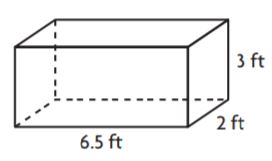
The sum of the first 2 sides = 3+4 = 7 < 8
Therefore, he cannot form a triangle unless he cuts the logs.

Question 4.
In shop class, Adriana makes a pyramid with a 4-inch square base and a height of 6 inches. She then cuts the pyramid vertically in half as shown. What is the area of each cut surface?
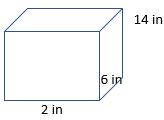
Go Math Grade 7 Answer Key Chapter 9 Circumference, Area, and Volume img 64
_____ in2

Answer: 12 in2

Explanation:
Base = 4 in
Height = 6 in
Area of the triangle = 1/2 x 6 x 4 = 12 in2

Page No. 300

Find the circumference and area of each circle. Round to the nearest hundredth.

Question 1.
Go Math Grade 7 Answer Key Chapter 9 Circumference, Area, and Volume img 65
C = __________ in
A = __________ in2

Answer:
C = 69.08 in
A = 379.94 in2

Explanation:
Diameter = 22 in
Radius = d/2 = 22/2 = 11 in
C = 2 πr = 2 π(11) = 22 (3.14) = 69.08 in
A = πr2 = 3.14 (11)2 = 379.94 in2

Question 2.
Go Math Grade 7 Answer Key Chapter 9 Circumference, Area, and Volume img 66
C = __________ m
A = __________ m2

Answer:
C = 28.26 m
A = 63.59m2

Explanation:
Radius = 4.5 m
C = 2 πr = 2 π(4.5) = 9 (3.14) = 28.26 m
A = πr2 = 3.14 (4.5)2 = 63.59 m2

Find the area of each composite figure. Round to the nearest hundredth if necessary.

Question 3.
Go Math Grade 7 Answer Key Chapter 9 Circumference, Area, and Volume img 67
______ in2

Answer: 99 in2

Explanation:
Area of the square = 9 x 9 = 81 in2
Base of the triangle = 13 – 9 = 4 in
Area of the triangle = 1/2 x 4 x 9 = 18 in2
The total area of the figure = 81 + 18 = 99 in2

Question 4.
Go Math Grade 7 Answer Key Chapter 9 Circumference, Area, and Volume img 68
______ cm2

Answer: 420.48 cm2

Explanation:
Area of the rectangle = 16 x 20 = 320 cm2
Diameter = 16 cm
Radius = 16/2 = 8 cm
Area of the semi circle = 1/2 πr2 = 1/2 x 3.14 (8)2 = 100.48 cm2
The total area of the figure = 320 + 100.48 = 420.48 cm2

Find the volume of each figure.

Question 5.
Go Math Grade 7 Answer Key Chapter 9 Circumference, Area, and Volume img 69
______ in3

Answer: 420 in3

Explanation:
B = 7(5) = 35 in2
V = Bh = 35 x 12 = 420 in3

Question 6.
The volume of a triangular prism is 264 cubic feet. The area of a base of the prism is 48 square feet. Find the height of the prism.
______ in

Answer: 5.5 ft

Explanation:
V = Bh
264 = 48h
h = 264/48 = 5.5ft

Page No. 301

A glass paperweight has a composite shape: a square pyramid fitting exactly on top of an 8 centimeter cube. The pyramid has a height of 3 cm. Each triangular face has a height of 5 centimeters.
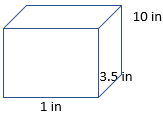
Go Math Grade 7 Answer Key Chapter 9 Circumference, Area, and Volume img 70

Question 7.
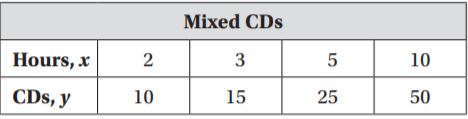
What is the volume of the paperweight?
______ cm3

Answer: 576 cm3

Explanation:
Pyramid:
B = 8 x 8 = 64 cm2
V = 1/3 Bh = 1/3 x 64 x 3 = 64 cm3
Prism:
B = 8 x 8 = 64 cm2
V = Bh = 64 x 8 = 512 cm3

The total volume of the figure = 64 + 512 = 576 cm3

Question 8.
What is the total surface area of the paperweight?
______ cm2

Answer: 400 cm2

Explanation:
Pyramid:
P = 4(8) = 32 cm
S = 1/2 Pl + B = 80 + 64 = 144 cm2

Prism:
P = 4(8) = 32 cm
S = Ph + 2B = 32(8) + 2(64) = 384 cm2
The total surface area of the prism
= Area of the prism + Area of the pyramid – 2[Area of the overlapping region]
= 144 + 384 – 2(64) = 400

Unit 4 Performance Tasks

Question 9.
Product Design Engineer
Miranda is a product design engineer working for a sporting goods company. She designs a tent in the shape of a triangular prism. The dimensions of the tent are shown in the diagram.
Go Math Grade 7 Answer Key Chapter 9 Circumference, Area, and Volume img 71
a. How many square feet of material does Miranda need to make the tent (including the floor)? Show your work.
______ ft2

Answer: 261 3/4  ft2

Explanation:
P = 2 x 7 1/2 + 8 = 22 1/2
B = 4/2 (8) (6) = 24
S = Ph + 2B = 22 1/2 x 9 1/2 + 2(24) = 213 3/4 + 48 = 261 3/4 ft2

Question 9.
b. What is the volume of the tent? Show your work.
______ ft3

Answer: 228 ft3

Explanation:
V = Bh = 24 x 9 1/2 = 228 ft3

Question 9.
c. Suppose Miranda wants to increase the volume of the tent by 10%. The specifications for the height (6 feet) and the width (8 feet) must stay the same. How can Miranda meet this new requirement? Explain
Type below:
____________

Answer: Increase the height to 10.45 ft

Explanation:
New volume = 1.10 x 228 = 250.8
250.8 = 24h
h = 10.45 ft

Unit 4 Performance Tasks (cont’d) – Page No. 302

Question 10.
Li is making a stand to display a sculpture made in art class. The stand will be 45 centimeters wide, 25 centimeters long, and 1.2 meters high.
a. What is the volume of the stand? Write your answer in cubic centimeters.
______ cm3

Answer: 135,000 cm3

Explanation:
B = 45 x 25 = 1125 cm2
V = Bh = 1125 x 120 = 135,000 cm3

Question 10.
b. Li needs to fill the stand with sand so that it is heavy and stable. Each piece of wood is 1 centimeter thick. The boards are put together as shown in the figure, which is not drawn to scale. How many cubic centimeters of sand does she need to fill the stand? Explain how you found your answer.
______ cm3

Answer: 116,702 cm3

Explanation:
Width = 45 – 2(1) = 43 ft
Length = 25 – 2(1) =23ft
Height = 120-2(1) = 118ft
B = 43 x 23 = 989 ft2
V = Bh = 989 x 118 = 116,702 ft3

Selected Response – Page No. 303

Question 1.
A school flag is in the shape of a rectangle with a triangle removed as shown.
Go Math Grade 7 Answer Key Chapter 9 Circumference, Area, and Volume img 72
What is the measure of angle x?
Options:
a. 50°
b. 80°
c. 90°
d. 100°

Answer: d. 100°

Explanation:
x = 50 + 50 = 100° [ Sum of two angles created by the 2 lines]

Question 2.
On a map with a scale of 2 cm = 1 km, the distance from Beau’s house to the beach is 4.6 centimetres. What is the actual distance?
Options:
a. 2.3 km
b. 4.6 km
c. 6.5 km
d. 9.2 km

Answer: a. 2.3 km

Explanation:
2/1 = 4.6/x
x = 4.6/2 = 2.3 km

Question 3.
Lalasa and Yasmin are designing a triangular banner to hang in the school gymnasium. They first draw the design on paper. The triangle has a base of 5 inches and a height of 7 inches. If 1 inch on the drawing is equivalent to 1.5 feet on the actual banner, what will the area of the actual banner be?
Options:
a. 17.5 ft2
b. 52.5 ft2
c. 39.375 ft2
d. 78.75 ft2

Answer: c. 39.375 ft2

Explanation:
1in = 1.5ft
The base of the triangle = 5 in = 1.5(5) ft = 7.5 ft
Height = 7 in = 7(1.5) ft = 10.5 ft
Area of the triangle = 1/2 x 7.5 x 10.5 = 39.375 ft2

Question 4.
Sonya has four straws of different lengths: 2 cm, 8 cm, 14 cm, and 16 cm. How many triangles can she make using the straws?
Options:
a. no triangle
b. one triangle
c. two triangles
d. more than two triangles

Answer: b. one triangle

Explanation:
The third side of a triangle must be smaller than the sum of the other two sides to form a triangle.
2+8 = 10<14
2+8 = 10<16
8+14 = 22>14
8+14 = 22>16
2+14 = 16=16
2+16 = 18>16

Therefore, only one triangle can be formed using the sides 8, 14, 16.

Question 5.
A one-topping pizza costs $15.00. Each additional topping costs $1.25. Let x be the number of additional toppings. You have $20 to spend. Which equation can you solve to find the number of additional toppings you can get on your pizza?
Options:
a. 15x + 1.25 = 20
b. 1.25x + 15 = 20
c. 15x − 1.25 = 20
d. 1.25x − 15 = 20

Answer: b. 1.25x + 15 = 20

Explanation:
If x is the number of additional toppings, then 1.25 x is the cost of the additional toppings.
This gives the total cost is 1.25x + 15
then,
1.25x + 15 = 20

Question 6.
A bank offers a home improvement loan with simple interest at an annual rate of 12%. J.T. borrows $14,000 over a period of 3 years. How much will he pay back altogether?
Options:
a. $15680
b. $17360
c. $19040
d. $20720

Answer: c. $19040

Explanation:
Simple interest = 14,000 x 0.12 x 2 = $5,040
Amount = $14,000 + $5,040 = $19040

Question 7.
What is the volume of a triangular prism that is 75 centimeters long and that has a base with an area of 30 square centimeters?
Options:
a. 2.5 cm3
b. 750 cm3
c. 1125 cm3
d. 2250 cm3

Answer: d. 2250 cm3

Explanation:
V = Bh = 30(75) = 2250cm3

Question 8.
Consider the right circular cone shown.
Go Math Grade 7 Answer Key Chapter 9 Circumference, Area, and Volume img 73
If a vertical plane slices through the cone to create two identical half cones, what is the shape of the cross section?
Options:
a. a rectangle
b. a square
c. a triangle
d. a circle

Answer: c. a triangle

Explanation:
Slicing through the vertex to create 2 identical half cones would create a cross-section that  is a triangle.

Page No. 304

Question 9.
The radius of the circle is given in meters. What is the circumference of the circle? Use 3.14 for π.
Go Math Grade 7 Answer Key Chapter 9 Circumference, Area, and Volume img 74
a. 25.12 m
b. 50.24 m
c. 200.96 m
d. 803.84 m

Answer: b. 50.24 m

Explanation:
Circumference = 2 πr = 2 π(8) = 16 (3.14) = 50.24 m

Question 10.
The dimensions of the figure are given in millimeters. What is the area of the two-dimensional figure?
Go Math Grade 7 Answer Key Chapter 9 Circumference, Area, and Volume img 75
Options:
a. 39 mm2
b. 169 mm2
c. 208 mm2
d. 247 mm2

Answer: c. 208 mm2

Explanation:
Area of the square = 13 x 13 = 169 mm2
Area of the triangle = 1/2 x 13 x 6 = 39 mm2
The total area of the figure = 169 + 39 = 208 mm2

Question 11.
A forest ranger wants to determine the radius of the trunk of a tree. She measures the circumference to be 8.6 feet. What is the trunk’s radius to the nearest tenth of a foot?
Options:
a. 1.4 ft
b. 2.7 ft
c. 4.3 ft
d. 17.2 ft

Answer: a. 1.4 ft

Explanation:
Circumference = 2 πr = 8.6 ft
r = 8.6/2 π = 1.4 ft

Question 12.
What is the measure in degrees of an angle that is supplementary to a 74° angle?
Options:
a. 16°
b. 74°
c. 90°
d. 106°

Answer: d. 106°

Explanation:
Sum of supplementary angles = 180°
x + 74° = 180°
x = 106°

Question 13.
What is the volume in cubic centimeters of a rectangular prism that has a length of 6.2 centimeters, a width of 3.5 centimeters, and a height of 10 centimeters?
Options:
a. 19.7 cm3
b. 108.5 cm3
c. 217 cm3
d. 237.4 cm3

Answer: c. 217 cm3

Explanation:
V = Bh
B = 6.2 x 3.5 = 21.7 cm2
h = 10 cm
V = 21.7 x 10 = 217 cm3

Question 14.
A patio is the shape of a circle with diameter shown.
Go Math Grade 7 Answer Key Chapter 9 Circumference, Area, and Volume img 76
What is the area of the patio? Use 3.14 for π.
Options:
a. 9 m2
b. 28.26 m2
c. 254.34 m2
d. 1017.36 m2

Answer: c. 254.34 m2

Explanation:
Diameter = 18 m
Radius = 18/2 = 9 m
Area of the patio = πr2 = 3.14 (9)2 = 254.34 m2

Question 15.
Petra fills a small cardboard box with sand. The dimensions of the box are 3 inches by 4 inches by 2 inches.
a. What is the volume of the box?
______ in3

Answer: 24 in3

Explanation:
V = Bh
B = 3 x 4 = 12 in2
V = 12 x 2 = 24 in3

Question 15.
b. Petra decides to cover the box by gluing on wrapping paper. How much wrapping paper does she need to cover all six sides of the box?
______ in2

Answer: 76 in2

Explanation:
P = 2(3) + 2(4) = 6 + 8 = 14 in
S = Ph + 2B = 14 x 2 + 2 x 24 = 76 in2

Question 15.
c. Petra has a second, larger box that is 6 inches by 8 inches by 4 inches. How many times larger is the volume of this second box? The surface area?
Volume is _________ times greater.
Surface area is _________ times greater

Answer: Surface area is about 2.7 times larger

Explanation:
B = 6 x 8 = 48 in2
V = Bh = 48 x 4 = 192 in3
192/24 = 8
P = 2(6) + 2(8) = 12 + 16 = 28
S = Ph + 2B = 28(4) + 2(48) = 112 + 96 = 208 in2
208/76 = 2.7

Conclusion:

We wish the information provided in this article regarding the Go Math Grade 7 Chapter 9 Circumference, Area, and Volume is beneficial for all the students. Make use of the given links and practice well for the exams. If you have any quieries about HMH Go Math 7th Grade Chapter 9 Circumference, Area, and Volume you can post your comments in the below section.

Go Math Grade 4 Answer Key Homework FL Chapter 3 Multiply 2-Digit Numbers Review/Test

go-math-grade-4-chapter-3-multiply-2-digit-numbers-review-test-answer-key

Students of 4th grade can collect chapter 3 Multiply 2-Digit Numbers Go Math Homework Review/Test Answer key from this page in pdf format. All you have to do is click on the links provided over here and practice more from the HMH Go Math Grade 4 Answer Key Homework FL Chapter 3 Multiply 2-Digit Numbers Review/Test. However, students can score good marks in the exam.

Go Math Grade 4 Answer Key Homework FL Chapter 3 Multiply 2-Digit Numbers Review/Test

Moreover, educators and instructors can also make use of this Go Math Grade 4 Answer Key Homework FL Review/Test as a test paper to keep the exam and verify their student’s knowledge. We as a team designed this guide by providing detailed solutions for each and every question from Practice Tests, Chapter Tests, Cumulative Practice. Practice regularly by using the 4th Grade Go Math Chapter 3 Answer Key Review/Test and also use it as a quick reference to assess your knowledge after preparing the concepts within it.

Chapter 3: Review/Test

Review/Test – Page No. 131

Concepts and Skills

Question 1.
Explain how to find 14 × 19 by breaking apart the factors into tens and ones and finding the sum of the four partial products.

Answer: 266.

Explanation:
We can break 14 and 19 as 10+4 and 10+9 and to get the answer we will multiply both of the first two numbers by the other two. So we will multiply 10(10+9) and 4(10+9), then the values will be (100+90) and (40+36). By adding both we will get 100+90+40+36= 266

Question 2.
Explain how to find 40 × 80 using mental math.

Answer: 3600.

Explanation:
By using mental math we will multiply 4×8= 36 and then we will add zeros, so the answer will be 3600.

Estimate the product. Choose a method.

Question 3.
80 × 26

Answer: 2,080.

Explanation:
80
×26
———
480
+160
———–
2,080

Question 4.
19 × $67
$ ____

Answer: $1,273.

Explanation:
By breaking apart the factors into tens and ones and we can find the sum of the four partial products.
19×67= (10+9)×(60+7)
= (10×60)+(10×7)+(9×60)+(9×7)
= 600+70+540+63
= $1,273.

Question 5.
43 × 25

Answer: 1,075.

Explanation:
By breaking apart the factors into tens and ones and we can find the sum of the four partial products.
43 × 25= (40+3)×(20+5)
= (40×20)+(40×5)+(3×20)+(3×5)
= 800+200+60+15
= 1,075.

Question 6.
54 × 83

Answer: 4,482.

Explanation:
By breaking apart the factors into tens and ones and we can find the sum of the four partial products.
54 × 83= (50+4)×(80+3)
= (50×80)+(50×3)+(4×80)+(4×3)
= 4000+150+320+12
= 4,482.

Estimate. Then find the product.

Question 7.
$ 2 4
× 9 6
———–
Estimate: $ ________
Product: $ _________

Answer:
Estimate: $ 2,300
Product: $ 2,304

Explanation:
$ 2 4
× 9 6
———–
14 4
+ 216
———–
2,304

Question 8.
4 4
× 6 0
————
Estimate: _________
Product: _________

Answer:
Estimate: 2,600.
Product: 2,640.

Explanation:
4 4
× 6 0
————
00
+264
———–
2640

Question 9.
9 9
× 1 4
————
Estimate: _________
Product: _________

Answer:
Estimate: 1,400
Product: 1,386

Explanation:
9 9
× 1 4
————
396
+99
———–
1,386.

Question 10.
6 7
× 2 5
————
Estimate: _________
Product: _________

Answer:
Estimate: 1,700
Product: 1,675

Explanation:
6 7
× 2 5
————
335
+134
————
1,675

Question 11.
3 6
× 5 7
————
Estimate: _________
Product: _________

Answer:
Estimate: 2,000.
Product: 2,052.

Explanation:
3 6
× 5 7
————
252
+180
———–
2,052

Question 12.
$ 5 4
× 2 9
————
Estimate: $ _________
Product: $ _________

Answer:
Estimate: 1,600.
Product: 1,566.

Explanation:
$ 5 4
× 2 9
————
486
+108
———–
1,566

Question 13.
7 6
× 3 8
————
Estimate: _________
Product: _________

Answer:
Estimate: 2,900.
Product: 2,888.

Explanation:
7 6
× 3 8
————
608
+228
———–
2,888.

Question 14.
8 5
× 4 6
————
Estimate: _________
Product: _________

Answer:
Estimate: 3,900.
Product: 3,910

Explanation:
8 5
× 4 6
————
510
+340
———-
3,910.

Review/Test – Page No. 132

Fill in the bubble completely to show your answer.

Question 15.
Each month Sid’s parents put $75 into his college fund. How much do his parents put in the fund during 2 years?
Options:
a. $150
b. $450
c. $1,800
d. $15,300

Answer: c.

Explanation:
As Sid’s parents put $75 into his college fund, during two years Sid’s parent’s fund $75×24= $1800.

Question 16.
Mrs. Jenks wrote the correct answer to a homework problem on the board below. Which of the following could have been the homework problem?
Go Math Grade 4 Answer Key Homework FL Chapter 3 Multiply 2-Digit Numbers Review Test img 1
Options:
a. 5 × 4,000
b. 50 × 400
c. 50 × 40
d. 50 × 4,000

Answer: c.

Explanation:
Mrs. Jenks’s homework problem is 50 × 40 because 50 × 40= 2,000.

Question 17.
George buys 30 cartons of 18 eggs for the Community Pancake Breakfast. How many eggs does he buy?
Options:
a. 340
b. 354
c. 460
d. 540

Answer: d

Explanation:
As George bought 30 cartons of 18 eggs for the Community Pancake Breakfast, the number of eggs George bought is 30×18= 540.

Review/Test – Page No. 133

Fill in the bubble completely to show your answer.

Question 18.
Mrs. Sampson donated a carton of pencils for each of the 35 classes at Lancet Elementary School. Each carton holds 64 pencils. Which is the best estimate for the number of pencils Mrs. Sampson donated?
Options:
a. A 99
b. B 1,800
c. C 2,400
d. D 2,800

Answer:  c.

Explanation:
As Mrs. Sampson donated a carton of pencils for each of the 35 classes at Lancet Elementary School, and each carton holds 64 pencils, so Mrs. Sampson donates 35×64= 2,240. And the estimated value is 2,400.

Question 19.
The school’s athletic department ordered 95 dozen badminton feather shuttles. How many feather shuttles were ordered?
Options:
a. A 2,280
b. B 1,140
c. C 1,030
d. D 114

Answer: b

Explanation:
One dozen is equal to 12. As school’s athletic department ordered 95 dozen badminton feather shuttles, so 95 dozens means
95×12= 1,140 badminton feather shuttles.

Question 20.
Jill sold 35 adult tickets and 48 child tickets for a fund-raising dinner. An adult ticket costs $18 and a child ticket costs $14. How much did Jill collect for the tickets?
Options:
a. A $1,354
b. B $1,302
c. C $1,232
d. D $1,102

Answer: b

Explanation:
As Jill sold 35 adult tickets and 48 child tickets for a fund-raising dinner and each adult ticket costs $18 and a child ticket costs $14, so total amount Jill collected is 35×$18= 630 and 48×$18= 672 by adding 630+672= $1,302.

Question 21.
Which shows a way to find 35 × 74?
Options:
a. A (30 × 7) + (30 × 4) + (70 × 3) + (70 × 5)
b. B (30 × 70) + (30 × 4) + (50 × 70) + (50 × 4)
c. C (30 + 70) + (30 + 4) + (70 + 30) + (70 + 5)
d. D (30 × 70) + (30 × 4) + (5 × 70) + (5 × 4)

Answer: d

Explanation:
By breaking apart the factors into tens and ones and finding the sum of the four partial products,
35 × 74= (30 × 70) + (30 × 4) + (5 × 70) + (5 × 4)

Question 22.
New seats are being delivered to the theater. There are 45 new seats for each row in a 15-row section. How many seats are being delivered?
Options:
a. A 60
b. B 400
c. C 675
d. D 1,000

Answer: c

Explanation:
As new seats are being delivered to the theater and there are 45 new seats for each row in a 15-row section, so the total number of new seats is 45×15= 675.

Review/Test – Page No. 134

Constructed Response

Question 23.
Gulfside Gifts has 48 boxes of postcards to sell. There are 24 postcards in each box. If the shop sells 3 boxes of postcards, how many postcards does the shop have left to sell? Explain how you found the answer.
______ remaining cards

Answer: 1,080 remaining cards.

Explanation:
As Gulfside Gifts has 48 boxes of postcards to sell and there are 24 postcards in each box. So total number of post cards are
48×24= 1,152. And the shop sold 3 boxes of postcards i.e 3×24= 72, so shop has left 1,152-72= 1,080 cards are remaining to sell.

Question 24.
Several steps in finding the product of 68 and 34 are shown below. Describe the remaining steps. Use pictures, words, or numbers. Then complete the multiplication.
Go Math Grade 4 Answer Key Homework FL Chapter 3 Multiply 2-Digit Numbers Review Test img 2
_____

Answer:  2,312.

Explanation:
68
× 34
———-
272
+ 204
———
2,312

Performance Task

Question 25.
A city is having a festival in a local park. Alison’s Bakery has agreed to donate $1,200 worth of baked goods for the event. The city wants to order 12 loaves of holiday bread, 18 dozen biscuits, 12 dozen bagels, and 14 dozen multigrain rolls.
A. Is the cost of the baked goods under the $1,200 donation limit? Use pictures, numbers, or words to explain how you found your answer.
Go Math Grade 4 Answer Key Homework FL Chapter 3 Multiply 2-Digit Numbers Review Test img 3

Answer: Yes, the donation is under $1,200.

Explanation:
As the city ordered 12 loaves of holiday bread, 18 dozen biscuits, 12 dozen bagels, and 14 dozen multigrain rolls. And holiday bread costs $20, one dozen busicuits costs $12, and one dozen bagels costs $28, 1 dozen multigrain rolls costs $22. So by adding them
(12×20)+(12×18)+(12×28)+(14×22) we will get $1,100 which is less than $1,200

Question 25.
B. If yes, what could the city add to the order? If no, what could the city remove from the order?

Answer: The city can add whatever they want with the remaining $100. As $1,200-$1,100= $100.

Conclusion:

We hope the information shared about the Go Math Grade 4 Answer Key Homework FL Chapter 3 Multiply 2-Digit Numbers Review/Test has benefited you in your way. For more problems to practice check out our Go Math Grade 4 Answer Key Homework Practice FL Chapter 3 Multiply 2-Digit Numbers.

Go Math Grade 4 Answer Key Chapter 10 Two-Dimensional Figures

Go Math Grade 4 Answer Key Chapter 10 Two-Dimensional Figures will make understanding concepts of Two-Dimensional Figures so easy. So following the Go Math HMH 4th Grade Chapter 10 Solution Key is very necessary to get notified of the topics of Two-dimensional shapes. Go Math Grade 4 Answer Key has specialized solutions to all the questions that are covered in extra practice FL, Homework Practice FL. So it’ll be easy for you to understand the concepts behind each and every lesson.

Go Math Grade 4 Chapter 10 Two-Dimensional Figures Answer Key

The questions asked in Chapter Tests, Practice Tests, Performance Tests, etc. are also covered by the Go Math Grade 4 Answer Key Chapter 10 Two-Dimensional Figures PDF. So that you can cross-check Go Math Grade 4 Chapter 10 Two-Dimensional Figures Solution Key PDF. For more practice questions simply go to the Go Math Grade 4 Solution Key Chapter 10 Two-Dimensional Figures Homework Practice FL Page on our site.

Lesson 1: Lines, Rays, and Angles

Lesson 2: Classify Triangles by Angles

Lesson 3: Parallel Lines and Perpendicular Lines

Lesson 4: Classify Quadrilaterals

Mid-Chapter Checkpoint

Lesson 5: Line Symmetry

Lesson 6: Find and Draw Lines of Symmetry

Lesson 7: Problem Solving • Shape Patterns

Review/Test

Common Core – New – Page No. 553

Lines, Rays, and Angles

Draw and label an example of the figure.

Question 1.
obtuse ∠ABC
Go Math Grade 4 Answer Key Chapter 10 Two-Dimensional Figures Common Core - New img 1
Think: An obtuse angle is greater than a right angle. The middle letter, B, names the vertex of the angle.
_________

Answer:
grade 4 chapter 10 Lines, Rays, and Angles image 1 553

Explanation:
An obtuse angle is greater than a right angle. The middle letter, B, names the vertex of the angle.

Question 2.
\(\overrightarrow{G H}\)
_________

Answer:
grade 4 chapter 10 Lines, Rays, and Angles image 2 553

Explanation:
GH is a ray that has one endpoint and continues without an end in one direction.

Question 3.
acute ∠JKL
_________

Answer:
grade 4 chapter 10 Lines, Rays, and Angles image 3 553

Explanation:
Angle JKL is an acute angle that is less than a right angle.

Question 4.
\(\overline{B C}\)

Answer:
grade 4 chapter 10 Lines, Rays, and Angles image 4 553

Explanation:
BC is a line that continues without an end in both directions.

Use the figure for 5–8.
Go Math Grade 4 Answer Key Chapter 10 Two-Dimensional Figures Common Core - New img 2

Question 5.
Name a line segment.

Answer:
line segment EF

Explanation:

EF line is a straight path of points that continues without an end in both directions.

Question 6.
Name a right angle.
∠ _____

Answer:
∠EJF

Explanation:
EJF is a right angle that forms a square corner.

Question 7.
Name an obtuse angle.
obtuse ∠ _____

Answer:
∠CEJ

Explanation:
CEJ is an obtuse angle that is greater than a right angle.

Question 8.
Name a ray.

Answer:
Ray JD

Explanation:
JD is a ray that has one endpoint and continues without an end in one direction.

Problem Solving

Use the figure at the right for 9–11.
Go Math Grade 4 Answer Key Chapter 10 Two-Dimensional Figures Common Core - New img 3

Question 9.
Classify ∠AFD
_________

Answer:
Obtuse Angle

Explanation:
AFD is an obtuse angle that is greater than a right angle.

Question 10.
Classify ∠CFE.
_________

Answer:
Right Angle

Explanation:
∠CFE is a right angle that forms a square corner.

Question 11.
Name two acute angles.
acute ∠ _____ acute ∠ _____

Answer:
∠AFB and ∠DFE

Explanation:
∠AFB and ∠DFE are two acute angles with less than a right angle.

Common Core – New – Page No. 554

Lesson Check

Question 1.
The hands of a clock show the time 12:25.
Go Math Grade 4 Answer Key Chapter 10 Two-Dimensional Figures Common Core - New img 4
Which best describes the angle between the hands of the clock?
Options:
a. acute
b. right
c. obtuse
d. straight

Answer:
c. obtuse

Explanation:
The hands of the time 12:25 are forming greater than a right angle. So, the answer is the Obtuse angle.

Question 2.
Which of the following name two different figures?
Options:
a. \(\overline{A B} \text { and } \overline{B A}\)
b. \(\stackrel{\longleftrightarrow}{A B}\) and \(\stackrel{\longleftrightarrow}{B A}\)
c. \(\overrightarrow{A B} \text { and } \overrightarrow{B A}\)
d. ∠ABC and ∠CBA

Answer:
c. \(\overrightarrow{A B} \text { and } \overrightarrow{B A}\)

Explanation:
In \(\overrightarrow{A B}\), A is an end point and B continues without end in one direction.
In \(\overrightarrow{B A}\), B is an end point and A continues without an end in one direction.

Spiral Review

Question 3.
Jan’s pencil is 8.5 cm long. Ted’s pencil is longer. Which could be the length of Ted’s pencil?
Options:
a. 0.09 cm
b. 0.8 cm
c. 8.4 cm
d. 9.0 cm

Answer:
d. 9.0 cm

Explanation:
9 ones is greater than 8 ones. So, 9.0 cm > 8.5 cm

Question 4.
Kayla buys a shirt for $8.19. She pays with a $10 bill. How much change should she receive?
Options:
a. $1.81
b. $1.89
c. $2.19
d. $2.81

Answer:
a. $1.81

Explanation:
Kayla buys a shirt for $8.19. She pays with a $10 bill. To find the change she received, $10 – $8.19 = 1.81

Question 5.
Sasha donated \(\frac{9}{100}\) of her class’s entire can collection for the food drive. Which decimal is equivalent to \(\frac{9}{100}\) ?
Options:
a. 9
b. 0.99
c. 0.9
d. 0.09

Answer:
d. 0.09

Explanation:
\(\frac{9}{100}\) is 9 hundredths. So, the decimal is 0.09.

Question 6.
Jose jumped 8 \(\frac{1}{3}\) feet. This was 2 \(\frac{2}{3}\) feet farther than Lila jumped. How far did Lila jump?
Options:
a. 5 \(\frac{1}{3}\)
b. 5 \(\frac{2}{3}\)
c. 6 \(\frac{1}{3}\)
d. 11

Answer:
b. 5 \(\frac{2}{3}\)

Explanation:
Jose jumped 8 \(\frac{1}{3}\) feet. This was 2 \(\frac{2}{3}\) feet farther than Lila jumped.
8 \(\frac{1}{3}\) – 2 \(\frac{2}{3}\) = \(\frac{25}{3}\) – \(\frac{8}{3}\) = \(\frac{7}{3}\) = 5 \(\frac{2}{3}\)

Page No. 557

Question 1.
Name the triangle. Tell whether each angle is acute, right, or obtuse.
A name for the triangle is __________ .
Go Math Grade 4 Answer Key Chapter 10 Two-Dimensional Figures img 5
Name:
∠F is _________
∠G is _________
∠H is _________

Answer:
Right Triangle; Triangle FGH;
∠F and ∠H are acute angles.
∠G is Right angle

Explanation:
∠F and ∠H are acute angles with less than a right angle. ∠G is the Right angle that forms a square corner. A triangle that has one right angle is called a right triangle.

Classify each triangle. Write acute, right, or obtuse.

Question 2.
Go Math Grade 4 Answer Key Chapter 10 Two-Dimensional Figures img 6
_____

Answer:

Obtuse triangle;
Angle B and Angle C are both acute.
Angle A is obtuse.

Explanation:
From triangle ABC, Angle B, and Angle C are both acute with less than a right angle. Angle A is obtuse angle that is greater than a right angle.

Question 3.
Go Math Grade 4 Answer Key Chapter 10 Two-Dimensional Figures img 7
_____

Answer:
grade 4 chapter 10 Lines, Rays, and Angles image 2 557
Obtuse triangle;
Angle A and Angle C are both acute.
Angle B is obtuse.

Explanation:
From triangle ABC, Angle A, and Angle C are both acute with less than a right angle. Angle B is an obtuse angle that is greater than a right angle. A triangle with an obtuse angle is called an obtuse triangle.

Question 4.
Go Math Grade 4 Answer Key Chapter 10 Two-Dimensional Figures img 8
_____

Answer:
grade 4 chapter 10 Lines, Rays, and Angles image 3 557
Acute triangle;
Angle A, Angle B, and Angle C are acute angles.

Explanation:
From triangle ABC, Angle A, Angle B, and Angle C are acute angles with less than a right angle. A triangle with three acute angles called an acute triangle. So, the given triangle is an acute triangle.

Question 5.
Go Math Grade 4 Answer Key Chapter 10 Two-Dimensional Figures img 9
_____

Answer:
grade 4 chapter 10 Lines, Rays, and Angles image 4 557
Right Triangle; Triangle ABC;
∠A and ∠C are acute angles.
∠B is Right angle

Explanation:
∠A and ∠C are acute angles with less than a right angle. ∠B is the Right angle that forms a square corner. A triangle that has one right angle is called a right triangle.

Question 6.
Go Math Grade 4 Answer Key Chapter 10 Two-Dimensional Figures img 10
_____

Answer:
grade 4 chapter 10 Lines, Rays, and Angles image 5 557
Acute triangle;
Angle A, Angle B, and Angle C are acute angles.

Explanation:
From triangle ABC, Angle A, Angle B, and Angle C are acute angles with less than a right angle. A triangle with three acute angles called an acute triangle. So, the given triangle is an acute triangle.

Question 7.
Go Math Grade 4 Answer Key Chapter 10 Two-Dimensional Figures img 11
_____

Answer:
grade 4 chapter 10 Lines, Rays, and Angles image 6 557
Right Triangle;
∠A and ∠C are acute angles.
∠B is Right angle

Explanation:
∠A and ∠C are acute angles with less than a right angle. ∠B is the Right angle that forms a square corner. A triangle that has one right angle is called a right triangle.

Question 8.
Cross out the figure that does not belong. Explain.
Go Math Grade 4 Answer Key Chapter 10 Two-Dimensional Figures img 12
Type below:
_________

Answer:
grade 4 chapter 10 Lines, Rays, and Angles image 7 557
Explanation:
From the given image, 1, 3, and 4 have two acute angles, and one obtuse angle. 2 have three acute angles.

Page No. 558

Use the Venn diagram for 9–10.
Go Math Grade 4 Answer Key Chapter 10 Two-Dimensional Figures img 13

Question 9.
Which triangles do NOT have an obtuse angle? Explain.
_______ triangles

Answer:
4 triangles;
Triangle DEF, Triangle SPN, Triangle ABC, and Triangle GHP are don’t have an obtuse angle. Triangle DEF, Triangle SPN are acute angles. An acute triangle is a triangle with three acute angles. Triangle ABC, and Triangle GHP are right angles. A right triangle is a triangle with one right angle. The sum of the triangle is 180 degrees. A right triangle has 90 degrees. So, the remaining angles must be acute angles.

Question 10.
How many triangles have at least two acute angles? Explain.
_______ triangles

Answer:
4 triangles;
Triangle DEF, Triangle SPN, Triangle ABC, and Triangle GHP at least two acute angles. Triangle DEF, Triangle SPN are acute angles. An acute triangle is a triangle with three acute angles. Triangle ABC, and Triangle GHP are right angles. A right triangle is a triangle with one right angle and two acute angles.

Question 11.
Use the square shown at the right. Draw a line segment from point M to point P. Name and classify the triangles formed by the line segment.
Go Math Grade 4 Answer Key Chapter 10 Two-Dimensional Figures img 14
Type below:
_________

Answer:
grade 4 chapter 10 Lines, Rays, and Angles image 8 557
Angle MNP and Angle MQP

Explanation:
The line segment from M to P forms Angle MNP and Angle MQP.

Question 12.
Write the letter of the triangle under its correct classification.
Go Math Grade 4 Answer Key Chapter 10 Two-Dimensional Figures img 15
Type below:
_________

Answer:
grade 4 chapter 10 Lines, Rays, and Angles image 9 557

Explanation:
Triangle A and triangle B have three acute angles. So, they are acute triangles. Triangle D and triangle F have one obtuse angle. So, they are obtuse triangles.
Triangle C and triangle E have one right angle. So, they are right triangles.

Common Core – New – Page No. 559

Classify Triangles

Classify each triangle. Write acute, right, or obtuse.

Question 1.
Go Math Grade 4 Answer Key Chapter 10 Two-Dimensional Figures Common Core - New img 16
Think: Angles A and C are both acute.
Angle B is obtuse.

Answer:
Obtuse triangle;
Angle A and Angle C are both acute.
Angle B is obtuse.

Explanation:
From triangle ABC, Angle A, and Angle C are both acute with less than a right angle. Angle B is an obtuse angle that is greater than a right angle.

Question 2.
Go Math Grade 4 Answer Key Chapter 10 Two-Dimensional Figures Common Core - New img 17
_________

Answer:
Right Triangle; Triangle DEF;
∠D and ∠F are acute angles.
∠E is Right angle

Explanation:
∠D and ∠F are acute angles with less than a right angle. ∠E is the Right angle that forms a square corner. A triangle that has one right angle is called a right triangle.

Question 3.
Go Math Grade 4 Answer Key Chapter 10 Two-Dimensional Figures Common Core - New img 18
_________

Answer:
Acute triangle;
Angle G, Angle J, and Angle H are acute angles.

Explanation:
From triangle GJH, Angle G, Angle J, and Angle H are acute angles with less than a right angle. A triangle with three acute angles called an acute triangle. So, the given triangle is an acute triangle.

Question 4.
Go Math Grade 4 Answer Key Chapter 10 Two-Dimensional Figures Common Core - New img 19
_________

Answer:
Obtuse triangle;
Angle L and Angle N are both acute.
Angle M is obtuse.

Explanation:
From triangle LMN, Angle L and Angle N are both acute with less than a right angle. Angle M is an obtuse angle that is greater than a right angle. A triangle with an obtuse angle is called an obtuse triangle.

Problem Solving

Question 5.
Use figure ABCD below. Draw a line segment from point B to point D. Name and classify the triangles formed.
Go Math Grade 4 Answer Key Chapter 10 Two-Dimensional Figures Common Core - New img 20
Two _________ triangles
△ _________
△ _________

Answer:
grade 4 chapter 10 Lines, Rays, and Angles image 1 559
Two Acute triangles.
△ ABD
△ BCD

Explanation:
If we draw a line segment from point B to point D, then there are two traingles formed with less than right angles. They are △ ABD and △ BCD.

Question 6.
Use figure ABCD below. Draw a line segment from point A to point C. Name and classify the triangles formed.
Go Math Grade 4 Answer Key Chapter 10 Two-Dimensional Figures Common Core - New img 21
Two _________ triangles
△ _________
△ _________

Answer:
grade 4 chapter 10 Lines, Rays, and Angles image 2 559
Two Acute triangles.
△ ABC
△ ADC

Explanation:
If we draw a line segment from point A to point C, then there are two traingles formed with less than right angles. They are △ ABC and △ ADC.

Common Core – New – Page No. 560

Lesson Check

Question 1.
Stephen drew this triangle. How many obtuse angles does the triangle have?
Go Math Grade 4 Answer Key Chapter 10 Two-Dimensional Figures Common Core - New img 22
Options:
a. 0
b. 1
c. 2
d. 3

Answer:
a. 0

Explanation:
The given image has three acute angles. So, there are 0 obtuse angles.

Question 2.
Joan was asked to draw a right triangle. How many right angles are in a right triangle?
Options:
a. 0
b. 1
c. 2
d. 3

Answer:
b. 1

Explanation:
A right triangle has only one right angle.

Spiral Review

Question 3.
Oliver drew the figure below to show light traveling from the sun to Earth. Name the figure he drew.
Go Math Grade 4 Answer Key Chapter 10 Two-Dimensional Figures Common Core - New img 23
Options:
a. segment SE
b. ray SE
c. line SE
d. ray ES

Answer:
b. ray SE

Explanation:
SE is a ray that has one endpoint and continues without an end in one direction.

Question 4.
Armon added \(\frac{1}{10}\) and \(\frac{8}{100}\). Which is the correct sum?
Options:
a. \(\frac{18}{10}\)
b. \(\frac{9}{10}\)
c. \(\frac{9}{100}\)
d. \(\frac{18}{100}\)

Answer:
d. \(\frac{18}{100}\)

Explanation:
\(\frac{1 X 10}{10 X 10}\) + \(\frac{8}{100}\) = \(\frac{10}{100}\) + \(\frac{8}{100}\) = \(\frac{18}{100}\)

Question 5.
Sam counted out loud by 6s. Jorge counted out loud by 8s. What are the first three numbers both students said?
Options:
a. 8, 16, 24
b. 14, 28, 42
c. 24, 48, 72
d. 48, 96, 144

Answer:
c. 24, 48, 72

Explanation:
Sam counted out loud by 6s = 6, 12, 18, 24, 30, 36, 42, 48, 54, 60, 66, 72.
Jorge counted out loud by 8s = 8, 16, 24, 32, 40, 48, 56, 64, 72, 80.
Both students said the first three numbers are 24, 48, 72.

Question 6.
A basketball team averaged 105 points per game. How many points did the team score in 6 games?
Options:
a. 605 points
b. 630 points
c. 900 points
d. 6,030 points

Answer:
b. 630 points

Explanation:
A basketball team averaged 105 points per game.
They score in 6 games = 6 x 105 = 630 points.

Page No. 563

Question 1.
Draw and label \(\overline{Q R} \| \overline{S T}\).
Think: Parallel lines never intersect. Parallel line segments are parts of parallel lines.
Type below:
_________

Answer:
grade 4 chapter 10 Lines, Rays, and Angles image 1 563
\(\overline{Q R} \| \overline{S T}\)

Explanation:
Parallel lines never intersect. Parallel line segments are parts of parallel lines.

Use the figure for 2 and 3.
Go Math Grade 4 Answer Key Chapter 10 Two-Dimensional Figures img 24

Question 2.
Name two line segments that appear to be parallel.
Type below:
_________

Answer:
Line Segment CB and Line Segment DF.

Explanation:
Line Segment CB and Line Segment DF are parallel lines. The both lines never intersect and are always the same distance apart.

Question 3.
Name two line segments that appear to be perpendicular.
Type below:
_________

Answer:
Line Segment CB and Line Segment BF are perpendicular lines.

Explanation:
Line Segment CB and Line Segment DF are perpendicular lines. Both lines intersect to form four right angles.

Use the figure for 4–5.
Go Math Grade 4 Answer Key Chapter 10 Two-Dimensional Figures img 25

Question 4.
Name a pair of lines that are perpendicular.
Type below:
_________

Answer:
FJ and HG are perpendicular lines.

Explanation:
FJ and HG lines intersect each other and form four right angles.

Question 5.
Name a pair of lines that appear to be parallel.
Type below:
_________

Answer:
DC and FJ are parallel lines.

Explanation:
DC and FJ are never intersected and are always the same distance apart.

Question 6.
\(\overline{R S} \| \overline{T U}\)
Type below:
_________

Answer:
grade 4 chapter 10 Lines, Rays, and Angles image 3 559
\(\overline{R S} \| \overline{T U}\)

Explanation:
Parallel lines never intersect. Parallel line segments are parts of parallel lines.

Question 7.
\(\overrightarrow{K L} \text { and } \overrightarrow{K M}\)
Type below:
_________

Answer:
grade 4 chapter 10 Lines, Rays, and Angles image 4 559

Explanation:
KL and KM are two rays and start at the same point K.

Question 8.
\(\overline{C D} \perp \overline{D E}\)
Type below:
_________

Answer:
grade 4 chapter 10 Lines, Rays, and Angles image 5 559
\(\overline{C D} \perp \overline{D E}\)

Explanation:
\(\overline{C D} \perp \overline{D E}\) are two lines. They are intersect each other and form four right angles.

Question 9.
\(\overset { \longleftrightarrow }{ JK } \) ⊥ \(\overset { \longleftrightarrow }{ LM } \)
Type below:
_________

Answer:
grade 4 chapter 10 Lines, Rays, and Angles image 5 559
\(\overset { \longleftrightarrow }{ JK } \) ⊥ \(\overset { \longleftrightarrow }{ LM } \)

Explanation:
JK and LM are two lines and intersected each other to form right angles.

Question 10.
\(\overset { \longleftrightarrow }{ ST } \) intersecting \(\overset { \longleftrightarrow }{ UV } \) at point X
Type below:
_________

Answer:
grade 4 chapter 10 Lines, Rays, and Angles image 7 559

Explanation:
ST and UV are two lines intersecting at point X.

Question 11.
\(\overset { \longleftrightarrow }{ AB } \) || \(\overset { \longleftrightarrow }{ FG } \)
Type below:
_________

Answer:
grade 4 chapter 10 Lines, Rays, and Angles image 8 559
\(\overset { \longleftrightarrow }{ AB } \) || \(\overset { \longleftrightarrow }{ FG } \)

Explanation:
Parallel lines never intersect. Parallel line segments are parts of parallel lines.

Use the figure for 12–13.
Go Math Grade 4 Answer Key Chapter 10 Two-Dimensional Figures img 26

Question 12.
Dan says that \(\overset { \longleftrightarrow }{ HL } \) is parallel to \(\overset { \longleftrightarrow }{ IM } \). Is Dan correct? Explain.
_____

Answer:
No; HL and IM are not parallel lines. Parallel lines are always the same distance apart. But from the given image, the H and I may intersect if the line is extended.

Question 13.
Name two intersecting line segments that are not perpendicular.
Type below:
_________

Answer:
JM and KG are two intersecting line segments and also not perpendicular.

Page No. 564

Use the house plan at the right for 14–16.
Go Math Grade 4 Answer Key Chapter 10 Two-Dimensional Figures img 27

Question 14.
What geometric term describes a corner of the living room?
_________

Answer:
The corner of the living room is a vertex. Corners of any shape are vertexes.

Question 15.
Name three parts of the plan that show line segments.
_________

Answer:
Kitchen, Living Room, and Master Bedroom.

Question 16.
Name a pair of line segments that appear to be parallel
_________

Answer:
Two sidelines of Living Room are parallel.
Two sidelines of Master Bedroom are parallel.

Use the map at the right for 17–19.
Go Math Grade 4 Answer Key Chapter 10 Two-Dimensional Figures img 28

Question 17.
Name a street that appears to be parallel to S 17th Street.
_________

Answer:
S 18th Street

Explanation:
S 18th Street is parallel to S 17th Street. They never meet each other and are always the same distance apart.

Question 18.
Use Diagrams Name a street that appears to be parallel to Vernon Street.
_________

Answer:
Perry Street

Explanation:
Perry Street is parallel to Vernon Street. They never meet each other and are always the same distance apart.

Question 19.
Name a street that appears to be perpendicular to S 19th Street.
_________

Answer:
Austin Street

Explanation:
Austin Street is perpendicular to S 19th Street. They are intersect with each other and form four right angles.

Question 20.
Choose the labels to make a true statement.
Go Math Grade 4 Answer Key Chapter 10 Two-Dimensional Figures img 29
Go Math Grade 4 Answer Key Chapter 10 Two-Dimensional Figures img 30
Type below:
_________

Answer:
Line AB is perpendicular to Line EF.

Common Core – New – Page No. 565

Parallel Lines and Perpendicular Lines

Use the figure for 1–3.
Go Math Grade 4 Answer Key Chapter 10 Two-Dimensional Figures Common Core - New img 31

Question 1.
Name a pair of lines that appear to be perpendicular.
Think: Perpendicular lines form right angles.
\(\overset { \longleftrightarrow }{ AB } \) and \(\overset { \longleftrightarrow }{ EF } \) appear to form right angles.
\(\overset { \longleftrightarrow }{ AB } \) and \(\overset { \longleftrightarrow }{ EF } \)

Answer:
\(\overset { \longleftrightarrow }{ AB } \) and \(\overset { \longleftrightarrow }{ EF } \)

Explanation:
Perpendicular lines form right angles.
\(\overset { \longleftrightarrow }{ AB } \) and \(\overset { \longleftrightarrow }{ EF } \) appear to form right angles.
\(\overset { \longleftrightarrow }{ AB } \) and \(\overset { \longleftrightarrow }{ EF } \)

Question 2.
Name a pair of lines that appear to be parallel.
_____ and _____

Answer:
\(\overset { \longleftrightarrow }{ AB } \) and \(\overset { \longleftrightarrow }{ CD} \)

Explanation:
Parallel lines never interest each other. \(\overset { \longleftrightarrow }{ AB } \) and \(\overset { \longleftrightarrow }{ CD} \) are parallel lines.

Question 3.
Name another pair of lines that appear to be perpendicular.
_____ and _____

Answer:
\(\overset { \longleftrightarrow }{ CD } \) and \(\overset { \longleftrightarrow }{ EF } \)

Explanation:
Perpendicular lines form right angles.
\(\overset { \longleftrightarrow }{ CD } \) and \(\overset { \longleftrightarrow }{ EF } \) appear to form right angles.
\(\overset { \longleftrightarrow }{ CD } \) and \(\overset { \longleftrightarrow }{ EF } \)

Draw and label the figure described.

Question 4.
\(\overset { \longleftrightarrow }{ MN } \) and \(\overset { \longleftrightarrow }{ PQ } \) intersecting at point R

Answer:
grade 4 chapter 10 Lines, Rays, and Angles image 1 565

Explanation:
MN and PQ are two lines and interesting at point R.

Question 5.
\(\overset { \longleftrightarrow }{ WX } \) || \(\overset { \longleftrightarrow }{ YZ } \)

Answer:
grade 4 chapter 10 Lines, Rays, and Angles image 2 565

Explanation:
WX and YZ are parallel lines and they never intersect with each other.

Question 6.
\(\overset { \longleftrightarrow }{ FH } \) ⊥ \(\overset { \longleftrightarrow }{ JK } \)

Answer:
grade 4 chapter 10 Lines, Rays, and Angles image 3 565

Explanation:
FH and JK are two lines and intersecting each other to form four right angles.

Problem Solving

Use the street map for 7–8.
Go Math Grade 4 Answer Key Chapter 10 Two-Dimensional Figures Common Core - New img 32

Question 7.
Name two streets that intersect but do not appear to be perpendicular.
Type below:
_________

Answer:
Maple and Oak or Oak and Birch

Explanation:
Maple and Oak or Oak and Birch; They are intersecting with each other and not perpendicular.

Question 8.
Name two streets that appear to be parallel to each other.
Type below:
_________

Answer:
Maple and Birch

Explanation:
Maple and Birch are streets and not intersect with each other. They appear to be parallel to each other.

Common Core – New – Page No. 566

Lesson Check

Question 1.
Which capital letter appears to have perpendicular line segments?
Options:
a. N
b. O
c. T
d. V

Answer:
c. T

Explanation:
T has two lines and interesting to form four right angles.

Question 2.
In the figure, which pair of line segments appear to be parallel?
Go Math Grade 4 Answer Key Chapter 10 Two-Dimensional Figures Common Core - New img 33
Options:
a. \(\overline{F G} \text { and } \overline{G H}\)
b. \(\overline{F J} \text { and } \overline{G H}\)
c. \(\overline{F G} \text { and } \overline{J H}\)
d. \(\overline{J H} \text { and } \overline{F J}\)

Answer:
c. \(\overline{F G} \text { and } \overline{J H}\)

Explanation:
\(\overline{F G} \text { and } \overline{J H}\) are parallel lines that never intersect

Spiral Review

Question 3.
Nolan drew a right triangle. How many acute angles did he draw?
Options:
a. 0
b. 1
c. 2
d. 3

Answer:
c. 2

Explanation:
A triangle with one right angle will have two acute angles.

Question 4.
Mike drank more than half the juice in his glass. What fraction of the juice could Mike have drunk?
Options:
a. \(\frac{1}{3}\)
b. \(\frac{2}{5}\)
c. \(\frac{3}{6}\)
d. \(\frac{5}{8}\)

Answer:
d. \(\frac{5}{8}\)

Explanation:
Mike drank more than half the juice in his glass. He drunk \(\frac{5}{8}\) of the juice.

Question 5.
A school principal ordered 1,000 pencils. He gave an equal number to each of 7 teachers until he had given out as many as possible. How many pencils were left?
Options:
a. 2
b. 4
c. 6
d. 142

Answer:
c. 6

Explanation:
A school principal ordered 1,000 pencils. He gave an equal number to each of 7 teachers until he had given out as many as possible. He shared 142 pencils for each of 7 teachers. So, 142 X 7 = 994. The remaining pencils are 6.

Question 6.
A carton of juice contains 64 ounces. Ms. Wilson bought 6 cartons of juice. How many ounces of juice did she buy?
Options:
a. 364 ounces
b. 370 ounces
c. 384 ounces
d. 402 ounces

Answer:
c. 384 ounces

Explanation:
A carton of juice contains 64 ounces. Ms. Wilson bought 6 cartons of juice. 64 X 6 = 384 ounces juice she can buy.

Page No. 569

Question 1.
Tell whether the quadrilateral is also a trapezoid, parallelogram, rhombus, rectangle, or square.
Go Math Grade 4 Answer Key Chapter 10 Two-Dimensional Figures img 34
Think:
____ pairs of parallel sides
____ sides of equal length
____ right angles
Quadrilateral ABCD is also a __________
__________

Answer:
2 pairs of parallel sides
4 sides of equal length
0 right angles.
Quadrilateral ABCD is also a Rhombus

Explanation:
A Rhombus is a quadrilateral that has 2 pairs of parallel sides and 4 sides of equal lengths.

Classify each figure as many ways as possible. Write quadrilateral, trapezoid, parallelogram, rhombus, rectangle, or square.

Question 2.
Go Math Grade 4 Answer Key Chapter 10 Two-Dimensional Figures img 35
__________

Answer:
Quadrilateral

Explanation:
0 pairs of parallel sides
0 sides of equal length
0 right angles.
The given image is quadrilateral.
The quadrilateral doesn’t have a name because it has 0 pairs of parallel sides, 0 sides of equal length, and 0 right angles.

Question 3.
Go Math Grade 4 Answer Key Chapter 10 Two-Dimensional Figures img 36
_________
_________
_________

Answer:
Quadrilateral, Rectangle, and Parallelogram

Explanation:
2 pairs of parallel sides
2 pairs of sides of equal length
4 right angles.
Given quadrilateral is Rectangle and Parallelogram.
A Rectangle is a quadrilateral that has 2 pairs of parallel sides and 2 pairs of sides of equal lengths, and 4 right angles.

Question 4.
Go Math Grade 4 Answer Key Chapter 10 Two-Dimensional Figures img 37
_________
_________
_________

Answer:
Quadrilateral, Parallelogram, and Rhombus

Explanation:
2 pairs of parallel sides
4 sides of equal length
0 right angles.
Given quadrilateral is Rhombus and Parallelogram.
A Rhombus is a quadrilateral that has 2 pairs of parallel sides and 4 sides of equal lengths, and 0 right angles.

Question 5.
Go Math Grade 4 Answer Key Chapter 10 Two-Dimensional Figures img 38
_________
_________

Answer:
Quadrilateral and Parallelogram

Explanation:
2 pairs of parallel sides
2 pairs of sides of equal length
0 right angles.
Given quadrilateral is Parallelogram.
A Parallelogram is a quadrilateral that has 2 pairs of parallel sides and 2 pairs of sides of equal lengths, and 0 right angles.

Question 6.
Go Math Grade 4 Answer Key Chapter 10 Two-Dimensional Figures img 39
_________
_________
_________

Answer:
Quadrilateral and Square

Explanation:
2 pairs of parallel sides
4 sides of equal length
4 right angles.
Given quadrilateral is Square.
A Square is a quadrilateral that has 2 pairs of parallel sides and 4 sides of equal lengths, and 4 right angles.

Question 7.
Go Math Grade 4 Answer Key Chapter 10 Two-Dimensional Figures img 40
_________
_________

Answer:
Quadrilateral and Trapezoid

Explanation:
1 pair of parallel sides
0 sides of equal length
0 right angles.
Given quadrilateral is Trapezoid.
A Square is a quadrilateral that has 1 pair of parallel sides and 0 sides of equal lengths, and 0 right angles.

Page No. 570

Question 8.
Explain how a rhombus and square are alike, and how they are different.
Type below:
_________

Answer:
The rhombus and square have 2 pairs of parallel sides and 4 sides of equal length. But the rhombus has 0 right angles and the square has 4 right angles.

Question 9.
Classify the figure. Select all that apply.
Go Math Grade 4 Answer Key Chapter 10 Two-Dimensional Figures img 41
Options:
a. quadrilateral
b. trapezoid
c. parallelogram
d. rectangle
e. rhombus
f. square

Answer:
a. quadrilateral
b. trapezoid
c. parallelogram

Explanation:
A Parallelogram is a quadrilateral that has 2 pairs of parallel sides and 2 pairs of sides of equal lengths, and 0 right angles.

The Louvre Museum is located in Paris, France. Architect I. M. Pei designed the glass and metal structure at the main entrance of the museum. This structure is called the Louvre Pyramid. Below is a diagram of part of the entrance to the Louvre Pyramid.
Go Math Grade 4 Answer Key Chapter 10 Two-Dimensional Figures img 42
Go Math Grade 4 Answer Key Chapter 10 Two-Dimensional Figures img 43

Question 10.
Describe the quadrilaterals you see in the diagram.
_________
_________

Answer:
Trapezoid and Rhombus

Explanation:
There are 2 quadrilaterals available in the given image. One is Trapezoid with 1 pair of parallel sides. Another one is Rhombus is with 2 pairs of parallel sides and 4 sides of equal lengths, and 0 right angles.
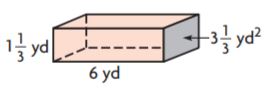
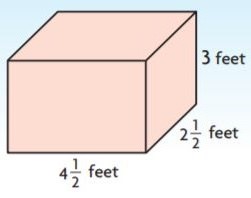
Question 11.
How many triangles do you see in the diagram? Explain.
______ triangles

Answer:
11 triangles

Explanation:
The given image has 11 triangles

Common Core – New – Page No. 571

Classify Quadrilaterals

Classify each figure as many ways as possible. Write quadrilateral, trapezoid, parallelogram, rhombus, rectangle, or square.

Question 1.
Go Math Grade 4 Answer Key Chapter 10 Two-Dimensional Figures Common Core - New img 44
Think: 2 pairs of parallel sides
4 sides of equal length
0 right angles
quadrilateral, parallelogram, rhombus

Answer:
Quadrilateral, Parallelogram, and rhombus.
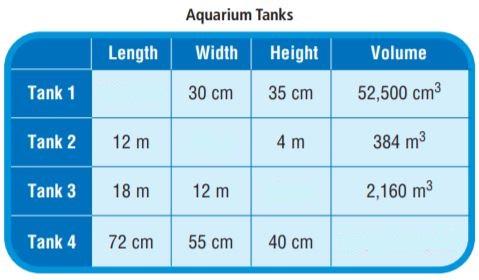
Explanation:
2 pairs of parallel sides
4 sides of equal length
0 right angles
Quadrilateral, Parallelogram, and rhombus.
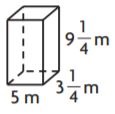
Question 2.
Go Math Grade 4 Answer Key Chapter 10 Two-Dimensional Figures Common Core - New img 45
Type below:
_________

Answer:
Quadrilateral, Parallelogram, Rectangle

Explanation:
2 pairs of parallel sides
2 pairs of sides of equal length
4 right angles
Quadrilateral, Parallelogram, Rectangle

Question 3.
Go Math Grade 4 Answer Key Chapter 10 Two-Dimensional Figures Common Core - New img 46
Type below:
_________

Answer:

Explanation:
1 pair of parallel sides
2 sides of equal length
0 right angles
Quadrilateral, Trapezoid

Question 4.
Go Math Grade 4 Answer Key Chapter 10 Two-Dimensional Figures Common Core - New img 47
Type below:
_________

Answer:
Quadrilateral

Explanation:
0 pair of parallel sides
0 sides of equal length
0 right angles
Quadrilateral

Question 5.
Go Math Grade 4 Answer Key Chapter 10 Two-Dimensional Figures Common Core - New img 48
Type below:
_________

Answer:
Quadrilateral, Parallelogram, and rhombus

Explanation:
2 pairs of parallel sides
4 sides of equal length
0 right angles
Quadrilateral, Parallelogram, and rhombus

Question 6.
Go Math Grade 4 Answer Key Chapter 10 Two-Dimensional Figures Go Math Grade 4 Answer Key Chapter 10 Two-Dimensional Figures img 49 img 49
Type below:
_________

Answer:

Explanation:
1 pair of parallel sides
0 sides of equal length
2 right angles
Quadrilateral, Trapezoid

Question 7.
Go Math Grade 4 Answer Key Chapter 10 Two-Dimensional Figures Go Math Grade 4 Answer Key Chapter 10 Two-Dimensional Figures img 50 img 50
Type below:
_________

Answer:

Explanation:
2 pairs of parallel sides
2 pairs of sides of equal length
0 right angles
Quadrilateral, Parallelogram

Problem Solving

Question 8.
Alan drew a polygon with four sides and four angles. All four sides are equal. None of the angles are right angles. What figure did Alan draw
_________

Answer:
Quadrilateral or rhombus

Explanation:
Alan drew a polygon with four sides and four angles. All four sides are equal. None of the angles are right angles. Alan drew Quadrilateral or rhombus

Question 9.
Teresa drew a quadrilateral with 2 pairs of parallel sides and 4 right angles. What quadrilateral could she have drawn?
_________

Answer:
square or rectangle

Explanation:
2 pairs of parallel sides and 4 right angles. she could draw a square or rectangle.

Common Core – New – Page No. 572

Lesson Check

Question 1.
Joey is asked to name a quadrilateral that is also a rhombus. What should be his answer?
Options:
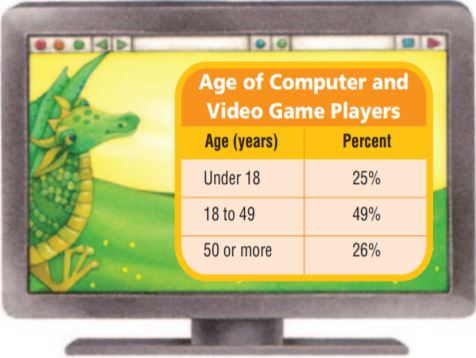
a. square
b. rectangle
c. parallelogram
d. trapezoid

Answer:
a. square

Explanation:
The quadrilateral square is also called a rhombus. Both square and rhombus have 2 pairs of parallel sides and 4 sides of equal length.

Question 2.
Which quadrilateral has exactly one pair of parallel sides?
Options:
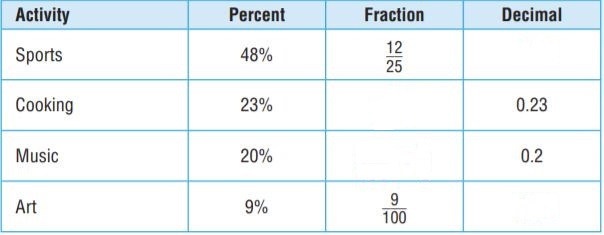
a. square
b. rhombus
c. parallelogram
d. trapezoid

Answer:
d. trapezoid

Explanation:
A trapezoid has exactly one pair of parallel sides.

Spiral Review

Question 3.
Terrence has 24 eggs to divide into equal groups. What are all the possible numbers of eggs that Terence could put in each group?
Options:
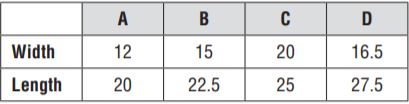
a. 1, 2, 3, 4
b. 2, 4, 6, 8, 12
c. 1, 2, 3, 4, 6, 8, 12, 24
d. 24, 48, 72, 96

Answer:
c. 1, 2, 3, 4, 6, 8, 12, 24

Explanation:
Terrence has 24 eggs to divide into equal groups. Terence could put in each group in 1, 2, 3, 4, 6, 8, 12, 24 ways.

Question 4.
In a line of students, Jenna is number 8. The teacher says that a rule for a number pattern is add 4. The first student in line says the first term, 7. What number
should Jenna say?
Options:
a. 31
b. 35
c. 39
d. 43

Answer:
b. 35

Explanation:
In a line of students, Jenna is number 8. The teacher says that a rule for a number pattern is add 4. The first student in line says the first term, 7.
7 + 4 = 11
11 + 4 = 15
15 + 4 = 19
19 + 4 = 23
23 + 4 = 27
27 + 4 = 31
31 + 4 = 35.
Jenna says 35.

Question 5.
Lou eats \(\frac{6}{8}\) of a pizza. What fraction of the pizza is left over?
Options:
a. \(\frac{1}{8}\)
b. \(\frac{1}{4}\)
c. \(\frac{1}{2}\)
d. \(\frac{3}{4}\)

Answer:
b. \(\frac{1}{4}\)

Explanation:
Lou eats \(\frac{6}{8}\) of a pizza. So, 6 parts of pizza is finished and remaining 2 parts of pizza is remained. So, the left over pizza is \(\frac{2}{8}\) = \(\frac{1}{4}\).

Question 6.
Which capital letter appears to have parallel lines?
Options:
a. D
b. L
c. N
d. T

Answer:
c. N

Explanation:
N has two parallel lines and never intersect each other.

Page No. 573

Choose the best term from the box to complete the sentence.
Go Math Grade 4 Answer Key Chapter 10 Two-Dimensional Figures img 51

Question 1.
A _______ is part of a line between two endpoints.
_________

Answer:
line segment

Question 2.
A _______ forms a square corner.
_________

Answer:
Right angle

Question 3.
An _______ is greater than a right angle and less than a straight angle.
_________

Answer:
Obtuse angle

Question 4.
The two-dimensional figure that has one endpoint is a ________.
_________

Answer:
ray

Question 5.
An angle that forms a line is called a _______.
_________

Answer:
straight line

Question 6.
On the grid below, draw a polygon that has 2 pairs of parallel sides, 2 pairs of sides equal in length, and 2 acute and 2 obtuse angles. Tell all the possible names for the figure.
Go Math Grade 4 Answer Key Chapter 10 Two-Dimensional Figures img 52
Type below:
_________

Answer:
grade 4 chapter 10 Lines, Rays, and Angles image 1 573
Parallelogram

Explanation:
The possible polygon that has 2 pairs of parallel sides, 2 pairs of sides equal in length, and 2 acute and 2 obtuse angles is Parallelogram.

Draw the figure.

Question 7.
parallel lines
Type below:
_________

Answer:
grade 4 chapter 10 Lines, Rays, and Angles image 1 563

Explanation:
QR and ST are two parallel lines. they never intersect each other.

Question 8.
obtuse ∠ABC
Type below:
_________

Answer:
Go Math Grade 4 Answer Key Chapter 10 Two-Dimensional Figures Common Core - New img 16

Explanation:
From triangle, ABC, Angle A, and Angle C are both acute with less than a right angle. Angle B is an obtuse angle that is greater than a right angle.

Question 9.
intersecting lines that are not perpendicular
Type below:
_________

Answer:

grade 4 chapter 10 Lines, Rays, and Angles image 7 559

Explanation:
ST and UV are two lines intersecting at point X.

Question 10.
acute ∠RST
Type below:
_________

Answer:
grade 4 chapter 10 Lines, Rays, and Angles image 2 575

Page No. 574

Question 11.
Which triangle has one right angle?
_________

Answer:
A right triangle has one right angle.

Question 12.
Which figure has 2 pairs of parallel sides, 2 pairs of sides of equal length, and 4 right angles?
_________

Answer:
A Rectangle has 2 pairs of parallel sides, 2 pairs of sides of equal length, and 4 right angles.

Question 13.
Which quadrilateral can have 2 pairs of parallel sides, all sides with equal length, and no right angles?
_________

Answer:
Rhombus can have 2 pairs of parallel sides, all sides with equal length, and no right angles.

Question 14.
What is the correct name of the figure shown?
Go Math Grade 4 Answer Key Chapter 10 Two-Dimensional Figures img 53
_________

Answer:
Ray

Explanation:
EF is a ray that has one endpoint and continues without an end in one direction.

Question 15.
Describe the angles of an obtuse triangle.
Type below:
_________

Answer:
An obtuse triangle (or obtuse-angled triangle) is a triangle with one obtuse angle (greater than 90°) and two acute angles.

Page No. 577

Tell whether the parts on each side of the line match. Is the line a line of symmetry? Write yes or no.

Question 1.
Go Math Grade 4 Answer Key Chapter 10 Two-Dimensional Figures img 54
____

Answer:
Yes;

Explanation:
The line of symmetry divides a shape into two parts that are the same size and shape.

Question 2.
Go Math Grade 4 Answer Key Chapter 10 Two-Dimensional Figures img 55
____

Answer:
Yes;

Explanation:
The line of symmetry divides a shape into two parts that are the same size and shape.

Question 3.
Go Math Grade 4 Answer Key Chapter 10 Two-Dimensional Figures img 56
____

Answer:
Yes;

Explanation:
The line of symmetry divides a shape into two parts that are the same size and shape.

Question 4.
Go Math Grade 4 Answer Key Chapter 10 Two-Dimensional Figures img 57
____

Answer:
No;

Explanation:
The line of symmetry divides a shape into two parts that are not with the same size and shape.

Tell if the blue line appears to be a line of symmetry. Write yes or no.

Question 5.
Go Math Grade 4 Answer Key Chapter 10 Two-Dimensional Figures img 58
____

Answer:
Yes;

Explanation:
The line of symmetry divides a shape into two parts that are the same size and shape.

Question 6.
Go Math Grade 4 Answer Key Chapter 10 Two-Dimensional Figures img 59
____

Answer:
No;

Explanation:
The line of symmetry divides a shape into two parts that are not with the same size and shape.

Question 7.
Go Math Grade 4 Answer Key Chapter 10 Two-Dimensional Figures img 60
____

Answer:
No;

Explanation:
The line of symmetry divides a shape into two parts that are not with the same size and shape.

Question 8.
Go Math Grade 4 Answer Key Chapter 10 Two-Dimensional Figures img 61
____

Answer:
Yes;

Explanation:
The line of symmetry divides a shape into two parts that are the same size and shape.

Tell if the blue line appears to be a line of symmetry. Write yes or no.

Question 9.
Go Math Grade 4 Answer Key Chapter 10 Two-Dimensional Figures img 62
____

Answer:
No;

Explanation:
The line of symmetry divides a shape into two parts that are not with the same size and shape.

Question 10.
Go Math Grade 4 Answer Key Chapter 10 Two-Dimensional Figures img 63
____

Answer:
Yes;

Explanation:
The line of symmetry divides a shape into two parts that are the same size and shape.

Question 11.
Go Math Grade 4 Answer Key Chapter 10 Two-Dimensional Figures img 64
____

Answer:
No;

Explanation:
The line of symmetry divides a shape into two parts that are not with the same size and shape.

Question 12.
Go Math Grade 4 Answer Key Chapter 10 Two-Dimensional Figures img 65
____

Answer:
Yes;

Explanation:
The line of symmetry divides a shape into two parts that are the same size and shape.

Question 13.
Which best describes the symmetry in the letter I?
Go Math Grade 4 Answer Key Chapter 10 Two-Dimensional Figures img 66
Type below:
________

Answer:
The two parts of the folded I match exactly. The fold line is a line of symmetry.

Explanation:
Take the Horizontal line in the middle of the Letter I. Cut out the tracing. Fold the tracing over a horizontal line. The two parts of the folded I match exactly. The fold line is a line of symmetry.

Page No. 578

Question 14.
Which shape has a correctly drawn line of symmetry?
Go Math Grade 4 Answer Key Chapter 10 Two-Dimensional Figures img 67
Go Math Grade 4 Answer Key Chapter 10 Two-Dimensional Figures img 68
Go Math Grade 4 Answer Key Chapter 10 Two-Dimensional Figures img 69
Go Math Grade 4 Answer Key Chapter 10 Two-Dimensional Figures img 70
a. What do you need to find?
Type below:
________

Answer:
Find the shape that has an exact line of symmetry.

Question 14.
b. How can you tell if the line of symmetry is correct?
Type below:
________

Answer:
If the two parts of the folded match exactly, then the line is a line of symmetry.

Question 14.
c. Tell how you solved the problem.
Type below:
________

Answer:
From fig 1 to 4, the fig 2 is has a line of symmetry that can exactly separate the two parts equally.

Question 14.
d. Circle the correct shape above.
Type below:
________

Answer:
Go Math Grade 4 Answer Key Chapter 10 Two-Dimensional Figures img 68

Question 15.
Reason Abstractly Draw a line of symmetry in the figure shown.
Go Math Grade 4 Answer Key Chapter 10 Two-Dimensional Figures img 71

Answer:
grade 4 chapter 10 Lines, Rays, and Angles image 1 578

Question 16.
Evie’s birthday is on the 18th of May. Since May is the 5th month, Evie wrote the date as shown.
Go Math Grade 4 Answer Key Chapter 10 Two-Dimensional Figures img 72
Evie says all the numbers she wrote have line symmetry. Is she correct? Explain.

Answer:
No; The number 5 doesn’t have a line of symmetry. So, Evie explanation is wrong.

Common Core – New – Page No. 579

Line Symmetry

Tell if the dashed line appears to be a line of symmetry. Write yes or no.

Question 1.
Go Math Grade 4 Answer Key Chapter 10 Two-Dimensional Figures Common Core - New img 73
yes

Answer:
Yes;

Explanation:
The line of symmetry divides a shape into two parts that are the same size and shape.

Question 2.
Go Math Grade 4 Answer Key Chapter 10 Two-Dimensional Figures Common Core - New img 74
____

Answer:
No;

Explanation:
The line of symmetry divides a shape into two parts that are not with the same size and shape.

Question 3.
Go Math Grade 4 Answer Key Chapter 10 Two-Dimensional Figures Common Core - New img 75
____

Answer:
Yes;

Explanation:
The line of symmetry divides a shape into two parts that are the same size and shape.

Question 4.
Go Math Grade 4 Answer Key Chapter 10 Two-Dimensional Figures Common Core - New img 76
____

Answer:
No;

Explanation:
The line of symmetry divides a shape into two parts that are not with the same size and shape.

Question 5.
Go Math Grade 4 Answer Key Chapter 10 Two-Dimensional Figures Common Core - New img 77
____

Answer:
No;

Explanation:
The line of symmetry divides a shape into two parts that are not with the same size and shape.

Question 6.
Go Math Grade 4 Answer Key Chapter 10 Two-Dimensional Figures Common Core - New img 78
____

Answer:
Yes;

Explanation:
The line of symmetry divides a shape into two parts that are the same size and shape.

Question 7.
Go Math Grade 4 Answer Key Chapter 10 Two-Dimensional Figures Common Core - New img 79
____

Answer:
No;

Explanation:
The line of symmetry divides a shape into two parts that are not with the same size and shape.

Question 8.
Go Math Grade 4 Answer Key Chapter 10 Two-Dimensional Figures Common Core - New img 80
____

Answer:
Yes;

Explanation:
The line of symmetry divides a shape into two parts that are the same size and shape.

Complete the design by reflecting over the line of symmetry.

Question 9.
Go Math Grade 4 Answer Key Chapter 10 Two-Dimensional Figures Common Core - New img 81

Answer:
grade 4 chapter 10 Lines, Rays, and Angles image 4 578

Question 10.
Go Math Grade 4 Answer Key Chapter 10 Two-Dimensional Figures Common Core - New img 82

Answer:
grade 4 chapter 10 Lines, Rays, and Angles image 6 578

Problem Solving

Question 11.
Kara uses the pattern below to make paper dolls. The dashed line represents a line of symmetry. A complete doll includes the reflection of the pattern over the line of symmetry. Complete the design to show what one of Kara’s paper dolls looks like.
Go Math Grade 4 Answer Key Chapter 10 Two-Dimensional Figures Common Core - New img 83

Answer:
grade 4 chapter 10 Lines, Rays, and Angles image 7 578

Common Core – New – Page No. 580

Lesson Check

Question 1.
Which best describes the line of symmetry in the letter D?
Go Math Grade 4 Answer Key Chapter 10 Two-Dimensional Figures Common Core - New img 84
Options:
a. horizontal
b. vertical
c. diagonal
d. half turn

Answer:
a. horizontal

Explanation:
The horizontal line of symmetry in the letter D can exactly separate two parts equally.

Question 2.
Which shape has a correctly drawn line of symmetry?
Options:
a. Go Math Grade 4 Answer Key Chapter 10 Two-Dimensional Figures Common Core - New img 85
b. Go Math Grade 4 Answer Key Chapter 10 Two-Dimensional Figures Common Core - New img 86
c. Go Math Grade 4 Answer Key Chapter 10 Two-Dimensional Figures Common Core - New img 87
d. Go Math Grade 4 Answer Key Chapter 10 Two-Dimensional Figures Common Core - New img 88

Answer:
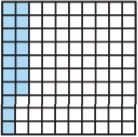
b. Go Math Grade 4 Answer Key Chapter 10 Two-Dimensional Figures Common Core - New img 86

Explanation:
Image b has the line of symmetry that separates two parts equally.

Spiral Review

Question 3.
The class has 360 unit cubes in a bag. Johnnie divides the unit cubes equally among 8 groups. How many unit cubes will each group get?
Options:
a. 40
b. 44
c. 45
d. 48

Answer:
c. 45

Explanation:
The class has 360 unit cubes in a bag. Johnnie divides the unit cubes equally among 8 groups. 360/8= 45.

Question 4.
There are 5,280 feet in one mile. How many feet are there in 6 miles?
Options:
a. 30,680
b. 31,260
c. 31,608
d. 31,680

Answer:
d. 31,680

Explanation:
There are 5,280 feet in one mile. So, for 6 miles = 6 x 5, 280 = 31,680.

Question 5.
Sue has 4 pieces of wood. The lengths of her pieces of wood are \(\frac{1}{3}\) foot, \(\frac{2}{5}\) foot, \(\frac{3}{10}\) foot, and \(\frac{1}{4}\) foot. Which piece of wood is the shortest?
Options:
a. the \(\frac{1}{3}\) foot piece
b. the \(\frac{2}{5}\) foot piece
c. the \(\frac{3}{10}\) foot piece
d. the \(\frac{1}{4}\) foot piece

Answer:
d. the \(\frac{1}{4}\) foot piece

Explanation:
The lengths of \(\frac{1}{4}\) foot piece is less compared to other lengths.

Question 6.
Alice has \(\frac{1}{5}\) as many miniature cars as Sylvester has. Sylvester has 35 miniature cars. How many miniature cars does Alice have?
Options:
a. 7
b. 9
c. 40
d. 175

Answer:
a. 7

Explanation:
Alice has \(\frac{1}{5}\) as many miniature cars as Sylvester has. Sylvester has 35 miniature cars. Alice have \(\frac{1}{5}\) X 35 = 7 miniature cars.

Page No. 583

Question 1.
The shape at the right has line symmetry. Draw the 2 lines of symmetry.
Go Math Grade 4 Answer Key Chapter 10 Two-Dimensional Figures img 89
Type below:
_________

Answer:
grade 4 chapter 10 Lines, Rays, and Angles image 1 583

Tell whether the shape appears to have zero lines, 1 line, or more than 1 line of symmetry. Write zero, 1, or more than 1.

Question 2.
Go Math Grade 4 Answer Key Chapter 10 Two-Dimensional Figures img 90
_________

Answer:
more than 1

Explanation:
grade 4 chapter 10 Lines, Rays, and Angles image 2 583
There is more than 1 line of symmetries that separates two parts equally.

Question 3.
Go Math Grade 4 Answer Key Chapter 10 Two-Dimensional Figures img 91
_________

Answer:
more than 1

Explanation:
grade 4 chapter 10 Lines, Rays, and Angles image 3 583
There is more than 1 lines of symmetries that separates two parts equally.

Question 4.
Go Math Grade 4 Answer Key Chapter 10 Two-Dimensional Figures img 92
_________

Answer:
1 line

Explanation:
grade 4 chapter 10 Lines, Rays, and Angles image 4 583
There is 1 line of symmetry that separates two parts equally.

Question 5.
Go Math Grade 4 Answer Key Chapter 10 Two-Dimensional Figures img 93
_________

Answer:
zero lines

Explanation:
There is no line of symmetries that separates two parts equally.

Tell whether the shape appears to have zero lines, 1 line, or more than 1 line of symmetry. Write zero, 1, or more than 1.

Question 6.
Go Math Grade 4 Answer Key Chapter 10 Two-Dimensional Figures img 94
_________

Answer:
more than 1

Explanation:
grade 4 chapter 10 Lines, Rays, and Angles image 6 583
There is more than 1 lines of symmetries that separate two parts equally.

Question 7.
Go Math Grade 4 Answer Key Chapter 10 Two-Dimensional Figures img 95
_________

Answer:
zero lines

Explanation:
There is no line of symmetries that separates two parts equally.

Question 8.
Go Math Grade 4 Answer Key Chapter 10 Two-Dimensional Figures img 96
_________

Answer:
zero lines

Explanation:
There is no line of symmetries that separates two parts equally.

Question 9.
Go Math Grade 4 Answer Key Chapter 10 Two-Dimensional Figures img 97
_________

Answer:
1 line

Explanation:
grade 4 chapter 10 Lines, Rays, and Angles image 8 583
There is 1 line of symmetry that separates two parts equally.

Practice: Copy and Solve Does the design have line symmetry?
Write yes or no. If your answer is yes, draw all lines of symmetry.

Question 10.
Go Math Grade 4 Answer Key Chapter 10 Two-Dimensional Figures img 98
____

Answer:
Yes;
grade 4 chapter 10 Lines, Rays, and Angles image 8 583

Question 11.
Go Math Grade 4 Answer Key Chapter 10 Two-Dimensional Figures img 99
_____

Answer:
No;

Question 12.
Go Math Grade 4 Answer Key Chapter 10 Two-Dimensional Figures img 100
_____

Answer:
Yes;
grade 4 chapter 10 Lines, Rays, and Angles image 9 578

Question 13.
Go Math Grade 4 Answer Key Chapter 10 Two-Dimensional Figures img 101
_____

Answer:
No;

Question 14.
Draw a figure that has 5 sides and exactly 1 line of symmetry.
Type below:
_________

Answer:

Explanation:
the above 5 sides shape has only 1 line symmetry

Page No. 584

Use the chart for 15–17.
Go Math Grade 4 Answer Key Chapter 10 Two-Dimensional Figures img 102

Question 15.
Which letters appear to have only 1 line of symmetry?
Type below:
_________

Answer:
A, B, C, D, E, T, U, V, W

Explanation:
The letters A, B, C, D, E, T, U, V, W have only 1 line of symmetry.

Question 16.
Which letters appear to have zero lines of symmetry?
Type below:
_________

Answer:
J, N, S

Explanation:
The letters J, N, S have only zero lines of symmetry.

Question 17.
The letter C has horizontal symmetry. The letter A has vertical symmetry. Which letters appear to have both horizontal and vertical symmetry?
Type below:
_________

Answer:
H and I

Explanation:
The letters H and I have both horizontal and vertical symmetry.

Question 18.
Verify the Reasoning of Others Jeff says that the shape has only 2 lines of symmetry.
Does his statement make sense? Explain.
Go Math Grade 4 Answer Key Chapter 10 Two-Dimensional Figures img 103
Type below:
_________

Answer:
No; Jeff’s explanation is wrong. Because the given shape has only 2 lines of symmetry.

Question 19.
Match each figure with the correct number of lines of symmetry it has.
Go Math Grade 4 Answer Key Chapter 10 Two-Dimensional Figures img 104
Type below:
_________

Answer:
grade 4 chapter 10 Lines, Rays, and Angles image 12 583

Common Core – New – Page No. 585

Find and Draw Lines of Symmetry

Tell whether the shape appears to have zero lines, 1 line, or more than 1 line of symmetry. Write zero, 1, or more than 1.

Question 1.
Go Math Grade 4 Answer Key Chapter 10 Two-Dimensional Figures Common Core - New img 105
1

Answer:
more than 1

Explanation:
There is more than 1 line of symmetry that separates two parts equally.

Question 2.
Go Math Grade 4 Answer Key Chapter 10 Two-Dimensional Figures Common Core - New img 106
________

Answer:
more than 1

Explanation:
There is more than 1 line of symmetry that separates two parts equally.

Question 3.
Go Math Grade 4 Answer Key Chapter 10 Two-Dimensional Figures Common Core - New img 107
________

Answer:
Zero

Explanation:
There are 0 lines of symmetries.

Question 4.
Go Math Grade 4 Answer Key Chapter 10 Two-Dimensional Figures Common Core - New img 108
________

Answer:
more than 1

Explanation:
grade 4 chapter 10 Lines, Rays, and Angles image 2 585
There is more than 1 line of symmetry that separates two parts equally.

Does the design have line symmetry? Write yes or no.
If your answer is yes, draw all lines of symmetry.

Question 5.
Go Math Grade 4 Answer Key Chapter 10 Two-Dimensional Figures Common Core - New img 109
_____

Answer:
Yes;
grade 4 chapter 10 Lines, Rays, and Angles image 3 585

Question 6.
Go Math Grade 4 Answer Key Chapter 10 Two-Dimensional Figures Common Core - New img 110
_____

Answer:
Yes;
grade 4 chapter 10 Lines, Rays, and Angles image 5 585

Go Math Grade 4 Answer Key Chapter 10 Two-Dimensional Figures Common Core - New img 111
_____

Answer:
No;

Question 8.
Go Math Grade 4 Answer Key Chapter 10 Two-Dimensional Figures Common Core - New img 112
______

Answer:
Yes;
grade 4 chapter 10 Lines, Rays, and Angles image 6 585

Draw a shape for the statement. Draw the line or lines of symmetry.

Question 9.
zero lines of symmetry
Go Math Grade 4 Answer Key Chapter 10 Two-Dimensional Figures Common Core - New img 113

Answer:
grade 4 chapter 10 Lines, Rays, and Angles image 7 585

Question 10.
1 line of symmetry
Go Math Grade 4 Answer Key Chapter 10 Two-Dimensional Figures Common Core - New img 114

Answer:
grade 4 chapter 10 Lines, Rays, and Angles image 9 585

Question 11.
2 lines of symmetry
Go Math Grade 4 Answer Key Chapter 10 Two-Dimensional Figures Common Core - New img 115

Answer:
grade 4 chapter 10 Lines, Rays, and Angles image 10 585

Problem Solving

Use the chart for 12–13.
Go Math Grade 4 Answer Key Chapter 10 Two-Dimensional Figures Common Core - New img 116

Question 12.
Which number or numbers appear to have only 1 line of symmetry?
_____

Answer:
3

Explanation:
The number 3 has only 1 line of symmetry.

Question 13.
Which number or numbers appear to have 2 lines of symmetry?
_____

Answer:
0 and 8

Explanation:
The numbers 0 and 8 appear to have 2 lines of symmetry.

Common Core – New – Page No. 586

Lesson Check

Question 1.
How many lines of symmetry does this shape appear to have?
Go Math Grade 4 Answer Key Chapter 10 Two-Dimensional Figures Common Core - New img 117
Options:
a. 0
b. 2
c. 6
d. 12

Answer:
c. 6

Explanation:
grade 4 chapter 10 Lines, Rays, and Angles image 1 586
The given shape has 6 lines of symmetries.

Question 2.
Which of the following shapes appears to have exactly 1 line of symmetry?
Options:
a. Go Math Grade 4 Answer Key Chapter 10 Two-Dimensional Figures Common Core - New img 118
b.Go Math Grade 4 Answer Key Chapter 10 Two-Dimensional Figures Common Core - New img 119
c. Go Math Grade 4 Answer Key Chapter 10 Two-Dimensional Figures Common Core - New img 120
d. Go Math Grade 4 Answer Key Chapter 10 Two-Dimensional Figures Common Core - New img 121

Answer:
d. Go Math Grade 4 Answer Key Chapter 10 Two-Dimensional Figures Common Core - New img 121

Explanation:
grade 4 chapter 10 Lines, Rays, and Angles image 2 586
The trapezoid has exactly 1 line of symmetry.

Spiral Review

Question 3.
Richard practiced each of 3 piano solos for \(\frac{5}{12}\) hour. How long did he practice in all?
Options:
a. \(\frac{2}{3}\) hours
b. 1 \(\frac{1}{4}\) hours
c. 1 \(\frac{1}{3}\) hours
d. 1 \(\frac{5}{12}\) hours

Answer:
b. 1 \(\frac{1}{4}\) hours

Explanation:
Richard practiced each of 3 piano solos for \(\frac{5}{12}\) hour. \(\frac{5}{12}\) hour = 1 \(\frac{1}{4}\) hours hours.

Question 4.
Which of the following decimals is equivalent to three and ten hundredths?
Options:
a. 0.30
b. 0.31
c. 3.01
d. 3.1

Answer:
d. 3.1

Explanation:
three and ten hundredths = 310 hundredths = 3.1

Question 5.
Lynne used \(\frac{3}{8}\) cup of flour and \(\frac{1}{3}\) cup of sugar in a recipe. Which number below is a common denominator for \(\frac{3}{8}\) and \(\frac{1}{3}\)?
Options:
a. 8
b. 12
c. 16
d. 24

Answer:
d. 24

Explanation:
Lynne used \(\frac{3}{8}\) cup of flour and \(\frac{1}{3}\) cup of sugar in a recipe. To find the common denominator for \(\frac{3}{8}\) and \(\frac{1}{3}\), multiply 8 X3 and 3 X 8 = 24.

Question 6.
Kevin draws a figure that has four sides. All sides have the same length. His figure has no right angles. What figure does Kevin draw?
Options:
a. square
b. trapezoid
c. rhombus
d. rectangle

Answer:
c. rhombus

Explanation:

Page No. 589

Question 1.
Marisol is making a pattern with blocks. What might the missing shape be?
First, look at the blocks.
Go Math Grade 4 Answer Key Chapter 10 Two-Dimensional Figures img 122
Next, describe the pattern.
Type below:
_________

Answer:
The first image 1 has three line segments. The next shape will have four line segments.

Question 1.
Finally, draw the missing shape.
Go Math Grade 4 Answer Key Chapter 10 Two-Dimensional Figures img 123
Type below:
_________

Answer:
grade 4 chapter 10 Lines, Rays, and Angles image 1 586

Question 2.
Use the shapes to write a number pattern. Then describe the pattern in the numbers.

Answer:
grade 4 chapter 10 Lines, Rays, and Angles image 3 586
Shape 1: Triangle
Shape 2: Square
Shape 3: Pentagon
Shape 4: Hexagon
Shape 5: Heptagon

Question 3.
What if the pattern continued? Write an expression to describe the number of sides the sixth shape has in Marisol’s pattern.
Type below:
_________

Answer:
If the pattern continued, then the next shape will have one more extra line segment to it. The sixth shape will become the octagon.
Shape 6: Octagon

Question 4.
Sahil made a pattern using circles. The first nine circles are shown. Describe the pattern. If Sahil continues the pattern, what might the next three circles be?
Go Math Grade 4 Answer Key Chapter 10 Two-Dimensional Figures img 124
Type below:
_________

Answer:
The pattern is repeated for every three circles. One big circle followed by two small circles.
grade 4 chapter 10 Lines, Rays, and Angles image 6 586

Page No. 590

Use the toy quilt designs for 5–6.
Go Math Grade 4 Answer Key Chapter 10 Two-Dimensional Figures img 125

Question 5.
Lu is making a quilt that is 20 squares wide and has 24 rows. The border of the quilt is made by using each toy design equally as often. Each square can hold one design. How many of each design does she use for the border?
______ times

Answer:
The border will have 20 squares two times, and 24 squares two times as well, that is the perimeter or the border, because a quilt has 4 sides:
20 X 2 + 24 X 2 = 40 + 48 = 88
So, the border will have 88 squares in total. So if the border can have only one design, Lu can use any toy design 88 times if she wants the border to have the same toy design in it.

Question 6.
Communicate Starting in the first square of her quilt, Lu lined up her toy designs in this order: plane, car, fire truck, helicopter, crane, and wagon. Using this pattern unit, which design will Lu place in the fifteenth square? Explain how you found your answer.
_________

Answer:
The answer is fire truck. As the pattern repeats, the fifteenth square will fire truck.

Question 7.
Missy uses 1 hexagonal, 2 rectangular, and 4 triangular pieces of fabric to make 1 bug design for a quilt. If she uses 70 pieces in all to make bug designs, how many of each shape does she use?
Hexagonal: _________ shapes
Rectangular: _________ shapes
Triangular: _________ shapes

Answer:
Hexagonal: 10 shapes
Rectangular: 10 shapes
Triangular: 10 shapes
(1 x 10) + (2 x 10) + (4 x 10) = 10 + 20 + 40 = 70 pieces in all.

Question 8.
Norris drew the pattern shown.
Go Math Grade 4 Answer Key Chapter 10 Two-Dimensional Figures img 126
Label the circles to show the colors in the fourth figure of the pattern.
Type below:
_________

Answer:
grade 4 chapter 10 Lines, Rays, and Angles image 1 591

Common Core – New – Page No. 591

Problem Solving Shape Patterns

Solve each Problem.

Question 1.
Marta is using this pattern to decorate a picture frame. Describe the pattern. Draw what might be the next three figures in the pattern.
Go Math Grade 4 Answer Key Chapter 10 Two-Dimensional Figures Common Core - New img 127
Possible answer: the pattern repeats: one trangle followed by two squares.

Answer:
Go Math Grade 4 Answer Key Chapter 10 Two-Dimensional Figures Common Core - New img 127
The pattern repeats one triangle followed by two squares.

Question 2.
Describe the pattern. Draw what might be the next three figures in the pattern. How many circles are in the sixth figure in the pattern?
Go Math Grade 4 Answer Key Chapter 10 Two-Dimensional Figures Common Core - New img 128
_____ circles

Answer:
grade 4 chapter 10 Lines, Rays, and Angles image 1 591
Add one more column with 1 more circle than in the previous column; 21.

Question 3.
Larry stencils this pattern to make a border at the top of his bedroom walls. Describe the pattern. Draw what might be the missing figure in the pattern.
Go Math Grade 4 Answer Key Chapter 10 Two-Dimensional Figures Common Core - New img 129

Answer:
grade 4 chapter 10 Lines, Rays, and Angles image 2 591
2 triangles placed side to side followed by 2 sets of 2 triangles placed vertex to vertex

Common Core – New – Page No. 592

Lesson Check

Question 1.
What might be the next three figures in this pattern?
Go Math Grade 4 Answer Key Chapter 10 Two-Dimensional Figures Common Core - New img 130
Options:
a. Go Math Grade 4 Answer Key Chapter 10 Two-Dimensional Figures Common Core - New img 131
b. Go Math Grade 4 Answer Key Chapter 10 Two-Dimensional Figures Common Core - New img 132
c. Go Math Grade 4 Answer Key Chapter 10 Two-Dimensional Figures Common Core - New img 133
d. Go Math Grade 4 Answer Key Chapter 10 Two-Dimensional Figures Common Core - New img 134

Answer:
a. Go Math Grade 4 Answer Key Chapter 10 Two-Dimensional Figures Common Core - New img 131

Explanation:
the pattern has odd numbers of up arrows then even number of down arrows. So, the next three figures are Go Math Grade 4 Answer Key Chapter 10 Two-Dimensional Figures Common Core - New img 131.

Question 2.
Which might be the missing figure in the following pattern?
Go Math Grade 4 Answer Key Chapter 10 Two-Dimensional Figures Common Core - New img 135
Options:
a. Go Math Grade 4 Answer Key Chapter 10 Two-Dimensional Figures Common Core - New img 136
b. Go Math Grade 4 Answer Key Chapter 10 Two-Dimensional Figures Common Core - New img 137
c. Go Math Grade 4 Answer Key Chapter 10 Two-Dimensional Figures Common Core - New img 138
d. Go Math Grade 4 Answer Key Chapter 10 Two-Dimensional Figures Common Core - New img 139

Answer:
a. Go Math Grade 4 Answer Key Chapter 10 Two-Dimensional Figures Common Core - New img 136

Explanation:
From the pattern, the missing image will have vertical rectangle with the circle and X mark in it.

Spiral Review

Question 3.
Chad has two pieces of wood. One piece is \(\frac{7}{12}\) foot long. The second piece is \(\frac{5}{12}\) foot longer than the first piece. How long is the second piece?
Options:
a. \(\frac{2}{12}\) foot
b. \(\frac{1}{2}\) foot
c. \(\frac{12}{18}\) foot
d. 1 foot

Answer:
d. 1 foot

Explanation:
\(\frac{7}{12}\) + \(\frac{5}{12}\) = \(\frac{12}{12}\) = 1 foot.

Question 4.
Olivia finished a race in 40.64 seconds. Patty finished the race in 40.39 seconds. Miguel finished the race in 41.44 seconds. Chad finished the race in 40.46 seconds. Who finished the race in the least time?
Options:
a. Olivia
b. Patty
c. Miguel
d. Chad

Answer:
b. Patty

Explanation:
Patty finished the race in 40.39 seconds that is the least time compared to others.

Question 5.
Justin bought 6 ribbons for an art project. Each ribbon is \(\frac{1}{4}\) yard long. How many yards of ribbon did Justin buy?
Options:
a. \(\frac{2}{3}\) yard
b. 1 \(\frac{1}{4}\) yards
c. 1 \(\frac{1}{2}\) yards
d. 1 \(\frac{3}{4}\) yards

Answer:
c. 1 \(\frac{1}{2}\) yards

Explanation:
Justin bought 6 ribbons for an art project. Each ribbon is \(\frac{1}{4}\) yard long. So, 6 X \(\frac{1}{4}\) = \(\frac{3}{2}\) = 1 \(\frac{1}{2}\) yards.

Question 6.
Kyle and Andrea were asked to make a list of prime numbers.
Kyle: 1, 3, 7, 19, 23
Andrea: 2, 3, 5, 7, 11
Whose list is correct?
Options:
a. Only Kyle’s list
b. Only Andrea’s list
c. Both lists are correct.
d. Neither list is correct.

Answer:
b. Only Andrea’s list

Explanation:
1 is not a prime number. So, the answer is Only Andrea’s list is correct.

Page No. 593

Question 1.
Gavin is designing a kite. He sketched a picture of the kite.
How many right angles does the kite appear to have?
Go Math Grade 4 Answer Key Chapter 10 Two-Dimensional Figures img 140
_____ right angles

Answer:
0 right angles

Explanation:
There is no right angles in the given shape.

Question 2.
Write the letter of the triangle under its correct classification.
Go Math Grade 4 Answer Key Chapter 10 Two-Dimensional Figures img 141
Go Math Grade 4 Answer Key Chapter 10 Two-Dimensional Figures img 142

Answer:
grade 4 chapter 10 Lines, Rays, and Angles image 1 593

Explanation:
C and F are Acute angles with less than right angles.
B and D are Obtuse Angles with more than right angles.
A and E are Right Angles.

Question 3.
Select the angles that identify an obtuse triangle. Mark all that apply.
Options:
a. acute, acute, acute
b. acute, acute, obtuse
c. right, acute, acute
d. obtuse, right, acute

Answer:
b. acute, acute, obtuse

Explanation:
An obtuse triangle will have one obtuse angle and two acute angles.

Page No. 594

Question 4.
Write the word that describes the part of Figure A written below.
Go Math Grade 4 Answer Key Chapter 10 Two-Dimensional Figures img 143
Go Math Grade 4 Answer Key Chapter 10 Two-Dimensional Figures img 144
\(\overline{E B}\) _________
\(\overset { \longleftrightarrow }{ AB } \) _________
\(\overrightarrow{G A}\) _________
∠EBG _________
∠CGB _________

Answer:
\(\overline{E B}\) line segment.
\(\overset { \longleftrightarrow }{ AB } \) Line.
\(\overrightarrow{G A}\) Ray.
∠EBG right angle.
∠CGB acute angle.

Explanation:
\(\overline{E B}\) is a line segment that has two endpoints connected to form a line.
\(\overset { \longleftrightarrow }{ AB } \) is a Line that continues without an end in both directions.
\(\overrightarrow{G A}\) is a Ray that has one endpoint and continues without an end in one direction.
∠EBG right angle.
∠CGB is an acute angle with less than the right angle.

Question 5.
What term best describes the figure shown below?
Go Math Grade 4 Answer Key Chapter 10 Two-Dimensional Figures img 145

Answer:
perpendicular lines

Explanation:
The lines are forming four right angles they form squares. So, the both lines are perpendicular lines.

Question 6.
Naomi leaves for her trip to Los Angeles on the 12th day of August. Since August is the 8th month, Naomi wrote the date as shown.
Go Math Grade 4 Answer Key Chapter 10 Two-Dimensional Figures img 146
Naomi says all the numbers she wrote have line symmetry. Is she correct? Explain your thinking.
_______

Answer:
Naomi is incorrect. The number 2 does not have a line of symmetry because if it were cut out, there would be no way to fold it in half so that the two parts matched exactly.

Page No. 595

Question 7.
Max made a pennant that looks like a triangle. How can you classify the triangle based upon its angles?
Go Math Grade 4 Answer Key Chapter 10 Two-Dimensional Figures img 147
The triangle is a(n) ____________ triangle.

Answer:
The triangle is an acute triangle.

Explanation:
The triangle is an acute triangle.  because it has angles with less than right angles.

Question 8.
Choose the labels to make a true statement.
Go Math Grade 4 Answer Key Chapter 10 Two-Dimensional Figures img 148
Go Math Grade 4 Answer Key Chapter 10 Two-Dimensional Figures img 149
_____ is parallel to ______

Answer:
Line AB is parallel to line CD.

Explanation:
From the given image, Line AB is parallel to line CD.

Question 9.
Classify the figure. Select all that apply.
Go Math Grade 4 Answer Key Chapter 10 Two-Dimensional Figures img 150
Options:
a. quadrilateral
b. trapezoid
c. parallelogram
d. rectangle
e. rhombus
f. square

Answer:
a. quadrilateral
b. trapezoid
c. parallelogram
d. rectangle

Explanation:
The given image has 2 parallel sides, 2 pairs of sides of length, and four right angles. So, the possible answers are quadrilateral, trapezoid, parallelogram, and rectangle.

Question 10.
Lily designed a deck in her backyard that looks like a quadrilateral that has only 1 pair of parallel sides. How can you classify the figure?
The quadrilateral is a ________

Answer:
The quadrilateral is a trapezoid

Explanation:
Lily designed a deck in her backyard that looks like a quadrilateral that has only 1 pair of parallel sides. So, the answer is a trapezoid.

Page No. 596

Question 11.
Match each figure with the correct number of lines of symmetry it has.
Go Math Grade 4 Answer Key Chapter 10 Two-Dimensional Figures img 151

Answer:
grade 4 chapter 10 Lines, Rays, and Angles image 1 595

Explanation:
Image 1: 1 line of symmetry
Image 2: 2 lines of symmetry
Image 3: 0 lines of symmetry
Image 4: More than 2 lines of symmetry.

Question 12.
Barb drew the pattern shown.
Go Math Grade 4 Answer Key Chapter 10 Two-Dimensional Figures img 152
Use the square shown to draw the missing pattern. □

Answer:
grade 4 chapter 10 Lines, Rays, and Angles image 1 596

Explanation:
The fourth shape must consist of one extra square box in the top line and bottom line.

Question 13.
Claudia drew the figure below. Draw a line of symmetry on Claudia’s figure.
Go Math Grade 4 Answer Key Chapter 10 Two-Dimensional Figures img 153

Answer:
grade 4 chapter 10 Lines, Rays, and Angles image 2 596

Explanation:
The image can have one line symmetry.

Question 14.
Write the word or words that best describe this figure.
Go Math Grade 4 Answer Key Chapter 10 Two-Dimensional Figures img 154
_________

Answer:
Ray

Explanation:
The ray that has one endpoint and continues without an end in one direction.

Question 15.
How many acute angles does a right triangle have?
A right triangle has ____ acute angles.

Answer:
A right triangle has 2 acute angles.

Page No. 597

Question 16.
Mike drew a figure with opposite sides parallel. Write the pairs of parallel sides. What figure is it?
Go Math Grade 4 Answer Key Chapter 10 Two-Dimensional Figures img 155

Answer:
Line DG is parallel to Line FE and Line DE is parallel to Line GF; the figure is a parallelogram.

Question 17.
Circle the letter that does not have line symmetry.
Go Math Grade 4 Answer Key Chapter 10 Two-Dimensional Figures img 156

Answer:
grade 4 chapter 10 Lines, Rays, and Angles image 4 569

Explanation:
The S does not have line symmetry.

Question 18.
Joseph made a pattern using ovals and rectangles. The first four figures of his pattern are shown. Draw the next figure in the pattern.
Go Math Grade 4 Answer Key Chapter 10 Two-Dimensional Figures img 157

Answer:
grade 4 chapter 10 Lines, Rays, and Angles image 5 596

Question 19.
Jeremy drew Figure 1 and Louisa drew Figure 2.
Go Math Grade 4 Answer Key Chapter 10 Two-Dimensional Figures img 158
Part A
Jeremy says both figures are rectangles. Do you agree with Jeremy?
Support your answer.
_____

Answer:
Yes; both figures have 2 pairs of parallel sides, opposite sides that are equal in length, and 4 right angles.

Question 19.
Part B
Louisa says both figures are rhombuses. Do you agree with Louisa?
Support your answer.
_____

Answer:
No; figure 2 is a rhombus since it has 2 pairs of parallel sides and 4 sides of equal length. Figure 1 does not have 4 sides of equal length so it cannot be a rhombus.

Page No. 598

Question 20.
Veronica found the number of lines of symmetry for the figure below. How many lines of symmetry does it have?
Go Math Grade 4 Answer Key Chapter 10 Two-Dimensional Figures img 159
______ lines of symmetry

Answer:
2 lines of symmetry

Explanation:
the given shape can have 2 lines of symmetry.

Question 21.
Jordan drew the pattern below.
Go Math Grade 4 Answer Key Chapter 10 Two-Dimensional Figures img 160
Part A
Describe the pattern.

Answer:
Each figure has 2 more squares than the preceding figure.

Question 21.
Part B
Write a rule using numbers to find the number of squares in any figure in the pattern.

Answer:
multiply the figure number by 2.

Question 21.
Part C
Draw Figure 5.

Answer:
grade 4 chapter 10 Lines, Rays, and Angles image 1 597

Page No. 603

Tell what fraction of the circle the shaded angle represents.

Question 1.
Go Math Grade 4 Answer Key Chapter 10 Two-Dimensional Figures img 161
\(\frac{□}{□}\)

Answer:
\(\frac{1}{2}\)

Explanation:
Half of the part is shaded out of the circle. So, the answer is 1/2.

Question 2.
Go Math Grade 4 Answer Key Chapter 10 Two-Dimensional Figures img 162
\(\frac{□}{□}\)

Answer:
\(\frac{1}{4}\)

Explanation:
\(\frac{1}{4}\) part of the circle is shaded out of the circle.

Question 3.
Go Math Grade 4 Answer Key Chapter 10 Two-Dimensional Figures img 163
\(\frac{□}{□}\)

Answer:
\(\frac{3}{4}\)

Explanation:
3 parts of the circle is shaded out of the circle

Question 4.
Go Math Grade 4 Answer Key Chapter 10 Two-Dimensional Figures img 164
\(\frac{□}{□}\)

Answer:
\(\frac{1}{1}\) = 1

Explanation:
The complete circle is shaded. So, the answer is 1.

Question 5.
Go Math Grade 4 Answer Key Chapter 10 Two-Dimensional Figures img 165
\(\frac{□}{□}\)

Answer:
\(\frac{1}{2}\)

Explanation:
Half of the part is shaded out of the circle. So, the answer is 1/2.

Question 6.
Go Math Grade 4 Answer Key Chapter 10 Two-Dimensional Figures img 166
\(\frac{□}{□}\)

Answer:
\(\frac{1}{12}\)

Tell whether the angle on the circle shows a \(\frac{1}{4}, \frac{1}{2}, \frac{3}{4}\), or 1 full turn clockwise or counterclockwise.

Question 7.
Go Math Grade 4 Answer Key Chapter 10 Two-Dimensional Figures img 167
Type below:
________

Answer:
\(\frac{3}{4}\); counterclockwise

Explanation:
The image shows the counterclockwise and formed the fraction of \(\frac{3}{4}\).

Question 8.
Go Math Grade 4 Answer Key Chapter 10 Two-Dimensional Figures img 168
Type below:
________

Answer:
\(\frac{1}{2}\); clockwise

Explanation:
The image shows the clockwise and formed the fraction of \(\frac{1}{2}\).

Question 9.
Go Math Grade 4 Answer Key Chapter 10 Two-Dimensional Figures img 169
Type below:
________

Answer:
\(\frac{1}{4}\); clockwise

Explanation:
The image shows the clockwise and formed the fraction of \(\frac{1}{4}\).

Question 10.
Susan watched the game from 1 p.m. to 1:30 p.m. Describe the turn the minute hand made.
Go Math Grade 4 Answer Key Chapter 10 Two-Dimensional Figures img 170
Type below:
________

Answer:
The minute hand made a \(\frac{1}{2}\) turn clockwise.

Question 11.
Compare the angles in Exercises 1 and 5. Does the position of the angle affect the size of the angle? Explain.
_____

Answer:
No; The size of the angle does not depend on the lengths of its sides.

Page No. 604

Question 12.
Malcolm drew this angle on the circle. Which of the following describes the angle? Mark all that apply.
Go Math Grade 4 Answer Key Chapter 10 Two-Dimensional Figures img 171
Options:
a. \(\frac{3}{4}\) turn
b. \(\frac{1}{4}\) turn
c. clockwise
d. counterclockwise

Answer:
a. \(\frac{3}{4}\) turn
d. counterclockwise

Explanation:
The image show the \(\frac{3}{4}\) turn and also the counterclockwise.

Sense or Nonsense?

Question 13.
Whose statement makes sense? Whose statement is nonsense? Explain your reasoning.
Go Math Grade 4 Answer Key Chapter 10 Two-Dimensional Figures img 172
Go Math Grade 4 Answer Key Chapter 10 Two-Dimensional Figures img 173
Type below:
__________

Answer:
The girl’s statement makes sense. The boy’s statement makes non-sense. Because from the figure it is clearly shown that the shaded part is \(\frac{1}{4}\) of the circle. There is no particular direction given to measure the shaded part.

Conclusion:

Finally, you will find detailed solutions to all questions that you’re looking for. So, you can attempt the exam with utmost confidence and secure good grades in the exams. The topics covered in Ch 10 Two-dimensional figures are such Lines, Rays, Angles, Classify Triangles by Angles, Parallel Lines and Perpendicular Lines, etc. Understand how to solve the problems of two-dimensional figures by accessing our Go Math Grade 4 Solution Key Chapter 10 Two-dimensional figures Homework Practice FL.

Go Math Grade 4 Answer Key Homework FL Chapter 7 Add and Subtract Fractions Review/Test

go-math-grade-4-chapter-7-add-and-subtract-fractions-review-test-answer-key

Develop student’s math skills by referring to our provided Go Math Grade 4 Answer Key Homework FL Chapter 7 Add and Subtract Fractions Review/Test. By using these review test solutions, students will surely get to know the weak and strong areas that they need to sharpen. After knowing them they will keep practicing on those areas with the help of HMH Go Math Grade 4 Review/Test Answer Key. Refer to the number of questions in Add and Subtract fractions with step by step explanation on our page.

Go Math Grade 4 Answer Key Homework FL Chapter 7 Add and Subtract Fractions Review/Test

Go Math Grade 4 Answer Key Homework FL Review/Test holds all the topics in ch 7 Add and Subtract Fractions you might require as a part of preparation. Following this Go Math Grade 4 Review/Test Answer guide of Ch 7 Add and Subtract Fractions helps you to secure better marks in exams. Get a good grip on the Add and Subtract Fractions concepts & solve the sums within no time.

Chapter 7: Review/Test

Review/Test – Page No. 309

Choose the best term from the box.
Go Math Grade 4 Answer Key Homework FL Chapter 7 Add and Subtract Fractions Review Test img 1

Question 1.
A number represented by a whole number and a fraction is a _________________ .
_________

Answer:
A number represented by a whole number and a fraction is a Mixed number.

Question 2.
A fraction that always has a numerator of 1 is a _______________ .
_________

Answer:
A fraction that always has a numerator of 1 is a Unit Fraction.

Write the fraction as a sum of unit fractions.

Question 3.
\(\frac{4}{5}\) =

Answer:
\(\frac{1}{5}\)+\(\frac{1}{5}\)+\(\frac{1}{5}\)+\(\frac{1}{5}\)+\(\frac{1}{5}\)

Explanation:
For a unit fraction the numerator should be 1, here we can see the numerator as 4 so we will add \(\frac{1}{5}\) four times. And the fraction can be written as the sum of a unit fraction as
\(\frac{1+1+1+1}{5}\)
= \(\frac{1}{5}\)+\(\frac{1}{5}\)+\(\frac{1}{5}\)+\(\frac{1}{5}\)+\(\frac{1}{5}\).

Question 4.
\(\frac{5}{10}\) =

Answer:
\(\frac{1}{10}\)+\(\frac{1}{10}\)+\(\frac{1}{10}\)+\(\frac{1}{10}\)+\(\frac{1}{10}\)

Explanation:
For a unit fraction the numerator should be 1, here we can see the numerator as 4 so we will add \(\frac{1}{5}\) four times. And the fraction can be written as the sum of a unit fraction as
\(\frac{1+1+1+1}{10}\)
= \(\frac{1}{10}\)+\(\frac{1}{10}\)+\(\frac{1}{10}\)+\(\frac{1}{10}\)+\(\frac{1}{10}\).

Write the mixed number as a fraction.

Question 5.
1 \(\frac{3}{8}\) =
\(\frac{□}{□}\)

Answer: So the answer is \(\frac{11}{8}\).

Explanation:
To convert a mixed number as a fraction, we will multiply the whole number by the fraction’s denominator, and then we will add to the numerator and the result will be on the top of the denominator.
1 \(\frac{3}{8}\)
= (1×8)+3
= 8+3
= 11
So the answer is \(\frac{11}{8}\).

Question 6.
4 \(\frac{2}{3}\) =
\(\frac{□}{□}\)

Answer: \(\frac{14}{3}\).

Explanation:
To convert a mixed number as a fraction, we will multiply the whole number by the fraction’s denominator, and then we will add to the numerator and the result will be on the top of the denominator.
4 \(\frac{2}{3}\)
= 4×3
= 12
= 12+2
= 14.
The answer is \(\frac{14}{3}\).

Question 7.
2 \(\frac{3}{5}\) =
\(\frac{□}{□}\)

Answer: \(\frac{13}{5}\).

Explanation:
To convert a mixed number as a fraction, we will multiply the whole number by the fraction’s denominator, and then we will add to the numerator and the result will be on the top of the denominator.
2 \(\frac{3}{5}\)
= 2×5
= 10
= 10+3
= 13.
The answer is \(\frac{13}{5}\).

Write the fraction as a mixed number.

Question 8.
\(\frac{12}{10}\) =
_____ \(\frac{□}{□}\)

Answer: 1 \(\frac{1}{5}\).

Explanation:
To convert the fraction to a mixed number we will divide the numerator with denominator and write the whole number, then the remainder will be written above the denominator.
\(\frac{12}{10}\)
= 12÷10
= 1 \(\frac{2}{10}\)
= 1 \(\frac{1}{5}\).

Question 9.
\(\frac{10}{3}\) =
_____ \(\frac{□}{□}\)

Answer: 3 \(\frac{1}{3}\).

Explanation:
To convert the fraction to a mixed number we will divide the numerator with denominator and write the whole number, then the remainder will be written above the denominator.
\(\frac{10}{3}\)
= 10÷3
= 3 \(\frac{1}{3}\).

Question 10.
\(\frac{15}{6}\) =
_____ \(\frac{□}{□}\)

Answer: 2 \(\frac{1}{2}\).

Explanation:
To convert the fraction to a mixed number we will divide the numerator with denominator and write the whole number, then the remainder will be written above the denominator.
\(\frac{15}{6}\)
= 15÷6
= 2 \(\frac{3}{6}\)
= 2 \(\frac{1}{2}\).

Find the sum or difference.

Question 11.
\(2 \frac{3}{8}+1 \frac{6}{8}\) =
_____ \(\frac{□}{□}\)

Answer: \(\frac{33}{8}\).

Explanation:
\(2 \frac{3}{8}+1 \frac{6}{8}\)
= \(\frac{19}{8}\)+\(\frac{14}{8}\)
= \(\frac{33}{8}\).

Question 12.
\(\frac{9}{12}-\frac{2}{12}\) =
_____ \(\frac{□}{□}\)

Answer: \(\frac{7}{12}\).

Explanation:
\(\frac{9}{12}-\frac{2}{12}\)
= \(\frac{7}{12}\).

Question 13.
\(5 \frac{7}{10}-4 \frac{5}{10}\) =
_____ \(\frac{□}{□}\)

Answer: \(\frac{6}{5}\).

Explanation:
\(5 \frac{7}{10}-4 \frac{5}{10}\)
= \(\frac{57}{10}\)–\(\frac{45}{10}\)
= \(\frac{12}{10}\)
= \(\frac{6}{5}\).

Question 14.
\(4 \frac{1}{6}-2 \frac{5}{6}\) =
_____ \(\frac{□}{□}\)

Answer: \(\frac{4}{3}\).

Explanation:
\(4 \frac{1}{6}-2 \frac{5}{6}\)
= \(\frac{25}{6}\)–\(\frac{17}{6}\)
= \(\frac{8}{6}\)
= \(\frac{4}{3}\).

Question 15.
\(3 \frac{2}{5}-1 \frac{4}{5}\) =
_____ \(\frac{□}{□}\)

Answer: \(\frac{8}{5}\).

Explanation:
\(3 \frac{2}{5}-1 \frac{4}{5}\)
= \(\frac{17}{5}\)–\(\frac{9}{5}\)
= \(\frac{8}{5}\).

Question 16.
\(\frac{4}{12}+\frac{6}{12}\) =
\(\frac{□}{□}\)

Answer: \(\frac{5}{6}\).

Explanation:
\(\frac{4}{12}+\frac{6}{12}\)
= \(\frac{10}{12}\)
= \(\frac{5}{6}\).

Use the properties and mental math to find the sum.

Question 17.
(1 \(\frac{2}{5}\) + \(\frac{1}{5}\)) + 2 \(\frac{3}{5}\) =
_______ \(\frac{□}{□}\)

Answer: \(\frac{21}{5}\).

Explanation:
(1 \(\frac{2}{5}\) + \(\frac{1}{5}\)) + 2 \(\frac{3}{5}\)
= ( \(\frac{7}{5}\) + \(\frac{1}{5}\)) + \(\frac{13}{5}\)
= \(\frac{21}{5}\).

Question 18.
2 \(\frac{4}{6}\) + (2 \(\frac{3}{6}\) + 2 \(\frac{2}{6}\)) =
_______ \(\frac{□}{□}\)

Answer: \(\frac{45}{6}\).

Explanation:
2 \(\frac{4}{6}\) + (2 \(\frac{3}{6}\) + 2 \(\frac{2}{6}\))
= \(\frac{16}{6}\) + (\(\frac{15}{6}\)) + \(\frac{14}{6}\))
= \(\frac{16}{6}\) +(\(\frac{29}{6}\))
= \(\frac{45}{6}\).

Question 19.
\(\frac{3}{10}\) + (2 \(\frac{4}{10}\) + \(\frac{7}{10}\)) =
_______ \(\frac{□}{□}\)

Answer: \(\frac{34}{10}\).

Explanation:
\(\frac{3}{10}\) + (2 \(\frac{4}{10}\) + \(\frac{7}{10}\))
= \(\frac{3}{10}\) + (\(\frac{24}{10}\) + \(\frac{7}{10}\))
= \(\frac{3}{10}\) + ( \(\frac{31}{10}\))
= \(\frac{34}{10}\).

Review/Test – Page No. 310

Fill in the bubble completely to show your answer.

Question 20.
Eddie cut 2 \(\frac{2}{4}\) feet of balsa wood for the length of a kite. He cut \(\frac{3}{4}\) foot for the width of the kite. How much longer is the length of the kite than the width?
Options:
a. 1 \(\frac{1}{4}\) feet
b. 1 \(\frac{3}{4}\) feet
c. 2 feet
d. 3 \(\frac{1}{4}\) feet

Answer: b

Explanation:
The length of Eddie cut is 2 \(\frac{2}{4}\) feet and the width is \(\frac{3}{4}\) feet, so the difference in the length and width is 2 \(\frac{2}{4}\)– \(\frac{3}{4}\)
= \(\frac{10}{4}\)–\(\frac{3}{4}\)
= \(\frac{7}{4}\)
= 1 \(\frac{3}{4}\) feet.

Question 21.
On a trip to the art museum, Lily rode the subway for \(\frac{7}{10}\) mile and walked for \(\frac{3}{10}\) mile. How much farther did she ride on the subway than walk?
Options:
a. \(\frac{3}{10}\) mile
b. \(\frac{4}{10}\) mile
c. \(\frac{7}{10}\) mile
d. 1 mile

Answer: d

Explanation:
As Lily rode \(\frac{7}{10}\) mile and walked for \(\frac{3}{10}\) mile, so she ride total of
\(\frac{7}{10}\)+ \(\frac{3}{10}\)
= 1 mile.

Question 22.
Pablo is training for a marathon. He ran 5 \(\frac{4}{8}\) miles on Friday, 6 \(\frac{5}{8}\) miles on Saturday, and 7 \(\frac{4}{8}\) miles on Sunday. How many miles did he run on all three days ?
Options:
a. 1 \(\frac{5}{8}\) miles
b. 12 \(\frac{1}{8}\) miles
c. 19 \(\frac{4}{8}\) miles
d. 19 \(\frac{5}{8}\) miles

Answer: d

Explanation:
Pablo ran 5 \(\frac{4}{8}\) miles on Friday and 6 \(\frac{5}{8}\) miles on Saturday, 7 \(\frac{4}{8}\) miles on Sunday. So total he ran on three days is
5 \(\frac{4}{8}\)+ 6 \(\frac{5}{8}\)+7 \(\frac{4}{8}\)
= \(\frac{44}{8}\)+ \(\frac{53}{8}\)+ \(\frac{60}{8}\)
= \(\frac{157}{8}\)
= 19 \(\frac{5}{8}\) miles.

Question 23.
Cindy has two jars of paint.
Go Math Grade 4 Answer Key Homework FL Chapter 7 Add and Subtract Fractions Review Test img 2
Which fraction below represents how much paint Cindy has?
Options:
a. \(\frac{1}{8}\)
b. \(\frac{4}{8}\)
c. \(\frac{5}{8}\)
d. \(\frac{7}{8}\)

Answer: c

Explanation:
The first jar contains \(\frac{3}{8}\) and in the second jar \(\frac{2}{8}\) of paint. So total paint Cindy contains
\(\frac{3}{8}\)+\(\frac{2}{8}\)
= \(\frac{5}{8}\).

Review/Test – Page No. 311

Question 24.
Cole grew 2 \(\frac{3}{4}\) inches last year. Kelly grew the same amount. Which fraction below represents the number of inches that Kelly grew last year?
Options:
a. \(\frac{3}{4}\)
b. \(\frac{5}{4}\)
c. \(\frac{11}{4}\)
d. \(\frac{14}{4}\)

Answer: c

Explanation:
As Cole grew 2 \(\frac{3}{4}\) inches and Kelly has same amount which is 2 \(\frac{3}{4}\) inches, so the fraction is
\(\frac{11}{4}\) inches.

Question 25.
Olivia’s dog is 4 years old. Her cat is 1 \(\frac{1}{2}\) years younger. How old is Olivia’s cat?
Options:
a. 5 \(\frac{1}{2}\) years old
b. 3 \(\frac{1}{2}\) years old
c. 2 \(\frac{1}{2}\) years old
d. 1 \(\frac{1}{2}\) years old

Answer: c

Explanation:
Olivia’s dog is 4 years old and her cat is 1 \(\frac{1}{2}\) years younger, so Olivia’s cat is
= 4- 1 \(\frac{1}{2}\)
= \(\frac{8}{2}\) – \(\frac{3}{2}\)
= \(\frac{5}{2}\)
= 2 \(\frac{1}{2}\) years old.

Question 26.
Lisa mixed 4 \(\frac{4}{6}\) cups of orange juice with 3 \(\frac{1}{6}\) cups of milk to make a health shake. She drank 3 \(\frac{3}{6}\) cups of the health shake. How much of the health shake did Lisa not drink?
Options:
a. \(\frac{2}{6}\) cup
b. 4 \(\frac{2}{6}\) cups
c. 7 \(\frac{5}{6}\) cups
d. 11 \(\frac{2}{6}\) cups

Answer: b

Explanation:
Lisa mixed 4 \(\frac{4}{6}\) cups of orange juice with 3 \(\frac{1}{6}\) cups of milk to make a health shake, so total health shake is 4 \(\frac{4}{6}\)+3 \(\frac{1}{6}\)
= \(\frac{28}{6}\)+ \(\frac{19}{6}\)
= \(\frac{47}{6}\) cups of health shake. As she drank 3 \(\frac{3}{6}\) cups of health shake, so
= \(\frac{47}{6}\)– 3 \(\frac{3}{6}\)
= \(\frac{47}{6}\)– \(\frac{21}{6}\)
= \(\frac{26}{6}\)
= 4 \(\frac{2}{6}\) cups.

Question 27.
Keiko entered a contest to design a new school flag. Five twelfths of her flag has stars and \(\frac{3}{12}\) has stripes. What fraction of Keiko’s flag has stars and stripes?
Options:
a. \(\frac{8}{12}\)
b. \(\frac{8}{24}\)
c. \(\frac{2}{12}\)
d. \(\frac{2}{24}\)

Answer: a

Explanation:
As Keiko’s flag has Five-twelfths of stars and \(\frac{3}{12}\) of strips, so the fraction of Keiko’s flag has stars and stripes is
\(\frac{5}{12}\)+\(\frac{3}{12}\)
= \(\frac{8}{12}\).

Review/Test – Page No. 312

Constructed Response

Question 28.
Ela is knitting a scarf from a pattern. The pattern calls for 4 \(\frac{2}{12}\) yards of yarn. She has only 2 \(\frac{11}{12}\) yards of yarn. How much more yarn does Ela need to finish knitting the scarf? Explain how you found your answer.
_____ \(\frac{□}{□}\) yards

Answer: 1 \(\frac{3}{12}\) yards.

Explanation:
Ela’s pattern calls for 4 \(\frac{2}{12}\) yards of yarn and Ela has 2 \(\frac{11}{12}\) yards of yarn only, so she needs
4 \(\frac{2}{12}\)– 2 \(\frac{11}{12}\)
= \(\frac{50}{12}\) – \(\frac{35}{12}\)
= \(\frac{15}{12}\)
= 1 \(\frac{3}{12}\) yards more.

Performance Task

Question 29.
Miguel’s class went to the state fair. The fairground is divided into sections. Rides are in \(\frac{6}{10}\) of the fairground. Games are in \(\frac{2}{10}\) of the fairground. Farm exhibits are in \(\frac{1}{10}\) of the fairground.
A. How much greater is the fraction of the fairground with rides than the fraction with farm exhibits? Draw a model to prove your answer is correct.
\(\frac{□}{□}\)

Answer: \(\frac{5}{10}\).

Explanation:
As the fairground is divided into sections, rides are in \(\frac{6}{10}\) of the fairground, games are in \(\frac{2}{10}\) of the fairground and Farm exhibits are in \(\frac{1}{10}\) of the fairground. So the fraction of the fairground with rides than the fraction with farm exhibits is \(\frac{6}{10}\)– \(\frac{1}{10}\)
= \(\frac{5}{10}\) greater than farm exhibits.

Question 29.
B. What fraction of the fairground has games and farm exhibits?
Write an equation to show your answer.

Answer: \(\frac{3}{10}\).

Explanation:
The fraction of the fairground has games and farm exhibits is \(\frac{2}{10}\)+\(\frac{1}{10}\)
= \(\frac{3}{10}\).

Question 29.
C. The rest of the fairground is refreshment booths. What fraction of the fairground is refreshment booths? Describe the steps you follow to solve the problem.

Answer: 9 \(\frac{1}{10}\).

Explanation:
As the fairground is divided into sections, rides are in \(\frac{6}{10}\) of the fairground, games are in \(\frac{2}{10}\) of the fairground and Farm exhibits are in \(\frac{1}{10}\) of the fairground. So the fraction of the fairground is refreshment booths \(\frac{6}{10}\)+\(\frac{2}{10}\)+\(\frac{1}{10}\)
= \(\frac{9}{10}\).
To find a fraction of the fairground is refreshment booths we will subtract \(\frac{9}{10}\) with 10, so
10- \(\frac{9}{10}\)
= \(\frac{100-9}{10}\)
= \(\frac{91}{10}\)
= 9 \(\frac{1}{10}\).

Conclusion:

Hoping the data gave above on Go Math Grade 4 Answer Key Homework FL Chapter 7 Add and Subtract Fractions Review/Test has benefited you a lot. For solving your doubts and need more questions related to the Ch 7 Add and Subtract Fraction refer to Go Math Grade 4 Solution Key & apply them in the real world.

Go Math Grade 4 Answer Key Homework Practice FL Chapter 13: Algebra: Perimeter and Area

go-math-grade-4-chapter-13-algebra-perimeter-and-area-pages-245-258-answer-key

Are you viewing for Go Math Grade 4 Answer Key Homework Practice FL Chapter 13 Algebra: Perimeter and Area? This is the correct page for you. We have listed chapterwise Go math grade 4 practice FL Answer key along with homework practice FL solution Key on our site. So, you can learn the concepts in an understanding manner & score maximum scores in the assessments and standardized tests. Hence, download the HMH Go Math 4th Grade Chapter 13 Perimeter and Area Answer key to find out the area & perimeter of the rectangle & square quickly & easily.

Go Math Grade 4 Answer Key Homework Practice FL Chapter 13: Algebra: Perimeter and Area

Go Math Grade 4 Ch 13 Answer Key includes topics covered in Algebra: Perimeter and Area. Students who are pursuing 4th grade can find the HMH Go Math Grade 4 Solution Key Chapter 13 Algebra: Perimeter and Area extremely useful. Simply identify your preparation level and weak areas by practicing and solving the questions from 4th Grade Go Math Answer Key Chapter 13 Algebra: Perimeter and Area. Tap on the below provided links and check the detailed explanation for each and every question covered here.

Lesson: 1 – Perimeter

Lesson: 2 – Area

Lesson: 3 – Area of Combined Rectangles

Lesson: 4 – Find Unknown Measures

Lesson: 5 – Problem Solving Find the Area

Lesson: 6 

Common Core – Algebra: Perimeter and Area – Page No. 247

Perimeter

Find the perimeter of the rectangle or square.

Question 1.
Go Math Grade 4 Answer Key Homework Practice FL Chapter 13 Algebra Perimeter and Area Common Core - Algebra: Perimeter and Area img 1
9 + 3 + 9 + 3 = 24
24 inches

Question 2.
Go Math Grade 4 Answer Key Homework Practice FL Chapter 13 Algebra Perimeter and Area Common Core - Algebra: Perimeter and Area img 2
_____ meters

Answer: 32

Explanation:
Given,
sides = 8 m
we know that the perimeter of a square is 4×s
P = 4 × s
P = 4 × 8m
P = 32m
Therefore the perimeter of the above square is 32m

Question 3.
Go Math Grade 4 Answer Key Homework Practice FL Chapter 13 Algebra Perimeter and Area Common Core - Algebra: Perimeter and Area img 3
_____ feet

Answer: 44

Explanation:
Given,
Length (L) = 10 ft
Width (W) = 12 ft
we know that the perimeter of a Rectangle is L + L+ W + W
P = L + L+ W + W
P = 10 ft + 10 ft + 12 ft + 12 ft
P = 44 ft
Therefore the perimeter of the above Rectangle is 44 ft

Remember: The perimeter is the total distance around the outside, which can be found by adding together the length of each side. In the case of a rectangle, opposite sides are equal in length, so the perimeter is twice its width plus twice its height.

Question 4.
Go Math Grade 4 Answer Key Homework Practice FL Chapter 13 Algebra Perimeter and Area Common Core - Algebra: Perimeter and Area img 4
____ centimeters

Answer: 108

Explanation:
Given,
Length (L) = 30 cm
Width (W) = 24 cm
we know that the perimeter of a Rectangle is L + L+ W + W
P = L + L+ W + W
P = 30 cm + 30 cm + 24 cm + 24 cm
P = 108 cm
Therefore the perimeter of the above Rectangle is 108 cm

Question 5.
Go Math Grade 4 Answer Key Homework Practice FL Chapter 13 Algebra Perimeter and Area Common Core - Algebra: Perimeter and Area img 5
____ inches

Answer: 216

Explanation:
Given,
Length (L) = 25 in.
Width (W) = 83 in.
we know that the perimeter of a Rectangle is L + L+ W + W
P = L + L+ W + W
P = 25 in. + 25 in. + 83 in. + 83 in.
P = 216 in.
Therefore the perimeter of the above Rectangle is 216 in.

Question 6.
Go Math Grade 4 Answer Key Homework Practice FL Chapter 13 Algebra Perimeter and Area Common Core - Algebra: Perimeter and Area img 6
_____ meters

Answer: 240

Explanation:
Given,
sides = 60 m
we know that the perimeter of a square is 4×s
P = 4×s
P = 4×60 m
P = 240 m
Therefore the perimeter of the above square is 240 m

Problem Solving

Question 7.
Troy is making a flag shaped like a square. Each side measures 12 inches. He wants to add ribbon along the edges. He has 36 inches of ribbon. Does he have enough ribbon? Explain.
_____

Answer: no. He needs 48 inches of ribbon.

Explanation:
Since each side is 12 inches, then multiply 12 by 4 since it’s a square and has 4 sides which make 48.
48 is bigger than 36.
Therefore, Troy does not have enough ribbon.

Question 8.
The width of the Ochoa Community Pool is 20 feet. The length is twice as long as its width. What is the perimeter of the pool?
_____ feet

Answer: 120

Explanation:

Width of the Ochoa community pool = 20 feet
Length is twice as long as its width = 2(20) = 40 feet
Use this formula to get perimeter = 2(w) + 2(L)
then the perimeter equals to = 2(20)+ 2(40)
P = 40 feet + 80 feet  = 120 feet
Therefore The perimeter of the pool is 120 feet.

Common Core – Algebra: Perimeter and Area – Page No. 248

Lesson Check

Question 1.
What is the perimeter of a square window with sides 36 inches long?
Options:
a. 40 inches
b. 72 inches
c. 144 inches
d. 1,296 inches

Answer: 144 inches

Explanation:
Perimeter of a square = L + L + L + L = 4L
From the question given L=36 inches
substitute the value of L into the formula
Perimeter of a square (P)= L + L + L + L
P = 36 in. + 36 in.. +36 in.+ 36 in.
P =144 inches
Therefore the perimeter of a square window with sides 36 inches long is 144 inches.

Question 2.
What is the perimeter of the rectangle below?
Go Math Grade 4 Answer Key Homework Practice FL Chapter 13 Algebra Perimeter and Area Common Core - Algebra: Perimeter and Area img 7
Options:
a. 11 meters
b. 14 meters
c. 18 meters
d. 400 meters

Answer: 18 meters

Explanation:
Given,
Length (L) = 5 m
Width (W) = 4 m
we know that the perimeter of a Rectangle is L + L+ W + W
P = L + L+ W + W
P = 5 m + 5 m + 4 m + 4 m
P = 18 m
Therefore the perimeter of the above Rectangle is 18 m
Thus the correct answer is option c.

Spiral Review

Question 3.
Which is the most reasonable estimate for the measure of the angle Natalie drew?
Go Math Grade 4 Answer Key Homework Practice FL Chapter 13 Algebra Perimeter and Area Common Core - Algebra: Perimeter and Area img 8
Options:
a. 30°
b. 90°
c. 180°
d. 210°

Answer: 90°

Explanation:
Right angle: An angle of 90°, as in a corner of a square or at the intersection of two perpendicular straight lines.
As we can see in the figure, that an angle is made at the intersection of the two perpendicular straight lines, thus the figure will be definitely a right-angled figure.
Therefore, the measure of the angle Natalie draw is 90°.
Thus the correct answer is option b.

Question 4.
Ethan has 3 pounds of mixed nuts. How many ounces of mixed nuts does Ethan have?
Options:
a. 30 ounces
b. 36 ounces
c. 48 ounces
d. 54 ounces

Answer: 48 ounces

Explanation:
Since we have given that
Number of pounds of mixed nuts = 3
As we know that
1 pound = 16 ounces
So, we need to find the number of ounces of mixed nuts Ethan has.
So, the number of ounces of mixed nuts Ethan have is given by
= 3 × 16
= 48 ounces
Thus the correct answer is option c.

Question 5.
How many lines of symmetry does the shape below appear to have?
Go Math Grade 4 Answer Key Homework Practice FL Chapter 13 Algebra Perimeter and Area Common Core - Algebra: Perimeter and Area img 9
Options:
a. 0
b. 1
c. 2
d. more than 2

Answer: 1

Explanation:
It has only one line of symmetry on the horizontal axis because it is an arrow.
Thus the correct answer is option b.

Question 6.
Which of the following comparisons is correct?
Options:
a. 0.70 > 7.0
b. 0.7 = 0.70
c. 0.7 < 0.70
d. 0.70 = 0.07

Answer: 0.7 = 0.70
The decimal 0.7 and 0.70 are the same so the correct answer is option b.

Common Core – Algebra: Perimeter and Area – Page No. 249

Area

Find the area of the rectangle or square.

Question 1.
Go Math Grade 4 Answer Key Homework Practice FL Chapter 13 Algebra Perimeter and Area Common Core - Algebra: Perimeter and Area img 10

Answer: 108 Square feet

Explanation:
Given,
Height (h) = 9 ft.
Breath (b) = 12 ft.
Area of the rectangle  A = b×h
A = 12 ft × 9 ft
A = 108 Square feet.
Therefore the Area of the rectangle is 108 Square feet.

Question 2.
Go Math Grade 4 Answer Key Homework Practice FL Chapter 13 Algebra Perimeter and Area Common Core - Algebra: Perimeter and Area img 11
_____ square yards

Answer: 64

Explanation:
Given,
Sides (s) = 8 yd
Area of the square. A = s×s
A = 8 yd × 8 yd
A = 64 Square yards
Therefore the Area of the square is 64 Square yards.

Question 3.
Go Math Grade 4 Answer Key Homework Practice FL Chapter 13 Algebra Perimeter and Area Common Core - Algebra: Perimeter and Area img 12
______ square meters

Answer: 45

Explanation:
Given,
Height (h) = 3 m
Breath (b) = 15 m
Area of the rectangle or square. A = b×h
A = 3 m× 15 m
A = 45 Square meters
Therefore the Area of the rectangle is 45 Square meters

Question 4.
Go Math Grade 4 Answer Key Homework Practice FL Chapter 13 Algebra Perimeter and Area Common Core - Algebra: Perimeter and Area img 13
______ square inches

Answer: 78

Explanation:
Given,
Height (h) = 6 in.
Breath (b) = 13 in.
Area of the rectangle =  A = b×h
A = 6 in. × 13 in.
A = 78 square inches
Therefore the Area of the rectangle is 78 square inches.

Question 5.
Go Math Grade 4 Answer Key Homework Practice FL Chapter 13 Algebra Perimeter and Area Common Core - Algebra: Perimeter and Area img 14
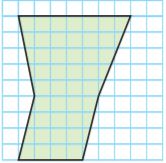
______ square centimeters

Answer: 150 square cm

Explanation:
Given,
Height (h) = 5 cm
Breath (b) = 30 cm
Area of the rectangle or square. A = b×h
A =  5 cm × 30 cm
A = 150 square centimeters
Therefore the Area of the rectangle is 150 square centimeters.

Question 6.
Go Math Grade 4 Answer Key Homework Practice FL Chapter 13 Algebra Perimeter and Area Common Core - Algebra: Perimeter and Area img 15
______ square feet

Answer: 56 square ft

Explanation:
Given,
Height (h) = 4 ft
Breath (b) = 14 ft
Area of the rectangle or square. A = b×h
A = 4 ft × 14 ft
A = 56 square feet
Therefore the Area of the rectangle is 56 square feet.

Problem Solving

Question 7.
Meghan is putting wallpaper on a wall that measures 8 feet by 12 feet. How much wallpaper does Meghan need to cover the wall?
_____ square feet wallpaper

Answer: 96 square feet wallpaper

Explanation:
Given,
Length = 8 feet.
Width = 12 feet.
the area (area=length × width)
area=8 × 12
area=96 square feets.
Therefore the area is always expressed in units squared it would be 96 square feet of wallpaper.

Question 8.
Bryson is laying down sod in his yard to grow a new lawn. Each piece of sod is a 1-foot by 1-foot square. How many pieces of sod will Bryson need to cover his yard if his yard measures 30 feet by 14 feet?
_____ pieces

Answer: 420 pieces

Explanation:
Given,
length (l) = 30 ft
Breath (b) = 14 ft
Area of the rectangle or square. A = l×b
A = 30 ft × 14 ft
A = 420
Therefore 420 pieces of sod will Bryson need to cover his yard if his yard measures 30 feet by 14 feet.

Common Core – Algebra: Perimeter and Area – Page No. 250

Lesson Check

Question 1.
Ellie and Heather drew floor models of their living rooms. Ellie’s model represented 20 feet by 15 feet. Heather’s model represented 18 feet by 18 feet. Whose floor model represents the greater area? How much greater?
Options:
a. Ellie; 138 square feet
b. Heather; 24 square feet
c. Ellie; 300 square feet
d. Heather; 324 square feet

Answer: Heather; 24 square feet

Explanation:

Given,
Ellie’s model represented 20 feet by 15 feet.
Heather’s model represented 18 feet by 18 feet.
Length of Ellie’s model = 20 feet
Width of Ellie’s model = 15 feet
Area = Length × Breadth
A = 20 × 15
A = 300 ft²
Length of Heather’s model = 18 feet
Width of Heather’s model = 18 feet
Area = Length × Breadth
A= 18 × 18
A= 324 ft²
Therefore Heather’s model has a greater area by (324-300)= 24 sq.ft.
Thus the correct answer is option b.

Question 2.
Tyra is laying down square carpet pieces in her photography studio. Each square carpet piece is 1 yard by 1 yard. If Tyra’s photography studio is 7 yards long and 4 yards wide, how many pieces of square carpet will Tyra need?
Options:
a. 10
b. 11
c. 22
d. 28

Answer: 28

Explanation:
Given,
Tyra’s photography studio  length is 7 yards
Tyra’s photography studio width is  4 yards
Area = Length × Breadth
Area = 7 yards × 4 yards
Area = 28 square yards
Therefore as Each square carpet piece is 1 yard by 1 yard. No.of pieces of square carpet Tyra needed is 28.
Thus the correct answer is option d.

Spiral Review

Question 3.
Typically, blood fully circulates through the human body 8 times each minute. How many times does blood circulate through the body in 1 hour?
Options:
a. 48
b. 240
c. 480
d. 4,800

Answer: 480

Explanation:
Given,
blood fully circulates through the human body 8 times each minute
one hour = 60 minutes
blood circulates through the body in 1 hour = 8 times × 60 minutes.
= 480 Times.
Therefore blood circulates through the body in 1 hour is 480 times.
Thus the correct answer is option c.

Question 4.
Each of the 28 students in Romi’s class raised at least $25 during the jump-a-thon. What is the least amount of money the class raised?
Options:
a. $5,200
b. $700
c. $660
d. $196

Answer: $700

explanation:
If each of the 28 students made at least $25,
you would multiply 28 and 25 together to obtain the least amount of money the class raised.
That gets,
28×25 = 700.
Therefore The class made at least $700.
Thus the correct answer is option b.

Question 5.
What is the perimeter of the shape below if 1 square is equal to 1 square foot?
Go Math Grade 4 Answer Key Homework Practice FL Chapter 13 Algebra Perimeter and Area Common Core - Algebra: Perimeter and Area img 16
Options:
a. 12 feet
b. 14 feet
c. 24 feet
d. 28 feet

Answer: 28 feet

Explanation:
From the above figure we can observe that there area 2 rows and 12 columns.
L = 12 feet
W = 2 feet
We know that perimeter of the rectangle is 2l + 2w
P = 2l + 2w
P = 2(12) + 2(2)
P = 24 feet + 4 feet
P = 28 feet
Thus the correct answer is option d.

Question 6.
Ryan is making small meat loaves. Each small meat loaf uses \(\frac{3}{4 }\) pound of meat. How much meat does Ryan need to make 8 small meat loaves?
Options:
a. 4 pounds
b. 6 pounds
c. 8 pounds
d. 10 \(\frac{2}{3}\) pounds

Answer: 6 pounds

Explanation:
Given,
3/4 pound=1 small meatloaf
So Multiply 3/4 pound by 8
because he wants to make 8 small meatloaves.
= 3/4 × 8
= 24/4 (24 divided by 4)
= 6 pounds
Therefore Ryan need 6 pounds to make 8 small meat loaves.
Thus the correct answer is option b.

Common Core – Algebra: Perimeter and Area – Page No. 251

Area of Combined Rectangles

Find the area of the combined rectangles.

Question 1.
Go Math Grade 4 Answer Key Homework Practice FL Chapter 13 Algebra Perimeter and Area Common Core - Algebra: Perimeter and Area img 17

Question 2.
Go Math Grade 4 Answer Key Homework Practice FL Chapter 13 Algebra Perimeter and Area Common Core - Algebra: Perimeter and Area img 18
_____ square feet

Answer: 143

Explanation:
Divide the figure into two parts
Figure 1:
L = 9 ft
W = 5 ft
Area of the rectangle = l × w
A = 9 ft × 5 ft = 45 sq. ft
Figure 2:
L = 14 ft
W = 7 ft
Area of the rectangle = l × w
A = 14 ft × 7 ft = 98 sq. ft
Area of the combined rectangles = 98 sq. ft + 45 sq. ft = 143 sq. ft.

Question 3.
Go Math Grade 4 Answer Key Homework Practice FL Chapter 13 Algebra Perimeter and Area Common Core - Algebra: Perimeter and Area img 19
_____ square inches

Answer: 63

Explanation:
Divide the figure into two parts
Figure 1:
L = 9 in.
W = 5 in.
Area of the rectangle = l × w
A = 9 in. × 5 in. = 45 sq. in.
Figure 2:
L = 3 in.
W = 6 in.
Area of the rectangle = l × w
A = 3 in. × 6 in. = 18 sq. in.
Area of the combined rectangles = 45 sq. in + 18 sq. in = 63 square inches.

Question 4.
Go Math Grade 4 Answer Key Homework Practice FL Chapter 13 Algebra Perimeter and Area Common Core - Algebra: Perimeter and Area img 20
_____ square feet

Answer: 50 square feet

Explanation:
Divide the figure into two parts
Figure 1:
L = 4 ft
W = 2 ft
Area of the rectangle = l × w
A = 4 ft × 2 ft = 8 sq. ft
Figure 2:
L = 6 ft
W = 7 ft
Area of the rectangle = l × w
A = 6 ft × 7 ft = 42 sq. ft
Area of the combined rectangles = 8 sq. ft + 42 sq. ft = 50 sq. ft.

Question 5.
Go Math Grade 4 Answer Key Homework Practice FL Chapter 13 Algebra Perimeter and Area Common Core - Algebra: Perimeter and Area img 21
_____ square centimeters

Answer: 180 square centimeters

Explanation:
Divide the figure into two parts
Figure 1:
L = 12 cm
W = 7 cm
Area of the rectangle = l × w
A = 12 cm × 7 cm = 84 sq. cm.
Figure 2:
L = 16 cm
W = 6 cm
Area of the rectangle = l × w
A = 16 cm × 6 cm = 96 sq. cm
Area of the combined rectangles = 84 sq. cm + 96 sq. cm = 180 square centimeters

Question 6.
Go Math Grade 4 Answer Key Homework Practice FL Chapter 13 Algebra Perimeter and Area Common Core - Algebra: Perimeter and Area img 22
______ square yards

Answer: 68

Explanation:
Divide the figure into two parts
Figure 1:
L = 20 yd
W = 1 yd
Area of the rectangle = l × w
A = 20 yd × 1 yd = 20 sq. yd.
Figure 2:
L = 6 yard
W = 8 yard
Area of the rectangle = l × w
A = 6 yard × 8 yard = 48 sq. yard
Area of the combined rectangles = 20 sq. yd + 48 sq. yd = 68 square yards

Problem Solving

Use the diagram for 7–8.

Nadia makes the diagram below to represent the counter space she wants to build in her craft room.
Go Math Grade 4 Answer Key Homework Practice FL Chapter 13 Algebra Perimeter and Area Common Core - Algebra: Perimeter and Area img 23

Question 7.
What is the area of the space that Nadia has shown for scrapbooking?
_____ square feet

Answer: 52

Explanation:
The length of the Scrapbooking is 13 ft
Width of the Scrapbooking is 4 ft
Area of the rectangle = l × w
A = 13 ft × 4 ft = 52 square feet
Thus the area of the space that Nadia has shown for scrapbooking is 52 square feet.

Question 8.
What is the area of the space she has shown for painting?
_____ square feet

Answer: 25

Explanation:
The area of the space shown for painting is square.
side = 5 ft
The area of the square is 5 ft × 5 ft = 25 sq. ft
Thus the area of the space she has shown for painting is 25 square feet.

Common Core – Algebra: Perimeter and Area – Page No. 252

Lesson Check

Question 1.
What is the area of the combined rectangles below?
Go Math Grade 4 Answer Key Homework Practice FL Chapter 13 Algebra Perimeter and Area Common Core - Algebra: Perimeter and Area img 24
Options:
a. 136 square yards
b. 100 square yards
c. 76 square yards
d. 64 square yards

Answer: 76 square yards

Explanation:
Divide the figure into two parts
Figure 1:
L = 8 yd
W = 5 yd
Area of the rectangle = l × w
A = 8 yd × 5 yd = 40 sq. yd.
Figure 2:
L = 12 yard
W = 3 yard
Area of the rectangle = l × w
A = 12 yard × 3 yard = 36 sq. yard
Area of the combined rectangles = 40 sq. yd + 36 sq. yd = 76 square yards
Therefore the correct option is c.

Question 2.
Marquis is redecorating his bedroom. What could Marquis use the area formula to find?
Options:
a. how much space should be in a storage box
b. what length of wood is needed for a shelf
c. the amount of paint needed to cover a wall
d. how much water will fill up his new aquarium

Answer: the amount of paint needed to cover a wall
The correct answer is option c.

Spiral Review

Question 3.
Giraffes are the tallest land animals. A male giraffe can grow as tall as 6 yards. How tall would the giraffe be in feet?
Options:
a. 2 feet
b. 6 feet
c. 12 feet
d. 18 feet

Answer: 18 feet

Explanation:
Given,
Giraffes are the tallest land animals. A male giraffe can grow as tall as 6 yards.
we have to find How tall would the giraffe be in feet
Converting from Yards to feet.
one Yard = 3 Feet.
So 6 yards = 6 × 3 feet
= 18 feet
Therefore the correct option is d.

Question 4.
Drew purchased 3 books for $24. The cost of each book was a multiple of 4. Which of the following could be the prices of the 3 books?
Options:
a. $4, $10, $10
b. $4, $8, $12
c. $5, $8, $11
d. $3, $7, $14

Answer: $4, $8, $12

Explanation:
Given,
Drew purchased 3 books for $24. The cost of each book was a multiple of 4.
To find the prices of the 3 books
The cost of one book is $4
the cost of two books is $4 × 2 = $8
The cost of three books is $4 × 3 = $12
Therefore the correct option is b.

Question 5.
Esmeralda has a magnet in the shape of a square. Each side of the magnet is 3 inches long. What is the perimeter of her magnet?
Options:
a. 3 inches
b. 7 inches
c. 9 inches
d. 12 inches

Answer: 12 inches

Explanation:
Given,
Esmeralda has a magnet in the shape of a square.
Each side of the magnet is 3 inches long.
To find the perimeter of her magnet
P = 4 × s
P = 4 × 3 in.
P = 12 in.
Therefore the correct option is d.

Question 6.
What is the area of the rectangle below?
Go Math Grade 4 Answer Key Homework Practice FL Chapter 13 Algebra Perimeter and Area Common Core - Algebra: Perimeter and Area img 25
Options:
a. 63 square feet
b. 32 square feet
c. 18 square feet
d. 16 square feet

Answer: 63 square feet

Explanation:
Given,
Height (h) = 7 ft.
Breath (b) = 9 ft.
Area of the rectangle  A = b×h
A = 7 ft × 9 ft
A = 63 Square feet.
The Area of the rectangle is 63 Square feet.
Therefore the correct option is a.

Common Core – Algebra: Perimeter and Area – Page No. 253

Find Unknown Measures

Find the unknown measure of the rectangle.

Question 1.
Go Math Grade 4 Answer Key Homework Practice FL Chapter 13 Algebra Perimeter and Area Common Core - Algebra: Perimeter and Area img 26
Perimeter = 54 feet
width = 7 feet
Think: P = (2 × l) + (2 × w)
54 = (2 × 20) + (2 × w)
54 = 40 + (2 × w)
Since 54 = 40 + 14, 2 × w = 14, and w = 7.

Question 2.
Go Math Grade 4 Answer Key Homework Practice FL Chapter 13 Algebra Perimeter and Area Common Core - Algebra: Perimeter and Area img 27
Perimeter = 42 meters
length = _____ meters

Answer: 12 meters

Explanation:
Given
Perimeter = 42 meters
width = 9 m
To find Length (l) of the rectangle
P = (2 × l) + (2 × w)
42 = (2 × l ) + (2 × 9)
42 = 2l + 18
2l = 42 – 18
2l = 24
l = 24/2
l = 12 m
Thus the length of the above rectangle is 12 m

Question 3.
Go Math Grade 4 Answer Key Homework Practice FL Chapter 13 Algebra Perimeter and Area Common Core - Algebra: Perimeter and Area img 28
Area = 28 square centimeters
height = _____ centimeters

Answer: 7 centimeters

Explanation:
Given
Area = 28 square centimeters
length  = 4 cm
To find Height (w) of the rectangle
A = l × w
28 = 4 cm × w
w = 28/4
w = 7 cm
Thus the height of the above rectangle is 7 cm

Question 4.
Go Math Grade 4 Answer Key Homework Practice FL Chapter 13 Algebra Perimeter and Area Common Core - Algebra: Perimeter and Area img 29
Area = 200 square inches
base = _____ inches

Answer: 8 inches

Explanation:
Given
Area = 200 square inches
width  = 25 in.
To find Base (b) of the rectangle
A = w × b
200 = 25 in. × b
b = 200/25
b = 8 inches
Thus the base of the above rectangle is 8 inches

Problem Solving

Question 5.
Susie is an organic vegetable grower. The perimeter of her rectangular vegetable garden is 72 yards. The width of the vegetable garden is 9 yards. How long is the vegetable garden?
length = _____ yards

Answer: 27 yards

Explanation:
Given,
The perimeter (P) of her rectangular vegetable garden is 72 yards.
The width (w) of the vegetable garden is 9 yards.
to find length (l)
P = (2 × l) + (2 × w)
72 yards  = (2 × l ) + (2 × 9 yards)
72 = 2l + 18
2l = 72 – 18
2l = 54
l = 54/2
l = 27 yards
Therefore length = 27 yards

Question 6.
An artist is creating a rectangular mural for the Northfield Community Center. The mural is 7 feet tall and has an area of 84 square feet. What is the length of
the mural?
length = _____ feet

Answer: 12 feet

Explanation:
Given,
The mural is 7 feet (w) tall and has an area of 84 square feet(A).
To find the length (l)
A = l × w
84 = l × 7
l = 84 /7
l= 12 feets
Therefore the length is 12 feets

Common Core – Algebra: Perimeter and Area – Page No. 254

Lesson Check

Question 1.
The area of a rectangular photograph is 35 square inches. If the width of the photo is 5 inches, how tall is the photo?
Options:
a. 5 inches
b. 7 inches
c. 25 inches
d. 30 inches

Answer: 7 inches

Explanation:
Given,
The area of a rectangular photograph is 35 square inches (A)
The width of the photo is 5 inches (w)
To find how tall is the photo (l)
A= l × b
35 square in. = l × 5 in.
l = 35/5
l = 7 inches
Therefore the photo height is 7 inches.
Thus the correct answer is option b.

Question 2.
Natalie used 112 inches of blue yarn as a border around her rectangular bulletin board. If the bulletin board is 36 inches wide, how long is it?
Options:
a. 20 inches
b. 38 inches
c. 40 inches
d. 76 inches

Answer: 20 inches

Explanation:
Given width is 36 in and the total inches used was 112.
To find length
Perimeter of Rectangle = 2(L + W)
Your equation is, 2(L + 36) = 112
Solving for L:
2(L + 36) = 112
L + 36 = 112 / 2
L + 36 = 56
L = 56 – 36
L = 20
Therefore the correct option is a.

Spiral Review

Question 3.
A professional basketball court is in the shape of a rectangle. It is 50 feet wide and 94 feet long. A player ran one time around the edge of the court. How far did the player run?
Options:
a. 144 feet
b. 194 feet
c. 238 feet
d. 288 feet

Answer: 288 feet

Explanation:
Given, the basketball court is 50 feet wide and 94 feet long
The perimeter of the rectangle(P) is given by:
P = 2(length + width)
50 + 94 = 144
144 x 2 = 288
The player ran 288 feet
Therefore the correct option is d.

Question 4.
On a compass, due east is a \(\frac{1}{4}\) turn clockwise from due north. How many degrees are in a \(\frac{1}{4}\) turn?
Options:
a. 45°
b. 60°
c. 90°
d. 180°

Answer: 90°

Explanation:
We have been given that on a compass, due east is a 1/4 turn clockwise from due north.
Since we know that a compass is in form of a circle and the measure of degrees in a circle is 360 degrees.
To find the number of degrees in a one-fourth turn, we will divide 360° by 4.
Number of degrees in a 1/4 turn of compass = 360°/4
Number of degrees in a 1/4 turn of compass = 90°
Therefore, there are 90 degrees in a 1/4 turn of the compass.
The correct option is c.

Question 5.
Hakeem’s frog made three quick jumps. The first was 1 meter. The second jump was 85 centimeters. The third jump was 400 millimeters. What was the total length of the frog’s three jumps?
Options:
a. 189 centimeters
b. 225 centimeters
c. 486 centimeters
d. 585 millimeters

Answer: 225 centimeters

Explanation:
Given:
distance of first jump = d1= 1 meter
distance of second jump = d2 = 85 centimeters
distance of third jump = d3 = 400 millimeters
This problem is about the conversion unit of length.
We have to recall that :
1 m = 100 cm
1 m = 1000 mm
Total distance = d = d1 + d2 + d3
d = 1 m + 85 m + 400 mm
d = 1 m + 85/100 m + 400/1000 m
d = 2.25  × 100 cm
d = 225 centimeters
Therefore the correct option is b.

Question 6.
Karen colors in squares on a grid. She colored \(\frac{1}{8}\) of the squares blue and \(\frac{5}{8}\) of the squares red. What fraction of the squares are not colored in?
Options:
a. \(\frac{1}{8}\)
b. \(\frac{1}{4}\)
c. \(\frac{1}{2}\)
d. \(\frac{3}{4}\)

Answer: \(\frac{1}{4}\)

Explanation:
since karen colored in 1/8 and 5/8 you add the numerators to get 6/8 you subtract the 8/8 the whole grid from 6/8 to get 2/8
⇒ 1/8 + 5/8 = 6/8
⇒ 8/8 – 6/8 = 2/8
= 1/4
There fore the correct option is b.

Common Core – Algebra: Perimeter and Area – Page No. 255

Problem Solving Find the Area

Solve each problem.

Question 1.
A room has a wooden floor. There is a rug in the center of the floor. The diagram shows the room and the rug. How many square feet of the wood floor still shows?
Go Math Grade 4 Answer Key Homework Practice FL Chapter 13 Algebra Perimeter and Area Common Core - Algebra: Perimeter and Area img 30
82 square feet
Area of the floor: 13 × 10 = 130 square feet
Area of the rug: 8 × 6 = 48 square feet
Subtract to find the area of the floor still showing: 130 – 48 = 82 square feet

Question 2.
A rectangular wall has a square window, as shown in the diagram.
Go Math Grade 4 Answer Key Homework Practice FL Chapter 13 Algebra Perimeter and Area Common Core - Algebra: Perimeter and Area img 31
What is the area of the wall NOT including the window?
The area of the wall NOT including the window = _____ square feet

Answer: 96 square feet

Explanation:
The area of the square window is 4 ft × 4 ft = 16 square feet.
Area of the rectangle = 14 ft × 8 ft = 112 square feet
Now we have to find the area of the wall NOT including the window
112 square feet – 16 square feet = 96 square feet
Thus the area of the wall NOT including the window is 96 square feet.

Question 3.
Bob wants to put down new sod in his backyard, except for the part set aside for his flower garden. The diagram shows Bob’s backyard and the flower garden.
Go Math Grade 4 Answer Key Homework Practice FL Chapter 13 Algebra Perimeter and Area Common Core - Algebra: Perimeter and Area img 32
How much sod will Bob need?
The area covered with new sod = _____ square yards

Answer: 235 square yards

Explanation:
The area of the non-shaded rectangle is 5 yd × 9 yd = 45 square yards.
The area of the rectangle is 20 yd × 14 yd = 280 square yard
The area covered with new sod is 280 square yard – 45 square yard = 235 square yards.

Question 4.
A rectangular painting is 24 inches wide and 20 inches tall without the frame. With the frame, it is 28 inches wide and 24 inches tall. What is the area of the frame not covered by the painting?
The area of the frame = _____ square inches

Answer: 192 square inches

Explanation:
area of painting without frame
A1 = l × b
= 24 x 20
= 480 square inches
area of painting with frame
A2 = l × b
=28×24
=672 square inches
area of the frame not covered by paint
=area with frame(A1) – area without frame(A2)
=672 – 480
=192
Therefore the area of the frame is 192 square inches

Question 5.
One wall in Jeanne’s bedroom is 13 feet long and 8 feet tall. There is a door 3 feet wide and 6 feet tall. She has a poster on the wall that is 2 feet wide and 3 feet tall. How much of the wall is visible?
The area of the wall visible = _____ square feet

Answer: 80

Explanation:
One wall in Jeanne’s bedroom is 13 feet long and 8 feet tall.
There is a door 3 feet wide and 6 feet tall.
She has a poster on the wall that is 2 feet wide and 3 feet tall.
13 × 8 is 104. 104 – (3×6) and -(2 × 3) is 80
Thus the area of the wall visible is 80 square feet.

Common Core – Algebra: Perimeter and Area – Page No. 256

Lesson Check

Question 1.
One wall in Zoe’s bedroom is 5 feet wide and 8 feet tall. Zoe puts up a poster of her favorite athlete. The poster is 2 feet wide and 3 feet tall. How much of the wall is not covered by the poster?
Options:
a. 16 square feet
b. 34 square feet
c. 35 square feet
d. 46 square feet

Answer: 34 square feet

Explanation:
One wall in Zoe’s bedroom is 5 feet wide and 8 feet tall.
Area of the rectangle = l × w
A = 5 feet × 8 feet
A = 40 square feet
Zoe puts up a poster of her favorite athlete. The poster is 2 feet wide and 3 feet tall.
Area of the rectangle = l × w
A = 2 feet × 3 feet
S = 6 square feet
To find:
How much of the wall is not covered by the poster, we need to subtract 6 square feet from 40 square feet
40 square feet – 6 square feet = 34 square feet
Thus the are of the wall is not covered by the poster is 34 square feet.
The correct answer is option b.

Question 2.
A garage door is 15 feet wide and 6 feet high. It is painted white, except for a rectangular panel 1 foot high and 9 feet wide that is brown. How much of the garage door is white?
Options:
a. 22 square feet
b. 70 square feet
c. 80 square feet
d. 81 square feet

Answer: 81 square feet

Explanation:
Given that the garage door is 15 feet wide and 6 feet high.
W = 15 feet
H = 6 feet
Area of the rectangle = l × w
A = 6 feet × 15 feet
A = 90 square feet
It is painted white, except for a rectangular panel 1 foot high and 9 feet wide that is brown.
H = 1 foot
W = 9 feet
Area of the rectangle = l × w
A = 1 feet × 9 feet
A = 9 feet
To find:
How much of the garage door is white, we need to subtract 9 feet from 90 feet.
90 feet – 9 feet = 81 feet.
Thus the area of the garage door is white is 81 square feet.
The correct answer is option d.

Spiral Review

Question 3.
Kate baked a rectangular cake for a party. She used 42 inches of frosting around the edges of the cake. If the cake was 9 inches wide, how long was the cake?
Options:
a. 5 inches
b. 12 inches
c. 24 inches
d. 33 inches

Answer: 12 inches

Explanation:
Given,
Kate baked a rectangular cake for a party. She used 42 inches of frosting around the edges of the cake.
The width of the cake is 9 inches.
9 + 9 = 18
42 – 18 = 24
24 / 2 = 12
the length is 12 inches
Thus the correct answer is option b.

Question 4.
Larry, Mary, and Terry each had a full glass of juice. Larry drank \(\frac{3}{4}\) of his. Mary drank \(\frac{3}{8}\) of hers. Terry drank \(\frac{7}{10}\) of his. Who drank less than \(\frac{1}{2}\) of their juice?
Options:
a. Larry
b. Mary
c. Mary and Terry
d. Larry and Terry

Answer: Mary
Mary drank the least because when half of 8 is \(\frac{4}{8}\).
The correct answer is option b.

Question 5.
Which of the following statements is NOT true about the numbers 7 and 9?
Options:
a. 7 is a prime number.
b. 9 is a composite number.
c. 7 and 9 have no common factors other than 1.
d. 27 is a common multiple of 7 and 9.

Answer: 27 is a common multiple of 7 and 9.

Explanation:
Statement 27 is a common multiple of 7 and 9 is false because 27 is not the multiple of 7.
Thus the correct answer is option d.

Question 6.
Tom and some friends went to a movie. The show started at 2:30 P.M. and ended at 4:15 P.M. How long did the movie last?
Options:
a. 1 hour 35 minutes
b. 1 hour 45 minutes
c. 1 hour 55 minutes
d. 2 hours 15 minutes

Answer: 1 hour 45 minutes

Explanation:
Given,
Tom and some friends went to a movie. The show started at 2:30 P.M. and ended at 4:15 P.M.
Subtract ending time and starting time.
4 hr 15 min
-2 hr 30 min
1 hr 45 min
Thus the correct answer is option B.

Common Core – Algebra: Perimeter and Area – Page No. 257

Lesson 13.1

Find the perimeter of the rectangle or square.

Question 1.
Go Math Grade 4 Answer Key Homework Practice FL Chapter 13 Algebra Perimeter and Area Common Core - Algebra: Perimeter and Area img 33
P =____ ft

Answer: 50

Explanation:
Given,
Length (L) = 16 ft
Width (W) = 9 ft
we know that the perimeter of a Rectangle is L + L+ W + W
P = L + L+ W + W
P = 16 ft + 16 ft + 9 ft + 9 ft
P = 50 ft
Therefore the perimeter of the above Rectangle is 50 ft

Question 2.
Go Math Grade 4 Answer Key Homework Practice FL Chapter 13 Algebra Perimeter and Area Common Core - Algebra: Perimeter and Area img 34
P =____ in.

Answer: 52

Explanation:
Given,
sides = 13 in.
we know that the perimeter of a square is 4×s
P = 4 × 13 in.
P = 4 × 13 in.
P = 52 in.
Therefore the perimeter of the above square is 52 in.

Question 3.
Go Math Grade 4 Answer Key Homework Practice FL Chapter 13 Algebra Perimeter and Area Common Core - Algebra: Perimeter and Area img 35
P =____ cm

Answer: 130

Explanation:
Given,
Length (L) = 40 cm
Width (W) = 25 cm
we know that the perimeter of a Rectangle is L + L+ W + W
P = L + L+ W + W
P = 40 cm + 40 cm + 25 cm + 25 cm
P = 130 cm
Therefore the perimeter of the above Rectangle is 130 cm.

Question 4.
Go Math Grade 4 Answer Key Homework Practice FL Chapter 13 Algebra Perimeter and Area Common Core - Algebra: Perimeter and Area img 36
P =____ m

Answer: 68

Explanation:
Given,
Length (L) = 16 m
Width (W) = 18 m
we know that the perimeter of a Rectangle is L + L+ W + W
P = L + L+ W + W
P = 16 m+ 16 m+ 18 m+ 18 m
P = 68 m
Therefore the perimeter of the above Rectangle is 68 m.

Lesson 13.2

Find the area of the rectangle or square.

Question 5.
Go Math Grade 4 Answer Key Homework Practice FL Chapter 13 Algebra Perimeter and Area Common Core - Algebra: Perimeter and Area img 37
A = ____ square inches

Answer: 180

Explanation:
Given,
Height (h) = 15 in.
Breath (b) = 12 in.
Area of the rectangle =  A = b×h
A = 12 in. × 15 in.
A = 180 square inches
Therefore the Area of the rectangle is 180 square inches.

Question 6.
Go Math Grade 4 Answer Key Homework Practice FL Chapter 13 Algebra Perimeter and Area Common Core - Algebra: Perimeter and Area img 38
A = ____ square yards

Answer: 300

Explanation:
Given,
Height (h) = 15 yd
Breath (b) = 20 yd
Area of the rectangle =  A = b×h
A = 15 yd. × 20 yd
A = 300 square yard
Therefore the Area of the rectangle is 300 square yards.

Question 7.
Go Math Grade 4 Answer Key Homework Practice FL Chapter 13 Algebra Perimeter and Area Common Core - Algebra: Perimeter and Area img 39
A = ____ square km

Answer: 25

Explanation:
Given,
Sides (s) = 5 km
Area of the square. A = s×s
A = 5 km × 5 km
A = 25 Square km
Therefore the Area of the square is 25 square km.

Question 8.
Go Math Grade 4 Answer Key Homework Practice FL Chapter 13 Algebra Perimeter and Area Common Core - Algebra: Perimeter and Area img 40
A = ____ square ft

Answer: 98

Explanation:
Given,
Height (h) = 14 ft
Breath (b) = 7 ft
Area of the rectangle =  A = b×h
A = 14 ft. × 7 ft
A = 98 square ft
Therefore the Area of the rectangle is 98 square ft.

Page No: 258

Lesson 13.3

Find the area of the combined rectangles.

Question 1.
Go Math Grade 4 Answer Key Homework Practice FL Chapter 13 Algebra Perimeter and Area Common Core - Algebra: Perimeter and Area img 41
A = ____ square cm

Answer: 116 square cm

Explanation:
Divide the figure into two parts
Figure 1:
L = 6 cm
Area of the square = s × s
A = 6 cm × 6 cm = 36 sq. cm.
Figure 2:
L = 10 cm
W = 8 cm
Area of the rectangle = l × w
A = 10 cm × 8 cm = 80 sq. cm
Area of the combined rectangles = 36 sq. cm + 80 sq. cm = 116 square centimeters

Question 2.
Go Math Grade 4 Answer Key Homework Practice FL Chapter 13 Algebra Perimeter and Area Common Core - Algebra: Perimeter and Area img 42
A = ____ square in.

Answer: 112 square in.

Explanation:
Divide the figure into two parts
Figure 1:
L = 8 in.
W = 4 in.
Area of the rectangle = l × w
A = 8 in. × 4 in. = 32 sq. in.
Figure 2:
L = 4 in.
W = 12 in.
Area of the rectangle = l × w
A = 4 in. × 12 in. = 48 sq. in.
Figure 3:
L = 8 in.
W = 4 in.
Area of the rectangle = l × w
A = 8 in. × 4 in. = 32 sq. in.
Area of the combined rectangles = 32 sq. in + 48 sq. in + 32 sq. in. = 112 square inches.

Lesson 13.4

Find the unknown measure of the rectangle.

Question 3.
Go Math Grade 4 Answer Key Homework Practice FL Chapter 13 Algebra Perimeter and Area Common Core - Algebra: Perimeter and Area img 43
base = ____ feet

Answer: 25 feet

Explanation:
A = 375 sq. ft
h = 15 ft
Area of the rectangle =  A = b×h
375 sq. ft = b × 15 ft
b = 375/15 = 25 ft
Thus the base of the figure is 25 ft.

Question 4.
Go Math Grade 4 Answer Key Homework Practice FL Chapter 13 Algebra Perimeter and Area Common Core - Algebra: Perimeter and Area img 44
height = ____ mi

Answer: 8 mi

Explanation:
A = 56 sq. mi
b = 7 mi
Area of the rectangle =  A = b×h
56 sq. mi = 7 mi × h
h = 56/7= 8 mi
Thus the height of the figure is 8 mi.

Lesson 13.5

Solve.

Question 5.
Jeanette is painting a rectangular wall that is 10 feet long and 8 feet tall. There is a window that is 5 feet wide and 3 feet tall on the wall. What is the area of the wall that Jeannette will paint?
____ square feet

Answer: 65 square feet

Explanation:
Given,
Jeanette is painting a rectangular wall that is 10 feet long and 8 feet tall.
There is a window that is 5 feet wide and 3 feet tall on the wall.
8 times 10 is eighty, then you need to subtract 3 times 5 (which is 15), and that makes it 65 feet squared.
80 sq. ft – 15 sq. ft = 65 square feet

Question 6.
Rob has a combined flower and vegetable garden that is 9 meters long and 11 meters wide. The flower garden is in the center and is a square with sides of 3 meters. How many square meters of the garden is used for vegetables?
____ square meters

Answer: 90 square meters

Explanation:
First, you would need to find the area of both the FULL veggie garden and flower garden.
Veggie Garden = 9×11 = 99
Flower Garden = 3×3 = 9
Then you would subtract the area of the veggie garden by the area of the flower garden.
99 – 9 = 90 meters squared

Conclusion:

Just solve all exercise questions and cross-check your solutions from Go Math Grade 4 Solution Key Chapter 13  Algebra Perimeter and Area. Like this, you can easily examine your strengths and weaknesses and focus on the areas you are faltering. Step-by-step Solutions presented here in the 4th Grade Go Math Answer Key Chapter Algebra Perimeter and Area useful for homework help and gain subject knowledge perfectly.

Go Math Grade 4 Answer Key Homework Practice FL Chapter 3 Multiply 2-Digit Numbers

go-math-grade-4-chapter-3-multiply-2-digit-numbers-answer-key

Parents are you searching for the best answer key resource to practice all the concepts of multiplication then here it is Go Math Grade 4 Answer Key Homework Practice FL Chapter 3 Multiply 2-Digit Numbers. It aids your kid’s preparation and makes them grasp all the concepts clearly. One of the best ways to learn the grade 4 Ch 3 Multiply 2-Digit Numbers basics in primary schools is by referring to the Go Math Grade 4 Answer Key.

However, it also supports students of grade 4 to overcome the difficulties of the basics of maths by presenting the Answer Key for Go Math Grade 4 Homework Practice FL Chapter 3 Multiply 2-Digit Numbers.

Go Math Grade 4 Answer Key Homework Practice FL Chapter 3 Multiply 2-Digit Numbers

Remember that Go Math Grade 4 Answer Key Homework Practice FL Chapter 3 Multiply 2-Digit Numbers are available in pdf format here to download easily and access them for free. So, check out the respective topic of Go Math grade 4 ch 3 Solutions key and learn the techniques by referring to the subject experts’ designed step by steps explanations. Just click on the link and solve complex questions with simple techniques.

Lesson: 1 – Multiply by Tens

Lesson: 2 – Estimate Products

Lesson: 3 – Investigate • Area Models and Partial Products

Lesson: 4 – Multiply Using Partial Products

Lesson: 5 – Multiply with Regrouping

Lesson: 6 – Choose a Multiplication Method

Lesson: 7 – Problem Solving • Multiply 2-Digit Numbers

Lesson: 8

Common Core – Multiply 2-Digit Numbers – Page No. 51

Multiply by Tens

Choose a method. Then find the product.

Question 1.
16 × 60 = 960
Use the halving-and-doubling strategy.
Find half of 16: 16 ÷ 2 = 8.
Multiply this number by 60: 8 × 60 = 480
Double this result: 2 × 480 = 960

Question 2.
80 × 22 = _____

Answer: 1760

Explanation:
By using the place value method, Multiply 80 × 22
You can think of 80 as 8 tens
80 × 22 = (22 × 8) tens
= 176 tens
= 176 × 10 = 1760
80 × 22 = 1760

Question 3.
30 × 52 = _____

Answer: 1560

Explanation:
Use the Associative Property
You can think of 30 as 3 × 10
30 × 52 = (3 × 10) × 52
= 3 × (10 × 52)
= 3 × 520
= 1560
30 × 52 = 1560

Question 4.
60 × 20 = _____

Answer: 1200

Explanation:
60 × 20
Use the halving and doubling strategy
half of the 60 to make the problem simpler
60/ 2 = 30
Multiply 30 with 20
30 × 20 = 600
Double the 600
2 × 600= 1200
60 × 20 = 1200

Question 5.
40 × 35 = _____

Answer: 1400

Explanation:
By using the Associative Property 40 × 35
You can think of 40 as 4 × 10
40 × 35 = (4 × 10) × 35
= 4 × (10 × 35)
= 4 × 350
= 1400
40 × 35 = 1400

Question 6.
10 × 90 = _____

Answer: 900

Explanation:
By using the place value method, Multiply 10 x 90
You can think of 90 as 9 tens
10 × 90 = (10 × 9) tens
= 90 tens
= 10 × 90 = 900

Question 7.
31 × 50 = _____

Answer: 1,550

Explanation:
Use the place value method to multiply 31 × 50
You can think of 50 as 5 tens
31 × 50 = 31 × 5 tens
= 155 tens
= 1,550
31 × 50 = 1,550

Problem Solving

Question 8.
Kenny bought 20 packs of baseball cards. There are 12 cards in each pack. How many cards did Kenny buy?
_____ cards

Answer: 240 cards

Explanation:
From the given data,
Kenny bought 20 packs of basketball cards
There are 12 cards in each pack = 12 × 20 cards
Use the associative property
You can write 20 as 2 × 10
12 × 20 = 12 × (2 × 10)
= (12 × 2) × 10
= (24) × 10
= 240 cards
Kenny bought 240 cards

Question 9.
The Hart family drove 10 hours to their vacation spot. They drove an average of 48 miles each hour. How many miles did they drive in all?
_____ miles

Answer: 480 miles

Explanation:
As per the given data,
Hart family drove 10 hours to their vacation spot
The average speed per each hour is = 48 miles
Total miles = 48 × 10
Use the halving and doubling strategy
Half of the 48 to make the problem simpler
48/ 2 = 24
Multiply 24 with 10 = 24 × 10 = 240
Double the value = 2 × 240 = 480 miles
Total miles drove by hart family = 480 miles.

Common Core – Multiply 2-Digit Numbers – Page No. 52

Lesson Check

Question 1.
For the school play, 40 rows of chairs are set up. There are 22 chairs in each row. How many chairs are there in all?
Options:
a. 800
b. 840
c. 880
d. 8,800

Answer: 880

Explanation:
As per the given data
For the school play, 40 rows of chairs are available. 22 chairs are available in each row.
Then total chairs in school play are = 22 × 40
By using the place value method
You can think of 40 as 4 tens
22 × 40 = 22 × 4 tens
= 88 tens
= 880
Total chairs in school are = 880
Thus the answer is option c.

Question 2.
At West School, there are 20 classrooms. Each classroom has 20 students. How many students are at West School?
Options:
a. 40
b. 400
c. 440
d. 4,000

Answer: 400

Explanation:
From the given data,
Total classrooms in west school = 20
Number of students per each classroom = 20
Then, total students at West School = 20 × 20
By using the associative property
You can think of 20 as 2 × 10
20 × 20 = 20 × (2 × 10)
= (20 × 2) × 10
=(40) × 10
=400
Total number of students at West School = 400
Thus the answer is option b.

Spiral Review

Question 3.
Alex has 48 stickers. This is 6 times the number of stickers Max has. How many stickers does Max have?
Options:
a. 6
b. 7
c. 8
d. 9

Answer: 8

Explanation:
As per the give data,
Alex has 48 stickers
That means, X= 48
This is 6 times the number of stickers max has = Y = 6X = 48
Then, number of stickers with Max = Y = X = 48/6 = 8
Number of stickers with Max = Y = 8 Stickers.
Thus the answer is option c.

Question 4.
Ali’s dog weighs 8 times as much as her cat. Together, the two pets weigh 54 pounds. How much does Ali’s dog weigh?
Options:
a. 6 pounds
b. 42 pounds
c. 46 pounds
d. 48 pounds

Answer: 48 pounds

Explanation:
From the given data,
Ali’s cat weight = X
Ali’s dog weight = 8 times as much as Ali’s cat = 8X
Together, the two pets weight = (X + 8X) = 54 pounds
9X = 54 pounds
X = 54/9 pounds = 6 pounds
Then, Ali’s dog weight = 8X =8 x 6 = 48 pounds.
Thus the answer is option d.

Question 5.
Allison has 3 containers with 25 crayons in each. She also has 4 boxes of markers with 12 markers in each box. She gives 10 crayons to a friend. How many crayons and markers does Allison have now?
Options:
a. 34
b. 113
c. 123
d. 133

Answer: 113

Explanation:
As per the given data,
Allison has 3 containers with 25 crayons in each = X = 3 × 25 = 75
Allison has 4 boxes of markers with 12 markers in each box = Y = 4 × 12 = 48
Allison gives 10 crayons to a friend = Z = 75 – 10 = 65
Now, total number of crayons and markers with Allison = Y + Z = 48 + 65 = 113
Thus the answer is option b.

Question 6.
The state of Utah covers 82,144 square miles. The state of Montana covers 145,552 square miles. What is the total area of the two states?
Options:
a. 63,408 square miles
b. 223,408 square miles
c. 227,696 square miles
d. 966,992 square miles

Answer: 227,696 square miles

Explanation:
From the given data,
The state of Utah covers 82,144 square miles
The state of Montana covers 145,552 square miles
Then, Total area of the two states = 82,144 + 145,552
The total area of two states = 227,696 square miles.
Thus the answer is option c.

Common Core – Multiply 2-Digit Numbers – Page No. 53

Estimate Products

Estimate the product. Choose a method.

Question 1.
38 × 21
38 × 21
↓        ↓
40 × 20
800

Question 2.
63 × 19
Estimate: _______

Answer: 1200

Explanation:
63     19
↓        ↓
60     20
Use mental math
60 × 20 = 1200

Question 3.
27 × $42
Estimate: _______

Answer: 1200

Explanation:
27     42
↓        ↓
30      40
Use mental math
30 × $40 = $1200

Question 4.
73 × 67
Estimate: _______

Answer: 4900

Explanation:
73      67

Go Math Grade 4 Answer Key Chapter 3 Multiply 2-Digit Numbers      Go Math Grade 4 Answer Key Chapter 3 Multiply 2-Digit Numbers
70      70
Use mental math
70 × 70 = 4900

Question 5.
37 × $44
Estimate: _______

Answer: 1600

Explanation:
37     44
↓        ↓
40     40
Use mental math
40 × $40 = $1600

Question 6.
85 × 71
Estimate: _______

Answer: 6300

Explanation:
85     71
↓        ↓
90     70
Use mental math
90 × 70 = 6300

Question 7.
88 × 56
Estimate: _______

Answer: 5400

Explanation:
88     56
↓        ↓
90      60
Use mental math
90 × 60 = 5400

Question 8.
97 × 13
Estimate: _______

Answer: 1000

Explanation:
97     13
↓        ↓
100    10
Use mental math
100 × 10 = 1000

Question 9.
92 × 64
Estimate: _______

Answer: 5400

Explanation:
92     64
↓        ↓
90      60
Use mental math
90 × 60 = 5400

Problem Solving

Question 10.
A dime has a diameter of about 18 millimeters. About how many millimeters long would a row of 34 dimes be?
about ______ millimeters

Answer:

about 600 millimeters

Explanation:
From the given data,
A dime has a diameter of about 18 millimeters
Then, 34 dimes diameter = 18 × 34
18 x 34
↓        ↓
20 × 30 = 600
So, 34 dimes have a diameter of about 600 millimeters long

Question 11.
A half-dollar has a diameter of about 31 millimeters. About how many millimeters long would a row of 56 half-dollars be?
about ______ millimeters

Answer: 1800 millimeters

Explanation:
As per the given data,
A half – dollar has a diameter of about 31 millimeters
Then, 56 half-dollars diameter = 31 × 56
31     56
↓        ↓
30     60
So, 56 half-dollars have a diameter of about 1800 millimeters long.

Common Core – Multiply 2-Digit Numbers – Page No. 54

Lesson Check

Question 1.
Which is the best estimate for the product
43 × 68?
Options:
a. 3,500
b. 2,800
c. 2,400
d. 280

Answer: 2,800

Explanation:
Round to the nearest tens
43 × 68
↓        ↓
40 × 70
Use mental math
4 × 7 = 28
40 × 70 = 2800
Estimated product of 43 × 68 = 2800
The correct answer is option b.

Question 2.
Marissa burns 93 calories each time she plays fetch with her dog. She plays fetch with her dog once a day. About how many calories will Marissa burn playing fetch with her dog in 28 days?
Options:
a. 4,000
b. 2,700
c. 2,000
d. 270

Answer: 2,700

Explanation:
From the given data,
Marissa burned calories each time when she plays fetch with her dog= 93 calories
Then, Marissa burned calories in 28 days while playing fetch with her dog = 28 × 93
Round to the nearest tens
28 × 93
↓        ↓
30 × 90
Then, estimated burned calories in 28 days by Marissa = 2700 calories
The correct answer is option b.

Spiral Review

Question 3.
Use the model to find 3 × 126.
Go Math Grade 4 Answer Key Homework Practice FL Chapter 3 Multiply 2-Digit Numbers Common Core - Multiply 2-Digit Numbers img 1
Options:
a. 368
b. 378
c. 468
d. 478

Answer: 378

Explanation:
From the above Figure,
3 × 126 = 3 × 100 + 3 × 20 + 3 × 6
= 300 + 60 + 18
= 378
3 × 126 = 378
The correct answer is option b.

Question 4.
A store sells a certain brand of jeans for $38. One day, the store sold 6 pairs of jeans of that brand. How much money did the store make from selling the 6 pairs of jeans?
Options:
a. $188
b. $228
c. $248
d. $288

Answer: $228

Explanation:
As per the given data,
A store sells a certain brand of jeans for rupees = $38
One day, the store sold 6 pairs of jeans of that brand = 6 × $38
6 × $38 = $228
The total amount of 6 pairs of jeans = $228
The correct answer is option b.

Question 5.
The Gateway Arch in St. Louis, Missouri, weighs about 20,000 tons. Which amount could be the exact number of tons the Arch weighs?
Options:
a. 31,093 tons
b. 25,812 tons
c. 17,246 tons
d. 14,096 tons

Answer: 17,246 tons

Explanation:
From the given data,
The Gateway Arch in St.Louis, Missouri weight = about 20,000 tons
From the available options, 17,246 tons is closer to 20,000 tons
Then, the exact number of tons the Arch weighs = 17,246 tons
The correct answer is option c.

Question 6.
Which is another name for 23 ten thousands?
Options:
a. 23,000,000
b. 2,300,000
c. 230,000
d. 23,000

Answer: 230,000

Explanation:
As per the data,
Another name for 23 ten thousands = 23 × 10,000
= 230,000
Another name for 23 ten thousand = 230,000
The correct answer is option c.

Common Core – Multiply 2-Digit Numbers – Page No. 55

Area Models and Partial Products

Draw a model to represent the product.
Then record the product.

Question 1.
13 × 42
Go Math Grade 4 Answer Key Homework Practice FL Chapter 3 Multiply 2-Digit Numbers Common Core - Multiply 2-Digit Numbers img 2

Question 2.
18 × 34 = _____

Answer:
chapter 3 - Area models and partial products- image 1. jpg
300 + 40 + 240 + 32 = 612

Question 3.
22 × 26 = _____

Answer:
chapter 3 - Area models and partial products- image 2. jpg

400 + 120 + 40 + 12 = 572

Question 4.
15 × 33 = _____

Answer:
chapter 3 - Area models and partial products- image 3. jpg

300 + 30 + 150 + 15 = 495

Question 5.
23 × 29 = _____

Answer:
chapter 3 - Area models and partial products- image 4. jpg

400 + 180 + 60 + 27 = 667

Question 6.
19 × 36 = _____

Answer:
chapter 3 - Area models and partial products- image 5. jpg

300 + 60 + 270 + 54 = 684

Problem Solving

Question 7.
Sebastian made the following model to find the product 17 × 24.
Go Math Grade 4 Answer Key Homework Practice FL Chapter 3 Multiply 2-Digit Numbers Common Core - Multiply 2-Digit Numbers img 3
Is his model correct? Explain.
i. yes
ii. no

Answer: no
chapter 3 - Area models and partial products- image 6. jpg

200 + 40 + 140 + 28 = 408

Question 8.
Each student in Ms. Sike’s kindergarten class has a box of crayons. Each box has 36 crayons. If there are 18 students in Ms. Sike’s class, how many crayons are
there in all?
_____ crayons

Answer: 648 crayons

Explanation:
From the given information,
Each student in Ms.Sike’s kindergarten class has a box of crayons
Crayons in each box = 36 Crayons
Number of students in Mr.Sike’s class = 18 students
Total crayons = 18 × 36
chapter 3 - Area models and partial products- image 7. jpg

300 + 60 + 240 + 48 = 648

Common Core – Multiply 2-Digit Numbers – Page No. 56

Lesson Check

Question 1.
Which product does the model below represent?
Go Math Grade 4 Answer Key Homework Practice FL Chapter 3 Multiply 2-Digit Numbers Common Core - Multiply 2-Digit Numbers img 4
Options:
a. 161
b. 230
c. 340
d. 391

Answer: 391

Explanation:
200 + 30 + 140 + 21 = 391
17 × 23 = 391
The correct answer is option d.

Question 2.
Which product does the model below represent?
Go Math Grade 4 Answer Key Homework Practice FL Chapter 3 Multiply 2-Digit Numbers Common Core - Multiply 2-Digit Numbers img 5
Options:
a. 219
b. 225
c. 244
d. 275

Answer: 225

Explanation:
130 + 20 + 65 + 10 = 225
15 × 15 = 225
The correct answer is option b.

Spiral Review

Question 3.
Mariah builds a tabletop using square tiles. There are 12 rows of tiles and 30 tiles in each row. How many tiles in all does Mariah use?
Options:
a. 100
b. 180
c. 360
d. 420

Answer: 360

Explanation:
From the given data,
Mariah builds a tabletop using square tiles
Square contains 12 rows of tiles and 30 tiles in each row = 12 × 30
12 × 30 = 360 tiles
Total tiles used by Mariah = 360 tiles
The correct answer is option c.

Question 4.
Trevor bakes 8 batches of biscuits, with 14 biscuits in each batch. He sets aside 4 biscuits from each batch for a bake sale and puts the rest in a jar. How many biscuits does Trevor put in the jar?
Options:
a. 112
b. 80
c. 50
d. 32

Answer: 80

Explanation:
As per the given data,
Number of biscuits baked by Trevor = 8 batches
Number of biscuits in each batch = 14 biscuits
So, total biscuits = 14 × 8 = 112
Trevor sets aside 4 biscuits from each batch for a bake = 8 × 4 = 32 biscuits are aside for a bake
Trevor kept rest of biscuits in a jar = 112 – 32 = 80
So, 80 biscuits are put in the jar by Trevor.
The correct answer is option b.

Question 5.
Li feeds her dog 3 cups of food each day. About how many cups of food does her dog eat in 28 days?
Options:
a. 60 cups
b. 70 cups
c. 80 cups
d. 90 cups

Answer: 80 cups

Explanation:
As per the given data,
Li feeds her dog per day = 3 cups of food
Then, Li feeds her dog for 28 days = 3 × 28 = 84 cups of food
So, Li feeds her dog with 84 cups of food in 28 days.
The correct answer is option c.

Question 6.
Which symbol makes the number sentence true?
4 ■ 0 = 0
Options:
a. +
b. –
c. ×
d. ÷

Answer: ×

Explanation:
4 x 0 = 0

Common Core – Multiply 2-Digit Numbers – Page No. 57

Multiply Using Partial Products

Record the product.

Question 1.
2 3
× 7 9
1, 4 0 0
———
2 1 0
1 8 0
+ 2 7
———
1, 8 17

Question 2.
5 6
× 3 2
———
________

Answer: 1,792

Explanation:
Chapter 3 - Common core - Image 7

Question 3.
8 7
× 6 4
———
________

Answer: 5,568

Explanation:
Chapter 3 - Common core - Image 8

Question 4.
3 3
× 2 5
———
________

Answer: 825

Explanation:
Chapter 3 - Common core - Image 9

Question 5.
9 4
× 1 2
———
________

Answer: 1,128

Explanation:
Chapter 3 - Common core - Image 10

Question 6.
5 1
× 7 7
———
________

Answer: 3,927

Explanation:
Chapter 3 - Common core - Image 11

Question 7.
6 9
× 4 9
———
________

Answer: 3,381

Explanation:
Chapter 3 - Common core - Image 12

Question 8.
8 6
× 8 4
———
________

Answer: 7,224

Explanation:
Chapter 3 - Common core - Image 13

Question 9.
9 8
× 4 2
———
________

Answer: 4,116

Explanation:
Chapter 3 - Common core - Image 14

Question 10.
7 3
× 3 7
———
________

Answer: 2,701

Explanation:
Chapter 3 - Common core - Image 15

Question 11.
8 5
× 5 1
———
________

Answer: 4,335

Explanation:
Chapter 3 - Common core - Image 16

Problem Solving

Question 12.
Evelyn drinks 8 glasses of water a day, which is 56 glasses of water a week. How many glasses of water does she drink in a year? (1 year = 52 weeks)
______ glasses

Answer: 2,912 glasses

Explanation:
As per the given data,
Evelyn drinks 8 glasses of water a day
Evelyn drinks water per week = 56 glasses
Then, the number of glasses per 52 weeks = 52 × 56
Chapter 3 - Common core - Image 17
Total number of glasses of water drink by Evelyn per year = 2912 glasses of water

Question 13.
Joe wants to use the Hiking Club’s funds to purchase new walking sticks for each of its 19 members. The sticks cost $26 each. The club has $480. Is this enough money to buy each member a new walking stick? If not, how much more money is needed?
Is the money enough? ________
How much more is needed? ________

Answer:
This amount is not enough to buy walking sticks
Still, $14 amount is needed to buy walking sticks

Explanation:
From the given data,
Joe wants to use the Hiking club funds to purchase new walking sticks for each of its 19 members
Cost per each stick = $26
Total walking sticks cost per 19 members = $26 × 19
Chapter 3 - Common core - Image 18

Total cost for walking sticks for 19 members = $494
The club has = $480
This amount is not enough to buy walking sticks.
Still, $14 amount is needed to buy walking sticks.

Common Core – Multiply 2-Digit Numbers – Page No. 58

Lesson Check

Question 1.
A carnival snack booth made $76 selling popcorn in one day. It made 22 times as much selling cotton candy. How much money did the snack booth make selling
cotton candy?
Options:
a. $284
b. $304
c. $1,562
d. $1,672

Answer: $1,672

Explanation:
As per the given data,
A carnival snack booth made popcorn in one day = $76
It made 22 times as much selling cotton candy
Then, total selling cotton candy made by snack booth = $76 × 22
Chapter 3 - Common core - Image 19

So, $1672 money snack booth will get for selling cotton candy.
Thus the correct answer is option d.

Question 2.
What are the partial products of
42 × 28?
Options:
a. 800, 80, 40, 16
b. 800, 16
c. 800, 40, 320, 16
d. 80, 16

Answer: 800, 40, 320, 16

Explanation:
Chapter 3 - Common core - Image 20

So, partial products of 42 x 28 are 800, 40, 320, 16
Thus the correct answer is option c.

Spiral Review

Question 3.
Last year, the city library collected 117 used books for its shelves. This year, it collected 3 times as many books. How many books did it collect this year?
Options:
a. 832
b. 428
c. 351
d. 72

Answer: 351

Explanation:
From the given data,
Last year, the number of used books collected by the city library by its shelves = 117 books
This year, it collected 3 times as many books = 3 × 117 =351 books
Total number of books collected by the city library for this year = 351 books
Thus the correct answer is option c.

Question 4.
Washington Elementary has 232 students. Washington High has 6 times as many students. How many students does Washington High have?
Options:
a. 1,392
b. 1,382
c. 1,292
d. 1,281

Answer: 1,392

Explanation:
As per the given data,
The number of students in Washington elementary = 232 students
Washington High has 6 times as many students = 6 x 232 = 1392
Total number of students in Washington High = 1392 students
Thus the correct answer is option a.

Question 5.
What are the partial products of 35 × 7?
Options:
a. 10, 12
b. 21, 35
c. 210, 35
d. 350, 21

Answer: 210, 35

Explanation:
Partial products of 35 x 7 are 210, 35
Thus the correct answer is option c.

Question 6.
Shelby has ten $5 bills and thirteen $10 bills. How much money does Shelby have in all?
Options:
a. $15
b. $60
c. $63
d. $180

Answer: $180

Explanation:
From the given data,
Shelby has ten $5 bills and thirteen $10 bills = (10 x $5) + (13 x $10)
= ($50) + ($130)
=$180
Total money with Shelby = $180
Thus the correct answer is option d.

Common Core – Multiply 2-Digit Numbers – Page No. 59

Multiply with Regrouping
Estimate. Then find the product.

Question 1.
Estimate: 2,700
Think: 87 is close to 90 and 32 is close to 30.
90 × 30 = 2,700
Go Math Grade 4 Answer Key Homework Practice FL Chapter 3 Multiply 2-Digit Numbers Common Core - Multiply 2-Digit Numbers img 6

Question 2.
7 3
× 2 8
———
Estimate: _______
Product: _______

Answer:
Estimate: 2,100
Product: 2,044

Explanation:
Estimate: 73 is close to 70; 28 is close to 30.
So, 70 × 30 = 2,100.
Product: Write 73 as 7 tens and 3 ones. Multiply 28 by 3 ones.
2
28
× 73
——–
84 <– 3 × 28
Multiply 28 by 7 tens
5
28
× 73
——–
1960 <– 70 × 28
Add the partial products.
84 + 1960 = 2,044.
So, 73 × 28 = 2,044.

Question 3.
4 8
× 3 8
———
Estimate: _______
Product: _______

Answer:
Estimate: 2,000
Product: 1,824

Explanation:
48 is close to 50 and 38 is close to 40.
Estimate: 50 × 40 = 2,000
40 × 38 = 1520
8 × 38 = 304
1520 + 304 = 1824.
Product: 1,824

Question 4.
5 9
× 5 2
———
Estimate: _______
Product: _______

Answer:
Estimate: 3,000
Product: 3,068

Explanation:
59 is close to 60 and 52 is close to 50.
Estimate: 60 × 50 = 3,000
50 × 52 = 2600
9 × 52 = 468
2600 + 468 = 3068.
Product: 3,068.

Question 5.
8 4
× 4 0
———
Estimate: _______
Product: _______

Answer:
Estimate: 3,200
Product: 3,360

Explanation:
84 is close to 80 and 40 is close to 40.
Estimate: 80 × 40 = 3,200
80 × 40 = 3,200
4 × 40 = 160
3200 + 160 = 3,360.
Product: 3,360.

Question 6.
8 3
× 7 7
———
Estimate: _______
Product: _______

Answer:
Estimate: 6,400
Product: 6,391

Explanation:
83 is close to 80 and 77 is close to 80.
Estimate: 80 × 80 = 6,400
80 × 77 = 6,160
3 × 77 = 231
6,160 + 231 = 6,391.
Product: 6,391.

Question 7.
9 1
× 1 9
———
Estimate: _______
Product: _______

Answer:

Estimate: 1,800
Product: 1,729

Explanation:
91 is close to 90 and 19 is close to 20.
Estimate: 90 × 20 = 1,800
90 × 19 = 1,710
1 × 19 = 19
1,710+ 19 = 1,729.
Product: 1,729.

Problem Solving

Question 8.
Baseballs come in cartons of 84 baseballs. A team orders 18 cartons of baseballs. How many baseballs does the team order?
______ baseballs

Answer: 1,512 baseballs

Explanation:
Given,
Baseballs come in cartons of 84 baseballs.
A team orders 18 cartons of baseballs.
To find total baseballs, 84 × 18
80 × 18 = 1,440
4 × 18 = 72
84 × 18 = 1,512
Thus the team order 1512 baseballs.

Question 9.
There are 16 tables in the school lunch room. Each table can seat 22 students. How many students can be seated at lunch at one time?
______ students

Answer: 352 students

Explanation:
Given,
There are 16 tables in the school lunch room.
Each table can seat 22 students.
Total Students = 16 × 22
10 × 22 = 220
6 × 22 = 132
220 + 132 = 352.
352 students can be seated at lunch at one time.

Common Core – Multiply 2-Digit Numbers – Page No. 60

Lesson Check

Question 1.
The art teacher has 48 boxes of crayons. There are 64 crayons in each box. Which is the best estimate of the number of crayons the art teacher has?
Options:
a. 2,400
b. 2,800
c. 3,000
d. 3,500

Answer: 3,000

Explanation:
Given,
The art teacher has 48 boxes of crayons. There are 64 crayons in each box.
Total number of crayons = 48 × 64
48 is close to 50; 64 is close to 60
50 × 60 = 3,000.
The art teacher has about 3, 000 crayons.
The correct answer is option c.

Question 2.
A basketball team scored an average of 52 points in each of 15 games. How many points did the team score in all?
Options:
a. 500
b. 312
c. 780
d. 1,000

Answer: 780

Explanation:
Given,
A basketball team scored an average of 52 points in each of 15 games.
Total Points = 52 × 15
50 × 15 = 750
2 × 15 = 30
750 + 30 = 780.
The basketball team scored 780 points in total.
The correct answer is option c.

Spiral Review

Question 3.
One Saturday, an orchard sold 83 bags of apples. There are 27 apples in each bag. Which expression represents the total number of apples sold?
Options:
a. 16 + 6 + 56 + 21
b. 160 + 60 + 56 + 21
c. 160 + 60 + 560 + 21
d. 1,600 + 60 + 560 + 21

Answer: 1,600 + 60 + 560 + 21

Explanation:
Total number of apples sold = 83 × 27
80 × 27 = 2,160
3 × 27 = 81
2,160 + 81 = 2,241.
The total number of apples sold = 2,241.
16 + 6 + 56 + 21 = 99 not equal to 2,241
160 + 60 + 56 + 21 = 297 not equal to 2,241
160 + 60 + 560 + 21 = 801 not equal to 2,241
1,600 + 60 + 560 + 21 = 2,241 equal to 2,241
1,600 + 60 + 560 + 21 = 2,241 is correct.
The correct answer is option d.

Question 4.
Hannah has a grid of squares that has 12 rows with 15 squares in each row. She colors 5 rows of 8 squares in the middle of the grid blue. She colors the rest of the squares red. How many squares does Hannah color red?
Options:
a. 40
b. 140
c. 180
d. 220

Answer: 140

Explanation:
Hannah has a grid of squares that has 12 rows with 15 squares in each row = 12 × 15 = 180.
She colors 5 rows of 8 squares in the middle of the grid blue.
The grid of squares in blue = 5 × 8 = 40.
The grid of squares in red = 180 – 40 = 140.
The correct answer is option b.

Question 5.
Gabriella has 4 times as many erasers a Leona. Leona has 8 erasers. How many erasers does Gabriella have?
Options:
a. 32
b. 24
c. 12
d. 2

Answer: 32

Explanation:
Given,
Gabriella has 4 times as many erasers a Leona.
Leona has 8 erasers.
Gabriella have 4 x 8 = 32 erasers.
The correct answer is option a.

Question 6.
Phil has 3 times as many rocks as Peter. Together, they have 48 rocks. How many more rocks does Phil have than Peter?
Options:
a. 36
b. 24
c. 16
d. 12

Answer: 24

Explanation:
Phil has 3 times as many rocks as Peter. Together, they have 48 rocks
If Peter has x rocks, Phil has 3x rocks
3x + x = 48.
4x = 48.
x = 48/4 = 12.
Peter has 12 rocks. Phil has 3 × 12 = 36 rocks.
Phil has 36 – 12 = 24 more rocks than Peter.
The correct answer is option b.

Common Core – Multiply 2-Digit Numbers – Page No. 61

Choose a Multiplication Method

Estimate. Then choose a method to find the product.

Question 1.
Estimate: 1,200
3 1
× 4 3
——-
9 3
+ 1, 2 4 0
———–
1, 3 3 3

Question 2.
6 7
× 8 5
———-
Estimate: _________
Product: _________

Answer:
Estimate: 6,300
Product: 5,695

Explanation:
Estimate: 67 is close to 70; 85 is close to 90.
70 × 90 = 6,300.
Product: 67 × 85
80 × 6 tens = 480 tens
80 × 7 ones = 560 ones
5 × 6 tens = 30 tens
5 × 7 ones = 35 ones.
Add partial products.
4800 + 560 + 300 + 35 = 5,695.

Question 3.
6 8
× 3 8
———-
Estimate: _________
Product: _________

Answer:
Estimate: 2,800
Product: 2,584

Explanation:
Estimate: 68 is close to 70; 38 is close to 40.
70 × 40 = 2,800.
Product: 68 × 38
30 × 6 tens = 180 tens
30 × 8 ones = 240 ones
8 × 6 tens = 48 tens
8 × 8 ones = 64 ones.
Add partial products.
1800 + 240 + 480 + 64 = 2,584.

Question 4.
9 5
× 1 7
———-
Estimate: _________
Product: _________

Answer:
Estimate: 1,700
Product: 1,615

Explanation:
Estimate: 95 is close to 100.
100 × 17 = 1,700.
Product: 95 × 17
10 × 9 tens = 90 tens
10 × 5 ones = 50 ones
7 × 9 tens = 63 tens
7 × 5 ones = 35 ones.
Add partial products.
900 + 50 + 630 + 35 = 1,615.

Question 5.
4 9
× 5 4
———-
Estimate: _________
Product: _________

Answer:
Estimate: 2,500
Product: 2,646

Explanation:
Estimate: 49 is close to 50; 54 is close to 50.
50 × 50 = 2,500.
Product: 49 × 54
50 × 4 tens = 200 tens
50 × 9 ones = 450 ones
4 × 4 tens = 16 tens
4 × 9 ones = 36 ones.
Add partial products.
2000 + 450 + 160 + 36 = 2,646.

Question 6.
9 1
× 2 6
———-
Estimate: _________
Product: _________

Answer:
Estimate: 2,700
Product: 2,366

Explanation:
Estimate: 91 is close to 90; 26 is close to 30.
90 × 30 = 2,700.
Product: 49 × 54
20 × 9 tens = 180 tens
20 × 1 ones = 20 ones
6 × 9 tens = 54 tens
6 × 1 ones = 6 ones.
Add partial products.
1800 + 20 + 540 + 6 = 2,366.

Question 7.
8 2
× 1 9
———-
Estimate: _________
Product: _________

Answer:
Estimate: 1,600
Product: 1,558

Explanation:
Estimate: 82 is close to 80; 19 is close to 20.
80 × 20 = 1,600.
Product: 82 × 19
10 × 8 tens = 80 tens
10 × 2 ones = 20 ones
9 × 8 tens = 72 tens
9 × 2 ones = 18 ones.
Add partial products.
800 + 20 + 720 + 18 = 1,558.

Question 8.
4 6
× 2 7
———-
Estimate: _________
Product: _________

Answer:
Estimate: 1,500
Product: 1,242

Explanation:
Estimate: 46 is close to 50; 27 is close to 30.
50 × 30 = 1,500.
Product: 46 × 27
20 × 4 tens = 80 tens
20 × 6 ones = 120 ones
7 × 4 tens = 28 tens
7 × 6 ones = 42 ones.
Add partial products.
800 + 120 + 280 + 42 = 1,242.

Question 9.
4 1
× 3 3
———-
Estimate: _________
Product: _________

Answer:
Estimate: 1,200
Product: 1,353

Explanation:
Estimate: 41 is close to 40; 33 is close to 30.
40 × 30 = 1,200.
Product: 41 × 33
30 × 4 tens = 120 tens
30 × 1 ones = 30 ones
3 × 4 tens = 12 tens
3 × 1 ones = 3 ones.
Add partial products.
1200 + 30 + 120 + 3 = 1,353.

Question 10.
9 7
× 1 3
———-
Estimate: _________
Product: _________

Answer:
Estimate: 1,300
Product: 1,261

Explanation:
Estimate: 97 is close to 100.
100 × 13 = 1,300.
Product: 97 × 13
10 × 9 tens = 90 tens
10 × 7 ones = 70 ones
3 × 9 tens = 27 tens
3 × 7 ones = 21 ones.
Add partial products.
900 + 70 + 270 + 21 = 1,261.

Question 11.
7 5
× 6 9
———-
Estimate: _________
Product: _________

Answer:
Estimate: 5,600
Product: 5,195

Explanation:
Estimate: 75 is close to 80; 69 is close to 70.
80 × 70 = 5,600.
Product: 75 × 69
60 × 7 tens = 420 tens
60 × 5 ones = 300 ones
9 × 7 tens = 63 tens
9 × 5 ones = 45 ones.
Add partial products.
4200 + 300 + 630 + 45 = 5,195.

Problem Solving

Question 12.
A movie theatre has 26 rows of seats. There are 18 seats in each row. How many seats are there in all?
_____ seats

Answer: 468 seats

Explanation:
Given,
A movie theatre has 26 rows of seats.
There are 18 seats in each row.
26 x 18 = 468 seats.
20 x 18 = 360
6 x 18 = 108
108+360 = 468.
Therefore there are 468 seats in all.

Question 13.
Each class at Briarwood Elementary collected at least 54 cans of food during the food drive. If there are 29 classes in the school, what was the least number of
cans collected?
_____ cans

Answer: 1,566 cans

Explanation:
Each class at Briarwood Elementary collected at least 54 cans of food.
If there are 29 classes in the school,
the least number of cans collected = 54 x 29 = 1,566 cans.

Common Core – Multiply 2-Digit Numbers – Page No. 62

Lesson Check

Question 1.
A choir needs new robes for each of its 46 singers. Each robe costs $32. What will be the total cost for all 46 robes?
Options:
a. $1,472
b. $1,372
c. $1,362
d. $230

Answer: $1,472

Explanation:
Given,
A choir needs new robes for each of its 46 singers. Each robe costs $32.
46 × $32
40 × $32 = $1,280
6 × $32 = $192
$1,280 + $192 = $1,472
The correct answer is option a.

Question 2.
A wall on the side of a building is made up of 52 rows of bricks with 44 bricks in each row. How many bricks make up the wall?
Options:
a. 3,080
b. 2,288
c. 488
d. 416

Answer: 2,288

Explanation:
Given,
A wall on the side of a building is made up of 52 rows of bricks with 44 bricks in each row.
52 × 44
50 × 44 = 2,200
2 × 44 = 88
2,200 + 88 = 2,288.
2,288 bricks make up the wall.
The correct answer is option b.

Spiral Review

Question 3.
Which expression shows how to multiply 4 × 362 by using place value and expanded form?
Options:
a. (4 × 3) + (4 × 6) + (4 × 2)
b. (4 × 300) + (4 × 600) +(4 × 200)
c. (4 × 300) + (4 × 60) + (4 × 20)
d. (4 × 300) + (4 × 60) + (4 × 2)

Answer: (4 × 300) + (4 × 60) + (4 × 2)

Explanation:
4 × 362 = 1,448
a. (4 × 3) + (4 × 6) + (4 × 2) = 12 + 24 + 8 = 44 not equal to 1,448.
b. (4 × 300) + (4 × 600) +(4 × 200) = 1200 + 2400 + 800 = 4,400 not equal to 1,448.
c. (4 × 300) + (4 × 60) + (4 × 20) = 1200 + 240 + 80 = 1,520 not equal to 1,448.
d. (4 × 300) + (4 × 60) + (4 × 2) = 1200 + 240 + 8 = 1,448 equal to 1,448.
The correct answer is option d.

Question 4.
Use the model below. What is the product 4 × 492?
Go Math Grade 4 Answer Key Homework Practice FL Chapter 3 Multiply 2-Digit Numbers Common Core - Multiply 2-Digit Numbers img 7
Options:
a. 16 + 36 + 8 = 60
b. 160 + 36 + 8 = 204
c. 160 + 360 + 8 = 528
d. 1,600 + 360 + 8 = 1,968

Answer: 1,600 + 360 + 8 = 1,968

Grade 4 Chapter 3 Common Core 182

1,600 + 360 + 8 = 1,968
The correct answer is option d.

Question 5.
What is the sum 13,094 + 259,728?
Options:
a. 272,832
b. 272,822
c. 262,722
d. 262,712

Answer: 262,722

Explanation:
13,094 + 259,728 = 262,722
The correct answer is option c.

Question 6.
During the 2008–2009 season, there were 801,372 people who attended the home hockey games in Philadelphia. There were 609,907 people who attended the home hockey games in Phoenix. How much greater was the home attendance in Philadelphia than in Phoenix that season?
Options:
a. 101,475
b. 191,465
c. 201,465
d. 202,465

Answer: 191,465

Explanation:
Given,
During the 2008–2009 season, there were 801,372 people who attended the home hockey games in Philadelphia.
There were 609,907 people who attended the home hockey games in Phoenix.
801,372 – 609,907 = 191,465
Philadelphia attendance is 191,465 greater than in Phoenix that season.
The correct answer is option b.

Common Core – Multiply 2-Digit Numbers – Page No. 63

Problem Solving Multiply 2 – Digit numbers

Solve each problem. Use a bar model to help.

Question 1.
Mason counted an average of 18 birds at his bird feeder each day for 20 days. Gloria counted an average of 21 birds at her bird feeder each day for 16 days. How many more birds did Mason count at his feeder than Gloria counted at hers?
Go Math Grade 4 Answer Key Homework Practice FL Chapter 3 Multiply 2-Digit Numbers Common Core - Multiply 2-Digit Numbers img 8
Birds counted by Mason: 18 × 20 = 360
Birds counted by Gloria: 21 × 16 = 336
Draw a bar model to compare.
Subtract. 360 – 336 = 24
So, Mason counted 24 more birds.

Question 2.
The 24 students in Ms. Lee’s class each collected an average of 18 cans for recycling. The 21 students in Mr. Galvez’s class each collected an average of 25 cans for recycling. How many more cans were collected by Mr. Galvez’s class than Ms. Lee’s class?
_____ more cans

Answer: 93 more cans

Explanation:
The number of cans collected by Ms. Lee’s class = 18 × 24 = 432.
The number of cans collected by Mr. Galvez’s class = 25 × 21 = 525.
Use Bar Model
Grade 4 Chapter 3 Common Core 187

Subtract. 525 – 432 = 93 more cans.
So, Mr. Galvez’s class collected 93 more cans than Ms. Lee’s class.

Question 3.
At East School, each of the 45 classrooms has an average of 22 students. At West School, each of the 42 classrooms has an average of 23 students. How many more students are at East School than at West School?
_____ more students

Answer: 24 more students

Explanation:
Students in East school = 45 × 22 = 990.
Students in West School = 42 × 23 = 966.
Use Bar Model
Grade 4 Chapter 3 Common Core image 2 187

Subtract. 990 – 966 = 24.
So, East School has 24 students more than West School.

Question 4.
A zoo gift shop orders 18 boxes of 75 key rings each and 15 boxes of 80 refrigerator magnets each. How many more key rings than refrigerator magnets does the gift shop order?
_____ more key rings

Answer: 150 more key rings

Explanation:
Number of Key Rings = 75 x 18 = 1,350.
Number of Refrigerator Magnets= 80 x 15 = 1,200.
Use Bar Model
Grade 4 Chapter 3 Common Core image 3 187
Subtract. 1,350 – 1,200 = 150.
So, key rings are 150 more than refrigerator magnets.

Common Core – Multiply 2-Digit Numbers – Page No. 64

Lesson Check

Question 1.
Ace Manufacturing ordered 17 boxes with 85 ball bearings each. They also ordered 15 boxes with 90 springs each. How many more ball bearings than springs did they order?
Options:
a. 5
b. 85
c. 90
d. 95

Answer: 95

Explanation:
Number of ball bearings = 85 × 17 = 1,445.
Number of springs = 90 × 15 = 1,350.
Use Bar Model
Grade 4 Chapter 3 Common Core image 1 188

Subtract. 1,445 – 1,350 = 95.
So, ball bearings are 95 more than springs.
The correct answer is option d.

Question 2.
Elton hiked 16 miles each day on a 12-day hiking trip. Lola hiked 14 miles each day on her 16-day hiking trip. In all, how many more miles did Lola hike than Elton hiked?
Options:
a. 2 miles
b. 18 miles
c. 32 miles
d. 118 miles

Answer: 32 miles

Explanation:
Hiking trip by Elton = 12 × 16 = 192.
Hiking trip by Lola = 16 × 14 = 224.
Use Bar Model
Grade 4 Chapter 3 Common Core image 2 188

Subtract. 224 – 192 = 32.
So, the Hiking trip by Lola is 32 times more than the Hiking trip by Elton.
The correct answer is option c.

Spiral Review

Question 3.
An orchard has 24 rows of apple trees. There are 35 apple trees in each row. How many apple trees are in the orchard?
Options:
a. 59
b. 192
c. 740
d. 840

Answer: 840

Explanation:
An orchard has 24 rows of apple trees. There are 35 apple trees in each row.
24 × 35 = 840 apple trees are in the orchard.
The correct answer is option d.

Question 4.
An amusement park reported 354,605 visitors last summer. What is this number rounded to the nearest thousand?
Options:
a. 354,600
b. 355,000
c. 360,000
d. 400,000

Answer: 355,000

Explanation:
An amusement park reported 354,605 visitors last summer. 4,605 is close to 5,000.
So, the answer is 355,000.
The correct answer is option b.

Question 5.
Attendance at the football game was 102,653. What is the value of the digit 6?
Options:
a. 6
b. 60
c. 600
d. 6,000

Answer: 600

Explanation:
Digit 6 is at hundreds of positions.
So, the answer is 6 x 100 = 600.
The correct answer is option c.

Question 6.
Jill’s fish weighs 8 times as much as her parakeet. Together, the pets weigh 63 ounces. How much does the fish weigh?
Options:
a. 7 ounces
b. 49 ounces
c. 55 ounces
d. 56 ounces

Answer: 56 ounces

Explanation:
Let Jill’s parakeet = X.
Jill’s fish weighs 8 times as much as her parakeet = 8X.
Together, the pets weigh 63 ounces.
X + 8X = 63.
9X = 63.
X = 63/9 = 7.
So, Jill’s parakeet =7.
Jill’s fish = 7 × 8 = 56 ounces.
The correct answer is option d.

Common Core – Multiply 2-Digit Numbers – Page No. 65

Lesson 3.1

Choose a method. Then find the product.

Question 1.
12 × 60 = _____

Answer: 720

Explanation:
By using the place value method
You can take 10 as 1 ten
12 × 60 = 12 × 6 ten
= 72 ten
12 × 60 = 720

Question 2.
56 × 40 = _____

Answer: 2240

Explanation:
56 × 40
By using the associative property
You can think of 40 as (4 × 10)
56 × 40 = 56 × (4 × 10)
= (56 × 4) × 10
= 224 × 10
56 × 40 = 2240

Question 3.
30 × 40 = _____

Answer: 1200

Explanation:
30 × 40
By using the place value method
You can take 30 as 3 tens
30 × 40 = 30 × 4 tens
= 120 tens
30 × 40 = 1200

Question 4.
50 × 67 = _____

Answer: 3350

Explanation:
By using the place value method
You can take 50 as 5 tens
50 x 67 = 67 x 5 tens
= 335 tens
50 × 67 = 3350

Lesson 3.2

Estimate the product. Choose a method.

Question 5.
33 × 76 = _____

Answer: 2400

Round to the nearest tens.
33 is close to 30; 76 is close to 80;
Use the mental math
30 × 80  = 2400
So, estimated product of 33 × 76 = 2400

Question 6.
43 × 90 = _____

Answer: 3600

Explanation:
Round to the nearest tens.
43 is close to 40; 90 is close to 90;
Use the mental math, then
9 × 4 = 36
90 × 40 = 3,600
So, estimated product of 43 × 90 = 3,600

Question 7.
47 × $ 66 = _____

Answer: $3500

Explanation:
Round to the nearest tens.
47 is close to 50; 66 is close to 70;
Use the mental math, then
50 × 70 = 3,500
So, estimated product of 50 × 70 = $3,500

Question 8.
12 × 81 = _____

Answer: 800

Explanation:
Round to the nearest tens.
12 is close to 10; 81 is close to 80;
Use mental math, then
10 × 80 = 800
So, the estimated product of 12 × 81 = 800

Question 9.
46 × 47 = _____

Answer: 2500

Explanation:
Round to the nearest tens.
46 is close to 50; 47 is close to 50;
Use mental math, then
50 × 50 = 2500
So, the estimated product of 46 × 47 = 2500

Question 10.
58 × 79 = _____

Answer: 4800

Explanation:
Round to the nearest tens.
58 is close to 60; 79 is close to 80;
Use mental math, then
60 × 80 = 4800
So, the estimated product of 58 × 79 = 4800

Question 11.
24 × 73 = _____

Answer: 1400

Explanation:
Round to the nearest tens.
24 is close to 20; 73 is close to 70;
Use mental math, then
20 × 70 = 1400
So, the estimated product of 24 × 73 = 1400

Question 12.
68 × 36 = _____

Answer: 2800

Explanation:
Round to the nearest tens.
68 is close to 70; 36 is close to 40;
Use mental math, then
70 × 40 = 2800
So, the estimated product of 68 × 36 = 2800

Lesson 3.3

Draw a model to represent the product.
Then record the product.

Question 13.
41 × 16 = _____

Answer: 656

Explanation:
Chapter-3-Common-core-image-2-1
400 + 240 + 10 + 6 = 656

Question 14.
39 × 52 = _____

Answer: 2028

Explanation:
Chapter-3-Common-core-image-2-2
1500 + 60 + 450 + 18 = 2028

Question 15.
94 × 36 = _____

Answer: 3384

Explanation:
Chapter-3-Common-core-image-2-3
2700 + 540 + 120 + 24 = 3384

Common Core – Multiply 2-Digit Numbers – Page No. 66

Lesson 3.4

Record the product.

Question 1.
5 3
× 3 7
———
________

Answer: 1961

Go Math Grade 4 Chapter 3 img 3-1

Question 2.
4 8
× 47
———
________

Answer: 2256

Go Math Grade 4 Chapter 3 img 3-2

Question 3.
6 5
× 2 8
———
________

Answer: 1820

Go Math Grade 4 Chapter 3 img 3-3

Question 4.
9 2
× 7 9
———
________

Answer: 7268

Go Math Grade 4 Chapter 3 img 3-4

Lessons 3.5–3.6

Estimate. Then choose a method to find the product.

Question 5.
4 8
× 2 1
———
Estimate: ________
Product: ________

Answer:

Explanation:
48 × 21
Estimate: Think 48 is close to 50; 21 is close to 20.
50 x 20 = 1000
Product:
10 x 5 tens = 50 tens
50 x 2 ones = 100 ones
2 x 2 tens = 40 tens
4 x 2 ones = 8 ones.
Add partial products.
500 + 100 + 400 + 8 = 1008.

Question 6.
$ 7 2
× 4 6
———
Estimate: ________
Product: ________

Answer: 3312

Estimate: Think 72 is close to 70; 46 is close to 50.
70 × 50 = 3500
Product:
70 x 4 tens = 280 tens
50 x 2 ones = 100 ones
4 x 10 tens = 40 tens
4 x 6 ones = 24 ones.
Add partial products.
2800 + 100 + 400 + 12 = 3312

Question 7.
$ 3 9
× 5 8
———
Estimate: ________
Product: ________

Answer: 2262

Estimate: Think 39 is close to 40; 58 is close to 60.
40 × 60 = 2400
Product:
30 x 5 tens = 150 tens
9 x 8 ones = 72 ones
8 x 3 tens = 24 tens
9 x 5 tens = 45 tens.
Add partial products.
1500 + 240 + 450 + 72 = 2262

Question 8.
27 × $ 19
Estimate: ________
Product: ________

Answer: 513

Estimate: Think 27 is close to 30; 19 is close to 20.
30 × 20 = 600
Product:
20 x 9 ones = 180 ones
9 x 7 ones = 63 ones
20 x 1 tens = 20 tens
7 x 10 ones = 70 ones.
Add partial products.
180 + 70 + 63 + 200 = 513

Question 9.
97 × 32
Estimate: ________
Product: ________

Answer: 3104

Estimate: Think 97 is close to 100; 32 is close to 30.
100 × 30 = 3000
Product:
30 x 9 tens = 270 tens
30 x 7 ones = 210 ones
2 x 9 tens = 18 tens
2 x 7 ones = 14 ones.
Add partial products.
2700 + 210 + 14 + 180 = 3104

Question 10.
44 × 69
Estimate: ________
Product: ________

Answer: 3036

Estimate: Think 44 is close to 40; 69 is close to 70.
100 × 30 = 3000
Product:
40 x 6 tens = 240 tens
40 x 9 ones = 360 ones
4 x 6 tens = 24 tens
4 x 9 ones = 36 ones.
Add partial products
2400 + 360 + 240 + 36 = 3036

Question 11.
Last week, Ms. Simpson worked 28 hours. She stocked shelves for 45 minutes each hour for 14 of those hours. The rest of the time she worked in customer service. How many minutes last week did Ms. Simpson work in customer service? (Hint: 1 hour = 60 minutes)
______ minutes

Answer: 1050 minutes

Explanation:
Given,
Last week, Ms. Simpson worked 28 hours.
She stocked shelves for 45 minutes each hour for 14 of those hours.
The rest of the time she worked in customer service.
45 × 14 = 630
She worked 630 minutes stocking shelves, which equals 10 hours and 30 minutes.
After that, she worked another 17 hours and 30 minutes in customer service.
17 × 60 = 1020
1020 + 30 = 1050
Ms. Simpson worked 1050 minutes in customer service.

Question 12.
The after-school craft center has 15 boxes of 64 crayons each. In 12 of the boxes, 28 of the crayons have not been used. All the rest have been used. How many of the crayons in the center have been used?
______ crayons

Answer: 624 crayon

Explanation:
In 12 of the boxes, 28 crayons have not been used; this leaves 64-28=36 crayons that have been used. 12(36) = 432 crayons have been used in these boxes.
3 full boxes have been used; this is 3(64) = 192 crayons.
Together this makes 432 + 192 = 624 crayons that have been used.

Conclusion:

I hope the answers provided in our Go Math Grade Chapter 3 Homework Practice FL Multiply 2-Digit Numbers are helpful for all the 4th standard students in scoring the marks in the exams. For more questions refer to Go Math Grade Chapter 3 Multiply 2-Digit Numbers pdf. All the Best Guys!!!!

Go Math Grade 5 Answer Key Chapter 9 Algebra: Patterns and Graphing

go-math-grade-5-chapter-9-algebra-patterns-and-graphing-answer-key

Redefine your true self with the Go Math Answer Key for Grade 5 curated by subject experts. Score higher grades in your exams and refer to Go Math Grade 5 Answer Key Chapter 9 Algebra: Patterns and Graphing to have strong command over fundamentals. Download the HMH Go Math 5th Grade Solution Key Chapter 9 free of cost and kick start your preparation immediately.

Go Math Grade 5 Answer Key Chapter 9 Algebra: Patterns and Graphing

You will get the necessary skillset needed to draw the line plots and graphs from 5th Grade Go Math Answer Key Ch 9. Access Detailed Solutions to all the problems and learn how to solve related problems when you encounter them during your exams. Seek Homework Help needed by accessing the Go Math Grade 5 Solution Key Chapter 9 Patterns and Graphing. Cross Check the Solutions from our Go Math Grade 5 Answer Key Algebra: Patterns and Graphing and understand the areas you are facing difficulty.

Lesson 1: Line Plot

Lesson 2: Ordered Pairs

Lesson 3: Investigate • Graph Data

Lesson 4: Line Graphs

Mid-Chapter Checkpoint

Lesson 5: Numerical Patterns

Lesson 6: Problem Solving • Find a Rule

Lesson 7: Graph and Analyze Relationships

Chapter 9 Review/Test

Share and Show – Page No. 371

Use the data to complete the line plot. Then answer the questions.

Lilly needs to buy beads for a necklace. The beads are sold by mass. She sketches a design to determine what beads are needed and then writes down their sizes. The sizes are shown below.
Go Math Grade 5 Answer Key Chapter 9 Algebra Patterns and Graphing img 1
\(\frac{2}{5} g, \frac{2}{5} g, \frac{4}{5} g, \frac{2}{5} g, \frac{1}{5} g, \frac{1}{5} g, \frac{3}{5} g, \frac{4}{5} g, \frac{1}{5} g, \frac{2}{5} g, \frac{3}{5} g, \frac{3}{5} g, \frac{2}{5} g\)
Think: There are ___ Xs above \(\frac{1}{5}\) on the line plot, so the combined mass of the beads is _____ fifths, or _____ gram.

Question 1.
What is the combined mass of the beads with a mass of 1/5 gram?
\(\frac{□}{□}\) grams

Answer: \(\frac{3}{5}\) grams

Explanation:
For first we will count the number of \(\frac{1}{5}\) grams for each amount. Draw an x for the number of times each amount is recorded to complete the line plot.
There are 3 xs above \(\frac{1}{5}\) on the line plot, so the combined mass of the beads is 3 fifths
3 × \(\frac{1}{5}\) = 3/5 gram.

Question 2.
What is the combined mass of all the beads with a mass of \(\frac{2}{5}\) gram?
_____ grams

Answer: 2

Explanation:
For first we will count the number of \(\frac{2}{5}\) grams for each amount. Draw an x for the number of times each amount is recorded to complete the line plot.
There are 5 xs above \(\frac{2}{5}\) on the line plot, so the combined mass of the beads is 5 two fifths.
5 × \(\frac{2}{5}\) = 2 grams

Question 3.
What is the combined mass of all the beads on the necklace?
_____ grams

Answer: 6

Explanation:
Total mass of all the beads on the necklace is \(\frac{3}{5}\) + 2 + \(\frac{8}{5}\) + \(\frac{9}{5}\) = \(\frac{30}{5}\) = 6
Therefore the combined mass of all the beads on the necklace is 6.

Question 4.
What is the average weight of the beads on the necklace?
\(\frac{□}{□}\) grams

Answer: \(\frac{3}{7}\) grams

Explanation:
Divide the sum by the number of beads to find the average.
The number of beads = 3 + 5 + 3 + 2 = 14
Divide by 6.
6 ÷ 14 = 3/7
So, the average mass of the beads on the necklace is 3/7 gram.

On Your Own

Use the data to complete the line plot. Then answer the questions.

A breakfast chef used different amounts of milk when making pancakes, depending on the number of pancakes ordered. The results are shown below.
\(\frac{1}{2} c, \frac{1}{4} c, \frac{1}{2} c, \frac{3}{4} c, \frac{1}{2} c, \frac{3}{4} c, \frac{1}{2} c, \frac{1}{4} c, \frac{1}{2} c, \frac{1}{2} c\)
Go Math Grade 5 Answer Key Chapter 9 Algebra Patterns and Graphing img 2

Question 5.
How much milk combined is used in \(\frac{1}{4}\)-cup amounts?
\(\frac{□}{□}\) cup

Answer: \(\frac{1}{2}\) cup

Explanation:
For first we will count the number of \(\frac{1}{4}\) cups for each amount.
2 × \(\frac{1}{4}\) = \(\frac{1}{2}\)

Question 6.
How much milk combined is used in \(\frac{1}{2}\)-cup amounts?
______ cups

Answer: 3 cups

Explanation:
For first we will count the number of \(\frac{1}{2}\) cups for each amount.
There are 6 \(\frac{1}{2}\) cups
6 × \(\frac{1}{2}\) = 3 cups

Question 7.
How much milk combined is used in \(\frac{3}{4}\)-cup amounts?
_____ \(\frac{□}{□}\) cups

Answer: 1 \(\frac{1}{2}\) cups

Explanation:
For first we will count the number of \(\frac{3}{4}\) cups for each amount.
There are 2 \(\frac{3}{4}\) cups of milk.
2 × \(\frac{3}{4}\) = \(\frac{3}{2}\)
Convert from improper fraction to the mixed fraction.
\(\frac{3}{2}\) = 1 \(\frac{1}{2}\) cups

Question 8.
How much milk is used in all the orders of pancakes?
_____ cups

Answer: 5 cups

Explanation:
\(\frac{1}{2} c\) + [/latex]\frac{1}{4} c[/latex] + [/latex]\frac{1}{2} c[/latex] + [/latex]\frac{3}{4} c[/latex] + [/latex]\frac{1}{2} c[/latex] + [/latex]\frac{3}{4} c[/latex] + [/latex]\frac{1}{2} c[/latex] +[/latex]\frac{1}{4} c[/latex] + [/latex]\frac{1}{2} c[/latex] + [/latex]\frac{1}{2} c[/latex]
= 3 + [/latex]\frac{1}{4} c[/latex] + [/latex]\frac{3}{4} c[/latex] + [/latex]\frac{3}{4} c[/latex] + [/latex]\frac{1}{4} c[/latex]
= 3 + 1 + 1 = 5cups
Therefore 5 cups of milk is used in all the orders of pancakes.

Question 9.
What is the average amount of milk used for an order of pancakes?
\(\frac{□}{□}\) cup of milk

Answer: \(\frac{1}{2}\) cup of milk

Explanation:
There are 6 \(\frac{1}{2}\) cups of milk.
The average amount of milk used for an order of pancakes is \(\frac{1}{2}\) cup.

Question 10.
Describe an amount you could add to the data that would make the average increase.
Type below:
_________

Answer: \(\frac{3}{4}\) cup
We can add \(\frac{3}{4}\) to the data to increase the average amount of milk.

UNLOCK the Problem – Page No. 372

Question 11.
For 10 straight days, Samantha measured the amount of food that her cat Dewey ate, recording the results, which are shown below. Graph the results on the line plot. What is the average amount of cat food that Dewey ate daily?
Go Math Grade 5 Answer Key Chapter 9 Algebra Patterns and Graphing img 3
\(\frac{1}{2} c, \frac{3}{8} c, \frac{5}{8} c, \frac{1}{2} c, \frac{5}{8} c, \frac{1}{4} c, \frac{3}{4} c, \frac{1}{4} c, \frac{1}{2} c, \frac{5}{8} c\)
a. What do you need to know?
Type below:
_________

Answer: I need to know the average amount of cat food that Dewey ate daily.

Question 11.
b. How can you use a line plot to organize the information?
Go Math Grade 5 Answer Key Chapter 9 Algebra Patterns and Graphing img 4
Type below:
_________

Answer:
Go Math Grade 5 Chapter 10 Answer Key solution image-2
We can draw the line plot by using the given information.

Question 11.
c. What steps could you use to find the average amount of food that Dewey ate daily?
Type below:
_________

Answer: \(\frac{1}{2}\) cup

Explanation:
Number of days = 10
1/4 + 1/4 + 3/8 + 1/2 + 1/2 + 1/2 + 5/8 + 5/8 + 5/8 + 3/4 = 1 + 1 + 1/4 + 3/8 + 1/2 + 15/8
2 + 18/8 + 3/4 = 2 + 3 = 5
The average amount of food is 5 ÷ 10 = 5/10 = \(\frac{1}{2}\) cup

Question 11.
d. Fill in the blanks for the totals of each amount measured.
\(\frac{1}{4}\) cup: __________
\(\frac{3}{8}\) cup: __________
\(\frac{1}{2}\) cup: __________
\(\frac{5}{8}\) cup: __________
\(\frac{3}{4}\) cup: __________
Type below:
_________

Answer:
There are 2 xs above \(\frac{1}{4}\) cup: 2
There is 1 x above \(\frac{3}{8}\) cup: 1
There are 3 xs above \(\frac{1}{2}\) cup: 3
There are 3 xs above \(\frac{5}{8}\) cup: 3
There is 1 x above \(\frac{3}{4}\) cup: 1

Question 11.
e. Find the total amount of cat food eaten over 10 days.
_____ + _____ + _____ + _____ + _____ = _____
So, the average amount of food Dewey ate daily was ______.
Type below:
_________

Answer:
Number of days = 10
1/4 + 1/4 + 3/8 + 1/2 + 1/2 + 1/2 + 5/8 + 5/8 + 5/8 + 3/4 = 1 + 1 + 1/4 + 3/8 + 1/2 + 15/8
2 + 18/8 + 3/4 = 2 + 3 = 5 cups

Question 12.
Test Prep How many days did Dewey eat the least amount of cat food?
Options:
a. 1 day
b. 2 day
c. 3 day
d. 4 day

Answer: 1 day
By seeing the above line plot we can say that Dewey eats the least amount of cat food on day 1.
Thus the correct answer is option A.

Share and Show – Page No. 375

Use Coordinate Grid A to write an ordered pair for the given point.
Go Math Grade 5 Answer Key Chapter 9 Algebra Patterns and Graphing img 5

Question 1.
C( _____ , _____ )

Answer: 6, 3

Explanation:
Locate the point for which you want to write an ordered pair.
Look below at the x-axis to identify the points horizontal distance from 0, which is its x-coordinate.
Look to the left at the y-axis to identify the points vertical distance from 0, which is it’s y-coordinate.
So, the ordered pair for C is (6, 3).

Question 2.
D( _____ , _____ )

Answer: 3, 0

Explanation:
Locate the point for which you want to write an ordered pair.
Look below at the x-axis to identify the points horizontal distance from 0, which is its x-coordinate.
Look to the left at the y-axis to identify the points vertical distance from 0, which is it’s y-coordinate.
Thus the ordered pair for D is (3, 0)

Question 3.
E( _____ , _____ )

Answer: 9, 9

Explanation:
Locate the point for which you want to write an ordered pair.
Look below at the x-axis to identify the points horizontal distance from 0, which is its x-coordinate.
Look to the left at the y-axis to identify the points vertical distance from 0, which is it’s y-coordinate.
Thus the ordered pair for E (9, 9)

Question 4.
F( _____ , _____ )

Answer: 10, 5

Explanation:
Locate the point for which you want to write an ordered pair.
Look below at the x-axis to identify the points horizontal distance from 0, which is its x-coordinate.
Look to the left at the y-axis to identify the points vertical distance from 0, which is it’s y-coordinate.
Thus the ordered pair for F is (10, 5)

Plot and label the points on Coordinate Grid A.

Question 5.
M (0, 9)
Type below:
_________

Answer:

Go-Math-Grade-5-Answer-Key-Chapter-9-Algebra-Patterns-and-Graphing-img-5

Question 6.
H (8, 6)
Type below:
_________

Answer:

Go-Math-Grade-5-Answer-Key-Chapter-9-Algebra-Patterns-and-Graphing-img-5-1

Question 7.
K (10, 4)
Type below:
_________

Answer:

Go-Math-Grade-5-Answer-Key-Chapter-9-Algebra-Patterns-and-Graphing-img-5-2

Question 8.
T (4, 5)
Type below:
_________

Answer:

Go-Math-Grade-5-Answer-Key-Chapter-9-Algebra-Patterns-and-Graphing-img-5-3

Question 9.
W (5, 10)
Type below:
_________

Answer:

Go-Math-Grade-5-Answer-Key-Chapter-9-Algebra-Patterns-and-Graphing-img-5-4

Question 10.
R (1, 3)
Type below:
_________

Answer:

Go-Math-Grade-5-Answer-Key-Chapter-9-Algebra-Patterns-and-Graphing-img-5-5

On Your Own

Use Coordinate Grid B to write an ordered pair for the given point.
Go Math Grade 5 Answer Key Chapter 9 Algebra Patterns and Graphing img 6

Question 11.
G( _____ , _____ )

Answer: 6, 4

Explanation:
Locate the point for which you want to write an ordered pair.
Look below at the x-axis to identify the points horizontal distance from 0, which is its x-coordinate.
Look to the left at the y-axis to identify the points vertical distance from 0, which is it’s y-coordinate.
So, the ordered pair for G is (6, 4)

Question 12.
H( _____ , _____ )

Answer: 4, 9

Explanation:
Locate the point for which you want to write an ordered pair.
Look below at the x-axis to identify the points horizontal distance from 0, which is its x-coordinate.
Look to the left at the y-axis to identify the points vertical distance from 0, which is it’s y-coordinate.
So, the ordered pair for H is (4, 9)

Question 13.
I( _____ , _____ )

Answer: 0, 7

Explanation:
Locate the point for which you want to write an ordered pair.
Look below at the x-axis to identify the points horizontal distance from 0, which is its x-coordinate.
Look to the left at the y-axis to identify the points vertical distance from 0, which is it’s y-coordinate.
So, the ordered pair for I is (0, 7)

Question 14.
J( _____ , _____ )

Answer: 9, 5

Explanation:
Locate the point for which you want to write an ordered pair.
Look below at the x-axis to identify the points horizontal distance from 0, which is its x-coordinate.
Look to the left at the y-axis to identify the points vertical distance from 0, which is it’s y-coordinate.
So, the ordered pair for J is (9, 5)

Question 15.
K( _____ , _____ )

Answer: 3, 3

Explanation:
Locate the point for which you want to write an ordered pair.
Look below at the x-axis to identify the points horizontal distance from 0, which is its x-coordinate.
Look to the left at the y-axis to identify the points vertical distance from 0, which is it’s y-coordinate.
So, the ordered pair for K is (3, 3)

Question 16.
L( _____ , _____ )

Answer: 5, 2

Explanation:
Locate the point for which you want to write an ordered pair.
Look below at the x-axis to identify the points horizontal distance from 0, which is its x-coordinate.
Look to the left at the y-axis to identify the points vertical distance from 0, which is it’s y-coordinate.
So, the ordered pair for L is (5, 2)

Question 17.
M( _____ , _____ )

Answer: 1, 1

Explanation:
Locate the point for which you want to write an ordered pair.
Look below at the x-axis to identify the points horizontal distance from 0, which is its x-coordinate.
Look to the left at the y-axis to identify the points vertical distance from 0, which is it’s y-coordinate.
So, the ordered pair for M is (1, 1)

Question 18.
N( _____ , _____ )

Answer: 2, 5

Explanation:
Locate the point for which you want to write an ordered pair.
Look below at the x-axis to identify the points horizontal distance from 0, which is its x-coordinate.
Look to the left at the y-axis to identify the points vertical distance from 0, which is it’s y-coordinate.
So, the ordered pair for N is (2, 5)

Question 19.
O( _____ , _____ )

Answer: 7, 8

Explanation:
Locate the point for which you want to write an ordered pair.
Look below at the x-axis to identify the points horizontal distance from 0, which is its x-coordinate.
Look to the left at the y-axis to identify the points vertical distance from 0, which is it’s y-coordinate.
So, the ordered pair for O is (7, 8)

Question 20.
P( _____ , _____ )

Answer: 10, 10

Explanation:
Locate the point for which you want to write an ordered pair.
Look below at the x-axis to identify the points horizontal distance from 0, which is its x-coordinate.
Look to the left at the y-axis to identify the points vertical distance from 0, which is it’s y-coordinate.
So, the ordered pair for P is (10, 10)

Plot and label the points on Coordinate Grid B.

Question 21.
W (8, 2)

Answer:

Go-Math-Grade-5-Answer-Key-Chapter-9-Algebra-Patterns-and-Graphing-img-6-1

Question 22.
E (0, 4)

Answer:

Go-Math-Grade-5-Answer-Key-Chapter-9-Algebra-Patterns-and-Graphing-img-6-2

Question 23.
X (2, 9)

Answer:

Go-Math-Grade-5-Answer-Key-Chapter-9-Algebra-Patterns-and-Graphing-img-6-3

Question 24.
B (3, 4)

Answer:

Go-Math-Grade-5-Answer-Key-Chapter-9-Algebra-Patterns-and-Graphing-img-6-4

Question 25.
R (4, 0)

Answer:

Go-Math-Grade-5-Answer-Key-Chapter-9-Algebra-Patterns-and-Graphing-img-6-5

Question 26.
F (7, 6)

Answer:

Go-Math-Grade-5-Answer-Key-Chapter-9-Algebra-Patterns-and-Graphing-img-6-6

Question 27.
T (5, 7)

Answer:

Go-Math-Grade-5-Answer-Key-Chapter-9-Algebra-Patterns-and-Graphing-img-6-7

Question 28.
A (7, 1)

Answer:

Go-Math-Grade-5-Answer-Key-Chapter-9-Algebra-Patterns-and-Graphing-img-6-8

Question 29.
S (10, 8)

Answer:

Go-Math-Grade-5-Answer-Key-Chapter-9-Algebra-Patterns-and-Graphing-img-6-9

Question 30.
Y (1, 6)

Answer:

Go-Math-Grade-5-Answer-Key-Chapter-9-Algebra-Patterns-and-Graphing-img-6-10

Question 31.
Q (3, 8)

Answer:

Go-Math-Grade-5-Answer-Key-Chapter-9-Algebra-Patterns-and-Graphing-img-6-11

Question 32.
V (3, 1)

Answer:

Go-Math-Grade-5-Answer-Key-Chapter-9-Algebra-Patterns-and-Graphing-img-6-12

Problem Solving – Page No. 376

Nathan and his friends are planning a trip to New York City. Use the map for 33–38. Each unit represents 1 city block.
Go Math Grade 5 Answer Key Chapter 9 Algebra Patterns and Graphing img 7

Question 33.
What ordered pair gives the location of Bryant Park?
( _____ , _____ )

Answer: 4, 8

Go-Math-Grade-5-Answer-Key-Chapter-9-Algebra-Patterns-and-Graphing-img-7

Question 34.
What’s the Error? Nathan says that Madison Square Garden is located at (0, 3) on the map. Is his ordered pair correct? Explain.
Type below:
__________

Answer: He needs to put point 3 on Y-axis but he placed on X-Axis.

Question 35.
The Empire State Building is located 5 blocks right and 1 block up from (0, 0). Write the ordered pair for this location. Plot and label a point for the Empire State Building.
Type below:
__________

Answer: 5, 1

Go-Math-Grade-5-Answer-Key-Chapter-9-Algebra-Patterns-and-Graphing-img-7-1

Question 36.
Paulo walks from point B to Bryant Park. Raul walks from point B to Madison Square Garden. If they only walk along the grid lines, who walks farther? Explain.
__________

Answer: Paulo
By seeing the above graph we can say that Paulo walks farther along the grid lines.

Question 37.
Explain how to find the distance between Bryant Park and a hot dog stand at the point (4, 2).
_____ city blocks

Answer: 6

Go-Math-Grade-5-Answer-Key-Chapter-9-Algebra-Patterns-and-Graphing-img-7-2

Question 38.
Test Prep Use the map above. Suppose a pizzeria is located at point B. What ordered pair describes this point?
Options:
a. (4,2)
b. (3,4)
c. (2,4)
d. (4,4)

Answer: (2,4)

Go-Math-Grade-5-Answer-Key-Chapter-9-Algebra-Patterns-and-Graphing-img-7-3

Share and Show – Page No. 379

Graph the data on the coordinate grid.
Go Math Grade 5 Answer Key Chapter 9 Algebra Patterns and Graphing img 8
Go Math Grade 5 Answer Key Chapter 9 Algebra Patterns and Graphing img 9

Question 1.
a. Write the ordered pairs for each point.
Type below:
__________

Answer: A(1, 30), B (2, 35), C (3, 38), D (4, 41), E (5, 44)

Go-Math-Grade-5-Answer-Key-Chapter-9-Algebra-Patterns-and-Graphing-img-9

Question 1.
b. What does the ordered pair (3, 38) tell you about Ryan’s age and height?
Type below:
__________

Answer: The ordered pair tells that the age of Ryan is 3 and height is 38 inches.

Question 1.
c. Why would the point (6, 42) be nonsense?
Type below:
__________

Answer: The point (6, 42) be nonsense because the height will be increased. In the above-ordered pair the height is decreased. So, the statement is nonsense.

Go Math Grade 5 Answer Key Chapter 9 Algebra Patterns and Graphing img 10
Go Math Grade 5 Answer Key Chapter 9 Algebra Patterns and Graphing img 11

Question 2.
a. Write the ordered pairs for each point.
Type below:
__________

Answer: We can write the ordered pairs by using the above table Day is the x-axis and height is the y-axis. The coordinates are A (5,1), B (10,3), C (15, 8), D (20,12), E (25,16), F(30,19).

Go-Math-Grade-5-Answer-Key-Chapter-9-Algebra-Patterns-and-Graphing-img-11

Question 2.
b. How would the ordered pairs be different if the heights of the plants were measured every 6 days for 30 days instead of every 5 days?

Answer:
If the heights of the plants were measured every 6 days for 30 days instead of every 5 days the coordinates will be A (6,1), B (12,3), C (18, 8), D (24,12), E (30,16)

Problem Solving – Page No. 380

What’s the Error?

Question 3.
Mary places a miniature car onto a track with launchers. The speed of the car is recorded every foot. Some of the data is shown in the table. Mary graphs the data on the coordinate grid below.
Go Math Grade 5 Answer Key Chapter 9 Algebra Patterns and Graphing img 12
Look at Mary’s graphed data.
Find her error.
Go Math Grade 5 Answer Key Chapter 9 Algebra Patterns and Graphing img 14
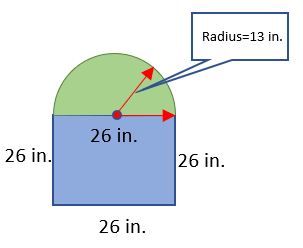
Go Math Grade 5 Answer Key Chapter 9 Algebra Patterns and Graphing img 13
Graph the data and correct
the error.
Go Math Grade 5 Answer Key Chapter 9 Algebra Patterns and Graphing img 15
• Describe the error Mary made.
Type below:
__________

Answer:
Go-Math-Grade-5-Answer-Key-Chapter-9-Algebra-Patterns-and-Graphing-img-14-1

Graph the data and correct the error
Go-Math-Grade-5-Answer-Key-Chapter-9-Algebra-Patterns-and-Graphing-img-15

Share and Show – Page No. 383

Use the table at the right for 1–3.
Go Math Grade 5 Answer Key Chapter 9 Algebra Patterns and Graphing img 16

Question 1.
What scale and intervals would be appropriate to make a graph of the data?
Type below:
__________

Answer:
Scale is 1 cm = 10°F
Months will be on the x-axis.
The temperature will be on the y-axis.

Question 2.
Write the related pairs as ordered pairs.
Type below:
__________

Answer: The related pairs are A (Jan, 40), B (Feb, 44), C (Mar, 54), D (Apr, 62), E (May, 70)

Question 3.
Make a line graph of the data.
Type below:
__________

Question 4.
Use the graph to determine between which two months the least change in average temperature occurs.
Type below:
__________

Answer: By seeing the above graph we can say that Jan and Feb has the least change in the average temperature.

On Your Own

Use the table at the right for 5–7.
Go Math Grade 5 Answer Key Chapter 9 Algebra Patterns and Graphing img 17

Question 5.
Write the related number pairs for the plant height as ordered pairs.
Type below:
__________

Answer: The related number pairs of the above table are A (1, 20), B(2, 25), C (3, 29), D (4, 32)

Question 6.
What scale and intervals would be appropriate to make a graph of the data?
Type below:
__________

Answer: The above table says that the X-Axis is Month and Y-Axis is Height in inches.
Scale is 1 cm = 5 inches.

Explanation:
The horizontal axis could represent months from 1 to 4. In this case, the scale interval is one month.
The vertical axis could represent height from 20 inches to 32 inches but we can show a break in the scale between 1 inch and 16 inches since there are no heights between 0 inches and 20 inches, the scale interval is 1 inch.

Question 7.
Make a line graph of the data.
Type below:
__________

Question 8.
Use the graph to find the difference in height between Month 1 and Month 2.
Type below:
__________

Answer: By observing the above graph we can say that the difference between months 1 and 2 is 5 inches.
25 – 20 = 5 inches
From the graph we can see that the plant grew the most between 1 and 2 months (about 5 inches), the least change is between 3 and 4 months (about 3 inches).

Question 9.
Use the graph to estimate the height at 1 \(\frac{1}{2}\) months.
_____ in.

Answer: The estimated height at 1 \(\frac{1}{2}\) months is 22.5 inches.
The average of month 1 and month 2 is (20 + 25) ÷ 2 = 45/2 = 22.5 inches.

Connect to science – Page No. 384

Evaporation changes water on Earth’s surface into water vapor. Water vapor condenses in the atmosphere and returns to the surface as precipitation. This process is called the water cycle. The ocean is an important part of this cycle. It influences the average temperature and precipitation of a place.
Go Math Grade 5 Answer Key Chapter 9 Algebra Patterns and Graphing img 18
The overlay graph below uses two vertical scales to show monthly average precipitation and temperatures for Redding, California.
Go Math Grade 5 Answer Key Chapter 9 Algebra Patterns and Graphing img 19

Use the graph for 10–13.

Question 10.
About how much precipitation falls in Redding, California, in February?
_____ inches

Answer: From the graph, we can see that the precipitation in February is 4.2 inches.

Question 11.
What is the average temperature for Redding, California, in February?
_____ °F

Answer: From the graph, we can see that the temperature in February is 50°F.

Question 12.
Explain how the overlay graph helps you relate precipitation and temperature for each month.
Type below:
__________

Answer: The average temperature for each month is plotted on the graph with the blue line and the red bar graph represents the precipitation. As the temperature increases the precipitation decreases.

Question 13.
Describe how the average temperature changes in the first 5 months of the year.
Type below:
__________

Answer: From the graph, we can see that the temperature in the first 5 months of the year but the amount of precipitation is decreasing. It’s logical because when the temperature is increasing the amount of precipitation is decreasing.

Question 14.
Test Prep Which day had an increase of 3 feet of snow from the previous day?
Go Math Grade 5 Answer Key Chapter 9 Algebra Patterns and Graphing img 20
Options:
a. Day 2
b. Day 3
c. Day 5
d. Day 6

Answer: Day 5

Explanation:
By seeing the above graph we can say that the snow level has increased 3 feet from day 4 to Day 5.
Thus the correct answer is option C.

Mid-Chapter Checkpoint – Vocabulary – Page No. 385

Choose the best term from the box.
Go Math Grade 5 Answer Key Chapter 9 Algebra Patterns and Graphing Mid-Chapter Checkpoint img 21

Question 1.
The ______ is the horizontal number line on the coordinate grid.
__________

Answer: X-Axis
The X-Axis is the horizontal number line on the coordinate grid.

Question 2.
A ______ is a graph that uses line segments to show how data changes over time.
__________

Answer: Line graph
A Line graph is a graph that uses line segments to show how data changes over time.

Concepts and Skills

Use the line plot at the right for 3–5.
Go Math Grade 5 Answer Key Chapter 9 Algebra Patterns and Graphing Mid-Chapter Checkpoint img 22

Question 3.
How many kittens weigh at least \(\frac{3}{8}\) of a pound?
______ kittens

Answer: 9

Explanation:
The line plot shows that there are 4 xs above \(\frac{3}{8}\), 3 xs above \(\frac{1}{2}\) and 2 xs on \(\frac{5}{8}\).
To find the kittens weigh at least \(\frac{3}{8}\) we need to add all above \(\frac{3}{8}\)
= 4 + 3 + 2 = 9

Question 4.
What is the combined weight of all the kittens?
______ lb

Answer: 5

Explanation:
There are 3 xs above 1/4 on the line plot, so the combined weight of Kitten in the animal shelter is 3 fourths
3 × 1/4 = 3/4.
There are 4 xs above 3/8 on the line plot, so the combined weight of kittens in the animal shelter is 4 three eights or
4 × 3/8 = 12/8 = 3/2
There are 3 xs above 1/2 on the line plot, so the combined weight of kittens in the animal shelter is 3 halves = 3/2
There are 2 xs above 5/8 on the line plot, so the combined weight of kittens in the animal shelter is 10/8
3/4 + 1 4/8 + 1 1/2 + 1 2/8
= 3/4 + 12/8 + 3/2 + 10/8 = 6/8 + 12/8 + 12/8 + 10/8 = 40/8 = 5 lb

Question 5.
What is the average weight of the kittens in the shelter?
______ lb

Answer: 5/12

Explanation:
Divide the sum you found in example 4. 5 lb by the number of the kittens to find the average. The number of kittens is 12 so we will divide 5 lb by 12.
5 ÷ 12 = 5/12.
Thus the average weight of the kittens in the shelter as 5/12 lb.

Use the coordinate grid at the right for 6–13.

Write an ordered pair for the given point.
Go Math Grade 5 Answer Key Chapter 9 Algebra Patterns and Graphing Mid-Chapter Checkpoint img 23

Question 6.
A( ______ , ______ )

Answer: 1, 6
The ordered pair for A is (1,6)

Question 7.
B( ______ , ______ )

Answer: 2, 2
The ordered pair for B is (2, 2)

Question 8.
C( ______ , ______ )

Answer: 4, 4
The ordered pair for C is (4, 4)

Question 9.
D( ______ , ______ )

Answer: 0, 3
The ordered pair for D is (0, 3)

Plot and label the point on the coordinate grid.

Question 10.
E(6, 2)
Type below:
__________

Answer:
Go-Math-Grade-5-Answer-Key-Chapter-9-Algebra-Patterns-and-Graphing-img-23-1

Question 11.
F(5, 0)
Type below:
__________

Answer:
Go-Math-Grade-5-Answer-Key-Chapter-9-Algebra-Patterns-and-Graphing-img-23-2

Question 12.
G(3, 4)
Type below:
__________

Answer:
Go-Math-Grade-5-Answer-Key-Chapter-9-Algebra-Patterns-and-Graphing-img-23-3

Question 13.
H(3, 1)
Type below:
__________

Answer:
Go-Math-Grade-5-Answer-Key-Chapter-9-Algebra-Patterns-and-Graphing-img-23-4

Mid-Chapter Checkpoint – Page No. 386

Question 14.
Jane drew a point that was 1 unit to the right of the y-axis and 7 units above the x-axis. What is the ordered pair for this location?
( ______ , ______ )

Answer: (1, 7)
The ordered pair for the location is (1, 7).

Question 15.
The graph below shows the amount of snowfall in a 6-hour period.
Go Math Grade 5 Answer Key Chapter 9 Algebra Patterns and Graphing Mid-Chapter Checkpoint img 24
Between which hours did the least amount of snow fall?
between hour ______ and hour ______

Answer: From the graph, we can see that the least amount of snow fall between 2 hours and 4 hours, 0 inches.
Go Math Grade 5 Answer Key Chapter 9 mid chapter solution

Question 16.
Joy recorded the distances she walked each day for five days. How far did she walk in 5 days?
Go Math Grade 5 Answer Key Chapter 9 Algebra Patterns and Graphing Mid-Chapter Checkpoint img 25
______ \(\frac{□}{□}\) miles

Answer: 2 \(\frac{1}{6}\) miles

Explanation:
There are 3 xs above \(\frac{1}{3}\) = 3 × \(\frac{1}{3}\) = 1
There are 1 x above \(\frac{1}{2}\) = 1 × \(\frac{1}{2}\) = \(\frac{1}{2}\)
There is 1 x above \(\frac{2}{3}\) = 1 × \(\frac{2}{3}\) = \(\frac{2}{3}\)
1 + \(\frac{2}{3}\) + \(\frac{1}{2}\) = (6 + 3 + 4)/6 = 13/6
The mixed fraction of 13/6 is 2 \(\frac{1}{6}\) miles
Thus she walked 2 \(\frac{1}{6}\) miles in 5 days.

Share and Show – Page No. 389

Use the given rules to complete each sequence. Then, complete the rule that describes how nickels are related to dimes.

Question 1.
Go Math Grade 5 Answer Key Chapter 9 Algebra Patterns and Graphing img 26
Type below:
__________

Answer: The number of Dimes is 2 times the number of Nickels.
We need to add 5 to Nickels = 5 + 5 + 5 + 5 + 5 = 25
We need to add 10 to Dimes = 10 + 10 + 10 + 10 + 10 = 50

Complete the rule that describes how one sequence is related to the other. Use the rule to find the unknown term.

Question 2.
Multiply the number of books by ______ to find the amount spent.
Go Math Grade 5 Answer Key Chapter 9 Algebra Patterns and Graphing img 27
______
Explain:
__________

Answer: The amount spent is 4 times the number of books so we multiply the number of books by 4 to find the amount spent.
Multiply 4 to the amount spent = 24 × 4 = 96

Question 3.
Divide the weight of the bag by _____ to find the number of marbles.
Go Math Grade 5 Answer Key Chapter 9 Algebra Patterns and Graphing img 28
______
Explain:
__________

Answer: The weight of Bag is 3 times the number of marbles So, we divide the weight of Bag by 3 to find the number of marbles.
Divide 360 by 3
360/3 = 120

On Your Own

Complete the rule that describes how one sequence is related to the other. Use the rule to find the unknown term.

Question 4.
Multiply the number of eggs by _______ to find the number of muffins.
Go Math Grade 5 Answer Key Chapter 9 Algebra Patterns and Graphing img 29
Type below:
__________

Answer: The muffins is 6 times the number of eggs so we multiply the number of eggs by 6 to find the muffins.
The unknown term in the table we will find when multiply 18 by 6.
18 × 6 = 108
The unknown term is 108.

Question 5.
Divide the number of meters by _______ to find the number of laps.
Go Math Grade 5 Answer Key Chapter 9 Algebra Patterns and Graphing img 30
Type below:
__________

Answer: The number of meters is 400 times the number of laps so we divide the number of meters by 400 to find the number of laps.
The unknown term in the table we will find when divide 6400 by 400.
6400 ÷ 400 = 16
The unknown term is 16.

Question 6.
Suppose the number of eggs used in Exercise 4 is changed to 3 eggs for each batch of 12 muffins, and 48 eggs are used. How many batches and how many muffins will be made?
______ batches
______ muffins

Answer: 16 batches 192 muffins will be made.

Explanation:
If we change to 3 eggs for each batch of 12 muffins and 48 eggs are used we will have 16 batches.
16 × 3 = 48
The muffins are 4 times the number of eggs so we multiply the number of eggs by 4 to fins the number of muffins.
If the number of batches is 16 and there are 48 eggs to find the number of muffins we will multiply the number of eggs 48 with 4:
48 × 4 = 192
192 muffins will be made.

Problem Solving – Page No. 390

Question 7.
Emily has a road map with a key that shows an inch on the map equals 5 miles of actual distance. If a distance measured on the map is 12 inches, what is the actual distance? Write the rule you used to find the actual distance.
______ miles

Answer: 60 miles

Explanation:
For first the total length of roads is 5 inches + 7 inches = 12 inches
1 inch on the map represents 5 miles of actual distance so to find what actual distance corresponding to 12 inches we will find with using proportion.
1 inch : 5 inches = 12 inches: x inches
1 × x = 5 × 12
x = 60 miles
The actual distance which Emily will drive is 60 miles.
The rule which we used to find the actual distance is multiplied by 5 which is a mark in solution.

Question 8.
To make a shade of lavender paint, Jon mixes 4 ounces of red tint and 28 ounces of blue tint into one gallon of white paint. If 20 gallons of white paint and 80 ounces of red tint are used, how much blue tint should be added? Write a rule that you can use to find the amount of blue tint needed.
______ oz

Answer: 560 oz

Explanation:
For one gallon of white paint, Jon mixed 28 ounces of blue tint so to find how much tint corresponding to 20 gallons of white paint we will find with using proportion.
1 gallon of white paint:28 ounces of blue tint = 20 gallons of white paint:x ounces of the blue tint.
1 × x = 28 × 20
x = 560
560 ounces of blue tint should be added.
The rule which we used to find the amount of blue tint needed is to multiply by 28 which is the mark in solution.

Question 9.
In the cafeteria, tables are arranged in groups of 4, with each table seating 8 students. How many students can sit at 10 groups of tables? Write the rule you used to find the number of students.
______ students

Answer: 320 students

Explanation:
Tables are arranged in groups of 4, with each table seating 8 students, so in one group sit
4 × 8 = 32 students
To find how many students can sit at 10 groups of tables, we will find when multiplying 32 students with 10.
32 × 10 = 320
Finally, 320 students can sit at 10 groups of tables. The rule which we used to find the number of students is to multiply by 32 which is marked is a solution.

Question 10.
Test Prep What is the unknown number in Sequence 2 in the chart? What rule could you write that relates Sequence 1 to Sequence 2?
Go Math Grade 5 Answer Key Chapter 9 Algebra Patterns and Graphing img 31
Options:
a. 70; Multiply by 2.
b. 100; Add 25.
c. 105; Multiply by 3.
d. 150; Add 150.

Answer: 105; Multiply by 3.

Explanation:
The unknown number in Sequence number 7 we will get when multiply 35 with 3 because the rule that releases the number of miles to the number of runners is multiplying by 3.
The unknown number is: 35 × 3 = 105
Thus the correct answer is option C.

Share and Show – Page No. 393

Question 1.
Max builds rail fences. For one style of fence, each section uses 3 vertical fence posts and 6 horizontal rails. How many posts and rails does he need for a fence that will be 9 sections long?
Go Math Grade 5 Answer Key Chapter 9 Algebra Patterns and Graphing img 32
Go Math Grade 5 Answer Key Chapter 9 Algebra Patterns and Graphing img 33
Go Math Grade 5 Answer Key Chapter 9 Algebra Patterns and Graphing img 34
First, think about what the problem is asking and what you know. As each section of fence is added, how does the number of posts and the number of rails change?

Next, make a table and look for a pattern. Use what you know about 1, 2, and 3 sections. Write a rule for the number of posts and rails needed for 9 sections
of fence.
Go Math Grade 5 Answer Key Chapter 9 Algebra Patterns and Graphing img 35
Possible rule for posts: _____________
Possible rule for rails: ______________
Finally, use the rule to solve the problem.
Type below:
__________

Answer:
Possible rule for posts: 27
Possible rule for rails: 54

Explanation:
The number of posts is 3 times the number of sections. So, we multiply the number of posts by 3.
With using the rule the unknown number is 9 × 3 = 27
Thus the possible rule for posts is 27.
Now multiply the number of rails by 2.
With using the rule the unknown number is 27 × 2 = 54
Thus the possible rule for rails is 54.

Question 2.
What if another style of rail fencing has 6 rails between each pair of posts? How many rails are needed for 9 sections of this fence?
Go Math Grade 5 Answer Key Chapter 9 Algebra Patterns and Graphing img 36
Possible rule for rails: ____________________
______ rails

Answer: 108 rails

Explanation:
The number of posts is 3 times the number of sections. So, we multiply the number of posts by 3.
With using the rule the unknown number is 9 × 3 = 27
Thus the possible rule for posts is 27.
Now multiply the number of rails by 4.
With using the rule the unknown number is 27 × 4 = 108
Thus the possible rule for rails is 108.

Question 3.
Leslie is buying a coat on layaway for $135. She will pay $15 each week until the coat is paid for. How much will she have left to pay after 8 weeks?
Go Math Grade 5 Answer Key Chapter 9 Algebra Patterns and Graphing img 37
$ ______

Answer: $15

Explanation:
Leslie is buying a coat on layaway for $135. She will pay $15 each week until the coat is paid for.
Multiply the number of weeks by 15.
15 × 8 = $120
Now subtract $120 from $135
= $135 – $120 = $15

On Your Own – Page No. 394

Question 4.
Jane works as a limousine driver. She earns $50 for every 2 hours that she works. How much does Jane earn in one week if she works 40 hours per week? Write a rule and complete the table.
Possible rule: _____________
Go Math Grade 5 Answer Key Chapter 9 Algebra Patterns and Graphing img 38
$ ______

Answer: 1000

Explanation:
The possible rule for Hour Worked: We can see that the difference between terms is 2.
So, the rule which describes this is Add 2.
The possible rule for Jane’s Pay: We can see that the difference between terms is 50.
So, the rule which describes this is Add 50.
Jane’s Pay is 25 times the hours worked so, we will multiply the hours worked by 25 to find Jane’s Pay.
The unknown number Jane’s Pay we will find when multiplying 40 with 25:
40 × 25 = 1000
She earns 1000 dollars.

Question 5.
Rosa joins a paperback book club. Members pay $8 to buy 2 tokens, and can trade 2 tokens for 4 paperback books. Rosa buys 30 tokens and trades them for 60 paperback books. How much money does she spend? Write a rule and complete the table.
Possible rule: _______________
Go Math Grade 5 Answer Key Chapter 9 Algebra Patterns and Graphing img 39
$ ______

Answer: 120

Explanation:
Possible rule for Tokens: We can see that the difference between terms is 8.
So, the rule which describes this is Add 8.
Possible rule for Games: We can see that the difference between terms is 4.
So, the rule which describes this is Add 4.
Tokens are 2 times the games so, we will divide the tokens by 2 to find how many games can she3 play.
The unknown number of games we will find when dividing 120 with 2:
120 ÷ 2 = 60
She can play 60 games for 120 tokens.

Question 6.
Paul is taking a taxicab to a museum. The taxi driver charges a $3 fee plus $2 for each mile traveled. How much does the ride to the museum cost if it is 8 miles away?

Answer: $40

Explanation:
Paul is taking a taxicab to a museum. The taxi driver charges a $3 fee plus $2 for each mile traveled.
That means the driver charged $5 per mile.
For 8 miles = 8 × $5 = $40.

Question 7.
Test Prep Which expression could describe the next figure in the pattern, Figure 4?
Go Math Grade 5 Answer Key Chapter 9 Algebra Patterns and Graphing img 40
Options:
a. 2 × 5
b. 2 + 4 + 4
c. 2 + 4 + 4 + 4
d. 16

Answer: 2 + 4 + 4 + 4

Explanation:
We can see that the difference between two consecutive figures is 4 squares.
So, the rule which describes this is Add 4.
Thus figure 4 has 14 squares.
Thus the correct answer is option C.

Share and Show – Page No. 397

Graph and label the related number pairs as ordered pairs.
Then complete and use the rule to find the unknown term.

Question 1.
Multiply the number of tablespoons by ___ to find its weight in ounces.
Go Math Grade 5 Answer Key Chapter 9 Algebra Patterns and Graphing img 41
Go Math Grade 5 Answer Key Chapter 9 Algebra Patterns and Graphing img 42
Type below:
_________

Answer: Multiply the number of tablespoons by 2 to find its weight in ounces.
5 × 2 = 10
Go-Math-Grade-5-Answer-Key-Chapter-9-Algebra-Patterns-and-Graphing-img-42-1

Question 2.
Multiply the number of hours by ____ to find the distance in miles.
Go Math Grade 5 Answer Key Chapter 9 Algebra Patterns and Graphing img 43
Go Math Grade 5 Answer Key Chapter 9 Algebra Patterns and Graphing img 44
Type below:
_________

Answer: Multiply the number of hours by 3 to find the distance in miles.
4 × 3 = 12 miles
Go-Math-Grade-5-Answer-Key-Chapter-9-Algebra-Patterns-and-Graphing-img-42-2

On Your Own

Graph and label the related number pairs as ordered pairs.
Then complete and use the rule to find the unknown term.

Question 3.
Multiply the number of inches by ____ to find the distance in miles.
Go Math Grade 5 Answer Key Chapter 9 Algebra Patterns and Graphing img 45
Go Math Grade 5 Answer Key Chapter 9 Algebra Patterns and Graphing img 46
Type below:
_________

Answer: Multiply the number of inches by 5 to find the distance in miles.
10 × 5 = 50
Go-Math-Grade-5-Answer-Key-Chapter-9-Algebra-Patterns-and-Graphing-img-46-1

Question 4.
Multiply the number of centiliters by ____ to find the equivalent number of milliliters.
Go Math Grade 5 Answer Key Chapter 9 Algebra Patterns and Graphing img 47
Go Math Grade 5 Answer Key Chapter 9 Algebra Patterns and Graphing img 48

Answer:
Multiply the number of centiliters by 10 to find the equivalent number of milliliters.
5 × 10 = 50 milliliters
Go-Math-Grade-5-Answer-Key-Chapter-9-Algebra-Patterns-and-Graphing-img-46-2

Problem Solving – Page No. 398

Sense or Nonsense?

Question 5.
Elsa solved the following problem.
Go Math Grade 5 Answer Key Chapter 9 Algebra Patterns and Graphing img 49
Lou and George are making chili for the Annual Firefighter’s Ball. Lou uses 2 teaspoons of hot sauce for every 2 cups of chili that he makes, and George uses 3 teaspoons of the same hot sauce for every cup of chili in his recipe. Who has the hotter chili, George or Lou?

Write the related number pairs as ordered pairs and then graph them. Use the graph to compare who has the hotter chili, George or Lou.
Go Math Grade 5 Answer Key Chapter 9 Algebra Patterns and Graphing img 50
Lou’s chili: (2, 2), (4, 4), (6, 6), (8, 8)
George’s chili: (1, 3), (2, 6), (3, 9), (4, 12)

Elsa said that George’s chili was hotter than Lou’s because the graph showed that the amount of hot sauce in George’s chili was always 3 times as great as the amount of hot sauce in Lou’s chili.

Does Elsa’s answer make sense, or is it nonsense?
Explain.
Go Math Grade 5 Answer Key Chapter 9 Algebra Patterns and Graphing img 51

Answer: Elsa’s Answer makes sense.

Explanation:
Elsa’s answer makes sense because the amount of hot sauce in George’s chili was always 3 times as great as the amount of hot sauce in Lou’s chili. To prove this we will take two points from the graph which has an equal amount of cups of chili and compares the amount of hot sauce in George’s chili with the amount of hot sauce in Lou’s chili.
If we take 4 cups of George’s chili and Lou’s chili the amount of hot sauce in George’s chili is 12 teaspoons and the amount of hot sauce in Lou’s chili is 4 teaspoons.
12 is 3 times greater than 4 so Elsa’s answer makes sense.

Chapter Review/Test – Vocabulary – Page No. 399

Choose the best term from the box.
Go Math Grade 5 Answer Key Chapter 9 Algebra Patterns and Graphing Chapter Review/Test img 52

Question 1.
The __________ is the point where the x-axis and y-axis meet. Its __________ is 0, and its __________ is 0.
The ________ is the point where the x-axis and y-axis meet.
Its ________ is 0,
and its ________ is 0.

Answer:
The Origin is the point where the x-axis and y-axis meet.
Its x-coordinate is 0,
and its y-coordinate is 0.

Question 2.
A __________ uses line segments to show how data changes over time.

Answer: A line graph uses line segments to show how data changes over time.

Check Concepts

Use the table for 3–4.
Go Math Grade 5 Answer Key Chapter 9 Algebra Patterns and Graphing Chapter Review/Test img 53

Question 3.
Write related number pairs of data as ordered pairs.
Type below:
__________

Answer:
The ordered pair for week 1 is (1, 2)
The ordered pair for week 2 is (2, 6)
The ordered pair for week 3 is (3, 14)
The ordered pair for week 4 is (4, 16)

Question 4.
Make a line graph of the data.
Go Math Grade 5 Answer Key Chapter 9 Algebra Patterns and Graphing Chapter Review/Test img 54
Type below:
__________

Answer:
Go-Math-Grade-5-Answer-Key-Chapter-9-Algebra-Patterns-and-Graphing-img-54

The ordered pair for week 1 is (1, 2)
The ordered pair for week 2 is (2, 6)
The ordered pair for week 3 is (3, 14)
The ordered pair for week 4 is (4, 16)

Complete the rule that describes how one sequence is related to the other. Use the rule to find the unknown term.

Question 5.
Multiply the number of eggs by ________ to find the number of cupcakes.
Go Math Grade 5 Answer Key Chapter 9 Algebra Patterns and Graphing Chapter Review/Test img 55
_______

Answer:
Multiply the number of eggs by 6 to find the number of cupcakes.
The unknown number in batches 6 we will get when multiply 18 with 6 because the rule that releases the number of eggs to the number of cupcakes is multiplying by 6.
The number of eggs is multiple of 3 and the number of cupcakes is multiple of 6.

Chapter Review/Test – Page No. 400

Fill in the bubble completely to show your answer.

Question 6.
The letters on the coordinate grid represent the locations of the first four holes on a golf course.
Go Math Grade 5 Answer Key Chapter 9 Algebra Patterns and Graphing Chapter Review/Test img 56
Which ordered pair describes the location of the hole labeled T?
Options:
a. (0, 7)
b. (1, 7)
c. (7, 0)
d. (7, 1)

Answer: (0, 7)
By seeing the above graph we can find the location of the hole label T i.e., (0, 7)

Use the line plot at the right for 7–8.
Go Math Grade 5 Answer Key Chapter 9 Algebra Patterns and Graphing Chapter Review/Test img 57

Question 7.
What is the average of the data in the line plot?
Options:
a. \(\frac{1}{2}\) pound
b. 1 pound
c. 6 pounds
d. 6 \(\frac{3}{4}\) pounds

Answer: 6 pounds

Explanation:
There are 3 xs above \(\frac{1}{2}\) pound = 3 × \(\frac{1}{2}\) = 3/2
There are 4 xs above \(\frac{2}{3}\) pound = 4 × \(\frac{2}{3}\) = 8/3
There is 1 x above \(\frac{5}{6}\) pound = 5/6
There are 2 xs above \(\frac{1}{6}\) = 2/6
There are 2 xs above \(\frac{1}{3}\) = 2/3
3/2 + 8/3 + 5/6 + 2/6 + 2/3 = 6 pounds
Thus the correct answer is option C.

Question 8.
How many bags of rice weigh at least \(\frac{1}{2}\) pound?
Options:
a. 2
b. 3
c. 5
d. 8

Answer: 8

Explanation:
By seeing the above line plot we can find the number of bags of rice weigh at least \(\frac{1}{2}\) pound
There are 3 xs above \(\frac{1}{2}\) pound = 3 × \(\frac{1}{2}\) = 3/2
There are 4 xs above \(\frac{2}{3}\) pound = 4 × \(\frac{2}{3}\) = 8/3
There is 1 x above \(\frac{5}{6}\) pound = 5/6
Total number of bags of rice weigh at least \(\frac{1}{2}\) pound = 3 + 4 + 1 = 8
Thus the correct answer is option D.

Chapter Review/Test – Page No. 401

Fill in the bubble completely to show your answer.

Use the table for 9–10.
Go Math Grade 5 Answer Key Chapter 9 Algebra Patterns and Graphing Chapter Review/Test img 58

Question 9.
Compare Tori’s and Martin’s savings. Which of the following statements is true?
Options:
a. Tori saves 4 times as much per week as Martin.
b. Tori will always have exactly $15 more in savings than Martin has.
c. Tori will save 15 times as much as Martin will.
d. On week 5, Martin will have $30 and Tori will have $90.

Answer: Tori saves 4 times as much per week as Martin.

Explanation:
By seeing the above table we can say that Tori saves 4 times as much per week as Martin.
Thus the correct answer is option A.

Question 10.
What rule could you use to find Tori’s savings after 10 weeks?
Options:
a. Add 10 from one week to the next.
b. Multiply the week by 2.
c. Multiply Martin’s savings by 4.
d. Divide Martin’s savings by 4.

Answer: Multiply Martin’s savings by 4.

Explanation:
We can find the savings of Tori by multiplying the savings of Martins by 4.
Thus the suitable statement is Multiply Martin’s savings by 4.
Therefore the correct answer is option C.

Question 11.
In an ordered pair, the x-coordinate represents the number of hexagons and the y-coordinate represents the total number of sides. If the x-coordinate is 7, what is the y-coordinate?
Options:
a. 6
b. 7
c. 13
d. 42

Answer: 6

Explanation:
Given that x-coordinate represents the number of hexagons.
Thus x-coordinate is 6.
And also given that the y-coordinate represents the number of sides.
The figure hexagon contains 6 sides.
So, the y-coordinate is 6.
Thus the ordered pair is (7, 6)
Therefore the correct answer is option A.

Question 12.
Point A is 2 units to the right and 4 units up from the origin. What ordered pair describes point A?
Options:
a. (2, 0)
b. (2, 4)
c. (4, 2)
d. (0, 4)

Answer: (2, 4)

Explanation:
Point A is 2 units to the right and 4 units up from the origin.
2 units will be located on the x-axis and 4 units will be on the y-axis.
Thus the ordered pair for point A is (2, 4)
Therefore the correct answer is option B.

Chapter Review/Test – Page No. 402

Constructed Response

Question 13.
Mr. Stevens drives 110 miles in 2 hours, 165 miles in 3 hours, and 220 miles in 4 hours. How many miles will he drive in 5 hours?
Explain how the number of hours he drives is related to the number of miles he drives.
_____ miles

Answer: 275 miles

Explanation:
Given that, Mr. Stevens drives 110 miles in 2 hours, 165 miles in 3 hours, and 220 miles in 4 hours.
We have to divide the number of miles by number of hours
That means, 110/2, 165/3, 220/4
the distance gone in 5 hours can be found with this equation
110/2 x ?/5
multiply 110 by 5 then divide the product by 2
110 × 5= 550
550/2 =275
Thus the answer is Mr. Stevens goes 275 miles in 5 hr.

Performance Task

Question 14.
Tim opens the freezer door and measures the temperature of the air inside. He continues to measure the temperature every 2 minutes, as the door stays open, and records the data in the table.
Go Math Grade 5 Answer Key Chapter 9 Algebra Patterns and Graphing Chapter Review/Test img 59
A). On the grid below, make a line graph showing the data in the table.
Go Math Grade 5 Answer Key Chapter 9 Algebra Patterns and Graphing Chapter Review/Test img 60
Type below:
__________

Question 14.
B). Use the graph to estimate the temperature at 7 minutes.
Estimate: _____ °F

Answer: By seeing the above graph we can say that the estimated temperature at 7 minutes is 15°F.

Question 14.
C). Write a question that can be answered by making a prediction. Then answer your question and explain how you made your prediction.
Type below:
__________

Question: Estimate the temperature at 5 minutes by using the graph.
Answer: By seeing the above table we can say that the estimated temperature at 5 minutes is 13°F

Conclusion

Fall in love with Maths by utilizing the Go Math 5th Standard 5 Answer Key. Make use of the Go Math Grade 5 Answer Key Chapter 9 Algebra: Patterns and Graphing as a reference for all your queries. Keep in touch with our site to avail updates on Class Specific Go Math Answer Key at your fingertips.

Go Math Grade 3 Answer Key Chapter 8 Understand Fractions Extra Practice

go-math-grade-3-chapter-8-understand-fractions-extra-practice-answer-key

Go Math Grade 3 Answer Key Chapter 8 Understand Fractions Extra Practice includes different questions from exercises, practice tests, chapter tests. Enhance your Math proficiency by solving the 3rd Grade Go Math Answer Key Chapter 8 on a regular basis. Kick start your preparation by taking the help of the Go Math 3rd Grade Answer Key Chapter 8 Extra Practice. Go Math Grade 3 Answer Key Chapter 8 Understand Fractions has detailed solutions for all the problems and makes it easy for you to understand the concepts.

3rd Grade Go Math Answer Key Chapter 8 Understand Fractions Extra Practice

Improve your subject knowledge and prepare effectively taking the help of the 3rd Grade HMH Go Math Solutions Key. Support your Child’s learning with our Go Math Answer Key for Grade 3 Chapter 8 Understand Fractions Extra Practice. Solve different questions and attempt the exam with full confidence and score well. 

Common Core – Page No. 171000

Lesson 8.1

Write the number of equal parts. Then write the name for the parts.

Question 1.
Go Math Grade 3 Answer Key Chapter 8 Understand Fractions Extra Practice Common Core img 1
Equal parts: _________
Name: _________

Answer:

i. 4
ii. Fourths

Explanation:

The figure shows that the square is divided into 4 equal parts. So, the name for the parts is fourths.

Question 2.
Go Math Grade 3 Answer Key Chapter 8 Understand Fractions Extra Practice Common Core img 2
Equal parts: _________
Name: _________

Answer:

i. 2
ii. Halves

Explanation:

The circle is divided into two equal parts. Thus the name for the parts is halves.

Question 3.
Go Math Grade 3 Answer Key Chapter 8 Understand Fractions Extra Practice Common Core img 3
Equal parts: _________
Name: _________

Answer:

i. 6
ii. Sixths

Explanation:

The hexagon is divided into six equal parts. Thus the name for the parts is sixths.

Lesson 8.2

Draw lines to show how much each person gets. Write the answer.

Question 4.
4 friends share 3 oranges equally.
Go Math Grade 3 Answer Key Chapter 8 Understand Fractions Extra Practice Common Core img 4
Type below:
___________

Answer: 3 fourths of an orange

Explanation:

There are 3 oranges and
The total number of friends = 4
We need to divide the 3 oranges for 4 friends equally
= 3/4
So, each friend gets 3 fourth of the orange.

Question 5.
6 sisters share 4 sandwiches equally.
Go Math Grade 3 Answer Key Chapter 8 Understand Fractions Extra Practice Common Core img 5
Type below:
___________

Answer: 4 sixths of a sandwich

Explanation:

Total number of sandwiches = 4
Number of friends = 6
To share the sandwiches equally we need to divide the number of sandwiches by a number of friends.
4/6
So, each friend gets 4 sixths of the sandwich.

Lessons 8.3–8.4

Write the number of equal parts in the whole. Write a fraction in words and in numbers to name the shaded part.

Question 6.
Go Math Grade 3 Answer Key Chapter 8 Understand Fractions Extra Practice Common Core img 6
_________ equal parts
_________ eighths

Question 6.
\(\frac{□} {□}\)

Answer:

i. 8
ii. Five
iii. \(\frac{5} {8}\)

Explanation:

The square is divided into 8 eight equal parts.
Among them, five parts are shaded.
So, the fraction name for the shaded part is \(\frac{5} {8}\).

Question 7.
Go Math Grade 3 Answer Key Chapter 8 Understand Fractions Extra Practice Common Core img 7
_________ equal parts
_________ thirds

Question 7.
\(\frac{□} {□}\)

Answer:

i. 3
ii. Two
iii. \(\frac{2} {3}\)

Explanation:

The aboved figure shows that the rectangle is divided into 3 equal parts. And 2 parts are shaded among them.
The fraction name for the shaded part is 2 thirds i.e, \(\frac{2} {3}\)

Common Core – Page No. 172000

Lesson 8.5

Write the fraction that names the point.
Go Math Grade 3 Answer Key Chapter 8 Understand Fractions Extra Practice Common Core img 8

Question 1.
point A: \(\frac{□} {□}\)

Answer: \(\frac{1} {6}\)

Explanation:

The number lies between 0 and 1. Each point is 1 sixth of the number line. So, it starts with 0/6 and ends on 6/6.
Now we have to locate the point A.
The point A lies between 0/6 and 2/6. The number between 0 and 2 is 1.
Thus the point A is \(\frac{1} {6}\)

Question 2.
point B: \(\frac{□} {□}\)

Answer: \(\frac{3} {6}\)

Explanation:

The point B lies between \(\frac{2} {6}\) and \(\frac{4} {6}\). The number between 2 and 4 is 3. Thus the location of point B is \(\frac{3} {6}\).

Question 3.
point C: \(\frac{□} {□}\)

Answer: \(\frac{5} {6}\)

Explanation:

The point C is located between \(\frac{4} {6}\) and \(\frac{6} {6}\).
The number between 4 and 6 is 5. Thus the location of Point C is \(\frac{5} {6}\)

Lesson 8.6

Each shape is 1 whole. Write a fraction greater than 1 for the parts that are shaded.

Question 4.
Go Math Grade 3 Answer Key Chapter 8 Understand Fractions Extra Practice Common Core img 9
2 = \(\frac{□} {□}\)

Answer: \(\frac{8} {4}\)

Explanation:

There are 2 circles and each circle is equally divided into 4 groups.
Number in each group = 4
Number of equal parts = 8
The shaded part of the circle = \(\frac{8} {4}\)

Question 5.
Go Math Grade 3 Answer Key Chapter 8 Understand Fractions Extra Practice Common Core img 10
3 = \(\frac{□} {□}\)

Answer: \(\frac{18} {6}\)

Explanation:

Number of circles = 3
Number of equal parts = 18
Number of shaded part in each circle = 6
So, the fraction of the shaded part is \(\frac{18} {6}\)

Lesson 8.7

Write a fraction to name the shaded part of each group.

Question 6.
Go Math Grade 3 Answer Key Chapter 8 Understand Fractions Extra Practice Common Core img 11
\(\frac{□} {□}\)

Answer: \(\frac{3} {6}\) or \(\frac{1} {2}\)

Explanation:

There are 6 circles, in which 3 circles are shaded and 3 circles are not shaded.
So, the fraction name for the shaded part is \(\frac{3} {6}\) or \(\frac{1} {2}\)

Question 7.
Go Math Grade 3 Answer Key Chapter 8 Understand Fractions Extra Practice Common Core img 12
\(\frac{□} {□}\)

Answer: \(\frac{1} {4}\) or \(\frac{2} {8}\)

Explanation:

The figure shows that there are 8 circles and in that 2 circles are shaded.
So, the fraction name for the shaded part is \(\frac{2} {8}\) or \(\frac{1} {4}\)

Lessons 8.8–8.9

Draw a quick picture to solve.

Question 8.
Charlotte has 12 T-shirts. One-fourth of her T-shirts is green. How many of Charlotte’s T-shirts are green?
_________ green T-shirts

Answer: 3 T-shirts

Explanation:

Given,
Charlotte has 12 T-shirts.
One-fourth of her T-shirts is green.
To know how many of Charlotte’s T-shirts are green we need to multiply 12 with 1/4
12 × \(\frac{1} {4}\)
12/4 = 3
Therefore there are 3 green T-shirts.

Question 9.
Josh walks 18 dogs each week. Today, he is walking \(\frac{1}{3}\) of the dogs. How many dogs is he walking today?
_________ dogs

Answer: 6 dogs

Explanation:

Given that Josh walks 18 dogs each week.
Today, he is walking \(\frac{1}{3}\) of the dogs.
To find how many dogs he walked today
We need to multiply 18 and \(\frac{1}{3}\)
18 × \(\frac{1}{3}\)
= 18/3 = 6
Thus he walked 6 dogs today.

Go Math Grade 3 Answer Key Chapter 8 Understand Fractions Extra Practice helps you to test your preparation standards. You can see the topics like Equal parts of a whole, unit fractions, relate fractions and whole numbers. We even considered images for a few questions for a better understanding of the concepts.

Go Math Grade 8 Answer Key Chapter 2 Exponents and Scientific Notation

go-math-grade-8-chapter-2-exponents-and-scientific-notation-answer-key

Get Free Access to Download Go Math Grade 8 Answer Key Chapter 2 Exponents and Scientific Notation PDF from here. Start your preparation with the help of Go Math Grade 8 Answer Key. It is essential for all the students to learn the concepts of this chapter in-depth. So, make use of the Go Math Grade 8 Chapter 2 Exponents and Scientific Notation Solution Key links and go through the solutions.

Go Math Grade 8 Chapter 2 Exponents and Scientific Notation Answer Key

Check out the list of the topics before you start your preparation. You can step by step explanation for all the questions in HMH Go Math Grade 8 Answer Key Chapter 2 Exponents and Scientific Notation for free of cost. Quickly download Go Math Grade 8 Chapter 2 Answer Key PDF and fix the timetable to prepare.

Lesson 1: Integer Exponents

Lesson 2: Scientific Notation with Positive Powers of 10

Lesson 3: Scientific Notation with Negative Powers of 10

Lesson 4: Operations with Scientific Notation

Model Quiz

Mixed Review

Guided Practice – Integer Exponents – Page No. 36

Find the value of each power.

Question 1.
8−1 =
\(\frac{□}{□}\)

Answer:
\(\frac{1}{8}\)

Explanation:
Base = 8
Exponent = 1
8−1 = (1/8)1 = 1/8

Question 2.
6−2 =
\(\frac{□}{□}\)

Answer:
\(\frac{1}{36}\)

Explanation:
Base = 6
Exponent = 2
6−2 = (1/6)2 = 1/36

Question 3.
2560 =
______

Answer:
1

Explanation:
2560
Base = 256
Exponent = 0
Anything raised to the zeroth power is 1.
2560 = 1

Question 4.
102 =
______

Answer:
100

Explanation:
Base = 10
Exponent = 2
102 = 10 × 10 = 100

Question 5.
54 =
______

Answer:
625

Explanation:
Base = 5
Exponent = 4
54 = 5 × 5 × 5 × 5 = 625

Question 6.
2−5 =
\(\frac{□}{□}\)

Answer:
\(\frac{1}{32}\)

Explanation:
Base = 2
Exponent = 5
2−5 = (1/2)5 = (1/2) × (1/2) × (1/2) × (1/2) × (1/2) = 1/32

Question 7.
4−5 =
\(\frac{□}{□}\)

Answer:
\(\frac{1}{1,024}\)

Explanation:
Base = 4
Exponent = 5
4−5 = (1/4)5 = (1/4) × (1/4) × (1/4) × (1/4) × (1/4) = 1/1,024

Question 8.
890 =
______

Answer:
1

Explanation:
890
Base = 89
Exponent = 0
Anything raised to the zeroth power is 1.
890 = 1

Question 9.
11−3 =
\(\frac{□}{□}\)

Answer:
\(\frac{1}{1,331}\)

Explanation:
Base = 11
Exponent = 3
11−3 = (1/11)3 = (1/11) × (1/11) × (1/11) = 1/1,331

Use properties of exponents to write an equivalent expression.

Question 10.
4 ⋅ 4 ⋅ 4 = 4?
Type below:
_____________

Answer:
43

Explanation:
The same number 4 is multiplying 3 times.
The number of times a term is multiplied called the exponent.
So the base is 4 and the exponent is 3
4 ⋅ 4 ⋅ 4 = 43

Question 11.
(2 ⋅ 2) ⋅ (2 ⋅ 2 ⋅ 2) = 2? ⋅ 2? = 2?
Type below:
_____________

Answer:
25

Explanation:
The same number 2 is multiplying 5 times.
The number of times a term is multiplied called the exponent.
So the base is 2 and the exponent is 5
(2 ⋅ 2) ⋅ (2 ⋅ 2 ⋅ 2) = 22 ⋅ 23 = 25

Question 12.
\(\frac { { 6 }^{ 7 } }{ { 6 }^{ 5 } } \) = \(\frac{6⋅6⋅6⋅6⋅6⋅6⋅6}{6⋅6⋅6⋅6⋅6}\) = 6?
Type below:
_____________

Answer:
62

Explanation:
\(\frac { { 6 }^{ 7 } }{ { 6 }^{ 5 } } \) = \(\frac{6⋅6⋅6⋅6⋅6⋅6⋅6}{6⋅6⋅6⋅6⋅6}\)
Cancel the common factors
6.6
Base = 6
Exponent = 2
62

Question 13.
\(\frac { { 8 }^{ 12 } }{ { 8 }^{ 9 } } \) = 8?-? = 8?
Type below:
_____________

Answer:
83

Explanation:
\(\frac { { 8 }^{ 12 } }{ { 8 }^{ 9 } } \)
Bases are common. So, the exponents are subtracted
812-9 = 83

Question 14.
510 ⋅ 5 ⋅ 5 = 5?
Type below:
_____________

Answer:
512

Explanation:
Bases are common and multiplied. So, the exponents are added
Base = 5
Exponents = 10 + 1 + 1 = 12
512

Question 15.
78 ⋅ 75 = 7?
Type below:
_____________

Answer:
713

Explanation:
Bases are common and multiplied. So, the exponents are added
Base = 7
Exponents = 8 + 5 = 13
713

Question 16.
(62)4 = (6 ⋅ 6)? = (6 ⋅ 6) ⋅ (6 ⋅ 6) ⋅ (? ⋅ ?) ⋅ ? = 6?
Type below:
_____________

Answer:
68

Explanation:
(62)4 = (6 ⋅ 6)4 = (6 ⋅ 6) ⋅ (6 ⋅ 6) ⋅ (6 ⋅ 6) ⋅ (6 ⋅ 6) = 62 ⋅ 62 . 62 ⋅ 62
Bases are common and multiplied. So, the exponents are added
= 62+2+2+2
68

Question 17.
(33)3 = (3 ⋅ 3 ⋅ 3)3 = (3 ⋅ 3 ⋅ 3) ⋅ (? ⋅ ? ⋅ ?) ⋅ ? = 3?
Type below:
______________

Answer:
39

Explanation:
(3 ⋅ 3 ⋅ 3) ⋅ (3 ⋅ 3 ⋅ 3) ⋅ (3 ⋅ 3 ⋅ 3) = 33 ⋅ 33 ⋅ 33
Bases are common and multiplied. So, the exponents are added
33 + 3 + 3
39

Simplify each expression.

Question 18.
(10 − 6)3⋅42 + (10 + 2)2
______

Answer:
1,168

Explanation:
4³. 4² + (12)² = 45 + (12)² = 45 + (12 . 12)²
45 + (144) = 1,024 + 144 = 1,168

Question 19.
\(\frac { { (12-5) }^{ 7 } }{ { [(3+4)^{ 2 }] }^{ 2 } } \)
________

Answer:
343

Explanation:
77 ÷ (7²)² = 77 ÷ 74
77-4

7 . 7 . 7 = 343

ESSENTIAL QUESTION CHECK-IN

Question 20.
Summarize the rules for multiplying powers with the same base, dividing powers with the same base, and raising a power to a power.
Type below:
______________

Answer:
The exponent “product rule” tells us that, when multiplying two powers that have the same base, you can add the exponents.
The quotient rule tells us that we can divide two powers with the same base by subtracting the exponents.
The “power rule” tells us that to raise a power to a power, just multiply the exponents.

Independent Practice – Integer Exponents – Page No. 37

Question 21.
Explain why the exponents cannot be added in the product 123 ⋅ 113.
Type below:
______________

Answer:
The exponent “product rule” tells us that, when multiplying two powers that have the same base, you can add the exponents.
The bases are not the same in the given problem.
=> (12)³ x (11)³
If we solve this equation following the rule of exponent will get the correct answer:
=> (12 x 12 x 12) x (11 x 11 x 11)
=> 1728 X 1331
=> the answer is 2 299 968
But if we add the exponent, the answer would be wrong
=> (12)³ x (11)³
=> 132^6
=> 5289852801024 which is wrong.

Question 22.
List three ways to express 35 as a product of powers.
Type below:
______________

Answer:
3¹ . 34
3² . 33
3³ . 32

Question 23.
Astronomy
The distance from Earth to the moon is about 224 miles. The distance from Earth to Neptune is about 227 miles. Which distance is the greater distance and about how many times greater is it?
_______ times

Answer:
(22)³ or 10,648 times

Explanation:
The distance from Earth to the moon is about 224 miles. The distance from Earth to Neptune is about 227 miles.
227 – 224  = (22)³
The greatest distance is from Earth to Neptune
The distance from Earth to Neptune is greater by (22)³ or 10,648 miles

Question 24.
Critique Reasoning
A student claims that 83 ⋅ 8-5 is greater than 1. Explain whether the student is correct or not.
______________

Answer:
83 ⋅ 8-5 is = 8-2
(1/8)²
(1/8) . (1/8) = 1/64 = 0.015
The student is not correct.

Find the missing exponent.

Question 25.
(b2)? = b-6
_______

Answer:
(b2)-8

Explanation:
(b2)? = b-6
(b-6) = b2-8
(b2-8) = b2 . b-8
(b2)-8 = b-6

Question 26.
x? ⋅ x6 = x9
_______

Answer:

Explanation:
x? ⋅ x6 = x9
x9 = x3 + 6
x³ x6

Question 27.
\(\frac { { y }^{ 25 } }{ { y }^{ ? } } \) = y6
_______

Answer:
y25 ÷ y16

Explanation:
\(\frac { { y }^{ 25 } }{ { y }^{ ? } } \) = y
y6 = y25 – 16
y25 ÷ y16

Question 28.
Communicate Mathematical Ideas
Why do you subtract exponents when dividing powers with the same base?
Type below:
______________

Answer:
To divide exponents (or powers) with the same base, subtract the exponents. The division is the opposite of multiplication, so it makes sense that because you add exponents when multiplying numbers with the same base, you subtract the exponents when dividing numbers with the same base.

Question 29.
Astronomy
The mass of the Sun is about 2 × 1027 metric tons, or 2 × 1030 kilograms. How many kilograms are in one metric ton?
________ kgs in one metric ton

Answer:
1,000 kgs in one metric ton

Explanation:
The mass of the Sun is about 2 × 1027 metric tons, or 2 × 1030 kilograms.
2 × 1027 metric tons = 2 × 1030 ki
1 metric ton = 2 × 1030 ki ÷ 2 × 1027 = (10)³ = 1,000 kgs in one metric ton

Question 30.
Represent Real-World Problems
In computer technology, a kilobyte is 210 bytes in size. A gigabyte is 230 bytes in size. The size of a terabyte is the product of the size of a kilobyte and the size of a gigabyte. What is the size of a terabyte?
Type below:
______________

Answer:
240 bytes

Explanation:
In computer technology, a kilobyte is 210 bytes in size. A gigabyte is 230 bytes in size. The size of a terabyte is the product of the size of a kilobyte and the size of a gigabyte.
terabyte = 210 bytes × 230 bytes = 210+30 bytes = 240 bytes

Integer Exponents – Page No. 38

Question 31.
Write equivalent expressions for x7 ⋅ x-2 and \(\frac { { x }^{ 7 } }{ { x }^{ 2 } } \). What do you notice? Explain how your results relate to the properties of integer exponents.
Type below:
______________

Answer:
x^a * x^b = x^(a+b)
and
x^-a = 1/x^a
Therefore, x^7 * x^-2 = x^7/x^2 = x^5
or
x^7 * x^-2 = x^(7-2) = x^5
x^7 / x^2 = x^7 * x^-2

A toy store is creating a large window display of different colored cubes stacked in a triangle shape. The table shows the number of cubes in each row of the triangle, starting with the top row.
Go Math Grade 8 Answer Key Chapter 2 Exponents and Scientific Notation Lesson 1: Integer Exponents img 1

Question 32.
Look for a Pattern
Describe any pattern you see in the table.
Type below:
______________

Answer:
As the number of rows increased, the number of cubes in each row by multiple of 3.

Question 33.
Using exponents, how many cubes will be in Row 6? How many times as many cubes will be in Row 6 than in Row 3?
_______ times more cubes

Answer:
(33) times more cubes

Explanation:
For row 6, the number of cubes in each row = (36)
(36) ÷ (33) = (36-3) = (33)
(33) times more cubes

Question 34.
Justify Reasoning
If there are 6 rows in the triangle, what is the total number of cubes in the triangle? Explain how you found your answer.
______ cubes

Answer:
1,092 cubes

Explanation:
(31) + (32) + (33) + (34) + (35) + (36)
3 + 9 + 27 + 81 + 243 + 729 = 1,092

H.O.T.

Focus on Higher Order Thinking

Question 35.
Critique Reasoning
A student simplified the expression \(\frac { { 6 }^{ 2 } }{ { 36 }^{ 2 } } \) as \(\frac{1}{3}\). Do you agree with this student? Explain why or why not.
______________

Answer:
\(\frac { { 6 }^{ 2 } }{ { 36 }^{ 2 } } \)
(62) ÷ (62
(62) ÷ (64)
(62 – 4)
(6-2) = 1/36
I don’t agree with the student

Question 36.
Draw Conclusions
Evaluate –an when a = 3 and n = 2, 3, 4, and 5. Now evaluate (–a)n when a = 3 and n = 2, 3, 4, and 5. Based on this sample, does it appear that –an = (–a)n? If not, state the relationships, if any, between –an and (–a)n.
Type below:
______________

Answer:
–an when a = 3 and n = 2, 3, 4, and 5.
-3n
-(32 )= -9
(–a)n = -3 . -3 = 9
–an = (–a)n are not equal.

Question 37.
Persevere in Problem Solving
A number to the 12th power divided by the same number to the 9th power equals 125. What is the number?
_______

Answer:
Let’s call our number a.
(a12 ) ÷ (a9 )
(a12-9 ) = (a3 )
(a3 ) = 125
a = (125)1/3
a = 5

Guided Practice – Scientific Notation with Positive Powers of 10 – Page No. 42

Write each number in scientific notation.

Question 1.
58,927
(Hint: Move the decimal left 4 places)
Type below:
______________

Answer:
5.8927 × (10)4

Explanation:
58,927
Move the decimal left 4 places
5.8927 × (10)4

Question 2.
1,304,000,000
(Hint: Move the decimal left 9 places.)
Type below:
______________

Answer:
1.304 × (10)9

Explanation:
1,304,000,000
Move the decimal left 9 places
1.304 × (10)9

Question 3.
6,730,000
Type below:
______________

Answer:

Explanation:
6,730,000
Move the decimal left 6 places
6.73 × (10)6

Question 4.
13,300
Type below:
______________

Answer:

Explanation:
13,300
Move the decimal left 4 places
1.33 × (10)4

Question 5.
An ordinary quarter contains about 97,700,000,000,000,000,000,000 atoms.
Type below:
______________

Answer:

Explanation:
97,700,000,000,000,000,000,000
Move the decimal left 22 places
9.77 × (10)22

Question 6.
The distance from Earth to the Moon is about 384,000 kilometers.
Type below:
______________

Answer:
3.84 × (10)6

Explanation:
384,000
Move the decimal left 6 places
3.84 × (10)6

Write each number in standard notation.

Question 7.
4 × 10⁵
(Hint: Move the decimal right 5 places.)
Type below:
______________

Answer:
400,000

Explanation:
4 × 10⁵
Move the decimal right 5 places
400,000

Question 8.
1.8499 × 10⁹
(Hint: Move the decimal right 9 places.)
Type below:
______________

Answer:
1849900000

Explanation:
1.8499 × 10⁹
Move the decimal right 9 places
1849900000

Question 9.
6.41 × 10³
Type below:
______________

Answer:
6410

Explanation:
6.41 × 10³
Move the decimal right 3 places
6410

Question 10.
8.456 × 10⁷
Type below:
______________

Answer:
84560000

Explanation:
8.456 × 10⁷
Move the decimal right 7 places
84560000

Question 11.
8 × 10⁵
Type below:
______________

Answer:
800,000

Explanation:
8 × 10⁵
Move the decimal right 5 places
800,000

Question 12.
9 × 10¹⁰
Type below:
______________

Answer:
90000000000

Explanation:
9 × 10¹⁰
Move the decimal right 10 places
90000000000

Question 13.
Diana calculated that she spent about 5.4 × 10⁴ seconds doing her math homework during October. Write this time in standard notation.
Type below:
______________

Answer:
5400

Explanation:
Diana calculated that she spent about 5.4 × 10⁴ seconds doing her math homework during October.
5.4 × 10⁴
Move the decimal right 4 places

5400

Question 14.
The town recycled 7.6 × 10⁶ cans this year. Write the number of cans in standard notation
Type below:
______________

Answer:
7600000

Explanation:
The town recycled 7.6 × 10⁶ cans this year.
7.6 × 10⁶
Move the decimal right 10 places
7600000

ESSENTIAL QUESTION CHECK-IN

Question 15.
Describe how to write 3,482,000,000 in scientific notation.
Type below:
______________

Answer:
3.482 × (10)9

Explanation:
3,482,000,000
Move the decimal left 9 places
3.482 × (10)9

Independent Practice – Scientific Notation with Positive Powers of 10 – Page No. 43

Paleontology

Use the table for problems 16–21. Write the estimated weight of each dinosaur in scientific notation.
Go Math Grade 8 Answer Key Chapter 2 Exponents and Scientific Notation Lesson 2: Scientific Notation with Positive Powers of 10 img 2

Question 16.
Apatosaurus ______________
Type below:
______________

Answer:
6.6 × (10)4

Explanation:
66,000
Move the decimal left 4 places
6.6 × (10)4

Question 17.
Argentinosaurus ___________
Type below:
______________

Answer:
2.2 × (10)5

Explanation:
220,000
Move the decimal left 5 places
2.2 × (10)5

Question 18.
Brachiosaurus ______________
Type below:
______________

Answer:
1 × (10)5

Explanation:
100,000
Move the decimal left 5 places
1 × (10)5

Question 19.
Camarasaurus ______________
Type below:
______________

Answer:
4 × (10)4

Explanation:
40,000
Move the decimal left 4 places
4 × (10)4

Question 20.
Cetiosauriscus ____________
Type below:
______________

Answer:
1.985 × (10)4

Explanation:
19,850
Move the decimal left 4 places
1.985 × (10)4

Question 21.
Diplodocus _____________
Type below:
______________

Answer:
5 × (10)4

Explanation:
50,000
Move the decimal left 4 places
5 × (10)4

Question 22.
A single little brown bat can eat up to 1,000 mosquitoes in a single hour. Express in scientific notation how many mosquitoes a little brown bat might eat in 10.5 hours.
Type below:
______________

Answer:
1.05 × (10)4

Explanation:
(1000 x 10.5) = 10500.
The little brown bat can eat 10500 mosquitoes in 10.5 hours.
1.05 × (10)4

Question 23.
Multistep
Samuel can type nearly 40 words per minute. Use this information to find the number of hours it would take him to type 2.6 × 10⁵ words.
Type below:
______________

Answer:
Samuel can type 40 words per minute.
Then how many hours will it take for him to type 2.6 words times 10 to the power of five words
2.6 words time 10 to the power of 5
2.6 × (10)4
2.6 x 100 000 = 260 000 words in all.
Now, we need to find the number of words Samuel can type in an hour
40 words/minutes, in 1 hour there are 60 minutes
40 x 60
2,400 words /hour
Now, let’s divide the total of words he needs to type to the number of words he can type in an hour
260 000 / 2 400
108.33 hours.

Question 24.
Entomology
A tropical species of mite named Archegozetes longisetosus is the record holder for the strongest insect in the world. It can lift up to 1.182 × 10³ times its own weight.
a. If you were as strong as this insect, explain how you could find how many pounds you could lift.
Type below:
______________

Answer:
Number of pounds you can lift by 1.182 × 10³ by your weight

Question 24.
b. Complete the calculation to find how much you could lift, in pounds, if you were as strong as an Archegozetes longisetosus mite. Express your answer in both scientific notation and standard notation.
Type below:
______________

Answer:
scientific notation: 1.182 × 10⁵
standard notation: 118200

Explanation:
1.182 × 103 × 102
1.182 × 10⁵
118200

Question 25.
During a discussion in science class, Sharon learns that at birth an elephant weighs around 230 pounds. In four herds of elephants tracked by conservationists, about 20 calves were born during the summer. In scientific notation, express approximately how much the calves weighed all together.
Type below:
______________

Answer:
4.6 × 10³

Explanation:
During a discussion in science class, Sharon learns that at birth an elephant weighs around 230 pounds. In four herds of elephants tracked by conservationists, about 20 calves were born during the summer.
Total weight of the claves = 230 × 20 = 4600
Move the decimal left 3 places
4.6 × 10³

Question 26.
Classifying Numbers
Which of the following numbers are written in scientific notation?
0.641 × 10³          9.999 × 10⁴
2 × 101                 4.38 × 510
Type below:
______________

Answer:
0.641 × 10³
4.38 × 510

Scientific Notation with Positive Powers of 10 – Page No. 44

Question 27.
Explain the Error
Polly’s parents’ car weighs about 3500 pounds. Samantha, Esther, and Polly each wrote the weight of the car in scientific notation. Polly wrote 35.0 × 10², Samantha wrote 0.35 × 10⁴, and Esther wrote 3.5 × 10⁴.
a. Which of these girls, if any, is correct?
______________

Answer:
None of the girls is correct

Question 27.
b. Explain the mistakes of those who got the question wrong.
Type below:
______________

Answer:
Polly did not express the number such first part is greater than or equal to 1 and less than 10
Samantha did not express the number such first part is greater than or equal to 1 and less than 10
Esther did not express the exponent of 10 correctly

Question 28.
Justify Reasoning
If you were a biologist counting very large numbers of cells as part of your research, give several reasons why you might prefer to record your cell counts in scientific notation instead of standard notation.
Type below:
______________

Answer:
It is easier to comprehend the magnitude of large numbers when in scientific notation as multiple zeros in the number are removed and express as an exponent of 10.
It is easier to compare large numbers when in scientific notation as numbers are be expressed as a product of a number greater than or equal to 1 and less than 10
It is easier to multiply the numbers in scientific notation.

H.O.T.

Focus on Higher Order Thinking

Question 29.
Draw Conclusions
Which measurement would be least likely to be written in scientific notation: number of stars in a galaxy, number of grains of sand on a beach, speed of a car, or population of a country? Explain your reasoning.
Type below:
______________

Answer:
speed of a car

Explanation:
As we know scientific notation is used to express measurements that are extremely large or extremely small.
The first two are extremely large, then, they could be expressed in scientific notation.
If we compare the speed of a car and the population of a country, it is clear that the larger will be the population of a country.
Therefore, it is more likely to express that in scientific notation, so the answer is the speed of a car.

Question 30.
Analyze Relationships
Compare the two numbers to find which is greater. Explain how you can compare them without writing them in standard notation first.
4.5 × 10⁶              2.1 × 10⁸
Type below:
______________

Answer:
2.1 × 10⁸

Explanation:
2.1 × 10⁸ is greater because the power of 10 is greater in  2.1 × 10⁸

Question 31.
Communicate Mathematical Ideas
To determine whether a number is written in scientific notation, what test can you apply to the first factor, and what test can you apply to the second factor?
Type below:
______________

Answer:
The first term must have one number before the decimal point
the second term (factor) must be 10 having some power.

Guided Practice – Scientific Notation with Negative Powers of 10 – Page No. 48

Write each number in scientific notation.

Question 1.
0.000487
Hint: Move the decimal right 4 places.
Type below:
______________

Answer:
4.87 × 10⁻⁴

Explanation:
0.000487
Move the decimal right 4 places
4.87 × 10⁻⁴

Question 2.
0.000028
Hint: Move the decimal right 5 places
Type below:
______________

Answer:
2.8 × 10⁻⁵

Explanation:
0.000028
Move the decimal right 5 places
2.8 × 10⁻⁵

Question 3.
0.000059
Type below:
______________

Answer:
5.9 × 10⁻⁵

Explanation:
0.000059
Move the decimal right 5 places
5.9 × 10⁻⁵

Question 4.
0.0417
Type below:
______________

Answer:
4.17 × 10⁻²

Explanation:
0.0417
Move the decimal right 2 places
4.17 × 10⁻²

Question 5.
Picoplankton can be as small as 0.00002 centimeters.
Type below:
______________

Answer:
2 × 10⁻⁵

Explanation:
0.00002
Move the decimal right 5 places
2 × 10⁻⁵

Question 6.
The average mass of a grain of sand on a beach is about 0.000015 gram.
Type below:
______________

Answer:
1.5 × 10⁻⁵

Explanation:
0.000015
Move the decimal right 5 places
1.5 × 10⁻⁵

Write each number in standard notation.

Question 7.
2 × 10⁻⁵
Hint: Move the decimal left 5 places.
Type below:
______________

Answer:
0.00002

Explanation:
2 × 10⁻⁵
Move the decimal left 5 places
0.00002

Question 8.
3.582 × 10⁻⁶
Hint: Move the decimal left 6 places.
Type below:
______________

Answer:
0.000003582

Explanation:
3.582 × 10⁻⁶
Move the decimal left 6 places
0.000003582

Question 9.
8.3 × 10⁻⁴
Type below:
______________

Answer:
0.00083

Explanation:
8.3 × 10⁻⁴
Move the decimal left 4 places
0.00083

Question 10.
2.97 × 10⁻²
Type below:
______________

Answer:
0.0297

Explanation:
2.97 × 10⁻²
Move the decimal left 2 places
0.0297

Question 11.
9.06 × 10⁻⁵
Type below:
______________

Answer:
0.0000906

Explanation:
9.06 × 10⁻⁵
Move the decimal left 5 places
0.0000906

Question 12.
4 × 10⁻⁵
Type below:
______________

Answer:
0.00004

Explanation:
4 × 10⁻⁵
Move the decimal left 5 places
0.00004

Question 13.
The average length of a dust mite is approximately 0.0001 meters. Write this number in scientific notation.
Type below:
______________

Answer:
1 × 10⁻⁴

Explanation:
The average length of a dust mite is approximately 0.0001 meters.
0.0001
Move the decimal right 4 places
1 × 10⁻⁴

Question 14.
The mass of a proton is about 1.7 × 10⁻²⁴ grams. Write this number in standard notation.
Type below:
______________

Answer:
0.000000000000000000000017

Explanation:
The mass of a proton is about 1.7 × 10⁻²⁴ grams.
1.7 × 10⁻²⁴
Move the decimal left 24 places
0.000000000000000000000017

ESSENTIAL QUESTION CHECK-IN

Question 15.
Describe how to write 0.0000672 in scientific notation.
Type below:
______________

Answer:
6.72 × 10⁻⁵

Explanation:
0.0000672
Move the decimal right 5 places
6.72 × 10⁻⁵

Independent Practice – Scientific Notation with Negative Powers of 10 – Page No. 49

Use the table for problems 16–21. Write the diameter of the fibers in scientific notation.
Go Math Grade 8 Answer Key Chapter 2 Exponents and Scientific Notation Lesson 3: Scientific Notation with Negative Powers of 10 img 3

Question 16.
Alpaca _______
Type below:
______________

Answer:
2.77 × 10⁻³

Explanation:
0.00277
Move the decimal right 3 places
2.77 × 10⁻³

Question 17.
Angora rabbit _____________
Type below:
______________

Answer:
1.3 × 10⁻³

Explanation:
0.0013
Move the decimal right 3 places
1.3 × 10⁻³

Question 18.
Llama ____________
Type below:
______________

Answer:
3.5 × 10⁻³

Explanation:
0.0035
Move the decimal right 3 places
3.5 × 10⁻³

Question 19.
Angora goat ____________
Type below:
______________

Answer:
4.5 × 10⁻³

Explanation:
0.0045
Move the decimal right 3 places
4.5 × 10⁻³

Question 20.
Orb web spider ___________
Type below:
______________

Answer:
1.5 × 10⁻²

Explanation:
0.015
Move the decimal right 2 places
1.5 × 10⁻²

Question 21.
Vicuña __________
Type below:
______________

Answer:
8 × 10⁻⁴

Explanation:
0.0008
Move the decimal right 4 places
8 × 10⁻⁴

Question 22.
Make a Conjecture
Which measurement would be least likely to be written in scientific notation: the thickness of a dog hair, the radius of a period on this page, the ounces in a cup of milk? Explain your reasoning.
Type below:
______________

Answer:
The ounces in a cup of milk would be least likely to be written in scientific notation. The ounces in a cup of milk is correct.
Scientific notation is used for either very large or extremely small numbers.
The thickness of dog hair is very small as the hair is thin. Hence can be converted to scientific notation.
The radius of a period on this page is also pretty small. Hence can be converted to scientific notation.
The ounces in a cup of milk. There are 8 ounces in a cup, so this is least likely to be written in scientific notation.

Question 23.
Multiple Representations
Convert the length 7 centimeters to meters. Compare the numerical values when both numbers are written in scientific notation
Type below:
______________

Answer:
7 centimeters convert to meters
In every 1 meter, there are 100 centimeters = 7/100 = 0.07
Therefore, in 7 centimeters there are 0.07 meters.
7 cm is a whole number while 0.07 m is a decimal number
Scientific Notation of each number
7 cm = 7 x 10°
7 m = 1 x 10¯²
Scientific notation, by the way, is an expression used by the scientist to make a large number of very small number easy to handle.

Question 24.
Draw Conclusions
A graphing calculator displays 1.89 × 10¹² as 1.89E12. How do you think it would display 1.89 × 10⁻¹²? What does the E stand for?
Type below:
______________

Answer:
1.89E-12. E= Exponent

Explanation:

Question 25.
Communicate Mathematical Ideas
When a number is written in scientific notation, how can you tell right away whether or not it is greater than or equal to 1?
Type below:
______________

Answer:
A number written in scientific notation is of the form
a × 10-n where 1 ≤ a < 10 and n is an integer
The number is greater than or equal to one if n ≥ 0.

Question 26.
The volume of a drop of a certain liquid is 0.000047 liter. Write the volume of the drop of liquid in scientific notation.
Type below:
______________

Answer:
4.7 × 10⁻⁵

Explanation:
The volume of a drop of a certain liquid is 0.000047 liter.
Move the decimal right 5 places
4.7 × 10⁻⁵

Question 27.
Justify Reasoning
If you were asked to express the weight in ounces of a ladybug in scientific notation, would the exponent of the 10 be positive or negative? Justify your response.
______________

Answer:
Negative

Explanation:
Scientific notation is used to express very small or very large numbers.
Very small numbers are written in scientific notation using negative exponents.
Very large numbers are written in scientific notation using positive exponents.
Since a ladybug is very small, we would use the very small scientific notation, which uses negative exponents.

Physical Science – Scientific Notation with Negative Powers of 10 – Page No. 50

The table shows the length of the radii of several very small or very large items. Complete the table.
Go Math Grade 8 Answer Key Chapter 2 Exponents and Scientific Notation Lesson 3: Scientific Notation with Negative Powers of 10 img 4

Question 28.
Type below:
______________

Answer:
1.74 × (10)6

Explanation:
The moon = 1,740,000
Move the decimal left 6 places
1.74 × (10)6

Question 29.
Type below:
______________

Answer:
1.25e-10

Explanation:
1.25 × (10)-10
Move the decimal left 10 places
1.25e-10

Question 30.
Type below:
______________

Answer:
2.8 × (10)3

Explanation:
0.0028
Move the decimal left 3 places
2.8 × (10)3

Question 31.
Type below:
______________

Answer:
71490000

Explanation:
7.149 × (10)7
Move the decimal left 7 places
71490000
Question 32.
Type below:
______________

Answer:
1.82 × (10)-10

Explanation:
0.000000000182
Move the decimal right 10 places
1.82 × (10)-10

Question 33.
Type below:
______________

Answer:
3397000

Explanation:
3.397 × (10)6
Move the decimal left 6 places
3397000

Question 34.
List the items in the table in order from the smallest to the largest.
Type below:
______________

Answer:
1.82 × (10)-10
1.25 × (10)-10
2.8 × (10)3
1.74 × (10)6
3.397 × (10)6
7.149 × (10)7

H.O.T.

Focus on Higher Order Thinking

Question 35.
Analyze Relationships
Write the following diameters from least to greatest. 1.5 × 10⁻²m ; 1.2 × 10² m ; 5.85 × 10⁻³ m ; 2.3 × 10⁻² m ; 9.6 × 10⁻¹ m.
Type below:
______________

Answer:
5.85 × 10⁻³ m, 1.5 × 10⁻²m, 2.3 × 10⁻² m, 9.6 × 10⁻¹ m, 1.2 × 10² m

Explanation:
1.5 × 10⁻²m = 0.015
1.2 × 10² m = 120
5.85 × 10⁻³ m = 0.00585
2.3 × 10⁻² m = 0.023
9.6 × 10⁻¹ m = 0.96
0.00585, 0.015, 0.023, 0.96, 120

Question 36.
Critique Reasoning
Jerod’s friend Al had the following homework problem:
Express 5.6 × 10⁻⁷ in standard form.
Al wrote 56,000,000. How can Jerod explain Al’s error and how to correct it?
Type below:
______________

Answer:

Explanation:
5.6 × 10⁻⁷ in
0.000000056
Al wrote 56,000,000. AI wrote the zeroes to the right side of the 56 which is not correct. As the exponent of 10 is negative zero’s need to add to the left of the number.

Question 37.
Make a Conjecture
Two numbers are written in scientific notation. The number with a positive exponent is divided by the number with a negative exponent. Describe the result. Explain your answer.
Type below:
______________

Answer:
When the division is performed, the denominator exponent is subtracted from the numerator exponent. Subtracting a negative value from the numerator exponent will increase its value.

Guided Practice – Operations with Scientific Notation – Page No. 54

Add or subtract. Write your answer in scientific notation.

Question 1.
4.2 × 10⁶ + 2.25 × 10⁵ + 2.8 × 10⁶
4.2 × 10⁶ + ? × 10 ? + 2.8 × 10⁶
4.2 + ? + ?
? × 10?
Type below:
______________

Answer:
4.2 × 10⁶ + 0.225 × 10 × 105 + 2.8 × 10⁶
Rewrite 2.25 = 0.225 × 10
(4.2 + 0.225 + 2.8) × 106
7.225 × 10⁶

Question 2.
8.5 × 10³ − 5.3 × 10³ − 1.0 × 10²
8.5 × 10³ − 5.3 × 10³ − ? × 10?
? − ? − ?
? × 10?
Type below:
______________

Answer:
8.5 × 10³ − 5.3 × 10³ − 0.1 × 10³
(8.5 − 5.3 − 0.1) × 103
(3.1) × 103

Question 3.
1.25 × 10² + 0.50 × 10² + 3.25 × 10²
Type below:
______________

Answer:
1.25 × 10² + 0.50 × 10² + 3.25 × 10²
(1.25 + 0.50 + 3.25) × 102
5 × 10²

Question 4.
6.2 × 10⁵ − 2.6 × 10⁴ − 1.9 × 10²
Type below:
______________

Answer:
6.2 × 10⁵ − 2.6 × 10⁴ − 1.9 × 10²
6.2 × 10⁵ − 0.26 × 10⁵ − 0.0019 × 10⁵
(6.2 – 0.26 – 0.0019) × 105
5.9381 × 10⁵

Multiply or divide. Write your answer in scientific notation.

Question 5.
(1.8 × 10⁹)(6.7 × 10¹²)
Type below:
______________

Answer:
12.06 × 10²¹

Explanation:
(1.8 × 10⁹)(6.7 × 10¹²)
1.8 × 6.7 = 12.06
109+12 = 1021
12.06 × 10²¹

Question 6.
\(\frac { { 3.46×10 }^{ 17 } }{ { 2×10 }^{ 9 } } \)
Type below:
______________

Answer:
1.73 × 10⁸

Explanation:
3.46/2 = 1.73
1017/109 = 1017-9 = 108
1.73 × 10⁸

Question 7.
(5 × 10¹²)(3.38 × 10⁶)
Type below:
______________

Answer:
16.9 × 10¹⁸

Explanation:
(5 × 10¹²)(3.38 × 10⁶)
5 × 3.38 = 16.9
106+12 = 1018
16.9 × 10¹⁸

Question 8.
\(\frac { { 8.4×10 }^{ 21 } }{ { 4.2×10 }^{ 14 } } \)
Type below:
______________

Answer:
2 × 10⁷

Explanation:
8.4/4.2 = 2
1021/1014 = 1021-14 = 107
2 × 10⁷

Write each number using calculator notation.

Question 9.
3.6 × 10¹¹
Type below:
______________

Answer:
3.6e11

Question 10.
7.25 × 10⁻⁵
Type below:
______________

Answer:
7.25e-5

Question 11.
8 × 10⁻¹
Type below:
______________

Answer:
8e-1

Write each number using scientific notation.

Question 12.
7.6E − 4
Type below:
______________

Answer:
7.6 × 10⁻⁴

Question 13.
1.2E16
Type below:
______________

Answer:
1.2 × 10¹⁶

Question 14.
9E1
Type below:
______________

Answer:
9 × 101

ESSENTIAL QUESTION CHECK-IN

Question 15.
How do you add, subtract, multiply, and divide numbers written in scientific notation?
Type below:
______________

Answer:
Numbers with exponents can be added and subtracted only when they have the same base and exponent.
To multiply two numbers in scientific notation, multiply their coefficients and add their exponents.
To divide two numbers in scientific notation, divide their coefficients, and subtract their exponents.

Independent Practice – Operations with Scientific Notation – Page No. 55

Question 16.
An adult blue whale can eat 4.0 × 10⁷ krill in a day. At that rate, how many krill can an adult blue whale eat in 3.65 × 10² days?
Type below:
______________

Answer:
14.6 × 10⁹

Explanation:
(4.0 × 10⁷ )(3.65 × 10² )
4.0 × 3.65 = 14.6
107+2  =  109
14.6 × 10⁹

Question 17.
A newborn baby has about 26,000,000,000 cells. An adult has about 4.94 × 10¹³ cells. How many times as many cells does an adult have than a newborn? Write your answer in scientific notation.
Type below:
______________

Answer:
1.9 × 10³

Explanation:
26,000,000,000 = 2.6 × 10¹⁰
4.94 × 10¹³
(4.94 × 10¹³ )/(2.6 × 1010 )
1.9 × 10³

Represent Real-World Problems

The table shows the number of tons of waste generated and recovered (recycled) in 2010.
Go Math Grade 8 Answer Key Chapter 2 Exponents and Scientific Notation Lesson 4: Operations with Scientific Notation img 5

Question 18.
What is the total amount of paper, glass, and plastic waste generated?
Type below:
______________

Answer:
11.388 × 10⁷

Explanation:
7.131 × 10⁷ + 1.153 × 10⁷ + 3.104 × 10⁷
11.388 × 10⁷

Question 19.
What is the total amount of paper, glass, and plastic waste recovered?
Type below:
______________

Answer:
5.025 × 10⁷

Explanation:
4.457 × 10⁷  + 0.313 × 10⁷  + 0.255 × 10⁷
5.025 × 10⁷

Question 20.
What is the total amount of paper, glass, and plastic waste not recovered?
Type below:
______________

Answer:
6.363 × 10⁷

Explanation:
(11.388 × 10⁷ )  – (5.025 × 10⁷)
6.363 × 10⁷

Question 21.
Which type of waste has the lowest recovery ratio?
Type below:
______________

Answer:
Plastics

Explanation:
7.131 × 10⁷  – 4.457 × 107 = 2.674 × 10⁷
1.153 × 10⁷  – 0.313 × 107 = 0.84 × 10⁷
3.104 × 10⁷  – 0.255 × 107 = 2.849 × 10⁷
Plastics has the lowest recovery ratio

Social Studies

The table shows the approximate populations of three countries.
Go Math Grade 8 Answer Key Chapter 2 Exponents and Scientific Notation Lesson 4: Operations with Scientific Notation img 6

Question 22.
How many more people live in France than in Australia?
Type below:
______________

Answer:
4.33 × 10⁷

Explanation:
(6.48 × 10⁷ )  – (2.15× 10⁷)
4.33 × 10⁷

Question 23.
The area of Australia is 2.95 × 10⁶ square miles. What is the approximate average number of people per square mile in Australia?
Type below:
______________

Answer:
About 7 people per square mile

Explanation:
2.95 × 10⁶ square miles = (2.15× 10⁷)
1 square mile = (2.15× 10⁷)/(2.95 × 106) = 7.288

Question 24.
How many times greater is the population of China than the population of France? Write your answer in standard notation.
Type below:
______________

Answer:
20.52; there are about 20 people in china for every 1 person in France.

Question 25.
Mia is 7.01568 × 10⁶ minutes old. Convert her age to more appropriate units using years, months, and days. Assume each month to have 30.5 days.
Type below:
______________

Answer:
13 years 3 months 22.5 days

Explanation:
7.01568 × 10⁶ minutes
(7.01568 × 10⁶ minutes) ÷ (6 × 101)(2.4 × 101)(1.2 × 101)(3.05 × 101)
= (1.331 × 101)
= 13 years 3 months 22.5 days

Operations with Scientific Notation – Page No. 56

Question 26.
Courtney takes 2.4 × 10⁴ steps during her a long-distance run. Each step covers an average of 810 mm. What total distance (in mm) did Courtney cover during her run? Write your answer in scientific notation. Then convert the distance to the more appropriate unit kilometers. Write that answer in standard form.
______ km

Answer:
19.4 km

Explanation:
Courtney takes 2.4 × 10⁴ steps during her a long-distance run. Each step covers an average of 810 mm.
(2.4 × 10⁴ steps) × 810mm
(2.4 × 10⁴ ) × (8.1 × 10² )
The total distance covered = (19.44 × 10⁶ )
Convert to unit kilometers:
(19.44 × 10⁶ ) × (1 × 10⁻⁶ )
(1.94 × 101 )
19.4 km

Question 27.
Social Studies
The U.S. public debt as of October 2010 was $9.06 × 10¹². What was the average U.S. public debt per American if the population in 2010 was 3.08 × 10⁸ people?
$ _______

Answer:
$29,400 per American

Explanation:
($9.06 × 10¹².)/(3.08 × 108 )
($2.94 × 10⁴.) = $29,400 per American

H.O.T.

Focus on Higher Order Thinking

Question 28.
Communicate Mathematical Ideas
How is multiplying and dividing numbers in scientific notation different from adding and subtracting numbers in scientific notation?
Type below:
______________

Answer:
When you multiply or divide in scientific notation, you just add or subtract the exponents. When you add or subtract in scientific notation, you have to make the exponents the same before you can do anything else.

Question 29.
Explain the Error
A student found the product of 8 × 10⁶ and 5 × 10⁹ to be 4 × 10¹⁵. What is the error? What is the correct product?
Type below:
______________

Answer:
The error student makes is he multiply the terms instead of addition.

Explanation:
product of 8 × 10⁶ and 5 × 10⁹
40 × 1015
4 × 10¹⁶
The student missed the 10 while multiplying the product of 8 × 10⁶ and 5 × 10⁹

Question 30.
Communicate Mathematical Ideas
Describe a procedure that can be used to simplify \(\frac { { (4.87×10 }^{ 12 }) – { (7×10 }^{ 10 }) }{ { (3×10 }^{ 7 })-{ (6.1×10 }^{ 8 }) } \). Write the expression in scientific notation in simplified form.
Type below:
______________

Answer:
\(\frac { { (4.87×10 }^{ 12 }) – { (7×10 }^{ 10 }) }{ { (3×10 }^{ 7 })-{ (6.1×10 }^{ 8 }) } \)
\(\frac { { (487×10 }^{ 10 }) – { (7×10 }^{ 10 }) }{ { (3×10 }^{ 7 })-{ (61×10 }^{ 7 }) } \)
(480 × 1010 )/(64 × 107 )
7.50 × 10³

2.1 Integer Exponents – Model Quiz – Page No. 57

Find the value of each power.

Question 1.
3-4
\(\frac{□}{□}\)

Answer:
\(\frac{1}{81}\)

Explanation:
Base = 3
Exponent = 4
3-4 = (1/3)4 = 1/81

Question 2.
350
______

Answer:
1

Explanation:
350
Base = 35
Exponent = 0
Anything raised to the zeroth power is 1.
350 = 1

Question 3.
44
______

Answer:
256

Explanation:
Base = 4
Exponent = 4
44 = 4 . 4 . 4 . 4 = 2561

Use the properties of exponents to write an equivalent expression.

Question 4.
83 ⋅ 87
Type below:
____________

Answer:
810

Explanation:
83 ⋅ 87
83+7
810

Question 5.
\(\frac { 12^{ 6 } }{ 12^{ 2 } } \)
Type below:
____________

Answer:
124

Explanation:
126 ÷ 122
126-2
124

Question 6.
(103)5
Type below:
____________

Answer:
108

Explanation:
(103)5
(103+5)
(108)

2.2 Scientific Notation with Positive Powers of 10

Convert each number to scientific notation or standard notation.

Question 7.
2,000
Type below:
____________

Answer:
2 × (103)

Explanation:
2 × 1,000
Move the decimal left 3 places
2 × (103)

Question 8.
91,007,500
Type below:
____________

Answer:
9.10075 × (107)

Explanation:
91,007,500
Move the decimal left 7 places
9.10075 × (107)

Question 9.
1.0395 × 10⁹
Type below:
____________

Answer:
1039500000

Explanation:
1.0395 × 10⁹
Move the decimal right 9 places
1039500000

Question 10.
4 × 10²
Type below:
____________

Answer:
400

Explanation:
4 × 10²
Move the decimal right 2 places
400

2.3 Scientific Notation with Negative Powers of 10

Convert each number to scientific notation or standard notation.

Question 11.
0.02
Type below:
____________

Answer:
2 × 10⁻²

Explanation:
0.02
Move the decimal right 2 places
2 × 10⁻²

Question 12.
0.000701
Type below:
____________

Answer:
7.01 × 10⁻⁴

Explanation:
0.000701
Move the decimal right 4 places
7.01 × 10⁻⁴

Question 13.
8.9 × 10⁻⁵
Type below:
____________

Answer:
0.000089

Explanation:
8.9 × 10⁻⁵
Move the decimal left 5 places
0.000089

Question 14.
4.41 × 10⁻²
Type below:
____________

Answer:
0.0441

Explanation:
4.41 × 10⁻²
Move the decimal left 2 places
0.0441

2.4 Operations with Scientific Notation

Perform the operation. Write your answer in scientific notation.

Question 15.
7 × 10⁶ − 5.3 × 10⁶
Type below:
____________

Answer:
1.7 × 10⁶

Explanation:
7 × 10⁶ − 5.3 × 10⁶
(7 – 5.3) × 106
1.7 × 10⁶

Question 16.
3.4 × 10⁴ + 7.1 × 10⁵
Type below:
____________

Answer:
7.44 × 10⁴

Explanation:
3.4 × 10⁴ + 7.1 × 10⁵
0.34 × 10⁵ + 7.1 × 10⁵
(0.34 + 7.1) × 105
7.44 × 10⁵

Question 17.
(2 × 10⁴)(5.4 × 10⁶)
Type below:
____________

Answer:
10.8 × 10¹⁰

Explanation:
(2 × 10⁴)(5.4 × 10⁶)
(2 × 5.4)(104 × 106)
10.8 × 10¹⁰

Question 18.
\(\frac { 7.86×10^{ 9 } }{ 3×10^{ 4 } } \)
Type below:
____________

Answer:
2.62 × 10⁵

Explanation:
7.86/3 = 2.62
109/104 = 105
2.62 × 10⁵

Question 19.
Neptune’s average distance from the Sun is 4.503×10⁹ km. Mercury’s average distance from the Sun is 5.791 × 10⁷ km. About how many times farther from the Sun is Neptune than Mercury? Write your answer in scientific notation.
Type below:
____________

Answer:
(0.7776 × 10² km) = 77.76 times

Explanation:
As Neptune’s average distance from the sun is 4.503×10⁹ km and Mercury is 5.791 × 10⁷ km
(4.503×10⁹ km)/(5.791 × 107 km)
(0.7776 × 10⁹-7 km)
(0.7776 × 10² km)
77.76 times

Essential Question

Question 20.
How is scientific notation used in the real world?
Type below:
____________

Answer:
Scientific notation is used to write very large or very small numbers using less digits.

Selected Response – Mixed Review – Page No. 58

Question 1.
Which of the following is equivalent to 6-3?
Options:
a. 216
b. \(\frac{1}{216}\)
c. −\(\frac{1}{216}\)
d. -216

Answer:
b. \(\frac{1}{216}\)

Explanation:
Base = 6
Exponent = 3
63 = (1/6)3 = 1/216

Question 2.
About 786,700,000 passengers traveled by plane in the United States in 2010. What is this number written in scientific notation?
Options:
a. 7,867 × 105 passengers
b. 7.867 × 10² passengers
c. 7.867 × 10⁸ passengers
d. 7.867 × 10⁹ passengers

Answer:
c. 7.867 × 10⁸ passengers

Explanation:
786,700,000
Move the decimal left 8 places
7.867 × 10⁸ passengers

Question 3.
In 2011, the population of Mali was about 1.584 × 10⁷ people. What is this number written in standard notation?
Options:
a. 1.584 people
b. 1,584 people
c. 15,840,000 people
d. 158,400,000 people

Answer:
c. 15,840,000 people

Explanation:
1.584 × 10⁷
Move the decimal right 7 places
15,840,000 people

Question 4.
The square root of a number is between 7 and 8. Which could be the number?
Options:
a. 72
b. 83
c. 51
d. 66

Answer:
c. 51

Explanation:
7²= 49
8²=64
(49+64)/2
56.5

Question 5.
Each entry-level account executive in a large company makes an annual salary of $3.48 × 10⁴. If there are 5.2 × 10² account executives in the company, how much do they make in all?
Options:
a. $6.69 × 101
b. $3.428 × 10⁴
c. $3.532 × 10⁴
d. $1.8096 × 10⁷

Answer:
d. $1.8096 × 10⁷

Explanation:
Each entry-level account executive in a large company makes an annual salary of $3.48 × 10⁴. If there are 5.2 × 10² account executives in the company,
($3.48 × 10⁴)( 5.2 × 10²)
$1.8096 × 10⁷

Question 6.
Place the numbers in order from least to greatest.
0.24,4 × 10-2, 0.042, 2 × 10⁻⁴, 0.004
Options:
a. 2 × 10⁻⁴, 4 × 10⁻², 0.004, 0.042, 0.24
b. 0.004, 2 × 10⁻⁴, 0.042, 4 × 10⁻², 0.24
c. 0.004, 2 × 10⁻⁴, 4 × 10⁻², 0.042, 0.24
d. 2 × 10⁻⁴, 0.004, 4 × 10⁻², 0.042, 0.24

Answer:
d. 2 × 10⁻⁴, 0.004, 4 × 10⁻², 0.042, 0.24

Explanation:
2 × 10-4 = 0.0002
4 × 10-2 = 0.04

Question 7.
Guillermo is 5 \(\frac{5}{6}\) feet tall. What is this number of feet written as a decimal?
Options:
a. 5.7 feet
b. 5.\(\bar{7}\) feet
c. 5.83 feet
d. 5.8\(\bar{3}\) feet

Answer:
c. 5.83 feet

Question 8.
A human hair has a width of about 6.5 × 10⁻⁵ meters. What is this width written in standard notation?
Options:
a. 0.00000065 meter
b. 0.0000065 meter
c. 0.000065 meter
d. 0.00065 meter

Answer:
c. 0.000065 meter

Explanation:
6.5 × 10⁻⁵ meter = 0.000065

Mini-Task

Question 9.
Consider the following numbers: 7000, 700, 70, 0.7, 0.07, 0.007
a. Write the numbers in scientific notation.
Type below:
_____________

Answer:
7000 = 7 × 10³
700 = 7 × 10²
70 = 7 × 10¹
0.7 = 7 × 10¯¹
0.07 = 7 × 10¯²
0.007 = 7 × 10¯³

Question 9.
b. Look for a pattern in the given list and the list in scientific notation. Which numbers are missing from the lists?
Type below:
_____________

Answer:
In the given list the decimal is moving to the left by one place. From the scientific notation, numbers are decreasing by 10. The number missing is 7

Question 9.
c. Make a conjecture about the missing numbers.
Type below:
_____________

Answer:
The numbers will continue to decrease by 10 in the given list.

Conclusion:

We wish the information provided in the Go Math Grade 8 Answer Key Chapter 2 Exponents and Scientific Notation for all the students. Go through the solved examples to have a complete grip on the subject and also on the way of solving each problem. Go Math Grade 8 Chapter 2 Exponents and Scientific Notation Key will help the students to score the highest marks in the exam.

Go Math Grade 3 Answer Key Chapter 12 Two-Dimensional Shapes Extra Practice

go-math-grade-3-chapter-12-two-dimensional-shapes-extra-practice-answer-key

Go Math Grade 3 Answer Key Chapter 12 Two-Dimensional Shapes Extra Practice makes it easy for you to test your preparation level. Solve all the practice questions on Go Math Grade 3 Answer Key Chapter 12 Two-Dimensional Shapes Extra Practice. We even provided the Step by Step Solutions for all the 3rd Grade Go Math Answer Key Ch 12 Two-Dimensional Shapes by which you can verify your answers. HMH Go Math Grade 3 gives you a new way of problem-solving and makes it easy for you to get a good grip on the concepts underlying.

Go Math Grade 3 Chapter 12 Two-Dimensional Shapes Extra Practice Answer Key

Download Go Math Grade 3 Answer Key Chapter 12 Two-Dimensional Shapes Extra Practice and prepare whenever you want. Grab the required knowledge and solve the problems of Grade 3 Chapter 12 Two-Dimensional Shapes Extra Practice on a regular basis. Check out the Step by Step Solutions provided Go Math Grade 3 Chapter 12 Two-Dimensional Shapes Extra Practice Answer Key and cross-check your answers.

Common Core – Page No. 257000

Chapter 12 Extra Practice

Lessons 12.1–12.3

Name the polygon.

Question 1.
Go Math Grade 3 Answer Key Chapter 12 Two-Dimensional Shapes Extra Practice Common Core img 1
_________

Answer:
quadrilateral

Explanation:
Chapter 12 Common Core image 1 257000
4 sides; 4 angles; quadrilateral

Question 2.
Go Math Grade 3 Answer Key Chapter 12 Two-Dimensional Shapes Extra Practice Common Core img 2
_________

Answer:
decagon

Explanation:
Chapter 12 Common Core image 2 257000
10 sides; 10 angles; decagon

Question 3.
Go Math Grade 3 Answer Key Chapter 12 Two-Dimensional Shapes Extra Practice Common Core img 3
_________

Answer:
hexagon

Explanation:
Chapter 12 Common Core image 3 257000
6 sides; 6 angles; hexagon

Question 4.
Go Math Grade 3 Answer Key Chapter 12 Two-Dimensional Shapes Extra Practice Common Core img 4
_________

Answer:
triangle

Explanation:
Chapter 12 Common Core image 4 257000
3 sides; 3 angles; triangle

Question 5.
Go Math Grade 3 Answer Key Chapter 12 Two-Dimensional Shapes Extra Practice Common Core img 5
_________

Answer:
octagon

Explanation:
Chapter 12 Common Core image 5 257000
8 sides; 8 angles; octagon

Question 6.
Go Math Grade 3 Answer Key Chapter 12 Two-Dimensional Shapes Extra Practice Common Core img 6
_________

Answer:
pentagon

Explanation:
Chapter 12 Common Core image 6 257000
5 sides; 5 angles; pentagon

Lesson 12.4

Look at the dashed sides of the polygon. Tell if they appear to be intersecting, perpendicular, or parallel. Write all the words that describe the sides.

Question 7.
Go Math Grade 3 Answer Key Chapter 12 Two-Dimensional Shapes Extra Practice Common Core img 7
_________
_________

Answer:
perpendicular lines

Explanation:
The dashed sides are meeting to form a right angle. So, they are perpendicular lines.

Question 8.
Go Math Grade 3 Answer Key Chapter 12 Two-Dimensional Shapes Extra Practice Common Core img 8
_________

Answer:
parallel lines

Explanation:
The dashed sides are not intersecting with each other. So, the given lines are parallel lines.

Question 9.
Go Math Grade 3 Answer Key Chapter 12 Two-Dimensional Shapes Extra Practice Common Core img 9
_________

Answer:
intersecting lines

Explanation:
The dashed line segments meet and form an angle. So, they are intersecting lines.

Lesson 12.5

Circle all the words that describe the quadrilateral.

Question 10.
Go Math Grade 3 Answer Key Chapter 12 Two-Dimensional Shapes Extra Practice Common Core img 10
Options:
a. rhombus
b. trapezoid
c. rectangle

Answer:
c. rectangle

Explanation:
The given shape has two pairs opposite with the same length. Also, all the angles are right angles. The given shape is a rectangle.

Question 11.
Go Math Grade 3 Answer Key Chapter 12 Two-Dimensional Shapes Extra Practice Common Core img 11
Options:
a. square
b. rhombus
c. trapezoid

Answer:
a. square
b. rhombus

Explanation:
The given shape has 4 sides with equal lengths. Also, all the angles are right angles. So, a possible answer is a square and rhombus.

Question 12.
Go Math Grade 3 Answer Key Chapter 12 Two-Dimensional Shapes Extra Practice Common Core img 12
Options:
a. trapezoid
b. rectangle
c. rhombus

Answer:
a. trapezoid

Explanation:
Even though the given shape has four sides, they are not equal. Also, it has only two right angles. The given shape is a trapezoid.

Common Core – Page No. 258000

Lesson 12.6

Draw a quadrilateral that does not belong. Then explain why.

Question 1.
Go Math Grade 3 Answer Key Chapter 12 Two-Dimensional Shapes Extra Practice Common Core img 13
Type below:
_________

Answer:
Chapter 12 Common Core image 1 258000

Explanation:
The shape is a trapezoid. Even though the given shape has four sides, they are not equal. Also, the angles are not right angles.

Lesson 12.7

Use the triangles for 1–2. Write A, B, or C.
Then complete the sentences.
Go Math Grade 3 Answer Key Chapter 12 Two-Dimensional Shapes Extra Practice Common Core img 14
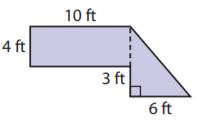
Question 2.
Triangle ____ has 1 angle greater than a right angle and appears to have ____ sides of equal length.

Answer:
Triangle C has 1 angle greater than a right angle and appears to have 0 sides of equal length.

Question 3.
Triangle____ has 1 right angle and appears to have ____ sides of equal length.

Answer:
Triangle A has 1 right angle and appears to have 2 sides of equal length.

Lesson 12.8
Go Math Grade 3 Answer Key Chapter 12 Two-Dimensional Shapes Extra Practice Common Core img 15

Question 4.
What label could you use to describe Circle A?
Type below:
_________

Answer:
All sides of Equal Lengths

Question 5.
What label could you use to describe Circle B?
Type below:
_________

Answer:
Right Angle

Lesson 12.9

Draw lines to divide the shape into equal parts that show the fraction given.

Question 6.
Go Math Grade 3 Answer Key Chapter 12 Two-Dimensional Shapes Extra Practice Common Core img 16 \(\frac{1}{4}\)

Answer:
Chapter 12 Common Core image 2 258000

Question 7.
Go Math Grade 3 Answer Key Chapter 12 Two-Dimensional Shapes Extra Practice Common Core img 17 \(\frac{1}{3}\)

Answer:
Chapter 12 Relate Shapes, Fractions, and Area image 2 752

Conclusion

Go Math Grade 3 Answer Key Chapter 12 Two-Dimensional Shapes Extra Practice helps you understand various topics in the Chapter easily. Download Go Math Grade 3 Answer Key PDF free of cost and prepare offline too. Each Problem is clearly explained with images and graphs so that you can better understand the concepts. For more assistance Go Math Grade 3 Answer Key Chapter 12 Two-Dimensional Shapes and achieve valuable knowledge.

Go Math Grade 2 Answer Key Chapter 8 Length in Customary Units

Go Math Grade 2 Chapter 8 Answer Key Length in Customary Units Concepts

Length in Customary Units Show What You Know

Compare Lengths
Question 1.
Order the pencils from shortest to longest.
Write 1, 2, 3.
2nd Grade Go Math Answer Key Chapter 8 Length in Customary Units 1.1
Answer:

Explanation:
The yellow color pencil is longest and the green color pencil is shortest pencil.

Use Nonstandard Units to Measure Length
2nd Grade Go Math Answer Key Chapter 8 Length in Customary Units 1.2
Question 2.
2nd Grade Go Math Answer Key Chapter 8 Length in Customary Units 1.3
Answer:

Explanation:
There are 6 color tiles that cover the object.Each color tile is 1 inch.So, the object given above is 6 inches long.

Question 3.
2nd Grade Go Math Answer Key Chapter 8 Length in Customary Units 1.4
Answer:

Explanation:
There are 5 color tiles that cover the object.Each color tile is 1 inch.So, the object given above is 5 inches long.

Measure Length Twice: Nonstandard Units
2nd Grade Go Math Answer Key Chapter 8 Length in Customary Units 1.5
Question 4.
2nd Grade Go Math Answer Key Chapter 8 Length in Customary Units 1.6
Answer:

Explanation:
There are 9 push pins that cover the object.So, the length of the given object is 9.

Question 5.
2nd Grade Go Math Answer Key Chapter 8 Length in Customary Units 1.7
Answer:

Explanation:
There are 23 linking cubes that cover the object.So, the length of the object is 23.

Length in Customary Units Vocabulary Builder

2nd Grade Go Math Answer Key Chapter 8 Length in Customary Units 2.1
Visualize It
Fill in the graphic organizer to describe the lengths of different objects.

Understand Vocabulary
Use review words. Complete the sentences.
2nd Grade Go Math Answer Key Chapter 8 Length in Customary Units 2.3

Question 1.
The blue pencil is the _______ pencil.
Answer:
The blue pencil is the longest pencil

Question 2.
The red pencil is the _______ pencil.
Answer:
The red pencil is the sortest pencil

Question 3.
The red pencil is ______ than the yellow pencil.
Answer:
The red pencil is shorter than the yellow pencil.

Question 4.
The blue pencil is _______ than the yellow pencil.
Answer:
The blue pencil is longer than the yellow pencil.

Length in Customary Units Game Longer or Shorter?

Materials
2nd Grade Go Math Answer Key Chapter 8 Length in Customary Units 2.4

  1. Each player chooses a picture on the board and then finds a real object that matches that picture.
  2. Place the objects next to each other to find which is longer and which is shorter. If the objects are the same length, choose another object.
  3. Spin the pointer on the spinner. The player with the object that matches the spinner puts a cube on that picture on the board.
  4. Take turns until all the pictures have cubes. The player with more cubes on the board wins.
    2nd Grade Go Math Answer Key Chapter 8 Length in Customary Units 2.5

Length in Customary Units Vocabulary Game

2nd Grade Go Math Answer Key Chapter 8 Length in Customary Units 3.1
Guess the Word
For 3 to 4 players
Materials

  • timer

How to Play

  1. Take turns to play.
  2. Choose a math word, but do not say it aloud.
  3. Set the timer for 1 minute.
  4. Give a one-word clue about your word. Give each player one chance to guess your word.
  5. If nobody guesses correctly, repeat Step 4 with a different clue. Repeat until a player guesses the word or time runs out. Give a different one-word clue each time.
  6. The first player to guess the word gets 1 point. If the player can use the word in a sentence, he or she gets 1 more point. Then that player gets the next turn.
  7. The first player to score 5 points wins.

The Write Way
Reflect
Choose one idea. Write about it in the space below.

  • When would you measure the length of an object? When would you estimate its length? Write 2–3 sentences to explain.
  • Explain when you would use each measuring tool. measuring tape yardstick inch ruler
  • Tell at least two things you know about a line plot.
    2nd Grade Go Math Answer Key Chapter 8 Length in Customary Units 3.2

Lesson 8.1 Measure with Inch Models

Essential Question How can you use inch models to measure length?

2nd Grade Go Math Answer Key Chapter 8 Length in Customary Units 8.1 1 ______ color tiles

Answer:
6 inches long

Explanation:
The object is 6 color tiles long.
So, the object is 6 inches long.

2nd Grade Go Math Answer Key Chapter 8 Length in Customary Units 8.1 2 ______ color tiles

Answer:
7 inches long

Explanation:
The object is 7 color tiles long.
So, the object is 7 inches long.

2nd Grade Go Math Answer Key Chapter 8 Length in Customary Units 8.1 3 ______ color tiles

Answer:
4 inches long

Explanation:
The object is 4 color tiles long.
So, the object is 4 inches long.

HOME CONNECTION • Your child used color tiles as an introduction to measurement of length before using standard measurement tools.

MATHEMATICAL PRACTICES
Attend to Precision Describe how to use color tiles to measure the length of an object.
Answer:
To measure the length of an object place the color tiles side by side and count the number of tiles that cover the object.Each tile is about 1 inch.Therefore the length of the object will be the total number of tiles.

Share and Show

Use color tiles. Measure the length of the object in inches.
Question 1.
2nd Grade Go Math Answer Key Chapter 8 Length in Customary Units 8.1 4 about ______ inches
Answer:

Answer:
6 inches long

Explanation:
The object is 6 color tiles long.
So, the object is 6 inches long.

Question 2.
2nd Grade Go Math Answer Key Chapter 8 Length in Customary Units 8.1 5 about ______ inches
Answer:

Answer:
9 inches long

Explanation:
The object is 9 color tiles long.
So, the object is 9 inches long.

Question 3.
2nd Grade Go Math Answer Key Chapter 8 Length in Customary Units 8.1 6 about ______ inches
Answer:

Answer:
6 inches long

Explanation:
The object is 6 color tiles long.
So, the object is 6 inches long.

Question 4.
2nd Grade Go Math Answer Key Chapter 8 Length in Customary Units 8.1 7 about ______ inches
Answer:

Answer:
10 inches long

Explanation:
The object is 10 color tiles long.
So, the object is 10 inches long.

On Your Own

Use color tiles. Measure the length of the object in inches.
Question 5.
2nd Grade Go Math Answer Key Chapter 8 Length in Customary Units 8.1 8 about ______ inches
Answer:

Answer:
5 inches long

Explanation:
The object is 5 color tiles long.
So, the object is 5 inches long.

Question 6.
2nd Grade Go Math Answer Key Chapter 8 Length in Customary Units 8.1 9 about ______ inches
Answer:

Answer:
9 inches long

Explanation:
The object is 9 color tiles long.
So, the object is 9 inches long.

Question 7.
2nd Grade Go Math Answer Key Chapter 8 Length in Customary Units 8.1 10 about ______ inches
Answer:

Answer:
13 inches long

Explanation:
The object is 13 color tiles long.
So, the object is 13 inches long.

Question 8.
2nd Grade Go Math Answer Key Chapter 8 Length in Customary Units 8.1 11 about ______ inches
Answer:

Answer:
7 inches long

Explanation:
The object is 7 color tiles long.
So, the object is 7 inches long.

Question 9.
2nd Grade Go Math Answer Key Chapter 8 Length in Customary Units 8.1 12 about ______ inches
Answer:

Answer:
9 inches long

Explanation:
The object is 9 color tiles long.
So, the object is 9 inches long.

Question 10.
GO DEEPER
Blue paper chains are 4 inches long. Red paper chains are 3 inches long. How many are needed to have 10 inches of paper chains?
______ blue paper chain
_______ red paper chains
Answer:

Problem Solving • Applications

Question 11.
THINK SMARTER
Blue paper chains are 8 inches long. Red paper chains are 6 inches long. How many are needed to have 22 inches of paper chains?
2nd Grade Go Math Answer Key Chapter 8 Length in Customary Units 8.1 13
______ blue paper chains
_______ red paper chain
Answer:

Question 12.
MATHEMATICAL PRACTICE
Use Reasoning
Liza has a ribbon that is 12 inches long. She needs to cut it into pieces that are each 4 inches long. How many pieces can she make?
______ Pieces
Answer:

Question 13.
THINK SMARTER +
Jeremy used color tiles to measure a string. Each tile is 1 inch long. How long is the string? Circle the number in the box to make the sentence true.
2nd Grade Go Math Answer Key Chapter 8 Length in Customary Units 8.1 14
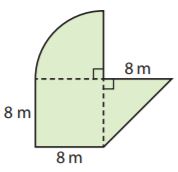
Answer:

Explanation:
There are 2 color tiles that cover the length of the string.Each color tile measures 1 inch.So, the string is about 2 inches long.

TAKE HOME ACTIVITY • Have your child use several of the same small item (such as paper clips) to measure the lengths of some objects at home.

Measure with Inch Models Homework & Practice 8.1

Use color tiles. Measure the length of the object in inches.
Question 1.
2nd Grade Go Math Answer Key Chapter 8 Length in Customary Units 8.1 15 about ______ inches
Answer:

Answer:
13 inches long

Explanation:
The object is 13 color tiles long.
So, the object is 13 inches long.

Question 2.
2nd Grade Go Math Answer Key Chapter 8 Length in Customary Units 8.1 16 about ______ inches
Answer:

Answer:
4 inches long

Explanation:
The object is 4 color tiles long.
So, the object is 4 inches long.

Question 3.
2nd Grade Go Math Answer Key Chapter 8 Length in Customary Units 8.1 17 about ______ inches
Answer:

Answer:
8 inches long

Explanation:
The object is 8 color tiles long.
So, the object is 8 inches long.

Problem Solving
Question 4.
Look around your classroom. Find an object that is about 4 inches long. Draw and label the object.
Answer:

Explanation:
The pencil i use is 4 inches long.

Question 5.
WRITE
Describe how you would find an object that is about 8 inches long.
Answer:
We can find an object that is about 8 inches long by placing color tiles along the object if the is about 8 color tiles then it is about 8 inches long.

Lesson Check
Question 1.
Jessie used color tiles to measure the rope. Each color tile measures 1 inch. The rope is about _____ inches long.
2nd Grade Go Math Answer Key Chapter 8 Length in Customary Units 8.1 18
Answer:
3 inches long

Explanation:
There are 3 color tiles that cover the lengthe of the rope.Each color tile measures 1 inch. The rope is about 3 inches long.

Spiral Review
Question 2.
Adam has these coins. How much money is this?
2nd Grade Go Math Answer Key Chapter 8 Length in Customary Units 8.1 19
Answer:

Question 3.
Look at the clock hands. What time does this clock show?
2nd Grade Go Math Answer Key Chapter 8 Length in Customary Units 8.1 20
Answer:

Explanation:
The clock has the hours hand on 4 and the minutes hand on the 6 ie 30 mins.So, the time shown in the above watch is 4.30.

Question 4.
Hank has 84 marbles in a bag. His friend Mario has 71 marbles in his bag. How many marbles do they have altogether?
2nd Grade Go Math Answer Key Chapter 8 Length in Customary Units 8.1 21
Answer:

Explanation:
Hank has 84 marbles in a bag. His friend Mario has 71 marbles in his bag.Therefore they have 84+71=155 marbles altogether.

Lesson 8.2 Make and Use a Ruler

Essential Question Why is using a ruler similar to using a row of color tiles to measure length?

Listen and Draw

Use color tiles. Make the given length. Trace along the edge to show the length.
4 inches

2 inches

3 inches

HOME CONNECTION • Your child used color tiles as 1-inch models to show different lengths. This activity helps to make inch units a more familiar concept.

MATHEMATICAL PRACTICE
Describe how you knew how many color tiles to use for each length.
Answer:

Share and Show

Measure the length with your ruler. Count the inches.
Question 1.
Go Math 2nd Grade Answer Key Chapter 8 Length in Customary Units 8.2 1 about ______ inches
Answer:

Question 2.
Go Math 2nd Grade Answer Key Chapter 8 Length in Customary Units 8.2 2 about ______ inches
Answer:

Question 3.
Go Math 2nd Grade Answer Key Chapter 8 Length in Customary Units 8.2 3 about ______ inches
Answer:

On Your Own

Measure the length with your ruler. Count the inches.

Question 4.
Go Math 2nd Grade Answer Key Chapter 8 Length in Customary Units 8.2 4 about ______ inches
Answer:

Question 5.
Go Math 2nd Grade Answer Key Chapter 8 Length in Customary Units 8.2 5 about ______ inches
Answer:

Question 6.
Go Math 2nd Grade Answer Key Chapter 8 Length in Customary Units 8.2 6 about ______ inches
Answer:

Question 7.
Go Math 2nd Grade Answer Key Chapter 8 Length in Customary Units 8.2 7 about ______ inches
Answer:

Question 8.
Go Math 2nd Grade Answer Key Chapter 8 Length in Customary Units 8.2 8 about ______ inches
Answer:

Problem Solving • Applications

Question 9.
THINK SMARTER
Work with a classmate. Use both of your rulers to measure the length of a bulletin board or a window. What is the length?
Go Math 2nd Grade Answer Key Chapter 8 Length in Customary Units 8.2 9
about _____ inches
Answer:

Question 10.
MATHEMATICAL PRACTICE
Explain Describe what you did in Exercise 9. How did you measure a length that is longer than your rulers?
______________________
______________________
Answer:

Question 11.
THINK SMARTER
Measure the length of the yarn with your ruler. Does the sentence describe the yarn. Choose Yes or No.
Go Math 2nd Grade Answer Key Chapter 8 Length in Customary Units 8.2 10
Answer:

TAKE HOME ACTIVITY • Choose one object in this lesson. Have your child find objects that are longer, about the same length, and shorter.

Make and Use a Ruler Homework & Practice 8.2

Measure the length with your ruler.
Count the inches.
Question 1.
Go Math 2nd Grade Answer Key Chapter 8 Length in Customary Units 8.2 11 about _____ inches
Answer:

Question 2.
Go Math 2nd Grade Answer Key Chapter 8 Length in Customary Units 8.2 12 about ______ inches
Answer:

Question 3.
Go Math 2nd Grade Answer Key Chapter 8 Length in Customary Units 8.2 13 about ______ inches
Answer:

Problem Solving
Question 4.
Use your ruler. Measure the width of this page in inches.
about ______ inches
Answer:

Question 5.
WRITE
Would you rather use color tiles or your ruler to measure the length of an object? Explain your choice.
Answer:

Lesson Check
Question 1.
Use your ruler. What is the length of this ribbon?
Go Math 2nd Grade Answer Key Chapter 8 Length in Customary Units 8.2 14
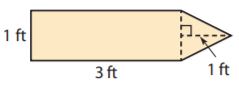
about _____ inches
Answer:

Spiral Review
Question 2.
What time is shown on this clock?
Go Math 2nd Grade Answer Key Chapter 8 Length in Customary Units 8.2 15
Answer:

Question 3.
What is the total value of these coins?
Go Math 2nd Grade Answer Key Chapter 8 Length in Customary Units 8.2 16
_____ cents
Answer:

Question 4.
The first group collected 238 cans. The second group collected 345 cans. How many cans did the two groups collect?
_________
Answer:

Question 5.
There are 2 children in each row. How many children are in 5 rows?
_____ children
Answer:

Lesson 8.3 Estimate Lengths in Inches

Essential Question How do you estimate the lengths of objects in inches?

Listen and Draw

Choose three objects. Measure their lengths with your ruler. Draw the objects and write their lengths.
Go Math 2nd Grade Answer Key Chapter 8 Length in Customary Units 8.3 1

MATHEMATICAL PRACTICES
Describe how the three lengths compare. Which is the longest object?
Answer:

Share and Show

Circle the best estimate for the length of the string.
Question 1.
Go Math Answer Key Grade 2 Chapter 8 Length in Customary Units 8.3 2
Answer:

Question 2.
Go Math Answer Key Grade 2 Chapter 8 Length in Customary Units 8.3 3
Answer:

Question 3.
Go Math Answer Key Grade 2 Chapter 8 Length in Customary Units 8.3 4
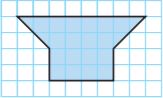
Answer:

On Your Own

Circle the best estimate for the length of the string.
Question 4.
Go Math Answer Key Grade 2 Chapter 8 Length in Customary Units 8.3 5
Answer:

Question 5.
Go Math Answer Key Grade 2 Chapter 8 Length in Customary Units 8.3 6
Answer:

Question 6.
Go Math Answer Key Grade 2 Chapter 8 Length in Customary Units 8.3 7
Answer:

Question 7.
THINK SMARTER
Use the 1 -inch mark. Estimate the length of each ribbon.
Go Math Answer Key Grade 2 Chapter 8 Length in Customary Units 8.3 8
Answer:

Problem Solving • Applications

MATHEMATICAL PRACTICE
Analyze Relationships
Question 8.
Sasha has a string that is the length of 5 beads. Each bead is 2 inches long. What is the length of the string?
_______ inches
Answer:

Question 9.
Maurice has a string that is 15 inches long. He has beads that are each 3 inches long. How many beads will fit on the string?
________ beads
Answer:

Question 10.
THINK SMARTER
Tameka has this string. She has many beads that are 1 inch long, like this blue bead. What is the best estimate for the length of the string? Draw more beads on the string to show your estimate.
Go Math Answer Key Grade 2 Chapter 8 Length in Customary Units 8.3 9
______ inches
Answer:

TAKE HOME ACTIVITY • With your child, estimate the lengths in inches of some small objects, such as books.

Estimate Lengths in Inches Homework & Practice 8.3

The bead is 1 inch long.
Circle the best estimate for the length of the string.
Question 1.
Go Math Answer Key Grade 2 Chapter 8 Length in Customary Units 8.3 10
Answer:

Question 2.
Go Math Answer Key Grade 2 Chapter 8 Length in Customary Units 8.3 11
Answer:

Question 3.
Go Math Answer Key Grade 2 Chapter 8 Length in Customary Units 8.3 12
Answer:

Problem Solving
Solve. Write or draw to explain.
Question 4.
Ashley has some beads. Each bead is 2 inches long. How many beads will fit on a string that is 8 inches long?
______ beads
Answer:

Question 5.
WRITE
Describe a way that someone could estimate the length of a book.
Answer:

Lesson Check
Question 1.
The bead is 1 inch long. Estimate the length of the string.
Go Math Answer Key Grade 2 Chapter 8 Length in Customary Units 8.3 13
______ inches
Answer:

Spiral Review
Question 2.
Draw hands on the clock to show 5 minutes after 6.
Go Math Answer Key Grade 2 Chapter 8 Length in Customary Units 8.3 14
Answer:

Question 3.
Ella read 16 pages of her book on Monday and 26 pages on Tuesday. There are 64 pages in the book. How many more pages are left for Ella to read?
_______ pages
Answer:

Question 4.
What is the sum?
38 + 24 = _____
Answer:

Lesson 8.4 Measure with an Inch Ruler

Essential Question How do you use an inch ruler to measure lengths?

Listen and Draw

Draw each worm to match the given length.

MATHEMATICAL PRACTICES
Use Reasoning Describe how you decided how long to draw the 2-inch and 3-inch worms.
Answer:

Share and Show

Measure the length to the nearest inch.
Question 1.
Go Math Grade 2 Answer Key Chapter 8 Length in Customary Units 8.4 1 ______ inches
Answer:

Question 2.
Go Math Grade 2 Answer Key Chapter 8 Length in Customary Units 8.4 2 ______ inches
Answer:

Question 3.
Go Math Grade 2 Answer Key Chapter 8 Length in Customary Units 8.4 3 ______ inches
Answer:

Question 4.
Go Math Grade 2 Answer Key Chapter 8 Length in Customary Units 8.4 4 ______ inches
Answer:

On Your Own

Measure the length to the nearest inch.
Question 5.
Go Math Grade 2 Answer Key Chapter 8 Length in Customary Units 8.4 5 ______ inches
Answer:

Question 6.
Go Math Grade 2 Answer Key Chapter 8 Length in Customary Units 8.4 6 ______ inches
Answer:

Question 7.
Go Math Grade 2 Answer Key Chapter 8 Length in Customary Units 8.4 7 ______ inches
Answer:

Question 8.
Go Math Grade 2 Answer Key Chapter 8 Length in Customary Units 8.4 8 ______ inches
Answer:

Question 9.
GO DEEPER
Measure the lengths to the nearest inch. How much shorter is the ribbon than the yarn?
Go Math Grade 2 Answer Key Chapter 8 Length in Customary Units 8.4 9
______ inch shorter
Answer:

Problem Solving • Applications

Go Math Grade 2 Answer Key Chapter 8 Length in Customary Units 8.4 10
Question 10.
THINK SMARTER
How much longer is the red string than the blue string?
_______ inch longer
Answer:

Question 11.
THINK SMARTER
If the red and
blue strings were straight and placed end to end, what would the total length be?
______ inches
Answer:

Question 12.
THINK SMARTER
Mrs. Grant’s pencil is 5 inches long. Is this Mrs. Grant’s pencil? Use an inch ruler to find out. Use the numbers and words on the tiles to make the sentences true.
Go Math Grade 2 Answer Key Chapter 8 Length in Customary Units 8.4 11
The pencil is ______ inches long.
This pencil _____ Mrs. Grant’s pencil.
Answer:

TAKE HOME ACTIVITY • Have your child measure the lengths of some objects to the nearest inch using a ruler or a similar measuring tool.

Measure with an Inch Ruler Homework & Practice 8.4

Measure the length to the nearest inch.
Question 1.
Go Math Grade 2 Answer Key Chapter 8 Length in Customary Units 8.4 12 ______ inches
Answer:

Question 2.
Go Math Grade 2 Answer Key Chapter 8 Length in Customary Units 8.4 13 ______ inches
Answer:

Question 3.
Go Math Grade 2 Answer Key Chapter 8 Length in Customary Units 8.4 14 ______ inches
Answer:

Problem Solving
Question 4.
Measure the string. What is its total length?
Go Math Grade 2 Answer Key Chapter 8 Length in Customary Units 8.4 15 _______ inches
Answer:

Question 5.
WRITE
Compare the ruler you made to an inch ruler. Describe how they are alike and how they are different.
Answer:

Lesson Check
Question 1.
Use an inch ruler. What is the length to the nearest inch?
Go Math Grade 2 Answer Key Chapter 8 Length in Customary Units 8.4 16
_____ inches
Answer:

Question 2.
Use an inch ruler. What is the length to the nearest inch?
Go Math Grade 2 Answer Key Chapter 8 Length in Customary Units 8.4 17
______ inches
Answer:

Spiral Review
Question 3.
The clock shows the time that Jen got to school. What time did Jen get to school?
Go Math Grade 2 Answer Key Chapter 8 Length in Customary Units 8.4 18
Answer:

Question 4.
What is the difference?
13 – 5 = _______
Answer:

Question 5.
Each color tile is about 1 inch long. About how long is the ribbon?
Go Math Grade 2 Answer Key Chapter 8 Length in Customary Units 8.4 19
Answer:

Lesson 8.5 Problem Solving • Add and Subtract in Inches

Essential Question How can drawing a diagram help when solving problems about length?

There is a paper clip chain that is 16 inches long. Aliyah removes 9 inches of paper clips from the chain. How long is the paper clip chain now?

Unlock the Problem
What information do I need to use?
The chain is _____ inches long. ______ inches of paper clips are removed from the chain.

Show how to solve the problem.
Go Math Grade 2 Chapter 8 Answer Key Pdf Length in Customary Units Concepts 8.5 1
The paper clip chain is ______ inches long now.

HOME CONNECTION • Your child drew a diagram to represent a problem about lengths. The diagram can be used to choose the operation for solving the problem.

Try Another Problem

Go Math Grade 2 Chapter 8 Answer Key Pdf Length in Customary Units Concepts 8.5 2
Draw a diagram. Write a number sentence using a ☐ for the missing number. Solve.
Question 1.
Carmen has a string that is 13 inches long and a string that is 8 inches long. How many inches of string does she have?
Go Math Grade 2 Chapter 8 Answer Key Pdf Length in Customary Units Concepts 8.5 3
_________________
Carmen has ________ inches of string.
Answer:

Question 2.
Eli has a cube train that is 24 inches long. He removes 9 inches of cubes from the train. How long is Eli’s cube train now?
Go Math Grade 2 Chapter 8 Answer Key Pdf Length in Customary Units Concepts 8.5 4
______________
Eli’s cube train is ______ inches long now.
Answer:

MATHEMATICAL PRACTICES
Describe how your diagram shows what happened in the second problem.
Answer:

Share and Show

Draw a diagram. Write a number sentence using a ☐ for the missing number. Solve.
Question 3.
Lee has a paper strip chain that is 25 inches long. He unhooks 13 inches from the chain. How long is Lee’s paper strip chain now?
Go Math Grade 2 Chapter 8 Answer Key Pdf Length in Customary Units Concepts 8.5 5
______________
Lee’s paper strip chain is _______ inches long now.
Answer:

Question 4.
THINK SMARTER
Sue has two ribbons that have the same length. She has 18 inches of ribbon in all. How long is each ribbon?
Go Math Grade 2 Chapter 8 Answer Key Pdf Length in Customary Units Concepts 8.5 6
_____________
Each ribbon is _______ inches long.
Answer:

TAKE HOME ACTIVITY • Have your child explain how he or she used a diagram to solve a problem in this lesson.

Problem Solving • Add and Subtract in Inches Homework & Practice 8.5

Draw a diagram. Write a number sentence using a ☐ for the missing number. Solve.
Question 1.
Molly had a ribbon that was 23 inches long. She cut 7 inches off the ribbon. How long is her ribbon now?
Go Math Grade 2 Chapter 8 Answer Key Pdf Length in Customary Units Concepts 8.5 7
_______________
Molly’s ribbon is _________ inches long now.
Answer:

Question 2.
WRITE
Describe how you could draw a diagram for a problem about finding the total length for two strings, 15 inches long and 7 inches long
______________________
________________________
Answer:

Lesson Check
Question 1.
Allie has two pieces of string. Each one is 8 inches long. How many inches of string does she have altogether?
_______ inches
Answer:

Question 2.
Jeff has a cube train that is 26 inches long. He removes 12 inches of cubes from the train. How long is Jeff’s cube train now?
_______ inches
Answer:

Spiral Review
Question 3.
Ann buys a pencil for 45 cents. Make a list of coins that would equal 45 cents.
__________
Answer:

Question 4.
Use an inch ruler. About how long is the string?
Go Math Grade 2 Chapter 8 Answer Key Pdf Length in Customary Units Concepts 8.5 8
about _______ inch
Answer:

Question 5.
Jason has these coins in a jar.
What is the total value of these coins?
Go Math Grade 2 Chapter 8 Answer Key Pdf Length in Customary Units Concepts 8.5 9
$ ______ or _______ cents
Answer:

Length in Customary Units Mid-Chapter Checkpoint

Concepts and Skills

Use color tiles. Measure the length of the object in inches.
Question 1.
Go Math Grade 2 Chapter 8 Answer Key Pdf Length in Customary Units Concepts 8.5 10 about _______ inches
Answer:

The bead is one inch long. Circle the best estimate for the length of the string.
Question 2.
Go Math Grade 2 Chapter 8 Answer Key Pdf Length in Customary Units Concepts 8.5 11
Answer:

Draw a diagram. Write a number sentence using a ☐ for the missing number. Solve.
Question 3.
A mark is 17 inches long. Katy erases 9 inches from the mark. How long is the mark now?
Go Math Grade 2 Chapter 8 Answer Key Pdf Length in Customary Units Concepts 8.5 12
___________________
The mark is ________ inches long now.
Answer:

Question 4.
THINK SMARTER
Use an inch ruler. What is the length of the string to the nearest inch?
Go Math Grade 2 Chapter 8 Answer Key Pdf Length in Customary Units Concepts 8.5 13 _______ inches
Answer:

Lesson 8.6 Measure in Inches and Feet

Essential Question Why is measuring in feet different from measuring in inches?

Listen and Draw

Draw or write to describe how you did each measurement.
First Measurement

Second Measurement

MATHEMATICAL PRACTICES
Use Reasoning Describe how the length of a sheet of paper and the length of a paper clip are different.
Answer:

Share and Show

Measure to the nearest inch.
Then measure to the nearest foot.
Question 1.
2nd Grade Go Math Answer Key Chapter 8 Length in Customary Units 8.6 1
______ inches
______ feet
Answer:

Question 2.
2nd Grade Go Math Answer Key Chapter 8 Length in Customary Units 8.6 2
______ inches
______ feet
Answer:

Question 3.
2nd Grade Go Math Answer Key Chapter 8 Length in Customary Units 8.6 3
______ inches
______ feet
Answer:

On Your Own

Measure to the nearest inch.
Then measure to the nearest foot.
Question 4.
2nd Grade Go Math Answer Key Chapter 8 Length in Customary Units 8.6 4
______ inches
______ feet
Answer:

Question 5.
2nd Grade Go Math Answer Key Chapter 8 Length in Customary Units 8.6 5
______ inches
______ feet
Answer:

Question 6.
2nd Grade Go Math Answer Key Chapter 8 Length in Customary Units 8.6 6
______ inches
______ feet
Answer:

Question 7.
2nd Grade Go Math Answer Key Chapter 8 Length in Customary Units 8.6 7
______ inches
______ feet
Answer:

Question 8.
2nd Grade Go Math Answer Key Chapter 8 Length in Customary Units 8.6 8
______ inches
______ feet
Answer:

Problem Solving • Applications

Question 9.
THINK SMARTER
Estimate the length of a real shelf in inches and in feet. Then measure.
2nd Grade Go Math Answer Key Chapter 8 Length in Customary Units 8.6 9
Answer:

Question 10.
MATHEMATICAL PRACTICE Explain
Look at your measurements for the shelf. Why is the number of inches different from the number of feet?
________________
__________________
Answer:

Question 11.
THINK SMARTER
Use the words on the tiles that make the sentence true.
2nd Grade Go Math Answer Key Chapter 8 Length in Customary Units 8.6 10
A book shelf is 4 ______ long.
Deb’s necklace is 20 ______ long.
A marker is 3 _______ long.
Jim’s bicycle is 4 _____ long.
Answer:

TAKE HOME ACTIVITY • Have your child measure the distance of a few footsteps in inches and then in feet.

Measure in Inches and Feet Homework & Practice 8.6

Measure to the nearest inch.
Then measure to the nearest foot.
Question 1.
bookcase
2nd Grade Go Math Answer Key Chapter 8 Length in Customary Units 8.6 11
______ inches
______ feet
Answer:

Question 2.
window
2nd Grade Go Math Answer Key Chapter 8 Length in Customary Units 8.6 12
______ inches
______ feet
Answer:

Problem Solving
Question 3.
Jake has a piece of yarn that is 4 feet long. Blair has a piece of yarn that is 4 inches long. Who has the longer piece of yarn? Explain.
___________________
_____________________
Answer:

Question 4.
WRITE
Would you measure the length of a jump rope in inches or in feet? Explain your choice.
Answer:

Lesson Check
Question 1.
Larry is telling his sister about using a ruler to measure length. Fill in the blanks with ‘inch’ or ‘foot’ to make the sentence true.
I ______ is longer than I ______.
Answer:

Spiral Review
Question 2.
Matt put this money in his pocket. What is the total value of this money?
$ ______
2nd Grade Go Math Answer Key Chapter 8 Length in Customary Units 8.6 13
Answer:

Question 3.
What time is shown on this clock?
2nd Grade Go Math Answer Key Chapter 8 Length in Customary Units 8.6 14
Answer:

Question 4.
Ali had 38 game cards. Her friend gave her 15 more game cards. How many game cards does Ali have now?
_____ cards
Answer:

Lesson 8.7 Estimate Lengths in Feet

Essential Question How do you estimate the lengths of objects in feet?

Look for 3 classroom objects that are about the same length as a 12-inch ruler. Draw and label the objects.

MATHEMATICAL PRACTICE
Which objects have a greater length than the ruler? Explain.
Answer:

Model and Draw

Estimate how many 12-inch rulers will be about the same length as this bulletin board.
Go Math 2nd Grade Answer Key Chapter 8 Length in Customary Units 8.7 1
_______ rulers, or ______ feet

Share and Show

Find each object. Estimate how many 12-inch rulers will be about the same length as the object.
Question 1.
bookshelf
Go Math 2nd Grade Answer Key Chapter 8 Length in Customary Units 8.7 2
Estimate: ______ rulers, or ______ feet
Answer:

Question 2.
chair
Go Math 2nd Grade Answer Key Chapter 8 Length in Customary Units 8.7 3
Estimate: ______ rulers, or ______ feet
Answer:

On Your Own

Find each object. Estimate how many 12-inch rulers will be about the same length as the object.
Question 3.
desktop
Go Math 2nd Grade Answer Key Chapter 8 Length in Customary Units 8.7 4
Estimate: ______ rulers, or ______ feet
Answer:

Question 4.
wall map
Go Math 2nd Grade Answer Key Chapter 8 Length in Customary Units 8.7 5
Estimate: ______ rulers, or ______ feet
Answer:

Question 5.
window
Go Math 2nd Grade Answer Key Chapter 8 Length in Customary Units 8.7 6
Estimate: ______ rulers, or ______ feet
Answer:

Question 6.
teacher’s desk
Go Math 2nd Grade Answer Key Chapter 8 Length in Customary Units 8.7 7
Estimate: ______ rulers, or ______ feet
Answer:

Problem Solving • Applications

Question 7.
THINK SMARTER
Estimate the distance from your desk to the door in feet. Then estimate the same distance in inches.
Go Math 2nd Grade Answer Key Chapter 8 Length in Customary Units 8.7 8
______ feet
_______ inches
Explain how you made your estimates for the number of feet and for the number of inches.
___________________
___________________
Answer:

Question 8.
THINK SMARTER
Match the object with the estimate of its length in feet.
Go Math 2nd Grade Answer Key Chapter 8 Length in Customary Units 8.7 9
Answer:

TAKE HOME ACTIVITY • With your child, estimate the lengths of some objects in feet.

Estimate Lengths in Feet Homework & Practice 8.7

Find each object.
Estimate how many 12-inch rulers will be about the same length as the object.
Question 1.
door
Estimate: ______ rulers, or _____ feet
Answer:

Question 2.
flag
Estimate: ______ rulers, or _____ feet
Answer:

Problem Solving
Solve. Write or draw to explain.
Question 3.
Mr. and Mrs. Baker place 12-inch rulers along the length of a rug. They each line up 3 rulers along the edge of the rug. What is the length of the rug?
about ______ feet
Answer:

Question 4.
WRITE
Choose an object that is a few feet long. Explain how to estimate its length in feet.
___________________
___________________
Answer:

Lesson Check
Question 1.
Estimate how many 12 inch rulers will be about the same length as a bike.
_____ rulers, or ______ feet
Answer:

Question 2.
Estimate how many 12 inch rulers will be about the same length as a keyboard.
_______ rulers, or _____ feet
Answer:

Spiral Review
Question 3.
What is the total value of 2 quarters, 3 dimes, and 4 nickels?
$ ______
Answer:

Question 4.
What is the total value of 2 dimes, 3 nickels, and 2 pennies?
$ _____ or _____ cents
Answer:

Question 5.
There are 68 children in the school. There are 19 children on the playground. How many more children are in the school than on the playground?
_______ children
Answer:

Question 6.
What is the sum?
Go Math 2nd Grade Answer Key Chapter 8 Length in Customary Units 8.7 10
Answer:

Lesson 8.8 Choose a Tool

Essential Question How do you choose a measuring tool to use when measuring lengths?

Listen and Draw

Draw or write to describe how you measured the distances with the yarn.
Distance 1

Distance 2

MATHEMATICAL PRACTICES
Which distance was longer? Explain how you know.
Answer:

Share and Show

Choose the best tool for measuring the real object.
Then measure and record the length or distance.
Go Math Answer Key Grade 2 Chapter 8 Length in Customary Units 8.8 1
Question 1.
the length of a book
Go Math Answer Key Grade 2 Chapter 8 Length in Customary Units 8.8 2
Tool : ________
Length : __________
Answer:

Question 2.
the distance around a cup
Go Math Answer Key Grade 2 Chapter 8 Length in Customary Units 8.8 3
Tool : ________
Length : __________
Answer:

On Your Own

Choose the best tool for measuring the real object.
Then measure and record the length or distance.
Go Math Answer Key Grade 2 Chapter 8 Length in Customary Units 8.8 4
Question 3.
the length of a chalkboard
Go Math Answer Key Grade 2 Chapter 8 Length in Customary Units 8.8 5
Tool : ________
Length : __________
Answer:

Question 4.
the length of a marker
Go Math Answer Key Grade 2 Chapter 8 Length in Customary Units 8.8 6
Tool : ________
Length : __________
Answer:

Question 5.
the distance around a globe
Go Math Answer Key Grade 2 Chapter 8 Length in Customary Units 8.8 7
Tool : ________
Length : __________
Answer:

Question 6.
the length of a classroom wall
Go Math Answer Key Grade 2 Chapter 8 Length in Customary Units 8.8 8
Tool : ________
Length : __________
Answer:

Problem Solving • Applications

Question 7.
THINK SMARTER
Rachel wants to measure the length of a sidewalk. Should she use an inch ruler or a yardstick? Explain.
Go Math Answer Key Grade 2 Chapter 8 Length in Customary Units 8.8 9
Rachel should use _______ because
___________________
Answer:

Question 8.
MATHEMATICAL PRACTICE Apply
What is an object that you would measure with a measuring tape? Explain why you would use this tool.
________________________
________________________
Answer:

Question 9.
THINK SMARTER+
Jim measures the length of a picnic table with an inch ruler. Is Jim using the best tool for measuring? Explain.
_________________________
________________________
Answer:

TAKE HOME ACTIVITY • Have your child name some objects that he or she would measure using a yardstick.

Choose a Tool Homework & Practice 8.8

Choose the best tool for measuring the real object. Then measure and record the length or distance.
Go Math Answer Key Grade 2 Chapter 8 Length in Customary Units 8.8 10
Question 1.
the length of your desk
Go Math Answer Key Grade 2 Chapter 8 Length in Customary Units 8.8 11
Tool : _____________
Length : ___________
Answer:

Question 2.
the distance around a basket
Go Math Answer Key Grade 2 Chapter 8 Length in Customary Units 8.8 12
Tool : _____________
Length : ___________
Answer:

Problem Solving
Choose the better tool for measuring.
Explain your choice.
Question 3.
Mark wants to measure the length of his room. Should he use an inch ruler or a yardstick?
Mark should use ________ because
______________________
Answer:

Question 4.
WRITE
Describe how you would use a yardstick to measure the length of a rug.
Answer:

Lesson Check
Question 1.
Kim wants to measure the distance around her bike tire. Circle the best tool for her to use.
Go Math Answer Key Grade 2 Chapter 8 Length in Customary Units 8.8 13
Answer:

Question 2.
Ben wants to measure the length of a seesaw. Circle the best tool for him to use.
Go Math Answer Key Grade 2 Chapter 8 Length in Customary Units 8.8 14
Answer:

Spiral Review
Question 3.
Estimate how many 12 inch rulers will be about the same length as a sheet of paper.
______ ruler, or _____ foot
Answer:

Question 4.
Andy has a rope that is 24 inches long. He cuts off 7 inches from the rope. How long is the rope now?
_____ inches
Answer:

Question 5.
Jan is telling her friend about using a ruler to measure length. Fill in the blanks with inches or foot to make the sentence true.
12 ______ is the same length as 1 _______.
Answer:

Lesson 8.9 Display Measurement Data

Essential Question How can a line plot be used to show measurement data?

Listen and Draw

Use an inch ruler. Measure and record each length.
Go Math Grade 2 Answer Key Chapter 8 Length in Customary Units 8.9 1 ______ inches

Go Math Grade 2 Answer Key Chapter 8 Length in Customary Units 8.9 2 ______ inches

Go Math Grade 2 Answer Key Chapter 8 Length in Customary Units 8.9 3 ______ inches

HOME CONNECTION • Your child practiced measuring different lengths in inches in preparation for collecting measurement data in this lesson.

MATHEMATICAL PRACTICES
Describe how the lengths of the three strings are different.
Answer:

Share and Show

Question 1.
Use an inch ruler. Measure and record the lengths of 5 books in inches.
Go Math Grade 2 Answer Key Chapter 8 Length in Customary Units 8.9 4
Answer:

Question 2.
Write a title for the line plot. Then write the numbers and draw the Xs.
Go Math Grade 2 Answer Key Chapter 8 Length in Customary Units 8.9 5
Answer:

On Your Own

Question 3.
Use an inch ruler. Measure and record the lengths of 5 pencils in inches.
Go Math Grade 2 Answer Key Chapter 8 Length in Customary Units 8.9 6
Answer:

Question 4.
Write a title for the line plot. Then write the numbers and draw the Xs.
Go Math Grade 2 Answer Key Chapter 8 Length in Customary Units 8.9 7
Answer:

Question 5.
Use an inch ruler. Measure and record the lengths of 4 crayons in inches. Then complete the line plot.
Go Math Grade 2 Answer Key Chapter 8 Length in Customary Units 8.9 8
Answer:

Problem Solving • Applications

Question 6.
THINK SMARTER
Use the data in the list to complete the line plot.
Go Math Grade 2 Answer Key Chapter 8 Length in Customary Units 8.9 9
Answer:

Question 7.
THINK SMARTER
Sarah made a line plot to show the data about the length of leaves. Is Sarah’s line plot correct? Tell why or why not.
Go Math Grade 2 Answer Key Chapter 8 Length in Customary Units 8.9 10
________________________
_________________________
Answer:

TAKE HOME ACTIVITY • Have your child describe how to make a line plot.

Display Measurement Data Homework & Practice 8.9

Question 1.
Use an inch ruler. Measure and record the lengths of 4 different books in inches.
Go Math Grade 2 Answer Key Chapter 8 Length in Customary Units 8.9 11
Answer:

Question 2.
Make a line plot of the information above. Write a title for a line plot. Then write the numbers and draw the Xs.
Go Math Grade 2 Answer Key Chapter 8 Length in Customary Units 8.9 12
Answer:

Problem Solving
Question 3.
Jesse measured the lengths of some strings. Use his list to complete the line plot.
Go Math Grade 2 Answer Key Chapter 8 Length in Customary Units 8.9 13
Answer:

Question 4.
WRITE
Describe how you made a line plot in this lesson.
Answer:

Lesson Check
Question 1.
Use the line plot. How many sticks are 4 inches long?
Go Math Grade 2 Answer Key Chapter 8 Length in Customary Units 8.9 14
______ sticks
Answer:

Spiral Review
Question 2.
Kim wants to measure a ball. Circle the best tool for Kim
Go Math Grade 2 Answer Key Chapter 8 Length in Customary Units 8.9 15
Answer:

Question 3.
Estimate how many 12 inch rulers will be about the same length as a teacher’s desk.
_____ rulers, or _____ feet
Answer:

Question 4.
Kurt has a string that is 12 inches long and another string that is 5 inches long. How many inches of string does he have altogether?
_______ inches
Answer:

Question 5.
One box has 147 books. The other box has 216 books. How many books are there in both boxes?
_______ books
Answer:

Length in Customary Units Review/Test

Question 1.
THINK SMARTER
Josh wants to measures the distance around a soccer ball.
Circle the best choice of tool.
inch ruler
yardstick
measuring tape
Go Math Grade 2 Chapter 8 Answer Key Pdf Length in Customary Units Concepts rt 1
Explain your choice of tool.
Answer:

Question 2.
GO DEEPER
Luke has a string that is 6 inches long and a string that is 11 inches long. How many inches of string does Luke have?
Draw a diagram. Write a number sentence using a ☐ for the missing number. Solve.
Go Math Grade 2 Chapter 8 Answer Key Pdf Length in Customary Units Concepts rt 2
Luke has ______ inches of string.
Answer:

Question 3.
Use an inch ruler. What is the length of the lip balm to the nearest inch?
Go Math Grade 2 Chapter 8 Answer Key Pdf Length in Customary Units Concepts rt 3
Circle the number in the box to make the sentence true.
Go Math Grade 2 Chapter 8 Answer Key Pdf Length in Customary Units Concepts rt 4
Answer:

Question 4.
Tom uses tiles to measure a string. Each tile is 1 inch long. Tom says the string is 3 inches long. Is he correct? Explain.
Go Math Grade 2 Chapter 8 Answer Key Pdf Length in Customary Units Concepts rt 5.1
___________________
___________________
Answer:

Question 5.
Dalia made a line plot to show the lengths of her ribbons. How many ribbons are shown in the line plot?
Go Math Grade 2 Chapter 8 Answer Key Pdf Length in Customary Units Concepts rt 5
The line plot shows ______ ribbons.
Suppose Dalia cut one of the ribbons that is 6 inches long into two pieces that are each 3 inches long. Explain how she should change the line plot.
_________________
_________________
Answer:

Question 6.
Use the words on the tiles to make the sentence true.
Go Math Grade 2 Chapter 8 Answer Key Pdf Length in Customary Units Concepts rt 6
The table is 3 ______ long.
The belt is 30 ______ long.
The hallway is 15 ______ long.
Answer:

Question 7.
Use the 1-inch mark. Estimate the length of each object.
Go Math Grade 2 Chapter 8 Answer Key Pdf Length in Customary Units Concepts rt 7
Answer:

Question 8.
Use an inch ruler. What is the length of the paper clip to the nearest inch?
Go Math Grade 2 Chapter 8 Answer Key Pdf Length in Customary Units Concepts rt 8
______ inches
Answer:

Question 9.
Estimate how many 12-inch rulers will be about the same height as a classroom door. Does the sentence describe the door? Choose Yes or No.
Go Math Grade 2 Chapter 8 Answer Key Pdf Length in Customary Units Concepts rt 9
What is your estimate of how wide the door is?
Answer: