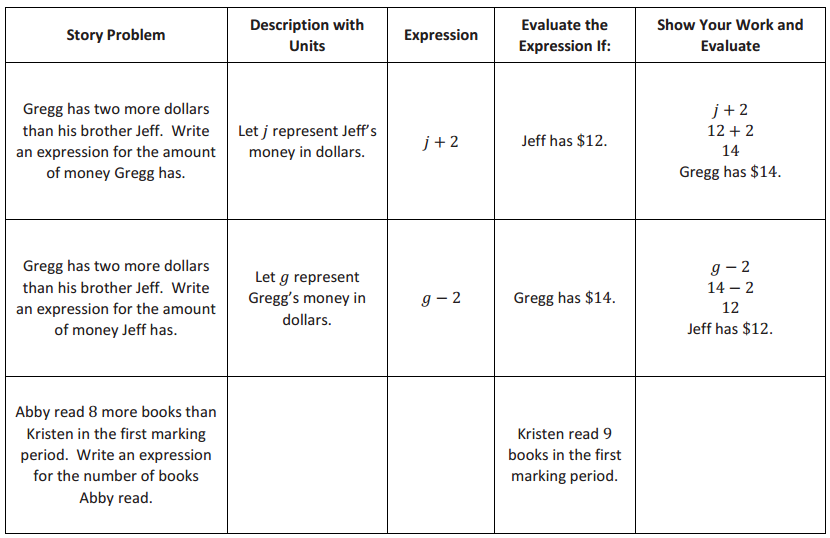
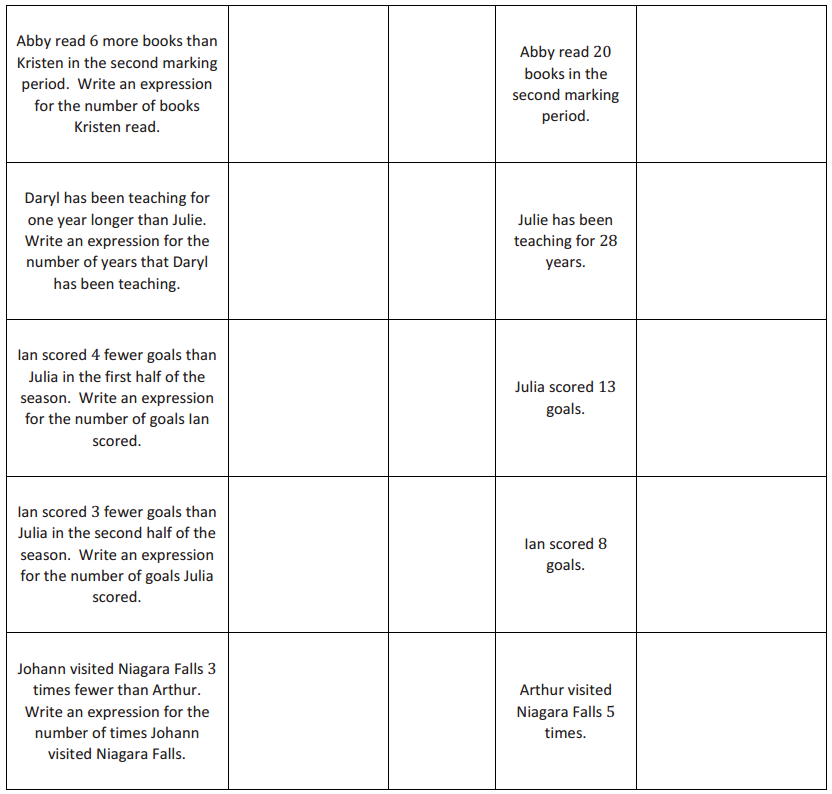
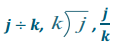
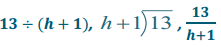
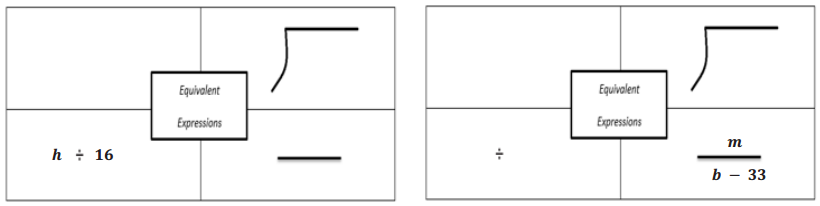
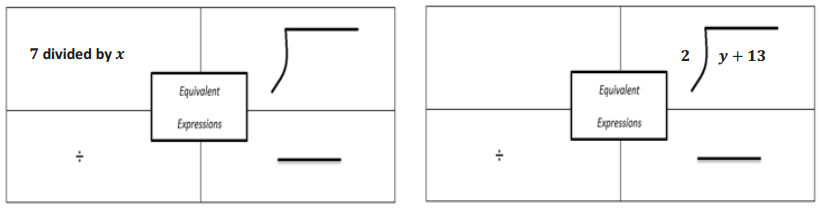
Eureka Math Grade 6 Module 4 Lesson 21 Answer Key

Engage NY Eureka Math 6th Grade Module 4 Lesson 21 Answer Key

Eureka Math Grade 6 Module 4 Lesson 21 Example Answer Key

Look at Example 1 with your group. Determine the cost for various numbers of pizzas, and also determine the expression that describes the cost of having P pizzas delivered.

a. Pizza Queen has a special offer on lunch pizzas: $4.00 each. They charge $2.00 to deliver, regardless of how many pizzas are ordered. Determine the cost for various numbers of pizzas, and also determine the expression that describes the cost of having P pizzas delivered.

Number of Pizzas DeliveredTotal cost in Dollars
1
2
3
4
10
50
P

Answer:

Number of Pizzas DeliveredTotal cost in Dollars
16
210
314
418
1042
50202
P4p + 2

What mathematical operations did you need to perform to find the total cost?
Answer:
Multiplication and addition. We multiplied the number of pizzas by $4 and then added the $2 delivery fee.

Suppose our principal wanted to buy a pizza for everyone in our class. Determine how much this would cost.
Answer:
Answers will vary depending on the number of students in your class.

b. If the booster club had $400 to spend on pizza, what is the greatest number of pizzas they could order?
Answer:
The greatest number of pizzas they could order would be 99. The pizzas themselves would cost 99 × $4 = $396, and then add $2.00 for delivery. The total bill is $398.

c. If the pizza price was raised to $5. 00 and the delivery price was raised to $3. 00, create a table that shows the total cost (pizza plus delivery) of 1, 2, 3, 4, and 5 pIzzas. Include the expression that describes the new cost of ordering P pizzas.

Number of Pizzas DeliveredTotal Cost in Dollars
1
2
3
4
5
P

Answer:

Number of Pizzas DeliveredTotal Cost in Dollars
18
213
318
423
528
P5p + 3

Eureka Math Grade 6 Module 4 Lesson 21 Mathematical Modeling Exercise Answer Key

Mathematical Modeling Exercise
The Italian Villa Restaurant has square tables that the servers can push together to accommodate the customers. Only one chair fits along the side of the square table. Make a model of each situation to determine how many seats will fit around various rectangular tables.

Eureka Math Grade 6 Module 4 Lesson 21 Example Answer Key 1

Number of Square TablesNumber of seats at the Table
1
2
3
4
5
50
200
T

Answer:

Number of Square TablesNumber of seats at the Table
14
26
38
410
512
50102
200402
T2T + 2 or 2(T + 1)

Are there any other ways to think about solutions to this problem?
Answer:
Regardless of the number of tables, there is one chair on each end, and each table has two chairs opposite one another.

It is impractical to make a model of pushing 50 tables together to make a long rectangle. If we did have a rectangle that long, how many chairs would fit on the long sides of the table?
Answer:
50 on each side, for a total of 100

How many chairs fit on the ends of the long table?
Answer:
2 chairs, one on each end

How many chairs fit in all? Record it on your table.
Answer:
102 chairs in all

Work with your group to determine how many chairs would fit around a very long rectangular table If 200 square tables were pushed together.
Answer:
200 chairs on each side, totaling 400, plus one on each end; grand total 402

If we let T represent the number of square tables that make one long rectangular table, what is the expression for the number of chairs that will fit around it?
Answer:
2T + 2

Eureka Math Grade 6 Module 4 Lesson 21 Problem Set Answer Key

Question 1.
Compact discs (CDs) cost $12 each at the Music Emporium. The company charges $4. 50 for shipping and handling, regardless of how many compact discs are purchased.
a. Create a table of values that shows the relationship between the number of compact discs that Mickey buys, D, and the amount of money Mickey spends, C, in dollars.

Number of CDs Mickey Buys (D)Total Cost in Dollars (c)
1
2
3

Answer:

Number of CDs Mickey Buys (D)Total Cost in Dollars (c)
1$16.50
2$28.50
3$40.50

b. If you know how many CDs Mickey orders, can you determine how much money he spends? Write the corresponding expression.
Answer:
12D + 4.5

c. Use your expression to determine how much Mickey spent buying 8 CDs.
Answer:
8(12) + 4. 50 = 100. 50. Mickey spent $100. 50.

Question 2.
Mr. Gee’s class orders paperback books from a book club. The books cost $2.95 each. Shipping charges are set at $4. 00, regardless of the number of books purchased.
a. Create a table of values that shows the relationship between the number of books that Mr. Gee’s class buys, B, and the amount of money they spend, C, in dollars.

Number of Books Ordered (B)Amount of Money Spent in Dollars (C)
1
2
3

Answer:

Number of Books Ordered (B)Amount of Money Spent in Dollars (C)
16.95
29.90
312.85

b. If you know how many books Mr. Gee’s class orders, can you determine how much money they spend? Write the corresponding expression.
Answer:
2.95B + 4

c. Use your expression to determine how much Mr. Gee’s class spent buying 24 books.
Answer:
24(2.95) + 4 = 74. Mr. Gee’s class spent $74.80.

Question 3.
Sarah is saving money to take a trip to Oregon. She received $450 in graduation gifts and saves $120 per week working.
a. Write an expression that shows how much money Sarah has after working W weeks.
Answer:
450 + 120W

b. Create a table that shows the relationship between the amount of money Sarah has (M) and the number of weeks she works (W).

Amount of Money Sarah Has (M)Number of weeks Worked (W)
1
2
3
4
5
6
7
8

Answer:

Amount of Money Sarah Has (M)Number of weeks Worked (W)
5701
6902
8103
9304
1,0505
1,1706
1,2907
1,4108

c. The trip will cost $1, 200. How many weeks will Sarah have to work to earn enough for the trip?
Answer:
Sarah will have to work 7 weeks to earn enough for the trip.

Question 4.
Mr. Gee’s language arts class keeps track of how many words per minute are read aloud by each of the students. They collect this oral reading fluency data each month. Below is the data they collected for one student in the first four months of school.
a. Assume this increase in oral reading fluency continues throughout the rest of the school year. Complete the table to project the reading rate for this student for the rest of the year.

MonthNumber of Words Read Aloud in one Minute
September126
October131
November136
December141
January
February
March
April
May
June

Answer:

MonthNumber of Words Read Aloud in one Minute
September126
October131
November136
December141
January146
February151
March156
April161
May166
June171

b. If this increase in oral reading fluency continues throughout the rest of the school year, when would this student achieve the goal of reading 165 words per minute?
Answer:
The student will meet the goal in May.

c. The expression for this student’s oral reading fluency is 121 + 5m, where m represents the number of
months during the school year. Use this expression to determine how many words per minute the student would read after 12 months of instruction.
Answer:
The student would read 181 words per minute: 121 + 5 × 12.

Question 5.
When corn seeds germinate, they tend to grow 5 inches in the first week and then 3 inches per week for the remainder of the season. The relationship between the height (H) and the number of weeks since germination (W) is shown below.
a. Complete the missing values in the table.

Number of Weeks Since Germination (W)Height of Corn Plant (H)
15
28
311
414
5
6

Answer:

Number of Weeks Since Germination (W)Height of Corn Plant (H)
15
28
311
414
517
620

b. The expression for this height is 2 + 3W. How tall will the corn plant be after 15 weeks of growth?
Answer:
2 + 3(15) = 47. The plant will be 47 inches tall.

Question 6.
The Honeymoon Charter Fishing Boat Company only allows newlywed couples on their sunrise trips. There is a captain, a first mate, and a deck hand manning the boat on these trips.
a. Write an expression that shows the number of people on the boat when there are C couples booked for the trip.
Answer:
3 + 2C

b. If the boat can hold a maximum of 20 people, how many couples can go on the sunrise fishing trip?
Answer:
Eight couples (16 passengers) can fit along with the 3 crew members, totaling 19 people on the boat. A ninth couple would overload the boat.

Eureka Math Grade 6 Module 4 Lesson 21 Exit Ticket Answer Key

Krystal Klear Cell Phone Company charges $5.00 per month for service. The company also charges $0. 10 for each text message sent.
a. Complete the table below to calculate the monthly charges for various numbers of text messages sent.

Number of Text Message Sent (T)Total Monthly Bill in Dollars
0
10
20
30
T

Answer:

Number of Text Message Sent (T)Total Monthly Bill in Dollars
05
106
207
308
T0.1T + 5

b. If Suzannah’s budget limit is $10 per month, how many text messages can she send in one month?
Answer:
Suzannah can send 50 text messages in one month for $10.


Eureka Math Grade 6 Module 4 Lesson 28 Answer Key

Engage NY Eureka Math Grade 6 Module 4 Lesson 28 Answer Key

Eureka Math Grade 6 Module 4 Lesson 28 Mathematical Modeling Exercise Answer Key

Mathematical Modeling Exercise:

Question 1.
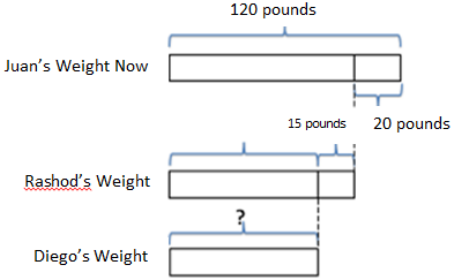
Juan has gained 20 lb. since last year. He now weighs 120 lb. Rashod is 15 Ib. heavier than Diego. If Rashod and Juan weighed the same amount last year, how much does Diego weigh? Let j represent Juan’s weight last year in pounds, and let d represent Diego’s weight in pounds.

Draw a tape diagram to represent Juan’s weight.
Answer:
Eureka Math Grade 6 Module 4 Lesson 28 Mathematical Modeling Exercise Answer Key 1

Draw a tape diagram to represent Rashod’s weight.
Answer:
Eureka Math Grade 6 Module 4 Lesson 28 Mathematical Modeling Exercise Answer Key 2

Draw a tape diagram to represent Diego’s weight.
Answer:
Eureka Math Grade 6 Module 4 Lesson 28 Mathematical Modeling Exercise Answer Key 3

What would combining all three tape diagrams look like?
Answer:
Eureka Math Grade 6 Module 4 Lesson 28 Mathematical Modeling Exercise Answer Key 4

Write an equation to represent Juan’s tape diagram.
Answer:
j + 20 = 120

Write an equation to represent Rashod’s tape diagram.
Answer:
d + 15 + 20 – 120

How can we use the final tape diagram or the equations above to answer the question presented?
Answer:
By combining 15 and 20 from Rashod’s equation, we can use our knowledge of addition identities to determine Diego’s weight.
The final tape diagram can be used to write a third equation d + 35 = 120. We con use our knowledge of addition identities to determine Diego’s weight
Calculate Diego’s weight.
d + 35 – 35 – 120 – 35
d = 85
We can use identities to defend our thought that d + 35 – 35 = d.

Does your answer make sense?
Answer:
Yes. If Diego weighs 85 lb., and Rashod weighs 15 lb. more than Diego, then Rashod weighs 100 lb., which is what Juan weighed before he gained 20 lb.

Eureka Math Grade 6 Module 4 Lesson 28 Example Answer Key

Example 1:

Marissa has twice as much money as Frank. Christina has $20 more than Marissa. If Christina has $100, how much money does Frank have? Let f represent the amount of money Frank has in dollars and m represents the amount of money Marissa has in dollars.

Draw a tape diagram to represent the amount of money Frank has.
Answer:
Eureka Math Grade 6 Module 4 Lesson 28 Example Answer Key 5

Draw a tape diagram to represent the amount of money Marissa has.
Answer:
Eureka Math Grade 6 Module 4 Lesson 28 Example Answer Key 6

Draw a tape diagram to represent the amount of money Christina has.
Answer:
Eureka Math Grade 6 Module 4 Lesson 28 Example Answer Key 7

Which tape diagram provides enough information to determine the value of the variable m?
Answer:
The tape diagram represents the amount of money Christina has.

Write and solve the equation.
Answer:
m + 20 = 100
m + 20 – 20 = 100 – 20
m = 80
The identities we have discussed throughout the module solidify that m + 20 – 20 = m

What does the 80 represent?
Answer:
80 is the amount of money, in dollars, that Morissa has.

Now that we know Marissa has $80, how can we use this information to find out how much money Frank has?
Answer:
We can write an equation to represent Marissa’s tape diagram since we now know the length is 80.

Write an equation.
Answer:
2f = 80

Solve the equation.
Answer:
2f ÷ 2 = 80 – 2
f = 40
Once again, the identities we have used throughout the module can solidify that 2f ÷ 2 = f.

What does the 40 represent?
Answer:
The 40 represents the amount of money Frank has in dollars.

Does 40 make sense in the problem?
Answer:
Yes, because if Frank has $40, then Marissa has twice this, which is $80. Then, Christina has $100 because she has $20 more than Marissa, which is what the problem stated.

Eureka Math Grade 6 Module 4 Lesson 28 Exercise Answer Key

Station One: Use tape diagrams to solve the problem:

Raeana is twice as old as Madeline, and Laura is 10 years older than Raeana. If Laura is 50 years old, how old is Madeline? Let m represent Madeline’s age in years, and let r represent Raeana’s age in years.

Raeano’s Tape Diagram:
Eureka Math Grade 6 Module 4 Lesson 28 Exercise Answer Key 8

Madeline’s Tape Diagram:
Eureka Math Grade 6 Module 4 Lesson 28 Exercise Answer Key 9

Laura’s Tape Diagram:
Eureka Math Grade 6 Module 4 Lesson 28 Exercise Answer Key 10

Equation for Laura’s Tape Diagram:
r ÷ 10 = 50
r + 10 – 10 = 50 – 10
r = 40
We now know that Raeana is 40 years old, and we can use this and Raeana’s tape diagram to determine the age of
Madeline.
2m = 40
2m – 2 = 40 ÷ 2
m = 20
There are, Madeline is 20 years old.

Station Two: Use tape diagrams to solve the problem.

Cadi has 90 apps on her phone. Braylen has half the amount of apps as Thees. If Cadi has three times the amount of apps as Theiss how many apps does Braylen have? Let b represent the number of Braylen’s apps and t represent the number of Theiss’s apps.
Answer:
Theiss’s Tape Diagram:
Eureka Math Grade 6 Module 4 Lesson 28 Exercise Answer Key 11

Broylen’s Tape Diagram:
Eureka Math Grade 6 Module 4 Lesson 28 Exercise Answer Key 12

Carli’s Tape Diagram:
Eureka Math Grade 6 Module 4 Lesson 28 Exercise Answer Key 13

Equation for Corll’s Tape Dio gram:
3t = 90
3t ÷ 3 = 90 + 3
t = 30
We now know that fleas has 30 opps on his phone. We can use this information to write an equation for Braylen’s tape diagram and determine how many opps ore on Bra ykn’s phone.
2h = 30
2b ÷ 2 = 30 + 2
b = 15

Therefore, Broylen has 15 apps on his phone.

Station Three: Use tape diagrams to solve the problem.

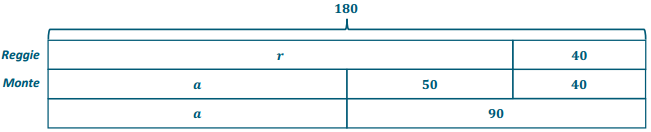
Reggie ran for 180 yards during the last football game, which is 40 more yards than his previous personal best Monte ran 50 more yards than Adrian during the same game. If Monte ran the same amount of yards Reggie ran in one game for his previous personal best, how many yards did Adrian run? Let r represent the number of yards Reggie ran during his previous personal best and a represents the number of yards Adrian ran.
Answer:
Reggie’s Tape Diagram:
Eureka Math Grade 6 Module 4 Lesson 28 Exercise Answer Key 14

Monte’s Tape Diagram:
Eureka Math Grade 6 Module 4 Lesson 28 Exercise Answer Key 15

Adrian Tape Diagram:
Eureka Math Grade 6 Module 4 Lesson 28 Exercise Answer Key 16

Combining all 3 tape diagrams:
Eureka Math Grade 6 Module 4 Lesson 28 Exercise Answer Key 17

Equation for Reggie’s Tape Diagram:
r + 40 = 180

Equation for Monte’s Tape Diagram:
a + 50 + 40 = 180
a + 90 = 180
a + 90 – 90 = 180 – 90
a = 90
Therefore, Adrian ran 90 yards during the football game.

Station Four: Use tape diagrams to solve the problem.

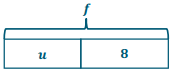
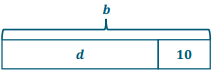
Lance rides his bike downhill at a pace of 60 miles per hour. When Lance is riding uphill, he rides 8 miles per hour slower than on flat roads. If Lance’s downhill speed is 4 times faster than his flat-road speed, how fast does he travel uphill? Let f represent Lance’s pace on flat roads in miles per hour and u represent Lance’s pace uphill in miles per hour.
Answer:
Tape Diagram for Uphill Pace:
Eureka Math Grade 6 Module 4 Lesson 28 Exercise Answer Key 18

Tape Diagram for Downhill Pace:
Eureka Math Grade 6 Module 4 Lesson 28 Exercise Answer Key 19

Equation for Downhill Pace:
4f = 60
4f ÷ 4 = 60 ÷4
f = 15

Equation for Uphill Pace:
u + 8 = 15
u + 8 – 8 = 15 – 8
u = 7
Therefore, Lance travels at a pace of 7 miles per hour uphill.

Eureka Math Grade 6 Module 4 Lesson 28 Problem Set Answer Key

Use tape diagrams to solve each problem.

Question 1.
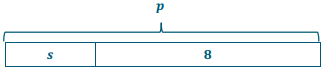
Dwayne scored SS points in the last basketball game, which is 10 points more than his previous personal best. Lebron scored 15 points more than Chris in the same game. Lebron scored the same number of points as Dwayne’s previous personal best. Let d represent the number of points Dwayne scored during his previous personal best and c represent the number of Chris’s points.

a. How many points did Chris score during the game?
Answer:

Eureka Math Grade 6 Module 4 Lesson 28 Problem Set Answer Key 20

Equation for Dwayne’s Tape Diagram: d + 10 = 55
Equation for Lebrons Tape Diagram:
c + 15 + 10 = 55
c + 25 = 55
c + 25 – 25 = 55 – 25
c = 30
Therefore, Chris scored 30 points in the game.

b. If these are the only three players who scored, what was the team’s total number of points at the end of the game?
Answer:
Dwayne scored 55 points. Chris scored 30 points. Lebron scored 45 points (answer to Dwayre’s equation). Therefore, the total number of points scored is 55 + 30 + 45 = 130.

Question 2.
The number of customers at Yummy Smoothies varies throughout the day. During the lunch rush on Saturday, there were 120 customers at Yummy Smoothies. rhe number of customers at Yummy Smoothies during dinner time was 10 customers fewer than the number during breakfast. The number of customers at Yummy Smoothies during lunch was 3 times more than during breakfast. How many people were at Yummy Smoothies during breakfast? How many people were at Yummy Smoothies during dinner? Let d represent the number of customers at Yummy Smoothies during dinner and b represent the number of customers at Yummy Smoothies during breakfast.
Answer:
Tape Diagram for Lunch:
Eureka Math Grade 6 Module 4 Lesson 28 Problem Set Answer Key 21

Tape Diagram for Dinner:
Eureka Math Grade 6 Module 4 Lesson 28 Problem Set Answer Key 22

Equation for Lunchs Tape Diagram:
3b = 120
3b ÷ 3 = 120 ÷ 3
b = 40

Now that we know 40 customers were at Yummy Smoothies for breakfast, we can use this information and the tape diagram for dinner to determine how many customers were at Yummy Smoot hies during dinner.
d + 10 = 40
d + 10 – 10 = 40 – 10
d = 30
Therefore, 30 customers were at Yummy Smoothies during dinner and 40 customers during breakfast.

Question 3.
Karter has 24 T-shirts. Karter has 8 fewer pairs of shoes than pairs of pants. If the number of T-shirts Karter has is double the number of pants he has, how many pairs of shoes does Karter have? Let p represent the number of pants Karter has and s represent the number of pairs of shoes he has.
Answer:
Tape Diagram for T-shirts:
Eureka Math Grade 6 Module 4 Lesson 28 Problem Set Answer Key 23

Tape Diagram for Shoes:
Eureka Math Grade 6 Module 4 Lesson 28 Problem Set Answer Key 24

Equation for T-Shirts Tape Diagram:
2p = 24
2p ÷ 2 = 24 ÷ 2
p = 12

Equation for Shoes Tape Diagram:
s + 8 = 12
s + 8 – 8 = 12 – 8
s = 4
Karter has 4 pairs of shoes.

Question 4.
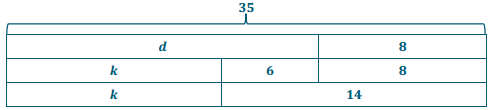
Darnell completed 35 push-ups in one minute, which is 8 more than his previous personal best. Mia completed 6 more push-ups than Katie. If Mia completed the same amount of push-ups as Darnell completed during his previous personal best, how many push-ups did Katie complete? Let d represent the number of push-ups Darnell completed during his previous personal best and k represent the number of push-ups Katie completed.
Answer:
Eureka Math Grade 6 Module 4 Lesson 28 Problem Set Answer Key 25

d + 8 = 35
k + 6 + 8 = 35
k + 14 = 35
k + 14 – 14 = 35 – 14
k = 21
Katie completed 21 push-ups.

Question 5.
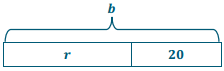
Justine swims freestyle at a pace of 150 laps per hour, Justine swims breaststroke 20 laps per hour slower than she swims butterfly. If Justine’s freestyle speed is three times faster than her butterfly speed, how fast does she swim breaststroke? Let b represent Justine’s butterfly sped in laps per hour and r represent Justine’s breaststroke sped in laps per hour.
Answer:
Tape Diagram for breaststroke:

Eureka Math Grade 6 Module 4 Lesson 28 Problem Set Answer Key 26

Tape Diagram for Freestyle:

Eureka Math Grade 6 Module 4 Lesson 28 Problem Set Answer Key 27

3b = 150
3b ÷ 3 = 150 ÷ 3
b = 50
Therefore, Justine swims butterfly at apace of 50 laps per hour.
r + 20 = 50
r + 20 – 20 = 50 – 20
r = 30
Therefore, Justine swims breaststroke at a pace of 30 laps per hour.

Eureka Math Grade 6 Module 4 Lesson 28 Exit Ticket Answer Key

Use tape diagrams and equations to solve the problem with visual models and algebraic methods.

Question 1.
Alyssa is twice as old as Brittany, and Jazmyn is 15 years older than Alyssa. If Jazmyn is 35 years old, how old is Brittany? Let a represent Alyssa’s age in years and b represent Brittany’s age in years.
Answer:
Brittany’s Tape Diagram:
Eureka Math Grade 6 Module 4 Lesson 28 Exit Ticket Answer Key 28

Alyssa’s Tape Diagram:
Eureka Math Grade 6 Module 4 Lesson 28 Exit Ticket Answer Key 29

Jazmyn’s Tape Diagram:
Eureka Math Grade 6 Module 4 Lesson 28 Exit Ticket Answer Key 30

Equation for jazmyn’s Tape Diagram:
a + 15 = 35
a + 15 – 15 = 35 – 15
a = 20

Now that we know Alyssa is 20 years old, we can use this information and Alyssa’s tape diagram to determine Brittany’s age.
2b = 20
2b ÷ 2 = 20 ÷ 2
b = 10
Therefore, Brittany is 10 years old.

Eureka Math Grade 6 Module 4 Lesson 28 Addition of Decimals II Answer Key

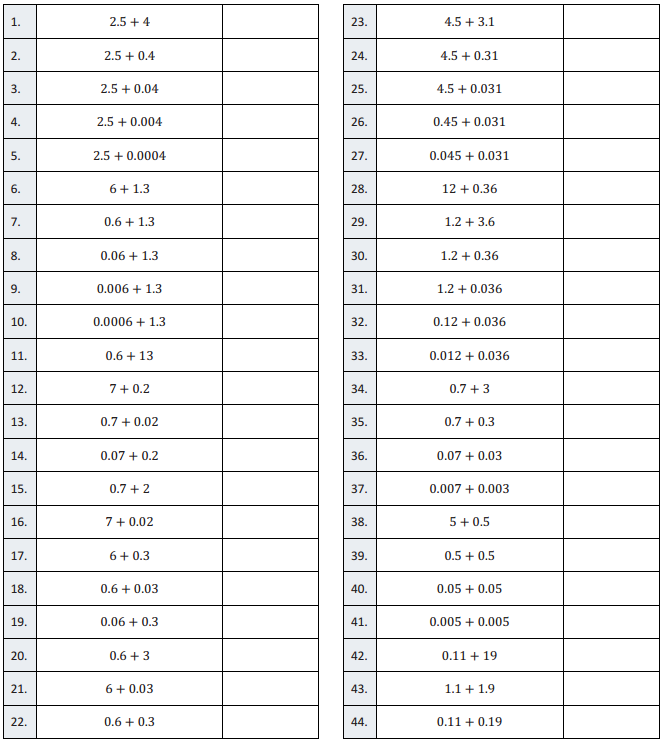
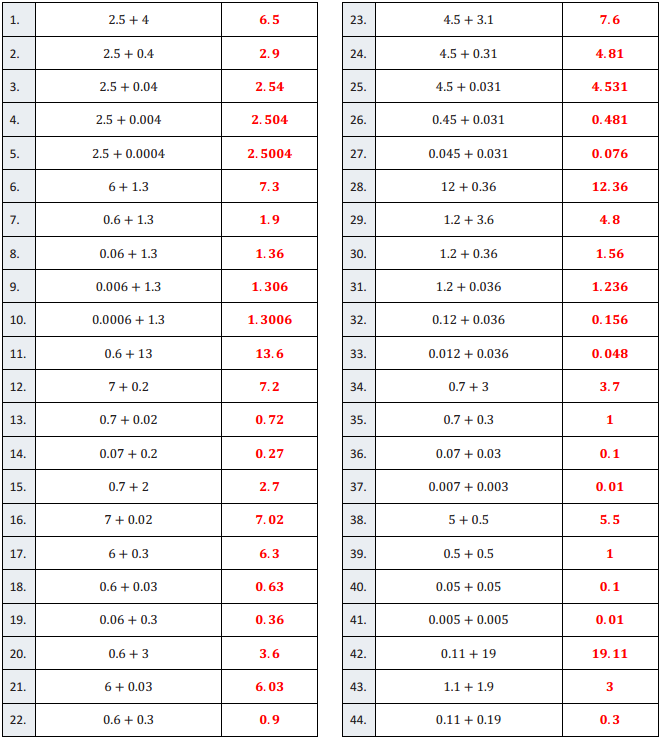
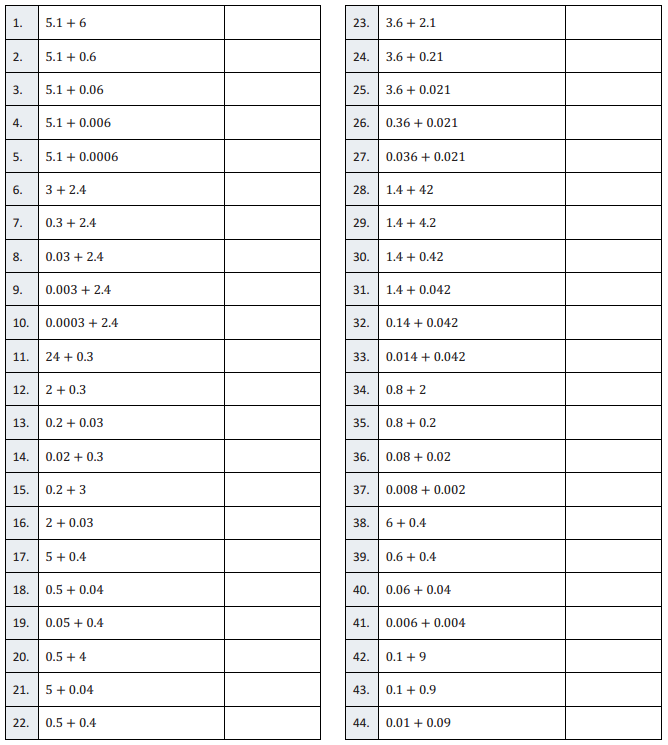
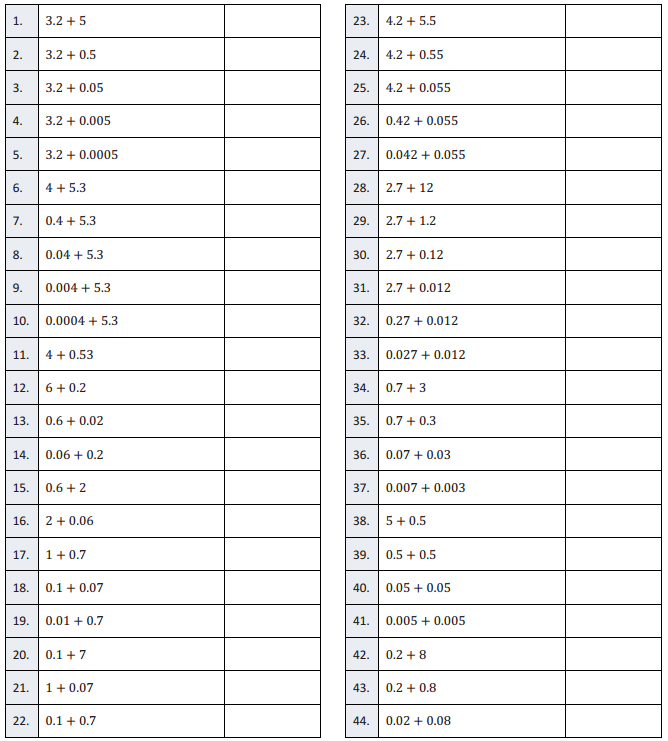
Addition of Decimals II – Round 1:

Directions: Evaluate each expression:

Eureka Math Grade 6 Module 4 Lesson 28 Addition of Decimals II Answer Key 31

Eureka Math Grade 6 Module 4 Lesson 28 Addition of Decimals II Answer Key 32

Question 1.
2.5 + 4
Answer:
6.5

Question 2.
2.5 + 0.4
Answer:
2.9

Question 3.
2.5 + 0.04
Answer:
2.54

Question 4.
2.5 + 0.004
Answer:
2.504

Question 5.
2.5 + 0.0004
Answer:
2.5004

Question 6.
6 + 1.3
Answer:
7.3

Question 7.
0.6 + 1.3
Answer:
1.9

Question 8.
0.06 + 1.3
Answer:
1.36

Question 9.
0.006 + 1.3
Answer:
1.306

Question 10.
0.0006 + 1.3
Answer:
1.3006

Question 11.
0.6 + 13
Answer:
13.6

Question 12.
7 + 0.2
Answer:
7.2

Question 13.
0.7 + 0.02
Answer:
0.72

Question 14.
0.07 + 0.2
Answer:
0.27

Question 15.
0.7 + 2
Answer:
2.7

Question 16.
7 + 0.02
Answer:
7.02

Question 17.
6 + 0.3
Answer:
6.3

Question 18.
0.6 + 0.03
Answer:
0.63

Question 19.
0.06 + 0.3
Answer:
0.36

Question 20.
0.6 + 3
Answer:
3.6

Question 21.
6 + 0.03
Answer:
6.03

Question 22.
0.6 + 0.3
Answer:
0.9

Question 23.
4.5 + 3.1
Answer:
7.6

Question 24.
4.5 + 0.31
Answer:
4.81

Question 25.
4.5 + 0.031
Answer:
4.531

Question 26.
0.45 + 0.031
Answer:
0.481

Question 27.
0.045 + 0.03 1
Answer:
0.076

Question 28.
12 +0.36
Answer:
12.36

Question 29.
1.2 + 3.6
Answer:
4.8

Question 30.
1.2 + 0.36
Answer:
1.56

Question 31.
1.2 + 0.036
Answer:
1.236

Question 32.
0.12 + 0.036
Answer:
0.156

Question 33.
0.012 + 0.036
Answer:
0.048

Question 34.
0.7 + 3
Answer:
3.7

Question 35.
0.7 + 0.3
Answer:
1

Question 36.
0.07 + 0.03
Answer:
0.1

Question 37.
0.007 + 0.003
Answer:
0.01

Question 38.
5 + 0.5
Answer:
5.5

Question 39.
0.5 + 0.5
Answer:
1

Question 40.
0.05 + 0.05
Answer:
0.1

Question 41.
0.005 + 0.005
Answer:
0.01

Question 42.
0.11+ 19
Answer:
19.11

Question 43.
1.1 + 1.9
Answer:
3

Question 44.
0.11+0.19
Answer:
0.3

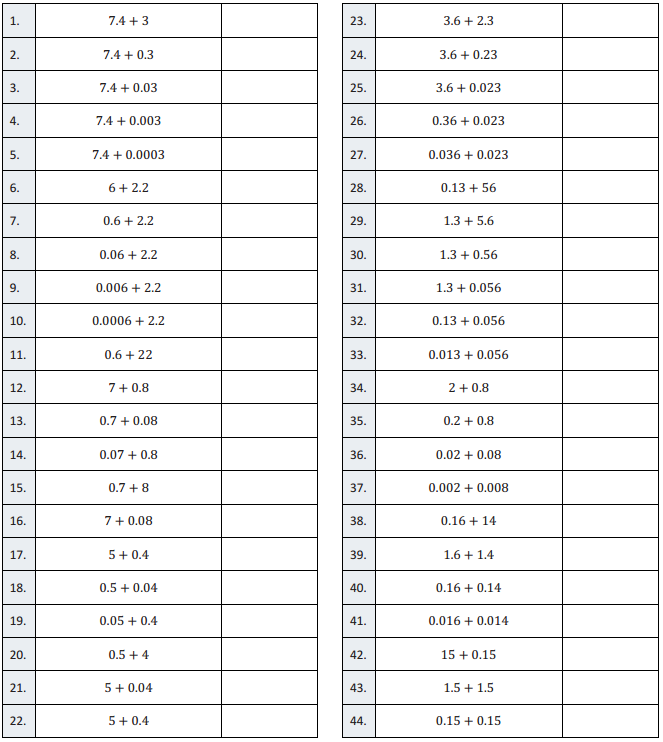
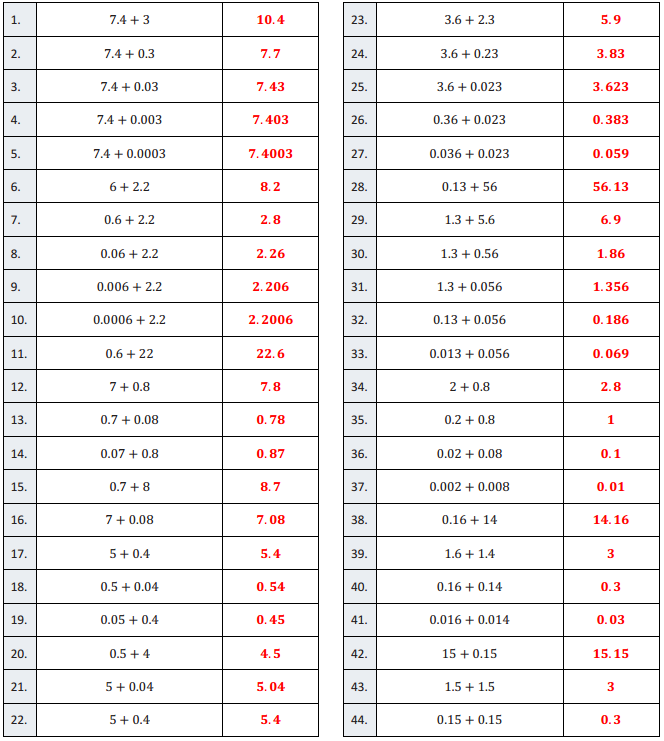
Addition of Decimals II – Round 2:

Directions: Evaluate each expression:

Eureka Math Grade 6 Module 4 Lesson 28 Addition of Decimals II Answer Key 33

Eureka Math Grade 6 Module 4 Lesson 28 Addition of Decimals II Answer Key 34

Question 1.
7.4 + 3
Answer:
10.4

Question 2.
7.4 + 0.3
Answer:
7.7

Question 3.
7.4 + 0.03
Answer:
7.43

Question 4.
7.4 + 0.003
Answer:
7.403

Question 5.
7.4 + 0.0003
Answer:
7.4003

Question 6.
6 + 2.2
Answer:
8.2

Question 7.
0.6 + 2.2
Answer:
2.8

Question 8.
0.06 + 2.2
Answer:
2.26

Question 9.
0.006 + 2.2
Answer:
2.206

Question 10.
0.0006 + 2.2
Answer:
2.2006

Question 11.
0.6 + 22
Answer:
22.6

Question 12.
7 + 0.8
Answer:
7.8

Question 13.
0.7 + 0.08
Answer:
0.78

Question 14.
0.07 + 0.8
Answer:
0.87

Question 15.
0.7 + 8
Answer:
8.7

Question 16.
7 + 0.08
Answer:
7.08

Question 17.
5 + 0.4
Answer:
5.4

Question 18.
0.5 + 0.04
Answer:
0.54

Question 19.
0.05 + 0.4
Answer:
0.45

Question 20.
0.5 + 4
Answer:
4.5

Question 21.
5 + 0.04
Answer:
5.04

Question 22.
5 + 0.4
Answer:
5.4

Question 23.
3.6 + 2.3
Answer:
5.9

Question 24.
3.6 + 0.23
Answer:
3.83

Question 25.
3.6 + 0.023
Answer:
3.623

Question 26.
0.36 + 0.023
Answer:
0.383

Question 27.
0.036 + 0.023
Answer:
0.059

Question 28.
0.13 + 56
Answer:
56.13

Question 29.
1.3 + 5.6
Answer:
6.9

Question 30.
1.3 + 0.56
Answer:
1.86

Question 31.
1.3 + 0.056
Answer:
1.356

Question 32.
0.13 + 0.056
Answer:
0.186

Question 33.
0.013 + 0.056
Answer:
0.069

Question 34.
2 + 0.8
Answer:
2.8

Question 35.
0.2 + 0.8
Answer:
1

Question 36.
0.02 + 0.08
Answer:
0.1

Question 37.
0.002 + 0.008
Answer:
0.01

Question 38.
0.16 + 14
Answer:
14.16

Question 39.
1.6 + 1.4
Answer:
3

Question 40.
0.16 + 0.14
Answer:
0.3

Question 41.
0.016+0.014
Answer:
0.03

Question 42.
15 + 0.15
Answer:
15.15

Question 43.
1.5 + 1.5
Answer:
3

Question 44.
0.15 + 0.15
Answer:
0.3

Eureka Math Grade 6 Module 4 Lesson 29 Answer Key

Engage NY Eureka Math Grade 6 Module 4 Lesson 29 Answer Key

Eureka Math Grade 6 Module 4 Lesson 29 Example Answer Key

Example:

The school librarian, Mr. Marker, knows the library has 1,400 books but wants to reorganize how the books are displayed on the shelves. Mr. Marker needs to know how many fiction, nonfiction, and resource books are in the library. He knows that the library has four times as many fiction books as resource books and half as many nonfiction books as fiction books. If these are the only types of books in the library, how many of each type of boo are in the library?

Draw a tape diagram to represent the total number of books in the library.
Answer:
Eureka Math Grade 6 Module 4 Lesson 29 Example Answer Key 1

Draw two more tape diagrams, one to represent the number of fiction books in the library and one to represent the number of resource books in the library.
Answer:
Eureka Math Grade 6 Module 4 Lesson 29 Example Answer Key 2

What variable should we use throughout the problem?
Answer:
We should user to represent the number of resource books in the library because it represents the fewest amount of books. Choosing the variable to represent a different type of book would create fractions throughout the problem.

Write the relationship between resource books and fiction books algebraically.
Answer:
If we let r represent the number resource books, then 4r represents the number of fiction books.

Draw a tape diagram to represent the number of nonfiction books.
Answer:
Eureka Math Grade 6 Module 4 Lesson 29 Example Answer Key 3

How did you decide how many sections this tape diagram would have?
Answer:
There are half as many nonfiction books as fiction books. Since the fiction book tape diagram has four sections, the nonfiction book tape diagram should have two sections.

Represent the number of nonfiction books in the library algebraically.
Answer:
2r because that is half as many as fiction books.

Use the tape diagrams we drew to solve the problem.
Answer:
We know that combining the tape diagrams for each type of book will leave us with 1,400 total books.
Eureka Math Grade 6 Module 4 Lesson 29 Example Answer Key 4

Write an equation that represents the tape diagram.
Answer:
4r + 2r + r = 1,400

Determine the value of r.
Answer:
We can gather like terms and then solve the equation.
7r = 1,400
7r + 7 = 1,400 + 7
r = 200

→ What does this 200 mean?
There are 200 resource books in the library because r represented the number of resource books.

How many fiction books are in the library?
Answer:
There are 800 fiction books in the library because 4(200) = 800.

How many nonfiction books are in the library?
Answer:
There are 400 nonfiction books in the library because 2(200) = 400.

→ We can use a different math tool to solve the problem as well. If we were to make a table, how many columns would we need?
4

→ Why do we need four columns?
We need to keep track of the number of fiction, nonfiction, and resource books that are in the library, but we also need to keep track of the total number of books.

Set up a table with four columns, and label each column.
Answer:
Eureka Math Grade 6 Module 4 Lesson 29 Example Answer Key 5

→ Highlight the important information from the word problem that will help us fill out the second row in our table.

The school librarian, Mr. Marker, knows the library has 1,400 books but wants to reorganize how the books are displayed on the shelves. Mr. Marker needs to know how many fiction, nonfiction, and resource books are in the library. He knows that the library has four times as many fiction books as resource books and half as many nonfiction books as fiction books. If these are the only types of books in the library, how many of each type of book are in the library?

→ Fill out the second row of the table using the algebraic representations.
Eureka Math Grade 6 Module 4 Lesson 29 Example Answer Key 6

→ If r = 1, how many of each type of book would be in the library?
Eureka Math Grade 6 Module 4 Lesson 29 Example Answer Key 7

→ How can we fill out another row of the table?
Substitute different values in for r.

→ Substitute 5 in for r. How many of each type of book would be in the library then?
Eureka Math Grade 6 Module 4 Lesson 29 Example Answer Key 8

→ Does the library have four times as many fiction books as resource books?
Yes, because 5 . 4 = 20.

→ Does the library have half as many nonfiction books as fiction books?
Yes, because half of 20 is 10.

→ How do we determine how many of each type of book is in the library when there are 1,400 books in the library?
Continue to multiply the rows by the same value, until the total column has 1400 books.

At this point, allow students to work individually to determine how many fiction, nonfiction, and resource books are in the library if there are 1,400 total books. Each table may look different because students may choose different values to multiply by. A sample answer is shown below.

Eureka Math Grade 6 Module 4 Lesson 29 Example Answer Key 9

How many fiction books are in the library?
Answer:
800

How many nonfiction books are in the library?
Answer:
400

How many resource books are in the library?
Answer:
200

Does the library have four times as many fiction books as resource books?
Answer:
Yes, because 200 . 4 = 800.

Does the library have half as many nonfiction books as fiction books?
Answer:
Yes, because half of 800 is 400.

Does the library have 1,400 books?
Answer:
Yes, because 800 + 400 + 200 = 1400.

Eureka Math Grade 6 Module 4 Lesson 29 Exercise Answer Key

Exercises:

Solve each problem below using tables and algebraic methods. Then, check your answers with the word problems.

Exercise 1.
Indiana Ridge Middle School wanted to add a new school sport, so they surveyed the students to determine which sport is most popular. Students were able to choose among soccer, football, lacrosse, or swimming. The same number of students chose lacrosse and swimming. The number of students who chose soccer was double the number of students who chose lacrosse. The number of students who chose football was triple the number of students who chose swimming. If 434 students completed the survey, how many students chose each sport?
Answer:

Eureka Math Grade 6 Module 4 Lesson 29 Exercise Answer Key 10

The rest of the table will vary.

Eureka Math Grade 6 Module 4 Lesson 29 Exercise Answer Key 11

124 students chose soccer, 186 students chose football, 62 students chose lacrosse, and 62 students chose swimming.

We can confirm that these numbers satisfy the conditions of the word problem because lacrosse and swimming were chosen by the same number of students. 124 is double 62, so soccer was chosen by double the number of students as lacrosse, and 186 is triple 62, so football was chosen by 3 times as many students as swimming. Also,
124 + 186 + 62 + 62 = 434.

Algebraically: Let s represent the number of students who chose swimming. Then, 2s is the number of students who chose soccer, 3s is the number of students who chose football, and s is the number of students who chose lacrosse.
2s + 3s + s + s = 434
7s = 434
7s ÷ 7 = 434 ÷ 7
s = 62

Therefore, 62 students chose swimming, and 62 students chose lacrosse. 124 students chose soccer because 2(62) = 124, and 186 students chose football because 3(62) = 186.

Exercise 2.
At Prairie Elementary School, students are asked to pick their lunch ahead of time so the kitchen staff will know what to prepare. On Monday, 6 times as many students chose hamburgers as chose salads. The number of students who chose lasagna was one third the number of students who chose hamburgers. If 225 students ordered lunch, how many students chose each option if hamburger, salad, and lasagna were the only three options?
Answer:

Eureka Math Grade 6 Module 4 Lesson 29 Exercise Answer Key 12

The rest of the table will vary.

Eureka Math Grade 6 Module 4 Lesson 29 Exercise Answer Key 13

150 students chose a hamburger for lunch, 25 students chose a salad, and 50 students chose lasagna.

We can confirm that these numbers satisfy the conditions of the word problem because 25 . 6 = 150, so hamburgers were chosen by 6 times more students than salads. Also, \(\frac{1}{3}\) . 150 = 50, which means lasagna was chosen by one third of the number of students who chose hamburgers. Finally, 150 + 25 + 50 = 225, which means 225 students completed the survey.

Algebraically: Let s represent the number of students who chose a salad. Then, 6s represents the number of students who chose hamburgers, and 2s represents the number of students who chose lasagna.
6s + s + 2s = 225
9s = 225
9s ÷ 9 = 225 ÷ 9s
s = 25
This means that 25 students chose salad, 150 students chose hamburgers because 6(25) = 150, and 50 students chose lasagna because 2(25) = 50.

Exercise 3.
The art teacher, Mr. Gonzalez, is preparing for a project. In order for students to have the correct supplies, Mr. Gonzalez needs 10 times more markers than pieces of construction paper. He needs the same number of bottles of glue as pieces of construction paper. The number of scissors required for the project is half the number of pieces of construction paper. If Mr. Gonzalez collected 400 items for the project, how many of each supp’y did he collect?
Answer:

Eureka Math Grade 6 Module 4 Lesson 29 Exercise Answer Key 14

The rest of the table will vary.

Eureka Math Grade 6 Module 4 Lesson 29 Exercise Answer Key 15

Mr. Gonzalez collected 320 markers, 32 pieces of construction paper, 32 glue bottles, and 16 scissors for the project.

We can confirm that these numbers satisfy the conditions of the word problem because Mr. Gonzalez collected the same number of pieces of construction paper and glue bottles. Also, 32 . 10 = 320, so Mr. Gonzalez collected 10 times more markers than pieces of construction paper and glue bottles. Mr. Gonzalez only collected 16 pairs of scissors, which is half of the number of pieces of construction paper. The supplies collected add up to 400 supplies, which is the number of supplies indicated in the word problem.

Algebraically: Let s represent the number of scissors needed for the project, which means 20s represents the number of markers needed, 2s represents the number of pieces of construction paper needed, and 2s represents the number of glue bottles needed.

20s + 2s + 2s + s = 400
25s = 400
\(\frac{25 s}{25}=\frac{400}{25}\)
s = 16
This means that 16 pairs of scissors, 320 markers, 32 pieces of construction paper, and 32 glue bottles are required
for the project.

Exercise 4.
The math teacher, Ms. Zentz, is buying appropriate math tools to use throughout the year. She is planning on buying twice as many rulers as protractors. The number of calculators Ms. Zentz Is planning on buying is one quarter of the number of protractors. If Ms. Zentz buys 65 Items, how many protractors does Ms. Zentz buy?
Answer:

Eureka Math Grade 6 Module 4 Lesson 29 Exercise Answer Key 16

The rest of the table will vary.

Eureka Math Grade 6 Module 4 Lesson 29 Exercise Answer Key 17

Ms. Zentz will buy 20 protractors.

We can confirm that this number satisfies the conditions of the word problem because the number of protractors is half of the number of rulers, and the number of calculators is one fourth of the number of protractors. Also, 40 + 20 + 5 = 65, so the total matches the total supplies that Ms. Zentz bought.

Algebraically: Let c represent the number of calculators Ms. Zentz needs for the year. Then, 8c represents the number of rulers, and 4c represents the number of protractors Ms. Zentz will need throughout the year.
8c + 4c + c = 65
13c = 65
\(\frac{13 c}{13}=\frac{65}{13}\)
c = 5
Therefore, Ms. Zentz will need 5 calculators, 40 rulers, and 20 protractors throughout the year.

Eureka Math Grade 6 Module 4 Lesson 29 Problem Set Answer Key

Create tables to solve the problems, and then check your answers with the word problems.

Question 1.
On average, a baby uses three times the number of large diapers as small diapers and double the number of medium diapers as small diapers.

a. If the average baby uses 2,940 diapers, size large and small, how many of each size would be used?
Answer:
Eureka Math Grade 6 Module 4 Lesson 29 Problem Set Answer Key 18

An average baby would use 490 small diapers, 980 medium diapers, and 1,470 large diapers.
The answer makes sense because the number of large diapers is 3 times more than small diapers. The number of medium diapers is double the number of small diapers, and the total number of diapers is 2, 940.

b. Support your answer with equations.
Answer:
Let s represent the number of small diapers a baby needs. Therefore, 2s represents the number of medium diapers, and 3s represents the amount of large diapers a baby needs.
s + 2s + 3s = 2,940
6s = 2,940
\(\frac{6 s}{6}=\frac{2,940}{6}\)
s = 490
Therefore, a baby requires 490 small diapers, 980 medium diapers (because 2(490) = 980), and 1,470 large diapers (because 3(490) = 1470), which matches the answer in part (a).

Question 2.
Tom has three times as many pencils as pens but has a total of 100 writing utensils.

a. How many pencils does Tom have?
Answer:
Eureka Math Grade 6 Module 4 Lesson 29 Problem Set Answer Key 19

b. How many more pencils than pens does Tom have?
Answer:
75 – 25 = 50. Tom has 50 more pencils than pens.

Question 3.
Serena’s mom is planning her birthday party. She bought balloons, plates, and cups. Serena’s mom bought twice as many plates as cups. The number of balloons Serena’s mom bought was half the number of cups.

a. If Serena’s mom bought 84 items, how many of each item did she buy?
Answer:
Eureka Math Grade 6 Module 4 Lesson 29 Problem Set Answer Key 20

Serena’s mom bought 12 balloons, 48 plates, and 24 cups.

b. Tammy brought 12 balloons to the party. How many total balloons were at Serena’s birthday party?
Answer:
12 + 12 = 24. There were 24 total balloons at the party.

c. If half the plates and all but four cups were used during the party, how many plates and cups were used?
Answer:
\(\frac{1}{2}\) . 48 = 24. Twenty-four plates were used during the party.
24 – 4 = 20. Twenty cups were used during the party.

Question 4.
Elizabeth has a lot of jewelry. She has four times as many earrings as watches but half the number of necklaces as earrings. Elizabeth has the same number of necklaces as bracelets.

a. If Elizabeth has 117 pieces of jewelry, how many earrings does she have?
Answer:
Eureka Math Grade 6 Module 4 Lesson 29 Problem Set Answer Key 21

Elizabeth has 52 earrings, 13 watches, 26 necklaces, and 26 bracelets.

b. Support your answer with an equation.
Answer:
Let w represent the number of watches Elizabeth has. Therefore, 4w represents the number of earrings Elizabeth has, and 2w represents both the number of necklaces and bracelets she has.

4w + w + 2w + 2w = 117
9w = 117
\(\frac{9 w}{9}=\frac{117}{9}\)
w = 13
Therefore, Elizabeth has 13 watches, 52 earrings because 4(13) = 52, and 26 necklaces and bracelets each because 2(13) = 26.

Question 5.
Claudia was cooking breakfast for her entire family. She made double the amount of chocolate chip pancakes as she did regular pancakes. She only made half as many blueberry pancakes as she did regular pancakes. Claudia also knows her family loves sausage, so she made triple the amount of sausage as blueberry pancakes.

a. How many of each breakfast item did Claudia make If she cooked 90 Items in total?
Answer:
Eureka Math Grade 6 Module 4 Lesson 29 Problem Set Answer Key 22

Claudia cooked 36 chocolate chip pancakes, 18 regular pancakes, 9 blueberry pancakes, and 27 pieces of sausage.

b. After everyone ate breakfast, there were 4 chocolate chip pancakes, 5 regular pancakes, 1 blueberry pancake, and no sausage left. How many of each item did the family eat?
Answer:
The family ate 32 chocolate chip pancakes, 13 regular pancakes, 8 blueberry pancakes, and 27 pieces of sausage during breakfast.

Question 6.
During a basketball game, Jeremy scored triple the number of points as Donovan. Kolby scored double the number of points as Donovan.

Eureka Math Grade 6 Module 4 Lesson 29 Problem Set Answer Key 23


a. If the three boys scored 36 points, how many points did each boy score?
Answer:
Jeremy scored 18 points, Donovan scored 6 points, and Kolby scored 12 points.

b. Support your answer with an equation.
Answer:
Let d represent the number of points Donovan scored, which means 3d represents the number of points Jeremy scored, and 2d represents the number of points Kolby scored.
3d + d + 2d = 36
6d = 36
\(\frac{6 d}{6}=\frac{36}{6}\)
d = 6
Therefore, Donovan scored 6 points, Jeremy scored 18 points because 3(6) = 18, and Kolby scored 12 points because 2(6) = 12

Eureka Math Grade 6 Module 4 Lesson 29 Exit Ticket Answer Key

Solve the problem using tables and equations, and then check your answer with the word problem. Try to find the answer only using two rows of numbers on your table.

Question 1.
A pet store owner, Byron, needs to determine how much food he needs to feed the animals. Byron knows that he needs to order the same amount of bird food as hamster food. He needs four times as much dog food as bird food and needs half the amount of cat food as dog food. If Byron orders 600 packages of animal food, how much dog food does he buy? Let b represent the number of packages of bird food Byron purchased for the pet store.
Answer:
Eureka Math Grade 6 Module 4 Lesson 29 Exit Ticket Answer Key 24

The rest of the table will vary (unless they follow suggestions from the Closing).

Eureka Math Grade 6 Module 4 Lesson 29 Exit Ticket Answer Key 25

Byron would need to order 300 packages of dog food.

The answer makes sense because Byron ordered the same amount of bird food and hamster food. The table also shows that Byron ordered four times as much dog food as bird food, and the amount of cat food he ordered Is half the amount of dog food. The total amount of pet food Byron ordered was 600 packages, which matches the word problem.

Algebraically: Let b represent the number of packages of bird food Byron purchased for the pet store. Therefore, b also represents the amount of hamster food, 4b represents the amount of dog food, and 2b represents the amount of cat food required by the pet store.

b + b + 4b + 2b = 600
8b = 600
8b ÷ 8 = 600 ÷ 8
b = 75
Therefore, Byron will order 75 pounds of bird food, which results in 300 pounds of dog food because 4(75) = 300.

Eureka Math Grade 6 Module 4 Lesson 30 Answer Key

Engage NY Eureka Math Grade 6 Module 4 Lesson 30 Answer Key

Eureka Math Grade 6 Module 4 Lesson 30 Opening Exercise Answer Key

Opening Exercise:

Draw an example of each term, and write a brief description.

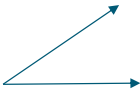
Acute:
Answer:
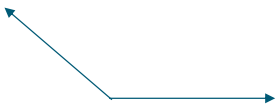
Less than 90°
Eureka Math Grade 6 Module 4 Lesson 30 Opening Exercise Answer Key 1

Obtuse
Answer:
Between 90° and 180°
Eureka Math Grade 6 Module 4 Lesson 30 Opening Exercise Answer Key 2

Right
Answer:
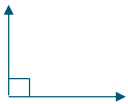
Exactly 90°
Eureka Math Grade 6 Module 4 Lesson 30 Opening Exercise Answer Key 3

Straight
Answer:
Exactly 180°
Eureka Math Grade 6 Module 4 Lesson 30 Opening Exercise Answer Key 4

Reflex
Answer:
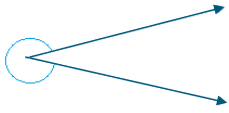
Between 180° and 360°
Eureka Math Grade 6 Module 4 Lesson 30 Opening Exercise Answer Key 5

Eureka Math Grade 6 Module 4 Lesson 30 Example Answer Key

Example 1:

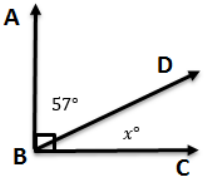
∠ABC measures 90°. The angle has been separated into two angles. If one angle measures 57°, what is the measure of the other angle?

Eureka Math Grade 6 Module 4 Lesson 30 Example Answer Key 6

Answer:
In this lesson, we will be using algebra to help us determine unknown measures of angles.

How are these two angles related?
Answer:
x° + 57° = 90°

What equation could we use to solve for x?
Answer:
Now, let’s solve.
x° + 57° – 57° = 90° – 57°
x° = 33°
The measure of the unknown angle is 33°.

Example 2:

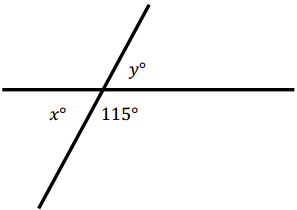
Michelle is designing a parking lot. She has determined that one of the angles should be 115°. What is the measure of angle x and angle y?
Eureka Math Grade 6 Module 4 Lesson 30 Example Answer Key 7

How is angle x related to the 115° angle?
Answer:
The two angles form o straight line. Therefore, they should add up to 180°.

What equation would we use to show this?
Answer:
x° + 115° = 180°

How would you solve this equation?
Answer:
115° was added to angle x, so I will take away 115° to get back to angle X.
x° + 115° – 115° = 180° – 115°
x° = 65°
The angle next to 115°, labeled with an x, is equal to 65°.

How is angle y related to the angle that measures 115°?
Answer:
These two angles also form a straight line and must add up to 180°.
Therefore, angles x and y must both be equal to 65°.

Example 3:

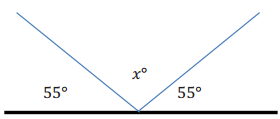
A beam of light is reflected off a mirror. Below is a diagram of the reflected beam. Determine the missing angle measure.

Eureka Math Grade 6 Module 4 Lesson 30 Example Answer Key 8

How are the angles in this question-related?
Answer:
There are three angles that, when all placed together, form a straight line. This means that the three angles have a sum of 180°.

What equation could we write to represent the situation?
Answer:
55° + x + 55° = 180°

How would you solve an equation like this?
Answer:
We can combine the two angles that we do know.
55° + 550 + x° = 180°
110° + x° = 180°
110° – 110° + x° = 180° – 110°
x° = 70°
The angle of the bounce is 70°.

Example 4:

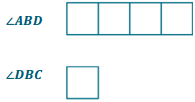
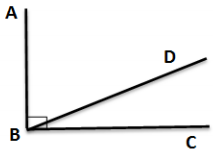
∠ABC measures 90°. It has been split into two angles, ∠ABD and ∠DBC. The measure of ∠ABD and ∠DBC is in a ratio of 4: 1. What are the measures of each angle? Use a tape diagram to represent the ratio 4: 1.
Eureka Math Grade 6 Module 4 Lesson 30 Example Answer Key 9

What is the measure of each angle?
5 units = 90°
1 unit = 18°
4 units = 72°
∠ABD is 72°. ∠DBC is 18°

How can we represent this situation with an equation?
Answer:
4x° + x° = 90°

Solve the equation to determine the measure of each angle.
4x° + x° = 90°
5x° = 90°
5x° ÷ 5 = 90° ÷ 5
x° = 18°
4x° = 4(18°) = 72°
The measure of ∠DBC is 18° and the measure of ∠ABD is 72°.

Eureka Math Grade 6 Module 4 Lesson 30 Exercise Answer Key

Exercises:

Write and solve an equation in each of the problems.

Exercise 1.
∠ABC measures 900. It has been split into two angles, ∠ABD and ∠DBC. The measure of the two angles is in a ratio of 2: 1. What are the measures of each angle?

Eureka Math Grade 6 Module 4 Lesson 30 Exercise Answer Key 10

Answer:
x° + 2x° = 90°
3x° = 90°
\(\frac{3 x^{\circ}}{3}=\frac{90^{\circ}}{3}\)
x° = 30°
One of the angles measures 30°, and the other measures 60°.

Exercise 2.
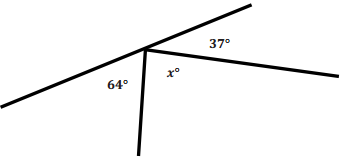
Solve for x.

Eureka Math Grade 6 Module 4 Lesson 30 Exercise Answer Key 11

Answer:
x° + 64° + 37° = 180°
x° + 101° = 180°
x° + 101° – 101° = 180° – 101°
x° = 79°

Exercise 3.
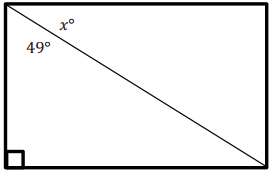
Candice is building a rectangular piece of a fence according to the plans her boss gave her. One of the angles is not labeled. Write an equation, and use it to determine the measure of the unknown angle.

Eureka Math Grade 6 Module 4 Lesson 30 Exercise Answer Key 12

Answer:
x° + 49° = 90°
x° + 49° – 49° = 90° – 49°
x° = 41°

Exercise 4.
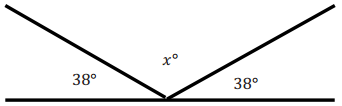
Rashid hit a hockey puck against the wall at a 38° angle. The puck hit the wall and traveled in a new direction. Determine the missing angle in the diagram.

Eureka Math Grade 6 Module 4 Lesson 30 Exercise Answer Key 13

Answer:
38° + x° + 38° = 180°
76° + x° = 180°
76° – 76° + x° = 180° – 76°
x° = 104°
The measure of the missing angle is 104°.

Exercise 5.
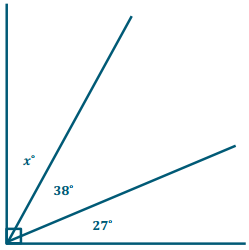
Jaxon is creating a mosaic design on a rectangular table. He has added two pieces to one of the corners. The first piece has an angle measuring 38° and is placed in the corner. A second piece has an angle measuring 27° and is also placed in the comer. Draw a diagram to model the situation. Then, write an equation, and use it to determine the measure of the unknown angle in a third piece that could be added to the corner of the table.
Answer:

Eureka Math Grade 6 Module 4 Lesson 30 Exercise Answer Key 14

x° + 38° + 27° = 90°
x° + 65° = 90°
x° + 65° – 65° = 90° – 65°
x° = 25°
The measure of the unknown angle is 25°.

Eureka Math Grade 6 Module 4 Lesson 30 Problem Set Answer Key

Write and solve an equation for each problem.

Question 1.
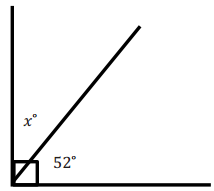
Solve for x.

Eureka Math Grade 6 Module 4 Lesson 30 Problem Set Answer Key 15

Answer:
x° + 52° = 90°
x° + 52° – 52° = 90° – 52°
x° = 38°
The measure of the missing angle is 38°

Question 2.
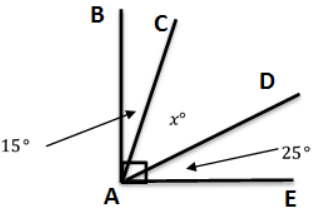
∠BAE measures 90°. Solve for x.

Eureka Math Grade 6 Module 4 Lesson 30 Problem Set Answer Key 16

Answer:
15° + x + 25° = 90°
15° + 25° + x = 90
40° + x = 90°
40° – 40° + x = 90°
x° = 50°

Question 3.
Thomas is putting in a tile floor. He needs to determine the angles that should be cut in the tiles to fit in the comer. The angle in the comer measures 90°. One piece of the tile will have a measure of 24°. Write an equation, and use it to determine the measure of the unknown angle.
Answer:
x° + 24° = 90°
x° + 24° – 24° = 90° – 24°
x° = 66°
The measure of the unknown angle is 66°.

Question 4.
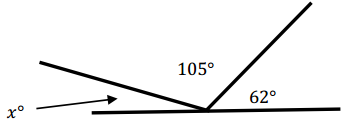
Solve for x°.

Eureka Math Grade 6 Module 4 Lesson 30 Problem Set Answer Key 17

Answer:
x° + 105° + 62° = 180°
x° + 167° = 180°
x° + 167° – 167° = 180° – 167°
x° = 13°
The measure of the missing angle is 13°.

Question 5.
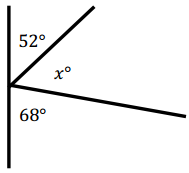
Aram has been studying the mathematics behind pinball machines. He made the following diagram of one of his

Eureka Math Grade 6 Module 4 Lesson 30 Problem Set Answer Key 18

Answer:
52° + x° + 68° = 180°
120° + x° = 180°
120° + x° – 120° = 180° – 120°
x° = 60°
The measure of the missing angle is 60°.

Question 6.
The measures of two angles have a sum of 90°. The measures of the angles are in a ratio of 2: 1. Determine the measures of both angles.
Answer:
2x° + x° = 90°
3x° = 90°
\(\frac{3 x^{\circ}}{3}=\frac{90^{\circ}}{3}\)
x° = 30°
The angles measure 30° and 60°.

Question 7.
The measures of two angles have a sum of 1800. The measures of the angles are in a ratio of 5: 1. Determine the measures of both angles.
Answer:
5x° + x° = 180°
6x° = 180°
\(\frac{6 x^{\circ}}{6}=\frac{180}{6}\)
x° = 30°
The angles measure 30° and 150°.

Eureka Math Grade 6 Module 4 Lesson 30 Exit Ticket Answer Key

Write an equation, and solve for the missing angle in each question.

Question 1.
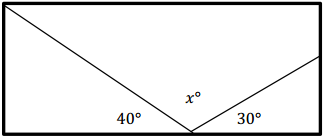
Alejandro is repairing a stained glass window. He needs to take ft apart to repair ft. Before taking ft apart, he makes a sketch with angle measures to put ft back together. Write an equation, and use ft to determine the measure of the unknown angle.

Eureka Math Grade 6 Module 4 Lesson 30 Exit Ticket Answer Key 19

Answer:
40° + x° + 30° = 180°
x° + 40° + 30° = 180°
x° + 70° = 180°
x° + 70° – 70° = 180° – 70°
x° = 110°
The missing angle measures 110°.

Question 2.
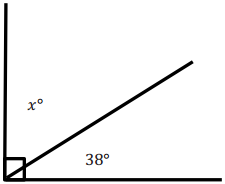
Hannah is putting in a tile floor. She needs to determine the angles that should be cut in the tiles to fit in the corner. The angle in the comer measures 90°. One piece of the tile will have a measure of 38°. Wrfte an equation, and use it to determine the measure of the unknown angle.

Eureka Math Grade 6 Module 4 Lesson 30 Exit Ticket Answer Key 20

Answer:
x° + 38° = 90°
38° – 38° = 90° – 38°
x° = 52°
The measure of the unknown angle is 52°.

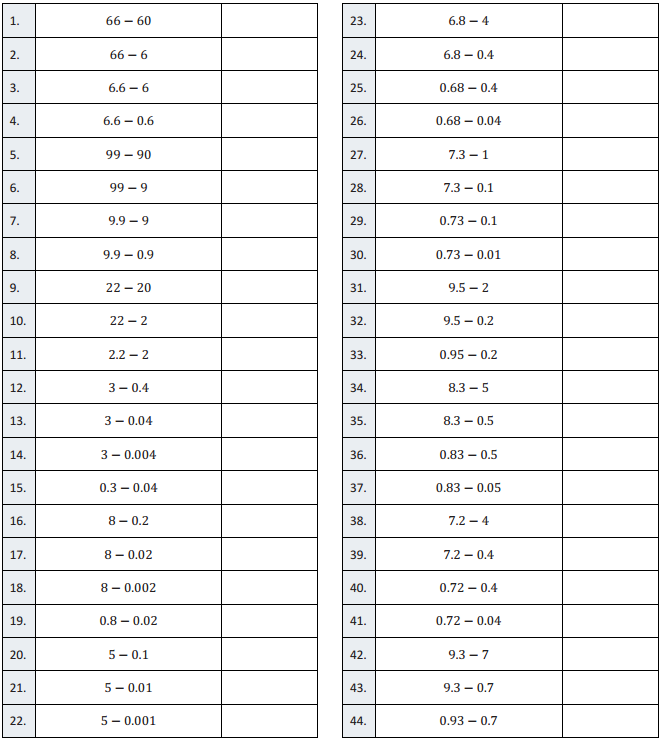
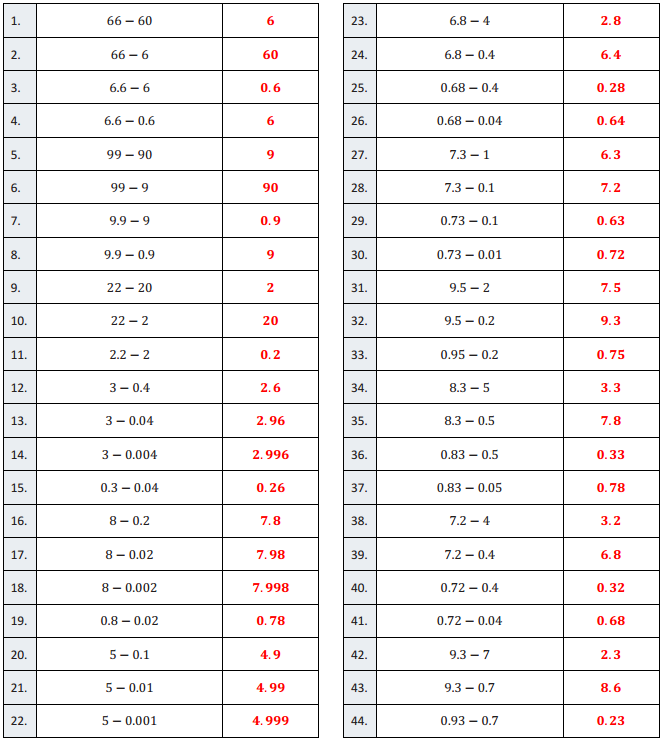
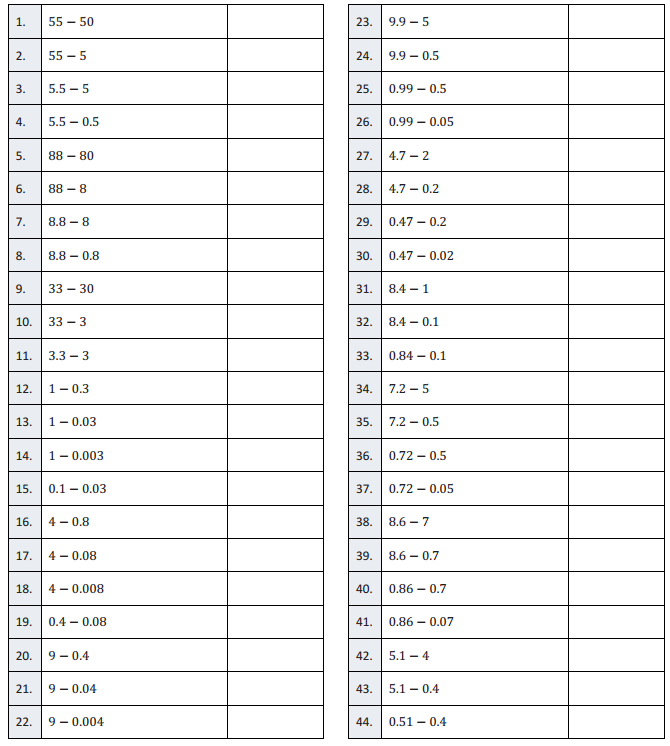
Eureka Math Grade 6 Module 4 Lesson 30 Subtraction of Decimals Answer Key

Subtraction of Decimals – Round 1:

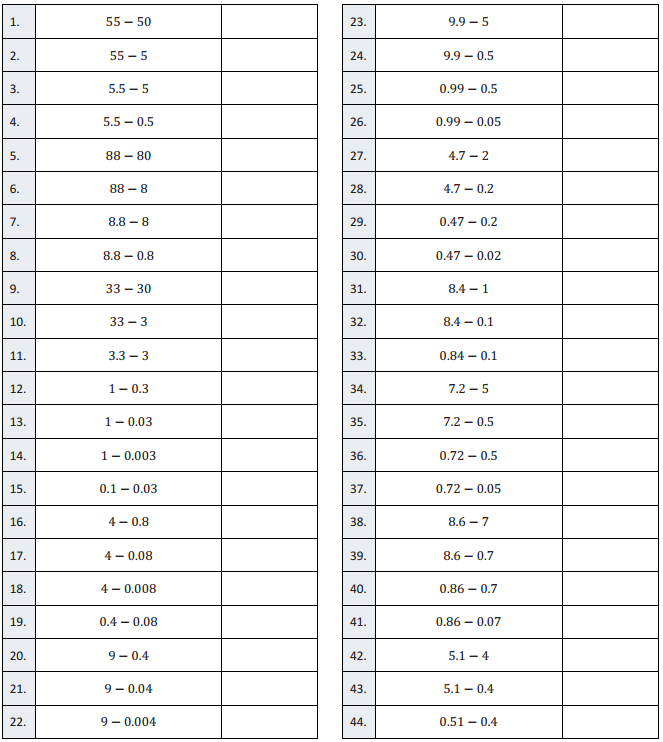
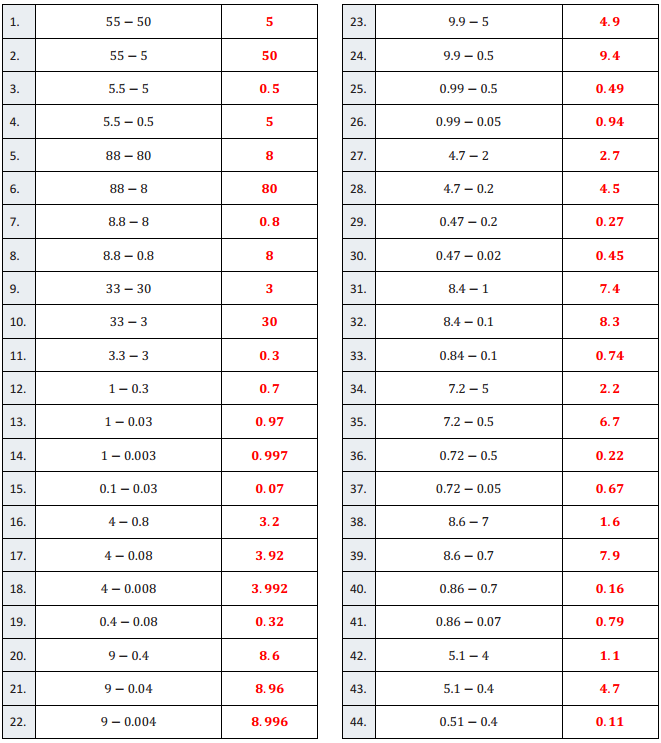
Directions: Evaluate each expression.

Eureka Math Grade 6 Module 4 Lesson 30 Subtraction of Decimals Answer Key 21

Eureka Math Grade 6 Module 4 Lesson 30 Subtraction of Decimals Answer Key 22

Question 1.
55 – 50
Answer:
5

Question 2.
55 – 5
Answer:
50

Question 3.
5.5 – 5
Answer:
0.5

Question 4.
5.5 – 0.5
Answer:
5.0

Question 5.
88 – 80
Answer:
8

Question 6.
88 – 8
Answer:
80

Question 7.
8.8 – 8
Answer:
0.8

Question 8.
8.8 – 0.8
Answer:
8

Question 9.
33 – 30
Answer:
3

Question 10.
33 – 3
Answer:
30

Question 11.
3.3 – 3
Answer:
0.3

Question 12.
1 – 0.3
Answer:
0.7

Question 13.
1 – 0.03
Answer:
0.97

Question 14.
1 – 0.003
Answer:
0.997

Question 15.
0.1 – 0.03
Answer:
0.07

Question 16.
4 – 0.8
Answer:
3.2

Question 17.
4 – 0.08
Answer:
3.92

Question 18.
4 – 0.008
Answer:
3.992

Question 19.
0.4 – 0.08
Answer:
0.32

Question 20.
9 – 0.4
Answer:
8.6

Question 21.
9 – 0.04
Answer:
8.96

Question 22.
9 – 0.004
Answer:
8.996

Question 23.
9.9 – 5
Answer:
4.9

Question 24.
9.9 – 0.5
Answer:
9.4

Question 25.
0.99 – 0.5
Answer:
0.49

Question 26.
0.99 – 0.05
Answer:
0.94

Question 27.
4.7-2
Answer:

Question 28.
4.7 – 0.2
Answer:
4.5

Question 29.
0.47 – 0.2
Answer:
0.27

Question 30.
0.47 – 0.02
Answer:
0.45

Question 31.
8.4 – 1
Answer:
7.4

Question 32.
8.4 – 0.1
Answer:
8.3

Question 33.
0.84 – 0.1
Answer:
0.83

Question 34.
7.2 – 5
Answer:
5.2

Question 35.
7.2 – 0.5
Answer:
6.7

Question 36.
0.72 – 0.5
Answer:
0.22

Question 37.
0.72 – 0.05
Answer:
0.67

Question 38.
8.6 – 7
Answer:
1.6

Question 39.
8.6 – 0.7
Answer:
7.9

Question 40.
0.86 – 0.7
Answer:
0.16

Question 41.
0.86 – 0.07
Answer:
0.79

Question 42.
5.1 – 4
Answer:
1.1

Question 43.
5.1 – 4.7
0.4
Answer:

Question 44.
0.51 – 0.4
Answer:
0.11

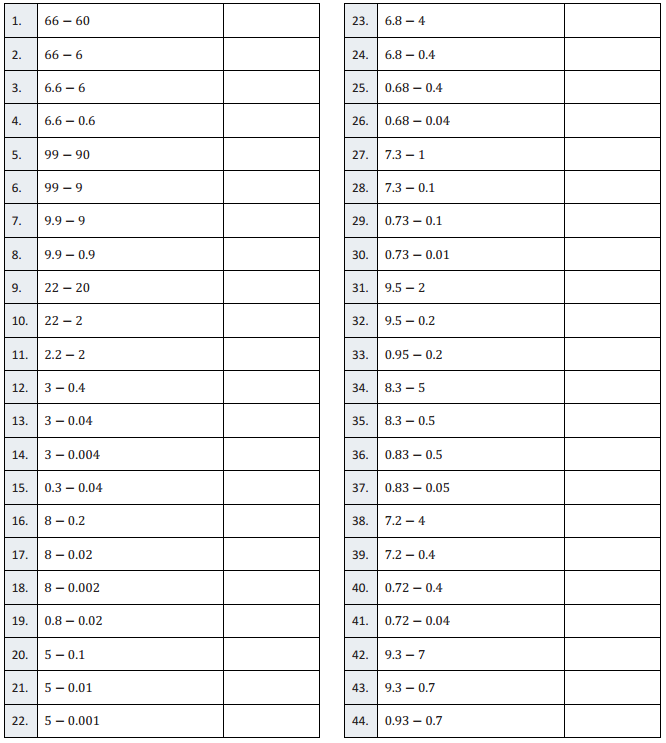
Subtraction of Decimals-Round 2:

Directions: Evaluate each expression:

Eureka Math Grade 6 Module 4 Lesson 30 Subtraction of Decimals Answer Key 23

Eureka Math Grade 6 Module 4 Lesson 30 Subtraction of Decimals Answer Key 24

Question 1.
66 – 60
Answer:
6

Question 2.
66 – 6
Answer:
60

Question 3.
6.6 – 6
Answer:
0.6

Question 4.
6.6 – 0.6
Answer:
6

Question 5.
99 – 90
Answer:
9

Question 6.
99 – 9
Answer:
90

Question 7.
9.9 – 9
Answer:
0.9

Question 8.
9.9 – 0.9
Answer:
9

Question 9.
22 – 20
Answer:
2

Question 10.
22 – 2
Answer:
20

Question 11.
2.2 – 2
Answer:
0.2

Question 12.
3 – 0.4
Answer:
2.6

Question 13.
3 – 0.04
Answer:
2.96

Question 14.
3 – 0.004
Answer:
2.996

Question 15.
0.3 – 0.04
Answer:
0.26

Question 16.
8 – 0.2
Answer:
7.8

Question 17.
8 – 0.02
Answer:
7.98

Question 18.
8 – 0.002
Answer:
7.998

Question 19.
0.8 – 0.02
Answer:
0.78

Question 20.
5 – 0.1
Answer:
4.9

Question 21.
5 – 0.01
Answer:
4.99

Question 22.
5 – 0.001
Answer:
4.999

Question 23.
6.8 – 4
Answer:
2.8

Question 24.
6.8 – 0.4
Answer:
6.4

Question 25.
0.68 – 0.4
Answer:
0.28

Question 26.
0.68 – 0.04
Answer:
0.64

Question 27.
7.3 – 1
Answer:
6.3

Question 28.
7.3 – 0.1
Answer:
7.2

Question 29.
0.73 – 0.1
Answer:
0.63

Question 30.
0.73 – 0.01
Answer:
0.72

Question 31.
9.5 – 2
Answer:
7.5

Question 32.
9.5 – 0.2
Answer:
9.3

Question 33.
0.95 – 0.2
Answer:
0.75

Question 34.
8.3 – 5
Answer:
3.3

Question 35.
8.3 – 0.5
Answer:
7.8

Question 36.
0.83 – 0.5
Answer:
0.33

Question 37.
0.83 – 0.05
Answer:
0.78

Question 38.
7.2 – 4
Answer:
3.2

Question 39.
7.2 – 0.4
Answer:
6.8

Question 40.
0.72 – 0.4
Answer:
0.32

Question 41.
0.72 – 0.04
Answer:
0.68

Question 42.
9.3 – 7
Answer:
2.3

Question 43.
9.3 – 0.7
Answer:
8.6

Question 44.
0.93 – 0.7
Answer:
0.23

Eureka Math Grade 6 Module 4 Lesson 31 Answer Key

Engage NY Eureka Math Grade 6 Module 4 Lesson 31 Answer Key

Eureka Math Grade 6 Module 4 Lesson 31 Example Answer Key

Example 1:

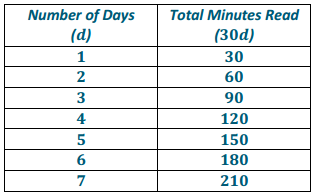
Marcus reads for 30 minutes each night. He wants to determine the total number of minutes he will read over the course of a month. He wrote the equation t = 30d to represent the total amount of time that he has spent reading, where t represents the total number of minutes read and d represents the number of days that he read during the month. Determine which variable is independent and which is dependent. Then, create a table to show how many minutes he has read in the first seven days.
Independent Variable: ________
Dependent Variable: _________

Eureka Math Grade 6 Module 4 Lesson 31 Example Answer Key 1
Answer:
Independent Variable: Number of days
Dependent Variable: Total minutes read

Eureka Math Grade 6 Module 4 Lesson 31 Example Answer Key 3

Example 2:

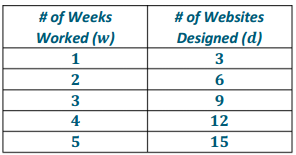
Kira designs websites. She can create three different websites each week. Kira wants to create an equation that will give her the total number of websites she can design given the number of weeks she works. Determine the independent and dependent variables. Create a table to show the number of websites she can design over the first 5 weeks. Finally, write an equation to represent the number of websites she can design when given any number of weeks.
Independent Variable: ________
Dependent Variable: _________
Equation: _______

Eureka Math Grade 6 Module 4 Lesson 31 Example Answer Key 4
Answer:
Independent variable: # of weeks worked Worked (w)
Dependent variable: # of websites designed

Eureka Math Grade 6 Module 4 Lesson 31 Example Answer Key 2
Equation d = 3w, where w is the number of weeks worked and d is the number of websites designed.

Example 3:

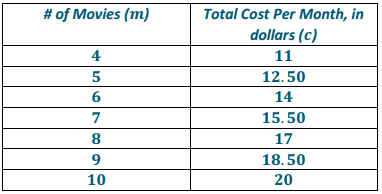
Priya streams movies through a company that charges her a $5 monthly fee plus $1. 50 per movie. Determine the independent and dependent variables, write an equation to model the situation, and create a table to show the total cost per month given that she might stream between 4 and 10 movies in a month.
Independent Variable: ________
Dependent Variable: _________
Equation: _______

Eureka Math Grade 6 Module 4 Lesson 31 Example Answer Key 5
Answer:
Independent variable: # of movies watched per month
Dependent variable: Total cost per month, in dollars
Equation: c = 1.5m + 5 or c = 1.50m + 5

Eureka Math Grade 6 Module 4 Lesson 31 Example Answer Key 6

Eureka Math Grade 6 Module 4 Lesson 31 Exercise Answer Key

Exercises:

Exercise 1.
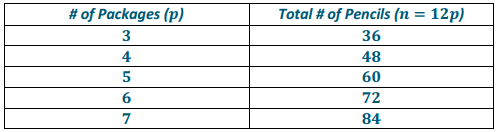
Sarah is purchasing pencils to share. Each package has 12 pencils. The equation n = 12p, where n is the total number of pencils and p is the number of packages, can be used to determine the total number of pencils Sarah purchased. Determine which variable is dependent and which is independent. Then, make a table showing the number of pencils purchased for 3 – 7 packages.

Eureka Math Grade 6 Module 4 Lesson 31 Exercise Answer Key 7
Answer:
The number of packages, p, is the independent variable.
The total number of pencils, n, is the dependent variable.

Eureka Math Grade 6 Module 4 Lesson 31 Exercise Answer Key 8

Exercise 2.
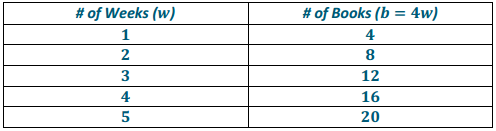
Charlotte reads 4 books each week. Let b be the number of books she reads each week, and let w be the number of weeks that she reads. Determine which variable is dependent and which is independent. Then, write an equation to model the situation, and make a table that shows the number of books read in under 6 weeks.

Eureka Math Grade 6 Module 4 Lesson 31 Exercise Answer Key 9
Answer:
The number of weeks, w, is the independent variable.
The number of books, b, is the dependent variable.
b = 4w

Eureka Math Grade 6 Module 4 Lesson 31 Exercise Answer Key 10

Exercise 3.
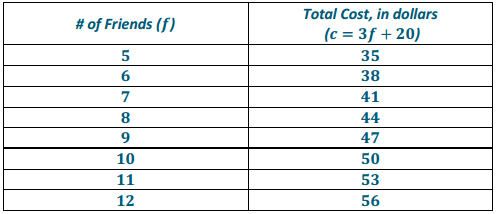
A miniature golf course has a special group rate. You can pay $20 plus $3 per person when you have a group of 5 or more friends. Let f be the number of friends and c be the total cost. Determine which variable is independent and which is dependent, and write an equation that models the situation. Then, make a table to show the cost for 5 to 12 friends.

Eureka Math Grade 6 Module 4 Lesson 31 Exercise Answer Key 11
Answer:
The number of friends, f, is the independent variable.
The total cost in dollars, c, is the dependent variable.
c = 3f +20

Eureka Math Grade 6 Module 4 Lesson 31 Exercise Answer Key 12

Exercise 4.
Carlos is shopping for school supplies. He bought a pencil box for $3, and he also needs to buy notebooks. Each notebook is $2. Let t represent the total cost of the supplies and n be the number of notebooks Carlos buys. Determine which variable is independent and which is dependent, and write an equation that models the situation. Then, make a table to show the cost for 1 to 5 notebooks.

Eureka Math Grade 6 Module 4 Lesson 31 Exercise Answer Key 13
Answer:
The total number of notebooks, n, is the independent variable.
The total cost in dollars, t, is the dependent variable.
t = 2n + 3

Eureka Math Grade 6 Module 4 Lesson 31 Exercise Answer Key 14

Eureka Math Grade 6 Module 4 Lesson 31 Problem Set Answer Key

Question 1.
Jazlyah sells 3 houses each month. To determine the number of houses she can sell in any given number of months, she uses the equation t = 3m, where t is the total number of houses sold and m is the number of months. Name the independent and dependent variables. Then, create a table to show how many houses she sells in fewer than 6 months.

Eureka Math Grade 6 Module 4 Lesson 31 Problem Set Answer Key 15
Answer:
The independent variable is the number of months. The dependent variable is the total number of houses sold.

Eureka Math Grade 6 Module 4 Lesson 31 Problem Set Answer Key 16

Question 2.
Joshua spends 25 minutes of each day reading. Let d be the number of days that he reads, and let m represent the total minutes of reading. Determine which variable is independent and which is dependent. Then, write an equation that models the situation. Make a table showing the number of minutes spent reading over 7 days.

Eureka Math Grade 6 Module 4 Lesson 31 Problem Set Answer Key 17
Answer:
The number of days, d, is the independent variable.
The total number of minutes of reading, m, is the dependent variable.
m = 25d

Eureka Math Grade 6 Module 4 Lesson 31 Problem Set Answer Key 18

Question 3.
Each package of hot dog buns contains 8 buns. Let p be the number of packages of hot dog buns and b be the total number of buns. Determine which variable is independent and which is dependent. Then, write an equation that models the situation, and make a table showing the number of hot dog buns in 3 to 8 packages.

Eureka Math Grade 6 Module 4 Lesson 31 Problem Set Answer Key 19
Answer:
The number of packages, p, is the independent variable.
The total number of hot dog buns, b, is the dependent variable.
b = 8p

Eureka Math Grade 6 Module 4 Lesson 31 Problem Set Answer Key 20

Question 4.
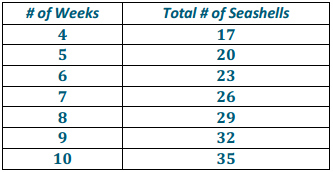
Emma was given 5 seashells. Each week she collected 3 more. Let w be the number of weeks Emma collects seashells and s be the number of seashells she has total. Which variable is independent, and which is dependent? Write an equation to model the relationship, and make a table to show how many seashells she has from week 4 to week 10.

Eureka Math Grade 6 Module 4 Lesson 31 Problem Set Answer Key 21
Answer:
The number of weeks, w, is the independent variable.
The total number of seashells, s, is the dependent variable.
s = 3w + 5

Eureka Math Grade 6 Module 4 Lesson 31 Problem Set Answer Key 22

Question 5.
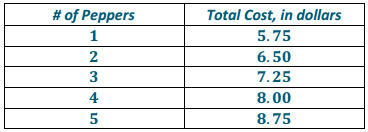
Emilia is shopping for fresh produce at a farmers market. She bought a watermelon for $5, and she also wants to buy peppers. Each pepper is $0. 75. Let t represent the total cost of the produce and n be the number of peppers bought. Determine which variable Is independent and which is dependent, and write an equation that models the situation. Then, make a table to show the cost for 1 to 5 peppers.

Eureka Math Grade 6 Module 4 Lesson 31 Problem Set Answer Key 23
Answer:
The number of peppers, n, is the independent variable.
The total cost in dollars, t, is the dependent variable.
t = 0.75n + 5

Eureka Math Grade 6 Module 4 Lesson 31 Problem Set Answer Key 24

Question 6.
A taxicab service charges a flat fee of $7 plus an additional $1.25 per mile driven. Show the relationship between the total cost and the number of miles driven. Which variable is independent, and which is dependent? Write an equation to model the relationship, and make a table to show the cost of 4 to 10 miles.

Eureka Math Grade 6 Module 4 Lesson 31 Problem Set Answer Key 25
Answer:
The number of miles driven, m, is the independent variable.
The total cost in dollars, c, is the dependent variable.
c = 125m + 7

Eureka Math Grade 6 Module 4 Lesson 31 Problem Set Answer Key 26

Eureka Math Grade 6 Module 4 Lesson 31 Exit Ticket Answer Key

For each problem, determine the independent and dependent variables, write an equation to represent the situation, and then make a table with at least 5 values that models the situation.

Question 1.
Kyla spends 60 minutes of each day exercising. Let d be the number of days that Kyla exercises, and let m represent the total minutes of exercise in a given time frame. Show the relationship between the number of days that Kyla exercises and the total minutes that she exercises.
Independent variable: _______
Dependent variable: ________
Equation: _______

Eureka Math Grade 6 Module 4 Lesson 31 Exit Ticket Answer Key 27
Answer:
Tables may vary.
Independent variable: Number of Days
Dependent variable: Total Number of Minutes
Equation: m = 60d

Eureka Math Grade 6 Module 4 Lesson 31 Exit Ticket Answer Key 28

Question 2.
A taxicab service charges a flat fee of $8 plus an additional $1.50 per mile. Show the relationship between the total cost and the number of miles driven.
Independent variable: _______
Dependent variable: ________
Equation: _______

Eureka Math Grade 6 Module 4 Lesson 31 Exit Ticket Answer Key 29
Answer:
Tables may vary.
Independent variable: Number of miles
Dependent variable: Total cost, in dollars
Equation: c = 1.50m + 8

Eureka Math Grade 6 Module 4 Lesson 31 Exit Ticket Answer Key 30

Eureka Math Grade 6 Module 4 Lesson 32 Answer Key

Engage NY Eureka Math Grade 6 Module 4 Lesson 32 Answer Key

Eureka Math Grade 6 Module 4 Lesson 32 Opening Exercise Answer Key

Opening Exercise:

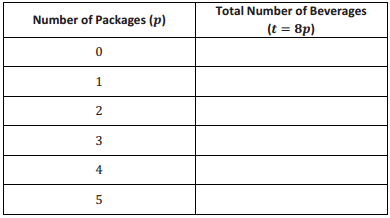
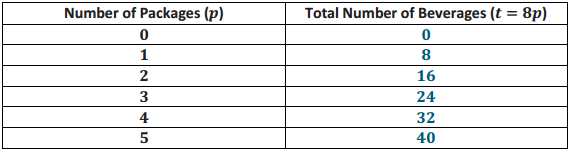
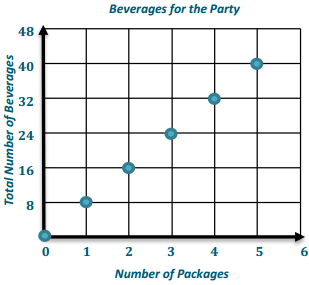
Xin is buying beverages for a party that comes in packs of 8. Let p be the number of packages Xin buys and t be the total number of beverages. The equation t = 8p can be used to calculate the total number of beverages when the number of packages is known. Determine the independent and dependent variables in this scenario. Then, make a table using whole number values of p less than 6.

Eureka Math Grade 6 Module 4 Lesson 32 Opening Exercise Answer Key 1

Answer:
The total number of beverages is the dependent variable because the total number of beverages depends on the number of packages purchased. Therefore, the independent variable is the number of packages purchased.

Eureka Math Grade 6 Module 4 Lesson 32 Opening Exercise Answer Key 2

Eureka Math Grade 6 Module 4 Lesson 32 Example Answer Key

Example 1:

Make a graph for the table in the Opening Exercise.

Eureka Math Grade 6 Module 4 Lesson 32 Example Answer Key 3

Answer:

Eureka Math Grade 6 Module 4 Lesson 32 Example Answer Key 4

→ To make a graph, we must determine which variable is measured along the horizontal axis and which variable is measured along the vertical axis.

→ Generally, the independent variable is measured along the x-axis. Which axis is the x-axis?
The x-axis is the horizontal axis.

→ Where would you put the dependent variable?
On the y-axis. It travels vertically, or up and down.

→ We want to show how the number of beverages changes when the number of packages changes. To check that you have set up your graph correctly, try making a sentence out of the labels on the axes. Write your sentence using the label from the y-axis first followed by the label from the x-axis. The total number of beverages depends on the number of packages purchased.

Example 2:

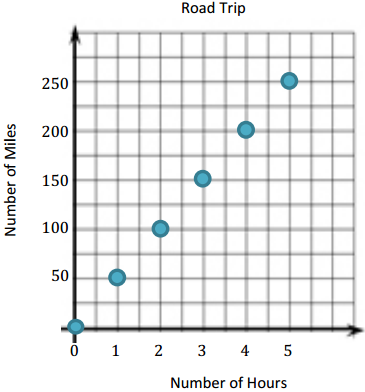
Use the graph to determine which variable is the independent variable and which is the dependent variable. Then, state the relationship between the quantities represented by the variables.

Eureka Math Grade 6 Module 4 Lesson 32 Example Answer Key 5

Answer:
The number of miles driven depends on how many hours they drive. Therefore, the number of miles driven is the dependent variable, and the number of hours is the independent variable. This graph shows that they can travel 50 miles every hour. So, the total number of miles driven increases by 50 every time the number of hours increases by 1.

Eureka Math Grade 6 Module 4 Lesson 32 Exercise Answer Key

Exercises:

Exercise 1.
Each week Quentin earns $30. If he saves this money, create a graph that shows the total amount of money Quentin has saved from week 1 through week 8. Write an equation that represents the relationship between the number of weeks that Quentin has saved his money, w, and the total amount of money in dollars that he has saved, s. Then, name the independent and dependent variables. Write a sentence that shows this relationship.

Eureka Math Grade 6 Module 4 Lesson 32 Exercise Answer Key 7

Eureka Math Grade 6 Module 4 Lesson 32 Exercise Answer Key 8

Answer:
s = 30w
The amount of money sowed in dollars, s, is the dependent variable, and the number of weeks, w, is the independent variable.

Eureka Math Grade 6 Module 4 Lesson 32 Exercise Answer Key 9

Eureka Math Grade 6 Module 4 Lesson 32 Exercise Answer Key 10
Therefore, the amount of money Quentin has saved increases by $30 for every week he saves money.

Exercise 2.
Zoe is collecting books to donate. She started with 3 books and collects two more each week. She is using the equation b = 2w + 3, where b is the total number of books collected and w is the number of weeks she has been collecting books. Name the independent and dependent variables. Then, create a graph to represent how many books Zoe has collected when w is 5 or less.

Eureka Math Grade 6 Module 4 Lesson 32 Exercise Answer Key 11

Eureka Math Grade 6 Module 4 Lesson 32 Exercise Answer Key 12

Answer:
The number of weeks is the independent variable. The number of books collected is the dependent variable.

Eureka Math Grade 6 Module 4 Lesson 32 Exercise Answer Key 13

Eureka Math Grade 6 Module 4 Lesson 32 Exercise Answer Key 14

Exercise 3.
Eliana plans to visit the fair. She must pay $5 to enter the fairgrounds and an additional $3 per ride. Write an equation to show the relationship between r, the number of rides, and t, the total cost in dollars. State which variable is dependent and which is independent. Then, create a graph that models the equation.
Eureka Math Grade 6 Module 4 Lesson 32 Exercise Answer Key 15

Eureka Math Grade 6 Module 4 Lesson 32 Exercise Answer Key 16

Answer:
t = 3r + 5
The number of rides is the independent variable, and the total cost in dollars, is the dependent variable.

Eureka Math Grade 6 Module 4 Lesson 32 Exercise Answer Key 17

Eureka Math Grade 6 Module 4 Lesson 32 Exercise Answer Key 18

Eureka Math Grade 6 Module 4 Lesson 32 Problem Set Answer Key

Question 1.
Caleb started saving money in a cookie jar. He started with $25. He adds $10 to the cookie jar each week. Write an equation where w is the number of weeks Caleb saves his money and t is the total amount in dollars in the cookie jar. Determine which variable is the independent variable and which is the dependent variable. Then, graph the total amount in the cookie jar for w being less than 6 weeks.
Eureka Math Grade 6 Module 4 Lesson 32 Problem Set Answer Key 19

Eureka Math Grade 6 Module 4 Lesson 32 Problem Set Answer Key 20

Answer:
t = 10w + 25
The total amount, t, is the dependent variable.
The number of weeks, w, is the independent variable.

Eureka Math Grade 6 Module 4 Lesson 32 Problem Set Answer Key 21

Eureka Math Grade 6 Module 4 Lesson 32 Problem Set Answer Key 22

Question 2.
Kevin is taking a taxi from the airport to his home. There is a $6 flat fee for riding In the taxi. In addition, Kevin must also pay $1 per mile. Write an equation where m is the number of miles and t is the total cost in dollars of the taxi ride. Determine which variable is independent and which is dependent. Then, graph the total cost for m being less than 6 miles.
Eureka Math Grade 6 Module 4 Lesson 32 Problem Set Answer Key 23

Eureka Math Grade 6 Module 4 Lesson 32 Problem Set Answer Key 24

Answer:
t = 1m + 6
The total cost in dollars, t, is the dependent variable.
The number of miles, m, is the Independent variable.

Eureka Math Grade 6 Module 4 Lesson 32 Problem Set Answer Key 25

Eureka Math Grade 6 Module 4 Lesson 32 Problem Set Answer Key 26

Question 3.
Anna started with $10. She saved an additional $5 each week. Write an equation that can be used to determine the total amount saved in dollars, t, after a given number of weeks, w. Determine which variable Is independent and which is dependent. Then, graph the total amount saved for the first 8 weeks.

Eureka Math Grade 6 Module 4 Lesson 32 Problem Set Answer Key 27

Eureka Math Grade 6 Module 4 Lesson 32 Problem Set Answer Key 28
Answer:
t = 5w + 10
The total amount saved in dollars, t, is the dependent variable.
The number of weeks, w, is the independent variable.

Eureka Math Grade 6 Module 4 Lesson 32 Problem Set Answer Key 29

Eureka Math Grade 6 Module 4 Lesson 32 Problem Set Answer Key 30

Question 4.
Aliyah is purchasing produce at the farmers’ market. She plans to buy $10 worth of potatoes and some apples. The apples cost $1. 50 per pound. Write an equation to show the total cost of the produce, where T is the total cost, in dollars, and a is the number of pounds of apples. Determine which variable is dependent and which is independent. Then, graph the equation on the coordinate plane.

Eureka Math Grade 6 Module 4 Lesson 32 Problem Set Answer Key 31

Eureka Math Grade 6 Module 4 Lesson 32 Problem Set Answer Key 32
Answer:
T = 1.50a + 10
The total cost in dollars is the dependent variable. The number of pounds of apples is the independent variable.

Eureka Math Grade 6 Module 4 Lesson 32 Problem Set Answer Key 33

Eureka Math Grade 6 Module 4 Lesson 32 Problem Set Answer Key 34

Eureka Math Grade 6 Module 4 Lesson 32 Exit Ticket Answer Key

Question 1.
Determine which variable is the independent variable and which variable is the dependent variable. Write an equation, make a table, and plot the points from the table on the graph. Enoch can type 40 words per minute. Let w be the number of words typed and m be the number of minutes spent typing.

Eureka Math Grade 6 Module 4 Lesson 32 Exit Ticket Answer Key 35

Eureka Math Grade 6 Module 4 Lesson 32 Exit Ticket Answer Key 36

Answer:
The independent variable is the number of minutes spent typing. The dependent variable is the number of words typed. The equation is w = 40m.

Eureka Math Grade 6 Module 4 Lesson 32 Exit Ticket Answer Key 37

Eureka Math Grade 6 Module 4 Lesson 32 Exit Ticket Answer Key 38

Eureka Math Grade 6 Module 4 Lesson 33 Answer Key

Engage NY Eureka Math Grade 6 Module 4 Lesson 33 Answer Key

Eureka Math Grade 6 Module 4 Lesson 33 Example Answer Key

Example 1:
What value(s) does the variable have to represent for the equation or inequality to result in a true number sentence? What value(s) does the variable have to represent for the equation or inequality to result in a false number sentence?

a. y + 6 = 16
Answer:
The number sentence is true when y is 10. The sentence is false when y is any number other than 10.


b. y + 6 > 16

Answer:
The number sentence is true when y is any number greater than 10. The sentence is false when y is 10 or any number less than 10.
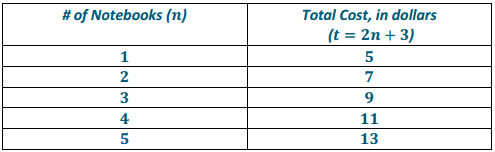
c. y + 6 ≥ 16
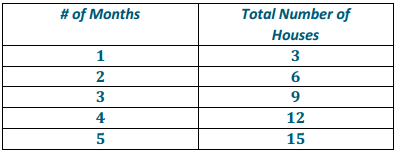
Answer:
The number sentence is true when y is 10 or any number greater than 10. The sentence is fake when y is a number less than 10.

d. 3g = 15
Answer:
The number sentence is true when g is 5. The number sentence is false when g is any number other than 5.

e. 3g < 15
Answer:
The number sentence is true when g is any number less than 5. The number sentence is false when g is 5 or any number greater than 5.

f. 3g ≤ 15
Answer:
The number sentence is true when g is 5 or any number less than 5. The number sentence is false when g is any number greater than 5.

Example 2:
Which of the following number(s), if any, make the equation or inequality true: (0, 3, 5, 8, 10, 14)?

a. m + 4 = 12
Answer:
m = 8 or (8)

b. m + 4 < 12
Answer:
(0, 3, 5)

→ How does the answer to part (a) compare to the answer to part (b)?
In part (a), 8 is the only number that will result in a true number sentence. But in part (b), any number in the set that is less than 8 will make the number sentence true.

c. f – 4 = 2
Answer:
None of the numbers in the set will result in a true number sentence.

d. f – 4 > 2
Answer:
(8, 10, 14)

→ Is there a number that we could include in the set so that part (c) will have a solution?
Yes. The number 6 will make the equation in part (c) true.

→ Would 6 be part of the solution set in part (d)?
No. The 6 would not make port (d) a true number sentence because 6 – 4 is not greater than 2.

→ How could we change part (d) so that 6 would be part of the solution?
Answers will vary; If the > was changed to a ≥, we could include 6 in the solution set.

e. \(\frac{1}{2}\)h = 8
Answer:
None of the numbers in the set will result in a true number sentence.

f. \(\frac{1}{2}\)h ≥ 8
Answer:
None of the numbers in the set will result in a true number sentence.

→ Which whole numbers, if any, make the inequality in part (f) true?
Answers will vary; 16 and any number greater than 16 will make the number sentence true.

Eureka Math Grade 6 Module 4 Lesson 33 Exercise Answer Key

Exercises:

Choose the number(s), if any, that make the equation or inequality true from the following set of numbers: (0, 1, 5, 8, 11, 17).

Exercise 1.
m + 5 = 6
Answer:
m= 1 or {1)

Exercise 2.
m + 5 ≤ 6
Answer:
(0, 1)

Exercise 3.
5h = 40
Answer:
h = 8 or (8)

Exercise 4.
5h > 40
Answer:
(11, 17)

Exercise 5.
\(\frac{1}{2}\)y = 5
Answer:
There is no solution in the set.

Exercise 6.
\(\frac{1}{2}\)y ≤ 5
Answer:
(0, 1, 5, 8)

Exercise 7.
k – 3 = 20
Answer:
There is no solution in the set.

Exercise 8.
k – 3 > 20
Answer:
There is no solution in the set.

Eureka Math Grade 6 Module 4 Lesson 33 Problem Set Answer Key

Choose the number(s), if any, that make the equation or inequality true from the following set of numbers: (0, 3, 4, 5, 9, 13, 18, 24).

Question 1.
h – 8 = 5
Answer:
h = 13 or (13)

Question 2.
h – 8 < 5
Answer:
(0, 3, 4, 5, 9)

Question 3.
4g = 36
Answer:
g = 9 or (9)

Question 4.
4g ≥ 36
Answer:
(9, 13, 18, 24)

Question 5.
\(\frac{1}{4}\)y = 7
Answer:
There is no number in the set that will make this equation true.

Question 6.
\(\frac{1}{4}\)y > 7
Answer:
There is no number in the set that will make this inequality true.

Question 7.
m – 3 = 10
Answer:
m = 13 or (13)

Question 8.
m – 3 ≤ 10
Answer:
{0, 3, 4, 5, 9, 13}

Eureka Math Grade 6 Module 4 Lesson 33 Exit Ticket Answer Key

Choose the number(s), if any, that make the equation or inequality true from the following set of numbers: {3,4, 7, 9, 12, 18, 32).

Question 1.
\(\frac{1}{3}\)f = 4
Answer:
f = 12 or {12}

Question 2.
\(\frac{1}{3}\)f < 4
Answer:
{3, 4, 7, 9)

Question 3.
m + 7 = 20
Answer:
There is no number in the set that will make this equation true.

Question 4.
m + 7 ≥ 20
Answer:
{18, 32}

Eureka Math Grade 6 Module 4 Lesson 19 Answer Key

Engage NY Eureka Math 6th Grade Module 4 Lesson 19 Answer Key

Eureka Math Grade 6 Module 4 Lesson 19 Example Answer Key

Example 1.

My Age (in years)My Sister’s
02
13
24
35
46

Answer:

My Age (in years)My Sister’s
02
13
24
35
46
YY + 2

a. What if you don’t know how old I am? Let’s use a variable for my age. Let Y = my age In years. Can you
develop an expression to describe how old my sister is?
Answer:
Your sister is Y + 2 years old.

b. Please add that to the last row of the table.
Answer:
My age is Y years. My sister is Y + 2 years old. So, no matter what my age is (or was), my sister’s age in years will always be two years greater than mine.

Example 2.

My Age (in years)My Sister’s
02
13
24
35
46

Answer:

My Age (in years)My Sister’s
02
13
24
35
46
G – 2G

a. How old was I when my sister was 6 years old?
Answer:
4 years old

b. How old was I when my sister was 15 years old?
Answer:
13 years old

c. How do you know?
Answer:
My age is always 2 years less than my sister’s age.

d. Look at the table in Example 2. If you know my sister’s age, can you determine my age?
Answer:
We can subtract two from your sister’s age, and that will equal your age.

e. If we use the variable G for my sister’s age in years, what expression would describe my age in years?
Answer:
G – 2

f. Fill in the last row of the table with the expressions.
Answer:
My age is G – 2 years. My sister is G years old.

g. With a partner, calculate how old I was when my sister was 22, 23, and 24 years old.
Answer:
You were 20, 21, and 22 years old, respectively.

Eureka Math Grade 6 Module 4 Lesson 19 Exercise Answer Key

Exercise 1.
Noah and Carter are collecting box tops for their school. They each bring in 1 box top per day starting on the first day of school. However, Carter had a head start because his aunt sent him 15 box tops before school began. Noah’s grandma saved 10 box tops, and Noah added those on his first day.
a. Fill in the missing values that indicate the total number of box tops each boy brought to school.

Shool dayNumber of Box Tops Noah HasNumber of Box Tops Carter Has
11116
2
3
4
5

Answer:

Shool dayNumber of Box Tops Noah HasNumber of Box Tops Carter Has
11116
21217
31318
41419
51520

b. If we let D be the number of days since the new school year began, on day D of school, how many box tops will Noah have brought to school?
Answer:
D + 10 box tops

c. On day D of school, how many box tops will Carter have brought to school?
Answer:
D + 15 box tops

d. On day 10 of school, how many box tops will Noah have brought to school?
Answer:
10 + 10 = 20; On day 10, Noah would have brought in 20 box tops.

e. On day 10 of school, how many box tops will Carter have brought to school?
Answer:
10 + 15 = 25; on day 10, Carter would have brought in 25 box tops.

Exercise 2.
Each week the Primary School recycles 200 pounds of paper. The Intermediate School also recycles the same amount but had another 300 pounds left over from summer school. The Intermediate School custodian added this extra 300 pounds to the first recycle week.
a. Number the weeks, and record the amount of paper recycled by both schools.
Eureka Math Grade 6 Module 4 Lesson 19 Exercise Answer Key 1
Answer:

WeekTotal Amount of Paper Recycled by the Primary School This School Year in PoundsTotal Amount of Paper Recycled by the Intermediate School This School Year in Pounds
1200500
2400700
3600900
48001,100
51,0001,300

b. If this trend continues, what will be the total amount collected for each school on Week 10?
Answer:
The Primary School will have collected 2,000 pounds. The Intermediate School will have collected 2,300 pounds.

Exercise 3.
Shelly and Kristen share a birthday, but Shelly is 5 years older.
a. Make a table showing their ages every year, beginning when Kristen was born.
Eureka Math Grade 6 Module 4 Lesson 19 Exercise Answer Key 2
Answer:

Kristen’s Age (in years)Shelly’s Age (in years)
05
16
27
38

b. If Kristen is 16 years old, how old is Shelly?
Answer:
If Kristen is 16 years old, Shelly is 21 years old.

c. If Kristen is K years old, how old is Shelly?
Answer:
If Kristen is K years old, Shelly is K + 5 years old.

d. If Shelly is S years old, how old is Kristen?
Answer:
If Shelly is S years old, Kristen is S – 5 years old.

Eureka Math Grade 6 Module 4 Lesson 19 Problem Set Answer Key

Question 1.
Suellen and Tara are in sixth grade, and both take dance lessons at Twinkle Toes Dance Studio. This Is Suellen’s first year, while this is Tara’s fifth year of dance lessons. Both girls plan to continue taking lessons throughout high school.
a. Complete the table showing the number of years the girls will have danced at the studio.

GradeSuellen’s Years of Experience DancingTara’s Years of Experience Dancing
Sixth
Seventh
Eighth
Ninth
Tenth
Eleventh
Twelfth

Answer:

GradeSuellen’s Years of Experience DancingTara’s Years of Experience Dancing
Sixth15
Seventh26
Eighth37
Ninth48
Tenth59
Eleventh610
Twelfth711

b. If Suellen has been taking dance lessons for Y years, how many years has Tara been taking lessons?
Answer:
Tara has been taking dance lessons for Y + 4 years.

Question 2.
Daejoy and Damian collect fossils. Before they went on a fossil-hunting trip, Daejoy had 25 fossils in her collection, and Damian had 16 fossils In his collection. On a 10-day fossil-hunting trIp, they each collected 2 new fossils each day.
a. Make a table showing how many fossils each person had In their collection at the end of each day.
Eureka Math Grade 6 Module 4 Lesson 19 Problem Set Answer Key 3
Answer:

DayNumber of Fossils in Daejoy’s CollectionNumber of Fossils in Damian’s Collection
12718
22920
33122
43324
53526
63728
73930
84132
94334
104536

b. If this pattern of fossil finding continues, how many fossils does Damian have when Daejoy has F fossils?
Answer:
When Daejoy has F fossils, Damian has F – 9 fossils.

c. If this pattern of fossil finding continues, how many fossils does Damian have when Daejoy has 55 fossils?
Answer:
55 – 9 = 46
When Daejoy has 55 fossils, Damian has 46 fossils.

Question 3.
A train consists of three types of cars: box cars, an engine, and a caboose. The relationship among the types of cars is demonstrated in the table below.

Number of Box CarsNumber of cars in the Train
02
13
24
1012
100102

a. Tom wrote an expression for the relationship depicted in the table as B + 2. Theresa wrote an expression for the same relationship as C – 2. Is It possible to have two different expressions to represent one relationship? Explain.
Answer:
Both expressions can represent the same relationship, depending on the point of view. The expression B + 2 represents the number of box cars plus an engine and a caboose. The expression C – 2 represents the whole car length of the train, less the engine and caboose.

b. What do you think the variable in each student’s expression represents? How would you define them?
Answer:
The variable C would represent the total cars in the train. The variable B would represent the number of box cars.

Question 4.
David was 3 when Marieka was born. Complete the table.

Marieka’s Age in yearsDavid’s Age in years
58
69
710
811
10
20
32
M
D

Answer:

Marieka’s Age in yearsDavid’s Age in years
58
69
710
811
1013
1720
3235
MM + 3
D – 3D

Question 5.
Caitlln and Michael are playing a card game. In the first round, Caitlin scored 200 points, and Michael scored 175 points. In each of the next few rounds, they each scored 50 points. Their score sheet is below.

Caitlln’s PointsMichael’s Points
200175
250225
300275
350352

a. If this trend continues, how many points will Michael have when Caitlin has 600 points?
Answer:
600 – 25 = 575
Michael will have 575 points.

b. If this trend continues, how many points will Michael have when Caitlin has C points?
Answer:
Michael will have C – 25 points.

c. If this trend continues, how many points will Caitlin have when Michael has 975 points?
Answer:
975 + 25 = 1000
Caitlin will have 1,000 points.

d. If this trend continues, how many points will Caitlin have when Michael has M points?
Answer:
Caitlin will have M + 25 points.

Question 6.
The high school marching band has 15 drummers this year. The band director Insists that there are to be 5 more trumpet players than drummers at all times.
a. How many trumpet players are in the marching band this year?
Answer:
15 + 5 = 20. There are 20 trumpet players this year.

b. Write an expression that describes the relationship of the number of trumpet players (T) and the number of drummers (D).
Answer:
T = D + 5 or D = T – 5

c. If there are only 14 trumpet players interested in joining the marching band next year, how many drummers will the band director want In the band?
Answer:
14 – 5 = 9.
The band director will want 9 drummers.

Eureka Math Grade 6 Module 4 Lesson 19 Exit Ticket Answer Key

Jenna and Allie work together at a piano factory. They both were hired on January 3, but Jenna was hired in 2005, and Allie was hired in 2009.

a. Fill in the table below to summarize the two workers’ experience totals.

YearAllie’s Years of ExperienceJenna’s Years of Experience
2010
2011
2012
2013
2014

Answer:

YearAllie’s Years of ExperienceJenna’s Years of Experience
201015
201126
201237
201348
201459

b. If both workers continue working at the piano factory, when Allie has A years of experience on the job, how many years of experience will Jenna have on the job?
Answer:
Jenna will have been on the job for A + 4 years.

c. If both workers continue working at the piano factory, when Allie has 20 years of experience on the job, how many years of experience will Jenna have on the job?
Answer:
20 + 4 = 24
Jenna will have been on the job for 24 years.

Eureka Math Grade 6 Module 4 Lesson 19 Opening Exercise Answer Key

My older sister is exactly two years older than I am. Sharing a birthday is both fun and annoying. Every year on our birthday, we have a party, which is fun, but she always brags that she is two years older than I am, which is annoying. Shown below is a table of our ages, starting when I was born:

My Age (in years)My Sister’s
02
13
24
35
46

a. Looking at the table, what patterns do you see? Tell a partner.
Answer:
My sister’s age is always two years more than my age.

b. On the day I turned 8 years old, how old was my sister?
Answer:
10 years old

c. How do you know?
Answer:
Since my sister’s age is always two years more than my age, we just add 2 to my age. 8 + 2 = 10

d. On the day I turned 16 years old, how old was my sister?
Answer:
18 years old

e. How do you know?
Answer:
Since my sister’s age is always two years more than my age, we just add 2 to my age. 16 + 2 = 18

f. Do we need to extend the table to calculate these answers?
Answer:
No; the pattern is to add 2 to your age to calculate your sister’s age.

Eureka Math Grade 6 Module 4 Lesson 19 Subtraction of Decimals Answer Key

Subtraction of Decimals – Round 1
Directions: Evaluate each expression.

Eureka Math Grade 6 Module 4 Lesson 19 Subtraction of Decimals Answer Key 5

Question 1.
55 – 50
Answer:
5

Question 2.
55 – 5
Answer:
50

Question 3.
5.5 – 5
Answer:
0.5

Question 4.
5.5 – 0.5
Answer:
5

Question 5.
88 – 80
Answer:
8

Question 6.
88 – 8
Answer:
80

Question 7.
8.8 – 8
Answer:
0.8

Question 8.
8.8 – 0.8
Answer:
8

Question 9.
33 – 30
Answer:
3

Question 10.
33 – 3
Answer:
30

Question 11.
3.3 – 3
Answer:
0.3

Question 12.
1 – 0.3
Answer:
0.7

Question 13.
1 – 0.03
Answer:
0.97

Question 14.
1 – 0.003
Answer:
0.997

Question 15.
0.1 – 0.03
Answer:
0.07

Question 16.
4 – 0.8
Answer:
3.2

Question 17.
4 – 0.08
Answer:
3.92

Question 18.
4 – 0.008
Answer:
3.992

Question 19.
0.4 – 0.08
Answer:
0.32

Question 20.
9 – 0.4
Answer:
8.6

Question 21.
9 – 0.04
Answer:
8.96

Question 22.
9 – 0.004
Answer:
8.996

Question 23.
9.9 – 5
Answer:
4.9

Question 24.
9.9 – 0.5
Answer:
9.4

Question 25.
0.99 – 0.5
Answer:
0.49

Question 26.
0.99 – 0.05
Answer:
0.94

Question 27.
4.7 – 2
Answer:
2.7

Question 28.
4.7 – 0.2
Answer:
4.5

Question 29.
0.47 – 0.2
Answer:
0.27

Question 30.
0.47 – 0.02
Answer:
0.45

Question 31.
8.4 – 1
Answer:
7.4

Question 32.
8.4 – 0.1
Answer:
8.3

Question 33.
0.84 – 0.1
Answer:
0.74

Question 34.
7.2 – 5
Answer:
2.2

Question 35.
7.2 – 0.5
Answer:
6.7

Question 36.
0.72 – 0.5
Answer:
0.22

Question 37.
0.72 – 0.05
Answer:
0.67

Question 38.
8.6 – 7
Answer:
1.6

Question 39.
8.6 – 0.7
Answer:
7.9

Question 40.
0.86 – 0.7
Answer:
0. 16

Question 41.
0.86 – 0.07
Answer:
0.79

Question 42.
5.1 – 4
Answer:
1.1

Question 43.
5.1 – 0.4
Answer:
4.7

Question 44.
0.51 – 0.4
Answer:
0.11

Subtraction of Decimals – Round 2
Directions: Evaluate each expression.

Eureka Math Grade 6 Module 4 Lesson 19 Subtraction of Decimals Answer Key 4

Question 1.
66 – 60
Answer:
6

Question 2.
66 – 6
Answer:
60

Question 3.
6.6 – 6
Answer:
0.6

Question 4.
6.6 – 0.6
Answer:
6

Question 5.
99 – 90
Answer:
9

Question 6.
99 – 9
Answer:
90

Question 7.
9.9 – 9
Answer:
0.9

Question 8.
9.9 – 0.9
Answer:
9

Question 9.
22 – 20
Answer:
2

Question 10.
22 – 2
Answer:
20

Question 11.
2.2 – 2
Answer:
0.2

Question 12.
3 – 0.4
Answer:
2.6

Question 13.
3 – 0.04
Answer:
2.96

Question 14.
3 – 0.004
Answer:
2.996

Question 15.
0.3 – 0.04
Answer:
0.26

Question 16.
8 – 0.2
Answer:
7.8

Question 17.
8 – 0.02
Answer:
7.98

Question 18.
8 – 0.0 02
Answer:
7.998

Question 19.
0.8 – 0.02
Answer:
0.78

Question 20.
5 – 0.1
Answer:
4.9

Question 21.
5 – 0.01
Answer:
4.99

Question 22.
5 – 0.001
Answer:
4.999

Question 23.
6.8 – 4
Answer:
2.8

Question 24.
6.8 – 0.4
Answer:
6.4

Question 25.
0.68 – 0.4
Answer:
0.28

Question 26.
0.68 – 0.04
Answer:
0.64

Question 27.
7.3 – 1
Answer:
6.3

Question 28.
7.3 – 0.1
Answer:
7.2

Question 29.
0.73 – 0.1
Answer:
0.63

Question 30.
0.73 – 0.01
Answer:
0.72

Question 31.
9.5 – 2
Answer:
7.5

Question 32.
9.5 – 0.2
Answer:
9.3

Question 33.
0.95 – 0.2
Answer:
0.75

Question 34.
8.3 – 5
Answer:
3.3

Question 35.
8.3 – 0.5
Answer:
7.8

Question 36.
0.83 – 0.5
Answer:
0.33

Question 37.
0.83 – 0.05
Answer:
0.78

Question 38.
7.2 – 4
Answer:
3.2

Question 39.
7.2 – 0.4
Answer:
6.8

Question 40.
0.72 – 0.4
Answer:
0.32

Question 41.
0.72 – 0.04
Answer:
0.68

Question 42.
9.3 – 7
Answer:
2.3

Question 43.
9.3 – 0.7
Answer:
8.6

Question 44.
0.93 – 0.7
Answer:
0.23

Eureka Math Grade 6 Module 4 Lesson 18 Answer Key

Engage NY Eureka Math 6th Grade Module 4 Lesson 18 Answer Key

Eureka Math Grade 6 Module 4 Lesson 18 Example Answer Key

Example 1. The Importance of Being Specific in Naming Variables
When naming variables in expressions, it is important to be very clear about what they represent. The units of measure must be included if something is measured.

Example 2: Writing and Evaluating Addition and Subtraction Expressions
Read each story problem. Identify the unknown quantity, and write the addition or subtraction expression that is described. Finally, evaluate your expression using the information given in column four.
Eureka Math Grade 6 Module 4 Lesson 18 Example Answer Key 2
Eureka Math Grade 6 Module 4 Lesson 18 Example Answer Key 3
Answer:
Eureka Math Grade 6 Module 4 Lesson 18 Example Answer Key 4

Eureka Math Grade 6 Module 4 Lesson 18 Exercise Answer Key

Exercise 1.
Read the variable in the table, and improve the description given, making it more specific.
Eureka Math Grade 6 Module 4 Lesson 18 Exercise Answer Key 5
Answer:
Answers may vary because students may choose a different unit.
Eureka Math Grade 6 Module 4 Lesson 18 Exercise Answer Key 6

Exercise 2.
Read each variable in the table, and improve the description given, making it more specific.
Eureka Math Grade 6 Module 4 Lesson 18 Exercise Answer Key 7
Answer:
Eureka Math Grade 6 Module 4 Lesson 18 Exercise Answer Key 8

Eureka Math Grade 6 Module 4 Lesson 18 Problem Set Answer Key

Question 1.
Read each story problem. Identify the unknown quantity, and write the addition or subtraction expression that is described. Finally, evaluate your expression using the information given in column four.
Eureka Math Grade 6 Module 4 Lesson 18 Problem Set Answer Key 9
Answer:
Sample answers are shown. An additional expression can be written for each.
Eureka Math Grade 6 Module 4 Lesson 18 Problem Set Answer Key 10

Question 2.
If George went camping 15 times, how could you figure out how many times Dave went camping?
Answer:
Adding 3 to George’s camping trip total (15) would yield an answer of 18 trips for Dave.

Eureka Math Grade 6 Module 4 Lesson 18 Exit Ticket Answer Key

Kathleen lost a tooth today. Now she has lost 4 more than her sister Cara lost.

Question 1.
Write an expression to represent the number of teeth Cara has lost. Let K represent the number of teeth Kathleen lost.
Answer:
Expression: K – 4

Question 2.
Write an expression to represent the number of teeth Kathleen lost. Let C represent the number of teeth Cara lost.
Answer:
Expression: C + 4

Question 3.
If Cara lost 3 teeth, how many teeth has Kathleen lost
Answer:
C + 4; 3 + 4; Kathleen has lost 7 teeth.

Eureka Math Grade 6 Module 4 Lesson 18 Opening Exercise Answer Key

How can we show a number increased by 2?
Answer:
a + 2 or 2 + a

Can you prove this using a model?
Answer:
Yes. I can use a tape diagram.
Eureka Math Grade 6 Module 4 Lesson 18 Opening Exercise Answer Key 1

Eureka Math Grade 6 Module 4 Lesson 17 Answer Key

Engage NY Eureka Math 6th Grade Module 4 Lesson 17 Answer Key

Eureka Math Grade 6 Module 4 Lesson 17 Exercise Answer Key

Exercises

Station One:

1. The sum of a and b
Answer:
a + b

2. Five more than twice a number c
Answer:
5 + 2c or 2c + S

3. Martha bought d number of apples and then ate 6 of them.
Answer:
d – 6

Station Two:

1. 14 decreased by p
Answer:
14 – p

2. The total of d and f, divided by 8
Answer:
\(\frac{d+f}{8}\) or (d + f) ÷ 8

3. Rashod scored 6 less than 3 times as many baskets as Mike. Mike scored b baskets.
Answer:
3b – 6

Station Three:
1. The quotient of c and 6
Answer:
\(\frac{c}{6}\)

2. Triple the sum of x and 17
Answer:
3(x + 17)

3. Gabrielle had b buttons but then lost 6. Gabrielle took the remaining buttons and split them equally among her 5 friends.
Answer:
\(\frac{b-6}{5}\) or (b – 6) ÷ 5

Station Four:

1. d doubled
Answer:
2d

2. Three more than 4 times a number x
Answer:
4x + 3 or 3 + 4x

3. Mall has c pleas of candy. She doubles the amount of candy she has and then gives away 15 pieces.
Answer:
2c – 15

Station Five:

1. f cubed
Answer:
f3

2. The quantity of 4 increased by a and then the sum is divided by 9.
Answer:
\(\frac{4+a}{9}\) or (4 + a) ÷ 9

3. Tai earned 4 points fewer than double Oden’s points. Oden earned p points.
Answer:
2p – 4

Station Six:

1. The difference between d and 8
Answer:
d – 8

2. 6 less than the sum of d and 9
Answer:
(d + 9) – 6

3. Adalyn has x pants and s shirts. She combined them and sold half of them. How many items did Adalyn sell?
Answer:
\(\frac{x+s}{2}\) or \(\frac{1}{2}\)(x + s)

Eureka Math Grade 6 Module 4 Lesson 17 Problem Set Answer Key

Write an expression using letters and/or numbers for each problem below.

Question 1.
4 less than the quantity of 8 times n
Answer:
8n – 4

Question 2.
6 times the sum of y and 11
Answer:
6(y + 11)

Question 3.
The square of m reduced by 49
Answer:
m2 – 49

Question 4.
The quotient when the quantity of 17 plus p is divided by 8
Answer:
\(\frac{17+p}{8}\) or (17 + p) ÷ 8

Question 5.
Jim earned j in tips, and Steve earned s in tips. They combine their tips and then split them equally.
Answer:
\(\frac{\boldsymbol{j}+s}{2}\) or (j + s) ÷ 2

Question 6.
Owen has c collector cards. He quadruples the number of cards he has and then combines them with lan, who has j collector cards.
Answer:
4c + i

Question 7.
Rae runs 4 times as many miles as Madison and Aaliyah combined. Madison runs m miles, and Aaliyah runs a miles.
Answer:
4(m + a)

Question 8.
By using coupons, Mary Jo is able to decrease the retail price of her groceries, g, by $125.
Answer:
g – 125

Question 9.
To calculate the area of a triangle, you find the product of the base and height and then divide by 2
Answer:
\(\frac{b h}{2}\) or bh ÷ 2

Question 10.
The temperature today was 10 degrees colder than twice yesterday’s temperature, t.
Answer:
2t – 10

Eureka Math Grade 6 Module 4 Lesson 17 Exit Ticket Answer Key

Write an expression using letters and/or numbers for each problem below.

Question 1.
d squared
Answer:
d2

Question 2.
A number x increased by 6, and then the sum is doubled.
Answer:
2(x + 6)

Question 3.
The total of h and b is split into 5 equal groups.
Answer:
\(\frac{h+b}{5}\) or (h + b) ÷ 5

Question 4.
Jazmin has increased her $45 by m dollars and then spends a third of the entire amount.
Answer:
\(\frac{45+m}{3}\) or \(\frac{1}{3}\)(45 + m)

Question 5.
Bill has d more than 3 times the number of baseball cards as Frank. Frank has f baseball cards.
Answer:
3f + d or d + 3f

Eureka Math Grade 6 Module 4 Lesson 17 Addition of Decimals Answer Key

Addition of Decimals I – Round 1

Directions: Evaluate each expression.

Eureka Math Grade 6 Module 4 Lesson 17 Addition of Decimals Answer Key 1

Question 1.
5.1 + 6
Answer:
11.1

Question 2.
5.1 + 0.6
Answer:
5.7

Question 3.
5.1 + 0.06
Answer:
5. 16

Question 4.
5.1 + 0.006
Answer:
5. 106

Question 5.
5.1 + 0.0006
Answer:
5. 1006

Question 6.
3 + 2.4
Answer:
5.4

Question 7.
0.3 + 2.4
Answer:
2.7

Question 8.
0.03 + 2.4
Answer:
2.43

Question 9.
0.003 + 2.4
Answer:
2.403

Question 10.
0.0003 + 2.4
Answer:
2. 4003

Question 11.
24 + 0.3
Answer:
24.3

Question 12.
2 + 0.3
Answer:
2.3

Question 13.
0.2 + 0.03
Answer:
0.23

Question 14.
0.02 + 0.3
Answer:
0.32

Question 15.
0.2 + 3
Answer:
3.2

Question 16.
2 + 0.03
Answer:
2.03

Question 17.
5 + 0.4
Answer:
5.4

Question 18.
0.5 + 0.04
Answer:
0.54

Question 19.
0.05 + 0.4
Answer:
0.45

Question 20.
0.5 + 4
Answer:
4.5

Question 21.
5 + 0.04
Answer:
5.04

Question 22.
0.5 + 0.4
Answer:
0.9

Question 23.
3.6 + 2.1
Answer:
5.7

Question 24.
3.6 + 0.21
Answer:
3.81

Question 25.
3.6 + 0.021
Answer:
3.621

Question 26.
0.36 + 0.02 1
Answer:
0.381

Question 27.
0.036 + 0.021
Answer:
0.057

Question 28.
1.4 + 42
Answer:
43.4

Question 29.
1.4 + 4.2
Answer:
5.6

Question 30.
1.4 + 0.42
Answer:
1.82

Question 31.
1.4 + 0.042
Answer:
1.442

Question 32.
0.14 + 0.042
Answer:
0. 182

Question 33.
0.0 14 + 0.042
Answer:
0.056

Question 34.
0.8 + 2
Answer:
2.8

Question 35.
0.8 + 0.2
Answer:
1

Question 36.
0.08 + 0.02
Answer:
0. 1

Question 37.
0.008 + 0.002
Answer:
0.01

Question 38.
6 + 0.4
Answer:
6.4

Question 39.
0.6 + 0.4
Answer:
1

Question 40.
0.06 + 0.04
Answer:
0. 1

Question 41.
0.006 + 0.004
Answer:
0.01

Question 42.
0.1 + 9
Answer:
9.1

Question 43.
0.1 + 0.9
Answer:
1

Question 44.
0.01 + 0.09
Answer:
0.1

Addition of Decimals I – Round 2

Directions: Evaluate each expression.

Eureka Math Grade 6 Module 4 Lesson 17 Addition of Decimals Answer Key 2

Question 1.
3.2 + 5
Answer:
8.2

Question 2.
3.2 + 0.5
Answer:
3.7

Question 3.
3.2 + 0.05
Answer:
3.25

Question 4.
3.2 + 0.005
Answer:
3.205

Question 5.
3.2 + 0.0005
Answer:
3.2005

Question 6.
4 + 5.3
Answer:
9.3

Question 7.
0.4 + 5.3
Answer:
5.7

Question 8.
0.04 + 5.3
Answer:
5.34

Question 9.
0.004 + 5.3
Answer:
5.304

Question 10.
0.0004 + 5.3
Answer:
5.3004

Question 11.
4 + 0.53
Answer:
4.53

Question 12.
6 + 0.2
Answer:
6.2

Question 13.
0.6 + 0.02
Answer:
0.62

Question 14.
0.06 + 0.2
Answer:
0.26

Question 15.
0.6 + 2
Answer:
2.6

Question 16.
2 + 0.06
Answer:
2.06

Question 17.
1 + 0.7
Answer:
1.7

Question 18.
0.1 + 0.07
Answer:
0. 17

Question 19.
0.01 + 0.7
Answer:
0.71

Question 20.
0.1 + 7
Answer:
7.1

Question 21.
1 + 0.07
Answer:
1.07

Question 22.
0.1 + 0.7
Answer:
0.8

Question 23.
4.2 + 5.5
Answer:
9.7

Question 24.
4.2 + 0.55
Answer:
4.75

Question 25.
4.2 + 0.055
Answer:
4.255

Question 26.
0.42 + 0.055
Answer:
0.475

Question 27.
0.042 + 0.055
Answer:
0.097

Question 28.
2.7 + 12
Answer:
14.7

Question 29.
2.7 + 1.2
Answer:
3.9

Question 30.
2.7 + 0.12
Answer:
2.82

Question 31.
2.7 + 0.012
Answer:
2.712

Question 32.
0.27 + 0.012
Answer:
0.282

Question 33.
0.027 + 0.012
Answer:
0.039

Question 34.
0.7 + 3
Answer:
3.7

Question 35.
0.7 + 0.3
Answer:
1

Question 36.
0.07 + 0.03
Answer:
0. 1

Question 37.
0.007 + 0.003
Answer:
0.01

Question 38.
5 + 0.5
Answer:
5.5

Question 39.
0.5 + 0.5
Answer:
1

Question 40.
0.05 + 0.05
Answer:
0. 1

Question 41.
0.005 + 0.005
Answer:
0.01

Question 42.
0.2 + 8
Answer:
8.2

Question 43.
0.2 + 0.8
Answer:
1

Question 44.
0.02 + 0.08
Answer:
0. 1

Eureka Math Grade 6 Module 4 Lesson 16 Answer Key

Engage NY Eureka Math 6th Grade Module 4 Lesson 16 Answer Key

Eureka Math Grade 6 Module 4 Lesson 16 Exercise Answer Key

Mark the text by underlining key words, and then write an expression using variables and/or numbers for each statement.

Exercise 1.
b decreased by c squared
Answer:
b decreased by c squared
b – c2

Exercise 2.
24 divided by the product of 2 and a
Answer:
24 divided by the product of 2 and a
\(\frac{24}{2 a}\) or 24 ÷ (2a)

Exercise 3.
150 decreased by the quantity of 6 plus b
Answer:
150 decreased by the quantity of 6 plus b
150 – (6 + b)

Exercise 4.
The sum of twice c and 10
Answer:
The sum of twice c and 10
2c + 10

Exercise 5.
Marlo had $35 but then spent Sm
Answer:
Mario had $35 but then spent $m.
35 – m

Exercise 6.
Samantha saved her money and was able to quadruple the original amount, m.
Answer:
Samantha saved her money and was able to quadruple the original amount, m.
4m

Exercise 7.
Veronica increased her grade, g, by 4 points and then doubled it.
Answer:
Veronica increased her grade, g, by 4 points and then doubled it.
2(g + 4)

Exercise 8.
Adbell had m pieces of candy and ate 5 of them. Then, he split the remaining candy equally among 4 friends.
Answer:
Adbell had m pieces of candy ate 5 of them. Then, he split the remaining candy equally among 4 friends.
\(\frac{m-5}{4}\) or (m – 5) ÷ 4

Exercise 9.
To find out how much paint is needed, Mr. Jones must square the side length, s, of the gate and then subtract 15.
Answer:
To find out how much paint is needed, Mr. Jones must square the side length, s, of the gate and then subtract 15.
s2 – 15

Exercise 10.
Luis brought x cans of cola to the party, Faith brought d cans of cola, and De’Shawn brought h cans of cola. How many cans of cola did they bring altogether?
Answer:
Luis brought x cans of cola to the party, Faith brought d cans of cola, and De’Shawn brought h cans of cola. How many cans of cola did they bring altogether?
x + d + h

Eureka Math Grade 6 Module 4 Lesson 16 Problem Set Answer Key

Mark the text by underlining key words, and then write an expression using variables and numbers for each of the statements below.

Question 1.
Justin can type w words per minute. Melvin can type 4 times as many words a Justin. Write an expression that represents the rate at which Melvin can type.
Answer:
Justin can type w words per minute. Melvin can type 4 times as many words as justin. Write an expression that represents the rate at which Melvin can type.
4w

Question 2.
Yohanna swam y yards yesterday. Sheylin swam 5 yards less than half the amount of yards as Yohanna. Write an expression that represents the number of yards Sheylin swam yesterday.
Answer:
Yohanna swam y yards yesterday. Sheylin swam 5 yards less than half the amount of yards as Yohanna. Write an expression that represents the number of yards Sheylin swam yesterday.
\(\frac{y}{2}\) – 5 or y ÷ 2 – 5 or \(\frac{1}{2}\)y – 5

Question 3.
A number d is decreased by 5 and then doubled.
Answer:
A number d is decreased by 5 and then doubled.
2(d – 5)

Question 4.
Nahom had n baseball cards, and Semir had s baseball cards. They combined their baseball cards and then sold 10 of them.
Answer:
Nahom had n baseball cards, and Semir had s baseball cards. They combined their baseball cards and then sold 10 of them.
n + s – 10

Question 5.
The sum of 25 and h is divided by f cubed.
Answer:
The sum of 25 and h is divided by f cubed.
\(\frac{25+h}{f^{3}}\) or (25 + h) ÷ f3

Eureka Math Grade 6 Module 4 Lesson 16 Exit Ticket Answer Key

Mark the text by underlining key words, and then write an expression using variables and/or numbers for each of the statements below.

Question 1.
Omaya picked x amount of apples, took a break, and then picked y more. Write the expression that models the total number of apples Omaya picked.
Answer:
Omaya picked x amount of apples, took a break, and then picked v more.
x + v

Question 2.
A number h is tripled and then decreased by 8.
Answer:
A number h is tripled and then decreased by 8.
3h – 8

Question 3.
Sidney brought s carrots to school and combined them with Jenan’s j carrots. She then split them equally among 8 friends.
Answer:
Sidney brought s carrots to school and combined them with Jenan’s j carrots. She then split them equally among 8 friends.
\(\frac{s+j}{8}\) or (s + j) ÷ 8

Question 4.
15 less than the quotient of e and d
Answer:
15 less than the quotient of e and d
\(\frac{e}{d}\) – 15 ore ÷ d – 15

Question 5.
Marissa’s hair was 10 inches long, and then she cut h inches.
Answer:
Marissa’s hair was 10 inches long, and then she cut h inches.
10 – h

Eureka Math Grade 6 Module 4 Lesson 16 Opening Exercise Answer Key

Underline the key words in each statement.

a. The sum of twice b and 5
Answer:
The sum of twice b and 5

b. The quotient of c and d
Answer:
The quotient of C and d

c. a raised to the fifth power and then increased by the product of 5 and c
Answer:
a raised to the fifth power and then increased by the product of 5 and c

d. The quantity of a plus b divided by 4
Answer:
The quantity of a plus b divided by 4

e. 10 less than the product of 15 and c
Answer:
10 less than the product of 15 and c

f. 5 times d and then increased by 8
Answer:
5 times d and then increased by 8

Eureka Math Grade 6 Module 4 Lesson 16 Mathematical Model Exercise Answer Key

Mathematical Modeling Exercise 1

Model how to change the expressions given in the Opening Exercise from words to variables and numbers.

a. The sum of twice band 5
Answer:
2b + 5

b. The quotient of c and d
Answer:
\(\frac{c}{d}\)

c. a raised to the fifth power and then increased by the product of 5 and c
Answer:
a5 + 5c

d. The quantity of a plus b divided by 4
Answer:
\(\frac{a+b}{4}\)

e. 10 less than the product of 15 and c
Answer:
15c – 10

f. 5 times d and then increased by 8
Answer:
5d + 8

Mathematical Modeling Exercise 2

Model how to change each real-world scenario to an expression using variables and numbers. Underline the text to show the key words before writing the expression.

Marcus has 4 more dollars than Yaseen. If y is the amount of money Yaseen has, write an expression to show how much money Marcus has.
Answer:
→ Underline key words.
Marcus has 4 more dollars than Yaseen.
→ If Yaseen had $7, how much money would Marcus have?
$11
→ How did you get that?
Added 7 + 4
→ Write an expression using y for the amount of money Yaseen has.
y + 4

Mario is missing half of his assignments. If a represents the number of assignments, write an expression to show how many assignments Mario is missing.
Answer:
→ Underline key words.
Mario is missing half of his assignments.
→ If Mario was assigned 10 assignments, how many is he missing?
5
→ How did you get that?
10 ÷ 2
→ Write an expression using a for the number of assignments Mario was assigned.
\(\frac{a}{2}\) or a ÷ 2

Kamilah’s weight has tripled since her first birthday. If w represents the amount Kamilah weighed on her first birthday, write an expression to show how much Kamilah weighs now.
Answer:
→ Underline key words.
Kamilah’s weight has tripled since her first birthday.
→ If Kamilah weighed 20 pounds on her first birthday, how much does she weigh flow?
60 pounds
→ How did you get that?
Multiplied 3 by 20
→ Write an expression using w for Kamilah’s weight on her first birthday.
3w

Nathan brings cupcakes to school and gives them to his five best friends, who share them equally. If c represents the number of cupcakes Nathan brings to school, write an expression to show how many cupcakes each of his friends receive.
Answer:
→ Underline key words.
Nathan brings cupcakes to school and gives them to his five best friends, who share them equally.
→ If Nathan brings 15 cupcakes to school, how many will each friend receive?
3
→ How did you determine that?
15 ÷ 5
→ Write an expression using c to represent the number of cupcakes Nathan brings to school.
\(\frac{c}{5}\) or c ÷ 5

Mrs. Marcus combines her atlases and dictionaries and then divides them among 10 different tables. If a represents the number of atlases and d represents the number of dictionaries Mrs. Marcus has, write an expression to show how many books would be on each table.
Answer:
→ Mrs. Marcus combines her atlases and dictionaries and then divides them among 10 different tables.
→ If Mrs. Marcus had 8 atlases and 12 dictionaries, how many books would be at each table?
2
→ How did you determine that?
Added the atlases and dictionaries together and then divided by lo.
→ Write an expression using a for atlases and d for dictionaries to represent how many books each table would receive.
\(\frac{a+d}{10}\) or (a + d) ÷ 10

To improve in basketball, Ivan’s coach told him that he needs to take four times as many free throws and four times as many jump shots every day. If f represents the number of free throws and j represents the number of jump shots Ivan shoots daily, write an expression to show how many shots he will need to take in order to improve in basketball.
Answer:
→ Underline key words.
To improve in basketball, Ivan needs to shoot 4 times more free throws and jump shots daily.
→ If Ivan shoots S free throws and 10 jump shots, how many will he need to shoot in order to improve in basketball?
60
→ How did you determine that?
Added the free throws and jump shots together and then multiplied by 4
→ Write an expression using f for free throws and j for jump shots to represent how many shots Ivan will have to take in order to improve in basketball.
4(f + j) or 4f + 4j

Eureka Math Grade 6 Module 4 Lesson 15 Answer Key

Engage NY Eureka Math 6th Grade Module 4 Lesson 15 Answer Key

Eureka Math Grade 6 Module 4 Lesson 15 Example Answer Key

Example 1
Write an expression using words.
a. a – b
Answer:
Possible answers: a minus b; the difference of a and b; a decreased by b; b subtracted from a

b. xy
Answer:
Possible answers: the product of x and y; x multiplied by y; x times y

c. 4f + p
Answer:
Possible answers: p added to the product of 4 and f; 4 times f plus p; the sum of 4 multiplied by f and p

d. d – b3
Answer:
Possible answers: d minus b cubed; the difference of d and the quantity b to the third power

e. 5(u – 10) + h
Answer:
Possible answers: Add h to the product of 5 and the difference of u and 10; 5 times the quantity of u minus 10 added to h.

f. \(\frac{3}{d+f}\)
Answer:
Possible answers: Find the quotient of 3 and the sum of d and f; 3 divided by the quantity d plus f.

Eureka Math Grade 6 Module 4 Lesson 15 Exercise Answer Key

Circle all the vocabulary words that could be used to describe the given expression.

Exercise 1.
6h – 10
ADDITION            SUBTRACTION           MULTIPLICATION           DIVISION
Answer:
Eureka Math Grade 6 Module 4 Lesson 15 Exercise Answer Key 3

Exercise 2.
\(\frac{5 d}{6}\)
SUM           DIFFERENCE           PRODUCT           QUOTIENT
Answer:
Eureka Math Grade 6 Module 4 Lesson 15 Exercise Answer Key 4

Exercise 3.
5(2 + d) – 8
ADD           SUBTRACT           MULTIPLY           DIVIDE
Answer:
Eureka Math Grade 6 Module 4 Lesson 15 Exercise Answer Key 5

Exercise 4.
abc
MORE THAN           LESS THAN           TIMES           EACH
Answer:
Eureka Math Grade 6 Module 4 Lesson 15 Exercise Answer Key 6

Write an expression using vocabulary to represent each given expression.

Exercise 5.
8 – 2g
Answer:
Possible answers: 8 minus the product of 2 and g; 2 times g subtracted from 8; 8 decreased by g doubled

Exercise 6.
15(a + c)
Answer:
Possible answers: 15 times the quantity of a increased by c; the product of 15 and the sum of a and c; 15 multiplied by the total of a and c

Exercise 7.
\(\frac{m+n}{5}\)
Answer:
Possible answers: the sum of m and n divided by 5; the quotient of the total of m and n, and 5; m plus n split into 5 equal groups

Exercise 8.
b3 – 18
Answer:
Possible answers: b cubed minus 18; b to the third power decreased by 18

Exercise 9.
f – \(\frac{d}{2}\)
Answer:
Possible answers: f minus the quotient of d and 2; d split into 2 groups and then subtracted from f; d divided by 2 less than f

Exercise 10.
\(\frac{u}{x}\)
Answer:
Possible answers: u divided by X; the quotient of u and X; u divided into x parts

Eureka Math Grade 6 Module 4 Lesson 15 Problem Set Answer Key

Question 1.
List five different vocabulary words that could be used to describe each given expression.
a. a – d + c
Answer:
Possible answers: sum, add, total, more than, increase, decrease, difference, subtract, less than

b. 20 – 3c
Answer:
Possible answers: difference, subtract, fewer than, triple, times, product

c. \(\frac{b}{d+2}\)
Answer:
Possible answers: quotient, divide, split, per, sum, add, increase, more than

Question 2.
Write an expression using math vocabulary for each expression below.
a. 5h – 18
Answer:
Possible answers: the product of 5 and b minus 18, 18 less than 5 times b

b. \(\frac{n}{2}\)
Answer:
Possible answers: the quotient of n and 2, n split into 2 equal groups

c. a + (d – 6)
Answer:
Possible answers: a plus the quantity d minus 6, a increased by the difference of d and 6

d. 10 + 2b
Answer:
Possible answers: 10 plus twice b, the total of 10 and the product of 2 and b

Eureka Math Grade 6 Module 4 Lesson 15 Exit Ticket Answer Key

Question 1.
Write two word expressions for each problem using different math vocabulary for each expression.
a. 5d – 10
Answer:
Possible answers: the product of 5 and d minus 10, 10 less than 5 times d

b. \(\frac{a}{b+2}\)
Answer:
Possible answers: the quotient of a and the quantity of b plus 2, a divided by the sum of b and 2

Question 2.
List five different math vocabulary words that could be used to describe each given expression.
a. 3(d – 2) + 10
Answer:
Possible answers: difference, subtract, product, times, quantity, add, sum

b. \(\frac{a b}{c}\)
Answer:
Possible answers: quotient, divide, split, product, multiply, times, per, each

Eureka Math Grade 6 Module 4 Lesson 15 Opening Exercise Answer Key

Question 1.
Complete the graphic organizer with mathematical words that indicate each operation. Some words may indicate more than one operation.
Eureka Math Grade 6 Module 4 Lesson 15 Opening Exercise Answer Key 1
Answer:
Eureka Math Grade 6 Module 4 Lesson 15 Opening Exercise Answer Key 2

Eureka Math Grade 6 Module 4 Lesson 14 Answer Key

Engage NY Eureka Math 6th Grade Module 4 Lesson 14 Answer Key

Eureka Math Grade 6 Module 4 Lesson 14 Example Answer Key

Example 1.
Fill in the three remaining squares so that all the squares contain equivalent expressions.
Answer:
Eureka Math Grade 6 Module 4 Lesson 14 Example Answer Key 1

Example 2.
Fill in a blank copy of the four boxes using the words dividend and divisor so that it is set up for any example.
Answer:
Eureka Math Grade 6 Module 4 Lesson 14 Example Answer Key 2

Eureka Math Grade 6 Module 4 Lesson 14 Exercise Answer Key

Exercises

Complete the missing spaces in each rectangle set.

Set A

Eureka Math Grade 6 Module 4 Lesson 14 Exercise Answer Key 3

1. 5 ÷ p
Answer:
5 divided by p, \(\frac{5}{p}\), Eureka Math Grade 6 Module 4 Lesson 14 Exercise Answer Key 6

2. The quotient of g and h
Answer:
g ÷ h, \(\frac{g}{h}\), Eureka Math Grade 6 Module 4 Lesson 14 Exercise Answer Key 7

3. Eureka Math Grade 6 Module 4 Lesson 14 Exercise Answer Key 12
Answer:
23 divided by w, 23 ÷ w, \(\frac{23}{w}\)

4. \(\frac{y}{x+8}\)
Answer:
y divided by the sum of x and 8, y ÷ (x + 8), Eureka Math Grade 6 Module 4 Lesson 14 Exercise Answer Key 8

5. 7 divided by the quantity a minus 6
Answer:
7 ÷ (a – 6), \(\frac{7}{a-6}\), Eureka Math Grade 6 Module 4 Lesson 14 Exercise Answer Key 9

6. Eureka Math Grade 6 Module 4 Lesson 14 Exercise Answer Key 13
Answer:
The sum of m and 11 dividend by 3, (m + 11) ÷ 3, \(\frac{m+11}{3}\)

7. (f + 2) ÷ g
Answer:
The sum of f and 2 dividend by g, \(\frac{f+2}{g}\), Eureka Math Grade 6 Module 4 Lesson 14 Exercise Answer Key 10

8. \(\frac{c-9}{d+3}\)
Answer:
The quotient of c minus 9 and d plus 3, (c – 9) ÷ (d + 3), Eureka Math Grade 6 Module 4 Lesson 14 Exercise Answer Key 11

Set B

Eureka Math Grade 6 Module 4 Lesson 14 Exercise Answer Key 3

1. h ÷ 11
Answer:
Eureka Math Grade 6 Module 4 Lesson 14 Exercise Answer Key 14

2. The quotient of m and n
Answer:
Eureka Math Grade 6 Module 4 Lesson 14 Exercise Answer Key 15

3. Eureka Math Grade 6 Module 4 Lesson 14 Exercise Answer Key 16
Answer:
The quotient of j and 5, j ÷ 5, \(\frac{j}{5}\)

4. \(\frac{h}{m-4}\)
Answer:
Eureka Math Grade 6 Module 4 Lesson 14 Exercise Answer Key 21

5. f divided by the quantity g minus 11
Answer:
Eureka Math Grade 6 Module 4 Lesson 14 Exercise Answer Key 17

6. Eureka Math Grade 6 Module 4 Lesson 14 Exercise Answer Key 18
Answer:
The sum of a and 5 dividend by 18, (a + 5) ÷ 18, \(\frac{a+5}{18}\)

7. (y – 3) ÷ x
Answer:
Eureka Math Grade 6 Module 4 Lesson 14 Exercise Answer Key 19

8. \(\frac{g+5}{h-11}\)
Answer:
The quotient of g plus 5 divided by the quantity h minus 11,
Eureka Math Grade 6 Module 4 Lesson 14 Exercise Answer Key 20

Set C

Eureka Math Grade 6 Module 4 Lesson 14 Exercise Answer Key 3

1. 6 ÷ k
Answer:
Eureka Math Grade 6 Module 4 Lesson 14 Exercise Answer Key 22

2. The quotient of j and k
Answer:
Eureka Math Grade 6 Module 4 Lesson 14 Exercise Answer Key 23

3. Eureka Math Grade 6 Module 4 Lesson 14 Exercise Answer Key 24
Answer:
a dividend by 10, a ÷ 10, \(\frac{a}{10}\)

4. \(\frac{15}{f-2}\)
Answer:
Eureka Math Grade 6 Module 4 Lesson 14 Exercise Answer Key 25

5. 13 divided by the sum of h and 1
Answer:
Eureka Math Grade 6 Module 4 Lesson 14 Exercise Answer Key 26

6. Eureka Math Grade 6 Module 4 Lesson 14 Exercise Answer Key 27
Answer:
The sum of c plus 18 dividend by 3, (c + 18) ÷ 3, \(\frac{c+18}{3}\)

7. (h – 2) ÷ m
Answer:
Eureka Math Grade 6 Module 4 Lesson 14 Exercise Answer Key 28

8. \(\frac{4-m}{n+11}\)
Answer:
The quantity of 4 minus m divided by the sum of n and 11,
Eureka Math Grade 6 Module 4 Lesson 14 Exercise Answer Key 29

Eureka Math Grade 6 Module 4 Lesson 14 Problem Set Answer Key

Complete the missing spaces in each rectangle set.

Eureka Math Grade 6 Module 4 Lesson 14 Problem Set Answer Key 4
Answer:
The quotient of h and 16, Eureka Math Grade 6 Module 4 Lesson 14 Problem Set Answer Key 30, \(\frac{h}{16}\)
m divided by the quantity b minus 33, Eureka Math Grade 6 Module 4 Lesson 14 Problem Set Answer Key 31, m ÷ (b – 33)

Eureka Math Grade 6 Module 4 Lesson 14 Problem Set Answer Key 5
Answer:
Eureka Math Grade 6 Module 4 Lesson 14 Problem Set Answer Key 32
The sum of y and 13 dividend by 2, (y + 13) ÷ 2, \(\frac{y+13}{2}\)


Eureka Math Grade 6 Module 4 Lesson 14 Exit Ticket Answer Key

Question 1.
Write the division expression in words and as a fraction.
(g + 12)÷h
Answer:
g+12
The sum of g and 12 divided by h, \(\frac{g+12}{13}\)

Question 2.
Write the following division expression using the division symbol and as a fraction: f divided by the quantity h minus 3.
Answer:
f ÷ (h – 3) and \(\frac{f}{h-3}\)

Eureka Math Grade 6 Module 4 Lesson 14 Long Division Algorithm Answer Key

Long Division Algorithm

Progression of Exercises

Question 1.
3,282 ÷ 6
Answer:
547

Question 2.
2,712 ÷ 3
Answer:
904

Question 3.
15,036 ÷ 7
Answer:
2,148

Question 4.
1,788 ÷ 8
Answer:
223.5

Question 5.
5,736 ÷ 12
Answer:
478

Question 6.
35,472 ÷ 16
Answer:
2,217

Question 7.
13,384÷28
Answer:
478

Question 8.
31,317÷39
Answer:
803

Question 9.
1,113÷42
Answer:
26.5

Question 10.
4,082 ÷ 52
Answer:
78.5

Eureka Math Grade 6 Module 4 Lesson 34 Answer Key

Engage NY Eureka Math Grade 6 Module 4 Lesson 34 Answer Key

Eureka Math Grade 6 Module 4 Lesson 34 Example Answer Key

Example 1:

Eureka Math Grade 6 Module 4 Lesson 34 Example Answer Key 1
Answer:
Eureka Math Grade 6 Module 4 Lesson 34 Example Answer Key 2

Example 2:

Kelly works for Quick Oil Change. If customers have to wait longer than 20 minutes for the oil change, the company does not charge for the service. The fastest oil change that Kelly has ever done took 6 minutes. Show the possible customer wait times in which the company charges the customer Eureka Math Grade 6 Module 4 Lesson 34 Example Answer Key 3
Answer:
Eureka Math Grade 6 Module 4 Lesson 34 Example Answer Key 4
6 ≤ x ≤ 20

Example 3:

Gurnaz has been mowing lawns to save money for a concert. Gurnaz will need to work for at least six hours to save enough money, but he must work fewer than 16 hours this week. Write an inequality to represent this situation, and then graph the solution.
Eureka Math Grade 6 Module 4 Lesson 34 Example Answer Key 5
Answer:
Eureka Math Grade 6 Module 4 Lesson 34 Example Answer Key 6
6 ≤ x ≤ 16

Eureka Math Grade 6 Module 4 Lesson 34 Exercise Answer Key

Exercises 1 – 5:

Write an inequality to represent each situation. Then, graph the solution.

Exercise 1.
Blayton is at most 2 meters above sea level.
Eureka Math Grade 6 Module 4 Lesson 34 Exercise Answer Key 7
Answer:
Eureka Math Grade 6 Module 4 Lesson 34 Exercise Answer Key 8
b ≤ 2 where b is Blayton’s position in relationship to sea level in meters.

Exercise 2.
Edith must read for a minimum of 20 minutes.
Eureka Math Grade 6 Module 4 Lesson 34 Exercise Answer Key 9
Answer:
Eureka Math Grade 6 Module 4 Lesson 34 Exercise Answer Key 10
E ≤ 20, where E is the number of minutes Edith reads.

Exercise 3.
Travis milks his cows each morning. He has never gotten fewer than 3 gallons of milk; however, he always gets fewer than 9 gallons of milk.
Eureka Math Grade 6 Module 4 Lesson 34 Exercise Answer Key 11
Answer:
Eureka Math Grade 6 Module 4 Lesson 34 Exercise Answer Key 12
3 ≤ x < 9, where x represents the gallons of milk.

Exercise 4.
Rita can make 8 cakes for a bakery each day. So far, she has orders for more than 32 cakes. Right now, Rita needs more than four days to make all 32 cakes.
Eureka Math Grade 6 Module 4 Lesson 34 Exercise Answer Key 13
Answer:
Eureka Math Grade 6 Module 4 Lesson 34 Exercise Answer Key 14
x > 4, where x is the number of days Rito has to bake the cakes.

Exercise 5.
Rita must have all the orders placed right now done In 7 days or fewer. How will this change your inequality and your graph?
Eureka Math Grade 6 Module 4 Lesson 34 Exercise Answer Key 15
Answer:
Eureka Math Grade 6 Module 4 Lesson 34 Exercise Answer Key 16
4 < x ≤ 7
Our inequality will change because there is a range for the number of days Rita has to bake the cakes. The graph has changed because Rita is more limited in the amount of time she has to bake the cakes. Instead of the graph showing any number larger than 4, the graph now has a solid circle at 7 because Rita must be done baking the cakes in a maximum of 7 days.

Possible Extension Exercises 6 – 10:

Exercise 6.
Kasey has been mowing lawns to save up money for a concert. He earns $15 per hour and needs at least $90 to go to the concert. How many hours should he mow?
Eureka Math Grade 6 Module 4 Lesson 34 Exercise Answer Key 17
Answer:
Eureka Math Grade 6 Module 4 Lesson 34 Exercise Answer Key 18
15 x ≥ 90
\(\frac{15 x}{15} \geq \frac{90}{15}\)
x ≥ 6
kasey will need to mow for 6 or more hours.

Exercise 7.
Rachel can make 8 cakes for a bakery each day. So far, she has orders for more than 32 cakes. How many days will it take her to complete the orders?
Eureka Math Grade 6 Module 4 Lesson 34 Exercise Answer Key 19
Answer:
Eureka Math Grade 6 Module 4 Lesson 34 Exercise Answer Key 20
8x > 32
\(\frac{8 x}{8}>\frac{32}{8}\)
x > 4

Exercise 8.
Ranger saves $70 each week. He needs to save at least $2,800 to go on a trip to Europe. How many weeks will he need to save?
Eureka Math Grade 6 Module 4 Lesson 34 Exercise Answer Key 21
Answer:
Eureka Math Grade 6 Module 4 Lesson 34 Exercise Answer Key 22
70x ≥ 2800
\(\frac{70 x}{70} \geq \frac{2800}{70}\)
x ≥ 40

Exercise 9.
Clara has less than $75. She wants to buy 3 pairs of shoes. What price shoes can Clara afford if all the shoes are the same price?
Eureka Math Grade 6 Module 4 Lesson 34 Exercise Answer Key 23
Answer:
Eureka Math Grade 6 Module 4 Lesson 34 Exercise Answer Key 24
3x < 75
\(\frac{3 x}{3}<\frac{75}{3}\)
x < 25
Clara can afford shoes that are greater than $0 and less than $25.

Exercise 10.
A gym charges $25 per month plus $4 extra to swim in the pool for an hour. If a member only has $45 to spend each month, at most how many hours can the member swim?
Eureka Math Grade 6 Module 4 Lesson 34 Exercise Answer Key 25
Answer:
Eureka Math Grade 6 Module 4 Lesson 34 Exercise Answer Key 26
4x + 25 ≤ 45
4x + 25 – 25 ≤ 45 – 25
4x ≤ 20
\(\frac{4 x}{4} \leq \frac{20}{4}\)
x ≤ 5

The member can swim in the pool for 5 hours. However, we also know that the total amount of time the member spends in the pool must be greater than or equal to 0 hours because the member may choose not to swim.
0 ≤ x ≤ 5

Eureka Math Grade 6 Module 4 Lesson 34 Problem Set Answer Key

Write and graph an inequality for each problem.

Question 1.
At least 13
Eureka Math Grade 6 Module 4 Lesson 34 Problem Set Answer Key 27
Answer:
Eureka Math Grade 6 Module 4 Lesson 34 Problem Set Answer Key 28
x ≥ 13

Question 2.
Less than 7
Eureka Math Grade 6 Module 4 Lesson 34 Problem Set Answer Key 29
Answer:
Eureka Math Grade 6 Module 4 Lesson 34 Problem Set Answer Key 30
x < 7

Question 3.
Chad will need at least 24 minutes to complete the 5k race. However, he wants to finish in under 30 minutes.
Eureka Math Grade 6 Module 4 Lesson 34 Problem Set Answer Key 31
Answer:
Eureka Math Grade 6 Module 4 Lesson 34 Problem Set Answer Key 32
24 ≤ x < 30

Question 4.
Eva saves $60 each week. Since she needs to save at least $2,400 to go on a trip to Europe, she will need to save for at least 40 weeks.
Eureka Math Grade 6 Module 4 Lesson 34 Problem Set Answer Key 33
Answer:
Eureka Math Grade 6 Module 4 Lesson 34 Problem Set Answer Key 34
x ≥ 40

Question 5.
Clara has $100. She wants to buy 4 pairs of the same pants. Due to tax, Clara can afford pants that are less than $25.
Eureka Math Grade 6 Module 4 Lesson 34 Problem Set Answer Key 35
Answer:
Clara must spend less than $25, but we also know that Clara will spend more than $0 when she buys pants at the store.
0 < x < 25
Eureka Math Grade 6 Module 4 Lesson 34 Problem Set Answer Key 36

Question 6.
A gym charges $30 per month plus $4 extra to swim in the poo1 for an hour. Because a member has just $50 to spend at the gym each month, the member can swim at most 5 hours.
Eureka Math Grade 6 Module 4 Lesson 34 Problem Set Answer Key 37
Answer:
The member can swim in the pool for 5 hours. However, we also know that the total amount of time the member spends in the pool must be greater than or equal to 0 hours because the member may choose not to swim.
0 ≤ x ≤ 5
Eureka Math Grade 6 Module 4 Lesson 34 Problem Set Answer Key 38

Eureka Math Grade 6 Module 4 Lesson 34 Exit Ticket Answer Key

For each question, write an inequality. Then, graph your solution.

Question 1.
Keisha needs to make at least 28 costumes for the school play. Since she can make 4 costumes each week, Keisha plans to work on the costumes for at least 7 weeks.
Eureka Math Grade 6 Module 4 Lesson 34 Exit Ticket Answer Key 39Eureka Math Grade 6 Module 4 Lesson 34 Exit Ticket Answer Key 39
Answer:
x ≥ 7
Keisha should plan to work on the costumes for 7 or more weeks.
Eureka Math Grade 6 Module 4 Lesson 34 Exit Ticket Answer Key 40

Question 2.
If Keisha has to have the costumes complete in 10 weeks or fewer, how will our solution change?
Eureka Math Grade 6 Module 4 Lesson 34 Exit Ticket Answer Key 41
Answer:
Keisha had 7 or more weeks in problem 1. It will still take her at least 7 weeks, but she cannot have more than 10 weeks.
7 ≤ x ≤ 10
Eureka Math Grade 6 Module 4 Lesson 34 Exit Ticket Answer Key 42

Eureka Math Grade 6 Module 4 Lesson 10 Answer Key

Engage NY Eureka Math 6th Grade Module 4 Lesson 10 Answer Key

Eureka Math Grade 6 Module 4 Lesson 10 Example Answer Key

Example 1.
Write each expression using the fewest number of symbols and characters. Use math terms to describe the expressions and parts of the expressions.

a 6 × b
Answer:
6b; the 6 is the coefficient and a factor and the b is the variable and a factor. We can call 6b the product,
and we can also call it a term.

b. 4 ∙ 3 ∙ h
Answer:
12h; the 12 is the coefficient and a factor and the h b the variable and a factor. We can call 12h the
produce and we can also call it a term.

c. 2 × 2 × 2 × a × b
Answer:
8ab; 8 is the coefficient and a factor, a and b are both varIables and factor, and 8ab is the product and also a term.

d. 5 × m × 3 × p
Answer:
15mp; 15 is the coefficient and factor, m and p are the variables and factors, 15mp is the product and also a term.

e. 1 × g × w
Answer:
1gw or gw; g and w are the variables and factors, 1 is the coefficient and factor if it is included, and gw is the product and also o term.

Example 2.
To expand multiplication expressions, we will rewrite the expressions by Including the “. “ back into the expressions.
a. 5g
Answer:
5 ∙ g

b. 7abc
Answer:
7 ∙ a ∙ b ∙ c

c. 12g
Answer:
12 ∙ g or 2 ∙ 2 ∙ 3 ∙ g

d. 3h ∙ 8
Answer:
3 ∙ h ∙ 8

e. 7g ∙ 9h
Answer:
7 ∙ g ∙ 9 ∙ h or 7 ∙ g ∙ 3 ∙ 3 ∙ h

Example 3.
a. Find the product of 4f ∙ 7g.
Answer:
It may be easier to see how we will use the fewest number of symbols and characters by expanding the expression first.
4 ∙ f ∙ 7 ∙ g
Now we can multiply the numbers and then multiply the variables.
4 ∙ 7 ∙ f ∙ g
28fg

b. Multiply 3de ∙ 9yz.
Answer:
Let’s start again by expanding the expression. Then, we can rewrite the expression by multiplying the numbers and then multiplying the variables.
3 ∙ d ∙ e ∙ 9 ∙ y ∙ z
3 ∙ 9 ∙ d ∙ e ∙ y ∙ z
27 deyz

c. Double the product of 6y and 3bc.
Answer:
6 ∙ y ∙ 3 ∙ b ∙ c
6 ∙ 3 ∙ b ∙ c ∙ y
18bcy
What does it mean to double something?
It means to multiply by 2.
2 ∙ 18bcy
36 bcy

Eureka Math Grade 6 Module 4 Lesson 10 Problem Set Answer Key

Question 1.
Rewrite the expression in standard form (use the fewest number of symbols and characters possible).
a. 5 ∙ y
Answer:
5y

b. 7 ∙ d ∙ e
Answer:
7de

c. 5 ∙ 2 ∙ 2 ∙ y ∙ z
Answer:
20yz

d. 3 ∙ 3 ∙ 2 ∙ 5 ∙ d
Answer:
90d

Question 2.
Write the following expressions in expanded form.
a. 3g
Answer:
3 ∙ g

b. 11mp
Answer:
11 ∙ m ∙ p

C. 20yz
Answer:
20 ∙ y ∙ z or 2 ∙ 2 ∙ 5 ∙ y ∙ z

d. 15abc
Answer:
15 ∙ a ∙ b ∙ c or 3 ∙ 5 ∙ a ∙ b ∙ c

Question 3.
Find the product.
a. 5d ∙ 7g
Answer:
35dg

b. 12ab ∙ 3cd
Answer:
36abcd

Eureka Math Grade 6 Module 4 Lesson 10 Exit Ticket Answer Key

Question 1.
Rewrite the expression in standard form (use the fewest number of symbols and characters possible).
a. 5g ∙ 7h
Answer:
35gh

b. 3 ∙ 4 ∙ 5 ∙ m ∙ n
Answer:
60mn

Question 2.
Name the parts of the expression. Then, write it in expanded form.
a. 14b
Answer:
14 ∙ b or 2 ∙ 7 ∙ b
14 is the coefficient, b is the variable, and 14b is a term and the product of 14 × b.

b. 30jk
Answer:
30 ∙ j ∙ k or 2 ∙ 3 ∙ 5 ∙ j ∙ k
30 is the coefficient, i and k are the variables, and 30jk is a term and the product of 30 ∙ j ∙ k.