Eureka Math Grade 3 Module 7 Lesson 23 Answer Key

Engage NY Eureka Math 3rd Grade Module 7 Lesson 23 Answer Key

Eureka Math Grade 3 Module 7 Lesson 23 Sprint Answer Key

A
Multiply or Divide by 5
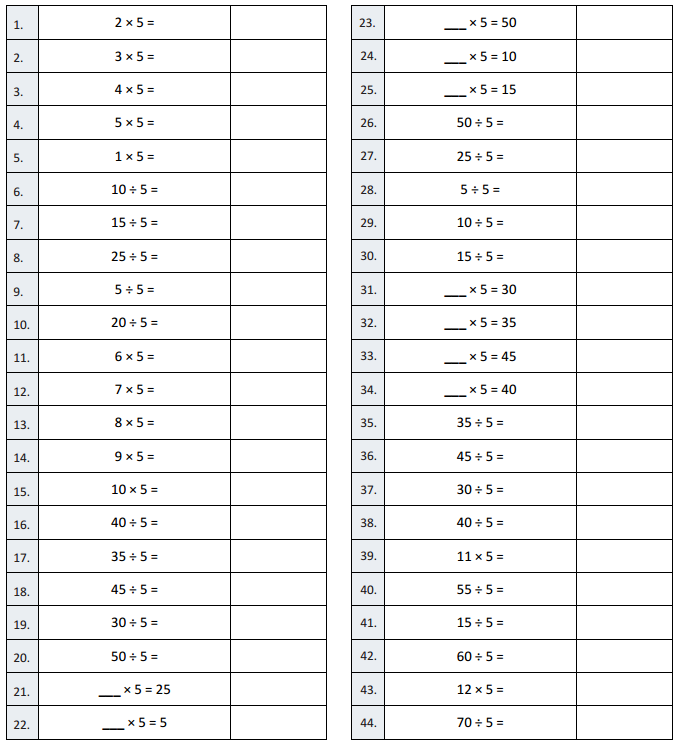
Engage NY Math 3rd Grade Module 7 Lesson 23 Sprint Answer Key s 1
Answer:
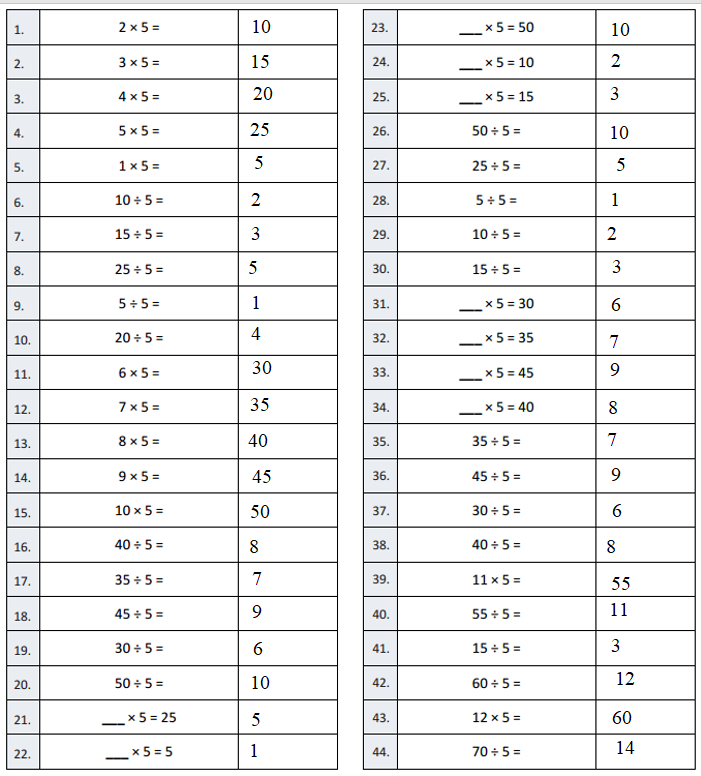
Engage-NY-Eureka-Math-3rd-Grade-Module-7-Lesson-23-Answer-Key-Eureka Math Grade 3 Module 7 Lesson 23 Sprint Answer Key-A
Question 1.
2 × 5 =
Answer:
2 × 5 = 10.

Question 2.
3 × 5 =
Answer:
3 × 5 = 15.

Question 3.
4 × 5 =
Answer:
4 × 5 = 20.

Question 4.
5 × 5 =
Answer:
5 × 5 = 25.

Question 5.
1 × 5 =
Answer:
1 × 5 = 5.

Question 6.
10 ÷ 5 =
Answer:
10 ÷ 5 = 2.

Question 7.
15 ÷ 5 =
Answer:
15 ÷ 5 = 3.

Question 8.
25 ÷ 5 =
Answer:
25 ÷ 5 = 5.

Question 9.
5 ÷ 5 =
Answer:
5 ÷ 5 = 1.

Question 10.
20 ÷ 5 =
Answer:
20 ÷ 5 = 4.

Question 11.
6 × 5 =
Answer:
6 × 5 = 30.

Question 12.
7 × 5 =
Answer:
7 × 5 = 35.

Question 13.
8 × 5 =
Answer:
8 × 5 = 40.

Question 14.
9 × 5 =
Answer:
9 × 5 = 45.

Question 15.
10 × 5 =
Answer:
10 × 5 = 50.

Question 16.
40 ÷ 5 =
Answer:
40 ÷ 5 = 8.

Question 17.
35 ÷ 5 =
Answer:
35 ÷ 5 = 7.

Question 18.
45 ÷ 5 =
Answer:
45 ÷ 5 = 9.

Question 19.
30 ÷ 5 =
Answer:
30 ÷ 5 = 6.

Question 20.
50 ÷ 5 =
Answer:
50 ÷ 5 = 10.

Question 21.
___ × 5 = 25
Answer:
_5__ × 5 = 25.

Question 22.
___ × 5 = 5
Answer:
_1__ × 5 = 5.

Question 23.
___ × 5 = 50
Answer:
_10__ × 5 = 50.

Question 24.
___ × 5 = 10
Answer:
_2__ × 5 = 10.

Question 25.
___ × 5 = 15
Answer:
_3__ × 5 = 15.

Question 26.
50 ÷ 5 =
Answer:
50 ÷ 5 = 10.

Question 27.
25 ÷ 5 =
Answer:
25 ÷ 5 = 5.

Question 28.
5 ÷ 5 =
Answer:
5 ÷ 5 = 1.

Question 29.
10 ÷ 5 =
Answer:
10 ÷ 5 = 2.

Question 30.
15 ÷ 5 =
Answer:
15 ÷ 5 = 3.

Question 31.
___ × 5 = 30
Answer:
_6__ × 5 = 30.

Question 32.
___ × 5 = 35
Answer:
_7__ × 5 = 35.

Question 33.
___ × 5 = 45
Answer:
__9_ × 5 = 45.

Question 34.
___ × 5 = 40
Answer:
__8_ × 5 = 40.

Question 35.
35 ÷ 5 =
Answer:
35 ÷ 5 = 7.

Question 36.
45 ÷ 5 =
Answer:
45 ÷ 5 = 9.

Question 37.
30 ÷ 5 =
Answer:
30 ÷ 5 = 6.

Question 38.
40 ÷ 5 =
Answer:
40 ÷ 5 = 8.

Question 39.
11 × 5 =
Answer:
11 × 5 = 55.

Question 40.
55 ÷ 5 =
Answer:
55 ÷ 5 = 11.

Question 41.
15 ÷ 5 =
Answer:
15 ÷ 5 = 3.

Question 42.
60 ÷ 5 =
Answer:
60 ÷ 5 = 12.

Question 43.
12 × 5 =
Answer:
12 × 5 = 60.

Question 44.
70 ÷ 5 =
Answer:
70 ÷ 5 = 14.

B
Multiply or Divide by 5
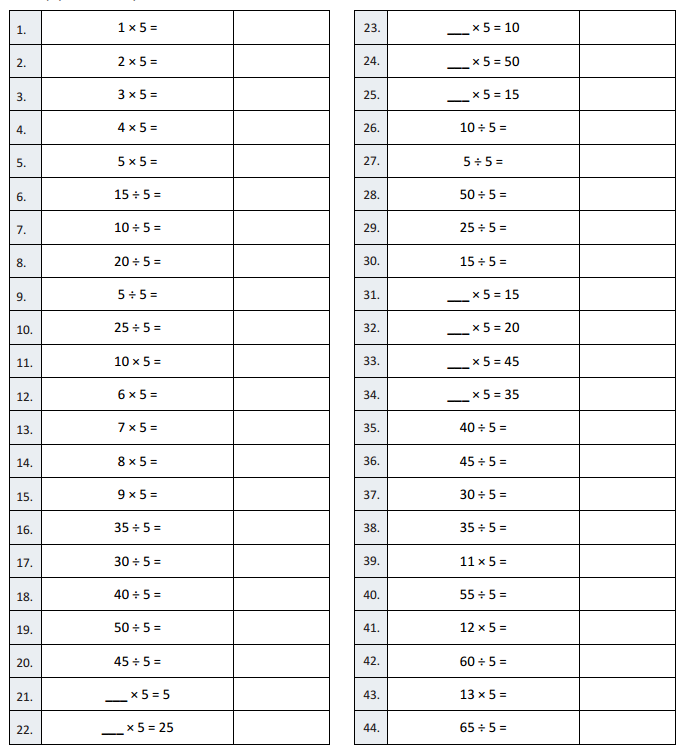
Engage NY Math 3rd Grade Module 7 Lesson 23 Sprint Answer Key s 2
Answer:
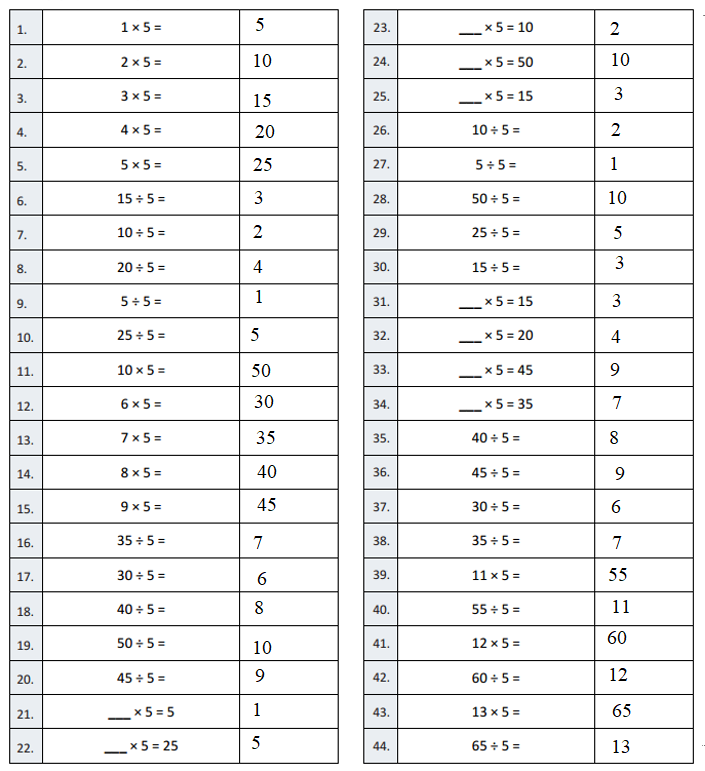
Engage-NY-Eureka-Math-3rd-Grade-Module-7-Lesson-23-Answer-Key-Eureka Math Grade 3 Module 7 Lesson 23 Sprint Answer Key-B
Question 1.
1 × 5 =
Answer:
1 × 5 = 5.

Question 2.
2 × 5 =
Answer:
2 × 5 = 10.

Question 3.
3 × 5 =
Answer:
3 × 5 = 15.

Question 4.
4 × 5 =
Answer:
4 × 5 = 20.

Question 5.
5 × 5 =
Answer:
5 × 5 = 25.

Question 6.
15 ÷ 5 =
Answer:
15 ÷ 5 = 3.

Question 7.
10 ÷ 5 =
Answer:
10 ÷ 5 = 2.

Question 8.
20 ÷ 5 =
Answer:
20 ÷ 5 = 4.

Question 9.
5 ÷ 5 =
Answer:
5 ÷ 5 = 1.

Question 10.
25 ÷ 5 =
Answer:
25 ÷ 5 = 5.

Question 11.
10 × 5 =
Answer:
10 × 5 = 50.

Question 12.
6 × 5 =
Answer:
6 × 5 = 30.

Question 13.
7 × 5 =
Answer:
7 × 5 = 35.

Question 14.
8 × 5 =
Answer:
8 × 5 = 40.

Question 15.
9 × 5 =
Answer:
9 × 5 = 45.

Question 16.
35 ÷ 5 =
Answer:
35 ÷ 5 = 7.

Question 17.
30 ÷ 5 =
Answer:
30 ÷ 5 = 6.

Question 18.
40 ÷ 5 =
Answer:
40 ÷ 5 = 8.

Question 19.
50 ÷ 5 =
Answer:
50 ÷ 5 = 10.

Question 20.
45 ÷ 5 =
Answer:
45 ÷ 5 = 9.

Question 21.
___ × 5 = 5
Answer:
_1__ × 5 = 5.

Question 22.
___ × 5 = 25
Answer:
_5__ × 5 = 25.

Question 23.
___ × 5 = 10
Answer:
_2__ × 5 = 10.

Question 24.
___ × 5 = 50
Answer:
_10__ × 5 = 50.

Question 25.
___ × 5 = 15
Answer:
_3__ × 5 = 15.

Question 26.
10 ÷ 5 =
Answer:
10 ÷ 5 = 50.

Question 27.
5 ÷ 5 =
Answer:

Question 28.
50 ÷ 5 =
Answer:

Question 29.
25 ÷ 5 =
Answer:

Question 30.
15 ÷ 5 =
Answer:

Question 31.
___ × 5 = 15
Answer:

Question 32.
___ × 5 = 20
Answer:

Question 33.
___ × 5 = 45
Answer:

Question 34.
___ × 5 = 35
Answer:

Question 35.
40 ÷ 5 =
Answer:

Question 36.
45 ÷ 5 =
Answer:

Question 37.
30 ÷ 5 =
Answer:

Question 38.
35 ÷ 5 =
Answer:

Question 39.
11 × 5 =
Answer:

Question 40.
55 ÷ 5 =
Answer:

Question 41.
12 × 5 =
Answer:

Question 42.
60 ÷ 5 =
Answer:

Question 43.
13 × 5 =
Answer:

Question 44.
65 ÷ 5 =
Answer:

Eureka Math Grade 3 Module 7 Lesson 23 Problem Set Answer Key

Question 1.
Gale makes a miniature stop sign, a regular octagon, with a perimeter of 48 centimeters for the town he built with blocks. What is the length of each side of the stop sign?
Answer:
The length of each side of the stop sign = 6 centimeters.
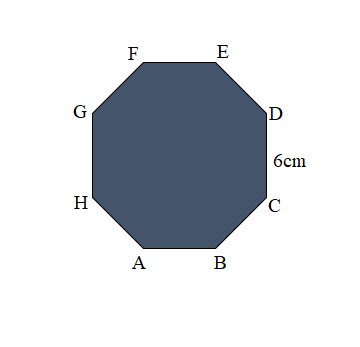
Engage-NY-Eureka-Math-3rd-Grade-Module-7-Lesson-23-Answer-Key-Eureka Math Grade 3 Module 7 Lesson 23 Problem Set Answer Key-1

Explanation:
Perimeter of Gale a miniature stop sign, a regular octagon = 48 centimeters
Number of sides of Gale a miniature stop sign, a regular octagon = 8
The length of each side of the stop sign = Perimeter of Gale a miniature stop sign, a regular octagon  ÷ Number of sides of Gale a miniature stop sign, a regular octagon
= 48 centimeters ÷  8
= 6 centimeters.


Question 2.
Travis bends wire to make rectangles. Each rectangle measures 34 inches by 12 inches. What is the total length of the wire needed for two rectangles?
Answer:
The total length of the wire needed for two rectangles = 184 inches.

Explanation:
Length of the Travis’s rectangle = 34 inches
Width of the Travis’s rectangle = 12 inches
Perimeter of the Travis’s rectangle = 2 ( Length + Width)
= 2 ( 34 inches + 12 inches )
= 2 × 46 inches
= 92 inches.
The total length of the wire needed for two rectangles = 2 ×  Perimeter of the Travis’s rectangle
= 2 ×  92 inches
= 184 inches.


Question 3.
The perimeter of a rectangular bathroom is 32 feet. The width of the room is 8 feet. What is the length of the room?
Answer:
The length of the room = 8 feet.

Explanation:
Perimeter of a rectangular bathroom = 32 feet.
Width of a rectangular bathroom = 8 feet.
Length of a rectangular bathroom = ??
Perimeter of a rectangular bathroom = 2 ( Length + Width)
=> 32 feet = (2 × Length) + (2 × 8 feet)
=> 32 feet = (2 × Length) + 16 feet
=> 32 feet – 16 feet = (2 × Length)
=> 16 feet = (2 × Length)
=> 16 feet ÷ 2 = Length
=> 8 feet = Length


Question 4.
Raj uses 6-inch square tiles to make a rectangle, as shown below. What is the perimeter of the rectangle in inches?
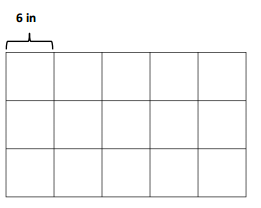
Engage NY Math Grade 3 Module 7 Lesson 23 Problem Set Answer Key p 1
Answer:
Perimeter of the rectangle in inches =96-inches.

Explanation:
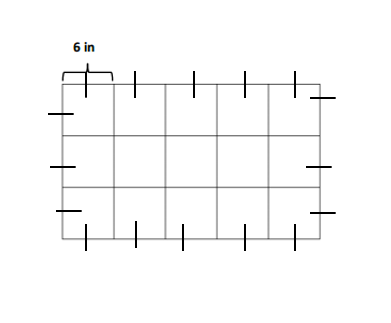
Engage-NY-Eureka-Math-3rd-Grade-Module-7-Lesson-23-Answer-Key-Eureka Math Grade 3 Module 7 Lesson 23 Problem Set Answer Key-4
Length of the side square tiles Raj uses to make a rectangle = 6-inch
Number of side of square tiles in the rectangle = 16
Perimeter of the rectangle in inches = Length of the side square tiles Raj uses to make a rectangle × Number of side of square tiles in the rectangle
= 6-inch × 16
= 96-inches.


Question 5.
Mischa makes a 4-foot by 6-foot rectangular banner. She puts ribbon around the outside edges. The ribbon costs $2 per foot. What is the total cost of the ribbon?
Answer:
Total cost of the ribbon = $20.

Explanation:
Length of the rectangular banner = 6-foot
Width of the rectangular banner = 4-foot
Perimeter of the rectangular banner = 2 ( Length + Width)
= 2 ( 6-foot + 4-foot )
= 2 × 10-foot
= 20- foot.
Cost of the ribbon per foot = $2
Total cost of the ribbon = Perimeter of the rectangular banner × Cost of the ribbon per foot
= 20- foot × $2
= $40.


Question 6.
Colton buys a roll of wire fencing that is 120 yards long. He uses it to fence in his 18-yard by 24-yard rectangular garden. Will Colton have enough wire fencing left over to fence in a 6-yard by 8-yard rectangular play space for his pet rabbit?
Answer:
Yes, Colton has wire fencing left over to fence for rectangular play space for his pet rabbit.

Explanation:
Total length of wire Colton purchased = 120 yards.
Length of the rectangular garden = 24-yard
Width of the rectangular garden = 18-yard
Perimeter of the rectangular garden = 2 ( Length + Width)
= 2 ( 24-yard + 18-yard )
= 2 × 42-yard
= 84-yard.
Wire used = Total length of wire Colton purchased – Perimeter of the rectangular garden
= 120 yards – 84 yards
= 36 yards.
Length of the rectangular play space for his pet rabbit = 8-yard
Width of the rectangular play space for his pet rabbit = 6-yard
Perimeter of the rectangular play space for his pet rabbit = 2 ( Length + Width)
= 2 ( 8-yard + 6-yard )
= 2 × 14-yard
= 28-yard.
Wire left = Wire used – Perimeter of the rectangular play space for his pet rabbit
= 36 yards – 28 yards
= 8 yards.


Eureka Math Grade 3 Module 7 Lesson 23 Exit Ticket Answer Key

Adriana traces a regular triangle to create the shape below. The perimeter of her shape is 72 centimeters. What are the side lengths of the triangle?
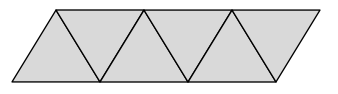
Eureka Math 3rd Grade Module 7 Lesson 23 Exit Ticket Answer Key t 1
Answer:
The side lengths of the triangle = 9 centimeters.

Explanation:
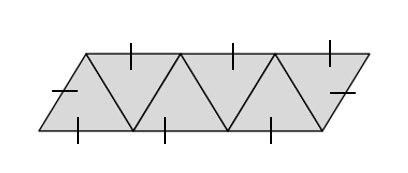
Engage-NY-Eureka-Math-3rd-Grade-Module-7-Lesson-23-Answer-Key-Eureka Math Grade 3 Module 7 Lesson 23 Exit Ticket Answer Key
Perimeter of Adriana’s shape = 72 centimeters
Number of sides of the triangle shape = 8
The side lengths of the triangle = Perimeter of Adriana’s shape  ÷ Number of sides of the triangle shape
= 72 centimeters ÷ 8
= 9 centimeters.


Eureka Math Grade 3 Module 7 Lesson 23 Homework Answer Key

Question 1.
Rosie draws a square with a perimeter of 36 inches. What are the side lengths of the square?
Answer:
The side lengths of the square = 9 inches.

Explanation:
Perimeter of the Square = 36 inches
Number of sides in the square = 4
The side lengths of the square = Perimeter of the Square  ÷ Number of sides in the square
= 36 inches ÷ 4
= 9 inches.


Question 2.
Judith uses craft sticks to make two 24-inch by 12-inch rectangles. What is the total perimeter of the 2 rectangles?
Answer:
Total perimeter of the 2 rectangles = 144 inches.

Explanation:
Length of the rectangle = 24-inch
Width of the rectangle = 12-inch
Perimeter of the rectangle = 2 ( Length + Width)
= 2 ( 24-inch + 12-inch )
= 2 × 36-inch
= 72 inches.
Total perimeter of the 2 rectangles = Perimeter of the rectangle × 2
= 72 inches × 2
= 144 inches.


Question 3.
An architect draws a square and a rectangle, as shown below, to represent a house that has a garage. What is the total perimeter of the house with its attached garage?
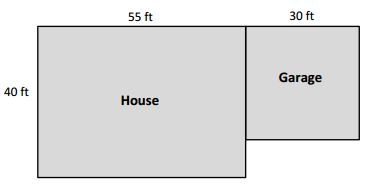
Eureka Math Grade 3 Module 7 Lesson 23 Homework Answer Key h 1
Answer:
Perimeter of the attached garage = 250 ft.

Explanation:
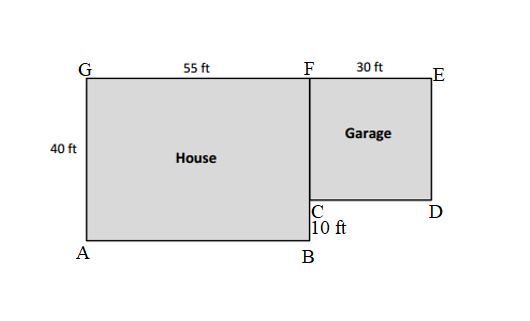
Engage-NY-Eureka-Math-3rd-Grade-Module-7-Lesson-23-Answer-Key-Eureka Math Grade 3 Module 7 Lesson 23 Homework Answer Key-3
Length of the side AB in the attached garage = 55 ft
Length of the side BC in the attached garage = 10 ft
Length of the side CD in the attached garage = 30 ft
Length of the side DE in the attached garage = 30 ft
Length of the side EF in the attached garage = 30 ft
Length of the side FG in the attached garage = 55 ft
Length of the side GA in the attached garage = 40 ft
Perimeter of the attached garage = Length of the side AB in the attached garage  +  Length of the side BC in the attached garage + Length of the side CD in the attached garage + Length of the side DE in the attached garage + Length of the side EF in the attached garage + Length of the side FG in the attached garage + Length of the side GA in the attached garage
= 55 ft + 10 ft + 30 ft + 30 ft + 30 ft + 55 ft + 40 ft
= 65 ft + 30 ft + 30 ft + 30 ft + 55 ft + 40 ft
= 95 ft + 30 ft + 30 ft + 55 ft + 40 ft
= 125 ft + 30 ft + 55 ft + 40 ft
= 155 ft + 55 ft + 40 ft
= 210 ft + 40ft
= 250 ft.


Question 4.
Manny draws 3 regular pentagons to create the shape shown below. The perimeter of 1 of the pentagons is 45 inches. What is the perimeter of Manny’s new shape?
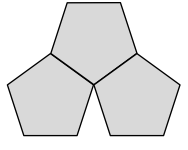
Eureka Math Grade 3 Module 7 Lesson 23 Homework Answer Key h 2
Answer:
Perimeter of Manny’s new shape = 99 inches.

Explanation:
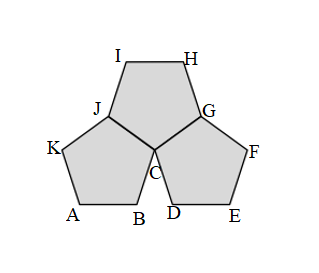
Engage-NY-Eureka-Math-3rd-Grade-Module-7-Lesson-23-Answer-Key-Eureka Math Grade 3 Module 7 Lesson 23 Homework Answer Key-4
Perimeter of the regular pentagons Manny draws = 45 inches
Number of side in the regular pentagons Manny draws = 5
Length of the side of the regular pentagons Manny draws = Perimeter of the regular pentagons Manny draws ÷ Number of side in the regular pentagons Manny draws
= 45 inches ÷ 5
= 9 inches.
Number of side Manny’s new shape  has = 11 ( Side AB + Side BC +Side CD + Side DE + Side EF +Side FG + Side GH + Side HI + Side IJ +Side JK + Side KA )
Perimeter of Manny’s new shape = Number of side Manny’s new shape has × Length of the side of the regular pentagons Manny draws
= 11 × 9 inches
= 99 inches.


Question 5.
Johnny uses 2-inch square tiles to make a square, as shown below. What is the perimeter of Johnny’s square?
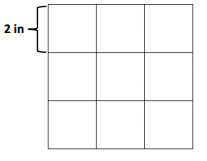
Eureka Math Grade 3 Module 7 Lesson 23 Homework Answer Key h 3
Answer:
Perimeter of Johnny’s square = 24 inches.

Explanation:
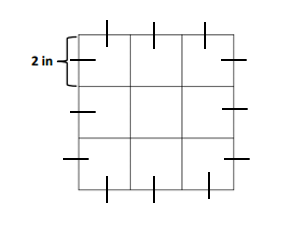
Engage-NY-Eureka-Math-3rd-Grade-Module-7-Lesson-23-Answer-Key-Eureka Math Grade 3 Module 7 Lesson 23 Homework Answer Key-5
Number of side in the Johnny’s square = 12
Length of  side  in the Johnny’s square = 2 inches
Perimeter of Johnny’s square = Number of side in the Johnny’s square  × Length of side in the Johnny’s square
= 12 × 2 inches
= 24 inches.

Question 6.
Lisa tapes three 7-inch by 9-inch pieces of construction paper together to make a happy birthday sign for her mom. She uses a piece of ribbon that is 144 inches long to make a border around the outside edges of the sign. How much ribbon is leftover?
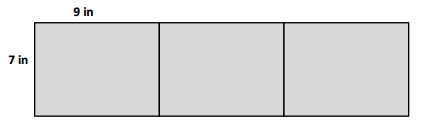
Eureka Math Grade 3 Module 7 Lesson 23 Homework Answer Key h 4
Answer:
Ribbon  leftover = 76 inches.

Explanation:
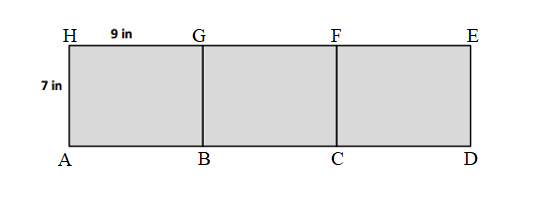
Engage-NY-Eureka-Math-3rd-Grade-Module-7-Lesson-23-Answer-Key-Eureka Math Grade 3 Module 7 Lesson 23 Homework Answer Key-6
Length of the Lisa’s piece of construction paper = 9-inch
Width of the Lisa’s piece of construction paper = 7-inch
Perimeter of the pieces of construction paper used to make a happy birthday sign for her mom = Side AB + Side BC + Side CD + Side DE + Side EF + Side FG + Side GH +Side HA
= 9-inch + 9-inch + 9-inch + 7-inch + 9-inch + 9-inch + 9-inch + 7-inch
= 18-inch + 9-inch + 7-inch + 9-inch + 9-inch + 9-inch + 7-inch
= 27-inch + 7-inch + 9-inch + 9-inch + 9-inch + 7-inch
= 34-inch + 9-inch + 9-inch + 9-inch + 7-inch
= 43-inch + 9-inch + 9-inch + 7-inch
= 52-inch + 9-inch + 7-inch
= 61-inch + 7-inch
= 68-inch.
Piece of ribbon Lisa’s  has = 144 inches
Ribbon  leftover = Piece of ribbon Lisa’s  has  – Perimeter of the pieces of construction paper used to make a happy birthday sign for her mom
= 144 inches – 68-inch.
= 76 inches.
Eureka Math Grade 3 Module 7 Lesson 22 Answer Key

Engage NY Eureka Math 3rd Grade Module 7 Lesson 22 Answer Key

Eureka Math Grade 3 Module 7 Lesson 22 Sprint Answer Key

A
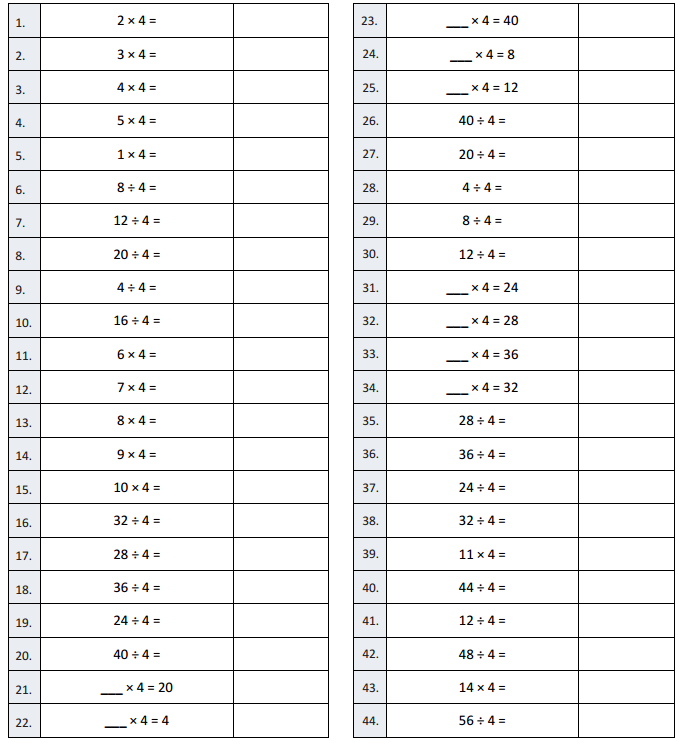
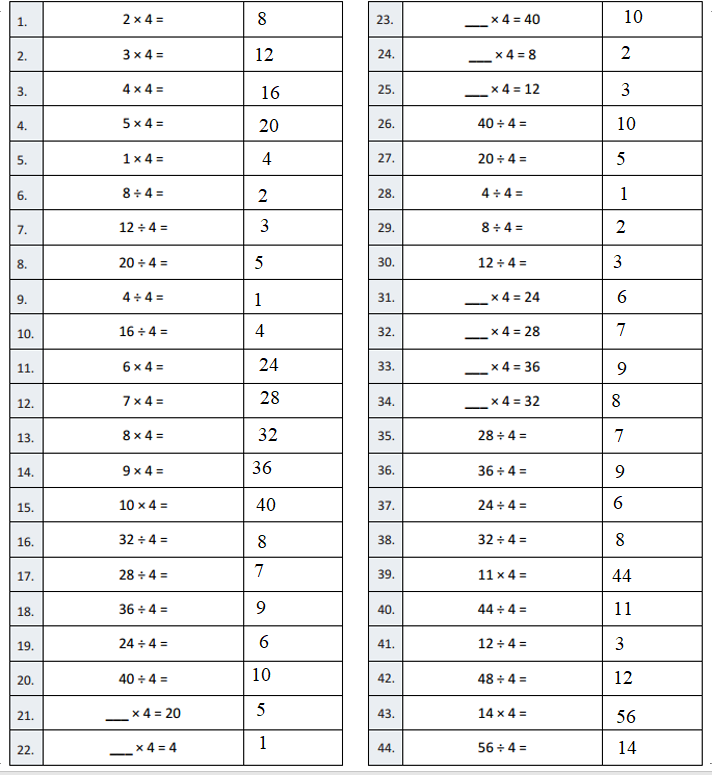
Multiply or Divide by 4
Engage NY Math 3rd Grade Module 7 Lesson 22 Sprint Answer Key s 1
Answer:
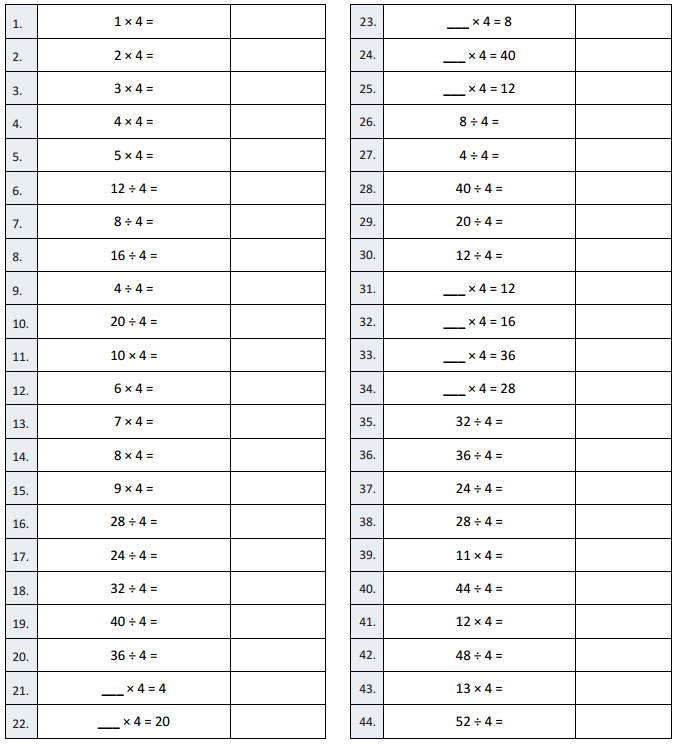
Engage-NY-Eureka-Math-3rd-Grade-Module-7-Lesson-22-Answer-Key-Eureka Math Grade 3 Module 7 Lesson 22 Sprint Answer Key-A
Question 1.
2 × 4 =
Answer:
2 × 4 = 8.

Question 2.
3 × 4 =
Answer:
3 × 4 = 12.

Question 3.
4 × 4 =
Answer:
4 × 4 = 16.

Question 4.
5 × 4 =
Answer:
5 × 4 = 20.

Question 5.
1 × 4 =
Answer:
1 × 4 = 4.

Question 6.
8 ÷ 4 =
Answer:
8 ÷ 4 = 2.

Question 7.
12 ÷ 4 =
Answer:
12 ÷ 4 = 3.

Question 8.
20 ÷ 4 =
Answer:
20 ÷ 4 = 5.

Question 9.
4 ÷ 4 =
Answer:
4 ÷ 4 = 1.

Question 10.
16 ÷ 4 =
Answer:
16 ÷ 4 = 4.

Question 11.
6 × 4 =
Answer:
6 × 4 = 24.

Question 12.
7 × 4 =
Answer:
7 × 4 = 28.

Question 13.
8 × 4 =
Answer:
8 × 4 = 32.

Question 14.
9 × 4 =
Answer:
9 × 4 = 36.

Question 15.
10 × 4 =
Answer:
10 × 4 = 40.

Question 16.
32 ÷ 4 =
Answer:
32 ÷ 4 = 8.

Question 17.
28 ÷ 4 =
Answer:
28 ÷ 4 = 7.

Question 18.
36 ÷ 4 =
Answer:
36 ÷ 4 = 9.

Question 19.
24 ÷ 4 =
Answer:
24 ÷ 4 = 6.

Question 20.
40 ÷ 4 =
Answer:
40 ÷ 4 = 10.

Question 21.
___ × 4 = 20
Answer:
_5__ × 4 = 20.

Question 22.
___ × 4 = 4
Answer:
_1__ × 4 = 4.

Question 23.
___ × 4 = 40
Answer:
_10__ × 4 = 40.

Question 24.
___ × 4 = 8
Answer:
_2__ × 4 = 8.

Question 25.
___ × 4 = 12
Answer:
_3__ × 4 = 12.

Question 26.
40 ÷ 4 =
Answer:
40 ÷ 4 = 10.

Question 27.
20 ÷ 4 =
Answer:
20 ÷ 4 = 5.

Question 28.
4 ÷ 4 =
Answer:
4 ÷ 4 = 1.

Question 29.
8 ÷ 4 =
Answer:
8 ÷ 4 = 2.

Question 30.
12 ÷ 4 =
Answer:
12 ÷ 4 = 3.

Question 31.
___ × 4 = 24
Answer:
_6__ × 4 = 24.

Question 32.
___ × 4 = 28
Answer:
_7__ × 4 = 28.

Question 33.
___ × 4 = 36
Answer:
_9__ × 4 = 36.

Question 34.
___ × 4 = 32
Answer:
_8__ × 4 = 32.

Question 35.
28 ÷ 4 =
Answer:
28 ÷ 4 = 7.

Question 36.
36 ÷ 4 =
Answer:
36 ÷ 4 = 9.

Question 37.
24 ÷ 4 =
Answer:
24 ÷ 4 = 6.

Question 38.
32 ÷ 4 =
Answer:
32 ÷ 4 = 8.

Question 39.
11 × 4 =
Answer:
11 × 4 = 44.

Question 40.
44 ÷ 4 =
Answer:
44 ÷ 4 = 11.

Question 41.
12 ÷ 4 =
Answer:
12 ÷ 4 = 3.

Question 42.
48 ÷ 4 =
Answer:
48 ÷ 4 = 12.

Question 43.
14 × 4 =
Answer:
14 × 4 = 56.

Question 44.
56 ÷ 4 =
Answer:
56 ÷ 4 = 14.

B
Multiply or Divide by 4
Engage NY Math 3rd Grade Module 7 Lesson 22 Sprint Answer Key s 2
Answer:
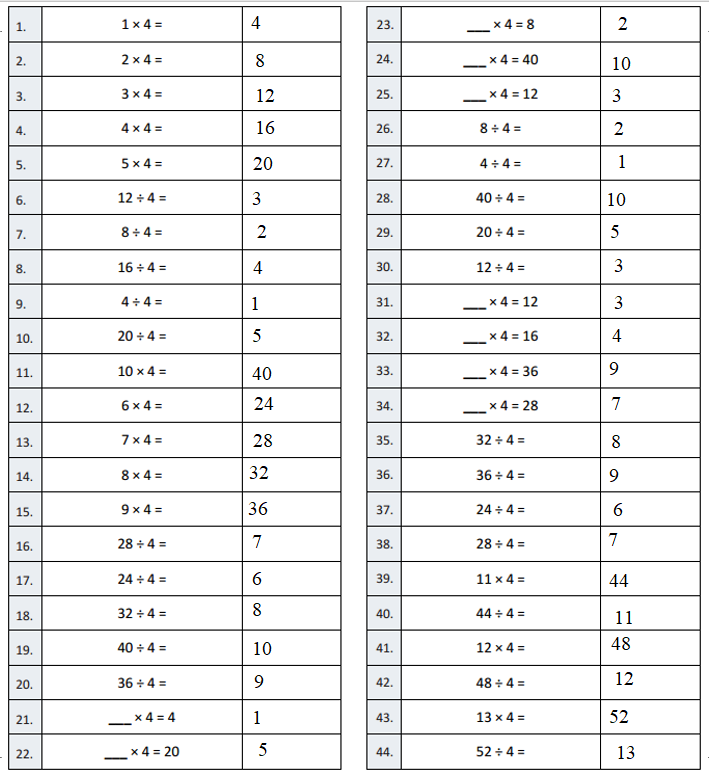
Engage-NY-Eureka-Math-3rd-Grade-Module-7-Lesson-22-Answer-Key-Eureka Math Grade 3 Module 7 Lesson 22 Sprint Answer Key-B
Question 1.
1 × 4 =
Answer:
1 × 4 = 4.

Question 2.
2 × 4 =
Answer:
2 × 4 = 8.

Question 3.
3 × 4 =
Answer:
3 × 4 = 12.

Question 4.
4 × 4 =
Answer:
4 × 4 = 16.

Question 5.
5 × 4 =
Answer:
5 × 4 = 20.

Question 6.
12 ÷ 4 =
Answer:
12 ÷ 4 = 3.

Question 7.
8 ÷ 4 =
Answer:
8 ÷ 4 = 2.

Question 8.
16 ÷ 4 =
Answer:
16 ÷ 4 = 4.

Question 9.
4 ÷ 4 =
Answer:
4 ÷ 4 = 1.

Question 10.
20 ÷ 4 =
Answer:
20 ÷ 4 = 5.

Question 11.
10 × 4 =
Answer:
10 × 4 = 40.

Question 12.
6 × 4 =
Answer:
6 × 4 = 24.

Question 13.
7 × 4 =
Answer:
7 × 4 = 28.

Question 14.
8 × 4 =
Answer:
8 × 4 = 32.

Question 15.
9 × 4 =
Answer:
9 × 4 = 36.

Question 16.
28 ÷ 4 =
Answer:
28 ÷ 4 = 7.

Question 17.
24 ÷ 4 =
Answer:
24 ÷ 4 = 6.

Question 18.
32 ÷ 4 =
Answer:
32 ÷ 4 = 8.

Question 19.
40 ÷ 4 =
Answer:
40 ÷ 4 = 10.

Question 20.
36 ÷ 4 =
Answer:
36 ÷ 4 = 9.

Question 21.
___ × 4 = 4
Answer:
_1__ × 4 = 4.

Question 22.
___ × 4 = 20
Answer:
_5__ × 4 = 20.

Question 23.
___ × 4 = 8
Answer:
_2__ × 4 = 8.

Question 24.
___ × 4 = 40
Answer:
_10__ × 4 = 40.

Question 25.
___ × 4 = 12
Answer:
_3__ × 4 = 12.

Question 26.
8 ÷ 4 =
Answer:
8 ÷ 4 = 2.

Question 27.
4 ÷ 4 =
Answer:
4 ÷ 4 = 1.

Question 28.
40 ÷ 4 =
Answer:
40 ÷ 4 = 10.

Question 29.
20 ÷ 4 =
Answer:
20 ÷ 4 = 10.

Question 30.
12 ÷ 4 =
Answer:
12 ÷ 4 = 3.

Question 31.
___ × 4 = 12
Answer:
_3__ × 4 = 12.

Question 32.
___ × 4 = 16
Answer:
_4__ × 4 = 16.

Question 33.
___ × 4 = 36
Answer:
_9__ × 4 = 36.

Question 34.
___ × 4 = 28
Answer:
_7__ × 4 = 28.

Question 35.
32 ÷ 4 =
Answer:
32 ÷ 4 = 8.

Question 36.
36 ÷ 4 =
Answer:
36 ÷ 4 = 9.

Question 37.
24 ÷ 4 =
Answer:
24 ÷ 4 = 6.

Question 38.
28 ÷ 4 =
Answer:
28 ÷ 4 = 7.

Question 39.
11 × 4 =
Answer:
11 × 4 = 44.

Question 40.
44 ÷ 4 =
Answer:
44 ÷ 4 = 11.

Question 41.
12 × 4 =
Answer:
12 × 4 = 48.

Question 42.
48 ÷ 4 =
Answer:
48 ÷ 4 = 12.

Question 43.
13 × 4 =
Answer:
13 × 4 = 52.

Question 44.
52 ÷ 4 =
Answer:
52 ÷ 4 = 13.

Eureka Math Grade 3 Module 7 Lesson 22 Problem Set Answer Key

Question 1.
Use the data you gathered from your Problem Sets to create a line plot for the number of rectangles you created with each given perimeter.
Number of Rectangles Made with a Given Perimeter
Engage NY Math Grade 3 Module 7 Lesson 22 Problem Set Answer Key p 1
Answer:
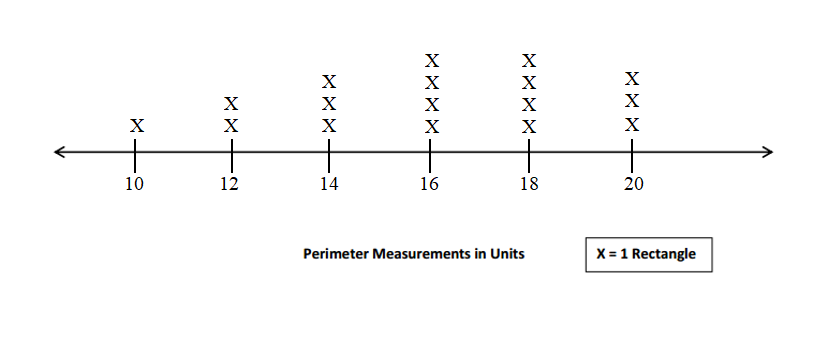
Engage-NY-Eureka-Math-3rd-Grade-Module-7-Lesson-22-Answer-Key-Eureka Math Grade 3 Module 7 Lesson 22 Problem Set Answer Key-1
Explanation:
The data  gathered from Problem Sets to create a line plot for the number of rectangles created with each given perimeter are : 10 units, 12 units, 14 units, 16 units,18 units, 20 units.

Question 2.
Why are all of the perimeter measurements even? Do all rectangles have an even perimeter?
Answer:
Well all perimeters of the rectangles are even because we have used the whole numbers and when we add them twice, we get the even numbers as the result.

Explanation:
Well all perimeters of the rectangles are even because we have used the whole numbers and when we add them twice, we get the even numbers as the result. Generally we used rulers to find the lengths of rectangles not the string. We have used string to show to get an odd perimeter.


Question 3.
Compare the two line plots we created. Is there any reason to think that knowing only the area of a rectangle would help you to figure out its perimeter or knowing only the perimeter of a rectangle would help you figure out its area?
Answer:
No, there is no reason to think that knowing only the area of a rectangle would help you to figure out its perimeter or knowing only the perimeter of a rectangle would help you figure out its area.

Explanation:
There is no connection between the area and perimeter of rectangle. Knowing one, doesnot help you to find the other.


Question 4.
Sumi uses unit square tiles to build 3 rectangles that have an area of 32 square units. Does knowing this help her find the number of rectangles she can build for a perimeter of 32 units? Why or why not?
Answer:
No, knowing the number of rectangles she built with the area of 32 square units does not help her to find the number of rectangles she can build for a perimeter of 32 units.

Explanation:
For example, if we do half 32 square units, we have the chance to make more than 3 pairs of number that add to 16. No, knowing the number of rectangles she built with the area of 32 square units does not help her to find the number of rectangles she can build for a perimeter of 32 units.

Question 5.
George draws 3 rectangles that have a perimeter of 14 centimeters. Alicia tells George that there are more than 3 rectangles that have a perimeter of 14 centimeters. Explain why Alicia is correct.
Answer:
Yes, I completely agree with Alicia because George  probably drew the rectangles using the whole numbers side lengths. He could have drawn more rectangles using fraction values as lengths.

Explanation:
Yes, I completely agree with Alicia ” George that there are more than 3 rectangles that have a perimeter of 14 centimeters. ” because George  probably drew the rectangles using the whole numbers side lengths. He could have drawn more rectangles using fraction values as lengths.


Eureka Math Grade 3 Module 7 Lesson 22 Exit Ticket Answer Key

Suppose you have a rectangle with a perimeter of 2 cm. What can you conclude about the side lengths? Can all 4 sides of the rectangle measure a whole number of centimeters?
Answer:
Well, if the rectangles perimeter is 2cm, I do not think the lengths are going to be whole numbers of centimeters. Because perimeter  is the total distance covered by the rectangle around its outside.

Explanation:
Perimeter  is the total distance covered by the rectangle around its outside. Well, if the rectangles perimeter is 2cm, I do not think the lengths are going to be whole numbers of centimeters.


Eureka Math Grade 3 Module 7 Lesson 22 Homework Answer Key

Question 1.
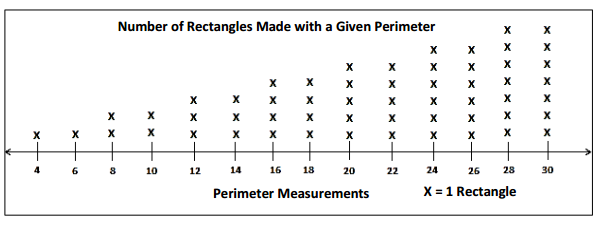
The following line plot shows the number of rectangles a student made using square unit tiles. Use the line plot to answer the questions below.
Eureka Math Grade 3 Module 7 Lesson 22 Homework Answer Key h 1
a. Why are all of the perimeter measurements even? Do all rectangles have even perimeters?
b. Explain the pattern in the line plot. What types of side lengths make this pattern possible?
c. How many X’s would you draw for a perimeter of 32? Explain how you know.
Answer:
a. Well all perimeters of the rectangles are even because the student has used the whole numbers and when they are added twice, we get the even numbers as the result.  Yes, mostly all rectangles have even perimeters as we use whole numbers not fractions.

b. The pattern in the line plot is showing all rectangles Perimeters which are even in numbers. Whole numbers types of side lengths make this pattern possible.

c. Number of X’s would be drawn for a perimeter of 32 are six or 6: : (2,14) (3,13) (4,12) (5,11) (6,10) (7,9).

Explanation:
a.  Well all perimeters of the rectangles are even because the student has used the whole numbers and when they are added twice, we get the even numbers as the result. Generally we used rulers to find the lengths of rectangles not the string. We have used string to show to get an odd perimeter.

b. The whole numbers are the part of the number system in which it includes all the positive integers from 0 to infinity. The pattern in the line plot is showing all rectangles Perimeters which are even in numbers.

c. Number of X’s would be drawn for a perimeter of 32 are six or 6 : (2,14) (3,13) (4,12) (5,11) (6,10) (7,9).
Engage-NY-Eureka-Math-3rd-Grade-Module-7-Lesson-22-Answer-Key-Eureka Math Grade 3 Module 7 Lesson 22 Homework Answer Key-1c

Question 2.
Luis uses square inch tiles to build a rectangle with a perimeter of 24 inches. Does knowing this help him find the number of rectangles he can build with an area of 24 square inches? Why or why not?
Answer:
Luis uses square inch tiles to build a rectangle with a perimeter of 24 inches.
No, knowing this cannot help him find the number of rectangles he can build with an area of 24 square inches because there is no connection  between the area and perimeter to find the number of rectangles to be obtained.

Explanation:
No, knowing this cannot help him find the number of rectangles he can build with an area of 24 square inches because there is no connection  between the area and perimeter to find the number of rectangles to be obtained.


Question 3.
Esperanza makes a rectangle with a piece of string. She says the perimeter of her rectangle is 33 centimeters. Explain how it’s possible for her rectangle to have an odd perimeter.
Answer:
Well, Esperanza  is correct in what she says ” the perimeter of her rectangle is 33 centimeters.”
because she is using her string to find the lengths of her rectangle.

Explanation:
Well, Esperanza  is correct in what she says ” the perimeter of her rectangle is 33 centimeters.”
because she is using her string to find the lengths of her rectangle. The measurements of rectangles forming an odd perimeter of Esperanza rectangles can be: (2,14.5) (4,12.5) (4.5,12) (5,11.5) (6, 10.5) ( 7, 9.5).

Eureka Math Grade 3 Module 1 Lesson 15 Answer Key

Engage NY Eureka Math 3rd Grade Module 1 Lesson 15 Answer Key

Eureka Math Grade 3 Module 1 Answer Key

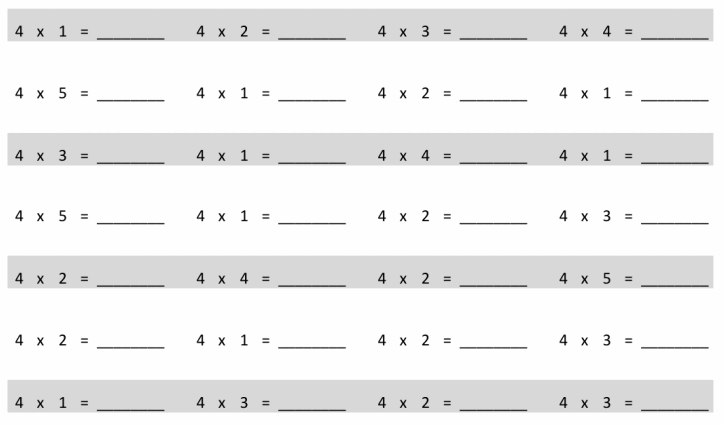
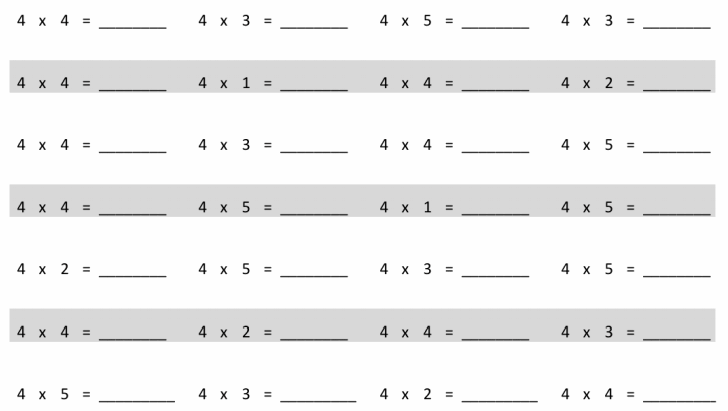
Eureka Math Grade 3 Module 1 Lesson 15 Pattern Sheet Answer Key

Multiply.

EngageNY Math Grade 3 Module 1 Lesson 15 Pattern Sheet Answer Key 1
EngageNY Math Grade 3 Module 1 Lesson 15 Pattern Sheet Answer Key 2
EngageNY Math Grade 3 Module 1 Lesson 15 Pattern Sheet Answer Key 3

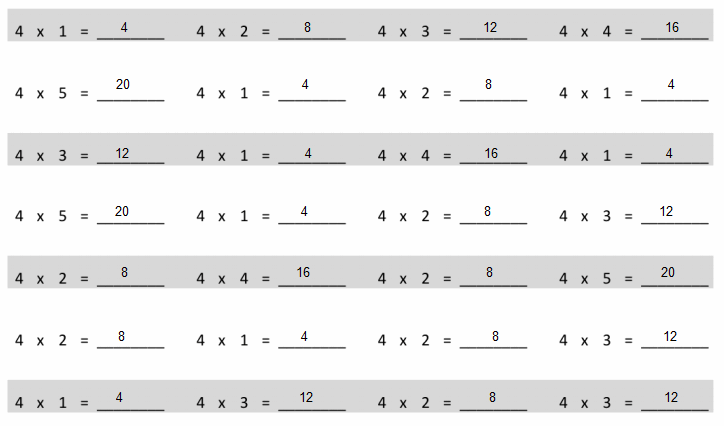
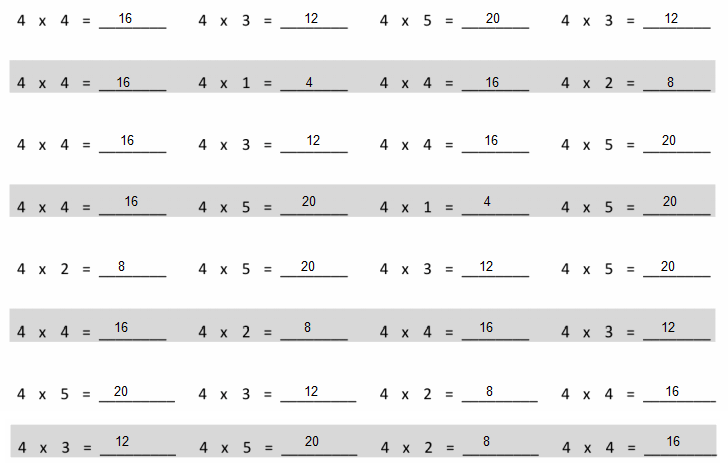
multiply by 4 (1–5)
Eureka Math Grade 3 Module 1 Lesson 15 Answer Key-1
Eureka Math Grade 3 Module 1 Lesson 15 Answer Key-2
Explanation:
Multiply by 4 (1–5) the expression as shown above.

Eureka Math Grade 3 Module 1 Lesson 15 Problem Set Answer Key

Question 1.
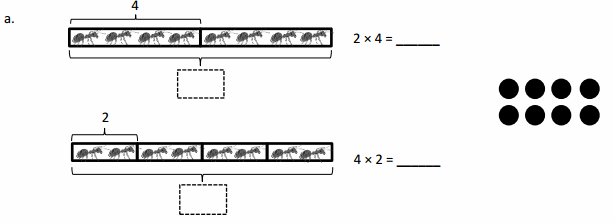
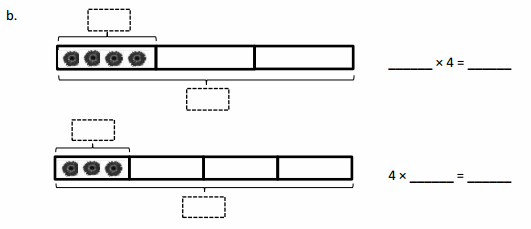
Label the tape diagrams and complete the equations. Then,
draw an array to represent the problems.
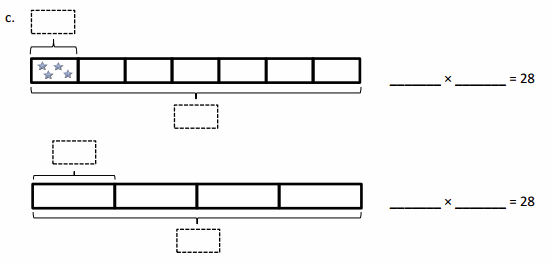
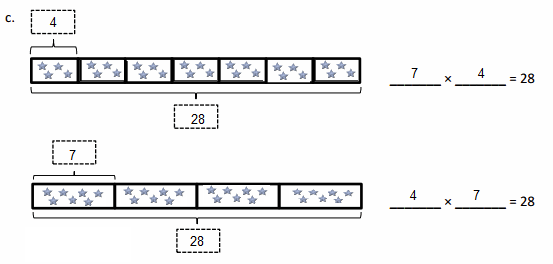
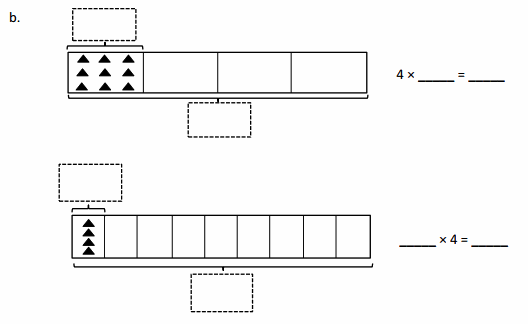
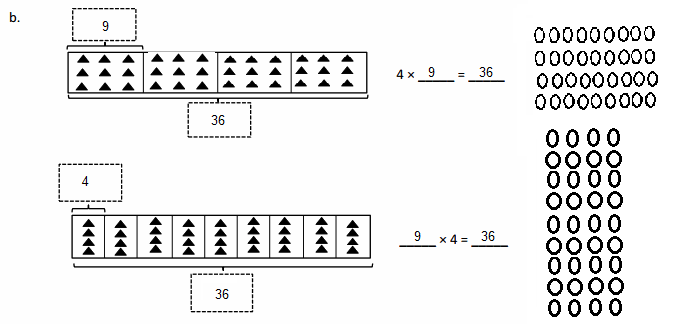
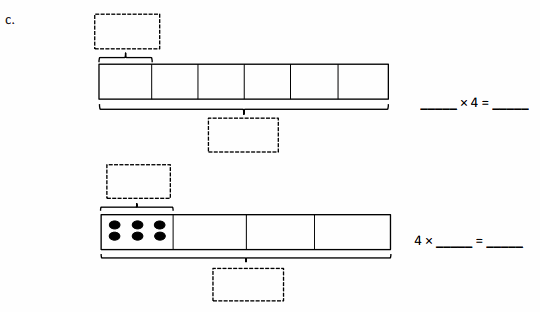
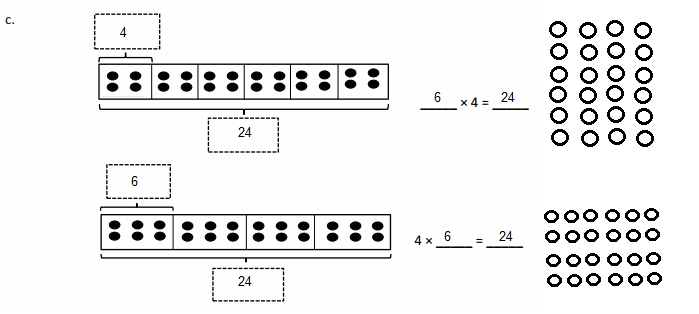
Eureka Math Grade 3 Module 1 Lesson 15 Problem Set Answer Key 4
Eureka Math Grade 3 Module 1 Lesson 15 Answer Key-3
Explanation:
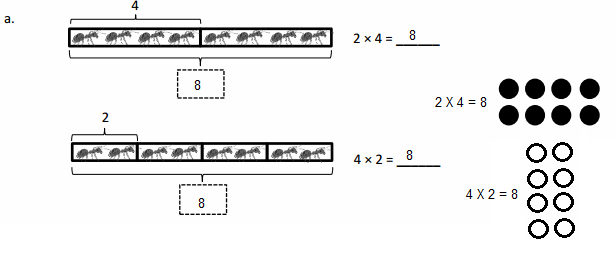
Labeled the tape diagram and completed the equations,
Drawn an array to represent the problems as
2 X 4 = 8, 4 X 2 = 8.

Eureka Math Grade 3 Module 1 Lesson 15 Problem Set Answer Key 5
Eureka Math Grade 3 Module 1 Lesson 15 Answer Key-4
Explanation:
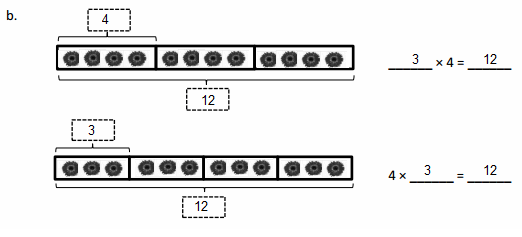
Labeled the tape diagram and completed the equations,
Drawn an array to represent the problems as
3 X 4 = 12, 4 X 3 = 12.
Eureka Math Grade 3 Module 1 Lesson 15 Problem Set Answer Key 6

Eureka Math Grade 3 Module 1 Lesson 15 Answer Key-5

Explanation:
Labeled the tape diagram and completed the equations,
Drawn an array to represent the problems as
7 X 4 = 28, 4 X 7 = 28.

Question 2.
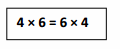
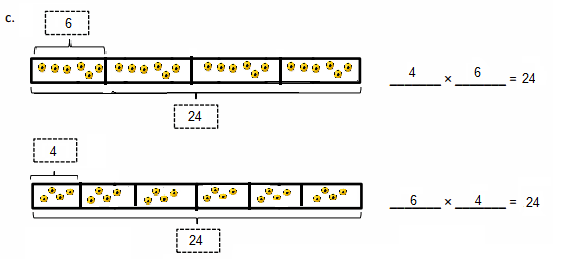
Draw and label 2 tape diagrams to model why the statement in the box is true.
Eureka Math Grade 3 Module 1 Lesson 15 Problem Set Answer Key 7

Eureka Math Grade 3 Module 1 Lesson 15 Answer Key-6
Statement in the box is true,

Explanation:
Drawn and labeled 2 tape diagrams to model the statement
in the box is true because as  4 X 6 = 24 and 6 X 4 = 24,
both has result value as 24, So the statement is true.

Question 3.
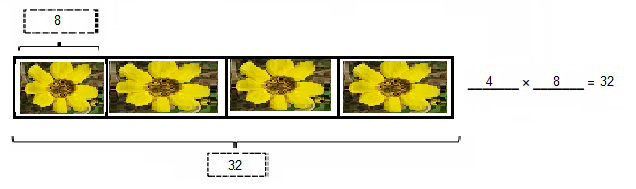
Grace picks 4 flowers from her garden. Each flower has 8 petals.
Draw and label a tape diagram to show how many petals
there are in total.

In total there are 32 petals,
Eureka Math Grade 3 Module 1 Lesson 15 Answer Key-7
Explanation:
Given Grace picks 4 flowers from her garden and each
flower has 8 petals. Drawn and labeled a tape diagram as
shown above total number of petals are 4 X 8 = 32 petals
are there in total.

Question 4.
Michael counts 8 chairs in his dining room. Each chair has 4 legs.
How many chair legs are there altogether?

There are 32 chair legs altogether,

Explanation:
Given Michael counts 8 chairs in his dining room and each
chair has 4 legs, So number of chair legs altogether are
8 X 4 = 32, therefore, there are 32 chair legs altogether.

Eureka Math Grade 3 Module 1 Lesson 15 Exit Ticket Answer Key

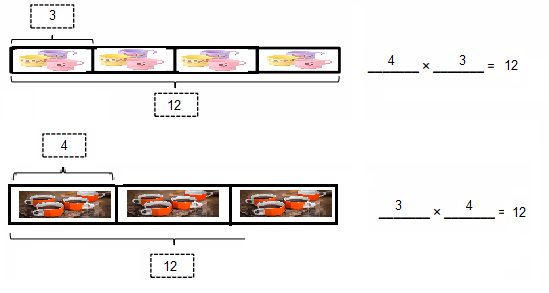
Draw and label 2 tape diagrams to show that 4 × 3 = 3 × 4.
Use your diagrams to explain how you know the statement is true.
Eureka Math Grade 3 Module 1 Lesson 15 Answer Key-8

Shown 4 X 3 = 3 X 4 as
4 cups X 3 cups = 12 cups,
3 cups x 4 cups = 12 cups,

Explanation:
Drawn and labeled 2 tape diagrams to show that 4 × 3 = 3 × 4
Used cups to explain the statement is true as
taken 4 boxes of 3 cups each and 3 boxes of
4 cups each so that 4 X 3 = 3 X 4,
both results values are same 12.

Eureka Math Grade 3 Module 1 Lesson 15 Homework Answer Key

Question 1.
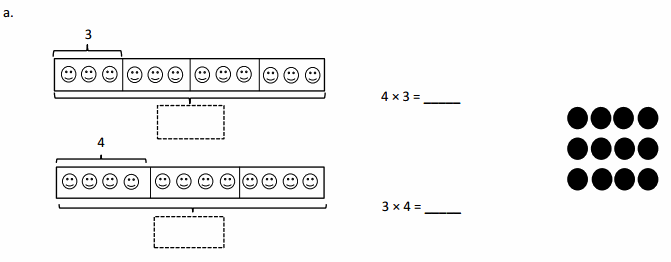
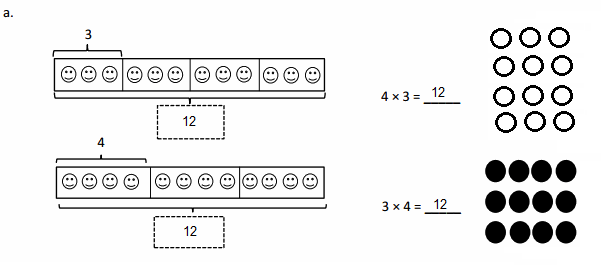
Label the tape diagrams and complete the equations.
Then, draw an array to represent the problems.
Eureka Math 3rd Grade Module 1 Lesson 15 Homework Answer Key 8
Eureka Math Grade 3 Module 1 Lesson 15 Answer Key-9
Explanation:
Labeled the tape diagrams and completed the equations as
4 X 3 = 12, 3 x 4 = 12 and drawn an array of  4 x 3 to represent the problems
as shown above in the picture.

Eureka Math 3rd Grade Module 1 Lesson 15 Homework Answer Key 9
Eureka Math Grade 3 Module 1 Lesson 15 Answer Key-10
Explanation:
Labeled the tape diagrams and completed the equations as
4 X 9 = 36, 9 x 4 = 36 and drawn an array of  4 X 9, 9 X 4 to
represent the problems as shown above in the picture.

Eureka Math 3rd Grade Module 1 Lesson 15 Homework Answer Key 10

Eureka Math Grade 3 Module 1 Lesson 15 Answer Key-11
Explanation:
Labeled the tape diagrams and completed the equations as
6 X 4 = 24, 4 x 6 = 24 and drawn an array of  6 X 4, 4 X 6 to
represent the problems as shown above in the picture.

Question 2.
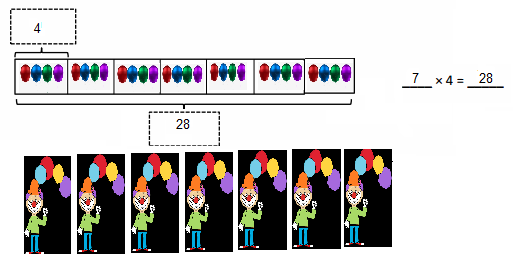
Seven clowns hold 4 balloons each at the fair.
Draw and label a tape diagram to show the total
number of balloons the clowns hold.

The total number of balloons the clowns hold are 28,
Eureka Math Grade 3 Module 1 Lesson 15 Answer Key-12
Explanation:
Given seven clowns hold 4 balloons each at the fair.
Drawn and labeled a tape diagram to show the total
number of balloons the clowns hold as 7 X 4 = 28 balloons.

Question 3.
George swims 7 laps in the pool each day.
How many laps does George swim after 4 days?

George swims 28 laps after 4 days.

Explanation:
Given George swims 7 laps in the pool each day,
So number of laps George swims after 4 days are
7 X 4 =28 laps.