Eureka Math
engage ny math 5th grade answer key pdf download
engage ny math 5th grade answer key | Eureka Math Grade 5 answer key
engage ny math 4th grade answer key pdf download
engage ny math 4th grade answer key | Eureka Math Grade 4 Answer Key
engage ny math 3rd grade answer key pdf download
engage ny math 3rd grade answer key | Eureka Math Grade 3 Answer Key
- engage ny math 3rd grade module 1 answer key
- engage ny math 3rd grade module 2 answer key
- engage ny math 3rd grade module 3 answer key
- engage ny math 3rd grade module 4 answer key
- engage ny math 3rd grade module 5 answer key
- engage ny math 3rd grade module 6 answer key
- engage ny math 3rd grade module 7 answer key
engage ny math 2nd grade answer key pdf download
engage ny math 2nd grade answer key | Eureka Math Grade 2 Answer Key
- engage ny math 2nd grade module 1 answer key
- engage ny math 2nd grade module 2 answer keyy
- engage ny math 2nd grade module 3 answer key
- engage ny math 2nd grade module 4 answer key
- engage ny math 2nd grade module 5 answer key
- engage ny math 2nd grade module 6 answer key
- engage ny math 2nd grade module 7 answer key
- engage ny math 2nd grade module 8 answer key
engage ny math 1st grade answer key pdf download
engage ny math 1st grade answer key | Eureka Math Grade 1 Answer Key
engage ny math kindergarten answer key pdf download
engage ny math kindergarten answer key | Eureka Math Kindergarten Answer Key
engage ny math pre k answer key pdf download
engage ny math pre k answer key | Eureka Math Pre K Answer Key
Eureka Math Grade 6 Module 4 Lesson 27 Answer Key
Engage NY Eureka Math Grade 6 Module 4 Lesson 27 Answer Key
Eureka Math Grade 6 Module 4 Lesson 27 Example Answer Key
Example 1:
Solve 3z = 9 using tape diagrams and algebraically. Then, check your answer. First, draw two tape diagrams, one to represent each side of the equation.
Answer:

If 9 had to be split into three groups, how big would each group be?
Answer:
3
Demonstrate the value of z using tape diagrams.
Answer:

How can we demonstrate this algebraically?
Answer:
We know we have to split 9 into three equal groups, so we have to divide by 3 to show this algebraically.
3z ÷ 3 = 9 ÷ 3
How does this get us the value of z?
Answer:
The left side of the equation will equal z because we know the identity property, where a . b ÷ b = a, so we con use this identity here.
The right side of the equation will be 3 because 9 ÷ 3 = 3.
Therefore, the value of z is 3.
How can we check our answer?
Answer:
We can substitute the value of z into the original equation to see if the number sentence is true.
3(3) = 9; 9 = 9. This number sentence is true, so our answer is correct.
Example 2:
Solve \(\frac{y}{4}\) = 2 using tape diagrams and algebraically. Then, check your answer. First, draw two tape diagrams, one to represent each side of the equation.
Answer:
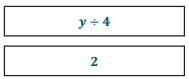
If the first tape diagram shows the size of y ÷ 4, how can we draw a tape diagram to represent y?
Answer:
The tape diagram to represent y should be four sections of the size y ÷ 4.
Draw this tape diagram.
Answer:

What value does each y ÷ 4 section represent? How do you know?
Answer:
Each y ÷ 4 section represents a value of 2. We know this from our original tape diagram.
How can you use a tape diagram to show the value of y?
Answer:
Draw four equal sections of 2, which will give y the value of 8.

How can we demonstrate this algebraically?
Answer:
\(\frac{y}{4}\) . 4 = 2 . 4. Because we multiplied the number of sections in the original equation by 4, we know the identity
\(\frac{a}{b}\) . b = a can be used here.
How does this help us find the value of y?
Answer:
The left side of the equation will equal y, and the right side will equal 8. Therefore, the value of y is 8.
How can we check our answer?
Answer:
Substitute 8 into the equation for y, and then check to see if the number sentence is true.
\(\frac{8}{4}\) = 2. This is a true number sentence, so 8 is the correct answer.
Eureka Math Grade 6 Module 4 Lesson 27 Exercise Answer Key
Exercises:
Exercise 1.
Use tape diagrams to solve the following problem: 3m = 21.
Answer:
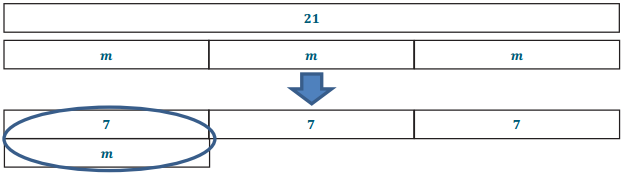
check: 3(7) = 21; 21 = 21. This number sentence is true, so 7 is the correct solution.
Exercise 2.
Solve the following problem algebraically: 15 = \(\frac{n}{5}\)
Answer:
15 = \(\frac{n}{5}\)
15 . 5 = \(\frac{n}{5}\) . 5
75 = n
Check: 15 = \(\frac{75}{5}\); 15 = 15. This number sentence is true, so 75 is the correct solution.
Exercise 3.
Calculate the solution of the equation using the method of your choice: 4p = 36.
Answer:
Tape Diagrams:
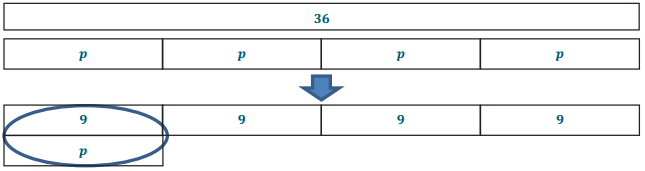
Algebraically:
4p = 36
4p ÷ 3 = 36 ÷ 4
p = 9
Check:
4(9) = 36; 36 = 36. This number sentence is true, so 9 is the correct solution.
Exercise 4.
Examine the tape diagram below, and write an equation it represents. Then, calculate the solution to the equation using the method of your choice.

Answer:

Algebraically:
7q = 70
7q ÷ 7 = 70 ÷ 7
q = 10
70 = 7q
70 ÷ 7 = 7q ÷ 7
q = 10
Check:
7(10) = 70, 70 = 7(10); 70 = 70. This number sentence is true, so 10 is the correct answer.
Exercise 5.
Write a multiplication equation that has a solution of 12. Use tape diagrams to prove that your equation has a solution of 12.
Answer:
Answers will vary.
Exercise 6.
Write a division equation that has a solution of 12. Prove that your equation has a solution of 12 using algebraic methods.
Answer:
Answers will vary.
Eureka Math Grade 6 Module 4 Lesson 27 Problem Set Answer Key
Question 1.
Use tape diagrams to calculate the solution of 30 = 5w. Then, check your answer.
Answer:
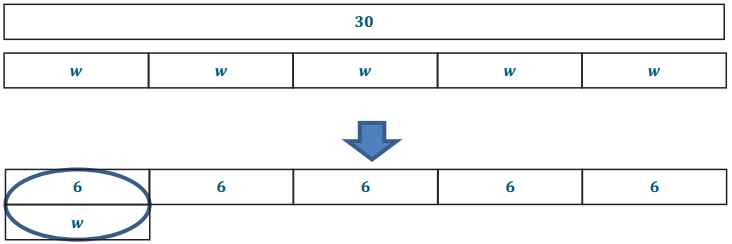
Check: 30 = 5(6); 30 = 30. This number sentence is true, so 6is the correct solution.
Question 2.
Solve 12 = \(\frac{x}{4}\) algebraically. Then, check your answer.
Answer:
12 = \(\frac{x}{4}\)
12 . 4 = \(\frac{x}{4}\) . 4
48 = x
Check:
12 = \(\frac{48}{4}\); 12 = 12. This number sentence is true, so 48 is the correct solution.
Question 3.
Use tape diagrams to calculate the solution of \(\frac{y}{5}\) = 15. Then, check your answer.
Answer:
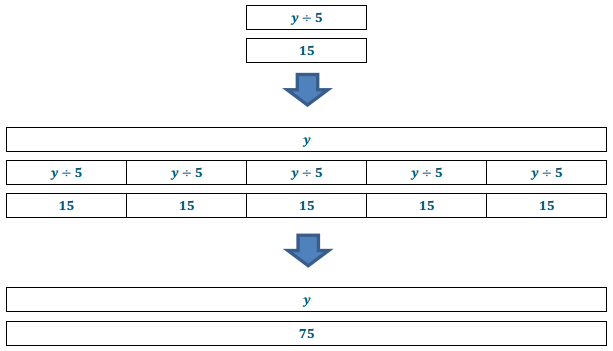
Check:
\(\frac{75}{5}\) = 15; 15 = 15. This number sentence is true, so 75 is the correct solution.
Question 4.
Solve 18z = 72 algebraically. Then, check your answer.
Answer:
18z = 72
18z ÷ 18 = 72 ÷ 18
z = 4
Check:
18(4) = 72; 72 = 72. This number sentence is true, so 4 is the correct solution.
Question 5.
Write a division equation that has a solution of 8. Prove that your solution is correct by using tape diagrams.
Answer:
Answers will vary.
Question 6.
Write a multiplication equation that has a solution of 8. Solve the equation algebraically to prove that your solution is correct.
Answer:
Answers will vary.
Question 7.
When solving equations algebraically, Meghan and Meredith each got a different solution. Who is correct? Why did the other person not get the correct answer?
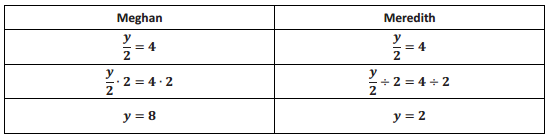
Answer:
Meghan is correct. Meredith divided by 2 to solve the equation, which is not correct because she would end up with \(\frac{y}{4}\) = 2. To solve a division equation, Meredith must multiply by 2 to end up with y because the identity states.
y ÷ 2 . 2 = y.
Eureka Math Grade 6 Module 4 Lesson 27 Exit Ticket Answer Key
Calculate the solution to each equation below using the indicated method. Remember to check your answers.
Question 1.
Use tape diagrams to find the solution of \(\frac{r}{10}\) = 4.
Answer:
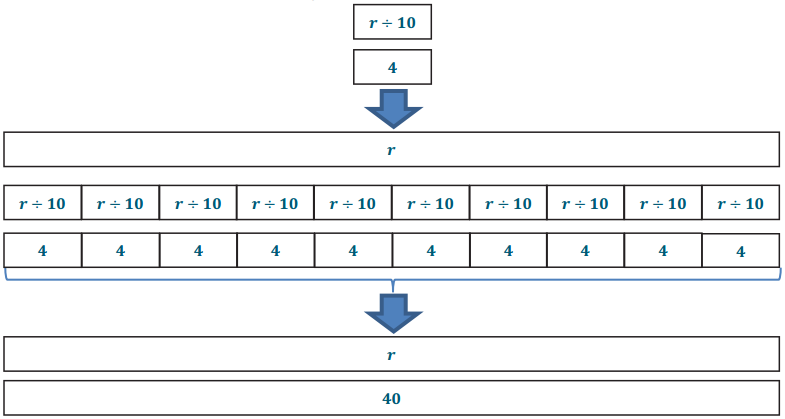
Check:
\(\frac{40}{10}\) = 4; 4 = 4. This number sentence is true, so 40 is the correct solution.
Question 2.
Find the solution of 64 = 16u algebraically.
Answer:
64 = 16u
64 ÷ 16 = 16u ÷ 16
4 = u
Check:
64 = 16(4); 64 = 64. This number sentence is true, so 4 is the correct solution.
Question 3.
Use the method of your choice to find the solution of 12 = 3v.
Answer:
Tape Diagrams:
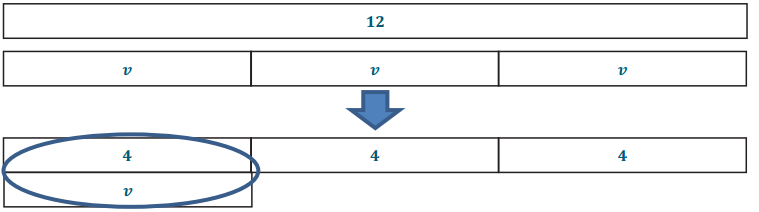
Algebraically:
12 = 3v
12 ÷ 3 = 3v ÷ 3
4 = v
Check:
12 = 3(4); 12 = 12. This number sentence is true, so 4 is the correct solution.
Eureka Math Grade 6 Module 4 Lesson 26 Answer Key
Engage NY Eureka Math Grade 6 Module 4 Lesson 26 Answer Key
Eureka Math Grade 6 Module 4 Lesson 26 Exercise Answer Key
Exercise 1:
Solve each equation. Use both tape diagrams and algebraic methods for each problem. Use substitution to check your answers.
a. b + 9 = 15
Answer:
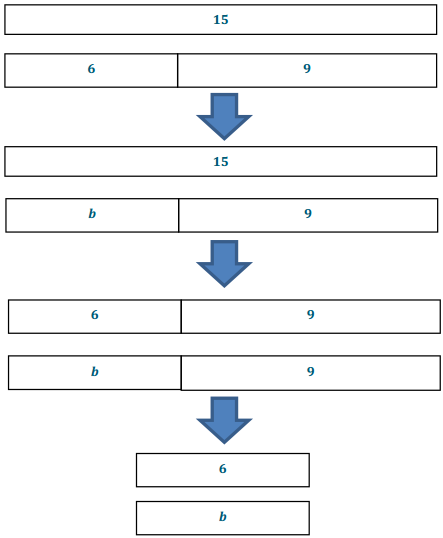
Algebraically:
b + 9 = 15
b + 9 – 9 = 15 – 9
b = 6
Check:
6 + 9 – 9 = 15 – 9; 6 = 6. This is a true number sentence, so 6 is the correct solution.
b. 12 = 8 + c
Answer:
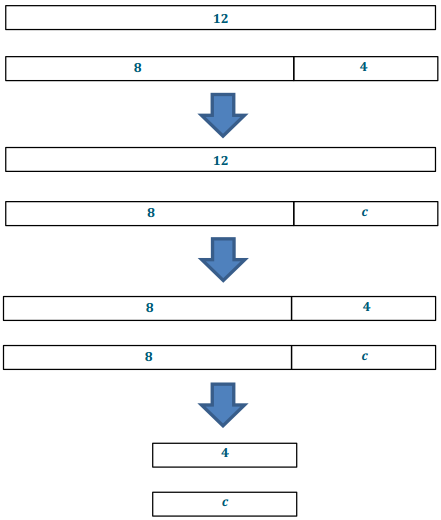
Algebraically:
12 = 8 + c
12 – 8 = 8 + c – 8
4 = c
Check:
12 – 8 = 8 + 4 – 8; 4 = 4. This is a true number sentence, so 4 is the correct solution.
Exercise 2:
Given the equation d – 5 = 7.
a. Demonstrate how to solve the equation using tape diagrams.
Answer:
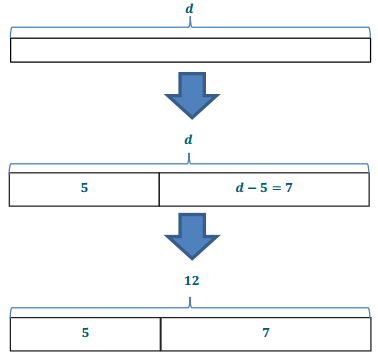
b. Demonstrate how to solve the equation algebraically.
Answer:
d – 5 = 7
d – 5 + 5 = 7 + 5
d = 12
c. check your answer.
Answer:
12 – 5 + 5 = 7 + 5; 12 = 12. This is a true number sentence, so our solution is correct.
Exercise 3:
Solve each problem, and show your work. You may choose which method (tape diagrams or algebraically) you prefer. Check your answers after solving each problem.
a. e + 12 = 20
Answer:
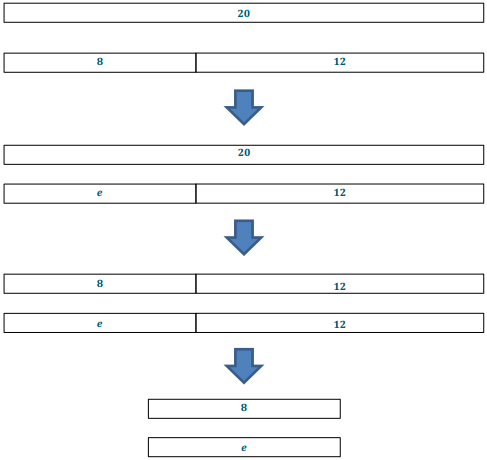
Algebraically:
e + 12 = 20
e + 12 – 12 = 20 – 12
e = 8
Check:
8 + 12 – 12 = 20 – 12; 8 = 8. This is a true number sentence, so our answer is correct.
b. f – 10 = 15
Answer:
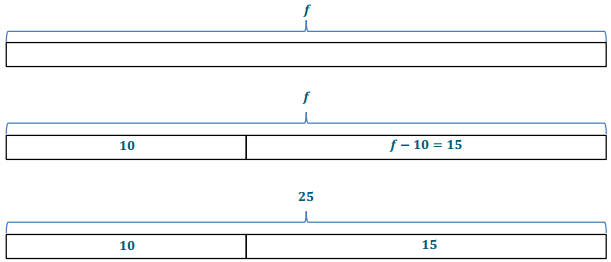
Algebraically:
f – 10 = 15
f – 10 + 10 = 15 + 10
f = 25
Check:
25 – 10 + 10 = 15 + 10; 25 = 25. This is a true number sentence, so our solution is correct.
c. g – 8 = 9
Answer:
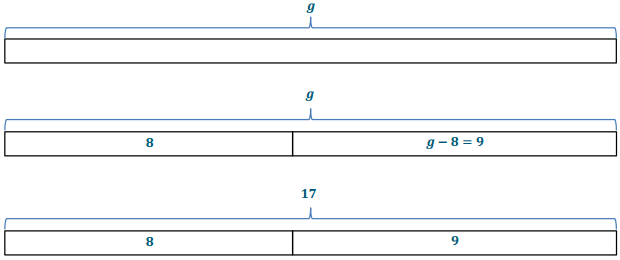
Algebraically:
g – 8 = 9
g – 8 + 8 = 9 + 8
g = 17
Check:
17 – 8 + 8 = 9 + 8; 17 = 17. This number sentence is true, so our solution is correct.
Eureka Math Grade 6 Module 4 Lesson 26 Problem Set Answer Key
Question 1.
Find the solution to the equation below using tape diagrams. Check your answer. m – 7 = 17
Answer:
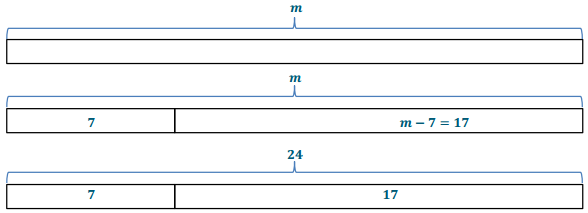
m is equal to 24; m = 24.
Check:
24 – 7 = 17; 17 = 17. This number sentence is true, so the solution is correct.
Question 2.
Find the solution of the equation below algebraically. Check your answer.
Answer:
n + 14 = 25
n + 14 – 14 = 25 – 14
n = 11
Check:
11 + 14 = 25; 25 = 25. This number sentence is true, so the solution is correct.
Question 3.
Find the solution of the equation below using tape diagrams. Check your answer. p + 8 = 18
Answer:
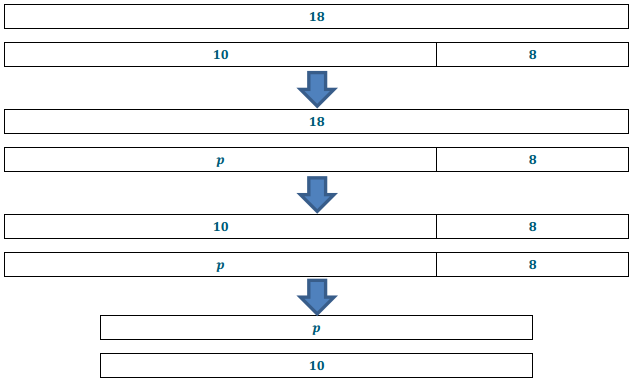
Check:
10 + 8 = 18; 18 = 18. This number sentence is true, so the solution is correct.
Question 4.
Find the solution to the equation algebraically. Check your answer.
Answer:
g – 62 = 14
g – 62 + 62 = 14 + 62
g = 76
Check:
76 – 62 = 14; 14 = 14. This number sentence is true, so the solution is correct.
Question 5.
Find the solution to the equation using the method of your choice. Check your answer. m + 108 = 243
Answer:
Tape Diagrams:
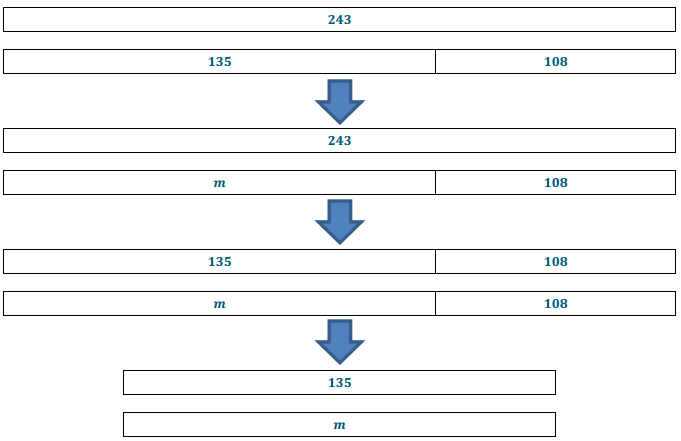
Algebraically:
m + 108 = 243
m + 108 – 108 = 243 – 108
m = 35
Check:
135 + 108 = 243; 243 = 243. This number sentence is true, so the solution is correct.
Question 6.
Identify the mistake in the problem below. Then, correct the mistake.
Answer:
p – 21 = 34
p – 21 – 21 = 34 – 21
p = 13
The mistake is subtracting rather than adding 21. This is incorrect because p – 21 – 21 would not equal p.
p – 21 = 34
p – 21 + 21 = 34 + 21
p = 55
Question 7.
Identify the mistake in the problem below. Then, correct the mistake.
Answer:
q + 18 = 22
q + 18 – 18 = 22 + 18
q = 40
The mistake is adding 18 on the right side of the equation instead of subtracting it from both sides.
q + 18 = 22
q + 18 – 18 = 22 – 18
q = 4
Question 8.
Match the equation with the correct solution on the right.
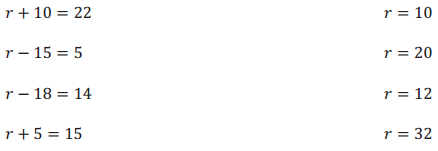
Answer:

Eureka Math Grade 6 Module 4 Lesson 26 Exit Ticket Answer Key
Question 1.
If you know the answer, state it. Then, use a tape diagram to demonstrate why this is the correct answer. If you do not know the answer, find the solution using a tape diagram. j + 12 = 25
Answer:
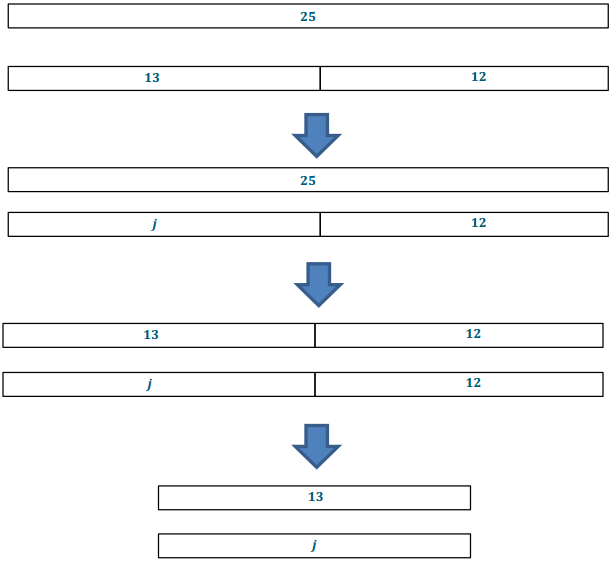
j is equal to 13; j = 13.
Check:
13 + 12 = 25; 25 = 25. This is a true number sentence, so the solution is correct.
Question 2.
Find the solution to the equation algebraically. Check your answer.
Answer:
k – 16 = 4
k – 16 + 16 = 4 + 16
k = 20
Check: 20 – 16 = 4; 4 = 4. This is a true number sentence, so the solution is correct.
Eureka Math Grade 6 Module 4 Lesson 25 Answer Key
Engage NY Eureka Math Grade 6 Module 4 Lesson 25 Answer Key
Eureka Math Grade 6 Module 4 Lesson 25 Opening Exercise Answer Key
Opening Exercise:
Identify a value for the variable that would make each equation or inequality into a true number sentence. Is this the only possible answer? State when the equation or inequality is true using equality and inequality symbols.
a. 3 + g = 15
Answer:
12 is the only value of g that will make the equation true. The equation is true when g = 12.
b. 30 > 2d
Answer:
Answers will vary. There is more than one value of d that will make the inequality true. The inequality is true when d < 15.
c. \(\frac{15}{f}\) < 5
Answer:
Answers will vary. There is more than one value off that will make the inequality true. The inequality is true when f > 3.
d. 42 ≤ 50 – m
Answer:
Answers will vary. There is more than one value of m that will make the inequality true. The inequality is true when m ≤ 8.
Eureka Math Grade 6 Module 4 Lesson 25 Example Answer Key
Example:
Each of the following numbers, if substituted for the variable, makes one of the equations below into a true number sentence. Match the number to that equation: 3, 6, 15, 16, 44.
a. n + 26 = 32
Answer:
6
b. n – 12 = 32
Answer:
44
c. 17n = 51
Answer:
3
d. 42 = n
Answer:
16
e. \(\frac{n}{3}\) = 5
Answer:
15
Eureka Math Grade 6 Module 4 Lesson 25 Problem Set Answer Key
Find the solution to each equation.
Question 1.
43 = y
Answer:
y = 64
Question 2.
8a = 24
Answer:
a = 3
Question 3.
32 = g – 4
Answer:
g = 36
Question 4.
56 = j + 29
Answer:
j = 27
Question 5.
\(\frac{48}{r}\) = 12
Answer:
r = 4
Question 6.
k = 15 – 9
k = 6
Question 7.
x . \(\frac{1}{5}\) = 60
Answer:
x = 300
Question 8.
m + 3 . 45 = 12 . 8
Answer:
m = 9 . 35
Question 9.
a = 15
Answer:
a = 1
Eureka Math Grade 6 Module 4 Lesson 25 Exit Ticket Answer Key
Find the solution to each equation.
Question 1.
7f = 49
Answer:
f = 7
Question 2.
1 = \(\frac{r}{12}\)
Answer:
r = 12
Question 3.
1.5 = d + 0.8
Answer:
d = 0.7
Question 4.
92 = h
Answer:
h = 81
Question 5.
q = 45 – 19
Answer:
q = 26
Question 6.
40 = \(\frac{1}{2}\)p
Answer:
p = 80
Eureka Math Grade 6 Module 4 Lesson 25 Division of Fractions Answer Key
Division of Fractions – Round 1:
Directions: Evaluate each expression and simplify:
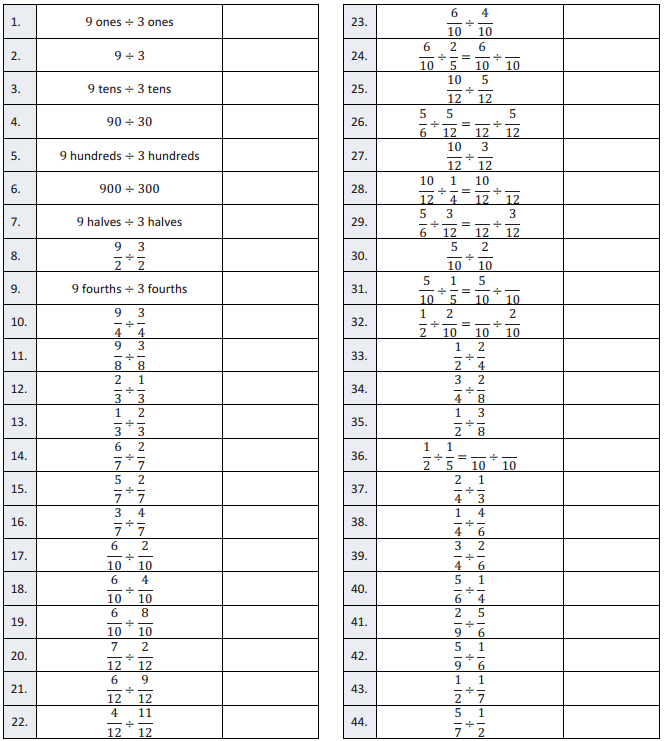
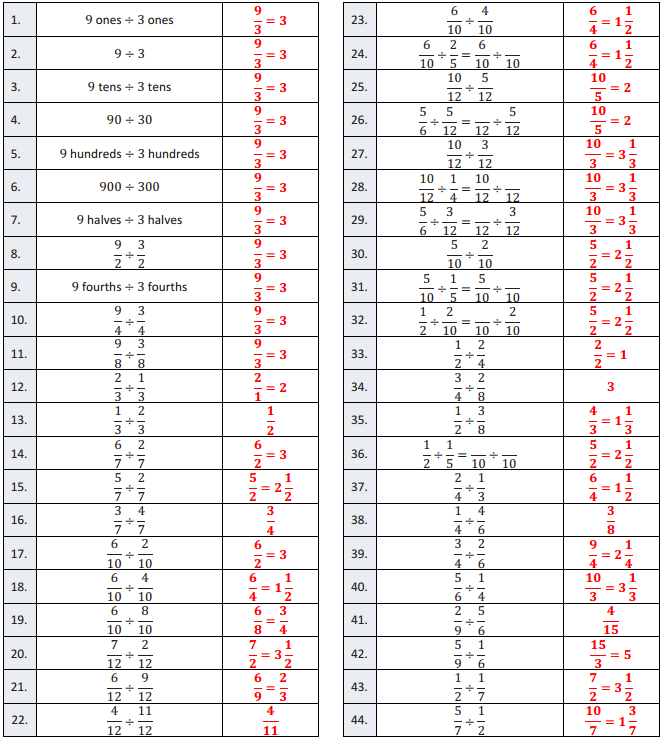
Question 1.
9 ones ÷ 3ones
Answer:
\(\frac{9}{3}\) = 3
Question 2.
9 ÷ 3
Answer:
\(\frac{9}{3}\) = 3
Question 3.
9tens ÷ 3tens
Answer:
\(\frac{9}{3}\) = 3
Question 4.
90 ÷ 30
Answer:
\(\frac{9}{3}\) = 3
Question 5.
9 hundreds ÷ 3 hundreds
Answer:
\(\frac{9}{3}\) = 3
Question 6.
900 ÷ 300
Answer:
\(\frac{9}{3}\) = 3
Question 7.
9 halves ÷ 3 halves
Answer:
\(\frac{9}{3}\) = 3
Question 8.
\(\frac{9}{2}\) ÷ \(\frac{9}{2}\)
Answer:
\(\frac{9}{3}\) = 3
Question 9.
9 fourths ÷ 9 fourths
Answer:
\(\frac{9}{3}\) = 3
Question 10.
\(\frac{9}{4}\) \(\frac{3}{4}\)
Answer:
\(\frac{9}{3}\) = 3
Question 11.
\(\frac{9}{8}\) ÷ \(\frac{3}{8}\)
Answer:
\(\frac{9}{3}\) =3
Question 12.
\(\frac{2}{3}\) ÷ \(\frac{1}{3}\)
Answer:
\(\frac{2}{1}\) = 2
Question 13.
\(\frac{1}{3}\) ÷ \(\frac{2}{3}\)
Answer:
\(\frac{1}{2}\)
Question 14.
\(\frac{6}{7}\) ÷ \(\frac{2}{7}\)
Answer:
\(\frac{6}{2}\) = 3
Question 15.
\(\frac{5}{7}\) ÷ \(\frac{2}{7}\)
Answer:
\(\frac{5}{2}\) = 2\(\frac{1}{2}\)
Question 16.
\(\frac{3}{7}\) ÷ \(\frac{4}{7}\)
Answer:
\(\frac{3}{4}\)
Question 17.
\(\frac{6}{10}\) ÷ \(\frac{2}{10}\)
Answer:
\(\frac{6}{2}\) = 3
Question 18.
\(\frac{6}{10}\) ÷ \(\frac{4}{10}\)
Answer:
\(\frac{6}{4}\) = 1\(\frac{1}{2}\)
Question 19.
\(\frac{6}{10}\) ÷ \(\frac{8}{10}\)
Answer:
\(\frac{6}{8}\) = \(\frac{3}{4}\)
Question 20.
\(\frac{7}{12}\) \(\frac{2}{12}\)
Answer:
\(\frac{7}{2}\) = 3\(\frac{1}{2}\)
Question 21.
\(\frac{6}{12}\) ÷ \(\frac{9}{12}\)
Answer:
\(\frac{6}{9}\) = \(\frac{2}{3}\)
Question 22.
\(\frac{4}{12}\) ÷ \(\frac{11}{12}\)
Answer:
\(\frac{4}{11}\)
Question 23.
\(\frac{6}{10}\) \(\frac{4}{10}\)
Answer:
\(\frac{6}{4}\) = 1\(\frac{1}{2}\)
Question 24.
\(\frac{9}{3}\) ÷ \(\frac{9}{3}\) = \(\frac{9}{3}\) ÷ \(\overline{10}\)
Answer:
\(\frac{6}{4}\) = 1\(\frac{1}{2}\)
Question 25.
\(\frac{10}{12}\) \(\frac{5}{12}\)
Answer:
\(\frac{10}{5}\) = 2
Question 26.
\(\frac{6}{4}\) ÷ \(\frac{6}{4}\) = \(\frac{6}{4}\) ÷ \(\overline{10}\)
Answer:
\(\frac{10}{5}\) = 2
Question 27.
\(\frac{10}{12}\) ÷ \(\frac{3}{12}\)
Answer:
\(\frac{10}{3}\) = 3\(\frac{1}{3}\)
Question 28.
\(\frac{10}{12}\) ÷ \(\frac{1}{4}\) = \(\frac{10}{12}\) ÷ \(\overline{10}\)
Answer:
\(\frac{10}{3}\) = 3\(\frac{1}{3}\)
Question 29.
\(\frac{5}{6}\) ÷ \(\frac{3}{12}\) = \(\overline{10}\) ÷ \(\frac{3}{12}\)
Answer:
\(\frac{10}{3}\) = 3\(\frac{1}{3}\)
Question 30.
\(\frac{5}{10}\) \(\frac{2}{10}\)
Answer:
\(\frac{5}{2}\) = 2\(\frac{1}{2}\)
Question 31.
\(\frac{5}{10}\) ÷ \(\frac{1}{5}\) = \(\frac{5}{10}\) ÷ \(\overline{10}\)
Answer:
\(\frac{5}{2}\) = 2\(\frac{1}{2}\)
Question 32.
\(\frac{1}{2}\) ÷ \(\frac{2}{10}\) = \(\overline{10}\) ÷ \(\frac{2}{10}\)
Answer:
\(\frac{5}{2}\) = 2\(\frac{1}{2}\)
Question 33.
\(\frac{1}{2}\) ÷ \(\frac{2}{4}\)
Answer:
\(\frac{1}{2}\) = 1
Question 34.
\(\frac{3}{4}\) ÷ \(\frac{2}{8}\)
Answer:
3
Question 35.
\(\frac{1}{2}\) ÷ \(\frac{3}{8}\)
Answer:
\(\frac{4}{3}\) = 1\(\frac{1}{3}\)
Question 36.
\(\frac{1}{2}\) ÷ \(\frac{1}{5}\) = \(\overline{10}\) ÷ \(\overline{10}\)
Answer:
\(\frac{5}{2}\) = 2\(\frac{1}{2}\)
Question 37.
\(\frac{2}{4}\) ÷ \(\frac{1}{3}\)
Answer:
\(\frac{6}{4}\) = 1\(\frac{1}{2}\)
Question 38.
\(\frac{1}{4}\) ÷ \(\frac{4}{6}\)
Answer:
\(\frac{3}{8}\)
Question 39.
\(\frac{3}{4}\) ÷ \(\frac{2}{6}\)
Answer:
\(\frac{9}{4}\) = 2\(\frac{1}{2}\)
Question 40.
\(\frac{5}{6}\) ÷ \(\frac{1}{4}\)
Answer:
\(\frac{10}{3}\) = 3\(\frac{1}{3}\)
Question 41.
\(\frac{2}{9}\) ÷ \(\frac{5}{6}\)
Answer:
\(\frac{4}{15}\)
Question 42.
\(\frac{5}{9}\) ÷ \(\frac{1}{6}\)
Answer:
\(\frac{15}{3}\) = 5
Question 43.
\(\frac{1}{2}\) ÷ \(\frac{1}{7}\)
Answer:
\(\frac{7}{2}\) = 3\(\frac{1}{2}\)
Question 44.
\(\frac{5}{7}\) ÷ \(\frac{1}{2}\)
Answer:
\(\frac{10}{7}\) = 1\(\frac{3}{7}\)
Division of Fractions – Round 2:
Directions: Evaluate each expression:
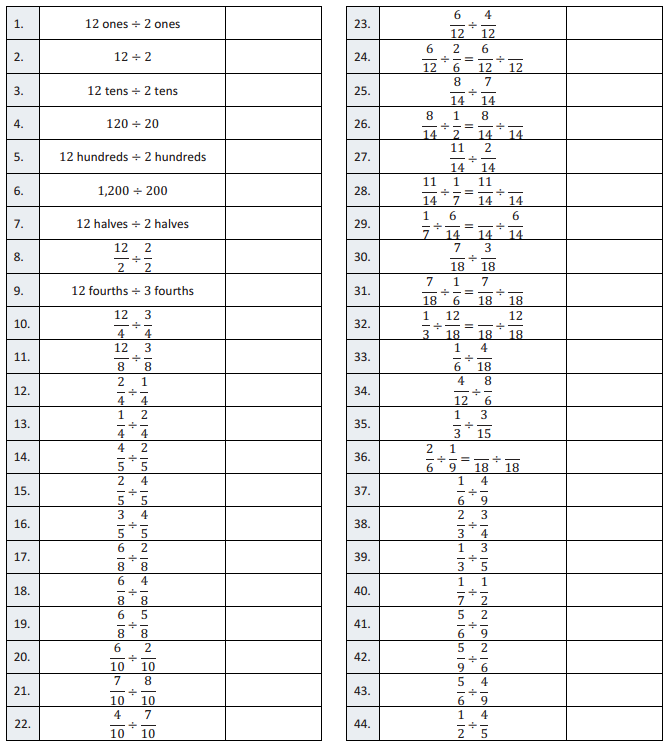
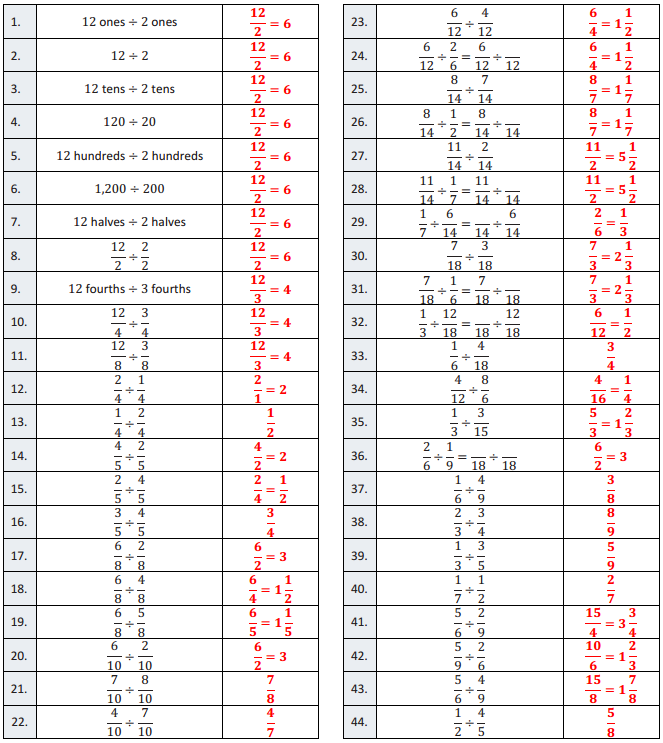
Question 1.
12ones ÷ 2ones
Answer:
\(\frac{12}{2}\) = 6
Question 2.
12 ÷ 2
Answer:
\(\frac{12}{2}\) = 6
Question 3.
12tens ÷ 2tens
Answer:
\(\frac{12}{2}\) = 6
Question 4.
120 ÷ 20
Answer:
\(\frac{12}{2}\) = 6
Question 5.
12 hundreds ÷ 2 hundreds
Answer:
\(\frac{12}{2}\) = 6
Question 6.
1,200 ÷ 200
Answer:
\(\frac{12}{2}\) = 6
Question 7.
12 halves ÷ 2 halves
Answer:
\(\frac{12}{2}\) = 6
Question 8.
\(\frac{12}{2}\) ÷ \(\frac{2}{2}\)
Answer:
\(\frac{12}{2}\) = 6
Question 9.
12 fourths ÷ 3 fourths
Answer:
\(\frac{12}{3}\) = 4
Question 10.
\(\frac{12}{4}\) ÷ \(\frac{12}{2}\)
Answer:
\(\frac{12}{3}\) = 4
Question 11.
\(\frac{12}{8}\) ÷ \(\frac{3}{8}\)
Answer:
\(\frac{12}{2}\) = 4
Question 12.
\(\frac{2}{4}\) ÷ \(\frac{1}{4}\)
Answer:
\(\frac{2}{1}\) = 2
Question 13.
\(\frac{1}{4}\) ÷ \(\frac{2}{4}\)
Answer:
\(\frac{1}{2}\)
Question 14.
\(\frac{4}{5}\) ÷ \(\frac{2}{5}\)
Answer:
\(\frac{4}{2}\) = 2
Question 15.
\(\frac{2}{5}\) ÷ \(\frac{4}{5}\)
Answer:
\(\frac{2}{4}\) = \(\frac{1}{2}\)
Question 16.
\(\frac{3}{5}\) ÷ \(\frac{4}{5}\)
Answer:
\(\frac{3}{4}\)
Question 17.
\(\frac{6}{8}\) ÷ \(\frac{2}{8}\)
Answer:
\(\frac{6}{2}\) = 3
Question 18.
\(\frac{6}{8}\) ÷ \(\frac{4}{8}\)
Answer:
\(\frac{6}{4}\) = 1\(\frac{1}{2}\)
Question 19.
\(\frac{6}{8}\) ÷ \(\frac{5}{8}\)
Answer:
\(\frac{6}{5}\) = 1\(\frac{1}{5}\)
Question 20.
\(\frac{6}{10}\) ÷ \(\frac{2}{10}\)
Answer:
\(\frac{6}{2}\) = 3
Question 21.
\(\frac{7}{10}\) ÷ \(\frac{8}{10}\)
Answer:
\(\frac{7}{8}\)
Question 22.
\(\frac{4}{10}\) ÷ \(\frac{7}{10}\)
Answer:
\(\frac{4}{7}\)
Question 23.
\(\frac{6}{12}\) ÷ \(\frac{4}{12}\)
Answer:
\(\frac{6}{4}\) = 1\(\frac{1}{2}\)
Question 24.
\(\frac{6}{12}\) ÷ \(\frac{2}{6}\) = \(\frac{6}{12}\) ÷ \(\overline{12}\)
Answer:
\(\frac{6}{4}\) = 1\(\frac{1}{2}\)
Question 25.
\(\frac{8}{14}\) ÷ \(\frac{7}{14}\)
Answer:
\(\frac{8}{7}\) = 1\(\frac{1}{7}\)
Question 26.
\(\frac{8}{14}\) ÷ \(\frac{1}{2}\) = \(\frac{8}{14}\) ÷ \(\overline{14}\)
Answer:
\(\frac{8}{7}\) = 1\(\frac{1}{7}\)
Question 27.
\(\frac{11}{14}\) = \(\frac{2}{14}\)
Answer:
\(\frac{11}{2}\) = 5\(\frac{1}{2}\)
Question 28.
\(\frac{11}{14}\) ÷ \(\frac{1}{7}\) = \(\frac{11}{14}\) ÷ \(\overline{14}\)
Answer:
\(\frac{11}{2}\) = 5\(\frac{1}{2}\)
Question 29.
\(\frac{1}{7}\) ÷ \(\frac{6}{14}\) = \(\overline{14}\) ÷ \(\frac{6}{14}\)
Answer:
\(\frac{2}{6}\) = \(\frac{1}{3}\)
Question 30.
\(\frac{7}{18}\) ÷ \(\frac{3}{18}\)
Answer:
\(\frac{7}{3}\) = 2\(\frac{1}{3}\)
Question 31.
\(\frac{7}{18}\) ÷ \(\frac{1}{6}\) = \(\frac{7}{18}\) ÷ \(\overline{18}\)
Answer:
\(\frac{7}{3}\) = 2\(\frac{1}{3}\)
Question 32.
\(\frac{1}{3}\) ÷ \(\frac{12}{18}\) = \(\overline{18}\) ÷ \(\frac{12}{18}\)
Answer:
\(\frac{6}{12}\) = \(\frac{1}{2}\)
Question 33.
\(\frac{1}{6}\) ÷ \(\frac{4}{18}\)
Answer:
\(\frac{3}{4}\)
Question 34.
\(\frac{4}{12}\) ÷ \(\frac{8}{6}\)
Answer:
\(\frac{4}{16}\) = \(\frac{1}{4}\)
Question 35.
\(\frac{1}{3}\) ÷ \(\frac{3}{15}\)
Answer:
\(\frac{5}{3}\) = 1\(\frac{2}{3}\)
Question 36.
\(\frac{2}{6}\) ÷ \(\frac{1}{9}\) = \(\overline{18}\) ÷ \(\overline{18}\)
Answer:
\(\frac{6}{2}\) = 3
Question 37.
\(\frac{1}{6}\) ÷ \(\frac{4}{9}\)
Answer:
\(\frac{3}{8}\)
Question 38.
\(\frac{2}{3}\) ÷ \(\frac{3}{4}\)
Answer:
\(\frac{8}{9}\)
Question 39.
\(\frac{1}{3}\) ÷ \(\frac{3}{5}\)
Answer:
\(\frac{5}{9}\)
Question 40.
\(\frac{1}{7}\) ÷ \(\frac{1}{2}\)
Answer:
\(\frac{2}{7}\)
Question 41.
\(\frac{5}{6}\) ÷ \(\frac{2}{9}\)
Answer:
\(\frac{15}{4}\) = 3\(\frac{3}{4}\)
Question 42.
\(\frac{5}{9}\) ÷ \(\frac{2}{6}\)
Answer:
\(\frac{10}{6}\) = 1\(\frac{2}{3}\)
Question 43.
\(\frac{5}{6}\) ÷ \(\frac{4}{9}\)
Answer:
\(\frac{15}{8}\) = 1\(\frac{7}{8}\)
Question 44.
\(\frac{1}{2}\) ÷ \(\frac{4}{5}\)
Answer:
\(\frac{5}{8}\)
Eureka Math Grade 6 Module 4 Lesson 24 Answer Key
Engage NY Eureka Math Grade 6 Module 4 Lesson 24 Answer Key
Eureka Math Grade 6 Module 4 Lesson 24 Opening Exercise Answer Key
Opening Exercise:
State whether each number sentence is true or false. If the number sentence is false, explain why.
a. 4 + 5 > 9
Answer:
False. 4 + 5 is not greater than 9.
b. 36 = 18
Answer:
True
c. 32 > \(\frac{64}{4}\)
Answer:
True
d. 78 – 15 < 68
Answer:
True
e. 22 ≥ 11 + 12
Answer:
False. 22 is not greater than or equal to 23.
Eureka Math Grade 6 Module 4 Lesson 24 Example Answer Key
Example 1:
Write true or false if the number substituted for g results in a true or false number sentence.
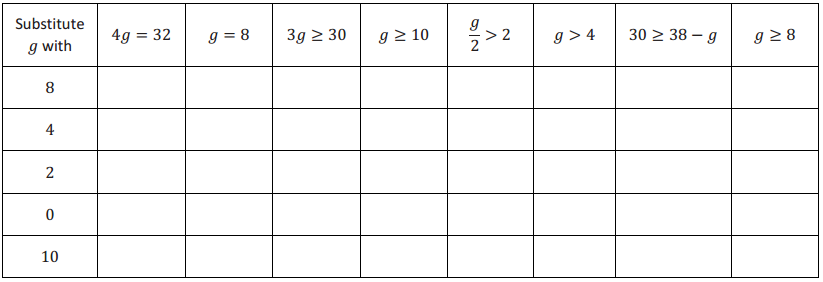
Answer:

Example 2:
State when the following equations/inequalities will be true and when they will be false.
a. r + 15 = 25
Answer:
→ Can you think of a number that will make this equation true?
Yes. Substituting 10 for r will make a true number sentence.
→ Is 10 the only number that results in a true number sentence? Why or why not?
Yes. There is only one value that, if substituted, will result in a true number sentence. There is only one number that can be added to 15 to get exactly 25.
→ What will make the number sentence false?
Any number that is not 10 will result in a false number sentence.
→ If we look back to the original questions, how can we state when the equation will be true? False?
The equation is true when the value substituted for r is 10 and false when the value of r is any other number.
b. 6 – d > 0
Answer:
→ If we wanted 6 – d to equal 0, what would the value of d have to be? Why?
The value of d would have to be 6 because 6 – 6 = 0.
→ Will substituting 6 for d result in a true number sentence? Why or why not?
If d has a value of 6, then the resulting number sentence would not be true because the left side has to be greater than 0, not equal to 0.
→ How about substituting 5 for d? 4? 3? 2?
Yes. Substituting any of these numbers for d into the inequality results in true number sentences.
→ What values can we substitute for d in order for the resulting number sentence to be true?
The inequality is true for any value of d that is less than 6.
→ What values for d would make the resulting number sentence false?
The inequality is false for any value of d that is greater than or equal to 6.
→ Let’s take a look at a number line and see why these statements make sense.
Display a number line on the board. Label the number line as shown below.

→ Let’s begin at 6. If I were to subtract 1 from 6, where would that place be on the number line?
5
→ So, if we substitute 1 for d, then 6 – 1 = 5, and the resulting number sentence is true. How about if I subtracted 2 from 6? Would our number sentence be true for the value 2?
Yes
→ What if I subtracted 6 from the 6 on the number line? Where would that be on the number line?
0
→ So, if we substitute 6 for d, will the resulting number sentence be true or false?
False
→ Let’s try one more. We have already determined that any number greater than or equal to 6 will result in a false number sentence. Let’s try a number greater than 6. Let’s try the number 7.
→ Start with the 6 on the number line. If we were to subtract 7, in which direction on the number line would we
move?
To the left
→ And how many times will we move to the left?
7
→ Model beginning at 6 on the number line, and move a finger, or draw the unit skips, while continually moving to the left on the number line 7 times.

→ So, it seems we have ended up at a place to the left of O. What number is represented by this position?
-1
c. \(\frac{1}{2}\)f = 15
Answer:
The equation is true when the value substituted for fis 30 (f = 30) and false when the value off is any other number (f ≠ 30).
d. \(\frac{y}{3}\) < 10
Answer:
The inequality is true for any value of y that is less than 30 (y < 30) and false when the value of y is greater than or equal to 30 (y ≥ 30).
e. 7g ≥ 42
Answer:
The inequality is true for any value of g that is greater than or equal to 6 (g ≥ 6) and false when the value of g is less than (g < 6).
f. a – 8 ≤ 15
Answer:
The inequality is true for any value of a that is less than or equal to 23 (a ≤ 23) and false when the value of a is greater than 23 (a > 23).
Eureka Math Grade 6 Module 4 Lesson 24 Exercise Answer Key
Exercises:
Complete the following problems in pairs. State when the following equations and inequalities will be true and when they will be fake.
Exercise 1.
15c > 45
Answer:
The inequality is true for any value of c that is greater than 3 (c > 3) and false when the value of c is less than or equal to (c ≤ 3).
Exercise 2.
25 = d – 10
Answer:
The equation is true when the value of d is 35 (d = 35) and false when the value of d is any other number (d ≠ 35).
Exercise 3.
56 ≥ 2e
Answer:
The inequality is true for any value of e that is less than or equal to 28 (e ≤ 28) and false when the value of e is greater than 8 (e > 28).
Exercise 4.
\(\frac{h}{5}\) ≥ 12
Answer:
The inequality is true for any value of h that is greater than or equal to 60 (h ≥ 60) and false when the value of h is less than (h < 60).
Exercise 5.
45 > h + 29
Answer:
The inequality is true for any value of h that is less than 16 (h < 16) and false when the value of h is greater than or
equal to 16 (h ≥ 16).
Exercise 6.
4a ≤ 16
Answer:
The inequality is true for any value of a that is less than or equal to 4 (a ≤ 4) and false when the value of a is greater than (a > 4).
Exercise 7.
3x = 24
Answer:
The equation is true when the value of x is 8 (x = 8) and false when the value of x is any other number (x ≠ 8).
Identify all equality and inequality signs that can be placed into the blank to make a true number sentence.
Exercise 8.
15 + 9 ___ 24
Answer:
= or ≥ or ≤
Exercise 9.
8.7 ___ 50
Answer:
> or ≥
Exercise 10.
\(\frac{15}{2}\) ___ 10
Answer:
< or ≤
Exercise 11.
34 ___ 17 . 2
Answer:
= or ≥ or ≤
Exercise 12.
18 ___ 24.5 – 6
Answer:
< or ≤
Eureka Math Grade 6 Module 4 Lesson 24 Problem Set Answer Key
State when the following equations and inequalities will be true and when they will be false.
Question 1.
36 = 9k
Answer:
The equation is true when the value of k is 4 and false when the value of k is any number other than 4.
OR
The equation is true when k = 4 and false when k ≠ 4.
Question 2.
67 > f – 15
Answer:
The inequality is true for any value off that is less than 82 and false when the value of f is greater than or equal to 82.
OR
The inequality is true when f < 82 and false when f ≥ 82.
Question 3.
\(\frac{v}{9}\) = 3
Answer:
The equation is true when the value of v is 27 and false when the value of v is any number other than 27.
OR
The equation is true when v = 27 and false when v ≠ 27.
Question 4.
10 + b > 42
Answer:
The inequality is true for any value of b that is greater than 32 and false when the value of b is less than or equal to 32.
OR
The inequality is true when b > 32 and false when b ≤ 32.
Question 5.
d – 8 ≥ 35
Answer:
The inequality is true for any value of d that is greater than or equal to 43 and false when the value of d is less than 43
OR
The inequality is true when d ≥ 43 and false when d <43.
Question 6.
32f < 64
Answer:
The inequality is true for any value of f that is less than 2 and false when the value off is greater than or equal to 2.
OR
The inequality is true when f < 2 and false when f ≥ 2.
Question 7.
10 – h ≤ 7
Answer:
The inequality is true for any value of h that is greater than or equal to 3 and false when the value of h is less than 3.
OR
The inequality is true when h ≥ 3 and false when h < 3.
Question 8.
42 + 8 ≥ g
Answer:
The inequality is true for any value of g that is less than or equal to 50 and false when the value of g is greater than 50.
OR
The inequality is true when g < 50 and false when g > 50.
Question 9.
\(\frac{m}{3}\) = 14
Answer:
The equation is true when the value of m is 42 and false when the value of m is any number other than 42.
OR
The equation is true when m = 42 and false when m ≠ 42.
Eureka Math Grade 6 Module 4 Lesson 24 Exit Ticket Answer Key
State when the following equations and inequalities will be true and when they will be false.
Question 1.
5g > 45
Answer:
The inequality is true for any value of g that is greater than 9 and false when the value of g is less than or equal to 9.
OR
The inequality is true when g > 9 and false when g ≤ 9.
Question 2.
14 = 5 + k
Answer:
The equation is true when the value of k is 9 and false when the value of k is any other number.
OR
The equation is true when k = 9 and false when k ≠ 9.
Question 3.
26 – w < 12
Answer:
The inequality is true for any value of w that is greater than 14 and false when the value of w is less than or equal to 14.
OR
The inequality is true when w > 14 and false when w < 14.
Question 4.
32 ≤ a + 8
Answer:
The inequality is true for any value of a that is greater than or equal to 24 and false when the value of a is less than 24.
OR
The inequality is true when a ≥ 24 and false when a < 24.
Question 5.
2 . h ≤ 16
Answer:
The inequality is true for any value of h that is less than or equal to 8 and false when the value of h is greater than 8.
OR
The inequality is true when h < 8 and false when h > 8.
Eureka Math Grade 6 Module 4 Lesson 23 Answer Key
Engage NY Eureka Math Grade 6 Module 4 Lesson 23 Answer Key
Eureka Math Grade 6 Module 4 Lesson 23 Opening Exercise Answer Key
Opening Exercise:
Determine what each symbol stands for, and provide an example.
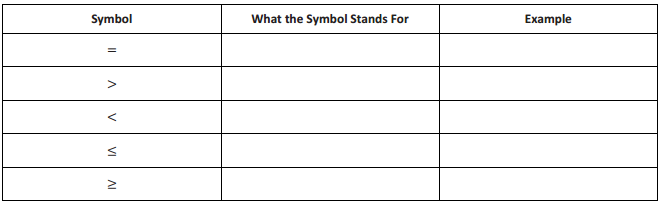
Answer:

→ What is another example of a number sentence that includes an equal symbol?
Answers will vary. Ask more than one student.
The student’s height is the height marked by the tape on the wall. Have students stand next to the marked height. Discuss how their heights compare to the height of the tape. Are there other students in the room who have the same height?

Use the student’s height measurement in the example (the example uses a student 4\(\frac{7}{8}\) ft. in height).
→ What is another example of a number sentence that includes a greater than symbol?
Answers will vary. Ask more than one student.
Have students taller than the tape on the wall stand near the tape. Discuss how more than one student has a height that is greater than the tape, so there could be more than one number inserted into the inequality: > 4\(\frac{7}{8}\).

→ What is another example of a number sentence that includes a less than symbol?
Answers will vary. Ask more than one student.
Have students shorter than the tape on the wall stand near the tape. Discuss how more than one student has a height that is less than the tape, so there could be more than one number inserted into the inequality: < 4\(\frac{7}{8}\).

→ What is another example of a number sentence that includes a less than or equal to symbol?
Answers will vary. Ask more than one student.
Ask students who are the exact height as the tape and students who are shorter than the tape to stand near the tape. Discuss how this symbol is different from the previous symbol.

→ What is another example of a number sentence that includes a greater than or equal to symbol?
Answers will vary. Ask more than one student.
→ Which students would stand near the tape to demonstrate this symbol?
Students who are the same height as or taller than the tape
Eureka Math Grade 6 Module 4 Lesson 23 Example Answer Key
For each equation or inequality your teacher displays, write the equation or inequality and then substitute 3 for every x. Determine if the equation or inequality results in a true number sentence or a false number sentence.
Answer:
Display 5 + x = 8.
→ Substitute 3 for x and evaluate. Does this result in a true number sentence or a false number sentence?
True
→ Why is the number sentence a true number sentence?
Each expression on either side of the equal sign evaluates to 8. 8 = 8
Display 5x = 8.
→ Substitute 3 for x and evaluate. Does this result in a true number sentence or a false number sentence?
False
→ Why is the number sentence a false number sentence?
Five times three equals fifteen. Fifteen does not equal eight, so the number sentence 5(3) = 8 is false.
Display 5 + x > 8.
→ Substitute 3 for x and evaluate. Does this result in a true number sentence or a false number sentence?
False
→ Why is the number sentence a false number sentence?
Each expression on either side of the in equality sign evaluates to 8. However, the inequality sign states that eight is greater than eight, which is not true. We have already shown that 8 = 8.
Display 5x > 8.
→ Substitute 3 for x and evaluate. Does this result in a true number sentence or a false number sentence?
True
→ Why is the number sentence a true number sentence?
When three is substituted, the left side of the inequality evaluates to fifteen. Fifteen is greater than eight, so the number sentence is true.
Display 5 + x ≥ 8.
→ Substitute 3 for x and evaluate. Does this result in a true number sentence or a false number sentence?
True
→ Why is the number sentence a true number sentence?
Each expression on either side of the inequality sign evaluates to 8. Because the inequality sign states that the expression on the left side can be greater than or equal to the expression on the right side, the number sentence is true because we have already shown that 8 = 8.
→ Can you find a number other than three that we can substitute for x that will result in a false number sentence?
Answers will vary, but any number less than three will result in a false number sentence.
Eureka Math Grade 6 Module 4 Lesson 23 Exercise Answer Key
Exercises:
Substitute the indicated value into the variable, and state (in a complete sentence) whether the resulting number sentence is true or false. If true, find a value that would result in a false number sentence. If false, find a value that would result in a true number sentence.
Exercise 1.
4 + x = 12. Substitute 8 for x.
Answer:
When 8 is substituted for x, the number sentence is true.
Answers will vary on values to make the sentence false; any number other than 8 will make the sentence false.
Exercise 2.
3g > 15. Substitute 4\(\frac{1}{2}\) for g.
Answer:
When 4\(\frac{1}{2}\) is substituted for g, the number sentence is false.
Answers will vary on values that make the sentence true; any number greater than 5 will make the sentence true.
Exercise 3.
\(\frac{f}{4}\) < 2. Substitute 8 for f.
Answer:
When 8 is substituted for f, the number sentence is false.
Answers will vary on values to make the sentence true; any number less than 8 will make the sentence true.
Exercise 4.
14.2 ≤ h – 10.3. Substitute 25.8 for h.
Answer:
When 25.8 is substituted for h, the number sentence is true.
Answers will vary on values to make the sentence false; any number less than 24.5 will make the sentence false.
Exercise 5.
4 = \(\frac{8}{h}\). Substitute 6 for h.
Answer:
When 6 is substituted for h, the number sentence is false.
2 is the only value that will make the sentence true.
Exercise 6.
3 > k + \(\frac{1}{4}\). Substitute 1\(\frac{1}{2}\) for k.
Answer:
When 1\(\frac{1}{2}\) is substituted for k, the number sentence is true.
Answers will vary on values to make the sentence false; the number 2\(\frac{3}{4}\) or any number greater than 2\(\frac{3}{4}\) will make the sentence false.
Exercise 7.
4.5 – d > 2.5. Substitute 2.5 for d.
Answer:
When 2.5 is substituted for d, the number sentence is false.
Answers will vary on values to make the sentence true; any number less than 2 will make the number sentence true.
Exercise 8.
8 ≥ 32p. Substitute for \(\frac{1}{2}\)p.
Answer:
When \(\frac{1}{2}\) is substituted for p, the number sentence is false.
Answers will vary on values to make the sentence true; the number \(\frac{1}{4}\) or any number less than \(\frac{1}{4}\) will make the sentence true.
Exercise 9.
\(\frac{w}{2}\) < 32. Substitute 16 for w.
Answer:
When 16 is substituted for p, the number sentence is true.
Answers will vary on values to make the sentence false; the number 64 or any other number greater than 64 will make the sentence false.
Exercise 10.
18 ≤ 32 – b. Substitute 14 for b.
Answer:
When 14 is substituted for b, the number sentence is true.
Answers will vary on values to make the sentence false; any number greater than 14 will make the sentence false.
Eureka Math Grade 6 Module 4 Lesson 23 Problem Set Answer Key
Substitute the value for the variable, and state (in a complete sentence) whether the resulting number sentence is true or false. If true, find a value that would result in a false number sentence. If false, find a value that would result in a true number sentence.
Question 1.
3\(\frac{5}{6}\) = 1-+h. Substitute 2\(\frac{1}{6}\) for h.
Answer:
When 2\(\frac{1}{6}\) is substituted in for h, the number sentence is true. Answers will vary, but any value for h other than 2\(\frac{1}{6}\) will result in a false number sentence.
Question 2.
39 > 156g. Substitute \(\frac{1}{4}\) for g.
Answer:
When \(\frac{1}{4}\) is substituted in for g, the number sentence is false. Answers will vary, but any value for g less than \(\frac{1}{4}\) will result in a true number sentence.
Question 3.
\(\frac{f}{4}\) ≤ 3. Substitute 12 for f.
Answer:
When 12 is substituted in for f, the number sentence is true. Answers will vary, but any value for f greater than 12 will result in a false number sentence.
Question 4.
121 – 98 ≥ r. Substitute 23 for r.
Answer:
When 23 is substituted in for r, the number sentence is true. Answers will vary, but any value for r greater than 23 will result in a false number sentence.
Question 5.
\(\frac{54}{q}\) = 6. Substitute 10 for q.
Answer:
When 10 is substituted in for q, the number sentence is false. The number 9 is the only value for q that will result in a true number sentence.
Create a number sentence using the given variable and symbol. The number sentence you write must be true for the given value of the variable
Question 6.
Variable: d Symbol: ≥ The sentence is true when 5 is substituted for d.
Answer:
Question 7.
Variable: y Symbol: ≠ The sentence is true when 10 is substituted for y.
Answer:
Question 8.
Variable: k Symbol: < The sentence Is true when 8 is substituted for k.
Answer:
Question 9.
Variable: a Symbol: < The sentence is true when 9 is substituted for a.
Answer:
Answers will vary for Problems 6 – 9.
Eureka Math Grade 6 Module 4 Lesson 23 Exit Ticket Answer Key
Substitute the value for the variable, and state in a complete sentence whether the resulting number sentence is true or false. If true, find a value that would result in a false number sentence. If false, find a value that would result in a true number sentence.
Question 1.
15a ≥ 75. Substitute 5 for a.
Answer:
When 5 is substituted in for a, the number sentence is true. Answers will vary, but any value for a less than 5 will result in a false number sentence.
Question 2.
23 + b = 30. Substitute 10 for b.
Answer:
When 10 is substituted in for b, the number sentence is false. The only value for b that will result in a true number sentence is 7.
Question 3.
20 > 86 – h. Substitute 46 for h.
Answer:
When 46 is substituted in for h, the number sentence will be false. Answers will vary, but any value for h greater than 66 will result in a true number sentence.
Question 4.
32 > 8m. Substitute 5 for m.
Answer:
When 5 is substituted in for m, the number sentence is false. Answers will vary, but the value of 4 and any value less than 4 for m will result in a true number sentence.
Eureka Math Grade 6 Module 4 Lesson 22 Answer Key
Engage NY Eureka Math Grade 6 Module 4 Lesson 22 Answer Key
Eureka Math Grade 6 Module 4 Lesson 22 Example Answer Key
Example 1: Folding Paper
Exercises:
Exercise 1.
Predict how many times you can fold a piece of paper in half.
My prediction: _____
Answer:
Exercise 2.
Before any folding (zero folds), there is only one layer of paper. This is recorded in the first row of the table. Fold your paper in half. Record the number of layers of paper that result. Continue as long as possible.
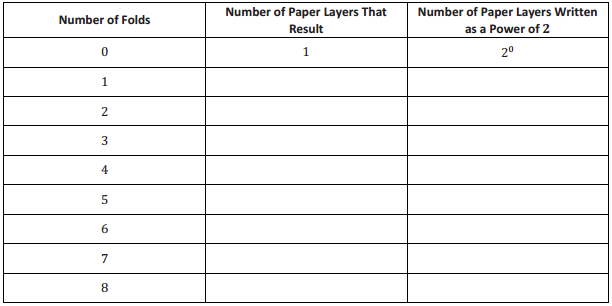
Answer:
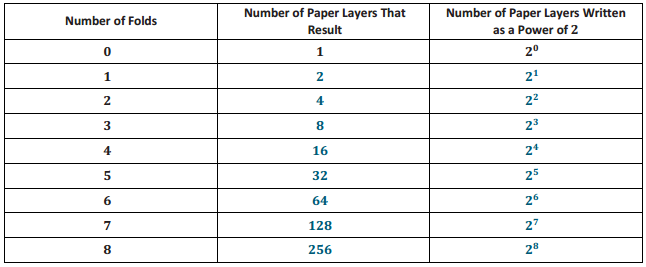
a. Are you able to continue folding the paper indefinitely? Why or why not?
Answer:
No. The stack got too thick on one corner because it kept doubling each time.
b. How could you use a calculator to find the next number in the series?
Answer:
I could multiply the number by 2 to find the number of layers after another fold.
c. What is the relationship between the number of folds and the number of layers?
Answer:
As the number of folds increases by one, the number of layers doubles.
d. How is this relationship represented in the exponential form of the numerical expression?
Answer:
I could use 2 as a base and the number of folds as the exponent.
e. If you fold paper f times, write an expression to show the number of paper layers.
Answer:
There would be 2f layers of paper.
Exercise 3.
If the paper were to be cut instead of folded, the height of the stack would double at each successive stage, and it would be possible to continue.
a. Write an expression that describes how many layers of paper result from 16 cuts.
Answer:
216
b. Evaluate this expression by writing it in standard form.
Answer:
216 = 65,536
Example 2: Bacterial Infection
Bacteria are microscopic single-celled organisms that reproduce in a couple of different ways, one of which is called binary fission. In binary fission, a bacterium increases its size until it is large enough to split into two parts that are identical. These two grow until they are both large enough to split into two individual bacteria. This continues as long as growing conditions are favorable.
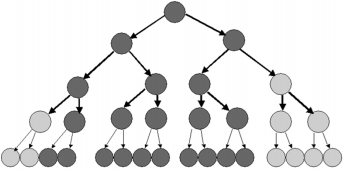
a. Record the number of bacteria that result from each generation.
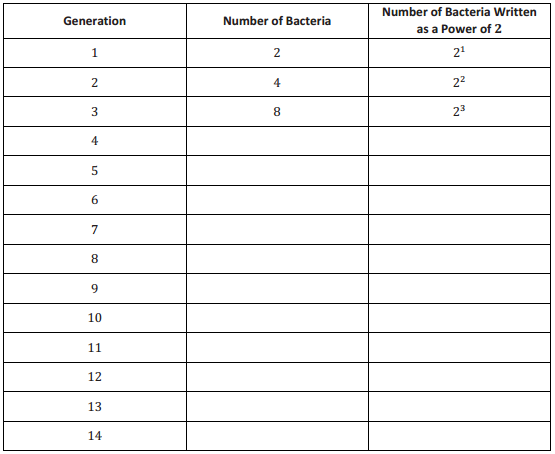
Answer:
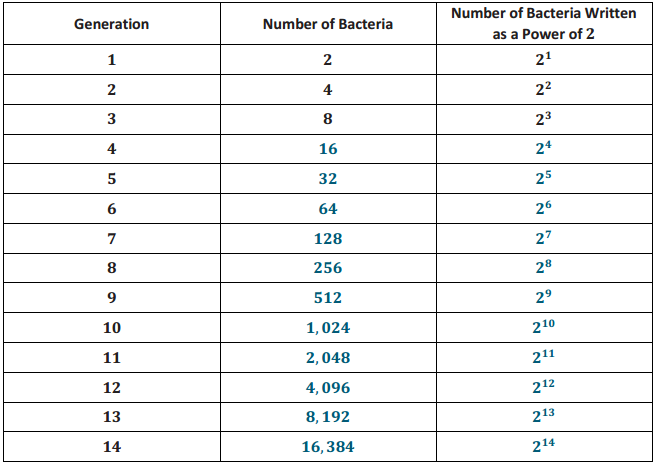
b. How many generations would it take until there were over one million bacteria present?
Answer:
20 generations will produce more than one million bacteria. 220 = 1,048,576
c. Under the right growing conditions, many bacteria can reproduce every 15 minutes. Under these conditions, how long would It take for one bacterium to reproduce itself into more than one million bacteria?
Answer:
It would take 20 fifteen-minute periods, or 5 hours.
d. Write an expression for how many bacteria would be present after g generations.
Answer:
There will be 2g bacteria present after g generations.
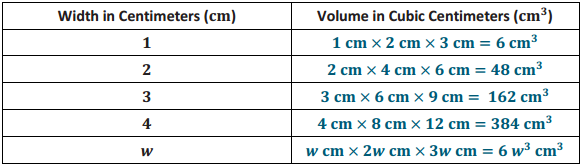
Example 3: Volume of a Rectangular Solid
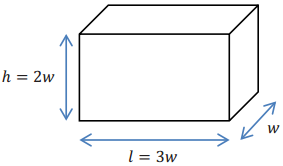
This box has a width, w. The height of the box, h, is twice the width. The length of the box, l, is three times the width. That is, the width, height, and length of a rectangular prism are in the ratio of 1: 2: 3.
For rectangular solids like this, the volume is calculated by multiplying length times width times height.
V = l . w . h
V = 3w . w . 2w
V = 3 .2 . w . w . w
V = 6w3
Follow the above example to calculate the volume of these rectangular solids, given the width, w.
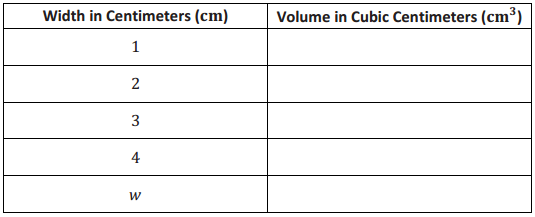
Answer:
Eureka Math Grade 6 Module 4 Lesson 22 Problem Set Answer Key
Question 1.
A checkerboard has 64 squares on it.
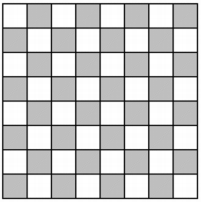
a. If one grain of rice is put on the first square, 2 grains of rice on the second square, 4 grains of rice on the third square, 8 grains of rice on the fourth square, and so on (doubling each time), complete the table to show how many grains of rice are on each square. Write your answers in exponential form on the table below.
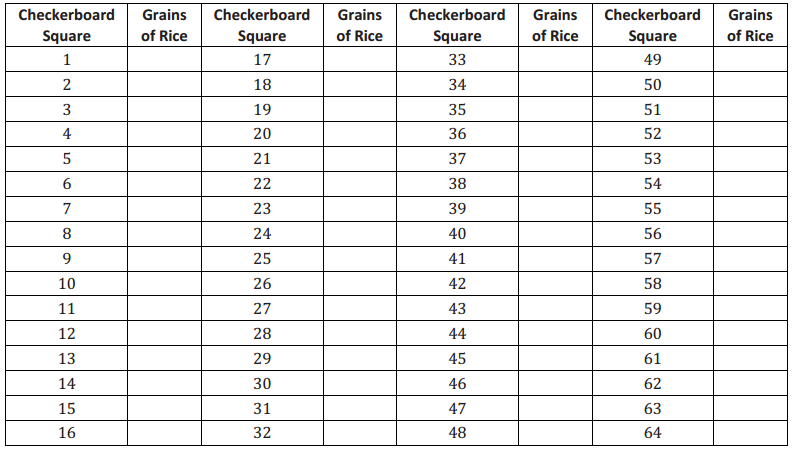
Answer:
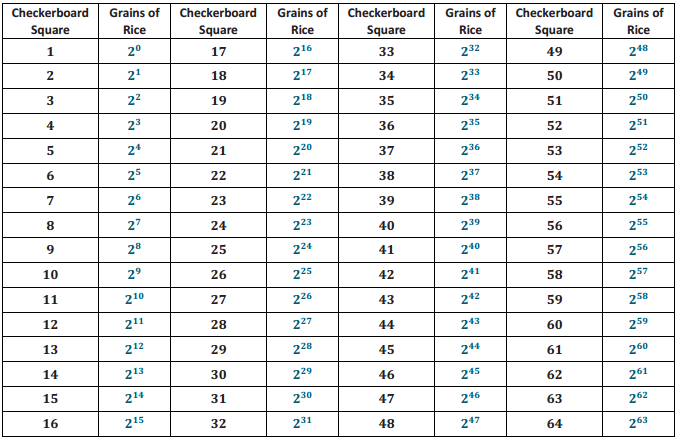
b. How many grains of rice would be on the last square? Represent your answer in exponential form and standard form. Use the table above to help solve the problem.
Answer:
There would be 263 0r 9,223, 372, 036, 854, 775, 808 grains of rice.
c. Would It have been easier to write your answer to part (b) in exponential form or a standard form?
Answer:
Answers will vary. Exponential form is more concise: 263. Standard form is longer and more complicated to calculate: 9,223, 372, 036, 854, 775, 808. (In word form: nine quintillions, two hundred twenty-three quadrillion, three hundred seventy-two trillion, thirty-six billion, eight hundred fifty-four million, seven hundred seventy-five thousand, eight hundred eight.)
Question 2.
If an amount of money is invested at an annual interest rate of 6%, it doubles every 12 years. If Alejandra invests $500, how long will it take for her investment to reach $2, 000 (assuming she does not contribute any additional funds)?
Answer:
It will take for 24 years. After 12 years, Alejandra will have doubled her money and will have $1,000. If she waits an additional 12 years, she will have $2,000.
Question 3.
The athletics director at Peter’s school has created a phone tree that is used to notify team players in the event a game has to be canceled or rescheduled. The phone tree is initiated when the director calls two captains. During the second stage of the phone tree, the captains each call two players. During the third stage of the phone tree, these players each call two other players. The phone tree continues until all players have been notified. If there are 50 players on the teams, how many stages will it take to notify all of the players?
Answer:
It will take five stages. After the first stage, two players have been called, and 48 will not have been called. After the second stage, four more players will have been called, for a total of six; 44 players will remain uncalled. After the third stage, players (eight) more will have been called, totaling 14; 36 remain uncalled. After the fourth stage, 2 more players (16) will have gotten a call, for a total of 30 players notified. Twenty remain uncalled at this stage. The fifth round of calls will cover all of them because 25 includes 32 more players.
Eureka Math Grade 6 Module 4 Lesson 22 Exit Ticket Answer Key
Question 1.
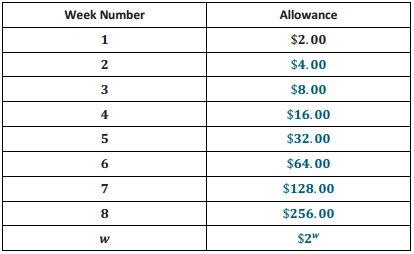
Naomi’s allowance is $2.00 per week. If she convinces her parents to double her allowance each week for two months, what will her weekly allowance be at the end of the second month (week 8)?
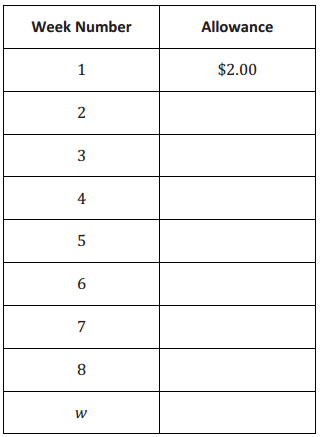
Answer:
Question 2.
Write the expression that describes Naomi’s allowance during week w in dollars.
Answer:
$2w
Eureka Math Grade 6 Module 4 Lesson 22 Multiplication of Decimals Answer Key
Question 1.
0.5 × 0.5 =
Answer:
0.25
Question 2.
0.6 × 0.6=
Answer:
0.36
Question 3.
0.7 × 0.7=
Answer:
0.49
Question 4.
0.5 × 0.6=
Answer:
0.3
Question 5.
1.5 × 1.5=
Answer:
2.25
Question 6.
2.5 × 2.5=
Answer:
6.25
Question 7.
0.25 × 0.25 =
Answer:
0. 0625
Question 8.
0.1 × 0.1=
Answer:
0.01
Question 9.
0.1 × 123.4 =
Answer:
12.34
Question 10.
0.01 × 123.4 =
Answer:
1.234
Eureka Math Grade 6 Module 4 Lesson 20 Answer Key
Engage NY Eureka Math 6th Grade Module 4 Lesson 20 Answer Key
Eureka Math Grade 6 Module 4 Lesson 20 Example Answer Key
Example 1.
The farmers’ market is selling bags of apples. In every bag, there are 3 apples.
a. Complete the table
| Number of Bags | Total Number of Apples |
| 1 | 3 |
| 2 | |
| 3 | |
| 4 | |
| B |
Answer:
| Number of Bags | Total Number of Apples |
| 1 | 3 |
| 2 | 6 |
| 3 | 9 |
| 4 | 12 |
| B | 3B |
b. What if the market had 25 bags of apples to sell? How many apples is that in all?
Answer:
If B = 25, then 3B = 3 25 = 75. The market had 75 apples to sell.
c. If a truck arrived that had some number, a, more apples on it, then how many bags would the clerks use to bag up the apples?
Answer:
a ÷ 3 bags are needed. If there are 1 or 2 apples left over, an extra bag will be needed (although not full).
d. If a truck arrived that had 600 apples on It, how many bags would the clerks use to bag up the apples?
apples
Answer:

e. How is part (d) different from part (b)?
Answer:
Part (d) gives the number of apples and asks for the number of bags. Therefore, we needed to divide the number of apples by 3. Part (b) gives the number of bags and asks for the number of apples. Therefore, we needed to multiply the number of bags by 3.
Eureka Math Grade 6 Module 4 Lesson 20 Exercise Answer Key
Exercise 1.
In New York State, there is a five-cent deposit on all carbonated beverage cans and bottles. When you return the empty can or bottle, you get the five cents back.
a. Complete the table.
| Number of Containers Returned | Refund in Dollars |
| 1 | |
| 2 | |
| 3 | |
| 4 | |
| 10 | |
| 50 | |
| 100 | |
| C |
Answer:
| Number of Containers Returned | Refund in Dollars |
| 1 | 0.05 |
| 2 | 0.10 |
| 3 | 0.15 |
| 4 | 0.20 |
| 10 | 0.50 |
| 50 | 2.50 |
| 100 | 5.00 |
| C | 0.05C |
b. If we let C represent the number of cans, what is the expression that shows how much money is returned?
Answer:
0.05c
c. Use the expression to find out how much money Brett would receive if he returned 222 cans.
Answer:
if c = 222, then 0. 05C = 0.05 ? 222 = 11.10. Brett would receive $11. 10 if he returned 222 cans.
d. If Gavin needs to earn $4. 50 for returning cans, how many cans does he need to collect and return?
Answer:
4.50 ÷ 0.05 = 90. Gavin needs to collect and return 90 cans.
e. How is part (d) different from part (c)?
Answer:
Part (d) gives the amount of money and asks for the number of cans. Therefore, we needed to divide the amount of money by 0.05. Part (c) gives the number of cans and asks for the amount of money. Therefore, we needed to multiply the number of cans by 0.05.
Exercise 2.
The fare for a subway or a local bus ride is $2. 50.
a. Complete the table.
| Number of Rides | Cost of Rides in Dollars |
| 1 | |
| 2 | |
| 3 | |
| 4 | |
| 5 | |
| 10 | |
| 30 | |
| R |
Answer:
| Number of Rides | Cost of Rides in Dollars |
| 1 | 2.50 |
| 2 | 5.00 |
| 3 | 7.50 |
| 4 | 10.00 |
| 5 | 12.50 |
| 10 | 25.00 |
| 30 | 75.00 |
| R | 2.50 R or 2.5 R |
b. If we let R represent the number of rides, what is the expression that shows the cost of the rides?
Answer:
2.50R or 2. 5R
c. Use the expression to find out how much money 60 rides would cost.
Answer:
If R = 60, then 2.50R = 2.50 ∙ 60 = 150.00. Sixty rides would cost $150.00.
d. If a commuter spends $175.00 on subway or bus rides, how many trips did the commuter take?
Answer:
175.00 ÷ 2.50 = 70. The commuter took 70 trips.
e. How is part (d) different from part (c)?
Answer:
Part (d) gives the amount of money and asks for the number of rides. Therefore, we needed to divide the
amount of money by the cost of each ride ($2. 50). Part (c) gives the number of rides and asks for the amount of money. Therefore, we needed to multiply the number of rides by $2. 50.
Challenge Problem
Exercise 3.
A pendulum swings though a certain number of cycles in a given time. Owen made a pendulum that swings 12 times every 15 seconds.
a. Construct a table showing the number of cycles through which a pendulum swings. Include data for up to one minute. Use the last row for C cycles, and write an expression for the time it takes for the pendulum to make C cycles.
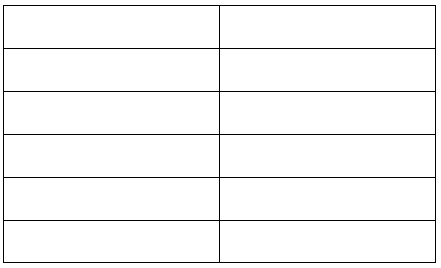
Answer:
| Number of Cycles | Time in seconds |
| 12 | 15 |
| 24 | 30 |
| 36 | 45 |
| 48 | 60 |
| C | \( \frac{15 C}{12} \) |
b. Owen and his pendulum team set their pendulum in motion and counted 16 cycles. What was the elapsed time?
Answer:
C = 16; \(\frac{15 \cdot 16}{12}\) = 20. The elapsed time is 20 seconds.
c. Write an expression for the number of cycles a pendulum swings in S seconds.
Answer:
\(\frac{12}{15}\)S or \(\frac{4}{5}\)S or 0.8 ∙ S
d. In a different experiment, Owen and his pendulum team counted the cycles of the pendulum for iS seconds. How many cycles did they count?
Answer:
S = 35; 0.8 ∙ 35 = 28. They counted 28 cycles.
Eureka Math Grade 6 Module 4 Lesson 20 Problem Set Answer Key
Question 1.
A radio station plays 12 songs each hour. They never stop for commercials, news, weather, or traffic reports.
a. Write an expression describing how many songs are played by the radio station in H hours.
Answer:
12H
b. How many songs will be played ¡n an entire day (24 hours)?
Answer:
12 ∙ 24 = 288. There will be 288 songs played.
c. How long does it take the radio station to play 60 consecutive songs?
Answer:

Question 2.
A ski area has a high-speed lift that can move 2,400 skiers to the top of the mountain each hour.
a. Write an expression describing how many skiers can be lifted in H hours.
Answer:
2,400H
b. How many skiers can be moved to the top of the mountain in 14 hours?
Answer:
14 ∙ 2,400 = 33,600. 33,600 skiers can be moved.
c. How long will it take to move 3,600 skiers to the top of the mountain?
Answer:
3,600 ÷ 2,400 = 1.5. It will take an hour and a half to move 3,600 skiers to the top of the mountain.
Question 3.
Polly writes a magazine column, for which she earns $35 per hour. Create a table of values that shows the relationship between the number of hours that Polly works, H, and the amount of money Polly earns in dollars, E.
Answer:
Answers will vary. Sample answers are shown.
| Hours Polly Works (H) | Polly’s Earnings in Dollars |
| 1 | 35 |
| 2 | 70 |
| 3 | 105 |
| 4 | 140 |
a. If you know how many hours Polly works, can you determine how much money she earned? Write the
corresponding expression.
Answer:
Multiplying the number of hours that Polly works by her rate ($35 per hour) will calculate her pay. 35H ¡s the expression for her pay in dollars.
b. Use your expression to determine how much Polly earned after working for 3\(\frac { 1 }{ 2 }\) hours.
Answer:
35H = 35 ∙ 3.5 = 122.5. Polly makes $122. 50 for working 3\(\frac{1}{2}\) hours.
c. If you know how much money Polly earned, can you determine how long she worked? Write the corresponding expression.
Answer:
Dividing Polly’s pay by 35 will calculate the number of hours she worked. E ÷ 35 ¡s the expression for the
number of hours she worked.
d. Use your expression to determine how long Polly worked if she earned $52. 50.
Answer:
52.50 – 35 = 1.5; Polly worked on hour and a half for $52.50.
Question 4.
Mitchell delivers newspapers after school, for which he earns $0.09 per paper. Create a table of values that shows the relationship between the number of papers that Mitchell delivers, P, and the amount of money Mitchell earns in dollars, E.
Answer:
Answers will vary. Sample answers are shown.
| Numbers of papers Delivered (P) | Mitchell’s Earnings in Dollars (E) |
| 1 | 0.09 |
| 10 | 0.90 |
| 100 | 9.00 |
| 1,000 | 90.00 |
a. If you know how many papers Mitchell delivered, can you determine how much money he earned? Write the corresponding expression.
Answer:
Multiplying the number of papers that Mitchell delivers by his rate ($0.09 per paper) will calculate his pay. 0. 09P is the expression for his pay in dollars.
b. Use your expression to determine how much Mitchell earned by delivering 300 newspapers.
Answer:
0. 09P = 0. 09 ∙ 300 = 27. Mitchell earned $27. 00 for delivering 300 newspapers.
c. If you know how much money Mitchell earned, can you determine how many papers he delivered? Write the corresponding expression.
Answer:
Dividing Mitchell’s pay by $0.09 will calculate the number of papers he delivered. E ÷ 0.09 Is the expression for the number of papers he delivered.
d. Use your expression to determine how many papers Mitchell delivered if he earned $58. 50 last week.
Answer:
58.50 ÷ 0.09 = 650; therefore, Mitchell delivered 650 newspapers last week.
Question 5.
Randy is an art dealer who sells reproductions of famous paintings. Copies of the Mona Lisa sell for $475.
a. Last year Randy sold $9, 975 worth of Mona Lisa reproductions. How many did he sell?
Answer:
9,975 ÷ 475 = 21. He sold 21 copies of the painting.
b. If Randy wants to increase his sales to at least $15,000 this year, how many copies will he need to sell (without changing the price per painting)?
Answer:
15,000 ÷ 475 is about 31.6. He will have to sell 32 paintings in order to increase his sales to at least $15,000.
Eureka Math Grade 6 Module 4 Lesson 20 Exit Ticket Answer Key
Anna charges $8. 50 per hour to babysit. Complete the table, and answer the questions below.
| Numbers of hours | Amount Anna Charges in Dollars |
| 1 | |
| 2 | |
| 5 | |
| 8 | |
| H |
Answer:
| Numbers of hours | Amount Anna Charges in Dollars |
| 1 | 8.50 |
| 2 | 17.00 |
| 5 | 42.50 |
| 8 | 68 |
| H | 8.50H or 8.5H |
a. Write an expression describing her earnings for working H hours.
Answer:
8.50H or 8.5H
b How much will she earn if she works for 3 hours?
Answer:
If H = 3.5, then 8.5H = 8.5 ∙ 3.5 = 29.75. She will earn $29.75.
c. How long will it take Anna to earn $51.00?
Answer:
51 ÷ 8.5 = 6. It will take Anna 6 hours to earn $51.00.