Eureka Math Grade 6 Module 4 Lesson 34 Answer Key

Engage NY Eureka Math Grade 6 Module 4 Lesson 34 Answer Key

Eureka Math Grade 6 Module 4 Lesson 34 Example Answer Key

Example 1:
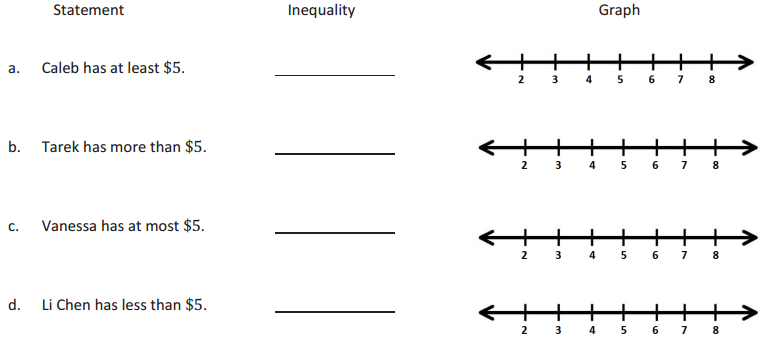
Eureka Math Grade 6 Module 4 Lesson 34 Example Answer Key 1
Answer:
Eureka Math Grade 6 Module 4 Lesson 34 Example Answer Key 2

Example 2:

Kelly works for Quick Oil Change. If customers have to wait longer than 20 minutes for the oil change, the company does not charge for the service. The fastest oil change that Kelly has ever done took 6 minutes. Show the possible customer wait times in which the company charges the customer Eureka Math Grade 6 Module 4 Lesson 34 Example Answer Key 3

Answer:
Eureka Math Grade 6 Module 4 Lesson 34 Example Answer Key 4
6 ≤ x ≤ 20

Example 3:

Gurnaz has been mowing lawns to save money for a concert. Gurnaz will need to work for at least six hours to save enough money, but he must work fewer than 16 hours this week. Write an inequality to represent this situation, and then graph the solution.

Eureka Math Grade 6 Module 4 Lesson 34 Example Answer Key 5
Answer:
Eureka Math Grade 6 Module 4 Lesson 34 Example Answer Key 6
6 ≤ x ≤ 16

Eureka Math Grade 6 Module 4 Lesson 34 Exercise Answer Key

Exercises 1 – 5:

Write an inequality to represent each situation. Then, graph the solution.

Exercise 1.
Blayton is at most 2 meters above sea level.

Eureka Math Grade 6 Module 4 Lesson 34 Exercise Answer Key 7
Answer:
Eureka Math Grade 6 Module 4 Lesson 34 Exercise Answer Key 8
b ≤ 2 where b is Blayton’s position in relationship to sea level in meters.

Exercise 2.
Edith must read for a minimum of 20 minutes.

Eureka Math Grade 6 Module 4 Lesson 34 Exercise Answer Key 9
Answer:
Eureka Math Grade 6 Module 4 Lesson 34 Exercise Answer Key 10
E ≤ 20, where E is the number of minutes Edith reads.

Exercise 3.
Travis milks his cows each morning. He has never gotten fewer than 3 gallons of milk; however, he always gets fewer than 9 gallons of milk.

Eureka Math Grade 6 Module 4 Lesson 34 Exercise Answer Key 11
Answer:
Eureka Math Grade 6 Module 4 Lesson 34 Exercise Answer Key 12
3 ≤ x < 9, where x represents the gallons of milk.

Exercise 4.
Rita can make 8 cakes for a bakery each day. So far, she has orders for more than 32 cakes. Right now, Rita needs more than four days to make all 32 cakes.

Eureka Math Grade 6 Module 4 Lesson 34 Exercise Answer Key 13
Answer:
Eureka Math Grade 6 Module 4 Lesson 34 Exercise Answer Key 14
x > 4, where x is the number of days Rito has to bake the cakes.

Exercise 5.
Rita must have all the orders placed right now done In 7 days or fewer. How will this change your inequality and your graph?

Eureka Math Grade 6 Module 4 Lesson 34 Exercise Answer Key 15
Answer:
Eureka Math Grade 6 Module 4 Lesson 34 Exercise Answer Key 16
4 < x ≤ 7
Our inequality will change because there is a range for the number of days Rita has to bake the cakes. The graph has changed because Rita is more limited in the amount of time she has to bake the cakes. Instead of the graph showing any number larger than 4, the graph now has a solid circle at 7 because Rita must be done baking the cakes in a maximum of 7 days.

Possible Extension Exercises 6 – 10:

Exercise 6.
Kasey has been mowing lawns to save up money for a concert. He earns $15 per hour and needs at least $90 to go to the concert. How many hours should he mow?

Eureka Math Grade 6 Module 4 Lesson 34 Exercise Answer Key 17
Answer:
Eureka Math Grade 6 Module 4 Lesson 34 Exercise Answer Key 18
15 x ≥ 90
\(\frac{15 x}{15} \geq \frac{90}{15}\)
x ≥ 6
kasey will need to mow for 6 or more hours.

Exercise 7.
Rachel can make 8 cakes for a bakery each day. So far, she has orders for more than 32 cakes. How many days will it take her to complete the orders?

Eureka Math Grade 6 Module 4 Lesson 34 Exercise Answer Key 19
Answer:
Eureka Math Grade 6 Module 4 Lesson 34 Exercise Answer Key 20
8x > 32
\(\frac{8 x}{8}>\frac{32}{8}\)
x > 4

Exercise 8.
Ranger saves $70 each week. He needs to save at least $2,800 to go on a trip to Europe. How many weeks will he need to save?

Eureka Math Grade 6 Module 4 Lesson 34 Exercise Answer Key 21
Answer:
Eureka Math Grade 6 Module 4 Lesson 34 Exercise Answer Key 22
70x ≥ 2800
\(\frac{70 x}{70} \geq \frac{2800}{70}\)
x ≥ 40

Exercise 9.
Clara has less than $75. She wants to buy 3 pairs of shoes. What price shoes can Clara afford if all the shoes are the same price?

Eureka Math Grade 6 Module 4 Lesson 34 Exercise Answer Key 23
Answer:
Eureka Math Grade 6 Module 4 Lesson 34 Exercise Answer Key 24
3x < 75
\(\frac{3 x}{3}<\frac{75}{3}\)
x < 25
Clara can afford shoes that are greater than $0 and less than $25.

Exercise 10.
A gym charges $25 per month plus $4 extra to swim in the pool for an hour. If a member only has $45 to spend each month, at most how many hours can the member swim?

Eureka Math Grade 6 Module 4 Lesson 34 Exercise Answer Key 25
Answer:
Eureka Math Grade 6 Module 4 Lesson 34 Exercise Answer Key 26
4x + 25 ≤ 45
4x + 25 – 25 ≤ 45 – 25
4x ≤ 20
\(\frac{4 x}{4} \leq \frac{20}{4}\)
x ≤ 5

The member can swim in the pool for 5 hours. However, we also know that the total amount of time the member spends in the pool must be greater than or equal to 0 hours because the member may choose not to swim.
0 ≤ x ≤ 5

Eureka Math Grade 6 Module 4 Lesson 34 Problem Set Answer Key

Write and graph an inequality for each problem.

Question 1.
At least 13

Eureka Math Grade 6 Module 4 Lesson 34 Problem Set Answer Key 27
Answer:
Eureka Math Grade 6 Module 4 Lesson 34 Problem Set Answer Key 28
x ≥ 13

Question 2.
Less than 7
Eureka Math Grade 6 Module 4 Lesson 34 Problem Set Answer Key 29
Answer:
Eureka Math Grade 6 Module 4 Lesson 34 Problem Set Answer Key 30
x < 7

Question 3.
Chad will need at least 24 minutes to complete the 5k race. However, he wants to finish in under 30 minutes.

Eureka Math Grade 6 Module 4 Lesson 34 Problem Set Answer Key 31
Answer:
Eureka Math Grade 6 Module 4 Lesson 34 Problem Set Answer Key 32
24 ≤ x < 30

Question 4.
Eva saves $60 each week. Since she needs to save at least $2,400 to go on a trip to Europe, she will need to save for at least 40 weeks.

Eureka Math Grade 6 Module 4 Lesson 34 Problem Set Answer Key 33
Answer:
Eureka Math Grade 6 Module 4 Lesson 34 Problem Set Answer Key 34
x ≥ 40

Question 5.
Clara has $100. She wants to buy 4 pairs of the same pants. Due to tax, Clara can afford pants that are less than $25.

Eureka Math Grade 6 Module 4 Lesson 34 Problem Set Answer Key 35
Answer:
Clara must spend less than $25, but we also know that Clara will spend more than $0 when she buys pants at the store.
0 < x < 25

Eureka Math Grade 6 Module 4 Lesson 34 Problem Set Answer Key 36

Question 6.
A gym charges $30 per month plus $4 extra to swim in the poo1 for an hour. Because a member has just $50 to spend at the gym each month, the member can swim at most 5 hours.

Eureka Math Grade 6 Module 4 Lesson 34 Problem Set Answer Key 37
Answer:
The member can swim in the pool for 5 hours. However, we also know that the total amount of time the member spends in the pool must be greater than or equal to 0 hours because the member may choose not to swim.
0 ≤ x ≤ 5

Eureka Math Grade 6 Module 4 Lesson 34 Problem Set Answer Key 38

Eureka Math Grade 6 Module 4 Lesson 34 Exit Ticket Answer Key

For each question, write an inequality. Then, graph your solution.

Question 1.
Keisha needs to make at least 28 costumes for the school play. Since she can make 4 costumes each week, Keisha plans to work on the costumes for at least 7 weeks.

Eureka Math Grade 6 Module 4 Lesson 34 Exit Ticket Answer Key 39Eureka Math Grade 6 Module 4 Lesson 34 Exit Ticket Answer Key 39
Answer:
x ≥ 7
Keisha should plan to work on the costumes for 7 or more weeks.

Eureka Math Grade 6 Module 4 Lesson 34 Exit Ticket Answer Key 40

Question 2.
If Keisha has to have the costumes complete in 10 weeks or fewer, how will our solution change?

Eureka Math Grade 6 Module 4 Lesson 34 Exit Ticket Answer Key 41
Answer:
Keisha had 7 or more weeks in problem 1. It will still take her at least 7 weeks, but she cannot have more than 10 weeks.
7 ≤ x ≤ 10

Eureka Math Grade 6 Module 4 Lesson 34 Exit Ticket Answer Key 42

Eureka Math Grade 6 Module 4 Lesson 10 Answer Key

Engage NY Eureka Math 6th Grade Module 4 Lesson 10 Answer Key
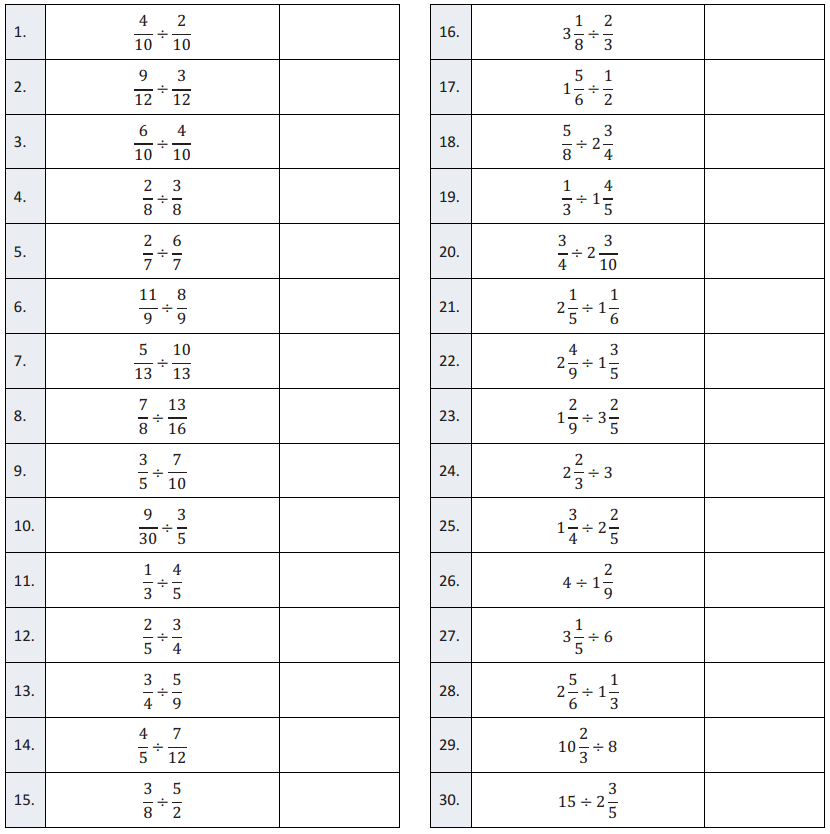
Eureka Math Grade 6 Module 4 Lesson 10 Example Answer Key
Example 1.
Write each expression using the fewest number of symbols and characters. Use math terms to describe the expressions and parts of the expressions.

a 6 × b
Answer:
6b; the 6 is the coefficient and a factor and the b is the variable and a factor. We can call 6b the product,
and we can also call it a term.

b. 4 ∙ 3 ∙ h
Answer:
12h; the 12 is the coefficient and a factor and the h b the variable and a factor. We can call 12h the
produce and we can also call it a term.

c. 2 × 2 × 2 × a × b
Answer:
8ab; 8 is the coefficient and a factor, a and b are both varIables and factor, and 8ab is the product and also a term.

d. 5 × m × 3 × p
Answer:
15mp; 15 is the coefficient and factor, m and p are the variables and factors, 15mp is the product and also a term.

e. 1 × g × w
Answer:
1gw or gw; g and w are the variables and factors, 1 is the coefficient and factor if it is included, and gw is the product and also o term.

Example 2.
To expand multiplication expressions, we will rewrite the expressions by Including the “. “ back into the expressions.
a. 5g
Answer:
5 ∙ g

b. 7abc
Answer:
7 ∙ a ∙ b ∙ c

c. 12g
Answer:
12 ∙ g or 2 ∙ 2 ∙ 3 ∙ g

d. 3h ∙ 8
Answer:
3 ∙ h ∙ 8

e. 7g ∙ 9h
Answer:
7 ∙ g ∙ 9 ∙ h or 7 ∙ g ∙ 3 ∙ 3 ∙ h

Example 3.
a. Find the product of 4f ∙ 7g.
Answer:
It may be easier to see how we will use the fewest number of symbols and characters by expanding the expression first.
4 ∙ f ∙ 7 ∙ g
Now we can multiply the numbers and then multiply the variables.
4 ∙ 7 ∙ f ∙ g
28fg

b. Multiply 3de ∙ 9yz.
Answer:
Let’s start again by expanding the expression. Then, we can rewrite the expression by multiplying the numbers and then multiplying the variables.
3 ∙ d ∙ e ∙ 9 ∙ y ∙ z
3 ∙ 9 ∙ d ∙ e ∙ y ∙ z
27 deyz

c. Double the product of 6y and 3bc.
Answer:
6 ∙ y ∙ 3 ∙ b ∙ c
6 ∙ 3 ∙ b ∙ c ∙ y
18bcy
What does it mean to double something?
It means to multiply by 2.
2 ∙ 18bcy
36 bcy

Eureka Math Grade 6 Module 4 Lesson 10 Problem Set Answer Key

Question 1.
Rewrite the expression in standard form (use the fewest number of symbols and characters possible).
a. 5 ∙ y
Answer:
5y

b. 7 ∙ d ∙ e
Answer:
7de

c. 5 ∙ 2 ∙ 2 ∙ y ∙ z
Answer:
20yz

d. 3 ∙ 3 ∙ 2 ∙ 5 ∙ d
Answer:
90d

Question 2.
Write the following expressions in expanded form.
a. 3g
Answer:
3 ∙ g

b. 11mp
Answer:
11 ∙ m ∙ p

C. 20yz
Answer:
20 ∙ y ∙ z or 2 ∙ 2 ∙ 5 ∙ y ∙ z

d. 15abc
Answer:
15 ∙ a ∙ b ∙ c or 3 ∙ 5 ∙ a ∙ b ∙ c

Question 3.
Find the product.
a. 5d ∙ 7g
Answer:
35dg

b. 12ab ∙ 3cd
Answer:
36abcd

Eureka Math Grade 6 Module 4 Lesson 10 Exit Ticket Answer Key

Question 1.
Rewrite the expression in standard form (use the fewest number of symbols and characters possible).
a. 5g ∙ 7h
Answer:
35gh

b. 3 ∙ 4 ∙ 5 ∙ m ∙ n
Answer:
60mn

Question 2.
Name the parts of the expression. Then, write it in expanded form.
a. 14b
Answer:
14 ∙ b or 2 ∙ 7 ∙ b
14 is the coefficient, b is the variable, and 14b is a term and the product of 14 × b.

b. 30jk
Answer:
30 ∙ j ∙ k or 2 ∙ 3 ∙ 5 ∙ j ∙ k
30 is the coefficient, i and k are the variables, and 30jk is a term and the product of 30 ∙ j ∙ k.

Eureka Math Grade 6 Module 4 Lesson 11 Answer Key

Engage NY Eureka Math 6th Grade Module 4 Lesson 11 Answer Key

Eureka Math Grade 6 Module 4 Lesson 11 Example Answer Key

a. Use the model to answer the following questions.
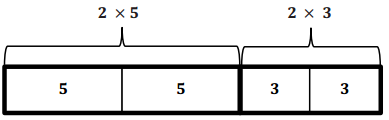
Eureka Math Grade 6 Module 4 Lesson 11 Example Answer Key 1

How many fives are in the model?
Answer:
5

How many threes are In the model?
Answer:
2

What does the expression represent in words?
Answer:
The sum of two groups of five and two groups of three

What expression could we write to represent the model?
Answer:
2 × 5 + 2 × 3

b. Use the new model and the previous model to answer the next set of questions.

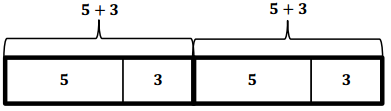
Eureka Math Grade 6 Module 4 Lesson 11 Example Answer Key 2
How many fives are in the model?
Answer:
2

How many threes are in the model?
Answer:
2

What does the expression represent in words?
Answer:
Two groups of the sum of five and three

What expression could we write to represent the model?
Answer:
(5 + 3) + (5 + 3) or 2(5 + 3)

Is the model in part (a) equivalent to the model in part (b)?
Answer:
Yes, because both expressions have two 5’s and two 3’s. Therefore, 2 × 5 + 2 × 3 = 2(5 + 3).

d. What relationship do we see happening on either side of the equal sign?
Answer:
On the left-hand side, 2 is being multiplied by 5 and then by 3 before adding the products together. On the right-hand side, the 5 and 3 are added first and then multiplied by 2.

e. In Grade 5 and in Module 2 of this year, you have used similar reasoning to solve problems. What Is the name of the property that is used to say that 2(5 + 3) is the same as 2 × 5 + 2 × 3?
Answer:
The name of the property is the distributive property.

Example 2.
Now we will take a look at an example with variables. Discuss the questions with your partner.
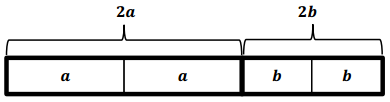
Eureka Math Grade 6 Module 4 Lesson 11 Example Answer Key 3

What does the model represent in words?
Answer:
a plus a plus b plus b, two a’s plus two b’s, two times a plus two times b

What does 2a mean?
Answer:
2a means that there are 2 a’s or 2 × a.

How many a’s are in the model?
Answer:
2

How many b’s are in the model?
Answer:
2

What expression could we write to represent the model?
Answer:
2a + 2b

Eureka Math Grade 6 Module 4 Lesson 11 Example Answer Key 4

How many a’s are in the expression?
Answer:
2

How many b’s are in the expression?
Answer:
2

What expression could we write to represent the model?
Answer:
(a + b) + (a + b) = 2(a + b)

Are the two expressions equivalent?
Answer:
Yes. Both models include 2 a’s and 2 b’s. Therefore, 2a + 2b = 2(a + b).

Example 3.

Use GCF and the distributive property to write equivalent expressions.
1. 3f + 3g = __________
Answer:
3(f + g)

What is the question asking us to do?
Answer:
We need to rewrite the expression as an equivalent expression in factored form, which means the expression is written as the product of factors. The number outside of the parentheses is the GCF.

How would Problem 1 look if we expanded each term?
Answer:
3 ∙ f + 3 ∙ g

What is the GCF in Problem 1?
Answer:
3

How can we use the GCF to rewrite this expression?
Answer:
3 goes on the outside, and f + g will go inside the parentheses. 3(f + g)

2. 6x + 9y = __________
Answer:
3(2x + 3y)

What is the question asking us to do?
Answer:
We need to rewrite the expression as an equivalent expression in factored form, which means the expression is written as the product of factors. The number outside of the parentheses is the GCF.

How would Problem 2 look if we expanded each term?
Answer:
2 ∙ 3 ∙ x + 3 ∙ 3 ∙ y

What is the GCF in Problem 2?
Answer:
The GCF is 3.

How can we use the GCF to rewrite this expression?
Answer:
I will factor out the 3 from both terms and place it in front of the parentheses. I will place what is left in the terms inside the parentheses: 3(2x + 3y).

3. 3c + 11c = _________
Answer:
c(3 + 11)

Is there a greatest common factor in Problem 3?
Answer:
Yes. When I expand, I can see that each term has a common factor c.
3 ∙ c + 11 ∙ c

Rewrite the expression using the distributive property.
Answer:
c(3 + 11)

4. 24b + 8 = _________
Answer:
8(3b + 1)

Explain how you used GCF and the distributive property to rewrite the expression in Problem 4.
Answer:
I first expanded each term. I know that 8 goes into 24, so I used it in the expansion.
2 ∙ 2 ∙ 2 ∙ 3 ∙ b + 2 ∙ 2 ∙ 2
I determined that 2 ∙ 2 ∙ 2, or 8, is the common factor. So, on the outside of the parentheses I wrote 8, and on the inside I wrote the leftover factor, 3b + 1 ∙ 8(3b + 1)

Why is there a 1 in the parentheses?
Answer:
When I factor out a number, lam leaving behind the other factor that multiplies to make the original number. In this case, when I factor out an 8 from 8, I am left with a 1 because 8 × 1 = 8.

How is this related to the first two examples?
Answer:
In the first two examples, we saw that we could rewrite the expressions by thinking about groups.
We can either think of 24b + 8 as 8 groups of 3b and 8 groups of 1 or as 8 groups of the sum of 3b + 1. This shows that 8(3b) + 8(1) = 8(3b + 1)is the some as 24b + 8.

Eureka Math Grade 6 Module 4 Lesson 11 Exercise Answer Key

Exercise 1.
Apply the distributive property to write equivalent expressions.
a. 7x + 7y
Answer:
7(x + y)

b. 15g + 20h
Answer:
5(3g + 4h)

c. 18m + 42n
Answer:
6(3m + 7n)

d. 30a + 39b
Answer:
3(10a + 13b)

e. 11f + 15f
Answer:
f(11 + 15)

f. 18h + 13h
Answer:
h(18 + 13)

g. 55m + 11
Answer:
11(5m + 1)

h. 7 + 56y
Answer:
7(1 + 8y)

2.
Evaluate each of the expressions below.
a. 6x + 21 y and 3(2x + 7y)                     x = 3 and y = 4
Answer:
6(3) + 21(4)                                             3(23 + 74)
18 + 84                                                    3(6 + 28)
102                                                           3(34)
102                                                           102

b. 5g + 7g and g(5 + 7)                          g = 6
Answer:
5(6) + 7(6)                                              6(5 + 7)
30 + 42                                                   6(12)
72                                                            72

c. 14x + 2 and 2(7x + 1)                          x = 10
Answer:
14(10) + 2                                               2(7.10 + 1)
140 + 2                                                   2(70 + 1)
142                                                          2(71)
142                                                          142

d. Explain any patterns that you notice in the results to parts (a) – c).
Answer:
Both expressions in parts (a) – (c) evaluated to the same number when the indicated value was substituted for the variable. This shows that the two expressions are equivalent for the given values.

e. What would happen if other values were given for the variables?
Answer:
Because the two expressions in each part are equivalent, they evaluate to the same number, no matter what value is chosen for the variable.

Closing

How can use you use your knowledge of GCF and the distributive property to write equivalent expressions?
Answer:
We can use our knowledge of GCF and the distributive property to change expressions from standard form to factored form.

Find the missing value that makes the two expressions equivalent.
4x + 12y                ___(x + 3y)
35x + 50y              ___(7x + 10y)
18x + 9y                ___(2x + y)
32x + 8y                ___(4x + y)
100x + 700y          ___(x + 7y)
Answer:
4x + 12y                 4 (x + 3y)
35x + 50y               5(7x + 10y)
18x + 9y                 9(2x + y)
32x + 8y                 8(4x + y)
100x + 700y           100(x + 7y)

Explain how you determine the missing number.
Answer:
I would expand each term and determine the greatest common factor. The greatest common factor is the number that is placed on the blank line.

Eureka Math Grade 6 Module 4 Lesson 11 Problem Set Answer Key

Question 1.
Use models to prove that 3(a + b) is equivalent to 3a + 3b.
Answer:
Eureka Math Grade 6 Module 4 Lesson 11 Problem Set Answer Key 5

Question 2.
Use greatest common factor and the distributive property to write equivalent expressions in factored form for the following expressions.
a. 4d + 12e
Answer:
4(d + 3e) or 4(1d + 3e)

b. 18x + 30y
Answer:
6(3x + 5y)

c. 21a + 28y
Answer:
7(3a + 4y)

d. 24f + 56g
Answer:
8(3f + 7g)

Eureka Math Grade 6 Module 4 Lesson 11 Exit Ticket Answer Key

Use greatest common factor and the distributive property to write equivalent expressions in factored form.

Question 1.
2x + 8y
Answer:
2(x + 4y)

Question 2.
13ab + 15 ab
Answer:
ab(13 + 15)

Question 3.
20g + 24h
Answer:
4(5g + 6h)

Eureka Math Grade 6 Module 4 Lesson 11 Greatest Common Factor Answer Key

Greatest Common Factor – Round 1
Directions: Determine the greatest common factor of each pair of numbers.

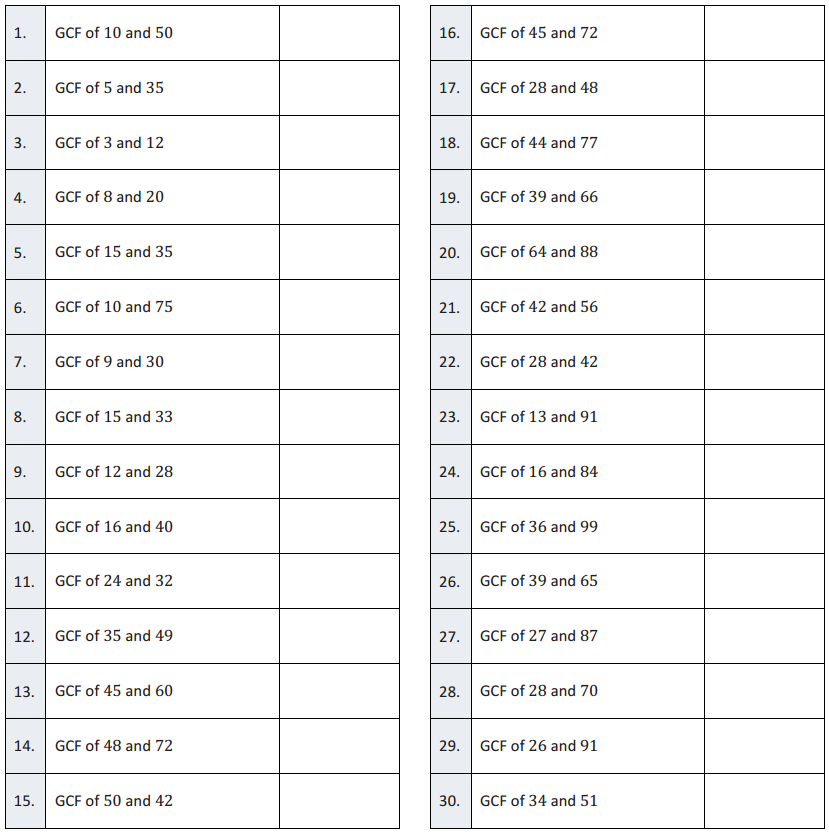
Eureka Math Grade 6 Module 4 Lesson 11 Greatest Common Factor Answer Key 6

Question 1.
GCF of 10 and 50
Answer:
10

Question 2.
GCF of 5 and 35
Answer:
5

Question 3.
GCF of 3 and 12
Answer:
3

Question 4.
GCF of 8 and 20
Answer:
4

Question 5.
GCF of 15 and 35
Answer:
5

Question 6.
GCF of 10 and 75
Answer:
5

Question 7.
GCF of 9 and 30
Answer:
3

Question 8.
GCF of 15 and 33
Answer:
3

Question 9.
GCF of 12 and 28
Answer:
4

Question 10.
GCF of 16 and 40
Answer:
8

Question 11.
GCF of 24 and 32
Answer:8
Question 12.
GCF of 35 and 49
Answer:
7

Question 13.
GCF of 45 and 60
Answer:
15

Question 14.
GCF of 48 and 72
Answer:
24

Question 15.
GCF of 50 and 42
Answer:
2

Question 16.
GCF of 45 and 72
Answer:
9

Question 17.
GCF of 28 and 48
Answer:
4

Question 18.
GCF of 44 and 77
Answer:
11

Question 19.
GCF of 39 and 66
Answer:
3

Question 20.
GCF of 64 and 88
Answer:
8

Question 21.
GCF of 42 and 56
Answer:
14

Question 22.
GCF of 28 and 42
Answer:
14

Question 23.
GCF of 13 and 91
Answer:
13

Question 24.
GCF of 16 and 84
Answer:
4

Question 25.
GCF of 36 and 99
Answer:
9

Question 26.
GCF of 39 and 65
Answer:
13

Question 27.
GCF of 27 and 87
Answer:
3

Question 28.
GCF of 28 and 70
Answer:
14

Question 29.
GCF of 29 and 91
Answer:
13

Question 30.
GCF of 34 and 51
Answer:
17

Greatest Common Factor – Round 2
Directions: Determine the greatest common factor of each pair of numbers.

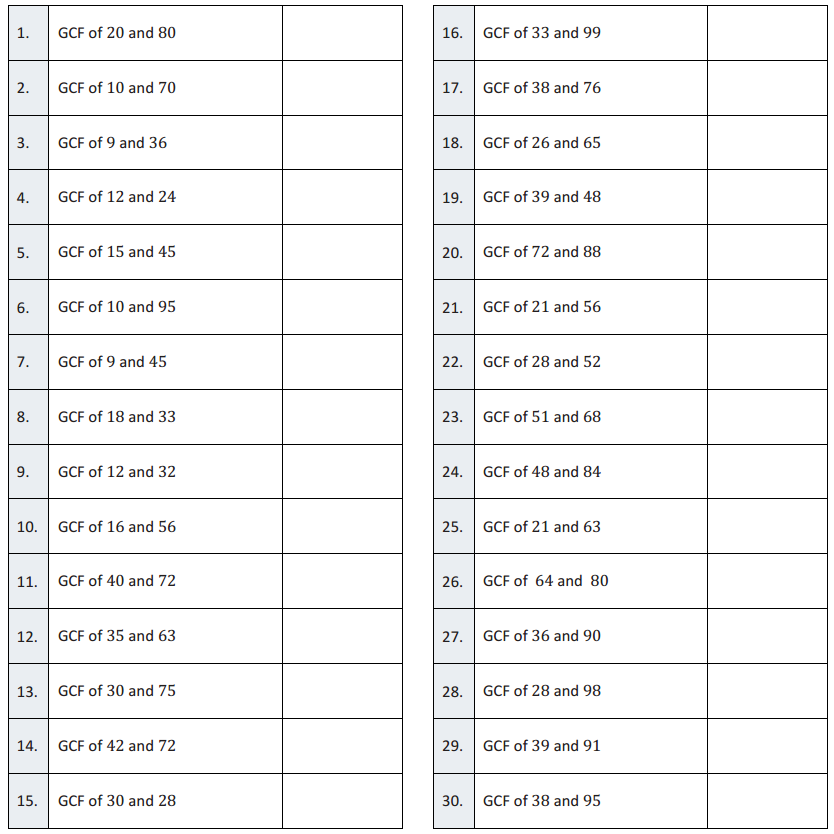
Eureka Math Grade 6 Module 4 Lesson 11 Greatest Common Factor Answer Key 7

Question 1.
GCF of 20 and 80
Answer:
20

Question 2.
GCF of 10 and 70
Answer:
10

Question 3.
GCF of 9 and 36
Answer:
9

Question 4.
GCF of 12 and 24
Answer:
12

Question 5.
GCF of 15 and 45
Answer:
15

Question 6.
GCF of 10 and 95
Answer:
5

Question 7.
GCF of 9 and 45
Answer:
9

Question 8.
GCF of 18 and 33
Answer:
3

Question 9.
GCF of 12 and 32
Answer:
4

Question 10.
GCF of 16 and 56
Answer:
8

Question 11.
GCF of 40 and 7
Answer:
8

Question 12.
GCF of 35 and 63
Answer:
7

Question 13.
GCF of 30 and 75
Answer:
15

Question 14.
GCF of 42 and 72
Answer:
6

Question 15.
GCF of 30 and 28
Answer:
2

Question 16.
GCF of 33 and 99
Answer:
33

Question 17.
GCF of 38 and 76
Answer:
38

Question 18.
GCF of 26 and 65
Answer:
13

Question 19.
GCF of 39 and 48
Answer:
3

Question 20.
GCF of 72 and 88
Answer:
8

Question 21.
GCF of 21 and 56
Answer:
7

Question 22.
GCF of 28 and 52
Answer:
4

Question 23.
GCF of 51 and 68
Answer:
17

Question 24.
GCF of 48 and 84
Answer:
12

Question 25.
GCF of 21 and 63
Answer:
21

Question 26.
GCF of 64 and 80
Answer:
16

Question 27.
GCF of 36 and 90
Answer:
18

Question 28.
GCF of 28 and 98
Answer:
14

Question 29.
GCF of 39 and 91
Answer:
13

Question 30.
GCF of 38 and 95
Answer:
19

Eureka Math Grade 6 Module 4 Lesson 12 Answer Key

Engage NY Eureka Math 6th Grade Module 4 Lesson 12 Answer Key

Eureka Math Grade 6 Module 4 Lesson 12 Example Answer Key

Example 1.
Write an expression that is equivalent to 2(a + b).
Answer:
→ In this example, we have been given the factored form of the expression.
→ To answer this question, we can create a model to represent 2(a + b).
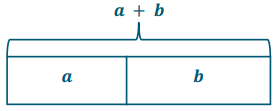
→ Let’s start by creating a model to represent (a + b).

Create a model to represent (a + b).
Answer:
Eureka Math Grade 6 Module 4 Lesson 12 Example Answer Key 3

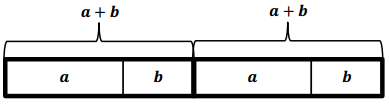
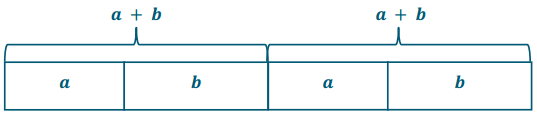
The expression 2(a + b) tells us that we have 2 of the (a + b)’s. Create a model that shows 2 groups of (a + b).
Answer:
Eureka Math Grade 6 Module 4 Lesson 12 Example Answer Key 4

How many a’s and how many b’s do you see in the diagram?
Answer:
There are 2 a’s and 2 b’s.

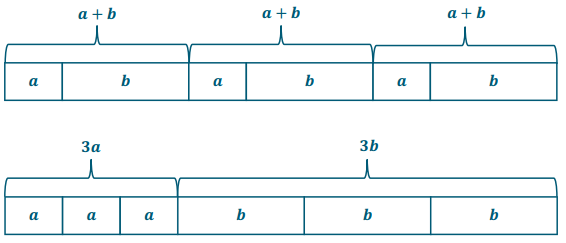
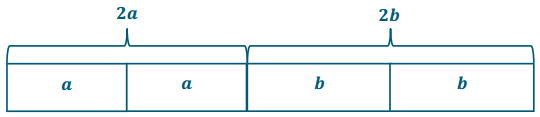
How would the model look if we grouped together the a’s and then grouped together the b’s?
Answer:
Eureka Math Grade 6 Module 4 Lesson 12 Example Answer Key 5

What expression could we write to represent the new diagram?
Answer:
2a + 2b

What conclusion can we draw from the models about equivalent expressions?
Answer:
2(a + b) = 2a + 2b

Let a = 3 and b = 4.
Answer:
2(a+b)                      2a + 2b
2(3 + 4)                    2(3) + 2(4)
2(7)                           6 + 8
14                              14

What happens when we double (a + b)?
Answer:
We double a, and we double b.

Example 2.
Write an expression that Is equivalent to double (3x + 4y).

How can we rewrite double (3x + 4y)?
Answer:
Double is the same as multiplying by two.
2(3x + 4y) or 6x + 8y

Is this expression In factored form, expanded form, or neither?
Answer:
The first expression is in factored form, and the second expression is in expanded form.

Let’s start this problem the same way that we started the first example. What should we do?
Answer:
We can make a model of 3x + 4y.
Eureka Math Grade 6 Module 4 Lesson 12 Example Answer Key 6

Are there terms that we can combine in this example?
Answer:
Eureka Math Grade 6 Module 4 Lesson 12 Example Answer Key 7
Yes. There are 6 x’s and 8y’s.
So, the model is showing 6x + 8y.

What is an equivalent expression that we can use to represent 2(3x + 4y)?
Answer:
2(3x + 4y) = 6x + 8y
This is the same as 2(3x) + 2(4y).

Summarize how you would solve this question without the model.
Answer:
When there is a number outside the parentheses, I would multiply it by all the terms on the inside of the parentheses.

Example 3.
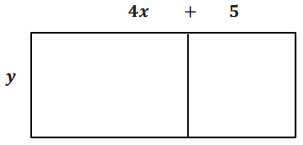
Write an expression in expanded form that is equivalent to the model below.
Eureka Math Grade 6 Module 4 Lesson 12 Example Answer Key 8

What factored expression is represented in the model?
Answer:
y(4x + 5)

How can we rewrite this expression in expanded form?
Answer:
y(4x) + y(5)
4xy + 5y

Example 4.
Write an expression in expanded form that is equivalent to 3(7d + 4e).
Answer:
We will multiply 3 × 7d and 3 × 4e.
We would get 21d + 12e. So, 3(7d+ 4e) = 21d + 12e.

Eureka Math Grade 6 Module 4 Lesson 12 Exercise Answer Key

Exercises
Create a model for each expression below. Then, write another equivalent expression using the distributive property.

Exercise 1.
3(x + y)
Answer:
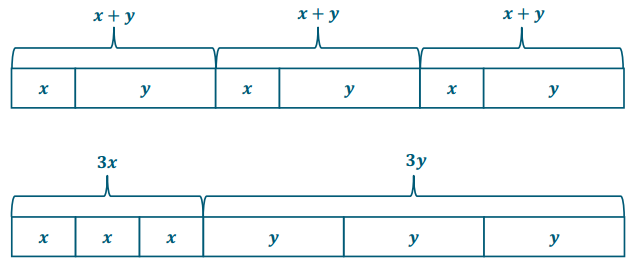
Eureka Math Grade 6 Module 4 Lesson 12 Exercise Answer Key 9
3x + 3y

Exercise 2.
4(2h + g)
Answer:
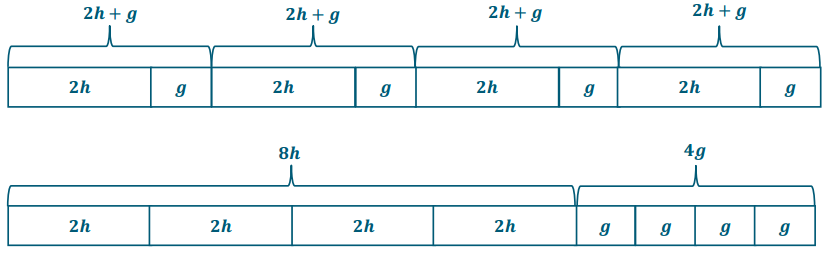
Eureka Math Grade 6 Module 4 Lesson 12 Exercise Answer Key 10
8h + 4g

Apply the distributive property to write equivalent expressions in expanded form.

Exercise 3.
8(h + 3)
Answer:
8k + 24

Exercise 4.
3(2h + 7)
Answer:
6k + 21

Exercise 5.
5(3x + 9y)
Answer:
15x + 45y

Exercise 6.
4(11k + 3g)
Answer:
44h + 12g

Exercise 7.
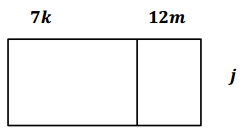
Eureka Math Grade 6 Module 4 Lesson 12 Exercise Answer Key 11
Answer:
7jk + 12jm

Exercise 8.
a(9b + 13)
Answer:
9ab + 13a

Eureka Math Grade 6 Module 4 Lesson 12 Problem Set Answer Key

Question 1.
Use the distributive property to write the following expressions in expanded form.
a. 4(x + y)
Answer:
4x + 4y

b. 8(a + 3b)
Answer:
8a + 24h

c. 3(2x + 11y)
Answer:
6x + 33y

d. 9(7a + 6b)
Answer:
63a + 54b

e. c(3a + b)
Answer:
3ac + bc

f. y(2x + 11z)
Answer:
2xy + 11yz

Question 2.
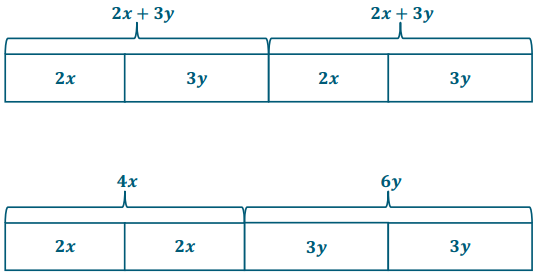
Create a model to show that 2(2x + 3y) = 4x + 6y.
Answer:
Eureka Math Grade 6 Module 4 Lesson 12 Problem Set Answer Key 12

Eureka Math Grade 6 Module 4 Lesson 12 Exit Ticket Answer Key

Use the distributive property to write the following expressions in expanded form.
Question 1.
2(b + c)
2h + 2c

Question 2.
5(7h + 3m)
Answer:
35h + 15m

Question 3.
e(f + g)
Answer:
ef + eg

Eureka Math Grade 6 Module 4 Lesson 12 Opening Exercise Answer Key

a. Create a model to show 2 × 5.
Answer:
Eureka Math Grade 6 Module 4 Lesson 12 Opening Exercise Answer Key 1

b. Create a model to show 2 × b, or 2b
Answer:
Eureka Math Grade 6 Module 4 Lesson 12 Opening Exercise Answer Key 2

Eureka Math Grade 6 Module 4 Lesson 13 Answer Key

Engage NY Eureka Math 6th Grade Module 4 Lesson 13 Answer Key

Eureka Math Grade 6 Module 4 Lesson 13 Example Answer Key

Example 1.
Write an expression showing 1 ÷ 2 without the use of the division symbol.
Answer:
Eureka Math Grade 6 Module 4 Lesson 13 Example Answer Key 1

What can we determine from the model?
Answer:
1 ÷ 2 is the same as \(\frac{1}{2}\).

Example 2.
Write an expression showing a ÷ 2 without the use of the division symbol.
Answer:
Eureka Math Grade 6 Module 4 Lesson 13 Example Answer Key 2

What can we determine from the model?
Answer:
a ÷ 2 is the same as \(\frac{a}{2}\).

When we write division expressions using the division symbol, we represent
Answer:
dividend ÷ divisor.

How would this look when we write division expressions using a fraction?
Answer:
Eureka Math Grade 6 Module 4 Lesson 13 Example Answer Key 3

Example 3
a. Write an expression showing a ÷ b without the use of the division symbol.
Answer:
\(\frac{a}{b}\)

b. Write an expression for g divided by the quantity h plus 3.
Answer:
\(\frac{g}{h+3}\)

c. Write an expression for the quotient of the quantity m reduced by 3 and 5.
Answer:
\(\frac{m-3}{5}\)

Eureka Math Grade 6 Module 4 Lesson 13 Exercise Answer Key

Write each expression two ways: using the division symbol and as a fraction.

a. 12 divided by 4
Answer:
12 ÷ 4 and \(\frac{12}{4}\)

b. 3 divided by 5
Answer:
3÷ 5 and \(\frac{3}{5}\)

c. a divided by 4
Answer:
a ÷ 4 and \(\frac{a}{4}\)

d. The quotient of 6 and m
Answer:
6 ÷ m and \(\frac{6}{m}\)

e. Seven divided by the quantity x plus y
Answer:
7 ÷ (x + y) and \(\frac{7}{x+y}\)

f. y divided by the quantity x minus 11
Answer:
y ÷ (x – 11) and \(\frac{y}{x-11}\)

g. The sum of the quantity h and 3 divided by 4
Answer:
(h + 3) ÷ 4 and \(\frac{h+3}{4}\)

h. The quotient of the quantity k minus 10 and m
Answer:
(k – 10) ÷ m and \(\frac{k-10}{m}\)

Eureka Math Grade 6 Module 4 Lesson 13 Problem Set Answer Key

Question 1.
Rewrite the expressions using the division symbol and as a fraction.

a. Three divided by 4
Answer:
3 ÷ 4 and \(\frac{3}{4}\)

b. The quotient of m and 11
Answer:
m ÷ 11 and \(\frac{m}{11}\)

c. 4 divided by the sum of h and 7
Answer:
4 ÷ (h + 7) and \(\frac{4}{h+7}\)

d. The quantity x minus 3 divided by y
Answer:
(x – 3) ÷ y and \(\frac{x-3}{y}\)

Question 2.
Draw a model to show that x ÷ 3 s the same as \(\frac{x}{3}\).
Answer:
Eureka Math Grade 6 Module 4 Lesson 13 Problem Set Answer Key 4

Eureka Math Grade 6 Module 4 Lesson 13 Exit Ticket Answer Key

Rewrite the expressions using the division symbol and as a fraction.

Question 1.
The quotient of m and 7
Answer:
m ÷ 7 and \(\frac{m}{7}\)

Question 2.
Five divided by the sum of a and b
Answer:
5 ÷ (a + b) and \(\frac{5}{a+b}\)

Question 3.
The quotient of k decreased by 4 and 9
Answer:
(k – 4) ÷ 9 and \(\frac{k-4}{9}\)

Rounding Decimals – Definition, Facts, Examples | How to Round Decimals?

Rounding Decimals

Are you seeking help on the Rounding Decimals Concept? If so you have landed on the right page where you can get a complete idea on Rounding Off Decimals definition, how to round off, etc. After going through this article, you will be well versed with details such as How to round decimals to the nearest whole number, how to round decimals to the nearest tenths, how to round decimals to the nearest hundredths along with sample problems on the same for better understanding.

Also, Read:

What is Rounding Off Decimals?

Rounding Off Decimals is a technique used for estimation or to find the approximate values and limit a decimal to certain places. While Rounding a decimal check the next digit in the decimal place if it is less than 5 round down and if the digit is greater than or equal to 5 round-up. In general, Decimals are Rounded to a Specified Place so that it’s easy to understand instead of having a long string of decimal places.

  • Rounding Decimals to the Nearest Whole Number
  • Rounding Decimals to the Nearest Tenths or Round to One Decimal Place
  • Rounding Decimals to the Nearest Thousandths or Round to Two Decimal Places

Rounding Decimals to the Nearest Whole Number

Follow the below provided steps to round decimals to the nearest whole number. They are along the lines

  • First, check the number you want to round.
  • As we are rounding the number to the nearest whole number we will mark the digit in the unit’s place.
  • Have a look at the digit in tenths place and if it is 0, 1, 2, 3, 4 we will round down the number in one’s place to the nearest whole number.
  • On the other hand, if it is 5, 6, 7, 8, or 9 we will round up the number in one’s place to the nearest whole number.
  • Remove all the digits next to the decimal point and the left out number is the desired answer.

Example:

Round Decimal 954.32 to the nearest whole number?

Solution:

Given Decimal is 954.32

Mark the digit in one’s place

Check the digit in tenths place so that you can estimate accordingly. The digit in the tenths place is 3 so we will round down the number in one’s place to the nearest whole number

Remove all the values next to the decimal point.

Therefore, 954.32 rounded to the nearest whole number is 954

Rounding Decimals to the Nearest Tenths

Go through the below provided steps to round the decimals to the nearest tenths. They are along the lines

  • Firstly, look at the number you want to round.
  • Since we are rounding decimals to the nearest tenths we will check the number in the tenths place.
  • Now, check the digit in the hundredths place i.e. the digit next to the tenths column.
  • If the digits in the hundredths place are 0, 1, 2, 3, or 4 then simply round down the number in tenths place to nearest tenths.
  • If the digits in the hundredths place are 5, 6, 7, 8, or 9 simply round up the decimal number in tenths place to nearest tenths.
  • At last, remove all the digits next to the tenths column and the resultant number is the answer.

Example

Round 442.66 to the nearest tenths?

Solution:

Given Decimal Number is 442.66

Look at the number we want to round. Check the number in tenths place as we are rounding decimals to the nearest tenths i.e. 6 as it is greater than 5 round up the decimal in the tenths place to nearest tenths.

Remove all the digits after the tenths column

By doing so we will get 442.7

Therefore, 442.66 rounded to nearest tenths is 442.7

Rounding Decimals to the Nearest Hundredths

Go through the simple steps provided here to learn about Rounding Decimals to the Nearest Hundredths. They are as such

  • The first and foremost step is to check the number we want to round.
  • Later, mark the digit in a hundredths place as we are rounding decimals to the nearest hundredths.
  • Now, look at the digit in thousandths place i.e. digit next to the hundredths place.
  • If the digits in thousandths place are 0, 1, 2, 3, 4 then round down the hundredths place to the nearest hundredths.
  • If the digits in the thousandths place are 5, 6, 7, 8, or 9 round up the hundredths place to the nearest hundredths.
  • Remove all the digits after the hundredths place and the resultant number is the answer.

Example:

Round Decimal 1234.156 to Nearest Hundredths?

Solution:

Given Decimal Number is 1234.156

Check the digit in hundredths place as we are rounding decimals to nearest hundredths. We have 5 in the hundredths place.

Now, check the digit in the thousandths place and if it is less than 5 round down or else round up to the nearest hundredths.

The digit in the thousandths place is 6 as it is greater than 5 we will round up the decimal in hundredths place to nearest hundredths. Later, remove all the digits in the decimal place after the hundredths place.

Therefore, 1234.156 rounded to nearest hundredths is 1234.16

FAQs on Rounding Decimals

1. What is rounding off a number?

Rounding off means a number is made simple and intact by approximating it closer to the next number.

2. How do you round up and down decimals?

The simple rule you need to follow while rounding decimals is if the digit is less than 5 round the previous digit down and if the digit is greater than or equal to 5 simply round up the previous digit up.

3. What is 1.5 rounded to Nearest Whole Number?

1.5 rounded to the Nearest Whole Number is 2.

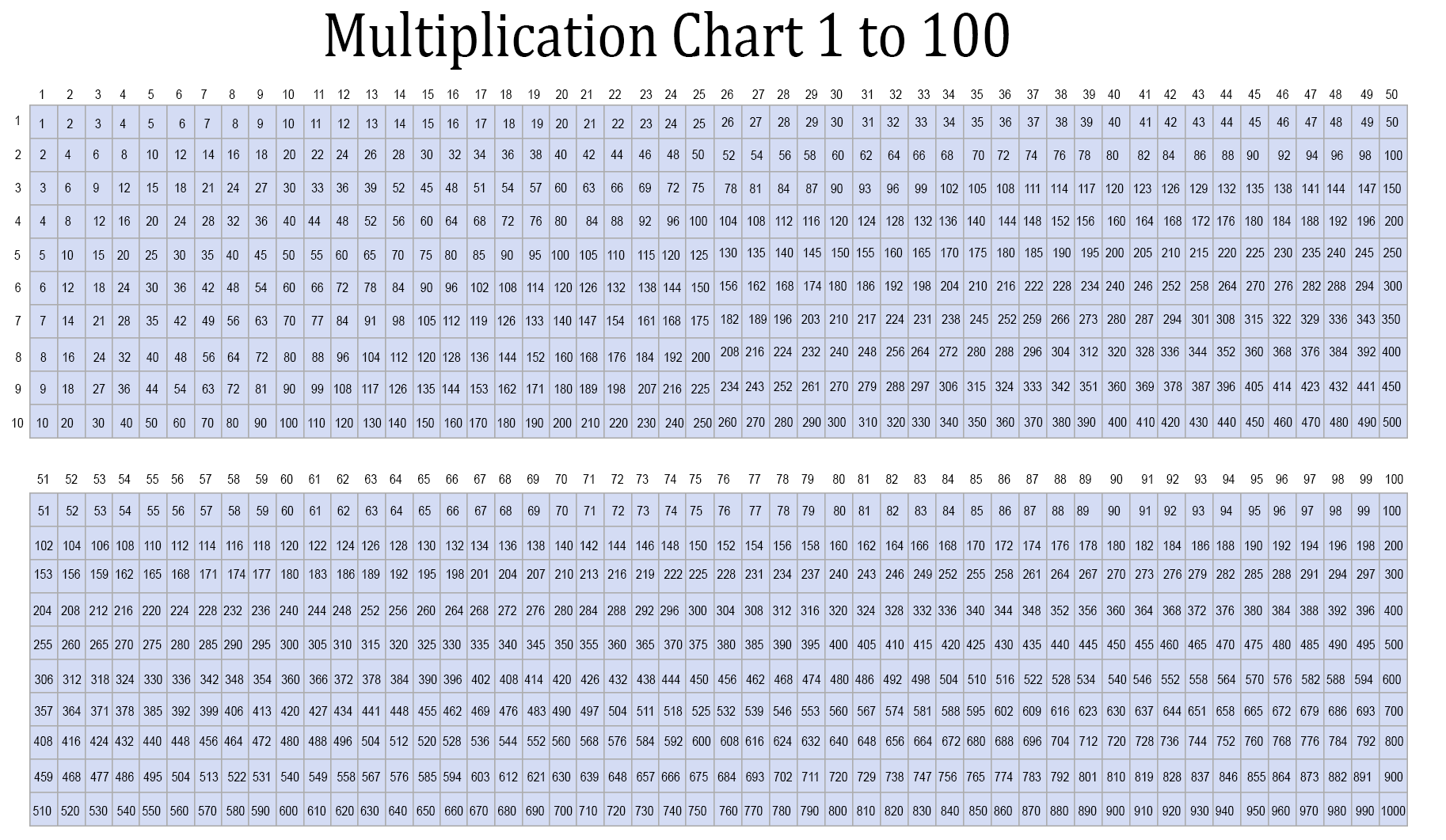
Math Tables 1 to 100 PDF Download | Multiplication Chart for 1-100 Tables | Tricks to Learn 1 to 100 Times Tables

Math Tables 1 to 100

Find Multiplication Tables for 1 to 100 here on this web page. Enhance your math skills by learning the Math Tables from 1 to 30. Answer any kind of math problem easily taking the help of the Multiplication Tables available. Use the Tables of One to Hundred provided below in image and tabular format. You can download them and prepare offline too and score better grades in the exams.

Also, Read:

Tables from 1 to 100

Here is the list of 100 Tables provided in tabular format. Having strong fundamentals of these Tables will aid you to solve any kind of Mathematical Problem easily and efficiently. Learn the Math Multiplication Tables from One to Hundred by referring to the below sections.

Multiplication Tables of 1 to 10

Table of 1Table of 2Table of 3Table of 4Table of 5Table of 6Table of 7Table of 8Table of 9Table of 10
1 x 1 = 12 ×‌ 1 = 23 × ‌1 = 34 × ‌1 = 45 × ‌1 = 56 × 1 = 67 × 1 = 78 × 1 = 89 × 1 = 910 × 1 = 10
1 x 2 = 22 ×‌ 2 = 43 × ‌2 = 64 × ‌2 = 85 × ‌2 = 106 × 2 = 127 × 2 = 148 × 2 = 169 × 2 = 1810 × 2 = 20
1 x 3 = 32 × ‌3 = 63 × ‌3 = 94 × ‌3 = 125 × ‌3 = 156 × 3 = 187 × 3 = 218 × 3 = 249 × 3 = 2710 × 3 = 30
1 x 4 = 42 × ‌4 = 83 × ‌4 = 124 × ‌4 = 165 × ‌4 = 206 × 4 = 247 × 4 = 288 × 4 = 329 × 4 = 3610 × 4 = 40
1 x 5 = 52 × ‌5 = 103 × ‌5 = 154 × ‌5 = 205 × ‌5 = 256 × 5 = 307 × 5 = 358 × 5 = 409 × 5 = 4510 × 5 = 50
1 x 6 = 62 × ‌6 = 123 × ‌6 = 184 × ‌6 = 245 × ‌6 = 306 × 6 = 367 × 6 = 428 × 6 = 489 × 6 = 5410 × 6 = 60
1 x 7 = 72 × ‌7 = 143 × ‌7 = 214 × ‌7 = 285 × ‌7 = 356 × 7 = 427 × 7 = 498 × 7 = 569 × 7 = 6310 × 7 = 70
1 x 8 = 82 × ‌8 = 163 × ‌8 = 244 × ‌8 = 325 × 8 = 406 × 8 = 487 × 8 = 568 × 8 = 649 × 8 = 7210 × 8 = 80
1 x 9 =92 × ‌9 = 183 × ‌9 = 274 × ‌9 = 365 × 9 = 456 × 9 = 547 × 9 = 638 × 9 = 729 × 9 = 8110 × 9 = 90
1 x 10 =102 × ‌10 = 203 × ‌10 = 304 × ‌10 = 405 × 10 = 506 × 10 = 607 × 10 = 708 × 10 = 809 × 10 = 9010 × 10 = 100

Multiplication Tables of 11 to 20

Table of 11Table of 12Table of 13Table of 14Table of 15Table of 16Table of 17Table of 18Table of 19Table of 20
11 ×‌‌ 1 = 1112 ×‌ 1 = 1213 ×‌ 1 = 1314 ×‌ 1 = 1415 ×‌ 1 = 1516 ×‌ 1 = 1617 ×‌ 1 = 1718 ×‌ 1 = 1819 ×‌ 1 = 1920 ×‌ 1 = 20
11 ×‌‌ 2 = 2212 ×‌ 2 = 2413 ×‌ 2 = 2614 ×‌ 2 = 2815 ×‌ 2 = 3016 ×‌ 2 = 3217 ×‌ 2 = 3418 ×‌ 2 = 3619 ×‌ 2 = 3820 ×‌ 2 = 40
11 ×‌‌ 3 = 3312 ×‌ 3 = 3613 ×‌ 3 = 3914 ×‌ 3 = 4215 ×‌ 3 = 4516 ×‌ 3 = 4817 ×‌ 3 = 5118 ×‌ 3 = 5419 ×‌ 3 = 5720 ×‌ 3 = 60
11 ×‌ 4 = 4412 ×‌ 4 = 4813 ×‌ 4 = 5214 ×‌ 4 = 5615 ×‌ 4 = 6016 ×‌ 4 = 6417 ×‌ 4 = 6818 ×‌ 4 = 7219 ×‌ 4 = 7620 ×‌ 4 = 80
11 ×‌ 5 = 5512 ×‌ 5 = 6013 ×‌ 5 = 6514 ×‌ 5 = 7015 ×‌ 5 = 7516 ×‌ 5 = 8017 ×‌ 5 = 8518 ×‌ 5 = 9019 ×‌ 5 = 9520 ×‌ 5 = 100
11 ×‌ 6 = 6612 ×‌ 6 = 7213 ×‌ 6 = 7814 ×‌ 6 = 8415 ×‌ 6 = 9016 ×‌ 6 = 9617 ×‌ 6 = 10218 ×‌ 6 = 10819 ×‌ 6 = 11420 ×‌ 6 = 120
11 ×‌ 7 = 7712 ×‌ 7 = 8413 ×‌ 7 = 9114 ×‌ 7 = 9815 ×‌ 7 = 10516 ×‌ 7 = 11217 ×‌ 7 = 11918 ×‌ 7 = 12619 ×‌ 7 = 13320 ×‌ 7 = 140
11 ×‌ 8 = 8812 ×‌ 8 = 9613 ×‌ 8 = 10414 ×‌ 8 = 11215 ×‌ 8 = 12016 ×‌ 8 = 12817 ×‌ 8 = 13618 ×‌ 8 = 14419 ×‌ 8 = 15220 ×‌ 8 = 160
11 ×‌ 9 = 9912 ×‌ 9 = 10813 ×‌ 9 = 11714 ×‌ 9 = 12615 ×‌ 9 = 13516 ×‌ 9 = 14417 ×‌ 9 = 15318 ×‌ 9 = 16219 ×‌ 9 = 17120 ×‌ 9 = 180
11 ×‌ 10 = 11012 ×‌ 10 = 12013 ×‌ 10 = 13014 ×‌ 10 = 14015 ×‌ 10 = 15016 ×‌ 10 = 16017 ×‌ 10 = 17018 ×‌ 10 = 18019 ×‌ 10 = 19020 ×‌ 10 = 200

Multiplication Tables of 21 to 30

Table of 21Table of 22Table of 23Table of 24Table of 25Table of 26Table of 27Table of 28Table of 29Table of 30
21 ×‌ 1 = 2122 ×‌ 1 = 2223 ×‌ 1 = 2324 ×‌ 1 = 2425 ×‌ 1 = 2526 ×‌ 1 = 2627 ×‌ 1 = 2728 ×‌ 1 = 2829 ×‌ 1 = 2930 ×‌ 1 = 30
21 ×‌ 2 = 4222 ×‌ 2 = 4423 ×‌ 2 = 4624 ×‌ 2 = 4825 ×‌ 2 = 5026 ×‌ 2 = 5227 ×‌ 2 = 5428 ×‌ 2 = 5629 ×‌ 2 = 5830 ×‌ 2 = 60
21 ×‌ 3 = 6322 ×‌ 3 = 6623 ×‌ 3 = 6924 ×‌ 3 = 7225 ×‌ 3 = 7526 ×‌ 3 = 7827 ×‌ 3 = 8128 ×‌ 3 = 8429 ×‌ 3 = 8730 ×‌ 3 = 90
21 ×‌ 4 = 8422 ×‌ 4 = 8823 ×‌ 4 = 9224 ×‌ 4 = 9625 ×‌ 4 = 10026 ×‌ 4 = 10427 ×‌ 4 = 10828 ×‌ 4 = 11229 ×‌ 4 = 11630 ×‌ 4 = 120
21 ×‌ 5 = 10522 ×‌ 5 = 11023 ×‌ 5 = 11524 ×‌ 5 = 12025 ×‌ 5 = 12526 ×‌ 5 = 13027 ×‌ 5 = 13528 ×‌ 5 = 14029 ×‌ 5 = 14530 ×‌ 5 = 150
21 ×‌ 6 = 12622 ×‌ 6 = 13223 ×‌ 6 = 13824 ×‌ 6 = 14425 ×‌ 6 = 15026 ×‌ 6 = 15627 ×‌ 6 = 16228 ×‌ 6 = 16829 ×‌ 6 = 17430 ×‌ 6 = 180
21 ×‌ 7 = 14722 ×‌ 7 = 15423 ×‌ 7 = 16124 ×‌ 7 = 16825 ×‌ 7 = 17526 ×‌ 7 = 18227 ×‌ 7 = 18928 ×‌ 7 = 19629 ×‌ 7 = 20330 ×‌ 7 = 210
21 ×‌ 8 = 16822 ×‌ 8 = 17623 ×‌ 8 = 18424 ×‌ 8 = 19225 ×‌ 8 = 20026 ×‌ 8 = 20827 ×‌ 8 = 21628 ×‌ 8 = 22429 ×‌ 8 = 23230 ×‌ 8 = 240
21 ×‌ 9 = 18922 ×‌ 9 = 19823 ×‌ 9 = 20724 ×‌ 9 = 21625 ×‌ 9 = 22526 ×‌ 9 = 23427 ×‌ 9 = 24328 ×‌ 9 = 25229 ×‌ 9 = 26130 ×‌ 9 = 270
21 ×‌ 10 = 21022 ×‌ 10 = 22023 ×‌ 10 = 23024 ×‌ 10 = 24025 ×‌ 10 = 25026 ×‌ 10 = 26027 ×‌ 10 = 27028 ×‌ 10 = 28029 ×‌ 10 = 29030 ×‌ 10 = 300

Multiplication Tables of 31 to 40

Table of 31Table of 32Table of 33Table of 34Table of 35Table of 36Table of 37Table of 38Table of 39Table of 40
31 ×‌ 1 = 3132 ×‌ 1 = 3233 ×‌ 1 = 3334 ×‌ 1 = 3435 ×‌ 1 = 3536 ×‌ 1 = 3637 ×‌ 1 = 3738 ×‌ 1 = 3839 ×‌ 1 = 3940 ×‌ 1 = 40
31 ×‌ 2 = 6232 ×‌ 2 = 6433 ×‌ 2 = 6634 ×‌ 2 = 6835 ×‌ 2 = 7036 ×‌ 2 = 7237 ×‌ 2 = 7438 ×‌ 2 = 7639 ×‌ 2 = 7840 ×‌ 2 = 80
31 ×‌ 3 = 9332 ×‌ 3 = 9633 ×‌ 3 = 9934 ×‌ 3 = 10235 ×‌ 3 = 10536 ×‌ 3 = 10837 ×‌ 3 = 11138 ×‌ 3 = 11439 ×‌ 3 = 11740 ×‌ 3 = 120
31 ×‌ 4 = 12432 ×‌ 4 = 12833 ×‌ 4 = 13234 ×‌ 4 = 13635 ×‌ 4 = 14036 ×‌ 4 = 14437 ×‌ 4 = 14838 ×‌ 4 = 15239 ×‌ 4 = 15640 ×‌ 4 = 160
31 ×‌ 5 = 15532 ×‌ 5 = 16033 ×‌ 5 = 16534 ×‌ 5 = 17035 ×‌ 5 = 17536 ×‌ 5 = 18037 ×‌ 5 = 18538 ×‌ 5 = 19039 ×‌ 5 = 19540 ×‌ 5 = 200
31 ×‌ 6 = 18632 ×‌ 6 = 19233 ×‌ 6 = 19834 ×‌ 6 = 20435 ×‌ 6 = 21036 ×‌ 6 = 21637 ×‌ 6 = 22238 ×‌ 6 = 22839 ×‌ 6 = 23440 ×‌ 6 = 240
31 ×‌ 7 = 21732 ×‌ 7 = 22433 ×‌ 7 = 23134 ×‌ 7 = 23835 ×‌ 7 = 24536 ×‌ 7 = 25237 ×‌ 7 = 18938 ×‌ 7 = 26639 ×‌ 7 = 27340 ×‌ 7 = 280
31 ×‌ 8 = 24832 ×‌ 8 = 25633 ×‌ 8 = 26434 ×‌ 8 = 27235 ×‌ 8 = 28036 ×‌ 8 = 28837 ×‌ 8 =29638 ×‌ 8 = 30439 ×‌ 8 = 31240 ×‌ 8 = 320
31 ×‌ 9 = 27932 ×‌ 9 = 28833 ×‌ 9 = 29734 ×‌ 9 = 30635 ×‌ 9 = 31536 ×‌ 9 = 32437 ×‌ 9 = 33338 ×‌ 9 = 34239 ×‌ 9 = 35140 ×‌ 9 = 360
31 ×‌ 10 = 31032 ×‌ 10 = 32033 ×‌ 10 = 33034 ×‌ 10 = 34035 ×‌ 10 = 35036 ×‌ 10 = 36037 ×‌ 10 = 37038 ×‌ 10 = 38039 ×‌ 10 = 39040 ×‌ 10 = 400

Multiplication Tables of 41 to 50

Table of 41Table of 42Table of 43Table of 44Table of 45Table of 46Table of 47Table of 48Table of 49Table of 50
41×1=4142×1=4243×1=4344×1=4445×1=4546×1=4647×1=4748×1=4849×1=4950×1=50
41×2=8242×2=8443×2=8644×2=8845×2=9046×2=9247×2=9448×2=9649×2=9850×2=100
41×3=12342×3=12643×3=12944×3=13245×3=13546×3=13847×3=14148×3=14449×3=14750×3=150
41×4=16442×4=16843×4=17244×4=17645×4=18046×4=18447×4=18848×4=19249×4=19650×4=200
41×5=20542×5=21043×5=21544×5=22045×5=22546×5=23047×5=23548×5=24049×5=24550×5=250
41×6=24642×6=25243×6=25844×6=26445×6=27046×6=27647×6=28248×6=28849×6=29450×6=300
41×7=28742×7=29443×7=30144×7=30845×7=31546×7=32247×7=32948×7=33649×7=34350×7=350
41×8=32842×8=33643×8=34444×8=35245×8=36046×8=36847×8=37648×8=38449×8=39250×8=400
41×9=36942×9=37843×9=38744×9=39645×9=40546×9=41447×9=42348×9=43249×9=44150×9=450
41×10=41042×10=42043×10=43044×10=44045×10=45046×10=46047×10=47048×10=48049×10=49050×10=500

Multiplication Tables of 51 to 60

Table of 51Table of 52Table of 53Table of 54Table of 55Table of 56Table of 57 Table of 58Table of 59Table of 60
51×1=5152×1=5253×1=5354×1=5455×1=5556×1=5657×1=5758×1=5859×1=5960×1=60
51×2=10252×2=10453×2=10654×2=10855×2=11056×2=11257×2=11458×2=11659×2=11860×2=120
51×3=15352×3=15653×3=15954×3=16255×3=16556×3=16857×3=17158×3=17459×3=17760×3=180
51×4=20452×4=20853×4=21254×4=21655×4=22056×4=22457×4=22858×4=23259×4=23660×4=240
51×5=25552×5=26053×5=26554×5=27055×5=27556×5=28057×5=28558×5=29059×5=29560×5=300
51×6=30652×6=31253×6=31854×6=32455×6=33056×6=33657×6=34258×6=34859×6=35460×6=360
51×7=35752×7=36453×7=37154×7=37855×7=38556×7=39257×7=39958×7=40659×7=41360×7=420
51×8=40852×8=41653×8=42454×8=43255×8=44056×8=44857×8=45658×8=46459×8=47260×8=480
51×9=45952×9=46853×9=47754×9=48655×9=49556×9=50457×9=51358×9=52259×9=53160×9=540
51×10=51052×10=52053×10=53054×10=54055×10=55056×10=56057×10=57058×10=58059×10=59060×10=600

Multiplication Tables of 61 to 70

Table of 61Table of 62Table of 63Table of 64Table of 65Table of 66Table of 67Table of 68Table of 69Table of 70
61×1=6162×1=6263×1=6364×1=6465×1=6566×1=6667×1=6768×1=6869×1=6970×1=70
61×2=10262×2=12463×2=10664×2=12865×2=13066×2=13267×2=13468×2=13669×2=13870×2=140
61×3=18362×3=18663×3=18964×3=19265×3=19566×3=19867×3=20168×3=20469×3=20770×3=210
61×4=24462×4=24863×4=25264×4=25665×4=26066×4=26467×4=26868×4=27269×4=27670×4=280
61×5=30562×5=31063×5=31564×5=32065×5=32566×5=33067×5=33568×5=34069×5=34570×5=350
61×6=36662×6=37263×6=37864×6=38465×6=39066×6=39667×6=40268×6=40869×6=41470×6=420
61×7=42762×7=43463×7=44164×7=44865×7=45566×7=46267×7=46968×7=47669×7=48370×7=490
61×8=48862×8=49663×8=50464×8=51265×8=52066×8=52867×8=53668×8=54469×8=55270×8=560
61×9=54962×9=55863×9=56764×9=57665×9=58566×9=59467×9=60368×9=61269×9=62170×9=630
61×10=61062×10=62063×10=63064×10=64065×10=65066×10=66067×10=67068×10=68069×10=69070×10=700

Multiplication Tables of 71 to 80

Table of 71Table of 72Table of 73Table of 74Table of 75Table of 76Table of 77 Table of 78Table of 79Table of 80
71×1=7172×1=7273×1=7374×1=7475×1=7576×1=7677×1=7778×1=7879×1=7980×1=80
71×2=14272×2=14473×2=14674×2=14875×2=15076×2=15277×2=15478×2=15679×2=15880×2=160
71×3=21372×3=21673×3=21974×3=22275×3=22576×3=22877×3=23178×3=23479×3=23780×3=240
71×4=28472×4=28873×4=29274×4=29675×4=30076×4=30477×4=30878×4=31279×4=31680×4=320
71×5=35572×5=36073×5=36574×5=37075×5=37576×5=38077×5=38578×5=39079×5=39580×5=400
71×6=42672×6=43273×6=43874×6=44475×6=45076×6=45677×6=46278×6=46879×6=47480×6=480
71×7=49772×7=50473×7=51174×7=51875×7=52576×7=53277×7=53978×7=54679×7=55380×7=560
71×8=56872×8=57673×8=58474×8=59275×8=60076×8=60877×8=61678×8=62479×8=63280×8=640
71×9=63972×9=64873×9=65774×9=66675×9=67576×9=68477×9=69378×9=70279×9=71180×9=720
71×10=71072×10=72073×10=73074×10=74075×10=75076×10=76077×10=77078×10=78079×10=79080×10=800

Multiplication Tables of 81 to 90

Table of 81Table of 82Table of 83Table of 84Table of 85Table of 86Table of 87 Table of 88Table of 89Table of 90
81×1=8182×1=8283×1=8384×1=8485×1=8586×1=8687×1=8788×1=7889×1=8990×1=90
81×2=16282×2=16483×2=16684×2=16885×2=17086×2=17287×2=17488×2=15689×2=17890×2=180
81×3=24382×3=24683×3=24984×3=25285×3=25586×3=25887×3=26188×3=23489×3=26790×3=270
81×4=32482×4=32883×4=33284×4=33685×4=34086×4=34487×4=34888×4=31289×4=35690×4=360
81×5=40582×5=41083×5=41584×5=42085×5=42586×5=43087×5=43588×5=39089×5=44590×5=450
81×6=48682×6=49283×6=49884×6=50485×6=51086×6=51687×6=52288×6=46889×6=53490×6=540
81×7=56782×7=57483×7=58184×7=58885×7=59586×7=60287×7=60988×7=54689×7=62390×7=630
81×8=64882×8=65683×8=66484×8=67285×8=68086×8=68887×8=69688×8=62489×8=71290×8=720
81×9=72982×9=73883×9=74784×9=75685×9=76586×9=77487×9=78388×9=70289×9=80190×9=810
81×10=81082×10=82083×10=83084×10=84085×10=85086×10=86087×10=87088×10=78089×10=89090×10=900

Multiplication Tables of 91 to 100

Table of 91Table of 92Table of 93Table of 94Table of 95Table of 96Table of 97 Table of 98Table of 99Table of 100
91×1=9192×1=9293×1=9394×1=9495×1=9596×1=9697×1=9798×1=9899×1=99100×1=100
91×2=18292×2=18493×2=18694×2=18895×2=19096×2=19297×2=19498×2=19699×2=198100×2=200
91×3=27392×3=27693×3=27994×3=28295×3=28596×3=28897×3=29198×3=29499×3=297100×3=300
91×4=36492×4=36893×4=37294×4=37695×4=38096×4=38497×4=38898×4=39299×4=396100×4=400
91×5=45592×5=46093×5=46594×5=47095×5=47596×5=48097×5=48598×5=49099×5=495100×5=500
91×6=54692×6=55293×6=55894×6=56495×6=57096×6=57697×6=58298×6=58899×6=594100×6=600
91×7=63792×7=64493×7=65194×7=65895×7=66596×7=67297×7=67998×7=68699×7=693100×7=700
91×8=72892×8=73693×8=74494×8=75295×8=76096×8=76897×8=77698×8=78499×8=792100×8=800
91×9=81992×9=82893×9=83794×9=84695×9=85596×9=86497×9=87398×9=88299×9=891100×9=900
91×10=91092×10=92093×10=93094×10=94095×10=95096×10=96097×10=97098×10=98099×10=990100×10=1000

Importance of Math Tables 1 to 100

Here is the significance of why you should learn the Math Times Tables for 1-100 and how they can aid you in your problem-solving. They are as follows

  • Memorizing the Multiplication Tables from 1-30 helps you to learn the rest of the tables easily.
  • You can solve all kinds of arithmetic operations such as Addition, Subtraction, Multiplication, and Division in a matter of seconds.
  • Learning Multiplication Tables from 1-100 not just help you to do math problems easily but faster too.
  • Knowing these Times Tables 1-100 by heart you can score good marks in your exams.

1 to 100 Tables Chart

Multiplication Chart for 1-100 Tables

Tables from 1 to 25 in PDF’s

Check out the quick links available below in PDF Format to access the respective table and get a good hold of it. Simply click on the links present and learn the relevant table easily. They are provided both in tabular format and image format for your convenience so that it is easy for you to learn the Math Multiplication Tables.

Table of 1Table of 2Table of 3Table of 4Table of 5
Table of 6Table of 7Table of 8Table of 9Table of 10
Table of 11Table of 12Table of 13Table of 14Table of 15 
Table of 16Table of 17Table of 18Table of 19Table of 20
Table of 21Table of 22Table of 23Table of 24Table of 25

FAQs on 1 to 100 Multiplication Tables

1. How can I Learn Math Tables easily and fast?

Follow the simple hacks provided below to learn the Multiplication Tables easily and fastly. They are along the lines

  • Start from easier tables and work on them regularly.
  • Learn the tips & tricks so that you can memorize the Math Tables much easier.
  • Drill as much you can and try to learn them by heart.

2. Why is it important to memorize the 1-100 Tables?

It is important to memorize the Tables so that they will develop the ability to learn the rest of the tables easily. They can enhance both their math skills and problem-solving abilities. In fact, memorizing the Multiplication Times Table helps them to perform any kind of calculation much simply and fastly.

3. Using the tables from 1 to 100, find the value of 5 plus 15 times 3 minus 15 times 6?

From Table of 15, we know 15 times 3 is 45 and 15 times 6 is 90

Writing it in statement form we get 5+15 times 3+15 times 6

= 5+45+90

= 140


Eureka Math Grade 6 Module 4 Lesson 9 Answer Key

Engage NY Eureka Math 6th Grade Module 4 Lesson 9 Answer Key

Eureka Math Grade 6 Module 4 Lesson 9 Example Answer Key

Example 1.
Create a bar diagram to show 3 plus 5.
Answer:
Eureka Math Grade 6 Module 4 Lesson 9 Example Answer Key 1

How would this look it you were asked to show 5 plus 3?
Answer:
There would be 5 tiles and then 3 tiles.
Eureka Math Grade 6 Module 4 Lesson 9 Example Answer Key 2

Are these two expressions equivalent?
Answer:
Yes. Both 3 + 5 and 5 + 3 have a sum of 8.

Example 2.

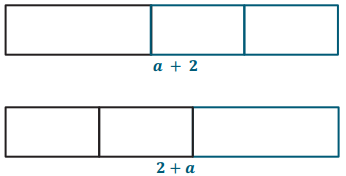
How can we show a number increased by 2?
Answer:
a + 2 or 2 + a

Eureka Math Grade 6 Module 4 Lesson 9 Example Answer Key 3

Can you prove this using a model? If so, draw the model.
Answer:
Yes. I can use a bar diagram.


Example 3.
Write an expression to show the sum of m and k.
Answer:
m + k or k + m

Which property can be used in Examples 1 – 3 to show that both expressions given are equivalent?
Answer:
The commutative property of addition

Example 4
How can we show 10 minus 6?
Draw a bar diagram to model this expression.
Answer:
Eureka Math Grade 6 Module 4 Lesson 9 Example Answer Key 4

What expression would represent this model?
Answer:
10 – 6

Could we also use 6 – 10?
Answer:
No. If we started with 6 and tried to take 10 away the models would not match.

Example 5
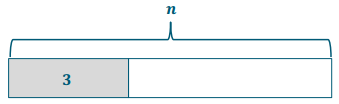
How can we write an expression to show 3 less than a number?
Start by drawing a diagram to model the subtraction. Are we taking away from the 3 or the unknown number?
Answer:
We are taking 3 away from the unknown number.
Eureka Math Grade 6 Module 4 Lesson 9 Example Answer Key 5

What expression would represent this model?
Answer:
The expression is n – 3

Example 6
How would we write an expression to show the number c being subtracted from the sum of a and b?

Start by writing an expression for “the sum of a and b.”
Answer:
a + b or b + a

Now, show c being subtracted from the sum.
Answer:
a + b – c or b + a – c

Example 7
Write an expression to show c minus the sum of a and b.
Answer:
c – (a + b)

Why are parentheses necessary in this example and not the others?
Answer:
Without the parentheses, only a is being taken away from c, where the expression says that a + b should be taken away from c.

Replace the variables with numbers to see if c – (a + b) is the same as c – a + b.

Eureka Math Grade 6 Module 4 Lesson 9 Exercise Answer Key

Exercise 1.
Write an expression to show the sum of 7 and 1. 5.
Answer:
7 + 1.5 or 1.5 + 7

Exercise 2.
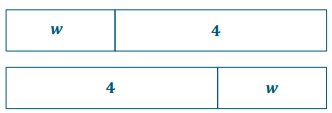
Write two expressions to show w increased by 4. Then, draw models to prove that both expressions represent the same thing.
Answer:
w + 4 and 4 + w
Eureka Math Grade 6 Module 4 Lesson 9 Exercise Answer Key 6

Exercise 3.
Write an expression to show the sum of a, b, and c.
Answer:
Answers will vary. Below are possible answers.
a + b + c               b + c + a           c + b + a
a + c + b               b + a + c           c + a + b

Exercise 4.
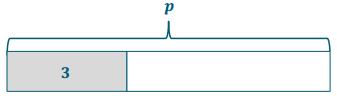
Write an expression and a model showing 3 less than p.
Answer:
p – 3
Eureka Math Grade 6 Module 4 Lesson 9 Exercise Answer Key 7

Exercise 5.
Write an expression to show the difference of 3 and p.
Answer:
3 – p

Exercise 6.
Write an expression to show 4 less than the sum of g and 5.
Answer:
g + 5 – 4 or 5 + g – 4

Exercise 7.
Write an expression to show 4 decreased by the sum of g and 5.
Answer:
4 – (g + 5) or 4 – (5 + g)

Exercise 8.
Should Exercises 6 and 7 have different expressions? Why or why not?
Answer:
The expressions are different because one includes the word “decreased by”and the other has the words ‘less than.” The words “less than” give the amount that was taken away first, whereas the word “decreased by” gives us a starting amount and then the amount that was taken away.

Eureka Math Grade 6 Module 4 Lesson 9 Problem Set Answer Key

Question 1.
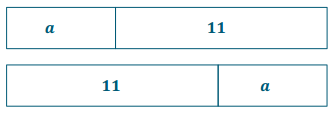
Write two expressions to show a number increased by 11. Then, draw models to prove that both expressions represent the same thing.
Answer:
a + 11 and 11 + a
Eureka Math Grade 6 Module 4 Lesson 9 Problem Set Answer Key 8

Question 2.
Write an expression to show the sum of x and y.
Answer:
x + y or y + x

Question 3.
Write an expression to show h decreased by 13.
Answer:
h – 13

Question 4.
Write an expression to show k less than 3. 5.
Answer:
3.5 – k

Question 5.
Write an expression to show the sum of g and h reduced by 11.
Answer:
g + h – 11

Question 6.
Write an expression to show 5 less than y, plus g.
Answer:
y – 5 + g

Question 7.
Write an expression to show 5 less than the sum of y and g.
Answer:
y + g – 5

Eureka Math Grade 6 Module 4 Lesson 9 Exit Ticket Answer Key

Question 1.
Write an expression showing the sum of 8 and a number f.
Answer:
8 + f or f + 8

Question 2.
Write an expression showing 5 less than the number k.
Answer:
k – 5

Question 3.
Write an expression showing the sum of a number h and a number w minus 11.
Answer:
h + w – 11

Eureka Math Grade 6 Module 4 Lesson 8 Answer Key

Engage NY Eureka Math 6th Grade Module 4 Lesson 8 Answer Key

Eureka Math Grade 6 Module 4 Lesson 8 Example Answer Key

Example 1.
Additive Identity Property of Zero
g + 0 = g

Remember a letter in a mathematical expression represents a number. Can we replace g with any number?
Answer:
Yes

Choose a value for g, and replace g with that number in the equation. What do you observe?
Answer:
The value of g does not change when 0 is added to g.

Repeat this process several times, each time choosing a different number for g.

Will all values of result in a true number sentence?
Answer:
Yes

Write the mathematical language for this property below:
Answer:
g + 0 = g, additive identity property of zero. Any number added to zero equals itself.

Example 2.
Multiplicative Identity Property of One
g × 1 = g
Remember a letter in a mathematical expression represents a number. Can we replace g with any number?
Answer:
Yes

Choose a value for g, and replace g with that number in the equation. What do you observe?
Answer:
The value of g does not change when g is multiplied by 1.

Will all values of result in a true number sentence? Experiment with different values before making your claim.
Answer:
Yes

Write the mathematical language for this property below:
Answer:
g × 1 = g, multiplicative identity property of one. Any number multiplied by one equals itself.

Example 3.
Commutative Property of Addition and Multiplication
3 + 4 = 4 + 3
3 × 4 = 4 × 3

Replace the 3’s in these number sentences with the letter
Answer:
a + 4 = 4 + a
a × 4 = 4 × a

Choose a value for a, and replace with that number in each of the equations. What do you observe?
Answer:
The result is a true number sentence.

Will all values of result in a true number sentence? Experiment with different values before making your claim.
Answer:
Yes, any number, even zero, can be used in place of the variable

Now, write the equations again, this time replacing the number 4 with a variable, b.
Answer:
a + b = b + a
a × b = b × a

Will all values of and result in true number sentences for the first two equations? Experiment with different values before making your claim.
Answer:
Yes

Write the mathematical language for this property below:
Answer:
a + b = b + a commutative property of addition. Order does not matter when adding.
a × b = b × a commutative property of multiplication. Order does not matter when multiplying.

Example 4.
3 + 3 + 3 + 3 = 4 × 3
3 ÷ 4 = \(\frac{3}{4}\)

Replace the 3’s in these number sentences with the letter
Answer:
a + a + a + a = 4 × a
a ÷ 4 = \(\frac{a}{4}\)

Choose a value for a, and replace a with that number in each of the equations. What do you observe?
Answer:
The result is a true number sentence.

Will all values of a result in a true number sentence? Experiment with different values before making your claim.
Answer:
Yes, any number, even zero, can be used in place of the variable

Now, write the equations again, this time replacing the number 4 with a variable, b.
Answer:
a + a + a + a = b × a
a ÷ b = \(\frac{a}{b}\), b ≠ 0

Will all values of and result in true number sentences for the equations? Experiment with different values before making your claim.
Answer:
In the equation a + a + a + a = b × a, any value can be substituted for the variable a, but only 4 can be used for b since there are exactly 4 copies of a in the equation.
It is true for all values of and all values of b ≠ 0.

Eureka Math Grade 6 Module 4 Lesson 8 Problem Set Answer Key

Question 1.
State the commutative property of addition using the variables a and b.
Answer:
a + b = b + a

Question 2.
State the commutative property of multiplication using the variables a and b.
Answer:
a × b = b × a

Question 3.
State the additive property of zero using the variable b.
Answer:
b + 0 = b

Question 4.
State the multiplicative identity property of one using the variable b.
Answer:
b × 1 = b

Question 5.
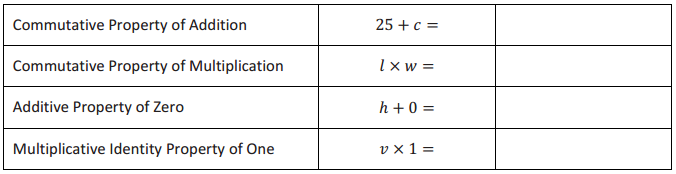
Demonstrate the property listed in the first column by filling in the third column of the table.
Eureka Math Grade 6 Module 4 Lesson 8 Problem Set Answer Key 1
Answer:
Eureka Math Grade 6 Module 4 Lesson 8 Problem Set Answer Key 2

Question 6.
Why is there no commutative property for subtraction or division? Show examples.
Answer:
Answers will vary. Examples should show reasoning and proof that the commutative property does not work for subtraction and division. An example would be 8 ÷ 2 and 2 ÷ 8. 8 ÷ 2 = 4, but 2 ÷ 8 = \(\frac{1}{4}\).

Eureka Math Grade 6 Module 4 Lesson 8 Exit Ticket Answer Key

Question 1.
State the commutative property of addition, and provide an example using two different numbers.
Answer:
Any two different addends can be chosen, such as 5 + 6 = 6 + 5.

Question 2.
State the commutative property of multiplication, and provide an example using two different numbers.
Answer:
Any two different factors can be chosen, such as 4 × 9 = 9 × 4.

Question 3.
State the additive property of zero, and provide an example using any other number.
Answer:
Any nonzero addend can be chosen, such as 3 + 0 = 3.

Question 4.
State the multiplicative identity property of one, and provide an example using any other number.
Answer:
Any nonzero factor can be chosen, such as 12 × 1 = 12.

Eureka Math Grade 6 Module 4 Lesson 8 Opening Exercise Answer Key

4 + 0 = 4
4 × 1 = 4
4 ÷ 1 = 4
4 × 0 = 0
1 ÷ 4 = \(\frac{1}{4}\)

How many of these statements are true?
Answer:
All of them

How many of those statements would be true if the number was replaced with the number in each of the number sentences?
Answer:
All of them

Would the number sentences be true if we were to replace the number with any other number?

What if we replaced the number 4 with the number 0? Would each of the number sentences be true?
Answer:
No. The first four are true, but the last one, dividing by zero, is not true.

What if we replace the number 4 with a letter g? Please write all 4 expressions below, replacing each 4 with a g.
Answer:
g + 0 = g
g × 1 = g
g ÷ 1 = g
g × 0 = 0
1 ÷ g = \(\frac{1}{g}\)

Are these all true (except for g= 0) when dividing?
Answer:
Yes

Eureka Math Grade 6 Module 4 Lesson 8 Division of Fractions II Answer Key

Division of Fractions II – Round 1

Directions: Determine the quotient of the fractions and simplify.

Eureka Math Grade 6 Module 4 Lesson 8 Division of Fractions II Answer Key 3

Question 1.
\(\frac{4}{10} \div \frac{2}{10}\)
Answer:
\(\frac{4}{2}\) = 2

Question 2.
\(\frac{9}{12} \div \frac{3}{12}\)
Answer:
\(\frac{9}{3}\) = 3

Question 3.
\(\frac{6}{10} \div \frac{4}{10}\)
Answer:
\(\frac{6}{4}=\frac{3}{2}=1 \frac{1}{2}\)

Question 4.
\(\frac{2}{8} \div \frac{3}{8}\)
Answer:
\(\frac{2}{3}\)

Question 5.
\(\frac{2}{7} \div \frac{6}{7}\)
Answer:
\(\frac{2}{6}=\frac{1}{3}\)

Question 6.
\(\frac{11}{9} \div \frac{8}{9}\)
Answer:
\(\frac{11}{8}=1 \frac{3}{8}\)

Question 7.
\(\frac{5}{13} \div \frac{10}{13}\)
Answer:
\(\frac{5}{10}=\frac{1}{2}\)

Question 8.
\(\frac{7}{8} \div \frac{13}{16}\)
Answer:
\(\frac{14}{13}=1 \frac{1}{13}\)

Question 9.
\(\frac{3}{5} \div \frac{7}{10}\)
Answer:
\(\frac{6}{7}\)

Question 10.
\(\frac{9}{30} \div \frac{3}{5}\)
Answer:
\(\frac{9}{18}=\frac{1}{2}\)

Question 11.
\(\frac{1}{3} \div \frac{4}{5}\)
Answer:
\(\frac{5}{12}\)

Question 12.
\(\frac{2}{5} \div \frac{3}{4}\)
Answer:
\(\frac{8}{15}\)

Question 13.
\(\frac{3}{4} \div \frac{5}{9}\)
Answer:
\(\frac{27}{20}=1 \frac{7}{20}\)

Question 14.
\(\frac{4}{5} \div \frac{7}{12}\)
Answer:
\(\frac{48}{35}=1 \frac{13}{35}\)

Question 15.
\(\frac{3}{8} \div \frac{5}{2}\)
Answer:
\(\frac{6}{40}=\frac{3}{20}\)

Question 16.
\(3 \frac{1}{8} \div \frac{2}{3}\)
Answer:
\(\frac{75}{16}=4 \frac{11}{16}\)

Question 17.
\(1 \frac{5}{6} \div \frac{1}{2}\)
Answer:
\(\frac{22}{6}=\frac{11}{3}=3 \frac{2}{3}\)

Question 18.
\(\frac{5}{8} \div 2 \frac{3}{4}\)
Answer:
\(\frac{20}{88}=\frac{5}{22}\)

Question 19.
\(\frac{1}{3} \div 1 \frac{4}{5}\)
Answer:
\(\frac{5}{27}\)

Question 20.
\(\frac{3}{4} \div 2 \frac{3}{10}\)
Answer:
\(\frac{30}{92}=\frac{15}{46}\)

Question 21.
\(2 \frac{1}{5} \div 1 \frac{1}{6}\)
Answer:
\(\frac{66}{35}=1 \frac{31}{35}\)

Question 22.
\(2 \frac{4}{9} \div 1 \frac{3}{5}\)
Answer:
\(\frac{110}{72}=\frac{55}{36}=1 \frac{19}{36}\)

Question 23.
\(1 \frac{2}{9} \div 3 \frac{2}{5}\)
Answer:
\(\frac{55}{153}\)

Question 24.
\(2 \frac{2}{3} \div 3\)
Answer:
\(\frac{8}{9}\)

Question 25.
\(1 \frac{3}{4} \div 2 \frac{2}{5}\)
Answer:
\(\frac{35}{48}\)

Question 26.
\(4 \div 1 \frac{2}{9}\)
Answer:
\(\frac{36}{11}=3 \frac{3}{11}\)

Question 27.
\(3 \frac{1}{5} \div 6\)
Answer:
\(\frac{16}{30}=\frac{8}{15}\)

Question 28.
\(2 \frac{5}{6} \div 1 \frac{1}{3}\)
Answer:
\(\frac{51}{24}=2 \frac{3}{24}=2 \frac{1}{8}\)

Question 29.
\(10 \frac{2}{3} \div 8\)
Answer:
\(\frac{32}{24}=\frac{4}{3}=1 \frac{1}{3}\)

Question 30.
\(15 \div 2 \frac{3}{5}\)
Answer:
\(\frac{75}{13}=5 \frac{10}{13}\)

Division of Fractions II – Round 2

Directions: Determine the quotient of the fractions and simplify.

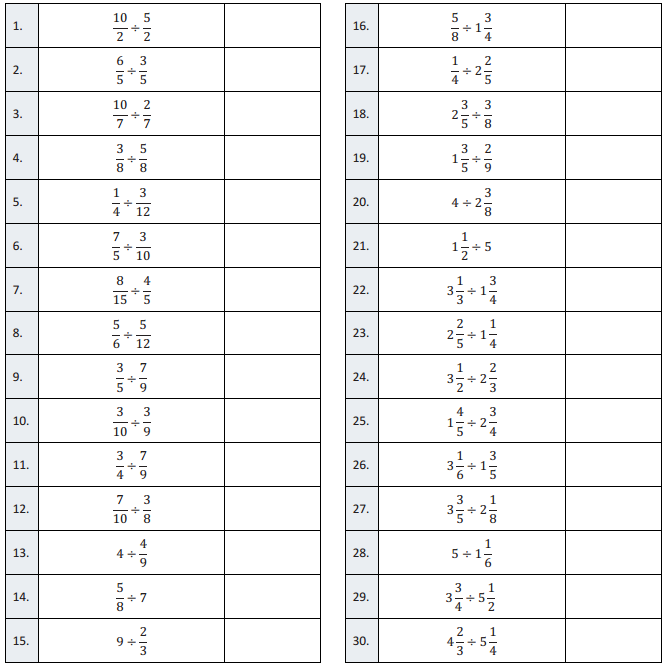
Eureka Math Grade 6 Module 4 Lesson 8 Division of Fractions II Answer Key 4

Question 1.
\(\frac{10}{2} \div \frac{5}{2}\)
Answer:
\(\frac{10}{5}\) = 2

Question 2.
\(\frac{6}{5} \div \frac{3}{5}\)
Answer:
\(\frac{6}{3}\) = 2

Question 3.
\(\frac{10}{7} \div \frac{2}{7}\)
Answer:
\(\frac{10}{2}\) = 5

Question 4.
\(\frac{3}{8} \div \frac{5}{8}\)
Answer:
\(\frac{3}{5}\)

Question 5.
\(\frac{1}{4} \div \frac{3}{12}\)
Answer:
\(\frac{3}{3}\) = 1

Question 6.
\(\frac{1}{4} \div \frac{3}{12}\)
Answer:
\(\frac{14}{3}=4 \frac{2}{3}\)

Question 7.
\(\frac{8}{15} \div \frac{4}{5}\)
Answer:
\(\frac{8}{12}=\frac{2}{3}\)

Question 8.
\(\frac{5}{6} \div \frac{5}{12}\)
Answer:
\(\frac{10}{5}\) = 2

Question 9.
\(\frac{3}{5} \div \frac{7}{9}\)
Answer:
\(\frac{27}{35}\)

Question 10.
\(\frac{3}{10} \div \frac{3}{9}\)
Answer:
\(\frac{27}{30}=\frac{9}{10}\)

Question 11.
\(\frac{3}{4} \div \frac{7}{9}\)
Answer:
\(\frac{27}{28}\)

Question 12.
\(\frac{7}{10} \div \frac{3}{8}\)
Answer:
\(\frac{56}{30}=\frac{28}{15}=1 \frac{13}{15}\)

Question 13.
\(4 \div \frac{4}{9}\)
Answer:
\(\frac{36}{4}\) = 9

Question 14.
\(\frac{5}{8} \div 7\)
Answer:
\(\frac{5}{56}\)

Question 15.
\(9 \div \frac{2}{3}\)
Answer:
\(\frac{27}{2}=13 \frac{1}{2}\)

Question 16.
\(\frac{5}{8} \div 1 \frac{3}{4}\)
Answer:
\(\frac{20}{56}=\frac{5}{14}\)

Question 17.
\(\frac{1}{4} \div 2 \frac{2}{5}\)
Answer:
\(\frac{5}{48}\)

Question 18.
\(2 \frac{3}{5} \div \frac{3}{8}\)
Answer:
\(\frac{104}{15}=6 \frac{14}{15}\)

Question 19.
\(1 \frac{3}{5} \div \frac{2}{9}\)
Answer:
\(\frac{72}{10}=7 \frac{2}{10}=7 \frac{1}{5}\)

Question 20.
\(4 \div 2 \frac{3}{8}\)
Answer:
\(\frac{32}{19}=1 \frac{13}{19}\)

Question 21.
\(1 \frac{1}{2} \div 5\)
Answer:
\(\frac{3}{10}\)

Question 22.
\(3 \frac{1}{3} \div 1 \frac{3}{4}\)
Answer:
\(\frac{40}{21}=1 \frac{19}{21}\)

Question 23.
\(2 \frac{2}{5} \div 1 \frac{1}{4}\)
Answer:
\(\frac{48}{25}=1 \frac{23}{25}\)

Question 24.
\(3 \frac{1}{2} \div 2 \frac{2}{3}\)
Answer:
\(\frac{21}{16}=1 \frac{5}{16}\)

Question 25.
\(1 \frac{4}{5} \div 2 \frac{3}{4}\)
Answer:
\(\frac{36}{55}\)

Question 26.
\(3 \frac{1}{6} \div 1 \frac{3}{5}\)
Answer:
\(\frac{95}{48}=1 \frac{47}{48}\)

Question 27.
\(3 \frac{3}{5} \div 2 \frac{1}{8}\)
Answer:
\(\frac{144}{85}=1 \frac{59}{85}\)

Question 28.
\(5 \div 1 \frac{1}{6}\)
Answer:
\(\frac{30}{7}=4 \frac{2}{7}\)

Question 29.
\(3 \frac{3}{4} \div 5 \frac{1}{2}\)
Answer:
\(\frac{30}{44}=\frac{15}{22}\)

Question 30.
\(4 \frac{2}{3} \div 5 \frac{1}{4}\)
Answer:
\(\frac{56}{63}=\frac{8}{9}\)

Eureka Math Grade 6 Module 4 Lesson 7 Answer Key

Engage NY Eureka Math 6th Grade Module 4 Lesson 7 Answer Key

Eureka Math Grade 6 Module 4 Lesson 7 Example Answer Key

Example 1.
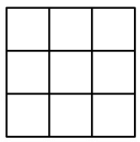
Eureka Math Grade 6 Module 4 Lesson 7 Example Answer Key 1

What is the length of one side of this square?
Answer:
3 units

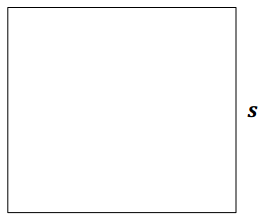
What is the formula for the area of a square?
Answer:
A = s2

What is the square’s area as a multiplication expression?
Answer:
3 units × 3 units

What is the square’s area?
Answer:
9 square units

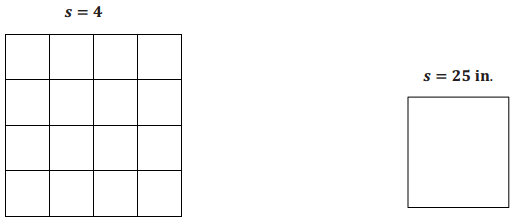
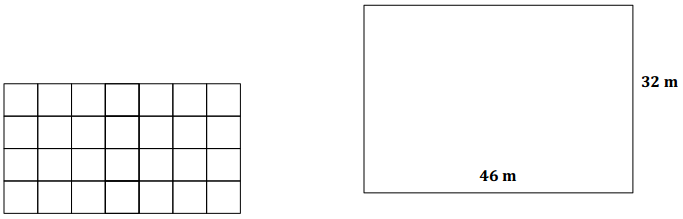
We can count the units. However, look at this other square. Its side length is 23 That is just too many tiny units to draw. What expression can we build to find this square’s area?
Answer:
23 × 23 cm

What is the area of the square? Use a calculator if you need to.
Answer:
529 cm2

Example 2.
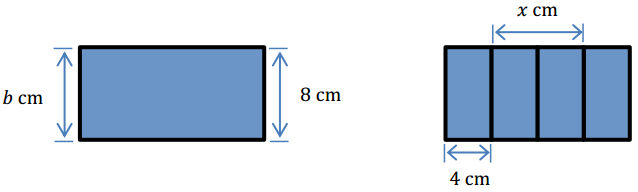
Eureka Math Grade 6 Module 4 Lesson 7 Example Answer Key 2

What does the letter represent in this blue rectangle?
Answer:
b = 8

With a partner, answer the following question: Given that the second rectangle is divided into four equal parts, what number does the x represent?
Answer:
x = 8

How did you arrive at this answer?
Answer:
We reasoned that each width of the 4 congruent rectangles must be the same. Two 4 lengths equals

What is the total length of the second rectangle? Tell a partner how you know.
Answer:
The length consists of 4 segments that each has a length of 4 cm. 4 × 4 cm = 16 cm.

If the two large rectangles have equal lengths and widths, find the area of each rectangle.
Answer:
8 cm × 16 cm = 128 cm2

Discuss with your partner how the formulas for the area of squares and rectangles can be used to evaluate area for a particular figure.
Answer:

Example 3.
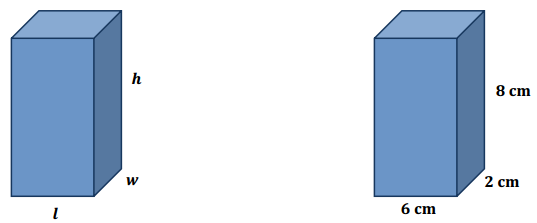
Eureka Math Grade 6 Module 4 Lesson 7 Example Answer Key 3

What does the l represent in the first diagram?
Answer:
The length of the rectangular prism

What does the w represent in the first diagram?
Answer:
The width of the rectangular prism

What does the h represent in the first diagram?
Answer:
The height of the rectangular prism

Since we know the formula to find the volume is V = l × w ×h, what number can we substitute for the l in the formula? Why?
Answer:
6, because the length of the second right rectangular prism is 6 cm.

What other number can we substitute for the l?
Answer:
No other number can replace the l. Only one number can replace one letter.

What number can we substitute for the in the formula? Why?
Answer:
2, because the width of the second right rectangular prism is 2 cm.

What number can we substitute for the h in the formula?
Answer:
8 because the height of the second right rectangular prism is 8 cm.

Determine the volume of the second right rectangular prism by replacing the letters in the formula with their appropriate numbers.
Answer:
V = l × w × h; V = 6 cm × 2 cm × 8 cm = 96 cm3

Eureka Math Grade 6 Module 4 Lesson 7 Exercise Answer Key

Exercise 1.
Complete the table below for both squares. Note: These drawings are not to scale.
Eureka Math Grade 6 Module 4 Lesson 7 Exercise Answer Key 4
Eureka Math Grade 6 Module 4 Lesson 7 Exercise Answer Key 5
Answer:
Eureka Math Grade 6 Module 4 Lesson 7 Exercise Answer Key 6

Exercise 2.
Eureka Math Grade 6 Module 4 Lesson 7 Exercise Answer Key 7
Eureka Math Grade 6 Module 4 Lesson 7 Exercise Answer Key 8
Answer:
Eureka Math Grade 6 Module 4 Lesson 7 Exercise Answer Key 9

Exercise 3.
Complete the table for both figures. Using a calculator is appropriate.
Eureka Math Grade 6 Module 4 Lesson 7 Exercise Answer Key 10
Eureka Math Grade 6 Module 4 Lesson 7 Exercise Answer Key 11
Answer:
Eureka Math Grade 6 Module 4 Lesson 7 Exercise Answer Key 12

Eureka Math Grade 6 Module 4 Lesson 7 Problem Set Answer Key

Question 1.
Replace the side length of this square with 4 in., and find the area.
Eureka Math Grade 6 Module 4 Lesson 7 Problem Set Answer Key 13
Answer:
The student should draw a square, label the side 4 in., and calculate the area to be 16 in2.

Question 2.
Complete the table for each of the given figures.
Eureka Math Grade 6 Module 4 Lesson 7 Problem Set Answer Key 14
Eureka Math Grade 6 Module 4 Lesson 7 Problem Set Answer Key 15
Answer:
Eureka Math Grade 6 Module 4 Lesson 7 Problem Set Answer Key 16

Question 3.
Find the perimeter of each quadrilateral in Problems 1 and 2.
Answer:
p = 16 in. p = 118 p = 35 yd.

Question 4.
Using the formula V = l × w × h, find the volume of a right rectangular prism when the length of the prism is 45 cm, the width is 12 cm, and the height is 10 cm.
Answer:
V = l × w × h; V = 45 cm × 12 cm × 10 cm = 5,400 cm3

Eureka Math Grade 6 Module 4 Lesson 7 Exit Ticket Answer Key

Question 1.
In the drawing below, what do the letters and represent?
Eureka Math Grade 6 Module 4 Lesson 7 Exit Ticket Answer Key 17
Answer:
Length and width of the rectangle

Question 2.
What does the expression l + w + l + w represent?
Answer:
Perimeter of the rectangle, or the sum of the sides of the rectangle

Question 3.
What does the expression l ∙ w represent?
Answer:
Area of the rectangle

Question 4.
The rectangle below is congruent to the rectangle shown in Problem 1. Use this information to evaluate the expressions from Problems 2 and 3.
Eureka Math Grade 6 Module 4 Lesson 7 Exit Ticket Answer Key 18
Answer:
l = 5 and w = 2 p = 14 units A = 10 units2

Eureka Math Grade 6 Module 4 Lesson 6 Answer Key

Engage NY Eureka Math 6th Grade Module 4 Lesson 6 Answer Key

Eureka Math Grade 6 Module 4 Lesson 6 Example Answer Key

Example 1.
Expressions with Only Addition, Subtraction, Multiplication, and Division

What operations are evaluated first?
Answer:
Multiplication and division are evaluated first, from left to right.

What operations are always evaluated last?
Answer:
Addition and subtraction are always evaluated last, from left to right.

Example 2.
Expressions with Four Operations and Exponents
4 + 92 ÷ 3 × 2 – 2

What operation is evaluated first?
Answer:
Exponents (92 = 9 × 9 = 81)

What operations are evaluated next?
Answer:
Multiplication and division, from left to right (81 ÷ 3 = 27; 27 × 2 = 54)

What operations are always evaluated last?
Answer:
Addition and subtraction, from left to right (4 + 54 = 58; 58 – 2 = 56)

What is the final answer?
Answer:
56

Example 3. Expressions with Parentheses
Consider a family of 4 that goes to a soccer game. Tickets are $5.00 each. The mom also buys a soft drink for $2.00. How would you write this expression?
Answer:
4 × 5 + 2

How much will this outing cost?
Answer:
$22

Consider a different scenario: The same family goes to the game as before, but each of the family members wants a drink. How would you write this expression?
Answer:
4 × (5 + 2)

Why would you add the 5 and 2 first?
Answer:
We need to determine how much each person spends. Each person spends $7; then, we multiply by 4 people to figure out the total cost.

How much will this outing cost?
Answer:
$28

How many groups are there?
Answer:
4

What does each group comprise?
Answer:
$5 + $2, or $7

Example 4.
Expressions with Parentheses and Exponents
2 × (3 + 4)2
Which value will we evaluate first within the parentheses? Evaluate.
Answer:
First, evaluate 42 which is 16; then, add 3.The value of the parentheses is 19.
2 × (3 + 42)
2 × (3 + 16)
2 × 19

Evaluate the rest of the expression.
Answer:
2 × 19 = 38

What do you think will happen when the exponent in this expression is outside of the parentheses?
2 × (3 + 4)2

Will the answer be the same?
Answer:
Answers will vary.

Which should we evaluate first? Evaluate.
Answer:
Parentheses
2 × (3 + 4)2
2 × (7)2

What happened differently here than in our last example?
Answer:
The 4 was not raised to the second power because it did not have an exponent. We simply added the values inside the parentheses.

What should our next step be?

We need to evaluate the exponent next.
Answer:
72 = 7 × 7 = 49

Evaluate to find the final answer.
Answer:
2 × 49
98

What do you notice about the two answers?
Answer:
The final answers were not the same.

What was different between the two expressions?
Answer:
Answers may vary. In the first problem, a value inside the parentheses had an exponent, and that value was evaluated first because it was inside of the parentheses. In the second problem, the exponent was outside of the parentheses, which made us evaluate what was in the parentheses first; then, we raised that value to the power of the exponent.

What conclusions can you draw about evaluating expressions with parentheses and exponents?
Answer:
Answers may vary. Regardless of the location of the exponent in the expression, evaluate the parentheses first. Sometimes there will be values with exponents inside the parentheses. If the exponent is outside the parentheses, evaluate the parentheses first, and then evaluate to the power of the exponent.

Eureka Math Grade 6 Module 4 Lesson 6 Exercise Answer Key

Exercise 1.
4 + 2 × 7
Answer:
4 + 14
18

Exercise 2.
36 ÷ 3 × 4
Answer:
12 × 4
48

Exercise 3.
20 − 5 × 2
Answer:
20 − 10
10

Exercise 4.
90 − 52 × 3
Answer:
90 − 25 × 3
90 − 75
15

Exercise 5.
43 + 2 × 8
Answer:
64 + 2 × 8
64 + 16
80

Exercise 6.
2 + (92)
Answer:
2 + (81 – 4)
2 + 77
79

Exercise 7.
2 . (13 + 5 – 14 ÷ (3 + 4)
Answer:
2 . (13 + 5 – 14 ÷ 7)
2 . (13 + 5 – 2)
2 . 16
32

Exercise 8.
7 + (12 – 32)
Answer:
7 + (12 – 9)
7 + 3
10

Exercise 9.
7 + (12 – 3)2
Answer:
7 + 92
7 + 81
88

Eureka Math Grade 6 Module 4 Lesson 6 Problem Set Answer Key

Evaluate each expression.

Question 1.
3 × 5 + 2 × 8 + 2
Answer:
15 + 16 + 2
33

Question 2.
($1.75 + 2 × $0.25 + 5 × $0.05) × 24
Answer:
($1.75 + $0.50 + $0.25) × 24
$2.50 × 24
$60.00

Question 3.
(2 × 6) + (8 × 4) + 1
Answer:
12 + 32 + 1
45

Question 4.
((8 × 1.95) + (3 × 2.95) + 10.95) × 1.06
Answer:
(15.6 + 8.85 + 10.99) × 1.06
35.4 × 1.06
37.54

Question 5.
((12 ÷ 3)2 – (18 ÷ 32)) × (4 ÷ 2)
Answer:
(42 − (18 ÷ 9)) × (4 ÷ 2)
(16 – 2) × 2
14 × 2
28

Eureka Math Grade 6 Module 4 Lesson 6 Exit Ticket Answer Key

Question 1.
Evaluate this expression: 39 ÷ (2 + 1) – 2 × (4 + 1).
Answer:
39 ÷ 3 − 2 × 5
13 − 10
3

Question 2.
Evaluate this expression: 12 × (3 + 22 ÷ 2 − 10
Answer:
12 × (3 + 4) ÷2 − 10
12 × 7 ÷ 2 − 10
84 ÷ 2 − 10
42 − 10
32

Question 3.
Evaluate this expression: 12 × (3 + 2)2 ÷ 2 – 10.
Answer:
12 × 52 ÷ 2 – 10
12 × 25 ÷ 2 − 10
300 ÷ 2 − 10
150 − 10
140

Eureka Math Grade 6 Module 4 Lesson 5 Answer Key

Engage NY Eureka Math 6th Grade Module 4 Lesson 5 Answer Key

Eureka Math Grade 6 Module 4 Lesson 5 Example Answer Key

Write each expression in exponential form.
Example 1.
5 × 5 × 5 × 5 × 5 =
Answer:
55

Example 2.
2 × 2 × 2 × 2 =
Answer:
24

Write each expression in expanded form.
Example 3.
83 =
Answer:
8 × 8 × 8

Example 4.
106 =
Answer:
10 × 10 × 10 × 10 × 10 × 10

Example 5.
g3 =
Answer:
g × g × g

Go back to Examples 1 – 4, and use a calculator to evaluate the expressions.

Example 1.
5 × 5 × 5 × 5 × 5 = 55
Answer:
3,125

Example 2.
2 × 2 × 2 × 2 = 24
Answer:
16

Example 3.
83 = 8 × 8 × 8
Answer:
512

Example 4.
106 = 10 × 10 × 10 × 10 × 10 × 10
Answer:
1,000,000

Example 5.
What is the difference between 3g and g3?
Answer:
3g = g + g + g or 3 times g; g3 = g × g × g

Example 6.
Write the expression in expanded form, and then evaluate.
(3.8)4 =
Answer:
3.8 × 3.8 × 3.8 × 3.8 = 208.5136

Example 7.
Write the expression in exponential form, and then evaluate.
Answer:
2.1 × 2.1 = (2.1)2 = 4.41

Example 8.
Write the expression in exponential form, and then evaluate.
0.75 × 0.75 × 0.75
Answer:
= (0.75)3 = 0.421875

The base number can also be a fraction. Convert the decimals to fractions in Examples 7 and 8 and evaluate. Leave your answer as a fraction. Remember how to multiply fractions!

Example 7.
Answer:
\(\frac{21}{10} \times \frac{21}{10}=\left(\frac{21}{10}\right)^{2}=\frac{441}{100}=4 \frac{41}{100}\)

Example 8.
Answer:
\(\frac{3}{4} \times \frac{3}{4} \times \frac{3}{4}=\left(\frac{3}{4}\right)^{3}=\frac{27}{64}\)

Example 9.
Write the expression in exponential form, and then evaluate.
Answer:
\(\frac{1}{2} \times \frac{1}{2} \times \frac{1}{2}=\left(\frac{1}{2}\right)^{3}=\frac{1}{8}\)

Example 10.
Write the expression in expanded form, and then evaluate.
Answer:
\(\left(\frac{2}{3}\right)^{2}=\frac{2}{3} \times \frac{2}{3}=\frac{4}{9}\)

Eureka Math Grade 6 Module 4 Lesson 5 Exercise Answer Key

Exercise 1.
Fill in the missing expressions for each row. For whole number and decimal bases, use a calculator to find the standard form of the number. For fraction bases, leave your answer as a fraction.

Exponential FormExpanded FormStandard Form
323 × 39
2 × 2 × 2 × 2 × 2 × 2
45
\( \frac{3}{4} \times \frac{3}{4} \)
1.5 × 1.5

Answer:

Exponential FormExpanded FormStandard Form
323 × 39
262 × 2 × 2 × 2 × 2 × 264
454 × 4 × 4 × 4 × 41,024
\(\left(\frac{3}{4}\right)^{2}\)\( \frac{3}{4} \times \frac{3}{4} \)\( \frac{9}{16} \)
(1.5)21.5 × 1.52.25

Exercise 2.
Write five cubed in all three forms: exponential form, expanded form, and standard form.
Answer:
53; 5 × 5 × 5; 125

Exercise 3.
Write fourteen and seven-tenths squared in all three forms.
Answer:
(14.7)2; 14.7 × 14.7; 216.09

Exercise 4.
One student thought two to the third power was equal to six. What mistake do you think he made, and how would you help him fix his mistake?
Answer:
The student multiplied the base, 2, by the exponent, 3. This is wrong because the exponent never multiplies the base; the exponent tells how many copies of the base are to be used as factors.

Eureka Math Grade 6 Module 4 Lesson 5 Problem Set Answer Key

Question 1.
Complete the table by filling in the blank cells. Use a calculator when needed.

Exponential FormExpanded FormStandard Form
35
4 × 4 × 4
(1.9)2
\(\left(\frac{1}{2}\right)^{5}\)

Answer:

Exponential FormExpanded FormStandard Form
353 × 3 × 3 × 3 × 3243
434 × 4 × 464
(1.9)21.9 × 1.93.61
\(\left(\frac{1}{2}\right)^{5}\)\( \frac{1}{2} \times \frac{1}{2} \times \frac{1}{2} \times \frac{1}{2} \times \frac{1}{2} \)\( \frac{1}{32} \)

Question 2.
Why do whole numbers raised to an exponent get greater, while fractions raised to an exponent get smaller?
Answer:
As whole numbers are multiplied by themselves, products are larger because there are more groups. As fractions of fractions are taken, the product is smaller. A part of a part is less than how much we started with.

Question 3.
The powers of 2 that are in the range 2 through 1,000 are 2, 4, 8, 16, 32, 64, 128, 256, and 512. Find all the powers of that are in the range 3 through 1,000.
Answer:
3, 9, 27, 81, 243, 729

Question 4.
Find all the powers of 4 in the range 4 through 1,000.
Answer:
4, 16, 64, 256

Question 5.
Write an equivalent expression for n × a using only addition.
Answer:
Eureka Math Grade 6 Module 4 Lesson 5 Problem Set Answer Key 1

Question 6.
Write an equivalent expression for wb using only multiplication.
Answer:
Eureka Math Grade 6 Module 4 Lesson 5 Problem Set Answer Key 2

a. Explain what w is in this new expression.
Answer:
w is the factor that will be repeatedly multiplied by itself.

b. Explain what b is in this new expression.
Answer:
b is the number of times w will be multiplied.

Question 7.
What is the advantage of using exponential notation?
Answer:
It is a shorthand way of writing a multiplication expression if the factors are all the same.

Question 8.
What is the difference between 4x and x4? Evaluate both of these expressions when x = 2
Answer:
4x means four times x; this is the same as x + x + x + x. On the other hand, x4 means x to the fourth power, or x × x × x × x.
When x = 2, 4x = 4 × 2 = 8.
When x = 2, x4 = 2 × 2 × 2 × 2 = 16.

Eureka Math Grade 6 Module 4 Lesson 5 Exit Ticket Answer Key

Question 1.
What is the difference between 6z and z6?
Answer:
6z = z + z + z + z + z + z or 6 times z; z6 = z × z × z × z × z × z

Question 2.
Write 103 as a multiplication expression having repeated factors.
Answer:
10 × 10 × 10

Question 3.
Write 8 × 8 × 8 × 8 using an exponent.
Answer:
84

Eureka Math Grade 6 Module 4 Lesson 5 Opening Exercise Answer Key

As you evaluate these expressions, pay attention to how you arrive at your answers.

Question 1.
4 + 4 + 4 + 4 + 4 + 4 + 4 + 4 + 4 + 4
Answer:
4 + 4 + 4 + 4 + 4 + 4 + 4 + 4 + 4 + 4 = 4 × 10
= 410

Question 2.
9 + 9 + 9 + 9 + 9
Answer:
9 + 9 + 9 + 9 + 9 = 9 × 5
= 95

Question 3.
10 + 10 + 10 + 10 + 10
Answer:
10 + 10 + 10 + 10 + 10 = 10 × 5
= 105

Eureka Math Grade 6 Module 4 Lesson 5 Multiplication of Decimals Answer Key

Progression of Exercises

Question 1.
0.5 × 0.5 =
Answer:
0.25

Question 2.
0.6 × 0.6 =
Answer:
0.36

Question 3.
0.7 × 0.7
Answer:
0.49

Question 4.
0.5 × 0.6 =
Answer:
0.3

Question 5.
1.5 × 1.5 =
Answer:
0.25

Question 6.
2.5 × 2.5 =
Answer:
6.25

Question 7.
0.25 × 0.25 =
Answer:
0.0625

Question 8.
0.1 × 0.1 =
Answer:
0.01

Question 9.
0.1 × 123.4 =
Answer:
12.34

Question 10.
0.01 × 123.4 =
Answer:
1.234

Eureka Math Grade 6 Module 4 Lesson 4 Answer Key

Engage NY Eureka Math 6th Grade Module 4 Lesson 4 Answer Key

Eureka Math Grade 6 Module 4 Lesson 4 Exercise Answer Key

Exercise 1.
Build subtraction equations using the indicated equations. The first example has been completed for you.
Eureka Math Grade 6 Module 4 Lesson 4 Exercise Answer Key 1
Answer:
Eureka Math Grade 6 Module 4 Lesson 4 Exercise Answer Key 2

Eureka Math Grade 6 Module 4 Lesson 4 Exercise Answer Key 3
Answer:
Eureka Math Grade 6 Module 4 Lesson 4 Exercise Answer Key 4

Exercise 2.
Answer each question using what you have learned about the relationship of division and subtraction.
a. If 12 ÷ x = 3 how many times would x have to be subtracted from 12 in order for the answer to be zero? What is the value of x?
Answer:
3; x = 4

b. 36 − f − f − f − f = 0. Write a division sentence for this repeated subtraction sentence. What is the value
of x?
Answer:
36 ÷ 4 = f or 36 ÷ f = 4; f = 9

c. If 24 ÷ b = 12, which number is being subtracted 12 times in order for the answer to be zero?
Answer:
Two

Eureka Math Grade 6 Module 4 Lesson 4 Problem Set Answer Key

Build subtraction equations using the indicated equations.
Eureka Math Grade 6 Module 4 Lesson 4 Problem Set Answer Key 5
Answer:
Eureka Math Grade 6 Module 4 Lesson 4 Problem Set Answer Key 6

Eureka Math Grade 6 Module 4 Lesson 4 Problem Set Answer Key 7
Answer:
Eureka Math Grade 6 Module 4 Lesson 4 Problem Set Answer Key 8

Eureka Math Grade 6 Module 4 Lesson 4 Exit Ticket Answer Key

Question 1.
Represent 56 ÷ 8 = 7 using subtraction. Explain your reasoning.
Answer:
56 – 7 – 7 – 7 – 7 – 7 – 7 – 7 – 7 = 0 because
56 – 7 = 49; 49 – 7 = 42; 42 – 7 = 35; 35 – 7 = 28; 28 – 7 = 21; 21 – 7 = 14; 14 – 7 = 7; 7 – 7 = 0.

OR

56 – 8 – 8 – 8 – 8 – 8 – 8 – 8 = 0 because
56 – 8 = 48; 48 – 8 = 40; 40 – 8 = 32; 32 – 8 = 24; 24 – 8 = 16; 16 – 8 = 8; 8 – 8 = 0.

Question 2.
Explain why 30 ÷ x = 6 is the same as 30 – x – x – x – x – x – x = 0. What is the value of x in this example?
Answer:
30 ÷ 5 = 6, so x = 5. When I subtract 5 from 30 six times, the result is zero. Division is a repeat operation of
subtraction.

Eureka Math Grade 6 Module 4 Lesson 3 Answer Key

Engage NY Eureka Math 6th Grade Module 4 Lesson 3 Answer Key

Eureka Math Grade 6 Module 4 Lesson 3 Exercise Answer Key

Exercise 1.
Write the addition sentence that describes the model and the multiplication sentence that describes the model.
Eureka Math Grade 6 Module 4 Lesson 3 Exercise Answer Key 4
Answer:
5 + 5 + 5 and 3 × 5

Exercise 2.
Write an equivalent expression to demonstrate the relationship of multiplication and addition.
a. 6 + 6
Answer:
2 × 6

b. 3 + 3 + 3 + 3 + 3 + 3
Answer:
6 × 3

c. 4 + 4 + 4 + 4 + 4
Answer:
5 × 4

d. 6 × 2
Answer:
2 + 2 + 2 + 2 + 2+ 2

e. 4 × 6
Answer:
6 + 6 + 6 + 6

f. 3 × 9
Answer:
9 + 9 + 9

g. h + h + h + h + h
Answer:
5h

h. 6y
Answer:
y + y + y + y + y + y

Exercise 3.
Roberto is not familiar with tape diagrams and believes that he can show the relationship of multiplication and addition on a number line. Help Roberto demonstrate that the expression 3 × 2 is equivalent to 2 + 2 + 2 on a number line.
Answer:
Possible answer: The first number line shows that there are 3 groups of 2, resulting in 6. The second number line shows the sum of 2 + 2 + 2, resulting in 6.
Eureka Math Grade 6 Module 4 Lesson 3 Exercise Answer Key 5
Since both number lines start at 0 and end at 6, the expressions are equivalent.

Exercise 4.
Tell whether the following equations are true or false. Then, explain your reasoning.
a. x + 6g − 6g = x
The equation is true because it demonstrates the addition identity.

b. 2f − 4e + 4e = 2f
Answer:
The equation is true because it demonstrates the subtraction identity.

Exercise 5.
Write an equivalent expression to demonstrate the relationship between addition and multiplication.
a. 6 + 6 + 6 + 6 + 6 + 6 + 6
Answer:
4 × 6 + 3 × 4

b. d + d + d + w + w + w + w + w
Answer:
3d + 5w

c. a + a + b + b + b + c + c + c + c
Answer:
2a + 3b + 4c

Eureka Math Grade 6 Module 4 Lesson 3 Problem Set Answer Key

Write an equivalent expression to show the relationship of multiplication and addition.

Question 1.
10 + 10 + 10
Answer:
3 × 10

Question 2.
4 + 4 + 4 + 4 + 4 + 4 + 4
Answer:
7 × 4

Question 3.
8 × 2
Answer:
2 + 2 + 2 + 2 + 2 + 2 + 2 + 2

Question 4.
3 × 9
Answer:
9 + 9 + 9

Question 5.
6m
Answer:
m + m + m + m + m + m

Question 6.
d + d + d + d + d
Answer:
5d

Eureka Math Grade 6 Module 4 Lesson 3 Exit Ticket Answer Key

Write an equivalent expression to show the relationship of multiplication and addition.

Question 1.
8 + 8 + 8 + 8 + 8 + 8 + 8 + 8 + 8
Answer:
9 × 8

Question 2.
4 × 9
Answer:
9 + 9 + 9 + 9

Question 3.
6 + 6 + 6
Answer:
3 × 6

Question 4.
7h
Answer:
h + h + h + h + h + h + h

Question 5.
j + j + j + j + j
Answer:
5j

Question 6.
u + u + u + u + u + u + u + u + u + u
Answer:
10u

Eureka Math Grade 6 Module 4 Lesson 3 Opening Exercise Answer Key

Write two different expressions that can be depicted by the tape diagram shown. One expression should include addition, while the other should include multiplication.

a.
Eureka Math Grade 6 Module 4 Lesson 3 Opening Exercise Answer Key 1
Answer:
Possible answers: 3 + 3 + 3 or 3 × 3

b.
Eureka Math Grade 6 Module 4 Lesson 3 Opening Exercise Answer Key 2
Answer:
Possible answers: 8 + 8 or 2 × 8

c.
Eureka Math Grade 6 Module 4 Lesson 3 Opening Exercise Answer Key 3
Answer:
Possible answers: 5 + 5 + 5 or 3 × 5

Eureka Math Grade 6 Module 4 Lesson 2 Answer Key

Engage NY Eureka Math 6th Grade Module 4 Lesson 2 Answer Key

Eureka Math Grade 6 Module 4 Lesson 2 Problem Set Answer Key

Question 1.
Fill in each blank to make each equation true.
a. 132 ÷ 3 × 3 = __________
Answer:
132

b. _______ ÷ 25 × 25 = 225
Answer:
225

c. 56 × ______ ÷ 8 = 56
Answer:
8

d. 452 × 12 ÷ ___ = 452
Answer:
12

Question 2
How is the relationship of addition and subtraction similar to the relationship of multiplication and division?
Answer:
Possible answer: Both relationships create identities.

Eureka Math Grade 6 Module 4 Lesson 2 Exit Ticket Answer Key

Question 1.
Fill In the blanks to make each equation true.
a. 12 ÷ 3 × __________ = 12
Answer:
3

b. f × h ÷ h = __________
Answer:
f

c. 45 × _________ ÷ 15 = 45
Answer:
15

d. __________ ÷ r × r = p
Answer:
p

Question 2.
Draw a series of tape diagrams to represent the following number sentences.
a. 12 ÷ 3 × 3 = 12
Answer:
Eureka Math Grade 6 Module 4 Lesson 2 Exit Ticket Answer Key 4

b. 4 × 5 ÷ 5 = 4
Answer:
Eureka Math Grade 6 Module 4 Lesson 2 Exit Ticket Answer Key 5

Eureka Math Grade 6 Module 4 Lesson 2 Opening Exercise Answer Key

Draw a pictorial representation of the division and multiplication problems using a tape diagram.

a. 8 ÷ 2
Answer:
Eureka Math Grade 6 Module 4 Lesson 2 Opening Exercise Answer Key 1

b. 3 × 2
Answer:
Eureka Math Grade 6 Module 4 Lesson 2 Opening Exercise Answer Key 2

Eureka Math Grade 6 Module 4 Lesson 2 Exploratory Challenge Answer Key

Work in pairs or small groups to determine equations to show the relationship between multiplication and division. Use tape diagrams to provide support for your findings.

Question 1.
Create two equations to show the relationship between multiplication and division. These equations should be identities and Include variables. Use the squares to develop these equations.
Answer:

Question 2.
Write your equations on large paper. Show a series of tape diagrams to defend each of your equations.
Answer:
Only one number sentence is shown there; the second number sentence and series of tape diagrams are included in the optional Discussion.
Possible answer: a × b ÷ b = a
Eureka Math Grade 6 Module 4 Lesson 2 Exploratory Challenge Answer Key 3
Possible answer: a ÷ b × b = a

Use the following rubric to critique other posters.
1. Name of the group you are critiquing
2. Equation you are critiquing
3. Whether or not you believe the equations are true and reasons why
Answer:

Eureka Math Grade 6 Module 4 Lesson 2 Division of Fractions Answer Key

Divisions of Fractions – Round 1

Eureka Math Grade 6 Module 4 Lesson 2 Division of Fractions Answer Key 6

Question 1.
9 ones ÷ 3 ones
Answer:
\(\frac{9}{3}\) = 3

Question 2.
9 ÷ 3
Answer:
\(\frac{9}{3}\) = 3

Question 3.
9 tens ÷ 3 tens
Answer:
\(\frac{9}{3}\) = 3

Question 4.
90 ÷ 30
Answer:
\(\frac{9}{3}\) = 3

Question 5.
9 hundreds ÷ 3 hundreds
Answer:
\(\frac{9}{3}\) = 3

Question 6.
900 ÷ 300
Answer:
\(\frac{9}{3}\) = 3

Question 7.
9 halves ÷ 3 halves
Answer:
\(\frac{9}{3}\) = 3

Question 8.
\(\frac{9}{2} \div \frac{3}{2}\)
Answer:
\(\frac{9}{3}\) = 3

Question 9.
9 fourths ÷ 3 fourths
Answer:
\(\frac{9}{3}\)

Question 10.
\(\frac{9}{4} \div \frac{3}{4}\)
Answer:
\(\frac{9}{3}\) = 3

Question 11.
\(\frac{9}{8} \div \frac{3}{8}\)
Answer:
\(\frac{9}{3}\) = 3

Question 12.
\(\frac{2}{3} \div \frac{1}{3}\)
Answer:
\(\frac{2}{1}\) = 2

Question 13.
\(\frac{1}{3} \div \frac{2}{3}\)
Answer:
\(\frac{1}{2}\)

Question 14.
\(\frac{6}{7} \div \frac{2}{7}\)
Answer:
\(\frac{6}{2}\) = 3

Question 15.
\(\frac{5}{7} \div \frac{2}{7}\)
Answer:
\(\frac{5}{2}=2 \frac{1}{2}\)

Question 16.
\(\frac{3}{7} \div \frac{4}{7}\)
Answer:
\(\frac{3}{4}\)

Question 17.
\(\frac{6}{10} \div \frac{2}{10}\)
Answer:
\(\frac{6}{2}\) = 3

Question 18.
\(\frac{6}{10} \div \frac{4}{10}\)
Answer:
\(\frac{6}{4}=1 \frac{1}{2}\)

Question 19.
\(\frac{6}{10} \div \frac{8}{10}\)
Answer:
\(\frac{6}{8}=\frac{3}{4}\)

Question 20.
\(\frac{7}{12} \div \frac{2}{12} \)
Answer:
\(\frac{7}{2}=3 \frac{1}{2}\)

Question 21.
\(\frac{6}{12} \div \frac{9}{12}\)
Answer:
\(\frac{6}{9}=\frac{2}{3}\)

Question 22.
\(\frac{4}{12} \div \frac{11}{12}\)
Answer:
\(\frac{4}{11}\)

Question 23.
\(\frac{6}{10} \div \frac{4}{10}\)
Answer:
\(\frac{6}{4}=1 \frac{1}{2}\)

Question 24.
\(\frac{6}{10} \div \frac{2}{5}=\frac{6}{10} \div \frac{ }{10}\)
Answer:
\(\frac{6}{4}=1 \frac{1}{2}\)

Question 25.
\(\frac{10}{12} \div \frac{5}{12}\)
Answer:
\(\frac{10}{5}=2\)

Question 26.
\(\frac{5}{6} \div \frac{5}{12}=\frac{ }{12} \div \frac{5}{12}\)
Answer:
\(\frac{10}{5}=2\)

Question 27.
\(\frac{10}{12} \div \frac{3}{12}\)
Answer:
\(\frac{10}{3}=3 \frac{1}{3}\)

Question 28.
\(\frac{10}{12} \div \frac{1}{4}=\frac{10}{12} \div \frac{ }{12}\)
Answer:
\(\frac{10}{3}=3 \frac{1}{3}\)

Question 29.
\(\frac{5}{6} \div \frac{3}{12}=\frac{ }{12} \div \frac{3}{12}\)
Answer:
\(\frac{10}{3}=3 \frac{1}{3}\)

Question 30.
\(\frac{5}{10} \div \frac{2}{10}\)
Answer:
\(\frac{5}{2}=2 \frac{1}{2}\)

Question 31.
\(\frac{5}{10} \div \frac{1}{5}=\frac{5}{10} \div \frac{ }{10}\)
Answer:
\(\frac{5}{2}=2 \frac{1}{2}\)

Question 32.
\(\frac{1}{2} \div \frac{2}{10}=\frac{ }{10} \div \frac{2}{10}\)
Answer:
\(\frac{5}{2}=2 \frac{1}{2}\)

Question 33.
\(\frac{1}{2} \div \frac{2}{4}\)
Answer:
\(\frac{2}{2}=1\)

Question 34.
\(\frac{3}{4} \div \frac{2}{8}\)
Answer:
3

Question 35.
\(\frac{1}{2} \div \frac{3}{8}\)
Answer:
\(\frac{4}{3}=1 \frac{1}{3}\)

Question 36.
\(\frac{1}{2} \div \frac{1}{5}=\frac{1}{10} \div \frac{ }{10}\)
Answer:
\(\frac{5}{2}=2 \frac{1}{2}\)

Question 37.
\(\frac{2}{4} \div \frac{1}{3}\)
Answer:
\(\frac{6}{4}=1 \frac{1}{2}\)

Question 38.
\(\frac{1}{4} \div \frac{4}{6}\)
Answer:
\(\frac{3}{8}\)

Question 39.
\(\frac{3}{4} \div \frac{2}{6}\)
Answer:
\(\frac{9}{4}=2 \frac{1}{4}\)

Question 40.
\(\frac{5}{6} \div \frac{1}{4}\)
Answer:
\(\frac{10}{3}=3 \frac{1}{3}\)

Question 41.
\(\frac{2}{9} \div \frac{5}{6}\)
Answer:
\(\frac{4}{15}\)

Question 42.
\(\frac{5}{9} \div \frac{1}{6}\)
Answer:
\(\frac{15}{3}\) = 5

Question 43.
\(\frac{1}{2} \div \frac{1}{7}\)
Answer:
\(\frac{7}{2}=3 \frac{1}{2}\)

Question 44.
\(\frac{5}{7} \div \frac{1}{2}\)
Answer:
\(\frac{10}{7}=1 \frac{3}{7}\)

Divisions of Fractions – Round 2

Eureka Math Grade 6 Module 4 Lesson 2 Division of Fractions Answer Key 7

Question 1.
12 ones ÷ 2 ones
Answer:
\(\frac{12}{2}\) = 6

Question 2.
12 ÷ 2
Answer:
\(\frac{12}{2}\) = 6

Question 3.
12 tens ÷ 2 tens
Answer:
\(\frac{12}{2}\) = 6

Question 4.
120 ÷ 20
Answer:
\(\frac{12}{2}\) = 6

Question 5.
12 hundreds ÷ 2 hundreds
Answer:
\(\frac{12}{2}\) = 6

Question 6.
1,200 ÷ 200
Answer:
\(\frac{12}{2}\) = 6

Question 7.
12 halves ÷ 2 halves
Answer:
\(\frac{12}{2}\) = 6

Question 8.
\(\frac{12}{2} \div \frac{2}{2}\)
Answer:
\(\frac{12}{2}\) =6

Question 9.
12 fourths ÷ 3 fourths
Answer:
\(\frac{12}{3}\) = 4

Question 10.
\(\frac{12}{4} \div \frac{3}{4}\)
Answer:
\(\frac{12}{3}\) = 4

Question 11.
\(\frac{12}{8} \div \frac{3}{8}\)
Answer:
\(\frac{12}{3}\) = 4

Question 12.
\(\frac{2}{4} \div \frac{1}{4}\)
Answer:
\(\frac{2}{1}\) = 2

Question 13.
\(\frac{1}{4} \div \frac{2}{4}\)
Answer:
\(\frac{1}{2}\)

Question 14.
\(\frac{4}{5} \div \frac{2}{5}\)
Answer:
\(\frac{4}{2}\) = 2

Question 15.
\(\frac{2}{5} \div \frac{4}{5}\)
Answer:
\(\frac{2}{4}=\frac{1}{2}\)

Question 16.
\(\frac{3}{5} \div \frac{4}{5}\)
Answer:
\(\frac{3}{4}\)

Question 17.
\(\frac{6}{8} \div \frac{2}{8}\)
Answer:
\(\frac{6}{2}\) = 3

Question 18.
\(\frac{6}{8} \div \frac{4}{8}\)
Answer:
\(\frac{6}{4}=1 \frac{1}{2}\)

Question 19.
\(\frac{6}{8} \div \frac{5}{8}\)
Answer:
\(\frac{6}{5}=1 \frac{1}{5}\)

Question 20.
\(\frac{6}{10} \div \frac{2}{10}\)
Answer:
\(\frac{6}{2}\) = 3

Question 21.
\(\frac{7}{10} \div \frac{8}{10}\)
Answer:
\(\frac{7}{8}\)

Question 22.
\(\frac{4}{10} \div \frac{7}{10}\)
Answer:
\(\frac{4}{7}\)

Question 23.
\(\frac{6}{12} \div \frac{4}{12}\)
Answer:
\(\frac{6}{4}=1 \frac{1}{2}\)

Question 24.
\(\frac{6}{12} \div \frac{2}{6}=\frac{6}{12} \div \frac{ }{12}\)
Answer:
\(\frac{6}{4}=1 \frac{1}{2}\)

Question 25.
\(\frac{8}{14} \div \frac{7}{14}\)
Answer:
\(\frac{8}{7}=1 \frac{1}{7}\)

Question 26.
\(\frac{8}{14} \div \frac{1}{2}=\frac{8}{14} \div \frac{ }{14}\)
Answer:
\(\frac{8}{7}=1 \frac{1}{7}\)

Question 27.
\(\frac{11}{14} \div \frac{2}{14}\)
Answer:
\(\frac{11}{2}=5 \frac{1}{2}\)

Question 28.
\(\frac{11}{14} \div \frac{1}{7}=\frac{11}{14} \div \frac{ }{14}\)
Answer:
\(\frac{11}{2}=5 \frac{1}{2}\)

Question 29.
\(\frac{1}{7} \div \frac{6}{14}=\frac{ }{14} \div \frac{6}{14}\)
Answer:
\(\frac{2}{6}=\frac{1}{3}\)

Question 30.
\(\frac{7}{18} \div \frac{3}{18}\)
Answer:
\(\frac{7}{3}=2 \frac{1}{3}\)

Question 31.
\(\frac{7}{18} \div \frac{1}{6}=\frac{7}{18} \div \frac{ }{18}\)
Answer:
\(\frac{7}{3}=2 \frac{1}{3}\)

Question 32.
\(\frac{1}{3} \div \frac{12}{18}=\frac{ }{18} \div \frac{12}{18}\)
Answer:
\(\frac{6}{12}=\frac{1}{2}\)

Question 33.
\(\frac{1}{6} \div \frac{4}{18}\)
Answer:
\(\frac{3}{4}\)

Question 34.
\(\frac{4}{12} \div \frac{8}{6}\)
Answer:
\(\frac{4}{16}=\frac{1}{4}\)

Question 35.
\(\frac{1}{3} \div \frac{3}{15}\)
Answer:
\(\frac{5}{3}=1 \frac{2}{3}\)

Question 36.
\(\frac{2}{6} \div \frac{1}{9}=\frac{1}{18} \div \frac{ }{18}\)
Answer:
\(\frac{6}{2}\)

Question 37.
\(\frac{1}{6} \div \frac{4}{9}\)
Answer:
\(\frac{3}{8}\)

Question 38.
\(\frac{2}{3} \div \frac{3}{4}\)
Answer:
\(\frac{8}{9}\)

Question 39.
\(\frac{1}{3} \div \frac{3}{5}\)
Answer:
\(\frac{5}{9}\)

Question 40.
\(\frac{1}{7} \div \frac{1}{2}\)
Answer:
\(\frac{2}{7}\)

Question 41.
\(\frac{5}{6} \div \frac{2}{9}\)
Answer:
\(\frac{15}{4}=3 \frac{3}{4}\)

Question 42.
\(\frac{5}{9} \div \frac{2}{6}\)
Answer:
\(\frac{10}{6}=1 \frac{2}{3}\)

Question 43.
\(\frac{5}{6} \div \frac{4}{9}\)
Answer:
\(\frac{15}{8}=1 \frac{7}{8}\)

Question 44.
\(\frac{1}{2} \div \frac{4}{5}\)
Answer:
\(\frac{5}{8}\)