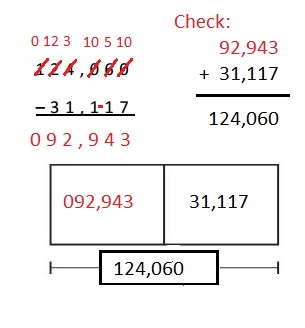
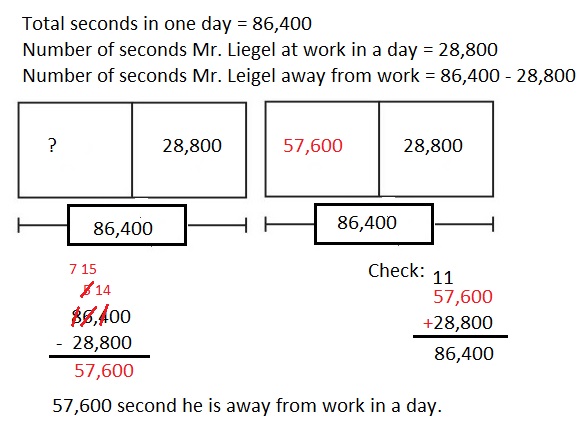
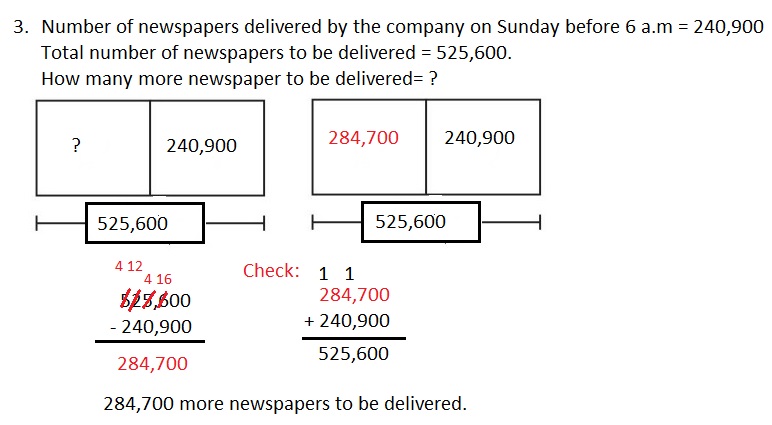
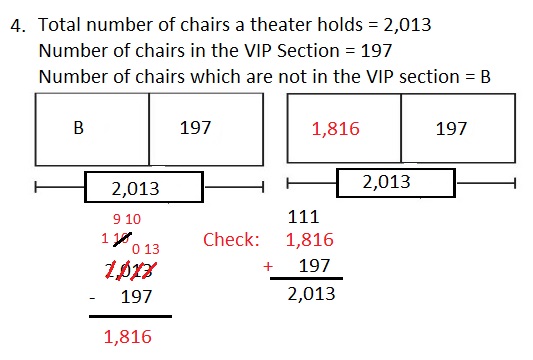
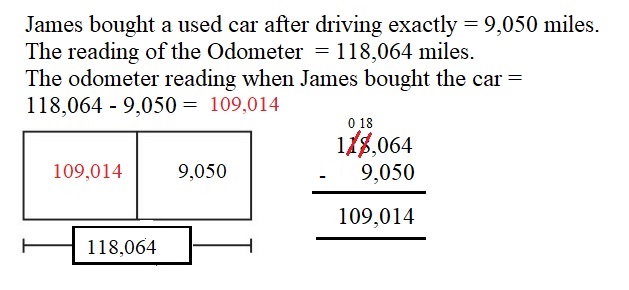
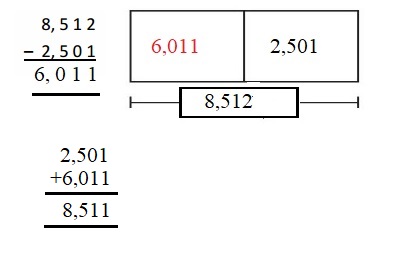
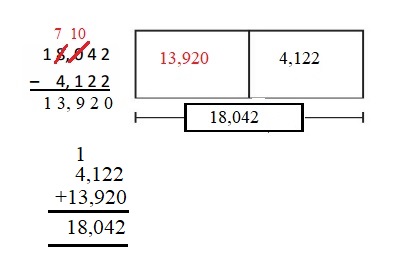
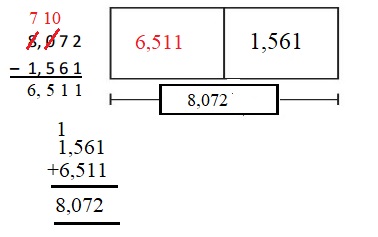
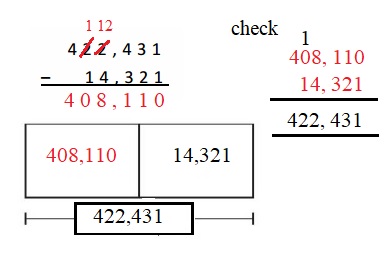
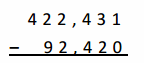
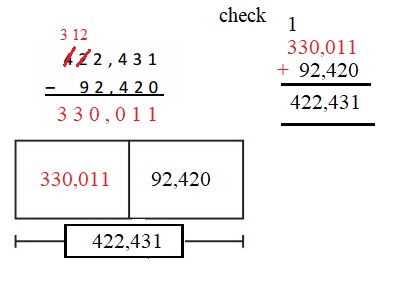
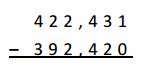
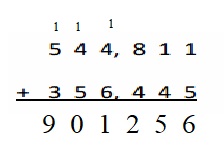
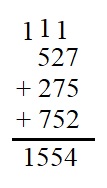
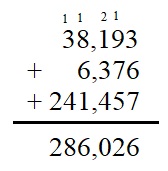
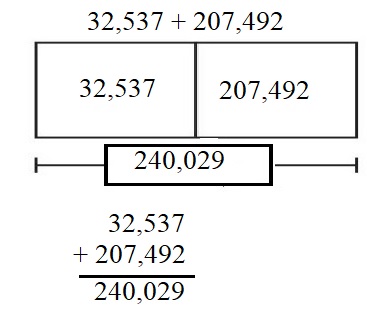
Eureka Math Grade 6 Module 6 Lesson 12 Answer Key

Engage NY Eureka Math Grade 6 Module 6 Lesson 12 Answer Key

Eureka Math Grade 6 Module 6 Lesson 12 Example Answer Key

Suppose a chain restaurant (Restaurant A) advertises that a typical number of french fries in a large bag is 82. The dot plot shows the number of french fries in a sample of twenty large bags from Restaurant A.

Eureka Math Grade 6 Module 6 Lesson 12 Example Answer Key 1

Sometimes it is useful to know what point separates a data distribution into two equal parts, where one part represents the upper half of the data values and the other part represents the lower half of the data values. This point is called the median. When the data are arranged in order from smallest to largest, the same number of values will be above the median point as below the median.

Exercises 1 – 3:

Exercise 1.
You just bought a large bag of fries from the restaurant. Do you think you have exactly 82 french fries? Why or why not?
Answer:
The number of fries in a bag seems to wary greatly from bag to bag. No bag had exactly 82 fries, so mine probably will not. The bags that were in the sample had from 66 to 93 french fries.

Exercise 2.
How many bags were in the sample?
Answer:
20 bags were port of the sample.

Exercise 3.
Which of the following statement(s) would seem to be true for the given data? Explain your reasoning.
a. Half of the bags had more than 82 fries in them.
b. Half of the bags had fewer than 82 fries in them.
c. More than half of the bags had more than 82 fries in them.
d. More than half of the bags had fewer than 82 fries in them.
e. If you got a random bag of fries, you could get as many as 93 fries.
Answer:
Statements (a) and (b) are true because there are 10 bags above 82 fries and 10 bags below 82 fries. Also, statement (e) is true because that happened once, so ¡t could probably happen again.

Example 2:
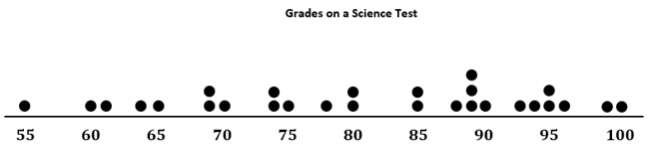
Examine the dot plot below.
Eureka Math Grade 6 Module 6 Lesson 12 Example Answer Key 2

a. How many data values are represented on the dot plot above?
Answer:
There are 28 data values on the dot plot.

b. How many data values should be located above the median? How many below the median? Explain.
Answer:
There should be 14 data values above the median and 14 data values below the median because the median represents the middle value in o sorted data set.

c. For this data set, 14 values are 80 or smaller, and 14 values are 85 or larger, so the median should be between 80 and 85. When the median falls between two values in a data set, we use the average of the two middle values. For this example, the two middle values are 80 and 85. What is the median of the data presented on the dot plot?
Answer:
The median of the dot plot is 82.5.

d. What does this information tell us about the data?
Answer:
The median tells us half of the students in the class scored below an 82. 5 on the science test, and the other half of the students scored above 82.5 on the science test.

Example 3:

Use the information from the dot plot In Example 2.

a. What percentage of students scored higher than the median? Lower than the median?
Answer:
50% of the students scored higher than the median, and 50% of the students scored lower than the median.

b. Suppose the teacher made a mistake, and the student who scored a 65 actually scored a 71. Would the median change? Why or why not?
Answer:
The median would not change because there would still be 14 scores below 82 5 and 14 scores above 82.5.

c. Suppose the student who scored a 65 actually scored an 89. Would the median change? Why or why not?
Answer:
The median would change because now there would be 13 scores below 82. 5 and 15 scores above 82.5, so 82.5 would not be the median.

Example 4:

A grocery store usually has three checkout lines open on Saturday afternoons. One Saturday afternoon, the store manager decided to count how many customers were waiting to check out at 10 different times. She calculated the median of her ten data values to be 8 customers.

a. Why might the median be an important number for the store manager to consider?
Answer:
Answers will vary. For example, students might point out that this means that half the time there were mœe than 8 customers waiting to check out. if there are only 3 checkout lines open, there would be a lot of people waiting to check out. She might want to consider having more checkout lines open on Saturday afternoons.

b. Give another example of when the median of a data set might provide useful information. Explain your thinking.
Answer:
Answers will vary.
Possible responses: When the data are about how much time students spend doing homework, it would be interesting to know the amount of time that more than half of the students spend on homework. If you are looking at the number of points earned in a competition, it would be good to know what number separates the top half of the competitors from the bottom half.

Exercises 4 – 5: A Skewed Distribution

Exercise 4.
The owner of the chain decided to check the number of french fries at another restaurant in the chain. Here are the data for Restaurant B: 82, 83, 83, 79, 85. 82, 78, 76, 76, 75, 78, 74, 70, 60, 82, 82, 83, 83, 83

a. How many bags of fries were counted?
Answer:
19 bags of fries were counted.

b. Sallee claims the median is 75 because she sees that 75 is the middle number in the data set listed on the previous page. She thinks half of the bags had fewer than 75 fries because there are 9 data values that come before 75 in the list, and there are 9 data values that come after 75 in the list. Do you think she would change her mind if the data were plotted in a dot plot? Why or why not?
Answer:
Yes. You cannot find the median unless the data are organized from least to greatest. Plotting the number of fries in each bag on a dot plot would order the data correctly. You would probably get a different halfway point because the data above are not ordered from least to greatest.

c. Jake said the median was 83. What would you say to Jake?
Answer:
83 is the most common number of fries in the bags (5 bags had 83 fries), but It is not in the middle of the data.

d. Betse argued that the median was halfway between 60 and 85, or 72.5. Do you think she is right? Why or why not?
Answer:
She is wrong because the median is not calculated from the distance between the largest and smallest value in the data set. This is not the same as finding a point that separates the ordered data into two ports with the same number of values in each part.

e. Chris thought the median was 82. Do you agree? Why or why not?
Answer:
Chris is correct because ¡f you order the numbers, the middle number will be the 10th number in the ordered list, with at most 9 bags that have more than 82 fries and at most 9 bogs that have fewer than 82 fries.

Exercise 5.
Calculate the mean, and compare it to the median. What do you observe about the two values? If the mean and median are both measures of center, why do you think one of them is smaller than the other?
Answer:
The mean is 78.6, and the median is 82. The bag with only 60 fries decreased the value of the mean.

Exercises 6 – 8: Finding Medians from Frequency Tables

Exercise 6.
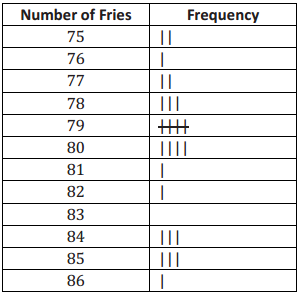
A third restaurant (Restaurant C) tallied the number of fries for a sample of bags of french fries and found the results below.
Eureka Math Grade 6 Module 6 Lesson 12 Example Answer Key 3

a. How many bags of fries did they count?
Answer:
They counted 26 bags of fries.

b. What is the median number of fries for the sample of bags from this restaurant? Describe how you found your answer.
Answer:
79.5; I took half of 26, which is 13, and then counted 13 tallies from 86 to reach 80. I also counted 13 tallies from 75 to reach 79. The point halfway between 79 and 80 is the median.

Exercise 7.
Robere wanted to look more closely at the data for bags of fries that contained a smaller number of fries and bags that contained a larger number of fries. He decided to divide the data into two parts. He first found the median of the whole data set and then divided the data set into the bottom half (the values in the ordered list that are before the median) and the top half (the values in the ordered list that are after the median).

a. List the 13 values in the bottom half. Find the median of these 13 values.
Answer:
75 75 76 77 77 78 78 78 79 79 79 79 79
The median of the lower half is 78.

b. List the 13 values of the top half. Find the median of these 13 values.
Answer:
80 80 80 80 81 82 84 84 84 85 85 85 86
The median of the top half is 84.

Exercise 8.
Which of the three restaurants seems most likely to really have 82 fries in a typical bag? Explain your thinking.
Answer:
Answers will vary. The data sets for Restaurants A and B both have a median of 82. Look for answers that consider how much the data values vary around 82. Restaurant B seems to have the most bogs closest to a count of 82. The data set for Restaurant C has a median of 79.5, but the data values are not very spread out, and most are close to 82, so some students might make a case for Restaurant C.

Eureka Math Grade 6 Module 6 Lesson 12 Problem Set Answer Key

Question 1.
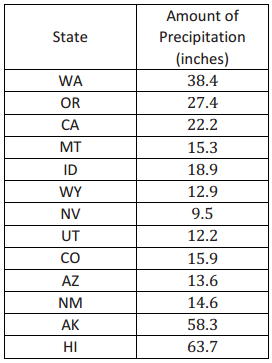
The amount of precipitation in each of the western states in the United States is given in the table as well as the dot plot.

Eureka Math Grade 6 Module 6 Lesson 12 Problem Set Answer Key 4

Eureka Math Grade 6 Module 6 Lesson 12 Problem Set Answer Key 5

a. How do the amounts vary across the states?
Answer:
Answers will vary. The spread is pretty large: 54.2 inches. Nevada has the lowest precipitation at 9.5 inches per year. Hawaii, Alaska, and Washington have more rain than most of the states. Hawaii has the most precipitation with 63.7 inches, followed by Alaska at 58.3 inches.

b. Find the median. What does the median tell you about the amount of precipitation?
Answer:
The median is 15.9 inches. Half of the western states have more than 15.9 inches of precipitation per year, and half have less.

c. Do you think the mean or median would be a better description of the typical amount of precipitation? Explain your thinking.
Answer:
The mean at 24.8 inches reflects the extreme values, while the median seems more typical at 15.9 inches.

Question 2.
Identify the following as true or false. If a statement is false, give an example showing why.

a. The median is always equal to one of the values in the data set.
Answer:
False. If the middle two values in the ordered data set are 1 and 5, the median is 3, and 3 is not in the set.

b. The median is halfway between the least and greatest values in the data set.
Answer:
False. For example, looking at the number of french fries per bog for Restaurant A in Example 1, the median is 82, which is not halfway between 66 and 93 (79.5).

c. At most, half of the values in a data set have values less than the median.
Answer:
True

d. In a data set with 25 different values, if you change the two smallest values in the data set to smaller values, the median will not be changed.
Answer:
True

e. If you add 10 to every value in a data set, the median will not change.
Answer:
False. The median will increase by 10 as well. If the data set is 1, 2, 3, 4, 5, the median is 3. For the data set 11, 12, 13, 14,15, the median is 13.

Question 3.
Make up a data set such that the following is true:

a. The data set has 11 different values, and the median is 5.
Answer:
Answers will vary. If the numbers are whole numbers, the set would be 0, 1, 2, 3, 4, 5, 6, 7, 8, 9, 10.

b. The data set has 10 values, and the median is 25.
Answer:
Answers will vary. One answer is to have ten values that are all 25’s.

c. The data set has 7 values, and the median is the same as the least value.
Answer:
Answers will vary. One answer is to have 1, 1, 1, 1, 2, 3, 4.

Question 4.
The dot plot shows the number of landline phones that a sample of people have in their homes.

Eureka Math Grade 6 Module 6 Lesson 12 Problem Set Answer Key 6

a. How many people were in the sample?
Answer:
There are 25 people in the sample.

b. Why do you think three people have no landline phones in their homes?
Answer:
Possible answers: Some people might only have cell phones or some people may not be able to afford a phone or may not want a phone.

c. Find the median number of phones for the people in the sample.
Answer:
The median number of phones per home is 2.

Question 5.
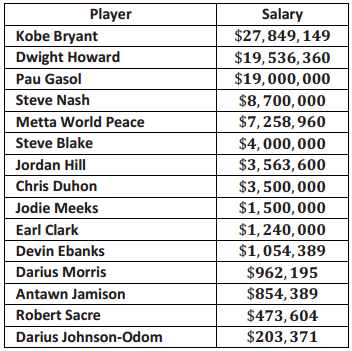
The salaries of the Los Angeles Lakers for the 2012 – 2013 basketball season are given below. The salaries in the table are ordered from largest to smallest.
Eureka Math Grade 6 Module 6 Lesson 12 Problem Set Answer Key 7

a. Just looking at the data, what do you notice about the salaries?
Answer:
Possible answer: A few of the salaries for the big stars like Kobe Bryant are really big, while others are very small in comparison.

b. Find the median salary, and explain what it tells you about the salaries.
Answer:
The median salary ¡s $3, 500,000 for Chris Duhon. Half of the players make more than $3, 500,000, and half of the players make less than $3, 500, 000.

c. Find the median of the lower half of the salaries and the median of the upper half of the salaries.
Answer:
$962, 195 is the median for the bottom half of the salaries. $8, 700,000 is the median for the top half of the salaries.

d. Find the width of each of the following intervals. What do you notice about the size of the interval widths, and what does that tell you about the salaries?

i. Minimum salary to the median of the lower half:
Answer:
$758, 824

ii. Median of the lower half to the median of the whole data set:
Answer:
$2,537,805

iii. Median of the whole data set to the median of the upper half:
Answer:
$5, 200, 000

iv. Median of the upper half to the highest salary:
Answer:
$19,149,149

The largest width is from the median of the upper half to the highest salary. The smaller salaries are closer together than the larger ones.

Question 6.
Use the salary table from the previous page to answer the following.

a. If you were to find the mean salary, how do you think it would compare to the median? Explain your reasoning.
Answer:
Possible answer: The mean will be a lot larger than the median because when you add in the really big salaries, the size of the mean will increase a lot.

b. Which measure do you think would give a better picture nf a typical salary for the Lakers, the mean or the median? Explain your thinking.
Answer:
Possible answer: The median seems better, os ¡t ¡s more typical of most of the salaries.

Eureka Math Grade 6 Module 6 Lesson 12 Exit Ticket Answer Key

Question 1.
What is the median age for the following data set representing the ages of students requesting tickets for a summer band concert? Explain your reasoning.
13 14 15 15 16 16 17 18 18
Answer:
The median is the 5th value in the ordered list, or 16 years, as there are 4 values less than 16 and 4 values greater than or equal to 16 (excluding the 5 value).

Question 2.
What ¡s the median number of diseased trees from a data set representing the numbers of diseased trees on each of 12 city blocks? Explain your reasoning.
11 3 3 4 6 12 9 3 8 8 8 1
Answer:
To find the median, the values first need to be ordered: 1 3 3 3 4 6 8 8 8 9 11 12.
Because there are an even number of data values, the median would be the mean of the 6th and 7th values: \(\frac{6+8}{2}\) or 7 diseased trees.

Question 3.
Describe how you would find the median for a set of data that has 35 values. How would this be different if there were 36 values?
Answer:
Answers will vary. First, you would order the data from kast to greatest. Because there are 35 values, you would look for the 18th value from the top or bottom in the ordered list. This would be the median with 17 values above and 17 values below, if the set hod 36 values, you would find the average of the middle two data values, which would be the average of the 18th and the 19th values in the ordered list.

Eureka Math Grade 6 Module 6 Lesson 11 Answer Key

Engage NY Eureka Math Grade 6 Module 6 Lesson 11 Answer Key

Eureka Math Grade 6 Module 6 Lesson 11 Example Answer Key

Example 1: Comparing Distributions with the Same Mean

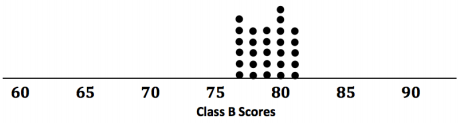
In Lesson 10, data distribution was characterized mainly by its center (mean) and variability (MAD). How these measures help us make a decision often depends on the context of the situation. For example, suppose that two classes of students took the same test, and their grades (based on loo points) are shown in the following dot plots. The mean score for each distribution is 79 points. Would you rather be in Class A or Class B if you had a score of 79?

Eureka Math Grade 6 Module 6 Lesson 11 Example Answer Key 1

Eureka Math Grade 6 Module 6 Lesson 11 Example Answer Key 2

Exercises 1 – 6:

Exercise 1.
Looking at the dot plots, which class has the greater MAD? Explain without actually calculating the MAD.
Answer:
Class A. The data for Class A have a much wider spread. Thus, it has greater variability and a larger MAD.

Exercise 2.
If Liz had one of the highest scores in her class, in which class would she rather be? Explain your reasoning.
Answer:
She would rather be in Class A. This doss had higher scores in the 90’s, whereas Class B had a high score of only 81.

Exercise 3.
If Logan scored below average, in which class would he rather be? Explain your reasoning.
Answer:
Logan would rather be in Class B. The low scores in Class B were in the 70 ‘s, whereas Class A had low scores in the 60’s.

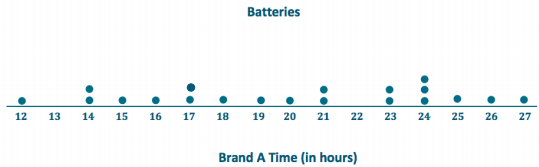
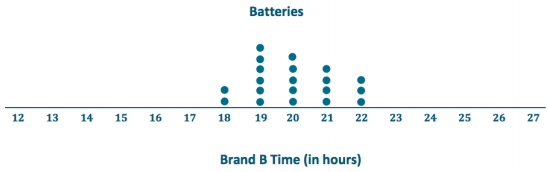
Your little brother asks you to replace the battery in his favorite remote control car. The car is constructed so that it is difficult to replace its battery. Your research of the lifetimes (in hours) of two different battery brands (A and B) shows the following lifetimes for 20 batteries from each brand:

Eureka Math Grade 6 Module 6 Lesson 11 Example Answer Key 3

Exercise 4.
To help you decide which battery to purchase, start by drawing a dot plot of the lifetimes for each brand.
Answer:
Eureka Math Grade 6 Module 6 Lesson 11 Example Answer Key 4

Eureka Math Grade 6 Module 6 Lesson 11 Example Answer Key 5

Exercise 5.
Find the mean battery lifetime for each brand, and compare them.
Answer:
The mean of Brand A is 20 hours.
The mean of Brand B is 20 hours.
Both Brand A and Brand B have the same mean lifetime.

Exercise 6.
Looking at the variability in the dot plot for each data set, give one reason you might choose Brand A. What is one reason you might choose Brand B? Explain your reasoning.
Answer:
Answers will vary.
If I choose Brand A, I might get a battery that lasts a lot longer than 20 hours, on might get a battery that has a much shorter lifetime. If I choose Brand B, I would always geta battery that lasts approximately 20 hours.

Example 2: Comparing Distributions with Different Means

You have been comparing distributions that have the same mean but different variability. As you have seen, deciding whether large variability or small variability is best depends on the context and on what is being asked. If two data distributions have different means, do you think that variability will still play a part in making decisions?
Answer:
Yes, because considering variability in addition to center provides us with more information about the distributions and allows us to make more informed decisions.

Exercises 7 – 9:

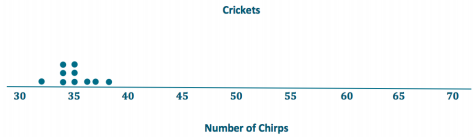
Suppose that you wanted to answer the following question: Are field crickets better predictors of air temperature than katydids? Both species of insect make chirping sounds by rubbing their front wings together.

The following data are the number of chirps (per minute) for 10 insects of each type. All the data were taken on the same evening at the same time.

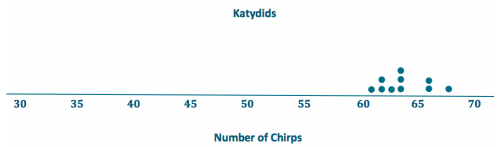
Eureka Math Grade 6 Module 6 Lesson 11 Example Answer Key 6

Exercise 7.
Draw dot plots for these two data distributions using the same scale, going from 30 to 70. Visually, what conclusions can you draw from the dot plots?
Answer:
Eureka Math Grade 6 Module 6 Lesson 11 Example Answer Key 7

Eureka Math Grade 6 Module 6 Lesson 11 Example Answer Key 8

Visually, you can see that the value for the mean number of chirps is higher for the katydids. The variability looks to be similar.

Exercise 8.
Calculate the mean and MAD for each distribution.
Answer:
Crickets: The mean is 35 chirps per minute.
The sum of all the distances from the mean is 12 because 0 + 3 + 0 + 2 + 1 + 1 + 3 + 0 + 1 + 1 = 12. Therefore, the MAD is 1.2 chirps per minute because \(\frac{12}{10}\) = 1. 2.

Katydids: The mean is 64 chirps per minute.

The sum of all the distances from the mean is 16 because 2 + 2 + 3 + 0 + 1 + 2 + 4 + 0 + 2 + 0 = 16. Therefore, the MAD is 1.6 chirps per minute because \(\frac{16}{10}\) = 1.6.

Exercise 9.
The outside temperature T, in degrees Fahrenheit, can be predicted by using two different formulas. The formulas include the mean number of chirps per minute made by crickets or katydids.

a. For crickets, T is predicted by adding 40 to the mean number of chirps per minute. What value of T is being predicted by the crickets?
Answer:
The predicted temperature is 35 + 40, or 75 degrees.

b. For katydids, T is predicted by adding 161 to the mean number of chirps per minute and then dividing the sum by 3. What value of T is being predicted by the katydids?
Answer:
The predicted temperature is \(\frac{(64+161)}{3}\), or 75 degrees.

c. The temperature was 75 degrees Fahrenheit when these data were recorded, so using the mean from each data set gave an accurate prediction of temperature. If you were going to use the number of chirps from a single cricket or a single katydid to predict the temperature, would you use a cricket of a katydid? Explain how variability in the distributions of number of chirps played a role in your decision.
Answer:
The crickets had a smaller MAD. This indicates that an indiuidual cricket is more likely to have a number of chirps that is close to the mean.

Eureka Math Grade 6 Module 6 Lesson 11 Problem Set Answer Key

Question 1.
Two classes took the same mathematics test. Summary measures for the two classes are as follows:
MeanMAD
Class A782
Class B7810

a. Suppose that you received the highest score in your class. Would your score have been higher if you were in Class A or Class B? Explain your reasoning.
Answer:
My score would have been higher if I had been in Class B because the means are the same, and the variability,
as measured by the MAD, is higher in that class than it is in Class A.

b. Suppose that your score was below the mean score. In which class would you prefer to have been? Explain your reasoning.
Answer:
I would prefer to have been in Class A because the variability, as measured by the MAD, indicates a more compact distribution around the mean. In contrast, a score below the mean in Class B could be far lower than in Class A.

Question 2.
Eight of each of two varieties of tomato plants, LoveEm and Wonderful, are grown under the same conditions. The numbers of tomatoes produced from each plant of each variety are shown:

Eureka Math Grade 6 Module 6 Lesson 11 Problem Set Answer Key 9

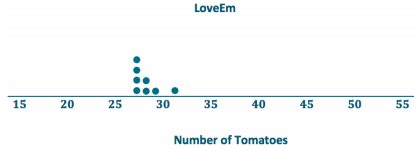
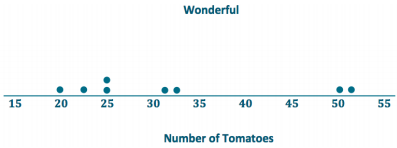
a. Draw dot plots to help you decide which variety is more productive.
Answer:
Eureka Math Grade 6 Module 6 Lesson 11 Problem Set Answer Key 10

Eureka Math Grade 6 Module 6 Lesson 11 Problem Set Answer Key 11

b. Calculate the mean number of tomatoes produced for each variety. Which one produces more tomatoes on average?
Answer:
The mean number of LoveEm tomatoes is 28, and the mean number of Wonderful tomatoes is 32. Wonderful produces more tomatoes on average.

c. If you want to be able to accurately predict the number of tomatoes a plant is going to produce, which variety should you choose – the one with the smaller MAD or the one with the larger MAD? Explain your reasoning.
Answer:
LoveEm produces fewer tomatoes on average but is far more consistent. Looking at the dot plots, its variability is far less than that of Wonderful tomatoes. Based on these data sets, choosing LoveEm should yield numbers in the high 20’s consistently, but the number from Wonderful could vary wildly from lower yields in the low 20’s too huge yields around 50.
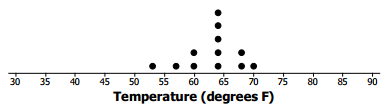
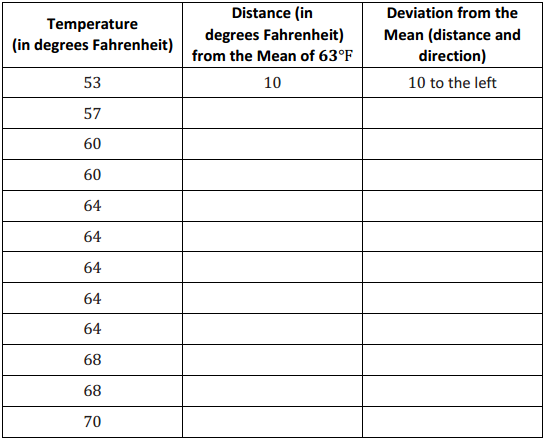
d. Calculate the MAD of each plant variety.
Answer:
The sum of the distances from the mean for LoveEm is 8 because 1 + 1 + 1 + 0 + 3 + 1 + 0 + 1 = 8.
Therefore, the MAD for LoveEm is 1 tomato because \(\frac{8}{8}\) = 1.

The sum of the distances from the mean for Wonderfulis 74 because 1 + 12 + 7 + 18 + 0 + 7 + 10 + 19 = 74. Therefore, the MAD for Wonderful is 9.25 tomatoes because \(\frac{74}{8}\) = 9. 25.

Eureka Math Grade 6 Module 6 Lesson 11 Exit Ticket Answer Key

Question 1.
You need to decide which of two brands of chocolate chip cookies to buy. You really love chocolate chip cookies. The numbers of chocolate chips in each of five cookies from each brand are as follows:

Eureka Math Grade 6 Module 6 Lesson 11 Exit Ticket Answer Key 12

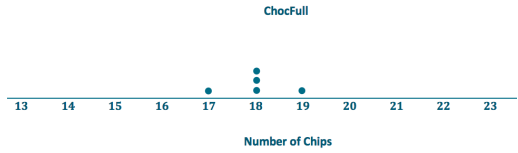
a. Draw a dot plot for each set of data that shows the distribution of the number of chips for that brand. Use the same scale for both of your dot plots (one that covers the span of both distributions).
Answer:

Eureka Math Grade 6 Module 6 Lesson 11 Exit Ticket Answer Key 13

Eureka Math Grade 6 Module 6 Lesson 11 Exit Ticket Answer Key 14

b. Find the mean number of chocolate chips for each of the two brands. Compare the means.
Answer:
Mean for ChocFull: 18 chocolate chips
Mean for AliChoc: 18 chocolate chips
The means for the two different brands are the same.

c. Looking at your dot plots and considering variability, which brand do you prefer? Explain your reasoning.
Answer:
Students could argue either way:
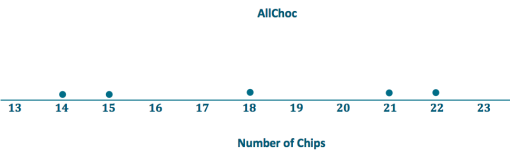
1. Students who prefer ChocFull may argue that they are assured of getting 18 chips most of the time, with no fewer than 17 chips, and a bonus once in a while of 19 chips. With AliChoc, they may sometimes get more than 20 chips but would sometimes get only 14or 15 chips.

2. Students who prefer AllChoc are the risk-takers who are willing to tolerate the chance of getting only 14 or 15 chips for the chance of getting 21 or 22 chips.

Eureka Math Grade 6 Module 6 Lesson 10 Answer Key

Engage NY Eureka Math Grade 6 Module 6 Lesson 10 Answer Key

Eureka Math Grade 6 Module 6 Lesson 10 Example Answer Key

Example 1: Describing Distributions

In Lesson 9, Sabina developed the mean absolute deviation (MAD) as a number that measures variability in a data distribution. Using the mean and MAD along with a dot plot allows you to describe the center, spread, and shape of a data distribution. For example, suppose that data on the number of pets for ten students are shown in the dot plot below.

Eureka Math Grade 6 Module 6 Lesson 10 Example Answer Key 1

There are several ways to describe the data distribution. The mean number of pets for these students is 3, which is a measure of center. There is variability in the number of pets the students have, and data values differ from the mean by about 2.2 pets on average (the MAD). The shape of the distribution is heavy on the left, and then it this out to the right.

Exercises 1 – 4:

Exercise 1.
sSuppose that the weights of seven middle school students’ backpacks are given below.

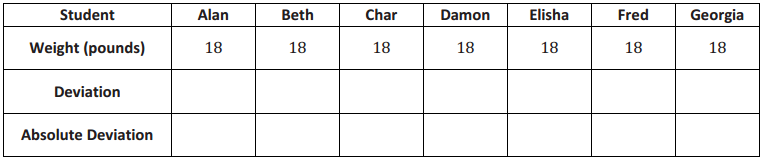
a. Fill in the following table.
Eureka Math Grade 6 Module 6 Lesson 10 Example Answer Key 2
Answer:
Eureka Math Grade 6 Module 6 Lesson 10 Example Answer Key 3

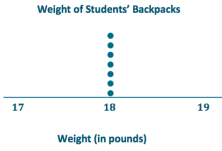
b. Draw a dot plot for these data, and calculate the mean and MAD.
Answer:
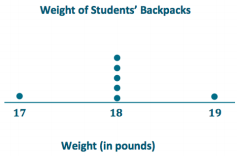
Eureka Math Grade 6 Module 6 Lesson 10 Example Answer Key 4
The mean is 18 pounds.
The MAD is 0 pounds.

c. Describe this distribution of weights of backpacks by discussing the center, spread, and shape.
Answer:
The mean is 18 pounds. There is no variability.
All of the data values are equal.

Exercise 2.
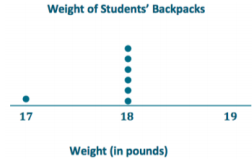
Suppose that the weight of Elisha’s backpack is 17 pounds rather than 18 pounds.

a. Draw a dot plot for the new distribution.
Answer:
Eureka Math Grade 6 Module 6 Lesson 10 Example Answer Key 5

b. Without doing any calculations, how is the mean affected by the lighter weight? Would the new mean be the same, smaller, or larger?
Answer:
The mean will be smaller because the new weight is smaller than the other weights.

c. Without doing any calculations, how is the MAD affected by the lighter weight? Would the new MAD be the same, smaller, or larger?
Answer:
The MAD would be larger because now there is variability, so the MAD is greater than zero.

Exercise 3.
Suppose that in addition to Elisha’s backpack weight having changed from 18 to 17 pounds, Fred’s backpack weight is changed from 18 to 19 pounds.

a. Draw a dot plot for the new distribution.
Answer:
Eureka Math Grade 6 Module 6 Lesson 10 Example Answer Key 6

b. Without doing any calculations, how would the new mean compare to the original mean?
Answer:
The new mean is 18 1b., which was also the original mean.

c. Without doing any calculations, would the MAD for the new distribution be the same as, smaller than, or larger than the original MAD?
Answer:
Since there is more variability, the MAD is larger than the original MAD.

d. Without doing any calculations, how would the MAD for the new distribution compare to the one in Exercise 2?
Answer:
There is more variability, so the MAD is greater than the MAD in Exercise 2.

Exercise 4.
Suppose that seven-second graders’ backpack weights were as follows:

Eureka Math Grade 6 Module 6 Lesson 10 Example Answer Key 7

a. How is the distribution of backpack weights for the second graders similar to the original distribution for the middle school students given in Exercise 1?
Answer:
Both have no variability, so the MAD is 0 pounds in both cases. The shapes of the distributions on the dot plots are the same.

b. How are the distributions different?
Answer:
The means are different. One mean is 18 pounds, and the other is 5 pounds.

Example 2: Using the MAD

Using data to make decisions often involves comparing distributions. Recall that Robert is trying to decide whether to move to New York City or to San Francisco based on temperature. Comparing the center, spread, and shape for the two temperature distributions could help him decide.

Dot Plot of Temperature for New York City
Eureka Math Grade 6 Module 6 Lesson 10 Example Answer Key 8

Dot Plot of Temperature for San Francisco
Eureka Math Grade 6 Module 6 Lesson 10 Example Answer Key 9

From the dot plots, Robert saw that monthly temperatures in New York City were spread fairly evenly from around 40 degrees to around 85 degrees, but in San Francisco, the monthly temperatures did not vary as much. He was surprised that the mean temperature was about the same for both cities. The MAD of 14 degrees for New York City told him that, on average, a month’s temperature was 14 degrees away from the mean of 63 degrees.

That is a lot of variability, which is consistent with the dot plot. On the other hand, the MAD for San Francisco told him that San Francisco’s monthly temperatures differ, on average, only 3.5 degrees from the mean of 64 degrees. So, the mean doesn’t help Robert very much in making a decision, but the MAD and dot plot are helpful.

Which city should he choose if he loves warm weather and really dislikes cold weather?
Answer:
He should choose San Francisco because there is little variability, and it does not get as cold as New York City.

Exercises 5 – 7:

Exercise 5.
Robert wants to compare temperatures for Cities B and C.
Eureka Math Grade 6 Module 6 Lesson 10 Example Answer Key 10

a. Draw a dot plot of the monthly temperatures for each of the cities.
Answer:
City B
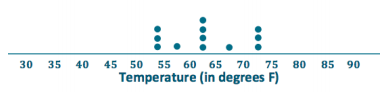
Eureka Math Grade 6 Module 6 Lesson 10 Example Answer Key 11

City C
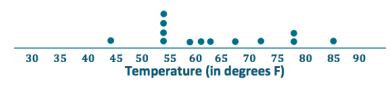
Eureka Math Grade 6 Module 6 Lesson 10 Example Answer Key 12

b. Verify that the mean monthly temperature for each distribution is 63 degrees.
Answer:
The data are nearly symmetrical around 63 degrees for City B. The sum of the distances to the left of the mean is equal to the sum of the distances to the right of the mean. Each of these sums is equal to 32 degrees.
For City C, the sum of the distances to the left of the mean is equal to the sum of the distances to the right of the mean. Each sum is equal to 61.

c. Find the MAD for each of the cities. Interpret the two MADs in words, and compare their values. Round your answers to the nearest tenth of a degree.
Answer:
1. The MAD is 5.3 degrees for City B, which means that, on average, the monthly temperatures differ by 5.3 degrees from the mean of 63 degrees.
2. The MAD is 10.2 degrees for City C, which means that, on average, the monthly temperatures differ by 10.2 degrees from the mean of 63 degrees.

Exercise 6.
How would you describe the differences in the shapes of the monthly temperature distributions of the two cities?
Answer:
The temperatures are nearly symmetric around the mean in City B. The temperatures are compact to the left of the mean for City C and then spread out to the right (skewed right).

Exercise 7.
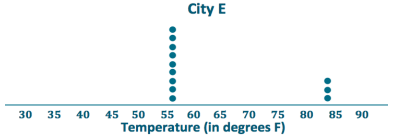
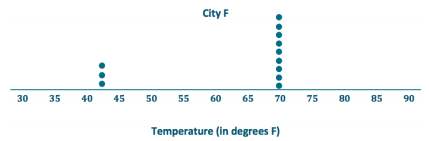
Suppose that Robert had to decide between Cities D, E, and F.
Eureka Math Grade 6 Module 6 Lesson 10 Example Answer Key 13

a. Draw a dot plot for each distribution.
Answer:
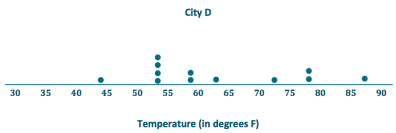
Eureka Math Grade 6 Module 6 Lesson 10 Example Answer Key 14

Eureka Math Grade 6 Module 6 Lesson 10 Example Answer Key 15

Eureka Math Grade 6 Module 6 Lesson 10 Example Answer Key 16

b. Interpret the MAD for the distributions. What does this mean about variability?
Answer:
The MADs are, all the same, so the monthly temperatures differ, on average, 10.5 degrees from the mean of 63 degrees. This means that all of the distributions have the same amount of variability.

c. How will Robert decide to which city he should move to? List possible reasons Robert might have for choosing each city.
Answer:
Robert needs to look more at the shapes of the distributions to help him make a decision.
City D – Appears to have four seasons with widespread temperatures.
City E – Has mainly cold weather and ¡s only hot for 3 months.
City F – Has mainly moderate weather and only a few cold months.

Eureka Math Grade 6 Module 6 Lesson 10 Problem Set Answer Key

Question 1.
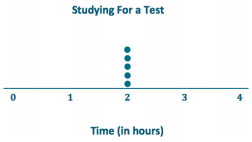
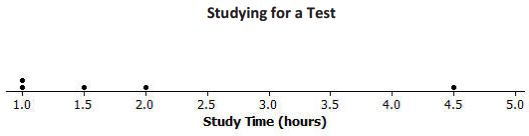
Draw a dot plot of the times that five students studied for a test if the meantime they studied was 2 hours and the MAD was 0 hours.
Answer:
Since the MAD is 0 hours, all data values are all the same, and they would be equal to the mean value.
Eureka Math Grade 6 Module 6 Lesson 10 Problem Set Answer Key 17


Question 2.
Suppose the times that five students studied for a test are as follows:

Eureka Math Grade 6 Module 6 Lesson 10 Problem Set Answer Key 18

Michelle said that the MAD for this data set is 0 hours because the dot plot is balanced around 2. Without doing any calculations, do you agree with Michelle? Why or why not?
Answer:
No. Michelle is wrong. There is variability within the data set, so the MAD is greater than 0 hours.
Note:
If students agree with Michelle, then they have not yet mastered an understanding that the MAD is measuring variability. They need to understand that if data values differ in a distribution, whether the distribution is symmetric or not, then there is variability. Therefore, the MAD cannot be 0 hours.

Question 3.
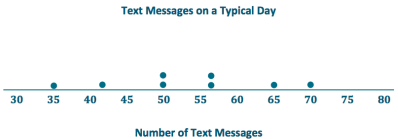
Suppose that the number of text messages eight students receive on a typical day is as follows:
Eureka Math Grade 6 Module 6 Lesson 10 Problem Set Answer Key 19

a. Draw a dot plot for the number of text messages received on a typical day for these eight students.
Answer:
Eureka Math Grade 6 Module 6 Lesson 10 Problem Set Answer Key 20

b. Find the mean number of text messages these eight students receive on a typical day.
Answer:
Since the distribution appears to be somewhat symmetrical around a value in the 50’s, students could guess a value for the mean, such as 52 or 53, and then check the sum of the distances on either side of their predictions. Using the formula, the mean is 53 text messages because \(\frac{424}{8}\) = 53.

c. Find the MAD for the number of text messages, and explain its meaning using the words of this problem.
Answer:
The sum of the absolute deviations is 70. So, \(\frac{70}{8}\) yields a MAD of 8. 75 text messages.
This means that, on average, the number of text messages these eight students receive on a typical day differs by 8.75 text messages from the group mean of 53 text messages.

d. Describe the shape of this data distribution.
Answer:
The shape of this distribution is fairly symmetrical (balanced) around the mean of 53 messages.

e. Suppose that in the original data set, Student 3 receives an additional five text messages per day and Student 4 receives five fewer text messages per day.

i. Without doing any calculations, does the mean for the new data set stay the same, increase, or decrease as compared to the original mean? Explain your reasoning.
Answer:
The mean would remain at 53 messages because one data value moved the same number of units to the right as another data value moved to the left. So, the balance point of the distribution does not change.

ii. Without doing any calculations, does the MAD for the new data set stay the same, increase, or decrease as compared to the original MAD? Explain your reasoning.
Answer:
Since the lowest data point moved closer to the mean and the highest dota point moved closer to the mean, the resulting distribution would be more compact than the original distribution. Therefore, the MAD would decrease.

Eureka Math Grade 6 Module 6 Lesson 10 Exit Ticket Answer Key

Question 1.
A dot plot of times that five students studied for a test is displayed below.
Eureka Math Grade 6 Module 6 Lesson 10 Problem Set Answer Key 21

a. Calculate the mean number of hours that these five students studied. Then, use the mean to calculate the absolute deviations, and complete the table.
Answer:
The mean is 2 hours since the sums of the distances on either side of 2 hours are equal.
Eureka Math Grade 6 Module 6 Lesson 10 Problem Set Answer Key 22

b. Find and interpret the MAD for this data set.
Answer:
\(\frac{5}{5}\) = 1
The MAD is 1 hour. This means that, on average, the study times differed by 1 hour from the group mean of 2 hours.

Question 2.
The same five students are preparing to take a second test. Suppose that the numbers of study hours were the same except that Ben studied 2.5 hours for the second test (1. 5 hours more), and Emma studied only 3 hours for the second test (1. 5 hours less).
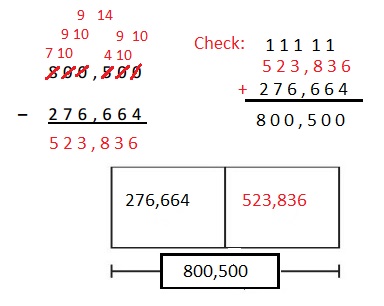
a. Without doing any calculations, is the mean for the second test the same as, greater than, or less than the mean for the first test? Explain your reasoning.
Answer:
The mean would be the same since the distance that one data value moved to the right was matched by the distance another data value moved to the left. The distribution is still balanced at the same place.
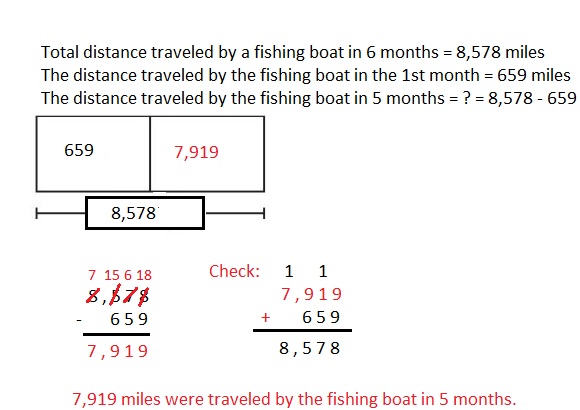
b. Without doing any calculations, is the MAD for the second test the same as, greater than, or less than the MAD for the first test? Explain your reasoning.
Answer:
The MAD would be smaller since the data values are clustered closer to the mean.

Eureka Math Grade 6 Module 6 Lesson 9 Answer Key

Engage NY Eureka Math Grade 6 Module 6 Lesson 9 Answer Key

Eureka Math Grade 6 Module 6 Lesson 9 Example Answer Key

Example 1: Variability

In Lesson 8, Robert wanted to decide where he would rather move (New York City or San Francisco). He planned to make his decision by comparing the average monthly temperatures for the two cities. Since the mean of the average monthly temperatures for New York City and the mean for San Francisco turned out to be about the same, he decided instead to compare the cities based on the variability in their monthly average temperatures.

He looked at the two distributions and decided that the New York City temperatures were more spread out from their mean than were the San Francisco temperatures from their mean.

Exercises 1 – 3:

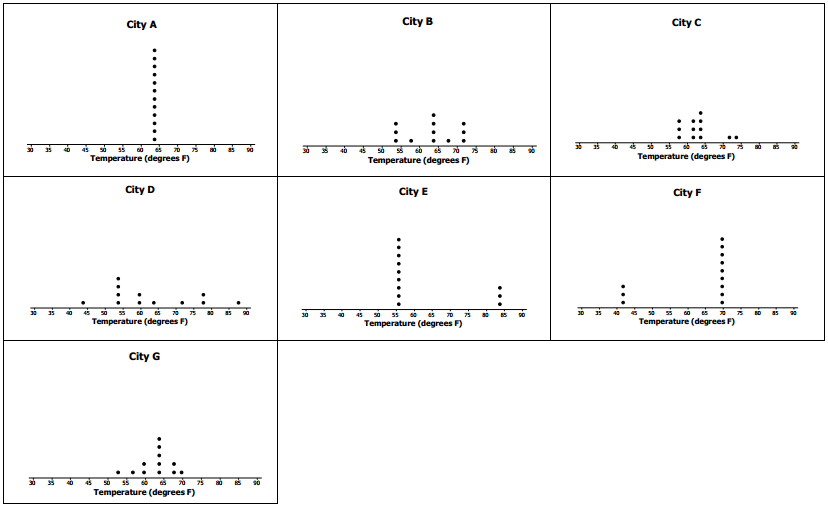
The following temperature distributions for seven other cities all have a mean monthly temperature of approximately 63 degrees Fahrenheit. They do not have the same variability.

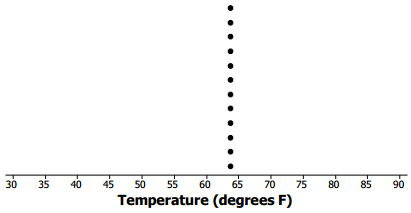
Eureka Math Grade 6 Module 6 Lesson 9 Example Answer Key 1

Exercise 1.
Which distribution has the smallest variability? Explain your answer.
Answer:
City A has the smallest variability because all the data points are the same.

Exercise 2.
Which distribution or distributions seem to have the most variability? Explain your answer.
Answer:
One or more of the following is acceptable: Cities D, E, and F. They appear to have data points that are the most
spread out.

Exercise 3.
Order the seven distributions from least variability to most variability. Explain why you listed the distributions in
the order that you chose.
Answer:
Several orderings are reasonable. Focus on student’s explanations for choosing the order, making sure that the ordering is consistent with an understanding of spread. There are some that will be hard for students to order, and if students have trouble, use this opportunity to point out that it would be useful to have a more formal way to measure variability in a data set. Such a measure is developed in Example 2.

Example 2: Measuring Variability

Based on just looking at the distributions, there are different orderings of variability that seem to make some sense. Sabina is interested in developing a formula that will produce a number that measures the variability in a data distribution. She would then use the formula to measure the variability in each data set and use these values to order the distributions from smallest variability to largest variability. She proposes beginning by looking at how far the values in a data set are from the mean of the data set.

Exercises 4 – 5:

The dot plot for the monthly temperatures in City G is shown below. Use the dot plot and the mean monthly temperature of 63 degrees Fahrenheit to answer the following questions.

City G
Eureka Math Grade 6 Module 6 Lesson 9 Example Answer Key 2

Exercise 4.
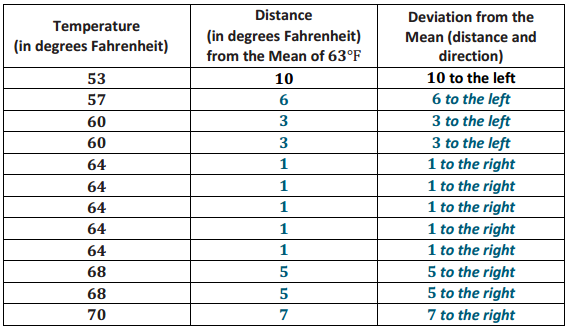
Fill in the following table for City G’s temperature deviations.

Eureka Math Grade 6 Module 6 Lesson 9 Example Answer Key 3
Answer:

Eureka Math Grade 6 Module 6 Lesson 9 Example Answer Key 4

Exercise 5.
What is the sum of the distances to the left of the mean? What is the sum of the distances to the right of the mean?
Answer:
The sum of the distances to the left of the mean is 10 + 6 + 3 + 3 = 22. The sum of the distances to the right of the mean is 1 + 1 + 1 + 1 + 1 + 5 + 5 + 7 = 22.

Example 3: Finding the Mean Absolute Deviation (MAD)

Sabina notices that when there is not much variability in a data set, the distances from the mean are small and that when there is a lot of variability in a data set, the data values are spread out and at least some of the distances from the mean are large. She wonders how she can use the distances from the mean to help her develop a formula to measure variability.

Exercises 6 – 7:

Exercise 6.
Use the data on monthly temperatures for City G given in Exercise 4 to answer the following questions.

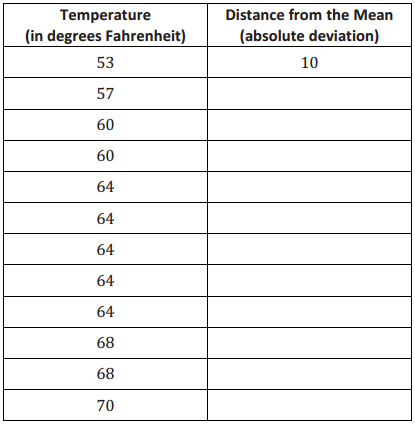
a. Fill in the following table.

Eureka Math Grade 6 Module 6 Lesson 9 Example Answer Key 5
Answer:

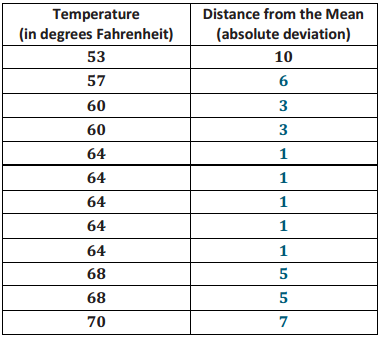
Eureka Math Grade 6 Module 6 Lesson 9 Example Answer Key 6

b. The absolute deviation for a data value is its distance from the mean of the data set. For example, for the first temperature value for City G (53 degrees), the absolute deviation is 10. What !s the sum of the absolute deviations?
Answer:
The sum of the absolute deviations is 10 + 6 + 3 + 3 + 1 + 1 + 1 + 1 + 1 + 5 + 5 + 7 = 44.

c. Sabina suggests that the mean of the absolute deviations (the mean of the distances) could be a measure of the variability in a data set. Its value is the average distance of the data values from the mean of the monthly temperatures. It is called the mean absolute deviation and is denoted by the letters MAD. Find the MAD for this data set of City G’s temperatures. Round to the nearest tenth.
Answer:
The MAD (mean absolute deviation) is \(\frac{44}{12^{\prime}}\) or 3.7 degrees to the nearest tenth of a degree.

d. Find the MAD values in degrees Fahrenheit for each of the seven city temperature distributions and use the values to order the distributions from least variability to most variability. Recall that the mean for each data set is 63 degrees Fahrenheit. Looking only at the distributions, does the list that you made in Exercise 2 match the list made by ordering MAD values?
Eureka Math Grade 6 Module 6 Lesson 9 Example Answer Key 7
Answer:
If time is a factor in completing this lesson, assign cities to individual students. After each student has calculated the mean deviation, organize the results for the whole class. Direct students to calculate the MAD to the nearest tenth of a degree.

MAD values (in °F):
City A = 0
City B = 5.3
City C = 3.2
City D = 10.5
City E = 10.5
City F = 10.5
City G = 3.7
The order from least to greatest is A, C, G, B, and D, E, and F(all tied).

e. Which of the following is a correct interpretation of the MAD?
i. The monthly temperatures in City G are all within 3. 7 degrees from the approximate mean of 63 degrees.
ii. The monthly temperatures in City G are, on average, 3. 7 degrees from the approximate mean temperature of 63 degrees.
iii. All of the monthly temperatures in City G differ from the approximate mean temperature of 63 degrees by 3. 7 degrees.
Answer:
The answer is (ii). Remind students that the MAD is an average of the distances from the mean, so some distances may be smaller and some larger than the value of the MAD. Point out that the distances from the mean for City G were not all equal to 3.7 and that some were smaller (for example, the distances of 1 and 3) and that some were larger (for example, the distances of 5 and 10).

Exercise 7.
The dot plot for City A’s temperatures follows.
City A
Eureka Math Grade 6 Module 6 Lesson 9 Example Answer Key 8

a. How much variability is there in City A’s temperatures? Why?
Answer:
There is no variability in City A’s temperatures. The absolute deviations (distances from the mean) are all 0.

b. Does the MAD agree with your answer In part (a)?
Answer:
The MAD does agree with my answer from part (a). The value of the MAD is 0.

Eureka Math Grade 6 Module 6 Lesson 9 Problem Set Answer Key

Question 1.
Suppose the dot plot on the left shows the number of goals a boys’ soccer team has scored in six games so far this
season, and the dot plot on the right shows the number of goals a girls’ soccer team has scored in six games so far
this season. The mean for both of these teams is 3.
Eureka Math Grade 6 Module 6 Lesson 9 Problem Set Answer Key 9

Eureka Math Grade 6 Module 6 Lesson 9 Problem Set Answer Key 10

a. Before doing any calculations, which dot plot has the larger MAD? Explain how you know.
Answer:
The graph of the boys’ team has a larger MAD because the data are more spread out and have the larger distances from the mean.

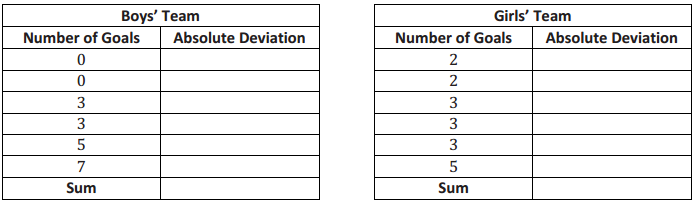
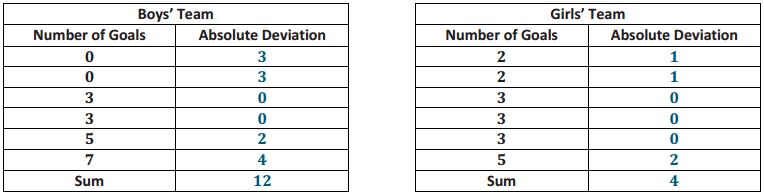
b. Use the following tables to find the MAD for each distribution. Round your calculations to the nearest hundredth.

Eureka Math Grade 6 Module 6 Lesson 9 Problem Set Answer Key 11
Answer:

Eureka Math Grade 6 Module 6 Lesson 9 Problem Set Answer Key 12
The MAD for the boy’s team is 2 goals because \(\frac{12}{6}\) = 2. The MAD for the girls’ team is 0.67 goal because \(\frac{4}{6}\) ≈ 0.67

c. Based on the computed MAD values, for which distribution is the mean a better indication of a typical value? Explain your answer.
Answer:
The mean is a better indicator of a typical value for the girl’s team because the measure of variability given by the MAD is lower (0.67 goal) than the boys’ MAD (2 goals).

Question 2.
Recall Robert’s problem of deciding whether to move to New York City or to San Francisco. A table of temperatures (in degrees Fahrenheit) and absolute deviations for New York City follows:

Eureka Math Grade 6 Module 6 Lesson 9 Problem Set Answer Key 13

a. The absolute deviations for the monthly temperatures are shown in the above table. Use this information to calculate the MAD. Explain what the MAD means in words.
Answer:
The sum of the absolute deviations is 168. The MAD is the average of the absolute deviations. The MAD is 14 degrees because \(\frac{168}{12}\) = 14. On average, the monthly temperatures in New York City differ from the mean of 63 degrees Fahrenheit by 14 degrees.

b. Complete the following table, and then use the values to calculate the MAD for the San Francisco data distribution.

Eureka Math Grade 6 Module 6 Lesson 9 Problem Set Answer Key 14
Answer:
The sum of the absolute deviations is 42. The MAD is the mean of the absolute deviations. The MAD is 3.5 degrees because \(\frac{42}{12}\) = 3. 5.

Eureka Math Grade 6 Module 6 Lesson 9 Problem Set Answer Key 15

c. Comparing the MAD values for New York City and San Francisco, which city would Robert choose to move to if he is interested in having a lot of variability in monthly temperatures? Explain using the MAD.
Answer:
New York City has a MAD of 14 degrees, as compared to 3.5 degrees in San Francisco. Robert should choose
New York City if he wants to have more variability in monthly temperatures.

Question 3.
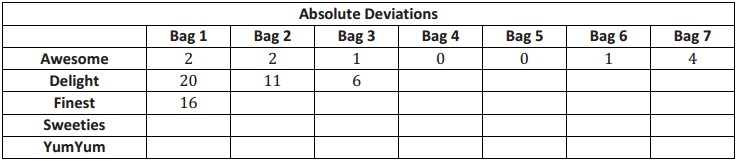
Consider the following data of the number of green jelly beans in seven bags sampled from each of five different candy manufacturers (Awesome, Delight, Finest, Sweeties, YumYum). Note that the mean of each distribution is 42 green jelly beans.

Eureka Math Grade 6 Module 6 Lesson 9 Problem Set Answer Key 16

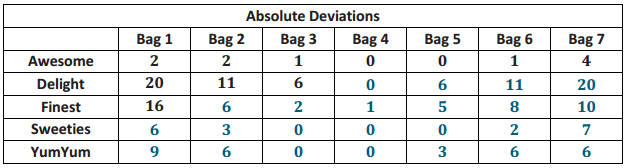
a. Complete the following table of the absolute deviations for the seven bags for each candy manufacturer.

Eureka Math Grade 6 Module 6 Lesson 9 Problem Set Answer Key 17
Answer:

Eureka Math Grade 6 Module 6 Lesson 9 Problem Set Answer Key 18

b. Based on what you learned about MAD, which manufacturer do you think will have the lowest MAD? Calculate the MAD for the manufacturer you selected.

Eureka Math Grade 6 Module 6 Lesson 9 Problem Set Answer Key 19
Answer:
Use the MAD for each manufacturer to evaluate student’s responses.

Eureka Math Grade 6 Module 6 Lesson 9 Problem Set Answer Key 20

Eureka Math Grade 6 Module 6 Lesson 9 Exit Ticket Answer Key

Question 1.
The mean absolute deviation (MAD) is a measure of variability for a data set. What does a data distribution look like if its MAD equals zero? Explain.
Answer:
If the MAD is zero, then all of the absolute deviations are zero. The MAD measures the average distance from the mean, and the distance is never negative. The only way the MAD could average to zero is if all the absolute deviations are zero. For example, City A had a dot plot where all of the temperatures were the same. Because all of the temperatures were the same, all of the absolute deviations were zero, which indicates that there was no variability in the temperatures.

Question 2.
Is it possible to have a negative value for the MAD of a data set?
Answer:
Because a MAD is the average of distances, which can never be negative, the MAD is always zero or a positive number.

Question 3.
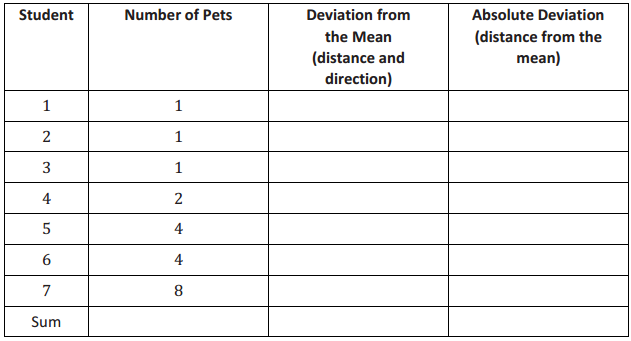
Suppose that seven students have the following numbers of pets: 1, 1, 1, 2, 4, 4, 8.

a. The mean number of pets for these seven students is 3 pets. Use the following table to find the MAD for this distribution of number of pets.

Eureka Math Grade 6 Module 6 Lesson 9 Exit Ticket Answer Key 21
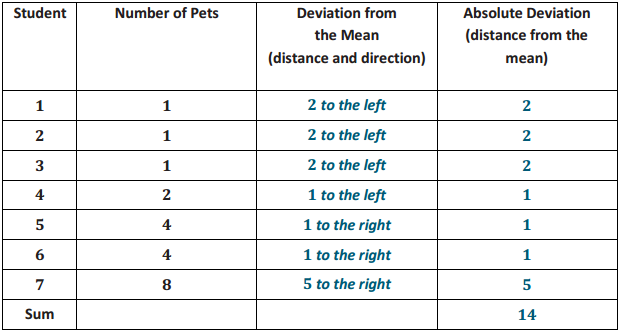
Answer:
\(\frac{14}{7}\)
The MAD number of pets is 2.

Eureka Math Grade 6 Module 6 Lesson 9 Exit Ticket Answer Key 22

b. Explain in words what the MAD means for this data set.
Answer:
On average, the number of pets for these students differs by 2 from the mean of 3 pets.

Eureka Math Grade 4 Module 1 Lesson 15 Answer Key

Engage NY Eureka Math 4th Grade Module 1 Lesson 15 Answer Key

Eureka Math Grade 4 Module 1 Lesson 15 Problem Set Answer Key

Question 1.
Use the standard subtraction algorithm to solve the problems below.
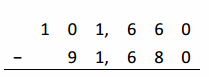
a. Eureka Math Grade 4 Module 1 Lesson 15 Problem Set Answer Key 1
Answer:
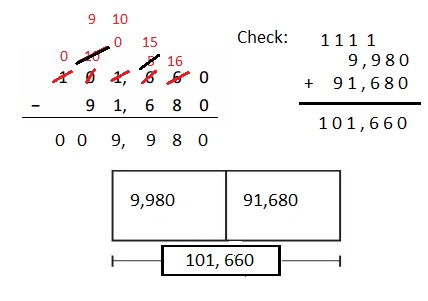
Engage-NY-Eureka-Math-4th-Grade-Module-1-Lesson-15-Answer-Key-Eureka-Math-Grade-4-Module-1-Lesson-15-Problem-Set-Answer-Key-Question-1-a
Explanation:
In subtraction if the minuend place values are less than the subtrahend then 1 is borrowed from the higher place value like
ones borrow from tens
tens borrow from hundreds
hundreds borrow  from thousands
thousands borrow from ten thousands
ten thousands borrow from hundred thousands
hundred thousands borrow from million.
if there are successive place values less  than the subtrahend we borrow from the highest place value whose value is higher than the subtrahend.
The number 101,660 is the minuend, the number 91,680 is the subtrahend and the number 9,980 is the difference.
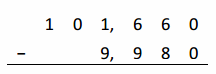
b. Eureka Math Grade 4 Module 1 Lesson 15 Problem Set Answer Key 2
Answer:
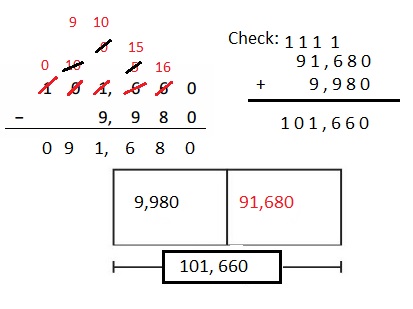
Engage-NY-Eureka-Math-4th-Grade-Module-1-Lesson-15-Answer-Key-Eureka-Math-Grade-4-Module-1-Lesson-15-Problem-Set-Answer-Key-Question-1-b
Explanation:
In subtraction if the minuend place values are less than the subtrahend then 1 is borrowed from the higher place value like
ones borrow from tens
tens borrow from hundreds
hundreds borrow  from thousands
thousands borrow from ten thousands
ten thousands borrow from hundred thousands
hundred thousands borrow from million.
if there are successive place values less  than the subtrahend we borrow from the highest place value whose value is higher than the subtrahend.
The number 101,660 is the minuend, the number 9,980 is the subtrahend and the number 91,680 is the difference.
c. Eureka Math Grade 4 Module 1 Lesson 15 Problem Set Answer Key 3
Answer:
Engage-NY-Eureka-Math-4th-Grade-Module-1-Lesson-15-Answer-Key-Eureka-Math-Grade-4-Module-1-Lesson-15-Problem-Set-Answer-Key-Question-1-c

Explanation:
In subtraction if the minuend place values are less than the subtrahend then 1 is borrowed from the higher place value like
ones borrow from tens
tens borrow from hundreds
hundreds borrow  from thousands
thousands borrow from ten thousands
ten thousands borrow from hundred thousands
hundred thousands borrow from million.
if there are successive place values less  than the subtrahend we borrow from the highest place value whose value is higher than the subtrahend.
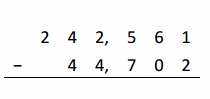
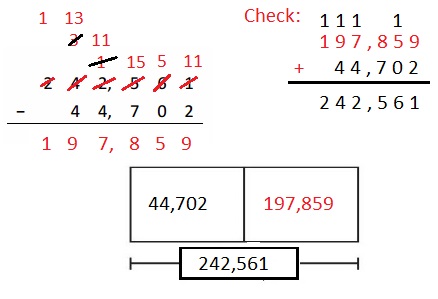
The number 242,561 is the minuend, the number 44,702 is the subtrahend and the number 197,859 is the difference.
d. Eureka Math Grade 4 Module 1 Lesson 15 Problem Set Answer Key 4
Answer:
Engage-NY-Eureka-Math-4th-Grade-Module-1-Lesson-15-Answer-Key-Eureka-Math-Grade-4-Module-1-Lesson-15-Problem-Set-Answer-Key-Question-1-d
Explanation:
In subtraction if the minuend place values are less than the subtrahend then 1 is borrowed from the higher place value like
ones borrow from tens
tens borrow from hundreds
hundreds borrow  from thousands
thousands borrow from ten thousands
ten thousands borrow from hundred thousands
hundred thousands borrow from million.
if there are successive place values less  than the subtrahend we borrow from the highest place value whose value is higher than the subtrahend.
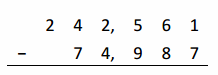
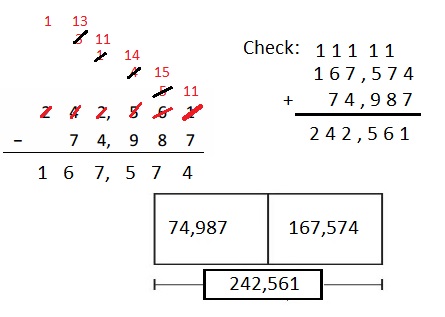
The number 242,561 is the minuend, the number 74,987 is the subtrahend and the number 167,574 is the difference.

e. Eureka Math Grade 4 Module 1 Lesson 15 Problem Set Answer Key 5
Answer:
Engage-NY-Eureka-Math-4th-Grade-Module-1-Lesson-15-Answer-Key-Eureka-Math-Grade-4-Module-1-Lesson-15-Problem-Set-Answer-Key-Question-1-e
Explanation:
In subtraction if the minuend place values are less than the subtrahend then 1 is borrowed from the higher place value like
ones borrow from tens
tens borrow from hundreds
hundreds borrow  from thousands
thousands borrow from ten thousands
ten thousands borrow from hundred thousands
hundred thousands borrow from million.
if there are successive place values less  than the subtrahend we borrow from the highest place value whose value is higher than the subtrahend.
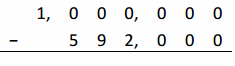
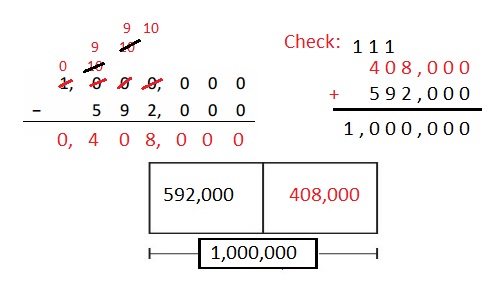
The number 1,000,000 is the minuend, the number 592,000 is the subtrahend and the number 408,000 is the difference.

f. Eureka Math Grade 4 Module 1 Lesson 15 Problem Set Answer Key 6
Answer:
Engage-NY-Eureka-Math-4th-Grade-Module-1-Lesson-15-Answer-Key-Eureka-Math-Grade-4-Module-1-Lesson-15-Problem-Set-Answer-Key-Question-1-f
Explanation:
In subtraction if the minuend place values are less than the subtrahend then 1 is borrowed from the higher place value like
ones borrow from tens
tens borrow from hundreds
hundreds borrow  from thousands
thousands borrow from ten thousands
ten thousands borrow from hundred thousands
hundred thousands borrow from million.
if there are successive place values less  than the subtrahend we borrow from the highest place value whose value is higher than the subtrahend.
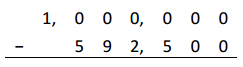
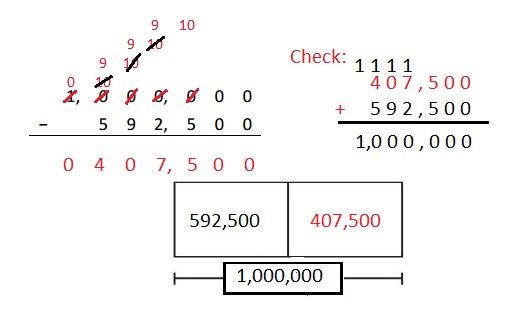
The number 1,000,000 is the minuend, the number 592,500 is the subtrahend and the number 407,500 is the difference.

g. Eureka Math Grade 4 Module 1 Lesson 15 Problem Set Answer Key 7
Answer:
Engage-NY-Eureka-Math-4th-Grade-Module-1-Lesson-15-Answer-Key-Eureka-Math-Grade-4-Module-1-Lesson-15-Problem-Set-Answer-Key-Question-1-g
Explanation:
In subtraction if the minuend place values are less than the subtrahend then 1 is borrowed from the higher place value like
ones borrow from tens
tens borrow from hundreds
hundreds borrow  from thousands
thousands borrow from ten thousands
ten thousands borrow from hundred thousands
hundred thousands borrow from million.
if there are successive place values less  than the subtrahend we borrow from the highest place value whose value is higher than the subtrahend.
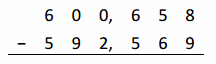
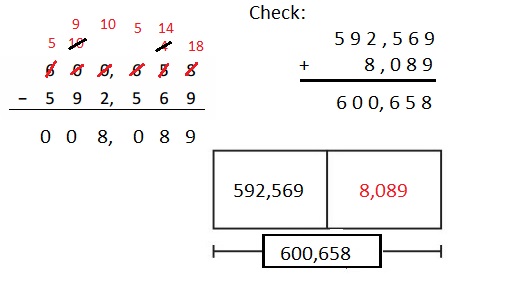
The number 600,658 is the minuend, the number 592,569 is the subtrahend and the number 8,089 is the difference.

h. Eureka Math Grade 4 Module 1 Lesson 15 Problem Set Answer Key 8

Answer:
Engage-NY-Eureka-Math-4th-Grade-Module-1-Lesson-15-Answer-Key-Eureka-Math-Grade-4-Module-1-Lesson-15-Problem-Set-Answer-Key-Question-1-h

Explanation:
In subtraction if the minuend place values are less than the subtrahend then 1 is borrowed from the higher place value like
ones borrow from tens
tens borrow from hundreds
hundreds borrow  from thousands
thousands borrow from ten thousands
ten thousands borrow from hundred thousands
hundred thousands borrow from million.
if there are successive place values less  than the subtrahend we borrow from the highest place value whose value is higher than the subtrahend.
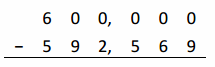
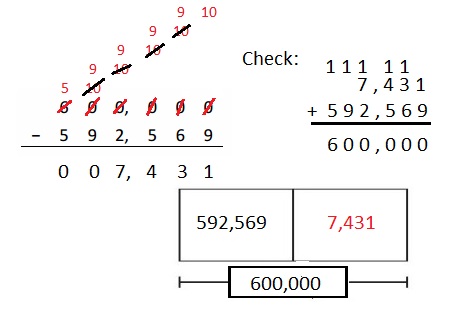
The number 600,000 is the minuend, the number 592,569 is the subtrahend and the number 7,431 is the difference.

Use tape diagrams and the standard algorithm to solve the problems below. Check your answers.

Question 2.
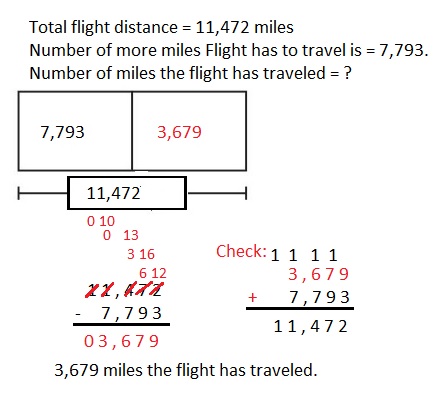
David is flying from Hong Kong to Buenos Aires. The total flight distance is 11,472 miles. If the plane has 7,793 miles left to travel, how far has it already traveled?
Answer:
Total flight distance = 11,472 miles
Number of more miles Flight has to travel is = 7,793.
Number of miles the flight has traveled = ?
Engage-NY-Eureka-Math-4th-Grade-Module-1-Lesson-15-Answer-Key-Eureka-Math-Grade-4-Module-1-Lesson-15-Problem-Set-Answer-Key-Question-2

Question 3.
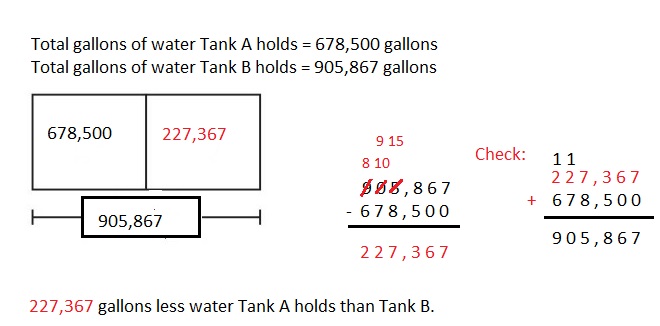
Tank A holds 678,500 gallons of water. Tank B holds 905,867 gallons of water. How much less water does Tank A hold than Tank B?
Answer:
Answer:
Total gallons of water Tank A holds = 678,500 gallons
Total gallons of water Tank B holds = 905,867 gallons
Engage-NY-Eureka-Math-4th-Grade-Module-1-Lesson-15-Answer-Key-Eureka-Math-Grade-4-Module-1-Lesson-15-Problem-Set-Answer-Key-Question-3

Question 4.
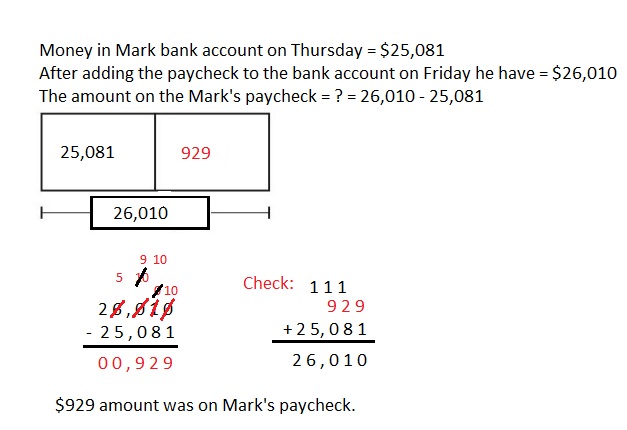
Mark had $25,081 in his bank account on Thursday. On Friday, he added his paycheck to the bank account, and he then had $26,010 in the account. What was the amount of Mark’s paycheck?
Answer:
Money in Mark bank account on Thursday = $25,081
After adding the paycheck to the bank account on Friday he have = $26,010
The amount on the Mark’s paycheck = ? = 26,010 – 25,081
Engage-NY-Eureka-Math-4th-Grade-Module-1-Lesson-15-Answer-Key-Eureka-Math-Grade-4-Module-1-Lesson-15-Problem-Set-Answer-Key-Question-4

Eureka Math Grade 4 Module 1 Lesson 15 Exit Ticket Answer Key

Draw a tape diagram to model each problem and solve.

Question 1.
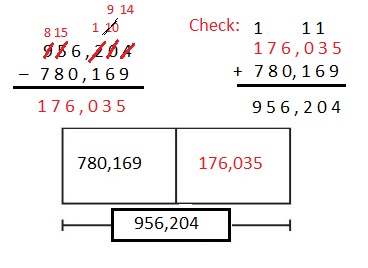
956,204 – 780,169 =_______________
Answer:
Engage-NY-Eureka-Math-4th-Grade-Module-1-Lesson-15-Answer-Key-Eureka-Math-Grade-4-Module-1-Lesson-15-Exit-Ticket-Answer-Key-Question-1
Explanation:
In subtraction if the minuend place values are less than the subtrahend then 1 is borrowed from the higher place value like
ones borrow from tens
tens borrow from hundreds
hundreds borrow  from thousands
thousands borrow from ten thousands
ten thousands borrow from hundred thousands
hundred thousands borrow from million.
if there are successive place values less  than the subtrahend we borrow from the highest place value whose value is higher than the subtrahend.
The number 956,204 is the minuend, the number 780,169 is the subtrahend and the number 176,035 is the difference.

Question 2.
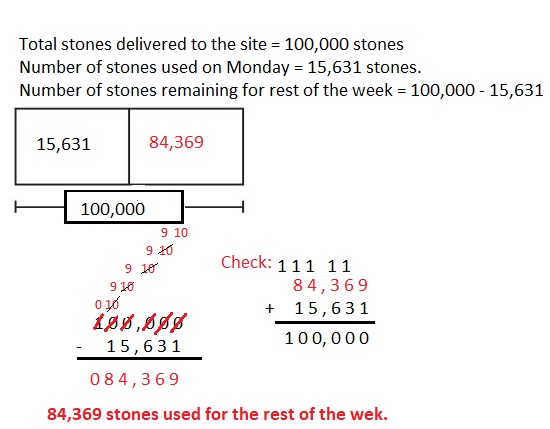
A construction company was building a stone wall on Main Street. 100,000 stones were delivered to the site. On Monday, they used 15,631 stones. How many stones remain for the rest of the week? Write your answer as a statement.
Answer:
Total stones delivered to the site = 100,000 stones
Number of stones used on Monday = 15,631 stones.
Number of stones remaining for rest of the week = 100,000 – 15,631
Engage-NY-Eureka-Math-4th-Grade-Module-1-Lesson-15-Answer-Key-Eureka-Math-Grade-4-Module-1-Lesson-15-Exit-Ticket-Answer-Key-Question-2

Eureka Math Grade 4 Module 1 Lesson 15 Homework Answer Key

Question 1.
Use the standard subtraction algorithm to solve the problems below.
a. Eureka Math 4th Grade Module 1 Lesson 15 Homework Answer Key 9
Answer:
Engage-NY-Eureka-Math-4th-Grade-Module-1-Lesson-15-Answer-Key-Eureka-Math-Grade-4-Module-1-Lesson-15-Homework-Answer-Key-Question-1-a

Explanation:
In subtraction if the minuend place values are less than the subtrahend then 1 is borrowed from the higher place value like
ones borrow from tens
tens borrow from hundreds
hundreds borrow  from thousands
thousands borrow from ten thousands
ten thousands borrow from hundred thousands
hundred thousands borrow from million.
if there are successive place values less  than the subtrahend we borrow from the highest place value whose value is higher than the subtrahend.
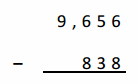
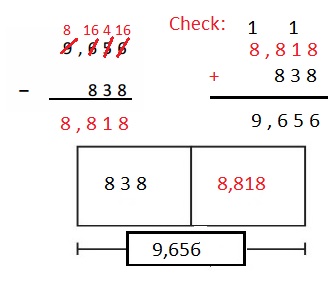
The number 9,656 is the minuend, the number 838 is the subtrahend and the number 8,818 is the difference.

b. Eureka Math 4th Grade Module 1 Lesson 15 Homework Answer Key 10
Answer:
Engage-NY-Eureka-Math-4th-Grade-Module-1-Lesson-15-Answer-Key-Eureka-Math-Grade-4-Module-1-Lesson-15-Homework-Answer-Key-Question-1-b

Explanation:
In subtraction if the minuend place values are less than the subtrahend then 1 is borrowed from the higher place value like
ones borrow from tens
tens borrow from hundreds
hundreds borrow  from thousands
thousands borrow from ten thousands
ten thousands borrow from hundred thousands
hundred thousands borrow from million.
if there are successive place values less  than the subtrahend we borrow from the highest place value whose value is higher than the subtrahend.
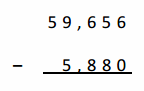
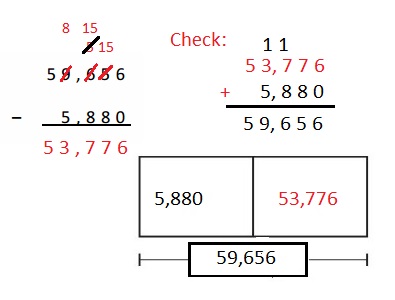
The number 59,656 is the minuend, the number 5,880 is the subtrahend and the number 53,776 is the difference.

c. Eureka Math 4th Grade Module 1 Lesson 15 Homework Answer Key 11
Answer:
Engage-NY-Eureka-Math-4th-Grade-Module-1-Lesson-15-Answer-Key-Eureka-Math-Grade-4-Module-1-Lesson-15-Homework-Answer-Key-Question-1-c

Explanation:
In subtraction if the minuend place values are less than the subtrahend then 1 is borrowed from the higher place value like
ones borrow from tens
tens borrow from hundreds
hundreds borrow  from thousands
thousands borrow from ten thousands
ten thousands borrow from hundred thousands
hundred thousands borrow from million.
if there are successive place values less  than the subtrahend we borrow from the highest place value whose value is higher than the subtrahend.
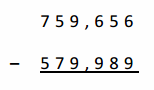
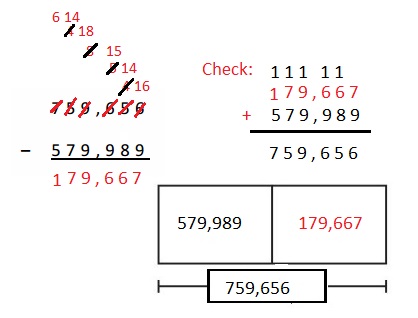
The number 759,656 is the minuend, the number 579,989 is the subtrahend and the number 179,667 is the difference.

d. Eureka Math 4th Grade Module 1 Lesson 15 Homework Answer Key 12
Answer:
Engage-NY-Eureka-Math-4th-Grade-Module-1-Lesson-15-Answer-Key-Eureka-Math-Grade-4-Module-1-Lesson-15-Homework-Answer-Key-Question-1-d
Explanation:
In subtraction if the minuend place values are less than the subtrahend then 1 is borrowed from the higher place value like
ones borrow from tens
tens borrow from hundreds
hundreds borrow  from thousands
thousands borrow from ten thousands
ten thousands borrow from hundred thousands
hundred thousands borrow from million.
if there are successive place values less  than the subtrahend we borrow from the highest place value whose value is higher than the subtrahend.
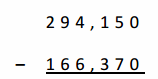
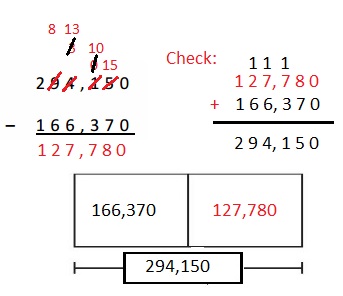
The number 294,150 is the minuend, the number 166,370 is the subtrahend and the number 127,780 is the difference.

e. Eureka Math 4th Grade Module 1 Lesson 15 Homework Answer Key 13
Answer:
Engage-NY-Eureka-Math-4th-Grade-Module-1-Lesson-15-Answer-Key-Eureka-Math-Grade-4-Module-1-Lesson-15-Homework-Answer-Key-Question-1-e
Explanation:
In subtraction if the minuend place values are less than the subtrahend then 1 is borrowed from the higher place value like
ones borrow from tens
tens borrow from hundreds
hundreds borrow  from thousands
thousands borrow from ten thousands
ten thousands borrow from hundred thousands
hundred thousands borrow from million.
if there are successive place values less  than the subtrahend we borrow from the highest place value whose value is higher than the subtrahend.
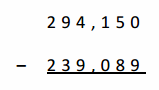
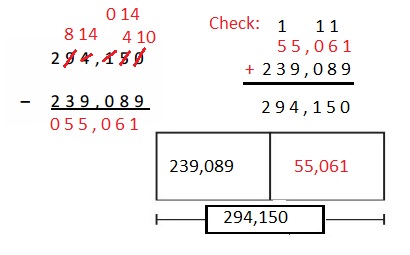
The number 294,150 is the minuend, the number 239,089 is the subtrahend and the number 55,061 is the difference.

f. Eureka Math 4th Grade Module 1 Lesson 15 Homework Answer Key 14
Answer:
Engage-NY-Eureka-Math-4th-Grade-Module-1-Lesson-15-Answer-Key-Eureka-Math-Grade-4-Module-1-Lesson-15-Homework-Answer-Key-Question-1-f
Explanation:
In subtraction if the minuend place values are less than the subtrahend then 1 is borrowed from the higher place value like
ones borrow from tens
tens borrow from hundreds
hundreds borrow  from thousands
thousands borrow from ten thousands
ten thousands borrow from hundred thousands
hundred thousands borrow from million.
if there are successive place values less  than the subtrahend we borrow from the highest place value whose value is higher than the subtrahend.
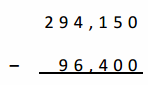
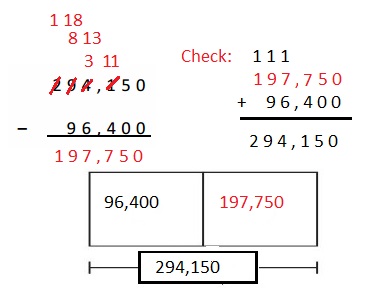
The number 294,150 is the minuend, the number 96,400 is the subtrahend and the number 197,750 is the difference.

g. Eureka Math 4th Grade Module 1 Lesson 15 Homework Answer Key 15
Answer:
Engage-NY-Eureka-Math-4th-Grade-Module-1-Lesson-15-Answer-Key-Eureka-Math-Grade-4-Module-1-Lesson-15-Homework-Answer-Key-Question-1-g
Explanation:
In subtraction if the minuend place values are less than the subtrahend then 1 is borrowed from the higher place value like
ones borrow from tens
tens borrow from hundreds
hundreds borrow  from thousands
thousands borrow from ten thousands
ten thousands borrow from hundred thousands
hundred thousands borrow from million.
if there are successive place values less  than the subtrahend we borrow from the highest place value whose value is higher than the subtrahend.
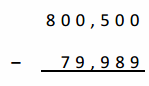
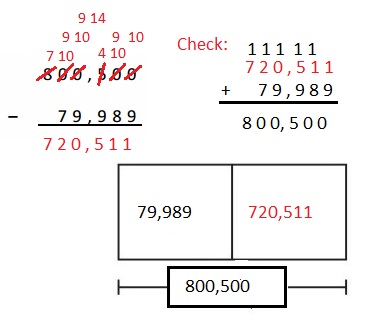
The number 800,500 is the minuend, the number 79,989 is the subtrahend and the number 720,511 is the difference.

h. Eureka Math 4th Grade Module 1 Lesson 15 Homework Answer Key 16
Answer:
Engage-NY-Eureka-Math-4th-Grade-Module-1-Lesson-15-Answer-Key-Eureka-Math-Grade-4-Module-1-Lesson-15-Homework-Answer-Key-Question-1-h
Explanation:
In subtraction if the minuend place values are less than the subtrahend then 1 is borrowed from the higher place value like
ones borrow from tens
tens borrow from hundreds
hundreds borrow  from thousands
thousands borrow from ten thousands
ten thousands borrow from hundred thousands
hundred thousands borrow from million.
if there are successive place values less  than the subtrahend we borrow from the highest place value whose value is higher than the subtrahend.
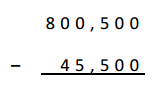
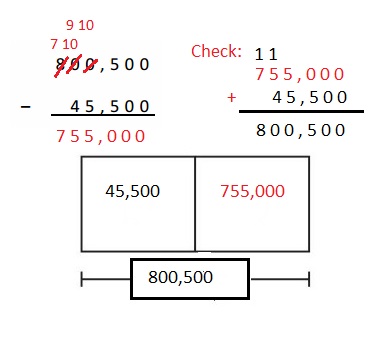
The number 800,500 is the minuend, the number 45,500 is the subtrahend and the number 755,000 is the difference.

i. Eureka Math 4th Grade Module 1 Lesson 15 Homework Answer Key 17

Answer:
Engage-NY-Eureka-Math-4th-Grade-Module-1-Lesson-15-Answer-Key-Eureka-Math-Grade-4-Module-1-Lesson-15-Homework-Answer-Key-Question-1-i

Explanation:
In subtraction if the minuend place values are less than the subtrahend then 1 is borrowed from the higher place value like
ones borrow from tens
tens borrow from hundreds
hundreds borrow  from thousands
thousands borrow from ten thousands
ten thousands borrow from hundred thousands
hundred thousands borrow from million.
if there are successive place values less  than the subtrahend we borrow from the highest place value whose value is higher than the subtrahend.
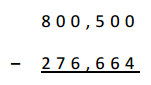
The number 800,500 is the minuend, the number 276,664 is the subtrahend and the number 523,836 is the difference.

Use tape diagrams and the standard algorithm to solve the problems below. Check your answers.

Question 2.
A fishing boat was out to sea for 6 months and traveled a total of 8,578 miles. In the first month, the boat traveled 659 miles. How many miles did the fishing boat travel during the remaining 5 months?
Answer:
Total distance traveled by a fishing boat in 6 months = 8,578 miles
The distance traveled by the fishing boat in the 1st month = 659 miles
The distance traveled by the fishing boat in 5 months = ? = 8,578 – 659
Engage-NY-Eureka-Math-4th-Grade-Module-1-Lesson-15-Answer-Key-Eureka-Math-Grade-4-Module-1-Lesson-15-Homework-Answer-Key-Question-2

Question 3.
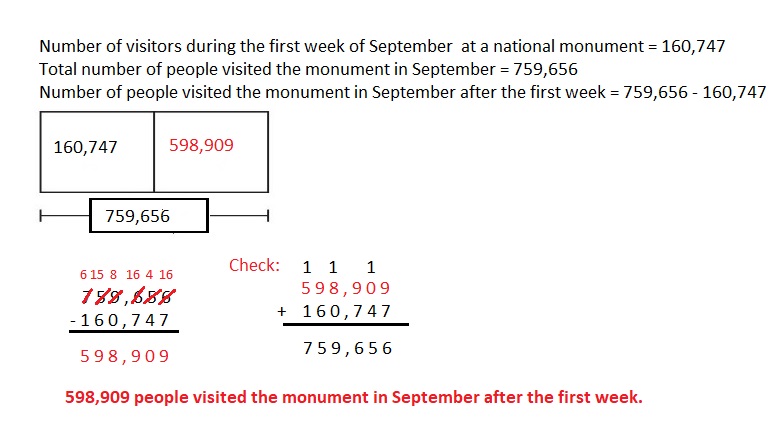
A national monument had 160,747 visitors during the first week of September. A total of 759,656 people visited the monument in September. How many people visited the monument in September after the first week?
Answer:
Number of visitors during the first week of September  at a national monument = 160,747
Total number of people visited the monument in September = 759,656
Number of people visited the monument in September after the first week = 759,656 – 160,747
Engage-NY-Eureka-Math-4th-Grade-Module-1-Lesson-15-Answer-Key-Eureka-Math-Grade-4-Module-1-Lesson-15-Homework-Answer-Key-Question-3

Question 4.
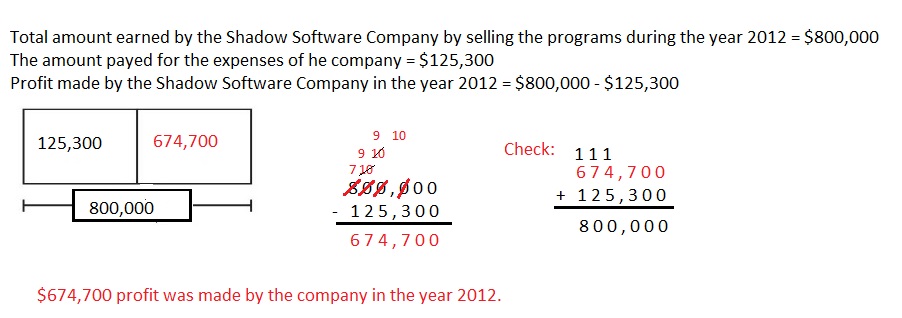
Shadow Software Company earned a total of $800,000 selling programs during the year 2012. $125,300 of that amount was used to pay expenses of the company. How much profit did Shadow Software Company make in the year 2012?
Answer:
Total amount earned by the Shadow Software Company by selling the programs during the year 2012 = $800,000
The amount payed for the expenses of he company = $125,300
Profit made by the Shadow Software Company in the year 2012 = $800,000 – $125,300
Engage-NY-Eureka-Math-4th-Grade-Module-1-Lesson-15-Answer-Key-Eureka-Math-Grade-4-Module-1-Lesson-15-Homework-Answer-Key-Question-4

Question 5.
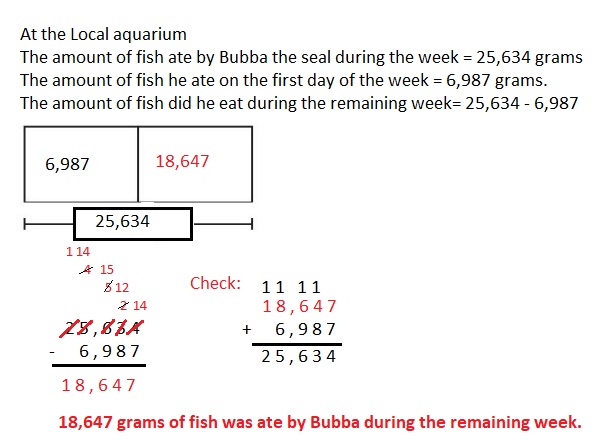
At the local aquarium, Bubba the Seal ate 25,634 grams of fish during the week. If, on the first day of the week, he ate 6,987 grams of fish, how many grams of fish did he eat during the remainder of the week?
Answer:
At the Local aquarium
The amount of fish ate by Bubba the seal during the week = 25,634 grams
The amount of fish he ate on the first day of the week = 6,987 grams.
The amount of fish did he eat during the remaining week= 25,634 – 6,987
Engage-NY-Eureka-Math-4th-Grade-Module-1-Lesson-15-Answer-Key-Eureka-Math-Grade-4-Module-1-Lesson-15-Homework-Answer-Key-Question-5

Eureka Math Grade 4 Module 1 Lesson 14 Answer Key

Engage NY Eureka Math 4th Grade Module 1 Lesson 14 Answer Key

Eureka Math Grade 4 Module 1 Lesson 14 Problem Set Answer Key

Question 1.
Use the standard algorithm to solve the following subtraction problems.
a. Eureka Math Grade 4 Module 1 Lesson 14 Problem Set Answer Key 1
Answer:
Engage-NY-Eureka-Math-4th-Grade-Module-1-Lesson-14-Answer-Key-Eureka-Math-Grade-4-Module-1-Lesson-14-Problem-Set-Answer-Key-Question-1-a
b. Eureka Math Grade 4 Module 1 Lesson 14 Problem Set Answer Key 2
Answer:
Engage-NY-Eureka-Math-4th-Grade-Module-1-Lesson-14-Answer-Key-Eureka-Math-Grade-4-Module-1-Lesson-14-Problem-Set-Answer-Key-Question-1-b
Explanation:
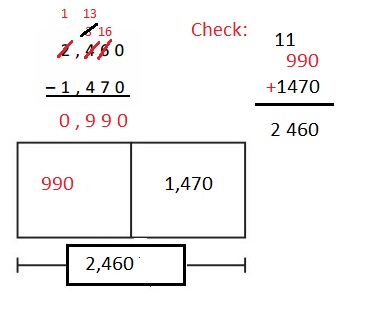
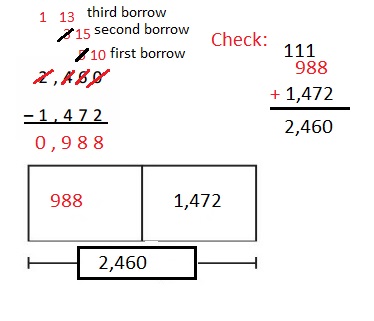
The rules of subtraction we first write the greater number at the top. Then subtract the digits column-wise ones from ones, tens from tens, hundreds from hundreds, thousands from thousands and so on.
Ones = 0 – 0 = 0.
Tens =  6 – 7 = 16 – 7 = 9.
6 is less than 7 so we borrow  1 from the 4 hundred  place  and make 4 hundred  as 3 hundred  and make 6  ten  as 16 ten and we subtract 7 from 16.
Hundreds = After borrowing 1 from hundred 4 becomes 3 . 3 – 4 = 13 – 4 = 9.
3 is less than 4 so we again borrow  1 from the 2 Thousands  place  and make 2 Thousands   as 1 Thousands and make 3 hundreds  as 13 hundreds and we subtract 4 from 13.
Thousands = 1 – 1 = 0
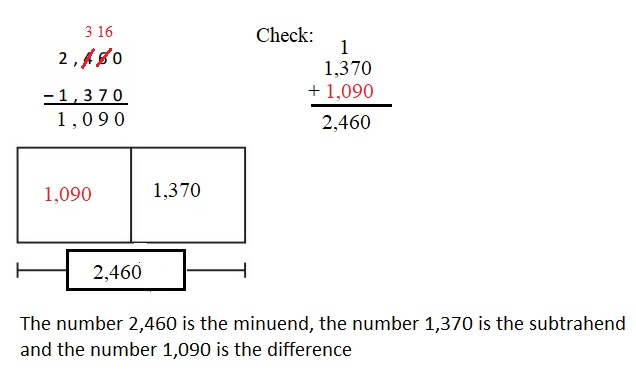
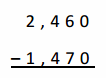
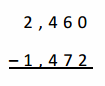
The number 2,460 is the minuend, the number 1,470 is the subtrahend and the number 990 is the difference.
c. Eureka Math Grade 4 Module 1 Lesson 14 Problem Set Answer Key 3
Answer:
Engage-NY-Eureka-Math-4th-Grade-Module-1-Lesson-14-Answer-Key-Eureka-Math-Grade-4-Module-1-Lesson-14-Problem-Set-Answer-Key-Question-1-c
Explanation:
The rules of subtraction we first write the greater number at the top. Then subtract the digits column-wise ones from ones, tens from tens, hundreds from hundreds, thousands from thousands and so on.
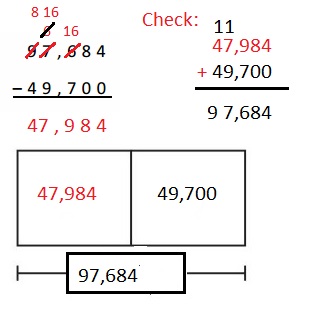
Ones = 4 – 0 = 4.
Tens =  8 – 0 = 8.
Hundreds = 6 – 7 = 16 – 7 = 9.
6 is less than 7 so we borrow  1 from the 7 thousands  place  and make 7 thousands  as 6 thousands  and make 6  hundreds  as 16 hundreds and we subtract 7 from 16.
Thousands =After borrowing 1 from thousands place 7 becomes 6. 6 – 9 = 16 – 9 = 7.
6 is less than 9 so we again borrow  1 from the 9 ten thousands place  and make 9 ten thousands  as 8 ten thousands and make 6  thousands as 16 thousands and we subtract 9 from 16.
Ten Thousands = 8 – 4 = 4.
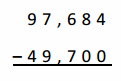
The number 97,684 is the minuend, the number 49,700 is the subtrahend and the number 47,984 is the difference.
d. Eureka Math Grade 4 Module 1 Lesson 14 Problem Set Answer Key 4
Answer:
Engage-NY-Eureka-Math-4th-Grade-Module-1-Lesson-14-Answer-Key-Eureka-Math-Grade-4-Module-1-Lesson-14-Problem-Set-Answer-Key-Question-1-d

Explanation:
The rules of subtraction we first write the greater number at the top. Then subtract the digits column-wise ones from ones, tens from tens, hundreds from hundreds, thousands from thousands and so on.
Ones = 0 – 2 = 10 – 2 = 8.
0 is less than 2 so we borrow  1 from the 6 tens  place  and make 6 tens  as 5 tens  and make 0 ones  as 10 ones and we subtract 2 from 10.
Tens =After borrowing 1 from tens place 6 becomes 5.  5 – 7 = 15 – 7 = 8.
5 is less than 7 so we borrow  1 from the 4 hundred  place  and make 4 hundred  as 3 hundred  and make 5  tens  as 15 tens and we subtract 7 from 15.
Hundreds = After borrowing 1 from hundred 4 becomes 3 . 3 – 4 = 13 – 4 = 9.
3 is less than 4 so we borrow  1 from the 2 Thousands  place  and make 2 Thousands   as 1 Thousands and make 3 hundreds  as 13 hundreds and we subtract 4 from 13.
Thousands = 1 – 1 = 0
The number 2,460 is the minuend, the number 1,472 is the subtrahend and the number 988 is the difference.
e. Eureka Math Grade 4 Module 1 Lesson 14 Problem Set Answer Key 5
Answer:
Engage-NY-Eureka-Math-4th-Grade-Module-1-Lesson-14-Answer-Key-Eureka-Math-Grade-4-Module-1-Lesson-14-Problem-Set-Answer-Key-Question-1-e

Explanation:
The rules of subtraction we first write the greater number at the top. Then subtract the digits column-wise ones from ones, tens from tens, hundreds from hundreds, thousands from thousands and so on.
Since, ones place and tens place values are less then the subtrahend we borrow 1 from the hundreds place and increase the value of tens.
Tens =After borrowing 1 from hundreds place 0 ten becomes 10 ten. So, After borrowing  1 from the 3 hundred  place. 3 hundred becomes 2 hundred .
Ones = 6 – 7 = 16 – 7 = 9.
6 is less than 7 so we borrow  1 from the 10 tens  place  and make 10 tens  as 9 tens  and make 6 ones  as 16 ones and we subtract 7 from 16.
Tens : After borrowing 1 from tens place. 10 becomes 9. 9 – 1 = 8.
Hundreds = After borrowing 1 from hundred 3 becomes 2 . 2 – 1 = 1.
Thousands : 4 – 1 = 3.
Ten Thousand : 2 – 3 = 12 – 3 = 9.
2 is less than 3 so we borrow  1 from the 1 hundred Thousands  place  and make 1 hundred Thousands   as 0  hundred Thousands and make 2 thousand  as 12 thousand and we subtract 3 from 12.
Hundred thousands = 0.
The number 124,306 is the minuend, the number 31,117 is the subtrahend and the number 93,189 is the difference.
f. Eureka Math Grade 4 Module 1 Lesson 14 Problem Set Answer Key 6
Answer:
Engage-NY-Eureka-Math-4th-Grade-Module-1-Lesson-14-Answer-Key-Eureka-Math-Grade-4-Module-1-Lesson-14-Problem-Set-Answer-Key-Question-1-f

Explanation:
The rules of subtraction we first write the greater number at the top. Then subtract the digits column-wise ones from ones, tens from tens, hundreds from hundreds, thousands from thousands and so on.
Ones = 4 – 5 = 14 – 5 = 9.
4 is less than 5 so we borrow  1 from the 8 hundred  place  and make 8 hundred  as 7 hundred  and make 4  ten  as 14 ten and we subtract 5 from 14.
Tens =  7 – 0 = 7
Hundreds =6 – 7 = 16 – 7 = 9
6 is less than 7 so we borrow  1 from the 7 Thousands  place  and make 7 Thousands   as 6 Thousands and make 6 hundreds  as 16 hundreds and we subtract 7 from 16.
Thousands = 6 – 4  = 2
Ten Thousand = 9.
The number 97,684 is the minuend, the number 4,705 is the subtrahend and the number 92,979 is the difference.
g. Eureka Math Grade 4 Module 1 Lesson 14 Problem Set Answer Key 7
Answer:
Engage-NY-Eureka-Math-4th-Grade-Module-1-Lesson-14-Answer-Key-Eureka-Math-Grade-4-Module-1-Lesson-14-Problem-Set-Answer-Key-Question-1-g

Explanation:
The rules of subtraction we first write the greater number at the top. Then subtract the digits column-wise ones from ones, tens from tens, hundreds from hundreds, thousands from thousands and so on.
The minuend ones , tens , hundreds all the three places are less then the subtrahend.
First
Ones = 6 – 7 = 16 – 7 = 9.
6 is less than 7 so we borrow  1 from the 0 ten place  and make 0 tens as 9 tens  and make 6  ones  as 16 ones and we subtract 7 from 16.
Tens = After borrowing 1 from hundred 0 becomes 9. 9 -1 = 8.
Hundreds = After borrowing 1 from thousand 0 becomes 9 . 9 – 1 = 8.
Thousands = 3 – 1 =  2.
Ten thousand = 2 – 2 = 0.
Hundred thousand = 1 – 1 = 0.
The number 124,006 is the minuend, the number 121,117 is the subtrahend and the number 2,889 is the difference.

h. Eureka Math Grade 4 Module 1 Lesson 14 Problem Set Answer Key 8
Answer:
Engage-NY-Eureka-Math-4th-Grade-Module-1-Lesson-14-Answer-Key-Eureka-Math-Grade-4-Module-1-Lesson-14-Problem-Set-Answer-Key-Question-1-h

Explanation:
The rules of subtraction we first write the greater number at the top. Then subtract the digits column-wise ones from ones, tens from tens, hundreds from hundreds, thousands from thousands and so on.
Ones = 4 – 5 = 14 – 5 = 9.
4 is less than 5 so we borrow  1 from the 8 Tens place  and make 8 Tens  as 7 Tens  and make 6  ones  as 16 ones and we subtract 5 from 14.
Tens =  7 – 0 = 7.
Hundreds = 6 – 7 = 16 – 7 = 9.
6 is less than 7 so we borrow  1 from the 7 Thousands  place  and make 7 Thousands   as 6 Thousands and make 6 hundreds  as 16 hundreds and we subtract 7 from 16.
Thousands = 6 – 7 = 16 – 7 = 9.
6 is less than 7 so we borrow  1 from the 9 ten Thousands  place  and make 9  ten Thousands   as 8 ten Thousands and make 6 hundreds  as 16 hundreds and we subtract 7 from 16.
ten thousand = 8 – 4 = 4.
The number 97,684 is the minuend, the number 47,705 is the subtrahend and the number  49,979 is the difference.
i. Eureka Math Grade 4 Module 1 Lesson 14 Problem Set Answer Key 9
Answer:
Engage-NY-Eureka-Math-4th-Grade-Module-1-Lesson-14-Answer-Key-Eureka-Math-Grade-4-Module-1-Lesson-14-Problem-Set-Answer-Key-Question-1-i

Explanation:
The rules of subtraction we first write the greater number at the top. Then subtract the digits column-wise ones from ones, tens from tens, hundreds from hundreds, thousands from thousands and so on.
Ones = 0 – 7 = 10 – 7 = 3.
0 is less than 7 so we borrow  1 from the 6 Tens place  and make 6 Tens  as 5 Tens  and make 0  ones  as 10 ones and we subtract 7 from 10.
Tens =  5 – 1 = 4.
Hundreds =0 – 1 = 1 – 1 = 9.
0 is less than 1 so we borrow  1 from the 4 Thousands  place  and make 4 Thousands   as 3 Thousands and make 0 hundreds  as 10 hundreds and we subtract 1 from 10.
Thousands = 3 – 1 = 2.
Ten thousand= 2 – 3 = 12 – 3 = 9.
2 is less than 3 so we borrow  1 from the 1 hundred Thousands  place  and make 1 hundred Thousands   as 0  hundred Thousands and make 2 ten thousand as 12 ten thousand and we subtract 3 from 12.
The number 124,060 is the minuend, the number 31,117 is the subtrahend and the number 92,943 is the difference.

Draw a tape diagram to represent each problem. Use numbers to solve, and write your answer as a statement. Check your answers.

Question 2.
There are 86,400 seconds in one day. If Mr. Liegel is at work for 28,800 seconds a day, how many seconds a day is he away from work?
Answer:
Total seconds in one day = 86,400
Number of seconds Mr. Liegel at work in a day = 28,800
Number of seconds Mr. Leigel away from work = 86,400 – 28,800
Engage-NY-Eureka-Math-4th-Grade-Module-1-Lesson-14-Answer-Key-Eureka-Math-Grade-4-Module-1-Lesson-14-Problem-Set-Answer-Key-Question-2

Question 3.
A newspaper company delivered 240,900 newspapers before 6 a.m. on Sunday. There were a total of 525,600 newspapers to deliver. How many more newspapers needed to be delivered on Sunday?
Answer:
Number of newspapers delivered by the company on Sunday before 6 a.m = 240,900
Total number of newspapers to be delivered = 525,600.
How many more newspaper to be delivered= ?
Engage-NY-Eureka-Math-4th-Grade-Module-1-Lesson-14-Answer-Key-Eureka-Math-Grade-4-Module-1-Lesson-14-Problem-Set-Answer-Key-Question-3

Question 4.
A theater holds a total of 2,013 chairs. 197 chairs are in the VIP section. How many chairs are not in the VIP section?
Total number of chairs a theater holds = 2,013
Number of chairs in the VIP Section = 197
Number of chairs which are not in the VIP section = B
Engage-NY-Eureka-Math-4th-Grade-Module-1-Lesson-14-Answer-Key-Eureka-Math-Grade-4-Module-1-Lesson-14-Problem-Set-Answer-Key-Question-4

Question 5.
Chuck’s mom spent $19,155 on a new car. She had $30,064 in her bank account. How much money does Chuck’s mom have after buying the car?
Answer:
Money spent by Chuck’s mom on new car = $19,155
Total money she had in her bank account = $30,064
Money left with her after buying the car = 30,064 – 19,155
Engage-NY-Eureka-Math-4th-Grade-Module-1-Lesson-14-Answer-Key-Eureka-Math-Grade-4-Module-1-Lesson-14-Problem-Set-Answer-Key-Question-5

Eureka Math Grade 4 Module 1 Lesson 14 Exit Ticket Answer Key

Use the standard algorithm to solve the following subtraction problems.

Question 1.
Engage NY Math 4th Grade Module 1 Lesson 14 Exit Ticket Answer Key 9.1
Answer:
Engage-NY-Eureka-Math-4th-Grade-Module-1-Lesson-14-Answer-Key-Eureka-Math-Grade-4-Module-1-Lesson-14-Exit-Ticket-Answer-Key-Question-1

Question 2.
32,010 – 2,546
Answer:
Engage-NY-Eureka-Math-4th-Grade-Module-1-Lesson-14-Answer-Key-Eureka-Math-Grade-4-Module-1-Lesson-14-Exit-Ticket-Answer-Key-Question-2

Draw a tape diagram to represent the following problem. Use numbers to solve, and write your answer as a statement. Check your answer.

Question 3.
A doughnut shop sold 1,232 doughnuts in one day. If they sold 876 doughnuts in the morning, how many doughnuts were sold during the rest of the day?
Answer:
Total doughnut sold by the doughnut shop in one day  = 1,232
Number of doughnuts sold in the morning = 876
Number of doughnuts sold during the rest of the day = A
Engage-NY-Eureka-Math-4th-Grade-Module-1-Lesson-14-Answer-Key-Eureka-Math-Grade-4-Module-1-Lesson-14-Exit-Ticket-Answer-Key-Question-3

Eureka Math Grade 4 Module 1 Lesson 14 Homework Answer Key

Question 1.
Use the standard algorithm to solve the following subtraction problems.
a. Eureka Math 4th Grade Module 1 Lesson 14 Homework Answer Key 10
Answer:
Engage-NY-Eureka-Math-4th-Grade-Module-1-Lesson-14-Answer-Key-Eureka-Math-Grade-4-Module-1-Lesson-14-Homework-Answer-Key-Question-1-a

Explanation:
In subtraction if the minuend place values are less than the subtrahend then 1 is borrowed from the higher place value like
ones borrow from tens
tens borrow from hundreds
hundreds borrow  from thousands
thousands borrow from ten thousands
ten thousands borrow from hundred thousands
hundred thousands borrow from million.
if there are successive place values less  than the subtrahend we borrow from the highest place value whose value is higher than the subtrahend.
The number 71,989 is the minuend, the number 21,492 is the subtrahend and the number 50,497 is the difference.

b. Eureka Math 4th Grade Module 1 Lesson 14 Homework Answer Key 11
Answer:
Engage-NY-Eureka-Math-4th-Grade-Module-1-Lesson-14-Answer-Key-Eureka-Math-Grade-4-Module-1-Lesson-14-Homework-Answer-Key-Question-1-b

Explanation:
In subtraction if the minuend place values are less than the subtrahend then 1 is borrowed from the higher place value like
ones borrow from tens
tens borrow from hundreds
hundreds borrow  from thousands
thousands borrow from ten thousands
ten thousands borrow from hundred thousands
hundred thousands borrow from million.
if there are successive place values less  than the subtrahend we borrow from the highest place value whose value is higher than the subtrahend.
The number 371,989 is the minuend, the number 96,492 is the subtrahend and the number 275,497 is the difference.
c. Eureka Math 4th Grade Module 1 Lesson 14 Homework Answer Key 12
Answer:
Engage-NY-Eureka-Math-4th-Grade-Module-1-Lesson-14-Answer-Key-Eureka-Math-Grade-4-Module-1-Lesson-14-Homework-Answer-Key-Question-1-c

Explanation:
In subtraction if the minuend place values are less than the subtrahend then 1 is borrowed from the higher place value like
ones borrow from tens
tens borrow from hundreds
hundreds borrow  from thousands
thousands borrow from ten thousands
ten thousands borrow from hundred thousands
hundred thousands borrow from million.
if there are successive place values less  than the subtrahend we borrow from the highest place value whose value is higher than the subtrahend.
The number 371,089 is the minuend, the number 25,192 is the subtrahend and the number 345,897 is the difference.

d. Eureka Math 4th Grade Module 1 Lesson 14 Homework Answer Key 13
Answer:
Engage-NY-Eureka-Math-4th-Grade-Module-1-Lesson-14-Answer-Key-Eureka-Math-Grade-4-Module-1-Lesson-14-Homework-Answer-Key-Question-1-d

Explanation:
In subtraction if the minuend place values are less than the subtrahend then 1 is borrowed from the higher place value like
ones borrow from tens
tens borrow from hundreds
hundreds borrow  from thousands
thousands borrow from ten thousands
ten thousands borrow from hundred thousands
hundred thousands borrow from million.
if there are successive place values less  than the subtrahend we borrow from the highest place value whose value is higher than the subtrahend.
The number 879,989 is the minuend, the number 721,492 is the subtrahend and the number 158,497 is the difference.

e. Eureka Math 4th Grade Module 1 Lesson 14 Homework Answer Key 14
Answer:
Engage-NY-Eureka-Math-4th-Grade-Module-1-Lesson-14-Answer-Key-Eureka-Math-Grade-4-Module-1-Lesson-14-Homework-Answer-Key-Question-1-e

Explanation:
In subtraction if the minuend place values are less than the subtrahend then 1 is borrowed from the higher place value like
ones borrow from tens
tens borrow from hundreds
hundreds borrow  from thousands
thousands borrow from ten thousands
ten thousands borrow from hundred thousands
hundred thousands borrow from million.
if there are successive place values less  than the subtrahend we borrow from the highest place value whose value is higher than the subtrahend.
The number 879,009 is the minuend, the number 788,492 is the subtrahend and the number 90,517 is the difference.
f. Eureka Math 4th Grade Module 1 Lesson 14 Homework Answer Key 15
Answer:
Engage-NY-Eureka-Math-4th-Grade-Module-1-Lesson-14-Answer-Key-Eureka-Math-Grade-4-Module-1-Lesson-14-Homework-Answer-Key-Question-1-f

Explanation:
In subtraction if the minuend place values are less than the subtrahend then 1 is borrowed from the higher place value like
ones borrow from tens
tens borrow from hundreds
hundreds borrow  from thousands
thousands borrow from ten thousands
ten thousands borrow from hundred thousands
hundred thousands borrow from million.
if there are successive place values less  than the subtrahend we borrow from the highest place value whose value is higher than the subtrahend.
The number 879,989 is the minuend, the number 21,070 is the subtrahend and the number 858,919 is the difference.
g. Eureka Math 4th Grade Module 1 Lesson 14 Homework Answer Key 16
Answer:
Engage-NY-Eureka-Math-4th-Grade-Module-1-Lesson-14-Answer-Key-Eureka-Math-Grade-4-Module-1-Lesson-14-Homework-Answer-Key-Question-1-g

Explanation:
In subtraction if the minuend place values are less than the subtrahend then 1 is borrowed from the higher place value like
ones borrow from tens
tens borrow from hundreds
hundreds borrow  from thousands
thousands borrow from ten thousands
ten thousands borrow from hundred thousands
hundred thousands borrow from million.
if there are successive place values less  than the subtrahend we borrow from the highest place value whose value is higher than the subtrahend.
The number 879,000 is the minuend, the number 21,989 is the subtrahend and the number 857,011 is the difference.
h. Eureka Math 4th Grade Module 1 Lesson 14 Homework Answer Key 17
Answer:
Engage-NY-Eureka-Math-4th-Grade-Module-1-Lesson-14-Answer-Key-Eureka-Math-Grade-4-Module-1-Lesson-14-Homework-Answer-Key-Question-1-h

Explanation:
In subtraction if the minuend place values are less than the subtrahend then 1 is borrowed from the higher place value like
ones borrow from tens
tens borrow from hundreds
hundreds borrow  from thousands
thousands borrow from ten thousands
ten thousands borrow from hundred thousands
hundred thousands borrow from million.
if there are successive place values less  than the subtrahend we borrow from the highest place value whose value is higher than the subtrahend.
The number 279,389 is the minuend, the number 191,492 is the subtrahend and the number 87,897 is the difference.
i. Eureka Math 4th Grade Module 1 Lesson 14 Homework Answer Key 18

Answer:
Engage-NY-Eureka-Math-4th-Grade-Module-1-Lesson-14-Answer-Key-Eureka-Math-Grade-4-Module-1-Lesson-14-Homework-Answer-Key-Question-1-i

Explanation:
In subtraction if the minuend place values are less than the subtrahend then 1 is borrowed from the higher place value like
ones borrow from tens
tens borrow from hundreds
hundreds borrow  from thousands
thousands borrow from ten thousands
ten thousands borrow from hundred thousands
hundred thousands borrow from million.
if there are successive place values less  than the subtrahend we borrow from the highest place value whose value is higher than the subtrahend.
The number 500,989 is the minuend, the number 242,000 is the subtrahend and the number 258,989 is the difference.

Draw a tape diagram to represent each problem. Use numbers to solve, and write your answer as a statement. Check your answers.

Question 2.
Jason ordered 239,021 pounds of flour to be used in his 25 bakeries. The company delivering the flour showed up with 451,202 pounds. How many extra pounds of flour were delivered?
Answer:
Total flour ordered by Jason to use in his 25 bakeries = 239,021 pounds
Total flour showed by the company at delivering = 451,202 pounds.
Extra pounds of flour delivered by the company =  A = 451,202 – 239,021
Engage-NY-Eureka-Math-4th-Grade-Module-1-Lesson-14-Answer-Key-Eureka-Math-Grade-4-Module-1-Lesson-14-Homework-Answer-Key-Question-2

Question 3.
In May, the New York Public Library had 124,061 books checked out. Of those books, 31,117 were mystery books. How many of the books checked out were not mystery books?
Answer:
Number of books checked out from the New York Public Library = 124,061 books
Out of the checked out books the Number of Mystery books are =  31,117 books
Engage-NY-Eureka-Math-4th-Grade-Module-1-Lesson-14-Answer-Key-Eureka-Math-Grade-4-Module-1-Lesson-14-Homework-Answer-Key-Question-3

Question 4.
A Class A dump truck can haul 239,000 pounds of dirt. A Class C dump truck can haul 600,200 pounds of dirt. How many more pounds can a Class C truck haul than a Class A truck?
Answer:
Number of pounds of dust A Class A dump truck can haul = 239,000 pounds
Number of pounds of dust A Class C dump truck can haul = 600,200 pounds
The number of more pounds of dust A Class C truck can haul than a Class A truck = ?
Engage-NY-Eureka-Math-4th-Grade-Module-1-Lesson-14-Answer-Key-Eureka-Math-Grade-4-Module-1-Lesson-14-Homework-Answer-Key-Question-4

Eureka Math Grade 4 Module 1 Lesson 12 Answer Key

Engage NY Eureka Math 4th Grade Module 1 Lesson 12 Answer Key

Eureka Math Grade 4 Module 1 Lesson 12 Problem Set Answer Key

Estimate and then solve each problem. Model the problem with a tape diagram. Explain if your answer is reasonable.

Question 1.
For the bake sale, Connie baked 144 cookies. Esther baked 49 more cookies than Connie.
a. About how many cookies did Connie and Esther bake? Estimate by rounding each number to the nearest ten before adding.
Answer:
Number of cookies Connie baked = 144 cookies
Number of cookies  Esther baked = 49 more than Connie = 49 + 144 = 193 cookies
Total number of cookies baked by both  = 144 + 193
rounding each number to the nearest ten = 144 ~ 140  and  193 ~ 190.
Adding both 140 + 190 = 330 cookies.
Engage-NY-Eureka-Math-4th-Grade-Module-1-Lesson-12-Answer-Key-Eureka-Math-Grade-4-Module-1-Lesson-12-Problem-Set-Answer-Key-Question-1-a
b. Exactly how many cookies did Connie and Esther bake?
Answer:
Engage-NY-Eureka-Math-4th-Grade-Module-1-Lesson-12-Answer-Key-Eureka-Math-Grade-4-Module-1-Lesson-12-Problem-Set-Answer-Key-Question-1-b
They both Baked 337 cookies exactly.
c. Is your answer reasonable? Compare your estimate from (a) to your answer from (b). Write a sentence to explain your reasoning.
Answer:
In the (a) bit the estimate answer was 330 cookies  but the answer in (b)  is 337 cookies on rounding it the nearest ten it would be 340 cookies.

Queens 2.
Raffle tickets were sold for a school fundraiser to parents, teachers, and students. 563 tickets were sold to teachers. 888 more tickets were sold to students than to teachers. 904 tickets were sold to parents.
a. About how many tickets were sold to parents, teachers, and students? Round each number to the nearest hundred to find your estimate.
Answer:
Engage-NY-Eureka-Math-4th-Grade-Module-1-Lesson-12-Answer-Key-Eureka-Math-Grade-4-Module-1-Lesson-12-Problem-Set-Answer-Key-Question-2-a
b. Exactly how many tickets were sold to parents, teachers, and students?
Answer:
Engage-NY-Eureka-Math-4th-Grade-Module-1-Lesson-12-Answer-Key-Eureka-Math-Grade-4-Module-1-Lesson-12-Problem-Set-Answer-Key-Question-2-b
c. Assess the reasonableness of your answer in (b). Use your estimate from (a) to explain.
Answer:
In (b) the answer is 2,918 on rounding it ti nearest hundred we get 2,900. But in (a) the answer is 3,000 on rounding to the nearest hundred. The difference is 100 tickets .

Queens 3.
From 2010 to 2011, the population of Queens increased by 16,075. Brooklyn’s population increased by 11,870 more than the population increase of Queens.
a. Estimate the total combined population increase of Queens and Brooklyn from 2010 to 2011.
(Round the addends to estimate.)
Answer:
Engage-NY-Eureka-Math-4th-Grade-Module-1-Lesson-12-Answer-Key-Eureka-Math-Grade-4-Module-1-Lesson-12-Problem-Set-Answer-Key-Question-3-a
b. Find the actual total combined population increase of Queens and Brooklyn from 2010 to 2011.
Answer:
Engage-NY-Eureka-Math-4th-Grade-Module-1-Lesson-12-Answer-Key-Eureka-Math-Grade-4-Module-1-Lesson-12-Problem-Set-Answer-Key-Question-3-b
c. Assess the reasonableness of your answer in (b). Use your estimate from (a) to explain.
Answer:
The answer in (b) is 44,020 population but on rounding to the nearest thousand the value is 44,000 in (a). There is a difference of 20 between the both value. Both the values are relatively closed.

Question 4.
During National Recycling Month, Mr. Yardley’s class spent 4 weeks collecting empty cans to recycle.

Week

Number of Cans Collected

1

10,827

2

3

10,522

4

20,011

a. During Week 2, the class collected 1,256 more cans than they did during Week 1. Find the total number of cans Mr. Yardley’s class collected in 4 weeks.
Answer:
Engage-NY-Eureka-Math-4th-Grade-Module-1-Lesson-12-Answer-Key-Eureka-Math-Grade-4-Module-1-Lesson-12-Problem-Set-Answer-Key-Question-4-a
b. Assess the reasonableness of your answer in (a) by estimating the total number of cans collected.
Answer:
On rounding the number to the nearest thousand we get 53,000 as total and the difference will be of 443 cans. both my estimation and actual are relatively close.

Engage NY Math 4th Grade Module 1 Lesson 12 Exit Ticket Answer Key

Model the problem with a tape diagram. Solve and write your answer as a statement.

In January, Scott earned $8,999. In February, he earned $2,387 more than in January. In March, Scott earned the same amount as in February. How much did Scott earn altogether during those three months? Is your answer reasonable? Explain.
Answer:
In January Scott earned = $8,999
In February Scott earned = $2,387
In March Scott earned same amount as February = $2,387
Total earnings in the three months =
Engage-NY-Eureka-Math-4th-Grade-Module-1-Lesson-12-Answer-Key-Eureka-Math-Grade-4-Module-1-Lesson-12-Exit-Ticket-Answer-Key
Yes my answer is  reasonable. Because my actual and estimation both are relatively close.

Eureka Math 4th Grade Module 1 Lesson 12 Homework Answer Key

Estimate and then solve each problem. Model the problem with a tape diagram. Explain if your answer is reasonable.

Question 1.
There were 3,905 more hits on the school’s website in January than February. February had 9,854 hits. How many hits did the school’s website have during both months?
Answer:
In February there were 9,854 hits on school’s website
In January  there were more hits than February = 3,905 + 9,854 = 13,759
a. About how many hits did the website have during January and February?
Answer:
Engage-NY-Eureka-Math-4th-Grade-Module-1-Lesson-12-Answer-Key-Eureka-Math-Grade-4-Module-1-Lesson-12-Homework-Answer-Answer-Key-Question-1-a
b. Exactly how many hits did the website have during January and February?
Answer:
Engage-NY-Eureka-Math-4th-Grade-Module-1-Lesson-12-Answer-Key-Eureka-Math-Grade-4-Module-1-Lesson-12-Homework-Answer-Answer-Key-Question-1-b
c. Is your answer reasonable? Compare your estimate from (a) to your answer from (b). Write a sentence to explain your reasoning.
Answer:
The actual number of hits 23,613 is reasonable because it is relatively close to the estimation 24,000.

Question 2.
On Sunday, 77,098 fans attended a New York Jets game. The same day, 3,397 more fans attended a New York Giants game than attended the Jets game. Altogether, how many fans attended the games?
Answer:
Number of fans attended a New York Jets game = 77,098
Number of fans attended the Giants game = 3,397 more than New York Jets = 3,397 + 77,098
a. What was the actual number of fans who attended the games?
Answer:
Engage-NY-Eureka-Math-4th-Grade-Module-1-Lesson-12-Answer-Key-Eureka-Math-Grade-4-Module-1-Lesson-12-Homework-Answer-Answer-Key-Question-2-a
b. Is your answer reasonable? Round each number to the nearest thousand to find an estimate of how many fans attended the games.
Answer:
Rounding each number to the nearest thousand
80,495 ~ 90,000               77,098 ~ 77,000
Engage-NY-Eureka-Math-4th-Grade-Module-1-Lesson-12-Answer-Key-Eureka-Math-Grade-4-Module-1-Lesson-12-Homework-Answer-Answer-Key-Question-2-b
Yes my answer is reasonable. The real value and the estimation values are close .

Question 3.
Last year on Ted’s farm, his four cows produced the following number of liters of milk:

Cow

Liters of Milk Produced

Daisy

5,098

Betsy

Mary

9,980

Buttercup

7,087

a. Betsy produced 986 more liters of milk than Buttercup. How many liters of milk did all 4 cows produce?
Answer:
Number of liters of milk produced by Daisy = 5,098
Number of liters of milk produced by Mary = 9,980
Number of liters of milk produced by Buttercup = 7,087
Number of liters of milk produced by Betsy = 986 more liters of milk than Buttercup =986 + 7,087
Engage-NY-Eureka-Math-4th-Grade-Module-1-Lesson-12-Answer-Key-Eureka-Math-Grade-4-Module-1-Lesson-12-Homework-Answer-Answer-Key-Question-3-a
b. Is your answer reasonable? Explain.
Answer:
Engage-NY-Eureka-Math-4th-Grade-Module-1-Lesson-12-Answer-Key-Eureka-Math-Grade-4-Module-1-Lesson-12-Homework-Answer-Answer-Key-Question-3-b

Eureka Math Grade 4 Module 1 Lesson 13 Answer Key

Engage NY Eureka Math 4th Grade Module 1 Lesson 13 Answer Key2ureka Math Grade 4 Module 1 Lesson 13 Problem Set Answer Key

Question 1.
Use the standard algorithm to solve the following subtraction problems.
a. Eureka Math Grade 4 Module 1 Lesson 13 Problem Set Answer Key 1
Answer:
Engage-NY-Eureka-Math-4th-Grade-Module-1-Lesson-13-Answer-Key-Eureka-Math-Grade-4-Module-1-Lesson-13-Problem-Set-Answer-Key-Question-1-a
Explanation:
The rules of subtraction we first write the greater number at the top. Then subtract the digits column-wise ones from ones, tens from tens, hundreds from hundreds, thousands from thousands and so on.
Ones =  5 – 2 = 3.
Tens =  2 – 0 = 2.
Hundreds = 5 – 5 = 0.
Thousands = 7 – 3 = 4.
The number 7,525 is the minuend, the number 3,502 is the subtrahend and the number 4,023 is the difference.
b. Eureka Math Grade 4 Module 1 Lesson 13 Problem Set Answer Key 2
Answer:
Engage-NY-Eureka-Math-4th-Grade-Module-1-Lesson-13-Answer-Key-Eureka-Math-Grade-4-Module-1-Lesson-13-Problem-Set-Answer-Key-Question-1-b
Explanation:
The rules of subtraction we first write the greater number at the top. Then subtract the digits column-wise ones from ones, tens from tens, hundreds from hundreds, thousands from thousands and so on.
Ones =  5 – 2 = 3.
Tens =  2 – 0 = 2.
Hundreds = 5 – 5 = 0.
Thousands = 7 – 3 = 4.
Ten thousands = 1 – 1 = 0.
The number 17,525 is the minuend, the number 13,502 is the subtrahend and the number 04,023 is the difference.

c. Eureka Math Grade 4 Module 1 Lesson 13 Problem Set Answer Key 3
Answer:
Engage-NY-Eureka-Math-4th-Grade-Module-1-Lesson-13-Answer-Key-Eureka-Math-Grade-4-Module-1-Lesson-13-Problem-Set-Answer-Key-Question-1-c
Explanation:
The rules of subtraction we first write the greater number at the top. Then subtract the digits column-wise ones from ones, tens from tens, hundreds from hundreds, thousands from thousands and so on.
Ones =  5 – 7 = 8.
5 is less than 7 so we borrow  1 from the 2 tens place and make 2 tens as 1 tens and make 5 ones as 15 ones and we subtract 7 from 15.
Tens =  1 – 1 = 0.
Hundreds = 6 – 4 = 2.
Thousands = 6 – 4 = 2.
The number 6,625 is the minuend, the number 4,417 is the subtrahend and the number 2,208 is the difference.
d. Eureka Math Grade 4 Module 1 Lesson 13 Problem Set Answer Key 4
Answer:
Engage-NY-Eureka-Math-4th-Grade-Module-1-Lesson-13-Answer-Key-Eureka-Math-Grade-4-Module-1-Lesson-13-Problem-Set-Answer-Key-Question-1-d
Explanation:
The rules of subtraction we first write the greater number at the top. Then subtract the digits column-wise ones from ones, tens from tens, hundreds from hundreds, thousands from thousands and so on.
Ones =  5 – 5 = 0.
Tens =  2 – 3 =  12 – 3 = 9.
2 is less than 3 so we borrow  1 from the 6 hundreds place  and make 6 hundreds as 5 hundreds and make 2 tens as 12 tens and we subtract 3 from 12.
Hundreds = 5 – 4 = 1.
Thousands = 4 – 0 = 4.
The number 4,625 is the minuend, the number 435 is the subtrahend and the number 4,190 is the difference.
e. Eureka Math Grade 4 Module 1 Lesson 13 Problem Set Answer Key 5
Answer:
Engage-NY-Eureka-Math-4th-Grade-Module-1-Lesson-13-Answer-Key-Eureka-Math-Grade-4-Module-1-Lesson-13-Problem-Set-Answer-Key-Question-1-e
Explanation:
The rules of subtraction we first write the greater number at the top. Then subtract the digits column-wise ones from ones, tens from tens, hundreds from hundreds, thousands from thousands and so on.
Ones =  0 – 0 = 0.
Tens =  0 – 7 =  10 – 7 = 3.
0 is less than 7 so we borrow  1 from the 5 hundreds place  and make 5 hundreds as 4 hundreds and make 0 tens as 10 tens and we subtract 7 from 10.
Hundreds = 4 – 4 = 0 .
Thousands = 6 – 0 = 6.
The number 6,500 is the minuend, the number 470 is the subtrahend and the number 6,030 is the difference.
f. Eureka Math Grade 4 Module 1 Lesson 13 Problem Set Answer Key 6
Answer:
Engage-NY-Eureka-Math-4th-Grade-Module-1-Lesson-13-Answer-Key-Eureka-Math-Grade-4-Module-1-Lesson-13-Problem-Set-Answer-Key-Question-1-f
Explanation:
The rules of subtraction we first write the greater number at the top. Then subtract the digits column-wise ones from ones, tens from tens, hundreds from hundreds, thousands from thousands and so on.
Ones =  5 – 2 = 3.
Tens =  2 – 0 =  2.
Hundreds = 0 – 5 = 10 – 5 = 5.
0 is less than 5 so we borrow  1 from the 6 Thousands place  and make 6 Thousands as 5 Thousands and make 0 hundreds as 10 hundreds and we subtract 5 from 10.
Thousands = 5 – 3 = 2.
The number 6,025 is the minuend, the number 3,502 is the subtrahend and the number 2,502 is the difference.
g. Eureka Math Grade 4 Module 1 Lesson 13 Problem Set Answer Key 7
Answer:
Engage-NY-Eureka-Math-4th-Grade-Module-1-Lesson-13-Answer-Key-Eureka-Math-Grade-4-Module-1-Lesson-13-Problem-Set-Answer-Key-Question-1-g
Explanation:
The rules of subtraction we first write the greater number at the top. Then subtract the digits column-wise ones from ones, tens from tens, hundreds from hundreds, thousands from thousands and so on.
Ones =  0 – 0  = 0.
Tens =  4 – 3 = 1
Hundreds = 6 – 6 = 0.
Thousands = 3 – 4 = 13 – 4 = 9.
3 is less than 4 so we borrow  1 from the 2 ten Thousands place  and make 2 Thousands as 1 ten Thousands and make 3 hundreds as 13 hundreds and we subtract 4 from 13.
Ten Thousands = 1 – 1 = 0
The number 23,640 is the minuend, the number 14,630 is the subtrahend and the number 09,010 is the difference.
h. Eureka Math Grade 4 Module 1 Lesson 13 Problem Set Answer Key 8
Answer:
Engage-NY-Eureka-Math-4th-Grade-Module-1-Lesson-13-Answer-Key-Eureka-Math-Grade-4-Module-1-Lesson-13-Problem-Set-Answer-Key-Question-1-h
Explanation:
The rules of subtraction we first write the greater number at the top. Then subtract the digits column-wise ones from ones, tens from tens, hundreds from hundreds, thousands from thousands and so on.
Ones =  5 – 5 = 0.
Tens =  2 – 1 =  1.
2 is less than 3 so we borrow  1 from the 6 hundreds place  and make 6 hundreds as 5 hundreds and make 2 tens as 12 tens and we subtract 3 from 12.
Hundreds = 9 – 8 = 1.
Thousands = 1 – 4 = 11 – 4 = 7.
1 is less than 4 so we borrow  1 from the 3 ten thousands place  and make 3 ten thousands as 2 ten thousands and make 1 thousands as 11 thousands and we subtract 4 from 11.
Ten thousand =2 – 0 = 2.
Hundred thousand = 4 – 2 = 2.
The number 431,925 is the minuend, the number 204,815 is the subtrahend and the number 227,110 is the difference.
i. Eureka Math Grade 4 Module 1 Lesson 13 Problem Set Answer Key 9
Answer:
Engage-NY-Eureka-Math-4th-Grade-Module-1-Lesson-13-Answer-Key-Eureka-Math-Grade-4-Module-1-Lesson-13-Problem-Set-Answer-Key-Question-1-i
Explanation:
The rules of subtraction we first write the greater number at the top. Then subtract the digits column-wise ones from ones, tens from tens, hundreds from hundreds, thousands from thousands and so on.
Ones =  5 – 5 = 0.
Tens =  2 – 0 =  2.
Hundreds = 9 – 7 = 2.
Thousands = 9 – 1 = 8
Ten thousand =1 – 2 = 11 – 2 = 9.
1 is less than 2 so we borrow  1 from the 2 hundred thousands place  and make 2 hundred thousands as 1 hundred thousands and make 1  ten thousands as 11 ten thousands and we subtract 2 from 11.
Hundred thousand = 1 – 1 = 0.
The number 219,925 is the minuend, the number 121,705 is the subtrahend and the number 098,220 is the difference.

Draw a tape diagram to represent each problem. Use numbers to solve, and write your answer as a statement. Check your answers.

Question 2.
What number must be added to 13,875 to result in a sum of 25,884?
Answer:
Engage-NY-Eureka-Math-4th-Grade-Module-1-Lesson-13-Answer-Key-Eureka-Math-Grade-4-Module-1-Lesson-13-Problem-Set-Answer-Key-Question-2
12,009 must be added to 13,875 to get the sum of 25,884.

Question 3.
Artist Michelangelo was born on March 6, 1475. Author Mem Fox was born on March 6, 1946. How many years after Michelangelo was born was Fox born?
Answer:
Artist Michelangelo was born on March 6, 1475.
Artist Mem Fox was born on March 6, 1946
The difference between the their years = 1946 – 1475 = 471 years.
Engage-NY-Eureka-Math-4th-Grade-Module-1-Lesson-13-Answer-Key-Eureka-Math-Grade-4-Module-1-Lesson-13-Problem-Set-Answer-Key-Question-3

Question 4.
During the month of March, 68,025 pounds of king crab were caught. If 15,614 pounds were caught in the first week of March, how many pounds were caught in the rest of the month?
Answer:
Number of pounds of king crabs caught in the month of March = 68,025 pounds.
Number of pounds of king crabs caught in the first week of March = 15,614 pounds.
Number of pounds were caught in the rest of the month = 68,025 – 15,614 = 52,411.
Engage-NY-Eureka-Math-4th-Grade-Module-1-Lesson-13-Answer-Key-Eureka-Math-Grade-4-Module-1-Lesson-13-Problem-Set-Answer-Key-Question-4

Question 5.
James bought a used car. After driving exactly 9,050 miles, the odometer read 118,064 miles. What was the odometer reading when James bought the car?
Answer:
James bought a used car after driving exactly = 9,050 miles.
The reading of the Odometer  = 118,064 miles.
The odometer reading when James bought the car = 118,064 – 9,050 =
Engage-NY-Eureka-Math-4th-Grade-Module-1-Lesson-13-Answer-Key-Eureka-Math-Grade-4-Module-1-Lesson-13-Problem-Set-Answer-Key-Question-5

Eureka Math Grade 4 Module 1 Lesson 13 Exit Ticket Answer Key

Question 1.
Use the standard algorithm to solve the following subtraction problems.
a. Engage NY Math 4th Grade Module 1 Lesson 13 Exit Ticket Answer Key 10
Answer:
Engage-NY-Eureka-Math-4th-Grade-Module-1-Lesson-13-Answer-Key-Eureka-Math-Grade-4-Module-1-Lesson-13-Exit-Ticket-Answer-Key-Question-1-a

Explanation:
The rules of subtraction we first write the greater number at the top. Then subtract the digits column-wise ones from ones, tens from tens, hundreds from hundreds, thousands from thousands and so on.
Ones =  2 – 1 = 1.
Tens =  1 – 0 = 1.
Hundreds = 5 – 5 = 0.
Thousands = 8 – 2 = 6.
The number 8,512 is the minuend, the number 2,501 is the subtrahend and the number 6,011 is the difference.

b. Engage NY Math 4th Grade Module 1 Lesson 13 Exit Ticket Answer Key 11
Answer:
Engage-NY-Eureka-Math-4th-Grade-Module-1-Lesson-13-Answer-Key-Eureka-Math-Grade-4-Module-1-Lesson-13-Exit-Ticket-Answer-Key-Question-1-b

Explanation:
The rules of subtraction we first write the greater number at the top. Then subtract the digits column-wise ones from ones, tens from tens, hundreds from hundreds, thousands from thousands and so on.
Ones =  2 – 2 = 0.
Tens =  4 – 2 =  2.
Hundreds = 0 – 1 = 10 – 1 = 9.
0 is less than 1 so we borrow  1 from the 8 thousands place  and make 8 thousands as 7 thousands and make 0 hundred as 10 hundred and we subtract 1 from 10.
Thousands = 7 – 4 = 3.
Ten thousand =1.
The number 18,042 is the minuend, the number 4,122 is the subtrahend and the number 13,920 is the difference.
c. Engage NY Math 4th Grade Module 1 Lesson 13 Exit Ticket Answer Key 12
Answer:
Engage-NY-Eureka-Math-4th-Grade-Module-1-Lesson-13-Answer-Key-Eureka-Math-Grade-4-Module-1-Lesson-13-Exit-Ticket-Answer-Key-Question-1-c
Explanation:
The rules of subtraction we first write the greater number at the top. Then subtract the digits column-wise ones from ones, tens from tens, hundreds from hundreds, thousands from thousands and so on.
Ones =  2 – 1 = 1.
Tens =  7- 6 =  1.
Hundreds = 0 – 5 = 10 – 5 = 5.
0 is less than 5 so we borrow  1 from the 8 thousands place  and make 8 thousands as 7 thousands and make 0 hundred as 10 hundred and we subtract 5 from 10.
Thousands = 7 – 1 = 6.
The number 8,072 is the minuend, the number 1,561 is the subtrahend and the number 6,511 is the difference.

Draw a tape diagram to represent the following problem. Use numbers to solve. Write your answer as a statement. Check your answer.

Question 2.
What number must be added to 1,575 to result in a sum of 8,625?
Answer:
Sum = 8,625
One Addend = 1,575
Second Addend = sum –  one addend = 8,625 – 1,575 =
Engage-NY-Eureka-Math-4th-Grade-Module-1-Lesson-13-Answer-Key-Eureka-Math-Grade-4-Module-1-Lesson-13-Exit-Ticket-Answer-Key-Question-2

Eureka Math Grade 4 Module 1 Lesson 13 Homework Answer Key

Question 1.
Use the standard algorithm to solve the following subtraction problems.

a. Eureka Math 4th Grade Module 1 Lesson 13 Homework Answer Key 13
Answer:
Engage-NY-Eureka-Math-4th-Grade-Module-1-Lesson-13-Answer-Key-Eureka-Math-Grade-4-Module-1-Lesson-13-Homework-Answer-Key-Question-1-a
b. Eureka Math 4th Grade Module 1 Lesson 13 Homework Answer Key 14
Answer:

Engage-NY-Eureka-Math-4th-Grade-Module-1-Lesson-13-Answer-Key-Eureka-Math-Grade-4-Module-1-Lesson-13-Homework-Answer-Key-Question-1-b
c. Eureka Math 4th Grade Module 1 Lesson 13 Homework Answer Key 15
Answer:
Engage-NY-Eureka-Math-4th-Grade-Module-1-Lesson-13-Answer-Key-Eureka-Math-Grade-4-Module-1-Lesson-13-Homework-Answer-Key-Question-1-c
d. Eureka Math 4th Grade Module 1 Lesson 13 Homework Answer Key 16
Answer:

Engage-NY-Eureka-Math-4th-Grade-Module-1-Lesson-13-Answer-Key-Eureka-Math-Grade-4-Module-1-Lesson-13-Homework-Answer-Key-Question-1-d
e. Eureka Math 4th Grade Module 1 Lesson 13 Homework Answer Key 17
Answer:
Engage-NY-Eureka-Math-4th-Grade-Module-1-Lesson-13-Answer-Key-Eureka-Math-Grade-4-Module-1-Lesson-13-Homework-Answer-Key-Question-1-e
f. Eureka Math 4th Grade Module 1 Lesson 13 Homework Answer Key 18
Answer:
Engage-NY-Eureka-Math-4th-Grade-Module-1-Lesson-13-Answer-Key-Eureka-Math-Grade-4-Module-1-Lesson-13-Homework-Answer-Key-Question-1-f
g. 2,431 – 920 =
Answer:
Engage-NY-Eureka-Math-4th-Grade-Module-1-Lesson-13-Answer-Key-Eureka-Math-Grade-4-Module-1-Lesson-13-Homework-Answer-Key-Question-1-g
h. 892,431 – 520,800 =
Answer:
Engage-NY-Eureka-Math-4th-Grade-Module-1-Lesson-13-Answer-Key-Eureka-Math-Grade-4-Module-1-Lesson-13-Homework-Answer-Key-Question-1-h

Question 2.
What number must be added to 14,056 to result in a sum of 38,773?
Answer:
Engage-NY-Eureka-Math-4th-Grade-Module-1-Lesson-13-Answer-Key-Eureka-Math-Grade-4-Module-1-Lesson-13-Homework-Answer-Key-Question-2

Draw a tape diagram to model each problem. Use numbers to solve, and write your answers as a statement. Check your answers.

Question 3.
An elementary school collected 1,705 bottles for a recycling program. A high school also collected some bottles. Both schools collected 3,627 bottles combined. How many bottles did the high school collect?
Answer:
Engage-NY-Eureka-Math-4th-Grade-Module-1-Lesson-13-Answer-Key-Eureka-Math-Grade-4-Module-1-Lesson-13-Homework-Answer-Key-Question-3
The High School have collected 1,922 bottles.

Question 4.
A computer shop sold $356,291 worth of computers and accessories. It sold $43,720 worth of accessories. How much did the computer shop sell in computers?
Answer:
Total worth of computers and accessories a computer shop = $356,291
The worth of  accessories = $43,720.
The worth of computers  = A
Engage-NY-Eureka-Math-4th-Grade-Module-1-Lesson-13-Answer-Key-Eureka-Math-Grade-4-Module-1-Lesson-13-Homework-Answer-Key-Question-4

Question 5.
The population of a city is 538,381. In that population, 148,170 are children.
a. How many adults live in the city?
b. 186,101 of the adults are males. How many adults are female?
Answer:
Total population of the city = 538,381
Number of children in the city = 148,170
Answer:
Engage-NY-Eureka-Math-4th-Grade-Module-1-Lesson-13-Answer-Key-Eureka-Math-Grade-4-Module-1-Lesson-13-Homework-Answer-Key-Question-5

Eureka Math Grade 4 Module 1 Lesson 11 Answer Key

Engage NY Eureka Math 4th Grade Module 1 Lesson 11 Answer Key

Eureka Math Grade 4 Module 1 Lesson 11 Problem Set Answer Key

Question 1.
Solve the addition problems below using the standard algorithm.
a. Eureka Math Grade 4 Module 1 Lesson 11 Problem Set Answer Key 1
Answer:
Engage-NY-Eureka-Math-4th-Grade-Module-1-Lesson-11-Answer-Key-Eureka-Math-Grade-4-Module-1-Lesson-11-Problem-Set-Answer-Key-Question-1-a
Explanation:
While adding two numbers we add the numbers according to the place values individually. We add number from ones place to the largest place value.
given number 6,311 and 268
first adding the ones place = 1 + 8 = 9.
ten place : 1 + 6 = 7
hundreds place = 3 + 2 = 5
thousands place = 6
Sum = 6,579
b. Eureka Math Grade 4 Module 1 Lesson 11 Problem Set Answer Key 2
Answer:
Engage-NY-Eureka-Math-4th-Grade-Module-1-Lesson-11-Answer-Key-Eureka-Math-Grade-4-Module-1-Lesson-11-Problem-Set-Answer-Key-Question-1-b
Explanation:
While adding two numbers we add the numbers according to the place values individually. We add number from ones place to the largest place value.
given number 6,311 and 1,268
first adding the ones place = 1 + 8 = 9.
ten place : 1 + 6 = 7
hundreds place = 3 + 2 = 5
thousands place = 6 + 1 = 7
Sum = 7,579
c. Eureka Math Grade 4 Module 1 Lesson 11 Problem Set Answer Key 3
Answer:
Engage-NY-Eureka-Math-4th-Grade-Module-1-Lesson-11-Answer-Key-Eureka-Math-Grade-4-Module-1-Lesson-11-Problem-Set-Answer-Key-Question-1-c
Explanation:
While adding two numbers we add the numbers according to the place values individually. We add number from ones place to the largest place value.
given number 6,314 and 1,268
first adding the ones place =  4 + 8 = 12. 12 is represented as 10 ones + 2 ones  that’s 10 ones make 1 ten and 2 ones. So 1 is carried to the tens place and added to the tens place values.
ten place : 1 + 6 + 1 = 8
hundreds place = 3+ 2 = 5
thousands place = 6 + 1 = 7
Sum = 7,582.
d. Eureka Math Grade 4 Module 1 Lesson 11 Problem Set Answer Key 4
Answer:
Engage-NY-Eureka-Math-4th-Grade-Module-1-Lesson-11-Answer-Key-Eureka-Math-Grade-4-Module-1-Lesson-11-Problem-Set-Answer-Key-Question-1-d
Explanation:
While adding two numbers we add the numbers according to the place values individually. We add number from ones place to the largest place value.
given number 6,314 and 2,493
first adding the ones place =  4 + 3 = 7.
ten place : 1 + 9  = 10. 10 tens make 1 hundred . So 1 is carried to the hundreds place and added to the hundreds place values and 0 is represented in tens place
hundreds place = 3+ 4 + 1 = 8
thousands place = 6 + 2 = 8
Sum = 8,807
e. Eureka Math Grade 4 Module 1 Lesson 11 Problem Set Answer Key 5
Answer:
Engage-NY-Eureka-Math-4th-Grade-Module-1-Lesson-11-Answer-Key-Eureka-Math-Grade-4-Module-1-Lesson-11-Problem-Set-Answer-Key-Question-1-e
Explanation:
While adding two numbers we add the numbers according to the place values individually. We add number from ones place to the largest place value.
given number 8,314 and 2,493
first adding the ones place = 4 + 3 = 7.
ten place : 1 + 9 = 10. 10 tens make 1 hundred . So 1 is carried to the hundreds place and added to the hundreds place values and 0 is represented in tens place
hundreds place = 3 + 4 + 1 = 8
thousands place = 8 + 2 = 10. 10 thousands make 1 ten thousands . So 1 is carried to the ten thousands place and added to the ten thousands place values and 0 is represented in thousands place
ten thousands = 1
Sum = 10,807.
f. Eureka Math Grade 4 Module 1 Lesson 11 Problem Set Answer Key 6
Answer:
Engage-NY-Eureka-Math-4th-Grade-Module-1-Lesson-11-Answer-Key-Eureka-Math-Grade-4-Module-1-Lesson-11-Problem-Set-Answer-Key-Question-1-f

Explanation:
While adding two numbers we add the numbers according to the place values individually. We add number from ones place to the largest place value.
given number 12,378 and 5,463
first adding the ones place = 8 + 3 = 11. 10 ones + 1 ones = 11. 10 ones make 1 ten . So 1 is carried to the tens place and added to the tens place values and 1 is represented in ones place
ten place : 7 + 6 + 1(carry on) = 14. 10 ten and 4 tens = 14 .10 tens make 1 hundred . So 1 is carried to the hundreds place and added to the hundreds place values and 4 is represented in tens place
hundreds place = 3 + 4 + 1(carry on) = 8
thousands place = 2 + 5 = 7
ten thousands = 1
Sum = 17,841

g. Eureka Math Grade 4 Module 1 Lesson 11 Problem Set Answer Key 7
Answer:
Engage-NY-Eureka-Math-4th-Grade-Module-1-Lesson-11-Answer-Key-Eureka-Math-Grade-4-Module-1-Lesson-11-Problem-Set-Answer-Key-Question-1-g
Explanation:
While adding two numbers we add the numbers according to the place values individually. We add number from ones place to the largest place value.
given number 52,098 and 6,048
first adding the ones place = 8 + 8 = 16. 10 ones + 6 ones = 16. 10 ones make 1 ten . So 1 is carried to the tens place and added to the tens place values and 6 is represented in ones place
ten place : 9 + 4 + 1(carry on) = 14. 10 ten and 4 tens = 14 .10 tens make 1 hundred . So 1 is carried to the hundreds place and added to the hundreds place values and 4 is represented in tens place
hundreds place = 0 + 0 + 1(carry on) = 1
thousands place = 2 + 6 = 8
ten thousands = 5
Sum = 58,146

h. Eureka Math Grade 4 Module 1 Lesson 11 Problem Set Answer Key 8
Answer:
Engage-NY-Eureka-Math-4th-Grade-Module-1-Lesson-11-Answer-Key-Eureka-Math-Grade-4-Module-1-Lesson-11-Problem-Set-Answer-Key-Question-1-h
Explanation:
While adding two numbers we add the numbers according to the place values individually. We add number from ones place to the largest place value.
given number 34,698 and 71,840
first adding the ones place = 8 + 0 = 8.
ten place : 9 + 4 = 13. 10 tens + 3 tens = 13 .10 tens make 1 hundred . So 1 is carried to the hundreds place and added to the hundreds place values and 3 is represented in tens place
hundreds place = 6 +8 + 1(carried number) = 15 = 10 hundred + 5 hundred . 10 hundreds make 1 thousands . So 1 is carried to the thousands place and added to the thousands place values and 5 is represented in hundreds place
thousands place = 4 + 1 + 1(carried number) = 6.
ten thousands = 3 + 7 = 10 .10  ten thousands make 1 hundred thousands . So 1 is carried to the hundred thousands place and added to the hundred thousands place values and 0 is represented in ten thousands place
Hundred thousands = 1(carried number) = 1
Sum = 106,538.
i. Eureka Math Grade 4 Module 1 Lesson 11 Problem Set Answer Key 9
Answer:
Engage-NY-Eureka-Math-4th-Grade-Module-1-Lesson-11-Answer-Key-Eureka-Math-Grade-4-Module-1-Lesson-11-Problem-Set-Answer-Key-Question-1-i
Explanation:
While adding two numbers we add the numbers according to the place values individually. We add number from ones place to the largest place value.
given number 34,698 and 71,840
first adding the ones place = 1 + 5 = 6.
ten place : 1 + 4 = 5.
hundreds place = 8 + 4 = 12 = 10 hundred + 2 hundred . 10 hundreds make 1 thousands . So 1 is carried to the thousands place and added to the thousands place values and 2 is represented in hundreds place
thousands place = 4 + 6 + 1(carried number) = 11 =10 thousand + 1 thousand. 10   thousands make 1 ten thousands . So 1 is carried to the ten thousands place and added to the ten thousands place values and 1 is represented in  thousands place
ten thousands = 4 + 5 + 1(carried number) = 10 .10  ten thousands make 1 hundred thousands . So 1 is carried to the hundred thousands place and added to the hundred thousands place values and 0 is represented in ten thousands place
Hundred thousands = 1(carried number) = 5 + 3 + 1(carried number) = 9
Sum = 901,256.
j. 527 + 275 + 752
Answer:
Engage-NY-Eureka-Math-4th-Grade-Module-1-Lesson-11-Answer-Key-Eureka-Math-Grade-4-Module-1-Lesson-11-Problem-Set-Answer-Key-Question-1-j
Explanation:
While adding two numbers we add the numbers according to the place values individually. We add number from ones place to the largest place value.
given number 527 , 275 and 752
first adding the ones place = 7 + 5 + 2 = 14 = 10 ones + 4 ones . 10 ones make 1 tens . So 1 is carried to the tens place and added to the tens place values and 4 is represented in ones place
ten place : 2 + 7 + 5 + 1(carried number) = 15 = 10 tens + 5 tens.  10 tens make 1 hundred . So 1 is carried to the hundreds place and added to the hundreds place values and 5 is represented in tens place
hundreds place = 5 +2 + 7 + 1(carried number)= 15 = 10 hundred + 5 hundred . 10 hundreds make 1 thousands . So 1 is carried to the thousands place and added to the thousands place values and 5 is represented in hundreds place
thousands place = 4 + 6 + 1(carried number) = 11 =10 thousand + 1 thousand. 10   thousands make 1 ten thousands . So 1 is carried to the ten thousands place and added to the ten thousands place values and 1 is represented in  thousands place
ten thousands = 4 + 5 + 1(carried number) = 10 .10  ten thousands make 1 hundred thousands . So 1 is carried to the hundred thousands place and added to the hundred thousands place values and 0 is represented in ten thousands place
Hundred thousands = 1(carried number) = 5 + 3 + 1(carried number) = 9
Sum = 1,554
k. 38,193 + 6,376 + 241,457
Answer:
Engage-NY-Eureka-Math-4th-Grade-Module-1-Lesson-11-Answer-Key-Eureka-Math-Grade-4-Module-1-Lesson-11-Problem-Set-Answer-Key-Question-1-k
Explanation:
While adding two numbers we add the numbers according to the place values individually. We add number from ones place to the largest place value.
given number 38,193 + 6,376 + 241,457
first adding the ones place = 3 + 6 + 7= 16 = 10 ones + 6 ones . 10 ones make 1 tens . So 1 is carried to the tens place and added to the tens place values and 6 is represented in ones place
ten place : 9 + 7 + 5 + 1(carried number) = 22 = 20 tens + 2 tens.  20 tens make 2 hundred . So 1 is carried to the hundreds place and added to the hundreds place values and 2 is represented in tens place
hundreds place = 1 + 3 + 4  + 1(carried number)= 10. 10 hundreds make 1 thousands . So 1 is carried to the thousands place and added to the thousands place values and 0 is represented in hundreds place
thousands place = 8 + 6 + 1 +1(carried number) = 16 =10 thousand + 6 thousand. 10   thousands make 1 ten thousands . So 1 is carried to the ten thousands place and added to the ten thousands place values and 6 is represented in  thousands place
ten thousands =3 + 4 + 1(carried number) = 8 .
Hundred thousands = 2
Sum = 286,026.

Draw a tape diagram to represent each problem. Use numbers to solve, and write your answer as a statement.

Question 2.
In September, Liberty Elementary School collected 32,537 cans for a fundraiser. In October, they collected 207,492 cans. How many cans were collected during September and October?
Answer:
Number of cans collected by the Liberty Elementary School for a fundraiser in September are = 32,537
Number of cans collected by the Liberty Elementary School for a fundraiser in October are = 207,492
Total number of cans collected during September and October are = 32,537 + 207,492 =
Engage-NY-Eureka-Math-4th-Grade-Module-1-Lesson-11-Answer-Key-Eureka-Math-Grade-4-Module-1-Lesson-11-Problem-Set-Answer-Key-Question-2

Question 3.
A baseball stadium sold some burgers. 2,806 were cheeseburgers. 1,679 burgers didn’t have cheese. How many burgers did they sell in all?
Answer:
Number of cheeseburgers sold at baseball stadium = 2,806
Number of burgers without cheese sold at baseball stadium are = 1,679
Total number of burgers sold in all are = 2,806 + 1,679
Engage-NY-Eureka-Math-4th-Grade-Module-1-Lesson-11-Answer-Key-Eureka-Math-Grade-4-Module-1-Lesson-11-Problem-Set-Answer-Key-Question-3

Question 4.
On Saturday night, 23,748 people attended the concert. On Sunday, 7,570 more people attended the concert than on Saturday. How many people attended the concert on Sunday?
Answer:
Number of people attended the concert on Saturday night = 23,748
Number of people attended the concert on Sunday are =  7,570 more than on Saturday
Total people attended the concert on Sunday = 23,748 + 7, 570
Engage-NY-Eureka-Math-4th-Grade-Module-1-Lesson-11-Answer-Key-Eureka-Math-Grade-4-Module-1-Lesson-11-Problem-Set-Answer-Key-Question-4

Eureka Math Grade 4 Module 1 Lesson 11 Exit Ticket Answer Key

Question 1.
Solve the addition problems below using the standard algorithm.
a. Engage NY Math 4th Grade Module 1 Lesson 11 Exit Ticket Answer Key 10
Answer:
Engage-NY-Eureka-Math-4th-Grade-Module-1-Lesson-11-Answer-Key-Eureka-Math-Grade-4-Module-1-Lesson-11-Exit-Ticket-Answer-Key-Question-1-a
Explanation:
While adding two numbers we add the numbers according to the place values individually. We add number from ones place to the largest place value.
given number 23,607 and 2,307
first adding the ones place = 7 + 7 = 14. 14 is represented as 10 + 4 that’s 1 ten and 4 ones. So 1 is carried to the tens place and added to the tens place values.
ten place : 0 + 0 + 1 = 1
hundreds place = 6 + 3 = 9
thousands place = 3 + 2 = 5
ten thousands place = 2
Sum = 25,914.

b. Engage NY Math 4th Grade Module 1 Lesson 11 Exit Ticket Answer Key 11
Answer:
Engage-NY-Eureka-Math-4th-Grade-Module-1-Lesson-11-Answer-Key-Eureka-Math-Grade-4-Module-1-Lesson-11-Exit-Ticket-Answer-Key-Question-1-b
Explanation:
While adding two numbers we add the numbers according to the place values individually. We add number from ones place to the largest place value.
given number 3,948 and 278
first adding the
ones place = 8 + 8 = 16. 16 is represented as 10 + 6 that’s 1 ten and 6 ones. So 1 is carried to the tens place and added to the tens place values and 6 is represented in ones place.
ten place : 4 + 7 + 1(carried number) = 12 = 10 + 2 that’s 1 hundred and 2 tens. So 1 is carried to the hundreds place and added to the hundreds place values and 2 is represented in tens place.
hundreds place = 9 + 2 + 1(carried number) = 12 = 10 + 2 that’s 1 thousand and 2 hundred. So 1 is carried to the thousands place and added to the thousands place values and 2 is represented in hundreds place.
thousands place = 3 + 1(carried number) = 4
Sum = 4,226.
c. 5,983 + 2,097
Answer:
Engage-NY-Eureka-Math-4th-Grade-Module-1-Lesson-11-Answer-Key-Eureka-Math-Grade-4-Module-1-Lesson-11-Exit-Ticket-Answer-Key-Question-1-c
Explanation:
While adding two numbers we add the numbers according to the place values individually. We add number from ones place to the largest place value.
given number 5,983 and 2,097
first adding the
ones place = 3 + 7 = 10. 10 is represented as 10 + 0 that’s 1 ten and 0 ones. So 1 is carried to the tens place and added to the tens place values and 0 is represented in ones place.
ten place : 8 + 9 + 1(carried number) = 18 = 10 + 8 that’s 1 hundred and 8 tens. So 1 is carried to the hundreds place and added to the hundreds place values and 8 is represented in tens place.
hundreds place = 9 + 0 + 1(carried number) = 10 = 10 + 0 that’s 1 thousand and 0 hundred. So 1 is carried to the thousands place and added to the thousands place values and 0 is represented in hundreds place.
thousands place = 5 + 2 + 1(carried number) = 8
Sum = 8,080

Question 2.
The office supply closet had 25,473 large paper clips, 13,648 medium paper clips, and 15,306 small paper clips. How many paper clips were in the closet?
Answer:
Number of large paper clips = 25,473
Number of medium paper clips = 13,648
Number of small paper clips = 15,306
Total number of paper clips = 25,473 + 13,648 + 15,306
Engage-NY-Eureka-Math-4th-Grade-Module-1-Lesson-11-Answer-Key-Eureka-Math-Grade-4-Module-1-Lesson-11-Exit-Ticket-Answer-Key-Question-2

Eureka Math Grade 4 Module 1 Lesson 11 Homework Answer Key

Question 1.
Solve the addition problems below using the standard algorithm.
a. Eureka Math 4th Grade Module 1 Lesson 11 Homework Answer Key 12
Answer:
Engage-NY-Eureka-Math-4th-Grade-Module-1-Lesson-11-Answer-Key-Eureka-Math-Grade-4-Module-1-Lesson-11-Homework-Answer-Key-Question-1-a
Explanation:
While adding two numbers we add the numbers according to the place values individually. We add number from ones place to the largest place value.
given number 7,909 and 1,044
first adding the ones place = 9 + 4 = 13 = 10 ones + 3 ones . 10 ones make 1 tens . So 1 is carried to the tens place and added to the tens place values and 3 is represented in ones place
ten place : 0 + 4 + 1(carried number) = 5
hundreds place = 9 + 0 = 9.
thousands place = 7 + 1 = 8.
Sum = 8,953.
b. Eureka Math 4th Grade Module 1 Lesson 11 Homework Answer Key 13
Answer:
Engage-NY-Eureka-Math-4th-Grade-Module-1-Lesson-11-Answer-Key-Eureka-Math-Grade-4-Module-1-Lesson-11-Homework-Answer-Key-Question-1-b
Explanation:
While adding two numbers we add the numbers according to the place values individually. We add number from ones place to the largest place value.
given number 27,909 and 9,740
first adding the ones place = 9 + 0 = 9
ten place : 0 + 4 = 4.
hundreds place = 9 + 7 = 16. 10 hundreds make 1 thousands . So 1 is carried to the thousands place and added to the thousands place values and 6 is represented in hundreds place
thousands place = 7 + 9 +1(carried number) = 17 =10 thousand + 7 thousand. 10   thousands make 1 ten thousands . So 1 is carried to the ten thousands place and added to the ten thousands place values and 7 is represented in  thousands place.
ten thousands =2 + 1(carried number) = 3 .
Sum = 37,649.
c. Eureka Math 4th Grade Module 1 Lesson 11 Homework Answer Key 14
Answer:
Engage-NY-Eureka-Math-4th-Grade-Module-1-Lesson-11-Answer-Key-Eureka-Math-Grade-4-Module-1-Lesson-11-Homework-Answer-Key-Question-1-c
Explanation:
While adding two numbers we add the numbers according to the place values individually. We add number from ones place to the largest place value.
given number 827,909 and 42,989
first adding the ones place = 9 + 9= 18 = 10 ones + 8 ones . 10 ones make 1 tens . So 1 is carried to the tens place and added to the tens place values and 8 is represented in ones place
ten place : 0 + 8  + 1(carried number) = 8.
hundreds place = 9 + 9 = 18. 10 hundreds make 1 thousands . So 1 is carried to the thousands place and added to the thousands place values and 8 is represented in hundreds place
thousands place = 7 + 2 +1(carried number) = 10 =10 thousand + 0 thousand. 10   thousands make 1 ten thousands . So 1 is carried to the ten thousands place and added to the ten thousands place values and 0 is represented in  thousands place
ten thousands =2+ 4 + 1(carried number) = 7 .
Hundred thousands = 8
Sum = 870,898.
d. Eureka Math 4th Grade Module 1 Lesson 11 Homework Answer Key 15
Answer:
Engage-NY-Eureka-Math-4th-Grade-Module-1-Lesson-11-Answer-Key-Eureka-Math-Grade-4-Module-1-Lesson-11-Homework-Answer-Key-Question-1-d
Explanation:
While adding two numbers we add the numbers according to the place values individually. We add number from ones place to the largest place value.
given number 289,205 and 11,845
first adding the ones place = 5 + 5 = 10 = 10 ones + 0 ones . 10 ones make 1 tens . So 1 is carried to the tens place and added to the tens place values and 0 is represented in ones place
ten place : 0 + 4 + 1(carried number) = 5.
hundreds place = 2 + 8 = 10. 10 hundreds make 1 thousands . So 1 is carried to the thousands place and added to the thousands place values and 0 is represented in hundreds place
thousands place = 9 + 1 +1(carried number) = 11 =10 thousand + 1 thousand. 10   thousands make 1 ten thousands . So 1 is carried to the ten thousands place and added to the ten thousands place values and 1 is represented in  thousands place
ten thousands =8 + 1 + 1(carried number) =10. 10 ten thousands make 1 hundred thousands . So 1 is carried to the hundred thousands place and added to the hundred thousands place values and 1 is represented in  ten thousands place
Hundred thousands = 2 + 1(carried over number) = 3
Sum = 301,050.
e. Eureka Math 4th Grade Module 1 Lesson 11 Homework Answer Key 16
Answer:
Engage-NY-Eureka-Math-4th-Grade-Module-1-Lesson-11-Answer-Key-Eureka-Math-Grade-4-Module-1-Lesson-11-Homework-Answer-Key-Question-1-e
Explanation:
While adding two numbers we add the numbers according to the place values individually. We add number from ones place to the largest place value.
given number 547,982 and 114,849
first adding the ones place = 2 + 9 = 11 = 10 ones + 1 ones . 10 ones make 1 tens . So 1 is carried to the tens place and added to the tens place values and 1 is represented in ones place
ten place : 8 + 4 + 1(carried number) = 13. 10 tens make 1 hundred . So 1 is carried to the hundreds place and added to the hundreds place values and 3 is represented in tens place
hundreds place = 9 + 8 + 1(carried number)= 18. 10 hundreds make 1 thousands . So 1 is carried to the thousands place and added to the thousands place values and 8 is represented in hundreds place
thousands place = 7 + 4 +1(carried number) = 12 =10 thousand + 2 thousand. 10   thousands make 1 ten thousands . So 1 is carried to the ten thousands place and added to the ten thousands place values and 2 is represented in  thousands place
ten thousands =4 + 1 + 1(carried number) = 6.
Hundred thousands = 5 + 1 = 6.
Sum = 662,831.
f. Eureka Math 4th Grade Module 1 Lesson 11 Homework Answer Key 17
Answer:
Engage-NY-Eureka-Math-4th-Grade-Module-1-Lesson-11-Answer-Key-Eureka-Math-Grade-4-Module-1-Lesson-11-Homework-Answer-Key-Question-1-f
Explanation:
While adding two numbers we add the numbers according to the place values individually. We add number from ones place to the largest place value.
given number 258,983 and 121,897.
first adding the ones place = 3 + 7 = 10 = 10 ones + 0 ones . 10 ones make 1 tens . So 1 is carried to the tens place and added to the tens place values and 0 is represented in ones place
ten place : 8 + 9+ 1(carried number) = 18. 10 tens make 1 hundred . So 1 is carried to the hundreds place and added to the hundreds place values and 8 is represented in tens place
hundreds place = 9 + 8 + 1(carried number)= 18. 10 hundreds make 1 thousands . So 1 is carried to the thousands place and added to the thousands place values and 8 is represented in hundreds place
thousands place = 8 + 1 +1(carried number) = 10 =10 thousand + 0 thousand. 10   thousands make 1 ten thousands . So 1 is carried to the ten thousands place and added to the ten thousands place values and 0 is represented in  thousands place
ten thousands =5 + 2 + 1(carried number) = 8.
Hundred thousands = 2 + 1 = 3.
Sum = 380,880.
g. Eureka Math 4th Grade Module 1 Lesson 11 Homework Answer Key 18
Answer:
Engage-NY-Eureka-Math-4th-Grade-Module-1-Lesson-11-Answer-Key-Eureka-Math-Grade-4-Module-1-Lesson-11-Homework-Answer-Key-Question-1-g
Explanation:
While adding two numbers we add the numbers according to the place values individually. We add number from ones place to the largest place value.
given number 83,906 and 35,808
first adding the ones place = 6 + 8  = 14 = 10 ones + 4 ones . 10 ones make 1 tens . So 1 is carried to the tens place and added to the tens place values and 4 is represented in ones place
ten place : 0 + 0 + 1(carried number) = 1.
hundreds place = 9 + 8 = 17. 10 hundreds make 1 thousands . So 1 is carried to the thousands place and added to the thousands place values and 7 is represented in hundreds place
thousands place = 3 + 5 +1(carried number) = 9.
ten thousands =8 + 3 = 11. 10 ten thousands make 1 hundred thousands . So 1 is carried to the hundred thousands place and added to the hundred thousands place values and 1 is represented in  ten thousands place
Hundred thousands = 1(carried number) = 1.
Sum = 119,714.
h. Eureka Math 4th Grade Module 1 Lesson 11 Homework Answer Key 19
Answer:
Engage-NY-Eureka-Math-4th-Grade-Module-1-Lesson-11-Answer-Key-Eureka-Math-Grade-4-Module-1-Lesson-11-Homework-Answer-Key-Question-1-h
Explanation:
While adding two numbers we add the numbers according to the place values individually. We add number from ones place to the largest place value.
given number 289,999 and 91,849
first adding the ones place = 9 + 9  = 18 = 10 ones + 8 ones . 10 ones make 1 tens . So 1 is carried to the tens place and added to the tens place values and 8 is represented in ones place
ten place : 9 + 4 + 1(carried number) = 14. 10 tens make 1 hundreds . So 1 is carried to the hundreds place and added to the hundreds place values and 4 is represented in tens place
hundreds place = 9 + 8 +1(carried number)= 18 . 10 hundreds make 1 thousands . So 1 is carried to the thousands place and added to the thousands place values and 8 is represented in hundreds place
thousands place = 9 + 1 +1(carried number) = 11. 10  thousands make 1 ten thousands . So 1 is carried to the ten thousands place and added to the ten thousands place values and 1 is represented in  thousands place.
ten thousands =8 + 9 +1(carried number) = 18. 10 ten thousands make 1 hundred thousands . So 1 is carried to the hundred thousands place and added to the hundred thousands place values and 8 is represented in  ten thousands place
Hundred thousands = 2 +1(carried number) = 3.
Sum = 381,848
i. Eureka Math 4th Grade Module 1 Lesson 11 Homework Answer Key 20
Answer:
Engage-NY-Eureka-Math-4th-Grade-Module-1-Lesson-11-Answer-Key-Eureka-Math-Grade-4-Module-1-Lesson-11-Homework-Answer-Key-Question-1-i

Explanation:
While adding two numbers we add the numbers according to the place values individually. We add number from ones place to the largest place value.
given number 289,999 and 91,849
first adding the ones place = 0 + 0  = 0.
ten place : 0 + 0 = 0.
hundreds place = 9+1= 10 . 10 hundreds make 1 thousands . So 1 is carried to the thousands place and added to the thousands place values and 0 is represented in hundreds place
thousands place = 4 + 5  +1(carried number) = 10. 10  thousands make 1 ten thousands . So 1 is carried to the ten thousands place and added to the ten thousands place values and 0 is represented in  thousands place.
ten thousands =5 + 4 +1(carried number) = 10. 10 ten thousands make 1 hundred thousands . So 1 is carried to the hundred thousands place and added to the hundred thousands place values and 0 is represented in  ten thousands place
Hundred thousands = 7 + 2 +1(carried number) = 1. 10 hundred thousands make 1 million . So 1 is carried to the millions place and added to the millions place values and 0 is represented in  hundred thousands place.
Millions = 1 (carried over number) = 1.
Sum = 1,000,000.

Draw a tape diagram to represent each problem. Use numbers to solve, and write your answer as a statement.

Question 2.
At the zoo, Brooke learned that one of the rhinos weighs 4,897 pounds, one of the giraffes weighs 2,667 pounds, one of the African elephants weighs 12,456 pounds, and one of the Komodo dragons weighs 123 pounds.
Answer:
Given
One of the rhinos weights at the zoo = 4,897 pounds.
One of the giraffes weights at the zoo  = 2,667 pounds
One of the African elephants weights at the zoo = 12, 456 pounds.
One of the Komodo dragons at the zoo weighs = 123 pounds.
a. What is the combined weight of the zoo’s African elephant and the giraffe?
Answer:
Engage-NY-Eureka-Math-4th-Grade-Module-1-Lesson-11-Answer-Key-Eureka-Math-Grade-4-Module-1-Lesson-11-Homework-Answer-Key-Question-2-a
b. What is the combined weight of the zoo’s African elephant and the rhino?
Answer:
Engage-NY-Eureka-Math-4th-Grade-Module-1-Lesson-11-Answer-Key-Eureka-Math-Grade-4-Module-1-Lesson-11-Homework-Answer-Key-Question-2-b
c. What is the combined weight of the zoo’s African elephant, the rhino, and the giraffe?
Answer:
Engage-NY-Eureka-Math-4th-Grade-Module-1-Lesson-11-Answer-Key-Eureka-Math-Grade-4-Module-1-Lesson-11-Homework-Answer-Key-Question-2-c
d. What is the combined weight of the zoo’s Komodo dragon and the rhino?
Answer:
Engage-NY-Eureka-Math-4th-Grade-Module-1-Lesson-11-Answer-Key-Eureka-Math-Grade-4-Module-1-Lesson-11-Homework-Answer-Key-Question-2-d

Eureka Math Grade 4 Module 7 End of Module Assessment Answer Key

Engage NY Eureka Math 4th Grade Module 7 End of Module Assessment Answer Key

Eureka Math Grade 4 Module 7 End of Module Assessment Task Answer Key

Question 1.
Solve for the following conversions. Draw tape diagrams to model the equivalency.
a. 1 gal = ______ qt
b. 3 qt 1 pt = ______ pt
Answer:

a. 1 gal =  4 qt


b. 3 qt 1 pt = 7 pt


Question 2.
Complete the following tables:
a.

Pounds

Ounces

116
232
696
10160
13208

The rule for converting pounds to ounces is _____________.

To convert pounds into ounces, multiply pounds x 16

b.

Hours

Minutes

160
3180
7420
10600
14840

The rule for converting hours to minutes is _____________.
Answer:

To convert hours into minutes, multiply hours x 60

Question 3.
Answer true or false for the following statements. Explain how you know using pictures, numbers, or words.
a. 68 ounces < 4 pounds _____________ b. 920 minutes > 17 hours _____________
c. 38 inches = 3 feet 2 inches _____________
Answer:

a. False, 4 pounds = 16 x 4 = 64 ounces

So, 68 ounces > 4 pounds

b. False, 17 hours = 17 x 60 = 1,020 minutes

So, 920 minutes < 1,020 minutes

c. True.

3 feet = 36 inches  and 2 inches

Total : 36 + 2 = 38 inches

So, 38 inches = 3 feet 2 inches.

Question 4.
Convert the following measurements.
a. Express the length of a 9 kilometre trip in meters. _______________
b. Express the capacity of a 3 liter 240 millilitre container in millilitres. ______________
c. Express the length of a 3 foot 5 inch fish in inches. _______________
d. Express the length of a 2\(\frac{1}{4}\) hour movie in minutes. _______________
e. Express the weight of a 24\(\frac{3}{8}\) pound wolverine in ounces. _______________
Answer:

a. Express the length of a 9 kilometre trip in meters. 9000 meters
b. Express the capacity of a 3 liter 240 millilitre container in millilitres. 3240 millilitres
c. Express the length of a 3 foot 5 inch fish in inches. 41 inches
d. Express the length of a 2\(\frac{1}{4}\) hour movie in minutes. 135 minutes
e. Express the weight of a 24\(\frac{3}{8}\) pound wolverine in ounces. 390 ounces

Question 5.
Find the following sums and differences. Show your work.
a. 4 gal 2 qt + 5 gal 3 qt = _______ gal _______ qt
b. 6 ft 2 in – 9 inches = _______ ft _______ in
c 3 min 34 sec + 7 min 46 sec = _______ min _______ sec
d. 24 lb 9 oz – 3 lb 11 oz = _______ lb _______ oz
Answer:

a. 4 gal 2 qt + 5 gal 3 qt = 10 gal 1 qt
b. 6 ft 2 in – 9 inches = 5 ft 5 in
c 3 min 34 sec + 7 min 46 sec = 11 min 20 sec
d. 24 lb 9 oz – 3 lb 11 oz = 20 lb 14 oz

Question 6.
a. Complete the table.

Length

yards

inches

136
272
3108
4144
5180
10360

b. Describe the rule for converting yards to inches.
c. How many inches are in 15 yards?
d. Jacob says that he can find the number of inches in 15 yards by tripling the number of inches in 5 yards. Does his strategy work? Why or why not?
e. A blue rope in Garret’s camping backpack is 6 yards long. The blue rope is 3 times as long as a red rope. A yellow rope is 2 feet 7 inches shorter than the red rope. What is the difference in length between the blue rope and the yellow rope?
Answer:

B.

To convert yards into inches

Multiply the number of yards x 36

c.

1 yard = 36 inches

15 yards = 15 x 36 = 540

Therefore, 15 yards = 540 inches.

d.

Yes, Jacob strategy is right.

15 yards can be shown as 5 yards x 3

1 yard = 36 inches

15 yards = 540 inches

5 yards tripling by 3 =

5 yards = 5 x 36 = 180

5 yards = 180 inches

180 inches x 3 = 540

e.

Given, the length of blue rope = 6 yards long

6 yards = 18 feet

Also given, the blue rope is 3 times as long as a red rope

so, length of red rope = 2 yards = 6 feet

A yellow rope is 2 feet 7 inches shorter than red rope

So, 6 feet – 2 feet 7 inches

= 3 feet 5 inches

Now,

18 feet – 3 feet 5 inches = 14 feet 7 inches.


Therefore, the length difference between the blue rope and the yellow rope is 14 feet 7 inches.

Eureka Math Grade 4 Module 7 Lesson 18 Answer Key

Engage NY Eureka Math 4th Grade Module 7 Lesson 18 Answer Key

Eureka Math Grade 4 Module 7 Lesson 18 Reflection Answer Key

Question 1.
Why do you think vocabulary was such an important part of fourth-grade math? How does vocabulary help you in math?
Answer:

Yes, Vocabulary is important in mathematics.

Vocabulary helps in understanding and communication. It helps to solve complex and real problems.

Question 2.
Which vocabulary terms do you know well, and which would you like to improve upon?
Answer:

I came across several vocabulary words like Area, data, absolute value, ratio etc…. I would like improve more on vocabulary terms by practicing.

Eureka Math Grade 4 Module 7 Lesson 17 Answer Key

Engage NY Eureka Math 4th Grade Module 7 Lesson 17 Answer Key

Eureka Math Grade 4 Module 7 Lesson 17 Reflection Answer Key

Question 1.
What are you able to do now in math that you were not able to do at the beginning of Grade 4?
Answer:

I am able to solve some critical problems related to areas and calculations which I am not able to do before

Question 2.
Which activities would you like to practice this summer in order to keep fluent or become more fluent?
Answer:

The activities I would like to practice are reading some books, I think they  will keep me more productive and useful for my studies too

Question 3.
What type of practice would help you build your fluency with these concepts?
Answer:

I think practicing some more critical problems and reasoning will help me to build fluency.

Eureka Math Grade 4 Module 7 Lesson 17 Homework Answer Key

Question 1.
Decimal Fraction Review: Plot and label each point on the number line below, and complete the chart. Only solve the portion above the dotted line.
Eureka Math Grade 4 Module 7 Lesson 17 Homework Answer Key 1

PointUnit FormDecimal FormMixed Number (ones and fraction form)

How much more to get to the next whole number?

A2 ones and 9 tenths
B4.44\(\frac{4}{10}\)
C\(\frac{2}{10}\) or 0.2

Answer:


Question 2.
Complete the chart. Create your own problem for B, and plot the point.
Eureka Math Grade 4 Module 7 Lesson 17 Homework Answer Key 2


Point

Unit FormDecimal FormMixed Number (ones and fraction form)

How much more to get to the next whole number?

A2 ones and 9 tenths2.92 9/10 1/10
B3 ones and 4 tenths3.43 8/102/10

Answer:

Question 3.
Complete the chart. The first one has been done for you. Only solve the top portion above the dotted line.

Decimal

Mixed NumberTenths

Hundredths

3.23\(\frac{2}{10}\)32 tenths    or \(\frac{32}{10}\)320 hundredths    or \(\frac{320}{100}\)
8.6 


11.7 


4.8

Answer:

Question 4.
Complete the chart. Create your own problem in the last row.

Decimal

Mixed NumberTenths

Hundredths

3.2
8.6 


11.7 


Answer:


Eureka Math Grade 4 Module 7 Lesson 16 Answer Key

Engage NY Eureka Math 4th Grade Module 7 Lesson 16 Answer Key

Eureka Math Grade 4 Module 7 Lesson 16 Problem Set Answer Key

Work with your partner to create each floor plan on a separate piece of paper, as described below.
You should use a protractor and a ruler to create each floor plan and be sure each rectangle you create has two sets of parallel lines and four right angles.
Be sure to label each part of your model with the correct measurement.
Question 1.
The bedroom in Samantha’s dollhouse is a rectangle 26 centimetres long and 15 centimetres wide. It has a rectangular bed that is 9 centimetres long and 6 centimetres wide. The two dressers in the room are each 2 centimetres wide. One measures 7 centimetres long, and the other measures 4 centimetres long. Create a floor plan of the bedroom containing the bed and dressers. Find the area of the open floor space in the bedroom after the furniture is in place.
Answer:

Total area = length x width

= 26 x 15

= 390 sq. cm.

Bedroom + dresser + dresser =

54 + 14 +14 = 76 sq. cm.

Now, Room furniture =

390 – 76 = 314 sq. cm.

Therefore, The area of the open floor space in the bedroom after furniture is placed = 314 sq. cm.

Question 2.
A model of a rectangular pool is 15 centimeters long and 10 centimeters wide. The walkway around the pool is 5 centimeters wider than the pool on each of the four sides. In one section of the walkway, there is a flowerbed that is 3 centimeters by 5 centimeters. Create a diagram of the pool area with the surrounding walkway and flowerbed. Find the area of the open walkway around the pool.
Answer:

Total area = 25 x 20 = 500 sq. cm

Pool + flower bed =

150 + 15 = 165 sq. cm.

Total area = 500 – 165 = 335 sq. cm.

Therefore, The area of the open walkway around the pool = 335 sq. cm.


Eureka Math Grade 4 Module 7 Lesson 16 Reflection Answer Key

In the table below are skills that you learned in Grade 4 and that you used to complete today’s lesson. These skills were originally introduced in earlier grades, and you will continue to work on them as you go on to later grades. Choose three topics from the chart, and explain how you think you might build on and use them in Grade 5.

Multiply 2-digit by
2-digit numbers
Use the area formula to
find the area of
composite figures
Create composite figures from a set of specifications
Subtract multi-digit numbersAdd multi-digit numbersSolve multi-step word problems
Construct parallel and perpendicular linesMeasure and construct
90° angles
Measure in centimeters

Eureka Math Grade 4 Module 7 Lesson 16 Homework Answer Key

For homework, complete the top portion of each page. This will become an answer key for you to refer to when completing the bottom portion as a mini-personal white board activity during the summer.

Use a ruler and protractor to create and shade a figure according to the directions. Then, find the area of the unshaded part of the figure.
Question 1.
Draw a rectangle that is 18 cm long and 6 cm wide. Inside the rectangle, draw a smaller rectangle that is 8 cm long and 4 cm wide. Inside the smaller rectangle, draw a square that has a side length of 3 cm. Shade in the smaller rectangle, but leave the square unshaded. Find the area of the unshaded space.
Answer:

The area of unshaded part =

( 4 x 8 ) – ( 3 x 3 )

32 – 9

= 23 sq. cm

Therefore, the area of unshaded part = 23 sq. cm.

Question 2.
Emanuel’s science project display board is 42 inches long and 48 inches wide. He put a 6-inch border around the edge inside the board and placed a title in the center of the board that is 22 inches long and 6 inches wide. How many square inches of open space does Emanuel have left on his board?
Answer:

The square inches of open space Emanuel have left on his board.

(42 x 48)-{(6 x 42)+(6 x 42)+(6 x 32 )+( 6 x 32 ) + (6 x 22)}

= 2016 – { 252 + 252 + 216 + 216+ 132 }

= 2016 – 1068

= 948 sq. inches.

Challenge: Replace the given dimensions with different measurements, and solve again.

Eureka Math Grade 4 Module 7 Lesson 15 Answer Key

Engage NY Eureka Math 4th Grade Module 7 Lesson 15 Answer Key

Eureka Math Grade 4 Module 7 Lesson 15 Problem Set Answer Key

Question 1.
Emma’s rectangular bedroom is 11 ft long and 12 ft wide with an attached closet that is 4 ft by 5 ft. How many square feet of carpet does Emma need to cover both the bedroom and closet?
Answer:

Given,

Emma’s rectangular bedroom measurements :

length = 11 ft

and width = 12 ft

Area = length x width

A = 11 x 12 = 132 sq. ft.

Also given the measurement of attached closet :

length = 4 ft

and width = 5 ft

Area = 4 x 5 = 20 sq. ft.

Total square feet of carpet Emma need to cover both the bedroom and closet =

132+ 20 = 152 square feet.

Therefore, Emma needs 152 sq. ft to cover bedroom and closet.

Question 2.
To save money, Emma is no longer going to carpet her closet. In addition, she wants one 3 ft by 6 ft corner of her bedroom to be wood floor. How many square feet of carpet will she need for the bedroom now?
Answer:

The area of Emma’s bedroom = 132 sq. ft.

Given that,

Emma wants to cover her 3 ft by 6 ft corner with wood floor

Now, Area = length x width

A = 3 x 6 = 18 sq. ft.

Now, the square feet of carpet Emma need for her bedroom =

132 – 18 = 114

Therefore, Emma need 114 sq. ft. of carper for her bedroom.

Question 3.
Find the area of the figure pictured to the right.
Engage NY Math Grade 4 Module 7 Lesson 15 Problem Set Answer Key 1
Answer:

Area of rectangle = length x width

a. Area = length x width

A = 15 x 8 = 120 sq. ft

b. Area = length x width

A= 12 x 5 = 60 sq. ft.

c. Area = length x width

A = 12 x 5 = 60 sq. ft.

Total area = 120 + 60 +60 = 240

Therefore, total area = 240 sq. ft.

Question 4.
Label the sides of the figure below with measurements that make sense. Find the area of the figure.
Engage NY Math Grade 4 Module 7 Lesson 15 Problem Set Answer Key 2
Answer:-

Area = length x width

a. 3 x 2 = 6 sq. inches

b. 3 x 1 = 3 sq. inches

c. 3 x 2 = 6 sq.inches

Total : 6 sq.in + 3 sq.in + 6 sq. in.

= 15 sq. inches

Question 5.
Peterkin Park has a square fountain with a walkway around it. The fountain measures 12 feet on each side. The walkway is 3\(\frac{1}{2}\) feet wide. Find the area of the walkway.
Answer: 217 sq. ft.

Explanation :

Given that,

The measurement of fountain on each side = 12 sq. ft.

Area = length x width

A = 12 x 12 = 144 sq. ft.

The measurement of walkway = 3 1/2 feet wide

Total measurement = 144 + 3 1/2 +3  1/2 = 19

Area = length x width

A = 19 x 19

= 361 sq. ft

Now, the area of walkway =

361 – 144 = 217

Therefore, the area of walkway = 217 sq. ft.


Question 6.
If 1 bag of gravel covers 9 square feet, how many bags of gravel will be needed to cover the entire walkway around the fountain in Peterkin Park?
Answer:

Given that,

1 bag of gravels covers 9 sq. ft.

Total area of walkway = 217 sq.ft.

Now,

217 / 9 = 24

24 and remaining of 1

Therefore, 25 bags of graved will be required to cover the walkway.


Eureka Math Grade 4 Module 7 Lesson 15 Reflection Answer Key

In the table below are topics that you learned in Grade 4 and that were used in today’s lesson. Choose 1 topic, and describe how you were successful in using it today.

2-digit by 2-digit multiplicationArea formulaDivision of 3-digit number by 1-digit number
Subtraction of multi-digit numbersAddition of multi-digit numbersSolving multi-step word problems

Eureka Math Grade 4 Module 7 Lesson 15 Homework Answer Key

For homework, complete the top portion of each page. This will become an answer key for you to refer to when completing the bottom portion as a mini-personal white board activity during the summer.
Find the area of the figure that is shaded.
Question 1.

Eureka Math Grade 4 Module 7 Lesson 15 Homework Answer Key 1
Answer:

a. Area of rectangle = length x width

Area = 4 x 16 = 64 sq. ft.

b. area = length x breadth

Area = 16 x 8 = 128

Total area =

64 + 128 = 192 sq.ft.

2.

Area of rectangle = length x breadth

The area of shaded part =

16 x 24 – {( 9 x 7 ) + ( 5 x 4 )}

= 384 – [63 + 20 ]

= 384 – 83

= 301 sq. ft.

Find the area of the figure that is shaded.
Question 1.
Eureka Math Grade 4 Module 7 Lesson 15 Homework Answer Key 2
Answer:

a. Area of rectangle = length x width

Area = 2 x 8 = 16 sq. ft.

b. area = length x breadth

Area = 8 x 4 = 32

Total area =

16 + 32 = 48 sq.ft.

2.

Area of rectangle = length x breadth

The area of shaded part =

16 x 24 – {( 9 x 7 ) + ( 5 x 4 )}

= 384 – [63 + 20 ]

= 384 – 83

= 301 sq. ft.

Find the area of the figure that is shaded.
Question 1.

Challenge: Replace the given dimensions with different measurements, and solve again.

Question 3.
A wall is 8 feet tall and 19 feet wide. An opening 7 feet tall and 8 feet wide was cut into the wall for a doorway. Find the area of the remaining portion of the wall.
Answer:

The area of remaining portion of wall =

( 8 x 19 ) – ( 7 x 8 )

= 152 – 56

= 96

Therefore, the area of the remaining portion of the wall = 96 sq. ft.


Eureka Math Grade 4 Module 7 Lesson 14 Answer Key

Engage NY Eureka Math 4th Grade Module 7 Lesson 14 Answer Key

Eureka Math Grade 4 Module 7 Lesson 14 Problem Set Answer Key

Use RDW to solve the following problems.
Question 1.
A cartoon lasts \(\frac{1}{2}\) hour. A movie is 6 times as long as the cartoon. How many minutes does it take to watch both the cartoon and the movie?
Answer:

Given that,

The time taken by cartoon to last = 1/2 hour = 30 minutes

Also given, a movie is 6 times as long as the cartoon

30 x 6 = 180 minutes

Now, 180 +30 = 210 minutes

Therefore, The number of minutes required to watch both the cartoon and movie = 210 minutes.

Question 2.
A large bench is 7 \(\frac{1}{6}\) feet long. It is 17 inches longer than a shorter bench. How many inches long is the shorter bench?
Answer:

Given,

The length of large bench = 7 1/6 feet

7 1/6 feet =

1 feet = 12 inches

So, 7 feet = 7 x 12 = 84 inches

1/6 feet = 2 inches

Total : 84 + 2 = 86

Also given,

Longer bench is 17 inches longer than a shorter bench

So, 86 – 17 = 69

Therefore, the length of shorter bench is 69 inches.

Question 3.
The first container holds 4 gallons 2 quarts of juice. The second container can hold 1\(\frac{3}{4}\) gallons more than the first container. Altogether, how much juice can the two containers hold?
Answer:

Given that,

The capacity of first container = 4 gallons 2 quarts or 4 1/2

Also given the capacity of second container is 1 3/4 gallons more than first container

Which means, 4 1/2 + 1 3/4 =6 1/4

Total : 4 1/2 gallons + 6 1/4  gallons

10 gallons + 3/4 gal  = 10 gallons 3 quarts

Therefore, two contains can hold 103/4 gallons altogether.

Question 4.
A girl’s height is 3\(\frac{1}{3}\) feet. A giraffe’s height is 3 times that of the girl’s. How many inches taller is the giraffe than the girl?
Answer:

Given,

The height of a girl = 3 1/3 feet

The height of giraffe is 3 times of the girl

We know that 1 feet = 12 inches

3 1/3 +3 1/3 = 6 feet 8 inches

6 feet = 6 x 12 = 72 inches

72 + 8 = 80

Therefore, The girrafe is 80 inches taller than the girl.

Question 5.
Five ounces of pretzels are put into each bag. How many bags can be made from 22\(\frac{3}{4}\) pounds of pretzels?
Answer:

1 pound = 16 ounces

22 3/4 pounds of pretzels =

22 x 16 =352 ounces and

3/4 = 12 ounces

Total : 352 + 12 = 364 ounces

Given that, 5 pounds of pretzels are kept in each bag

Now, 364 / 5 = 72

Therefore, 72 bags can be made from 22 3/4 pounds of pretzels.

Question 6.
Twenty servings of pancakes require 15 ounces of pancake mix.
a. How much pancake mix is needed for 120 servings?
b. Extension: The mix is bought in 2\(\frac{1}{2}\)-pound bags. How many bags will be needed to make 120 servings?
Answer:

Given that,

Twenty servings of pancakes require 15 ounces of pancake mix.

20+20+20+20+20+20 = 120

Now, 6 x 15 = 90 ounces

Therefore, 90 ounces of pancake is needed for 120 servings.

b.

1 pound = 16 ounces

Given that mix is bought 2 1/2 pounds

Which means, 2 1/2 = 2 x 16 = 32 oz + 8 oz = 40 oz

40 oz x 2 = 80 ounces

Therefore, to make 120 servings  3 bags of mix will be need to purchase.

Because, 2 1/2 mix can only make 80 ounces which is nit enough..

Eureka Math Grade 4 Module 7 Lesson 14 Exit Ticket Answer Key

Use RDW to solve the following problem.
It took Gigi 1 hour and 20 minutes to complete a bicycle race. It took Johnny twice as long because he got a flat tire. How many minutes did it take Johnny to finish the race?
Answer:

The time taken by Gigi to complete his bicycle race = 1 hour 20 minutes

The time taken by Johnny is twice as long because he got a flat tire =

Which means,

1 hour 20 minutes + 1 hour 20 minutes = 2 hours 40 minutes

1 hour = 60 minutes

2 hours = 2 x 60 = 120 minutes

120 minutes + 40 minutes = 160 minutes

Therefore, it took Johnny 160 minutes to finish his bicycle race.

Eureka Math Grade 4 Module 7 Lesson 14 Homework Answer Key

Use RDW to solve the following problems.
Question 1.
Molly baked a pie for 1 hour and 45 minutes. Then, she baked banana bread for 35 minutes less than the pie. How many minutes did it take to bake the pie and the bread?
Answer:

The amount of time Molly backed a pie = 1 hour 45 minutes

Given that, the time taken to bake the banana bread is 35 minutes less

Which means, 1 hour 45 minutes – 35 minutes = 1 hour 10 minutes

Total time required to bake both the pie and bread :

1 hour 45 minutes + 1 hour 10 minutes = 2 hours 55 minutes.

Therefore, it took 2 hours 55 minutes to bake pie and banana bread.

Question 2.
A slide on the playground is 12\(\frac{1}{2}\) feet long. It is 3 feet 7 inches longer than the small slide. How long is the small slide?
Answer:

Given that, the length of the longer slide = 12 1/2  = 12 feet 6 inches

The length of smaller slide is 3 feet 7 inches shorter than longer slide.

Now,

12 feet 6 inches – 3 feet 7 inches = 8 feet 11 inches

Therefore, the length of smaller slide is 8 feet 11 inches.

Question 3.
The fish tank holds 8 gallons 2 quarts of water. Jeffrey poured 1\(\frac{3}{4}\) gallons into the empty tank. How much more water does he still need to pour into the tank to fill it?
Answer:

The quantity of water the fish tank can hold = 8 gallons 2 quarts

The quantity of water of Jeffrey poured into empty tank = 1 3/4 gallons or 1 gallon 3 quarts

Now,

8 gallons 2 quarts – 1 gallons 3 quarts = 6 gallons 1 quarts

Therefore, Jeffrey need to pour 6 gallons 1 quarts of water to fill the tank.

Question 4.
The candy shop puts 10 ounces of gummy bears in each box. How many boxes do they need to fill if there are 21\(\frac{1}{4}\) pounds of gummy bears?
Answer:

1 pound = 16 ounces

21 1/4 =

21 pounds x 16 = 336 ounces

1/4 = 4 ounces

Total : 336 + 4 = 340 ounces

Given that,

The number of gummy bears the candy shop puts in each box = 10

Now, 340 / 10 = 34

Therefore, they need to fill 34 boxes.

Question 5.
Mom can make 10 brownies from a 12-ounce package.
a. How many ounces of brownie mix would be needed to make 50 brownies?
b. Extension: The brownie mix is also sold in 1\(\frac{1}{2}\)-pound bags. How many bags would be needed to make 120 brownies?
Answer:

a.

Given that,

Mom can make 10 brownies from a 12- ounce package.

The amount of brownie mix she need to make 50 brownies  =

12 x 5 = 60

Therefore, 60 ounces of brownie mix is needed to make 50 brownies

b.

1 pound = 16 ounces

1 1/2 =

16 ounces + 8 ounces = 24 ounces

Given , 10 brownies are made from 12 ounce brownie mix

Now, 10 x 12 =120

12 x 12 = 144 ounces

Now, 144 ounces / 24 ounces = 6

Therefore, 6 bags are needed to make 120 brownies.