Eureka Math Grade 7 Module 3 Lesson 26 Answer Key

Engage NY Eureka Math 7th Grade Module 3 Lesson 26 Answer Key

Eureka Math Grade 7 Module 3 Lesson 26 Example Answer Key

Example 1.
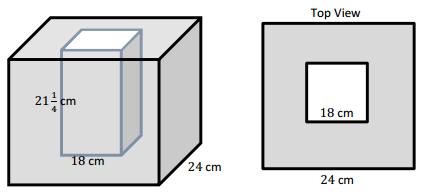
Engage NY Math 7th Grade Module 3 Lesson 26 Example Answer Key 1
The insulated box shown is made from a large cube with a hollow inside that is a right rectangular prism with a square base. The figure on the right is what the box looks like from above.
a. Calculate the volume of the outer box.
Answer:
24 cm × 24 cm × 24 cm = 13,824 cm3

b. Calculate the volume of the inner prism.
Answer:
18 cm × 18 cm × 21 \(\frac{1}{4}\) cm = 6,885 cm3

c. Describe in words how you would find the volume of the insulation.
Answer:
Find the volume of the outer cube and the inner right rectangular prism, and then subtract the two volumes.

d. Calculate the volume of the insulation in cubic centimeters.
Answer:
13,824 cm3 – 6,885 cm3 = 6,939cm3

e. Calculate the amount of water the box can hold in liters.
Answer:
6939 cm3 = 6939 mL = \(\frac{(6939 \mathrm{~mL})}{1000 \frac{\mathrm{mL}}{\mathrm{L}}}\) = 6.939 L

Eureka Math Grade 7 Module 3 Lesson 26 Exercise Answer Key

Opening Exercise
Explain to your partner how you would calculate the area of the shaded region. Then, calculate the area.
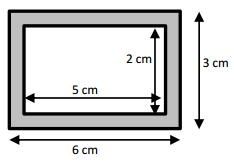
Engage NY Math Grade 7 Module 3 Lesson 26 Exercise Answer Key 1
Answer:
Find the area of the outer rectangle, and subtract the area of the inner rectangle.
6 cm × 3 cm – 5 cm × 2 cm = 8 cm2

Exercise 1: Brick Planter Design
You have been asked by your school to design a brick planter that will be used by classes to plant flowers. The planter will be built in the shape of a right rectangular prism with no bottom so water and roots can access the ground beneath. The exterior dimensions are to be 12 ft. × 9 ft. × 2 \(\frac{1}{2}\) ft. The bricks used to construct the planter are 6 in. long, 3 \(\frac{1}{2}\) in. wide, and 2 in. high.
a. What are the interior dimensions of the planter if the thickness of the planter’s walls is equal to the length of the bricks?
Answer:
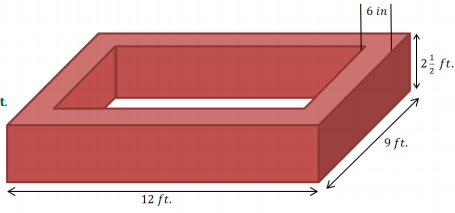
Engage NY Math Grade 7 Module 3 Lesson 26 Exercise Answer Key 2
6 in = \(\frac{1}{2}\) ft.
Interior length:
12 ft. – \(\frac{1}{2}\) ft. – \(\frac{1}{2}\) ft. = 11 ft.
Interior width:
9 ft. – \(\frac{1}{2}\) ft. – \(\frac{1}{2}\) ft. = 8 ft.
Interior dimensions:
11 ft. × 8 ft. × 2 \(\frac{1}{2}\) ft.

b. What is the volume of the bricks that form the planter?
Answer:
Solution 1
Subtract the volume of the smaller interior prism V_S from the volume of the large exterior prism V_L.
VBrick = VL – VS
VBrick = (12 ft. × 9 ft. × 2 \(\frac{1}{2}\) ft.) – (11 ft. × 8 ft. × 2 \(\frac{1}{2}\) ft.)
VBrick = 270 ft3 – 220 ft3
VBrick = 50 ft3

Solution 2
The volume of the brick is equal to the area of the base times the height.
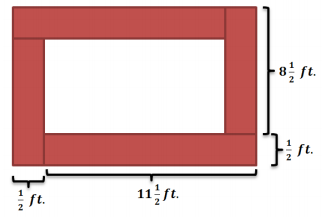
Engage NY Math Grade 7 Module 3 Lesson 26 Exercise Answer Key 3
B = \(\frac{1}{2}\) ft. × (8 \(\frac{1}{2}\) ft. + 11 \(\frac{1}{2}\) ft. + 8 \(\frac{1}{2}\) ft. + 11 \(\frac{1}{2}\) ft.)
B = \(\frac{1}{2}\) ft. × (40 ft.) = 20 ft2
V = Bh
V = (20 ft2 )(2 \(\frac{1}{2}\) ft.) = 50 ft3

c. If you are going to fill the planter \(\frac{3}{4}\) full of soil, how much soil will you need to purchase, and what will be the height of the soil?
Answer:
The height of the soil will be \(\frac{3}{4}\) of 2 \(\frac{1}{2}\)feet.
\(\frac{3}{4}\) (\(\frac{5}{2}\) ft.) = \(\frac{15}{8}\) ft.; The height of the soil will be \(\frac{15}{8}\) ft. (or 1 \(\frac{7}{8}\) ft.).
The volume of the soil in the planter:
V = (11 ft × 8 ft. × \(\frac{15}{8}\) ft.)
V = (11 ft. × 15 ft2 ) = 165 ft3

d. How many bricks are needed to construct the planter?
Answer:
P = 2(8 \(\frac{1}{2}\)ft.) + 2(11 \(\frac{1}{2}\)ft.)
P = 17 ft. + 23 ft. = 40 ft.

3 \(\frac{1}{2}\) in. = \(\frac{7}{24}\) ft.
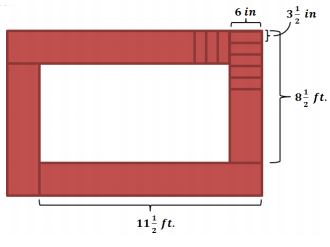
Engage NY Math Grade 7 Module 3 Lesson 26 Exercise Answer Key 4
We can then divide the perimeter by the width of each brick in order to determine the number of bricks needed for each layer of the planter.
40 ÷ \(\frac{7}{24}\) = \(\frac{960}{7}\)
40 × \(\frac{24}{7}\) = \(\frac{960}{7}\) ≈ 137.1

Each layer of the planter requires approximately 137.1 bricks.
2 in. = \(\frac{1}{6}\) ft.
The height of the planter, 2 \(\frac{1}{2}\) ft., is equal to the product of the number of layers of brick, n, and the height of each brick, \(\frac{1}{6}\) ft.
2\(\frac{1}{2}\) = l(\(\frac{1}{6}\))
6(2 \(\frac{1}{2}\)) = l
15 = l
There are 15 layers of bricks in the planter.

The total number of bricks, b, is equal to the product of the number of bricks in each layer (\(\frac{960}{7}\)) and the number of layers (15).
b = \(\frac{960}{7}\))(15)
b = \(\frac{14400}{7}\) ≈ 2057.1
It is not reasonable to purchase 0.1 brick; we must round up to the next whole brick, which is 2,058 bricks. Therefore, 2,058 bricks are needed to construct the planter.

e. Each brick used in this project costs $0.82 and weighs 4.5 lb. The supply company charges a delivery fee of $15 per whole ton (2000 lb) over 4000 lb How much will your school pay for the bricks (including delivery) to construct the planter?
Answer:
If the school purchases 2058 bricks, the total weight of the bricks for the planter,
2058(4.5 lb) = 9261 lb
The number of whole tons over 4,000 pounds,
9261 – 4000 = 5261
Since 1 ton = 2000 lb., there are 2 whole tons (4000 lb.) in 5,261 lb.
Total cost = cost of bricks + cost of delivery
Total cost = 0.82(2058) + 2(15)
Total cost = 1687.56 + 30 = 1717.56
The cost for bricks and delivery will be $1,717.56.

f. A cubic foot of topsoil weighs between 75 and 100 lb. How much will the soil in the planter weigh?
Answer:
The volume of the soil in the planter is 165 ft3.
Minimum weight:
Minimum weight = 75 lb(165)
Minimum weight = 12375 lb.

Maximum weight:
Maximum weight = 100 lb(165)
Maximum weight = 16500 lb.
The soil in the planter will weigh between 12,375 lb. and 16,500 lb.

g. If the topsoil costs $0.88 per cubic foot, calculate the total cost of materials that will be used to construct the planter.
Answer:
The total cost of the top soil:
Cost = 0.88(165) = 145.2; The cost of the top soil will be $145.20.
The total cost of materials for the brick planter project:
Cost = (cost of bricks) + (cost of soil)
Cost = $1,717.56 + $145.20
Cost = $1,862.76
The total cost of materials for the brick planter project will be $1,862.76.

Exercise 2: Design a Feeder
You did such a good job designing the planter that a local farmer has asked you to design a feeder for the animals on his farm. Your feeder must be able to contain at least 100,000 cubic centimeters, but not more than 200,000 cubic centimeters of grain when it is full. The feeder is to be built of stainless steel and must be in the shape of a right prism but not a right rectangular prism. Sketch your design below including dimensions. Calculate the volume of grain that it can hold and the amount of metal needed to construct the feeder.
The farmer needs a cost estimate. Calculate the cost of constructing the feeder if \(\frac{1}{2}\) cm thick stainless steel sells for $93.25 per square meter.
Answer:
Answers will vary. Below is an example using a right trapezoidal prism.
This feeder design consists of an open – top container in the shape of a right trapezoidal prism. The trapezoidal sides of the feeder will allow animals easier access to feed at its bottom. The dimensions of the feeder are shown in the diagram.
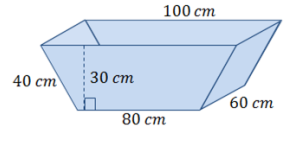
Engage NY Math Grade 7 Module 3 Lesson 26 Exercise Answer Key 5
B = \(\frac{1}{2}\)(b1 + b2 )h
B = \(\frac{1}{2}\) (100 cm + 80 cm)∙30 cm
B = \(\frac{1}{2}\) (180 cm)∙30 cm
B = 90 cm∙30 cm
B = 2700 cm2

V = Bh
V = (2,700 cm2 )(60 cm)
V = 162,000 cm3

The volume of the solid prism is 162,000 cm3, so the volume that the feeder can contain is slightly less, depending on the thickness of the metal used.

The exterior surface area of the feeder tells us the area of metal required to build the feeder.
SA = (LA – Atop) + 2B
SA = 60 cm∙(40 cm + 80 cm + 40 cm) + 2(2,700 cm2 )
SA = 60 cm(160 cm) + 5,400 cm2
SA = 9,600 cm2 + 5,400 cm2
SA = 15,000 cm2
The feeder will require 15,000 cm2 of metal.
1 m2 = 10,000 cm2, so 15,000 cm2 = 1.5 m2
Cost = 93.25(1.5) = 139.875
Since this is a measure of money, the cost must be rounded to the nearest cent, which is $139.88.

Eureka Math Grade 7 Module 3 Lesson 26 Problem Set Answer Key

Question 1.
A child’s toy is constructed by cutting a right triangular prism out of a right rectangular prism.
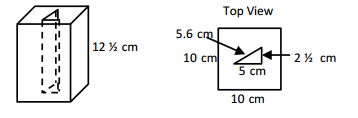
Eureka Math 7th Grade Module 3 Lesson 26 Problem Set Answer Key 1
a. Calculate the volume of the rectangular prism.
Answer:
10 cm × 10 cm × 12 \(\frac{1}{2}\) cm = 1250 cm3

b. Calculate the volume of the triangular prism.
Answer:
\(\frac{1}{2}\) (5 cm × 2 \(\frac{1}{2}\) cm) × 12 \(\frac{1}{2}\) cm = 78 \(\frac{1}{8}\) cm3

c. Calculate the volume of the material remaining in the rectangular prism.
Answer:
1250 cm3 – 78 \(\frac{1}{8}\) cm3 = 1171 \(\frac{7}{8}\) cm3

d.
What is the largest number of triangular prisms that can be cut from the rectangular prism?
Answer:
\(\frac{1250 \mathrm{~cm}^{3}}{78 \frac{1}{8} \mathrm{~cm}^{3}}\) = 16

e. What is the surface area of the triangular prism (assume there is no top or bottom)?
Answer:
5.6 cm × 12 \(\frac{1}{2}\) cm + 2 \(\frac{1}{2}\) cm × 12 \(\frac{1}{2}\) cm + 5 cm × 12 \(\frac{1}{2}\) cm = 163 \(\frac{3}{4}\) cm2

Question 2.
A landscape designer is constructing a flower bed in the shape of a right trapezoidal prism. He needs to run three identical square prisms through the bed for drainage.
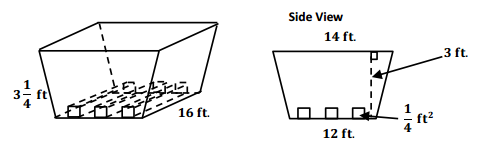
Eureka Math 7th Grade Module 3 Lesson 26 Problem Set Answer Key 2
a. What is the volume of the bed without the drainage pipes?
Answer:
\(\frac{1}{2}\) (14 ft. + 12 ft.) × 3 ft. × 16 ft. = 624 ft3

b. What is the total volume of the three drainage pipes?
Answer:
3(\(\frac{1}{4}\) ft2 × 16 ft.) = 12 ft3

c. What is the volume of soil if the planter is filled to 3/4 of its total capacity with the pipes in place?
Answer:
\(\frac{3}{4}\) (624 ft3 ) – 12 ft3 = 456 ft3

d. What is the height of the soil? If necessary, round to the nearest tenth.
Answer:
\(\frac{456 \mathrm{ft}^{3}}{\frac{1}{2}(14 \mathrm{ft} + 12 \mathrm{ft}) \times 16 \mathrm{ft}}\)≈ 2.2 ft.

e. If the bed is made of 8 ft. × 4 ft. pieces of plywood, how many pieces of plywood will the landscape designer need to construct the bed without the drainage pipes?
Answer:
2(3 \(\frac{1}{4}\) ft. × 16 ft.) + 12 ft. × 16 ft. + 2(\(\frac{1}{2}\) (12 ft. + 14 ft.) × 3 ft.) = 374 ft2
374 ft2 ÷ \(\frac{(8 \mathrm{ft} \times 4 \mathrm{ft})}{\text { piece of plywood }}\) = 11.7, or 12 pieces of plywood

f. If the plywood needed to construct the bed costs $35 per 8 ft. × 4 ft. piece, the drainage pipes cost $125 each, and the soil costs $1.25/cubic foot, how much does it cost to construct and fill the bed?
Answer:
\(\frac{\$ 35}{\text { piece of plywood }}\)(12 pieces of plywood) + \(\frac{\$ 125}{\text { pipe }}\) (3 pipes) + \(\frac{\$ 1.25}{f t^{3} \text { soil }}\)(456 ft3 soil) = $1,365.00

Eureka Math Grade 7 Module 3 Lesson 26 Exit Ticket Answer Key

Lawrence is designing a cooling tank that is a square prism. A pipe in the shape of a smaller 2 ft × 2 ft square prism passes through the center of the tank as shown in the diagram, through which a coolant will flow.
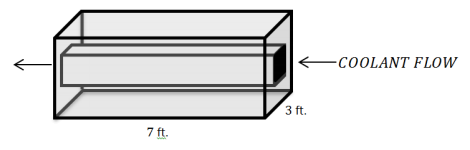
Eureka Math Grade 7 Module 3 Lesson 26 Exit Ticket Answer Key 1
a. What is the volume of the tank including the cooling pipe?
Answer:
7 ft. × 3 ft. × 3 ft. = 63 ft3

b. What is the volume of coolant that fits inside the cooling pipe?
Answer:
2 ft. × 2 ft. × 7 ft. = 28 ft3

c. What is the volume of the shell (the tank not including the cooling pipe)?
Answer:
63 ft3 – 28 ft3 = 35 ft3

d. Find the surface area of the cooling pipe.
Answer:
2 ft. × 7 ft. × 4 = 56 ft2

Eureka Math Grade 7 Module 4 Lesson 17 Answer Key

Engage NY Eureka Math 7th Grade Module 4 Lesson 17 Answer Key

Eureka Math Grade 7 Module 4 Lesson 17 Example Answer Key

Example 1.
A 5 – gallon container of trail mix is 20% nuts. Another trail mix is added to it, resulting in a 12 – gallon container of trail mix that is 40% nuts.
a. Write an equation to describe the relationships in this situation.
Answer:
Let j represent the percent of nuts in the second trail mix that is added to the first trail mix to create the resulting 12 – gallon container of trail mix.
0.4(12) = 0.2(5) + j(12 – 5)

b. Explain in words how each part of the equation relates to the situation.
Answer:
Quantity = Percent×Whole
(Resulting gallons of trail mix)(Resulting % of nuts) = (1st trail mix in gallons)(% of nuts) + (2nd trail mix in gallons)(% of nuts)

c. What percent of the second trail mix is nuts?
Answer:
4.8 = 1 + 7j
4.8 – 1 = 1 – 1 + 7j
3.8 = 7j
j ≈ 0.5429
About 54% of the second trail mix is nuts.

Example 2.
Soil that contains 30% clay is added to soil that contains 70% clay to create 10 gallons of soil containing 50% clay. How much of each of the soils was combined?
Answer:
Let x be the amount of soil with 30% clay.
(1st soil amount)(% of clay) + (2nd soil amount)(% of clay) = (resulting amount)(resulting % of clay)
(0.3)(x) + (0.7)(10 – x) = (0.5)(10)
0.3x + 7 – 0.7x = 5
– 0.4x + 7 – 7 = 5 – 7
– 0.4x = – 2
x = 5
5 gallons of the 30% clay soil and 10 – 5 = 5, so 5 gallons of the 70% clay soil must be mixed to make 10 gallons of 50% clay soil.

Eureka Math Grade 7 Module 4 Lesson 17 Exercise Answer Key

Opening Exercise
Imagine you have two equally – sized containers. One is pure water, and the other is 50% water and 50% juice. If you combined them, what percent of juice would be the result?
Engage NY Math Grade 7 Module 4 Lesson 17 Exercise Answer Key 1
Answer:
Engage NY Math Grade 7 Module 4 Lesson 17 Exercise Answer Key 2
25% of the resulting mixture is juice because \(\frac{0.5}{2}\) = \(\frac{1}{4}\).

If a 2 – gallon container of pure juice is added to 3 gallons of water, what percent of the mixture is pure juice?
Engage NY Math Grade 7 Module 4 Lesson 17 Exercise Answer Key 3
Answer:
Let x represent the percent of pure juice in the resulting juice mixture.
Engage NY Math Grade 7 Module 4 Lesson 17 Exercise Answer Key 4

If a 2 – gallon container of juice mixture that is 40% pure juice is added to 3 gallons of water, what percent of the mixture is pure juice?
Engage NY Math Grade 7 Module 4 Lesson 17 Exercise Answer Key 5
Answer:
Engage NY Math Grade 7 Module 4 Lesson 17 Exercise Answer Key 6
→ How many gallons of the juice mixture is pure juice?
(2 gallons)(0.40) = 0.8 gallons

→ What percent is pure juice out of the resulting mixture?
16%

→ Does this make sense relative to the prior problem?
Yes, because the mixture should have less juice than in the prior problem

If a 2 – gallon juice cocktail that is 40% pure juice is added to 3 gallons of pure juice, what percent of the resulting mixture is pure juice?
Engage NY Math Grade 7 Module 4 Lesson 17 Exercise Answer Key 7
Answer:
Engage NY Math Grade 7 Module 4 Lesson 17 Exercise Answer Key 8
What is the difference between this problem and the previous one?
Instead of adding water to the two gallons of juice mixture, pure juice is added, so the resulting liquid contains 3.8 gallons of pure juice.
What percent is pure juice out of the resulting mixture?
Let x represent the percent of pure juice in the resulting mixture.
x(5) = 40%(2) + 100%(3)
5x = 0.8 + 3
5x = 3.8
x = 0.76
The mixture is 76% pure juice.

Exercise 1.
Represent each situation using an equation, and show all steps in the solution process.
a. A 6 – pint mixture that is 25% oil is added to a 3 – pint mixture that is 40% oil. What percent of the resulting mixture is oil?
Answer:
Let x represent the percent of oil in the resulting mixture.
0.25(6) + 0.40(3) = x(9)
1.5 + 1.2 = 9x
2.7 = 9x
x = 0.3
The resulting 9 – pint mixture is 30% oil.

b. An 11 – ounce gold chain of 24% gold was made from a melted down 4 – ounce charm of 50% gold and a golden locket. What percent of the locket was pure gold?
Let x represent the percent of pure gold in the locket.
0.5(4) + (x)(7) = 0.24(11)
2 + 7x = 2.64
2 – 2 + 7x = 2.64 – 2
\(\frac{7x}{7}\) = \(\frac{0.64}{7}\)
x≈0.0914
The locket was about 9% gold.

c. In a science lab, two containers are filled with mixtures. The first container is filled with a mixture that is 30% acid. The second container is filled with a mixture that is 50% acid, and the second container is 50% larger than the first. The first and second containers are then emptied into a third container. What percent of acid is in the third container?
Answer:
Let m represent the total amount of mixture in the first container.
0.3m is the amount of acid in the first container.
0.5(m + 0.5m) is the amount of acid in the second container.
0.3m + 0.5(m + 0.5m) = 0.3m + 0.5(1.5m) = 1.05m is the amount of acid in the mixture in the third container.
m + 1.5m = 2.5m is the amount of mixture in the third container. So, \(\frac{1.05 m}{2.5 m}\) = 0.42 = 42% is the percent of acid in the third container.

Exercise 2.
The equation (0.2)(x) + (0.8)(6 – x) = (0.4)(6) is used to model a mixture problem.
a. How many units are in the total mixture?
Answer:
6 units

b. What percents relate to the two solutions that are combined to make the final mixture?
Answer:
20% and 80%

c. The two solutions combine to make 6 units of what percent solution?
Answer:
40%

d. When the amount of a resulting solution is given (for instance, 4 gallons) but the amounts of the mixing solutions are unknown, how are the amounts of the mixing solutions represented?
Answer:
If the amount of gallons of the first mixing solution is represented by the variable x, then the amount of gallons of the second mixing solution is 4 – x.

Eureka Math Grade 7 Module 4 Lesson 17 Problem Set Answer Key

Question 1.
A 5 – liter cleaning solution contains 30% bleach. A 3 – liter cleaning solution contains 50% bleach. What percent of bleach is obtained by putting the two mixtures together?
Answer:
Let x represent the percent of bleach in the resulting mixture.
0.3(5) + 0.5(3) = x(8)
1.5 + 1.5 = 8x
3 ÷ 8 = 8x ÷ 8
x = 0.375
The percent of bleach in the resulting cleaning solution is 37.5%.

Question 2.
A container is filled with 100 grams of bird feed that is 80% seed. How many grams of bird feed containing 5% seed must be added to get bird feed that is 40% seed?
Answer:
Let x represent the amount of bird feed, in grams, to be added.
0.8(100) + 0.05x = 0.4(100 + x)
80 + 0.05x = 40 + 0.4x
80 – 40 + 0.05x = 40 – 40 + 0.4x
40 + 0.05x = 0.4x
40 + 0.05x – 0.05x = 0.4x – 0.05x
40 ÷ 0.35 = 0.35x ÷ 0.35
x ≈ 114.3
About 114.3 grams of the bird seed containing 5% seed must be added.

Question 3.
A container is filled with 100 grams of bird feed that is 80% seed. Tom and Sally want to mix the 100 grams with bird feed that is 5% seed to get a mixture that is 40% seed. Tom wants to add 114 grams of the 5% seed, and Sally wants to add 115 grams of the 5% seed mix. What will be the percent of seed if Tom adds 114 grams? What will be the percent of seed if Sally adds 115 grams? How much do you think should be added to get 40% seed?
Answer:
If Tom adds 114 grams, then let x be the percent of seed in his new mixture. 214x = 0.8(100) + 0.05(114). Solving, we get the following:
x = \(\frac{80 + 5.7}{214}\) = \(\frac{85.7}{214}\) ≈ 0.4005 = 40.05%.
If Sally adds 115 grams, then let y be the percent of seed in her new mixture. 215y = 0.8(100) + 0.05(115). Solving, we get the following:
y = \(\frac{80 + 5.75}{215}\) = \(\frac{85.75}{215}\) ≈ 0.3988 = 39.88%.
The amount to be added should be between 114 and 115 grams. It should probably be closer to 114 because 40.05% is closer to 40% than 39.88%.

Question 4.
Jeanie likes mixing leftover salad dressings together to make new dressings. She combined 0.55 L of a 90% vinegar salad dressing with 0.45 L of another dressing to make 1 L of salad dressing that is 60% vinegar. What percent of the second salad dressing was vinegar?
Answer:
Let c represent the percent of vinegar in the second salad dressing.
0.55(0.9) + (0.45)(c) = 1(0.6)
0.495 + 0.45c = 0.6
0.495 – 0.495 + 0.45c = 0.6 – 0.495
0.45c = 0.105
0.45c ÷ 0.45 = 0.105 ÷ 0.45
c ≈ 0.233
The second salad dressing was around 23% vinegar.

Question 5.
Anna wants to make 30 mL of a 60% salt solution by mixing together a 72% salt solution and a 54% salt solution. How much of each solution must she use?
Answer:
Let s represent the amount, in milliliters, of the first salt solution.
0.72(s) + 0.54(30 – s) = 0.60(30)
0.72s + 16.2 – 0.54s = 18
0.18s + 16.2 = 18
0.18s + 16.2 – 16.2 = 18 – 16.2
0.18s = 1.8
s = 10
Anna needs 10 mL of the 72% solution and 20 mL of the 54% solution.

Question 6.
A mixed bag of candy is 25% chocolate bars and 75% other filler candy. Of the chocolate bars, 50% of them contain caramel. Of the other filler candy, 10% of them contain caramel. What percent of candy contains caramel?
Answer:
Let c represent the percent of candy containing caramel in the mixed bag of candy.
0.25(0.50) + (0.75)(0.10) = 1(c)
0.125 + 0.075 = c
0.2 = c
In the mixed bag of candy, 20% of the candy contains caramel.

Question 7.
A local fish market receives the daily catch of two local fishermen. The first fisherman’s catch was 84% fish while the rest was other non – fish items. The second fisherman’s catch was 76% fish while the rest was other non – fish items. If the fish market receives 75% of its catch from the first fisherman and 25% from the second, what was the percent of other non – fish items the local fish market bought from the fishermen altogether?
Answer:
Let n represent the percent of non – fish items of the total market items.
0.75(0.16) + 0.25(0.24) = n
0.12 + 0.06 = n
0.18 = n
The percent of non – fish items in the local fish market is 18%.

Eureka Math Grade 7 Module 4 Lesson 17 Exit Ticket Answer Key

A 25% vinegar solution is combined with triple the amount of a 45% vinegar solution and a 5% vinegar solution resulting in 20 milliliters of a 30% vinegar solution.
Question 1.
Determine an equation that models this situation, and explain what each part represents in the situation.
Answer:
Let s represent the number of milliliters of the first vinegar solution.
(0.25)(s) + (0.45)(3s) + (0.05)(20 – 4s) = (0.3)(20)
(0.25)(s) represents the amount of the 25% vinegar solution.
(0.45)(3s) represents the amount of the 45% vinegar solution, which is triple the amount of the 25% vinegar solution.
(0.05)(20 – 4s) represents the amount of the 5% vinegar solution, which is the amount of the remainder of the solution.
(0.3)(20) represents the result of the mixture, which is 20 mL of a 30% vinegar solution.

Question 2.
Solve the equation and find the amount of each of the solutions that were combined.
Answer:
0.25s + 1.35s + 1 – 0.2s = 6
1.6s – 0.2s + 1 = 6
1.4s + 1 – 1 = 6 – 1
1.4s ÷ 1.4 = 5 ÷ 1.4
s ≈ 3.57
3s ≈ 3(3.57) = 10.71
20 – 4s ≈ 20 – 4(3.57) = 5.72
Around 3.57 mL of the 25% vinegar solution, 10.71 mL of the 45% vinegar solution and 5.72 mL of the
5% vinegar solution were combined to make 20 mL of the 30% vinegar solution.

Eureka Math Grade 7 Module 4 Lesson 15 Answer Key

Engage NY Eureka Math 7th Grade Module 4 Lesson 15 Answer Key

Eureka Math Grade 7 Module 4 Lesson 15 Example Answer Key

Example 1.
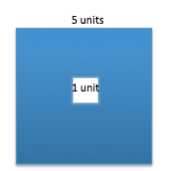
What percent of the area of the large square is the area of the small square?
Engage NY Math 7th Grade Module 4 Lesson 15 Example Answer Key 1
Answer:
Scale factor of the large square to the small square: \(\frac{1}{5}\)
Area of the large square to the small square: (\(\frac{1}{5}\))2 = \(\frac{1}{25}\) = \(\frac{4}{100}\) = 0.04 = 4%
The area of the small square is only 4% of the area of the large square.

Example 2.
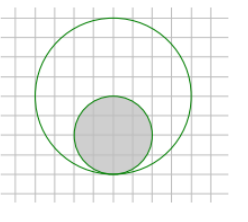
What percent of the area of the large disk lies outside the shaded disk?
Engage NY Math 7th Grade Module 4 Lesson 15 Example Answer Key 2
Answer:
Radius of the shaded disk = 2
Radius of large disk = 4
Scale factor of the large disk to the shaded disk: \(\frac{2}{4}\) = \(\frac{1}{2}\)
Area of the large disk to the shaded disk:
(\(\frac{1}{2}\))2 = \(\frac{1}{4}\) = 25%
Area outside shaded disk: \(\frac{3}{4}\) = 75%

Example 3.
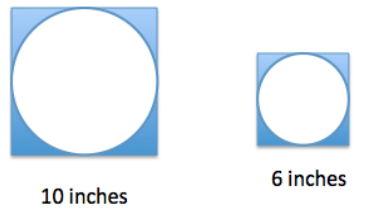
If the area of the shaded region in the larger figure is approximately 21.5 square inches, write an equation that relates the areas using scale factor and explain what each quantity represents. Determine the area of the shaded region in the smaller scale drawing.
Engage NY Math 7th Grade Module 4 Lesson 15 Example Answer Key 3
Answer:
Scale factor of corresponding sides:
\(\frac{6}{10}\) = \(\frac{3}{5}\) = 60%

Area of shaded region of smaller figure: Assume A is the area of the shaded region of the larger figure.
(\(\frac{3}{5}\))2 A = \(\frac{9}{25}\) A
= \(\frac{9}{25}\)(21.5)
= 7.74
In this equation, the square of the scale factor, (\(\frac{3}{5}\))2, multiplied by the area of the shaded region in the larger figure, 21.5 sq.in., is equal to the area of the shaded region of the smaller figure, 7.74 sq.in.
The area of shaded region of the smaller scale drawing is about 7.74 sq.in.

Example 4.
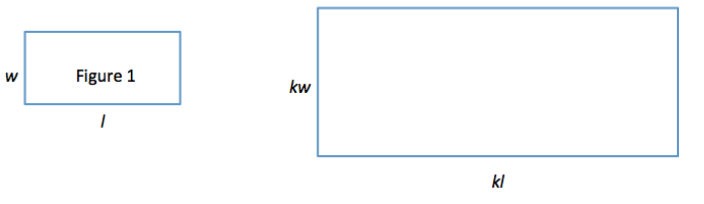
Use Figure 1 below and the enlarged scale drawing to justify why the area of the scale drawing is k2 times the area of the original figure.
Engage NY Math 7th Grade Module 4 Lesson 15 Example Answer Key 4
Answer:
Area of Figure 1: Area of scale drawing:
Area = lw Area = lw
Area = (kl)(kw)
Area = k2 lw
Since the area of Figure 1 is lw, the area of the scale drawing is k2 multiplied by the area of Figure 1.

Explain why the expressions (kl)(kw) and k2 lw are equivalent. How do the expressions reveal different information about this situation?
Answer:
(kl)(kw) is equivalent to klkw by the associative property, which can be written kklw using the commutative property. This is sometimes known as “any order, any grouping.” kklw is equal to k2 lw because k × k = k2. (kl)(kw) shows the area as the product of each scaled dimension, while k2 lw shows the area as the scale factor squared, times the original area (lw).

Eureka Math Grade 7 Module 4 Lesson 15 Exercise Answer Key

Opening Exercise
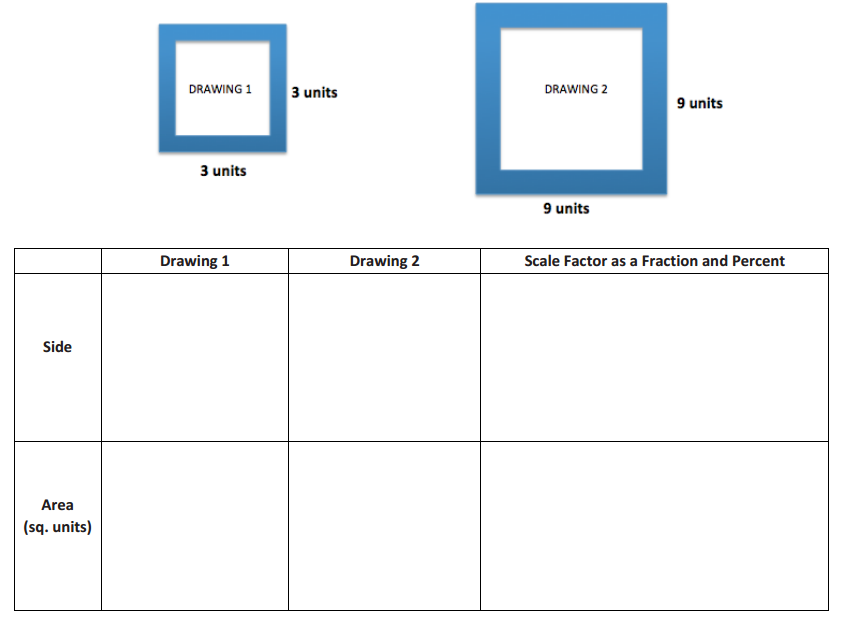
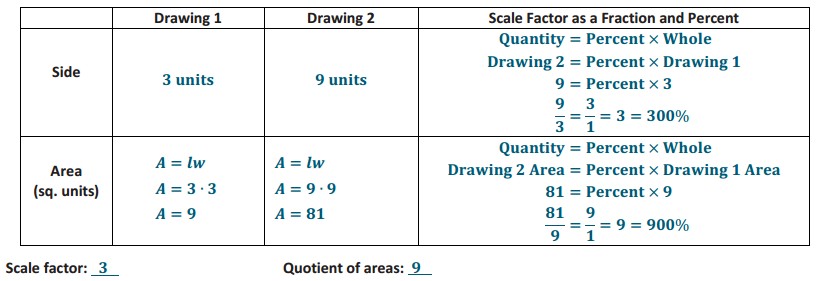
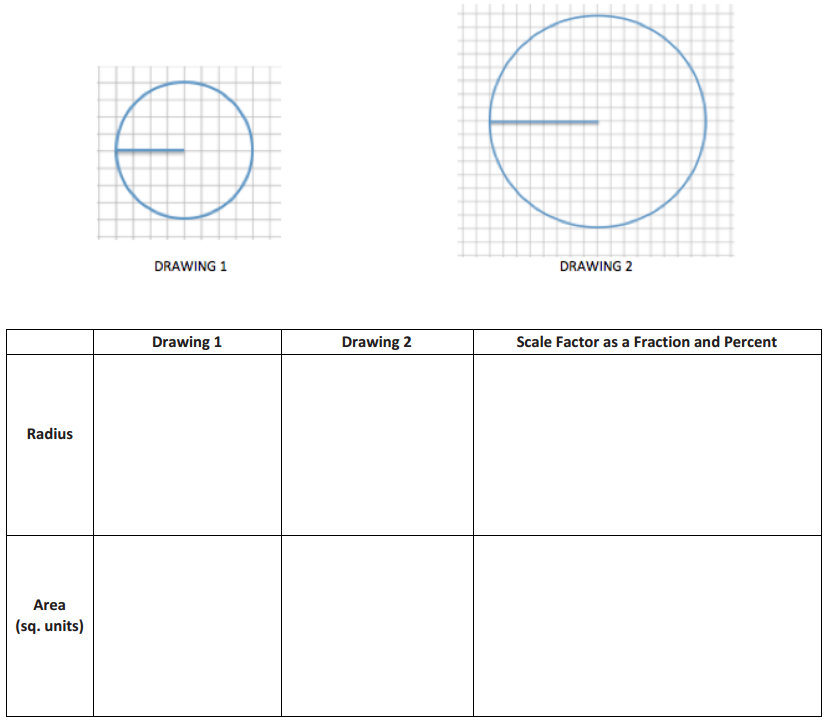
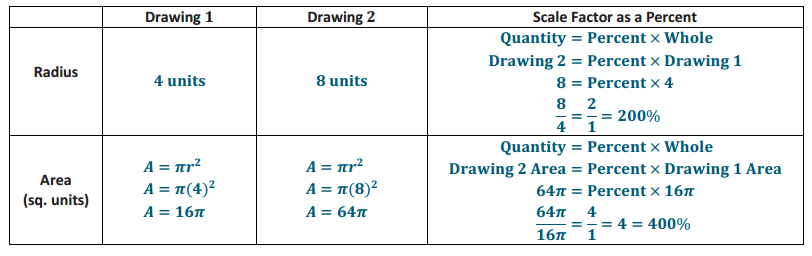
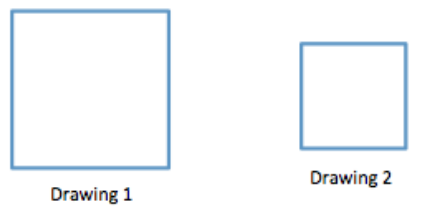
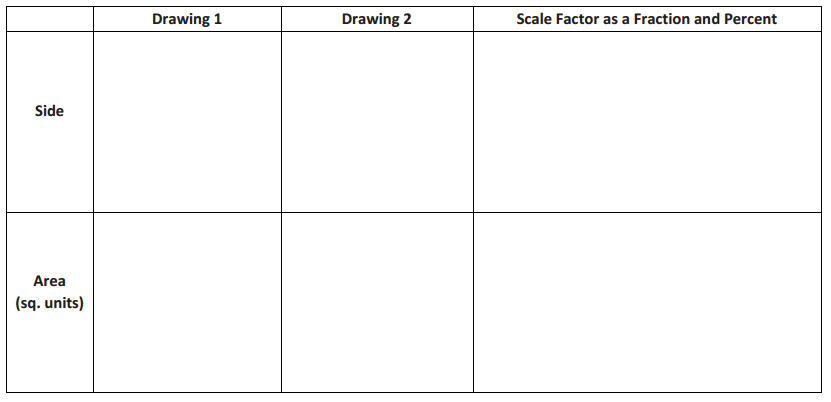
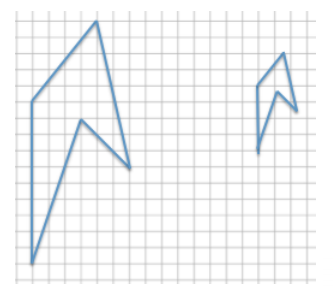
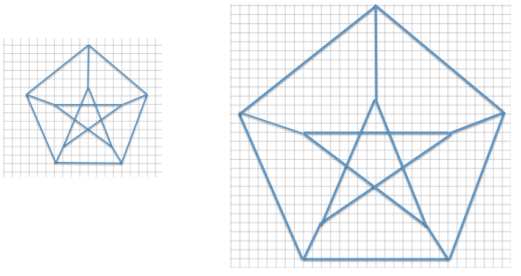
For each diagram, Drawing 2 is a scale drawing of Drawing 1. Complete the accompanying charts. For each drawing, identify the side lengths, determine the area, and compute the scale factor. Convert each scale factor into a fraction and percent, examine the results, and write a conclusion relating scale factors to area.
Engage NY Math Grade 7 Module 4 Lesson 15 Exercise Answer Key 1
Answer:
Engage NY Math Grade 7 Module 4 Lesson 15 Exercise Answer Key 2

Engage NY Math Grade 7 Module 4 Lesson 15 Exercise Answer Key 3
Answer:
Engage NY Math Grade 7 Module 4 Lesson 15 Exercise Answer Key 4

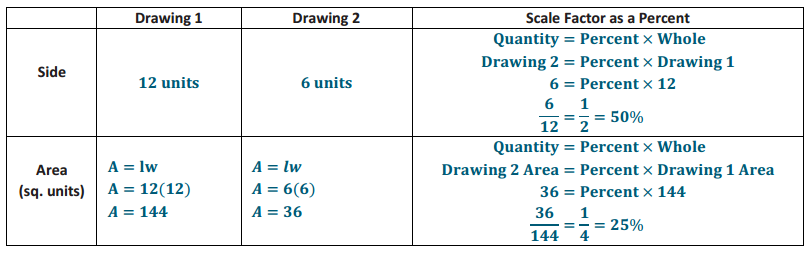
The length of each side in Drawing 1 is 12 units, and the length of each side in Drawing 2 is 6 units.
Engage NY Math Grade 7 Module 4 Lesson 15 Exercise Answer Key 5.1
Engage NY Math Grade 7 Module 4 Lesson 15 Exercise Answer Key 5
Answer:
Engage NY Math Grade 7 Module 4 Lesson 15 Exercise Answer Key 6
Scale factor: \(\frac{1}{2}\)
Quotient of areas: \(\frac{1}{4}\)
Conclusion: (\(\frac{1}{2}\))(\(\frac{1}{2}\)) = (\(\frac{1}{2}\))2 = \(\frac{1}{4}\)
The quotient of the areas is equal to the square of the scale factor.

Exercise 1.
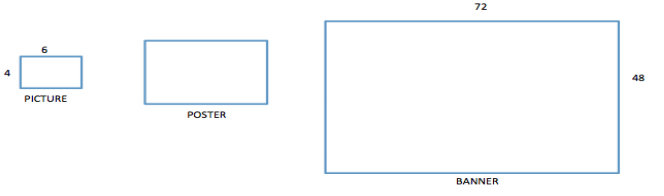
The Lake Smith basketball team had a team picture taken of the players, the coaches, and the trophies from the season. The picture was 4 inches by 6 inches. The team decided to have the picture enlarged to a poster and then enlarged again to a banner measuring 48 inches by 72 inches.
a. Sketch drawings to illustrate the original picture and enlargements.
Answer:
Engage NY Math Grade 7 Module 4 Lesson 15 Exercise Answer Key 7

b. If the scale factor from the picture to the poster is 500%, determine the dimensions of the poster.
Answer:
Quantity = Percent × Whole
Poster height = Percent × Picture height
Poster height = 500% × 4 in.
Poster height = (5.00)(4 in.)
Poster height = 20 in.

Quantity = Percent × Whole
Poster width = Percent × Picture width
Poster width = 500% × 6 in.
Poster width = (5.00)(6 in.)
Poster width = 30 in.

The dimensions of the poster are 20 in. by 30 in.

c. What scale factor is used to create the banner from the picture?
Answer:
Quantity = Percent × Whole
Banner width = Percent × Picture width
72 = Percent × 6
\(\frac{72}{6}\) = Percent
12 = 1,200%

Quantity = Percent × Whole
Banner height = Percent × Picture height
48 = Percent × 4
\(\frac{48}{4}\) = Percent
12 = 1,200%

The scale factor used to create the banner from the picture is 1,200%.

d. What percent of the area of the picture is the area of the poster? Justify your answer using the scale factor and by finding the actual areas.
Answer:
Area of picture:
A = lw
A = (4)(6)
A = 24
Area = 24 sq.in.

Area of poster:
A = lw
A = (20)(30)
A = 600
Area = 600 sq.in.

Quantity = Percent × Whole
Area of Poster = Percent × Area of Picture
600 = Percent × 24
\(\frac{600}{24}\) = Percent
25 = 2,500%

Using scale factor:
Scale factor from picture to poster was given earlier in the problem as 500% = \(\frac{500}{100}\) = 5.
The area of the poster is the square of the scale factor times the corresponding area of the picture. So, the area of the poster is ????,????????????% the area of the original picture.

e. Write an equation involving the scale factor that relates the area of the poster to the area of the picture.
Answer:
Quantity = Percent × Whole
Area of Poster = Percent × Area of Picture
A = 2,500% p
A = 25p

f. Assume you started with the banner and wanted to reduce it to the size of the poster. What would the scale factor as a percent be?
Answer:
Banner dimensions: 48 in. × 72 in.
Poster dimensions: 20 in. × 30 in.
Quantity = Percent × Whole
Poster = Percent × Banner
30 = Percent × 72
\(\frac{30}{72}\) = \(\frac{5}{12}\) = \(\frac{5}{12}\) × 100% = 41 \(\frac{2}{3}\)%

g. What scale factor would be used to reduce the poster to the size of the picture?
Answer:
Poster dimensions: 20 in. × 30 in.
Picture dimensions: 4 in. × 6 in.
Quantity = Percent × Whole
Picture width = Percent × Poster width
6 = Percent × 30
\(\frac{6}{30}\) = \(\frac{1}{5}\) = 0.2 = 20%

Eureka Math Grade 7 Module 4 Lesson 15 Problem Set Answer Key

Question 1.
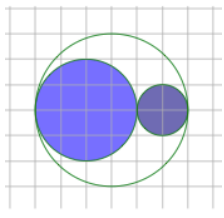
What percent of the area of the larger circle is shaded?
Eureka Math 7th Grade Module 4 Lesson 15 Problem Set Answer Key 1
a. Solve this problem using scale factors.
Answer:
Scale factors:
Shaded small circle: radius = 1 unit
Shaded medium circle: radius = 2 units
Large circle: radius = 3 units, area = A
Area of small circle: (\(\frac{1}{3}\))2 A = \(\frac{1}{9}\) A
Area of medium circle: (\(\frac{2}{3}\))2 A = \(\frac{4}{9}\) A
Area of shaded region: \(\frac{1}{9}\) A + 4/9 A = \(\frac{5}{9}\) A = \(\frac{5}{9}\) A × 100% = 55 \(\frac{5}{9}\)%A
The area of the shaded region is 55 \(\frac{5}{9}\)% of the area of the entire circle.

b. Verify your work in part (a) by finding the actual areas.
Areas:
Answer:
Small circle: A = πr2
A = π(1 unit)2
A = 1π unit2
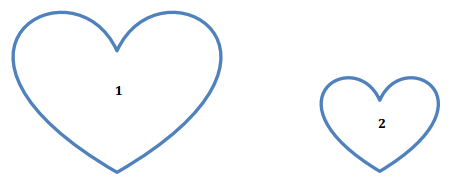
Medium circle: A = πr2
A = π(2 units)2
A = 4π units2
Area of shaded circles: 1π unit2 + 4π units2 = 5π units2
Large circle: A = πr2
A = π(3 units)2
A = 9π units2
Percent of shaded to large circle: \(\frac{5 \pi \text { units }^{2}}{9 \pi \text { units }^{2}}\) = \(\frac{5}{9}\) = \(\frac{5}{9}\) × 100% = 55 \(\frac{5}{9}\)%

Question 2.
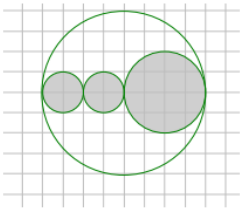
The area of the large disk is 50.24 units2.
Eureka Math 7th Grade Module 4 Lesson 15 Problem Set Answer Key 2
a. Find the area of the shaded region using scale factors. Use 3.14 as an estimate for π.
Answer:
Radius of small shaded circles = 1 unit
Radius of larger shaded circle = 2 units
Radius of large disk = 4 units
Scale factor of shaded region:
Small shaded circles: \(\frac{1}{4}\)
Large shaded circle: \(\frac{2}{4}\)
If A represents the area of the large disk, then the total shaded area:
(\(\frac{1}{4}\))2 A + (\(\frac{1}{4}\))2 A + (\(\frac{2}{4}\))2 A
= \(\frac{1}{16}\) A + \(\frac{1}{16}\) A + \(\frac{4}{16}\) A
= \(\frac{6}{16}\) A
= \(\frac{6}{16}\)(50.24 units2)
The area of the shaded region is 18.84 units2.

b. What percent of the large circular region is unshaded?
Answer:
Area of the shaded region is 18.84 square units. Area of total is 50.24 square units. Area of the unshaded region is 31.40 square units. Percent of large circular region that is unshaded is
\(\frac{31.4}{50.24}\) = \(\frac{5}{8}\) = 0.625 = 62.5%.

Question 3.
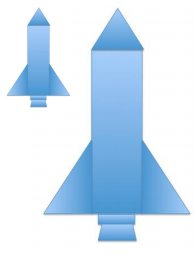
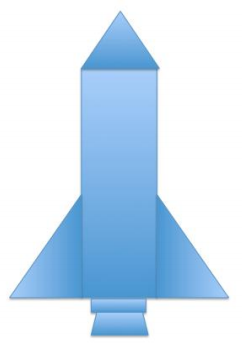
Ben cut the following rockets out of cardboard. The height from the base to the tip of the smaller rocket is 20 cm. The height from the base to the tip of the larger rocket is 120 cm. What percent of the area of the smaller rocket is the area of the larger rocket?
Eureka Math 7th Grade Module 4 Lesson 15 Problem Set Answer Key 3
Answer:
Height of smaller rocket: 20 cm
Height of larger rocket: 120 cm
Scale factor:
Quantity = Percent × Whole
Actual height of larger rocket = Percent × height of smaller rocket
120 = Percent × 20
6 = Percent
600%
Area of larger rocket:
(scale factor)2 (area of smaller rocket)
(6)2 (area of smaller rocket)
36A
36 = 36 × 100% = 3,600%
The area of the larger rocket is 3,600% the area of the smaller rocket.

Question 4.
In the photo frame depicted below, three 5 inch by 5 inch squares are cut out for photographs. If these cut-out regions make up 3/16 of the area of the entire photo frame, what are the dimensions of the photo frame?
Eureka Math 7th Grade Module 4 Lesson 15 Problem Set Answer Key 4
Answer:
Since the cut-out regions make up \(\frac{3}{16}\) of the entire photo frame, then each cut-out region makes up (\(\frac{\frac{3}{16}}{3}\) = \(\frac{1}{16}\) of the entire photo frame.
The relationship between the area of the scale drawing is
(square factor)2 × area of original drawing.

The area of each cut-out is \(\frac{1}{16}\) of the area of the original photo frame. Therefore, the square of the scale factor is \(\frac{1}{16}\). Since (\(\frac{1}{4}\))2 = \(\frac{1}{16}\), the scale factor that relates the cut-out to the entire photo frame is \(\frac{1}{4}\), or 25%.
To find the dimensions of the square photo frame:
Quantity = Percent × Whole
Small square side length = Percent × Photo frame side length
5 in. = 25% × Photo frame side length
5 in. = \(\frac{1}{4}\) × Photo frame side length
4(5) in. = 4(\(\frac{1}{4}\)) × Photo frame side length
20 in. = Photo frame side length
The dimensions of the square photo frame are 20 in. by 20 in.

Question 5.
Kelly was online shopping for envelopes for party invitations and saw these images on a website.
Eureka Math 7th Grade Module 4 Lesson 15 Problem Set Answer Key 5
The website listed the dimensions of the small envelope as 6 in. by 8 in. and the medium envelope as 10 in. by 13 \(\frac{1}{3}\) in.
a. Compare the dimensions of the small and medium envelopes. If the medium envelope is a scale drawing of the small envelope, what is the scale factor?
Answer:
To find the scale factor,
Quantity = Percent × Whole
Medium height = Percent × small height
10 = Percent × 6
\(\frac{10}{6}\) = \(\frac{5}{3}\) = \(\frac{5}{3}\) × 100% = 166 \(\frac{2}{3}\)%

Quantity = Percent × Whole
Medium width = Percent × Small width
13 \(\frac{1}{3}\) = Percent × 8
\(\frac{13 \frac{1}{3}}{8}\) = \(\frac{5}{3}\) = \(\frac{5}{3}\) × 100% = 166 \(\frac{2}{3}\)%

b. If the large envelope was created based on the dimensions of the small envelope using a scale factor of 250%, find the dimensions of the large envelope.
ans;:
Scale factor is 250%, so multiply each dimension of the small envelope by 2.50.
Large envelope dimensions are as follows:
(6 in.)(2.5) = 15 in.
(8 in.)(2.5) = 20 in.

c. If the medium envelope was created based on the dimensions of the large envelope, what scale factor was used to create the medium envelope?
Answer:
Scale factor:
Quantity = Percent × Whole
Medium = Percent × Large
10 = Percent × 15
\(\frac{10}{15}\) = Percent
\(\frac{2}{3}\) = \(\frac{2}{3}\) × 100% = 66 \(\frac{2}{3}\)%

Quantity = Percent × Whole
Medium = Percent × Large
13 \(\frac{1}{3}\) = Percent × 20
\(\frac{13 \frac{1}{3}}{20}\) = Percent
\(\frac{2}{3}\) = \(\frac{2}{3}\) × 100% = 66 \(\frac{2}{3}\)%

d. What percent of the area of the larger envelope is the area of the medium envelope?
Answer:
Scale factor of larger to medium: 66 \(\frac{2}{3}\)% = \(\frac{2}{3}\)
Area: (\(\frac{2}{3}\))2 = \(\frac{4}{9}\) = \(\frac{4}{9}\) × 100% = 44 \(\frac{4}{9}\)%
The area of the medium envelope is 44 \(\frac{4}{9}\)% of the larger envelope.

Eureka Math Grade 7 Module 4 Lesson 15 Exit Ticket Answer Key

Question 1.
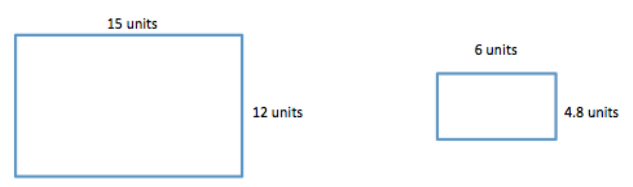
Write an equation relating the area of the original (larger) drawing to its smaller scale drawing. Explain how you determined the equation. What percent of the area of the larger drawing is the smaller scale drawing?
Eureka Math Grade 7 Module 4 Lesson 15 Exit Ticket Answer Key 1
Answer:
Scale factor:
Quantity = Percent × Whole
Scale Drawing Length = Percent × Original Length
6 = Percent × 15
\(\frac{6}{15}\) = \(\frac{2}{5}\) = \(\frac{4}{10}\) = 0.4
The area of the scale drawing is equal to the square of the scale factor times the area of the original drawing. Using A to represent the area of the original drawing, then the area of the scale is
(\(\frac{4}{10}\))2 A = \(\frac{16}{100}\) A.
As a percent, \(\frac{16}{100}\) A = 0.16A .
Therefore, the area of the scale drawing is 16% of the area of the original drawing.

Eureka Math Grade 7 Module 4 Lesson 14 Answer Key

Engage NY Eureka Math 7th Grade Module 4 Lesson 14 Answer Key

Eureka Math Grade 7 Module 4 Lesson 14 Example Answer Key

Example 1.
The distance around the entire small boat is 28.4 units. The larger figure is a scale drawing of the smaller drawing of the boat. State the scale factor as a percent, and then use the scale factor to find the distance around the scale drawing.
Engage NY Math 7th Grade Module 4 Lesson 14 Example Answer Key 1
Answer:
Scale factor:
Horizontal distance of the smaller boat: 8 units Vertical sail distance of smaller boat: 6 units
Horizontal distance of the larger boat: 22 units Vertical sail distance of larger boat: 16.5 units
Scale factor: Quantity = Percent × Whole
Smaller boat is the whole.
Total Distance:
Distance around smaller boat = 28.4 units
Distance around larger boat = 28.4(275%) = 28.4(2.75) = 78.1
The distance around the larger boat is 78.1 units.
Length in larger = Percent × Length in smaller
22 = P × 8
\(\frac{22}{8}\) = 2.75 = 275%

Length in larger = Percent × Length in smaller
16.5 = P × 6
\(\frac{16.5}{6}\) = 2.75 = 275%

Example 2: Time to Garden
Engage NY Math 7th Grade Module 4 Lesson 14 Example Answer Key 2
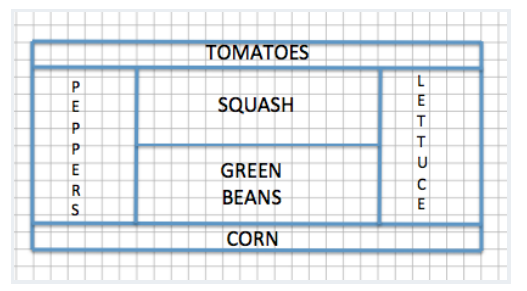
Sherry designed her garden as shown in the diagram above. The distance between any two consecutive vertical grid lines is 1 foot, and the distance between any two consecutive horizontal grid lines is also 1 foot. Therefore, each grid square has an area of one square foot. After designing the garden, Sherry decided to actually build the garden 75% of the size represented in the diagram.
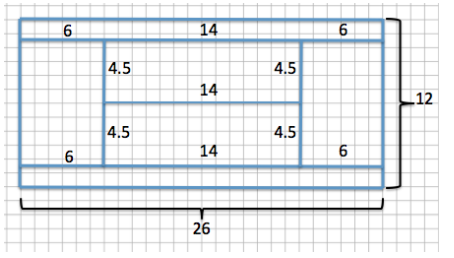
a. What are the outside dimensions shown in the blueprint?
Answer:
Blueprint dimensions: Length: 26 boxes = 26 ft.
Width: 12 boxes = 12 ft.

b. What will the overall dimensions be in the actual garden? Write an equation to find the dimensions. How does the problem relate to the scale factor?
Answer:
Actual garden dimensions (75% of blueprint): 19.5 ft. × 9 ft.
Length: (26 ft.)(0.75) = 19.5 ft.
Width: (12 ft.)(0.75) = 9 ft.
Since the scale factor was given as 75%, each dimension of the actual garden should be 75% of the original corresponding dimension. The actual length of the garden,19.5 ft., is 75% of 26 ft., and the actual width of the garden, 9 ft., is 75% of 12 ft.

c. If Sherry plans to use a wire fence to divide each section of the garden, how much fence does she need?
Answer:
Dimensions of the blueprint:
Engage NY Math 7th Grade Module 4 Lesson 14 Example Answer Key 3
Total amount of wire needed for the blueprint:
26(4)+12(2)+4.5(4)+14 = 160
The amount of wire needed is 160 ft.
New dimensions of actual garden:
Length: 19.5 ft. (from part (b))
Width: 9 ft. (from part (b))
Inside borders: 4.5(0.75) = 3.375; 3.375 ft.
14(0.75) = 10.5; 10.5 ft.
The dimensions of the inside borders are 3.375 ft. by 10.5 ft.

Total wire with new dimensions:
19.5(4)+9(2)+3.375(4)+10.5 = 120
OR
160(0.75) = 120
Total wire with new dimensions is 120 ft.
Simpler way: 75% of 160 ft. is 120 ft.

d. If the fence costs $3.25 per foot plus 7% sales tax, how much would the fence cost in total?
Answer:
3.25(120) = 390
390(1.07) = 417.30
The total cost is $417.30.

Example 3.
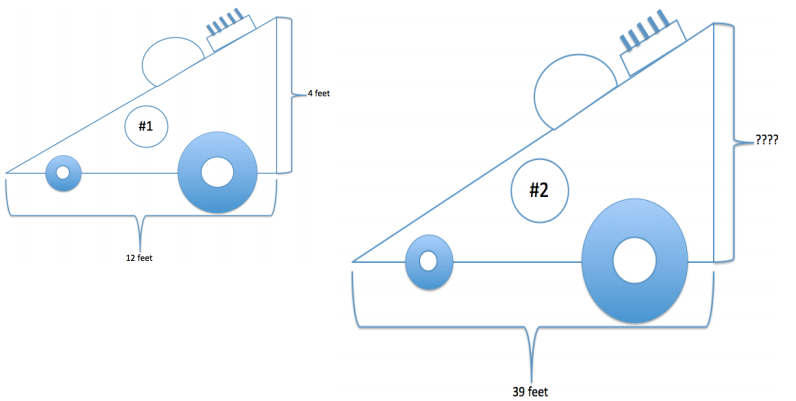
Race Car #2 is a scale drawing of Race Car #1. The measurement from the front of Race Car #1 to the back of Race Car #1 is 12 feet, while the measurement from the front of Race Car #2 to the back of Race Car #2 is 39 feet. If the height of Race Car #1 is 4 feet, find the scale factor, and write an equation to find the height of Race Car #2. Explain what each part of the equation represents in the situation.
Engage NY Math 7th Grade Module 4 Lesson 14 Example Answer Key 4
Answer:
Scale Factor: The larger race car is a scale drawing of the smaller. Therefore, the smaller race car is the whole in the relationship.
Quantity = Percent × Whole
Larger = Percent × Smaller
39 = Percent × 12
\(\frac{39}{12}\) = 3.25 = 325%
Height: 4(3.25) = 13
The height of Race Car #2 is 13 ft.
The equation shows that the smaller height, 4 ft., multiplied by the scale factor of 3.25, equals the larger height, 13 ft.

Eureka Math Grade 7 Module 4 Lesson 14 Exercise Answer Key

Exercise 1.
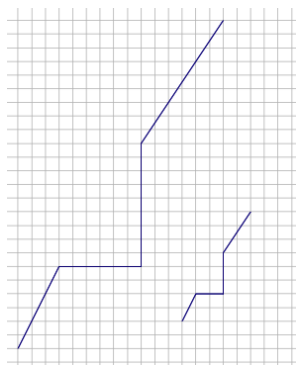
The length of the longer path is 32.4 units. The shorter path is a scale drawing of the longer path. Find the length of the shorter path, and explain how you arrived at your answer.
Engage NY Math Grade 7 Module 4 Lesson 14 Exercise Answer Key 1
Answer:
First, determine the scale factor. Since the smaller path is a reduction of the original drawing, the scale factor should be less than 100%. Since the smaller path is a scale drawing of the larger, the larger path is the whole in the relationship.
Quantity = Percent × Whole
To determine the scale factor, compare the horizontal segments of the smaller path to the larger path.
Smaller = Percent × Larger
2 = Percent × 6
\(\frac{2}{6}\) = \(\frac{1}{3}\) = 33 \(\frac{1}{3}\)%
To determine the length of the smaller path, multiply the length of the larger path by the scale factor.
32.4(\(\frac{1}{3}\)) = 10.8
The length of the shorter path is 10.8 units.

Exercise 2.
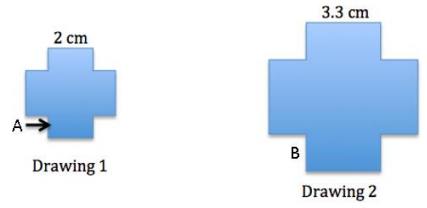
Determine the scale factor, and write an equation that relates the height of side A in Drawing 1 and the height of side B in Drawing 2 to the scale factor. The height of side A is 1.1 cm. Explain how the equation illustrates the relationship.
Engage NY Math Grade 7 Module 4 Lesson 14 Exercise Answer Key 2
Answer:
Equation: 1.1(scale factor) = height of side B in Drawing 2
First find the scale factor:
Quantity = Percent × Whole
Drawing 2 = Percent × Drawing 1
3.3 = Percent × 2
\(\frac{3.3}{2}\) = 1.65 = 165%
Equation: (1.1)(1.65) = 1.815
The height of side B in Drawing 2 is 1.815 cm.
Once we determine the scale factor, we can write an equation to find the unknown height of side B in Drawing 2 by multiplying the scale factor by the corresponding height in the original drawing.

Exercise 3.
The length of a rectangular picture is 8 inches, and the picture is to be reduced to be 45 \(\frac{1}{2}\)% of the original picture. Write an equation that relates the lengths of each picture. Explain how the equation illustrates the relationship.
Answer:
8(0.455) = 3.64
The length of the reduced picture is 3.64 in. The equation shows that the length of the reduced picture, 3.64, is equal to the original length, 8, multiplied by the scale factor, 0.455.

Eureka Math Grade 7 Module 4 Lesson 14 Problem Set Answer Key

Question 1.
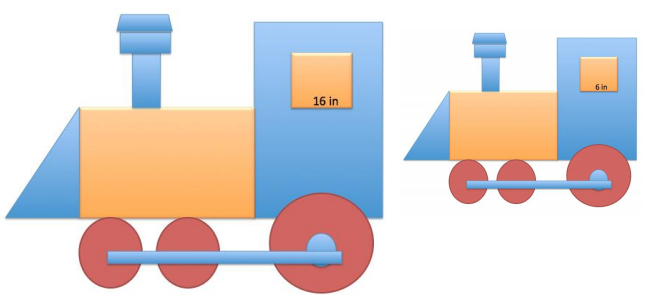
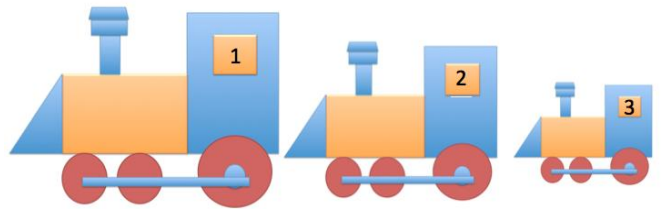
The smaller train is a scale drawing of the larger train. If the length of the tire rod connecting the three tires of the larger train, as shown below, is 36 inches, write an equation to find the length of the tire rod of the smaller train. Interpret your solution in the context of the problem.
Eureka Math 7th Grade Module 4 Lesson 14 Problem Set Answer Key 1
Answer:
Scale factor:
Smaller = Percent × Larger
6 = Percent × 16
\(\frac{6}{16}\) = 0.375 = 37.5%
Tire rod of smaller train: (36)(0.375) = 13.5
The length of the tire rod of the smaller train is 13.5 in.
Since the scale drawing is smaller than the original, the corresponding tire rod is the same percent smaller as the windows. Therefore, finding the scale factor using the windows of the trains allows us to then use the scale factor to find all other corresponding lengths.

Question 2.
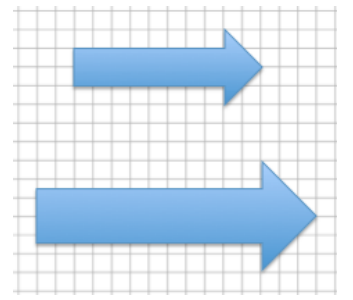
The larger arrow is a scale drawing of the smaller arrow. If the distance around the smaller arrow is 25.66 units. What is the distance around the larger arrow? Use an equation to find the distance and interpret your solution in the context of the problem.
Eureka Math 7th Grade Module 4 Lesson 14 Problem Set Answer Key 2
Answer:
Horizontal distance of smaller arrow: 8 units
Horizontal distance of larger arrow: 12 units
Scale factor:
Larger = Percent × Smaller
12 = Percent × 8
\(\frac{12}{8}\) = 1.5 = 150%
Distance around larger arrow:
(25.66)(1.5) = 38.49
The distance around the larger arrow is 38.49 units.
An equation where the distance of the smaller arrow is multiplied by the scale factor results in the distance around the larger arrow.

Question 3.
The smaller drawing below is a scale drawing of the larger. The distance around the larger drawing is 39.4 units. Using an equation, find the distance around the smaller drawing.
Eureka Math 7th Grade Module 4 Lesson 14 Problem Set Answer Key 3
Answer:
Vertical distance of larger drawing: 10 units
Vertical distance of smaller drawing: 4 units
Scale factor:
Smaller = Percent × Larger
4 = Percent × 10
\(\frac{4}{10}\) = 0.4 = 40%
Total distance:
(39.4)(0.4) = 15.76
The total distance around the smaller drawing is 15.76 units.

Question 4.
The figure is a diagram of a model rocket and is a two-dimensional scale drawing of an actual rocket. The length of a model rocket is 2.5 feet, and the wing span is 1.25 feet. If the length of an actual rocket is 184 feet, use an equation to find the wing span of the actual rocket.
Eureka Math 7th Grade Module 4 Lesson 14 Problem Set Answer Key 4
Answer:
Length of actual rocket: 184 ft.
Length of model rocket: 2.5 ft.
Scale Factor:
Actual = Percent × Model
184 = Percent × 2.5
\(\frac{184}{2.5}\) = 73.60 = 7,360%

Wing span:
Model rocket wing span: 1.25 ft.
Actual rocket wing span : (1.25)(73.60) = 92
The wing span of the actual rocket is 92 ft.

Eureka Math Grade 7 Module 4 Lesson 14 Exit Ticket Answer Key

Question 1.
Each of the designs shown below is to be displayed in a window using strands of white lights. The smaller design requires 225 feet of lights. How many feet of lights does the enlarged design require? Support your answer by showing all work and stating the scale factor used in your solution.
Eureka Math Grade 7 Module 4 Lesson 14 Exit Ticket Answer Key 1
Answer:
Scale Factor:
Bottom horizontal distance of the smaller design: 8
Bottom horizontal distance of the larger design: 16
The smaller design represents the whole since we are going from the smaller to the larger.
Quantity = Percent × Whole
Larger = Percent × Smaller
16 = Percent × 8
\(\frac{16}{8}\) = 2 = 200%
Number of feet of lights needed for the larger design:
225 ft.(200%) = 225 ft.(2) = 450 ft.

Eureka Math Grade 7 Module 4 Lesson 13 Answer Key

Engage NY Eureka Math 7th Grade Module 4 Lesson 13 Answer Key

Eureka Math Grade 7 Module 4 Lesson 13 Example Answer Key

Example 1.
The scale factor from Drawing 1 to Drawing 2 is 60%. Find the scale factor from Drawing 2 to Drawing 1. Explain your reasoning.
Engage NY Math 7th Grade Module 4 Lesson 13 Example Answer Key 1
Answer:
The scale drawing from Drawing 2 to Drawing 1 is an enlargement. Drawing 1 is represented by 100%, and Drawing 2, a reduction of Drawing 1, is represented by 60%. A length in Drawing 2 is the whole, so the scale factor from Drawing 2 to 1 is length in Drawing 1 = percent × length in Drawing 2.
100% = percent × 60%
\(\frac{100 \%}{60 \%}\) = \(\frac{1}{0.60}\) = \(\frac{1}{\frac{3}{5}}\) = \(\frac{5}{3}\) = 166 \(\frac{2}{3}\)%

Example 2.
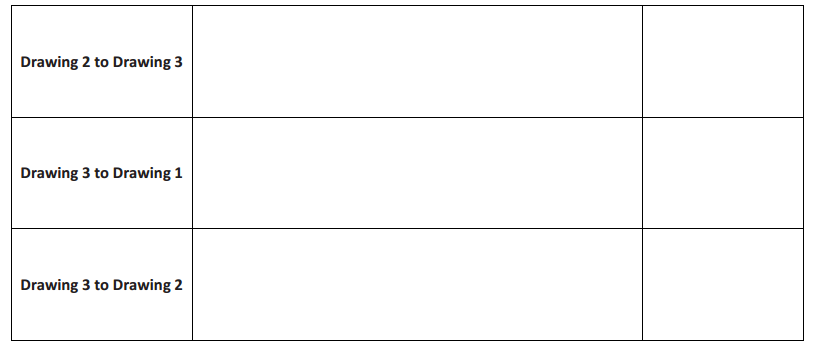
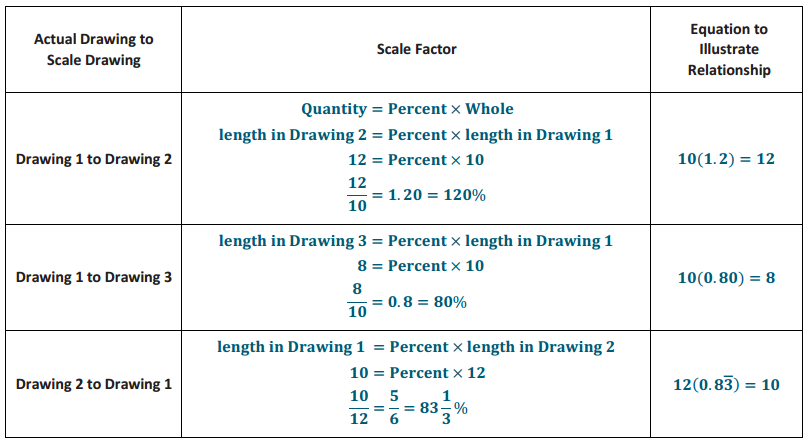
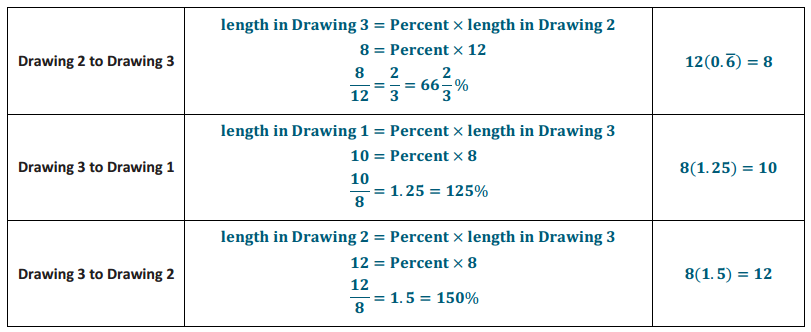
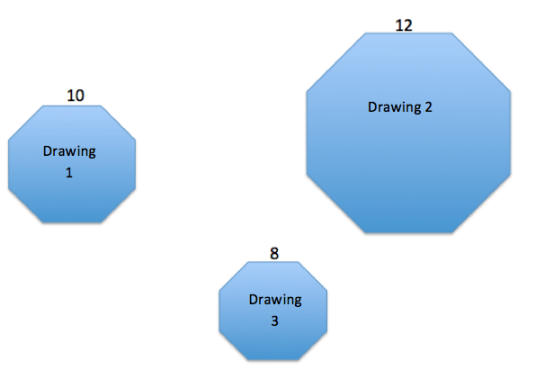
A regular octagon is an eight-sided polygon with side lengths that are all equal. All three octagons are scale drawings of each other. Use the chart and the side lengths to compute each scale factor as a percent. How can we check our answers?
Engage NY Math 7th Grade Module 4 Lesson 13 Example Answer Key 2
Engage NY Math 7th Grade Module 4 Lesson 13 Example Answer Key 3
Engage NY Math 7th Grade Module 4 Lesson 13 Example Answer Key 4
Answer:
Engage NY Math 7th Grade Module 4 Lesson 13 Example Answer Key 5.1
Engage NY Math 7th Grade Module 4 Lesson 13 Example Answer Key 5
To check our answers, we can start with 10 (the length of the original Drawing 1) and multiply by the scale factors we found to see whether we get the corresponding lengths in Drawings 2 and 3.
Drawing 1 to 2: 10(1.20) = 12
Drawing 2 to 3: 12(\(\frac{2}{3}\)) = 8

Example 3.
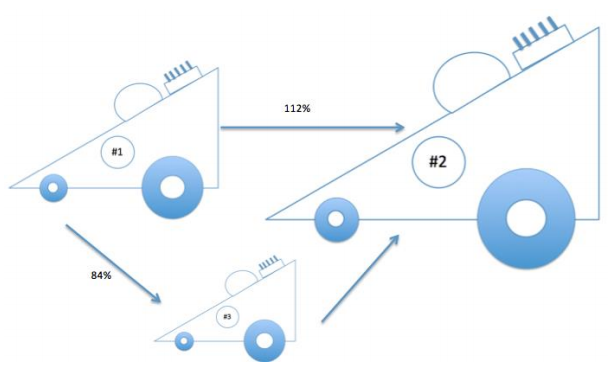
The scale factor from Drawing 1 to Drawing 2 is 112%, and the scale factor from Drawing 1 to Drawing 3 is 84%. Drawing 2 is also a scale drawing of Drawing 3. Is Drawing 2 a reduction or an enlargement of Drawing 3? Justify your answer using the scale factor. The drawing is not necessarily drawn to scale.
Engage NY Math 7th Grade Module 4 Lesson 13 Example Answer Key 6
Answer:
First, I needed to find the scale factor of Drawing 3 to Drawing 2 by using the relationship
Quantity = Percent × Whole.
Drawing 3 is the whole. Therefore,
Drawing 2 = Percent × Drawing 3
112% = Percent × 84%
\(\frac{1.12}{0.84}\) = \(\frac{112}{84}\) = \(\frac{4}{3}\) = 133 \(\frac{1}{3}\)%
Since the scale factor is greater than 100%, Drawing 2 is an enlargement of Drawing 3.

Explain how you could use the scale factors from Drawing 1 to Drawing 2 (112%) and from Drawing 2 to Drawing 3 (75%) to show that the scale factor from Drawing 1 to Drawing 3 is 84%.
Answer:
The scale factor from Drawing 1 to Drawing 2 is 112%, and the scale factor from Drawing 2 to Drawing 3 is 75%; therefore, I must find 75% of 112% to get from Drawing 2 to Drawing 3. (0.75)(1.12) = 0.84. Comparing this answer to the original problem, the resulting scale factor is indeed what was given as the scale factor from Drawing 1 to
Drawing 3.

Eureka Math Grade 7 Module 4 Lesson 13 Exercise Answer Key

Opening Exercise
Scale factor: \(\frac{\text { length in SCALE drawing }}{\text { Corresponding length in ORIGINAL drawing }}\)
Describe, using percentages, the difference between a reduction and an enlargement.
Answer:
A scale drawing is a reduction of the original drawing when the lengths of the scale drawing are smaller than the lengths in the original drawing. The scale factor is less than 100%.
A scale drawing is an enlargement of the original drawing when the lengths of the scale drawing are greater than the lengths in the original drawing. The scale factor is greater than 100%.

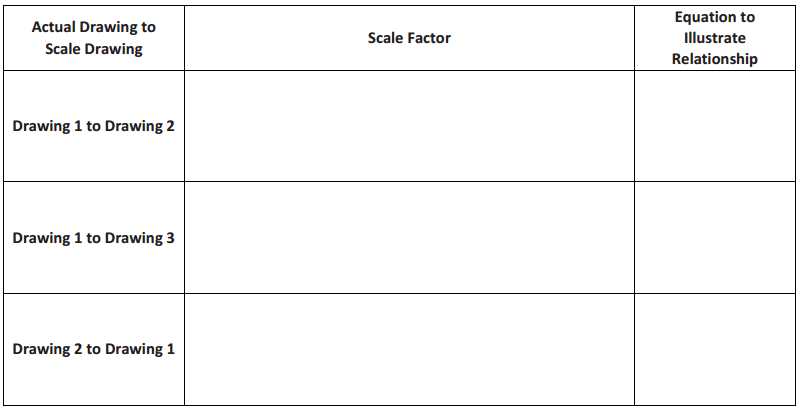
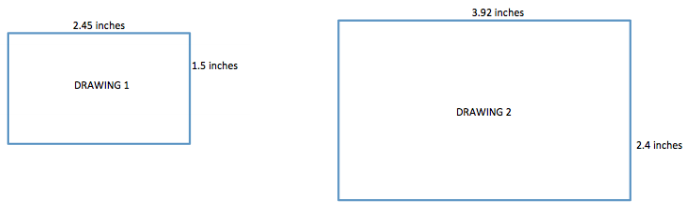
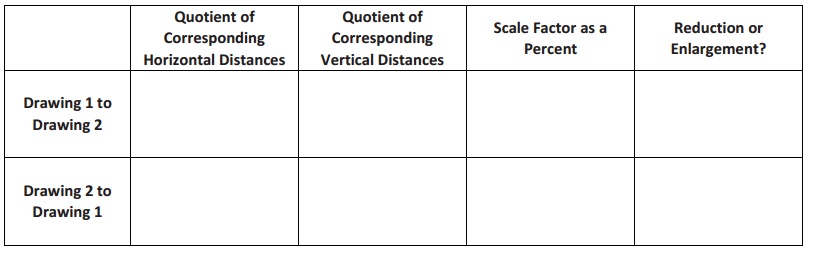
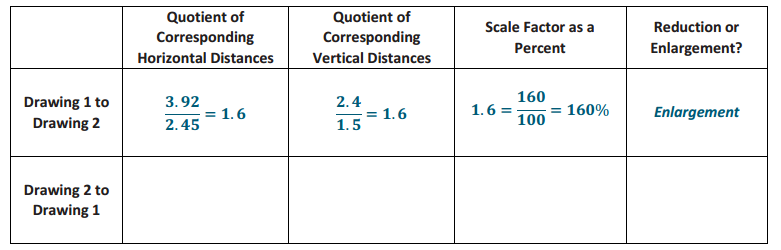
Use the two drawings below to complete the chart. Calculate the first row (Drawing 1 to Drawing 2) only.
Engage NY Math Grade 7 Module 4 Lesson 13 Exercise Answer Key 1
Engage NY Math Grade 7 Module 4 Lesson 13 Exercise Answer Key 2
Answer:
Engage NY Math Grade 7 Module 4 Lesson 13 Exercise Answer Key 3

Compare Drawing 2 to Drawing 1. Using the completed work in the first row, make a conjecture (statement) about what the second row of the chart will be. Justify your conjecture without computing the second row.
Answer:
Drawing 1 will be a reduction of Drawing 2. I know this because the corresponding lengths in Drawing 1 are smaller than the corresponding lengths in Drawing 2. Therefore, the scale factor from Drawing 2 to Drawing 1 would be less than 100%.

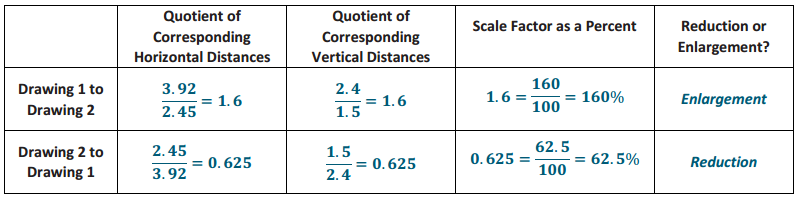
Compute the second row of the chart. Was your conjecture proven true? Explain how you know.
Answer:
The conjecture was true because the calculated scale factor from Drawing 2 to Drawing 1 was 62.5%. Since the scale factor is less than 100%, the scale drawing is indeed a reduction.
Engage NY Math Grade 7 Module 4 Lesson 13 Exercise Answer Key 4

Eureka Math Grade 7 Module 4 Lesson 13 Problem Set Answer Key

Question 1.
The scale factor from Drawing 1 to Drawing 2 is 41 \(\frac{2}{3}\)%. Justify why Drawing 1 is a scale drawing of Drawing 2 and why it is an enlargement of Drawing 2. Include the scale factor in your justification.
Eureka Math 7th Grade Module 4 Lesson 13 Problem Set Answer Key 1
Answer:
Quantity = Percent × Whole
Length in Drawing 1 = Percent × Length in Drawing 2
100% = Percent × 41 \(\frac{2}{3}\)%
\(\frac{100 \%}{41 \frac{2}{3} \%}\) = \(\frac{100 \cdot 3}{41 \frac{2}{3} \cdot 3}\) = \(\frac{300}{125}\) = \(\frac{12}{5}\) = 2.40 = 240%
Drawing 1 is a scale drawing of Drawing 2 because the lengths of Drawing 1 would be larger than the corresponding lengths of Drawing 2.
Since the scale factor is greater than 100%, the scale drawing is an enlargement of the original drawing.

Question 2.
The scale factor from Drawing 1 to Drawing 2 is 40%, and the scale factor from Drawing 2 to Drawing 3 is 37.5%. What is the scale factor from Drawing 1 to Drawing 3? Explain your reasoning, and check your answer using an example.
Eureka Math 7th Grade Module 4 Lesson 13 Problem Set Answer Key 2
Answer:
To find the scale factor from Drawing 1 to 3, I needed to find 37.5% of 40%, so (0.375)(0.40) = 0.15. The scale factor from Drawing 1 to Drawing 3 would be 15%.
Check: Assume the length of Drawing 1 is 10. Then, using the scale factor for Drawing 2, the corresponding length of Drawing 2 would be 4. Then, applying the scale factor to Drawing 3, Drawing 3 would be 4(0.375) = 1.5. To go directly from Drawing 1 to Drawing 3, which was found to have a scale factor of 15%, then 10(0.15) = 1.5.

Question 3.
Traci took a photograph and printed it to be a size of 4 units by 4 units as indicated in the diagram. She wanted to enlarge the original photograph to a size of 5 units by 5 units and 10 units by 10 units.
a. Sketch the different sizes of photographs.
Eureka Math 7th Grade Module 4 Lesson 13 Problem Set Answer Key 3
Answer:
Eureka Math 7th Grade Module 4 Lesson 13 Problem Set Answer Key 4

b. What was the scale factor from the original photo to the photo that is 5 units by 5 units?
Answer:
The scale factor from the original to the 5 by 5 enlargement is \(\frac{5}{4}\) = 1.25 = 125%.

c. What was the scale factor from the original photo to the photo that is 10 units by 10 units?
Answer:
The scale factor from the original to the 10 by 10 photo is \(\frac{10}{4}\) = 2.5 = 250%.

d. What was the scale factor from the 5 × 5 photo to the 10 × 10 photo?
The scale factor from the 5 × 5 photo to the 10 × 10 photo is \(\frac{10}{5}\) = 2 = 200%.

e. Write an equation to verify how the scale factor from the original photo to the enlarged 10 × 10 photo can be calculated using the scale factors from the original to the 5 × 5 and then from the 5 × 5 to the 10 × 10.
Answer:
Scale factor original to 5 × 5: (125%)
Scale factor 5 × 5 to 10 × 10: (200%)
4(1.25) = 5
5(2.00) = 10
Original to 10 × 10, scale factor = 250%
4(2.50) = 10
The true equation 4(1.25)(2.00) = 4(2.50) verifies that a single scale factor of 250% is equivalent to a scale factor of 125% followed by a scale factor of 200%.

Question 4.
The scale factor from Drawing 1 to Drawing 2 is 30%, and the scale factor from Drawing 1 to Drawing 3 is 175%. What are the scale factors of each given relationship? Then, answer the question that follows. Drawings are not to scale.
Eureka Math 7th Grade Module 4 Lesson 13 Problem Set Answer Key 5
a. Drawing 2 to Drawing 3
Answer:
The scale factor from Drawing 2 to Drawing 3 is
\(\frac{175 \%}{30 \%}\) = \(\frac{1.75}{0.30}\) = \(\frac{175}{30}\) = \(\frac{35}{6}\) = 5 \(\frac{5}{6}\) = 583 \(\frac{1}{3}\)%.

b. Drawing 3 to Drawing 1
Answer:
The scale factor from Drawing 3 to Drawing 1 is
\(\frac{1}{1.75}\) = \(\frac{100}{175}\) = \(\frac{4}{7}\) ≈ 57.14%.

c. Drawing 3 to Drawing 2
Answer:
The scale factor from Drawing 3 to Drawing 2 is
\(\frac{0.3}{1.75}\) = \(\frac{30}{175}\) = \(\frac{6}{35}\) ≈ 17.14%.

d. How can you check your answers?
Answer:
To check my answers, I can work backwards and multiply the scale factor from Drawing 1 to Drawing 3 of 175% to the scale factor from Drawing 3 to Drawing 2, and I should get the scale factor from Drawing 1 to Drawing 2.
(1.75)(0.1714) ≈ 0.29995 ≈ 0.30 = 30%

Eureka Math Grade 7 Module 4 Lesson 13 Exit Ticket Answer Key

Question 1.
Compute the scale factor, as a percent, for each given relationship. When necessary, round your answer to the nearest tenth of a percent.
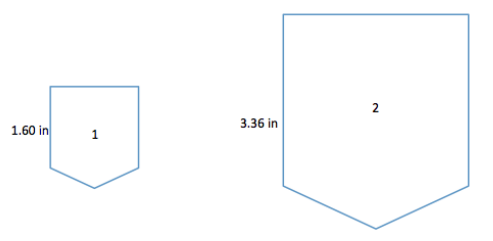
Eureka Math Grade 7 Module 4 Lesson 13 Exit Ticket Answer Key 1
a. Drawing 1 to Drawing 2
Answer:
Drawing 2 = Percent × Drawing 1
3.36 = Percent × 1.60
\(\frac{3.36}{1.60}\) = 2.10 = 210%

b. Drawing 2 to Drawing 1
Answer:
Drawing 1 = Percent × Drawing 2
1.60 = Percent × 3.36
\(\frac{1.60}{3.36}\) = \(\frac{1}{2.10}\) ≈ 0.476190476 ≈ 47.6%

c. Write two different equations that illustrate how each scale factor relates to the lengths in the diagram.
Answer:
Drawing 1 to Drawing 2:
1.60(2.10) = 3.36
Drawing 2 to Drawing 1:
3.36(0.476) = 1.60

Question 2.
Drawings 2 and 3 are scale drawings of Drawing 1. The scale factor from Drawing 1 to Drawing 2 is 75%, and the scale factor from Drawing 2 to Drawing 3 is 50%. Find the scale factor from Drawing 1 to Drawing 3.
Eureka Math Grade 7 Module 4 Lesson 13 Exit Ticket Answer Key 2
Answer:
Drawing 1 to 2 is 75%. Drawing 2 to 3 is 50%. Therefore, Drawing 3 is 50% of 75%, so
(0.50)(0.75) = 0.375. To determine the scale factor from Drawing 1 to Drawing 3, we went from 100% to 37.5%. Therefore, the scale factor is 37.5%. Using the relationship:
Drawing 3 = Percent × Drawing 1
37.5% = Percent × 100%
0.375 = Percent
= 37.5%

Eureka Math Grade 7 Module 4 Lesson 12 Answer Key

Engage NY Eureka Math 7th Grade Module 4 Lesson 12 Answer Key

Eureka Math Grade 7 Module 4 Lesson 12 Example Answer Key

Example 1.
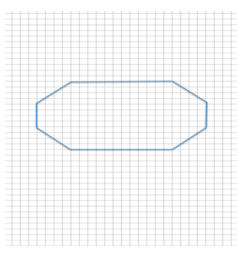
Create a snowman on the accompanying grid. Use the octagon given as the middle of the snowman with the following conditions:
Engage NY Math 7th Grade Module 4 Lesson 12 Example Answer Key 1
a. Calculate the width, neck, and height, in units, for the figure to the right.
Answer:
Width: 20
Neck: 12
Height: 12

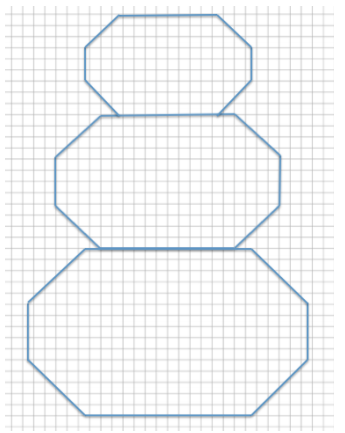
b. To create the head of the snowman, make a scale drawing of the middle of the snowman with a scale factor of 75%. Calculate the new lengths, in units, for the width, neck, and height.
Answer:
Width: 75%(20) = (0.75)(20) = 15
Neck: 75%(12) = (0.75)(12) = 9
Height : 75%(12) = (0.75)(12) = 9

c. To create the bottom of the snowman, make a scale drawing of the middle of the snowman with a scale factor of 125%. Calculate the new lengths, in units, for the width, waist, and height.
Answer:
Width: 125%(20) = (1.25)(20) = 25
Waist: 125%(12) = (1.25)(12) = 15
Height: 125%(12) = (1.25)(12) = 15

d. Is the head a reduction or an enlargement of the middle?
Answer:
The head is a reduction of the middle since the lengths of the sides are smaller than the lengths in the original drawing and the scale factor is less than 100% (75%).

e. Is the bottom a reduction or an enlargement of the middle?
Answer:
The bottom is an enlargement of the middle since the lengths of the scale drawing are larger than the lengths in the original drawing, and the scale factor is greater than 100% (125%).

f. What is the significance of the scale factor as it relates to 100%? What happens when such scale factors are applied?
Answer:
A scale factor of 100% would create a drawing that is the same size as the original drawing; therefore, it would be neither an enlargement nor reduction. A scale factor of less than 100% results in a scale drawing that is a reduction of the original drawing. A scale factor of greater than 100% results in a scale drawing that is an enlargement of the original drawing.

g. Use the dimensions you calculated in parts (b) and (c) to draw the complete snowman.
Answer:
Engage NY Math 7th Grade Module 4 Lesson 12 Example Answer Key 2

Example 2.
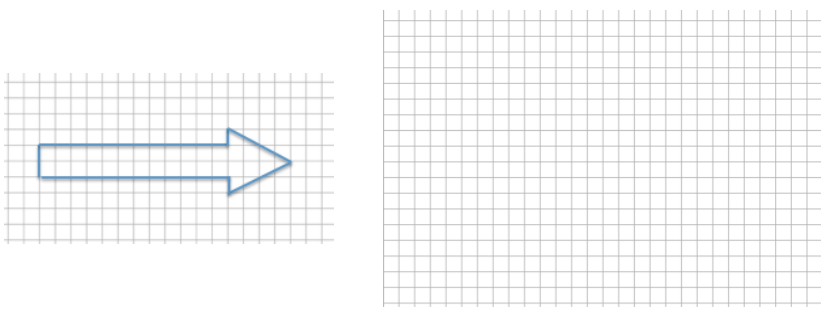
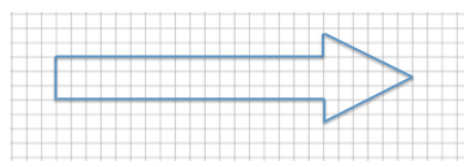
Create a scale drawing of the arrow below using a scale factor of 150%.
Engage NY Math 7th Grade Module 4 Lesson 12 Example Answer Key 3
Answer:
Engage NY Math 7th Grade Module 4 Lesson 12 Example Answer Key 4

Example 3: Scale Drawings Where the Horizontal and Vertical Scale Factors Are Different
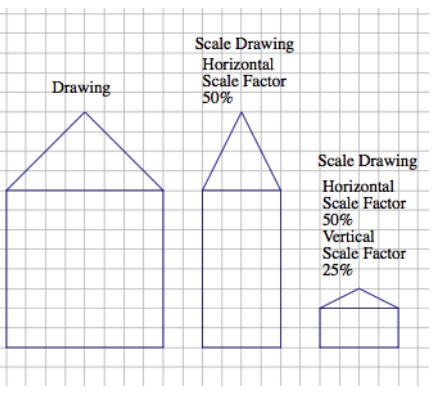
Sometimes it is helpful to make a scale drawing where the horizontal and vertical scale factors are different, such as when creating diagrams in the field of engineering. Having differing scale factors may distort some drawings.

For example, when you are working with a very large horizontal scale, you sometimes must exaggerate the vertical scale in order to make it readable. This can be accomplished by creating a drawing with two scales. Unlike the scale drawings with just one scale factor, these types of scale drawings may look distorted. Next to the drawing below is a scale drawing with a horizontal scale factor of 50% and vertical scale factor of 25% (given in two steps). Explain how each drawing is created.
Engage NY Math 7th Grade Module 4 Lesson 12 Example Answer Key 5
Answer:
Each horizontal distance in the scale drawing is 50%
(or half) of the corresponding length in the original drawing. Each vertical distance in the scale drawing is 25% (or one-fourth) of the corresponding length in the original drawing.
Horizontal distance of house: 8(0.50) = 8(\(\frac{1}{2}\)) = 4
Vertical distance of house: 8(0.25) = 8(\(\frac{1}{4}\)) = 2
Vertical distance of top of house:
4(0.25) = 4(\(\frac{1}{4}\)) = 1

Eureka Math Grade 7 Module 4 Lesson 12 Exercise Answer Key

Opening Exercise:
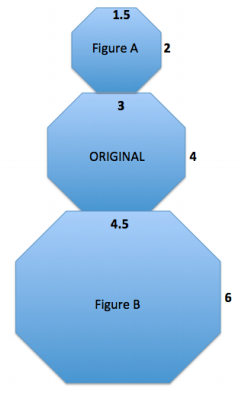
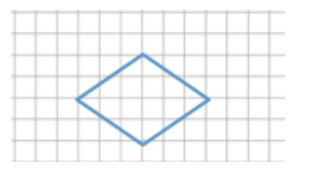
Engage NY Math Grade 7 Module 4 Lesson 12 Exercise Answer Key 1
Compare the corresponding lengths of Figure A to the original octagon in the middle. This is an example of a particular type of scale drawing called a _________. Explain why it is called that.
Answer:
reduction
A scale drawing is a reduction of the original drawing when the side lengths of the scale drawing are smaller than the corresponding side lengths of the original figure or drawing.

Compare the corresponding lengths of Figure B to the original octagon in the middle. This is an example of a particular type of scale drawing called an __________. Explain why it is called that.
Answer:
enlargement
A scale drawing is an enlargement of the original drawing when the side lengths of the scale drawing are larger than the corresponding side lengths of the original figure or drawing.

The scale factor is the quotient of any length in the scale drawing and its corresponding length in the original drawing.
Use what you recall from Module 1 to determine the scale factors between the original figure and Figure A and the original figure and Figure B.
Answer:
Scale factor between original and Figure A: \(\frac{1.5}{3}\) = \(\frac{1}{2}\) or \(\frac{2}{4}\) = \(\frac{1}{2}\)
Scale factor between original and Figure B: \(\frac{4.5}{3}\) = \(\frac{3}{2}\) or \(\frac{6}{4}\) = \(\frac{3}{2}\)

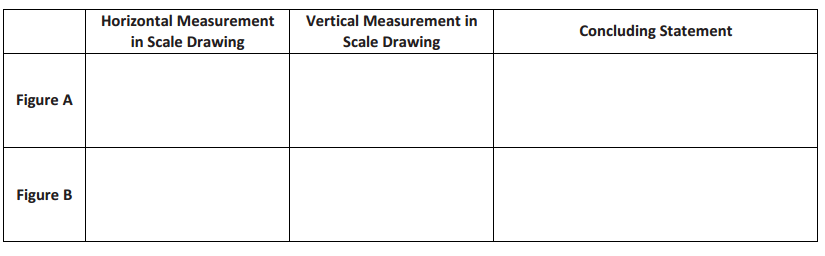
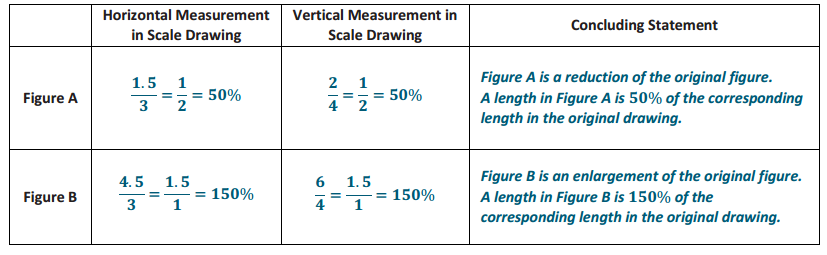
Use the diagram to complete the chart below to determine the horizontal and vertical scale factors. Write answers as a percent and as a concluding statement using the previously learned reduction and enlargement vocabulary.
Engage NY Math Grade 7 Module 4 Lesson 12 Exercise Answer Key 2
Answer:
Engage NY Math Grade 7 Module 4 Lesson 12 Exercise Answer Key 3

Exercise 1.
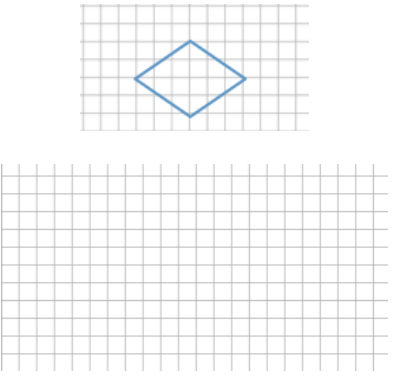
Create a scale drawing of the following drawing using a horizontal scale factor of 183 \(\frac{1}{3}\)% and a vertical scale factor of 25%.
Engage NY Math Grade 7 Module 4 Lesson 12 Exercise Answer Key 4
Answer:
Engage NY Math Grade 7 Module 4 Lesson 12 Exercise Answer Key 5
Horizontal scale factor: \(\frac{183 \frac{1}{3} \cdot 3}{100 \cdot 3}\) = \(\frac{550}{300}\) = \(\frac{11}{6}\)
Horizontal distance: 6(\(\frac{11}{6}\)) = 11
Vertical scale factor: \(\frac{25}{100}\) = \(\frac{1}{4}\)
Vertical distance: 4(\(\frac{1}{4}\)) = 1
New sketch:
Engage NY Math Grade 7 Module 4 Lesson 12 Exercise Answer Key 6

Exercise 2.
Chris is building a rectangular pen for his dog. The dimensions are 12 units long and 5 units wide.
Engage NY Math Grade 7 Module 4 Lesson 12 Exercise Answer Key 7
Chris is building a second pen that is 60% the length of the original and 125% the width of the original. Write equations to determine the length and width of the second pen.
Answer:
Length: 12 × 0.60 = 7.2
The length of the second pen is 7.2 units.
Width: 5 × 1.25 = 6.25
The width of the second pen is 6.25 units.

Eureka Math Grade 7 Module 4 Lesson 12 Problem Set Answer Key

Question 1.
Use the diagram below to create a scale drawing using a scale factor of 133 \(\frac{1}{3}\)%. Write numerical equations to find the horizontal and vertical distances in the scale drawing.
Eureka Math 7th Grade Module 4 Lesson 12 Problem Set Answer Key 1
Answer:
Scale factor: 133 \(\frac{133 \frac{1}{3} \cdot 3}{100 \cdot 3}\) = \(\frac{400}{300}\) = \(\frac{4}{3}\)
Horizontal distance: 9(\(\frac{4}{3}\)) = 12
Vertical distance forks: 3(\(\frac{4}{3}\)) = 4
Vertical distance handle: 6(\(\frac{4}{3}\)) = 8
Scale drawing:
Eureka Math 7th Grade Module 4 Lesson 12 Problem Set Answer Key 2

Question 2.
Create a scale drawing of the original drawing given below using a horizontal scale factor of 80% and a vertical scale factor of 175%. Write numerical equations to find the horizontal and vertical distances.
Eureka Math 7th Grade Module 4 Lesson 12 Problem Set Answer Key 3
Answer:
Horizontal scale factor: 80% = \(\frac{80}{100}\) = \(\frac{4}{5}\)
Horizontal segment lengths: 10(0.80) = 8 or 10(\(\frac{4}{5}\)) = 8
Horizontal distance: 15(\(\frac{4}{5}\)) = 12
Vertical scale factor: 175% = \(\frac{175}{100}\) = \(\frac{7}{4}\)
Vertical distance: 8(\(\frac{7}{4}\)) = 14
Scale drawing:
Eureka Math 7th Grade Module 4 Lesson 12 Problem Set Answer Key 4

Question 3.
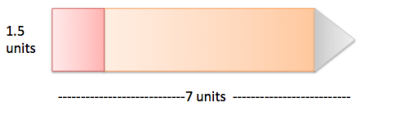
The accompanying diagram shows that the length of a pencil from its eraser to its tip is 7 units and that the eraser is 1.5 units wide. The picture was placed on a photocopy machine and reduced to 66 2/3%. Find the new size of the pencil, and sketch a drawing. Write numerical equations to find the new dimensions.
Eureka Math 7th Grade Module 4 Lesson 12 Problem Set Answer Key 5
Answer:
Scale factor: 66 \(\frac{2}{3}\)% = \(\frac{66 \frac{2}{3} \cdot 3}{100 \cdot 3}\) = \(\frac{200}{300}\) = \(\frac{2}{3}\)
Pencil length: 7(\(\frac{2}{3}\)) = 4 \(\frac{2}{3}\)
Eraser: (1 \(\frac{1}{2}\))(\(\frac{2}{3}\)) = (\(\frac{3}{2}\))(\(\frac{2}{3}\)) = 1
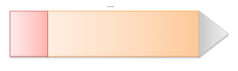
Eureka Math 7th Grade Module 4 Lesson 12 Problem Set Answer Key 6

Question 4.
Use the diagram to answer each question.
a. What are the corresponding horizontal and vertical distances in a scale drawing if the scale factor is 25%? Use numerical equations to find your answers.
Eureka Math 7th Grade Module 4 Lesson 12 Problem Set Answer Key 7
Answer:
Horizontal distance on original drawing: 14
Vertical distance on original drawing: 10
Scale drawing:
Scale factor: 25%
\(\frac{25}{100}\) = \(\frac{1}{4}\)
Horizontal distance: 14(\(\frac{1}{4}\)) = 3.5
Vertical distance: 10(\(\frac{1}{4}\)) = 2.5

b. What are the corresponding horizontal and vertical distances in a scale drawing if the scale factor is 160%? Use a numerical equation to find your answers.
Answer:
Horizontal distance on original drawing: 14
Vertical distance on original drawing: 10
Scale drawing:
Scale factor: 160%
\(\frac{160}{100}\) = \(\frac{8}{5}\)
Horizontal distance: 14(\(\frac{8}{5}\)) = 22.4
Vertical distance: 10(\(\frac{8}{5}\)) = 16

Question 5.
Create a scale drawing of the original drawing below using a horizontal scale factor of 200% and a vertical scale factor of 250%.
Eureka Math 7th Grade Module 4 Lesson 12 Problem Set Answer Key 8
Answer:
Eureka Math 7th Grade Module 4 Lesson 12 Problem Set Answer Key 9

Question 6.
Using the diagram below, on grid paper sketch the same drawing using a horizontal scale factor of 50% and a vertical scale factor of 150%.
Eureka Math 7th Grade Module 4 Lesson 12 Problem Set Answer Key 10
Answer:
Eureka Math 7th Grade Module 4 Lesson 12 Problem Set Answer Key 11

Eureka Math Grade 7 Module 4 Lesson 12 Exit Ticket Answer Key

Question 1.
Create a scale drawing of the picture below using a scale factor of 60%. Write three equations that show how you determined the lengths of three different parts of the resulting picture.
Eureka Math Grade 7 Module 4 Lesson 12 Exit Ticket Answer Key 1
Answer:
Scale factor: 60% = \(\frac{60}{100}\) = \(\frac{3}{5}\)
Horizontal distances: 10(\(\frac{3}{5}\)) = 6
5(\(\frac{3}{5}\)) = 3
Vertical distances: 5(\(\frac{3}{5}\)) = 3
7 \(\frac{1}{2}\) (\(\frac{3}{5}\)) = \(\frac{15}{2}\) (\(\frac{3}{5}\)) = \(\frac{9}{2}\) = 4.5
Scale drawing:
Eureka Math Grade 7 Module 4 Lesson 12 Exit Ticket Answer Key 2

Equations:
Left vertical distance: 5 × 0.60 = 3
Right vertical distance: 7.5 × 0.60 = 4.5
Top horizontal distance: 5 × 0.60 = 3
Bottom horizontal distance: 10 × 0.60 = 6

Question 2.
Sue wants to make two picture frames with lengths and widths that are proportional to the ones given below.
Note: The illustration shown below is not drawn to scale.
Eureka Math Grade 7 Module 4 Lesson 12 Exit Ticket Answer Key 3
a. Sketch a scale drawing using a horizontal scale factor of 50% and a vertical scale factor of 75%. Determine the dimensions of the new picture frame.
Answer:
Eureka Math Grade 7 Module 4 Lesson 12 Exit Ticket Answer Key 4
Horizontal measurement: 8(0.50) = 4
Vertical measurement: 12(0.75) = 9
4 in. by 9 in.

b. Sketch a scale drawing using a horizontal scale factor of 125% and a vertical scale factor of 140%. Determine the dimensions of the new picture frame.
Answer:
Eureka Math Grade 7 Module 4 Lesson 12 Exit Ticket Answer Key 5
Horizontal measurement: 8(1.25) = 10
Vertical measurement: 12(1.40) = 16.8
10 in. by 16.8 in.

Dividing Decimal by a Whole Number | How to Divide a Decimal by a Whole Number?

Dividing Decimal by a Whole Number

Dividing Decimals is much similar to dividing Whole Numbers, except the way we handle the decimal point. Refer to the Dividing Decimal by a Whole Number Step by Step, Solved Examples, etc. Get a good hold of the concept and know How to Divide a Decimal by a Whole Number. Learn the entire procedure used to Divide Decimals by a Whole Number and solve related problems with ease.

Also, Read: Multiplying Decimal by a Decimal Number 

Dividing Decimals – Definition

The process of Dividing Decimals is much similar to the normal division. All you need to keep in mind is to place the decimal point correctly in the quotient. To divide a decimal by a whole number, the division is performed in the same way as in whole numbers ignoring the decimal point. Place the decimal point in the quotient in the same position as in the dividend.

How to Divide a Decimal by a Whole Number?

Follow the simple steps provided below to get acquainted with the Division of a Decimal with a Whole Number. They are along the lines

  • Write the division in standard form and divide the whole number part of the decimal number with the divisor.
  • Here dividend is the decimal number and the divisor is the whole number.
  • Place the decimal point in the quotient above the decimal point of the dividend. Get the tenths digit down.
  • Divide the dividend with the divisor.
  • Try adding Zeros in the dividend till you get a Zero Remainder.

Solved Examples on Division of a Decimal by Whole Number

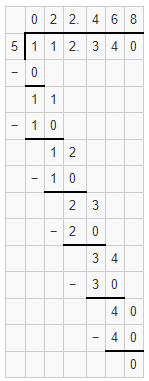
1. Solve 112.340 ÷ 5?

Solution:

Decimal Number 112.340 is the dividend and 5 is the whole number. Place the decimal point in the quotient above the decimal point of the dividend 112.340.

Now, we are going to bring down the 3. But, because it follows the decimal point, we have to place a decimal point in the quotient. Later we can bring down the next number.

Division of Decimal by a Whole Number Example

Therefore, 112.340 ÷ 5 = 22.468

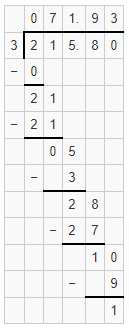
2. Solve 215.8 ÷ 3?

Solution:

Decimal Number 215.8 is the dividend and 3 is the whole number. Place the decimal point in the quotient above the decimal point of the dividend 215.8

Now, we are going to bring down the 8. But, because it follows the decimal point, we have to place a decimal point in the quotient. Later we can bring down the next number.

Dividing Decimal with a Whole Number Example

Therefore, 215.8 ÷ 3 = 71.93

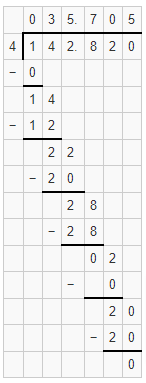
3. Find 142.82 ÷ 4?

Solution:

Decimal Number 142.82 is the dividend and 4 is the whole number. Place the decimal point in the quotient above the decimal point of the dividend 142.82

Now, we are going to bring down the 8. But, because it follows the decimal point, we have to place a decimal point in the quotient. Later we can bring down the next number.

Decimal Division by a Whole Number Sample Problem

Therefore, 142.82÷ 4 = 35.705

Eureka Math Kindergarten Answer Key | Engage NY Math Kindergarten Answer Key Solutions

eureka-math-kindergarten-answer-key

Eureka Math Grade K Answer Key is meticulously coherent and has an intense focus on key concepts and creates enduring knowledge. Problem Solving Methods used in the Eureka Math Answer Key will help you to retain the math concepts for a longtime. Students can trust the Module Wise Eureka Engage NY Grade Kindergarten Solution Key as they are given by subject experts after ample research and meets the Common Core State Standards. Boost your preparation and build confidence taking the help of the Eureka Math Grade K Answers.

EngageNY Kindergarten Math Answer Key | Kindergarten Eureka Math Answers Key PDF Free Download

Students willing to master the concepts of Eureka Math Grade K will find the below listed Eureka Math Grade K Answers for All Modules quite helpful. Make the most out of these handy resources and stand out from the crowd. All you have to do is tap on the respective module you wish to avail and clear all your concerns. The below provided Engage NY Math Kindergarten Grade Solutions helps both students and teachers in the implementation of common core.

Importance of Eureka Math Grade K Solution Key

Students will have numerous advantages of referring to the Eureka Math Kindergarten Grade Answer Key. You can have a deeper knowledge of concepts right from surface level to a deeper level. They are in the following fashion

  • All the Preparation Resources regarding the Eureka Math Grade K Answer Key are given as per the latest common core curriculum.
  • Eureka Math Kindergarten Grade Answers provided are given by subject experts so that you need not worry about the accuracy.
  • Step by Step Solutions provided in the Eureka Engage NY Math Grade K Answer Key makes it easy for you to understand and grasp the concepts.
  • Practicing regularly using the Eureka Math Kindergarten Grade Solution Key you can enhance your problem-solving skills and speed while attempting the exam.

FAQs on Engage NY Math Kindergarten Grade Answers

1. Where do I get the Eureka Math Grade K Solutions in PDF Format?

You can get the Eureka Math Grade K  Solutions in PDF Format for free of cost on our page.

2. How to download Eureka Math Kindergarten Grade Answer Key?

You can download Eureka Math Grade K Answer Key by simply tapping on the quick links available.

3. Does Practicing from the Engage NY Grade K Answers help you score high marks in the exams?

Yes, practicing from the Engage NY Grade Answers help you get a good hold of the concepts. Preparing from these quick resources helps you score high marks in the exams.

Multiplication of a Decimal by a Decimal – Definition, Examples | How to Multiply Decimals by Decimals?

Multiplication of a Decimal by a Decimal

In Multiplication of Decimals, you will learn how to multiply a decimal by decimal. While Multiplying Decimals firstly ignore the decimal points and place the decimal point in the product in a way that decimal places in the product are equal to the sum of decimal places in the given numbers. Refer to the complete article to be well versed with details like Procedure for Multiplying Decimals, Solved Examples on Decimal Multiplication explained step by step.

Also, Read: Multiplying Decimal by a Whole Number

How to Multiply a Decimal by Decimal?

Follow the below-listed guidelines on how or multiply a decimal by decimal. They are along the lines

  • Multiply both the numbers as if they are whole numbers and don’t consider the decimal points.
  • Place the decimal point after leaving digits equal to the total number of decimal places in both the numbers.
  • Remember to count the decimal places from the unit’s place of the product.

Solved Examples on Multiplying Decimal by a Decimal

1. Find the product of 1.3 × 1.3

Solution:

First while performing the multiplication of decimals ignore the decimal points and perform the multiplication as if they are whole numbers

13

x 13

——–––

39

130

(+)

——–––

169

——–––

Count the total number of decimal places i.e. both in the multiplicant and multiplier together. Now, place the decimal point with as many decimal places are in the given numbers.

Since 2 decimal places are there place the decimal point counting from the unit’s place of the product.

Thus the product becomes 1.69

Therefore, the Product of 1.3 by 1.3 gives 1.69

2. Find the product of 3.5 × 0.06?

Solution:

First while performing the multiplication of decimals ignore the decimal points and perform the multiplication as if they are whole numbers

35

x 6

——–––

210

——–––

Count the total number of decimal points both in multiplicand and multiplier together. Place a decimal point as many decimal places are there in the given numbers.

Since there are 3 decimal places all together in given numbers place a decimal point counting from the unit’s place of the product.

Thus, the product becomes 0.210

Therefore, the product of 3.5 by 0.006 gives 0.210

3. Multiply 118.12 by 3.5?

Solution:

Before performing the decimal multiplication multiply as if they are whole numbers and ignore the decimal points.

11812

x     35

——–––––––

59060

35436

(+)

——–––––––

413420

——–––––––

Count the total number of decimal points both in multiplicand and multiplier together. Place a decimal point as many decimal places are there in the given numbers.

Since there are 3 decimal places all together in given numbers place a decimal point counting from the unit’s place of the product.

Thus, the product becomes 413.420

Therefore, the product of118.12 by 3.5 gives 413.420

Multiplying Decimal by a Whole Number | How to Multiply Decimals with Whole Numbers?

Do you wish to learn Multiplication of Decimal with a Whole Number? Then this is the right place where you will get complete knowledge on Step by Step Procedure for Multiplication of Decimal with a Whole Number. Check out the Definition, Solved Examples listed here to get a grip on the concept. Learn the approach used here so that it becomes easy for you during your math calculations.

Also, See:

How to Multiply a Decimal by a Whole Number?

To Multiply a Decimal with a Whole Number follow the simple procedure listed below. They are along the lines

  • Multiply the decimal as you would do with the whole number.
  • Count the number of decimal places in the factors.
  • Now, mark the decimal point in the result obtained from right to left as per the number of decimal places in the given decimal number.

Worked Out Problems on Multiplication of Decimals with a Whole Number

1. Find the Product

6.36 × 7

Solution:

Firstly, ignore the decimal places and multiply as if it is they are whole numbers.

Multiplication of Decimal by Whole Number Example

Count the number of decimal places in the given decimal number and place the decimal point in the result obtained after multiplication. Rewrite the product with 2 decimal places as the decimal 6.36 has 2 decimal places.

Thus, the product of 6.36 × 7 gives 44.52

2. The length and breadth of a rectangle are 16.82 m and 6 m. Find the area of the rectangle?

Solution:

Length of a Rectangle = 16.82 m

Breadth of a Rectangle = 6m

Area of Rectangle = l*b

= 16.82*6

Ignore the decimal places and multiply as if it is they are whole numbers.

= Example of Multiplying Decimal by Whole Number

Count the number of decimal places in the given decimal number and place the decimal point in the result obtained after multiplication. Rewrite the product with 2 decimal places as the decimal 16.82 has 2 decimal places.

Thus, the product of 16.82*6 results in 100.92

3. Find the Product 8.54×3?

Solution:

Firstly, ignore the decimal places and multiply as if it is they are whole numbers.

Decimal Multiplication Example

Count the number of decimal places in the given decimal number and place the decimal point in the result obtained after multiplication. Rewrite the product with 2 decimal places as the decimal 8.54 has 2 decimal places.

Place the decimal point in the product with 2 decimal places i.e. 25.62

4.  The length and breadth of a rectangle are 11.82 m and 3 m. Find the area of the rectangle?

Solution:

Length of the Rectangle = 11.82m

Breadth of Rectangle = 3m

Area of Rectangle = l*b

= 11.82*3

Decimal Multiplication

Count the number of decimal places in the given decimal number and place the decimal point in the result obtained after multiplication. Rewrite the product with 2 decimal places as the decimal 11.82 has 2 decimal places.

Place the decimal point in the product with 2 decimal places i.e. 35.46

Multiples – Definition, Facts, Examples | How to find Multiples of a Number?

Multiples

A multiple is the product of one number with another number. Also, we can define a multiple as the result that is obtained by multiplying a number by an integer. But it is not a function. The multiples of the whole numbers are found by doing the product of the counting numbers and that of whole numbers. For example, multiples of 5 can be obtained when we multiply 5 by 1, 5 by 2, 5 by 3, and so on.

Example 1: Find the multiples of whole number 4?
Firstly, do the multiplication of 4 with other numbers to get multiples of 4.
Multiplication: 4 x 1, 4 x 2, 4 x 3, 4 x 4, 4 x 5, 4 x 6, 4 x 7, 4 x 8
Multiples of 4: 4, 8, 12, 16, 20, 24, 28, 32
Solution: The multiples of 4 are 4, 8, 12, 16, 20, 24, 28, 32,……

Example 2: Find the multiples of whole number 6?
Firstly, do the multiplication of 6 with other numbers to get multiples of 6.
Multiplication: 6 x 1, 6 x 2, 6 x 3, 6 x 4, 6 x 5, 6 x 6, 6 x 7, 6 x 8
Multiples of 6: 6, 12, 18, 24, 30, 36, 42, 48.
Solution: The multiples of 6 are 6, 12, 18, 24, 30, 36, 42, 48,……

Also, Check: Common Multiples

Properties of Multiples

Here we have given some important Properties of Multiples. Check out the properties and get a grip on them to make your learning easy.
(i) Every number is a multiple of itself.
For example, the first multiple of 5 is 5 because 5 × 1 = 5.
(ii) The multiples of a number are infinite.
We know that numbers are infinite. Therefore, the multiples of a number also infinite. If you take the example of multiples of 2, we begin with 2, 4, 6, 8, 10, 12, 14,…. and so on.
(iii) The multiple of a number is greater than or equal to the number itself.
For example, if we take the multiples of 3: 3, 6, 9, 12, 15, .… and so on. We can see that: The 1st multiple of 3 is equal to 3: 3 × 1 = 3. The 2nd multiple, the 3rd multiple, and the following multiples of 3 are all greater than 3 (6 > 3, 9 > 3, ….)
(iv) 0 is a multiple of every number.

Common Multiples

Multiples that are common to any given two numbers are known as common multiples of those numbers. Check out the example for better understanding.
Consider two numbers– 2 and 3. Multiples of 2 and 3 are –
Multiples of 2 = 2, 4, 6, 8, 10, 12, ….
Multiples of 3 = 3, 6, 9, 12, 15, 18,……….
We observe that 6 and 12 are the first two common multiples of 2 and 3. But what can be the real-life use of common multiples?
Suppose Arun and Anil are cycling on a circular track. They start from the same point but Arun takes 30 seconds to cover a lap while Anil takes 45 seconds to cover the lap. So when will be the first time they meet again at the starting point?
This can be deduced from the list of common multiples. Arun and Anil will meet again after 90 minutes.

First Ten Multiples of the Numbers

Find out the first ten multiples of the numbers from the below figure.

First Ten Multiples of the Numbers

Multiples of Different Numbers

When two numbers are multiplied the result is called the product of the multiple of given numbers. If the number 6 is multiplied with other numbers, then you get different multiples. Also, if the number 7 is multiplied with other numbers, then you get different multiples.

Multiples of other numbers

Solved Examples on Multiples

1. Find the first three multiples of 7.

Solution:
The given number is 7.
To find the first three multiples of 7, you need to multiply 7 with 1, 2, 3.
7 × 1 = 7
7 × 2 = 14
7 × 3 = 21

So, 7, 14, 21 are the first 3 multiples of 7.

2. Four friends Alex, Ram, Vijay, and Venu decided to pluck flowers from the garden in the order of the first four multiples of 5. Can you list the number of flowers that each of them plucked as a series of the first four multiples of 5?

Solution:
Given that four friends Alex, Ram, Vijay, and Venu decided to pluck flowers from the garden in the order of the first four multiples of 5.
To find the first four multiples of 5, you need to multiply 5 with 1, 2, 3, and 4.
5 × 1 = 5
5 × 2 = 10
5 × 3 = 15
5 × 4 = 20
The first four multiples of 5 are (5 × 1) = 5, (5 × 2) =10, (5 × 3) = 15, and (5 × 4) = 20.

Hence, Alex plucked 5 flowers, Ram plucked 10 flowers, Vijay plucked 15 flowers and Venu plucked 20 flowers.

3. Sam loves watering plants. Her mom asked her to water the pots which were marked in the order of the multiples of 8. However, she missed a few pots. Can you help her identify the pots that she missed in the following list: 8, 16, __, 32, __, 48, 56, 64, __?

Solution:
Given that Sam’s mom asked her to water the pots which were marked in the order of the multiples of 8.
Let us start counting the multiplication table of 8: 8 × 1 = 8, 8 × 2 = 16, 8 × 3 = 24, 8 × 4 = 32, 8 × 5 = 40, 8 × 6 = 48, 8 × 7 = 56, 8 × 8 = 64, 8 × 9 = 72.

The missed pots are 24, 40, and 72.

Divisible by 3 | Divisibility Test for 3 | Divisibility Rule of 3 with Examples

Divisible by 3

Divisible by 3 is possible when the sum of the given digits is divisible by 3. Check out how a number is divisible by 3 in this article. We have given different examples along with a clear explanation here. Also, we have included some of the tricks to find out the process to find a number that is divisible by 3. Improve your math solving skills by learning the different tricks in math operations. Verify all the articles on our website and make your real-life happy with the best math learning process.

Also, See:

How to Test if a Number is Divisible by 3 or Not?

Follow the below procedure to find out the numbers either are divisible by 3 or not.

  1. Note down the given number.
  2. Add all the digits of a given number.
  3. Check out the output of addition is divisible by 3 or not.
  4. If the output is divisible is 3, the given number is divided by 3. If not the given number is not divisible by 3.

Divisible by 3 Examples

(i) 60

The given number is 60.
Add the digits of the given number.
Add 6 and 0.
6 + 0 = 6.
The number 6 is divisible by 3.

Hence, 60 is divisible by 3.

(ii) 74

The given number is 74.
Add the digits of the given number.
Add 7 and 4.
7 + 4 = 11.
The number 11 is not divisible by 3.

Hence, 74 is not divisible by 3.

(iii) 139

The given number is 139.
Add the digits of the given number.
Add 1, 3, and 9.
1 + 3 + 9 = 13.
The number 13 is not divisible by 3.

Hence, 139 is not divisible by 3.

(iv) 234

The given number is 234.
Add the digits of the given number.
Add 2, 3, and 4.
2 + 3 + 4 = 9.
The number 9 is divisible by 3.

Hence, 234 is divisible by 3.

(v) 196

The given number is 196.
Add the digits of the given number.
Add 1, 9, and 6.
1 + 9 + 6 = 16.
The number 16 is not divisible by 3.

Hence, 196 is not divisible by 3.

(vi) 156

The given number is 156.
Add the digits of the given number.
Add 1, 5, and 6.
1 + 5 + 6 = 12.
The number 12 is divisible by 3.

Hence, 156 is divisible by 3.

(vii) 174

The given number is 174.
Add the digits of the given number.
Add 1, 7, and 4.
1 + 7 + 4 = 12.
The number 12 is divisible by 3.

Hence, 174 is divisible by 3.

(viii) 278

The given number is 278.
Add the digits of the given number.
Add 2, 7, and 8.
2 + 7 + 8 = 17.
The number 17 is not divisible by 3.

Hence, 278 is not divisible by 3.

(ix) 279

The given number is 279.
Add the digits of the given number.
Add 2, 7, and 9.
2 + 7 + 9 = 18.
The number 18 is divisible by 3.

Hence, 279 is divisible by 3.

(x) 181

The given number is 181.
Add the digits of the given number.
Add 1, 8, and 1.
1 + 8 + 1 = 10.
The number 10 is not divisible by 3.

Hence, 181 is not divisible by 3.

Solved Problems on Rules of Divisibility by 3

Fill the correct lowest possible digit in the blank space to make the number divisible by 3.

(i) 15335_

The given number is 15335_.
Add the digits of the given number.
Add 1, 5, 3, 3, and 5.
1 + 5 + 3 + 3 + 5 = 17.
By adding 1 to the number 17, it becomes 18. The number 18 is divisible by 3.
The lowest possible digit in the blank space to make the number divisible by 3 is 1.

Hence, 153351 is the required digit of a given number.

(ii) 20_987

The given number is 20_987.
Add the digits of the given number.
Add 2, 0, 9, 8, and 7.
2 + 0 + 9 + 8 + 7 = 26.
By adding 1 to the number 26, it becomes 27. The number 27 is divisible by 3.
The lowest possible digit in the blank space to make the number divisible by 3 is 1.

Hence, 201987 is the required digit of a given number.

(iii) 8420_1

The given number is 8420_1.
Add the digits of the given number.
Add 8, 4, 2, 0, and 1.
8 + 4 + 2 + 0 + 1 = 15.
By adding 0 to the number 15, it becomes 15. The number 15 is divisible by 3.
The lowest possible digit in the blank space to make the number divisible by 3 is 0.

Hence, 842001 is the required digit of a given number.

(iv) 749_262

The given number is 749_262.
Add the digits of the given number.
Add 7, 4, 9, 2, 6, and 2.
7 + 4 + 9 + 2 + 6 + 2 = 30.
By adding 0 to the number 30, it becomes 30. The number 30is divisible by 3.
The lowest possible digit in the blank space to make the number divisible by 3 is 0.

Hence, 7490262 is the required digit of a given number.

(v) 998_32

The given number is 998_32.
Add the digits of the given number.
Add 9, 9, 8, 3, and 2.
9 + 9 + 8 + 3 + 2 = 31.
By adding 2 to the number 31, it becomes 33. The number 33 is divisible by 3.
The lowest possible digit in the blank space to make the number divisible by 3 is 2.

Hence, 998232 is the required digit of a given number.

(vi) 1_7072

The given number is 1_7072.
Add the digits of the given number.
Add 1, 7, 0, 7, and 2.
1 + 7 + 0 + 7 + 2 = 17.
By adding 1 to the number 17, it becomes 18. The number 18 is divisible by 3.
The lowest possible digit in the blank space to make the number divisible by 3 is 1.

Hence, 117072 is the required digit of a given number.

Round off to Nearest 1000 – Definition, Rules, Examples | How to Round off the Numbers to Nearest 1000?

Round off to Nearest 1000

Rounding off the numbers means shortening the length of the number from long digits by replacing it with the nearest value. Round of to the nearest 1000 means minimizing the given decimal number to its nearest 1000 value. Check out the complete concept to learn the process to Round off the Numbers to Nearest 1000. We have also given Solved examples for your best practice.

Also, See:

How to Round off the Numbers to Nearest 1000?

Based on the below steps, we can easily round the numbers to the nearest 1000.
1. First, Find out the thousand’s digit in the number.
2. Next, choose the next smallest number (that is the hundredths digit of the number).
3. Now, check the hundred’s digit is either <5 (That means 0, 1, 2, 3, 4) or > = 5 (That is 5, 6, 7, 8, 9).
(i) If the digit is < 5, then the hundreds place is replaced with the digit ‘0’.
(ii) If the digit is > = 5, then the hundred’s digit is replaced with the digit ‘0’, and the thousand’s place digit is increased by 1 digit.

For example, Number 3350 Round to the Nearest 1000.
Step 1: Thousand’s digit of the number is 3.
Step 2: Hundreds digit of the number is 3.
Step 3: The hundred’s digit ‘3’ is < 5. So, we have to apply 3(i) conditions. That is, the hundred’s placed is replaced with the digit ‘0’.
3350 Rounding of the nearest 1000 is equal to 3000.

Rounding to Nearest 1000 Examples

1. Round of the number 2850 to nearest 1000.

Solution:
The given decimal number is 2850.
Step 1: Thousand’s digit of the number 2850 is ‘2’.
Step 2: Hundred’s digit of the number 2850 is ‘8’.
Step 3: The hundred’s digit of the number ‘8’ is > 5. So, the hundred’s digit is replaced by ‘0’ and the thousand’s digit is increased by ‘1’. That is
3000.

By rounding the number 2850 to its nearest 1000, it is equal to 3000.

2. Round of the number 5059 to nearest 1000.

Solution:
The given decimal number is 5059.
Step 1: Thousand’s digit of the number 5059 is ‘5’.
Step 2: Hundred’s digit of the number 5059 is ‘0’.
Step 3: The hundred’s digit of the number ‘0’ is < 5. So, the hundred’s digit is replaced by ‘0’. That is
5000.

By rounding the number 5059 to its nearest 1000, it is equal to 5000.

3. Round of the number 7985 to nearest 1000.

Solution:
The given decimal number is 7985.
Step 1: Thousand’s digit of the number 7985 is ‘7’.
Step 2: Hundred’s digit of the number 7985 is ‘9’.
Step 3: The hundred’s digit of the number ‘9’ is > 5. So, the hundred’s digit is replaced by ‘0’ and the thousand’s digit is increased by ‘1’. That is
8000.

By rounding the number 7985 to its nearest 1000, it is equal to 8000.

4. Round of the number 6500 to nearest 1000.

Solution:
The given decimal number is 6500.
Step 1: Thousand’s digit of the number 6500 is ‘6’.
Step 2: Hundred’s digit of the number 6500 is ‘5’.
Step 3: The hundred’s digit of the number ‘5’ is = 5. So, the hundred’s digit is replaced by ‘0’ and the thousand’s digit is increased by ‘1’. That is

By rounding the number 6500 to its nearest 1000, it is equal to 7000.

5. Round of the number 1287 to nearest 1000.

Solution:
The given decimal number is 1287.
Step 1: Thousand’s digit of the number 1287 is ‘1’.
Step 2: Hundred’s digit of the number 1287 is ‘2’.
Step 3: The hundred’s digit of the number ‘2’ is < 5. So, the hundred’s digit is replaced by ‘0’. That is
1000.

By rounding the number 1287 to its nearest 1000, it is equal to 1000.

6. Round off the below numbers to the nearest 1000.
(i) 50,105.
(ii) 25, 657
(iii) 3562
(iv) 9254
(v) 4895
(vi) 78962

Solution:
(i) The given decimal number is 50,105.
Step 1: Thousand’s digit of the number 50,105 is ‘0’.
Step 2: Hundred’s digit of the number 50,105 is ‘1’.
Step 3: The hundred’s digit of the number ‘1’ is < 5. So, the hundred’s digit is replaced by ‘0’. That is
50,000.
By rounding off the number50,105 to its nearest 1000, it is equal to 50,000.
(ii) The given decimal number is 25,657.
Step 1: Thousand’s digit of the number 25,657 is ‘5’.
Step 2: Hundred’s digit of the number 25,657 is ‘6’.
Step 3: The hundred’s digit of the number ‘6’ is > 5. So, the hundred’s digit is replaced by ‘0’, and the thousand’s digit of the number is increased by ‘1’. That is
26,000.
By rounding the number 25,657 to its nearest 1000, it is equal to 26,000.
(iii) The given decimal number is 3562.
Step 1: Thousand’s digit of the number 3562 is ‘3’.
Step 2: Hundred’s digit of the number 3562 is ‘5’.
Step 3: The hundred’s digit of the number ‘5’ is = 5. So, the hundred’s digit is replaced by ‘0’, and the thousand’s digit of the number is increased by ‘1’. That is
4000.
By rounding the number 3562 to its nearest 1000, it is equal to 4000.
(iv) The given decimal number is 9254.
Step 1: Thousand’s digit of the number 9254 is ‘9’.
Step 2: Hundred’s digit of the number 9254 is ‘2’.
Step 3: The hundred’s digit of the number ‘2’ is < 5. So, the hundred’s digit is replaced by ‘0’. That is
9000.
By rounding of the number 9254 to its nearest 1000, it is equal to 9000.
(v) The given decimal number is 4895.
Step 1: Thousand’s digit of the number 4895 is ‘4’.
Step 2: Hundred’s digit of the number 4895 is ‘8’.
Step 3: The hundred’s digit of the number ‘8’ is > 5. So, the hundred’s digit is replaced by ‘0’, and the thousand’s digit of the number is increased by ‘1’. That is
5000.
By rounding the number 4895 to its nearest 1000, it is equal to 5000.
(vi) The given decimal number is 78,962.
Step 1: Thousand’s digit of the number 78,962 is ‘8’.
Step 2: Hundred’s digit of the number 78,962 is ‘9’.
Step 3: The hundred’s digit of the number ‘9’ is > 5. So, the hundred’s digit is replaced by ‘0’, and the thousand’s digit of the number is increased by ‘1’. That is
79,000.
By rounding the number 78,962 to its nearest 1000, it is equal to 79,000.

18 Times Table Multiplication Chart | Learn Multiplication Table of 18 | Tricks to Remember Table of 18

18 Times Multiplication Table

18 Times Table is one of the difficult tables below 20. To make you learn 18-time table easily, we have given 18 Times Table Multiplication Chart. 18 times table values are double the values of 9 times table. This is a very important table for children to quickly solve the solutions and for mental ability. There are various ways to learn the 18 Multiplication Table. We have provided the different Math Tables along with the explanation below. Check out all the ways and make your learning simple.

How to Read Table of 18?

One time eighteen is 18

Two times eighteen are 36

Three times eighteen are 54

Four times eighteen are 72

Five times eighteen are 90

Six times eighteen are 108

Seven times eighteen are 126

Eight times eighteen are 144

Nine times eighteen are 162

Ten times eighteen are 180

Eleven times eighteen are 198

Twelve times eighteen are 216

Multiplication Table of 18 up to 20

Check out the multiplication table of 18 and remember the output to make your math-solving problems easy.

18×1=18
18×2=36
18×3=54
18×4=72
18×5=90
18×6=108
18×7=126
18×8=144
18×9=162
18×10=180
18×11=198
18×12=216
18×13=234
18×14=252
18×15=270
18×16=288
18×17=306
18×18=324
18×19=342
18×20=360

Tricks to Remember 18 Times Table

(i) If you know the 9 times table, then you can easily remember the 18 times table. Yes, add the resultant values of the 9 times table to the 9 times table. That is,
9 X 1 = 9 + 9 = 18 = 18 X 1 = 18.
9 X 2 = 18 + 18 = 36 = 18 X 2 = 36.
9 X 3 = 27 + 27 = 54 = 18 X 3 = 54.
9 X 4 = 36 + 36 = 72 = 18 X 4 = 72.
9 X 5 = 45 + 45 = 90 = 18 X 5 = 90.

(ii) If you know the 17 times table, then it is very easy to remember 18 times table. Yes,
17 X 1 = 17 + 1 = 18 = 18 X 1 = 18.
17 X 2 = 34 + 2 = 36 = 18 X 2 = 36.
17 X 3 = 51 + 3 = 54 = 18 X 3 = 54.
17 X 4 = 68 + 4 = 72 = 18 X 4 = 72.
17 X 5 = 85 + 5 = 90 = 18 X 5 = 90.
……17 X 10 = 170 + 10 = 180 = 18 X 10 = 180.

(iii) One more tip to remember 18 times table is
19 X 1 = 19 – 1 = 18 = 18 X 1 = 18.
19 X 2 = 38 – 2 = 36 = 18 X 2 = 36.
19 X 3 = 57 – 3 = 54 = 18 X 3 = 54.
19 X 4 = 76 – 4 = 72 = 18 X 4 = 72.
19 X 5 = 95 -5 = 90 = 18 X 5 = 90.
…..19 X 10 = 190 – 10 = 180 = 18 X 10 = 180.

Get More Tables:

0 Times Multiplication Chart1 Times Multiplication Chart2 Times Multiplication Chart
3 Times Multiplication Chart4 Times Multiplication Chart5 Times Multiplication Chart
6 Times Multiplication Chart7 Times Multiplication Chart8 Times Multiplication Chart
9 Times Multiplication Chart10 Times Multiplication Chart11 Times Multiplication Chart
12 Times Multiplication Chart13 Times Multiplication Chart14 Times Multiplication Chart
15 Times Multiplication Chart16 Times Multiplication Chart17 Times Multiplication Chart
19 Times Multiplication Chart20 Times Multiplication Chart21 Times Multiplication Chart
22 Times Multiplication Chart23 Times Multiplication Chart24 Times Multiplication Chart
25 Times Multiplication Chart

Solved Example on Eighteen Times Table

1. By using the 18 Times Table find the (i) 18 times 4 (ii) 18 times 6 minus 4 (iii) 18 times 2 plus 6 (iv) 18 times 3 multiple of 2?

Solution:
(i) 18 Times 4.
By using the 18 times table,
18 Times 4 in mathematical is equal to 18X 4 = 72.
So, 18 Times 4 is equal to 72.
(ii) 18 times 6 minus 4.
By using the 18 Times table,
18 Times 6 minus 4 can be written as 18 X 6 – 4 in mathematical.
18 X 6 – 4 = 108 – 4 = 104.
So, 18 times 6 minus 4 is equal to 104.
(iii) 18 times 2 plus 6
By using the 18 times table,
We can write the 18 times 2 plus 6 as 18 X 2 + 6.
18 X 2 + 6 = 36 + 6 = 42.
Therefore, 18 Times 2 plus 6 is equal to 42.
(iv) 18 times 3 multiple of 2
By using the 18 times table,
We can write the 18 times 3 multiple of 2 as 18 X 3 X 2.
18 X 3 X 2 = 54 X 2 = 108.
Therefore, 18 Times 3 multiple of 2 is equal to 108.


Cumulative Frequency – Definition, Types, Examples | How to find Cumulative Frequency?

Cumulative Frequency

A cumulative frequency is the sum of frequency values of class or basic value. The frequency values are equal to the number of times the score or basic value or class is repeated. For Example, Class : 1 ,2, 1, 1, 1, 3,3, 3, 5, 5, 5, 6, 6, 7, 7, 7, 8, 8. The cumulative frequency of a value of a variable is the collection of data of a number of values less than or equal to the value of the variable. The cumulative frequency of a class interval that is overlapping or nonoverlapping is the sum of the frequencies of earlier class intervals and the concerned class interval.

ClassFrequencyCumulative Frequency
144
215 (that is 4 +1)
338 (that is 5 + 3)
5311 (that is (8 + 3)
6213 (that is 11 + 2)
7316 (that is 13 + 3)
8218 (that is 16 + 2)

Also, Read: Medians and Altitudes of a Triangle

Cumulative Frequency Examples

1. The Following Table gives the frequency distribution of marks obtained by the 30 students. Find the Cumulative frequency based on the below values?
cumulative frequency.image1

Solution: Based on the student’s marks and the frequency of the marks, we can easily find out the cumulative frequency. Cumulative frequency is the sum of the frequency of marks of the students. That is,
cumulative frequency.image2
So, the cumulative frequency is 5, 17 ( 5 + 12), 27 (17 + 10), and 30 (27 + 3).

2. The below table gives the mass of 30 objects with the frequency. Find out the cumulative frequency for the objects?
cumulative frequency.image3

Solution: As per the given information We have mass objects and the frequency of the mass of objects. The cumulative frequency is the sum of the frequency of mass of objects. That is
cumulative frequency.image4
Finally, the cumulative frequency of the mass of objects is 10, 16, 36, and 51.

3. The below-given details are the ages of the employees in a particular company and the frequency of the ages of employees. Find the cumulative frequency for the given data?
cumulative frequency.image5

Solution: As per the given details,
Ages of the employees in a company and the frequency of ages of the employees are noted. The cumulative frequency of the ages of employees is
cumulative frequency.image6

4. A cloth store contains different colors of clothes. The color details, the cumulative frequency of some colors, and the frequency of the colors are given below, find the final cumulative frequency?
cumulative frequency.image8

Solution: The given details are colors of cloths are white, brown, black, red, and pink.
The frequency of the colors is 10, 18, 20, 2, and 6.
The cumulative frequency of colors is the sum of the frequency of the colors. That is,
White – 10
Brown – 10 + 18 = 28
Black – 28+ 20 = 48
Red – 48 + 2 = 50
Pink – 50 + 6 = 56.
So, the final cumulative frequency of the colors is equal to 56.

5. For the collection of numbers 10, 12, 35, 10, 10, 12, 12, 35, 35, 35, 35, 10, 13, 11, 11, 13, 11, 13, and 10? What is the cumulative frequency of 13?

Solution: As per the given information
The given numbers are10, 12, 35, 10, 10, 12, 12, 35, 35, 35, 35, 10, 13, 11, 11, 13, 11, 13, and 10.
The frequency of the numbers is
Number – frequency
10 – 5
11 – 3
12 – 3
13 – 3
Cumulative frequency is equal to the sum of the frequency and the cumulative frequency of the 13 is equal to the sum of the frequency of less than or equal to 13. That is
5 + 3+ 3 + 3 = 14.
Therefore, the cumulative frequency of 13 is equal to 14.

6. The marks of 100 students are given below with the frequency. Find the cumulative frequency and answer the following questions.
(i) How many students obtain less than 41 % marks?
(ii) How many students obtain at least 51% marks?
cumulative frequency.image9

Solution: The cumulative frequency is
cumulative frequency.image10
(i) How many students obtain less than 40 marks?
The number of students obtaining less than 41% of marks is 31 – 40% cumulative frequency = 65.
(ii) How many students obtain at least 51% marks?
The number of students obtaining at least 51% of marks =total number of students – the number of students obtaining less than or equal to 41 – 50%.
= 100 – 75 = 25.

So, the number of students obtaining at least 51% of marks is equal to 25.