What is Ratio and Proportion? – Definition, Formulas, Examples with Answers

Ratio and Proportion are mainly explained using fractions. If a fraction is expressed in the form of a:b it is called a ratio and when two ratios are equal it is said to be in proportion. Ratio and Proportion is the fundamental concept to understand various concepts in maths. We will come across this concept in our day to day lives while dealing with money or while cooking any dish. Check out Definitions, Formulas for Ratio and Proportion, and Example Questions belonging to the concept in the further modules.

Quick Links of Ratio and Proportion Topics

If you want to get a good hold of the concept Ratio and Proportion you can practice using the quick links available for various topics in it. You just need to tap on the direct links available and get a good grip on the concept.

What is Ratio and Proportion?

Ratio and Proportion is a crucial topic in mathematics. Find Definitions related to Ratio and Proportion along with examples here.

In Certain Situations comparison of two quantities by the division method is efficient. Comparison or Simplified form of two similar quantities is called ratio. The relation determines how many times one quantity is equal to the other quantity. In other words, the ratio is the number that can be used to express one quantity as a fraction of other ones.

Points to remember regarding Ratios

  • Ratio exists between quantities of a similar kind
  • During Comparison units of two things must be similar.
  • There should be significant order of terms
  • Comparison of two ratios is performed if the ratios are equivalent similar to fractions.

Proportion – Definition

Proportion is an equation that defines two given ratios are equivalent to each other. In Simple words, Proportion states the equality of two fractions or ratios. If two sets of given numbers are either increasing or decreasing in the same ratio then they are said to be directly proportional to each other.

Ex: For instance, a train travels at a speed of 100 km/hr and the other train travels at a speed of 500km/5 hrs the both are said to be in proportion since their ratios are equal

100 km/hr = 500 km/5 hrs

Continued Proportion

Consider two ratios a:b and c:d then in order to find the continued proportion of two given ratio terms we need to convert to a single term/number.

For the given ratio, the LCM of b & c will be bc.

Thus, multiplying the first ratio by c and the second ratio by b, we have

The first ratio becomes ca: bc

The second ratio becomes bc: bd

Thus, the continued proportion can be written in the form of ca: bc: bd

Ratio and Proportion Formulas

Ratio Formula

Let us consider, we have two quantities and we have to find the ratio of these two, then the formula for ratio is defined as

a: b ⇒ a/b

a, b be two quantities. In this a is called the first term or antecedent and b is called the second term or consequent.

Example: In the Ratio 5:6 5 is called the first term or antecedent and 6 is called the consequent.

If we multiply and divide each term of the ratio by the same number (non-zero), it doesn’t affect the ratio.

Proportion Formula

Consider two ratios are in proportion a:b&c:d the b, c are called means or mean terms and a, d are known as extremes or extreme terms.

a/b = c/d or a : b :: c : d

Example: 3 : 5 :: 4 : 8 in this 3, 8 are extremes and 5, 4 are means

Properties of Proportion

Check out the important list of properties regarding the Proportion Below. They are as follows

  • Addendo – If a : b = c : d, then a + c : b + d
  • Subtrahendo – If a : b = c : d, then a – c : b – d
  • Componendo – If a : b = c : d, then a + b : b = c+d : d
  • Dividendo – If a : b = c : d, then a – b : b = c – d : d
  • Invertendo – If a : b = c : d, then b : a = d : c
  • Alternendo – If a : b = c : d, then a : c = b: d
  • Componendo and dividendo – If a : b = c : d, then a + b : a – b = c + d : c – d

Difference Between Ratio and Proportion

S.No.RatioProportion
1The ratio is used to compare two similar quantities having the same unitsThe proportion is used to express the relation of two ratios
2It is expressed using a colon (:), slash (/)It is expressed using the double colon (::) or equal to the symbol (=)
3The keyword to identify ratio in a problem is “to every”The keyword to identify proportion in a problem is “out of”
4It is an expressionIt is an equation

Fourth, Third and Mean Proportional

If a : b = c : d, then:

d is called the fourth proportional to a, b, c.
c is called the third proportion to a and b.
Mean proportional between a and b is √(ab).
Comparison of Ratios
If (a:b)>(c:d) = (a/b>c/d)

The compounded ratio of the ratios: (a : b), (c : d), (e : f) is (ace : bdf).

Duplicate Ratios

If a:b is a ratio, then:

  • a2:b2 is a duplicate ratio
  • √a:√b is the sub-duplicate ratio
  • a3:b3 is a triplicate ratio

Ratio and Proportion Tricks

Check out the Tricks and Tips to Solve Problems related to Ratio and Proportion. They are as under

  • If u/v = x/y, then u/x = v/y
  • If u/v = x/y, then uy = vx
  • If u/v = x/y, then v/u = y/x
  • If u/v = x/y, then (u-v)/v = (x-y)/y
  • If u/v = x/y, then (u+v)/v = (x+y)/y
  • If u/v = x/y, then (u+v)/ (u-v) = (x+y)/(x-y), it is known as Componendo Dividendo Rule
  • If a/(b+c) = b/(c+a) = c/(a+b) and a+b+ c ≠0, then a =b = c

Solved Questions on Ratio and Proportion

1. Are the Ratios 4:5 and 5:10 said to be in Proportion?

Solution:

Expressing the given ratios 4:5 we have 4/5 = 0.8

5:10 = 5/10 = 0.2

Since both the ratios are not equal they are not in proportion.

2. Out of the total students in a class, if the number of boys is 4 and the number of girls being 5, then find the ratio between girls and boys?

Solution:

The ratio between girls and boys is 5:4. The ratio can be written in factor form as 5/4

3. Two numbers are in the ratio 3 : 4. If the sum of numbers is 42, find the numbers?

Solution:

Given 3/4 is the ratio of any two numbers

Let us consider the numbers be 3x and 4x

Given, 3x+4x = 42

7x = 42

x = 42/7

x = 6

finding the numbers we have 3x = 3*6 = 18

4x = 4*6 = 24

Therefore, two numbers are 18, 24


Place Value Chart Definition | All About Indian & International System of Place Value Charts with Examples

In maths, Numbers are used for common tasks like counting, measurements, and comparisons. A Place Value is a basic mathematical concept, important for every arithmetic math operations. A place value can be represented for both whole numbers and decimals. A place value chart can assist students in identifying and comparing the position of the digits in the given numbers through millions.

The place value of a digit rise by ten times as we move left on the place value chart and drops by ten times as we move right. While representing the number in general form, the place of each digit will be expanded. Let’s understand What is Place Value Chart, what are the systems of place value charts, how to solve the place values explicitly from this article.

Place Value Chart

Place value charts in mathematics support students and even learners to ensure that the digits are in the correct places. To recognize the positional values of numbers correctly, writing the digits in the place value chart is the best way and then address the numbers in the general and the standard form.

Here, we have presented the Indian system place value chart & Internal system place value chart for reference. Go through these two charts and identify the place values of the given number.

Indian Place Value Chart System

It is a chart that represents the value of each digit in a number on the basis of its position. As you noticed in the below Indian place value chart, the nine places are grouped into four periods: Ones, Thousands, Lakhs, and Crores. When reading the number, all digits in the same period are read together as well as with the period name, exclude the one’s period.

Note: If a period contains zero, we do not name that period in the word form.

The Indian System of Place value chart is given below.

Place Value Chart For Indian System
CroresLakhsThousandsOnes
Ten Crores (TC)

(10,00,00,000)

Crores (C) (1,00,00,000)Ten Lakhs (TL) (10,00,000)Lakhs (L) (1,00,000)Ten-Thousands (TTh) (10,000)Thousands (Th) (1000)Hundreds (H) (100)Tens (T) (10)Ones (O) (1)

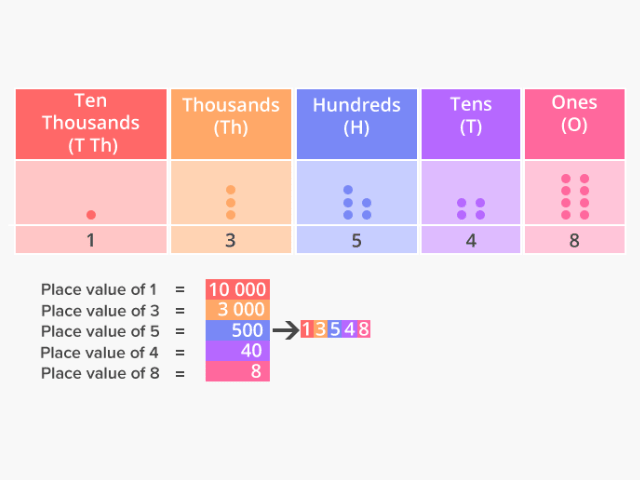
Below is an example that shows the relationship between the place or position and the place value of the digits in the given number 13548.

In 13548, 1 is in ten thousand’s place and its place value is 10,000,
3 is in the thousands place and its place value is 3,000,
5 is in the hundreds place and its place value is 500,
4 is in the tens place and its place value is 40,
8 is in one place and its place value is 8.

example for indian place value chart of the given number

International Place Value Chart

In the international place value chart, the digits are classified into three periods in a big number. The number is read from left to right as billion, million, thousands, ones.

  • 100,000 = 100 thousand
  • 1,000,000 = 1 million
  • 10,000,000 = 10 millions
  • 100,000,000 = 100 millions

The place value chart of the International System is given below:

Place Value Chart For International System
MillionsThousandsOnes
Hundred- Millions (HM)
(100,000,000)
Ten-Millions (TM)
(10,000,000)
Millions (M)
(1,000,000)
Hundred -Thousands (HTh)
(100,000)
Ten- Thousands (TTh)
(10,000)
Thousands (Th)
(1000)
Hundreds (H)
(100)
Tens (T)
(10)
Ones (O) (1)

Comparison Between Indian and International System of Place Value

In this section, you will have a glance at the comparison between both the Indian and International place value system:

Indian Place Value ChartInternational Place Value Chart
Nine places are grouped into four periods: ones, thousands, lakhs, and crores.Nine places are grouped into three periods: ones, thousands, and millions.
Place Values: Ones, tens, hundreds, thousands, ten thousand, lakhs, ten lakhs, crores, and ten crores.Place Values: Ones, tens, hundreds, thousands, ten thousand, hundred thousand, millions, ten million, and hundred million
Lakhs and crores are Indians units in the Indian Place Value Chart.Millions and billions are international units in the International Place Value Chart.

Decimals Place Value

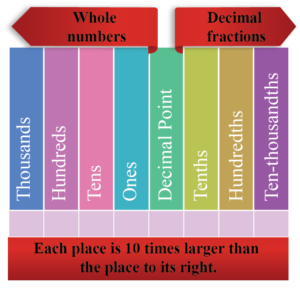
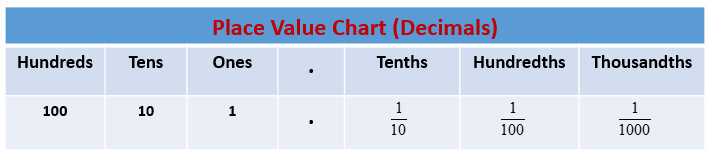
In decimals, place value represents the position of each digit after the decimal point and before the decimal point. A place-value chart tells you how many hundreds, tens, and ones to use. The place value of decimals is based on multiplying by 1/10.

  Hundred
Thousands
      Ten
Thousands
ThousandsHundredsTensOnes.OnesTenthsHundredths

place value chart for decimals

Place Value Table

NumberPlace ValueValue of digit
67,891,234Units / Ones4
67,891,234Tens30
67,891,234Hundreds200
67,891,234Thousands1,000
67,891,234Ten thousand90,000
67,891,234Hundred thousand800,000
67,891,234Millions7,000,000
67,891,234Ten million60,000,000

Solved Examples:

Example 1: Find the place value for the number 27349811 in the International place value system & address it with commas and in words.

Solution:

MILLIONTHOUSANDSONES
T.MMH.ThT.ThThHTO
27349811

The given number place values representation with commas is 27,349,811 and in words is Twenty-seven million three hundred forty-nine thousand eight hundred eleven.

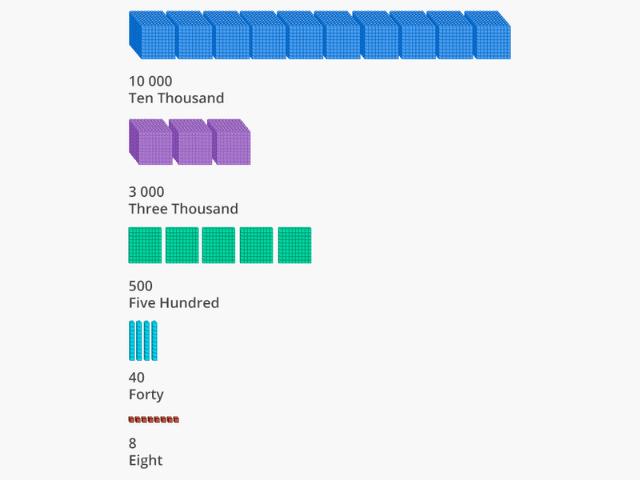
Example 2: Identify the place value of digits for the given number 13548 using base-ten blocks?

Also, The place value of digits of the number can be positioned using base-ten blocks and aid learners write numbers in their expanded form. The below image has a solution for place value of digits for the given number 13548 using base-ten blocks:

example of place value chart using base-ten blocks

FAQs on Place Value Chart

1. What is Place Value with Example?

The position of each digit in a number is known as a place value. The place value of digits is determined as ones, tens, hundreds, thousands,ten-thousands, and so on, based on their place in the number. For instance, the place value of 7 in 1672 is tens, i.e. 70.

2. What is the place value chart for the number 50?

The place value chart for 50 number is

5 digit – Tens – 50

0 digit – ones – 0

3. Is place value different from face value?

Yes, The place value outlines the position of a digit in the given number but the face value represents the exact value of a digit. As an example here we are taking a number ie., 790, and identify both values of digit 9, the place value of 9 is Tens whereas the face value of 9 is 9.

Trigonometrical Ratios Table of All Angles | Tips & Tricks to Learn Trigonometric Functions Table

Trigonometry Ratios Table 0-360: Trigonometry is a branch of mathematics that deals with the study of the length and angles of a triangle. It is usually associated with a right-angle triangle in which one of the angles is 90 degrees. It has a vast number of applications in the field of mathematics. You can figure out many geometrical calculations much simpler if you are aware of the Trigonometric Functions and Table.

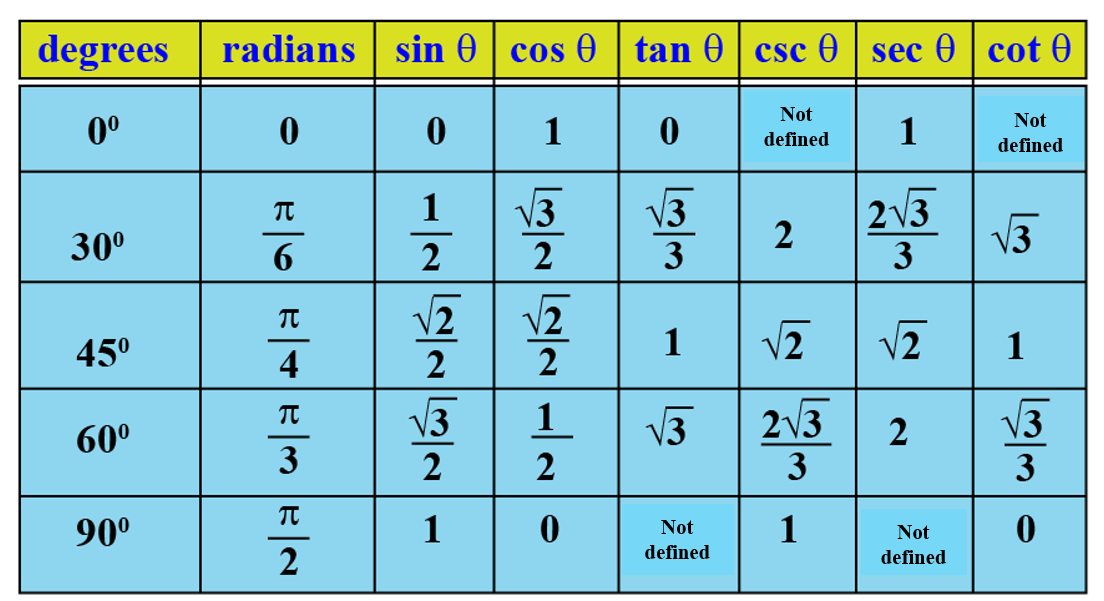
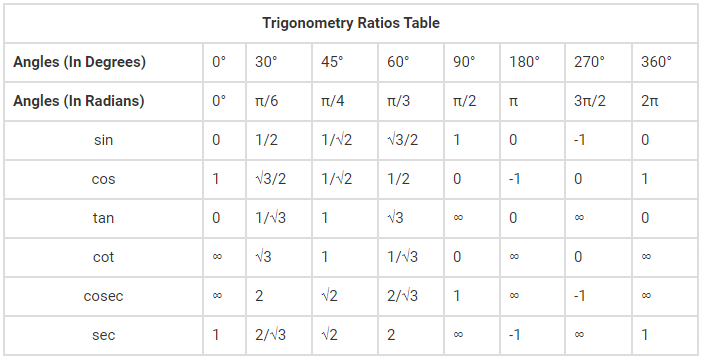
Trigonometric Ratios Table help you find the trigonometric standard angles such as 0°, 30°, 45°, 60°, and 90°. You can find Trigonometric Ratios such as sine, cosine, tangent, cosecant, secant, cotangent, etc. In short, you can write the Trigonometric Ratios as sin, cos, tan, cosec, sec, and cot. You can solve Trigonometry Problems easily if you know the standard values of the Trigonometric Ratios. Thus, remember the standard angle values to make your job easier.

Trigonometric Table has a wide range of applications and it was used ever since before the existence of calculators.  Another Important Application of the Trigonometric Table is in the Fast Fourier Transforms.

Trigonometric Ratios Table for Standard Angles

Trigonometrical Ratios Table in Degrees and Radians

Trig Values Table: 0 to 360 Degrees

Trigonometry Ratio Table for All Angles

Tricks to Remember Trigonometry Table

It is easy to remember the trigonometry table. If you are aware of the trigonometric formulas remembering the table is quite simple. The Trigonometric Ratios Table is dependant on the Trigonometric Formulas. Try to remember the trigonometric table easily by going through the simple formulas.

  • sin x = cos (90° – x)
  • cos x = sin (90° – x)
  • tan x = cot (90° – x)
  • cot x = tan (90° – x)
  • sec x = cosec (90° – x)
  • cosec x = sec (90° – x)
  • 1/sin x = cosec x
  • 1/cos x = sec x
  • 1/tan x = cot x

How to Create a Trigonometric Ratio Table?

Check out the simple guidelines listed below to create a Trigonometric Table having Values of Standard Angles. They are in the following fashion

Step 1:

Create a table having the top row and list out the angles 0°, 30°, 45°, 60°, 90° and also write trigonometric functions such as sin, cos, tan, cosec, sec, cot.

Step 2: Determine the Value of Sin

In the second step determine the value of sin, divide 0, 1, 2, 3, 4 by 4 under the root.

\(\sqrt{\frac{0}{4}}=0\)


Angles (In Degrees)30°45°60°90°180°270°360°
sin01/21/√2√3/210-10

Step 3: Determine the Value of Cos

Cos is opposite to sin and to find the value of cos divide by 4 in the opposite sequence of sin. For instance, divide 4 with 4 under the root to obtain the value of cos 0°

\(\sqrt{\frac{4}{4}}=1\)


Angles (In Degrees)30°45°60°90°180°270°360°
cos1√3/21/√21/20-101

Step 4: Determine the value of tan

Tan is obtained by dividing sin with cos. To find the value of tan 0° divide the Value of Sin 0° by the Value of Cos 0°.

Angles (In Degrees)30°45°60°90°180°270°360°
tan01/√31√300

Step 5: Determine the value of the cot

Value of cot is equal to reciprocal of tan. The value of cot at 0° is obtained by dividing 1 with the value of tan at 0°. In the same way, you can find the value of the cot for all the angles.

Angles (In Degrees)30°45°60°90°180°270°360°
cot√311/√300

Step 6: Determine the value of cosec

Cosec value at 0° is the reciprocal of sin at 0°. You can find all the angles of cosec as such

Angles (In Degrees)30°45°60°90°180°270°360°
cosec2√22/√31-1

Step 7: Determine the value of sec

sec values can be obtained by the reciprocal values of cos. Sec value at 0° is the opposite of cos on 0°. In the similar way entire table of values is given.

Angles (In Degrees)30°45°60°90°180°270°360°
sec12/√3√22-11

FAQs on Trigonometric Ratios Table

1. How to find the Trigonometric Functions Values?

All the Trigonometric Functions Values can be found easily using the formulas and they are given as such

  • Sin = Opposite/Hypotenuse
  • Cos = Adjacent/Hypotenuse
  • Tan = Opposite/Adjacent
  • Cot = 1/Tan = Adjacent/Opposite
  • Cosec = 1/Sin = Hypotenuse/Opposite
  • Sec = 1/Cos = Hypotenuse/Adjacent

2. What is Trigonometric Values Table?

Trigonometric Values table is made of trigonometric ratios that are interrelated to each other – sine, cosine, tangent, cosecant, secant, cotangent.

3. What are Trigonometric Ratios?

Trigonometric Ratios is a relationship between measurements of length and angles of a right angle triangle.

Whole Numbers – Definition, Symbol, Properties, Examples

Whole Numbers is a part of a number system that includes all the positive integers from 0 to infinity. These numbers are present on the number line and are usually called real numbers. Thus, we can say that Whole Numbers are Real Numbers but not all Real Numbers are Whole Numbers. Complete Set of Natural Numbers including “0” are called Whole Numbers.

Whole Numbers – Definition

Whole Numbers are numbers that don’t have fractions and is a collection of positive integers including zero. It is denoted by the symbol “W” and is given as {0, 1, 2, 3, 4, 5, ………}. Zero on a whole denotes null value or nothing.

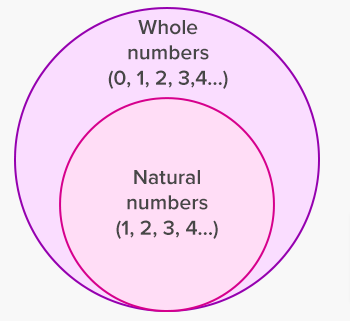
  • Whole Numbers: W = {0, 1, 2, 3, 4, 5, 6, 7, 8, 9, 10……}
  • Natural Numbers: N = {1, 2, 3, 4, 5, 6, 7, 8, 9,…}
  • Integers: Z = {….-9, -8, -7, -6, -5, -4, -3, -2, -1, 0, 1, 2, 3, 4, 5, 6, 7, 8, 9,…}
  • Counting Numbers: {1, 2, 3, 4, 5, 6, 7,….}

Whole numbers are positive integers along with zero and don’t have fractional or decimal parts. You can perform all the basic operations such as Addition, Subtraction, Multiplication, and Division.

Symbol

The Symbol to denote the Whole Numbers is given by the alphabet W = 0, 1, 2, 3, 4, 5, 6, 7, 8, 9, 10,…

  • All-natural numbers are whole numbers
  • All positive integers including zero are whole numbers
  • All whole numbers are real numbers
  • All counting numbers are whole numbers

Properties of Whole Numbers

Whole Numbers Properties depend on arithmetic operations such as Addition, Subtraction, Multiplication, Division. When you multiply or add two whole numbers the result will always be a Whole Number. If you Subtract Two Whole Numbers the result may not always be a Whole Number and it can be an Integer too. Division of Whole Numbers can result in a Fraction at times. Let us see few more Properties of Whole Numbers by referring below.

Closure Property: Whole Numbers can be closed under addition or multiplication. If a, b are two whole numbers then a.b and a+b is also a whole number.

Commutative Property of Addition and Multiplication: Sum and Product of Two Whole Numbers will be the same no matter the order in which they are added or multiplied. If a, b are two whole numbers then a+b = b+a, a.b = b.a

Additive Identity: If a Whole Number is added to 0 the result remains unchanged. If a is a whole number then a+0 = 0+a = a

Multiplicative Identity: Whenever you multiply a whole number with 1 the result remains unchanged. Let us consider a whole number “a” then a.1 = 1. = a

Associative Property: If you are grouping the whole numbers and adding or multiplying a set the result remains the same irrespective of the order. If a, b, c are whole numbers then a + (b + c) = (a + b) + c and a. (b.c)=(a.b).c

Distributive Property: If a, b, c are three whole numbers then the distributive property of multiplication over addition is given by a.(b+c) =(a.b)+(a.c), Similarly Distributive Propoerty of Multiplication over Subtraction is given by a.(b-c) = (a.b)-(a.c)

Multiplication by Zero: If you multiply a Whole Number with Zero the result is always zero. i.e. a.0=0.a=0

Division by Zero: If you divide a Whole Number with Zero the result is undefined, i.e. a divided by 0 is not defined.

Difference between Natural Numbers and Whole Numbers

Whole NumbersNatural Numbers
Whole Numbers: {0, 1, 2, 3, 4, 5, 6,…..}Natural Numbers: {1, 2, 3, 4, 5, 6,……}
All whole numbers are not natural numbersAll Natural numbers are whole numbers
Counting starts from 0Counting starts from 1

By referring to the below sections you will better understand the difference between Whole Numbers and Natural Numbers.

Difference Between Whole Numbers and Natural Numbers


Solved Examples on Whole Numbers

1. Are 101, 147, 193, 4028 whole numbers?

Yes, 101, 147, 193, 4028 are all whole numbers.

2. Solve 8 × (3 + 12) using the Distributive Property?

We know as per the Distributive Property a.(b+c) =(a.b)+(a.c)

Applying the Input Numbers in the formula we have the equation as such

8 × (3 + 12) = 8*3 +8*12

= 24+108

= 132

FAQs on Whole Numbers

1. Is 0 a Whole Number?

Yes, 0 is a Whole Number.

2. What is the Symbol of Whole Numbers?

The Letter W represents the Whole Numbers.

3. Are all Natural Numbers Whole Numbers?

Yes, all Natural Numbers are Whole Numbers but not all Whole Numbers are Natural Numbers. Natural Numbers begin from 0 and counts till infinity. Whole Numbers begin from 0 and end at infinity.

4. What is the set of whole numbers?

The whole numbers are the natural numbers together with 0. The set of whole numbers is a subset of the integers but does not include the negative integers.

Standard Form in Math | Definition, Formulas, How to Find Standard Form with Examples

Basically, Standard Form in Maths can be represented for numbers like decimal numbers, rational numbers, fractions, polynomials, equations, linear equations, etc. As we all know that the simplified form of the fractions called decimal numbers. Eventually, we can say that standard form is the representation of large numbers in small numbers irrespective of any form of numbers. In this article, we have explained what is the standard form of numbers, decimals, equations, etc. How to do it, Rules, and solved Standard form examples.

So, Let’s dive into it!

What is Standard Form?

A Standard Form is a process of formulating a given mathematical concept such as number, equation, polynomial, etc. in the standard form by following certain basic rules.

Standard Form of a Number

The definition of the standard form of a number is representing the very large expanded number in a small number. Here, we will see how to write a numerical in standard form with an example.

Now, we are taking a large number in the expanded form and convert the number into standard form.

Example: 

Write the given expanded form into standard form.

10,00,00,000 + 5,00,00,000 + 4,00,000 + 80,000 + 2,000 + 60 + 9.

Solution:

With the help of this below table, we will write the given expanded form of number into the standard form of a number.

TCCTLLTthThHTO
100000000
50000000
400000
80000
2000
60
9
150482069

Expanded Form                                                                                                   Standard Form

10,00,00,000 + 5,00,00,000 + 4,00,000 + 80,000 + 2,000 + 60 + 9       =             150482069

Standard Form of a Decimal Number

In Britain, the Scientific Notation’s other name is the Standard Form. And in other countries, it means not in the form of the large expanded number. We all know that it’s tough to read numbers such as 0.000000002345678 or 12345678900000. In order to help you all while reading these large numbers, we convert them into standard form.

Any number which we will address as a decimal number, among 1.0 and 10.0, multiplied by a power of 10, is stated to be in standard form. For example, 0.67X10¹³ is in the standard form.

Example:

Write down the standard form of the given decimal number 5326.6?

Solution:

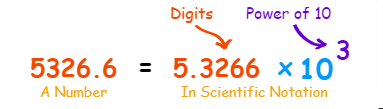
The given decimal number 5326.6 can be written in this way in a scientific notation:

decimals standard form or scientific notation

Because 5326.6 = 53266 X 1000 =  5.3266 × 10³.

Standard Form of a Linear Equation

The “Standard Form” for writing down a Linear Equation is Ax + By = C

A shouldn’t be negative, A and B shouldn’t both be zero, and A, B, and C should be integers.

Example:

Put this y = 7x + 4 in linear equation standard form?

Solution:

Given equation is Y= 7x + 4

Now, you have to change 7x from right to left like this, −7x + y = 4

Multiply all by −1:

7x − y = −4

Note: A = 7, B = −1, C = −4.

Standard Form of a Quadratic Equation

The Standard Form for writing down a Quadratic Equation is ax^2 + bx + c = 0, a is not equal to 0.

Example: 

Put this equation x(x−1) = 4 in the standard form?

Solution:

Given equation is x(x−1) = 4

In the first step, you have to expand x(x−1):

x(x−1) = x² − x

x² − x = 4

Next step is to move the 4 numerical to left side,

x² − x − 4 = 0.

Where A=1, B= -1, C= -4

The standard form of a quadratic equation x(x−1) = 4 is x² − x − 4 = 0. 

FAQs on Standard Form Rules in Maths

1. What is the standard form of an Equation?

An Equation in Standard Form looks like (some expression) = 0 ie., x + y = 0, where the left side of an equation are x and y terms and the Zero is on the right side.

2. What is meant by the standard form of a circle?

The graph of a circle is fully defined by its center and radius. The standard form for the equation of a circle is (x−h)²+(y−k)²=r². The center is (h,k) and the radius measures r units.

3. How to write 81 900 000 000 000 in standard form?

Steps on how to find or write the standard form of a given number ie., 81 900 000 000 000:

  • In step-1, write the first digit 8
  • Now, add a point then it becomes 8.
  • Count the remaining digits after the digit 8 and write the count in the power of 10.
  • For this example, there are 13 digits. So, the standard form of 81 900 000 000 000 is 8.19 × 10¹³.

Proof of De Morgan’s Law in Sets | Demorgan’s Law Definition, Statement and Proof

According to Demorgan’s Law Complement of Union of Two Sets is the Intersection of their Complements and the Complement of Intersection of Two Sets is the Union of Complements. The Law can be expressed as such ( A ∪ B) ‘ = A ‘ ∩ B ‘. By referring to the further modules you can find Demorgan’s Law Statement, Proof along with examples.

For any two finite sets A and B, we have

(i) (A U B)’ = A’ ∩ B’ (which is a De Morgan’s law of union).

(ii) (A ∩ B)’ = A’ U B’ (which is a De Morgan’s law of intersection).

De Morgan’s Laws Statement and Proof

A Set is a well-defined collection of objects or elements. You can perform various operations on sets such as Complement, Union, and Intersection. These Operations and usage can be further simplified by a set of simple laws called Demorgan’s Laws.

Any Set that includes all the elements related to a particular context is called a universal set. Let us assume a Universal Set U such that A and B are Subsets of it.

De Morgan’s Law Proof: (A∪B)’= A’∩ B’   

As per Demorgan’s First Law, the Complement of Union of Two Sets A and B is equal to the Intersection of Complements of Sets A and B.

(A∪B)’= A’∩ B’

Let P = (A U B)’ and Q = A’ ∩ B’

Consider x to be an arbitrary element of P then x ∈ P ⇒ x ∈ (A U B)’

⇒ x ∉ (A U B)

⇒ x ∉ A and x ∉ B

⇒ x ∈ A’ and x ∈ B’

⇒ x ∈ A’ ∩ B’

⇒ x ∈ Q

Therefore, P ⊂ Q …………….. (i)

Let us consider y to be an arbitrary element of Q then y ∈ Q ⇒ y ∈ A’ ∩ B’

⇒ y ∈ A’ and y ∈ B’

⇒ y ∉ A and y ∉ B

⇒ y ∉ (A U B)

⇒ y ∈ (A U B)’

⇒ y ∈ P

Therefore, Q ⊂ P …………….. (ii)

Combining (i) and (ii) we get; P = Q i.e. (A U B)’ = A’ ∩ B’

De Morgan’s Law Proof: (A ∩ B)’ = A’ U B’

Let us consider Sets M = (A ∩ B)’ and N = A’ U B’

Let x be an arbitrary element of M then x ∈ M ⇒ x ∈ (A ∩ B)’

⇒ x ∉ (A ∩ B)

⇒ x ∉ A or x ∉ B

⇒ x ∈ A’ or x ∈ B’

⇒ x ∈ A’ U B’

⇒ x ∈ N

Thus, M ⊂ N …………….. (i)

Again, let y be an arbitrary element of N then y ∈ N ⇒ y ∈ A’ U B’

⇒ y ∈ A’ or y ∈ B’

⇒ y ∉ A or y ∉ B

⇒ y ∉ (A ∩ B)

⇒ y ∈ (A ∩ B)’

⇒ y ∈ M

Thus, N ⊂ M …………….. (ii)

Combining (i) and (ii) we get; M = N i.e. (A ∩ B)’ = A’ U B’

Examples of De Morgan’s Law

1. If U = {a,b,c, d, e}, X = {b, c, d} and Y = {b, d, e}. Prove that De Morgan’s law: (X ∩ Y)’ = X’ U Y’?

Solution:

Given Sets are U = {a,b,c, d, e}, X = {b, c, d} and Y = {b, d, e}

Firstly find the (X ∩ Y) = {b, c, d} ∩ {b, d, e}

= { b,d}

(X ∩ Y)’ = U – (X ∩ Y)

= {a,b,c, d, e} – { b,d}

= {a,c,e}

X’ =  U – X

= {a,b,c, d, e} – {b, c, d}

= {a,e}

Y’ = U – Y

= {a,b,c, d, e} – {b, d, e}

= {a,c}

X’ U Y’ = {a,e} U {a,c}

= {a,c,e}

Hence Prooved (X ∩ Y)’ = X’ U Y’

2. Let U = {1, 2, 3, 4, 5, 6, 7, 8}, A = {2, 3, 4} and B = {5, 6, 8}. Show that (A ∪ B)’ = A’ ∩ B’?

Solution:

Given Sets are U = {1, 2, 3, 4, 5, 6, 7, 8}, A = {4, 5, 6} and B = {5, 6, 8}
(A ∪ B) = {4, 5, 6} ∪ {5, 6, 8}

= {4, ,5, 6, 8}

(A ∪ B)’ = U – (A ∪ B)

= {1, 2, 3, 4, 5, 6, 7, 8} – {4, ,5, 6, 8}

= {1, 2, 3,7}

A’ = U – A

= {1, 2, 3, 4, 5, 6, 7, 8} – {4, 5, 6}

= {1, 2, 3, 7, 8}

B’ = U – B

= {1, 2, 3, 4, 5, 6, 7, 8} – {5, 6, 8}

= {1, 2, 3, 4, 7}

A’ ∩ B’ = {1, 2, 3, 7, 8} ∩ {1, 2, 3, 4, 7}

= {1, 2, 3, 7}

Hence Prooved (A ∪ B)’ = A’ ∩ B’


Binary Subtraction Definition, Table, Rules, Examples | How to Subtract Binary Numbers?

Binary Subtraction is one among the four binary operations in which we perform subtraction of binary numbers i.e. 0 or 1. It is similar to the Basic Arithmetic Operation of Decimals. When we subtract 1 from 0 we need to borrow 1 from the next digit to reduce the digit by 1 and the remainder left here is 1. Go through the entire article to know about Binary Subtraction Rules, Subtraction Table, Tricks and Procedure on How to Subtract Binary Numbers, etc.

What is meant by Binary Subtraction?

Binary Numbers Subtraction is similar to Subtraction of Decimals or Base 10 Numbers. For instance, 1+1+1 is 3 in base 10 whereas in a binary number system 1+1+1 is 11. While Performing Addition and Subtraction in Binary Numbers be careful with borrowing as you might need to do them quite often.

While performing subtraction of several columns of binary digits you need to consider the borrowing. If you subtract 1 from 0 the result will be 1 where 1 is borrowed from the next highest order digit.

Binary Subtraction Table

Binary NumberSubtraction Value
0 – 00
1 – 01
0 – 11 (Borrow 1 from next high order digit)
1 – 10

On Adding Two Binary Numbers 1 and 1 we get the result 10 in which we consider 0 and carry forward 1 to the next higher-order bit. On Subtracting 1 from 1, the result is 0 and nothing will be carry forwarded.

While subtracting 1 from 0 in the case of decimal numbers we borrow 1 from the preceding higher-order number and make it 10 and after subtracting result becomes 9. However, in the case of Binary Subtraction, the result is 0.

Rules for Binary Subtraction

Binary Subtraction is quite simple compared to Decimal Subtraction if you remember the following tips and tricks.

0 – 0 = 0
0 – 1 = 1 ( with a borrow of 1)
1 – 0 = 1
1 – 1 = 0

You can look at the binary subtraction examples provided below for better understanding.

How to Subtract Binary Numbers?

Follow the below-listed steps to perform Binary Subtraction. You will find the Subtraction of Binary Numbers much easier after going through the below steps. They are as follows

  • Align the numbers similar to an ordinary subtraction problem. Write the larger number up and the smaller number below it. If the Smaller Digit has few digits align them towards the right same as in decimal subtraction.
  • Begin from the right column and perform the subtraction operation of binary numbers. While doing so keep the binary subtraction rules in mind and do accordingly.
  • Solve column by column moving from right to left.

Binary Subtraction Examples

1. Find the Value of 1010011 – 001110?

Solution:

Write the given numbers as if you subtracting decimal numbers. Align them to the right and fill them with leading zeros so that both the numbers have the same digits.

1011011

(-)0001010

——————

1010001

Binary Notation

Decimal Notation

The decimal Equivalent of given numbers is

1011011 = 91

001010 = 10

91-10 = 81

2. Find the value of 1100010 – 001000?

Solution:

Write the given numbers as if you subtracting decimal numbers. Align them to the right and fill them with leading zeros so that both the numbers have the same digits.

1100010

(-)0001000

——————

1,011,010

Decimal Notation

The decimal Equivalent of given numbers is

1100010 = 98

1000 = 8

98-8 = 90

Binary Subtraction using 1’s Complement

Go through the below procedure and perform the Binary Subtraction easily. They are as follows

  • Firstly, write the 1’s complement of the subtrahend.
  • And then add the 1’s complement subtrahend with the minuend.
  • If the result has a carryover add the carryover in the least significant bit.
  • If it has no carryover take the 1’s complement of resultant and it is negative.

Questions on Binary Subtraction using 1’s Complement

1. (11001)2  – (1010)2

Solution:

(11001) = 25

(1010) = 10 – subtrahend

Fill with leading zeros till you have the same number of digits in both the numbers. Firstly, take the 1’s complement of subtrahend i.e. (01010)2.

1’s complement of the subtrahend is 10101. Add 1 to the 1’s complement of the second number

10101
+   1

10110

Now instead of subtracting add the 1’s complement of the second number to the first one

11001
+ 10110

——————
101111

Remove the leading 1 to obtain the result.

Then, remove the leading zeros as it will not alter the result and you can write the final result of subtraction as such

11001
– 1010

——————

1111

FAQs on Binary Subtraction

1. What are the Rules of Binary Subtraction?

Rules of Binary Subtraction are as follows

0 – 0 = 0
0 – 1 = 1 ( with a borrow of 1)
1 – 0 = 1
1 – 1 = 0

2. How many basic binary subtraction combinations are possible?

There are four possible binary subtraction combinations when subtracting binary digits.

3. What signs does the binary digit 0 and 1 represent?

0 represents the positive sign and 1 represents the negative sign.

Decimal Place Value Chart: Definition, How to Write, and Examples

Mathematics is the study of numbers, shapes, and patterns. It includes various complex and simple arithmetic topics that help people in their daily life routine. In Maths, Numbers play a major role and they can be of different types like Real Numbers, Whole Numbers, Natural Numbers, Decimal Numbers, Rational Numbers, etc. Today, we are going to discuss one of the main topics of Decimal Numbers. In Decimals, identifying the Decimal Place Values is a fundamental topic and everyone should know the techniques clearly. So, here we will be discussing elaborately the topic of Decimal Place Values Chart.

Let’s get into it.

What is a Decimal in Math?

In algebra, a decimal number can be represented as a number whose whole number part and the fractional part is divided by a decimal point. The dot in a decimal number is called a decimal point. The digits following the decimal point show a value smaller than one.

What is the Place Value of Decimals?

Place value is a positional notation system where the position of a digit in a number, determines its value. The place value for decimal numbers is arranged exactly the identical form of treating whole numbers, but in this case, it is reverse. On the basis of the preceding exponential of 10, the place value in decimals can be decided.

Decimal Place Value Chart

Decimal Place Value Chart table image

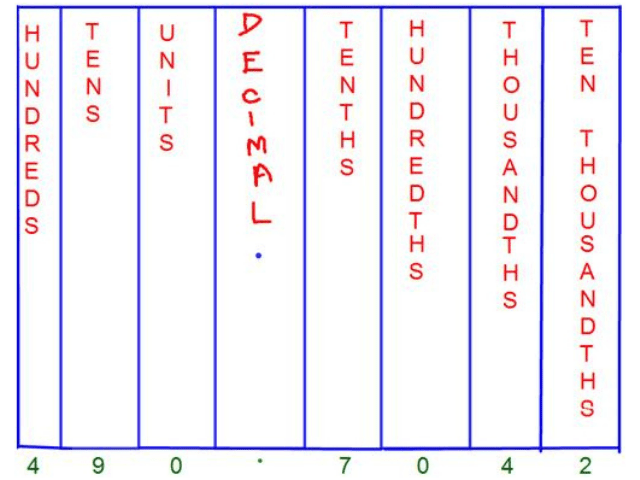
On the place value chart, the numbers on the left of the decimal point are multiplied with increasing positive powers of 10, whereas the digits on the right of the decimal point are multiplied with increasing negative powers of 10 from left to right.

  • The first digit after the decimal represents the tenths place.
  • The second digit after the decimal represents the hundredths place.
  • The third digit after the decimal represents the thousands place.
  • The rest of the digits proceed to fill in the place values until there are no digits left.

How to write the place value of decimals for the number 132.76?

  • The place of 6 in the decimal 132.76 is 6/100
  • The place of 7 in the decimal 132.76 is 7/10
  • The place of 2 in the decimal 132.76 is 2
  • The place of 3 in the decimal 132.76 is 30
  • The place of 1 in the decimal 132.76 is 100.

Examples:

1.  Write the place value of digit 7 in the following decimal number: 5.47?

The number 7 is in the place of hundredths, and its place value is 7 x 10 -2 = 7/100 = 0.07.

2. Identify the place value of the 6 in the given number: 689.87?

Given number is 689.87

The place of 6 in the decimal 689.87 is 600 or 6 hundreds. 

3. Write the following numbers in the decimal place value chart.

(i) 4532.079

(ii) 490.7042

Solutions: 

(i) 4532.079

4532.079 in the decimal place value chart.

example of decimal place value for the given number

(ii) 490.7042

490.7042 in the decimal place value chart.

decimal place value chart examples

Math Conversion Chart | Conversion of Units of Measurement | Metric Conversion Chart

In your day-to-day life, you might need to convert from one unit to another. To Perform the Required Calculations you might need to learn about Mathematical Conversions. Thus, it is necessary to learn about Unit Conversions to change from one unit to another unit.  Before understanding the Units of Measurement you need to be aware of the relationship between them.

Go through the entire article to learn about units of length conversion chart, unit of mass and weight conversion chart, unit of time conversion chart, units of capacity and volume conversion chart, unit of a temperature conversion chart, etc. Math Conversion Charts are quite important and interesting to learn.

What is Conversion of Units?

Depending on the Situation each unit differs. For instance, the area of the room is expressed in Meters whereas the thickness of the pencil is expressed in mm. Thus, it is necessary to convert from one unit to another.

Importance of Mathematical Conversions

In Order to have accuracy and avoid confusion in measurement, we need to change from one unit to another. For example, we will measure the length of the pencil in cm but no in km. Likewise, we need to convert from one unit to another. While converting from one unit to another of the same quantity we use multiplicative conversion factors. Let’s see how to convert different units of length and mass in the later modules.

Length Conversion Chart

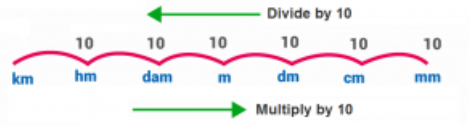
Length Conversion Chart

Mass Conversion Chart

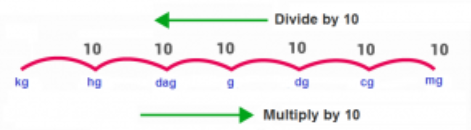
Mass Conversion Chart

Unit Conversion Table

Length Conversion Table

1 km = 10 hm

1 hm = 10 dam

1 dam = 10 m

1 m = 10 dm

1 dm = 10 cm

1 cm = 10 mm

1mm = \(\frac { 1 }{ 10 } \) cm

1 cm = \(\frac { 1 }{ 10 } \) dm

1 dm = \(\frac { 1 }{ 10 } \) m

1m = \(\frac { 1 }{ 10 } \) dam

1 dam = \(\frac { 1 }{ 10 } \) hm

1hm = \(\frac { 1 }{ 10 } \) km

Mass Conversion Table

1 kg = 10 hg

1 hg = 10 dag

1 dag = 10 g

1 g = 10 dg

1 dg = 10 cg

1 cg = 10 mg

1 mg = \(\frac { 1 }{ 10 } \) cg

1 cg = \(\frac { 1 }{ 10 } \) dg

1 dg = \(\frac { 1 }{ 10 } \) g

1 g = \(\frac { 1 }{ 10 } \) dag

1 dag = \(\frac { 1 }{ 10 } \) hg

1 hg = \(\frac { 1 }{ 10 } \) kg

Capacity Conversion Table

1 kℓ = 10 hℓ

1 hℓ = 10 daℓ

1 daℓ = 10 ℓ

1 ℓ = 10 dℓ

1 dℓ = 10 cℓ

1 cℓ = 10 mℓ

1 mℓ =\(\frac { 1 }{ 10 } \) cℓ

1 cℓ = \(\frac { 1 }{ 10 } \) dℓ

1dℓ = \(\frac { 1 }{ 10 } \) ℓ

1 ℓ = \(\frac { 1 }{ 10 } \) dℓ

1 daℓ = \(\frac { 1 }{ 10 } \) hℓ

1 hℓ = \(\frac { 1 }{ 10 } \) kℓ

Points to remember:

  • To convert bigger units to smaller units multiply
  • To convert smaller units to bigger units divide

Solved Examples on Conversion of Units

1. Convert 4 cm to km?

Solution:

Step 1:

Draw a line or box as below

kmhmdammdmcmmm

Step 2:

Put 1 at the larger unit to be converted.

Here we want to convert cm to km,

Since km is the larger unit, thus put 1 under the corresponding column (km).

km

1

hm


dam


m


dm


cm


mm


Step 3:

Now place 0 till the smaller unit

km

1

hm

0

dam

0

m

0

dm

0

cm

0

mm


Since the conversion is from a smaller unit to larger we need to divide the given length by 100000 i.e. 105

4 cm = 4/105

= 0.00004 km

2. Convert 7 gms to milligrams?

Solution:

We need to convert grams to milligrams

We know 1 gram = 1000 mg

Thus 7 g = 7*1000

= 7000 mg


What is 90 Degree Clockwise Rotation Rule? | Check How to Rotate 90° Point in Clockwise Direction with Examples?

In Geometry Topics, the most commonly solved topic is Rotations. A Rotation is a circular motion of any figure or object around an axis or a center. If we talk about the real-life examples, then the known example of rotation for every person is the Earth, it rotates on its own axis. However, Rotations can work in both directions ie., Clockwise and Anticlockwise or Counterclockwise. 90° and 180° are the most common rotation angles whereas 270° turns about the origin occasionally.

Here, in this article, we are going to discuss the 90 Degree Clockwise Rotation like definition, rule, how it works, and some solved examples. So, Let’s get into this article!

90 Degree Clockwise Rotation

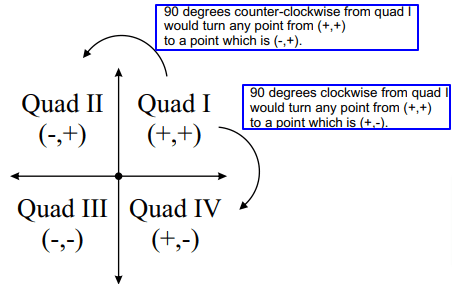
If a point is rotating 90 degrees clockwise about the origin our point M(x,y) becomes M'(y,-x). In short, switch x and y and make x negative.

image for understanding 90 degree rotations rules

Before RotationAfter Rotation
(x, y)(y,-x)

Rule of 90 Degree Rotation about the Origin

  • When the object is rotating towards 90° clockwise then the given point will change from (x,y) to (y,-x).
  • When the object is rotating towards 90° anticlockwise then the given point will change from (x,y) to (-y,x).

Solved Examples:

Example 1:

Solve the given coordinates of the points obtained on rotating the point through a 90° clockwise direction?

(i) A (4, 7)

(ii) B (-8, -9)

(iii) C (-2, 8)

Solution:

When the point rotated through 90º about the origin in the clockwise direction, then the new place of the above coordinates are as follows:

(i) The current position of point A (4, 7) will change into A’ (7, -4)

(ii) The current position of point B (-8, -9) will change into B’ (-9, 8)

(iii) The current position of point C (-2, 8) will change into C’ (8, 2)

Example 2: 

Let P (-6, 3), Q (9, 6), R (2, 7) S (3, 8) be the vertices of a closed figure. If this figure is rotated 90° about the origin in a clockwise direction, find the vertices of the rotated figure.

Solution:

Given vertices are P (-6, 3), Q (9, 6), R (2, 7) S (3, 8)

Now, we will solve this closed figure when it rotates in a 90° clockwise direction,

In step 1, we have to apply the rule of 90 Degree Clockwise Rotation about the Origin

(x, y) → (-y, x)

Next, find the new position of the points of the rotated figure by using the rule in step 1.

(x, y) → (y, -x)

P (-6, 3) → P'(3, 6)

Q (9, 6) → Q’ (6, -9)

R (2, 7) → R'(7, -2)

S (3, 8) → S'(8, -3)

Finally, the Vertices of the rotated figure are P'(3, 6), Q’ (6, -9), R'(7, -2), S'(8, -3).

Example 3:

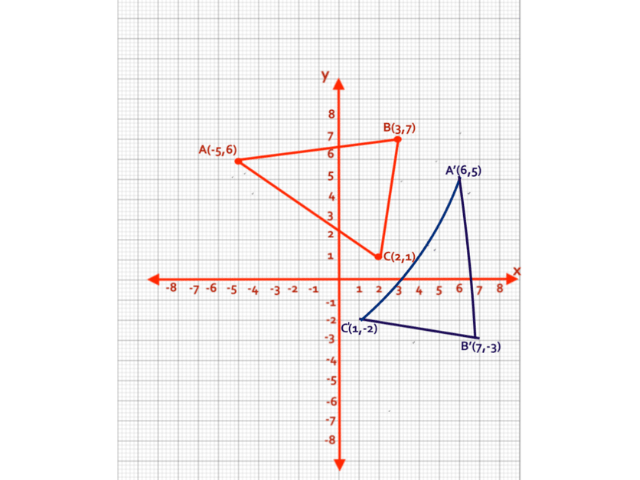
Find the new position of the given coordinates A(-5,6), B(3,7), and C(2,1) after rotating 90 degrees clockwise about the origin?

Solution:

90 degree clockwise rotation example graph

Given Coordinates are A(-5,6), B(3,7), and C(2,1)

The rule/formula for 90 degree clockwise rotation is (x, y) —> (y, -x). 

After applying this rule for all coordinates, it changes into new coordinates and the result is as follows:

A(-5,6) –> A'(6,5)

B(3,7) –> B'(7,-3)

C(2,1) –> C'(1,-2)

I believe that the above graph clears all your doubts regarding the 90 degrees rotation about the origin in a clockwise direction. At last, the result of the coordinates is A'(6,5), B'(7,-3), C'(1,-2). 

FAQs on 90 Degree Clockwise Rotation

1. Is a 90 Degree rotation clockwise or counterclockwise?

Considering that the rotation is 90 Degree, you should rotate the point in a clockwise direction.

2. What are the types of rotation?

You can see the rotation in two ways ie., clockwise or counterclockwise. In case, there is an object which is rotating that can rotate in different ways as shown below:

  • 90 degrees counterclockwise
  • 90 degrees clockwise
  • 180 degrees counterclockwise
  • 180 degrees clockwise

3. What is the rule of Rotation by 90° about the origin?

The rule for a rotation by 90° Counterclockwise about the origin is (x,y)→(−y,x)

The rule for a rotation by 90° Clockwise about the origin is (x,y)→(y,−x)

Practice Test on Profit and Loss | Profit and Loss Practice Questions

Solving the Profit and Loss Questions can give you an idea of how to solve related problems. Know different methods and formulae involved to calculate the Profit and Loss. Try to solve the Profit and Loss Questions on your own and then verify your solution with ours to know where you went wrong. By solving them regularly you can increase your speed and accuracy thereby attempt the exam well and score better grades in the exam.

Question 1:

If the manufacturer gains 15%, the wholesale dealer gets 20% and the retailer gets 30%, then find the cost of production of a blackboard, the retail price of which is $ 1360?

Solution:

Cost of production of blackboard be ‘X’

115% of 120% of 130% of cost price is

i.e. \(\frac { 115 }{ 120 } \)*\(\frac { 120 }{ 100 } \)*\(\frac { 130}{ 100} \)*1360

Cost of production of a blackboard $ 758.08

Question 2:

A man bought a dog and a kennel for $ 4500. He sold the dog at a gain of 25% and the carriage at a loss of 15%, thereby gaining 3% on the whole. Find the cost of the dog.

Solution:

Cost price (C.P.) of dog ‘X’

Cost price (C.P.) of kennel ‘4500 – X’

25% of x – 15% of (4500 – X) = 3% of 4500

Cost of a dog is $ 1373.68.

Question 3:

Profit earned by selling television for $ 6000 is 25% more than the loss incurred by selling the article for $ 4500. At what price should the article be sold to earn 25% profit?

Solution:

let cost price (C.P.) be ‘X’

By equalizing,

(6000 – X) = \(\frac { 125 }{ 100 } \)*(X-4500)

Desired selling price of the television is $ 6458.3.

Question 4:

A manufacturer undertakes to supply 2200 pieces of a particular component at $ 30 per piece. According to his estimates, even if 6% fail to pass the quality tests, then he will make a profit of 30%. However, as it turned out, 60% of the components were rejected. What is the loss to the manufacturer?

Solution:

Incurred cost = $(\(\frac { 100 }{ 130 } \)*30*(94% of 2200))

Loss = C.P. – S.P.

The loss to the manufacturer is $ 8123.07.

Question 5:

John bought a lorry for a certain sum of money. He spent 15% of the cost on repairs and sold the lorry for a profit of $ 1600. How did he spend on repairs if he made a profit of 30%?

Solution:

Let the Cost price (C.P.) of the lorry be ‘X’

Profit (P) = $16,00

Profit (%) = 30

Profit (%) = \(\frac { 100 }{ CP } \)*P

30 = \(\frac { 100 }{ CP} \)*1600

CP = \(\frac { 100 }{ CP} \)*1600

CP = \(\frac { 100 }{ 30} \)*1600

= $5333.3

The C.P Includes both original price and repairs cost

C.P +0.15C.P = $5333.3

1.15 C.P = $5333.3

C.P = $4637.68

Repairs Cost = Total Cost Price – Cost Price for which john bought the lorry

= $5333.3 – $4637.68

= $ 695.61

Expenditure spend on repairs = $ 695.61.

Question 6:

A boy bought 25 litres of milk at the rate of $ 12 per litre. He got it churned after spending $ 15 and 7kg of cream and 25 lit of toned milk were obtained. If he sold the cream at $ 40 per kg and toned milk at $ 6 per lit, what is his profit % in the transaction?

Solution:

Cost price (C.P.) = $ ((25*12) + 15)

Selling price (S.P.) = $ ((7*40) + (25*6))

Gained profit % on the above transaction is 36.50%.

Question 7:

Arun purchased 150 reams of paper at $ 90 per ream. He spent $ 300 on transportation, paid local tax at the rate of 50 paise per ream, and paid $ 76 to coolie. If he wants to have a gain of 10%, what must be the selling price per ream?

Solution:

Total investment = $ (((150*90) + 300) + ((50/100 * 150) + 76))

Find selling price per ream

Selling price per ream = $ 102.3

Question 8:

A retailer mixes three varieties of dal costing $ 50, $ 25, and $ 30 per kg in the ratio 3: 5: 2 in terms of weight, and sells the mixture at $ 35 per kg. What percentage of profit does he make?

Solution:

Cost price (C.P.) of dal for 10 kgs = $ ((3*50) + (5*25) + (2*30))

Selling price for 10 kgs = $ (10*35)

Profit percentage on transactions is 4.74%.

Question 9:

A man buys chocolates at 3 for $ 2 and an equal number at 5 for $ 3 and sells the whole at 6 for $ 4. His gain or loss percent is?

Solution:

Suppose he buys 7 eggs of each kind

Find C.P. and S.P. for 14 eggs

C.P. = $ ((\(\frac { 2 }{ 3 } \) * 7) + (\(\frac { 3 }{ 5 } \) * 7)) = $ 8.86

Similarly, find S.P.

The gain % obtain is 5.34%.

Question 10:

The manufacturer of a certain item can sell all he can produce at the selling price of $ 65 each. It costs him $ 45 in material and labor to produce each item and he has overhead expenses of $ 3500 per week in order to operate the plant. The number of units he should produce and sell in order to make a profit of at least $ 1200 per week is?

Solution:

Consider he produces ‘x’ items

Cost price (C.P.) = $ (45x + 3500)

Selling price (S.P.) = $ 65x

The number of units produced per week to gain profit is 235.

Examples on Division of Integers | Dividing Integers Problems with Solutions

Get the complete practice test questions and worksheet here. Follow the step by step procedure to solve examples on the division of integers all the problems. Know the shortcuts, tricks, and steps involved in solving Division of Integers problems. Also, find the definitions, formulae before going to start the practice sessions. Go through the below sections to know the detailed information regarding formulas, definitions, and problems.

Integers Division Rules

Rule 1: The quotient value of a positive integer number and a negative integer number is negative.

Rule 2: The quotient value of two positive integer numbers is a positive number.

Rule 3: The quotient value of two negative integer numbers is a positive number.

Division of Integers Rules and Examples

Question 1: Find the value of ||-17|+17| / ||-25|-42|

Solution:

||-17|+17| / ||-25|-42|

= |17+17| / |25–42|

= |34| / |-17|

= 34 / 17

= 2

Question 2: Simplify: {36 / (-9)} / {(-24) / 6}

Solution:

{36 / (-9)} / {(-24) / 6}

= {36/-9} / {-24/6}

= – (36/9) / – (24/6)

= -4/-4

= 4/4

=1

Question 3: Find the value of [32 + 2 x 17 + (-6)] ÷ 15

Solution:

[32+2 x 17+(-6)] / 15

= [32+34+(-6)] / 15

= (66-6) / 15

= 60 / 15

= 4

Question 4: Divide the absolute values of the two given integers?

Solution:

The quotient of the absolute value of integer +24 and the absolute value of integer -8

From the rules given above, dividing the integers with different signs gives the final result as negative.

When positive(+) 24 is divided by negative(-) 8 results negative(-) 3, which can be defined as +24/(-8) = -3

Question 5: Prove that [((-8) / (-4)] ≠ =-8 / [(-4) / (-2)]

Solution:

From the given question

[((-8)/(-4)]/(-2)] ≠ -8/[(-4)/(-2)]

First of all, we will consider the LHS part i.e., [((-8) / (-4)] / (-2)]

To solve the equation, first, we divide 8 by 4, we get the result as 2

As both numbers have a negative sign, it will be positive.

Then we divide the result (2) by -2, then the final result will be -1.

Therefore, the result of the LHS part is -1.

Now, we consider the RHS part i.e., -8 / [(-4) / (-2)]

First of all, we divide -4 by -2, the result will be 2.

As both the numbers have a negative sign, the result will be positive.

Now, divide -8 by the above result 2.

Hence, the result will be -4.

Therefore, the result of RHS is -4.

Hence, LHS ≠ RHS

The above given equation [((-8) / (-4)] / (-2)] ≠ -8 / [(-4) / (-2)] is thus satisfied.

Question 6: In a maths test containing 10 questions, 2 marks are given for every correct answer and (-1) marks are given for every wrong answer. Rohith attempts all the questions and 8 questions answers are correct. What is Rohith’s total score?

Solution:

From the given question,

The marks given for every correct answer = 2 marks

Marks given for 8 correct answers = 2 * 8= 16 marks

Marks given for 1 incorrect answer = -1 marks

Marks given for 2 incorrect answers = -1 * 2 = -2 marks

Rohit’s total score = 16-2 = 14 marks

Therefore, the answer is 14 marks.

Question 7: Priya sells 20 pens and some pencils losing 2 Rs in all. If Priya gains 2 Rs on each pen and loses 1 Rs on each pencil. How many pencils does Priya sell?

Solution:

Suppose that Priya sells x pencils.

Total gain on pens = 2*20 = 40 Rs

Total loss on pencils = 1x = x

Total loss on selling pens and pencils = (-2)

40-x = (-2)

40+2 = x

x = 42

Therefore, Priya sells 42 pencils.

Thus, the answer is 42 pencils.

Question 8: To make ice cream, the room temperature must be decreased from 45degree C at the rate of 5 degrees C per hour. What will be the room temperature 12 hours after the freezing point of the icecream?

Solution:

As given in the question,

Temperature after 12 hours = 12*5 = 60degree C

Room temperature = 45degree C

Hence, the room temperature after freezing process of 12 hours = (45-60)degree C

= -15degree C

Question 9:

A car runs at a rate of 50km/hr. If the car starts at 5 km above the starting point, how long will it take to reach 2505km?

Solution:

As per the question,

Total distance covered by car = (2505-5) km = 2500 km

Rate of car = 50km/hr

From the above values, Distance = 2500 km, speed = 50 km/hr

Therefore, the time required by the car = distance/speed

=2500/50 = 50 hours

Therefore, the car will take 50 hours to travel 2505 km.

Hence, The final solution is 50 hours.

Question 10: Jason borrowed $5 a day to buy launch. She now owes $65 dollars. How many days did Jane borrow $5?

Solution:

As per the question,

Jason borrowed a launch at =  $5

Now she owes = $65

No of days = (-65) / (-5)

= 13 days

Therefore, Jane borrows $5 for 13 days.

Hence, The final solution is 13 days.

Division of Integers Word Problems

Question 11: Allen’s score in a video game was changed by -120 points because he missed some target points. He got -15 points for each of the missed targets. How many targets did he miss?

Solution: 

As per the given question,

Allen scored points in a video game = -120

He got points for missed targets = -15

No of targets he missed = -120/-15 = 8 targets.

Therefore, he missed 8 targets.

Question 12: Karthik made five of his truck payments late and was fined five late fees. The total change in his savings of late fees was -$30. What integer represents the one late fee?

Solution:

As given in the question, Karthik has made five of his truck payments. Therefore, it is positive.

He was fined -$30 as the late fees.

To find one late fee, we have to divide the fine by no of payments he did.

Therefore, One Late fee = -$30/5

=-$6

Thus, He paid $6 for each payment as late fees.

Hence, the final answer is -$6.


Examples on Multiplication of Integers | Questions on Multiplication of Integers

Do you find it difficult to understand the Integers Multiplication? Here is the best solution for you all. We are providing Examples on Multiplication of Integers here. Integers Multiplication is an important concept which helps you to score more marks in the exam. Questions on Multiplication of Integers with Answers are available so that you can practice them regularly. Learn How to Multiply Integers by referring to the further modules.

Worked out Multiplication of Integers Problems

Before going to solve the Integers Multiplication problems, know all the definitions, rules, formulae etc. In the upcoming sections, you will find all the details and also problem-solving techniques and tips. To be more precise, you can only solve the problems if you know all the details regarding integers.  Know various properties of integers beforehand and how they work while multiplying the integers.

Key Points to Remember on Properties of Integers Multiplication

  • The Closure Integer Property of multiplication defines that the product value of two or three integer numbers will be an integer number.
  • The commutative Integer Multiplication property defines that swapping two or three integers will not differ the value of the final result.
  • The associative Integer Multiplication property defines that the grouping of integer values together will not affect the final result.
  • The distributive Integer property of multiplication defines that the distribution concept of 1 operation value on other mathematical integer values within the given braces.
  • Multiplication by zero defines the product value of any negative or positive integer number by zero
  • Multiplicative Integer defines the final result as 1 when any integer number is multiplied with 1.

Integer Multiplication Rules on Problems

Question 1:

The temperature in an area drops by 4 degrees for 4 hours. How much is the total drop in the temperature?

Solution:

As given in the question, the temperature drops by 4 degrees. Therefore, the temperature is a negative factor.

Also. given that it decreases for 4 hours.

The total drop in temperature is (-4) * (4) = -16

Therefore, the total drop in temperature is 16 degrees C

Thus, the final result is -16 degree C

Question 2:

Jason borrowed $2 a day to buy a launch. She now owes $60. How many days did Jason borrow $2?

Solution:

As given in the question, Jason borrowed to buy a launch = $2

After buying she owes $60

No of days Jason borrowed money = 60/2 = 30

Therefore, the total days = 30 days

Thus, the final result is 30 days.

Question 3: A football team 12 yards on each of the four consecutive plays. What was the team’s total change in position for four plays?

Solution: 

As given in the question, A football team lost yards = -12 yards

No of plays = 4

Team total change in position for 4 plays = (-12) * (4) = 48

Therefore, the total change = -48 yards

Thus, the final answer is -48 yards.

Question 4: On a certain day, the temperature changed at a rate of -2 degrees F per hour. If this happened for continuous 5 days. For how many days there was a change in temperature?

Solution:

As per the given question, The temperature changed at the rate = -2 degree F

The change happened for days = 5 days

No of days there was a change = (-2)*5 = -10

Therefore, there was a change for days = 10 days

Thus, the final solution is 10 days.

Question 5: Flora made 6 deposits $ 7 each from her bank account. What was the overall change in her account?

Solution:

As per the given question,

Flora made no of deposits = 6

Amount of deposited money = $7

The overall change in the account = 6 * ($7) = 42

Therefore, the change in money = 42

Thus, the final solution is $42

Questions on Multiplication of Integers

Question 6: A winter coat was priced at $200. Each month for three months, the price was reduced by $15. How much was the coat reduced in price?

Solution:

As per the given question,

The price of the winter coat is reduced by $15, Therefore it is negative = -$15

No of times it is reduced = 3

The absolute values of |3| and |-15| are 3 and 15

The coat reduced in price = 3*15 = 45

Therefore, the total change in price = $45

Thus the final answer = -$45

Question 7:

Netflix charges $9 per month for their streaming plan to watch movies. If they automatically bill a customer for 6 months, How much will be deducted from the customer’s bank account?

Solution:

As per the given question,

Netflix charges $9 per month. Therefore, it is negative.

Given, the bill will be deducted automatically for months = 6

The absolute values of |6| and |9| are 6 and 9.

The amount of money deducted from customers bank account = 6*9 = 54

Therefore, the total amount after determining the signs = -$54

Hence, the final solution is -$54

Question 8: Lisa decided her hair was too long. In June and again in July. she cut 3 inches off. Then, in August, September, and October she cut off 2 inches. Write an equation to represent the change in the length of her hair?

Solution:

As given in the question,

In 2 months, she cut 3 inches off her hair. Cutting her hair made the length shorter, therefore it is negative.

In 3 months, she cut 2 inches off her hair. This is also negative.

For the month of June and July, the length of the hair she cut = 2 * (-3) = -6

For the months August, September, and October, the length of the hair she cut = 3 * (-2) = -6

Therefore, the total length = (-6) + (-6) = -12 inches

Thus. the complete length she cut = 12 inches

Hence, the final solution is -12 inches

Question 9: The depth of the water in a pool decreases an average of two inches each week during the summer. What will be the change in the depth of water of four weeks?

Solution:

As given in the question,

The depth of the water in a pool decreases each week = 2 inches

As the water level decreases, it will be negative.

The decrease in water for weeks = 4

The change in depth of water = (-2)*4 = -8

Therefore, the water level decreases by 8 inches.

Thus, the final solution is -8 inches

Question 10:

For every 1000 feet, you gain in elevation, the temperature drops by 3 degrees. If you increase your elevation by 5000 feet, How would the temperature change?

Solution:

As per the given question,

The temperature drops by 3 degrees. Therefore, it will be negative.

Also given for every 1000 feet it is 3 degrees. Thus for every 5000 feet, it is 5 degrees.

The temperature change = (-3)*5 = -15

Thus, for every 5000 feet, the temperature changes by -15 degrees.

Hence, the final solution is -15 degrees.

Fundamental Operations in Mathematics | Four Basic Mathematical Operations for Simplifying Algebraic Terms

Wanna start your preparation from basics? Then here is the most basic and important concept. Learn all the Fundamental Operations and their usage in day to day life. Solve all the important problems involved in fundamental algebra operations. Know the definitions, rules, strategies, tips, tricks, and problems. Refer to the upcoming sections to get more information regarding mathematical expressions and operations.

Fundamental Operations – Introduction

Fundamental Operations are the basic concept to solve any type of problem. We perform the operations at one time and generally, it starts from the left towards the right. If the expression contains more than 1 fundamental operation, then you can’t perform them in the order they appear in the question. There are certain rules to follow to perform various operations when more than 1 fundamental value is available. The precedence order has to be followed to solve the Fundamental Operation. The precedence order will be shown in the below sections.

Order of Expression – DMAS Rule

The fundamental operations are expressed in an order. Generally, the order will be in the format of “DMAS” where “D” stands for “Division”, “M” stands for “Multiplication”, “A” stands for “Addition”, “S” stands for “Subtraction”. This order is considered and sequentially performed from left to right.

As there are fundamental operations in arithmetic, there are in a wat that three pairs of arithmetic operations, and for each pair of operations is the reversal of co-operation within the pairs. As addition and subtraction are reverse operations of each other. It is similar for other operations too. In regard to Algebra, everyone must understand that it is a set of rules based on fundamental operations which helps for faster calculations and an easy approach for variable problem-solving.

Basic Fundamental Operations to Simplify Mathematical Expressions

Addition

The addition is defined by the operator (+). It is the fundamental operation of the arithmetic operators. It implies the combination of distinct quantities or sets. It involves counting numbers from one to one by incrementing the values. The result value after adding all the numbers is called the “sum”. The numbers and the initial number are called addends.

The addition of natural numbers involves 2 important properties i.e., associativity and commutativity.

Addition Operation on Positive and Negative Integers

Positive (+) + Positive (+) = Positive (+)
Negative (-) + Positive (+) = Negative (-)
Positive (+) + Negative (-) = Sign of the largest Number
Negative (-) + Positive (+) = Sign of the largest number

Examples:
5+4 = 9
(-5) + (-4) = -9
(-5) + 4 = -1
4 + (-5) = -1
(-4) + 5 = -1
5 + (-4) = 1

Example Problem:

An empty water tank of 8 feet high is available. A monkey is sitting at the bottom of that tank. The monkey tried jumping to the top of the tank. While jumping it jumps 3 ft up and slides down to 2 ft. How many jumps will the monkey take to reach the top of the water tank?

Solution:

As per the given question,

Monkey’s first jump = 3 ft up and 2 ft down

= (+3)-2=1

2nd Jump of the Monkey = 3 ft up and 2 ft down = (1+3) = 4

= (+4)-2=2

Therefore, the monkey covers 2 ft after the 2nd jump

3rd Jump of the Monkey = 3 ft up and 2 ft down = (2+3) = 5

=(+5)-2 = 3

Therefore, the monkey covers 3 ft after the 3rd jump

4th Jump of the Monkey = 3 ft up and 2 ft down = (3+3) = 6

=(+6)-2 = 4

Hence, the monkey covers 4 ft after the 4th jump

5th Jump of the Monkey = 3 ft up and 2 ft down = (4+3)=7

=(+7)-2 = 5

Therefore, the monkey covers 5 ft after the 5th jump.

6th Jump of the Monkey = 3 ft up = (5+3) = 8

As the water tank is 8 feet high, the monkey will reach the top of the water tank in the 6th jump.

Subtraction

The subtraction is defined by the operator (-). Subtraction is the inverse property of addition. It means that removing one quantity from another quantity. It involves incrementing down from the given number. The result value after subtracting all the numbers is called the “difference”. The number from which other number is subtracted is called subtrahend. The subtracted number is called minuend.

Subtraction Operation on Positive and Negative Integers

Negative (-) – Positive (+) = Negative (-)
Positive (+) – Negative (-) = Positive (+)
Negative (-) – Negative (-) = Sign of the largest Number
Negative (-) + Positive (+) = Sign of the largest number

Examples:

(-5)-4 = (-5) + (-4) =- 9
5 – (-4) = 5 +4 = 9
(-5) – (-4) = (-5) + 4 = -1
(-4) – (-5) = (-4) + 5 = 1

Example Problem:

At a height of 3000 feet above sea level, a plane is flying. At some time, there is a submarine that is exactly above and floating 700 feet below sea level. Calculate the vertical distance using the concept of subtraction of integers?

Solution:

Height of the plane that is flying = 3000 feet

Depth of the submarine = -700 feet ( It is negative, as it is below the sea level).

To calculate the vertical distance, we use the subtraction of integers operation.

3000-(-700) = 3000 + 700 = 3700 feet

Therefore, the vertical distance is 3700 feet.

Multiplication

The multiplication is defined by the operator (“x” o “*”). Multiplication is the repeated property of addition. It means that a particular number is being repeatedly added to itself several times. It involves adding the number with the same number. The result value after multiplying all the numbers is called the “product”. The number to which another number is multiplied is called multiplicand. The multiplied number is called a multiplier.

Multiplication Operation on Positive and Negative Integers

Negative (-) x Positive (+) = Negative (-)
Positive (+) x Negative (-) = Negative (-)
Negative (-) x Negative (-) = Negative (-)
Positive (+) + Positive (+) = Positive (+)

Examples:

5×4 = 12

(-3) x (-4) = 12

(-3) x 4 = – 12

3 x (-4) = -12

Example Problems:

The submarine descends 40 feet per minute from sea level. Find the relation of the submarine with the sea level 5 minutes after it starts descending?

Solution:

The submarine below sea level =40 feet

As it is below sea level, it is negative. Therefore, it is -40.

After 5 minutes, the submarine is at = -40 x 5 = -200 feet

Therefore, the final solution is -200 feet.

Division

The division is defined by the operator (÷). The division is the inverse property of multiplication. It means that a particular number or quantity is split into equal or the same parts. It involves the splitting of numbers in the same proportions. The result value after dividing the numbers is called the “quotient”. The original number is called “dividend”. The number which is used for dividing into groups is called “divisor”. The final result is “quotient”.

Division Operation on Positive and Negative Integers

Negative (-) ÷ Positive (+) = Negative (-)

Positive (+) ÷ Negative (-) = Negative (-)

Negative (-) ÷ Negative (-) = Positive (+)

Positive (+) ÷ Positive (+) = Positive (+)

Examples:

20÷4 = 5

(-20)÷(-4) = 5

(-20) ÷ 4 = -5

20÷(-4) = -5

Example Problem:

In a living room, there are 120 books in total and they are placed on 6 shelves. Consider that each shelf has an equal number of books, Calculate the number of books on each shelf?

Solution:

As per the given question,

The total no of books = 120

No of seats placed on shelves = 6

To determine the number of books on each shelf = 120/6 =20

Therefore, the number of books on each shelf = 20 books.

Thus the final solution is 20 books.

Practice Test on Parallelogram | Multiple Choice Questions on Parallelogram 

Practice Test on Parallelogram will help you to test your knowledge. Answer on your own for every question given below. Before you take the practice test, make sure you have read the concept completely and solved all problems. It becomes easy if you have a perfect grip on the entire concept. Also, it will avoid you to confuse while choosing the answers. Complete concept and Objective Questions on Parallelogram are given on our website for free of cost.

Tick (✔) the correct answer in each of the following

1. From the given options, which parallelogram two diagonals are not necessarily equal ………………..

(a) square
(b) rectangle
(c) isosceles trapezium
(d) rhombus

Answer:

(d) rhombus

Explanation: rhombus two diagonals are not necessarily equal.


2. A rhombus has diagonals of 16 cm and 12 cm. Find the length of each side?

(a) 8cm
(b) 12cm
(c) 10cm
(d) 9cm

Answer:

(c) 10cm

Explanation:
Given that One diagonal is 16 and another 12 then half of both is 8 and 6. Diagonal of a rhombus bisect at 90º.
By pythogaurus theorem
h² = 8² + 6²
h² = 64 + 36=100
h = √100 = 10

Side = 10


3. Two adjacent angles of a parallelogram are (4b + 15)° and (2b – 10)°. The value of b is ………………. .

(a) 29.16
(b) 32
(c) 42
(d) 36

Answer:

(a) 29.16

Explanation: sum of the adjacent angles of parallelogram=180
4b + 15 + 2b – 10=180
6b + 5 = 180
6b =180 – 5
6b = 175
b = 175/6

b = 29.16


4. From the given options, which parallelogram two diagonals do not necessarily intersect at right angles ………………..

(a) rhombus
(b) rectangle
(c) kite
(d) parallelogram

Answer:

(d) parallelogram

Explanation: The diagonals do not necessarily intersect at right angles in a parallelogram.


5. The length and breadth of a rectangle are in the ratio 8 : 6. If the diagonal measures 50 cm. Find the perimeter of a rectangle?

(a) 800 cm
(b) 700 cm
(c) 600 cm
(d) 560 cm

Answer:

(b) 700 cm

Explanation: Let m be the common multiple.
Length = 8m
Breadth = 6m
According to Pythagoras theorem,
(8m)² + (6m)²=(50)²
64m²+ 36m² = 2500
100m² = 2500
m² = 2500/100
m = 25
So, Length = 8m = 200 cm
Breadth = 6m = 150 cm
Perimeter = 2 (l × b)
= 2 (200 + 150)
= 700 cm

So, perimeter of rectangle is 700 cm.


6. The bisectors of any two adjacent angles of a parallelogram intersect at ………………..

(a) 90°
(b) 30°
(c) 60°
(d) 45°

Answer:

(a) 90°

Explanation: The bisectors of any two adjacent angles of a parallelogram intersect at 90°.


7. If an angle of a parallelogram is 2/3 of its adjacent angle find the angle of a parallelogram.

(a) 72°
(b) 54°
(c) 108°
(d) 81°

Answer:

(a) 72°

Explanation: Let m and n be the adjacent angles of a parallelogram.
Now, as we know that adjacent angles of a parallelogram are supplementary
Therefore, the sum of angles a and b will be 180º.
m + n = 180º
One angle is 2/3rd of the other.
m = 2/3 . n
2/3 . n + n = 180º
5/3 . n = 180º
n = 108º
m = 2/3 . 108º = 72º


8. The diagonals do not necessarily bisect the interior angles at the vertices in a ………………..

(a) square
(b) rectangle
(c) rhombus
(d) all of these

Answer:

(b) rectangle

Explanation: The diagonals do not necessarily bisect the interior angles at the vertices in a rectangle.


9. In a square PQRS, PQ = (3a + 5) cm and RS = (2a – 2) cm. Find the value of a?

(a) 4
(b) 5
(c) 7
(d) 8

Answer:

(c) 7

Explanation: We know all the sides of a square are equal.
3a + 5 = (2a – 2)
3a – 2a = 5 + 2
a = 7

Hence, solved


10. If one angle if a parallelogram is 24º less than twice the smallest angle then the largest angle if parallelogram is?

(a) 68°
(b) 112°
(c) 102°
(d) 176°

Answer:

(b) 112°

Explanation: Let the smallest angle be a then, the largest angle will be =180−a
but, the same equals to [2a − 24]
so we have [2a − 24] = 180 − a
3a = 204
a = 68

Thus, the largest angle 180 − 68 = 112 degree