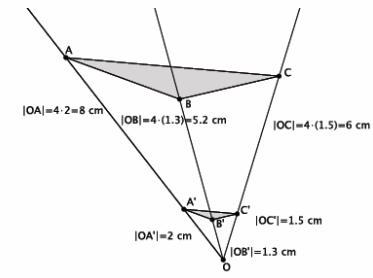
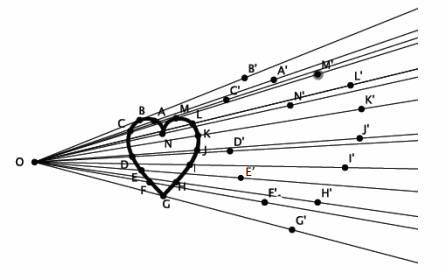
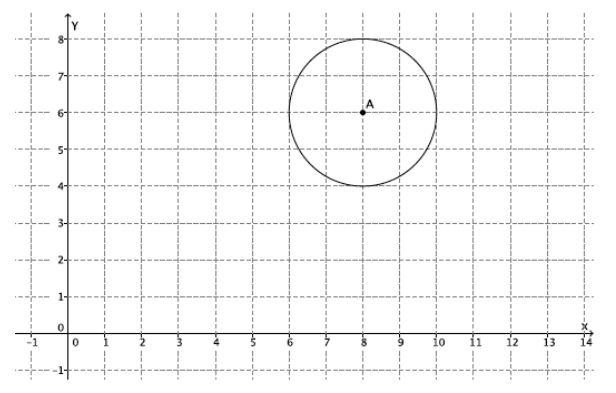
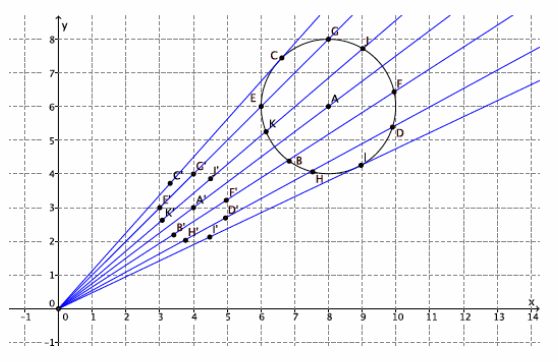
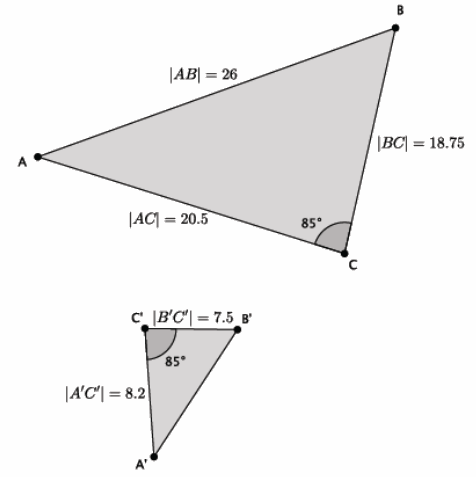
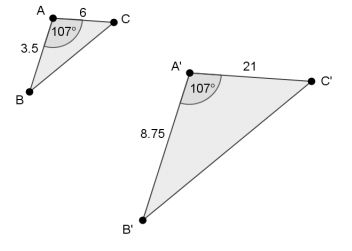
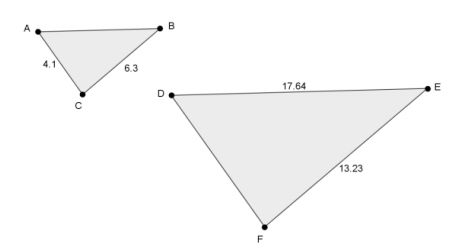
Eureka Math Grade 8 Module 3 Lesson 5 Answer Key

Engage NY Eureka Math 8th Grade Module 3 Lesson 5 Answer Key

Eureka Math Grade 8 Module 3 Lesson 5 Exercise Answer Key

Exercise 1.
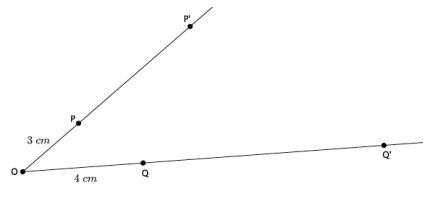
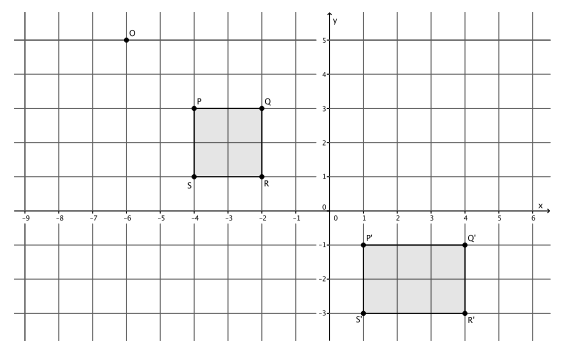
In the diagram below, points P and Q have been dilated from center O by scale factor r. \(\overline{P Q}\) || \(\overline{\boldsymbol{P}^{\prime} \boldsymbol{Q}^{\prime}}\) |PQ|=5 cm, and |P’Q’|=10 cm.
Eureka Math Grade 8 Module 3 Lesson 5 Exercise Answer Key 1

b. Determine the scale factor r.
Answer:
According to FTS, |P’Q’|=r|PQ|. Therefore, 10=r∙5, so r=2.

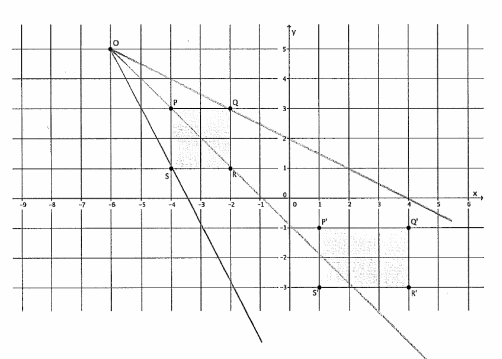
b. Locate the center O of dilation. Measure the segments to verify that |OP’|=r|OP| and |OQ’|=r|OQ|. Show your work below.
Answer:
Center O and measurements are shown above.
|OP’|=r|OP|
6=2∙3
6=6
|OQ’|=r|OQ|
8=2∙4
8=8

Exercise 2.
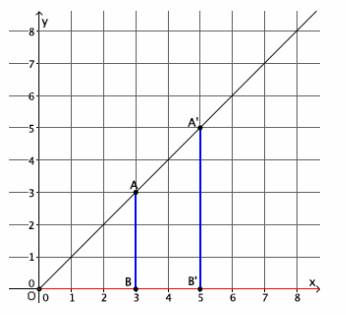
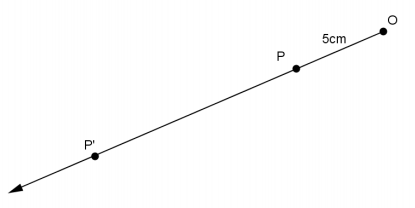
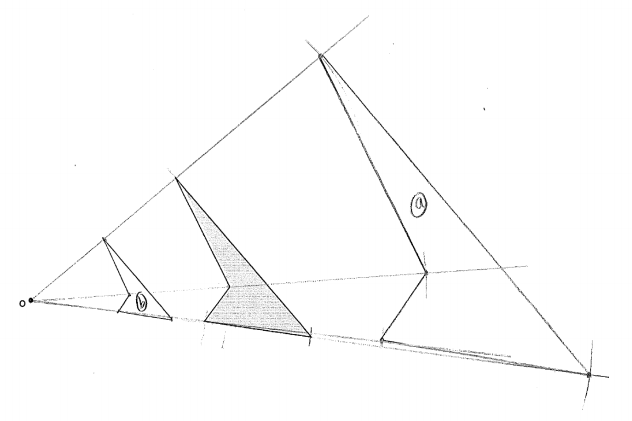
In the diagram below, you are given center O and ray \(\overrightarrow{0 A}\). Point A is dilated by a scale factor r=4. Use what you know about FTS to find the location of point A’.
Eureka Math Grade 8 Module 3 Lesson 5 Exercise Answer Key 2
Answer:
Point A’ must be located at (12,12).

Exercise 3.
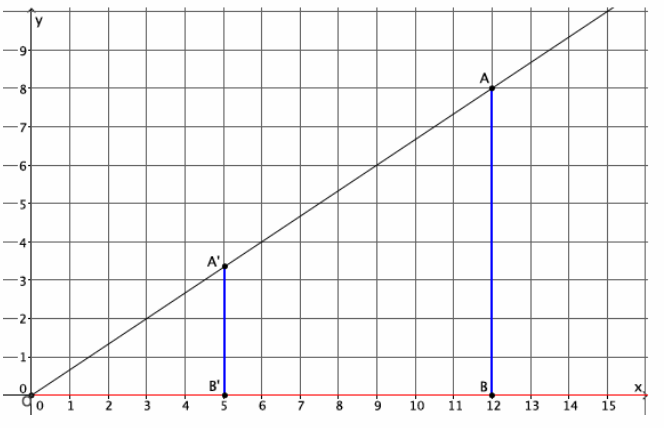
In the diagram below, you are given center O and ray \(\overrightarrow{0 A}\). Point A is dilated by a scale factor r=\(\frac{5}{12}\). Use what you know about FTS to find the location of point A’.
Eureka Math Grade 8 Module 3 Lesson 5 Exercise Answer Key 3
Answer:
The x-coordinate of A’ is 5. The y-coordinate is equal to the length of segment A’B’. Since |A’B’|=r|AB|, then |A’B’|=\(\frac{5}{12}\)∙8=\(\frac{40}{12}\)≈3.3. The location of A’ is (5,3.3).

Eureka Math Grade 8 Module 3 Lesson 5 Exit Ticket Answer Key

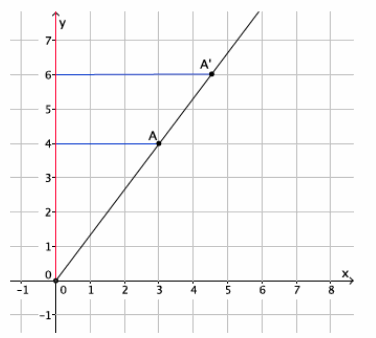
In the diagram below, you are given center O and ray \(\overrightarrow{O A}\). Point A is dilated by a scale factor r= \(\frac{6}{4}\). Use what you know about FTS to find the location of point A’.
Eureka Math Grade 8 Module 3 Lesson 5 Exit Ticket Answer Key 4
Answer:
Eureka Math Grade 8 Module 3 Lesson 5 Exit Ticket Answer Key 4.1
The y-coordinate of A’ is 6. The x-coordinate is equal to the length of segment A’B’. Since |A’B’|=r|AB|, then
|A’B’|=\(\frac{6}{4}\)∙3=\(\frac{18}{4}\)=4.5. The location of A’ is (4.5,6).

Eureka Math Grade 8 Module 3 Lesson 5 Problem Set Answer Key

Students practice using the first consequences of FTS in terms of dilated points and their locations on the coordinate plane.

Question 1.
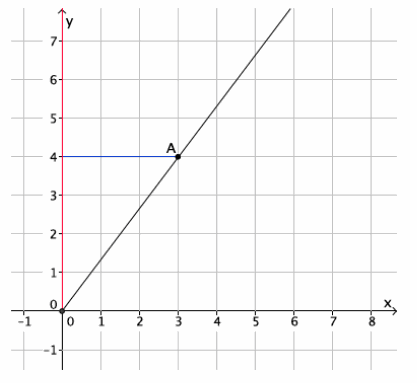
Dilate point A, located at (3,4) from center O, by a scale factor r=\(\frac{5}{3}\).
Eureka Math Grade 8 Module 3 Lesson 5 Problem Set Answer Key 5
What is the precise location of point A’?
Answer:
The y-coordinate of point A’ is the length of segment A’B’. Since |A’B’|=r|AB|, then |A’B’|=\(\frac{5}{3}\)∙4=\(\frac{20}{3}\). The location of point A’ is
(5,\(\frac{20}{3}\)), or approximately (5,6.7).

Question 2.
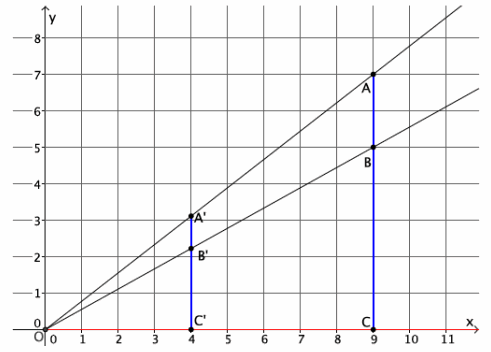
Dilate point A, located at (9,7) from center O, by a scale factor r=\(\frac{4}{9}\). Then, dilate point B, located at (9,5) from center O, by a scale factor of r=\(\frac{4}{9}\). What are the coordinates of points A’ and B’? Explain.
Eureka Math Grade 8 Module 3 Lesson 5 Problem Set Answer Key 6
Answer:
The y-coordinate of point A’ is the length of A’C’. Since |A’C’|=r|AC|, then |A’C’|=\(\frac{4}{9}\)∙7=\(\frac{28}{9}\). The location of point A’ is (4, \(\frac{28}{9}\)), or approximately (4,3.1). The y-coordinate of point B’ is the length of B’C’. Since |B’C’|=r|BC|, then |B’C’|=\(\frac{4}{9}\)∙5=\(\frac{20}{9}\). The location of point B’ is (4, \(\frac{20}{9}\)), or approximately (4,2.2).

Question 3.
Explain how you used the fundamental theorem of similarity in Problems 1 and 2.
Answer:
Using what I knew about scale factor, I was able to determine the placement of points A’ and B’, but I did not know the actual coordinates. So, one of the ways that FTS was used was actually in terms of the converse of FTS. I had to make sure I had parallel lines. Since the lines of the coordinate plane guarantee parallel lines, I knew that |A’C’|=r|AC|. Then, since I knew the length of segment AC and the scale factor, I could find the precise location of A’. The precise location of B’ was found in a similar way but using |B’C’|=r|BC|.

Eureka Math Grade 8 Module 3 Lesson 4 Answer Key

Engage NY Eureka Math 8th Grade Module 3 Lesson 4 Answer Key

Eureka Math Grade 8 Module 3 Lesson 4 Exercise Answer Key

Exercise
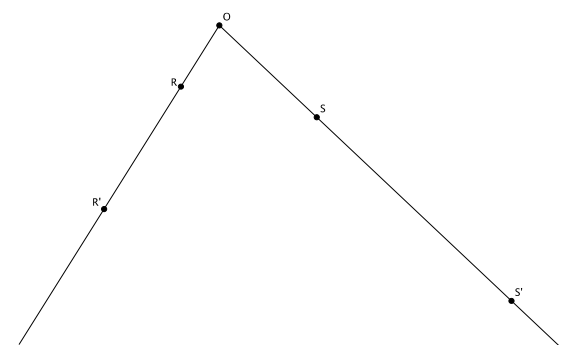
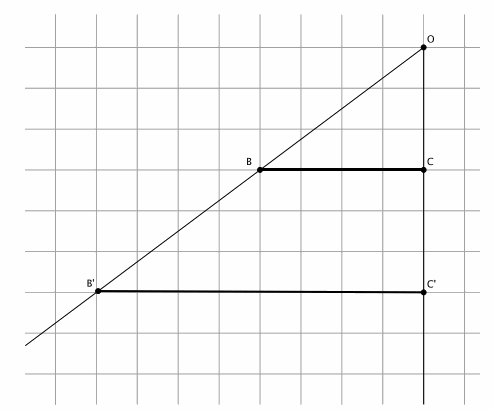
In the diagram below, points R and S have been dilated from center O by a scale factor of r=3.
Eureka Math Grade 8 Module 3 Lesson 4 Exercise Answer Key 1

a. If |OR|=2.3 cm, what is |OR’|?
Answer:
|OR’|=3(2.3 cm)=6.9 cm

b. If |OS|=3.5 cm, what is |OS’|?
Answer:
|OS’|=3(3.5 cm)=10.5 cm

c. Connect the point R to the point S and the point R’ to the point S’. What do you know about the lines that contain segments RS and R’ S’?
Answer:
The lines containing the segments RS and R’S’ are parallel.

d. What is the relationship between the length of segment RS and the length of segment R’ S’?
Answer:
The length of segment R’ S’ is equal to the length of segment RS, times the scale factor of 3 (i.e., |R’ S’|=3|RS|).

e. Identify pairs of angles that are equal in measure. How do you know they are equal?
Answer:
|∠ORS|=|∠OR’ S’| and |∠OSR|=|∠OS’ R’| They are equal because they are corresponding angles of parallel lines cut by a transversal.

Eureka Math Grade 8 Module 3 Lesson 4 Problem Set Answer Key

Students verify that the fundamental theorem of similarity holds true when the scale factor r is 0<r<1.

Question 1.
Use a piece of notebook paper to verify the fundamental theorem of similarity for a scale factor r that is
0<r<1.
✓ Mark a point O on the first line of notebook paper.
✓ Mark the point P on a line several lines down from the center O. Draw a ray, \(\overrightarrow{O P}\). Mark the point P’ on the ray and on a line of the notebook paper closer to O than you placed point P. This ensures that you have a scale factor that is 0<r<1. Write your scale factor at the top of the notebook paper.
✓ Draw another ray, \(\overrightarrow{O Q}\), and mark the points Q and Q’ according to your scale factor.
✓ Connect points P and Q. Then, connect points P’ and Q’.
✓ Place a point, A, on the line containing segment PQ between points P and Q. Draw ray \(\overrightarrow{O A}\). Mark point A’ at the intersection of the line containing segment P’Q’ and ray \(\overrightarrow{O A}\).
Answer:
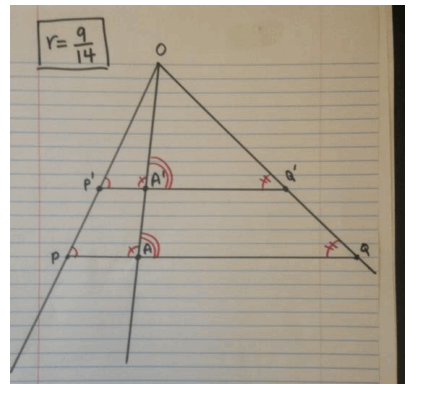
Sample student work is shown in the picture below:
Eureka Math Grade 8 Module 3 Lesson 4 Problem Set Answer Key 25

a. Are the lines containing segments PQ and P’Q’ parallel lines? How do you know?
Answer:
Yes, the lines containing segments PQ and P’Q’ are parallel. The notebook lines are parallel, and these lines fall on the notebook lines.

b. Which, if any, of the following pairs of angles are equal in measure? Explain.
i. ∠OPQ and ∠OP’Q’
ii. ∠OAQ and ∠OA’Q’
iii. ∠OAP and ∠OA’P’
iv. ∠OQP and ∠OQ’P’
Answer:
All four pairs of angles are equal in measure because each pair of angles are corresponding angles of parallel lines cut by a transversal. In each case, the parallel lines are line PQ and line P’ Q’, and the transversal is the respective ray.

c. Which, if any, of the following statements are true? Show your work to verify or dispute each statement.
i. |OP’|=r|OP|
ii. |OQ’|=r|OQ|
iii. |P’A’|=r|PA|
iv. |A’Q’|=r|AQ|
Answer:
All four of the statements are true. Verify that students have shown that the length of the dilated segment was equal to the scale factor multiplied by the original segment length.

d. Do you believe that the fundamental theorem of similarity (FTS) is true even when the scale factor is 0<r<1? Explain.
Answer:
Yes, because I just experimentally verified the properties of FTS for when the scale factor is 0<r<1.

Question 2.
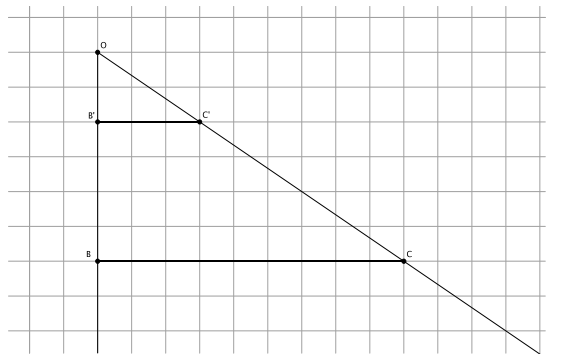
Caleb sketched the following diagram on graph paper. He dilated points B and C from center O.
Answer:
Eureka Math Grade 8 Module 3 Lesson 4 Problem Set Answer Key 26

a. What is the scale factor r? Show your work.
Answer:
|OB’|=r|OB|
2=r∙6
\(\frac{2}{6}\)=r
\(\frac{1}{3}\)=r

b. Verify the scale factor with a different set of segments.
Answer:
|B’ C’|=r|BC|
3=r∙9
\(\frac{3}{9}\)=r
\(\frac{1}{3}\)=r

c. Which segments are parallel? How do you know?
Answer:
Segment BC and B’C’ are parallel. They lie on the lines of the graph paper, which are parallel.

d. Which angles are equal in measure? How do you know?
Answer:
|∠OB’ C’|=|∠OBC|, and |∠OC’ B’|=|∠OCB| because they are corresponding angles of parallel lines cut by a transversal.

Question 3.
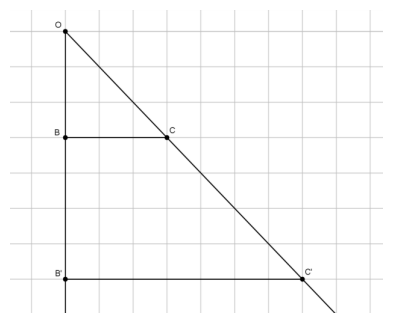
Points B and C were dilated from center O.
Eureka Math Grade 8 Module 3 Lesson 4 Problem Set Answer Key 27
a. What is the scale factor r? Show your work.
Answer:
|OC’|=r|OC|
6=r∙3
\(\frac{6}{3}\)=r
2=r

b. If |OB|=5, what is |OB’|?
Answer:
|OB’|=r|OB|
|OB’|=2∙5
|OB’|=10

c. How does the perimeter of triangle OBC compare to the perimeter of triangle OB’C’?
Answer:
The perimeter of triangle OBC is 12 units, and the perimeter of triangle OB’C’ is 24 units.

d. Did the perimeter of triangle OB’C’=r×(perimeter of triangle OBC)? Explain.
Answer:
Yes, the perimeter of triangle OB’C’ was twice the perimeter of triangle OBC, which makes sense because the dilation increased the length of each segment by a scale factor of 2. That means that each side of triangle OB’C’ was twice as long as each side of triangle OBC.

Eureka Math Grade 8 Module 3 Lesson 4 Exit Ticket Answer Key

Steven sketched the following diagram on graph paper. He dilated points B and C from point O. Answer the following questions based on his drawing.

Question 1.
What is the scale factor r? Show your work.
Answer:
Eureka Math Grade 8 Module 3 Lesson 4 Exit Ticket Answer Key 20
|OB’|=r|OB|
7=r∙3
\(\frac{7}{3}\)=r

Question 2.
Verify the scale factor with a different set of segments.
Answer:
|B’ C’|=r|BC|
7=r∙3
\(\frac{7}{3}\)=r

Question 3.
Which segments are parallel? How do you know?
Answer:
Segments BC and B’C’ are parallel since they lie on the grid lines of the paper, which are parallel.

Question 4.
Are ∠OBC and ∠OB’C’ right angles? How do you know?
Answer:
The grid lines on graph paper are perpendicular, and since perpendicular lines form right angles, ∠OBC and ∠OB’C’ are right angles.

Eureka Math Grade 8 Module 3 Lesson 3 Answer Key

Engage NY Eureka Math 8th Grade Module 3 Lesson 3 Answer Key

Eureka Math Grade 8 Module 3 Lesson 3 Example Answer Key

Example 1.
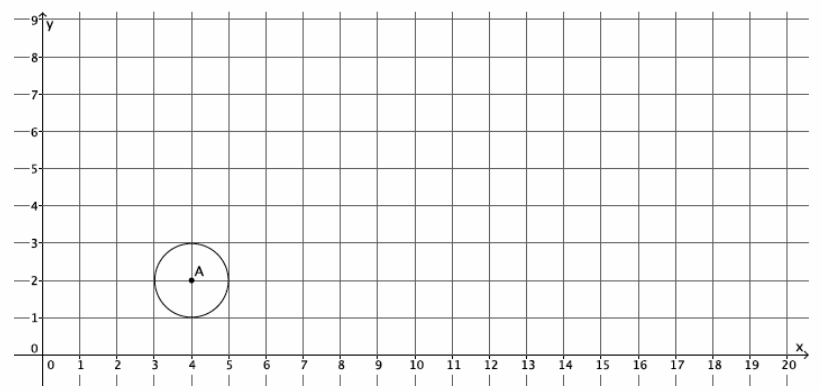
Dilate circle A from center O at the origin by scale factor r=3.
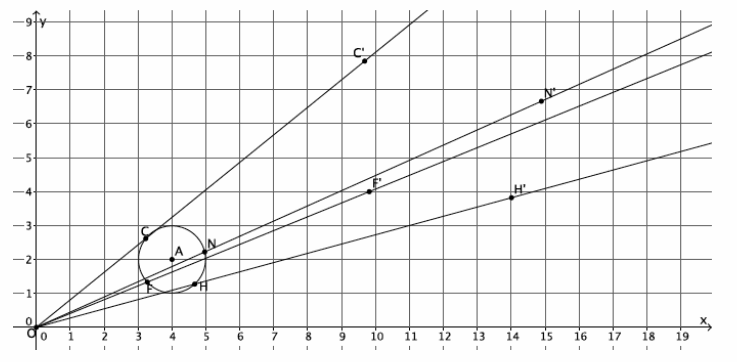
Engage NY Math 8th Grade Module 3 Lesson 3 Example Answer Key 1

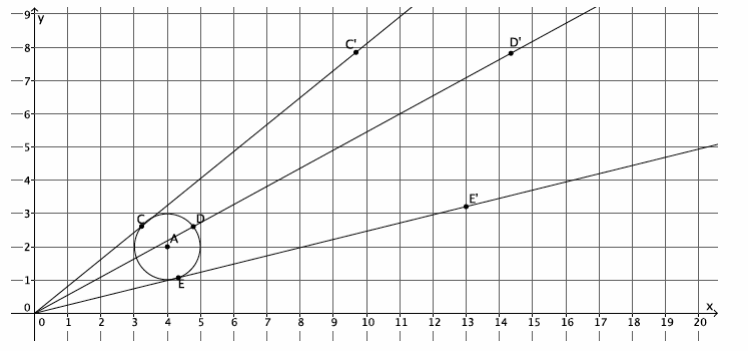
→ Are three points enough? Let’s try.
(Show a picture of three dilated points.) If we connect these three dilated points, what image do we get?
→ With just three points, the image looks like a triangle.
Engage NY Math 8th Grade Module 3 Lesson 3 Example Answer Key 2
→ What if we dilate a fourth point? Is that enough? Let’s try.
→ (Show the picture of four dilated points.) If we connect these four dilated points, what image do we get?
→ With four points, the image looks like a quadrilateral.
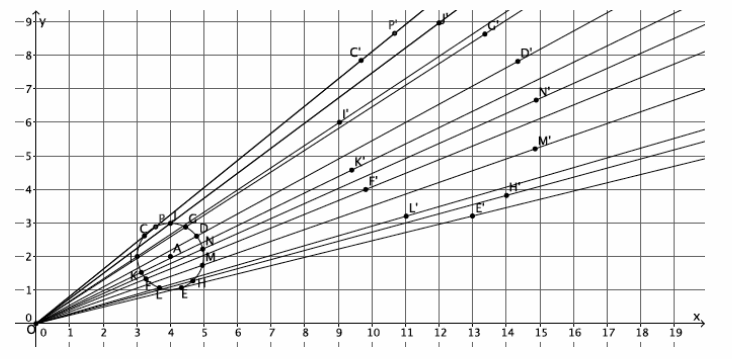
Engage NY Math 8th Grade Module 3 Lesson 3 Example Answer Key 3

→ What if we dilate five, six, or ten points? What do you think?
→ The more points that are dilated, the more the image looks like a circle.
→ (Show the picture with many dilated points.)
Engage NY Math 8th Grade Module 3 Lesson 3 Example Answer Key 4
→ Notice that the shape of the dilated image is now unmistakably a circle. Dilations map circles to circles, so it is important that when we dilate a circle we choose our points carefully.
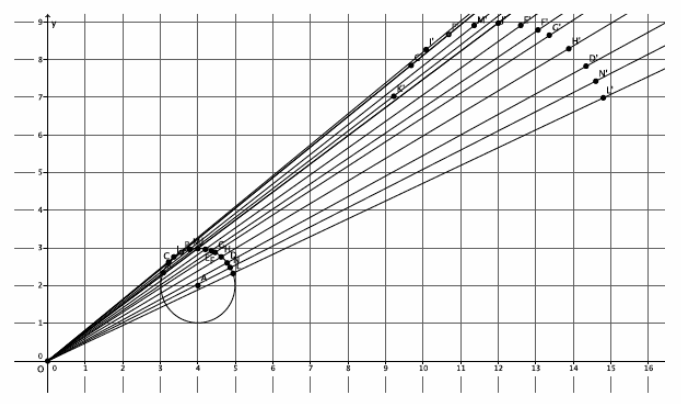
→ Would we have an image that looked like a circle if all of the points we considered were located on just one part of the circle? For example, what if all of our points were located on just the top half of the circle? Would the dilated points produce an image of the circle?
Engage NY Math 8th Grade Module 3 Lesson 3 Example Answer Key 5

→ Or consider the image when we select points just on the lower half of the circle:
Engage NY Math 8th Grade Module 3 Lesson 3 Example Answer Key 6
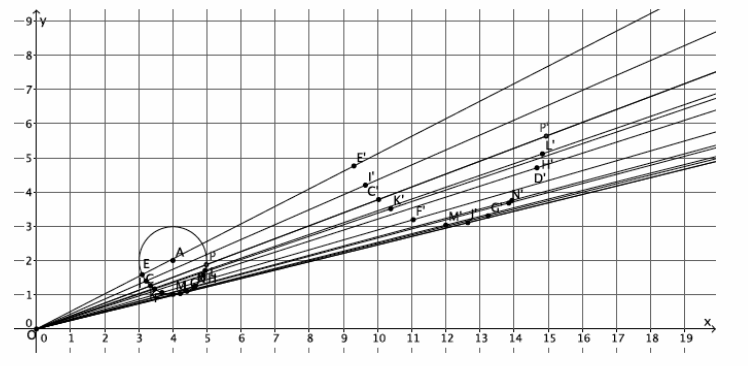
→ Consider the image when the points are focused on just the sides of the circle:
Engage NY Math 8th Grade Module 3 Lesson 3 Example Answer Key 7
→ The images are not good enough to truly show that the original figure was a circle.
→ How should we select points to dilate when we have a curved figure?
→ We should select points on all parts of the curve, not just those points focused in one area.
→ The number of points to dilate that is enough is as many as are needed to produce a dilated image that looks like the original. For curved figures, like this circle, the more points you dilate the better. The location of the points you choose to dilate is also important. The points selected to dilate should be spread out evenly on the curve.

Example 2.
In the picture below, we have triangle ABC, that has been dilated from center O, by a scale factor of r=\(\frac{1}{3}\). It is noted by A’B’C’.
Engage NY Math 8th Grade Module 3 Lesson 3 Example Answer Key 8
Ask students what can be done to map this new triangle, triangle A’B’C’, back to the original. Tell them to be as specific as possible. Students should write their conjectures or share with a partner.
→ Let’s use the definition of dilation and some side lengths to help us figure out how to map triangle A’B’C’ back onto triangle ABC. How are the lengths |OA’ | and |OA| related?
→ We know by the definition of dilation that |OA’|=r|OA|.
We know that r=\(\frac{1}{3}\). Let’s say that the length of segment OA is 6 units (we can pick any number, but 6 makes it easy for us to compute). What is the length of segment OA’?
→ Since |OA’|=\(\frac{1}{3}\) |OA|, and we are saying that the length of segment OA is 6, then |OA’|=\(\frac{1}{3}\)∙=2, and |OA’|=2 units.
→ Now, since we want to dilate triangle A’B’C’ to the size of triangle ABC, we need to know what scale factor r is required so that |OA|=r|OA’|. What scale factor should we use, and why?
→ We need a scale factor r=3 because we want |OA|=r|OA’|. Using the lengths from before, we have 6=r⋅2. Therefore, r=3.
→ Now that we know the scale factor, what precise dilation would map triangle A’B’C’ onto triangle ABC?
→ A dilation from center O with scale factor r=3

Example 3.
In the picture below, we have triangle DEF that has been dilated from center O by a scale factor of r=4. It is
noted by D’E’F’.
Engage NY Math 8th Grade Module 3 Lesson 3 Example Answer Key 9
→ Based on the example we just did, make a conjecture about how we could map this new triangle D’E’F’ back onto the original triangle.
Let students attempt to prove their conjectures on their own or with a partner. If necessary, use the scaffolding questions that follow.
→ What is the difference between this problem and the last?
→ This time the scale factor is greater than one, so we need to shrink triangle D’E’F’ to the size of triangle DEF.
→ We know that r=4. Let’s say that the length of segment OF is 3 units. What is the length of segment OF’?
→ Since |OF’|=r|OF| and we are saying that the length of segment OF is 3, then |OF’|=4⋅3=12, and |OF’|=12 units.
→ Now, since we want to dilate triangle D’E’F’ to the size of triangle DEF, we need to know what scale factor r is required so that |OF|=r|OF’|. What scale factor should we use, and why?
→ We need a scale factor r=\(\frac{1}{4}\) because we want |OF|=r|OF’|. Using the lengths from before, we have 3=r⋅12. Therefore, r=\(\frac{1}{4}\).
→ What precise dilation would make triangle D’E’F’ the same size as triangle DEF?
→ A dilation from center O with scale factor r=\(\frac{1}{4}\) would make triangle D’E’F’ the same size as triangle DEF.

Eureka Math Grade 8 Module 3 Lesson 3 Exercise Answer Key

Exercises 1–2.

Exercise 1.
Dilate ellipse E, from center O at the origin of the graph, with scale factor r=2. Use as many points as necessary to develop the dilated image of ellipse E.
Answer:
The dilated image of E is shown in red below. Verify that students have dilated enough points evenly placed to get an image that resembles an ellipse.
Eureka Math Grade 8 Module 3 Lesson 3 Exercise Answer Key 18

Exercise 2.
What shape was the dilated image?
Answer:
The dilated image was an ellipse. Dilations map ellipses to ellipses.

Exercise 3.
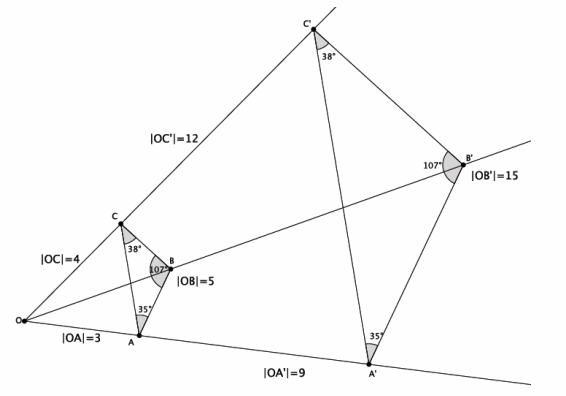
Triangle ABC has been dilated from center O by a scale factor of r=\(\frac{1}{4}\) denoted by triangle A’B’C’. Using a centimeter ruler, verify that it would take a scale factor of r=4 from center O to map triangle A’B’C’ onto triangle ABC.
Eureka Math Grade 8 Module 3 Lesson 3 Exercise Answer Key 91
Answer:
Sample measurements provided. Note that, due to print variations, the measurements may be slightly different.
Verify that students have measured the lengths of segments from center O to each of the dilated points. Then, verify that students have multiplied each of the lengths by 4 to see that it really is the length of the segments from center O to the original points.

Eureka Math Grade 8 Module 3 Lesson 3 Problem Set Answer Key

Students practice dilating a curved figure and stating the scale factor that would bring a dilated figure back to its original size.

Question 1.
Dilate the figure from center O by a scale factor r=2. Make sure to use enough points to make a good image of the original figure.
Answer:
Sample student work is shown below. Verify that students used enough points to produce an image similar to the original.
Eureka Math Grade 8 Module 3 Lesson 3 Problem Set Answer Key 50

Question 2.
Describe the process for selecting points when dilating a curved figure.
Answer:
When dilating a curved figure, you have to make sure to use a lot of points to produce a decent image of the original figure. You also have to make sure that the points you choose are not all concentrated in just one part of the figure.

Question 3.
A figure was dilated from center O by a scale factor of r=5. What scale factor would shrink the dilated figure back to the original size?
Answer:
A scale factor of r=\(\frac{1}{5}\) would bring the dilated figure back to its original size.

Question 4.
A figure has been dilated from center O by a scale factor of r=\(\frac{7}{6}\). What scale factor would shrink the dilated figure back to the original size?
A scale factor of r=\(\frac{6}{7}\) would bring the dilated figure back to its original size.

Question 5.
A figure has been dilated from center O by a scale factor of r=\(\frac{3}{10}\). What scale factor would magnify the dilated figure back to the original size?
Answer:
A scale factor of r=\(\frac{10}{3}\) would bring the dilated figure back to its original size.

Eureka Math Grade 8 Module 3 Lesson 3 Exit Ticket Answer Key

Question 1.
Dilate circle A from center O by a scale factor r=\(\frac{1}{2}\). Make sure to use enough points to make a good image of the original figure.
Eureka Math Grade 8 Module 3 Lesson 3 Exit Ticket Answer Key 10
Answer:
Eureka Math Grade 8 Module 3 Lesson 3 Exit Ticket Answer Key 11
Student work is shown below. Verify that students used enough points to produce an image similar to the original.

Question 2.
What scale factor would magnify the dilated circle back to the original size of circle A? How do you know?
Answer:
A scale factor of r=2 would bring the dilated circle back to the size of circle A. Since the circle was dilated by a scale factor of r=\(\frac{1}{2}\), then to bring it back to its original size, you must dilate by a scale factor that is the reciprocal of \(\frac{1}{2}\), which is 2.

Eureka Math Grade 8 Module 3 Lesson 2 Answer Key

Engage NY Eureka Math 8th Grade Module 3 Lesson 2 Answer Key

Eureka Math Grade 8 Module 3 Lesson 2 Example Answer Key

Example 1.
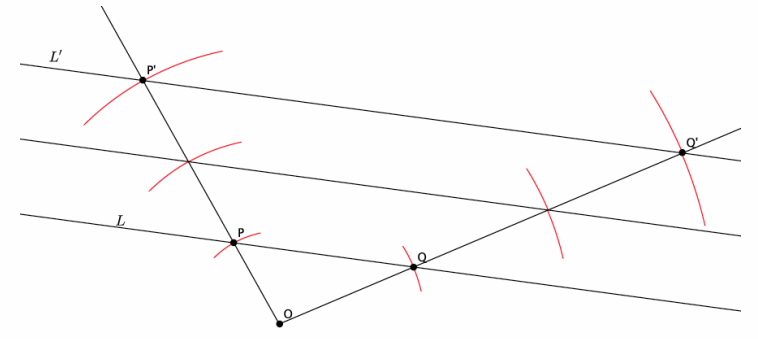
Examples 1–3 demonstrate that dilations map lines to lines and how to use a compass to dilate.
→ This example shows that a dilation maps a line to a line. This means that the image of a line, after undergoing a dilation, is also a line. Given line L, we dilate with a scale factor r=2 from center O. Before we begin, exactly how many lines can be drawn through two points?
→ Only one line can be drawn through two points.
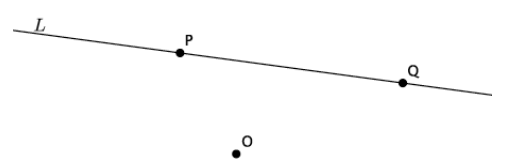
To dilate the line, we choose two points on L (points P and Q) to dilate. When we connect the dilated images of P and Q (P’ and Q’), we have the dilated image of line L, L’.

→ First, let’s select a center O off the line L and two points P and Q on line L.

Examples 1–2:
Dilations Map Lines to Lines
Engage NY Math 8th Grade Module 3 Lesson 2 Example Answer Key 1
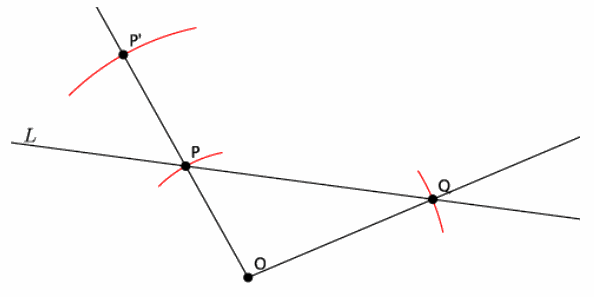
→ Second, we draw rays from center O through each of the points P and Q. We want to make sure that the points O, P, and P’ (the dilated P) lie on the same line (i.e., are collinear). That is what keeps the dilated image “in proportion.” Think back to the last lesson where we saw how the size of the picture changed when pulling the corners compared to the sides. Pulling from the corners kept the picture “in proportion.” The way we achieve this in diagrams is by drawing rays and making sure that the center, the point, and the dilated point are all on the same line.
Engage NY Math 8th Grade Module 3 Lesson 2 Example Answer Key 2

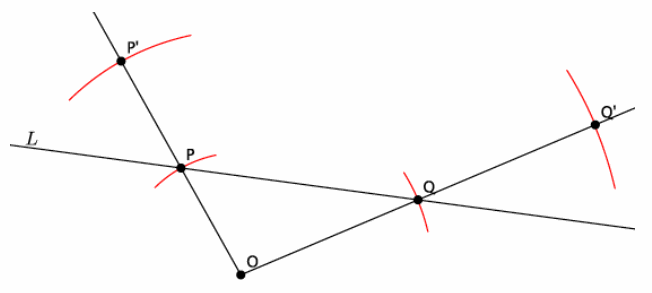
→ Next, we use our compass to measure the distance from O to P. Do this by putting the point of the compass on point O, and adjust the radius of the compass to draw an arc through point P. Once you have the compass set, move the point of the compass to P, and make a mark along the ray OP (without changing the radius of the compass) to mark P’. Recall that the dilated point P’ is the distance 2|OP| (i.e., |OP’ |=2|OP|). The compass helps us to find the location of P’ so that it is exactly twice the length of segment OP. Use your ruler to prove this to students.
Engage NY Math 8th Grade Module 3 Lesson 2 Example Answer Key 3
→ Next, we repeat this process to locate Q’.
Engage NY Math 8th Grade Module 3 Lesson 2 Example Answer Key 4

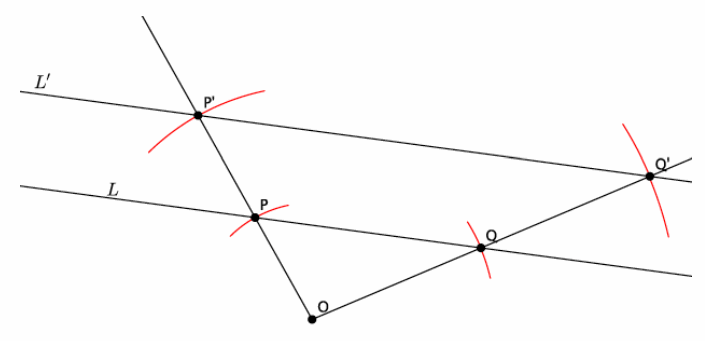
→ Finally, connect points P’ and Q’ to draw line L’.
Engage NY Math 8th Grade Module 3 Lesson 2 Example Answer Key 5

→ Return to your conjecture from before, or look at our class list. Which conjectures were accurate? How do you know?
→ Answers may vary depending on conjectures made by the class. Students should identify that the conjecture of a line mapping to a line under a dilation is correct.
→ What do you think would happen if we selected a different location for the center or for the points P and Q?
→ Points O, P, and Q are arbitrary points. That means that they could have been anywhere on the plane. For that reason, the results would be the same; that is, the dilation would still produce a line, and the line would be parallel to the original.
→ Look at the drawing again, and imagine using our transparency to translate the segment OP along vector \(\overrightarrow{O Q}\) to segment PP’ and to translate the segment OQ along vector \(\overrightarrow{O Q}\) to segment QQ’. With that information, can you say anything more about lines L and L’?
→ Since P and Q are arbitrary points on line L, and translations map lines to parallel lines when the vector is not parallel to or part of the original line, we can say that L is parallel to L’.
→ How would the work we did change if the scale factor were r=3 instead of r=2?
→ We would have to find a point P’ so that it is 3 times the length of segment OP instead of twice the length of segment OP. Same for the point Q’

Example 2.
→ Do you think line L would still be a line under a dilation with scale factor r=3? Would the dilated line, L’, still be parallel to L? (Allow time for students to talk to their partners and make predictions.)
→ Yes, it is still a line, and it would still be parallel to line L. The scale factor being three instead of two simply means that we would perform the translation of the points P’ and Q’ more than once, but the result would be the same.
→ Here is what would happen with scale factor r=3.
Engage NY Math 8th Grade Module 3 Lesson 2 Example Answer Key 6

Example 3.
Dilations Map Lines to Lines
Engage NY Math 8th Grade Module 3 Lesson 2 Example Answer Key 7
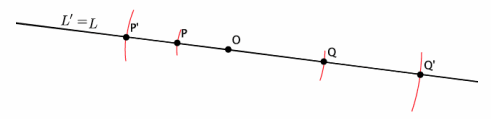
→ What would happen if the center O were on line L? (Allow time for students to talk to their partners and make predictions.)
→ If the center O were on line L, and if we pick points P and Q on L, then the dilations of points P and Q, P’ and Q’, would also be on L. That means that line L and its dilated image, line L’, would coincide.
Engage NY Math 8th Grade Module 3 Lesson 2 Example Answer Key 8
→ What we have shown with these three examples is that a line, after a dilation, is still a line. Mathematicians like to say that dilations map lines to lines.

Example 4.
Example 4 demonstrates that dilations map rays to rays. It also demonstrates how to use a ruler to dilate with scale factor r=\(\frac{1}{2}\). Similar to Example 1, before this example, discuss the conjectures students developed about rays. Also, consider getting students started and then asking them to finish with a partner.
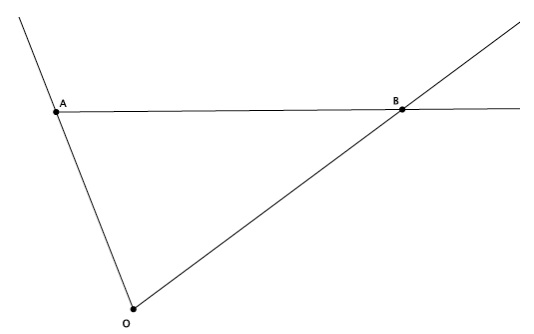
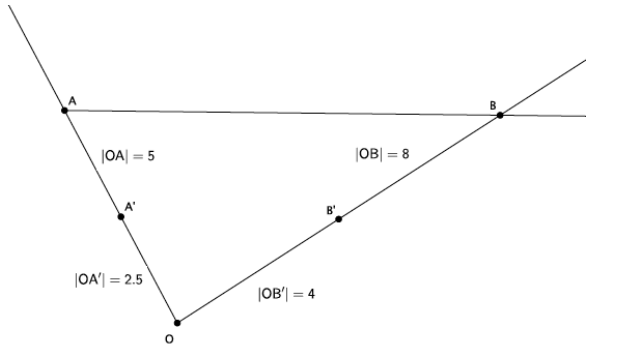
→ This example shows that a dilation maps a ray to a ray. Given ray \(\overrightarrow{A B}\), we dilate with a scale factor r=\(\frac{1}{2}\) from center O.
→ To dilate the ray, we choose a center O off of the ray. Like before, we draw rays from center O through points A and B.
Engage NY Math 8th Grade Module 3 Lesson 2 Example Answer Key 9
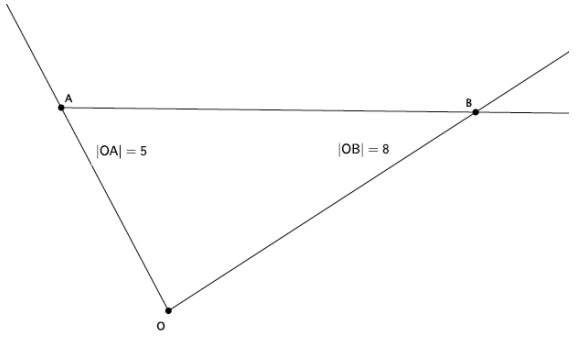
→ Since our scale factor is r=\(\frac{1}{2}\), we need to use a ruler to measure the length of segments OA and OB. When you get into high school Geometry, you learn how to use a compass to handle scale factors that are greater than zero but less than one, like our r=\(\frac{1}{2}\). For now, we use a ruler.
Engage NY Math 8th Grade Module 3 Lesson 2 Example Answer Key 9.1

→ Since our scale factor is r=\(\frac{1}{2}\), we know that the dilated segment, OA’, must be equal to \(\frac{1}{2}\) the length of segment OA (i.e., |OA’ |=\(\frac{1}{2}\) |OA|). Then, |OA’ | must be \(\frac{1}{2}\)∙5; therefore, |OA’ |=2.5. What must the |OB’ | be?
→ We know that |OB’ |=\(\frac{1}{2}\) |OB|; therefore, |OB’ |=\(\frac{1}{2}\)⋅8=4, and |OB’ |=4.
→ Now that we know the lengths of segments OA’ and OB’, we use a ruler to mark off those points on their respective rays.
Engage NY Math 8th Grade Module 3 Lesson 2 Example Answer Key 11
→ Finally, we connect point A’ through point B’. With your partner, evaluate your conjecture. What happened to our ray after the dilation?
→ When we connect point A’ through point B’, then we have the ray \(\overrightarrow{A^{\prime} B^{\prime}}\).
Engage NY Math 8th Grade Module 3 Lesson 2 Example Answer Key 12
→ What do you think would have happened if we selected our center O as a point on the ray \(\overrightarrow{A B}\)?
→ If our center O were on the ray, then the ray \(\overrightarrow{A B}\) would coincide with its dilated image \(\overrightarrow{A^{\prime} B^{\prime}},\), which is similar to what we saw when the line L was dilated from a center O on it.
Engage NY Math 8th Grade Module 3 Lesson 2 Example Answer Key 13

Eureka Math Grade 8 Module 3 Lesson 2 Exercise Answer Key

Given center O and triangle ABC, dilate the triangle from center O with a scale factor r=3.
Eureka Math Grade 8 Module 3 Lesson 2 Exercise Answer Key 14
a. Note that the triangle ABC is made up of segments AB, BC, and CA. Were the dilated images of these segments still segments?
Answer:
Yes, when dilated, the segments were still segments.

b. Measure the length of the segments AB and A’ B’. What do you notice? (Think about the definition of dilation.)
Answer:
The segment A’ B’ was three times the length of segment AB. This fits with the definition of dilation, that is, |A’ B’ |=r|AB|.

c. Verify the claim you made in part (b) by measuring and comparing the lengths of segments BC and B’ C’ and segments CA and C’ A’. What does this mean in terms of the segments formed between dilated points?
Answer:
This means that dilations affect segments in the same way they do points. Specifically, the lengths of segments are dilated according to the scale factor.

d. Measure ∠ABC and ∠A’B’C’. What do you notice?
Answer:
The angles are equal in measure.

e. Verify the claim you made in part (d) by measuring and comparing the following sets of angles:
(1) ∠BCA and ∠B’ C’ A’ and
(2) ∠CAB and ∠C’ A’ B’. What does that mean in terms of dilations with respect to angles and their degrees?
Answer:
It means that dilations map angles to angles, and the dilation preserves the measures of the angles.

Eureka Math Grade 8 Module 3 Lesson 2 Exit Ticket Answer Key

Question 1.
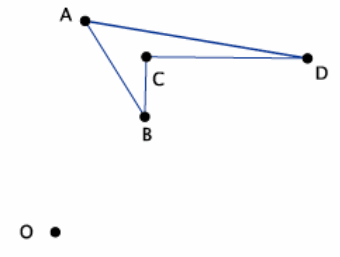
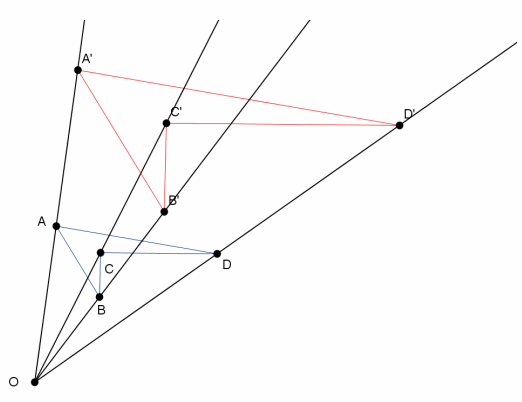
Given center O and quadrilateral ABCD, using a compass and ruler, dilate the figure from center O by a scale factor of r=2. Label the dilated quadrilateral A’B’C’D’.
Engage NY Math 8th Grade Module 3 Lesson 2 Exit Ticket Answer Key 20
Answer:
Sample student work is shown below. Verify that students have magnified the image ABCD.
Engage NY Math 8th Grade Module 3 Lesson 2 Exit Ticket Answer Key 21

Question 2.
Describe what you learned today about what happens to lines, segments, rays, and angles after a dilation.
Answer:
We learned that a dilation maps a line to a line, a segment to a segment, a ray to a ray, and an angle to an angle. Further, the length of the dilated line segment is exactly r (the scale factor) times the length of the original segment. Also, the measure of a dilated angle remains unchanged compared to the original angle.

Eureka Math Grade 8 Module 3 Lesson 2 Problem Set Answer Key

Students practice dilating figures with different scale factors.

Question 1.
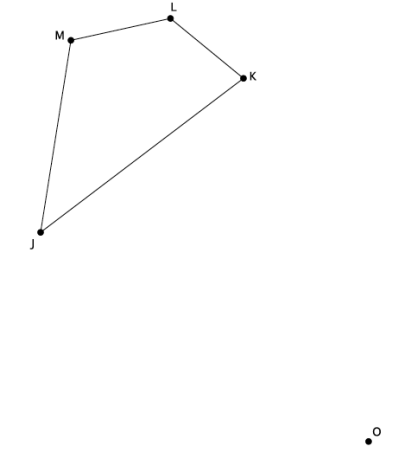
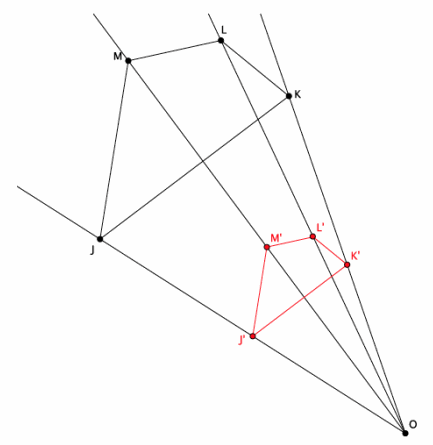
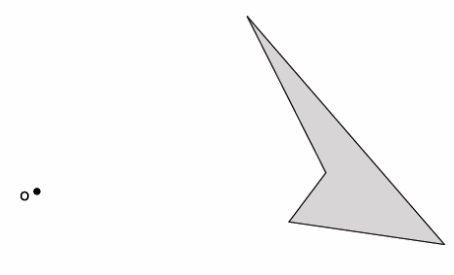
Use a ruler to dilate the following figure from center O, with scale factor r=\(\frac{1}{2}\).
Eureka Math Grade 8 Module 3 Lesson 2 Problem Set Answer Key 22
Answer:
The dilated figure is shown in red below. Verify that students have dilated according to the scale factor r=\(\frac{1}{2}\).
Eureka Math Grade 8 Module 3 Lesson 2 Problem Set Answer Key 22.1

Question 2.
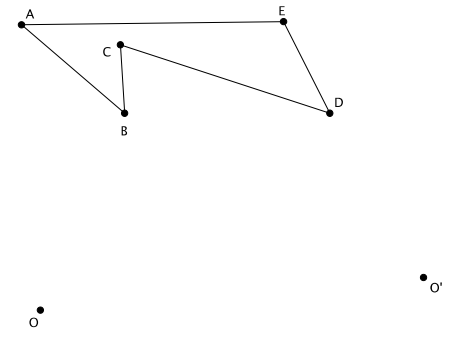
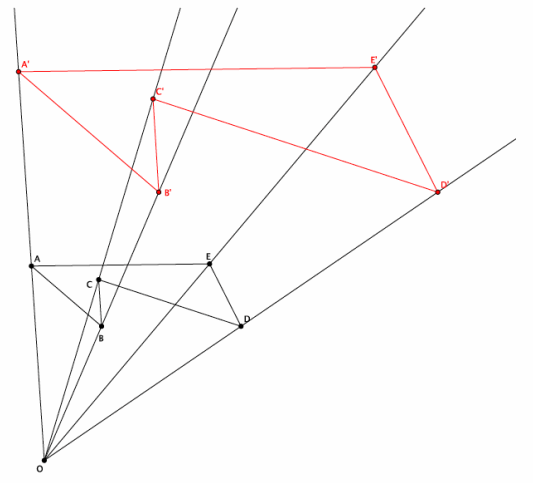
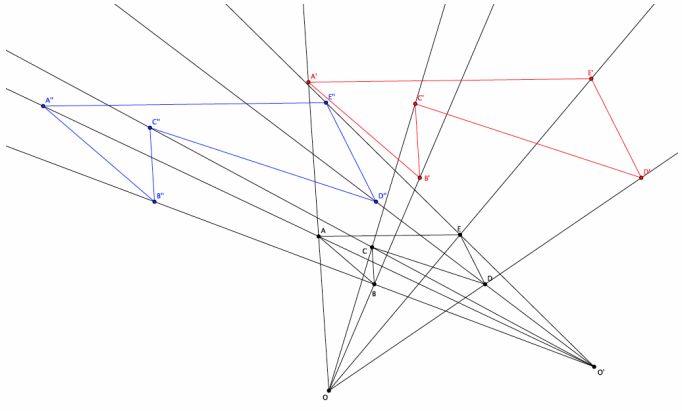
Use a compass to dilate the figure ABCDE from center O, with scale factor r=2.
Eureka Math Grade 8 Module 3 Lesson 2 Problem Set Answer Key 23
Answer:
The figure in red below shows the dilated image of ABCDE.
Eureka Math Grade 8 Module 3 Lesson 2 Problem Set Answer Key 23.1
a. Dilate the same figure, ABCDE, from a new center, O’, with scale factor r=2. Use double primes (A”B”C”D”E”) to distinguish this image from the original.
Answer:
Eureka Math Grade 8 Module 3 Lesson 2 Problem Set Answer Key 23.2
The figure in blue below shows the dilated figure A”B”C”D”E”.

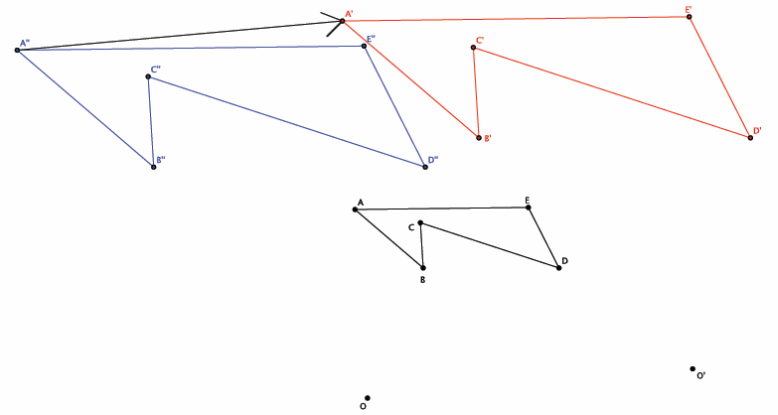
b. What rigid motion, or sequence of rigid motions, would map A”B”C”D”E” to A’B’C’D’E’?
Answer:
Eureka Math Grade 8 Module 3 Lesson 2 Problem Set Answer Key 23.3
A translation along vector \(\overrightarrow{\boldsymbol{A}^{\prime \prime} \boldsymbol{A}^{\prime}}\) (or any vector that connects a point of A”B”C”D”E” and its corresponding point of A’B’C’D’E’) would map the figure A”B”C”D”E” to A’B’C’D’E’.
The image below (with rays removed for clarity) shows the vector \(\overrightarrow{\boldsymbol{A}^{\prime \prime} \boldsymbol{A}^{\prime}}\).

Question 3.
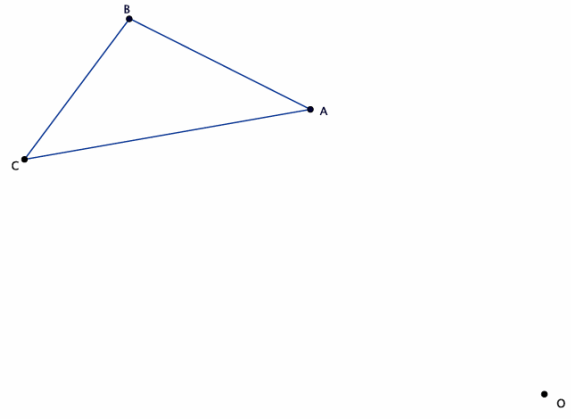
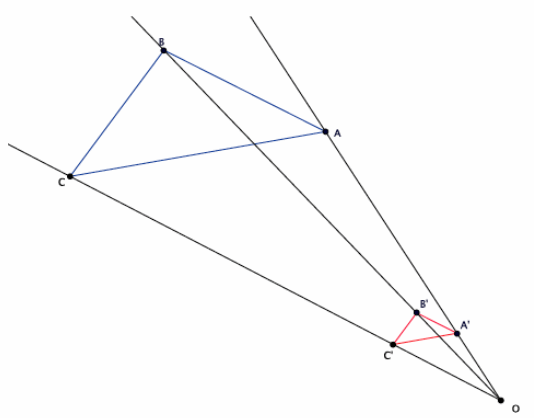
Given center O and triangle ABC, dilate the figure from center O by a scale factor of r=\(\frac{1}{4}\). Label the dilated triangle A’B’C’.
Eureka Math Grade 8 Module 3 Lesson 2 Problem Set Answer Key 25.1
Answer:
Eureka Math Grade 8 Module 3 Lesson 2 Problem Set Answer Key 25

Question 4.
A line segment AB undergoes a dilation. Based on today’s lesson, what is the image of the segment?
Answer:
The segment dilates as a segment.

Question 5.
∠GHI measures 78°. After a dilation, what is the measure of ∠G’H’I’? How do you know?
Answer:
The measure of ∠G’H’I’ is 78°. Dilations preserve angle measure, so it remains the same size as ∠GHI.

Eureka Math Grade 8 Module 3 Lesson 1 Answer Key

Engage NY Eureka Math 8th Grade Module 3 Lesson 1 Answer Key

Eureka Math Grade 8 Module 3 Lesson 1 Exploratory Challenge Answer Key

Exploratory Challenge.
Two geometric figures are said to be similar if they have the same shape but not necessarily the same size. Using that informal definition, are the following pairs of figures similar to one another? Explain.
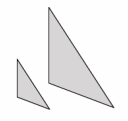
Pair A:
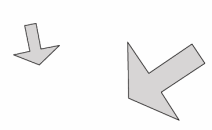
Eureka Math Grade 8 Module 3 Lesson 1 Exploratory Challenge Answer Key 1
Answer:
Yes, these figures appear to be similar. They are the same shape, but one is larger than the other, or one is smaller than the other.

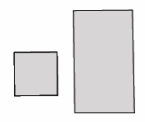
Pair B:
Eureka Math Grade 8 Module 3 Lesson 1 Exploratory Challenge Answer Key 2
Answer:
No, these figures do not appear to be similar. One looks like a square and the other like a rectangle.

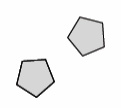
Pair C:
Eureka Math Grade 8 Module 3 Lesson 1 Exploratory Challenge Answer Key 3
Answer:
These figures appear to be exactly the same, which means they are congruent.

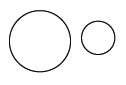
Pair D:
Eureka Math Grade 8 Module 3 Lesson 1 Exploratory Challenge Answer Key 4
Answer:
Yes, these figures appear to be similar. They are both circles, but they are different sizes.

Pair E:
Eureka Math Grade 8 Module 3 Lesson 1 Exploratory Challenge Answer Key 5
Answer:
Yes, these figures appear to be similar. They are the same shape, but they are different in size.

Pair F:
Eureka Math Grade 8 Module 3 Lesson 1 Exploratory Challenge Answer Key 6
Answer:
Yes, these figures appear to be similar. The faces look the same, but they are just different in size.

Pair G:
Eureka Math Grade 8 Module 3 Lesson 1 Exploratory Challenge Answer Key 7
Answer:
They do not look to be similar, but I’m not sure. They are both happy faces, but one is squished compared to the other.

P air H:
Eureka Math Grade 8 Module 3 Lesson 1 Exploratory Challenge Answer Key 8
Answer:
No, these two figures do not look to be similar. Each is curved but shaped differently.

Eureka Math Grade 8 Module 3 Lesson 1 Exercise Answer Key

Question 1.
Given |OP|=5 in.
a. If segment OP is dilated by a scale factor r=4, what is the length of segment OP’?
Answer:
|OP |=20 in. because the scale factor multiplied by the length of the original segment is 20; that is,
4 ∙ 5=20.

b. If segment OP is dilated by a scale factor r=\(\frac{1}{2}\), what is the length of segment OP’?
Answer:
|OP’ |=2.5 in. because the scale factor multiplied by the length of the original segment is 2.5; that is,
(\(\frac{1}{2}\))∙5=2.5.

Use the diagram below to answer Exercises 2–6. Let there be a dilation from center O. Then, Dilation(P)=P’ and Dilation(Q)=Q’. In the diagram below, |OP|=3 cm and |OQ|=4 cm, as shown.
Eureka Math Grade 8 Module 3 Lesson 1 Exercise Answer Key 10

Question 2.
If the scale factor is r=3, what is the length of segment OP’?
Answer:
The length of the segment OP’ is 9 cm.

Question 3.
Use the definition of dilation to show that your answer to Exercise 2 is correct.
Answer:
|OP’ |=r |OP|; therefore, |OP’|=3∙3 cm=9 cm.

Question 4.
If the scale factor is r=3, what is the length of segment OQ’?
Answer:
The length of the segment OQ’ is 12 cm.

Question 5.
Use the definition of dilation to show that your answer to Exercise 4 is correct.
Answer:
|OQ’ |=r|OQ|; therefore, |OQ’ |=3∙4 cm=12 cm.

Question 6.
If you know that |OP|=3, |OP’ |=9, how could you use that information to determine the scale factor?
Answer:
Since we know |OP’|=r|OP|, we can solve for r: \(\frac{\left|o P^{\prime}\right|}{|O P|}\) =r, which is \(\frac{9}{3}\)=r or 3=r.

Eureka Math Grade 8 Module 3 Lesson 1 Exit Ticket Answer Key

Question 1.
Why do we need a better definition for similarity than “same shape, not the same size”?
Answer:
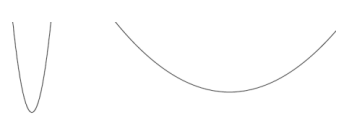
We need a better definition that includes dilation and a scale factor because some figures may look to be similar (e.g., the smiley faces), but we cannot know for sure unless we can check the proportionality. Other figures (e.g., the parabolas) may not look similar but are. We need a definition so that we are not just guessing if they are similar by looking at them.

Question 2.
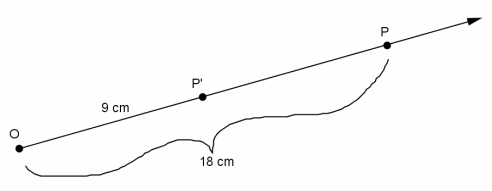
Use the diagram below. Let there be a dilation from center O with scale factor 3. Then, Dilation(P)=P’. In the diagram below, |OP|=5 cm. What is |OP’ |? Show your work.
Eureka Math Grade 8 Module 3 Lesson 1 Exit Ticket Answer Key 60
Answer:
Since |OP’|=r|OP|, then
|OP’|=3∙5 cm,
|OP’|=15 cm.

Question 3.
Use the diagram below. Let there be a dilation from center O. Then, Dilation(P)=P’. In the diagram below, |OP|=18 cm and |OP’|=9 cm. What is the scale factor r? Show your work.
Eureka Math Grade 8 Module 3 Lesson 1 Exit Ticket Answer Key 61
Answer:
Since |OP’ |=r|OP|, then
9 cm=r∙18 cm,
\(\frac{1}{2}\)=r.

Eureka Math Grade 8 Module 3 Lesson 1 Problem Set Answer Key

Have students practice using the definition of dilation and finding lengths according to a scale factor.

Question 1.
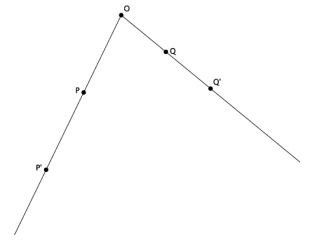
Let there be a dilation from center O. Then, Dilation(P)=P’ and Dilation(Q)=Q’. Examine the drawing below. What can you determine about the scale factor of the dilation?
Answer:
Eureka Math Grade 8 Module 3 Lesson 1 Problem Set Answer Key 20
The scale factor must be greater than one, r>1, because the dilated points are farther from the center than the original points.

Question 2.
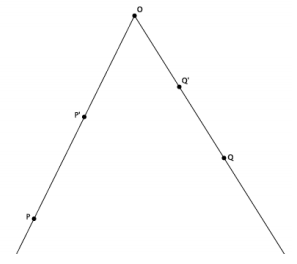
Let there be a dilation from center O. Then, Dilation(P)=P’, and Dilation(Q)=Q’. Examine the drawing below. What can you determine about the scale factor of the dilation?
Eureka Math Grade 8 Module 3 Lesson 1 Problem Set Answer Key 21
Answer:
The scale factor must be greater than zero but less than one, 0<r<1, because the dilated points are closer to the center than the original points.

Question 3.
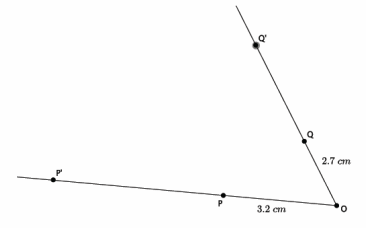
Let there be a dilation from center O with a scale factor r=4. Then, Dilation(P)=P’ and Dilation(Q)=Q’. |OP|=3.2 cm, and |OQ|=2.7 cm, as shown. Use the drawing below to answer parts (a) and (b). The drawing is not to scale.
Eureka Math Grade 8 Module 3 Lesson 1 Problem Set Answer Key 22

a. Use the definition of dilation to determine |OP’ |.
Answer:
|OP’ |=r|OP|; therefore, |OP’ |=4 (3.2 cm)=12.8 cm.

b. Use the definition of dilation to determine |OQ’ |.
Answer:
|OQ’ |=r|OQ|; therefore, |OQ’ |=4 (2.7 cm)=10.8 cm.

Question 4.
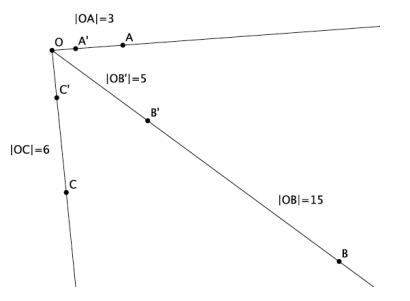
Let there be a dilation from center O with a scale factor r. Then, Dilation(A)=A’, Dilation(B)=B’, and Dilation(C)=C’. |OA|=3, |OB|=15, |OC|=6, and |OB’ |=5, as shown. Use the drawing below to answer parts (a)–(c).
Eureka Math Grade 8 Module 3 Lesson 1 Problem Set Answer Key 25

a. Using the definition of dilation with lengths OB and OB’, determine the scale factor of the dilation.
Answer:
|OB’ |=r|OB|, which means 5=r×15; therefore, r=\(\frac{1}{3}\).

b. Use the definition of dilation to determine |OA’|.
Answer:
|OA’ |=\(\frac{1}{3}\) |OA|; therefore, |OA’ |=\(\frac{1}{3}\)∙3=1, and |OA’|=1.

c. Use the definition of dilation to determine |OC’|.
Answer:
|OC’ |=\(\frac{1}{3}\) |OC|; therefore, |OC’|=\(\frac{1}{3}\)∙6=2, and |OC’|=2.

Eureka Math Grade 8 Module 2 Mid Module Assessment Answer Key

Engage NY Eureka Math 8th Grade Module 2 Mid Module Assessment Answer Key

Eureka Math Grade 8 Module 2 Mid Module Assessment Task Answer Key

Question 1.
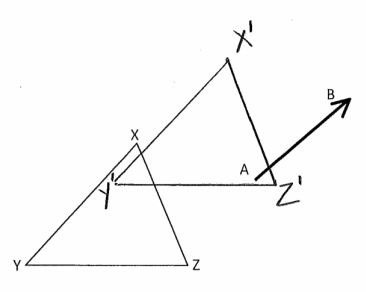
Translate △XYZ along \(\overrightarrow{A B}\). Label the image of the triangle with X’, Y’, and Z’.
Answer:
Eureka Math Grade 8 Module 2 Mid Module Assessment Task Answer Key 1

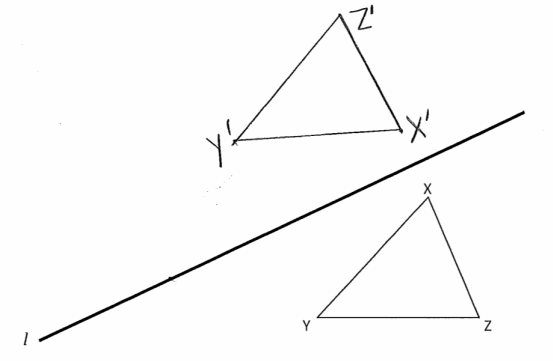
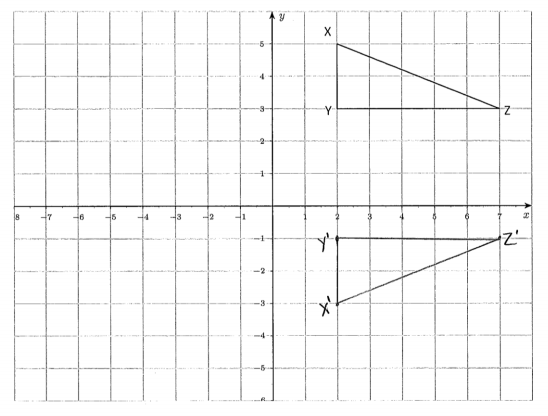
b. Reflect △XYZ across the line of reflection, l. Label the image of the triangle with X’, Y’, and Z’.
Answer:
Eureka Math Grade 8 Module 2 Mid Module Assessment Task Answer Key 2

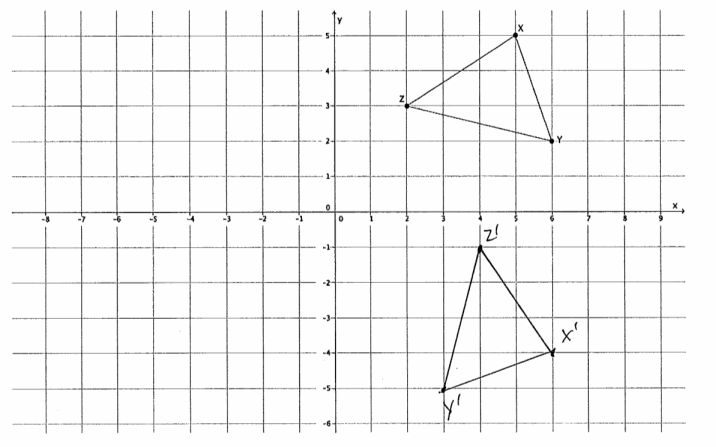
c. Rotate △XYZ around the point (1,0) clockwise 90°. Label the image of the triangle with X’, Y’, and Z’.
Answer:
Eureka Math Grade 8 Module 2 Mid Module Assessment Task Answer Key 3

Question 2.
Use the picture below to answer the questions.
Answer:
Eureka Math Grade 8 Module 2 Mid Module Assessment Task Answer Key 4

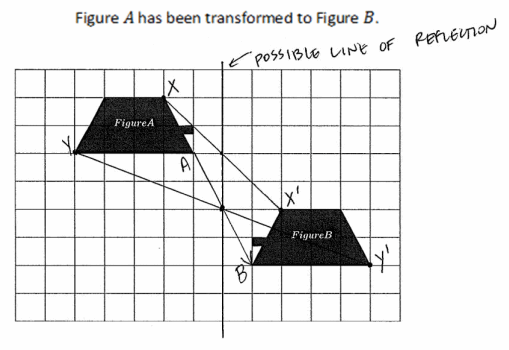
a. Can Figure A be mapped onto Figure B using only translation? Explain. Use drawings as needed in your explanation.
Answer:
No, if i translate along vector \(\overrightarrow{A B}\) i can get the longer point of figure A to map onto the lower left point of figure B(one pair of corresponding points). But no other points of the figures coincide.)

b. Can Figure A be mapped onto Figure B using only reflection? Explain. Use drawings as needed in your explanation. Use the graphs below to answer parts (a) and (b).
Answer:
No, when i connect a point of figure A to its image on figure B, the line of reflection should bisect the segment. When i connect midpoints of \(\overline{x x^{\prime}}\) & \(\overline{y y^{\prime}}\) i get a possible line of reflection, but when i check, figure A does not map onto figure B.

Question 3.
Reflect △XYZ over the horizontal line (parallel to the x-axis) through point (0,1). Label the reflected image with X’Y’Z’.

a. Reflect △XYZ over the horizontal line (parallel to the x-axis) through point (0,1). Label the reflected image with X’Y’Z’.
Answer:
Eureka Math Grade 8 Module 2 Mid Module Assessment Task Answer Key 5

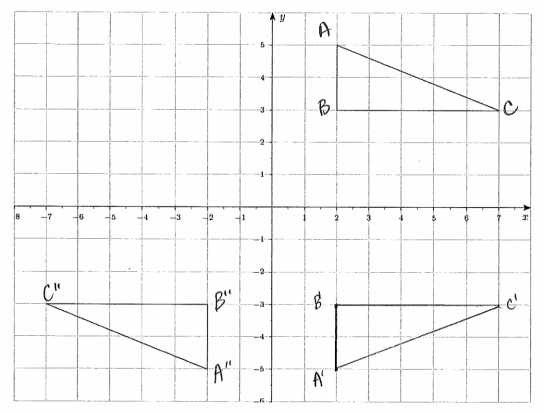
b. One triangle in the diagram below can be mapped onto the other using two reflections. Identify the lines of reflection that would map one onto the other. Can you map one triangle onto the other using just one basic rigid motion? If so, explain.
Answer:
Eureka Math Grade 8 Module 2 Mid Module Assessment Task Answer Key 6
A reflection across the x-axis maps △ABC to △A’B’C’ and a reflection across the y-axis maps △A’B’C’ to △A”B”C”.
Since AB || A”B”, BC = B”C”, AC = A”C”, then A 180° rotation about the origin will map △ABC to △A”B”C”.

Eureka Math Grade 8 Module 2 End of Module Assessment Answer Key

Engage NY Eureka Math 8th Grade Module 2 End of Module Assessment Answer Key

Eureka Math Grade 8 Module 2 End of Module Assessment Task Answer Key

Question 1.
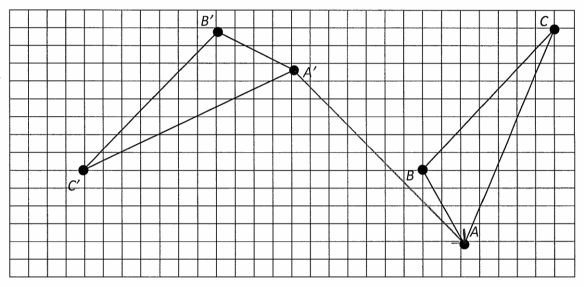
△ABC≅ △A’B’C’. Use the picture to answer the question below.
Eureka Math Grade 8 Module 2 End of Module Assessment Task Answer Key 1
Describe a sequence of rigid motions that would prove a congruence between △ABC and △A’B’C’.
Answer:
Let T be the Translation AWNG \(\overrightarrow{A^{\prime} A}\) so that t(A’) = A. Let R be the rotation around A, d degrees so that R(A’B’) = AB. By hypothesis |AB| = |A’B’|. Let |∠A| = |∠A|, |∠B| = |∠B|, so the composition ʌ.R.T will map ∆A’B’C’ to ∆A’B’C’ to ∆ABC, i.e., ʌ(R(T(△A’B’C’))) = △ABC

Question 2.
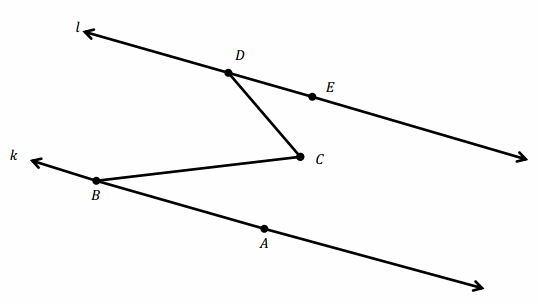
Use the diagram to answer the question below.

k || l
Eureka Math Grade 8 Module 2 End of Module Assessment Task Answer Key 2
Answer:
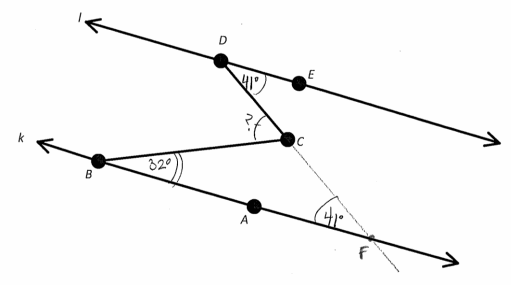
Eureka Math Grade 8 Module 2 End of Module Assessment Task Answer Key 2.1

Line k is parallel to line l. m∠EDC=41° and m∠ABC=32°. Find the m∠BCD. Explain in detail how you know you are correct. Add additional lines and points as needed for your explanation.
Answer:
Let F be a point on line or so that ∠DCF is a straight angle. Then because r || l, ∠EDC ≅ ∠CFA and have equal measure. ∠ABC and ∠CFA are the remote interior angles of △BCF which means ∠BCD = ∠ABC + CFA. Therefore ∠BCD = 32 + 41 = 73°.

Question 3.
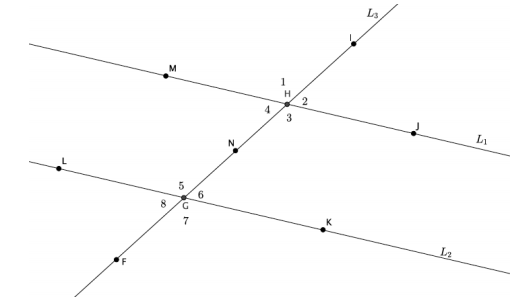
Use the diagram below to answer the questions that follow. Lines L1 and L2 are parallel, L1 || L2. Point N is the midpoint of segment GH.
Eureka Math Grade 8 Module 2 End of Module Assessment Task Answer Key 3

a. If the measure of ∠IHM is 125°, what is the measure of ∠IHJ? ∠JHN? ∠NHM?
Answer:
∠IHJ = 55°
∠JHN = 125°
∠NHM = 55°

b. What can you say about the relationship between ∠4 and ∠6? Explain using a basic rigid motion. Name another pair of angles with this same relationship.
Answer:
∠4 & ∠6 are alternate interior angles that are equal because L1 || L2. Let R be a rotation of 180° around point N. Then R(N) = N, R(L3) = L3 and R(L1) = L2. Rotations are degree preserving so (∠4) = ∠6
∠3 & ∠5 are also alternate interior angles that are equal.

c. What can you say about the relationship between ∠1 and ∠5? Explain using a basic rigid motion. Name another pair of angles with this same relationship.
Answer:
∠1 & ∠5 are corresponding angles that are equal because L1 || L2. Let T be the Translation along vector \(\overrightarrow{G H}\). Then T(L2) = L1 and T(∠5) = ∠1.
∠3 & ∠7 are also corresponding angles that are equal.

Eureka Math Grade 8 Module 4 Lesson 2 Answer Key

Engage NY Eureka Math 8th Grade Module 4 Lesson 2 Answer Key

Eureka Math Grade 8 Module 4 Lesson 2 Exercise Answer Key

Write each of the following statements in Exercises 1–12 as a mathematical expression. State whether or not the expression is linear or nonlinear. If it is nonlinear, then explain why.

Exercise 1.
The sum of a number and four times the number
Answer:
Let x be a number; then, x+4x is a linear expression.

Exercise 2.
The product of five and a number
Answer:
Let x be a number; then, 5x is a linear expression.

Exercise 3.
Multiply six and the reciprocal of the quotient of a number and seven.
Answer:
Let x be a number; then, 6∙\(\frac{7}{x}\) is a nonlinear expression. The expression is nonlinear because the number
\(\frac{7}{x}\)=7∙\(\frac{1}{x}\)=7∙x-1. The exponent of the x is the reason it is not a linear expression.

Exercise 4.
Twice a number subtracted from four times a number, added to 15
Answer:
Let x be a number; then, 15+(4x-2x) is a linear expression.

Exercise 5.
The square of the sum of six and a number
Answer:
Let x be a number; then,(x+6)2 is a nonlinear expression. When you multiply(x+6)2, you get x2+12x+36. The x2 is the reason it is not a linear expression.

Exercise 6.
The cube of a positive number divided by the square of the same positive number
Answer:
Let x be a number; then, \(\frac{x^{3}}{x^{2}}\) is a nonlinear expression. However, if you simplify the expression to x, then it is linear.

Exercise 7.
The sum of four consecutive numbers
Answer:
Let x be the first number; then, x+(x+1)+(x+2)+(x+3) is a linear expression.

Exercise 8.
Four subtracted from the reciprocal of a number
Answer:
Let x be a number; then, \(\frac{1}{x}\)-4 is a nonlinear expression. The term \(\frac{1}{x}\) is the same as x-1, which is why this expression is not linear. It is possible that a student may let x be the reciprocal of a number, \(\frac{1}{x}\), which would make the expression linear.

Exercise 9.
Half of the product of a number multiplied by itself three times
Answer:
Let x be a number; then, \(\frac{1}{2}\)∙x∙x∙x is a nonlinear expression. The term \(\frac{1}{2}\)∙x∙x∙x is the same as\(\frac{1}{2}\) x3, which is why this expression is not linear.

Exercise 10.
The sum that shows how many pages Maria read if she read 45 pages of a book yesterday and \(\frac{2}{3}\) of the remaining pages today
Answer:
Let x be the number of remaining pages of the book; then, 45+\(\frac{2}{3}\) x is a linear expression.

Exercise 11.
An admission fee of $10 plus an additional $2 per game
Answer:
Let x be the number of games; then, 10+2x is a linear expression.

Exercise 12.
Five more than four times a number and then twice that sum
Answer:
Let x be the number; then, 2(4x+5) is a linear expression.

Eureka Math Grade 8 Module 4 Lesson 2 Problem Set Answer Key

Students practice writing expressions and identifying them as linear or nonlinear.

Write each of the following statements as a mathematical expression. State whether the expression is linear or nonlinear. If it is nonlinear, then explain why.

Question 1.
A number decreased by three squared
Answer:
Let x be a number; then, x-32 is a linear expression.

Question 2.
The quotient of two and a number, subtracted from seventeen
Answer:
Let x be a number; then, 17-\(\frac{2}{x}\) is a nonlinear expression. The term \(\frac{2}{x}\) is the same as 2∙\(\frac{1}{x}\) and \(\frac{1}{x}\)=x-1, which is why it is not linear.

Question 3.
The sum of thirteen and twice a number
Answer:
Let x be a number; then, 13+2x is a linear expression.

Question 4.
5.2 more than the product of seven and a number
Answer:
Let x be a number; then, 5.2+7x is a linear expression.

Question 5.
The sum that represents the number of tickets sold if 35 tickets were sold Monday, half of the remaining tickets were sold on Tuesday, and 14 tickets were sold on Wednesday
Answer:
Let x be the remaining number of tickets; then, 35+\(\frac{1}{2}\) x+14 is a linear expression.

Question 6.
The product of 19 and a number, subtracted from the reciprocal of the number cubed
Answer:
Let x be a number; then, \(\frac{1}{x^{3}}\) -19x is a nonlinear expression. The term \(\frac{1}{x^{3}}\) is the same as x-3, which is why it is not linear.

Question 7.
The product of 15 and a number, and then the product multiplied by itself four times
Answer:
Let x be a number; then,(15x)4 is a nonlinear expression. The expression can be written as 154∙x4. The exponent of 4 with a base of x is the reason it is not linear.

Question 8.
A number increased by five and then divided by two
Answer:
Let x be a number; then, \(\frac{x+5}{2}\) is a linear expression.

Question 9.
Eight times the result of subtracting three from a number
Answer:
Let x be a number; then, 8(x-3) is a linear expression.

Question 10.
The sum of twice a number and four times a number subtracted from the number squared
Answer:
Let x be a number; then, x2-(2x+4x) is a nonlinear expression. The term x2 is the reason it is not linear.

Question 11.
One-third of the result of three times a number that is increased by 12
Answer:
Let x be a number; then, \(\frac{1}{3}\) (3x+12) is a linear expression.

Question 12.
Five times the sum of one-half and a number
Answer:
Let x be a number; then, 5(\(\frac{1}{2}\)+x) is a linear expression.

Question 13.
Three-fourths of a number multiplied by seven
Answer:
Let x be a number; then, \(\frac{3}{4}\)x∙7 is a linear expression.

Question 14.
The sum of a number and negative three, multiplied by the number
Answer:
Let x be a number; then, (x+(-3))x is a nonlinear expression because (x+(-3))x=x2-3x after using the distributive property. It is nonlinear because the power of x in the term x2 is greater than 1.

Question 15.
The square of the difference between a number and 10
Answer:
Let x be a number; then, (x-10)2 is a nonlinear expression because (x-10)2=x2-20x+100. The term x2 is a positive power of x>1; therefore, this is not a linear expression.

Eureka Math Grade 8 Module 4 Lesson 2 Exit Ticket Answer Key

Write each of the following statements as a mathematical expression. State whether the expression is a linear or nonlinear expression in x.

Question 1.
Seven subtracted from five times a number, and then the difference added to nine times a number
Answer:
Let x be a number; then, (5x-7)+9x. The expression is a linear expression.

Question 2.
Three times a number subtracted from the product of fifteen and the reciprocal of a number
Answer:
Let x be a number; then, 15∙\(\frac{1}{x}\)-3x. The expression is a nonlinear expression.

Question 3.
Half of the sum of two and a number multiplied by itself three times
Answer:
Let x be a number; then, \(\frac{1}{2}\) (2+x3). The expression is a nonlinear expression.

Eureka Math Grade 8 Module 4 Lesson 1 Answer Key

Engage NY Eureka Math 8th Grade Module 4 Lesson 1 Answer Key

Eureka Math Grade 8 Module 4 Lesson 1 Exercise Answer Key

Write each of the following statements using symbolic language.

Exercise 1.
The sum of four consecutive even integers is -28.
Answer:
Let x be the first even integer. Then, x+x+2+x+4+x+6=-28.

Exercise 2.
A number is four times larger than the square of half the number.
Answer:
Let x be the number. Then, x=4(\(\frac{x}{2}\))2.

Exercise 3.
Steven has some money. If he spends $9.00, then he will have \(\frac{3}{5}\) of the amount he started with.
Answer:
Let x be the amount of money (in dollars) Steven started with. Then, x-9=\(\frac{3}{5}\) x.

Exercise 4.
The sum of a number squared and three less than twice the number is 129.
Answer:
Let x be the number. Then, x2+2x-3=129.

Exercise 5.
Miriam read a book with an unknown number of pages. The first week, she read five less than \(\frac{1}{3}\) of the pages. The second week, she read 171 more pages and finished the book. Write an equation that represents the total number of pages in the book.
Answer:
Let x be the total number of pages in the book. Then, \(\frac{1}{3}\) x-5+171=x.

Eureka Math Grade 8 Module 4 Lesson 1 Problem Set Answer Key

Students practice transcribing written statements into symbolic language.

Write each of the following statements using symbolic language.

Question 1.
Bruce bought two books. One book costs $4.00 more than three times the other. Together, the two books cost him $72.
Answer:
Let x be the cost of the less expensive book. Then, x+4+3x=72.

Question 2.
Janet is three years older than her sister Julie. Janet’s brother is eight years younger than their sister Julie. The sum of all of their ages is 55 years.
Answer:
Let x be Julie’s age. Then, (x+3)+(x-8)+x=55.

Question 3.
The sum of three consecutive integers is 1,623.
Answer:
Let x be the first integer. Then, x+(x+1)+(x+2)=1623.

Question 4.
One number is six more than another number. The sum of their squares is 90.
Answer:
Let x be the smaller number. Then, x2+(x+6)2=90.

Question 5.
When you add 18 to \(\frac{1}{4}\) of a number, you get the number itself.
Answer:
Let x be the number. Then, \(\frac{1}{4}\) x+18=x.

Question 6.
When a fraction of 17 is taken away from 17, what remains exceeds one-third of seventeen by six.
Answer:
Let x be the fraction of 17. Then, 17-x=\(\frac{1}{3}\)∙17+6.

Question 7.
The sum of two consecutive even integers divided by four is 189.5.
Answer:
Let x be the first even integer. Then, \(\frac{x+(x+2)}{4}\)=189.5.

Question 8.
Subtract seven more than twice a number from the square of one-third of the number to get zero.
Answer:
Let x be the number. Then, (\(\frac{1}{3}\) x)2-(2x+7)=0.

Question 9.
The sum of three consecutive integers is 42. Let x be the middle of the three integers. Transcribe the statement accordingly.
Answer:
(x-1)+x+(x+1)=42

Eureka Math Grade 8 Module 4 Lesson 1 Exit Ticket Answer Key

Write each of the following statements using symbolic language.

Question 1.
When you square five times a number, you get three more than the number.
Answer:
Let x be the number. Then, (5x)2=x+3.

Question 2.
Monica had some cookies. She gave seven to her sister. Then, she divided the remainder into two halves, and she still had five cookies left.
Answer:
Let x be the original amount of cookies. Then, \(\frac{1}{2}\) (x-7)=5.

Eureka Math Grade 8 Module 3 Mid Module Assessment Answer Key

Engage NY Eureka Math 8th Grade Module 3 Mid Module Assessment Answer Key

Eureka Math Grade 8 Module 3 Mid Module Assessment Task Answer Key

Question 1.
Use the figure below to complete parts (a) and (b).
Eureka Math Grade 8 Module 3 Mid Module Assessment Task Answer Key 1

Answer:
Eureka Math Grade 8 Module 3 Mid Module Assessment Task Answer Key 1.1

a. Use a compass and ruler to produce an image of the figure with center O and scale factor r=2.

b. Use a ruler to produce an image of the figure with center O and scale factor r=\(\frac{1}{2}\).

Question 2.
Use the diagram below to answer the questions that follow.

Let D be the dilation with center O and scale factor r>0 so that Dilation(P)=P’ and Dilation(Q)=Q’.
Eureka Math Grade 8 Module 3 Mid Module Assessment Task Answer Key 2
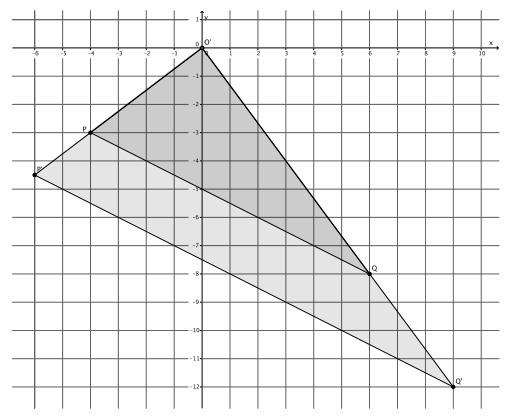
a. Use lengths |OQ|=10 units and |OQ’ |=15 units to determine the scale factor r of dilation D. Describe how to determine the coordinates of P’ using the coordinates of P.
Answer:
|OQ|r= |OQ’|
Eureka Math Grade 8 Module 3 Mid Module Assessment Task Answer Key 500
r = \(\frac{15}{10}\)
r = \(\frac{3}{2}\)
The same factor is r = \(\frac{3}{2}\)
Since the coordinates of P = (-4, -3) the coordinates of the dilated point P’ will be the same factor times the coordinates of P. Therefore P’ = (\(\frac{3}{2}\) × (-4), \(\frac{3}{2}\) × (-3)) = (-6, -45)

b. If |OQ|=10 units, |OQ’|=15 units, and |P’Q’|=11.2 units, determine |PQ|. Round your answer to the tenths place, if necessary.
Answer:
\(\frac{15}{10}\) = \(\frac{11.2}{|PQ|}\)
15(|PQ|) = 112
|PQ| = \(\frac{112}{15}\) ≈ 7.5
The length of \(\overline{P Q}\) is about 7.5 units.

Question 3.
Use a ruler and compass, as needed, to answer parts (a) and (b).

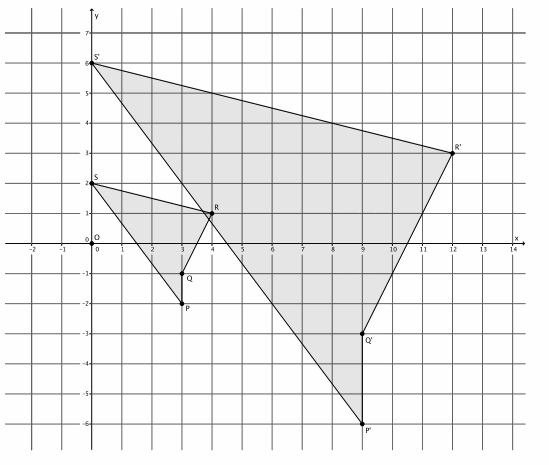
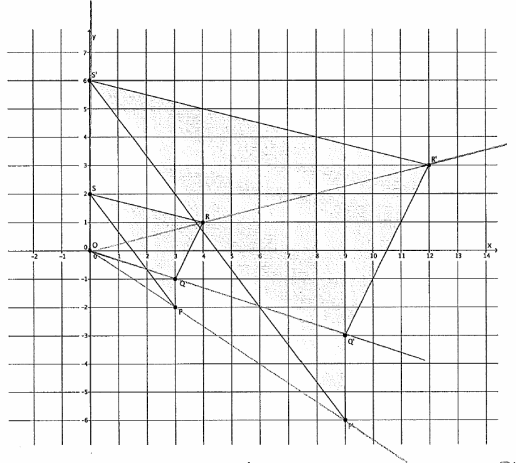
a. Is there a dilation D with center O that would map figure PQRS to figure P’Q’R’S’? Explain in terms of scale factor, center, and coordinates of corresponding points.
Eureka Math Grade 8 Module 3 Mid Module Assessment Task Answer Key 3
Answer:
Eureka Math Grade 8 Module 3 Mid Module Assessment Task Answer Key 3.1
P = (3, -2)
P’ = (9, -6)
Q = (3, -1)
Q’ = (9, -3)
R = (4, 1)
R’ = (12, 3)
S = (0, 2)
S’ = (0, 6)
Yes, there is a dilation D with Genter O, that maps PQS to P’Q’R’S’. The scale factor is 3. The image of each point is 3 times the coordinates of the original image. For example, P = (3, -2) and P’ = (3 × 3, 3 × (-2)) = (9, -6)

b. Is there a dilation D with center O that would map figure PQRS to figure P’Q’R’S’? Explain in terms of scale factor, center, and coordinates of corresponding points.
Eureka Math Grade 8 Module 3 Mid Module Assessment Task Answer Key 4
Answer:
Eureka Math Grade 8 Module 3 Mid Module Assessment Task Answer Key 4.1
No, there is not a dilation D that will map PQRS to P’Q’R’S’. A dilation will move A point, S, to its image S’ on the ray \(\overrightarrow{O S}\). In the picture above O, S, S’ are not on the same ray. A similar statement can be made for points P, Q and R, Therefore, there is no dilation that maps PQRS to P’Q’R’S’.

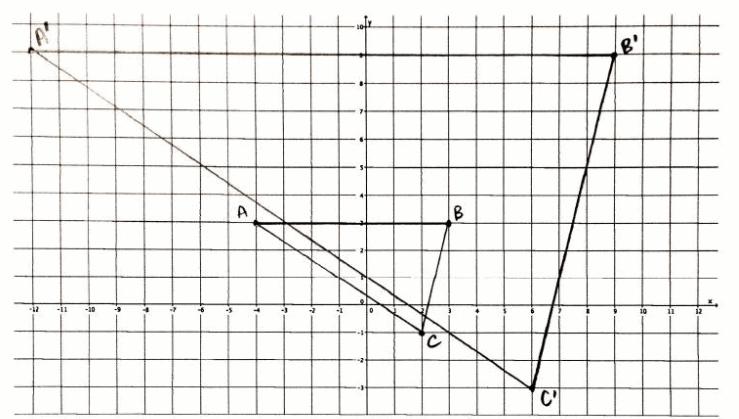
c. Triangle ABC is located at points A(-4,3), B(3,3), and C(2,-1) and has been dilated from the origin by a scale factor of 3. Draw and label the vertices of triangle ABC. Determine the coordinates of the dilated triangle A’B’C’, and draw and label it on the coordinate plane.
Eureka Math Grade 8 Module 3 Mid Module Assessment Task Answer Key 5
Answer:
Eureka Math Grade 8 Module 3 Mid Module Assessment Task Answer Key 5.1
A= (-4, 3)
A’ = (-4×3, 3×3) = (-12, 9)
B =(3, 3)
B’ = (3×3, 3×3) = (9, 9)
C = (2, -1)
C’ = (2×3, -1×3) = (6, -3)

Eureka Math Grade 8 Module 3 End of Module Assessment Answer Key

Engage NY Eureka Math 8th Grade Module 3 End of Module Assessment Answer Key

Eureka Math Grade 8 Module 3 End of Module Assessment Task Answer Key

Question 1.
Use the diagram below to answer the questions that follow.
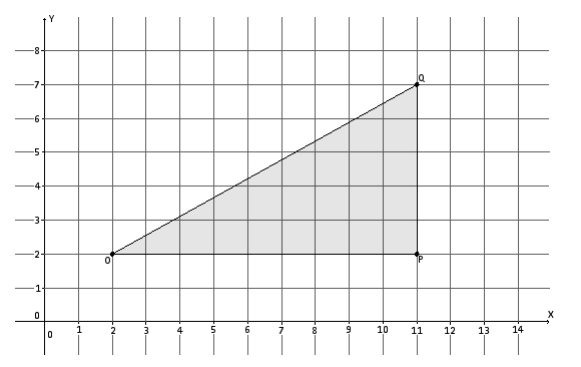
Eureka Math Grade 8 Module 3 End of Module Assessment Task Answer Key 1
Answer:
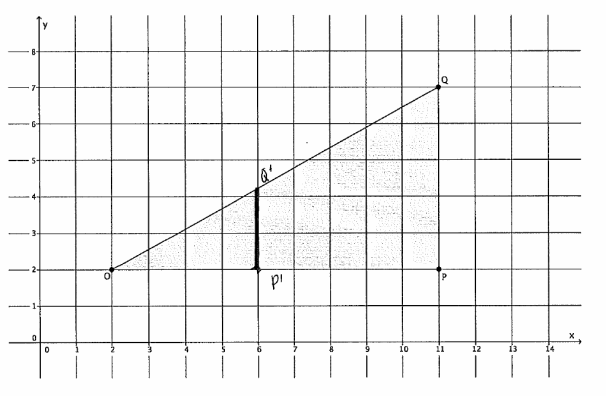
Eureka Math Grade 8 Module 3 End of Module Assessment Task Answer Key 1.1

a. Dilate △OPQ from center O and scale factor r=\(\frac{4}{9}\). Label the image △OP’Q’.

b. Find the coordinates of points P’ and Q’.
Answer:
P’ = (6, 2)
Q’ = (6, \(\frac{38}{9}\))
\(\frac{\left(P^{\prime} Q^{\prime}\right)}{|P Q|}\) = \(\frac{4}{9}\)
\(\frac{\left|P^{\prime} Q^{\prime}\right|}{5}\) = \(\frac{4}{9}\)
|P’Q’| = \(\frac{20}{9}\)
\(\frac{20}{9}\) + 2 = \(\frac{20}{9}\) + \(\frac{18}{9}\)
= \(\frac{38}{9}\)

c. Are ∠OQP and ∠OQ’P’ equal in measure? Explain.
Answer:
Yes ∠OQP = ∠OQ’P’ Since D(△OQP) = △OQ’P’ and dilations are degree preserving, then ∠OQP = ∠OQ’P’.
∠OQP & ∠OQ’P’ are corresponding angles of parallel lines PQ & P’Q’, therefore ∠OQR = ∠OQ’P’

d. What is the relationship between segments PQ and P’Q’? Explain in terms of similar triangles.
Answer:
The lines that contain \(\overline{\text { PQ }}\) and \(\overline{p^{\prime} Q^{\prime}}\) are parallel. ∆OPQ ~ ∆OP’Q’ by the AA criterion (∠D = ∠D, ∠OP’Q’ = ∠OPQ), Therefore by the fundamental theorem of similarity \(\overline{P Q}\) || \(\overline{P^{\prime} Q^{\prime}}\)

e. If the length of segment OQ is 9.8 units, what is the length of segment OQ’? Explain in terms of similar triangles.
Answer:
Since ∆OPQ ~ ∆OP’Q’, then the ratios of lengths of corresponding sides will be equal to the scale factor then
\(\frac{\left|O P^{\prime}\right|}{|O P|}\) = \(\frac{\left|O Q^{\prime}\right|}{|O Q|}\) = \(\frac{4}{9}\)
\(\frac{4}{9}\) = \(\frac{\left|O Q^{\prime}\right|}{|9.0|}\)
39.2 = 9(|OQ’|)
4.36 = |OQ’|
|OQ’| is approximately 4.4 units.

Question 2.
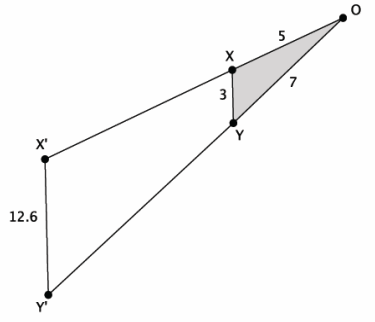
Use the diagram below to answer the questions that follow. The length of each segment is as follows: segment OX is 5 units, segment OY is 7 units, segment XY is 3 units, and segment X’Y’ is 12.6 units.
Eureka Math Grade 8 Module 3 End of Module Assessment Task Answer Key 10

a. Suppose segment XY is parallel to segment X’Y’. Is △OXY similar to △OX’Y’? Explain.
Answer:
Yes, ∆OXY ~ ∆OX’Y’. Since \(\overline{X Y}\) || \(X^{\prime} Y^{\prime}\) and ∠OYX = ∠OY’X’. Because corresponding angles of parallel lines are equal in measure, by AA ∆OXY ~ ∆OX’Y’.

b. What is the length of segment OX’? Show your work.
Answer:
\(\frac{12.6}{3}\) = \(\frac{\left|O X^{\prime}\right|}{|5|}\)
5(12.6) = 3(|OX’|)
63 = 3(|OX’|)
21 = |OX’|
|OX’| is 21 units.

c. What is the length of segment OY’? Show your work.
Answer:
\(\frac{12.6}{3}\) = \(\frac{\left|OY^{\prime}\right|}{|7|}\)
12.6(7) = (3|OY’|)
88.2 = 3(|OY’|)
29.4 = |OY’|
|OY’| is 29.4 units.

Question 3.
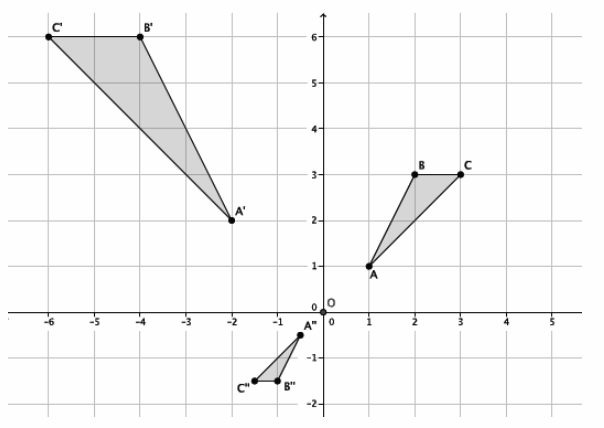
Given △ABC ~△A^’ B^’ C’ and △ABC ~△A”B”C” in the diagram below, answer parts (a)–(c).
Eureka Math Grade 8 Module 3 End of Module Assessment Task Answer Key 50
a. Describe the sequence that shows the similarity for △ABC and △A’ B’ C’.
Answer:
\(\frac{B^{\prime} C^{\prime}}{B C}\) = \(\frac{2}{1}\) = 2 = r
Le D be the dilation from center O and scale factor r=2. Let there be a reflection across the Y-axis. Then the dilation followed by the reflection maps △ABC onto △A’B’C’.

b. Describe the sequence that shows the similarity for △ABC and △A”B”C”.
Answer:
Let D be the dilation from center O and scale factor. 0<r<1. Let there be a rotation of 180° around center O. Then the dilation followed by the rotation maps △ABC onto △A”B”C”.

c. Is △A’B’C’ similar to △A”B”C”? How do you know?
Answer:
Yes △A’B’C’ ~ △A”B”C”. Dilations preserve angle measures and since △ABC ~ △A’B’C and △ABC ~ △A”B”C”, we know ∠A= ∠A’ = ∠A”, ∠B = ∠B’=∠B”, by AA Criterion for similarity △A’B’C’ ~ △ A”B”C”. Also, similarity is Transitive.

Eureka Math Grade 8 Module 3 Lesson 14 Answer Key

Engage NY Eureka Math 8th Grade Module 3 Lesson 14 Answer Key

Eureka Math Grade 8 Module 3 Lesson 14 Example Answer Key

Example 1.
To maintain the focus of the lesson, allow the use of calculators in order to check the validity of the right angle using the Pythagorean theorem.
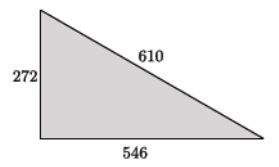
→ The numbers in the diagram below indicate the units of length of each side of the triangle. Is the triangle shown below a right triangle?
Engage NY Math 8th Grade Module 3 Lesson 14 Example Answer Key 1
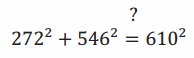
→ To find out, we need to put these numbers into the Pythagorean theorem. Recall that side c is always the longest side. Since 610 is the largest number, it is representing the c in the Pythagorean theorem. To determine if this triangle is a right triangle, then we need to verify the computation.
Engage NY Math 8th Grade Module 3 Lesson 14 Example Answer Key 2
→ Find the value of the left side of the equation: 2722+5462=372 100. Then, find the value of the right side of the equation: 6102=372 100. Since the left side of the equation is equal to the right side of the equation, we have a true statement, that is, 2722+5462=6102. What does that mean about the triangle?
→ It means that the triangle with side lengths of 272, 546, and 610 is a right triangle.

Example 2.
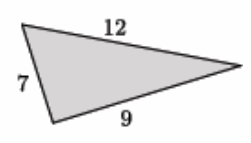
→ The numbers in the diagram below indicate the units of length of each side of the triangle. Is the triangle shown below a right triangle?
Engage NY Math 8th Grade Module 3 Lesson 14 Example Answer Key 3
→ What do we need to do to find out if this is a right triangle?
→ We need to see if it makes a true statement when we replace a, b, and c with the numbers using the Pythagorean theorem.
→ Which number is c? How do you know?
→ The longest side is 12; therefore, c=12.
→ Use your calculator to see if it makes a true statement. (Give students a minute to calculate.) Is it a right triangle? Explain.
→ No, it is not a right triangle. If it were a right triangle, the equation 72+92=122 would be true. But the left side of the equation is equal to 130, and the right side of the equation is equal to 144. Since 130≠144, then these lengths do not form a right triangle.

Eureka Math Grade 8 Module 3 Lesson 14 Exercise Answer Key

Exercise 1.
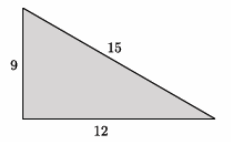
The numbers in the diagram below indicate the units of length of each side of the triangle. Is the triangle shown below a right triangle? Show your work, and answer in a complete sentence.
Eureka Math Grade 8 Module 3 Lesson 14 Exercise Answer Key 4
Answer:
We need to check if 92+122=152 is a true statement. The left side of the equation is equal to 225. The right side of the equation is equal to 225. That means 92+122=152 is true, and the triangle shown is a right triangle by the converse of the Pythagorean theorem.

Exercise 2.
The numbers in the diagram below indicate the units of length of each side of the triangle. Is the triangle shown below a right triangle? Show your work, and answer in a complete sentence.
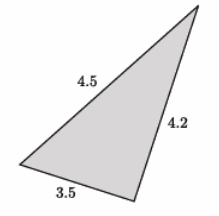
Eureka Math Grade 8 Module 3 Lesson 14 Exercise Answer Key 5
Answer:
We need to check if 3.52+4.22=4.52 is a true statement. The left side of the equation is equal to 29.89. The right side of the equation is equal to 20.25. That means 3.52+4.22=4.52 is not true, and the triangle shown is not a right triangle.

Exercise 3.
The numbers in the diagram below indicate the units of length of each side of the triangle. Is the triangle shown below a right triangle? Show your work, and answer in a complete sentence.
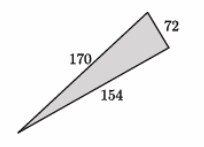
Eureka Math Grade 8 Module 3 Lesson 14 Exercise Answer Key 6
Answer:
We need to check if 722+1542=1702 is a true statement. The left side of the equation is equal to 28,900. The right side of the equation is equal to 28,900. That means 722+1542=1702 is true, and the triangle shown is a right triangle by the converse of the Pythagorean theorem.

Exercise 4.
The numbers in the diagram below indicate the units of length of each side of the triangle. Is the triangle shown below a right triangle? Show your work, and answer in a complete sentence.
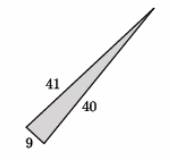
Eureka Math Grade 8 Module 3 Lesson 14 Exercise Answer Key 7
Answer:
We need to check if 92+402=412 is a true statement. The left side of the equation is equal to 1,681. The right side of the equation is equal to 1,681. That means 92+402=412 is true, and the triangle shown is a right triangle by the converse of the Pythagorean theorem.

Exercise 5.
The numbers in the diagram below indicate the units of length of each side of the triangle. Is the triangle shown below a right triangle? Show your work, and answer in a complete sentence.
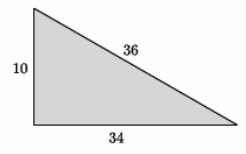
Eureka Math Grade 8 Module 3 Lesson 14 Exercise Answer Key 8
Answer:
We need to check if 102+342=362 is a true statement. The left side of the equation is equal to 1,256. The right side of the equation is equal to 1,296. That means 102+342=362 is not true, and the triangle shown is not a right triangle.

Exercise 6.
The numbers in the diagram below indicate the units of length of each side of the triangle. Is the triangle shown below a right triangle? Show your work, and answer in a complete sentence.
Eureka Math Grade 8 Module 3 Lesson 14 Exercise Answer Key 9
Answer:
We need to check if 22+52=72 is a true statement. The left side of the equation is equal to 29. The right side of the equation is equal to 49. That means 22+52=72 is not true, and the triangle shown is not a right triangle.

Exercise 7.
The numbers in the diagram below indicate the units of length of each side of the triangle. Is the triangle shown below a right triangle? Show your work, and answer in a complete sentence.
Eureka Math Grade 8 Module 3 Lesson 14 Exercise Answer Key 10
Answer:
We need to check if 2.52+62=6.52 is a true statement. The left side of the equation is equal to 42.25. The right side of the equation is equal to 42.25. That means 2.52+62=6.52 is true, and the triangle shown is a right triangle by the converse of the Pythagorean theorem.

Eureka Math Grade 8 Module 3 Lesson 14 Exit Ticket Answer Key

Question 1.
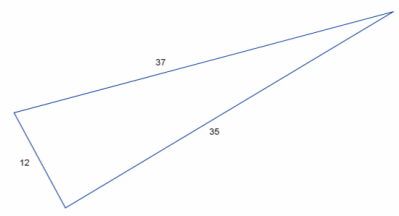
The numbers in the diagram below indicate the lengths of the sides of the triangle. Bernadette drew the following triangle and claims it is a right triangle. How can she be sure?
Engage NY Math 8th Grade Module 3 Lesson 14 Exit Ticket Answer Key 11
Answer:
Since 37 is the longest side, if this triangle was a right triangle, 37 would have to be the hypotenuse (or c). Now she needs to check to see if 122+352=372 is a true statement. The left side is 1,369, and the right side is 1,369. That means 122+352=372 is true, and this is a right triangle.

Question 2.
Do the lengths 5, 9, and 14 form a right triangle? Explain.
Answer:
No, the lengths of 5, 9, and 14 do not form a right triangle. If they did, then the equation 52+92=142 would be a true statement. However, the left side equals 106, and the right side equals 196. Therefore, these lengths do not form a right triangle.

Eureka Math Grade 8 Module 3 Lesson 14 Problem Set Answer Key

Students practice using the converse of the Pythagorean theorem and identifying common errors in computations.

Question 1.
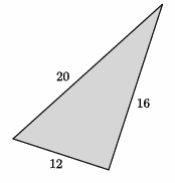
The numbers in the diagram below indicate the units of length of each side of the triangle. Is the triangle shown below a right triangle? Show your work, and answer in a complete sentence.
Eureka Math Grade 8 Module 3 Lesson 14 Problem Set Answer Key 12
Answer:
We need to check if 122+162=202 is a true statement. The left side of the equation is equal to 400. The right side of the equation is equal to 400. That means 122+162=202 is true, and the triangle shown is a right triangle.

Question 2.
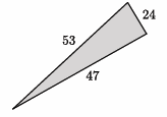
The numbers in the diagram below indicate the units of length of each side of the triangle. Is the triangle shown below a right triangle? Show your work, and answer in a complete sentence.
Eureka Math Grade 8 Module 3 Lesson 14 Problem Set Answer Key 13
Answer:
We need to check if 472+242=532 is a true statement. The left side of the equation is equal to 2,785. The right side of the equation is equal to 2,809. That means 472+242=532 is not true, and the triangle shown is not a right triangle.

Question 3.
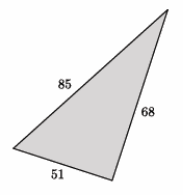
The numbers in the diagram below indicate the units of length of each side of the triangle. Is the triangle shown below a right triangle? Show your work, and answer in a complete sentence.
Eureka Math Grade 8 Module 3 Lesson 14 Problem Set Answer Key 14
Answer:
We need to check if 512+682=852 is a true statement. The left side of the equation is equal to 7,225. The right side of the equation is equal to 7,225. That means 512+682=852 is true, and the triangle shown is a right triangle.

Question 4.
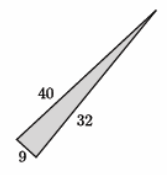
The numbers in the diagram below indicate the units of length of each side of the triangle. Sam said that the following triangle is a right triangle because 9+32=40. Explain to Sam what he did wrong to reach this conclusion and what the correct solution is.
Eureka Math Grade 8 Module 3 Lesson 14 Problem Set Answer Key 15
Answer:
Sam added incorrectly, but more importantly forgot to square each of the side lengths. In other words, he said 9+32=40, which is not a true statement. However, to show that a triangle is a right triangle, you have to use the Pythagorean theorem, which is a2+b2=c2. Using the Pythagorean theorem, the left side of the equation is equal to 1,105, and the right side is equal to 1,600. Since 1,105≠1,600, the triangle is not a right triangle.

Question 5.
The numbers in the diagram below indicate the units of length of each side of the triangle. Is the triangle shown below a right triangle? Show your work, and answer in a complete sentence.
Eureka Math Grade 8 Module 3 Lesson 14 Problem Set Answer Key 16
Answer:
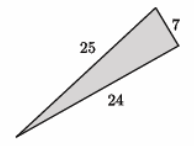
We need to check if 242+72=252 is a true statement. The left side of the equation is equal to 625. The right side of the equation is equal to 625. That means 242+72=252 is true, and the triangle shown is a right triangle.

Question 6.
Jocelyn said that the triangle below is not a right triangle. Her work is shown below. Explain what she did wrong, and show Jocelyn the correct solution.
Eureka Math Grade 8 Module 3 Lesson 14 Problem Set Answer Key 17
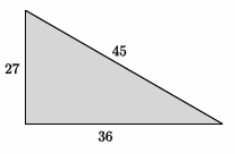
We need to check if 272+452=362 is a true statement. The left side of the equation is equal to 2,754. The right side of the equation is equal to 1,296. That means 272+452=362 is not true, and the triangle shown is not a right triangle.
Answer:
Jocelyn made the mistake of not putting the longest side of the triangle in place of c in the Pythagorean theorem, a2+b2=c2. Specifically, she should have used 45 for c, but instead she used 36 for c. If she had done that part correctly, she would have seen that, in fact, 272+362=452 is a true statement because both sides of the equation equal 2,025. That means that the triangle is a right triangle.

Eureka Math Grade 8 Module 3 Lesson 12 Answer Key

Engage NY Eureka Math 8th Grade Module 3 Lesson 12 Answer Key

Eureka Math Grade 8 Module 3 Lesson 12 Example Answer Key

Example.
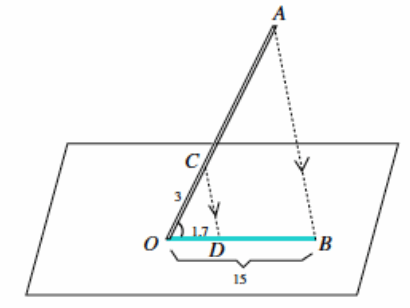
Not all flagpoles are perfectly upright (i.e., perpendicular to the ground). Some are oblique (i.e., neither parallel nor at a right angle, slanted). Imagine an oblique flagpole in front of an abandoned building. The question is, can we use sunlight and shadows to determine the length of the flagpole?
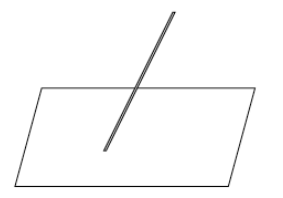
Engage NY Math 8th Grade Module 3 Lesson 12 Example Answer Key 1
Assume that we know the following information: The length of the shadow of the flagpole is 15 feet. There is a mark on the flagpole 3 feet from its base. The length of the shadow of this three-foot portion of the flagpole is 1.7 feet.
Answer:
Students may say that they would like to directly measure the length of the pole. Remind them a direct measurement may not always be possible.

→ Where would the shadow of the flagpole be?
→ On the ground, some distance from the base of the flagpole

→ In the picture below, OA is the length of the flagpole. OB is the length of the shadow cast by the flagpole. (OC) ̅ represents the segment from the base to the 3-foot mark up the flagpole, and OD is the length of the shadow cast by the length of (OC) ̅ that is 1.7 feet in length. (Note: The picture is not drawn to scale.)
Engage NY Math 8th Grade Module 3 Lesson 12 Example Answer Key 2
→ If we assume that all sunbeams are parallel to each other (i.e., \(\overline{C D}\)||\(\overline{A B}\)̅), do we have a pair of similar triangles? Explain.
→ If \(\overline{C D}\) || \(\overline{A B}\), then △COD~△AOB, by the AA criterion. Corresponding angles of parallel lines are equal, so we know that ∠CDO=∠ABO, and ∠COD is equal to itself.

→ Now that we know △COD~△AOB, how can we find the length of the flagpole?
→ Since the triangles are similar, then we know that the ratios of their corresponding sides must be equal. Therefore, if we let x represent the length of the flagpole (i.e., OA), then
\(\frac{x}{3}\)=\(\frac{15}{1.7}\)

→ We are looking for the value of x that makes the fractions equivalent.
→ Therefore, 1.7x=45, and x≈26.47. The length of the flagpole is approximately 26.47 feet.

Eureka Math Grade 8 Module 3 Lesson 12 Exercise Answer Key

Mathematical Modeling Exercises 1–3

Exercise 1.
You want to determine the approximate height of one of the tallest buildings in the city. You are told that if you place a mirror some distance from yourself so that you can see the top of the building in the mirror, then you can indirectly measure the height using similar triangles. Let point O be the location of the mirror so that the person shown can see the top of the building.
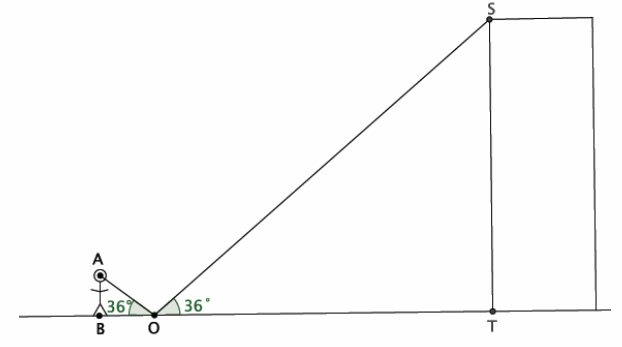
Eureka Math Grade 8 Module 3 Lesson 12 Exercise Answer Key 20
a. Explain why △ABO~△STO.
Answer:
The triangles are similar by the AA criterion. The angle that is formed by the figure standing is 90° with the ground. The building also makes a 90° angle with the ground. The measure of the angle formed with the mirror at ∠AOB is equal to the measure of ∠SOT. Since there are two pairs of corresponding angles that are equal in measure, then △ABO~△STO.

b. Label the diagram with the following information: The distance from eye level straight down to the ground is 5.3 feet. The distance from the person to the mirror is 7.2 feet. The distance from the person to the base of the building is 1,750 feet. The height of the building is represented by x.
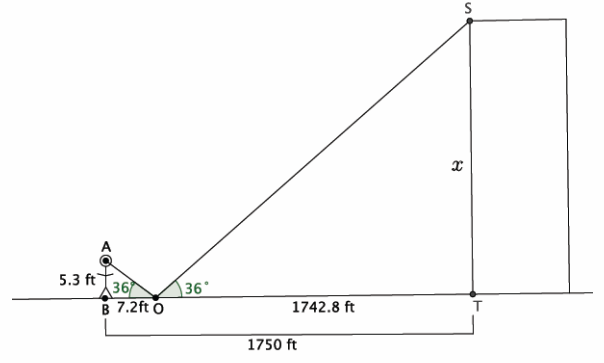
Eureka Math Grade 8 Module 3 Lesson 12 Exercise Answer Key 21

c. What is the distance from the mirror to the building?
Answer:
1750 ft.-7.2 ft.=1742.8 ft.

d. Do you have enough information to determine the approximate height of the building? If yes, determine the approximate height of the building. If not, what additional information is needed?
Answer:
Yes, there is enough information about the similar triangles to determine the height of the building.
Since x represents the height of the building, then
\(\frac{x}{5.3}\) = \(\frac{1,742.8}{7.2}\)
We are looking for the value of x that makes the fractions equivalent. Then, 7.2x=9236.84, and
x≈1282.9. The height of the building is approximately 1,282.9 feet.

Exercise 2.
A geologist wants to determine the distance across the widest part of a nearby lake. The geologist marked off specific points around the lake so that the line containing \(\overline{D E}\) would be parallel to the line containing \(\overline{B C}\). The segment BC is selected specifically because it is the widest part of the lake. The segment DE is selected specifically because it is a short enough distance to easily measure. The geologist sketched the situation as shown below.
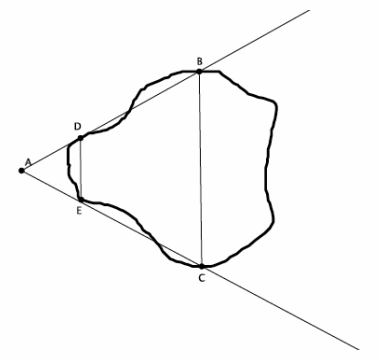
Eureka Math Grade 8 Module 3 Lesson 12 Exercise Answer Key 21.1

a. Has the geologist done enough work so far to use similar triangles to help measure the widest part of the lake? Explain.
Answer:
Yes, based on the sketch, the geologist found a center of dilation at point A. The geologist marked points around the lake that, when connected, would make parallel lines. So, the triangles are similar by the AA criterion. Corresponding angles of parallel lines are equal in measure, and the measure of ∠DAE is equal to itself. Since there are two pairs of corresponding angles that are equal, then △DAE~△BAC.

b. The geologist has made the following measurements: |DE|=5 feet, |AE|=7 feet, and |EC|=15 feet. Does she have enough information to complete the task? If so, determine the length across the widest part of the lake. If not, state what additional information is needed.
Answer:
Yes, there is enough information about the similar triangles to determine the distance across the widest part of the lake.
Let x represent the length of segment BC; then
\(\frac{x}{5}\)=\(\frac{22}{7}\)
We are looking for the value of x that makes the fractions equivalent. Therefore, 7x=110, and x≈15.7. The distance across the widest part of the lake is approximately 15.7 feet.

c. Assume the geologist could only measure a maximum distance of 12 feet. Could she still find the distance across the widest part of the lake? What would need to be done differently?
Answer:
The geologist could still find the distance across the widest part of the lake. However, she would have to select different points D and E at least 3 feet closer to points B and C, respectively. That would decrease the length of \(\overline{\boldsymbol{E C}}\) to, at most, 12 feet. Then \(\overline{\boldsymbol{D E}}\), in its new position, would still have to be contained within a line that was parallel to the line containing \(\overline{\boldsymbol{B C}}\) in order to calculate the desired distance.

Exercise 3.
A tree is planted in the backyard of a house with the hope that one day it is tall enough to provide shade to cool the house. A sketch of the house, tree, and sun is shown below.
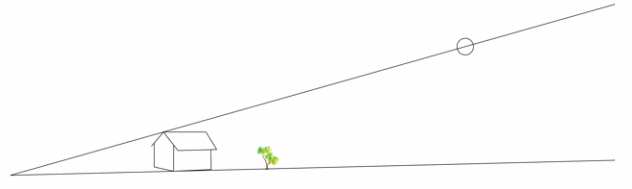
Eureka Math Grade 8 Module 3 Lesson 12 Exercise Answer Key 30
a. What information is needed to determine how tall the tree must be to provide the desired shade?
Answer:
We need to ensure that we have similar triangles. For that reason, we need to know the height of the house and the length of the shadow that the house casts. We also need to know how far away the tree was planted from that point (i.e., the center). Assuming the tree grows perpendicular to the ground, the height of the tree and the height of the house would be parallel, and by the AA criterion, we would have similar triangles.

b. Assume that the sun casts a shadow 32 feet long from a point on top of the house to a point in front of the house. The distance from the end of the house’s shadow to the base of the tree is 53 feet. If the house is 16 feet tall, how tall must the tree get to provide shade for the house?
Answer:
If we let x represent the height the tree must be, then
\(\frac{16}{x}\)=\(\frac{32}{53}\)
We are looking for the value of x that makes the fractions equivalent. Therefore, 32x=848, and x=26.5. The tree must grow to a height of 26.5 feet to provide the desired shade for the house.

c. Assume that the tree grows at a rate of 2.5 feet per year. If the tree is now 7 feet tall, about how many years will it take for the tree to reach the desired height?
Answer:
The tree needs to grow an additional 19.5 feet to reach the desired height. If the tree grows 2.5 feet per year, then it will take the tree 7.8 years or about 8 years to reach a height of 26.5 feet.

Eureka Math Grade 8 Module 3 Lesson 12 Problem Set Answer Key

Students practice solving real-world problems using properties of similar triangles.

Question 1.
The world’s tallest living tree is a redwood in California. It’s about 370 feet tall. In a local park, there is a very tall tree. You want to find out if the tree in the local park is anywhere near the height of the famous redwood.
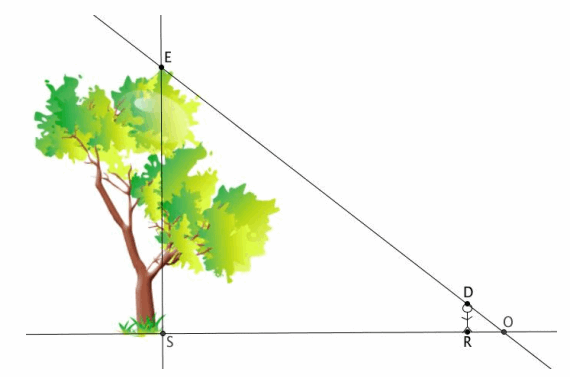
Eureka Math Grade 8 Module 3 Lesson 12 Problem Set Answer Key 50
a. Describe the triangles in the diagram, and explain how you know they are similar or not.
Answer:
There are two triangles in the diagram, one formed by the tree and the shadow it casts, △ESO, and another formed by the person and his shadow, △DRO. The triangles are similar if the height of the tree is measured at a 90° angle with the ground and if the person standing forms a 90° angle with the ground. We know that ∠DOR is an angle common to both triangles. If ∠ESO=∠DRO=90°, then △ESO~△DRO by the AA criterion.

b. Assume △ESO~△DRO. A friend stands in the shadow of the tree. He is exactly 5.5 feet tall and casts a shadow of 12 feet. Is there enough information to determine the height of the tree? If so, determine the height. If not, state what additional information is needed.
Answer:
No, there is not enough information to determine the height of the tree. I need either the total length of the shadow that the tree casts or the distance between the base of the tree and the friend.

c. Your friend stands exactly 477 feet from the base of the tree. Given this new information, determine about how many feet taller the world’s tallest tree is compared to the one in the local park.
Let x represent the height of the tree; then
\(\frac{x}{5.5}\)=\(\frac{489}{12}\)
We are looking for the value of x that makes the fractions equivalent. Therefore, 12x=2689.5, and x=224.125. The world’s tallest tree is about 146 feet taller than the tree in the park.

d. Assume that your friend stands in the shadow of the world’s tallest redwood, and the length of his shadow is just 8 feet long. How long is the shadow cast by the tree?
Answer:
Let x represent the length of the shadow cast by the tree; then
\(\frac{x}{8}\)=\(\frac{370}{5.5}\)
We are looking for the value of x that makes the fractions equivalent. Therefore, 5.5x=2960, and
x≈538.2. The shadow cast by the world’s tallest tree is about 538 feet in length.

Question 2.
A reasonable skateboard ramp makes a 25° angle with the ground. A two-foot-tall ramp requires about 4.3 feet of wood along the base and about 4.7 feet of wood from the ground to the top of the two-foot height to make the ramp.
a. Sketch a diagram to represent the situation.
Answer:
A sample student drawing is shown below.
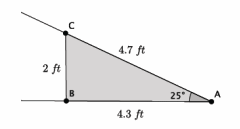
Eureka Math Grade 8 Module 3 Lesson 12 Problem Set Answer Key 50.1

b. Your friend is a daredevil and has decided to build a ramp that is 5 feet tall. What length of wood is needed to make the base of the ramp? Explain your answer using properties of similar triangles.
Answer:
Sample student drawing and work are shown below.
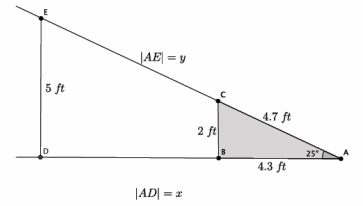
Eureka Math Grade 8 Module 3 Lesson 12 Problem Set Answer Key 51
△EDA~△CBA by the AA criterion because ∠A is common to both triangles, and ∠EDA=∠CBA=90°.
If we let x represent the base of the 5-foot ramp, then
\(\frac{4.3}{x}\)=\(\frac{2}{5}\)
We are looking for the value of x that makes the fractions equivalent. Therefore, 2x=21.5, and x=10.75. The base of the 5-foot ramp must be 10.75 feet in length.

c. What length of wood is required to go from the ground to the top of the 5-foot height to make the ramp? Explain your answer using properties of similar triangles.
Answer:
If we let y represent the length of the wood needed to make the ramp, then
\(\frac{4.7}{y}\)=\(\frac{2}{5}\)
We are looking for the value of y that makes the fractions equivalent. Therefore, 2y=23.5, and
y=11.75. The length of wood needed to make the ramp is 11.75 feet.

Eureka Math Grade 8 Module 3 Lesson 12 Exit Ticket Answer Key

Henry thinks he can figure out how high his kite is while flying it in the park. First, he lets out 150 feet of string and ties the string to a rock on the ground. Then, he moves from the rock until the string touches the top of his head. He stands up straight, forming a right angle with the ground. He wants to find out the distance from the ground to his kite. He draws the following diagram to illustrate what he has done.
Eureka Math Grade 8 Module 3 Lesson 12 Exit Ticket Answer Key 31

a. Has Henry done enough work so far to use similar triangles to help measure the height of the kite? Explain.
Answer:
Yes Based on the sketch, Henry found a center of dilation, point A. Henry has marked points so that, when connected, would make parallel lines. So, the triangles are similar by the AA criterion. Corresponding angles of parallel lines are equal in measure, and the measure of ∠BAC is equal to itself. Since there are two pairs of corresponding angles that are equal, then △BAC~△DAE.

b. Henry knows he is 5\(\frac{1}{2}\) feet tall. Henry measures the string from the rock to his head and finds it to be 8 feet. Does he have enough information to determine the height of the kite? If so, find the height of the kite. If not, state what other information would be needed.
Answer:
Yes, there is enough information. Let x represent the height DE. Then,
\(\frac{8}{150}\)=\(\frac{5.5}{x}\)
We are looking for the value of x that makes the fractions equivalent. Therefore, 8x=825, and x=103.125 feet. The height of the kite is approximately 103 feet high in the air.
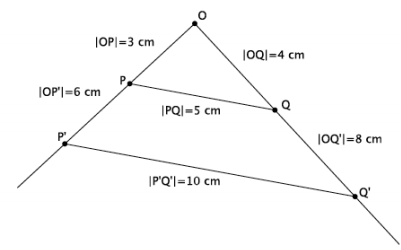
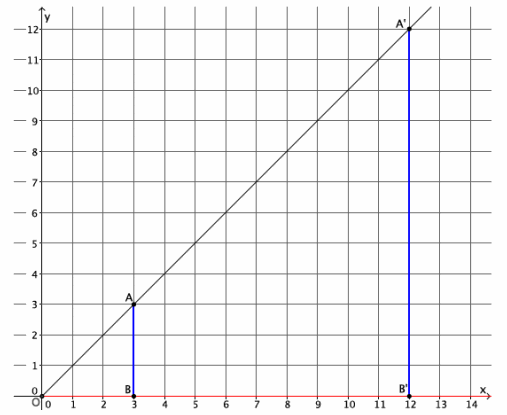
Eureka Math Grade 8 Module 3 Lesson 13 Answer Key

Engage NY Eureka Math 8th Grade Module 3 Lesson 13 Answer Key

Eureka Math Grade 8 Module 3 Lesson 13 Exercise Answer Key

Exercises
Use the Pythagorean theorem to determine the unknown length of the right triangle.

Exercise 1.
Determine the length of side c in each of the triangles below.

a. Eureka Math Grade 8 Module 3 Lesson 13 Exercise Answer Key 1
Answer:
52+122=c2
25+144=c2
169=c2
13=c

b. Eureka Math Grade 8 Module 3 Lesson 13 Exercise Answer Key 2
Answer:
0.52+1.22=c2
0.25+1.44=c2
1.69=c2
1.3=c

Exercise 2.
Determine the length of side b in each of the triangles below.
a. Eureka Math Grade 8 Module 3 Lesson 13 Exercise Answer Key 3
Answer:
42+b2=52
16+b2=25
16-16+b2=25-16
b2=9
b=3

b. Eureka Math Grade 8 Module 3 Lesson 13 Exercise Answer Key 4
Answer:
0.42+b2=0.52
0.16+b2=0.25
0.16-0.16+b2=0.25-0.16
b2=0.09
b=0.3

Exercise 3.
Determine the length of \(\overline{Q S}\). (Hint: Use the Pythagorean theorem twice.)
Eureka Math Grade 8 Module 3 Lesson 13 Exercise Answer Key 5
Answer:
152+|QT|2=172
225+|QT|2=289
225-225+|QT|2=289-225
|QT|2=64
|QT| = 8

152+|TS|2=252
225+|TS|2=625
225-225+|TS|2=625-225
|TS|2=400
|TS|=20
Since |QT|+|TS|=|QS|, then the length of side \(\overline{Q S}\) is 8+20, which is 28.

Eureka Math Grade 8 Module 3 Lesson 13 Exit Ticket Answer Key

Determine the length of side \(\overline{B D}\) in the triangle below.
Eureka Math Grade 8 Module 3 Lesson 13 Exit Ticket Answer Key 6
Answer:
First, determine the length of side \(\overline{B C}\).
122+BC2=152
144+BC2=225
BC2=225-144
BC2=81
BC=9

Then, determine the length of side \(\overline{C D}\).
122+CD2=132
144+CD2=169
CD2=169-144
CD2=25
CD=5
Adding the lengths of sides \(\overline{B C}\) and \(\overline{C D}\) determines the length of side \(\overline{B D}\); therefore, 5+9=14. \(\overline{B D}\) has a length of 14.

Eureka Math Grade 8 Module 3 Lesson 13 Problem Set Answer Key

Students practice using the Pythagorean theorem to find unknown lengths of right triangles.

Use the Pythagorean theorem to determine the unknown length of the right triangle.

Question 1.
Determine the length of side c in each of the triangles below.
a. Engage NY Math Grade 8 Module 3 Lesson 13 Problem Set Answer Key 20
Answer:
62+82=c2
36+64=c2
100=c2
10=c

b. Engage NY Math Grade 8 Module 3 Lesson 13 Problem Set Answer Key 21
Answer:
0.62+0.82=c2
0.36+0.64=c2
1=c2
1=c

Question 2.
Determine the length of side a in each of the triangles below.
a. Engage NY Math Grade 8 Module 3 Lesson 13 Problem Set Answer Key 22
Answer:
a2+82=172
a2+64=289
a2+64-64=289-64
a2=225
a=15

b. Engage NY Math Grade 8 Module 3 Lesson 13 Problem Set Answer Key 23
Answer:
a2+0.82=1.72
a2+0.64=2.89
a2+0.64-0.64=2.89-0.64
a2=2.25
a=1.5

Question 3.
Determine the length of side b in each of the triangles below.
a. Engage NY Math Grade 8 Module 3 Lesson 13 Problem Set Answer Key 24
Answer:
202+b2=252
400+b2=625
400-400+b2=625-400
b2=225
b=15

b. Engage NY Math Grade 8 Module 3 Lesson 13 Problem Set Answer Key 25
Answer:
22+b2=2.52
4+b2=6.25
4-4+b2=6.25-4
b2=2.25
b=1.5

Question 4.
Determine the length of side a in each of the triangles below.
a. Engage NY Math Grade 8 Module 3 Lesson 13 Problem Set Answer Key 25.1
Answer:
a2+122=202
a2+144=400
a2+144-144=400-144
a2=256
a=16

b. Engage NY Math Grade 8 Module 3 Lesson 13 Problem Set Answer Key 26
Answer:
a2+1.22=22
a2+1.44=4
a2+1.44-1.44=4-1.44
a2=2.56
a=1.6

Question 5.
What did you notice in each of the pairs of Problems 1–4? How might what you noticed be helpful in solving problems like these?
Answer:
In each pair of problems, the problems and solutions were similar. For example, in Problem 1, part (a) showed the sides of the triangle were 6, 8, and 10, and in part (b), they were 0.6, 0.8, and 1. The side lengths in part (b) were a tenth of the value of the lengths in part (a). The same could be said about parts (a) and (b) of Problems 2–4. This might be helpful for solving problems in the future. If I am given side lengths that are decimals, then I could multiply them by a factor of 10 to make whole numbers, which are easier to work with. Also, if I know common numbers that satisfy the Pythagorean theorem, like side lengths of 3, 4, and 5, then I recognize them more easily in their decimal forms, that is, 0.3, 0.4, and 0.5.
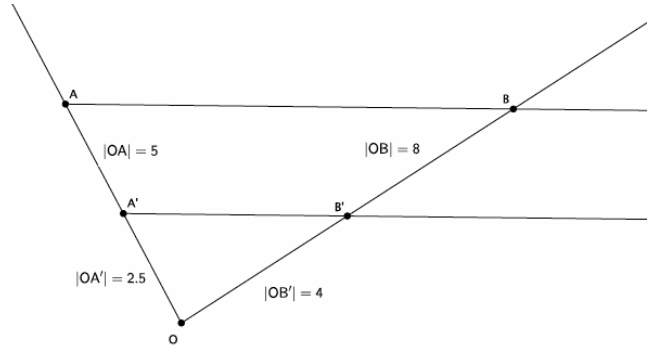

Eureka Math Grade 8 Module 3 Lesson 11 Answer Key

Engage NY Eureka Math 8th Grade Module 3 Lesson 11 Answer Key

Eureka Math Grade 8 Module 3 Lesson 11 Exercise Answer Key

Exercise 1.
In the diagram below, you have △ABC and △AB’ C’. Use this information to answer parts (a)–(d).
Eureka Math Grade 8 Module 3 Lesson 11 Exercise Answer Key 1

a. Based on the information given, is △ABC~△AB’ C’? Explain.
Answer:
There is not enough information provided to determine if the triangles are similar. We would need information about a pair of corresponding angles or more information about the side lengths of each of the triangles.
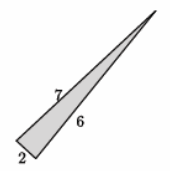
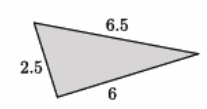
b. Assume the line containing \(\overline{B C}\) is parallel to the line containing \(\overline{\boldsymbol{B}^{\prime} \boldsymbol{C}^{\prime}}\). With this information, can you say that △ABC~△AB’ C’? Explain.
Answer:
If the line containing \(\overline{B C}\) is parallel to the line containing \(\overline{\boldsymbol{B}^{\prime} \boldsymbol{C}^{\prime}}\), then △ABC~△AB’ C’. Both triangles share ∠A. Another pair of equal angles is ∠AB’C’and ∠ABC. They are equal because they are corresponding angles of parallel lines. By the AA criterion, △ABC~△AB’ C’.

c. Given that △ABC~△AB’ C’, determine the length of side \(\overline{A C^{\prime}}\).
Answer:
Let x represent the length of side \(\overline{A C^{\prime}}\).
\(\frac{x}{6}\)=\(\frac{2}{8}\)
We are looking for the value of x that makes the fractions equivalent. Therefore, 8x=12, and x=1.5.
The length of side \(\overline{A C^{\prime}}\) is 1.5.

d. Given that △ABC~△AB’ C’, determine the length of side \(\overline{A B}\).
Answer:
Let y represent the length of side \(\overline{A B}\).
\(\frac{2.7}{y}\)=\(\frac{2}{8}\)
We are looking for the value of y that makes the fractions equivalent. Therefore, 2y=21.6, and y=10.8. The length of side \(\overline{A B}\) is 10.8.

Exercise 2.
In the diagram below, you have △ABC and △A’B’C’. Use this information to answer parts (a)–(c).
Eureka Math Grade 8 Module 3 Lesson 11 Exercise Answer Key 2
a. Based on the information given, is △ABC~△A’B’ C’? Explain.
Answer:
Yes, △ABC~△A’ B’C’. There are two pairs of corresponding angles that are equal in measure, namely, ∠A=∠A’=59°, and ∠B=∠B’=92°. By the AA criterion, these triangles are similar.

b. Given that △ABC~△A’B’ C’, determine the length of side \(\overline{A^{\prime} C^{\prime}}\).
Answer:
Let x represent the length of side \(\overline{A^{\prime} C^{\prime}}\).
\(\frac{x}{6.1}\)=\(\frac{5.12}{3.2}\)
We are looking for the value of x that makes the fractions equivalent. Therefore, 3.2x=31.232, and
x=9.76. The length of side \(\overline{A^{\prime} C^{\prime}}\) is 9.76.

c. Given that △ABC~△A’B’ C’, determine the length of side \(\overline{B C}\).
Answer:
Let y represent the length of side \(\overline{B C}\).
\(\frac{8.96}{y}\)=\(\frac{5.12}{3.2}\)
We are looking for the value of y that makes the fractions equivalent. Therefore, 5.12y=28.672, and y=5.6. The length of side \(\overline{B C}\) is 5.6.

Exercise 3.
In the diagram below, you have △ABC and △A’B’ C’. Use this information to answer the question below.
Eureka Math Grade 8 Module 3 Lesson 11 Exercise Answer Key 3
Based on the information given, is △ABC~△A’B’ C’? Explain.
Answer:
No, △ABC is not similar to △A’ B’ C’. Since there is only information about one pair of corresponding angles, then we must check to see that the corresponding sides have equal ratios. That is, the following must be true:
\(\frac{10.58}{5.3}\) = \(\frac{11.66}{4.6}\)
When we compare products of each numerator with the denominator of the other fraction, we see that 48.668≠61.798. Since the corresponding sides do not have equal ratios, then the fractions are not equivalent, and the triangles are not similar.

Eureka Math Grade 8 Module 3 Lesson 11 Problem Set Answer Key

Students practice presenting informal arguments as to whether or not two given triangles are similar. Students practice finding measurements of similar triangles.

Question 1.
In the diagram below, you have △ABC and △A’B’ C’. Use this information to answer parts (a)–(b).
Eureka Math Grade 8 Module 3 Lesson 11 Problem Set Answer Key 6
a. Based on the information given, is △ABC~△A’B’ C’? Explain.
Answer:
Yes, △ABC~△A’B’ C’. Since there is only information about one pair of corresponding angles being equal, then the corresponding sides must be checked to see if their ratios are equal.
\(\frac{10.65}{7.1}\)=\(\frac{9}{6}\)
63.9=63.9
Since the cross products are equal, the triangles are similar.

b. Assume the length of side \(\overline{A C}\) is 4.3. What is the length of side \(\overline{A^{\prime} C^{\prime}}\)?
Answer:
Let x represent the length of side \(\overline{A^{\prime} C^{\prime}}\).
\(\frac{x}{4.3}\)=\(\frac{9}{6}\)
We are looking for the value of x that makes the fractions equivalent. Therefore, 6x=38.7, and x=6.45. The length of side \(\overline{A^{\prime} C^{\prime}}\) is 6.45.

Question 2.
In the diagram below, you have △ABC and △AB’ C’. Use this information to answer parts (a)–(d).
Eureka Math Grade 8 Module 3 Lesson 11 Problem Set Answer Key 20
a. Based on the information given, is △ABC~△AB’ C’? Explain.
Answer:
There is not enough information provided to determine if the triangles are similar. We would need information about a pair of corresponding angles or more information about the side lengths of each of the triangles.

b. Assume the line containing \(\overline{B C}\) is parallel to the line containing \(\overline{\boldsymbol{B}^{\prime} \boldsymbol{C}^{\prime}}\). With this information, can you say that △ABC~△AB’ C’? Explain.
Answer:
If the line containing \(\overline{B C}\) is parallel to the line containing \(\overline{\boldsymbol{B}^{\prime} \boldsymbol{C}^{\prime}}\), then △ABC~△AB’ C’. Both triangles share ∠A. Another pair of equal angles are ∠AB’C’ and ∠ABC. They are equal because they are corresponding angles of parallel lines. By the AA criterion, △ABC~△AB’ C’.

c. Given that △ABC~△AB’ C’, determine the length of side \(\overline{A C^{\prime}}\).
Let x represent the length of side \(\overline{A C^{\prime}}\).
\(\frac{x}{16.1}\)=\(\frac{1.6}{11.2}\)
We are looking for the value of x that makes the fractions equivalent. Therefore, 11.2x=25.76, and x=2.3. The length of side \(\overline{A C^{\prime}}\) is 2.3.

d. Given that △ABC~△AB’ C’, determine the length of side \(\overline{A B^{\prime}}\).
Answer:
Let y represent the length of side \(\overline{A B^{\prime}}\).
\(\frac{y}{7.7}\)=\(\frac{1.6}{11.2}\)
We are looking for the value of y that makes the fractions equivalent. Therefore, 11.2y=12.32, and
y=1.1. The length of side \(\overline{A B^{\prime}}\) is 1.1.

Question 3.
In the diagram below, you have △ABC and △A’B’ C’. Use this information to answer parts (a)–(c).
Eureka Math Grade 8 Module 3 Lesson 11 Problem Set Answer Key 25
a. Based on the information given, is △ABC~△A’B’ C’? Explain.
Answer:
Yes, △ABC~△A’ B’C’. There are two pairs of corresponding angles that are equal in measure, namely, ∠A=∠A’=23°, and ∠C=∠C’=136°. By the AA criterion, these triangles are similar.

b. Given that △ABC~△A’B’ C’, determine the length of side \(\overline{\boldsymbol{B}^{\prime} \boldsymbol{C}^{\prime}}\).
Answer:
Let x represent the length of side \(\overline{\boldsymbol{B}^{\prime} \boldsymbol{C}^{\prime}}\).
\(\frac{x}{3.9}\)=\(\frac{8.75}{7}\)
We are looking for the value of x that makes the fractions equivalent. Therefore, 7x=34.125, and
x=4.875. The length of side \(\overline{\boldsymbol{B}^{\prime} \boldsymbol{C}^{\prime}}\) is 4.875.

c. Given that △ABC~△A’B’ C’, determine the length of side \(\overline{A C}\).
Answer:
Let y represent the length of side \(\overline{A C}\).
\(\frac{5}{y}\)=\(\frac{8.75}{7}\)
We are looking for the value of y that makes the fractions equivalent. Therefore, 8.75y=35, and y=4. The length of side \(\overline{A C}\) is 4.

Question 4.
In the diagram below, you have △ABC and △AB’ C’. Use this information to answer the question below.
Eureka Math Grade 8 Module 3 Lesson 11 Problem Set Answer Key 50
Based on the information given, is △ABC~△AB’ C’? Explain.
Answer:
No, △ABC is not similar to △AB’ C’. Since there is only information about one pair of corresponding angles, then we must check to see that the corresponding sides have equal ratios. That is, the following must be true:
\(\frac{9}{3}\)=\(\frac{12.6}{4.1}\)
When we compare products of each numerator with the denominator of the other fraction, we see that
36.9≠37.8. Since the corresponding sides do not have equal ratios, the fractions are not equivalent, and the triangles are not similar.

Question 5.
In the diagram below, you have △ABC and △A’B’C’. Use this information to answer parts (a)–(b).
Eureka Math Grade 8 Module 3 Lesson 11 Problem Set Answer Key 51
a. Based on the information given, is △ABC~△A’B’ C’? Explain.
Answer:
Yes, △ABC~△A’B’ C’. Since there is only information about one pair of corresponding angles being equal, then the corresponding sides must be checked to see if their ratios are equal.
\(\frac{8.2}{20.5}\)=\(\frac{7.5}{18.75}\)
When we compare products of each numerator with the denominator of the other fraction, we see that 153.75=153.75. Since the products are equal, the fractions are equivalent, and the triangles are similar.

b. Given that △ABC~△A’B’ C’, determine the length of side \(\overline{\boldsymbol{A}^{\prime} \boldsymbol{B}^{\prime}}\).
Answer:
Let x represent the length of side \(\overline{\boldsymbol{A}^{\prime} \boldsymbol{B}^{\prime}}\).
\(\frac{x}{26}\)=\(\frac{7.5}{18.75}\)
We are looking for the value of x that makes the fractions equivalent. Therefore, 18.75x=195, and
x=10.4. The length of side \(\overline{\boldsymbol{A}^{\prime} \boldsymbol{B}^{\prime}}\) is 10.4.

Eureka Math Grade 8 Module 3 Lesson 11 Exit Ticket Answer Key

Question 1.
In the diagram below, you have △ABC and △A’B’ C’. Based on the information given, is △ABC~△A’B’ C’? Explain.
Eureka Math Grade 8 Module 3 Lesson 11 Exit Ticket Answer Key 4
Answer:
Since there is only information about one pair of corresponding angles, we need to check to see if corresponding sides have equal ratios. That is, does \(\frac{|A B|}{\left|A^{\prime} B^{\prime}\right|}\) = \(\frac{|A C|}{\left|A^{\prime} C^{\prime}\right|^{\prime}}\), or does \(\frac{3.5}{8.75}\) = \(\frac{6}{21}\)? The products are not equal; 73.5≠52.5. Since the corresponding sides do not have equal ratios, the triangles are not similar.

Question 2.
In the diagram below, △ABC~△DEF. Use the information to answer parts (a)–(b).
Eureka Math Grade 8 Module 3 Lesson 11 Exit Ticket Answer Key 5
a. Determine the length of side \(\overline{A B}\). Show work that leads to your answer.
Answer:
Let x represent the length of side \(\overline{A B}\).
Then, \(\frac{x}{17.64}\)=\(\frac{6.3}{13.23}\). We are looking for the value of x that makes the fractions equivalent. Therefore, 111.132=13.23x, and x=8.4. The length of side \(\overline{A B}\) is 8.4.

b. Determine the length of side \(\overline{D F}\). Show work that leads to your answer.
Answer:
Let y represent the length of side \(\overline{D F}\).
Then, \(\frac{4.1}{y}\)= \(\frac{6.3}{13.23}\). We are looking for the value of y that makes the fractions equivalent. Therefore, 54.243=6.3y, and 8.61=y. The length of side \(\overline{D F}\) is 8.61.