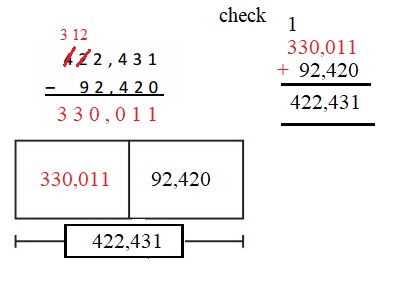
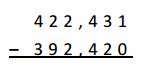
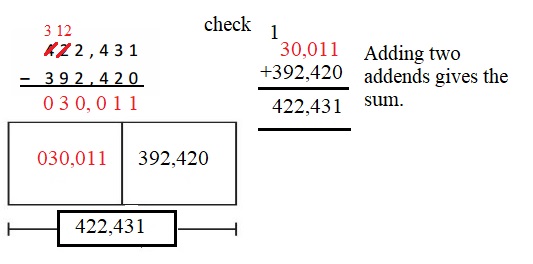
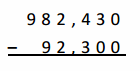
Eureka Math Grade 4 Module 1 Lesson 13 Answer Key

Engage NY Eureka Math 4th Grade Module 1 Lesson 13 Answer Key2ureka Math Grade 4 Module 1 Lesson 13 Problem Set Answer Key

Question 1.
Use the standard algorithm to solve the following subtraction problems.
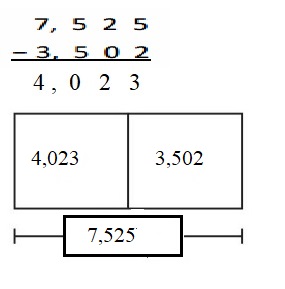
a. Eureka Math Grade 4 Module 1 Lesson 13 Problem Set Answer Key 1
Answer:
Engage-NY-Eureka-Math-4th-Grade-Module-1-Lesson-13-Answer-Key-Eureka-Math-Grade-4-Module-1-Lesson-13-Problem-Set-Answer-Key-Question-1-a
Explanation:
The rules of subtraction we first write the greater number at the top. Then subtract the digits column-wise ones from ones, tens from tens, hundreds from hundreds, thousands from thousands and so on.
Ones =  5 – 2 = 3.
Tens =  2 – 0 = 2.
Hundreds = 5 – 5 = 0.
Thousands = 7 – 3 = 4.
The number 7,525 is the minuend, the number 3,502 is the subtrahend and the number 4,023 is the difference.
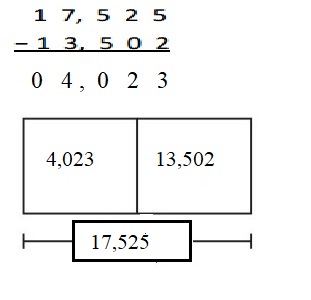
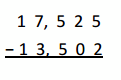
b. Eureka Math Grade 4 Module 1 Lesson 13 Problem Set Answer Key 2
Answer:
Engage-NY-Eureka-Math-4th-Grade-Module-1-Lesson-13-Answer-Key-Eureka-Math-Grade-4-Module-1-Lesson-13-Problem-Set-Answer-Key-Question-1-b
Explanation:
The rules of subtraction we first write the greater number at the top. Then subtract the digits column-wise ones from ones, tens from tens, hundreds from hundreds, thousands from thousands and so on.
Ones =  5 – 2 = 3.
Tens =  2 – 0 = 2.
Hundreds = 5 – 5 = 0.
Thousands = 7 – 3 = 4.
Ten thousands = 1 – 1 = 0.
The number 17,525 is the minuend, the number 13,502 is the subtrahend and the number 04,023 is the difference.

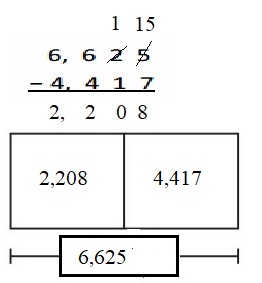
c. Eureka Math Grade 4 Module 1 Lesson 13 Problem Set Answer Key 3
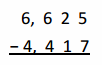
Answer:
Engage-NY-Eureka-Math-4th-Grade-Module-1-Lesson-13-Answer-Key-Eureka-Math-Grade-4-Module-1-Lesson-13-Problem-Set-Answer-Key-Question-1-c
Explanation:
The rules of subtraction we first write the greater number at the top. Then subtract the digits column-wise ones from ones, tens from tens, hundreds from hundreds, thousands from thousands and so on.
Ones =  5 – 7 = 8.
5 is less than 7 so we borrow  1 from the 2 tens place and make 2 tens as 1 tens and make 5 ones as 15 ones and we subtract 7 from 15.
Tens =  1 – 1 = 0.
Hundreds = 6 – 4 = 2.
Thousands = 6 – 4 = 2.
The number 6,625 is the minuend, the number 4,417 is the subtrahend and the number 2,208 is the difference.
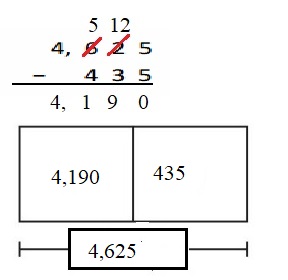
d. Eureka Math Grade 4 Module 1 Lesson 13 Problem Set Answer Key 4
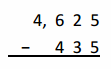
Answer:
Engage-NY-Eureka-Math-4th-Grade-Module-1-Lesson-13-Answer-Key-Eureka-Math-Grade-4-Module-1-Lesson-13-Problem-Set-Answer-Key-Question-1-d
Explanation:
The rules of subtraction we first write the greater number at the top. Then subtract the digits column-wise ones from ones, tens from tens, hundreds from hundreds, thousands from thousands and so on.
Ones =  5 – 5 = 0.
Tens =  2 – 3 =  12 – 3 = 9.
2 is less than 3 so we borrow  1 from the 6 hundreds place  and make 6 hundreds as 5 hundreds and make 2 tens as 12 tens and we subtract 3 from 12.
Hundreds = 5 – 4 = 1.
Thousands = 4 – 0 = 4.
The number 4,625 is the minuend, the number 435 is the subtrahend and the number 4,190 is the difference.
e. Eureka Math Grade 4 Module 1 Lesson 13 Problem Set Answer Key 5
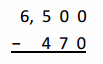
Answer:
Engage-NY-Eureka-Math-4th-Grade-Module-1-Lesson-13-Answer-Key-Eureka-Math-Grade-4-Module-1-Lesson-13-Problem-Set-Answer-Key-Question-1-e
Explanation:
The rules of subtraction we first write the greater number at the top. Then subtract the digits column-wise ones from ones, tens from tens, hundreds from hundreds, thousands from thousands and so on.
Ones =  0 – 0 = 0.
Tens =  0 – 7 =  10 – 7 = 3.
0 is less than 7 so we borrow  1 from the 5 hundreds place  and make 5 hundreds as 4 hundreds and make 0 tens as 10 tens and we subtract 7 from 10.
Hundreds = 4 – 4 = 0 .
Thousands = 6 – 0 = 6.
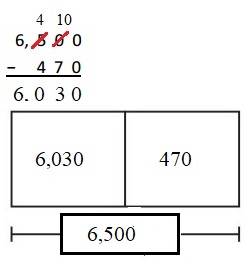
The number 6,500 is the minuend, the number 470 is the subtrahend and the number 6,030 is the difference.
f. Eureka Math Grade 4 Module 1 Lesson 13 Problem Set Answer Key 6
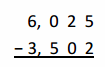
Answer:
Engage-NY-Eureka-Math-4th-Grade-Module-1-Lesson-13-Answer-Key-Eureka-Math-Grade-4-Module-1-Lesson-13-Problem-Set-Answer-Key-Question-1-f
Explanation:
The rules of subtraction we first write the greater number at the top. Then subtract the digits column-wise ones from ones, tens from tens, hundreds from hundreds, thousands from thousands and so on.
Ones =  5 – 2 = 3.
Tens =  2 – 0 =  2.
Hundreds = 0 – 5 = 10 – 5 = 5.
0 is less than 5 so we borrow  1 from the 6 Thousands place  and make 6 Thousands as 5 Thousands and make 0 hundreds as 10 hundreds and we subtract 5 from 10.
Thousands = 5 – 3 = 2.
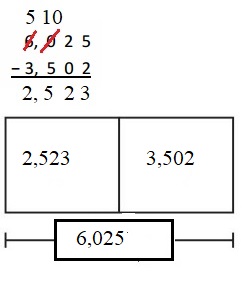
The number 6,025 is the minuend, the number 3,502 is the subtrahend and the number 2,502 is the difference.
g. Eureka Math Grade 4 Module 1 Lesson 13 Problem Set Answer Key 7
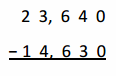
Answer:
Engage-NY-Eureka-Math-4th-Grade-Module-1-Lesson-13-Answer-Key-Eureka-Math-Grade-4-Module-1-Lesson-13-Problem-Set-Answer-Key-Question-1-g
Explanation:
The rules of subtraction we first write the greater number at the top. Then subtract the digits column-wise ones from ones, tens from tens, hundreds from hundreds, thousands from thousands and so on.
Ones =  0 – 0  = 0.
Tens =  4 – 3 = 1
Hundreds = 6 – 6 = 0.
Thousands = 3 – 4 = 13 – 4 = 9.
3 is less than 4 so we borrow  1 from the 2 ten Thousands place  and make 2 Thousands as 1 ten Thousands and make 3 hundreds as 13 hundreds and we subtract 4 from 13.
Ten Thousands = 1 – 1 = 0
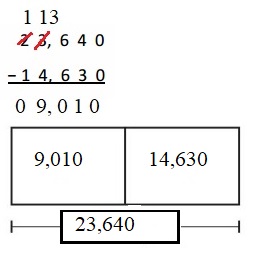
The number 23,640 is the minuend, the number 14,630 is the subtrahend and the number 09,010 is the difference.
h. Eureka Math Grade 4 Module 1 Lesson 13 Problem Set Answer Key 8
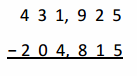
Answer:
Engage-NY-Eureka-Math-4th-Grade-Module-1-Lesson-13-Answer-Key-Eureka-Math-Grade-4-Module-1-Lesson-13-Problem-Set-Answer-Key-Question-1-h
Explanation:
The rules of subtraction we first write the greater number at the top. Then subtract the digits column-wise ones from ones, tens from tens, hundreds from hundreds, thousands from thousands and so on.
Ones =  5 – 5 = 0.
Tens =  2 – 1 =  1.
2 is less than 3 so we borrow  1 from the 6 hundreds place  and make 6 hundreds as 5 hundreds and make 2 tens as 12 tens and we subtract 3 from 12.
Hundreds = 9 – 8 = 1.
Thousands = 1 – 4 = 11 – 4 = 7.
1 is less than 4 so we borrow  1 from the 3 ten thousands place  and make 3 ten thousands as 2 ten thousands and make 1 thousands as 11 thousands and we subtract 4 from 11.
Ten thousand =2 – 0 = 2.
Hundred thousand = 4 – 2 = 2.
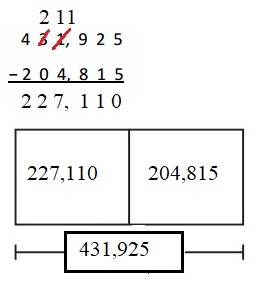
The number 431,925 is the minuend, the number 204,815 is the subtrahend and the number 227,110 is the difference.
i. Eureka Math Grade 4 Module 1 Lesson 13 Problem Set Answer Key 9
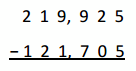
Answer:
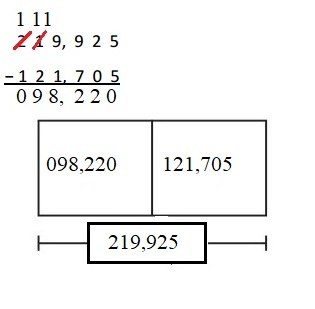
Engage-NY-Eureka-Math-4th-Grade-Module-1-Lesson-13-Answer-Key-Eureka-Math-Grade-4-Module-1-Lesson-13-Problem-Set-Answer-Key-Question-1-i
Explanation:
The rules of subtraction we first write the greater number at the top. Then subtract the digits column-wise ones from ones, tens from tens, hundreds from hundreds, thousands from thousands and so on.
Ones =  5 – 5 = 0.
Tens =  2 – 0 =  2.
Hundreds = 9 – 7 = 2.
Thousands = 9 – 1 = 8
Ten thousand =1 – 2 = 11 – 2 = 9.
1 is less than 2 so we borrow  1 from the 2 hundred thousands place  and make 2 hundred thousands as 1 hundred thousands and make 1  ten thousands as 11 ten thousands and we subtract 2 from 11.
Hundred thousand = 1 – 1 = 0.
The number 219,925 is the minuend, the number 121,705 is the subtrahend and the number 098,220 is the difference.

Draw a tape diagram to represent each problem. Use numbers to solve, and write your answer as a statement. Check your answers.

Question 2.
What number must be added to 13,875 to result in a sum of 25,884?
Answer:
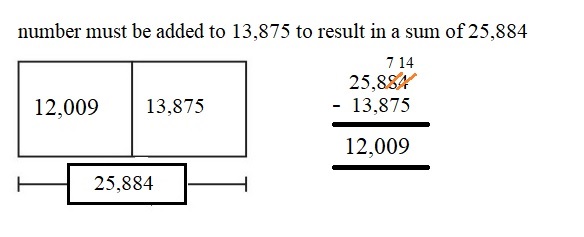
Engage-NY-Eureka-Math-4th-Grade-Module-1-Lesson-13-Answer-Key-Eureka-Math-Grade-4-Module-1-Lesson-13-Problem-Set-Answer-Key-Question-2
12,009 must be added to 13,875 to get the sum of 25,884.

Question 3.
Artist Michelangelo was born on March 6, 1475. Author Mem Fox was born on March 6, 1946. How many years after Michelangelo was born was Fox born?
Answer:
Artist Michelangelo was born on March 6, 1475.
Artist Mem Fox was born on March 6, 1946
The difference between the their years = 1946 – 1475 = 471 years.
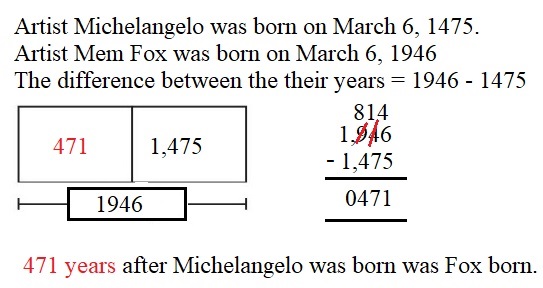
Engage-NY-Eureka-Math-4th-Grade-Module-1-Lesson-13-Answer-Key-Eureka-Math-Grade-4-Module-1-Lesson-13-Problem-Set-Answer-Key-Question-3

Question 4.
During the month of March, 68,025 pounds of king crab were caught. If 15,614 pounds were caught in the first week of March, how many pounds were caught in the rest of the month?
Answer:
Number of pounds of king crabs caught in the month of March = 68,025 pounds.
Number of pounds of king crabs caught in the first week of March = 15,614 pounds.
Number of pounds were caught in the rest of the month = 68,025 – 15,614 = 52,411.
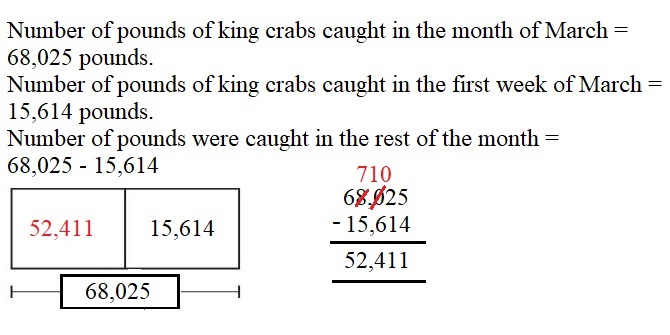
Engage-NY-Eureka-Math-4th-Grade-Module-1-Lesson-13-Answer-Key-Eureka-Math-Grade-4-Module-1-Lesson-13-Problem-Set-Answer-Key-Question-4

Question 5.
James bought a used car. After driving exactly 9,050 miles, the odometer read 118,064 miles. What was the odometer reading when James bought the car?
Answer:
James bought a used car after driving exactly = 9,050 miles.
The reading of the Odometer  = 118,064 miles.
The odometer reading when James bought the car = 118,064 – 9,050 =
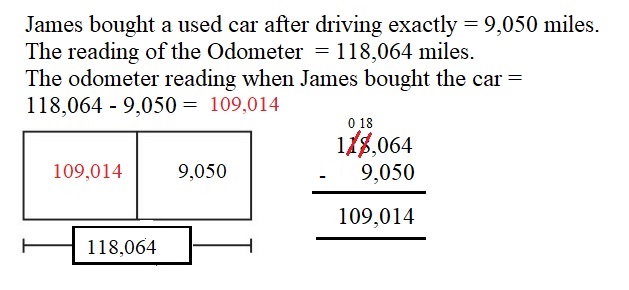
Engage-NY-Eureka-Math-4th-Grade-Module-1-Lesson-13-Answer-Key-Eureka-Math-Grade-4-Module-1-Lesson-13-Problem-Set-Answer-Key-Question-5

Eureka Math Grade 4 Module 1 Lesson 13 Exit Ticket Answer Key

Question 1.
Use the standard algorithm to solve the following subtraction problems.
a. Engage NY Math 4th Grade Module 1 Lesson 13 Exit Ticket Answer Key 10
Answer:
Engage-NY-Eureka-Math-4th-Grade-Module-1-Lesson-13-Answer-Key-Eureka-Math-Grade-4-Module-1-Lesson-13-Exit-Ticket-Answer-Key-Question-1-a

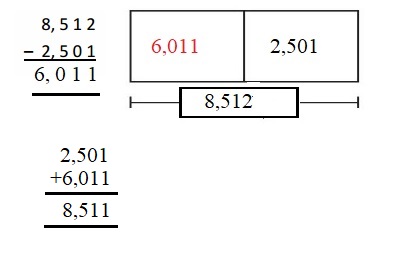
Explanation:
The rules of subtraction we first write the greater number at the top. Then subtract the digits column-wise ones from ones, tens from tens, hundreds from hundreds, thousands from thousands and so on.
Ones =  2 – 1 = 1.
Tens =  1 – 0 = 1.
Hundreds = 5 – 5 = 0.
Thousands = 8 – 2 = 6.
The number 8,512 is the minuend, the number 2,501 is the subtrahend and the number 6,011 is the difference.

b. Engage NY Math 4th Grade Module 1 Lesson 13 Exit Ticket Answer Key 11
Answer:
Engage-NY-Eureka-Math-4th-Grade-Module-1-Lesson-13-Answer-Key-Eureka-Math-Grade-4-Module-1-Lesson-13-Exit-Ticket-Answer-Key-Question-1-b

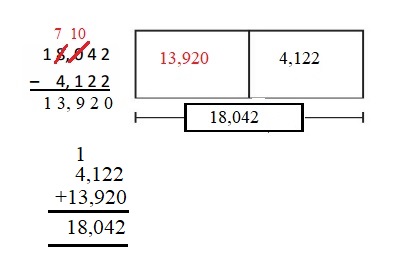
Explanation:
The rules of subtraction we first write the greater number at the top. Then subtract the digits column-wise ones from ones, tens from tens, hundreds from hundreds, thousands from thousands and so on.
Ones =  2 – 2 = 0.
Tens =  4 – 2 =  2.
Hundreds = 0 – 1 = 10 – 1 = 9.
0 is less than 1 so we borrow  1 from the 8 thousands place  and make 8 thousands as 7 thousands and make 0 hundred as 10 hundred and we subtract 1 from 10.
Thousands = 7 – 4 = 3.
Ten thousand =1.
The number 18,042 is the minuend, the number 4,122 is the subtrahend and the number 13,920 is the difference.
c. Engage NY Math 4th Grade Module 1 Lesson 13 Exit Ticket Answer Key 12
Answer:
Engage-NY-Eureka-Math-4th-Grade-Module-1-Lesson-13-Answer-Key-Eureka-Math-Grade-4-Module-1-Lesson-13-Exit-Ticket-Answer-Key-Question-1-c
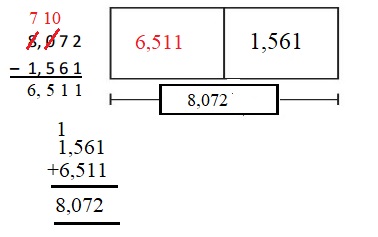
Explanation:
The rules of subtraction we first write the greater number at the top. Then subtract the digits column-wise ones from ones, tens from tens, hundreds from hundreds, thousands from thousands and so on.
Ones =  2 – 1 = 1.
Tens =  7- 6 =  1.
Hundreds = 0 – 5 = 10 – 5 = 5.
0 is less than 5 so we borrow  1 from the 8 thousands place  and make 8 thousands as 7 thousands and make 0 hundred as 10 hundred and we subtract 5 from 10.
Thousands = 7 – 1 = 6.
The number 8,072 is the minuend, the number 1,561 is the subtrahend and the number 6,511 is the difference.

Draw a tape diagram to represent the following problem. Use numbers to solve. Write your answer as a statement. Check your answer.

Question 2.
What number must be added to 1,575 to result in a sum of 8,625?
Answer:
Sum = 8,625
One Addend = 1,575
Second Addend = sum –  one addend = 8,625 – 1,575 =
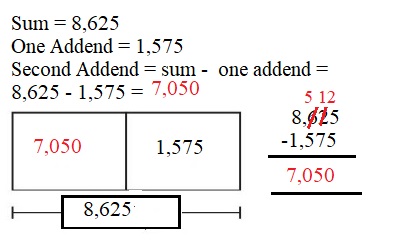
Engage-NY-Eureka-Math-4th-Grade-Module-1-Lesson-13-Answer-Key-Eureka-Math-Grade-4-Module-1-Lesson-13-Exit-Ticket-Answer-Key-Question-2

Eureka Math Grade 4 Module 1 Lesson 13 Homework Answer Key

Question 1.
Use the standard algorithm to solve the following subtraction problems.

a. Eureka Math 4th Grade Module 1 Lesson 13 Homework Answer Key 13
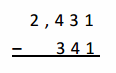
Answer:
Engage-NY-Eureka-Math-4th-Grade-Module-1-Lesson-13-Answer-Key-Eureka-Math-Grade-4-Module-1-Lesson-13-Homework-Answer-Key-Question-1-a
b. Eureka Math 4th Grade Module 1 Lesson 13 Homework Answer Key 14
Answer:

Engage-NY-Eureka-Math-4th-Grade-Module-1-Lesson-13-Answer-Key-Eureka-Math-Grade-4-Module-1-Lesson-13-Homework-Answer-Key-Question-1-b
c. Eureka Math 4th Grade Module 1 Lesson 13 Homework Answer Key 15
Answer:
Engage-NY-Eureka-Math-4th-Grade-Module-1-Lesson-13-Answer-Key-Eureka-Math-Grade-4-Module-1-Lesson-13-Homework-Answer-Key-Question-1-c
d. Eureka Math 4th Grade Module 1 Lesson 13 Homework Answer Key 16
Answer:

Engage-NY-Eureka-Math-4th-Grade-Module-1-Lesson-13-Answer-Key-Eureka-Math-Grade-4-Module-1-Lesson-13-Homework-Answer-Key-Question-1-d
e. Eureka Math 4th Grade Module 1 Lesson 13 Homework Answer Key 17
Answer:
Engage-NY-Eureka-Math-4th-Grade-Module-1-Lesson-13-Answer-Key-Eureka-Math-Grade-4-Module-1-Lesson-13-Homework-Answer-Key-Question-1-e
f. Eureka Math 4th Grade Module 1 Lesson 13 Homework Answer Key 18
Answer:
Engage-NY-Eureka-Math-4th-Grade-Module-1-Lesson-13-Answer-Key-Eureka-Math-Grade-4-Module-1-Lesson-13-Homework-Answer-Key-Question-1-f
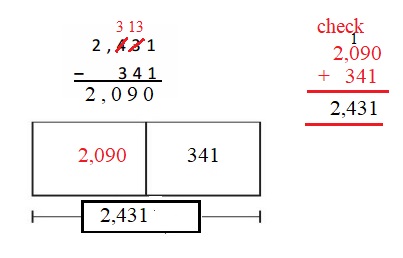
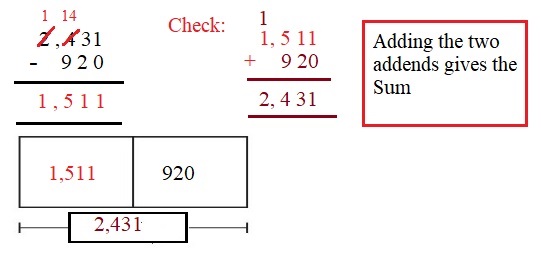
g. 2,431 – 920 =
Answer:
Engage-NY-Eureka-Math-4th-Grade-Module-1-Lesson-13-Answer-Key-Eureka-Math-Grade-4-Module-1-Lesson-13-Homework-Answer-Key-Question-1-g
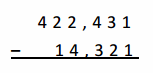
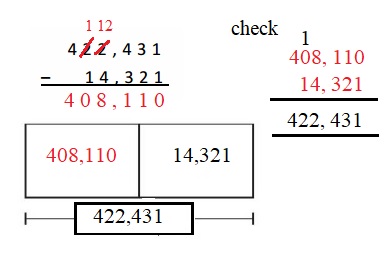
h. 892,431 – 520,800 =
Answer:
Engage-NY-Eureka-Math-4th-Grade-Module-1-Lesson-13-Answer-Key-Eureka-Math-Grade-4-Module-1-Lesson-13-Homework-Answer-Key-Question-1-h

Question 2.
What number must be added to 14,056 to result in a sum of 38,773?
Answer:
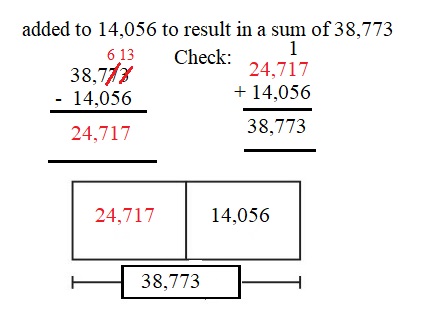
Engage-NY-Eureka-Math-4th-Grade-Module-1-Lesson-13-Answer-Key-Eureka-Math-Grade-4-Module-1-Lesson-13-Homework-Answer-Key-Question-2

Draw a tape diagram to model each problem. Use numbers to solve, and write your answers as a statement. Check your answers.

Question 3.
An elementary school collected 1,705 bottles for a recycling program. A high school also collected some bottles. Both schools collected 3,627 bottles combined. How many bottles did the high school collect?
Answer:
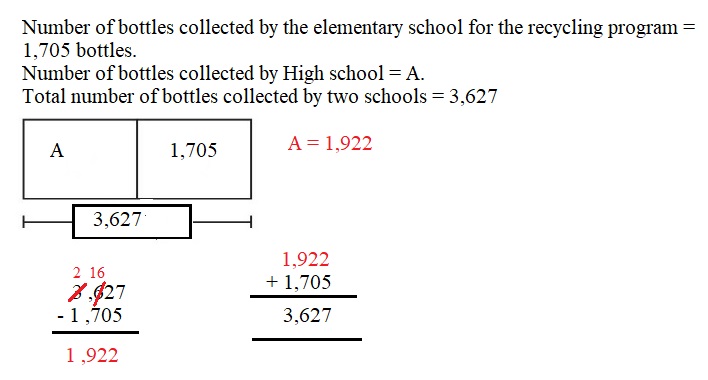
Engage-NY-Eureka-Math-4th-Grade-Module-1-Lesson-13-Answer-Key-Eureka-Math-Grade-4-Module-1-Lesson-13-Homework-Answer-Key-Question-3
The High School have collected 1,922 bottles.

Question 4.
A computer shop sold $356,291 worth of computers and accessories. It sold $43,720 worth of accessories. How much did the computer shop sell in computers?
Answer:
Total worth of computers and accessories a computer shop = $356,291
The worth of  accessories = $43,720.
The worth of computers  = A
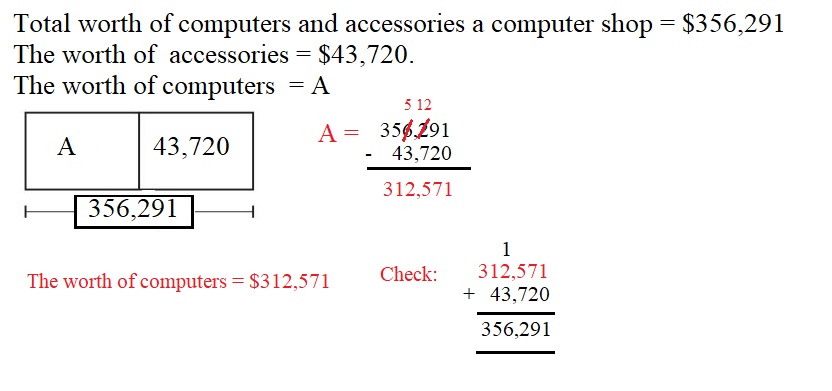
Engage-NY-Eureka-Math-4th-Grade-Module-1-Lesson-13-Answer-Key-Eureka-Math-Grade-4-Module-1-Lesson-13-Homework-Answer-Key-Question-4

Question 5.
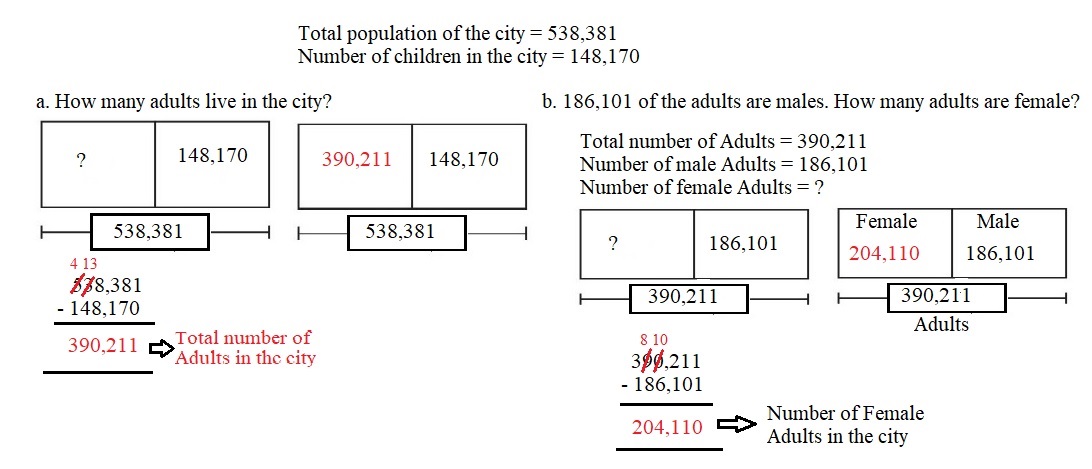
The population of a city is 538,381. In that population, 148,170 are children.
a. How many adults live in the city?
b. 186,101 of the adults are males. How many adults are female?
Answer:
Total population of the city = 538,381
Number of children in the city = 148,170
Answer:
Engage-NY-Eureka-Math-4th-Grade-Module-1-Lesson-13-Answer-Key-Eureka-Math-Grade-4-Module-1-Lesson-13-Homework-Answer-Key-Question-5

Eureka Math Grade 4 Module 1 Lesson 11 Answer Key

Engage NY Eureka Math 4th Grade Module 1 Lesson 11 Answer Key

Eureka Math Grade 4 Module 1 Lesson 11 Problem Set Answer Key

Question 1.
Solve the addition problems below using the standard algorithm.
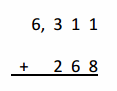
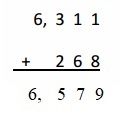
a. Eureka Math Grade 4 Module 1 Lesson 11 Problem Set Answer Key 1
Answer:
Engage-NY-Eureka-Math-4th-Grade-Module-1-Lesson-11-Answer-Key-Eureka-Math-Grade-4-Module-1-Lesson-11-Problem-Set-Answer-Key-Question-1-a
Explanation:
While adding two numbers we add the numbers according to the place values individually. We add number from ones place to the largest place value.
given number 6,311 and 268
first adding the ones place = 1 + 8 = 9.
ten place : 1 + 6 = 7
hundreds place = 3 + 2 = 5
thousands place = 6
Sum = 6,579
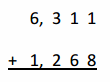
b. Eureka Math Grade 4 Module 1 Lesson 11 Problem Set Answer Key 2
Answer:
Engage-NY-Eureka-Math-4th-Grade-Module-1-Lesson-11-Answer-Key-Eureka-Math-Grade-4-Module-1-Lesson-11-Problem-Set-Answer-Key-Question-1-b
Explanation:
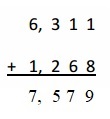
While adding two numbers we add the numbers according to the place values individually. We add number from ones place to the largest place value.
given number 6,311 and 1,268
first adding the ones place = 1 + 8 = 9.
ten place : 1 + 6 = 7
hundreds place = 3 + 2 = 5
thousands place = 6 + 1 = 7
Sum = 7,579
c. Eureka Math Grade 4 Module 1 Lesson 11 Problem Set Answer Key 3
Answer:
Engage-NY-Eureka-Math-4th-Grade-Module-1-Lesson-11-Answer-Key-Eureka-Math-Grade-4-Module-1-Lesson-11-Problem-Set-Answer-Key-Question-1-c
Explanation:
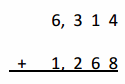
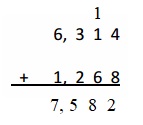
While adding two numbers we add the numbers according to the place values individually. We add number from ones place to the largest place value.
given number 6,314 and 1,268
first adding the ones place =  4 + 8 = 12. 12 is represented as 10 ones + 2 ones  that’s 10 ones make 1 ten and 2 ones. So 1 is carried to the tens place and added to the tens place values.
ten place : 1 + 6 + 1 = 8
hundreds place = 3+ 2 = 5
thousands place = 6 + 1 = 7
Sum = 7,582.
d. Eureka Math Grade 4 Module 1 Lesson 11 Problem Set Answer Key 4
Answer:
Engage-NY-Eureka-Math-4th-Grade-Module-1-Lesson-11-Answer-Key-Eureka-Math-Grade-4-Module-1-Lesson-11-Problem-Set-Answer-Key-Question-1-d
Explanation:
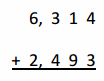
While adding two numbers we add the numbers according to the place values individually. We add number from ones place to the largest place value.
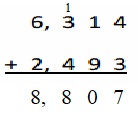
given number 6,314 and 2,493
first adding the ones place =  4 + 3 = 7.
ten place : 1 + 9  = 10. 10 tens make 1 hundred . So 1 is carried to the hundreds place and added to the hundreds place values and 0 is represented in tens place
hundreds place = 3+ 4 + 1 = 8
thousands place = 6 + 2 = 8
Sum = 8,807
e. Eureka Math Grade 4 Module 1 Lesson 11 Problem Set Answer Key 5
Answer:
Engage-NY-Eureka-Math-4th-Grade-Module-1-Lesson-11-Answer-Key-Eureka-Math-Grade-4-Module-1-Lesson-11-Problem-Set-Answer-Key-Question-1-e
Explanation:
While adding two numbers we add the numbers according to the place values individually. We add number from ones place to the largest place value.
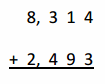
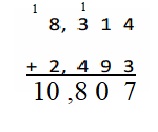
given number 8,314 and 2,493
first adding the ones place = 4 + 3 = 7.
ten place : 1 + 9 = 10. 10 tens make 1 hundred . So 1 is carried to the hundreds place and added to the hundreds place values and 0 is represented in tens place
hundreds place = 3 + 4 + 1 = 8
thousands place = 8 + 2 = 10. 10 thousands make 1 ten thousands . So 1 is carried to the ten thousands place and added to the ten thousands place values and 0 is represented in thousands place
ten thousands = 1
Sum = 10,807.
f. Eureka Math Grade 4 Module 1 Lesson 11 Problem Set Answer Key 6
Answer:
Engage-NY-Eureka-Math-4th-Grade-Module-1-Lesson-11-Answer-Key-Eureka-Math-Grade-4-Module-1-Lesson-11-Problem-Set-Answer-Key-Question-1-f

Explanation:
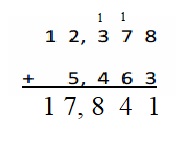
While adding two numbers we add the numbers according to the place values individually. We add number from ones place to the largest place value.
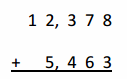
given number 12,378 and 5,463
first adding the ones place = 8 + 3 = 11. 10 ones + 1 ones = 11. 10 ones make 1 ten . So 1 is carried to the tens place and added to the tens place values and 1 is represented in ones place
ten place : 7 + 6 + 1(carry on) = 14. 10 ten and 4 tens = 14 .10 tens make 1 hundred . So 1 is carried to the hundreds place and added to the hundreds place values and 4 is represented in tens place
hundreds place = 3 + 4 + 1(carry on) = 8
thousands place = 2 + 5 = 7
ten thousands = 1
Sum = 17,841

g. Eureka Math Grade 4 Module 1 Lesson 11 Problem Set Answer Key 7
Answer:
Engage-NY-Eureka-Math-4th-Grade-Module-1-Lesson-11-Answer-Key-Eureka-Math-Grade-4-Module-1-Lesson-11-Problem-Set-Answer-Key-Question-1-g
Explanation:
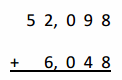
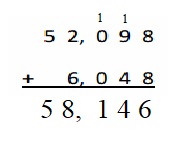
While adding two numbers we add the numbers according to the place values individually. We add number from ones place to the largest place value.
given number 52,098 and 6,048
first adding the ones place = 8 + 8 = 16. 10 ones + 6 ones = 16. 10 ones make 1 ten . So 1 is carried to the tens place and added to the tens place values and 6 is represented in ones place
ten place : 9 + 4 + 1(carry on) = 14. 10 ten and 4 tens = 14 .10 tens make 1 hundred . So 1 is carried to the hundreds place and added to the hundreds place values and 4 is represented in tens place
hundreds place = 0 + 0 + 1(carry on) = 1
thousands place = 2 + 6 = 8
ten thousands = 5
Sum = 58,146

h. Eureka Math Grade 4 Module 1 Lesson 11 Problem Set Answer Key 8
Answer:
Engage-NY-Eureka-Math-4th-Grade-Module-1-Lesson-11-Answer-Key-Eureka-Math-Grade-4-Module-1-Lesson-11-Problem-Set-Answer-Key-Question-1-h
Explanation:
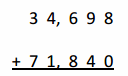
While adding two numbers we add the numbers according to the place values individually. We add number from ones place to the largest place value.
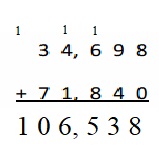
given number 34,698 and 71,840
first adding the ones place = 8 + 0 = 8.
ten place : 9 + 4 = 13. 10 tens + 3 tens = 13 .10 tens make 1 hundred . So 1 is carried to the hundreds place and added to the hundreds place values and 3 is represented in tens place
hundreds place = 6 +8 + 1(carried number) = 15 = 10 hundred + 5 hundred . 10 hundreds make 1 thousands . So 1 is carried to the thousands place and added to the thousands place values and 5 is represented in hundreds place
thousands place = 4 + 1 + 1(carried number) = 6.
ten thousands = 3 + 7 = 10 .10  ten thousands make 1 hundred thousands . So 1 is carried to the hundred thousands place and added to the hundred thousands place values and 0 is represented in ten thousands place
Hundred thousands = 1(carried number) = 1
Sum = 106,538.
i. Eureka Math Grade 4 Module 1 Lesson 11 Problem Set Answer Key 9
Answer:
Engage-NY-Eureka-Math-4th-Grade-Module-1-Lesson-11-Answer-Key-Eureka-Math-Grade-4-Module-1-Lesson-11-Problem-Set-Answer-Key-Question-1-i
Explanation:
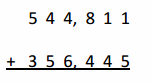
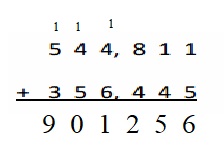
While adding two numbers we add the numbers according to the place values individually. We add number from ones place to the largest place value.
given number 34,698 and 71,840
first adding the ones place = 1 + 5 = 6.
ten place : 1 + 4 = 5.
hundreds place = 8 + 4 = 12 = 10 hundred + 2 hundred . 10 hundreds make 1 thousands . So 1 is carried to the thousands place and added to the thousands place values and 2 is represented in hundreds place
thousands place = 4 + 6 + 1(carried number) = 11 =10 thousand + 1 thousand. 10   thousands make 1 ten thousands . So 1 is carried to the ten thousands place and added to the ten thousands place values and 1 is represented in  thousands place
ten thousands = 4 + 5 + 1(carried number) = 10 .10  ten thousands make 1 hundred thousands . So 1 is carried to the hundred thousands place and added to the hundred thousands place values and 0 is represented in ten thousands place
Hundred thousands = 1(carried number) = 5 + 3 + 1(carried number) = 9
Sum = 901,256.
j. 527 + 275 + 752
Answer:
Engage-NY-Eureka-Math-4th-Grade-Module-1-Lesson-11-Answer-Key-Eureka-Math-Grade-4-Module-1-Lesson-11-Problem-Set-Answer-Key-Question-1-j
Explanation:
While adding two numbers we add the numbers according to the place values individually. We add number from ones place to the largest place value.
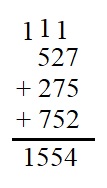
given number 527 , 275 and 752
first adding the ones place = 7 + 5 + 2 = 14 = 10 ones + 4 ones . 10 ones make 1 tens . So 1 is carried to the tens place and added to the tens place values and 4 is represented in ones place
ten place : 2 + 7 + 5 + 1(carried number) = 15 = 10 tens + 5 tens.  10 tens make 1 hundred . So 1 is carried to the hundreds place and added to the hundreds place values and 5 is represented in tens place
hundreds place = 5 +2 + 7 + 1(carried number)= 15 = 10 hundred + 5 hundred . 10 hundreds make 1 thousands . So 1 is carried to the thousands place and added to the thousands place values and 5 is represented in hundreds place
thousands place = 4 + 6 + 1(carried number) = 11 =10 thousand + 1 thousand. 10   thousands make 1 ten thousands . So 1 is carried to the ten thousands place and added to the ten thousands place values and 1 is represented in  thousands place
ten thousands = 4 + 5 + 1(carried number) = 10 .10  ten thousands make 1 hundred thousands . So 1 is carried to the hundred thousands place and added to the hundred thousands place values and 0 is represented in ten thousands place
Hundred thousands = 1(carried number) = 5 + 3 + 1(carried number) = 9
Sum = 1,554
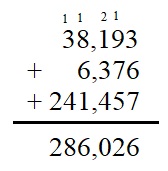
k. 38,193 + 6,376 + 241,457
Answer:
Engage-NY-Eureka-Math-4th-Grade-Module-1-Lesson-11-Answer-Key-Eureka-Math-Grade-4-Module-1-Lesson-11-Problem-Set-Answer-Key-Question-1-k
Explanation:
While adding two numbers we add the numbers according to the place values individually. We add number from ones place to the largest place value.
given number 38,193 + 6,376 + 241,457
first adding the ones place = 3 + 6 + 7= 16 = 10 ones + 6 ones . 10 ones make 1 tens . So 1 is carried to the tens place and added to the tens place values and 6 is represented in ones place
ten place : 9 + 7 + 5 + 1(carried number) = 22 = 20 tens + 2 tens.  20 tens make 2 hundred . So 1 is carried to the hundreds place and added to the hundreds place values and 2 is represented in tens place
hundreds place = 1 + 3 + 4  + 1(carried number)= 10. 10 hundreds make 1 thousands . So 1 is carried to the thousands place and added to the thousands place values and 0 is represented in hundreds place
thousands place = 8 + 6 + 1 +1(carried number) = 16 =10 thousand + 6 thousand. 10   thousands make 1 ten thousands . So 1 is carried to the ten thousands place and added to the ten thousands place values and 6 is represented in  thousands place
ten thousands =3 + 4 + 1(carried number) = 8 .
Hundred thousands = 2
Sum = 286,026.

Draw a tape diagram to represent each problem. Use numbers to solve, and write your answer as a statement.

Question 2.
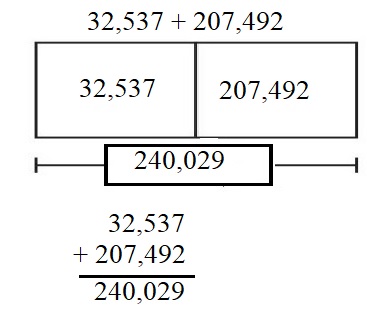
In September, Liberty Elementary School collected 32,537 cans for a fundraiser. In October, they collected 207,492 cans. How many cans were collected during September and October?
Answer:
Number of cans collected by the Liberty Elementary School for a fundraiser in September are = 32,537
Number of cans collected by the Liberty Elementary School for a fundraiser in October are = 207,492
Total number of cans collected during September and October are = 32,537 + 207,492 =
Engage-NY-Eureka-Math-4th-Grade-Module-1-Lesson-11-Answer-Key-Eureka-Math-Grade-4-Module-1-Lesson-11-Problem-Set-Answer-Key-Question-2

Question 3.
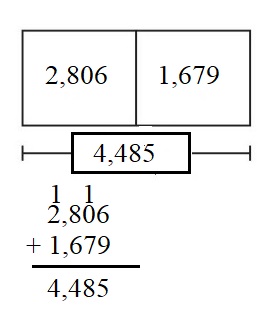
A baseball stadium sold some burgers. 2,806 were cheeseburgers. 1,679 burgers didn’t have cheese. How many burgers did they sell in all?
Answer:
Number of cheeseburgers sold at baseball stadium = 2,806
Number of burgers without cheese sold at baseball stadium are = 1,679
Total number of burgers sold in all are = 2,806 + 1,679
Engage-NY-Eureka-Math-4th-Grade-Module-1-Lesson-11-Answer-Key-Eureka-Math-Grade-4-Module-1-Lesson-11-Problem-Set-Answer-Key-Question-3

Question 4.
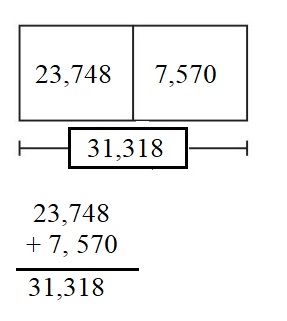
On Saturday night, 23,748 people attended the concert. On Sunday, 7,570 more people attended the concert than on Saturday. How many people attended the concert on Sunday?
Answer:
Number of people attended the concert on Saturday night = 23,748
Number of people attended the concert on Sunday are =  7,570 more than on Saturday
Total people attended the concert on Sunday = 23,748 + 7, 570
Engage-NY-Eureka-Math-4th-Grade-Module-1-Lesson-11-Answer-Key-Eureka-Math-Grade-4-Module-1-Lesson-11-Problem-Set-Answer-Key-Question-4

Eureka Math Grade 4 Module 1 Lesson 11 Exit Ticket Answer Key

Question 1.
Solve the addition problems below using the standard algorithm.
a. Engage NY Math 4th Grade Module 1 Lesson 11 Exit Ticket Answer Key 10
Answer:
Engage-NY-Eureka-Math-4th-Grade-Module-1-Lesson-11-Answer-Key-Eureka-Math-Grade-4-Module-1-Lesson-11-Exit-Ticket-Answer-Key-Question-1-a
Explanation:
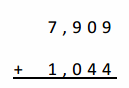
While adding two numbers we add the numbers according to the place values individually. We add number from ones place to the largest place value.
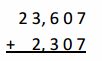
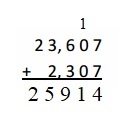
given number 23,607 and 2,307
first adding the ones place = 7 + 7 = 14. 14 is represented as 10 + 4 that’s 1 ten and 4 ones. So 1 is carried to the tens place and added to the tens place values.
ten place : 0 + 0 + 1 = 1
hundreds place = 6 + 3 = 9
thousands place = 3 + 2 = 5
ten thousands place = 2
Sum = 25,914.

b. Engage NY Math 4th Grade Module 1 Lesson 11 Exit Ticket Answer Key 11
Answer:
Engage-NY-Eureka-Math-4th-Grade-Module-1-Lesson-11-Answer-Key-Eureka-Math-Grade-4-Module-1-Lesson-11-Exit-Ticket-Answer-Key-Question-1-b
Explanation:
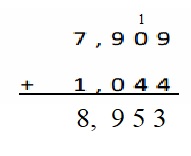
While adding two numbers we add the numbers according to the place values individually. We add number from ones place to the largest place value.
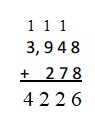
given number 3,948 and 278
first adding the
ones place = 8 + 8 = 16. 16 is represented as 10 + 6 that’s 1 ten and 6 ones. So 1 is carried to the tens place and added to the tens place values and 6 is represented in ones place.
ten place : 4 + 7 + 1(carried number) = 12 = 10 + 2 that’s 1 hundred and 2 tens. So 1 is carried to the hundreds place and added to the hundreds place values and 2 is represented in tens place.
hundreds place = 9 + 2 + 1(carried number) = 12 = 10 + 2 that’s 1 thousand and 2 hundred. So 1 is carried to the thousands place and added to the thousands place values and 2 is represented in hundreds place.
thousands place = 3 + 1(carried number) = 4
Sum = 4,226.
c. 5,983 + 2,097
Answer:
Engage-NY-Eureka-Math-4th-Grade-Module-1-Lesson-11-Answer-Key-Eureka-Math-Grade-4-Module-1-Lesson-11-Exit-Ticket-Answer-Key-Question-1-c
Explanation:
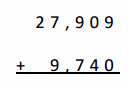
While adding two numbers we add the numbers according to the place values individually. We add number from ones place to the largest place value.
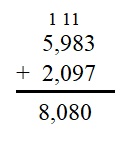
given number 5,983 and 2,097
first adding the
ones place = 3 + 7 = 10. 10 is represented as 10 + 0 that’s 1 ten and 0 ones. So 1 is carried to the tens place and added to the tens place values and 0 is represented in ones place.
ten place : 8 + 9 + 1(carried number) = 18 = 10 + 8 that’s 1 hundred and 8 tens. So 1 is carried to the hundreds place and added to the hundreds place values and 8 is represented in tens place.
hundreds place = 9 + 0 + 1(carried number) = 10 = 10 + 0 that’s 1 thousand and 0 hundred. So 1 is carried to the thousands place and added to the thousands place values and 0 is represented in hundreds place.
thousands place = 5 + 2 + 1(carried number) = 8
Sum = 8,080

Question 2.
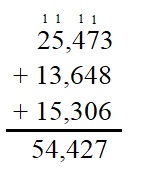
The office supply closet had 25,473 large paper clips, 13,648 medium paper clips, and 15,306 small paper clips. How many paper clips were in the closet?
Answer:
Number of large paper clips = 25,473
Number of medium paper clips = 13,648
Number of small paper clips = 15,306
Total number of paper clips = 25,473 + 13,648 + 15,306
Engage-NY-Eureka-Math-4th-Grade-Module-1-Lesson-11-Answer-Key-Eureka-Math-Grade-4-Module-1-Lesson-11-Exit-Ticket-Answer-Key-Question-2

Eureka Math Grade 4 Module 1 Lesson 11 Homework Answer Key

Question 1.
Solve the addition problems below using the standard algorithm.
a. Eureka Math 4th Grade Module 1 Lesson 11 Homework Answer Key 12
Answer:
Engage-NY-Eureka-Math-4th-Grade-Module-1-Lesson-11-Answer-Key-Eureka-Math-Grade-4-Module-1-Lesson-11-Homework-Answer-Key-Question-1-a
Explanation:
While adding two numbers we add the numbers according to the place values individually. We add number from ones place to the largest place value.
given number 7,909 and 1,044
first adding the ones place = 9 + 4 = 13 = 10 ones + 3 ones . 10 ones make 1 tens . So 1 is carried to the tens place and added to the tens place values and 3 is represented in ones place
ten place : 0 + 4 + 1(carried number) = 5
hundreds place = 9 + 0 = 9.
thousands place = 7 + 1 = 8.
Sum = 8,953.
b. Eureka Math 4th Grade Module 1 Lesson 11 Homework Answer Key 13
Answer:
Engage-NY-Eureka-Math-4th-Grade-Module-1-Lesson-11-Answer-Key-Eureka-Math-Grade-4-Module-1-Lesson-11-Homework-Answer-Key-Question-1-b
Explanation:
While adding two numbers we add the numbers according to the place values individually. We add number from ones place to the largest place value.
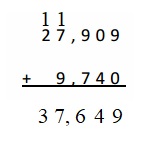
given number 27,909 and 9,740
first adding the ones place = 9 + 0 = 9
ten place : 0 + 4 = 4.
hundreds place = 9 + 7 = 16. 10 hundreds make 1 thousands . So 1 is carried to the thousands place and added to the thousands place values and 6 is represented in hundreds place
thousands place = 7 + 9 +1(carried number) = 17 =10 thousand + 7 thousand. 10   thousands make 1 ten thousands . So 1 is carried to the ten thousands place and added to the ten thousands place values and 7 is represented in  thousands place.
ten thousands =2 + 1(carried number) = 3 .
Sum = 37,649.
c. Eureka Math 4th Grade Module 1 Lesson 11 Homework Answer Key 14
Answer:
Engage-NY-Eureka-Math-4th-Grade-Module-1-Lesson-11-Answer-Key-Eureka-Math-Grade-4-Module-1-Lesson-11-Homework-Answer-Key-Question-1-c
Explanation:
While adding two numbers we add the numbers according to the place values individually. We add number from ones place to the largest place value.
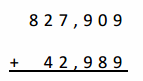
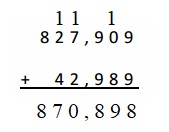
given number 827,909 and 42,989
first adding the ones place = 9 + 9= 18 = 10 ones + 8 ones . 10 ones make 1 tens . So 1 is carried to the tens place and added to the tens place values and 8 is represented in ones place
ten place : 0 + 8  + 1(carried number) = 8.
hundreds place = 9 + 9 = 18. 10 hundreds make 1 thousands . So 1 is carried to the thousands place and added to the thousands place values and 8 is represented in hundreds place
thousands place = 7 + 2 +1(carried number) = 10 =10 thousand + 0 thousand. 10   thousands make 1 ten thousands . So 1 is carried to the ten thousands place and added to the ten thousands place values and 0 is represented in  thousands place
ten thousands =2+ 4 + 1(carried number) = 7 .
Hundred thousands = 8
Sum = 870,898.
d. Eureka Math 4th Grade Module 1 Lesson 11 Homework Answer Key 15
Answer:
Engage-NY-Eureka-Math-4th-Grade-Module-1-Lesson-11-Answer-Key-Eureka-Math-Grade-4-Module-1-Lesson-11-Homework-Answer-Key-Question-1-d
Explanation:
While adding two numbers we add the numbers according to the place values individually. We add number from ones place to the largest place value.
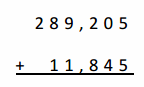
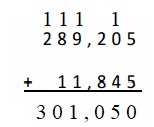
given number 289,205 and 11,845
first adding the ones place = 5 + 5 = 10 = 10 ones + 0 ones . 10 ones make 1 tens . So 1 is carried to the tens place and added to the tens place values and 0 is represented in ones place
ten place : 0 + 4 + 1(carried number) = 5.
hundreds place = 2 + 8 = 10. 10 hundreds make 1 thousands . So 1 is carried to the thousands place and added to the thousands place values and 0 is represented in hundreds place
thousands place = 9 + 1 +1(carried number) = 11 =10 thousand + 1 thousand. 10   thousands make 1 ten thousands . So 1 is carried to the ten thousands place and added to the ten thousands place values and 1 is represented in  thousands place
ten thousands =8 + 1 + 1(carried number) =10. 10 ten thousands make 1 hundred thousands . So 1 is carried to the hundred thousands place and added to the hundred thousands place values and 1 is represented in  ten thousands place
Hundred thousands = 2 + 1(carried over number) = 3
Sum = 301,050.
e. Eureka Math 4th Grade Module 1 Lesson 11 Homework Answer Key 16
Answer:
Engage-NY-Eureka-Math-4th-Grade-Module-1-Lesson-11-Answer-Key-Eureka-Math-Grade-4-Module-1-Lesson-11-Homework-Answer-Key-Question-1-e
Explanation:
While adding two numbers we add the numbers according to the place values individually. We add number from ones place to the largest place value.
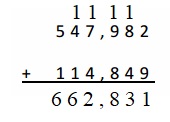
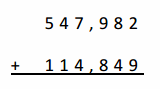
given number 547,982 and 114,849
first adding the ones place = 2 + 9 = 11 = 10 ones + 1 ones . 10 ones make 1 tens . So 1 is carried to the tens place and added to the tens place values and 1 is represented in ones place
ten place : 8 + 4 + 1(carried number) = 13. 10 tens make 1 hundred . So 1 is carried to the hundreds place and added to the hundreds place values and 3 is represented in tens place
hundreds place = 9 + 8 + 1(carried number)= 18. 10 hundreds make 1 thousands . So 1 is carried to the thousands place and added to the thousands place values and 8 is represented in hundreds place
thousands place = 7 + 4 +1(carried number) = 12 =10 thousand + 2 thousand. 10   thousands make 1 ten thousands . So 1 is carried to the ten thousands place and added to the ten thousands place values and 2 is represented in  thousands place
ten thousands =4 + 1 + 1(carried number) = 6.
Hundred thousands = 5 + 1 = 6.
Sum = 662,831.
f. Eureka Math 4th Grade Module 1 Lesson 11 Homework Answer Key 17
Answer:
Engage-NY-Eureka-Math-4th-Grade-Module-1-Lesson-11-Answer-Key-Eureka-Math-Grade-4-Module-1-Lesson-11-Homework-Answer-Key-Question-1-f
Explanation:
While adding two numbers we add the numbers according to the place values individually. We add number from ones place to the largest place value.
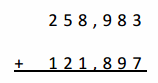
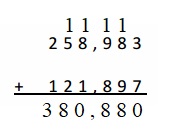
given number 258,983 and 121,897.
first adding the ones place = 3 + 7 = 10 = 10 ones + 0 ones . 10 ones make 1 tens . So 1 is carried to the tens place and added to the tens place values and 0 is represented in ones place
ten place : 8 + 9+ 1(carried number) = 18. 10 tens make 1 hundred . So 1 is carried to the hundreds place and added to the hundreds place values and 8 is represented in tens place
hundreds place = 9 + 8 + 1(carried number)= 18. 10 hundreds make 1 thousands . So 1 is carried to the thousands place and added to the thousands place values and 8 is represented in hundreds place
thousands place = 8 + 1 +1(carried number) = 10 =10 thousand + 0 thousand. 10   thousands make 1 ten thousands . So 1 is carried to the ten thousands place and added to the ten thousands place values and 0 is represented in  thousands place
ten thousands =5 + 2 + 1(carried number) = 8.
Hundred thousands = 2 + 1 = 3.
Sum = 380,880.
g. Eureka Math 4th Grade Module 1 Lesson 11 Homework Answer Key 18
Answer:
Engage-NY-Eureka-Math-4th-Grade-Module-1-Lesson-11-Answer-Key-Eureka-Math-Grade-4-Module-1-Lesson-11-Homework-Answer-Key-Question-1-g
Explanation:
While adding two numbers we add the numbers according to the place values individually. We add number from ones place to the largest place value.
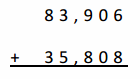
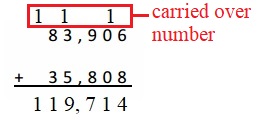
given number 83,906 and 35,808
first adding the ones place = 6 + 8  = 14 = 10 ones + 4 ones . 10 ones make 1 tens . So 1 is carried to the tens place and added to the tens place values and 4 is represented in ones place
ten place : 0 + 0 + 1(carried number) = 1.
hundreds place = 9 + 8 = 17. 10 hundreds make 1 thousands . So 1 is carried to the thousands place and added to the thousands place values and 7 is represented in hundreds place
thousands place = 3 + 5 +1(carried number) = 9.
ten thousands =8 + 3 = 11. 10 ten thousands make 1 hundred thousands . So 1 is carried to the hundred thousands place and added to the hundred thousands place values and 1 is represented in  ten thousands place
Hundred thousands = 1(carried number) = 1.
Sum = 119,714.
h. Eureka Math 4th Grade Module 1 Lesson 11 Homework Answer Key 19
Answer:
Engage-NY-Eureka-Math-4th-Grade-Module-1-Lesson-11-Answer-Key-Eureka-Math-Grade-4-Module-1-Lesson-11-Homework-Answer-Key-Question-1-h
Explanation:
While adding two numbers we add the numbers according to the place values individually. We add number from ones place to the largest place value.
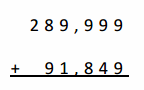
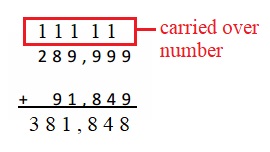
given number 289,999 and 91,849
first adding the ones place = 9 + 9  = 18 = 10 ones + 8 ones . 10 ones make 1 tens . So 1 is carried to the tens place and added to the tens place values and 8 is represented in ones place
ten place : 9 + 4 + 1(carried number) = 14. 10 tens make 1 hundreds . So 1 is carried to the hundreds place and added to the hundreds place values and 4 is represented in tens place
hundreds place = 9 + 8 +1(carried number)= 18 . 10 hundreds make 1 thousands . So 1 is carried to the thousands place and added to the thousands place values and 8 is represented in hundreds place
thousands place = 9 + 1 +1(carried number) = 11. 10  thousands make 1 ten thousands . So 1 is carried to the ten thousands place and added to the ten thousands place values and 1 is represented in  thousands place.
ten thousands =8 + 9 +1(carried number) = 18. 10 ten thousands make 1 hundred thousands . So 1 is carried to the hundred thousands place and added to the hundred thousands place values and 8 is represented in  ten thousands place
Hundred thousands = 2 +1(carried number) = 3.
Sum = 381,848
i. Eureka Math 4th Grade Module 1 Lesson 11 Homework Answer Key 20
Answer:
Engage-NY-Eureka-Math-4th-Grade-Module-1-Lesson-11-Answer-Key-Eureka-Math-Grade-4-Module-1-Lesson-11-Homework-Answer-Key-Question-1-i

Explanation:
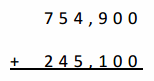
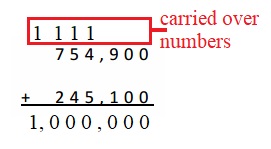
While adding two numbers we add the numbers according to the place values individually. We add number from ones place to the largest place value.
given number 289,999 and 91,849
first adding the ones place = 0 + 0  = 0.
ten place : 0 + 0 = 0.
hundreds place = 9+1= 10 . 10 hundreds make 1 thousands . So 1 is carried to the thousands place and added to the thousands place values and 0 is represented in hundreds place
thousands place = 4 + 5  +1(carried number) = 10. 10  thousands make 1 ten thousands . So 1 is carried to the ten thousands place and added to the ten thousands place values and 0 is represented in  thousands place.
ten thousands =5 + 4 +1(carried number) = 10. 10 ten thousands make 1 hundred thousands . So 1 is carried to the hundred thousands place and added to the hundred thousands place values and 0 is represented in  ten thousands place
Hundred thousands = 7 + 2 +1(carried number) = 1. 10 hundred thousands make 1 million . So 1 is carried to the millions place and added to the millions place values and 0 is represented in  hundred thousands place.
Millions = 1 (carried over number) = 1.
Sum = 1,000,000.

Draw a tape diagram to represent each problem. Use numbers to solve, and write your answer as a statement.

Question 2.
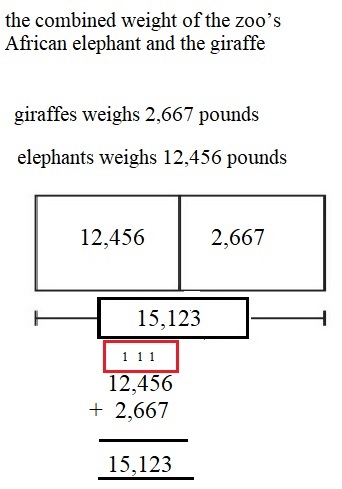
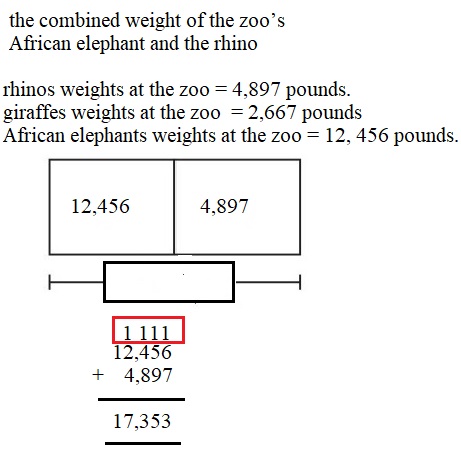
At the zoo, Brooke learned that one of the rhinos weighs 4,897 pounds, one of the giraffes weighs 2,667 pounds, one of the African elephants weighs 12,456 pounds, and one of the Komodo dragons weighs 123 pounds.
Answer:
Given
One of the rhinos weights at the zoo = 4,897 pounds.
One of the giraffes weights at the zoo  = 2,667 pounds
One of the African elephants weights at the zoo = 12, 456 pounds.
One of the Komodo dragons at the zoo weighs = 123 pounds.
a. What is the combined weight of the zoo’s African elephant and the giraffe?
Answer:
Engage-NY-Eureka-Math-4th-Grade-Module-1-Lesson-11-Answer-Key-Eureka-Math-Grade-4-Module-1-Lesson-11-Homework-Answer-Key-Question-2-a
b. What is the combined weight of the zoo’s African elephant and the rhino?
Answer:
Engage-NY-Eureka-Math-4th-Grade-Module-1-Lesson-11-Answer-Key-Eureka-Math-Grade-4-Module-1-Lesson-11-Homework-Answer-Key-Question-2-b
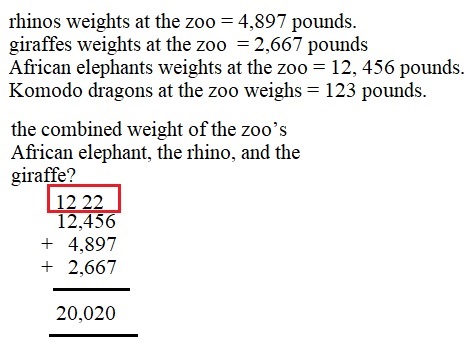
c. What is the combined weight of the zoo’s African elephant, the rhino, and the giraffe?
Answer:
Engage-NY-Eureka-Math-4th-Grade-Module-1-Lesson-11-Answer-Key-Eureka-Math-Grade-4-Module-1-Lesson-11-Homework-Answer-Key-Question-2-c
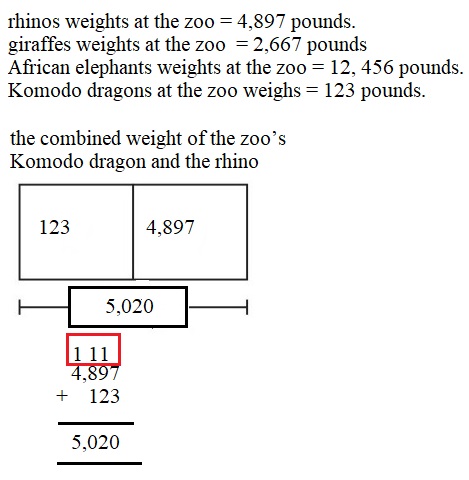
d. What is the combined weight of the zoo’s Komodo dragon and the rhino?
Answer:
Engage-NY-Eureka-Math-4th-Grade-Module-1-Lesson-11-Answer-Key-Eureka-Math-Grade-4-Module-1-Lesson-11-Homework-Answer-Key-Question-2-d

Eureka Math Grade 4 Module 7 End of Module Assessment Answer Key

Engage NY Eureka Math 4th Grade Module 7 End of Module Assessment Answer Key

Eureka Math Grade 4 Module 7 End of Module Assessment Task Answer Key

Question 1.
Solve for the following conversions. Draw tape diagrams to model the equivalency.
a. 1 gal = ______ qt
b. 3 qt 1 pt = ______ pt
Answer:

a. 1 gal =  4 qt


b. 3 qt 1 pt = 7 pt


Question 2.
Complete the following tables:
a.

Pounds

Ounces

116
232
696
10160
13208

The rule for converting pounds to ounces is _____________.

To convert pounds into ounces, multiply pounds x 16

b.

Hours

Minutes

160
3180
7420
10600
14840

The rule for converting hours to minutes is _____________.
Answer:

To convert hours into minutes, multiply hours x 60

Question 3.
Answer true or false for the following statements. Explain how you know using pictures, numbers, or words.
a. 68 ounces < 4 pounds _____________ b. 920 minutes > 17 hours _____________
c. 38 inches = 3 feet 2 inches _____________
Answer:

a. False, 4 pounds = 16 x 4 = 64 ounces

So, 68 ounces > 4 pounds

b. False, 17 hours = 17 x 60 = 1,020 minutes

So, 920 minutes < 1,020 minutes

c. True.

3 feet = 36 inches  and 2 inches

Total : 36 + 2 = 38 inches

So, 38 inches = 3 feet 2 inches.

Question 4.
Convert the following measurements.
a. Express the length of a 9 kilometre trip in meters. _______________
b. Express the capacity of a 3 liter 240 millilitre container in millilitres. ______________
c. Express the length of a 3 foot 5 inch fish in inches. _______________
d. Express the length of a 2\(\frac{1}{4}\) hour movie in minutes. _______________
e. Express the weight of a 24\(\frac{3}{8}\) pound wolverine in ounces. _______________
Answer:

a. Express the length of a 9 kilometre trip in meters. 9000 meters
b. Express the capacity of a 3 liter 240 millilitre container in millilitres. 3240 millilitres
c. Express the length of a 3 foot 5 inch fish in inches. 41 inches
d. Express the length of a 2\(\frac{1}{4}\) hour movie in minutes. 135 minutes
e. Express the weight of a 24\(\frac{3}{8}\) pound wolverine in ounces. 390 ounces

Question 5.
Find the following sums and differences. Show your work.
a. 4 gal 2 qt + 5 gal 3 qt = _______ gal _______ qt
b. 6 ft 2 in – 9 inches = _______ ft _______ in
c 3 min 34 sec + 7 min 46 sec = _______ min _______ sec
d. 24 lb 9 oz – 3 lb 11 oz = _______ lb _______ oz
Answer:

a. 4 gal 2 qt + 5 gal 3 qt = 10 gal 1 qt
b. 6 ft 2 in – 9 inches = 5 ft 5 in
c 3 min 34 sec + 7 min 46 sec = 11 min 20 sec
d. 24 lb 9 oz – 3 lb 11 oz = 20 lb 14 oz

Question 6.
a. Complete the table.

Length

yards

inches

136
272
3108
4144
5180
10360

b. Describe the rule for converting yards to inches.
c. How many inches are in 15 yards?
d. Jacob says that he can find the number of inches in 15 yards by tripling the number of inches in 5 yards. Does his strategy work? Why or why not?
e. A blue rope in Garret’s camping backpack is 6 yards long. The blue rope is 3 times as long as a red rope. A yellow rope is 2 feet 7 inches shorter than the red rope. What is the difference in length between the blue rope and the yellow rope?
Answer:

B.

To convert yards into inches

Multiply the number of yards x 36

c.

1 yard = 36 inches

15 yards = 15 x 36 = 540

Therefore, 15 yards = 540 inches.

d.

Yes, Jacob strategy is right.

15 yards can be shown as 5 yards x 3

1 yard = 36 inches

15 yards = 540 inches

5 yards tripling by 3 =

5 yards = 5 x 36 = 180

5 yards = 180 inches

180 inches x 3 = 540

e.

Given, the length of blue rope = 6 yards long

6 yards = 18 feet

Also given, the blue rope is 3 times as long as a red rope

so, length of red rope = 2 yards = 6 feet

A yellow rope is 2 feet 7 inches shorter than red rope

So, 6 feet – 2 feet 7 inches

= 3 feet 5 inches

Now,

18 feet – 3 feet 5 inches = 14 feet 7 inches.


Therefore, the length difference between the blue rope and the yellow rope is 14 feet 7 inches.

Eureka Math Grade 4 Module 7 Lesson 18 Answer Key

Engage NY Eureka Math 4th Grade Module 7 Lesson 18 Answer Key

Eureka Math Grade 4 Module 7 Lesson 18 Reflection Answer Key

Question 1.
Why do you think vocabulary was such an important part of fourth-grade math? How does vocabulary help you in math?
Answer:

Yes, Vocabulary is important in mathematics.

Vocabulary helps in understanding and communication. It helps to solve complex and real problems.

Question 2.
Which vocabulary terms do you know well, and which would you like to improve upon?
Answer:

I came across several vocabulary words like Area, data, absolute value, ratio etc…. I would like improve more on vocabulary terms by practicing.

Eureka Math Grade 4 Module 7 Lesson 17 Answer Key

Engage NY Eureka Math 4th Grade Module 7 Lesson 17 Answer Key

Eureka Math Grade 4 Module 7 Lesson 17 Reflection Answer Key

Question 1.
What are you able to do now in math that you were not able to do at the beginning of Grade 4?
Answer:

I am able to solve some critical problems related to areas and calculations which I am not able to do before

Question 2.
Which activities would you like to practice this summer in order to keep fluent or become more fluent?
Answer:

The activities I would like to practice are reading some books, I think they  will keep me more productive and useful for my studies too

Question 3.
What type of practice would help you build your fluency with these concepts?
Answer:

I think practicing some more critical problems and reasoning will help me to build fluency.

Eureka Math Grade 4 Module 7 Lesson 17 Homework Answer Key

Question 1.
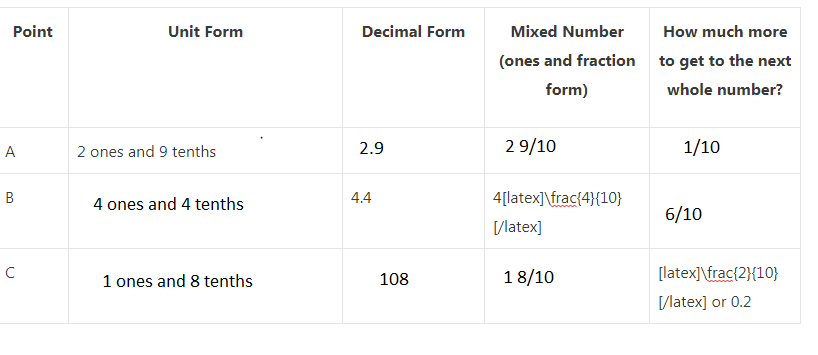
Decimal Fraction Review: Plot and label each point on the number line below, and complete the chart. Only solve the portion above the dotted line.
Eureka Math Grade 4 Module 7 Lesson 17 Homework Answer Key 1

PointUnit FormDecimal FormMixed Number (ones and fraction form)

How much more to get to the next whole number?

A2 ones and 9 tenths
B4.44\(\frac{4}{10}\)
C\(\frac{2}{10}\) or 0.2

Answer:


Question 2.
Complete the chart. Create your own problem for B, and plot the point.
Eureka Math Grade 4 Module 7 Lesson 17 Homework Answer Key 2


Point

Unit FormDecimal FormMixed Number (ones and fraction form)

How much more to get to the next whole number?

A2 ones and 9 tenths2.92 9/10 1/10
B3 ones and 4 tenths3.43 8/102/10

Answer:

Question 3.
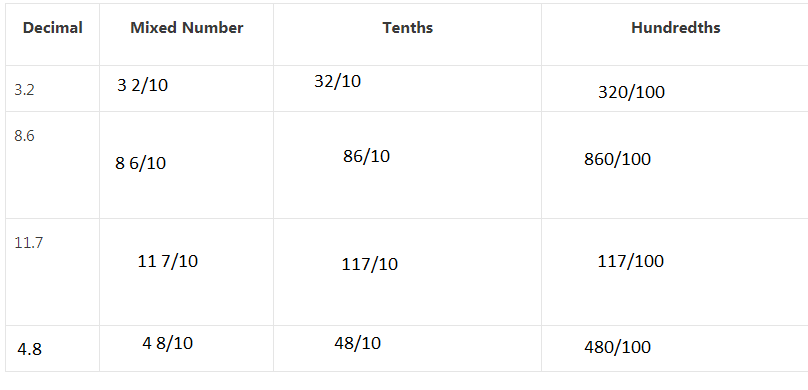
Complete the chart. The first one has been done for you. Only solve the top portion above the dotted line.

Decimal

Mixed NumberTenths

Hundredths

3.23\(\frac{2}{10}\)32 tenths    or \(\frac{32}{10}\)320 hundredths    or \(\frac{320}{100}\)
8.6 


11.7 


4.8

Answer:

Question 4.
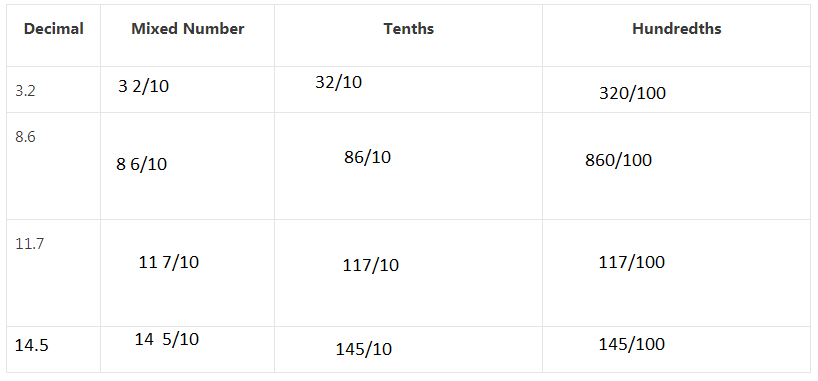
Complete the chart. Create your own problem in the last row.

Decimal

Mixed NumberTenths

Hundredths

3.2
8.6 


11.7 


Answer:


Eureka Math Grade 4 Module 7 Lesson 16 Answer Key

Engage NY Eureka Math 4th Grade Module 7 Lesson 16 Answer Key

Eureka Math Grade 4 Module 7 Lesson 16 Problem Set Answer Key

Work with your partner to create each floor plan on a separate piece of paper, as described below.
You should use a protractor and a ruler to create each floor plan and be sure each rectangle you create has two sets of parallel lines and four right angles.
Be sure to label each part of your model with the correct measurement.
Question 1.
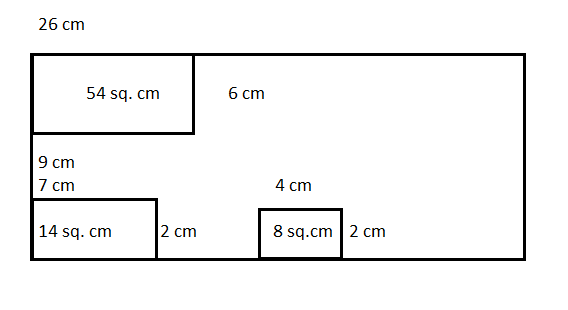
The bedroom in Samantha’s dollhouse is a rectangle 26 centimetres long and 15 centimetres wide. It has a rectangular bed that is 9 centimetres long and 6 centimetres wide. The two dressers in the room are each 2 centimetres wide. One measures 7 centimetres long, and the other measures 4 centimetres long. Create a floor plan of the bedroom containing the bed and dressers. Find the area of the open floor space in the bedroom after the furniture is in place.
Answer:

Total area = length x width

= 26 x 15

= 390 sq. cm.

Bedroom + dresser + dresser =

54 + 14 +14 = 76 sq. cm.

Now, Room furniture =

390 – 76 = 314 sq. cm.

Therefore, The area of the open floor space in the bedroom after furniture is placed = 314 sq. cm.

Question 2.
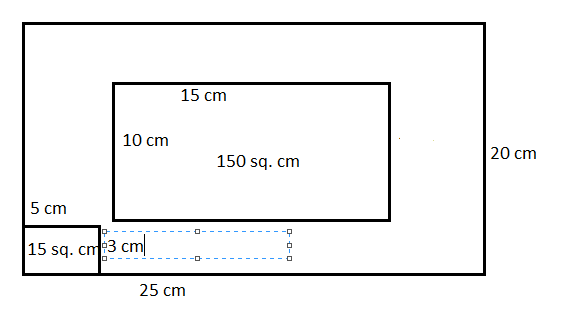
A model of a rectangular pool is 15 centimeters long and 10 centimeters wide. The walkway around the pool is 5 centimeters wider than the pool on each of the four sides. In one section of the walkway, there is a flowerbed that is 3 centimeters by 5 centimeters. Create a diagram of the pool area with the surrounding walkway and flowerbed. Find the area of the open walkway around the pool.
Answer:

Total area = 25 x 20 = 500 sq. cm

Pool + flower bed =

150 + 15 = 165 sq. cm.

Total area = 500 – 165 = 335 sq. cm.

Therefore, The area of the open walkway around the pool = 335 sq. cm.


Eureka Math Grade 4 Module 7 Lesson 16 Reflection Answer Key

In the table below are skills that you learned in Grade 4 and that you used to complete today’s lesson. These skills were originally introduced in earlier grades, and you will continue to work on them as you go on to later grades. Choose three topics from the chart, and explain how you think you might build on and use them in Grade 5.

Multiply 2-digit by
2-digit numbers
Use the area formula to
find the area of
composite figures
Create composite figures from a set of specifications
Subtract multi-digit numbersAdd multi-digit numbersSolve multi-step word problems
Construct parallel and perpendicular linesMeasure and construct
90° angles
Measure in centimeters

Eureka Math Grade 4 Module 7 Lesson 16 Homework Answer Key

For homework, complete the top portion of each page. This will become an answer key for you to refer to when completing the bottom portion as a mini-personal white board activity during the summer.

Use a ruler and protractor to create and shade a figure according to the directions. Then, find the area of the unshaded part of the figure.
Question 1.
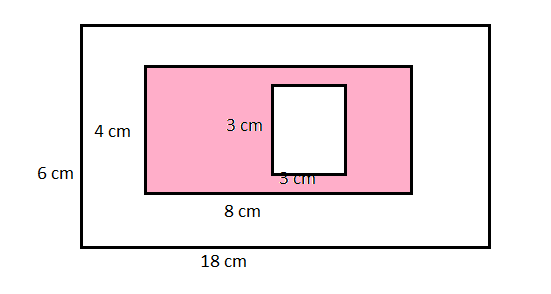
Draw a rectangle that is 18 cm long and 6 cm wide. Inside the rectangle, draw a smaller rectangle that is 8 cm long and 4 cm wide. Inside the smaller rectangle, draw a square that has a side length of 3 cm. Shade in the smaller rectangle, but leave the square unshaded. Find the area of the unshaded space.
Answer:

The area of unshaded part =

( 4 x 8 ) – ( 3 x 3 )

32 – 9

= 23 sq. cm

Therefore, the area of unshaded part = 23 sq. cm.

Question 2.
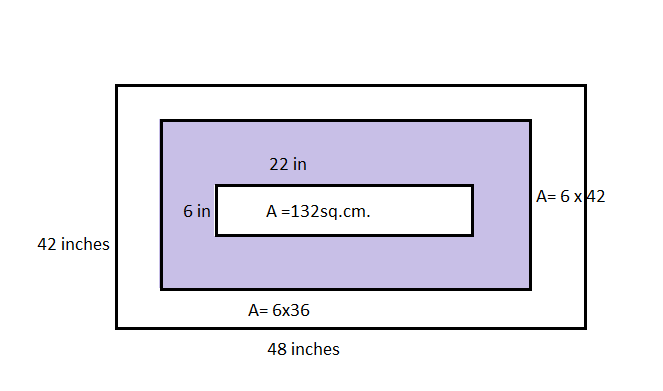
Emanuel’s science project display board is 42 inches long and 48 inches wide. He put a 6-inch border around the edge inside the board and placed a title in the center of the board that is 22 inches long and 6 inches wide. How many square inches of open space does Emanuel have left on his board?
Answer:

The square inches of open space Emanuel have left on his board.

(42 x 48)-{(6 x 42)+(6 x 42)+(6 x 32 )+( 6 x 32 ) + (6 x 22)}

= 2016 – { 252 + 252 + 216 + 216+ 132 }

= 2016 – 1068

= 948 sq. inches.

Challenge: Replace the given dimensions with different measurements, and solve again.

Eureka Math Grade 4 Module 7 Lesson 15 Answer Key

Engage NY Eureka Math 4th Grade Module 7 Lesson 15 Answer Key

Eureka Math Grade 4 Module 7 Lesson 15 Problem Set Answer Key

Question 1.
Emma’s rectangular bedroom is 11 ft long and 12 ft wide with an attached closet that is 4 ft by 5 ft. How many square feet of carpet does Emma need to cover both the bedroom and closet?
Answer:

Given,

Emma’s rectangular bedroom measurements :

length = 11 ft

and width = 12 ft

Area = length x width

A = 11 x 12 = 132 sq. ft.

Also given the measurement of attached closet :

length = 4 ft

and width = 5 ft

Area = 4 x 5 = 20 sq. ft.

Total square feet of carpet Emma need to cover both the bedroom and closet =

132+ 20 = 152 square feet.

Therefore, Emma needs 152 sq. ft to cover bedroom and closet.

Question 2.
To save money, Emma is no longer going to carpet her closet. In addition, she wants one 3 ft by 6 ft corner of her bedroom to be wood floor. How many square feet of carpet will she need for the bedroom now?
Answer:

The area of Emma’s bedroom = 132 sq. ft.

Given that,

Emma wants to cover her 3 ft by 6 ft corner with wood floor

Now, Area = length x width

A = 3 x 6 = 18 sq. ft.

Now, the square feet of carpet Emma need for her bedroom =

132 – 18 = 114

Therefore, Emma need 114 sq. ft. of carper for her bedroom.

Question 3.
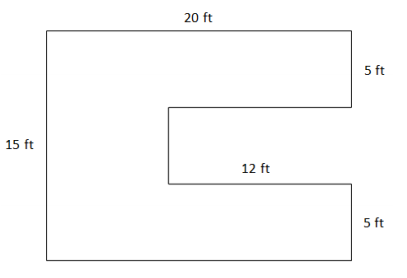
Find the area of the figure pictured to the right.
Engage NY Math Grade 4 Module 7 Lesson 15 Problem Set Answer Key 1
Answer:

Area of rectangle = length x width

a. Area = length x width

A = 15 x 8 = 120 sq. ft

b. Area = length x width

A= 12 x 5 = 60 sq. ft.

c. Area = length x width

A = 12 x 5 = 60 sq. ft.

Total area = 120 + 60 +60 = 240

Therefore, total area = 240 sq. ft.

Question 4.
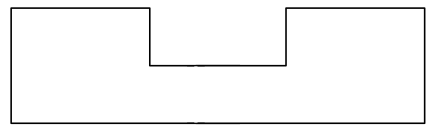
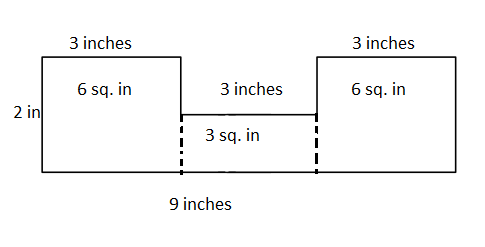
Label the sides of the figure below with measurements that make sense. Find the area of the figure.
Engage NY Math Grade 4 Module 7 Lesson 15 Problem Set Answer Key 2
Answer:-

Area = length x width

a. 3 x 2 = 6 sq. inches

b. 3 x 1 = 3 sq. inches

c. 3 x 2 = 6 sq.inches

Total : 6 sq.in + 3 sq.in + 6 sq. in.

= 15 sq. inches

Question 5.
Peterkin Park has a square fountain with a walkway around it. The fountain measures 12 feet on each side. The walkway is 3\(\frac{1}{2}\) feet wide. Find the area of the walkway.
Answer: 217 sq. ft.

Explanation :

Given that,

The measurement of fountain on each side = 12 sq. ft.

Area = length x width

A = 12 x 12 = 144 sq. ft.

The measurement of walkway = 3 1/2 feet wide

Total measurement = 144 + 3 1/2 +3  1/2 = 19

Area = length x width

A = 19 x 19

= 361 sq. ft

Now, the area of walkway =

361 – 144 = 217

Therefore, the area of walkway = 217 sq. ft.


Question 6.
If 1 bag of gravel covers 9 square feet, how many bags of gravel will be needed to cover the entire walkway around the fountain in Peterkin Park?
Answer:

Given that,

1 bag of gravels covers 9 sq. ft.

Total area of walkway = 217 sq.ft.

Now,

217 / 9 = 24

24 and remaining of 1

Therefore, 25 bags of graved will be required to cover the walkway.


Eureka Math Grade 4 Module 7 Lesson 15 Reflection Answer Key

In the table below are topics that you learned in Grade 4 and that were used in today’s lesson. Choose 1 topic, and describe how you were successful in using it today.

2-digit by 2-digit multiplicationArea formulaDivision of 3-digit number by 1-digit number
Subtraction of multi-digit numbersAddition of multi-digit numbersSolving multi-step word problems

Eureka Math Grade 4 Module 7 Lesson 15 Homework Answer Key

For homework, complete the top portion of each page. This will become an answer key for you to refer to when completing the bottom portion as a mini-personal white board activity during the summer.
Find the area of the figure that is shaded.
Question 1.

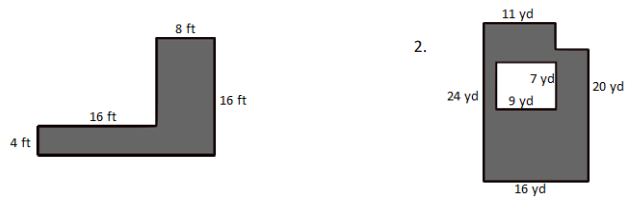
Eureka Math Grade 4 Module 7 Lesson 15 Homework Answer Key 1
Answer:

a. Area of rectangle = length x width

Area = 4 x 16 = 64 sq. ft.

b. area = length x breadth

Area = 16 x 8 = 128

Total area =

64 + 128 = 192 sq.ft.

2.

Area of rectangle = length x breadth

The area of shaded part =

16 x 24 – {( 9 x 7 ) + ( 5 x 4 )}

= 384 – [63 + 20 ]

= 384 – 83

= 301 sq. ft.

Find the area of the figure that is shaded.
Question 1.
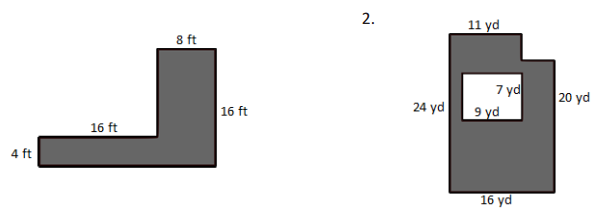
Eureka Math Grade 4 Module 7 Lesson 15 Homework Answer Key 2
Answer:

a. Area of rectangle = length x width

Area = 2 x 8 = 16 sq. ft.

b. area = length x breadth

Area = 8 x 4 = 32

Total area =

16 + 32 = 48 sq.ft.

2.

Area of rectangle = length x breadth

The area of shaded part =

16 x 24 – {( 9 x 7 ) + ( 5 x 4 )}

= 384 – [63 + 20 ]

= 384 – 83

= 301 sq. ft.

Find the area of the figure that is shaded.
Question 1.

Challenge: Replace the given dimensions with different measurements, and solve again.

Question 3.
A wall is 8 feet tall and 19 feet wide. An opening 7 feet tall and 8 feet wide was cut into the wall for a doorway. Find the area of the remaining portion of the wall.
Answer:

The area of remaining portion of wall =

( 8 x 19 ) – ( 7 x 8 )

= 152 – 56

= 96

Therefore, the area of the remaining portion of the wall = 96 sq. ft.


Eureka Math Grade 4 Module 7 Lesson 14 Answer Key

Engage NY Eureka Math 4th Grade Module 7 Lesson 14 Answer Key

Eureka Math Grade 4 Module 7 Lesson 14 Problem Set Answer Key

Use RDW to solve the following problems.
Question 1.
A cartoon lasts \(\frac{1}{2}\) hour. A movie is 6 times as long as the cartoon. How many minutes does it take to watch both the cartoon and the movie?
Answer:

Given that,

The time taken by cartoon to last = 1/2 hour = 30 minutes

Also given, a movie is 6 times as long as the cartoon

30 x 6 = 180 minutes

Now, 180 +30 = 210 minutes

Therefore, The number of minutes required to watch both the cartoon and movie = 210 minutes.

Question 2.
A large bench is 7 \(\frac{1}{6}\) feet long. It is 17 inches longer than a shorter bench. How many inches long is the shorter bench?
Answer:

Given,

The length of large bench = 7 1/6 feet

7 1/6 feet =

1 feet = 12 inches

So, 7 feet = 7 x 12 = 84 inches

1/6 feet = 2 inches

Total : 84 + 2 = 86

Also given,

Longer bench is 17 inches longer than a shorter bench

So, 86 – 17 = 69

Therefore, the length of shorter bench is 69 inches.

Question 3.
The first container holds 4 gallons 2 quarts of juice. The second container can hold 1\(\frac{3}{4}\) gallons more than the first container. Altogether, how much juice can the two containers hold?
Answer:

Given that,

The capacity of first container = 4 gallons 2 quarts or 4 1/2

Also given the capacity of second container is 1 3/4 gallons more than first container

Which means, 4 1/2 + 1 3/4 =6 1/4

Total : 4 1/2 gallons + 6 1/4  gallons

10 gallons + 3/4 gal  = 10 gallons 3 quarts

Therefore, two contains can hold 103/4 gallons altogether.

Question 4.
A girl’s height is 3\(\frac{1}{3}\) feet. A giraffe’s height is 3 times that of the girl’s. How many inches taller is the giraffe than the girl?
Answer:

Given,

The height of a girl = 3 1/3 feet

The height of giraffe is 3 times of the girl

We know that 1 feet = 12 inches

3 1/3 +3 1/3 = 6 feet 8 inches

6 feet = 6 x 12 = 72 inches

72 + 8 = 80

Therefore, The girrafe is 80 inches taller than the girl.

Question 5.
Five ounces of pretzels are put into each bag. How many bags can be made from 22\(\frac{3}{4}\) pounds of pretzels?
Answer:

1 pound = 16 ounces

22 3/4 pounds of pretzels =

22 x 16 =352 ounces and

3/4 = 12 ounces

Total : 352 + 12 = 364 ounces

Given that, 5 pounds of pretzels are kept in each bag

Now, 364 / 5 = 72

Therefore, 72 bags can be made from 22 3/4 pounds of pretzels.

Question 6.
Twenty servings of pancakes require 15 ounces of pancake mix.
a. How much pancake mix is needed for 120 servings?
b. Extension: The mix is bought in 2\(\frac{1}{2}\)-pound bags. How many bags will be needed to make 120 servings?
Answer:

Given that,

Twenty servings of pancakes require 15 ounces of pancake mix.

20+20+20+20+20+20 = 120

Now, 6 x 15 = 90 ounces

Therefore, 90 ounces of pancake is needed for 120 servings.

b.

1 pound = 16 ounces

Given that mix is bought 2 1/2 pounds

Which means, 2 1/2 = 2 x 16 = 32 oz + 8 oz = 40 oz

40 oz x 2 = 80 ounces

Therefore, to make 120 servings  3 bags of mix will be need to purchase.

Because, 2 1/2 mix can only make 80 ounces which is nit enough..

Eureka Math Grade 4 Module 7 Lesson 14 Exit Ticket Answer Key

Use RDW to solve the following problem.
It took Gigi 1 hour and 20 minutes to complete a bicycle race. It took Johnny twice as long because he got a flat tire. How many minutes did it take Johnny to finish the race?
Answer:

The time taken by Gigi to complete his bicycle race = 1 hour 20 minutes

The time taken by Johnny is twice as long because he got a flat tire =

Which means,

1 hour 20 minutes + 1 hour 20 minutes = 2 hours 40 minutes

1 hour = 60 minutes

2 hours = 2 x 60 = 120 minutes

120 minutes + 40 minutes = 160 minutes

Therefore, it took Johnny 160 minutes to finish his bicycle race.

Eureka Math Grade 4 Module 7 Lesson 14 Homework Answer Key

Use RDW to solve the following problems.
Question 1.
Molly baked a pie for 1 hour and 45 minutes. Then, she baked banana bread for 35 minutes less than the pie. How many minutes did it take to bake the pie and the bread?
Answer:

The amount of time Molly backed a pie = 1 hour 45 minutes

Given that, the time taken to bake the banana bread is 35 minutes less

Which means, 1 hour 45 minutes – 35 minutes = 1 hour 10 minutes

Total time required to bake both the pie and bread :

1 hour 45 minutes + 1 hour 10 minutes = 2 hours 55 minutes.

Therefore, it took 2 hours 55 minutes to bake pie and banana bread.

Question 2.
A slide on the playground is 12\(\frac{1}{2}\) feet long. It is 3 feet 7 inches longer than the small slide. How long is the small slide?
Answer:

Given that, the length of the longer slide = 12 1/2  = 12 feet 6 inches

The length of smaller slide is 3 feet 7 inches shorter than longer slide.

Now,

12 feet 6 inches – 3 feet 7 inches = 8 feet 11 inches

Therefore, the length of smaller slide is 8 feet 11 inches.

Question 3.
The fish tank holds 8 gallons 2 quarts of water. Jeffrey poured 1\(\frac{3}{4}\) gallons into the empty tank. How much more water does he still need to pour into the tank to fill it?
Answer:

The quantity of water the fish tank can hold = 8 gallons 2 quarts

The quantity of water of Jeffrey poured into empty tank = 1 3/4 gallons or 1 gallon 3 quarts

Now,

8 gallons 2 quarts – 1 gallons 3 quarts = 6 gallons 1 quarts

Therefore, Jeffrey need to pour 6 gallons 1 quarts of water to fill the tank.

Question 4.
The candy shop puts 10 ounces of gummy bears in each box. How many boxes do they need to fill if there are 21\(\frac{1}{4}\) pounds of gummy bears?
Answer:

1 pound = 16 ounces

21 1/4 =

21 pounds x 16 = 336 ounces

1/4 = 4 ounces

Total : 336 + 4 = 340 ounces

Given that,

The number of gummy bears the candy shop puts in each box = 10

Now, 340 / 10 = 34

Therefore, they need to fill 34 boxes.

Question 5.
Mom can make 10 brownies from a 12-ounce package.
a. How many ounces of brownie mix would be needed to make 50 brownies?
b. Extension: The brownie mix is also sold in 1\(\frac{1}{2}\)-pound bags. How many bags would be needed to make 120 brownies?
Answer:

a.

Given that,

Mom can make 10 brownies from a 12- ounce package.

The amount of brownie mix she need to make 50 brownies  =

12 x 5 = 60

Therefore, 60 ounces of brownie mix is needed to make 50 brownies

b.

1 pound = 16 ounces

1 1/2 =

16 ounces + 8 ounces = 24 ounces

Given , 10 brownies are made from 12 ounce brownie mix

Now, 10 x 12 =120

12 x 12 = 144 ounces

Now, 144 ounces / 24 ounces = 6

Therefore, 6 bags are needed to make 120 brownies.

Eureka Math Grade 4 Module 7 Lesson 13 Answer Key

Engage NY Eureka Math 4th Grade Module 7 Lesson 13 Answer Key

Eureka Math Grade 4 Module 7 Lesson 13 Problem Set Answer Key

Question 1.
Solve.
Engage NY Math Grade 4 Module 7 Lesson 13 Problem Set Answer Key 1
a. \(\frac{1}{16}\) pound = _______ ounce
b. \(\frac{}{16}\) pound = \(\frac{1}{2}\) pound = _______ ounces
c. \(\frac{}{16}\) pound = \(\frac{1}{4}\) pound = _______ ounces
d. \(\frac{}{16}\) pound = \(\frac{3}{4}\) pound = _______ ounces
e. \(\frac{}{16}\) pound = \(\frac{1}{8}\) pound = _______ ounces
f. \(\frac{}{16}\) pound = \(\frac{3}{8}\) pound = _______ ounces
Answer:

a. \(\frac{1}{16}\) pound = 1 ounce
b. \(\frac{8}{16}\) pound = \(\frac{1}{2}\) pound = 8 ounces
c. \(\frac{4}{16}\) pound = \(\frac{1}{4}\) pound = 4 ounces
d. \(\frac{12}{16}\) pound = \(\frac{3}{4}\) pound = 12 ounces
e. \(\frac{2}{16}\) pound = \(\frac{1}{8}\) pound = 2 ounces
f. \(\frac{6}{16}\) pound = \(\frac{3}{8}\) pound = 6 ounces

Question 2.
Draw a tape diagram to show 2\(\frac{1}{2}\) pounds = 40 ounces.
Answer:

1 pound = 16 ounces

2 1/2 = 40 ounces

Question 3.
Engage NY Math Grade 4 Module 7 Lesson 13 Problem Set Answer Key 2
a. \(\frac{1}{60}\) hour = _______ minute
b. \(\frac{}{60}\) hour = \(\frac{1}{2}\) hour = _______ minutes
c. \(\frac{}{60}\) hour = \(\frac{1}{4}\) hour = _______ minutes
Answer:

a. \(\frac{1}{60}\) hour = 1 minute
b. \(\frac{30}{60}\) hour = \(\frac{1}{2}\) hour = 30 minutes
c. \(\frac{15}{60}\) hour = \(\frac{1}{4}\) hour = 15 minutes

Question 4.
Draw a tape diagram to show that 1\(\frac{1}{2}\) hours = 90 minutes.
Answer:

1 hour = 60 minutes

So, 1 1/2 hours = 60 + 30 = 90 minutes

Question 5.
a. 1\(\frac{1}{8}\)pounds = _____ ounces
Answer:

1\(\frac{1}{8}\)pounds = 18 ounces

b. 3\(\frac{3}{8}\) pounds = _______ ounces
Answer:

3\(\frac{3}{8}\) pounds = 54 ounces

c. 5\(\frac{3}{4}\) lb = _______ oz
Answer:

5\(\frac{3}{4}\) lb = 92 oz

d. 5\(\frac{1}{2}\) lb = ________ oz
Answer:

5\(\frac{1}{2}\) lb = 88 oz

e. 1\(\frac{1}{4}\) hours = _______ minutes
Answer:

1\(\frac{1}{4}\) hours = 75 minutes

f. 3\(\frac{1}{2}\) hours = _______ minutes
Answer:

3\(\frac{1}{2}\) hours = 210 minutes

g. 2\(\frac{1}{4}\) hr = _______ min
Answer:

2\(\frac{1}{4}\) hr = 135 min

h. 5\(\frac{1}{2}\) hr = _______ min
Answer:

5\(\frac{1}{2}\) hr = 330 min

i. 3\(\frac{1}{3}\) yards = ________ feet
Answer:

3\(\frac{1}{3}\) yards = 10 feet

j. 7\(\frac{2}{3}\) yd = ________ ft
Answer:

7\(\frac{2}{3}\) yd = 23 ft

k. 4\(\frac{1}{2}\) gallons = ________ quarts
Answer:

4\(\frac{1}{2}\) gallons = 18 quarts

l. 6\(\frac{3}{4}\) gal = ________ qt
Answer:

6\(\frac{3}{4}\) gal = 27 qt

m. 5\(\frac{3}{4}\) feet = _______ inches
Answer:

5\(\frac{3}{4}\) feet = 69 inches

n. 8\(\frac{1}{3}\) ft = _______ in
Answer:

8\(\frac{1}{3}\) ft =  100 in

Eureka Math Grade 4 Module 7 Lesson 13 Exit Ticket Answer Key

Question 1.
Draw a tape diagram to show that 4\(\frac{3}{4}\) gallons = 19 quarts.
Answer:

1 gallon = 4 quarts

So, 4 3/4 gallons = 19 quarts

Question 2.
Solve.
a. 1\(\frac{1}{4}\) pounds = _______ ounces
Answer:

1\(\frac{1}{4}\) pounds = 20 ounces

b. 2\(\frac{3}{4}\) hr = _____ min
Answer:

2\(\frac{3}{4}\) hr = 165 min

c. 5\(\frac{1}{2}\) feet = ________ inches
Answer:

5\(\frac{1}{2}\) feet = 66 inches

d. 3\(\frac{5}{6}\) ft = _________ in
Answer:

3\(\frac{5}{6}\) ft =  46 in

Eureka Math Grade 4 Module 7 Lesson 13 Homework Answer Key

Question 1.
Solve.
Eureka Math Grade 4 Module 7 Lesson 13 Homework Answer Key 1
a. \(\frac{1}{16}\) pound = _______ ounce
b. \(\frac{}{16}\) pound = \(\frac{1}{2}\) pound = _______ ounces
c. \(\frac{}{16}\) pound = \(\frac{1}{4}\) pound = _______ ounces
d. \(\frac{}{16}\) pound = \(\frac{3}{4}\) pound = _______ ounces
e. \(\frac{}{16}\) pound = \(\frac{1}{8}\) pound = _______ ounces
f. \(\frac{}{16}\) pound = \(\frac{5}{8}\) pound = _______ ounces
Answer:

a. \(\frac{1}{16}\) pound = 1 ounce
b. \(\frac{8}{16}\) pound = \(\frac{1}{2}\) pound = 8 ounces
c. \(\frac{4}{16}\) pound = \(\frac{1}{4}\) pound = 4 ounces
d. \(\frac{12}{16}\) pound = \(\frac{3}{4}\) pound = 12 ounces
e. \(\frac{2}{16}\) pound = \(\frac{1}{8}\) pound = 2 ounces
f. \(\frac{10}{16}\) pound = \(\frac{5}{8}\) pound = 10 ounces

Question 2.
Draw a tape diagram to show 1\(\frac{1}{4}\) pounds = 20 ounces.
Answer:

1 pound = 16 ounces

So, 1 1/4 = 20 ounces.

Question 3.
Solve.
Eureka Math Grade 4 Module 7 Lesson 13 Homework Answer Key 2
a. \(\frac{1}{60}\) hour = _______ minute
b. \(\frac{}{60}\) hour = \(\frac{1}{2}\) hour = _______ minutes
c. \(\frac{}{60}\) hour = \(\frac{1}{4}\) hour = _______ minutes
d. \(\frac{}{60}\) hour = \(\frac{1}{3}\) hour = _______ minutes
Answer:

a. \(\frac{1}{60}\) hour = 1 minute
b. \(\frac{30}{60}\) hour = \(\frac{1}{2}\) hour = 30 minutes
c. \(\frac{15}{60}\) hour = \(\frac{1}{4}\) hour = 15 minutes
d. \(\frac{20}{60}\) hour = \(\frac{1}{3}\) hour = 20 minutes

Question 4.
Draw a tape diagram to show that 2\(\frac{1}{4}\) hours = 135 minutes.
Answer:

1 hour = 60 minutes

So, 2 1/4 = 135 minutes

Question 5.
Solve.
a. 2\(\frac{1}{2}\) pounds = _______ounces
Answer:

2\(\frac{1}{2}\) pounds = 36 ounces

b. 4\(\frac{7}{8}\) pounds = _________ ounces
Answer:

4\(\frac{7}{8}\) pounds = 78 ounces

c. 6\(\frac{3}{4}\) lb = ________ oz
Answer:

6\(\frac{3}{4}\) lb = 108 oz

d. 4\(\frac{1}{8}\) lb = ________ oz
Answer:

4\(\frac{1}{8}\) lb = 66 oz

e. 1\(\frac{3}{4}\) hours = ________ minutes
Answer:

1\(\frac{3}{4}\) hours = 105 minutes

f. 4\(\frac{1}{2}\) hours = ________ minutes
Answer:

4\(\frac{1}{2}\) hours = 270 minutes

g. 3\(\frac{3}{4}\) hr = _______ min
Answer:

3\(\frac{3}{4}\) hr = 225 min

h. 5\(\frac{1}{3}\) hr = _________ min
Answer:

5\(\frac{1}{3}\) hr = 320 min

i. 4\(\frac{2}{3}\) yards = ______ feet
Answer:

4\(\frac{2}{3}\) yards = 14 feet

j. 6\(\frac{1}{3}\) yd = _______ ft
Answer:

6\(\frac{1}{3}\) yd = 19 ft

k. 4\(\frac{1}{4}\) gallons = ________ quarts
Answer:

4\(\frac{1}{4}\) gallons = 17 quarts

l. 2\(\frac{3}{4}\) gal = ________ qt
Answer:

2\(\frac{3}{4}\) gal = 11 qt

m. 6\(\frac{1}{4}\) feet = ________ inches
Answer:

6\(\frac{1}{4}\) feet = 75 inches

n. 9\(\frac{5}{6}\) ft = ________ in
Answer:

9\(\frac{5}{6}\) ft = 118 in

Eureka Math Grade 4 Module 7 Lesson 12 Answer Key

Engage NY Eureka Math 4th Grade Module 7 Lesson 12 Answer Key

Eureka Math Grade 4 Module 7 Lesson 12 Problem Set Answer Key

Question 1.
Draw a tape diagram to show 1 yard divided into 3 equal parts.
a. \(\frac{1}{3}\) yd = _________ ft
b. \(\frac{2}{3}\) yd = _________ ft
c. \(\frac{3}{3}\) yd = _________ ft
Answer:

a. \(\frac{1}{3}\) yd = 1 ft
b. \(\frac{2}{3}\) yd = 2 ft
c. \(\frac{3}{3}\) yd = 3 ft

Question 2.
Draw a tape diagram to show 2\(\frac{2}{3}\) yards = 8 feet.
Answer:

1 yard = 3 feet

2 2/3 yard = 8 feet

Question 3.
Draw a tape diagram to show \(\frac{3}{4}\) gallon = 3 quarts.
Answer:

1 gallon = 4 quarts

So, 3/4 gallons = 3 quarts

Question 4.
Draw a tape diagram to show 3\(\frac{3}{4}\) gallons = 15 quarts.
Answer:

1 gallon = 4 quarts

So, 3 3/4 gallons = 15 quarts

Question 5.
Solve the problems using whatever tool works best for you.
Engage NY Math Grade 4 Module 7 Lesson 12 Problem Set Answer Key 1
a. \(\frac{1}{12}\) ft = _______ in
b. \(\frac{}{12}\) ft = \(\frac{1}{2}\) ft = _______ in
c. \(\frac{}{12}\) ft = \(\frac{1}{4}\) ft = _______ in
d. \(\frac{}{12}\) ft = \(\frac{3}{4}\) ft = _______ in
e. \(\frac{}{12}\) ft = \(\frac{1}{3}\) ft = _______ in
f. \(\frac{}{12}\) ft = \(\frac{2}{3}\) ft = _______ in
Answer:

a. \(\frac{1}{12}\) ft = 1 in
b. \(\frac{6}{12}\) ft = \(\frac{1}{2}\) ft = 6 in
c. \(\frac{3}{12}\) ft = \(\frac{1}{4}\) ft = 3 in
d. \(\frac{9}{12}\) ft = \(\frac{3}{4}\) ft = 9 in
e. \(\frac{4}{12}\) ft = \(\frac{1}{3}\) ft = 4 in
f. \(\frac{8}{12}\) ft = \(\frac{2}{3}\) ft = 8 in

Question 6.
Solve.
a. 1\(\frac{1}{3}\) yd = _______ ft
Answer:

1\(\frac{1}{3}\) yd = 4 ft

b. 4\(\frac{2}{3}\) yd = _______ ft
Answer:

4\(\frac{2}{3}\) yd = 14 ft

c. 2\(\frac{1}{2}\) gal = ______ qt
Answer:

2\(\frac{1}{2}\) gal = 10 qt

d. 7\(\frac{3}{4}\) gal = _______ qt
Answer:

7\(\frac{3}{4}\) gal = 31 qt

e. 1\(\frac{1}{2}\) ft = ______ in
Answer:

1\(\frac{1}{2}\) ft = 18 in

f. 6\(\frac{1}{2}\) ft = ______ in
Answer:

6\(\frac{1}{2}\) ft = 78 in

g. 1\(\frac{1}{4}\) ft = ______ in
Answer:

1\(\frac{1}{4}\) ft = 15 in

h. 6\(\frac{1}{4}\) ft = _______ in
Answer:

6\(\frac{1}{4}\) ft = 75 in

Eureka Math Grade 4 Module 7 Lesson 12 Exit Ticket Answer Key

Question 1.
Solve the problems using whatever tool works best for you.
Eureka Math 4th Grade Module 7 Lesson 12 Exit Ticket Answer Key 1
a. \(\frac{}{12}\) ft = \(\frac{1}{2}\) ft = _______in
b. \(\frac{}{12}\) ft = \(\frac{3}{4}\) ft = _______in
Answer:

a. \(\frac{6}{12}\) ft = \(\frac{1}{2}\) ft = 6 in
b. \(\frac{9}{12}\) ft = \(\frac{3}{4}\) ft = 9 in

Question 2.
Solve.
a. 1\(\frac{1}{3}\) yd = ______ ft
Answer:

1\(\frac{1}{3}\) yd = 4  ft

b. 5\(\frac{3}{4}\) gal = ________ qt
Answer:

5\(\frac{3}{4}\) gal = 23 qt

Eureka Math Grade 4 Module 7 Lesson 12 Homework Answer Key

Question 1.
Draw a tape diagram to show 1\(\frac{1}{3}\) yards = 4 feet.
Answer:

1 yard = 3 feet

3 feet + 1 foot = 4 feet

So, 1 1/3 yards = 4 feet

Question 2.
Draw a tape diagram to show \(\frac{1}{2}\) gallon = 2 quarts.
Answer:

1 gallon = 4 quarts

So, 1/2 gallon = 2 quarts

Question 3.
Draw a tape diagram to show 1\(\frac{3}{4}\) gallons = 7 quarts.
Answer:

1 gallon = 4 quarts

3/4 gallon = 3 quarts

So, 1 3/4 gallons = 7 quarts.

Question 4.
Solve the problems using whatever tool works best for you.
Eureka Math 4th Grade Module 7 Lesson 12 Homework Answer Key 2
a. \(\frac{1}{2}\) foot = _______inches
b. \(\frac{}{12}\)foot = \(\frac{1}{4}\) foot = _______inches
c. \(\frac{}{12}\) foot = \(\frac{1}{6}\) foot = _______inches
d. \(\frac{}{12}\) foot = \(\frac{1}{3}\) foot = _______inches
e. \(\frac{}{12}\) foot = \(\frac{2}{3}\) foot = _______inches
f. \(\frac{}{12}\) foot = \(\frac{5}{6}\) foot = _______inches
Answer:

a. \(\frac{1}{2}\) foot = 6 inches
b. \(\frac{3}{12}\)foot = \(\frac{1}{4}\) foot = 3 inches
c. \(\frac{2}{12}\) foot = \(\frac{1}{6}\) foot = 2 inches
d. \(\frac{4}{12}\) foot = \(\frac{1}{3}\) foot = 4 inches
e. \(\frac{8}{12}\) foot = \(\frac{2}{3}\) foot = 8 inches
f. \(\frac{10}{12}\) foot = \(\frac{5}{6}\) foot = 10  inches

Question 5.
Solve.
a. 2\(\frac{2}{3}\) yd = _____ ft
Answer:

2\(\frac{2}{3}\) yd = 8 ft

b. 3\(\frac{1}{3}\) yd = ______ ft
Answer:

3\(\frac{1}{3}\) yd = 10 ft

c. 3\(\frac{1}{2}\)gal = _______ qt
Answer:

3\(\frac{1}{2}\)gal = 14 qt

d. 5\(\frac{1}{4}\)gal = _______ qt
Answer:

5\(\frac{1}{4}\)gal = 21 qt

e. 6\(\frac{1}{4}\)ft = ________ in
Answer:

6\(\frac{1}{4}\)ft = 75 in

f. 7\(\frac{1}{3}\)ft = ______ in
Answer:

7\(\frac{1}{3}\)ft = 88 in

g. 2\(\frac{1}{2}\)ft = _____ in
Answer:

2\(\frac{1}{2}\)ft = 30 in

h. 5\(\frac{3}{4}\)ft = _______ in
Answer:

5\(\frac{3}{4}\)ft = 69 in

i. 9\(\frac{2}{3}\)ft = _______ in
Answer:

9\(\frac{2}{3}\)ft = 116 in

j. 7\(\frac{5}{6}\)ft = ______ in
Answer:

7\(\frac{5}{6}\)ft = 94 in

Eureka Math Grade 4 Module 7 Lesson 11 Answer Key

Engage NY Eureka Math 4th Grade Module 7 Lesson 11 Answer Key

Eureka Math Grade 4 Module 7 Lesson 11 Problem Set Answer Key

Use RDW to solve the following problems.
Question 1.
Lauren ran a marathon and finished 1 hour 15 minutes after Amy, who had a time of 2 hours 20 minutes. Cassie finished 35 minutes after Lauren. How long did it take Cassie to run the marathon?
Answer:

The time taken by Amy to complete the run = 2 hours 20 minutes

The time taken by Lauren is 1 hour 15 minutes more

Which means, 2 hours 20 minutes + 1 hour 15 minutes = 3 hours 35 minutes

The time taken by Cassie to finish the run is 35 minutes more than Lauren

Which means, 3 hours 35 minutes + 35 minutes

= 3 hours 70 minutes

It is also written as 4 hours 10 minutes

Therefore, Cassie took 4 hours 10 minutes to run the marathon.

Question 2.
Chef Joe has 8 lb 4 oz of ground beef in his freezer. This is \(\frac{1}{3}\) of the amount needed to make the number of burgers he planned for a party. If he uses 4 oz of beef for each burger, how many burgers is he planning to make?
Answer:

The amount of beef Chef Joe has in his freezer = 8 lb 4 oz

Given that, 1/3 of the amount is needed to make the number of burgers

Now, 3 x ( 8 lb 4 oz )

= 24 lb 12 oz

24 lb is also written as 384 ounces

So, 384 ounces + 12 ounces = 396 ounces

If he uses 4 oz of beef for each burger

The number of burgers he is planning to make =

396 /4  = 99

Therefore, chef Joe is planning to make 99 burgers.

Question 3.
Sarah read for 1 hour 17 minutes each day for 6 days. If she took 3 minutes to read each page, how many pages did she read in 6 days?
Answer:

Given,

The time each day Sarah read for 6 days = 1 hour 17 minutes

1 hour 17 minutes = 77 minutes

77 minutes  x 6 days = 462 minutes

If she took 3 minutes to read each page , the number of pages she can read in 6 days =

462 / 3 = 154

In 6 days she can read 154 pages.

Question 4.
Grades 3, 4, and 5 have their annual field day together. Each grade level is given 16 gallons of water. If there are a total of 350 students, will there be enough water for each student to have 2 cups?
Answer:

We know that, 1 gallon = 16 cups

16 x 3 = 48 gallons

Now, 48 gallons in cups =

48 x 16 = 768 cups

We have 768 cups of water

Total number of students = 350

Now, 350 x 2 = 700 cups

Therefore, therefore is enough water for each student to have 2 cups.

Eureka Math Grade 4 Module 7 Lesson 11 Exit Ticket Answer Key

Use RDW to solve the following problem.
Judy spent 1 hour 15 minutes less than Sandy exercising last week. Sandy spent 50 minutes less than Mary, who spent 3 hours at the gym. How long did Judy spend exercising?
Answer:

Given,

The time spend by Mary at the gym = 3 hours

The time Sandy spend at the gym is 50 minutes less than Mary

Which means,

3 hours – 50 minutes

= 2 hours 10 minutes

The time Judy spent at the gym is 1 hour 15 minutes less than Sandy

Which means, 2 hours 10 minutes – 1 hour 15 minutes

= 55 minutes

Therefore, Judy spent 55 minutes for exercising.

Eureka Math Grade 4 Module 7 Lesson 11 Homework Answer Key

Use RDW to solve the following problems.
Question 1.
Ashley ran a marathon and finished 1 hour 40 minutes after P.J., who had a time of 2 hours 15 minutes. Kerry finished 12 minutes before Ashley. How long did it take Kerry to run the marathon?
Answer:

The time taken for p.j. to complete his run = 2 hours 15 minutes

The time taken for Ashley to finish his run is 1 hour 40 minutes after p.j.

Which means, 2 hours 15 minutes + 1 hour 40 minutes = 3 hours 55 minutes

The time taken for Kerry to finish his run is 12 minutes before Ashley

Which means,

3 hours 55 minutes – 12 minutes = 3 hours 43 minutes

Therefore, Kerry took 3 hours 43 minutes to run the marathon.

Question 2.
Mr. Foote’s deck is 12 ft 6 in wide. Its length is twice the width plus 3 more inches. How long is the deck?
Answer:

Given,

The wide of deck = 12 feet 6 in

Also given, The length is twice the width plus 3 more inches

So, 12 feet 6 inches + 12 feet 6 inches + 3 inches

= 24 feet 15 inches

We, know that, 1 feet = 12 inches

Therefore, the deck is 25 feet 3 inches long.

Question 3.
Mrs. Lorentz bought 12 pounds 8 ounces of sugar. This is \(\frac{1}{4}\) of the sugar she will use to make sugar cookies in her bakery this week. If she uses 10 ounces of sugar for each batch of sugar cookies, how many batches of sugar cookies will she make in a week?
Answer:

Given,

The amount of sugar Mrs. Lorentz bought = 12 pounds 8 ounces

We know that, 1 pound = 16 ounces

12 pounds 8 ounces = 200 ounces

If she uses 10 ounces of sugar

The number of batches of sugar cookies she will make in a week

= 200 / 10 = 20

Therefore, she will make 20 batches of cookies.

Question 4.
Beth Ann practiced piano for 1 hour 5 minutes each day for 1 week. She had 5 songs to practice and spent the same amount of time practicing each song. How long did she practice each song during the week?
Answer:

Given that,

The time Beth Ann spent to practice piano for 1 week = 1 hour 5 minutes

Total number of songs = 5

1 hour 5 minutes = 65 minutes

65 minutes x 7 days = 455 minutes

Now, 455 / 5 = 91

Therefore, Beth Ann practiced each song for 91 minutes.

Question 5.
The concession stand has 18 gallons of punch. If there are a total of 240 students who want to purchase 1 cup of punch each, will there be enough punch for everyone?
Answer:

Total number of students = 240

We know that,

1 gallon = 4 quart = 8 pints = 16 cups

1 pint = 2 cups

Now,

240 x 2 = 480 cups

Therefore, There will be enough punch for everyone.

Eureka Math Grade 4 Module 7 Lesson 10 Answer Key

Engage NY Eureka Math 4th Grade Module 7 Lesson 10 Answer Key

Eureka Math Grade 4 Module 7 Lesson 10 Problem Set Answer Key

Use RDW to solve the following problems.
Question 1.
Paula’s time swimming in the Ironman Triathlon was 1 hour 25 minutes. Her time biking was 5 hours longer than her swimming time. She ran for 4 hours 50 minutes. How long did it take her to complete all three parts of the race?
Answer:

Given that,

The time taken for swimming in the Iron man Triathlon = 1 hour 25 minutes

The time required for biking is 5 hours longer than her swimming

Which means,

1 hour + 5 hours = 6 hours 25 minutes

The time required for running = 4 hours 50 minutes

Total : 1 hour 25 minutes + 6 hours 25 minutes  + 4 hours 50 minutes

= 12 hours 40 minutes

Therefore, Paula took 12 hours 40 minutes to complete her three parts of race.

Question 2.
Nolan put 7 gallons 3 quarts of gas into his car on Monday and twice as much on Saturday. What was the total amount of gas put into the car on both days?
Answer:

We know that, 1 gallon = 4 quarts

The amount of gas kept into the car on Monday = 7 gallons 3 quarts

Also, given on Saturday Nolan put twice more than Monday

Which means

3 x( 7 gallons 3 quarts )

= 21 gallons 9 quarts

It is also written as

23 gallons 1 quart

Therefore, the total amount of gas Nolan put in his car on both the days = 23 gallons 1 quart.

Question 3.
One pumpkin weighs 7 pounds 12 ounces. A second pumpkin weighs 10 pounds 4 ounces. A third pumpkin weighs 2 pounds 9 ounces more than the second pumpkin. What is the total weight of all three pumpkins?
Answer:

1 pound = 16 ounces

The weight of first pumpkin = 7 pounds 12 ounces

The weight of second pumpkin = 10 pounds 4 ounces

Given, the third one is 2 pounds 9 ounces more than the second pumpkin

Which means, 10 pounds 4 ounces + 2 pounds 9 ounces = 12 pounds 13 ounces

Total weight = 7 pounds 12 ounces + 10 pounds 4 ounces  +12 pounds 13 ounces

= 29 pounds 29 ounces

It is also written as 30 pounds 13 ounces

Therefore, the total weight of 3 pumpkins = 30 pounds 13 ounces.

Question 4.
Mr. Lane is 6 feet 4 inches tall. His daughter, Mary, is 3 feet 8 inches shorter than her father. His son is 9 inches taller than Mary. How many inches taller is Mr. Lane than his son?
Answer:

Given that,

The height of Mr. lane = 6 feet 4 inches

The height of Mary is 3 feet 8 inches shorter than her father

Which means,

6 feet 4 inches – 3 feet 8 inches

= 2 feet 8 inches

Also given, his son 9 inches taller than Mary

2 feet 8 inches + 9 inches = 3 feet 5 inches

Now, 6 feet 4 inches – 3 feet 5 inches

= 2 feet 11 inches

2 feet = 24 inches

24 inches + 11 inches = 35 inches

Therefore, Mr. lane is 35 inches taller than his son.

Eureka Math Grade 4 Module 7 Lesson 10 Exit Ticket Answer Key

Use RDW to solve the following problem.
Hadley spent 1 hour and 20 minutes completing her math homework, 45 minutes completing her social studies homework, and 30 minutes studying her spelling words. How much time did Hadley spend on homework and studying?
Answer:

Given that,

The time taken to complete math homework = 1 hour 20 minutes

The time taken to complete her social studies = 45 minutes

The time taken to study her spelling words = 30 minutes

Total time = 1 hour 20 minutes + 45 minutes + 30 minutes

= 1 hour 95 minutes

It is also written as 2 hours 35 minutes

Therefore, Hadley spent 2 hours 35 minutes to complete his homework and studying.

Eureka Math Grade 4 Module 7 Lesson 10 Homework Answer Key

Use RDW to solve the following problems.
Question 1.
On Saturday, Jeff used 2 quarts 1 cup of water from a full gallon to replace some water that leaked from his fish tank. On Sunday, he used 3 pints of water from the same gallon. How much water was left in the gallon after Sunday?
Answer:

The amount of water Jeff used from a full gallon to replace some water that leaked from fish tank = 2 quarts 1 cup

The amount of water he use on Saturday from same gallon = 3 pints which means 6 cups

Total : 2 quarts 1 cup + 6 cups = 2 quarts 7 cups ( W e know that 4 cups = 1 quart)

It is also written as 3 quarts 3 cups

Now,

1 gallon – 3 quarts 3 cups = 1 cup

Therefore, the leftover amount of water = 1 cup.


Question 2.
To make punch, Julia poured 1 quart 3 cups of ginger ale into a bowl and then added twice as much fruit juice. How much punch did she make in all?
Answer:

Given that,

The amount of ginger Julia poured into a bowl =1 quart 3 cups

Also given the amount of fruit juice is twice

Which means, 2 quart 6 cups

Total : 1 quart 3 cups + 2 quart 6 cups = 3 quart 9 cups

9 cups = 2 quarts 1 cup

= 5 quart 1 cup

We know that 4 quart = 1 gallon

So, 1 gallon 1 quart 1 cup

Therefore, the amount of punch she made = 1 gallon 1 quart and 1 cup

Question 3.

Patti went swimming for 1 hour 15 minutes on Monday. On Tuesday, she swam twice as long as she swam on Monday. On Wednesday, she swam 50 minutes less than the time she swam on Tuesday. How much time did she spend swimming during that three-day period?
Answer:

Given,

The amount of time Patti swims on Monday = 1 hour 15 minutes

The amount of time She swims on Tuesday is twice as long as on Monday

Which means, 1 hour 15 minutes + 1 hour 15 minutes = 2 hours 30 minutes

The amount of time she swims on Wednesdays is 50 minutes less than the time she swim on Tuesday

Which means, 2 hours 30 minutes – 50 minutes = 1 hour 40 minutes

The total time she spend swimming during three day period =

1 hour 15 minutes + 2 hours 30 minutes +  1 hour 40 minutes

= 4 hours 85 minutes

It is also written as 5 hours 25 minutes

Therefore, she swam 5 hours 25 minutes

Question 4.
Myah is 4 feet 2 inches tall. Her sister, Ally, is 10 inches taller. Their little brother is half as tall as Ally. How tall is their little brother in feet and inches?
Answer:

Given Myah’s height is 4 feet 2 inches

Also, given Ally is 10 inches taller

So, 4 feet 2 inches + 10 = 5 feet

Their little brother is half as tall as Ally

Now,

5 feet / 2

Which means, 2 feet 6 inches

Therefore, the height of his little brother = 2 feet 6 inches


Question 5.
Rick and Laurie have three dogs. Diesel weighs 89 pounds 12 ounces. Ebony weighs 33 pounds 14 ounces less than Diesel. Luna is the smallest at 10 pounds 2 ounces. What is the combined weight of the three dogs in pounds and ounces?
Answer:

The weight of Diesel = 89 pounds 12 ounces

Also given, Ebony weighs 33 pounds 14 ounces less than diesel

89 pounds 12 ounces – 33 pounds 14 ounces

= 55 pounds 14 ounces

The weight of Luna is 10 pounds 2 ounces

Total weight = 89 pounds 12 ounces + 55 pounds 14 ounces + 10 pounds 2 ounces

= 155 pounds 12 ounces

Therefore, The combined weight = 155 pounds 12 ounces.

Eureka Math Grade 4 Module 7 Lesson 9 Answer Key

Engage NY Eureka Math 4th Grade Module 7 Lesson 9 Answer Key

Eureka Math Grade 4 Module 7 Lesson 9 Problem Set Answer Key

Question 1.
Determine the following sums and differences. Show your work.
a. 23 min + 37 min = _______ hr
b. 1 hr 11 min + 49 min = _______ hr
c. 1 hr – 12 min = _______ min
d. 4 hr – 12 min = _______ hr _______ min
e. 22 sec + 38 sec = _______ min
f. 3 min – 45 sec = _______ min _______ sec
Answer:

a. 23 min + 37 min = 1 hr
b. 1 hr 11 min + 49 min = 2  hr
c. 1 hr – 12 min = 48 min
d. 4 hr – 12 min = 3 hr 48 min
e. 22 sec + 38 sec = 1 min
f. 3 min – 45 sec = 2 min 15 sec

Question 2.
Find the following sums and differences. Show your work.
a. 3 hr 45 min + 25 min = _____ hr _____ min
b. 2 hr 45 min + 6 hr 25 min = _____ hr _____ min
c. 3 hr 7 min – 42 min = _____ hr _____ min
d. 5 hr 7 min – 2 hr 13 min = _____ hr _____ min
e. 5 min 40 sec + 27 sec = ______ min _____ sec
f. 22 min 48 sec – 5 min 58 sec = ________ min ____ sec
Answer:

a. 3 hr 45 min + 25 min = 4 hr 10 min
b. 2 hr 45 min + 6 hr 25 min = 9 hr 10 min
c. 3 hr 7 min – 42 min = 2 hr 25  min
d. 5 hr 7 min – 2 hr 13 min = 2 hr 54 min
e. 5 min 40 sec + 27 sec = 6 min 7 sec
f. 22 min 48 sec – 5 min 58 sec = 16 min 50 sec

Question 3.
At the cup-stacking competition, the first place finishing time was 1 minute 52 seconds. That was 31 seconds faster than the second place finisher. What was the second place time?
Answer:

Given that,

The first place finishing time = 1 minute 52 seconds

Also given, The first place finishing time is 31 seconds faster than second place finisher

Now,

1 minute 52 seconds + 31 seconds = 2 minutes 23 seconds

Therefore, the second place time is 2 minutes 23 seconds.

Question 4.
Jackeline and Raychel have 5 hours to watch three movies that last 1 hour 22 minutes, 2 hours 12 minutes, and 1 hour 57 minutes, respectively.
a. Do the girls have enough time to watch all three movies? Explain why or why not.
b. If Jackeline and Raychel decide to watch only the two longest movies and take a 30-minute break in between, how much of their 5 hours will they have left over?
Answer:

a.

Given that, the total time = 5 hours

The time required to watch three movies respectively, :

1 hour 22 minutes + 2 hours 12 minutes + 1 hour 57 minutes

= 5 hours 31 minutes

Therefore, they do not have enough time to watch all the three movies.

They need 31 minutes more to complete all movies.

b.

The time required to watch long movies with 30 minutes break in between =

2 hours 12 minutes + 1 hour 57 minutes + 30 minutes

= 4 hours 39 minutes

Now,

5 hours – 4 hours 39 minutes

= 21 minutes

They will have 21 minutes left over.

Eureka Math Grade 4 Module 7 Lesson 9 Exit Ticket Answer Key

Find the following sums and differences. Show your work.
Question 1.
2 hr 25 min + 25 min = ______ hr ______ min
Answer:

2 hr 25 min + 25 min = 2 hr 50 min

Question 2.
4 hr 45 min + 2 hr 35 min = ______ hr _____ min
Answer:

4 hr 45 min + 2 hr 35 min = 7 hr 20 min

Question 3.
11 hr 6 min – 32 min = _______ hr _______ min
Answer:

11 hr 6 min – 32 min = 10 hr 34 min

Question 4.
8 hr 9 min – 6 hr 42 min = ______ hr_____ min
Answer:

8 hr 9 min – 6 hr 42 min = 1 hr 27 min

Eureka Math Grade 4 Module 7 Lesson 9 Homework Answer Key

Question 1.
Determine the following sums and differences. Show your work.
a. 41 min + 19 min = _______ hr
b. 2 hr 21 min + 39 min = _______ hr
c. 1 hr – 33 min = _______ min
d. 3 hr – 33 min = _______ hr _______ min
e. 31 sec + 29 sec = _______ min
f. 5 min – 15 sec = _______ min ________ sec
Answer:

a. 41 min + 19 min = 1 hr
b. 2 hr 21 min + 39 min = 3 hr
c. 1 hr – 33 min = 27 min
d. 3 hr – 33 min = 2 hr 27 min
e. 31 sec + 29 sec = 1 min
f. 5 min – 15 sec = 4 min 45 sec

Question 2.
Find the following sums and differences. Show your work.
a. 5 hr 30 min + 35 min = ______ hr ______ min
b. 3 hr 15 min + 5 hr 55 min = ______ hr_____ min
c. 4 hr 4 min – 38 min = _______ hr ______ min
d. 7 hr 3 min – 4 hr 25 min = ______ hr _____ min
e. 3 min 20 sec + 49 sec = ______ min ______ sec
f. 22 min 37 sec – 5 min 58 sec = ____ min ____ sec
Answer:

a. 5 hr 30 min + 35 min = 6 hr 5 min
b. 3 hr 15 min + 5 hr 55 min = 9 hr 10 min
c. 4 hr 4 min – 38 min = 3 hr 26 min
d. 7 hr 3 min – 4 hr 25 min = 2 hr 38 min
e. 3 min 20 sec + 49 sec = 4 min 9 sec
f. 22 min 37 sec – 5 min 58 sec =  16 min 39 sec

Question 3.
It took 5 minutes 34 seconds for Melissa’s oven to preheat to 350 degrees. That was 27 seconds slower than it took Ryan’s oven to preheat to the same temperature. How long did it take Ryan’s oven to preheat?
Answer:

Given that, the time taken for Melissa to preheat to 350 degrees = 5 minutes 34 seconds

Also given,

The time is 27 seconds slower than Ryan’s oven to preheat the same temperature.

Now, 5 minutes 34 seconds – 27 seconds

= 5 minutes 7 seconds

Therefore, Ryan took 5 minutes 7 seconds to preheat the oven

Question 4.
Joanna read three books. Her goal was to finish all three books in a total of 7 hours. She completed them, respectively, in 2 hours 37 minutes, 3 hours 9 minutes, and 1 hour 51 minutes.
a. Did Joanna meet her goal? Write a statement to explain why or why not.
b. Joanna completed the two shortest books in one evening. How long did she spend reading that evening? How long, with her goal in mind, did that leave her to read the third book?
Answer:

The total time to  finish three books according to Joanna’s goal = 7 hours

The total she completed reading :

2 hours 37 minutes + 3 hours 9 minutes + 1 hour 51 minutes

= 7 hours 37 minutes

So, She did not reach her goal

She took 37 minutes more than her goal.

b.

The time required to read shortest book =

2 hours 37 min + 1 hour 51 minutes = 4 hours 28 minutes

Now,

7 hours – 4 hours 28 minutes = 2 hours 32 minutes

Therefore, Joanna is left with 2 hours 32 minutes to complete the third book.

Eureka Math Grade 4 Module 7 Lesson 8 Answer Key

Engage NY Eureka Math 4th Grade Module 7 Lesson 8 Answer Key

Eureka Math Grade 4 Module 7 Lesson 8 Problem Set Answer Key

Question 1.
Determine the following sums and differences. Show your work.
a. 7 oz + 9 oz = ________ lb
b. 1 lb 5 oz + 11 oz = ________ lb
c. 1 lb – 13 oz = ________ oz
d. 12 lb – 4 oz = ________ lb ________ oz
e. 3 lb 9 oz + 9 oz = ________ lb ________ oz
f. 30 lb 9 oz + 9 lb 9 oz = ________ lb ________ oz
g. 25 lb 2 oz – 14 oz = ________ lb ________ oz
h. 125 lb 2 oz – 12 lb 3 oz = ________ lb ________ oz
Answer:

a. 7 oz + 9 oz = 1 lb
b. 1 lb 5 oz + 11 oz = 2 lb
c. 1 lb – 13 oz = 3 oz
d. 12 lb – 4 oz = 11 lb 12 oz
e. 3 lb 9 oz + 9 oz = 4 lb 2 oz
f. 30 lb 9 oz + 9 lb 9 oz = 40 lb 2 oz
g. 25 lb 2 oz – 14 oz =  24 lb 4 oz
h. 125 lb 2 oz – 12 lb 3 oz = 112 lb 15 oz

Question 2.
The total weight of Sarah and Amanda’s full backpacks is 27 pounds. Sarah’s backpack weighs 15 pounds 9 ounces. How much does Amanda’s backpack weigh?
Answer:

Given that, the weight of the both backpacks = 27 pounds

Also given, the weight of Sarah’s bag = 15 pounds 9 ounces

Now,

27 – 15 lb 9  oz = 11 lb 7 oz

Therefore, the weight of Amanda’s backpack = 11 pounds 7 ounces

Question 3.
In Emma’s supply box, a pencil weighs 3 ounces. Her scissors weigh 3 ounces more than the pencil, and a bottle of glue weighs three times as much as the scissors. How much does the bottle of glue weigh in pounds and ounces?
Answer:

Given that,

The weight of pencil = 3 ounces

Also given the weight of scissors is 3 ounces more than the pencil

= 3 oz x 6

= 18 oz

1 pound = 16 ounces

So, 1 pound 2 ounces

Therefore, the bottle of glue weighs 1 pound 2 ounces.

Question 4.
Use the information in the chart about Jodi’s school supplies to answer the following questions:
Engage NY Math Grade 4 Module 7 Lesson 8 Problem Set Answer Key 1
a. On Mondays, Jodi packs only her laptop and supply case into her backpack. How much does her full backpack weigh?
b. On Tuesdays, Jodi brings her laptop, supply case, two notebooks, and two textbooks in her backpack. On Fridays, Jodi only packs her binder and supply case. How much less does Jodi’s full backpack weigh on Friday than it does on Tuesday?
Answer:

a.

The weight of backpack = 2 lb 14 oz

The weight of laptop = 5 lb 12 oz

The weight of supply case = 1 lb

Total weight = 2 lb 14 oz + 5 lb 12 oz + 1 lb

= 8 lb 26 oz

It is also written as 9 pounds 10 ounces

Therefore, the weight of  Emma’s backpack = 9 pounds 10 ounces.

b.

On Tuesdays :

The weight of laptop, supply case, two notebooks, and two textbooks

5 lb 12 oz + 1 lb + 11 lb + 11 lb + 3 lb 8 oz + 3 lb 8 oz

= 12 lb 50 oz

It is also written as 15 lb 2 oz.

On Fridays ;

Binder and supply case

2 lb 5 oz + 1 lb = 3 lb 5 oz

Now,

15 lb 2 oz – 3 lb 5 oz =

11 lb 13 oz

Therefore, Jodi’s backpack weight is 11 pounds 13 ounces less on Friday than on Tuesdays


Eureka Math Grade 4 Module 7 Lesson 8 Exit Ticket Answer Key

Determine the following sums and differences. Show your work.
Question 1.
4 lb 6 oz + 10 oz = ________ lb ________ oz
Answer:

4 lb 6 oz + 10 oz = 5 lb 0 oz

Question 2.
12 lb 4 oz + 3 lb 14 oz = ________ lb ________ oz
Answer:

12 lb 4 oz + 3 lb 14 oz = 16 lb 2 oz

Question 3.
5 lb 4 oz – 12 oz = ________ lb ________ oz
Answer:

5 lb 4 oz – 12 oz = 4 lb 8 oz

Question 4.
20 lb 5 oz – 13 lb 7 oz = ________ lb ________oz
Answer:

20 lb 5 oz – 13 lb 7 oz = 6 lb 14 oz

Eureka Math Grade 4 Module 7 Lesson 8 Homework Answer Key

Question 1.
Determine the following sums and differences. Show your work.
a. 11 oz + 5 oz = ________ lb
b. 1 lb 7 oz + 9 oz = ________lb
c. 1 lb – 11 oz = ________ oz
d. 12 lb – 8 oz = ________ lb ________ oz
e. 5 lb 8 oz + 9 oz = ________ lb ________ oz
f. 21 lb 8 oz + 6 lb 9 oz = ________ lb ________ oz
g. 23 lb 1 oz – 15 oz = ________ lb ________ oz
h. 89 lb 2 oz – 16 lb 4 oz = ________ lb ________ oz
Answer:

a. 11 oz + 5 oz = 1 lb
b. 1 lb 7 oz + 9 oz = 2 lb
c. 1 lb – 11 oz = 5 oz
d. 12 lb – 8 oz = 11 lb 8 oz
e. 5 lb 8 oz + 9 oz = 6 lb 1 oz
f. 21 lb 8 oz + 6 lb 9 oz = 28 lb 1 oz
g. 23 lb 1 oz – 15 oz = 22 lb 2 oz
h. 89 lb 2 oz – 16 lb 4 oz = 72 lb 14 oz

Question 2.
When David took his dog, Rocky, to the vet in December, Rocky weighed 29 pounds 9 ounces. When he took Rocky back to the vet in March, Rocky weighed 34 pounds 4 ounces. How much weight did Rocky gain?
Answer:

The weight of David’s dog Rocky in December = 29 pounds 9 ounces

The weight of dog in March = 34 pounds 4 ounces

It is also written as 33 pounds 20 ounces

Now,

33 pounds 20 ounces – 29 pounds 9 ounces

= 4 pounds 11 ounces

Therefore, Rocky gained : 4 pounds 11 ounces.

Question 3.
Bianca had 6 identical jars of bubble bath. She put them all in a bag that weighed 2 ounces. The total weight of the bag filled with the six jars was 1 pound 4 ounces. How much did each jar weigh?
Answer:

1 pound 4 oz = 20 oz

The weight of bag = 2 oz

Now, 20 oz – 2 oz = 18 oz

18 / 6 = 3

Therefore, Each jar weighs 3 ounces.

Question 4.
Use the information in the chart about Melissa’s school supplies to answer the following questions:
Eureka Math Grade 4 Module 7 Lesson 8 Homework Answer Key 1
a. On Wednesdays, Melissa packs only two notebooks and a binder into her backpack. How much does her full backpack weigh on Wednesdays?
b. On Thursdays, Melissa puts her laptop, supply case, two textbooks, and a notebook in her backpack. How much does her full backpack weigh on Thursdays?
c. How much more does the backpack weigh with 3 textbooks and a notebook than it does with just 1 textbook and the supply case?
Answer:

a.

On Wednesdays,

The weight of two notebooks and a binder in backpack :

11 oz +11 oz +2 lb 5 oz + 2 lb 14 oz

= 4 lb 41 oz

It is also written as 6 lb 9 oz

Therefore, the weight of backpack on Wednesdays = 6 pounds and 9 ounces.

b.

On Thursdays,

The weight of laptop, supply case, Two textbooks and a note book in her backpack :

5 lb 12 oz + 1 lb + 3 lb 8 oz + 3 lb 8 oz + 11 oz + 2 lb 14 oz

= 17 lb 5 oz

Therefore, the weight of backpack on Wednesdays = 17 lb 5 oz

c.

The weight of three textbooks and a notebook =

3 lb 8 oz + 3 lb 8 oz + 3 lb + 8 oz + 11 oz = 11 lb 3 oz

The weight of  1 textbook and supply case =

3 lb 8 oz + 1 lb = 4 lb 8 oz

Now , 11 oz 3 oz – 4 lb 8 oz = 6 lb 11 oz

Therefore, the bag weighs 6 lb 11 oz more.

Eureka Math Grade 4 Module 7 Lesson 7 Answer Key

Engage NY Eureka Math 4th Grade Module 7 Lesson 7 Answer Key

Eureka Math Grade 4 Module 7 Lesson 7 Problem Set Answer Key

Question 1.
Determine the following sums and differences. Show your work.
a. 1 ft + 2 ft = _______ yd
b. 3 yd 1 ft + 2 ft = _______ yd
c. 1 yd – 1 ft = _______ ft
d. 8 yd – 1 ft = _______ yd _______ ft
e. 3 in + 9 in = _______ ft
f. 6 in + 9 in = _______ ft _______ in
g. 1 ft – 8 in = _______ in
h. 5 ft – 8 in = _______ ft _______ in
Answer:

a. 1 ft + 2 ft = 1  yd
b. 3 yd 1 ft + 2 ft = 4 yd
c. 1 yd – 1 ft = 2 ft
d. 8 yd – 1 ft =7 yd 2 ft
e. 3 in + 9 in = 1 ft
f. 6 in + 9 in = 1 ft 3 in
g. 1 ft – 8 in = 4 in
h. 5 ft – 8 in = 4 ft 4 in

Question 2.
Find the following sums and differences. Show your work.
a. 5 yd 2 ft + 2 ft = _______ yd _______ ft
b. 7 yd 2 ft + 2 yd 2 ft = _______ yd _______ ft
c. 4 yd 1 ft – 2 ft = _______ yd _______ ft
d. 6 yd 1 ft – 2 yd 2 ft =_______ yd _______ ft
e. 6 ft 9 in + 4 in = _______ ft _______ in
f. 4 ft 4 in + 3 ft 11 in =_______ ft _______ in
g. 34 ft 4 in – 8 in = _______ ft _______ in
h. 7 ft 1 in – 5 ft 10 in = _______ ft _______ in
Answer:

a. 5 yd 2 ft + 2 ft = 6 yd 1 ft
b. 7 yd 2 ft + 2 yd 2 ft = 10 yd 1 ft
c. 4 yd 1 ft – 2 ft = 3 yd 2 ft
d. 6 yd 1 ft – 2 yd 2 ft =3 yd 2 ft
e. 6 ft 9 in + 4 in = 7 ft 1 in
f. 4 ft 4 in + 3 ft 11 in = 8 ft 3 in
g. 34 ft 4 in – 8 in = 33 ft 8 in
h. 7 ft 1 in – 5 ft 10 in = 1 ft 3 in

Question 3.
Matthew is 6 feet 2 inches tall. His little cousin Emma is 3 feet 6 inches tall. How much taller is Matthew than Emma?
Answer:

The height of Matthew = 6 feet 2 inches Which means, 74 inches

The height of his little cousin Emma = 3 feet 6 inches Which means, 42 inches

Now, the age difference = 6 ft 2 in – 3 ft 6 in = 2 ft 8 in

Therefore, the Mathew is 2 feet 8 inches than Emma.

Question 4.
In gym class, Jared climbed 10 feet 4 inches up a rope. Then, he continued to climb up another 3 feet 9 inches. How high did Jared climb?
Answer:

Given that,

Firstly,Jared climbed 10 feet 4 inches

The length he continued climbing = 3 feet 9 inches

Total length = 10 feet 4  inches + 3 feet 9 inches = 13 feet and 13 inches

Also written as 14 feet 1 inch

Therefore, the total length Jared climbed = 14 feet 1 inch.

Question 5.
A quadrilateral has a perimeter of 18 feet 2 inches. The sum of three of the sides is 12 feet 4 inches.
a. What is the length of the fourth side?
b. An equilateral triangle has a side length equal to the fourth side of the quadrilateral. What is the perimeter of the triangle?
Answer:

a.

Given , the parameter of quadrilateral = 18 feet 2 inches or 17 feet 14 inches

The sum of three of the sides = 12 feet 4 inches

The length of fourth side = 18 ft 2 in – 12 ft 4 in = 5 ft 10 in

Therefore, the length of forth side = 5 ft 10 in

b.

The perimeter of triangle =

3 x (5 ft 10 in)

15 ft 30 inches

30 inches can also be written as 24 inches 6 inches

24 inches = 2 ft

Total = 17 ft 6 in

Therefore, the perimeter of triangle = 17 ft 6 in.

Eureka Math Grade 4 Module 7 Lesson 7 Exit Ticket Answer Key

Determine the following sums and differences. Show your work.
Question 1.
4 yd 1 ft + 2 ft ________ yd
Answer:

4 yd 1 ft + 2 ft = 5 yd

Question 2.
6 yd – 1 ft = ________ yd ________ ft
Answer:

6 yd – 1 ft = 5 yd 2 ft

Question 3.
4 yd 1 ft + 3 yd 2 ft = ________ yd
Answer:

4 yd 1 ft + 3 yd 2 ft = 8 yd

Question 4.
8 yd 1 ft – 3 yd 2 ft =________ yd ________ ft
Answer:

8 yd 1 ft – 3 yd 2 ft = 4 yd 2 ft

Eureka Math Grade 4 Module 7 Lesson 7 Homework Answer Key

Question 1.
Determine the following sums and differences. Show your work.
a. 2 yd 2 ft + 1 ft = ________ yd
b. 2 yd – 1 ft = ________ yd ________ ft
c. 2 ft + 2 ft = ________ yd ________ ft
d. 5 yd – 1 ft = ________ yd ________ft
e. 7 in + 5 in = ________ ft
f. 7 in + 7 in =________ ft ________ in
g. 1 ft – 2 in = ________ in
h. 2 ft – 6 in = ________ ft ________ in
Answer:

a. 2 yd 2 ft + 1 ft = 3 yd
b. 2 yd – 1 ft = 1 yd 2 ft
c. 2 ft + 2 ft = 1 yd 1 ft
d. 5 yd – 1 ft = 4 yd 2 ft
e. 7 in + 5 in = 1 ft
f. 7 in + 7 in = 1 ft 2 in
g. 1 ft – 2 in = 10 in
h. 2 ft – 6 in = 1 ft 6 in

Question 2.
Find the following sums and differences. Show your work.
a. 4 yd 2 ft + 2 ft = ________ yd ________ ft
b. 6 yd 2 ft + 1 yd 1 ft = ________ yd ________ ft
c. 5 yd 1 ft – 2 ft = ________ yd ________ ft
d. 7 yd 1 ft – 5 yd 2 ft = ________ yd ________ ft
e. 7 ft 8 in + 5 in = ________ ft ________ in
f. 6 ft 5 in + 5 ft 9 in = ________ ft ________ in
g. 32 ft 3 in – 7 in = ________ ft ________ in
h. 8 ft 2 in – 3 ft 11 in = ________ ft ________ in
Answer:

a. 4 yd 2 ft + 2 ft = 5 yd 1 ft
b. 6 yd 2 ft + 1 yd 1 ft = 8 yd 0 ft
c. 5 yd 1 ft – 2 ft = 4 yd 2 ft
d. 7 yd 1 ft – 5 yd 2 ft = 1 yd 2 ft
e. 7 ft 8 in + 5 in = 8 ft 1 in
f. 6 ft 5 in + 5 ft 9 in = 12 ft 2 in
g. 32 ft 3 in – 7 in = 31 ft 8 in
h. 8 ft 2 in – 3 ft 11 in =  4 ft 3 in

Question 3.
Laurie bought 9 feet 5 inches of blue ribbon. She also bought 6 feet 4 inches of green ribbon. How much ribbon did she buy altogether?
Answer:

Given that,

The length of blue ribbon Laurie bought = 9 feet 5 inches

The length of green ribbon Laurie bought = 6 feet 4 inches

Total length : 9 ft 5 in + 6 ft 4 in

= 15 ft 9 in

Therefore, the total length of ribbons Laurie bought altogether = 15 feet 9 inches.

Question 4.
The length of the room is 11 feet 6 inches. The width of the room is 2 feet 9 inches shorter than the length. What is the width of the room?
Answer:

11 feet 6 inches can also be written as 10 feet 18 inches

Given that the width of the room is 2 feet 9 inches smaller than the length

Now, 10 feet 18 inches – 2 feet 9 inches

= 8 feet 9 inches

Therefore, the width of the room = 8 feet 9 inches.

Question 5.
Tim’s bedroom is 12 feet 6 inches wide. The perimeter of the rectangular-shaped bedroom is 50 feet.
a. What is the length of Tim’s bedroom?
b. How much longer is the length of Tim’s room than the width?
Answer:

a.

12 feet 6 inches + 12 feet 6 inches = 50

25 ft = 50

= 12 ft 6 in

Therefore, the length of Tim’s room is 12 feet 6 inches.

b.

The length and width are the same .