Eureka Math Kindergarten Module 2 Answer Key | Engage NY Math Kindergarten Module 2 Answer Key

EngageNY Kindergarten Math Module 2 Answer Key | Kindergarten Eureka Math Module 2 Answer Key

Eureka Math Kindergarten Module 2 Two-Dimensional and Three-Dimensional Shapes

Eureka Math Kindergarten Module 2 Topic A Two-Dimensional Flat Shapes

Engage NY Math Kindergarten Module 2 Topic B Three-Dimensional Solid Shapes

Kindergarten Eureka Math Module 2 Topic C Two-Dimensional and Three-Dimensional Shapes

Eureka Math Kindergarten Module 2 End of Module Assessment Answer Key

Eureka Math Kindergarten Module 1 Answer Key | Engage NY Math Kindergarten Module 1 Answer Key

Eureka Math Kindergarten Module 1 Answer Key Eureka Math Kindergarten Module 2 Answer Key Eureka Math Kindergarten Module 3 Answer Key Eureka Math Kindergarten Module 4 Answer Key Eureka Math Kindergarten Module 5 Answer Key Eureka Math Kindergarten Module 6 Answer Key

EngageNY Kindergarten Math Module 1 Answer Key | Kindergarten Eureka Math Module 1 Answer Key

Eureka Math Kindergarten Module 1 Numbers to 10

Eureka Math Kindergarten Module 1 Topic A Attributes of Two Related Objects

Engage NY Math Kindergarten Module 1 Topic B Classify to Make Categories and Count

Kindergarten Eureka Math Module 1 Topic C Numbers to 5 in Different Configurations, Math Drawings, and Expressions

EngageNY Kindergarten Math Module 1 Topic D The Concept of Zero and Working with Numbers 0–5

Eureka Math Kindergarten Module 1 Mid Module Assessment Answer Key

Great Minds Eureka Math Kindergarten Module 1 Topic E Working with Numbers 6–8 in Different Configurations

Engage NY Kindergarten Module 1 Topic F Working with Numbers 9–10 in Different Configurations

Eureka Math Kindergarten Module 1 Topic G One More with Numbers 0–10

Engage NY Math Kindergarten Module 1 Topic H One Less with Numbers 0–10

Eureka Math Kindergarten Module 1 End of Module Assessment Answer Key

Eureka Math Pre K Module 5 Answer Key | Engage NY Math Pre K Module 5 Answer Key

EngageNY Pre K Math Module 5 Answer Key | Pre K Eureka Math Module 5 Answer Key

Eureka Math Pre K Module 5 Addition and Subtraction Stories and Counting to 20

Eureka Math Pre K Module 5 Topic A Writing Numerals 0 to 5

  • Eureka Math Pre K Module 5 Lesson 1 Answer Key
  • Eureka Math Pre K Module 5 Lesson 2 Answer Key
  • Eureka Math Pre K Module 5 Lesson 3 Answer Key
  • Eureka Math Pre K Module 5 Lesson 4 Answer Key
  • Eureka Math Pre K Module 5 Lesson 5 Answer Key

Engage NY Math Pre K Module 5 Topic B Contextualizing Addition Stories to Solve

  • Eureka Math Pre K Module 5 Lesson 6 Answer Key
  • Eureka Math Pre K Module 5 Lesson 7 Answer Key
  • Eureka Math Pre K Module 5 Lesson 8 Answer Key
  • Eureka Math Pre K Module 5 Lesson 9 Answer Key
  • Eureka Math Pre K Module 5 Lesson 10 Answer Key

Pre K Eureka Math Module 5 Topic C Contextualizing Subtraction Stories to Solve

  • Eureka Math Pre K Module 5 Lesson 11 Answer Key
  • Eureka Math Pre K Module 5 Lesson 12 Answer Key
  • Eureka Math Pre K Module 5 Lesson 13 Answer Key
  • Eureka Math Pre K Module 5 Lesson 14 Answer Key
  • Eureka Math Pre K Module 5 Lesson 15 Answer Key

Eureka Math Pre K Module 5 Mid Module Assessment Answer Key

EngageNY Pre K Math Module 5 Topic D Decontextualizing Addition Stories to Solve Using Fingers, Objects, and Drawings

  • Eureka Math Pre K Module 5 Lesson 16 Answer Key
  • Eureka Math Pre K Module 5 Lesson 17 Answer Key
  • Eureka Math Pre K Module 5 Lesson 18 Answer Key
  • Eureka Math Pre K Module 5 Lesson 19 Answer Key

Great Minds Eureka Math Pre K Module 5 Topic E Decontextualizing Subtraction Stories to Solve Using Fingers, Objects, and Drawings

  • Eureka Math Pre K Module 5 Lesson 20 Answer Key
  • Eureka Math Pre K Module 5 Lesson 21 Answer Key
  • Eureka Math Pre K Module 5 Lesson 22 Answer Key
  • Eureka Math Pre K Module 5 Lesson 23 Answer Key

Engage NY Pre K Module 5 Topic F Duplicating and Extending Patterns

  • Eureka Math Pre K Module 5 Lesson 24 Answer Key
  • Eureka Math Pre K Module 5 Lesson 25 Answer Key
  • Eureka Math Pre K Module 5 Lesson 26 Answer Key
  • Eureka Math Pre K Module 5 Lesson 27 Answer Key
  • Eureka Math Pre K Module 5 Lesson 28 Answer Key

Eureka Math Pre K Module 5 End of Module Assessment Answer Key

Eureka Math Pre K Module 4 Answer Key | Engage NY Math Pre K Module 4 Answer Key

EngageNY Pre K Math Module 4 Answer Key | Pre K Eureka Math Module 4 Answer Key

Eureka Math Pre K Module 4 Comparison of Length, Weight, Capacity, and Numbers to 5

Eureka Math Pre K Module 4 Topic A Comparison of Length

  • Eureka Math Pre K Module 4 Lesson 1 Answer Key
  • Eureka Math Pre K Module 4 Lesson 2 Answer Key
  • Eureka Math Pre K Module 4 Lesson 3 Answer Key
  • Eureka Math Pre K Module 4 Lesson 4 Answer Key
  • Eureka Math Pre K Module 4 Lesson 5 Answer Key

Engage NY Math Pre K Module 4 Topic B Comparison of Weight

  • Eureka Math Pre K Module 4 Lesson 6 Answer Key
  • Eureka Math Pre K Module 4 Lesson 7 Answer Key
  • Eureka Math Pre K Module 4 Lesson 8 Answer Key

Pre K Eureka Math Module 4 Topic C Comparison of Volume

  • Eureka Math Pre K Module 4 Lesson 9 Answer Key
  • Eureka Math Pre K Module 4 Lesson 10 Answer Key
  • Eureka Math Pre K Module 4 Lesson 11 Answer Key
  • Eureka Math Pre K Module 4 Lesson 12 Answer Key

Eureka Math Pre K Module 4 Mid Module Assessment Answer Key

EngageNY Pre K Math Module 4 Topic D First and Last

  • Eureka Math Pre K Module 4 Lesson 13 Answer Key
  • Eureka Math Pre K Module 4 Lesson 14 Answer Key
  • Eureka Math Pre K Module 4 Lesson 15 Answer Key

Great Minds Eureka Math Pre K Module 4 Topic E Are There Enough?

  • Eureka Math Pre K Module 4 Lesson 16 Answer Key
  • Eureka Math Pre K Module 4 Lesson 17 Answer Key
  • Eureka Math Pre K Module 4 Lesson 18 Answer Key

Engage NY Pre K Module 4 Topic F Comparison of Sets Up to 5

  • Eureka Math Pre K Module 4 Lesson 19 Answer Key
  • Eureka Math Pre K Module 4 Lesson 20 Answer Key
  • Eureka Math Pre K Module 4 Lesson 21 Answer Key
  • Eureka Math Pre K Module 4 Lesson 22 Answer Key

Eureka Math Pre K Module 4 Topic G Comparison of Sets Including Numerals Up to 5

  • Eureka Math Pre K Module 4 Lesson 23 Answer Key
  • Eureka Math Pre K Module 4 Lesson 24 Answer Key
  • Eureka Math Pre K Module 4 Lesson 25 Answer Key
  • Eureka Math Pre K Module 4 Lesson 26 Answer Key
  • Eureka Math Pre K Module 4 Lesson 27 Answer Key

Eureka Math Pre K Module 4 End of Module Assessment Answer Key

Eureka Math Pre K Module 3 Answer Key | Engage NY Math Pre K Module 3 Answer Key

EngageNY Pre K Math Module 3 Answer Key | Pre K Eureka Math Module 3 Answer Key

Eureka Math Pre K Module 3 Counting to 10

Eureka Math Pre K Module 3 Topic A How Many Questions with up to 7 Objects

  • Eureka Math Pre K Module 3 Lesson 1 Answer Key
  • Eureka Math Pre K Module 3 Lesson 2 Answer Key
  • Eureka Math Pre K Module 3 Lesson 3 Answer Key
  • Eureka Math Pre K Module 3 Lesson 4 Answer Key
  • Eureka Math Pre K Module 3 Lesson 5 Answer Key

Engage NY Math Pre K Module 3 Topic B Matching One Numeral with up to 7 Objects

  • Eureka Math Pre K Module 3 Lesson 6 Answer Key
  • Eureka Math Pre K Module 3 Lesson 7 Answer Key
  • Eureka Math Pre K Module 3 Lesson 8 Answer Key
  • Eureka Math Pre K Module 3 Lesson 9 Answer Key
  • Eureka Math Pre K Module 3 Lesson 10 Answer Key
  • Eureka Math Pre K Module 3 Lesson 11 Answer Key

Pre K Eureka Math Module 3 Topic C How Many Questions with up to 8 Objects

  • Eureka Math Pre K Module 3 Lesson 12 Answer Key
  • Eureka Math Pre K Module 3 Lesson 13 Answer Key
  • Eureka Math Pre K Module 3 Lesson 14 Answer Key
  • Eureka Math Pre K Module 3 Lesson 15 Answer Key

EngageNY Pre K Math Module 3 Topic D Matching One Numeral with up to 8 Objects

  • Eureka Math Pre K Module 3 Lesson 16 Answer Key
  • Eureka Math Pre K Module 3 Lesson 17 Answer Key
  • Eureka Math Pre K Module 3 Lesson 18 Answer Key
  • Eureka Math Pre K Module 3 Lesson 19 Answer Key
  • Eureka Math Pre K Module 3 Lesson 20 Answer Key

Eureka Math Pre K Module 3 Mid Module Assessment Answer Key

Great Minds Eureka Math Pre K Module 3 Topic E How Many Questions with 0 up to 9 Objects

  • Eureka Math Pre K Module 3 Lesson 21 Answer Key
  • Eureka Math Pre K Module 3 Lesson 22 Answer Key
  • Eureka Math Pre K Module 3 Lesson 23 Answer Key
  • Eureka Math Pre K Module 3 Lesson 24 Answer Key
  • Eureka Math Pre K Module 3 Lesson 25 Answer Key

Engage NY Pre K Module 3 Topic F Matching One Numeral with 0 up to 9 Objects

  • Eureka Math Pre K Module 3 Lesson 26 Answer Key
  • Eureka Math Pre K Module 3 Lesson 27 Answer Key
  • Eureka Math Pre K Module 3 Lesson 28 Answer Key
  • Eureka Math Pre K Module 3 Lesson 29 Answer Key
  • Eureka Math Pre K Module 3 Lesson 30 Answer Key

Eureka Math Pre K Module 3 Topic G How Many Questions with up to 10 Objects

  • Eureka Math Pre K Module 3 Lesson 31 Answer Key
  • Eureka Math Pre K Module 3 Lesson 32 Answer Key
  • Eureka Math Pre K Module 3 Lesson 33 Answer Key
  • Eureka Math Pre K Module 3 Lesson 34 Answer Key

Engage NY Math Pre K Module 3 Topic H Matching One Numeral with up to 10 Objects

  • Eureka Math Pre K Module 3 Lesson 35 Answer Key
  • Eureka Math Pre K Module 3 Lesson 36 Answer Key
  • Eureka Math Pre K Module 3 Lesson 37 Answer Key
  • Eureka Math Pre K Module 3 Lesson 38 Answer Key
  • Eureka Math Pre K Module 3 Lesson 39 Answer Key
  • Eureka Math Pre K Module 3 Lesson 40 Answer Key
  • Eureka Math Pre K Module 3 Lesson 41 Answer Key
  • Eureka Math Pre K Module 3 Lesson 42 Answer Key

Eureka Math Pre K Module 3 End of Module Assessment Answer Key

Eureka Math Pre K Module 2 Answer Key | Engage NY Math Pre K Module 2 Answer Key

EngageNY Pre K Math Module 2 Answer Key | Pre K Eureka Math Module 2 Answer Key

Eureka Math Pre K Module 2 Shapes

Eureka Math Pre K Module 2 Topic A Two-Dimensional Shapes

  • Eureka Math Pre K Module 2 Lesson 1 Answer Key
  • Eureka Math Pre K Module 2 Lesson 2 Answer Key
  • Eureka Math Pre K Module 2 Lesson 3 Answer Key
  • Eureka Math Pre K Module 2 Lesson 4 Answer Key
  • Eureka Math Pre K Module 2 Lesson 5 Answer Key

Engage NY Math Pre K Module 2 Topic B Constructing Two-Dimensional Shapes

  • Eureka Math Pre K Module 2 Lesson 6 Answer Key
  • Eureka Math Pre K Module 2 Lesson 7 Answer Key
  • Eureka Math Pre K Module 2 Lesson 8 Answer Key

Pre K Eureka Math Module 2 Topic C Three-Dimensional Shapes

  • Eureka Math Pre K Module 2 Lesson 9 Answer Key
  • Eureka Math Pre K Module 2 Lesson 10 Answer Key
  • Eureka Math Pre K Module 2 Lesson 11 Answer Key
  • Eureka Math Pre K Module 2 Lesson 12 Answer Key

Eureka Math Pre K Module 2 End of Module Assessment Answer Key

Eureka Math Pre K Module 1 Answer Key | Engage NY Math Pre K Module 1 Answer Key

EngageNY Pre K Math Module 1 Answer Key | Pre K Eureka Math Module 1 Answer Key

Eureka Math Pre K Module 1 Counting to 5

Eureka Math Pre K Module 1 Topic A How Many Questions with up to 7 Objects

  • Eureka Math Pre K Module 1 Lesson 1 Answer Key
  • Eureka Math Pre K Module 1 Lesson 2 Answer Key
  • Eureka Math Pre K Module 1 Lesson 3 Answer Key
  • Eureka Math Pre K Module 1 Lesson 4 Answer Key

Engage NY Math Pre K Module 1 Topic B Sorting

  • Eureka Math Pre K Module 1 Lesson 5 Answer Key
  • Eureka Math Pre K Module 1 Lesson 6 Answer Key
  • Eureka Math Pre K Module 1 Lesson 7 Answer Key

Pre K Eureka Math Module 1 Topic C How Many Questions with 1, 2, or 3 Objects

  • Eureka Math Pre K Module 1 Lesson 8 Answer Key
  • Eureka Math Pre K Module 1 Lesson 9 Answer Key
  • Eureka Math Pre K Module 1 Lesson 10 Answer Key
  • Eureka Math Pre K Module 1 Lesson 11 Answer Key

EngageNY Pre K Math Module 1 Topic D Matching 1 Numeral with up to 3 Objects

  • Eureka Math Pre K Module 1 Lesson 12 Answer Key
  • Eureka Math Pre K Module 1 Lesson 13 Answer Key
  • Eureka Math Pre K Module 1 Lesson 14 Answer Key

Eureka Math Pre K Module 1 Mid Module Assessment Answer Key

Great Minds Eureka Math Pre K Module 1 Topic E How Many Questions with 4 or 5 Objects

  • Eureka Math Pre K Module 1 Lesson 15 Answer Key
  • Eureka Math Pre K Module 1 Lesson 16 Answer Key
  • Eureka Math Pre K Module 1 Lesson 17 Answer Key
  • Eureka Math Pre K Module 1 Lesson 18 Answer Key
  • Eureka Math Pre K Module 1 Lesson 19 Answer Key
  • Eureka Math Pre K Module 1 Lesson 20 Answer Key

Engage NY Pre K Module 1 Topic F Matching 1 Numeral with up to 5 Objects

  • Eureka Math Pre K Module 1 Lesson 21 Answer Key
  • Eureka Math Pre K Module 1 Lesson 22 Answer Key
  • Eureka Math Pre K Module 1 Lesson 23 Answer Key
  • Eureka Math Pre K Module 1 Lesson 24 Answer Key
  • Eureka Math Pre K Module 1 Lesson 25 Answer Key
  • Eureka Math Pre K Module 1 Lesson 26 Answer Key
  • Eureka Math Pre K Module 1 Lesson 27 Answer Key

Eureka Math Pre K Module 1 Topic G One More with Numbers 1 to 5

  • Eureka Math Pre K Module 1 Lesson 28 Answer Key
  • Eureka Math Pre K Module 1 Lesson 29 Answer Key
  • Eureka Math Pre K Module 1 Lesson 30 Answer Key
  • Eureka Math Pre K Module 1 Lesson 31 Answer Key
  • Eureka Math Pre K Module 1 Lesson 32 Answer Key

Engage NY Math Pre K Module 1 Topic H Counting 5, 4, 3, 2, 1

  • Eureka Math Pre K Module 1 Lesson 33 Answer Key
  • Eureka Math Pre K Module 1 Lesson 34 Answer Key
  • Eureka Math Pre K Module 1 Lesson 35 Answer Key
  • Eureka Math Pre K Module 1 Lesson 36 Answer Key
  • Eureka Math Pre K Module 1 Lesson 37 Answer Key

Eureka Math Pre K Module 1 End of Module Assessment Answer Key

Eureka Math Kindergarten Answer Key | Engage NY Math Kindergarten Answer Key Solutions

eureka-math-kindergarten-answer-key

Eureka Math Grade K Answer Key is meticulously coherent and has an intense focus on key concepts and creates enduring knowledge. Problem Solving Methods used in the Eureka Math Answer Key will help you to retain the math concepts for a longtime. Students can trust the Module Wise Eureka Engage NY Grade Kindergarten Solution Key as they are given by subject experts after ample research and meets the Common Core State Standards. Boost your preparation and build confidence taking the help of the Eureka Math Grade K Answers.

EngageNY Kindergarten Math Answer Key | Kindergarten Eureka Math Answers Key PDF Free Download

Students willing to master the concepts of Eureka Math Grade K will find the below listed Eureka Math Grade K Answers for All Modules quite helpful. Make the most out of these handy resources and stand out from the crowd. All you have to do is tap on the respective module you wish to avail and clear all your concerns. The below provided Engage NY Math Kindergarten Grade Solutions helps both students and teachers in the implementation of common core.

Importance of Eureka Math Grade K Solution Key

Students will have numerous advantages of referring to the Eureka Math Kindergarten Grade Answer Key. You can have a deeper knowledge of concepts right from surface level to a deeper level. They are in the following fashion

  • All the Preparation Resources regarding the Eureka Math Grade K Answer Key are given as per the latest common core curriculum.
  • Eureka Math Kindergarten Grade Answers provided are given by subject experts so that you need not worry about the accuracy.
  • Step by Step Solutions provided in the Eureka Engage NY Math Grade K Answer Key makes it easy for you to understand and grasp the concepts.
  • Practicing regularly using the Eureka Math Kindergarten Grade Solution Key you can enhance your problem-solving skills and speed while attempting the exam.

FAQs on Engage NY Math Kindergarten Grade Answers

1. Where do I get the Eureka Math Grade K Solutions in PDF Format?

You can get the Eureka Math Grade K  Solutions in PDF Format for free of cost on our page.

2. How to download Eureka Math Kindergarten Grade Answer Key?

You can download Eureka Math Grade K Answer Key by simply tapping on the quick links available.

3. Does Practicing from the Engage NY Grade K Answers help you score high marks in the exams?

Yes, practicing from the Engage NY Grade Answers help you get a good hold of the concepts. Preparing from these quick resources helps you score high marks in the exams.

Eureka Math Grade 6 Module 1 Lesson 14 Answer Key

Engage NY Eureka Math 6th Grade Module 1 Lesson 14 Answer Key

Eureka Math Grade 6 Module 1 Lesson 14 Example Answer Key

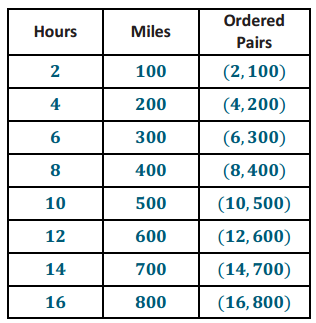
Example 1.
Dinner service starts once the train is 250 miles away from Yonkers. What is the minimum time the players will have to wait before they can have their meal?
Eureka Math Grade 6 Module 1 Lesson 14 Example Answer Key 5
Answer:
Eureka Math Grade 6 Module 1 Lesson 14 Example Answer Key 6
Eureka Math Grade 6 Module 1 Lesson 14 Problem Set Answer Key 8
The minimum time is 5 hours.

Eureka Math Grade 6 Module 1 Lesson 14 Exercise Answer Key

Exercise 1.
Create a table to show the time it will take Kelli and her team to travel from Yonkers to each town listed in the
schedule assuming that the ratio of the amount of time traveled to the distance traveled is the same for each city.
Then, extend the table to include the cumulative time it will take to reach each destination on the ride home.
Eureka Math Grade 6 Module 1 Lesson 14 Exercise Answer Key 1
Answer:
Eureka Math Grade 6 Module 1 Lesson 14 Exercise Answer Key 2

Exercise 2.
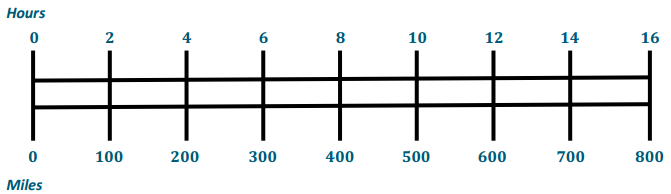
Create a double number line diagram to show the time It will take Kelli and her team to travel from Yonkers to each town listed in the schedule. Then, extend the double number line diagram to include the cumulative time it will take to reach each destination on the ride home. Represent the ratio of the distance traveled on the round trip to the amount of time taken with an equation.
Eureka Math Grade 6 Module 1 Lesson 14 Exercise Answer Key 3
Answer:
Eureka Math Grade 6 Module 1 Lesson 14 Exercise Answer Key 4

Using the information from the double number line diagram, how many miles would be traveled in one hour?
Answer:
50

How do you know?
Answer:
If the train is moving at a constant speed, half of 2 hours is 1 hour, and half of 100 miles is 50 miles.

Eureka Math Grade 6 Module 1 Lesson 14 Problem Set Answer Key

Question 1.
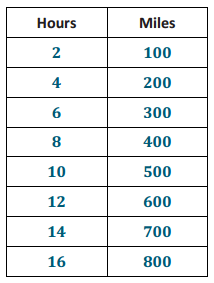
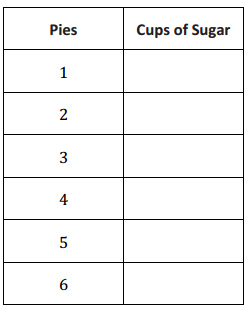
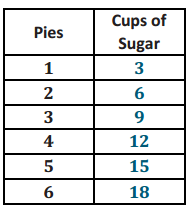
Complete the table of values to find the following:
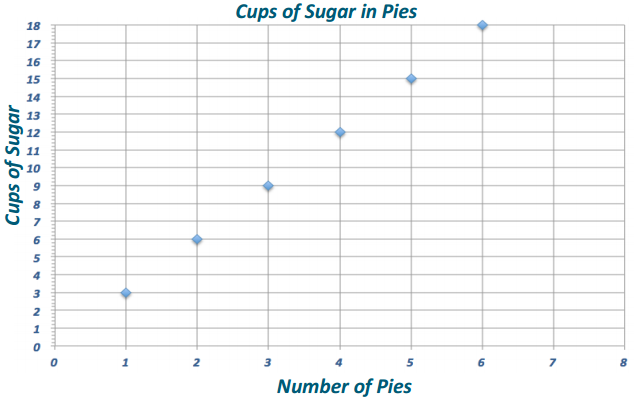
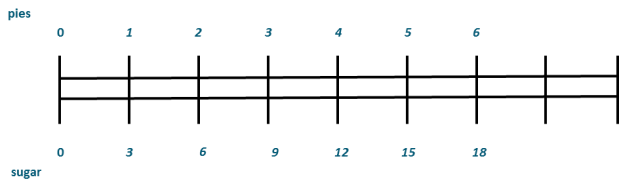
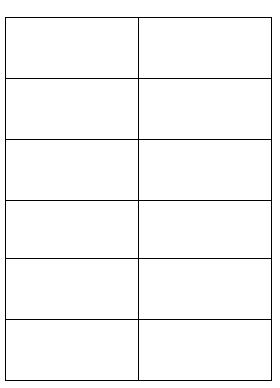
Find the number of cups of sugar needed if for each pie Karrie makes, she has to use 3 cups of sugar.
Eureka Math Grade 6 Module 1 Lesson 14 Problem Set Answer Key 8
Answer:
Eureka Math Grade 6 Module 1 Lesson 14 Problem Set Answer Key 9

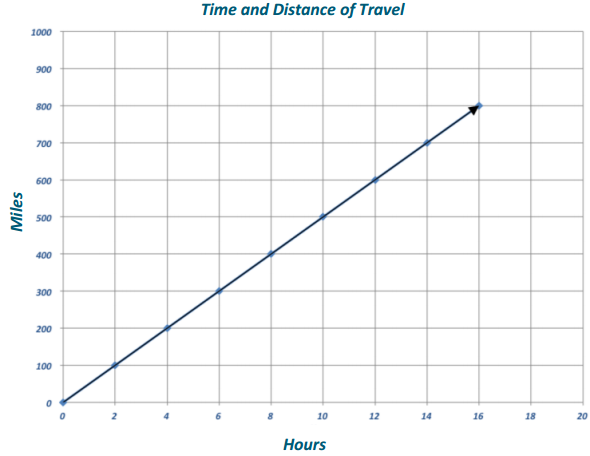
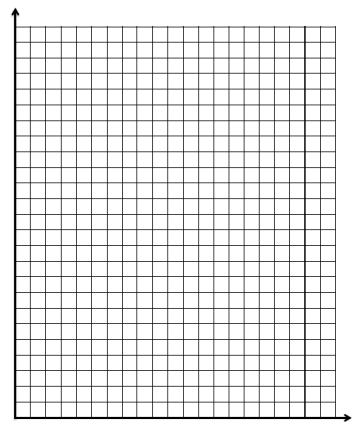
Use a graph to represent the relationship
Eureka Math Grade 6 Module 1 Lesson 14 Problem Set Answer Key 10
Answer:
Eureka Math Grade 6 Module 1 Lesson 14 Problem Set Answer Key 11

Create a double number line diagram to show the relationship.
Eureka Math Grade 6 Module 1 Lesson 14 Problem Set Answer Key 12
Answer:
Eureka Math Grade 6 Module 1 Lesson 14 Problem Set Answer Key 13

Question 2.
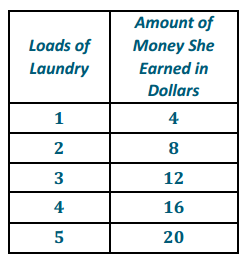
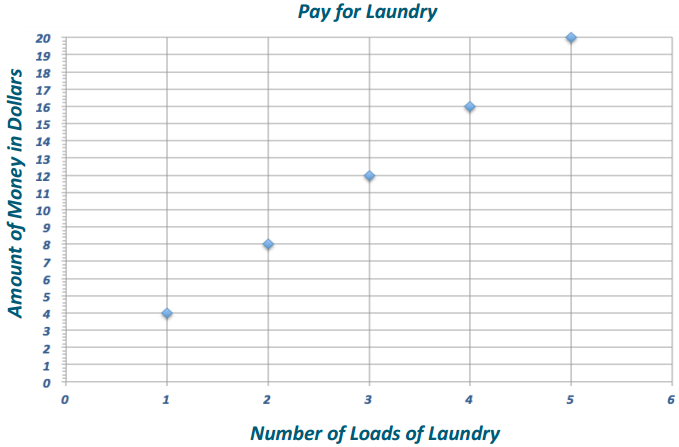
Write a story context that would be represented by the ratio 1: 4.
Answer:
Answers will vary. Example: Kendra’s mom pays her four dollars for every load of laundry she washes and dries.

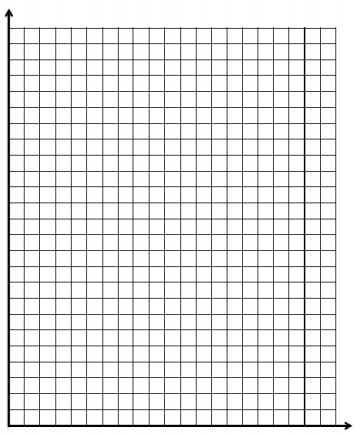
Complete a table of values for this equation and graph.
Eureka Math Grade 6 Module 1 Lesson 14 Problem Set Answer Key 14
Answer:
Eureka Math Grade 6 Module 1 Lesson 14 Problem Set Answer Key 15

Eureka Math Grade 6 Module 1 Lesson 14 Problem Set Answer Key 16
Answer:
Eureka Math Grade 6 Module 1 Lesson 14 Problem Set Answer Key 17

Eureka Math Grade 6 Module 1 Lesson 14 Exit Ticket Answer Key

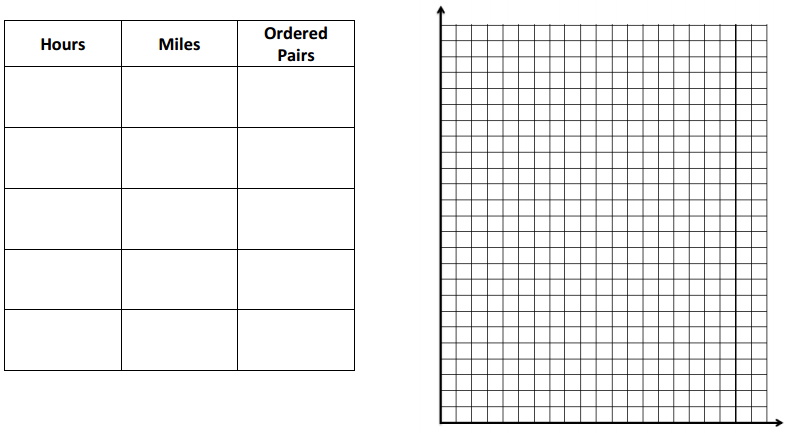
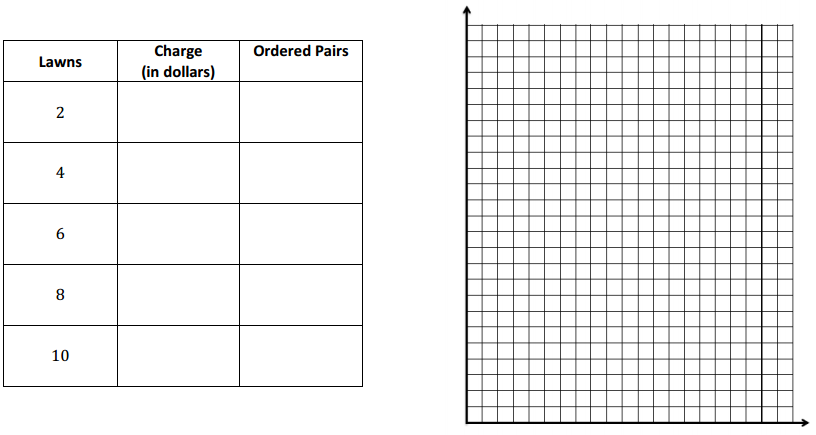
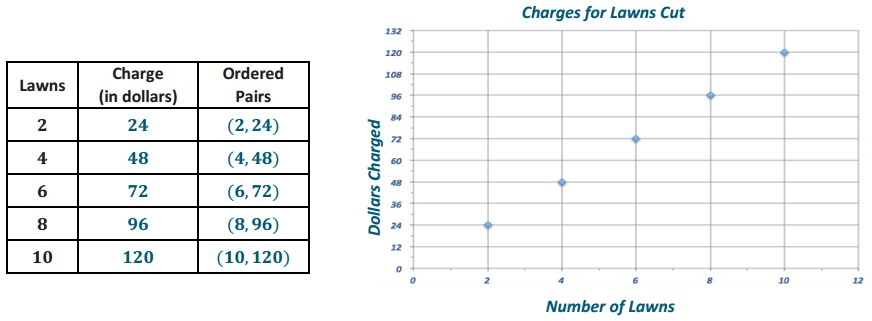
Dominic works on the weekends and on vacations from school mowing lawns in his neighborhood. For every lawn he mows, he charges $12. Complete the table. Then determine ordered pairs, and create a labeled graph.
Eureka Math Grade 6 Module 1 Lesson 14 Exit Ticket Answer Key 18
Answer:
Eureka Math Grade 6 Module 1 Lesson 14 Exit Ticket Answer Key 19

Question 1.
How many lawns wIll Dominic need to mow In order to make $240?
Answer:
20 lawns

Question 2.
How much money wIll Dominic make If he mows 9 lawns?
Answer:
$108

Eureka Math Grade 6 Module 1 Lesson 13 Answer Key

Engage NY Eureka Math 6th Grade Module 1 Lesson 13 Answer Key

Eureka Math Grade 6 Module 1 Lesson 13 Exercise Answer Key

Exercise 1
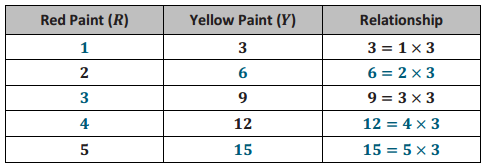
Jorge is mixing a special shade of orange paint. He mixed 1 gallon of red paint with 3 gallons of yellow paint. Based on this ratio, which of the following statements are true?

→ \(\frac{3}{4}\) of a 4 gallon mix would be yellow paint.
Answer:
True

→ Every 1 gallon of yellow paint requires \(\frac{1}{3}\) gallon of red paint. .
Answer:
True

→ Every 1 gallon of red paint requires 3 gallons of yellow paint.
Answer:
True

→ There is 1 gallon of red paint in a 4-gallon mix of orange paint,
Answer:
True

→ There are 2 gallons of yellow paint in an 8-gallon mix of orange paint.
Answer:
False

Use the space below to determine If each statement is true or false.

Eureka Math Grade 6 Module 1 Lesson 13 Exercise Answer Key 1
Answer:
Allow students to discuss each question with a partner or group. When the class comes back together as a whole group, each group is responsible for explaining to the class one of the statements and whether the group feels the statement is true or false and why. (The first four statements are true while the fifth statement is false. To be made true, the fifth statement should read “There are 6 gallons of yellow paint in an 8 galIon mix of orange paint.”)

Exercise 2.
Based on the information on red and yellow paint given in Exercise 1, complete the table below.
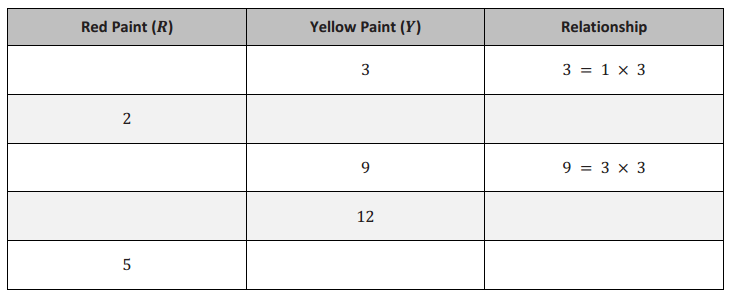
Eureka Math Grade 6 Module 1 Lesson 13 Exercise Answer Key 2
Answer:
Eureka Math Grade 6 Module 1 Lesson 13 Exercise Answer Key 3

Exercise 3
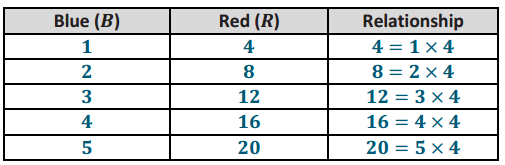
a. Jorge now plans to mix red paint and blue paint to create purple paint. The color of purple he has decided to make combines red paint and blue paint in the ratio 4: 1. If Jorge can only purchase paint in one gallon containers, construct a ratio table for all possible combinations for red and blue paint that will give Jorge no more than 25 gallons of purple paint.
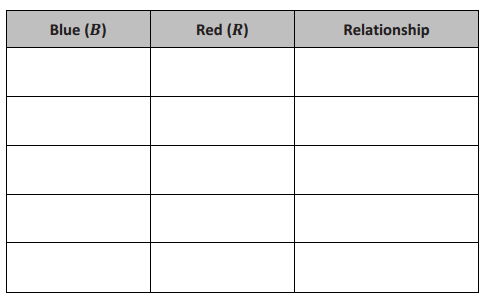
Eureka Math Grade 6 Module 1 Lesson 13 Exercise Answer Key 4
Answer:
Eureka Math Grade 6 Module 1 Lesson 13 Exercise Answer Key 5

Write an equation that will let Jorge calculate the amount of red paint he will need for any given amount of blue paint.
Answer:
R = 4B

Write an equation that will let Jorge calculate the amount of blue paint he will need for any given amount o
red paint.
Answer:
B = \(\frac{1}{4}\)R

If Jorge has 24 gallons of red paint, how much blue paint will he have to use to create the desired color of purple?
Answer:
Jorge will have to use 6 gallons of blue paint.

If Jorge has 24 gallons of blue paint, how much red paint will he have to use to create the desired color of purple?
Answer:
Jorge will have to use 96 gallons of red paint.

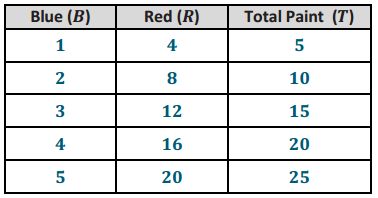
b. Using the same relationship of red to blue from above, create a table that models the relationship of the three colors blue, red, and purple (total) paint. Let B represent the number of gallons of blue paint, let R represent the number of gallons of red paint, and let T represent the total number of gallons of (purple) paint. Then write an equation that models the relationship between the blue paint and the total amount of paint, and answer the questions.
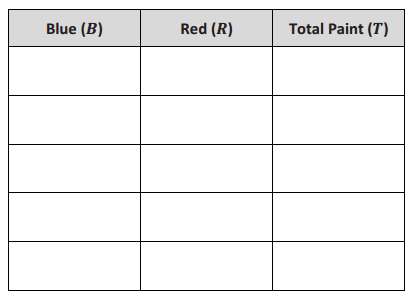
Eureka Math Grade 6 Module 1 Lesson 13 Exercise Answer Key 6
Answer:
Eureka Math Grade 6 Module 1 Lesson 13 Exercise Answer Key 7

Equation:
Answer:
T = 5B

Value of the ratio of total paint to blue paint:
Answer:
\(\frac{5}{1}\)

How is the value of the ratio related to the equation?
Answer:
The value of the ratio is used to determine the total paint value by multiplying it with the blue paint value.

Exercise 4.
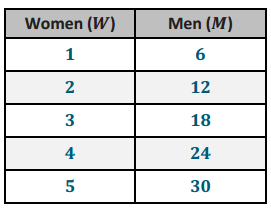
During a particular U.S. Air Force training exercise, the ratio of the number of men to the number of women was 6: 1. Use the ratio table provided below to create at least two equations that model the relationship between the number of men and the number of women participating in this training exercise.
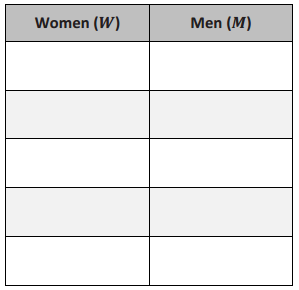
Eureka Math Grade 6 Module 1 Lesson 13 Exercise Answer Key 8
Answer:
Eureka Math Grade 6 Module 1 Lesson 13 Exercise Answer Key 9

Equations:
Answer:
M = 6w
W = \(\left(\frac{1}{6}\right)\)M
\(\frac{M}{W}\) = 6
\(\frac{W}{M}\) = \(\frac{1}{6}\)

If 200 women participated in the training exercise, use one of your equations to calculate the number of men who participated.
Answer:
I can substitute 200 for the value of women and multiply by 6, the value of the ratio, to get the number of men. There would be 1,200 men participating in the training exercise.

Exercise 5.
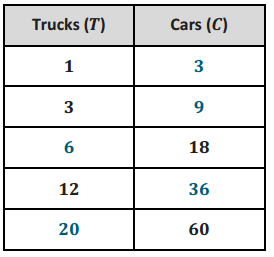
Malia is on a road trip. During the first five minutes of Malia’s trip, she sees 18 cars and 6 trucks. Assuming this ratio of cars to trucks remains constant over the duration of the trip, complete the ratio table using this comparison. Let T represent the number of trucks she sees, and let C represent the number of cars she sees.
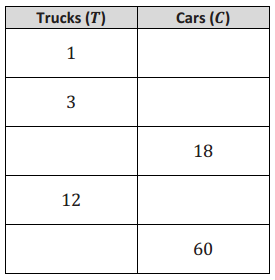
Eureka Math Grade 6 Module 1 Lesson 13 Exercise Answer Key 10
Answer:
Eureka Math Grade 6 Module 1 Lesson 13 Exercise Answer Key 11

What is the value of the ratio of the number of cars to the number of trucks?
Answer:
\(\frac{3}{1}\)

What equation would model the relationship between cars and trucks?
Answer:
C = 3T and T = \(\left(\frac{1}{3}\right)\)C

At the end of the trip, Malla had counted 1, 254 trucks. How many cars did she see?
Answer:
C = 1,254.3; C = 3, 762 cars

Exercise 6
Kevin is training to run a half-marathon. His training program recommends that he run for 5 minutes and walk for 1 minute. Let R represent the number of minutes running, and let W represent the number of minutes walking.

Eureka Math Grade 6 Module 1 Lesson 13 Exercise Answer Key 12
Answer:
Eureka Math Grade 6 Module 1 Lesson 13 Exercise Answer Key 13

What is the value of the ratio of the number of minutes walking to the number of minutes running?
Answer:
\(\frac{1}{5}\)

What equation could you use to calculate the minutes spent walking if you know the minutes spent running?
Answer:
W = \(\frac{1}{5}\)R; Answers will vary.

Eureka Math Grade 6 Module 1 Lesson 13 Problem Set Answer Key

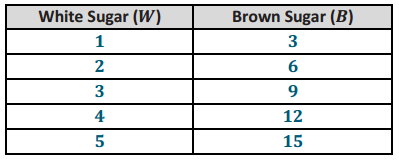
A cookie recipe calls for 1 cup of white sugar and 3 cups of brown sugar.
Make a table showing the comparison of the amount of white sugar to the amount of brown sugar.
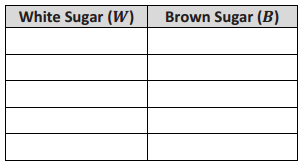
Eureka Math Grade 6 Module 1 Lesson 13 Problem Set Answer Key 14
Answer:
Eureka Math Grade 6 Module 1 Lesson 13 Problem Set Answer Key 15

Question 1.
Write the value of the ratio of the amount of white sugar to the amount of brown sugar.
Answer:
\(\frac{1}{3}\)

Question 2.
Write an equation that shows the relationship of the amount of white sugar to the amount of brown sugar.
Answer:
B = 3W or W = \(\frac{1}{3}\) B

Question 3.
Explain how the value of the ratio can be seen In the table.
Answer:
The values in the first row show the values in the ratio. The ratio of the amount of brown sugar to the amount of white sugar is 3: 1. The value of the ratio is \(\frac{3}{1}\).

Question 4.
Explain how the value of the ratio can be seen in the equation.
Answer:
The amount of brown sugar is represented as B in the equation. The amount of white sugar is represented as W. The value is represented because the amount of brown sugar is three times as much as the amount of white sugar, or B = 3W.

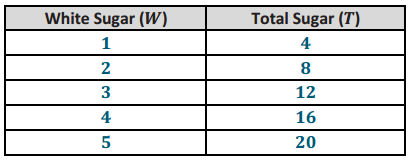
Using the same recipe, compare the amount of white sugar to the amount of total sugars used in the recipe.
Make a table showing the comparison of the amount of white sugar to the amount of total sugar.
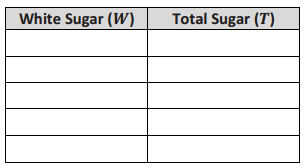
Eureka Math Grade 6 Module 1 Lesson 13 Problem Set Answer Key 16
Answer:
Eureka Math Grade 6 Module 1 Lesson 13 Problem Set Answer Key 17

Question 5.
Write the value of the ratio of the amount of total sugar to the amount of white sugar.
Answer:
\(\frac{4}{1}\)

Question 6.
Write an equation that shows the relationship of total sugar to white sugar.
Answer:
T = 4W

Eureka Math Grade 6 Module 1 Lesson 13 Exit Ticket Answer Key

Question 1.
A carpenter uses four nails to install each shelf. Complete the table to represent the relationship between the number of nails (N) and the number of shelves (S). Write the ratio that describes the number of nails per number of shelves. Write as many different equations as you can that describe the relationship between the two quantities.

Shelves
(s)
Nails
(N)
14
2
12
16
5

Answer:

Shelves
(s)
Nails
(N)
14
28
312
416
520

\(\left(\frac{N}{S}\right)=\left(\frac{4}{1}\right)\)
Equations:
N = 4s
S = \(\left(\frac{1}{4}\right)\)N
Eureka Math Grade 6 Module 1 Lesson 12 Answer Key

Engage NY Eureka Math 6th Grade Module 1 Lesson 12 Answer Key

Eureka Math Grade 6 Module 1 Lesson 12 Exercise Answer Key

Exercise 2.
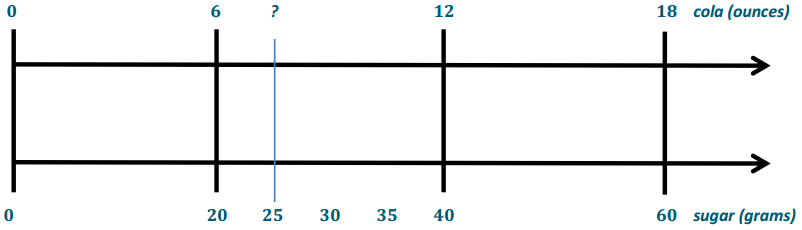
The amount of sugary beverages Americans consume is a leading health concern. For a given brand of cola, a 12 oz. serving of cola contains about 40 g of sugar. Complete the ratio table, using the given ratio to find equivalent ratios.
Eureka Math Grade 6 Module 1 Lesson 12 Exercise Answer Key 1
Answer:
Answers may vary but are found by either multiplying or dividing both 12 and 40 by the same number.

Exercise 3.
A 1 L bottle of cola contains approximately 34 fluid ounces. How many grams of sugar would be in a 1 L bottle of the cola? Explain and show how to arrive at the solution.
Answer:
Eureka Math Grade 6 Module 1 Lesson 12 Exercise Answer Key 2

Exercise 4.
A school cafeteria has a restriction on the amount of sugary drinks available to students. Drinks may not have more than 25 g of sugar. Based on this restriction, what is the largest size cola (in ounces) the cafeteria can offer to students?
Answer:
Eureka Math Grade 6 Module 1 Lesson 12 Exercise Answer Key 3
My estimate is between 6 and 12 oz. but closer to 6 ounces. I need to find \(\frac{1}{4}\) of 6 and add it to 6.
\(\frac{1}{4} \times \frac{6}{1}=\frac{6}{4}=1 \frac{1}{2}\)
6 + 1\(\frac{1}{2}\) = 7\(\frac{1}{2}\)
As 7\(\frac{1}{2}\) oz. cola is the largest size that the school cafeteria can offer to students.

Exercise 5.
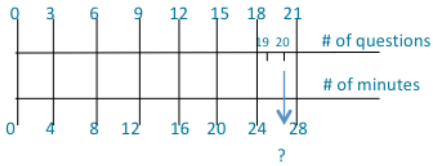
Shontelle solves three math problems in four minutes.
a. Use this information to complete the table below.
Eureka Math Grade 6 Module 1 Lesson 12 Exercise Answer Key 4
Answer:
Eureka Math Grade 6 Module 1 Lesson 12 Exercise Answer Key 7

b. Shontelle has soccer practice on Thursday evening. She has a half hour before practice to work on her math homework and to talk to her friends. She has 20 math skill-work questions for homework, and she wants to complete them before talking with her friends. How many minutes will Shontelle have left after completing her math homework to talk to her friends?
Use a double number line diagram to support your answer, and show all work.
Answer:
Eureka Math Grade 6 Module 1 Lesson 12 Exercise Answer Key 5
Step 1: \(\frac{2}{3} \times 4=\frac{8}{3}=2 \frac{2}{3}\)
Step 2: \(24+2 \frac{2}{3}=26 \frac{2}{3}\)
Step 3: \(30-26 \frac{2}{3}=3 \frac{1}{3}\)
Shontelle can talk to her friends for 3\(\frac{1}{3}\) minutes.

Eureka Math Grade 6 Module 1 Lesson 12 Problem Set Answer Key

Question 1.
While shopping, Kyla found a dress that she would like to purchase, but it costs $52.25 more than she has. Kyla charges $5.50 an hour for babysitting. She wants to figure out how many hours she must babysit to earn $52.25 to buy the dress. Use a double number line to support your answer.
Answer:
9.5 hours

Question 2.
Frank has been driving at a constant speed for 3 hours, during which time he traveled 195 miles. Frank would like to know how long it will take him to complete the remaining 455 miles, assuming he maintains the same constant speed. Help Frank determine how long the remainder of the trip will take. Include a table or diagram to support your answer.
Answer:
7 hours

Eureka Math Grade 6 Module 1 Lesson 12 Exit Ticket Answer Key

Question 1.
Kyra is participating in a fundraiser walk-a-thon. She walks 2 miles in 30 minutes. If she continues to walk at the same rate, determine how many minutes it will take her to walk 7 miles. Use a double number line diagram to support your answer.
Answer:
Eureka Math Grade 6 Module 1 Lesson 12 Exit Ticket Answer Key 6
It will take kyra 105 minutes to walk 7 miles.

Eureka Math Grade 6 Module 1 Lesson 11 Answer Key

Engage NY Eureka Math 6th Grade Module 1 Lesson 11 Answer Key

Eureka Math Grade 6 Module 1 Lesson 11 Example Answer Key

Example 1.
Create four equivalent ratios (2 by scaling up and 2 by scaling down) using the ratio 30 to 80.
Answer:
There are various possible answers.
Some examples of scaling down are 3: 8, 6: 16, 9: 24, 12: 32, 15: 40, 18: 48, 21: 56, 24: 64, and 27: 72.
Some examples of scaling up are 60: 160, 90: 240, 120: 320, etc.

Write a ratio to describe the relationship shown in the table.

HoursNumbers of Pizzas Sold
216
540
648
1080

Answer:
The ratio used to create the table is 1:8, which means that there are 8 pizzas being sold every hour.

Eureka Math Grade 6 Module 1 Lesson 11 Exercise Answer Key

Exercise 1
The following tables show how many words each person can text in a given amount of time. Compare the rates of texting for each person using the ratio table.

Michaela
Eureka Math Grade 6 Module 1 Lesson 11 Exercise Answer Key 1

Jenna
Eureka Math Grade 6 Module 1 Lesson 11 Exercise Answer Key 2

Maria
Eureka Math Grade 6 Module 1 Lesson 11 Exercise Answer Key 3
Answer:
Michaela texts the fastest because she texts 50 words per minute, next is Jenna who texts 45 words per minute, and last is Maria who texts 40 words per minute.

Complete the table so that it shows Max has a texting rate of 55 words per minute.

Max
Eureka Math Grade 6 Module 1 Lesson 11 Exercise Answer Key 4
Answer:
Eureka Math Grade 6 Module 1 Lesson 11 Exercise Answer Key 5

Exercise 2:
Making Juice (Comparing Juice to Water)

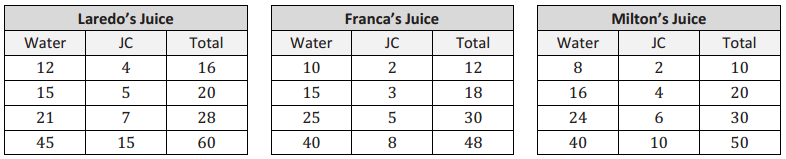
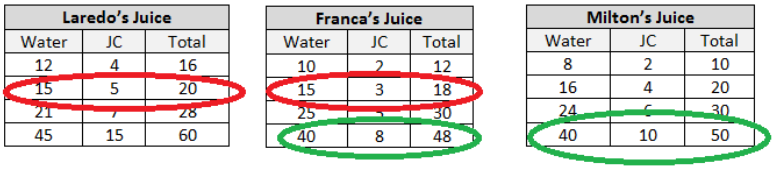
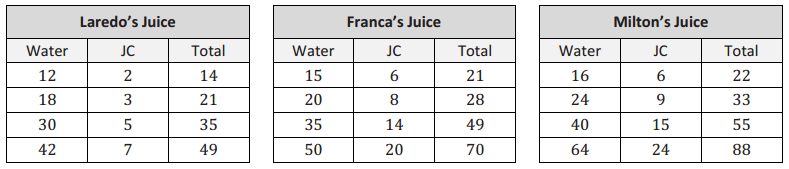
a. The tables below show the comparison of the amount of water to the amount of juice concentrate (JC) in grape juice made by three different people. Whose juice has the greatest water-to-juice concentrate ratio, and whose juice would taste strongest? Be sure to justify your answer.
Answer:
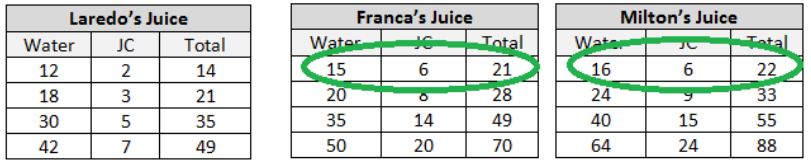
Franca’s juice has the greatest amount of water in comparison to juice concentrate, followed by Milton, and then Laredo, Because Laredo’s juice has the least amount of water in comparison to juice concentrate, his juice would taste the strongest.

Eureka Math Grade 6 Module 1 Lesson 11 Exercise Answer Key 6
Answer:
Eureka Math Grade 6 Module 1 Lesson 11 Exercise Answer Key 7

Put the juices in order from the juice containing the most water to the juice containing the least water.
Answer:
Franca, Milton, Laredo

Explain how you used the values in the table to determine the order.
Answer:
Laredo makes his juice by combining three cups of water for every one cup of juice concentrate.
Franca makes her juice by combining five cups of water for every one cup of juice concentrate.
Milton makes his juice by combining four cups of water for every one cup of juice concentrate.

What ratio was used to create each table?
Answer:
Laredo 3: 1, Franca 5: 1, Milton 4: 1

Explain how the ratio could help you compare the juices.
Answer:
Answers will vary.

b. The next day, each of the three people made juice again, but this time they were making apple juice. Whose juice has the greatest water-to-juice concentrate ratio, and whose juice would taste the strongest? Be sure to justify your answer.
Eureka Math Grade 6 Module 1 Lesson 11 Exercise Answer Key 8
Answer:
Eureka Math Grade 6 Module 1 Lesson 11 Exercise Answer Key 9

Put the Juices in order from the strongest apple taste to the weakest apple taste.
Answer:
Franca, Milton, Laredo

Explain how you used the values in the table to determine the order.
Answer:
Answers will vary.

What ratio was used to create each table?
Answer:
Laredo: 6: 1, Franca: 5: 2, Milton: 8: 3

Explain how the ratio could help you compare the juices.
Answer:
Answers will vary.

How was this problem different than the grape juice questions in part (a)?
Answer:
Answers will vary.

c. Max and Sheila are making orange juice. Max has mixed 15 cups of water with 4 cups of juice concentrate. Sheila has made her juice by mixing 8 cups water with 3 cups of juice concentrate. Compare the ratios of juice concentrate to water using ratio tables. State which beverage has a higher juice concentrate-to-water ratio.
Answer:
Eureka Math Grade 6 Module 1 Lesson 11 Exercise Answer Key 10
Sheila has a higher juice concentrate-to-water ratio because she mixed 12 cups of juice concentrate to only 32 cups of water. Max’s juice would be more watery because he would have 45 cups of water with the 12 cups of juice concentrate.

d. Victor is making recipes for smoothies. His first recipe calls for 2 cups of strawberries and 7 cups of other ingredients. His second recipe says that 3 cups of strawberries are combined with 9 cups of other Ingredients. Which smoothie recipe has more strawberries compared to other ingredients? Use ratio tables to justify your answer.
Answer:
Recipe 2 has more strawberries compared to other ingredients.
Eureka Math Grade 6 Module 1 Lesson 11 Exercise Answer Key 11
Recipe 2 has more strawberries compared to the other ingredients. When comparing 6 cups of strawberries, there were fewer other ingredients added in Recipe 2 than in Recipe 1.

Eureka Math Grade 6 Module 1 Lesson 11 Problem Set Answer Key

Question 1.
Sarah and Eva were swimming.
a. Use the ratio tables below to determine who the faster swimmer is.

Sarah
Eureka Math Grade 6 Module 1 Lesson 11 Problem Set Answer Key 12

Eva
Eureka Math Grade 6 Module 1 Lesson 11 Problem Set Answer Key 13
Answer:
Eva is the faster swimmer because she swims 26 meters in 1 minute, which is faster than Sarah who swims 25 meters in 1 minute.

b. Explain the method that you used to determine your answer.
Answer:
Answers will vary.

Question 2.
A 120 lb. person would weigh about 20 lb. on the earth’s moon. A 150 lb. person would weigh about 28 lb. on lo, a moon of Jupiter. Use ratio tables to determine which moon would make a person weigh the most.
Answer:
Answers will vary. A person on lo will weigh more than a person on our moon.

Eureka Math Grade 6 Module 1 Lesson 11 Exit Ticket Answer Key

Question 1.
Beekeepers sometimes supplement the diet of honey bees with sugar water to help promote colony growth in the spring and help the bees survive through fall and winter months. The tables below show the amount of water and the amount of sugar used in the Spring and in the Fall.
Eureka Math Grade 6 Module 1 Lesson 11 Exit Ticket Answer Key 14

Write a sentence that compares the ratios of the number of cups of sugar to the number of cups of water in each table.
Answer:
The value of the ratio for the Spring sugar water is \(\frac{1.5}{1}\), while the value of the ratio of the Fall sugar water is \(\frac{2}{1}\). Therefore, the Fall sugar water mixture has more sugar mixed in for every cup of water added to the mixture than the Spring sugar water mixture.

Explain how you determined your answer.
Answer:
Spring: \(\frac{6}{4}\) = \(\frac{3}{2}\) = \(\frac{1.5}{1}\)
Fall: \(\frac{4}{2}\) = \(\frac{2}{1}\)

Eureka Math Grade 6 Module 1 Lesson 10 Answer Key

Engage NY Eureka Math 6th Grade Module 1 Lesson 10 Answer Key

Eureka Math Grade 6 Module 1 Lesson 10 Exploratory Challenge Answer Key

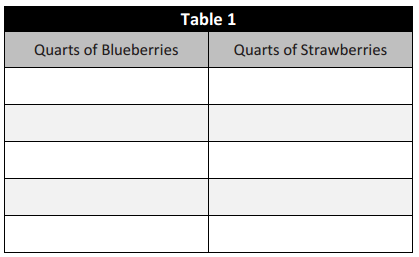
Imagine that you are making a fruit salad. For every quart of blueberries you add, you would like to put in 10 quarts of strawberries. Create three ratio tables that show the amounts of blueberries and strawberries you would use If you needed to make fruit salad for greater numbers of people.
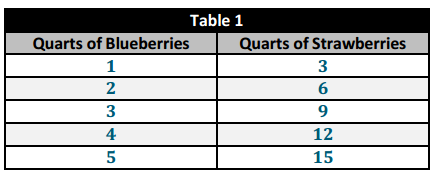
Table 1 should contain amounts where you have added fewer than 10 quarts of blueberries to the salad.
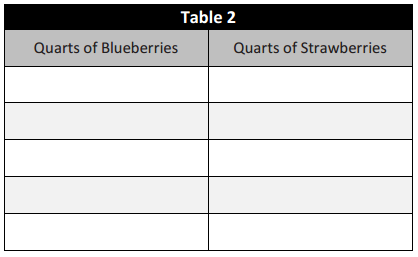
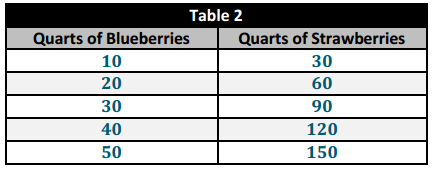
Table 2 should contain amounts of blueberries between and including 10 and 50 quarts.
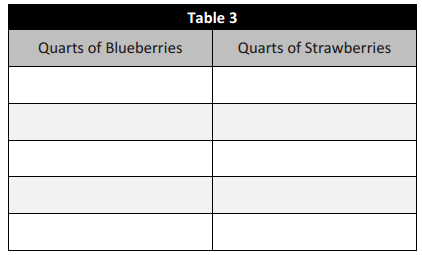
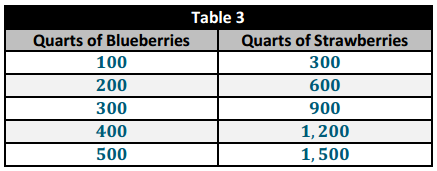
Table 10 should contain amounts of blueberries greater than or equal to 100 quarts.
Answer:
Student answers may vary. Here are possible solutions:

Eureka Math Grade 6 Module 1 Lesson 10 Exploratory Challenge Answer Key 1
Answer:
Eureka Math Grade 6 Module 1 Lesson 10 Exploratory Challenge Answer Key 2

Eureka Math Grade 6 Module 1 Lesson 10 Exploratory Challenge Answer Key 3
Answer:
Eureka Math Grade 6 Module 1 Lesson 10 Exploratory Challenge Answer Key 4

Eureka Math Grade 6 Module 1 Lesson 10 Exploratory Challenge Answer Key 5
Answer:
Eureka Math Grade 6 Module 1 Lesson 10 Exploratory Challenge Answer Key 6

The answers to the questions will depend on the variation of the table that students have created.

a. Describe any patterns you see in the tables. Be specific in your descriptions.
Answer:
The value in the second column is always three times as much as the corresponding value in the first column. In the first table, the entries in the first column increase by 1, and the entries in the second column increase by 3. In the second table, the entries in the first column increase by 10, and the entries in the second column increase by 30. In the third table, the entries in the first column increase by 100, and the entries in the second column increase by 300.

b. How are the amounts of blueberries and strawberries related to each other?
Answer:
The amount of strawberries is always three times the amount of blueberries. Students could also respond that the ratio of the number of quarts of blueberries to the number of quarts of strawberries is always equivalent to 1:3.

c. How are the values in the Blueberries column related to each other?
Answer:
Answers will vary. However, students could use the chart paper and write on the table to see the patterns. Most tables should have addition repeating throughout.

d. How are the values in the Strawberries column related to each other?
Answer:
Answers will vary. However, students could use the chart paper and write on the table to see the patterns. Most tables should have addition repeating throughout.

e. If we know we want to add 7 quarts of blueberries to the fruit salad in Table 1, how can we use the table to help us determine how many strawberries to add?
Answer:
We could extend our table until we get to 7 in the blueberry column.

f. If we know we used 70 quarts of blueberries to make our salad, how can we use a ratio table to find out how many quarts of strawberries were used?
Answer:
We could start with the ratio 1: 3 that was given in the description and then multiply by ten to get 10 and 30. These would be the first values in our table. Then, we would count up by tens in the Blueberries column and count up by 30’s in the Strawberries column.

Eureka Math Grade 6 Module 1 Lesson 10 Exercise Answer Key

Exercise 1.
The following tables were made incorrectly. Find the mistakes that were made, create the correct ratio table, and state the ratio that was used to make the correct ratio table.
a.
Eureka Math Grade 6 Module 1 Lesson 10 Exercise Answer Key 7
Answer:
Eureka Math Grade 6 Module 1 Lesson 10 Exercise Answer Key 8

b.
Eureka Math Grade 6 Module 1 Lesson 10 Exercise Answer Key 9
Answer:
Eureka Math Grade 6 Module 1 Lesson 10 Exercise Answer Key 10

Eureka Math Grade 6 Module 1 Lesson 10 Problem Set Answer Key

Question 1.
a. Create a ratio table for making lemonade with a lemon juice-to-water ratio of 1: 3. Show how much lemon juice would be needed if you use 36 cups of water to make lemonade.
Answer:

Lemon Juice (cups)Water (cups)
13
26
39
412
1236

12 cups of lemon Juice would be needed if 36 cups of water is used.

b. How is the value of the ratio used to create the table?
Answer:
The value of the ratio is \(\frac{1}{3}\). If we know the amount of lemon juice, we can multiply that amount by 3 to get the amount of water. If we know the amount of water, we can multiply that amount by \(\frac{1}{3}\) (or divide by 3) to get the amount of lemon juice.

Question 2.
Ryan made a table to show how much blue and red paint he mixed to get the shade of purple he will use to paint the room. He wants to use the table to make larger and smaller batches of purple paint.

BlueRed
123
205
287
369

a. What ratio was used to create this table? Support your answer.
Answer:
The ratio of the amount of blue paint to the amount of red point is 4: 1. I know this because 12: 3, 20: 5, 28: 7, and 36:9 are all equivalent to 4: 1.

b. How are the values in each row related to each other?
Answer:
In each row, the amount of red paint is \(\frac{1}{4}\) times the amount of blue paint, or the amount of blue paint is 4 times the amount of red paint.

c. How are the values in each column related to each other?
Answer:
The values in the columns are increasing using the ratio. Since the ratio of the amount of blue paint to the amount of red paint is 4: 1, we have used 4 × 2: 1 × 2, or 8: 2, and repeatedly added to form the table. 8 was added to the entries in the blue column while 2 was added to the entries in the red column.

Eureka Math Grade 6 Module 1 Lesson 10 Exit Ticket Answer Key

Question 1.
Show more than one way you could use the structure of the table to find the unknown value. Fill in the unknown values.

Number of WeeksAmount of Money in Account
2$350
4$700
6$1,050
8
10

Answer:

Number of WeeksAmount of Money in Account
2$350
4$700
6$1,050
8$1,400
10$1,750

I can add two to the weeks each time to get the next number. I can add $350 to the money to get the next values.

In the rows, we have 2:350, which is equal to 1: 175. So the money is 175 times larger than the week. I can just multiply the week by 175 to get the amount of money in the account.

The ratio used to create the table was 1: 175.

Eureka Math Grade 6 Module 1 Lesson 9 Answer Key

Engage NY Eureka Math 6th Grade Module 1 Lesson 9 Answer Key

Eureka Math Grade 6 Module 1 Lesson 9 Example Answer Key

Example 1.
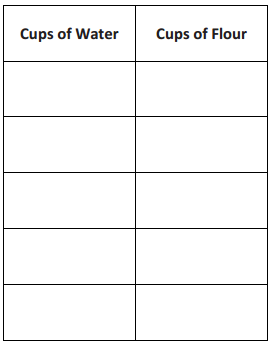
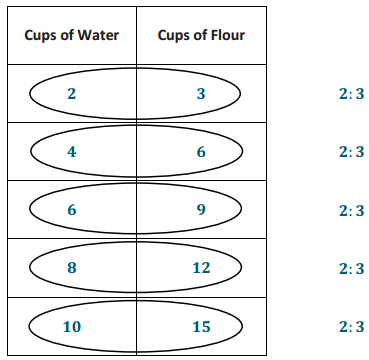
To make paper mache, the art teacher mixes water and flour. For every two cups of water, she needs to mix in three cups of flour to make the paste.
Find equivalent ratios for the ratio relationship 2 cups of water to 3 cups of flour. Represent the equivalent ratios in the table below:
Eureka Math Grade 6 Module 1 Lesson 9 Example Answer Key 1
Answer:
Eureka Math Grade 6 Module 1 Lesson 9 Example Answer Key 2

Example 2.
Javier has a new job designing websites. He is paid at a rate of $700 for every 3 pages of web content that he builds. Create a ratio table to show the total amount of money Javier has earned in ratio to the number of pages he has built.
Eureka Math Grade 6 Module 1 Lesson 9 Example Answer Key 3
Answer:
Eureka Math Grade 6 Module 1 Lesson 9 Example Answer Key 4

Javier is saving up to purchase a used car that costs $4,200. How many web pages will Javier need to build before he can pay for the car?
Answer:
Javier will need to build 18 web pages in order to pay for the car.

Eureka Math Grade 6 Module 1 Lesson 9 Exercise Answer Key

Exercise 1.
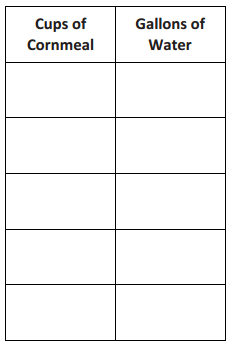
Spraying plants with cornmeal juice is a natural way to prevent fungal growth on the plants. It is made by soaking cornmeal in water, using two cups of cornmeal for every nine gallons of water. Complete the ratio table to answer the questions that follow.
Eureka Math Grade 6 Module 1 Lesson 9 Problem Set Answer Key 11
Answer:

Cups of CornmealGallons of Water
29
418
627
836
1045

a. How many cups of cornmeal should be added to 45 gallons of water?
Answer:
10 cups of cornmeal should be added t0 45 gallons of water.

b. Paul has only 8 cups of cornmeal. How many gallons of water should he add if he wants to make as much cornmeal juice as he can?
Answer:
Paul should add 36 gallons of water.

c. What can you say about the values of the ratios in the table?
Answer:
The values of the ratios are equivalent.

Exercise 2.
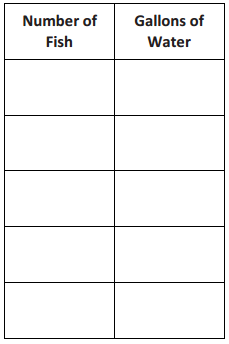
James is setting up a fish tank. He is buying a breed of goldfish that typically grows to be 12 inches long, It is recommended that there be 1 gallon of water for every inch of fish length in the tank. What is the recommended ratio of gallons of water per fully-grown goldfish in the tank?
Complete the ratio table to help answer the following questions:
Eureka Math Grade 6 Module 1 Lesson 9 Problem Set Answer Key 12
Answer:

Number of FishGallons of Water
112
224
336
448
560

a. What size tank (in gallons) Is needed for James to have 5 full-grown goldfish?
Answer:
James needs a tank that holds 60 gallons of water in order to have 5 full-grown goldfish.

b. How many full-grown goldfish can go in a 40-gallon tank?
Answer:
3 full-grown goldfish can go in a 40-gallon tank.

c. What can you say about the values of the ratios in the table?
Answer:
The values of the ratios are equivalent.

Eureka Math Grade 6 Module 1 Lesson 9 Problem Set Answer Key

Assume each of the following represents a table of equivalent ratios. Fill in the missing values. Then choose one of the tables, and create a real-world context for the ratios shown in the table.

Question 1.
Eureka Math Grade 6 Module 1 Lesson 9 Problem Set Answer Key 5
Answer:
Eureka Math Grade 6 Module 1 Lesson 9 Problem Set Answer Key 6

Question 2.
Eureka Math Grade 6 Module 1 Lesson 9 Problem Set Answer Key 7
Answer:
Eureka Math Grade 6 Module 1 Lesson 9 Problem Set Answer Key 8

Question 3.
Eureka Math Grade 6 Module 1 Lesson 9 Problem Set Answer Key 9
Answer:
Eureka Math Grade 6 Module 1 Lesson 9 Problem Set Answer Key 10

Eureka Math Grade 6 Module 1 Lesson 9 Exit Ticket Answer Key

Question 1.
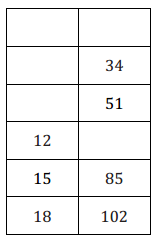
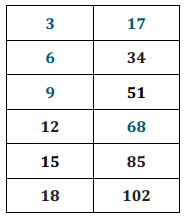
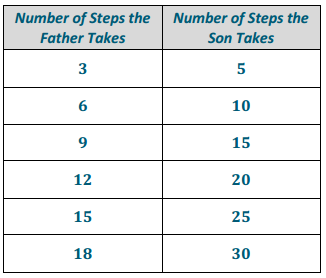
A father and his young toddler are walking along the sidewalk. For every 3 steps the father takes, the son takes 5 steps just to keep up. What is the ratio of the number of steps the father takes to the number of steps the son takes? Add labels to the columns of the table, and place the ratio into the first row of data. Add equivalent ratios to build a ratio table.
Eureka Math Grade 6 Module 1 Lesson 9 Exit Ticket Answer Key 11
Answer:
Eureka Math Grade 6 Module 1 Lesson 9 Exit Ticket Answer Key 12

What can you say about the values of the ratios in the table?
Answer:
The values of the ratios in the table should all be equal since the ratios in the table are equivalent.

Eureka Math Grade 6 Module 1 Lesson 8 Answer Key

Engage NY Eureka Math 6th Grade Module 1 Lesson 8 Answer Key

Eureka Math Grade 6 Module 1 Lesson 8 Exercise Answer Key

Exercise 1
Circle any equivalent ratios from the list below.
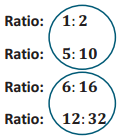
Ratio: 1: 2
Ratio: 5: 10
Ratio: 6: 16
Ratio: 12: 32
Answer:
Eureka Math Grade 6 Module 1 Lesson 8 Exercise Answer Key 1

Revisit this when discussing the value of the equivalent ratios.

Find the value of the following ratios, leaving your answer as a fraction, but rewrite the fraction using the largest possible unit.
Ratio: 1: 2             Value of the Ratio:
Ratio: 5: 10            Value of the Ratio:
Ratio: 6: 16             Value of the Ratio:
Ratio: 12: 32           Value of the Ratio:
Answer:
Ratio: 1: 2           Value of the Ratio: \(\frac{1}{2}\)
Ratio: 5: 10          Value of the Ratio: \(\frac{1}{2}\)
Ratio: 6: 16           Value of the Ratio: \(\frac{3}{8}\)
Ratio: 12: 32          Value of the Ratio: \(\frac{3}{8}\)

What do you notice about the value of the equivalent ratios?
Answer:
The value of the ratio is the same for equivalent ratios.

Exercise 2
Here is a theorem: If A: B with B ≠ 0 and C: D with D ≠ 0 are equivalent, then they have the same value: \(\frac{A}{B}=\frac{C}{D}\). This is essentially stating that if two ratios are equivalent, then their values are the same (when they have values). Can you provide any counterexamples to the theorem above?
Answer:
Allow students to try this in pairs. Observe the progress of students and question students’ counterexamples. Ask for further clarification or proof that the two ratios are equivalent but do not have the same value. If students still think they have discovered a counterexample, share the example with the class and discuss why it is not a counterexample.

Ask entire class if anyone thought of a counterexample. If students share examples, have others explain why they are not counterexamples. Then discuss why there are no possible counterexamples to the given theorem. It is important for students to understand that the theorem is always true, so it is not possible to come up with a counterexample.

Exercise 3
Taivon is training for a duathlon, which is a race that consists of running and cycling. The cycling leg is longer than the running leg of the race, so while Taivon trains, he rides his bike more than he runs. During training, Taivon runs 4 miles for every 14 miles he rides his bike.

a. Identify the ratio associated with this problem and find its value.
Answer:
The ratio of the number of miles he ran to the number of miles he cycled is 4: 14, and the value of the ratio is \(\frac{2}{7}\) The ratio of the number of miles he cycled to the number of miles he ranis 14: 4, and the value of the ratio is \(\frac{7}{2}\).

Use the value of each ratio to solve the following.

b. When Taivon completed all of his training for the duathlon, the ratio of total number of miles he ran to total number of miles he cycled was 80: 280. Is this consistent with Taivon’s training schedule? Explain why or why not.
Answer:
This is consistent because the ratio of the number of miles he ran to the number of miles he cycled, 80: 280, has the value of \(\frac{2}{7}\), which is the same value as the ratio 4: 14.

c. In one training session, Taivon ran 4 miles and cycled 7 miles. Did this training session represent an equivalent ratio of the distance he ran to the distance he cycled? Explain why or why not.
Answer:
This training session does not represent an equivalent ratio of the distance he ran to the distance he cycled because the value of the ratio in this instance is \(\frac{4}{7}\), which is not equal to \(\frac{2}{7}\).

Eureka Math Grade 6 Module 1 Lesson 8 Problem Set Answer Key

Question 1.
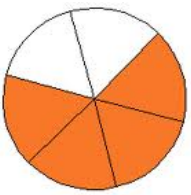
The ratio of the number of shaded sections to the number of unshaded sections is 4 to 2. What is the value of the ratio of the number of shaded pieces to the number of unshaded pieces?
Eureka Math Grade 6 Module 1 Lesson 8 Problem Set Answer Key 2
Answer:
\(\frac{4}{2}\) = \(\frac{2}{1}\) or 2

Question 2.
Use the value of the ratio to determine which ratios are equivalent to 7: 15.
a. 21:45
b. 14:45
c. 3:5
d. 63: 135
Answer:
Both (a) and (d) are equivalent to 7: 15.

Question 3.
Sean was at batting practice. He swung 25 times but only hit the ball 15 times.
a. Describe and write more than one ratio related to this situation.
Answer:
Ratio of the number of hits to the total number of swings is 15: 25.
Ratio of the number hits to the number of misses is 15: 10.
Ratio of the number of misses to the number of hits is 10: 15.
Ratio of the number of misses to the total number of swings is 10: 25.

b. For each ratio you oeated, use the value of the ratio to express one quantity as a fraction of the other quantity.
Answer:
The number of hits is \(\frac{15}{25}\) or \(\frac{3}{5}\) of the total number of swh,gs.
The number of hits is \(\frac{15}{10}\) or \(\frac{3}{2}\) the number of misses
The number of misses is \(\frac{10}{15}\) or \(\frac{2}{3}\) the number of hits.
The number of misses is \(\frac{10}{25}\) or \(\frac{2}{5}\) of the total number of swings.

c. Make up a word problem that a student can solve using one of the ratios and its value.
Answer:
If Sean estimates he will take 10 swings in his next game how many hits would he expect to get assuming his ratio of hits-to-swings does not change.

Question 4.
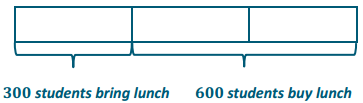
Your middle school has 900 students. \(\frac{1}{3}\) of students bring their lunch instead of buying lunch at school. What is the value of the ratio of the number of students who do bring their lunch to the number of students who do not?
Eureka Math Grade 6 Module 1 Lesson 8 Problem Set Answer Key 3
Answer:
First, I created a tape diagram. In the tape diagram, \(\frac{1}{3}\) of students bring their lunch instead of buying lunch at school. I determined that 300 students bring their lunch, leaving 600 students who buy their lunch. One unit of the tape diagram represents 300, and 2 units of the tape diagram represent 600. This creates a ratio of 1: 2. As such, the value of the ratio of the number of students who bring their lunch to the number of students who buy their lunch is \(\frac{1}{2}\)

Eureka Math Grade 6 Module 1 Lesson 8 Exit Ticket Answer Key

Question 1.
You created a new playlist, and 100 of your friends listened to it and shared if they liked the new playlist or not. Nadhii said the ratio of the number of people who liked the playlist to the number of people who did not like the playlist is 75: 25. Dylan said that for every three people who liked the playlist, one person did not.

Do Nadhii and Dy’an agree? Prove your answer using the values of the ratios.
Answer:
Dylan and Nadhii agree. The value of both of their ratios is equivalent, so their ratios are also equivalent.