Eureka Math Grade 6 Module 1 Lesson 7 Answer Key

Engage NY Eureka Math 6th Grade Module 1 Lesson 7 Answer Key

Eureka Math Grade 6 Module 1 Lesson 7 Example Answer Key

Example 1
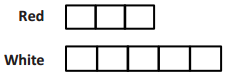
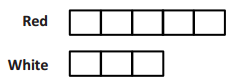
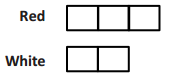
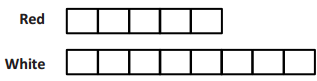
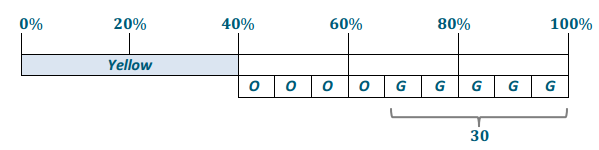
Which of the following correctly models that the number of red gumballs is \(\frac{5}{3}\) the number of white gumballs?
a.
Eureka Math Grade 6 Module 1 Lesson 7 Example Answer Key 1
b.
Eureka Math Grade 6 Module 1 Lesson 7 Example Answer Key 2
c.
Eureka Math Grade 6 Module 1 Lesson 7 Example Answer Key 3
d.
Eureka Math Grade 6 Module 1 Lesson 7 Example Answer Key 4
Answer:
b.
Eureka Math Grade 6 Module 1 Lesson 7 Example Answer Key 2

Example 2.
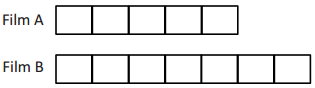
The duration of two films are modeled below.
Eureka Math Grade 6 Module 1 Lesson 7 Example Answer Key 5
a. The ratio of the length of Film A to the length of Film B is _______ : _______.
Answer:
The ratio of the length of Film A to the length of Film B is 5: 7.

b. The length of Film A is Eureka Math Grade 6 Module 1 Lesson 7 Example Answer Key 6 of the length of Film B.
Answer:
The length of Film A is Eureka Math Grade 6 Module 1 Lesson 7 Example Answer Key 7 of the length of Film B.

c. The length of Film B is Eureka Math Grade 6 Module 1 Lesson 7 Example Answer Key 6 of the length of Film A.
Answer:
The length of Film B is Eureka Math Grade 6 Module 1 Lesson 7 Example Answer Key 8 of the length of Film A.

Eureka Math Grade 6 Module 1 Lesson 7 Exercise Answer Key

Exercise 1
Sammy and Kaden went fishing using live shrimp as bait. Sammy brought 8 more shrimp than Kaden brought. When they combined their shrimp they had 32 shrimp altogether.
a. How many shrimp did each boy bring?
Answer:
Kaden brought 12 shrimp. Sammy brought 20 shrimp.

b. What is the ratio of the number of shrimp Sammy brought to the number of shrimp Kaden brought?
Answer:
20: 12

c. Express the number of shrimp Sammy brought as a fraction of the number of shrimp Kaden brought.
Answer:
\(\frac{20}{12}\)

d. What is the ratio of the number of shrimp Sammy brought to the total number of shrimp?
Answer:
20: 32

e. What fraction of the total shrimp did Sammy bring?
Answer:
\(\frac{20}{32}\)

Exercise 2.
A food company that produces peanut butter decides to try out a new version of its peanut butter that is extra crunchy, using twice the number of peanut chunks as normal. The company hosts a sampling of its new product at grocery stores and finds that 5 out of every 9 customers prefer the new extra crunchy version.

a. Let’s make a list of ratios that might be relevant for this situation.
i. The ratio of number preferring new extra crunchy to total number surveyed is __________.
Answer:
The ratio of number preferring new extra crunchy to total number surveyed is  5 to 9  .

ii. The ratio of number preferring regular crunchy to the total number surveyed is __________.
Answer:
The ratio of number preferring regular crunchy to the total number surveyed is   4 to 9  .

iii. The ratio of number preferring regular crunchy to number preferring new extra crunchy is __________.
Answer:
The ratio of number preferring regular crunchy to number preferring new extra crunchy is   4 to 5   .

iv. The ratio of number preferring new extra crunchy to number preferring regular crunchy is __________.
Answer:
The ratio of number preferring new extra crunchy to number preferring regular crunchy is   5 to 4    .

b. Let’s use the value of each ratio to make multiplicative comparisons for each of the ratios we described here.
i. The number preferring new extra crunchy is _________ of the total number surveyed.
Answer:
The number preferring new extra crunchy is \(\frac{5}{9}\)  of the total number surveyed.

ii. The number preferring regular crunchy is _________ of the total number surveyed.
Answer:
The number preferring regular crunchy is \(\frac{4}{9}\) of the total number surveyed.

iii. The number preferring regular crunchy is __________ of those preferring new extra crunchy.
Answer:
The number preferring regular crunchy is \(\frac{4}{5}\) of those preferring new extra crunchy.

iv. The number preferring new extra crunchy is _________ of those preferring regular crunchy.
Answer:
The number preferring new extra crunchy is \(\frac{5}{4}\) of those preferring regular crunchy.

c. If the company is planning to produce 90,000 containers of crunchy peanut butter, how many of these containers should be the new extra crunchy variety, and how many of these containers should be the regular crunchy peanut butter? What would be helpful in solving this problem? Does one of our comparison statements above help us?
Answer:
The company should produce 50,000 containers of new crunchy peanut butter and 40,000 containers of regular crunchy peanut butter.

d. If the company decides to produce 2000 containers of regular crunchy peanut butter, how many containers of new extra crunchy peanut butter would it produce?
Answer:
2,500 new extra crunchy peanut butter containers

e. If the company decides to produce 10,000 containers of new extra crunchy peanut butter, how containers of regular crunchy peanut butter would it produce?
Answer:
8,000 regular crunchy peanut butter containers

f. If the company decides to only produce 3,000 containers of new extra crunchy peanut butter, how many containers of regular crunchy peanut butter would it produce?
Answer:
2,400 regular crunchy peanut butter containers

Eureka Math Grade 6 Module 1 Lesson 7 Problem Set Answer Key

Question 1.
Maritza is baking cookies to bring to school and share with her friends on her birthday. The recipe requires 3 eggs for every 2 cups of sugar. To have enough cookies for all of her friends, Maritza determined she would need 12 eggs. If her mom bought 6 cups of sugar, does Maritza have enough sugar to make the cookies? Why or why not?
Answer:
Maritza will NOT have enough sugar to make all the cookies because she needs 8 cups of sugar and only has 6 cups of sugar.

Question 2.
Hamza bought 8 gallons of brown paint to paint his kitchen and dining room. Unfortunately, when Hamza started painting, he thought the paint was too dark for his house, so he wanted to make It lighter. The store manager would not let Hamza return the paint but did inform him that if he used \(\frac{1}{4}\) of a gallon of white paint mixed with 2 gallons of brown paint, he would get the shade of brown he desired. If Hamza decided to take this approach, how many gallons of white paint would Hamza have to buy to lighten the 8 gallons of brown paint?
Answer:
Hamza would need 1 gallon of white paint to make the shade of brown he desires.

Eureka Math Grade 6 Module 1 Lesson 7 Exit Ticket Answer Key

Alyssa’s extended family Is staying at the lake house this weekend for a family reunion. She is in charge of making homemade pancakes for the entire group. The pancake mix requires 2 cups of flour for every 10 pancakes.

Question 1.
Write a ratio to show the relationship between the number of cups of flour and the number of pancakes made.
Answer:
2: 10

Question 2.
Determine the value of the ratio.
Answer:
\(\frac{2}{10}=\frac{1}{5}\)

Question 3.
Use the value of the ratio to make a multiplicative comparison statement.
a. The number of pancakes made is _______ times the number of cups of flour needed.
Answer:
The number of pancakes made is 5 times the number of cups of flour needed.

b. The number of cups of flour needed is _______ of the number of pancakes made.
Answer:
The number of cups of flour needed is \(\frac{1}{5}\) of the number of pancakes made.

Question 4.
If Alyssa has to make 70 pancakes, how many cups of flour will she have to use?
Answer:
Alyssa will have to use 14 cups of flour.

Eureka Math Grade 7 Module 3 Lesson 2 Answer Key

Engage NY Eureka Math 7th Grade Module 3 Lesson 2 Answer Key

Eureka Math Grade 7 Module 3 Lesson 2 Example Answer Key

Example 1.
Subtracting Expressions
a. Subtract: (40 + 9) – (30 + 2).
Answer:
The opposite of a sum is the sum of its opposites. Order of operations

40 + 9 + (- (30 + 2))
40 + 9 + (- 30) + (- 2)
49 + (- 30) + (- 2)
19 + (- 2)
17

(40 + 9)- (30 + 2)
(49)- (32)
17

b. Subtract: (3x + 5y – 4) – (4x + 11).
Answer:
3x + 5y + ( – 4) + ( – (4x + 11)) Subtraction as adding the opposite
3x + 5y + ( – 4) + ( – 4x) + ( – 11) The opposite of a sum is the sum of its opposites.
3x + ( – 4x) + 5y + ( – 4) + ( – 11) Any order, any grouping
– x + 5y + ( – 15) Combining like terms
– x + 5y – 15 Subtraction replaces adding the opposite.
Have students check the equivalency of the expressions by substituting 2 for x and 6 for y.
(3x + 5y – 4) – (4x + 11)
(3(2) + 5(6) – 4) – (4(2) + 11)
(6 + 30 – 4) – (8 + 11)
(36 – 4) – (19)
32 – 19
13
– x + 5y – 15
– (2) + 5(6) – 15
– 2 + 30 + ( – 15)
28 + ( – 15)
13
→ When writing the difference as adding the expression’s opposite in Example 1(b), what happens to the grouped terms that are being subtracted?
→ When the subtraction is changed to addition, every term in the parentheses that follows must be converted to its opposite.

Example 2.
Combining Expressions Vertically
a. Find the sum by aligning the expressions vertically.
(5a + 3b – 6c) + (2a – 4b + 13c)
Answer:
(5a + 3b + ( – 6c)) + (2a + ( – 4b) + 13c) Subtraction as adding the opposite
Engage NY Math 7th Grade Module 3 Lesson 2 Example Answer Key 30
7a – b + 7c Adding the opposite is equivalent to subtraction.

b. Find the difference by aligning the expressions vertically.
(2x + 3y – 4) – (5x + 2)
Answer:
(2x + 3y + ( – 4)) + ( – 5x + ( – 2)) Subtraction as adding the opposite
Engage NY Math 7th Grade Module 3 Lesson 2 Example Answer Key 31
– 3x + 3y – 6 Adding the opposite is equivalent to subtraction.
Students should recognize that the subtracted expression in Example 1(b) did not include a term containing the variable y, so the 3y from the first grouped expression remains unchanged in the answer.

Example 3.
Using Expressions to Solve Problems
A stick is x meters long. A string is 4 times as long as the stick.
a. Express the length of the string in terms of x.
Answer:
The length of the stick in meters is x meters, so the string is 4∙x, or 4x, meters long.

b. If the total length of the string and the stick is 15 meters long, how long is the string?
Answer:
The length of the stick and the string together in meters can be represented by x + 4x, or 5x. If the length of the stick and string together is 15 meters, the length of the stick is 3 meters, and the length of the string is 12 meters.

Example 4.
Expressions from Word Problems
It costs Margo a processing fee of $3 to rent a storage unit, plus $17 per month to keep her belongings in the unit. Her friend Carissa wants to store a box of her belongings in Margo’s storage unit and tells her that she will pay her $1 toward the processing fee and $3 for every month that she keeps the box in storage. Write an expression in standard form that represents how much Margo will have to pay for the storage unit if Carissa contributes. Then, determine how much Margo will pay if she uses the storage unit for 6 months.
Answer:
Let m represent the number of months that the storage unit is rented.
(17m + 3) – (3m + 1) Original expression
17m + 3 + ( – (3m + 1)) Subtraction as adding the opposite
17m + 3 + ( – 3m) + ( – 1) The opposite of the sum is the sum of its opposites.
17m + ( – 3m) + 3 + ( – 1) Any order, any grouping
14m + 2 Combined like terms
This means that Margo will have to pay only $2 of the processing fee and $14 per month that the storage unit is used.
14(6) + 2
84 + 2
86
Margo will pay $86 toward the storage unit rental for 6 months of use.

Example 5.
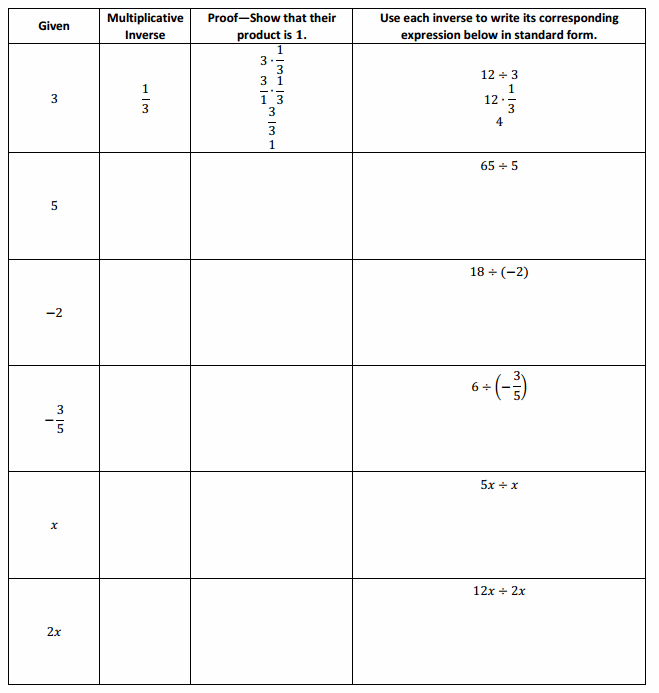
Extending Use of the Inverse to Division
Engage NY Math 7th Grade Module 3 Lesson 2 Example Answer Key 20
Answer:
Engage NY Math 7th Grade Module 3 Lesson 2 Example Answer Key 21

Eureka Math Grade 7 Module 3 Lesson 2 Opening Exercise Answer Key

Opening Exercise
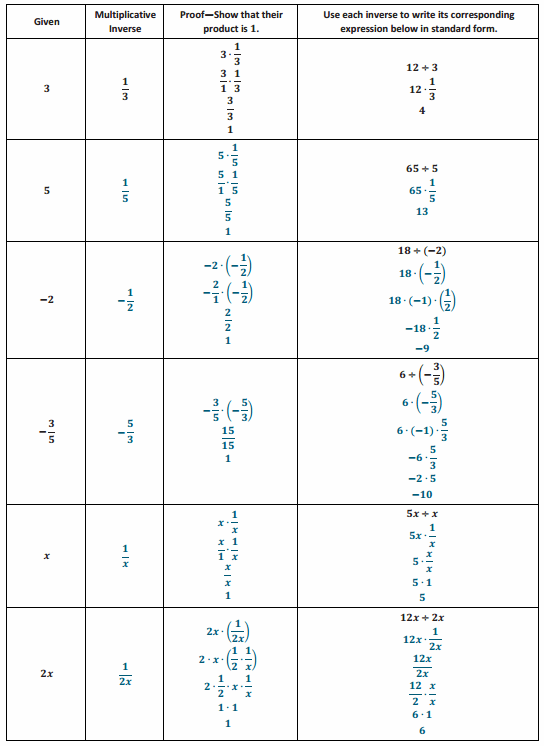
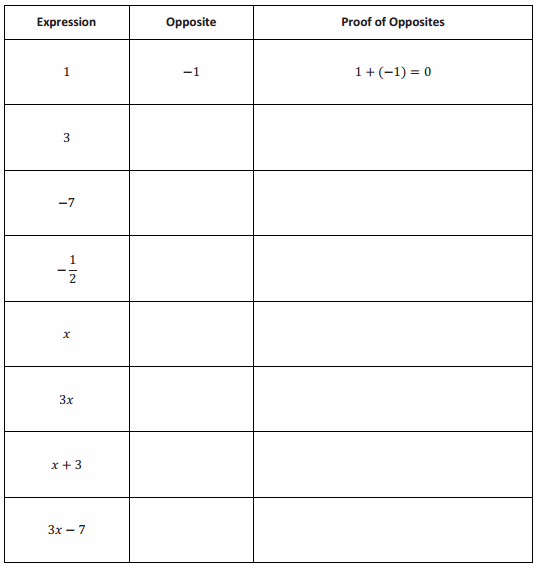
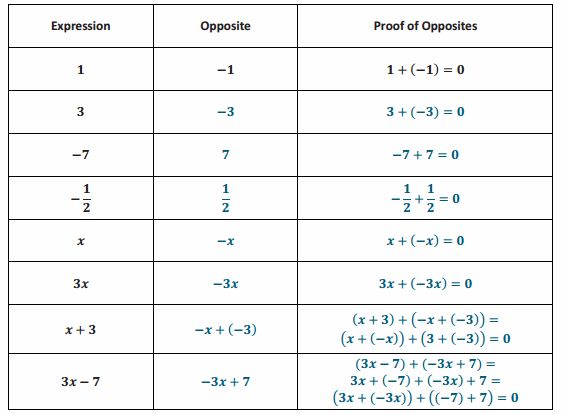
Additive inverses have a sum of zero. Fill in the center column of the table with the opposite of the given number or expression, then show the proof that they are opposites. The first row is completed for you.
Eureka Math Grade 7 Module 3 Lesson 2 Opening Exercise Answer Key 1
Answer:
Eureka Math Grade 7 Module 3 Lesson 2 Opening Exercise Answer Key 2

Eureka Math Grade 7 Module 3 Lesson 2 Problem Set Answer Key

Question 1.
Write each expression in standard form. Verify that your expression is equivalent to the one given by evaluating each expression using x=5.

a. 3x + (2 – 4x)
Answer:
3x + (2 – 4x)
– x + 2
– 5 + 2
– 3

3(5) + (2 – 4(5))
15 + (2 + ( – 20))
15 + ( – 18)
– 3

b. 3x + ( – 2 + 4x)
Answer:
3x + ( – 2 + 4x)
7x – 2
7(5) – 2
35 – 2
33

3(5) + ( – 2 + 4(5))
15 + ( – 2 + 20)
15 + 18
33

c. – 3x + (2 + 4x)
Answer:
– 3x + (2 + 4x)
x + 2
5 + 2
7

– 3(5) + (2 + 4(5))
– 15 + (2 + 20)
– 15 + 22
7

d. 3x + ( – 2 – 4x)
Answer:
3x + ( – 2 – 4x)
– x – 2
– 5 – 2
– 7

3(5) + ( – 2 – 4(5))
15 + ( – 2 + ( – 4(5)))
15 + ( – 2 + ( – 20))
15 + ( – 22)
– 7

e. 3x – (2 + 4x)
Answer:
3x – (2 + 4x)
– x – 2
– 5 – 2
– 7

3(5) – (2 + 4(5))
15 – (2 + 20)
15 – 22
15 + ( – 22)
– 7

f. 3x – ( – 2 + 4x)
Answer:
3x – ( – 2 + 4x)
– x + 2
– 5 + 2
– 3

3(5) – ( – 2 + 4(5))
15 – ( – 2 + 20)
15 – (18)
15 + ( – 18)
– 3

g. 3x – ( – 2 – 4x)
Answer:
3x – ( – 2 – 4x)
7x + 2
7(5) + 2
35 + 2
37

3(5) – ( – 2 – 4(5))
15 – ( – 2 + ( – 4(5)))
15 – ( – 2 + ( – 20))
15 – ( – 22)
15 + 22
37

h. 3x – (2 – 4x)
Answer:
3x – (2 – 4x)
7x – 2
7(5) – 2
35 – 2
33

3(5) – (2 – 4(5))
15 – (2 + ( – 4(5)))
15 – (2 + ( – 20))
15 – ( – 18)
15 + 18
33

i. – 3x – ( – 2 – 4x)
Answer:
– 3x – ( – 2 – 4x)
x + 2
5 + 2
7

– 3(5) – ( – 2 – 4(5))
– 15 – ( – 2 + ( – 4(5)))
– 15 – ( – 2 + ( – 20))
– 15 – ( – 22)
– 15 + 22
7

j. In problems (a)–(d) above, what effect does addition have on the terms in parentheses when you removed the parentheses?
Answer:
By the any grouping property, the terms remained the same with or without the parentheses.

k. In problems (e)–(i), what effect does subtraction have on the terms in parentheses when you removed the parentheses?
Answer:
The opposite of a sum is the sum of the opposites; each term within the parentheses is changed to its opposite.

Question 2.
Write each expression in standard form. Verify that your expression is equivalent to the one given by evaluating each expression for the given value of the variable.
a. 4y – (3 + y); y=2
Answer:
4y – (3 + y)
3y – 3
3(2) – 3
6 – 3
3

4(2) – (3 + 2)
8 – 5
8 + ( – 5)
3

b. (2b + 1) – b; b= – 4
Answer:
(2b + 1) – b
b + 1
– 4 + 1
– 3

(2( – 4) + 1) – ( – 4)
( – 8 + 1) + 4
( – 7) + 4
– 3

c. (6c – 4) – (c – 3); c= – 7
Answer:
(6c – 4) – (c – 3)
5c – 1
5( – 7) – 1
– 35 – 1
– 36

(6( – 7) – 4) – ( – 7 – 3)
( – 42 – 4) – ( – 10)
– 42 + ( – 4) + (10)
– 46 + 10
– 36

d. (d + 3d) – ( – d + 2); d=3
Answer:
(d + 3d) – ( – d + 2)
5d – 2
5(3) – 2
15 – 2
13

(3 + 3(3)) – ( – 3 + 2)
(3 + 9) – ( – 1)
12 + 1
13

e. ( – 5x – 4) – ( – 2 – 5x); x=3
Answer:
– 2
( – 5(3) – 4) – ( – 2 – 5(3))
( – 15 – 4) – ( – 2 – 15)
( – 19) – ( – 17)
( – 19) + 17
– 2

f. 11f – ( – 2f + 2); f=\(\frac{1}{2}\)
13f – 2
13(\(\frac{1}{2}\) ) – 2
\(\frac{13}{2}\) – 2
6 \(\frac{1}{2}\) – 2
4 \(\frac{1}{2}\)

11(\(\frac{1}{2}\) ) – ( – 2(\(\frac{1}{2}\) ) + 2)
1\(\frac{1}{2}\) – ( – 1 + 2)
1\(\frac{1}{2}\) – 1
1\(\frac{1}{2}\) + ( – \(\frac{2}{2}\) )
\(\frac{9}{2}\)
4 \(\frac{1}{2}\)

g. – 5g + (6g – 4); g= – 2
Answer:
– 5g + (6g – 4)
g – 4
– 2 – 4
– 6

– 5( – 2) + (6( – 2) – 4)
10 + ( – 12 – 4)
10 + ( – 12 + ( – 4))
10 + ( – 16)
– 6

h. (8h – 1) – (h + 3); h= – 3
Answer:
(8h – 1) – (h + 3)
7h – 4
7( – 3) – 4
– 21 – 4
– 25

(8( – 3) – 1) – ( – 3 + 3)
( – 24 – 1) – (0)
( – 25) – 0
– 25

i. (7 + w) – (w + 7); w= – 4
Answer
(7 + w) – (w + 7)
0
(7 + ( – 4)) – ( – 4 + 7)
3 – 3
3 + ( – 3)
0

j. (2g + 9h – 5) – (6g – 4h + 2); g= – 2 and h=5
Answer:
(2g + 9h – 5) – (6g – 4h + 2)
– 4g + 13h – 7
– 4( – 2) + 13(5) – 7
8 + 65 + ( – 7)
73 + ( – 7)
66

(2( – 2) + 9(5) – 5) – (6( – 2) – 4(5) + 2)
( – 4 + 45 – 5) – ( – 12 + ( – 4(5)) + 2)
(41 – 5) – ( – 12 + ( – 20) + 2)
(41 + ( – 5)) – ( – 32 + 2)
36 – ( – 30)
36 + 30
66

Question 3.
Write each expression in standard form. Verify that your expression is equivalent to the one given by evaluating both expressions for the given value of the variable.

a. – 3(8x); x=\(\frac{1}{4}\)
Answer:
– 3(8x)
– 24x
– 24(\(\frac{1}{4}\) )
– 24/4
– 6

– 3(8(\(\frac{1}{4}\) ))
– 3(2)
– 6

b. 5∙k∙( – 7); k=\(\frac{3}{5}\)
Answer:
5∙k∙( – 7)
– 35k
– 35(\(\frac{3}{5}\) )
– 105/5
– 21

5(\(\frac{3}{5}\) )( – 7)
3( – 7)
– 21

c. 2( – 6x)∙2; x=\(\frac{3}{4}\)
Answer:
2( – 6x)∙2
– 24x
– 24(\(\frac{3}{4}\) )
– \(\frac{72}{4}\)
– 18

2( – 6(\(\frac{3}{4}\) ))∙2
2( – 3(\(\frac{3}{2}\) ))∙2
2( – 3)(\(\frac{3}{2}\) )(2)
– 6(3)
– 18

d. – 3(8x) + 6(4x); x=2
Answer:
– 3(8x) + 6(4x)
0

– 3(8(2)) + 6(4(2))
– 3(16) + 6(8)
– 48 + 48
0

e. 8(5m) + 2(3m); m= – 2
Answer:
8(5m) + 2(3m)
46m
46( – 2)
– 92

8(5( – 2)) + 2(3( – 2))
8( – 10) + 2( – 6)
– 80 + ( – 12)
– 92

f. – 6(2v) + 3a(3); v=\(\frac{1}{3}\) ; a=\(\frac{2}{3}\)
Answer:
– 6(2v) + 3a(3); v=\(\frac{1}{3}\)
– 6(2v) + 3a(3)
– 12v + 9a
– 12(\(\frac{1}{3}\) ) + 9(\(\frac{2}{3}\) )
– 1\(\frac{2}{3}\) + \(\frac{18}{3}\)
– 4 + 6
2

– 6(2(\(\frac{1}{3}\) )) + 3(\(\frac{2}{3}\) )(3)
– 6(\(\frac{2}{3}\) ) + 2(3)
– 4 + 6
2

Question 4.
Write each expression in standard form. Verify that your expression is equivalent to the one given by evaluating both expressions for the given value of the variable

a. 8x ÷ 2; x= – \(\frac{1}{4}\)
Answer:
8x ÷ 2
4x
4( – \(\frac{1}{4}\) )
– 1

8( – \(\frac{1}{4}\) ) ÷ 2
– 2 ÷ 2
– 1

b. 18w ÷ 6; w=6
Answer:
18w ÷ 6
3w
3(6)
18

18(6) ÷ 6
108 ÷ 6
18

c. 25r ÷ 5r; r= – 2
Answer:
25r ÷ 5r
5

25( – 2) ÷ (5( – 2))
– 50 ÷ ( – 10)
5

d. 33y ÷ 11y; y= – 2
Answer:
33y ÷ 11y
3

33( – 2) ÷ (11( – 2))
( – 66) ÷ ( – 22)
3

e. 56k ÷ 2k; k=3
Answer:
56k ÷ 2k
28

56(3) ÷ (2(3))
168 ÷ 6
28

f. 24xy ÷ 6y; x= – 2;y=3
Answer:
24xy ÷ 6y
4x
4( – 2)
– 8

24( – 2)(3) ÷ (6(3))
– 48(3) ÷ 18
– 144 ÷ 18
– 8

Question 5.
For each problem (a)–(g), write an expression in standard form.
a. Find the sum of – 3x and 8x.
Answer:
– 3x + 8x
5x

b. Find the sum of – 7g and 4g + 2.
Answer:
– 7g + (4g + 2)
– 3g + 2

c. Find the difference when 6h is subtracted from 2h – 4.
Answer:
(2h – 4) – 6h
– 4h – 4

d. Find the difference when – 3n – 7 is subtracted from n + 4.
Answer:
(n + 4) – ( – 3n – 7)
4n + 11

e. Find the result when 13v + 2 is subtracted from 11 + 5v.
Answer:
(11 + 5v) – (13v + 2)
– 8v + 9

f. Find the result when – 18m – 4 is added to 4m – 14.
Answer:
(4m – 14) + ( – 18m – 4)
– 14m – 18

g. What is the result when – 2x + 9 is taken away from – 7x + 2?
Answer:
( – 7x + 2) – ( – 2x + 9)
– 5x – 7

Question 6.
Marty and Stewart are stuffing envelopes with index cards. They are putting x index cards in each envelope. When they are finished, Marty has 15 stuffed envelopes and 4 extra index cards, and Stewart has 12 stuffed envelopes and 6 extra index cards. Write an expression in standard form that represents the number of index cards the boys started with. Explain what your expression means.
Answer:
They inserted the same number of index cards in each envelope, but that number is unknown, x. An expression that represents Marty’s index cards is 15x + 4 because he had 15 envelopes and 4 cards left over. An expression that represents Stewart’s index cards is 12x + 6 because he had 12 envelopes and 6 left over cards. Their total number of cards together would be:
15x + 4 + 12x + 6
15x + 12x + 4 + 6
27x + 10
This means that altogether, they have 27 envelopes with x index cards in each, plus another 10 leftover index cards.

Question 7.
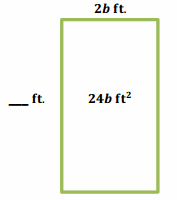
The area of the pictured rectangle below is 24b ft2. Its width is 2b ft. Find the height of the rectangle and name any properties used with the appropriate step.
Answer:
24b ÷ 2b
Eureka Math Grade 7 Module 3 Lesson 2 Problem Set Answer Key 25
24b∙\(\frac{1}{2b}\) Multiplying the reciprocal
\(\frac{27b}{2b}\) Multiplication
\(\frac{24}{2}\) ∙\(\frac{b}{b}\) Any order, any grouping in multiplication
12∙1
12
The height of the rectangle is 12 ft.

Eureka Math Grade 7 Module 3 Lesson 2 Generating Equivalent Expressions—Round 1 Answer Key

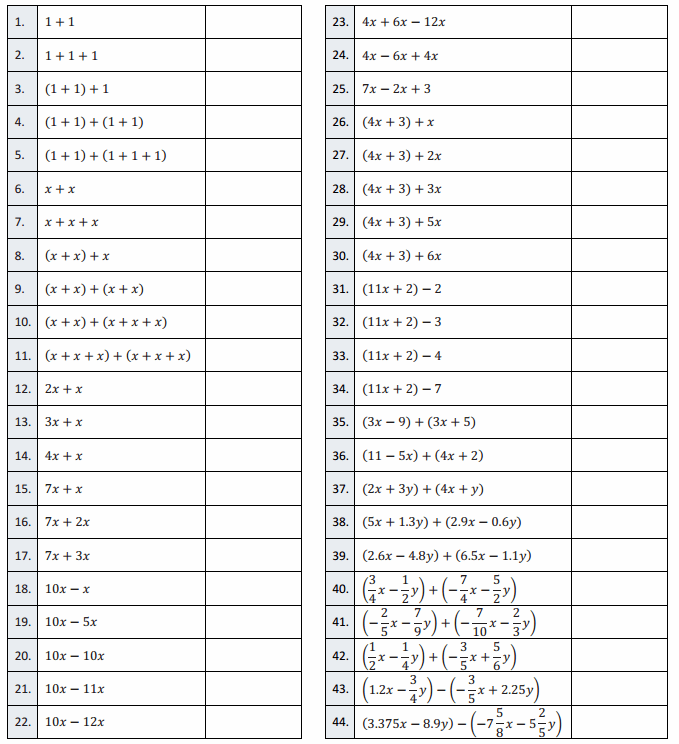
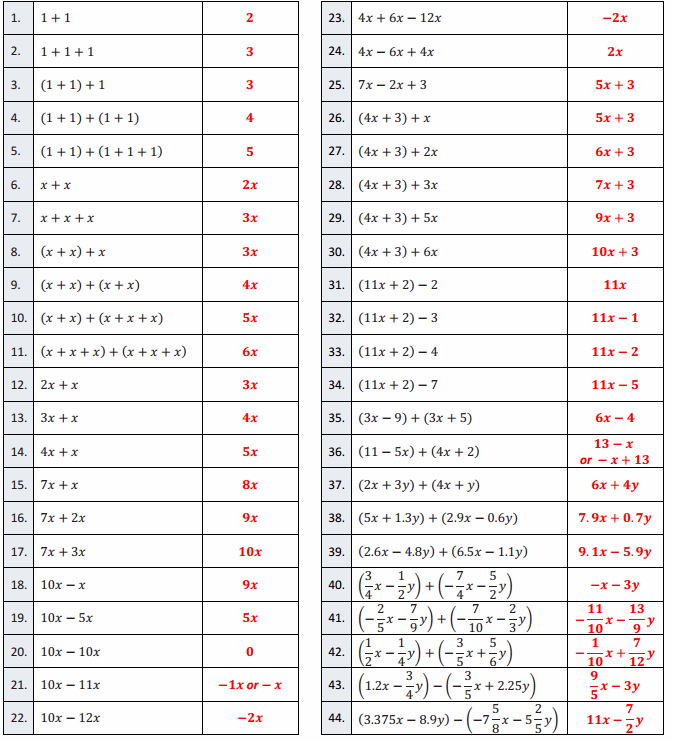
Directions: Write each as an equivalent expression in standard form as quickly and as accurately as possible within the allotted time.
Eureka Math Grade 7 Module 3 Lesson 2 Generating Equivalent Expressions—Round 1 Answer Key 20.1
Answer:
Eureka Math Grade 7 Module 3 Lesson 2 Generating Equivalent Expressions—Round 1 Answer Key 20.2

Eureka Math Grade 7 Module 3 Lesson 2 Generating Equivalent Expressions—Round 2 Answer Key

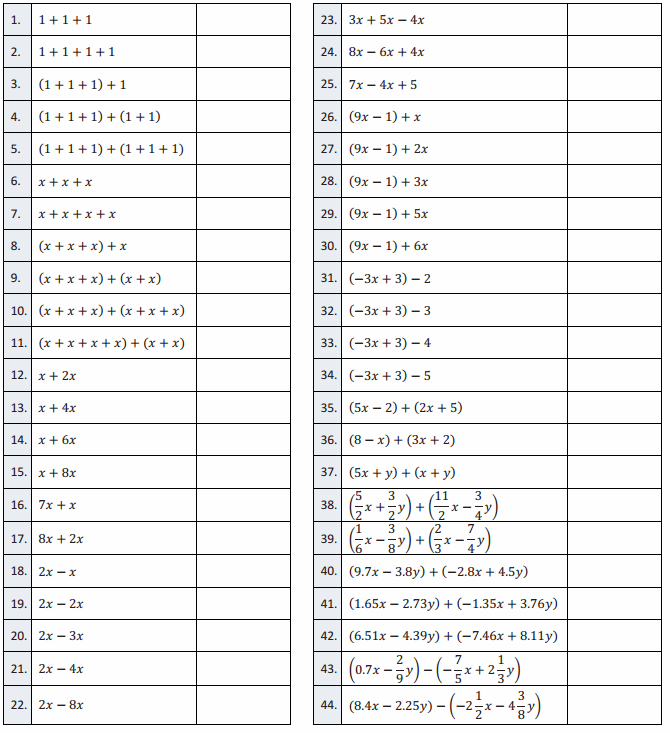
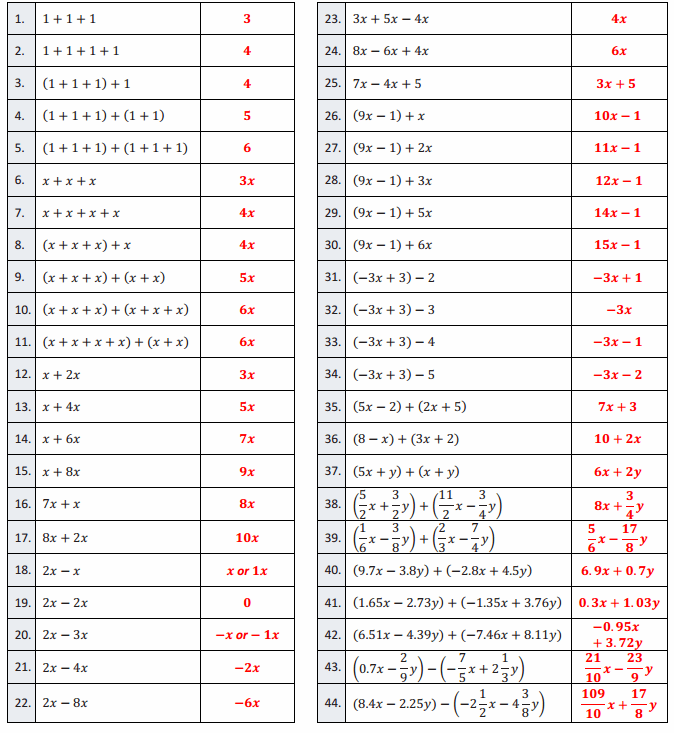
Directions: Write each as an equivalent expression in standard form as quickly and as accurately as possible within the allotted time.

Eureka Math Grade 7 Module 3 Lesson 2 Generating Equivalent Expressions—Round 2 Answer Key 25
Answer:
Eureka Math Grade 7 Module 3 Lesson 2 Generating Equivalent Expressions—Round 2 Answer Key 26

Eureka Math Grade 7 Module 3 Lesson 2 Exit Ticket Answer Key

Question 1.
Write the expression in standard form.
Answer:
(4f – 3 + 2g) – ( – 4g + 2)
4f + ( – 3) + 2g + ( – ( – 4g + 2)) Subtraction as adding the opposite
4f + ( – 3) + 2g + 4g + ( – 2) The opposite of a sum is the sum of its opposites.
4f + 2g + 4g + ( – 3) + ( – 2) Any order, any grouping
4f + 6g + ( – 5) Combined like terms
4f + 6g – 5 Subtraction as adding the opposite

Question 2.
Find the result when 5m + 2 is subtracted from 9m.
Answer:
9m – (5m + 2) Original expression
9m + ( – (5m + 2)) Subtraction as adding the opposite
9m + ( – 5m) + ( – 2) The opposite of a sum is the sum of its opposites.
4m + ( – 2) Combined like terms
4m – 2 Subtraction as adding the opposite

Question 3.
Write the expression in standard form.
27h ÷ 3h
Answer:
27h∙\(\frac{1}{3 h}\) Multiplying by the reciprocal
\(\frac{27h}{3 h}\) Multiplication
\(\frac{27}{3}\)∙\(\frac{h}{h}\) Any order, any grouping
9∙1
9

Eureka Math Grade 7 Module 3 Lesson 1 Answer Key

Engage NY Eureka Math 7th Grade Module 3 Lesson 1 Answer Key

Eureka Math Grade 7 Module 3 Lesson 1 Example Answer Key

Example 1.
Any Order, Any Grouping Property with Addition
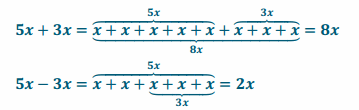
a. Rewrite 5x+3x and 5x-3x by combining like terms.
Write the original expressions and expand each term using addition. What are the new expressions equivalent to?
Answer:
Engage NY Math 7th Grade Module 3 Lesson 1 Example Answer Key 1
Because both terms have the common factor of x, we can use the distributive property to create an equivalent expression.
5x+3x=(5+3)x=8x
5x-3x=(5-3)x=2x

Ask students to try to find an example (a value for x) where 5x+3x≠8x or where
5x-3x≠2x. Encourage them to use a variety of positive and negative rational numbers. Their failure to find a counterexample helps students realize what equivalence means.

In Example 1, part (b), students see that the commutative and associative properties of addition are regularly used in consecutive steps to reorder and regroup like terms so that they can be combined. Because the use of these properties does not change the value of an expression or any of the terms within the expression, the commutative and associative properties of addition can be used simultaneously. The simultaneous use of these properties is referred to as the any order, any grouping property.

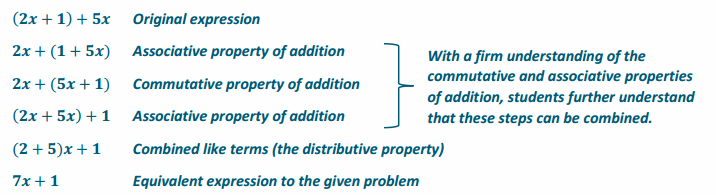
b. Find the sum of 2x+1 and 5x.
Answer:
Engage NY Math 7th Grade Module 3 Lesson 1 Example Answer Key 10
7x+1 Equivalent expression to the given problem
→ Why did we use the associative and commutative properties of addition?
→ We reordered the terms in the expression to group together like terms so that they could be combined.
→ Did the use of these properties change the value of the expression? How do you know?
→ The properties did not change the value of the expression because each equivalent expression includes the same terms as the original expression, just in a different order and grouping.
→ If a sequence of terms is being added, the any order, any grouping property allows us to add those terms in any order by grouping them together in any way.
→ How can we confirm that the expressions (2x+1)+5x and 7x+1 are equivalent expressions?
→ When a number is substituted for the x in both expressions, they both should yield equal results.
The teacher and student should choose a number, such as 3, to substitute for the value of x and together check to see if both expressions evaluate to the same result.

Given Expression
((2x+1)+5x
(2∙3+1)+5∙3
(6+1)+15
(7)+15
22

Equivalent Expression?
7x+1
7∙3+1
21+1
22

→ The expressions both evaluate to 22; however, this is only one possible value of x. Challenge students to find a value for x for which the expressions do not yield the same number. Students find that the expressions evaluate to equal results no matter what value is chosen for x.
→ What prevents us from using any order, any grouping in part (c), and what can we do about it?
→ The second expression, (5a-3), involves subtraction, which is not commutative or associative; however, subtracting a number x can be written as adding the opposite of that number. So, by changing subtraction to addition, we can use any order and any grouping.

c. Find the sum of -3a+2 and 5a-3.
Answer:
(-3a+2)+(5a-3) Original expression
-3a+2+5a+(-3) Add the opposite (additive inverse)
-3a+5a+2+(-3) Any order, any grouping
2a+(-1) Combined like terms (Stress to students that the expression is not yet simplified.)
2a-1 Adding the inverse is subtracting.

→ What was the only difference between this problem and those involving all addition?
→ We first had to rewrite subtraction as addition; then, this problem was just like the others.

Example 2.
Any Order, Any Grouping with Multiplication
Find the product of 2x and 3.
Answer:
Engage NY Math 7th Grade Module 3 Lesson 1 Example Answer Key 18

→ Why did we use the associative and commutative properties of multiplication?

We reordered the factors to group together the numbers so that they could be multiplied.

→ Did the use of these properties change the value of the expression? How do you know?

→ The properties did not change the value of the expression because each equivalent expression includes the same factors as the original expression, just in a different order or grouping.

→ If a product of factors is being multiplied, the any order, any grouping property allows us to multiply those factors in any order by grouping them together in any way.

Example 3.
Any Order, Any Grouping in Expressions with Addition and Multiplication
Use any order, any grouping to write equivalent expressions.
a. 3(2x)
Answer:
(3∙2)x
6x

b. 4y(5)
Answer:
(4∙5)y
20y

c. 4∙2∙z
Answer:
(4∙2)z
8z

d. 3(2x)+4y(5)
Answer:
Engage NY Math 7th Grade Module 3 Lesson 1 Example Answer Key 19
(3∙2)x+(4∙5)y
6x+20y

e. 3(2x)+4y(5)+4∙2∙z
Answer:
Engage NY Math 7th Grade Module 3 Lesson 1 Example Answer Key 20
(3∙2)x+(4∙5)y+(4∙2)z
6x+20y+8z

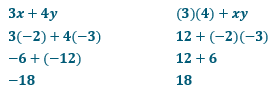
f. Alexander says that 3x+4y is equivalent to (3)(4)+xy because of any order, any grouping. Is he correct? Why or why not?

Encourage students to substitute a variety of positive and negative rational numbers for x and y because in order for the expressions to be equivalent, the expressions must evaluate to equal numbers for every substitution of numbers into all the letters in both expressions.

Alexander is incorrect; the expressions are not equivalent because if we, for example, let x=-2 and let
y=-3, then we get the following:
Engage NY Math 7th Grade Module 3 Lesson 1 Example Answer Key 21
-18≠18, so the expressions cannot be equivalent.

→ What can be concluded as a result of part (f)?
→ Any order, any grouping cannot be used to mix multiplication with addition. Numbers and letters that are factors within a given term must remain factors within that term.

Eureka Math Grade 7 Module 3 Lesson 1 Problem Set Answer Key

For Problems 1–9, write equivalent expressions by combining like terms. Verify the equivalence of your expression and the given expression by evaluating each for the given values: a=2, b=5, and c=-3.

Question 1.
3a+5a
Answer:
8a
8(2)
16

3(2)+5(2)
6+10
16

Question 2.
8b – 4b
Answer:
4b
4(5)
20

8(5)-4(5)
40-20
20

Question 3.
5c+4c+c
10c
10(-3)
-30

5(-3)+4(-3)+(-3)
-15+(-12)+(-3)
-27+(-3)
-30

Question 4.
3a+6+5a
8a+6
8(2)+6
16+6
22

3(2)+6+5(2)
6+6+10
12+10
22

Question 5.
8b + 8 – 4b
4b+8
4(5)+8
20+8
28

8(5)+8-4(5)
40+8-20
48-20
28

Question 6.
2c
2(-3)
-6

5(-3)-4(-3)+(-3)
-15+(-4(-3))+(-3)
-15+(12)+(-3)
-3+(-3)
-6

Eureka Math Grade 7 Module 3 Lesson 1 Exit Ticket Answer Key

Question 1.
Write an equivalent expression to 2x+3+5x+6 by combining like terms.
Answer:
2x+3+5x+6
2x+5x+3+6
7x+9

Question 2.
Find the sum of (8a+2b-4) and (3b-5).
Answer:
(8a+2b-4)+(3b-5)
8a+2b+(-4)+3b+(-5)
8a+2b+3b+(-4)+(-5)
8a+(5b)+(-9)
8a+5b-9

Question 3.
Write the expression in standard form: 4(2a)+7(-4b)+(3∙c∙5).
Answer:
(4∙2)a+(7∙(-4))b+(3∙5)c
8a+(-28)b+15c
8a-28b+15c

Eureka Math Grade 7 Module 3 Lesson 1 Opening Exercise Answer Key

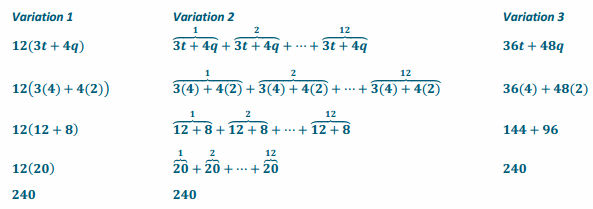
Each envelope contains a number of triangles and a number of quadrilaterals. For this exercise, let t represent the number of triangles, and let q represent the number of quadrilaterals.
a. Write an expression using t and q that represents the total number of sides in your envelope. Explain what the terms in your expression represent.
Answer:
3t+4q. Triangles have 3 sides, so there will be 3 sides for each triangle in the envelope. This is represented by 3t. Quadrilaterals have 4 sides, so there will be 4 sides for each quadrilateral in the envelope. This is represented by 4q. The total number of sides will be the number of triangle sides and the number of quadrilateral sides together.

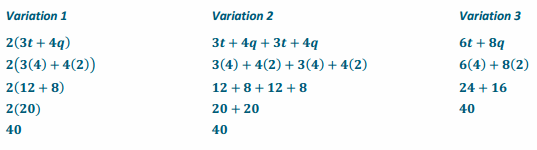
b. You and your partner have the same number of triangles and quadrilaterals in your envelopes. Write an expression that represents the total number of sides that you and your partner have. If possible, write more than one expression to represent this total.
Answer:
3t+4q+3t+4q; 2(3t+4q); 6t+8q

c. Each envelope in the class contains the same number of triangles and quadrilaterals. Write an expression that represents the total number of sides in the room.
Answer:
Answer depends on the number of students in the classroom. For example, if there are 12 students in the classroom, the expression would be 12(3t+4q), or an equivalent expression

d. Use the given values of t and q and your expression from part (a) to determine the number of sides that should be found in your envelope.
Answer:
3t+4q
3(4)+4(2)
12+8
20
There should be 20 sides contained in my envelope.

e. Use the same values for t and q and your expression from part (b) to determine the number of sides that should be contained in your envelope and your partner’s envelope combined.
Eureka Math Grade 7 Module 3 Lesson 1 Opening Exercise Answer Key 22
My partner and I have a combined total of 40 sides.

f. Use the same values for t and q and your expression from part (c) to determine the number of sides that should be contained in all of the envelopes combined.
Answer:
Answer will depend on the seat size of your classroom. Sample responses for a class size of 12:
Eureka Math Grade 7 Module 3 Lesson 1 Opening Exercise Answer Key 23
For a class size of 12 students, there should be 240 sides in all of the envelopes combined.

g. What do you notice about the various expressions in parts (e) and (f)?
Answer:
The expressions in part (e) are all equivalent because they evaluate to the same number: 40. The expressions in part (f) are all equivalent because they evaluate to the same number: 240. The expressions themselves all involve the expression 3t+4q in different ways. In part (e), 3t+3t is equivalent to 6t, and 4q+4q is equivalent to 8q. There appear to be several relationships among the representations involving the commutative, associative, and distributive properties.

Eureka Math Grade 7 Module 2 Lesson 23 Answer Key

Engage NY Eureka Math 7th Grade Module 2 Lesson 23 Answer Key

Eureka Math Grade 7 Module 2 Lesson 23 Exercise Answer Key

Exercises
Youth Group Trip

Exercise 1.
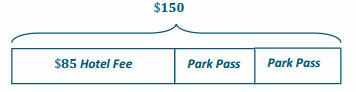
The youth group is going on a trip to an amusement park in another part of the state. The trip costs each group member $150, which includes $85 for the hotel and two one – day combination entrance and meal plan passes.
a. Write an equation representing the cost of the trip. Let P be the cost of the park pass.
Answer:
85 + 2P = 150

b. Solve the equation algebraically to find the cost of the park pass. Then write the reason that justifies each step using if – then statements.
Answer:
If: 85 + 2P = 150,
Then: 85 – 85 + 2P = 150 – 85 Subtraction property of equality for the additive inverse of 85
If: 0 + 2P = 65
Then: 2P = 65 Additive identity
If: 2P = 65
Then: (\(\frac{1}{2}\))2P = (\(\frac{1}{2}\))65 Multiplication property of equality using the multiplicative inverse of 2
If: 1P = 32.5
Then: P = 32.5 Multiplicative identity
The park pass costs $32.50.

c. Model the problem using a tape diagram to check your work.
Answer:
150 – 85 = 65
65÷2 = 32.50
Eureka Math Grade 7 Module 2 Lesson 23 Exercise Answer Key 1

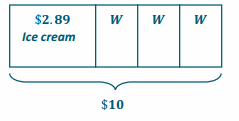
Suppose you want to buy your favorite ice cream bar while at the amusement park, and it costs $2.89. If you purchase the ice cream bar and 3 bottles of water, pay with a $10 bill, and receive no change, then how much did each bottle of water cost?

d. Write an equation to model this situation.
Answer:
W: the cost of one bottle of water
2.89 + 3W = 10

e. Solve the equation to determine the cost of one water bottle. Then write the reason that justifies each step using if – then statements.
Answer:
If: 2.89 + 3W = 10
Then: 2.89 – 2 .89 + 3W = 10 – 2.89 Subtraction property of equality for the additive inverse of 2.89
If: 0 + 3W = 7.11
Then: 3W = 7.11 Additive identity
If: 3W = 7.11
Then: \(\frac{1}{3}\) (3W) = \(\frac{1}{3}\) (7.11) Multiplication property of equality using the multiplicative inverse of 3
If: 1W = 2.37
Then: W = 2.37 Multiplicative identity

A bottle of water costs $2.37.

f. Model the problem using a tape diagram to check your work.
Answer:
Eureka Math Grade 7 Module 2 Lesson 23 Exercise Answer Key 2
10 – 2.89 = 7.11
\(\frac{7.11}{3}\) = 2.37

Question 2.
Weekly Allowance
Charlotte receives a weekly allowance from her parents. She spent half of this week’s allowance at the movies but earned an additional $4 for performing extra chores. If she did not spend any additional money and finished the week with $12, what is Charlotte’s weekly allowance?
a. Write an equation that can be used to find the original amount of Charlotte’s weekly allowance. Let A be the value of Charlotte’s original weekly allowance.
Answer:
\(\frac{1}{2}\) A + 4 = 12

b. Solve the equation to find the original amount of allowance. Then write the reason that justifies each step using if – then statements.
Answer:
If: \(\frac{1}{2}\) A + 4 = 12
Then: \(\frac{1}{2}\) A + 4 – 4 = 12 – 4 Subtraction property of equality for the additive inverse of 4
If: \(\frac{1}{2}\) A + 0 = 8
Then: \(\frac{1}{2}\) A = 8 Additive identity
If : \(\frac{1}{2}\) A = 8
Then: (2) \(\frac{1}{2}\) A = (2)8 Multiplication property of equality using the multiplicative inverse of \(\frac{1}{2}\)
If: 1A = 16
Then: A = 16 Multiplicative identity
The original allowance was $16.

c. Explain your answer in the context of this problem.
Answer:
Charlotte’s weekly allowance is $16.

d. Charlotte’s goal is to save $100 for her beach trip at the end of the summer. Use the amount of weekly allowance you found in part (c) to write an equation to determine the number of weeks that Charlotte must work to meet her goal. Let w represent the number of weeks.
Answer:
16 w = 100
(\(\frac{1}{16}\))16w = (\(\frac{1}{16}\))100
1w = 6.25
w = 6.25

e. In looking at your answer to part (d) and based on the story above, do you think it will take Charlotte that many weeks to meet her goal? Why or why not?
Answer:
Charlotte needs more than 6 weeks’ allowance, so she will need to save 7 weeks’ allowance (and not spend any of it). There are 10–12 weeks in the summer; so, yes, she can do it.

Exercise 3.
Travel Baseball Team
Allen is very excited about joining a travel baseball team for the fall season. He wants to determine how much money he should save to pay for the expenses related to this new team. Players are required to pay for uniforms, travel expenses, and meals.
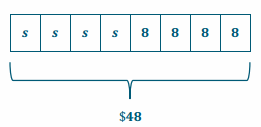
a. If Allen buys 4 uniform shirts at one time, he gets a $10.00 discount so that the total cost of 4 shirts would be $44. Write an algebraic equation that represents the regular price of one shirt. Solve the equation. Write the reason that justifies each step using if – then statements.
Answer:
s: the cost of one shirt
If: 4s – 10 = 44
Then: 4s – 10 + 10 = 44 + 10 Addition property of equality using the additive inverse of – 10
If: 4s + 0 = 54
Then: 4s = 54 Additive identity
If: 4s = 54
Then: (\(\frac{1}{4}\))4s = (\(\frac{1}{4}\))54 Multiplication property of equality using multiplicative inverse of 4
If: 1s = 13.50
Then: s = 13.50 Multiplicative identity

b. What is the cost of one shirt without the discount?
Answer:
The cost of one shirt is $13.50.

c. What is the cost of one shirt with the discount?
Answer:
4s = 44
(\(\frac{1}{4}\))4s = (\(\frac{1}{4}\))44
1s = 11
s = 11
The cost of one shirt with the discount is $11.00.

d. How much more do you pay per shirt if you buy them one at a time (rather than in bulk)?
Answer:
13.50 – 11.00 = 2.50
One shirt costs $11 if you buy them in bulk. So, Allen would pay $2.50 more per shirt if he bought them one at a time.

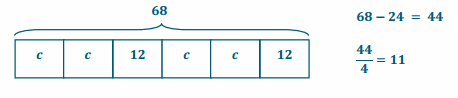
Allen’s team was also required to buy two pairs of uniform pants and two baseball caps, which total $68. A pair of pants costs $12 more than a baseball cap.

e. Write an equation that models this situation. Let c represent the cost of a baseball cap.
Answer:
2(cap + 1 pair of pants) = 68
2(c + c + 12) = 68 or 2 ( 2c + 12) = 68 or 4c + 24 = 68

f. Solve the equation algebraically to find the cost of a baseball cap. Write the reason that justifies each step using if – then statements.
Answer:
If: 2 (2 c + 12) = 68
Then: (\(\frac{1}{2}\))(2 )(2 c + 12) = (\(\frac{1}{2}\))68 Multiplication property of equality using the multiplicative inverse of 2
If: 1(2c + 12) = 34
Then: 2c + 12 = 34 Multiplicative identity
If: 2c + 12 = 34
Then: 2c + 12 – 12 = 34 – 12 Subtraction property of equality for the additive inverse of 12
If: 2c + 0 = 22
Then: 2c = 22 Additive identity
If: 2c = 22
Then: (\(\frac{1}{2}\))2c = (\(\frac{1}{2}\))22 Multiplication property of equality using the multiplicative inverse of 2
If: 1c = 11
Then: c = 11 Multiplicative identity

g. Model the problem using a tape diagram in order to check your work from part (f).
Answer:
Eureka Math Grade 7 Module 2 Lesson 23 Exercise Answer Key 55

h. What is the cost of one cap?
Answer:
The cost of one cap is $11.

i. What is the cost of one pair of pants?
Answer:
11 + 12 = 23 The cost of one pair of pants is $23.

Eureka Math Grade 7 Module 2 Lesson 23 Problem Set Answer Key

For Exercises 1–4, solve each equation algebraically using if – then statements to justify your steps.

Question 1.
\(\frac{2}{3}\) x – 4 = 20
Answer:
If: \(\frac{2}{3}\) x – 4 = 20
Then: \(\frac{2}{3}\) x – 4 + 4 = 20 + 4 Addition property of equality using the additive inverse of – 4
If: \(\frac{2}{3}\) x + 0 = 24
Then: \(\frac{2}{3}\) x = 24 Additive identity
If: \(\frac{2}{3}\) x = 24
Then: (\(\frac{3}{2}\)) \(\frac{2}{3}\) x = (\(\frac{3}{2}\))24 Multiplication property of equality using the multiplicative inverse of \(\frac{2}{3}\)
If: 1x = 36
Then: x = 36 Multiplicative identity

Question 2.
4 = \(\frac{ – 1 + x}{2}\)
Answer:
If: 4 = \(\frac{ – 1 + x}{2}\)
Then: 2 (4) = 2 (\(\frac{ – 1 + x}{2}\)) Multiplication property of equality using the multiplicative inverse of \(\frac{1}{2}\)
If: 8 = 1 ( – 1 + x)
Then: 8 = – 1 + x Multiplicative identity
If: 8 = – 1 + x
Then: 8 – ( – 1) = – 1 – ( – 1) + x Subtraction property of equality for the additive inverse of – 1
If: 9 = 0 + x
Then: 9 = x Additive identity

Question 3.
12(x + 9) = – 108
Answer:
If: 12(x + 9) = – 108
Then: (\(\frac{1}{12}\))12(x + 9) = (\(\frac{1}{12}\))( – 108) Multiplication property of equality using the multiplicative inverse of 12
If: 1 (x + 9) = – 9
Then: x + 9 = – 9 Multiplicative identity
If: x + 9 = – 9
Then: x + 9 – 9 = – 9 – 9 Subtraction property of equality for the additive inverse of 9
If: x + 0 = – 18
Then: x = – 18 Additive identity

Question 4.
5x + 14 = – 7
Answer:
If: 5x + 14 = – 7
Then: 5x + 14 – 14 = – 7 – 14 Subtraction property of equality for the additive inverse of 14
If: 5x + 0 = – 21
Then: 5x = – 21 Additive identity
If: 5x = – 21
Then: (\(\frac{1}{5}\))5x = (\(\frac{1}{5}\))( – 21) Multiplication property of equality using the multiplicative inverse of 5
If: 1x = – 4.2
Then: x = – 4.2 Multiplicative identity

For Exercises 5–7, write an equation to represent each word problem. Solve the equation showing the steps, and then state the value of the variable in the context of the situation.

Question 5.
A plumber has a very long piece of pipe that is used to run city water parallel to a major roadway. The pipe is cut into two sections. One section of pipe is 12 ft. shorter than the other. If \(\frac{3}{4}\) of the length of the shorter pipe is
120 ft., how long is the longer piece of the pipe?
Answer:
Let x represent the longer piece of pipe.
If: \(\frac{3}{4}\)(x – 12) = 120
Then: \(\frac{4}{3}\) (\(\frac{3}{4}\))(x – 12) = (\(\frac{4}{3}\))120 Multiplication property of equality using the multiplicative inverse of \(\frac{3}{4}\)
If: 1(x – 12) = 160
Then: x – 12 = 160 Multiplicative identity
If: x – 12 = 160
Then: x – 12 + 12 = 160 + 12 Addition property of equality for the additive inverse of – 12
If: x + 0 = 172
Then: x = 172 Additive identity
The longer piece of pipe is 172 ft.

Question 6.
Bob’s monthly phone bill is made up of a $10 fee plus $0.05 per minute. Bob’s phone bill for July was $22. Write an equation to model the situation using m to represent the number of minutes. Solve the equation to determine the number of phone minutes Bob used in July.
Answer:
Let m represent the number of phone minutes Bob used.
If: 10 + 0.05m = 22
Then: 10 – 10 + 0.05m = 22 – 10 Subtraction property of equality for the additive inverse of 10
If: 0 + 0.05m = 12
Then: 0.05m = 12 Additive identity
If: 0.05m = 12
Then: (\(\frac{1}{0.05}\))0.05m = (\(\frac{1}{0.05}\))12 Multiplication property of equality using the multiplicative inverse of 0.05
If: 1m = 240
Then: m = 240 Multiplicative identity
Bob used 240 phone minutes in July.

Question 7.
Kym switched cell phone plans. She signed up for a new plan that will save her $3.50 per month compared to her old cell phone plan. The cost of the new phone plan for an entire year is $294. How much did Kym pay per month under her old phone plan?
Answer:
Let n represent the amount Kym paid per month for her old cell phone plan.
If: 294 = 12(n – 3.50)
Then: (\(\frac{1}{12}\))(294) = (\(\frac{1}{12}\))12(n – 3.50) Multiplication property of equality using the multiplicative inverse of 12
If: 24.5 = 1 (n – 3.50)
Then: 24.5 = n – 3.50 Multiplicative identity
If: 24.5 = n – 3.50
Then: 24.5 + 3.50 = n – 3.50 + 3.50 Addition property of equality for the additive inverse of – 3.50
If: 28 = n + 0
Then: 28 = n Additive identity
Kym paid $28 per month for her old cell phone plan.

Eureka Math Grade 7 Module 2 Lesson 23 Exit Ticket Answer Key

Andrew’s math teacher entered the seventh – grade students in a math competition. There was an enrollment fee of $30 and also an $11 charge for each packet of 10 tests. The total cost was $151. How many tests were purchased?
Set up an equation to model this situation, solve it using if – then statements, and justify the reasons for each step in your solution.
Answer:
Let p represent the number of test packets.
Enrollment fee + cost of test = 151
If: 30 + 11p = 151
Then: 30 – 30 + 11p = 151 – 30 Subtraction property of equality for the additive inverse of 30
If: 0 + 11p = 121
Then: 11p = 121 Additive identity
If: 11p = 121
Then: \(\frac{1}{11}\) (11p) = \(\frac{1}{11}\) (121) Multiplication property of equality using the multiplicative inverse of 11
If: 1p = 11
Then: p = 11 Multiplicative identity
Andrew’s math teacher bought 11 packets of tests. There were 10 tests in each packet, and 10×11 = 110.
So, there were 110 tests purchased.

Eureka Math Grade 7 Module 2 Lesson 22 Answer Key

Engage NY Eureka Math 7th Grade Module 2 Lesson 22 Answer Key

Eureka Math Grade 7 Module 2 Lesson 22 Example Answer Key

Example 1.
Yoshiro’s New Puppy
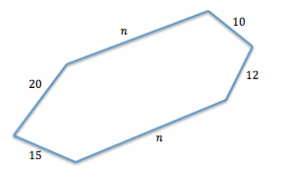
Yoshiro has a new puppy. She decides to create an enclosure for her puppy in her backyard. The enclosure is in the shape of a hexagon (six-sided polygon) with one pair of opposite sides running the same distance along the length of two parallel flower beds. There are two boundaries at one end of the flower beds that are 10 ft. and 12 ft., respectively, and at the other end, the two boundaries are 15 ft. and 20 ft., respectively. If the perimeter of the enclosure is 137 ft., what is the length of each side that runs along the flower bed?

→ What is the general shape of the puppy yard? Draw a sketch of the puppy yard.
Engage NY Math 7th Grade Module 2 Lesson 22 Example Answer Key 1

→ Write an equation that would model finding the perimeter of the puppy yard.
→ The sum of the lengths of the sides = Perimeter
n + n + 10 + 12 + 20 + 15 = 137

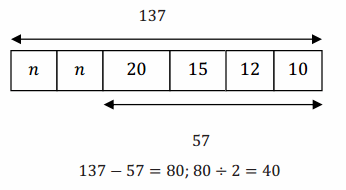
→ Model and solve this equation with a tape diagram.
→ Sample response:
Engage NY Math 7th Grade Module 2 Lesson 22 Example Answer Key 2

→ Now review making zero in an equation and making one in an equation. Explicitly connect making zero and making one in the next question to the bar model diagram. Subtracting 57 from 137 in the bar diagram is the same as using the subtraction property of equality (i.e., subtracting 57 from both sides of the equation in order to make zero). Dividing 80 by 2 to find the size of two equal groups that total 80 is the same as using the multiplicative property of equality (i.e., multiplying each side of the equation by \(\frac{1}{2}\) to make one group of n).
→ Use algebra to solve this equation.
→ First, use the additive inverse to find out what the lengths of the two missing sides are together. Then, use the multiplicative inverse to find the length of one of the two equal sides. Sum of missing sides + Sum of known sides = Perimeter
If: 2n + 57 = 137
Then: 2n + 57-57 = 137-57 Subtraction property of equality
If: 2n + 0 = 80
Then: 2n = 80 Additive identity
If: 2n = 80
Then: \(\frac{1}{2}\) (2n) = \(\frac{1}{2}\)(80) Multiplication property of equality
If: 1n = 40
Then: n = 40 Multiplicative identity

→ Does your solution make sense in this context? Why?
→ Yes, 40 ft. makes sense because when you replace the two missing sides of the hexagon with 40 in the number sentence ( 40 + 40 + 10 + 12 + 20 + 15 = 137), the lengths of the sides reach a total of 137.

Example 2.
Swim Practice
Jenny is on the local swim team for the summer and has swim practice four days per week. The schedule is the same each day. The team swims in the morning and then again for 2 hours in the evening. If she swims 12 hours per week, how long does she swim each morning?
Answer:
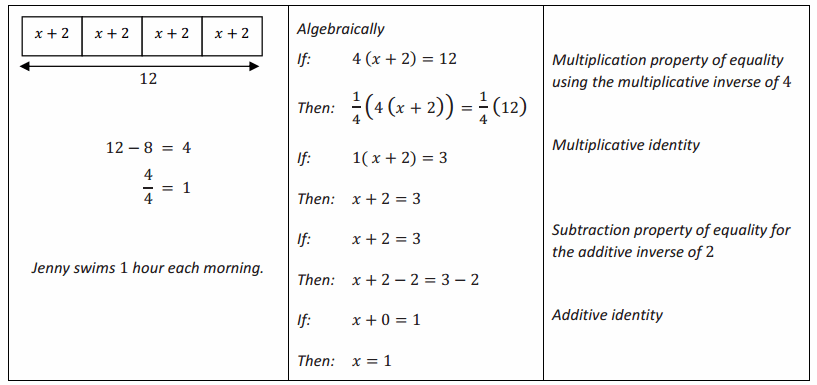
→ Write an algebraic equation to model this problem. Draw a tape diagram to model this problem.
→ Let x = number of hours of swimming each morning
Model days per week (number of hours swimming a.m. and p.m.) = hours of swimming total
Engage NY Math 7th Grade Module 2 Lesson 22 Example Answer Key 14
Recall in the last problem that students used making zero first and then making one to solve the equation. Explicitly connect making zero and making one in the previous statement to the tape diagram.

→ Solve the equations algebraically and graphically with the help of the tape diagram.
→ Sample response:
Engage NY Math 7th Grade Module 2 Lesson 22 Example Answer Key 15
→ Does your solution make sense in this context? Why?
→ Yes, if Jenny swims 1 hour in the morning and 2 hours in the evening for a total of 3 hours per day and swims 4 days per week, then 3(4) = 12 hours for the entire week.

Eureka Math Grade 7 Module 2 Lesson 22 Exercise Answer Key

Solve each equation algebraically using if–then statements to justify each step.

Question 1.
5x + 4 = 19
Answer:
If: 5x + 4 = 19
Then: 5x + 4-4 = 19-4 Subtraction property of equality for the additive inverse of 4
If: 5x + 0 = 15
Then: 5x = 15 Additive identity
If: 5x = 15
Then: \(\frac{1}{5}\) (5x) = (\(\frac{1}{5}\))15 Multiplication property of equality for the multiplicative inverse of 5
If: 1x = 3
Then: x = 3 Multiplicative identity

Question 2.
15x + 14 = 19
Answer:
If: 15x + 14 = 19
Then: 15x + 14-14 = 19-14 Subtraction property of equality for the additive inverse of 14
If: 15x + 0 = 5
Then: 15x = 5 Additive Identity
If: 15x = 5
Then: \(\frac{1}{15}\) (15x) = (\(\frac{1}{15}\))5 Multiplication property of equality for the multiplicative inverse of 15
If: 1x = \(\frac{1}{3}\)
Then: x = \(\frac{1}{3}\) Multiplicative identity

Question 3.
Claire’s mom found a very good price on a large computer monitor. She paid $325 for a monitor that was only $65 more than half the original price. What was the original price?
Answer:
x: the original price of the monitor
If: \(\frac{1}{2}\) x + 65 = 325
Then: \(\frac{1}{2}\) x + 65-65 = 325-65 Subtraction property of equality for the additive inverse of 65
If: \(\frac{1}{2}\) x + 0 = 260
Then: \(\frac{1}{2}\) x = 260 Additive identity
If: \(\frac{1}{2}\) x = 260
Then: (2)\(\frac{1}{2}\) x = (2)260 Multiplication property of equality for the multiplicative inverse of \(\frac{1}{2}\)
If: 1x = 520
Then: x = 520 Multiplicative identity
The original price was $520.

Question 4.
2(x + 4) = 18
Answer:
If: 2(x + 4) = 18
Then: \(\frac{1}{2}\) (2 (x + 4)) = \(\frac{1}{2}\) (18) Multiplication property of equality using the multiplicative inverse of 2
If: 1(x + 4) = 9
Then: x + 4 = 9 Multiplicative identity
If: x + 4 = 9
Then: x + 4-4 = 9-4 Subtraction property of equality for the additive inverse of 4
If: x + 0 = 5
Then: x = 5 Additive identity

Question 5.
Ben’s family left for vacation after his dad came home from work on Friday. The entire trip was 600 mi. Dad was very tired after working a long day and decided to stop and spend the night in a hotel after 4 hours of driving. The next morning, Dad drove the remainder of the trip. If the average speed of the car was 60 miles per hour, what was the remaining time left to drive on the second part of the trip? Remember: Distance = rate multiplied by time.
Answer:
m: the number of miles driven on the second day
60 (m + 4) = 600
If: 60 (m + 4) = 600
Then: (\(\frac{1}{60}\))60 (m + 4) = (\(\frac{1}{60}\))600 Multiplication property of equality for the multiplicative inverse of 60
If: 1 ( m + 4) = 10
Then: m + 4 = 10 Multiplicative identity
If: m + 4 = 10
Then: m + 4-4 = 10-4 Subtraction property of equality for the additive inverse of 4
If: m + 0 = 6
Then: m = 6 Additive identity
There were 6 hours left to drive.

Eureka Math Grade 7 Module 2 Lesson 22 Problem Set Answer Key

For each problem below, explain the steps in finding the value of the variable. Then find the value of the variable, showing each step. Write if–then statements to justify each step in solving the equation.

Question 1.
7(m + 5) = 21
Answer:
Multiply both sides of the equation by \(\frac{1}{7}\) , and then subtract 5 from both sides of the equation; m = -2.
If: 7(m + 5) = 21
Then: \(\frac{1}{7}\) (7(m + 5)) = \(\frac{1}{7}\) (21) Multiplication property of equality using the multiplicative inverse of 7
If: 1 (m + 5) = 3
Then: m + 5 = 3 Multiplicative identity
If: m + 5 = 3
Then: m + 5-5 = 3-5 Subtraction property of equality for the additive inverse of 5
If: m + 0 = -2
Then: m = -2 Additive identity

Question 2.
-2v + 9 = 25
Answer:
Subtract 9 from both sides of the equation, and then multiply both sides of the equation by –\(\frac{1}{2}\); v = -8.
If: -2v + 9 = 25
Then: -2v + 9-9 = 25-9 Subtraction property of equality for the additive inverse of 9
If: -2v + 0 = 16
Then: -2v = 16 Additive identity
If: -2v = 16
Then: –\(\frac{1}{2}\) (-2v) = –\(\frac{1}{2}\) (16) Multiplication property of equality using the multiplicative inverse of -2
If: 1 v = -8
Then: v = -8 Multiplicative identity

Question 3.
\(\frac{1}{3}\) y-18 = 2
Answer:
Add 18 to both sides of the equation, and then multiply both sides of the equation by 3; y = 60.
If: \(\frac{1}{3}\) y-18 = 2
Then: \(\frac{1}{3}\) y-18 + 18 = 2 + 18 Addition property of equality for the additive inverse of –18
If: \(\frac{1}{3}\) y + 0 = 20
Then: \(\frac{1}{3}\) y = 20 Additive identity
If: \(\frac{1}{3}\) y = 20
Then: 3(\(\frac{1}{3}\) y) = 3 (20) Multiplication property of equality using the multiplicative inverse of \(\frac{1}{3}\)
If: 1 y = 60
Then: y = 60 Multiplicative identity

Question 4.
6-8p = 38
Answer:
Subtract 6 from both sides of the equation, and then multiply both sides of the equation by –\(\frac{1}{8}\); p = -4.
If: 6-8p = 38
Then: 6-6-8p = 38-6 Subtraction property of equality for the additive inverse of 6
If: 0 + (-8p) = 32
Then: -8p = 32 Additive identity
If: -8p = 32
Then: (-\(\frac{1}{8}\))(-8p) = (-\(\frac{1}{8}\))32 Multiplication property of equality using the multiplicative inverse of -8
If: 1 p = -4
Then: p = -4 Multiplicative identity

Question 5.
15 = 5k-13
Answer:
Add 13 to both sides of the equation, and then multiply both sides of the equation by \(\frac{1}{5}\); k = 5.6.
If: 15 = 5k-13
Then: 15 + 13 = 5k-13 + 13 Addition property of equality for the additive inverse of -13
If: 28 = 5k + 0
Then: 28 = 5k Additive identity
If: 28 = 5k
Then: (\(\frac{1}{5}\))28 = (\(\frac{1}{5}\))5k Multiplication property of equality using the multiplicative inverse of 5
If: 5.6 = 1k
Then: 5.6 = k Multiplicative identity

Eureka Math Grade 7 Module 2 Lesson 22 Exit Ticket Answer Key

Susan and Bonnie are shopping for school clothes. Susan has $50 and a coupon for a $10 discount at a clothing store where each shirt costs $12.
Susan thinks that she can buy three shirts, but Bonnie says that Susan can buy five shirts. The equations they used to model the problem are listed below. Solve each equation algebraically, justify your steps, and determine who is correct and why?
Eureka Math Grade 7 Module 2 Lesson 22 Exit Ticket Answer Key 50
Answer:
Bonnie is correct. The equation that would model this situation is 12n-10 = 50. Solving this equation would involve making zero by adding 10. And by doing so, 12n-10 + 10 = 50 + 10, we arrive at 12n = 60. So, if a group of shirts that cost $12 each totals $60, then there must be five shirts since \(\frac{60}{12}\) equals 5.
Bonnie’s Equation:
12n-10 = 50
12n-10 + 10 = 50 + 10 Addition property of equality for the additive inverse of -10
12n + 0 = 60
12n = 60 Additive identity
(\(\frac{1}{12}\))12n = (\(\frac{1}{12}\))60 Multiplication property of equality using the multiplicative inverse of 12
1n = 5
n = 5 Multiplicative identity

Susan’s Equation:
12n + 10 = 50
12n + 10-10 = 50-10 Subtraction property of equality for the additive inverse of 10
12n + 0 = 40
12n = 40 Additive identity
(\(\frac{1}{12}\))12n = (\(\frac{1}{12}\))40 Multiplication property of equality using the multiplicative inverse of 12
1n = 3 \(\frac{1}{3}\)
n = 3 \(\frac{1}{3}\) Multiplicative identity

Eureka Math Grade 7 Module 2 Lesson 21 Answer Key

Engage NY Eureka Math 7th Grade Module 2 Lesson 21 Answer Key

Eureka Math Grade 7 Module 2 Lesson 21 Exercise Answer Key

Question 1.
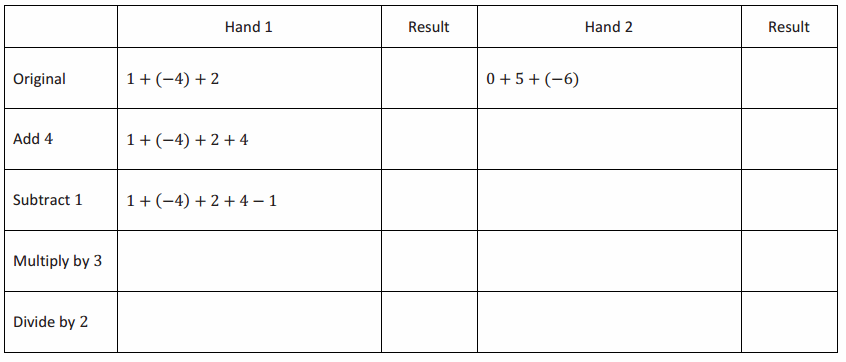
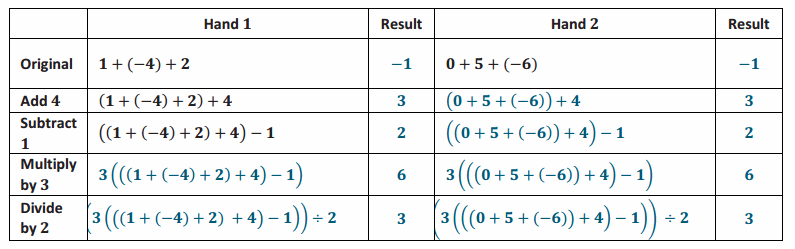
The table below shows two hands from the Integer Game and a series of changes that occurred to each hand. Part of the table is completed for you. Complete the remaining part of the table; then summarize the results.
Eureka Math Grade 7 Module 2 Lesson 21 Exercise Answer Key 0.1
Answer:
Eureka Math Grade 7 Module 2 Lesson 21 Exercise Answer Key 0.2
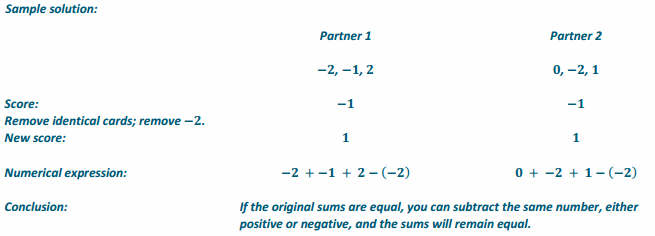
Since the sums of each original hand are the same, the same cards can be added, subtracted, multiplied, and divided, and the sums will remain equal to each other.

Question 2.
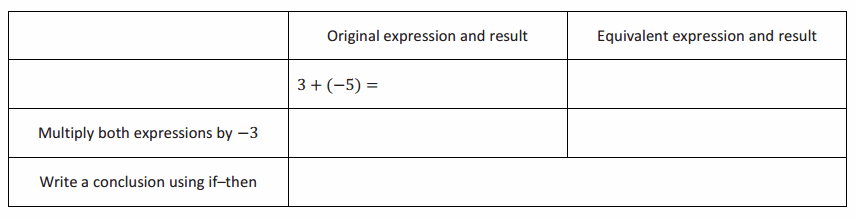
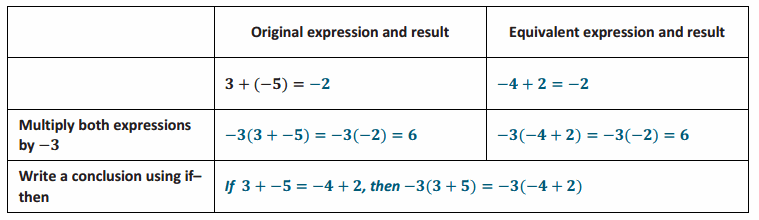
Complete the table below using the multiplication property of equality.
Eureka Math Grade 7 Module 2 Lesson 21 Exercise Answer Key 0.3
Answer:
Eureka Math Grade 7 Module 2 Lesson 21 Exercise Answer Key 0.4

Eureka Math Grade 7 Module 2 Lesson 21 Exploratory Challenge Answer Key

Exploratory Challenge: Integer Game Revisited
Let’s investigate what happens if a card is added or removed from a hand of integers.
Eureka Math Grade 7 Module 2 Lesson 21 Exploratory Challenge Answer Key 1

Event 1.
Eureka Math Grade 7 Module 2 Lesson 21 Exploratory Challenge Answer Key 2
Answer:
Eureka Math Grade 7 Module 2 Lesson 21 Exploratory Challenge Answer Key 3

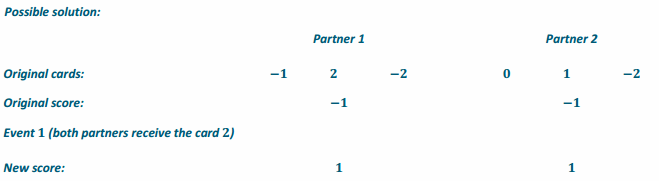
Repeat this process with one minor change; this time both students receive one integer card containing the same negative value. Have students record their new scores and, after comparing with their partners, write a conclusion using an if–then statement.

Event 1 (both partners receive the card – 1)

Eureka Math Grade 7 Module 2 Lesson 21 Exploratory Challenge Answer Key 4

Series of questions leading to the conclusion:
→ Were your scores the same when we began?
→ Yes
→ Did you add the same values to your hand each time?
→ Yes
→ Did the value of your hand change each time you added a new card?
→ Yes
→ Was the value of your hand still the same as your partner’s after each card was added?
→ Yes
→ Why did the value of your hand remain the same after you added the new cards?
→ We started with the same sum; therefore, when we added a new card, we had equivalent expressions, which resulted in the same sum.
→ Since your original cards were different, but your original sum was the same, write a conclusion that was exemplified by this event.
→ If the original sums were equal, you can add a number, either positive or negative, and the sums will remain equal.

Event 2.
Eureka Math Grade 7 Module 2 Lesson 21 Exploratory Challenge Answer Key 5
Answer:
Eureka Math Grade 7 Module 2 Lesson 21 Exploratory Challenge Answer Key 6

Event 3.
Eureka Math Grade 7 Module 2 Lesson 21 Exploratory Challenge Answer Key 7
Answer:
Eureka Math Grade 7 Module 2 Lesson 21 Exploratory Challenge Answer Key 8
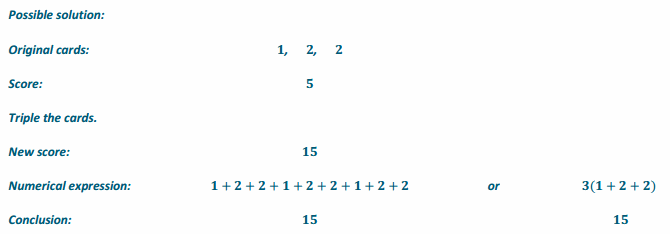
If the sums are the same, then the product of the sums will remain equal when both are multiplied by the same rational number.

Event 4.

Expression:

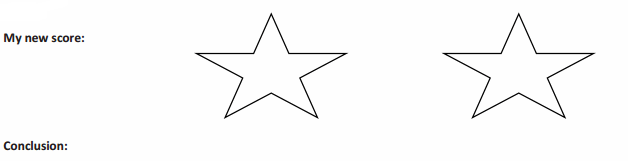
Conclusion:
Answer:
Eureka Math Grade 7 Module 2 Lesson 21 Exploratory Challenge Answer Key 9

Eureka Math Grade 7 Module 2 Lesson 21 Problem Set Answer Key

Question 1.
Evaluate the following numerical expressions.
a. 2 + ( – 3) + 7=
Answer:
6

b. – 4 – 1=
Answer:
– 5

c. – \(\frac{5}{2}\) ×2=
Answer:
– 5

d. – 10÷2 + 3=
Answer:
– 2

e. (\(\frac{1}{2}\) )(8) + 2 =
Answer:
6

f. 3 + ( – 4) – 1=
Answer:
– 2

Question 2.
Which expressions from Exercise 1 are equal?
Answer:
Expressions (a) and (e) are equivalent.
Expressions (b) and (c) are equivalent.
Expressions (d) and (f) are equivalent.

Question 3.
If two of the equivalent expressions from Exercise 1 are divided by 3, write an if–then statement using the properties of equality.
Answer:
If 2 + ( – 3) + 7=(\(\frac{1}{2}\) )(8) + 2, then (2 + ( – 3) + 7)÷3=((\(\frac{1}{2}\) )(8) + 2)÷3.

Question 4.
Write an if–then statement if – 3 is multiplied by the following equation: – 1 – 3= – 4.
Answer:
If – 1 – 3 = – 4, then – 3( – 1 – 3) = – 3( – 4)

Question 5.
Simplify the expression.
5 + 6 – 5 + 4 + 7 – 3 + 6 – 3
Answer:
=17

Using the expression, write an equation.
Answer:
5 + 6 – 5 + 4 + 7 – 3 + 6 – 3=17

Rewrite the equation if 5 is added to both expressions.
Answer:
5 + 6 – 5 + 4 + 7 – 3 + 6 – 3 + 5=17 + 5

Write an if–then statement using the properties of equality.
Answer:
If 5 + 6 – 5 + 4 + 7 – 3 + 6 – 3 = 17, then 5 + 6 – 5 + 4 + 7 – 3 + 6 – 3 + 5
= 17 + 5

Eureka Math Grade 7 Module 2 Lesson 21 Exit Ticket Answer Key

Compare the two expressions.
Expression 1: 6 + 7 + – 5
Expression 2: – 5 + 10 + 3

Question 1.
Are the two expressions equivalent? How do you know?
Answer:
Yes, the expressions are equivalent because Expression 1 is equal to 8 and Expression 2 is equal to 8, as well. When two expressions evaluate to the same number, they are equivalent.

Question 2.
Subtract – 5 from each expression. Write the new numerical expression, and write a conclusion as an if–then statement.
Answer:
Expression 1:
6 + 7±5 – ( – 5)
13
Expression 2: – 5 + 10 + 3 – ( – 5)
13
If 6 + 7 + – 5= – 5 + 10 + 3, then 6 + 7 + – 5 – ( – 5)= – 5 + 10 + 3 – ( – 5).
If Expression 1= Expression 2, then (Expression 1 – ( – 5))=(Expression 2 – ( – 5)).

Question 3.
Add 4 to each expression. Write the new numerical expression, and write a conclusion as an if–then statement.
Answer:
Expression 1: 6 + 7±5 + 4
12
Expression 2: – 5 + 10 + 3 + 4
12
If 6 + 7 + – 5= – 5 + 10 + 3, then 6 + 7 + – 5 + 4= – 5 + 10 + 3 + 4.
If Expression 1 = Expression 2, then (Expression 1 + 4)=(Expression 2 + 4).

Question 4.
Divide each expression by – 2. Write the new numerical expression, and write a conclusion as an if–then statement.
Answer:
Expression 1: (6 + 7 + – 5)÷ – 2
8÷ – 2
– 4
Expression 2: ( – 5 + 10 + 3)÷ – 2
8÷ – 2
– 4
If 6 + 7 + – 5= – 5 + 10 + 3, then (6 + 7 + – 5)÷ – 2=( – 5 + 10 + 3)÷ – 2
If Expression 1= Expression 2, then (Expression 1 ÷ – 2)=(Expression 2 ÷ – 2).

Eureka Math Grade 7 Module 2 Lesson 20 Answer Key

Engage NY Eureka Math 7th Grade Module 2 Lesson 20 Answer Key

Eureka Math Grade 7 Module 2 Lesson 20 Task Answer Key

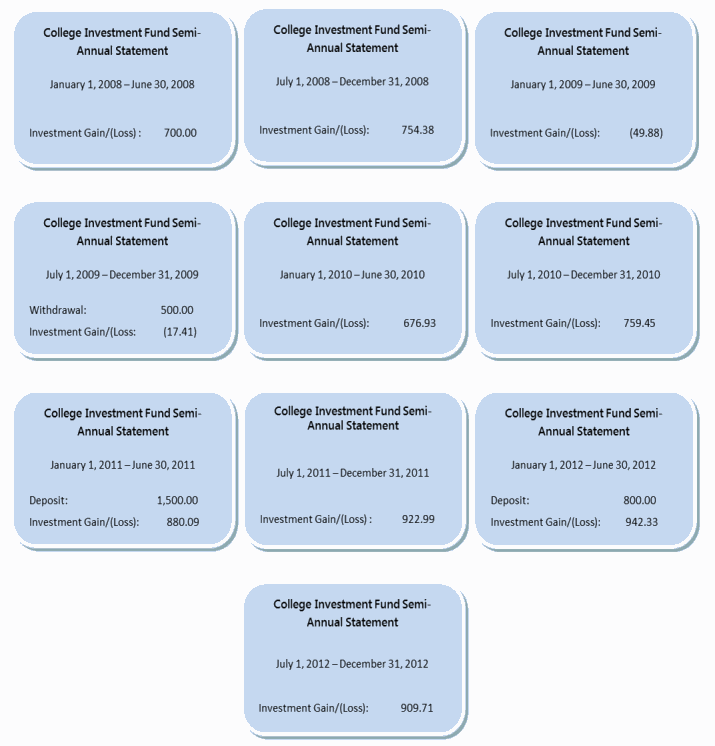
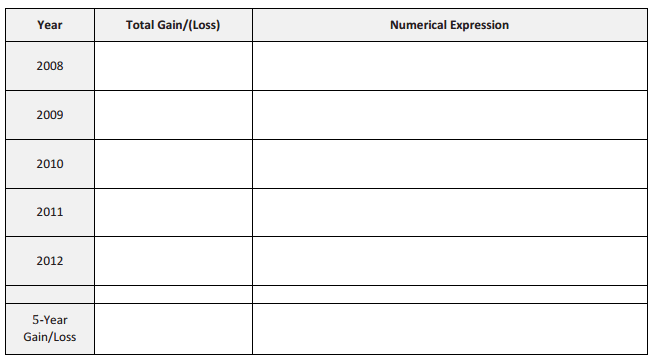
TASK: Using the above information, semiannual statements, register, and beginning balance, do the following:
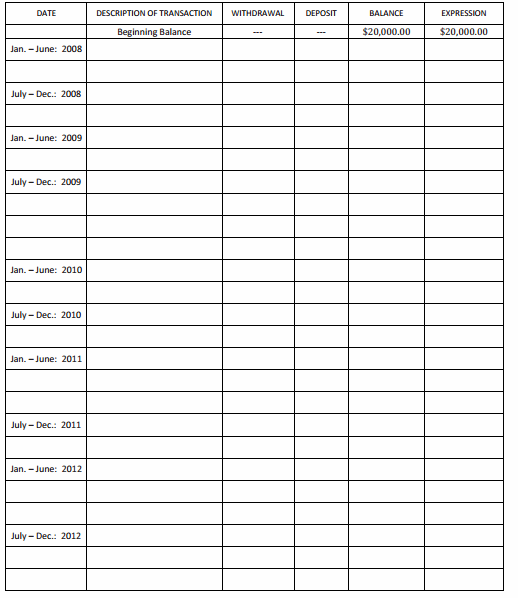
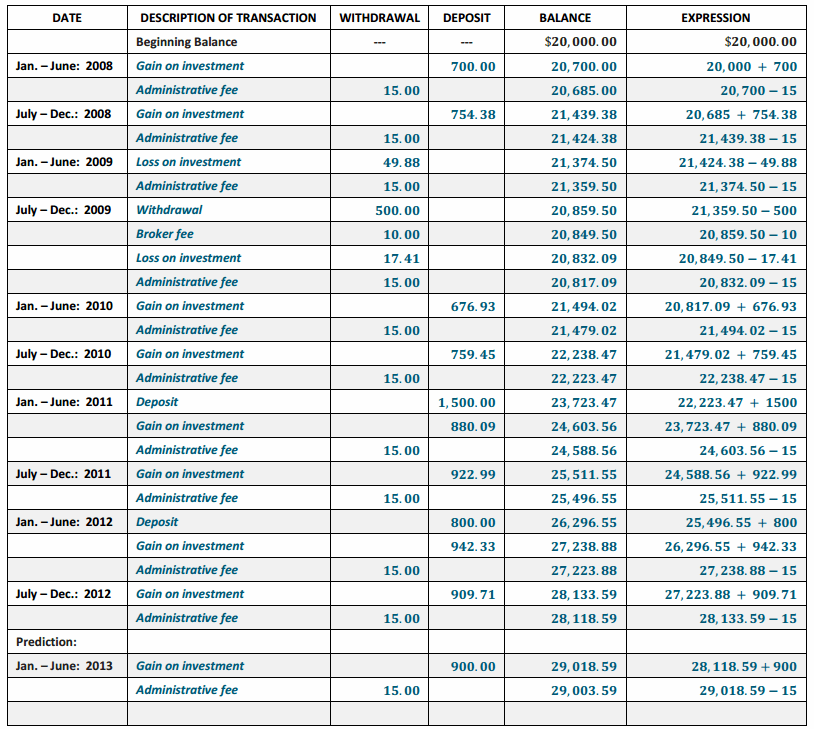
1. Record the beginning balance and all transactions from the account statements into the register.
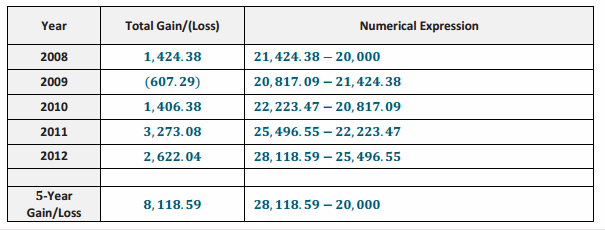
2. Determine the annual gain or loss as well as the overall 5-year gain or loss.
3. Determine if there is enough money in the account after 5 years to cover $30,000 of college expenses for Justin and Adrienne’s daughter. Write a summary to defend your answer. Be sure to indicate how much money is in excess, or the shortage that exists.
4. Answer the related questions that follow.
Eureka Math Grade 7 Module 2 Lesson 20 Task Answer Key 1
Answer:
Eureka Math Grade 7 Module 2 Lesson 20 Task Answer Key 2

Question 5.
Register
Eureka Math Grade 7 Module 2 Lesson 20 Task Answer Key 3
Answer:
Eureka Math Grade 7 Module 2 Lesson 20 Task Answer Key 4

→ Describe the process of completing the register.
→ Starting with the beginning balance, fill in the description of the transaction and the amount. If the transaction is an investment loss,
withdrawal, or fee, then the amount is recorded in the payment column. If the transaction is an investment gain or deposit, then the amount is recorded in the deposit column. To obtain the new balance, subtract the payment amount, or add the deposit amount, from the balance on the preceding line. Record the new balance, and use that balance to complete the next line.
→ Describe how to find the broker’s fee.
→ The broker’s fee is 2% of the transaction amount. To find the broker’s fee, you must first find the total
of the transaction amount. Once you have that, write the percent as a fraction out of 100 and multiply
the fraction by the transaction amount. This result is the amount of the broker’s fee, which is then
subtracted from the preceding balance.
Example: 2% of $2,500
\(\frac{2}{100}\) × 2,500 = \(\frac{1}{50}\) × 2,500 = 50
→ Compare your register with the person next to you. Did each of you list the transactions in the same order?
Does it make a difference?
→ The order is probably not the same. The order of the transactions for each 6-month period does not
make a difference.
→ Continue to compare your registers. Do you both get the same balance at the end of 2012? If not, switch papers and check to see if you can find your neighbor’s mistake.

Question 6.
Annual Gain/Loss Summary
Eureka Math Grade 7 Module 2 Lesson 20 Task Answer Key 5
Answer:
Eureka Math Grade 7 Module 2 Lesson 20 Task Answer Key 6

Question 7.
Summary
Answer:
There is not enough money in the account at the end of 5 years to cover the college expenses, but it is close. They needed at least $30,000 in the account to cover the expenses, and there was $28,118.59, leaving a shortage of $1,881.41.

Question 8.
Related Questions
a. For the first half of 2009, there was a $700 gain on the initial investment of $20,000. Represent the gain as a percentage of the initial investment.
Answer:
\(\frac{x}{100}\) =700/(20,000) The gain was 3.5% of $20,000.

b. Based on the gains and losses on their investment during this 5-year period, over what period of time was their investment not doing well? How do you know? What factors might contribute to this?
Answer:
The investment was not doing well in 2009. There were losses on the investment for both halves of the year, and $500 was taken out of the account. It could be because the economy was doing badly, and a recession affected the investment’s performance.

c. In math class, Jaheim and Frank were working on finding the total amount of the investment after 5 years. As a final step, Jaheim subtracted $150 for administrative fees from the balance he arrived at after adding in all the deposits and subtracting out the one withdrawal and broker’s fee. For every semiannual statement, Frank subtracted $15 from the account balance for the administrative fee. Both boys arrived at the same ending 5-year balance. How is this possible? Explain.
Answer:
Jaheim took the $15 fee and multiplied it by 10, since there were 10 statements, and deducted the $150 total. Frank subtracted $15 from the account balance for each statement. That was 10 times. So, both ways produce the same result: reducing the account balance by $150 overall.

d. Based on the past statements for their investment account, predict what activity you might expect to see on Adrienne and Justin’s January–June 2013 account statement. Then record it in the register to arrive at the balance as of June 30, 2013.
Answer:
I predict the account will continue to produce gains. The gains have been around $900 for the past four statements, so I predict it will be about $900 again, since it decreased by a little bit the last time, and there was a $909.71 gain the last time. If I take away $15 for the administrative fee, the balance would go up by $885, and it would be $29,003.59.

e. Using the answer from part (d), if their daughter’s college bill is due in September of 2013, how much money do you estimate will be in their investment account at the end of August 2013 before the college bill is paid? Support your answer.
Answer:
Their investment could gain more money for July and August. Right now, it is gaining about $900 per statement. If I divide that by 6, it equals $150 (which is the average gain per month). So, for July and August I estimate that it will earn about another $300 (including the $15 fee), so there might be $29,333.59 in the account.

Eureka Math Grade 7 Module 2 Lesson 20 Exercise Answer Key

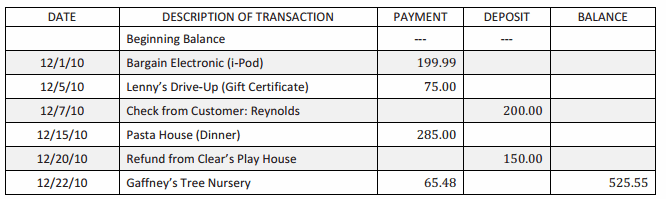
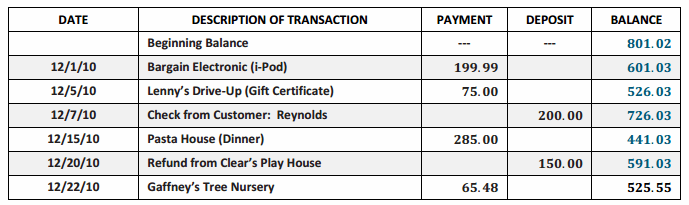
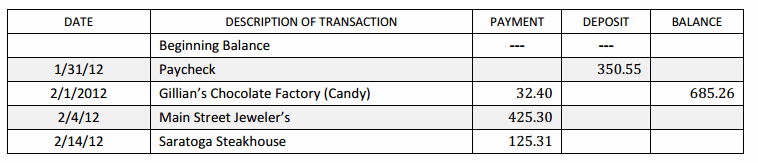
Below is a transaction log of a business entertainment account. The transactions are completed, and the ending balance in the account is $525.55. Determine the beginning balance.
Eureka Math Grade 7 Module 2 Lesson 20 Exercise Answer Key 30
Answer:
Eureka Math Grade 7 Module 2 Lesson 20 Exercise Answer Key 31

Eureka Math Grade 7 Module 2 Lesson 20 Exit Ticket Answer Key

Question 1.
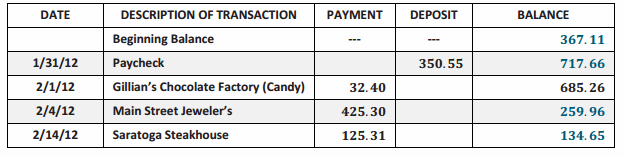
Using the incomplete register below, work forward and backward to determine the beginning and ending balances after the series of transactions listed.
Engage NY Math 7th Grade Module 2 Lesson 20 Exit Ticket Answer Key 40
Answer:
Engage NY Math 7th Grade Module 2 Lesson 20 Exit Ticket Answer Key 41

Question 2.
Write an expression to represent the balance after the paycheck was deposited on 1/31/12. Let x represent the beginning balance.
Answer:
x+350.55

Question 3.
Write a numerical expression to represent the balance after the transaction for Main Street Jeweler’s was made.
Answer:
685.26-425.30

Eureka Math Grade 7 Module 2 Lesson 19 Answer Key

Engage NY Eureka Math 7th Grade Module 2 Lesson 19 Answer Key

Eureka Math Grade 7 Module 2 Lesson 19 Example Answer Key

Example 1.
Tic-Tac-Toe Review
Fill in the 9 spaces with one expression from the list below. Use one expression per space. You will use 9 of the expressions:
12-4x
8x+4-12x
8(\(\frac{1}{2}\) x -2)
Engage NY Math 7th Grade Module 2 Lesson 19 Example Answer Key 1
12-6x+2x
-4x+4
x-2+2x-4
4x-12
4(x-4)
3(x-2)
0.1(40x)-\(\frac{1}{2}\) (24)

Example 2.
Engage NY Math 7th Grade Module 2 Lesson 19 Example Answer Key 2
Answer:
Engage NY Math 7th Grade Module 2 Lesson 19 Example Answer Key 3

Example 3.
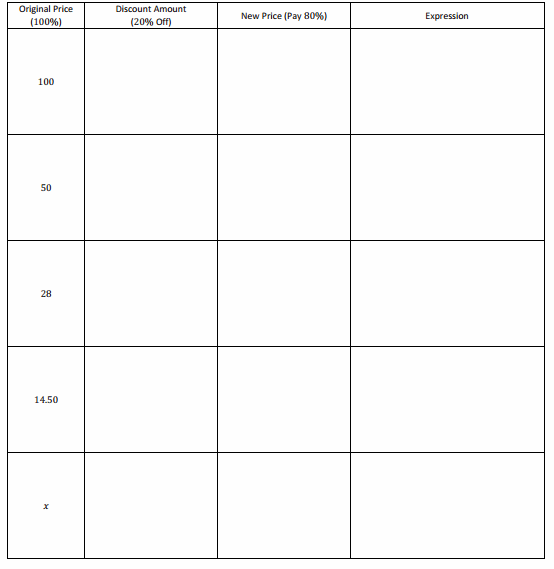
An item that has an original price of x dollars is discounted 33%.
a. Write an expression that represents the amount of the discount.
Answer:
0.33x

b. Write two equivalent expressions that represent the new, discounted price.
Answer:
x-0 .33x
x(1-0.33)
x(0.67)

c. Use one of your expressions to calculate the new, discounted price if the original price was $56.
Answer:
0.67x
0.67(56)
37.52
The new discounted price is $37.52.

d. How would the expressions you created in parts (a) and (b) have to change if the item’s price had increased by 33% instead of decreased by 33%?
Answer:
Instead of subtracting 0.33x, you would have to add for the increase. The expression would be
x+0.33x
1.33x.

Example 4.
Eureka Math Grade 7 Module 2 Lesson 19 Exercise Answer Key 5
Answer:
Eureka Math Grade 7 Module 2 Lesson 19 Exercise Answer Key 6

Eureka Math Grade 7 Module 2 Lesson 19 Problem Set Answer Key

Solve the following problems. If necessary, round to the nearest penny.

Question 1.
A family of 12 went to the local Italian restaurant for dinner. Every family member ordered a drink and meal, 3 ordered an appetizer, and 6 people ordered cake for dessert.
a. Write an expression that can be used to figure out the cost of the bill. Include the definitions for the variables the server used.
Answer:
d= drink
m = meal
a = appetizer
c = cake
12d+12m+3a+6c

b. The waitress wrote on her ordering pad the following expression: 3(4d+4m+a+2c). Was she correct? Explain why or why not.
Answer:
Yes, she was correct because her expression is equivalent to the expression from part (a). If the distributive property is applied, the expressions would be exact.

c. What is the cost of the bill if a drink costs $3, a meal costs $20, an appetizer costs $5.50, and a slice of cake costs $3.75?
Answer:
12d+12m+3a+6c
12(3)+12(20)+3(5.50)+6(3.75)
36+240+16.50+22.50
315
The cost of the bill is $315.

d. Suppose the family had a 10% discount coupon for the entire check and then left an 18% tip. What is the total?
Answer:
(315-315(0.10))+0.18(315-315(0.10))
1.18(315-315(0.10))
1.18(315(0.90))
334.53
After the discount and tip, the new total is $334.53.

Question 2.
Sally designs web pages for customers. She charges $135.50 per web page; however, she must pay a monthly rental fee of $650 for her office. Write an expression to determine her take-home pay after expenses. If Sally designed 5 web pages last month, what was her take-home pay after expenses?
w= number of webpages Sally designs
135.50w-650
135.50(5)-650
27.50
After expenses, Sally’s take-home pay is $27.50.

Question 3.
While shopping, Megan and her friend Rylie find a pair of boots on sale for 25% off the original price. Megan calculates the final cost of the boots by first deducting the 25% and then adding the 6% sales tax. Rylie thinks Megan will pay less if she pays the 6% sales tax first and then takes the 25% discount.
a. Write an expression to represent each girl’s scenario if the original price of the boots was x dollars.
Answer:
Eureka Math Grade 7 Module 2 Lesson 19 Problem Set Answer Key 15

b. Evaluate each expression if the boots originally cost $200.
Answer:
Eureka Math Grade 7 Module 2 Lesson 19 Problem Set Answer Key 16
Using both Megan’s and Rylie’s methods would show that the boots would cost $159.

c. Who was right? Explain how you know.
Answer:
Neither girl was right. They both pay the same amount.

d. Explain how both girls’ expressions are equivalent.
Answer:
Two expressions are equivalent if they yield the same number for every substitution of numbers for the variables in each expression. Since multiplication is commutative, the order of the multiplication can be reversed, and the result will remain the same.

Eureka Math Grade 7 Module 2 Lesson 19 Exit Ticket Answer Key

Question 1.
Write three equivalent expressions that can be used to find the final price of an item costing g dollars that is on sale for 15% off and charged 7% sales tax.
Answer:
(x-0.15x) + 0.07(x-0.15x) 1.07(x -0 .15x) 1.07(0.85x) or 0.85(1.07)x

Question 2.
Using all of the expressions, determine the final price for an item that costs $75. If necessary, round to the nearest penny.
Answer:
Eureka Math Grade 7 Module 2 Lesson 19 Exit Ticket Answer Key 100
The final price of an item that costs $75 is $68.21.

Question 3.
If each expression yields the same final sale price, is there anything to be gained by using one over the other?
Answer:
Using the final two expressions makes the problem shorter and offers fewer areas to make errors. However, all three expressions are correct.

Question 4.
Describe the benefits, special characteristics, and properties of each expression.
Answer:
The second and third expressions collect like terms. The third expression can be written either way using the commutative property of multiplication. The first and second expressions find the discount price first, whereas the third expression is written in terms of percent paid.

Eureka Math Grade 7 Module 2 Lesson 18 Answer Key

Engage NY Eureka Math 7th Grade Module 2 Lesson 18 Answer Key

Eureka Math Grade 7 Module 2 Lesson 18 Exercise Answer Key

Exercise 1.
John’s father asked him to compare several different cell phone plans and identify which plan will be the least expensive for the family. Each phone company charges a monthly fee, but this fee does not cover any services: phone lines, texting, or internet access. Use the information contained in the table below to answer the following questions.
Cell Phone Plans
Eureka Math Grade 7 Module 2 Lesson 18 Exercise Answer Key 1
All members of the family may not want identical plans; therefore, we will let x represent the number of phone lines, y represent the number of phone lines with unlimited texting, and z represent the number of phone lines with internet access.
Expression
Company A __

Company B __

Company C ___
Answer:
Company A 70 + 20x + 15y + 15z
Company B 90 + 15x + 10y + 20z
Company C 200 + 10x

Using the expressions above, find the cost to the family of each company’s phone plan if:
a. Four people want a phone line, four people want unlimited texting, and the family needs two internet lines.
Eureka Math Grade 7 Module 2 Lesson 18 Exercise Answer Key 2
Answer:
Eureka Math Grade 7 Module 2 Lesson 18 Exercise Answer Key 3
Which cell phone company should John’s family use? Why?
Answer:
The family should choose Company B since it is cheaper than the others for the given values

b. Four people want a phone line, four people want unlimited texting, and all four people want internet lines.
Eureka Math Grade 7 Module 2 Lesson 18 Exercise Answer Key 4
Answer:
Eureka Math Grade 7 Module 2 Lesson 18 Exercise Answer Key 5

Which cell phone company should John’s family use? Why?
Answer:
The family should choose Company C since it is cheaper than the other companies for the given values.

c. Two people want a phone line, two people want unlimited texting, and the family needs two internet lines.
Eureka Math Grade 7 Module 2 Lesson 18 Exercise Answer Key 6
Answer:
Eureka Math Grade 7 Module 2 Lesson 18 Exercise Answer Key 7

Which cell phone company should John’s family use? Why?
Answer:
The family should choose Company A since it is cheaper than the other companies for the given values.

Exercise 2.
Three friends went to the movies. Each purchased a medium – sized popcorn for p dollars and a small soft drink for s dollars.
a. Write the expression that represents the total amount of money (in dollars) the three friends spent at the concession stand.
Answer:
3(p + s)

b. If the concession stand charges $6.50 for a medium – sized popcorn and $4.00 for a small soft drink, how much did the three friends spend on their refreshments altogether?
Answer:
One possible solution is shown here; more solution methods are shown in the discussion that follows.
3(p + s)
3(6.50 + 4)
3(10.50)
31.50
They spent $31.50.

Exercise 3.
Complete the table below by writing equivalent expressions to the given expression and evaluating each expression with the given values.
Eureka Math Grade 7 Module 2 Lesson 18 Exercise Answer Key 10
Eureka Math Grade 7 Module 2 Lesson 18 Exercise Answer Key 10.2
Answer:
Eureka Math Grade 7 Module 2 Lesson 18 Exercise Answer Key 10.1

Eureka Math Grade 7 Module 2 Lesson 18 Problem Set Answer Key

Question 1.
Sally is paid a fixed amount of money to walk her neighbor’s dog every day after school. When she is paid each month, she puts aside $20 to spend and saves the remaining amount. Write an expression that represents the amount Sally will save in 6 months if she earns m dollars each month. If Sally is paid $65 each month, how much will she save in 6 months?
Answer:
m= monthly pay
6(m – 20)
6m – 120
For m=65
6(m – 20)
6(65 – 20)
6(45)
270
or
6(m – 20)
6(65 – 20)
390 – 120
270
Sally will save $270 in 6 months.

Question 2.
A football team scored 3 touchdowns, 3 extra points, and 4 field goals.
a. Write an expression to represent the total points the football team scored.
Answer:
t= number of points for a touchdown.
e= number of points for the extra point.
f= number of points for a field goal.
3t + 3e + 4f

b. Write another expression that is equivalent to the one written above.
Answer:
Answers may vary. Sample response: 3t + 3e + 2f + 2f

c. If each touchdown is worth 6 points, each extra point is 1 point, and each field goal is 3 points, how many total points did the team score?
Answer:
3t + 3e + 4f
3(6) + 3(1) + 4(3)
18 + 3 + 12
33

Question 3.
Write three other expressions that are equivalent to 8x – 12.
Answer:
Answers may vary.
4(2x – 3)
6x + 2x – 12
8(x – 1) – 4
– 12 + 8x

Question 4.
Profit is defined as earnings less expenses (earnings – expenses). At the local hot – air balloon festival, the Ma & Pops Ice Cream Truck sells ice cream pops, which cost them $0.75 each but are sold for $2 each. They also paid $50 to the festival’s organizers for a vendor permit. The table below shows the earnings, expenses, and profit earned when 50, 75, and 100 ice cream pops were sold at the festival.
Eureka Math Grade 7 Module 2 Lesson 18 Problem Set Answer Key 25
a. Write an expression that represents the profit (in dollars) Ma & Pops earned by selling ice cream pops at the festival.
Answer:
p represents the number of pops sold.
2p – 0.75p – 50

b. Write an equivalent expression.
Answer:
1.25p – 50

c. How much of a profit did Ma & Pops Ice Cream Truck make if it sold 20 ice cream pops? What does this mean? Explain why this might be the case.
Answer:
1.25p – 50
1.25(20) – 50
25 – 50
– 25
They did not make any money; they lost $25. A possible reason is it could have been cold or rainy and people were not buying ice cream.

d. How much of a profit did Ma & Pops Ice Cream Truck make if it sold 75 ice cream pops? What does this mean? Explain why this might be the case.
Answer:
1.25p – 50
1.25(75) – 50
93.75 – 50
43.75
They made a profit of $43.75. Possible reasons are the weather could have been warmer and people bought the ice cream, or people just like to eat ice cream no matter what the weather is.

Eureka Math Grade 7 Module 2 Lesson 18 Exit Ticket Answer Key

Bradley and Louie are roommates at college. At the beginning of the semester, they each paid a security deposit of A dollars. When they move out, their landlord will deduct from this deposit any expenses (B) for excessive wear and tear and refund the remaining amount. Bradley and Louie will share the expenses equally.
→ Write an expression that describes the amount each roommate will receive from the landlord when the lease expires.
→ Evaluate the expression using the following information: Each roommate paid a $125 deposit, and the landlord deducted $50 total for damages.
Answer:
Deposit each person paid: A
Total damages: B
Each roommate receives: A – \(\frac{B}{2}\)
A=125, B=50
A – \(\frac{B}{2}\)
125 – \(\frac{50}{2}\)
125 – 25
100

Eureka Math Grade 7 Module 2 Lesson 17 Answer Key

Engage NY Eureka Math 7th Grade Module 2 Lesson 17 Answer Key

Eureka Math Grade 7 Module 2 Lesson 17 Opening Exercise Answer Key

For his birthday, Zack and three of his friends went to a movie. They each got a ticket for $8.00 and the same snack from the concession stand. If Zack’s mom paid $48 for the group’s tickets and snacks, how much did each snack cost?
The equation 4(s+8)=48 represents the situation when s represents the cost, in dollars, of one snack.
Answer:
4(s + 8) = 48
\(\frac{1}{4}\) (4(s+8))=\(\frac{1}{4}\) (48)
s + 8 = 12
s + 8 – 8 = 12 – 8
s+0=4
s=4
Eureka Math Grade 7 Module 2 Lesson 17 Opening Exercise Answer Key 1
OR
4(s+8)=48
4s+32=48
4s+32-32=48-32
4s+0=16
4s=16
\(\frac{1}{4}\) (4s)=\(\frac{1}{4}\) (16)
1s=4
s=4
Eureka Math Grade 7 Module 2 Lesson 17 Opening Exercise Answer Key 14

Eureka Math Grade 7 Module 2 Lesson 17 Exercise Answer Key

Exercise
The cost of a babysitting service on a cruise is $10 for the first hour and $12 for each additional hour. If the total cost of babysitting baby Aaron was $58, how many hours was Aaron at the sitter?
Algebraic Solution
h = number of additional hours
12h + 10 = 58
12h + 10-10 = 58-10
12h + 0 = 48
(\(\frac{1}{12}\) )(12h)=(48)(\(\frac{1}{12}\) )
1h = 4
h=4
Eureka Math Grade 7 Module 2 Lesson 17 Exercise Answer Key 15

1+4=5
Aaron was with the babysitter for 5 hours

Eureka Math Grade 7 Module 2 Lesson 17 Exploratory Challenge Answer Key

Exploratory Challenge: Expenses on Your Family Vacation
John and Ag are summarizing some of the expenses of their family vacation for themselves and their three children, Louie, Missy, and Bonnie. Write an algebraic equation, create a model to determine how much each item will cost using all of the given information, and answer the questions that follow.
Expenses:
Eureka Math Grade 7 Module 2 Lesson 17 Exploratory Challenge Answer Key 30

Your Group’s Scenario Solution:
Answer:
Scenario 1
During one rainy day on the vacation, the entire family decided to go watch a matinee movie in the morning and a drive-in movie in the evening. The price for a matinee movie in the morning is different than the cost of a drive-in movie in the evening. The tickets for the matinee morning movie cost $6 each. How much did each person spend that day on movie tickets if the ticket cost for each family member was the same? What was the cost for a ticket for the drive-in movie in the evening?
Answer:
Algebraic Equation & Solution

Morning matinee movie: $6 each
Evening drive-in movie: e each
5(e+6)=75
5e+30=75
5e+30-30=75-30
5e+0=45
(\(\frac{1}{5}\))5e=45(\(\frac{1}{5}\))
1e=9
e=9
OR
5(e+6)=75
(\(\frac{1}{5}\) )5(e+6)=75(\(\frac{1}{5}\) )
e+6=15
e+6-6=15-6
e =9
Eureka Math Grade 7 Module 2 Lesson 17 Exploratory Challenge Answer Key 4
The total each person spent on movies in one day was $15. The evening drive-in movie costs $9 each

Scenario 2
For dinner one night, the family went to the local pizza parlor. The cost of a soda was $3. If each member of the family had a soda and one slice of pizza, how much did one slice of pizza cost?
Answer:
Algebraic Equation & Solution
One Soda: $3
Slice of Pizza: p dollars
5(p+3)=37.95
5p +15 = 37.95
5p+15-15 =37.95 -15
5p+0=22.95
(\(\frac{1}{5}\) )5p=22.95(\(\frac{1}{5}\) )
1p = 4.59
p= 4.59
OR
5(p+3)=37.95
(\(\frac{1}{5}\) )5(p+3)=(37.95)(\(\frac{1}{5}\) )
p + 3 = 7.59
p + 3-3 = 7.59-3
p = 4.59
Eureka Math Grade 7 Module 2 Lesson 17 Exploratory Challenge Answer Key 9
one slice of pizza cost $4.59

Scenario 3
One night, John, Louie, and Bonnie went to see the local baseball team play a game. They each bought a game ticket and a hat that cost $10. How much was each ticket to enter the ballpark?
Answer:
Algebraic Equation & Solution
Ticket: t dollars
Hat: $10
3(t +10)=103.83
3t + 30 = 103.83
3t+30-30=103.83-30
3t + 0 = 73.83
(\(\frac{1}{3}\) )3t=73.83(\(\frac{1}{3}\) )
1t = 24.61
t = 24.61
OR
3(t +10)=103.83
(\(\frac{1}{3}\) )3(t +10)=(103.83)(\(\frac{1}{3}\) )
t+10=34.61
t+10-10=34.61-10
t=24.61
One ticket costs $24.61.
Eureka Math Grade 7 Module 2 Lesson 17 Exploratory Challenge Answer Key 10

Scenario 4.
While John, Louie, and Bonnie went to see the baseball game, Ag and Missy went shopping. They bought a T-shirt for each member of the family and bought two pairs of sandals that cost $10 a pair. How much was each T-shirt?
Answer:
Algebraic Equation & Solution
T-Shirt: t dollars
Sandals: 2 × $10 = $20
5t + 20 = 120
5t +20-20 =120- 20
5t + 0 = 100
(\(\frac{1}{5}\) )5t=100(\(\frac{1}{5}\) )
1t=20
t=20
Eureka Math Grade 7 Module 2 Lesson 17 Exploratory Challenge Answer Key 11
One T-shirt costs $20.

Scenario 5.
The family flew in an airplane to their vacation destination. Each person had to have his own ticket for the plane and also pay $25 in insurance fees per person. What was the cost of one ticket?
Answer:
Algebraic Equation & Solution
One ticket: t dollars
Insurance: $25 per person
5(t + 25) =875
5t +125-125=875 -125
5t + 0 = 750
5t=750(\(\frac{1}{5}\) )
t = 150
OR
5(t + 25)=875
(\(\frac{1}{5}\) )5(t+25)=(\(\frac{1}{5}\) )(875)
t+25=175
t+25-25=175-25
t = 150
One ticket costs $150.
Eureka Math Grade 7 Module 2 Lesson 17 Exploratory Challenge Answer Key 11.1

Scenario 6
While on vacation, the family rented a car to get them to all the places they wanted to see for five days. The car costs a certain amount each day, plus a one-time insurance fee of $50. How much was the daily cost of the car (not including the insurance fees)?
Answer:
Algebraic Equation & Solution
Daily fee: d dollars
Insurance fee: $50
5d + 50 = 400
5d +50-50 =400 –50
5d+0=350
(\(\frac{1}{5}\) )5d=350(\(\frac{1}{5}\) )
1d = 70
d = 70
Eureka Math Grade 7 Module 2 Lesson 17 Exploratory Challenge Answer Key 15.1
one day costs $70

Scenario 7.
The family decided to stay in a motel for four nights. The motel charges a nightly fee plus $60 in state taxes. What is the nightly charge with no taxes included?
Answer:
Algebraic Equation & Solution
Nightly charge: n dollars
Taxes: $60
4n + 60 = 400
4n +60-60 =400-60
4n + 0=340
(\(\frac{1}{4}\) )4n=340(\(\frac{1}{4}\) )
1n = 85
n = 85
One night costs $85.
Eureka Math Grade 7 Module 2 Lesson 17 Exploratory Challenge Answer Key 13

After collaborating with all of the groups, summarize the findings in the table below.
Eureka Math Grade 7 Module 2 Lesson 17 Exploratory Challenge Answer Key 14
Answer:
Eureka Math Grade 7 Module 2 Lesson 17 Exploratory Challenge Answer Key 14.1

Using the results, determine the cost of the following:

Question 1.
A slice of pizza, 1 plane ticket, 2 nights in the motel, and 1 evening movie.
Answer:
4.59 + 150 + 2(85) + 9 = 333.59

Question 2.
One T-shirt, 1 ticket to the baseball game, and 1 day of the rental car.
Answer:
20 + 24.61 + 70 = 114.61

Eureka Math Grade 7 Module 2 Lesson 17 Problem Set Answer Key

Question 1.
A taxi cab in Myrtle Beach charges $2 per mile and $1 for every person. If a taxi cab ride for two people costs $12, how far did the taxi cab travel?
Answer:
Algebraic Equation & Solution
Number of miles: m
People: 2
12-2 = 10 10 ÷2 = 5
2m+2=12
2m+2-2=12-2
2m+0=10
(1/2)2m=10(1/2)
1m=5
m = 5
The taxi cab traveled 5 miles.
Eureka Math Grade 7 Module 2 Lesson 17 Problem Set Answer Key 31

Question 2.
Heather works as a waitress at her family’s restaurant. She works 2 hours every morning during the breakfast shift and returns to work each evening for the dinner shift. In the last four days, she worked 28 hours. If Heather works the same number of hours every evening, how many hours did she work during each dinner shift?
Answer:
Algebraic Equation & Solution
Number of morning hours: 2
Number of evening hours: e
4(e +2)=28
4e+8-8=28-8
4e+0=20
(\(\frac{1}{4}\) )4e=20(\(\frac{1}{4}\) )
1e=5
e=5
OR
(\(\frac{1}{4}\) )4(e+2)=28(\(\frac{1}{4}\) )
e+2=7
e+2-2=7-2
e=5
Heather worked 5 hours in the evening.
Eureka Math Grade 7 Module 2 Lesson 17 Problem Set Answer Key 31.1

Question 3.
Jillian exercises 5 times a week. She runs 3 miles each morning and bikes in the evening. If she exercises a total of 30 miles for the week, how many miles does she bike each evening?
Answer:
Algebraic Equation & Solution
Eureka Math Grade 7 Module 2 Lesson 17 Problem Set Answer Key 32
Run: 3 mi.
Bikes: b mi.
OR
(\(\frac{1}{5}\) )(b+3)=30(\(\frac{1}{5}\) )
b+3=6
b+3-3=6-3
b=3
Jillian bikes 3 miles every evening.

Question 4.
Marc eats an egg sandwich for breakfast and a big burger for lunch every day. The egg sandwich has 250 calories. If Marc has 5,250 calories for breakfast and lunch for the week in total, how many calories are in one big burger?
Answer:
Algebraic Equation & Solution
Eureka Math Grade 7 Module 2 Lesson 17 Problem Set Answer Key 33
Egg Sandwich: 250 cal.
Hamburger: m cal
7(m+250)=5,250
7m+1,750-1750=5250-1750
7m+0=3,500
(\(\frac{1}{7}\) )7m=3,500(\(\frac{1}{7}\) )
1m = 500
m=500
OR
(\(\frac{1}{7}\) )7(m+250)=(\(\frac{1}{7}\) )5,250
m+250=750
m+250-250=750-250
m=500
Each hamburger has 500 calories.

Question 5.
Jackie won tickets playing the bowling game at the local arcade. The first time, she won 60 tickets. The second time, she won a bonus, which was 4 times the number of tickets of the original second prize. Altogether she won 200 tickets. How many tickets was the original second prize?
Answer:
Algebraic Equation & Solution
Eureka Math Grade 7 Module 2 Lesson 17 Problem Set Answer Key 60
First Prize: 60 tickets
Second Prize: p tickets
4p+60=200
4p+60-60=200-60
4p+0=140
(\(\frac{1}{4}\) )4p=140(\(\frac{1}{4}\) )
1p=35
p=35
The original second prize was 35 tickets.

Eureka Math Grade 7 Module 2 Lesson 17 Exit Ticket Answer Key

Question 1.
Eric’s father works two part-time jobs, one in the morning and one in the afternoon, and works a total of 40 hours each 5-day workweek. If his schedule is the same each day, and he works 3 hours each morning, how many hours does Eric’s father work each afternoon?
Answer:
Algebraic Equation & Solution
Number of afternoon hours: a
Number of morning hours: 3
5(a+3)=40
5a+15-15=40-15
5a+0= 25
(\(\frac{1}{5}\) )5a=25(\(\frac{1}{5}\) )
a=5
Eureka Math Grade 7 Module 2 Lesson 17 Exit Ticket Answer Key 20
OR
5(a+3)=40
(\(\frac{1}{5}\) )5(a+3)=40(\(\frac{1}{5}\) )
a+3=8
a+3-3=8-3
a=5
Eric’s father works 5 hours in the afternoon.

Question 2.
Henry is using a total of 16 ft. of lumber to make a bookcase. The left and right sides of the bookcase are each 4 ft. high. The top, bottom, and two shelves are all the same length, labeled S. How long is each shelf?
Answer:
Algebraic Equation & Solution
Shelves: s ft.
Sides: 8 ft.
4s+8=16
4s+8-8=16-8
4s+0=8
(\(\frac{1}{4}\) )4s=8(\(\frac{1}{4}\) )
1s=2
s=2
Each shelf is 2 ft. long.
Eureka Math Grade 7 Module 2 Lesson 17 Exit Ticket Answer Key 25

Eureka Math Grade 7 Module 4 Lesson 11 Answer Key

Engage NY Eureka Math 7th Grade Module 4 Lesson 11 Answer Key

Eureka Math Grade 7 Module 4 Lesson 11 Exercise Answer Key

Opening Exercise: Tax, Commission, Gratuity, and Fees
How are each of the following percent applications different, and how are they the same? Solve each problem, and then compare your solution process for each problem.
a. Silvio earns 10% for each car sale he makes while working at a used car dealership. If he sells a used car for $2,000, what is his commission?
Answer:
His commission is $200.

b. Tu’s family stayed at a hotel for 10 nights on their vacation. The hotel charged a 10% room tax, per night. How much did they pay in room taxes if the room cost $200 per night?
Answer:
They paid $200.

c. Eric bought a new computer and printer online. He had to pay 10% in shipping fees. The items totaled $2,000. How much did the shipping cost?
Answer:
The shipping cost $200.

d. Selena had her wedding rehearsal dinner at a restaurant. The restaurant’s policy is that gratuity is included in the bill for large parties. Her father said the food and service were exceptional, so he wanted to leave an extra 10% tip on the total amount of the bill. If the dinner bill totaled $2,000, how much money did her father leave as the extra tip?
Answer:
Her father left $200 as the extra tip.
For each problem, I had to find 10% of the total ($2,000). Even though each problem was different—one was a commission, one was a tax, one was a fee, and one was a gratuity—I arrived at the answer in the same manner, by taking 10% of $2,000 means \(\frac{1}{10}\) of $2,000, which is $200.

Exercises 1 – 4
Show all work; a calculator may be used for calculations.
The school board has approved the addition of a new sports team at your school.
Exercise 1.
The district ordered 30 team uniforms and received a bill for $2,992.50. The total included a 5% discount.
a. The school needs to place another order for two more uniforms. The company said the discount will not apply because the discount only applies to orders of $1,000 or more. How much will the two uniforms cost?
Answer:
Quantity = Percent∙Whole
2,992.50 = 0.95W
2,992.50(\(\frac{1}{0.95}\)) = 0.95(\(\frac{1}{0.95}\))W
3,150 = W
30 uniforms cost $3,150 before the discount. ($3,150)/30 per uniform means each uniform costs $105.
$105 × 2 = $210, so it will cost $210 for 2 uniforms without a discount.

b. The school district does not have to pay the 8% sales tax on the $2,992.50 purchase. Estimate the amount of sales tax the district saved on the $2,992.50 purchase. Explain how you arrived at your estimate.
Answer:
$2,992.50≈$3,000. To find 8% of $3,000, I know 8% of 100 is 8, since percent means per hundred. 8% of 1,000 is ten times as much since 1,000 is ten times as much as 100. 8(10) = 80. Then, I multiplied that by 3 since it is $3,000, so 3(80) = 240. The district saved about $240 in sales tax.

c. A student who loses a uniform must pay a fee equal to 75% of the school’s cost of the uniform. For a uniform that cost the school $105, will the student owe more or less than $75 for the lost uniform? Explain how to use mental math to determine the answer.
Answer:
75% means 75 per hundred. Since the uniform cost more than $100, a 75% fee will be more than $75.

d. Write an equation to represent the proportional relationship between the school’s cost of a uniform and the amount a student must pay for a lost uniform. Use u to represent the uniform cost and s to represent the amount a student must pay for a lost uniform. What is the constant of proportionality?
Answer:
s = 0.75u; the constant of proportionality is 75% = 0.75.

Exercise 2.
A taxpayer claims the new sports team caused his school taxes to increase by 2%.
a. Write an equation to show the relationship between the school taxes before and after a 2% increase. Use b to represent the dollar amount of school tax before the 2% increase and t to represent the dollar amount of school tax after the 2% increase.
Answer:
t = 1.02b

b. Use your equation to complete the table below, listing at least 5 pairs of values.
Engage NY Math Grade 7 Module 4 Lesson 11 Exercise Answer Key 1
Answer:
Engage NY Math Grade 7 Module 4 Lesson 11 Exercise Answer Key 2

c. On graph paper, graph the relationship modeled by the equation in part (a). Be sure to label the axes and scale.
Answer:
Engage NY Math Grade 7 Module 4 Lesson 11 Exercise Answer Key 3

d. Is the relationship proportional? Explain how you know.
Answer:
Yes. The graph is a straight line that touches the point (0,0).

e. What is the constant of proportionality? What does it mean in the context of the situation?
Answer:
The constant of proportionality is 1.02. It means that after the 2% tax increase, $1.02 will be paid for every dollar of tax paid before the increase.

f. If a taxpayers’ school taxes rose from $4,000 to $4,020, was there a 2% increase? Justify your answer using your graph, table, or equation.
Answer:
No. The change represents less than a 2% increase. On my graph, the point (4000,4020) does not fall on the line; it falls below the line, which means 4,020 is too low for the second coordinate (the new tax amount). If I examined my table, when b is 4,000, t is 4,080. The equation would be
4,000(1.02) = 4,080, which is not equivalent to 4,020.

Exercise 3.
The sports booster club is selling candles as a fundraiser to support the new team. The club earns a commission on its candle sales (which means it receives a certain percentage of the total dollar amount sold). If the club gets to keep 30% of the money from the candle sales, what would the club’s total sales have to be in order to make at least $500?
Answer:
Part = Percent∙Whole
500 = 0.3W
500(\(\frac{1}{0.3}\)) = 0.3(\(\frac{1}{0.3}\))W
1,666.67 ≈ W
They will need candle sales totaling at least $1,666.67.

Exercise 4.
Christian’s mom works at the concession stand during sporting events. She told him they buy candy bars for $0.75 each and mark them up 40% to sell at the concession stand. What is the amount of the markup? How much does the concession stand charge for each candy bar?
Answer:
Let N represent the new price of a candy after the markup. Let M represent the percent or markup rate.
N = M∙Whole
N = (100% + 40%)(0.75)
N = (1 + 0.4)(0.75)
N = 1.05
The candy bars cost $1.05 at the concession stand. $1.05 – $0.75 = $0.30, so there is a markup of $0.30.

With your group, brainstorm solutions to the problems below. Prepare a poster that shows your solutions and math work. A calculator may be used for calculations.

Exercise 5.
For the next school year, the new soccer team will need to come up with $600.
a. Suppose the team earns $500 from the fundraiser at the start of the current school year, and the money is placed for one calendar year in a savings account earning 0.5% simple interest annually. How much money will the team still need to raise to meet next year’s expenses?
Answer:
Interest = Principal × Interest Rate × Time
Interest = $500 × 0.005 × 1
Interest = $2.50
Total Money Saved = Interest + Principal = $500.00 + $2.50 = $502.50
Total Money Needed For Next Year = $600.00 – $502.50 = $97.50
The team will need to raise $97.50 more toward their goal.

b. Jeff is a member of the new sports team. His dad owns a bakery. To help raise money for the team, Jeff’s dad agrees to provide the team with cookies to sell at the concession stand for next year’s opening game. The team must pay back the bakery $0.25 for each cookie it sells. The concession stand usually sells about 60 to 80 baked goods per game. Using your answer from part (a), determine a percent markup for the cookies the team plans to sell at next year’s opening game. Justify your answer.
Answer:
The team needs to raise $97.50. Based on past data for the typical number of baked goods sold, we estimate that we will sell 60 cookies, so we need to divide 97.50 by 60. 97.5÷60 is about 1.63. That means we need to make a profit of $1.63 per cookie after we pay back the bakery $0.25 per cookie. So, if we add $0.25 to $1.63, we arrive at a markup price of $1.88. We decide to round that up to $2.00 since we want to be sure we raise enough money. We may sell fewer than 60 cookies (especially if the data for the typical number of baked goods sold includes items other than cookies, such as cupcakes or muffins).
To find the percent markup, we used the following equation with $0.25 as the original price; since
$2.00 – $0.25 = $1.75, then $1.75 is the markup.
Markup = Markup Rate∙Original Price
1.75 = Markup Rate∙(0.25)
1.75(\(\frac{1}{0.25}\)) = Markup Rate∙(0.25)(\(\frac{1}{0.25}\))
7 = Markup Rate
7 = \(\frac{7}{1}\) = \(\frac{700}{100}\) = 700% markup

c. Suppose the team ends up selling 78 cookies at next year’s opening game. Find the percent error in the number of cookies that you estimated would be sold in your solution to part (b).
Percent Error = \(\frac{|a – x|}{|x|}\) ∙100%, where x is the exact value and a is the approximate value.
Answer:
We estimated 60 cookies would be sold, but if 78 are sold, then 78 is the actual value. Next, we used the percent error formula:
Percent Error = \(\frac{|a – x|}{|x|}\)∙100%
Percent Error = \(\frac{|60 – 78|}{|78|}\)∙100%
Percent Error = \(\frac{18}{78}\)∙100%
Percent Error ≈ 23%
There was about a 23% error in our estimate for the number of cookies sold.

Eureka Math Grade 7 Module 4 Lesson 11 Problem Set Answer Key

Question 1.
A school district’s property tax rate rises from 2.5% to 2.7% to cover a $300,000 budget deficit (shortage of money). What is the value of the property in the school district to the nearest dollar? (Note: Property is assessed at 100% of its value.)
Answer:
Let W represent the worth of the property in the district, in dollars.
300,000 = 0.002W
300,000(\(\frac{1}{0.002}\)) = 0.002(\(\frac{1}{0.002}\))W
150,000,000 = W
The property is worth $150,000,000.

Question 2.
Jake’s older brother, Sam, has a choice of two summer jobs. He can either work at an electronics store or at the school’s bus garage. The electronics store would pay him to work 15 hours per week. He would make $8 per hour plus a 2% commission on his electronics sales. At the school’s bus garage, Sam could earn $300 per week working 15 hours cleaning buses. Sam wants to take the job that pays him the most. How much in electronics would Sam have to sell for the job at the electronics store to be the better choice for his summer job?
Answer:
Let S represent the amount, in dollars, sold in electronics.
300 < 8(15) + 0.02(S)
300 < 120 + 0.02S
180 < 0.02S
180(\(\frac{1}{0.02}\)) < 0.02(\(\frac{1}{0.05}\))S
9,000 < S
Sam would have to sell more than $9,000 in electronics for the electronics store to be the better choice.

Question 3.
Sarah lost her science book. Her school charges a lost book fee equal to 75% of the cost of the book. Sarah received a notice stating she owed the school $60 for the lost book.
a. Write an equation to represent the proportional relationship between the school’s cost for the book and the amount a student must pay for a lost book. Let B represent the school’s cost of the book in dollars and N represent the student’s cost in dollars.
Answer:
N = 0.75B

b. What is the constant or proportionality? What does it mean in the context of this situation?
Answer:
The constant of proportionality is 75% = 0.75. It means that for every $1 the school spends to purchase a textbook, a student must pay $0.75 for a lost book.

c. How much did the school pay for the book?
Answer:
60 = 0.75B
60(\(\frac{1}{0.75}\)) = 0.75(\(\frac{1}{0.75}\))B
\(\frac{60}{0.75}\) = B
80 = B
The school paid $80 for the science book.

Question 4.
In the month of May, a certain middle school has an average daily absentee rate of 8% each school day. The absentee rate is the percent of students who are absent from school each day.
a. Write an equation that shows the proportional relationship between the number of students enrolled in the middle school and the average number of students absent each day during the month of May. Let s represent the number of students enrolled in school, and let a represent the average number of students absent each day in May.
Answer:
a = 0.08s

b. Use your equation to complete the table. List 5 possible values for s and a.
Eureka Math 7th Grade Module 4 Lesson 11 Problem Set Answer Key 1
Answer:
Eureka Math 7th Grade Module 4 Lesson 11 Problem Set Answer Key 2

c. Identify the constant of proportionality, and explain what it means in the context of this situation.
Answer:
The constant of proportionality is 0.08. 0.08 = 8%, so on average, for every 100 students enrolled in school, 8 are absent from school.

d. Based on the absentee rate, determine the number of students absent on average from school during the month of May if there are 350 students enrolled in the middle school.
Answer:
28 students; 350 is halfway between 300 and 400. So, I used the table of values and looked at the numbers of students absent that correspond to 300 and 400 students at the school, which are 24 and 32. Halfway between 24 and 32 is 28.

Question 5.
The equation shown in the box below could relate to many different percent problems. Put an X next to each problem that could be represented by this equation. For any problem that does not match this equation, explain why it does not. Quantity = 1.05∙Whole

_________ Find the amount of an investment after 1 year with 0.5% interest paid annually.
Answer:
The equation should be Quantity = 1.005∙Whole.

________ Write an equation to show the amount paid for an item including tax, if the tax rate is 5%.
Answer:
X

________ A proportional relationship has a constant of proportionality equal to 105%.
X

Eureka Math 7th Grade Module 4 Lesson 11 Problem Set Answer Key 3
Answer:
Eureka Math 7th Grade Module 4 Lesson 11 Problem Set Answer Key 4

_______ Mr. Hendrickson sells cars and earns a 5% commission on every car he sells. Write an equation to show the relationship between the price of a car Mr. Hendrickson sold and the amount of commission he earns.
Answer:
The equation should be Quantity = 0.05∙Whole.

Eureka Math Grade 7 Module 4 Lesson 11 Exit Ticket Answer Key

Lee sells electronics. He earns a 5% commission on each sale he makes.
a. Write an equation that shows the proportional relationship between the dollar amount of electronics Lee sells, d, and the amount of money he makes in commission, c.
Answer:
c = \(\frac{1}{20}\)d or c = 0.05d

b. Express the constant of proportionality as a decimal.
Answer:
0.05

c. Explain what the constant of proportionality means in the context of this situation.
Answer:
The constant of proportionality of 0.05 means that Lee would earn five cents for every dollar of electronics that he sells.

d. If Lee wants to make $100 in commission, what is the dollar amount of electronics he must sell?
Answer:
c = 0.05 d
100 = 0.05 d
\(\frac{1}{0.05}\)(100) = \(\frac{1}{0.05}\)(0.05) d
2,000 = d
Lee must sell $2,000 worth of electronics.

Eureka Math Grade 7 Module 4 Lesson 10 Answer Key

Engage NY Eureka Math 7th Grade Module 4 Lesson 10 Answer Key

Eureka Math Grade 7 Module 4 Lesson 10 Example Answer Key

Example 1: Can Money Grow? A Look at Simple Interest
Larry invests $100 in a savings plan. The plan pays 4 \(\frac{1}{2}\)% interest each year on his $100 account balance.
a. How much money will Larry earn in interest after 3 years? After 5 years?
Answer:
3 years:
I = Prt
I = 100(0.045)(3)
I = 13.50
Larry will earn $13.50 in interest after 3 years.

5 years:
I = Prt
I = 100(0.045)(5)
I = 22.50
Larry will earn $22.50 in interest after 5 years.

b. How can you find the balance of Larry’s account at the end of 5 years?
Answer:
You would add the interest earned after 5 years to the beginning balance. $22.50 + $100 = $122.50.

Example 2: Time Other Than One Year
A $1,000 savings bond earns simple interest at the rate of 3% each year. The interest is paid at the end of every month. How much interest will the bond have earned after 3 months?
Answer:
Step 1: Convert 3 months to a year.
12 months = 1 year. So, divide both sides by 4 to get 3 months = \(\frac{1}{4}\) year.
Step 2: Use the interest formula to find the answer.
I = Prt
I = ($1000)(0.03)(0.25)
I = $7.50
The interest earned after 3 months is $7.50.

Example 3: Solving for P, r, or t
Mrs. Williams wants to know how long it will take an investment of $450 to earn $200 in interest if the yearly interest rate is 6.5%, paid at the end of each year.
Answer:
I = Prt
$200 = ($450)(0.065)t
$200 = $29.25t
$200(1/($29.25)) = (1/($29.25))$29.25t
6.8376 = t
Six years is not enough time to earn $200. At the end of seven years, the interest will be over $200. It will take seven years since the interest is paid at the end of each year.

Eureka Math Grade 7 Module 4 Lesson 10 Exercise Answer Key

Exercise 1.
Find the balance of a savings account at the end of 10 years if the interest earned each year is 7.5%. The principal is $500.
Answer:
I = Prt
I = $500(0.075)(10)
I = $375
The interest earned after 10 years is $375. So, the balance at the end of 10 years is $375 + $500 = $875.

Exercise 2.
Write an equation to find the amount of simple interest, A, earned on a $600 investment after 1 1/2 years if the semi – annual (6 – month) interest rate is 2%.
Answer:
1 \(\frac{1}{2}\)years is the same as
Engage NY Math Grade 7 Module 4 Lesson 10 Exercise Answer Key 1
Interest = Principal × Rate × Time
A = 600(0.02)(3) 1.5 years is 1 year and 6 months, so t = 3.
A = 36
The amount of interest earned is $36.

Exercise 3.
A $1,500 loan has an annual interest rate of 4 \(\frac{1}{4}\)% on the amount borrowed. How much time has elapsed if the interest is now $127.50?
Answer:
Interest = Principal × Rate × Time
Let t be time in years.
127.50 = (1,500)(0.0425)t
127.50 = 63.75t
(127.50)(\(\frac{1}{63.75}\)) = (\(\frac{1}{63.75}\))(63.75)t
2 = t
Two years have elapsed.

Eureka Math Grade 7 Module 4 Lesson 10 Problem Set Answer Key

Question 1.
Enrique takes out a student loan to pay for his college tuition this year. Find the interest on the loan if he borrowed $2,500 at an annual interest rate of 6% for 15 years.
Answer:
I = 2,500(0.06)(15)
I = 2,250
Enrique would have to pay $2,250 in interest.

Question 2.
Your family plans to start a small business in your neighborhood. Your father borrows $10,000 from the bank at an annual interest rate of 8% rate for 36 months. What is the amount of interest he will pay on this loan?
Answer:
I = 10,000(0.08)(3)
I = 2,400
He will pay $2,400 in interest.

Question 3.
Mr. Rodriguez invests $2,000 in a savings plan. The savings account pays an annual interest rate of 5.75% on the amount he put in at the end of each year.
a. How much will Mr. Rodriguez earn if he leaves his money in the savings plan for 10 years?
Answer:
I = 2,000(0.0575)(10)
I = 1,150
He will earn $1,150.

b. How much money will be in his savings plan at the end of 10 years?
Answer:
At the end of 10 years, he will have $3,150 because $2,000 + $1,150 = $3,150.

c. Create (and label) a graph in the coordinate plane to show the relationship between time and the amount of interest earned for 10 years. Is the relationship proportional? Why or why not? If so, what is the constant of proportionality?
Answer:
Eureka Math 7th Grade Module 4 Lesson 10 Problem Set Answer Key 1
Yes, the relationship is proportional because the graph shows a straight line touching the origin. The constant of proportionality is 115 because the amount of interest earned increases by $115 for every one year.

d. Explain what the points (0,0) and (1,115) mean on the graph.
Answer:
(0, 0) means that no time has elapsed and no interest has been earned. (1, 115) means that after 1 year, the savings plan would have earned $115. 115 is also the constant of proportionality.

e. Using the graph, find the balance of the savings plan at the end of seven years.
Answer:
From the table, the point (7,805) means that the balance would be $2,000 + $805 = $2,805.

f. After how many years will Mr. Rodriguez have increased his original investment by more than 50%? Show your work to support your answer.
Answer:
Quantity = Percent × Whole
Let Q be the account balance that is 50% more than the original investment.
Q > (1 + 0.50)(2,000)
Q > 3,000
The balance will be greater than $3,000 beginning between 8 and 9 years because the graph shows (8, 920) and (9, 1035), so $2,000 + $920 = $2,920<$3,000, and $2,000 + $1,035 = $3,035 > $3,000.

Challenge Problem:
Question 4.
George went on a game show and won $60,000. He wanted to invest it and found two funds that he liked. Fund 250 earns 15% interest annually, and Fund 100 earns 8% interest annually. George does not want to earn more than $7,500 in interest income this year. He made the table below to show how he could invest the money.
Eureka Math 7th Grade Module 4 Lesson 10 Problem Set Answer Key 2
Answer:
Eureka Math 7th Grade Module 4 Lesson 10 Problem Set Answer Key 3

a. Explain what value x is in this situation.
Answer:
x is the principal, in dollars, that George could invest in Fund 100.

b. Explain what the expression 60,000 – x represents in this situation.
Answer:
60,000 – x is the principal, in dollars, that George could invest in Fund 250. It is the money he would have left over once he invests in Fund 100.

c. Using the simple interest formula, complete the table for the amount of interest earned.
Answer:
See the table above.

d. Write an inequality to show the total amount of interest earned from both funds.
Answer:
0.08x + 0.15(60,000 – x)≤7,500

e. Use algebraic properties to solve for x and the principal, in dollars, George could invest in Fund 100. Show your work.
Answer:
0.08x + 9,000 – 0.15x ≤ 7,500
9,000 – 0.07x ≤ 7,500
9,000 – 9,000 – 0.07x ≤ 7,500 – 9,000
– 0.07x ≤ – 1,500
(\(\frac{1}{ – 0.07}\))( – 0.07x) ≤ (\(\frac{1}{ – 0.07}\))( – 1,500)
x ≥ 21,428.57
x approximately equals $21,428.57. George could invest $21,428.57 or more in Fund 100.

f. Use your answer from part (e) to determine how much George could invest in Fund 250.
Answer:
He could invest $38,571.43 or less in Fund 250 because 60,000 – 21,428.57 = 38,571.43.

g. Using your answers to parts (e) and (f), how much interest would George earn from each fund?
Answer:
Fund 100: 0.08 × 21,428.57 × 1 approximately equals $1,714.29.
Fund 250: 0.15 × 38,571.43 × 1 approximately equals $5,785.71 or $7,500 – $1,714.29.

Eureka Math Grade 7 Module 4 Lesson 10 Exit Ticket Answer Key

Question 1.
Erica’s parents gave her $500 for her high school graduation. She put the money into a savings account that earned 7.5% annual interest. She left the money in the account for nine months before she withdrew it. How much interest did the account earn if interest is paid monthly?
Answer:
I = Prt
I = (500)(0.075)(\(\frac{9}{12}\))
I = 28.125
The interest earned is $28.13.

Question 2.
If she would have left the money in the account for another nine months before withdrawing, how much interest would the account have earned?
Answer:
I = Prt
I = (500)(0.075)(\(\frac{18}{12}\))
I = 56.25
The account would have earned $56.25.

Question 3.
About how many years and months would she have to leave the money in the account if she wants to reach her goal of saving $750?
Answer:
750 – 500 = 250 She would need to earn $250 in interest.
I = Prt
250 = (500)(0.075)t
250 = 37.5t
250(\(\frac{1}{37.5}\)) = (\(\frac{1}{37.5}\))(37.5)t
6 \(\frac{2}{3}\) = t
It would take her 6 years and 8 months to reach her goal because \(\frac{2}{3}\) × 12 months is 8 months.

Eureka Math Grade 7 Module 4 Lesson 10 Fractional Percents—Round 1 Answer Key

Directions: Find the part that corresponds with each percent.
Eureka Math Grade 7 Module 4 Lesson 10 Fractional Percents—Round 1 Answer Key 1
Answer:
Eureka Math Grade 7 Module 4 Lesson 10 Fractional Percents—Round 1 Answer Key 2

Eureka Math Grade 7 Module 4 Lesson 10 Fractional Percents—Round 2 Answer Key

Directions: Find the part that corresponds with each percent.
Eureka Math Grade 7 Module 4 Lesson 10 Fractional Percents—Round 2 Answer Key 3
Answer:
Eureka Math Grade 7 Module 4 Lesson 10 Fractional Percents—Round 2 Answer Key 4

Eureka Math Grade 7 Module 4 Lesson 9 Answer Key

Engage NY Eureka Math 7th Grade Module 4 Lesson 9 Answer Key

Eureka Math Grade 7 Module 4 Lesson 9 Example Answer Key

Example 1.
The amount of money Tom has is 75% of Sally’s amount of money. After Sally spent $120 and Tom saved all his money, Tom’s amount of money is 50% more than Sally’s. How much money did each have at the beginning? Use a visual model and a percent line to solve the problem.
Answer:
Engage NY Math 7th Grade Module 4 Lesson 9 Example Answer Key 1

Example 2.
Erin and Sasha went to a candy shop. Sasha bought 50% more candies than Erin. After Erin bought 8 more candies, Sasha had 20% more. How many candies did Erin and Sasha have at first?
a. Model the situation using a visual model.
Engage NY Math 7th Grade Module 4 Lesson 9 Example Answer Key 2
Answer:

b. How many candies did Erin have at first? Explain.
Answer:
Each bar in the after tape diagram is 8 candies. Sasha has 48 candies. Each bar in the before tape diagram is 16 candies. Erin started with 32 candies.

Example 3.
Kimberly and Mike have an equal amount of money. After Kimberly spent $50 and Mike spent $25, Mike’s money is 50% more than Kimberly’s. How much did Kimberly and Mike have at first?
a. Use an equation to solve the problem.
Answer:
Equation Method:
Let x be the amount of Kimberly’s money, in dollars, after she spent $50. After Mike spent $25, his money is 50% more than Kimberly’s. Mike’s money is also $25 more than Kimberly’s.
0.5x = 25
x = 50
Kimberly started with $100 because 100 – 50 = 50. Mike has $75 because (1.5)50 = 75.
They each started with $100.

b. Use a visual model to solve the problem.
Answer:
Engage NY Math 7th Grade Module 4 Lesson 9 Example Answer Key 3
Each bar is $25. They both started with $100.

c. Which method do you prefer and why?
Answer:
Answers will vary. I prefer the visual method because it is easier for me to draw the problem out instead of using the algebraic properties.

Eureka Math Grade 7 Module 4 Lesson 9 Exercise Answer Key

Exercise 1.
Todd has 250% more video games than Jaylon. Todd has 56 video games in his collection. He gives Jaylon 8 of his games. How many video games did Todd and Jaylon have in the beginning? How many do they have now?
Answer:
Answers may vary. Sample answer is provided below.
Visual Model:
Engage NY Math Grade 7 Module 4 Lesson 9 Exercise Answer Key 1
Each bar in the dark box is 8 games.
Equation Method:
Let z be the number of video games that Jaylon had at the beginning. Then, Todd started with 3.5z video games.
3.5z = 56
z = 16
In the beginning, Jaylon had 16, and Todd had 56. After Todd gave Jaylon 8 of his games, Jaylon had 24, and Todd had 48.

Eureka Math Grade 7 Module 4 Lesson 9 Problem Set Answer Key

Question 1.
Solve each problem using an equation.
a. What is 150% of 625?
Answer:
n = 1.5(625)
n = 937.5

b. 90 is 40% of what number?
Answer:
90 = 0.4(n)
n = 225

c. What percent of 520 is 40? Round to the nearest hundredth of a percent.
Answer:
40 = p(520)
p ≈ 0.0769 = 7.69%

Question 2.
The actual length of a machine is 12.25 cm. The measured length is 12.2 cm. Round the answer to part (b) to the nearest hundredth of a percent.
a. Find the absolute error.
Answer:
|12.2 – 12.25| = 0.05
The absolute error is 0.05 cm.

b. Find the percent error.
Answer:
\(\frac{0.05}{|12.25|}\) × 100% = 0.4082%
percent error ≈ 0.41%

Question 3.
A rowing club has 600 members. 60% of them are women. After 200 new members joined the club, the percentage of women was reduced to 50%. How many of the new members are women?
Answer:
40 of the new members are women.

Question 4.
40% of the marbles in a bag are yellow. The rest are orange and green. The ratio of the number of orange to the number of green is 4:5. If there are 30 green marbles, how many yellow marbles are there? Use a visual model to show your answer.
Answer:
5 units = 30 marbles
1 unit = 30 marbles ÷5 = 6 marbles
4 units = 4 × 6 marbles = 24 marbles
30+24 = 54→60%
18 → 20%
36 → 40%
There are 36 yellow marbles because 40% of the marbles are yellow.
Eureka Math 7th Grade Module 4 Lesson 9 Problem Set Answer Key 1

Question 5.
Susan has 50% more books than Michael. Michael has 40 books. If Michael buys 8 more books, will Susan have more or less books than Michael? What percent more or less will Susan’s books be? Use any method to solve the problem.
Answer:
Susan has 25% more.

Question 6.
Harry’s amount of money is 75% of Kayla’s amount of money. After Harry earned $30 and Kayla earned 25% more of her money, Harry’s amount of money is 80% of Kayla’s money. How much money did each have at the beginning? Use a visual model to solve the problem.
Answer:
Eureka Math 7th Grade Module 4 Lesson 9 Problem Set Answer Key 2
Each bar is $30. Harry started with $90, and Kayla started with $120.

Eureka Math Grade 7 Module 4 Lesson 9 Exit Ticket Answer Key

Question 1.
Terrence and Lee were selling magazines for a charity. In the first week, Terrance sold 30% more than Lee. In the second week, Terrance sold 8 magazines, but Lee did not sell any. If Terrance sold 50% more than Lee by the end of the second week, how many magazines did Lee sell?
Choose any model to solve the problem. Show your work to justify your answer.
Answer:
Answers may vary.
Equation Model:
Let m be the number of magazines Lee sold.
150% – 130% = 20%, so 0.2m = 8 and m = 40
Visual Model:
Eureka Math Grade 7 Module 4 Lesson 9 Exit Ticket Answer Key 1
20% → 8
100% → 40

Eureka Math Grade 7 Module 4 Lesson 8 Answer Key

Engage NY Eureka Math 7th Grade Module 4 Lesson 8 Answer Key

Eureka Math Grade 7 Module 4 Lesson 8 Example Answer Key

Example 1: How Far Off?
Find the absolute error for the following problems. Explain what the absolute error means in context.
a. Taylor’s Measurement 1
Answer:
|15 \(\frac{2}{8}\)in. – 15 in.| = |0.25 in| = 0.25 in.
Taylor’s Measurement 1 was 0.25 in. away from the actual value of 15 in.

b. Connor’s Measurement 1
Answer:
|15\(\frac{4}{8}\)in. – 15 in.| = |0.5 in.| = 0.5 in.
Connor’s Measurement 1 was 0.5 in. away from the actual value of 15 in.

c. Jordan’s Measurement 2
Answer:
|14\(\frac{6}{8}\) in. – 15 in.| = 0.25 in.
Jordan’s Measurement 2 was 0.25 in. away from the actual value of 15 in.

Example 2: How Right Is Wrong?
a. Find the percent error for Taylor’s Measurement 1. What does this mean?
Answer:
\(\frac{\left|15 \frac{2}{8} – 15\right|}{|15|}\) × 100%
\(\frac{|0.25|}{|15|}\) × 100%
\(\frac{1}{60}\) × 100%
1\(\frac{2}{3}\)%
This means that Taylor’s measurement of 15.25 in. has an error that is 1\(\frac{2}{3}\)% of the actual value.

b. From Example 1, part (b), find the percent error for Connor’s Measurement 1. What does this mean?
Answer:
\(\frac{0.5 \mathrm{in} .}{15 \mathrm{in} .}\) × 100% = 3\(\frac{1}{3}\)%
This means that Connor’s measurement of 15\(\frac{4}{8}\)in. has an error that is 3\(\frac{1}{3}\)% of the actual value.

c. From Example 1, part (c), find the percent error for Jordan’s Measurement 2. What does it mean?
Answer:
\(\frac{0.25 \mathrm{in} .}{15 \mathrm{in} .}\) × 100% = 1\(\frac{2}{3}\)%
This means that Jordan’s measurement of 14\(\frac{6}{8}\)in. has an error that is 1\(\frac{2}{3}\)% of the actual value.

d. What is the purpose of finding percent error?
Answer:
It tells you how big your error is compared to the true value. An error of 1 cm is very small when measuring the distance for a marathon, but an error of 1 cm is very large if you are a heart surgeon. In evaluating the seriousness of an error, we usually compare it to the exact value.

Example 3: Estimating Percent Error
The attendance at a musical event was counted several times. All counts were between 573 and 589. If the actual attendance number is between 573 and 589, inclusive, what is the most the percent error could be? Explain your answer.
Answer:
The most the absolute error could be is |589 – 573| = 16. The percent error will be largest when the exact value is smallest. Therefore, the most the percent error could be is \(\frac{16}{573}\) × 100%<2.8%. In this case, the percent error is less than 2.8%.

Eureka Math Grade 7 Module 4 Lesson 8 Exercise Answer Key

Calculate the percent error for Problems 1–3. Leave your final answer in fraction form, if necessary.
Exercise 1.
A real estate agent expected 18 people to show up for an open house, but 25 attended.
Answer:
\(\frac{|18 – 25|}{|25|}\) × 100% = 28%

Exercise 2.
In science class, Mrs. Moore’s students were directed to weigh a 300 – gram mass on the balance scale. Tina weighed the object and reported 328 grams.
Answer:
\(\frac{|328 – 300|}{|300|}\) × 100% = 9\(\frac{1}{3}\)%

Exercise 3.
Darwin’s coach recorded that he had bowled 250 points out of 300 in a bowling tournament. However, the official scoreboard showed that Darwin actually bowled 225 points out of 300.
Answer:
\(\frac{|250 – 225|}{|225|}\) × 100% = 11 \(\frac{1}{9}\)%

Eureka Math Grade 7 Module 4 Lesson 8 Problem Set Answer Key

Question 1.
The odometer in Mr. Washington’s car does not work correctly. The odometer recorded 13.2 miles for his last trip to the hardware store, but he knows the distance traveled is 15 miles. What is the percent error? Use a calculator and the percent error formula to help find the answer. Show your steps.
Answer:
15 is the exact value, and 13.2 is the approximate value. Using the percent error formula, \(\frac{|a – x|}{|x|}\) × 100%, the percent error is
\(\frac{|13.2 – 15|}{|15|}\) × 100% = 12%.
The percent error is equal to 12%.

Question 2.
The actual length of a soccer field is 500 feet. A measuring instrument shows the length to be 493 feet. The actual width of the field is 250 feet, but the recorded width is 246.5 feet. Answer the following questions based on this information. Round all decimals to the nearest tenth.
Eureka Math 7th Grade Module 4 Lesson 8 Problem Set Answer Key 1
a. Find the percent error for the length of the soccer field.
Answer:
\(\frac{|493 – 500|}{|500|}\) × 100% = 1.4%

b. Find the percent error of the area of the soccer field.
Answer:
Actual area:
A = l × w
A = (500)(250) = 125,000
The actual area is 125,000 square feet.

Approximate area:
A = l × w
A = (493)(246.5)
The approximate area is 121,524.5 square feet.

Percent error of the area:
\(\frac{|121,524.5 – 125,000|}{|125,000|}\) × 100% = 2.8%

c. Explain why the values from parts (a) and (b) are different.
Answer:
In part (a), 1.4% is the percent error for the length, which is one dimension of area. Part (b) is the percent error for the area, which includes two dimensions―length and width. The percent error for the width of the soccer field should be the same as the percent error for the length if the same measuring tool is used. So, 2.8% = 1.4% × 2. However, this is not always the case. Percent error for the width is not always the same as the percent error for the length. It is possible to have an error for both the length and the width, yet the area has no error. For example: publicized length = 100 feet, publicized width = 90 feet,
actual length = 150 feet, and actual width = 60 feet.

Question 3.
Kayla’s class went on a field trip to an aquarium. One tank had 30 clown fish. She miscounted the total number of clown fish in the tank and recorded it as 24 fish. What is Kayla’s percent error?
Answer:
\(\frac{|24 – 30|}{|30|}\) × 100% = 20%

Question 4.
Sid used geometry software to draw a circle of radius 4 units on a grid. He estimated the area of the circle by counting the squares that were mostly inside the circle and got an answer of 52 square units.
Eureka Math 7th Grade Module 4 Lesson 8 Problem Set Answer Key 2
a. Is his estimate too large or too small?
Answer:
A = πr2
A = 42 π = 16π
The exact area of the circle is 16π square units. 16π is approximately 50.3. His estimate is too large.

b. Find the percent error in Sid’s estimation to the nearest hundredth using the π key on your calculator.
\(\frac{|52 – 16 \pi|}{|16 \pi|}\) × 100% ≈ 3.45%

Question 5.
The exact value for the density of aluminum is 2.699 g/cm3. Working in the science lab at school, Joseph finds the density of a piece of aluminum to be 2.75 g/cm3. What is Joseph’s percent error? (Round to the nearest hundredth.)
Answer:
\(\frac{|2.75 – 2.699|}{|2.699|}\) × 100% ≈ 1.89%

Question 6.
The world’s largest marathon, The New York City Marathon, is held on the first Sunday in November each year. Between 2 million and 2.5 million spectators will line the streets to cheer on the marathon runners. At most, what is the percent error?
Answer:
\(\frac{|2.5 – 2|}{|2|}\) × 100% = 25%

Question 7.
A circle is inscribed inside a square, which has a side length of 12.6 cm. Jared estimates the area of the circle to be about 80% of the area of the square and comes up with an estimate of 127 cm2.
Eureka Math 7th Grade Module 4 Lesson 8 Problem Set Answer Key 3
a. Find the absolute error from Jared’s estimate to two decimal places using the π key on your calculator.
|127 – π6.32|≈ 2.31
The absolute error is approximately 2.31 cm.

b. Find the percent error of Jared’s estimate to two decimal places using the π key on your calculator.
Answer:
\(\frac{\left|127 – \pi 6 \cdot 3^{2}\right|}{\left|\pi 6 \cdot 3^{2}\right|}\) × 100% ≈ 1.85%. The percent error is approximately 1.85%.

c. Do you think Jared’s estimate was reasonable?
Answer:
Yes. The percent error is less than 2%.

d. Would this method of computing the area of a circle always be too large?
Answer:
Yes. If the circle has radius r, then the area of the circle is πr2, and the area of the square is 4r2.
\(\frac{\pi r^{2}}{4 r^{2}}\) = \(\frac{\pi}{4}\). The area approximately equals 0.785 = 78.5%<80%.

Question 8.
In a school library, 52% of the books are paperback. If there are 2,658 books in the library, how many of them are not paperback to the nearest whole number?
Answer:
100% – 52% = 48%
Let n represent the number of books that are not paperback.
n = 0.48(2,658)
n = 1,275.84
About 1,276 books are not paperback.

Question 9.
Shaniqua has 25% less money than her older sister Jennifer. If Shaniqua has $180, how much money does Jennifer have?
Answer:
100% – 25% = 75%
Let j represent the amount of money that Jennifer has.
180 = \(\frac{3}{4}\)j
\(\frac{4}{3}\)(180) = (\(\frac{3}{4}\))(\(\frac{4}{3}\))j
240 = j
Jennifer has $240.

Question 10.
An item that was selling for $1,102 is reduced to $806. To the nearest whole, what is the percent decrease?
Answer:
Let p represent the percent decrease.
1,102 – 806 = 296
296 = p ∙ 1,102
\(\frac{296}{1,10.2}\) = p
0.2686 = p
The percent decrease is approximately 27%.

Question 11.
If 60 calories from fat is 75% of the total number of calories in a bag of chips, find the total number of calories in the bag of chips.
Answer:
Let t represent the total number of calories in a bag of chips.
60 = \(\frac{3}{4}\) t
\(\frac{4}{3}\) ∙ 60 = \(\frac{3}{4}\) ∙ \(\frac{4}{3}\) ∙ t
80 = t
The total number of calories in the bag of chips is 80 calories.

Eureka Math Grade 7 Module 4 Lesson 8 Exit Ticket Answer Key

Question 1.
The veterinarian weighed Oliver’s new puppy, Boaz, on a defective scale. He weighed 36 pounds. However, Boaz weighs exactly 34.5 pounds. What is the percent of error in measurement of the defective scale to the nearest tenth?
Answer:
\(\frac{|36 – 34.5|}{|34.5|}\) × 100% = 4 \(\frac{8}{23}\)%
≈ 4.3%

Question 2.
Use the π key on a scientific or graphing calculator to compute the percent of error of the approximation of pi, 3.14, to the value π. Show your steps, and round your answer to the nearest hundredth of a percent.
Answer:
\(\frac{|3 \cdot 14 – \pi|}{|\pi|}\) × 100% = 0.05%

Question 3.
Connor and Angie helped take attendance during their school’s practice fire drill. If the actual count was between 77 and 89, inclusive, what is the most the absolute error could be? What is the most the percent error could be? Round your answer to the nearest tenth of a percent.
Answer:
The most the absolute error could be is |89 – 77| = |12| = 12.
The percent error will be largest when the exact value is smallest. The most the percent error could be is
\(\frac{|12|}{|77|}\) × 100% < 15.6%. The percent error is less than 15.6%.

Eureka Math Grade 7 Module 4 Lesson 7 Answer Key

Engage NY Eureka Math 7th Grade Module 4 Lesson 7 Answer Key

Eureka Math Grade 7 Module 4 Lesson 7 Example Answer Key

Example 1: A Video Game Markup
Games Galore Super Store buys the latest video game at a wholesale price of $30.00. The markup rate at Game’s Galore Super Store is 40%. You use your allowance to purchase the game at the store. How much will you pay, not including tax?
a. Write an equation to find the price of the game at Games Galore Super Store. Explain your equation.
Answer:
Let P represent the price of the video game.
Quantity = Percent × Whole
P = (100% + 40%)(30)
The equation shows that the price of the game at the store is equal to the wholesale cost, which is 100% and the 40% increase. This makes the new price 140% of the wholesale price.

b. Solve the equation from part (a).
Answer:
P = (100% + 40%)(30)
P = (1.40)(30)
P = 42
I would pay $42.00 if I bought it from Games Galore Super Store.

c. What was the total markup of the video game? Explain.
Answer:
The markup was $12.00 because $42 – $30 = $12.

d. You and a friend are discussing markup rate. He says that an easier way to find the total markup is by multiplying the wholesale price of $30.00 by 40%. Do you agree with him? Why or why not?
Answer:
Yes, I agree with him because (0.40)(30) = 12. The markup rate is a percent of the wholesale price. Therefore, it makes sense to multiply them together because Quantity = Percent × Whole.

→ Which quantity is the whole quantity in this problem?
The wholesale price is the whole quantity.

→ How do 140% and 1.4 correspond in this situation?
The markup price of the video game is 140% times the wholesale price. 140% and 1.4 are equivalent forms of the same number. In order to find the markup price, convert the percent to a decimal or fraction, and multiply it by the whole.

→ What does a markup mean?
A markup is the amount of increase in a price.

Example 2: Black Friday
A $300 mountain bike is discounted by 30% and then discounted an additional 10% for shoppers who arrive before
5:00 a.m.
a. Find the sales price of the bicycle.
Answer:
Find the price with the 30% discount:
Let D represent the discount price of the bicycle with the 30% discount rate.
Quantity = Percent × Whole
D = (100% – 30%)(300)
D = (0.70)(300)
D = 210
$210 is the discount price of the bicycle with the 30% discount rate.
Find the price with the additional 10% discount:
Let A represent the discount price of the bicycle with the additional 10% discount.
A = (100% – 10%)(210)
D = (1 – 0.10)(210)
D = (0.90)(210)
D = 189
$189 is the discount price of the bicycle with the additional 10% discount.

b. In all, by how much has the bicycle been discounted in dollars? Explain.
Answer:
$300 – $189 = $111. The bicycle has been discounted $111 because the original price was $300. With both discounts applied, the new price is $189.

c. After both discounts were taken, what was the total percent discount?
Answer:
A final discount of 40% means that you would add 30% to 10% and apply it to the same whole. This is not the case because the additional 10% discount is taken after the 30% discount has been applied, so you are only receiving that 10% discount on 70% of the original price. A 40% discount would make the final price $180 because 180 = (0.60)(300).
However, the actual final discount as a percent is 37%.
Let P be the percent the sales price is of the original price. Let F represent the actual final discount as a percent.
Part = Percent × Whole
189 = P × 300
(\(\frac{1}{300}\))189 = P × 300(\(\frac{1}{300}\))
0.63 = 63% = P
F = 100% – 63% = 37%

d. Instead of purchasing the bike for $300, how much would you save if you bought it before 5:00 a.m.?
Answer:
You would save $111 if you bought the bike before 5:00 a.m. because $300 – $189 is $111.

Example 3: Working Backward
A car that normally sells for $20,000 is on sale for $16,000. The sales tax is 7.5%.

→ What is the whole quantity in this problem?
a. The whole quantity is the original price of the car, $20,000.
Answer:
What percent of the original price of the car is the final price?
Quantity = Percent × Whole
16,000 = P(20,000)
16,000(\(\frac{1}{20,000}\)) = P(20,000)(\(\frac{1}{20,000}\))
0.8 = P
0.8 = \(\frac{80}{100}\) = 80%
The final price is 80% of the original price.

b. Find the discount rate.
Answer:
The discount rate is 20% because 100% – 80% = 20%.

c. By law, sales tax has to be applied to the discount price. However, would it be better for the consumer if the 7.5% sales tax was calculated before the 20% discount was applied? Why or why not?
Answer:
Apply Sales Tax First
Apply the sales tax to the whole.
(100% + 7.5%)(20,000)
(1 + 0.075)(20,000)
(1.075)(20,000)
$21,500 is the price of the car, including tax, before the discount.
Apply the discount to the new whole.
(100% – 20%)(21,500)
(1 – 0.2)(21,500)
$17,200 is the final price, including the discount and tax.

Apply the Discount First
(100% + 7.5%)(16,000)
(1 + 0.075)(16,000)
(1.075)(16,000)
$17,200 is the final price, including the discount and tax.

Because both final prices are the same, it does not matter which is applied first. This is because multiplication is commutative. The discount rate and sales tax rate are both being applied to the whole, $20,000.

d. Write an equation applying the commutative property to support your answer to part (c).
Answer:
20,000(1.075)(0.8) = 20,000(0.8)(1.075)

Eureka Math Grade 7 Module 4 Lesson 7 Exercise Answer Key

Exercises 1–3

Exercise 1.
Sasha went shopping and decided to purchase a set of bracelets for 25% off the regular price. If Sasha buys the bracelets today, she will save an additional 5%. Find the sales price of the set of bracelets with both discounts. How much money will Sasha save if she buys the bracelets today?

Engage NY Math Grade 7 Module 4 Lesson 7 Exercise Answer Key 1
Answer:
Let B be the sales price with both discounts in dollars.
B = (0.95)(0.75)(44) = 31.35. The sales price of the set of bracelets with both discounts is $31.35. Sasha will save $12.65.

Exercise 2.
A golf store purchases a set of clubs at a wholesale price of $250. Mr. Edmond learned that the clubs were marked up 200%. Is it possible to have a percent increase greater than 100%? What is the retail price of the clubs?
Answer:
Yes, it is possible. Let C represent the retail price of the clubs, in dollars.
C = (100% + 200%)(250)
C = (1 + 2)(250)
C = (3)(250)
C = 750
The retail price of the clubs is $750.

Exercise 3.
Is a percent increase of a set of golf clubs from $250 to $750 the same as a markup rate of 200%? Explain.
Answer:
Yes, it is the same. In both cases, the percent increase and markup rate show by how much (in terms of percent) the new price is over the original price. The whole is $250 and corresponds to 100%. \(\frac{750}{250}\) = \(\frac{3}{1}\) × 100% = 300%. $750 is 300% of $250. 300% – 100% = 200%. From Exercise 2, the markup is 200%. So, percent increase is the same as markup.

Exercise 4.
a. Write an equation to determine the selling price in dollars, p, on an item that is originally priced s dollars after a markup of 25%.
Answer:
p = 1.25s or p = (0.25 + 1)s

b. Create and label a table showing five possible pairs of solutions to the equation.
Answer:
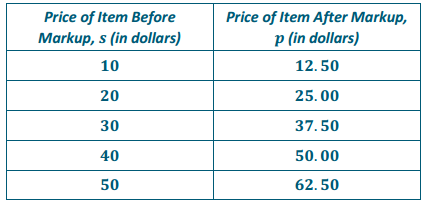
Engage NY Math Grade 7 Module 4 Lesson 7 Exercise Answer Key 2

c. Create and label a graph of the equation.

Engage NY Math Grade 7 Module 4 Lesson 7 Exercise Answer Key 3
Answer:
Engage NY Math Grade 7 Module 4 Lesson 7 Exercise Answer Key 4

d. Interpret the points (0, 0) and (1, r).
Answer:
The point (0, 0) means that a $0 (free) item will cost $0 because the 25% markup is also $0. The point (1, r) is (1, 1.25). It means that a $1.00 item will cost $1.25 after it is marked up by 25%; r is the unit rate.

Exercise 5.
Use the following table to calculate the markup or markdown rate. Show your work. Is the relationship between the original price and the selling price proportional or not? Explain.
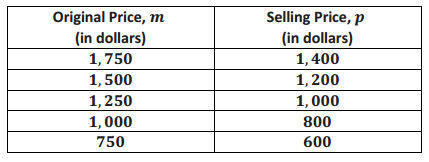
Engage NY Math Grade 7 Module 4 Lesson 7 Exercise Answer Key 5
Answer:
Because the selling price is less than the original price, use the equation: Selling Price = (1 – m) × Whole.
1,400 = (1 – m)(1,750)
\(\frac{1,400}{1,750}\) = (1 – m)\(\frac{1,750}{1,750}\)
0.80 = 1 – m
0.20 = m
The markdown rate is 20%. The relationship between the original price and selling price is proportional because the table shows the ratio \(\frac{p}{m}\) = \(\frac{0.80}{1}\) for all possible pairs of solutions.

Eureka Math Grade 7 Module 4 Lesson 7 Problem Set Answer Key

Question 1.
You have a coupon for an additional 25% off the price of any sale item at a store. The store has put a robotics kit on sale for 15% off the original price of $40. What is the price of the robotics kit after both discounts?
Answer:
(0.75)(0.85)(40) = 25.50. The price of the robotics kit after both discounts is $25.50.

Question 2.
A sign says that the price marked on all music equipment is 30% off the original price. You buy an electric guitar for the sale price of $315.
a. What is the original price?
Answer:
\(\frac{315}{1 – 0.30}\) = \(\frac{315}{0.70}\) = 450. The original price is $450.

b. How much money did you save off the original price of the guitar?
Answer:
450 – 315 = 135. I saved $135 off the original price of the guitar.

c. What percent of the original price is the sale price?
Answer:
\(\frac{315}{450}\) = \(\frac{70}{100}\) = 70%. The sale price is 70% of the original price.

Question 3.
The cost of a New York Yankee baseball cap is $24.00. The local sporting goods store sells it for $30.00. Find the markup rate.
Answer:
Let P represent the unknown percent.
30 = P(24)
P = \(\frac{30}{24}\) = 1.25 = (100% + 25%). The markup rate is 25%.

Question 4.
Write an equation to determine the selling price in dollars, p, on an item that is originally priced s dollars after a markdown of 15%.
Answer:
p = 0.85s or p = (1 – 0.15)s

a. Create and label a table showing five possible pairs of solutions to the equation.
Answer:
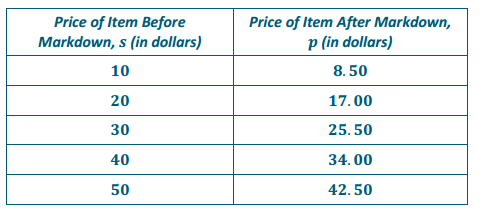
Eureka Math 7th Grade Module 4 Lesson 7 Problem Set Answer Key 1

b. Create and label a graph of the equation.

Eureka Math 7th Grade Module 4 Lesson 7 Problem Set Answer Key 2
Answer:
Eureka Math 7th Grade Module 4 Lesson 7 Problem Set Answer Key 3

c. Interpret the points (0,0) and (1,r).
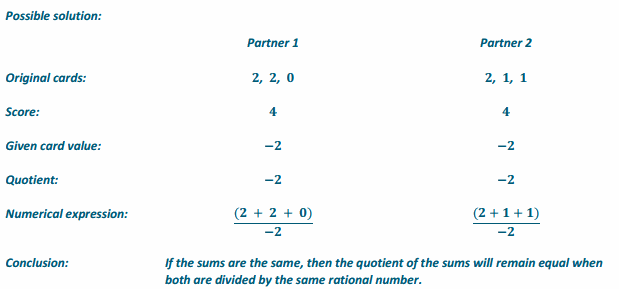
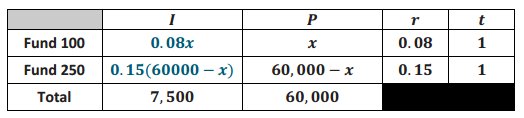
Answer:
The point (0, 0) means that a $0 (free) item will cost $0 because the 15% markdown is also $0. The point (1, r) is (1,0.85), which represents the unit rate. It means that a $1.00 item will cost $0.85 after it is marked down by 15%.

Question 5.
At the amusement park, Laura paid $6.00 for a small cotton candy. Her older brother works at the park, and he told her they mark up the cotton candy by 300%. Laura does not think that is mathematically possible. Is it possible, and if so, what is the price of the cotton candy before the markup?
Answer:
Yes, it is possible. \(\frac{6.00}{1 + 3}\) = \(\frac{6}{4}\) = 1.50. The price of the cotton candy before the markup is $1.50.

Question 6.
A store advertises that customers can take 25% off the original price and then take an extra 10% off. Is this the same as a 35% off discount? Explain.
Answer:
No, because the 25% is taken first off the original price to get a new whole. Then, the extra 10% off is multiplied to the new whole. For example, (1 – 0.25)(1 – 0.10) = 0.675 or (0.75)(0.90) = 0.675. This is multiplied to the whole, which is the original price of the item. This is not the same as adding 25% and 10% to get 35% and then multiplying by (1 – 0.35), or 0.65.

Question 7.
An item that costs $50.00 is marked 20% off. Sales tax for the item is 8%. What is the final price, including tax?
a. Solve the problem with the discount applied before the sales tax.
Answer:
(1.08)(0.80)(50) = 43.20. The final price is $43.20.

b. Solve the problem with the discount applied after the sales tax.
Answer:
(0.80)(1.08)(50) = 43.20. The final price is $43.20.

c. Compare your answers in parts (a) and (b). Explain.
Answer:
My answers are the same. The final price is $43.20. This is because multiplication is commutative.

Question 8.
The sale price for a bicycle is $315. The original price was first discounted by 50% and then discounted an additional 10%. Find the original price of the bicycle.
Answer:
(315 ÷ 0.9) ÷ 0.5 = 700. The original price was $700.

Question 9.
A ski shop has a markup rate of 50%. Find the selling price of skis that cost the storeowner $300.
Answer:
Solution 1: Use the original price of $300 as the whole. The markup rate is 50% of $300 or $150.
The selling price is $300 + $150 = $450.
Solution 2: Multiply $300 by 1 plus the markup rate (i.e., the selling price is (1.5)($300) = $450).

Question 10.
A tennis supply store pays a wholesaler $90 for a tennis racquet and sells it for $144. What is the markup rate?
Answer:
Solution 1: Let the original price of $90 be the whole. Quantity = Percent × Whole.
144 = Percent(90)
\(\frac{144}{90}\) = Percent
1.6 = 160%. This is a 60% increase. The markup rate is 60%.
Solution 2:
Selling Price = (1 + m)(Whole)
144 = (1 + m)90
1 + m = \(\frac{144}{90}\)
m = 1.6 – 1 = 0.6 = 60%
The markup rate is 60%.

Question 11.
A shoe store is selling a pair of shoes for $60 that has been discounted by 25%. What was the original selling price?
Answer:
Solution 1:
$60 → 75%
$20 → 25%
$80 → 100%
The original price was $80.

Solution 2: Let x be the original cost in dollars.
(1 – 0.25)x = 60
\(\frac{3}{4}\) x = 60
(\(\frac{4}{3}\))(\(\frac{3}{4}\) x) = \(\frac{4}{3}\) (60)
x = 80
The original price was $80.

Question 12.
A shoe store has a markup rate of 75% and is selling a pair of shoes for $133. Find the price the store paid for the shoes.
Answer:
Solution 1:
$133 → 175%
$19 → 25%
$76 → 100%
The store paid $76.

Solution 2: Divide the selling price by 1.75.
\(\frac{133}{1.75}\) = 76
The store paid $76.

Question 13.
Write 5 \(\frac{1}{4}\)% as a simple fraction.
Answer:
\(\frac{21}{400}\)

Question 14.
Write \(\frac{3}{8}\) as a percent.
Answer:
37.5%

Question 15.
If 20% of the 70 faculty members at John F. Kennedy Middle School are male, what is the number of male faculty members?
Answer:
(0.20)(70) = 14. Therefore, 14 faculty members are male.

Question 16.
If a bag contains 400 coins, and 33 1/2% are nickels, how many nickels are there? What percent of the coins are not nickels?
Answer:
(400)(0.335) = 134. Therefore, 134 of the coins are nickels. The percent of coins that are not nickels is 66 1/2%.

Question 17.
The temperature outside is 60 degrees Fahrenheit. What would be the temperature if it is increased by 20%?
Answer:
(60)(1.2) = 72. Therefore, the temperature would be 72 degrees Fahrenheit.

Eureka Math Grade 7 Module 4 Lesson 7 Exit Ticket Answer Key

A store that sells skis buys them from a manufacturer at a wholesale price of $57. The store’s markup rate is 50%.
a. What price does the store charge its customers for the skis?
Answer:
57 × (1 + 0.50) = 85.50. The store charges $85.50 for the skis.

b. What percent of the original price is the final price? Show your work.
Answer:
Quantity = Percent × Whole. Let P represent the unknown percent.
85.50 = P(57)
85.50(\(\frac{1}{57}\)) = P(57)(\(\frac{1}{57}\))
1.50 = P
1.50 = \(\frac{150}{100}\) = 150%. The final price is 150% of the original price

c. What is the percent increase from the original price to the final price?
Answer:
The percent increase is 50% because 150% – 100% = 50%.