What is 90 Degree Clockwise Rotation Rule? | Check How to Rotate 90° Point in Clockwise Direction with Examples?

In Geometry Topics, the most commonly solved topic is Rotations. A Rotation is a circular motion of any figure or object around an axis or a center. If we talk about the real-life examples, then the known example of rotation for every person is the Earth, it rotates on its own axis. However, Rotations can work in both directions ie., Clockwise and Anticlockwise or Counterclockwise. 90° and 180° are the most common rotation angles whereas 270° turns about the origin occasionally.

Here, in this article, we are going to discuss the 90 Degree Clockwise Rotation like definition, rule, how it works, and some solved examples. So, Let’s get into this article!

90 Degree Clockwise Rotation

If a point is rotating 90 degrees clockwise about the origin our point M(x,y) becomes M'(y,-x). In short, switch x and y and make x negative.
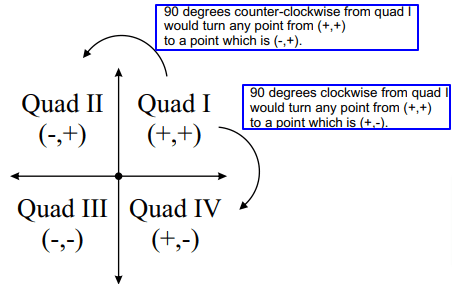
image for understanding 90 degree rotations rules

Before RotationAfter Rotation
(x, y)(y,-x)

Rule of 90 Degree Rotation about the Origin

  • When the object is rotating towards 90° clockwise then the given point will change from (x,y) to (y,-x).
  • When the object is rotating towards 90° anticlockwise then the given point will change from (x,y) to (-y,x).

Solved Examples:

Example 1:

Solve the given coordinates of the points obtained on rotating the point through a 90° clockwise direction?

(i) A (4, 7)

(ii) B (-8, -9)

(iii) C (-2, 8)

Solution:

When the point rotated through 90º about the origin in the clockwise direction, then the new place of the above coordinates are as follows:

(i) The current position of point A (4, 7) will change into A’ (7, -4)

(ii) The current position of point B (-8, -9) will change into B’ (-9, 8)

(iii) The current position of point C (-2, 8) will change into C’ (8, 2)

Example 2: 

Let P (-6, 3), Q (9, 6), R (2, 7) S (3, 8) be the vertices of a closed figure. If this figure is rotated 90° about the origin in a clockwise direction, find the vertices of the rotated figure.

Solution:

Given vertices are P (-6, 3), Q (9, 6), R (2, 7) S (3, 8)

Now, we will solve this closed figure when it rotates in a 90° clockwise direction,

In step 1, we have to apply the rule of 90 Degree Clockwise Rotation about the Origin

(x, y) → (-y, x)

Next, find the new position of the points of the rotated figure by using the rule in step 1.

(x, y) → (y, -x)

P (-6, 3) → P'(3, 6)

Q (9, 6) → Q’ (6, -9)

R (2, 7) → R'(7, -2)

S (3, 8) → S'(8, -3)

Finally, the Vertices of the rotated figure are P'(3, 6), Q’ (6, -9), R'(7, -2), S'(8, -3).

Example 3:

Find the new position of the given coordinates A(-5,6), B(3,7), and C(2,1) after rotating 90 degrees clockwise about the origin?

Solution:
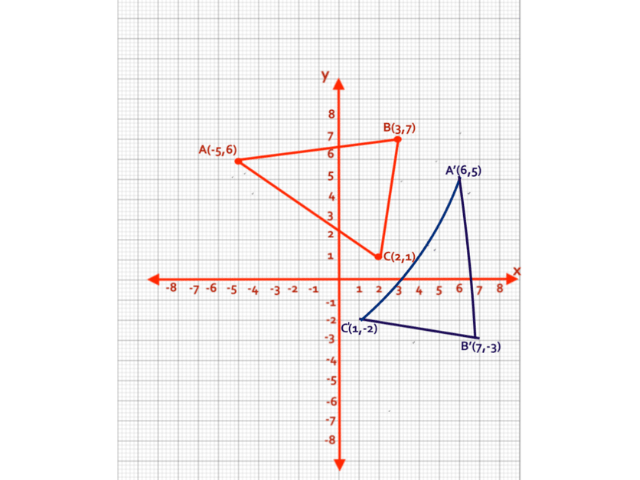
90 degree clockwise rotation example graph

Given Coordinates are A(-5,6), B(3,7), and C(2,1)

The rule/formula for 90 degree clockwise rotation is (x, y) —> (y, -x). 

After applying this rule for all coordinates, it changes into new coordinates and the result is as follows:

A(-5,6) –> A'(6,5)

B(3,7) –> B'(7,-3)

C(2,1) –> C'(1,-2)

I believe that the above graph clears all your doubts regarding the 90 degrees rotation about the origin in a clockwise direction. At last, the result of the coordinates is A'(6,5), B'(7,-3), C'(1,-2). 

FAQs on 90 Degree Clockwise Rotation

1. Is a 90 Degree rotation clockwise or counterclockwise?

Considering that the rotation is 90 Degree, you should rotate the point in a clockwise direction.

2. What are the types of rotation?

You can see the rotation in two ways ie., clockwise or counterclockwise. In case, there is an object which is rotating that can rotate in different ways as shown below:

  • 90 degrees counterclockwise
  • 90 degrees clockwise
  • 180 degrees counterclockwise
  • 180 degrees clockwise

3. What is the rule of Rotation by 90° about the origin?

The rule for a rotation by 90° Counterclockwise about the origin is (x,y)→(−y,x)

The rule for a rotation by 90° Clockwise about the origin is (x,y)→(y,−x)

Practice Test on Profit and Loss | Profit and Loss Practice Questions

Solving the Profit and Loss Questions can give you an idea of how to solve related problems. Know different methods and formulae involved to calculate the Profit and Loss. Try to solve the Profit and Loss Questions on your own and then verify your solution with ours to know where you went wrong. By solving them regularly you can increase your speed and accuracy thereby attempt the exam well and score better grades in the exam.

Question 1:

If the manufacturer gains 15%, the wholesale dealer gets 20% and the retailer gets 30%, then find the cost of production of a blackboard, the retail price of which is $ 1360?

Solution:

Cost of production of blackboard be ‘X’

115% of 120% of 130% of cost price is

i.e. \(\frac { 115 }{ 120 } \)*\(\frac { 120 }{ 100 } \)*\(\frac { 130}{ 100} \)*1360

Cost of production of a blackboard $ 758.08

Question 2:

A man bought a dog and a kennel for $ 4500. He sold the dog at a gain of 25% and the carriage at a loss of 15%, thereby gaining 3% on the whole. Find the cost of the dog.

Solution:

Cost price (C.P.) of dog ‘X’

Cost price (C.P.) of kennel ‘4500 – X’

25% of x – 15% of (4500 – X) = 3% of 4500

Cost of a dog is $ 1373.68.

Question 3:

Profit earned by selling television for $ 6000 is 25% more than the loss incurred by selling the article for $ 4500. At what price should the article be sold to earn 25% profit?

Solution:

let cost price (C.P.) be ‘X’

By equalizing,

(6000 – X) = \(\frac { 125 }{ 100 } \)*(X-4500)

Desired selling price of the television is $ 6458.3.

Question 4:

A manufacturer undertakes to supply 2200 pieces of a particular component at $ 30 per piece. According to his estimates, even if 6% fail to pass the quality tests, then he will make a profit of 30%. However, as it turned out, 60% of the components were rejected. What is the loss to the manufacturer?

Solution:

Incurred cost = $(\(\frac { 100 }{ 130 } \)*30*(94% of 2200))

Loss = C.P. – S.P.

The loss to the manufacturer is $ 8123.07.

Question 5:

John bought a lorry for a certain sum of money. He spent 15% of the cost on repairs and sold the lorry for a profit of $ 1600. How did he spend on repairs if he made a profit of 30%?

Solution:

Let the Cost price (C.P.) of the lorry be ‘X’

Profit (P) = $16,00

Profit (%) = 30

Profit (%) = \(\frac { 100 }{ CP } \)*P

30 = \(\frac { 100 }{ CP} \)*1600

CP = \(\frac { 100 }{ CP} \)*1600

CP = \(\frac { 100 }{ 30} \)*1600

= $5333.3

The C.P Includes both original price and repairs cost

C.P +0.15C.P = $5333.3

1.15 C.P = $5333.3

C.P = $4637.68

Repairs Cost = Total Cost Price – Cost Price for which john bought the lorry

= $5333.3 – $4637.68

= $ 695.61

Expenditure spend on repairs = $ 695.61.

Question 6:

A boy bought 25 litres of milk at the rate of $ 12 per litre. He got it churned after spending $ 15 and 7kg of cream and 25 lit of toned milk were obtained. If he sold the cream at $ 40 per kg and toned milk at $ 6 per lit, what is his profit % in the transaction?

Solution:

Cost price (C.P.) = $ ((25*12) + 15)

Selling price (S.P.) = $ ((7*40) + (25*6))

Gained profit % on the above transaction is 36.50%.

Question 7:

Arun purchased 150 reams of paper at $ 90 per ream. He spent $ 300 on transportation, paid local tax at the rate of 50 paise per ream, and paid $ 76 to coolie. If he wants to have a gain of 10%, what must be the selling price per ream?

Solution:

Total investment = $ (((150*90) + 300) + ((50/100 * 150) + 76))

Find selling price per ream

Selling price per ream = $ 102.3

Question 8:

A retailer mixes three varieties of dal costing $ 50, $ 25, and $ 30 per kg in the ratio 3: 5: 2 in terms of weight, and sells the mixture at $ 35 per kg. What percentage of profit does he make?

Solution:

Cost price (C.P.) of dal for 10 kgs = $ ((3*50) + (5*25) + (2*30))

Selling price for 10 kgs = $ (10*35)

Profit percentage on transactions is 4.74%.

Question 9:

A man buys chocolates at 3 for $ 2 and an equal number at 5 for $ 3 and sells the whole at 6 for $ 4. His gain or loss percent is?

Solution:

Suppose he buys 7 eggs of each kind

Find C.P. and S.P. for 14 eggs

C.P. = $ ((\(\frac { 2 }{ 3 } \) * 7) + (\(\frac { 3 }{ 5 } \) * 7)) = $ 8.86

Similarly, find S.P.

The gain % obtain is 5.34%.

Question 10:

The manufacturer of a certain item can sell all he can produce at the selling price of $ 65 each. It costs him $ 45 in material and labor to produce each item and he has overhead expenses of $ 3500 per week in order to operate the plant. The number of units he should produce and sell in order to make a profit of at least $ 1200 per week is?

Solution:

Consider he produces ‘x’ items

Cost price (C.P.) = $ (45x + 3500)

Selling price (S.P.) = $ 65x

The number of units produced per week to gain profit is 235.

Absolute Value of an Integer Definition, Examples | How to find the Absolute Value of an Integer?

Wanna learn all the basics of Integers concepts? Then start with the absolute value of an integer. Integer Absolute Value is an important and basic concept to learn other concepts of Integers. Refer to all the rules, definitions, solved examples, types, etc to understand the concept more clearly. Follow the below sections to get more idea on how to find the Absolute Value of an Integer in detail and Solved Problems for finding the Integer Absolute Value using different approaches.

Absolute Value of an Integer – Introduction

Integers Absolute Value is the distance of that integer value from zero irrespective of (positive or negative) direction. While considering the absolute value, its numerical value is taken without taking the sign into consideration.

An integer is any positive or negative whole number. Therefore, the positive integer has a negative sign and vice versa.

A positive number is a number that is greater than zero. It is represented by a “+” symbol and can be written with or without a symbol in front of it. The gain in some value or something is written with a positive number. A negative number is a number that is less than zero. It is represented by a “-” symbol and can be written with a “-” symbol in front of it. The loss in some value or something is written with a negative number.

A number line is a kind of diagram on which the numbers are marked at intervals. These are used to illustrate simple and easy numerical operations. Using the number line allows seeing a number is in relationship to other numbers and from zero. Zero, is present in the middle and separates positive and negative numbers. On the right side of zero, we can find numbers that are greater than zero (positive numbers) and on the left side, we can find numbers that are less than zero (negative numbers). The absolute value of the integer is the same as the distance from zero to a specific number.

Representation of Absolute Value of an Integer

Integer Absolute Value is represented with two vertical lines. i.e., | |, one on either side of the integer.

|a| = a, when a is the positive integer

|a| = -a, when a is the negative integer

Examples:

  1. Absolute integer value of -15 is written as |-15| = 15 {here mod of -15 = 15}
  2. Absolute integer value of 8 is written as |8| = 8 {here mod of 8 = 8}

Adding and Subtracting Absolute Value of Integers

To add 2 integers with the same (positive or negative) sign, add absolute values and assign the sum with the same sign as same both values.

Example:

(-7) + (-4) = -(7 + 4)= – 11.

To add 2 integers with different signs, find the difference in absolute integer values and give that product the same sign of the largest absolute value.

Example:

(-7)+(2)= -5

How to find the absolute value?

  1. First of all, find the absolute values of (7 and 2)
  2. Find the difference of numbers between 7 and 2 (7-2=5)
  3. Find the sign of the largest absolute value i.e., negative, as 7 is of (-)sign
  4. Add the sign to the difference we got in Step 2.
  5. Hence the final solution is -5

When an integer is subtracted or added by another integer, the result will be an integer.

Multiplication of Absolute Value of Integers

To multiply the integer values, we have to multiply the absolute values. If the integers that are to be multiplied have the same sign, then the result will be positive. If both the integers have different signs, then the result will be negative.

When an integer is multiplied by another integer, then the result will be an integer itself.

Absolute Value of Integers Examples

Question 1:

Write the absolute value of each of the following?

(i) 15

(ii) -24

(iii) -375

(iv) 0

(v) +7

(vi) +123

Solution: 

(i) 15

(ii) 24

(iii) 375

(iv) 0

(v) 7

(vi) 123

Question 2: 

Evaluate the following integers

(i) |-7| + |+5| + |0|

(ii) |10| – |-15| + |+12|

(iii) – |+3| – |-3| + |-6|

(iv) |-8| – |17| + |-12|

Solution: 

(i) 12

(ii) 7

(iii) 0

(iv) 3

Question 3:

State whether the statements are true or false?

(i) The absolute value of -3 is 3.

(ii) The absolute value of an integer is always greater than the integer.

(iii) |+5| = +5

(iv) |-5| = -5

(v) – |+5| = 5

(vi) – |-5| = -5

Solution:

(i) True

(ii) False

(iii) True

(iv) False

(v) False

(vi) True

Methods to Compute the Absolute Value of Integer

There are 3 approaches to find the Integers Absolute value. These approaches are helpful while solving problems. Finding the absolute value is the first step in solving the problems.

Method 1: 

As the absolute value of the integer is always positive. For the positive integer, the absolute number is the number itself. For the negative number, the absolute number is multiplied by other negative numbers.

Method 2:

Negative numbers are saved in 2’s complement form. To get the absolute number, toggle bits of the number, then 1 to the result.

Method 3:

The built-in function library finds the absolute value of an integer.

To solve most of the problems, knowing the absolute value of the integer is important. This method is used in the real world and it has all sorts of math clues. Absolute values are often used in distance problems and also sometimes used for inequalities. Integers Absolute values are really helpful to get clarity on many things.

We have mentioned the important concept of Integers Absolute Value in the above article. Hope you got a clear idea of definitions, rules, and how to solve the problems. If you have any doubts, you can contact us from the below comment box. You can also directly ping us to know other information. Stay tuned to our page to get the latest and important information about all mathematical concepts.

Examples on Division of Integers | Dividing Integers Problems with Solutions

Get the complete practice test questions and worksheet here. Follow the step by step procedure to solve examples on the division of integers all the problems. Know the shortcuts, tricks, and steps involved in solving Division of Integers problems. Also, find the definitions, formulae before going to start the practice sessions. Go through the below sections to know the detailed information regarding formulas, definitions, and problems.

Integers Division Rules

Rule 1: The quotient value of a positive integer number and a negative integer number is negative.

Rule 2: The quotient value of two positive integer numbers is a positive number.

Rule 3: The quotient value of two negative integer numbers is a positive number.

Division of Integers Rules and Examples

Question 1: Find the value of ||-17|+17| / ||-25|-42|

Solution:

||-17|+17| / ||-25|-42|

= |17+17| / |25–42|

= |34| / |-17|

= 34 / 17

= 2

Question 2: Simplify: {36 / (-9)} / {(-24) / 6}

Solution:

{36 / (-9)} / {(-24) / 6}

= {36/-9} / {-24/6}

= – (36/9) / – (24/6)

= -4/-4

= 4/4

=1

Question 3: Find the value of [32 + 2 x 17 + (-6)] ÷ 15

Solution:

[32+2 x 17+(-6)] / 15

= [32+34+(-6)] / 15

= (66-6) / 15

= 60 / 15

= 4

Question 4: Divide the absolute values of the two given integers?

Solution:

The quotient of the absolute value of integer +24 and the absolute value of integer -8

From the rules given above, dividing the integers with different signs gives the final result as negative.

When positive(+) 24 is divided by negative(-) 8 results negative(-) 3, which can be defined as +24/(-8) = -3

Question 5: Prove that [((-8) / (-4)] ≠ =-8 / [(-4) / (-2)]

Solution:

From the given question

[((-8)/(-4)]/(-2)] ≠ -8/[(-4)/(-2)]

First of all, we will consider the LHS part i.e., [((-8) / (-4)] / (-2)]

To solve the equation, first, we divide 8 by 4, we get the result as 2

As both numbers have a negative sign, it will be positive.

Then we divide the result (2) by -2, then the final result will be -1.

Therefore, the result of the LHS part is -1.

Now, we consider the RHS part i.e., -8 / [(-4) / (-2)]

First of all, we divide -4 by -2, the result will be 2.

As both the numbers have a negative sign, the result will be positive.

Now, divide -8 by the above result 2.

Hence, the result will be -4.

Therefore, the result of RHS is -4.

Hence, LHS ≠ RHS

The above given equation [((-8) / (-4)] / (-2)] ≠ -8 / [(-4) / (-2)] is thus satisfied.

Question 6: In a maths test containing 10 questions, 2 marks are given for every correct answer and (-1) marks are given for every wrong answer. Rohith attempts all the questions and 8 questions answers are correct. What is Rohith’s total score?

Solution:

From the given question,

The marks given for every correct answer = 2 marks

Marks given for 8 correct answers = 2 * 8= 16 marks

Marks given for 1 incorrect answer = -1 marks

Marks given for 2 incorrect answers = -1 * 2 = -2 marks

Rohit’s total score = 16-2 = 14 marks

Therefore, the answer is 14 marks.

Question 7: Priya sells 20 pens and some pencils losing 2 Rs in all. If Priya gains 2 Rs on each pen and loses 1 Rs on each pencil. How many pencils does Priya sell?

Solution:

Suppose that Priya sells x pencils.

Total gain on pens = 2*20 = 40 Rs

Total loss on pencils = 1x = x

Total loss on selling pens and pencils = (-2)

40-x = (-2)

40+2 = x

x = 42

Therefore, Priya sells 42 pencils.

Thus, the answer is 42 pencils.

Question 8: To make ice cream, the room temperature must be decreased from 45degree C at the rate of 5 degrees C per hour. What will be the room temperature 12 hours after the freezing point of the icecream?

Solution:

As given in the question,

Temperature after 12 hours = 12*5 = 60degree C

Room temperature = 45degree C

Hence, the room temperature after freezing process of 12 hours = (45-60)degree C

= -15degree C

Question 9:

A car runs at a rate of 50km/hr. If the car starts at 5 km above the starting point, how long will it take to reach 2505km?

Solution:

As per the question,

Total distance covered by car = (2505-5) km = 2500 km

Rate of car = 50km/hr

From the above values, Distance = 2500 km, speed = 50 km/hr

Therefore, the time required by the car = distance/speed

=2500/50 = 50 hours

Therefore, the car will take 50 hours to travel 2505 km.

Hence, The final solution is 50 hours.

Question 10: Jason borrowed $5 a day to buy launch. She now owes $65 dollars. How many days did Jane borrow $5?

Solution:

As per the question,

Jason borrowed a launch at =  $5

Now she owes = $65

No of days = (-65) / (-5)

= 13 days

Therefore, Jane borrows $5 for 13 days.

Hence, The final solution is 13 days.

Division of Integers Word Problems

Question 11: Allen’s score in a video game was changed by -120 points because he missed some target points. He got -15 points for each of the missed targets. How many targets did he miss?

Solution: 

As per the given question,

Allen scored points in a video game = -120

He got points for missed targets = -15

No of targets he missed = -120/-15 = 8 targets.

Therefore, he missed 8 targets.

Question 12: Karthik made five of his truck payments late and was fined five late fees. The total change in his savings of late fees was -$30. What integer represents the one late fee?

Solution:

As given in the question, Karthik has made five of his truck payments. Therefore, it is positive.

He was fined -$30 as the late fees.

To find one late fee, we have to divide the fine by no of payments he did.

Therefore, One Late fee = -$30/5

=-$6

Thus, He paid $6 for each payment as late fees.

Hence, the final answer is -$6.


Examples on Multiplication of Integers | Questions on Multiplication of Integers

Do you find it difficult to understand the Integers Multiplication? Here is the best solution for you all. We are providing Examples on Multiplication of Integers here. Integers Multiplication is an important concept which helps you to score more marks in the exam. Questions on Multiplication of Integers with Answers are available so that you can practice them regularly. Learn How to Multiply Integers by referring to the further modules.

Worked out Multiplication of Integers Problems

Before going to solve the Integers Multiplication problems, know all the definitions, rules, formulae etc. In the upcoming sections, you will find all the details and also problem-solving techniques and tips. To be more precise, you can only solve the problems if you know all the details regarding integers.  Know various properties of integers beforehand and how they work while multiplying the integers.

Key Points to Remember on Properties of Integers Multiplication

  • The Closure Integer Property of multiplication defines that the product value of two or three integer numbers will be an integer number.
  • The commutative Integer Multiplication property defines that swapping two or three integers will not differ the value of the final result.
  • The associative Integer Multiplication property defines that the grouping of integer values together will not affect the final result.
  • The distributive Integer property of multiplication defines that the distribution concept of 1 operation value on other mathematical integer values within the given braces.
  • Multiplication by zero defines the product value of any negative or positive integer number by zero
  • Multiplicative Integer defines the final result as 1 when any integer number is multiplied with 1.

Integer Multiplication Rules on Problems

Question 1:

The temperature in an area drops by 4 degrees for 4 hours. How much is the total drop in the temperature?

Solution:

As given in the question, the temperature drops by 4 degrees. Therefore, the temperature is a negative factor.

Also. given that it decreases for 4 hours.

The total drop in temperature is (-4) * (4) = -16

Therefore, the total drop in temperature is 16 degrees C

Thus, the final result is -16 degree C

Question 2:

Jason borrowed $2 a day to buy a launch. She now owes $60. How many days did Jason borrow $2?

Solution:

As given in the question, Jason borrowed to buy a launch = $2

After buying she owes $60

No of days Jason borrowed money = 60/2 = 30

Therefore, the total days = 30 days

Thus, the final result is 30 days.

Question 3: A football team 12 yards on each of the four consecutive plays. What was the team’s total change in position for four plays?

Solution: 

As given in the question, A football team lost yards = -12 yards

No of plays = 4

Team total change in position for 4 plays = (-12) * (4) = 48

Therefore, the total change = -48 yards

Thus, the final answer is -48 yards.

Question 4: On a certain day, the temperature changed at a rate of -2 degrees F per hour. If this happened for continuous 5 days. For how many days there was a change in temperature?

Solution:

As per the given question, The temperature changed at the rate = -2 degree F

The change happened for days = 5 days

No of days there was a change = (-2)*5 = -10

Therefore, there was a change for days = 10 days

Thus, the final solution is 10 days.

Question 5: Flora made 6 deposits $ 7 each from her bank account. What was the overall change in her account?

Solution:

As per the given question,

Flora made no of deposits = 6

Amount of deposited money = $7

The overall change in the account = 6 * ($7) = 42

Therefore, the change in money = 42

Thus, the final solution is $42

Questions on Multiplication of Integers

Question 6: A winter coat was priced at $200. Each month for three months, the price was reduced by $15. How much was the coat reduced in price?

Solution:

As per the given question,

The price of the winter coat is reduced by $15, Therefore it is negative = -$15

No of times it is reduced = 3

The absolute values of |3| and |-15| are 3 and 15

The coat reduced in price = 3*15 = 45

Therefore, the total change in price = $45

Thus the final answer = -$45

Question 7:

Netflix charges $9 per month for their streaming plan to watch movies. If they automatically bill a customer for 6 months, How much will be deducted from the customer’s bank account?

Solution:

As per the given question,

Netflix charges $9 per month. Therefore, it is negative.

Given, the bill will be deducted automatically for months = 6

The absolute values of |6| and |9| are 6 and 9.

The amount of money deducted from customers bank account = 6*9 = 54

Therefore, the total amount after determining the signs = -$54

Hence, the final solution is -$54

Question 8: Lisa decided her hair was too long. In June and again in July. she cut 3 inches off. Then, in August, September, and October she cut off 2 inches. Write an equation to represent the change in the length of her hair?

Solution:

As given in the question,

In 2 months, she cut 3 inches off her hair. Cutting her hair made the length shorter, therefore it is negative.

In 3 months, she cut 2 inches off her hair. This is also negative.

For the month of June and July, the length of the hair she cut = 2 * (-3) = -6

For the months August, September, and October, the length of the hair she cut = 3 * (-2) = -6

Therefore, the total length = (-6) + (-6) = -12 inches

Thus. the complete length she cut = 12 inches

Hence, the final solution is -12 inches

Question 9: The depth of the water in a pool decreases an average of two inches each week during the summer. What will be the change in the depth of water of four weeks?

Solution:

As given in the question,

The depth of the water in a pool decreases each week = 2 inches

As the water level decreases, it will be negative.

The decrease in water for weeks = 4

The change in depth of water = (-2)*4 = -8

Therefore, the water level decreases by 8 inches.

Thus, the final solution is -8 inches

Question 10:

For every 1000 feet, you gain in elevation, the temperature drops by 3 degrees. If you increase your elevation by 5000 feet, How would the temperature change?

Solution:

As per the given question,

The temperature drops by 3 degrees. Therefore, it will be negative.

Also given for every 1000 feet it is 3 degrees. Thus for every 5000 feet, it is 5 degrees.

The temperature change = (-3)*5 = -15

Thus, for every 5000 feet, the temperature changes by -15 degrees.

Hence, the final solution is -15 degrees.

Lines and Angles – Definition, Types, Properties, Solved Problems

Lines and Angles concepts are explained by experts in order to help students to get excellent marks in their examination. The line is a combination of infinite points that has both directions infinitely. There are different lines available such as intersecting lines, perpendicular lines, transversal lines, etc. An angle is nothing but a combination of two rays with a common endpoint.

Based on the operations performed on a line, then the lines are classified as Parallel Lines, Perpendicular Lines, Transversal, etc. In the same way, the angles are classified as Complementary Angles, Supplementary Angles, Adjacent Angles, Vertically Opposite Angles based on their operation.

Quick Links of Lines and Angles

Working on Lines and Angles problems will help students to get an idea about how to solve the problems. All the concept links are given below. Just check out the concepts and open the topic that is difficult for you. After that solve all the problems available on that topic to get a grip on that entire topic.

Line Segment

The line segment is a line that has two endpoints with a fixed length.

line segment

Ray

A ray is a line that has only one endpoint and extends infinitely in another direction. From the below figure, point A is the and point.

ray

Perpendicular Lines

Two lines are said to be Perpendicular Lines when they meet at a single point and forms a right angle. From the below figure, PQ and RS are two lines and they intersect at a point x. Also, the two lines PQ and RS form a right angle 90º.

Perpendicular-lines

Parallel Lines

Two lines are said to be Parallel Lines when they do not intersect each other and they have the same distance throughout the plane. From the below figure, A and B are two parallel lines.

parallel lines

Transversal Line

A transversal Line is a line that intersects two lines at distinct points. From the below figure, C is the Transversal Line, that intersects the lines A and B at two points D and E.

Transversal line

Properties of Lines

  • The points those are not lie on the same line are called non-collinear points.
  • The points that lie on the same line are called Collinear points

Acute Angle

The angle that is less than the right angle is called Acute Angle.

Obtuse Angle

The angle that is more than the right angle is called Acute Angle.

Right Angle

The angle with 90 degrees is called as Right Angle.

Straight Angle

The angle that is equal to 180 degrees is called Straight Angle.

Complementary Angles

If the sum of the two angles is 90 degrees, then they are called Complementary Angles.

Supplementary Angles

If the sum of the angles is 180 degrees, then those angles are called Supplementary Angles.

Properties of Angles

  • An angle is formed at a point where two rays intersecting.
  • If the angle is more than 180 degrees and less than 360 degrees, then it is called a reflex angle.
  • If the two angles are adjacent angles and add up to 180 degrees then they form linear pair.

Quick Access to Lines and Angles

We have given solutions for all questions with step by step explanation in understandable language. Therefore, students can get great knowledge on the entire concepts of Lines and Angles. All the questions and answers that are present in the updated syllabus are included on our website with individual concept explanation. So, students who want to learn a single topic can go through the required link available below and learn it from the concerned link.

Are you searching for Lines and Angles Material? You have free access to Lines and Angles Material on our website. You can read and practice all problems either online or offline. So, immediately bookmark our website and practice all the math problems at your comfortable times. Do hard work and get complete knowledge on the Lines and Angles concept. Clear your doubts by contacting us through the comment section.


Triangle on Same Base and between Same Parallels Theorem – Solved Examples

When two triangles lie on the same base and between the same parallels, then those triangles measure equal area. Check the proof for Triangles on the same base and between the same parallel are equal in Area. Get the relationship between the areas of triangles having the same base in the following sections. For the reference of students, we have also included the solved examples on Triangle on the Same Base and between Same Parallels.

Proof for Area of Triangles are Equal Having the Same Base

Get a detailed explanation for how the areas of triangles are equal when their bases are the same and between the same parallels.

In the following figure, ∆ABD and ∆DEF having equal base length and between the same parallels BF and AD.

In this case, Area of △ ABC = Area of △ DEF

To prove that Triangle on the Same Base and between Same Parallels have the same area, follow these instructions.

Let us take △ ABC and △ ABD on the same base AB and between the same parallels AB and CD.

Draw a parallelogram ABPQ with AB base and lying between the same parallels AB and Q.

The relationship between the area of the triangle and parallelogram says that when they lie on the same base and between the same parallels, then the triangle is half of the parallelogram area.

So, Area of ∆ ABC = 1/2 x Area of parallelogram ABPQ

In the same way, Area of ∆ ABD = 1/2 x Area of parallelogram ABPQ

Therefore, Area of ∆ ABC = Area of ∆ ABD.

Hence proved.

Questions on Triangles on the Same Base and between Same Parallels

Example 1.

AD is the median of ∆ABC and ∆ADC. E is any point on AD. Show that area of ∆ABE = area of ∆ACE.

Solution:

Here, AD is the median for △ ABC.

So, BD = CD

In the above figure, △ ABD and △ ADC are having equal bases BD and CD and they are between the same parallels BC and U.

So, Area of △ ADC = Area of △ ABD —– (i)

Since E lies on AD

Therefore, Ed is the median for △ BCE

Now, BDE and CDE are having the equal base length BD = CD and between the same paralleks BC and m, then

Area of △ CDE = Area of △ BDE —— (ii)

Subtracting equation (i) and equation (ii), we get

Area of △ ADC – Area of △ CDE = Area of ∆ABD – Area of ∆BED

Area of △ ABE = Area of △ ACE

Hence, shown.

Example 2.

Prove that the medians of the triangle divide it into two triangles having equal area?

Solution:

AD is the median of the ∆ BCA and AE is the altitude of ∆ BCA and also ∆ ADC.

And AE is perpendicular to BC

Here, AD is the median of ∆ ABC

Therefore, BD = CD

On multiplying both sides of the equation by AE, we get

BD x AE = CD x AE

Again multiply both sides by 1/2

1/2 x BD x AE = 1/2 x CD x AE

Area of ∆ABD = Area of ∆ADC

Hence shown.

Triangle and Parallelogram on Same Base and between Same Parallels | Example Questions

If a triangle and parallelogram having the same base and between the same parallels, then the area of the triangle is equal to half the area of the parallelogram. Get the example problems and solutions on Triangle and Parallelogram on the Same Base and between Same Parallels. Also, find the relationship between them in the following sections explained step by step.

Proof for Area of Triangle Equal to Half of the Parallelogram having the Same Base

In the following figure, parallelogram ABCD and ∆ABD are on the same base AB and between the same parallels AF and DC. Get the area of the triangle ABD and area of the parallelogram ABCD and check their areas.

Area of the parallelogram ABCD = base x height

= AB x CF

Here, CF and DE area parallel lines CF = DE.

Area of the parallelogram = AB x DE = AB x CF.

Area of △ ABD = 1/2 x base x height

= 1/2 x AB x DE

= 1/2 x Area of the parallelogram ABCD

Therefore, Area of the parallelogram ABCD = 1/2 x Area of △ ABD

Hence proved.

Here are various case studies for the area of the parallelogram is half of the area of the triangle when they lie on the same base.

1. When a triangle and a parallelogram lies on the same base and have the same altitude, then the area of the triangle is equal to half of the parallelogram.
2. If they lie between the same parallels and have the same altitude, then the area of the triangle is equal to half of the area of the parallelogram.
3. When the triangle and rectangle have the same base and between the same parallels, then the area of the triangle is half of the area of the rectangle.

Example Questions for Triangle and Parallelogram on Same Base and between Same Parallels

Example 1:

∆ ABD and parallelogram ABCD are on the same base AB. If the base and altitude of the parallelogram are 10 cm and 6 cm, find the area of the triangle.

Solution:

Given that,

Base of the parallelogram = 10 cm

Altitude of the parallelogram = 6 cm

Area of the parallelogram = base x altitude

= 10 x 6 = 60 cm²

We know that when a triangle and parallelogram having the same base and between the same parallels then the area of the triangle is equal to half of the area of the parallelogram.

So, area of △ ABD = 1/2x Area of the parallelogram ABCD

= 1/2 x 60 = 30 cm²

Therefore, triangle area is 30 cm².

Example 2:

∆ ABD and parallelogram ABCD are on the same base AB. If the base and height of the triangle is 16 cm and 12 cm, find the area of the parallelogram.

Solution:

Given that,

The base length of the triangle = 16 cm

Height of the triangle = 12 cm

Area of ∆ ABD = 1/2 x base x height

= 1/2 x 16 x 12

= 1/2 x 192 = 96 cm²

We know that when a triangle and parallelogram having the same base and between the same parallels then the area of the parallelogram is equal to double the area of the parallelogram.

Area of the parallelogram ABCD = 2 x Area of ∆ ABD

= 2 x 96 = 192 cm²

Therefore, parallelogram area is 192 cm².

Example 3:

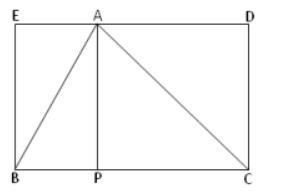
In the adjacent figure, BCDE is a rectangle and ABC is a triangle show that area of the triangle ABC is equal to half of the area of the rectangle BCDE.

Solution:

Given that,

Triangle ABC and rectangle BCDE lies on the same base BC and between the same parallels BC and ED>

Area of triangle ABC = 1/2 x base x height

= 1/2 x BC x AP

AP and Cd are parallel lines and having the same length. So, AP = CD.

△ ABC area = 1/2 x BC x AP = 1/2 x BC x CD

Area of the rectangle = length x breadth

= BC x CD

= 1/2 x Area of △ ABC.

Therefore, the Area of the rectangle BCDE = 1/2 x Area of △ ABC

Hence, shown.

Parallelograms and Rectangles on Same Base and between Same Parallels – Theorem, Examples

When one parallelogram and a rectangle lies on the same base and between the same parallels then they measure equal area. Here we are providing the example questions, answers for Parallelograms, and Rectangles on Same Base and between the Same Parallels. We are also offering proof that shows parallelogram and rectangle on same between same parallels have the same area.

Proof for Rectangles and Parallelograms on the Same Base have Equal Area

Below-mentioned is the steps for the parallelogram and rectangles having the same base and between the same parallels having equal area.

In the following figure, ABCD is a parallelogram and ABEF is the rectangle that lies on the same base AB and the same parallels AB and DF.

Area of parallelogram ABCD = base x altitude

AF is the altitude of the parallelogram.

So, Parallelogram area = AB x AF.

Area of the rectangle ABEF = base x height

= AB x AF

Therefore, the area of the parallelogram ABCD = Area of the rectangle ABEF.

Solved Examples for Parallelograms and Rectangles on Same Base and between Same Parallels

Example 1:

Parallelogram ABCD and rectangle ABFE have the same AB and the length and breadth of the rectangle are 15 cm and 9 cm. Find the area of the parallelogram.

Solution:

Given that,

Length of the rectangle l = 15 cm

The breadth of the rectangle b = 9 cm

Parallelogram ABCD and rectangle ABFE have the same AB.

So, area of the parallelogram = Area of the rectangle.

Area of the rectangle = length x breadth

= 15 x 9 = 135 cm²

Therefore, area of the parallelogram is 135 cm².

Example 2:

In the adjacent figure, ABCD is a parallelogram and EFCD is a rectangle. Also, AL ⊥ DC. Prove that

(a) Area (ABCD) = Area (EFCD)

(b) Area (ABCD) = DC × AL

Solution:

(a)

Rectangle is CDEF.

Parallelogram is ABCD.

In the given figure, AL and DE are parallel and have the same length. So, DE = AL.

Area of ABCD = CD x AL

= CD x DE square units.

Area of EFCD = CD x DE

So, Area of EFCD = Area of ABCD

Hence proved.

(b)

As ABCD is a parallelogram.

Area of ABCD = base x altitude

The base is CD and the altitude is AL.

Therefore, Area of ABCD = CD x AL

Hence proved.

Example 3:

Parallelogram ABCD and rectangle ABFE have the same AB and the base and height of the parallelogram are 28 cm and 16 cm. Find the area of the rectangle.

Solution:

Given that,

Base of the parallelogram = 28 cm

Height of the parallelogram = 16 cm

Area of the parallelogram = base x height

= 28 x 16 = 448 cm²

We know, that when Parallelograms and Rectangles on Same Base and between Same Parallels, then the area of the parallelogram = area of the rectangle.

So, the area of the rectangle = 448 cm².

Parallelograms on the Same Base and between Same Parallels Theorem, Example Questions

Students can check how parallelograms having the same base and between the same parallels are equal in area and proof for that. When two or more parallelogram lies on the same base and between same parallels then they have the same area. Also, find the solved example questions here explaining the concept and learn the concept behind them.

Proof for Theorem: Parallelogram on the Same Base & Between Same Parallels are Equal in Area

Let us draw a parallelogram ABCD on a cardboard sheet or thick sheet of paper.

Now, draw a line segment DE as shown in the figure.

Now, cut the triangle ADE congruent to triangle ADE in a seperate sheet with the help of a tracing paper and place the triangle ADE in such a way that AD coincides BC. The entire process is as shown below.

Note that there are two parallelograms ABCD and EE’CD on the same base CD and between the same parallel AE’ and CD.

∆ADE ≅ ∆ A’ D’ E’

Therefore, Area of ADE = Area of A’D’E’

Also, Area of ABCD = Area of ADE + Area of EBCE

= Area of A’D’E’ + Area of EBCD

= Area of EE’CD

So, the two parallelograms are in an equal area.

Parallelograms on Same Base and Between Same Parallels Examples

Example 1:

A farmer was having a field in the form of a parallelogram ABCD. She took any point P on AB and joined it to points C and D. In how many parts the fields are divided? What are the shapes of these parts? The farmer wants to sow wheat and pulses in equal portions of the field separately. How should she do it?

Solution:

If DP and CP are joined parallelogram ABCD is divided into three triangles.

They are △ APD, △ CDP, △ BCP

△ CDP and parallelogram ABCD are on the same base i.e CD and between parallel sides CD ∥ AC

∴ Area of △ CDP = 1/2 x area of parallelogram ABCD —- (i)

∴ Area of △ APD + Area of △ BCP = 1/2 x area of parallelogram ABCD —- (ii)

From equation (i) and equation (ii)

Area of △ CDP = Area of △ APD + Area of △ BCP

∴ The farmer can use the part of the field to sow wheat, i.e. Area of △ APD + Area of △ BCP, and in the same area he can use the Area of △ CDP to sow pulses.

Example 2:

Parallelograms ABCD and ABEF are situated on the opposite sides of AB in such a way that D, A, F are not collinear. Prove that DCEF is a parallelogram, and parallelogram ABCD + parallelogram ABEF = parallelogram DCEF.

Solution:

AB and DC are two opposite sides of parallelogram ABCD,

Therefore, AB ∥ DC and AB = DC

Again, AB and EF are two opposite sides of parallelogram ABEF

Therefore, AB ∥ EF and AB ∥ EF

Therefore, DC ∥ EF and DC = EF

Therefore, DCEF is a parallelogram.

Therefore, ∆ADF and ∆BCE, we get

AD = BC (opposite sides of parallelogram ABCD)

AF = BE (opposite sides of parallelogram ABEF)

And DF = CE (opposite sides of parallelogram CDEF)

Therefore, ∆ADF ≅ ∆BCE (side – side – side)

Therefore, ∆ADF = ∆BCE

Therefore, polygon AFECD – ∆BCE = polygon AFCED – ∆ADF

Parallelogram ABCD + Parallelogram ABEF = Parallelogram DCEF

Figures on the Same Base and between Same Parallels | How to Identify Figures on the Same Base and between Same Parallels?

Two geometric shapes are said to be on the same base and between the same parallels, if they have a common side called the base and vertices opposite to the common base on the line parallel to the base. In the below sections, you can learn about the How to Identify figure on the same base and between the same parallels. We know the measure of the plane region enclosed by a closed figure called the area.

The area is measured in cm², m², and other square units. We also know how to calculate the area of different figures using various formulas. Here you will use the formulas to study the relationship between the area of figures when they lie on the same base and between the same parallels.

Some Geometric Figures on the Same Base and between Same Parallels

Below-mentioned is the geometric figures for which you can change the same base and between the same parallels.

The common base for triangles ABC, BCD is BC. And both triangles lie on the same base.

Parallelograms ABCD and triangle CDE lie on the same base CD.

Parallelograms ABCD and EFCD are on the same base DC.

Trapezium ABCD and parallelogram EFCD have a common side DC. We say that trapezium ABCD and parallelogram EFCD are on the same base DC.

Example Questions on Figures that Lie on the Same Base and Between Same Parallels

Example 1.

ABC is right-angled at B with BC = 10 cm and AC = 15 cm. also ∆ABC and ∆BCD are on the same base BC. Find the area of ∆BCD.

Solution:

In right angled ∆ ABC, AC = 15 cm and BC = 10 cm. using Pythagoras theorem, we get

AC² = AB² + BC²

15² = x² + 10²

x² = 15² – 10²

x² = 225 – 100

x² = 125

x = √125

x = 11.18 cm

Now, since ∆ ABC and ∆BCD are on the same base BC.

Therefore, area of ∆ ABC = Area of ∆BCD

1/2 × base × height = Area of ∆BCD

1/2 × 10 × 11.18 = Area of ∆BCD

Area of ∆BCD = 5 x 11.18 = 55.9 cm²

Therefore, area of ∆BCD is 55.9 cm².

Example 2.

AD is the median of ∆ABC. E is any point on AD. Show that area of ∆ABE = area of ∆ACE

Solution:

The common base for ∆ABE, ∆ACE is AE.

ABC is a triangle with AD as the median.

i.e BD = CD

E is any point on AD.

In ∆ABC,

Given that,

D is the midpoint of BC.

∴ AD is median

Since median divides the triangle into two triangles of equal area.

So, Area of ∆ABD = Area of ∆ABC —– (i)

In ∆EBC

Given that, D is the midpoint of BC.

∴ ED is median.

Since median divides the triangle into two triangles of equal area.

So, Area of ∆EBD = Area of ∆EDC —— (ii)

Subtracting equation (1) from equation (2)

Area of ∆ABD – Area of ∆EBD = Area of ∆ADC – Area of ∆EDC

Area of ∆ABE = Area of ∆ACE

Hence, proved.

Example 3.

Parallelogram PQRS and PQTU are on the same base PQ and between the same parallels PQ and UR. Area of parallelogram PQRS = 56 cm² and the altitude of the parallelogram PQTU = 7 cm. Find the length of the common side of two parallelograms.

Solution:

Given that,

Area of parallelogram PQRS = 56 cm²

The altitude of the parallelogram PQTU = 7 cm

Area of parallelogram PQRS = base x height

56 = PQ x 7

PQ = 56/7

PQ = 8 cm

Therefore, the length of the common side of the two parallelograms is 8 cm.

Properties of Division of Integers – Closure, Commutative

Properties of Division of Integers are here. Check all the rules, methods, and explanations of integer division properties. Follow simple tricks and tips to remember all rules of division of integer properties. With the Dividing Integers Properties, you can easily simplify and answer the series of operations. Refer to various properties of the division of integers and apply them while solving the problems. Scroll to the below sections to know more details regarding the division of integer properties.

Properties of Division of Integers – Importance

Knowing the properties of the division of integers is important because most of the candidates often get confused between the properties of multiplication and division. Both the operations have different properties and are mandatory to follow all the rules. The properties help to solve many problems in an easy manner. To recall, integer numbers are positive or negative numbers, including zero. All the properties for multiplication, subtraction, division, and addition are applicable to integers. Integers are denoted by the letter “Z”.

Rules for Division of Integers

Rule 1: The quotient of 2 positive(+) integers is positive(+).

Rule 2: The quotient of a positive(+) integer and a negative(-) integer is negative(-).

Rule 3: The quotient of 2 negative(-) integers is positive(+).

In brief, if the signs of the two integers are the same, then the result will be positive. If the signs of the two integers are different, then the result will be negative.

Integers Division Properties

The division is the inverse operation of multiplication.

Let us take the example of whole numbers,

24/4 which means dividing 24 by 4 is nothing but finding an integer when multiplied with 4 that gives us 24, such integer is 6.

So, 24/6=4 and 24/4=6

Hence, for each whole-number multiplication statement, there are two division statements.

1. Division of negative integer by positive integer

Whenever a negative number is divided by a positive number, the result will always be negative.

Steps:

  1. Divide the given number as the whole number first.
  2. Then add, minus symbol before the quotient. Thus we get the final result as a negative integer.

Example:

(-10)/(2) = (-5)

(-32)/(8) = (4)

2. Division of positive integer by negative integer

Whenever a positive integer is divided by a negative integer, the result will always be negative.

Steps:

  1. Divide the given number as the whole number first.
  2. Then add, minus symbol before the quotient. Thus we get the final result as a negative integer.

Example:

81/(–9) = –9

60/(–10) = –6

3. Divide a negative integer by a negative integer

Whenever a negative integer is divided by a negative integer, then the result will always be positive.

Steps:

  1. Divide the given number as the whole number first.
  2. Then add, plus symbol before the quotient. Thus we get the final result as a positive integer.

Example: 

(–15)/(– 3)=5

(–21)/(– 7)=3

4. Closure Under Division Property

Generally, the closure property is, if there are 2 integers, then the addition or subtraction of those integer results in an integer. But integers division does not follow closure property.

Example:

Let us consider the pair of integers.

(-12)/(-6) = 2 (Result is an integer)

(-5)/(-10) = -1/2 (Result is not an integer)

From the above examples, we conclude that integers are not closed under division.

5. Commutative Property of Division

The commutative property states that swapping or changing the order of integers does not affect the final result. Integers division does not follow commutative property also.

Let us consider the pairs of integers.

(– 14)/(– 7)=2

(– 7)/(– 14)=1/2

(– 14)/(– 7)≠(– 7)/(– 14)

From the above examples, we conclude that integers are not commutative for integers.

6. Division of Integer by Zero

Any integer divided by zero gives no result or meaningless result.

Example:

5 ÷ 0 = not defined

When zero is divided by an integer other than zero it results in zero.

Example:

0 ÷ 6 = 0

7. Division of Integer by 1

When an integer is divided by 1, it gives the result as 1.

Example:

(– 7)/1=(– 7)

The above example shows that when a negative integer is divided by 1, it gives the same negative integer.

Dividing Integers Properties Examples

Question 1:

Verify that a/(b+c)≠(a/b)+(a/c) when a = 8, b = – 2, c = 4.

Solution:

L.H.S=a/(b + c)

= 8/(-2+4)

= 8/2=4

R.H.S=(a/b)+(a/c)

= [8/(-2)]+(8/4)

= (-4)+2

= -2

Therefore, L.H.S≠R.H.S

Hence the above equation is verified.

Question 2:

(– 80)/(4) is not the same as 80/(–4). True/False

Solution:

(– 80)/(4)=-20

80/(–4)=-20

As (– 80)/(4) = 80/(–4), therefore the above statement is false.

Question 3:

Evaluate [(– 8)+4)]/[(–5)+1]

Solution: [(– 8)+4)]/[(–5)+1]

= (-4)/(-4)

= 1

Question 4:

Find the quotient of

(-15625)/(-125)

Solution:

From the question, (-15625)/(-125)

= (-15625/-125)

= (15625/125)

= 125

Question 5:

Find the value of [32+2*17+(-6)]/15

Solution:

[32+2*17+(-6)]/15

= [32+34+(-6)]/15

= (66 – 6) ÷ 15

= 60/15

= 4

How to Divide Whole Numbers?

  1. After dividing the first digit of the dividend by divisor, if the divisor is a larger number than the first digit of the dividend, then divide the first 2 digits of the dividend by divisor and so on.
  2. Always, write the quotient above the dividend.
  3. Multiply the quotient value by the divisor and write the product value under the dividend.
  4. Subtract the product value from the dividend and bring down the next digit of that dividend.
  5. Repeat solving from Step 1 until there are no digits left in the dividend.
  6. Finally, verify the solution by multiplying the quotient times the divisor.

Hope you can now get the complete information on the Properties of the Division of Integers. Get the latest updates on all types of mathematical concepts like Integers, Time and Work, Pipes & Cisterns, Ratios and Proportions, Variations, etc. Follow all the articles to get complete clarity on the Integers topic. Stay tuned to our site to get the complete data or information regarding mathematical concepts.

Fundamental Operations in Mathematics | Four Basic Mathematical Operations for Simplifying Algebraic Terms

Wanna start your preparation from basics? Then here is the most basic and important concept. Learn all the Fundamental Operations and their usage in day to day life. Solve all the important problems involved in fundamental algebra operations. Know the definitions, rules, strategies, tips, tricks, and problems. Refer to the upcoming sections to get more information regarding mathematical expressions and operations.

Fundamental Operations – Introduction

Fundamental Operations are the basic concept to solve any type of problem. We perform the operations at one time and generally, it starts from the left towards the right. If the expression contains more than 1 fundamental operation, then you can’t perform them in the order they appear in the question. There are certain rules to follow to perform various operations when more than 1 fundamental value is available. The precedence order has to be followed to solve the Fundamental Operation. The precedence order will be shown in the below sections.

Order of Expression – DMAS Rule

The fundamental operations are expressed in an order. Generally, the order will be in the format of “DMAS” where “D” stands for “Division”, “M” stands for “Multiplication”, “A” stands for “Addition”, “S” stands for “Subtraction”. This order is considered and sequentially performed from left to right.

As there are fundamental operations in arithmetic, there are in a wat that three pairs of arithmetic operations, and for each pair of operations is the reversal of co-operation within the pairs. As addition and subtraction are reverse operations of each other. It is similar for other operations too. In regard to Algebra, everyone must understand that it is a set of rules based on fundamental operations which helps for faster calculations and an easy approach for variable problem-solving.

Basic Fundamental Operations to Simplify Mathematical Expressions

Addition

The addition is defined by the operator (+). It is the fundamental operation of the arithmetic operators. It implies the combination of distinct quantities or sets. It involves counting numbers from one to one by incrementing the values. The result value after adding all the numbers is called the “sum”. The numbers and the initial number are called addends.

The addition of natural numbers involves 2 important properties i.e., associativity and commutativity.

Addition Operation on Positive and Negative Integers

Positive (+) + Positive (+) = Positive (+)
Negative (-) + Positive (+) = Negative (-)
Positive (+) + Negative (-) = Sign of the largest Number
Negative (-) + Positive (+) = Sign of the largest number

Examples:
5+4 = 9
(-5) + (-4) = -9
(-5) + 4 = -1
4 + (-5) = -1
(-4) + 5 = -1
5 + (-4) = 1

Example Problem:

An empty water tank of 8 feet high is available. A monkey is sitting at the bottom of that tank. The monkey tried jumping to the top of the tank. While jumping it jumps 3 ft up and slides down to 2 ft. How many jumps will the monkey take to reach the top of the water tank?

Solution:

As per the given question,

Monkey’s first jump = 3 ft up and 2 ft down

= (+3)-2=1

2nd Jump of the Monkey = 3 ft up and 2 ft down = (1+3) = 4

= (+4)-2=2

Therefore, the monkey covers 2 ft after the 2nd jump

3rd Jump of the Monkey = 3 ft up and 2 ft down = (2+3) = 5

=(+5)-2 = 3

Therefore, the monkey covers 3 ft after the 3rd jump

4th Jump of the Monkey = 3 ft up and 2 ft down = (3+3) = 6

=(+6)-2 = 4

Hence, the monkey covers 4 ft after the 4th jump

5th Jump of the Monkey = 3 ft up and 2 ft down = (4+3)=7

=(+7)-2 = 5

Therefore, the monkey covers 5 ft after the 5th jump.

6th Jump of the Monkey = 3 ft up = (5+3) = 8

As the water tank is 8 feet high, the monkey will reach the top of the water tank in the 6th jump.

Subtraction

The subtraction is defined by the operator (-). Subtraction is the inverse property of addition. It means that removing one quantity from another quantity. It involves incrementing down from the given number. The result value after subtracting all the numbers is called the “difference”. The number from which other number is subtracted is called subtrahend. The subtracted number is called minuend.

Subtraction Operation on Positive and Negative Integers

Negative (-) – Positive (+) = Negative (-)
Positive (+) – Negative (-) = Positive (+)
Negative (-) – Negative (-) = Sign of the largest Number
Negative (-) + Positive (+) = Sign of the largest number

Examples:

(-5)-4 = (-5) + (-4) =- 9
5 – (-4) = 5 +4 = 9
(-5) – (-4) = (-5) + 4 = -1
(-4) – (-5) = (-4) + 5 = 1

Example Problem:

At a height of 3000 feet above sea level, a plane is flying. At some time, there is a submarine that is exactly above and floating 700 feet below sea level. Calculate the vertical distance using the concept of subtraction of integers?

Solution:

Height of the plane that is flying = 3000 feet

Depth of the submarine = -700 feet ( It is negative, as it is below the sea level).

To calculate the vertical distance, we use the subtraction of integers operation.

3000-(-700) = 3000 + 700 = 3700 feet

Therefore, the vertical distance is 3700 feet.

Multiplication

The multiplication is defined by the operator (“x” o “*”). Multiplication is the repeated property of addition. It means that a particular number is being repeatedly added to itself several times. It involves adding the number with the same number. The result value after multiplying all the numbers is called the “product”. The number to which another number is multiplied is called multiplicand. The multiplied number is called a multiplier.

Multiplication Operation on Positive and Negative Integers

Negative (-) x Positive (+) = Negative (-)
Positive (+) x Negative (-) = Negative (-)
Negative (-) x Negative (-) = Negative (-)
Positive (+) + Positive (+) = Positive (+)

Examples:

5×4 = 12

(-3) x (-4) = 12

(-3) x 4 = – 12

3 x (-4) = -12

Example Problems:

The submarine descends 40 feet per minute from sea level. Find the relation of the submarine with the sea level 5 minutes after it starts descending?

Solution:

The submarine below sea level =40 feet

As it is below sea level, it is negative. Therefore, it is -40.

After 5 minutes, the submarine is at = -40 x 5 = -200 feet

Therefore, the final solution is -200 feet.

Division

The division is defined by the operator (÷). The division is the inverse property of multiplication. It means that a particular number or quantity is split into equal or the same parts. It involves the splitting of numbers in the same proportions. The result value after dividing the numbers is called the “quotient”. The original number is called “dividend”. The number which is used for dividing into groups is called “divisor”. The final result is “quotient”.

Division Operation on Positive and Negative Integers

Negative (-) ÷ Positive (+) = Negative (-)

Positive (+) ÷ Negative (-) = Negative (-)

Negative (-) ÷ Negative (-) = Positive (+)

Positive (+) ÷ Positive (+) = Positive (+)

Examples:

20÷4 = 5

(-20)÷(-4) = 5

(-20) ÷ 4 = -5

20÷(-4) = -5

Example Problem:

In a living room, there are 120 books in total and they are placed on 6 shelves. Consider that each shelf has an equal number of books, Calculate the number of books on each shelf?

Solution:

As per the given question,

The total no of books = 120

No of seats placed on shelves = 6

To determine the number of books on each shelf = 120/6 =20

Therefore, the number of books on each shelf = 20 books.

Thus the final solution is 20 books.

Practice Test on Parallelogram | Multiple Choice Questions on Parallelogram 

Practice Test on Parallelogram will help you to test your knowledge. Answer on your own for every question given below. Before you take the practice test, make sure you have read the concept completely and solved all problems. It becomes easy if you have a perfect grip on the entire concept. Also, it will avoid you to confuse while choosing the answers. Complete concept and Objective Questions on Parallelogram are given on our website for free of cost.

Tick (✔) the correct answer in each of the following

1. From the given options, which parallelogram two diagonals are not necessarily equal ………………..

(a) square
(b) rectangle
(c) isosceles trapezium
(d) rhombus

Answer:

(d) rhombus

Explanation: rhombus two diagonals are not necessarily equal.


2. A rhombus has diagonals of 16 cm and 12 cm. Find the length of each side?

(a) 8cm
(b) 12cm
(c) 10cm
(d) 9cm

Answer:

(c) 10cm

Explanation:
Given that One diagonal is 16 and another 12 then half of both is 8 and 6. Diagonal of a rhombus bisect at 90º.
By pythogaurus theorem
h² = 8² + 6²
h² = 64 + 36=100
h = √100 = 10

Side = 10


3. Two adjacent angles of a parallelogram are (4b + 15)° and (2b – 10)°. The value of b is ………………. .

(a) 29.16
(b) 32
(c) 42
(d) 36

Answer:

(a) 29.16

Explanation: sum of the adjacent angles of parallelogram=180
4b + 15 + 2b – 10=180
6b + 5 = 180
6b =180 – 5
6b = 175
b = 175/6

b = 29.16


4. From the given options, which parallelogram two diagonals do not necessarily intersect at right angles ………………..

(a) rhombus
(b) rectangle
(c) kite
(d) parallelogram

Answer:

(d) parallelogram

Explanation: The diagonals do not necessarily intersect at right angles in a parallelogram.


5. The length and breadth of a rectangle are in the ratio 8 : 6. If the diagonal measures 50 cm. Find the perimeter of a rectangle?

(a) 800 cm
(b) 700 cm
(c) 600 cm
(d) 560 cm

Answer:

(b) 700 cm

Explanation: Let m be the common multiple.
Length = 8m
Breadth = 6m
According to Pythagoras theorem,
(8m)² + (6m)²=(50)²
64m²+ 36m² = 2500
100m² = 2500
m² = 2500/100
m = 25
So, Length = 8m = 200 cm
Breadth = 6m = 150 cm
Perimeter = 2 (l × b)
= 2 (200 + 150)
= 700 cm

So, perimeter of rectangle is 700 cm.


6. The bisectors of any two adjacent angles of a parallelogram intersect at ………………..

(a) 90°
(b) 30°
(c) 60°
(d) 45°

Answer:

(a) 90°

Explanation: The bisectors of any two adjacent angles of a parallelogram intersect at 90°.


7. If an angle of a parallelogram is 2/3 of its adjacent angle find the angle of a parallelogram.

(a) 72°
(b) 54°
(c) 108°
(d) 81°

Answer:

(a) 72°

Explanation: Let m and n be the adjacent angles of a parallelogram.
Now, as we know that adjacent angles of a parallelogram are supplementary
Therefore, the sum of angles a and b will be 180º.
m + n = 180º
One angle is 2/3rd of the other.
m = 2/3 . n
2/3 . n + n = 180º
5/3 . n = 180º
n = 108º
m = 2/3 . 108º = 72º


8. The diagonals do not necessarily bisect the interior angles at the vertices in a ………………..

(a) square
(b) rectangle
(c) rhombus
(d) all of these

Answer:

(b) rectangle

Explanation: The diagonals do not necessarily bisect the interior angles at the vertices in a rectangle.


9. In a square PQRS, PQ = (3a + 5) cm and RS = (2a – 2) cm. Find the value of a?

(a) 4
(b) 5
(c) 7
(d) 8

Answer:

(c) 7

Explanation: We know all the sides of a square are equal.
3a + 5 = (2a – 2)
3a – 2a = 5 + 2
a = 7

Hence, solved


10. If one angle if a parallelogram is 24º less than twice the smallest angle then the largest angle if parallelogram is?

(a) 68°
(b) 112°
(c) 102°
(d) 176°

Answer:

(b) 112°

Explanation: Let the smallest angle be a then, the largest angle will be =180−a
but, the same equals to [2a − 24]
so we have [2a − 24] = 180 − a
3a = 204
a = 68

Thus, the largest angle 180 − 68 = 112 degree


Uses of Brackets | How to Use Brackets in Math? | Brackets Rule(DMAS Rule)

Uses of Brackets are given here. Find the various uses and types of brackets. Before knowing the complete details regarding the brackets, know the fundamental operations like addition, subtraction, multiplication, and division. Know the history, rules, and precedence order of brackets. Go through the below sections to know the complete details regarding the usage of brackets.

History of Brackets

The word bracket is derived from the French word “Braguette” which the “piece around”. Anything that is written in brackets is defined as the piece of that bracket. Most brackets are used to enclose notes, references, explanations, etc. which are called crotchets as per the typographical brackets. Later, brackets were used as the group bracketed together for equal standing in some of the graded systems which are mostly used for sports brackets.

Brackets Usage

Mathematical brackets are known as symbols and parentheses which are most often used to create groups or that which clarify the order in which operations are to be done in the given algebraic expression.

Brackets symbol             Name

            ( )                         Parentheses or common brackets

            { }                        Braces or Curly brackets

            [ ]                         Brackets or square brackets or box brackets

             _                          Vinculum

The Left Part of the Bracket indicates the start of the bracket and the right part indicates the end of the bracket.

While Writing mathematical expressions having more than one bracket, parenthesis is used in the innermost part followed by braces, and these two are covered by square brackets. You need to know about the Uses of brackets to perform a  set of operations prior to the others.

Types of Brackets, Braces, Paranthesis in Math

Mathematical brackets are used for grouping. These brackets can include:

  • ( )
  • [ ]
  • { }

In the grouping of numbers, brackets come in pairs. There will be a pair of sets i.e., the opening bracket and a closing bracket. Brackets are generally used to give clarity in the order of operations.

Suppose that there is an expression: 3+5*7-2. You cannot understand which operation to perform at the beginning. Therefore, we include brackets to understand the precedence of operations. If the problem is given as (3+5)*(7-2) = 8*5 = 40.

In the above problem, the parentheses will tell you the usual order of operations and will give you visual clarity.

“( ) Brackets”

The symbols “(” “)” are known as parentheses. These are called Brackets or Round Brackets. They are called Round Brackets as they are not curly or square braces. The input of the function is enclosed in parentheses. Parenthesis means “to put beside” in Geek language. Things like additional information, asides, clarifications, citations are defined by Paranteseis. Any type of information written in parentheses can be as short as a word or number or a few sentences. If something is given in parenthesis, then that sentence must have the capability of standing on its own.

Example: The little puppy (Rocky) skipped across the garden to her mother.

“Square Brackets [ ]”

The square brackets are denoted inside the parentheses to define something to the sub-ordinate clause. Square brackets are defined by the symbol “[ ]”. The main purpose of using square brackets is writing in the conjunction or to insert a name or word for clarification.

Square brackets are needed to add clarifications.

Example: She [Rosy] hit the policeman

They are also used to add additional information

Example: Two teams in the FIFA football final match were from South America [ Argentina and Uruguay]

Missing words can also be added with the help of square brackets.

Example: It is [a] good answer.

Authorial Comments or editorial can also be added using square brackets.

Example: There are not present [my emphasis]

Square brackets are also used to modify the direct quotation.

Example: The direct quotation is “I love traveling” which can be modified as ” He love[s] traveling”.

These can also be used for nesting.

Example: (We use square brackets [in this way] inside the round brackets).

“Curly Brackets { }”

Mostly curly brackets are not used for general purposes. They are mostly used in programming or math concepts. They are mainly used to hold terms or terms and hold a list of items.

Example:

3{2+[5(3+1)+4]}

This is the example of lists

Example of programming languages:

$value=0;

do{

$value++;

if ($value >=20)

{

Print(“Value is equal to or greater than 10. Ending.”);

exit;

}

}

until ($value >=200);

Curly brackets can also be used in sets in mathematics.

Grouping of numbers resembles Sets.

Example: {1,2,4,6,9}

Difference between ( ) and [ ] in math

Square brackets [ ] are used for commands whereas parenthesis or round brackets represent braces and to describe some special words.

Multiple Level of Grouping

If you planning for an equation, then grouping within other grouping is a little bit confusing. To avoid that confusion, we use various brackets and group the numbers with order precedence. If we are using the brackets, then we can define the level of operations within the equation.

Example:

2 + {1+[2+3*(5+4)]}

In the above example, first, we go for the inner calculations.

Therefore, first, we have to go for the grouping of (5+4) = 9

Then, we go for the multiplication of 3 and 9 i.e., 18

For the next order, we go for the addition of 3 with 18, the result will be 21.

The next precedence will be the addition of 1 and 21, the result will be 22.

Then, we go for the last grouping of 2 and 22, Therefore, the result of the addition is 24.

With the above example, it is clear that finding a way of solving the equation will be easy.

Questions on How to Use Brackets

Problem 1:

Simplify the expression : [(3*2) + (4*5)]/(7-3)

Solution:

Start solving the problem by simplifying the equation that is inside the parentheses i.e., 4 *5 = 20

Then, solve the equation of other parentheses, i.e., 3 * 2 = 6

Then simplify the equation within the square brackets i.e., [6 + 20]= 26

Now, solve the equation outside the parenthesis i.e., 7-3 = 4

Now finish the division of the two values = 26/4 = 6.5

Therefore, the final solution is 6.5

Problem 2:

Simplify the equation, [(3+2)*4 – (5*6)]/[1-(3+4)*2]

Solution:

Start solving the problem by simplifying the equation inside the parenthesis i.e., 5 *6 = 30

Then, solve the equation (3+2)*4 = %*4 = 20

Then, go for the next equation of 3+4 = 7, 7*4 = 28

Now, go for the other equation in the brackets i.e., 5*6=30

The second part of the equation is 3 + -7, then 7*2 = 14

Now, solve the equation of 1-14 = -13

Finally, divide the values -10/-13 = 0.769

Therefore, the final solution is -0.769

Thus, the three types of brackets are helpful for solving various equations. Check all the uses and importance of using the brackets and also know the preceding order.