Multiplying Fractions – Definition, Examples | How to Multiply Fractions?

Multiplying Fractions

Multiplying numbers is so easy compared to Multiplying Fractions. The fraction is represented as the division of the whole. The fraction is in the form of “x/y” where “x” is the numerator and “y” is the denominator. One can apply the fraction concept to real-time examples easily after reading the entire concept here. If you have an apple and you made it into 4 equal parts, then it can represent as \(\frac { 1 }{ 4 } \). Or else if it cut into 7 pieces then it can represented as \(\frac { 1 }{ 7 } \).

How to Multiply Fractions?

We have provided simple steps to multiply fractions and find the solution of multiplying fractions. It is easy to find out the solution using the below procedure. Multiplying fractions can be defined as the product of a fraction with another fraction or with the variables or with an integer. Follow the below process to multiply fractions

  • Multiply the numerator with numerator
  • Multiply the denominator with the denominator
  • Simplify the fractions, if needed

Example:
1. Multiply \(\frac { 2 }{ 3 } \) × \(\frac { 1 }{ 5 } \)

Solution:
Given that \(\frac { 2 }{ 3 } \) × \(\frac { 1 }{ 5 } \)
To multiply the above fractions, firstly multiply the numerators
2 × 1 = 2
multiply the denominators
3 × 5 = 15
Now, simplify the fraction, we get \(\frac { 2 }{ 15 } \)
If \(\frac { x }{ y } \) and \(\frac { m }{ n } \) are the multiplicand and multiplier, then the output is \(\frac { xm }{ yn } \)
Product of Fraction = Product of Numerator/Product of Denominator

Fractions Parts and Types

A fraction consists of two parts. One is the numerator and another one is the denominator. If \(\frac { a }{ b } \) is a fraction, then the two parts are a and b where a is the numerator and b is the denominator. Or else if \(\frac { 3 }{ 4 } \) is a fraction, then the two parts are 3 and 4 where 3 is the numerator and 4 is the denominator.

Mainly, there are three types of fractions considered. They are proper fractions, improper fractions, and mixed fractions.
Proper fractions: A fraction is said to be a proper fraction when the numerator of a fraction is less than the denominator.
Examples: \(\frac { 1 }{ 4 } \), \(\frac { 5 }{ 6 } \), \(\frac { 7 }{ 11 } \)
Improper fractions: A fraction is said to be an improper fraction when the numerator is greater than the denominator.
Examples: \(\frac { 5 }{ 4 } \), \(\frac { 7 }{ 6 } \), \(\frac { 13 }{ 11 } \)
Mixed Fraction: A fraction is said to be a mixed fraction when we write the improper fraction in the combination of a whole number and a fraction.
Examples: 1 \(\frac { 5 }{ 4 } \), 3 \(\frac { 9 }{ 6 } \), 2 \(\frac { 6 }{ 7 } \)

Also, Read:

Fractional Simplification

Generally, the multiplication of fractions can be finished by multiplying numerators with numerators and multiplying denominators with denominators. To make the fractional multiplication simpler, we can reduce the fraction by canceling the common factors. By canceling out the common factors from the given factor, it becomes easier to find the exact output.

Example: \(\frac { 9 }{ 4 } \) and \(\frac { 2 }{ 3 } \)
\(\frac { 9 }{ 4 } \) can written as \(\frac { 3 × 3 }{ 2×2 } \)
\(\frac { 3 × 3 }{ 2×2 } \) × \(\frac { 2 }{ 3 } \) = \(\frac { 3 }{ 2 } \)
If there is no common factors, then the numerators and denominators are multiplied directly.

Types of Fraction Multiplication

There are different types of Fraction Multiplication available. They are

  • Multiplication of Fraction with Whole Numbers
  • Multiplication of Fraction with another Fraction
  • Multiplication of Fraction with Variables

Multiplication of Fractional Number by a Whole Number

In Multiplication of Fractional Number by a Whole Number, we multiply the numerator with the numerator and the denominator remains the same. Before you multiply, reduce the fraction to the lowest terms. Check out different problems on the Multiplication of Fractional Number by a Whole Number below.

1. Multiply 2 \(\frac { 2 }{ 3 } \) by 9

Solution:
Given that multiply 2 \(\frac { 2 }{ 3 } \) by 9.
Firstly, convert given mixed fraction 2 \(\frac { 2 }{ 3 } \) to fraction.
2 \(\frac { 2 }{ 3 } \) = \(\frac { 8 }{ 3 } \)
Now, multiply \(\frac { 8 }{ 3 } \) by 9.
Multiply the numerator of the fractional number by the whole number. The denominator remains the same.
8 × 9 = 72.
So, the fraction is \(\frac { 72 }{ 3 } \)
Simplify the fraction to get the final answer.
\(\frac { 72 }{ 3 } \) = 24.

The final answer is 24.

(ii) Multiply \(\frac { 3 }{ 4 } \) by 6

Solution:
Given that multiply \(\frac { 3 }{ 4 } \) by 6
multiply \(\frac { 3 }{ 4 } \) by 6.
Multiply the numerator of the fractional number by the whole number. The denominator remains the same.
3 × 6 = 18.
So, the fraction is \(\frac { 18 }{ 4 } \)
Simplify the fraction to get the final answer.
\(\frac { 18 }{ 4 } \) = \(\frac { 9 }{ 2 } \).

The final answer is \(\frac { 9 }{ 2 } \).

(iii) Multiply 3 \(\frac { 3 }{ 2 } \) by 6

Solution:
Given that multiply 3 \(\frac { 3 }{ 2 } \) by 6.
Firstly, convert given mixed fraction 3 \(\frac { 3 }{ 2 } \) to fraction.
3 \(\frac { 3 }{ 2 } \) = \(\frac { 9 }{ 2 } \)
Now, multiply \(\frac { 9 }{ 2 } \) by 6.
Multiply the numerator of the fractional number by the whole number. The denominator remains the same.
9 × 6 = 54.
So, the fraction is \(\frac { 54 }{ 2 } \)
Simplify the fraction to get the final answer.
\(\frac { 54 }{ 2 } \) = 27.

The final answer is 27.

Multiplication of Fractional Number by Another Fractional Number

Multiplying Fraction with Another Fraction is explained with the below examples.

(i). Multiply \(\frac { 3 }{ 5 } \) by \(\frac { 6 }{ 5 } \)

Solution:
Given that Multiply \(\frac { 3 }{ 5 } \) by \(\frac { 6 }{ 5 } \).
Firstly, multiply the numerators with numerators.
3 × 6 = 18.
Next, multiply the denominators with denominators.
5 × 5 = 25.
Finally, write the fraction in the simplest form.
\(\frac { 18 }{ 25 } \)

The final answer is \(\frac { 18 }{ 25 } \)

(ii) Multiply \(\frac { 3 }{ 4 } \) by \(\frac { 7 }{ 2 } \)

Solution:
Given that Multiply \(\frac { 3 }{ 4 } \) by \(\frac { 7 }{ 2 } \).
Firstly, multiply the numerators with numerators.
3 × 7 = 21.
Next, multiply the denominators with denominators.
4 × 2 = 8.
Finally, write the fraction in the simplest form.
\(\frac { 21 }{ 8 } \)

The final answer is \(\frac { 21 }{ 8 } \).

(iii) Multiply \(\frac { 2 }{ 3 } \), \(\frac { 2 }{ 5 } \), and \(\frac { 2 }{ 7 } \)

Solution:
Given that Multiply \(\frac { 2 }{ 3 } \), \(\frac { 2 }{ 5 } \), and \(\frac { 2 }{ 7 } \).
Firstly, multiply the numerators with numerators.
2 × 2 × 2 = 8.
Next, multiply the denominators with denominators.
3 × 5 × 7 = 105.
Finally, write the fraction in the simplest form.
\(\frac { 8 }{ 105 } \)

The final answer is \(\frac { 8 }{ 105 } \).

Multiplication of a Mixed number by Another Mixed Number

To find the multiplication of a mixed number with another mixed number, we need to change the mixed fractions to fractions and multiply them.

(i) Multiply 3 \(\frac { 2 }{ 5 } \) and 2 \(\frac { 3 }{ 7 } \)

Solution:
Given that multiply 3 \(\frac { 2 }{ 5 } \) and 2 \(\frac { 3 }{ 7 } \).
Firstly, convert given mixed fractions 3 \(\frac { 2 }{ 5 } \) and 2 \(\frac { 3 }{ 7 } \) to fractions.
3 \(\frac { 2 }{ 5 } \) = \(\frac { 17 }{ 5 } \)
2 \(\frac { 3 }{ 7 } \) = \(\frac { 17 }{ 7 } \)
Now, multiply \(\frac { 17 }{ 5 } \) by \(\frac { 17 }{ 7 } \).
Firstly, multiply the numerators with numerators.
17 × 17 = 289.
Next, multiply the denominators with denominators.
5 × 7 = 35.
Finally, write the fraction in the simplest form.
\(\frac { 289 }{ 35 } \)

The final answer is \(\frac { 289 }{ 35 } \).

(ii) Multiply 2 \(\frac { 4 }{ 3 } \) and 1 \(\frac { 6 }{ 5 } \)

Solution:
Given that multiply 2 \(\frac { 4 }{ 3 } \) and 1 \(\frac { 6 }{ 5 } \).
Firstly, convert given mixed fractions 2 \(\frac { 4 }{ 3 } \) and 1 \(\frac { 6 }{ 5 } \) to fractions.
2 \(\frac { 4 }{ 3 } \) = \(\frac { 10 }{ 3 } \)
1 \(\frac { 6 }{ 5 } \) = \(\frac { 11 }{ 5 } \)
Now, multiply \(\frac { 10 }{ 3 } \) by \(\frac { 11 }{ 5 } \).
Firstly, multiply the numerators with numerators.
10 × 11 = 110.
Next, multiply the denominators with denominators.
5 × 3 = 15.
Finally, write the fraction in the simplest form.
\(\frac { 110 }{ 15 } \) = \(\frac { 22 }{ 3 } \)

The final answer is \(\frac { 22 }{ 3 } \).

(i) Multiply 4 \(\frac { 2 }{ 9 } \) and 5 \(\frac { 1 }{ 4 } \)

Solution:
Given that multiply 4 \(\frac { 2 }{ 9 } \) and 5 \(\frac { 1 }{ 4 } \).
Firstly, convert given mixed fractions 4 \(\frac { 2 }{ 9 } \) and 5 \(\frac { 1 }{ 4 } \) to fractions.
4 \(\frac { 2 }{ 9 } \) = \(\frac { 38 }{ 9 } \)
5 \(\frac { 1 }{ 4 } \) = \(\frac { 21 }{ 4 } \)
Now, multiply\(\frac { 38 }{ 9 } \) by \(\frac { 21 }{ 4 } \).
Firstly, multiply the numerators with numerators.
38 × 21 = 798.
Next, multiply the denominators with denominators.
9 × 4 = 36.
Finally, write the fraction in the simplest form.
\(\frac { 798 }{ 36 } \)

The final answer is \(\frac { 798 }{ 36 } \).

Multiplying Fractions Examples

I. Find the product
(i) \(\frac { 5 }{ 4 } \) × 1
(ii) \(\frac { 3 }{ 5 } \) × 6
(iii) \(\frac { 10 }{ 15 } \) × 7
(iv) \(\frac { 2 }{ 3 } \) × 0
(v) \(\frac { 1 }{ 4 } \) × \(\frac { 2 }{ 7 } \)
(vi) 2\(\frac { 9 }{ 13 } \) × 4
(vii) \(\frac { 1 }{ 6 } \) × \(\frac { 7 }{ 1 } \)
(viii) \(\frac { 1 }{ 4 } \) × \(\frac { 8 }{ 6 } \) × \(\frac { 3 }{ 10 } \)
(ix) \(\frac { 5 }{ 16 } \) × \(\frac { 11 }{ 23 } \)
(x) \(\frac { 1 }{ 2 } \) of 50
(xi) \(\frac { 1 }{ 3 } \) of 90
(xii) \(\frac { 5 }{ 6 } \) of \(\frac { 9 }{ 12 } \)

(i) \(\frac { 5 }{ 4 } \) × 1
Solution:
Given that \(\frac { 5 }{ 4 } \) × 1
Now, multiply \(\frac { 5 }{ 4 } \) by 1.
Multiply the numerator of the fractional number by the whole number. The denominator remains the same.
5 × 1 = 5.
So, the fraction is \(\frac { 5 }{ 4 } \)

The final answer is \(\frac { 5 }{ 4 } \).

(ii) \(\frac { 3 }{ 5 } \) × 6
Solution:
Given that \(\frac { 3 }{ 5 } \) × 6
multiply \(\frac { 3 }{ 5 } \) by 6
Multiply the numerator of the fractional number by the whole number. The denominator remains the same.
3 × 6 = 18.
So, the fraction is \(\frac { 18 }{ 5 } \)
Simplify the fraction to get the final answer.
\(\frac { 18 }{ 5 } \).

The final answer is \(\frac { 18 }{ 5 } \).

(iii) \(\frac { 10 }{ 15 } \) × 7
Solution:
Given that \(\frac { 10 }{ 15 } \) × 7
multiply \(\frac { 10 }{ 15 } \) by 7
Multiply the numerator of the fractional number by the whole number. The denominator remains the same.
10 × 7 = 70.
So, the fraction is \(\frac { 70 }{ 15 } \)
Simplify the fraction to get the final answer.
\(\frac { 70 }{ 15 } \) = \(\frac { 14 }{ 3 } \).

The final answer is \(\frac { 14 }{ 3 } \).

(iv) \(\frac { 2 }{ 3 } \) × 0
Solution:
Any fraction that multiplies with 0 gives 0.
Therefore, the answer is 0.

(v) \(\frac { 1 }{ 4 } \) × \(\frac { 2 }{ 7 } \)
Solution:
Given that Multiply \(\frac { 1 }{ 4 } \) by \(\frac { 2 }{ 7 } \).
Firstly, multiply the numerators with numerators.
1 × 2 = 2.
Next, multiply the denominators with denominators.
4 × 7 = 28.
Finally, write the fraction in the simplest form.
\(\frac { 2 }{ 28 } \)
Simplify the fraction to get the final answer.
\(\frac { 1 }{ 14 } \).

The final answer is \(\frac { 1 }{ 14 } \).

(vi) 2\(\frac { 9 }{ 13 } \) × 4
Solution:
Given that multiply 2\(\frac { 9 }{ 13 } \) × 4.
Firstly, convert given mixed fraction 2\(\frac { 9 }{ 13 } \) to fraction.
2\(\frac { 9 }{ 13 } \) = \(\frac { 35 }{ 13 } \)
Now, multiply \(\frac { 35 }{ 13 } \) by 4.
Multiply the numerator of the fractional number by the whole number. The denominator remains the same.
35 × 4 = 140.
So, the fraction is \(\frac { 140 }{ 13 } \)
Simplify the fraction to get the final answer.
\(\frac { 140 }{ 13 } \).

The final answer is \(\frac { 140 }{ 13 } \).

(vii) \(\frac { 1 }{ 6 } \) × \(\frac { 7 }{ 1 } \)
Solution:
Given that Multiply \(\frac { 1 }{ 6 } \) × \(\frac { 7 }{ 1 } \).
Firstly, multiply the numerators with numerators.
1 × 7 = 7.
Next, multiply the denominators with denominators.
6 × 1 = 6.
Finally, write the fraction in the simplest form.
\(\frac { 7 }{ 6 } \)
Simplify the fraction to get the final answer.
\(\frac { 7 }{ 6 } \).

The final answer is \(\frac { 7 }{ 6 } \).

(viii) \(\frac { 1 }{ 4 } \) × \(\frac { 8 }{ 6 } \) × \(\frac { 3 }{ 10 } \)
Solution:
Given that Multiply \(\frac { 1 }{ 4 } \) × \(\frac { 8 }{ 6 } \) × \(\frac { 3 }{ 10 } \).
Firstly, multiply the numerators with numerators.
1 × 8 × 3 = 24.
Next, multiply the denominators with denominators.
4 × 6 × 10 = 240.
Finally, write the fraction in the simplest form.
\(\frac { 24 }{ 240 } \)
Simplify the fraction to get the final answer.
\(\frac { 1 }{ 10 } \).

The final answer is \(\frac { 1 }{ 10 } \).

(ix) \(\frac { 5 }{ 16 } \) × \(\frac { 11 }{ 23 } \)
Solution:
Given that Multiply \(\frac { 5 }{ 16 } \) × \(\frac { 11 }{ 23 } \).
Firstly, multiply the numerators with numerators.
5 × 11 = 55.
Next, multiply the denominators with denominators.
16 × 23 = 368.
Finally, write the fraction in the simplest form.
\(\frac { 55 }{ 368 } \)
Simplify the fraction to get the final answer.
\(\frac { 55 }{ 368 } \).

The final answer is \(\frac { 55 }{ 368 } \).

(x) \(\frac { 1 }{ 2 } \) of 50
Solution:
Given that \(\frac { 1 }{ 2 } \) of 50
multiply \(\frac { 1 }{ 2 } \) by 50
Multiply the numerator of the fractional number by the whole number. The denominator remains the same.
1 × 50 = 50.
So, the fraction is \(\frac { 50 }{ 2 } \)
Simplify the fraction to get the final answer.
\(\frac { 50 }{ 2 } \) = 25.

The final answer is 25.

(xi) \(\frac { 1 }{ 3 } \) of 90

Solution:
Given that \(\frac { 1 }{ 3 } \) of 90
multiply \(\frac { 1 }{ 3 } \) by 90
Multiply the numerator of the fractional number by the whole number. The denominator remains the same.
1 × 90 = 90.
So, the fraction is \(\frac { 90 }{ 3 } \)
Simplify the fraction to get the final answer.
\(\frac { 90 }{ 3 } \) = 30.

The final answer is 30.

II. Multiply and write the product in the lowest terms.

(i) \(\frac { 1 }{ 2 } \) × 60
(ii) \(\frac { 1 }{ 3 } \) × 18
(iii) \(\frac { 2 }{ 5 } \) × 25
(iv) \(\frac { 4 }{ 3 } \) × 0
(v) \(\frac { 7 }{ 29 } \) × 1
(vi) 6 × \(\frac { 7 }{ 36 } \)
(vii) \(\frac { 5 }{ 34 } \) × \(\frac { 34 }{ 8 } \)
(viii) \(\frac { 12 }{ 25 } \) × \(\frac { 5 }{ 6 } \)
(ix) \(\frac { 6 }{ 14 } \) × \(\frac { 56 }{ 7 } \)
(x) \(\frac { 1 }{ 3 } \) × \(\frac { 4 }{ 5 } \) × \(\frac { 5 }{ 8 } \)
(xi) \(\frac { 6 }{ 3 } \) × \(\frac { 1 }{ 2 } \) × \(\frac { 3 }{ 3 } \)
(xii) 3\(\frac { 8 }{ 5 } \) × \(\frac { 5 }{ 4 } \)

(i) \(\frac { 1 }{ 2 } \) × 60
Solution:
Given that \(\frac { 1 }{ 2 } \) × 60
Now, multiply \(\frac { 1 }{ 2 } \) by 60.
Multiply the numerator of the fractional number by the whole number. The denominator remains the same.
1 × 60 = 60.
So, the fraction is \(\frac { 60 }{ 2 } \)
Simplify the fraction to get the final answer.
\(\frac { 60 }{ 2 } \) = 30.

The final answer is 30.

(ii) \(\frac { 1 }{ 3 } \) × 18
Solution:
Given that \(\frac { 1 }{ 3 } \) × 18
Now, multiply \(\frac { 1 }{ 3 } \) by 18.
Multiply the numerator of the fractional number by the whole number. The denominator remains the same.
1 × 18 = 18.
So, the fraction is \(\frac { 18 }{ 3 } \)
Simplify the fraction to get the final answer.
\(\frac { 18 }{ 3 } \) = 6.

The final answer is 6.

(iii) \(\frac { 2 }{ 5 } \) × 25
Solution:
Given that \(\frac { 2 }{ 5 } \) × 25
Now, multiply \(\frac { 2 }{ 5 } \) by 25.
Multiply the numerator of the fractional number by the whole number. The denominator remains the same.
2 × 25 = 50.
So, the fraction is \(\frac { 50 }{ 5 } \)
Simplify the fraction to get the final answer.
\(\frac { 50 }{ 5 } \) = 10.

The final answer is 10.

(iv) \(\frac { 4 }{ 3 } \) × 0
Solution:
Any fraction that multiplies with 0 gives 0.
Therefore, the answer is 0.

(v) \(\frac { 7 }{ 29 } \) × 1
Solution:
Any fraction that multiplies with 1 gives the same output.
Therefore, the answer is \(\frac { 7 }{ 29 } \).

(vi) 6 × \(\frac { 7 }{ 36 } \)
Solution:
Given that 6 × \(\frac { 7 }{ 36 } \)
Now, multiply 6 by \(\frac { 7 }{ 36 } \).
Multiply the numerator of the fractional number by the whole number. The denominator remains the same.
6 × 7 = 42.
So, the fraction is \(\frac { 42 }{ 36 } \)
Simplify the fraction to get the final answer.
\(\frac { 42 }{ 36 } \) = \(\frac { 21 }{ 18 } \).

The final answer is \(\frac { 21 }{ 18 } \).

(vii) \(\frac { 5 }{ 34 } \) × \(\frac { 34 }{ 8 } \)
Solution:
Given that Multiply \(\frac { 5 }{ 34 } \) × \(\frac { 34 }{ 8 } \).
Firstly, multiply the numerators with numerators.
5 × 34 = 170.
Next, multiply the denominators with denominators.
34 × 8 = 272.
Finally, write the fraction in the simplest form.
\(\frac { 170 }{ 272 } \)
Simplify the fraction to get the final answer.
\(\frac { 5 }{ 8 } \).

The final answer is \(\frac { 5 }{ 8 } \).

(viii) \(\frac { 12 }{ 25 } \) × \(\frac { 5 }{ 6 } \)
Solution:
Given that Multiply \(\frac { 12 }{ 25 } \) × \(\frac { 5 }{ 6 } \).
Firstly, multiply the numerators with numerators.
12 × 5 = 60.
Next, multiply the denominators with denominators.
25 × 6 = 150.
Finally, write the fraction in the simplest form.
\(\frac { 60 }{ 150 } \)
Simplify the fraction to get the final answer.
\(\frac { 60 }{ 150 } \) = \(\frac { 2 }{ 5 } \).

The final answer is \(\frac { 2 }{ 5 } \).

(ix) \(\frac { 6 }{ 14 } \) × \(\frac { 56 }{ 7 } \)
Solution:
Given that Multiply \(\frac { 6 }{ 14 } \) × \(\frac { 56 }{ 7 } \).
Firstly, multiply the numerators with numerators.
6 × 56 = 336.
Next, multiply the denominators with denominators.
14 × 7 = 98.
Finally, write the fraction in the simplest form.
\(\frac { 336 }{ 98 } \)
Simplify the fraction to get the final answer.
\(\frac { 336 }{ 98 } \) = 168.

The final answer is 168.

(x) \(\frac { 1 }{ 3 } \) × \(\frac { 4 }{ 5 } \) × \(\frac { 5 }{ 8 } \)
Solution:
Given that Multiply \(\frac { 1 }{ 3 } \) × \(\frac { 4 }{ 5 } \) × \(\frac { 5 }{ 8 } \).
Firstly, multiply the numerators with numerators.
1 × 4 × 5 = 20.
Next, multiply the denominators with denominators.
3 × 5 × 8 = 120.
Finally, write the fraction in the simplest form.
\(\frac { 20 }{ 120 } \)
Simplify the fraction to get the final answer.
\(\frac { 20 }{ 120 } \) = \(\frac { 1 }{ 6 } \).

The final answer is \(\frac { 1 }{ 6 } \).

(xi) \(\frac { 6 }{ 3 } \) × \(\frac { 1 }{ 2 } \) × \(\frac { 3 }{ 3 } \)
Solution:
Given that Multiply \(\frac { 6 }{ 3 } \) × \(\frac { 1 }{ 2 } \) × \(\frac { 3 }{ 3 } \).
Firstly, multiply the numerators with numerators.
6 × 1 × 3 = 18.
Next, multiply the denominators with denominators.
3 × 2 × 3 = 18.
Finally, write the fraction in the simplest form.
\(\frac { 18 }{ 18 } \)
Simplify the fraction to get the final answer.
\(\frac { 18 }{ 18 } \) = 1.

The final answer is 1.

(xii) 3\(\frac { 8 }{ 5 } \) × \(\frac { 5 }{ 4 } \)
Solution:
Given that multiply 3\(\frac { 8 }{ 5 } \) × \(\frac { 5 }{ 4 } \).
Firstly, convert given mixed fraction 3\(\frac { 8 }{ 5 } \) to fraction.
3\(\frac { 8 }{ 5 } \) = \(\frac { 23 }{ 5 } \)
Multiply \(\frac { 23 }{ 5 } \) × \(\frac { 5 }{ 4 } \).
Firstly, multiply the numerators with numerators.
23 × 5 = 115.
Next, multiply the denominators with denominators.
5 × 4 = 20.
Finally, write the fraction in the simplest form.
\(\frac { 115 }{ 20 } \)
Simplify the fraction to get the final answer.
\(\frac { 115 }{ 20 } \) = \(\frac { 23 }{ 4 } \).

The final answer is \(\frac { 23 }{ 4 } \).

III. Find the given quantity.

(i) \(\frac { 1 }{ 6 } \) of 48 kg apples
Solution:
Given that \(\frac { 1 }{ 6 } \) of 48 kg apples.
\(\frac { 1 }{ 6 } \) × 48 kg
8 kg

The answer is 8 kg.

(ii) \(\frac { 1 }{ 7 } \) of $280
Solution:
Given that \(\frac { 1 }{ 7 } \) of $280.
\(\frac { 1 }{ 7 } \) × $280
$40

The answer is $40.

(iii) \(\frac { 6 }{ 3 } \) of 54 km
Solution:
Given that \(\frac { 6 }{ 3 } \) of 54 km.
\(\frac { 6 }{ 3 } \) × 54 km
108 km

The answer is 108 km.

(iv) \(\frac { 2 }{ 8 } \) of 40 chairs
Solution:
Given that \(\frac { 2 }{ 8 } \) of 40 chairs.
\(\frac { 2 }{ 8 } \) × 40 chairs
10 chairs

The answer is 10 chairs.

Word problems on Multiplying Fractions

1. 3\(\frac { 5 }{ 8 } \) m of cloth is required to make a shirt. Sam wants to make 32 shirts, what length of cloth does he need?

Solution:
Given that 3\(\frac { 5 }{ 8 } \) m of cloth is required to make a shirt.
Sam wants to make 32 shirts.
3\(\frac { 5 }{ 8 } \) m of 32.
Firstly, convert given mixed fraction 3\(\frac { 5 }{ 8 } \) to fraction.
3\(\frac { 5 }{ 8 } \) = \(\frac { 29 }{ 8 } \)
\(\frac { 29 }{ 8 } \) × 32
Now, multiply \(\frac { 29 }{ 8 } \) by 32.
Multiply the numerator of the fractional number by the whole number. The denominator remains the same.
29 × 32 = 928.
So, the fraction is \(\frac { 928 }{ 8 } \)
Simplify the fraction to get the final answer.
\(\frac { 928 }{ 8 } \) = 116.

The final answer is 116.

2. \(\frac { 5 }{ 2 } \) cups of milk is required to make a cake of 1 kg. How many cups of milk is required to make a cake of \(\frac { 2 }{ 5 } \) kg?

Solution:
Given that \(\frac { 5 }{ 2 } \) cups of milk is required to make a cake of 1 kg.
To make a cake of \(\frac { 2 }{ 5 } \) kg, multiply \(\frac { 5 }{ 2 } \) with \(\frac { 2 }{ 5 } \).
Firstly, multiply the numerators with numerators.
2 × 5 = 10.
Next, multiply the denominators with denominators.
5 × 2 = 10.
Finally, write the fraction in the simplest form.
\(\frac { 10 }{ 10 } \)
Simplify the fraction to get the final answer.
\(\frac { 10 }{ 10 } \) = 1.

The final answer is 1.

3. Shelly bought \(\frac { 11 }{ 9 } \) liters of juice. If the cost of 1-liter juice is $36, find the total cost of juice?

Solution:
Given that Shelly bought \(\frac { 11 }{ 9 } \) liters of juice.
If the cost of 1-liter juice is $36, multiply \(\frac { 11 }{ 9 } \) with $36.
\(\frac { 11 }{ 9 } \) × $36 = $44.

The final answer is $44.

4. The weight of each bag is 7\(\frac { 1 }{ 9 } \) Kg. What would be the weight of 36 such bags?

Solution:
Given that the weight of each bag is 7\(\frac { 1 }{ 9 } \) Kg.
If the weight of 36 such bags is 7\(\frac { 1 }{ 9 } \) Kg × 36.
Firstly, convert given mixed fraction 7\(\frac { 1 }{ 9 } \) to fraction.
7\(\frac { 1 }{ 9 } \) = \(\frac { 64 }{ 9 } \)
Now, multiply \(\frac { 64 }{ 9 } \) by 36.
Multiply the numerator of the fractional number by the whole number. The denominator remains the same.
64 × 36 = 2304.
So, the fraction is \(\frac { 2304 }{ 9 } \)
Simplify the fraction to get the final answer.
\(\frac { 2304 }{ 9 } \) = 256.

The final answer is 256.

5. Sam works for 1 \(\frac { 5 }{ 6 } \) hours each day. For how much time will she work in a month if she works for 24 days in a month?

Solution:
Given that Sam works for 1 \(\frac { 5 }{ 6 } \) hours each day.
If she works for 24 days in a month, 1 \(\frac { 5 }{ 6 } \) hours each day × 24
Firstly, convert given mixed fraction 1 \(\frac { 5 }{ 6 } \) to fraction.
1 \(\frac { 5 }{ 6 } \) = \(\frac { 11 }{ 6 } \)
Now, multiply \(\frac { 11 }{ 6 } \) by 24.
Multiply the numerator of the fractional number by the whole number. The denominator remains the same.
11 × 24 = 264.
So, the fraction is \(\frac { 264 }{ 6 } \)
Simplify the fraction to get the final answer.
\(\frac { 264 }{ 6 } \) = 44.

The final answer is 44.
Fraction as a Part of a Whole – Definition, Facts and Examples | How to write Fraction as a Whole?

Fraction as a Part of a Whole

Fraction as a part of a whole definition, rules, facts, and examples here. Get various problems and solutions involved in whole fractions. Know the tips to solve various problems and find the definition here. Follow the step-by-step procedure to solve part-whole fraction problems. Refer to the models that are present in whole fractions. Check the below sections to know the various concepts involved in fraction whole parts.

What is a Fraction of a Whole?

In the interpretation of part-whole, the denominator value shows equal parts number in whole and the numerator represents the number of parts that are included in a particular fraction. The construct of the whole-part is often represented with the model area like dividing the shape into equal parts. The fraction represents the part of the object. Therefore, the fraction is the whole object part. It is a collection of objects or part of the collection. If the number is not a whole number, then it is a fraction number.

The fraction is a whole number part like 1, 2, 3, 4, 5, 6, ………. 200 …….. etc.

Example of fraction numbers: \(\frac { 1 }{ 3 } \), \(\frac { 1 }{ 5 } \), \(\frac { 1 }{ 7 } \), \(\frac { 1 }{ 9 } \), \(\frac { 1 }{ 11 } \), \(\frac { 1 }{ 13 } \), etc.

How do you write a Fraction as a Whole?

The way to represent whole parts is a fraction. If the fraction is represented with a/b, then the numerator “a” represents the equal number of parts where the whole number is divided into parts. The denominator “b” represents the way that represents the whole number. The denominator value cannot be zero, as division by zero is the undefined value.

Important Concepts of Whole Parts

Property of one

The number which is divided by itself and which is not divided by zero is called the property of one.

Example: 3/3 = 1 where 3 ≠ 0

Mixed Numbers

The mixed number is nothing but the whole number (a) along with the fraction value (b/c) where c ≠ 0 and it ca be written as a b/c where c ≠ 0

Example: 4¾ is the mixed fraction

Proper and Improper Fractions

If the proper fraction is ab, then a<b and if the improper fraction is ab, then a≥b

Conversion of an improper fraction into a mixed fraction

  1. The numerator has to be divided with denominator
  2. Check remainder, quotient, divisor
  3. Note down the mixed number as the quotient i.e., remainder/divisor

Conversion of a mixed fraction into an improper fraction

  1. The denominator has to be multiplied by the whole number
  2. The product we get in Step 1 has to be added to the numerator
  3. In the last step, add the final product and put the denominator as it is

Fractions of equivalent property

If the numbers are a, b and c where c ≠ 0, b ≠ 0 then a/b = a-c/b-c

Also, Check:

Problems on Fraction as a Part of a Whole

Problem 1:

Mary had some stamps. She gave 7 stamps to her younger brothers. Mary then had 14 stamps. How many stamps did Mary have at first?

Solution:

As given in the question,

No of stamps she gave to her younger brother = 7

No of stamps she had = 14

To find the number of stamps at first, we have to add the values

Therefore 7 + 14 = 21

Thus, Mary had 21 stamps at first

Problem 2:

Rahul spent \(\frac { 3 }{ 4 } \) of an hour for 2 days working on his science project. Kite spent \(\frac { 1 }{ 4 } \)of an hour for 6 days working on his science project. Find the one who spent most f his time working on the science project?

Solution:

As given in the question,

Amount of time Rahul spent for an hour = \(\frac { 3 }{ 4 } \)

No of working days = 2

Amount of time Kite spent for an hour = \(\frac { 1 }{ 4 } \)

No of working days = 6

To find the total time they spent on the science project, we apply the law of multiplication here

Therefore, amount of time Rahul spent = \(\frac { 3 }{ 4 } \) * 2

It can be written as \(\frac { 3 }{ 4 } \) + \(\frac { 3 }{ 4 } \) = \(\frac { 6 }{ 4 } \) hours

Hence, Rahul takes \(\frac { 6 }{ 4 } \) hours to complete the science project

The amount of time Kite spent on his project = \(\frac { 1 }{ 4 } \) * 6

It can be written as \(\frac { 1 }{ 4 } \) + \(\frac { 1 }{ 4 } \) +\(\frac { 1 }{ 4 } \) +\(\frac { 1 }{ 4 } \) +\(\frac { 1 }{ 4 } \) +\(\frac { 1 }{ 4 } \) = \(\frac { 6 }{ 4 } \)

Hence, Kite takes \(\frac { 6 }{ 4 } \) hours to complete the science project

From, the above simplification, we came to know that both of them completes the project in some time.

Therefore, they both complete the science project in \(\frac { 6 }{ 4 } \) hours

Problem 3:

Baine worked 3\(\frac { 1 }{ 5 } \) hrs before work and 2\(\frac { 2 }{ 3 } \) hrs after lunch. How many hours did she work altogether? How many hours did she leave in her 8 days of work?

Solution:

As given in the question,

Baine worked before work = 3\(\frac { 1 }{ 5 } \) hrs

Baine worked after lunch = 2\(\frac { 2 }{ 3 } \)

Therefore, the total amount of time he worked = 3\(\frac { 1 }{ 5 } \) hrs + 2\(\frac { 2 }{ 3 } \)

We have to find the common denominator for 3 and 5

To find the no of hours she worked altogether, we have to add both the fraction values

3\(\frac { 1 }{ 5 } \) hrs + 2\(\frac { 2 }{ 3 } \)

The result is 5\(\frac { 13 }{ 15 } \) hours

To find the number of hours left in her day, we have to subtract the fraction values

Now, we just can’t drop 5\(\frac { 13 }{ 15 } \) as it is \(\frac { 0 }{ 15 } \)

The way we can write 8 is 7 plus 1 and \(\frac { 0 }{ 15 } \)

Thus, \(\frac { 0 }{ 15 } \) is 1 times 15 is 15, plus 0 is just 15

So, I have 7 and \(\frac { 15 }{ 15 } \) minus 5 and \(\frac { 13 }{ 15 } \)

Now, I am ready to subtract 15 minus 13 is 2, and 7 minus 5 is 2

She has two hours and \(\frac { 2 }{ 15 } \)

That is what she has left

Hence, she has worked so far is \(\frac { 2 }{ 15 } \)

Therefore, 5\(\frac { 13 }{ 15 } \) hours they work altogether

\(\frac { 2 }{ 15 } \) hours she left in her 8 days of work

Joint Variation – Formula, Examples | How to Solve Problems Involving Joint Variation?

Joint Variation

Joint Variation definition, rules, methods and formulae are here. Check the joint variation problems and solutions to prepare for the exam. Refer to problems of direct and inverse variations and the relationship between the variables. Know the different type of variations like inverse, direct, combined and joint variation. Go through the below sections to check definition, various properties, example problems, value tables, concepts etc.

Joint Variation – Introduction

Joint Variation refers to the scenario where the value of 1 variable depends on 2 or more and other variables that are held constant. For example, if C varies jointly as A and B, then C = ABX for which constant “X”. The joint variation will be useful to represent interactions of multiple variables at one time.

Most of the situations are complicated than the basic inverse or direct variation model. One or the other variables depends on the multiple other variables. Joint Variation is nothing but the variable depending on 2 or more variables quotient or product. To understand clearly with an example, The amount of busing candidates for each of the school trip varies with the no of candidates attending the distance from the school. The variable c (cost) varies jointly with n (number of students) and d (distance).

Joint Variation problems are very easy once you get the perfection of the lingo. These problems involve simple formulae or relationships which involves one variable which is equal to the “one” term which may be linear (with just an “x” axis), a quadratic equation (like “x²) where more than one variable (like “hr²”), and square root (like “\sqrt{4 – r^2\,}4−r2​”) etc.

Functions of 2 or More Variables

It is very uncommon for the output variable to depend on 2 or more inputs. Most of the familiar formulas describe the several variables functions. For suppose, if the rectangle perimeter depends on the length and width. The cylinder volume depends on its height and radius. The travelled distance depends on the time and speed while travelling. The function notation of the formulas can be written as

P = f(l,w) = 2l + 2w where P is the perimeter and is a function of width and length

V = f(r,h) = Πr²h where V is the volume and is a function of radius and height

d = f(r,t) = rt where d is the distance and is a function of time and rate.

Tables of Values

Just for the single variable functions, we use the tables to describe two-variable functions. The heading of the table shows row and column and it shows the value if two input variables and the complete table shows the values of the output variable.

Graphs

You can easily make graphs in three dimensions for two-variable functions. Instead of representing graphs, we represent functions by holding two or one variable constants.

Also, Read:

How to Solve Joint Variation Problems?

Follow the step by step procedure provided below to solve problems involving Joint Variation and arrive at the solution easily. They are along the lines

Step 1: Write the exact equation. The problems of joint variation can be solved using the equation y =kxz. While dealing with the word problems. you should also consider using variables other than x,y and z. Use the variables which are relevant to the problem being solved. Read the problem carefully and determine the changes in the equation of joint variation such as cubes, squares or square roots.

Step 2: With the help of the information in the problem, you have to find the value of k which is called the constant of proportionality and variation.

Step 3: Rewrite the equation starting with 1 substituting the value of k and found in step 2.

Step 4: Use the equation in step 3 and the information in the problem to answer the question. While solving the word problems, remember including the units in the final answer.

Joint Variation Problems with Solutions

Problem 1:

The area of a triangle varies jointly as the base and the height. Area = 12m² when base = 6m and height = 4m. Find base when Area = 36m² and height = 8m?

Solution:

The area of the triangle is represented with A

The base is represented with b

Height is represented with h

As given in the question,

A = 12m² when B = 6m and H = 4m

We know the equation,

A = kbh where k is the constant value

12 = k(6)(4)

12 = k(24)

Divide by 24 on both sides, we get

12/24 = k(24)/24

1/2 = k

The value of k = 1/2

As the equation is

A = kbh

A = 1/2bh

To find the base of the triangle of A = 36m² and H = 8m

A = 1/2bh

36 = 1/2(b)(8)

36 = 4b

Dividing both sides by 4, we get

36/4 = 4b/4

9 = b

The value of base = 9m

Hence, the base of the triangle when A = 36m² and H = 8m is 9m

Problem 2:

Wind resistance varies jointly as an object’s surface velocity and area. If the object travels at 80 miles per hour and has a surface area of 30 square feet which experiences 540 newtons wind resistance. How much fast will the car move with 40 square feet of the surface area in order to experience a wind resistance of 495 newtons?

Solution:

Let w be the wind resistance

Let s be the object’s surface area

Let v be the object velocity

The object’s surface area = 80 newtons

The wind resistance = 540 newtons

The object velocity = 30

We know the equation,

w = ksv where k is the constant

(540) = k (80) (30)

540 = k (2400)

540/2400 = k

9/40 = k

The value of k is 9/40

To find the velocity of the car with s = 40, w = 495 newtons and k = 9/40

Substitute the values in the equation

w = ksv

495 = (9/40) (40) v

495 = 9v

495/9 = v

v = 55 mph

The velocity of a car is 55mph for which the object’s surface area is 40 and wind resistance is 495 newtons

Hence, the final solution is 55mph

Problem 3:

For the given interest, SI (simple interest) varies jointly as principal and time. If 2,500 Rs left in an account for 5 years, then the interest of 625 Rs. How much interest would be earned, if you deposit 7,000 Rs for 9 years?

Solution:

Let i be the interest

Let p be the principal

Let t be the time

The interest is 625 Rs

The principal is 2500

The time is 5 hours

We know the equation,

i = kpt where k is the constant

Substituting the values in the equation,

(625) = k(2500)(5)

625 = k(12,500)

Dividing 12,500 on both the sides

625/12,500 = k (12,500)/12,500

1/20 = k

The value of k = 1/20

To find the interest where the deposit is 7000Rs for 9 years, use the equation

i = kpt

i = (1/20) (7000) (9)

i = (350) (9)

i = 3,150

Therefore, the interest is 3,150 Rs, if you deposit 7,000 Rs for 9 years

Thus, the final solution is Rs. 3,150

Problem 4:

The volume of a pyramid varies jointly as its height and the area of the base. A pyramid with a height of 21 feet and a base with an area of 24 square feet has a volume of 168 cubic feet. Find the volume of a pyramid with a height of 18 feet and a base with an area of 42 square feet?

Solution:

Let v be the volume of a pyramid

Let h be the height of a pyramid

Let a be the area of a pyramid

The volume v = 168 cubic feet

The height h = 21 feet

The area a = 24 square feet

We know the equation,

V = Kha where K is the constant,

Substitute the values in the equation

168 = k(21)(24)

168 = k(504)

Divide 504 on both sides

168/504 = k(504)/504

1/3 = k

The value of k = 1/3

To find the volume of a pyramid with a height of 18 feet and a base with an area of 42 square feet

Therefore,

h = 18 feet

a = 42 square feet

V = kha

V = (1/3) (18) (42)

V = (6) (42)

V = 252 ft³

The volume of the pyramid = 252 ft³ which has a height of 18 feet and a base with an area of 42 square feet

Therefore, the final solution is 252 ft³

Problem 5:

The amount of oil used by a ship travelling at a uniform speed varies jointly with the distance and the square of the speed. If the ship uses 200 barrels of oil in travelling 200 miles at 36 miles per hour, determine how many barrels of oil are used when the ship travels 360 miles at 18 miles per hour?

Solution:

As given in the question,

No of barrels of oil = 200

The distance at which the oil is travelling = 200 miles

The distance at which the ship is travelling = 36 miles per hour

We know the equation,

A = kds² where k is constant

200 = k.200.(36)²

Dividing both sides by 200

200/200 = k.200.(36)²/200

1 = k.(36)²

k = 1/1296

The value of k is 1/1296

To find the no of barrels when the ship travels 360 miles at 18 miles per hour

Substitute the values in the equation

A = kds²

A = 1/1296 * 360 * 18²

A = 90

Therefore, 90 barrels of oil is used when the ship travels 360 miles at 18 miles per hour

Thus, the final solution is 90 barrels

Round Off to Nearest 10 – Definition, Rules, Examples | How to Round Numbers to Nearest Ten?

Round Off to Nearest 10

Round off is a type of estimation. Estimation is used in subjects like mathematics and physics. Round off means making a number simpler by keeping its value intact closer to the next number. Round off to nearest 10 is nothing but making the unit digits of the number to zero and getting the estimated nearest 10 for that number. Check the rules, detailed steps, and solved examples on rounding the numbers to the nearest 10.

Round off to Nearest 10 – Definition

Round off is a process of making a number simpler to read and remember. It is done for the whole numbers, decimals for various places of tens, thousands, hundreds, etc. Round off to Nearest 10 means writing the nearest 10 of the given number. By using the Rounding Numbers to the Nearest 10, you can easily estimate the answer quickly and easily. It is also used to get the average score of people in the class.

Get More Related Articles

Rules for Rounding Numbers to Nearest 10

We have two different rules for rounding numbers to the nearest 10. They are explained in the below modules

  • Rule 1: When rounding the numbers to the nearest 10, if the digit in the unit’s place is less than 5 or between 0 and 4, then the unit’s place of the number is replaced by 0.
  • Rule 2: If the digit in the unit’s place is greater than or equal to 5 or between 5 and 9, then the unit’s place is replaced by 0, and the tens place of the number is increased by 1.

How to Round Numbers to Nearest 10?

Follow the below-listed procedure to learn Round off to Nearest 10. They are along the lines

  • Get a whole number for rounding.
  • Identify the digit in the unit’s place.
  • If the digit is between 0 and 4, then place zero in the unit’s place of the number.
  • If the digit is or 6 or 7 or 8 or 9, then place zero in the unit place and add 1 to the tens place of the number.
  • Now, write the new number as a rounded or estimated number.

Rounding to the Nearest Ten Examples

Example 1:

Round the following numbers to the nearest 10.

(i) 63

(ii) 578

(iii) 1052

Solution:

(i) The given number is 63

We see the digit in the unit place is 3 means that is less than 5. So, we round to the nearest multiple of a ten which is less than the number. So place zero in the unit place.

Therefore, rounding off 63 to the nearest 10 is 60.

(ii) The given number is 578

We see the digit in the unit place is 8 means that is more than 5. So, we round to the nearest multiple of a ten which is less than the number. So place zero in the unit place and increase digit in tens place by 1.

Therefore, rounding off 578 to the nearest 10 is 580.

(iii) The given number is 1052

We see the digit in the unit place is 2 means that is less than 5. So, we round to the nearest multiple of a ten which is less than the number. So place zero in the unit place.

Therefore, rounding off 1052 to the nearest 10 is 1050.

Example 2:

Round off the below-mentioned numbers to the nearest 10.

(i) 167

(ii) 55

(iii) 109

Solution:

(i) The given number is 167

We see the digit in the unit place is 7 means that is greater than 5. So, we round to the nearest multiple of a ten which is less than the number. So place zero in the unit place and increase digit in tens place by 1.

Therefore, the obtained number is 170.

(ii) The given number is 55

We see the digit in the unit place is 5 means that is equal to 5. So, we round to the nearest multiple of a ten which is less than the number. So place zero in the unit place and increase digit in tens place by 1.

Therefore, rounding off 55 to the nearest 10 is 60.

(iii) The given number is 109

We see the digit in the unit place is 9 means that is more than 5. So, we round to the nearest multiple of a ten which is less than the number. So place zero in the unit place and increase digit in tens place by 1.

Therefore, round off 109 to the nearest 10 is 110.

Example 3:

Round off to Nearest 10.

(i) 221

(ii) 854

(iii) 57

Solution:

(i) The given number is 221

We see the digit in the unit place is 1 means that is lesser than 5. So, we round to the nearest multiple of a ten which is less than the number. So place zero in the unit place.

Therefore, round off 221 to the nearest 10 is 220.

(ii) The given number is 854

We see the digit in the unit place is 4 means that is less than 5. So, we round to the nearest multiple of a ten which is less than the number. So place zero in the unit place.

Therefore, round off 854 to the nearest 10 is 850.

(iii) The given number is 57

We see the digit in the unit place is 7 means that is more than 5. So, we round to the nearest multiple of a ten which is less than the number. So place zero in the unit place and increase digit in tens place by 1.

Therefore, round off 57 to the nearest 10 is 60.

Example 4:

Round the following numbers to the nearest tens.

(i) 5526

(ii) 328

Solution:

(i) The given number is 5526

We see the digit in the unit place is 6 means that is more than 5. So, we round to the nearest multiple of a ten which is less than the number. So place zero in the unit place and increase digit in tens place by 1.

Therefore, round off 5526 to the nearest 10 is 5530.

(ii) The given number is 328

We see the digit in the unit place is 8 means that is more than 5. So, we round to the nearest multiple of a ten which is less than the number. So place zero in the unit place and increase digit in tens place by 1.

Therefore, round off 328 to the nearest 10 is 330.

6 Times Table Multiplication Chart | How to Read, Write & Memorize Multiplication Table of 6?

6 Times Table Multiplication Chart

6 Times Multiplication Table is an important table in maths as most of the questions are based on it. Many of the students may feel that it is very difficult to learn and remember the 6 Times Table Multiplication Chart. But it is not, six table is nothing but multiplying the whole numbers with 6. Learning the Math Multiplication Table Charts from 0 to 25 is necessary at the time of primary schooling. Remembering the 6 Times Table enhances skills throughout your learning stages. Get the easy tricks to memorize the multiplication chart of 6, know how to read and write 6 table.

Six Times Table Multiplication Chart

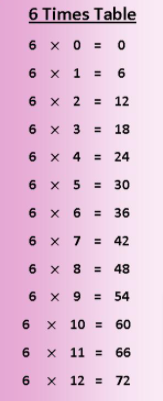
Here, we will find the Multiplication Table of 6 in an image format to download and practice daily. This, 6 Times Table Multiplication Chart image is useful for future reference. So, download 6 Multiplication Table Image, paste a printed copy on your walls to refer regularly and solve more basic multiplication, division mathematical problems easily and quickly.

6 Times Multiplication Chart

Writing 6 Times Table | Multiplication Table of 6 Up to 20

Get the 6 Times Table Multiplication Chart in the tabular format in the below sections and know how to write the 6 table. We have given the first 20 multiples of 6 here for your comfort. Use this handy and free Multiplication Table of 6 Chart to perform the arithmetic operations quickly. Have a deeper insight into the multiplication process by availing the 6 Multiplication Table present here.

6x0=0
6x1=6
6x2=12
6x3=18
6x4=24
6x5=30
6x6=36
6x7=42
6x8=48
6x9=54
6x10=60
6x11=66
6x12=72
6x13=78
6x14=84
6x15=90
6x16=96
6x17=102
6x18=108
6x19=114
6x20=120

Tips & Tricks to Memorize 6 Times Table

To memorize the 6 Times Table Multiplication Chart, have a look at the tricks mentioned here.

  • Generally, multiples of 6 are multiples of both 2 and 3.
  • If you multiply an even number with 6 the result will be the same even number in the unit digit i.e 6 x 2 = 12, 6 x 6 = 36, 6 x 8 = 48 and so on
  • You can also learn the 6 Multiplication Table using the skip counting process.

How to Read Multiplication Table of 6 in Words?

One time six is 6.

Two times six is 12.

Three times six is 18.

Four times six is 24.

Five times six is 30.

Six times six is 36.

Seven times six is 42.

Eight times six is 48.

Nine times six is 54.

Ten times six is 60.

Why one Should Learn 6 Times Multiplication Table Chart

Learning the 6 Times Table Multiplication Chart is important and it has several advantages and they are listed along the lines.

  • You can solve all the mathematical problems involving division, multiplication easily by learning the Multiplication Table of 6.
  • This 6 Times Multiplication Table makes you perfect in performing the quick calculations.
  • 6 Times Multiplication Chart is helpful to understand the patterns easily.
  • It can be a great savior to do your mental math calculations right in your head.

Get More Math Table Multiplication Charts

0 Times Table Multiplication Chart1 Times Table Multiplication Chart2 Times Table Multiplication Chart
3 Times Table Multiplication Chart4 Times Table Multiplication Chart5 Times Table Multiplication Chart
7 Times Table Multiplication Chart8 Times Table Multiplication Chart9 Times Table Multiplication Chart
10 Times Table Multiplication Chart11 Times Table Multiplication Chart12 Times Table Multiplication Chart
13 Times Table Multiplication Chart14 Times Table Multiplication Chart15 Times Table Multiplication Chart
16 Times Table Multiplication Chart17 Times Table Multiplication Chart18 Times Table Multiplication Chart
19 Times Table Multiplication Chart20 Times Table Multiplication Chart21 Times Table Multiplication Chart
22 Times Table Multiplication Chart23 Times Table Multiplication Chart24 Times Table Multiplication Chart
25 Times Table Multiplication Chart

Solved Examples on 6 Times Table Multiplication Chart

Example 1:

What does 6 × 7 mean? What number is it equal to?

Solution:

6 x 7 means multiply 6 with 7 or 6 times 7

6 x 7 = 42

Therefore, 42 is equal to 6 times 7.

Example 2:

Eashwar eats 2 apples per day. How many apples will he eat in 6 days?

Solution:

Given that,

The number of apples Eashwar eats in a day = 2

The number of apples Eashwar eats in 6 days = 6 x 2

= 12

Therefore, Eashwar eats 12 apples in 6 days.

Example 3:

(i) How many sixes in 42?

(ii) How many sixes in 30?

(iii) How many sixes in 66?

Solution:

(i)

42 = 6 + 6 + 6 + 6 + 6 + 6 + 6

So, there are 7 sixes in 42.

(ii)

30 = 6 + 6 + 6 + 6 + 6

So, there are 5 sixes in 30.

(iii)

66 = 6 + 6 + 6 + 6 + 6 + 6 + 6 + 6 + 6 + 6 + 6

So, there are 11 sixes in 66.

Example 4:

(i) What are 6 fives?

(ii) 12 times 6?

(iii) What is 4 multiplied by 6?

(iv) sixes 7?

Solution:

(i)

6 fives means 6 x 5 = 30

(ii)

12 times 6 means multiply 6 with 12

6 x 12 = 72

(iii)

4 multiplied by 6 means 6 times 4.

6 x 4 = 24.

(iv)

Sixes 7 means 6 times 7

6 x 7 = 42.

FAQs on 6 Multiplication Table

1. Is there a pattern in the 6 times table?

Multiples of 6 are multiples of 2 and 3. The pattern of 6 is 6, 2, 8, 4, 0 in the unit’s place. all the multiples of 6 are even numbers. When a multiple of 2 and 3 overlap, you will get 6 multiples.

2. How do you memorize the 6 Times Table Multiplication Chart?

The best trick to remember the 6 table is to add 1 to the multiples of 5 to get the multiples of 6. You can also perform 6 times 2 means add 6 twice to get the result.

3. What is the trick for multiplying by 6?

We don’t have any special tricks for the 6 multiplication table. You just have to read it and remember. When you multiply the even number the unit digit of the result remains the same.

Representing Fractions on Number Line – Definition, Examples | How to Represent Fractions on Number Line?

Representing Fractions on Number Line

A fraction shows the equal parts of a collection or whole. The number line is a straight line with numbers placed at equal intervals along its length. Representing Fractions on Number Line means pointing the fractions on the number line. It shows the interval between two numbers. Learn the process of how to represent fractional numbers on a number line from the below-provided segments of this page.

Representing Fractions on Number Line – Definition

First of all, representing whole numbers on a number line means pointing those numbers on the line. In the same way, we need to point to the fraction which is between two numbers on the number line. Here, we need to divide the space between two whole numbers on a number line into the number of parts. Make each part as a fraction and then point to the respective fraction.

Examples of Fractions are \(\frac { 2 }{ 5 } \), \(\frac { 1 }{ 2 } \), \(\frac { 5 }{ 6 } \).

How to Represent Fraction on Number Line?

Are you looking for any help on representing fractions on a number line then read the following points. Here you will get the detailed step-by-step procedure.

  • Get the fraction and draw a number line.
  • If the numerator of the fraction is more than the denominator, then convert the fraction into a mixed fraction.
  • Divide the space between two consecutive whole numbers and the denominator number of parts.
  • And consider each division as a fraction.
  • Now, mark the points on the number line.

Also, Read More Related Articles

Representing Fractions on a Number Line Examples

Example 1:

Represent \(\frac { 52 }{ 5 } \) on the number line.

Solution:

First, convert \(\frac { 52 }{ 5 } \) into the mied fraction.

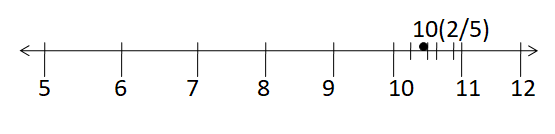
\(\frac { 52 }{ 5 } \) = 10\(\frac { 2 }{ 5 } \)

Now, we start from 10 and divide the section between 10 and 11 into 5 equal parts because the denominator is 5. The second point in the division is 2/5. Mark the point as 10\(\frac { 2 }{ 5 } \).

Representing Fractions On Number Line 1

Example 2:

Draw a number line to represent the fractions –\(\frac { 2 }{ 4 } \), \(\frac { 3 }{ 4 } \), \(\frac { 8 }{ 4 } \), \(\frac { 14 }{ 4 } \), and \(\frac { 21 }{ 4 } \).

Solution:

Given fractions are –\(\frac { 2 }{ 4 } \), \(\frac { 3 }{ 4 } \), \(\frac { 8 }{ 4 } \), \(\frac { 14 }{ 4 } \), and \(\frac { 21 }{ 4 } \)

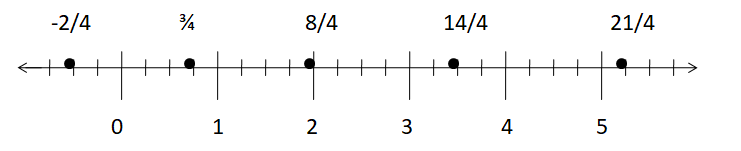
The denominator of all the factions is 4. So, divide each interval into 4 parts. Each part so obtained will represent the fraction 1/4 and the number line obtained will be in the form of as shown here.

Representing Fractions On Number Line 2

To mark –\(\frac { 2 }{ 4 } \); move two parts on the left-side of zero.

To mark \(\frac { 3 }{ 4 } \); count three parts from the zero.

To mark \(\frac { 8 }{ 4 } \); count 8 parts from the zero.

To mark \(\frac { 14 }{ 4 } \); count 14 parts from the zero.

To mark \(\frac { 21 }{ 4 } \), count 21 parts from the zero.

The following diagram shows markings of fractions –\(\frac { 2 }{ 4 } \), \(\frac { 3 }{ 4 } \), \(\frac { 8 }{ 4 } \), \(\frac { 14 }{ 4 } \), and \(\frac { 21 }{ 4 } \) on a number line.

Representing Fractions On Number Line 3

Example 3:

Represent the fractions \(\frac { 1 }{ 3 } \), \(\frac { 12 }{ 3 } \), \(\frac { 16 }{ 3 } \), \(\frac { 8 }{ 3 } \) on a number line.

Solution:

The given fractions are \(\frac { 1 }{ 3 } \), \(\frac { 12 }{ 3 } \), \(\frac { 16 }{ 3 } \), \(\frac { 8 }{ 3 } \)

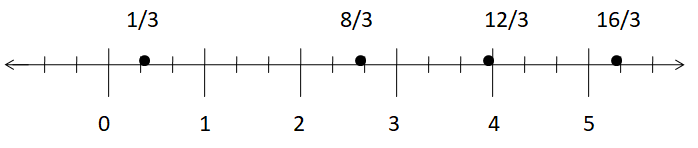
The denominator of all the factions is 3. So, divide each interval into 3 parts. Each part so obtained will represent the fraction 1/3 and the number line obtained will be in the form of as shown here.

Representing Fractions On Number Line 7

To mark \(\frac { 1 }{ 3 } \), move 1 point on the right side of zero.

To mark \(\frac { 12 }{ 3 } \), move 12 pionts on the right side of zero.

To mark \(\frac { 16 }{ 3 } \), move 16 points on the right side of zero.

To mark \(\frac { 8 }{ 3 } \), move 8 points on the right side of zero.

The following diagram shows markings of fractions \(\frac { 1 }{ 3 } \), \(\frac { 12 }{ 3 } \), \(\frac { 16 }{ 3 } \), \(\frac { 8 }{ 3 } \) on a number line.

Representing Fractions On Number Line 5


Example 4:

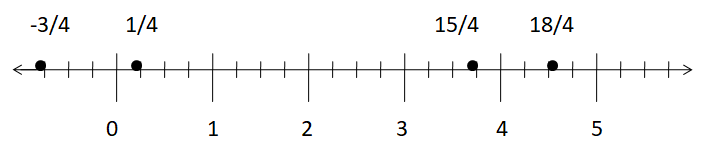
Represent the fractions \(\frac { 15 }{ 4 } \), \(\frac { 1 }{ 4 } \), \(\frac { -3 }{ 4 } \), \(\frac { 18 }{ 4 } \) on a number line.

Solution:

The give fractions are \(\frac { 15 }{ 4 } \), \(\frac { 1 }{ 4 } \), \(\frac { -3 }{ 4 } \), \(\frac { 18 }{ 4 } \)

The denominator of all the factions is 4. So, divide each interval into 4 parts. Each part so obtained will represent the fraction 1/4 and the number line obtained will be in the form of as shown here.

Representing Fractions On Number Line 2

To mark –\(\frac { 3 }{ 4 } \); move three parts on the left-side of zero.

To mark \(\frac { 1 }{ 4 } \); count one part from the zero.

To mark \(\frac { 15 }{ 4 } \); count 15 parts from the zero.

To mark \(\frac { 18 }{ 4 } \), count 18 parts from the zero.

The following diagram shows markings of fractions \(\frac { 15 }{ 4 } \), \(\frac { 1 }{ 4 } \), \(\frac { -3 }{ 4 } \), \(\frac { 18 }{ 4 } \) on a number line.

Representing Fractions On Number Line 6

FAQ’s on Representing Fractions on Number Line

1. How do you represent a fraction on a number line?

To represent fractions on the number line, divide each line segment between 0 to 1 into the denominator number of parts. And count the numerator parts from zero and mark the fractions.

2. What is \(\frac { 3}{ 4 } \) on a number line?

The fraction \(\frac { 3}{ 4 } \) means 3 out of 4 equal parts. So, count 3 parts from 0 on the number line to get \(\frac { 3}{ 4 } \).

3. What does the denominator of a fraction represent on the number line?

A fraction has two parts numerator and denominator. The denominator means how many equal parts an item was divided into.

Word Problems on Pythagorean Theorem | Pythagorean Theorem Problems with Answers

Word Problems on Pythagorean Theorem

Check Word Problems On Pythagorean Theorem in the below sections. Refer Pythagorean Theorem Study Material along with the solutions and steps to solve them. Get various model questions on Pythagoreans theorem and improve your mathematical knowledge along with other math skills. Know the shortcuts, tips, and tricks to solve Pythagorean Theorem Problems. Assess your preparation standard taking the help of the Pythagorean Theorem Questions available and cross-check your solutions here.

How to Solve Problems on Pythagorean Theorem?

Follow the simple steps listed here to solve problems related to the Pythagorean Theorem. They are along the lines

Step 1: Look at all the terms in the final equation

Step 2: Find out which right triangles contain those terms

Step 3: Start with those right triangles and apply the Pythagorean Theorem

Pythagorean Theorem Word Problems

Problem 1:

A 35-foot ladder is leaning against the side of a building and its positioned such that the base of the ladder is 21 feet from the base of the building. Find the distance above the ground where the point of the ladder touches the building?

Solution:

Let the point above the ground = x

As given in the question,

Length of the foot ladder = 35

Base of the ladder = 21 feet

Let the equation be a² + b² = c²

(21)² + (x)² = (35)²

441 + x = 1225

Subtracting by 441 on both sides

x = 784

Squaring and both sides

x = √784

x = 28

28 feet far above the ground is the point where the ladder touches the building.

Problem 2:

Lainey runs a string of lights from the ground straight up a door frame that is 2.5 meters tall. Then they run the rest of the string in a straight line to a point on the ground that is 6 meters from the base of the door frame. There are 10 lights per meter of a string. How many total lights are on the string?

Solution:

As given in the question,

The length of the lights = 2.5 meters

The base of the door frame = 6 meters

No of lights per meter = 10

To find the total number of lights on a string, we write the equation

h² = (2.5)² + (6)²

h²= 6.25 + 36

h²= 42.25

h = √42.25

String Length = 2.5 + √42.25

Therefore, no of lights = 9m * 10 lights = 90 lights

Thus, the total lights on the string = 90 lights

Problem 3:

Fencing at a hardware store costs $16.97 per yard. How much would it cost to fence in a triangular-shaped yard that has a leg of 11 feet and another leg of 60 feet?

Note: The yard is in the shape of a right triangle.

Solution:

Amount of fencing at hardware store = $16.97 per yard

Length of one leg = 11 feet

Length of another leg = 60 feet

As given the yard is in the shape of right triangle

We know the equation,

a² + b² = c²

(11)² + (60)² = c²

121 + 3600 = c²

3721 = c²

Squaring on both sides

√3721 = √c²

61 = c

The amount for a fence in a triangular-shaped yard = $61

Thus, the final solution is $61

Problem 4:

If a 34-foot ladder is placed against the top of a 30-foot building. How many feet will be at the bottom of the ladder from the bottom of the building?

Solution:

As given in the question,

Length of the ladder = 34 foot

Length of the building = 30 foot

Let the length of bottom of the ladder = x

a² + b² = c²

(30)² + x² = (34)²

900 + x² = 1156

x² = 256

Add square root on both sides

√x² = √256

x = 16 feets

Therefore, the bottom of the ladder from the bottom of the building will be 16 feets

Thus, the final solution is 16 feet

Problem 5:

A certain television is advertised as a 34-inch TV. If the width of the TV is 30 inches, how many inches tall is the TV?

Solution:

As given in the question,

Size of the TV = 34 inch

Width of the TV = 30 inch

Length of TV = x

To know the length of TV, we have to find the equation

a² + b² = c²

(30)² + x² = (34)²

900 + x² = 1156

Add square root on both sides

√x² = √1156

x = 34

TV is 34 inches tall.

Thus, the final solution is 34 inches

Problem 6:

Ramu starts driving north for 9 miles, then takes a right turn, and then he drives east for another 40 miles. At the end of driving, what is the distance of a straight line from the starting point?

Solution:

As given in the question,

Driving for north = 9 miles

Driving for east =40 miles

Let the straight line distance = x

The equation will be

a² + b² = c²

(9)² + (40)² = c²

81 + 1600 = c²

1681 = c²

Add square roots on both sides

√1681 = √c²

41 = c

Therefore, the straight line distance from the starting point is 41 miles

Thus, the final solution is 41 miles

Problem 7:

In a right-angled triangle, the hypotenuse square is equal to the sum of the squares of other two sides?

Solution:

Given: A right-angle triangle in which one of the sides is 90°

To prove: AC² = AB² + BC²

Construction: Draw BD ⊥ AC

In Δ’s ADB and ABC

∠ADB = ∠ABC (Each 90°)

∠A = ∠A (Common)

ΔADB ∼ ΔABC (By A-A Criteria)

AD/AB = AB/AC

AB² = AD * AC is the first equation

In Δ’s BDC and ABC

∠CDB = ∠ABC (Each 90°)

∠C = ∠C (Common)

ΔBDC ∼ ΔABC (By A-A Criteria)

DC/BC = BC/AC

BC² = AC * DC is the (2) equation

AB² = AD * AC is the (3) equation

Adding the equations (1) and (2)

AB² + BC² = AD * AC + AC * AD

AB² + BC² = AC (AD + DC)

AB² + BC² = AC (AC)

AB² + BC² = AC²

∴ Hence proved

Problem 8:

In the triangle, if the square of one side of the triangle is equal to the sum of the squares of another two sides of the triangle, then the angle that is opposite to the first side is a right angle triangle?

Solution:

 Given: ΔABC such that AB² + BC² = AC²

To prove: ∠B = 90°

Construction: Draw ΔDEF such that DE = AB, EF = BC and ∠E = 90°

Since ΔDEF is right-angled,

By Pythagoras theorem

DE² + EF² = DF²

AB² + BC² = DF² (By const DE = AB and EF = BC)

AC² = DF² (Given AB² + BC² = AC²)

AC = DF

To prove: ∠B = 90°

In Δs ABC and DEF

AB = DE (By const)

BC = EF (By const)

AC = DF (Proved)

ΔABC ≅ ΔDEF (SSS)

∠B = ∠E = 90°

ΔABC is a right triangle

Problem 9:

Mary wants to cut across a rectangular lot rather than walk around it. Of the lot is 120 feet long and 50 feet wide. Mary walks diagonally across the lot, how many feet is the short cut?

Solution:

As given in the question,

Length of the lot = 120 feet

Width of the lot = 50 feet

Let the shortcut distance be x

As per the Pythagorean theorem,

a² + b² = c²

(50)² + (120)² = x²

2500 + 14,400 = x²

16,900 = x²

130 = x

Therefore, Mary walks 130 feet shortcut

Thus, the final solution is 130 feet

Problem 10:

The length of a living room is 2 feet less than twice its width. If the diagonal is 2 feet more than twice the width, find the dimensions of the room?

Solution:

Let the width of the living room = x

Given that

Length of the living room = 2 feet less than twice its width

Diagonal = 2 feet more than twice the width

From the given equations,

Width represents x² + (2x – 2)² = (2x + 2)²

Length represents x² = (2x + 2)² – (2x-2)²

From both the equations,

x² = (4x + 8x + 4) – (4x – 8x + 4)

x² = 16x

(x²-16x) = 0

x(x-16) = 0

x = 0, x=16

Therefore, the width = 16

Length = (2x – 2) = 2(16) – 2 = 30

Thus, the length of the living room = 30 feet

Width = 16 feet

Hence, the final solution is l = 30 feet and w = 16 feet

Problem 11:

A man goes 12m east and 9m north. Find the distance from the initial point?

Solution:

As given in the question,

The distance man goes to east = 12m

i.e., BC = 12m

The distance man goes to north = 9m

i.e., AB = 9m

To find the initial point (AC), apply the Pythagorean theorem

AC² = AB² + BC²

AC² = (9)² + (12)²

AC² = 81 + 144

AC² = 225

AC = √225

AC = 15

Therefore, he is 15m far from his initial point

Thus, the final solution is 15m

Problem 12:

Hari wants to hang a 7m long banner from the roof of her shop. The hooks for the strings are 10m apart. Hari wants the top of the banner to hang 1m below the roof. How long should each of the strings be?

Solution:

As per the question,

Length of the long banner = 7m

Hooks for strings = 10m apart

Length where the banner to hang below the roof = 1m

Let the length of the string = x

Hence, the equation will be

7 + 2x = 10

2x = 3

x = 1.5

Now, apply the Pythagorean theorem,

C² = (1)² + (1.5)²

C² = 1 + 2.25

C² = 3.25

C = √3.25

C = 1.80

Hence, each string should be 1.80m

Thus, the final solution is 1.80m

Problem 13:

Two kids are flying a kite with a string of 50 meters long. If the kids are 35 meters apart, how high is the kite off the ground?

Solution:

As given in the question,

Length of the string = 50 meters

The distance of kids apart = 35 meters

The height of the kite off the ground = b

Applying the Pythagorean theorem, we get

a² + b² = c²

(35)² + b² = (50)²

1225 + b² = 2500

b² = 1275

b = √1275

b = 35.70

Therefore, 35.70m is the kite off the ground

Thus, the final solution is 35.70 m

Problem 14:

A carpenter needs to add 2 braces to a barn door. If the door measures 12 * 16 feet, how much wood will he need for both braces?

Solution:

As given in the question,

No of braces = 2

Length of the door = 12 feet

The breadth of the door = 16 feet

To find the amount of wood for braces, we apply Pythagorean theorem

a² + b² = c²

(12)² + (16)² = c²

144 + 256 = c²

400 = c²

c = √400

c = 20

Amount of wood for both the braces = 2 * 20 = 40ft

Therefore, the carpenter requires 40 ft of wood for both the braces.

Thus, the final solution is 40 ft

Problem 15:

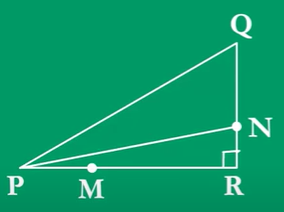
M and N are points on the sides RP and RQ respectively of triangle PQR right-angled at R. Prove that PN² + QM² = PQ² + MN²?

Solution:

PN² = PR² + RN² is the (1) equation

QM² = MR² + RQ² is the (2) equation

Adding the equation (1) and (2)

PN² + QM² = MR² + RQ² + PR² + RN²

PN² + QM² = (MR² + RN²) + (RQ² + PR²)

PN² + QM² = MN² + PQ²

∴ Hence, it is proved

Modulus of a Complex Number | Properties of Absolute Value of a Complex Number | How to find the Modulus of a Complex Number?

Modulus of a Complex Number

The modulus of a Complex Number is here. Know the example problems of modules and various forms involved in them. Follow cartesian form, trigonometric or polar form, exponential form, modulus properties, the principal value of the argument of LPA. Refer to the important topics and terminology used in complex values. Check the below sections to know the absolute value and the modulus of the complex number.

Modulus of a Complex Number – Definition

The modulus of a complex number gives you the distance of the complex numbers from the origin point in the argand plane. the conjugate of the complex number gives the reflection of that number about the real axis in the same argand plane. The modulus of the complex number is always positive which is |z| > 0. Also, the complex values have a similar module that lies on a circle.

Cartesian Form

z¡ = x + iy is the complex number that is in the cartesian form. The modulus can be represented as |z|. The value of |z| = √x2 + y2

Trigonometric or Polar Form

The complex number in the polar form is represented with z. The equation of z = r cisθ or z = r∠θ, r(cosθ + isinθ) where r represents the distance of the point z from the origin or the modulus. θ is the subtended angle by z from the positive x-axis.

Here, r = √x2 + y2 & θ represents its argument.

Exponential Form

The complex number “z” in the form of exponential can be expressed as z = rei∅ or |z|eiarg(z) represents the complex number modulus and ∅ is the argument value.

Properties of Modulus

  • If |z| = 0, then z = 0 + i0
  • |z| = |-z| = |\(\overline{z}\)| = |iz|
  • -|z| ≤ Re(z) ≤ |z|
  • -|z| ≤ Im(z) ≤ |z|
  • \(\overline{z}\)z = |z|², if |\(\overline{z}\)| = 1

These type of modulus are called as unimodulars

then \(\overline{z}\) = 1/z

    • |z1z2| = |z1||z2|, is true for n complex numbers
    • |zn|= |z|n
    • |z1/z2| = |z1|/|z2|
    • |z1 + z2|² + |z1 – z2|² = 2(|z1|² + |z2|²)

Definition and Meaning of Arg

Argument or Arg in complex numbers resembles the angle which is subtended by any of the complex points on the argand plane from the +(positive) x-axis. For the complex number z, the argument is represented with arg(z) which gives us the measurement of the angle between the + (positive) x-axis and also the

For any complex number z, its argument is represented by arg(z). It gives us the measurement of the angle between the positive x-axis and the line joining origin and the point. There are three ways to express an argument of a complex number. The three ways are as follows.

General Argument

For all the complex numbers z, the general argument is z = x + iy or r(cosθ + isinθ)

Im(z) = r sinØ and Re(z) = r cosØ which shows the real and imaginary parts of the complex numbers and also are the functions of sin and cosine. Hence, they are periodic with the period 2Π which means that there exist infinite complex numbers which have the same argument or angle. The same case follows for modulus too.

Assume the complex numbers in the first quadrant (z) = x + iy (x,y >0)

The general argument will be defined as Ø = 2nΠ + tan-1y/x where n ∈l.

Here, tan-1y/x is known as the argument principle value and hence its value depends upon the quadrant in that point lies.

Also, Read: Properties of Complex Numbers

Prinicipal Value of Argument (PA) or Amplitude (amp)

A general argument or a well-defined complex number cannot be expressed. We used the principle value or amplitude instead of the general argument in the case where the well-defined complex function is required.

In the principle argument, Φ value is restricted to be in interval ( -Π < Φ ≤ Π) or (-Π, Π]. The range of principle argument represents the half-circled range from the +(positive) x-axis in either direction.

QuadrantSign of x & yArg (z)
Ix,y>0tan-1y/x
IIx<0,y>0Π – tan-1|y/x|
IIIx,y<0-Π + tan-1|y/x|
IVx>0,y<0-tan-1|y/x|

LPA (Least Positive Argument)

LPA is another type of argument, where the angle range Ø is kept as (0< Ø ≤ 2Π) or (0,2Π]. This type of argument has only anticlockwise rotation is considered. To find the complex number in any of the quadrants, the angle has to be calculated from the positive x-axis in the counterclockwise or anticlockwise direction only.

The native way of calculating the angle to the point (a,b) can be done by using arctan (b/a) but arctan takes the value in the range of [-Π/2, Π/2], which gives the wrong result for the negative x component coordinates. We can fix it by adding or subtracting Π and it depends on the quadrant of the Argand diagram in which the point lies in

  • 1st quadrant (Θ) = arctan (b/a)
  • 2nd quadrant (Θ) = arctan (b/a) + Π
  • 3rd quadrant (Θ) = arctan (b/a) – Π
  • 4th quadrant (Θ) = arctan (b/a)

Modulus of a Complex Number Examples

Problem 1:

If |z-(4/z)| = 2. Find the maximum value of |z|?

Solution:

As given in the question,

|z-(4/z)|

The equation is

|z-(4/z)| ≥ |z| -|4/z|

2 ≥ |z| – 4/|z|

2|z| ≥ |z|² – 4

|z|² – 2|z| – 4 ≤ 0

|z| ≤ √5 + 1

The maximum value of z,

|z| ≤ √5 + 1

Problem 2:

If z + |z| = 1 + 4i. Find the value of |z|?

Solution:

The given equation is

z= x + iy

z + |z| = 1 + 4i

x + iy + √(x² + y²) = 1 + 4i

y=4 and x + √(x² + y²) = 1

x + √(x² + 4²) = 1

√(x² + 4²) = 1-x

Squaring on both the sides, we get

x² + 4² = 1 + x² – 2x

2x = -15

or x = -15/2

|z| = √x² + y²

|z| = √(-15/2)² + 4²

|z| = √(225/4 + 16)

|z| = √(225 + 64/4

|z| = √(289/4)

|z| = 17/2

The value of |z| = 17/2

Problem 3:

For the equation, z = (3-2i)/2i. Find the complex number modulus?

Solution:

As given in the question,

z = (3-2i)/2i

z = (3)/2i – 2i/2i

z= 3/2i – 1

z= 3i/(2i)² – 1

z = -3i/2 – 1

|z| = √(-3/2)² + (-1)²

|z| = √(9/4 + 1)

|z| = √(9+4)/4

|z| = √13/4

|z| = √13/2

Therefore, the complex modules is |z| = √13/2

Estimating the Quotient – Definition, Examples | How to Estimate the Quotient?

Estimating the Quotient

The division is a basic arithmetic operation and it is the inverse of multiplication. The terms of division are dividend, divisor, quotient, and remainder. The number which we divide is known as a dividend, the number by which we divide is called the divisor. The quotient means the number of times a division is completed fully, and the remainder is the quantity that doesn’t go fully into the divisor. Here, we will learn about how to estimate the quotient of two numbers easily with solved example questions.

What is Estimating the Quotient?

When we divide two numbers, the result we get is called the quotient. The formula to express the terms of division is divided ÷ divisor = quotient + remainder. It is important to know how to estimate the quotient. Estimating the quotient means, we not doing the division for the actual numbers. You need to round off the dividend and divisor to the nearest 10 and proceed for the division to get the estimated quotient value.

How to Estimate the Quotient?

Check out the step-by-step process to calculate the estimating quotient of two numbers.

  • If the numbers have two or more digits, then round off the numbers to the nearest 10 or 100 or 1000.
  • And divide those numbers to get the quotient.
  • The obtained quotient is called the estimated quotient of the given numbers.

Also, Read More Articles:

Example Questions on Estimating the Quotient

Example 1:

Find the estimated quotient and actual quotient when 78 divided by 36.

Solution:

Given that,

dividend = 78, divisor = 36

divided ÷ divisor = 78 ÷ 36

Estimating the Quotient 1

Actual quotient = 2

Round off the divided and divisor to the nearest 10

new divided = 80, new divisor = 40

80 ÷ 40 = 2

Estimated quotient = 2.

Example 2:

A school track is 9.76 meters wide. It is divided into 8 lanes of equal width. How wide is each lane?

Solution:

The width of each lane is nothing but the quotient when we divide 9.76 by 8.

Round off the school track to the nearest 10 i.e 9.76 is 10.

Divide 10 by 8

10 ÷ 8 = 1

Approximately, 1 meter wide each lane.

Example 3:

Aerobics classes cost $153.86 for 14 sessions. What is the estimated fee for one session?

Solution:

The fee for one session is nothing but the quotient when we divide 153.86 by 14.

Round off 153.86 to the nearest 10 i.e 150

Round off 14 to the nearest 10 i.e 10

Divide 150 by 10

150 ÷ 10 = 15

Therefore, the estimated fee for one session is $15.

Example 4:

Estimate quotient when 1058 divided by 50.

Solution:

Round off 1058 to the nearest 100 i.e 1100

Divide 1100 by 50

1100 ÷ 50 = 22

The estimated quotient is 22.

FAQs on Estimating the Quotient

1. How can you use estimation to check if a quotient is reasonable?

  • Round off the divisor and dividend to the nearest 10 or 100 depending on the number of digits.
  • Divide the rounded dividend by divisor to get the estimated quotient.
  • Compare the estimated and exact answers to check whether the answer is reasonable or not.

2. How do you estimate the quotients?

To estimate the quotients, you need to round off each number to the nearest 10 or 100 or 100 and then divide. The result is called the estimated quotient.

3. What is a quotient?

Quotient means the answer a division problem. In the divisor parts, you divide the dividend to get the quotient.

Subsets of a Given Set – Definition, Symbol, Properties | How to find the Number of Subsets in a Set?

Subsets of a Given Set

Subsets of a Given Set mean the subset having the elements present in a set. In other words, Subsets are a part of the set. A set is nothing but a collection of elements placed within curly braces. The example of a set is {a, b, c}. If we take a set of even numbers and name it as A and set B has {2, 4, 6}, then B is the subset of set A. It is represented as B⊆A. The elements of sets may be variables, groups of real numbers, constants, or whole numbers, etc.

What is Subset of a Set?

The subset is said to be a part of the set. Subset must have the elements that present in a set. If set A is said to be a subset of Set B, then all the elements of Set A are must present in Set B. Set A is contained inside Set B.
Example: If Set A has {C, D} and set B has {C, D, E}, then A is the subset of B because all the elements of A are also present in set B. The subset is denoted by the symbol ⊆ we read as ‘subset of’. A ⊆ B; which means Set A is a subset of Set B.

All Subsets of a Set

The subset of any given set must consist of all possible sets along with the elements and also having a null set. Check out the below example to understand the subset of a set.
Example: A = {7, 6, 8, 9}
Solution: Given that A = {6, 7, 8, 9}.
Subsets = {}, {6}, {7}, {8}, {9},
{6,7}, {6,8}, {6,9}, {7,8},{7,9}, {8,9},
{6,7,8}, {7,8,9}, {6,8,9}, {6,7,9}
{6, 7, 8, 9}

Types of Subsets

Mainly, there are two different types of subsets available. they are classified as

  • Proper Subset
  • Improper Subsets

Proper Subset

The proper subset contains some elements of an original set along with a null set. Set A is treated to be a proper subset of Set B if Set B has at least one element that is not present in Set A. A proper subset is denoted by ⊂ and it is read as ‘is a proper subset of’. We can show a proper subset for set A and set B as A ⊂ B.

Proper Subset Formula

If we take n number of elements from a set having N number of elements, then it shows as  NCn number of ways. The number of possible subsets having n number of elements from a set containing N number of elements is equal to  NCn.

Also, Read:

Improper Subset

A subset that has all elements of the original set is called an improper subset. It is denoted by ⊆. The Improper Subset consists of all elements of a set that doesn’t miss any element.

Example: Set P = {3, 5, 7}
The subsets of P are {}, {3}, {5}, {7}, {3,5}, {5,7}, {3,7} and {3,5,7}.
Where, {}, {3}, {5}, {7}, {3,5}, {5,7}, {3,7} are the proper subsets and {3,5,7} is the improper subsets. Therefore, we can write {3,5,7} ⊆ P.

Note: The empty set is an improper subset of itself but it is a proper subset of any other set.

Power Set

The power set is defined as the collection of all the subsets. It is represented by P(A).
If A is set having elements {a, b}. Then the power set of A will be
P(A) =  {∅, {a}, {b}, {a, b}}

How many Subsets and Proper Subsets does a Set have?

Let us consider a set that consists of n elements, then the number of a subset of the given set is 2n and the number of proper subsets of the given subset is given by 2n-1.

Example: If set A consists the elements, A = {c, d}, then the proper subset of the given subset are {}, {c}, {d}.
The number of elements in the set is 2.
The formula to find the number of proper subsets is 2n – 1.
= 2² – 1
= 4 – 1
= 3
Thus, the number of proper subset for the given set is 3 ({ }, {c}, {d}).

Properties of Subsets

The below are some of the important properties of subsets.

  • Every set is considered as a subset of the given set itself. It means that X ⊂ X or Y ⊂ Y, etc
  • Also, we can say, an empty set is considered as a subset of every set.
  • A is a subset of B. It means that A is contained in B
  • If a set A is a subset of set B, we can say that B is a superset of A

Solved Examples on Subsets of a Given Set

1. If A {2, 3, 7}, then write all the possible subsets of A. Find their numbers?

Solution:
Given that set A {2, 3, 7}.
Let us write all the possible subsets of a given set.
The subset of A containing no elements – {  }
The subset of A containing one element each – {2} {3} {7}
The subset of A containing two elements each – {2, 3} {2, 7} {3, 7}
The subset of A containing three elements – {2, 3, 7}
Therefore, all possible subsets of A are { }, {2}, {3}, {7}, {2, 3}, {2, 7}, {3, 7}, {2, 3, 7}
Therefore, the number of all possible subsets of A is 8 which is equal to 2³.
Proper subsets are = {  }, {2}, {3}, {7}, {2, 3}, {3, 7}

Number of proper subsets are 7 = 8 – 1 = 2³ – 1.

2. If the number of elements in a set is 4, find the number of subsets and proper subsets.

Solution:
Number of elements in a set = 4
Then, number of subsets = 24 = 16
Also, the number of proper subsets = 24 – 1
= 16 – 1 = 15

3. If A = {5, 6, 7, 8, 9}

The formula to calculate the number of proper subsets of a given set is 2n – 1
then the number of proper subsets = 25 – 1
= 32 – 1 = 31   {Take [ 2n – 1]}
and the formula to calculate the number of subsets of a given set is 2n
power set of A = 25 = 32 {Take [2n]}

Different Types of Lines in Geometry – Basic Definition, and Examples

Types of Lines

A line is a one-dimensional geometric figure having length but no width. It is made up of points that are extended in opposite directions infinitely. The different types of lines are horizontal, vertical, parallel, perpendicular, curved, and slanting lines. The definitions of each type of line with an image are given below. Go through the entire article to learn in detail about the Types of Lines in Geometry and examples for each one of them.

What is a Line?

A line can be defined as the set of points that is extended in opposite directions. It has no width, no endpoints in opposite directions and it is a one-dimensional plane. The line has no thickness.

Types of Lines

There are different types of lines in geometry, the basic types of lines are listed below. Let us discuss in detail the figures, definitions, properties of each one of them. They are along the lines

  • Vertical Lines
  • Horizontal Lines
  • Parallel Lines
  • Skew Lines
  • Perpendicular Lines
  • Oblique or slanting lines
  • Concurrent Lines
  • Transversal line
  • Coplanar Lines

Straight Lines:

Straight lines are the lines as shown below.

Types of Lines 1

Horizontal Lines:

If the line moves from the left to the right side in a straight direction, it is called the horizontal line.

Types of Lines 2

Vertical Lines:

If a line moves from the top to the bottom in a straight direction, then it is a vertical line.

Types of Lines 3

Parallel Lines:

When two straight lines don’t intersect at any point, then they are parallel lines.

Types of Lines 4

Perpendicular Lines:

When two straight lines meet at an angle of 90 degrees, then they are perpendicular lines.

Types of Lines 5

Also, Read More Articles:

Oblique or slanting lines:

If the lines are drawn in a slanting position, then they are called the oblique or slanting lines.

Types of Lines 6

Skew Lines:

If two non-parallel lines are not intersecting in a space, then they are called the skew lines.

Types of Lines 7

Concurrent Lines:

When two or more lines are passing through a common point, then those lines are called concurrent lines.

Types of Lines 8

Transversal line:

A transversal line is a straight line that cuts 2 or more lines. The lines may or may not be parallel.

Types of Lines 9

Coplanar lines:

Coplanar lines are lines that lie on the same plane.

Frequently Asked Questions on Types of Lines

1. What are the different types of lines?

The various types of lines are Horizontal Line, Vertical Line, Parallel Lines, Perpendicular Lines, Skew Lines, Oblique or slanting lines, Coplanar Lines, Concurrent Lines, and Transversal line.

2. Define a Line?

A straight line is a one-dimensional figure that has no thickness and extending infinitely from the extreme directions.

3. What is a line segment?

A line segment is a part of the line that has two fixed endpoints and it can’t be extended infinitely.

4. What are parallel and perpendicular lines?

When two straight lines extend in both directions and they don’t meet at any point is called parallel lines. Perpendicular lines intersect each other at right angles.

Class Boundaries – Definition, Examples | How to find Class Boundaries in a Frequency Table?

Class Boundaries

Class Boundaries are the data values that separate classes. These are not part of the classes or the data set. The class boundary is the middle point of the upper-class limit of one class and the lower class limit of the subsequent class. Each class has an upper and a lower class boundary. Find the definition of the class boundaries or actual class limits and example questions in the below-mentioned sections.

What is Class Boundary?

If we have different classes of data, then it has an upper-class limit and lower class limit which means the smaller and larger values. A class boundary is the midpoint of the upper-class limit of one class and the lower class limit of the subsequent class.

Lower class boundary = (lower class limit of the concerned class + upper-class limit of the previous class)/2

Upper class boundary = (upper-class limit of the concerned class + lower class limit of the subsequent class)/2

For the nonoverlapping class intervals,

The actual lower limit = lower limit – ½ x gap

The actual upper limit = upper limit + ½ x gap

Class Limit

The class limit can be defined as the minimum and maximum values contain in a class interval.

The minimum value is called the lower class limit and the maximum value is called the upper-class limit.

Solved Examples on True Class Limits

Example 1:

ClassFrequency
0 – 92
10 – 195
20 – 297

Find the lower, upper class boundaries?

Solution:

The class boundary of 0 – 9 is

Upper class boundary = (upper-class limit of the concerned class + lower class limit of the subsequent class)/2

= \(\frac { (9 + 10) }{ 2 } \)

= \(\frac { 19 }{ 2 } \)

Lower class boundary = (lower class limit of the concerned class + upper class limit of the previous class)/2

= \(\frac { (0 + 0) }{ 2 } \)

= 0

The class boundary of 10 – 19 is

Upper class boundary = \(\frac { (19 + 20) }{ 2 } \)

= \(\frac { 39 }{ 2 } \)

Lower Class boundary = \(\frac { (10 + 9) }{ 2 } \)

= \(\frac { 19 }{ 2 } \)

Example 2:

If the class marks of two consecutive overlapping intervals of equal size in distribution are 94 and 104 then find the corresponding intervals.

Solution:

The difference between 104 and 94 = 104 – 94 = 10

Therefore, the class intervals are (94 – \(\frac { 10 }{ 2 } \)) – (94 + \(\frac { 10 }{ 2 } \)) and (104 – \(\frac { 10 }{ 2 } \)) – (104 + \(\frac { 10 }{ 2 } \))

= (94 – 5) – (94 + 5) and (104 – 5) and (104 + 5)

= 89 – 99 and 99 – 109.

Example 3:

Weight in Kg (Class Interval)Frequency
44-483
49-534
54-585
59-637
64-689
69-738

Find the upper, lower class boundaries?

Solution:

Lower Class Boundary of the first class interval = 44 – \(\frac { (49 – 48) }{ 2 } \)

= 44 – \(\frac { 1 }{ 2 } \)

= 44 – 0.5

= 43.5

Upper Class Boundary = 48 + \(\frac { (49 – 48) }{ 2 } \)

= 48 + \(\frac { 1 }{ 2 } \)

= 48 + 0.5

= 48.5.

FAQs on Class Boundaries

1. What is a Class Boundary?

A class boundary is the midpoint of the upper-class limit of one class and the lower class limit of the subsequent class.

2. What is the difference between class limits and class boundaries?

In the case of the class limit, the upper extreme value of the first class interval and the lower extreme value of the next class interval are not equal. However, in the class boundary, the upper extreme value of the first class interval and the lower extreme value of the next class interval are equal.

3. How to find Class Boundaries?

Follow the below-listed steps to calculate the Class Boundaries easily. They are along the lines

  • Subtract the upper class limit for the first class from the lower class limit for the second class.
  • Divide the result by two.
  • Subtract the result from the lower class limit and add the result to the upper class limit for each class.

Angle between Two Straight Lines – Definition, Formula, Derivation, and Examples

Angle between Two Straight Lines

The angle is nothing but the figure formed by two rays. If two straight lines meet, then they form two sets of angles. The intersection forms a pair of acute angles and another pair of obtuse angles. The angle values will be based on the slopes of the intersecting lines. Check out the formula to calculate the angle between two straight lines, derivation, example questions with answers in the following sections of this page.

Angle between Two Lines – Definition

In a plane when two straight and non-parallel lines meet at a point, then it forms two opposite vertical angles. In the formed angles, one is lesser than 90 degrees and the other is greater than 90 degrees. We will find the angle between two straight and perpendicular lines is 90 degrees and parallel lines is zero degrees.

Angle between Two Straight Lines Formula and Derivation

Let us consider θ as the angle between two intersecting straight lines. And those straight lines be y = mx + c, Y = MX + C, then the angle θ is given by

tan θ = ± \(\frac { (M – m) }{ (1 + mM)} \)

Derivation

Angle Between Two Straight Lines

Two straight lines L₁, L₂ are intersecting each other to form acute and obtuse angles.

Let us take the slope measurement can be taken as

tan θ₁ = m₁ and tan θ₂ = m₂

From the figure, we can say that θ = θ₂ – θ₁

Now, tan θ = tan(θ₂ – θ₁)

tan θ = \(\frac { (tan θ₂ – tan θ₁) }{ (1 + tan θ₁ tan θ₂) } \)

Substitute tan θ₁ = m₁, tan θ₂ = m₂

tan θ = \(\frac { (m₂ – m₁) }{ (1 + m₁ m₂) } \)

How to find Angle Between Two Straight Lines?

If three points on a coordinate plane are given, then endpoints of a line are (x₁, y₁) and (x₂, y₂)

The equation of the slope is m = \(\frac { (y₂ – y₁) }{ (x₂ – x₁) } \)

m₁ and m₂ can be calculated by substituting in the formula, then the angle between two lines is given by

tan θ = ± \(\frac { m₂ – m₁) }{ (1 + m₁ m₂) } \)

Also Check:

Angle between Two Straight Lines Examples

Example 1:

If A (-2, 1), B (2, 3), and C (-2, -4) are three points, find the angle between two straight lines AB, BC.

Solution:

Given that,

Three points are A (-2, 1), B (2, 3), and C (-2, -4)

The slope of line AB is m = \(\frac { (y₂ – y₁) }{ (x₂ – x₁) } \)

m = \(\frac { (3 – 1) }{ (2 – (-2)) } \)

= \(\frac { (2) }{ (2 + 2) } \)

= \(\frac { 2 }{ 4 } \)

= \(\frac { 1 }{ 2 } \)

Therefore, m₁ = \(\frac { 1 }{ 2 } \)

The slope of line BC is given by

m = \(\frac { (y₂ – y₁) }{ (x₂ – x₁) } \)

m = \(\frac { (-4 – 3) }{ (-2 – 2) } \)

= \(\frac { -7 }{ -4 } \)

= \(\frac { 7 }{ 4 } \)

Therefore, m₂ = \(\frac { 7 }{ 4 } \)

Substituting the values of m2 and m1 in the formula for the angle between two lines when we know the slopes of two sides, we have,

tan θ = ± \(\frac { (m₂ – m₁) }{ (1 + m₁ m₂) } \)

= ± \(\frac { (\frac { 7 }{ 4 } – \frac { 1 }{ 2 } ) }{ (1 + \frac { 1 }{ 2 }  * \frac { 7 }{ 4 }) } \)

= ± \(\frac { 2 }{ 3 } \)

Therefore,  θ = tan -1 (⅔)

So, the angle between the lines AB, BC is tan -1 (⅔).

Example 2:

Find the angle between the following lines 4x – 3y = 8, 2x + 5y = 4.

Solution:

Given two straight lines are 4x – 3y = 8, 2x + 5y = 4

Converting the given lines into slope intercept form

4x – 3y = 8

4x = 8 + 3y

3y = 4x – 8

y = \(\frac { 4x – 8 }{ 3 } \)

y = \(\frac { 4x }{ 3 } – \frac { 8 }{ 3 } \)

Therefore, the slope of line 4x – 3y = 8 is \(\frac { 4 }{ 3 } \)

2x + 5y = 4

5y = 4 – 2x

y = \(\frac { 4 – 2x }{ 5 } \)

y = \(\frac { -2x }{ 5 } + \frac { 4 }{ 5 } \)

Therefore, the slope of the line 2x + 5y = 4 is –\(\frac { 2 }{ 5 } \)

The angle between lines is tan θ = ± \(\frac { (m₂ – m₁) }{ (1 + m₁ m₂) } \)

= ± \(\frac { (\frac { -2 }{ 5 } – \frac { 4 }{ 3 } ) }{ (1 + \frac { 4 }{ 3 }  * \frac { (-2) }{ 5 }) } \)

= \(\frac { -26 }{ 7 } \)

θ = tan -1 (\(\frac { -26 }{ 7 } \))

Example 3:

Find the angle between two lines x + y = 4, x + 2y = 3.

Solution:

The given two lines are x + y = 4, x + 2y = 3.

The slope-intercept form of the first line is

x + y = 4

y = 4 – x

Therefore, slope of x + y = 4 is m₁ = -1

The slope-intercept form of the second line is

x + 2y = 3

2y = 3 – x

y = \(\frac { (3 – x) }{ 2 } \)

y = \(\frac { 3 }{ 2 } – \frac { x }{ 2 } \)

Therefore, slope of x + 2y = 3 is m₂ = \(\frac { -1 }{ 2 } \)

The angle between lines is tan θ = ± \(\frac { (m₂ – m₁) }{ (1 + m₁ m₂) } \)

= ± \(\frac { (\frac { -1 }{ 2 } – (-1) ) }{ (1 + \frac { -1 }{ 2 }  * (-1)) } \)

= \(\frac { 1 }{ 3 } \)

θ = tan-1(\(\frac { 1 }{ 3 } \))

Example 4:

Find the angle between two straight lines x + 2y – 1 = 0 and 3x – 2y + 5 = 0

Solution:

The given lines are x + 2y – 1 = 0 and 3x – 2y + 5 = 0

The slope intercept form of first line is

x + 2y – 1 = 0

2y = 1 – x

y = \(\frac { 1 – x }{ 2 } \)

y = \(\frac { 1 }{ 2 } – \frac { x }{ 2 } \)

Therefore, the slope of line x + 2y – 1 = 0 is m₁ = \(\frac { -1 }{ 2 } \)

The slope-intercept form of the second line is

3x – 2y + 5 = 0

3x + 5 = 2y

y = \(\frac { 3x + 5 }{ 2 } \)

y = \(\frac { 3x }{ 2 } + \frac { 5 }{ 2 } \)

Therefore, the slope of line 3x – 2y + 5 = 0 is m₂ = \(\frac { 3 }{ 2 } \)

The angle between lines is tan θ = ± \(\frac { (m₂ – m₁) }{ (1 + m₁ m₂) } \)

= ± \(\frac { (\frac { 3 }{ 2 } – \frac { (-1 }{ 2 )} ) }{ (1 – \frac { 1 }{ 2 }  * \frac { (3) }{ 2 }) } \)

= 2

θ = tan-1(2)

Transverse and Conjugate Axis of the Hyperbola Definition, Examples | How to find Length of Transverse and Conjugate Axes of Hyperbola?

Transverse and Conjugate Axis of the Hyperbola

The transverse and conjugate axis of the hyperbola is here. Check the definition of the transverse and conjugate axis. Refer to Standard forms of the hyperbola with the center, vertices, and foci. Learn How to find the Length of Transverse and Conjugate Axes of a Hyperbola. Know the procedure to solve hyperbola problems along with solutions.

Hyperbola – Definition

The hyperbola is a set of all the points in such a way that the difference of distance between any of the points on the hyperbola to the fixed points is always constant. The fixed points of the hyperbola are called the “foci of hyperbola”. The hyperbola graph is not continuous i.e., every hyperbola has two distinct points or branches. The transverse axis is nothing but the line segment where both endpoints of the hyperbola are on it.

The transverse axis endpoints are known as vertices of the hyperbola. “Center” is the point halfway between the foci which is the midpoint of the traverse axis. The transverse axis of hyperbola x2 / a2 – y2 / b2 = 1 is along the x-axis and the length of a hyperbola is 2a.

Important Formulae and Terms of Hyperbola

There are a few terms related to hyperbola which has to be understood to get perfection in this concept. The important terms used in hyperbola are:

  • Eccentricity: 1 + [(transverse axis)2 + (conjugate axis)2]
  • Directrix: x = (-a/e), x = (a/e)
  • Focii: S’ = (-ae,0), S = (ae,0)
  • Conjugate Axis: The line segment of length 2b, between 2 points B’ = (0,-b) & B = (0,b) is called hyperbola conjugate axis.
  • Transverse Axis: The line segment of the length 2a in which focii ” S’ ” and “S” lie is called the hyperbola transverse axis.
  • Principle Axis: The conjugate and transverse axis both combinedly called a principle axis.
  • Vertices: A’ = (-a, 0) & A = (a, 0)
  • Double Ordinate: The chord that is perpendicular to the transverse axis is known as double ordinate.
  • Focal Chord: A chord that passes through a focus is known as a focal chord.
  • Latus Rectum: The focal chord which is perpendicular to the transverse axis is called the latus rectum.

The length of latus rectum = [(conjugate)2 / transverse] = (2b2 / a) = 2a (e2 – 1)

The difference of the focal distances is the constant value

i.e., |PS-PS’| = 2a

Length of latus rectum = 2e * (the distance of the focus from the corresponding directrix)

Endpoints of Latus Rectum: (± ae, ± b2 / a)

Centre: The point at which bisects every chord of the conic which is drawn through it and is called the center of the conic.

C: (0, 0) is the centre of [(x2/a2) – (y2/b2)] = 1

Key Points about Transverse and Conjugate Axis of the Hyperbola

    • Any point present on the conjugate hyperbola will be in the form (a tan θ, b sec θ).
    • The equation of the hyperbola conjugate to xy = c2 is xy = -c2
    • Conjugate Hyperbola + Hyperbola = 2 (Pair of Asymptotes).
    • The point where a pair of the diameter of conjugates meets a hyperbola and the form of the conjugates of a parallelogram, where vertices lie on asymptotes and the area is constant.
    • The equation of asymptotes and hyperbola differ by the similar constant by which the asymptotes equations and conjugate hyperbola differ.
    • If a pair of diameters of hyperbola conjugate meet the hyperbola and its conjugate in T, T’ and R, R’ respectively. Then the asymptotes bisect TR and TR’.
    • If e1 and e2 are the hyperbola eccentricities and its conjugate then the equation is e1-2 + e2-2 = 1
    •  Two hyperbolas with similar eccentricity are said to be similar.
    • The focus of conjugate and hyperbola are concyclic and they form the square vertices.

Standard Forms of Hyperbola Equation with Center (0,0)

The standard form of hyperbola equation with center (0,0) and the transverse axis on x-axis is x2 / a2 – y2 / b2 = 1

where,

  • the transverse axis length is 2a
  • the vertices coordinates are (±a,0)
  • the conjugate axis length is 2b
  • the co-vertices coordinates are (0, ±b)
  • the distance between foci is 2c, where c2=a2 + b2
  • the foci coordinates are (±c,0)
  • the asymptotes equation is y = ±b/a x

The standard form of hyperbola equation with center (0,0) and the transverse axis on y-axis is y2 / a2 – x2 / b2 = 1

where,

  • the transverse axis length is 2a
  • the vertices coordinates are (0,±a)
  • the conjugate axis length is 2b
  • the co-vertices coordinates are (±b,0)
  • the distance between foci is 2c, where c2=a2 + b2
  • the foci coordinates are (0,±c)
  • the asymptotes equation is y = ±a/b x

Standard Forms of Hyperbola Equation with Vertices and Foci

    • First of all, determine if the transverse axis lies on the x-axis or y-axis. Check that a2 is under the variable with +(positive) coefficient. Therefore, if you set another variable equal to zero (0), you can find the intercepts easily. The point at which the intercepts of hyperbola coincide with vertices, it is centered as an origin.
    • If the equation is of the form x2 / a2 – y2 / b2 = 1, then the axis of the transverse line lies on the x-axis. The vertices are pointed at (±a,0) and foci are pointed at (±c,0).
    • If the equation is of the form y2 / a2 – x2 / b2 = 1, then the axis of the transverse line lies on the y-axis. The vertices are pointed at (0,±a) and the foci are pointed at (0,±c)
    • Solve the value for a, by using the equation a = √a2
    • Solve the value for c, using the equation c = √a2 + b2

Transverse and Conjugate Axes of Hyperbola Examples

Problem 1:

Find the lengths of conjugate and transverse axis of the hyperbola 16x2 – 9y2 = 144?

Solution:

The given equation of the hyperbola is 16x2 – 9y2 = 144

x2/9 – y2/16 = 1 is the (1) equation

The above equation (1) is of the form x2 / a2 – y2 / b2 = 1, where a2 = 9 and b2=16

Therefore, the length of the transverse axis is 2a, which can be written as 2*3 = 6 and the length of the conjugate axis is 2b, which can be written as 2*4 = 8

Problem 2:

Find the lengths of conjugate and transverse axis of the hyperbola 3x2 – 6y2 = -18?

Solution:

The given equation of the hyperbola is 3x2 – 6y2 = -18

The hyperbola equation can be written as x2/6 – y2/3 = 1 is the (1) equation

The above equation (1) is of the form x2 / a2 – y2 / b2 = -1, where a2 = 6 and b2=3

Hence, the length of the transverse axis is equal to 2b which is 2 * √3 = 2√3 and the length of the conjugate axis is equal to 2a which is 2 * √6 = 2√6

Problem 3:

Find the hyperbola eccentricity whose latus rectum is half of the transverse axis?

Solution:

Let the equation of the hyperbola be x2 / a2 – y2 / b2 = 1

Transverse axis = 2a and lactus-rectum = (2b2/a)

According to the question, (2b2/a) = (1/2) * 2a

2b2=a (Since, b2=a2(e2-1))

2a2(e2-1) = a2

2e2-2 = 1

e2=(3/2)

e = √(3/2)

Therefore, hyperbola eccentricity is √(3/2).

Thus, the final solution is √(3/2).

Units of Time Conversion Chart(Hours, Minutes, Seconds) with Examples | How to Convert Units of Time?

Units of Time Conversion Chart

The interesting topic of mathematics is Time. Measurement of the time requires some specifications and units. Know the different units of time and various circumstances it is used in. Follow the terminology used in time and know the solved examples involving time. Check the below sections to know the details like units of time conversion chart, mathematical conversions, terminology, formulae, etc.

How to Convert Units of Time?

To convert a unit of time, we can use the factor of conversions. The conversion for a unit of time can be done by using division or multiplication. With the help of the conversion factor, simplification will be easier. The most used equation while converting units of time is

S * C = E

where S is considered as the starting value, C is considered as the conversion factor and E is desired as the converted solution.

Time – Definition

Time is considered as the continuous existence progress in the past, present, and also future. With the help of the unit of time, one can easily measure the existence of the event present. The most commonly used time units are:

  • Hour
  • Minute
  • Second

Popular Time Measurement Units

The most commonly used units of time include hour, minute, week, day, year, and month. In consideration of long durations of time, year multiples are also used for a certain time frame. A decade is equal to 10 years, the century is equal to 100 years, the millennium is equal to 1,000 years and a mega-annum is equal to 1,000,000 years.

Units of Time

Units of Time
Year31,557,600 seconds or 365 days
Month 2,419,200-2,678.400 seconds or 28-31 days
Week604,800 seconds or 7 days
Day86,400 seconds or 24 hours
Hour3,600 seconds or 60 minutes
Minute60 seconds

How to Convert Units of Time?

Follow the simple steps to change between one unit of time to another. They are in the following fashion

Step 1: In the first step, identify the units that are used in the problem.

Step 2: Find and determine the relationship between the given units.

Step 3: Check and determine the fraction form (the conversion factor). The denominator value must have the same unit as the given original measurement.

Step 4: Multiply the given original measurement with the conversion factor.

Time Unit Conversion Table

Convert FromCenturyDecadeYear
1 century =110100 yr
1 decade =0.1110 yr
1 year =0.010.11 yr
1 month =0.0008330.0083330.083333 yr
1 week =0.0001920.0019170.019165 yr
1 day =0.0000273790.0002740.002738 yr
1 hour =0.00000114080.0000114080.000114 yr
1 minute =0.0000000190130.000000190130.0000019013 yr
1 second =0.000000000316890.00000000316890.000000031689 yr
1 millisecond =0.000000000000316890.00000000000316890.000000000031689 yr
1 microsecond =0.000000000000000316890.00000000000000316890.000000000000031689 yr

Relationship Between Units of Time

ConversionRuleExample
Days into Hours1 day is equal to 24 hours7 days = 7 * 24 = 168 hours
Days and hours into hoursFirst of all, convert days into hours by multiplying the days by 24 and then add no of hours to it7 days 9 hours

7 days + 9 hours

(7 * 24) + 9 hours

168 hours + 9 hours

177 hours

Hours into Minutes1 hour = 60 minutes4 hours = 4 * 60 = 240 minutes
Hours and Minutes into MinutesFirst of all, convert hours into minutes by multiplying the number of hours by 60 and then add minutes to hours7 hours 45 minutes

7 hours + 45 minutes

(7 * 60) + 45 minutes

420 + 45

465 minutes

Minutes into seconds1 minute = 60 seconds25 minutes = 25 * 60 = 1500 seconds

Also, Check:

How to Solve Unit Conversion Problems?

Step 1: Read the problem carefully and write down any key points

Step 2: Highlight or underline the main question

Step 3: Make a plan, write out exactly what needs to be done in order to obtain the solution.

Step 4: Proceed by using the mathematical operations necessary as described in Step 3

Step 5: Check your answer

Time Measurement Examples

Problem 1:

Convert 4 hours into seconds?

Solution:

As we have to convert 4 hours into seconds, first convert 4 hours into minutes and then to seconds

“Hours into Minutes”

To convert hours into minutes, multiply with 60

Therefore 4 hours = 4 * 60 = 240 minutes

“Minutes into Seconds”

To convert minutes into seconds, multiply with 60

Therefore, 240 minutes = 240 * 60 = 14400 seconds

Thus, 4 hours in seconds = 14400 seconds

Problem 2:

Convert 3 hours 10 minutes into seconds?

Solution:

As we have to convert 3 hours 10 minutes into seconds, first convert 3 hours into minutes and then add that to 10 minutes and later convert that to seconds

“Hours to Minutes”

To convert hours into minutes, multiply with 60

Therefore 3 hours = 3 * 60 = 180 minutes

Now, add 180 minutes to 10 minutes

Thus, minutes = 190 minutes

“Minutes into Seconds”

1 min = 60 seconds

Therefore, 190 * 60 = 11,400 seconds

Thus, 3 hours 10 mins = 11,400 seconds

Problem 3:

Calgrand’s juice can produce 500 gallons of apple juice in quart-sized containers for $750. If they can sell the apple juice for $3.25 per quart, how much will they earn by selling all 500 gallons?

Solution:

As given in the question,

Amount of apple juice = 500 gallons

Amount of quart-sized containers = $750

Amount of juice per quart = $3.25

Let x be the no of quarts sold

Profits = Revenue – Cost

$3.25 * x

500 gallons * (4 quarts/ 1 gallon) = 2000 quarts

2000 * 3.25 = 650000

$6500 – $750 = $5750

Amount of money they earn by selling all 500 gallons = $5750

Therefore, the final amount of money they earn = $5750

Problem 4:

John went on vacation and left her dog at a kennel. The kennel charges $13 per hour. If John left his dog there for $9.25 days, how much was his bill?

Solution:

As given in the question,

Amount of kennel per hour = $13

No of days = $9.25

To convert the days into hours, multiply it with 24

9.25 * 24hours/1day = 22200

To find the amount of bill = x * cost per hour

222 * 13 = 2886

Therefore, John bill was $2886

Problem 5:

A top drug company has just invented a new colon drug. They can produce 1 millimeter for $7.35. How much will it cost them to produce 2 kilolitres of this colon drug?

Solution:

As given in the question,

Amount to invent a new colon drug = $7.35

To produce 2 kilolitres of the colon drug

2 kilolitres = 2,000,000 millilitres

For 1 millimeter = 7.35 * 2,000,000 = 1470000000

Therefore, it will cost $14.7 to produce 2 kilolitres of the colon drug.

Thus, the final solution is $14.7