Units Of Length Conversion Charts | Length Unit Conversion Table & Examples

Wondering where to find Metric Conversions Chart and Customary Units Conversion of Length? Don’t worry as you will get all of them here. We know the Standard Unit of Length is Meter and is expressed in short as “m”. 1 m is usually divided into 100 equal parts and each part is named as Centimeter and written in short as “cm”.

Long distances are measured in Kilometers and 1 Km is equal to 1000 m and is written as “km”. Different Units of Length and their Equivalents are expressed in the further modules. Check out our Math Conversion Chart to learn about length, mass, capacity, conversions etc. In Most Cases, we use Kilometre (km), Metre (m), and Centimetre (cm) as units of length measurement. You can also check Customary Units of Length, its Chart in the below sections.

Length Conversion Charts

Different Units of Length Conversions are explained here which you can use as a part of your calculations. Make the most out of them whenever you need unit conversions.

1 kilometre (km) = 10 Hectometres (hm) = 1000 m

1 Hectometre (hm) = 10 Decametres (dcm) = 100 m

1 Decametre (dcm) = 10 Metres (m)

1 Metre (m) = 10 Decimetres (dm) = 100 cm = 1000 mm

1 Decimetre (dm) = 10 Centimetres (cm)

1 decimeter = 0.1 meter

1 Centimetre (cm) = 10 Millimetres (mm)

1 centimeter = 0.01 meter

1 millimeter = 0.001 meter

Customary Units of Length are expressed here in the below table so that you can use the conversions of length.

1 mile = 1760 yards1 mile = 5280 feet

1 yard = 3 feet

1 foot = 12 inches

Solved Examples on Unit Conversions

1. Convert 0.7 m to cm?

Solution:

We know 1 m = 100 cm

0.7m = 0.7*100

= 70 Cm

Therfore, 0.7m converted to cm is 70 cm.

2. Convert 5 m 16 cm to m?

Solution:

We know 1 cm = \(\frac { 1 }{ 100 } \) m

5m 16 cm = 5m +\(\frac { 16 }{ 100 } \)m

= 5m+0.16m

= 5.16m

Therefore, 5m 16 cm converted to m is 5.16m

3. Convert 14 km 350 m into km?

Solution:

We know 1 km = 1000m

1m = \(\frac { 1 }{ 1000 } \) km

14km 350m = 14 km+\(\frac { 350 }{ 1000 } \) km

= 14km+0.35km

= 14.35 km

14 km 350 m converted to m is 14.35km

4. The length of a square tile is 120 cm. What will be the length of the tile strip in millimeters if 12 tiles are kept in a line?

Solution:

Length of Square Tile = 120 cm

Length of 12 Tile Strips in mm = 120*12

= 1440 mm

Therefore, the Length of the Tile Strip in mm is 1440mm.

Three-Dimensional Figures(3D Shapes) – Definition, Types, Properties, Facts & Examples

Three-Dimensional Figures are shapes that consist of 3 dimensions such as length, breadth, and height. Three-Dimensional shapes also called solids. The length, breadth, and height are the three important measurements of 3-dimensional figures. There are different 3-dimensional shapes used in real-time. They are cuboids, cubes, Prisms, Pyramids, cylinders and cones, etc.

Solid Shapes

Solid shapes are the fixed objects they have fixed size, shape, and space. Let us check different examples of Solid Shapes to deeply understand the Solid Geometrical Figures.

Surface Area and Volume of Three-Dimensional shapes

Surface Area is defined as the complete area of the surface of the three-dimensional object. It is measured in square units. The surface area can be calculated using three different classifications.

  • Curved Surface Area (CSA) is the area present in all the curved regions.
  • Lateral Surface Area (LSA) is the area of all the flat surfaces and all the curved regions excluding base areas.
  • Total Surface Area (TSA) is the area of all the surfaces including the base of a Three-Dimensional object.

The volume of the 3D shape is explained as the total space occupied by the three-dimensional object. It is measured in terms of cubic units and denoted by V.

Faces, Vertices, and Edges of a 3-Dimensional Shape

Have a look at the Faces, Vertices, and Edges of a 3-dimensional object.

  • A solid consists of a flat part on it. Each flat part of a solid is known as the Face of a solid.
  • The corner or Vertex is an end where three faces of a solid join together. Vertices are the plural form of the vertex.
  • When two faces of a solid meet in a line called an Edge.

Types of Three Dimensional Shapes(3D Shapes)

Here we are going to discuss the list of three-dimensional shapes, their properties, and formulas. We even took examples for a better understanding of the concept.

1. Cuboid

A cuboid is also known as a rectangular prism consists of rectangle faces. The cuboid has 90 degrees angles each. Also, it has 8 vertices, 12 edges, 6 faces.
The formula of surface area and volume of a cuboid is given below.
Surface Area of a Cuboid = 2(lb + bh + lh) Square units
The volume of a Cuboid = lbh Cubic units
Examples of Cuboid are a box, a book, a matchbox, a brick, a tile, etc.,

Example:
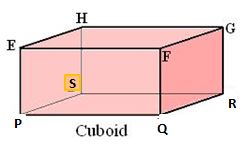
Let us consider the below figure to completely understand a Cuboid
cuboid

(i) Faces of a Cuboid: A cuboid consists of 6 faces. From the given figure, the 6 faces of the cuboid are PQRS, EFGH, PSHE, QRGF, PQFE, and SRGH.
(ii) Vertices of a Cuboid: A cuboid has 8 vertices. From the given figure, the 8 vertices of the cuboid are P, Q, R, S, E, F, G, H.
(iii) Edges of a Cuboid: A cuboid has 12 edges. From the given figure, the 12 edges of the cuboid are PQ, QR, RS, SP, EF, FG, GH, HE, PE, SH, QF, RG.

2. Cube

A Cube is of solid shape and consists of 6 square faces. The Cube all edges are equal. Also, it has 8 vertices, 12 edges, 6 faces.
The formula of surface area and volume of a Cube is given below.
Surface Area of a Cube = 6a² Square units
The volume of a Cube = a³ Cubic units

Example:
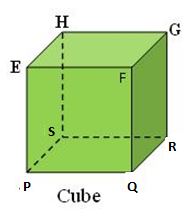
Let us consider the below figure to completely understand a Cube.
Cube

(i) Faces of a Cube: A cube consists of 6 faces. From the given figure, the 6 faces of the cube are PQRS, EFGH, PSHE, QRGF, PQFE, and SRGH.
(ii) Vertices of a Cube: A cube consists of 8 vertices. From the given figure, the 8 vertices of the cube are P, Q, R, S, E, F, G, H.
(iii) Edges of a Cube: A cube consists of 12 edges. From the given figure, the 12 edges of the cube are PQ, QR, RS, SP, EF, FG, GH, HE, PE, SH, QF, RG.

3. Prism

A prism has two equal ends, flat faces or surfaces, and also it has an identical cross-section across its length. If the cross-section of a prism looks like a triangle, then the prism is called a triangular prism. The prism will not have any curve. Also, it has 6 vertices, 9 edges, 5 faces (2 triangles and 3 rectangles).
The formula of surface area and volume of a Prism is given below.
Surface Area of a prism = 2(Base Area) + (Base perimeter × length) square units
The volume of a prism = Base Area × Height Cubic units

Example:
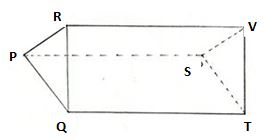
Let us consider the below figure to completely understand a triangular prism.
traingular prism
(i) Faces of a Triangular Prism: A triangular prism consists of 2 triangular faces and 3 rectangular faces. From the given figure, 2 triangular faces are ∆PQR and ∆STV, 3 rectangular faces are PQTS, PSVR, and RSTV.
(ii) Vertices of a Triangular Prism: A triangular prism consists of 6 vertices. From the given figure, the 6 vertices of the triangular prism are P, Q, R, S, T, V.
(iii) Edges of a Triangular Prism: A triangular prism consists of 9 edges. From the given figure, the 9 edges of the triangular prism are PQ, QR, RP, ST, TV, VS, PS, QT, RV.

4. Pyramid

A pyramid has a triangular face on the outside and its base is square, triangular, quadrilateral, or in the shape of any polygon. Also, it has 5 vertices, 8 edges, 5 faces.
The formula of surface area and volume of a Prism is given below.
Surface Area of a Pyramid = (Base area) + (1/2) × (Perimeter) × (Slant height) square units
The volume of a Pyramid = 1/ 3 × (Base Area) × height Cubic units

Example:
1. Let us consider the below figure to completely understand a Square Pyramid.
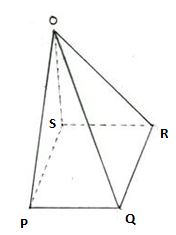
traingle pyramid
(i) Vertices of a Square Pyramid: A square pyramid consists of 5 vertices. From the given figure, OPQRS is a square pyramid having O, P, Q, R, S as its vertices.
(ii) Faces of a Square Pyramid: A square pyramid consists of faces one of which is a square face and the rest four are triangular faces. From the given figure, OPQRS is a square pyramid having PQRS as its square face and OPS, ORS, OQR, and OPQ as its triangular faces.
(iii) Edges of a Square Pyramid: A square pyramid consists of 8 edges. From the given figure, the square pyramid OPQRS has 8 edges, namely, PQ, QR, RS, SP, OP, OQ, OR, and OS.

2. Let us consider the below figure to completely understand a Rectangular Pyramid.
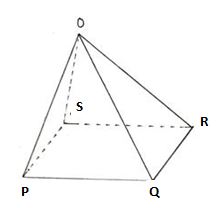
rectangular pyramid
(i) Vertices of a Rectangular Pyramid: A Rectangular pyramid consists of 5 vertices. From the given figure, OPQRS is a Rectangular pyramid having O, P, Q, R, S as its vertices.
(ii) Faces of a Rectangular Pyramid: A Rectangular pyramid consists of 1 rectangular face and 4 triangular faces. From the given figure, OPQRS is a rectangular pyramid having PQRS as its rectangular face and OPS, OSR, OPQ, OQR as its triangular faces.
(iii) Edges of a Rectangular Pyramid: A rectangular pyramid consists of 8 edges. From the given figure, the rectangular pyramid OPQRS has 8 edges, namely, PQ, QR, RS, SP, OP, OQ, OR, and OS.

3. Let us consider the below figure to completely understand a triangular Pyramid.
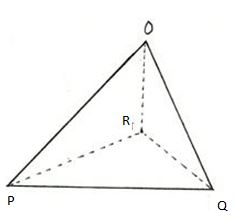
Tetrahedron pyramid
(i) Vertices of a triangular Pyramid: A triangular pyramid consists of 4 vertices. From the given figure, PQRS is a Rectangular pyramid having P, Q, R, S as its vertices.
(ii) Faces of a triangular Pyramid: A triangular pyramid consists of 4 triangular faces. From the given figure, PQRS is a rectangular pyramid having PQR, OPQ, OPR, and OQR triangular faces.
(iii) Edges of a triangular Pyramid: A triangular pyramid consists of 6 edges. From the given figure, the triangular pyramid PQRS has 6 edges, namely, OP, OQ, OR, PQ, PR, QR.

Cylinder

A cylinder is explained as a figure that has two circular bases connected by a curved surface. The cylinder will not consist of any vertices. Also, it has 1 curved face, 2 edges, 2 flat faces.
The formula of surface area and volume of a cylinder is given below.
Surface Area of a cylinder = 2πr(h +r) Square units
The curved surface of a cylinder = 2πrh Square units
The volume of a Cylinder = πr2 h Cubic units

Cone

A cone is defined as a three-dimensional figure, which has a circular base and has a single vertex. The cone decreases smoothly from the circular flat base to the top point. Also, it has 1 vertex, 1 edge, 1 flat face – circle, 1 curved face.
The formula of surface area and volume of a cylinder is given below.
Surface Area of a cone = πr(r +√(r²+h²)  Square units
The curved surface of the area of a cone = πrl Square units
Slant height of a cone = √(r²+h²) Cubic units
The volume of a cone = ⅓ πr²h Cubic units

Sphere

A sphere appears round in shapes and every point on its surface is equidistant from the center point. The distance from the center to any point of the sphere is called the radius of the sphere. Also, it has No vertex, No edges, 1 curved face.
The formula of surface area and volume of a cylinder is given below.
The Curved Surface Area of a Sphere = 2πr² Square units
The Total Surface Area of a Sphere = 4πr² Square units
The volume of a Sphere = 4/3(πr³) cubic units
Different Types of Fractions – Proper, Improper, Mixed Fractions

Types of Fractions and their rules, methods, and formulae are defined here. Know the various types of fractions along with their usage in various situations. Refer to the terminology involved in fractions and also know the problems involved in it. Follow fraction rules and real-life scenarios of fractions. Check the below sections to find examples, rules, methods, etc.

Types of Fractions | What are Fractions?

Before going to know about types of fractions, first know what are fractions and how they work in real life. Fractions are derived from the Latin word “fractus” which means the number or quantity that represents the part or portion of the whole. In the language of layman, a fraction means a number that describes the size of the parts of a whole. Fractions are generally declared with the numerator displaying above the line and below the line, the denominator will be displayed. The terms numerators and denominators are also used in other fractions like mixed, complex, and compound.

Fractions can be written as the equal or same number of parts being counted which is called the numerator over the number or quantity of parts in whole which is called the denominator. There are three major types of fractions which are proper fractions, improper fractions, and mixed fractions. These fractions are divided based on numerator and denominator. Apart from these major fractions, there are also other fractions such as like fractions, unlike fractions, equivalent fractions, etc.

Proper, Improper, and Mixed fractions are defined as single fractions and the remaining fractions determine the comparison of fractions.

Fraction Definition and Terminology

The fraction is considered as the ratio between two numbers. Fractions are defined by a/b. a is called the numerator which means the equal number of parts that are counted. b is called the denominator which means a number of parts in the whole. The numerator and denominator are divided with a line. The line denoted the separation between the numerator and the denominator.

Fraction Types

There are various types of fractions available. We have listed a few of them and explained their definitions, examples in detail. They are as such

1. Proper Fraction:

A proper fraction is that where the value of the numerator is less than the value of the denominator

If you include a numerator, a denominator and a line in between, then it is called a fraction. Proper Fraction is defined as Numerator < Denominator. The value of the proper fraction is always less than 1.

Example:

1/2, 9/15,30/45 are the proper fractions

2. Improper Fraction:

An improper fraction is that where the value of the denominator is less than the value of the numerator. Improper fractions are defined as Numerator > Denominator. Each natural number can be written in fractions in which the denominator is always 1. For example: 20/1,40/1,35/1. The value of the improper fraction is always greater than 1.

Examples: 

3/2, 16/10,45/15 are the improper fractions

3. Mixed Fraction:

A mixed fraction is the combination of a natural number and a fraction. These fractions are improper fractions. Mixed fractions can easily be converted into improper fractions and also mixed fractions can also be converted to improper fractions. The mixed fraction is always greater than 1.

Examples:

3 4/3, 4 5/4, 6 2/3

4. Like Fraction:

If the fractions have the same denominator, then they are called like fractions. For additional simplifications, we can easily make with the like fractions. Addition, Subtraction, Division and multiplication operations can be made easily on like factors.

Examples:

1/2,3/2.5/2,7/2,9/2 are like fractions.

5. Unlike Fractions:

If the factors have different or unique denominators, then they are called, unlike fractions. Simplification of fractions is a lengthy process, therefore we factorize the denominators and then simplify the numerators.

Suppose that we have to add two fractions 1/2 and 1/3.

As the denominators are different, take the LCM of 2 and 3 is equal to 6.

Now, we multiply 1/2 and 1/3 by 2. Multiply it both in numerator and denominator.

Therefore, the fraction becomes 3/6 and 2/6

Now if add 3/6 and 2/6, we get 5/6

Examples:

1/3,1/5,1/7 are unlike fractions

6. Equivalent Fractions:

When more fractions have a similar or same result even after simplification, they represent a similar portion of the whole. Those fractions are equal or similar to each other which are called equivalent fractions.

Examples:

1/2 and 2/4 are equivalent to each other.

1/3 and 3/9 are also equivalent to each other.

How to Convert Improper Fractions into Mixed Fractions?

To convert an improper fraction into mixed fractions, the numerator is divided by the denominator, and the quotient is written as the whole number and the remainder as the numerator.

Example:

Convert the fraction 17/4 into a mixed fraction?

Solution:

To solve the above problem, the steps undertaken are

  • Divide the numerator of the given fraction 17 by the denominator of the fraction 4.
  • After solving, the quotient is 4 and the remainder is 1.
  • Now, combine the whole number 4 with the fraction of 1/4.
  • Therefore, the mixed fraction is 4 1/4.

How to Convert Mixed Fraction to Proper Fraction?

The mixed fraction is converted to a proper fraction by multiplying the denominator of the fraction with the whole number and the product is added to the numerator.

The steps that are to be followed to convert mixed fraction as a proper fraction are:

  • Multiply the denominator with the whole number.
  • Suppose that 2 1/3 is an improper fraction.
  • In the above equation, 2 is the whole number and 3 is the denominator.
  • 2 * 3 = 6
  • Add the product of the numerator
  • 6 + 1 = 7
  • Now, after adding the product, numerator changes to 7 and denominator changes to 3.
  • Now, write the result as an improper fraction as 7/3

How to add Unlike Fractions?

To add the unlike fractions, first, we have to convert them to like fractions. The steps that are involved in adding the unlike fractions are:

  1. First, calculate the LCM of both the denominators.
  2. The result of LCM will be the denominator of fractions.
  3.  Now, we have to calculate the equivalent value of the 1st fraction. To calculate the equivalent, first, divide the LCM calculated in the previous step with the denominator of the 1st fraction. Now, multiply the numerator with the denominator value.
  4. In the same way, calculate the equivalent value of the second fraction. To find the equivalent value of the 2nd fraction, divide that LCM that is calculated in the first step by the denominator of the second fraction. Now multiply it with the numerator, therefore both the fractions have the same numerator.
  5. Finally, add both the values of the numerator as shown in the previous section.

Perimeter and Area of Rectangle – Definition, Formula, Solved Examples

The Perimeter and Area of Rectangle are two important formulas in Mensuration. It calculates the space occupied by the rectangle and the length of boundaries of the rectangle. In this article, students can come across the concept of area and perimeter of rectangle deeply.

A rectangle is a quadrilateral with two equal sides and two parallel lines and four right angles. The concept of area and perimeter of rectangle formulas are explained with examples. Some of the examples of different shapes are given below.

What is Perimeter and Area of a Rectangle?

Perimeter: Perimeter of the rectangle is the sum of all the sides of the rectangle. The rectangle has two lengths and two breadths. To find the perimeter of the rectangle we have to add the length and breadth. It is measured in units. It is denoted by P.

Area: The area of the rectangle formula helps to calculate the length and breadth of the two-dimensional closed figure. To find the area of the rectangle we have to multiply the length and breadth of the rectangle. It is measured in square units. It is denoted by A.

Properties of Rectangle

  • A Rectangle has two equal sides
  • The rectangle is a quadrilateral
  • The diagonals of the rectangle have the same length.
  • The diagonal of the rectangle bisect each other.
  • Sum of all the four angles is 360º
  • Each angle of the rectangle is 90º
  • If the sides of the rectangle are l and b then the diagonal of the rectangle d = √l² + b²
  • The opposite sides of the rectangle are parallel.

Derivation of Perimeter of a Rectangle

The perimeter of the rectangle is the sum of all four sides.
P = l + l + b + b
P = 2l + 2b
P = 2(l + b)
Thus the perimeter of the rectangle is = 2(l + b)

Area of the Rectangle

The area of the rectangle is the product of length and breadth.
A = l × b

Perimeter and Area of Rectangle Formula

  • Area of Rectangle = l × b
  • Perimeter of Rectangle = 2(l + b)
  • Length of the rectangle = A/b
  • The breadth of the Rectangle = A/l
  • Diagonal of the Rectangle = √l² + b²

Solved Problems on Area and Perimeter of a Rectangle

The formula of Perimeter and Area of Rectangle is explained step by step here with examples. Go through the below questions and solve the problems using the Area and Perimeter of the Rectangle formula.

1. Find the length of the rectangular plot whose breadth is 11 cm and the area is 165 cm². Also, find the perimeter of the rectangle?

Solution:

Given,
Breadth = 11 cm
Area = 165 cm²
Area of the rectangle = l × b
165 sq. cm = l × 11 cm
l = 165/11
l = 15 cm
Thus the length of the rectangle is 15 cm.
We know that,
Perimeter of the rectangle = 2(l + b)
P = 2(15 + 11)
P = 2(26)
P = 52 cm
Thus the perimeter of the rectangle is 52 cm.

2. Find the Perimeter of the Rectangle whose length is 10 cm and breadth is 8 cm?

Solution:

Given, Length = 10 cm
Breadth = 8 cm
We know that,
Perimeter of the rectangle = 2(l + b)
P = 2(10 cm + 8 cm)
P = 2(18 cm)
P = 36 cm
Therefore the perimeter of the rectangle is 36 cm.

3. Find the area of the rectangle whose length is 14 meter and width is 10 meters?

Solution:

Given,
Length = 14 meter
Width = 10 meter
We know that,
Area of the rectangle = l × w
A = 14 m × 10 m
A = 140 sq. meters
Therefore the area of the rectangle is 140 square meters.

4. A rectangular plot has its length of 16 cm and a perimeter of 60 cm. Find the width of the rectangular plot?

Solution:

Given,
Length = 16 cm
Perimeter = 60 cm
Width = ?
We know that
The perimeter of the rectangle = 2(l + w)
60 cm = 2(16 cm + w)
16 + w = 60/2
16 + w = 30
w = 30 – 16
w = 14 cm
Thus the width of the rectangular plot is 14 cm.

5. Find the area and perimeter of the rectangle whose length and breadth are 12 m and 6 m?

Solution:
Given,
length = 12 m
breadth = 6 m
We know that,
Area of the rectangle = l × b
A = 12 m × 6 m
A = 72 sq. meters
Now find the perimeter of the rectangle
P = l + l + b + b
P = 12 m + 12 m + 6 m + 6 m
P = 24 m + 12 m
P = 36 m
Therefore the area and perimeter of the rectangle is 72 square meters and 36 meters.

FAQs on Area and Perimeter of Rectangle

1. How to find the perimeter of a rectangle?

The perimeter of the rectangle can be calculated by adding all the sides of the rectangle.

2. What is the area of the rectangle?

The area of the rectangle is defined as the space occupied by the rectangle or closed figure. It is the product of length and breadth.

3. What is the unit for the perimeter of a rectangle?

The unit for the perimeter of the rectangle is cm or meters.

Types of Angles (Acute, Obtuse, Right, Straight, Reflex) | Definitions, Explanation & Examples

In geometry, you will various math concepts like Angles, Lines, Shapes, Area and Perimeter, etc. Today, we will discuss completely the concept named Angles and its types. Based on measurements, there are various types of angles. Usually, an angle is measured in degrees and it is one of the core concepts of geometry in Maths. Are you excited to learn deeply about the topic called Angle? Then, refer to the below modules thoroughly and know what is an angle, what are the Types of Angles, definitions, figures, and some solved examples.

What is an Angle?

An Angle is a geometrical shape formed when two rays join with a common end-point. “side and vertex’ are the two components of an angle. Angles are classified based on their measures.

Parts of Angle

  • Vertex – Point where the arms meet.
  • Arms – Two straight line segments form a vertex.
  • Angle – When a ray turn about its endpoint, the measure of its rotation between its initial and final position is called Angle.

If these two ray joins in various fashions to form a various type of angles in maths. Let’s, start learning what are the different types of angles and their definitions and figures.

Classification of Angles

In nature, there are several types of angles that exist. Each and every angle of them hold great value in our everyday living standards.

Basically, Angles are classified on the basis of:

  • Magnitude
  • Rotation

Types of Angles Based on Magnitude

In maths, mainly, there are 6 types of angles on the basis of direction. And also, all these six angle types are commonly used in geometry. The names of different angles types are as follows:

  • Acute Angle
  • Obtuse Angle
  • Right Angle
  • Straight Angle
  • Reflex Angle
  • Complete Angle

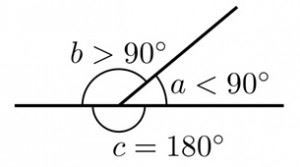
The below image illustrates specific types of angles based on magnitude:

types of angles

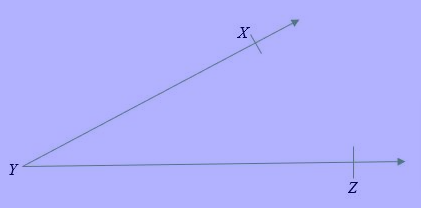
1. Acute Angle:

An acute angle is an angle that lies between 0 degrees to 90 degrees. In other words, an angle is less than 90° is called an acute angle.

Illustration:

acute angle figure

∠XYZ is greater than 0° but less than 90° so, this is an acute angle type.

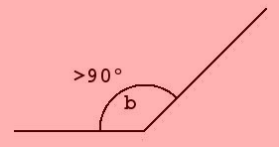
2. Obtuse Angle:

Opposite of the Acute angle is called Obtuse Angle. In other words, the angle that lies between 90 degrees and 180 degrees is known as the obtuse angle.

Illustration:

obtuse angle figure

3. Right Angle:

An angle that measures at exactly 90 degrees is called a right angle. Basically, it forms when two lines are perpendicular to each other. See the below-illustrated figure of a right angle.

right angle figure

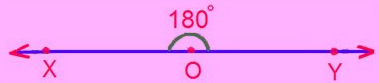
4. Straight Angle:

An angle that measures 180° is known as Straight angle. The following figure illustrated the straight angle.

straight angle figure

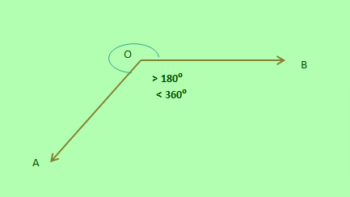
5. Reflex Angle:

The angle that lies between 180 degrees and 360 degrees is called a reflex angle. If you want to calculate the reflex angle then you must require an acute angle. The below figure illustrates the reflex angle.

reflex angle figure

6. Complete Angle:

An angle measured 360 degrees is called a Complete Angle. 1 Revolution is equal to 360° and the illustration of the complete angle is as shown in the below figure:

complete angle figure

Solved Examples on Types of Angles

1. The sum of three angles is (x+6), (x -4), and (x + 8) forms a right angle. Find the value of x.

Solution:

⇒ (x+6) + (x-4) + (x+8) = 90

⇒ 3x + 10 = 90

⇒ 3x = 80

x = 26

Therefore, the value of x is 26 degrees.

2. A certain angle is such that, two times the sum of its size and 70° is 90°. What is the name of this angle?

Solution:

The angle be x°

⇒ 2(x + 70°) = 90°

⇒ 2x + 140° = 90°

⇒ 2x = 50°

x = 25°

The angle is 25°

Since 25° is less than 90°, so the type of the angle is an Acute angle.

Conversion of a Decimal Fraction into a Fractional Number | How to Convert Decimals to Fractions?

Are you looking for help on how to convert a decimal fraction to a fraction number? Don’t Fret as you will find easy methods to convert from decimal to fraction here. Before, diving let’s learn about Decimals, Fractions Definitions. To Convert a Decimal to a Fraction place the decimal number over its place value. For better understanding, we even listed Solved Problems on Decimal Fraction to Fraction Number Conversions here. You can easily convert from decimals to fractions and no calculators are needed.

Decimal Definition

Decimal Numbers are the Numbers that have base 10 in Computer Science. However, in Mathematics Decimal Number is a number that has a decimal point in between digits. In Other Words, we can say that decimals are fractions that have denominator 10 or multiples of 10.

Example: 2.35, 6.78, 8.79 are decimals

Fraction Definition

A fraction is a part of a whole number and is represented as a ratio of two numbers a/b in which a, b are integers and b≠0. The two numbers are namely numerator and denominator. There are different types of fractions namely proper, improper, mixed fractions. we can perform all basic operations on the fractions.

Example: \(\frac { 1 }{ 3 } \), \(\frac { 3 }{ 4 } \) are fractions

How to Convert a Decimal to Fraction?

Learn the Steps to Convert Decimal to Fraction here. Follow the below-listed procedure to change between Decimals to Fractions easily. They are in the following fashion

  • Firstly, write the fraction with the decimal number as the numerator and with 1 in the denominator.
  • Remove the decimal places by multiplication. Firstly, count how many places are there right to the decimal. Let Suppose there are x places then you need to multiply both the numerator and denominator with 10x
  • Reduce the fraction to the lowest form by dividing both the numerator and denominator of the fraction with GCF.

Steps to Convert a Repeating Decimal to Fraction

Converting a regular Decimal to Fraction is an easy method. But, converting a recurring or repeating decimal fraction is a bit tedious and can be confusing. Let us learn how to convert a repeating decimal to a fraction by considering few examples.

Step 1: Let us assume the decimal number as X

Step 2: Count the number of trailing or repeating digits. If there are x digits multiply with 10x and consider it as the 2nd equation.

Step 3: Subtract Equation (1) from (2) and Solve for X

Step 4: Reduce the obtained fraction to the lowest form by dividing both the numerator and denominator with their GCF. The obtained fraction is the converted value of the repeating decimal given.

Decimal to Fraction Table

Below is the list of decimal values converted to fractions that you might find useful during your calculations. They are in the following fashion

DecimalFractionDecimalFraction
0.5\(\frac { 1 }{ 2 } \)1.5\(\frac { 6 }{ 4 } \)
0.25\(\frac { 1 }{ 4 } \)0.857142…\(\frac { 6 }{ 7 } \)
0.6666…\(\frac { 2 }{ 3 } \)0.875\(\frac { 7 }{ 8 } \)
0.4\(\frac { 2 }{ 5 } \)1.4\(\frac { 7 }{ 5 } \)
0.285714…\(\frac { 2 }{ 7 } \)3.333…\(\frac { 10 }{ 3 } \)
0.2222\(\frac { 2 }{ 9 } \)1.42857…\(\frac { 10 }{ 7 } \)
0.75\(\frac { 3 }{ 4 } \)1.875\(\frac { 15 }{ 8 } \)
0.428571…\(\frac { 3 }{ 7 } \)0.9375\(\frac { 15 }{ 16 } \)
2.5\(\frac { 5 }{ 2 } \)0.95454…\(\frac { 21}{ 22 } \)
0.83333\(\frac { 5 }{ 6 } \)0.78125\(\frac { 25 }{ 32 } \)

Decimal to Fraction Conversion Examples

1. Convert 2.25 to fraction?

Solution:

Step 1: To change 2.25 to fraction firstly write the numerator part with a decimal number leaving the denominator part with 1.

Step 2: Count the number of decimal places to the right of the decimal point. Since give decimal value has 2 digits next to the decimal point multiply with 102 both the numerator and denominator.

= \(\frac { (2.25*100) }{ (1*100) } \)

= \(\frac { 225 }{ 100 } \)

Step 3: Reduce the obtained fraction in the earlier step to its lowest form by dividing them with GCF. GCF(225, 100) = 25

i.e. \(\frac { 225÷25 }{ 100÷25 } \)

= \(\frac { 9 }{ 4 } \)

Therefore, 2.25 converted to fraction form is \(\frac { 9 }{ 4 } \)

2. Convert 101.1 to fraction?

Solution:

Given Decimal value is 101.1

Step 1: Place the given decimal value in the numerator of the fraction and place 1 in the denominator.

Step 2: Count the number of digits after the decimal point. Since the given decimal value has only 1 digit multiply both the numerator and denominator with 10. i.e. \(\frac { 101.1*10 }{ 1*10 } \) = \(\frac { 1011 }{ 10 } \)

Step 3:  The above fraction can’t be reduced further since the GCF is 1.

Therefore, 2.25 converted to fraction form is \(\frac {1011 }{ 10 } \)

FAQs on Decimal to Fraction

1. What is a Decimal?

Decima Number is defined as a number whose whole number part and fraction part is separated by a decimal point(dot).

2. What are the types of Decimals?

There are two different types of Decimals

  • Terminating Decimals or Non-Recurring Decimals
  • Non-Terminating or Recurring Decimals

3. What is a Fraction?

A fraction is a numerical value that is a part of a whole. It is evaluated by dividing a whole into a number of parts.

4. How do I Convert a Decimal to a Fraction?

To Convert a Decimal to a Fraction, place the decimal number over its place value.

Conversion Of Minutes Into Seconds (min to sec) Formula | Definitions of Minute & Second | Solved Examples on How to Convert Min to Sec?

Conversion Of Minutes Into Seconds:  Wondering how to calculate the conversion of minutes into seconds in a simple way? Then, you have stepped on the correct page. Here, we have curated the definitions, formula, process of converting min to sec with solved problems. Students can easily convert minutes into seconds within no time by referring to this article. Also, have a glance at the Math Conversion Chart for getting knowledge about length, mass, capacity, conversions, etc. Let’s get into this article and ace up your preparation about conversion between min and sec.

What is Minute?

The definition of a minute is a unit of time equal to 1/60 of an hour or 60 seconds. A Minute is separated into seconds and multiplied into hours. The short form of Minutes is ‘min’. For instance, 1 Minute can be written as 1 min.

What is Second?

The second is called the base unit of time. Seconds are classified into milliseconds and multiplied into minutes. Scientists defined one minute to be 60 seconds. The second is the SI base unit for a time in the metric system. The shortened of the is ‘sec’. For example, 1 Second can be written as 1 sec.

Minutes to Seconds Conversion Formula

In terms of math, the conversion formula below is the correct way to calculate minutes to seconds conversion. The simple formula to convert min to sec is as follows:

Seconds = Minutes x 60 s/min

(or)

Sec = min / 0.016667

How to Convert Minutes(min) to Seconds(sec)

To convert minutes unit of time into seconds unit of time, all you need to perform is multiple the time value by 60. Hence, one minute is equal to 60 seconds. Use the simple Minute to Second conversion formula and substitute the given values in the formula and find out the conversion of minutes into seconds easily.

[number of ] mins x 60 = [number of ] secs

To understand the process of converting minute to second, we have listed out some worked-out examples on minutes to seconds conversion in the below module. Have a look at them and practice well to grasp the concept of conversion of min to sec.

Solved Examples of Min to Sec Conversion

1. Convert 7 minutes to seconds using the conversion formula?

Solution:

Given Minutes = 7

Now, convert them into seconds by using the conversion formula,

The conversion formula for minutes to seconds is Seconds = Minutes x 60 s/min

Substitute the minutes into the formula and calculate the seconds,

Seconds = 7 x 60 = 420 sec

Therefore, 7 minutes = 420 seconds. 

2. How many seconds are there in 4 minutes?

Solution:

Since we know that, 1 minute = 60 seconds, we can make use of this information to solve:

4 minutes x 60 seconds / 1 minute = 4 x 60 sec = 240 sec. 

3. Convert 25 minutes 15 seconds into seconds?

Solution:

As we know, 1 minute = 60 seconds

25 minutes 15 seconds = (25 × 60) seconds + 15 seconds

= 1500 seconds + 15 seconds

= 1515 seconds.

For better learnings about time conversions like Conversion Of Hours Into Seconds visit our website thoroughly.

Minute to Second Conversion Table

MinutesSeconds
1 min60 sec
2 min120 sec
3 min180 sec
4 min240 sec
5 min300 sec
6 min360 sec
7 min420 sec
8 min480 sec
9 min540 sec
10 min600 sec
11 min660 sec
12 min720 sec
13 min780 sec
14 min840 sec
15 min900 sec
16 min960 sec
17 min1,020 sec
18 min1,080 sec
19 min1,140 sec
20 min1,200 sec
21 min1,260 sec
22 min1,320 sec
23 min1,380 sec
24 min1,440 sec
25 min1,500 sec
26 min1,560 sec
27 min1,620 sec
28 min1,680 sec
29 min1,740 sec
30 min1,800 sec
31 min1,860 sec
32 min1,920 sec
33 min1,980 sec
34 min2,040 sec
35 min2,100 sec
36 min2,160 sec
37 min2,220 sec
38 min2,280 sec
39 min2,340 sec
40 min2,400 sec

FAQs on Conversion Of Minutes Into Seconds

1. How many seconds does 1 minute have?

In one minute, there are 60 seconds. In short, a second is 1/60 of a minute.

2. What is 75 minutes as seconds?

75 minutes = 4500 seconds.

3. Why we use minutes and seconds units?

Minutes and Seconds units are used to measure the time.

Perimeter of a Square Definition, Formula, Examples | How to Find the Perimeter of a Square?

The Perimeter of a Square is the length that the boundary covers. You can obtain the Perimeter of a Square by adding all the sides together. Refer to the entire article and learn about Perimeter of a Square Definition, Formula, Derivation, Solved Examples, etc.

A Square is a type of rectangle in which the adjacent sides are equal. In other words, we can frame the Definition as Square has all sides of equal length. Refer to the Properties of Square here along with Solved Example Questions in the later sections.

(i) All the angles in a square are the same and equal 90º.

(ii) All the sides of a square are equal.

What is the Perimeter of a Square?

The Perimeter of any closed geometrical shape is defined as the distance around the object. Usually, the Perimeter of a Square is found by summing all four sides together. Since the square has equal sides thus perimeter will be 4 times the side i.e., 4*Side

The Formula for Perimeter of a Square(P) = 4 × Side

Derivation of Perimeter of a Square

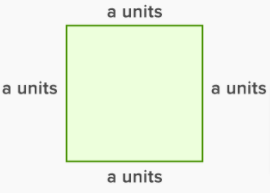
The Perimeter of a Square is defined as the length of the boundary of the object.

Perimeter of a Square Figure

The Formula to Calculate the Perimeter of a Square = Sum of Lengths of all 4 Sides

Here Length of Each Side = a units

Perimeter = Side +Side + Side+Side

= a+a+a+a

= 4a units

where a, is the length of a side of square.

Solved Perimeter of Square Questions

Question 1.

Find the Perimeter of a Square whose side is 4 cm?

Solution:

We know the formula to calculate Perimeter of a Square = 4*Side

Given Length of the Side = 4 cm

Substitute the Side Length in the formula of Perimeter

Perimeter of a Square = 4*4

= 16 cm

Therefore, the Perimeter of a Square is 16 cm.

Question 2.

Calculate the Perimeter of a Square if its Side is 12cm?

Solution:

The formula for Perimeter of a Square = 4*Side

Given Length of the Side = 12 cm

Substitute the Side Length in the Formula of Perimeter we have

Perimeter of a Square = 4*12 cm

= 48 cm

Therefore, the Perimeter of a Square is 48 cm.

Question 3.

If the Perimeter of a Square is 84 cm find its Side?

Solution:

Perimeter of a Square = 84 cm

The Formula for Perimeter of a Square =4*Side

4*Side = 84 cm

Side = 84/4

= 21 cm

Therefore, the Length of the Side is 21 cm.

FAQs on Perimeter of a Square

1. What is the Perimeter of a Square?

Perimeter of a Square is the total length of the boundary of squares.

2. How to find the Perimeter of a Square?

To find the Perimeter of a Square add all the sides. There are 4 Sides in a Square and Sum of all 4 Sides gives the Perimeter.

3. What is the Formula for Perimeter of a Square?

The Formula for Perimeter of a Square is P = Side+Side+Side+Side i.e. 4*Side

Properties of Perfect Squares, Examples | How to Find a Perfect Square?

Have a look at the Properties of Perfect Squares and know how to solve problems on Perfect Square concepts. You can easily learn to solve problems on your own once you get a complete grip on the Perfect Square Concept. We have clearly mentioned every property of a perfect square along with examples. Check out the examples for a better understanding. All concepts available on Square are given on our website for free of cost and you can prepare anytime and anywhere.

Different Properties of Perfect Squares

See different properties of perfect squares given below.

Property 1:
Numbers those end with 2, 3, 7, or 8 will never a perfect square. Also, all the numbers ending in 1, 4, 5, 6, 9, 0 are not square numbers.
Examples:
The numbers 20, 32, 73, 167, 298 end in 0, 2, 3, 7, 8 respectively.
So, none of them is a perfect square.

Property 2:
A number that ends with an odd number of zeros is never a perfect square.
Examples:
The numbers 150, 3000, 700000 end in one zero, three zeros, and five zeros respectively.
So, none of them is a perfect square.

Property 3:
The square of an even number is always even.
Examples:
12² = 144, 14² = 196, 16² = 256, 18² = 324, etc.

Property 4:
The square of an odd number is always odd.
Examples:
11² = 121, 13² = 169, 15² = 225, 17² = 289, 19² = 361, etc. All the numbers are odd.

Property 5:
The square of a proper fraction is smaller than the fraction.
Examples:
(3/4)² = (3/4 × 3/4) = 9/16 and 9/16 < 3/4, since (16 × 3) < (9 × 4).

Property 6:
For every natural number n, we have
(n + 1)² – n² = (n + 1 + n)(n + 1 – n) = {(n + 1) + n}.
Therefore, {(n + 1)² – n²} = {(n + 1) + n}.
Examples:
(i) {1 + 3 + 5 + 7 + 9} = sum of first 5 odd numbers = 5²
(ii) {1 + 3 + 5 + 7 + 9 + 11 + 13 + 15} = sum of first 8 odd numbers = 8²

Property 7:
For every natural number n, we can write as the sum of the first n odd numbers = n²
Examples:
(i) {1 + 3 + 5 + 7 + 9} = sum of first 5 odd numbers = 5²
(ii) {1 + 3 + 5 + 7 + 9 + 11 + 13 + 15} = sum of first 8 odd numbers = 8²

Property 8 (Pythagorean Triplets):
Three natural numbers m, n, p is said to form a Pythagorean triplet (m, n, p) if (m² + n²) = p².
Note:
For every natural number m > 1, we have (2m, m² – 1, m² + 1) as a Pythagorean triplet.
Examples:
(i) Putting m = 6 in (2m, m² – 1, m² + 1) we get (12, 35, 37) as a Pythagorean triplet.
(ii) Putting m = 7 in (2m, m² – 1, m² + 1) we get (14, 48, 50) as a Pythagorean triplet.

Solved Examples on Properties of Perfect Squares

1. Without adding, find the sum (1 + 3 + 5 + 7 + 9 + 11 + 13 + 15 + 17 + 19).

Solution:
(1 + 3 + 5 + 7 + 9 + 11 + 13 + 15 + 17 + 19) = sum of first 10 odd numbers
Find the square of the 10 to get the answer.
= (10)² = 100

100 is the sum of the given numbers 1 + 3 + 5 + 7 + 9 + 11 + 13 + 15 + 17 + 19.

2. Express 81 as the sum of nine odd numbers.

Solution:
81 = 9² = sum of first nine odd numbers
Let us write the first nine odd numbers and add them naturally.
= (1 + 3 + 5 + 7 + 9 + 11 + 13) = 81.

3. Find the Pythagorean triplet whose smallest member is 4.

Solution:
For every natural number m > 1. (2m, m² – 1, m² + 1) is a Pythagorean triplet.
Putting 2m = 8, i.e., m = 4, we get the triplet (8, 15, 17).

The final answer is (8, 15, 17).

Perfect Square or Square Number Definition, Examples | How to find the Perfect Square of a Number?

A Perfect Square is formed by squaring a whole number. For example 1² = 1; 2² = 4; 3² = 9; 4² = 16; 5² = 25 and so on. Thus 1, 4, 9, 16, 25, etc., are perfect squares. Learn complete information regarding the perfect square and how to find it in this article. We have given examples and also their explanations to understand it easily. Therefore, it is now your part to begin practice and get a complete grip on the concept.

Examples:
1 = 1²; 4 = 2²; 9 = 3²; 16 = 4²; 25 = 5² and so on. Here 1, 4, 9, 16, 25, etc., are perfect squares.

How to Find a Perfect Square or Square Number?

A perfect square number is defined as the product of pairs of equal factors. Or it can also express as grouped in pairs of equal factors.

1. Find out if the following numbers are perfect squares?
(i) 169
(ii) 512
(iii) 64

Solution:
(i) Given number is 169
Find the prime factors of the given number 169.
The prime factors of 169 are 13 and 13.
Grouping the factors into the pairs of equal factors.
(13 × 13)
Factors of the 169 are 13 × 13.

Therefore, 169 is a perfect square.

(ii) Given number is 512
Find the prime factors of the given number 512.
The prime factors of 169 are 8, 8, and 8.
Grouping the factors into the pairs of equal factors.
(8 × 8) × 8
Factors of the 169 are 8 × 8 × 8.
8 is not grouped in pairs of equal factors.

Therefore, 512 is not a perfect square.

(iii) Given number is 64
Find the prime factors of the given number 64.
The prime factors of 64 are 8, and 8.
Grouping the factors into the pairs of equal factors.
(8 × 8)
Factors of the 169 are 8 × 8.

Therefore, 64 is a perfect square.

2. Is 16 a perfect square? If so, find the number whose square is 16.

Solution:
Given number is 16
Find the prime factors of the given number 16.
The prime factors of 16 are 2, 2, 2, and 2.
Grouping the factors into the pairs of equal factors.
(2 × 2) ×(2 × 2)
Therefore, 16 is a perfect square.
Take one number from each group and multiply them to find the number whose square is 16.
2 × 2 = 4.

4 is the number whose square is 16.

3. Is 576 a perfect square? If so, find the number whose square is 576.

Solution:
Given number is 576
Find the prime factors of the given number 16.
The prime factors of 16 are 2, 2, 3, 3, 4, and 4.
Grouping the factors into the pairs of equal factors.
(2 × 2) × (3 × 3) × (4 × 4)
Therefore, 576 is a perfect square.
Take one number from each group and multiply them to find the number whose square is 576.
2 × 3 × 4 = 24.

24 is the number whose square is 576.

4. Show that 288 is not a perfect square.

Solution:
Given number is 288
Find the prime factors of the given number 288.
The prime factors of 16 are 2, 3, 3, 4, and 4.
Grouping the factors into the pairs of equal factors.
2 × (3 × 3) × (4 × 4)
2 is not grouped in pairs of equal factors.

Therefore, 288 is not a perfect square.

5. Find the smallest number by which 100 must be multiplied to make it a perfect square?

Solution:
The given number is 100.
Find the prime factors of the given number 100.
The prime factors of 100 are 5, 5, and 4.
Grouping the factors into the pairs of equal factors.
4 × (5 × 5)
4 is not grouped in pairs of equal factors.
Therefore, by multiplying 4 to 100, we make 100 as a perfect square.

4 is the smallest number by which 100 must be multiplied to make it a perfect square

6. Find the smallest number by which 180 must be divided so as to get a perfect square.

Solution:
The given number is 180.
Find the prime factors of the given number 180.
The prime factors of 180 are 2, 2, 3, 3, and 5.
Grouping the factors into the pairs of equal factors.
5 × (3 × 3) × (2 × 2)
5 is not grouped in pairs of equal factors.
Therefore, by dividing 5 by 180, we make 180 a perfect square.

5 is the smallest number by which 180 must be divided so as to get a perfect square.

Greater or Less Than and Equal To Symbols | Tricks to Memorize Symbols & Solved Examples

Greater or Less Than and Equal To Symbols

In mathematics, symbols play a major role in calculating various concepts. Greater or Less Than and Equal To aid in your preparation and make you understand how one number is separate from another number. If the value of one numeric is larger or smaller than the value of another numeric or both the numeric is equal then you can compare them easily by using the symbols of greater than, less than, and equal to. Let’s discuss deeply on this topic in this article. Dive into the below modules and grasp the whole concept of Greater or Less than and equal to signs.

Greater Than or Less Than and Equal To Signs

Greater than and less than symbols are used for the comparison of any two values. When a numeric is bigger than another numeric then we have to use greater than a symbol. When a number is lesser than another number, then the symbol of less than is used. Greater than and less than symbols signifies an inequality between two values. Greater than Less than Signs decreases the time complexity and it provides an easy way for the reader to follow.

The symbol for greater than is “ >” and for less than is “<”. Get more math symbols here with us.

Greater Than Sign:

In maths, the greater than symbol is located between two numbers in which the first value is larger than the second value. The symbol for greater than is “>”. For example, 34 > 23. Here 34 is greater than 23.

Less Than Sign:

The Less than sign is placed between two numbers for comparison. If the first value is smaller than the second value then the symbol less than is used like this “<“. ie., smaller number < bigger number. For instance, 27 is less than 40, so we write it like 27<40.

Equal To Symbol:

The symbol of Equal To is applied to show the equality in two given numerics. This equal to sign is opposite to both greater than and less than signs. Not only for equality between two values also use this sign for writing the equations. The indication of the Equal To sign seems like “=”. Illustration: If P = 10 and Q = 10, then P = Q.

Trick to Memorize Greater Than & Less Than Signs

Assume that the sign of greater than less than the letter V rotated. Always, the large opening points to the greater number and the smaller end means the tip points to the smaller number. For instance:

5 > 4: Five is greater than Four, so the large opening of the rotated V symbol faces five and the tip of the V faces four.

3 < 9: Three is less than Nine, where the tip end faces the three and larger side points the nine.

Bigger number > Smaller number: This sign here is greater than

Smaller number < Bigger number: This sign here is less than

Also, there are two more tricks that you can remember the greater than less than symbols easily. They are,

  1. Alligator Method
  2. L Method

All The Symbols

Below is the table that helps students to understand all the symbols briefly:

Symbol
Words
Example Use
=
equals
1 + 1 = 2
not equal to
1 + 1 ≠ 1
>
greater than
5 > 2
<
less than
7 < 9
greater than or equal to
marbles ≥ 1
less than or equal to
dogs ≤ 3

Solved Examples on Greater Than or Less Than and Equal To Signs

1. How do you sign for the following statements,

(i) 19 is greater than 5

(ii) 7 is less than 3

Solution:

Given statements are,

(i) 19 is greater than 5: Here the answer is 19 > 5

(ii) 7 is less than 87: Here the answer is 7< 87

2. Is -0.1 is less than 0.1, if yes write down its mathematical expression?

Solution:

Yes, -0.1 is less than 0.1. So, the mathematical expression for the given -0.1 is less than 0.1 statement is -0.1 < 0.1.

3. Jasmin had 10 stones but lost some. How many has he now?

Solution:

Jasmin had 10 stones, let’s assume the scenarios and find out how many she has now:

She should have less than 10

Stones < 10

Still, she has some stones we can say

Stones > 0

If Jasmin could have lost all her stones we would say

Stones ≥ 0

Simply, the number of stones is greater than or equal to zero.

4. Dolly has Ten bananas and Maneesha has six bananas. Find out who has more bananas.

Given,

Dolly has 10 bananas.

Maneesha has 6 bananas.

so, 10 is greater than 6, 10 >6

Therefore Dolly has more bananas than Maneesha.

Square Definition, Properties, Formulas, Examples | How to find Square of a Number?

A square of a number is calculated by multiplying a number by itself twice. Geometrically, a square is a two-dimensional plane that has equal sides.
Area of a square = Side × Side
Square number = a × a = a²

1, 4, 9, 16, 25, 36, 49, 64, etc. are some of the examples of the number for a square of a number. If S is a number that formed by multiplying a by two times, then S is called the square of a number. For example, 16 is a number then it can write as 4 . 4 where 4 is the natural number and 16 is the square of a number. Also, 42 is a number and it is the multiplication of 7 and 6. However, 42 is not considered as a square of a number. Square numbers are also treated as perfect square numbers.

List of Square Concepts

We have given a list of Square Concepts and their concerned links for you. Click on the required link and learn the entire topic easily.

Solved Examples on Square of a Number

Check the below examples to understand which numbers are called squares of a number.

  • 2² = (2 × 2) = 4. Therefore, we can say that the square of 2 is 4.
  • 3² = (3 × 3) = 9. Therefore, we can say that the square of 3 is 9.
  • 4² = (4 × 4) = 16. Therefore, we can say that the square of 4 is 16.
  • 5² = (5 × 5) = 25. Therefore, we can say that the square of 5 is 25.
  • 6² = (6 × 6) = 36. Therefore, we can say that the square of 6 is 36.
  • 7² = (7 × 7) = 49. Therefore, we can say that the square of 7 is 49.
  • 8² = (8 × 8) = 64. Therefore, we can say that the square of 8 is 64.
  • 9² = (9 × 9) = 81. Therefore, we can say that the square of 9 is 81.
  • 10² = (10 × 10) = 100. Therefore, we can say that the square of 10 is 100.
  • 11² = (11 × 11) = 121. Therefore, we can say that the square of 11 is 121.
  • 12² = (12 × 12) = 144. Therefore, we can say that the square of 12 is 144.
  • 13² = (13 × 13) = 169. Therefore, we can say that the square of 13 is 169.
  • 14² = (14 × 14) = 196. Therefore, we can say that the square of 14 is 196.
  • 15² = (15 × 15) = 225. Therefore, we can say that the square of 15 is 225.

Square of a Negative Number

The square of a negative number always a positive number.

  • (-2)² = ((-2) × (-2)) = 4. Therefore, we can say that the square of (-2) is 4.
  • (-3)² = ((-3) × (-3)) = 9. Therefore, we can say that the square of (-3) is 9.
  • (-4)² = ((-4) × (-4)) = 16. Therefore, we can say that the square of (-4) is 16.
  • (-5)² = ((-5) × (-5)) = 25. Therefore, we can say that the square of (-5) is 25.
  • (-6)² = ((-6) × (-6)) = 36. Therefore, we can say that the square of (-6) is 36.
  • (-7)² = ((-7) × (-7)) = 49. Therefore, we can say that the square of (-7) is 49.
  • (-8)² = ((-8) × (-8)) = 64. Therefore, we can say that the square of (-8) is 64.
  • (-9)² = ((-9) × (-9)) = 81. Therefore, we can say that the square of (-9) is 81.
  • (-10)² = ((-10) × (-10)) = 100. Therefore, we can say that the square of (-10) is 100.
  • (-11)² = ((-11) × (-11)) = 121. Therefore, we can say that the square of (-11) is 121.
  • (-12)² = ((-12) × (-12)) = 144. Therefore, we can say that the square of (-12) is 144.
  • (-13)² = ((-13) × (-13)) = 169. Therefore, we can say that the square of (-13) is 169.
  • (-14)² = ((-14) × (-14)) = 196. Therefore, we can say that the square of (-14) is 196.
  • (-15)² = ((-15) × (-15)) = 225. Therefore, we can say that the square of (-15) is 225.

What is the Square of a number?

A number is multiplied by itself to form a square of a number. Thus, the number with exponent 2 is called the square number.
Example:
\(\frac { 3 }{ 7 } \) × \(\frac { 3 }{ 7 } \) = (\(\frac { 3 }{ 7 } \))² = \(\frac { 9 }{ 49 } \)
Here \(\frac { 9 }{ 49 } \) is the square of \(\frac { 3 }{ 7 } \).
0.2 × 0.2 = (0.2)² = 0.04
Here 0.04 is the square of 0.2.

Odd and Even Square numbers

  • Square of an even number is always even, i.e, (2n)² = 4n².
  • Square of an odd numbers is always odd, i.e, (2n + 1) = 4(n² + n) + 1.
  • Since every odd square is of the form 4n + 1, the odd numbers that are of the form 4n + 3 are not square numbers.

Properties of Square Numbers

Check out the properties of Square Numbers given below to completely understand the Square concept.

1. If the numbers 2, 3, 7, or 8 present in the unit’s place, then the number will not become a perfect square. Therefore, the numbers that end with 2, 3, 7, or 8 will never become a perfect square.
2. The number ends with even zeros becomes perfect squares. Also, the numbers with an odd number of zeros will never become a perfect square.
3. Square of even numbers always an even number and square of odd numbers always an odd number.
4. If the natural numbers that are more than one are squared, then it should be either of multiple of 3 or more than the multiple of 3 by 1.
5. Also, if the natural numbers that are more than one are squared, then it should be either of multiple of 4 or more than the multiple of 4 by 1.
6. If the unit’s digit of the square of a number is equal to the unit’s digit of the square of the digit at the unit’s place of the given natural number.
7. If there are n natural numbers, say x and y such that x² = 2y².
8. For every natural number n, we can write it as (n + 1)² – n² = ( n + 1) + n.
9. For any natural number, say”n” which is greater than 1, we can say that (2n, n² – 1, n²+ 1) should be a Pythagorean triplet.
10. If a number n is squared, it equals the sum of first n odd natural numbers.

Like and Unlike Fractions – Definition, Facts, Arithmetic Operations, and Examples

Wanna become perfect in fraction concepts? Here is the in-detail information regarding like and unlike fractions. Check the complete guide to know more about fractions and unlike fractions. Refer to various concepts like Examples, Conversions, etc. Follow the important points and steps to convert like fractions to, unlike fractions. Know who the various operations like addition, subtraction, multiplication, and division apply to various fractions. Go through the below sections to check details like solved questions, practice tests, definition, etc.

Like Fractions and Unlike Fractions Definitions

A fraction is nothing but the number that is representing a part of a group of objects or a single whole object. The upper part of the fraction is called the numerator and the lower part of the fraction is called the denominator. Based on the similarities of the denominator, fractions are categorized into two types. They are:

  1. Like or Similar Fractions
  2. Unlike or Dissimilar Fractions

Like Fractions

If two or more number of fractions or a group of fractions where the denominator is similar are said to be like fractions. Or we can also define as the fractions where the bottom number is the same.

Example: \(\frac { 4 }{ 4 } \), \(\frac { 6 }{ 4 } \), \(\frac { 8 }{ 4 } \), \(\frac { 10 }{ 4 } \)

In the above example, the denominator is 4 in all cases. Therefore, they are all like factors.

Important Points for Like Fractions:

  • Fraction values like \(\frac { 2 }{ 8 } \), \(\frac { 25 }{ 20 } \) , \(\frac { 9 }{ 12 } \), \(\frac { 8 }{ 32 } \) are also called fractions. Even though they possess different denominators, they are called like fractions because on further simplification, they will have the same denominators. i.e., \(\frac { 1 }{ 4 } \), \(\frac { 5 }{ 4 } \) , \(\frac { 3 }{ 4} \), \(\frac { 1 }{ 4 } \)
  • Fraction values like \(\frac { 4 }{ 10 } \), \(\frac { 4 }{ 15 } \), \(\frac { 4 }{ 20 } \), \(\frac { 4 }{ 25 } \) are not like fractions. Even they have the same numerators, they are not like factors as their denominators are not the same.
  • All-natural numbers like 2,3,4,5 are considered to be the like fractions because they all have the same denominator value 1. They can be written as \(\frac { 2 }{ 1 } \), \(\frac { 3}{1 } \), \(\frac { 4 }{ 1 } \), \(\frac { 5 }{ 1 } \)

Arithmetic Operations on Like Fractions

Arithmetic operations like addition and subtraction can be easily done on like fractions. As they have the same denominators, addition and subtraction can be easily done.

Addition of Like or Similar Fractions

To add like fractions, we have to first consider the fractions. As both the denominators are the same, we directly add the numerators and write the value of it and then write the denominator value to it.

Example:

Add the like fractions – \(\frac { 2 }{ 3 } \) and \(\frac { 4 }{ 3 } \)?

Solution:

As given in the question,

\(\frac { 2 }{ 3 } \) and \(\frac { 4 }{ 3 } \) are the like fractions

To add the above fractions, we apply the addition rule.

2 + \(\frac { 3 }{ 3} \) = \(\frac { 5 }{ 3 } \)

Therefore, the final solution is \(\frac { 5 }{ 3 } \).

Subtraction of Like or Similar Fractions

To add unlike or dissimilar fractions, we have to first consider the fractions. As both the denominators are the same, we directly subtract the numerators and write the value of it and then write the denominator value of it.

Example:

Subtract the fractions \(\frac { 1 }{ 2 } \) from \(\frac { 11 }{ 2 } \)?

Solution:

As given in the question,

\(\frac { 1 }{ 2 } \) and \(\frac { 11 }{ 2 } \) are like fractions

To subtract the above fraction, we apply the rule of subtraction.

= \(\frac { (11-1) }{ 2 } \)

= \(\frac { 10 }{ 2 } \)

Unlike Fractions

If two or more number of fractions or a group of fractions where the denominator is different are said to be like fractions. Or we can also define as the fractions where the bottom number is the same.

Example: \(\frac { 2 }{ 3 } \), \(\frac { 4 }{ 5 } \), \(\frac { 7 }{ 9 } \), \(\frac { 9 }{ 11 } \) etc.

In the above example, the denominator values are different, therefore they are unlike fractions.

Important Points for Unlike Fractions

  • \(\frac { 2 }{ 4 } \), \(\frac { 4 }{ 8 } \), \(\frac { 1 }{ 2 } \), etc. are unlike fractions, though after simplification they result in \(\frac { 1 }{ 2 } \)
  • \(\frac { 6 }{ 16} \) and \(\frac { 6 }{ 26 } \) are unlike fractions. The numerators of the fractions are the same whereas the denominators are not.
  • 2, 3, 4 are like or similar fractions since their denominators are considered as 1 because they all have the same denominator value 1. They can be written as \(\frac { 2 }{ 1 } \), \(\frac { 3 }{ 1 } \), \(\frac { 4 }{ 1 } \). Hence, they are unlike fractions.

Arithmetic Operation on Unlike Fractions

Arithmetic operations like addition and subtraction can be done on unlike fractions. As they have different denominators, addition and subtraction can be done.

Addition of Unlike Fractions:

To add unlike fractions, first, we have to convert unlike fractions to like fractions. Converting to like fraction means we have to make the denominators equal. There are 2 methods to make the denominator equal. They are:

  1. LCM Method
  2. Cross Multiplication Method

In the LCM Method of conversion, first, we have to take the LCM of denominators of the fractions. Using the result of LCM, make all the fractions as similar or like fractions. Then simplify the numerator to get the final result.

Example:

Simply the equation by adding \(\frac { 3 }{ 8 } \) and \(\frac { 5 }{ 12 } \)?

Solution:

As given in the question, \(\frac { 3 }{ 8 } \) + \(\frac { 5 }{ 12 } \) are the fractions.

Now find the LCM of 8 and 12, we get

LCM of (8, 12) = 2 * 2 * 2 * 3 = 24

Now multiply the fractions to get the denominator values equal to 24, such that

= \(\frac { (3 * 3) }{ (8 * 3) } \) + \(\frac { (5 * 2) }{(12 * 2) } \)

= \(\frac { 9 }{ 24 } \) + \(\frac { 10 }{ 24 } \)

= \(\frac { 19 }{ 24 } \)

In the cross multiplication method, you have to multiply the numerator of the 1st fraction with the denominator of the second fraction. Then, multiply the numerator of the second fraction with the denominator of the first fraction. Now, multiply the denominators and consider it as a common denominator. Later we add the fraction values.

Example:

Simplify the equation by adding the fractions \(\frac { 1 }{ 3 } \) and \(\frac { 3 }{ 4 } \)

Solution: \(\frac { 1 }{ 3} \) + \(\frac { 3 }{ 4 } \)

By cross multiplication method, we get;

\(\frac { (1 x 4) + (3 x 3) }{ (3 x 4) } \)

= \(\frac {(4 + 9) }{ 12 } \)

= \(\frac {13 }{ 12 } \)

Subtraction of Unlike Fractions

To subtract, unlike fractions, first, we have to convert unlike fractions to like fractions. Converting to like fraction means we have to make the denominators equal. There are 2 methods to make the denominator equal. They are:

  1. LCM Method
  2. Cross Multiplication Method

In the LCM Method of conversion, first, we have to take the LCM of denominators of the fractions. Using the result of LCM, make all the fractions as similar or like fractions. Then simplify the numerator to get the final result.

Example:

Simplify the equation by subtracting \(\frac {1}{ 10 } \) from \(\frac {2}{ 5 } \)?

Solution:

As given in question \(\frac { 2 }{ 5 } \) – \(\frac { 1 }{ 10 } \)

Now find the L.C.M. of the denominators 10 and 5,

LCM of (10 & 5) is 10

Now multiply the fractions to get the denominator values equal to 10, such that

= \(\frac { 2 }{ 5 } \) = \(\frac { (2 × 2) }{ (5 × 2) } \) = \(\frac { 4 }{ 10 } \) (because 10 ÷ 5 = 2)

= \(\frac { 1 }{ 10 } \) = \(\frac { (1 × 1) }{ (10 × 1)) } \) = \(\frac { 1 }{ 10 } \) (because 10 ÷ 10 = 1)


Thus, \(\frac { 2 }{ 5 } \) – \(\frac { 1 }{ 10 } \)

= \(\frac { 4 }{ 10 } \) – \(\frac { 1 }{ 10 } \)

= \(\frac { (4 – 1) }{10 } \)

= \(\frac { 3 }{ 10 } \)

In the cross multiplication method, you have to multiply the numerator of the 1st fraction with the denominator of the second fraction. Then, multiply the numerator of the second fraction with the denominator of the first fraction. Now, multiply the denominators and consider it as a common denominator. Later we subtract the fraction values.

Example:

Simplify the equation by subtracting the fractions \(\frac { 3 }{ 4 } \) and \(\frac { 1 }{ 3 } \)

Solution:

\(\frac { 3 }{ 4 } \) – \(\frac { 1 }{ 3 } \)

By cross multiplication method, we get;

\(\frac { (3 x 3) – (1 x 4) }{ (3 x 4) } \)

= \(\frac { (9 – 4) }{ 12 } \)

= \(\frac { 5 }{ 12 } \)


Equivalent Fractions Definition, Examples | How to find the Equivalent Fractions?

Confused between various fraction types? If yes, then check here for the important type of fraction i.e., equivalent fraction. Definition of Equivalent Fractions is here. Check rules, methods, and formulae of Equivalent Fractions. Refer step by step procedure to know the problems of equal fractions. Follow the important points and example problems to know in-depth of equivalent problems. Check the below sections to know the detailed description of equivalent fractions and their rules.

What are Equivalent Fractions?

Equivalent Fractions or equal fractions are the fractions that have different numerators and denominators but gives the same value. For example, the value of both the fractions \(\frac { 4 }{ 8 } \) and \(\frac { 3 }{ 6} \) is equal to \(\frac { 1 }{ 2 } \). Hence, both the values are the same they are equivalent in nature. This equivalent fraction represents a similar proportion of the whole.

To define the equivalent fractions, suppose that \(\frac { a }{ b } \) and \(\frac { c }{ d } \) are 2 fractions. After simplification of the given fractions, both results in equal fractions suppose e/f which are equal to each other.

Why do fractions have the same values in spite of having a different number?

For the above question, the answer is the denominator and numerator are not co-prime numbers. This fraction has a common multiple that gives the same value therefore they have a common multiple, which on division gives exactly the same value.

Example:

\(\frac { 2 }{ 4 } \)

= \(\frac { 1 }{ 2 } \)

= \(\frac { 4 }{ 8 } \)

In the above given example, it is clearly shown that the fractions have different denominators and numerators.

Dividing both denominator and numerator by their common factor, we have:

= \(\frac { 2 }{ 2 } \) ÷ \(\frac { 4 }{ 2 } \)

= \(\frac { 1 }{ 2 } \)

In a similar way, on simplifying \(\frac { 4 }{ 8 } \) we get

= \(\frac { 4 }{ 4} \) ÷ \(\frac { 8 }{ 4 } \)

= \(\frac { 1 }{ 2 } \)

Therefore both the fractions have an equal value \(\frac { 1 }{ 2 } \)

How to Find Equal Fractions?

Equal fractions are actually similar because when we divide or multiply both the denominator and numerator by the same number, the fraction value doesn’t change. On simplifying the value of the equivalent fractions, the value will be the same.

Example:

Simplify the fraction \(\frac { 1 }{ 5 } \)

On multiplying denominator and numerator with 2, the result will be = \(\frac { 2 }{ 10 } \)

On multiplying denominator and numerator with 3, the result will be = \(\frac { 3 }{ 15 } \)

Multiplying denominator and numerator with 4, the result will be = \(\frac { 4 }{ 20 } \)

Thus, we can conclude from the above simplification as,

\(\frac { 1 }{ 5 } \) = \(\frac { 2 }{ 10 } \) = \(\frac { 3}{ 15 } \) = \(\frac { 4 }{ 20 } \)

We can only divide or multiply by similar numbers to get an equal or equivalent fraction and not subtraction or addition. Simplification has to be done where both the denominator and numerator should be whole numbers.

Key Points to Remember

  • Equal Fractions or equivalent fractions will look different, but they both have the same values.
  • You can easily divide or multiply to find an equivalent fraction.
  • The functions of addition and subtraction do not work for similar fractions or equivalent fractions.
  • If you divide or multiply with the top part of the fraction, you must also do the same for the denominator.
  • Use the rule of cross multiplication, to determine if both the fractions are equivalent.

How to Determine Whether Two Fractions are Equivalent?

Simplifying the given fractions is the only step to find whether the fractions are equivalent or not. Equivalent numbers simplification can be done for a point where both the denominator and numerator should be the whole number. There are some methods to identify that the given fractions are equal. Some of them are:

Step 1: Make the denominators same

Step 2: Find the decimal form of both the fraction values.

Step 3: Apply the cross multiplication method.

Step 4: Visualise the method of fractions.

Example 1:

Show that the fractions below are equivalent fractions

\(\frac {3}{ 7 } \), \(\frac { 12 }{ 28 } \), \(\frac { 18 }{ 42 } \), \(\frac { 27 }{ 63 } \)?

Solution:

The trick of solving the fractions is to select any of the four fractions and also using some arithmetic equations, transform one fraction into another three fractions. For this example, I would like to pick the smallest fraction which is \(\frac { 3 }{ 7 } \).

Step 1:

Converting \(\frac { 3 }{ 7 } \) into \(\frac { 12 }{ 28 } \) to prove they are equivalent fractions

To convert into an equivalent fraction, we have to multiply the fraction with \(\frac { 4 }{4 } \)

Therefore, the fraction can be written as \(\frac { 3 }{ 7 } \) * \(\frac { 4 }{ 4 } \)

= \(\frac { 12 }{ 28 } \)

Thus, the fractions are equivalent.

Step 2:

Converting \(\frac { 3 }{ 7 } \) into \(\frac { 18 }{ 42 } \) to prove they are equivalent fractions

To convert into an equivalent fraction, we have to multiply the fraction with \(\frac { 6 }{ 6 } \)

Therefore, the fraction can be written as

\(\frac { 3 }{ 7} \) * \(\frac { 6 }{6 } \)

= \(\frac { 18 }{ 42 } \)

Step 3:

Converting \(\frac { 3 }{ 7 } \) into \(\frac { 27 }{ 63 } \) to prove they are equivalent fractions

To convert into an equivalent fraction, we have to multiply the fraction with \(\frac { 9 }{ 9 } \)

Therefore, the fraction can be written as

\(\frac { 3 }{ 7 } \) * \(\frac { 9 }{ 9 } \)

= \(\frac { 27 }{ 63 } \)

Example 2:

Check whether \(\frac { 2 }{ 5 } \) is equivalent to \(\frac { 4 }{ 10 } \)?

Solution:

To find that two fractions \(\frac { 2 }{ 5 } \) and \(\frac { 4 }{ 10 } \) are equivalent, we have to apply the cross multiplication

To convert into equivalent fractions, we have to multiply the fraction \(\frac { 4 }{ 10 } \) with \(\frac { 2 }{ 2 } \)

On multiplying the fraction with \(\frac { 2 }{ 2 } \), we get \(\frac { 2 }{ 5 } \)

Therefore the fraction \(\frac { 4 }{ 10 } \) is equivalent to \(\frac { 2 }{ 5 } \).

Thus, these are called equal or equivalent fractions.

Example 3: 

Mr.Lee is planting a vegetable garden. The garden will have no more than 16 equal sections. \(\frac { 3 }{ 4 } \) of the garden will have tomatoes. What fraction could represent the part of the garden that will have tomatoes?

Solution:

We need to find other fractions that are equivalent to \(\frac { 3 }{ 4 } \)

We can make a table of those fractions

We can use multiplication to find the equivalent fractions

Multiply the fraction with \(\frac { 2 }{ 2 } \), \(\frac { 3 }{ 3 } \), \(\frac { 4 }{ 4 } \)

\(\frac { 3 }{ 2 } \) * \(\frac { 4 }{ 2 } \) = \(\frac { 6 }{ 8 } \)

\(\frac { 3 }{ 3 } \) * \(\frac { 4 }{ 3 } \) = \(\frac { 9 }{ 12 } \)

\(\frac { 3 }{ 4 } \) * \(\frac { 4 }{ 4 } \) = \(\frac { 12 }{ 16 } \)

Each numerator represents the part of Mr.Lee’s garden that has tomatoes.

Each denominator represents how many parts there are in all his garden.

As the denominator becomes a greater number, the size of the parts becomes smaller.

Example 4:

Sopia is making bracelets with beads. Each bracelet has 4 beads and \(\frac { 3 }{ 4 } \) of the beads are red. If Sopia makes 5 bracelets, how many red beads does she need?

Solution:

As given in the question,

No of beads each bracelet has = 4

No of beads that are red = \(\frac { 3 }{ 4 } \)

To make 5 bracelets, the no of red beads she needs

5 * \(\frac { 3 }{ 4 } \) * 4 = 15

Therefore, 15 red beads are needed for Sopia to make 5 bracelets.

Example 5:

Sopia is making necklaces. The largest necklace will have 24 beads. Another necklace may contain fewer beads but will have at least 12 beads. In every necklace, half of the beads are red, \(\frac { 1 }{ 3 } \) is green and \(\frac { 1 }{ 6 } \) are yellow. What combinations of beads represent all the possible necklaces that Sopia can make?

Solution:

The common multiplies of 2, 3 and 6 are 12,18,24

Total beads in necklace = 12

Fraction of red beads = 6

Fraction of green beads = 4

Fraction of yellow beads = 2

Total beads in 2nd necklace = 18

Fraction of red beads = 9

Fraction of green beads = 6

Fraction of yellow beads = 3

Total beads in 3rd necklace = 24

Fraction of red beads = 12

Fraction of green beads = 8

Fraction of yellow beads = 4

We find equivalent fractions using common multiple as denominator

Half of them are red – \(\frac { 1 }{ 2 } \) * \(\frac { 6 }{6 } \) = \(\frac { 6 }{ 12 } \),

\(\frac { 1 }{ 3} \) – \(\frac { 1 }{ 3 } \)* \(\frac { 4 }{ 4 } \) = \(\frac { 4 }{ 12 } \),

\(\frac { 1 }{ 2 } \) are yellow – \(\frac { 1 }{ 2 } \) *\(\frac { 6 }{ 2 } \) = \(\frac { 2 }{ 12 } \)

Half of them are red – \(\frac { 1 }{ 2 } \) * \(\frac { 9 }{9 } \) = \(\frac { 9 }{ 18 } \)

\(\frac { 1 }{ 3 } \) are green – \(\frac { 1 }{ 3 } \)* \(\frac { 6 }{ 6 } \) = \(\frac { 6 }{ 18 } \)

\(\frac { 1 }{ 2 } \) are yellow – \(\frac { 1 }{ 6 } \) * \(\frac { 3 }{ 3 } \) = \(\frac { 3 }{ 18 } \)

Half of them are red – \(\frac { 1 }{ 2 } \) * \(\frac { 12 }{ 12 } \) = \(\frac { 12 }{ 24 } \)

\(\frac { 1 }{ 3 } \) are green – \(\frac { 1 }{ 3 } \) * \(\frac { 8 }{ 8 } \) = \(\frac { 8 }{ 24 } \)

\(\frac { 1 }{ 6 } \) are yellow – \(\frac { 1 }{ 6 } \)* \(\frac { 4 }{4 } \) = \(\frac { 4 }{ 24 } \)

Worked out Problems on Ratio and Proportion | Ratio and Proportion Questions with Solutions

If you are seeking help on the concept of Ratio and Proportion you can always make use of Worked out Problems on Ratio and Proportion. All the Problems are explained with straightforward description making it easy for you to understand the concept. Solve different problems on Ratio and Proportion available here firstly on your own and cross-check your solutions.

You can find Ratio and Proportion Questions related to Simplification of Ratios, Comparison of Ratios, Arranging Ratios in Ascending Order, Descending Order, Word Problems on Ratio and Proportion, etc. Sample Problems on Ratio and Proportion will help you get a good grip on the concept and its fundamentals too in no time.

Ratio and Proportion Problems and Solutions

1. Two numbers are in the ratio 4 : 5. If the sum of numbers is 72, find the numbers?

Solution:

Let the numbers be 4x and 5x

Since Sum of the Numbers is 72 we have the equation as such

4x+5x = 72

9x= 72

x = 72/9

= 8

Substitute the value of x to obtain the numbers

4x = 4*8  32

5x = 5*8 = 40

Therefore, the Numbers are 32 and 40.

2. If x : y = 3 : 2, find the value of (2x + 4y) : (x + 5y)?

Solution:

We know x:y = 3:2

we can rewrite it as

x/y = 3/2

Given equation (2x + 4y) : (x + 5y)

we can rewrite it as

(2x + 4y)/(x + 5y)

Dividing Numerator and Denominator with y we have the equation as follows

= (2(x/y)+4(y/y))/((x/y)+5(y/y))

Since we know the value of x/y substitute it in the above equation

= (2(1/2)+4(1))/((1/2)+5(1))

= (1+4)/(1/2+5)

= 5/(11/2)

= 10/11

Therefore, value of (2x + 4y) : (x + 5y) is 10/11.

3. The average age of three boys is 36 years and their ages are in the proportion 5 : 6 : 7. Find the age of the youngest boy?

Solution:

From the ratio 5:6:7, the ages of boys are 5x, 6x, 7x

Given Average Age of Boys = 36

5x+6x+7x = 36

18x = 36

x = 2

Age of Youngest Boy = 5x

= 5*2

= 10 years

Therefore, the Age of the Youngest Boy is 10 Years.

4. If 3A = 4B = 5C, find A : B : C?

Solution:

Let us assume a constant k

3A=4B=5C = k

equating them we have

3A= k, 4B = k, 5C = k

A = k/3, B = k/4, C = k/5…….(1)

Finding LCM for the obtained values 3, 4, 5

LCM(3, 4, 5) = 60

Multiplying with 60 the eqn (1) we get the Ratio as Follows

Ratio of A:B:C is 20:15:12

5. What must be added to each term of the ratio 3 : 2, so that it may become equal to 5 : 4?

Solution:

Let the Number to be added be x then (3+x):(2+x) = 5:4

(3+x)/(2+x) = 5/4

(3+x)4 = 5(2+x)

12+4x= 10+5x

12-10 = 5x-4x

x =2

To make the ratio 3:2 to 4:5 you need to add 2.

6. The length of the ribbon was originally 33 cm. It was reduced in the ratio 3:2. What is its length now?

Solution:

Length of Ribbon = 33 cm

Let the Original Length be 3x

Reduced Length be 2x

But 3x = 33 cm

x = 33 cm/3

= 11 cm

Reduced Length = 2x

= 2*11

= 22 cm

Therefore, the Length of the Ribbon is 22 Cm.

7. The ratio of the number of boys and girls is 5 : 3. If there are 15 girls in a class, find the number of boys in the class and the total number of students in the class?

Solution:

Given Ratio of Boys to Girls is 5:3

There are 15 Girls in the Class

Boys/Girls = 5/3

Boys/15 = 5/3

Boys = (5*15)/3

= 25

Number of Students in Class = Boys +Girls

= 25+15

= 40

Therefore, there are 25 Boys and 40 Students in the Class.

8. Find the third proportional of 10 and 20?

Solution:

Let us consider the Third Proportional of 10 and 20 be x

10, 20, and x are in Proportion

10:20 = 20:x

Product of Means = Product of Extremes

20*20 = 10*x

400 =10x

x = 400/10

= 40

Third Proportional of 10, 20 is 40

9. The first, second, and third terms of the proportion are 40, 36, 35. Find the fourth term?

Solution:

Let us consider the fourth term be x

40, 36, 35, x

Product of Means = Product of Extremes

36*35 = 40*x

x = (36*35)/40

= 31.5

Fourth Proportional of 40, 36, 35 is 31.5

10. Arrange the following ratios in Ascending Order

3:2, 4:3, 5 : 6, 1 : 4

Solution:

Given Ratios are 3/2, 4/3, 5/6 and 1/4

Finding the LCM of 2, 3, 6, 4 we get 12

Express the given ratios in terms of common denominator we get

3/2 = (3*6/2*6) = 18/12

4/3 = (4*4/3*4) = 16/12

5/6 = (5*2/6*2) = 10/12

1/4 = (1*3/4*3) = 3/12

Clearly, 3/12<10/12<16/12<18/12

Therefore, 1:4 <5:6<4:3<3:2