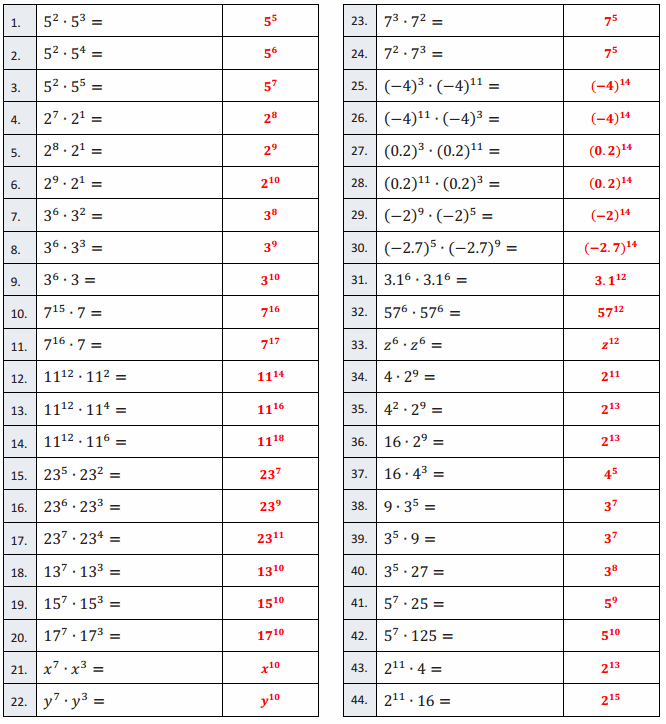
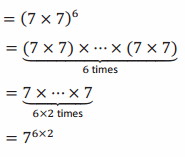
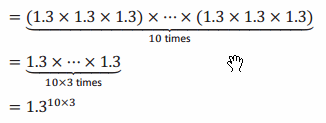
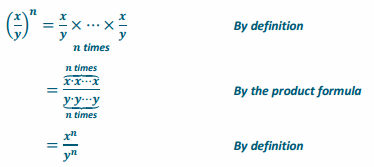
Eureka Math Grade 7 Module 3 Lesson 11 Answer Key

Engage NY Eureka Math 7th Grade Module 3 Lesson 11 Answer Key

Eureka Math Grade 7 Module 3 Lesson 11 Example Answer Key

Example 1.
The following figure shows three lines intersecting at a point. In a complete sentence, describe the angle relationship in the diagram. Write an equation for the angle relationship shown in the figure and solve for x. Confirm your answers by measuring the angle with a protractor.
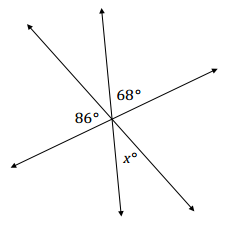
Engage NY Math 7th Grade Module 3 Lesson 11 Example Answer Key 1
Answer:
The angles 86°, 68°, and the angle between them, which is vertically opposite and equal in measure to x, are angles on a line and have a sum of 180°.
86 + x + 68 = 180
x + 154 = 180
x + 154 – 154 = 180 – 154
x = 26

Example 2.
In a complete sentence, describe the angle relationships in the diagram. You may label the diagram to help describe the angle relationships. Write an equation for the angle relationship shown in the figure and solve for x. Confirm your answers by measuring the angle with a protractor.
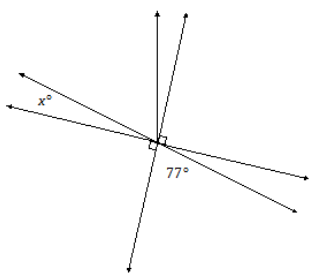
Engage NY Math 7th Grade Module 3 Lesson 11 Example Answer Key 2
Answer:
The angle formed by adjacent angles a° and b° is vertically opposite to the 77° angle. The angles x°, a°, and b° are adjacent angles that have a sum of 90° (since the adjacent angle is a right angle and together the angles are on a line).
x + 77 = 90
x + 77 – 77 = 90 – 77
x = 13

Example 3.
In a complete sentence, describe the angle relationships in the diagram. Write an equation for the angle relationship shown in the figure and solve for x. Find the measures of ∠JAH and ∠GAF. Confirm your answers by measuring the angle with a protractor.
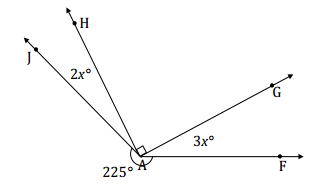
Engage NY Math 7th Grade Module 3 Lesson 11 Example Answer Key 3
Answer:
The sum of the degree measurements of ∠JAH, ∠GAH, ∠GAF, and the arc that subtends ∠JAF is 360°.
225 + 2x + 90 + 3x = 360
315 + 5x = 360
315 – 315 + 5x = 360 – 315
5x = 45
(\(\frac{1}{5}\))5x = (\(\frac{1}{5}\))45
x = 9
m∠JAH = 2(9°) = 18° m∠GAF = 3(9°) = 27°

Example 4.
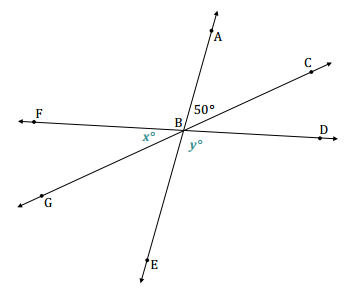
In the accompanying diagram, the measure of ∠DBE is four times the measure of ∠FBG.
Engage NY Math 7th Grade Module 3 Lesson 11 Example Answer Key 4
a. Label ∠DBE as y° and ∠FBG as x°. Write an equation that describes the relationship between ∠DBE and ∠FBG.
Answer:
y = 4x

b. Find the value of x.
Answer:
50 + x + 4x = 180
50 + 5x = 180
5x + 50 – 50 = 180 – 50
5x = 130
(\(\frac{1}{5}\))(5x) = (\(\frac{1}{5}\))(130)
x = 26

c. Find the measures of ∠FBG, ∠CBD, ∠ABF, ∠GBE, and ∠DBE.
Answer:
m∠FBG = 26°
m∠CBD = 26°
m∠ABF = 4(26°) = 104°
m∠GBE = 50°
m∠DBE = 104°

d. What is the measure of ∠ABG? Identify the angle relationship used to get your answer.
Answer:
∠ABG = ∠ABF + ∠FBG
∠ABG = 104 + 26
∠ABG = 130
m∠ABG = 130°
To determine the measure of ∠ABG, you need to add the measures of adjacent angles ∠ABF and ∠FBG.

Eureka Math Grade 7 Module 3 Lesson 11 Exercise Answer Key

Opening Exercise
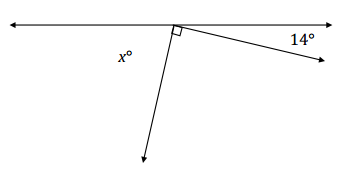
a. In a complete sentence, describe the angle relationship in the diagram. Write an equation for the angle relationship shown in the figure and solve for x. Confirm your answers by measuring the angle with a protractor.
Engage NY Math Grade 7 Module 3 Lesson 11 Exercise Answer Key 1
Answer:
The angles marked by x°, 90°, and 14° are angles on a line and have a sum of 180°.
x + 90 + 14 = 180
x + 104 = 180
x + 104 – 104 = 180 – 104
x = 76

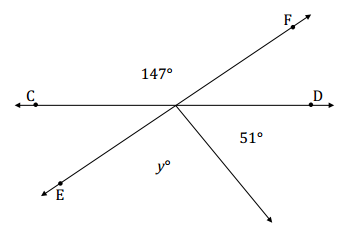
b. \(\overleftrightarrow{C D}\) and \(\overleftrightarrow{E F}\) are intersecting lines. In a complete sentence, describe the angle relationship in the diagram. Write an equation for the angle relationship shown in the figure and solve for y. Confirm your answers by measuring the angle with a protractor.
Engage NY Math Grade 7 Module 3 Lesson 11 Exercise Answer Key 2
Answer:
The adjacent angles marked by y° and 51° together form the angle that is vertically opposite and equal to the angle measuring 147°.
y + 51 = 147
y + 51 – 51 = 147 – 51
y = 96

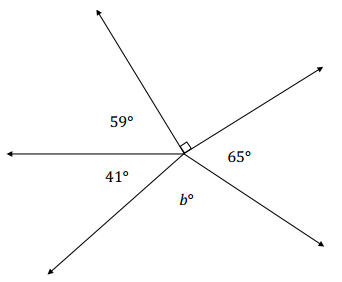
c. In a complete sentence, describe the angle relationship in the diagram. Write an equation for the angle relationship shown in the figure and solve for b. Confirm your answers by measuring the angle with a protractor.
Engage NY Math Grade 7 Module 3 Lesson 11 Exercise Answer Key 3
Answer:
The adjacent angles marked by 59°, 41°, b°, 65°, and 90° are angles at a point and together have a sum of 360°.
59 + 41 + b + 65 + 90 = 360
b + 255 = 360 – 255
b = 105

d. The following figure shows three lines intersecting at a point. In a complete sentence, describe the angle relationship in the diagram. Write an equation for the angle relationship shown in the figure and solve for z. Confirm your answers by measuring the angle with a protractor.
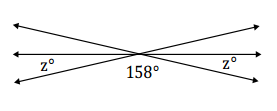
Engage NY Math Grade 7 Module 3 Lesson 11 Exercise Answer Key 4
Answer:
The angles marked by z°, 158°, and z° are angles on a line and have a sum of 180°.
z + 158 + z = 180
2z + 158 = 180
2z + 158 – 158 = 180 – 158
2z = 22
z = 11

e. Write an equation for the angle relationship shown in the figure and solve for x. In a complete sentence, describe the angle relationship in the diagram. Find the measurements of ∠EPB and ∠CPA. Confirm your answers by measuring the angle with a protractor.
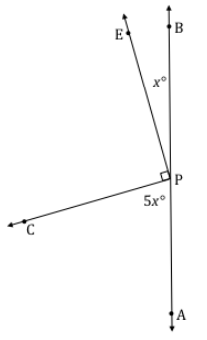
Engage NY Math Grade 7 Module 3 Lesson 11 Exercise Answer Key 5
Answer:
∠CPA, ∠CPE, and ∠EPB are angles on a line and their measures have a sum of 180°.
5x + 90 + x = 180
6x + 90 = 180
6x + 90 – 90 = 180 – 90
6x = 90
(\(\frac{1}{6}\))6x = (\(\frac{1}{6}\))90
x = 15
∠EPB = 15°
∠CPA = 5(15°) = 75°

Exercise 1.
The following figure shows four lines intersecting at a point. In a complete sentence, describe the angle relationships in the diagram. Write an equation for the angle relationship shown in the figure and solve for x and y. Confirm your answers by measuring the angle with a protractor.
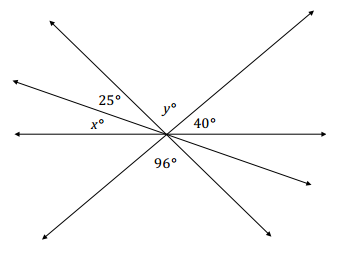
Engage NY Math Grade 7 Module 3 Lesson 11 Exercise Answer Key 6
Answer:
The angles x°, 25°, y°, and 40° are angles on a line and have a sum of 180°; the angle marked y° is vertically opposite and equal to 96°.
y = 96, vert. ∠s
x + 25 + (96) + 40 = 180
x + 161 = 180
x + 161 – 161 = 180 – 161
x = 19

Exercise 2.
In a complete sentence, describe the angle relationships in the diagram. Write an equation for the angle relationship shown in the figure and solve for x and y. Confirm your answers by measuring the angles with a protractor.
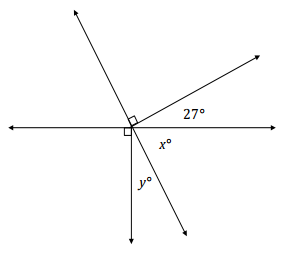
Engage NY Math Grade 7 Module 3 Lesson 11 Exercise Answer Key 7
Answer:
The measures of angles x and y have a sum of 90°; the measures of angles x and 27 have a sum of 90°.
x + 27 = 90
x + 27 – 27 = 90 – 27
x = 63
(63) + y = 90
63 – 63 + y = 90 – 63
y = 27

Exercise 3.
In a complete sentence, describe the angle relationships in the diagram. Write an equation for the angle relationship shown in the figure and solve for x. Find the measure of ∠JKG. Confirm your answer by measuring the angle with a protractor.
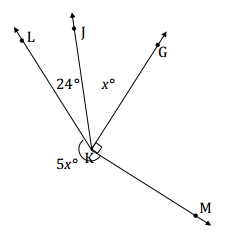
Engage NY Math Grade 7 Module 3 Lesson 11 Exercise Answer Key 8
Answer:
The sum of the degree measurements of ∠LKJ, ∠JKG, ∠GKM, and the arc that subtends ∠LKM is 360°.
5x + 24 + x + 90 = 360
6x + 114 = 360
6x + 114 – 114 = 360 – 114
6x = 246
(\(\frac{1}{6}\))6x = (\(\frac{1}{6}\))246
x = 41
m∠JKG = 41°

Eureka Math Grade 7 Module 3 Lesson 11 Problem Set Answer Key

In a complete sentence, describe the angle relationships in each diagram. Write an equation for the angle relationship(s) shown in the figure, and solve for the indicated unknown angle. You can check your answers by measuring each angle with a protractor.
Question 1.
Find the measures of ∠EAF, ∠DAE, and ∠CAD.
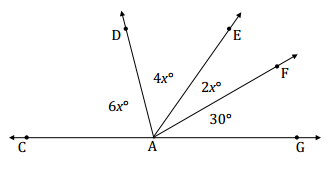
Eureka Math 7th Grade Module 3 Lesson 11 Problem Set Answer Key 1
Answer:
∠GAF, ∠EAF, ∠DAE, and ∠CAD are angles on a line and their measures have a sum of 180°.
6x + 4x + 2x + 30 = 180
12x + 30 = 180
12x + 30 – 30 = 180 – 30
12x = 150
x = 12.5
m∠EAF = 2(12.5°) = 25°
m∠DAE = 4(12.5°) = 50°
m∠CAD = 6(12.5°) = 75°

Question 2.
Find the measure of a.
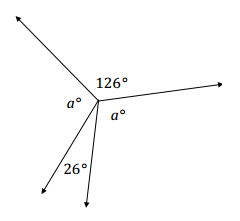
Eureka Math 7th Grade Module 3 Lesson 11 Problem Set Answer Key 2
Answer:
Angles a°, 26°, a°, and 126° are angles at a point and have a sum of 360°.
a + 126 + a + 26 = 360
2a + 152 = 360
2a + 152 – 152 = 360 – 152
2a = 208
(\(\frac{1}{2}\))2a = (\(\frac{1}{2}\))208
a = 104

Question 3.
Find the measures of x and y.
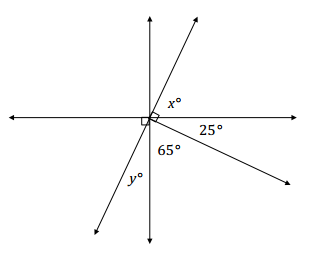
Eureka Math 7th Grade Module 3 Lesson 11 Problem Set Answer Key 3
Answer:
Angles y° and 65° and angles 25° and x° have a sum of 90°.
x + 25 = 90
x + 25 – 25 = 90 – 25
x = 65
65 + y = 90
65 + y = 90
65 – 65 + y = 90 – 65
y = 25

Question 4.
Find the measure of ∠HAJ.
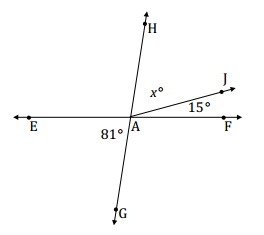
Eureka Math 7th Grade Module 3 Lesson 11 Problem Set Answer Key 4
Answer:
Adjacent angles x° and 15° together are vertically opposite from and are equal to angle 81°.
x + 15 = 81
x + 15 – 15 = 81 – 15
x = 66
m∠HAJ = 66°

Question 5.
Find the measures of ∠HAB and ∠CAB.
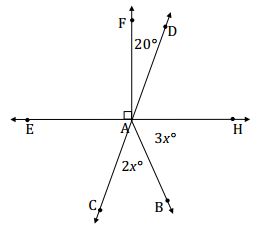
Eureka Math 7th Grade Module 3 Lesson 11 Problem Set Answer Key 5
Answer:
The measures of adjacent angles ∠CAB and ∠HAB have a sum of the measure of ∠CAH, which is vertically opposite from and equal to the measurement of ∠DAE.
2x + 3x + 70 = 180
5x = 110
(\(\frac{1}{5}\))5x = (\(\frac{1}{5}\))110
x = 22
m∠HAB = 3(22°) = 66°
m∠CAB = 2(22°) = 44°

Question 6.
The measure of ∠SPT is b°. The measure of ∠TPR is five more than two times ∠SPT. The measure of ∠QPS is twelve less than eight times the measure of ∠SPT. Find the measures of ∠SPT, ∠TPR, and ∠QPS.
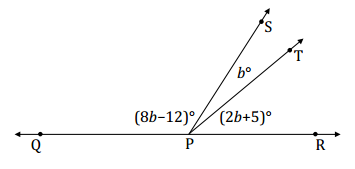
Eureka Math 7th Grade Module 3 Lesson 11 Problem Set Answer Key 6
Answer:
∠QPS, ∠SPT, and ∠TPR are angles on a line and their measures have a sum of 180°.
(8b – 12) + b + (2b + 5) = 180
11b – 7 = 180
11b – 7 + 7 = 180 + 7
11b = 187
(\(\frac{1}{11}\))11b = (\(\frac{1}{11}\))187
b = 17
m∠SPT = (17°) = 17°
m∠TPR = 2(17°) + 5° = 39°
m∠QPS = 8(17°) – 12° = 124°

Question 7.
Find the measures of ∠HQE and ∠AQG.
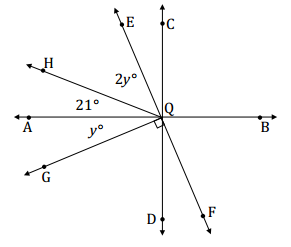
Eureka Math 7th Grade Module 3 Lesson 11 Problem Set Answer Key 7
Answer:
∠AQG, ∠AQH, and ∠HQE are adjacent angles whose measures have a sum of 90°.
2y + 21 + y = 90
3y + 21 = 90
3y + 21 – 21 = 90 – 21
3y = 69
(\(\frac{1}{3}\))3y = (\(\frac{1}{3}\))69
y = 23
m∠HQE = 2(23°) = 46°
m∠AQG = (23°) = 23°

Question 8.
The measures of three angles at a point are in the ratio of 2:3:5. Find the measures of the angles.
Answer:
∠A = 2x, ∠B = 3x, ∠C = 5x
2x + 3x + 5x = 360
10x = 360
(\(\frac{1}{10}\))10x = (\(\frac{1}{10}\))360
x = 36
∠A = 2(36°) = 72°
∠B = 3(36°) = 108°
∠C = 5(36°) = 180°

Question 9.
The sum of the measures of two adjacent angles is 72°. The ratio of the smaller angle to the larger angle is 1∶3. Find the measures of each angle.
Answer:
∠A = x, ∠B = 3x
x + 3x = 72
4x = 72
(\(\frac{1}{4}\))(4x) = (\(\frac{1}{4}\))(72)
x = 18
∠A = (18°) = 18°
∠B = 3(18°) = 54°

Question 10.
Find the measures of ∠CQA and ∠EQB.
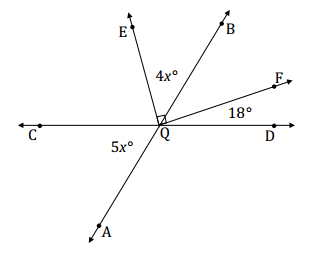
Eureka Math 7th Grade Module 3 Lesson 11 Problem Set Answer Key 8
Answer:
4x + 5x = 108
9x = 108
(\(\frac{1}{9}\))9x = (\(\frac{1}{9}\))108
x = 12
m∠CQA = 5(12°) = 60°
m∠EQB = 4(12°) = 48°

Eureka Math Grade 7 Module 3 Lesson 11 Exit Ticket Answer Key

Question 1.
Write an equation for the angle relationship shown in the figure and solve for x. Find the measures of ∠RQS and ∠TQU.
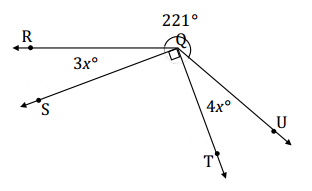
Eureka Math Grade 7 Module 3 Lesson 11 Exit Ticket Answer Key 1
Answer:
3x + 90 + 4x + 221 = 360
7x + 311 = 360
7x + 311 – 311 = 360 – 311
7x = 49
(\(\frac{1}{7}\))7x = (\(\frac{1}{7}\))49
x = 7
m∠RQS = 3(7°) = 21°
m∠TQU = 4(7°) = 28°
Eureka Math Grade 7 Module 3 Lesson 12 Answer Key

Engage NY Eureka Math 7th Grade Module 3 Lesson 12 Answer Key

Eureka Math Grade 7 Module 3 Lesson 12 Example Answer Key

Example 1.
Preserves the inequality symbol:
Answer:
means the inequality symbol stays the same.

Reverses the inequality symbol:
Answer:
means the inequality symbol switches less than with greater than and less than or equal to with greater than or equal to.

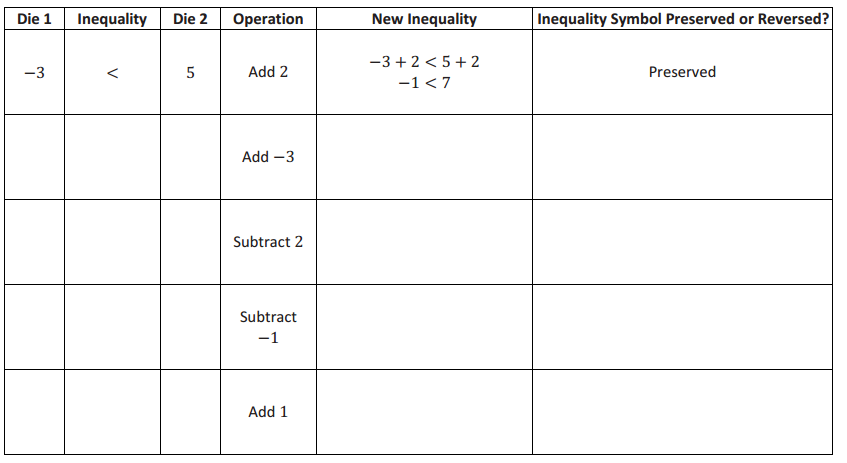
Station 1
Add or Subtract a Number to Both Sides of the Inequality
Engage NY Math 7th Grade Module 3 Lesson 12 Example Answer Key 1
Examine the results. Make a statement about what you notice, and justify it with evidence.
Answer:
When a number is added or subtracted to both numbers being compared, the symbol stays the same, and the inequality symbol is preserved.

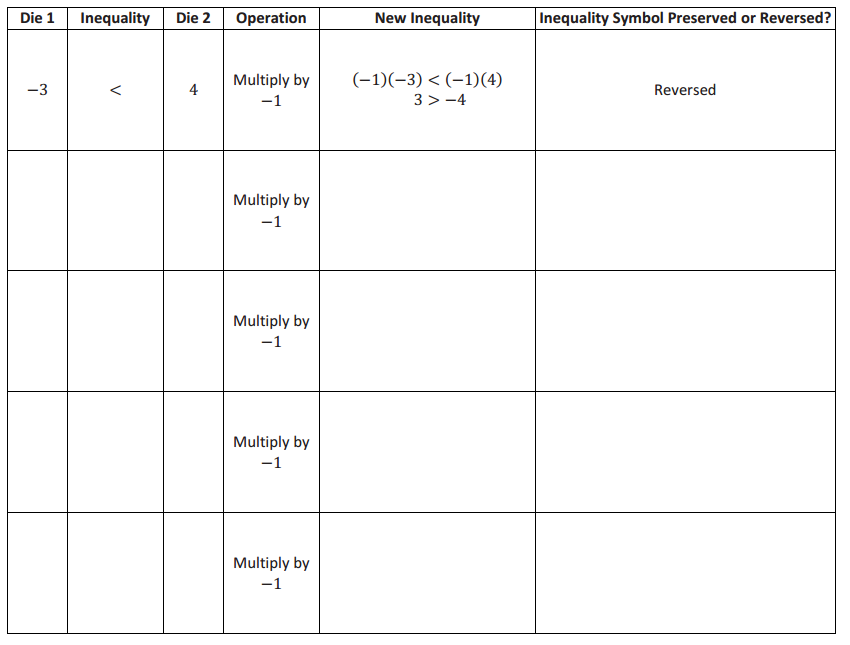
Station 2
Multiply each term by – 1
Engage NY Math 7th Grade Module 3 Lesson 12 Example Answer Key 2
Examine the results. Make a statement about what you notice and justify it with evidence.
Answer:
When both numbers are multiplied by – 1, the symbol changes, and the inequality symbol is reversed.

Station 3
Multiply or Divide Both Sides of the Inequality by a Positive Number
Engage NY Math 7th Grade Module 3 Lesson 12 Example Answer Key 3
Examine the results. Make a statement about what you notice, and justify it with evidence.
Answer:
When both numbers being compared are multiplied by or divided by a positive number, the symbol stays the same, and the inequality symbol is preserved.

Station 4
Multiply or Divide Both Sides of the Inequality by a Negative Number
Engage NY Math 7th Grade Module 3 Lesson 12 Example Answer Key 4
Examine the results. Make a statement about what you notice and justify it with evidence.
Answer:
When both numbers being compared are multiplied by or divided by a negative number, the symbol changes, and the inequality symbol is reversed.

Eureka Math Grade 7 Module 3 Lesson 12 Exercise Answer Key

Exercise
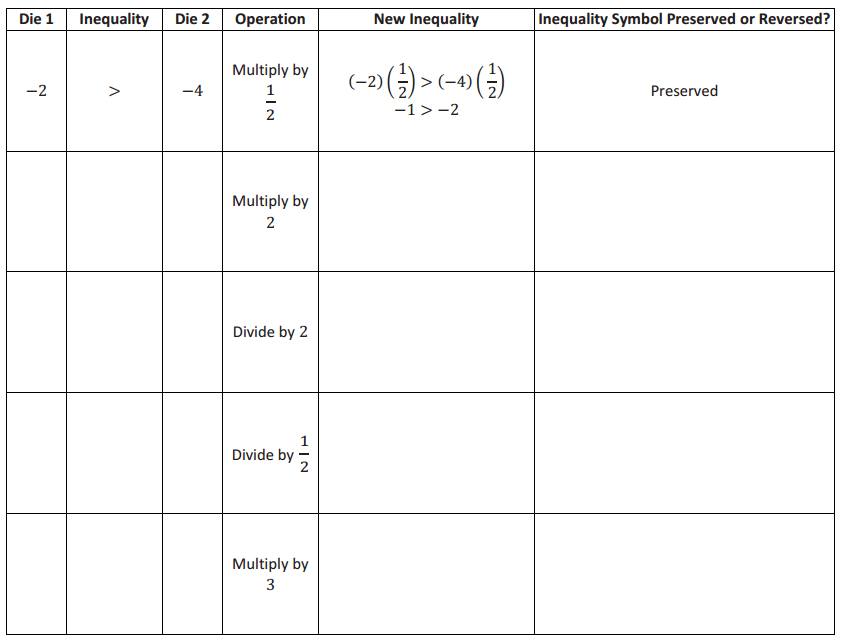
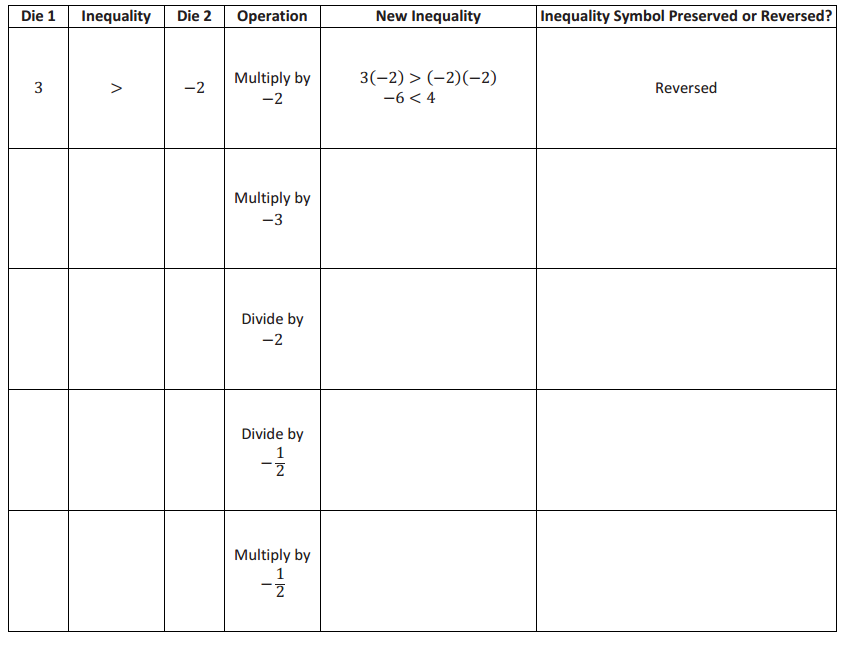
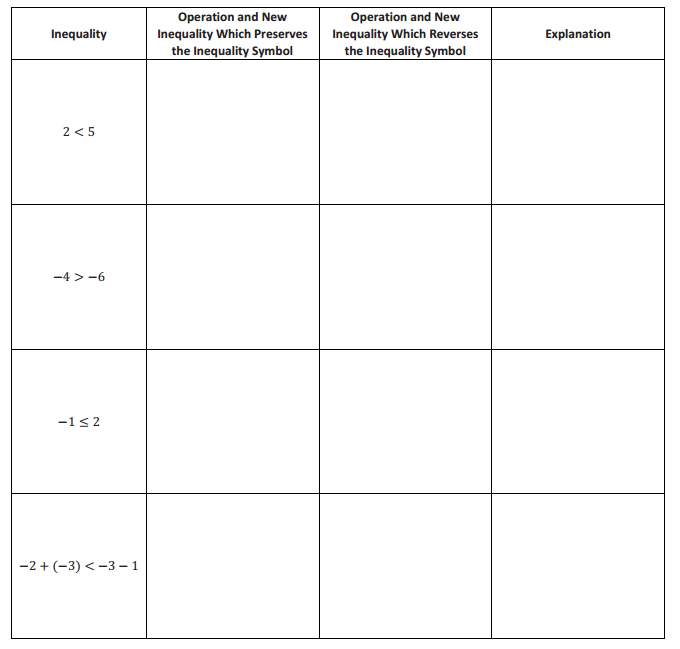
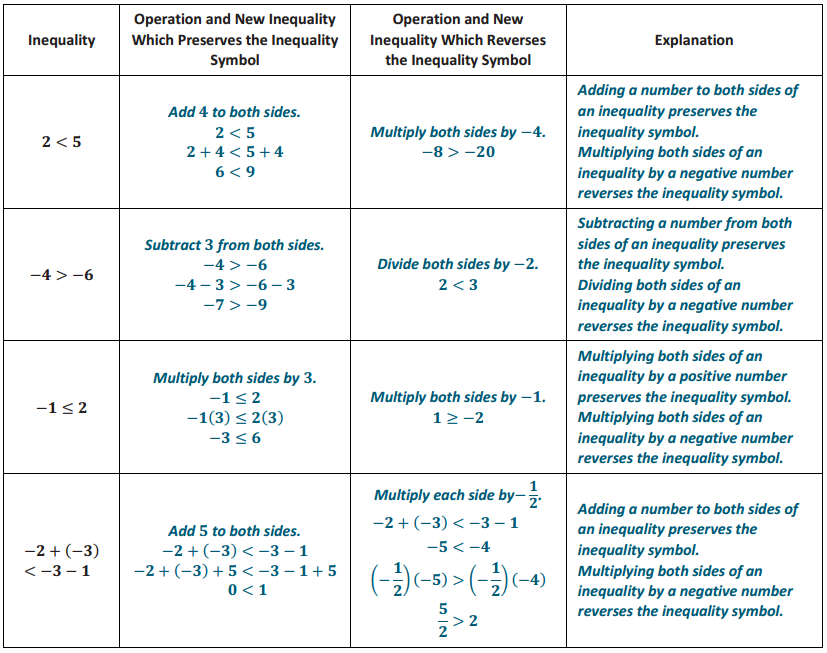
Complete the following chart using the given inequality, and determine an operation in which the inequality symbol is preserved and an operation in which the inequality symbol is reversed. Explain why this occurs.
Engage NY Math Grade 7 Module 3 Lesson 12 Exercise Answer Key 1
Answer:
Solutions may vary. A sample student response is below.
Engage NY Math Grade 7 Module 3 Lesson 12 Exercise Answer Key 2

Eureka Math Grade 7 Module 3 Lesson 12 Problem Set Answer Key

Question 1.
For each problem, use the properties of inequalities to write a true inequality statement.
The two integers are – 2 and – 5.
a. Write a true inequality statement.
Answer:
– 5 < – 2

b. Subtract – 2 from each side of the inequality. Write a true inequality statement.
Answer:
– 7 < – 4

c. Multiply each number by – 3. Write a true inequality statement.
Answer:
15 > 6

Question 2.
On a recent vacation to the Caribbean, Kay and Tony wanted to explore the ocean elements. One day they went in a submarine 150 feet below sea level. The second day they went scuba diving 75 feet below sea level.
a. Write an inequality comparing the submarine’s elevation and the scuba diving elevation.
Answer:
– 150 < – 75

b. If they only were able to go one – fifth of the capable elevations, write a new inequality to show the elevations they actually achieved.
Answer:
– 30 < – 15

c. Was the inequality symbol preserved or reversed? Explain.
Answer:
The inequality symbol was preserved because the number that was multiplied to both sides was NOT negative.

Question 3.
If a is a negative integer, then which of the number sentences below is true? If the number sentence is not true, give a reason.
a. 5 + a < 5
Answer:
True

b. 5 + a > 5
Answer:
False because adding a negative number to 5 will decrease 5, which will not be greater than 5.

c. 5 – a > 5
Answer:
True

d. 5 – a < 5
Answer:
False because subtracting a negative number is adding a positive number to 5, which will be larger than 5.

e. 5a < 5
Answer:
True

f. 5a > 5
Answer:
False because a negative number multiplied by a positive number is negative, which will be less than 5.

g. 5 + a > a
Answer:
True

h. 5 + a < a
Answer: False because adding 5 to a negative number is greater than the negative number itself.

i. 5 – a > a
Answer:
True

j. 5 – a < a
Answer:
False because subtracting a negative number is the same as adding a positive number, which is greater than the negative number itself.

k. 5a > a
Answer:
False because a negative number multiplied by a 5 is negative and will be 5 times smaller than a.

l. 5a < a
Answer:
True

Eureka Math Grade 7 Module 3 Lesson 12 Exit Ticket Answer Key

Question 1.
Given the initial inequality – 4 < 7, state possible values for c that would satisfy the following inequalities.
a. c( – 4) < c(7)
Answer:
c > 0

b. c( – 4) > c(7)
Answer:
c < 0

c. c(- 4) = c(7)
Answer:
c = 0

Question 2.
Given the initial inequality 2 > – 4, identify which operation preserves the inequality symbol and which operation reverses the inequality symbol. Write the new inequality after the operation is performed.
a. Multiply both sides by – 2.
Answer:
The inequality symbol is reversed.
2 > – 4
2( – 2) < – 4( – 2)
– 4 < 8

b. Add – 2 to both sides.
Answer:
The inequality symbol is preserved. 2 > – 4
2 + ( – 2) > – 4 + ( – 2)
0 > – 6

c. Divide both sides by 2.
Answer:
The inequality symbol is preserved.
2 > – 4
2 ÷ 2 > – 4 ÷ 2
1 > – 2

d. Multiply both sides by – \(\frac{1}{2}\).
Answer:
Inequality symbol is reversed.
2 > – 4
2( – \(\frac{1}{2}\) ) < – 4( – \(\frac{1}{2}\) )
– 1 < 2 e. Subtract – 3 from both sides. Answer: The inequality symbol is preserved. 2 > – 4
2 – ( – 3) > – 4 – ( – 3)
5 > – 1

Eureka Math Grade 7 Module 3 Lesson 12 Equations Answer Key

Progression of Exercises
Determine the value of the variable.

Set 1
Question 1.
x + 1 = 5
Answer:
x = 4

Question 2.
x + 3 = 5
Answer:
x = 2

Question 3.
x + 6 = 5
Answer:
x = – 1

Question 4.
x – 5 = 2
Answer:
x = 7

Question 5.
x – 5 = 8
Answer:
x = 13

Set 2
Question 1.
3x = 15
Answer:
x = 5

Question 2.
3x = 0
Answer:
x = 0

Question 3.
3x = – 3
Answer:
x = – 1

Question 4.
– 9x = 18
Answer:
x = – 2

Question 5.
– x = 18
Answer:
x = – 18

Set 3
Question 1.
\(\frac{1}{7}\) x = 5
Answer:
x = 35

Question 2.
\(\frac{2}{7}\) x = 10
Answer:
x = 35

Question 3.
\(\frac{3}{7}\) x = 15
Answer:
x = 35

Question 4.
\(\frac{4}{7}\) x = 20
Answer:
x = 35

Question 5.
– \(\frac{5}{7}\) x = – 25
Answer:
x = 35

Set 4
Question 1.
2x + 4 = 12
Answer:
x = 4

Question 2.
2x – 5 = 13
Answer:
x = 9

Question 3.
2x + 6 = 14
Answer:
x = 4

Question 4.
3x – 6 = 18
Answer:
x = 8

Question 5.
– 4x + 6 = 22
Answer:
x = – 4

Set 5
Question 1.
2x + 0.5 = 6.5
Answer:
x = 3

Question 2.
3x – 0.5 = 8.5
Answer:
x = 3

Question 3.
5x + 3 = 8.5
Answer:
x = 1.1

Question 4.
5x – 4 = 1.5
Answer:
x = 1.1

Question 5.
– 7x + 1.5 = 5
Answer:
x = – 0.5

Set 6
Question 1.
2(x + 3) = 4
Answer:
x = – 1

Question 2.
5(x + 3) = 10
Answer:
x = – 1

Question 3.
5(x – 3) = 10
Answer:
x = 5

Question 4.
– 2(x – 3) = 8
Answer:
x = – 1

Question 5.
– 3(x + 4) = 3
Answer:
x = – 5

Eureka Math Grade 7 Module 3 Lesson 13 Answer Key

Engage NY Eureka Math 7th Grade Module 3 Lesson 13 Answer Key

Eureka Math Grade 7 Module 3 Lesson 13 Example Answer Key

Example 1: Evaluating Inequalities—Finding a Solution
The sum of two consecutive odd integers is more than – 12. Write several true numerical inequality expressions.
Answer:
Engage NY Math 7th Grade Module 3 Lesson 13 Example Answer Key 1

The sum of two consecutive odd integers is more than – 12. What is the smallest value that will make this true?
a. Write an inequality that can be used to find the smallest value that will make the statement true.
Answer:
x: an integer
2x + 1: odd integer
2x + 3: next consecutive odd integer
2x + 1 + 2x + 3 > – 12

b. Use if – then moves to solve the inequality written in part (a). Identify where the 0’s and 1’s were made using the if – then moves.
Answer:
4x + 4 > – 12
4x + 4 – 4 > – 12 – 4 If a > b, then a – 4 > b – 4.
4x + 0 > – 16 0 was the result.
(\(\frac{1}{4}\))(4x) > (\(\frac{1}{4}\))( – 16) If a > b, then a(\(\frac{1}{4}\)) > b(\(\frac{1}{4}\)).
x > – 4 1 was the result.

c. What is the smallest value that will make this true?
Answer:
To find the odd integer, substitute – 4 for x in 2x + 1.
2( – 4) + 1
– 8 + 1
– 7
The values that will solve the original inequality are all the odd integers greater than – 7. Therefore, the smallest values that will make this true are – 5 and – 3.

Eureka Math Grade 7 Module 3 Lesson 13 Exercise Answer Key

Opening Exercise: Writing Inequality Statements
Tarik is trying to save $265.49 to buy a new tablet. Right now, he has $40 and can save $38 a week from his allowance.
Write and evaluate an expression to represent the amount of money saved after …
2 weeks
Answer:
40 + 38(2)
40 + 76
116

3 weeks
Answer:
40 + 38(3)
40 + 114
154

4 weeks
Answer:
40 + 38(4)
40 + 152
192

5 weeks
Answer:
40 + 38(5)
40 + 190
230

6 weeks
Answer:
40 + 38(6)
40 + 228
268

7 weeks
Answer:
40 + 38(7)
40 + 266
306

8 weeks
Answer:
40 + 38(8)
40 + 304
344

When will Tarik have enough money to buy the tablet?
Answer:
From 6 weeks and onward

Write an inequality that will generalize the problem.
Answer:
38w + 40 ≥ 265.49 Where w represents the number of weeks it will take to save the money.

Exercise 1.
Connor went to the county fair with $22.50 in his pocket. He bought a hot dog and drink for $3.75 and then wanted to spend the rest of his money on ride tickets, which cost $1.25 each.
a. Write an inequality to represent the total spent where r is the number of tickets purchased.
Answer:
1.25r + 3.75 ≤ 22.50

b. Connor wants to use this inequality to determine whether he can purchase 10 tickets. Use substitution to show whether he will have enough money.
Answer:
1.25r + 3.75 ≤ 22.50
1.25(10) + 3.75 ≤ 22.50
12.5 + 3.75 ≤ 22.50
16.25 ≤ 22.50
True
He will have enough money since a purchase of 10 tickets brings his total spending to $16.25.

c. What is the total maximum number of tickets he can buy based upon the given information?
Answer:
1.25r + 3.75 ≤ 22.50
1.25r + 3.75 – 3.75 ≤ 22.50 – 3.75
1.25r + 0 ≤ 18.75
(\(\frac{1}{1.25}\))(1.25r) ≤ (\(\frac{1}{1.25}\))(18.75)
r ≤ 15
The maximum number of tickets he can buy is 15.

Exercise 2.
Write and solve an inequality statement to represent the following problem:
On a particular airline, checked bags can weigh no more than 50 pounds. Sally packed 32 pounds of clothes and five identical gifts in a suitcase that weighs 8 pounds. Write an inequality to represent this situation.
Answer:
x: weight of one gift
5x + 8 + 32 ≤ 50
5x + 40 ≤ 50
5x + 40 – 40 ≤ 50 – 40
5x ≤ 10
(\(\frac{1}{5}\))(5x) ≤ (\(\frac{1}{5}\))(10)
x ≤ 2
Each of the 5 gifts can weigh 2 pounds or less.

Eureka Math Grade 7 Module 3 Lesson 13 Problem Set Sample Answer Key

Question 1.
Match each problem to the inequality that models it. One choice will be used twice.
_________ The sum of three times a number and – 4 is greater than 17.         a. 3x + – 4 ≥ 17
_________ The sum of three times a number and – 4 is less than 17.               b. 3x + – 4 < 17
_________ The sum of three times a number and – 4 is at most 17.                 c. 3x + – 4 > 17
_________ The sum of three times a number and – 4 is no more than 17.       d. 3x + – 4 ≤ 17
_________ The sum of three times a number and – 4 is at least 17.
Answer:
c The sum of three times a number and – 4 is greater than 17.           a. 3x + – 4 ≥ 17
b The sum of three times a number and – 4 is less than 17.                b. 3x + – 4 < 17
d The sum of three times a number and – 4 is at most 17.                  c. 3x + – 4 > 17
d The sum of three times a number and – 4 is no more than 17.        d. 3x + – 4 ≤ 17
a The sum of three times a number and – 4 is at least 17.

Question 2.
If x represents a positive integer, find the solutions to the following inequalities.
a. x < 7
Answer:
x < 7 or 1, 2, 3, 4, 5, 6

b. x – 15 < 20
Answer:
x < 35

c. x + 3 ≤ 15
Answer:
x ≤ 12

d. – x > 2
Answer:
There are no positive integer solutions.

e. 10 – x > 2
Answer:
x < 8

f. – x ≥ 2
Answer:
There are no positive integer solutions.

g. \(\frac{x}{3}\) < 2
x < 6 Answer: h. – \(\frac{x}{3}\) > 2
Answer:
There are no positive integer solutions.

i. 3 – \(\frac{x}{4}\) > 2
Answer:
x < 4

Question 3.
Recall that the symbol ≠ means not equal to. If x represents a positive integer, state whether each of the following statements is always true, sometimes true, or false.
a. x > 0
Answer:
Always true

b. x < 0
Answer:
False

c. x > – 5
Answer:
Always true

d. x > 1
Answer:
Sometimes true

e. x ≥ 1
Answer:
Always true

f. x ≠ 0
Answer:
Always true

g. x ≠ – 1
Answer:
Always true

h. x ≠ 5
Answer:
Sometimes true

Question 4.
Twice the smaller of two consecutive integers increased by the larger integer is at least 25.
Model the problem with an inequality, and determine which of the given values 7, 8, and/or 9 are solutions. Then, find the smallest number that will make the inequality true.
Answer:
2x + x + 1 ≥ 25
The smallest integer would be 8.
For x = 7:
2x + x + 1 ≥ 25
2(7) + 7 + 1 ≥ 25
14 + 7 + 1 ≥ 25
22 ≥ 25
False

For x = 8:
2x + x + 1 ≥ 25
2(8) + 8 + 1 ≥ 25
16 + 8 + 1 ≥ 25
25 ≥ 25
True

For x = 9:
2x + x + 1 ≥ 25
2(9) + 9 + 1 ≥ 25
18 + 9 + 1 ≥ 25
28 ≥ 25
True
The smallest integer would be 8.

Question 5.
a. The length of a rectangular fenced enclosure is 12 feet more than the width. If Farmer Dan has 100 feet of fencing, write an inequality to find the dimensions of the rectangle with the largest perimeter that can be created using 100 feet of fencing.
Answer:
Let w represent the width of the fenced enclosure.
w + 12: length of the fenced enclosure
w + w + w + 12 + w + 12 ≤ 100
4w + 24 ≤ 100

b. What are the dimensions of the rectangle with the largest perimeter? What is the area enclosed by this rectangle?
Answer:
4w + 24 ≤ 100
4w + 24 – 24 ≤ 100 – 24
4w + 0 ≤ 76
(\(\frac{1}{4}\))(4w) ≤ (\(\frac{1}{4}\))(76)
w ≤ 19
Maximum width is 19 feet.
Maximum length is 31 feet.
Maximum area: A = lw
A = (19)(31)
A = 589
The area is 589 ft < sup > 2 < /sup > .

Question 6.
At most, Kyle can spend $50 on sandwiches and chips for a picnic. He already bought chips for $6 and will buy sandwiches that cost $4.50 each. Write and solve an inequality to show how many sandwiches he can buy. Show your work, and interpret your solution.
Answer:
Let s represent the number of sandwiches.
4.50s + 6 ≤ 50
4.50s + 6 – 6 ≤ 50 – 6
4.50s ≤ 44
(\(\frac{1}{4.50}\))(4.50s) ≤ (\(\frac{1}{4.50}\))(44)
s ≤ 9 \(\frac{7}{9}\)
At most, Kyle can buy 9 sandwiches with $50.

Eureka Math Grade 7 Module 3 Lesson 13 Exit Ticket Answer Key

Question 1.
Shaggy earned $7.55 per hour plus an additional $100 in tips waiting tables on Saturday. He earned at least $160 in all. Write an inequality and find the minimum number of hours, to the nearest hour, that Shaggy worked on Saturday.
Answer:
Let h represent the number of hours worked.
7.55h + 100 ≥ 160
7.55h + 100 – 100 ≥ 160 – 100
7.55h ≥ 60
(\(\frac{1}{7.55}\))(7.55h) ≥ (\(\frac{1}{7.55}\))(60)
h ≥ 7.9
If Shaggy earned at least $160, he would have worked at least 8 hours.

Eureka Math Grade 7 Module 3 Lesson 14 Answer Key

Engage NY Eureka Math 7th Grade Module 3 Lesson 14 Answer Key

Eureka Math Grade 7 Module 3 Lesson 14 Example Answer Key

Example 1.
A youth summer camp has budgeted $2,000 for the campers to attend the carnival. The cost for each camper is $17.95, which includes general admission to the carnival and two meals. The youth summer camp must also pay $250 for the chaperones to attend the carnival and $350 for transportation to and from the carnival. What is the greatest number of campers who can attend the carnival if the camp must stay within its budgeted amount?
Answer:
Let c represent the number of campers to attend the carnival.
17.95c + 250 + 350 ≤ 2000
17.95c + 600 ≤ 2000
17.95c + 600 – 600 ≤ 2000 – 600
17.95c ≤ 1400
(\(\frac{1}{17.95}\))(17.95c) ≤ (\(\frac{1}{17.95}\))(1400)
c ≤ 77.99
In order for the camp to stay in budget, the greatest number of campers who can attend the carnival is 77 campers.

Example 2.
The carnival owner pays the owner of an exotic animal exhibit $650 for the entire time the exhibit is displayed. The owner of the exhibit has no other expenses except for a daily insurance cost. If the owner of the animal exhibit wants to make more than $500 in profits for the 5 \(\frac{1}{2}\) days, what is the greatest daily insurance rate he can afford to pay?
Answer:
Let i represent the daily insurance cost.
650 – 5.5i > 500
– 5.5i + 650 – 650 > 500 – 650
– 5.5i + 0> – 150
(\(\frac{1}{ – 5.5}\))( – 5.5i)>(\(\frac{1}{ – 5.5}\))( – 150)
i<27.27 The maximum daily cost the owner can pay for insurance is $27.27. Example 3. Several vendors at the carnival sell products and advertise their businesses. Shane works for a recreational company that sells ATVs, dirt bikes, snowmobiles, and motorcycles. His boss paid him $500 for working all of the days at the carnival plus 5% commission on all of the sales made at the carnival. What was the minimum amount of sales Shane needed to make if he earned more than $1,500? Answer: Let s represent the sales, in dollars, made during the carnival. 500 + \(\frac{5}{100}\) s > 1,500
\(\frac{5}{100}\) s + 500 > 1,500
\(\frac{5}{100}\) s + 500 – 500 > 1,500 – 500
\(\frac{5}{100}\) s + 0 > 1,000
(\(\frac{100}{5}\))(\(\frac{5}{100}\) s) > (\(\frac{100}{5}\))(1,000)
s > 20,000
The sales had to be more than $20,000 for Shane to earn more than $1,500.

Eureka Math Grade 7 Module 3 Lesson 14 Exercise Answer Key

Opening Exercise
The annual County Carnival is being held this summer and will last 5 \(\frac{1}{2}\) days. Use this information and the other given information to answer each problem.

You are the owner of the biggest and newest roller coaster called the Gentle Giant. The roller coaster costs $6 to ride. The operator of the ride must pay $200 per day for the ride rental and $65 per day for a safety inspection. If you want to make a profit of at least $1,000 each day, what is the minimum number of people that must ride the roller coaster?
Write an inequality that can be used to find the minimum number of people, p, which must ride the roller coaster each day to make the daily profit.
Answer:
6p – 200 – 65 ≥ 1000

Solve the inequality.
Answer:
6p – 200 – 65 ≥ 1000
6p – 265 ≥ 1000
6p – 265 + 265 ≥ 1000 + 265
6p + 0 ≥ 1265
(\(\frac{1}{6}\))(6p) ≥ (\(\frac{1}{6}\))(1265)
p ≥ 210 \(\frac{5}{6}\)

Interpret the solution.
Answer:
There needs to be a minimum of 211 people to ride the roller coaster every day to make a daily profit of at least $1,000.

Eureka Math Grade 7 Module 3 Lesson 14 Problem Set Answer Key

Question 1.
As a salesperson, Jonathan is paid $50 per week plus 3% of the total amount he sells. This week, he wants to earn at least $100. Write an inequality with integer coefficients for the total sales needed to earn at least $100, and describe what the solution represents.
Answer:
Let the variable p represent the purchase amount.
50 + \(\frac{3}{100}\) p ≥ 100
\(\frac{3}{100}\) p + 50 ≥ 100
(100)(\(\frac{3}{100}\) p) + 100(50) ≥ 100(100)
3p + 5000 ≥ 10000
3p + 5000 – 5000 ≥ 10000 – 5000
3p + 0 ≥ 5000
(\(\frac{1}{3}\))(3p) ≥ (\(\frac{1}{3}\))(5000)
p ≥ 1666 \(\frac{2}{3}\)
Jonathan must sell $1,666.67 in total purchases.

Question 2.
Systolic blood pressure is the higher number in a blood pressure reading. It is measured as the heart muscle contracts. Heather was with her grandfather when he had his blood pressure checked. The nurse told him that the upper limit of his systolic blood pressure is equal to half his age increased by 110.
a. a is the age in years, and p is the systolic blood pressure in millimeters of mercury (mmHg). Write an inequality to represent this situation.
Answer:
p ≤ \(\frac{1}{2}\) a + 110

b. Heather’s grandfather is 76 years old. What is normal for his systolic blood pressure?
Answer:
p ≤ \(\frac{1}{2}\) a + 110, where a = 76.
p ≤ \(\frac{1}{2}\) (76) + 110
p ≤ 38 + 110
p ≤ 148
A systolic blood pressure for his age is normal if it is at most 148 mmHG.

Question 3.
Traci collects donations for a dance marathon. One group of sponsors will donate a total of $6 for each hour she dances. Another group of sponsors will donate $75 no matter how long she dances. What number of hours, to the nearest minute, should Traci dance if she wants to raise at least $1,000?
Answer:
Let the variable h represent the number of hours Traci dances.
6h + 75 ≥ 1000
6h + 75 – 75 ≥ 1000 – 75
6h + 0 ≥ 925
(\(\frac{1}{6}\))(6h) ≥ (\(\frac{1}{6}\))(925)
h ≥ 154 \(\frac{1}{6}\)
Traci would have to dance at least 154 hours and 10 minutes.

Question 4.
Jack’s age is three years more than twice the age of his younger brother, Jimmy. If the sum of their ages is at most 18, find the greatest age that Jimmy could be.
Answer:
Let the variable j represent Jimmy’s age in years.
Then, the expression 3 + 2j represents Jack’s age in years.
j + 3 + 2j ≤ 18
3j + 3 ≤ 18
3j + 3 – 3 ≤ 18 – 3
3j ≤ 15
(\(\frac{1}{3}\))(3j) ≤ (\(\frac{1}{3}\))(15)
j ≤ 5
Jimmy’s age is 5 years or less.

Question 5.
Brenda has $500 in her bank account. Every week she withdraws $40 for miscellaneous expenses. How many weeks can she withdraw the money if she wants to maintain a balance of a least $200?
Answer:
Let the variable w represent the number of weeks.
500 – 40w ≥ 200
500 – 500 – 40w ≥ 200 – 500
– 40w ≥ – 300
( – \(\frac{1}{40}\))( – 40w) ≤ ( – \(\frac{1}{40}\))( – 300)
w ≤ 7.5
$40 can be withdrawn from the account for seven weeks if she wants to maintain a balance of at least $200.

Question 6.
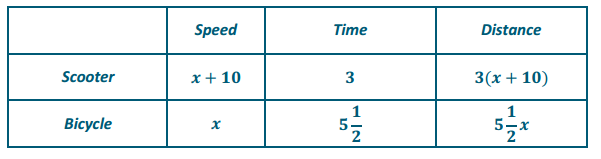
A scooter travels 10 miles per hour faster than an electric bicycle. The scooter traveled for 3 hours, and the bicycle traveled for 5 \(\frac{1}{2}\) hours. Altogether, the scooter and bicycle traveled no more than 285 miles. Find the maximum speed of each.
Answer:
Eureka Math 7th Grade Module 3 Lesson 14 Problem Set Answer Key 1
3(x + 10) + 5 \(\frac{1}{2}\) x ≤ 285
3x + 30 + 5 \(\frac{1}{2}\) x ≤ 285
8 \(\frac{1}{2}\) x + 30 ≤ 285
8 \(\frac{1}{2}\) x + 30 – 30 ≤ 285 – 30
8 \(\frac{1}{2}\) x ≤ 255
\(\frac{17}{2}\) x ≤ 255
(\(\frac{2}{17}\))(\(\frac{17}{2}\) x) ≤ (255)(\(\frac{2}{17}\))
x ≤ 30
The maximum speed the bicycle traveled was 30 miles per hour, and the maximum speed the scooter traveled was 40 miles per hour.

Eureka Math Grade 7 Module 3 Lesson 14 Exit Ticket Answer Key

Question 1.
Games at the carnival cost $3 each. The prizes awarded to winners cost $145.65. How many games must be played to make at least $50?
Answer:
Let g represent the number of games played.
3g – 145.65 ≥ 50
3g – 145.65 + 145.65 ≥ 50 + 145.65
3g + 0 ≥ 195.65
(\(\frac{1}{3}\))(3g) ≥ (\(\frac{1}{3}\))(195.65)
g ≥ 65.217
There must be at least 66 games played to make at least $50.

Eureka Math Grade 7 Module 3 Lesson 15 Answer Key

Engage NY Eureka Math 7th Grade Module 3 Lesson 15 Answer Key

Eureka Math Grade 7 Module 3 Lesson 15 Example Answer Key

Example
A local car dealership is trying to sell all of the cars that are on the lot. Currently, there are 525 cars on the lot, and the general manager estimates that they will consistently sell 50 cars per week. Estimate how many weeks it will take for the number of cars on the lot to be less than 75.
Write an inequality that can be used to find the number of full weeks, w, it will take for the number of cars to be less than 75. Since w is the number of full or complete weeks, w = 1 means at the end of week 1.
Answer:
525 – 50w < 75

Solve and graph the inequality.
Answer:
525 – 50w < 75
– 50w + 525 – 525 < 75 – 525
– 50w + 0 < – 450 ( – \(\frac{1}{50}\))( – 50w) > ( – \(\frac{1}{50}\))( – 450)
w > 9
Engage NY Math 7th Grade Module 3 Lesson 15 Example Answer Key 1

Interpret the solution in the context of the problem.
Answer:
The dealership can sell 50 cars per week for more than 9 weeks to have less than 75 cars remaining on the lot.

Verify the solution.
Answer:
w = 9:
525 – 50w < 75
525 – 50(9) < 75
525 – 450 < 75
75 < 75
False

w = 10:
525 – 50w < 75
525 – 50(10) < 75
525 – 500 < 75
25 < 75
True

Eureka Math Grade 7 Module 3 Lesson 15 Exercise Answer Key

Exercise 1.
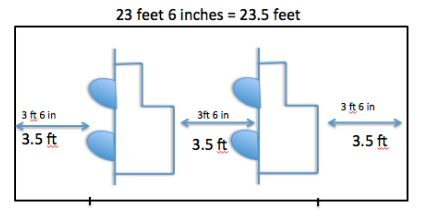
Two identical cars need to fit into a small garage. The opening is 23 feet 6 inches wide, and there must be at least 3 feet 6 inches of clearance between the cars and between the edges of the garage. How wide can the cars be?
Answer:
Encourage students to begin by drawing a diagram to illustrate the problem. A sample diagram is as follows:
Engage NY Math Grade 7 Module 3 Lesson 15 Exercise Answer Key 1
Have students try to find all of the widths that the cars could be. Challenge them to name one more width than the person next to them. While they name the widths, plot the widths on a number line at the front of the class to demonstrate the shading. Before plotting the widths, ask if the circle should be open or closed as a quick review of graphing inequalities. Ultimately, the graph should be
Engage NY Math Grade 7 Module 3 Lesson 15 Exercise Answer Key 2
→ Describe how to find the width of each car.
To find the width of each car, I subtract the minimum amount of space needed on either side of each car and in between the cars from the total length. Altogether, the amount of space needed was 3(3.5 ft.) or 10.5 ft. Then, I divided the result, 23.5 – 10.5 = 13, by 2 since there were 2 cars. The answer would be no more than \(\frac{13}{2}\) ft. or 6.5 ft.

→ Did you take an algebraic approach to finding the width of each car or an arithmetic approach? Explain.
Answers will vary.

→ If arithmetic was used, ask, “If w is the width of one car, write an inequality that can be used to find all possible values of w.”
2w + 10.5 ≤ 23.5

→ Why is an inequality used instead of an equation?
Since the minimum amount of space between the cars and each side of the garage is at least 3 feet 6 inches, which equals 3.5 ft., the space could be larger than 3 feet 6 inches. If so, then the width of the cars would be smaller. Since the width in between the cars and on the sides is not exactly 3 feet 6 inches, and it could be more, then there are many possible car widths. An inequality will give all possible car widths.

→ If an algebraic approach was used initially, ask, “How is the work shown in solving the inequality similar to the arithmetic approach?”
The steps to solving the inequality are the same as in an arithmetic approach. First, determine the total minimum amount of space needed by multiplying 3 by 3.5. Then, subtract 10.5 from the total of 23.5 and divide by 2.

→ What happens if the width of each car is less than 6.5 feet?
The amount of space between the cars and on either side of the car and garage is more then 3 feet 6 inches.

→ What happens if the width of each car is exactly 6.5 feet?
The amount of space between the cars and on either side of the car and garage is exactly 3 feet 6 inches.

→ What happens if the width of each car is more than 6.5 feet?
The amount of space between the cars and on either side of the car and garage is less than 3 feet 6 inches.

→ How many possible car widths are there?
Any infinite number of possible widths.

→ What assumption is being made?
The assumption made is that the width of the car is greater than 0 feet. The graph illustrates all possible values less than 6.5 feet, but in the context of the problem, we know that the width of the car must be greater than 0 feet.

→ Since we have determined there is an infinite amount, how can we illustrate this on a number line?
Illustrate by drawing a graph with a closed circle on 6.5 and an arrow drawn to the left.

→ What if 6.5 feet could not be a width, but all other possible measures less than 6.5 can be a possible width; how would the graph be different?
The graph would have an open circle on 6.5 and an arrow drawn to the left.

Exercise 2.
The cost of renting a car is $25 per day plus a one – time fee of $75.50 for insurance. How many days can the car be rented if the total cost is to be no more than $525?
a. Write an inequality to model the situation.
Answer:
Let x represent the number of days the car is rented.
25x + 75.50 ≤ 525

b. Solve and graph the inequality.
Answer:
25x + 75.50 ≤ 525
25x + 75.50 – 75.50 ≤ 525 – 75.50
25x + 0 ≤ 449.50
(\(\frac{1}{25}\)(25x) ≤ (\(\frac{1}{25}\))(449.50)
x ≤ 17.98

OR

25x + 75.50 ≤ 525
2,500x + 7,550 ≤ 52,500
2,500x + 7,550 – 7,550 ≤ 52,500 – 7,550
(\(\frac{1}{2,500}\))(2,500x) ≤ (\(\frac{1}{2,500}\))(44,950)
x ≤ 17.98
Engage NY Math Grade 7 Module 3 Lesson 15 Exercise Answer Key 3

c. Interpret the solution in the context of the problem.
Answer:
The car can be rented for 17 days or fewer and stay within the amount of $525. The number of days is an integer. The 18th day would put the cost over $525, and since the fee is charged per day, the solution set includes whole numbers.

Exercise 3.
Mrs. Smith decides to buy three sweaters and a pair of jeans. She has $120 in her wallet. If the price of the jeans is $35, what is the highest possible price of a sweater, if each sweater is the same price?
Answer:
Let w represent the price of one sweater.
3w + 35 ≤ 120
3w + 35 – 35 ≤ 120 – 35
3w + 0 ≤ 85
(\(\frac{1}{3}\))(3w) ≤ (\(\frac{1}{3}\))(85)
w ≤ 28.33
Graph:
Engage NY Math Grade 7 Module 3 Lesson 15 Exercise Answer Key 4
Solution: The highest price Mrs. Smith can pay for a sweater and have enough money is $28.33.

Exercise 4.
The members of the Select Chorus agree to buy at least 250 tickets for an outside concert. They buy 20 fewer lawn tickets than balcony tickets. What is the least number of balcony tickets bought?
Answer:
Let b represent the number of balcony tickets.
Then b – 20 represents the number of lawn tickets.
b + b – 20 ≥ 250
2b – 20 ≥ 250
2b – 20 + 20 ≥ 250 + 20
2b + 0 ≥ 270
(\(\frac{1}{2}\))(2b) ≥ (\(\frac{1}{2}\))(270)
b ≥ 135
Graph:
Engage NY Math Grade 7 Module 3 Lesson 15 Exercise Answer Key 5
Solution: The least number of balcony tickets bought is 135. The answers need to be integers.

Exercise 5.
Samuel needs $29 to download some songs and movies on his MP3 player. His mother agrees to pay him $6 an hour for raking leaves in addition to his $5 weekly allowance. What is the minimum number of hours Samuel must work in one week to have enough money to purchase the songs and movies?
Answer:
Let h represent the number of hours Samuel rakes leaves.
6h + 5 ≥ 29
6h + 5 – 5 ≥ 29 – 5
6h + 0 ≥ 24
(\(\frac{1}{6}\))(6h) ≥ (\(\frac{1}{6}\))(24)
h ≥ 4
Graph:
Engage NY Math Grade 7 Module 3 Lesson 15 Exercise Answer Key 6
Solution: Samuel needs to rake leaves at least 4 hours to earn $29. Any amount of time over 4 hours will earn him extra money.

Eureka Math Grade 7 Module 3 Lesson 15 Problem Set Answer Key

Question 1.
Ben has agreed to play fewer video games and spend more time studying. He has agreed to play less than 10 hours of video games each week. On Monday through Thursday, he plays video games for a total of 5 \(\frac{1}{2}\) hours. For the remaining 3 days, he plays video games for the same amount of time each day. Find t, the amount of time he plays video games for each of the 3 days. Graph your solution.
Answer:
Let t represent the time in hours spent playing video games.
3t + 5 \(\frac{1}{2}\) < 10
3t + 5 \(\frac{1}{2}\) – 5 \(\frac{1}{2}\) < 10 – 5 \(\frac{1}{2}\)
3t + 0 < 4 \(\frac{1}{2}\)
(\(\frac{1}{3}\))(3t) < (\(\frac{1}{3}\))(4 \(\frac{1}{2}\))
t < 1.5
Graph:
Eureka Math 7th Grade Module 3 Lesson 15 Problem Set Answer Key 1
Ben plays less than 1.5 hours of video games each of the three days.

Question 2.
Gary’s contract states that he must work more than 20 hours per week. The graph below represents the number of hours he can work in a week.
Eureka Math 7th Grade Module 3 Lesson 15 Problem Set Answer Key 2
a. Write an algebraic inequality that represents the number of hours, h, Gary can work in a week.
Answer:
h > 20

b. Gary is paid $15.50 per hour in addition to a weekly salary of $50. This week he wants to earn more than $400. Write an inequality to represent this situation.
Answer:
15.50h + 50 > 400

c. Solve and graph the solution from part (b). Round your answer to the nearest hour.
Answer:
15.50h + 50 – 50 > 400 – 50
15.50h > 350
(\(\frac{1}{15.50}\))(15.50h) > 350(\(\frac{1}{15.50}\))
h > 22.58
Gary has to work 23 or more hours to earn more than $400.
Eureka Math 7th Grade Module 3 Lesson 15 Problem Set Answer Key 3

Question 3.
Sally’s bank account has $650 in it. Every week, Sally withdraws $50 to pay for her dog sitter. What is the maximum number of weeks that Sally can withdraw the money so there is at least $75 remaining in the account? Write and solve an inequality to find the solution, and graph the solution on a number line.
Answer:
Let w represent the number of weeks Sally can withdraw the money.
650 – 50w ≥ 75
650 – 50w – 650 ≥ 75 – 650
– 50w ≥ – 575
(\(\frac{1}{ – 50}\))( – 50w) ≥ (\(\frac{1}{ – 50}\))( – 575)
w ≤ 11.5
The maximum number of weeks Sally can withdraw the weekly dog sitter fee is 11 weeks.
Eureka Math 7th Grade Module 3 Lesson 15 Problem Set Answer Key 4

Question 4.
On a cruise ship, there are two options for an Internet connection. The first option is a fee of $5 plus an additional $0.25 per minute. The second option costs $50 for an unlimited number of minutes. For how many minutes, m, is the first option cheaper than the second option? Graph the solution.
Answer:
Let m represent the number of minutes of Internet connection.
5 + 0.25m < 50
5 + 0.25m – 5 < 50 – 5
0.25m + 0 < 45
(\(\frac{1}{0.25}\))(0.25m) < (\(\frac{1}{0.25}\))(45)
m < 180
If there are less than 180 minutes, or 3 hours, used on the Internet, then the first option would be cheaper. If 180 minutes or more are planned, then the second option is more economical.
Eureka Math 7th Grade Module 3 Lesson 15 Problem Set Answer Key 5

Question 5.
The length of a rectangle is 100 centimeters, and its perimeter is greater than 400 centimeters. Henry writes an inequality and graphs the solution below to find the width of the rectangle. Is he correct? If yes, write and solve the inequality to represent the problem and graph. If no, explain the error(s) Henry made.
Eureka Math 7th Grade Module 3 Lesson 15 Problem Set Answer Key 6
Answer:
Henry’s graph is incorrect. The inequality should be 2(100) + 2w > 400. When you solve the inequality, you get w > 100. The circle on 100 on the number line is correct; however, the circle should be an open circle since the perimeter is not equal to 400. Also, the arrow should be pointing in the opposite direction because the perimeter is greater than 400, which means the width is greater than 100. The given graph indicates an inequality of less than or equal to.

Eureka Math Grade 7 Module 3 Lesson 15 Exit Ticket Answer Key

Question 1.
The junior high art club sells candles for a fundraiser. The first week of the fundraiser, the club sells 7 cases of candles. Each case contains 40 candles. The goal is to sell at least 13 cases. During the second week of the fundraiser, the club meets its goal. Write, solve, and graph an inequality that can be used to find the possible number of candles sold the second week.
Answer:
Let n represent the number candles sold the second week.
\(\frac{n}{40}\) + 7 ≥ 13
\(\frac{n}{40}\) + 7 – 7 ≥ 13 – 7
\(\frac{n}{40}\) ≥ 6
(40)(\(\frac{n}{40}\)) ≥ 6(40)
n ≥ 240
The minimum number of candles sold the second week was 240.
Eureka Math Grade 7 Module 3 Lesson 15 Exit Ticket Answer Key 1

OR

Let n represent the number of cases of candles sold the second week.
40n + 280 ≥ 520
40n + 280 – 280 ≥ 520 – 280
40n + 0 ≥ 240
(\(\frac{1}{40}\))(40n) ≥ 240(\(\frac{1}{40}\))
n ≥ 6
Eureka Math Grade 7 Module 3 Lesson 15 Exit Ticket Answer Key 2
The minimum number of cases sold the second week was 6. Since there are 40 candles in each case, the minimum number of candles sold the second week would be (40)(6) = 240.

Eureka Math Grade 7 Module 3 Lesson 15 Inequalities Answer Key

Progression of Exercises
Determine the value(s) of the variable.
Set 1
Question 1.
x + 1 > 8
Answer:
x > 7

Question 2.
x + 3 > 8
Answer:
x > 5

Question 3.
x + 10 > 8
Answer:
x > – 2

Question 4.
x – 2 > 3
Answer:
x > 5

Question 5.
x – 4 > 3
Answer:
x > 7

Set 2
Question 1.
3x ≤ 15
Answer:
x ≤ 5

Question 2.
3x ≤ 21
Answer:
x ≤ 7

Question 3.
– x ≤ 4
Answer:
x ≥ – 4

Question 4.
– 2x ≤ 4
Answer:
x ≥ – 2

Question 5.
– x ≤ – 4
Answer:
x ≥ 4

Set 3
Question 1.
\(\frac{1}{2}\) x < 1
Answer:
x < 2

Question 2.
\(\frac{1}{2}\)x < 3
Answer:
x < 6

Question 3.
– \(\frac{1}{5}\)x < 2 Answer: x > – 10

Question 4.
– \(\frac{2}{5}\) x < 2 Answer: x > – 5

Question 5.
– \(\frac{3}{5}\) x < 3 Answer: x > – 5

Set 4
Question 1.
2x + 4 ≥ 8
Answer:
x ≥ 2

Question 2.
2x – 3 ≥ 5
Answer:
x ≥ 4

Question 3.
– 2x + 1 ≥ 7
Answer:
x ≤ – 3

Question 4.
– 3x + 1 ≥ – 8
Answer:
x ≤ 3

Question 5.
– 3x – 5 ≥ 10
Answer:
x ≤ – 5

Set 5
Question 1.
2x – 0.5 > 5.5
Answer:
x > 3

Question 2.
3x + 1.5 > 4.5
Answer:
x > 2

Question 3.
5x – 3 > 4.5
Answer:
x > 1.5

Question 4.
– 5x + 2 > 8.5
Answer:
x < – 1.3 Question 5. – 9x – 3.5 > 1
Answer:
x < – 0.5

Set 6
Question 1.
2(x + 3) ≤ 4
Answer:
x ≤ – 1

Question 2.
3(x + 3) ≤ 6
Answer:
x ≤ – 1

Question 3.
4(x + 3) ≤ 8
Answer:
x ≤ – 1

Question 4.
– 5(x – 3) ≤ – 10
Answer:
x ≥ 5

Question 5.
– 2(x + 3) ≤ 8
Answer:
x ≥ – 7

Eureka Math Grade 7 Module 3 Lesson 16 Answer Key

Engage NY Eureka Math 7th Grade Module 3 Lesson 16 Answer Key

Eureka Math Grade 7 Module 3 Lesson 16 Example Answer Key

Example
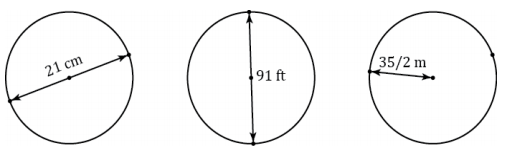
a. The following circles are not drawn to scale. Find the circumference of each circle. (Use \(\frac{22}{7}\) as an approximation for π.)
Engage NY Math 7th Grade Module 3 Lesson 16 Example Answer Key 1
Answer:
66 cm; 286 ft.; 110 m; Ask students if these numbers are roughly three times the diameters.

b. The radius of a paper plate is 11.7 cm. Find the circumference to the nearest tenth. (Use 3.14 as an approximation for π.)
Answer:
Diameter: 23.4 cm; circumference: 73.5 cm

c. The radius of a paper plate is 11.7 cm. Find the circumference to the nearest hundredth. (Use the π button on your calculator as an approximation for π.)
Answer:
Circumference: 73.51 cm

d. A circle has a radius of r cm and a circumference of C cm. Write a formula that expresses the value of C in terms of r and π.
Answer:
C = π ∙ 2r, or C = 2πr.

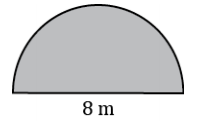
e. The figure below is in the shape of a semicircle. A semicircle is an arc that is half of a circle. Find the perimeter of the shape. (Use 3.14 for π.)
Engage NY Math 7th Grade Module 3 Lesson 16 Example Answer Key 2
Answer:
8 m + \(\frac{8(3.14)}{2}\) m = 20.56 m

Eureka Math Grade 7 Module 3 Lesson 16 Exercise Answer Key

Opening Exercise
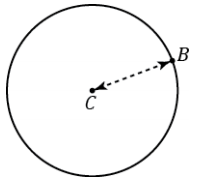
a. Using a compass, draw a circle like the picture to the right.
Engage NY Math Grade 7 Module 3 Lesson 16 Exercise Answer Key 1
C is the center of the circle.
The distance between C and B is the radius of the circle.

b. Write your own definition for the term circle.
Answer:
Student responses will vary. Many might say, “It is round.” “It is curved.” “It has an infinite number of sides.” “The points are always the same distance from the center.” Analyze their definitions, showing how other figures such as ovals are also “round” or “curved.” Ask them what is special about the compass they used. (Answer: The distance between the spike and the pencil is fixed when drawing the circle.) Let them try defining a circle again with this new knowledge.

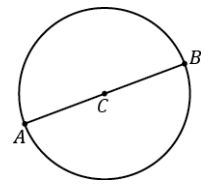
c. Extend segment CB to a segment AB, where A is also a point on the circle.
Answer:
Engage NY Math Grade 7 Module 3 Lesson 16 Exercise Answer Key 2

The length of the segment AB is called the diameter of the circle.
d. The diameter is ______________________ as long as the radius.
Answer:
The diameter is twice, or 2 times, as long as the radius.

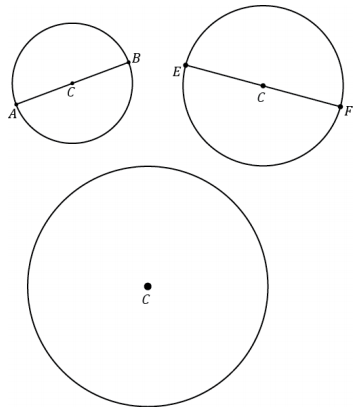
e. Measure the radius and diameter of each circle. The center of each circle is labeled C.
Engage NY Math Grade 7 Module 3 Lesson 16 Exercise Answer Key 3
Answer:
CB = 1.5 cm, AB = 3 cm, CF = 2 cm, EF = 4 cm
The radius of the largest circle is 3 cm. The diameter is 6 cm.

f. Draw a circle of radius 6 cm.
Answer:
Part (f) may not be as easy as it seems. Let students grapple with how to measure 6 cm with a compass. One difficulty they might encounter is trying to measure 6 cm by putting the spike of the compass on the edge of the ruler (i.e., the
0 cm mark). Suggest either of the following: (1) Measure the compass from the 1 cm mark to the 7 cm mark, or (2) Mark two points 6 cm apart on the paper first; then, use one point as the center.

Eureka Math Grade 7 Module 3 Lesson 16 Problem Set Answer Key

Question 1.
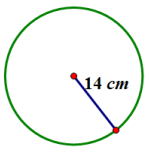
Find the circumference.
Eureka Math 7th Grade Module 3 Lesson 16 Problem Set Answer Key 1
a. Give an exact answer in terms of π.
Answer:
C = 2πr
C = 2π ∙ 14 cm
C = 28π cm

b. Use π ≈ \(\frac{22}{7}\) , and express your answer as a fraction in lowest terms.
Answer:
C ≈ 2 ∙ \(\frac{22}{7}\) ∙ 14 cm
C ≈ 88 cm

c. Use the π button on your calculator, and express your answer to the nearest hundredth.
Answer:
C = 2 ∙ π ∙ 14 cm
C ≈ 87.96 cm

Question 2.
Find the circumference.
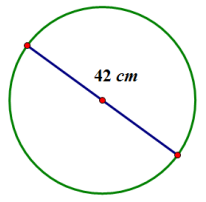
Eureka Math 7th Grade Module 3 Lesson 16 Problem Set Answer Key 2
a. Give an exact answer in terms of π.
Answer:
d = 42 cm
C = πd
C = 42π cm

b. Use π ≈ \(\frac{22}{7}\) , and express your answer as a fraction in lowest terms.
Answer:
C ≈ 42 cm ∙ \(\frac{22}{7}\)
C ≈ 132 cm

Question 3.
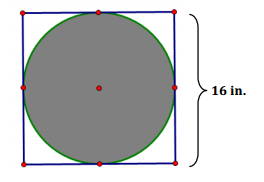
The figure shows a circle within a square. Find the circumference of the circle. Let π ≈ 3.14.
Eureka Math 7th Grade Module 3 Lesson 16 Problem Set Answer Key 3
Answer:
The diameter of the circle is the same as the length of the side of the square.
C = πd
C = π ∙ 16 in.
C ≈ 3.14 ∙ 16 in.
C ≈ 50.24 in.

Question 4.
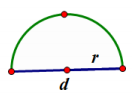
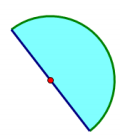
Consider the diagram of a semicircle shown.
Eureka Math 7th Grade Module 3 Lesson 16 Problem Set Answer Key 4
a. Explain in words how to determine the perimeter of a semicircle.
Answer:
The perimeter is the sum of the length of the diameter and half of the circumference of a circle with the same diameter.

b. Using d to represent the diameter of the circle, write an algebraic equation that will result in the perimeter of a semicircle.
Answer:
P = d + \(\frac{1}{2}\) πd

c. Write another algebraic equation to represent the perimeter of a semicircle using r to represent the radius of a semicircle.
Answer:
P = 2r + \(\frac{1}{2}\) π ∙ 2r
P = 2r + πr

Question 5.
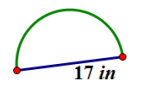
Find the perimeter of the semicircle. Let π ≈ 3.14.
Eureka Math 7th Grade Module 3 Lesson 16 Problem Set Answer Key 5
Answer:
P = d + \(\frac{1}{2}\) πd
P ≈ 17 in. + \(\frac{1}{2}\) ∙ 3.14 ∙ 17 in.
P ≈ 17 in. + 26.69 in.
P ≈ 43.69 in.

Question 6.
Ken’s landscape gardening business makes odd-shaped lawns that include semicircles. Find the length of the edging material needed to border the two lawn designs. Use 3.14 for π.
a. The radius of this flowerbed is 2.5 m.
Eureka Math 7th Grade Module 3 Lesson 16 Problem Set Answer Key 6
Answer:
A semicircle has half of the circumference of a circle. If the circumference of the semicircle is C = \(\frac{1}{2}\)(π ∙ 2 ∙ 2.5 m), then the circumference approximates 7.85 m. The length of the edging material must include the circumference and the diameter; 7.85 m + 5 m = 12.85 m. Ken needs 12.85 meters of edging to complete his design.

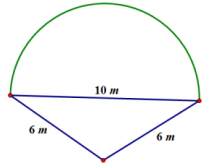
b. The diameter of the semicircular section is 10 m, and the lengths of the two sides are 6 m.
Eureka Math 7th Grade Module 3 Lesson 16 Problem Set Answer Key 7
Answer:
The circumference of the semicircular part has half of the circumference of a circle. The circumference of the semicircle is C = \(\frac{1}{2}\) π ∙ 10 m, which is approximately 15.7 m. The length of the edging material must include the circumference of the semicircle and the perimeter of two sides of the triangle;
15.7 m + 6 m + 6 m = 27.7 m. Ken needs 27.7 meters of edging to complete his design.

Question 7.
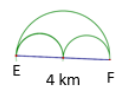
Mary and Margaret are looking at a map of a running path in a local park. Which is the shorter path from E to F, along the two semicircles or along the larger semicircle? If one path is shorter, how much shorter is it? Let π ≈ 3.14.
Eureka Math 7th Grade Module 3 Lesson 16 Problem Set Answer Key 8
Answer:
A semicircle has half of the circumference of a circle. The circumference of the large semicircle is C = \(\frac{1}{2}\) π ∙ 4 km, or 6.28 km. The diameter of the two smaller semicircles is 2 km. The total circumference would be the same as the circumference for a whole circle with the same diameter. If C = π ∙ 2 km, then C = 6.28 km. The distance around the larger semicircle is the same as the distance around both of the semicircles. So, both paths are equal in distance.

Question 8.
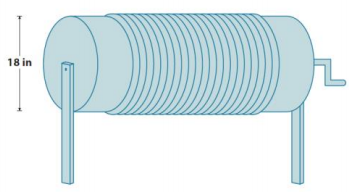
Alex the electrician needs 34 yards of electrical wire to complete a job. He has a coil of wiring in his workshop. The coiled wire is 18 inches in diameter and is made up of 21 circles of wire. Will this coil be enough to complete the job? Let π ≈ 3.14.
Eureka Math 7th Grade Module 3 Lesson 16 Problem Set Answer Key 9
Answer:
The circumference of the coil of wire is C = π ∙ 18 in., or approximately 56.52 in. If there are 21 circles of wire, then the number of circles times the circumference will yield the total number of inches of wire in the coil. If 56.52 in. ∙ 21 ≈ 1186.92 in., then \(\frac{1186.92 \mathrm{in.}}{36 \mathrm{in.}}\) ≈ 32.97 yd. (1 yd. = 3 ft. = 36 in. When converting inches to yards, you must divide the total inches by the number of inches in a yard, which is 36 inches.) Alex will not have enough wire for his job in this coil of wire.

Eureka Math Grade 7 Module 3 Lesson 16 Exit Ticket Answer Key

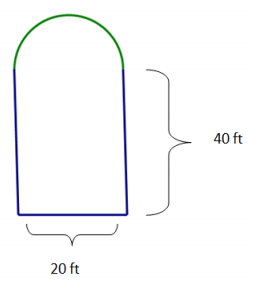
Brianna’s parents built a swimming pool in the backyard. Brianna says that the distance around the pool is 120 feet.
Question 1.
Is she correct? Explain why or why not.
Eureka Math Grade 7 Module 3 Lesson 16 Exit Ticket Answer Key 1
Answer:
Brianna is incorrect. The distance around the pool is 131.4 ft. She found the distance around the rectangle only and did not include the distance around the semicircular part of the pool.

Question 2.
Explain how Brianna would determine the distance around the pool so that her parents would know how many feet of stone to buy for the edging around the pool.
Answer:
In order to find the distance around the pool, Brianna must first find the circumference of the semicircle, which is C = \(\frac{1}{2}\) ∙ π ∙ 20 ft., or 10π ft., or about 31.4 ft. The sum of the three other sides is
20 ft. + 40 ft. + 40 ft. = 100 ft.; the perimeter is 100 ft. + 31.4 ft. = 131.4 ft.

Question 3.
Explain the relationship between the circumference of the semicircular part of the pool and the width of the pool.
Answer:
The relationship between the circumference of the semicircular part and the width of the pool is the same as half of π because this is half the circumference of the entire circle.

Eureka Math Grade 7 Module 3 Lesson 17 Answer Key

Engage NY Eureka Math 7th Grade Module 3 Lesson 17 Answer Key

Eureka Math Grade 7 Module 3 Lesson 17 Exploratory Challenge Answer Key

Exploratory Challenge
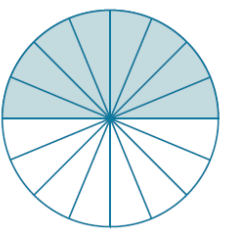
To find the formula for the area of a circle, cut a circle into 16 equal pieces.
Engage NY Math 7th Grade Module 3 Lesson 17 Exploratory Challenge Answer Key 1
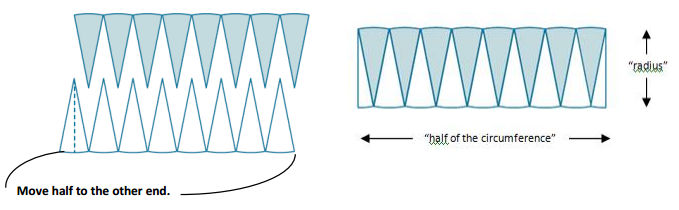
Arrange the triangular wedges by alternating the “triangle” directions and sliding them together to make a “parallelogram.” Cut the triangle on the left side in half on the given line, and slide the outside half of the triangle to the other end of the parallelogram in order to create an approximate “rectangle.”
Engage NY Math 7th Grade Module 3 Lesson 17 Exploratory Challenge Answer Key 2
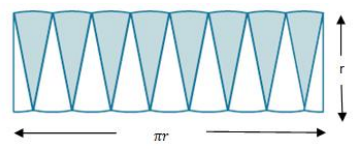
The circumference is 2πr, where the radius is r. Therefore, half of the circumference is πr.
Engage NY Math 7th Grade Module 3 Lesson 17 Exploratory Challenge Answer Key 3

What is the area of the “rectangle” using the side lengths above?
Answer:
The area of the “rectangle” is base times height, and, in this case, A = πr ∙ r.

Are the areas of the “rectangle” and the circle the same?
Answer:
Yes, since we just rearranged pieces of the circle to make the “rectangle,” the area of the “rectangle” and the area of the circle are approximately equal. Note that the more sections we cut the circle into, the closer the approximation.

If the area of the rectangular shape and the circle are the same, what is the area of the circle?
Answer:
The area of a circle is written as A = πr ∙ r, or A = πr2.

Eureka Math Grade 7 Module 3 Lesson 17 Example Answer Key

Example 1.
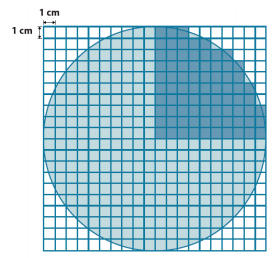
Use the shaded square centimeter units to approximate the area of the circle.
Engage NY Math 7th Grade Module 3 Lesson 17 Example Answer Key 1
Question 1.
What is the radius of the circle?
Answer:
10 cm

Question 2.
What would be a quicker method for determining the area of the circle other than counting all of the squares in the entire circle?
Answer:
Count \(\frac{1}{4}\) of the squares needed; then, multiply that by four in order to determine the area of the entire circle.

Question 3.
Using the diagram, how many squares were used to cover one-fourth of the circle?
Answer:
The area of one-fourth of the circle is approximately 79 cm2.

Question 4.
What is the area of the entire circle?
Answer:
A ≈ 4 ∙ 79 cm2
A ≈ 316 cm2

Example 2.
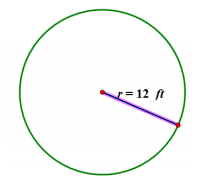
A sprinkler rotates in a circular pattern and sprays water over a distance of 12 feet. What is the area of the circular region covered by the sprinkler? Express your answer to the nearest square foot.
Draw a diagram to assist you in solving the problem. What does the distance of 12 feet represent in this problem?
Answer:
Engage NY Math 7th Grade Module 3 Lesson 17 Example Answer Key 2
The radius is 12 feet.

What information is needed to solve the problem?
Answer:
The formula to find the area of a circle is A = πr2. If the radius is 12 ft., then A = π ∙ (12 ft.)2 = 144π ft2, or approximately 452 ft2.

Example 3.
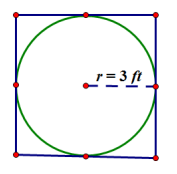
Suzanne is making a circular table out of a square piece of wood. The radius of the circle that she is cutting is 3 feet. How much waste will she have for this project? Express your answer to the nearest square foot.
Draw a diagram to assist you in solving the problem. What does the distance of 3 feet represent in this problem?
Answer:
The radius of the circle is 3 feet.
Engage NY Math 7th Grade Module 3 Lesson 17 Example Answer Key 3

Question 1.
What information is needed to solve the problem?
Answer:
The area of the circle and the area of the square are needed so that we can subtract the area of the circle from the area of the square to determine the amount of waste.

Question 2.
What information do we need to determine the area of the square and the circle?
Answer:
Circle: just radius because A = πr2 Square: one side length

Question 3.
How will we determine the waste?
Answer:
The waste is the area left over from the square after cutting out the circular region. The area of the circle is
A = π ∙ (3 ft.)2 = 9π ft2 ≈ 28.26 ft2. The area of the square is found by first finding the diameter of the circle, which is the same as the side of the square. The diameter is d = 2r; so, d = 2 ∙ 3 ft. or 6 ft. The area of a square is found by multiplying the length and width, so A = 6 ft. ∙ 6 ft. = 36 ft2. The solution is the difference between the area of the square and the area of the circle, so 36 ft2-28.26 ft2 ≈ 7.74 ft2.

Question 4.
Does your solution answer the problem as stated?
Answer:
Yes, the amount of waste is 7.74 ft2.

Eureka Math Grade 7 Module 3 Lesson 17 Exercise Answer Key

Exercises 1–3
Solve the problem below individually. Explain your solution.

Exercise 1.
Find the radius of a circle if its circumference is 37.68 inches. Use π ≈ 3.14.
Answer:
If C = 2πr, then 37.68 = 2πr. Solving the equation for r,
37.68 = 2πr
(\(\frac{1}{2 \pi}\))37.68 = (\(\frac{1}{2 \pi}\))2πr
\(\frac{1}{6.28}\) (37.68) ≈ r
6 ≈ r
The radius of the circle is approximately 6 in.

Exercise 2.
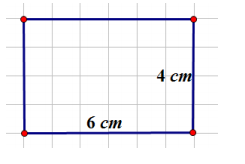
Determine the area of the rectangle below. Name two ways that can be used to find the area of the rectangle.
Engage NY Math Grade 7 Module 3 Lesson 17 Exercise Answer Key 1
Answer:
The area of the rectangle is 24 cm2. The area can be found by counting the square units inside the rectangle or by multiplying the length (6 cm) by the width (4 cm).

Exercise 3.
Find the length of a rectangle if the area is 27 cm2 and the width is 3 cm.
Answer:
If the area of the rectangle is Area = length ∙ width, then
27 cm2 = l ∙ 3 cm
\(\frac{1}{3}\) ∙ 27 cm2 = \(\frac{1}{3}\) ∙ l ∙ 3 cm
9 cm = l

Exercises 4–6

Exercise 4.
A circle has a radius of 2 cm.
a. Find the exact area of the circular region.
Answer:
A = π ∙ (2 cm)2 = 4π cm2

b. Find the approximate area using 3.14 to approximate π.
Answer:
A = 4 cm2 ∙ π ≈ 4 cm2 ∙ 3.14 ≈ 12.56 cm2

Exercise 5.
A circle has a radius of 7 cm.
a. Find the exact area of the circular region.
Answer:
A = π ∙ (7 cm)2 = 49π cm2

b. Find the approximate area using \(\frac{22}{7}\) to approximate π.
Answer:
A = 49 ∙ π cm2 ≈ (49 ∙ \(\frac{22}{7}\) ) cm2 ≈ 154 cm2

c. What is the circumference of the circle?
Answer:
C = 2π ∙ 7 cm = 14π cm ≈ 43.96 cm

Exercise 6.
Joan determined that the area of the circle below is 400π cm2. Melinda says that Joan’s solution is incorrect; she believes that the area is 100π cm2. Who is correct and why?
Answer:
Engage NY Math Grade 7 Module 3 Lesson 17 Exercise Answer Key 2
Melinda is correct. Joan found the area by multiplying π by the square of 20 cm (which is the diameter) to get a result of 400π cm2, which is incorrect. Melinda found that the radius was 10 cm (half of the diameter). Melinda multiplied π by the square of the radius to get a result of 100π cm2.

Eureka Math Grade 7 Module 3 Lesson 17 Problem Set Answer Key

Question 1.
The following circles are not drawn to scale. Find the area of each circle. (Use \(\frac{22}{7}\) as an approximation for π.)
Eureka Math 7th Grade Module 3 Lesson 17 Problem Set Answer Key 1
Answer:
Eureka Math 7th Grade Module 3 Lesson 17 Problem Set Answer Key 2

Question 2.
A circle has a diameter of 20 inches.
a. Find the exact area, and find an approximate area using π ≈ 3.14.
Answer:
If the diameter is 20 in., then the radius is 10 in. If A = πr2, then A = π ∙ (10 in.)2 or 100π in2.
A ≈ (100 ∙ 3.14) in2 ≈ 314 in2.

b. What is the circumference of the circle using π ≈ 3.14 ?
Answer:
If the diameter is 20 in., then the circumference is C = πd or C ≈ 3.14 ∙ 20 in. ≈ 62.8 in.

Question 3.
A circle has a diameter of 11 inches.
a. Find the exact area and an approximate area using π ≈ 3.14.
Answer:
If the diameter is 11 in., then the radius is \(\frac{11}{2}\) in. If A = πr2, then A = π ∙ (\(\frac{11}{2}\) in.)2or \(\frac{121}{4}\) π in2.
A ≈ (\(\frac{121}{4}\) ∙ 3.14) in2 ≈ 94.985 in2

b. What is the circumference of the circle using π ≈ 3.14?
Answer:
If the diameter is 11 inches, then the circumference is C = πd or C ≈ 3.14 ∙ 11 in. ≈ 34.54 in.

Question 4.
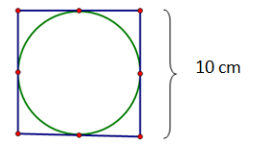
Using the figure below, find the area of the circle.
Eureka Math 7th Grade Module 3 Lesson 17 Problem Set Answer Key 3
Answer:
In this circle, the diameter is the same as the length of the side of the square. The diameter is 10 cm; so, the radius is 5 cm. A = πr2, so A = π(5 cm)2 = 25π cm2.

Question 5.
A path bounds a circular lawn at a park. If the inner edge of the path is 132 ft. around, approximate the amount of area of the lawn inside the circular path. Use π ≈ \(\frac{22}{7}\) .
Answer:
The length of the path is the same as the circumference. Find the radius from the circumference; then, find the area.
C = 2πr
132 ft. ≈ 2 ∙ \(\frac{22}{7}\) ∙ r
132 ft. ≈ \(\frac{44}{7}\) r
\(\frac{7}{44}\) ∙ 132 ft. ≈ \(\frac{7}{44}\) ∙ \(\frac{44}{7}\) r
21 ft. ≈ r
A ≈ \(\frac{22}{7}\) ∙ (21 ft.)2
A ≈ 1386 ft2

Question 6.
The area of a circle is 36π cm2. Find its circumference.
Answer:
Find the radius from the area of the circle; then, use it to find the circumference.
A = πr2
36π cm2 = πr2
\(\frac{1}{\pi}\) ∙ 36π cm2 = \(\frac{1}{\pi}\) ∙ πr2
36 cm2 = r2
6 cm = r
C = 2πr
C = 2π ∙ 6 cm
C = 12π cm

Question 7.
Find the ratio of the area of two circles with radii 3 cm and 4 cm.
Answer:
The area of the circle with radius 3 cm is 9π cm2. The area of the circle with the radius 4 cm is 16π cm2. The ratio of the area of the two circles is 9π:16π or 9:16.

Question 8.
If one circle has a diameter of 10 cm and a second circle has a diameter of 20 cm, what is the ratio of the area of the larger circle to the area of the smaller circle?
Answer:
The area of the circle with the diameter of 10 cm has a radius of 5 cm. The area of the circle with the diameter of 10 cm is π ∙ (5 cm)2, or 25π cm2. The area of the circle with the diameter of 20 cm has a radius of 10 cm. The area of the circle with the diameter of 20 cm is π ∙ (10 cm)2 or 100π cm2. The ratio of the diameters is 20 to 10 or 2:1, while the ratio of the areas is 100π to 25π or 4:1.

Question 9.
Describe a rectangle whose perimeter is 132 ft. and whose area is less than 1 ft2. Is it possible to find a circle whose circumference is 132 ft. and whose area is less than 1 ft2? If not, provide an example or write a sentence explaining why no such circle exists.
Answer:
A rectangle that has a perimeter of 132 ft. can have a length of 65.995 ft. and a width of 0 .005 ft. The area of such a rectangle is 0.329975 ft2, which is less than 1 ft2. No, because a circle that has a circumference of 132 ft. has a radius of approximately 21 ft.
A = πr2 = π(21)2 = 1387.96 ≠ 1

Question 10.
If the diameter of a circle is double the diameter of a second circle, what is the ratio of the area of the first circle to the area of the second?
Answer:
If I choose a diameter of 24 cm for the first circle, then the diameter of the second circle is 12 cm. The first circle has a radius of 12 cm and an area of 144π cm2. The second circle has a radius of 6 cm and an area of 36π cm2. The ratio of the area of the first circle to the second is 144π to 36π , which is a 4 to 1 ratio. The ratio of the diameters is 2, while the ratio of the areas is the square of 2, or 4.

Eureka Math Grade 7 Module 3 Lesson 17 Exit Ticket Answer Key

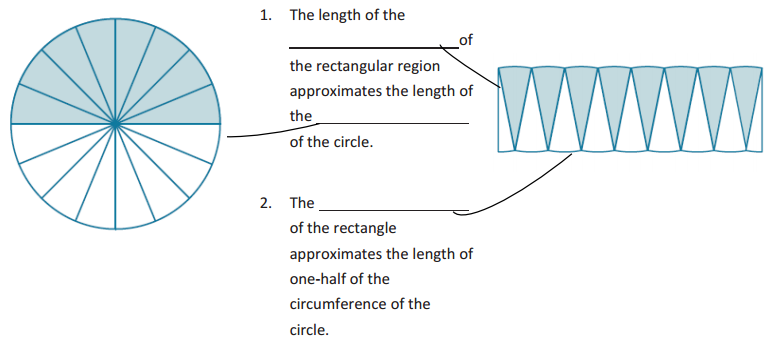
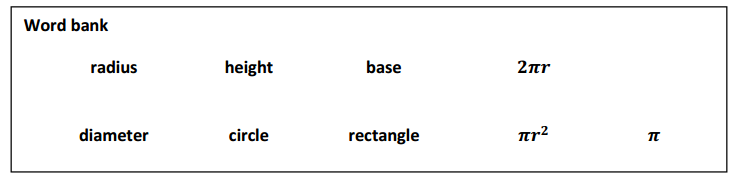
Complete each statement using the words or algebraic expressions listed in the word bank below.
Eureka Math Grade 7 Module 3 Lesson 17 Exit Ticket Answer Key 1
Answer:
1. The length of the height of the rectangular region approximates the length of the radius of the circle.
2. The base of the rectangle approximates the length of one-half of the circumference of the circle.

Question 3.
The circumference of the circle is _______________________.
Answer:
The circumference of the circle is 2πr.

Question 4.
The _________________ of the ___________________ is 2r.
Answer:
The diameter of the circle is 2r.

Question 5.
The ratio of the circumference to the diameter is ______.
Answer:
The ratio of the circumference to the diameter is π.

Question 6.
Area (circle) = Area of (_____________) = \(\frac{1}{2}\) ∙ circumference ∙ r = \(\frac{1}{2}\) (2πr) ∙ r = π ∙ r ∙ r = _____________.
Answer:
Area (circle) = Area of (rectangle) = \(\frac{1}{2}\) ∙ circumference ∙ r = \(\frac{1}{2}\) (2πr) ∙ r = π ∙ r ∙ r = πr2.

Eureka Math Grade 7 Module 3 Lesson 17 Exit Ticket Answer Key 2

Eureka Math Grade 8 Module 1 Lesson 9 Answer Key

Engage NY Eureka Math 8th Grade Module 1 Lesson 9 Answer Key

Eureka Math Grade 8 Module 1 Lesson 9 Exercise Answer Key

Are the following numbers written in scientific notation? If not, state the reason.

Exercise 1.
1.908×10¹⁷
Ans:
yes

Exercise 2.
0.325×10⁻²
Answer:
no, d<1

Exercise 3.
7.99×1032
Answer:
yes

Exercise 4.
4.0701 + 107
Answer:
no, it must be a product

Exercise 5.
18.432×58
Answer:
no, d>10 and it is ×5 instead of ×10

Exercise 6.
8×10-11
Answer:
yes

Exercises 7–9 (10 minutes)
Have students complete Exercises 7–9 independently.

Use the table below to complete Exercises 7 and 8.
The table below shows the debt of the three most populous states and the three least populous states.
Eureka Math Grade 8 Module 1 Lesson 9 Exercise Answer Key 20

Exercise 7.
a. What is the sum of the debts for the three most populous states? Express your answer in scientific notation.
Answer:
(4.07×(10)11)+(3.37×10¹¹)+(2.76×10¹¹)=(4.07+3.37+2.76)×1011
=10.2×1011
=(1.02×10)×1011
=1.02×10¹²

b. What is the sum of the debt for the three least populous states? Express your answer in scientific notation.
Ans:
(4×10⁹)+(4×10⁹)+(2×10⁹)=(4+4+2)×109
=10×109
=(1×10)×109
=1×10¹⁰

c. How much larger is the combined debt of the three most populous states than that of the three least populous states? Express your answer in scientific notation.
Answer:
(1.02×10¹²)-(1×10¹⁰)=(1.02×102×1010)-(1×10¹⁰)
=(102×1010)-(1×10¹⁰)
=(102-1)×1010
=101×1010
=(1.01×102)×1010
=1.01×10¹²

Exercise 8.
a. What is the sum of the population of the three most populous states? Express your answer in scientific notation.
Answer:
(3.8×10⁷)+(1.9×10⁷)+(2.6×10⁷)=(3.8+1.9+2.6)×107
=8.3×10⁷

b. What is the sum of the population of the three least populous states? Express your answer in scientific notation.
Answer:
(6.9×10⁵)+(6.26×10⁵)+(5.76×10⁵)=(6.9+6.26+5.76)×105
=18.92×105
=(1.892×10)×105
=1.892×10⁶

c. Approximately how many times greater is the total population of California, New York, and Texas compared to the total population of North Dakota, Vermont, and Wyoming?
Answer:
\(\frac{8.3 \times 10^{7}}{1.892 \times 10^{6}}\) = \(\frac{8.3}{1.892}\) × \(\frac{10^{7}}{10^{6}}\)
≈4.39×10
=43.9
The combined population of California, New York, and Texas is about 43.9 times greater than the combined population of North Dakota, Vermont, and Wyoming.

Exercise 9.
All planets revolve around the sun in elliptical orbits. Uranus’s furthest distance from the sun is approximately 3.004×10⁹ km, and its closest distance is approximately 2.749×10⁹ km. Using this information, what is the average distance of Uranus from the sun?
Answer:
average distance = \(\frac{\left(3.004 \times 10^{9}\right)+\left(2.749 \times 10^{9}\right)}{2}\)
= \(\frac{(3.004+2.749) \times 10^{9}}{2}\)
= \(\frac{5.753 \times 10^{9}}{2}\)
=2.8765×10⁹
On average, Uranus is 2.8765×10⁹ km from the sun.

Eureka Math Grade 8 Module 1 Lesson 9 Problem Set Answer Key

Students practice working with numbers written in scientific notation.

Question 1.
Write the number 68,127,000,000,000,000 in scientific notation. Which of the two representations of this number do you prefer? Explain.
Answer:
68 127 000 000 000 000=6.8127×10¹⁶
Most likely, students will say that they like the scientific notation better because it allows them to write less. However, they should also take note of the fact that counting the number of zeros in 68,127,000,000,000,000 is a nightmare. A strong reason for using scientific notation is to circumvent this difficulty: right away, the exponent 16 shows that this is a 17-digit number.

Question 2.
Here are the masses of the so-called inner planets of the solar system.
Eureka Math Grade 8 Module 1 Lesson 9 Problem Set Answer Key 30
What is the average mass of all four inner planets? Write your answer in scientific notation.
Answer:
Eureka Math Grade 8 Module 1 Lesson 9 Problem Set Answer Key 35
The average mass of the inner planets is 2.9531925×1024 kg.

Eureka Math Grade 8 Module 1 Lesson 9 Exit Ticket Answer Key

Question 1.
The approximate total surface area of Earth is 5.1×10⁸ km2. All the salt water on Earth has an approximate surface area of 352,000,000 km2, and all the fresh water on Earth has an approximate surface area of 9×10⁶ km2. How much of Earth’s surface is covered by water, including both salt and fresh water? Write your answer in scientific notation.
Answer:
(3.52×10⁸)+(9×10⁶)=(3.52×102×106)+(9×10⁶)
=(352×106)+(9×10⁶)
=(352+9)×106
=361×106
=3.61×10⁸
The Earth’s surface is covered by 3.61×10⁸ km2 of water.

Question 2.
How much of Earth’s surface is covered by land? Write your answer in scientific notation.
Answer:
(5.1×10⁸)-(3.61×10⁸)=(5.1-3.61)×108
=1.49×10⁸
The Earth’s surface is covered by 1.49×10⁸ km2 of land.

Question 3.
Approximately how many times greater is the amount of Earth’s surface that is covered by water compared to the amount of Earth’s surface that is covered by land?
Answer:
\(\frac{3.61 \times 10^{8}}{1.49 \times 10^{8}}\)≈2.4
About 2.4 times more of the Earth’s surface is covered by water than by land.

Eureka Math Grade 8 Module 1 Lesson 8 Answer Key

Engage NY Eureka Math 8th Grade Module 1 Lesson 8 Answer Key

Eureka Math Grade 8 Module 1 Lesson 8 Example Answer Key

Example 1.
In 1723, the population of New York City was approximately 7,248. By 1870, almost 150 years later, the population had grown to 942,292. We want to determine approximately how many times greater the population was in 1870 compared to 1723.
The word approximately in the question lets us know that we do not need to find a precise answer, so we approximate both populations as powers of 10.
→ Population in 1723: 7248<9999<10000=104
→ Population in 1870: 942 292<999 999<1 000 000=106
We want to compare the population in 1870 to the population in 1723:
\(\frac{10^{6}}{10^{4}}\)
Now we can use what we know about the laws of exponents to simplify the expression and answer the question:
\(\frac{10^{6}}{10^{4}}\) =102.
Therefore, there were approximately 100 times more people in New York City in 1870 compared to 1723.

Example 2.
Let’s compare the population of New York City to the population of New York State. Specifically, let’s find out how many times greater the population of New York State is compared to that of New York City.
The population of New York City is 8,336,697. Let’s round this number to the nearest million; this gives us 8,000,000. Written as single-digit integer times a power of 10:
8 000 000=8×10⁶.
The population of New York State is 19,570,261. Rounding to the nearest million gives us 20,000,000. Written as a single-digit integer times a power of 10:
20 000 000=2×10⁷.
To estimate the difference in size we compare state population to city population:
\(\frac{2 \times 10^{7}}{8 \times 10^{6}}\)
Now we simplify the expression to find the answer:
\(\frac{2 \times 10^{7}}{8 \times 10^{6}}\) = \(\frac{2}{8}\) × \(\frac{10^{7}}{10^{6}}\)By the product formula
= \(\frac{1}{4}\)×10 By equivalent fractions and the first law of exponents
=0.25×10
=2.5
Therefore, the population of the state is 2.5 times that of the city.

Example 3.
There are about 9 billion devices connected to the Internet. If a wireless router can support 300 devices, about how many wireless routers are necessary to connect all 9 billion devices wirelessly?
Because 9 billion is a very large number, we should express it as a single-digit integer times a power of 10.
9 000 000 000=9×10⁹
The laws of exponents tells us that our calculations will be easier if we also express 300 as a single-digit integer times a power of 10, even though 300 is much smaller.
300=3×10²
We want to know how many wireless routers are necessary to support 9 billion devices, so we must divide
\(\frac{9 \times 10^{9}}{3 \times 10^{2}}\)
Now, we can simplify the expression to find the answer:
\(\frac{9 \times 10^{9}}{3 \times 10^{2}}\) = \(\frac{9}{3}\) × \(\frac{10^{9}}{10^{2}}\) By the product formula
=3×10⁷ By equivalent fractions and the first law of exponents
=30 000 000
About 30 million routers are necessary to connect all devices wirelessly.

Example 4.
The average American household spends about $40,000 each year. If there are about 1×〖10〗8 households, what is the total amount of money spent by American households in one year?
Let’s express $40,000 as a single-digit integer times a power of 10.
40000=4×〖10〗4
The question asks us how much money all American households spend in one year, which means that we need to multiply the amount spent by one household by the total number of households:
(4×10⁴ )(1×10⁸ )=(4×1)(104×108 ) By repeated use of associative and commutative properties
=4×10¹² By the first law of exponents
Therefore, American households spend about $4,000,000,000,000 each year altogether!

Eureka Math Grade 8 Module 1 Lesson 8 Exercise Answer Key

Exercise 1.
The Federal Reserve states that the average household in January of 2013 had $7,122 in credit card debt. About how many times greater is the U.S. national debt, which is $16,755,133,009,522? Rewrite each number to the nearest power of 10 that exceeds it, and then compare.
Answer:
Household debt=7122<9999<10000=104.
U.S.debt =16 755 133 009 522<99 999 999 999 999<100 000 000 000 000=1014.
\(\frac{10^{14}}{10^{4}}\) = 1014-4=1010. The U.S. national debt is 1010 times greater than the average household’s credit card debt.

Exercise 2.
There are about 3,000,000 students attending school, kindergarten through Grade 12, in New York. Express the number of students as a single-digit integer times a power of 10.
Answer:
3 000 000=3×10⁶

The average number of students attending a middle school in New York is 8×〖10〗2. How many times greater is the overall number of K–12 students compared to the average number of middle school students?
Answer:
\(\frac{3 \times 10^{6}}{8 \times 10^{2}}\)= \(\frac{3}{8}\)×\(\frac{10^{6}}{10^{2}}\)
= \(\frac{3}{8}\)×\(\frac{10^{6}}{10^{2}}\)
=0.375×〖10〗4
=3750
There are about 3,750 times more students in K–12 compared to the number of students in middle school.

Exercise 3.
A conservative estimate of the number of stars in the universe is 6×10²². The average human can see about 3,000 stars at night with his naked eye. About how many times more stars are there in the universe compared to the stars a human can actually see?
Answer:
\(\frac{6 \times 10^{22}}{3 \times 10^{3}}\) = \(\frac{6}{3}\) ×\(\frac{10^{22}}{10^{3}}\)= 2×10²²-3 = 2×10¹⁹
There are about 2×10¹⁹ times more stars in the universe compared to the number we can actually see.

Exercise 4.
The estimated world population in 2011 was 7×10⁹. Of the total population, 682 million of those people were left-handed. Approximately what percentage of the world population is left-handed according to the 2011 estimation?
Answer:
682 000 000≈700 000 000=7×10⁸
\(\frac{7 \times 10^{8}}{7 \times 10^{9}}\)=\(\frac{7}{7}\)×\(\frac{10^{8}}{10^{9}}\)
= 1×\(\frac{1}{10}\)
=\(\frac{1}{10}\)
About one-tenth of the population is left-handed, which is equal to 10%.

Exercise 5
The average person takes about 30,000 breaths per day. Express this number as a single-digit integer times a power of 10.
Answer:
30000=3×10⁴

If the average American lives about 80 years (or about 30,000 days), how many total breaths will a person take in her lifetime?
Answer:
(3×10⁴ )×(3×10⁴ )=9×10⁸
The average American takes about 900,000,000 breaths in a lifetime.

Eureka Math Grade 8 Module 1 Lesson 8 Problem Set Answer Key

Students practice estimating size of quantities and performing operations on numbers written in the form of a single-digit integer times a power of 10.

Question 1.
The Atlantic Ocean region contains approximately 2×10¹⁶ gallons of water. Lake Ontario has approximately 8,000,000,000,000 gallons of water. How many Lake Ontarios would it take to fill the Atlantic Ocean region in terms of gallons of water?
Answer:
8 000 000 000 000=8×10¹²
\(\frac{2 \times 10^{16}}{8 \times 10^{12}}\)=\(\frac{2}{8}\)×\(\frac{10^{16}}{10^{12}}\)
=\(\frac{1}{4}\)×104
=0.25×104
=2500
2,500 Lake Ontario’s would be needed to fill the Atlantic Ocean region.

Question 2.
U.S. national forests cover approximately 300,000 square miles. Conservationists want the total square footage of forests to be 300,000〗2 square miles. When Ivanna used her phone to do the calculation, her screen showed the following:
Eureka Math Grade 8 Module 1 Lesson 8 Problem Set Answer Key 1
a. What does the answer on her screen mean? Explain how you know.
Answer:
The answer means 9×10¹⁰. This is because:
(300 000)2=(3×10⁵)2
=32×(105 )2
=9×10¹⁰

b. Given that the U.S. has approximately 4 million square miles of land, is this a reasonable goal for conservationists? Explain.
Answer:
4 000 000=4×10⁶. It is unreasonable for conservationists to think the current square mileage of forests could increase that much because that number is greater than the number that represents the total number of square miles in the U.S,
9×10¹⁰>4×10⁶.

Question 3.
The average American is responsible for about 20,000 kilograms of carbon emission pollution each year. Express this number as a single-digit integer times a power of 10.
Answer:
20 000=2×10⁴

Question 4.
The United Kingdom is responsible for about 1× 10⁴ kilograms of carbon emission pollution each year. Which country is responsible for greater carbon emission pollution each year? By how much?
Answer:
2× 10⁴>1×10⁴
America is responsible for greater carbon emission pollution each year. America produces twice the amount of the U.K. pollution.

Eureka Math Grade 8 Module 1 Lesson 8 Exit Ticket Answer Key

Most English-speaking countries use the short-scale naming system, in which a trillion is expressed as 1,000,000,000,000. Some other countries use the long-scale naming system, in which a trillion is expressed as 1,000,000,000,000,000,000,000. Express each number as a single-digit integer times a power of ten. How many times greater is the long-scale naming system than the short-scale?
Answer:
1 000 000 000 000=1012
1 000 000 000 000 000 000 000= 1021
\(\frac{10^{21}}{10^{12}}\) = 109. The long-scale is about 109 times greater than the short-scale.

Eureka Math Grade 8 Module 1 Lesson 8 Sprint Answer Key

Applying Properties of Exponents to Generate Equivalent Expressions—Round 1
Directions: Simplify each expression using the laws of exponents. Use the least number of bases possible and only positive exponents. When appropriate, express answers without parentheses or as equal to 1. All letters denote numbers.
Eureka Math Grade 8 Module 1 Lesson 8 Sprint Answer Key 60
Answer:
Eureka Math Grade 8 Module 1 Lesson 8 Sprint Answer Key 61

Applying Properties of Exponents to Generate Equivalent Expressions—Round 2

Directions: Simplify each expression using the laws of exponents. Use the least number of bases possible and only positive exponents. When appropriate, express answers without parentheses or as equal to 1. All letters denote numbers.
Eureka Math Grade 8 Module 1 Lesson 8 Sprint Answer Key 23
Answer:
Eureka Math Grade 8 Module 1 Lesson 8 Sprint Answer Key 24

Eureka Math Grade 8 Module 1 Lesson 7 Answer Key

Engage NY Eureka Math 8th Grade Module 1 Lesson 7 Answer Key

Eureka Math Grade 8 Module 1 Lesson 7 Exercise Answer Key

Exercise 1.
Let M=993,456,789,098,765. Find the smallest power of 10 that will exceed M.
Answer:
M=993 456 789 098 765 < 999 999 999 999 999 < 1 000 000 000 000 000=1015. Because M has 15 digits, 1015 will exceed it.

Exercise 2.
Let M=78,491\(\frac{899}{987}\). Find the smallest power of 10 that will exceed M.
Answer:
M=78491\(\frac{899}{987}\) < 78492<99999<100 000=105.
Therefore, 105 will exceed M.

Exercise 3.
Let M be a positive integer. Explain how to find the smallest power of 10 that exceeds it.
Answer:
If M is a positive integer, then the power of 10 that exceeds it will be equal to the number of digits in M. For example, if M were a 10-digit number, then 1010 would exceed M. If M is a positive number, but not an integer, then the power of 10 that would exceed it would be the same power of 10 that would exceed the integer to the right of M on a number line. For example, if M=5678.9, the integer to the right of M is 5,679. Then based on the first explanation, 104 exceeds both this integer and M; this is because M=5678.9<5679<10 000=104.

Exercise 4.
The chance of you having the same DNA as another person (other than an identical twin) is approximately 1 in 10 trillion (one trillion is a 1 followed by 12 zeros). Given the fraction, express this very small number using a negative power of 10.
\(\frac{1}{10000000000000}\)
Answer:
\(\frac{1}{10000000000000}\) = \(\frac{1}{10^{13}}\)
= 10-13

Exercise 5.
The chance of winning a big lottery prize is about 10-8, and the chance of being struck by lightning in the U.S. in any given year is about 0.000 001. Which do you have a greater chance of experiencing? Explain.
Answer:
0.000 001=10-6
There is a greater chance of experiencing a lightning strike. On a number line, 10-8 is to the left of 10-6. Both numbers are less than one (one signifies 100% probability of occurring). Therefore, the probability of the event that is greater is 10-6—that is, getting struck by lightning.

Exercise 6.
There are about 100 million smartphones in the U.S. Your teacher has one smartphone. What share of U.S. smartphones does your teacher have? Express your answer using a negative power of 10.
Answer:
\(\frac{1}{100000000}\)=\(\frac{1}{10^{8}}\)=10-8

Eureka Math Grade 8 Module 1 Lesson 7 Problem Set Answer Key

Question 1.
What is the smallest power of 10 that would exceed 987,654,321,098,765,432?
Answer:
987 654 321 098 765 432<999 999 999 999 999 999<1 000 000 000 000 000 000=1018

Question 2.
What is the smallest power of 10 that would exceed 999,999,999,991?
Answer:
999 999 999 991<999 999 999 999<1 000 000 000 000=1012

Question 3.
Which number is equivalent to 0.000 000 1: 107or 10-7? How do you know?
Answer:
0.000 000 1=10-7. Negative powers of 10 denote numbers greater than zero but less than 1. Also, the decimal 0.000 000 1 is equal to the fraction \(\frac{1}{10^{7}}\) which is equivalent to 10-7.

Question 4.
Sarah said that 0.000 01 is bigger than 0.001 because the first number has more digits to the right of the decimal point. Is Sarah correct? Explain your thinking using negative powers of 10 and the number line.
Answer:
0.000 01= \(\frac{1}{100000}\) = 10-5 and 0.001= \(\frac{1}{1000}\) =10-3. On a number line, 10-5 is closer to zero than 10-3; therefore, 10-5 is the smaller number, and Sarah is incorrect.

Question 5.
Order the following numbers from least to greatest:
Engage NY Math Grade 8 Module 1 Lesson 7 Problem Set Answer Key 1
Answer:
10-99<10-17<10-5<105<10-14<1030

Eureka Math Grade 8 Module 1 Lesson 7 Exit Ticket Answer Key

Question 1.
Let M=118,526.65902. Find the smallest power of 10 that will exceed M.
Answer:
Since M=118,526.65902<118,527<1,000,000<106, then 106will exceed M.

Question 2.
Scott said that 0.09 was a bigger number than 0.1. Use powers of 10 to show that he is wrong.
Answer:
We can rewrite 0.09 as \(\frac{9}{10^{2}}\) = 9×10⁻² and rewrite 0.1 as \(\frac{1}{10^{1}}\) =1 ×10⁻¹. Because 0.09 has a smaller power of 10, 0.09 is closer to zero and is smaller than 0.1.

Eureka Math Grade 8 Module 1 Lesson 6 Answer Key

Engage NY Eureka Math 8th Grade Module 1 Lesson 6 Answer Key

Eureka Math Grade 8 Module 1 Lesson 6 Exercise Answer Key

Exercise 1.
Show that (C) is implied by equation (5) of Lesson 4 when m>0, and explain why (C) continues to hold even when
m=0.
Answer:
Equation (5) says for any numbers x, y, (y≠0) and any positive integer n, the following holds: (\(\frac{x}{y}\))n=\(\frac{x^{n}}{y^{n}}\). So,
(\(\frac{1}{x}\))m = \(\frac{1^{m}}{x^{m}}\) By (\(\frac{x}{y}\))n= \(\frac{x^{n}}{y^{n}}\) for positive integer n and nonzero y (5)
= \(\frac{1}{x^{m}}\) Because 1m =1

If m= 0, then the left side is
(\(\frac{1}{x}\))m =(\(\frac{1}{x}\))0
=1 By definition of x0,
and the right side is
\(\frac{1}{x^{m}}\) = \(\frac{1}{x^{0}}\)
= \(\frac{1}{1}\) By definition of x0
=1.

Exercise 2.
Show that (B) is in fact a special case of (11) by rewriting it as (xm)-1 = x(-1m) for any whole number m, so that if b=m (where m is a whole number) and a=-1, (11) becomes (B).
Answer:
(B) says x-m = \(\frac{1}{x^{m}}\).
The left side of (B), x-m is equal to x(-1)m.
The right side of (B), \(\frac{1}{x^{m}}\), is equal to (xm)-1 by the definition of (xm)-1 in Lesson 5.
Therefore, (B) says exactly that (xm)-1 = x(-1)m.

Exercise 3.
Show that (C) is a special case of (11) by rewriting (C) as (x-1)m = xm(-1) for any whole number m. Thus, (C) is the special case of (11) when b=-1 and a=m, where m is a whole number.
Answer:
(C) says (\(\frac{1}{x}\))m = \(\frac{1}{x^{m}}\) for any whole number m.
The left side of (C) is equal to
(\(\frac{1}{x}\))m =(x-1)mBy definition of x-1 ,
and the right side of (C) is equal to
\(\frac{1}{x^{m}}\) =x-m By definition of x-m, and the latter is equal to xm(-1). Therefore, (C) says (x-1)m) =xm(-1) for any whole number m.

Exercise 4.
Proof of Case (iii): Show that when a<0 and b≥0, (xb )a=xab is still valid. Let a=-c for some positive integer c. Show that the left and right sides of (xb )a=xab are equal.
The left side is
(xb )a=(xb )-c
= \(\frac{1}{\left(x^{b}\right)^{c}}\) By x-m = \(\frac{1}{x^{m}}\) for any whole number m (B)
= \(\frac{1}{x^{c b}}\) . By (xm)n=xmn for all whole numbers m and n (A)
The right side is
xab = x(-c)b
=x-(cb)
= \(\frac{1}{x^{c b}}\) . By x-m = \(\frac{1}{x^{m}}\) for any whole number m (B)
So, the two sides are equal.

Eureka Math Grade 8 Module 1 Lesson 6 Problem Set Answer Key

Question 1.
You sent a photo of you and your family on vacation to seven Facebook friends. If each of them sends it to five of their friends, and each of those friends sends it to five of their friends, and those friends send it to five more, how many people (not counting yourself) will see your photo? No friend received the photo twice. Express your answer in exponential notation.
Eureka Math Grade 8 Module 1 Lesson 6 Problem Set Answer Key 18
Answer:
Eureka Math Grade 8 Module 1 Lesson 6 Problem Set Answer Key 19
The total number of people who viewed the photo is (50+51+52+53 )×7.

Question 2.
Show directly, without using (11), that (1.27-36 )85= 1.27-36∙85.
Answer:
(1.27-36 )85= (\(\frac{1}{1.27^{36}}\))85 By definition
= \(\frac{1}{\left(1.27^{36}\right)^{85}}\)By (\(\frac{1}{x}\))m =\(\frac{1}{x^{m}}\) for any whole number m (C)
= \(\frac{1}{1.27^{36 \cdot 85}}\)By (xm)n=xmn for whole numbers m and n (7)
= 1.27-36∙85 By x-m = \(\frac{1}{x^{m}}\) for any whole number m (B)

Question 3.
Show directly that (\(\frac{2}{13}\))-127∙(\(\frac{2}{13}\))-56=(\(\frac{2}{13}\))-183.
Answer:
Eureka Math Grade 8 Module 1 Lesson 6 Problem Set Answer Key 50

Question 4.
Prove for any nonzero number x, x-127∙x-56=x-183.
Answer:
x-127∙x-56 =\(\frac{1}{x^{127}}\) ∙\(\frac{1}{x^{56}}\) By definition
= \(\frac{1}{x^{127} \cdot x^{56}}\) By the product formula for complex fractions
=\(\frac{1}{x^{127+56}}\) By xm ∙xn=xm+n for whole numbers m and n (6)
= \(\frac{1}{x^{183}}\)
= x-183 By x-m = \(\frac{1}{x^{m}}\) for any whole number m (B)

Question 5.
Prove for any nonzero number x, x-m ∙x-n=x-m-n for positive integers m and n.
Answer:
x-m∙x-n= \(\frac{1}{x^{m}}\)∙\(\frac{1}{x^{n}}\) By definition
= \(\frac{1}{x^{m} \cdot x^{n}}\) By the product formula for complex fractions
= \(\frac{1}{x^{m+n}}\) By xm ∙xn=xm+n for whole numbers m and n (6)
=x-(m+n) By x-m = \(\frac{1}{x^{m}}\) for any whole number m (B)
=x-m-n

Question 6.
Which of the preceding four problems did you find easiest to do? Explain.
Answer:
Students will likely say that x-m ∙x-n=x-m-n (Problem 5) was the easiest problem to do. It requires the least amount of writing because the symbols are easier to write than decimal or fraction numbers.

Question 7.
Use the properties of exponents to write an equivalent expression that is a product of distinct primes, each raised to an integer power.
Answer:
Eureka Math Grade 8 Module 1 Lesson 6 Problem Set Answer Key 60

Eureka Math Grade 8 Module 1 Lesson 6 Exit Ticket Answer Key

Question 1.
Show directly that for any nonzero integer x, x-5∙x-7 = x-12.
Answer:
x-5∙x-7 =\(\frac{1}{x^{5}}\) ∙\(\frac{1}{x^{7}}\) By x-m = \(\frac{1}{x^{m}}\) for any whole number m (B)
=\(\frac{1}{x^{5} \cdot x^{7}}\) By the product formula for complex fractions
=\(\frac{1}{x^{5+7}}\) By xm ∙xn=xm+n for whole numbers m and n (6)
=\(\frac{1}{x^{12}}\)
= x-12 By x-m = \(\frac{1}{x^{m}}\) for any whole number m (B)

Question 2.
Show directly that for any nonzero integer x, (x-2 )-3=x6.
Answer:
(x-2)-3 = \(\frac{1}{\left(x^{-2}\right)^{3}}\) By x-m = \(\frac{1}{x^{m}}\) for any whole number m (B)
= \(\frac{1}{x^{-(2 \cdot 3)}}\) By case (ii) of (11)
=\(\frac{1}{x^{-6}}\)
= x6 By x-m = \(\frac{1}{x^{m}}\) for any whole number m (B)

Eureka Math Grade 8 Module 1 Lesson 5 Answer Key

Engage NY Eureka Math 8th Grade Module 1 Lesson 5 Answer Key

Eureka Math Grade 8 Module 1 Lesson 5 Exercise Answer Key

Exercise 1.
Verify the general statement x-b=\(\frac{1}{x^{b}}\) for x=3 and b=-5.
Answer:
If b were a positive integer, then we have what the definition states. However, b is a negative integer, specifically
b=-5, so the general statement in this case reads
3-(-5)=\(\frac{1}{3^{-5}}\).
The right side of this equation is
Eureka Math Grade 8 Module 1 Lesson 5 Exercise Answer Key 1
Since the left side is also 35, both sides are equal.
3-(-5)=\(\frac{1}{3^{-5}}\)=35

Exercise 2.
What is the value of (3×10⁻²)?
Answer:
(3×10⁻²) = 3 × \(\frac{1}{10^{2}}\) = \(\frac{3}{10^{2}}\) =0.03

Exercise 3.
What is the value of (3×10⁻⁵)?
Answer:
(3×10⁻⁵) = 3×\(\frac{1}{10^{5}}\) = \(\frac{3}{10^{5}}\) =0.00003

Exercise 4.
Write the complete expanded form of the decimal 4.728 in exponential notation.
Answer:
4.728=(4×100)+(7×10⁻¹)+(2×10⁻²)+(8×10⁻³)

For Exercises 5–10, write an equivalent expression, in exponential notation, to the one given, and simplify as much as possible.

Exercise 5.
5-3=
Answer:
\(\frac{1}{5^{3}}\)

Exercise 6.
\(\frac{1}{8^{9}}\) =
Answer:
8-9

Exercise 7.
3∙2-4=
Answer:
3∙\(\frac{1}{2^{4}}\) =\(\frac{3}{2^{4}}\)

Exercise 8.
Let x be a nonzero number.
x-3=
Answer:
\(\frac{1}{x^{3}}\)

Exercise 9.
Let x be a nonzero number.
\(\frac{1}{x^{9}}\) =x-9

Exercise 10.
Let x,y be two nonzero numbers.
xy-4 =
Answer:
x∙\(\frac{1}{y^{4}}\) = \(\frac{x}{y^{4}}\)

Exercise 11.
\(\frac{19^{2}}{19^{5}}\) =
Answer:
192-5

Exercise 12.
\(\frac{17^{16}}{17^{-3}}\) =
Answer:
1716×\(\frac{1}{17^{-3}}\) =1716×173= 1716+3

Exercise 13.
If we let b=-1 in (11), a be any integer, and y be any nonzero number, what do we get?
Answer:
(y-1)a=y-a

Exercise 14.
Show directly that (\(\frac{7}{5}\))-4=\(\frac{7^{-4}}{5^{-4}}\).
Answer:
(\(\frac{7}{5}\))-4=(7∙\(\frac{1}{5}\))-4 By the product formula
=(7∙5-1 )-4 By definition
=7-4∙(5-1 )-4 By (xy)a=xa ya (12)
=7-4∙54 By (xb )a=xab (11)
=7-4∙\(\frac{1}{5-4}\) By x-b=\(\frac{1}{x^{b}}\)(9)
=\(\frac{7^{-4}}{5^{-4}}\) By product formula

Eureka Math Grade 8 Module 1 Lesson 5 Problem Set Answer Key

Question 1.
Compute: 33 ×32 ×31 ×30×3-1 ×3-2=
Answer:
33 =27
Compute: 52 ×51 0×58 ×50×5-10 ×5-8 =52 =25
Compute for a nonzero number, a: am ×an ×al ×a-n ×a-m ×a-l ×a0=
Answer:
a0=1

Question 2.
Without using (10), show directly that (17.6-1 )8 = 17.6-8 .
Answer:
(17.6-1)8 =(\(\frac{1}{17.6}\))8 By definition
= \(\frac{1^{8}}{17.6^{8}}\) By (\(\frac{x}{y}\))n = \(\frac{x^{n}}{y^{n}}\) (5)
= \(\frac{1}{17.6^{8}}\)
= 17.6-8 By definition

Question 3.
Without using (10), show (prove) that for any whole number n and any nonzero number y, (y-1 )n =y-n .
Answer:
(y-1 )n =(\(\frac{1}{y}\))n By definition
=\(\frac{1^{n}}{y^{n}}\) By (\(\frac{x}{y}\))n = \(\frac{x^{n}}{y^{n}}\)(5)
= \(\frac{1}{y^{n}}\)
= y-n By definition

Question 4.
Without using (13), show directly that \(\frac{2.8^{-5}}{2.8^{7}}\) = 2.8-12 .
Answer:
\(\frac{2.8^{-5}}{2.8^{7}}\) = 2.8-5 × \(\frac{1}{2.8^{7}}\) By the product formula for complex fractions
= \(\frac{1}{2.8^{5}}\) × \(\frac{1}{2.8^{7}}\) By definition
= \(\frac{1}{2.8^{5} \times 2.8^{7}}\) By the product formula for complex fractions
= \(\frac{1}{2.8^{5+7}}\) By xa∙xb =xa+b (10)
= \(\frac{1}{2.8^{12}}\)
= 2.8-12 By definition

Eureka Math Grade 8 Module 1 Lesson 5 Exit Ticket Answer Key

Write each expression in a simpler form that is equivalent to the given expression.

Question 1.
76543-4=
Answer:
\(\frac{1}{76543^{4}}\)

Question 2.
Let f be a nonzero number. f-4=
Answer:
\(\frac{1}{f^{4}}\)

Question 3.
671×28796-1 =
Answer:
671×\(\frac{1}{28796}\)=\(\frac{671}{28796}\)

Question 4.
Let a, b be numbers (b≠0). ab-1 =
Answer:
a∙\(\frac{1}{b}\)=\(\frac{a}{b}\)

Question 5.
Let g be a nonzero number. \(\frac{1}{g^{-1}}\) =
Answer:
g

Eureka Math Grade 8 Module 1 Lesson 4 Answer Key

Engage NY Eureka Math 8th Grade Module 1 Lesson 4 Answer Key

Eureka Math Grade 8 Module 1 Lesson 4 Exercise Answer Key

Exercise 1.
List all possible cases of whole numbers m and n for identity (1). More precisely, when m>0 and n>0, we already know that (1) is correct. What are the other possible cases of m and n for which (1) is yet to be verified?
Answer:
Case (A): m>0 and n=0
Case (B): m=0 and n>0
Case (C): m=n=0

Model how to check the validity of a statement using Case (A) with equation (1) as part of Exercise 2. Have students work independently or in pairs to check the validity of (1) in Case (B) and Case (C) to complete Exercise 2. Next, have students check the validity of equations (2) and (3) using Cases (A)–(C) for Exercises 3 and 4.

Exercise 2.
Check that equation (1) is correct for each of the cases listed in Exercise 1.
Answer:
Case (A): xm∙x0=xm? Yes, because xm∙x0=xm∙1=xm.
Case (B): x0∙xn=xn? Yes, because x0∙xn=1∙xn=xn.
Case (C): x0∙x0=x0? Yes, because x0∙x0=1∙1=x0.

Exercise 3.
Do the same with equation (2) by checking it case-by-case.
Answer:
Case (A): (xm)0=x0×m? Yes, because xm is a number, and a number raised to a zero power is 1. 1=x0=x0×m.
S0, the left side is 1. The right side is also 1 because x0×m=x0=1.
Case (B): (x0)n=xn×0? Yes, because, by definition x0=1 and 1n=1, the left side is equal to 1. The right side is equal to x0=1, so both sides are equal.
Case (C): (x0)0=x0×0? Yes, because, by definition of the zeroth power of x, both sides are equal to 1.

Exercise 4.
Do the same with equation (3) by checking it case-by-case.
Answer:
Case (A): (xy)0=x0 y0? Yes, because the left side is 1 by the definiti0n of the zeroth power, while the right side is
1×1=1.
Case (B): Since n>0, we already know that (3) is valid.
Case (C): This is the same as Case (A), which we have already shown to be valid.

Exercise 5.
Write the expanded form of 8,374 using exponential notation.
Answer:
8374=(8×10³)+(3×10²)+(7×101)+(4×100)

Exercise 6.
Write the expanded form of 6,985,062 using exponential notation.
Answer:
6 985 062
= (6×10⁶)+(9×10⁵)+(8×10⁴)+(5×10³)+(0×102)+(6×101) + (2×100)

Eureka Math Grade 8 Module 1 Lesson 4 Problem Set Answer Key

Let x,y be numbers (x,y≠0). Simplify each of the following expressions.

Question 1.
\(\frac{y^{12}}{y^{12}}\) = y12-12
Answer:
=y0
=1

Question 2.
915\(\frac{1}{9^{15}}\) = \(\frac{9^{15}}{9^{15}}\)
Answer:
=915-15
=90
=1

Question 3.
(7(123456.789)4)0=
Answer:
=70 (123456.789)4×0
=70 (123456.789)0
=1

Question 4.
22∙\(\frac{1}{2^{5}}\)∙25∙\(\frac{1}{2^{2}}\) =\(\frac{2^{2}}{2^{2}}\)∙\(\frac{2^{5}}{2^{5}}\)
Answer:
=22-2∙25-5
=20∙20
=1

Question 5.
Eureka Math Grade 8 Module 1 Lesson 4 Problem Set Answer Key 500
Answer:
= \(\frac{x^{41}}{x^{41}}\)∙\(\frac{y^{15}}{y^{15}}\)
= x41-41∙y15-15
=x0∙y0
= 1

Eureka Math Grade 8 Module 1 Lesson 4 Exit Ticket Answer Key

Question 1.
Simplify the following expression as much as posiible.
Answer:
\(\frac{4^{10}}{4^{10}}\).70 = 410-10.1 = 40.1 = 1.1 = 1

Question 2.
Let a and b be two numbers. Use the distributive law and then the definition of zeroth power to show that the numbers (a0+b0) a0 and (a0+b0) b0 are equal.
Answer:
(a0+b0) a0=a0∙a0+b0∙a0
=a0+0+a0 b0
=a0+a0 b0
=1+1∙1
=1+1
=2
(a0+b0) b0=a0∙b0+b0∙b0
=a0 b0+b0+0
=a0 b0+b0
=1∙1+1
=1+1
=2
Since both numbers are equal to 2, they are equal.

Eureka Math Grade 8 Module 1 Lesson 4 Sprint Answer Key

Applying Properties of Exponents to Generate Equivalent Expressions—Round 1
Directions: Simplify each expression using the laws of exponents. Use the least number of bases possible and only positive exponents. All letters denote numbers.
Eureka Math Grade 8 Module 1 Lesson 4 Sprint Answer Key 30
Answer:
Eureka Math Grade 8 Module 1 Lesson 4 Sprint Answer Key 31

Applying Properties of Exponents to Generate Equivalent Expressions—Round 2

Directions: Simplify each expression using the laws of exponents. Use the least number of bases possible and only positive exponents. All letters denote numbers.

Eureka Math Grade 8 Module 1 Lesson 4 Sprint Answer Key 32
Answer:
Eureka Math Grade 8 Module 1 Lesson 4 Sprint Answer Key 33

Eureka Math Grade 8 Module 1 Lesson 3 Answer Key

Engage NY Eureka Math 8th Grade Module 1 Lesson 3 Answer Key

Eureka Math Grade 8 Module 1 Lesson 3 Example Answer Key

Examples 1–2
Work through Examples 1 and 2 in the same manner. (Supplement with additional examples if needed.) Have students calculate the resulting exponent; however, emphasis should be placed on the step leading to the resulting exponent, which is the product of the exponents.
Example 1.
(72 )6=
Answer:
Eureka Math Grade 8 Module 1 Lesson 3 Example Answer Key 1

Example 2.
(1.3)3 )10=
Answer:
(1.3×1.3×1.3)10
Eureka Math Grade 8 Module 1 Lesson 3 Example Answer Key 2

Eureka Math Grade 8 Module 1 Lesson 3 Exercise Answer Key

Exercise 1.
(153)9=
Answer:
(15)9×3

Exercise 2.
((-2)5 )8=
Answer:
(-2)8×5

Exercise 3.
(3.417)4=
Answer:
3.44×17

Exercise 4.
Let s be a number.
Answer:
(s17 )4=
Answer:
s4×17

Exercise 5.
Sarah wrote (35 )7=312. Correct her mistake. Write an exponential expression using a base of 3 and exponents of 5, 7, and 12 that would make her answer correct.
Answer:
Correct way: (35 )7=335; Rewritten Problem: 35×37=35+7=312.

Exercise 6.
A number y satisfies y24-256=0. What equation does the number x=y4 satisfy?
Answer:
Since x=y4, then (x)6=(y4 )6. Therefore, x=y4 would satisfy the equation x6-256=0.

Exercises 7–13 (10 minutes)
Have students complete Exercises 17–12 independently and then check their answers.

Exercise 7.
(11×4)9=
Answer:
119×1×49×1

Exercise 8.
(32×74 )5=
Ans:
35×2×75×4

Exercise 9.
Let a, b, and c be numbers.
(32 a4 )5=
Answer:
35×2 a5×4

Exercise 10.
Let x be a number.
(5x)7=
Ans:
57×1 ∙x7×1

Exercise 11.
Let x and y be numbers.
(5xy2 )7=
Ans:
57×1 ∙x7×1∙y7×2

Exercise 12.
Let a, b, and c be numbers.
(a2 bc3 )4=
Ans:
a4×2 ∙b4×1∙c4×3

Exercise 13.
Let x and y be numbers, y≠0, and let n be a positive integer. How is (\(\frac{x}{y}\))n related to xn and yn?
Answer:
(\(\frac{x}{y}\))n=\(\frac{x^{n}}{y^{n}}\)
Because
Eureka Math Grade 8 Module 1 Lesson3 Exercise Answer Key 20

Eureka Math Grade 8 Module 1 Lesson 3 Problem Set Answer Key

Question 1.
Show (prove) in detail why (2∙3∙7)4=24 34 74.
Answer:
(2∙3∙7)4=(2∙3∙7)(2∙3∙7)(2∙3∙7)(2∙3∙7)
=(2∙2∙2∙2)(3∙3∙3∙3)(7∙7∙7∙7)
By repeated use of the commutative and associative properties
=24 34 74 By definition

Question 2.
Show (prove) in detail why (xyz)4=x4 y4 z4 for any numbers x,y,z.
Answer:
The left side of the equation (xyz)4 means (xyz) (xyz) (xyz) (xyz). Using the commutative and associative properties of multiplication, we can write (xyz) (xyz) (xyz) (xyz) as (xxxx)(yyyy) (zzzz), which in turn can be written as x4 y4 z4, which is what the right side of the equation states.
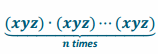
Question 3.
Show (prove) in detail why (xyz)n=xn yn zn for any numbers x, y, and z and for any positive integer n.
Ans:
Beginning with the left side of the equation, (xyz)n means Eureka Math Grade 8 Module 1 Lesson 3 Problem Set Answer Key 15. Using the commutative and associative properties of multiplication, Eureka Math Grade 8 Module 1 Lesson 3 Problem Set Answer Key 16 can be rewritten as Eureka Math Grade 8 Module 1 Lesson 3 Problem Set Answer Key 17 and, finally, xn yn zn, which is what the right side of the equation states. We can also prove this equality by a different method, as follows. Beginning with the right side xn yn zn means Eureka Math Grade 8 Module 1 Lesson 3 Problem Set Answer Key 19 which by the commutative property of multiplication can be rewritten as Eureka Math Grade 8 Module 1 Lesson 3 Problem Set Answer Key 21. Using exponential notation, Eureka Math Grade 8 Module 1 Lesson 3 Problem Set Answer Key 22 can be rewritten as (xyz)n, which is what the left side of the equation states.
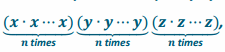
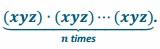
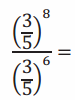
Eureka Math Grade 8 Module 1 Lesson 3 Exit Ticket Answer Key

Write each expression as a base raised to a power or as the product of bases raised to powers that is equivalent to the given expression.

Question 1.
(93 )6=
Ans:
(93 )6=96×3=918

Question 2.
(1132×37×514 )3=
Ans:
(1132×37×514 )3=((1132×37)×514 )3 By associative law
= (1132×37)3×(514 )3 Because (xy)n=xn yn for all numbers x, y
= (1132)3×373×(514)3 Because (xy)n=xn yn for all numbers x, y
= 1136×373×5112 Because (xm)n=xmn for all numbers x

Question 3.
Let x,y,z be numbers. (x2 yz4 )3=
Answer:
(x2yz4 )3=((x2×y)×z4 )3 By associative law
= (x2×y)3×(z4 )3 Because (xy)n=xn yn for all numbers x, y
=(x2 )3×y3×(z4 )3 Because (xy)n=xn yn for all numbers x, y
=x6×y3×z12 Because (xm)n=xmn for all numbers x
= x6 y3 z12

Question 4.
Let x,y,z be numbers and let m,n,p,q be positive integers. (xm yn zp)q=
Ans:
(xm yn zp )q=((xm×yn )×zp)q By associative law
=(xm×yn )q×(zp )q Because (xy)n=xn yn for all numbers x, y
=(xm )q×(yn )q×(zp)q Because (xy)n=xn yn for all numbers x, y
= xmp×ynq×zpq Because (xm )n=xmn for all numbers x
=xmqynqzpq

Question 5.
\(\frac{4^{8}}{5^{8}}\) =
Answer:
\(\frac{4^{8}}{5^{8}}\) = \(\left(\frac{4}{5}\right)^{8}\)

Eureka Math Grade 8 Module 1 Lesson 2 Answer Key

Engage NY Eureka Math 8th Grade Module 1 Lesson 2 Answer Key

Eureka Math Grade 8 Module 1 Lesson 2 Example Answer Key

Examples 1–2
Work through Examples 1 and 2 in the manner just shown. (Supplement with additional examples if needed.)
It is preferable to write the answers as an addition of exponents to emphasize the use of the identity. That step should not be left out. That is, 52×54=56 does not have the same instructional value as 52×54=52+4.

Example 1.
52×54=
Answer:
52+4

Example 2.
(-\(\frac{2}{3}\))4×(-\(\frac{2}{3}\))5=(-\(\frac{2}{3}\))4+5
→ What is the analog of xm∙xn=xm+n in the context of repeated addition of a number x?
Allow time for a brief discussion.
→ If we add m copies of x and then add to it another n copies of x, we end up adding m+n copies of x. By the distributive law:
mx+nx=(m+n)x .
This is further confirmation of what we observed at the beginning of Lesson 1: The exponent m+n in xm+n in the context of repeated multiplication corresponds exactly to the m+n in (m+n)x in the context of repeated addition.

Examples 3–4.
Work through Examples 3 and 4 in the manner shown. (Supplement with additional examples if needed.)
It is preferable to write the answers as a subtraction of exponents to emphasize the use of the identity.

Example 3.
Engage NY Math 8th Grade Module 1 Lesson 2 Example Answer Key 10
Answer:
(\(\frac{3}{5}\))8-6

Example 4.
\(\frac{4^{5}}{4^{2}}\) =
Answer:
45-2

Eureka Math Grade 8 Module 1 Lesson 2 Exercise Answer Key

Exercise 1.
1423×148=
Answer:
1423+8

Exercise 2.
(-72)10×(-72)13=
Answer:
(-72)10+13

Exercise 3.
594×578=
Answer:
594+78

Exercise 4.
(-3)9×(-3)5=
Answer:
(-3)9+5

Exercise 5.
Let a be a number.
a23∙a8=
Answer:
a23+8

Exercise 6.
Let f be a number.
f10∙f13=
Answer:
f10+13

Exercise 7.
Let b be a number.
b94∙b78=
Answer:
b94+78

Exercise 8.
Let x be a positive integer. If (-3)9×(-3)x=(-3)14, what is x?
Answer:
x=5

In Exercises 9–16, students need to think about how to rewrite some factors so the bases are the same. Specifically, 24×82=24×26=24+6 and 37×9=37×32=37+2. Make clear that these expressions can only be combined into a single base because the bases are the same. Also included is a non-example, 54×211, that cannot be combined into a single base using this identity. Exercises 17–20 offer further applications of the identity.

What would happen if there were more terms with the same base? Write an equivalent expression for each problem.

Exercise 9.
94×96×913=
Answer:
94+6+13

Exercise 10.
23×25×27×29=
Answer:
23+5+7+9

Can the following expressions be written in simpler form? If so, write an equivalent expression. If not, explain why not.

Exercise 11.
65×49×43×614=
Answer:
49+3×65+14

Exercise 12.
(-4)2∙175∙(-4)3∙177=
Answer:
(-4)2+3∙175+7

Exercise 13.
152∙72∙15∙74=
Answer:
152+1∙72+4

Exercise 14.
24×82=24×26=
Answer:
24+6

Exercise 15.
37×9=37×32=
Answer:
37+2

Exercise 16.
54 ×211=
Answer:
Cannot be simplified. Bases are different and cannot be rewritten in the same base.

Exercise 17.
Let x be a number. Rewrite the expression in a simpler form.
(2x3 )(17x7 )=
Answer:
34x10

Exercise 18.
Let a and b be numbers. Use the distributive law to rewrite the expression in a simpler form.
a(a+b)=
Answer:
a2+ab

Exercise 19.
Let a and b be numbers. Use the distributive law to rewrite the expression in a simpler form.
b(a+b)=
Answer:
ab+b2

Exercise 20.
Let a and b be numbers. Use the distributive law to rewrite the expression in a simpler form.
(a+b)(a+b)=
Answer:
a2+ab+ba+b2=a2+2ab+b2

Exercise 21.
\(\frac{7^{9}}{7^{6}}\) =
Answer:
79-6

Exercise 22.
\(\frac{(-5)^{16}}{(-5)^{7}}\) =
Answer:
(-5)16-7

Exercise 23.
Eureka Math Grade 8 Module 1 Lesson 2 Exercise Answer Key 20
Answer:
(\(\frac{8}{5}\))9-2

Exercise 24.
\(\frac{13^{5}}{13^{4}}\)=
Answer:
135-4

Exercise 25.
Let a, b be nonzero numbers. What is the following number?
Eureka Math Grade 8 Module 1 Lesson 2 Exercise Answer Key 21
Answer:
(\(\frac{a}{b}\))9-2

Exercise 26.
Let x be a nonzero number. What is the following number?
\(\frac{x^{5}}{x^{4}}\) =
Answer:
x5-4

Can the following expressions be written in simpler forms? If yes, write an equivalent expression for each problem. If not, explain why not.

Exercise 27.
\(\frac{2^{7}}{4^{2}}\) = \(\frac{2^{7}}{2^{4}}\) =
Answer:
27-4

Exercise 28.
\(\frac{3^{23}}{27}\)= \(\frac{3^{23}}{3^{3}}\) =
Answer:
323-3

Exercise 29.
\(\frac{3^{5} \cdot 2^{8}}{3^{2} \cdot 2^{3}}\)=
Answer:
35-2∙28-3

Exercise 30.
Eureka Math Grade 8 Module 1 Lesson 2 Exercise Answer Key 26
Answer:
(-2)7-5∙955-4

Exercise 31.
Let x be a number. Write each expression in a simpler form.
a. \(\frac{5}{x^{3}}\)(3x8 )=
Answer:
15x5

b. \(\frac{5}{x^{3}}\)(-4x6 )=
Answer:
-20x3

c. \(\frac{5}{x^{3}}\)(11x4 )=
Answer:
55x

Exercise 32.
Anne used an online calculator to multiply 2 000 000 000×2 000 000 000 000. The answer showed up on the calculator as 4e+21, as shown below. Is the answer on the calculator correct? How do you know?
Eureka Math Grade 8 Module 1 Lesson 2 Exercise Answer Key 30
Answer:
2 000 000 000×2 000 000 000 000=4 000 000 000 000 000 000 000.
The answer must mean 4 followed by 21 zeros. That means that the answer on the calculator is correct.
This problem is hinting at scientific notation (i.e., (2× 10⁹)(2×10¹²)=4×10⁹+12). Accept any reasonable explanation of the answer.

Eureka Math Grade 8 Module 1 Lesson 2 Problem Set Answer Key

To ensure success with Problems 1 and 2, students should complete at least bounces 1–4 with support in class. Consider working on Problem 1 as a class activity and assigning Problem 2 for homework.
Students may benefit from a simple drawing of the scenario. It will help them see why the factor of 2 is necessary when calculating the distance traveled for each bounce. Make sure to leave the total distance traveled in the format shown so that students can see the pattern that is developing. Simplifying at any step will make it difficult to write the general statement for n number of bounces.

Question 1.
A certain ball is dropped from a height of x feet. It always bounces up to \(\frac{2}{3}\) x feet. Suppose the ball is dropped from 10 feet and is stopped exactly when it touches the ground after the 30th bounce. What is the total distance traveled by the ball? Express your answer in exponential notation.
Eureka Math Grade 8 Module 1 Lesson 2 Problem Set Answer Key 27
Answer:
Eureka Math Grade 8 Module 1 Lesson 2 Problem Set Answer Key 28

Question 2.
If the same ball is dropped from 10 feet and is stopped exactly at the highest point after the 25th bounce, what is the total distance traveled by the ball? Use what you learned from the last problem.
Answer:
Based on the last problem, we know that each bounce causes the ball to travel 2(\(\frac{2}{3}\))n 10 feet. If the ball is stopped at the highest point of the 25th bounce, then the distance traveled on that last bounce is just (\(\frac{2}{3}\))25 10 feet because it does not make the return trip to the ground. Therefore, the total distance traveled by the ball in feet in this situation is
10+2(\(\frac{2}{3}\))10+2(\(\frac{2}{3}\))2 10+2(\(\frac{2}{3}\))3 10+2(\(\frac{2}{3}\))4 10+…..+2(\(\frac{2}{3}\))2310+2(\(\frac{2}{3}\))2410.

Question 3.
Let a and b be numbers and b≠0, and let m and n be positive integers. Write each expression using the fewest number of bases possible.
Eureka Math Grade 8 Module 1 Lesson 2 Problem Set Answer Key 29
Answer:
Eureka Math Grade 8 Module 1 Lesson 2 Problem Set Answer Key 30

Question 4.
Let the dimensions of a rectangle be (4×(871209)5+ 3×49 762 105) ft. by (7×(871 209)3-(49 762 105)4) ft. Determine the area of the rectangle. (Hint: You do not need to expand all the powers.)
Answer:
Area=(4×(871 209)5+3×49 762 105) ft.(7×(871 209)3-(49 762 105)4 ) ft.
=(28×(871 209)8-4×(871 209)5 (49 762 105)4+21×(871 209)3 (49 762 105)-3×(49 762 105)5 ) sq.ft.

Question 5.
A rectangular area of land is being sold off in smaller pieces. The total area of the land is 215 square miles. The pieces being sold are 83 square miles in size. How many smaller pieces of land can be sold at the stated size? Compute the actual number of pieces.
Answer:
83=29
\(\frac{2^{15}}{2^{9}}\) =215-9=26=64
64 pieces of land can be sold.

Eureka Math Grade 8 Module 1 Lesson 2 Exit Ticket Answer Key

Note to Teacher: Accept both forms of the answer; in other words, accept an answer that shows the exponents as a sum or difference as well as an answer where the numbers are actually added or subtracted.

Write each expression using the fewest number of bases possible.

Question 1.
Let a and b be positive integers. 23a × 23b=
Answer:
23a × 23b = 23a+b

Question 2.
53×25=
Answer:
53×25=53×52
= 53+2
=55

Question 3.
Let x and y be positive integers and x>y. \(\frac{11^{x}}{11^{y}}\) =
Answer:
\(\frac{11^{x}}{11^{y}}\) = 11x-y

Question 4.
\(\frac{2^{13}}{8}\) =
Answer:
\(\frac{2^{13}}{2^{3}}\) = 213-3 = 210