Eureka Math Grade 7 Module 4 Lesson 6 Answer Key

Engage NY Eureka Math 7th Grade Module 4 Lesson 6 Answer Key

Eureka Math Grade 7 Module 4 Lesson 6 Example Answer Key

Example 1: Mental Math and Percents
a. 75% of the students in Jesse’s class are 60 inches or taller. If there are 20 students in her class, how many students are 60 inches or taller?
Answer:
→ Is this question a comparison of two separate quantities, or is it part of the whole? How do you know?
The problem says that the students make up 75% of Jesse’s class, which means they are part of the whole class; this is a part of the whole problem.

→ What numbers represent the part, whole, and percent?
The part is the number of students that are 60 inches or taller, the whole is the 20 students that make up Jesse’s class, and the percent is 75%.

Instruct students to discuss the problem with a partner; challenge them to solve it using mental math only. After 1–2 minutes of discussion, ask for students to share their mental strategies with the class.
Possible strategies:
75% is the same as \(\frac{3}{4}\) of 100%; 20 → 100% and 20 = 4(5), so 3(5) = 15, which means 15 is \(\frac{3}{4}\) of 20.
100% → 20
25% → 5
75% → 15
Have students write a description of how to mentally solve the problem (including the math involved) in their student materials.

→ Was this problem easy to solve mentally? Why?
The numbers involved in the problem shared factors with 100 that were easy to work with.

b. Bobbie wants to leave a tip for her waitress equal to 15% of her bill. Bobbie’s bill for her lunch is $18. How much money represents 15% of the bill?
Answer:
→ Is this question a comparison of two separate quantities, or is it part of a whole? How do you know?
She is leaving a quantity that is equal to 15% of her bill, so this is a comparison of two separate quantities.

→ What numbers represent the part, the whole, and the percent? Is the part actually part of her lunch bill?
The part is the amount that she plans to leave for her waitress and is not part of her lunch bill but is calculated as if it is a part of her bill; the whole is the $18 lunch bill, and the percent is 15%.

Instruct students to discuss the problem with a partner; challenge them to solve it using mental math only. After 1–2 minutes of discussion, ask for students to share their mental strategies with the class.
Possible strategy includes the following:
15% = 10%+5%; 10% of $18 is $1.80; half of 10% is 5%, so 5% → 1/2( $1.80) = $0.90;
$1.80+$0.90 = $2.70.

→ Was this problem easy to solve mentally? Why?
The numbers involved in the problem shared factors with 100 that were easy to work with.

→ Could you use this strategy to find 7% of Bobbie’s bill?
Yes; 7% = 5%+2(1%); 1% of $18 is $0.18, so 2% → $0.36; $0.90+$0.36 = $1.26, so
7% → $1.26.
Have students write a description of how to mentally solve the problem in their student materials including the math involved.

Eureka Math Grade 7 Module 4 Lesson 6 Exercise Answer Key

Exercise 1.
Express 9 hours as a percentage of 3 days.
Answer:
3 days is the equivalent of 72 hours since 3(24) = 72.
72 hours represents the whole.
Quantity = Percent × Whole. Let p represent the unknown percent.
9 = p(72)
\(\frac{1}{72}\) (9) = p(72) ∙ \(\frac{1}{72}\)
\(\frac{9}{72}\) = p(1)
\(\frac{1}{8}\) = p
\(\frac{1}{8}\) (100%) = 12.5%

Exercise 2.
Richard works from 11:00 a.m. to 3:00 a.m. His dinner break is 75% of the way through his work shift. What time is Richard’s dinner break?
Answer:
The total amount of time in Richard’s work shift is 16 hours since 1+12+3 = 16.
16 hours represents the whole.
Quantity = Percent × Whole. Let b represent the number of hours until Richard’s dinner break.
b = 0.75(16)
b = 12
Richard’s dinner break is 12 hours after his shift begins.
12 hours after 11:00 a.m. is 11:00 p.m.
Richard’s dinner break is at 11:00 p.m.

Exercise 3.
At a playoff basketball game, there were 370 fans cheering for school A and 555 fans cheering for school B.
a. Express the number of fans cheering for school A as a percent of the number of fans cheering for school B.
Answer:
The number of fans for school B is the whole.
Quantity = Percent × Whole. Let p represent the unknown percent.
370 = p(555)
\(\frac{1}{555}\) (370) = p(555)\(\frac{1}{555}\)
\(\frac{370}{555}\) = p(1)
\(\frac{2}{3}\) = p
\(\frac{2}{3}\) (100%) = 66\(\frac{2}{3}\)%
The number of fans cheering for school A is 66 2/3% of the number of fans cheering for school B.

b. Express the number of fans cheering for school B as a percent of the number of fans cheering for school A.
Answer:
The number of fans cheering for school A is the whole.
Quantity = Percent × Whole. Let p represent the unknown percent.
555 = p(370)
\(\frac{1}{370}\) (555) = p(370)\(\frac{1}{370}\)
\(\frac{555}{370}\) = p(1)
\(\frac{3}{2}\) = p
\(\frac{3}{2}\) (100%) = 150%
The number of fans cheering for school B is 150% of the number of fans cheering for school A.

c. What percent more fans were there for school B than for school A?
Answer:
There were 50% more fans cheering for school B than for school A.

Exercise 4.
Rectangle A has a width of 8 cm and a length of 16 cm. Rectangle B has the same area as the first, but its width is 62.5% of the width of the first rectangle. Express the length of Rectangle B as a percent of the length of Rectangle A. What percent more or less is the length of Rectangle B than the length of Rectangle A?
Answer:
To find the width of Rectangle B:
The width of Rectangle A is the whole.
Quantity = Percent × Whole. Let w represent the unknown width of Rectangle B.
w = 0.625(8) = 5
The width of Rectangle B is 5 cm.

To find the length of Rectangle B:
The area of Rectangle B is 100% of the area of Rectangle A because the problem says the areas are the same.
Area = Width × Length. Let A represent the unknown area of Rectangle A.
A = 8 cm(16 cm) = 128 cm2
Area = Width × Length. Let l represent the unknown length of Rectangle B.
128 cm2 = 5 cm (l)
25.6 cm = l
The length of Rectangle B is 25.6 cm.

To express the length of Rectangle B as a percent of the length of Rectangle A:
The length of Rectangle A is the whole.
Quantity = Percent × Whole. Let p represent the unknown percent.
25.6 cm = p(16 cm)
1.6 = p
1.6(100%) = 160%; The length of Rectangle B is 160% of the length of Rectangle A.

Therefore, the length of Rectangle B is 60% more than the length of Rectangle A.

Exercise 5.
A plant in Mikayla’s garden was 40 inches tall one day and was 4 feet tall one week later. By what percent did the plant’s height increase over one week?
Answer:
4 feet is equivalent to 48 inches since 4(12) = 48.
40 inches is the whole.
Quantity = Percent × Whole. Let p represent the unknown percent.
8 = p(40)
\(\frac{1}{5}\) = p
\(\frac{1}{5}\) = 20/100 = 20%
The plant’s height increased by 20% in one week.

Exercise 6.
Loren must obtain a minimum number of signatures on a petition before it can be submitted. She was able to obtain 672 signatures, which is 40% more than she needs. How many signatures does she need?
Answer:
The number of signatures needed represents the whole.
Quantity = Percent × Whole. Let s represent the number of signatures needed.
672 = 1.4(s)
480 = s
Loren needs to obtain 480 signatures on her petition.

Eureka Math Grade 7 Module 4 Lesson 6 Problem Set Answer Key

Question 1.
Micah has 294 songs stored in his phone, which is 70% of the songs that Jorge has stored in his phone. How many songs are stored on Jorge’s phone?
Answer:
Quantity = Percent × Whole. Let s represent the number of songs on Jorge’s phone.
294 = \(\frac{70}{100}\) ∙ s
294 = \(\frac{7}{10}\) ∙ s
294 ∙ \(\frac{10}{7}\) = \(\frac{7}{10}\) ∙ \(\frac{10}{7}\) ∙ s
42 ∙ 10 = 1 ∙ s
420 = s
There are 420 songs stored on Jorge’s phone.

Question 2.
Lisa sold 81 magazine subscriptions, which is 27% of her class’s fundraising goal. How many magazine subscriptions does her class hope to sell?
Answer:
Quantity = Percent × Whole. Let s represent the number of magazine subscriptions Lisa’s class wants to sell.
81 = \(\frac{27}{100}\) ∙ s
81 ∙ \(\frac{100}{27}\) = \(\frac{27}{100}\) ∙ \(\frac{100}{27}\) ∙ s
3 ∙ 100 = 1 ∙ s
300 = s
Lisa’s class hopes to sell 300 magazine subscriptions.

Question 3.
Theresa and Isaiah are comparing the number of pages that they read for pleasure over the summer. Theresa read 2,210 pages, which was 85% of the number of pages that Isaiah read. How many pages did Isaiah read?
Answer:
Quantity = Percent × Whole. Let p represent the number of pages that Isaiah read.
2,210 = \(\frac{85}{100}\) ∙ p
2,210 = \(\frac{17}{20}\) ∙ p
2,210 ∙ \(\frac{20}{17}\) = \(\frac{17}{20}\) ∙ \(\frac{20}{17}\) ∙ p
130 ∙ 20 = 1 ∙ p
2,600 = p
Isaiah read 2,600 pages over the summer.

Question 4.
In a parking garage, the number of SUVs is 40% greater than the number of non-SUVs. Gina counted 98 SUVs in the parking garage. How many vehicles were parked in the garage?
Answer:
40% greater means 100% of the non-SUVs plus another 40% of that number, or 140%.
Quantity = Percent × Whole. Let d represent the number of non-SUVs in the parking garage.
98 = \(\frac{140}{100}\) ∙ d
98 = \(\frac{7}{5}\) ∙ d
98 ∙ \(\frac{5}{7}\) = \(\frac{7}{5}\) ∙ \(\frac{5}{7}\) ∙ d
14 ∙ 5 = 1 ∙ d
70 = d
There are 70 non-SUVs in the parking garage.
The total number of vehicles is the sum of the number of the SUVs and non-SUVs.
70+98 = 168. There is a total of 168 vehicles in the parking garage.

Question 5.
The price of a tent was decreased by 15% and sold for $76.49. What was the original price of the tent in dollars?
Answer:
If the price was decreased by 15%, then the sale price is 15% less than 100% of the original price, or 85%.
Quantity = Percent × Whole. Let t represent the original price of the tent.
76.49 = \(\frac{85}{100}\) ∙ t
76.49 = \(\frac{17}{20}\) ∙ t
76.49 ∙ \(\frac{20}{17}\) = \(\frac{17}{20}\) ∙ \(\frac{20}{17}\) ∙ t
\(\frac{1,529.8}{17}\) = 1 ∙ t
89.988 ≈ t
Because this quantity represents money, the original price was $89.99 after rounding to the nearest hundredth.

Question 6.
40% of the students at Rockledge Middle School are musicians. 75% of those musicians have to read sheet music when they play their instruments. If 38 of the students can play their instruments without reading sheet music, how many students are there at Rockledge Middle School?
Answer:
Let m represent the number of musicians at the school, and let s represent the total number of students. There are two whole quantities in this problem. The first whole quantity is the number of musicians. The 38 students who can play an instrument without reading sheet music represent 25% of the musicians.
Quantity = Percent × Whole
38 = 25/100 ∙ m
38 = \(\frac{1}{4}\) ∙ m
38 ∙ \(\frac{4}{1}\) = \(\frac{1}{4}\) ∙ \(\frac{4}{1}\) ∙ m
\(\frac{152}{1}\) = 1 ∙ m
152 = m
There are 152 musicians in the school.

Quantity = Percent × Whole
152 = \(\frac{40}{100}\) ∙ s
152 = \(\frac{2}{5}\) ∙ s
152 ∙ \(\frac{5}{2}\) = \(\frac{2}{5}\) ∙ \(\frac{5}{2}\) ∙ s
\(\frac{760}{2}\) = 1 ∙ s
380 = s
There are 380 students at Rockledge Middle School.

Question 7.
At Longbridge Middle School, 240 students said that they are an only child, which is 48% of the school’s student enrollment. How many students attend Longbridge Middle School?
Answer:
Quantity → 100%
240 → 48%
\(\frac{240}{48}\) → 1%
\(\frac{240}{48}\) (100) → 100%
5(100) → 100%
500 → 100%
There are 500 students attending Longbridge Middle School.

Question 8.
Grace and her father spent 4 1/2 hours over the weekend restoring their fishing boat. This time makes up 6% of the time needed to fully restore the boat. How much total time is needed to fully restore the boat?
Answer:
Quantity → %
4 \(\frac{1}{2}\) → 6%
\(\frac{\frac{9}{2}}{6}\) → 6%
\(\frac{\frac{9}{2}}{6}\) → 1%
\(\frac{\frac{9}{2}}{6}\) (100) → 100%
(\(\frac{9}{2}\))(\(\frac{1}{6}\))100 → 100%
(\(\frac{9}{12}\))100 → 100%
(\(\frac{3}{4}\))100 → 100%
300/4 → 100%
75 → 100%
The total amount of time to restore the boat is 75 hours.

Question 9.
Bethany’s mother was upset with her because Bethany’s text messages from the previous month were 218% of the amount allowed at no extra cost under her phone plan. Her mother had to pay for each text message over the allowance. Bethany had 5,450 text messages last month. How many text messages is she allowed under her phone plan at no extra cost?
Answer:
Quantity → %
5,450 → 218%
\(\frac{5,450}{218}\) → 1%
\(\frac{5,450}{218}\) (100) → 100%
25(100) → 100%
2,500 → 100%
Bethany is allowed 2,500 text messages without extra cost.

Question 10.
Harry used 84% of the money in his savings account to buy a used dirt bike that cost him $1,050. How much money is left in Harry’s savings account?
Answer:
Quantity → %
1,050 → 84%
\(\frac{1,050}{84}\) → 1%
\(\frac{1,050}{84}\) (100) → 100%
12.5(100) → 100%
1,250 → 100%
Harry started with $1,250 in his account but then spent $1,050 of it on the dirt bike.
1,250-1,050 = 200
Harry has $200 left in his savings account.

Question 11.
15% of the students in Mr. Riley’s social studies classes watch the local news every night. Mr. Riley found that 136 of his students do not watch the local news. How many students are in Mr. Riley’s social studies classes?
Answer:
If 15% of his students do watch their local news, then 85% do not.
Quantity → %
136 → 85%
\(\frac{136}{85}\) → 1%
(\(\frac{136}{85}\))(100) → 100%
1.6(100) → 100%
160 → 100%
There are 160 total students in Mr. Riley’s social studies classes.

Question 12.
Grandma Bailey and her children represent about 9.1% of the Bailey family. If Grandma Bailey has 12 children, how many members are there in the Bailey family?
Answer:
Quantity → %
13 → 9.1%
(\(\frac{1}{9.1}\))(13) → 1%
100(\(\frac{13}{9.1}\)) → 100%
\(\frac{1,300}{9.1}\) → 100%
142.857″…” → 100%
The Bailey family has 143 members.

Question 13.
Shelley earned 20% more money in tips waitressing this week than last week. This week she earned $72.00 in tips waitressing. How much money did Shelley earn last week in tips?
Answer:
Quantity = Percent × Whole. Let m represent the number of dollars Shelley earned waitressing last week.
72 = \(\frac{120}{100}\) m
72(\(\frac{100}{120}\)) = \(\frac{120}{100}\) (\(\frac{100}{120}\))m
60 = m
Shelley earned $60 waitressing last week.

Question 14.
Lucy’s savings account has 35% more money than her sister Edy’s. Together, the girls have saved a total of $206.80. How much money has each girl saved?
Answer:
The money in Edy’s account corresponds to 100%. Lucy has 35% more than Edy, so the money in Lucy’s account corresponds to 135%. Together, the girls have a total of $206.80, which is 235% of Edy’s account balance.
Quantity = Pecent × Whole. Let b represent Edy’s savings account balance in dollars.
206.8 = \(\frac{235}{100}\) ∙ b
206.8 = \(\frac{47}{20}\) ∙ b
206.8 ∙ \(\frac{20}{47}\) = \(\frac{47}{20}\) ∙ \(\frac{20}{47}\) ∙ b
\(\frac{4,136}{47}\) = 1 ∙ b
88 = b
Edy has saved $88 in her account. Lucy has saved the remainder of the $206.80, so 206.8-88 = 118.8.
Therefore, Lucy has $118.80 saved in her account.

Question 15.
Bella spent 15% of her paycheck at the mall, and 40% of that was spent at the movie theater. Bella spent a total of $13.74 at the movie theater for her movie ticket, popcorn, and a soft drink. How much money was in Bella’s paycheck?
Answer:
$13.74 → 40%
$3.435 → 10%
$34.35 → 100%

Bella spent $34.35 at the mall.
$34.35 → 15%
$11.45 → 5%
$229 → 100%
Bella’s paycheck was $229.

Question 16.
On a road trip, Sara’s brother drove 47.5% of the trip, and Sara drove 80% of the remainder. If Sara drove for 4 hours and 12 minutes, how long was the road trip?
Answer:
There are two whole quantities in this problem. First, Sara drove 80% of the remainder of the trip; the remainder is the first whole quantity. 4 hr.12 min. is equivalent to 4 12/60 hr. = 4.2 hr.
Quantity → %
4.2 → 80%
\(\frac{4.2}{80}\) → 1%
\(\frac{4.2}{80}\) (100) → 100%
\(\frac{420}{80}\) → 100%
\(\frac{42}{8}\) → 100%
5.25 → 100%
The remainder of the trip that Sara’s brother did not drive was 5.25 hours. He drove 47.5% of the trip, so the remainder of the trip was 52.5% of the trip, and the whole quantity is the time for the whole road trip.
Quantity → %
5.25 → 52.5%
\(\frac{5.25}{52.5}\) → 1%
(\(\frac{5.25}{52.5}\))(100) → 100%
\(\frac{525}{52.5}\) → 100%
10 → 100%
The road trip was a total of 10 hours.

Eureka Math Grade 7 Module 4 Lesson 6 Exit Ticket Answer Key

Question 1.
Parker was able to pay for 44% of his college tuition with his scholarship. The remaining $10,054.52 he paid for with a student loan. What was the cost of Parker’s tuition?
Answer:
Parker’s tuition is the whole; 56% represents the amount paid by a student loan.
Quantity = Percent × Whole. Let t represent the cost of Parker’s tuition.
10,054.52 = 0.56(t)
\(\frac{10,054.52}{0.56}\) = t
17,954.50 = t
Parker’s tuition was $17,954.50.

Question 2.
Two bags contain marbles. Bag A contains 112 marbles, and Bag B contains 140 marbles. What percent fewer marbles does Bag A have than Bag B?
Answer:
The number of marbles in Bag B is the whole.
There are 28 fewer marbles in Bag A.
Quantity = Percent × Whole. Let p represent the unknown percent.
28 = p(140)
\(\frac{2}{10}\) = p
\(\frac{2}{10}\) = \(\frac{20}{100}\) = 20%
Bag A contains 20% fewer marbles than Bag B.

Question 3.
There are 42 students on a large bus, and the rest are on a smaller bus. If 40% of the students are on the smaller bus, how many total students are on the two buses?
Answer:
The 42 students on the larger bus represent 60% of the students. If I divide both 60% and 42 by 6, then I get 7 → 10%. Multiplying both by 10, I get 70 → 100%. There are 70 total students on the buses.

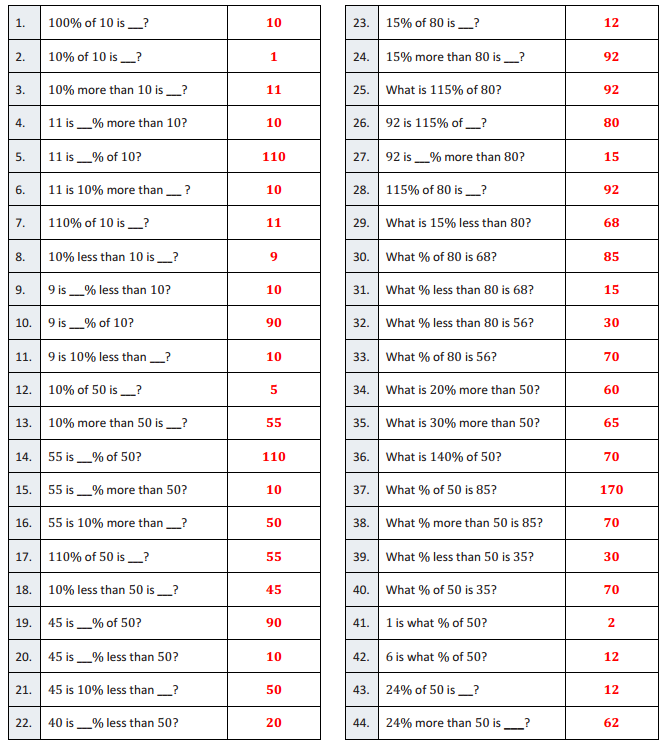
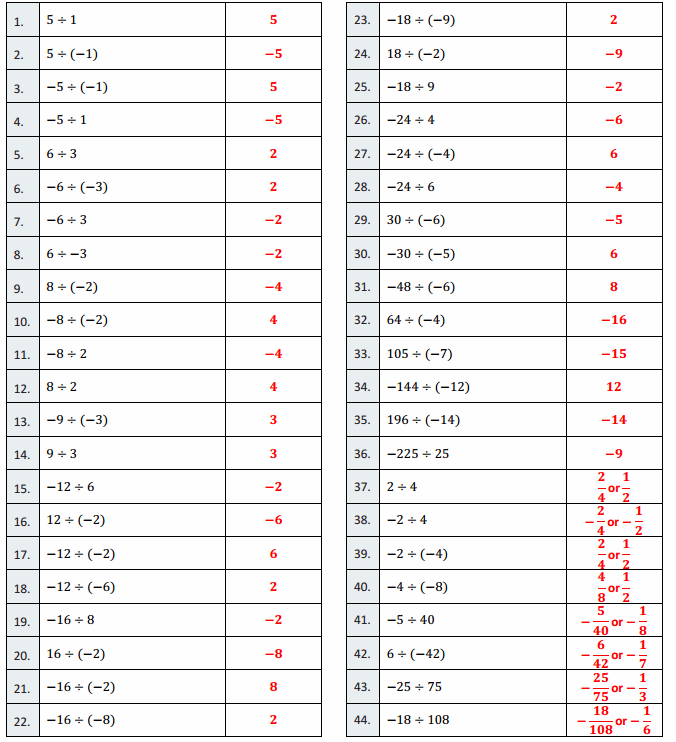
Eureka Math Grade 7 Module 4 Lesson 6 Percent More or Less—Round 1 Answer Key

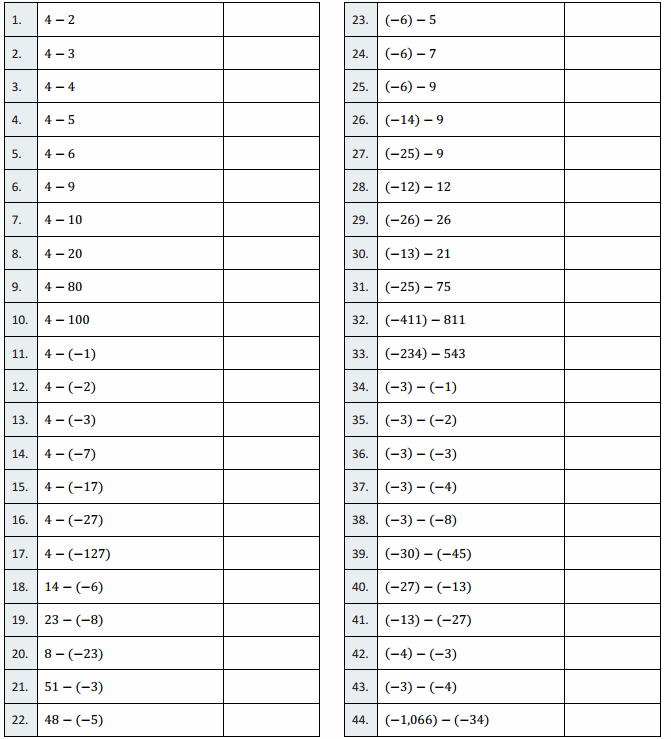
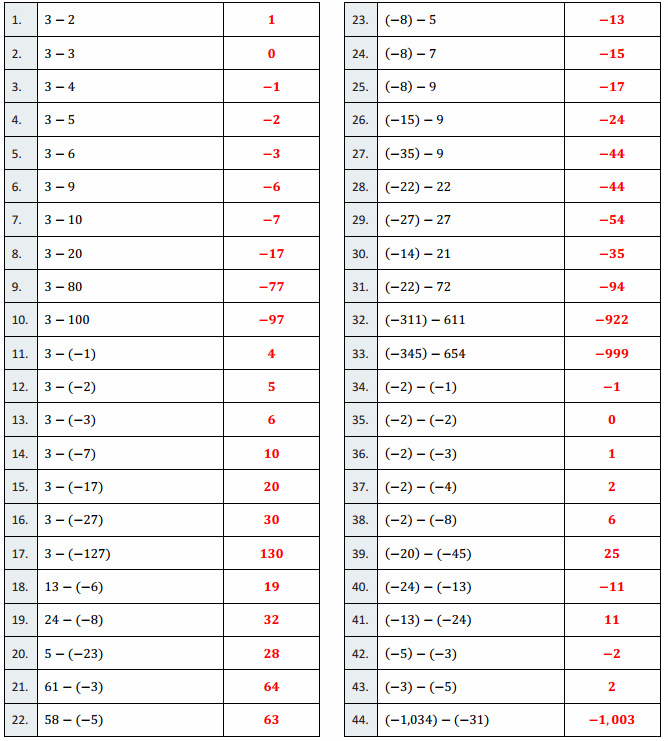
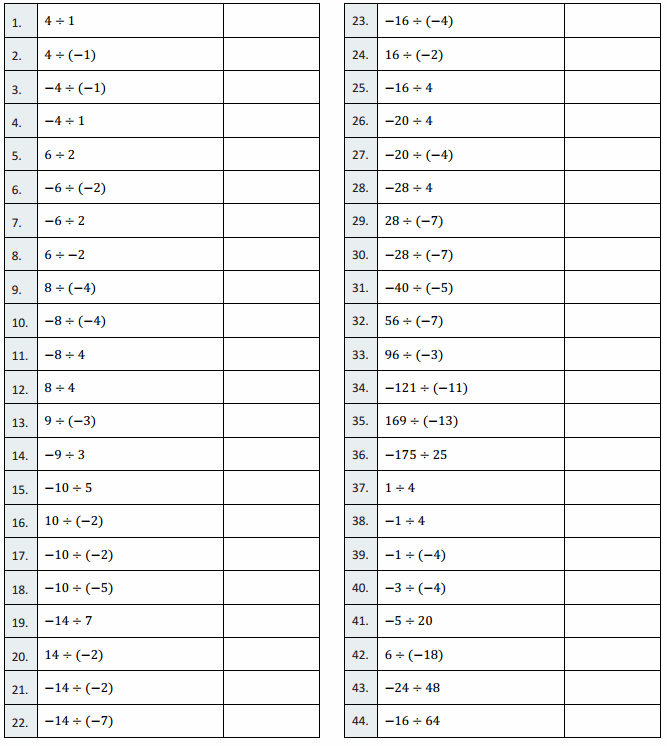
Directions: Find each missing value.
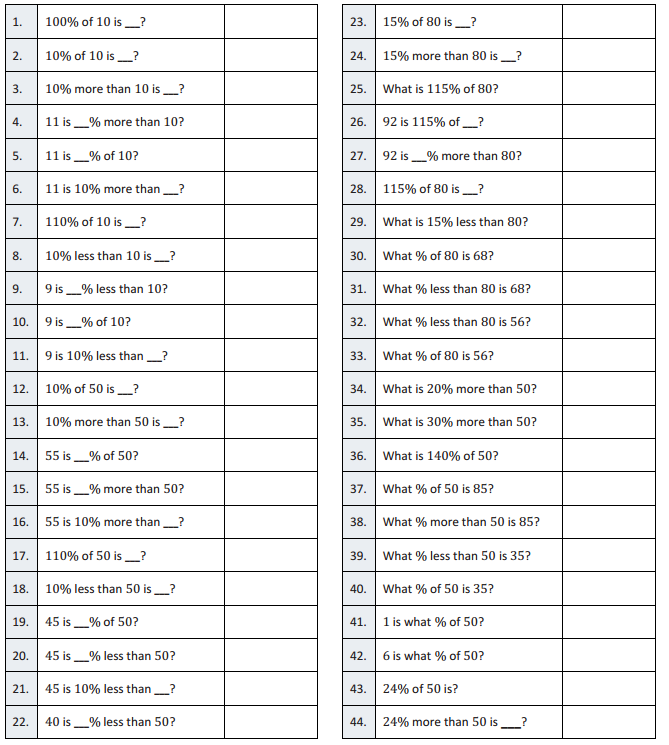
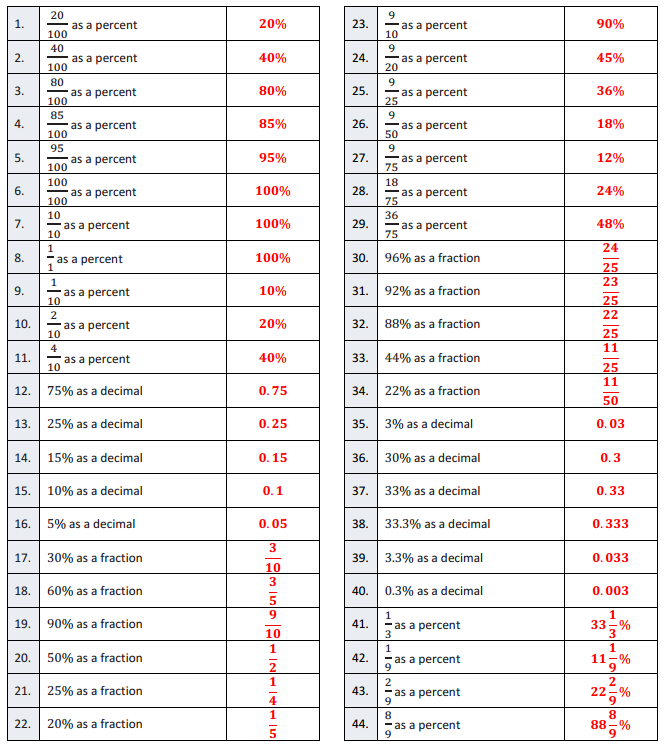
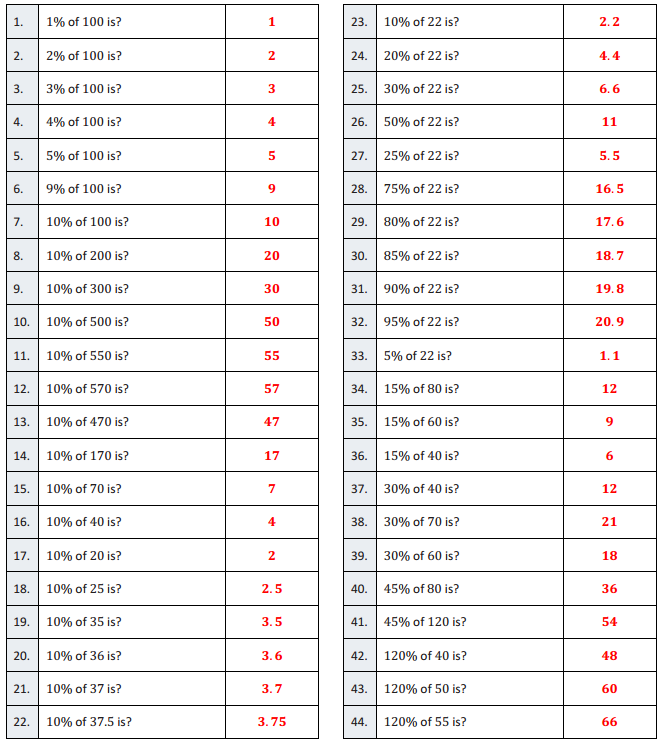
Engage NY Math 7th Grade Module 4 Lesson 6 Percent More or Less—Round 1 Answer Key 1
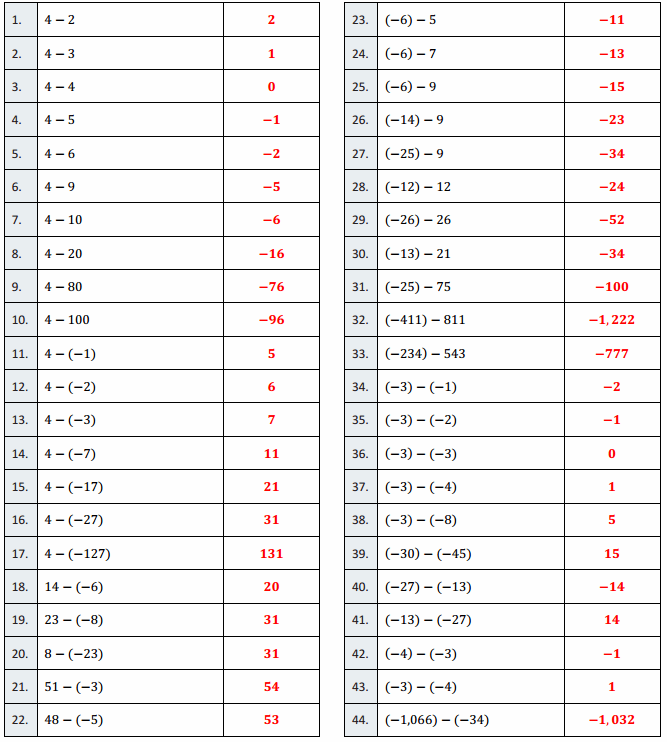
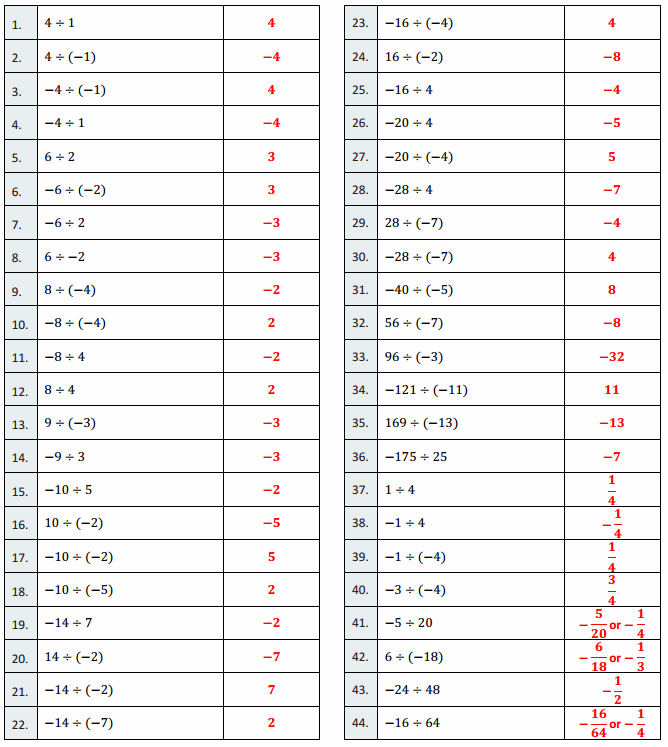
Answer:
Engage NY Math 7th Grade Module 4 Lesson 6 Percent More or Less—Round 1 Answer Key 2

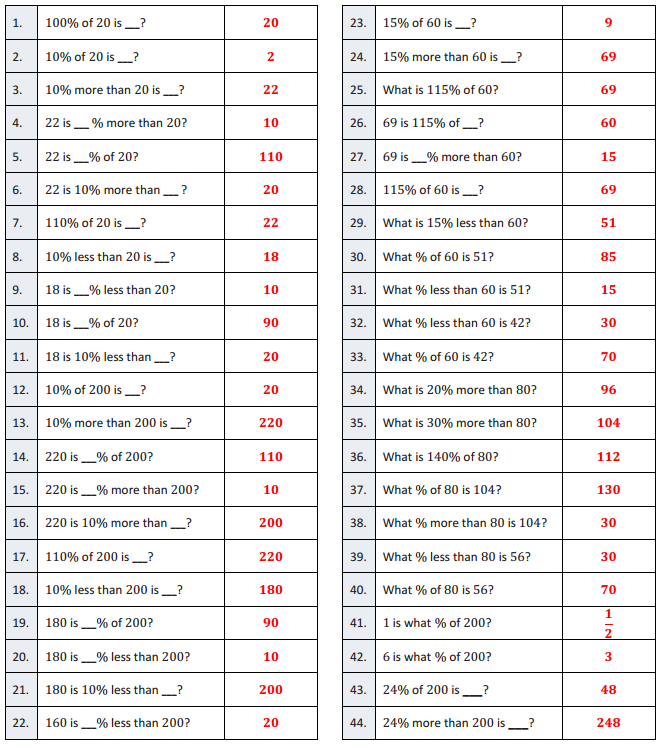
Eureka Math Grade 7 Module 4 Lesson 6 Percent More or Less—Round 2 Answer Key

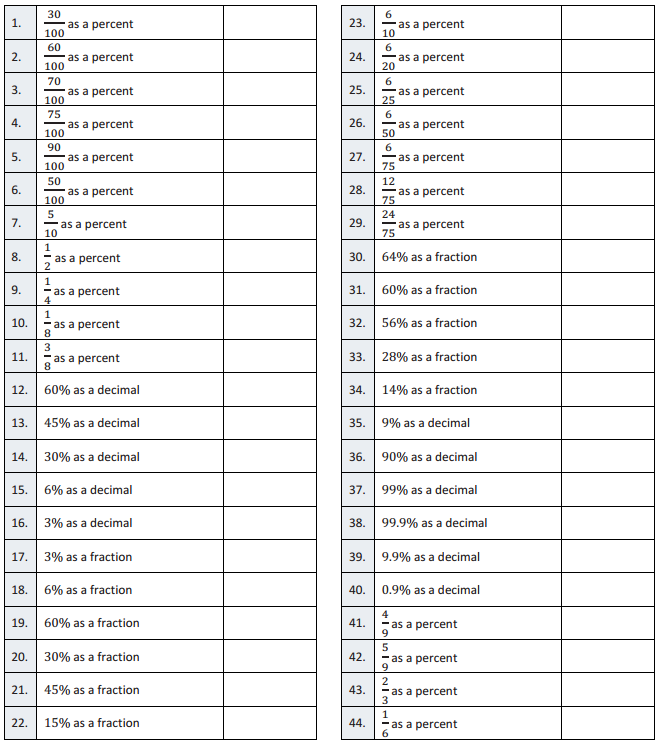
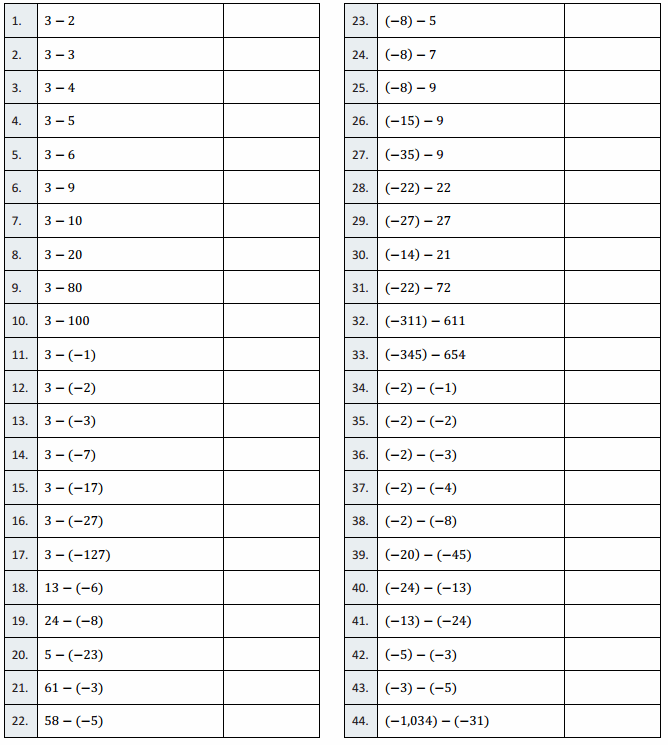
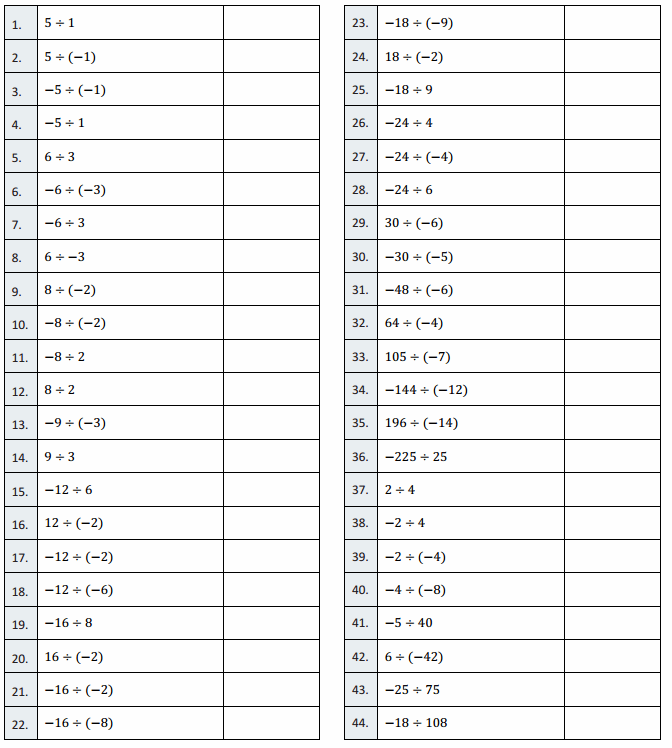
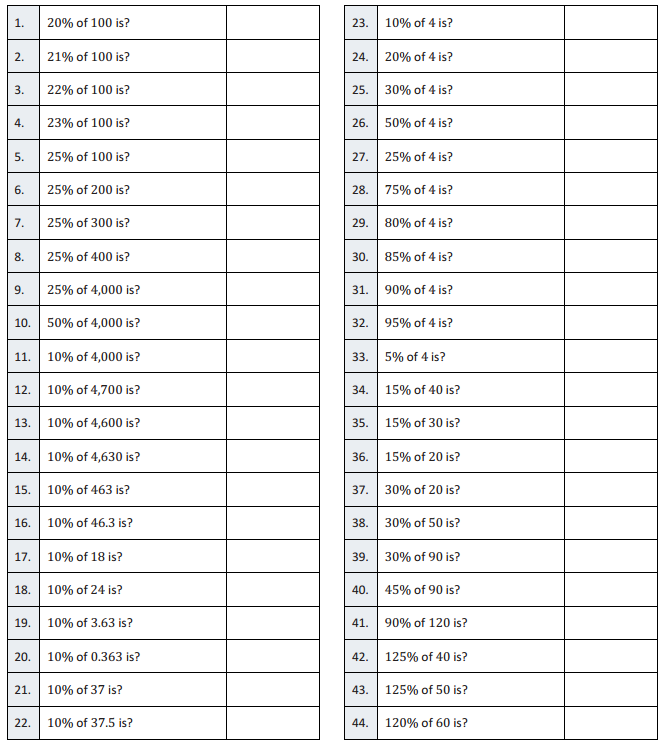
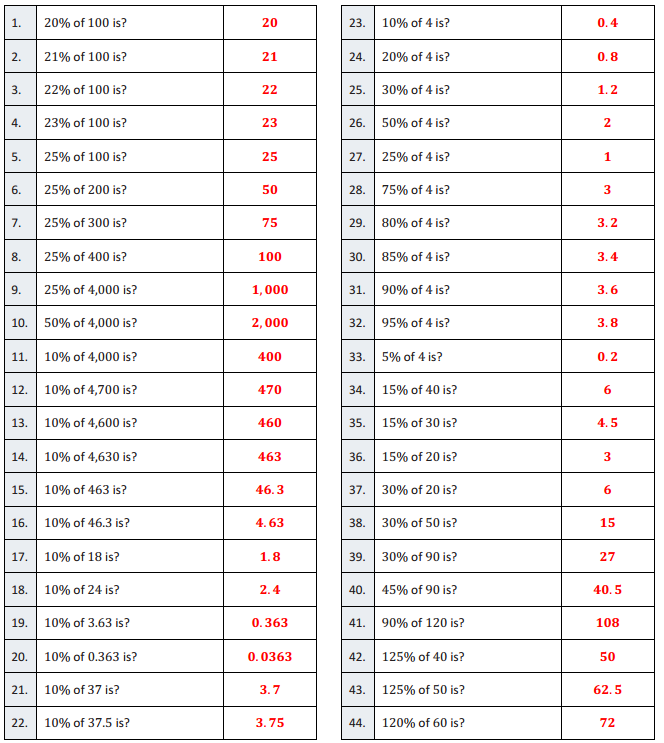
Directions: Find each missing value.
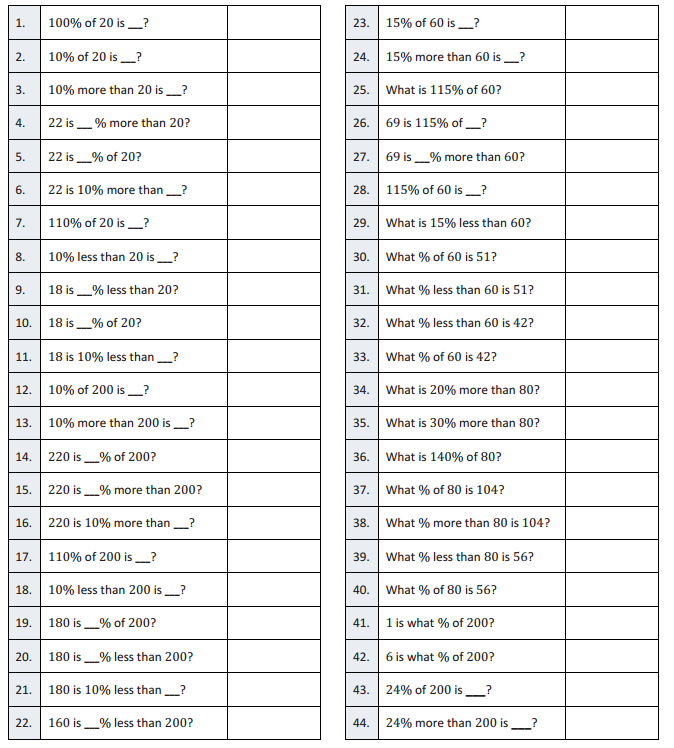
Engage NY Math 7th Grade Module 4 Lesson 6 Percent More or Less—Round 2 Answer Key 3
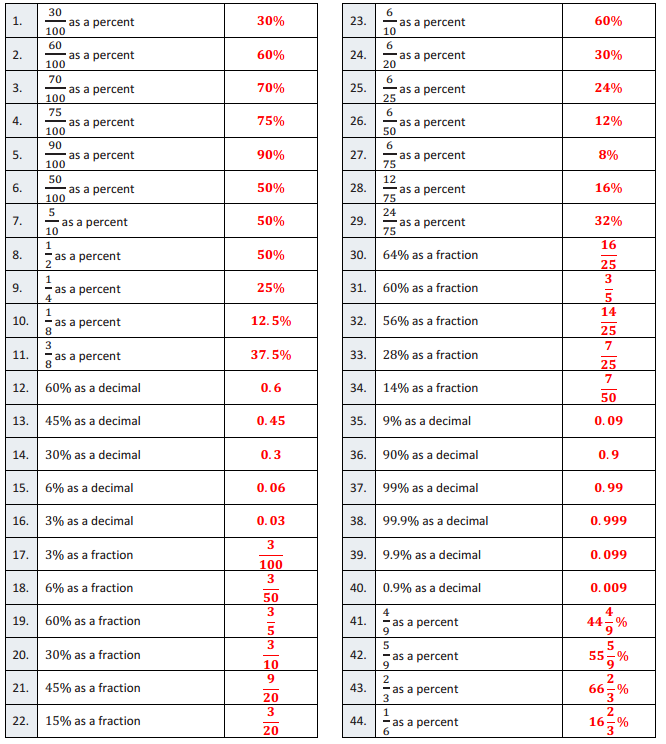
Answer:
Engage NY Math 7th Grade Module 4 Lesson 6 Percent More or Less—Round 2 Answer Key 4

Eureka Math Grade 7 Module 4 Lesson 5 Answer Key

Engage NY Eureka Math 7th Grade Module 4 Lesson 5 Answer Key

Eureka Math Grade 7 Module 4 Lesson 5 Example Answer Key

Example 1: Using a Modified Double Number Line with Percents
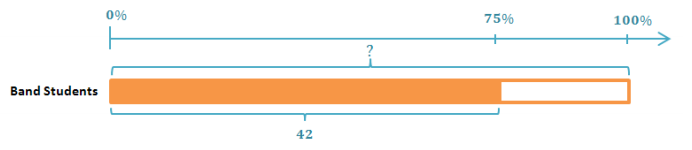
The 42 students who play wind instruments represent 75% of the students who are in band. How many students are in band?
Answer:
→ Which quantity in this problem represents the whole?
The total number of students in band is the whole, or 100%.

→ Draw the visual model shown with a percent number line and a tape diagram.
Engage NY Math 7th Grade Module 4 Lesson 5 Example Answer Key 1
→ Use the number line and tape diagram to find the total number of students in band.
100% represents the total number of students in band, and 75% is 3/4 of 100%. The greatest common factor of 75 and 100 is 25.
42→75%
\(\frac{42}{3}\)→25%
4(\(\frac{42}{3}\))→100%
4(14)→100%
56→100%

Example 2: Mental Math Using Factors of 100
Answer each part below using only mental math, and describe your method.
a. If 39 is 1% of a number, what is that number? How did you find your answer?
Answer:
39 is 1% of 3,900. I found my answer by multiplying 39∙100 because 39 corresponds with each 1% in 100%, and 1%∙100 = 100%, so 39∙100 = 3,900.

b. If 39 is 10% of a number, what is that number? How did you find your answer?
Answer:
39 is 10% of 390. 10 is a factor of 100, and there are ten 10% intervals in 100%. The quantity 39 corresponds to 10%, so there are 39∙10 in the whole quantity, and 39∙10 = 390.

c. If 39 is 5% of a number, what is that number? How did you find your answer?
Answer:
39 is 5% of 780. 5 is a factor of 100, and there are twenty 5% intervals in 100%. The quantity 39 corresponds to 5%, so there are twenty intervals of 39 in the whole quantity.
39∙20
39∙2∙10 Factored 20 for easier mental math
78∙10
780

d. If 39 is 15% of a number, what is that number? How did you find your answer?
Answer:
39 is 15% of 260. 15 is not a factor of 100, but 15 and 100 have a common factor of 5. If 15% is 39, then because 5 = 15/3 , 5% is 13 = 39/3. There are twenty 5% intervals in 100%, so there are twenty intervals of 13 in the whole.
13∙20
13∙2∙10 Factored 20 for easier mental math
26∙10
260

e. If 39 is 25% of a number, what is that number? How did you find your answer?
Answer:
39 is 25% of 156. 25 is a factor of 100, and there are four intervals of 25% in 100%. The quantity 39 corresponds with 25%, so there are 39∙4 in the whole quantity.
39∙4
39∙2∙2 Factored 4 for easier mental math
78∙2
156

Eureka Math Grade 7 Module 4 Lesson 5 Exercise Answer Key

Opening Exercise
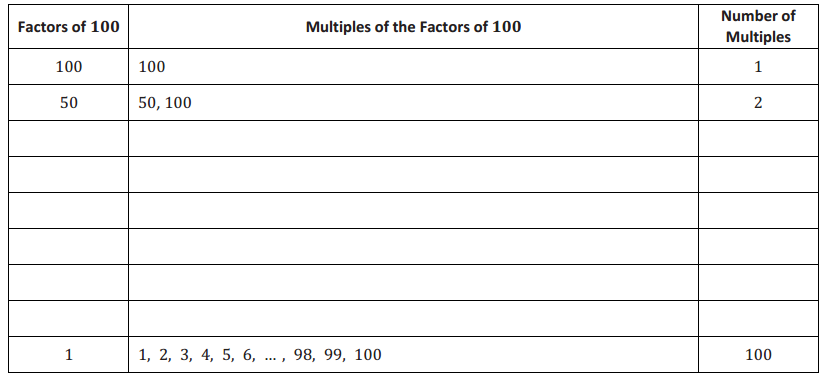
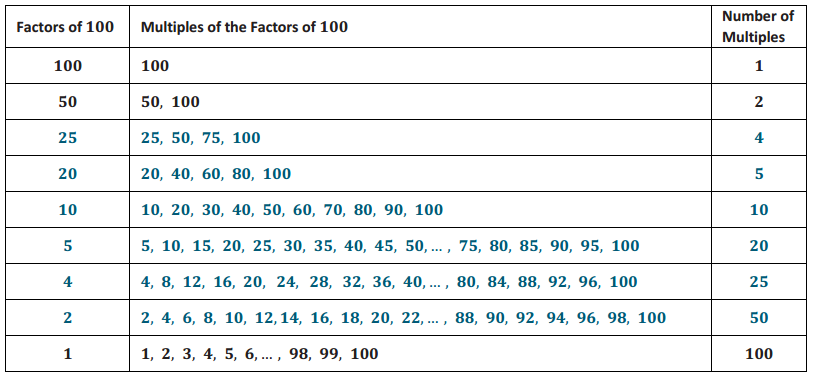
What are the whole number factors of 100? What are the multiples of those factors? How many multiples are there of each factor (up to 100)?
Engage NY Math Grade 7 Module 4 Lesson 5 Exercise Answer Key 1
Answer:
Engage NY Math Grade 7 Module 4 Lesson 5 Exercise Answer Key 2
→ How do you think we can use these whole number factors in calculating percents on a double number line?
The factors represent all ways by which we could break 100% into equal – sized whole number intervals. The multiples listed would be the percents representing each cumulative interval. The number of multiples would be the number of intervals.

Exercises 1–3

Exercise 1.
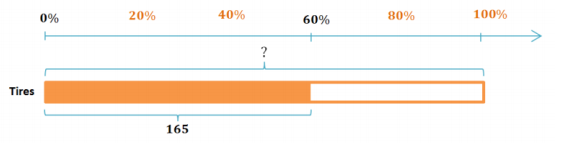
Bob’s Tire Outlet sold a record number of tires last month. One salesman sold 165 tires, which was 60% of the tires sold in the month. What was the record number of tires sold?
Answer:
Engage NY Math Grade 7 Module 4 Lesson 5 Exercise Answer Key 3
The salesman’s total is being compared to the total number of tires sold by the store, so the total number of tires sold is the whole quantity. The greatest common factor of 60 and 100 is 20, so I divided the percent line into five equal – sized intervals of 20%. 60% is three of the 20% intervals, so I divided the salesman’s 165 tires by 3 and found that 55 tires corresponds with each 20% interval. 100% consists of five 20% intervals, which corresponds to five groups of 55 tires. Since 5∙55 = 275, the record number of tires sold was 275 tires.

Exercise 2.
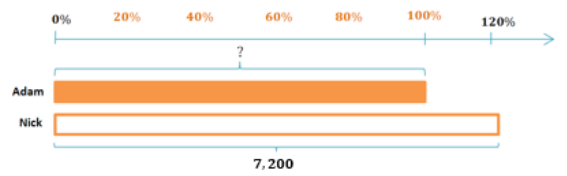
Nick currently has 7,200 points in his fantasy baseball league, which is 20% more points than Adam. How many points does Adam have?
Answer:
Engage NY Math Grade 7 Module 4 Lesson 5 Exercise Answer Key 4
Nick’s points are being compared to Adam’s points, so Adam’s points are the whole quantity. Nick has 20% more points than Adam, so Nick really has 120% of Adam’s points. The greatest common factor of 120 and 100 is 20, so I divided the 120% on the percent line into six equal – sized intervals. I divided Nick’s 7,200 points by 6 and found that 1,200 points corresponds to each 20% interval. Five intervals of 20% make 100%, and five intervals of 1,200 points totals 6,000 points. Adam has 6,000 points in the fantasy baseball league.

Exercise 3.
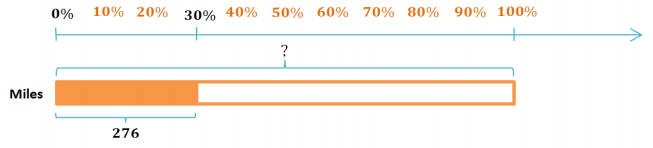
Kurt has driven 276 miles of his road trip but has 70% of the trip left to go. How many more miles does Kurt have to drive to get to his destination?
Answer:
Engage NY Math Grade 7 Module 4 Lesson 5 Exercise Answer Key 5
With 70% of his trip left to go, Kurt has only driven 30% of the way to his destination. The greatest common factor of 30 and 100 is 10, so I divided the percent line into ten equal – sized intervals. 30% is three of the 10% intervals, so I divided 276 miles by 3 and found that 92 miles corresponds to each 10% interval. Ten intervals of 10% make 100%, and ten intervals of 92 miles totals 920 miles. Kurt has already driven 276 miles, and 920 – 276 = 644, so Kurt has 644 miles left to get to his destination.

Exercises 4–5

Exercise 4.
Derrick had a 0.250 batting average at the end of his last baseball season, which means that he got a hit 25% of the times he was up to bat. If Derrick had 47 hits last season, how many times did he bat?
Answer:
The decimal 0.250 is 25%, which means that Derrick had a hit 25% of the times that he batted. His number of hits is being compared to the total number of times he was up to bat. The 47 hits corresponds with 25%, and since 25 is a factor of 100, 100 = 25∙4. I used mental math to multiply the following:
47∙4
(50 – 3)∙4 Used the distributive property for easier mental math
200 – 12
188
Derrick was up to bat 188 times last season.

Exercise 5.
Nelson used 35% of his savings account for his class trip in May. If he used $140 from his savings account while on his class trip, how much money was in his savings account before the trip?
Answer:
35% of Nelson’s account was spent on the trip, which was $140. The amount that he spent is being compared to the total amount of savings, so the total savings represents the whole. The greatest common factor of 35 and 100 is 5. 35% is seven intervals of 5%, so I divided $140 by 7 to find that $20 corresponds to 5%.
100% = 5%∙20, so the whole quantity is $20∙20 = $400. Nelson’s savings account had $400 in it before his class trip.

Eureka Math Grade 7 Module 4 Lesson 5 Problem Set Answer Key

Use a double number line to answer Problems 1–5.
Question 1.
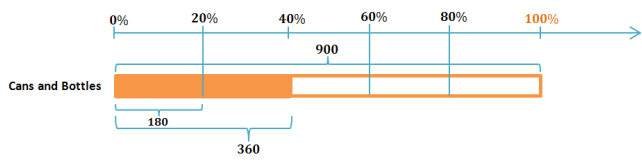
Tanner collected 360 cans and bottles while fundraising for his baseball team. This was 40% of what Reggie collected. How many cans and bottles did Reggie collect?
Answer:
Eureka Math 7th Grade Module 4 Lesson 5 Problem Set Answer Key 1
The greatest common factor of 40 and 100 is 20.
\(\frac{1}{2}\) (40%) = 20%, and \(\frac{1}{2}\) (360) = 180, so 180 corresponds with 20%. There are five intervals of 20% in 100%, and 5(180) = 900, so Reggie collected 900 cans and bottles.

Question 2.
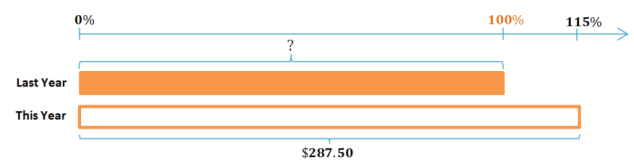
Emilio paid $287.50 in taxes to the school district that he lives in this year. This year’s taxes were a 15% increase from last year. What did Emilio pay in school taxes last year?
Answer:
Eureka Math 7th Grade Module 4 Lesson 5 Problem Set Answer Key 2
The greatest common factor of 100 and 115 is 5. There are 23 intervals of 5% in 115%, and \(\frac{287.5}{23}\) = 12.5, so 12.5 corresponds with 5%. There are 20 intervals of 5% in 100%, and 20(12.5) = 250, so Emilio paid $250 in school taxes last year.

Question 3.
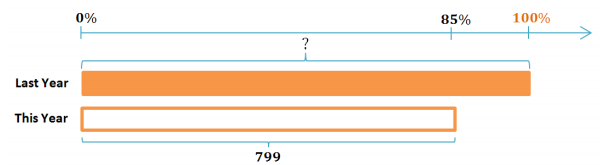
A snowmobile manufacturer claims that its newest model is 15% lighter than last year’s model. If this year’s model weighs 799 lb., how much did last year’s model weigh?
Answer:
Eureka Math 7th Grade Module 4 Lesson 5 Problem Set Answer Key 3
15% lighter than last year’s model means 15% less than 100% of last year’s model’s weight, which is 85%. The greatest common factor of 85 and 100 is 5. There are 17 intervals of 5% in 85%, and \(\frac{799}{17}\) = 47, so 47 corresponds with 5%. There are 20 intervals of 5% in 100%, and 20(47) = 940, so last year’s model weighed 940 pounds.

Question 4.
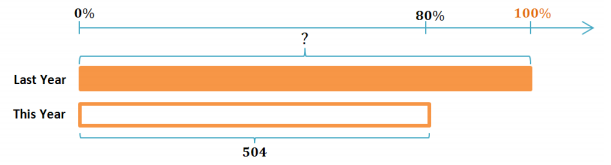
Student enrollment at a local school is concerning the community because the number of students has dropped to 504, which is a 20% decrease from the previous year. What was the student enrollment the previous year?
Answer:
Eureka Math 7th Grade Module 4 Lesson 5 Problem Set Answer Key 4
A 20% decrease implies that this year’s enrollment is 80% of last year’s enrollment. The greatest common factor of 80 and 100 is 20. There are 4 intervals of 20% in 80%, and \(\frac{504}{4}\) = 126, so 126 corresponds to 20%. There are 5 intervals of 20% in 100%, and 5(126) = 630, so the student enrollment from the previous year was 630 students.

Question 5.
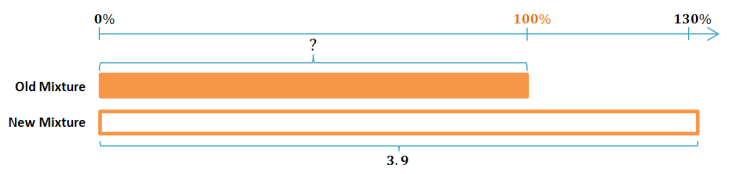
The color of paint used to paint a race car includes a mixture of yellow and green paint. Scotty wants to lighten the color by increasing the amount of yellow paint 30%. If a new mixture contains 3.9 liters of yellow paint, how many liters of yellow paint did he use in the previous mixture?
Answer:
Eureka Math 7th Grade Module 4 Lesson 5 Problem Set Answer Key 5
The greatest common factor of 130 and 100 is 10. There are 13 intervals of 10% in 130%, and \(\frac{3.9}{13}\) = 0.3, so 0.3 corresponds to 10%. There are 10 intervals of 10% in 100%, and 10(0.3) = 3, so the previous mixture included 3 liters of yellow paint.

Use factors of 100 and mental math to answer Problems 6–10. Describe the method you used.
Question 6.
Alexis and Tasha challenged each other to a typing test. Alexis typed 54 words in one minute, which was 120% of what Tasha typed. How many words did Tasha type in one minute?
Answer:
The greatest common factor of 120 and 100 is 20, and there are 6 intervals of 20% in 120%, so I divided 54 into 6 equal – sized intervals to find that 9 corresponds to 20%. There are five intervals of 20% in 100%, so there are five intervals of 9 words in the whole quantity. 9∙5 = 45, so Tasha typed 45 words in one minute.

Question 7.
Yoshi is 5% taller today than she was one year ago. Her current height is 168 cm. How tall was she one year ago?
Answer:
5% taller means that Yoshi’s height is 105% of her height one year ago. The greatest common factor of 105 and 100 is 5, and there are 21 intervals of 5% in 105%, so I divided 168 into 21 equal – sized intervals to find that 8 cm corresponds to 5%. There are 20 intervals of 5% in 100%, so there are 20 intervals of 8 cm in the whole quantity. 20∙8 cm = 160 cm, so Yoshi was 160 cm tall one year ago.

Question 8.
Toya can run one lap of the track in 1 min.3 sec., which is 90% of her younger sister Niki’s time. What is Niki’s time for one lap of the track?
Answer:
1 min.3 sec = 63 sec. The greatest common factor of 90 and 100 is 10, and there are nine intervals of 10 in 90, so I divided 63 sec. by 9 to find that 7 sec. corresponds to 10%. There are 10 intervals of 10% in 100%, so 10 intervals of 7 sec. represents the whole quantity, which is 70 sec. 70 sec. = 1 min.10 sec. Niki can run one lap of the track in 1 min.10 sec.

Question 9.
An animal shelter houses only cats and dogs, and there are 25% more cats than dogs. If there are 40 cats, how many dogs are there, and how many animals are there total?
Answer:
25% more cats than dogs means that the number of cats is 125% the number of dogs. The greatest common factor of 125 and 100 is 25. There are 5 intervals of 25% in 125%, so I divided the number of cats into 5 intervals to find that 8 corresponds to 25%. There are four intervals of 25% in 100%, so there are four intervals of 8 in the whole quantity. 8∙4 = 32. There are 32 dogs in the animal shelter.
The number of animals combined is 32 + 40 = 72, so there are 72 animals in the animal shelter.

Question 10.
Angie scored 91 points on a test but only received a 65% grade on the test. How many points were possible on the test?
Answer:
The greatest common factor of 65 and 100 is 5. There are 13 intervals of 5% in 65%, so I divided 91 points into 13 intervals and found that 7 points corresponds to 5%. There are 20 intervals of 5% in 100%, so I multiplied 7 points times 20, which is 140 points. There were 140 points possible on Angie’s test.

For Problems 11–17, find the answer using any appropriate method.
Question 11.
Robbie owns 15% more movies than Rebecca, and Rebecca owns 10% more movies than Joshua. If Rebecca owns 220 movies, how many movies do Robbie and Joshua each have?
Answer:
Robbie owns 253 movies, and Joshua owns 200 movies.

Question 12.
20% of the seventh – grade students have math class in the morning. 16 2/3% of those students also have science class in the morning. If 30 seventh – grade students have math class in the morning but not science class, find how many seventh – grade students there are.
Answer:

There are 180 seventh – grade students.

Question 13.
The school bookstore ordered three – ring notebooks. They put 75% of the order in the warehouse and sold 80% of the rest in the first week of school. There are 25 notebooks left in the store to sell. How many three – ring notebooks did they originally order?
Answer:
The store originally ordered 500 three – ring notebooks.

Question 14.
In the first game of the year, the modified basketball team made 62.5% of their foul shot free throws. Matthew made all 6 of his free throws, which made up 25% of the team’s free throws. How many free throws did the team miss altogether?
Answer:
The team attempted 24 free throws, made 15 of them, and missed 9.

Question 15.
Aiden’s mom calculated that in the previous month, their family had used 40% of their monthly income for gasoline, and 63% of that gasoline was consumed by the family’s SUV. If the family’s SUV used $261.45 worth of gasoline last month, how much money was left after gasoline expenses?
Answer:
The amount of money spent on gasoline was $415; the monthly income was $1,037.50. The amount left over after gasoline expenses was $622.50.

Question 16.
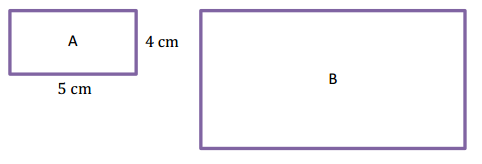
Rectangle A is a scale drawing of Rectangle B and has 25% of its area. If Rectangle A has side lengths of 4 cm and 5 cm, what are the side lengths of Rectangle B?
Eureka Math 7th Grade Module 4 Lesson 5 Problem Set Answer Key 6
Answer:
AreaA = length × width
AreaA = (5 cm)(4 cm)
AreaA = 20 cm2
The area of Rectangle A is 25% of the area of Rectangle B.
25% × 4 = 100%
20 × 4 = 80
So, the area of Rectangle B is 80 cm2.
The value of the ratio of area A to area B is the square of the scale factor of the side lengths A:B.
The value of the ratio of area A:B is 20/80 = \(\frac{1}{4}\) , and \(\frac{1}{4}\) = (\(\frac{1}{2}\))2, so the scale factor of the side lengths A:B is \(\frac{1}{2}\).
So, using the scale factor:
\(\frac{1}{2}\) (lengthB) = 5 cm; lengthB = 10 cm
\(\frac{1}{2}\) (widthB ) = 4 cm; widthB = 8 cm
The dimensions of Rectangle B are 8 cm and 10 cm.

Question 17.
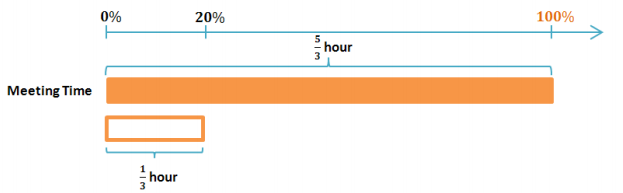
Ted is a supervisor and spends 20% of his typical work day in meetings and 20% of that meeting time in his daily team meeting. If he starts each day at 7:30 a.m., and his daily team meeting is from 8:00 a.m. to 8:20 a.m., when does Ted’s typical work day end?
Answer:
Eureka Math 7th Grade Module 4 Lesson 5 Problem Set Answer Key 7
20 minutes is \(\frac{1}{3}\) of an hour since \(\frac{20}{60}\) = \(\frac{1}{3}\).
Ted spends \(\frac{1}{3}\) hour in his daily team meeting, so \(\frac{1}{3}\) corresponds to 20% of his meeting time. There are 5 intervals of 20% in 100%, and 5(\(\frac{1}{3}\)) = \(\frac{5}{3}\), so Ted spends \(\frac{5}{3}\) hours in meetings.
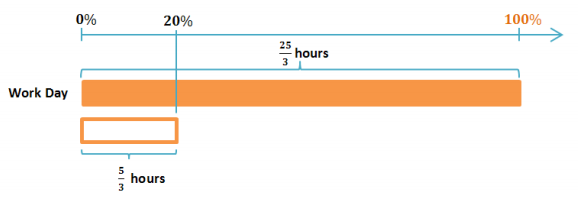
\(\frac{5}{3}\) of an hour corresponds to 20% of Ted’s work day.
Eureka Math 7th Grade Module 4 Lesson 5 Problem Set Answer Key 8
There are 5 intervals of 20% in 100%, and 5(\(\frac{5}{3}\)) = \(\frac{25}{3}\), so Ted spends \(\frac{25}{3}\) hours working. \(\frac{25}{3}\) hours = 8 \(\frac{1}{3}\) hours. Since \(\frac{1}{3}\) hour = 20 minutes, Ted works a total of 8 hours 20 minutes. If he starts at 7:30 a.m., he works 4 hours 30 minutes until 12:00 p.m., and since 8 \(\frac{1}{3}\) – 4 \(\frac{1}{2}\) = 3 \(\frac{5}{6}\), Ted works another 3 \(\frac{5}{6}\) hours after 12:00 p.m.

\(\frac{1}{6}\) hour = 10 minutes, and \(\frac{5}{6}\) hour = 50 minutes, so Ted works 3 hours 50 minutes after 12:00 p.m., which is 3:50 p.m. Therefore, Ted’s typical work day ends at 3:50 p.m.

Eureka Math Grade 7 Module 4 Lesson 5 Exit Ticket Answer Key

Question 1.
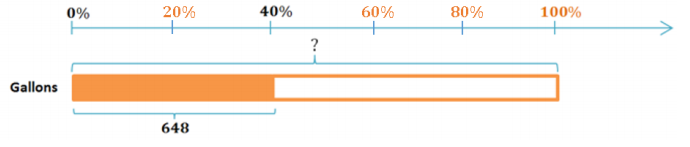
A tank that is 40% full contains 648 gallons of water. Use a double number line to find the maximum capacity of the water tank.
Answer:

Eureka Math Grade 7 Module 4 Lesson 5 Exit Ticket Answer Key 1
I divided the percent line into intervals of 20% making five intervals of 20% in 100%. I know that I have to divide \(\frac{40}{2}\) to get 20, so I divided \(\frac{648}{2}\) to get 324 that corresponds with 20%. Since there are five 20% intervals in 100%, there are five 324 gallon intervals in the whole quantity, and 324∙5 = 1,620. The capacity of the tank is 1,620 gallons.

Question 2.
Loretta picks apples for her grandfather to make apple cider. She brings him her cart with 420 apples. Her grandfather smiles at her and says, “Thank you, Loretta. That is 35% of the apples that we need.”
Use mental math to find how many apples Loretta’s grandfather needs. Describe your method.
Answer:
420 is 35% of 1,200. 35 is not a factor of 100, but 35 and 100 have a common factor of 5. There are seven intervals of 5% in 35%, so I divided 420 apples into seven intervals; \(\frac{420}{7}\) = 60. There are 20 intervals of 5% in 100%, so I multiplied as follows:
60∙20
60∙2∙10
120∙10
1,200
Loretta’s grandfather needs a total of 1,200 apples to make apple cider.

Eureka Math Grade 7 Module 4 Lesson 4 Answer Key

Engage NY Eureka Math 7th Grade Module 4 Lesson 4 Answer Key

Eureka Math Grade 7 Module 4 Lesson 4 Example Answer Key

Example 1: Finding a Percent Increase
Cassandra’s aunt said she will buy Cassandra another ring for her birthday. If Cassandra gets the ring for her birthday, what will be the percent increase in her ring collection?
Engage NY Math 7th Grade Module 4 Lesson 4 Example Answer Key 1
Answer:
→ Looking back at our answers to the Opening Exercise, what percent is represented by 1 ring? If Cassandra gets the ring for her birthday, by what percent did her ring collection increase?
20% represents 1 ring, so her ring collection would increase by 20%.

→ Compare the number of new rings to the original total:
\(\frac{1}{5}\) = \(\frac{20}{100}\) = 0.20 = 20%

→ Use an algebraic equation to model this situation. The quantity is represented by the number of new rings.
Quantity = Percent × Whole. Let p represent the unknown percent.
1 = p∙5
\(\frac{1}{5}\) = p
\(\frac{1}{5}\) = \(\frac{20}{100}\) = 0.2 = 20%

Example 2: Percent Decrease
Ken said that he is going to reduce the number of calories that he eats during the day. Ken’s trainer asked him to start off small and reduce the number of calories by no more than 7%.
Ken estimated and consumed 2,200 calories per day instead of his normal 2,500 calories per day until his next visit with the trainer. Did Ken reduce his calorie intake by no more than 7%? Justify your answer.
Answer:
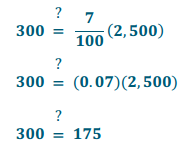
a. Ken reduced his daily calorie intake by 300 calories. Does 7% of 2,500 calories equal 300 calories?
Quantity = Percent × Whole
Engage NY Math 7th Grade Module 4 Lesson 4 Example Answer Key 2

False, because 300≠175.

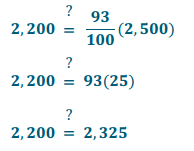
b. A 7% decrease means Ken would get 93% of his normal daily calorie intake since 100% – 7% = 93%. Ken consumed 2,200 calories, so does 93% of 2,500 equal 2,200?
Quantity = Percent × Whole
Engage NY Math 7th Grade Module 4 Lesson 4 Example Answer Key 3
False. Because 2,200 ≠ 2,325, Ken’s estimation was wrong.

Example 3: Finding a Percent Increase or Decrease
Justin earned 8 badges in Scouts as of the Scout Master’s last report. Justin wants to complete 2 more badges so that he will have a total of 10 badges earned before the Scout Master’s next report.
a. If Justin completes the additional 2 badges, what will be the percent increase in badges?
Answer:
Quantity = Percent × Whole. Let p represent the unknown percent.
2 = p∙8
2(\(\frac{1}{8}\)) = p(\(\frac{1}{8}\))(8)
\(\frac{2}{8}\) = p
\(\frac{1}{4}\) = p
\(\frac{1}{4}\) = \(\frac{25}{100}\) = 25%
There would be a 25% increase in the number of badges.

b. Express the 10 badges as a percent of the 8 badges.
Answer:
8 badges is the whole, or 100%, and 2 badges represent 25% of the badges, so 10 badges represent
100% + 25% = 125% of the 8 badges.
Check:
10 = p∙8
10(\(\frac{1}{8}\)) = p(\(\frac{1}{8}\))(8)
\(\frac{10}{8}\) = p
\(\frac{5}{4}\) = p
\(\frac{5}{4}\) = \(\frac{125}{100}\) = 125%

c. Does 100% plus your answer in part (a) equal your answer in part (b)? Why or why not?
Answer:
Yes. My answer makes sense because 8 badges are the whole or 100%, and 2 badges represent 25% of the badges, so 10 badges represent 100% + 25%, or 125% of the 8 badges.

Example 4: Finding the Original Amount Given a Percent Increase or Decrease
The population of cats in a rural neighborhood has declined in the past year by roughly 30%. Residents hypothesize that this is due to wild coyotes preying on the cats. The current cat population in the neighborhood is estimated to be 12. Approximately how many cats were there originally?
Answer:
→ Do we know the part or the whole?
We know the part (how many cats are left), but we do not know the original whole.

→ Is this a percent increase or decrease problem? How do you know?
Percent decrease because the word declined means decreased.

→ If there was about a 30% decline in the cat population, then what percent of cats remain?
100% – 30% = 70%, so about 70% of the cats remain.

→ How do we write an equation to model this situation?
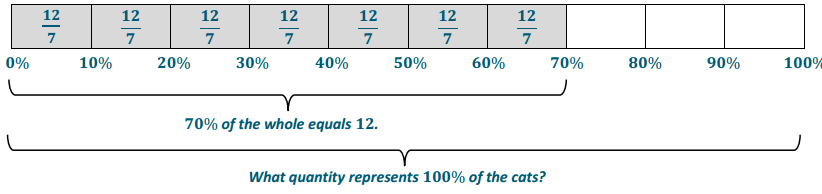
12 cats represent the quantity that is about 70% of the original number of cats. We are trying to find the whole, which equals the original number of cats. So, using Quantity = Percent × Whole and substituting the known values into the equation, we have 12 = 70%∙W, where W represents the original number of cats.
Quantity = Percent × Whole
12 = (\(\frac{7}{10}\))∙W
(12)(\(\frac{10}{7}\)) = (\(\frac{7}{10}\))(\(\frac{10}{7}\))∙W
\(\frac{120}{7}\) = W
W≈17.1≈17
There must have been 17 cats originally.
Engage NY Math 7th Grade Module 4 Lesson 4 Example Answer Key 4
To find the original number of cats or the whole (100% of the cats), we need to add three more twelve sevenths to 12.
12 + 3(\(\frac{12}{7}\)) = \(\frac{84}{7}\) + \(\frac{36}{7}\) = \(\frac{120}{7}\)≈17
The decrease was given as approximately 30%, so there must have been 17 cats originally.

Example 5.
Lu’s math score on her achievement test in seventh grade was a 650. Her math teacher told her that her test level went up by 25% from her sixth grade test score level. What was Lu’s test score level in sixth grade?
Answer:
→ Does this represent a percent increase or decrease? How do you know?
Percent increase because the word up means increase.

→ Using the equation Quantity = Percent × Whole, what information do we know?
We know Lu’s test score level in seventh grade after the change, which is the quantity, and we know the percent. But we do not know the whole (her test score level from sixth grade).

→ If Lu’s sixth grade test score level represents the whole, then what percent represents the seventh grade level?
100% + 25% = 125%
→ How do we write an equation to model this situation? Let W represent Lu’s test score in sixth grade.
Quantity = Percent × Whole
650 = 125% × W
650 = 1.25W
650(\(\frac{1}{1.25}\)) = 1.25(\(\frac{1}{1.25}\))W
\(\frac{650}{1.25}\) = W
\(\frac{65,000}{125}\) = W
520 = W
Lu’s sixth grade test score level was 520.

Eureka Math Grade 7 Module 4 Lesson 4 Exercise Answer Key

Opening Exercise
Cassandra likes jewelry. She has 5 rings in her jewelry box.
a. In the box below, sketch Cassandra’s 5 rings.
Answer:

Engage NY Math Grade 7 Module 4 Lesson 4 Exercise Answer Key 1

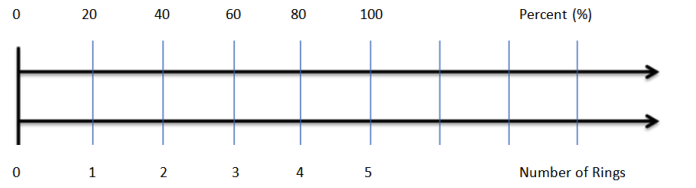
b. Draw a double number line diagram relating the number of rings as a percent of the whole set of rings.
Answer:
Engage NY Math Grade 7 Module 4 Lesson 4 Exercise Answer Key 2

c. What percent is represented by the whole collection of rings? What percent of the collection does each ring represent?
Answer:
100%, 20%

Exercise 1.
a. Jon increased his trading card collection by 5 cards. He originally had 15 cards. What is the percent increase? Use the equation Quantity = Percent × Whole to arrive at your answer, and then justify your answer using a numeric or visual model.
Answer:
Quantity = Percent × Whole. Let p represent the unknown percent.
5 = p(15)
5(\(\frac{1}{15}\)) = p(15)(\(\frac{1}{15}\))
\(\frac{5}{15}\) = p
p = \(\frac{1}{3}\) = 0.3333…
0.3333 … = \(\frac{33}{100}\) + \(\frac{0.3333 \ldots}{100}\) = 33% + \(\frac{1}{3}\)% = 33\(\frac{1}{3}\)%

b. Suppose instead of increasing the collection by 5 cards, Jon increased his 15 – card collection by just 1 card. Will the percent increase be the same as when Cassandra’s ring collection increased by 1 ring (in Example 1)? Why or why not? Explain.
Answer:
No, it would not be the same because the part – to – whole relationship is different. Cassandra’s additional ring compared to the original whole collection was 1 to 5, which is equivalent to 20 to 100, which is 20%. Jon’s additional trading card compared to his original card collection is 1 to 15, which is less than 10%, since
\(\frac{1}{15}\)<\(\frac{1}{10}\), and \(\frac{1}{10}\) = 10%.

c. Based on your answer to part (b), how is displaying change as a percent useful?
Answer:
Representing change as a percent helps us to understand how large the change is compared to the whole.

Discussion
A sales representative is taking 10% off of your bill as an apology for any inconveniences.
Engage NY Math Grade 7 Module 4 Lesson 4 Exercise Answer Key 3
Answer:
Engage NY Math Grade 7 Module 4 Lesson 4 Exercise Answer Key 4

Exercise 2.
Skylar is answering the following math problem:
The value of an investment decreased by 10%. The original amount of the investment was $75.00. What is the current value of the investment?
a. Skylar said 10% of $75.00 is $7.50, and since the investment decreased by that amount, you have to subtract $7.50 from $75.00 to arrive at the final answer of $67.50. Create one algebraic equation that can be used to arrive at the final answer of $67.50. Solve the equation to prove it results in an answer of $67.50. Be prepared to explain your thought process to the class.
Answer:
Let F represent the final value of the investment.
The final value is 90% of the original investment, since 100% – 10% = 90%.
F = Percent × Whole
F = (0.90)(75)
F = 67.5
The final value of the investment is $67.50.

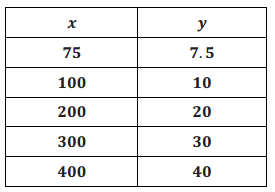
b. Skylar wanted to show the proportional relationship between the dollar value of the original investment, x, and its value after a 10% decrease, y. He creates the table of values shown below. Does it model the relationship? Explain. Then, provide a correct equation for the relationship Skylar wants to model.
Engage NY Math Grade 7 Module 4 Lesson 4 Exercise Answer Key 5
Answer:
No. The table only shows the proportional relationship between the amount of the investment and the amount of the decrease, which is 10% of the amount of the investment. To show the relationship between the value of the investment before and after the 10% decrease, he needs to subtract each value currently in the y – column from each value in the x – column so that the y – column shows the following values: 67.5, 90, 180, 270, and 360. The correct equation is y = x – 0.10x, or y = 0.90x.

Eureka Math Grade 7 Module 4 Lesson 4 Problem Set Answer Key

Question 1.
A store advertises 15% off an item that regularly sells for $300.
a. What is the sale price of the item?
Answer:
(0.85)300 = 255; the sale price is $255.

b. How is a 15% discount similar to a 15% decrease? Explain.
Answer:
In both cases, you are subtracting 15% of the whole from the whole, or finding 85% of the whole.

c. If 8% sales tax is charged on the sale price, what is the total with tax?
Answer:
(1.08)(255) = 275.40; the total with tax is $275.40.

d. How is 8% sales tax like an 8% increase? Explain.
Answer:
In both cases, you are adding 8% of the whole to the whole, or finding 108% of the whole.

Question 2.
An item that was selling for $72.00 is reduced to $60.00. Find the percent decrease in price. Round your answer to the nearest tenth.
Answer:
The whole is 72. 72 – 60 = 12. 12 is the part. Using Quantity = Percent × Whole, I get 12 = p × 72, where p represents the unknown percent, and working backward, I arrive at \(\frac{12}{72}\) = \(\frac{1}{6}\) = \(0.1 \overline{6}\) = p.
So, it is about a 16.7% decrease.

Question 3.
A baseball team had 80 players show up for tryouts last year and this year had 96 players show up for tryouts. Find the percent increase in players from last year to this year.
Answer:
The number of players that showed up last year is the whole; 16 players are the quantity of change since
96 – 80 = 16.
Quantity = Percent × Whole. Let p represent the unknown percent.
16 = p(80)
p = 0.2
0.2 = \(\frac{20}{100}\) = 20%
The number of players this year was a 20% increase from last year.

Question 4.
At a student council meeting, there was a total of 60 students present. Of those students, 35 were female.
a. By what percent is the number of females greater than the number of males?
Answer:
The number of males (60 – 35 = 25) at the meeting is the whole. The part (quantity) can be represented by the number of females (35) or how many more females there are than the number of males.
Quantity = Percent × Whole
35 = p(25)
p = 1.4
1.4 = 140%, which is 40% more than 100%. Therefore, there were 40% more females than males at the student council meeting.

b. By what percent is the number of males less than the number of females?
Answer:
The number of females (35) at the meeting is the whole. The part (quantity) can be represented by the number of males, or the number less of males than females (10).
Quantity = Percent × Whole
10 = p(35)
p≈0.29
0.29 = 29%
The number of males at the meeting is approximately 29% less than the number of females.

c. Why is the percent increase and percent decrease in parts (a) and (b) different?
Answer:
The difference in the number of males and females is the same in each case, but the whole quantities in parts (a) and (b) are different.

Question 5.
Once each day, Darlene writes in her personal diary and records whether the sun is shining or not. When she looked back though her diary, she found that over a period of 600 days, the sun was shining 60% of the time. She kept recording for another 200 days and then found that the total number of sunny days dropped to 50%. How many of the final 200 days were sunny days?
Answer:
To find the number of sunny days in the first 600 days, the total number of days is the whole.
Quantity = Percent × Whole. Let s represent the number of sunny days.
s = 0.6(600)
s = 360
There were 360 sunny days in the first 600 days.
The total number of days that Darlene observed was 800 days because 600 + 200 = 800.
d = 0.5(800)
d = 400
There was a total of 400 sunny days out of the 800 days.
The number of sunny days in the final 200 days is the difference of 400 days and 360 days.
400 – 360 = 40, so there were 40 sunny days of the last 200 days.

Question 6.
Henry is considering purchasing a mountain bike. He likes two bikes: One costs $500, and the other costs $600. He tells his dad that the bike that is more expensive is 20% more than the cost of the other bike. Is he correct? Justify your answer.
Answer:
Yes. Quantity = Percent × Whole. After substituting in the values of the bikes and percent, I arrive at the following equation: 600 = 1.2(500), which is a true equation.

Question 7.
State two numbers such that the lesser number is 25% less than the greater number.
Answer:
Answers will vary. One solution is as follows: Greater number is 100; lesser number is 75.

Question 8.
State two numbers such that the greater number is 75% more than the lesser number.
Answer:
Answers will vary. One solution is as follows: Greater number is 175; lesser number is 100.

Question 9.
Explain the difference in your thought process for Problems 7 and 8. Can you use the same numbers for each problem? Why or why not?
Answer:
No. The whole is different in each problem. In Problem 7, the greater number is the whole. In Problem 8, the lesser number is the whole.

Question 10.
In each of the following expressions, c represents the original cost of an item.
Eureka Math 7th Grade Module 4 Lesson 4 Problem Set Answer Key 1
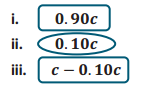
a. Circle the expression(s) that represents 10% of the original cost. If more than one answer is correct, explain why the expressions you chose are equivalent.
b. Put a box around the expression(s) that represents the final cost of the item after a 10% decrease. If more than one is correct, explain why the expressions you chose are equivalent.
Answer:
c – 0.10c
1c – 0.10c Multiplicative identity property of 1
(1 – 0.10)c Distributive property (writing a sum or difference as a product)
0.90c
Therefore, c – 0.10c = 0.90c.

c. Create a word problem involving a percent decrease so that the answer can be represented by expression (ii).
Answer:
Answers will vary. The store’s cashier told me I would get a 10% discount on my purchase. How can I find the amount of the 10% discount?

d. Create a word problem involving a percent decrease so that the answer can be represented by expression (i).
Answer:
Answers will vary. An item is on sale for 10% off. If the original price of the item is c, what is the final price after the 10% discount?

e. Tyler wants to know if it matters if he represents a situation involving a 25% decrease as 0.25x or (1 – 0.25)x. In the space below, write an explanation that would help Tyler understand how the context of a word problem often determines how to represent the situation.
Answer:
If the word problem asks you to find the amount of the 25% decrease, then 0.25x would represent it. If the problem asks you to find the value after a 25% decrease, then (1 – 0.25)x would be a correct representation.

Eureka Math Grade 7 Module 4 Lesson 4 Exit Ticket Answer Key

Question 1.
Erin wants to raise her math grade to a 95 to improve her chances of winning a math scholarship. Her math average for the last marking period was an 81. Erin decides she must raise her math average by 15% to meet her goal. Do you agree? Why or why not? Support your written answer by showing your math work.
Answer:
No, I do not agree. 15% of 81 is 12.15. 81 + 12.15 = 93.15, which is less than 95. I arrived at my answer using the equation below to find 15% of 81.
Quantity = Percent × Whole
Let G stand for the number of points Erin’s grade will increase by after a 15% increase from 81. The whole is 81, and the percent is 15%. First, I need to find 15% of 81 to arrive at the number of points represented by a 15% increase. Then, I will add that to 81 to see if it equals 95, which is Erin’s goal.
G = 0.15 × 81
G = 12.15
Adding the points onto her average: 81.00 + 12.15 = 93.15
Comparing it to her goal: 93.15 < 95

Eureka Math Grade 7 Module 4 Lesson 3 Answer Key

Engage NY Eureka Math 7th Grade Module 4 Lesson 3 Answer Key

Eureka Math Grade 7 Module 4 Lesson 3 Example Answer Key

Example
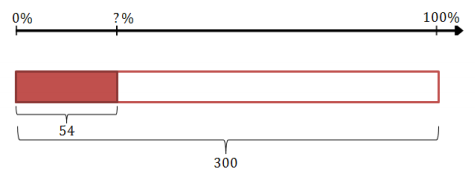
a. The members of a club are making friendship bracelets to sell to raise money. Anna and Emily made 54 bracelets over the weekend. They need to produce 300 bracelets by the end of the week. What percent of the bracelets were they able to produce over the weekend?
Answer:
Engage NY Math 7th Grade Module 4 Lesson 3 Example Answer Key 1
300 → 100%
1 → \(\frac{100}{300}\)%
54 → 54 ∙ \(\frac{100}{300}\)%
54 → 54 ∙ \(\frac{1}{3}\)%
54 → 18%
Anna and Emily were able to produce 18% of the total number of bracelets over the weekend

Quantity = Percent × Whole
Let p represent the unknown percent.
54 = p(300)
\(\frac{1}{300}\) (54) = \(\frac{1}{300}\) (300)p
\(\frac{54}{300}\) = 1p
\(\frac{18}{100}\) = p
\(\frac{18}{100}\) = 0.18 = 18%
Anna and Emily were able to produce 18% of the total bracelets over the weekend.

b. Anna produced 32 of the 54 bracelets produced by Emily and Anna over the weekend. Write the number of bracelets that Emily produced as a percent of those that Anna produced.
Answer:
Arithmetic Method:
32 → 100%
1 → \(\frac{100}{32}\)%
22 → 22 ∙ \(\frac{100}{32}\)%
22 → 100 ∙ \(\frac{22}{32}\)%
22 → 100 ∙ 0.6875%
22 → 68.75%

Algebraic Method:
Quantity = Percent × Whole
Let p represent the unknown percent.
22 = p(32)
\(\frac{1}{32}\) (22) = \(\frac{1}{32}\) (32)p
\(\frac{22}{32}\) = 1p
0.6875 = p
0.6875 = 68.75%

22 bracelets are 68.75% of the number of bracelets that Anna produced. Emily produced 22 bracelets; therefore, she produced 68.75% of the number of bracelets that Anna produced.

c. Write the number of bracelets that Anna produced as a percent of those that Emily produced.
Answer:
Arithmetic Method:
22 → 100%
1 → \(\frac{100}{22}\)%
32 → 32 ∙ \(\frac{100}{22}\)%
32 → 100 ∙ \(\frac{32}{22}\)%
32 → 100 ∙ \(\frac{16}{11}\)%
32 → \(\frac{1600}{11}\)%
32 → 145 \(\frac{5}{11}\)%

Algebraic Method:
Quantity = Percent × Whole
Let p represent the unknown percent.
32 = p(22)
\(\frac{1}{22}\) (32) = \(\frac{1}{22}\) (22)p
\(\frac{32}{22}\) = 1p
\(\frac{16}{11}\) = p
1 \(\frac{5}{11}\) = p
1 \(\frac{5}{11}\) = 1 \(\frac{5}{11}\) × 100% = 145 \(\frac{5}{11}\)%

32 bracelets are 145 \(\frac{5}{11}\)% of the number of bracelets that Emily produced. Anna produced 32 bracelets over the weekend, so Anna produced 145 \(\frac{5}{11}\)% of the number of bracelets that Emily produced.

Eureka Math Grade 7 Module 4 Lesson 3 Exercise Answer Key

Opening Exercise
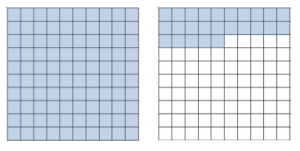
If each 10 × 10 unit square represents one whole, then what percent is represented by the shaded region?
Engage NY Math Grade 7 Module 4 Lesson 3 Exercise Answer Key 1
In the model above, 25% represents a quantity of 10 students. How many students does the shaded region represent?
Answer:
If 25% represents 10 students, then 1% represents \(\frac{10}{25}\), or \(\frac{2}{5}\), of a student. The shaded region covers 125 square units, or 125%, so since \(\frac{2}{5}\) ∙ 125 = 50, the shaded region represents 50 students.

Exercise 2.
There are 750 students in the seventh – grade class and 625 students in the eighth – grade class at Kent Middle School.
a. What percent is the seventh – grade class of the eighth – grade class at Kent Middle School?
The number of eighth graders is the whole amount. Let p represent the percent of seventh graders compared to eighth graders.
Quantity = Percent × Whole
Let p represent the unknown percent.
750 = p(625)
750(\(\frac{1}{625}\)) = p(625)(\(\frac{1}{625}\))
1.2 = p
1.2 = 120%
The number of seventh graders is 120% of the number of eighth graders.
There are 20% more seventh graders than eighth graders.
Alternate solution: There are 125 more seventh graders. 125 = p(625), p = 0.20. There are 20% more seventh graders than eighth graders.

b. The principal will have to increase the number of eighth – grade teachers next year if the seventh – grade enrollment exceeds 110% of the current eighth – grade enrollment. Will she need to increase the number of teachers? Explain your reasoning.
Answer:
The principal will have to increase the number of teachers next year. In part (a), we found out that the seventh grade enrollment was 120% of the number of eighth graders, which is greater than 110%.

Exercise 3.
At Kent Middle School, there are 104 students in the band and 80 students in the choir. What percent of the number of students in the choir is the number of students in the band?
Answer:
The number of students in the choir is the whole.
Quantity = Percent × Whole
Let p represent the unknown percent.
104 = p(80)
p = 1.3
1.3 = 130%
The number of students in the band is 130% of the number of students in the choir.

Exercise 4.
At Kent Middle School, breakfast costs $1.25 and lunch costs $3.75. What percent of the cost of lunch is the cost of breakfast?
Quantity = Percent × Whole
Let p represent the unknown percent.
1.25 = p(3.75)
1.25(\(\frac{1}{3.75}\)) = p(3.75)(\(\frac{1}{3.75}\))
p = \(\frac{1.25}{3.75}\)
p = \(\frac{1}{3}\)
\(\frac{1}{3}\) = \(\frac{1}{3}\) (100%) = 33 \(\frac{1}{3}\)%
Engage NY Math Grade 7 Module 4 Lesson 3 Exercise Answer Key 2
The cost of breakfast is 33 \(\frac{1}{3}\)% of the cost of lunch.

Teacher may ask students what percent less than the cost of lunch is the cost of breakfast.
The cost of breakfast is 66\(\frac{2}{3}\)% less than the cost of lunch.

Teacher may ask what percent more is the cost of lunch than the cost of breakfast.
Let p represent the percent of lunch to breakfast.
3.75 = p(1.25)
3.75(\(\frac{1}{1.25}\)) = p(1.25)(\(\frac{1}{1.25}\))
p = \(\frac{3.75}{1.25}\) = 3 = 300%
Engage NY Math Grade 7 Module 4 Lesson 3 Exercise Answer Key 3
The cost of lunch is 300% of the cost of breakfast.

Exercise 5.
Describe a real – world situation that could be modeled using the equation 398.4 = 0.83(x). Describe how the elements of the equation correspond with the real – world quantities in your problem. Then, solve your problem.
Answer:
Word problems will vary. Sample problem: A new tablet is on sale for 83% of its original sale price. The tablet is currently priced at $398.40. What was the original price of the tablet?

0.83 = \(\frac{83}{100}\) = 83%, so 0.83 represents the percent that corresponds with the current price. The current price ($398.40) is part of the original price; therefore, it is represented by 398.4. The original price is represented by x and is the whole quantity in this problem.
398.4 = 0.83x
\(\frac{1}{0.83}\) (398.4) = \(\frac{1}{0.83}\) (0.83)x
\(\frac{398.4}{0.83}\) = 1x
480 = x
The original price of the tablet was $480.00.

Eureka Math Grade 7 Module 4 Lesson 3 Problem Set Answer Key

Question 1.
Solve each problem using an equation.
a. 49.5 is what percent of 33?
Answer:
49.5 = p(33)
p = 1.5 = 150%

b. 72 is what percent of 180?
Answer:
72 = p(180)
p = 0.4 = 40%

c. What percent of 80 is 90?
Answer:
90 = p(80)
p = 1.125 = 112.5%

Question 2.
This year, Benny is 12 years old, and his mom is 48 years old.
a. What percent of his mom’s age is Benny’s age?
Answer:
Let p represent the percent of Benny’s age to his mom’s age.
12 = p(48)
p = 0.25 = 25%
Benny’s age is 25% of his mom’s age.

b. What percent of Benny’s age is his mom’s age?
Answer:
Let p represent the percent of his mom’s age to Benny’s age.
48 = p(12)
p = 4 = 400%
Benny’s mom’s age is 400% of Benny’s age.

c. In two years, what percent of his age will Benny’s mom’s age be at that time?
Answer:
In two years, Benny will be 14, and his mom will be 50.
14 → 100%
1 → (\(\frac{100}{14}\))%
50 → 50(\(\frac{100}{14}\)%
50 → 25(\(\frac{100}{7}\))%
50 → (\(\frac{2500}{7}\))%
50 → 357 \(\frac{1}{7}\)%
His mom’s age will be 357 \(\frac{1}{7}\)% of Benny’s age at that time.

d. In 10 years, what percent will Benny’s mom’s age be of his age?
Answer:
In 10 years, Benny will be 22 years old, and his mom will be 58 years old.
22 → 100%
1 → \(\frac{100}{22}\)%
58 → 58(\(\frac{100}{22}\))%
58 → 29(\(\frac{100}{11}\))%
58 → \(\frac{2900}{11}\)%
58 → 263 \(\frac{7}{11}\)%
In 10 years, Benny’s mom’s age will be 263 \(\frac{7}{11}\)% of Benny’s age at that time.

e. In how many years will Benny be 50% of his mom’s age?
Answer:
Benny will be 50% of his mom’s age when she is 200% of his age (or twice his age). Benny and his mom are always 36 years apart. When Benny is 36, his mom will be 72, and he will be 50% of her age. So, in 24 years, Benny will be 50% of his mom’s age.

d. As Benny and his mom get older, Benny thinks that the percent of difference between their ages will decrease as well. Do you agree or disagree? Explain your reasoning.
Answer:
Student responses will vary. Some students might argue that they are not getting closer since they are always 36 years apart. However, if you compare the percents, you can see that Benny‘s age is getting closer to 100% of his mom’s age, even though their ages are not getting any closer.

Question 3.
This year, Benny is 12 years old. His brother Lenny’s age is 175% of Benny’s age. How old is Lenny?
Answer:
Let L represent Lenny’s age. Benny’s age is the whole.
L = 1.75(12)
L = 21
Lenny is 21 years old.

Question 4.
When Benny’s sister Penny is 24, Benny’s age will be 125% of her age.
a. How old will Benny be then?
Answer:
Let b represent Benny’s age when Penny is 24.
b = 1.25(24)
b = 30
When Penny is 24, Benny will be 30.

b. If Benny is 12 years old now, how old is Penny now? Explain your reasoning.
Answer:
Penny is 6 years younger than Benny. If Benny is 12 now, then Penny is 6.

Question 5.
Benny’s age is currently 200% of his sister Jenny’s age. What percent of Benny’s age will Jenny’s age be in 4 years?
If Benny is 200% of Jenny’s age, then he is twice her age, and she is half of his age. Half of 12 is 6. Jenny is currently 6 years old. In 4 years, Answer:
Jenny will be 10 years old, and Benny will be 16 years old.
Quantity = Percent × Whole. Let p represent the unknown percent. Benny’s age is the whole.
10 = p(16)
p = \(\frac{10}{16}\)
p = \(\frac{5}{8}\)
p = 0.625 = 62.5%
In 4 years, Jenny will be 62.5% of Benny’s age.

Question 6.
At the animal shelter, there are 15 dogs, 12 cats, 3 snakes, and 5 parakeets.
a. What percent of the number of cats is the number of dogs?
Answer:
\(\frac{15}{12}\) = 1.25. That is 125%. The number of dogs is 125% the number of cats.

b. What percent of the number of cats is the number of snakes?
Answer:
\(\frac{3}{12}\) = \(\frac{1}{4}\) = 0.25. There are 25% as many snakes as cats.

c. What percent less parakeets are there than dogs?
Answer:
\(\frac{5}{15}\) = \(\frac{1}{3}\). That is 33 \(\frac{1}{3}\)%. There are 66 \(\frac{2}{3}\)% less parakeets than dogs.

d. Which animal has 80% of the number of another animal?
Answer:
\(\frac{12}{15}\) = \(\frac{4}{5}\) = \(\frac{8}{10}\) = 0.80. The number of cats is 80% the number of dogs.

e. Which animal makes up approximately 14% of the animals in the shelter?
Answer:
Quantity = Percent × Whole. The total number of animals is the whole.
q = 0.14(35)
q = 4.9
The quantity closest to 4.9 is 5, the number of parakeets.

Question 7.
Is 2 hours and 30 minutes more or less than 10% of a day? Explain your answer.
Answer:
2 hr.30 min. → 2.5 hr.; 24 hours is a whole day and represents the whole quantity in this problem.
10% of 24 hours is 2.4 hours.
2.5 > 2.4, so 2 hours and 30 minutes is more than 10% of a day.

Question 8.
A club’s membership increased from 25 to 30 members.
a. Express the new membership as a percent of the old membership.
Answer:
The old membership is the whole.
Quantity = Percent × Whole. Let p represent the unknown percent.
30 = p(25)
p = 1.2 = 120%
The new membership is 120% of the old membership.

b. Express the old membership as a percent of the new membership.
Answer:
The new membership is the whole.
30 → 100%
1 → \(\frac{100}{30}\)%
25 → 25 ∙ \(\frac{100}{30}\)%
25 → 5 ∙ 1\(\frac{100}{6}\)%
25 → \(\frac{500}{6}\)% = 83 \(\frac{1}{3}\)%
The old membership is 83 \(\frac{1}{3}\)% of the new membership.

Question 9.
The number of boys in a school is 120% the number of girls at the school.
a. Find the number of boys if there are 320 girls.
Answer:
The number of girls is the whole.
Quantity = Percent × Whole.
Let b represent the unknown number of boys at the school.
b = 1.2(320)
b = 384
If there are 320 girls, then there are 384 boys at the school.

b. Find the number of girls if there are 360 boys.
Answer:
The number of girls is still the whole.
Quantity = Percent × Whole.
Let g represent the unknown number of girls at the school.
360 = 1.2(g)
g = 300
If there are 360 boys at the school, then there are 300 girls.

Question 10.
The price of a bicycle was increased from $300 to $450.
a. What percent of the original price is the increased price?
Answer:
The original price is the whole.
Quantity = Percent × Whole. Let p represent the unknown percent.
450 = p(300)
p = 1.5
1.5 = \(\frac{150}{100}\) = 150%
The increased price is 150% of the original price.

b. What percent of the increased price is the original price?
Answer:
The increased price, $450, is the whole.
450 → 100%
1 → \(\frac{100}{450}\)%
300 → 300(\(\frac{100}{450}\))%
300 → 2(\(\frac{100}{3}\))%
300 → \(\frac{200}{3}\)%
300 → 66 \(\frac{2}{3}\)%
The original price is 66 \(\frac{2}{3}\)% of the increased price.

Question 11.
The population of Appleton is 175% of the population of Cherryton.
a. Find the population in Appleton if the population in Cherryton is 4,000 people.
Answer:
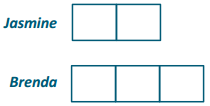
The population of Cherryton is the whole.
Quantity = Percent × Whole. Let a represent the unknown population of Appleton.
a = 1.75(4,000)
a = 7,000
If the population of Cherryton is 4,000 people, then the population of Appleton is 7,000 people.

b. Find the population in Cherryton if the population in Appleton is 10,500 people.
Answer:
The population of Cherryton is still the whole.
Quantity = Percent × Whole. Let c represent the unknown population of Cherryton.
10,500 = 1.75c
c = 10,500÷1.75
c = 6,000
If the population of Appleton is 10,500 people, then the population of Cherryton is 6,000 people.

Question 12.
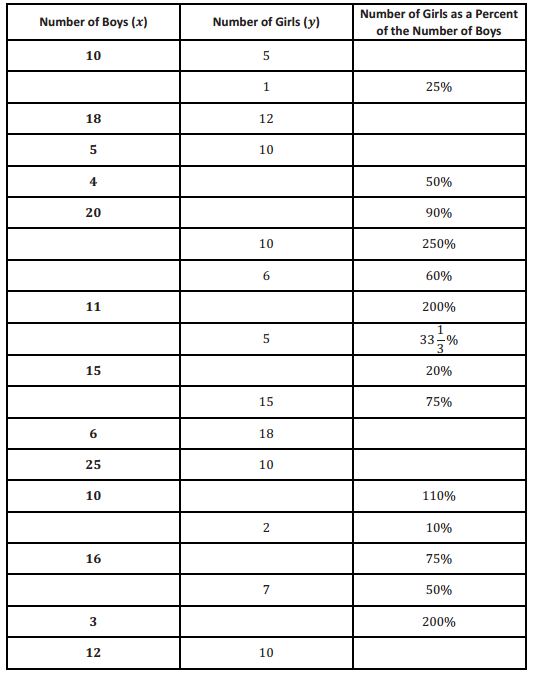
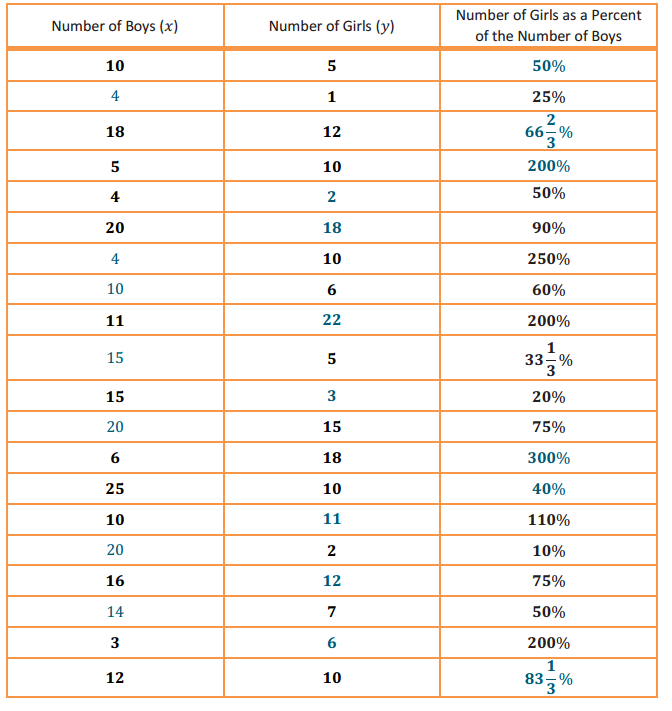
A statistics class collected data regarding the number of boys and the number of girls in each classroom at their school during homeroom. Some of their results are shown in the table below.
a. Complete the blank cells of the table using your knowledge about percent.
Eureka Math 7th Grade Module 4 Lesson 3 Problem Set Answer Key 1
Answer:
Eureka Math 7th Grade Module 4 Lesson 3 Problem Set Answer Key 2

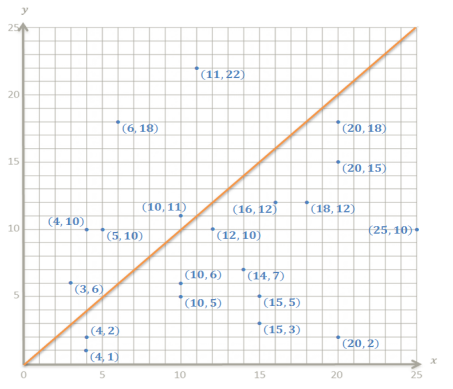
b. Using a coordinate plane and grid paper, locate and label the points representing the ordered pairs (x,y).
Answer:
See graph to the right.
Eureka Math 7th Grade Module 4 Lesson 3 Problem Set Answer Key 3

c. Locate all points on the graph that would represent classrooms in which the number of girls y is 100% of the number of boys x. Describe the pattern that these points make.
Answer:
The points lie on a line that includes the origin; therefore, it is a proportional relationship.

d. Which points represent the classrooms in which the number of girls as a percent of the number of boys is greater than 100%? Which points represent the classrooms in which the number of girls as a percent of the number of boys is less than 100%? Describe the locations of the points in relation to the points in part (c).
Answer:
All points where y > x are above the line and represent classrooms where the number of girls is greater than 100% of the number of boys. All points where y < x are below the line and represent classrooms where the number of girls is less than 100% of the boys.

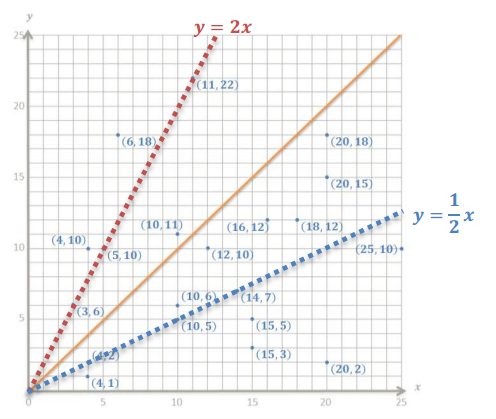
e. Find three ordered pairs from your table representing classrooms where the number of girls is the same percent of the number of boys. Do these points represent a proportional relationship? Explain your reasoning.
Answer:
There are two sets of points that satisfy this question:
{(3,6), (5,10), and (11,22)}: The points do represent a proportional relationship because there is a constant of proportionality k = \(\frac{y}{x}\) = 2.
{(4,2), (10,5), and (14,7)}: The points do represent a proportional relationship because there is a constant of proportionality k = \(\frac{y}{x}\) = \(\frac{1}{2}\).

f. Show the relationship(s) from part (e) on the graph, and label them with the corresponding equation(s).
Answer:
Eureka Math 7th Grade Module 4 Lesson 3 Problem Set Answer Key 4

g. What is the constant of proportionality in your equation(s), and what does it tell us about the number of girls and the number of boys at each point on the graph that represents it? What does the constant of proportionality represent in the table in part (a)?
Answer:
In the equation y = 2x, the constant of proportionality is 2, and it tells us that the number of girls will be twice the number of boys, or 200% of the number of boys, as shown in the table in part (a).
In the equation y = 1/2 x, the constant of proportionality is 1/2, and it tells us that the number of girls will be half the number of boys, or 50% of the number of boys, as shown in the table in part (a).

Eureka Math Grade 7 Module 4 Lesson 3 Exit Ticket Answer Key

Solve each problem below using at least two different approaches.
Question 1.
Jenny’s great – grandmother is 90 years old. Jenny is 12 years old. What percent of Jenny’s great – grandmother’s age is Jenny’s age?
Answer:

Algebraic Solution:
Quantity = Percent × Whole. Let p represent the unknown percent.
Jenny’s great – grandmother’s age is the whole.
12 = p(90)
12 ∙ \(\frac{1}{90}\) = p(90) ∙ \(\frac{1}{90}\)
2 ∙ \(\frac{1}{15}\) = p(1)
\(\frac{2}{15}\) = p
\(\frac{2}{15}\) = \(\frac{2}{15}\) (100%) = 13 \(\frac{1}{3}\)%
Jenny’s age is 13 1/3% of her great – grandmother’s age.

Numeric Solution:
90 → 100%
1 → \(\frac{100}{90}\)%
12 → (12 ∙ \(\frac{100}{90}\))%
12 → (100 ∙ \(\frac{12}{90}\))%
12 → 100(\(\frac{2}{15}\))%
12 → 20(\(\frac{2}{3}\))%
12 → (\(\frac{40}{3}\))%
12 → 13 \(\frac{1}{3}\)%

Alternative Numeric Solution:
90 → 100%
9 → 10%
3 → \(\frac{10}{3}\)%
12 → 4(\(\frac{10}{3}\))%
12 → (\(\frac{40}{3}\))%
12 → 13 \(\frac{1}{3}\)%

Question 2.
Jenny’s mom is 36 years old. What percent of Jenny’s mother’s age is Jenny’s great – grandmother’s age?
Answer:
Quantity = Percent × Whole.
Let p represent the unknown percent. Jenny’s mother’s age is the whole.
90 = p(36)
90 ∙ \(\frac{1}{36}\) = p(36) ∙ \(\frac{1}{36}\)
5 ∙ \(\frac{1}{2}\) = p(1)
2.5 = p
2.5 = 250%
Jenny’s great grandmother’s age is 250% of Jenny’s mother’s age.

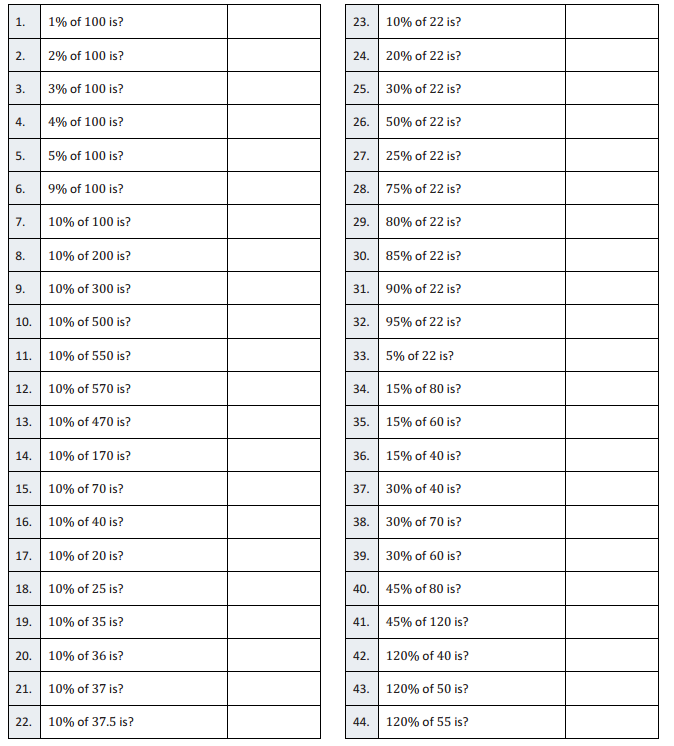
Eureka Math Grade 7 Module 4 Lesson 3 Part, Whole, or Percent—Round 1 Answer Key

Directions: Find each missing value.
Eureka Math Grade 7 Module 4 Lesson 3 Part, Whole, or Percent—Round 1 Answer Key 1
Answer:
Eureka Math Grade 7 Module 4 Lesson 3 Part, Whole, or Percent—Round 1 Answer Key 2

Eureka Math Grade 7 Module 4 Lesson 3 Part, Whole, or Percent—Round 2 Answer Key

Directions: Find each missing value.
Eureka Math Grade 7 Module 4 Lesson 3 Part, Whole, or Percent—Round 1 Answer Key 3
Answer:
Eureka Math Grade 7 Module 4 Lesson 3 Part, Whole, or Percent—Round 1 Answer Key 4

Eureka Math Grade 7 Module 4 Lesson 2 Answer Key

Engage NY Eureka Math 7th Grade Module 4 Lesson 2 Answer Key

Eureka Math Grade 7 Module 4 Lesson 2 Example Answer Key

Example 2: A Numeric Approach to Finding a Part, Given a Percent of the Whole
In Ty’s English class, 70% of the students completed an essay by the due date. There are 30 students in Ty’s English class. How many completed the essay by the due date?
Answer:
Whole → 100%
30 → 100%
\(\frac{30}{100}\) → 1%
70 ∙ \(\frac{3}{100}\) → 21
21 → 70%
70% of 30 is 21, so 21 of the students in Ty’s English class completed their essays on time.

Example 3: An Algebraic Approach to Finding a Part, Given a Percent of the Whole
A bag of candy contains 300 pieces of which 28% are red. How many pieces are red?
Which quantity represents the whole?
Answer:
The total number of candies in the bag, 300, is the whole because the number of red candies is being compared to it.

Which of the terms in the percent equation is unknown? Define a letter (variable) to represent the unknown quantity.
Answer:
We do not know the part, which is the number of red candies in the bag. Let r represent the number of red candies in the bag.

Write an expression using the percent and the whole to represent the number of pieces of red candy.
Answer:
\(\frac{28}{100}\) ∙ (300), or 0.28∙(300), is the amount of red candy since the number of red candies is 28% of the 300 pieces of candy in the bag.

Write and solve an equation to find the unknown quantity.
Part = Percent × Whole
r = \(\frac{28}{100}\) ∙ (300)
r 28 ∙ 3
r = 84
There are 84 red pieces of candy in the bag.

Example 4: Comparing Part of a Whole to the Whole with the Percent Formula
Zoey inflated 24 balloons for decorations at the middle school dance. If Zoey inflated 15% of the total number of balloons inflated for the dance, how many balloons are there total? Solve the problem using the percent formula, and verify your answer using a visual model.
Answer:
Part = Percent×Whole
The part is 24 balloons, and the percent is 15%, so let t represent the unknown total number of balloons.
24 = \(\frac{15}{100}\) t If a = b, then ac = bc.
\(\frac{100}{15}\) (24) = \(\frac{100}{15}\) (\(\frac{15}{100}\))t Multiplicative inverse
\(\frac{2400}{15}\) = 1t Multiplicative identity property of 1 and equivalent fractions
160 = t
The total number of balloons to be inflated for the dance was 160 balloons.

15% → 24
1% → \(\frac{24}{15}\) We want the quantity that corresponds with 100%, so first we find 1%.*
100% → \(\frac{24}{15}\) ∙ 100
100% → \(\frac{24}{3}\) ∙ 20
100% → 160
Student may also find 5% as is shown in the tape diagram below.
The total number of balloons to be inflated for the dance was 160 balloons.
Engage NY Math 7th Grade Module 4 Lesson 2 Example Answer Key 1

Example 5: Finding the Percent Given a Part of the Whole and the Whole
Haley is making admission tickets to the middle school dance. So far she has made 112 tickets, and her plan is to make 320 tickets. What percent of the admission tickets has Haley produced so far? Solve the problem using the percent formula, and verify your answer using a visual model.
Answer:
Part = Percent×Whole
The part is 112 tickets, and the whole is 320 tickets, so let p represent the unknown percent.
112 = p(320) If” a = b”,then” ac = bc.
112 ∙ \(\frac{1}{320}\) = p(320) ∙ \(\frac{1}{320}\) “Multiplicative inverse
\(\frac{112}{320}\) = p(1) Multiplicative identity property of 1
\(\frac{7}{20}\) = p
0.35 = p
0.35 = \(\frac{35}{100}\) = 35%, so Haley has made 35% of the tickets for the dance.
Engage NY Math 7th Grade Module 4 Lesson 2 Example Answer Key 2
We need to know the percent that corresponds with 112, so first we find the percent that corresponds with 1 ticket.
320 → 100%
1 → (\(\frac{100}{320}\))%
112 → 112 ∙ (\(\frac{100}{320}\))%
112 → 112 ∙ (\(\frac{5}{16}\))%
112 → 7∙(5)%
112 → 35%
Haley has made 35% of the tickets for the dance.

Eureka Math Grade 7 Module 4 Lesson 2 Exercise Answer Key

Opening Exercise
a. What is the whole unit in each scenario?
Engage NY Math Grade 7 Module 4 Lesson 2 Exercise Answer Key 1
Answer:
Engage NY Math Grade 7 Module 4 Lesson 2 Exercise Answer Key 2

b. Read each problem, and complete the table to record what you know.
Engage NY Math Grade 7 Module 4 Lesson 2 Exercise Answer Key 3
Answer:
Engage NY Math Grade 7 Module 4 Lesson 2 Exercise Answer Key 4

Exercise 1.
In Ty’s art class, 12% of the Flag Day art projects received a perfect score. There were 25 art projects turned in by Ty’s class. How many of the art projects earned a perfect score? (Identify the whole.)
Answer:
Engage NY Math Grade 7 Module 4 Lesson 2 Exercise Answer Key 5
The whole is the number of art projects turned in by Ty’s class, 25.
\(\frac{25}{100}\) = 0.25; 0.25∙12 = 3; 12% of 25 is 3, so 3 art projects in Ty’s class received a perfect score.

Exercise 2
A bag of candy contains 300 pieces of which 28% are red. How many pieces are not red?
a. Write an equation to represent the number of pieces that are not red, n.
Answer:
Part = Percent×Whole
n = (100% – 28%)(300)

b. Use your equation to find the number of pieces of candy that are not red.
Answer:
If 28% of the candies are red, then the difference of 100% and 28% must be candies that are not red.
n = (100% – 28%)(300)
n = (72%)(300)
n = \(\frac{72}{100}\)(300)
n = 72∙3
n = 216
There are 216 pieces of candy in the bag that are not red.

c. Jah – Lil told his math teacher that he could use the answer from Example 3 and mental math to find the number of pieces of candy that are not red. Explain what Jah – Lil meant by that.
Answer:
He meant that once you know there are 84 red pieces of candy in a bag that contains 300 pieces of candy total, you just subtract 84 from 300 to know that 216 pieces of candy are not red.

Eureka Math Grade 7 Module 4 Lesson 2 Problem Set Answer Key

Question 1.
Represent each situation using an equation. Check your answer with a visual model or numeric method.
a. What number is 40% of 90?
Answer:
n = 0.40(90)
n = 36

b. What number is 45% of 90?
Answer:
n = 0.45(90)
n = 40.5

c. 27 is 30% of what number?
Answer:
27 = 0.3n
\(\frac{27}{0.3}\) = 1n
90 = n

d. 18 is 30% of what number?
Answer:
0.30n = 18
1n = \(\frac{18}{0.3}\)
n = 60

e. 25.5 is what percent of 85?
Answer:
25.5 = p(85)
\(\frac{25.5}{85}\) = 1p
0.3 = p
0.3 = \(\frac{30}{100}\) = 30%

f. 21 is what percent of 60?
21 = p(60)
\(\frac{21}{60}\) = 1p
0.35 = p
0.35 = \(\frac{35}{100}\) = 35%

Question 2.
40% of the students on a field trip love the museum. If there are 20 students on the field trip, how many love the museum?
Answer:
Let s represent the number of students who love the museum.
s = 0.40(20)
s = 8
Therefore, 8 students love the museum.

Question 3.
Maya spent 40% of her savings to pay for a bicycle that cost her $85.
a. How much money was in her savings to begin with?
Answer:
Let s represent the unknown amount of money in Maya’s savings.
85 = 0.4s
212.5 = s
Maya originally had $212.50 in her savings.

b. How much money does she have left in her savings after buying the bicycle?
Answer:
$212.50 – $85.00 = $127.50
She has $127.50 left in her savings after buying the bicycle.

Question 4.
Curtis threw 15 darts at a dartboard. 40% of his darts hit the bull’s – eye. How many darts did not hit the bull’s – eye?
Answer:
Let d represent the number of darts that hit the bull’s – eye.
d = 0.4(15)
d = 6
6 darts hit the bull’s – eye. 15 – 6 = 9
Therefore, 9 darts did not hit the bull’s – eye.

Question 5.
A tool set is on sale for $424.15. The original price of the tool set was $499.00. What percent of the original price is the sale price?
Answer:
Let p represent the unknown percent.
424.15 = p(499)
0.85 = p
The sale price is 85% of the original price.

Question 6.
Matthew scored a total of 168 points in basketball this season. He scored 147 of those points in the regular season and the rest were scored in his only playoff game. What percent of his total points did he score in the playoff game?
Answer:
Matthew scored 21 points during the playoff game because 168 – 147 = 21.
Let p represent the unknown percent.
21 = p(168)
0.125 = p
The points that Matthew scored in the playoff game were 12.5% of his total points scored in basketball this year.

Question 7.
Brad put 10 crickets in his pet lizard’s cage. After one day, Brad’s lizard had eaten 20% of the crickets he had put in the cage. By the end of the next day, the lizard had eaten 25% of the remaining crickets. How many crickets were left in the cage at the end of the second day?
Answer:
Let n represent the number of crickets eaten.
Day 1:
n = 0.2(10)
n = 2
At the end of the first day, Brad’s lizard had eaten 2 of the crickets.
Day 2:
n = 0.25(10 – 2)
n = 0.25(8)
n = 2
At the end of the second day, Brad’s lizard had eaten a total of 4 crickets, leaving 6 crickets in the cage.

Question 8.
A furnace used 40% of the fuel in its tank in the month of March and then used 25% of the remaining fuel in the month of April. At the beginning of March, there were 240 gallons of fuel in the tank. How much fuel (in gallons) was left at the end of April?
Answer:
March:
n = 0.4(240)
n = 96
Therefore, 96 gallons were used during the month of March, which means 144 gallons remain.
April:
n = 0.25(144)
n = 36
Therefore, 36 gallons were used during the month of April, which means 108 gallons remain.
There were 144 gallons of fuel remaining in the tank at the end of March and 108 gallons of fuel remaining at the end of April.

Question 9.
In Lewis County, there were 2,277 student athletes competing in spring sports in 2014. That was 110% of the number from 2013, which was 90% of the number from the year before. How many student athletes signed up for a spring sport in 2012?
Answer:
2013:
2,277 = 1.10a
2,070 = a
Therefore, 2,070 student athletes competed in spring sports in 2013.
2012:
2,070 = 0.9a
2,300 = a
Therefore, 2,300 student athletes competed in spring sports in 2012.
There were 2,070 students competing in spring sports in 2013 and 2,300 students in 2012.

Question 10.
Write a real – world word problem that could be modeled by the equation below. Identify the elements of the percent equation and where they appear in your word problem, and then solve the problem.
57.5 = p(250)
Answer:
Answers will vary. Greig is buying sliced almonds for a baking project. According to the scale, his bag contains 57.5 grams of almonds. Greig needs 250 grams of sliced almonds for his project. What percent of his total weight of almonds does Greig currently have?

The quantity 57.5 represents the part of the almonds that Greig currently has on the scale, the quantity 250 represents the 250 grams of almonds that he plans to purchase, and the variable p represents the unknown percent of the whole quantity that corresponds to the quantity 57.5.
57.5 = p(250)
\(\frac{1}{250}\) (57.5) = p(\(\frac{1}{250}\))(250)
\(\frac{57.5}{250}\) = p(1)
0.23 = p
0.23 = \(\frac{23}{100}\) = 23%
Greig currently has 23% of the total weight of almonds that he plans to buy.

Eureka Math Grade 7 Module 4 Lesson 2 Exit Ticket Answer Key

Question 1.
On a recent survey, 60% of those surveyed indicated that they preferred walking to running.
a. If 540 people preferred walking, how many people were surveyed?
Answer:
Let n represent the number of people surveyed.
0.60n is the number of people who preferred walking.
Since 540 people preferred walking,
0.60n = 540
n = \(\frac{540}{0.6}\) = \(\frac{5,400}{6}\) = 900
Therefore, 900 people were surveyed.

b. How many people preferred running?
Answer:
Subtract 540 from 900.
900 – 540 = 360
Therefore, 360 people preferred running.

Question 2.
Which is greater: 25% of 15 or 15% of 25? Explain your reasoning using algebraic representations or visual models.
Answer:
They are the same.
0.25×15 = \(\frac{25}{100}\) × 15 = 3.75
0.15×25 = \(\frac{15}{100}\) × 25 = 3.75
Also, you can see they are the same without actually computing the product because of any order, any grouping of multiplication.
\(\frac{25}{100}\) × 15 = 25 × \(\frac{1}{100}\) × 15 = 25 × \(\frac{15}{100}\)

Eureka Math Grade 7 Module 4 Lesson 1 Answer Key

Engage NY Eureka Math 7th Grade Module 4 Lesson 1 Answer Key

Eureka Math Grade 7 Module 4 Lesson 1 Example Answer Key

Example 1.
Use the definition of the word percent to write each percent as a fraction and then as a decimal.
Engage NY Math 7th Grade Module 4 Lesson 1 Example Answer Key 1
Answer:
Engage NY Math 7th Grade Module 4 Lesson 1 Example Answer Key 2

Example 2.
Fill in the chart by converting between fractions, decimals, and percents. Show your work in the space below.
Engage NY Math 7th Grade Module 4 Lesson 1 Example Answer Key 3
Answer:
Engage NY Math 7th Grade Module 4 Lesson 1 Example Answer Key 4
350% as a fraction: 350% = \(\frac{350}{100}\) = \(\frac{35}{10}\) = \(\frac{7}{2}\) = 3\(\frac{1}{2}\)
350% as a decimal: 350% = \(\frac{350}{100}\) = 3.50
Engage NY Math 7th Grade Module 4 Lesson 1 Example Answer Key 5

Eureka Math Grade 7 Module 4 Lesson 1 Exercise Answer Key

Opening Exercise 1: Matching
Match the percents with the correct sentence clues.
Engage NY Math Grade 7 Module 4 Lesson 1 Exercise Answer Key 1
Answer:
Engage NY Math Grade 7 Module 4 Lesson 1 Exercise Answer Key 2

Opening Exercise 2.
Color in the grids to represent the following fractions:
a. \(\frac{30}{100}\)
Engage NY Math Grade 7 Module 4 Lesson 1 Exercise Answer Key 3
Answer:
Engage NY Math Grade 7 Module 4 Lesson 1 Exercise Answer Key 4

b. \(\frac{3}{100}\)
Engage NY Math Grade 7 Module 4 Lesson 1 Exercise Answer Key 5
Answer:
Engage NY Math Grade 7 Module 4 Lesson 1 Exercise Answer Key 6

c. \(\frac{\frac{1}{3}}{100}\)
Engage NY Math Grade 7 Module 4 Lesson 1 Exercise Answer Key 7
Answer:
Engage NY Math Grade 7 Module 4 Lesson 1 Exercise Answer Key 8

Eureka Math Grade 7 Module 4 Lesson 1 Problem Set Answer Key

Question 1.
Create a model to represent the following percents.
a. 90%
Answer:
Eureka Math 7th Grade Module 4 Lesson 1 Problem Set Answer Key 2

b. 0.9%
Answer:
Eureka Math 7th Grade Module 4 Lesson 1 Problem Set Answer Key 3

c. 900%
Answer:
Eureka Math 7th Grade Module 4 Lesson 1 Problem Set Answer Key 4

c. \(\frac{9}{10}\)%
Answer:
Eureka Math 7th Grade Module 4 Lesson 1 Problem Set Answer Key 5

Question 2.
Benjamin believes that \(\frac{1}{2}\)% is equivalent to 50%. Is he correct? Why or why not?
Answer:
Benjamin is not correct because \(\frac{1}{2}\)% is equivalent to 0.50%, which is equal to (\(\frac{\frac{1}{2}}{100}\)). The second percent is equivalent to \(\frac{50}{100}\). These percents are not equivalent.

Question 3.
Order the following from least to greatest:
100%, \(\frac{1}{100}\), 0.001%, \(\frac{1}{10}\), 0.001, 1.1, 10, and \(\frac{10,000}{100}\)
Answer:
0.001%, 0.001, \(\frac{1}{100}\), \(\frac{1}{10}\), 100%, 1.1, 10, and \(\frac{10,000}{100}\)

Question 4.
Fill in the chart by converting between fractions, decimals, and percents. Show work in the space below.
Eureka Math 7th Grade Module 4 Lesson 1 Problem Set Answer Key 1
Answer:
Eureka Math 7th Grade Module 4 Lesson 1 Problem Set Answer Key 6

Eureka Math Grade 7 Module 4 Lesson 1 Exit Ticket Answer Key

Question 1.
Fill in the chart converting between fractions, decimals, and percents. Show work in the space provided.
Eureka Math Grade 7 Module 4 Lesson 1 Exit Ticket Answer Key 1
Answer:
Eureka Math Grade 7 Module 4 Lesson 1 Exit Ticket Answer Key 2

Question 2.
Using the values from the chart in Problem 1, which is the least and which is the greatest? Explain how you arrived at your answers.
Answer:
The least of the values is \(\frac{2}{5}\)%, and the greatest is 1.125. To determine which value is the least and which is the greatest, compare all three values in decimal form, fraction form, or percents. When comparing the three decimals, 0.125, 1.125, and 0.004, one can note that 0.004 is the smallest value, so \(\frac{2}{5}\)% is the least of the values and 1.125 is the greatest.

Eureka Math Grade 7 Module 4 Lesson 1 Fractions, Decimals, and Percents—Round 1 Answer Key

Directions: Write each number in the alternate form indicated.
Eureka Math Grade 7 Module 4 Lesson 1 Fractions, Decimals, and Percents—Round 1 Answer Key 1
Answer:
Eureka Math Grade 7 Module 4 Lesson 1 Fractions, Decimals, and Percents—Round 1 Answer Key 2

Eureka Math Grade 7 Module 4 Lesson 1 Fractions, Decimals, and Percents—Round 2 Answer Key

Directions: Write each number in the alternate form indicated.
Eureka Math Grade 7 Module 4 Lesson 1 Fractions, Decimals, and Percents—Round 2 Answer Key 3
Answer:
Eureka Math Grade 7 Module 4 Lesson 1 Fractions, Decimals, and Percents—Round 2 Answer Key 4

Eureka Math Grade 6 Module 1 Lesson 6 Answer Key

Engage NY Eureka Math 6th Grade Module 1 Lesson 6 Answer Key

Eureka Math Grade 6 Module 1 Lesson 6 Exercise Answer Key

Exercise 1.
The Business Direct Hotel caters to people who travel for different types of business trips. On Saturday night there is not a lot of business travel, so the ratio of the number of occupied rooms to the number of unoccupied rooms is 2: 5. However, on Sunday night the ratio of the number of occupied rooms to the number of unoccupied rooms is 6: 1 due to the number of business people attending a large conference in the area. If the Business Direct Hotel has 432 occupied rooms on Sunday night, how many unoccupied rooms does it have on Saturday night?
Answer:
Eureka Math Grade 6 Module 1 Lesson 6 Exercise Answer Key 1

Exercise 2.
Peter is trying to work out by completing sit-ups and push-ups in order to gain muscle mass. Originally, Peter was completing five sit-ups for every three push-ups, but then he injured his shoulder. After the injury, Peter completed the same number of repetitions as he did before his injury, but he completed seven sit-ups for every one push-up. During a training session after his injury, Peter completed eight push-ups. How many push-ups was Peter completing before his injury?
Answer:
Peter was completing 24 push-ups before his injury.

Exercise 3.
Tom and Rob are brothers who like to make bets about the outcomes of different contests between them. Before the last bet, the ratio of the amount of Tom’s money to the amount of Rob’s money was 4: 7. Rob lost the latest competition, and now the ratio of the amount of Tom’s money to the amount of Rob’s money is 8: 3. If Rob had $280 before the last competition, how much does Rob have now that he lost the bet?
Answer:
Rob has $ 120.

Exercise 4.
A sporting goods store ordered new bikes and scooters. For every 3 bikes ordered, 4 scooters were ordered. However, bikes were way more popular than scooters, so the store changed its next order. The new ratio of the number of bikes ordered to the number of scooters ordered was 5: 2. If the same amount of sporting equipment was ordered in both orders and 64 scooters were ordered originally, how many bikes were ordered as part of the new order?
Answer:
80 bikes were ordered as part of the new order.

Exercise 5.
At the beginning of Grade 6, the ratio of the number of advanced math students to the number of regular math students was 3: 8. However, after taking placement tests, students were moved around changing the ratio of the number of advanced math students to the number of regular math students to 4: 7. How many students started in regular math and advanced math if there were 92 students in advanced math after the placement tests?
Answer:
There were 69 students in advanced math and 184 students in regular math before the placement tests,

Exercise 6.
During first semester, the ratio of the number of students in art class to the number of students in gym class was 2: 7. However, the art classes were really small, and the gym classes were large, so the principal changed students’ classes for second semester. In second semester, the ratio of the number of students in art class to the number of students in gym class was 5: 4. If 75 students were in art class second semester, how many were in art class and gym class first semester?
Answer:
There were 30 students in art class and 105 students in gym class during first semester.

Exercise 7.
Jeanette wants to save money, but she has not been good at it in the past. The ratio of the amount of money in Jeanette’s savings account to the amount of money in her checking account was 1: 6. Because Jeanette is trying to get better at saving money, she moves some money out of her checking account and into her savings account. Now, the ratio of the amount of money in her savings account to the amount of money in her checking account is 4: 3. If Jeanette had $936 in her checking account before moving money, how much money does Jeanette have in each account after moving money?
Answer:
Jeanette has $624 in her savings account and $468 in her checking account after moving money.

Eureka Math Grade 6 Module 1 Lesson 6 Problem Set Answer Key

Question 1.
Shelley compared the number of oak trees to the number of maple trees as part of a study about hardwood trees in a woodlot. She counted 9 maple trees to every 5 oak trees. Later in the year there was a bug problem and many trees died. New trees were planted to make sure there was the same number of trees as before the bug problem. The new ratio of the number of maple trees to the number of oak trees is 3: 11. After planting new trees, there were 132 oak trees. How many more maple trees were in the woodlot before the bug problem than after the bug problem? Explain.
Answer:
There were 72 more maple trees before the bug problem than after because there were 108 maples trees before the bug problem and 36 maple trees after the bug problem.

Question 2.
The school band is comprised of middle school students and high school students, but it always has the same maximum capacity. Last year the ratio of the number of middle school students to the number of high school students was 1: 8. However, this year the ratio of the number of middle school students to the number of high school students changed to 2: 7. If there are 18 middle school students in the band this year, how many fewer high school students are in the band this year compared to last year? Explain.
Answer:
There are 9 fewer high school students in the band this year when compared to last year because last year there were 72 high school students in the band, and this year there are only 63 high school students in the band.

Eureka Math Grade 6 Module 1 Lesson 6 Exit Ticket Answer Key

Question 1.
Students surveyed boys and girls separately to determine which sport was enjoyed the most. After completing the boy survey, it was determined that for every 3 boys who enjoyed soccer, 5 boys enjoyed basketball. The girl survey had a ratio of the number of girls who enjoyed soccer to the number of girls who enjoyed basketball of 7: 1. If the same number of boys and girls were surveyed, and 90 boys enjoy soccer, how many girls enjoy each sport?
Answer:
The girl survey would show that 210 girls enjoy soccer, and 30 girls enjoy basketball.

Eureka Math Grade 6 Module 1 Lesson 5 Answer Key

Engage NY Eureka Math 6th Grade Module 1 Lesson 5 Answer Key

Eureka Math Grade 6 Module 1 Lesson 5 Example Answer Key

Example 1.
A County Superintendent of Highways is interested in the numbers of different types of vehicles that regularly travel within his county. In the month of August, a total of 192 registrations were purchased for passenger cars and pickup trucks at the local Department of Motor Vehicles (DMV). The DMV reported that in the month of August, for every 5 passenger cars registered, there were 7 pickup trucks registered. How many of each type of vehicle were registered in the county in the month of August?
a. Using the information in the problem, write four different ratios and describe the meaning of each.
Answer:
The ratio of cors to trucks is 5: 7 and is a part-to-part ratio. The ratio of trucks to cors is 7:5, and that is a
part-to-part ratio. The ratio of cars to total vehicles is 5 to 12, and that is a part-to-whole ratio. The ratio of
trucks to total vehicles is 7 to 12, and that is a part-to-whole ratio.

b. Make a tape diagram that represents the quantities in the part-to-part ratios that you wrote.
Answer:
Eureka Math Grade 6 Module 1 Lesson 5 Example Answer Key 1

c. How many equal-sized parts does the tape diagram consist of?
Answer:
12

d. What total quantity does the tape diagram represent?
Answer:
192 vehicles

e. What value does each individual part of the tape diagram represent?
Answer:
Divide the total quantity into 12 equal-sized parts:
\(\frac{192}{12}\) = 16

f. How many of each type of vehicle were registered in August?
Answer:
5 . 16 = 80 passenger cars
7 . 16 = 112 pickup trucks

Example 2.
The Superintendent of Highways is further interested in the numbers of commercial vehicles that frequently use the county’s highways. He obtains information from the Department of Motor Vehicles for the month of September and finds that for every 14 non-commercial vehicles, there were 5 commercial vehicles. If there were 108 more non commercial vehicles than commercial vehicles, how many of each type of vehicle frequently use the county’s highways during the month of September?
Answer:
Eureka Math Grade 6 Module 1 Lesson 5 Example Answer Key 2

Eureka Math Grade 6 Module 1 Lesson 5 Exercise Answer Key

Exercise 1.
The ratio of the number of people who own a smartphone to the number of people who own a flip phone is 4: 3. If 500 more people own a smartphone than a flip phone, how many people own each type of phone?
Answer:
2,000 people own a smartphone, and 1,500 people own a flip phone.

Exercise 2.
Sammy and David were selling water bottles to raise money for new football uniforms. Sammy sold 5 water bottles for every 3 water bottles David sold. Together they sold 160 water bottles. How many did each boy sell?
Answer:
Sammy sold 100 Water bottles, and David sold 60 water bottles.

Exercise 3.
Ms. Johnson and Ms. Siple were folding report cards to send home to parents. The ratio of the number of report cards Ms. Johnson folded to the number of report cards Ms. Siple folded is 2: 3. At the end of the day, Ms. Johnson and Ms. Siple folded a total of 300 report cards. How many did each person fold?
Answer:
Ms. Johnson folded 120 report cards, and Ms. Siple folded 180 report cards.

Exercise 4.
At a country concert, the ratio of the number of boys to the number of girls is 2: 7. If there are 250 more girls than boys, how many boys are at the concert?
Answer:
There are 100 boys at the country concert.

Eureka Math Grade 6 Module 1 Lesson 5 Problem Set Answer Key

Question 1.
Last summer, at Camp Okey-Fun-Okey, the ratio of the number of boy campers to the number of girl campers was 8: 7. If there were a total of 195 campers, how many boy campers were there? How many girl campers?
Answer:
104 boys and 91 girls are at Camp Okey-Fun-Okey.

Question 2.
The student-to-faculty ratio at a small college is 17: 3. The total number of students and faculty is 740. How many faculty members are there at the college? How many students?
Answer:
111 faculty members and 629 students are at the college.

Question 3.
The Speedy Fast Ski Resort has started to keep track of the number of skiers and snowboarders who bought season passes. The ratio of the number of skiers who bought season passes to the number of snowboarders who bought season passes is 1: 2. If 1,250 more snowboarders bought season passes than skiers, how many snowboarders and how many skiers bought season passes?
Answer:
1,250 skiers bought season passes, and 2,500 snowboarders bought season passes.

Question 4.
The ratio of the number of adults to the number of students at the prom has to be 1: 10. Last year there were
477 more students than adults at the prom. If the school is expecting the same attendance this year, how many
adults have to attend the prom?
Answer:
53 adults have to be at the prom to keep the 1: 10 ratio.

Eureka Math Grade 6 Module 1 Lesson 5 Exit Ticket Answer Key

Question 1.
When Carla looked out at the school parking lot, she noticed that for every 2 minivans, there were 5 other types of vehicles. If there are 161 vehicles in the parking lot, how many of them are not minivans?
Answer:
5 out of 7 vehicles are not minivans. 7 × 23 = 161. So, 5 × 23 = 115. 115 of the vehicles are not minivans.

Eureka Math Grade 6 Module 1 Lesson 4 Answer Key

Engage NY Eureka Math 6th Grade Module 1 Lesson 4 Answer Key

Eureka Math Grade 6 Module 1 Lesson 4 Example Answer Key

Example 1.
The morning announcements said that two out of every seven sixth-grade students In the school have an overdue library book. Jasmine said, “That would mean 24 of us have overdue books!” Grace argued, “No way. That is way too high.” How can you determine who is right?
Answer:
You would have to know the total number of sixth-grade students, and then see if the ratio 24: total is equivalent to 2: 7.
Eureka Math Grade 6 Module 1 Lesson 4 Example Answer Key 1
Answer:

Eureka Math Grade 6 Module 1 Lesson 4 Exercise Answer Key

Exercise 1.
Decide whether or not each of the following pairs of ratios is equivalent.
→ If the ratios are not equivalent, find a ratio that is equivalent to the first ratio.
→ If the ratios are equivalent, identify the nonzero number, c, that could be used to multiply each number of the first ratio by in order to get the numbers for the second ratio.
a. 6: 11 and 42: 88
________ Yes, the value, c, is ________
________ No, an equivalent ratio would be ________
Answer:
Eureka Math Grade 6 Module 1 Lesson 4 Exercise Answer Key 2
________ Yes, the value, c, is ________
  x    No, an equivalent ratio would be    42: 77   
Answer:

b. 0: 5 and 0: 20
________ Yes, the value, c, is ________
________ No, an equivalent ratio would be ________
Answer:
Eureka Math Grade 6 Module 1 Lesson 4 Exercise Answer Key 3
  x _  Yes, the value, c, is   4   
________ No, an equivalent ratio would be ________

Exercise 2.
In a bag of mixed walnuts and cashews, the ratio of the number of walnuts to the number of cashews is 5: 6. Determine the number of walnuts that are in the bag if there are 54 cashews. Use a tape diagram to support your work. Justify your answer by showing that the new ratio you created of the number of walnuts to the number of cashews is equivalent to 5: 6.
Answer:
Eureka Math Grade 6 Module 1 Lesson 4 Exercise Answer Key 4
54 divided by 6 equals 9.
5 times 9 equals 45.
There are 45 walnuts in the bag.
The ratio of the number of walnuts to the number of cashews is 45: 54. That ratio is equivalent to 5: 6.
Eureka Math Grade 6 Module 1 Lesson 4 Exercise Answer Key 5
Answer:

Eureka Math Grade 6 Module 1 Lesson 4 Problem Set Answer Key

Question 1.
Use diagrams or the description of equivalent ratios to show that the ratios 2: 3, 4: 6, and 8: 12 are equivalent.
Answer:
Eureka Math Grade 6 Module 1 Lesson 4 Problem Set Answer Key 6

Question 2.
Prove that 3: 8 is equivalent to 12: 32.
a. Use diagrams to support your answer.
Answer:
Eureka Math Grade 6 Module 1 Lesson 4 Problem Set Answer Key 7

b. Use the description of equivalent ratios to support your answer.
Answer:
Answers will vary. Descriptions should include multiplicative comparisons, such as 12 is 3 times 4 and 32 is 8 times 4. The constant number, c, is 4.

Question 3.
The ratio of Isabella’s money to Shane’s money is 3: 11. If Isabella has $33, how much money do Shane and Isabella have together? Use diagrams to illustrate your answer.
Answer:
Isabella has $33, and Shane has $121. $33 + $121 = $154. Together, Isabella and Shane have $154. 00.
Eureka Math Grade 6 Module 1 Lesson 4 Problem Set Answer Key 8

Eureka Math Grade 6 Module 1 Lesson 4 Exit Ticket Answer Key

Question 1.
There are 35 boys in the sixth grade. The number of girls in the sixth grade is 42. Lonnie says that means the ratio of the number of boys in the sixth grade to the number of girls in sixth grade is 5: 7. Is Lonnie correct? Show why or why not.
Answer:
No, Lonnie is not correct. The ratios 5:7 and 35:42 are not equivalent. They are not equivalent because 5 × 7 = 35, but 7 × 7 = 49, not 42.

Eureka Math Grade 6 Module 1 Lesson 3 Answer Key

Engage NY Eureka Math 6th Grade Module 1 Lesson 3 Answer Key

Eureka Math Grade 6 Module 1 Lesson 3 Exercise Answer Key

Exercise 1.
Write a one-sentence story problem about a ratio.
Answer:
Answers will vary. The ratio of the number of sunny days to the number of cloudy days in this town is 3: 1.

Write the ratio in two different forms.
Answer:
3: 1 and 3 to 1

Exercise 2.
Shanni and Mel are using ribbon to decorate a project in their art class. The ratio of the length of Shanni’s ribbon to the length of Mel’s ribbon is 7: 3.
Draw a tape diagram to represent this ratio.
Answer:
Eureka Math Grade 6 Module 1 Lesson 3 Exercise Answer Key 1

Exercise 3.
Mason and Laney ran laps to train for the long-distance running team. The ratio of the number of laps Mason ran to the number of laps Laney ran was 2 to 3.
a. If Mason ran 4 miles, how far did Laney run? Draw a tape diagram to demonstrate how you found the answer.
Answer:
Eureka Math Grade 6 Module 1 Lesson 3 Exercise Answer Key 2

b. If Laney ran 930 meters, how far did Mason run? Draw a tape diagram to determine how you found the answer.
Answer:
Eureka Math Grade 6 Module 1 Lesson 3 Exercise Answer Key 3

c. What ratios can we say are equivalent to 2: 3?
Answer:
4: 6 and 620: 930

Exercise 4.
Josie took a long multiple-choice, end-of-year vocabulary test. The ratio of the number of problems Josie got incorrect to the number of problems she got correct is 2: 9.
a. If Josie missed 8 questions, how many did she get correct? Draw a tape diagram to demonstrate how you found the answer.
Answer:
Eureka Math Grade 6 Module 1 Lesson 3 Exercise Answer Key 4

b. If Josie missed 20 questions, how many did she get correct? Draw a tape diagram to demonstrate how you found the answer.
Answer:
Eureka Math Grade 6 Module 1 Lesson 3 Exercise Answer Key 5

c. What ratios can we say are equivalent to 2: 9?
Answer:
8: 36 and 20: 90

d. Come up with another possible ratio of the number Josie got incorrect to the number she got correct.
Answer:
Eureka Math Grade 6 Module 1 Lesson 3 Exercise Answer Key 6

e. How did you find the numbers?
Answer:
Multiplied 5 × 2 and 5 × 9

f. Describe how to create equivalent ratios.
Answer:
Multiply both numbers of the ratio by the same number (any number you choose).

Eureka Math Grade 6 Module 1 Lesson 3 Problem Set Answer Key

Question 1.
Write two ratios that are equivalent to 1: 1.
Answer:
Answers will vary. 2:2, 50: 50, etc.

Question 2.
Write two ratios that are equivalent to 3: 11.
Answer:
Answers will vary. 6:22, 9:33, etc.

Question 3.
a. The ratio of the width of the rectangle to the height of the rectangle is _______ to _______.
Eureka Math Grade 6 Module 1 Lesson 3 Problem Set Answer Key 7
Answer:
The ratio of the width of the rectangle to the height of the rectangle is   9     to   4    .

b. If each square in the grid has a side length of 8 mm, what is the width and height of the rectangle?
Answer:
72 mm wide and 32 mm high

Question 4.
For a project in their health class, Jasmine and Brenda recorded the amount of milk they drank every day. Jasmine drank 2 pints of milk each day, and Brenda drank 3 pints of milk each day.
a. Write a ratio of the number of pints of milk Jasmine drank to the number of pints of milk Brenda drank each day.
Answer:
2: 3

b. Represent this scenario with tape diagrams.
Answer:
Eureka Math Grade 6 Module 1 Lesson 3 Problem Set Answer Key 8

c. If one pint of milk Is equivalent to 2 cups of milk, how many cups of milk did Jasmine and Brenda each drink? How do you know?
Answer:
Jasmine drank 4 cups of milk, and Brenda drank 6 cups of milk. Since each pint represents 2 cups, I multiplied
Jasmine’s 2 pints by 2 and multiplied Brenda’s 3 pints by 2.

d. Write a ratio of the number of cups of milk Jasmine drank to the number of cups of milk Brenda drank.
Answer:
4: 6

e. Are the two ratios you determined equivalent? Explain why or why not.
Answer:
2: 3 and 4: 6 are equivalent because they represent the same value. The diagrams never changed, only the value of each unit in the diagram.

Eureka Math Grade 6 Module 1 Lesson 3 Exit Ticket Answer Key

Pam and her brother both open savings accounts. Each begin with a balance of zero dollars. For every two dollars that Pam saves in her account, her brother saves five dollars in his account.

Question 1.
Determine a ratio to describe the money in Pam’s account to the money in her brother’s account.
Answer:
2: 5

Question 2.
If Pam has 40 dollars in her account, how much money does her brother have in his account? Use a tape diagram to support your answer.
Answer:
Eureka Math Grade 6 Module 1 Lesson 3 Exit Ticket Answer 9

Question 3.
Record the equivalent ratio.
Answer:
40: 100

Question 4.
Create another possible ratio that describes the relationship between the amount of money in Pam’s account and the amount of money in her brother’s account.
Answer:
Answers will vary. 4: 10, 8: 20, etc.

Eureka Math Grade 6 Module 1 Lesson 2 Answer Key

Engage NY Eureka Math 6th Grade Module 1 Lesson 2 Answer Key

Eureka Math Grade 6 Module 1 Lesson 2 Exercise Answer Key

Exercise 1.
Come up with two examples of ratio relationships that are interesting to you.
Answer:
1. My brother watches twice as much television as I do. The ratio of number of hours he watches in a day to the number of hours I watch in a day is usually 2: 1.

2. For every 2 chores my mom gives my brother, she gives 3 to me. The ratio is 2:3.

Exploratory Challenge:
A T-shirt manufacturing company surveyed teenage girls on their favorite T-shirt color to guide the company’s decisions about how many of each color T-shirt they should design and manufacture. The results of the survey are shown here.
Eureka Math Grade 6 Module 1 Lesson 2 Exercise Answer Key 1
Exercises for Exploratory Challenge
Question 1.
Describe a ratio relationship, in the context of this survey, for which the ratio is 3: 5.
Answer:
The number of girls who answered orange to the number of girls who answered pink.

Question 2.
For each ratio relationship given, fill in the ratio it is describing.
Eureka Math Grade 6 Module 1 Lesson 2 Exercise Answer Key 2
Answer:
Eureka Math Grade 6 Module 1 Lesson 2 Exercise Answer Key 3

Question 3.
For each ratio given, fill in a description of the ratio relationship it could describe, using the context of the survey.
Eureka Math Grade 6 Module 1 Lesson 2 Exercise Answer Key 4
Answer:
Eureka Math Grade 6 Module 1 Lesson 2 Exercise Answer Key 5

Eureka Math Grade 6 Module 1 Lesson 2 Problem Set Answer Key

Question 1.
Using the floor tiles design shown below, create 4 different ratios related to the image. Describe the ratio
relationship, and write the ratio in the form A: B or the form A to B.
Eureka Math Grade 6 Module 1 Lesson 2 Problem Set Answer Key 6
Answer:
For every 16 tiles, there are 4 white tiles.
The ratio of the number of black tiles to the number of white tiles is 2 to 4.
(Answers will vary.)

Question 2.
Billy wanted to write a ratio of the number of apples to the number of peppers in his refrigerator. He wrote 1: 3.
Did Billy write the ratio correctly? Explain your answer.
Eureka Math Grade 6 Module 1 Lesson 2 Problem Set Answer Key 7
Answer:
Billy is incorrect. There are 3 apples and 1 pepper in the picture. The ratio of the number of apples to the number of peppers is 3: 1.

Eureka Math Grade 6 Module 1 Lesson 2 Exit Ticket Answer Key

Question 1.
Give two different ratios with a description of the ratio relationship using the following information:
There are 15 male teachers in the school. There are 35 female teachers in the school.
Answer:
Possible solutions:

  • The ratio of the number of male teachers to the number of female teachers is 15: 35.
  • The ratio of the number of female teachers to the number of male teachers is 35: 15.
  • The ratio of the number of female teachers to the total number of teachers in the school is 35: 50.
  • The ratio of the number of male teachers to the total number of teachers in the school is 15: 50.

Please note that some students may write other equivalent ratios as answers. For example, 3: 7 is equivalent to 15: 35.

Eureka Math Grade 6 Module 1 Lesson 1 Answer Key

Engage NY Eureka Math 6th Grade Module 1 Lesson 1 Answer Key

Eureka Math Grade 6 Module 1 Lesson 1 Example Answer Key

Example 1.
The coed soccer team has four times as many boys on it as it has girls. We say the ratio of the number of boys to the number of girls on the team is 4: 1. We read this as four to one.
Answer:
→ Let’s create a table to show how many boys and how many girls could be on the team.
Create a table like the one shown below to show possibilities of the number of boys and girls on the soccer team. Have students copy the table into their student materials.

# of Boys# of GirlsTotal # of Players
415

→ So, we would have four boys and one girl on the team for a total of five players. Is this big enough for a team?
→ Adult teams require 11 players, but youth teams may have fewer. There is no right or wrong answer;
just encourage reflection on the question, thereby having students connect their math work back to the
context.
→ What are some other ratios that show four times as many boys as girls, or a ratio of boys to girls of 4 to 1?
→ Have students add each ratio to their table.

# of Boys# of GirlsTotal # of Players
415
8210
12315

→ From the table, we can see that there are four boys for every one girl on the team.

Suppose the ratio of the number of boys to the number of girls on the team is 3: 2.
Answer:
Create a table like the one shown below to show possibilities of the number of boys and girls on the soccer team. Have students copy the table into their student materials.

# of Boys# of GirlsTotal # of Players
325

→ What are some other team compositions where there are three boys for every two girls on the team?

# of Boys# of GirlsTotal # of Players
325
6410
9615

→ I can’t say there are 3 times as many boys as girls. What would my multiplicative value have to be? There are ________ as many boys as girls.
Encourage students to articulate their thoughts, guiding them to say there are \(\frac{3}{2}\) as many boys as girls.
→ Can you visualize \(\frac{3}{2}\) as many boys as girls?
→ Can we make a tape diagram (or bar model) that shows that there \(\frac{3}{2}\) are as many boys as girls?
Boys Eureka Math Grade 6 Module 1 Lesson 1 Example Answer Key 1
Girls Eureka Math Grade 6 Module 1 Lesson 1 Example Answer Key 2
→ Which description makes the relationship easier to visualize: saying the ratio is 3 to 2 or saying there are 3
halves as many boys as girls?

Example 2.
Write the ratio of the number of boys to the number of girls in our class.
Answer:
Record a ratio for each of the examples the teacher provides.

  1. Answers will vary. One example is 12: 10.
  2. Answers will vary. One example is 10: 12.
  3. Answers will vary. One example is 7: 15.
  4. Answers will vary. One example is 15: 7.
  5. Answers will vary. One example is 11: 11.
  6. Answers will vary. One example is 11: 11.

Write the ratio of the number of girls to the number of boys in our class.
Answer:
Record a ratio for each of the examples the teacher provides.

  1. Answers will vary. One example is 12: 10.
  2. Answers will vary. One example is 10: 12.
  3. Answers will vary. One example is 7: 15.
  4. Answers will vary. One example is 15: 7.
  5. Answers will vary. One example is 11: 11.
  6. Answers will vary. One example is 11: 11.

Eureka Math Grade 6 Module 1 Lesson 1 Exercise Answer Key

Exercise 1.
My own ratio compares __________________ to __________________.
My ratio is __________________.
Answer:
My own ratio compares the number of students wearing jeans to the number of students not wearing jeans.
My ratio is 16: 6.

Exercise 2.
Using words, describe a ratio that represents each ratio below.
a. 1 to 12
Answer:
For every one year, there ore twelve months.

b. 12: 1
Answer:
For every twelve months, there is one year.

c. 2 to 5
Answer:
For every two non-school days in a week, there are five school days.

d. 5 to 2
Answer:
For every five female teachers I have, there are two male teachers.

e. 10: 2
Answer:
For every ten toes, there are two feet.

f. 2: 10
Answer:
For every two problems I can finish, there are ten minutes that pass.

Eureka Math Grade 6 Module 1 Lesson 1 Problem Set Answer Key

Question 1.
At the sixth grade school dance, there are 132 boys, 89 girls, and 14 adults.
a. Write the ratio of the number of boys to the number of girls.
Answer:
132: 89 or 132 to 89

b. Write the same ratio using another form (A: B vs. A to B).
Answer:
132 to 89 or 132: 89

c. Write the ratio of the number of boys to the number of adults.
Answer:
132: 14 or 132 to 14

d. Write the same ratio using another form.
Answer:
132 to 14 or 132: 14

Question 2.
In the cafeteria, loo milk cartons were put out for breakfast. At the end of breakfast, 27 remained.
a. What is the ratio of the number of milk cartons taken to the total number of milk cartons?
Answer:
73: 100 or 73 to 100

b. What is the ratio of the number of milk cartons remaining to the number of milk cartons taken
Answer:
27: 73 or 27 to 73

Question 3.
Choose a situation that could be described by the following ratios, and write a sentence to describe the ratio In the context of the situation you chose.
For example:
3: 2. When making pink paint, the art teacher uses the ratio 3: 2. For every 3 cups of white paint she uses in the
mixture, she needs to use 2 cups of red paint.
a. 1 to 2
Answer:
For every one nose, there are two eyes (answers will vary).

b. 29 to 30
Answer:
For every 29 girls in the cafeteria, there are 30 boys (answers will vary).

c. 52: 12
Answer:
For every 52 weeks in the year, there are 12 months (answers will vary).

Eureka Math Grade 6 Module 1 Lesson 1 Exit Ticket Answer Key

Question 1.
Write a ratio for the following description: Kaleel made three times as many baskets as John during basketball
Answer:
A ratio of 3: 1 or 3 to 1 can be used.

Question 2.
Describe a situation that could be modeled with the ratio 4: 1.
Answer:
Answers will vary but could include the following: For every four teaspoons of cream in a cup of tea, there is one teaspoon of honey.

Question 3.
Write a ratio for the following description: For every 6 cups of flour in a bread recipe, there are 2 cups of milk.
Answer:
A ratio of 6: 2 or 6 to 2 can be used, or students might recognize and suggest the equivalent ratio of 3: 1.

Eureka Math Grade 7 Module 2 Lesson 9 Answer Key

Engage NY Eureka Math 7th Grade Module 2 Lesson 9 Answer Key

Eureka Math Grade 7 Module 2 Lesson 9 Example Answer Key

Represent each of the following expressions as one rational number. Show and explain your steps.

Example 1.
4\(\frac{4}{7}\) – (4\(\frac{4}{7}\) – 10)
= 4\(\frac{4}{7}\) – (4\(\frac{4}{7}\) + (- 10)) Subtracting a number is the same as adding its inverse.
= 4\(\frac{4}{7}\) + (- 4\(\frac{4}{7}\) + 10) The opposite of a sum is the sum of its opposites.
= (4\(\frac{4}{7}\) + (- 4\(\frac{4}{7}\))) + 10 The associative property of addition
= 0 + 10 A number plus its opposite equals zero.
= 10

Example 2.
5 + (- 4\(\frac{4}{7}\))
= 5 + (- (4 +\(\frac{4}{7}\))) The mixed number 4\(\frac{4}{7}\) is equivalent to 4 +\(\frac{4}{7}\).
= 5 + (- 4 + (-\(\frac{4}{7}\))) The opposite of a sum is the sum of its opposites.
= (5 + (- 4)) + (-\(\frac{4}{7}\)) Associative property of addition
= 1 + (-\(\frac{4}{7}\)) 5 + (- 4) = 1
=\(\frac{7}{7}\) + (-\(\frac{4}{7}\))\(\frac{7}{7}\) =1
=\(\frac{3}{7}\)

Eureka Math Grade 7 Module 2 Lesson 9 Exercise Answer Key

Exercise 1
Unscramble the cards, and show the steps in the correct order to arrive at the solution to 5\(\frac{2}{9}\) – (8.1 + 5\(\frac{2}{9}\)) .
Eureka Math Grade 7 Module 2 Lesson 9 Exercise Answer Key 1
Answer:
5\(\frac{2}{9}\) + (- 8.1 + (- 5\(\frac{2}{9}\)) ) The opposite of a sum is the sum of its opposites.
5\(\frac{2}{9}\) + (- 5\(\frac{2}{9}\) + (- 8.1)) Apply the commutative property of addition.
(5\(\frac{2}{9}\) + (- 5\(\frac{2}{9}\)) ) + (- 8.1) Apply the associative property of addition.
0 + (- 8.1) A number plus its opposite equals zero.
– 8.1 Apply the additive identity property.

Exercise 2.
Team Work!
a. – 5.2 – (-3.1) + 5.2
Answer:
= – 5.2 + 3.1 + 5.2
= – 5.2 + 5.2 + 3.1
= 0 + 3.1
= 3.1

b. 32 + (- 12\(\frac{7}{8}\))
Answer:
= 32 + (- 12 + (-\(\frac{7}{8}\)) )
= (32 + (- 12)) + (-\(\frac{7}{8}\))
= 20 + (-\(\frac{7}{8}\))
= 19\(\frac{1}{8}\)

c. 3\(\frac{1}{6}\) + 20.3 – (- 5\(\frac{5}{6}\))
= 3\(\frac{1}{6}\) + 20.3 + 5\(\frac{5}{6}\)
= 3\(\frac{1}{6}\) + 5\(\frac{5}{6}\) + 20.3
= 8\(\frac{6}{6}\) + 20.3
= 9 + 20.3
= 29.3

d.\(\frac{16}{20}\) – (- 1.8) –\(\frac{4}{5}\)
=\(\frac{16}{20}\) + 1.8 –\(\frac{4}{5}\)
=\(\frac{16}{20}\) + 1.8 + (-\(\frac{4}{5}\))
=\(\frac{16}{20}\) + (-\(\frac{4}{5}\)) + 1.8
=\(\frac{16}{20}\) + (-\(\frac{16}{20}\)) + 1.8
= 0 + 1.8
= 1.8

Exercise 3.
Explain, step by step, how to arrive at a single rational number to represent the following expression. Show both a written explanation and the related math work for each step.
– 24 – (-\(\frac{1}{2}\)) – 12.5
Answer:
Subtracting (-\(\frac{1}{2}\)) is the same as adding its inverse\(\frac{1}{2}\): = – 24 +\(\frac{1}{2}\) + (- 12.5)
Next, I used the commutative property of addition to rewrite the expression: = – 24 + (- 12.5) +\(\frac{1}{2}\)
Next, I added both negative numbers: = – 36.5 +\(\frac{1}{2}\)
Next, I wrote\(\frac{1}{2}\) in its decimal form: = – 36.5 + 0.5
Lastly, I added – 36.5 + 0.5: = – 36

Eureka Math Grade 7 Module 2 Lesson 9 Problem Set Answer Key

Show all steps taken to rewrite each of the following as a single rational number.

Question 1.
80 + (- 22\(\frac{4}{15}\))
= 80 + (-22 + (-\(\frac{4}{15}\)))
= (80 + (-22)) + (-\(\frac{4}{15}\))
= 58 + (-\(\frac{4}{15}\))
= 57\(\frac{11}{15}\)

Question 2.
10 + (- 3\(\frac{3}{8}\))
Answer:
= 10 + (- 3 + (-\(\frac{3}{8}\)))
= (10 + (- 3)) + (-\(\frac{3}{8}\))
= 7 + (-\(\frac{3}{8}\))
= 6\(\frac{5}{8}\)

Question 3.
\(\frac{1}{5}\) + 20.3 – (-5\(\frac{3}{5}\))
= \(\frac{1}{5}\) + 20.3 + 5\(\frac{3}{5}\)
= \(\frac{1}{5}\) + 5\(\frac{3}{5}\) + 20.3
= 5\(\frac{4}{5}\) + 20.3
= 5\(\frac{4}{5}\) + 20\(\frac{3}{10}\)
= 5\(\frac{8}{10}\) + 20\(\frac{3}{10}\)
= 25\(\frac{11}{10}\)
= 26\(\frac{1}{10}\)

Question 4.
(\(\frac{11}{12}\)) – (- 10) – \(\frac{5}{6}\)
Answer:
= (\(\frac{11}{12}\)) + 10 + (-\(\frac{5}{6}\))
= (\(\frac{11}{12}\)) + (-\(\frac{5}{6}\)) + 10
= (\(\frac{11}{12}\)) + (- \(\frac{10}{12}\)) + 10
= (\(\frac{1}{12}\)) + 10
= 10 (\(\frac{1}{12}\))

Question 5.
Explain, step by step, how to arrive at a single rational number to represent the following expression. Show both a written explanation and the related math work for each step.
1 – \(\frac{3}{4}\) + (- 12\(\frac{1}{4}\))
Answer:
First, I rewrote the subtraction of \(\frac{3}{4}\) as the addition of its inverse – \(\frac{3}{4}\):
= 1 + (- \(\frac{3}{4}\)) + (- 12\(\frac{1}{4}\))
Next, I used the associative property of addition to regroup the addend:
= 1 + ((- \(\frac{3}{4}\)) + (- 12\(\frac{1}{4}\)))
Next, I separated – 12\(\frac{1}{4}\) into the sum of – 12 and –\(\frac{1}{4}\):
= 1 + ((-\(\frac{3}{4}\)) + (- 12) + (-\(\frac{1}{4}\)))
Next, I used the commutative property of addition:
= 1 + ((- \(\frac{3}{4}\)) + (-\(\frac{1}{4}\)) + (- 12))
Next, I found the sum of – \(\frac{3}{4}\) and –\(\frac{1}{4}\):
= 1 + ((- 1) + (- 12))
Next, I found the sum of – 1 and – 12:
= 1 + (- 13)
Lastly, since the absolute value of 13 is greater than the absolute value
of 1, and it is a negative 13, the answer will be a negative number.
The absolute value of 13 minus the absolute value of 1 equals 12,
so the answer is – 12.
= – 12

Eureka Math Grade 7 Module 2 Lesson 9 Integer Subtraction Round 1 Answer Key

Directions: Determine the difference of the integers, and write it in the column to the right.
Eureka Math Grade 7 Module 2 Lesson 9 Integer Subtraction Round 1 Answer Key 15
Answer:
Eureka Math Grade 7 Module 2 Lesson 9 Integer Subtraction Round 1 Answer Key 16

Question 1.
4 – 2
Answer:
2

Question 2.
4 – 3
Answer:
1

Question 3.
4 – 4
Answer:
0

Question 4.
4 – 5
– 1

Question 5.
4 – 6
Answer:
– 2

Question 6.
4 – 9
Answer:
– 5

Question 7.
4 – 10
Answer:
– 6

Question 8.
4 – 20
Answer:
– 16

Question 9.
4 – 80
Answer:
– 76

Question 10.
4 – 100
Answer:
– 96

Question 11.
4 – (- 1)
Answer:
5

Question 12.
4 – (- 2)
Answer:
6

Question 13.
4 – (- 3)
Answer:
7

Question 14.
4 – (- 7)
Answer:
11

Question 15.
4 – (- 17)
Answer:
21

Question 16.
4 – (- 27)
Answer:
31

Question 17.
4 – (- 127)
Answer:
131

Question 18.
14 – (- 6)
Answer:
20

Question 19.
23 – (- 8)
Answer:
31

Question 20.
8 – (- 23)
Answer:
31

Question 21.
51 – (- 3)
Answer:
54

Question 22.
48 – (- 5)
Answer:
53

Question 23.
(- 6) – 5
Answer:
– 11

Question 24.
(- 6) – 7
– 13

Question 25.
(- 6) – 9
Answer:
– 15

Question 26.
(- 14) – 9
Answer:
– 23

Question 27.
(- 25) – 9
Answer:
– 34

Question 28.
(- 12) – 12
Answer:
– 24

Question 29.
(- 26) – 26
Answer:
– 52

Question 30.
(- 13) – 21
Answer:
– 34

Question 31.
(- 25) – 75
Answer:
– 100

Question 32.
(- 411) – 811
Answer:
– 1,222

Question 33.
(- 234) – 543
Answer:
– 777

Question 34.
(- 3) – (- 1)
Answer:
– 2

Question 35.
(- 3) – (- 2)
Answer:
– 1

Question 36.
(- 3) – (- 3)
Answer:
0

Question 37.
(- 3) – (- 4)
Answer:
1

Question 38.
(- 3) – (- 8)
Answer:
5

Question 39.
(- 30) – (- 45)
Answer:
15

Question 40.
(- 27) – (- 13)
Answer:
– 14

Question 41.
(- 13) – (- 27)
Answer:
14

Question 42.
(- 4) – (- 3)
Answer:
– 1

Question 43.
(- 3) – (- 4)
Answer:
1

Question 44.
(- 1,066) – (- 34)
Answer:
– 1,032

Eureka Math Grade 7 Module 2 Lesson 9 Integer Subtraction Round 2 Answer Key

Directions: Determine the difference of the integers, and write it in the column to the right.

Eureka Math Grade 7 Module 2 Lesson 9 Integer Subtraction Round 2 Answer Key 17
Answer:
Eureka Math Grade 7 Module 2 Lesson 9 Integer Subtraction Round 2 Answer Key 18

Question 1.
3 – 2
Answer:
1

Question 2.
3 – 3
Answer:
0

Question 3.
3 – 4
Answer:
– 1

Question 4.
3 – 5
Answer:
– 2

Question 5.
3 – 6
Answer:
– 3

Question 6.
3 – 9
Answer:
– 6

Question 7.
3 – 10
Answer:
– 7

Question 8.
3 – 20
Answer:
– 17

Question 9.
3 – 80
Answer:
– 77

Question 10.
3 – 100
Answer:
– 97

Question 11.
3 – (- 1)
Answer:
4

Question 12.
3 – (- 2)
Answer:
5

Question 13.
3 – (- 3)
Answer:
6

Question 14.
3 – (- 7)
Answer:
10

Question 15.
3 – (- 17)
Answer:
20

Question 16.
3 – (- 27)
Answer:
30

Question 17.
3 – (- 127)
Answer:
130

Question 18.
13 – (- 6)
Answer:
19

Question 19.
24 – (- 8)
Answer:
32

Question 20.
5 – (- 23)
Answer:
28

Question 31.
61 – (- 3)
Answer:
64

Question 32.
58 – (- 5)
Answer:
63

Question 33.
(- 8) – 5
Answer:
– 13

Question 34.
(- 8) – 7
Answer:
– 15

Question 35.
(- 8) – 9
Answer:
– 17

Question 36.
(- 15) – 9
Answer:
– 24

Question 37.
(- 35) – 9
Answer:
– 44

Question 38.
(- 22) – 22
Answer:
– 44

Question 39.
(- 27) – 27
Answer:
– 54

Question 40.
(- 14) – 21
Answer:
– 35

Question 41.
(- 22) – 72
Answer:
– 94

Question 42.
(- 311) – 611
Answer:
– 922

Question 43.
(- 345) – 654
Answer:
– 999

Question 44.
(- 2) – (- 1)
Answer:
– 1

Question 45.
(- 2) – (- 2)
Answer:
0

Question 46.
(- 2) – (- 3)
Answer:
1

Question 47.
(- 2) – (- 4)
Answer:
2

Question 48.
(- 2) – (- 8)
Answer:
6

Question 49.
(- 20) – (- 45)
Answer:
25

Question 41.
(- 24) – (- 13)
Answer:
– 11

Question 42.
(- 13) – (- 24)
Answer:
11

Question 43.
(- 5) – (- 3)
Answer:
– 2

Question 44.
(- 3) – (- 5)
Answer:
2

Question 45.
(- 1,034) – (- 31)
Answer:
– 1,003

Eureka Math Grade 7 Module 2 Lesson 9 Exit Ticket Answer Key

Question 1.
Jamie was working on his math homework with his friend, Kent. Jamie looked at the following problem.
-9.5 – (-8) – 6.5
He told Kent that he did not know how to subtract negative numbers. Kent said that he knew how to solve the problem using only addition. What did Kent mean by that? Explain. Then, show your work, and represent the answer as a single rational number.
Answer:
Kent meant that since any subtraction problem can be written as an addition problem by adding the opposite of the number you are subtracting, Jamie can solve the problem by using only addition.
Work Space:
-9.5 – (-8) – 6.5
= -9.5 + 8 + (-6.5)
= -9.5 + (-6.5) + 8
= -16 + 8
= -8
Answer:
-8

Question 2.
Use one rational number to represent the following expression. Show your work.
3 + (- 0.2) – 15\(\frac{1}{4}\)
Answer:
= 3 + (-0.2) + (-15 + (-\(\frac{1}{4}\)))
= 3 + (-0.2 + (-15) + (- 0.25))
= 3 + (-15.45)
= -12.45

Eureka Math Grade 7 Module 2 Lesson 14 Answer Key

Engage NY Eureka Math 7th Grade Module 2 Lesson 14 Answer Key

Eureka Math Grade 7 Module 2 Lesson 14 Example Answer Key

Example 1.
Can All Rational Numbers Be Written as Decimals?
a. Using the division button on your calculator, explore various quotients of integers 1 through 11. Record your fraction representations and their corresponding decimal representations in the space below.
Answer:
Fractions will vary. Examples:
Eureka Math Grade 7 Module 2 Lesson 14 Example Answer Key 1

b. What two types of decimals do you see?
Answer:
Some of the decimals stop, and some fill up the calculator screen (or keep going).

→ Did you find any quotients of integers that do not have decimal representations?
→ No. Dividing by zero is not allowed. All quotients have decimal representations, but some do not terminate (end).
→ All rational numbers can be represented in the form of a decimal. We have seen already that fractions with powers of ten in their denominators (and their equivalent fractions) can be represented as terminating decimals. Therefore, other fractions must be represented by decimals that do not terminate.

Example 2.
Decimal Representations of Rational Numbers
In the chart below, organize the fractions and their corresponding decimal representation listed in Example 1 according to their type of decimal.
Eureka Math Grade 7 Module 2 Lesson 14 Example Answer Key 2
Answer:
Eureka Math Grade 7 Module 2 Lesson 14 Example Answer Key 3

Example 3.
Converting Rational Numbers to Decimals Using Long Division
Use the long division algorithm to find the decimal value of –\(\frac{3}{4}\).
Answer:
The fraction is a negative value, so its decimal representation will be as well.
–\(\frac{3}{4}\) = -0.75
Eureka Math Grade 7 Module 2 Lesson 14 Example Answer Key 4
We know that -(-\(\frac{3}{4}\))= —\(\frac{3}{4}\) = \(\frac{3}{-4}\), so we use our rules for dividing integers. Dividing 3 by 4 gives us 0.75, but we know the value must be negative.
Answer: -0.75

Example 4.
Converting Rational Numbers to Decimals Using Long Division
Use long division to find the decimal representation of \(\frac{1}{3}\) .
Answer:
The remainders repeat, yielding the same dividend remainder in each step. This repeating remainder causes the numbers in the quotient to repeat as well. Because of this pattern, the decimal will go on forever, so we cannot write the exact quotient.
Eureka Math Grade 7 Module 2 Lesson 14 Example Answer Key 7

Example 5.
Fractions Represent Terminating or Repeating Decimals
How do we determine whether the decimal representation of a quotient of two integers, with the divisor not equal to zero, will terminate or repeat?
Answer:
In the division algorithm, if the remainder is zero, then the algorithm terminates, resulting in a terminating decimal.
If the value of the remainder is not zero, then it is limited to whole numbers 1, 2, 3, … , (d-1), where d is the divisor. This means that the value of the remainder must repeat within (d-1) steps. (For example, given a divisor of 9, the nonzero remainders are limited to whole numbers 1 through 8, so the remainder must repeat within 8 steps.) When the remainder repeats, the calculations that follow will also repeat in a cyclical pattern causing a repeating decimal.

Example 6.
Using Rational Number Conversions in Problem Solving
a. Eric and four of his friends are taking a trip across the New York State Thruway. They decide to split the cost of tolls equally. If the total cost of tolls is $8, how much will each person have to pay?
Answer:
There are five people taking the trip. The friends will each be responsible for $1.60 of the tolls due.
Eureka Math Grade 7 Module 2 Lesson 14 Example Answer Key 14

b. Just before leaving on the trip, two of Eric’s friends have a family emergency and cannot go. What is each person’s share of the $8 tolls now?
Answer:
There are now three people taking the trip. The resulting quotient is a repeating decimal because the remainders repeat
as 2s. The resulting quotient is \(\frac{8}{3}\) = 2.66666…= \(\text { 2. } \overline{6} \text { . }\) If each friend pays $2.66, they will be $0.02 shy of $8, so the amount must be rounded up to $2.67 per person.
Eureka Math Grade 7 Module 2 Lesson 14 Example Answer Key 15

Eureka Math Grade 7 Module 2 Lesson 14 Exercise Answer Key

Exercise 1.
Convert each rational number to its decimal form using long division.

a. –\(\frac{7}{8}\) =
Answer:
Eureka Math Grade 7 Module 2 Lesson 14 Exercise Answer Key 5

b. \(\frac{3}{16}\) =
Answer:
\(\frac{3}{16}\) = 0.1875
Eureka Math Grade 7 Module 2 Lesson 14 Exercise Answer Key 6

Students notice that since the remainders repeat, the quotient takes on a repeating pattern of 3s.
→ We cannot possibly write the exact value of the decimal because it has an infinite number of decimal places. Instead, we indicate that the decimal has a repeating pattern by placing a bar over the shortest sequence of repeating digits (called the repetend).
→ 0.333… = \(0 . \overline{3}\)
→ What part of your calculations causes the decimal to repeat?
→ When a remainder repeats, the calculations that follow must also repeat in a cyclical pattern, causing the digits in the quotient to also repeat in a cyclical pattern.
→ Circle the repeating remainders.
Refer to the graphic above.

Exercise 2.
Calculate the decimal values of the fraction below using long division. Express your answers using bars over the shortest sequence of repeating digits.
a. –\(\frac{4}{9}\)
Answer:
–\(\frac{4}{9}\) = -0.4444…= –\(0 . \overline{4}\)
Eureka Math Grade 7 Module 2 Lesson 14 Exercise Answer Key 10

b. –\(\frac{1}{11}\)
Answer:
–\(\frac{1}{11}\) = -0.090909…= –\(0 . \overline{09}\)
Eureka Math Grade 7 Module 2 Lesson 14 Exercise Answer Key 11

c. \(\frac{1}{7}\)
Answer:
\(\frac{1}{7}\) = 0.142857148…= \(0 . \overline{142857}\)
Eureka Math Grade 7 Module 2 Lesson 14 Exercise Answer Key 12

d. –\(\frac{5}{6}\)
Answer:
–\(\frac{5}{6}\) = -0.33333…= –\(0 . \overline{83}\)
Eureka Math Grade 7 Module 2 Lesson 14 Exercise Answer Key 13

Eureka Math Grade 7 Module 2 Lesson 14 Problem Set Answer Key

Question 1.
Convert each rational number into its decimal form.
Eureka Math Grade 7 Module 2 Lesson 14 Problem Set Answer Key 20
Answer:
Eureka Math Grade 7 Module 2 Lesson 14 Problem Set Answer Key 21

One of these decimal representations is not like the others. Why?
Answer:
\(\frac{3}{6}\) in its simplest form is \(\frac{1}{2}\) (the common factor of 3 divides out, leaving a denominator of 2, which in decimal form will terminate.

Enrichment:

Question 2.
Chandler tells Aubrey that the decimal value of –\(\frac{1}{17}\) is not a repeating decimal. Should Aubrey believe him? Explain.
No, Aubrey should not believe Chandler. The divisor 17 is a prime number containing no factors of 2 or 5, and therefore, cannot be written as a terminating decimal. By long division, –\(\frac{1}{17}\) = \(-0 . \overline{0588235294117647}\). The decimal appears as though it is not going to take on a repeating pattern because all 16 possible nonzero remainders appear before the remainder repeats. The seventeenth step produces a repeat remainder causing a cyclical decimal pattern.

Question 3.
Complete the quotients below without using a calculator, and answer the questions that follow.
a. Convert each rational number in the table to its decimal equivalent.
Eureka Math Grade 7 Module 2 Lesson 14 Problem Set Answer Key 22
Answer:
Eureka Math Grade 7 Module 2 Lesson 14 Problem Set Answer Key 22.1

Do you see a pattern? Explain.
Answer:
The two digits that repeat in each case have a sum of nine. As the numerator increases by one, the first of the two digits increases by one as the second of the digits decreases by one.

b. Convert each rational number in the table to its decimal equivalent.
Eureka Math Grade 7 Module 2 Lesson 14 Problem Set Answer Key 24
Answer:
Eureka Math Grade 7 Module 2 Lesson 14 Problem Set Answer Key 25

Do you see a pattern? Explain.
Answer:
The 2-digit numerator in each fraction is the repeating pattern in the decimal form.

c. Can you find other rational numbers that follow similar patterns?
Answer:
Answers will vary.

Eureka Math Grade 7 Module 2 Lesson 14 Exit Ticket Answer Key

Question 1.
What is the decimal value of \(\frac{4}{11}\) ?
Answer:
\(\frac{4}{11}\) = \(0 . \overline{36}\)

Question 2.
How do you know that \(\frac{4}{11}\) is a repeating decimal?
Answer:
The prime factor in the denominator is 11. Fractions that correspond with terminating decimals have only factors 2 and 5 in the denominator in simplest form.

Question 3.
What causes a repeating decimal in the long division algorithm?
Answer:
When a remainder repeats, the division algorithm takes on a cyclic pattern causing a repeating decimal.

Eureka Math Grade 7 Module 2 Lesson 16 Answer Key

Engage NY Eureka Math 7th Grade Module 2 Lesson 16 Answer Key

Eureka Math Grade 7 Module 2 Lesson 16 Example Answer Key

Example 1.
Using the Commutative and Associative Properties to Efficiently Multiply Rational Numbers
a. Evaluate the expression below.
-6 × 2 × (-2) × (-5) × (-3)
Answer:
Engage NY Math 7th Grade Module 2 Lesson 16 Example Answer Key 1

b. What types of strategies were used to evaluate the expressions?
Answer:
The strategies used were order of operations, rearranging the terms using the commutative property, and multiplying the terms in various orders using the associative property.

c. Can you identify the benefits of choosing one strategy versus another?
Answer:
Multiplying the terms allowed me to combine factors in more manageable ways, such as multiplying
(-2) × (-5) to get 10. Multiplying other numbers by 10 is very easy.

d. What is the sign of the product, and how was the sign determined?
Answer:
The product is a positive value. When calculating the product of the first two factors, the answer will be negative because when the factors have opposite signs, the result is a negative product. Two negative values multiplied together yield a positive product. When a negative value is multiplied by a positive product, the sign of the product again changes to a negative value. When this negative product is multiplied by the last (fourth) negative value, the sign of the product again changes to a positive value.

Example 2.
Using the Distributive Property to Multiply Rational Numbers
Rewrite the mixed number as a sum; then, multiply using the distributive property.
-6 × (5 \(\frac{1}{3}\))
Answer:
-6 × (5+\(\frac{1}{3}\))
Engage NY Math 7th Grade Module 2 Lesson 16 Example Answer Key 6

→ Did the distributive property make this problem easier to evaluate? How so?
→ Answers will vary, but most students will think that distributive property did make the problem easier to solve.

Example 3.
Using the Distributive Property to Multiply Rational Numbers
Evaluate using the distributive property.
16 × (-\(\frac{3}{8}\)) + 16 × \(\frac{1}{4}\)
16(-\(\frac{3}{8}\) + \(\frac{1}{4}\)) Distributive property
16(-\(\frac{3}{8}\) + \(\frac{2}{8}\)) Equivalent fractions
16(-\(\frac{1}{8}\))
-2

Example 4.
Using the Multiplicative Inverse to Rewrite Division as Multiplication
Rewrite the expression as only multiplication and evaluate.
1 ÷ \(\frac{2}{3}\) × (-8) × 3 ÷ (-\(\frac{1}{2}\))
Answer:
1 ÷ \(\frac{2}{3}\) × (-8) × 3 ÷ (-\(\frac{1}{2}\))
Engage NY Math 7th Grade Module 2 Lesson 16 Example Answer Key 20

Eureka Math Grade 7 Module 2 Lesson 16 Exercise Answer Key

Exercise 1.
Find an efficient strategy to evaluate the expression and complete the necessary work.
-1 × (-3) × 10 × (-2) × 2
Answer:
Methods will vary.
Eureka Math Grade 7 Module 2 Lesson 16 Exercise Answer Key 21

Exercise 2.
Find an efficient strategy to evaluate the expression and complete the necessary work.
Methods will vary.
4 × \(\frac{1}{3}\) × (-8) × 9 × (-\(\frac{1}{2}\))
Answer:
Eureka Math Grade 7 Module 2 Lesson 16 Exercise Answer Key 3

Exercise 3.
What terms did you combine first and why?
Answer:
I multiplied the –\(\frac{1}{2}\) × -8 and \(\frac{1}{3}\) × 9 because their products are integers; this eliminated the fractions.

Exercise 4.
Refer to the example and exercises. Do you see an easy way to determine the sign of the product first?
Answer:
The product of two negative integers yields a positive product. If there is an even number of negative factors, then each negative value can be paired with another negative value yielding a positive product. This means that all factors become positive values and, therefore, have a positive product.
Eureka Math Grade 7 Module 2 Lesson 16 Exercise Answer Key 4
If there are an odd number of negative factors, then all except one can be paired with another negative. This leaves us with a product of a positive value and a negative value, which is negative.
Eureka Math Grade 7 Module 2 Lesson 16 Exercise Answer Key 5

Exercise 5.
Multiply the expression using the distributive property.
9 × (-3 \(\frac{1}{2}\))
Answer:
Eureka Math Grade 7 Module 2 Lesson 16 Exercise Answer Key 7

Exercise 6.
4.2 × (-\(\frac{1}{3}\))÷\(\frac{1}{6}\) × (-10)
Answer:
4.2 × (-\(\frac{1}{3}\))÷\(\frac{1}{6}\) × (-10)
Eureka Math Grade 7 Module 2 Lesson 16 Exercise Answer Key 7.1

Eureka Math Grade 7 Module 2 Lesson 16 Problem Set Answer Key

Question 1.
Evaluate the expression -2.2 × (-2)÷(-\(\frac{1}{4}\)) × 5
a. Using the order of operations only.
Answer:
4.4 ÷ (-\(\frac{1}{4}\)) × 5
-17.6 × 5
-88

b. Using the properties and methods used in Lesson 16.
Answer:
-2.2 × (-2) × (-4) × 5
-2.2 × (-2) × 5 × (-4)
-2.2 × (-10) × (-4)
22 × (-4)
-88

c. If you were asked to evaluate another expression, which method would you use, (a) or (b), and why?
Answer:
Answers will vary; however, most students should have found method (b) to be more efficient.

Question 2.
Evaluate the expressions using the distributive property.
a. (2 \(\frac{1}{4}\)) × (-8)
Answer:
2 × (-8)+\(\frac{1}{4}\) × (-8)
-16 + (-2)
-18

b. \(\frac{2}{3}\)(-7)+\(\frac{2}{3}\)(-5)
Answer:
\(\frac{2}{3}\) (-7+(-5))
\(\frac{2}{3}\) (-12)
-8

Question 3.
Mia evaluated the expression below but got an incorrect answer. Find Mia’s error(s), find the correct value of the expression, and explain how Mia could have avoided her error(s).
0.38 × 3÷(-\(\frac{1}{2}\)0) × 5÷(-8)
0.38 × 5 × (\(\frac{1}{2}\)0) × 3 × (-8)
0.38 × (\(\frac{1}{4}\)) × 3 × (-8)
0.38 × (\(\frac{1}{4}\)) × (-24)
0.38 × (-6)
-2.28
Answer:
Mia made two mistakes in the second line; first, she dropped the negative symbol from –\(\frac{1}{20}\) when she changed division to multiplication. The correct term should be (-20) because dividing a number is equivalent to multiplying its multiplicative inverse (or reciprocal). Mia’s second error occurred when she changed division to multiplication at the end of the expression; she changed only the operation, not the number. The term should be (-\(\frac{1}{8}\)). The correct value of the expressions is 14 \(\frac{1}{4}\), or 14.25.
Mia could have avoided part of her error if she had determined the sign of the product first. There are two negative values being multiplied, so her answer should have been a positive value.

Eureka Math Grade 7 Module 2 Lesson 15 Integer Multiplication Round 1 Answer Key

Directions: Determine the quotient of the integers, and write it in the column to the right.
Eureka Math Grade 7 Module 2 Lesson 15 Integer Multiplication Round 1 Answer Key 50
Answer:
Eureka Math Grade 7 Module 2 Lesson 15 Integer Multiplication Round 1 Answer Key 51

Eureka Math Grade 7 Module 2 Lesson 15 Integer Multiplication Round 2 Answer Key

Eureka Math Grade 7 Module 2 Lesson 15 Integer Multiplication Round 2 Answer Key 53
Answer:
Eureka Math Grade 7 Module 2 Lesson 15 Integer Multiplication Round 2 Answer Key 54

Eureka Math Grade 7 Module 2 Lesson 16 Exit Ticket Answer Key

Question 1.
Evaluate the expression below using the properties of operations.
18÷(-\(\frac{2}{3}\)) × 4÷(-7) × (-3)÷(\(\frac{1}{4}\))
Answer:
18 × (-\(\frac{3}{2}\)) × 4 × (-\(\frac{1}{7}\)) × (-3) × (\(\frac{4}{1}\))
-27 × 4 × (-\(\frac{1}{7}\)) × (-3) × (\(\frac{4}{1}\))
–\(\frac{1296}{7}\)
Answer: -185 \(\frac{1}{7}\) or –\(-185 . \overline{142857}\)

Question 2.
a. Given the expression below, what will the sign of the product be? Justify your answer.
-4 × (-\(\frac{8}{9}\)) × 2.78 × (1 \(\frac{1}{3}\)) × (-\(\frac{2}{5}\)) × (-6.2) × (-0.2873) × (3\(\frac{1}{11}\)) × A
Answer:
There are five negative values in the expression. Because the product of two numbers with the same sign yield a positive product, pairs of negative factors have positive products. Given an odd number of negative factors, all but one can be paired into positive products. The remaining negative factor causes the product of the terms without A to be a negative value. If the value of A is negative, then the pair of negative factors forms a positive product. If the value of A is positive, the product of the two factors with opposite signs yields a negative product.

b. Give a value for A that would result in a positive value for the expression.
Answer:
Answers will vary, but the answer must be negative. -2

c. Give a value for A that would result in a negative value for the expression.
Answer:
Answers will vary, but the answer must be positive. 3.6