Logarithm Rules Or Log Rules | Expanding Laws of Logarithm | Formulas & Examples

Logarithm Rules Or Log Rules

In this logarithm rules or log rules guide, students and teachers will learn the presented common laws of logarithms, also called ‘log rules’. Mainly, there are four log rules that are helpful in expanding logarithms, condensing logarithms, and solving logarithmic equations. Along with this, you will also find the proofs of these four log rules and additional laws of logarithms for a better understanding of the basic logarithm concept. Whenever you get confused during homework help please check out the basic logarithm rules or log rules prevailing here in this article.

Logarithm Rules Or Log Rules

There are four following math logarithm formulas:

  • Product Rule Law: loga (MN) = loga M + loga N
  • Power Rule Law: loga Mn = n loga M
  • Quotient Rule Law: loga (M/N) = loga M – loga N
  • Change of Base Rule Law: loga M = logb M × loga b

Also Check: Convert Exponentials and Logarithms

Descriptions of Logarithm Rules

Here, we have discussed four log rules along with proofs to grasp the concepts easily and become pro in calculating the logarithm problems. Let’s start with proof 1:

1. Logarithm Product Rule:

The logarithm of the multiplication of x and y is the sum of the logarithm of x and the logarithm of y.

logb(x ∙ y) = logb(x) + logb(y)

Proof of Log Product Rule Law: 

loga(MN) = loga M + loga N

Let loga M = x ⇒ a sup>x = M

and loga N= y ⇒ ay = N

Now ax ∙ ay = MN or, ax+y = MN

Therefore from definition, we have,

loga (MN) = x + y = loga M + loga N [putting the values of x and y]

Corollary: The law is true for more than two positive factors i.e.,

loga (MNP) = loga M + loga N + loga P

since, loga (MNP) = loga (MN) + loga P = loga M+ loga N+ loga P

Therefore in general, loga (MNP ……. )= loga M + loga N + loga P + …….

So, the product logarithm of two or more positive factors to any positive base other than 1 is equal to the sum of the logarithms of the factors to the same base.

Example: Calculate log10(8 ∙ 4)?

The given expression matches the logarithm product rule.

So apply the log rule and get the result,

log10(8 ∙ 4) = log10(8) + log10(4)

2. Logarithm Power Rule:

The logarithm of x raised to the power of y is y times the logarithm of x.

logb(xy) = y ∙ logb(x)

Proof of Log Power Rule Law:

logaMn = n loga M

Let loga Mn = x ⇒ ax = Mn

and loga M = y ⇒ ay = M

Now, ax = Mn = (ay)n = any

Therefore, x = ny or, loga Mn = n loga M [putting the values of x and y].

Example: Find log10(29)?

Given log10(29) is in logarithm power rule. So, apply the log rule and calculate the output:

Hence, log10(29) = 9∙ log10(2).

3. Logarithm Quotient Rule Formula

The logarithm of the ratio of two numbers is the logarithm of the numerator minus the logarithm of the denominator.

loga(x / y) = loga(x) – loga(y)

Proof of Log Quotient Rule Formula:

Let M = ax and N = ay, then it follows that loga(M) = x and loga(N) = y,

We can now prove the quotient rule as follows:

loga (M/N) = loga (ax/ay)

= loga(ax-y)

= x – y [Put the values of x and y]

= loga M – loga N

Corollary: loga [(M × N × P)/(R × S × T)] = loga (M × N × P) – loga (R × S × T)

= loga M + loga N + loga P – (loga R + loga S + loga T)

Example: Calculate log10(10 / 5)

Now apply the log quotient rule and get the result,

Therefore, log10(10 / 5) = log10(10) – log10(5).

4. Logarithm Base Change Rule:

The logarithm of M for base b is equal to the base a log of M divided by the base a log of b.

logb M = loga M/loga b

Proof of Change of base Rule Law:

loga M = logb M × loga b

Assume loga M = x ⇒ ax = M,

logb M = y ⇒ by = M,

and loga b = z ⇒ az = b.

Now, ax= M = by – (az)y = ayz

Therefore x = yz or, loga M = logb M × loga b [putting the values of x, y, and z].

Corollary:

(i) Putting M = a on both sides of the change of base rule formula [loga M = logb M × loga b] we get,

loga a = logb a × loga b or, logb a × loga b = 1 [since, loga a = 1]

or, logb a = 1/loga b

In other words, the logarithm of a positive number a with respect to a positive base b (≠ 1) is equal to the reciprocal of logarithm of b with respect to the base a.

(ii) On the basis of the log change of base rule formula we get,

logb M = loga M/loga b

In other terms, the logarithm of a positive number M in respect of a positive base b (≠ 1) is equal to the quotient of the logarithm of the number M and the logarithm of the number b both with respect to any positive base a (≠1).

List of Some Other Logarithm Rules or Log Rules:

If M > 0, N > 0, a > 0, b > 0 and a ≠ 1, b ≠ 1 and n is any real number, then

(i) loga 1 = 0

(ii) loga a = 1

(iii) a loga M = M

(iv) loga (MN) = loga M + loga N

(v) loga (M/N) = loga M – loga N

(vi) loga Mn = n loga M

(vii) loga M = logb M × loga b

(viii) logb a × loga b = 1

(ix) logb a = 1/loga b

(x) logb M = loga M/loga b

Solved Examples of How to Apply the Log Rules or Logarithm Rules

1. Evaluate the expression ie., log2 4 + log2 8 by using log rules.

Solution:

Given expression is log2 4 + log2 8

First, express 4 and 8 as exponential numbers with a base of 2. Next, apply the logarithm power rule formula followed by the identity rule. Once you finished that, add the resulting values to find the final answer.

log2 4 + log2 8
= log2 22 + log223 [apply power rule]
= 2 log2 2 + 3 log2 2 [apply identity rule]
= 2(1) + 3(1)
= 2+3
= 5
Hence, the answer for the given expression log2 4 + log2 8 is 5.

2. Evaluate the expression with Log Rules: log3 162 – log3 6

Solution:

log3 162 – log3 6

Now, we can’t express the 162 as an exponential number with base 3. Don’t worry, we have another way of solving the expression.

It is possible by applying the log rules in the reverse process. Yes, we can also apply the logarithm rules in reverse if not solved in a direct manner.

Remember that the log expression can be stated as one or a single logarithm number via using the backward Quotient Rule Law. Sounds different right, but so easy to calculate.

Take the given expression, log3 162 – log3 6
= log3 (162/6)
= log3 (27)
= log3 (33)
= 3 log3 3
= 3(1)
= 3

By applying the rules in reverse, we get the result as 3 for the given expression log3 162 – log3 6.

Hence, log3 162 – log3 6 = 3.
Convert Exponentials and Logarithms | Relationship between Exponentials and Logarithms

Convert Exponentials and Logarithms

Are you looking for ways on how to convert from Exponential Form to Logarithmic Form? Then, don’t panic as we will discuss how to change Exponential Form to Logarithmic Form or Vice Versa. Get to know the Definitions of Exponential and Logarithmic Forms. Find Solved Examples on Converting between Exponential and Logarithmic Forms and learn the entire procedure.

Logarithmic Form – Definition

Logarithmic Functions are inverse of Exponential Functions. It tells us how many times we need to multiply a number to get another number. To give us the ability to solve the problem x = by for y

For x>0, b>0 b≠ 1, y = logb x is equivalent to by = x

Example: When asked how many times we’ll need to multiply 2 in order to get 32, the answer is the logarithm 5.

Exponential Form – Definition

Exponents are when a number is raised to a certain power that tells you how many times to repeat the multiplication of a number by itself.

by = x

How to Convert from Exponential Form to Logarithmic Form?

To convert from exponential form to logarithmic form, identify the base of the exponential equation
and move the base to the other side of the equal to sign, and add the word “log”. Do not change anything
but the base, the other numbers or variables will not change sides.

Consider the equation by = x

The equation y = logb x is said to be the Logarithmic Form

by = x is said to be Exponential Form

Two Equations are different ways of writing the same thing.

Solved Examples on Converting Between Exponential Form to Logarithmic Form

1. Convert the 103 = 1000 Exponential Form to Logarithmic Form?

Solution:

103 = 1000

log101000 = 3

In this example, the base is 10 and the base moved from the left side of the exponential equation to the right side of the logarithmic equation, and the word “log” was added.

2. Write the Exponential Equation 3x = 27 in Logarithmic Form?

Solution:

3x = 27

In this example, the base is 3 and the base moved from the left side of the exponential equation to the right side of the logarithmic equation, and the word “log” was added.

x = log327

= log333

= 3log33

= 3.1

= 3

3. Write the Exponential Equation  6y = 98 in Logarithmic Form?

Solution:

Given Equation is 6y = 98

In this example, the base is 6 and the base moved from the left side of the exponential equation to the right side of the logarithmic equation, and the word “log” was added.

y = log6 98

Coin Toss Probability Formula, Solved Examples | Possible Events that Occur when a Coin is Tossed

Coin Toss Probability

Have you ever seen Tossing a Coin before Commencement of a Cricket Match? This is usually done in Matches and the Captain who predicts the Toss Correctly can choose on what his team could defend. It is the most common application of the Coin Toss Experiment. Tossing a Coin is quite useful as the Probability of obtaining Heads is as likely as Tail. There are only two outcomes when you flip a coin i.e. Head(H) and Tail(T).

However, if you Toss 2, 3, 4, or more coins than that at the same time the Probability is Different. Let us learn about the Coin Toss Probability Formula in detail in the later sections. You can check out Solved Examples on Tossing a Coin and their Probabilities here.

Tossing a Coin Probability

When Tossed a Coin you will have only two possible outcomes i.e. Head or Tail. However, you will not know which outcome you will get among Heads or Tails. Tossing a Coin is a Random Experiment and you do know the set of Outcomes but not the exact outcomes.

General Formula to Determine the Probability = \(\frac { No.\; of\; Favorable\; Outcomes }{  Total\; Number\; of\; Possible\; Outcomes } \)

On Tossing, we do have only two possible outcomes

Probability of getting Head = \(\frac { No.\;of \;Outcomes\; to\; get\; Head }{  Total\; Number\; of\; Possible\; Outcomes } \)

= \(\frac { 1 }{ 2 } \)

Probability of getting Tail = \(\frac { No.\; of\; Outcomes\; to\; get\; Tail }{  Total\; Number\; of\; Possible\; Outcomes } \)

= \(\frac { 1 }{ 2 } \)

How to Predict Heads or Tails?

  • If a coin is fair or unbiased, i.e. no outcome is particularly preferred, then it is difficult to predict heads or tails. Both the outcomes are equally likely to show up.
  • If a coin is unfair or biased, i.e. an outcome is preferred, then we can predict the outcome by choosing the side that has a higher probability.
    • If the probability of a head showing up is greater than 1/2, then we can predict the next outcome as a head.
    • If the probability of a tail showing up is greater than 1/2, then we can predict the next outcome as a tail.

Solved Examples on Coin Toss Probability

1. On tossing a coin twice, what is the probability of getting only one Head?

Solution:

On tossing a coin twice, the possible outcomes are {HH, TT, HT, TH}

Therefore, the total number of outcomes is 4

Getting only one Head includes {HT, TH}

Thus, the number of favorable outcomes is 2

Hence, the probability of getting exactly one head =  Probability of Favorable Outcomes/Total Number of Outcomes

= \(\frac { 1 }{ 2 } \)

2. Three fair coins are tossed simultaneously. What is the probability of getting at least three tails?

Solution:

When 3 coins are tossed, the possible outcomes are {HHH, HHT, HTH, HTT, THH, THT, TTH, TTT}.

Thus, the total number of possible outcomes = 8
Getting at least 3 tails include the outcomes = {TTT}

No. of Favorable Outcomes = 1

Probability of getting at least three tails include = Probability of Favorable Outcomes/Total Number of Outcomes

= \(\frac { 1 }{ 8 } \)


Trigonometrical Ratios of (180° – θ) | Solved Problems on Trigonometric Functions of 180 Minus Theta | Relation Between All Six Quadrants

Trigonometrical Ratios of (180° - θ)

Do you want to learn about the Relation among All Trigonometric Ratios of (180° – θ)? Then, halt your search here as we have explained the Relationship between Trigonometric Functions of 180 Minus Theta in detail along with their proofs. Find Solved Examples on finding the Trigonometric Ratios with Step by Step Explanation making it easy for you to solve related problems in no time. Know a Simple Formula to memorize the Trigonometric Functions.

How to Determine the Trigonometric Ratios of (180° – θ)?

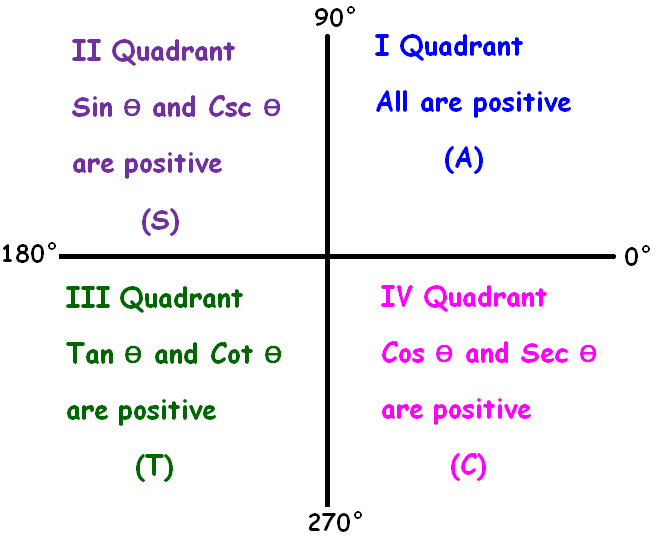
Before diving deep into the article to understand how trigonometric ratios of (180° – θ) are determined you need to understand the ASTC Formula.

The ASTC Formula can be easily remembered by considering the Phrases provided below

“All Silver Tea Cups” or ” All Students Take Calculus”

You will better understand the concept by having a glance at the below picture. From the picture, it is clearly evident that 180 degrees minus theta fall under the 2nd Quandrant. In the 2nd Quadrant, only sin and cosecant are Positive.

ASTC Formula

sin(180° – θ)=sinθ
cos(180° – θ)=−cosθ
tan(180° – θ)=−tanθ
cosec (180° – θ)=cosec θ
sec(180° – θ)=−secθ
cot(180° – θ)=−cotθ

Read More Articles:

Evaluate Trigonometric Functions of (180° – θ)

1. Evaluate Sin(180° – θ)?

Solution:

Sin(180° – θ) = Sin (90° + 90° – θ)

= Sin [90° + (90° – θ)]

= Cos (90° – θ), [since Sin (90° + θ) = Cos θ]

= Sin θ[since Cos (90° – θ) = Sin θ]

Therefore, Sin (180° – θ) = Sin θ

2. Evaluate Cos(180° – θ)?

Cos (180° – θ) = Cos (90° + 90° – θ)

= Cos [90° + (90° – θ)]

= – Sin (90° – θ), [since Cos (90° + θ) = -Sin θ]

= -Cos θ [since sin (90° – θ) = cos θ]

Therefore, Cos (180° – θ) = – Cos θ

3. Evaluate Tan (180° – θ)?

Solution:

Tan (180° – θ) = Tan (90° + 90° – θ)

= Tan [90° + (90° – θ)] [since Tan (90° + θ) = -Cot θ]

= – Cot (90° – θ)

= Tan θ [since Cot (90° – θ) = Tan θ]

Therefore, Tan (180° – θ) = – Tan θ

4. Evaluate Csc (180° – θ)?

Solution:

Csc (180° – θ) = \(\frac { 1 }{ Sin(180° – θ) } \)

= \(\frac { 1 }{ Sin θ } \) [Since Sin(180° – θ) = Sin θ]

Therefore, Csc (180° – θ) = \(\frac { 1 }{ Sin θ } \)

5. Evaluate Sec (180° – θ)?

Solution:

Sec (180° – θ) = \(\frac { 1 }{ Cos(180° – θ) } \)

= = \(\frac { 1 }{ -Cos θ } \) [Since Cos(180° – θ) = -Cos θ]

= -Sec θ

Therefore, Sec (180° – θ) = -Sec θ

6. Evaluate Cot (180° – θ)?

Solution:

Cot (180° – θ) = \(\frac { 1 }{ Tan(180° – θ) } \)

= \(\frac { 1 }{ -Tan θ } \) [Since Tan(180° – θ) = -Tan θ]

= -Cot θ

Solved Examples on Trigonometric Ratios

1. Find the Value of Cos 150°?

Solution:

Cos 150° = Cos(180° – 30°)

= – Cos 30°

= – \(\frac { √3 }{ 2 } \)

2. Find the value of Cot 135°?

Solution:

Cot 135° = Cot(180° – 45°)

= -Cot 45°

= -1

Worksheet on Multiplication of Fractions | Multiplying Fractions Worksheets with Answers

Worksheet on Multiplication of Fractions

Worksheet on Multiplication of Fractions is here. Get important questions involved in Fractions Multiplication. Refer to the various rules, methods, formulae of Fractions Multiplication. Follow questions regarding proper, improper, mixed fractions and how they work when multiplying them. Solved examples in Multiplying Fractions Worksheet will help you to get a piece of detailed information and also helps you to score better marks in the exam.

Problem 1:

Gita has eight marbles. She gave \(\frac { 1 }{ 4 } \) of them to her younger brother. How many marbles did her brother get?

Solution:

As given in the question,

Gita has marbles = 8

She gave to younger brother = \(\frac { 1 }{ 4 } \) of 8

No of marbles her brother got = \(\frac { 1*8 }{ 4 } \)

= \(\frac { 2 }{ 1 } \)

= 2

Therefore, her brother got 2 marbles

Thus, the final solution is 2 marbles


Problem 2:

Mr. Gupta puts 3\(\frac { 1 }{ 4 } \) litres of petrol in his car. If he uses \(\frac { 1 }{ 3 } \) of it. How many litres of petrol did he use?

Solution:

As given in the question,

Mr. Gupta puts = 3\(\frac { 1 }{ 4 } \) litres of petrol

He used = \(\frac { 1 }{ 3 } \) of 3\(\frac { 1 }{ 4 } \)

\(\frac { 1 }{ 3 } \) * \(\frac { 13 }{ 4 } \)

\(\frac { 1*13 }{ 3*4 } \)

3\(\frac { 13 }{ 12 } \)

1\(\frac { 1 }{ 12 } \)

Therefore, Mr. Gupta used 1\(\frac { 1 }{ 12 } \) litres of petrol.

Thus, the final solution is 1\(\frac { 1 }{ 12 } \) litres


Problem 3:

Neha spends 3\(\frac { 3 }{ 5 } \) hours a day in morning exercises. How many hours does she spend in morning exercises in one week?

Solution:

As given in the question,

Neha spends = \(\frac { 3 }{ 5 } \) hours/day

Hours she spends in a week = \(\frac { 3 }{ 5 } \) * 7

\(\frac { 3*7 }{ 5 } \) \(\frac { 21 }{ 5 } \)

4\(\frac { 1 }{ 5 } \) hours

Therefore, Neha spends 4\(\frac { 1 }{ 5 } \) hours in morning exercises.

Thus, the solution is 4\(\frac { 1 }{ 5 } \) hours


Problem 4:

One plum cake weighs \(\frac { 3 }{ 4 } \) kg. If Mr. Ramesh buys five such cakes, how many kilograms of cakes did he buy?

Solution:

As given in the question,

Weight of one plum cake = \(\frac { 3 }{ 4 } \) kg

No of cakes = 5

Amount of cake he bought = \(\frac { 3 }{ 4 } \) * 5

\(\frac { 3*5 }{ 4 } \) \(\frac { 15 }{ 4 } \)

Therefore, \(\frac { 15 }{ 4 } \) kilograms of cake, Mr. Ramesh buy

Thus, the final solution is \(\frac { 15 }{ 4 } \)


Problem 5:

The cost of one kilogram apples is Rupees 25\(\frac { 1 }{ 2 } \). What is the cost of 1\(\frac { 1 }{ 2 } \) kilogram apples?

Solution:

As given in the question,

The cost of one kilogram apple = 25\(\frac { 1 }{ 2 } \)

The cost of 1\(\frac { 1 }{ 2 } \) kilogram apples = 25\(\frac { 1 }{ 2 } \) * 1\(\frac { 1 }{ 2 } \)

\(\frac { 51 }{ 2 } \) * \(\frac { 3 }{ 2 } \)

\(\frac { 153 }{ 4 } \)

Therefore, \(\frac { 153 }{ 4 } \) is the price for 1\(\frac { 1 }{ 2 } \) kilogram apples.

Thus, the final solution is \(\frac { 153 }{ 4 } \)


Problem 6:

The thickness of the Mathematics book of Class – IV is 1\(\frac { 1 }{ 4 } \) cm. What will be the thickness of a pile of 16 such books?

Solution:

As given in the question,

Thickness of book = 1\(\frac { 1 }{ 4 } \)

No of books = 16

The thickness of a pile of 16 books = 1\(\frac { 1 }{ 4 } \) * 16

\(\frac { 5 }{ 4 } \) * 16

\(\frac { 80 }{ 4 } \)

= 20

Therefore, the thickness of a pile of 16 books is 20cm.

Thus, the final solution is 20cm.


Problem 7:

Milk is sold at Rs 16\(\frac { 3 }{ 4 } \) per litre, find the cost of 6\(\frac { 2 }{ 5 } \) litre of milk?

Solution:

As given in the question,

Cost of 1 litre milk = 16\(\frac { 3 }{ 4 } \)

Cost of \(\frac { 32 }{ 5 } \) litre milk = 16\(\frac { 3 }{ 4 } \)

= \(\frac { 67 }{ 4 } \)

The cost of 6\(\frac { 2 }{ 5 } \) is \(\frac { 67 }{ 4 } \) * \(\frac { 32 }{ 5 } \)

= \(\frac { 67*8 }{ 5 } \)

= \(\frac { 536 }{ 5 } \)

= 107\(\frac { 1 }{ 5 } \)

Therefore, the cost of 6\(\frac { 2 }{ 5 } \) litre of milk is 107\(\frac { 1 }{ 5 } \)

Thus, the final solution is 107\(\frac { 1 }{ 5 } \)


Problem 8:

Find the area of the rectangular park which is 41\(\frac { 2 }{ 3 } \) long and 18\(\frac { 3 }{ 5 } \) m board?

Solution:

As given in the question,

Length of the rectangular park = 41\(\frac { 2 }{ 3 } \)

Breadth of the rectangular park = 18\(\frac { 3 }{ 5 } \)

Area of rectangle = length * breadth

= \(\frac { 125 }{ 3 } \) * \(\frac { 93 }{ 5 } \)

= 775 meters

Therefore, the area of the rectangular park is 775 meters

Thus, the final solution is 775 meters.


Problem 9.
If the cost of 5\(\frac { 2 }{ 5 } \) litres of milk is 236\(\frac { 1 }{ 4 } \), find the cost per litre?

Solution:

As given in the question,

The cost of milk = 236\(\frac { 1 }{ 4 } \)

No of litres = 5\(\frac { 2 }{ 5 } \)

Cost of \(\frac { 27 }{ 5 } \) litres of milk = \(\frac { 945 }{ 4 } \)

Cost of 1 litre of milk = \(\frac { 945%4 }{ 27%5 } \)

= \(\frac { 945 }{ 4 } \) * \(\frac { 5 }{ 27 } \)

= \(\frac { 35*5 }{ 4 } \)

= \(\frac { 175 }{ 4 } \)

= 43\(\frac { 3 }{ 4 } \)

Therefore, the cost per litre = 43\(\frac { 3 }{ 4 } \)

Thus, the final solution is 43\(\frac { 3 }{ 4 } \)


Problem 10:

Margaret has 2\(\frac { 1 }{ 3 } \) cups of sugar. She is using 1\(\frac { 1 }{ 4 } \) cups to make cookies. How much sugar will she have left?

Solution:

As given in the question,

Amount of sugar Margaret has = 2\(\frac { 1 }{ 3 } \)

No of cups she is using to make cookies = 1\(\frac { 1 }{ 4 } \)

Amount of sugar will she have left = 2\(\frac { 1 }{ 3 } \) – 1\(\frac { 1 }{ 4 } \)

= \(\frac { 7 }{ 3 } \) – \(\frac { 5 }{ 4 } \)

= \(\frac { 7 }{ 3 } \) * \(\frac { 4 }{ 4 } \) – \(\frac { 5 }{ 4 } \) * \(\frac { 3 }{ 3 } \)

= \(\frac { 28 }{ 12 } \) – \(\frac { 15 }{ 12 } \)

= \(\frac { 28-15 }{ 12 } \)

= \(\frac { 13 }{ 12 } \)

Therefore, \(\frac { 13 }{ 12 } \) cups of sugar will she have left.

Thus, the final solution is \(\frac { 13 }{ 12 } \)


Problem 11:

Russell spent \(\frac { 1 }{ 3 } \) of his allowance to go to movies. He wants to buy a new video game that will cost him another \(\frac { 1 }{ 2 } \) of his allowance. If he buys the game. How much of his allowance will he have spent?

Solution:

As given in the question,

Amount of money Russell spent on movies = \(\frac { 1 }{ 3 } \)

Amount of money Russell spent on new video game = \(\frac { 1 }{ 2 } \)

Total amount of money he spent of his allowance = \(\frac { 1 }{ 3 } \) + \(\frac { 1 }{ 2 } \)

= \(\frac { 1 }{ 3 } \) * \(\frac { 2 }{ 2 } \) + \(\frac { 1 }{ 2 } \) * \(\frac { 3 }{ 3 } \)

= \(\frac { 2 }{ 6 } \) + \(\frac { 3 }{ 6 } \)

= \(\frac { 2+3 }{ 6 } \)

= \(\frac { 5 }{ 6 } \)

Therefore, the total amount of money spent = \(\frac { 5 }{ 6 } \)

Thus, the final solution is \(\frac { 5 }{ 6 } \)


Problem 12:

Sam has 3\(\frac { 1 }{ 8 } \) acres of land. He planted potatoes on 2\(\frac { 2 }{ 3 } \) of the land. He wants to plant corn. How much land does he have left to plant the corn?

Solution:

As given in the question,

Acres of land Sam has = 3\(\frac { 1 }{ 8 } \)

Acres of land he planted potatoes = 2\(\frac { 2 }{ 3 } \)

Amount of land left to plant the corn = 3\(\frac { 1 }{ 8 } \) – 2\(\frac { 2 }{ 3 } \)

= \(\frac { 25 }{ 8 } \) – \(\frac { 8 }{ 3 } \)

= \(\frac { 25 }{ 8 } \) * \(\frac { 3 }{ 3 } \) – \(\frac { 8 }{ 3 } \) * \(\frac { 8 }{ 8 } \)

= \(\frac { 75 }{ 24 } \) – \(\frac { 64 }{ 24 } \)

= \(\frac { 75-64 }{ 24 } \)

= \(\frac { 11 }{ 24 } \)

Therefore, \(\frac { 11 }{ 24 } \) acres of land left to plant the corn.

Thus, the final solution is \(\frac { 11 }{ 24 } \)


Problem 13:

I bought 80 pounds of spaghetti to share equally between 7 families. About how many pounds of spaghetti will each family receive?

Solution:

As given in the question,

Amount of spaghetti = 80 pounds

No of families = 7

Amount of spaghetti each family receive = \(\frac { 80 }{ 7 } \)

Therefore, \(\frac { 80 }{ 7 } \) pounds of spaghetti each family will receive.


Problem 14:

I have 70 feet of rope that I need to share equally between 11 people. About how many feet of rope will each person receive?

Solution:

As given in the question,

No of people = 11

Length of the rope = 70 feet

Length of rope each person will receive = \(\frac { 70 }{ 11 } \)

Therefore, each person will receive \(\frac { 70 }{ 11 } \) feet of rope.

Thus, the final solution is \(\frac { 70 }{ 11 } \).


Problem 15:

Mom made pizza. There is only \(\frac { 1 }{ 4 } \) of the pizza left. Mom and her friend Sally are going to share the remaining pizza evenly. How much of pizza will they each get?

Solution:

As given in the question,

Fraction of pizza left = \(\frac { 1 }{ 4 } \)

No of people who share the pizza = 2

Amount of pizza each will get = \(\frac { 1%4 }{ 2 } \)

= \(\frac { 1 }{ 4 } \) * \(\frac { 2 }{ 1 } \)

= \(\frac { 2 }{ 4 } \)

= \(\frac { 1 }{ 2 } \)

Therefore, each gets \(\frac { 1 }{ 2 } \) of pizza.

Thus, the final solution is \(\frac { 1 }{ 2 } \)


What is Place Value? – Definition, Properties of Place, Face Value, Place Value, Examples

Place Value

Place value is nothing but the position or place of a digit in the decimal number. In a number, every digit has someplace. The positions of digits in number starts from one’s place. The order of place value of digits of a number of right to left is units, tens, hundreds, thousands, ten thousand’s, and so on. Generally, a number is formed by grouping digits together.

Place, Place Value and Face Value Definitions

In a number, every digit has a fixed position known as the digit place. And each digit has a value depending on its place called the place value of the digit. Face value of a digit for any place in the value of the digit itself.

Place Value of a digit = (face value of the digit) x (value of the place)

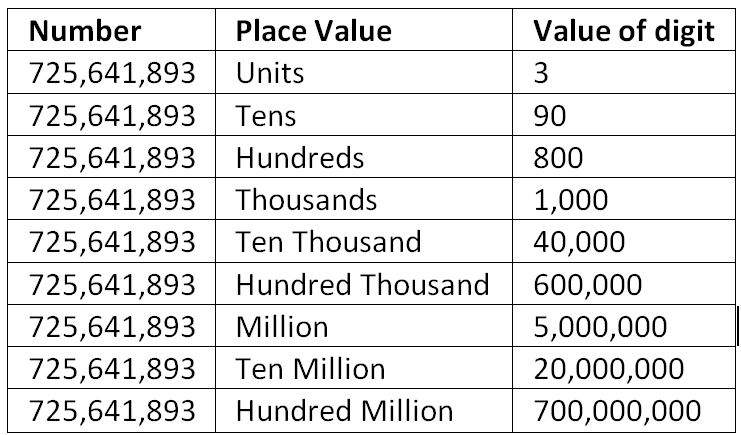
Place Value Table

Place value chart is helpful to ensure that the digits are in the correct places. Place value tells us how much each digit stands for. The place value table is mentioned here.

place value 1

Properties of Place Value

  • The place value of every one-digit number is the same as the face value.

The place value and face value of 1, 2, 3, 4, 5, 6, 7, 8, and 9 are 1, 2, 3, 4, 5, 6, 7, 8, and 9. The place value of 0 is always 0. It may present at any place in the number, its value is always zero.

Example:

(i) In the numbers 105, 270, 1025 the place of value 0 is 0.

(ii) The place of 1 in 251 is 1, 7 in 8567 is 7.

  • In a two-digit number, the place value of the ten-place digit is equal to 10 times of the digit.

Example:

(i) The place value of 6 in 67 is 6 x 10 = 60

(ii) The place value of 2 in 526 is 2 x 10 = 20

  • In the number 567, the digit 7 is at one’s place, the digit 6 is at ten’s place and the digit 5 is at the hundred’s place.

So, the place value of 7 is 7, 6 is 6 x 10 = 60, and 5 is 5 x 100 = 500

Thus, for the place value of a digit, the digit is multiplied by the place value of 1 it has to be that place.

Example:

In the number 286,

The place value of 6 is 6 x 1 = 6

The place value of 8 is 8 x 10 = 80

The place value of 2 is 2 x 100 = 200

  • Now it is the general law that the digit possesses its place value as the product of the digit and place value of one to be at that position.

Examples:

(i) In the number 3578,

The place value of 8 is 8 x 1 = 8 because 8 is at the unit’s place.

The place value of 7 is 7 x 10 = 70 because 7 is at ten’s place.

The place value of 5 is 5 x 100 = 500 because 5 is at hundred’s place

The place value of 3 is 3 x 1000 = 3000 because 3 is at thousand’s place.

(ii) In the number 58762, the place value of each digit is as follows

2 is 2 x 1 = 2

6 is 6 x 10 = 60

7 is 7 x 100 = 700

8 is 8 x 1000 = 8000

5 is 5 x 10000 = 50000

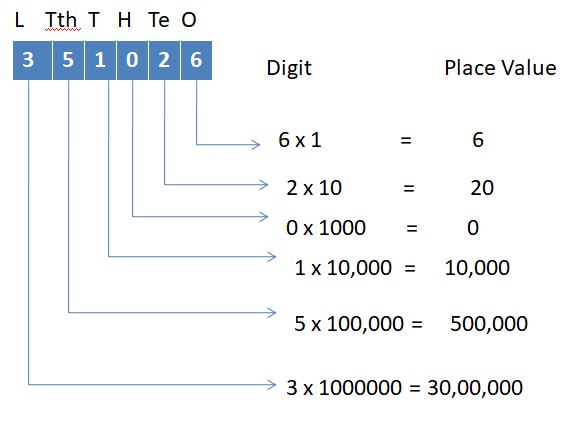
(iii) Find the place value of digits 30589

place value 2

Also, check out

Example Questions on Place Value

Example 1:

Write the place value of the given numbers.

(i) 5 in 38956

(ii) 2 in 2587

(iii) 6 in 6845321

Solution:

(i) The given number is 38956

The place value of 5 in 38956 is 5 x 10 = 50. Because 5 is at tens place.

(ii) The given number is 2587

The place value of 2 in 2587 is 2 x 1000 = 2000. Because 2 is at thousands place.

(iii) The given number is 6845321

The place value of 6 in 6845321 is 6 x 1000000 = 60,00,000. Because 6 is at ten lakhs place.

Example 2:

Write the place value of a highlighted digit in the given numbers

(i) 2589

(ii) 67525

(iii) 2515963

Solution:

(i) The given number is 2589

The place value of highlighted 8 in 2589 is 8 x 10 = 80 as it is located at the tens position.

(ii) The given number is 67525

The place value of highlighted digit 5 in 67525 is 5 x 100 = 500 as it is located at the hundred’s position.

(iii) The given number is 2515963

The place value of highlighted digit 1 in 2515963 is 1 x 10000 = 10000 as it is located at the ten thousand’s position.

Example 3:

Circle the following.

(i) Digit at the hundreds place in 5289.

(ii) Digit at the lakhs place in 2563891

(iii) Digit at the units place in 5280

Solution:

(i) In the number 5289,

9 is at units place, 8 is at tens place, 2 is at hundreds place and 5 is at thousand’s place

So, Digit at the hundreds place in 5289 is 2.

(ii) In the number 2563891,

1 is at units place, 9 is at tens place, 8 is at hundreds place, 3 is at thousand’s place, 6 is at ten thousand’s place, 5 is at lakhs place, 2 is at ten lakhs place.

Therefore, Digit at the lakhs place in 2563891 is 5.

(iii) In the number 5280,

0 is at the unit’s place, 8 is at the ten’s place, 2 is at the hundred’s place and 5 is at the thousand’s place.

Hence, the digit at the units place in 5280 is 0.

Example 4:

Find the place value of 5 in the given numbers.

(i) 6,00,521

(ii) 5,23,168

(iii) 2,05,387

Solution:

(i) The given number is 6,00,521

The place value of 5 is 5 x 100 = 500.

(ii) The given number is 5,23,168

The place value of 5 is 5 x 10,000 = 50,000.

(iii) The given number is 2,05,387

The place value of 5 is 5 x 1000 = 5000.

FAQs on Place Value

1. Write the differences between place value and face value?

Place value means the position of a particular digit in the number but face value represents the exact value of a digit in that number. For example in the number 2556, the place value of 2 is thousands but the face value is 2.

2. Define place value with an example?

The place value is the position of a digit in a number. The place values of digits are represented as ones, tens, hundreds, thousands, ten thousand, and so on. The example is the place value of 8 in 589 is 8 tens i.e 80.

Worksheet on Division of Fractions | Dividing Fractions Worksheet with Answers

Worksheet on Division of Fractions

Access Worksheet on Division of Fractions here to get acquainted with various problems on Division of Fractions. Refer to Fractions Division’s step-by-step procedure to solve the problems. Follow the study material and guidance to solve various questions and answers. Know the important methods, rules, and formulae of Dividing Fractions. Try to solve the Dividing Fractions Word Problems Worksheet available on your own to test your knowledge of the concept. We have provided detailed solutions to all the Dividing Fractions Problems available.

Dividing Fractions Word Problems Worksheets with Answers

Problem 1:

Jiya thought it would be nice to include \(\frac { 2 }{ 21 } \) of a pound of chocolate in each of the holiday gift bags she made for her friends and family. How many holiday gift bags could jiya make with \(\frac { 2 }{ 3 } \) of a pound of chocolate?

Solution:

As given in the question,

Amount of chocolate = \(\frac { 2 }{ 21 } \)

No of bags = Total lb/lbs per bag

\(\frac { 2 }{ 3 } \) % \(\frac { 2 }{ 21 } \)

= \(\frac { 2 }{ 3 } \) % \(\frac { 2 }{ 21 } \)

= \(\frac { 2 }{ 3 } \) * \(\frac { 21 }{ 2 } \)

= \(\frac { 2 }{ 3 } \) + \(\frac { 2 }{ 21 } \)

= \(\frac { 2 }{ 3 } \) * \(\frac { 21 }{ 21 } \) + \(\frac { 2 }{ 21 } \) * \(\frac { 3 }{ 3 } \)

= \(\frac { 42 }{ 63 } \) + \(\frac { 6 }{ 63 } \)

= \(\frac { 48 }{ 63 } \)


Problem 2:

Lithi has \(\frac { 1 }{ 5 } \) of a bag of dog food left. She is splitting it between her 3 dogs evenly. What fraction of the original bag does each dog get?

Solution:

As given in the question,

Amount of dog food left = \(\frac { 1 }{ 5 } \)

No of dogs = 3

The fraction of the original bag each dog get = \(\frac { 1%5 }{ 3 } \)

= \(\frac { 1 }{ 5 } \) * \(\frac { 1 }{ 3 } \)

= \(\frac { 1 }{ 15 } \)

Therefore, \(\frac { 1 }{ 15 } \) fraction of original bag each dog gets

Thus, the final solution is \(\frac { 1 }{ 15 } \)


Problem 3:

John has \(\frac { 1 }{ 4 } \) of a gallon of saltwater that he is using for an experiment. He needs to evenly separate the saltwater into 3 separate beakers. How much salt water will be in each beaker?

Solution:

As given in the question,

Fraction of salt water he is using for an experiment = \(\frac { 1 }{ 4 } \)

No of beakers = 3

Amount of salt water in each beaker = \(\frac { 1 }{ 4 } \) % 3

= \(\frac { 1 }{ 4 } \) * \(\frac { 1 }{ 3 } \)

= \(\frac { 1 }{ 12 } \)

Therefore, \(\frac { 1 }{ 12 } \) gallons of salt water

Thus, the final solution is \(\frac { 1 }{ 12 } \)


Problem 4:

David has a board that measures 4ft in length. The board is going to be cut into \(\frac { 1 }{ 4 } \) ft pieces. How many pieces will David split the board into?

Solution:

As given in the question,

Length of the board = 4ft

No of pieces the board is going to be cut = \(\frac { 1 }{ 4 } \)

No of pieces David will get = 4 % \(\frac { 1 }{ 4 } \)

= \(\frac { 4 }{ 1 } \) * \(\frac { 4 }{ 1 } \)

= \(\frac { 16 }{ 1 } \)

= 16 pieces

Therefore, Devin split the board into 16 pieces.


Problem 5:

Jasmine has \(\frac { 1 }{ 4 } \) hour left to finish 4 math problems on the test. How much time does she have to spend on each problem?

Solution:

As given in the question,

No of hours Jasmine left to finish math problems = \(\frac { 1 }{ 4 } \)

No of problems = 4

The time she have to spend on each problem = \(\frac { 1 }{ 4 } \) % 4

= \(\frac { 1 }{ 4 } \) * \(\frac { 1 }{ 4 } \)

= \(\frac { 1 }{ 16 } \)

Therefore, \(\frac { 1 }{ 16 } \) fraction of time she spend on each problem

Thus, the final solution is \(\frac { 1 }{ 16 } \)


Problem 6:

Sandya finished \(\frac { 1 }{ 3 } \) of her homework problems. Which fraction is equivalent to what Sandya finished?

Solution:

As given in the question,

The fraction of homework problems = \(\frac { 1 }{ 3 } \)

The fraction that is equivalent to wht Sandra finished = \(\frac { 1 }{ 3 } \) * \(\frac { 2 }{ 2 } \)

= \(\frac { 2 }{ 6 } \)

= \(\frac { 1 }{ 3 } \) * \(\frac { 3 }{ 3 } \)

= \(\frac { 3 }{ 9 } \)

Therefore, the fractions \(\frac { 2 }{ 6 } \) and \(\frac { 3 }{ 9 } \) are equivalent to Sandra.

Thus, the final solution is \(\frac { 2 }{ 6 } \) and \(\frac { 3 }{ 9 } \)


Problem 7:

Berlin has 9 cups of sugar. If this is \(\frac { 3 }{ 4 } \) of the number he needs to make a cake, how many cups does he need?

Solution:

As given in the question,

No of cups of sugar = 9

The fraction of cake he needs = \(\frac { 3 }{ 4 } \)

No of cups = 9 % \(\frac { 3 }{ 4 } \)

= \(\frac { 9 }{ 1 } \) * \(\frac { 4 }{ 3 } \)

= \(\frac { 36 }{ 3 } \)

= 12

Therefore, Berlin needs 12 cups of sugar.

Thus, the final solution is 12 cups.


Problem 8:

Mahathi is working on projects that require 3\(\frac { 1 }{ 2 } \) yards of ribbon per project. Mahathi has 28 yards of ribbon. What is the greatest number of projects that Mahathi can complete with this ribbon?

Solution:

As given in the question,

Amount of yards of ribbon per project = 3\(\frac { 1 }{ 2 } \)

No of yards = 28

The greatest number of projects = 28 % 3\(\frac { 1 }{ 2 } \)

= 28 % \(\frac { 7 }{ 2 } \)

= \(\frac { 28 }{ 1 } \) * \(\frac { 2 }{ 7 } \)

= \(\frac { 56 }{ 7 } \)

= 8

Therefore, Mahathi can complete 8 projects with this ribbon.

Thus, the final solution is 8 projects


Problem 9:

Arjun made 40 cookies for the upcoming bake sale. He made \(\frac { 3 }{ 5 } \) of the cookies of chocolate chip and \(\frac { 1 }{ 4 } \) of them peanut butter. How many chocolate chip and peanut butter cookies are there in together?

Solution:

As given in the question,

No of cookies = 40

No of cookies of chocolate chip = \(\frac { 3 }{ 5 } \)

No of cookies of peanut butter = \(\frac { 1 }{ 4 } \)

No of chocolate chips = 40 * \(\frac { 3 }{ 5 } \)

= \(\frac { 120 }{ 5 } \)

= 24

No of peanut cookies = 40 * \(\frac { 1 }{ 4 } \)

= \(\frac { 40 }{ 4 } \)

= 10

Therefore, a total of 10 chocolate and peanut cookies are in together.


Problem 10:

Gillian took 6\(\frac { 1 }{ 2 } \) hours to build a dog house. If she worked for 1\(\frac { 3 }{ 4 } \) hours each night. How many nights did it take?

Solution:

As given in the question,

No of hours Gillian take to build a dog house = 6\(\frac { 1 }{ 2 } \)

No of hours she worked each night = 1\(\frac { 3 }{ 4 } \)

No of nights he took = 6\(\frac { 1 }{ 2 } \) % 1\(\frac { 3 }{ 4 } \)

= \(\frac { 13 }{ 2 } \) % \(\frac { 7 }{ 4 } \)

= \(\frac { 13 }{ 2 } \) * \(\frac { 4 }{ 7 } \)

= \(\frac { 52 }{ 14 } \)

= 3\(\frac { 10 }{ 14 } \)

Therefore, 3\(\frac { 10 }{ 14 } \) nights it took to build a dog house.

Thus, the final solution is 3\(\frac { 10 }{ 14 } \)


Problem 11:

A class consists of 40 students. Of them \(\frac { 2 }{ 5 } \) of the fraction are boys. Find the number of girls present in the class?

Solution: 

As given in the question,

No of students in class = 40

No of boys = \(\frac { 2 }{ 5 } \)

No of boys present = \(\frac { 40 }{ 1 } \) * \(\frac { 2 }{ 5 } \)

= \(\frac { 80 }{ 5 } \)

= 16 boys

Therefore, the total no of girls = 40 – 16

= 24 girls

Therefore, there are 24 girls present in the class

Thus, the final solution is 24 girls.


Problem 12:

John had Php 960. He spent \(\frac { 1 }{ 3 } \) of his money on food. How many were left to him?

Solution: 

As given in the question,

Amount of Php, John had = 960

Amount of money he spent on food = \(\frac { 1 }{ 3 } \)

Amount of money left out after spending on food = \(\frac { 960 }{ 1 } \) * \(\frac { 1 }{ 3 } \)

= \(\frac { 960 }{ 3 } \)

= 320

Total amount of money left = 960 – 320 = 640

Therefore, John has 640 Php left with him.

Thus, the final solution is Php 640.


Problem 13:

Efren had 480 apples for sale. He sold \(\frac { 3 }{ 5 } \) of them. How many were left?

Solution: 

As given in the question,

No of apples for sale = 480

Fraction of apples he sold = \(\frac { 3 }{ 5 } \)

No of apples left = \(\frac { 480 }{ 1 } \) * \(\frac { 3 }{ 5 } \)

= \(\frac { 1440 }{ 5 } \)

= 288

No of apples left after selling = 480 – 288

= 192

Therefore, there were 192 apples left after selling

Thus, the final solution is 192 apples.


Problem 14:

Rose and Mary were filling the class-raised garden bed with soil. Rose shoveled in \(\frac { 1 }{ 3 } \) of a cubic yard, and Mary shoveled in \(\frac { 1 }{ 2 } \) of a cubic yard. How much of the soil did they put into the garden bed altogether?

Solution: 

As given in the question,

The fraction of cubic yard Rose shoveled = \(\frac { 1 }{ 3 } \)

The fraction of cubic yard Mary shoveled = \(\frac { 1 }{ 2 } \)

The amount of soil they put into the garden together = \(\frac { 1 }{ 3 } \) + \(\frac { 1 }{ 2 } \)

Multiply the first fraction with \(\frac { 2 }{ 2 } \) and second fraction with \(\frac { 3 }{ 3 } \)

= \(\frac { 2 }{ 6 } \) + \(\frac { 3 }{ 6 } \)

= \(\frac { 5 }{ 6 } \)

Therefore, \(\frac { 5 }{ 6 } \) fraction of soil they put into the garden bed altogether

Thus, the solution is \(\frac { 5 }{ 6 } \)


Problem 15:

Carl’s invited Otto over to his house. Carl’s liked to share with his guests, so he got out his chocolate stash from last Halloween. He still had \(\frac { 4 }{ 5 } \) of a pound of chocolate. Carl’s asked Otto how much chocolate he would like. Otto said that he would like \(\frac { 1 }{ 3 } \) of a pound of chocolate. Carl’s obliged. How much chocolate does Carl’s have left?

Solution: 

As given in the question,

Amount of chocolate = \(\frac { 4 }{ 5 } \)

Otto would have chocolate = \(\frac { 1 }{ 3 } \)

Amount of chocolate Carl’s have = \(\frac { 4 }{ 5 } \) – \(\frac { 1 }{ 3 } \)

Multiply the first equation with \(\frac { 3 }{ 3 } \) and the second equation with \(\frac { 5 }{ 5 } \)

= \(\frac { 12 }{ 15 } \) – \(\frac { 5 }{ 15 } \)

= \(\frac { 7 }{ 15 } \)

Therefore, Carl’s have \(\frac { 7 }{ 15 } \) fraction of chocolate

Thus, the final solution is \(\frac { 7 }{ 15 } \).


Worksheet on Fractions | Simplifying Fractions Worksheets with Answers

Worksheet on Fractions

Worksheet on Fractions is here. Know the step-by-step procedure to solve fraction problems. Refer to addition, subtraction, multiplication, and division of fractions to know the different model problems. Follow different terminology and rules to solve fraction problems. Various methods, rules, formulae involved in fractions operations are here. Go through the below sections to know more about the fractions.

Solved Problems on Simplifying Fractions

Problem 1:

Sameer has read three-fifth of the 75 pages of his book. How many more pages he needs to read to complete the book?

Solution:

As given in the question,

No of pages = 75

Sameer has read = \(\frac { 3 }{ 5 } \) of 75 pages

= \(\frac { 3 }{ 5 } \) x 75 pages

= 45 pages

Sameer has to read = (75-45) pages = 30 pages

Therefore, Sameer has to read 30 more pages.


Problem 2:

Ravi had Rs.675. He gave \(\frac { 13 }{ 15 } \) of the amount to Sam. Sam spent \(\frac { 9 }{ 15 } \) of the amount given to him. How much money is Sam left with?

Solution:

As given in the question,

The total amount of Ravi had = Rs.675

Amount of money Ravi gave to Sam = \(\frac { 13 }{ 15 } \) x Rs.675 = Rs. 585

Amount Sam spent = \(\frac { 9 }{ 15 } \) x Rs.675 = Rs. 351

Amount Sam is left with = Rs. 585 – Rs. 351 = Rs. 234


Problem 3:

Jagadish spends \(\frac { 3 }{ 5 } \) of his income on rent and \(\frac { 1 }{ 4 } \) of remainder amount on grocery. He saves the remaining amount.

a) What fraction of income does he save?

b) If he saves Rs.1029 per month, what is his monthly income?

Solution:

a) As given in the question,

Amount of income Jagadish spend = \(\frac { 3 }{ 5 } \)

Let Jagadish’s income be Re. 1

Money spent on rent = \(\frac { 3 }{ 5 } \) of Re. 1 – Re (1 x \(\frac { 3 }{ 5 } \)) – Re \(\frac { 3 }{ 5 } \)

Remainder = Re (1 – \(\frac { 3 }{ 5 } \)) = Re \(\frac { 5-3 }{ 2 } \) = Re \(\frac { 3 }{ 5 } \)

Money spent on grocery = \(\frac { 1 }{ 4 } \) of Re. \(\frac { 2 }{ 5 } \) = Re (\(\frac { 2 }{ 5 } \) x \(\frac { 1 }{ 4 } \)) = Re. \(\frac { 1 }{ 10 } \)

Saving = Re. (\(\frac { 2 }{ 5 } \) – \(\frac { 1 }{ 10 } \)) = Re. \(\frac { 3 }{ 10 } \)

Therefore, he saves \(\frac { 3 }{ 10 } \) of his total income.

b) From (a) we got to know that Jagadish saves \(\frac { 3 }{ 10 } \) of his total income.

Amount he saves per month = Rs. 1029

\(\frac { 3 }{ 10 } \) x  (Total income) = Rs 1029

Total income = Rs (1029 x \(\frac { 10 }{ 3 } \) = Rs. 3430


Problem 4:

A baby rabbit was born \(\frac { 3 }{ 4 } \) of a month early. When it was born, its weight was \(\frac { 7 }{ 8 } \) kilogram. The weight at birth was \(\frac { 9 }{ 10 } \) kilogram less than the average weight of a newborn rabbit. What is the average weight of a newborn rabbit?

Solution:

No of months early a baby rabbit was born = \(\frac { 3 }{ 4 } \)

The weight of the baby rabbit = \(\frac { 7 }{ 8 } \) kilogram

Weight at birth less than the average weight = \(\frac { 9 }{ 10 } \)

Average weight of a newborn rabbit = \(\frac { 9 }{ 10 } \) + \(\frac { 7 }{ 8 } \)

= \(\frac { 9×8 }{ 10×8 } \) + \(\frac { 10×7 }{ 10×8 } \)

= \(\frac { 142 }{ 80 } \)

= 1\(\frac { 62 }{ 80 } \)


Problem 5:

In the zoo, \(\frac { 3 }{ 8 } \) of the staff are male. \(\frac { 7 }{ 12 } \) of the staff works part-time at the zoo. What is the fraction of the staff that is female?

Solution:

No of male staff = \(\frac { 3 }{ 8 } \)

No of part-time staff at zoo = \(\frac { 7 }{ 12 } \)

The fraction of the female staff = 1 – \(\frac { 3 }{ 8 } \)

= \(\frac { 8 }{ 8 } \) – \(\frac { 3 }{ 8 } \)

= \(\frac { 5 }{ 8 } \)


Problem 6:

The lions in the zoo are fed three times a day. During the morning feeding, \(\frac { 2 }{ 15 } \) tons of meat is fed. During the afternoon feeding, the weight of the meat will be \(\frac { 1 }{ 15 } \) ton meat fed during the morning. If the total weight of the meat in a day is \(\frac { 1 }{ 2 } \) ton, how much is fed during the feeding at night?

Solution:

As given in the question,

Morning feed = \(\frac { 2 }{ 15 } \)

Afternoon feed = \(\frac { 1 }{ 15 } \) more than morning

Therefore, afternoon feed = \(\frac { 2 }{ 15 } \) + \(\frac { 1 }{ 15 } \)

Total feed = \(\frac { 1 }{ 2 } \)

Total feed = \(\frac { 1 }{ 2 } \) = Morning Feed + Afternoon Feed + Evening Feed

Let the evening feed = xyz

Therefore xyz = \(\frac { 1 }{ 2 } \) – \(\frac { 2 }{ 15 } \) – \(\frac { 3 }{ 5 } \)

xyz = \(\frac { 1 }{ 2 } \) – \(\frac { 2 }{ 15 } \) – \(\frac { 3 }{ 15 } \)

=\(\frac { 15 }{ 30 } \) – \(\frac { 4 }{ 30 } \) – \(\frac { 6 }{ 30 } \)

= \(\frac { 15-4-6 }{ 30 } \)

= \(\frac { 5 }{ 30 } \)

= \(\frac { 1 }{ 6 } \)


Problem 7:

The monkey nursery is open two times a day: \(\frac { 2 }{ 3 } \) hours at noon and \(\frac { 5 }{ 12 } \) hours in the afternoon. How much time is the monkey nursery open everyday?

Solution:

As given in the question,

The fraction of part monkey nursery is open at noon = \(\frac { 2 }{ 3 } \)

The  fraction of par monkey nursery is open at afternoon = \(\frac { 5 }{ 12 } \)

The time monkey nursery is open everyday = \(\frac { 2 }{ 3 } \) + \(\frac { 5 }{ 12 } \)

= \(\frac { 8 }{ 12 } \) + \(\frac { 5 }{ 12 } \)

=\(\frac { 13 }{ 12 } \)

=1\(\frac { 1 }{ 12 } \)


Problem 8:

An octopus weighed \(\frac { 5 }{ 6 } \) kilogram. After two weeks, its weight was increased by \(\frac { 3 }{ 10 } \) kilogram. But afterwards, it lost \(\frac { 1 }{ 5 } \) kilogram in weight as it was sick. What was the current weight?

Solution:

As given in the question,

Weight of the octopus = \(\frac { 5 }{ 6 } \) kgs

Weight after 2 weeks = \(\frac { 3 }{ 10 } \) kgs

Weight after it was sick = \(\frac { 1 }{ 5 } \) kgs

The current weight of octopus = \(\frac { 5 }{ 6 } \) + \(\frac { 3 }{ 10 } \) – \(\frac { 1 }{ 5 } \)

= \(\frac { 25 }{ 30 } \) + \(\frac { 9 }{ 30 } \) – \(\frac { 6 }{ 30 } \)

= \(\frac { 25+9-6 }{ 30 } \)

= \(\frac { 28 }{ 30 } \)

= \(\frac { 14 }{ 15 } \)


Problem 9:

Two types of fish can be found in a small tank that is 5\(\frac { 1 }{ 7 } \) feet long. A blue fish is \(\frac { 2 }{ 15 } \) feet long and an orange fish is \(\frac { 7 }{ 10 } \) feet long. How much longer is the orange fish?

Solution:

As given in the question,

No of fishes found in the tank = 2

Length of the fish = 5\(\frac { 1 }{ 7 } \)

Length of the blue fish = \(\frac { 2 }{ 15 } \)

Length of the orange fish = \(\frac { 7 }{ 10 } \)

The length of orange fish = \(\frac { 7 }{ 10 } \) – \(\frac { 2 }{ 15 } \)

= \(\frac { 21 }{ 30 } \) – \(\frac { 4 }{ 30 } \)

= \(\frac { 21-4 }{ 30 } \)

=\(\frac { 17 }{ 30 } \)


Problem 10:

Ila read 25 pages of a book containing 100 pages. Lalitha read \(\frac { 2 }{ 5 } \) of the same book. Who read less?

Solution:

As given in the question,

Ila read pages = 25

Lalitha read pages = \(\frac { 2 }{ 5 } \) of 100

= \(\frac { 2 }{ 5 } \) x 100

= 40

Therefore Ila read less number of pages.


Problem 11:

Javed was given \(\frac { 5 }{ 7 } \) of a basket of apples. What fraction of apples are left in the basket?

Solution:

As given in the question,

Total apples in the basket = 1

Javed was given =\(\frac { 5 }{ 7 } \)

Apples left in the basket = 1 – \(\frac { 5 }{ 7 } \)

= \(\frac { 7 }{ 7 } \) – \(\frac { 5 }{ 7 } \)

= \(\frac { 7-5 }{ 7 } \)

= \(\frac { 2 }{ 7 } \)


Problem 12:

Reena was given 1\(\frac { 1 }{ 2 } \) piece of cake and Meena was given 1\(\frac { 1 }{ 3 } \) piece of cake. Find total amount was given to both of them?

Solution:

As given in the question,

Reena got cake = 1\(\frac { 1 }{ 2 } \) = 3/2

Meena got cake = 1\(\frac { 1 }{ 3 } \)

Total cake = \(\frac { 3 }{ 2 } \) + \(\frac { 4 }{ 3 } \)

= \(\frac { 9+8 }{ 6 } \)

= \(\frac { 17 }{ 6 } \)

= 2\(\frac { 5 }{ 6 } \)


Problem 13:

Bailey’s restaurant bought 6\(\frac { 1 }{ 3 } \) pounds of onions. The restaurant bought 8 times as much potatoes as onion. How many pounds of potatoes did the restaurant buy?

Solution:

As given in the question,

Bailey’s bought pounds of onion = 6\(\frac { 1 }{ 3 } \)

No of times Baileys bought potatoes as onions = 8

No of pounds of potatoes the restaurant bought = 6\(\frac { 1 }{ 3 } \) x 8

= \(\frac { 19 }{ 3 } \) x \(\frac { 8 }{ 1 } \)

= \(\frac { 152 }{ 3 } \)

= 50\(\frac { 2 }{ 3 } \) pounds


Problem 14:

Betsy has \(\frac { 2 }{ 5 } \) of a cup of powdered sugar. He sprinkles \(\frac { 3 }{ 4 } \) of the powdered sugar onto a plate of brownies. How much sugar does Betsy sprinkle on the brownies?

Solution:

As given in the question,

Amount of powdered sugar = \(\frac { 2 }{ 5 } \)

Amount of sugar he sprinkled on a plate of brownies = \(\frac { 3 }{ 4 } \)

Amount of sugar he sprinkled on brownies = \(\frac { 2 }{ 5 } \) x \(\frac { 3 }{ 4 } \)

\(\frac { 3 }{ 10 } \) of a cup


Problem 15:

At Goshen High School, \(\frac { 1 }{ 2 } \) of the students play a sport. Of the students who play a sport, \(\frac { 1 }{ 2 } \) play football. What fraction of the students play football?

Solution:

As given in the question,

Fraction of students play sports = \(\frac { 1 }{ 2 } \)

Fraction of students play sport = \(\frac { 1 }{ 2 } \)

Fraction of students who play football = \(\frac { 1 }{ 2 } \) x \(\frac { 1 }{ 2 } \)

= \(\frac { 1 }{ 4 } \)

Therefore \(\frac { 1 }{ 4 } \) play football.


Division of Fractions Definition, Examples | How to Divide Fractions?

Division of Fractions

Get detailed information regarding the division of fractions here. Check all the important terms, formulae, and the usage of fractions division. Refer step by step procedure to solve the fraction division problems. Know the various methods to solve proper, improper, mixed fractions, etc. Follow the complete guide to know the day-to-day usage of fractions division problems. Go through the below sections to follow the importance and problems of division on fractions.

Division of Fractions – Introduction

Dividing the fractions also involves various methods and also a lengthy process. First of all, you have to know the difference between proper, improper, and mixed fractions. Once you come to know the difference, then you can easily analyze the method to solve them. As we have seen, for the multiplication, we have to make the fractions equivalent.

In the same way, the division of fractions requires the equivalent fractions to solve them. First, make sure you make the fractions equivalent and then follow all the steps in dividing the fractions. Generally, fraction division in the direct method requires more effort. Hence, we are providing an alternative method here.

How to Divide Fractions?

Division of fractions can be done by multiplying the fractions by writing the reciprocal of one of fraction numbers or by reversing one of two fraction integers. Reciprocal of the fraction number or reverse of the fraction number means, if the fraction is \(\frac { a }{ b } \), then \(\frac { b }{ a } \) is its reciprocal. Interchanging the position of numerator and denominator is nothing but reversing the fraction. Fractions division can be classified into 3 ways.

  • Fractions division by a fraction
  • Fractions division by a mixed fraction
  • Fractions division by a whole number

Fractions Division by a Fraction

Fractions division can be done in three steps. For division, we convert into the multiplication of fractions and obtain the desired result. The three steps are as follows.

  1. Convert the second fraction into its reciprocal and multiply it with the first fraction.
  2.  Multiply the denominator and numerator of both the fractions.
  3. Next, simplify the fraction numbers.

For example, suppose that \(\frac { a }{ b } \) is divided by the fraction \(\frac { c }{ d } \). We can solve the division as:

  • \(\frac { a }{ b } \) ÷ \(\frac { c }{ d } \) = \(\frac { a }{ b } \) * \(\frac { d }{ c } \)
  • \(\frac { a }{ b } \) ÷\(\frac { c }{ d } \) = \(\frac { a*d }{ b*c } \)
  • \(\frac { a }{ b } \) ÷ \(\frac { c }{ d } \) = \(\frac { ad }{ bc } \)

As given above, we can divide the fractions in three ways. Further simplification has to be done to get the exact result.

Fractions Division by a Whole Number

Fractions Division by a whole number is the easiest process. Follow the below steps to divide a whole number.

  1. The whole number is nothing but the real numbers which include zero and all positive integers. All the whole numbers can be written as the fraction values if we give the denominator value as 1.
  2. Find the reciprocal of the given number
  3. Now, multiply the value of the fraction by a given fraction.
  4. Then, simplify the equation to get its lowest terms.

Example:

Divide the fraction \(\frac { 6 }{ 5 } \) by 10?

Solution:

As given in the question,

The equation is \(\frac { 6 }{ 5 } \) by 10.

Step 1: Conversion into the whole number

As 10 is the whole number, we convert it into fractional value i.e., we write it as \(\frac { 10 }{ 1 } \)

Step 2: Find the reciprocal of the fraction

To find the reciprocal, we get \(\frac { 1 }{ 10 } \)

Step 3: Multiply both the fractions

Multiply the fractions, \(\frac { 6 }{ 5 } \) x \(\frac { 1 }{ 10 } \)

Step 4: Now, multiply the numertors and denominators of the fractions i.e., \(\frac { 6×1 }{ 15×10 } \)

Step 5: Simplify the equation

The resutant is  \(\frac { 3 }{ 25 } \)

Fractions Division by a Mixed Fraction

Fractions Division by a mixed fraction is almost similar to fractions division by fraction. The following are the steps to divide mixed fractions.

  1. Conversion of mixed fraction into an improper fraction
  2. Now, find the reciprocal of the improper fraction
  3. Multiply the resultant fraction by the given fraction value.
  4. Simplify the fractions.

Example:

Divide the fraction \(\frac { 2 }{ 5 } \) by 3\(\frac { 1 }{ 2 } \)?

Solution:

As given in the question,

The equation is \(\frac { 2 }{ 5 } \) by 3\(\frac { 1 }{ 2 } \)

Step 1: Conversion of mixed fraction into improper fraction

Convert, 3\(\frac { 1 }{ 2 } \), we get the result as 7/2

Step 2: Now, convert the reciprocal of the improper fraction, we get \(\frac { 2 }{ 7 } \)

Step 3: Multiply \(\frac { 2 }{ 5 } \) and \(\frac { 2 }{ 7 } \)

Step 4: Multiply the numertors and denominators of the fractions i.e., \(\frac { 2×2 }{ 5×7 } \)

Step 5: Simplify the fraction

the result value is \(\frac { 4 }{ 35 } \)

Fractions Division of Decimal Values

In the above sections, we have seen how to divide the fractions into three steps. Now, we see how to divide decimals with examples.

To convert the decimal values into natural numbers, we multiply both the numerator and denominator by 10.

Example:

Divide \(\frac { 0.5 }{ 0.2 } \)

Solution:

As given in the question,

The equation is \(\frac { 0.5 }{ 0.2 } \)

To divide the decimal values, convert the values into natural numbers by multiplying both numerator and denominator with 10.

Therefore, \(\frac { 0.5×10 }{ 0.2×10 } \)

We get the solution as, \(\frac { 5 }{ 2 } \) = 2.5

Also, we use the method of dividing fractions to solve the problem.

We can write 0.5 as \(\frac { 5 }{ 10 } \) and 0.2 as \(\frac { 2 }{ 10 } \)

Therefore, to find the solution of \(\frac { 5÷10 }{ 2÷10 } \)

Take the reciprocal of the second fraction i.e., \(\frac { 10 }{ 2 } \)

= \(\frac { 5*10 }{ 10*2 } \)

= \(\frac { 50 }{ 20 } \)

= \(\frac { 5 }{ 2 } \)

= 2.5

Dividing Fractions Examples

Problem 1: Lucy has \(\frac { 1 }{ 5 } \) of a bag of dog food left. She is splitting it between her 3 dogs evenly. What fraction of the original bag does each dog get?

Solution:

As given in the question,

Amount of dog food left = \(\frac { 1 }{ 5 } \)

No of dogs = 3

The fraction of the original bag each dog gets = \(\frac { 1/5 }{ 3 } \)

= \(\frac { 1 }{ 5 } \) x \(\frac { 1 }{ 3 } \)

= \(\frac { 1 }{ 15 } \) of the bag each dog gets.

Thus the final solution is \(\frac { 1 }{ 15 } \)

Problem 2: AJ has \(\frac { 1 }{ 4 } \) of a gallon of saltwater that he is using for an experiment. He needs to evenly separate the saltwater into separate beakers. How much salt water will be in each beaker?

Solution:

As given in the question,

Amount of salt water he is using for an experiment = \(\frac { 1 }{ 4 } \)

No of beakers = 3

Amount of salt water in each beaker = \(\frac { 1/4 }{ 3 } \)

= \(\frac { 1 }{ 4 } \) x \(\frac { 1 }{ 3 } \)

= \(\frac { 1 }{ 12 } \)

Therefore, \(\frac { 1 }{ 12 } \) gallons of salt water will be in each beaker.

Problem 3: Devin has a board that measures 4 ft in length. The board is going to be cut into \(\frac { 1 }{ 4 } \) ft pieces. How many pieces will Devin split the board into?

Solution:

As given in the question,

Length of the board = 4 ft

No of pieces the board is going to be cut = \(\frac { 1 }{ 4 } \)

No of pieces Devin split the board = 4 ÷ \(\frac { 1 }{ 4 } \)

= \(\frac { 4 }{ 1 } \) x \(\frac { 4 }{ 1 } \)

= \(\frac { 16 }{ 1 } \)

Hence, the final solution is 16 pieces.

Therefore, Devin will split the board into 16 pieces.

Fractions – Definition, Types, Properties, Rules and Examples

Know the importance of Fractions. Refer to types of fractions and their usage for various numbers. Follow the definition of fraction numbers along with properties, real-life examples. Check important points to convert fractions into decimals along with the different types of fractions. For better understanding, we took few examples and explained all of them in detail.

Fractions – Definition and Types

Fractions are the most important concept in mathematics. They are defined as the whole parts. Fraction value is nothing but a section or portion of a quantity. These are denoted by the symbol “/”.

Example: \(\frac { 4 }{ 6 } \) is a fraction value.

In the above fraction, 4 is defined as the numerator and 6 is defined as the denominator.

Quick Links of Fractions Concepts

Below is the list of topics that comes under the topic Fractions. If you have any queries on the concerned topic you can simply tap on the links available and learn the fundamentals involved in it easily. Get a good hold of the concept by practicing on a consistent basis.

History of Fraction

Fraction word is derived or originated from the Latin word “Fractus” which means broken. To consider a real-life example, suppose the cake is a whole part, if we cut some portion say \(\frac { 1 }{ 4 } \), it is defined as the fraction portion of the cake.

Definition of Fractions

A numerical value is represented by a fraction which means the portion or parts of a whole. For suppose, if a number(a) is to be divided into four parts, then it is represented by \(\frac { a }{ 4 } \). Therefore, the number \(\frac { a }{ 4 } \) defines \(\frac { 1 }{ 4 } \)th of the number a. Fraction values are an important part of daily life.

Types of Fractions

There are three types of Fractions that are used majorly. The three types of fractions are proper, improper, and mixed fractions which are majorly used. Apart from these, there are also other fractions – like fractions, unlike fractions, equivalent fractions. Therefore, there are totally 6 types of fractions.

  1. Proper Fractions
  2. Improper Fractions
  3. Mixed Fractions
  4. Like Fractions
  5. Unlike Fractions
  6. Equivalent Fractions

The above-mentioned first 3 fractions define single fractions whereas the other three fractions define the comparison of two or more fractions.

These fractions play an important role in real life as all the measured quantities cannot be absolute whole numbers, dealing with some portions or parts is also necessary, that is where the concept of fractions has come in.

1. Proper Fractions

The proper fractions are those in which the numerator value is less than the denominator value. i.e., Numerator < Denominator. After further simplification, the value of the proper fraction will always be less than 1.
Example: \(\frac { 5 }{ 9 } \) will be the proper fraction

2. Improper Fractions

The improper fractions are those in which the numerator value is greater than the denominator value. i.e., Denominator < Numerator. After further simplification, the value of the improper fraction will always be greater or equal to 1 but not less than 1.
Example: \(\frac { 9 }{ 5 } \) will be the improper fraction

3. Mixed Fractions

The mixed fraction is nothing but the combination of an integer value and a proper fraction. These are also called as mixed numerals or mixed numbers. These mixed fractions can be converted to a normal fraction. Mixed fractions are always greater than 1.
Example: 3 \(\frac { 3 }{ 2 } \) is a mixed fraction.

4. Like Fractions

As the name defines like fractions are those which are the same or alike. i.e., the fractions with the same denominators are called the like fractions.

Example:

\(\frac { 7}{ 2 } +\frac { 5 }{ 2 }+\frac{3}{2}+ \frac {1}{2} =\frac { 16 }{ 2 } \) = 8

5. Unlike Fractions

As the name defines, unlike fractions are those which are different or unequal. i.e., the fractions with unlike or unequal denominators are called, unlike fractions.

Example: \(\frac { 1 }{ 5 } \),\(\frac { 1 }{ 4 } \),\(\frac { 1 }{ 3 } \),\(\frac { 1 }{ 2 } \)

Steps to Simplify Unlike Fractions:

Simplifying the unlike fractions is a little bit of a lengthy process.

  1. First, factorize the denominator and simplify them.
  2. For example, if we have \(\frac { 1 }{ 2 } \) and \(\frac { 1 }{ 3 } \). Then, find the solution of LCM of 2 and 3 which equals 6.
  3. Now, multiply the first equation i.e., \(\frac { 1}{ 2 } \) with 3, and second equation i.e., \(\frac { 1 }{ 3 } \) with 2, the multiplication implies for both numerator and denominator.
  4. After applying the multiplication, the result will be \(\frac { 3 }{ 6 } \) and \(\frac { 2 }{ 6 } \).
  5. Now add both the values of \(\frac { 3 }{ 6} \) and \(\frac { 2 }{ 6 } \).
  6. The result value will be \(\frac { 5 }{ 6 } \).

6. Equivalent Fractions:

Equivalent Fractions are those whose result value is the same after the simplification process and they represent the same portion or quantity of the whole. Therefore, the fractions which are equal to each other are known as equivalent fractions.

Example: \(\frac { 2 }{ 3 } \) and \(\frac { 4 }{ 6 } \) are equivalent fractions

Since \(\frac { 4 }{ 6 } \) can be written as \(\frac { (2*2) }{(2*3) } \)

The result value will be \(\frac { 2 }{ 3 } \) which means that both are equivalent.

Properties of Fractions

In similar to whole numbers and real numbers, fractions also holds some of the important properties.

  1. Associative and Commutative Properties holds true for multiplication and addition of fractions.
  2. Fractional multiplication is always 1 and the identity element of the fractional addition is 0.
  3. If a and b are non-zero elements, then the multiplicative inverse of \(\frac { a }{ b } \) is \(\frac { b }{ a } \) where a and b must be non-zero elements.
  4. The distributive property of multiplication over addition is applicable to all fractional numbers.

Important Points about Fraction Types

Proper fraction value after the simplification of the equation is always less than 1.

Every natural number can be represented in fraction form, where the denominator value is equal to 1

Improper Fraction value after the simplification of expression is always greater than or equal to 1, but no less than 1.

Every mixed fraction can be converted into a normal fraction.

Every improper fraction can also be converted into a mixed fraction.

A mixed fraction simplification always results in greater than 1.

If the numerator value is equal to 1, then that fraction is called a unit fraction.

Example:

One-fifth of the whole – \(\frac { 1 }{ 5 } \)

One-fourth of the whole – \(\frac { 1 }{ 4 } \)

One-third of the whole – \(\frac { 1 }{ 3 } \)

One half of the whole – \(\frac { 1 }{ 2 } \)

Fractional Rules

There are some rules to be followed to solve fraction based problems.

Rule 1: Before going for the addition or subtraction of fractions, make sure that the denominators are the same or equal. Therefore, only the fractions with the same denominator can be added or subtracted.

Rule 2: To multiply the fractions, the numerators and the denominators are multiplied separately, and later the simplification of fractions is done.

Rule 3: When dividing a fraction from another, we have to find the reciprocal of that fraction and then multiply it with the first fraction to find the answer.

Addition of Fractions

If two fractions have the same denominator, then adding those fractions will be easy. We just add the numerators and give the common denominator.

Example:

\(\frac { 8 }{ 3 } +\frac { 2 }{ 3 } =\frac { 10 }{ 3 } \)

The above is the case where both the denominators have the same value.

If the denominators have different values, then we have to simplify the equation by finding the LCM of denominators and then making that common for both the fractions.

Example:

\(\frac { 3 }{ 4 } \)+\(\frac { 2 }{ 3 } \)

The denominators of the equation are 4 and 3

LCM of the denominators 4,3 is 12

Then multiply the first equation by \(\frac { 4 }{ 4 } \) and the second equation by \(\frac { 3 }{ 3 } \)

Hence, we get

= \(\frac { 9 }{ 12 } \)+\(\frac { 8 }{ 12 } \)

= \(\frac { (9+8) }{ 12 } \)

= \(\frac { 17 }{12 } \)

Subtraction of Fractions

If two fractions have the same denominator, then subtract the numerator numbers and get the final result.

Example:

\(\frac { 7 }{ 2 } +\frac { 4 }{ 2 } =\frac { 3 }{ 2 } \)

If two fractions have different denominators, then take the LCM of the numerators and then making it common for 2 fractions.

Example:

\(\frac { 2 }{ 3 } \)–\(\frac { 3 }{ 4 } \)

In the above equation, the denominators are 3,4

The LCM of 3,4 is 12

Therefore, multiply the first equation by \(\frac { 4 }{ 4 } \) and the second equation by \(\frac { 3 }{ 3 } \), we get

\(\frac { 8 }{ 12 } \) –\(\frac { 9 }{ 12 } \)

Now that the denominators are the same, subtract the first numerator value from the second.

= \(\frac {(8-9)}{ 12 } \)

=\(\frac { -1 }{ 12 } \)

Multiplication of Fractions

To multiply two fractions, both the numerators from both equations and both the denominators from both equations are multiplied.

Example:

Multiply \(\frac { 3 }{ 7 } \) and \(\frac { 2 }{ 3 } \)

= \(\frac { (3×2) }{ (7×3) } \)

=\(\frac { 6 }{ 21 } \)

=\(\frac { 2 }{ 7 } \)

Division of Fractions

To divide two fractions, we need to multiply the first fraction with the reciprocal of the second fraction.

Example:

Divide \(\frac { 3 }{ 7 } \) and \(\frac { 2 }{ 3 } \)

To divide two equations, multiply the first fraction with the reciprocal of the second fraction.

=\(\frac { (3×3) }{(7×2) } \)

= \(\frac { 6 }{ 14 } \)

= \(\frac { 3 }{ 7 } \)


Divisible by 6 | Divisibility Rules of 6 | How to test if a number is divisible by 6 or not?

Divisible by 6

Have you ever wondered why certain numbers divide evenly into a number while others will not? Divisibility Rules or Tests will help you determine whether the given number actually divides the other number without actually dividing. Maths may not be easy for some of us and to help you we have listed the guidelines on whether a Number is Divisible by 6 or not. Check out Solved Examples for testing whether a number is divisible by 6 or not.

Divisibility Rule of 6 – Definition

A number is divisible by 6 if it is divisible by both 2 and 3. To know whether a number is divisible by 6 one needs to know both the Divisibility Rules of 2 and 3 in advance.

How to Check whether a Number is Divisible by 6 or not?

Go through the below Divisibility Guidelines of 6 to know whether a number is divisible by 6 or not. To know if a number is divisible by 6 it has to meet two conditions in prior and they are along the lines

  • It has to be divisible by 2 i.e. the last digit in the number should be even.
  • It has to be divisible by  3 i.e. the sum of digits must be a multiple of 3.

If both the conditions are met then the given number is also a multiple of 6 and divisible by 6.

Solved Examples on Divisibility Tests for 6

Find whether the following numbers are divisible by 6 or not

1. 48

Solution:

Given Number is 48

To check whether it is divisible by 6 or not it has to meet two conditions

48 is divisible by 2 since the units digit of the number i.e. 8 is divisible by 2

48 is divisible by 3 since the sum of digits is a multiple of 3 i.e. 4+8 = 12 is divisible by 3

Therefore, 48 is divisible by both 2 and 3

Thus, 48 is divisible by 6.

2. 258

Solution:

Given Number is 258

258 is divisible by 2 since the units digit of the number i.e. 6 is divisible by 2

258 is divisible by 3 since the sum of digits is divisible by 3 i.e. 2+5+8 = 15 is divisible by 3

Since 258 is divisible by both 2, 3 it is also divisible by 6

3. 154

Solution:

Given Number is 154

154 is divisible by 2 since the units digit of the number i.e. 4 is divisible by 2

154 is not divisible by 3 as the sum of the digits is not divisible by 3 i.e. 1+5+4 = 10

10 is not divisible by 3

Since the given number is not divisible by 3 the given number is not divisible by 6.

4. 243

Solution:

Given Number is 243

243 is not divisible by 2 since the units digit of the number is not divisible by 2 i.e. 3 is not divisible by 2

243 is divisible by 3 since the sum of digits is a multiple of 3 i.e. 2+4+3 = 9 and 9 is divisible by 3

Since the given number is not divisible by 2 it is not divisible by 6

Therefore, 243 is not divisible by 6.

Properties of Complex Numbers | Basic Algebraic Properties of Complex Numbers

Properties of Complex Numbers

Complex Number is a combination of both Real and Imaginary Numbers. In other words, Complex Numbers are defined as the numbers that are in the form of x+iy where x, y are real numbers and i =√-1.

z = x+iy here x is the real part of the Complex Number and is denoted by Re Z and y is called the Imaginary Part and is denoted as Im Z. In the later sections, you will find What is a Complex Number and Properties of Complex Numbers. We tried explaining each and every Property of Complex Number in detail with Proofs.

What are Complex Numbers?

If x, y ∈ R, then ordered pair (x, y) = x + iy is called a complex number. It is denoted by z. Where x is the real part and is denoted as Re(z) and y is the imaginary part of the complex number and represented as Im(z).

(i) If Re(z) = x = 0, then the number z is a purely imaginary number

(ii) If Im(z) = y = 0 then the number z is a purely real number.

Properties of Complex Numbers

1. If x, y are two real numbers and x+iy =0 then x = 0 and y = 0

Proof:

Since, x + iy = 0 = 0 + i0, thus by the definition of equality of two complex numbers we can say that, x = 0 and y = 0.

2. If x, y, p, q are real and x + iy = p + iq then x = p and y = q

Proof:

Given x + iy = p + iq

rearranging the equation we get x − p = -i(y − q)

⇒ (x − p)2 = i2 (y − q)2

⇒ (x − p)2 + (y − q)2 = 0 (We know i2 = -1)……..(1)

Since x, y, p, q are real, and (x − p)2 and (y − q)2 are both non-negative. Equation (1) is satisfied if each square is separately zero.

Thus we can write the equation as follows

(x − p)2 = 0 or x = p and (y − q)2 = 0 or y = q.

3. Similar to real numbers, the set of complex numbers also satisfy the commutative, associative, and distributive laws

Proof:

If z1, z2 and z3 be three complex numbers then,

z1 + z2 = z2 + z1 (commutative law of addition) and z1. z2 = z2. z1 (commutative law of multiplication)

(z1 + z2) + z3 = z1 + (z2 + z3) (associative law of addition) and (z1. z2) z3 = z1 (z2. z3) (associative law of multiplication)

z1(z2 + z3) = z1 z2 + z1 z3 (distributive law)

4. Sum and Product of Two Conjugate Complex Quantities are both Real.

Proof:

Consider z = x + iy is a complex number where x, y are real.

Then, the conjugate of z is = x − iy.

Now, z + \(\overline {z}\)= x + iy + x − iy = 2x, is real.

and z. \(\overline {z}\) = (x + iy)(x − iy) = x2 − i2y2 = x2 + y2 is also real.

5. For two complex quantities z1 and z2,  |z1+ z2| ≤ |z1 | + |z2 |

Proof:

Let z1 = r1(cosθ1 + isinθ1 ) and z2 = r2(cosθ2 + isinθ2 ).

Hence |z1 | = r1 and |z2 | = r2

Now

z1 + z2 = r1(cosθ1isinθ1) + r2(cosθ2 + isinθ2)

= (r1(cosθ1+ r2cosθ2 )+ i(r1sinθ1+ r2sinθ2)

Hence |z1+ z2 | = √(r1cosθ1+ r2cosθ2)2 + (r1sinθ1+ r2sinθ2)2

= √r12(cos2θ1+ sin21) + r22(cos2θ2+ sin2θ2) + 2r1r2 (cosθ1 cosθ2+ sinθ1 sinθ2)

= √r12 + r22 + 2r1r2cos (θ1– θ2)

Now, |cos(θ1– θ2)| ≤ 1

Hence |z1+ z2| ≤ √r12 + r22 + 2r1r2 or |z1+ z2 | ≤ |z1| + |z2 |

6. If the sum of two complex numbers is real and the product of two complex numbers is also real then the complex numbers are conjugate to each other.

Proof:

Let us consider z1 = a + ib and z2 = c + id are two complex quantities (a, b, c, d and real and b ≠ 0, d ≠0).

As per the property,

z1 + z2 = a+ ib + c + id = (a + c) + i(b + d) is real.

Therefore, b + d = 0

⇒ d = -b

and,

z1.z2 = (a + ib)(c + id) = (a + ib)(c +id) = (ac – bd) + i(ad + bc) is real.

Therefore, ad + bc = 0

⇒ -ab + bc = 0, (Since, d = -b)

⇒ b(c – a) = 0

⇒ c = a (Since, b ≠ 0)

Hence, z2 = c + id = a + i(-b) = a – ib

Thus, we can say that z1 and z2 are conjugate to each other.

Conversion of Hours into Minutes Definition, Formula, Examples | How to Convert Hours(hrs) to Minutes(min)?

Conversion of Hours into Minutes

Are you looking for help regarding the Units of Time Conversion i.e. from Hours to Minutes? You have come the right way and we will guide you all throughout on How to Convert from Hours to Minutes. Check out the basic definitions of hours, minutes, hrs to min conversion table, the procedure for hours to mins conversion, etc. Have a glance at the Solved Examples on Hours to Minutes Conversions and understand how to solve related problems easily. You can also check out our Math Conversion Chart to learn more about length, mass, capacity conversions along with Time Conversions.

Hours & Minutes Definitions

Hour(hr)

An Hour is a Unit of Time Conventionally defined as 1/24th of a day or 60 Minutes. The Hour is the SI unit of time accepted for the Metric System. Hours can be abbreviated as hr. As per the conversion base, 1 hr = 60 Minutes or 3600 Seconds.

Minutes(min)

A Minute is a period of time conventionally equal to 1/60 of an hour or 60 seconds. The Minute is the SI unit of time accepted for the Metric System. Minutes can be abbreviated as min. According to the Conversion Base, 1 Min = 60 Seconds.

Hours to Minutes Conversion Chart | Hrs to Mins Conversion Table

Below is the list of hours converted to minutes. Refer to them and have an idea of How many minutes are there in a Particular Hour.

HoursMinutes
1 hr60 min
2 hr120 min
3 hr180 min
4 hr240 min
5 hr300 min
6 hr360 min
7 hr420 min
8 hr480 min
9 hr540 min
10 hr600 min
11 hr660 min
12 hr720 min
13 hr780 min
14 hr840 min
15 hr900 min
16 hr960 min
17 hr1,020 min
18 hr1,080 min
19 hr1,140 min
20 hr1,200 min
21 hr1,260 min
22 hr1,320 min
23 hr1,380 min
24 hr1,440 min
25 hr1,500 min
26 hr1,560 min
27 hr1,620 min
28 hr1,680 min
29 hr1,740 min
30 hr1,800 min
31 hr1,860 min
32 hr1,920 min
33 hr1,980 min
34 hr2,040 min
35 hr2,100 min
36 hr2,160 min
37 hr2,220 min
38 hr2,280 min
39 hr2,340 min
40 hr2,400 min

How to Convert Hours to Minutes?

To convert hours measurement to minutes multiply time by the conversion ratio. Use the simple formula listed below to change between Hours to Minutes easily as a part of your conversions.

We know 1 hour = 60 minutes

Time in Minutes is equal to hours multiplied by 60.

Therefore, the Hours to Minutes Conversion Formula is given as

Minutes = Hours*60

Now that you know the formula to Convert Between Hours to Minutes simply substitute the given hrs value and calculate the minutes in no time. To understand more about hr to min Conversions check out a few worked out examples provided by us in the below modules and know how to convert Hours to Minutes easily and quickly.

Read Similar Articles

Solved Examples on Conversion of Hours into Minutes

1. Convert 12 hrs to min?

Solution:

We know 1 hr = 60 minutes

The formula to convert from hrs to mins is given as follows

min = hours *60

min = 12*60

= 720

Therefore, 12 hrs converted to mins is 720 mins.

2. Convert 6 hrs 30 mins to minutes?

Solution:

Given 6hrs 30 mins

We know 1 hr = 60 minutes

6hrs 30 minutes = 6*60+30

= 360+30

= 390 minutes

Therefore, 6 hrs 30 mins converted to mins is 390 minutes.

3. Convert 8 hrs 42 mins to mins?

Solution:

We know 1 hr = 60 mins

8hrs 42 mins = 8*60+42

=480+42

= 512 mins

Therefore, 8 hrs 42 mins to 512 mins.

FAQs on Converting Hours to Minutes

1. What is the formula for converting hours to minutes?

The formula for converting hours to minutes is Minutes = Hours*60

2. How many minutes are there in 1 hour?

There are 60 minutes in an hour.

3. How to convert hr to mins?

Since there are 60 mins in an hour to convert from hrs to mins multiply with 60.

S is equal to R Theta | Arc Length Proof, Formula, Denotations & Solved Examples

S is equal to R Theta

Worried about how to find the Arc Length? Don’t Panic as we will guide you completely in this and help you with the definition of Arc Length, Formula and Proof for Length of the Arc explained in detail. Check out the step by step explanation provided for determining the Arc Length. Also, refer to the solved examples for calculating the length of the arc and solve related problems in no time.

In general, Arc Length is nothing but the distance along the curved line making the arc. Remember that Arc Length is greater than the Straight Line Distance present between the Endpoints. Know about Denotations in the Arc Length Formula in the later sections.

Prove that the radian measure of any angle at the centre of a circle is equal to the ratio of the arc subtending that angle at the centre to the radius of the circle?

Let, us consider XOY to be a given angle. Now, with Centre O and any radius \(\overline {O L} \) draw a circle. Consider the circle drawn intersects \(\overline {O X} \) and \(\overline {O Y} \) at Points L and M respectively.

Arc Length

From the figure, it is clear that Arc LM subtends ∠LOM at Centre O. Now, take an Arc LN of length equal to the radius of the circle and join \(\overline {O N} \).
From definition, ∠LON = 1 radian.

We know the ratio of two arcs in a circle is equal to the ratio of the angles subtended by the arcs at the center of the circle,

Therefore, ∠LOM/∠LON = Arc LM/Arc LN
or, ∠LOM/1 radian = Arc LM/Radius \(\overline {O L} \)
or, ∠LOM = Arc LM/Radius OL × 1 radian = Arc LM/ Radius \(\overline {O L} \) radian.
Thus, circular measures of ∠LOM is Arc LM/Radius \(\overline {O L} \)
Let us consider θ be the circular measure of ∠LOM, Arc LM = s and Radius of the circle = \(\overline {O L} \) = r then,
θ = s/r, [i.e. theta equals s over r]

or, s = r θ, [i.e. s r theta formula]

Denotations in the Arc Length Formula

  • s is the Arc Length
  • r is the Radius of the Circle
  • θ is the Central Angle of the Arc

Formulas to Measure the Arc Length

Arc Length Formula (if θ is in degrees)s = 2 π r (θ/360°)
Arc Length Formula in Integral Forms=\(\int^{b}_a\sqrt{1+(\frac{dy}{dx})^2}dx\)
Arc Length Formula (if θ is in radians)s = θ × r

Solved Examples on Arc Length using the Formula s = rθ

1. Calculate the Length of the Arc if the radius of the circle is 9 cm and θ = 45°?

Solution:

We know the formula to Calculate the Arc Length s = rθ

Substituting the given input values r = 9 cm, θ =45° we get

Arc Length = 9*45°

= 9*0.785398(since 45° in radians =0.785398)

= 7.06 cm

Therefore, Arc Length is 7.06 cm

2. What would be the length of the arc formed by 65° of a circle having a diameter of 14 cm?

Solution:

From the given data

θ =65°

Diameter of the Circle = 14 cm

Radius of the Circle = \(\frac { d }{ 2 } \)

= \(\frac { 14 }{ 2 } \)

= 7 cm

We know the formula to calculate the Arc Length s = rθ

= 7*65°

= 7*1.13446

= 7.94 cm

Therefore, Arc Length is 7.94cm

Converting the Temperature from Celsius to Fahrenheit(°C to °F) | Celsius to Fahrenheit Conversion Formula, Examples

Converting the Temperature from Celsius to Fahrenheit

Temperature is written in terms of Celsius, Fahrenheit, Kelvin. Temperature can be converted from one unit to another using certain formulas. Of all the Temperature Conversions Celsius to Fahrenheit Conversion is the most commonly used. To help you understand we have provided the formula for °C to °F Conversion, the procedure to convert from Celsius to Fahrenheit in the later modules.

Both Celsius and Fahrenheit have different freezing and boiling points of water and follow the varied unit differences between each scale. Check out Solved Examples on Celsius to Fahrenheit Temperature Conversion for a better understanding of the concept.

Celsius to Fahrenheit Conversion Formula

Conversion from Celsius to Fahrenheit can be mathematically expressed using the formula

F = \(\frac { 9 }{ 5 } \)*C+32

Where F is the Temperature in Fahrenheit

C is the Temperature in Celsius

1 degrees Celsius to Fahrenheit\(F=(\frac{9}{5}\times 1)+32\)33.8 °F

How to Convert Celsius to Fahrenheit(°C to °F)?

Check out the quick and easiest way to perform Celsius to Fahrenheit Conversion. They are along the lines

  • To convert from Celsius to Fahrenheit firstly multiply the value of the celsius degrees by 9.
  • Later divide the product with 5.
  • Add 32 to the result obtained in the earlier step.
  • That’s the required Fahrenheit Value and place °F symbol next to it.

Celsius to Fahrenheit Conversion Table

Celsius (°C)Fahrenheit (°F)
-50 °C-58.0 °F
-40 °C-40.0 °F
-30 °C-22.0 °F
-20 °C-4.0 °F
-10 °C14.0 °F
-9 °C15.8 °F
-8 °C17.6 °F
-7 °C19.4 °F
-6 °C21.2 °F
-5 °C23.0 °F
-4 °C24.8 °F
-3 °C26.6 °F
-2 °C28.4 °F
-1 °C30.2 °F
0 °C32.0 °F
1 °C33.8 °F
2 °C35.6 °F
3 °C37.4 °F
4 °C39.2 °F
5 °C41.0 °F
6 °C42.8 °F
7 °C44.6 °F
8 °C46.4 °F
9 °C48.2 °F
10 °C50.0 °F
20 °C68.0 °F
30 °C86.0 °F
40 °C104.0 °F
50 °C122.0 °F
60 °C140.0 °F
70 °C158.0 °F
80 °C176.0 °F
90 °C194.0 °F
100 °C212.0 °F
200 °C392.0 °F
300 °C572.0 °F
400 °C752.0 °F
500 °C932.0 °F
600 °C1112.0 °F
700 °C1292.0 °F
800 °C1472.0 °F
900 °C1652.0 °F
1000 °C1832.0 °F

Relation between °C and °F

The Relation between Celsius and Fahrenheit is direct. Celsius is directly proportional to Fahrenheit and it implies

  • If the Temperature in Celsius increases then the Fahrenheit Equivalent Temperature also increases.
  • If the Temperature in Celsius decreases then the Fahrenheit Equivalent Temperature also decreases.

Both the Scales of Temperature have their own measurements. In Fahrenheit Scale 32 °F is the freezing point of water and 212 °F is the boiling point of water. However, in Celsius Scale 0 °C is the Freezing Point of water and 100 °C is the boiling point of water.

Solved Examples on Celsius to Fahrenheit Conversion

1. Convert 40°C to °F?

Solution:

We know the formula to convert Celsius to Fahrenheit is

\(F=(\frac{9}{5}\times 1)+32\)

\(F= (\frac{9}{5}\times 40)+32\)

=104°F

Therefore 40°C converted to Fahrenheit is 104°F

2. What is 60°C in Fahrenheit?

Solution:

We know the formula to convert Celsius to Fahrenheit is

\(F=(\frac{9}{5}\times 1)+32\)

\(F=(\frac{9}{5}\times 60)+32\)

= 140°F

Therefore, 60°C in Fahrenheit is 140°F

FAQs on Celsius to Fahrenheit Conversion

1. What is the formula to convert from Celsius(°C) to Fahrenheit(°F)?

The Formula to Convert from Celsius to Fahrenheit is \(F=(\frac{9}{5}\times 1)+32\)

2. What is C equal to in F?

1 Degree in Centigrade is Equal to 33.8 Fahrenheit.

3. What are the different Temperature Conversions?

The three major temperature conversions are

  • Conversion Between Celsius and Kelvin
  • Conversion Between Fahrenheit and Kelvin
  • Conversion Between Celsius and Fahrenheit