Properties of Division- Closure, Commutative, Associative, Distributive | Basic Division Properties with Examples

Properties of Division

Properties of Division definition is here. Check the formulae, various properties of division, and how they work on various problems. Know the basics regarding the division and also the division property of equality. Follow the various operators with examples and concepts. Get the expression form and also step by step procedure to solve the problems. Division rule follows many properties and those are important in solving various problems. Check the below sections to know the complete details regarding properties of division, formulae, rules, examples, etc.

Also, Read:

Properties of Division

Of the four basic arithmetic operations, the division is the one. In the operation of division, we distribute or share the number or a group of things into equal parts. Division operation defines the fair result of sharing. It is the inverse property of multiplication. Division operation has five properties which are discussed in the below sections. The division is defined as the most complicated part of the arithmetic functions. But will be easy if you have a clear idea of all the methods, concepts, rules, and formulae along with a clear understanding of its usage.

Representation of Division Operator

The notation of the division operator is a short horizontal line with 2 dots one above the line and the other below the line.

Notation:

The division is represented with the notation “÷”

Basic Terms Used in Division

Various parts involving in the division rule have a special name.

Dividend – Dividend is the term that is being divided.

Divisor – The term which is being divided by the dividend is called the divisor

Quotient – The term quotient is defined as the result that is obtained in the division process

Remainder – The term remainder is defined as the leftover portion after the division process

Rules of Division

  • The first division rule is when the number is divided by zero, then the result is always 0. For suppose, 0 ÷ 4 = 0, i.e., 0 chocolates are shared among 4 pupils and each one gets 0 chocolates.
  • No number can be divided with zero, the result gives the undefined value. For suppose, 4 ÷ 0. You have 4 chocolates but no pupil to distribute it, hence you cannot divide it by 0.
  • On dividing the number with 1, the result is the same number with which you are dividing. For suppose, 4 ÷ 1 = 4. 4 chocolates divided among one pupil.
  • If you divide the number by 2, it means that you are halving the number. For suppose, 4 ÷ 2 = 2. 4 chocolates dividing among two pupils, each gets 2 chocolates.
  • On dividing the same number, the result value will always be one. For suppose, 4 ÷ 4 = 1. If 4 chocolates are divided among 4 pupils, then each gets one chocolate.
  • The dividend rule must be applied in a proper way because if we interchange the numbers, the result value changes. For suppose, 20 ÷ 4 = 5 and 4 ÷ 20 = 0.2. Hence, the division rule must be applied in the correct order.
  • The fractions like ¼, ½, ¾ are known as the division sums. ¼ is nothing but 1 ÷ 4, i.e., 1 chocolate is divided among 4 pupils.

Division Properties

There are various properties of a division operation. They are explained in detail by considering few examples and they are as under

Closure Property

In general closure property states that, the resultant value will be always an integer. But when it comes to the division operation, the resultant value of the division need not be an integer value always. Hence, division fundamental operation does not follow closure property. i.e., a ÷ b is not an integer always. Therefore a ÷ b does not follow closure property.

Example: 7 ÷ 3 is not an integer

If we divide 7 with 3, then the resultant value is 2.33 which is not an integer. Thus, it is proved that closure property is not applicable for division operation.

Commutative Property

In general commutative property states that, even after swapping or shifting of numbers, the resultant value will be the same. When it comes to division operation, it gives the different resultant value when the operators are shifted or swapped. Hence, division operation does not follow the commutative property. i.e., a ÷ b ≠ b ÷ a. Therefore, a ÷ b does not follow the commutative property.

Example: 10 ÷ 5 ≠ 5 ÷ 10

If we divide 7 with 3, the resultant value is 2.33. If we divide 3 with 7, the resultant value is 0.42. Therefore, both the values are not equal. Thus, it is proved that commutative property is not applicable for division operation.

Associative Property

In general associative property states that, even if the parentheses of the expression are rearranged, the resultant will not be changed. When it comes to the division operation, it gives a different value when the parentheses are rearranged. Hence, division operation does not follow the associative property. i.e., a ÷ (b ÷ c) ≠ (a ÷ b) ÷ c. Therefore, a ÷ (b ÷ c) does not follow the associative property.

Example: (16 ÷ 4) ÷ 2 ≠ 16 ÷ (4 ÷ 2)

If we solve (16 ÷ 4) ÷ 2, the resultant value is 2 and if we solve 16 ÷ (4 ÷ 2), the resultant value is 8. Therefore, both the values are not the same. Thus, it is proved that associative property is not applicable for division operation.

Distributive Property

In general distributive property states that, the resultant value is the same, even if the sum of two or more addends are multiplied or each addend multiplied separately, and then the products to be added together. When it comes to division operation, it gives different results when the addends are multiplied separately. Hence, division operation does not follow the distributive property. Therefore a ÷ (b + c) ≠ (a ÷ b) + (a ÷ c).

Example: 12 ÷ (4+ 2) ≠ (12 ÷ 4) + (12 ÷ 2)

If we solve the equation 12 ÷ (4+ 2), we get the resultant value as 2 and if we solve the equation (12 ÷ 4) + (12 ÷ 2), we get the resultant value as 9. Therefore, both the values are not similar. Thus, it is proved that commutative property is not applicable for division operation.

Division by 1

Any number that is divided by 1 gives the resultant value as the same number.

Example: 

5 ÷ 1 = 5

Example Problems on Division Properties

Problem 1: 

There are 80 chocolates. Each packet must be packed with 5 chocolates. How many packets do we need in total?

Solution:

Total number of chocolates = 80

Toffees that are to be packed in 1 packet = 5

Packets needed to pack 80 toffees = 80 ÷ 5

= 16

Therefore, we require 16 packets to pack 80 chocolates

Problem 2:

There are 100 donuts. They are equally packed in 10 packets. How many donuts are there in each box?

Solution:

Total number of donuts = 100

Total number of packets = 10

Number of donuts in each packet = 100 ÷ 10

= 10

Therefore, there are 10 donuts in each box

Problem 3:

50 bottles are placed in 5 equal trays. Find the number of bottles in each tray?

Solution:

Total no of bottles = 50

No of trays = 5

Number of bottles in each tray = 50 ÷ 5

= 10

Therefore, there are 10 bottles in each tray
Worksheet on Math Relation | Relations and Functions Worksheets with Answers

Worksheet on Math Relation

Students who are searching to get Math Relation problems can check the Worksheet on Math Relation. Our Math Relation Worksheets available improves your preparation level and are very helpful in your practice. It included various models of questions on Math Relations. Therefore, practice all the given examples and check out the answers to cross-check your method of solving. Practice different questions related to Ordered Pair, Cartesian Product of Two Sets, Relation, Domain, and Range of a Relation in Math Relation Worksheet.

See More: Sets

Relations and Functions Questions and Answers

1. Find the values of x and y, if (x + 4, y – 8) = (8, 1).

Solution:

Given that (x + 4, y – 8) = (8, 1)
Compare the elements of the given ordered pairs.
Firstly, compare the first components of the given ordered pairs.
x + 4 = 8
x = 8 – 4 = 4
So, x = 4.
Now, compare the second components of the given ordered pairs.
y – 8 = 1
y = 8 + 1 = 9
So, y = 9.

Therefore, the value of x = 4 and y = 9.


2. If (x/5 + 3, y – 5/7) = (4, 5/14), find the values of x and y.

Solution:

Given that (x/5 + 3, y – 5/7) = (4, 5/14)
Compare the elements of the given ordered pairs.
Firstly, compare the first components of the given ordered pairs.
x/5 + 3 = 4
x/5 = 4-3
Therefore, x/5 = 1
x = 1 * 5 = 5
So, x = 5.
Now, compare the second components of the given ordered pairs.
y – 5/7 = 5/14
y = 5/14 + 5/7 = 15/14
So, y = 15/14.

Therefore, the value of x = 5 and y = 15/14.


3. If X = {m, n, o} and Y = {u, v}, find X × Y and Y × X. Are the two products equal?

Solution:

Given that X = {m, n, o} and Y = {u, v},
Let’s find the X × Y
X × Y = {(m, u); (m, v); (n, u); (n, v); (o, u); (o, v)}
Now, find Y × X.
Y × X = {(u, m); (u, n); (u, o); (v, m); (v, n); (v, o)}
Compare the elements of the given ordered pairs X and Y.
X × Y not equal to Y × X

Therefore, it is clearly stated that the two products are not equal.


4. If P × Q = {(x, 7); (x, 9); (y, 7); (y, 9); (z, 7); (z, 9)}, find P and Q.

Solution:

Given that P × Q = {(x, 7); (x, 9); (y, 7); (y, 9); (z, 7); (z, 9)},
We know that P is a set of all first entries in ordered pairs in P × Q.
Q is a set of all second entries in ordered pairs in P × Q.
Therefore, P = {x, y, z}
Q = {7, 9}

Therefore, the final answer is P = {x, y, z} and Q = {7, 9}


5. If M and N are two sets, and M × N consists of 6 elements: If three elements of M × N are (8, 4) (7, 3) (6, 3). Find M × N.

Solution:

Given that M and N are two sets, and M × N consists of 6 elements: If three elements of M × N are (8, 4) (7, 3) (6, 3).
We know that M is a set of all first entries in ordered pairs in M × N.
N is a set of all second entries in ordered pairs in M × N.
Therefore, M = {8, 7, 6}, and N = {4, 3}
Now, M × N = {(8, 4); (8, 3); (7, 4); (7, 3); (6, 4); (6, 3)}

Thus, M × N contains six ordered pairs.


6. If A × B = {(m, 3); (m, 7); (m, 4); (n, 3); (n, 7); (n, 4)}, find B × A.

Solution:

Given that A × B = {(m, 3); (m, 7); (m, 4); (n, 3); (n, 7); (n, 4)},
We know that A is a set of all first entries in ordered pairs in A × B.
B is a set of all second entries in ordered pairs in A × B.
Therefore, A = {m, n}, and B = {3, 7, 4}
Now, B × A = {(3, m); (3, n); (7, m); (7, n); (4, m); (4, n)}

Therefore, the final answer is B × A = {(3, m); (3, n); (7, m); (7, n); (4, m); (4, n)}


7. If P = { 2, 1, 9} and Q = {4, 5}, then
Find: (i) P × Q (ii) Q × P (iii) P × P (iv) (Q × Q)

Solution:

Given that P = { 2, 1, 9} and Q = {4, 5}
(i) P × Q = {(2, 4); (2, 5); (1, 4); (1, 5); (9, 4); (9, 5)}
(ii) Q × P = {(4, 2); (4, 1); (4, 9); (5, 2); (5, 1); (5, 9)}
(iii) P × P = {(2, 2); (2, 1); (2, 9); (1, 2); (1, 1); (1, 9); (9, 2); (9, 1); (9, 9)}
(iv) (Q × Q) = {(4, 4); (4, 5); (5, 4); (5, 5)}


8. If P = {3, 5, 7} and Q = {2, 3, 6}, state which of the following is a relation from P to Q.
(a) R₁ = {(3, 5); (6, 7); (7, 2)} (b) R₂ = {(3, 3); (7, 6)}
(c) R₃ = {(3, 2); (5, 6); (6, 7)} (d) R₄ = {(7, 2); (7, 6); (5, 3); (3, 3), (5, 2), (5, 7)}

Solution:

Given that P = {3, 5, 7} and Q = {2, 3, 6}
Note: Every element of set P is associated with a unique element of set Q. No element of P must have more than one image.
(a) f(1) = 3 and f(1) = 5 are not possible. so, this relation is not mapping from P to Q.
(b) R₂ = {(3, 3); (7, 6)}. Every element of set P is associated with a unique element of set Q. hence, it is relation from P to Q.
(c) R₃ = {(3, 2); (5, 6); (6, 7)} it’s not relation from P to Q.
(d) R₄ = {(7, 2); (7, 6); (5, 3); (3, 3), (5, 2), (5, 7)} Every element of set P is associated with a unique element of set Q. hence, it is relation from P to Q.

Therefore, the final answer is (b) R₂ = {(3, 3); (7, 6)} and (d) R₄ = {(7, 2); (7, 6); (5, 3); (3, 3), (5, 2), (5, 7)}


9. Write the domain and range of the following relations.
(a) R₁ = {(5, 4); (7, 9); (5, 9); (1, 8); (8, 6); (1, 9)}
(b) R₂ = {(p, 3); (q, 4); (r, 3); (p, 4); (s, 5); (q, 5)}

Solution:

Given that (a) R₁ = {(5, 4); (7, 9); (5, 9); (1, 8); (8, 6); (1, 9)}
(b) R₂ = {(p, 3); (q, 4); (r, 3); (p, 4); (s, 5); (q, 5)}
(a) R₁ = {(5, 4); (7, 9); (5, 9); (1, 8); (8, 6); (1, 9)}
From the given information, the Domain = {1, 5, 7, 8} and Range = {4, 6, 8, 9}
(b) R₂ = {(p, 3); (q, 4); (r, 3); (p, 4); (s, 5); (q, 5)}
From the given information, the Domain = {p, q, r, s} and Range = {3, 4, 5}


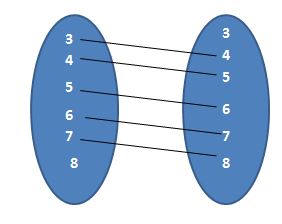
10. Let P = {3, 4, 5, 6, 7, 8}. Define a relation R from A to A by R = {(x, y) : y = x + 1}.

  • Depict this relation using an arrow diagram.
  • Write down the domain and range of R.
Solution:

Given that P = {3, 4, 5, 6, 7, 8}. Define a relation R from A to A by R = {(x, y) : y = x + 1}.
If x = 3, y = x + 1 = 3 + 1 = 4.
x = 4, y = x + 1 = 4 + 1 = 5.
x = 5, y = x + 1 = 5 + 1 = 6.
x = 6, y = x + 1 = 6 + 1 = 7.
x = 7, y = x + 1 = 7 + 1 = 8.
x = 8, y = x + 1 = 8 + 1 = 9.
R = {(3, 4); (4, 5); (5, 6); (6, 7); (7, 8)} where P = {3, 4, 5, 6, 7, 8}.
Worksheet on Math Relation
Domain = Set of all first elements in a relation = {3, 4, 5, 6, 7}
Range = Set of all second elements in a relation = {4, 5, 6, 7, 8}


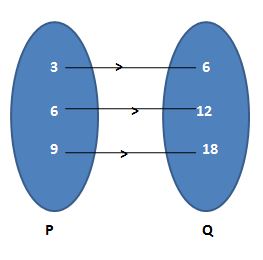
11. Adjoining figure shows a relationship between the set P and Q. Write this relation in the roster form. What are its domain and range?
Domain and Range Problems

Solution:

The relation mentioned in the figure shows, P a domain and Q as a range.
Let the relation be R.
In roster form R = {(3, 6); (6, 12); (9, 18)}
Domain = Set of all first elements in a relation = {3, 6, 9}
Range = Set of all second elements in a relation = {6, 12, 18}


12. In the given ordered pairs (2, 4); (4, 16); (5, 7); (1, 3); (6, 36); (2, 9); (1, 1), find the following relationship:
(a) Is a factor of ….
(b) Is a square root of …..
Also, find the domain and range in each case.

Solution:

Given that the ordered pairs (2, 4); (4, 16); (5, 7); (1, 3); (6, 36); (2, 9); (1, 1).
(a) Is a factor of ….
Let’s find out the factor of …. from the given order pars.
(2, 4); (4, 16); (1, 3); (6, 36); (1, 1)
Domain =  Set of all first elements in a relation = {1, 2, 4, 6}
Range = Set of all second elements in a relation = {1, 3, 4, 16, 36}
(b) Is a square root of …..
Let’s find out the square root of …. from the given order pars.
(2, 4); (4, 16); (6, 36).
Domain =  Set of all first elements in a relation = {2, 4, 6}
Range = Set of all second elements in a relation = {4, 16, 36}


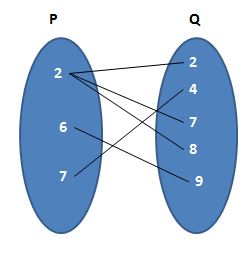
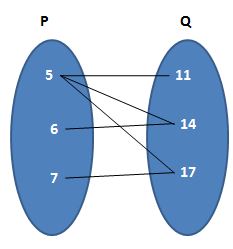
13. Draw the arrow diagrams to represent the following relations.
(a) R₁ = {(2, 2); (2, 7); (2, 8); (6, 9); (7, 4)}
(b) R₂ = {(5, 11); (5, 14); (5, 17); (6, 14); (7, 17)}
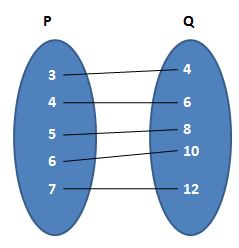
(c) R₃ = {(3, 4); (4, 6); (5, 8); (6, 10); (7, 12)}
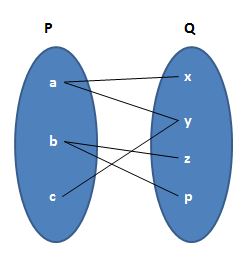
(d) R₄ = {(a, x); (a, y); (b, p); (b, z); (c, y)}

Solution:

(a) Given that R₁ = {(2, 2); (2, 7); (2, 8); (6, 9); (7, 4)}
Let the two sets are P and Q.
The required diagram is
Math Relation Worksheet
(b) Given that R₂ = {(5, 11); (5, 14); (5, 17); (6, 14); (7, 17)}
Let the two sets are P and Q.
The required diagram is
Math Relation Worksheets
(c) Given that R₃ = {(3, 4); (4, 6); (5, 8); (6, 10); (7, 12)}
Let the two sets are P and Q.
The required diagram is
Math Relation Worksheet problems
(d) Given that R₄ = {(a, x); (a, y); (b, p); (b, z); (c, y)}
Let the two sets are P and Q.
The required diagram is
Math Relation Worksheet Questions


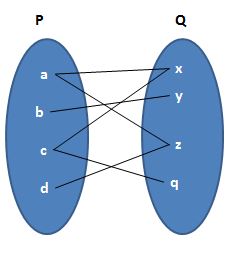
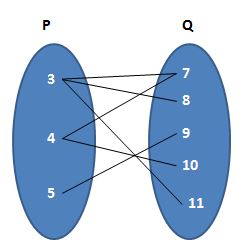
14. Represent the following relation in the roster form.
(a) Math Relation Worksheet Questions and answers
(b) Worksheet on Math Relation Problems
(c) Math Relation Worksheet Question and answers
(d) Math Relation Worksheet Solved Examples

Solution:

(a) R = {(a, x) (a, z) (b, y) (c, x) (c, q) (d, z)}
(b) R = {(3, 7) (3, 9) (4, 7) (4, 10) (5, 9) (3, 11)}
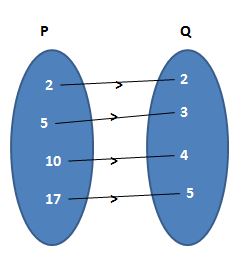
(c) R = {(2, 2) (5, 3) (10, 4) (17, 5)}
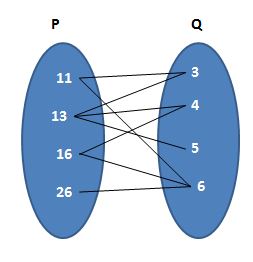
(d) R = {(11, 3) (11, 6) (13, 3) (13, 4) (13, 5) (16, 4) (16, 6) (26, 6)}


Standard Sets of Numbers | Set of Natural Numbers, Whole Numbers, Integers, Rational Numbers

Standard Sets of Numbers

Standard Sets of Numbers mean the set of common numbers. As we all know, a set is a collection of well-defined objects. Those well-defined objects can be all numbers also. Based on the elements present in the set, we will call them with some names. Let us check the following sections to know the generally used standard common number sets with examples. Students can also clear their doubts by reading the frequently asked questions section.

Standard Sets of Numbers

There are several standard sets of common numbers. We can represent those standard sets of numbers using three different forms names statement form, roster form, and set-builder form. All these sets are infinite sets, so it will extend infinitely and has no end number. We have represented all these sets in all three forms with definitions and examples.

1. Natural Numbers:

Natural Numbers are the numbers starting from 1 counting upward.

The set of natural numbers are N = {1, 2, 3, 4, 5, 6, 7, . . . }

The statement form is the set of natural numbers.

The set builder form is { x: x is a counting number starting from 1 }

2. Whole Numbers:

The whole numbers are the natural numbers including 0. It will start from 0.

The set of whole numbers are W = {0, 1, 2, 3, 4, 5, 6, . . .}

The statement form is the set of natural numbers including zero.

The set builder form is { x: x is zero and all-natural numbers }

3. Integers:

integers are the set of whole numbers along with the negative numbers means opposite to the natural numbers.

The set of integers are Z or I = { . . . -4, -3, -2, -1, 0, 1, 2, 3, 4, 5, . . . }

The statement form is the set natural numbers, zero, and negative natural numbers.

The set builder form is Z = { x: x ∈ I}

4. Real Numbers:

Real numbers are also called measuring numbers. It includes all numbers and which can be written as decimals. It can include fractions and irrational numbers in the form of decimals.

The set of real numbers are R = {0.5, 0.25, 0.6, 0.07, 0.8}

The set builder form is { x: x is a decimal}

The statement form is the set of decimals.

5. Rational Numbers:

The rational numbers are the fractional numbers. The numerator and denominator of the fractions are integers. The numerator can be zero but the denominator cannot be 0.

The set of rational numbers are R = {\(\frac { 1 }{ 2 } \), \(\frac { -4 }{ 5 } \), \(\frac { 5 }{ 8 } \)}

The statement form is the set of fractions.

The set builder form is { x: x is a fraction }

6. Even Numbers:

Even numbers are the numbers that are divisible by 2.

The statement form of even numbers is the set of numbers divisible by 2.

The roster form is E = {2, 4, 6, 8, 10, 12, 14, 16, 18, 20, . . . }

The set builder form is { x : x is a even number}

7. Odd Numbers:

Odd numbers are the numbers that are not divisible by 2.

The set builder form of odd numbers is { x: x is a number that is not divisible by 2 }

The roster form is O = {1, 3, 5, 7, 9, 11, 13, 15, . . . . }

The statement form is “the set of numbers which are not even”.

8. Prime Numbers:

Prime numbers are the positive integers that have only two factors 1 and that integer itself.

The statement form of the prime numbers is “set of numbers has two factors 1 and the same integer”

The set builder form is P = { x: x is a positive integer has only two factors }

The roster form is P = {1, 2, 3, 5, 7, 11, 13, . . . }

9. Complex Numbers:

Complex numbers are the numbers that can be expressed in the form of a + bi. Here ‘i’ is the imaginary unit.

The statement form is “set of numbers in the form of a + bi”

The roster form is C = {1 +2i, 3 + 4i, 5 + 4i, . . . }

The set builder form is C = { x : x is a number in the form of a + bi }

10. Imaginary Numbers:

The imaginary numbers are the numbers which have square root or imaginary unit.

The statement form is “the set of numbers having either square root or imaginary unit”.

The set builder form is I = {x: x is an imaginary number}

The roster form is I = {√5, 3i, √6, √8, √15, . . . }

Also, Read:

Basic Concepts of SetsSets
Elements of a SetObjects Form a Set
Proof of De Morgan’s LawSubsets
Different Notations in SetsSubsets of a Given Set
Union of SetsIntersection of Sets
Cardinal Number of a SetLaws of Algebra of Sets
Basic Properties of SetsRepresentation of a Set

FAQs on Standard Sets of Numbers

1. What are the sets of numbers?

The different sets of numbers are natural numbers, whole numbers, integers, real numbers, rational numbers, irrational numbers, even numbers, odd numbers, complex numbers, imaginary numbers, and prime numbers.

2. What are the 3 ways to describe a set?

The 3 different ways to represent a set are statement form, set builder form, and roster form. The last 2 forms use curly braces. The roster form lists all the set elements. The set builder form uses a property and statement form that describes the set verbally.

3. What are the 4 operations of sets?

The four operations of sets are union, intersection, set difference, the complement of a set, and cartesian product.

4. What are sets and their types?

Set is a collection of well-defined objects. The various types of sets are finite set, infinite set, empty set, singleton set, equal sets, equivalent sets, subset, superset, disjoint sets, proper subset, and universal set.

Types of Sets and their Symbols – Finite, Infinite, Equivalent, Power, Empty, Singleton, Equal, Subset, Disjoint Set

Types of Sets

In mathematics, a set is a collection of well-defined objects. Those objects are called members or elements of a set. The set elements are closed between the curly braces and each element is broken up by a comma. The sets are classified into various types. Interested students can go through the following sections to check useful information on set types. You can see definitions and examples for all sets.

Set Types

Based on the elements on the set, size of the set, and other factors, sets are divided into various types. They are listed here.

  • Finite Set
  • Null Set
  • Infinite set
  • Equal Sets
  • Singleton Set
  • Equivalent Sets
  • Subset
  • Proper Subset
  • Cardinal Number of a set
  • Power Set
  • Superset
  • Disjoint Sets
  • Universal Set

Types of Sets

Let us discuss the definition and examples of all types of sets in the below sections.

1. Empty Set

If a set has no elements in it, then it is called the empty set. It is also known as the null set or void set. An empty set is represented by ϕ or {}.

Examples:

A = { x : x is a whole number that is not a natural number, x ≠ 0}

Zero is the only whole number that is not a natural number. If x ≠ 0, then there is no possible value for x. So, A = ϕ.

B = { y : 1 < y < 2, y is a natural number}

We know that a natural number cannot be a decimal. So, set y is a null set.

2. Finite Set

A finite set has a definite number of elements. We can find the size of the finite set easily.

Examples:

C = { x | x is a natural number, 20 > x > 10 }

D = { t, y, p, e, s, o, f, s, e, t, s }

3. Infinite Set

A set that has an infinite number of elements in it is called the infinite set. It is not possible to find the size of an infinite set.

Examples:

E = { x : x is a whole number, x > 50 }

The set of whole numbers greater than 50 are 51, 52, 53, 54, . . . . Therefore, set E is an infinite set.

F = { x | x is an even number and x >2 }

The set of even numbers greater than 2 are 4, 6, 8, 10, 12, 14, 16, 18, 20, . . . Hence, set F is an infinite set.

4. Singleton Set

Singleton set is also known as a unit set. If a set has only one element, then it is called the singleton set. The size of a unit set is always 1.

Examples:

G = {5}

As set G has only one element it is a singleton set.

H = {x : x is whole number but not natural number }

We have only one element which is the whole number, not a natural number i.e 0. So, H is a singleton set.

5. Equal Sets

If two sets contain the same elements, then they are equal sets. There is no need to have the same order of elements in both sets.

Examples:

Let I = {4, 14, 15, 5, 6, 18} and J = {15, 5, 18, 14, 4, 6} are two sets.

Then I = J

Here, two sets have the same elements i.e 4, 5, 6, 14, 15, 18

6. Equivalent Sets

If two sets have the same number of elements, then they are called equivalent sets. Two sets order or cardinality is equal.

Examples:

Let K = {8, 17, 25, 63}, L = {56, 5, 45, 28}

The order of K = n(k) = 4

The order of L = n(L) = 4

So, L and K are equivalent sets.

Let M = {p, o, w, e, r}, N = {1, 5, 6, 8, 12}

n(M) = 5

n(N) = 5

So, M and n are equivalent sets.

7. Subset

A set A is said to be a subset of B if all the elements of A are the elements B. Subset is denoted by the symbol ⊂ and A ⊂ B.

Examples:

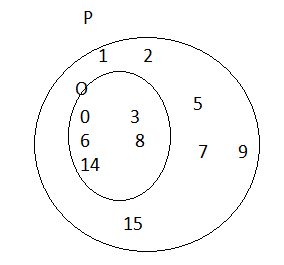
If O = {0, 3, 6, 8, 14}, P = {15, 5, 0, 1, 2, 3, 6, 14, 7, 8, 9}

The elements of P are 0, 1, 2, 3, 5, 6, 7, 8, 9, 14, and 15.

The elements of O are 0, 3, 6, 8, and 14.

All the elements of O belong to set P. So, O ⊆ P.

Types of Sets 1

8. Proper Subset

If A, B are two sets, A is called the proper subset of B if A ⊂ B but B ⊃ A i.e A ≠ B. The symbol ⊆ is used to represent the proper subset.

Examples:

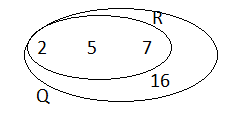
Q = {7, 5, 2, 16} and R = {2, 5, 7}

All the elements of R are in Q.

n(R) = 3, n(Q) = 4 and Q ≠ R

So, R ⊆ Q

Types of Sets 2

9. Superset

When set A is a subset of set B, then B is a superset of A and it can be represented as B ⊇ A. The symbol ⊇ means “is a superset of”.

Examples:

Let S = {p, o, w, e, r}, T = {p, o, w, e, r, f, u, l}

Here, S ⊂ T. So, T ⊇ S.

10. Universal Set

A set that has all the elements of other given sets is known as the universal set. The symbol is ∪ or ξ.

Examples:

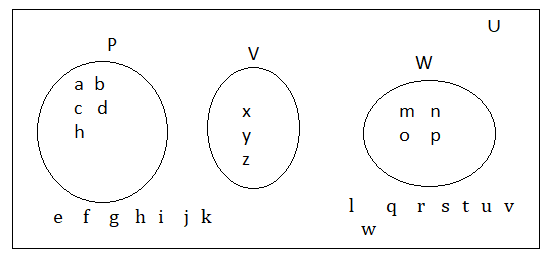
Let P = {a, b, c, d, h},  V = {x, y, z}, W = {m, n, o , p}

∪ = {a, b, c d, e, f, g h, i, j, k, l, m, n, o, p, q, r, s, t, u, v w, x, y, z}

So, ∪ is the universal set.

Types of Sets 4

11. Disjoint Sets

Two sets A and B are called disjoint sets if they do not have common elements between them. So, the properties of disjoint sets are n(A ∩ B) = { }, n(A U B) = n(A) + n(B)

Examples:

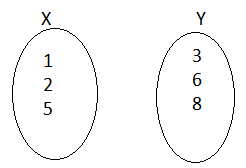
X = {1, 2, 5}, Y = {8, 6, 3}

Here, X and y sets has no common element. So X, Y are disjoint sets.

Types of Sets 3

12. Cardinal Number of a set

The number of different elements in the set is called the cardinal number of a set. It is denoted by n(A).

Examples:

Y = { x : x is a natural number, n >10}

n(Y) = 9

Z = {n, u, m, b, e, r, o, f, e, l, e, m, e, n, t, s}

n(Z) = 16

13. Power Set

The set of all subsets is called the power sets. We know that an empty set is a subset of all sets and every set is a subset of itself.

Examples:

If set A = {1, 8, 15}, then power set of A is P(A) = {ϕ, {8}, {15, 8}, {1, 8}, {1, 15}, (8, 1, 15}, {15}, {1}}

Frequently Asked Questions on Set Types

1. How do you express an empty set?

An empty set has no element. it can be represented as ϕ or { }.

2. What are the two sets that contain the same elements?

If two sets have the same elements, then they are called equal sets. The example is A = {m, a, t, h, e, m, a, t, i, c, s} and B = {a, a, m, m, t, t, h, e, s, i, c}. So, A = B.

3. What is a Subset?

If A and B are two sets, and every element of set A is also an element of set B, then A is called a subset of B and expressed as A ⊂ B. B ⊇ A means B is a superset of A. A ⊆ B means A is a proper subset of B.

Read Similar Articles on Sets

Basic Concepts of SetsRepresentation of a SetSubset
SetsElements of a SetBasic Properties of Sets
Objects Form a SetIntersection of SetsProof of De Morgan’s Law
Subsets of a Given SetDifferent Notations in SetsUnion of Sets
Laws of Algebra of SetsCardinal Number of a Set

Pairs of Sets – Equal Sets, Equivalent Sets, Overlapping Sets, Disjoint Sets

Pairs of Sets

In general, a set is a collection of well-defined objects. A set must have the same type of objects. The objects are also called the members or elements of the set. The number of the element present in a set is called the order of the set. The pairs of sets mean there is a relationship between two sets. Get the examples and various pairs of sets in the below sections of this article.

What are Pairs of Sets?

If there is some relationship between two sets then such sets are called pairs of sets. Various pairs of sets are mentioned below.

  • Equal Sets
  • Equivalent Sets
  • Disjoint Sets
  • Overlapping Sets

Pairs of Sets Examples

The relation between two sets is called pairs of sets. Let us know about each of the set pairs with the examples on the following modules.

1. Equal Sets:

Two sets P and Q are said to be equal sets if all the elements of the first set are in the second set irrespective of the position of the elements. The symbol to denote the equal sets is “=”.

Here P = Q means P is equal to Q and Q is equal to P.

Examples:

P = {12, 13, 14, 15, 16}

Q = {15, 12, 14, 13, 16}

The elements of P and Q are same. So, P = Q.

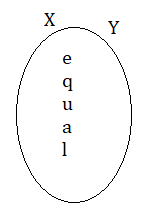
X = {a, e, l, , u}, Y = {e, q, u, a, l}

The elements of sets X and Y are the same. So, X = Y and Y = X.

Pairs of Sets 1

2. Equivalent Sets:

Two sets P and Q are said to be equivalent if both sets have the same number of elements or same order or same cardinality. The symbol to denote equivalent sets is ↔. Equal sets are always equivalent. But equivalent sets may or may not be equal.

P ↔ Q means set P and Q have the same order.

Examples:

P = {10, 20, 30, 40, 50, 60, 70, 80, 90, 100}

Q = {11, 22, 33, 44, 55, 66, 77, 88, 99, 111}

The order of P = n(P) = 10

The order of Q = n(Q) = 10

n(P) = n(Q). So, P ↔ Q.

A = {a, p, p, l, e}, B = {p, o, w, e, r}

The number of elements of A = n(A) = 5

The number of elements of B = n(B) = 5

n(A) = n(B). So, A ↔ B i.e A is equivalent to B.

3. Disjoint Sets:

Two sets P and Q are said to be disjoint sets if they do not contain only one element in common.

Examples:

P = {x | x is an even number}

Q = {x : x is an odd number}

The set of even numbers are {2, 4, 6, 8, 10, 12, 14, . . . }

The set of odd numbers are {1, 3, 5, 7, 9, 11, 13, . . }

So, there is no common element in between P and Q. Therefore, P and Q are disjoint sets.

A = {5, 10, 15, 20, 25, 30, 35, 40}, B = {3, 6, 9, 18, 21, 24, 27}

Here, A and B has no common element. So, A and B are disjoint sets.

4. Overlapping Sets:

Two sets P and Q are said to be overlapping sets if they have at least one element in common.

Examples:

P = {x : x is a whole number}

Q = {x : x is a natural number}

The set of whole numbers are {0, 1, 2, 3, 4, 5, 6, 7, 8, . . . }

The set of natural numbers are {1, 2, 3, 4, 5, 6, . . . }

The common elements in both sets are {1, 2, 3, 4, 5, 6, 7, . . . }

So, P and Q are overlapping sets.

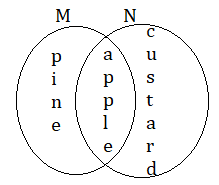
M = {p, i, n, e, a, p, p, l, e}

N = {c, u, s, t, a, r, d, a, p, p, l, e}

The common elements in both sets are {a, p, p, l, e}

Pairs of Sets 2

Also, Read

Union of SetsRepresentation of a SetLaws of Algebra of Sets
Subsets of a Given SetCardinal Number of a SetBasic Properties of Sets
Proof of De Morgan’s LawElements of a SetObjects Form a Set
SetsIntersection of SetsBasic Concepts of Sets
SubsetDifferent Notations in Sets

Solved Example Questions on Pairs of Sets

Example 1:

State whether the sets A and B are equal sets or not?

A = {s, t, a, t, e s}

B = {a, e, s, s, t, t}

Solution:

Given two sets are

A = {s, t, a, t, e s}, B = {a, e, s, s, t, t}

The elements of both sets are the same. So, A and B are equal sets.

Therefore, A = B.

Example 2:

State whether the sets C and D are equivalent or not?

C = {5, 9, 10, 12, 16, 78}

D = {a, b, c, d, e, g}

Solution:

Given two sets are

C = {5, 9, 10, 12, 16, 78} and D = {a, b, c, d, e, g}

The number of elements of C = n(C) = 6

The order of D = n(D) = 6

n(C) = n(D)

So, C and D are equivalent sets i.e C ↔ D.

Example 3:

Find whether the following sets are disjoint sets or overlapping sets.

(i) X = {x : x is a multiple of 7 between 1 and 50}

Y = {x | x is a multiple of 11 between 1 and 50}

(ii) P = {x : x is a letter in ‘FLOOR’}

Q = {x | x is a letter in ‘FLOWER’}

Solution:

(i) Given two sets are X = {x : x is a multiple of 7 between 1 and 50} and Y = {x | x is a multiple of 11 between 1 and 50}

The roster form is X = {7, 14, 21, 28, 35, 42, 49}, Y = {11, 22, 33, 44}

Two sets X and Y have no common element.

So, X and Y are disjoint sets

(ii) Given two sets are P = {x : x is a letter in ‘FLOOR’} and Q = {x | x is a letter in ‘FLOWER’}

The roster form of P = {F, L, O, O, R}, Q = {F, L, O, W, E, R}

The common elements are F, L, O, R

So, P and Q are overlapping sets.

Conversion of Numbers to Roman Numerals – Rules, Chart, Examples | How to Convert Numbers to Roman Numerals?

Conversion of Numbers to Roman Numerals

Looking for ways on how to convert from Numbers to Roman Numerals? If so, look no further as this web page gives you entire information regarding the basics like Roman Numerals Definition, Frequently Used Roman Numerals. Furthermore, you will get acquainted with the details like Procedure on How to Convert Numbers to Roman Numerals, Rules involving the Roman Numerals Conversion, their Applications in day to day lives, etc. Also, check out the Solved Examples on Changing between Numbers to Roman Numerals for a better understanding of the concept.

Also, Read:

Roman Numerals – Definition

Romans used a special kind of numerical notations that contains Latin alphabets which signifies values. Roman alphabets are English alphabets except for J, U, and w. These are used to represent roman numbers.
For Example:
1 is written as I
2 is written as II
3 is written as III
The other letters V, X, I, C, M are easy to understand.

Commonly used Roman Numerals are listed below.

NumberRoman Numeral
5V
10X
50L
100C
500D
1000M

How to Convert Numbers into Roman Numerals?

Follow the below-listed step-by-step process to change between Numbers to Roman Numerals easily. You can get the results easily by following the Numbers to Roman Numerals Conversion procedure. They are as follows

  • Break the number into thousands, hundreds, tens, and ones and write down each conversion.
  • Remember a Letter can only be repeated three times.

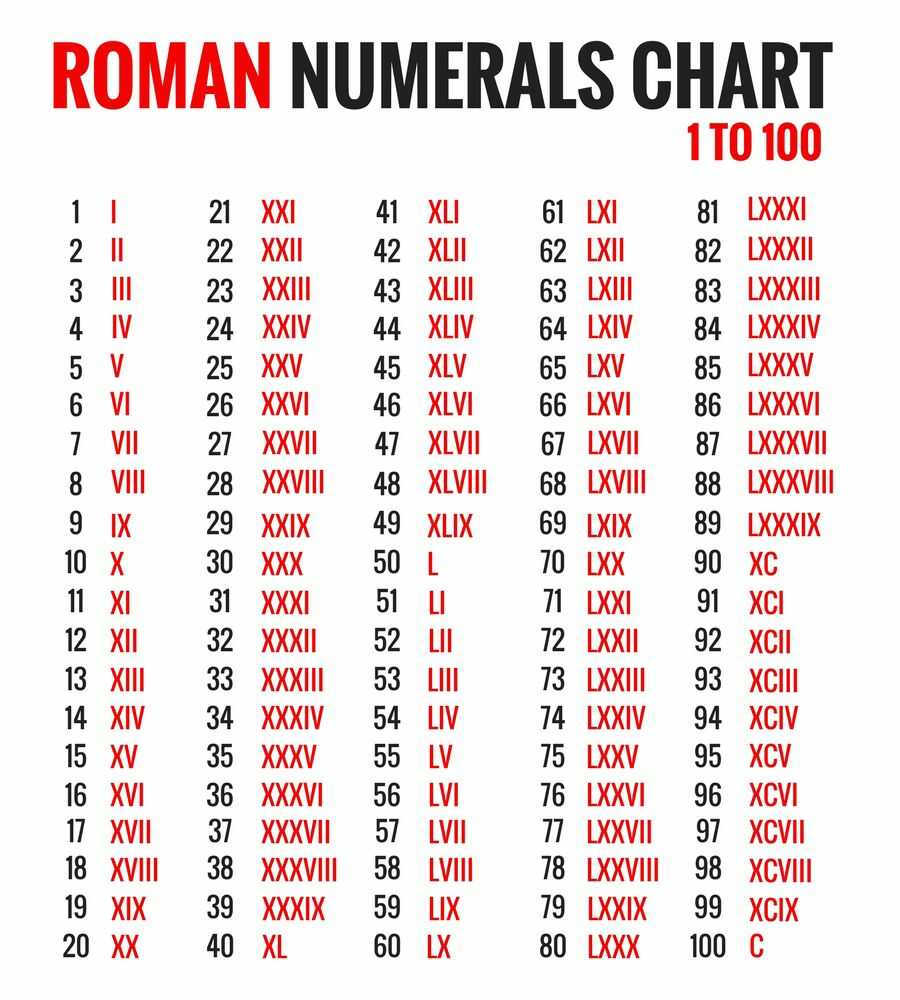
Roman Numerals Chart for 1-100 Numbers

Roman Numerals Chart for 1-100 Numbers

Rules for Converting Numbers to Roman Numerals

We can convert any number to a Roman numeral and vice versa. However, to do so we have to follow certain rules and they are explained in detail below by considering a few examples. Primary Rules for Reading and Writing the Roman Numerals are given here. They are as follows

  • A Letter can be repeated only thrice and not more than that. For instance XXX = 30, etc.
  • When a smaller numeral is placed after a larger or (equal) one it has the effect of addition. i.e., a smaller number is added to the larger number.
    For Example: VIII=V+I+I+I=5+1+1+1=8
    CXX=C=+X+X=100+10+10=120
  • When a smaller numeral is placed before a larger one it has the effect of subtraction. i.e., the smaller number is subtracted from the larger number.
    For Example: IX=X-I=10-1=9
    LIX=50-1+10=59
  • A bar placed on top of a letter or string of letters increases the numeral’s value by 1,000 times.

Solved Examples on Conversion of Numbers to Roman Numerals

1. Convert 1789 to Roman Numerals?

Solution:

Break the number into thousands, hundreds, tens, and ones and perform the individual conversion.

Given Number 1789 broken down into place values are as follows

1000=M
700=DCC
80=LXXX
9=IX
Therefore, 1789 converted MDCCLXXXIX

2. Convert 1674 to Roman Numerals?

Solution:

Break down the number into thousands, hundreds, tens, and ones and perform conversion each.

Given Number 1674 broken down into place values are as follows

1000 = M
600 = DC
70 = LXX
4 = IV

Therefore, 1674 converted to Roman Numerals is MDCLXXIV

Uses of Roman Numerals

Roman Numerals have various applications and are used in plenty of scenarios that we come across in our day-to-day lives. They are in the following fashion

  • They are used in chapters of the book, movie titles, television programs, and videos.
  • Roman Numbers used for the names of pope ships.
  • They are also used for displaying hours on analog clocks and watches.

FAQ’S on Conversion of Numbers to Roman Numerals

1. How do we write 1000 in Roman Numbers?

1000 Written in Roman Numerals is represented by the Letter ‘M’.

2. How to Convert Numbers to Roman Numbers?

You can convert numbers to Roman Numerals by simply breaking down the Thousands, Hundreds, Tens, Ones and perform each conversion adhering to the roman numeral conversion rules.

3. What does the Roman Number XV equal to?

Roman Numeral XV is expressed in numbers as 95.

Simplification of a Decimal using Identities | Simplifying Expressions with Decimals Questions and Answers

Simplification of Decimal

Learn the Identities for Solving Problems related to Simplification of a Decimals. Check out the Solved Examples on simplifying Expressions with Decimals and get to know the concept better. You can apply these Identities and simplify the expressions involving decimals. Refer to the step-by-step explanation provided below for solving or simplifying expressions involving decimals.

Identities used in the Simplifying Expressions with Decimals are provided as such

(a) (a + b)2 = a2 + b2 + 2ab

(b) (a – b)2 = a2 + b2 – 2ab

(c) a2 – b2 = (a + b) (a – b)

(d) a3 + b3 = (a + b) (a2 – ab + b2)

(e) a3 – b3 = (a – b) (a2 + ab + b2)

How to Simplify Decimal Expressions?

Follow the simple and easy process listed below to simplify the decimal expressions. They are in the below fashion

  • Check the given expression and observe which identity is close to it.
  • Simplify the expressions to the possible extent.
  • Later substitute the given values accordingly and then simplify according to the order of operations to obtain the result.

Also, Read:

Worked Out Examples on Simplifying Expressions Involving Decimals

1. Simplify the Expression {(0.8 – 0.52}/{(0.8)2 – 2(0.8)(0.5) + (0.5)2}?

Solution:

Given Expression is {(0.8 – 0.5)3}/{(0.8)2 – 2(0.8)(0.5) + (0.5)2}

Let us consider a = 0.8, b = 0.5

Thus, it becomes {(a-b)3}/{(a2 -2ab+b2)}

= {(a-b)3}/{(a-b)2}

= a-b

Now, substitute the values of a, b in the simplified expression

= 0.8-0.5

= 0.3

Thus, {(0.8 – 0.52}/{(0.8)2 – 2(0.8)(0.5) + (0.5)2} simplified results in the value 0.3

2. Simplify the expression [(4.8)3 – (2.4)3]/[(4.8)2 + (2.4)2 – 2(4.8)(2.4)]?

Solution:

Given Expression is [(4.8)3 – (2.4)3]/[(4.8)2 + (2.4)2 – 2(4.8)(2.4)]

Let us consider a = 4.8, b = 2.4

Now, rearranging the expression using the Identities we know we get

= [a3 – b3]/[a2 – 2ab + b2]

=  [(a – b) (a2 + ab + b2)]/[(a – b)2]

= (a2 + ab + b2)/(a-b)

Placing the value of a, b we have the equation as follows

= (4.8)2+(4.8)(2.4)+(2.4)2}/(4.8-2.4)

= (23.04+11.52+5.76)/2.4

= 40.32/2.4

= 16.8

Therefore, [(4.8)3 – (2.4)3]/[(4.8)2 + (2.4)2 – 2(4.8)(2.4)] results the value 16.8

3. Simplify the Expression [(7.65)2 – (3.35)2]/(7.65 + 3.35)

Solution:

Given Expression is [(7.65)2 – (3.35)2]/(7.65 + 3.35)

Let us consider a = 7.65, b = 3.35

Now, rearranging the expression using the Identities we know we get

= [a2 -b2]/(a+b)

= [(a-b)(a+b)]/(a+b)

= a-b

Placing the value of a, b we have the equation as follows

= 7.65-3.35

= 4.3

Therefore, on simplifying [(7.65)2 – (3.35)2]/(7.65 + 3.35) we get 4.3

4. Simplify [(7.8)3 + (2.2)3]/[(7.8)2 + (2.2)2-(7.8)(2.2)]?

Solution:

Given Expression is [(7.8)3 + (2.2)3]/[(7.8)2 + (2.2)2-(7.8)(2.2)]

Let us consider a = 7.8, b = 2.2

Now, rearranging the expression using the Identities we know we get

= [a3+b3]/[a2-ab+b2]

= [(a+b)(a2-ab+b2)]/a2-ab+b2)

= a+b

Placing the value of a, b we have the equation as follows

= 7.8+2.2

= 10

Therefore, [(7.8)3 + (2.2)3]/[(7.8)2 + (2.2)2-(7.8)(2.2)] on simplification results in the value 10.

8th Grade Math Practice, Topics, Test, Problems, and Worksheets

8th Grade Math

Do you have a test coming up and scared about what to prepare for in 8th Grade Math? Don’t Fret as we have included the bunch of topics that you might come across in Grade 8 Maths all in one place. We know the Concepts learned in Grade 8 go a long way in higher grades concepts. Grade 8 Children are advised to practice these concepts regularly and get a good hold of them. Higher-Order Concepts such as Rational Numbers, Irrational Numbers, Exponents, etc. are all introduced in the 8th Standard.

8th Grade Math Topics covered here help you to tackle any kind of Math Problem easily. Grasp the Formulas and Techniques needed for learning 8th Standard Math Concepts in no time. Improve your mathematical abilities by practicing from our 8th Grade Math Problems provided.

Go Math Grade 8 Answer Key

Check out Chapterwise Go Math 8th Grade Answer Key available here during your practice sessions. Make the most out of them and score better grades in your exams. You can access whichever chapter you feel like preparing by tapping on the quick links listed below. Once you click on them you will be redirected to the concerned chapter in no time.

Grade 8 HMH Go Math – Answer Keys

Big Ideas Math Answers Grade 8

Access our Big Ideas Math 8th Grade Answers listed below to resolve all your queries on the Chapters involved. Don’t worry about the accuracy of the Big Ideas Math Grade 8 Solutions as they are given after extensive research. Start Practicing the Chapterwise BIM 8th Grade Answers and no longer feel the concepts of Big Ideas Math Grade 8th difficult.

8th Grade Math Topics

Teaching Grade 8 Math Topics effectively will help your kids to advance their math reasoning and logical ability. Confidence and ability to learn will be improved by referring to the 8th Standard Math Topics available. Thus, they will be prepared for high school studies. If you want to learn more about the 8th Grade Math Concepts have an insight into the below topics and get an idea of what is included in the 8th Grade Curriculum.

All you have to do is simply tap on the quick links available to avail the respective topics and get a grip on them. We included both the theoretical part as well as worksheets for your practice. Our 8th Grade Math Worksheets make it easy for you to test your preparation standard on the corresponding topics. Identify the knowledge gap and improvise on the topics you are facing difficulty with.

Ratio and Proportion

Ratio and Proportion – Worksheets

  • Worksheet on Ratio and Proportion

Significant Figures

Significant Figures – Worksheets

  • Worksheet on Significant Figures

Square

Square – Worksheets

  • Worksheet on Squares

Square Root

Square Root- Worksheets

  • Worksheet on Square Root using Prime Factorization Method
  • Worksheet on Square Root using Long Division Method
  • Worksheet on Square Root of Numbers in Decimal and Fraction Form

Algebraic Expression

  • Algebraic Expression
  • Addition of Algebraic Expressions
  • Subtraction of Algebraic Expressions
  • Multiplication of Algebraic Expression
  • Division of Algebraic Expressions

Formula

Formula – Worksheets

  • Worksheet on Framing the Formula
  • Worksheet on Changing the Subject of a Formula
  • Worksheet on Changing the Subject in an Equation or Formula

Factorization

Factorization – Worksheet

  • Worksheet on Factoring Algebraic Expression
  • Worksheet on Factoring Binomials
  • Worksheet on Factoring by Grouping
  • Worksheet on Factorization by Regrouping
  • Worksheet on Factoring out a Common Binomial Factor
  • Worksheet on Factoring Identities
  • Worksheet on Factoring the Differences of Two Squares
  • Worksheet on Factorization using Formula
  • Worksheet on Factoring Trinomials
  • Worksheet on Factoring Simple Quadratics
  • Worksheet on Factoring Quadratic Trinomials
  • Worksheet on Factoring Trinomials by Substitution
  • Worksheet on Factorization

Equations

Equations – Worksheets

  • Worksheet on Linear Equations
  • Worksheet on Word Problems on Linear Equation

Simultaneous Linear Equations

Simultaneous Linear Equations – Worksheets

  • Worksheet on Simultaneous Linear Equations
  • Worksheet on Problems on Simultaneous Linear Equations

Linear Inequations

Linear Inequations – Worksheets

  • Worksheet on Linear Inequations

Quadratic Equations

Quadratic Equations – Worksheets

  • Worksheet on Quadratic Equations

Percentage

  • Fraction into Percentage
  • Percentage into Fraction
  • Percentage into Ratio
  • Ratio into Percentage
  • Percentage into Decimal
  • Decimal into Percentage
  • Percentage of the given Quantity
  • How much Percentage One Quantity is of Another?
  • Percentage of a Number
  • Increase Percentage
  • Decrease Percentage
  • Basic Problems on Percentage
  • Solved Examples on Percentage
  • Problems on Percentage
  • Real-Life Problems on Percentage
  • Word Problems on Percentage
  • Application of Percentage

Percentage – Worksheets

  • Worksheet on Fraction into Percentage
  • Worksheet on Percentage into Fraction
  • Worksheet on Percentage into Ratio
  • Worksheet on Ratio into Percentage
  • Worksheet on Percentage into Decimal
  • Worksheet on Percentage of a Number
  • Worksheet on Finding Percent
  • Worksheet on Finding Value of a Percentage
  • Worksheet on Percentage of a Given Quantity
  • Worksheet on Word Problems on Percentage
  • Worksheet on Increase Percentage
  • Worksheet on Decrease Percentage
  • Worksheet on increase and Decrease Percentage
  • Worksheet on Expressing Percent
  • Worksheet on Percent Problems
  • Worksheet on Finding Percentage

Profit, Loss, and Discount

Profit, Loss, and Discount – Worksheets

  • Worksheet to Find Profit and Loss
  • Worksheets on Profit and Loss Percentage
  • Worksheet on Gain and Loss Percentage
  • Worksheet on Discounts

Time and Work

  • Time and Work
  • Pipes and Cistern
  • Practice Test on Time and Work

Time and Work – Worksheets

  • Worksheet on Time and Work

Time and Distance

Time and Distance – Worksheets

  • Worksheet on Conversion of Units of Speed
  • Worksheet on Calculating Time
  • Worksheet on Calculating Speed
  • Worksheet on Calculating Distance
  • Worksheet on Train Passes through a Pole
  • Worksheet on Train Passes through a Bridge
  • Worksheet on Relative Speed
  • Worksheet on Decimal into Percentage

Simple Interest

  • What is Simple Interest?
  • Calculate Simple Interest
  • Practice Test on Simple Interest

Simple Interest – Worksheets

  • Simple Interest Worksheet

Compound Interest

  • Compound Interest
  • Compound Interest with Growing Principal
  • Compound Interest with Periodic Deductions
  • Compound Interest by Using Formula
  • Compound Interest when Interest is Compounded Yearly
  • Compound Interest when Interest is Compounded Half-Yearly
  • Compound Interest when Interest is Compounded Quarterly
  • Problems on Compound Interest
  • Variable Rate of Compound Interest
  • Difference of Compound Interest and Simple Interest
  • Practice Test on Compound Interest
  • Uniform Rate of Growth
  • Uniform Rate of Depreciation
  • Uniform Rate of Growth and Depreciation

Compound Interest – Worksheet

  • Worksheet on Compound Interest
  • Worksheet on Compound Interest when Interest is Compounded Half-Yearly
  • Worksheet on Compound Interest with Growing Principal
  • Worksheet on Compound Interest with Periodic Deductions
  • Worksheet on Variable Rate of Compound Interest
  • Worksheet on Difference of Compound Interest and Simple Interest
  • Worksheet on Uniform Rate of Growth
  • Worksheet on Uniform Rate of Depreciation
  • Worksheet on Uniform Rate of Growth and Depreciation

Ratio and Proportion (Direct & Inverse Variation)

  • Direct Variation
  • Inverse Variation
  • Practice Test on Direct Variation and Inverse Variation

Ratio and Proportion – Worksheets

  • Worksheet on Direct Variation
  • Worksheet on Inverse Variation

Probability

  • Probability

Probability – Worksheets

  • Worksheet on Probability

Geometry

Lines and Angles

Parallelogram

Parallelogram – Worksheet

  • Worksheet on Parallelogram

Quadrilateral

Quadrilateral – Worksheets

  • Quadrilateral Worksheet
  • Worksheet on Construction on Quadrilateral
  • Worksheet on Different Types of Quadrilaterals

Three-Dimensional Figures

Three-Dimensional Figures – Worksheets

  • Worksheet on Three Dimensional Figures

Mensuration

Mensuration – Worksheets

  • Worksheet on Area and Perimeter of Rectangles
  • Worksheet on Area and Perimeter of Squares
  • Worksheet on Area of the Path
  • Worksheet on Circumference and Area of Circle
  • Worksheet on Area and Perimeter of Triangle

Volume and Surface Area of Solids

Area of a Trapezium

Area of a Trapezium – Worksheet

  • Worksheet on Trapezium
  • Worksheet on Area of a Polygon

Area Proposition

Area Proposition – Worksheets

  • Worksheet on Same Base and Same Parallels

Data Handling

  • Data Handling
  • Frequency Distribution
  • Grouping of Data

Data Handling – Worksheet

  • Worksheet on Data Handling

Constructing and Interpreting Bar Graphs or Column Graphs

  • Bar Graph or Column Graph

Bar Graphs or Column Graphs – Worksheets

  • Worksheet on Bar Graphs or Column Graphs

Pie Charts or Pie Graphs

  • Pie Chart

Pie Charts or Pie Graphs – Worksheets

  • Worksheet on Pie Chart

Coordinate Geometry

  • Coordinate Graph
  • Ordered pair of a Coordinate System
  • Plot Ordered Pairs
  • Coordinates of a Point
  • All Four Quadrants
  • Signs of Coordinates
  • Find the Coordinates of a Point
  • Coordinates of a Point in a Plane
  • Plot Points on Co-ordinate Graph
  • Graph of Linear Equation
  • Simultaneous Equations Graphically
  • Graphs of Simple Function
  • Graph of Perimeter vs. Length of the Side of a Square
  • Graph of Area vs. Side of a Square
  • Graph of Simple Interest vs. Number of Years
  • Graph of Distance vs. Time

Coordinate Geometry – Worksheet

  • Worksheet on Coordinate Graph

Set Theory

  • Sets Theory
  • Representation of a Set
  • Types of Sets
  • Finite Sets and Infinite Sets
  • Power Set
  • Problems on Union of Sets
  • Problems on Intersection of Sets
  • Difference of two Sets
  • Complement of a Set
  • Problems on Complement of a Set
  • Problems on Operation on Sets
  • Word Problems on Sets
  • Venn Diagrams in Different Situations
  • Relationship in Sets using Venn Diagram
  • Union of Sets using Venn Diagram
  • Intersection of Sets using Venn Diagram
  • Disjoint of Sets using Venn Diagram
  • Difference of Sets using Venn Diagram
  • Examples on Venn Diagram

Relations and Mapping

  • Ordered Pair
  • Cartesian Product of Two Sets
  • Relation
  • Domain and Range of a Relation
  • Practice Test on Math Relation
  • Functions or Mapping
  • Domain Co-domain and Range of Function
  • Math Practice Test on Function

Relations and Mapping – Worksheets

Cube and Cube Roots

  • Cube
  • To Find if the Given Number is a Perfect Cube
  • Cube Root
  • Method for Finding the Cube of a Two-Digit Number
  • Table of Cube Roots

Cube and Cube Roots – Worksheets

  • Worksheet on Cube
  • Worksheet on Cube and Cube Root
  • Worksheet on Cube Root

Rational Numbers

  • Introduction of Rational Numbers
  • What are Rational Numbers?
  • Is Every Rational Number a Natural Number?
  • Is Zero a Rational Number?
  • Is Every Rational Number an Integer?
  • Is Every Rational Number a Fraction?
  • Positive Rational Number
  • Negative Rational Number
  • Equivalent Rational Numbers
  • Equivalent form of Rational Numbers
  • Rational Number in Different Forms
  • Properties of Rational Numbers
  • Lowest form of a Rational Number
  • Standard form of a Rational Number
  • Equality of Rational Numbers using Standard Form
  • Equality of Rational Numbers with Common Denominator
  • Equality of Rational Numbers using Cross Multiplication
  • Comparison of Rational Numbers
  • Rational Numbers in Ascending Order
  • Rational Numbers in Descending Order
  • Representation of Rational Numbers on the Number Line
  • Rational Numbers on the Number Line
  • Addition of Rational Number with Same Denominator
  • Addition of Rational Number with Different Denominator
  • Addition of Rational Numbers
  • Properties of Addition of Rational Numbers
  • Subtraction of Rational Number with Same Denominator
  • Subtraction of Rational Number with Different Denominator
  • Subtraction of Rational Numbers
  • Properties of Subtraction of Rational Numbers
  • Rational Expressions Involving Addition and Subtraction
  • Simplify Rational Expressions Involving the Sum or Difference
  • Multiplication of Rational Numbers
  • Product of Rational Numbers
  • Properties of Multiplication of Rational Numbers
  • Rational Expressions Involving Addition, Subtraction, and Multiplication
  • Reciprocal of a Rational  Number
  • Division of Rational Numbers
  • Rational Expressions Involving Division
  • Properties of Division of Rational Numbers
  • Rational Numbers between Two Rational Numbers
  • To Find Rational Numbers

Rational Numbers – Worksheets

  • Worksheet on Rational Numbers
  • Worksheet on Equivalent Rational Numbers
  • Worksheet on Lowest form of a Rational Number
  • Worksheet on Standard form of a Rational Number
  • Worksheet on Equality of Rational Numbers
  • Worksheet on Comparison of Rational Numbers
  • Worksheet on Representation of Rational Number on a Number Line
  • Worksheet on Adding Rational Numbers
  • Worksheet on Properties of Addition of Rational Numbers
  • Worksheet on Subtracting Rational Numbers
  • Worksheet on Addition and Subtraction of Rational Number
  • Worksheet on Rational Expressions Involving Sum and Difference
  • Worksheet on Multiplication of Rational Number
  • Worksheet on Properties of Multiplication of Rational Numbers
  • Worksheet on Division of Rational Numbers
  • Worksheet on Properties of Division of Rational Numbers
  • Worksheet on Finding Rational Numbers between Two Rational Numbers
  • Worksheet on Word Problems on Rational Numbers
  • Worksheet on Operations on Rational Expressions
  • Objective Questions on Rational Numbers

Fun with Numbers

  • Playing with Numbers
  • Test of Divisibility
  • Number Puzzles and Games

Fun with Numbers – Worksheets

  • Worksheet on Number Puzzles and Games

Exponents

  • Exponents
  • Laws of Exponents
  • Rational Exponent
  • Integral Exponents of a Rational Numbers
  • Solved Examples on Exponents
  • Practice Test on Exponents

Exponents – Worksheets

  • Worksheet on Exponents

Simplification  of Algebraic Fractions

  • Algebraic Fractions
  • Arithmetic Fraction and Algebraic Fraction
  • Highest Common Factor of Monomials
  • Highest Common Factor of Monomials by Factorization
  • Lowest Common Multiple of Monomials
  • Lowest Common Multiple of Monomials by Factorization
  • Highest Common Factor of Polynomials
  • Lowest Common Multiple of Polynomials
  • H.C.F. of Polynomials by Factorization
  • Highest Common Factor of Polynomials by Factorization
  • L.C.M. of Polynomials by Factorization
  • Lowest common multiple of Polynomials by Factorization
  • H.C.F. of Polynomials by Division Method
  • H.C.F. of Polynomials by Long Division Method
  • Relation Between H.C.F. and L.C.M. of Two Polynomials
  • Reduce Algebraic Fractions to its Lowest Term
  • Simplification of Algebraic Fractions
  • Rule of Separation of Division
  • Sum and Difference of Algebraic Fractions
  • Problems on Algebraic Fractions
  • Solving Algebraic Fractions
  • Multiplication of Algebraic Fractions
  • Division of Algebraic Fractions

Simplification  of Algebraic Fractions – Worksheets

  • Worksheet on H.C.F. of Monomials
  • Worksheet on L.C.M. of Monomials
  • Worksheet on H.C.F. and L.C.M. of Monomials
  • Worksheet on H.C.F. of Polynomials
  • Worksheet on L.C.M. of Polynomials
  • Worksheet on H.C.F. and L.C.M. of Polynomials
  • Worksheet on Reducing Algebraic Fractions
  • Worksheet on Algebraic Expressions to the Lowest Terms
  • Worksheet on Algebraic Fractions
  • Worksheet on Simplifying Algebraic Fractions

Objectives of 8th Grade Math

Below is the general list of math objectives that 8th Grade Students should attain

  • Identify Rational and Irrational Numbers
  • Calculate and Approximate Principal Square Roots
  • Solve Linear Inequalities in Two Variables.
  • Differentiate between Types of Sampling Techniques.
  • Determine Mean, Median, Mode, and Range of a Set of Real World Data.

Why Choose our 8th Grade Math Curriculum?

Choose the interactive program and help your child master the concepts of Grade 8 Math.

  • Activities aimed helps students to meet their math objectives easily and make the entire learning process stressful.
  • You can access the lessons 24/7 so that you can prepare during your peak learning time be it day or night.
  • Aside from the interactive lessons, we have included printable worksheets to provide you with tons of extra practice.
  • Build additional math skills and achieve your math learning targets without struggling.
  • Student paced learning encourages and keeps you be focused and motivated.
  • Free Online Learning Environment deepens your conceptual knowledge.

Hope the information shared regarding the 8th Grade Math has helped you a lot. If you have any suggestions on concepts to be added to the list feel free to reach us and we will get back to you at the earliest. Bookmark our site to avail Gradewise Math Topics to cater to your math learning needs.

Basic Properties of Sets with Examples – Commutative, Associative, Distributive, Identity, Complement, Idempotent

Properties of Sets

A set is a collection of well-defined objects. The best examples are set of even numbers between 2 and 20, set of whole numbers. The change in writing the order of elements in a set does not make any change. And if anyone or more elements of a set are repeated, then also the set remains the same. Check out the detailed information on the properties of set operations in the following sections along with the formulas.

Properties of Sets

If two or more sets are combined together to form another set under the provided constraints, then operations on the sets are carried out. the six important properties of set operations are along the lines.

1. Commutative Property

2. Associative Property

3. Distributive Property

4. Identity Property

5. Complement Property

6. Idempotent Property

What are the Basic Properties of Set Operations?

Here, we will discuss the six important set operations using the Venn diagrams.

To understand the following properties, let us take A, B, and C are three sets and U be the universal set.

Property 1: Commutative Property

Intersection and union of sets satisfy the commutative property.

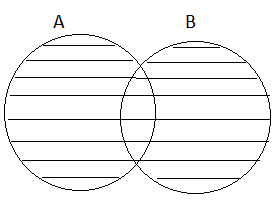
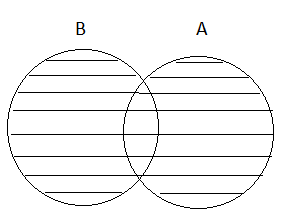
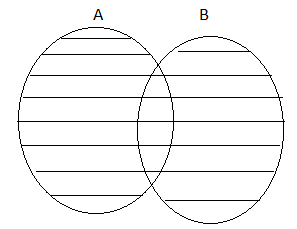
(i) A U B = B U A

Properties of Sets 1     =  Properties of Sets 2

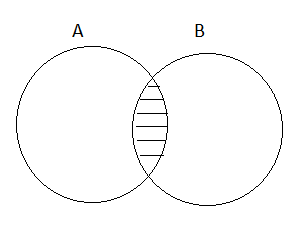
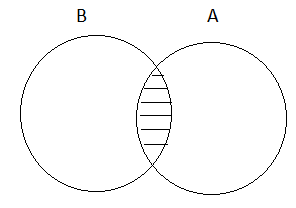
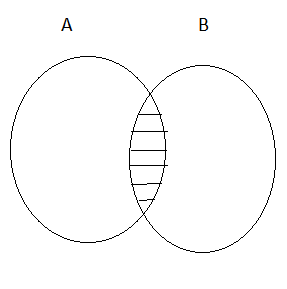
(ii) A ∩ B = B ∩ A

 Properties of Sets 3 Properties of Sets 4

Property 2: Associative Property

Intersection and union of sets satisfy the associative property.

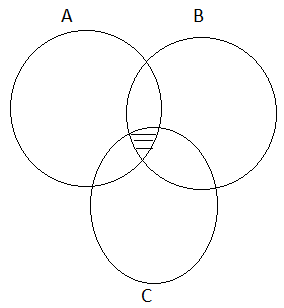
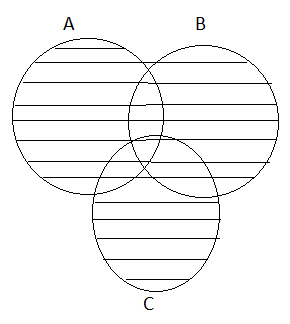
(i) (A⋂B)⋂C = A⋂(B⋂C)

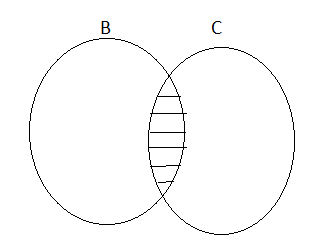
Properties of Sets 8 Properties of Sets 5

Properties of Sets 9 Properties of Sets 5

(ii) (A⋃B)⋃C = A⋃(B⋃C)

Properties of Sets 10   Properties of Sets 6

Properties of Sets 11  Properties of Sets 6

Property 3: Distributive Property

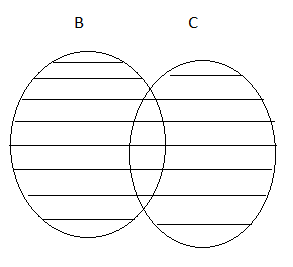
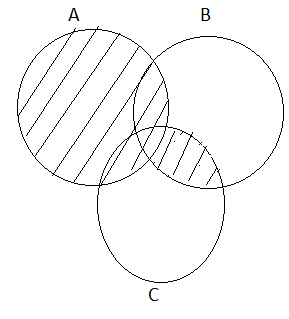
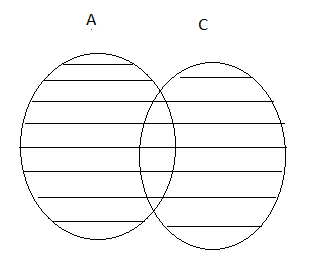
(i) A⋃(B⋂C) = (A⋃B)⋂(A⋃C)

Properties of Sets 9    Properties of Sets 7

Properties of Sets 10 Properties of Sets 12 Properties of Sets 7

(ii) A⋂(B⋃C) = (A⋂B)⋃(A⋂C)

Properties of Sets 11 Properties of Sets 13

Properties of Sets 8 Properties of Sets 14 Properties of Sets 13

Property 4: Identity Property

(i) A⋃∅ = A

(ii) A⋂U = A

Property 5: Complement Property

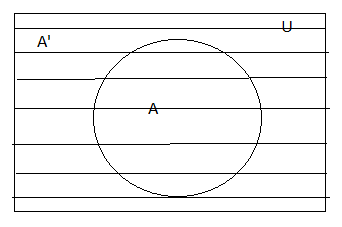
(i) A⋃Ac = U

Properties of Sets 15

(ii) A⋂Ac = ∅

Properties of Sets 16

Property 6: Idempotent Property

(i) A⋂A = A

(ii) A⋃A = A

Solved Examples on Properties of Sets

Example 1:

If A = {1, 4, 6}, U = {1, 2, 3, 4, 5, 6} prove the complement property.

Solution:

Given that,

A = {1, 4, 6}, U = {1, 2, 3, 4, 5, 6}

A’ = {2, 3, 5}

To prove that A⋃A’ = U

L.H.S = AUA’

= {1, 4, 6} U {2, 3, 5}

= {1, 4, 6, 2, 3, 5}

= R.H.S

To prove A⋂A’ = ∅

L.H.S = {1, 4, 6} ⋂ {2, 3, 5}

= { }

= R.H.S

Hence, proved.

Example 2:

If A = {4, 10, 25}, B = {1, 5, 8}, C = {2, 16, 18}, prove that A⋃(B⋂C) = (A⋃B)⋂(A⋃C).

Solution:

Given that,

A = {4, 10, 25}, B = {1, 4, 5, 8}, C = {5, 2, 4, 16, 18}

L.H.S = A⋃(B⋂C)

= {4, 10, 25} U ({1, 4, 5, 8} ⋂ {2, 5, 16, 4, 18})

= {4, 10, 25} U {4, 5}

= {4, 5, 10, 25}

R.H.S = (A⋃B)⋂(A⋃C)

= ({4, 10, 25} U {1, 4, 5, 8}) ⋂ ({4, 10, 25} ⋃ {5, 2, 4, 16, 18})

= {1, 4, 5, 8, 10, 25} ⋂ {2, 4, 5, 10, 16, 18, 25}

= {4, 5, 10, 25}

Therefore, L.H.S = R.H.S

Example 3:

If A = {2, 4, 6, 8}, B = {1, 3, 5, 7}, C = {1, 2, 5, 8}, then show that (A⋃B)⋃C = A⋃(B⋃C)

Solution:

Given that,

A = {2, 4, 6, 8}, B = {1, 3, 5, 7}, C = {1, 2, 5, 8}

L.H.S = (A⋃B)⋃C

= ({2, 4, 6, 8} U {1, 3, 5, 7}) U {1, 2, 5, 8}

= {1, 2, 3, 4, 5, 6, 7, 8} U {1, 2, 5, 8}

= {1, 2, 3, 4, 5, 6, 7, 8

R.H.S = A⋃(B⋃C)

= {2, 4, 6, 8} U ({1, 3, 5, 7} U {1, 2, 5, 8})

= {2, 4, 6, 8} U {1, 2, 3, 5, 7}

= {1, 2, 3, 4, 5, 6, 7, 8}

Hence, shown.

Also, Read

Basic Concepts of SetsSets
Elements of a SetObjects Form a Set
Proof of De Morgan’s Law in Boolean AlgebraSubsets
Different Notations in SetsSubsets of a Given Set
Union of SetsIntersection of Sets
Cardinal Number of a SetLaws of Algebra of Sets

Representation of a Set – Statement Form, Set Builder Form, Roster Form

Representation of a Set

Interested students can see the process of representation of sets on this page. We have three different ways to represent a set. Get the solved examples on sets in the following sections. Check out the Representation of a Set in set-builder form, roster form, and statement form from the below sections of this page. Also, refer to solved examples on the representation of a set using different notations explained clearly.

What is Meant by Representation of a Set?

Sets are the collection of well-defined objects. The numbers, alphabets and others enclosed between the curly braces of a set are called the elements. The elements are separated by a comma symbol. Usually, sets are denoted by capital letters i.e A, B, C and so on. We have three ways for representing a set, they are

1. Descriptive Form

2. Set Builder Form

3. Roster Form

Also, Read

Basic Concepts of SetsSets
Elements of a SetObjects Form a Set
Proof of De Morgan’s Law in Boolean AlgebraSubsets
Different Notations in SetsSubsets of a Given Set
Union of SetsIntersection of Sets
Cardinal Number of a SetLaws of Algebra of Sets

Descriptive Form

It is a way of representing a set in the verbal statement. It gives a description of elements in the set. The description must allow a concise determination of which elements belong to the set and which elements do not.

Examples:

  • The set of natural numbers less than 25.
  • The set of vowels in the alphabets.
  • The set of all letters in English alphabets.
  • The set of prime numbers less than 50.
  • The set of even numbers between 20 and 40.

Roster Form or Tabular Form

Roster form means listing all the elements of a set inside a pair of curly braces {}.

Examples:

The natural numbers less than 15 are 1, 2, 3, 4, 5, 6, 7, 8, 9, 10, 11, 12, 13, 14.

Let N be the set of natural numbers less than 15.

N = {1, 2, 3, 4, 5, 6, 7, 8, 9, 10, 11, 12, 13, 14}

The prime numbers lesser than 50 are 2, 3, 5, 7, 11, 13, 17, 19, 23, 29, 31, 37, 41, 43, 47

Let P be the set of prime numbers below 50.

P = {2, 3, 5, 7, 11, 13, 17, 19, 23, 29, 31, 37, 41, 43, 47}

Let M be the set of all months in a year.

Therefore, M = {January, February, March, April, May, June, July, August, September, October November, December}

Set-Builder Form or Rule Form

In the set-builder form, the statements are written inside a pair of braces. In this case, all the set elements must have a single property to become the set member. Here, the set elements are described by a symbol ‘x’ or any other variable followed by a colon “:” or slash “|”. After writing the symbol, you need to write a statement including the variable. In this, colon or slash stands for such that and braces stands for ‘set of all’.

Examples:

(i) Let P is the set of natural numbers between 15 and 25.

The set builder form is

P = { x : x is a natural number between 15 and 25 } or

P = { x | x is a natural number between 15 and 25 }

You can read this as P is a set of elements x such that x is a natural number between 15 and 25.

(ii) Let A denote the set of prime numbers between 5 and 50. It can be written in the set builder form as

A = { x | x is a prime number, 5 < x < 50 }

or A = { x : x ∈ P, 5 < x < 50 and P is an prime number }

(iii) The set B of all even natural numbers can be written as

B = {x : x is a natural number and x = 2n for n ∈ W}

Example Questions on Set Representation Using 3 Methods

Question 1:

The set of days of a week.

Solution:

Given that,

Set of days of a week.

The statement form is Set of seven days in a week.

The days in a week are Sunday, Monday, Tuesday, Wednesday, Thursday, Friday, Saturday

The roster form is W ={Sunday, Monday, Tuesday, Wednesday, Thursday, Friday, Saturday}

The set-builder notation is W = { x : x is a day of the week }

Question 2:

The set of whole numbers lying between 5 and 25.

Solution:

Given that,

The set of whole numbers lying between 5 and 25.

The description notation is Set of whole numbers between 5 and 25.

The whole numbers lying between 5 and 25 are 6, 7, 8, 9, 10, 11, 12, 13, 14, 15, 16, 17, 18, 19, 20, 21, 22, 23, and 24.

The set-builder form is A = {x | x is a whole number, 5 < x <24}

The roster form is A = {6, 7, 8, 9, 10, 11, 12, 13, 14, 15, 16, 17, 18, 19, 20, 21, 22, 23, 24}

Question 3:

The set of all numbers lesser than 16 and greater than 8.

Solution:

Given that,

The set of all numbers lesser than 16 and greater than 8.

The numbers greater than 8 and less than 16 are 9, 10, 11, 12, 13, 14, 15

The roster form is N = {9, 10, 11, 12, 13, 14, 15}

The statement form is the set of numbers between 8 and 16.

The set builder form is N = { x : x ∈ A, 8 < x < 16, A is a natural number}

FAQs on Representation of a Set

1. What are the ways for representing a set?

The 3 various ways of set representation are statement form or description form, set-builder form or rule form, roster form or tabular form.

2. What is the formula to use rule form?

The rule form formula is { x : property}. Here property defines the elements of a set.

3. What is the best way to represent sets?

According to me, the best and most used way of writing a set is roster form. The advantage of using the roster form is we can just list the set elements between the curly braces and each element is separated by a comma.

4. What are the two methods of writing sets?

The two main methods of representation of a set are using a Venn diagram or listing the elements (roster form). Venn diagram is the pictorial representation and roster form is the mathematical representation.

7th Grade Math Practice, Topics, Test, Problems, and Worksheets

7th Grade Math

In 7th Grade Math Practice, you will find all Kinds of Topics explained in a clear-cut way. Keeping in mind the Child’s Level of Understanding in Grade 7 we have outlined all the concepts in a simple language so that they understand them easily. Improve your knowledge by practicing the 7th Grade Topics regularly and understand the application of concepts.

We have compiled Practice Tests, Worksheets for the 7th Standard Math Concepts so that you can test your preparation levels. Identify the areas you are not comfortable with and allot time to them so that you can attempt them with confidence in the actual exam. After practicing from these 7th Grade Math Problems you will interpret and compute different types of topics and their problems easily.

Go Math Grade 7 Answer Key Free PDF Download

Students who wish to prepare the 7th Grade Math Concepts can check out the Chapterwise Go Math Grade 7 Answer Key available below. You just need to click on the quick links to access the concerned chapter of Go Math 7th Grade Solution Key. Clarify all your concerns easily by practicing the Step by Step Go Math Grade 7 Solutions on a daily basis.

HMH Go Math 7th Grade Answer Key

Big Ideas Math Book 7th Grade Answer Key

Utilize the Big Ideas Math Book Grade 7 Answer Key for all the Chapters whenever you need Homework Help. The BIM Grade 7 Answer Key available ensures you achieve your learning targets and achieve success in your exams. To make your searching experience simple we have outlined all the Big Ideas Math Grade 7 Answer Key organized as per the Big Ideas Math 7th Grade Textbooks. Simply click on the respective chapter you wanted to prepare and learn all the underlying topics in it easily.

Big Ideas Math Book 7th Grade Advanced Answer Key

Big Ideas Math Book 7th Grade Advanced Answer Key available here covers all the concepts as per the latest syllabus guidelines. Develop a Conceptual Understanding of Grade 7 Math and improve your ability to apply mathematics to solve problems. To make it easy for you we have compiled all the Chapterwise 7th Standard Math Answer Key in a simple and understandable language. You just have to click on the concerned chapter you wish to prepare and allot time accordingly.

7th Grade Math Topics

On this page, you will learn all the Topics that a Grade 7 Student should learn. We have covered all the topics that a middle school student should learn as a part of the curriculum. You will find Chapters such as Integers, Fractions, Decimals, etc. Tap on the concerned chapter you wish to learn the concepts in it accordingly. You just need to tap on the direct links available and avail the topics easily.

Set Theory

Relations and Mapping

Relations and Mapping – Worksheets

Integers

Numbers – Worksheets

Fractions

Fractions – Worksheets

Decimals

BODMAS/PEMDAS Rule

Profit, Loss, and Discount

Profit, Loss and Discount – Worksheets

Ratios and Proportions

Ratios and Proportions – Worksheets

  • Worksheet on Ratios
  • Worksheet on Proportions

Time and Work

  • Calculate Time to Complete a Work
  • Calculate Work Done in a Given Time
  • Problems on Time required to Complete a Piece a Work
  • Problems on Work Done in a Given Period of Time
  • Problems on Time and Work
  • Pipes and Water Tank
  • Problems on Pipes and Water Tank

Time and Work – Worksheets

  • Worksheet on Work Done in a Given Period of Time
  • Worksheet on Time Required to Complete a Piece of Work
  • Worksheet on Pipes and Water Tank

Unitary Method

  • Problems Using Unitary Method
  • Situations of Direct Variation
  • Situations of Inverse Variation
  • Direct Variations Using Unitary Method
  • Direct Variations Using Method of Proportion
  • Inverse Variation Using Unitary Method
  • Inverse Variation Using Method of Proportion
  • Problems on Unitary Method using Direct Variation
  • Problems on Unitary Method Using Inverse Variation
  • Mixed Problems Using Unitary Method

Unitary Method – Worksheets

  • Worksheet on Direct Variation using Unitary Method
  • Worksheet on Direct variation using Method of Proportion
  • Worksheet on Word Problems on Unitary Method
  • Worksheet on Inverse Variation Using Unitary Method
  • Worksheet on Inverse Variation Using Method of Proportion

Simple Interest

  • What is Simple Interest?
  • Calculate Simple Interest
  • Practice Test on Simple Interest

Simple Interest – Worksheets

  • Simple Interest Worksheet

Algebraic Expressions

  • Division of Polynomial by Monomial

Algebraic Expressions – Worksheets

  • Worksheet on Dividing Polynomial by Monomial

Formula

  • Formula and Framing the Formula
  • Change the Subject of a Formula
  • Changing the Subject in an Equation or Formula
  • Practice Test on Framing the Formula

Formula – Worksheets

  • Worksheet on Framing the Formula
  • Worksheet on Changing the Subject of a Formula
  • Worksheet on Changing the Subject in an Equation or Formula

Algebraic Identities

  • Square of The Sum of Two Binomials
  • Square of The Difference of Two Binomials
  • Product of Sum and Difference of Two Binomials
  • Product of Two Binomials whose First Terms are Same and Second Terms are Different
  • Square of a Trinomial
  • Cube of The Sum of Two Binomials
  • Cube of The Difference of Two Binomials
  • Cube of a Binomial
  • Square of a Binomial

Equations

Equations – Worksheets

  • Worksheet on Linear Equations
  • Worksheet on Word Problems on Linear Equation

Inequations

Inequations – Worksheets

  • Worksheet on Linear Inequations

    Geometry

Lines and Angles

Congruence

  • Congruent Shapes
  • Congruent Line-segments
  • Congruent Angles
  • Congruent Triangles
  • Conditions for the Congruence of Triangles
  • Side Side Side Congruence
  • Side Angle Side Congruence
  • Angle Side Angle Congruence
  • Angle Angle Side Congruence
  • Right Angle Hypotenuse Side congruence
  • Pythagorean Theorem
  • Proof of Pythagorean Theorem
  • Converse of Pythagorean Theorem
  • Word problems on Pythagorean Theorem

Polygons

  • Polygon and its Classification
  • Terms Related to Polygons
  • Interior and Exterior of the Polygon
  • Convex and Concave Polygons
  • Regular and Irregular Polygon
  • Number of Triangles Contained in a Polygon
  • Angle Sum Property of a Polygon
  • Problems on Angle Sum Property of a Polygon
  • Sum of the Interior Angles of a Polygon
  • Sum of the Exterior Angles of a Polygon

Polygons – Worksheets

  • Worksheet on Polygon and its Classification
  • Worksheet on Interior Angles of a Polygon
  • Worksheet on Exterior Angles of a Polygon

Quadrilateral

Symmetrical Figure

Coordinate System

  • Coordinate Graph
  • Ordered Pair of a Coordinate System
  • Plot Ordered Pairs
  • Coordinates of a Point
  • All Four Quadrants
  • Signs of Coordinates
  • Find the Coordinates of a Point
  • Coordinates of a Point in a Plane
  • Plot Points on Coordinate Graph
  • Graph of Linear Equation
  • Simultaneous Equations Graphically
  • Graphs of Simple Function
  • Graph of Perimeter vs. Length of the Side of a Square
  • Graph of Area vs. Side of a Square
  • Graph of Simple Interest vs. Number of Years
  • Graph of Distance vs. Time

Mensuration

Mensuration – Worksheets

  • Worksheet on Area and Perimeter of Rectangles
  • Worksheet on Area and Perimeter of Squares
  • Worksheet on Area of the Path
  • Worksheet on Circumference and Area of Circle
  • Worksheet on Area and Perimeter of Triangle

Volume and Surface Area of Solids

Statistics

Grade 7 Math Goals and Objectives

Comprehensive 7th Grade Math Curriculum will concentrate on the below areas and ensure students are achieving these learning targets. They are as under

  • Understand Rational Number Operations
  • Representation of Rational Numbers with Decimals
  • Analyze Proportional Relationships to solve mathematical problems in the real world.
  • Construct and describe geometrical figures and the relationships between them.
  • Solve Problems involving Angle Measure, Area, and Volume.
  • Extend the use of 4 basic arithmetic operations on whole numbers, mixed numbers, decimals, and fractions.
  • Analyze and Interpret Data presented in various forms.
  • Solve Mathematical Problems involving numerical and algebraic expressions, equations and inequalities, etc.

Why Choose our 7th Grade Math Curriculum?

Master the concepts of Grade 7 Math and study advanced mathematics in a fun learning way. They are as follows

  • 7th Grade Math Practice helps you to achieve learning targets and master the concepts easily.
  • Our Preparation Material keeps students engaged irrespective of their learning method.
  • You can access the 7th Grade Math Topics 24/7 from anywhere for free of cost.
  • 7th Grade Math Worksheets and Practice Tests available make it easy for you to learn challenging concepts too even after school.
  • Learning Exercises and Simulated Assessments provide 7th Grade Standardized Test Practice.

We wish the knowledge shed regarding the 7th Grade Math Topics has enlightened you. If you have any suggestions do leave us your feedback so that we can look into them and add if necessary. Keep in touch with our site to avail latest updates on Gradewise Math Topics in no time.

Common Core 4th Grade Math Word Problems, Lessons, Topics, Practice Tests, Worksheets

4th Grade Math

Grade 4 is an important year for students to build a base for their future studies. It focuses on fractions, decimals, lines and angles, higher-order numbers. Appealing Visualizations make the concepts learning much fun and enjoyable. Enhance your Math Proficiency and be thorough with the concepts. Grade 4 Math Topics curated here are provided by subject experts after ample research and you need not worry about the accuracy.

All you have to do is practice using the Grade 4 Math Problems provided here and bridge the knowledge gap. Whether you are unclear with any concept of 4th Grade our Grade 4 Textbook Solutions available help you tackle any kind of problem. Grasp the formulas and techniques used in 4th Grade Math Worksheets and learn the problem-solving method approach used.

4th Grade Math Topics, Worksheets, and Textbook Solutions

Children in Grade 4 are introduced to concepts such as Factors, Prime Numbers, Multiples, Decimals. Decimal Numbers understanding is extended to many other concepts such as Measurement and Time. Students will be introduced to concepts such as Area and Perimeter. Concepts are explained using enough objects, images, and visual models to concretize learning. With Consistent Practice, you will be able to add, multiply, subtract mentally.

4th Grade Numbers

  • Formation of Numbers
  • Finding Out the Numbers
  • Names of the Numbers
  • Numbers Showing on Spike Abacus
  • 1 Digit Number on Spike Abacus
  • 2 Digits Number on Spike Abacus
  • 3 Digits Number on Spike Abacus
  • 4 Digits Number on Spike Abacus
  • 5 Digits Number on Spike Abacus
  • Large Number
  • How to Read a Large Number?
  • Counting Beyond 999,999
  • Place Value Chart
  • International Place-value Chart
  • Place Value
  • Problems Related to Place Value
  • Expanded form of a Number
  • Standard Form
  • Comparison of Numbers
  • Example on Comparison of Numbers
  • Successor and Predecessor of a Whole Number
  • Arranging Numbers
  • Formation of Numbers with the Given Digits
  • Formation of Greatest and Smallest Numbers
  • Examples on the Formation of Greatest and the Smallest Number
  • Rounding off Numbers
  • Indian Numbering System
  • International Numbering System
  • Expressing Numbers on the Number Line
  • Expressing Numbers in the Expanded Form
  • Expressing Place Value and Face Value
  • Skip Counting Numbers
  • Addendum
  • Minuend and Subtrahend
  • Multiplicand and Multiplier
  • Multiplier by 10, 100, 1000, 10000
  • Dividend, Divisor, Quotient and Remainder
  • Divide by 2-digit Divisors
  • Divide by 10, 100 and 1000 Divisors
  • Worksheet on International Numbering System
  • Worksheet on Indian Numbering System
  • Worksheet on Numbering Systems
  • Worksheet on Word Problems on Expressing Numbers
  • Worksheet on Roman Symbols
  • Worksheet on Addendum
  • Worksheet on Word Problems on Addendum
  • Worksheet on Word Problems on Minuend and Subtrahend
  • Worksheet on Minuend and Subtrahend
  • Worksheet on Multiplicand and Multiplier
  • Worksheet on Dividend, Divisor, Quotient and Remainder
  • Worksheet on Divide by 2-digit Divisors
  • Worksheet on Divide by 10, 100 and 1000 Divisors
  • Worksheet on Division Problems by 2-digit Divisors
  • Worksheet on Sum, Difference, Product, Quotient
  • Worksheet on Word Problems on Four Operations
  • Worksheet on Addition of Hours, Minutes and Seconds
  • Worksheet on Subtraction of Hours, Minutes and Seconds
  • 4th Grade Numbers Worksheets

Roman Numerals

Roman Numerals Worksheets

  • Worksheet on Roman Numerals
  • 4th Grade Roman Numerals

Test of Divisibility

  • Exact Divisibility
  • Worksheet on Exact Divisibility

Mathematical Operations

  • Addition
  • Adding 4-digit Numbers without Regrouping
  • Adding 4-digit Numbers with Regrouping
  • Adding 5-digit Numbers with Regrouping
  • Word Problems on Addition
  • 4th Grade Addition Worksheet
  • Subtraction
  • Subtraction without Regrouping
  • Subtraction with Regrouping
  • Check for Subtraction and Addition
  • Addition and Subtraction Together
  • Word Problems Involving Addition and Subtraction
  • Estimating Sums and Differences
  • Find the Missing Digits
  • 4th Grade Subtraction Worksheets
  • Multiplication
  • Multiplication by 1-digit Number
  • Multiply a Number by a 2-Digit Number
  • Multiplication of a Number by a 3-Digit Number
  • Multiply a Number
  • Estimating Products
  • Word Problems on Multiplication
  • 4th Grade Multiplication Worksheet
  • Multiplication and Division
  • Division of Two-Digit by a One-Digit Numbers
  • Division of Four-Digit by a One-Digit Numbers
  • Division by 10 and 100 and 1000
  • Dividing Numbers
  • Estimating the Quotient
  • Division by Two-Digit Numbers
  • Word Problems on Division
  • 4th Grade Division Worksheet

Interesting Facts on Pattern and Mental Math

  • Patterns and Mental Mathematics
  • Counting Numbers in Proper Pattern
  • Odd Numbers Patterns
  • Three Consecutive Numbers
  • Number Formed by Any Power
  • Product of The Number
  • Magic Square
  • Square of a Number
  • Difference of The Squares
  • Multiplied by Itself
  • Puzzle
  • Patterns
  • Systems of Numeration

Factors and Multiples

  • Factors and Multiples by using Multiplication Facts
  • Factors and Multiples by using Division Facts
  • Multiples
  • Properties of Multiples
  • Examples on Multiples
  • Factors
  • Factor Tree Method
  • Properties of Factors
  • Examples on Factors
  • Even and Odd Numbers
  • Even and Odd Numbers Between 1 and 100
  • Examples on Even and Odd Numbers
  • Properties of Even and Odd Numbers
  • Composite Number
  • Prime Number
  • Finding the Prime Numbers
  • Worksheet on Factors and Multiples
  • Methods of Prime Factorization
  • Worksheet on Methods of Prime Factorization
  • Method of H.C.F.
  • Properties of H.C.F.
  • Word Problems on H.C.F.
  • Worksheet on H.C.F.
  • Method of L.C.M.
  • Properties of L.C.M.
  • Word Problems on L.C.M.
  • Worksheet on L.C.M.
  • Worksheet on Methods of H.C.F.and L.C.M.
  • Worksheet on Properties of Even and Odd Numbers
  • 4th Grade Factors and Multiples Worksheet

Fractional Numbers

  • Representation of a Fraction
  • Equivalent Fractions
  • Properties of Equivalent Fractions
  • Finding Equivalent Fractions
  • Reducing the Equivalent Fractions
  • Verification of Equivalent Fractions
  • Finding a Fraction of a Whole Number
  • Like and Unlike Fractions
  • Comparison of Like Fractions
  • Comparison of Fractions having the Same Numerator
  • Comparison of Unlike Fractions
  • Fractions in Ascending Order
  • Fractions in Descending Order
  • Types of Fractions
  • Changing Fractions
  • Conversion of Fractions into Fractions having Same Denominator
  • Conversion of a Fraction into its Smallest and Simplest Form
  • Addition of Fractions having the Same Denominator
  • Addition of Like Fractions
  • Addition of Unlike Fractions
  • Addition of Mixed Fractions
  • Word Problems on Addition of Mixed Fractions
  • Worksheet on Word Problems on Addition of Mixed Fractions
  • Subtraction of Fractions having the Same Denominator
  • Subtraction of Unlike Fractions
  • Subtraction of Mixed Fractions
  • Word Problems on Subtraction of Mixed Fractions
  • Worksheet on Word Problems on subtraction of Mixed Fractions
  • Addition and Subtraction of Fractions on the Fraction Number Line
  • Word Problems on Multiplication of Mixed Fractions
  • Worksheet on Word Problems on Multiplication of Mixed Fractions
  • Multiplying Fractions
  • Fraction of a Fraction
  • Reciprocal of a Fraction
  • Dividing Fractions
  • Word Problems on Division of Mixed Fractions
  • Worksheet on Word Problems on Division of Mixed Fractions
  • 4th Grade Fractions Worksheet

Decimals

  • Concept of Decimal
  • Fraction as Decimal
  • Decimal as Fraction
  • Decimal in Expanded Form
  • Addition of Decimals
  • Subtraction of Decimals
  • Multiplication of Decimals
  • Use of Decimal in Calculating Money
  • Use of Decimal in Measuring the Length
  • Use of Decimal in Measuring the Distance
  • Use of Decimal in Measuring the Mass
  • Use of Decimal in Measuring the Capacity
  • Word Problems on Addition and Subtraction of Decimals
  • Worksheet on Concept of Decimal
  • Worksheet on Word Problems on Addition and Subtraction of Decimals
  • Worksheet on Addition of Decimals
  • Worksheet on Subtraction of Decimals
  • Worksheet on Multiplication of Decimals
  • Worksheet on Use of Decimal

Bigger Amounts of Money Operations

  • Adding Money
  • Subtracting Money
  • Multiplying Money
  • Dividing Money
  • Word Problems on Adding Money
  • Word Problems on Subtracting Money
  • Word Problems on Multiplying Money
  • Word Problems on Dividing Money
  • Worksheet on Word Problems on Money
  • Money Bills
  • Worksheet on Adding Money
  • Worksheet on Subtracting Money
  • Worksheet on Multiplying Money
  • Worksheet on Dividing Money

Geometry – Simple Shapes & Circle

Data Handling

  • Pictographs
  • To Make a Pictograph
  • Data for The Pictograph
  • Pictograph to Represent The Collected Data
  • Interpreting a Pictograph
  • Represent Data on a Bar Graph
  • Interpreting Bar Graph
  • Worksheet on Representing Data on Bar Graph

Metric System

  • Metric Measures
  • Bigger Units to Smaller Units
  • Smaller Units to Bigger Units
  • Addition of Metric Measures
  • Subtraction of Metric Measures
  • Multiplication of Metric Measures
  • Division of Metric Measures
  • Worksheet on Metric Measures
  • Worksheet on Addition of Metric Measures
  • Worksheet on Subtraction of Metric Measures
  • Worksheet on Multiplication of Metric Measures
  • Worksheet on Division of Metric Measures

Measurement of Length, Mass, Capacity, and Time

4th Grade Math Tips & Tricks to Remember

Follow the simple hacks provided below and help your 4th Grader Master the fundamentals of Maths after the Classroom.

  • Encourage them to have a positive attitude towards math.
  • Ask them to read the problems out loud so that they can think about what’s being asked.
  • Integrate math into everyday activities.
  • Encourage them to spot out some of the math concepts like parallel lines on a railway track, pillars in a building, etc.
  • Ask them to practice and use math in house projects, etc.

Importance of Grade 4 Math Curriculum

Students will have plenty of advantages referring to the Grade 4 Math Topics and they are listed as follows

  • It is essential for kids to learn with confidence especially at a delicate age.
  • Math can be challenging and surprising at the same time so you better practice from trusted sources like us.
  • 4th Grade Math Concepts, Worksheets provided smooths out the learning curve and brings the best in you.
  • You can see the progress when they start practicing from the 4th Grade Math Curriculum.

Final Words

We wish our comprehensive collection of Grade 4 Math Topics has helped you in your preparation. If you need any information or want to clarify your doubts you can always drop your queries through the comment box and our experts will guide you. Bookmark our site to have the latest updates on Gradewise Math Topics at your fingertips.

10th Grade Math Topics, Lessons, Worksheets, Quiz, Questions with Answer Key, Practice Problems

10th Grade Math

With our 10th Grade Math Topics, your kid will learn the key algebra concepts and skills needed. If you have any doubts on what a 10th Grader must know then follow the 10th Grade Math Curriculum. Determine Progress and build on Knowledge and expand the skillset. Attempt the exam with utmost confidence and Achieve Success in your learning path. Hone your skills and enhance your Math Proficiency and score better grades in the exam.

Tenth Grade Math Lessons, Practice Test, Worksheets, Textbook Questions and Answer Key

For the sake of your comfort, we have curated the Tenth Grade Math Topics adhering to the syllabus guidelines. All you have to do is just tap on the quick links available and learn the concepts quite easily. Practicing from the 10th Grade Math Lessons you can understand the concepts quite easily and build confidence too. Solving regularly from the Tenth Grade Math Worksheets you can assess your preparation level from time to time and improvise on the areas accordingly.

Commercial Mathematics

Compound Interest

  • Compound Interest Definition
  • Compound Interest
  • Compound Interest with Growing Principal
  • Compound Interest with Periodic Deductions
  • Compound Interest by Using Formula
  • Compound Interest when Interest is Compounded Yearly
  • Compound Interest when Interest is Compounded Half-Yearly
  • Compound Interest when Interest is Compounded Quarterly
  • Problems on Compound Interest
  • Variable Rate of Compound Interest
  • Difference of Compound Interest and Simple Interest
  • Practice Test on Compound Interest
  • Uniform Rate of Growth
  • Uniform Rate of Depreciation
  • Uniform Rate of Growth and Depreciation

Sales Tax and Value Added Tax

    • Calculation of Sales Tax
    • Sales Tax in a Bill
    • Mark-ups and Discounts Involving Sales Tax
    • Profit Loss Involving Tax
    • Value Added Tax
    • Problems on Value Added Tax (VAT)
    • Worksheet on Printed Price, Rate of Sales Tax and Selling Price
    • Worksheet on Profit/Loss Involving Sales Tax
    • Worksheet on Sales Tax and Value-added Tax
    • Worksheet on Mark-ups and Discounts Involving Sales Tax

Shares and Dividends

  • Share and Value of Shares
  • Dividend and Rate of Dividend
  • Calculation of Income, Return, and Number of Shares
  • Problems on Income and Return from Shares
  • Problems on Shares and Dividends
  • Worksheet on Basic Concept on Shares and Dividends
  • Worksheet on Income and Return from Shares
  • Worksheet on Share and Dividend

Algebra/Linear Algebra

Linear Inequations in One Variable(Unknown)

  • Linear Inequation in One Variable
  • Laws of Inequality
  • Replacement Set and Solution Set in Set Notation
  • Difference Between Equation and Inequation
  • Solving a Linear Inequation Algebraically
  • Problems on Law of Inequality
  • Problems on Linear Inequation
  • Worksheet on Laws of Inequality
  • Worksheet on Solution of a Linear Inequation in One Variable

Quadratic Equation

  • Introduction to Quadratic Equation
  • Formation of Quadratic Equation in One Variable
  • Solving Quadratic Equations
  • General Properties of Quadratic Equation
  • Methods of Solving Quadratic Equations
  • Roots of a Quadratic Equation
  • Examine the Roots of a Quadratic Equation
  • Problems on Quadratic Equations
  • Quadratic Equations by Factoring
  • Word Problems Using Quadratic Formula
  • Examples on Quadratic Equations
  • Word Problems on Quadratic Equations by Factoring
  • Worksheet on Formation of Quadratic Equation in One Variable
  • Worksheet on Quadratic Formula
  • Worksheet on Nature of the Roots of a Quadratic Equation
  • Worksheet on Word Problems on Quadratic Equations by Factoring

Factorization

  • Polynomial
  • Polynomial Equation and its Roots
  • Division Algorithm
  • Remainder Theorem
  • Problems on Remainder Theorem
  • Factors of a Polynomial
  • Worksheet on Remainder Theorem
  • Factor Theorem
  • Application of Factor Theorem

Ratio and Proportion

  • Basic Concept of Ratios
  • Important Properties of Ratios
  • Ratio in Lowest Term
  • Types of Ratios
  • Comparing Ratios
  • Arranging Ratios
  • Dividing into a Given Ratio
  • Divide a Number into Three Parts in a Given Ratio
  • Dividing a Quantity into Three Parts in a Given Ratio
  • Problems on Ratio
  • Worksheet on Ratio in Lowest Term
  • Worksheet on Types of Ratios
  • Worksheet on Comparison on Ratios
  • Worksheet on Ratio of Two or More Quantities
  • Worksheet on Dividing a Quantity in a Given Ratio
  • Word Problems on Ratio
  • Proportion
  • Definition of Continued Proportion
  • Mean and Third Proportional
  • Word Problems on Proportion
  • Worksheet on Proportion and Continued Proportion
  • Worksheet on Mean Proportional
  • Properties of Ratio and Proportion

Matrix

  • Definition of a Matrix
  • Order of a Matrix
  • Position of an Element in a Matrix
  • Classification of Matrices
  • Problems on Classification of Matrices
  • Square Matrix
  • Row Matrix
  • Column Matrix
  • Null Matrix
  • Equal Matrices
  • Identity (or Unit) Matrix
  • Triangular Matrix
  • Addition of Matrices
  • Addition of Two Matrices
  • Properties of Addition of Matrices
  • Negative of a Matrix
  • Subtraction of Matrices
  • Subtraction of Two Matrices
  • Scalar Multiplication of a Matrix
  • Multiplication of a Matrix by a Number
  • Properties of Scalar Multiplication of a Matrix
  • Multiplication of Matrices
  • Multiplication of Two Matrices
  • Problems on Understanding Matrices
  • Worksheet on Understanding Matrix
  • Worksheet on Addition of Matrices
  • Worksheet on Matrix Multiplication
  • Worksheet on Matrix

Reflection and Coordinate Geometry

Reflection

  • Position of a Point in a Plane
  • Reflection of a Point in a Line
  • Reflection of a Point in the x-axis
  • Reflection of a Point in the y-axis
  • Reflection of a Point in the Origin
  • Reflection of a Point in a Line Parallel to the x-axis
  • Reflection of a Point in a Line Parallel to the y-axis
  • Problems on Reflection in the x-axis or y-axis
  • Invariant Points for Reflection in a Line
  • Reflection in Lines Parallel to Axes
  • Worksheet on Reflection in the Origin

Distance and Section Formulae

  • Distance Formula
  • Distance Properties in some Geometrical Figures
  • Conditions of Collinearity of Three Points
  • Problems on Distance Formula
  • Distance of a Point from the Origin
  • Distance Formula in Geometry
  • Section Formula
  • Midpoint Formula
  • Centroid of a Triangle
  • Worksheet on Distance Formula
  • Worksheet on Collinearity of Three Points
  • Worksheet on Finding the Centroid of a Triangle
  • Worksheet on Section Formula

Equation of a Straight Line

  • Inclination of a Line
  • Slope of a Line
  • Intercepts Made by a Straight Line on Axes
  • Slope of the Line Joining Two Points
  • Equation of a Straight Line
  • Slope-intercept Form of a Straight Line
  • Point-slope Form of a Line
  • Two-point Form of a Line
  • Equally Inclined Lines
  • Slope and Y-intercept of a Line
  • Condition of Perpendicularity of Two Straight Lines
  • Condition of parallelism
  • Problems on Condition of Perpendicularity
  • Worksheet on Slope and Intercepts
  • Worksheet on Slope Intercept Form
  • Worksheet on Two-point Form
  • Worksheet on Point-slope Form
  • Worksheet on Collinearity of 3 Points
  • Worksheet on Equation of a Straight Line

Geometry and Measurement

Loci

  • Concept of loci
  • Theorems on Locus of a Point which is Equidistant from Two Fixed Points

Properties of Tangents

  • Secant and Tangent
  • Common Tangents to Two Circles
  • Tangent – Perpendicular to Radius
  • Two Circles Touch each Other
  • Two Tangents from an External Point
  • Angles between the Tangent and the Chord
  • Problems on Properties on Tangents
  • Chord and Tangent Intersect Externally
  • Direct Common Tangents
  • Important Properties of Direct Common Tangents
  • Transverse Common Tangents
  • Important Properties of Transverse Common Tangents
  • Examples of Loci Based on Circles Touching Straight Lines or Other Circles
  • Circumcircle of a Triangle
  • Incircle of a Triangle
  • Circumcentre and Incentre of a Triangle
  • Solved on the Basic Properties of Tangents
  • Problems on Two Tangents to a Circle from an External Point
  • Two Tangents are Drawn to a Circle from an External Point
  • Two Parallel Tangents of a Circle Meet a Third Tangent
  • Contact of Two Circles
  • Tangent is Parallel to a Chord
  • Measure of the Angles of the Cyclic Quadrilateral
  • Problems on Relation Between Tangent and Secant
  • Problems on Common Tangent to Two Circles

Area and Perimeter of a Circle

    • Area and Perimeter of a Circle
    • Area and Perimeter of a Sector of a Circle
    • Area and Perimeter of a Semicircle and Quadrant of a Circle
    • Area of Combined Figures
    • Area of the Shaded Region
    • Find the Area of the Shaded Region
    • Application Problems on Area of a Circle

Trigonometry

Trigonometrical Ratios and Identities

  • Basic Trigonometric Ratios
  • Relations Between the Trigonometric Ratios
  • Properties of Trigonometrical Ratios
  • Problems on Trigonometric Ratios
  • Reciprocal Relations of Trigonometric Ratios
  • Trigonometrical Identity
  • Problems on Trigonometric Identities
  • Elimination of Trigonometric Ratios
  • Eliminate Theta between the equations
  • Problems on Eliminate Theta
  • Trig Ratio Problems
  • Proving Trigonometric Ratios
  • Trig Ratios Proving Problems
  • Verify Trigonometric Identities
  • Trigonometric Identities
  • Elimination of Unknown Angles
  • Finding the Unknown Angle
  • Worksheet on Trigonometric Identities
  • Worksheet on Evaluation Using Trigonometric Identities
  • Worksheet on Establishing Conditional Results
  • Worksheet on Elimination of Unknown Angle(s)
  • Worksheet on Finding the Unknown Angle
  • Problems on Relation between the Ratios

Trigonometric Ratios of Complementary Angles

  • Complementary Angles and their Trigonometric Ratios
  • Worksheet on Evaluation using Trigonometric Ratios of Complementary Angles
  • Worksheet on Establishing Equality using Trigonometric Ratios of Complementary Angles
  • Worksheet on Establishing Identities and Simplification Using Trigonometric Ratios of Complementary Angles

Height and Distance

  • Angle of Elevation
  • Angle of Depression
  • Height and Distance with Two Angles of Elevation
  • Finding sin Value from Trigonometric Table
  • Finding cos Value from Trigonometric Table
  • Finding tan Value from Trigonometric Table
  • Worksheet on Heights and Distances

Statistics and Probability

Graphical Representation

  • Histogram
  • Frequency Polygon
  • Method of Constructing a Frequency Polygon with the Help of a Histogram
  • Method of Constructing Frequency Polygon with the Help of Class Marks
  • Cumulative-Frequency Curve
  • Problems on Histogram
  • Problems on Frequency Polygon
  • Problems on Cumulative-Frequency Curve

Measures of Central Tendency

  • Mean of Ungrouped Data
  • Problems on Mean of Ungrouped Data
  • Mean of Grouped Data
  • Mean of Classified Data
  • Step-deviation Method
  • Finding the Mean from Graphical Representation
  • Worksheet on Finding the Mean of Raw Data
  • Worksheet on Finding the Mean of Arrayed Data
  • Worksheet on Finding the Mean of Arrayed Data
  • Median of Raw Data
  • Problems on Median of Raw Data
  • Finding the Median of Grouped Data
  • Lower Quartile and the Method of Finding it for Raw Data
  • Upper Quartile and the Method of Finding it for Raw Data
  • Find the Quartiles for Arrayed Data
  • Range and Interquartile Range
  • Median Class
  • Estimate Median, Quartiles from Ogive
  • Worksheet on Finding the Median of Raw Data
  • Worksheet on Finding the Median of Arrayed Data
  • Worksheet on Finding the Quartiles & Interquartile Range of Raw Data
  • Worksheet on Estimating Median and the Quartiles using Ogive

Probability

Goals & Objectives of 10th Grade

Below is the list of objectives that a 10th Grader must meet by the end of the year. They are in the following fashion

  • Analyze descriptions and diagrams that illustrate postulates about points, lines, and planes.
  • Decompose 2-D Figures.
  • Interpret Union and Intersection of Sets using Set Notation and Venn Diagrams.
  • Prove Angle Relationships given parallel lines cut by a transversal.

Why Choose 10th Grade Math Curriculum?

  • You can access the Grade 10 Lessons 24/7 so that your child can work even after school.
  • All the Grade 10 Math Topics provided are as per the latest Common Core State Standards syllabus guidelines.
  • Visually appealing lessons and hands-on activities make it easy for you to learn math in a fun and engaging way.
  • Detailed concepts provided helps students better understand them and get a good hold of them.

Final Words

We as a team believe the knowledge shared about Grade 10 Math Topics has helped you to a possible extent. In case of any further assistance needed do leave us your doubts so that we can look into them. Keep connected to our site to avail updates on Gradewise Math Articles in split seconds.

Practice Test on Profit Loss and Discount | Profit Loss and Discount Questions and Answers

Practice Test on Profit Loss and Discount

Practice Test on Profit Loss and Discount will help you to learn the depth concepts of Profit Loss and Discount. We have included all the basic questions to trick questions for better practice. Also, by practicing the given problems, you can test your own knowledge and improve your preparation level easily. Students who want to learn the depth concept of Profit, Loss, and Discount can refer to the complete article. Find out various models and also the step-by-step procedure to solve all the questions. All questions given here are framed by the subject experts to help the students to have a perfect knowledge of the concept.

Also, Check:

Profit Loss and Discount Practice Questions

1. A shopkeeper buys a Book for $25 and sells it for $40. What is the Profit for the shopkeeper?
(a) $25
(b) $15
(c) $20
(d) $10

Answer:
(b) $15

Explanation:
Given that a shopkeeper buys a Book for $25 and sells it for $40.
The Cost price of the Book = $25
The Selling Price of the Book = $40
To find the profit, subtract the Cost Price from the Selling Price.
Profit = Selling Price – Cost Price
Substitute the Selling Price and Cost Price in the above formula.
Profit = $40 – $25 = $15.
Therefore, the Profit gained by the shopkeeper is $15.

The answer is (b) $15

2. Ryan buys a clock for $85 and sells it for $60. What is the Loss?
(a) $25
(b) $15
(c) $20
(d) $10

Answer:
(a) $25

Explanation:
Given that Ryan buys a clock for $85 and sells it for $60.
The Cost price of the clock = $85
The Selling Price of the clock = $60
To find the loss, subtract the Selling Price from the Cost Price.
Loss = Cost Price – Selling Price
Substitute the Selling Price and Cost Price in the above formula.
Loss = $85 – $60 = $25.
Therefore, the Loss is $25.

The answer is (a) $25.

3. The marked price of a phone is $ 2400. The shopkeeper offers an off-season discount of 15% on it. Find its selling price.
(a) $2015
(b) $2030
(c) $2040
(d) $2050

Answer:
(c) $2040

Explanation:
Given that the marked price of a phone is $ 2400. The shopkeeper offers an off-season discount of 15% on it.
The price of a phone is $ 2400.
The discount percent on a phone is 15%
Firstly, find out the discount on the phone.
Discount on phone = (15 * $2400)/100 = $360
To find the selling price of the phone, subtract the discount on the phone from The price of a phone.
Selling price = $ 2400 – $360 = $2040
Therefore, the selling price of a phone is $2040.

The final answer is (c) $2040

4. Sam buys a Watch for $80 and sells it for $120. Her gain percent is …………….
(a) 50%
(b) 45%
(c) 60%
(d) 25%

Answer:
(a) 50%

Explanation:
Given that Sam buys a Watch for $60 and sells it for $120.
The Cost price of the Watch = $80
The Selling Price of the Watch = $120
To find the profit, subtract the Cost Price from the Selling Price.
Profit = Selling Price – Cost Price
Substitute the Selling Price and Cost Price in the above formula.
Profit = $120 – $80 = $40.
Therefore, the Profit gained by the shopkeeper is $40.
Gain% = (Profit or Gain/C.P x 100)%
Substitute the Profit and Cost Price in the above formula.
Gain% = ($40/$80 x 100)%
Gain% = (0.5 x 100)%
Gain% = 50%

Therefore, the answer is (a) 50%

5. A cricket bat is bought for $150 and sold for $120. The loss percent is ……………. .
(a) 45%
(b) 30%
(c) 20%
(d) 15%

Answer:
(c) 20%

Explanation:
Given that a cricket bat is bought for $150 and sold for $120.
The Cost price of the clock = $150
The Selling Price of the clock = $120
To find the loss, subtract the Selling Price from the Cost Price.
Loss = Cost Price – Selling Price
Substitute the Selling Price and Cost Price in the above formula.
Loss = $150 – $120 = $30.
Therefore, the Loss is $30.
Loss percentage = (Loss / Cost price) x 100
Substitute the Loss and Cost Price in the above formula.
Loss percentage = ($30/$150) x 100
Loss% = (0.2 x 100)%
Loss% = 20%

Therefore, the answer is (c) 20%

6. Ram sold a phone for Rs.5000 and thereby gains Rs.300. Find his gain percent?
(a) 5.38%
(b) 6.72%
(c) 6.38%
(d) 6.97%

Answer:
(c) 6.38%

Explanation:
Given that Ram sold a phone for Rs.5000 and thereby gains Rs.300.
The gain = Rs.300
The Selling Price of the phone = Rs.5000
To find the profit, subtract the Cost Price from the Selling Price.
Profit = Selling Price – Cost Price
Find the Cost Price from the Above Formula.
Cost Price = Selling Price – Profit
Substitute the Selling Price and Profit in the above formula.
Cost Price = Rs.5000 – Rs.300 = Rs.4700
Therefore, the Cost Price of the phone is Rs.4700.
Gain% = (Profit or Gain/C.P x 100)%
Substitute the Profit and Cost Price in the above formula.
Gain% = (Rs.300/Rs.4700 x 100)%
Gain% = 6.38%

Therefore, the answer is (c) 6.38%

MCQs on Profit Loss and Discount

1. By selling a table for $ 624, a shopkeeper gains 10%. For how much should he sell it to gain 12%?
(a) $645.34
(b) $655.34
(c) $625.34
(d) $635.34

Answer:
(d) $635.34

Explanation:
Given that By selling a table for $ 624, a shopkeeper gains 10%.
Let the Cost Price be X.
To find the profit, subtract the Cost Price from the Selling Price.
Profit = Selling Price – Cost Price
Selling Price = Profit + Cost Price
Substitute the Selling Price and Profit in the above formula.
$ 624 = X + 10%X
$ 624 = (110/100)X
X = $567.27
If the table has to be sold at 12% gain,
$567.27 × 12% = $68.07
Selling price = $567.27 + $68.07 = $635.34

Therefore, the answer is (d) $635.34

2. Olivia buys a laptop for Rs.25000 and thereby gains Rs.5000. Find his gain percent?
(a) 30%
(b) 25%
(c) 15%
(d) 20%

Answer:
(d) 20%

Explanation:
Given that Olivia buys a laptop for Rs.25000 and thereby gains Rs.5000.
The gain = Rs.5000
The Cost Price of the laptop = Rs.25000
Gain% = (Profit or Gain/C.P x 100)%
Substitute the Profit and Cost Price in the above formula.
Gain% = (Rs.5000/Rs.25000 x 100)%
Gain% = 20%

Therefore, the answer is (d) 20%

3. Anil sold a bike for Rs.25000 and he faced a loss of Rs.5000. Find his loss percent?
(a) 16.66%
(b) 15.66%
(c) 14.28%
(d) 17.66%

Answer:
(a) 16.66%

Explanation:
Given that Anil sold a bike for Rs.25000 and he faced a loss of Rs.5000.
The Loss = Rs.5000
The Selling Price of the bike = Rs.25000
To find the loss, subtract the Selling Price from the Cost Price.
Loss = Cost Price – Selling Price
Cost Price = Selling Price + Loss
Substitute the Selling Price and Loss in the above formula.
Cost Price = Rs.25000 + Rs.5000
Therefore, the Cost Price is $30000.
Loss percentage = (Loss / Cost price) x 100
Substitute the Loss and Cost Price in the above formula.
Loss percentage = (5000/30000) x 100
Loss% = (0.1666 x 100)%
Loss% = 16.66%

Therefore, the answer is (a) 16.66%

4. Some Apples were bought at 8 for $6 and sold at 5 for $10. The gain percent is….
(a) 1.84%
(b) 1.66%
(c) 2%
(d) 2.33%

Answer:
(b) 1.66%

Explanation:
Given that Some Apples were bought at 8 for $6 and sold at 6 for $4.
The Cost Price of the Apples = 8 for $6 = \(\frac { $6 }{ 8 } \)
The Selling Price of the Apples = 5 for $10 = \(\frac { $10 }{ 5 } \)
To find the profit, subtract the Cost Price from the Selling Price.
Profit = Selling Price – Cost Price
Substitute the Selling Price and Cost Price in the above formula.
Profit = 2 – \(\frac { $6 }{ 8 } \) = \(\frac { $5 }{ 4 } \).
Therefore, the Profit gained by the shopkeeper is \(\frac { $5 }{ 4 } \).
Gain% = (Profit or Gain/C.P x 100)%
Substitute the Profit and Cost Price in the above formula.
Gain% = (\(\frac { $5 }{ 4 } \) / \(\frac { $6 }{ 8 } \) x 100)%
Gain% = \(\frac { 5 }{ 3 } \)%
Gain% = 1.66%

Therefore, the answer is (b) 1.66%

5. On selling 50 oranges, a vendor loses the selling price of 5 oranges. Find his loss percent?
(a) 9.09%
(b) 9.05%
(c) 10%
(d) 9.06%

Answer:
(a) 9.09%

Explanation:
Given that On selling 50 oranges, a vendor loses the selling price of 5 oranges.
Let the Cost price of 1 orange = X
Therefore, the Cost price of 50 oranges = 50X
Let the Selling Price of 1 orange = S
Therefore, the Selling Price of 50 oranges = 50S
Loss as given = Selling Price of 5 oranges = 5S
LOSS = Cost price – Selling Price
i.e. 5S = 50X – 50S
55S = 50X
S = 50/55 * X
Therefore S = 10/11 * X
Now, loss% = loss X 100 / C.P
Loss% = 5S * 100 / 50X
Substitute S = 10X/11
Loss% = 5(10X/11) * 100 / 50X
Loss% = 9.09

Therefore, the loss percent is 9.09%

6. The price of a shirt was slashed from $ 350 to $ 300 by a shopkeeper in the winter season. Find the rate of discount given by him?
(a) 14.28%
(b) 13.02%
(c) 15.78%
(d) 14.06%

Answer:
(a) 14.28%

Explanation:
Given that the price of a shirt was slashed from $ 350 to $ 300 by a shopkeeper in the winter season.
Cost Price = Price of the shirt in the starting = ₹ 350
Selling Price = Price of the shirt after slashing = ₹ 300
To Find the Rate of discount which is given by him, first, we have to find the amount that has been discounted.
The discount on the shirt = Cost Price – Selling Price
Substitute the Cost Price and Selling Price in the above equation.
The discount on the shirt = 350 – 300= ₹ 50
Now, We need to calculate the discount percentage.
To find out the discount percentage we use the formula,
Discount Percentage = Discounted Price / Cost Price x 100
Now, Substitute the Discounted Price and Cost Price in the above equation.
Discount Percentage = ₹ 50/₹ 350 x 100 = 14.28% (approximately)
Therefore, the rate of discount that is given to him is 14.28%.

The final answer is (a) 14.28%

Sample Questions on Profit Loss and Discount

1. Komal buys a shoe for Rs.2400 and he loses Rs.400. Find his loss percent?
(a) 16.24%
(b) 16.87%
(c) 16.11%
(d) 16.66%

Answer:
(d) 16.66%

Explanation:
Given that Komal buys a shoe for Rs.2400 and he loses Rs.400.
The loss = Rs.400
The Cost Price of the shoe = Rs.2400
Loss% = (Loss / Cost price) x 100
Substitute the Loss and Cost Price in the above formula.
Loss% = (Rs.400/Rs.2400 x 100)%
Gain% = 16.66%

Therefore, the answer is (d) 16.66%

2. A shopkeeper sold two dresses for Rs. 525 each, gaining 10% on one and losing 10% on the other. Find his gain or loss percent in the whole transaction.
(a) neither gain nor loss
(b) 1 % gain
(c) 1 % loss
(d) 0.99% loss

Answer:
(d) 0.99% loss

Explanation:
Given that a shopkeeper sold two dresses for Rs. 525 each, gaining 10% on one and losing 10% on the other.
Let the two dresses are A and B.
The Selling Price of the two dresses A and B is Rs. 525.
Let the cost price of dress A = X
Given Profit =10%
Therefore, \(\frac { 110 }{ 100 } \)X = 525
X = 477.2727
Let the cost price of dress B = Y
Given Loss =10%
Therefore, \(\frac { 90 }{ 100 } \) Y = 525
Y = 583.3333
Net cost price = X + Y = 1060.606
Net selling price = 525 * 2 = 1050
Loss% = \(\frac { 1060.606 – 1050 }{ 1060.606 } \) * 100 = 0.99%

Therefore, the answer is (d) 0.99% loss

3. By selling a dinner set for $ 500, a man loses 1/9 of his outlay. If it is sold for $ 800, what is the gain or loss percent?
(a) 40% gain
(b) 42.22 % gain
(c) 42.36 % gain
(d) 43.87% gain

Answer:
(b) 42.22 % gain

Explanation:
Given that by selling a dinner set for $ 500, a man loses 1/9 of his outlay.
8/9 of the cost price = $ 500
Cost price = \(\frac { 500 * 9 }{ 8 } \) = 562.5
If selling price is $ 800,
Gain = $ 800 – $562.5 = $237.5
Gain% = (Gain/Cost Price) * 100
Gain% = \(\frac { $237.5 }{ $562.5 } \) * 100
The gain% = 42.22%

Therefore, the gain% is (b) 42.22 % gain

4. At what percentage above the cost price must a laptop be marked so as to gain 22% after allowing a customer a discount of 10%?
(a) 35.55%
(b) 35%
(c) 40%
(d) 35.80%

Answer:
(a) 35.55%

Explanation:
Given that the cost price must a laptop be marked so as to gain 22% after allowing a customer a discount of 10%
Let the cost price = Rs.100
Then, the selling price = Rs.122
Now let the Market Price be Rs. X
Then, 90% of X = 122
\(\frac { 90X }{ 100 } \) = 122
X = 135.5555
Therefore, the marked price = 35.55% above the Cost Price.

The answer is (a) 35.55%

5. A dealer marks his goods at 55% above the cost price and allows a discount of 30% on the marked price. Find his gain or loss percent?
(a) 6.2%
(b) 7.5%
(c) 3.5%
(d) 8.5%

Answer:
(d) 8.5%

Explanation:
Given that a dealer marks his goods at 55% above the cost price and allows a discount of 30% on the marked price.
Let the Cost Price of the goods be X
The Marked price of the goods = X + (55/100 of x) = Rs 1.55 X
Also, the discount = 30%
Marked Price – Discount on Marked Price = Selling Price
Substitute the values in the above equation.
Discount = 30% of 1.55X = 1.55X × 0.3 = Rs 0.465X
Selling Price = 1.55 X – 0.465X = 1.085X
Selling Price = 1.085X
As Selling Price is more than Cost Price, there is a profit.
So, Profit = Selling Price – Cost Price
= 1.085X – X
= 0.085X
Profit percentage = (Profit / Cost Price) x 100
= (0.085X / X) x 100
= 8.5%
Therefore, the Profit percentage is 8.5%.

The answer is (d) 8.5%

9th Grade Math Curriculum, Topics, Lessons, Worksheets, Problems and Answers, Tests

9th Grade Math

Trying to figure out a perfect source online so that your kid can learn Math. Look no further as you have landed on the right place and your kid will excel in math rather than learning. We at ccssmathanswers take every effort and utmost care so that your kid will grow. 9th Grade Students can find all the concepts as per the Common Core State Standards Curriculum. You can learn the Math Concepts in the comfort of your home. 9th Grade Math Topics will emphasize a conceptual understanding rather than repetitive drills.

Ninth Grade Math Lessons, Practice Test, Worksheets, Textbook Questions and Answer Key

We develop a visually intuitive learning system and provide you world-class education right from your home itself. You can enhance your math proficiency by consistently practicing from the Grade 9 Math Pages available. In fact, our Grade 9 Math Worksheets help you test your knowledge and bridge the knowledge gap accordingly. Once you start solving the 9th Grade Textbook Solutions you will witness the Mathemagic happen. Simply click on the direct links available for corresponding topics and allot time to the areas you feel difficult.

Arithmetic

Rational Numbers

  • Rational Numbers
  • Decimal Representation of Rational Numbers
  • Rational Numbers in Terminating and Non-Terminating Decimals
  • Recurring Decimals as Rational Numbers
  • Laws of Algebra for Rational Numbers
  • Comparison between Two Rational Numbers
  • Rational Numbers Between Two Unequal Rational Numbers
  • Representation of Rational Numbers on Number Line
  • Problems on Rational numbers as Decimal Numbers
  • Problems Based On Recurring Decimals as Rational Numbers
  • Problems on Comparison Between Rational Numbers
  • Problems on Representation of Rational Numbers on Number Line
  • Worksheet on Rational Number as Decimal Numbers
  • Worksheet on Recurring Decimals as Rational Numbers
  • Worksheet on Comparison between Rational Numbers
  • Worksheet on Representation of Rational Numbers on the Number Line

Irrational Numbers

  • Definition of Irrational Numbers
  • Decimal Representation of Irrational Number
  • Representation of Irrational Numbers on The Number Line
  • Comparison between Two Irrational Numbers
  • Comparison between Rational and Irrational Numbers
  • Real number between Two Unequal Real Numbers
  • Rationalization
  • Problems on Irrational Numbers
  • Problems on Rationalizing the Denominator
  • Worksheet on Irrational Numbers

Profit and Loss

  • Cost Price, Selling Price, and Rates of Profit and Loss
  • Problems on Cost Price, Selling Price and Rates of Profit and Loss
  • Understanding Overheads Expenses
  • Worksheet on Cost Price, Selling Price and Rates of Profit and Loss
  • Understanding Discount and Mark Up
  • Successive Discount
  • Worksheet on Discount and Markup
  • Worksheet on the application of overhead Expenses
  • Worksheet on Successive Discounts

Compound Interest

  • Introduction to Compound Interest
  • Compound Interest as Repeated Simple Interest
  • Formulae for Compound Interest
  • Comparison between Simple Interest and Compound Interest
  • Worksheet on Compound Interest as Repeated Simple Interest
  • Worksheet on Use of Formula for Compound Interest

Algebra/Linear Algebra

Expansion of Powers of Binomials and Trinomials

  • Expansion of (a ± b)^2
  • Expansion of (a ± b ± c)^2
  • Expansion of (x ± a)(x ± b)
  • Express a^2 + b^2 + c^2 – ab – bc – ca as Sum of Squares
  • Completing a Square
  • Simplification of (a + b)(a – b)
  • Application Problems on Expansion of Powers of Binomials and Trinomials
  • Worksheet on Expansion of (a ± b)^2 and its Corollaries
  • Worksheet on Expanding of (a ± b ± c)^2 and its Corollaries
  • Worksheet on Expansion of (x ± a)(x ± b)
  • Worksheet on Completing Square
  • Worksheet on Simplification of (a + b)(a – b)
  • Worksheet on Application Problems on Expansion of Powers of Binomials and Trinomials
  • Expansion of (a ± b)^3
  • Simplification of (a ± b)(a^2 ∓ ab + b^2)
  • Simplification of (a + b + c)(a^2 + b^2 + c^2 – ab – bc – ca)
  • Expansion of (x + a)(x + b)(x + c)
  • Problems on Expanding of (a ± b)^3 and its Corollaries

Factorization

  • Introduction to Factorization
  • Problems on Factorization by Grouping of Terms
  • Problems on Factorization of Expressions of the Form a^2 – b^2
  • Problems on Factorization Using a^2 – b^2 = (a + b)(a – b)
  • Factorization of a Perfect-square Trinomial
  • Factorization of Expressions of the Form x^2 + (a + b)x + ab
  • Factorization of Expressions of the Form ax^2 + bx + c, a ≠ 1
  • Problems on Factorization of Expressions of the Form x^2 +(a + b)x +ab
  • Worksheet on Factorization of the Trinomial ax^2 + bx + c
  • Factorization of Expressions of the Form a^3 + b^3
  • Factorization of Expressions of the Form a^3 – b^3
  • Factorization of expressions of the Form a^3 + b^3 + c^3 – 3abc
  • Factorization of Expressions of the Form a^3 + b^3 + c^3, a + b + c = 0
  • Miscellaneous Problems on Factorization
  • Worksheet on Factorization

Linear Equations

  • Linear Equation in One Variable
  • Solution of a Linear Equation in One Variable
  • Laws of Equality
  • Method of Solving a Linear Equation in One Variable
  • Problems on Application of Linear Equations
  • Different Types of Problems in Linear Equation in One Variable
  • Worksheet on Linear Equation in One Variable
  • Worksheet on Forming of Linear Equations in One Variable
  • Worksheet on Solving a Word Problem by using Linear Equation in One Unknown

Changing the Subject of a Formula

  • Establishing an Equation
  • Subject of a Formula
  • Change of Subject of Formula
  • Evaluation of Subject by Substitution
  • Problem on Change the Subject of a Formula
  • Worksheet on Framing a Formula
  • Worksheet on Change of Subject

Simultaneous Linear equations

  • Solution of a Linear Equation in Two Variables
  • Method of Elimination
  • Method of Substitution
  • Method of Cross Multiplication

Exponents/Indices

  • Power of a Number
  • Laws of Indices
  • nth Root of a

Quadratic Equation

  • Introduction to Quadratic Equation
  • Formation of Quadratic Equation in One Variable
  • Solving Quadratic Equations
  • General Properties of Quadratic Equation
  • Methods of Solving Quadratic Equations
  • Roots of a Quadratic Equation
  • Examine the Roots of a Quadratic Equation
  • Problems on Quadratic Equations
  • Quadratic Equations by Factoring
  • Word Problems Using Quadratic Formula
  • Examples on Quadratic Equations
  • Word Problems on Quadratic Equations by Factoring
  • Worksheet on Formation of Quadratic Equation in One Variable
  • Worksheet on Quadratic Formula
  • Worksheet on Nature of the Roots of a Quadratic Equation
  • Worksheet on Word Problems on Quadratic Equations by Factoring

Geometry and Measurement

  • Triangles
  • Classification of Triangles on the Basis of Their Sides and Angles
  • Medians and Altitudes of a Triangle
  • Geometrical Property of Altitudes
  • Properties of Angles of a Triangle
  • Congruency of Triangles
  • Criteria for Congruency
  • Problems on Congruency of Triangles
  • Any point on the bisector of an angle is equidistant from the arms of that angle
  • An Altitude of an Equilateral Triangle is also a Median
  • Bisectors of the Angles of a Triangle Meet at a Point
  • Application of Congruency of Triangles
  • Angles Opposite to Equal Sides of an Isosceles Triangle are Equal
  • Equal Sides of an Isosceles Triangle are Produced, the Exterior Angles angles are equal.
  • The Three Angles of an Equilateral Triangle are Equal.
  • Sides Opposite to the Equal Angles of a Triangle are Equal
  • Three Angles of an Equilateral Triangle are Equal
  • Problems on Properties of Isosceles Triangles
  • Problem on Two Isosceles Triangles on the Same Base
  • Lines Joining the Extremities of the Base of an Isosceles Triangle
  • Points on the Base of an Isosceles Triangle
  • Theorem on Isosceles Triangle

Inequalities in Triangles

  • Greater Side has the Greater Angle Opposite to It
  • Greater Angle has the Greater Side Opposite to It
  • The Sum of any Two Sides of a Triangle is Greater than the Third Side
  • Perpendicular is the Shortest Theorem
  • Comparison of Sides and Angles in a Triangle
  • Problem on Inequalities in Triangle
  • Sum Of Any Two Sides Is Greater Than Twice The Median
  • Sum of the Four Sides of a Quadrilateral Exceeds the Sum of the Diagonals

Midpoint Theorem

  • Midpoint Theorem
  • Converse of Midpoint Theorem
  • Four Triangles which are Congruent to One Another
  • Straight Line Drawn from the Vertex of a Triangle to the Base
  • Midpoint Theorem on Trapezium
  • Midsegment Theorem on Trapezium
  • Midpoint Theorem on Right-angled Triangle
  • Collinear Points Proved by Midpoint Theorem
  • Equal Intercepts Theorem
  • Problems on Equal Intercepts Theorem
  • Midpoint Theorem by using the Equal Intercepts Theorem
  • Proof By the Equal Intercepts Theorem

Similarity

  • Enlargement Transformation
  • Reduction Transformation
  • Properties of Size Transformation
  • Similar Triangles
  • Criteria of Similarity between Triangles
  • AA Criterion of Similarity
  • Basic Proportionality Theorem
  • Converse of Basic Proportionality Theorem
  • Application of Basic Proportionality Theorem
  • Greater segment of the Hypotenuse is Equal to the Smaller Side of the Triangle
  • AA Criterion of Similarly on Quadrilateral
  • Pythagoras’ Theorem
  • Converse of Pythagoras’ Theorem
  • Applying Pythagoras’ Theorem
  • Riders Based on Pythagoras’ Theorem

Rectilinear Figures

  • Rectilinear Figures
  • Sum of the Interior Angles of an n-sided Polygon
  • Sum of the Exterior Angles of an n-sided Polygon

Parallelogram

  • Concept of Parallelogram
  • Opposite Sides of a Parallelogram are Equal
  • Opposite Angles of a Parallelogram are Equal
  • Diagonals of a Parallelogram Bisect Each Other
  • A Quadrilateral is a Parallelogram if its Diagonals Bisect Each Other
  • Pair of Opposite Sides of a Parallelogram are Equal and Parallel
  • A Rhombus is a Parallelogram whose Diagonals Meet at Right Angles
  • A Parallelogram whose Diagonals Intersect at Right Angles is a Rhombus
  • In a Rectangle the Diagonals are of Equal Lengths
  • A Parallelogram, whose Diagonals are of Equal Length, is a Rectangle
  • Diagonals of a Square are Equal in Length & they Meet at Right Angles
  • Diagonals of a Parallelogram are Equal & Intersect at Right Angles
  • Conditions for Classification of Quadrilaterals and Parallelograms
  • Bisectors of the Angles of a Parallelogram form a Rectangle

Area

  • Area of a Closed Figure
  • Base and Height (Altitude) in a Triangle and a Parallelogram
  • Every Diagonal of a Parallelogram Divides it into Two Triangles of Equal Area
  • Parallelogram on the Same Base and Between the Same Parallel Lines are Equal in Area
  • Area of a Parallelogram is Equal to that of a Rectangle Between the Same Parallel Lines
  • Area of a Triangle is Half that of a Parallelogram on the Same Base and between the Same Parallels
  • Triangles on the Same Base and between the Same Parallels are Equal in Area
  • Triangles with Equal Areas on the Same Base have Equal Corresponding Altitudes
  • Problems on Finding Area of Triangle and Parallelogram
  • Area of the Triangle formed by Joining the Middle Points of the Sides of a Triangle is Equal to One-fourth Area of the given Triangle
  • The Area of a Rhombus is Equal to Half the Product of its Diagonals
  • If Each Diagonal of a Quadrilateral Divides it in Two Triangles of Equal Area then Prove that the Quadrilateral is a Parallelogram

Statistics

  • Statistics and Statistical Data
  • Representation of Data
  • Statistical Variable
  • Range of the Statistical Data
  • Frequency of the Statistical Data
  • Mean of Ungrouped Data
  • Arithmetic Mean
  • Word Problems on Arithmetic Mean
  • Properties of Arithmetic Mean
  • Problems Based on Average
  • Problems on Mean of Ungrouped Data
  • Properties Questions on Arithmetic Mean
  • Median of Raw Data
  • Problems on Median of Ungrouped Data
  • Worksheet on Mean of Ungrouped Data
  • Worksheet on Median of Ungrouped Data
  • Frequency Distribution
  • Class Interval
  • Tally Marks
  • Constructing Frequency Distribution Tables
  • Class Limits
  • Class Boundaries
  • Nonoverlapping Class Intervals into Overlapping Class Intervals
  • Cumulative Frequency

Mensuration

Plane Figures

Solid Figures

Cube and Cuboid

  • Solid Figures
  • Volume and Surface Area of Cuboid
  • Volume and Surface Area of Cube
  • Volume and Surface Area of Cube and Cuboid
  • Volume of Cuboid
  • Volume of Cube
  • Lateral Surface Area of a Cuboid

Cylinder

  • Cross Section
  • Cylinder
  • Right Circular Cylinder
  • Hollow Cylinder
  • Problems on Right Circular Cylinder

Probability

Pre-Calculus

Mathematical Models with Applications

Basic Trigonometry

  • Trigonometry
  • Measurement of Trigonometric Angles
  • Sexagesimal System
  • Circular System
  • Radian is a Constant Angle
  • Relation between Sexagesimal and Circular
  • Conversion from Sexagesimal to Circular System
  • Conversion from Circular to Sexagesimal System

Coordinate Geometry

  • Independent Variables and Dependent Variables
  • Coordinates of a Point
  • Rectangular Cartesian Coordinates of a Point
  • Quadrants and Convention for Signs of Coordinates
  • Plotting a Point in Cartesian Plane
  • Coordinate Geometry Graph
  • Graph of Standard Linear Relations Between x, y
  • Slope of the Graph of y = mx + c
  • y-intercept of the Graph of y = mx + c
  • Drawing Graph of y = mx + c Using Slope and y-intercept
  • Problems on Plotting Points in the x-y Plane
  • Problems on Slope and Y-intercept
  • Worksheet on Plotting Points in the Coordinate Plane
  • Worksheet on Graph of Linear Relations in x, y
  • Worksheet on Slope and Y-intercept

Goals & Objectives of Ninth Grade Math Curriculum

The comprehensive collection of Ninth Grade Math Topics listed here focuses on the below areas. They are as such

  • 9th Grade Math Concepts focuses on Algebra 1 and includes advanced mathematical concepts such as Geometry, Pre Calculus, Trigonometry, etc.
  • Children must be able to Rearrange and Solve Basic Algebraic Equations.
  • Ninth Graders must understand concepts completely before moving on so that they don’t feel lost and confused.
  • Develops strong fundamentals that are useful for High School.
  • Clear Cut Explanations provided for all the Problems makes it easy for you to grasp the techniques and formulas quickly.

Why Choose our Grade 9 Math Curriculum?

Master the concepts of Grade 9 Math Lessons and learn the benefits of following the Ninth Grade Math Curriculum. They are as under

  • Lesson Plans, Assessment Tests, help you master the concepts and achieve learning targets easily.
  • Ninth Grade Math Worksheets, Lessons, etc. created helps your child achieve success in Mathematics.
  • Practice Tests of Grade 9 help you remediate the knowledge gap and provides a Standardized Test Environment.
  • All the 9th Standard Math Concepts, Pages explained are as per the latest syllabus guidelines.
  • Our Learning Material Provided engages the students irrespective of the learning methods adopted

Conclusion

We as a team believe the knowledge shared about Grade 9 Math is true and genuine. Do leave us your suggestions via the comment section so that our experts can look into them. Stay connected to our site to avail latest information on Gradewise Math Topics at your fingertips.