Elements of a Set – Definition, Symbols, Examples | How to find the Number of Elements in a Set?

Elements of a Set

Do you want to know what is meant by elements of a set? If yes, then stay tuned to this page. Students can see the example problems on how to find set elements and element definition. You can also check what is the size of a set. Set size and elements are related terms, one depends on the other. Generally, sets are represented using curly braces { }.

What are the Elements of a Set?

Elements of a set mean the numbers, alphabets, and others enclosed between curly braces. The set is a collection of elements or well-defined objects. Each element in a set is separated by a comma. The set elements are also called members of a set. The set name is always written in capital letters.

Examples:

set A = {2, 4, 6, 8, 10}

The elements of set A are 2, 4, 6, 8, and 10. It is a finite set as it has a finite number of elements.

set B = {-1, 0, 1, 2, 3, 4, . . . }

The elements of set B are -1, 0, 1, 2, 3, 4, 5, etc. It is an infinite set as we can’t count the number of elements in set B.

set C = {‘a’, ‘ab’, ‘c’, ‘d’}

The elements of set C are ‘a’, ‘ab’, ‘c’, and ‘d’.

Size of a Set

The size of a set means the number of elements or objects in the set. We can find the set size for the finite sets but infinite set size can’t be defined. The size of a set is also known as the order of sets. The order of a set is represented as n(set_name).

Examples:

P = {1, 3, 5, 7, 9}

The order of P is 5. n(P) = 5

Q = {“Apple”, “Orrange”, “Banana”, “Pomegranate”, “Pineapple”, “Papaya”}

Set Q has the names of fruits apple, orange, pomegranate, banana, papaya, and pineapple as the elements.

n(Q) = 6

Elements of a Set Examples

Question 1:

If set V = {‘a’, ‘e’, ‘i’, ‘o’, ‘u’}. State whether the following statements are ‘true’ or ‘false’:

(i) o ∈ V

(ii) m ∉ V

(iii) e ∈ B

Solution:

The elements of the given set V are ‘a’, ‘e’, ‘i’, ‘o’, and ‘u’.

(i) o ∈ V

It is a true statement. Because the letter o is present in the set V.

(ii) m ∉ V

True statement. Why because the letter m does not belongs to the set V.

(iii) e ∈ B

False statement. The reason is we don’t know about the elements of set B.

Question 2:

List out the members and order of each set in the following.

(i) A = {3, 6, 8, 10, 5, 7, 8}

(ii) B = {10, 12, 15, 7, 16}

(iii) C = {2, 8, 14, 20}

Solution:

(i) The given set is A = {3, 6, 8, 10, 5, 7, 8}

The members of set A is 3, 6, 8, 10, 5, and 7.

The order of A = n(A) = 7.

(ii) The given set is B = {10, 12, 15, 7, 16}

The elements of set B is 10, 7, 12, 15 and 16

n(B) = 5

(iii) The given set is C = {2, 8, 14, 20}

The elements of set C is 2, 8, 14, and 20.

n(C) = 4.

Question 3:

If set X = {2, 4, 6, 8, 10, 12, 14}. State which of the following statements are ‘correct’ and which are ‘wrong’ along with the correct explanations.

(i) X is a set of even numbers between 2 and 20.

(ii) 8, 4, 6, 12 are the members of set X.

(iii) 16 ∈ X

(iv) 10 ∈ X

(v) 1 ∉ X

Solution:

The given set is X = {2, 4, 6, , 10, 12, 14}

The elements of set X are 2, 4, 6, 8, 10, 12, and 14.

(i) X is a set of even numbers between 2 and 20.

Wrong. Since the set X contains even numbers till 14.

(ii) 8, 4, 6, 12 are the members of set X.

Correct. By checking the elements of X, we can say that 8, 6, and 12 belong to X.

(iii) 16 ∈ X

Wrong. As 16 does not belong to set X.

(iv) 10 ∈ X

Correct. As 10 belong to set X.

(v) 1 ∉ X

Correct. As the number 1 is not an element of set X.

Also, Check out

Basic Concepts of SetsLaws of Algebra of Sets
SetsIntersection of Sets
Subsets of a Given SetSubsets
Different Notations in SetsObjects Form a Set
Union of SetsCardinal Number of a Set

FAQ’s on Elements of a Set

1. Does a Null Set have elements?

Null set or empty set does not have members or elements. It is represented as {Ø} or { }.

2. What are the set members?

The members of a set are the objects or elements in it. For example the set A = {5, 8, 17, 25}. The elements or members of set A are 5, 8, 17, and 25. All the elements are locked between curly braces and they are separated by a comma.

3. What does ∈ mean?

The symbol ∈ is set membership. It means “is an element of”. The example B = {x, y, z, p, g}, g ∈ B means g is an element of B. ∉ means “is not an element of”. p ∉ B means p is not a member of set B.

4. What are elements and cardinality?

The cardinality is the number of elements in a set. If a set has 10 elements, then its cardinality becomes 10.
11 and 12 Grade Math Topics, Lessons, Problems and Answers, Worksheets, Practice Tests

11 and 12 Grade Math

Students are expected to be acquainted with Grade 11 & 12 Math Concepts and must be able to apply them. Whichever course you opt in your High School you can get comprehensive knowledge of core math skills needed for further studies. Become a Pro in 11th Grade & 12th Grade Math Lessons through the plenty of opportunities provided for Math Practice here. Assess your strengths and weaknesses taking the help of the 11th & 12th Grade Math Problems and Answers, Worksheets, Practice Tests, etc.

All the Grade 11 and Grade 12 Math Topics explained are as per the latest textbooks and are given by subject experts. Sufficient Problems are inserted in Worksheets so that you can choose them depending on levels such as beginner, advanced, hard, etc. Look no further and take your preparation to the next level.

Grade 11th & 12th Math Topics, Problems, Worksheets, Textbook Solutions

Grade 11 and 12 Math Topics cover the lessons belonging to absolute value, systems of equations, systems of inequalities, radicals & square roots, quadratic equations, graphing parabolas & quadratic functions, polynomials, factoring trinomials, etc. You just need to click on the quick links available for the corresponding topics so that you can learn them completely.

Ace up your preparation by having a quick look at the complete concepts of Grade 11 and Grade 12. Solve the Grade 11 and 12 Worked out Problems available on a frequent basis and attempt the exam with confidence and clear with flying colors.

Algebra

In 11 and 12 Grade Math these are the topics that are covered in Algebra.

  • Variation
  • Arithmetic Progression
  • Geometric Progression
  • Surds
  • Laws of Indices
  • Logarithms
  • Complex Numbers
  • Theory of Quadratic Equations
  • Permutations
  • Combinations
  • Binomial Theorem for Positive Integral Index
  • Infinite Series

Trigonometry

In 11 and 12-grade math, these are the topics that are covered in Trigonometry.

  • The Negative and Associated angles
  • Trigonometrical Ratios of Compound Angles
  • Trigonometrical Ratios
  • General Solutions of Trigonometrical Equations
  • Multiple and Sub-multiple Angles
  • Graphs of Trigonometrical Functions
  • Properties of Triangles

Plane Analytical Geometry, Mensuration & Solid Geometry

In 11 and 12-grade math, these are the topics that are covered in Plane Analytical Geometry, Mensuration & Solid Geometry.

  • Rectangular Cartesian Co-ordinates
  • Polar Co-ordinates
  • Transformation
  • Distance between Two Points
  • Division of a Line Segment
  • Area of the Triangle Formed by Three co-ordinate Points
  • Medians of a Triangle are Concurrent
  • Apollonius’ Theorem
  • Locus
  • Locus of a Moving Point
  • Equation of a Straight Line
  • Angle between Two Lines
  • Distance of a Point from a Given Line
  • Equations of Circles
  • Conic Section
  • Parabola
  • Ellipse and Hyperbola
  • Diameters of Conic
  • Solid Geometry

Theorems

  • Theorems on Solid Geometry
  • Theorems on Straight Lines and Plane
  • Theorem on Co-planar
  • Theorem on Parallel Lines and Plane
  • Theorem of Three Perpendiculars

Mensuration

  • Formulas for 3D Shapes
  • Prism
  • Pyramid

Formula

  • Basic Math Formulas
  • Math Formula Sheet on Co-Ordinate Geometry
  • All Math Formula on Mensuration
  • Simple Math Formula on Trigonometry

Mathematical Induction

  • Mathematical Induction
  • Problems on Principle of Mathematical Induction
  • Proof by Mathematical Induction
  • Induction Proof

Variation

Surds

  • Definitions of Surds
  • Order of a Surd
  • Equiradical Surds
  • Pure and Mixed Surds
  • Simple and Compound Surds
  • Similar and Dissimilar Surds
  • Comparison of Surds
  • Addition and Subtraction of Surds
  • Multiplication of Surds
  • Division of Surds
  • Rationalization of Surds
  • Conjugate Surds
  • Product of two unlike Quadratic Surds
  • Express of a Simple Quadratic Surd
  • Properties of Surds
  • Rules of Surds
  • Problems on Surds

Complex Numbers

  • Introduction of Complex Numbers
  • Equality of Complex Numbers
  • Addition of Two Complex Numbers
  • Subtraction of Complex Numbers
  • Multiplication of Two Complex Numbers
  • Commutative Property of Multiplication of Complex Numbers
  • Associative Property of Multiplication of Complex Numbers
  • Division of Complex Numbers
  • Integral Powers of a Complex Number
  • Conjugate Complex Numbers
  • Reciprocal of a Complex Number
  • Complex Number in the Standard Form
  • Modulus of a Complex Number
  • Amplitude or Argument of a Complex Number
  • Roots of a Complex Number
  • Properties of Complex Numbers
  • The Cube Roots of Unity
  • Problems on Complex Numbers

Arithmetic Progression

  • Definition of Arithmetic Progression
  • General Form of an Arithmetic Progress
  • Arithmetic Mean
  • Sum of the First n Terms of an Arithmetic Progression
  • Sum of the Cubes of First n Natural Numbers
  • Sum of First n Natural Numbers
  • Sum of the Squares of First n Natural Numbers
  • Properties of Arithmetic Progression
  • Selection of Terms in an Arithmetic Progression
  • Arithmetic Progression Formulae
  • Problems on Arithmetic Progression
  • Problems on Sum of ‘n’ Terms of Arithmetic Progression

Geometric Progression

  • Definition of Geometric Progression
  • General Form and General Term of a Geometric Progression
  • Sum of n terms of a Geometric Progression
  • Definition of Geometric Mean
  • Position of a term in a Geometric Progression
  • Selection of Terms in Geometric Progression
  • Sum of an infinite Geometric Progression
  • Geometric Progression Formulae
  • Properties of Geometric Progression
  • Relation between Arithmetic Means and Geometric Means
  • Problems on Geometric Progression

Theory of Quadratic Equation

  • Introduction of Quadratic Equation
  • Quadratic Equation has Only Two Roots
  • Relation between Roots and Coefficients of a Quadratic Equation
  • Quadratic Equation cannot have more than Two Roots
  • Formation of the Quadratic Equation whose Roots are Given
  • Nature of the Roots of a Quadratic Equation
  • Complex Roots of a Quadratic Equation
  • Irrational Roots of a Quadratic Equation
  • Symmetric Functions of Roots of a Quadratic Equation
  • Condition for Common Root or Roots of Quadratic Equations
  • Theory of Quadratic Equation Formulae
  • Sign of the Quadratic Expression
  • Maximum and Minimum Values of the Quadratic Expression
  • Problems on Quadratic Equation

Logarithm

  • Mathematics Logarithms
  • Convert Exponentials and Logarithms
  • Logarithm Rules or Log Rules
  • Solved Problems on Logarithm
  • Common Logarithm and Natural Logarithm
  • Antilogarithm

Trigonometry

Measurement of Angles

  • Sign of Angles
  • Trigonometric Angles
  • Measure of Angles in Trigonometry
  • Systems of Measuring Angles
  • Important Properties on Circle
  • S is Equal to R Theta
  • Sexagesimal, Centesimal and Circular Systems
  • Convert the Systems of Measuring Angles
  • Convert Circular Measure
  • Convert into Radian
  • Problems Based on Systems of Measuring Angles
  • Length of an Arc
  • Problems based on S R Theta Formula

Trigonometric Functions

  • Basic Trigonometric Ratios and Their Names
  • Restrictions of Trigonometrical Ratios
  • Reciprocal Relations of Trigonometric Ratios
  • Quotient Relations of Trigonometric Ratios
  • Limit of Trigonometric Ratios
  • Trigonometrical Identity
  • Problems on Trigonometric Identities
  • Elimination of Trigonometric Ratios
  • Eliminate Theta between the equations
  • Problems on Eliminate Theta
  • Trig Ratio Problems
  • Proving Trigonometric Ratios
  • Trig Ratios Proving Problems
  • Verify Trigonometric Identities
  • Trigonometrical Ratios of 0°
  • Trigonometrical Ratios of 30°
  • Trigonometrical Ratios of 45°
  • Trigonometrical Ratios of 60°
  • Trigonometrical Ratios of 90°
  • Trigonometrical Ratios Table
  • Problems on Trigonometric Ratio of Standard Angle
  • Trigonometrical Ratios of Complementary Angles
  • Rules of Trigonometric Signs
  • Signs of Trigonometrical Ratios
  • All Sin Tan Cos Rule
  • Trigonometrical Ratios of (- θ)
  • Trigonometrical Ratios of (90° + θ)
  • Trigonometrical Ratios of (90° – θ)
  • Trigonometrical Ratios of (180° + θ)
  • Trigonometrical Ratios of (180° – θ)
  • Trigonometrical Ratios of (270° + θ)
  • Trigonometrical Ratios of (270° – θ)
  • Trigonometrical Ratios of (360° + θ)
  • Trigonometrical Ratios of (360° – θ)
  • Trigonometrical Ratios of any Angle
  • Trigonometrical Ratios of some Particular Angles
  • Trigonometric Ratios of an Angle
  • Trigonometric Functions of any Angles
  • Problems on Trigonometric Ratios of an Angle
  • Problems on Signs of Trigonometrical Ratios

Compound Angle

  • Proof of Compound Angle Formula sin (α + β)
  • Proof of Compound Angle Formula sin (α – β)
  • Proof of Compound Angle Formula cos (α + β)
  • Proof of Compound Angle Formula cos (α – β)
  • Proof of Compound Angle Formula Sin2(α – β)
  • Proof of Compound Angle Formula Cos2 α – Sin2β
  • Proof of Tangent Formula tan (α + β)
  • Proof of Tangent Formula tan (α – β)
  • Proof of Cotangent Formula cot (α + β)
  • Proof of Cotangent Formula cot (α – β)
  • Expansion of sin (A + B + C)
  • Expansion of sin (A – B + C)
  • Expansion of cos (A + B + C)
  • Expansion of tan (A + B + C)
  • Compound Angle Formulae
  • Problems using Compound Angle Formulae
  • Problems on Compound Angles

Converting Product into Sum/Difference and Vice Versa

  • Converting Product into Sum or Difference
  • Formulae for Converting Product into Sum or Difference
  • Converting Sum or Difference into Product
  • Formulae for Converting Sum or Difference into Product
  • Express the Sum or Difference as a Product
  • Express the Product as a Sum or Difference

Multiple Angles

  • sin 2A in Terms of A
  • cos 2A in Terms of A
  • tan 2A in Terms of A
  • sin 2A in Terms of tan A
  • cos 2A in Terms of tan A
  • Trigonometric Functions of A in Terms of cos 2A
  • sin 3A in Terms of A
  • cos 3A in Terms of A
  • tan 3A in Terms of A
  • Multiple Angle Formulae

Submultiple Angles

  • Trigonometric Ratios of Angle A/2
  • Trigonometric Ratios of Angle A/3
  • Trigonometric Ratios of Angle A/2 in terms of Cos A
  • Tan A/2 in terms of Tan A
  • Exact value of sin 7½°
  • Exact value of cos 7½°
  • Exact value of tan 7½°
  • Exact Value of cot 7½°
  • Exact Value of tan 11¼°
  • Exact Value of sin 15°
  • Exact Value of cos 15°
  • Exact Value of tan 15°
  • Exact Value of sin 18°
  • Exact Value of cos 18°
  • Exact Value of sin 22½°
  • Exact Value of cos 22½°
  • Exact Value of tan 22½°
  • Exact Value of sin 27°
  • Exact Value of cos 27°
  • Exact Value of tan 27°
  • Exact Value of sin 36°
  • Exact Value of cos 36°
  • Exact Value of sin 54°
  • Exact Value of cos 54°
  • Exact Value of tan 54°
  • Exact Value of sin 72°
  • Exact Value of cos 72°
  • Exact Value of tan 72°
  • Exact Value of tan 142½°
  • Submultiple Angle Formulae
  • Problems on Submultiple Angles

Conditional Trigonometric Identities

  • Identities Involving Sines and Cosines
  • Sines and Cosines of Multiples or Submultiples
  • Identities Involving Squares of Sines and Cosines
  • Square of Identities Involving Squares of Sines and Cosines
  • Identities Involving Tangents and Cotangents
  • Tangents and Cotangents of Multiples or Submultiples

Graphs of Trigonometrical Functions

  • Graph of y = sin x
  • Graph of y = cos x
  • Graph of y = tan x
  • Graph of y = csc x
  • Graph of y = sec x
  • Graph of y = cot x

Trigonometric Equations

  • General solution of the equation sin x = ½
  • General solution of the equation cos x = 1/√2
  • General solution of the equation tan x = √3
  • General Solution of the Equation sin θ = 0
  • General Solution of the Equation cos θ = 0
  • General Solution of the Equation tan θ = 0
  • General Solution of the Equation sin θ = sin ∝
  • General Solution of the Equation sin θ = 1
  • General Solution of the Equation sin θ = -1
  • General Solution of the Equation cos θ = cos ∝
  • General Solution of the Equation cos θ = 1
  • General Solution of the Equation cos θ = -1
  • General Solution of the Equation tan θ = tan ∝
  • General Solution of a cos θ + b sin θ = c
  • Trigonometric Equation Formula
  • Trigonometric Equation using Formula
  • General solution of Trigonometric Equation
  • Problems on Trigonometric Equation

Inverse Trigonometric Functions

  • General and Principal Values of sin-1x
  • General and Principal Values of cos-1x
  • General and Principal Values of tan-1x
  • General and Principal Values of csc-1x
  • General and Principal Values of sec-1x
  • General and Principal Values of cot-1x
  • Principal Values of Inverse Trigonometric Functions
  • General Values of Inverse Trigonometric Functions
  • arcsin(x) + arccos(x) =  π/2
  • arctan(x) + arccot(x) = π/2
  • arctan(x) + arctan(y) = arctan\(\frac { x+y }{1-xy} \)
  • arctan(x) – arctan(y) = arctan\(\frac { x-y }{1+xy} \)
  • arctan(x) + arctan(y) + arctan(z)= arctan\(\frac { x+y+z-xyz }{1-xy-yz-xz} \)
  • arccot(x) + arccot(y) = arccot\(\frac { xy-1 }{y+x} \)
  • arccot(x) – arccot(y) = arccot\(\frac { xy+1 }{y-x} \)
  • arcsin(x) + arcsin(y) = arcsin(x√1-y2±y√1-x2)
  • arcsin (x) – arcsin(y) = arcsin(x√1-y2–y√1-x2)
  • arccos (x) + arccos(y) = arccos(xy-√1-x2.√1-y2)
  • arccos(x) – arccos(y) = arccos(xy+√1-x2.√1-y2)
  • 2 arcsin(x) = arcsin(2x.√1-x2)
  • 2 arccos(x) = arccos(2x2-1)
  • 2 arctan(x) = arctan( 2x/1-x2) = arcsin(2x/1+x2) = arccos((1-x2)/(1+x2)
  • 3 arcsin(x) = arcsin(3x – 4x3)
  • 3 arccos(x) = arccos(4x3 -3x)
  • 3 arctan(x) = arctan{3x – 4x3}/{1-3x2}
  • Inverse Trigonometric Function Formula
  • Principal Values of Inverse Trigonometric Functions
  • Problems on Inverse Trigonometric Function

Properties of Triangles

  • The Law of Sines or The Sine Rule
  • Theorem on Properties of Triangle
  • Projection Formulae
  • Proof of Projection Formulae
  • The Law of Cosines or The Cosine Rule
  • Area of a Triangle
  • Law of Tangents
  • Properties of Triangle Formulae
  • Problems on Properties of Triangle

Trigonometrical Table

  • Finding sin Value from Trigonometric Table
  • Finding cos Value from Trigonometric Table
  • Finding tan Value from Trigonometric Table
  • Table of Sines and Cosines
  • Table of Tangents and Cotangents

Coordinate Geometry

  • What is Co-ordinate Geometry?
  • Rectangular Cartesian Co-ordinates
  • Polar Co-ordinates
  • Relation between Cartesian and Polar Co-Ordinates
  • Distance between Two given Points
  • Distance between Two Points in Polar Co-ordinates
  • Division of Line Segment: Internal & External
  • Area of the Triangle Formed by Three co-ordinate Points
  • Condition of Collinearity of Three Points
  • Medians of a Triangle are Concurrent
  • Apollonius’ Theorem
  • Quadrilateral form a Parallelogram
  • Problems on Distance Between Two Points
  • Area of a Triangle Given 3 Points
  • Worksheet on Quadrants
  • Worksheet on Rectangular – Polar Conversion
  • Worksheet on Line-Segment Joining the Points
  • Worksheet on Distance Between Two Points
  • Worksheet on Distance Between the Polar Co-ordinates
  • Worksheet on Finding Mid-Point
  • Worksheet on Division of Line-Segment
  • Worksheet on Centroid of a Triangle
  • Worksheet on Area of Co-ordinate Triangle
  • Worksheet on Collinear Triangle
  • Worksheet on Area of Polygon
  • Worksheet on Cartesian Triangle

Locus

  • Concept of Locus
  • Concept of Locus of a Moving Point
  • Locus of a Moving Point
  • Worked-out Problems on Locus of a Moving Point
  • Worksheet on Locus of a Moving Point
  • Worksheet on Locus

The Straight Line

  • Straight Line
  • Slope of a Straight Line
  • Slope of a Line through Two Given Points
  • Collinearity of Three Points
  • Equation of a Line Parallel to x-axis
  • Equation of a Line Parallel to y-axis
  • Slope-intercept Form
  • Point-slope Form
  • Straight line in Two-point Form
  • Straight Line in Intercept Form
  • Straight Line in Normal Form
  • General Form into Slope-intercept Form
  • General Form into Intercept Form
  • General Form into Normal Form
  • Point of Intersection of Two Lines
  • Concurrency of Three Lines
  • Angle between Two Straight Lines
  • Condition of Parallelism of Lines
  • Equation of a Line Parallel to a Line
  • Condition of Perpendicularity of Two Lines
  • Equation of a Line Perpendicular to a Line
  • Identical Straight Lines
  • Position of a Point Relative to a Line
  • Distance of a Point from a Straight Line
  • Equations of the Bisectors of the Angles between Two Straight Lines
  • Bisector of the Angle which Contains the Origin
  • Straight Line Formulae
  • Problems on Straight Lines
  • Word Problems on Straight Lines
  • Problems on Slope and Intercept

The Circle

  • Definition of Circle
  • Equation of a Circle
  • General Form of the Equation of a Circle
  • General Equation of Second Degree Represents a Circle
  • Centre of the Circle Coincides with the Origin
  • Circle Passes through the Origin
  • Circle Touches x-axis
  • Circle Touches y-axis
  • Circle Touches both x-axis and y-axis
  • Centre of the Circle on x-axis
  • Centre of the Circle on y-axis
  • Circle Passes through the Origin and Centre Lies on x-axis
  • Circle Passes through the Origin and Centre Lies on y-axis
  • Equation of a Circle when Line Segment Joining Two Given Points is a Diameter
  • Equations of Concentric Circles
  • Circle Passing Through Three Given Points
  • Circle Through the Intersection of Two Circles
  • Equation of the Common Chord of Two Circles
  • Position of a Point with Respect to a Circle
  • Intercepts on the Axes made by a Circle
  • Circle Formulae
  • Problems on Circle

The Parabola

  • Concept of Parabola
  • Standard Equation of a Parabola
  • Standard form of Parabola y2 =-4ax
  • Standard form of Parabola x2=4ay
  • Standard form of Parabola x2=-4ay
  • Parabola whose Vertex at a given Point and Axis is Parallel to x-axis
  • Parabola whose Vertex at a given Point and Axis is Parallel to y-axis
  • Position of a Point with respect to a Parabola
  • Parametric Equations of a Parabola
  • Parabola Formulae
  • Problems on Parabola

The Ellipse

  • Definition of Ellipse
  • Standard Equation of an Ellipse
  • Two Foci and Two Directrices of the Ellipse
  • Vertex of the Ellipse
  • Centre of the Ellipse
  • Major and Minor Axes of the Ellipse
  • Latus Rectum of the Ellipse
  • Position of a Point with respect to the Ellipse
  • Ellipse Formulae
  • Focal Distance of a Point on the Ellipse
  • Problems on Ellipse

The Hyperbola

  • Definition of Hyperbola
  • Standard Equation of an Hyperbola
  • Vertex of the Hyperbola
  • Centre of the Hyperbola
  • Transverse and Conjugate Axis of the Hyperbola
  • Two Foci and Two Directrices of the Hyperbola
  • Latus Rectum of the Hyperbola
  • Position of a Point with Respect to the Hyperbola
  • Conjugate Hyperbola
  • Rectangular Hyperbola
  • Parametric Equation of the Hyperbola
  • Hyperbola Formulae
  • Problems on Hyperbola

Solid Geometry

  • Solid Geometry
  • Worksheet on Solid Geometry
  • Theorems on Solid Geometry
  • Theorems on Straight Lines and Plane
  • Theorem on Co-planar
  • Theorem on Parallel Lines and Plane
  • Theorem of Three Perpendiculars
  • Worksheet on Theorems of Solid Geometry

Mensuration

  • Formulas for 3D Shapes
  • Volume and Surface Area of the Prism
  • Worksheet on Volume and Surface Area of Prism
  • Volume and Whole Surface Area of Right Pyramid
  • Volume and Whole Surface Area of Tetrahedron
  • Volume of a Pyramid
  • Volume and Surface Area of a Pyramid
  • Problems on Pyramid
  • Worksheet on Volume and Surface Area of a Pyramid
  • Worksheet on Volume of a Pyramid

Math Objectives for 11th & 12th Grade Curriculum

Depending on the 11th & 12th Grade Math Curriculums you have to meet certain guidelines and they are as follows

  • To be able to Solve One Variable Linear Inequalities including Compound Inequalities, represent solutions set both algebraically and graphically.
  • Find the Solutions of Quadratic Equations by completing the square.
  • Analyze and factor the Polynomials completely.
  • Convert between degree and radian measures.
  • Identify and Analyze the Graphs of Logarithmic Functions.

Why one should learn from Grade 11 & 12 Math Lessons?

Go through the following steps to learn about the advantages of Grade 11 & 12 Math Topics listed here. They are as such

  • Student Paced Learning Promotes effective learning alongside reduces anxiety in students.
  • Master the 11th Grade & 12th Grade Topics by retaking the quizzes and tests.
  • You can access the Learning Materials irrespective of your busy schedules.
  • Interactive Lesson Activities provided help to learn the concepts in an efficient manner.
  • Builds prior knowledge and skills through interactive lessons, exercises, practice opportunities.

Summary

Hope the information prevailing on our page regarding the 11th and 12th Grade Math has helped you to the possible extent. If you have any questions left unanswered do drop us your queries so that we can look into them and resolve them as soon as possible. Stay in touch with our site to avail latest updates on Gradewise Math Topics, Lessons, in a matter of seconds.

6th Grade Math Practice Topics, Test, Problems with Answers, Worksheets

6th Grade Math

In Grade 6 a lot of topics are covered from Grade 5 but with more depth. Applied Math Concepts like percentages, profit and loss, ratio, and proportions are introduced in 6th Grade. You will get acquainted with concepts of linear equations and algebraic expressions. Worry not, we are here to assist you with the concepts and help you to ace the curriculum without any difficulty.

Students encounter problems on the road to math Proficiency. This is especially true in Grade 6 when complicated theories and models are introduced from all directions. Our experts can make a difference in your learning and help your child overcome the fear of Math.

6th Grade Math Solutions and Topics

We have compiled the Grade 6 Math Practice Problems covering the entire curriculum. All you have to do is simply tap on the 6th Grade concepts you would like to prepare and learn them accordingly. Identify the areas of need and improvise on them accordingly. Interpret and Compute different types of problems easily. You can have an easy transition from Grade 5 to Grade 6 and all the Grade 6 Topics, Problems, Worksheets made available help you to learn something new.

Grade 6 Concepts

  • Decimal Fractions with 10 as Denominator
  • Decimal Fractions with 100 as Denominator
  • Decimal Fractions with 1000 as Denominator
  • Integers and the Number Line
  • Ordering Integers
  • Use of Integers
  • Use of Integers as Directed Numbers
  • Adding Integers
  • Properties of Adding Integers
  • Subtracting Integers
  • Properties of Subtracting Integers
  • Multiplying Integers
  • Properties of Multiplying Integers
  • Dividing Integers
  • Properties of Dividing Integers
  • Worksheet on Integers and the Number Line
  • Worksheet on Use of Integers
  • Worksheet on Ordering Integers
  • Worksheet on Absolute Value of an Integer
  • Worksheet on Adding Integers
  • Worksheet on Subtracting Integers
  • Worksheet on Multiplying Integers
  • Worksheet on Dividing Integers
  • Worksheet on use of Integers as Directed Numbers

Numbers

Estimate

  • Estimate to Nearest Tens
  • Rounding off to the Nearest Tens
  • Estimate to Nearest Hundreds
  • Estimate to Nearest Thousands
  • Estimating Sum and Difference
  • Estimating Product and Quotient

Estimate – Worksheets

  • Worksheet on Estimate
  • Worksheet on Estimation

Natural Numbers

  • Properties of Natural Numbers

Whole Numbers

Fraction

  • Representations of Fractions on a Number Line
  • Fraction as Division
  • Types of Fractions
  • Conversion of Mixed Fractions into Improper Fractions
  • Conversion of Improper Fractions into Mixed Fractions
  • Equivalent Fractions
  • Interesting Fact about Equivalent Fractions
  • Fractions in Lowest Terms
  • Like and Unlike Fractions
  • Comparing Like Fractions
  • Comparing Unlike Fractions
  • Addition and Subtraction of Like Fractions
  • Addition and Subtraction of Unlike Fractions
  • Inserting a Fraction between Two Given Fractions

Number Line

  • Compare Two Numbers using a Number Line
  • Natural Numbers, Whole Numbers, and Integers on Number Lines
  • Addition of Numbers using Number Line
  • Subtraction of Numbers using Number Line
  • Addition of Numbers without using Number Line
  • Subtraction of Numbers without using Number Line
  • Representing Fractions on Number Line
  • Representing Decimals on Number Line

Number Line – Worksheets

  • Worksheet on Fractions and Decimals on Number Line
  • Worksheet on Addition and Subtraction using Number Line
  • Worksheet on Addition and Subtraction without using Number Line

Arithmetic

Profit and Loss

  • To find Profit or Loss when Cost Price and Selling Price are Given
  • To find Selling Price when Cost Price and Profit or Loss are Given
  • To find Cost Price when Selling Price and Profit or Loss are Given
  • Examples on Profit and Loss
  • Calculate Profit Percent
  • Calculate Loss Percent
  • Calculate Profit or Loss Percent
  • Calculate Profit and Selling Price
  • Calculate Loss and Selling Price
  • Overhead Charges
  • Discount and Discount Percent

Profit and Loss – Worksheets

  • Worksheet on Calculating Profit or Loss
  • Worksheet on Calculating Cost Price
  • Worksheet on Calculating Selling Price
  • Worksheet on Cost Price and Selling Price
  • Worksheet on Calculating Profit or Loss Percent
  • Worksheet on Profit or Loss Percent
  • Worksheet on Calculating Overhead Charges
  • Worksheet on Calculating Discount
  • Worksheet on Discount Percent
  • Worksheet on Calculating Discount on Marked Price

Ratios and Proportions

  • Concept of Ratio
  • Properties of Ratios
  • Ratio in Simplest Form
  • Problems on Ratios in Simplest Form
  • Comparison of Ratios
  • Equivalent Ratios
  • Convert Fractional Ratio into Whole Number Ratio
  • Dividing a Quantity in Two given Ratios
  • Dividing a Quantity in Three given Ratios
  • Dividing a Quantity in a given Ratio
  • Concept of Proportion
  • Continued Proportion
  • Properties of Proportion
  • Proportion Problems
  • Word Problems using Proportion

Ratios and Proportions – Worksheets

  • Worksheet on Ratio in Simplest Form
  • Worksheet on Concept of Ratio
  • Worksheet on Basic Problems on Ratio
  • Worksheet on Ratio Problems
  • Worksheet on Simple Word Problems on Ratio
  • Worksheet on Word Problems on Ratio
  • Worksheet on Basic Problems on Proportion
  • Worksheet on Concept of Proportion
  • Worksheet on Simple Word Problems on Proportion
  • Worksheet on Proportion Problems
  • Worksheet on Word Problems on Proportion
  • Multiple Choice Questions on Ratio and Proportion
  • Practice Test on Concept of Ratio and Proportion

Algebra

Literal Numbers

  • Addition of Literals
  • Subtraction of Literals
  • Multiplication of Literals
  • Properties of Multiplication of Literals
  • Division of Literals
  • Powers of Literal Numbers

Literal Numbers Worksheets

  • Worksheet on Addition of Literals
  • Worksheet on Subtraction of Literals
  • Worksheet on Multiplication of Literals
  • Worksheet on Division of Literals
  • Worksheet on Powers of Literal Numbers

Constants and Variables

Terms

  • Like and Unlike Terms
  • Like Terms
  • Addition of Like Terms
  • Subtraction of Like Terms
  • Adding and Subtracting Like Terms
  • Unlike Terms
  • Addition of Unlike Terms
  • Subtraction of Unlike Terms

Terms Worksheets

  • Worksheet on Terms
  • Worksheet on Like and Unlike Terms
  • Worksheet on Addition of Like Terms
  • Worksheet on Subtraction of Like Terms
  • Worksheet on Adding and Subtracting Like Terms
  • Worksheet on Combining Like Terms
  • Worksheet on Addition of Unlike Terms
  • Worksheet on Subtraction of Unlike Terms

Coefficient

  • Worksheet on Coefficients

Terms of an Algebraic Expression

  • Types of Algebraic Expressions
  • Degree of a Polynomial
  • Addition of Polynomials
  • Subtraction of Polynomials
  • Power of Literal Quantities
  • Multiplication of Two Monomials
  • Multiplication of Polynomial by Monomial
  • Multiplication of Two Binomials
  • Division of Monomials

Terms of an Algebraic Expression – Worksheet

  • Worksheet on Types of Algebraic Expressions
  • Worksheet on Degree of a Polynomial
  • Worksheet on Addition of Polynomials
  • Worksheet on Subtraction of Polynomials
  • Worksheet on Addition and Subtraction of Polynomials
  • Worksheet on Adding and Subtracting Polynomials
  • Worksheet on Multiplying Monomials
  • Worksheet on Multiplying Monomial and Binomial
  • Worksheet on Multiplying Monomial and Polynomial
  • Worksheet on Multiplying Binomials
  • Worksheet on Dividing Monomials

Grade 6 Goals and Objectives

  • Grade 6 Math Practice is created to help you get acquainted with all kinds of topics.
  • Keeping in mind the mental level of a child in 6th Grade all efforts are taken to introduce you to new concepts in a simple language so that you don’t find any difficulty.
  • Difficulty Level of Problems are reduced and mathematical concepts are explained in the simplest way possible so that you will not feel any difficulty in learning.
  • All the Topics are given with a large number of examples so that you will learn the applications of concepts.
  • In 6th Grade, we will introduce you to literal numbers, fractions, ratios, percentages, algebraic expressions, linear equations, etc.

Why Choose our 6th Grade Math Curriculum?

Comprehensive 6th Grade Math will concentrate on the areas listed below and you can achieve your learning targets easily. They are as follows

  • There is no end to the ways your kid in Grade 6 can improve their math skills.
  • Engaging activities will help kids learn math in a new learning way.
  • Strong Emphasis is laid on conceptual understanding rather than repetitive mugging up of concepts.
  • Grade 6 will cover a new concept so that you can see a significant improvement in your performance.

Hope the information shared has enlightened you to the possible extent. If you have any queries do contact us via comment box and our experts will guide you at the earliest possible. For more updates or information of Gradewise Math Concepts bookmark our site.

Do Objects Form a Set? | Conditions to Declare Whether or Not the Objects Form a Set with Examples

Objects Form a Set

In maths, a set is a group of objects or elements. It deals with the properties & a collection of objects. Set theory is used in various concepts like fields, loops, groups, abstract algebra constructs, and closed part of one more operations. Here, we can check whether the given objects form a set or not? Get the conditions, and solved example problems in the following segments of this page.

What is a Set?

A set is a collection of objects or elements. The ways of describing sets are statement form, roster form, and set builder form. All the elements of the set are enclosed by curly braces. While forming a set the objects are grouped into a single entity. The example of a set are A = {“apple”, “custard apple”, “pineapple”, “orange”, “banana”, “grapes”, “papaya”}. The essential features of a set theory are along the lines.

  • The relationship that may or may not exist between a set and an object is called a membership relationship.
  • The principle of extension states that the set is defined by its objects instead of a single or defining group.

How to Confirm that Whether Objects Form a Set?

The following states help the students to check whether the group of objects form a set or not.

  • A bunch of “lovely flowers” is not a set. As the object i.e flowers is not well defined. The reason is the word lovely is a relative term. What one person may feel lovely is not the same for other persons.
  • A bunch of “red roses” is a set, because every red color rose is included in this set. It means set objects are well defined.
  • A group of young actors” does not form a set. Because the particular rage of the young actor is not specified exactly. So, the objects are well defined.
  • A group of “employees with age between 20 and 30 years” is a set. Because here the range of age of employees is provided. So, it can easily decide which employee is included and who is excluded.

Also, Read

Basic Concepts of SetsSubsets of a Given SetSubsetsLaws of Algebra of Sets
Intersection of SetsDifferent Notations in SetsUnion of Sets

Whether Objects Form a Set or Not Examples

State Whether the Objects Form a Set

Example 1:

The school has 45 students who know Telugu.

Solution:

The given objects form a set.

Reason: It can easily find the number of students in the school who can know the Telugu language by just asking them. Count those students. Hence, the objects form a set.

Example 2:

All the objects are heavier than 35 kg.

Solution:

The given objects form a set.

Every object’s weight is compared. If the weight is more than 28 kgs, then they are selected. It means objects are well defined.

Hence, the objects form a set.

Example 3:

All the number of books in the school bag is 6.

Solution:

The given objects form a set.

Reason: Check every student’s school bag, if the number of books is equal to 6 then take them into consideration. It says that objects are well defined.

Hence, the objects form a set.

Example 4:

All problems of this book, which are difficult to solve.

Solution:

The given objects do not form a set.

The problems one may difficult may not be difficult problems for other students. So, the objects not well defined.

Hence, the objects do not form a set.

Sets – Introduction, Notation, Types, Symbols, Elements, Formulas, Examples with Answers

Sets

Sets are a collection of organized objects. It can be represented using either roster or set-builder form. Students can read the further sections of this page to know the complete details like the definition, types, symbols, elements, and how to represent the sets. Few examples of sets are a collection of numbers, a list of fruits, a group of friends, and others.

Sets Definition

Sets are a collection of well-defined elements or objects. A set is represented by capital alphabets. The number of elements in a finite set is called the cardinal number of a set. The elements in the sets are separated by a comma.

Example:

A = {0, 1, 2, 3, 4, 5, . . .}

Here A is a set.

The elements or members of the set are 0, 1, 2, 3, . . .

The set of elements are here are whole numbers.

Representation of Sets

Generally, the elements of sets are enclosed by curly braces. Examples are {x, y, z}, {grapes, bananas, apples, oranges}. The sets can be represented in roster form or set builder form or statement form.

Statement Form:

The well-defined description of elements of a set is written and enclosed in the curly brackets. The set of odd numbers between 20 and 100 can be written in the statement form as {odd numbers between 20 and 100}.

Roster Form:

The roster form means all the members of the set are listed. The set of whole numbers is W = {0, 1, 2, 3, . . }

Set Builder Form:

The general form of set builder form is A = { x : property }. The example is A = {x : x = 5n, n ∈ N and 1 < n < 50}

Elements of a Set

The elements of a set mean the numbers or alphabets or objects in the set. The number of objects or items in a set is called the order of the set. The order of the set defines the set size. It is also known as cardinality.

Let us take a set M = {5, 8, 9, 15}

The elements of a set are 5, 8, 9 and 15.

As the set M has 4 elements, the size order of M is 4.

Types of Sets

In mathematics, the different types of sets are listed here.

Empty Set: A set that does not have elements in it is called an empty or null or void set. It is denoted by Ø or { }.

Finite Set: One which has a finite number of elements is called a finite set. An example is a set of natural numbers up to 6. A = {1, 2, 3, 4, 5, 6}

Singleton Set: One which has only one element is called a singleton set.

Equivalent Set: If two different sets have the same number of elements, then they are called equivalent sets.

Infinite Set: One which has an infinite number of elements is called an infinite set. Example is A = {5, 10, 15, . . .}

Equal Sets: If two sets have exactly the same elements irrespective of the elements order is called the equal sets. A = {Red, Green, Yellow, Orange}, B = {Green, Orange, Yellow, Red}. So, A = B.

Disjoint Sets: If two sets are disjoint, then they should not have common elements between them. Example is A = {2, 4, 6}, B = {1, 3, 5} are disjoint sets.

Subsets: Set A is the subset of set B means every element of A is also an element of B. It is denoted as A⊆ B.

Superset: If set X is a subset of another set Y and all the elements of set Y are the elements of set X, then X is a superset of Y. Superset can be represented as X⊃Y.

Proper Subset: If A ⊆ B and A ≠ B, then A is called the proper subset of B and it can be written as A⊂B.

Universal Set: One set which has all sets relevant to a condition is called a universal set.

Also, Read:

Basic Concepts of SetsSubsets of a Given SetSubsets
Intersection of SetsDifferent Notations in SetsUnion of Sets

Sets Formulas

Check out the most important and commonly used Sets Formula from the below table. Use them during your calculations and make your work much simple.

For any three sets A, B, and C
n ( A ∪ B ) = n(A) + n(B) – n ( A ∩ B)
If A ∩ B = ∅, then n ( A ∪ B ) = n(A) + n(B)
n( B – A) + n( A ∩ B ) = n(B)
n( A – B) + n( A ∩ B ) = n(A)
n( A – B) + n ( A ∩ B) + n( B – A) = n ( A ∪ B )
n ( A ∪ B ∪ C ) = n(A) + n(B) + n(C) – n ( A ∩ B) – n ( B ∩ C) – n ( C ∩ A) +  n ( A ∩ B  ∩ C)

Frequently Asked Questions on Sets

1. What is a set and example?

In mathematics, a set is a collection of objects, items, or elements. The set of all-natural numbers is an infinite set. The example of set is A = {5, 6, 8, 10}.

2. What are the different types of sets?

The sets are classified into various types. They are universal set, subset, proper subset, superset, equal sets, finite set, infinite set, disjoint sets, equivalent sets, empty set, and singleton set.

3. Why do we use sets?

Sets allow us to treat a collection of mathematical objects as an object. With the sets, you can develop further objects like constructing a continuous function.

4. What is the notation of a set?

We can represent sets in two forms roster form or set builder form. These two forms use curly braces to represent elements. The roster form is S = {a, b, c, d, e}, set builder form is S = {x : x +5n, n∈ N and 1  ≤ n ≤ 4}.

5th Grade Math Curriculum Topics, Word Problems, Worksheets with Answers, Practice Tests

5th Grade Math

In 5th Grade Math Problems, we have explained all types of topics with solutions. Keeping in mind students’ mental level we took all efforts and introduced new concepts in a simple language. Mathematical Concepts are explained in the simplest possible way so that you can retain the concepts for a long time. Each Topic is provided with various examples and you can understand the applications easily.

In Grade 5 Math you will find the concepts on Roman Numerals, Integers, Decimals, Rounding Numbers, Percentage, Profit and Loss, Simple Interest, Quadrilaterals, Data Handling, etc. Grade 5 Worksheets provided helps teachers and students track the child’s learning progress. Develop efficient ways to tackle the Fifth Grade Math Topics and clear the exams with better grades.

5th Grade Math Topics, Worksheets, and Textbook Solutions

We have listed the Grade 5 Math Practice Topics covering the entire curriculum. Solving and Practicing the Questions using 5th Grade Math Worksheets one can know the basic Math at your fingertips. Learn what is behind every fact rather than simply obtaining the answers. No Matter where you are you will find the Grade 5 Textbook Solutions extremely helpful and challenging. Be ahead of your peers and have a smooth transition from Grade 5 to Grade 6.

Roman Numerals

  • Roman Numeration
  • Conversion of Roman Numeration
  • Operations on Roman Numerals

Roman Numerals – Worksheets

  • Worksheet on Roman Numeration
  • Worksheet on Comparison of Roman Numerals
  • Worksheet on Operations on Roman Numerals

5th Grade Numbers

Various Types of Numbers

  • Prime and Composite Numbers

Operations on Whole Numbers

  • Addition Of Whole Numbers
  • Word Problems on Addition and Subtraction of Whole Numbers
  • Subtraction Of Whole Numbers
  • Multiplication Of Whole Numbers
  • Properties Of Multiplication
  • Multiplication by Ten, Hundred and Thousand
  • Division Of Whole Numbers.
  • Properties Of Division
  • Word Problems on Multiplication and Division of Whole Numbers
  • Estimation in Operations on Numbers
  • Worksheet on Addition and Subtraction of Large Numbers
  • Worksheet on Word Problems on Multiplication of Whole Numbers
  • Worksheet on Multiplication and Division of Large Numbers
  • Worksheet on Operations On Whole Numbers

Integers

  • Representation of Integers on a Number Line
  • Addition of Integers on a Number Line
  • Addition of Integers
  • Rules to Add Integers
  • Subtraction of Integers
  • Rules to Subtract Integers

Multiplication is Repeated Addition

  • Multiplication of a Whole Number by a Fraction
  • Multiplication of Fractional Number by a Whole Number
  • Multiplication of a Fraction by Fraction
  • Properties of Multiplication of Fractional Numbers
  • Multiplicative Inverse
  • Problems on Multiplication of Fractional Numbers
  • Worksheet on Multiplication on Fraction
  • Division of a Fraction by a Whole Number
  • Division of a Fractional Number
  • Division of a Whole Number by a Fraction.
  • Properties of Fractional Division
  • Problems on Division of Fractional Numbers
  • Worksheet on Division of Fractions
  • Simplification of Fractions
  • Worksheet on Simplification of Fractions
  • Word Problems on Fraction
  • Worksheet on Word Problems on Fractions

Decimals

  • Tenth Place in Decimals
  • Hundredths Place in Decimals
  • Thousandths Place in Decimals
  • Whole Numbers and Decimals
  • Decimal Place Value Chart
  • Expanded form of Decimal Fractions
  • Like Decimal Fractions
  • Unlike Decimal Fraction
  • Equivalent Decimal Fractions
  • Changing Unlike to Like Decimal Fractions
  • Ordering Decimals
  • Comparison of Decimal Fractions
  • Conversion of a Decimal Fraction into a Fractional Number
  • Conversion of Fractions to Decimals Numbers
  • Addition of Decimal Fractions
  • Problems on Addition of Decimal Fractions
  • Subtraction of Decimal Fractions
  • Problems on Subtraction of Decimal Fractions
  • Multiplication of a Decimal Numbers
  • Multiplication of a Decimal by 10, 100, 1000
  • Multiplication of a Decimal by a Decimal
  • Properties of Multiplication of Decimal Numbers
  • Problems on Multiplication of Decimal Fractions
  • Division of a Decimal by a Whole Number
  • Division of Decimal Fractions
  • Division of Decimal Fractions by Multiples
  • Division of a Decimal by a Decimal
  • Division of a whole number by a Decimal
  • Properties of Division of Decimal Numbers
  • Problems on Division of Decimal Fractions
  • Conversion of Fraction to Decimal Fraction
  • Simplification in Decimals
  • Word Problems on Decimal

Simplification of Numerical Expressions

  • Numerical Expressions Involving Whole Numbers
  • Numerical Expressions Involving Fractional Numbers
  • Numerical Expressions Involving Decimal Numbers

Rounding Numbers

Factors

  • Common Factors
  • Prime Factors
  • Repeated Prime Factors
  • Highest Common Factor (H.C.F)
  • Examples on Highest Common Factor (H.C.F)
  • Greatest Common Factor (G.C.F)
  • Examples of Greatest Common Factor (G.C.F)
  • Prime Factorisation
  • To find Highest Common Factor by using Prime Factorization Method
  • Examples to find Highest Common Factor by using Prime Factorization Method
  • To find Highest Common Factor by using Division Method
  • Examples to find Highest Common Factor of two numbers by using Division Method
  • To find the Highest Common Factor of three numbers by using Division Method

Multiples

  • Common Multiples
  • Least Common Multiple (L.C.M)
  • To find Least Common Multiple by using Prime Factorization Method
  • Examples to find Least Common Multiple by using Prime Factorization Method
  • To Find Lowest Common Multiple by using Division Method
  • Examples to find Least Common Multiple of two numbers by using Division Method
  • Examples to find Least Common Multiple of three numbers by using Division Method
  • Relationship between H.C.F. and L.C.M
  • Worksheet on H.C.F. and L.C.M
  • Word problems on H.C.F. and L.C.M
  • Worksheet on word problems on H.C.F. and L.C.M

Multiples and Factors

  • Worksheet on Multiples and Factors

Divisibility Rules

  • Properties of Divisibility
  • Divisible by 2
  • Divisible by 3
  • Divisible by 4
  • Divisible by 5
  • Divisible by 6
  • Divisible by 7
  • Divisible by 8
  • Divisible by 9
  • Divisible by 10
  • Problems on Divisibility Rules
  • Worksheet on Divisibility Rules

Percentage

  • To Convert a Percentage into a Fraction
  • To Convert a Fraction into a Percentage
  • To find the percent of a given number
  • To find what percent is one Number of another Number
  • To Calculate a Number when its Percentage is Known
  • Metric measures as Percentages
  • Problems Involving Percentage
  • Worksheet on Problems Involving Percentage
  • 5th Grade Percentage Worksheet

Profit and Loss

  • Formulas of Profit and Loss
  • Finding Profit or Loss
  • Calculating Cost Price
  • Calculating Selling Price
  • To find Cost Price or Selling Price when Profit or Loss is given
  • Worksheet on Profit and Loss
  • Worksheet on Calculating Selling Price and Cost Price
  • Worksheet on Finding Profit or Loss

Simple Interest

  • Word Problems on Simple Interest
  • Factors Affecting Interest
  • In Simple Interest when the Time is given in Months and Days
  • To find Principal when Time Interest and Rate are given
  • To find Rate when Principal Interest and Time are given
  • To find Time when Principal Interest and Rate are given
  • Worksheet on Simple Interest
  • Worksheet on Factors affecting Interest

Temperature

Average

  • Word Problems on Average
  • Worksheet on Average
  • Worksheet on Word Problems on Average

Speed Distance and Time

  • Relation of Speed Distance and Time
  • Express Speed in Different Units
  • To find Speed when Distance and Time are given
  • To find the Distance when Speed and Time are given
  • To find Time when Distance and Speed are given.
  • Worksheet on Expressing Speed in Different Units
  • Worksheet on Calculating Distance and Time
  • Worksheet on Speed, Distance, and Time

Bills

  • Preparing a Bill
  • Worksheet on Bills

Measurement

  • Units of Measurement
  • Length
  • Mass
  • Capacity
  • Addition and Subtraction of Units of Measurement
  • Multiplication and Division of Units of Measurement
  • Worksheet on Addition and Subtraction of Units of Measurement
  • Adding and Subtracting Time
  • Multiplication and Division of Time
  • Elapsed Time
  • Worksheet on Word Problems on Measurement
  • Worksheet on Measurement
  • 5th Grade Measurement Worksheet
  • 5th Grade Time Worksheet

Unitary Method

  • Worksheet on Unitary Method

5th Grade Geometry

Angle

Triangle

  • Classification of Triangle
  • Properties of Triangle
  • Examples of Properties of Triangle
  • Worksheet on Properties of Triangle
  • Worksheet on Triangle
  • To Construct a Triangle whose Three Sides are given
  • To Construct a Triangle when Two of its Sides and the included Angles are given
  • To Construct a Triangle when Two of its Angles and the included Side are given
  • To Construct a Right Triangle when its Hypotenuse and One Side are given
  • Worksheet on Construction of Triangles

Circle

  • Relation between Diameter Radius and Circumference
  • Worksheet on Circle
  • Practice Test on Circle

Quadrilaterals

  • Elements of a Quadrilateral
  • Types of Quadrilaterals
  • Parallel Lines
  • Drawing Parallel Lines with Set-Squares
  • Intersecting Lines
  • Perpendicular Lines
  • Construction of Perpendicular Lines by using a Protractor
  • Sum of Angles of a Quadrilateral
  • Worksheet on Quadrilateral
  • Practice Test on Quadrilaterals

Area

  • Area of a Rectangle
  • Area of a Square
  • To find Area of a Rectangle when Length and Breadth are of Different Units
  • To find Length or Breadth when the Area of a Rectangle is given
  • Areas of Irregular Figures
  • To find Cost of Painting or Tilling when Area and Cost per Unit is given
  • To find the Number of Bricks or Tiles when Area of Path and Brick is given
  • Worksheet on Area
  • Word Problems on Area of a Rectangle
  • Word Problems on Area of a Square
  • Worksheet on Area of a Square and Rectangle
  • Worksheet on Area of Regular Figures
  • Practice Test on Area

Volume

  • Units of Volume
  • Cube
  • Cuboid
  • Practice Test on Volume
  • Worksheet on Volume of a Cube and Cuboid
  • Worksheet on Volume

Representation of Tabular Data

  • Advantages of Tabular Data
  • Worksheet on Representation of Tabular Data

Data Handling

  • Reading Pictographs
  • Bar Graph
  • Bar Graph on Graph Paper
  • Construct bar Graph on Graph Paper
  • Worksheet on Pictograph and Bar Graph
  • Double Bar Graph
  • Line Graph
  • 5th Grade Data Handling Worksheet

Grade 5 Math Objectives & Goals

  • Advanced Math is introduced to children in Grade 5 and you can learn the concepts of LCM, GCF, how to add & subtract fractions.
  • If you are unable to pick up any concepts in Grade 5 our 5th Grade Math Practice helps you to cope up and be par at class.
  • 5th Grade Math Problems available encourages you to learn math using objects, pictures, and visual models.
  • You can see improvement in your Mathematical Abilities by referring to the 5th Grade Worksheets, Practice Tests available.

Benefits of referring to 5th Grade Math Curriculum

There are numerous perks of solving 5th Grade Math Topics from here. We have curated few of them for your convenience and they are as such

  • Our Grade 5 Math Concepts are designed in a way to teach, challenge, boost the confidence of budding Mathematics.
  • The more you practice using the Grade 5 Math Problems the more you can grasp the related formulas, techniques and get ahead.
  • You can witness the difference in yourself right after solving the Grade 5 Math Topics on a regular basis.
  • Clear Explanation is provided for all the topics in a simple and easy-to-understand language so that you will no longer feel any difficulty.

Summary

Hope the knowledge shared regarding the 5th Grade Math Practice Problems, Topics has shed some light on you. If you need any assistance do reach us via comment box and we will get back to you with the possible solution. Bookmark our site to avail latest updates on Gradewise Math Practice Problems in a matter of seconds.

General Form of the Equation of a Circle – Definition, Formula, Examples | How to find the General Form Equation of a Circle?

General Form of the Equation of a Circle

Know the definition of a circle, the general form of the equation of a circle. Get the various terms involved in the general and standard form of a circle, formulae, and definition, etc. Refer to solved examples of a circle, standard equation of a circle. For your reference, we have included the solved examples on how to find the general form of an equation of the circle, conversion from standard form to general form and vice versa, etc.

Also, Read: Circumference and Area of Circle

Circle Definition

The circle is defined as the locus of a point that moves in a plane such that its distance from a fixed point in that plane is always constant. The center of the circle is the fixed point. The set of points in the plane at a fixed distance is called the radius of the circle.

General Form of the Equation of a Circle

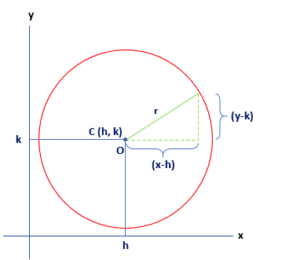
To find the general form of the equation of a circle, we use the below-given graph. Each circle form has its own advantages. Here, we can take an example of a standard form which is great for determining the radius and center just with a glance at the above equation. The general form of a circle is good at substituting ordered pairs and testing them. We use both of these forms. So this gives us an idea that we should interchange between these forms. Firstly, we will transform the standard form to the general form.

General Form of the Equation of a Circle Diagram

General form of equation is (x-h)2 + (y-k)2 = r2

where r is defined as the radius of the circle

h, k is defined as the center coordinates

Standard Form to General Form

Here, we will take an example that gives us an idea to transform an equation from a Standard form to a general form

Eg: Transform (x – 3)2 + (y + 5)2 = 64 to general form.

(x – 3)2 + (y + 5)2 = 64

Now, all the binomial should be multiplied and rearranged till we get the general form.

(x – 3) (x – 3) + (y + 5) (y + 5) = 64

(x2 – 3x – 3x + 9) + (y2 + 5y + 5y + 25) = 64

x2 – 6x + 9 + y2 + 10y + 25 = 64

x2 + y2 – 6x + 10y + 9 + 25 – 64 = 0

(x2) + (y2) – 6(x) + 10(y) – 30 = 0

x2+y2–6x+10y–30 = 0

This is the general form of the equation as transformed from Standard from.

General to Standard Form

To transform an equation to standard form from a general form, we must first complete the equation balanced and complete the square. Here, completing the square implies creating Perfect Square Trinomials(PST’s).

To give you an idea about Perfect Square Trinomials, here are some examples

Example 1:

x2 + 2x + 1

When we factor PSTs, we get two identical binomial factors.

x2 + 2x + 1 = (x + 1)(x + 1) = (x + 1)2

Example 2:

x2 – 4x + 4

When we factor PSTs, we get two identical binomial factors.

x2 – 4x + 4= (x – 2)(x – 2) = (x – 2)2

We can observe that the sign for the middle term can either be positive or negative.

We have a relationship between the last term and the coefficient of the middle term

(b/2)2

Now, we see a few examples of circle equation that include the transformation of the equation from a standard form to the general form

General Form of the Equation of a Circle Examples

Problem 1:

The circle equation is: x2 + y2 – 8x + 4y + 11 = 0. Find the centre and radius?

Solution:

To find the centre and radius of the circle, we first need to transform the equation from general form to standard form

x2 + y2 – 8x + 4y + 11 = 0

x2 – 8x + y2 + 4y + 11 = 0

(x2 – 8x + ) + (y2 + 4y + ) = -11

We are leaving the spaces empty for PST’s.

We must complete the square of the PST’ds by adding appropriate values

To maintain balance on the above equation, we must add same values on the right side which we add on the left side of the equation to keep the equation equal on both the sides

(x2 – 8x + 16) + (y2 + 4y + 4) = -11 + 16 + 4

(x – 4)2 + (y + 2)2 = 9

By comparing the above equation with the standard form of the circle, we observe that

Centre =(4,-2)

Radius = 3

Problem 2:

Find the standard form of the equation of a circle of radius 4 whose centre is (-3,2). Convert the equation into general form

Solution:

As given in the question,

radius = 4

h = -3

k = 2

General form of equation is (x-h)2 + (y-k)2 = r2

(x-(-3))2 + (y-2)2 = 42

(x+3)2 + (y-2)2 = 16

x+ 6x + 9  + y2 -4y + 4 = 16

x+ y+ 6x – 4y – 3 = 0

Therefore, the general solution is x+ y+ 6x – 4y – 3 = 0

Problem 3:

Write the equation in the general form given the radius and centre

r = 3, centre = (1,2)

Solution:

As given in the question,

r = 3

h = 1

k = 2

General form of equation is (x-h)2 + (y-k)2 = r2

(x-1)2 + (y-2)2 = 32

x2 – 2x + 1  + y2 -4y + 4 = 9

x2 + y2 – 2x – 4y – 4 = 0

Therefore, the general solution is x2 + y2 – 2x – 4y – 4 = 0

Common Core 3rd Grade Math Curriculum, Lessons, Worksheets, Word Problems, Practice Tests

3rd Grade Math

Third Grade Math Lessons provided here are arranged in a way that you can learn Math while playing 3rd Grade Math Games. 3rd Grade Math Topics included covers the concepts such as Four-Digit Numbers, Comparison of Numbers, Geometrical Shapes and Figures, Measurement of Length, Mass, Capacity, Time, and Money, Fractional Numbers, Pictographs, Mental Arithmetic, Patterns, etc.

By Practicing from the Grade 3 Math Worksheets available one can score higher grades in the exams. Get to know the applications of Grade 3 Math Concepts. You can get a good hold of the concepts by simply clicking on the quick links available. Use them as a reference and resolve all your queries and enhance your math skills right from a young age.

3rd Grade Math Topics, Practice Test, Worksheet, Question and Answer Key

We follow a step-wise learning process so that you can understand the concepts better and recognize your mistakes. Keep a track of your learning progress taking the help of the interactive Grade 3 Math Worksheets. You will be accustomed to new concepts, ideas at this stage. Lessons present make it easy for you to absorb the concepts such as time, fractions, geometry, and money in a most efficient way and apply them.

Eureka Math Grade 3 Answer Key

Grade 3 HMH Go Math – Answer Keys

Grade 3 HMH Go Math – Extra Practice Questions and Answers

Big Ideas Math Grade 3 Answers

Formation of Four-Digit Numbers

  • Four Digit Numbers
  • Four-digit Numbers in Numerals and Words

International and Roman Numerals

  • Conversion of Numbers to Roman Numerals
  • Conversion of Roman Numerals to Numbers

Comparison of Numbers

  • Comparison of One-digit Numbers
  • Comparison of Two-digit Numbers
  • Comparison of Three-digit Numbers
  • Comparison of Four-digit Numbers
  • Compare Two Numbers
  • Face value and place value
  • Finding and Writing the Place Value
  • Making the Numbers From Given Digits
  • Numbers with Digits
  • Expanded Form and Short Form of a Number
  • Facts about Addition
  • Addition of 4-Digit Numbers
  • Word Problems on 4-Digit Numbers
  • Addition of 5-Digit Numbers
  • Facts about Subtraction
  • Subtraction of 4-Digit Numbers
  • Combination of Addition and Subtraction
  • Word Problems on Addition and Subtraction
  • Facts about Multiplication
  • Expansion Method of Multiplication
  • Column Method of Multiplication
  • Word Problems on Multiplication by 2-Digit Number
  • Word Problems on Multiplication
  • Shortcut Method of Division
  • Facts about Division
  • Long Division
  • Long Division Method without Regrouping and without Remainder
  • Long Division Method without Regrouping with Remainder
  • Long Division Method with Regrouping and without Remainder
  • Long Division Method with Regrouping and with Remainder
  • Word Problems on Division by 2-Digit Number
  • Circle the Smallest Number
  • Circle the Greatest Number
  • Estimating a Sum

Geometrical Shapes and Figures

  • Basic Shapes
  • Surfaces of The Solids
  • Common Solid Figures
  • Points, Lines and Shapes
  • Line-Segment, Ray and Line
  • Types of Lines
  • Geometrical Design and Models
  • Basic Concept of Perimeter
  • Measuring Area in Square Units
  • Area using Square Paper

Measurement of Length

  • Standard Unit of Length
  • Conversion of Standard Unit of Length
  • Centimeters to Meters and Centimeters
  • Meters into Kilometers and Meters
  • Conversion of Measuring Length
  • Addition of Length: Learn to add the units of length with conversion and without conversion.
  • Subtraction of Length: Learn to subtract the units of length with conversion and without conversion.
  • Addition and Subtraction of Measuring Length
  • Word Problems on Measuring Length

Measurement of Mass

  • What is Mass?
  • Conversion of Standard Unit of Mass
  • Conversion of Measuring Mass
  • Addition of Mass
  • Subtraction of Mass
  • Addition and Subtraction of Measuring Mass
  • Word Problems on Measuring Mass

Measurement of Capacity

  • Standard Unit of Capacity
  • Conversion of Standard Unit of Capacity
  • Conversion of Measuring Capacity
  • Addition of Capacity
  • Subtraction of Capacity
  • Addition and Subtraction of Measuring Capacity
  • Measurement of Time
  • Telling Time

Introduction of Indian Money (Rupees and Paise)

  • Money
  • Coins and Currency Notes
  • Writing Money in Words and Figure
  • Use of Decimal to Represent Money
  • Conversion of Money
  • Conversion of Rupees and Paise
  • Addition of Money
  • Word Problems on Addition of Money
  • Subtraction of Money
  • Word Problems on Subtraction of Money
  • Multiplication of Money
  • Division of Money

Fractional Numbers

Order of Fractions

  • Convert a Fraction to an Equivalent Fraction
  • Verify Equivalent Fractions
  • Proper Fraction and Improper Fraction

Data Handling

  • Pictorial Representation
  • Examples of Pictographs
  • Problems on Pictographs

Mental Arithmetic and Patterns

  • Mental Math Addition
  • Mental Math Subtraction

Advantages of Grade 3 Math Curriculum

  • Students will have a plethora of opportunities to calculate the math concepts mentally and put them on paper easily.
  • Grade 3 Math Concepts provided ensures that students ace the curriculum without any difficulty.
  • Solving from the Grade 3 Math Problems one can avoid the speed bumps on the road to math proficiency.
  • Overcome the fear to learn the 3rd Grade Math Concepts that are often complicated math theories and models.
  • Ease the learning curve for your kids by taking help from the 3rd Grade Math Curriculum and add value to your little one’s learning.
  • Students will fall in love with math rather than feel it as a complicated subject.

Conclusion

We believe the knowledge shared regarding the 3rd Grade Math Topics is true as far as our knowledge is concerned. If you need any further assistance do leave us your queries via the comment box so that we can revert back to you at the earliest possibility. Stay tuned to our site to avail latest information on Gradewise Math Practice Topics in a matter of seconds.

First Grade Math

First Grade Math Games, Problems, Activities, Worksheets, Practice Test, Questions and Answer Key

Place Value

  • Math Place Value
  • Numbers Worksheet
  • Missing Numbers Worksheet
  • Worksheet on Tens and Ones
  • Number Dot to Dot
  • Before and After
  • Number that Comes Between
  • Greater or Less than and Equal to
  • Ascending Order or Descending Order
  • Number Games

Addition

  • Adding 1-Digit Number
  • Vertical Addition
  • Addition Word Problems – 1-Digit Numbers
  • Missing Number in Addition
  • Missing Addend Sums with 1-Digit Number:
  • Adding with Zero
  • Adding Doubles
  • Addition Fact Sums to 10
  • Addition Fact Sums to 11
  • Addition Fact Sums to 12
  • Addition Fact Sums to 13
  • Addition Facts of 14, 15, 16, 17 and 18

Subtraction

  • Subtracting 1-Digit Number
  • Subtracting 2-Digit Numbers
  • Subtraction Word Problems – 1-Digit Numbers
  • Missing Number in Subtraction

Adding 0 to 9

  • Worksheet on Adding 0
  • Worksheet on Adding 1
  • Worksheet on Adding 2
  • Worksheet on Adding 3
  • Worksheet on Adding 4
  • Worksheet on Adding 5
  • Worksheet on Adding 6
  • Worksheet on Adding 7
  • Worksheet on Adding 8
  • Worksheet on Adding 9

Subtracting 0 to 9

  • Worksheet on Subtracting 0
  • Worksheet on Subtracting 1
  • Worksheet on Subtracting 2
  • Worksheet on Subtracting 3
  • Worksheet on Subtracting 4
  • Worksheet on Subtracting 5
  • Worksheet on Subtracting 6
  • Worksheet on Subtracting 7
  • Worksheet on Subtracting 8
  • Worksheet on Subtracting 9

Money Names and Values


2nd Grade Math Curriculum, Topics, Practice Tests, Games, Worksheets

2nd Grade Math

Scoring higher grades in Grade 2 Mathematics just got easier. With Consistent Practice, you will learn to interpret and organize information in an efficient manner. Encourage your kids to learn the math concepts in a fun and engaging way. Improve your Mathematical Abilities taking the help of the 2nd Grade Math Pages. All the Grade 2 Math Topics are explained adhering to the latest Grade 2 Curriculum and are prepared by subject experts.

Whatever the Topic our Grade 2 Math Problems provided help you tackle any kind of problem with ease. 2nd Grade Math Concepts are designed to teach, challenge, build confidence among kids. The more you practice the Grade 2 Topics the quick you can grasp the formulas, techniques to get ahead. 2nd Grade Math Worksheets available help you test your fundamentals and identify the knowledge gap.

2nd Grade Math Topics, Practice Test, Worksheet, Textbook Questions and Answer Key

Grade 2 Math Concepts isn’t easy for kids but our 2nd Grade Math Pages help you to have a smooth learning curve. You can bring out the best in your Kid by making them practice the entire Grade 2 Word Problems, Questions available. Your kid will fall in love with Math instead of feeling it as a dreading subject. Simply click on the respective topic you wish to prepare and learn the underlying concepts within easily.

Skip Counting

  • Skip Counting by 2’s
  • Skip Counting by 3’s
  • Skip Counting by 4’s
  • Skip Counting by 5’s
  • Skip Counting by 6’s
  • Skip Counting by 7’s
  • Skip Counting by 8’s
  • Skip Counting by 9’s
  • Skip Counting by 10’s
  • Skip Counting by 11’s
  • Skip Counting by 12’s
  • Skip Counting by 13’s
  • Skip Counting by 14’s
  • Skip Counting by 15’s

Numbers and Numeration

  • Cardinal Numbers and Ordinal Numbers
  • 2 Digit Numbers
  • Three-Digit Numbers
  • Three-digit Numbers in Numerals and Words
  • Place Values in Words and Numbers
  • Express a Number
  • Greater than and Less than Symbols
  • Numbers from 100 to 199
  • Numbers in Expanded Word Form
  • Numbers from 200 to 299
  • Numbers Name and Expanded Form
  • Numbers from 300 to 399
  • Names of Three-Digit Numbers
  • Numbers Name and Expanded form – 300 to 399
  • Numbers Name and Expanded form – 400 to 499
  • Numbers Name and Expanded form – 500 to 599
  • Numbers Name and Expanded form – 600 to 699
  • Numbers Name and Expanded form – 700 to 799
  • Numbers Name and Expanded form – 800 to 899
  • Numbers Name and Expanded form – 900 to 999
  • Number words 100 to 1000
  • Odd and Even Numbers
  • Place Value and Face Value
  • Worksheet on Numeration
  • Comparing Numbers
  • Use a Number Line
  • Adding 1-Digit Number
  • Adding 2-Digit Numbers
  • Addition Word Problems – 2-Digit Numbers
  • Adding 2-Digit Numbers with Regrouping
  • Adding Numbers in Expanded Form
  • 2-Digit Addition with Carry Over
  • 3-Digit Addition with Carry-over
  • Add Three Numbers of 2-Digit with Carry Over
  • Find the Sum using Addition Property
  • Subtracting 2-Digit Numbers
  • Subtraction without Decomposition (2-Digit Number from 2-Digit Number)
  • Subtraction with Decomposition 2-Digit Number from 2-Digit Number
  • Subtraction Placing the Numbers
  • Subtracting Numbers in Expanded Form
  • Find the Difference using Subtraction Property
  • Subtracting 3-Digit Numbers
  • Subtracting 2-digit Numbers with Borrowing
  • Subtracting 3-Digit Numbers with Borrowing
  • Problem Solving on Addition
  • Problem Solving on Subtraction
  • Basic Multiplication Facts
  • Find the Product using Multiplication Property
  • Multiplying 1-Digit Number
  • Multiplying 2-Digit Number by 1-Digit Number
  • Problem Solving on Multiplication
  • Dividing 1-Digit Number
  • Dividing 2-Digit Number by 1-Digit Number
  • Basic Division Facts
  • Divide on a Number Line
  • Divide by Repeated Subtraction
  • Problem Solving on Division
  • Multiplication and Division are Related
  • Parentheses
  • Concept of Pattern
  • Measuring Length
  • Measuring Mass
  • Measuring Capacity
  • Measuring Time
  • The Story about Seasons
  • Yesterday, Today, and Tomorrow
  • Months and Days
  • Rupees and Paise
  • Sum and Difference of Rupees and Paise

Numbers and Numeration Worksheets

  • Worksheet on Addition (Carrying)
  • Worksheet on Counting by Tens
  • Worksheet on Order with Hundreds, Tens, and Ones
  • Worksheet on Number in Expanded Form
  • Worksheet on Odd and Even Numbers
  • Worksheet on Place Value and Face Value
  • Worksheet on Ordinals
  • Worksheet on Cardinal Numbers and Ordinal Numbers
  • Worksheet on Two-Digit Numbers
  • Worksheet on Numbers 1 to 100
  • Worksheet on Multiplication and Division by 2
  • Worksheet on Multiplication and Division by 3
  • Worksheet on Multiplication and Division by 4
  • Worksheet on Multiplication and Division by 5
  • Worksheet on Multiplication and Division by 6
  • Worksheet on Multiplication and Division by 7
  • Worksheet on Multiplication and Division by 8
  • Worksheet on Multiplication and Division by 9
  • Worksheet on Multiplication and Division by 10
  • Worksheet on Parentheses
  • Worksheet on Days of the Week
  • Worksheet on Months and Days
  • Number Puzzles
  • Worksheet on Fundamental Concepts of Geometry

Fractional Numbers

  • Concept of Fractions
  • Numerator and Denominator

Geometry

  • Fundamental Concepts of Geometry
  • Points and Line Segment
  • Geometrical Shapes
  • Two Dimensional Shapes and Lines

Benefits of referring to 2nd Grade Math Curriculum

There are numerous perks of solving from the 2nd Grade Math Topics and they are listed here. They are as follows

  • Our 2nd Grade Math Concepts help you tackle any kind of problem.
  • Whether it’s skip counting, graphing, multiplication, and division your child will discover the best of 2nd Grade Math.
  • You can understand all the complexities of Grade 2 quite easily by practicing from the Math Concepts.
  • All the Grade 2 Topics explained here are as per the latest 2nd Grade Curriculum.

Final Words

We hope the knowledge shared regarding the Grade 2 Math Topics has helped you be on the right track. In case of any queries do leave us your doubts so that we can get back to you at the earliest. Keep in touch with our site to avail latest updates on Gradewise Math Concepts in a matter of seconds.

1st Grade Math Curriculum, Worksheets, Word Problems, Games, Practice Tests

1st Grade Math

Children in Grade K are comfortable with counting and writing numbers from 1 to 20. Kids of Grade 1 will learn 3 digit numbers up to 120. Learn new concepts such as Adding, Subtracting Numbers. Concepts existing will lay a strong foundation of math basics that are useful for higher grades. Make your math learning fun and enjoyable by availing the Grade 1 Math Topics existing.

1st Grade Math Concepts will improve the child’s understanding of number values, arithmetic, linear measurements, and shape compositions. Appealing Visuals make the concepts much fun and enjoyable. Practicing from the Grade 1 Math Concepts helps you to become proficient in Math as well as be thorough with the concepts. Engaging Printable Grade 1 Worksheets present enthralls the kids to have a new learning experience. Solving the 1st Grade Math Concepts one can see a significant improvement in their performance.

First Grade Math Topics, Textbook Solutions

We have curated unique activities and alluring characters for kids in grade 1.  Grade 1 students will get to see identifying patterns, sorting, telling time, measuring time & distances, and many more. Rather than mugging up concepts, one can understand the concept behind them. Simply tap on the quick links available to learn the related concept in a matter of seconds.

Place Value

  • Math Place Value

Numbers – Worksheet

  • Missing Numbers Worksheet
  • Worksheet on Tens and Ones
  • Number Dot to Dot
  • Before and After
  • Number that Comes Between
  • Greater or Less than and Equal to
  • Ascending Order or Descending Order
  • Number Games

Numbers – Worksheet

  • Missing Numbers Worksheet
  • Worksheet on Tens and Ones
  • Number Dot to Dot
  • Before and After
  • Number that Comes Between
  • Greater or Less than and Equal to
  • Ascending Order or Descending Order
  • Number Games

Addition

  • Adding 1-Digit Number
  • Vertical Addition
  • Addition Word Problems – 1-Digit Numbers
  • Missing Number in Addition
  • Missing Addend Sums with 1-Digit Number
  • Adding with Zero
  • Adding Doubles
  • Addition Fact Sums to 10
  • Addition Fact Sums to 11
  • Addition Fact Sums to 12
  • Addition Fact Sums to 13
  • Addition Facts of 14, 15, 16, 17 and 18

Subtraction

  • Subtracting 1-Digit Number
  • Subtracting 2-Digit Numbers
  • Subtraction Word Problems – 1-Digit Numbers
  • Missing Number in Subtraction

Adding 0 to 9

  • Worksheet on Adding 0
  • Worksheet on Adding 1
  • Worksheet on Adding 2
  • Worksheet on Adding 3
  • Worksheet on Adding 4
  • Worksheet on Adding 5
  • Worksheet on Adding 6
  • Worksheet on Adding 7
  • Worksheet on Adding 8
  • Worksheet on Adding 9

Subtracting 0 to 9

  • Worksheet on Subtracting 0
  • Worksheet on Subtracting 1
  • Worksheet on Subtracting 2
  • Worksheet on Subtracting 3
  • Worksheet on Subtracting 4
  • Worksheet on Subtracting 5
  • Worksheet on Subtracting 6
  • Worksheet on Subtracting 7
  • Worksheet on Subtracting 8
  • Worksheet on Subtracting 9

Money Names and Values

Why refer to 1st Grade Math Curriculum?

Go through the advantages listed below by accessing our Grade 1 Math Curriculum. They are along the lines

  • No matter the topic you can always count on Grade 1 Math Topics to improve your child’s proficiency.
  • From Basic Addition and Subtraction to Measurement there is a number of ways you can get a good hold of them.
  • If your child is struggling with telling time or reading a clock you can always seek help from us.
  • All the Grade 1 Concepts are explained in detail adhering to the Latest 1st Grade Curriculum.
  • You will discover the joy of learning math that you have never thought of as a kid.

Summary

Hope the knowledge shared about Grade 1 Math has helped you to a possible extent. If you need any assistance on the 1st Grade Math Topics please do drop us your suggestions so that we can revert back to you at the possible extent. Stay in touch with our site to avail latest updates on Grade Wise Math Topics, Word Problems, etc. at your fingertips.

Subtraction – Introduction, Definition, Parts, Methods, Examples

Subtraction

Subtraction concepts and worksheets are here. Know the different formulae, definitions, and methods involved in subtraction. Know the representation, parts, and properties of subtraction. Solve various problems involved in subtraction and refer to definitions and examples. Check the below sections to know the various information of subtraction like Signs, properties, definition, subtraction method in special situations, number bonds, etc.

Read More:

Subtraction – Definition

Subtraction is the oldest and the important basic arithmetic operation used in day-to-day life. Subtraction is as important as addition is. The word “subtraction” is derived by using two words “sub” which means below or under and “tract” which means carry away or pull. Hence, the final definition of subtraction means to carry the below or lower part.

It’s been 6000 years that subtraction is known to mathematicians. The subtraction symbol was first used by the German mathematician as barrel markings. Later on, from the 1500s its usage started as an operation symbol. Then, in 1557, the famous Mathematician and Physician used in Whetstone of Witte and thus it became common.

Subtraction Symbol

Subtraction is represented with the symbol hyphen(-). There are 4 parts in subtraction: the difference, an equal sign, the minuend, the subtrahend. Subtraction is useful to understand the parts because it enables the beginners to grasp all the principles and also develop strategies to solve subtraction problems.

The Difference

“Difference” is the term used to determine the result or the answer of the equation or operation. For suppose, 8-4 = 4. Therefore, the difference in the case is 4.

The Equal Sign

The equal sign indicates that 2 sides of the equation are equal or equivalent. The equal sign is denoted with the symbol “=” and it is inserted between the values which are to be subtracted.

The Subtrahend

The subtrahend is the number that is taken away from the starting value or money. For suppose, 8-4 =4, the subtrahend is 4. The subtraction sentence will have multiple subtrahends which depend on the equation complexity.

The Minuend

The minuend is the number from which other numbers are taken away. It is the starting value of the subtraction equation. For suppose, 8-4 =4, the minuend is 8.

Important Points on Subtraction

  • The order of numbers or values is important in subtraction. The smaller number is always subtracted from the bigger number. Else it gives a negative value Example: 25 – 5 = 20
  • On subtracting the value zero from the given number, it results in the same number. Example: 25 – 0 = 25
  • On subtracting the value one from the given number, it results in the preceding number. Example: 25 – 1 = 24
  • On subtracting the same number itself from the number, the difference obtained is always zero. Example: 25 – 25 = 0

Properties of Subtraction

Identity Property

The property of identity states that if zero is added or subtracted to the number, the resultant value will be the number itself.

Example:

5 + 0 = 5

6 – 0 = 6

Commutative Property

If a and b are the two whole numbers then a-b is not equal to b-a, i.e., {a-b ≠ b-a}

Example:

25 – 5 = 20 and 5 – 25 ≠ 20

Closure Property

If a & b are whole numbers, then a-b is a whole number, if a > b or a = b. If a < b, then a-b is not a whole number.

Example:

5 and 4 are whole numbers, then 5 -4 is also a whole number

Since 5 is greater than 4

Associative Property

If a,b,c are whole numbers and c≠0. then (a-b)-c ≠ a – (b – c)

Property of 1

If the value one is subtracted from the given number, it gives the preceding value of the given number

Example:

643 – 1 = 642

Inverse Operations

Subtraction and Addition are opposite operations of each other. In the addition property the value of the resultant increases and in the subtraction property the value of the resultant decreases.

Example: 8 + 4 – 4 = 8

Adding and subtracting the same value indicates the cancellation of two values. Hence, while solving a large group of numbers, notice all the same value numbers and cancel those terms to make the simplification easy.

Method to Solve Subtraction Problems

  1. First of all, know the greater and smaller numbers, write the greater number above the smaller number.
  2. Start subtraction from the rightmost digit and then compare the upper and lower digits.
  3. In the comparision, if you find that the lower digit is small than the upper digit, subtract the lower value from the upper value and write the answer below.
  4. If there is a case that the upper digit is small than the lower digit, then borrow 1 from the next number. Now as the digit has become greater, you can easily subtract the lower value from the higher value and write the answer below.
  5. Repeat the procedure in the same way until you run out of all the digits.

Subtraction Examples

Problem 1:

Tara has 65 shirts. Patan has 42 shirts. How many less shirts does Patan have than Tara?

Solution:

As given in the question,

No of shirts Tara has = 65 shirts

No of shirts Patan has = 42 shirts

To find the less shirts Patan have than Tara, we apply subtraction law

Therefore, no of shirts = 65 – 42

= 23

Thus, Patan has 23 less shirts than Tara has

Problem 2:

A sweet shop has 78 sweets. It sold only 43 sweets. How many sweets are left to be sold?

Solution:

As given in the question,

No of sweets, the sweet shop has = 78

No of sweets sold = 43

To find the no of sweets left, we apply the subtraction law

Therefore, no of sweets left out = 78 – 43

= 35

Thus, No of sweets left = 35

Problem 3:

The total strength of the class is 50. Out of which 24 are girls. Find the total number of boys present in the class?

Solution:

As given in the question,

Total strength of the class = 50

No of girls = 24

To find the total boys present in the class, we apply subtraction law

Therefore, no of boys in the class = 50 – 24

= 26

Thus, the total boys present in the class = 26

Problem 4:

Akshu bought 562 chocolates on her birthday. He distributed 326 chocolates among her friends. How many chocolates are left with her?

Solution:

As given in the question,

No of chocolates Akshu bought = 562

No of chocolates she distributed among her friends = 326

To find the remaining chocolates, we apply the subtraction law

Therefore, to find the remaining chocolates = 562 – 326

= 236

Thus, the number of remaining chocolates = 236

Problem 5:

There are 7 ant raincoats and 4 cockroach raincoats. How many less cockroach raincoats are there than ant raincoats?

Solution:

As given in the question,

No of ant raincoats = 7

No of cockroach raincoats = 4

To find the number of less cockroach raincoats, we apply subtraction law

Therefore, the number of less cockroach raincoats = 7 – 4

= 3

Thus, the number of less cockroach raincoats = 3

Problem 6:

There are 30 green umbrellas and 10 pink umbrellas. What is the difference between the number of green and the pink umbrella?

Solution:

As given in the question,

No of green umbrellas = 30

No of pink umbrellas = 10

To find the difference between the number of green and pink umbrellas. we apply subtraction law

Therefore, to the difference between the number of green and pink umbrellas = 30 – 10

= 20

Thus, the difference between the number of green and pink umbrellas = 20

Problem 7:

Wilson has 7 apples and he ate 4 apples. How many apples are left with him?

Solution:

As given in the equation,

No of apples Wilson has = 7

No of apples he ate = 4

To find the number of apples, we apply the subtraction law

Therefore, number of apples = 7 – 4

= 3

Thus, the number of apples = 3

Problem 8:

Guna has 25 books and Mona has 12 books out of them. How many books are left with Guna?

Solution:

As given in the question,

No of books Guna has = 25

No of books Mona has = 12

To find the number of books left with Guna, we apply subtraction law

Therefore, number of books = 25 – 12

= 13

Thus, the number of books = 13

Problem 9:

Mani bought 36 candles for Diwali, He lit 20 candles. How many candles are left with him?

Solution:

As given in the question,

No of candles Mani bought = 36

No of candles he lit = 20

To find the number of candles left, we apply the law of subtraction

Therefore, number of candles left = 36 – 20

= 16

Thus, the number of candles = 16

Problem 10:

Tom bought 30 eggs from the shop, out of which 12 eggs were broken. How many eggs are left with him?

Solution:

As given in the question,

No of eggs = 30

No of broken eggs = 12

To find the number of eggs left him, we apply subtraction law

Therefore, number of eggs left = 30 – 12 = 22

Thus, the number of eggs left = 22

Properties of Subtraction – Closure, Identity, Commutative, Associative, Distributive

Properties of Subtraction

The basic four different arithmetic operations are addition, subtraction, multiplication, and division. To perform these arithmetic operations, you just need at least 2 numbers. Subtraction is one of the arithmetic operations that means removing objects from a group. It is represented using the minus sign “-“.

The other names of subtraction are minus, difference, deduct, less, decrease, and take away. For subtracting larger whole numbers, you can use subtraction with regrouping (borrowing) or quick subtraction or subtraction or addition methods. Interested candidates can read further sections to know five different properties of subtraction along with solved examples.

Also Check:

How to Subtract Two Whole Numbers?

Students can subtract two larger whole numbers by following these steps.

  • Let us take two numbers one is minuend, second is subtrahend.
  • Write the number that is to be subtracted from on the top and the number that is to be subtracted on the bottom.
  • Begin the process from the rightmost digits of the numbers.
  • If the minuend digit is lesser than the subtrahend digit, then barrow 10 from the next digit of minuend which is on the left side.
  • Add 10 to the minuend digit and subtract the result from the subtrahend’s digit.
  • Don’t forget to mention the borrowed value on the top of the digit.
  • Then the next digit becomes (digit – 1)
  • Repeat the steps till you are left with nothing on the left side.

Properties of Subtraction

We are here to explain about five different properties of subtraction. Let us have a look at the following sections to get a clear idea about the topic.

Property 1: Closure Property

The difference between any two integers will also be an integer. If a, b are integers, then a – b is also an integer.

Examples:

15 – 5 = 10

259 – 8 = 251

45 – 48 = -3

16 – 0 = 16

Property 2: Identity Property

When a is an integer other than zero, then a – 0 = a but 0 – a is undefined.

Examples:

15 – 0 = 15 but 0 – 15 is not possibe

2 – 0 = 2 but 0 – 2 is undefined

84 – 0 = 84 but 0 – 84 is not defined

Property 3: Commutative Property

The commutative property of subtraction says that the swapping of terms will affect the difference value. If a and b are two integers, then (a – b) is never equal to (b – a).

Examples:

15 – 4 = 11 and 4 – 15 = -11

So, 15 – 4 ≠ 4 – 15

82 – 45 = 37 and 45 – 82 = -37

So, 82 – 45 ≠ 45 – 82

6 – 10 = -4 and 10 – 6 = 4

So, 6 – 10 ≠ 10 – 6

Property 4: Associative Property

The associative property of subtraction states that if you change the way of grouping numbers, then the result will be different. If a, b, c are three integers, then a – (b – c) is not equal to (a – b) – c.

Examples:

1. 15 – (10 – 2) = 15 – 8 = 7

(15 – 10) – 2 = 5 – 2 = 3

Therefore, 15 – (10 – 2) ≠ (15 – 10) – 2

2. 28 – (6 – 4) = 28 – 2 = 26

(28 – 6) – 4 = 22 – 4 = 18

Therefore, 28 – (6 – 4) ≠ (28 – 6) – 4

3. (156 – 120) – 10 = 36 – 10 = 26

156 – (120 – 10) = 156 – 110 = 46

Therefore, (156 – 120) – 10 ≠ 156 – (120 – 10)

Property 5: Distributive Property

The distributive property states that the integers are subtracted first and then multiplied by the result or multiply first and then subtraction later. If a, b, c are three integers, then a x (b – c) = a x b – a x c.

Examples:

1. 5 x (6 – 7) = 5 x (-1) = -5

5 x 6 – 5 x 7 = 30 – 35 = -5

So, 5 x (6 – 7) = 5 x 6 – 5 x 7

2. 16 x 25 – 16 x 20 = 400 – 320 = 80

16 x (25 – 20) = 16 x 5 = 80

So, 16 x 25 – 16 x 20 = 16 x (25 – 20)

Property 6:

If a, b, c are the whole numbers and a – b = c, then a = c + b.

Examples:

18 – 0 = 18 and 18 = 18 + 0

So, whenever zero is subtracted from any whole number, then we get the whole number.

18 – 18 = 0

So whenever a number is subtracted from the same number, then the difference is zero.

1850 – 1 = 1849 and 1849 + 1 = 1850.

Solved Examples on Properties of Subtraction

Example 1:

Solve the following.

(i) 415 – 0

(ii) 710 – 2

(iii) 5645 – 455

Solution:

(i) The given integers are 415, 0

As per the identity property, if any number is subtracted from 0, then the difference is a whole number.

So, 415 – 0 = 415.

(ii) The given integers are 710, 2

710 – 2 = 708.

(iii)

10

5 6 4 5

– 4 5 5

5 1 9 0

5645 – 455 = 5190.

Example 2:

Find the missed numbers from the following.

(i) 258 – _____ = 0

(ii) ______ – 90 = 88

(iii) 1652 – ______ = 10

Solution:

(i) 258 – x = 0

We already know that a – b = c, then a = c + b.

258 – 0 = x

As per the identity property, if any number is subtracted from 0, then the difference is a whole number.

So, 258 – 0 = 0

(ii) x – 90 = 88

We already know that a – b = c, then a = c + b.

x = 88 + 90

x = 178

So, 178 – 90 = 88.

(iii) 1652 – x = 10

We already know that a – b = c, then a = c + b.

1652 – 10 = x

x = 1642

So, 1652 – 1642 = 10.

Example 3:

State whether the following statements are correct or not.

(i) 56 x (85 – 25) = 56 x 85 – 56 x 25

(ii) 182 – (72 – 38) = (182 – 72) – 38

(iii) 546 – 546 = 1

Solution:

(i) The given statement is 56 x (85 – 25) = 56 x 85 – 56 x 25

L.H.S = 56 x (85 – 25)

= 56 x 60

= 3360

R.H.S = 56 x 85 – 56 x 25

= 4760 – 1400

= 3360

So, L.H.S = R.H.S

Therefore, the stament is true.

(ii) The given statement is 182 – (72 – 38) = (182 – 72) – 38

L.H.S = 182 – (72 – 38)

= 182 – 34

= 148

R.H.S = (182 – 72) – 38

= (110) – 38

= 72

L.H.S ≠ R.H.S

Therefore, the statement is false.

(iii) The given statement is 546 – 546 = 1

We know that, if a number is subtracted from the same whole number, then the result is zero.

Therefore, the statement is false.

FAQs on Properties of Subtraction

1. Write the different properties of subtraction?

The five various subtraction properties are closure property, identity property, distributive property, commutative property, and associative property.

2. Describe the terms minuend, subtrahend, and difference?

A minuend is a number that is to be subtracted from, a subtrahend is a number that is to be subtracted, and the difference is the result of subtracting one number from another number.

3. What is the difference between distributive property and associative property.

Distributive property for subtraction is true but associative property for subtraction is false. Distributive property is a x b – a x c = a x (b – c). Associative property is a – (b – c) ≠ (a – b) – c.

Rules for Formation of Roman Numerals – Complete Guide | Roman Numerals Conversions with Examples

Rules for Formation of Roman Numerals

Roman Numerals are a special kind of numerical notations that were used by the Romans. Different combinations of symbols are used to represent the number. Both addition and subtraction are used to convert the roman numbers to the numbers. We are 4 different rules to form a roman numeral. The rules for forming the roman numerals with examples are mentioned in the following sections of this page.

Also, Read: Roman Numerals

Roman Numeral – Definition

A Roman numeral is a numeral in a system of notation that is based on the ancient Roman system. In this system, numbers are represented by the combination of letters from the Latin alphabet. The mostly used seven symbols and their values are I = 1, V = 5, X = 10, L = 50, C = 100, D = 500, M = 1000. Addition and subtraction operations are used to find other numbers. The first 10 roman numbers are I, II, III, IV, V, VI, VII, VIII, IX, and X.

Roman Numerals Chart 1-1000

Roman Numerals Chart

Rules for Formation of Roman Numerals

In the Roman numerals system, there is no symbol to represent the digit 0. Roman numerals system has no place value. The digit or digits of lower value is placed after or before the digit of higher value. The value of digits of lower value is added to or subtracted from the value of digits of higher value. Using these rules, you can represent a number in the numeral system.

Rule 1: Repetition of roman numeral means addition.

(i) The symbols I, X, C, and M can be repeated more than once.

The value of I is 1, X is 10, C is 50, M is 1000.

(ii) The values I, X and C can be added as

II = 1 + 1 = 2

III = 1 + 1 + 1 = 3

XX = 10 + 10 = 20

XXX = 10 + 10 + 10 = 30

CC = 100 + 100 = 200

CCC = 100 + 100 + 100 = 300

(iii) The symbols V, L, D cannot be repeated. The repetition of V, L, and D is invalid in the formation of numbers.

(iv) None of the numeral symbols can be repeated more than 3 times.

Rule 2: If a smaller numeral is written to the right side of a larger numeral, then it is always added to the larger numeral.

(i) When a digit of lower value is written to the right side or after a digit of higher value, the values of all the digits are added.

VI = 5 + 1 = 6

VII = 5 + 1 + 1 = 7

XII = 10 + 1 + 1 = 12

XV = 10 + 5 = 15

LX = 50 + 10 = 60

(ii) Value of similar digits are also added as indicated in rule 1

XXX = 10 + 10 + 10 = 30

II = 1 + 1 = 2

Rule 3: If a small numeral is written to the left side of a larger numeral, then it is always subtracted from the larger value.

(i) V, L, D can never be subtracted

(ii) I can be subtracted only from V and X.

IV = 5 – 1 = 4

IX = 10 – 1 = 9

XIV = 10 + (5 – 1) = 10 + 4 = 14

CLIX = 100 + 50 + (10 – ) = 159

XXIX = 10 + 10 + (10 – 1) = 29

However, V is never written to the left of X.

Rule 4: If a smaller numeral is located between two large numerals, then the small numeral is subtracted from the bigger numeral immediately following it.

Rule 5: When a roman number has a straight horizontal line on the top of it, then its value becomes 1000 times.

XIV = 14 but XIV = 14000

CLV = 155 but CLV = 155000

Roman Numerals Examples

Example 1:

Write the Roman numerals for the following numbers:

(i) 55

(ii) 216

(iii) 517

Solution:

(i) The given number is 55

55 = 50 + 5

= LV

So, 55 = LV

(ii) The given number is 216

216 = 100 + 100 + 10 + 5 + 1

= CCXVI

So, 216 = CCXVI

(iii) The given number is 517

517 = 500 + 10 + 5 + 1 + 1

= DXVII

So, 517 = DXVII

Example 2:

Write the numbers for the following Roman numerals:

(i) XXXVII

(ii) DXLV

(iii) XLII

Solution:

(i) The given roman numeral is XXXVII

XXXVII = 10 + 10 + 10 + 5 + 1 + 1

= 37

So, XXXVII = 37

(ii) The given roman numeral is DXLV

DXLV = 500 + (-10 + 50) + 5

= 500 + 40 + 5

= 545

So, DXLV = 545

(iii) The given roman numeral is XLII

XLII = (-10 + 50) + 1 + 1

= 40 + 1 + 1

= 42

So, XLII = 42

Example 3:

Write the Roman numerals for the following numbers:

(i) 425

(ii) 159

(iii) 61

Solution:

(i) The given number is 425

425 = (500 – 100) + 10 + 10 + 5

= CDXXV

So, 425 = CDXXV

(ii) The given number is 159

159 = 100 + 50 + (10 – 1)

= C + L + (X – I)

= CLIX

So, 159 = CLIX

(iii) The given number is 61

61 = 50 + 10 + 1

= L + X + I

= LXI

So, 61 = LXI

Frequency Distribution of Ungrouped and Grouped Data – Definition, Table, Formula, Examples

Frequency Distribution of Grouped and Ungrouped Data

To learn more about the Frequency Distribution of Grouped data and Ungrouped data this is the right place to learn, and to increase more knowledge on Frequency Distribution. Statistics is the study of collecting data, organization, interpretation, analysis, and data presentation. The main purpose of statistics is to plan the collected data in terms of the experimental designs and statistical surveys.

Statistical knowledge will help to collect the data in the proper method, and samples are employed in the correct analysis process, in order to effectively produce the results. In statistics, the Frequency distribution is a table that displays the number of outcomes of a sample. In this platform, we have to learn about Frequency Distribution definition, ungrouped data, grouped data advantages, and disadvantages.

Also, Read: Terms Related to Statistics

What is Frequency Distribution?

A frequency distribution can be defined as the tabulation of the values with one or more variables. A frequency distribution is a representation, either in a graphical format or tabular format, that displays the number of observations within a given interval. The interval size will depend on the data being analyzed and the goals of the analyst. The intervals must be mutually exclusive and exhaustive.

Basically, the Frequency distribution is typically used within a statistical context. A frequency distribution can be graphed as a histogram (or) pie chart. Frequency distributions are particularly useful for normal distributions, which show the observations of probabilities divided among standard deviations.

The tabular form of Frequency Distribution of statistics is shown below

Frequency Distribution of Grouped Data

Grouped data means the data or information given in the form of class intervals. This information can also be displayed using a pictograph or a bar graph.  Grouped data plays an important role when we have to deal large information or data. Arranging the individual observations of a variable into groups, so that the frequency distribution table of these groups provides a convenient way of summarizing or analyzing the data is termed grouped data.

The advantages of Frequency distribution grouped data are:

  • It improves the accuracy and efficiency of estimation.
  • It helps to focus on the important subpopulations and ignores irrelevant ones.

The disadvantages of grouping data are:

  • Lose some of the details in the data.
  • we cannot accurately calculate statistics such as the mean or median from a grouped data of frequency table is alone

Frequency Distribution Table of Grouped Data:

The frequency distribution of grouped data is to analyze when the collected data is large, we can follow this approach to analysed it easily. It is named tally marks.

Example of Frequency Distribution Grouped Data: 

Consider the marks of 30 students of class VII obtained in an examination. The maximum marks of the exam are 50.

24, 6, 12, 17, 33, 45, 16, 7, 24, 28, 11, 31, 23, 40, 39, 16, 26, 9, 16, 20, 31, 25, 28, 18, 15, 33, 28, 47, 43, 21.

So, if we create a frequency distribution table for each and every observation, then it will form a large table. For easy understanding, we can make a table with a group of observations say that 0 – 10, 10 – 20, 20 – 30, 30 – 40,   40 – 50, and so on. We can form the data like the above table, easily understanding and faster-doing the calculation.

The distribution obtained in the above table is known as grouped data of frequency distribution. In that tabular form mention the data or marks in between 10 – 20, suppose 3 numbers will be there then the frequency is 3 like that you can counting or calculated the intervals, frequency will be noticed. But 20 will appear in both 10 to 20 and 20 to 30, 30 also will appear in both 20 to 30 and 30 to 40. But is not feasible that observation either 10 or 20 belong to two classes concurrently.

To avoid this inconsistency, we choose the rule that the general conclusion will belong to the higher class. It means that 10 belongs to the class interval 10-20 but not to 0-10, similarly 20 belongs to class interval of 20-30 but not to 10-20. This is how we create a frequency distribution table of grouped data.

Frequency Distribution of Ungrouped Data

Frequency Distribution of ungrouped data is a data given as individual data points. An ungrouped set of data is basically a list of numbers. Ungrouped data does not fall in any group, it still raw data.

The advantages of ungrouped data frequency distribution are :

  • Most people can easily interpret it.
  • When the sample size is small, it is easy to calculate the mean, mode and median.
  • It does not require technical expertise to analyze it.

Frequency Distribution Table of Ungrouped Data

The data is raw that means it cannot sorted in to categories, classified, or otherwise grouped. An ungrouped set of data is basically a list of numbers. The ungrouped data of frequency distribution table is as shown below,

The following rules must be completed in order to create an ungrouped data frequency distribution :

  1.  Set the values of data, which are called scores, in the column starting from the lowest value to the highest or vice versa.
  2. Create the second column with the frequency of each data occurrence. This column is known as the tally of the scores.
  3.  Create the third column, where the relative frequency of each score will be inserted. The relative frequency can be obtained as follows: fr = f/N, where f is the frequency of each score from the second column and N is the total number of scores. In order to check the correctness of calculations, the sum of fr should be calculated and should be equal to 1.
  4. The next column, where the relative frequency will be performed in percentages, is to be created.
  5. In the next column, known as the cumulative frequency column, the cumulative frequency for each score should be estimated. Calculation of the cumulative frequncy should be started from the lowest value of score, for which the cumulative frequency equals the value of frequency from the second column.
  6. The further calculations are to be performed for each score in a sequence from lowest to highest and the cumulative frequency for each next score equals to the sum of the cumulative frequency of the previous score and frequency of this score from the second column. The cumulative frequency of the highest score should be equal to the total number of scores.
  7.  The next column is called “cumulative proportion” and the values of its column are obtained as a ratio of cumulative frequency for each score and the total number of scores.
  8.  The last column is the cumulative percent, where the cumulative proportion is presented as percentages.

Difference between Grouped Data and Ungrouped Data

Based on Classification, Accuracy, Summarization of grouped data and ungrouped data difference are listed below:

  • Classification: Grouped data is organized into forms whereas Ungrouped data has no forms of organisation.
  • Accuracy: Grouped data has higher accuracy levels when calculating mean and median, whereas ungrouped data has less accurate in determining the mean and median.
  • Preference: Grouped data preferred the analyzing data whereas ungrouped data preferred the collecting data.
  • Summary : Grouped data is summarised in a frequency distribution, while the ungrouped data has no summarization.
  • The representation of grouped data and ungrouped data of frequency distribution is as shown below: