Commonly Used Statistics Terms | Defintions of Basic Statistical Terms with Examples

Terms Related to Statistics

Statistics is a method of collecting data and summarizing the data. The study of the collection, analysis, interpretation, presentation, and organization of data is called Statistics. Now a days Statistics is very important because today we live in the information world and much of this information is determined mathematically by Statistics. The statistics concept is necessary for informing correct data. Go through the entire article to be well versed with Statistical Terms and Concepts along with Examples.

Also, Read: Real Life Statistics

Statistical Terms and Definitions

The various terms related to statistics such as Data, Mean, Mode, Raw data, Observation, Array, Range are explained clearly. Let us discuss them in detail by considering few examples.

Data

Statistical refers to the set of numerical facts collected for the purpose of an investigation is called Statistical data. There are two types of statistical data,

  1. Primary Statistical data
  2. Secondary Statistical data

The data can be about population, birth, death, the temperature of place during a week marks scored in the class runs scored in different matches, etc.

Primary Statistical Data: The data which are naturally obtained by the investigator himself for the first time for his own use is called Primary Statistical data. Primary data also called First Handed Data.

Secondary Statistical Data: The data which was collected by someone with the help of primary data is called secondary data, which is artificial in nature. Secondary Statistical data is also called Second Handed Data in nature. They are two types of Secondary Statistical Data,

  1. Raw data (or) ungrouped data.
  2. Array

Example:  

The below table is an example of statistical data, in this, the data will be regarding the number of students opting for different subjects like English, Maths, Science, Social.

SubjectsEnglishMathsScienceSocial
No. of students25304020

Based on the above table, we can easily calculate the total numbers of the students, average of the students. Therefore the total number of students is 115. If we want to calculate two subjects total then we can add that two subjects student numbers.

Raw Data (or) Ungrouped Data

Raw data is also called ungrouped data. These types of data are obtained in their original form. When some information is randomly and presented is called Raw Data.

Example: 

The example of Raw data (or) ungrouped data is given below. The students in class VII A are 15 and marks obtained by them out of 25 in the English Test. Based on the given data we can know each student’s marks, this means a student is one data and marks is another data we are knowing the marks based on the student. In some marks will be given more students but student strength gives less at that time we are comparing both then choose the predict or collect values.

Given the marks (out of 25) obtained by 15 students of class VII A in English in a test.

16, 13, 20, 21, 15, 25, 14, 19, 10, 20, 22, 12, 18, 15, 23

Array

Generally, Arrays are the data that are put in the form of a table which is also called the presentation of data. simply, Array refers to the arrangement of data in ascending or descending of data order. If the number of times an observation occurs, then it is called frequency distribution. Array data is also called Arrayed data.

Example:

In this example, the main concept is array is putting the raw data in ascending order or descending order. The below data is given, we can arrange them in ascending order,

Given data is 12, 10, 10, 12, 8, 3, 7, 2, 17, 20, 15

The given data is arranged in ascending and represented as,

2, 3, 7, 8, 10, 10, 12, 12, 15, 17, 20

Observation

The observation is defined as every entry is collected as a numerical fact in the given data. In other words, an observation in statistics means a value of something of interest you are measuring or counting during a study or experiment ‘like a person’s height, a bank account value at a certain point in time, or a number of animals like that. The observation unit measures the same thing in the context.

For example, let’s say you are measuring how well your savings perform over the period of one year. You record one measurement that is your bank account balance for every three months for a total.

Range

Statistics Range means the difference between the highest value and the lowest value of the observation is called the range of the data. In other words, statistics the range of a set of data is the difference between the largest and smallest values. The formulae of Range is,

Range (X) = Max(X) – Min(X)

The above range formula is used for calculating the same value, the minimum range is subtracted from the maximum range value to get the Range Value. X is denoted as the value of data.

Example:

In an exam, the highest marks obtained are 20 and the lowest marks are 5 then what is the range?

Highest marks obtained = 20

Lowest marks obtained = 4

Range (X) = Max(X) – Min(X)

Therefore, range = highest marks – lowest marks = 20 – 5 = 16

Another example is, in {4, 6, 9, 3, 7} the lowest value is 3, and the highest is 9, so the range is 9 − 3 = 6.
The range can also mean all the output values of a function.

Mean

Mean and mode is used to measure the central tendency. Mean is defined as the average or the most common value in a collection of numbers. The mean or average of a data set is found by adding all numbers in the data set and then dividing by the number of values in the set.

If x, x1, x3, ……… xn are n observations then
Arithmetic mean = (x1 + x2 + xn, ……………. xn)/n = (∑xi)/n.
∑ is the Greek letter sigma and is used to denote summation.

Mode

In Statistics, the mode is the value that appears most frequently in a data set. A set of data may have one mode, more than one mode, or no mode at all. The mode can be the same value as the mean and/or median, but this is usually not the case.

A Mode in statistics is defined as the value that has a higher frequency in a given set of data. It is the value that appears the most number of times.  Two modes in a given set of data, such values are called Bimodal. A set of numbers with three modes is called Trimodal, and any set of numbers with more than one mode is called Multimodal.

The advantages of mode in statistics are below,

  • The mode is equal to understand and calculate.
  • The mode is not affected by extreme values.
  • The mode is easy to identify in a data set and in a discrete frequency distribution
  • The mode is useful for Qualitative data.
  • The mode can be located graphically.
  • The mode can be computed in an open- Ended frequency table.

Example:

In the following list of numbers, 12 is the mode since it appears more times in the set than any other numbers:

3, 3, 4, 5, 5, 6, 8, 9, 12, 12, 12, 24, 27, 37

Solving Problems on Statistical Terms

Example 1:

The height of 12 girls was measured in cm and the results are as follows:

149, 144, 126, 138, 145, 130, 145, 150, 133 ,129, 131, 151

(i) What is the height of the tallest girl?

(ii) What is the Height of the shortest girl?

(iii) What is the range of data?

Solution:

Given the 12 girls heights in cm

To finding the tallest girl height and shortest height and range.

(i) The height of the tallest girl is 151 cm

(ii) The height of the shortest girl is 126

(iii) We know the Range Formula,

Range (X) = Max (X) – Min (X )

Substitute the given values in above formula, we get

Range = 151 cm – 126 cm

= 25 cm

Therefore, Range = 25 cm.

Example 2:

Find the Mean of the given data

5, 6, 9, 10, 15, 17, 19, 20, 25, 30

Solution :

Given the data is 5, 6, 9, 10, 15, 17, 19, 20, 25, 30

Now, we can calculate the Mean

Mean = Total sum / no. of terms

Mean = 156 / 10 = 15. 6

Therefore, the Mean of a given data is 15.6

Example 3:

Find the Mode of a given data.

3, 3, 5, 6, 13, 15, 15, 19, 20 , 15

Solution:

Given the data is 3, 3, 5, 6, 13, 15, 15, 19, 20, 15

Now, we are finding the Mode of a given data.

Mode means the value that has the higher frequency in a given set of data.

In this given data the higher frequency data is 15.

Therefore the Mode of a given data is 15.
Preschool Math Activities for Kids – Lesson Plans, Fun Games, Worksheets, Practice Tests

Preschool Math Activities

If you are looking for Preschool Math Activities all in one place then you have come to the right place. We have compiled hands-on math activities that can enhance your math skills. All the Preschool Worksheets are designed in a way that kids can recognize numbers and counting. Find Playful and Engaging Ways to teach math right at your home. We believe the Hands-on Pre-School Math Activities provided will help the kids to inculcate thinking in them at an early age.

Preschool Math Activities, Worksheets, Textbook Questions and Answer Key

Access the Preschool Math Problems on various concepts such as Counting the Numbers from 1 to 20, Identification of Numbers, etc. Simply tap on the quick links available and learn the concepts underlying easily. Our goal is to offer young minds complete lesson plans, develop their ability and skills through various fun learning activities. All the Preschool Activities, Worksheets are designed keeping in mind the student’s pace of understanding.

Practice Traceable Numbers Worksheets for Preschool Kids

Practice tracing the numbers from 1 to 5

  • Worksheet on Number 1
  • Worksheet on Number 2
  • Worksheet on Number 3
  • Worksheet on Number 4
  • Worksheet on Number 5
  • Worksheets on Tracing Numbers from 1 to 5

Practice tracing the numbers from 6 to 10

  • Worksheet on Number 6
  • Worksheet on Number 7
  • Worksheet on Number 8
  • Worksheet on Number 9
  • Worksheet on Number 10
  • Worksheets on Tracing Numbers from 6 to 10

Practice tracing the numbers from 11 to 15

  • Worksheet on Number 11
  • Worksheet on Number 12
  • Worksheet on Number 13
  • Worksheet on Number 14
  • Worksheet on Number 15

Practice tracing the numbers from 16 to 20

  • Worksheet on Number 16
  • Worksheet on Number 17
  • Worksheet on Number 18
  • Worksheet on Number 19
  • Worksheet on Number 20

Traceable Math Worksheets on Number Names for Kids

  • Worksheet on Number One
  • Worksheet on Number Two
  • Worksheet on Number Three
  • Worksheet on Number Four
  • Worksheet on Number Five
  • Worksheet on Number Six
  • Worksheet on Number Seven
  • Worksheet on Number Eight
  • Worksheet on Number Nine
  • Worksheet on Number Ten

Learn to Write Numbers

  • Learn to Write Number 1
  • Learn to Write Number 2
  • Learn to Write Number 3
  • Learn to Write Number 4
  • Learn to Write Number 5
  • Learn to Write Number 6
  • Learn to Write Number 7
  • Learn to Write Number 8
  • Learn to Write Number 9
  • Learn to Write Number 10

Identification of Numbers Worksheets

  • Worksheet on Identify Number 1
  • Worksheet on Identify Number 2
  • Worksheet on Identify Number 3
  • Worksheet on Identify Number 4
  • Worksheet on Identify Number 5
  • Worksheet on Identify Number 6
  • Worksheet on Identify Number 7
  • Worksheet on Identify Number 8
  • Worksheet on Identify Number 9
  • Worksheet on Identify Number 10

Coloring Sheets

  • Color by Number Worksheets
  • Counting Coloring Activity
  • Worksheets on Counting Numbers
  • Color by Number
  • Worksheet on Counting Numbers
  • Worksheet on Numbers

Why One Should Learn from Preschool Math Curriculum?

Go through the advantages of accessing the Preschool Math Topics available here. They are in the following fashion

  • Preschoolers will be able to identify the colors and shapes.
  • All the Math Activities designed such as rhymes, coloring pages, puzzles help you improve your skills.
  • Printable Worksheets for Preschoolers help them keep occupied for hours.
  • Your child will enjoy these Math Learning Exercises in a Casual and No-Pressure Manner.
  • Preschool Math Activity provided will help for the child’s overall development as well as prepares them for future endeavors.

Summary

Hope the information shared regarding Preschool Math has helped you be on the right track. In case of any information needed on the same, you can always leave us your suggestions through the comment section. Stay in touch with our site to avail latest updates on Gradewise Math Pages in a matter of seconds.

PEMDAS Rule Involving Decimals – Definition, Examples | How to Solve PEMDAS?

PEMDAS Rule Involving Decimals

PEMDAS Rule – Involving Decimals helps you to solve all the decimal operations easily in minutes. Improve your problem-solving skills using PEMDAS Rule while calculating decimal operations. The order of operations is also the same for the calculation of the decimal number using the PEMDAS Rule. The order of operations is Parenthesis, Exponent, Multiplication, Division, Addition, and Subtraction. Check out different examples and also the order of operation in the below article.

Do Refer:

How to Solve PEMDAS(Order of Operations)?

1. Parenthesis Terms
We have to give the first importance to the parenthesis terms while simplifying an arithmetic expression. For example
0.3 + (0.2 × 0.2).
In the above, expression the parenthesis term is (0.2 × 0.2). By simplifying the term. We will get
0.3 + 0.04.
0.34 (addition).

2. Exponent Terms
After solving the parenthesis terms, we have to give priority to exponent terms in the calculation. For example
0.5 × (0.6 + 0.2) + (0.2)².
First, simplify the parenthesis term. That is
0.5 × 0.8 + (0.2)².
In the above expression, the exponent term is (0.2)². By simplifying the exponent term, we will get
0.5 × 0.8 + 0.04.
0.4 + 0.04 (Multiplication 0.5 × 0.8 = 0.4).
0.44 (addition).

3. Multiplication Terms
While simplifying an arithmetic expression, we need to give the third priority for multiplication terms. For example
0.1 × [(0.2 + 0.5) + (0.8 – 0.4)] + (0.3 + 0.3)².
Simplify the parenthesis terms. That is
0.1×[ 0.7 + 0.4 ] + (0.6)².
0.1×1.1 + (0.6)². (again Parenthesis term simplification).
Next, simplify the Exponent terms. That is
0.1× 1.1 + 0.36.
Now, simplify the Multiplication term 0.1× 1.1. we will get
0.11 + 0.36 = 0.47.

4. Division Simplification.
The next priority while simplification of expression is division terms. For example
0.3 × (0.25 + 0.12) ÷ 0.1 + (0.24)².
First, simplify the parenthesis terms. That is
0.3 × 0.37 ÷ 0.1 + (0.24)².
The second priority for exponent terms. That is
0.3 × 0.37 ÷ 0.1 + 0.0576.
Simplify the Multiplication Terms. That is
0.111 ÷ 0.1 + 0.0576.
Now, Simplify the division terms. We will get
1.11 + 0.0576.
1.1676.

5. Addition Terms Simplification.
The fifth priority while calculating an arithmetic expression is addition terms. For example
0.5 + 0.25 ÷ 0.1 + (0.8)² + (0.2 + 0.6).
Simplify the parenthesis terms. We will get
0.5 + 0.25 ÷ 0.1 + (0.8)² + 0.8.
Exponent terms simplification.
0.5 + 0.25 ÷ 0.1 + 0.64 + 0.8.
Division terms simplification.
0.5 + 2.5 + 0.64 + 0.8.
Now, simplify the additional terms. That is
1.44.

6. Subtraction Terms Simplification.
The last priority while the simplification process is subtraction. For example
0.4 + (0.2)³ × 0.1 ÷ 0.2 – 0.25.
Simplify the exponent terms first. That is
0.4 + 0.008× 0.1 ÷ 0.2 – 0.25.
Multiplication terms simplification.
0.4 + 0.0008 ÷ 0.2 – 0.25.
Simplify the division terms.
0.4 + 0.004 – 0.25.
Addition terms simplification.
0.404 – 0.25.
Subtraction simplification.
0.154.

PEMDAS Rule Involving Decimals Worked Out Problems

1. Simplify the given expressions by using the PEMDAS Rule
(i) 10.5 – 0.5 × 0.25 + (0.5)² + (0.4 + 0.6).
(ii) 12.5 + 0.6 × 0.23 – 0.89 + (1.25 – 0.2).
(iii) 20.25 ÷ 0.5 + 0.26 – 6.45 × (0.3)².
(iv) 50.6 – 25.2 × 0.45 + 0.5 + (0.2 – 0.1)³.

(i) 10.5 – 0.5 × 0.25 + (0.5)² + (0.4 + 0.6).

Solution:

The given expression is 10.5 – 0.5 × 0.25 + (0.5)² + (0.4 + 0.6).
As per the PEMDAS rule, we have to follow the order of operations while simplifying the expression. That is, Parenthesis, Exponent, Multiplication, Division, Addition, and Subtraction.
10.5 – 0.5 × 0.25 + (0.5)² + (0.4 + 0.6).
10.5 – 0.5 × 0.25 + (0.5)² + 1.
10.5 – 0.5 × 0.25 + 0.25 + 1.
10.5 –0.125 + 0.25 + 1.
11.75 – 0.125.
11.625.
By simplifying the expression 10.5 – 0.5 × 0.25 + (0.5)² + (0.4 + 0.6), we will get the resultant value as 11.625.

(ii) 12.5 + 0.6 × 0.23 – 0.89 + (1.25 – 0.2).

Solution:

The given expression is 12.5 + 0.6 × 0.23 – 0.89 + (1.25 – 0.2).
As per the PEMDAS rule, we have to follow the order of operations while simplifying the expression. That is Parenthesis, Exponent, Multiplication, Division, Addition, and Subtraction.
12.5 + 0.6 × 0.23 – 0.89 + (1.25 – 0.2).
12.5 + 0.6 × 0.23 – 0.89 + 1.05.
12.5 + 0.138 – 0.89 + 1.05.
13.688 – 0.89.
12.798.
By simplifying the expression 12.5 + 0.6 × 0.23 – 0.89 + (1.25 – 0.2)
we will get the resultant value as 12.798.

(iii) 20.25 ÷ 0.5 + 0.26 – 6.45 × (0.3)².

Solution:

The given expression is 20.25 ÷ 0.5 + 0.26 – 6.45 × (0.3)².
As per the PEMDAS rule, we have to follow the order of operations while simplifying the expression. That is, Parenthesis, Exponent, Multiplication, Division, Addition, and Subtraction.
20.25 ÷ 0.5 + 0.26 – 6.45 × (0.3)².
20.25 ÷ 0.5 + 0.26 – 6.45 × 0.09.
20.25 ÷ 0.5 + 0.26 – 0.5805.
40.5 + 0.26 – 0.5805.
40.76 – 0.5805.
40.1795.
By simplifying the expression 20.25 ÷ 0.5 + 0.26 – 6.45 × (0.3)²
we will get the resultant value as 40.1795.

(iv) 50.6 – 25.2 × 0.45 + 0.5 + (0.2 – 0.1)³.

Solution:

The given expression is 50.6 – 25.2 × 0.45 + 0.5 + (0.2 – 0.1)³.
As per the PEMDAS rule, we have to follow the order of operations while simplifying the expression. That is, Parenthesis, Exponent, Multiplication, Division, Addition, and Subtraction.
50.6 – 25.2 × 0.45 + 0.5 + (0.2 – 0.1)³.
50.6 – 25.2 × 0.45 + 0.5 + (0.1)³.
50.6 – 25.2 × 0.45 + 0.5 + 0.001.
50.6 – 11.34 + 0.5 + 0.001.
51.101 – 11.34.
39.761.
By simplifying the expression 50.6 – 25.2 × 0.45 + 0.5 + (0.2 – 0.1)³ we will get the resultant value as 39.761.

PEMDAS Rules Involving Integers – Definition, Examples | How to Simplify PEMDAS Involving Integers?

PEMDAS Rule involving Integers

We have multiple operations in one arithmetic expression. To simplify the expression very easily, we have to follow the PEMDAS rules. The PEMDAS rule is an order of operations. By using the PEMDAS Rule, we can know the priority levels of the operations in mathematics. So, we can easily simplify the arithmetic expressions involves integers. Check out the PEMDAS Rules applied to the integers and solving methods to find the answers.

Also, Read:

How to do Order of Operations with Integers?

1. First priority for Parenthesis terms {}, (), [].
For example, 2 × (10+15).
2 × 25 (parenthesis term first).
50 (multiplication).

2. Second Priority for Exponent Terms a².
For example, 10 + (20 × 2) + 4².
10 + (20 × 2) + 4² = 10 + 40 + 4² (Parenthesis term 20 × 2 = 40).
= 10 + 40 + 16 (Exponent Term 4² = 16 second priority).
= 66 (addition).

3. Third Priority for Multiplication a × b.
For example, 25 × 2 + (10 + 2) + 2².
25 × 2 + 12 + 2² (Parenthesis first 10 +2 = 12).
25 × 2 + 12 + 4 (Exponent Second 2² = 4).
50 + 12 + 4 (Multiplication third 25 × 2 = 50).
66 (addition).

4. Fourth Priority for Division a ÷ b.
For example, 100 ÷ 2 × 25 + (20 × 2) + (10 + 2)².
100 ÷ 2 × 25 + 40 + 12² (Parenthesis first 20 × 2 = 40 and 10 + 2 = 12).
100 ÷ 2 × 25 + 40 + 144 (Exponent Second 12² = 144).
100 ÷ 50 + 40 + 144 (Multiplication Third 25 × 2 = 50).
2 + 40 + 144 (Division Fourth 100 ÷ 50 = 2).
186 (addition).

5. Next priority for Addition a + b.
For example, 14 × 2 ÷ 4 + (25 + 5) + 5².
14 × 2 ÷ 4 + 30 + 5² (Parenthesis First 25 + 5 = 30).
14 × 2 ÷ 4 + 30 + 25 (Exponent 5² = 25).
28 ÷ 4 + 30 + 25 (Multiplication Third 14 × 2 = 28).
7 + 30 + 25 (Division Fourth 28 ÷ 4 = 7).
62 (fifth priority for addition 7 + 30 + 25 = 62).

6. Next priority for Subtraction a – b.
For example, 10 × 2 + 15 ÷ 5 + (100 × 2) – 15 + 2².
10 × 2 + 15 ÷ 5 + 200 – 15 + 2² (Parenthesis First 100 × 2 = 200).
10 × 2 + 15 ÷ 5 + 200 – 15 + 4 (Exponent second priority 2² =4).
20 + 15 ÷ 5 + 200 – 15 + 4 (Multiplication Third 10 × 2 = 20).
20 + 3 + 200 – 15 + 4 (Division fourth priority 15 ÷ 5 = 3).
227 – 15 (Addition Fifth Priority 20 + 3+ 200 + 4 = 227).
212 (Subtraction 227 – 15 = 212).

Solved Examples on How to Simplify PEMDAS Involving Integers

1. Simplify the given Expressions by using the PEMDAS Rule
(i) 10 – 24 ÷ 6 + 20 × (30 + 5).
(ii) 25 – [(15 × 2) + (30 +10)] + 5².
(iii) 62 + 25 of (50 – 20) × 25².
(iv) 40 + 25- 46 × 30 + (10 + 35).

(i) 10 – 24 ÷ 6 + 20 × (30 + 5).

Solution:

The given expression is 10 – 24 ÷ 6 + 20 × (30 + 5).
Based on the PEMDAS rule, we need to follow the order of operations. That is Parenthesis, Exponent, Multiplication, Division, Addition, and Subtraction.
10 – 24 ÷ 6 + 20 × (30 + 5).
Simplify the Parenthesis terms first. That is
10 – 24 ÷ 6 + 20 × 35.
Simplify the Multiplication Term. That is,
10 – 24 ÷ 6 + 700.
Simplify the Division Term. That is,
10 – 4 + 700.
Simplify the Addition term. That is,
710 – 4.
Simplify the subtraction. That is,
706.
Therefore, 10 – 24 ÷ 6 + 20 × (30 + 5) is equal to 706.

(ii) 25 – [(15 × 2) + (30 +10)] + 5².

Solution:

The given expression is25 – [(15 × 2) + (30 +10)] + 5².
As per the PEMDAS rule, the order of operations is Parenthesis, Exponent, Multiplication, Division, Addition, Subtraction.
25 – [(15 × 2) + (30 +10)] + 5².
25 – [30 + 40] + 5² (parenthesis term simplification).
25 – 70 + 5² (again parenthesis term simplification).
25 – 70 + 25 (Exponent term simplification).
50 – 70 (addition simplification).
-20 (subtraction).
Therefore, 25 – [(15 × 2) + (30 +10)] + 5² is equal to – 20.

(iii) 62 + 25 of (50 – 20) × 25².

Solution:

The given expression is 62 + 25 of (50 – 20) × 25².
As per the PEMDAS rule, the order of operations is Parenthesis, Exponent, Multiplication, Division, Addition, Subtraction.
62 + 25 of (50 – 20) × 25².
Solve the Parenthesis term. That is
62 + 25 of (30) × 25².
We can write it as 62 + 25 × 30 × 25².
Next, simplify the exponent terms. That is
62 + 25 × 30 × 625.
The next priority for simplification is multiplication. That is
62 + 4,68,750.
4,68,812.
Therefore, 62 + 25 of (50 – 20) × 25² is equal to 4,68,812.

(iv) 40 + 25- 46 × 30 + (10 + 35).

Solution:

The given expression is 40 + 25- 46 × 30 + (10 + 35).
As per the PEMDAS rule, the order of operations is Parenthesis, Exponent, Multiplication, Division, Addition, Subtraction.
40 + 25- 46 × 30 + (10 + 35).
We need to simplify the parenthesis terms first. That is
40 + 25- 46 × 30 + 45.
Next, simplify the multiplication terms. That is
40 + 25 – 1380 + 45.
Simplify the additional terms. That is
110 – 1380.
Subtract the above terms. That is
-1270.
Therefore, 40 + 25- 46 × 30 + (10 + 35) is equal to – 1270.

PEMDAS Rule – Definition, Full Form, Examples with Answers | Steps to Simplify Order of Operations

PEMDAS Rule

In mathematics, we have different types of operations such as addition, subtraction, multiplication, division, etc. If we start with any one of the operations to solve an arithmetic expression, then we won’t get the exact result for the expression. For the exact result, we have to follow one basic rule in mathematics and that is PEMDAS Rule. PEMDAS Rule is the same as BODMAS Rule. An acronym for the PEMDAS rule is “Please Excuse My Dear Sally”.

PEMDAS Full Form

The PEMDAS stands for
P —- Parenthesis.
E —- Exponent.
M —- Multiplication.
D —- Division.
A —- Addition.
S —- Subtraction.

PEMDAS Rule – Order of Operations

The PEMDAS Rule states that the order of the operations for better and easy calculation and the exact result of the expression. The order of operations is

  • The parenthesis terms are the first priority terms in the expression. Which are {}, [], (), and etc..
  • Exponent terms are the second priority terms. They are a² or √a.
  • The third priority of the operations is multiplication operation like a b.
  • Next, we have to solve the division operations a ÷ b.
  • The Next priority in mathematics is for the addition operation that is a + b.
  • Then, solve the subtraction operations a – b.

An arithmetic expression is arranged with the number of operations but by following the above order of operations, we need to solve the parenthesis operations first. After the parenthesis operations only, we have to solve the exponent operation, and then multiplication, division, addition, subtraction.

Example for the order of operations 2 + 3× 6 =?
If we follow left to right method, then 2 + 3 × 6 = 5 6 = 30. (wrong calculation).
If we follow the PEMDAS Rule, 2 + 3 × 6 = 2 + 18 (multiplication first).
2 + 18= 20. (addition next).
2 + 3 × 6 = 20 is the correct answer.

Some people use the BODMAS Rule (Bracket, Order, Division, Multiplication, Addition, Subtraction) for simple calculations and some people will follow the PEMDAS Rule. But both are the same there is no difference. In Canada, BEDMAS Rule (Bracket, Exponent, Division, Multiplication, Addition, Subtraction) is used for better calculation.

Also, Check:

Common Errors While using PEMDAS Rule

If the multiple parenthesis operations are there in an expression, then it leads to an incorrect solution in most of the conditions. Why because, we will get confused, which operation we have to solve first. So, learn the PEMDAS Rule concept carefully and solve the solutions with perfect answers.

Steps to Simplify PEMDAS Rule(Order of Operations)

1. Solve Parenthesis first?
Example: (5 + 8) ×3?

Solution:

The given expression is (5 + 8) × 3.
Based on the PEMDAS Rule, solve the parenthesis terms first. That is
(5 + 8) × 3 = 13 × 3.
Multiplication next. That is,
13 × 3 = 39.
So, (5 + 8) × 3 is equal to 39.

2. Solve Exponent term.
Example: 5 + 2²?

Solution:

The given expression is 5 + 2².
Based on the PEMDAS Rule, we have to give the importance for exponent term first. That is,
5 + 2² = 5 + 4.
5 + 4 = 9(addition).
Therefore, 5 + 2² is equal to 9.

3. Third priority is for multiplication.
Example: 20 + 3 × 3 + 5?

Solution:

The given expression is 20 + 3 × 3 + 5.
Based on the PEMDAS Rule, we have to give the importance for multiplication term first. That is,
20 + 3 × 3 + 5 = 20 + 9 + 5 (multiplication 3 × 3 = 9).
20 + 9 + 5 = 34 (addition).
So, 20 + 3 × 3 + 5 is equal to 34.

4. Next priority for division.
Example: 20 ÷ 5 – 2 + 3?

Solution:

The given expression is 20 ÷ 5 – 2 + 3.
Based on the PEMDAS Rule, we have to give the importance for Division term first. That is,
20 ÷ 5 – 2 + 3 = 4 – 2 + 3 (division first 20 ÷ 5 = 4).
= 7 – 2 (addition 4 + 3 = 7).
= 5 (subtraction 7 – 2 = 5).

5. Solve the addition and subtraction.
Example: 15 + 25 – 10?

Solution:

The given expression is 15 + 25 – 10.
Based on the PEMDAS Rule, we have to give the importance for addition term first and then subtraction. That is,
15 + 25 – 10 = 40 – 10 (addition 15 + 25 = 40).
40 – 10 = 30 (subtraction).
So, 15 + 25 – 10 is equal to 30.

PEMDAS Examples with Answers

1. Simplify the expressions by using the PEMDAS Rule
(i) 125 ÷ 10 + 20 × 5 -10.
(ii) 20 × 10 + [(5 – 2) + (25 + 5)].
(iii) 100 ÷ 5 – [30 + 20 – 15] + 4².
(iv) 60 + 20 – {(56 – 24 × 10) + (10 – 2+ 6)}.

(i) 125 ÷ 10 + 20 × 5 -10.

Solution:

The given expression is 125 ÷ 10 + 20 × 5 -10.
As per the PEMDAS rule,
125 ÷ 10 + 20 × 5 -10 = 125 ÷ 10 + 100 – 10 (Multiplication 20 x 5 = 100).
= 12.5 + 100 -10 (division 125 ÷ 10 = 12.5).
= 112.5 – 10 (addition 12.5 + 100 = 112.5).
= 102.5 ( subtraction 112.5 – 10 = 102.5).
Therefore, 125 ÷ 10 + 20 × 5 -10 is equal to 102.5.
(ii) 20 × 10 + [(5 – 2) + (25 + 5)].

Solution:

The given expression is 20 × 10 + [(5 – 2) + (25 + 5)].
As per the PEMDAS Rule,
20 × 10 + [(5 – 2) + (25 + 5)] = 20 × 10 + [3 + 30] (parenthesis terms simplification 5 – 2 = 3 and 25 + 5 = 30).
= 20 × 10 + 33.
= 200 + 33 (multiplication 20 x 10 = 200).
= 233 (addition).
So, 20 × 10 + [(5 – 2) + (25 + 5)] is equal to 233.
(iii) 100 ÷ 5 – [30 + 20 – 15] + 4².

Solution:

The given expression is 100 ÷ 5 – [30 + 20 – 15] + 4².
Based on the PEMDAS Rule,
100 ÷ 5 – [30 + 20 – 15] + 4² = 100 ÷ 5 – [50 – 15] + 4²( parenthesis addition 30 + 20 = 50).
= 100 ÷ 5 – [35] + 4² (subtraction in parenthesis 50 – 15 = 35).
= 100 ÷ 5 – 35 + 16 (exponent 4² = 16).
= 20 – 35 + 16 (division 100 ÷ 5 = 20).
= 36 – 35 (addition 20 + 16 = 36).
= 1 (subtraction).
Therefore, by following the PEMDAS Rule 100 ÷ 5 – [30 + 20 – 15] + 4² is equal to 1.

(iv) 60 + 20 – {(56 – 24 × 10) + (10 – 2+ 6)}.

Solution:

The given expression is 60 + 20 – {(56 – 24 × 10) + (10 – 2+ 6)}.
As per the PEMDAS Rule
60 + 20 – {(56 – 24 × 10) + (10 – 2+ 6)} = 60 + 20 – {(56 – 240) + (16 – 2)}.
= 60 + 20 – { – 184 + 14 }.
= 60 + 20 – {-170}.
= 60 + 20 + 170.
= 250.
So, by following the PEMDAS rule, 60 + 20 – {(56 – 24 × 10) + (10 – 2+ 6)} is equal to 250.

FAQs on PEMDAS Rule

1. What is PEMDAS Rule?

PEMDAS rule is used for better calculation.

2. What is the Full form of PEMDAS?

The full form of PEMDAS is Parenthesis, Exponent, Multiplication, Division, Addition, and Subtraction.

3. What is ‘E’ in PEMDAS?

E stands for Exponent in PEMDAS Rule.

4. Is BODMAS and PEMDAS the same?

BODMAS stands for Brackets, Orders, Division, Multiplication, Addition, and Subtraction. PEMDAS stands for Parenthesis, Exponent, Multiplication, Division, Addition, Subtraction. BIDMAS and PEMDAS do exactly the same operations but using different words.

Indirect Variation – Definition, Formula, Equation, Graph, Examples

Indirect Variation

Know the indirect variation definition here. Check day-to-day usage of inverse variations and know various problems involved in it. Gather the complete material of inverse proportions or indirect proportions. Follow the step-by-step process which helps you in solving the complicated problems. Get the detailed preparation material of indirect variation and follow all the tips and tricks mentioned below. Scroll down to the below sections to know the various details like definition, word problems, examples, formulae, key ideas, tips, tricks, etc.

Also, Read:

Importance of Inverse Variation

We use variation in values of quantities in day-to-day life. In most cases, the variation of the value of some quantity depends on the value of another quantity. Inverse variation or inverse proportion is defined as the variable which varies inversely in respect to another variable.

For suppose, If the train is traveling for x distance at a constant speed, the time taken to travel x distance remains constant, if there is a change in the speed then the time taken will also change. Hence, the inverse proportion values work here.

Indirect Variation – Definition

As we know that direct variation implies the direct proportion of one quantity to another, an inverse proportion is vice-verse of direct proportion. The change in one quantity is inversely proportional to the other quantity. i.e., If there is an increase in the value of one quantity, then there will be a decrease in the value of another quantity. Thus, both the values of quantities are defined to be indirectly proportional.

Inverse Variation Equation

Quantities that are available in inverse variation are expressed as,

x ∝ 1/y

xy = k, where k is the constant of proportionality and x,y are the values of 2 quantities. To define the change in values of two quantities, suppose that the initial values are x1, y1 and the final values are x2, y2 which are in inverse variation. The equation can be expressed as,

x1/x2 = y1/y2

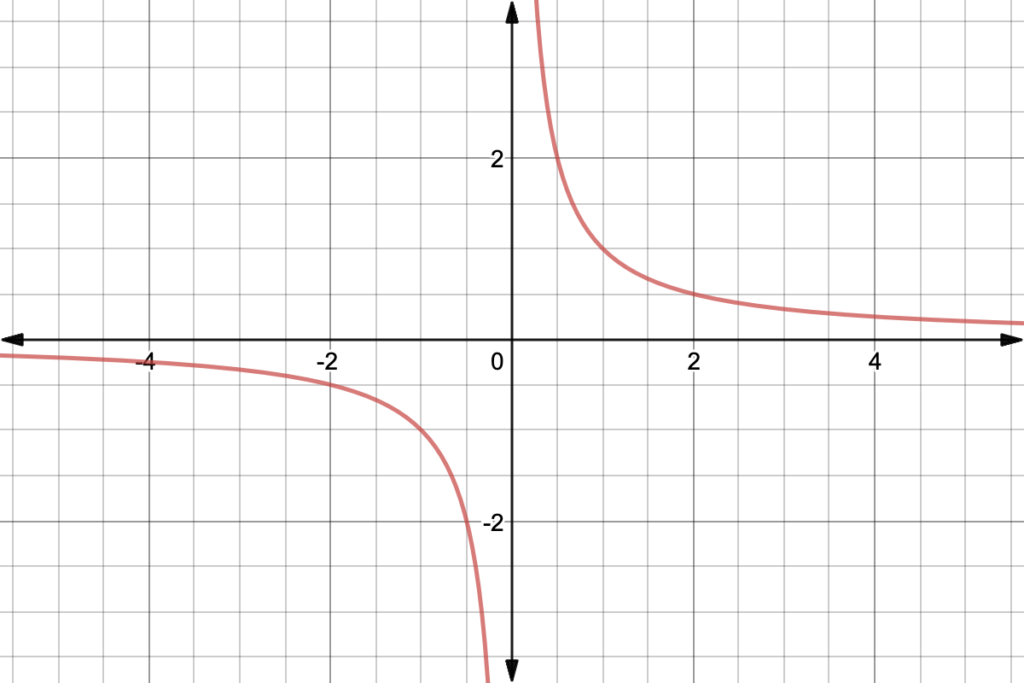
Inverse Variation Example Graph 

Inverse Variation Graphical Representation

How to Solve Inverse Variation Problems?

Go through the simple procedure listed below to solve the Problems on Inverse Variation. They are along the lines

Step 1: First of all, check the given equation. We use the formula y = k/x to solve indirect proportions. When you are working on the word problems, consider the variables given other than x and y and also use those variables which are relevant to the problem to be solved. Check all the values carefully to determine the changes in inverse variation equations like square roots, squares, and cubes.

Step 2:  Find the complete information in the problem and find the “k” value which is found in step 2.

Step 3: Rewrite the resultant equation which is obtained in step 1. Substitute the value of k which we got in step 2.

Step 4: With the equation we got in step 3 and also with the help of the remaining information in the question, we find the final solution in this step. While solving the word problems, include the units in the final answer.

How to Identify Inverse Variation?

  • We define it as yy inversely varies with xx if yy is defined as the product of a constant number kk and xx reciprocal
  • The value of kk will never be 0(zero), i.e, k≠0
  • kk is defined as the fixed or the constant product of xx and yy which means that multiplying both the values of xx and yy always gives the constant output of kk.

Inverse Variation Word Problems

Problem 1:

The number of hours constructing a deep well is inversely proportional to the number of men working doing it. It takes 10 hours for 2 men to construct. How many men are needed to complete the work in 4 hours?

Solution:

Let y be the number of men working

Let x be the number of hours

In the first case,

y = 10, x = 2

As we know the equation of inverse proportion,

yx = k

Substituting the values in the equation,

(10)(2) = k

k = 20

Therefore, the value of k = 20

In the second case,

y = ?, x = 4

As we already got the k value i.e., 20

Substitute the values in the above equation,

yx = k

(y)(4) = 20

4y = 20

y = 20/4

y = 5

Therefore, no of men required to finish the work in 4 hours = 5 men

Hence, the final solution is 5 men

Problem 2:

When riding a bus at 55km/hr average speed, it takes Marcel 3 hours to reach his destination. How long will it take him if he travels by van at 70 km/hr?

Solution:

Let y be the average speed

Let x be the number of hours

In the first case,

y = 55, x = 3

As we know the equation of inverse proportion,

yx = k

Substituting the values in the equation,

(55)(3) = k

k = 165

Therefore, the value of k is 165

In the second case,

y = 70, x = ?

As we already got the k value i.e., 165

Substitute the values in the above equation,

yx = k

70x = 165

x = 165/70

x = 2.36

Therefore, it takes 2.36 hours for him to travel by van at 70 km/hr

Thus, the final solution is 2.36 hours

Problem 3:

A group of 10 men decided to rent a house for $100 for the stay of one week. But two people of them got sick and couldn’t join them. How much would each man pay for the rent?

Solution:

Let no of men = y

Let payment of each man = x

In the first case,

y = 10

x = 10

As we know the equation of inverse proportion,

yx = k

Substituting the values in the equation,

(10)(10) = k

k = 100

Therefore, the value of k is 100

In the second case,

As 2 men dropped to join the rent, we get the value as

y = 10-2

y = 8

x =?

As we already got the k value i.e., 100

Substitute the values in the above equation,

yx = k

(8)(x) = 100

x = 100/8

x = 2.5

Therefore, each man would pay $2.5 for the rent.

Thus, the final solution is $2.5

Problem 4:

Clark on his first drive traveled from home to his destination or 6 hours with an average speed of 60 km/hr. What must be his average speed if he wants to get there within 5 hours?

Solution:

Let y be the no of hours

Let x be average speed

In the first case,

y = 6, x = 60

As we know the equation of inverse proportion,

yx = k

Substituting the values in the equation,

(6)(60) = k

k =360

In the second case,

y = 5, x = ?

As we already got the k value i.e., 360

Substitute the values in the above equation,

yx = k

(5)(x) = 360

x = 360/5

x = 72 km/hr

Therefore, he must maintain an average speed of 72km/hr to get there within 5 hours

Problem 5:

Three fishermen decided to contribute individually to purchase a boat worth $1500. They decided to let other fishermen join them so they can lower their payments. How many fishermen will they need so that each one will pay $300?

Solution:

Let y be the no of fishermen

Let x be the amount to be paid by each fisherman

In the first case,

y = 3, x = 1500/3 = 500

As we know the equation of inverse proportion,

yx = k

Substituting the values in the equation,

(3)(500) = k

k = 1500

Therefore, the value of k = 1500

In the second case,

y = ?, x = 300

As we already got the k value i.e., 1500

Substitute the values in the above equation,

yx = k

(y)(300) = 1500

y = 1500/300

y = 5

Therefore, they need 5 fishermen that each one will pay $300

Problem 6:

The volume of a gas t constant temperature varies inversely as the pressure. The volume of the gas is 75 milliliters when the pressure is 1.5 atmospheres. Find the volume of the gas when the pressure is increased to 2.5 atmospheres?

Solution:

Let the volume of gas be V

Let the pressure be P

As we know the equation,

V = k/P

75 = k/1.5

112.5 = k

The value of k is 112.5

Substitute the value of k in the above equation

V = 112.5/P

V = 112.5/2.5

V = 45 milliliters

Therefore, the volume of the gas is 45 milliliters when the pressure is increased to 2.5 atmospheres

Problem 7:

The bases of triangles having equal areas are inversely proportional to their altitudes. The base of a certain triangle is 24 cm and its altitude is 30 cm. Find the base of the triangle whose altitude is 40 cm?

Solution:

Let b be the bases of the triangle

Let a be the altitudes of the triangle

As we know the equation of inverse proportion

b = k/a

(24) = k/(30)

(30)(24) = k

k = 720

Therefore, the value of k is 720

Substitute the value of k and a in the equation,

b = 720/40

b = 18 cm

Therefore, the base of the triangle is 18 cm

Thus the final solution is 18 cm

Problem 8:

The number of hours required to do a job varies inversely as the number of people working together. If it takes 8 hours or 5 people to paint a house how long will it take 12 people to paint the house?

Solution:

Let h be the number of hours

Let p be the number of people

As we know the equation of inverse proportion

h = k/p

(8) = k/(5)

(5)(8) = k

k = 40

Substitute the value of k and p in the above equation

h = 40/12

h = 10/3

h ≡ 3.33 hours

Therefore, it takes 3.33 hours for 12 people to paint the house.

Sin Theta Equals 0 General Solution | How do you Solve Sin Theta = 0?

Sin Theta Equals 0

Sin Theta Equals 0 properties is here. Check Sine Definition in terms of Sin 0 value. Know the various Sine degrees and radians along with the formulae, tricks, and tips. Follow sin θ equals zero examples, frequently asked questions, steps to solve trigonometric equations, analysis of the solution, etc. Get the steps to solve trigonometric problems, formulae, examples, solutions, etc.

Do Read:

Sin 0 Definition

In trigonometric equations, there are 3 primary functions which are sine, cosine, and tangent. These functions are used to calculate the length and angles of the right-angled triangles. The sine function is something that defines the relationship between the hypotenuse side and the angle of the perpendicular side (or) sin θ is defined as the ratio of the hypotenuse and the perpendicular of the right-angled triangle.

Sin θ Formula

If we have to calculate the degree of sin 0 value, then find the coordinates points on the x and y plane. Sin 0 defines the x value where coordinates are 1 and the y coordinates value is 0, which is (x,y) = (1,0) which means that the value of the perpendicular or opposite side is 0 and the hypotenuse value is 1. Therefore, to place the sin ratio values for where θ=00 hypotenuse is 0 and perpendicular side is 1

Sin 0° = 0

or

Sin 0° =0/1

The relations of various trigonometric functions are

sin(θ) = Opposite/Hypotenues

tan(θ) = Opposite/Adjacent

cos(θ) = Adjacent/Hypotenues

From the above-written equations, sin 0 degrees value. Now have a look at radians or degree values for each revolution in the given table.

Sine Radians / DegreesSin Values
Sin (0°)0
Sin (30°) or Sin (Π/6)1/2
Sin (45°) or Sin (Π/4)1/√2
Sin (60°) or Sin (Π/3)3/√2
Sin (90°) or Sin (Π/2)1
Sin (180°) or Sin (Π)0
Sin (270°) or Sin (3Π/2)-1
Sin (360°) or Sin (2Π)0

As mentioned in the above table, we can determine the values of tan values

Tan(θ) = Sin(θ)/Cos(θ)

Hence,

Tan(0°)=Sin(0°)/Cos(0°) = 0

Tan(30°)=Sin(30°)/Cos(30°) = 3/√2

Tan(450)=Sin(45°)/Cos(45°) = 1

Tan(60°)=Sin(60°)/Cos(60°) = √3

Tan(90°)=Sin(90°)/Cos(90°) = Undefined

2Π is the period for both cosine and sine function. To find all the possible solutions, add 2Πk, where k is an integer to the initial solution. The period of the function is 2Π which states all the possible solutions for the given function.

The equation with the period 2Π for the function is

sinθ = sin(θ ± 2kπ)

For other trigonometric functions also, the possible solutions are indicated by the same rules. To solve the trigonometric equations, we must follow the same techniques that we use for the algebraic equations. We read and write a trigonometric equation from left to right, in the same way as we read the sentence. To make the straightforward process, we must look for the factors, patterns, find the common denominators, the substitution of certain expressions with the variable.

How to solve a Trigonometric Equation?

  • First of all, check for the pattern which helps you in minimizing the equation. Mostly the pattern will be of algebraic properties like factoring or a squares opportunity.
  • Now, use the single variable and substitute it in the trigonometric equation in such a way that u or x.
  • Follow the same pattern of the algebraic equation to solve trigonometric expressions.
  • Then, substitute the trigonometric expression in the resultant expression by using the variable.
  • Finally, solve the equation to find the angle of the equation.

Table of Trigonometric Ratios for Various Angles

Angles (In Degrees)30°45°60°90°180°270°360°
Angles (In Radians)π/6π/4π/3π/2π3π/2
sin01/21/√2√3/210-10
cos1√3/21/√21/20-101
tan01/√31√300
cot√311/√300
cosec2√2√2/31-1
sec1√2/3√22-11

Table of Trigonometric Ratios for Various Radians

Angle30°45°60°90°180°270°360°
Radian0Π/6Π/4Π/3Π/2Π3Π/2

Applications of Trigonometry

  • Trigonometric equations help us to find the missing sides and angles of the triangle.
  • These equations are mostly used by builders to measure the distance and height of the building from the viewpoint.
  • It is used by the students to solve trigonometry-based problems.

Problems on Sin Theta Equals 0

Problem 1:

If √3 sinθ- cosθ = 0 and 0 < θ < 90°, find the value of θ?

Solution:

As given in the question,

The equation is √3 sinθ- cosθ = 0

√3 sin θ = cos θ

sin θ = cos θ * 1/√3

sin θ / cos θ = 1/√3

tan θ = Tan 30

θ = 30°

Therefore, the value of θ is 30º

Problem 2:

If secθ.sinθ = 0, then find the value of θ?

Solution:

As given in the question,

The equation is secθ.sinθ = 0

As we know that sec θ = 1/cos θ

The equation will be

1/cos θ . sin θ = 0

tan θ = 0

tan θ = tan 45°

θ = 45°

Problem 3:

Find the values of θ in [0°,360) so that y/r = sin θ = 1/2?

Hint: Take y=1,r=2

Solution:

As given in the question,

y/r = sin θ = 1/2

r = 2, y = 1

From the given values, we use the hypotenuse theorem

Hence, we have to find the values of x

i.e., x = √3

Therefore, θ = 30°

As the side of the triangle is not mentioned, there is also another chance where the x can be negative

Hence, if the value of x is negative, then x = -√3

Therefore, θ = 150º

Thus, the values of θ in (0°,360) are 30° and 150°

Pre School & Kindergarten Math Curriculum, Worksheets, Activities, Problems, Fun Games

Kindergarten Math

The best way to make young kids love math is to make it exciting for them. Preschool Kindergarten Math Topics designed feature images and quirky Characters. You will have the topics from addition to subtraction, sorting and identifying coins, counting, tracing, coloring, etc. Our Kindergarten Math Topics listed here assist young learners with building fundamental math skills.

Some kids will have a strong grasp of numbers and they are ready to dive right into addition and subtraction. Regardless of your child’s early math concepts, our Kindergarten Math Worksheets provided by subject experts are the perfect supplement to your classroom instruction. In fact, our Kindergarten Math Activities are designed in a way that your kids will love practicing math as a fun activity rather than feeling it difficult.

Preschool Kindergarten Math Topics, Textbook Solutions

There are numerous opportunities to engage your kid and help them learn the Kindergarten Math Concepts without even their knowledge. Through our Kindergarten Math Pages, one can sharpen their early math skills. Simply tap on the quick links available and practice the concepts at your convenience. Kindergarten Math Worksheets make it easy for you to test knowledge on related areas in no time and you can download them for free of cost.

  • Number Rhymes
  • Matching the Objects
  • Numbers and Counting up to 10
  • Number the Pictures
  • Numbers up to 10
  • Numbers 1 to 10
  • Count and Write Numbers
  • Count the Numbers and Match
  • Numbers and their Names
  • Numbers and Counting up to 20
  • Learn About Counting
  • Counting Eleven to Twenty with Numbers and Words
  • Counting Numbers from Twenty One to Thirty
  • Counting Numbers from Thirty One to Forty
  • Geometric Shapes
  • Geometric Objects
  • Time
  • Tell The Time
  • Worksheet on Time
  • Addition
  • Addition on a Number Line
  • Worksheet on Addition I
  • Worksheet on Addition II
  • Odd Man Out
  • Sequence
  • Ordinal Numbers
  • Worksheet on Ordinal Numbers
  • Addition Worksheets
  • Subtraction Worksheets
  • Counting Numbers Practice Test
  • Worksheets on Counting Numbers
  • Worksheet on Counting Numbers 6 to 10
  • What is addition?
  • Worksheet on Kindergarten Addition
  • Kindergarten Addition up to 5
  • Worksheets on Kindergarten Addition up to 5
  • Addition Facts
  • What is zero?
  • Order of Numbers.
  • Worksheets on Addition
  • Before and After Counting Worksheet up to 10
  • Worksheets on Counting Before and After
  • Before, After, and Between Numbers Worksheet up to 10
  • Worksheet on Before, After, and Between Numbers
  • Counting Before, After, and Between Numbers up to 10
  • The Story about Seasons
  • Color by Number Worksheets
  • Worksheet on Joining Numbers

Free Printable Kindergarten Math Worksheets

Practice tracing the numbers from 21 to 30

  • Worksheet on Number 21
  • Worksheet on Number 22
  • Worksheet on Number 23
  • Worksheet on Number 24
  • Worksheet on Number 25
  • Worksheet on Number 26
  • Worksheet on Number 27
  • Worksheet on Number 28
  • Worksheet on Number 29
  • Worksheet on Number 30

Practice tracing the numbers from 31 to 40

  • Worksheet on Number 31
  • Worksheet on Number 32
  • Worksheet on Number 33
  • Worksheet on Number 34
  • Worksheet on Number 35
  • Worksheet on Number 36
  • Worksheet on Number 37
  • Worksheet on Number 38
  • Worksheet on Number 39
  • Worksheet on Number 40

Practice tracing the numbers from 41 to 50

  • Worksheet on Number 41
  • Worksheet on Number 42
  • Worksheet on Number 43
  • Worksheet on Number 44
  • Worksheet on Number 45
  • Worksheet on Number 46
  • Worksheet on Number 47
  • Worksheet on Number 48
  • Worksheet on Number 49
  • Worksheet on Number 50

Missing Number Worksheets

  • Missing Numbers up to 10
  • Worksheets on Missing Numbers from 1 to 10
  • Worksheets on Missing Numbers from 1 to 20
  • Worksheets on Missing Numbers from 15 to 25
  • Worksheets on Missing Numbers from 1 to 25
  • Worksheet on Before, After, and Between Numbers up to 20
  • Worksheet on Before, After, and Between Numbers up to 50

Kindergarten Math Curriculum Goals & Objectives

The goal of the Kindergarten Math Curriculum is to prepare kids for the 1st Grade Math.

  • Count Numbers up to 20 and a little beyond.
  • Concept of Equality
  • Count Backwards from 10 to 0.
  • Recognize Numbers and Able to Write Them.
  • Recognize Basic Shapes.
  • To be able to learn the Fundamentals of Basic Directions
  • To be able understand the Addition and Subtraction with Smaller Numbers
  • Exposes kids to Two-Digit Numbers.

Benefits of referring to Kindergarten Math Concepts

There are several advantages of referring to the Pre School Kindergarten Math Topics and we have outlined some of them here. They are as follows

  • Brain Development in Kids is rapid at young age and learning from these Kindergarten Math Topics helps them to develop inherent problem-solving skills.
  • You can learn arithmetic operations with ease and can be strong in premath.
  • Kids can explore the outside world around them in their own way.
  • Pre School Math Activities Provided acts as a visual treat for kids and inspires them to learn math skills in a fun and engaging way.
  • All the Kindergarten Games, Assessments, Math Activities provided are as per the latest Kindergarten Curriculum and are prepared by subject experts.

Final Words

We wish the knowledge shared has helped your kids learn math right from an early age. If you have any suggestions or feel any topic is missing do leave us your suggestions so that we can look into them. For more updates on Gradewise Math Worksheets, Practice Problems, Lessons stay tuned to our site.

Profit and Loss – Basic Concepts, Definition, Formulas, Tricks, and Examples

Concept of Profit and Loss

The concept of Profit and Loss is very helpful in our real-time. In mathematics, we can estimate the growth of a business using its price, profit, and loss. Every product and everything has its cost price and selling price. Depending on these prices, we can estimate the profit gained or the loss incurred for a particular item. Mainly, in the Concept of Profit and Loss, we discuss the cost price, variable, fixed, and semi-variable cost, marked price, selling price, list price, margin, etc. Also, check out the profit and loss percentage formula for a better understanding.

Let us consider a shop owner selling a product. If the value of the selling price is more than the cost price of a commodity, then it is a profit and if the cost price is more than the selling price, it becomes a loss.

Also, Check:

Basic Concepts of Profit and Loss

  • Check out the basic terms and concepts included in the Profit and Loss below.
  • Profit (P): If the selling price of a product is more than its cost price, then the profit occurs for that product.
  • Loss (L): If the selling price of a product is less than its cost price, then the loss occurs for that product.
  • Cost Price (CP): The amount paid to purchase the product is known as Cost Price. It is denoted by CP. Also, the cost price classified into two different categories. They are
    –> Fixed Cost: The fixed cost is constant and it doesn’t vary under any circumstances.
    –> Variable Cost: It could change depending on the number of units.
  • Selling Price (SP): The amount of a product that can be sold is known as the Selling Price. It is denoted by SP. In some situations, the Selling Price is also called the sale price.
  • Marked Price Formula (MP): The shopkeepers use Marked Price to offer a discount to the customers. The formula for Marked Price is
    –> Discount = Marked Price – Selling Price
    –> And Discount Percentage = (Discount/Marked price) x 100

Profit and Loss Formulas

Let us discuss the Profit and Loss Formulas. The profit or gain is equal to the selling price minus the cost price. Also, the Loss is equal to the cost price minus the selling price.

  • Profit or Gain = Selling price – Cost Price
  • Loss = Cost Price – Selling Price

The formula for the profit and loss percentage is:

  • Profit percentage = (Profit /Cost Price) x 100
  • Loss percentage = (Loss / Cost price) x 100

Important Note:
(i) In case of profit, selling price > cost price and in case of loss, selling price< cost price.
(ii) profit or loss is usually calculated on the cost price.
(iii) The percentage value for profit and loss is calculated in terms of cost price.

Profit and Loss Examples

  • If a shopkeeper brings a shirt for Rs.120 and sells it for Rs.140, then he has made a profit of Rs.20/-.
  • If a salesperson has bought a washing machine for Rs.5000 and he has to sell it for Rs.4500/-, then he has gone through a loss of Rs.500/-.
  • Suppose, Sam brings a Chess Board for Rs. 300/- and she sells it to her friend for Rs. 400/-, then Sam has made a profit of Rs.100 with a gain percentage of 20%.

Profit and Loss Tricks

Simple tricks of profit and loss make your learning easy. Along with profit and loss, remember these tricks and use them in your real life for better learning.

  1. Profit, P = SP – CP; SP>CP
  2. Loss, L = CP – SP; CP>SP
  3. SP = {(100 + P%)/100} x CP
  4. SP = {(100 – L%)/100} x CP
  5. CP = {100/(100 + P%)} x SP
  6. CP = {100/(100 – L%)} x SP
  7. P% = (P/CP) x 100
  8. L% = (L/CP) x 100
  9. Discount = MP – SP
  10. SP = MP -Discount
  11. For false weight, profit percentage will be P% = (True weight – false weight/ false weight) x 100.
  12. When you have two successful profits say x% and y%, then the net percentage profit equals (x + y + xy)/100
  13. When the profit is x% and loss is y%, then the net % profit or loss will be: (x – y – xy)/100
  14. If a product is sold at x% profit and then again sold at y% profit then the actual cost price of the product will be: CP = [100 x 100 x P/(100 + x)(100 + y)]. In case of loss, CP = [100 x 100 x P/(100 – x)(100 – y)]
  15. If P% and L% are equal then, P = L and %loss = P2/100

Profit and Loss Problems with Solutions

Example 1.

Suppose a shopkeeper has bought 2 kg of apples for 200 rs. And sold it for Rs. 240 per kg. How much is the profit gained by him?

Solution:
Given that a shopkeeper has bought 2 kg of apples for 200 rs. And sold it for Rs. 240 per kg.
The Cost Price for apples is 200 rs.
The Selling Price for apples is 240 rs.
Then profit gained by shopkeeper is ; P = SP – CP
Substitute the Cost Price and Selling Price in the above formula.
P = SP – CP
P = 240 – 200 = Rs/- 40.

Example 2.

For the above example calculate the percentage of the profit gained by the shopkeeper.

Solution:
We know, Profit percentage = (Profit /Cost Price) x 100
Therefore, Profit percentage = (40/200) x 100 = 20%.

Example 3.

A man buys a cooler for Rs. 2000 and sells it at a loss of 30%. What is the selling price of the cooler?

Solution:
Given that a man buys a cooler for Rs. 2000 and sells it at a loss of 30%.
The Cost Price of the fan is Rs.2000
Loss percentage is 30%
As we know, Loss percentage = (Loss/Cost Price) x 100
Substitute the Loss and Cost Price in the above formula.
30 = (Loss/2000) x 100
Therefore, Loss = 600 rs.
As we know, Loss = Cost Price – Selling Price
So, Selling Price = Cost Price – Loss
Substitute the Loss and Cost Price in the above formula.
Selling Price = 2000 – 600
Selling Price = Rs.1400/-

Therefore, the selling price of the cooler is Rs.1400/-

Example 4.

If a pencil costs Rs.40 after a 10% discount, then what is the actual price or marked price of the pencil?

Solution:
Given that a pencil costs Rs.40 and a 10% discount.
To find out the marked price, substitute the given values in its formula.
MP x (100 – 10) /100 = 40
MP x (90/100) = 40
MP = (40 x 100)/90
MP = Rs. 44.44/-

Therefore, the actual price or marked price of the pencil is Rs. 44.44/-

Different Types of Algebraic Expressions – Definitions, Formula, Examples

Types of Algebraic Expressions

Algebraic expressions are the expressions that have variables, constants, and arithmetic operators. Mainly, we have three different types of algebraic expressions. Get to know more about those algebraic expression types in the following sections. You can check what is meant by an algebraic expression, definitions of various algebraic expressions, examples, and worked out problems in this article.

Algebraic Expression Definition

An algebraic expression is a mathematical term that contains variables, constants along with mathematical operators like addition, subtraction, division, and multiplication. The example of an algebraic expression is 5x + 20y – 9. The different parts of an algebraic expression are variable, coefficient, operator, and constant. The definitions of these different parts of an algebraic expression are:

  • Constant: It is a term whose value remains unchanged throughout the expression.
  • Variable: It is an alphabetic letter whose value is unknown. It can take any value based on the situation.
  • Coefficient: It is a numerical value added before the variable to modify the variable value.
  • Operator: Mathematical operators are used in algebraic expressions to perform some math calculations on two or more expressions.

Types of Algebraic Expressions

The algebraic expressions are further divided into 5 different types. Let us discuss each of these types in the following sections.

1. Monomial Algebraic Expression

2. Polynomial Algebraic Expression

3. Binomial Algebraic Expression

4. Trinomial Algebraic Expression

5. Multinomial Algebraic Expression

Also, Read:

Monomial Algebraic Expression

An algebraic expression that has only one non-zero term is known as the monomial.

Examples of monomials:

7a³b² is a monomial in two variables a, b

\(\frac { 2ax }{ 3y } \) is a monomial in three variables a, x and y.

x² is a monomial in one variable x.

2y is a monomial in one variable y.

Polynomial Algebraic Expression

An algebraic expression that has one, two, or more terms is known as the polynomial.

Examples of Polynomials:

3x + 4y is a polynomial in two variables x, y

4x² – 3xy + 6y² + 80 is a polynomial in two variables x, y

m + 5mn – 7mn² + nm² + 9 is a polynomial in two variables m, n

a³b + 4b²c + 6ab + 2ca + 5bc is a polynomial in three variables a, b, c

Binomial Algebraic Expression

An algebraic expression that has two non-zero terms is known as the binomial.

Examples of binomials:

5x + 6y³ is a binomial in two variables x, y

a + b is a binomial in two variables a, b

p – q² is a binomial in two variables p, q

m²n + 6 is a binomial in two variables m, n

Trinomial Algebraic Expression

An expression that has three non-zero terms is known as trinomial.

Examples of Trinomial:

p + q + r is a trinomial in three variables p, q, r

\(\frac { x² }{ 3 } \) + ay – 6bz is a trinomial in three variables x, y, z

xy + x + 2y2 is a trinomial in two variables x and y.

Multinomial Algebraic Expression

An algebraic expression that has two or more than three terms is known as the multinomial.

Examples of Multinomial:

w + x – y + 2z is a multinomial in four variables w, x, y, z.

a + ab + b + bc + cd is a multinomial of five terms in four variables a, b, c, and d.

5x⁸ + 3x⁷ + 2x⁶ + 5x⁵ – 2x⁴ – x³ + 7x² – x is a multinomial of eight terms in one variable x.

Formulas

The general algebraic formulas we use to solve the expressions or equations are:

  • (a + b)² = a² + 2ab + b²
  • (a – b)² = a² – 2ab + b²
  • a2 – b² = (a – b)(a + b)
  • (a + b)³ = a³ + b³ + 3ab(a + b)
  • (a – b)³ = a³ – b³ – 3ab(a – b)
  • a³ – b³ = (a – b)(a² + ab + b²)
  • a³ + b³ = (a + b)(a² – ab + b²)

Algebraic Expressions Questions

Question 1:

Add algebraic expressions 3x + 5y – 6z and x – 4y + 2z.

Solution:

The given algebraic expressions are 3x + 5y – 6z and x – 4y + 2z

While adding two or more algebraic expressions, add the like terms together.

3x + 5y – 6z + x – 4y + 2z = (3x + x) + (5y – 4y) + (2z – 6z)

= 4x + y – 4z

Therefore, the sum is 4x + y – 4z

Question 2:

Subtract the algebraic expressions 3x² – 6x – 4 from x + 5 – 2x²

Solution:

The given algebraic expressions are 3x² – 6x – 4, x + 5 – 2x²

While subtracting two or more algebraic expressions, perform the operation only between the like terms.

x + 5 – 2x² – (3x² – 6x – 4) = x + 5 – 2x² – 3x² + 6x + 4

= (x + 6x) + 5 + 4 – (2x² + 3x²)

= 7x + 9 – 5x²

Therefore, x + 5 – 2x² – (3x² – 6x – 4) = 7x + 9 – 5x²

Question 3:

Simplify the algebraic expression by combining the like terms

4(2x+1) – 3x – 2

Solution:

The given algebraic expression is 4(2x+1) – 3x – 2

Remove the braces

4(2x+1) – 3x – 2 = 8x + 4 – 3x – 2

= (8x – 3x) + 4 – 2

= 5x + 2

Therefore, 4(2x+1) – 3x – 2 = 5x + 2

Question 4:

Reduce the algebraic expression to its lowest term

\(\frac { (x² – y²)}{ (x + y) } \)

Solution:

The given algebraic expression is \(\frac { (x² – y²)}{ (x + y) } \)

We see that the numerator and denominator of the given algebraic fraction is polynomial, which can be factorized.

(x² – y²) = (x + y)(x – y)

\(\frac { (x² – y²)}{ (x + y) } \) = \(\frac { (x + y)(x – y)}{ (x + y) } \)

Cancel te like term (x + y)

= (x – y)

Therefore, \(\frac { (x² – y²)}{ (x + y) } \) = x – y.

FAQs on Types of Algebraic Expressions

1. What are the types of algebraic expressions?

The five different types of algebraic expressions are monomial, binomial, trinomial, multinomial, and polynomial.

2. What are the rules for algebraic expressions?

The basic rules are to combine the like terms, constants for addition or subtraction. Remove any grouping symbols like paranthesis, brackets by multiplying factors. Use the exponential rule to remove grouping.

3. Write examples of algebraic expressions?

The examples of algebraic expression is x + 2y + 1, x² + 5xy + y³ + 9, x⁴y + 4x³y² + 16xy.

4. How to derive algebraic expressions?

An algebraic expression is a combination of constants, variables and algebraic operations (+, -, ×, ÷). We can derive the algebraic expression for a given situation or condition by using these combinations.

Division of a Decimal by a Decimal | Steps on How to Divide Decimals?

Division of a Decimal by a Decimal

Looking for any help to divide a decimal by a decimal number? Then stay on this page. Here we are giving solved example questions on how to divide two decimal numbers. Interested students can read this complete page to know more details about the topic. Not only the easy procedure Division of a Decimal by a Decimal but also you can check the definition of decimal numbers in the further sections.

Also, Read

What are Decimals?

A decimal number is a number that has a whole number part and fractional part separated by a dot called a decimal point. The value of digits following the decimal point should be less than the value of 1. Some of the decimal numbers are 45.9, 708.3, etc.

How to Divide a Decimal by a Decimal?

Get the detailed steps on Dividing Decimal by a Decimal Number in the following sections. Follow these steps as it is to get the product easily and quickly.

  • Take any two decimal numbers one as dividend and the other as the divisor.
  • In general, dividend value should be more when compared to divisor value.
  • Remove dot from the decimal numbers.
  • Divide those two numbers.
  • Place the decimal dot in the quotient.

Decimal Division Problems with Answers

Example 1:

Solve 15.5 ÷ 0.5 by eliminating the decimal places.

Solution:

The given divisor is 0.5 and the dividend is 15.5

Count the number of decimal digits in the divisor and we observe that after decimal there is 1 number so we divide the number by 10.

15.5 ÷ 0.5 = \(\frac { 155 }{ 10 } \) ÷ \(\frac { 5 }{ 10 } \)

= \(\frac { 155 }{ 10 } \) x \(\frac { 10 }{ 5 } \) [reverse it to multiplication]

= \(\frac { 155 x 10 }{ 5 x 10 } \)

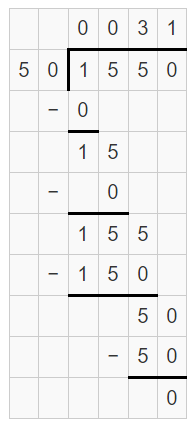
= \(\frac { 1550 }{ 50 } \)

Now divide the numbers as usual.

Dividing Decimal by a Decimal Number 1

Therefore, 15.5 ÷ 0.5 = 31

Example 2:

Solve 1.296 ÷ 0.108.

Solution:

The given divisor = 0.108, dividend = 1.296

Count the number of decimal digits in the divisor and we observe that after decimal there are 3 numbers so we divide the number by 1000

1.296 ÷ 0.108 = \(\frac { 1296 }{ 1000 } \) ÷ \(\frac { 108 }{ 1000 } \)

= \(\frac { 1296 }{ 1000 } \)  x \(\frac { 1000 }{ 108 } \) [reverse it to multiplication]

= \(\frac { 1296 x 1000 }{ 1000 x 108 } \)

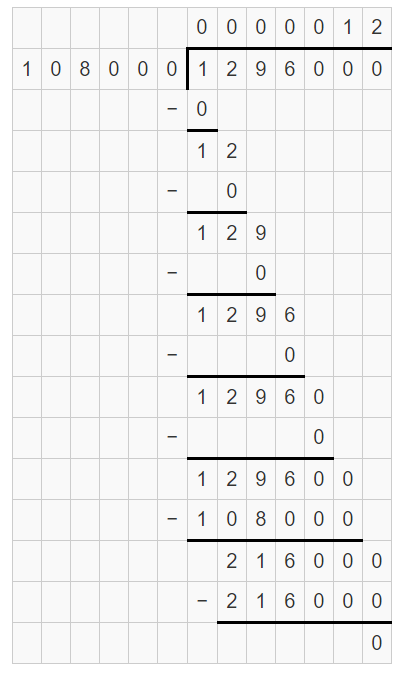
= \(\frac { 1296000 }{ 108000 } \)

Now divide the numbers as usual.

Dividing Decimal by a Decimal Number 2

Therefore, 1.296 ÷ 0.108 = 12

Example 3:

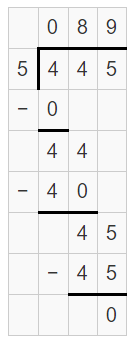
Solve 0.445 ÷ 0.05.

Solution:

The given divisor = 0.05, dividend = 0.445

Count the number of decimal digits in the divisor.

Move the decimal in a dividend that many places to the right.

So, 0.445 ÷ 0.05 = 44.5 ÷ 5

Write the divisor without the decimal. And add the decimal point to the quotient.

Dividing Decimal by a Decimal Number 3

Therefore, 0.445 ÷ 0.05 = 8.9.

Example 4:

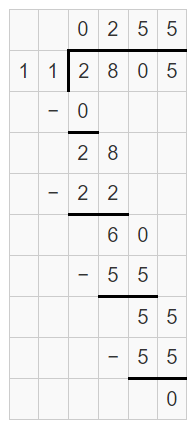
Solve 2.805 ÷ 0.11.

Solution:

The given divisor = 0.11, dividend = 2.805

Count the number of decimal digits in the divisor.

Move the decimal in a dividend that many places to the right.

So, 2.805 ÷ 0.11 = 280.5 ÷ 11

Write the divisor without the decimal. And add the decimal point to the quotient.

Dividing Decimal by a Decimal Number 4

So, 2.805 ÷ 0.11 = 25.5.

FAQs on Division of a Decimal by a Decimal

1. How do you divide a decimal number by a decimal?

To divide two decimal numbers, move the decimal point in the divisor and dividend. The number we divide by is called the divisor and the number which divides is called the dividend. After removing the decimal point in the divisor, divide like normal. And add the decimal point to the obtained quotient.

2. How do you divide decimals without a calculator?

To divide the decimal by a decimal number without a calculator, follow the simple steps mentioned here.

3. What are the steps for dividing decimals?

Eliminate the decimal point in the divisor by moving the point to the left side. Just remove the decimal point in the dividend and divide those numbers as usual. And then add a decimal point to the quotient.

Worksheet on LCM | Least Common Multiples Worksheet | LCM Problems with Answers

Worksheet on LCM

Worksheet on LCM is given here. Students can get the important questions on the least common multiples on this page. Along with the problems, you can also see the solutions, steps to solve all types of LCM questions. Check out the detailed explanation on solving the L.C.M of numbers, monomials, and polynomials in the following sections. By solving all the questions of Worksheet on Least Common Multiples, you can prepare well for the exams.

You can find the lowest common multiple of numbers by finding the common prime factors, prime factorization method, division method, listing multiples, and others. Practice the problems as much as possible to clear the exam.

Also, Read: Common Factors

What is L.C.M?

The least common multiple of two integers a, b is denoted as lcm(a, b), which means the smallest positive integer that is divisible by both a and b. As the division of integers by zero is undefined, the definition has meaning only if a and b are both different from zero. The lcm is the lowest common denominator (LCD) that can be used before adding, subtracting, or comparing the fractions. The L.C.M of two or more integers can be the smallest positive integer that is divisible by all of them.

Problem 1:

Find the L.C.M of the following integers by listing their multiples.

(i) 10, 15, 35

(ii) 6, 42, 54

(iii) 16, 24, 48

Solution:

(i) The given three integers are 10, 15, 35

The process of listing multiples is

10 = 2 x 5

15 = 3 x 5

35 = 7 x 5

L.C.M = 2 x 3 x 7 x 5

= 210

Therefore, the least common multiple of 10, 15, 35 is 210.

(ii) The given three integers are 6, 42, 54

The process of listing multiples is

6 = 2 x 3

42 = 2 x 3 x 7

54 = 2 x 3 x 3 x 3

L.C.M = 2 x 3 x 3 x 3 x 7

= 378

Therefore, the least common multiple of 6, 42, 54 is 378.

(iii) The given three integers are 16, 24, 48

The process of listing multiples is

16 = 2 x 2 x 2 x 2

24 = 2 x 2 x 2 x 3

48 = 2 x 2 x 2 x 2 x 3

L.C.M = 2 x 2 x 2 x 2 x 3

= 48.

Therefore, the least common multiple of 16, 24, 48 is 48.


Problem 2:

Find the first 3 common multiples of the given using a number line.

(i) 2 and 3

(ii) 3 and 4

(iii) 9 and 12

Solution:

(i) The given numbers are 2 and 3

Multiples of 2 are 2, 4, 6, 8, 10, 12, 16, 18, 20, 22, 24, 26, 28, 30, . . .

Multiples of 3 are 3, 6, 9, 12, 15, 18, 21, 24, 27, 30, . .

The first three common multiples of 2 and 3 are 6, 12, 18.

(ii) The given numbers are 3 and 4

Multiples of 3 are 3, 6, 9, 12, 15, 18, 21, 24, 27, 30, 33, 36, 39, 42, 45, 48, . . . . .

Multiples of 4 are 4, 8, 12, 16, 20, 24, 28, 32, 36, 40, 44, 48, . . . .

The first three common multiples of 3 and 4 are 12, 24, 36.

(iii) The given numbers are 9 and 12

Multiples of 9 are 9, 18, 27, 36, 45, 54, 63, 72, 81, 90, 99, 108, . . .

Multiples of 12 are 12, 24, 36, 48, 60, 72, 84, 96, 108, 120, . . . .

The first three common multiples of 9 and 12 are 36, 72, 108.


Problem 3:

Find the Lowest Common Multiple of the following by finding common prime factors.

(i) 2, 8, 10

(ii) 56, 72

(iii) 25, 30, 150

Solution:

(i) The given three integers are 2, 8, 10

Using common prime factors to get the L.C.M

2 = 2 x 1

8 = 2 x 2 x 2

10 = 2 x 5

The common factor is 2. The remaining factors are 2, 2, and 5.

So, the L.C.M = 2 x 2 x 2 x 5

= 40

Therefore, the LCM of 2, 8, 10 is 40.

(ii) The given two integers are 56, 72

Using common prime factors to get the L.C.M

56 = 2 x 2 x 2 x 7

72 = 2 x 2 x 2 x 3 x 3

The common factors are 2, 2, 2 and other factors are 7, 3, 3

So, the Least common multiple = 2 x 2 x 2 x 7 x 3 x 3

= 504

Therefore, the lowest common multiple of 56 and 72 is 504.

(iii) The given three integers are 25, 30, 150

Using common prime factors to get the L.C.M

25 = 5 x 5

30 = 5 x 2 x 3

150 = 2 x 3 x 5 x 5

The common factor is 5, remaining factors are 2, 3, 5

So, the LCM = 5 x 2 x 3 x 5

= 150

Therefore, the least common multiple of 25, 30, 150 is 150.


Problem 4:

Find the L.C.M. of the given numbers by division method.

(i) 70, 110, 150

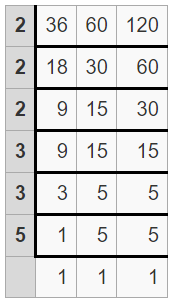
(ii) 36, 60, 120

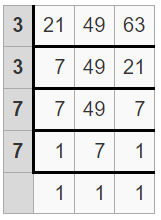
(iii) 21, 49, 63

Solution:

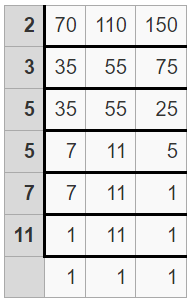
(i) The given three integers are 70, 110, 150

To find the L.C.M of three numbers using the long division method, divide the numbers by the least prime number until you left nothing common.

Worksheet on LCM 1

Find the product of prime numbers in the first column to get the LCM

LCM = 2 x 3 x 5 x 5 x 7 x 11

= 11,550

Therefore, LCM(70, 110, 150) = 11,550.

(ii) The given three integers are 36, 60, 120

Divide your numbers by prime numbers as long as at least one of your numbers is evenly divisible by a prime number.

Worksheet on LCM 2

Find the product of prime numbers in the first column to get the LCM

So, LCM = 2 x 2 x 2 x 3 x 3 x 5

= 360

Therefore, LCM of 36, 60, 120 is 360.

(iii) The given three integers are 21, 49, 63

Divide your numbers by prime numbers as long as at least one of your numbers is evenly divisible by a prime number.

Worksheet on LCM 3

Find the product of prime numbers in the first column to get the LCM

So, least common multiple = 3 x 3 x 7 x 7

= 441

Therefore, the LCM of 21, 49, 63 si 441.


Problem 5:

Find the LCM of the given numbers by the prime factorization method.

(i) 10, 15 and 45

(ii) 36, 27 and 18

(iii) 18, 54, 72

Solution:

(i) The given three integers are 10, 15 and 45

We use prime factorization to solve LCM

Prime factorization of 10 is 2 x 5 = 2¹ x 5¹

Prime factorization of 15 is 3 x 5 = 3¹ x 5¹

Prime factorization of 45 is 3 x 3 x 5 = 3² x 5¹

For each prime factor, find where it occurs most often as a factor and write it that many times in a new list.

The new list is 2, 3, 3, 5

Multiply these factors together to find the LCM.

LCM = 2 x 3 x 3 x 5

= 90

In exponential form: LCM = 2¹ x 3² x 5¹ = 90

Therefore, the LCM of 10, 15, and 45 is 90

(ii) The given three integers are 36, 27 and 18

We use prime factorization to find the lowest common multiple

Prime factorization of 36 = 2 x 2 x 3 x 3 = 2² x 3²

Prime factorization of 27 = 3 x 3 x 3 = 3³

Prime factorization of 18 = 2 x 3 x 3 = 2¹ x 3²

For each prime factor, find where it occurs most often as a factor and write it that many times in a new list.

The new list is 2, 2, 3, 3, 3

Multiply these factors together to find the LCM.

LCM = 2 x 2 x 3 x 3 x 3

= 108

In exponential form: LCM = 2² x 3³ = 108

Therefore, the LCM of 36, 27, and 18 is 108

(iii) The given three integers are 18, 54, 72

We use prime factorization to solve LCM

Prime factorization of 18 = 2 x 3 x 3= 2¹ x 3²

Prime factorization of 54 = 2 x 3 x 3 x 3 = 2¹ x 3³

Prime factorization of 72 = 2 x 2 x 2 x 3 x 3 = 2³ x 3²

For each prime factor, find where it occurs most often as a factor and write it that many times in a new list.

The new list is 2, 2, 2, 3, 3, 3

Multiply these factors together to find the LCM.

LCM = 2 x 2 x 2 x 3 x 3 x 3

= 216

In exponential form: LCM = 2³ x 3³ = 216

Therefore, the LCM of 18, 54, 72 is 216.


Problem 6:

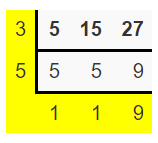
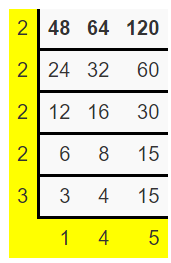
Calculate the LCM of integers using the Cake/Ladder method.

(i) 5, 27, 15

(ii) 48, 64 and 120

(iii) 12 and 20

Solution:

(i) The given three integers are 5, 27, 15

Divide your numbers by prime numbers as long as at least two numbers are evenly divisible by that prime.

Worksheet on LCM 4

The LCM is the product of the numbers in the L shape.

Least common multiple = 3 x 5 x 9

= 135

Therefore, the lowest common multiple of 5, 27, 15 is 135.

(ii) The given three integers are 48, 64, and 120

Divide your numbers by prime numbers as long as at least two numbers are evenly divisible by that prime.

Worksheet on LCM 5

The LCM is the product of the numbers in the L shape

So, LCM = 2 x 2 x 2 x 2 x 3 x 4 x 5

= 960

Therefore, the lowest common multiple of 48, 64, and 120 is 960.

(iii) The given two integers are 12 and 20

Divide your numbers by prime numbers as long as at least two numbers are evenly divisible by that prime.

Worksheet on LCM 6

The LCM is the product of the numbers in the L shape

So, LCM = 2 x 2 x 3 x 5

= 60

Therefore, the lowest common multiple of 12, 20 is 60.


Problem 7:

Calculate the least common multiple of numbers using the G.C.F method.

(i) 49, 14, 70

(ii) 84, 90

(iii) 10, 25, 60

Solution:

(i) The given integers are 49, 14, 70

LCM(14, 49, 70) = LCM( LCM(14, 49), 70 )

L.C.M (14, 49) = \(\frac { 14 x 49 }{ G.C.F(14, 49) } \)

= \(\frac { 686 }{ 7 } \)

= 98

LCM( LCM(14, 49), 70 ) = LCM(98, 70)

= \(\frac { 98 x 70 }{ G.C.F(98, 70) } \)

= \(\frac { 6860 }{ 14 } \)

= 490

Therefore, LCM(14, 49, 70) = 490

(ii) The given integers are 84, 90

LCM of 84, 90 = \(\frac { 84 x 90 }{ G.C.F(84, 90) } \)

= \(\frac { 7560 }{ 6 } \)

= 1260

Therefore, LCM(84, 90) = 1260.

(iii) The given numbers are 10, 25, 60

LCM(10, 25, 60) = LCM( LCM(10, 25), 60 )

LCM(10, 25) = \(\frac { 10 x 25 }{ G.C.F(10, 25) } \)

= \(\frac { 250 }{ 5 } \)

= 50

LCM(10, 25, 60) = LCM(50, 60) = \(\frac { 50 x 60 }{ G.C.F(50, 60) } \)

= \(\frac { 3000 }{ 10 } \)

= 300

Therefore, LCM(10, 25, 60) = 300.


Problem 8:

Find the lowest number which is less by 2 to be divided by 56 and 98 exactly.

Solution:

Given that,

A number is less by 2 to be divided by 56 and 98 exactly

Let us take the lowest number as x

x is less by 2 to be divided by 56 and 98 exactly

So, x + 2 divided by 56 and 98 exactly

x + 2 is LCM of 56, 98

56 = 2 x 2 x 2 x 7

98 = 2 x 7 x 7

LCM = 2 x 2 x 2 x 7 x 7

= 392

So, x + 2 = 392

x = 392 – 2

x = 390

Therefore, the lowest number which is less by 2 to be divided by 56 and 98 exactly is 390


Problem 9:

The H.C.F. two numbers are 6 and their L.C.M. is 36. If one of the numbers is 18, find the other number.

Solution:

Given that,

H.C.F. two numbers = 6

L.C.M. of two numbers = 36

One number = 18

Let us consider the second number is y

x * y = LCM x HCF

18 x y = 36 x 6

18y = 216

y = \(\frac { 216 }{ 18 } \)

y = 12

Therefore, the other number is 12.


Problem 10:

The product of two numbers is 144. If the L.C.M. of these numbers is 12, find their H.C.F.

Solution:

Given that,

Product of two numbers = 144

LCM of two numbers = 12

Let us take two numbers as a, b

Then a x b = HCF x LCM

144 = HCF x 12

HCF = \(\frac { 144 }{ 12 } \)

= 12

Therefore, the highest common factor is 12.


Problem 11:

Find the LCm of monomials 4mn, 10n

Solution:

Numeral coefficients = 4 , 10

4 = 2 x 2, 10 = 2 x 5

LCM of numeral coefficients = 2 x 2 x 5 = 20

Literal coefficients = mn, n

L.C.M of mn, n = mn

Therefore, LCM(4mn, 10n) = 20mn


Problem 12:

Find the LCM of polynomials x² – 5², (x + 5)²

Solution:

First polynomial = x² – 2²

= (x – 5) (x + 5)

Second polynomial = (x + 5)²

= (x + 5) (x + 5)

In both the polynomials, the common factors are (x + 5), the extra common factor of the first polynomial (x – 5), the second polynomial is (x + 5).

Therefore, required the least common multiple = (x + 5) (x + 5) (x – 5).


13 Times Table Multiplication Chart | How to Read and Write Multiplication Table of 13?

13 Times Table Multiplication Chart

Students do you want to know that the number 13 is a prime number or not? Also, learn more about the 13 Times Table Multiplication Chart from this article. Here, you will find various options to understand, learn and remember the multiplication table of thirteen. So, read this complete page and gather the useful information that helps to learn the Math Tables from 0 to 25. These tables are mandatory at the time of prime classes. Hence have a look at the tips and tricks to memorize the 13 Times Table and the solved example questions.

Multiplication Table of 13 | Table of Thirteen

In the below sections, we have provided the 13 Times Table Multiplication Chart both in the image and tabular format. Students can download it from here and prepare offline too whenever they need it. By downloading Multiplication Table of 13 you can revise it regularly and remember it easily. You can get it free of cost from our site which is useful to make your math calculations quickly.

13 times table 1

13 Times Multiplication Table up to 25

It is very easy to learn the Thirteen Times Table Multiplication Chart. Just we need to add 13 to the first multiple and get the next multiple. It is a process of repeated addition where 13 x 0 = 0 and then add 13 to get the next multiple results. So, go through the table and learn the writing the Multiplication Table of 13 up to 25 whole numbers. Also, you will find the section to learn how to read 13 times Multiplication Table on this page.

13x0=0
13x1=13
13x2=26
13x3=39
13x4=52
13x5=65
13x6=78
13x7=91
13x8=104
13x9=117
13x10=130
13x11=143
13x12=156
13x13=169
13x14=182
13x15=195
13x16=208
13x17=221
13x18=234
13x19=247
13x20=260
13x21=273
13x22=286
13x23=299
13x24=312
13x25=325

How to Read Thirteen Times Table

Zero time thirteen is 0

One time thirteen is 13

Two times thirteen is 26

Three times thirteen is 39

Four times thirteen is 52

Five times thirteen is 65

Six times thirteen is 78

Seven times thirteen is 91

Eight times thirteen is 104

Nine times thirteen is 117

Ten times thirteen is 130.

Get More Multiplication Tables

0 Times Table Multiplication Chart1 Times Table Multiplication Chart2 Times Table Multiplication Chart
3 Times Table Multiplication Chart4 Times Table Multiplication Chart5 Times Table Multiplication Chart
6 Times Table Multiplication Chart7 Times Table Multiplication Chart8 Times Table Multiplication Chart
9 Times Table Multiplication Chart10 Times Table Multiplication Chart11 Times Table Multiplication Chart
12 Times Table Multiplication Chart14 Times Table Multiplication Chart15 Times Table Multiplication Chart
16 Times Table Multiplication Chart17 Times Table Multiplication Chart18 Times Table Multiplication Chart
19 Times Table Multiplication Chart20 Times Table Multiplication Chart21 Times Table Multiplication Chart
22 Times Table Multiplication Chart23 Times Table Multiplication Chart24 Times Table Multiplication Chart
25 Times Table Multiplication Chart

Why One Should Read 13 Times Table Multiplication Chart?

Learning 13 times Multiplication table is very important and it has several advantages for solving mathematical problems. There are many aspects of mathematics that require multiplication tables to spend less amount of time.

  • Math Tables saves your time while doing arithmetical operations like multiplications, divisions, and reducing fractions, finding LCM, GCF, etc
  • In this way, learning tables are helpful to solve math problems easily and quickly.
  • 13 Times Table makes you perfect in performing the quick calculations.

Tips & Tricks to Remember 13th Table

We have 2 simple techniques to remember and memorize the Multiplication table of 13. So, interested students must check out these tips to learn the table quickly.

  • To memorize the 13 Times Table Multiplication Chart, first, you need to remember the 3rd Table. The multiples of three are 3, 6, 9, 12, 15, 18, . . .
  • And then add natural numbers to the ten’s digit of the 3 multiples. The obtaines 13 multiples are (1 + 0)3 = 13, (2 + 0)6 = 26, (3 + 0)9 = 39, (4 + 1)2 = 52, (5 + 1)5 = 65, (6 + 1)8 = 78, (7 + 2)1 = 91, (8 + 2)4 = 104, (9 + 2)7 = 117, (10 + 3)0 = 130, (11 + 3)3 = 143, . .
  • Thirteen does not have any rules that make the multiplication table easier to memorize. Them here is a structure for every 10 multiples of 13. They are 13, 26, 39, 52, 65, 78, 91, 104, 117, 130. In all these multiples, the last digit i.e units place digit is repeating. So, one can remember this logic to memorize the table.

Solved Examples on 13 Times Multiplication Table

Example 1:

Calculate the value of 3 plus 13 times of 7 minus 4, using the 13 Times Table.

Solution:

Given, calculate the value using 13 Times Table

First, we have to write down the given statement plus 13 times of 7 minus 4

Now, solving the above expression by using 13 Times Table Multiplication Chart,

3 plus 13 times 7 minus 4 = 3 + 13 x 7 – 4

= 3 + 91 – 4

= 3 + 87

= 90

Therefore, the value of 3 plus 13 times 7 minus is 90.

Example 2:

Check using the table of 13 whether 8 times 13 minus 4 is 100?

Solution:

Given, calculate the value using 13 Times Table

First, we have to write down the given statement 8 times 13 minus 4

8 times 13 minus 4 = 8 x 13 – 4

= 104 – 4

= 100

Therefore, the given statement is true.

Example 3:

Use the 13 times table multiplication chart, and evaluate the value of 6 plus 13 times 5 minus 9.

Solution:

Given, calculate the value using 13 Times Table

First, we have to write down the given statement 6 plus 13 times 5 minus 9

6 plus 13 times 5 minus 9 = 6 + 13 x 5 – 9

= 6 + 65 – 9

= 6 + 56

= 62

Therefore, 6 plus 13 times 5 minus 9 is 62.

Example 4:

Using the Multiplication Table of 13, evaluate 13 times 15 plus 25 minus 4.

Solution:

Given, calculate the value using 13 Times Table

First, we have to write down the given statement 13 times 15 plus 25 minus 4

Now, solving the above expression by using 13 Times Table

13 times 15 plus 25 minus 4 = 13 x 15 + 25 – 4

= 195 + 25 – 4

= 195 + 21

= 216

Therefore, 13 times 15 plus 25 minus 4 is 216.

BODMAS/PEMDAS Rules – Involving Decimals | Order of Operations with Decimals Questions and Answers

BODMAS PEMDAS Rules Involving Decimals

We can easily simplify the arithmetic expression which involves decimals by using the BODMAS Rules or PEMDAS Rules. Some children will get confused while simplifying an arithmetic expression but by using the BODMAS rule, they can simply solve the expressions. Check out the Order of Operations and solved examples of BODMAS Rules Involving Decimals in this article. We have clearly given questions and answers along with the explanations for your best practice.

Also, Check:

Order of Operations Involving Decimals Questions and Answers

Example 1.

First priority for Bracket terms: Solve inside the Brackets/parenthesis before Of, Multiply, Divide, Add or Subtract.
For example 1.2 + (1.5 – 2.3).

Solution:

The given expression is 1.2 + (1.5 – 2.3).
1.2 + (1.5 – 2.3) = 1.2 + (- 0.8) (subtraction of bracket term).
= 1.2 – 0.8.
= 0.4.
Finally, 1.2 + (1. 5 – 2. 3) is equal to 0.4.

Example 2.

Order terms are second priority: Then, solve Of part (Exponent, Powers, Roots, etc.,) before Multiply, Divide, Add or Subtract.
For example 0.2 X (1.2 + 1.4) + (0.2)^2.
Solution:

The given expression is 0.2 X (1.2 + 1.4) + (0.2)^2.
0.2 X (1.2 + 1.4) + (0.2)^2 = 0.2 X 2.6 + (0.2)^2 ( bracket terms addition first).
= 0.2 X 2.6 + 0.04 (order term (0.2)^2 = 0.04).
= 0.52 + 0.04 (multiplication 0.2 X 2.6 = 0.52).
= 0.56 (addition 0.52 + 0.04 = 0.56).
Therefore, 0.2 X (1.2 + 1.4) + (0.2)^2 is equal to 0.56.

Example 3.

Division and Multiplication: Then, calculate Multiply or Divide before Add or Subtract start from left to right.
For example 1.4 + 1.6 ÷ 0.2 X 0.2.
Solution:

The given expression is1.4 + 1.6 ÷ 0.2 X 0.2.
1.4 + 1.6 ÷ 0.2 X 0.2 = 1.4 + 8 X 0.2 (division 1.6 ÷ 0.2 = 8).
= 1.4 + 0.4 (multiplication 8 X 0.2 = 0.4).
= 1.8 (addition 1.4 + 0.4 = 1.8).
Therefore, 1.4 + 1.6 ÷ 0.2 X 0.2 is equal to 1.8.

Example 4.

Addition and Subtraction: At last Add or Subtract start from left to right.
For example 1.5 + (3.2 – 1.6) + 0.1.
Solution:

The given expression is 1.5 + (3.2 – 1.6) + 0.1.
1.5 + (3.2 – 1.6) + 0.1 = 1.5 + 1.6 + 0.1 (subtraction of bracket terms 3.2 – 1.6 = 1.6).
= 3.2 (addition 1.5 + 1.6 + 0.1 = 3.2).
Therefore, 1.5 + (3.2 – 1.6) + 0.1 is equal to 3.2.

BODMAS Rules Involving Decimals Questions and Answers

Problem 1.

Simplify the below expressions by using the BODMAS rules.
(i) 0.4 + 0.8 ÷ 0.2 + 0.2 X 0.4.
(ii) 0.2 X 0.5(1.2 + 2.1) + 2.5.
(iii) 0.6 – 0.2 X 1.2 + 1.6.
(iv) 1.2 + [2.5 + (2.6 – 1.6) – 2.4)] – 3.2.
(v) 0.8 + 1.2 X 0.5 + 1.2.

Solution:

(i) 0.4 + 0.8 ÷ 0.2 + 0.2 X 0.4.
Solution:
The given expression is 0.4 + 0.8 ÷ 0.2 + 0.2 X 0.4.
0.4 + 0.8 ÷ 0.2 + 0.2 X 0.4 = 0.4 + 4 + 0.2 X 0.4 (division 0.8 ÷ 0.2 = 4).
= 0.4 + 4 + 0.08 (multiplication 0.2 X 0.4 = 0.08).
= 4.48.
By using the BODMAS Rule, 0.4 + 0.8 ÷ 0.2 + 0.2 X 0.4 is equal to 4.48.

(ii) 0.2 X 0.5(1.2 + 2.1) + 2.5.
Solution:
The given expression is 0.2 X 0.5(1.2 + 2.1) + 2.5.
0.2 X 0.5(1.2 + 2.1) + 2.5 = 0.2 X 0.5(3.3) + 2.5 (addition 1.2 + 2.1 = 3.3).
= 0.2 X 0.5 X 3.3 + 2.5
= 0.33 + 2.5 (multiplication 0.2 X 0.5 X 3.3 = 0.33).
= 2.83 (addition 0.33 + 2.5 = 4.83).
By using the BODMAS rule, the given expression 0.2 X 0.5(1.2 + 2.1) + 2.5 is simplified as 2.83.

(iii) 0.6 – 0.2 X 1.2 + 1.6.
Solution:
The given expression is0.6 – 0.2 X 1.2 + 1.6.
0.6 – 0.2 X 1.2 + 1.6 = 0.6 – 0.24 + 1.6 (multiplication 0.2 X 1.2 = 0.24).
= 2.2 – 0.24 (addition 0.6 + 1.6 = 2.2).
= 1.96 (subtraction 2.2 – 0.24 = 1.96).
Finally, by using the BODMAS rule, the given expression 0.6 – 0.2 X 1.2 + 1.6 is simplified as 1.96.

(iv) 1.2 + [2.5 + (2.6 – 1.6) – 2.4)] – 3.2.
Solution:
The given expression is 1.2 + [2.5 + (2.6 – 1.6) – 2.4)] – 3.2.
1.2 + [2.5 + (2.6 – 1.6) – 2.4)] – 3.2 = 1.2 + [2.5 + (1.0) – 2.4)] – 3.2 (subtraction in brackets 2.6 – 1.6 = 1.0).
1.2 + [2.5 + (2.6 – 1.6) – 2.4)] – 3.2 = 1.2 + [3.5 – 2.4] – 3.2 (addition 2.5 + 1.0 = 3.5).
1.2 + [2.5 + (2.6 – 1.6) – 2.4)] – 3.2 = 1.2 + 1.1 – 3.2 (subtraction 3.5 – 2.4 = 1.1).
1.2 + [2.5 + (2.6 – 1.6) – 2.4)] – 3.2 = 2.3 – 3.2 (addition 1.2 + 1.1 = 2.3).
= – 0.9 (subtraction 2.3 – 3.2 = – 0.9).
By using the BODMAS rule, the given expression 1.2 + [2.5 + (2.6 – 1.6) – 2.4)] – 3.2 is simplified as – 0.9.

(v) 0.8 + 1.2 X 0.5 + 1.2.
Solution:
The given expression is 0.8 + 1.2 X 0.5 + 1.2.
0.8 + 1.2 X 0.5 + 1.2 = 0.8 + 0.6 + 1.2 (multiplication first 1.2 X 0.5 = 0.6).
= 2.6 (addition 0.8 + 0.6 + 1.2 = 1.4 + 1.2 = 2.6).
By using the BODMAS rule, 0.8 + 1.2 X 0.5 + 1.2 is simplified as 2.6.

BODMAS Rules – Involving Integers | Simplification of Expressions Involving Integers | Order of Operations in Mathematics

BODMAS Rules Involving Integers

For the simplification of involving integers in an arithmetic expression, we have to follow the BODMAS Rules. It is the basic order for mathematic operations. In BODMAS every letter indicates one operation and we have to place it in a specific order to simplify any arithmetic operation easily.

B stands for Bracket, O stands for order or of, D stands for Division, M stands for Multiplication, A stands for Addition and S stands for Subtraction. We have to follow the above priority levels for every arithmetic operation simplification process which involves integers.

Read More:

BODMAS Rules Involving Integers Questions

Example 1.

Solve the below expressions by using BODMAS Rule
(i) 6 × (10 + 5).
(ii) 2 + 5 of 3 – 6.
(iii) 10 ÷ 2 × 3 + 6.
(iv) 15 + (6 × 3) – 20 ÷ 5.

(i) 6 × (10 + 5).
Solution:

The given expression is 6 × (10 + 5).
As per the BODMAS rule, simplify the bracket terms first and then multiplication.
6 × (10 + 5) = 6 × 15.
= 90.
Therefore, 6 X (10 + 5)is equal to 90.
(ii) 2 + 5 of 3 – 6.
Solution: The given expression is 2 + 5 of 3 – 6.
As per the BODMAS rules, we have to simplify the ‘of’ term first and then addition and subtraction terms.
2 + 5 of 3 – 6 = 2 + 5 × 3 – 6.
= 2 + 15 – 6.
= 17 – 6.
= 11.
So, by simplifying the 2 + 5 of 3 – 6 is equal to 11.
(iii) 10 ÷ 2 × 3 + 6.
Solution: The given expression is 10 ÷ 2 × 3 + 6.
As per the BODMAS Rule, we have to simplify division terms first then multiplication and addition.
10 ÷ 2 × 3 + 6 = 5 × 3 + 6.
= 15 + 6.
= 21.
Therefore, by simplifying the 10 ÷ 2 × 3 + 6 is equal to 21.
(iv) 15 + (6 × 3) – 20 ÷ 5.
Solution: The given expression is 15 + (6 × 3) – 20 ÷ 5.
As per the BODMAS rule, we have to simplify the bracket terms first, then division, addition, and subtraction.
15 + (6 × 3) – 20 ÷ 5 = 15 + 18 – 20 ÷ 5.
= 15 + 18 – 4.
= 33 – 4.
= 29.
So, by simplifying the 15 + (6 × 3) – 20 ÷ 5, we will get the result as 29.

Example 2.

Simplify the below expressions by using the BODMAS rule.
(a) 15 – 24 ÷ 6 + 10 × 2.
(b) 39 – [10 + 6 of (20 – 2 + 10)].
(c) 25 – 8 of (15 – 10) + 2 × 5.
(d) 30 × 2 + 2 of (10 ÷ 2) – 10.

(a) 15 – 24 ÷ 6 + 10 × 2.
Solution:

The given expression is 15 – 24 ÷ 6 + 10 × 2.
Based on the BODMAS Rule.
15 – 24 ÷ 6 + 10 × 2 = 15 – 4 + 10 × 2 (Division first 24 ÷ 6 = 4).
= 15 – 4 + 20 (multiplication term 10 × 2 = 20).
= 35 – 4 (addition 15 + 20 = 35).
= 31 (subtraction 35 – 4 = 31).
Therefore, by simplifying the 15 – 24 ÷ 6 + 10 × 2, we will get the result as 31.
(b) 39 – [10 + 6 of (20 – 2 + 10)].
Solution: The given expression is 39 – [10 + 6 of (20 – 2 + 10)].
Based on the BODMAS Rule,
39 – [10 + 6 of (20 – 2 + 10)] = 39 – [10 + 6 of (30 – 2)] (addition term in brackets 10 + 20 =30).
= 39 – [10 + 6 of (28)] (subtraction 30 – 2= 28).
= 39 – [10 + 6 × 28].
= 39 – [10 + 168] (multiplication 6 x 28 = 168).
= 39 – 178 (addition 10 + 168 = 178).
= – 139 ( subtraction).
By simplifying the 39 – [10 + 6 of (20 – 2 + 10)], we will get the result as -139.
(c) 25 – 8 of (15 – 10) + 2 × 5.
Solution: The given expression is 25 – 8 of (15 – 10) + 2 × 5.
Based on the BODMAS rule,
25 – 8 of (15 – 10) + 2 × 5 = 25 – 8 of (5) + 2 × 5 (bracket term subtraction 15 – 10 = 5).
= 25 – 8 × 5 + 2 × 5.
= 25 – 40 + 10 (multiplication 8 × 5 = 40, 2 × 5 = 10).
= 35 – 40 (addition 25 + 10 = 35).
= – 5 (subtraction 35 – 40 = -5).
Therefore, 25 – 8 of (15 – 10) + 2 × 5 is equal to – 5.
(d) 30 × 2 + 2 of (10 ÷ 2) – 10.
Solution: The given expression is 30 × 2 + 2 of (10 ÷ 2) – 10.
Based on the BODMAS Rule,
30 × 2 + 2 of (10 ÷ 2) – 10 = 30 × 2 + 2 of (5) – 10 (division 10 ÷ 2 = 5).
= 30 × 2 + 2 × 5 – 10.
= 60 + 10 – 10 (multiplication 30 × 2 = 60, 2 × 5 = 10).
= 70 -10 (addition 60 + 10 = 70).
= 60 (subtraction 70 – 10 = 60).
Therefore, 30 × 2 + 2 of (10 ÷ 2) – 10 is equal to 60.