Decimal Places – Definition, Facts, Examples | How to Learn to Count Decimal Places?

Decimal Places

A Decimal Number consists of a whole number part and a fractional part separated by a decimal point. If you wish to learn completely about Decimal Places and How to Learn to Count Decimal Places. Know about Decimal Place Value Chart Definition, Facts, Solved Examples in the further modules. We are sure you will be familiar with the Decimal Places by the end of this article.

What is meant by Decimal Places?

A Decimal Number consists of both whole number part and decimal number part. The digits right to the decimal point are called the Decimal Part and the digits left to the decimal point are called the whole number part. The Number of Digits present in the decimal part of the given decimal number is known as Decimal Places.

Decimal Place Value

Based on the position of the digit in the number it has a value named place value. For Example, the Place Value of the digit 2 in 1234.45 is 200 as 2 is in the hundreds place. However, if you interchange the digits 3 and 2 we get a new number i.e. 1324.45. In 1324.45 the place value of a digit is 20 as it is in the tens place.

How to Learn to Count Decimal Places?

The number of digits present in the decimal part of the given decimal number is nothing but the Decimal Places. Check out the below-listed examples to understand how to read and count the decimal places for the given decimal number.

For Example:

Decimal Number 5.34 has 2 decimal places.

Decimal Number 0.376 has 3 decimal places.

The Number 86.261 has 3 decimal places.

The Number 912.67 has 2 decimal places.

To better understand the Decimal Numbers you need to be aware of the Place Value.

For Example Decimal Number 51.048053 Place Value is explained clearly below.
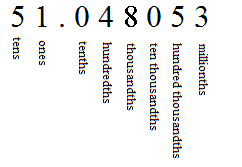
Decimal Place Value Example

In the above-illustrated example, 51 is the whole number part and 048053 is the decimal or fractional part.

Whole Number Part

Place of 1 is Ones and its place value is 1

Place of 5 is Tens and its place value is 50

Decimal Number Part

Place of 0 is Tenths and its place value is 0*\(\frac { 1 }{ 10 } \) = 0

Place of 4 is hundredths and its place value is 4*\(\frac { 1 }{ 100 } \) = \(\frac { 4 }{ 100 } \) = 0.04

Place of 8 is Thousandths and its place value is 8*\(\frac { 1 }{ 1000 } \) = \(\frac { 8 }{ 1000 } \) = 0.008

Place of 0 is Ten Thousandths and its place value is 0*\(\frac { 1 }{ 10,000 } \) = 0

Place of 5 is Hundred Thousandths and its place value is 5*\(\frac { 1 }{ 100,000 } \) = \(\frac { 5 }{ 100,000 } \) = 0.00005

Place of 3 is Millionths and its place value is 3*\(\frac { 1 }{ 1000000 } \) = \(\frac { 3 }{ 1000000 } \) = 0.000003

= 5*10+1*1+0*10-1+4*10-2+8*10-3+0*10-4+5*10-5+3*10-6

= 51.048053

FAQs on Decimal Places

1. What are Decimal Places?

Decimal Places are nothing but the number of digits next to the decimal point or in the decimal part.

2. How do you find the Decimal Places?

Firstly, count the number of digits after the decimal point and the number itself tells the Decimal Places for a particular decimal number.

3. How many decimal places are there in the Decimal Number 32.4356?

The number of Decimal Places in the Decimal Number 32.4356 is 4.
Decimal Fractions – Definition, Facts, Operations, Examples

Decimal Fractions

Before recalling about Decimal Fraction let us learn the fundamentals of what is a fraction. A fraction is formed up of two parts namely numerator and denominator. A Decimal Fraction is a Fraction having a denominator of 10 or multiples of 10 such as 100, 1000, 10000, …., etc. This article helps you to be well versed with Decimals Fractions such as Definitions, Facts, Operations performed on Decimal Fractions, Solved Examples.

What is a Decimal Fraction?

A Decimal Fraction is a Fraction in which the denominator is a power of 10 such as 10, 100, 1000, etc. You can write Decimal Fractions with a Decimal Point instead of a Denominator. By expressing the decimal fractions using decimal point calculations of addition, subtraction, multiplication, and division will be much simpler.

Examples:

\(\frac { 13 }{ 100 } \) = 0.13

\(\frac { 54 }{ 10 } \) = 5.4

Also, See:

Operations on Decimal Fractions

Addition and Subtraction of Decimal Fractions: Given Numbers are placed under each other so that the decimal points lie in each column and below one another. Later, the numbers are added and subtracted in a regular way.

For Example:

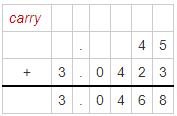
Add 0.0045 and 3.0423

Addition of Decimal Fractions

The Sum of 0.0045 and 3.0423 is 3.0468

Multiplication of Decimal Fractions: Multiply the given numbers without considering the decimal point. After that, the decimal point is marked off to obtain the decimal places that is the sum of decimal places in the given numbers.

For Example 0.3*0.03*0.003

Multiply the numbers without considering the decimal point

3*3*3 = 27

Now find the number of decimal places to be marked by adding the decimal places in the given numbers i.e. (1+2+3) = 6 i.e. 0.000027

Dividing Decimal Fraction by a Counting Number: Divide the given number without considering the decimal point by counting the number. Later, after obtaining the quotient place as many decimal places are there in the dividend. If we were to divide 0.0028÷7 we will firstly divide 28÷7 and the quotient is 4. As there are 4 decimal places in the given number place the same in quotient obtained i.e. 0.0004

Thus, 0.0028÷7 = 0.0004

Dividing Decimal Fraction by a Decimal Fraction: Multiply both the dividend and divisor with suitable powers of 10 so that you can make them as a whole number and then proceed.

Thus, \(\frac { 0.00077 }{ 0.11 } \) = \(\frac { 0.00077*100 }{ 0.11*100 } \)

= \(\frac { 0.077 }{ 11 } \)

= 0.007

Solved Examples on Decimal Fractions

1. Convert (i) 0.60 and (ii) 4.008 into vulgar fractions?

Solution:

(i) 0.60 = \(\frac { 60 }{ 100 } \) = \(\frac { 3 }{ 5 } \)

(ii) 4.008 = \(\frac { 4008 }{ 1000 } \) = \(\frac { 501 }{ 125 } \)

In order to convert decimal into vulgar fractions firstly place 1 in the denominator and annex with as many zeros as the number of digits after the decimal point in the given number. Later, remove the decimal point and note the whole number in the numerator. Reduce it to Lowest Form. Remember Annexing Zeros to the Right of Decimal Fraction doesn’t change the value.

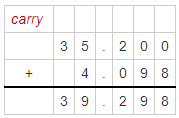
2. Add 35.2 + 4.098?

Solution:

Given Numbers are placed under each other so that the decimal point lies in one column. Numbers can be subtracted or added in a usual way.

Decimal Fractions Addition Example

3. Evaluate i) 5.3029×100

Solution:

i) 5.3029×100

To Multiply a Decimal Fraction by a Power of 10 shift the decimal point to the right as many places of decimal that is to the power of 10.

5.3029×100 = 530.29

4. Find the product

i) 2.232×0.1

Simply multiply the numbers without considering the decimal point. i.e. 2232*1= 2232

Later, count the number of decimal places in the given numbers i.e. (3+1) = 4

Now put the decimal after 4 that counts 4 digits from right thus 0.02232

5. Evaluate 0.81÷ 9?

Solution:

Divide the given number as if there is no decimal point. 81÷9 = 9

After obtaining the quotient count the number of decimal places in the given number i.e. 0.81 =2

Hence place the decimal point on the left of 0.09

Addition of Mixed Fractions – Definition, Examples | How to Add Mixed Fractions with Like and Unlike Denominators?

Addition of Mixed Fractions

Looking for ways on How to Add Mixed Fractions? If so, halt your search as we have listed all about Mixed Fractions Addition and different methods of it clearly in the later modules. Mixed Fractions are one of the types of fractions. These are also called Mixed Numbers. Go through the entire article to be well versed with the details like Adding Mixed Fractions Definition, How to Add Mixed Fractions with Same and Different Denominators, Examples, etc.

Mixed Fraction – Definition

A Mixed Fraction is a form of a fraction that has a whole number next to a fraction.

Example: 3 \(\frac { 1 }{ 5 } \) where 3 is a whole number and \(\frac { 1 }{ 5 } \) is a fraction.

How to Add Mixed Numbers?

When it comes to Adding Mixed Fractions we can have either the same or different denominators for both the fractions to be added. There are two different methods for Adding Mixed Numbers with Like, Unlike Denominators. Here is a Step by Step Procedure on How to Add Mixed Fractions. They are as such

Method 1: Adding the Whole Numbers and Fractions Separately

  • In the first step add the whole numbers separately.
  • In order to add fractions with the same denominator, simply add the numerators and keep the denominator unaltered. However, if you have different or unlike denominators take the LCM of them and change to Like Fractions.
  • Once, you have a Common Denominator adding fractions is much simpler.
  • Find the Sum of Whole Numbers and Fractions in Simplest Form.

Method 2: Convert Mixed Numbers to Improper Fractions and then Add them

  • Initially, change the given Mixed Fractions to Improper Fractions.
  • If Denominators of the Improper Fractions are the same simply add the numerators. If the Denominators of Improper Fractions are Unlike or Different take the LCM of Denominators and change them to like fractions.
  • Add Like Fractions and express the sum to its Simplest Form.

Also, Check:

Examples on Adding Mixed Fractions using Method 1

1. Add 3 \(\frac { 1 }{ 3 } \), 2 \(\frac { 1 }{ 4} \)?

Solution:

3 \(\frac { 1 }{ 3 } \)+ 2 \(\frac { 1 }{ 4} \)

Let us add the whole numbers and fraction parts separately i.e.

Whole Numbers Part 3+2 = 5

Fractions Part = \(\frac { 1 }{ 3 } \)+ \(\frac { 1 }{ 4} \)

Since the denominators of the fractions are not same find the LCM of the Denominators to make them like fractions

LCM(3,4) = 12

\(\frac { 1*4 }{ 3*4 } \) + \(\frac { 1*3 }{ 4*3} \)

= \(\frac { 4 }{ 12 } \) + \(\frac { 3 }{ 12 } \)

= \(\frac { (4+3) }{ 12 } \)

= \(\frac { 7 }{ 12 } \)

Now add the like fractions and express the sum to its simplest form

= 5 \(\frac { 7 }{ 12 } \)

Therefore, 3 \(\frac { 1 }{ 3 } \), 2 \(\frac { 1 }{ 4} \) when added gives 5 \(\frac { 7 }{ 12 } \)

2. Add 5 \(\frac { 1 }{ 4} \), 2 \(\frac { 1 }{ 5} \), \(\frac { 1 }{ 6 } \)?

Solution:

5 \(\frac { 1 }{ 4} \) + 2 \(\frac { 1 }{ 5} \) + \(\frac { 1 }{ 6 } \)

Firstly, let us add the whole numbers and fraction parts separately i.e.

Whole Numbers Part (5+2+0) = 7

Fractions Part = \(\frac { 1 }{ 4} \) + \(\frac { 1 }{ 5} \) + \(\frac { 1 }{ 6 } \)

Since the Denominators of Fractions aren’t the same find the LCM of Denominators and express them as like fractions

LCM(4, 5, 6) = 60

= \(\frac { (1*15) }{ (4*15) } \) + \(\frac { (1*12) }{ (5*12)} \) + \(\frac { (1*10) }{ (6*10) } \)

= \(\frac { 15 }{ (60) } \) + \(\frac { 12 }{ 60} \) + \(\frac { 10 }{ 60 } \)

= \(\frac { (15+12+10) }{ 60 } \)

= \(\frac { 37 }{ 60 } \)

Now add the like fractions and express the sum to its simplest form

= 7 \(\frac { 37 }{ 60 } \)

Therefore, 5 \(\frac { 1 }{ 4} \), 2 \(\frac { 1 }{ 5} \), \(\frac { 1 }{ 6 } \) when added gives 7 \(\frac { 37 }{ 60 } \)

Adding Mixed Fractions Examples using Method 2

1. Add 5 \(\frac { 1 }{ 4 } \), 3 \(\frac { 1 }{ 2 } \)?

Solution:

5 \(\frac { 1 }{ 4 } \) + 3 \(\frac { 1 }{ 2 } \)

Change the given Mixed Numbers to Improper Fractions

= \(\frac { (5*4+1) }{ 4 } \) +  \(\frac { (3*2+1) }{ 2 } \)

= \(\frac { 21 }{ 4 } \) +  \(\frac { 7 }{ 2 } \)

Since the Denominators aren’t same find the LCM and express them as Like Fractions

LCM(4,2) = 2

= \(\frac { (21*1) }{ 4*1 } \) +  \(\frac { (7*2) }{ (2*2) } \)

= \(\frac { 21 }{ 4 } \) +  \(\frac { 14 }{ 4 } \)

= \(\frac { (21+14) }{ 4 } \)

= \(\frac { 35 }{ 4 } \)

Thus, 5 \(\frac { 1 }{ 4 } \), 3 \(\frac { 1 }{ 2 } \) added results in \(\frac { 35 }{ 4 } \)

2. Add 6 \(\frac { 1 }{ 4 } \), 7 \(\frac { 1 }{ 4 } \), 3 \(\frac { 1 }{ 4 } \)?

Solution:

6 \(\frac { 1 }{ 4 } \) + 7 \(\frac { 1 }{ 4 } \) + 3 \(\frac { 1 }{ 4 } \)

Change the given Mixed Fractions to Improper Fractions

= \(\frac { (6*4+1) }{ 4 } \) +  \(\frac { (7*4+1) }{ 4 } \) + \(\frac { (3*4+1) }{ 4 } \)

= \(\frac { 25 }{ 4 } \) + \(\frac {29 }{ 4 } \) + \(\frac { 13 }{ 4 } \)

= \(\frac { (25+29+13) }{ 4 } \)

= \(\frac { 67 }{ 4 } \)

Thus, 6 \(\frac { 1 }{ 4 } \), 7 \(\frac { 1 }{ 4 } \), 3 \(\frac { 1 }{ 4 } \) results in \(\frac { 67 }{ 4 } \)

FAQs on Adding Mixed Fractions

1. What is a Mixed Fraction with Example?

A Mixed Fraction is a form of a fraction that has a whole number next to a fraction. For Example 6 \(\frac { 1 }{ 4 } \) is a Mixed Fraction where 6 is a whole number and \(\frac { 1 }{ 4 } \) is the fraction part.

2. What does a Mixed Fraction look like?

Mixed Fraction is simply an improper fraction written as the sum of a whole number and a proper fraction. For instance, improper fraction \(\frac { 5 }{ 2 } \) can be written as Mixed Fraction 2 \(\frac { 1 }{ 2 } \).

3. How to add Mixed Fractions Step by Step?

Follow the simple and easy steps listed below to add Mixed Fractions and they are as such

  • Convert the given Mixed Fractions to Improper Fractions
  • Find the LCM of Denominators and then make them like fractions.
  • Add the Like Fractions and Express the Sum to its Simplest Form.

Perimeter of Quadrilateral – Definition, Formula, Examples | How to Find the Perimeter of Quadrilateral?

Perimeter of Quadrilateral

The perimeter is the distance around a shape. A quadrilateral is a polygon that has four sides and four angles. To find the perimeter of a quadrilateral adds the measurements of four sides of it. We have given the most common types of quadrilaterals along with the perimeter of that quadrilateral. Check out the complete article and know how to find the perimeter of the quadrilateral. Some of the examples of a quadrilateral are Parallelogram, Rectangle, Square, Rhombus, and Trapezium, etc.

Also, Read:

Perimeter of Different Types of Quadrilaterals

The sum of the four angles of the quadrilateral is equal to 360°. We have different types of quadrilateral. They are

  1. Parallelogram
  2. Rectangle
  3. Square
  4. Rhombus
  5. Trapezium

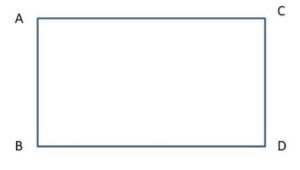
The perimeter of the Quadrilateral is the sum of the distance around the image. That means the perimeter of a quadrilateral is equal to the sum of the four sides of the image or object. That is,

Perimeter of quadrilateral. introduction.image1

(AB + BD + DC + CA) = Perimeter of the Quadrilateral.

1. Parallelogram

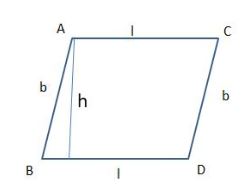
Perimeter of quadrilateral. introduction.image2

Here, the lengths of the two sides of the parallelogram are equal and the breadths of the two sides of the parallelogram are equal. Opposite sides are equal in a parallelogram.
Perimeter of the Parallelogram = (AB + BD + DC + CA)
= (b + l + b + l).
Perimeter of the Parallelogram = 2(l + b).
Here, ‘l’ represents the length and ‘b’ represents the breadth of the parallelogram.
Area of the parallelogram = Base * height.

2. Rectangle

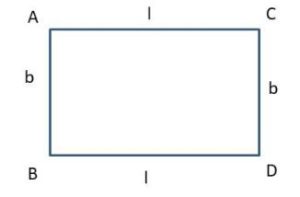
Perimeter of quadrilateral. introduction.image3

In a rectangle, both the lengths of the sides are equal and the breadths of the sides of a rectangle are equal. That means, opposite sides of the rectangle are equal.
Perimeter of the rectangle = (AB + BD + DC + CA) = (b + l + b + l) = 2(l + b).
Perimeter of the Rectangle = 2(l + b).
Area of the Rectangle = length * breadth = l *b.
Here, ‘l’ indicates the length of the rectangle and ‘b’ indicates the breadth of the rectangle.

3. Square

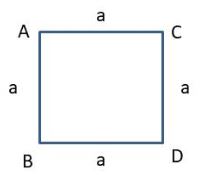
Perimeter of quadrilateral. introduction.image4

In this, a square is also enclosed with the four sides and the lengths of these four sides are equal.
Here, ‘a’ indicates the length of the sides of the square.
Perimeter of the square = (AB + BD + DC + CA) = (a + a + a + a) = 4a.
The perimeter of the square = 4a.
Area of the Square = Side * Side = a * a = a^2.

4. Rhombus

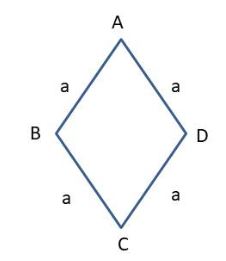
Perimeter of quadrilateral. introduction.image5

The lengths of the four sides of the rhombus are equal. Here, ‘a’ represents the length of the side.
Perimeter of the Rhombus = (AB + BC + CD + DA) = (a + a + a + a) = 4a.
The perimeter of the Rhombus = 4a.
Area of the Rhombus = (Base * height).

5. Trapezium

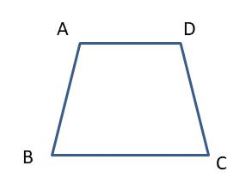
Perimeter of quadrilateral. introduction.image6

Two opposite sides of the trapezium are parallel. Perimeter of the Trapezium = (AB + BC + CD + DA).
AB + BC + CD + DA = (c + b + d + a)cm.
Area of the Trapezium = (a + b) / 2 * h.
Here, a, b, c, d are the sides of the trapezium. And ‘h’ indicates the height of the trapezium.

Perimeter of Quadrilateral Examples

1. Find the Perimeter of the Quadrilateral with the sides 2cm, 10cm, 5cm, and 20cm?

Solution:
The given information is the length of the four sides of the quadrilateral is = 2cm, 10cm, 5cm, 20cm.
The perimeter of the quadrilateral = sum of the length of the four sides of the quadrilateral.
Perimeter of the quadrilateral = (2 + 10 + 5 + 20)cm. = 37cm.

So, the perimeter of the quadrilateral is equal to 37cm.

2. The Perimeter of the quadrilateral is 40cm and the length of the three sides of the quadrilateral is 5cm, 10cm, and 5cm. Find the length of the four sides of the quadrilateral?

Solution:
The given details are the Perimeter of the quadrilateral = 40cm.
Length of the three sides of quadrilateral = 5cm, 10cm, and 5cm.
The perimeter of the quadrilateral = sum of the length of four sides of the quadrilateral.
40cm = (5 + 10 + 5 + x) cm.
40 = 20 + x.
x = 40 – 20 = 20cm.

Finally, the length of the fourth side of the quadrilateral is equal to 20cm.

3. A woman crosses a distance of 24m long while going round a quadrilateral field twice. What will be the cost of fencing the field at the rate of cost $1.20per m?

Solution:
The given information is Women crosses a distance of 24m long = perimeter of its boundary = 24 / 2 = 12m.
Cost of fencing the field for 1m = $1.20.
Then the cost of 12m of fencing the field = 12 * $1.20 = $14.4.

Therefore, the cost of the 12m fencing field is equal to $14.4.

4. One side of the square is 4cm. Find the perimeter of the square?

Solution:
As per the given information, the length of the side of the square = 4cm.
The perimeter of the square = 4a.
Here, a = 4.
By substituting the ‘a’ value in the formulae, we will get
Perimeter of the square = 4 * 4 = 16cm.

So, the perimeter of the square is equal to 16cm.

5. Length of the rectangle is 10cm and the breadth of the rectangle is 5cm. Calculate the Perimeter of the Rectangle?

Solution:
As per the given details, the Length of the rectangle (l) = 10cm.
Breadth of the rectangle (b) = 5cm.
Perimeter of the rectangle = 2(l + b).
By substituting the values in the formulae, we will get like
Perimeter of the rectangle = 2(10 + 5) = 2(15) = 30cm.

Therefore, the perimeter of the rectangle is equal to 30cm.

6. If the area of the rhombus is 20 square units and the height of the rhombus is 6 units, then calculate the base of the rhombus?

Solution:
From the given information, Area of the Rhombus = 20 Sq units.
Height of the Rhombus (h) = 6 units.
Area of the Rhombus = Base * height.
20 = Base * 6.
Base = 20 / 6 = 10 / 3 = 0.3 units.

The base of the Rhombus is equal to 0.3 units.

Frequently Asked Questions

1. What is Quadrilateral?

The quadrilateral is enclosed with four sides. It has four corners, four angles, and four sides. The total angle of the quadrilateral is equal to 360°.

2. What are the types of Quadrilateral?

The types of Quadrilateral are,
1. Square
2. Rectangle
3. Parallelogram
4. Trapezium
5. Rhombus

3. How we can find the perimeter of a quadrilateral?

The area of the quadrilateral is the sum of all sides of the quadrilateral. Yes, by adding all sides of the quadrilateral, we can find the perimeter of the quadrilateral.

Decimals – Definition, Types, Properties, Conversions, Arithmetic Operations, Examples

In Maths Numbers are Classified into Various Types like Real Numbers, Whole Numbers, Natural Numbers, Rational Numbers, etc. Decimal Numbers is a Standard form among them used to represent integers and non-integer numbers. By going through this article, you will learn all about the Definition of Decimals, Types, Properties, Conversions, Examples, etc. in the later modules.

What are Decimals?

Decimals are one type of numbers that has a whole number and fractional part separated by a  decimal point. The Dot present between the whole number part and fractional part is called the decimal point.

For instance, 23.4 is a decimal number in which 23 is a whole number and 4 is called the fractional part.

“.” is called the decimal point.

List of Decimal Concepts

Below is the list of Decimal Topics for your reference. You can access them by simply clicking on the quick links available. Once you click on them you will be redirected to a new page having the entire concept explained with examples. Try solving as much as possible to get a good grip on the concept.

  • Decimal Numbers
  • Decimal Fractions
  • Decimal Places
  • Decimal and Fractional Expansion
  • Like and Unlike Decimals
  • Conversion of Unlike Decimals to Like Decimals
  • Comparing Decimals
  • Adding Decimals
  • Subtracting Decimals
  • Simplify Decimals Involving Addition and Subtraction Decimals
  • Multiplying Decimal by a Whole Number
  • Multiplying Decimal by a Decimal Number
  • Dividing Decimal by a Whole Number
  • Dividing Decimal by a Decimal Number
  • Simplification of Decimal
  • Converting Decimals to Fractions
  • Converting Fractions to Decimals
  • Rounding Decimals
  • Rounding Decimals to the Nearest Whole Number
  • Rounding Decimals to the Nearest Tenths
  • Rounding Decimals to the Nearest Hundredths
  • Round a Decimal
  • H.C.F. and L.C.M. of Decimals
  • Terminating Decimal
  • Non-Terminating Decimal
  • Repeating or Recurring Decimal
  • Pure Recurring Decimal
  • Mixed Recurring Decimal
  • Conversion of Pure Recurring Decimal into Vulgar Fraction
  • Conversion of Mixed Recurring Decimals into Vulgar Fractions

Types of Decimal Numbers

Decimal Numbers are classified into two types namely

  • Recurring Decimal Numbers
  • Non-Recurring Decimal Numbers
  • Decimal Fraction

Recurring Decimal Numbers: These are also called Repeating or Non-Terminating Decimals. These Recurring Decimals are further classified into Finite and Infinite.

Example:

3.2525(Finite)

4.12121212……(Infinite)

Non-Recurring Decimal Numbers: These are also called Non-Repeating or Terminating Decimals. They are further classified into finite and infinite non-recurring decimal numbers.

Example:

5.2475 (Finite)

4.1367254….(Infinite)

Decimal Fraction: It Represents the fraction whose denominator is in powers of ten.

31.75 = 3175/100

22.415 = 22415/1000

In Order to Change the Decimal Number to Decimal Fraction firstly place 1 in the denominator and remove the decimal point. “1” is followed by zeros that are equal to the number of digits following the decimal point.

For Example to convert 2.345 to decimal fraction we get

22.345 = 2345/1000

2 represents the power of 101 that is the tenths position.

2 represents the power of 10that is the unit’s position.

3 represents the power of 10-1 that is the one-tenth position.

4 represents the power of 10-2 that is the one-hundredths position.

5 represents the power of 10-3 that is the one-thousandths position

This is how each digit is represented to the power of a decimal number.

Place Value in Decimals

Place Value System defines the position of a digit in a number that helps to determine its value. When we write Numbers Position of each digit is important.

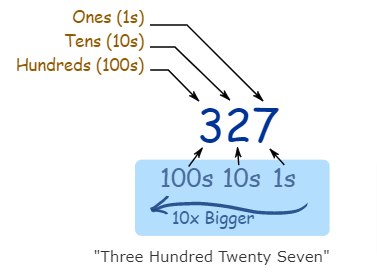
Decimal Example

The position of “7” is in One’s place, which means 7 ones (i.e. 6).
The position of “2” is in the Ten’s place, which means 2 tens (i.e. twenty).
The position of “3” is in the Hundred’s place, which means 3 hundred.
As we go left, each position becomes ten times greater.

Therefore, we read it as Three Hundred Twenty-Seven

On Moving towards the left each position becomes 10 times bigger and

Tens are 10 times bigger than ones and similarly, Hundreds are 10 times bigger than Tens.

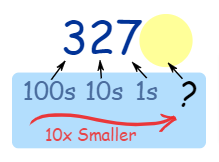
Decimal Place Value Towards Right

Moving towards the right each position becomes 10 times smaller from Hundreds to Tens to Ones. If we continue further the process after ones \(\frac { 1 }{ 10 } \)ths are smaller. Before doing so, you need to place a decimal point.

Decimal Point Example

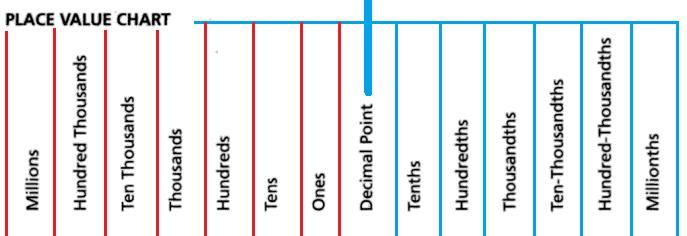
Place Value Chart

For a better understanding of the concept of place value check out the Place Value Chart below.

Place Value Chart

Digits to the left of the decimal point are multiplied with positive powers of 10 in increasing order from right to left.  In the same way, digits to the right of the decimal point are multiplied with negative powers of 10 in increasing order from left to right.

Example:

71.325

Decimal Expansion of the number is expressed as follows

{(7*10)+(1*1)} + {(3*0.1)+(2*0.01)+(5*0.001)}

Here, each number is multiplied with associated power of 10.

Decimals Properties

Below is the list of important properties of decimal numbers under both multiplication and division operations. They are as follows

  • Irrespective of the decimal numbers multiplied in any order the product remains unchanged.
  • On multiplying a whole number and decimal number in any order the product remains the same.
  • If a decimal fraction is multiplied by 1 product is the decimal fraction itself.
  • If you multiply a decimal fraction with zero the product is zero(0).
  • On dividing a decimal number with 1, the quotient is the decimal number itself.
  • If you divide a decimal number with the same number the quotient is 1.
  • If you divide 0 with any decimal the quotient becomes zero.
  • Division of a Decimal Number with 0 isn’t possible since the reciprocal of 0 doesn’t exist.

Arithmetic Operations on Decimals

Similar to performing Arithmetic Operations on Integers you can do the same with Decimals. Let us discuss important tips while performing arithmetic operations.

Addition: In Decimal Numbers Addition, line up the decimal points of given numbers and then add the numbers. If you don’t find the decimal point, the decimal is behind the number.

Subtraction: Decimal Subtraction is also similar to Decimal Addition. Just like Decimal Addition line up the decimal point of given numbers and subtract the values. To do the arithmetic operation use place holding zeros for your reference.

Multiplication: While Performing Multiplication of Decimal Numbers multiply similar to integers as if the decimal point is not present. Find the product and count the number of digits next to the decimal point in both the numbers. Count indicates how many numbers are needed after the decimal point in the product value.

Division: In Order to divide decimal numbers firstly move the digits so that the number becomes whole numbers. Perform Division Operation similar to Integers Division.

Decimal to Fraction Conversions

Conversion of Fraction to Decimal or Decimal to Fraction is quite simple. We have explained both the methods by even taking few examples. They are as follows

Decimal to Fraction Conversion

Numbers after the decimal points denotes tenths, hundredths, thousandths, and so on. While converting from decimal to fraction note down the decimal numbers in expanded form and then simplify the values.

Example 0.45

Expanded form of 0.45 is 45*(\(\frac { 1 }{ 100 } \)) = \(\frac { 45 }{ 100 } \) = \(\frac { 9 }{ 20 } \)

Fraction to Decimal Conversion

In order to change from fraction to decimal simply divide the numerator with the denominator

For example, \(\frac { 9 }{ 2 } \) is a fraction. If it’s divided, we get 4.5

Problems on Decimals

Question 1.

Convert \(\frac { 15 }{ 10 } \) to decimal?

Solution:

To change from fraction to decimal you just need to divide the numerator with the denominator

On dividing, we get the decimal value as 1.5

Question 2.

Express 3.35 in fraction form?

Solution:

The given decimal number is 3.35

The expanded form of 3.35 is

= 335 x (\(\frac { 1 }{ 100 } \))

= \(\frac { 335 }{ 100 } \)

=\(\frac { 67 }{ 20 } \)

Hence, the equivalent fraction for 3.35is \(\frac { 67 }{ 20 } \).

Correct to One Decimal Place – Definition, Rules, Examples | How to Round to One Decimal Place?

Correct to One Decimal Place

Do you want to round numbers to one decimal place? If yes, then stay on this page. Here we will discuss how to correct to one decimal place. Rounding off is a type of estimation. We generally use estimation in everyday life and also in maths, physics subjects. You will also learn rounding decimals to the nearest tenth, rules, and example questions with the solutions in the following sections.

Correct to One Decimal Place – Definition

Correct to one decimal place is also known as round off to the nearest tenths. The rounding decimals technique is used to find the approximate values of a decimal number. Here the decimal numbers are rounded to the one decimal place to make them easier to read, understand instead of having lengthy string decimal places.

Rules for Rounding Decimals to Nearest Tenths or Rounding off to One Decimal Place

To correct the decimals to the nearest tenths, you have to check the below-mentioned rules.

  • Rule 1: If the digit in the hundredths place of the number is lesser than 5, then remove the following digits or substitute 0 in place of them.
  • Rule 2: If the digit in the hundredths of the number is equal to or greater than 5, then the digit in the tenths place is increased by 1 and the following digits are replaced by 0.

How to Round to One Decimal Place?

Have a look at the detailed step-by-step process on correct to one decimal place in the further sections.

  • Identify the number to which you need to round off to the nearest tenths.
  • Observe the digit in the hundredths position of the given number.
  • If the observed digit is less than 5 i.e 0, 1, 2, 3, 4 then replace the following digits with 0.
  • When the digit is more than 5 i.e 5, 6, 7, 8, 9 then add 1 to the digit in the tenths place and remove the following digits.

Also, Read

Rounding to 1 Decimal Place Examples

Example 1:

Round off the following numbers to one decimal place.

(a) 5.256

(b) 17.89

(c) 146.36

Solution:

(a) The given decimal number is 5.256

We see the digit in the hundredths place is 5 then round it to the nearest tenths which is greater than the given decimal number. Since 5 = 5 then the decimal number is rounded to 5.3.

Therefore, the solution is 5.3

(b) The given decimal number is 17.89

We can identify the digit in the hundredths place is 9 then round it to the nearest hundredths which is greater than the given decimal number. Since 9 > 5 then the decimal number is rounded to 17.80.

Therefore, the solution is 17.8.

(c) The given decimal number is 146.36

We see the digit in the hundredths place is 6 then round it to the nearest tenths which is greater than the given decimal number. Since 6 > 5 then the decimal number is rounded to 146.4.

Therefore, the solution is 146.4.

Example 2:

Round off the numbers to the nearest tenths.

(i) 14.732

(ii) 80.75

(iii) 16.54

Solution:

(i) The given decimal number is 14.732

We see the digit in the hundredths place is 3 then round it to the nearest tenths which is smaller than the given decimal number. Since 3 < 5 then the decimal number is rounded to 14.7.

(ii) The given decimal number is 80.75

The digit in the hundredths place is 5. ie equal to 5

Increase the digit in the tenths place by 1 and replace the following digits by 0.

The rounded number is 80.8.

(iii) The given decimal number is 16.54

We see the digit in the hundredths place is 4 then round it to the nearest tenths which is smaller than the given decimal number. Since 4 < 5 then the decimal number is rounded to 16.5.

Example 3:

Correct the following to one decimal place.

(i) 185.04

(ii) 77.49

(iii) 111.12

Solution:

(i) The given decimal number is 185.04

We can identify the digit in the hundredths place is 4 then round it to the nearest hundredths which is smaller than the given decimal number. Since 4 < 5 then the decimal number is rounded to 185.0.

Therefore, the solution is 185.0

(ii) The given decimal number is 77.49

We can identify the digit in the hundredths place is 9 then round it to the nearest hundredths which is greater than the given decimal number. Since 9 > 5 then the decimal number is rounded to 77.5.

Therefore, the solution is 77.5

(iii) The given decimal number is 111.12

We can identify the digit in the hundredths place is 2 then round it to the nearest hundredths which is smaller than the given decimal number. Since 2 < 5 then the decimal number is rounded to 111.1.

Therefore, the solution is 111.1.

Ratios – Definition, Formulas, Tricks, and Examples | How to Solve Ratios?

Ratios

The ratio indicates how many times a number contains another. Ratios are represented as fractions i.e a: b. The comparison or the simplified form of two quantities of the same kind is called the ratio. Interested students who want to know more about the concept of ratios can read this complete page. Here, we will discuss the basic concept of the ratio, key points, definition, and example questions.

Ratios – Definition

Ratios are an important concept in mathematics. In certain cases, the comparison of two quantities using the division method is difficult. So, at that time, we use ratio. The ratio gives us how many times one quantity is equal to another quantity.

Simply, a ratio is a number that is used to express one quantity as a fraction of another one. Two numbers in a ratio can be expressed only when they have the same unit. The sign of ratio is ‘:’. The real-life examples of a ratio are the rate of speed (distance/time), price of a material (rupees/meter, and others.

Key Points to Remember regarding Ratios

The key points to remember regarding the ratios are as follows:

  • A ratio must exist between two quantities of the same kind
  • To compare two things, their units should be the same
  • There should be significant order of terms
  • The comparison of two ratios can be performed, if the ratios are equivalent like fractions

Ratio Formulas

1. If we have two entities and you need to find the ratio of these two then the formula is defined as a: b or a/b.

Where a, b will be the entities

a is called the first term or antecedent and b is called the second term or consequent

2. If two ratios are equal, then they are proportional

a : b = c : d

d is called the fourth proportional to a, b, c

c is called third proportion to a, b

The mean proportion between a and b is √(ab)

3. If (a : b) > (c : d) = (a/b > c/d)

The compounded ratio of the ratios (a : b), (c : d), (e : f) is (ace : bdf)

4. If a: b is a ratio, then

a²: b² is a duplicate ratio

√a: √b is a sub-duplicate ratio

a³: b³ is a triplicate ratio

5. Ratio and Proportion Tricks

If a/b = x/y, then ay = bx or a/x = b/y or b/a = y/x

If a/b = x/y, then \(\frac { a + b }{ b } =\frac { x + y }{ y } \) or \(\frac { a – b }{ b } =\frac { x – y }{ y } \)

If a/b = x/y, then \(\frac { a + b }{ a – b } =\frac { x + y }{ x – y } \) this is componendo dividendo rule

Also, Read

Solved Examples on Ratios

Example 1:

If x : y = 4 : 7, then find (4x – y) : (2x + 3y).

Solution:

Given ratio is x : y = 4 : 7

x = 4k, y = 7k

(4x – y) : (2x + 3y) = \(\frac { (4x – y) }{ (2x + 3y) } \) = \(\frac { (4 • 4k  – 7k) }{ (2 • 4k + 3 • 7k) } \)

= \(\frac { (16k  – 7k) }{ (8k + 21k) } \) = \(\frac { 9k }{ 29k } \)

= \(\frac { 9 }{ 29 } \)

= 9 : 29

Therefore, (4x – y) : (2x + 3y) = 9 : 29.

Example 2:

If a : b = 4 : 5, b : c = 15 : 8 then find a : c.

Solution:

Given that,

a : b = 4 : 5, b : c = 15 : 8

a : b = 4 : 5 = \(\frac { 4 }{ 5 } \) —– (i)

b : c = 15 : 8 = \(\frac { 15 }{ 8 } \) —– (ii)

By multiplying (i) and (ii), we get

\(\frac { a }{ b } \) x \(\frac { b }{ c } \) = \(\frac { 4 }{ 5 } \) x \(\frac { 15 }{ 8 } \)

\(\frac { a }{ c } \) = \(\frac { 3 }{ 2 } \)

Therefore, a : c = 3 : 2

Example 3:

If a quantity is divided in the ratio of 5: 7, the larger part is 84. Find the quantity.

Solution:

Given that,

A quantity is divided in the ratio of 5: 7

Let the quantity be x

Then the two quantities are \(\frac { 5x }{ 5 + 7 } \), \(\frac { 7x }{ 5 + 7 } \)

The larger part is 84

So, \(\frac { 7x }{ 5 + 7 } \) = 84

\(\frac { 7x }{ 12 } \) = 84

7x = 84 • 12

7x = 1008

x = \(\frac { 1008 }{ 7 } \)

x = 144

Therefore, the quantity is 144.

Example 4:

If (3a + 5b) : (7a – 4b) = 7 : 4 then find the ratio a : b.

Solution:

Given that,

(3a + 5b) : (7a – 4b) = 7 : 4

\(\frac { 3a + 5b }{ 7a – 4b } \) = \(\frac { 7 }{ 4 } \)

4(3a + 5b) = 7(7a – 4b)

12a + 20b = 49a – 28 b

20b + 28b = 49a – 12a

48b = 37a

\(\frac { 48 }{ 37 } \) = \(\frac { a }{ b } \)

So, a : b = 48 : 37

Frequently Asked Questions on Ratios

1. What are the different types of ratios?

The different types of ratios are compounded ratio, duplicate ratio, triplicate ratio, subtriplicate ratio, subduplicate ratio, the ratio of equalities, reciprocal ratio, the ratio of inequalities, the ratio of greater inequalities, and the ratio of lesser inequalities.

2. What are the 3 ways of writing ratios?

The three most used ways to write a ratio are given here. The first one is fraction 2/5. The second method is using a word to i.e 2 to 5. Finally, the third one is using the ratio colon between two numbers, 2: 5.

3. Define ratio with an example?

The ratio is a mathematical expression represented in the form of a: b, where a and b are two integers. It can also be expressed as a fraction. It is used to compare things or quantities. The example is 3: 4 = 3/4.

4. Write the differences between ratio and proportion?

The ratio is helpful to compare two things of the same unit whereas proportion is used to express the relation between two ratios. The ratio is represented using a colon: or slash / and proportion is represented using a double colon:: or equal to symbol =. The keyword to identify a ratio is “to every” and the proportion is “out of”.

Line of Symmetry – Definition, Facts, Types and Examples

Line Symmetry

Symmetry can be split into two mirror-image halves. Suppose you can fold any picture, in it half you see both sides match, it is called Symmetrical. The word “symmetry” comes from a Greek word that implies measuring together. The two objects are claimed to be symmetrical if they have an identical size and shape with one object having a different orientation from the first. You are already acquainted with the term symmetry which is a balanced and proportionate similarity found in two halves of an object, one – half is the mirror image of the other half.

Line of Symmetry – Introduction

Line of symmetry means, it is the line that passes through the center of the object or any shape and it is considered as the imaginary or axis line of the object. Another name of line symmetry is “Reflection symmetry”, one half is the reflection of the other half. Reflection symmetry sometimes called line symmetry or Mirror symmetry.  The line of symmetry can be in any direction.

For example, if we cut an equilateral triangle into two equal halves, then the two triangles are formed after the intersection is the right-angled triangles. Take one more example, if we cut an orange into two equal halves, then one of the pieces is said to be in symmetry with another. Rectangle, circle, square are also considered examples of line symmetry.

Line of Symmetry – Definition

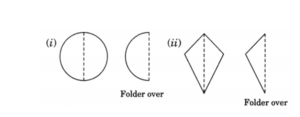
Line of symmetry is defined as, a line that cuts a shape exactly in half, if you fold the shape or figure along the line, both halves would match exactly that is symmetrical halves. It is also termed as Axis of symmetry.  The line symmetry also called a reflection symmetry or mirror symmetry because it presents two reflections of an image that can coincide.

A line of symmetry may be one or more lines of symmetry. Symmetry has many types such as

  1. Infinite lines of symmetry
  2. One line of symmetry
  3. Two lines of symmetry
  4. Multiple lines of symmetry (more than two lines is called multiple lines)
  5. No line of symmetry means the figure is asymmetrical.

There are many shapes that are irregular and cannot be divided into equal parts. Such shapes are termed asymmetrical shapes. Hence, in such cases, line symmetry is not applicable. Line of symmetry are two types:

  1. Vertical line of symmetry
  2. Horizontal line of symmetry

Also, Read:

Types of Line of Symmetry

Basically, the line of symmetry is of two types. The line or axes may be any combination of Vertical, Horizontal, and Diagonal. Two types of lines of symmetry are

  • Vertical line of symmetry
  • Horizontal line of symmetry

Vertical Line of Symmetry

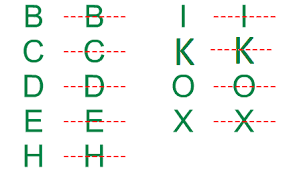
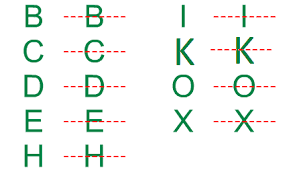
A vertical line of symmetry refers to one which runs down an image or figure and divides into two identical halves. The mirror image of the other half of the shape can be seen in a vertical or straight standing position. A, H, M, O, U, V, W, T, Y are some of the alphabets that can be divided vertically in symmetry. The trapezoid has only the vertical line of symmetry.

Vertical Line of Symmetry

Example of Vertical Line of Symmetry

Horizontal Line of Symmetry

The Horizontal line of symmetry is a line or axis of a shape which runs across the image, it divides into two identical halves is known as the Horizontal Line of Symmetry. B, C, H, E, are some of the alphabets that can be divided horizontally in symmetry.

Horizontal Line of Symmetry

Horizontal Line of Symmetry ExampleSome other types of lines of symmetries are there. Those are three lines of symmetry, four lines of symmetry, five lines of symmetry, six lines of symmetry, and infinite lines of symmetry.
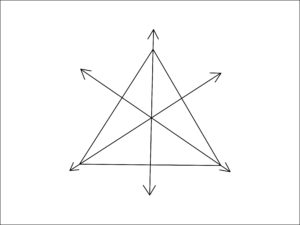
Three Lines of Symmetry

An Equilateral Triangle has about three lines of symmetry. It is symmetrical along its three medians.

Three Lines of Symmetry
Some other patterns also have three lines of symmetry.

Four Lines of Symmetry

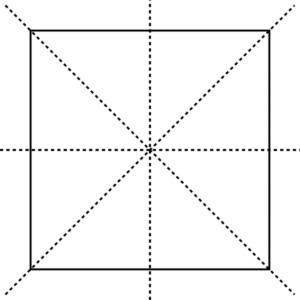
A square has four lines of symmetry. It can be folded in half over either diagonal, the horizontal segment which cuts the square in half, and the vertical segment which cuts the square in half. so, the square has four lines of symmetry.

A square is symmetrical along four lines of symmetry, two along the diagonals and two along with the midpoints of the opposite sides. some other patterns also have four lines of symmetry.

Four Line of Symmetry Five Lines of Symmetry
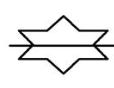
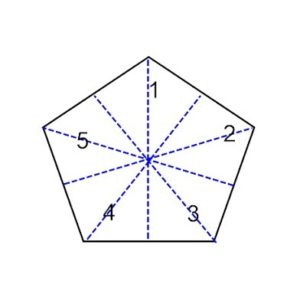
A regular pentagon has around five lines of symmetry. The lines joining a vertex to the mid-point of the opposite side divide the figure into ten symmetrical halves. Some other patterns also have five lines of symmetry.Five Lines of Symmetry
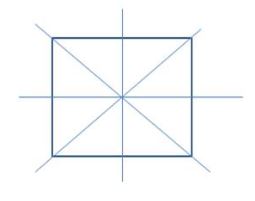
Six Lines of Symmetry

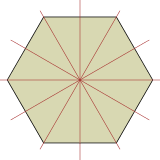
A regular polygon with N sides has N lines of symmetry. Hexagon is said to have six lines of symmetry, 3 joining the opposite vertices and 3 joining the midpoints of the opposite sides.

Six Lines of Symmetry

Infinite Lines of Symmetry
A circle has its diameter as the line of symmetry, and a circle can have an infinite number of diameters. It is symmetrical along all its diameters.

Examples of Lines of Symmetry
Line of Symmetry has different figures and we have outlined few examples

  1. A Triangle is said to have 3, 1 number lines of symmetry
  2. A quadrilateral has 4 or 2 number lines of symmetry
  3. An Equilateral Triangle has 3- lines of symmetry
  4. A Regular Pentagon has 5lines of symmetry
  5. A Regular Heptagon has 7 lines of symmetry
  6. A circle has an infinite number of lines of symmetry

Real-Life Examples of Lines of Symmetry
  • Reflection of trees in clear water.
  • Reflection of mountains in a lake.
  • Most butterflies’ wings are identical on the left and right sides.
  • Some human faces are the same on the left and right.
  • People can also have a symmetrical mustache.

FAQ’s on Line of Symmetry

1. How many lines of symmetry does a circle have?

A circle has infinite lines of symmetry.

2. What is the figure of reflection symmetry on a vertical mirror?

A rectangle is the figure of reflection symmetry on a vertical mirror.

3. Define Line of Symmetry?

The imaginary line or axis along which you can fold a figure to obtain the symmetrical halves is called the line of symmetry. It is also termed the axis of symmetry. The other names of Line of Symmetry are Reflection Symmetry or Mirror Symmetry.

4. What are the types of Lines of Symmetry?

Lines of Symmetry are of two types, the first one is the Vertical line of symmetry and the second one is the Horizontal line of symmetry.
5. Define Vertical Line of Symmetry?

The axis of the shape or object or figure which divides the shape into two identical halves Vertically is called a Vertical line of symmetry.

6. Define Horizontal Line of Symmetry?

The axis of the shape or figure or object that divides the shape into two identical halves Horizontally is called a horizontal line of symmetry.

Types of Symmetry – Line, Translation, Rotational, Reflection, Glide | Different Types of Symmetry with Examples

Types of Symmetry

Symmetry is one of the important concepts of geometry. If one part of the object looks like the same as another part of the object when we turn, flip, or slide, then it is called symmetry. If an object is not looking like another part of the object then it is called asymmetric.

To find out a given object is symmetric, we need to follow some steps. Firstly, draw a line on the middle of the image or object, and observe the image or object whether the left side of the object is the same as the right side or not. If the image is symmetrical, then the left side of the image is looking like a mirror image of the right side of the image or not. We can define different types of symmetries as below.

Also, Read:

Example Images of Symmetry

Types of Symmetry. Example for Symmetry. Image 1. jpg

Line of Symmetry

An object is divided into two parts with the help of a line and the two parts are mirror images of an object, then it is called a line of symmetry. The line of symmetry is also called as ‘axis of symmetry’. The line may be either vertical or horizontal or diagonal.

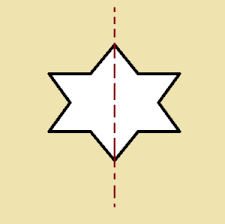
Vertical Line of Symmetry

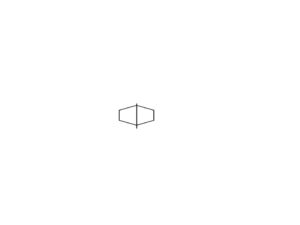
The above figure shows the hexagonal image divided into two parts with the help of a vertical line. Here, the vertical line divides the above image into two parts and these two parts are mirror images for each other. That means, both the parts of an image are the same. This type of symmetry is called as Vertical line of Symmetry.

Types of Symmetry. vertical line of Symmetry. Image 2

Horizontal Line of Symmetry

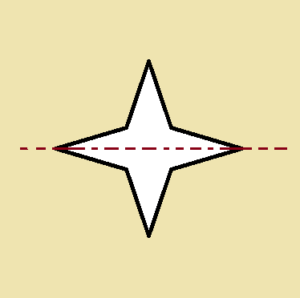
The above diagram shows that the image is split into two parts with the help of a horizontal line. Here, the horizontal line dividing the above image into two parts, and these two parts are equal halves of the image. This type of symmetry is called a horizontal line of symmetry.

Types of Symmetry. Horizontal line of Symmetry. Image 3. jpg

Diagonal Line of Symmetry

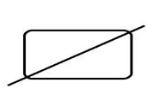
From the above diagram, an image is divided into two equal halves by the diagonal line. These two equal halves are mirror images of each other. This type of line of symmetry is called as Diagonal Line of Symmetry.

Again we have a number of types in line of symmetry. Yes, we can divide the image into a number of parts with the help of one line, two-line,s or more lines. Every part must be the mirror image of another.

Types of Symmetry. Diagonal line of Symmetry.image 4

One Line of Symmetry

By using the vertical or horizontal or diagonal line, we need to divide the image into equal halves and it is called one line of symmetry. Above mentioned, vertical, horizontal, and diagonal lines of symmetry are examples of one line of symmetry.

Two Lines of Symmetry
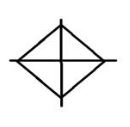
Same like one line of symmetry, in two lines of symmetry also we can use the vertical or horizontal or diagonal lines but we need to use only two lines to divide the image equally. This type of line of symmetry is called Two lines of Symmetry.

Types of Symmetry. Two lines of Symmetry.image 5

Infinite Lines of Symmetry
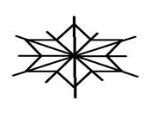
An image or object is divided into a number of parts with the help of a number of lines and these equal halves of the image. It is called Infinite Lines of Symmetry. These lines are either vertical or horizontal or diagonal lines.

Types of Symmetry. Infinite lines of Symmetry.image 6

Some Other Types of Symmetry
We have different types of symmetries considered depending on the various cases. They are

  1. Translational Symmetry
  2. Rotational Symmetry
  3. Reflexive Symmetry
  4. Glide Symmetry

1.Translational Symmetry

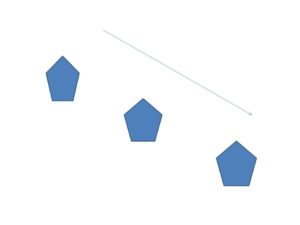
An object or image is moving forward or backward or changing the position from one place to another, but there is no change in the image or object. This type of Symmetry is called Translational Symmetry.
Types of Symmetry. Translational Symmetry.image 7

2.Rotational Symmetry

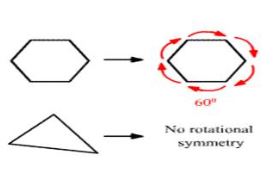
An object or image is rotated in a particular direction but the position of an object or image is identical to the origin of an image or object, then it is called rotational symmetry. It is also called radial symmetry.

Types of Symmetry. Rotational Symmetry.image 8

From the above figure, we can observe the rotational symmetry. If you rotate the hexagonal object or image in a 60° clockwise direction with respect to the origin, there is no change in the shape of an image. More Examples for Rotational Symmetry are Circle, Hexagonal, Square, Rectangle, and etc…

3.Reflexive Symmetry

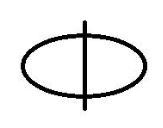
Reflexive Symmetry is the same as a line of symmetry. Yes, in this type of symmetry one part of the image or object represents the mirror image of another part of the image. Reflexive Symmetry is also called a line of symmetry or mirror symmetry. The below figure is a better example of Reflexive symmetry.

Types of Symmetry. Reflexive Symmetry.image 9

The above object is divide into two parts and the left side part is the mirror image of the right side of the image.

4.Glide Symmetry

It is the combination of both translation symmetry and reflection symmetry.

Point Symmetry

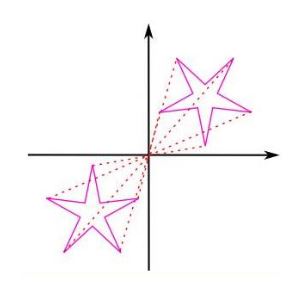
When an object is in opposite direction, every part of the object must be matched with the original object. It is called Point Symmetry. It is the same as Rotational Symmetry, so we can call it Rotational Symmetry order 2.

Types of Symmetry. Translational Symmetry.image 7

Solved Examples on Types of Symmetry
1. Name and draw the shape which possesses linear symmetry, point symmetry, and rotational symmetry?

Solution:
(i) Line Segment

Types of Symmetry. Line segment.image 11

  • Linear symmetry is a line of symmetry. here, it indicates ‘AB’.
  • Point symmetry, the mid-point of the line of origin of the image that is ‘O’.
  • Rotational Symmetry, If we move the above image in any direction with respect to the origin, there is no change in the image. Here, the origin of the image is ‘O’

(ii) Square

Types of Symmetry. Square.image 12

  • Linear symmetry, two lines of symmetry.
  • Point symmetry, the intersection of two lines that is ‘O’.
  • Rotational Symmetry order of 2.

2. If the following figure shows a line of symmetry, then complete the figure?

Types of Symmetry. line of symmetry.image 13

Solution:
The line of symmetry, vertical or horizontal line divides the image into two equal halves and two parts are look as same. So, the remaining part of the image also the same as the above figure. That is,
Types of Symmetry. line of symmetry.image 14

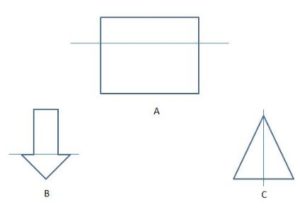
3. Identify which of the following figure is the example for symmetry?

Types of Symmetry. symmetry.image 15

Solution:
In the symmetry method, an image or object is divided into equal halves either it may be vertical lines or horizontal lines. Each part must be a mirror image of the other part of the image. That particular image, we can consider as the example for symmetry. In the above diagrams, figure ‘c’ is showing as an example of symmetry. In that one only, the image is divided into two equal halves and the remaining A and B are not divided into equal halves.

4. How many lines of symmetry does a rectangle have?

Types of Symmetry. symmetry.image 16

Solution:
Four lines of symmetry. One horizontal line, one vertical line, and two diagonal lines.

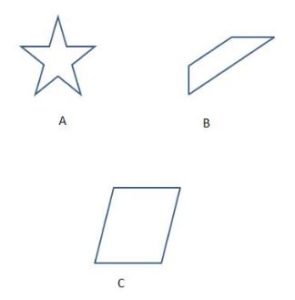
5. Identify which of the following image indicates the rotational symmetry?

Types of Symmetry. Rotational symmetry.image 17

Solution:
By moving in a forward or backward direction, an object or image will be in the same as the original image, which is called rotational symmetry. From the above, Figure (A) is the best example for Rotational symmetry.

FAQs on Types of Symmetry
1. What is Symmetry?

In symmetry, an object is divided into equal parts and each part of an object is a mirror image of another part of the object. 

2. What are the Types of Symmetry?

There are four types of symmetry. They are

  1. Translational Symmetry
  2. Rotational Symmetry
  3. Reflexive Symmetry
  4. Glide Symmetry

3. What is a Line of Symmetry?

An object or image is divided into equal halves with horizontal or vertical or diagonal lines. But the left side of the image is the same as the right side of the image that is called a line of symmetry.

4. What is Point Symmetry?

If we place the image or object in the opposite direction, then every part of the image must be matched with the equal distance that is called point symmetry.

5. What is Asymmetric?

An object is divided into equal parts but the left side of the image is not the same as the right side of the image and it is called an asymmetric method.

Common Solid Figures – Definition, Shapes, Formulas, Properties, Examples

Common Solid Figures

Solid shapes or figures are solids having 3 dimensions, namely length, breadth, and height. Solid figures are classified into different categories. The characteristics and properties of solid shapes, the number of faces, edges, and also the number of vertices are explained below. Also, we have given examples for a better understanding of solid shapes. Also, we have given the solid shapes with clear explanations. Check out the complete concept to learn about solid shapes.

Attributes of Solid Figures

Face: The flat surface present on the solid figure is known as the Face of the solid figure.
Edge: The edge of the solid figure is defined as the line where two faces meet.
Corner: The corner is a point where three or more edges join together is known as a corner.

Different Types of Solid Figures

There are different types of solid figures available in geometry. Check out the detailed explanation of some of the examples of solid figures below.

Cube

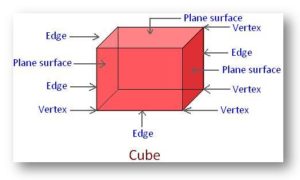
The first and important solid figure everyone discusses Cube. A cube is defined as a slid box-shaped that has six identical square faces. One solid figure that called a cube must consist of 6 equal and plane surfaces they appear as a square in shape.

A cube consists of 6 plane surfaces, 8 vertices and, 12 edges. There are two adjoining planes available in a cube which are called surfaces that meet at an edge. Also, it consists of 12 edges that are equal in length. These edges are straight edges. Furthermore, the joining point of two corners called a vertex. In a cube, there are 8 such vertices available.

cube solid figures

Parts of a Cube

(i) Face: The sides of a cube are known as the Face of the cube. A cube consists of six faces. All the faces of a cube are square in shapes. Each face of a cube has four equal sides.
(ii) Edge: When two edges join each other with a line segment, then that corner is called the edge. The cube has 12 edges. All the 12 edges are equal in length as all faces are squares. These edges are straight edges.
(iii) Vertex: A point formed with the joint of the three edges is known as a vertex of a cube. There are 8 vertices in a cube.
(iv) Face Diagonals: Face Diagonals of a cube is the line segment that joins the opposite vertices of a face. There are 12 diagonals in the cube that are formed with 2 diagonals in each face altogether.
(v) Space Diagonals: Space diagonals of a cube are the line segment that joins the opposite vertices of a cube and also cutting through its interior. There are 4 space diagonals in a cube.

Properties of a Cube

Volume: The volume of a cube is shown by s³ where s is the length of one edge.
Surface Area: The surface area of a cube is 6s², where s is the length of one edge.

Also, Read:

Cuboid

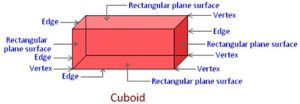
The cuboid consists of 6 rectangular faces which form a convex polyhedron. The opposite rectangular plane surfaces are equal. It has 8 vertices and 12 edges.

A cuboid consists of 6 rectangular plane surfaces. There are 8 vertices and 12 edges. All the faces of a cuboid are equal and square. Therefore, a cube has all the six faces equal, whereas a cuboid has the opposite faces equal.

cuboid solid figures

Properties of a Cuboid

Volume: The volume of a cuboid is lwh, where l is the length, h is the height, and w is the width.
Lateral Surface Area: The lateral surface area of a cuboid is 2lh + 2wh, where l is the length, w is the width, and h is the height.
Surface Area: The surface area of a cuboid is 2lw + 2lh + 2wh, where l is the length, w is the width and h is the height.

Cylinder

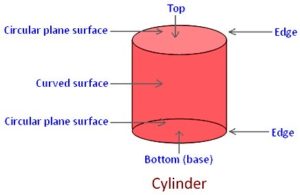
The cylinder is one of the basic 3d shapes that stands on a circular plane surface consisting of circular plane surfaces on its top and bottom. A cylinder has two circular plane surfaces. One surface presents at its base and the other one presents at its top. Also, it has a curved surface in the middle. Two edges at which the two plane surfaces meet with the curved surface present on a cylinder. The edges are curved in a shape.

A cylinder has 2 plane surfaces and 1 curved surface. There are 2 edges and no vertices. Furthermore, the top and bottom of the cylinder are of the same shape as well as in size. They both are equal.

cylinder solid figures

Cone

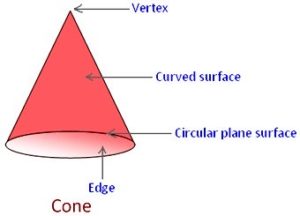
A cone is a distinctive three-dimensional geometric figure that has one plane circular surface. It consists of a base and only one curved surface. There are 1 edge and 1 vertex present in the cone. The edge of the cone is a curved edge. It is formed by the circular plane surface meeting with the curved surface.

Cone solid figures

Sphere

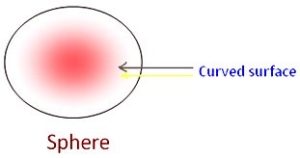
A sphere is a geometrical figure that has a ball-like shape. There is only one curve surface present in the sphere and no edge and no vertex present in it.

sphere solid figures

Binary Addition using 2’S Complement – Definition, Examples | How to do 2’S Complement Binary Addition?

Binary Addition using 2'S Complement

A binary number is a number expressed in the base 2 numeral system which uses only two symbols 0 and 1. Each digit in the binary is called a bit or binary digit. The addition is one of the basic arithmetic operations. Binary addition is one of the binary operations. The binary addition works similarly to the base 10 decimal system. Check out more about the binary addition using 2s complement with solved example questions in the following sections of this page.

Also, Read

Binary Addition

The binary addition is similar to the decimal system, but it is a base 2 system. The binary system has two digits 0 and 1. Almost all functionalities of the computer system use the binary number system. The process of the addition operation is very familiar to the decimal system by just adjusting the base 2 of the numbers.

Before attempting the binary addition process, we should have complete knowledge of how the place works in the binary number system. Most modern digital computers and electric circuits perform binary operations by representing each bit as a voltage signal. the bit 0 in the binary system denotes the “OFF” state, bit 1 in the binary system denotes the “ON” state.

2’s Complement of a Binary Number

To get the 2’s complement of a given binary number, invert the given number and add 1 to the least significant bit (LSB) of the given result. The various uses of 2’s complement of binary numbers are signed binary number representation, to perform arithmetic operations on binary numbers.

Example:

2’s complement of 101

Invert 101 = 010

Add 1 to LSB of 010 = 010 + 1

= 011

So, 2’s complement of 101 is 011.

Binary Addition using 2’s Complement

Binary Addition using 2’s Complement is similar to the normal addition of two binary numbers. When you add two positive numbers, then the result is a positive number. When you add two negative numbers, then the addition will be a negative number. The basic rules of binary addition is 1 + 1 = 10 (1 is carry), 0 + 0 = 0, 0 + 1 = 1, 1 + 0 = 1. If two numbers have different signs then follow these cases.

Case I: When the positive number has a greater magnitude.

In this case, the carry obtained is discarded and the final result is the addition of two numbers

Let us take the 5-bit numbers 1011 and -0101

2’s complement of 0101 = 1011

1 0 1 1 ⇒ 0 1 0 1 1

– 0 1 0 1 ⇒ 1 1 0 1 1 (2’s Complement)

⇒ 0 0 1 1 0 (Carry 1 is discarded)

So, 1011 – 0101 = 00110

Case II: When the negative number has a greater magnitude.

If the negative number has a greater magnitude then no carry will be generated in the sign bit. The result of an addition will be negative and the final result obtained by taking 2’s complement of the magnitude bits of the result.

Let us take two numbers as + 0100 and -0111

+ 0 1 0 0 ⇒ 0 0 1 0 0

– 0 1 1 1 ⇒ 1 1 0 0 1 (2’s complement)

⇒ 1 1 1 0 1

2’s complement of 1101 is 0011.

Hence the required sum is – 0011.

Case III: When the numbers are negative.

When two negative numbers are added a carry will be generated from the sign bit which will be discarded. 2’s complement of the magnitude bits of the operation will be the final sum.

Let us take two numbers as -0111 and -0010

– 0 1 1 1 ⇒ 1 1 0 0 1 (2’s complement)

– 0 0 1 0 ⇒ 1 1 1 1 0 (2’s complement)

⇒ 1 0 1 1 1 (Carry 1 discarded)

2’s complement of 0111 is 1001

Hence the required sum is -1001.

Solved Examples on Binary Addition using 2’s Complement

Example 1:

Find the sum of -1101 and -1110 using the 2’s complement.

Solution:

Given numbers are -1101, -1110

Find the 2’s complement of the negative numbers

So, 2’s complement of 01110 is 10010 and 01101 is 10011

Add the complemet numbers

1 0 0 1 0 + 1 0 0 1 = 1 0 0 1 0 1

End carry 1 of the sum is dicarded

2’s complement of the result 00101 is 11011

So, sum of -1101, -1110 is -11011.

Example 2:

Find 10101 – 10111 using the 2’s complement concept.

Solution:

The given numbers are 10101, -10111

2’s complement of the negative number 10111 is 01001

Add first number and 2’s complement of negative number

1 0 1 0 1 + 0 1 0 0 1 = 1 1 1 1 0

2’s complement of the result 11110 is 00010.

So, 10101 – 10111 = -00010

Example 3:

Find the addition of 00110 and 01001 using the 2’s complement.

Solution:

Given numbers are 00110, 01001

0 0 1 1 0 + 0 1 0 0 1 = 0 1 1 1 1

Hence, the sum is 0 1 1 1 1.

FAQs on Binary Addition using 2’s Complement

1. What are the Rules of Binary Addition?

The four basic rules of the binary addition are 0 + 0 = 0, 0 + 1 = 1, 1 + 0 = 1, 1 + 1 = 10.

2. How to add two binary numbers?

Add the first column if two numbers are 1 then the result is 10. Here, 1 is the carry. Continue adding till no digit is left on the left side. The result is the sum of two binary numbers.

3. How to find 2’s complement of a binary number?

Invert the given numbers and add one to the least significant bit to get the 2’s complement of the binary number.

Units of Time – SI, CGS, Other Units | Converting Units of Time(Hours, Minutes, Seconds)

Units of Time

Time is defined as the continued progress of existence in past, present, and future. Using the unit of time you can measure the existence of events. The most commonly used units of time are second, minute and hour. Time is an interesting topic and everyone is familiar with it. Want to know about the units of time then go through the following sections. Learn Converting Units of Time such as Hours, Minutes, Seconds from one unit to another by referring through solved examples available.

SI Unit of Time

The SI Unit of Time is Second and is accurately defined as the time interval equal to 9192631770 periods of radiation. Unit second is often represented as s or sec.

Different Units of Time

Some of the common and frequently used time units are minutes, hour, day, week, month, and year. If you want to measure a long duration of time, then you can use a decade which is equal to 10 years, a century which is equal to 100 years, a millennium which is equal to 1000 years, and a mega-annum which is equal to 1,000,000 years. The popular units of time are given below.

The most commonly used Units of Time are

  • Hours
  • Minutes
  • Seconds
1000 milliseconds1 second
60 seconds1 minute
60 minutes1 hour
24 hours1 day
7 days1 week
28, 29, 30, or 31 days1 month
365 or 366 days1 year
12 months1 year
10 years1 decade
100 years1 century
1000 years1 millennium

How Time Became So Important?

The top ten reasons why time is so important are mentioned here.

  • Every single thing in the universe is affected by time.
  • Time is the most precious resource because you can’t get it back.
  • Because of privileges, not everyone truly has the same amount of time in a day.
  • No one knows how much time they have.
  • The only time we actually have is the present.
  • How we see time impacts happiness.
  • Managing it poorly or well has a huge impact on life.
  • Skills are impacted by how much time you invest.
  • Relationships are made or broken by how much time you invest.
  • Time is a teacher or a healer.

Also, Read

Time Conversions

To convert 1 unit of time to another, you have to know the units of time. You can use the multiplication or division operations to convert the time.

  • To convert minutes into seconds, you need to multiply each minute by 60 seconds.
  • To convert seconds into minutes, you need to divide each second by 60 minutes.

You can use these parameters for any type of time conversion.

Solved Examples on Converting Units of Time

1. Convert the following

(i) 5 hours 30 minutes into minutes

(ii)90 minutes to seconds

Solution:

(i) 5 hours 30 minutes into minutes

We know 1 hr = 60 minutes

5 hours = 5*60 minutes

= 300 minutes

5 hrs 30 minutes = 300 minutes +30 minutes

= 330 minutes

Therefore, 5 hours 30 minutes = 330 minutes

(ii)90 minutes to seconds

We know 1 minute = 60 seconds

90 minutes = 90*60 seconds

= 5400 seconds

Therefore, 90 minutes = 5400 seconds

2. Find the total time

5 hours 40 minutes and 3 hours 20 minutes

Solution:

Firstly add the hours i.e. 5 hours +3 hours

= 8 hours

Now add the minutes individually i.e. 40 minutes +20 minutes

= 60 minutes

= 1 hour

Now, add this to the hours we got in the earlier step i.e. 8 hours +1 hour

= 9 hours

Therefore, 5 hours 40 minutes and 3 hours 20 minutes is equal to 9 hours

Frequently Asked Questions on Units of Time

1. What is the SI unit of time?

The SI unit of time is seconds.

2. What are the 3 possible units of time?

The three most used units of time are seconds, minutes, and hours. 1 minute = 60 seconds, 1 hour = 60 minutes = 3600 seconds.

3. What are the different units of a second?

The various units of a second from the smallest to the largest values are along the lines:
Decisecond (1/10th of a second), centisecond (1/100th of a second), millisecond (1/1000th of a second), microsecond (one-millionth of a second), nanosecond (one-billionth of a second), picosecond (one-trillionth of a second), femtosecond (one-quadrillionth of a second), attosecond (one-quintillionth of a second), zeptosecond (one-sextillionth of a second), yoctosecond (one-septillionth of a second), and Planck time.

4. What is the largest unit of time?

The largest unit of time is the supereon. It is the combination of eons, eras, periods, epochs, and ages.

Laws of Algebra of Sets – Commutative, Associative, Distributive, Demorgan’s | Set Operations & Laws of Set Theory

Laws of Algebra of Sets

Sets are defined as a collection of well-defined elements that do not vary from person to person. It can be represented either in set-builder form or roster form. Generally, sets can be represented using curly braces {}. The different types of sets are empty set, finite set, singleton set, infinite set, equivalent set, disjoint sets, equal sets, subsets, superset, and universal sets. Get to know more about the Laws of Algebra of Sets for a better understanding of the students.

Laws of Algebra of Sets

The operations of sets are union, intersection, and complementation. The binary operations of set union, intersection satisfy many identities. The seven fundamental laws of the algebra of sets are commutative laws, associative laws, idempotent laws, distributive laws, de morgan’s laws, and other algebra laws.

1. Commutative Laws

For any two finite sets A and B

  • A U B = B U A
  • A ∩ B = B ∩ A

2. Associative Laws

For any three finite sets A, B, and C

  • (A U B) U C = A U (B U C)
  • (A ∩ B) ∩ C = A ∩ (B ∩ C)

So, union and intersection are associative.

3. Idempotent Laws

For any finite set A

  • A U A = A
  • A ∩ A = A
  • A ∩ A’ = ∅
  • ∅’ = U
  • ∅ = U’

4. Distributive Laws

For any three finite sets A, B, and C

  • A U (B ∩ C) = (A U B) ∩ (A U C)
  • A ∩ (B U C) = (A ∩ B) U (A ∩ C)

Thus, union and intersection are distributive over intersection and union respectively.

5. De morgan’s Laws

For any two finite sets A and B

  • A – (B U C) = (A – B) ∩ (A – C)
  • A – (B ∩ C) = (A – B) U (A – C)

De Morgan’s Laws can also be written as

  • Law of union: (A U B)’ = A’ ∩ B’
  • Law of intersection: (A ∩ B)’ = A’ U B’

6. Complement Law

For any finite set A

  • A ∪ A’ = A’ ∪ A =U
  • A ∩ A’ = ∅

More laws of the algebra of sets:

7. For any two finite sets A and B;

  • A – B = A ∩ B’
  • B – A = B ∩ A’
  • A – B = A ⇔ A ∩ B = ∅
  • (A – B) U B = A U B
  • (A – B) ∩ B = ∅
  • A ⊆ B ⇔ B’ ⊆ A’
  • (A – B) U (B – A) = (A U B) – (A ∩ B)

8. For any three finite sets A, B, and C;

  • A – (B ∩ C) = (A – B) U (A – C)
  • A – (B U C) = (A – B) ∩ (A – C)
  • A ∩ (B – C) = (A ∩ B) – (A ∩ C)
  • A ∩ (B △ C) = (A ∩ B) △ (A ∩ C)

Also, Read

Solved Examples on Laws of Algebra of Sets

Example 1:

If E = {1, 2, 3, 4, 5, 6, 7}, A = {1, 2, 3, 4, 5}, B = {2, 5, 7} show that

(i) (A U B)’ = A’ ∩ B’

(ii) (A U B) = B U A

(iii) A ∩ B = B ∩ A

(iv) (A ∩ B)’ = A’ U B’

Solution:

Given that

E = {1, 2, 3, 4, 5, 6, 7}, A = {1, 2, 3, 4, 5}, B = {2, 5, 7}

(i) (A U B)’ = A’ ∩ B’

A U B = {{1, 2, 3, 4, 5} U {2, 5, 7}}

= {1, 2, 3, 4, 5, 7}

(A U B)’ = {1, 2, 3, 4, 5, 7}’

= {6}

A’ = {6, 7}

B’ = {1, 3, 4, 6}

A’ ∩ B’ = {6, 7} ∩ {1, 3, 4, 6}

= {6}

So, L.H.S = R.H.S

(ii) (A U B) = B U A

A U B = {{1, 2, 3, 4, 5} U {2, 5, 7}}

= {1, 2, 3, 4, 5, 7}

B U A = {2, 5, 7} U {1, 2, 3, 4, 5}

= {1, 2, 3, 4, 5, 7}

So, L.H.S = R.H.S

(iii) A ∩ B = B ∩ A

L.H.S = A ∩ B

= {1, 2, 3, 4, 5} ∩ {2, 5, 7}

= {2, 5}

R.H.S = B ∩ A

= {2, 5, 7} ∩ {1, 2, 3, 4, 5}

= {2, 5}

So, L.H.S = R.H.S

(iv) (A ∩ B)’ = A’ U B’

L.H.S = (A ∩ B)’

= {{1, 2, 3, 4, 5} ∩ {2, 5, 7}}’

= {2, 5}’

= {1, 3, 4, 6, 7}

R.H.S = A’ U B’

= {1, 2, 3, 4, 5}’ U {2, 5, 7}’

= {6, 7} U {1, 3, 4, 6}

= {1, 3, 4, 6, 7}

L.H.S = R.H.S

Hence, proved.

Example 2:

If X = {a, b, c, d}, Y = {b, d, f}, Z = {a, c, e} verify that

(i) (X ∪ Y) ∪ Z = X ∪ (Y ∪ Z)

(ii) (X ∩ Y) ∩ Z = X ∩ (Y ∩ Z)

Solution:

Given that,

X = {a, b, c, d}, Y = {b, d, f}, Z = {a, c, e}

(i) (X ∪ Y) ∪ Z = X ∪ (Y ∪ Z)

L.H.S = (X ∪ Y) ∪ Z

= ({a, b, c, d} U {b, d, f}) U {a, c, e}

= {a, b, c, d, f} U {a, c, e}

= {a, b, c, d, e, f}

R.H.S = X ∪ (Y ∪ Z)

= {a, b, c, d} U ({b, d, f} U {a, c, e})

= {a, b, c, d} U {a, b, c, d, e, f}

= {a, b, c, d, e, f}

So, L.H.S = R.H.S

(ii) (X ∩ Y) ∩ Z = X ∩ (Y ∩ Z)

L.H.S = (X ∩ Y) ∩ Z

= ({a, b, c, d} ∩ {b, d, f}) ∩ {a, c, e}

= {b, d} ∩ {a, c, e}

= ∅

R.H.S = X ∩ (Y ∩ Z)

= {a, b, c, d} ∩ ({b, d, f} ∩ {a, c, e})

= {a, b, c, d} ∩ ∅

= ∅

So, L.H.S = R.H.S

Hence verified.

Example 3:

If A = {p, q, r, s}, B = {u, q, s, v} find

(i) A – B

(ii) B – A

(iii) A ∩ B

Solution:

Given that,

A = {p, q, r, s}, B = {u, q, s, v}

(i)

A – B = {p, q, r, s} – {u, q, s, v}

= {p, r}

(ii)

B – A = {u, q, s, v} – {p, q, r, s}

= {u, v}

(iii)

A ∩ B = {p, q, r, s} ∩ {u, q, s, v}

= {q, s}

FAQs on Laws of Algebra of Sets

1. What is a set? Give an example?

A set is a collection of elements or objects or numbers represented using the curly brackets {}. The example is {1, 2, 3, 5} is a set of numbers.

2. What are the five basic properties of sets?

The five basic properties of sets are commutative property, identity property, associative property, complement property, and distributive property.

3. What are the 4 operations of sets?

The 4 set operations include set union, set intersection, set difference, the complement of a set, and cartesian product.

Worksheet on Area and Perimeter of Rectangle | Area and Perimeter of Rectangles Problems with Solutions

Worksheet on Area and Perimeter of Rectangles

Worksheet on Area and Perimeter of Rectangle Problems will help the students to explore their knowledge of Rectangle word Problems. Solve all the Problems to learn the formula of Area of Rectangle and Perimeter of a Rectangle. To know the definition, properties, derivation, Problems with Solutions, Formulas of Rectangle you can visit our website. We have given the complete Rectangle concept along with examples. Check out the Area and Perimeter of Rectangle Problems Worksheet and know the various strategies to solve problems in an easy and understandable way.

Also Read :

Perimeter and Area of a Rectangle – Definitions

A Rectangle is a quadrilateral with two equal sides and two parallel lines and four right angles. Four right angles vertices are equal to 90 degrees, it is also called an equiangular quadrilateral.

The perimeter of the rectangle is defined as the sum of all the sides of the rectangle.  Rectangle has two lengths and breadths, it is denoted by P, it is measured in units. For finding the perimeter of the rectangle we have to add the length and breadth.

Perimeter of the Rectangle, P = 2(l + b)

The area of the rectangle is defined as to calculate the length and breadth of the two- dimensional closed figure. For finding the area of the rectangle we have to multiply the length and breadth, it is denoted by A, measured in square units.

Area of the rectangle , A = l x b

Problems on Area and Perimeter of the Rectangle

1. Find the Area and Perimeter of the following rectangles whose dimensions are :

(i) length = 15 cm             breadth = 12 cm

(ii) length = 7.9 m            breadth = 6.2 m

(iii) length = 4 m              breadth = 36 cm

(iv) length = 2 m              breadth = 6 dm

Solution:

(i) Given, length = 15 cm, breadth = 12 cm

we know that, Perimeter of rectangle = 2 (length + breadth)

substitute the given values in above formula, we get

Perimeter of rectangle = 2 (15 + 12) cm

= 2 × 27 cm

= 54 cm

We know that, area of rectangle = length × breadth

Therefore, substituting the  values in above formula, we get

Area of rectangle = 15 cm x 12 cm

= (15 × 12) cm²

= 195 cm²

Therefore, Area of rectangle is 195 cm²

(ii) Given, length = 7 m, breadth = 6.2 m

we know that, Perimeter of rectangle = 2 (length + breadth)

substitute the values in the formula , we get

Perimeter of rectangle = 2 (7.9 + 6.2) m

= 2 × 14. 1 m

= 28. 2 m

We know that, area of rectangle = length × breadth

Therefore, substituting the value we get,

Area of rectangle = 7.9 m x 6.2 m

= (7.9 × 6.2) m²

= 48. 98m²

Therefore, Area of rectangle = 48. 98 m²

(iii) Given, length = 4 m

breadth = 36 cm = 36/ 100 = 0. 36 m ( cm is converted to m)

we know that, Perimeter of rectangle = 2 (length + breadth)

substitute the values in the formula, we get

Perimeter of  a rectangle  = 2 (4 + 36) m

= 2 × 40 m

The perimeter of a rectangle is 80 m

We know that, area of rectangle = length × breadth

substituting the value we get,

Area of rectangle  = 4 m× 36 m

= (4 x 36) m²

= 144 m²

Therefore, Area of a rectangle is 144 m²

(iv) Given, length = 2 m

breadth = 60 dm

1m = 10 dm

so we get, 60 dm =  6 m ( dm is converted to m)

we know that, Perimeter of rectangle = 2 (length + breadth)

substitute the values in the formula, we get

Perimeter of rectangle  = 2 (2 + 6) m

= 2 × 8 m

= 16 m

We know that, area of rectangle = length × breadth

substituting the value we get,

Area of rectangle  = 2 m× 6 m

= (2x 6) m² = 12 m²

Therefore, the Area of a rectangle is  12m².


2. The perimeter of the rectangle is  140 cm. If the length of the rectangle is 30 cm, find its breadth and area of the rectangle?

Solution:

Given, Perimeter of the rectangle is, 140 cm

The length of the rectangle is, 30 cm

we know that, Perimeter of the rectangle = 2(l + b)

substitute the value in the above formula, we get

140 = 2( 30 + b)

70 = 30

40 = b

Therefore, breadth = 40 cm

Now, Area of Rectangle = length x breadth

= 30 x 40 = 120  cm²

Therefore, the Area of a rectangle is 120 cm²


3. The area of a rectangle is 78 cm². If the breadth of the rectangle is 6 cm, find its length and perimeter?

Solution:

Given, Area of a rectangle is 78 cm²

The breadth of the rectangle is 6 cm

we know that, Area of rectangle = length x breadth

substitute the given value, we get

78 cm = length x 6 cm

78/ 6 = length

Length of the rectangle =12 cm

Now, perimeter of rectangle = 2 (l + b)

substitute the value, we get

Perimeter of rectangle = 2(12 + 6)

= 2 x 18

= 36 cm

Therefore, the perimeter of the rectangle = 36 cm


4. How many boxes whose length and breadth are 9 cm and 5 cm respectively are needed to cover a rectangular region whose length and breadth are 420 cm and 90 cm?

Solution:

Given,  Length of the box is 9 cm

The breadth of the box is 5 cm

Region length is 420 cm

Region breadth is 90 cm

we know the formula,

The area of a rectangle is l x b

Therefore, Area of region = l x b

substitute the value, we get

Area of region = 420 cm x 90 cm

= 37800 cm²

Again use the  area of a rectangle formula,

Area of one box is = 9 cm x 5 cm

= 45 cm²

Number of boxes = Area of region /Area of one box = 37800/45 = 840

Thus, 840 boxes are required.


5. If it costs $500 to fence a rectangular park of length 40 m at the rate of $25 per m², find the breadth of the park and its perimeter. Also, find the area of the field?

Solution:

Given, Cost of Rectangular park fencing is $500

Length of the  rectangular park = 20 m

Rate of fencing 1 m² = $25

Area of a rectangle = l x b

Now we find  area , therefore  Area = 500/ 25 = 20

substitute the  value  in formula, we get

20 = 20 x breadth

breadth = area / length

b = 20 / 20 = 1 m

Now finding the Perimeter,

Perimeter of a rectangle = 2 (l + b)

substituting the values ,

Perimeter  of a rectangle=  2 (20 + 1)

=  2 (21)

Therefore, the Perimeter of a rectangle =  41 m


6. A rectangular tile has a length equals to 20 cm and a perimeter equals 70 cm. Find its width?

Solution:

Given, Perimeter of the tile = 80 cm

Length of the tile = 20 cm

Let W be the width of the tile

we know that,

Perimeter of a rectangle = 2(length + width)

Substituting the values, we get,

The perimeter of a tile = 80 cm

Therefore, 80 = 2 (20 + Width)

80/ 2 = 20 + Width

40 = 20 + Width

40 – 20 = Width

Therefore, Width = W = 20.


7. Find the area of a rectangle, Perimeter of a rectangle, and diagonal of a rectangle whose length and breadth 12 cm and 16 cm respectively.

Solution:

Given, length of the rectangle = 12 cm

Breadth of the rectangle = 16 cm

we know the formulae,

Area of a rectangle = l x b

substitute the values in the above formula, we get

Area of a rectangle = 12 x 16 = 192 cm²

we know, Perimeter of a rectangle = 2 (l + b)

substitute the values, we get

Perimeter of a rectangle = 2 (12 + 16)

= 2 (192) = 384 m

Now, we finding the diagonal of a rectangle

The diagonal of a rectangle is d² = l² + b²

substitute the values, we get

d² = (12)² + (16)²

d² = (12 + 16)²

d = √(12 + 16)²

square and root both will be cancelled,

d = 12 + 16 = 28

Therefore, the Diagonal of a rectangle = 28 cm.


8. Find the cost of tiling a rectangular plot of land 200 m long and 120 m wide at the rate of $6 per hundred square m?

Solution:

Given,

Cost of tiling rectangular plot of land 200 m long and 120 m wide

The cost of tiling per 100 sq.m is $6

we know the area of a rectangle formula,

Area of a rectangle = length  x breadth

substituting the values in the above formula, we get

Area of a rectangle = 200 m x 120 m

= 24000 m²

Therefore, the Area of a rectangle is 24000 m²

Now, we finding the total cost of tiling

Total cost of tiling =  (6 x 24000) / 100

= 144000/100

=  $1440

Therefore, the Total cost of tiling is $1440


9. The length of a rectangular board is thrice its width. If the width of the board is 140 cm, find the cost of framing it at the rate of $5 for 30 cm.

Solution:

Given, the width of the board = 140 cm

length of the board is thrice

so ,length = 3 x width

length =  3 x 140 = 420 cm

30 cm rate is $5

Circumference of rectangle = 2 ( l+ b)

substitute the values in the above formula, we get

Circumference of rectangle = 2 ( 420 + 140)

= 2 x 560 = 1120 cm
Therefore, the circumference of rectangle = 1120 cm

Now, 30 cm cost is equal to rs. 5

So, 1 cm = 5/ 30

But, we want the cost of framing

So, 1120 = (5 x 1120)/ 20 =  rs. 280

Therefore, the cost of framing is Rs. 280


10. The Perimeter of a rectangular pool is 46 meters. If the length of the pool is 16 meters, then find its width. Here the perimeter and length of the rectangular pool are given. we have to find the width of the pool.

Solution:

Given,

The perimeter of a rectangular pool is 46 meters

The length of the pool is 16 meters

Now we find the width of the pool.

we know the formula,

Perimeter of a rectangle = 2(l + b)

substituting the values, we get

46 = 2( 16) +2( w)

46= 32 + 2w

46 – 32 = 2W

14 = 2W

W= 14/2 = 7 meters

Therefore, the width of the Pool is 7 meters.


11. The sides of a rectangle are in the ratio of 4: 5 and its perimeter is 90 cm. Find the dimensions of the rectangle and hence its area.

Solution:

Given, Perimeter of a rectangle is 90 cm

Length of the sides = 4 : 5

Let the common ratio be X

So the sides will be 4X and 5X

we know that,

The Sum of all sides of the rectangle is equal to the perimeter.

so, Perimeter of a rectangle = 2 ( length + breadth)

substituting the values, we get

90 = 2(l) + 2(b)

90 = 2(4X) + 2 (5X)

90 = 8X + 10 X

18 X = 90

Therefore, X = 90/18 = 5

Hence , length = 4X  and breadth = 5X

substitute the ‘X’ value, we get

length = 4(5) = 20 , Breadth = 5(5) = 25

Now we find the area of a rectangle,

Area of a rectangle = length x breadth

substitute the values in the formula, we get

Area of a rectangle = 20  cm x 25 cm

= 500 cm²

Therefore, the Area of a rectangle is 500 cm².


Units of Measurement – Definition, Conversion, Examples | Metric Units of Length, Mass, Volume, Time

Unit of Measurement

In the metric system of measurement, the meter is the basic unit of length, a gram is the basic unit of mass and liter is the basic unit of capacity.  We can use a centimeter(cm) to measure the length. Centimeter and Millimeter are very small units to measure the length, so we use another unit called meters.

Learn completely about the Units of a Measurement- Definition, Units Conversion, Prefix for Length, Time, Weight, and Volume or Capacity. Get to know the Importance of SI Units, Solved Examples on How to Convert one unit to another, etc.

Metric System – Introduction

The French are widely credited with originating the metric system of measurement, the system is officially adopted in 1795. It was originated in the year 1799. Metric System is basically a system used for measuring distance, length, volume, weight, and temperature. The term metric system is used as another word for SI or the international system of units.  Based on three basic units we can measure almost everything in the world, those are M- Meter, used to measure the length, Kg- Kilogram, used to measure the mass, and S- Second, used to measure time.

Units of Measurement – Definition

The SI system, also called the metric system, is used around the world. SI units stand for standard International System of the units. Seven basic units in the SI  system, give proper definitions for meter, kilogram, and the second. It also specifies and defines remaining four different  units:

1. Kelvin(K)- used to measure the Temperature

2. Ampere(A)- used to measure the Electric current

3. Candela(cd)- used to measure the Luminous Intensity

4. Mole(mol)- used to measure  the Material Quantity

Also, Read:

Units of Measurement Conversion

To convert among units in the metric system, identify the unit that you have, the unit that you want to convert to, and then count the number of units between them. Some units are connected with each other by the following relation:

1 Kilometer (km) = 1000 meter (m)

1 meter (m) = 100 centimeter (cm)

1 centimeter (cm) =  10 millimeter (mm)Metric System (Definition and Examples) | What is the Metric System?

Metric Units Prefix

A metric prefix is a unit prefix that precedes a basic unit of measure to indicate a multiple or submultiple of the unit. To convert from one unit to another within the metric system usually means moving a decimal point. you can convert within the metric system relatively easily by simply multiplying or dividing the number by the value of prefix.

In order to remember the proper movements of units, arrange the prefixes from the largest to the smallest.

Metric Prefixes & Conversion

What is Metric System? - [Definition, Facts & Example]

Now, let us discuss some of the units for length, weight, volume, time.

Units of Measurement Length

The most common unit used to measure the length are as follows. Centimeters and millimeters are very small to measure the length so, we use another unit that is the meter (m). Even meter is too small when we measure the distance between two cities, we use kilometers (km).

Session 2: Units of measure: 1.4 Converting units - OpenLearn - Open University - FSM_1_CYMRU

Kilometer (km)Hectometer (hm)Decameter (dam)Meter (m)Decimeter (dm)Centimeter (cm)Millimeter (mm)
10001001011/101/1001/1000

Units of Measurement for Volume or Capacity

A liter is a metric unit of volume. The most common units used to measure the capacity or volume of any object are as follows:

1 liter (l) = 1000 milliliters (ml)

Kiloliter (kl)Hectoliter (hl)Decaliter(dal)Liter (l)Deciliter (dl)Centiliter(cl)Milliliter(ml)
10001001011/101/1001/1000

Units of Measurement for Weight

To measure the weight of the compound, we can use a smaller unit called milligrams. The most common units to measure the weight of any object are as follows:

1 kilograms (kg) = 1000 grams (gm)

1 grams (gm) = 1000 milligrams (mg)

1 kilograms (kg) = 1000 × 1000 milligrams (mg) = 1,000,000 milligrams (mg)

Kilogram (kg)Hectogram (hg)Decagram (dag)Gram (g)Decigram (dg)Centigram(cg)Milligram (mg)
10001001011/101/1001/1000

SI Unit of Measurement for Time

The SI unit for the period, as for all the measurements of time, is the Second. The other units of Time are minute, hour, day, week, month, year, and century. Now let us discuss some other units of time.

1 minute = 60 seconds

1 hour = 60 minutes

1day = 24 hours

1 week = 7 days

1 month = 30 or 31 days

NOTE: February has 28 days, but in leap year February has 29 days.

1 year = 12 hours or 365 days (in a leap year 366 days)

Importance of Standard Unit of Measurement

We need standard units for measurement, to make our judgment more reliable, accurate, and uniformity.  It is important because it allows scientists to compare data and communicate with each other about their results. To avoid confusion when measuring, scientists use a shared system of measurement called the international system of units (SI).

units-of-meausrement.png (396×314) | Metric measurement chart, Metric conversion chart, Unit conversion chart

common metric units

Units of Measurement Examples

Example 1: Convert  248 centimeters to meters?

Solution:

We know that, 1 cm = 0.01 mThus , 248 cm = 248 x 0.01 = 2.48 m

now , 248 cm = 2. 48 m

Therefore, 248 cm is equivalent to 2.48 m.

Example 2:

Convert  2000 grams to kilograms?

Solution:

We know that, 1 gram = 0.001 grams

Thus , 2000 grams = 2000 x 0.001 = 2 kilogram

2000 grams = 2 kilograms

Therefore, 2000 grams is equivalent to 2 kilograms.

Example 3:

Convert 20 kiloliters to liters?

Solution:

We know that 1 kiloliter = 1000 liters

Thus, 20 litres = 20 x 1000 litres = 20000 liters

20 kiloliters = 20000 liters

Therefore, 20 kiloliters are equivalent to 20000 liters.

Example 4:

Convert  150 kg to milligrams?

Solution:

We know that, 1 gram = 1000 milligrams and 1 kg = 1000 grams

So, first we convert the kg to g as :

1 kg = 1000 g

Therefore,  150 kg = 150 x 1000 g = 150,000 grams

Now, converting g to mg:

1 g = 1000 mg

Therefore , 150,000 g = 150,000 x 1000 mg = 250,000,000 mg.

FAQ’S on Units of Measurements

1.  What are the base units for Length, Weight, and Volume in a Metric System?

The base units for length, weight, and volume in a metric system are meters, grams, and liters respectively.

2. Mention the US Standard Units for Length, Weight, and Volume?

In US systems, the units used are:

  • Distance or length in miles, yards, feet, inches
  • Mass or weight in pounds, tons, ounces
  • Capacity or volume in cups, gallons or quarts, pints, fluid ounces.

3. What are the advantages of using a Standard Unit of Measurement?

The advantage of the SI unit is, it has only one unit for each quantity. suppose the one and only SI unit of length is the meter (m).

4. Why do we use Measurement?

Measurements require tools and provide scientists with a quantity. A quantity describes how much of something there is or how many there are.

5. What is a Standard Unit?

Standard units are the units we usually use to measure the weight, length, and volume of the objects.