Eureka Math Grade 7 Module 6 Lesson 16 Answer Key

Engage NY Eureka Math 7th Grade Module 6 Lesson 16 Answer Key

Eureka Math Grade 7 Module 6 Lesson 16 Example Answer Key

Example 1.
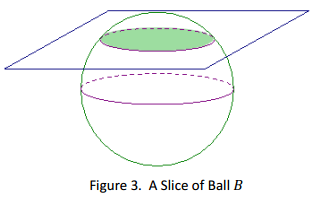
Consider a ball B. Figure 3 shows one possible slice of B.
a. What figure does the slicing plane form? Students may choose their method of representation of the slice (e.g., drawing a 2D sketch, a 3D sketch, or describing the slice in words).
Engage NY Math 7th Grade Module 6 Lesson 16 Example Answer Key 1
b. Will all slices that pass through B be the same size? Explain your reasoning.
c. How will the plane have to meet the ball so that the plane section consists of just one point?
Answer:
a. A circle (or disc)
b. No, different slices can result in circles of different sizes; it will depend on where the slicing plane meets the ball.
c. If you picture the ball and the plane as distinct but being brought toward each other, the plane section of just one point occurs when the plane just makes contact with the ball.

Example 2.
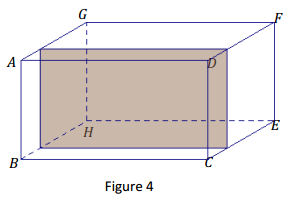
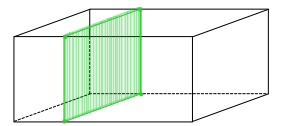
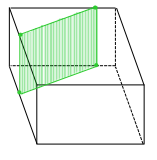
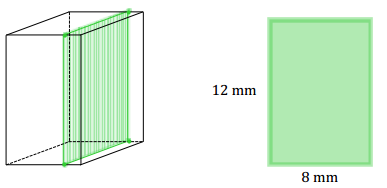
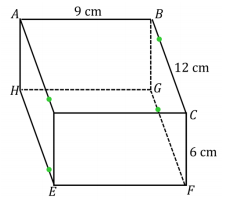
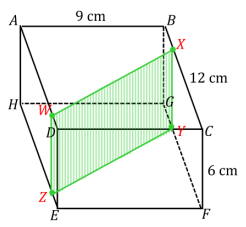
The right rectangular prism in Figure 4 has been sliced with a plane parallel to face ABCD. The resulting slice is a rectangular region that is identical to the parallel face.
Engage NY Math 7th Grade Module 6 Lesson 16 Example Answer Key 2
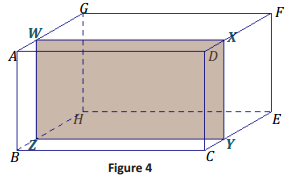
a. Label the vertices of the rectangular region defined by the slice as WXYZ.
b. To which other face is the slice parallel and identical?
c. Based on what you know about right rectangular prisms, which faces must the slice be perpendicular to?
Answer:
a. Engage NY Math 7th Grade Module 6 Lesson 16 Example Answer Key 4
b. The slice is parallel and identical to the face EFGH.
c. Since the slice is parallel to two faces, it will be perpendicular to whichever sides those faces are perpendicular to. Therefore, the slice is perpendicular to faces ABHG, CDFE, BCEH, and ADFG.

Example 3.
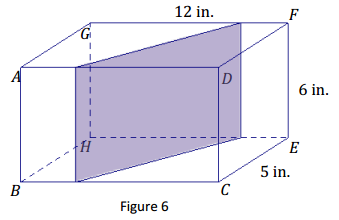
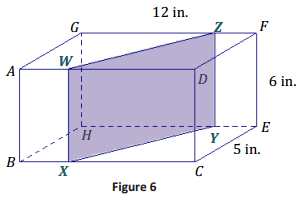
The right rectangular prism in Figure 6 has been sliced with a plane perpendicular to BCEH. The resulting slice is a rectangular region with a height equal to the height of the prism.
Engage NY Math 7th Grade Module 6 Lesson 16 Example Answer Key 3
a. Label the vertices of the rectangle defined by the slice as WXYZ.
b. To which other face is the slice perpendicular?
c. What is the height of rectangle WXYZ?
d. Joey looks at WXYZ and thinks that the slice may be a parallelogram that is not a rectangle. Based on what is known about how the slice is made, can he be right? Justify your reasoning.
Answer:
a. Engage NY Math 7th Grade Module 6 Lesson 16 Example Answer Key 5
b. The slice is perpendicular to the face ADFG.
c. 6 in.
d. The slice was made perpendicular to face BCEH. Then we know that the angles in the slice, ∠X and ∠Y, formed by the slicing plane and face BCEH, are right angles. If we focus on ∠X of the slice, since it is a right angle, we know that \(\overline{W X}\) must be perpendicular to face BCEH. \(\overline{W X}\) lies in face ABCD, which is perpendicular to both BCEH and to ADFG, so \(\overline{W X}\)is perpendicular to ABCD. This means that \(\overline{W X}\) must also be perpendicular to \(\overline{W Z}\). A similar argument can be made for ∠Y of the slice, making all four angles of WXYZ right angles and making WXYZ a rectangle.

Eureka Math Grade 7 Module 6 Lesson 16 Exercise Answer Key

Exercise 1.
Discuss the following questions with your group.
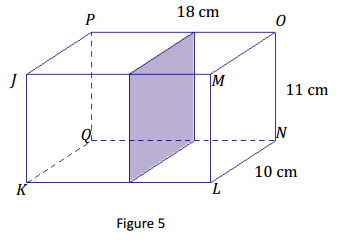
The right rectangular prism in Figure 5 has been sliced with a plane parallel to face LMON.
Engage NY Math Grade 7 Module 6 Lesson 16 Exercise Answer Key 1
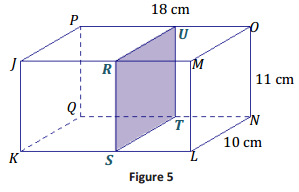
a. Label the vertices of the rectangle defined by the slice as RSTU.
b. What are the dimensions of the slice?
c. Based on what you know about right rectangular prisms, which faces must the slice be perpendicular to?
Answer:
a. Engage NY Math Grade 7 Module 6 Lesson 16 Exercise Answer Key 7
b. 10 cm × 11 cm
c. Since the slice is parallel to two faces, it will be perpendicular to whichever sides those faces are perpendicular to. Therefore, the slice is perpendicular to faces JKLM, JMOP, NOPQ, and KLNQ.

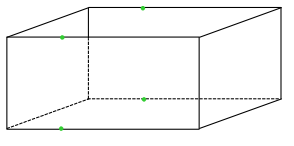
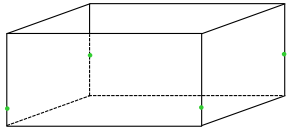
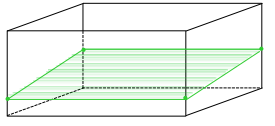
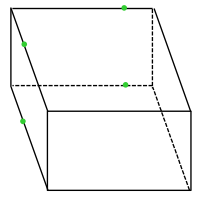
In the following exercises, the points at which a slicing plane meets the edges of the right rectangular prism have been marked. Each slice is either parallel or perpendicular to a face of the prism. Use a straightedge to join the points to outline the rectangular region defined by the slice, and shade in the rectangular slice.
Exercise 2.
A slice parallel to a face
Engage NY Math Grade 7 Module 6 Lesson 16 Exercise Answer Key 2
Answer:
Engage NY Math Grade 7 Module 6 Lesson 16 Exercise Answer Key 8.1

Exercise 3.
A slice perpendicular to a face
Engage NY Math Grade 7 Module 6 Lesson 16 Exercise Answer Key 3
Answer:
Engage NY Math Grade 7 Module 6 Lesson 16 Exercise Answer Key 8

Exercise 4.
A slice perpendicular to a face
Engage NY Math Grade 7 Module 6 Lesson 16 Exercise Answer Key 4
Answer:
Engage NY Math Grade 7 Module 6 Lesson 16 Exercise Answer Key 9

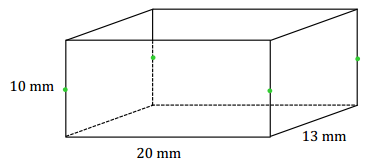
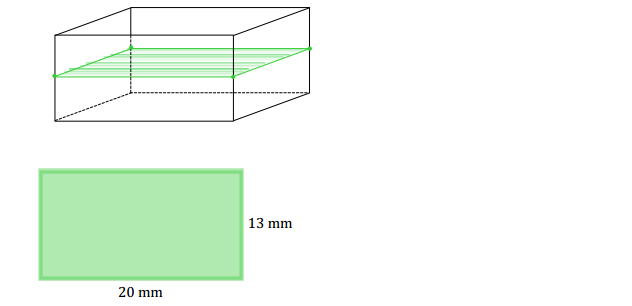
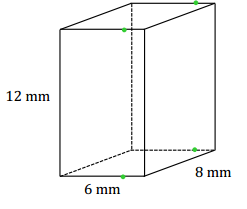
In Exercises 5–6, the dimensions of the prisms have been provided. Use the dimensions to sketch the slice from each prism, and provide the dimensions of each slice.
Exercise 5.
A slice parallel to a face
Engage NY Math Grade 7 Module 6 Lesson 16 Exercise Answer Key 5
Answer:
Engage NY Math Grade 7 Module 6 Lesson 16 Exercise Answer Key 10

Exercise 6.
A slice perpendicular to a face
Engage NY Math Grade 7 Module 6 Lesson 16 Exercise Answer Key 6
Answer:
Engage NY Math Grade 7 Module 6 Lesson 16 Exercise Answer Key 11

Eureka Math Grade 7 Module 6 Lesson 16 Problem Set Answer Key

Question 1.
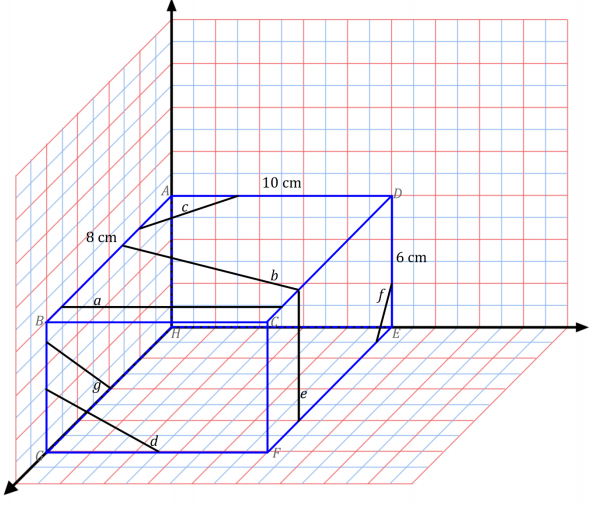
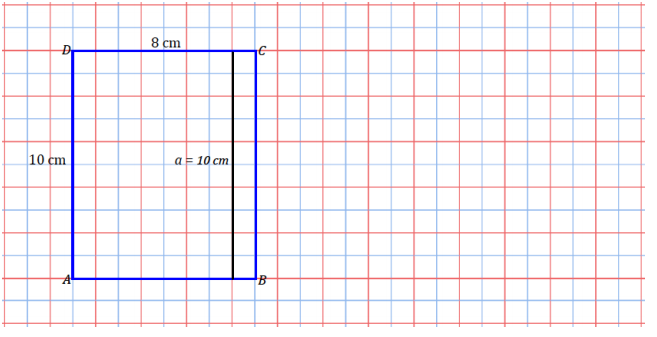
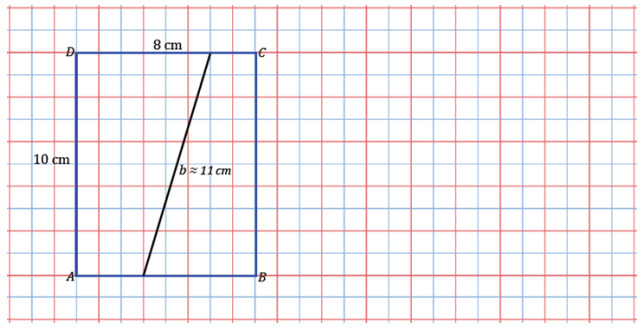
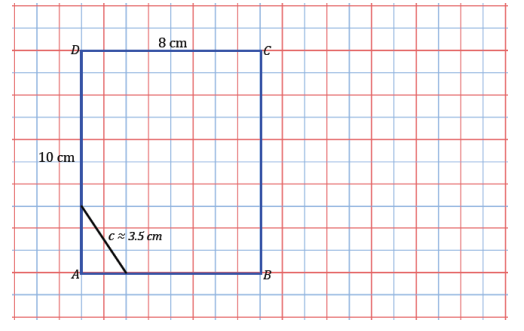
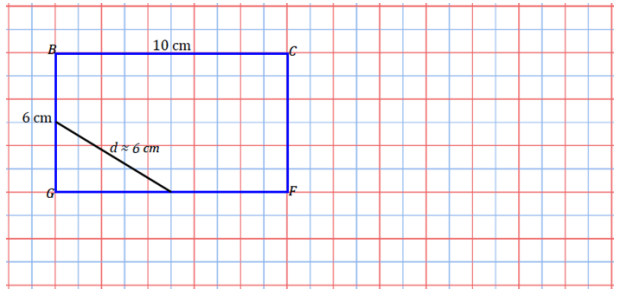
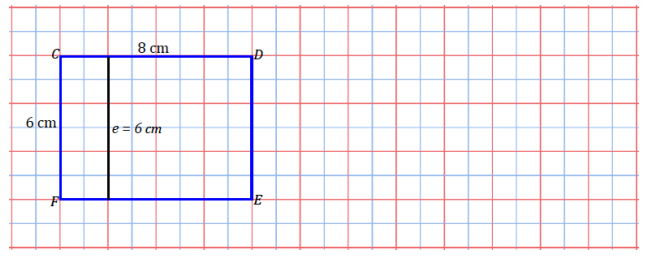
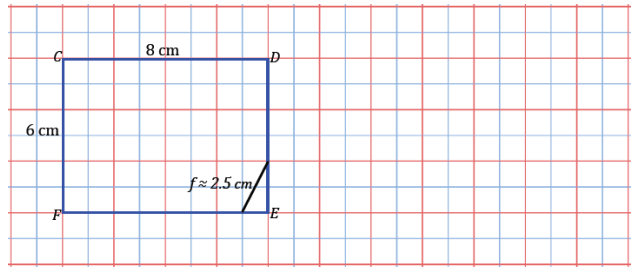
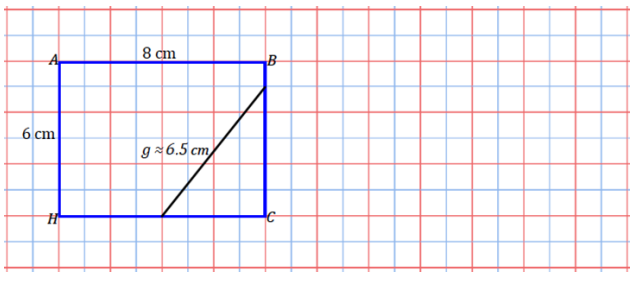
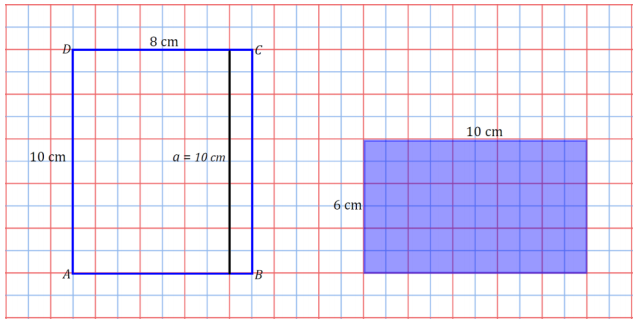
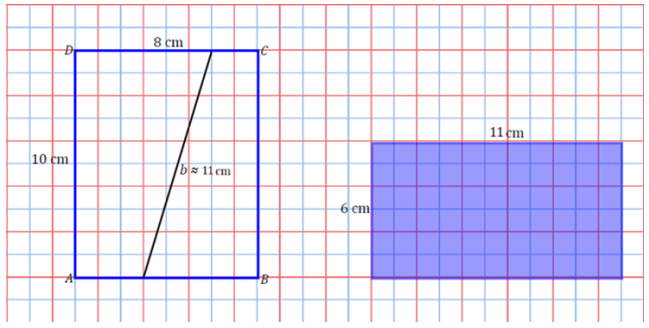
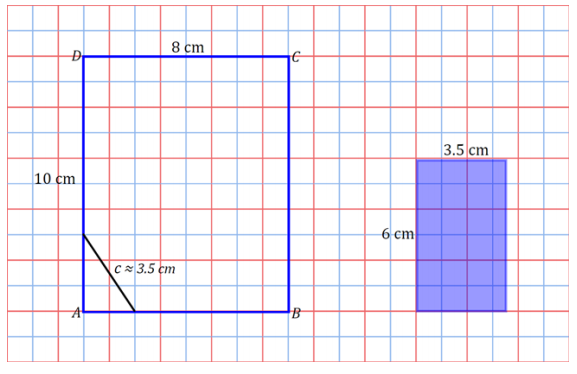
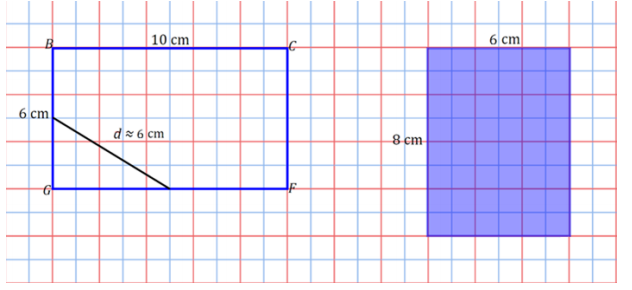
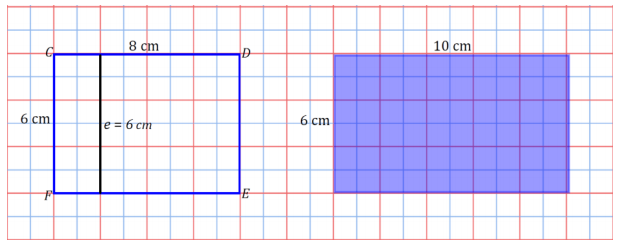
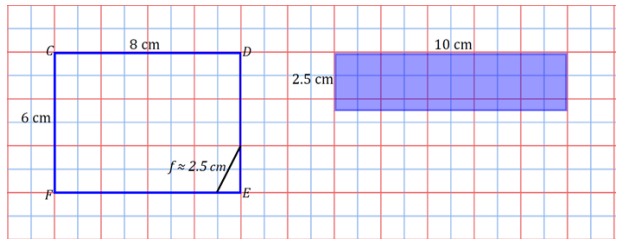
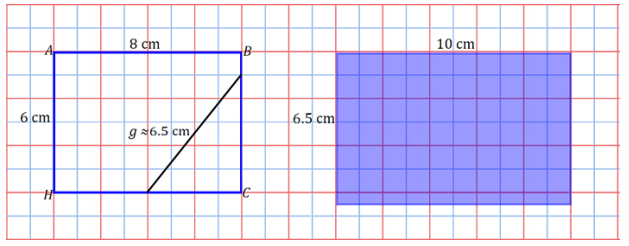
A right rectangular prism is shown along with line segments that lie in a face. For each line segment, draw and give the approximate dimensions of the slice that results when the slicing plane contains the given line segment and is perpendicular to the face that contains the line segment.
Eureka Math 7th Grade Module 6 Lesson 16 Problem Set Answer Key 1
a.
Eureka Math 7th Grade Module 6 Lesson 16 Problem Set Answer Key 2

b.
Eureka Math 7th Grade Module 6 Lesson 16 Problem Set Answer Key 3

c.
Eureka Math 7th Grade Module 6 Lesson 16 Problem Set Answer Key 4

d.
Eureka Math 7th Grade Module 6 Lesson 16 Problem Set Answer Key 5

e.
Eureka Math 7th Grade Module 6 Lesson 16 Problem Set Answer Key 6

f.
Eureka Math 7th Grade Module 6 Lesson 16 Problem Set Answer Key 7

g.
Eureka Math 7th Grade Module 6 Lesson 16 Problem Set Answer Key 8
Answer:
a.
Eureka Math 7th Grade Module 6 Lesson 16 Problem Set Answer Key 9

b.
Eureka Math 7th Grade Module 6 Lesson 16 Problem Set Answer Key 10

c.
Eureka Math 7th Grade Module 6 Lesson 16 Problem Set Answer Key 11

d.
Eureka Math 7th Grade Module 6 Lesson 16 Problem Set Answer Key 12

e.
Eureka Math 7th Grade Module 6 Lesson 16 Problem Set Answer Key 13

f.
Eureka Math 7th Grade Module 6 Lesson 16 Problem Set Answer Key 14

g.
Eureka Math 7th Grade Module 6 Lesson 16 Problem Set Answer Key 15

Eureka Math Grade 7 Module 6 Lesson 16 Exit Ticket Answer Key

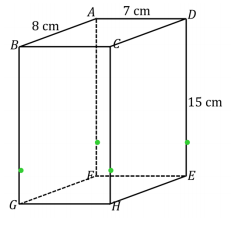
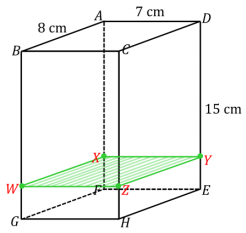
In the following figures, use a straightedge to join the points where a slicing plane meets with a right rectangular prism to outline the slice.
i) Label the vertices of the rectangular slice WXYZ.
ii) State any known dimensions of the slice.
iii) Describe two relationships slice WXYZ has in relation to faces of the right rectangular prism.
Question 1.
Eureka Math Grade 7 Module 6 Lesson 16 Exit Ticket Answer Key 1
Answer:
Eureka Math Grade 7 Module 6 Lesson 16 Exit Ticket Answer Key 3
Sides \(\overline{W Z}\) and \(\overline{X Y}\) are 6 cm in length. Slice WXYZ is perpendicular to faces ABCD and EFGH.

Question 2.
Eureka Math Grade 7 Module 6 Lesson 16 Exit Ticket Answer Key 2
Answer:
Eureka Math Grade 7 Module 6 Lesson 16 Exit Ticket Answer Key 4
Sides \(\overline{W Z}\) and \(\overline{X Y}\) are 7 cm in length. Sides \(\overline{W X}\) and \(\overline{Z Y}\) are 8 cm in length. Slice WXYZ is parallel to faces ABCD and EFGH and perpendicular to faces CDEH, ADEF, ABGF, and BCHG.
Note: Students are only required to state two of the relationships the slice has with the faces of the prism.

Eureka Math Grade 7 Module 6 Lesson 15 Answer Key

Engage NY Eureka Math 7th Grade Module 6 Lesson 15 Answer Key

Eureka Math Grade 7 Module 6 Lesson 15 Example Answer Key

Example 1.
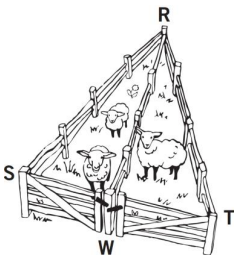
A triangular fence with two equal angles, ∠S = ∠T, is used to enclose some sheep. A fence is constructed inside the triangle that exactly cuts the other angle into two equal angles: ∠SRW = ∠TRW. Show that the gates, represented by \(\overline{S W}\) and \(\overline{W T}\), are the same width.
Engage NY Math 7th Grade Module 6 Lesson 15 Example Answer Key 1
Answer:
There is a correspondence △SRW ↔ △TRW that matches two pairs of angles of equal measurement, ∠S = ∠T and ∠SRW = ∠TRW, and one pair of sides of equal length shared, side \(\overline{R W}\). The triangles satisfy the two angles and side opposite a given angle condition. From the correspondence, we can conclude that SW = WT, or that the gates are of equal width.

Example 2.
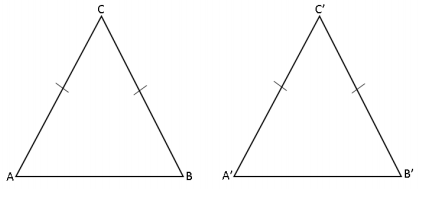
In △ABC, AC = BC, and △ABC ↔ △B’ A’ C’. John says that the triangle correspondence matches two sides and the included angle and shows that ∠A = ∠B’. Is John correct?
Engage NY Math 7th Grade Module 6 Lesson 15 Example Answer Key 2
Answer:
We are told that AC = BC. The correspondence △ABC ↔ △B’A’C’ tells us that BC ↔ A’C’, CA ↔ C’B’, and ∠C↔∠C’, which means △ABC is identical to △B’A’C’ by the two sides and included angle condition. From the correspondence, we can conclude that ∠A = ∠B’; therefore, John is correct.

Eureka Math Grade 7 Module 6 Lesson 15 Exercise Answer Key

Exercise 1.
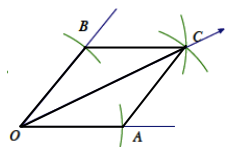
Mary puts the center of her compass at the vertex O of the angle and locates points A and B on the sides of the angle. Next, she centers her compass at each of A and B to locate point C. Finally, she constructs the ray \(\overrightarrow{O C}\). Explain why ∠BOC = ∠AOC.
Engage NY Math Grade 7 Module 6 Lesson 15 Exercise Answer Key 1
Answer:
Since Mary uses one compass adjustment to determine points A and B, OA = OB. Mary also uses the same compass adjustment from B and A to find point C; this means BC = AC. Side \(\overrightarrow{O C}\) is common to both the triangles,
△OBC and △OAC. Therefore, there is a correspondence △OBC ↔ △OAC that matches three pairs of equal sides, and the triangles are identical by the three sides condition. From the correspondence, we conclude that
∠BOC = ∠AOC.
Engage NY Math Grade 7 Module 6 Lesson 15 Exercise Answer Key 5

Exercise 2.
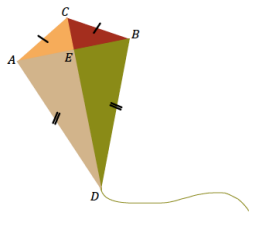
Quadrilateral ACBD is a model of a kite. The diagonals \(\overline{A B}\) and \(\overline{C D}\) represent the sticks that help keep the kite rigid.
a. John says that ∠ACD = ∠BCD. Can you use identical triangles to show that John is correct?
Engage NY Math Grade 7 Module 6 Lesson 15 Exercise Answer Key 2
b. Jill says that the two sticks are perpendicular to each other. Use the fact that ∠ACD = ∠BCD and what you know about identical triangles to show ∠AEC = 90°.
c. John says that Jill’s triangle correspondence that shows the sticks are perpendicular to each other also shows that the sticks cross at the midpoint of the horizontal stick. Is John correct? Explain.
Answer:
a. From the diagram, we see that AC = BC, and AD = BD. \(\overline{C D}\) is a common side to both triangles, △ACD and △BCD. There is a correspondence △ACD ↔ △BCD that matches three pairs of equal sides; the two triangles are identical by the three sides condition. From the correspondence, we conclude that ∠ACD = ∠BCD. John is correct.

b. Since we know that AC = BC and ∠ACD = ∠BCD, and that △ACE and △BCE share a common side, \(\overline{C E}\), we can find a correspondence that matches two pairs of equal sides and a pair of equal, included angles. The triangles are identical by the two sides and included angle condition. We can then conclude that ∠AEC = ∠BEC. Since both angles are adjacent to each other on a straight line, we also know their measures must sum to 180°. We can then conclude that each angle measures 90°.

c. Since we have established that △ACE and △BCE are adjacent to each other, we know that AE = BE. This means that E is the midpoint of \(\overline{A B}\), by definition.

Exercise 3.
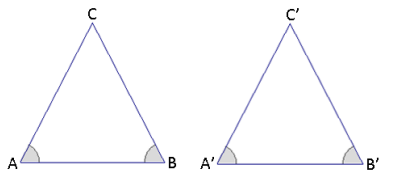
In △ABC, ∠A = ∠B, and △ABC ↔ △B’A’C’. Jill says that the triangle correspondence matches two angles and the included side and shows that AC = B’C’. Is Jill correct?
Engage NY Math Grade 7 Module 6 Lesson 15 Exercise Answer Key 3
Answer:
We are told that ∠A = ∠B. The correspondence △ABC ↔ △B’A’C’ tells us that ∠A = ∠B’, ∠B = ∠A’, and AB = B’A’, which means △ABC is identical to △B’A’C’ by the two angles and included side condition. From the correspondence, we can conclude that AC = B’C’; therefore, Jill is correct.

Exercise 4.
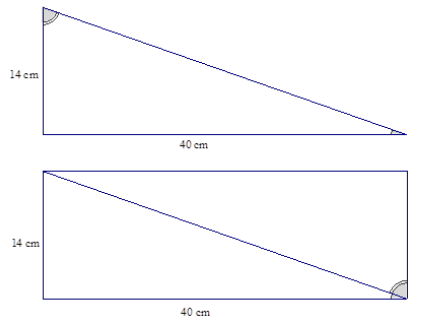
Right triangular corner flags are used to mark a soccer field. The vinyl flags have a base of 40 cm and a height of 14 cm.
a. Mary says that the two flags can be obtained by cutting a rectangle that is 40 cm×14 cm on the diagonal. Will that create two identical flags? Explain.
Engage NY Math Grade 7 Module 6 Lesson 15 Exercise Answer Key 4
b. Will measures the two non-right angles on a flag and adds the measurements together. Can you explain, without measuring the angles, why his answer is 90°?
Answer:
a. If the flag is to be cut from a rectangle, both triangles will have a side of length 40 cm, a length of 14 cm, and a right angle. There is a correspondence that matches two pairs of equal sides and an included pair of equal angles to the corner flag; the two triangles are identical to the corner flag as well as to each other.

b. The two non-right angles of the flags are adjacent angles that together form one angle of the four angles of the rectangle. We know that a rectangle has four right angles, so it must be that the two non-right angles of the flag together sum to 90°.

Eureka Math Grade 7 Module 6 Lesson 15 Problem Set Answer Key

Question 1.
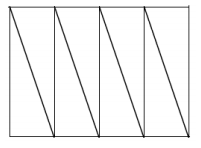
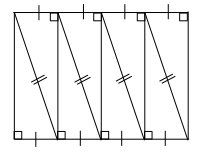
Jack is asked to cut a cake into 8 equal pieces. He first cuts it into equal fourths in the shape of rectangles, and then he cuts each rectangle along a diagonal.
Did he cut the cake into 8 equal pieces? Explain.
Eureka Math 7th Grade Module 6 Lesson 15 Problem Set Answer Key 1
Answer:
Eureka Math 7th Grade Module 6 Lesson 15 Problem Set Answer Key 3
Yes, Jack cut the cake into 8 equal pieces. Since the first series of cuts divided the cake into equal fourths in the shape of rectangles, we know that the opposite sides of the rectangles are equal in length; that means all 8 triangles have two sides that are equal in length to each other. Each of the triangular pieces also has one right angle because we know that rectangles have four right angles. Therefore, there is a correspondence between all 8 triangles that matches two pairs of equal sides and an equal, 90° non-included angle, determining 8 identical pieces of cake.

Question 2.
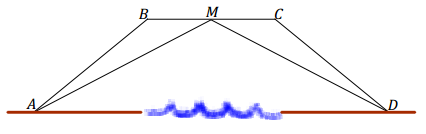
The bridge below, which crosses a river, is built out of two triangular supports. The point M lies on \(\overline{B C}\) . The beams represented by \(\overline{A M}\) and \(\overline{D M}\) are equal in length, and the beams represented by \(\overline{A B}\) and \(\overline{D C}\) are equal in length. If the supports were constructed so that ∠A and ∠D are equal in measurement, is point M the midpoint of \(\overline{B C}\)? Explain.
Eureka Math 7th Grade Module 6 Lesson 15 Problem Set Answer Key 2
Answer:
Yes, M is the midpoint of \(\overline{B C}\). The triangles are identical by the two sides and included angle condition. The correspondence △ABM ↔ △DCM matches two pairs of equal sides and one pair of included equal angles. Since the triangles are identical, we can use the correspondence to conclude that BM = CM, which makes M the midpoint, by definition.

Eureka Math Grade 7 Module 6 Lesson 15 Exit Ticket Answer Key

Question 1.
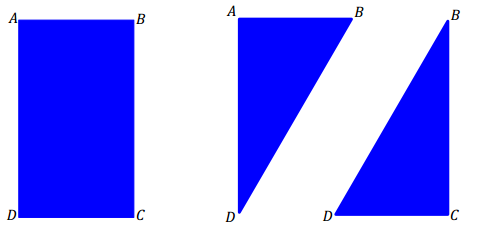
Alice is cutting wrapping paper to size to fit a package. How should she cut the rectangular paper into two triangles to ensure that each piece of wrapping paper is the same? Use your knowledge of conditions that determine unique triangles to justify that the pieces resulting from the cut are the same.
Eureka Math Grade 7 Module 6 Lesson 15 Exit Ticket Answer Key 1
Answer:
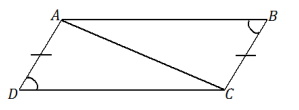
Alice should cut along the diagonal of rectangle ABCD. Since ABCD is a rectangle, the opposite sides will be equal in length, or AB = DC and AD = BC. A rectangle also has four right angles, which means a cut along the diagonal will result in each triangle with one 90° angle. The correspondence △ABD ↔ △CDB matches two equal pairs of sides and an equal, included pair of angles; the triangles are identical by the two sides and included angle condition.

Eureka Math Grade 7 Module 6 Lesson 14 Answer Key

Engage NY Eureka Math 7th Grade Module 6 Lesson 14 Answer Key

Eureka Math Grade 7 Module 6 Lesson 14 Example Answer Key

Example 1.
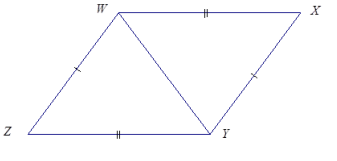
What is the relationship between the two triangles below?
Engage NY Math 7th Grade Module 6 Lesson 14 Example Answer Key 1
Answer:
What is the relationship between the two triangles below?
The triangles share a common side.
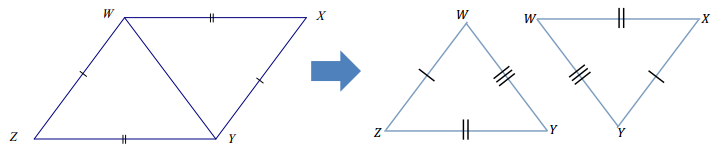
Imagine that △WXY and △WZY were pulled apart and separated. Sketch the triangles separately. Based on how they were joined, what kind of tick mark should be added to each triangle?
\(\overline{W Y}\) is a common side. Since it belongs to each triangle, we should put a triple tick mark on \(\overline{W Y}\) to indicate that it is a part of equal measure in both triangles.
Engage NY Math 7th Grade Module 6 Lesson 14 Example Answer Key 3
Are the triangles identical? How do you know?
The triangles are identical by the three sides condition. The correspondence that matches the three equal pairs of sides is △WXY↔△YZW.

Example 2.
Are the triangles identical? Justify your reasoning.
Engage NY Math 7th Grade Module 6 Lesson 14 Example Answer Key 2
Answer:
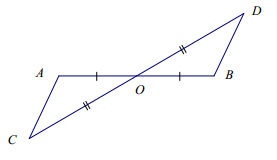
The triangles are identical by the two sides and the included angle condition. The correspondence △AOC ↔ △BOD matches two equal pairs of sides and a pair of equal angles, ∠AOC = ∠BOD, which we know to be equal in measurement because they are vertical angles.

Eureka Math Grade 7 Module 6 Lesson 14 Exercise Answer Key

Exercise 1.
Are the triangles identical? Justify your reasoning.
Engage NY Math Grade 7 Module 6 Lesson 14 Exercise Answer Key 1
Answer:
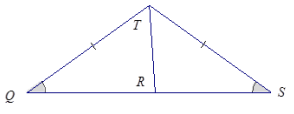
The triangles are not necessarily identical. The correspondence △QRT ↔ △SRT matches a pair of equal angles and a pair of equal sides. The correspondence also matches a common side, \(\overline{R T}\), to both triangles. Two sides and a non-included acute angle do not necessarily determine a unique triangle.

Exercise 2.
Are the triangles identical? Justify your reasoning.
Engage NY Math Grade 7 Module 6 Lesson 14 Exercise Answer Key 2
Answer:
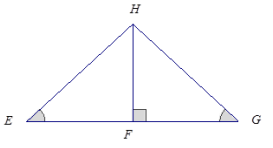
These triangles are identical by the two angles and side opposite a given angle condition. The correspondence △EFH ↔ △GFH matches two pairs of equal angles and a pair of equal sides. ∠HFE must be a right angle since ∠HFG is a right angle, and they are both on a line. Also, \(\overline{H F}\) is a common side to both triangles. Since both triangles have parts under the condition of the same measurement, the triangles must be identical.

Exercise 3.
Are the triangles identical? Justify your reasoning.
Engage NY Math Grade 7 Module 6 Lesson 14 Exercise Answer Key 3
Answer:
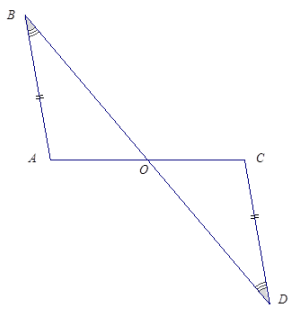
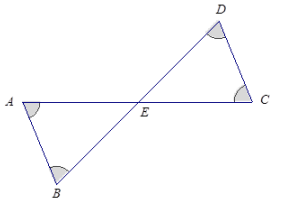
These triangles are identical by the two angles and side opposite a given angle condition. The correspondence △AOB ↔ △COD matches the two pairs of equal angles and one pair of equal sides. There is a marked pair of equal sides and one pair of marked, equal angles. The second pair of equal angles, ∠AOB = ∠COD, are vertical angles.

Exercise 4.
Are the triangles identical? Justify your reasoning.
Engage NY Math Grade 7 Module 6 Lesson 14 Exercise Answer Key 4
Answer:
The triangles are not necessarily identical. The correspondence △AEB ↔ △CED matches three pairs of equal angles, including the unmarked angles, ∠AEB and ∠CED, which are equal in measurement because they are vertical angles. The triangles could have different side lengths; therefore, they are not necessarily identical.

Exercise 5.
Are the triangles identical? Justify your reasoning.
Engage NY Math Grade 7 Module 6 Lesson 14 Exercise Answer Key 5
Answer:
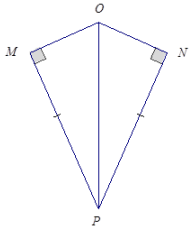
The triangles are identical by the two sides and non-included 90° (or greater) angle condition. The correspondence △MPO ↔ △NPO matches two pairs of equal sides and one pair of equal angles. One of the two pairs of equal sides is side \(\overline{O P}\), which is common to both triangles.

Exercise 6.
Are the triangles identical? Justify your reasoning.
Engage NY Math Grade 7 Module 6 Lesson 14 Exercise Answer Key 6
Answer:
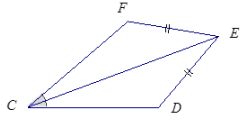
These triangles are not necessarily identical. The triangles have a pair of marked equal sides and equal angles; side \(\overline{C E}\) is also common to both triangles. The triangles satisfy the two sides and non-included acute angle condition, which does not determine a unique triangle.

Exercise 7.
Are the triangles identical? Justify your reasoning.
Engage NY Math Grade 7 Module 6 Lesson 14 Exercise Answer Key 7
Answer:
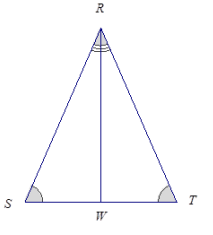
These triangles are identical by the two angles and a side opposite a given angle condition. The triangle correspondence △RWS ↔ △RWT matches two pairs of equal angles and one pair of equal sides. The equal pair of sides, \(\overline{R W}\), is common to both triangles.

Exercise 8.
Create your own labeled diagram and set of criteria for a pair of triangles. Ask a neighbor to determine whether the triangles are identical based on the provided information.
Answer:
Answers will vary.

Eureka Math Grade 7 Module 6 Lesson 14 Problem Set Answer Key

In the following problems, determine whether the triangles are identical, not identical, or not necessarily identical; justify your reasoning. If the relationship between the two triangles yields information that establishes a condition, describe the information. If the triangles are identical, write a triangle correspondence that matches the sides and angles.
Question 1.
Eureka Math 7th Grade Module 6 Lesson 14 Problem Set Answer Key 1
Answer:
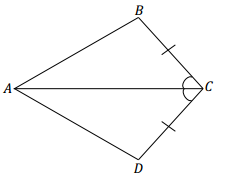
These triangles are identical by the two sides and the included angle condition. The triangle correspondence △ABC ↔ △ADC matches two pairs of equal sides and one pair of equal angles. One of the equal pairs of sides is shared side \(\overline{A C}\).

Question 2.
Eureka Math 7th Grade Module 6 Lesson 14 Problem Set Answer Key 2
Answer:
These triangles are not necessarily identical. The triangles have a pair of marked equal sides, and a pair of marked, acute, equal angles; side \(\overline{A C}\) is also common to both triangles. The triangles satisfy the two sides and non-included acute angle condition, which does not determine a unique triangle.

Question 3.
Eureka Math 7th Grade Module 6 Lesson 14 Problem Set Answer Key 3
Answer:
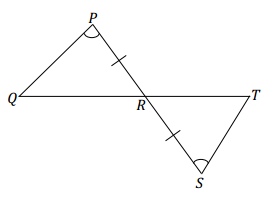
These triangles are identical by the two angles and included side condition. The triangle correspondence △QPR ↔ △TSR matches the two pairs of equal angles and one pair of equal sides. One pair of equal angles is the vertical angle pair ∠PRQ = ∠SRT.

Question 4.
Eureka Math 7th Grade Module 6 Lesson 14 Problem Set Answer Key 4
Answer:
These triangles are not necessarily identical. A correspondence that matches up the equal pair of sides and the equal pair of vertical angles does not match the marked equal pair of angles.

Question 5.
Eureka Math 7th Grade Module 6 Lesson 14 Problem Set Answer Key 5
Answer:
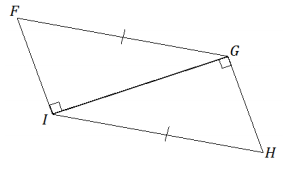
The triangles are identical by the two sides and non-included 90° (or greater) angle condition. The correspondence △IFG ↔ △GHI matches two pairs of equal sides and one pair of equal angles. One of the two pairs of equal sides is side \(\overline{I G}\), which is common to both triangles.

Question 6.
Eureka Math 7th Grade Module 6 Lesson 14 Problem Set Answer Key 6
Answer:
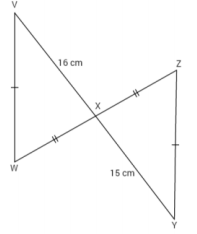
The triangles are not identical since a correspondence that matches the two marked equal pairs of sides also matches sides \(\overline{V X}\) and \(\overline{X Y}\), which are not equal in length.

Question 7.
Eureka Math 7th Grade Module 6 Lesson 14 Problem Set Answer Key 7
Answer:
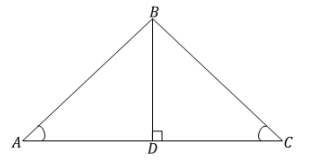
These triangles are identical by the two angles and side opposite a given angle condition. The correspondence △ABD ↔ △CBD matches the two pairs of equal angles and one pair of equal sides. The pair of equal sides is the common side, \(\overline{B D}\). We know ∠ADB must be a right angle since ∠CDB is a right angle; they are both on a line, and of course angles ∠A and ∠C are equal in measurement.

Question 8.
Are there any identical triangles in this diagram?
Eureka Math 7th Grade Module 6 Lesson 14 Problem Set Answer Key 8
Answer:
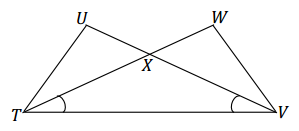
△TUX and △VWX are not necessarily identical; we only know about a single pair of equal angles in the triangles, which are vertical angles. △TUV and △VWT are also not necessarily identical. We only know about a single pair of equal angles and a side common to both triangles, which is not enough information to determine the triangles as identical or non-identical.

Question 9.
Eureka Math 7th Grade Module 6 Lesson 14 Problem Set Answer Key 9
Answer:
The triangles are not necessarily identical since there is no correspondence that matches the two marked equal pairs of sides as well as the two pairs of equal angles. One of the pairs of equal angles is the pair of vertical angles.

Question 10.
Eureka Math 7th Grade Module 6 Lesson 14 Problem Set Answer Key 10
Answer:
△ABE and △CBD are not necessarily identical. The triangles satisfy the two sides and non-included acute angle condition, which does not determine a unique triangle.

Eureka Math Grade 7 Module 6 Lesson 14 Exit Ticket Answer Key

Question 1.
Are △DEF and △DGF identical, not identical, or not necessarily identical? Justify your reasoning. If the relationship between the two triangles yields information that establishes a condition, describe the information. If the triangles are identical, write a triangle correspondence that matches the sides and angles.
Eureka Math Grade 7 Module 6 Lesson 14 Exit Ticket Answer Key 1
Answer:
These triangles are identical by the two angles and side opposite a given angle condition. The triangle correspondence △DEF ↔ △DGF matches the two pairs of equal angles and one pair of equal sides condition. The pair of equal sides, \(\overline{D F}\), is common to both triangles.

Eureka Math Grade 7 Module 6 Lesson 13 Answer Key

Engage NY Eureka Math 7th Grade Module 6 Lesson 13 Answer Key

Eureka Math Grade 7 Module 6 Lesson 13 Example Answer Key

Example 1.
Engage NY Math 7th Grade Module 6 Lesson 13 Example Answer Key 1
Answer:
The triangles are identical by the two angles and the included side condition. The correspondence △ABC↔△YXZ matches two pairs of angles and one pair of equal sides. Since both triangles have parts under the condition of the same measurement, the triangles must be identical.

In Example 2 and Exercises 4–6, three pieces of information are given for △ABC and △XYZ. Draw, freehand, the two triangles (do not worry about scale), and mark the given information. If the triangles are identical, give a triangle correspondence that matches equal angles and equal sides. Explain your reasoning.

Example 2.
AB = XZ, AC = XY, ∠A = ∠X
Answer:
Engage NY Math 7th Grade Module 6 Lesson 13 Example Answer Key 2
These triangles are identical by the two sides and included angle condition. The triangle correspondence △ABC ↔ △XZY matches two pairs of equal sides and one pair of equal, included angles. Since both triangles have parts under the condition of the same measurement, the triangles must be identical.

Eureka Math Grade 7 Module 6 Lesson 13 Exercise Answer Key

Opening Exercise
a. List all the conditions that determine unique triangles.
b. How are the terms identical and unique related?
Answer:
a.
→ Three sides condition
→ Two sides and included angle condition
→ Two angles and included side condition
→ Two angles and the side opposite a given angle condition
→ Two sides and a non-included angle, provided the angle is 90° or greater
→ Two sides and a non-included angle, provided the side adjacent to the angle is shorter than the side opposite the angle.

b. When drawing a triangle under a given condition, the triangle will either be identical or non-identical to the original triangle. If only one triangle can be drawn under the condition, we say the condition determines a unique triangle. A triangle drawn under a condition that is known to determine a unique triangle will be identical to the original triangle.

Each of the following problems gives two triangles. State whether the triangles are identical, not identical, or not necessarily identical. If the triangles are identical, give the triangle conditions that explain why, and write a triangle correspondence that matches the sides and angles. If the triangles are not identical, explain why. If it is not possible to definitively determine whether the triangles are identical, write “the triangles are not necessarily identical,” and explain your reasoning.

Exercises 1–3
1.
Engage NY Math Grade 7 Module 6 Lesson 13 Exercise Answer Key 1
Answer:
The triangles are identical by the two sides and the included angle condition. The correspondence △DEF↔△GIH matches two equal pairs of sides and one equal pair of angles. Since both triangles have parts under the condition of the same measurement, the triangles must be identical.

2.
Engage NY Math Grade 7 Module 6 Lesson 13 Exercise Answer Key 2
Answer:
The triangles are not necessarily identical. Although the two angles in each triangle match, the marked sides do not correspond. In △ABC, the marked side is not between the marked angles; whereas in △DEF, the marked side is between the marked angles.

3.
Engage NY Math Grade 7 Module 6 Lesson 13 Exercise Answer Key 3
Answer:
The triangles are identical by the three sides condition. The correspondence △ABC↔△YZX matches three equal pairs of sides. Since both triangles have the same side lengths, the triangles must be identical.

Exercises 4–6
4. ∠A = ∠Z, ∠B = ∠Y, AB = YZ
Answer:
Engage NY Math Grade 7 Module 6 Lesson 13 Exercise Answer Key 4
These triangles are identical by the two angles and included side condition. The triangle correspondence
△ABC ↔ △ZYX matches two pairs of equal angles and one pair of equal, included sides. Since both triangles have parts under the condition of the same measurement, the triangles must be identical.

5. ∠A = ∠Z, ∠B = ∠Y, BC = XY
Answer:
Engage NY Math Grade 7 Module 6 Lesson 13 Exercise Answer Key 5
These triangles are identical by the two angles and side opposite a given angle condition. The triangle correspondence △ABC ↔ △ZYX matches two pairs of equal angles and one pair of equal sides. Since both triangles have parts under the condition of the same measurement, the triangles must be identical.

6. ∠A = ∠Z, ∠B = ∠Y, BC = XZ
Answer:
Engage NY Math Grade 7 Module 6 Lesson 13 Exercise Answer Key 6
These triangles are not necessarily identical. In △ABC, the marked side is opposite ∠A. In △XYZ, the marked side is not opposite ∠Z, which is equal to ∠A. Rather, it is opposite ∠Y, which is equal to ∠B.

Eureka Math Grade 7 Module 6 Lesson 13 Problem Set Answer Key

In each of the following four problems, two triangles are given. State whether the triangles are identical, not identical, or not necessarily identical. If the triangles are identical, give the triangle conditions that explain why, and write a triangle correspondence that matches the sides and angles. If the triangles are not identical, explain why. If it is not possible to definitively determine whether the triangles are identical, write “the triangles are not necessarily identical,” and explain your reasoning.
Question 1.
Eureka Math 7th Grade Module 6 Lesson 13 Problem Set Answer Key 1
Answer:
The triangles are identical by the two angles and included side condition. The correspondence △MNO↔△RQP matches two equal pairs of angles and one equal pair of included sides. Since both triangles have parts under the condition of the same measurement, the triangles must be identical.

Question 2.
Eureka Math 7th Grade Module 6 Lesson 13 Problem Set Answer Key 2
Answer:
The triangles are identical by the two angles and side opposite a given angle condition. The correspondence △EGF ↔ △RQS matches two equal pairs of angles and one equal pair of sides. Since both triangles have parts under the condition of the same measurement, the triangles must be identical.

Question 3.
Eureka Math 7th Grade Module 6 Lesson 13 Problem Set Answer Key 3
Answer:
The triangles are identical by the two sides and non-included 90° (or greater) angle condition. The correspondence △WXY ↔ △EDC matches two pairs of equal sides and one pair of equal angles. Since both triangles have parts under the condition of the same measurement, the triangles must be identical.

Question 4.
Eureka Math 7th Grade Module 6 Lesson 13 Problem Set Answer Key 4
Answer:
The triangles are not necessarily identical by the two angles and side opposite a given angle condition. In △ABC, the marked side is adjacent to the angle marked with a single arc mark. In △WXY, the marked side is not adjacent to the angle marked with a single arc mark.

For Problems 5–8, three pieces of information are given for △ABC and △YZX. Draw, freehand, the two triangles (do not worry about scale), and mark the given information. If the triangles are identical, give a triangle correspondence that matches equal angles and equal sides. Explain your reasoning.
Question 5.
AB = YZ, BC = ZX, AC = YX
Answer:
Eureka Math 7th Grade Module 6 Lesson 13 Problem Set Answer Key 5
These triangles are identical by the three sides condition. The triangle correspondence △ABC ↔ △YZX matches three pairs of equal sides. Since both triangles have parts under the condition of the same measurement, the triangles must be identical.

Question 6.
AB = YZ, BC = ZX, ∠C = ∠Y
Answer:
Eureka Math 7th Grade Module 6 Lesson 13 Problem Set Answer Key 6
These triangles are not necessarily identical. In △ABC, the marked angle is adjacent to \(\overline{B C}\). In △YZX, the marked angle is not adjacent to the side equal to ZX, which is equal to BC.

Question 7.
AB = XZ, ∠A = ∠Z, ∠C = ∠Y
Answer:
Eureka Math 7th Grade Module 6 Lesson 13 Problem Set Answer Key 7
These triangles are identical by the two angles and a side opposite a given angle condition. The triangle correspondence △ABC ↔ △ZXY matches two pairs of equal angles and one pair of equal sides. Since both triangles have parts under the condition of the same measurement, the triangles must be identical.

Question 8.
AB = XY, AC = YZ, ∠C = ∠Z (Note that both angles are obtuse.)
Answer:
Eureka Math 7th Grade Module 6 Lesson 13 Problem Set Answer Key 8
The triangles are identical by the two sides and non-included 90° (or greater) angle condition. The correspondence △ABC ↔ △YXZ matches two pairs of equal sides and one pair of equal angles. Since both triangles have parts under the condition of the same measurement, the triangles must be identical.

Eureka Math Grade 7 Module 6 Lesson 13 Exit Ticket Answer Key

Question 1.
∠A and ∠D are equal in measure. Draw two triangles around each angle, and mark parts appropriately so that the triangles are identical; use ∠A and ∠D as part of the chosen condition. Write a correspondence for the triangles.
Eureka Math Grade 7 Module 6 Lesson 13 Exit Ticket Answer Key 1
Answer:
Answers will vary; students should select any condition except for the three sides condition and show the appropriate correspondence for their condition on the two triangles.

Eureka Math Grade 7 Module 6 Lesson 12 Answer Key

Engage NY Eureka Math 7th Grade Module 6 Lesson 12 Answer Key

Eureka Math Grade 7 Module 6 Lesson 12 Exploratory Challenge Answer Key

Question 1.
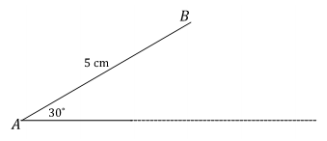
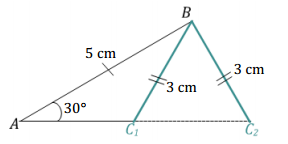
Use your tools to draw △ABC in the space below, provided AB = 5 cm, BC = 3 cm, and ∠A = 30°. Continue with the rest of the problem as you work on your drawing.
a. What is the relationship between the given parts of △ABC?
b. Which parts of the triangle can be drawn without difficulty? What makes this drawing challenging?
c. A ruler and compass are instrumental in determining where C is located.
✓ Even though the length of segment AC is unknown, extend the ray AC in anticipation of the intersection with segment BC.
✓ Draw segment BC with length 3 cm away from the drawing of the triangle.
✓ Adjust your compass to the length of \(\overline{B C}\).
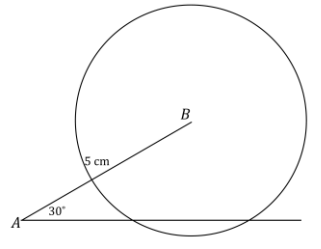
✓ Draw a circle with center B and a radius equal to BC, or 3 cm.
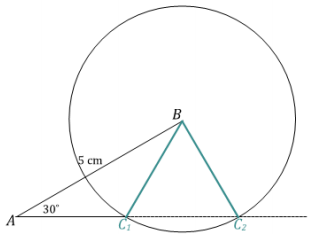
d. How many intersections does the circle make with segment AC? What does each intersection signify?
e. Complete the drawing of △ABC.
f. Did the results of your drawing differ from your prediction?
Answer:
Engage NY Math 7th Grade Module 6 Lesson 12 Exploratory Challenge Answer Key 1
a. Two sides and a non-included angle are provided.

b. The parts that are adjacent, \(\overline{A B}\) and ∠A, are easiest to draw. It is difficult to position \(\overline{B C}\).

c. Engage NY Math 7th Grade Module 6 Lesson 12 Exploratory Challenge Answer Key 2

d. Two intersections; each intersection represents a possible location for vertex C.
e. Engage NY Math 7th Grade Module 6 Lesson 12 Exploratory Challenge Answer Key 3
f. Answers will vary.

Question 2.
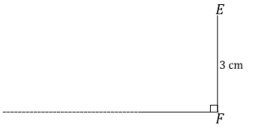
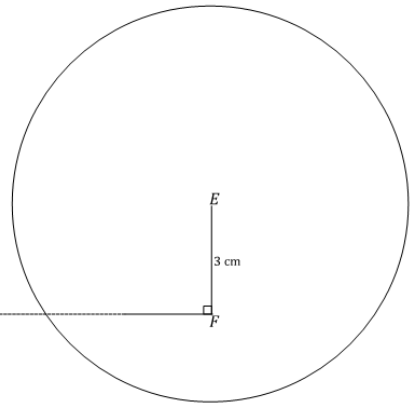
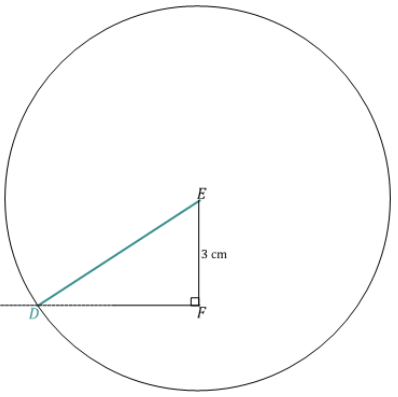
Now attempt to draw △DEF in the space below, provided DE = 5 cm, EF = 3 cm, and ∠F = 90°. Continue with the rest of the problem as you work on your drawing.
a. How are these conditions different from those in Exercise 1, and do you think the criteria will determine a unique triangle?
b. What is the relationship between the given parts of △DEF?
c. Describe how you will determine the position of \(\overline{D E}\).
d. How many intersections does the circle make with \(\overline{F D}\)?
e. Complete the drawing of △DEF. How is the outcome of △DEF different from that of △ABC?
f. Did your results differ from your prediction?
Answer:
a. The provided angle was an acute angle in Exercise 1; now the provided angle is a right angle. Possible prediction: Since the same general criteria (two sides and a non-included angle) determined more than one triangle in Exercise 1, the same can happen in this situation.
Engage NY Math 7th Grade Module 6 Lesson 12 Exploratory Challenge Answer Key 4
b. Two sides and a non-included angle are provided.

c. I will draw a segment equal in length to \(\overline{D E}\), or 5 cm, and adjust my compass to this length. Then, I will draw a circle with center E and radius equal to DE. This circle should intersect with the ray FD.

d. Just one intersection.
Engage NY Math 7th Grade Module 6 Lesson 12 Exploratory Challenge Answer Key 5
e. In drawing △ABC, there are two possible locations for vertex C, but in drawing △DEF, there is only one location for vertex D.
Engage NY Math 7th Grade Module 6 Lesson 12 Exploratory Challenge Answer Key 6
f. Answers will vary.

Question 3.
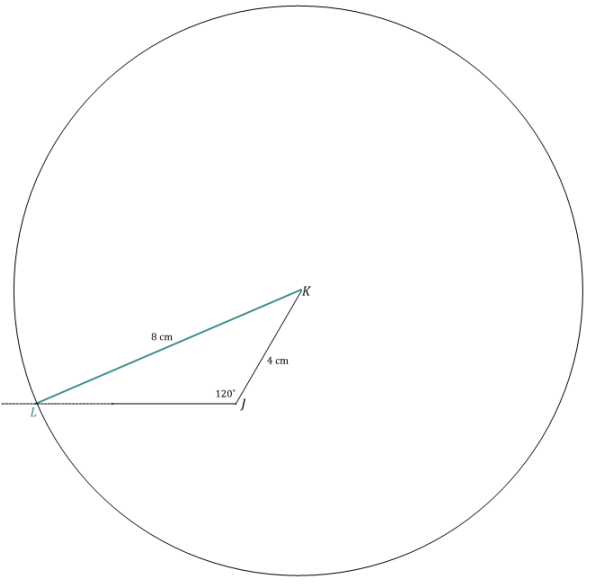
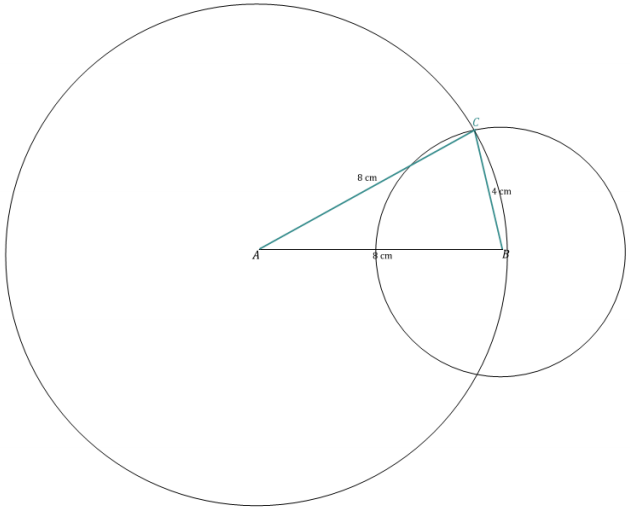
Now attempt to draw △JKL, provided KL = 8 cm, KJ = 4 cm, and ∠J = 120°. Use what you drew in Exercises 1 and 2 to complete the full drawing.
Answer:
Engage NY Math 7th Grade Module 6 Lesson 12 Exploratory Challenge Answer Key 7

Question 4.
Review the conditions provided for each of the three triangles in the Exploratory Challenge, and discuss the uniqueness of the resulting drawing in each case.
Answer:
All three triangles are under the condition of two sides and a non-included angle. The non-included angle in △ABC is an acute angle, while the non-included angle in △DEF is 90°, and the non-included angle in △JKL is obtuse. The triangles drawn in the latter two cases are unique because there is only one possible triangle that could be drawn for each. However, the triangle drawn in the first case is not unique because there are two possible triangles that could be drawn.

Eureka Math Grade 7 Module 6 Lesson 12 Problem Set Answer Key

Question 1.
In each of the triangles below, two sides and a non-included acute angle are marked. Use a compass to draw a nonidentical triangle that has the same measurements as the marked angle and marked sides (look at Exercise 1,
part (e) of the Exploratory Challenge as a reference). Draw the new triangle on top of the old triangle. What is true about the marked angles in each triangle that results in two non-identical triangles under this condition?
Eureka Math 7th Grade Module 6 Lesson 12 Problem Set Answer Key 1
Answer:
a. The non-included angle is acute.
Eureka Math 7th Grade Module 6 Lesson 12 Problem Set Answer Key 4

b. The non-included angle is acute.
Eureka Math 7th Grade Module 6 Lesson 12 Problem Set Answer Key 5

c. The non-included angle is acute.
Eureka Math 7th Grade Module 6 Lesson 12 Problem Set Answer Key 6

Question 2.
Sometimes two sides and a non-included angle of a triangle determine a unique triangle, even if the angle is acute. In the following two triangles, copy the marked information (i.e., two sides and a non-included acute angle), and discover which determines a unique triangle. Measure and label the marked parts.
In each triangle, how does the length of the marked side adjacent to the marked angle compare with the length of the side opposite the marked angle? Based on your drawings, specifically state when the two sides and acute non-included angle condition determines a unique triangle.
Eureka Math 7th Grade Module 6 Lesson 12 Problem Set Answer Key 2
Answer:
While redrawing △ABC, students will see that a unique triangle is not determined, but in redrawing △DEF, a unique triangle is determined. In △ABC, the length of the side opposite the angle is shorter than the side adjacent to the angle. However, in △DEF, the side opposite the angle is longer than the side adjacent to the angle.
The two sides and acute non-included angle condition determines a unique triangle if the side opposite the angle is longer than the side adjacent to the angle.
Eureka Math 7th Grade Module 6 Lesson 12 Problem Set Answer Key 7

Question 3.
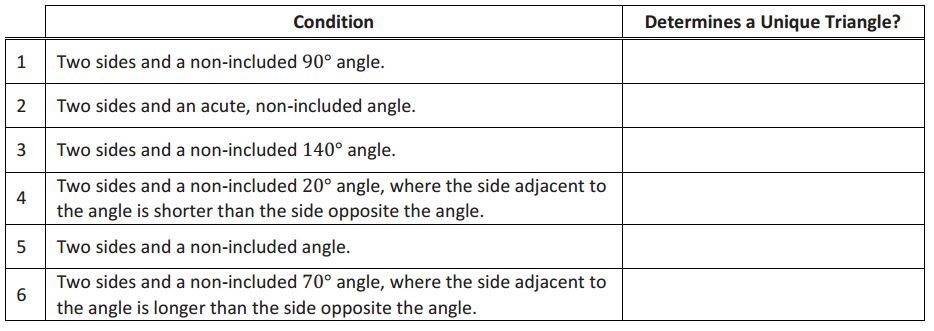
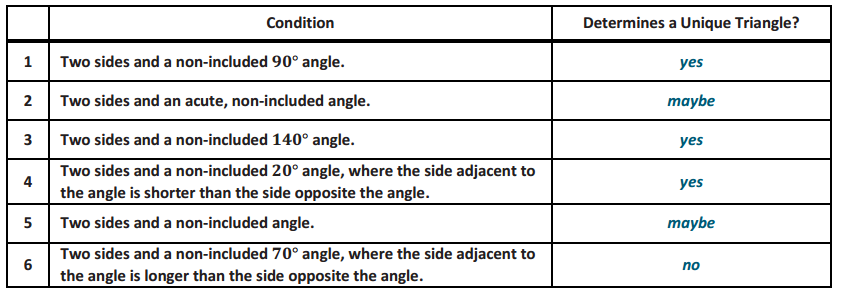
A sub-condition of the two sides and non-included angle is provided in each row of the following table. Decide whether the information determines a unique triangle. Answer with a yes, no, or maybe (for a case that may or may not determine a unique triangle).
Eureka Math 7th Grade Module 6 Lesson 12 Problem Set Answer Key 3
Answer:
Eureka Math 7th Grade Module 6 Lesson 12 Problem Set Answer Key 8

Question 4.
Choose one condition from the table in Problem 3 that does not determine a unique triangle, and explain why.
Answer:
Possible response: Condition 6 does not determine a unique triangle because the condition of two sides and an acute non-included angle determines two possible triangles when the side adjacent to the angle is longer than the side opposite the angle.

Question 5.
Choose one condition from the table in Problem 3 that does determine a unique triangle, and explain why.
Answer:
Possible response: Condition 1 determines a unique triangle because the condition of two sides and a non-included angle with a measurement of 90° or more has a ray that only intersects the circle once.

Eureka Math Grade 7 Module 6 Lesson 12 Exit Ticket Answer Key

Question 1.
So far, we have learned about four conditions that determine unique triangles: three sides, two sides and an included angle, two angles and an included side, and two angles and the side opposite a given angle.
a. In this lesson, we studied the criterion two sides and a non-included angle. Which case of this criterion determines a unique triangle?
b. Provided \(\overline{A B}\) has length 5 cm, \(\overline{B C}\) has length 3 cm, and the measurement of ∠A is 30°, draw △ABC, and describe why these conditions do not determine a unique triangle.
Answer:
a. For the criterion two sides and a non-included angle, the case where the non-included angle is 90° or greater determines a unique triangle.
b. Eureka Math Grade 7 Module 6 Lesson 12 Exit Ticket Answer Key 1
The non-included angle is an acute angle, and two different triangles can be determined in this case since \(\overline{B C}\) can be in two different positions, forming a triangle with two different lengths of \(\overline{A C}\).

Eureka Math Grade 7 Module 6 Lesson 10 Answer Key

Engage NY Eureka Math 7th Grade Module 6 Lesson 10 Answer Key

Eureka Math Grade 7 Module 6 Lesson 10 Exploratory Challenge Answer Key

Question 1.
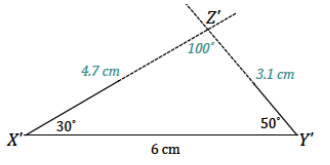
A triangle XYZ has angle measures ∠X = 30° and ∠Y = 50° and included side XY = 6 cm. Draw △X’Y’Z’ under the same condition as △XYZ. Leave all construction marks as evidence of your work, and label all side and angle measurements.
Under what condition is △X’Y’Z’ drawn? Compare the triangle you drew to two of your peers’ triangles. Are the triangles identical? Did the condition determine a unique triangle? Use your construction to explain why.
Answer:
Engage NY Math 7th Grade Module 6 Lesson 10 Exploratory Challenge Answer Key 1
The condition on △X’Y’Z’ is the two angles and included side condition. All of the triangles are identical; the condition determined a unique triangle. After drawing the included side length, I used the protractor to draw the provided angle measurements at either endpoint of the included side \(\overline{X^{\prime} Y^{\prime}}\). Since these two angle measurements are fixed, the two remaining side lengths will intersect in one location, which is the third vertex of the triangle, Z’. There is no other way to draw this triangle; therefore, the condition determines a unique triangle.

Question 2.
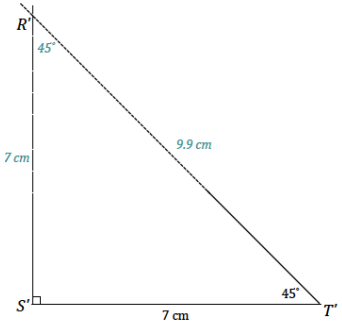
A triangle RST has angle measures ∠S = 90° and ∠T = 45° and included side ST = 7 cm. Draw △R’S’T’ under the same condition. Leave all construction marks as evidence of your work, and label all side and angle measurements.
Under what condition is △R’S’T’ drawn? Compare the triangle you drew to two of your peers’ triangles. Are the triangles identical? Did the condition determine a unique triangle? Use your construction to explain why.
Answer:
Engage NY Math 7th Grade Module 6 Lesson 10 Exploratory Challenge Answer Key 2
The condition on △R’ S’ T’ is the two angles and included side condition. All of the triangles are identical; the condition determined a unique triangle. After drawing the included side length, I used the protractor to draw the provided angle measurements at either endpoint of the included side \(\overline{S^{\prime} T^{\prime}}\). The intersection of the sides of the angle is the third vertex of the triangle, R’. There is no other way to draw this triangle; therefore, the condition determines a unique triangle.

Question 3.
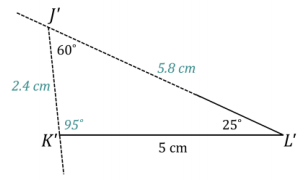
A triangle JKL has angle measures ∠J = 60° and ∠L = 25° and side KL = 5 cm. Draw △J’K’L’ under the same condition. Leave all construction marks as evidence of your work, and label all side and angle measurements.
Under what condition is △J’K’L’ drawn? Compare the triangle you drew to two of your peers’ triangles. Are the triangles identical? Did the condition determine a unique triangle? Use your construction to explain why.
Answer:
The condition on △J’K’L’ is the two angles and the side opposite a given angle condition. All of the triangles are identical; the condition determined a unique triangle. After drawing the given side length, I used the protractor to draw ∠L’ adjacent to \(\overline{K^{\prime} L^{\prime}}\). I drew the angle opposite the given side, ∠J’, on a slip of paper and lined up one ray of the angle on patty paper with one ray of the angle adjacent to the given side. I moved the angle on patty paper along the coinciding rays until the free ray just met the endpoint of \(\overline{K^{\prime} L^{\prime}}\). There is no other way to draw this triangle; therefore, the condition determines a unique triangle.
Engage NY Math 7th Grade Module 6 Lesson 10 Exploratory Challenge Answer Key 3

Question 4.
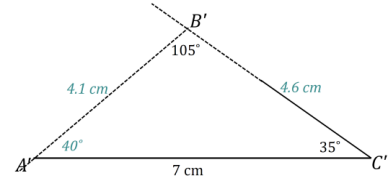
A triangle ABC has angle measures ∠C = 35° and ∠B = 105° and side AC = 7 cm. Draw △A’B’C’ under the same condition. Leave all construction marks as evidence of your work, and label all side and angle measurements.
Under what condition is △A’B’C’ drawn? Compare the triangle you drew to two of your peers’ triangles. Are the triangles identical? Did the condition determine a unique triangle? Use your construction to explain why.
Answer:
Engage NY Math 7th Grade Module 6 Lesson 10 Exploratory Challenge Answer Key 4
The condition on △A’B’C’ is the two angles and the side opposite a given angle condition. All of the triangles are identical; the condition determined a unique triangle. After drawing the given side length, I used the protractor to draw ∠C’ adjacent to \(\overline{A^{\prime} C^{\prime}}\). I drew the angle opposite the given side, ∠B’, on a slip of paper and lined up one ray of the angle on patty paper with one ray of the angle adjacent to the given side. I moved the angle on patty paper along the coinciding rays until the free ray just met the endpoint of \(\overline{A^{\prime} C^{\prime}}\). There is no other way to draw this triangle; therefore, the condition determines a unique triangle.

Eureka Math Grade 7 Module 6 Lesson 10 Problem Set Answer Key

Question 1.
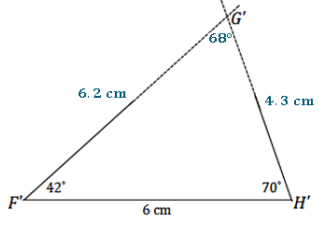
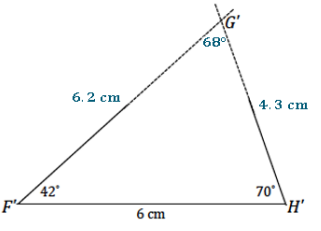
In △FGH, ∠F = 42° and ∠H = 70°. FH = 6 cm. Draw △F’G’H’ under the same condition as △FGH. Leave all construction marks as evidence of your work, and label all side and angle measurements.
What can you conclude about △FGH and △F’G’H’? Justify your response.
Answer:
Eureka Math 7th Grade Module 6 Lesson 10 Problem Set Answer Key 1
△FGH and △F’G’H’ are identical triangles by the two angles and included side condition. Since both triangles are drawn under the same condition, and the two angles and included side condition determines a unique triangle, both triangles determine the same unique triangle. Therefore, they are identical.

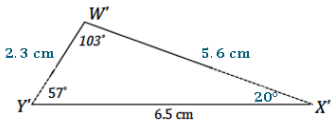
Question 2.
In △WXY, ∠Y = 57° and ∠W = 103°. Side YX = 6.5 cm. Draw △W’X’Y’ under the same condition as △WXY. Leave all construction marks as evidence of your work, and label all side and angle measurements.
What can you conclude about △WXY and △W’X’Y’? Justify your response.
Answer:
Eureka Math 7th Grade Module 6 Lesson 10 Problem Set Answer Key 2
△WXY and △W’X’Y’ are identical triangles by the two angles and the side opposite a given angle condition. Since both triangles are drawn under the same condition, and the two angles and the side opposite a given angle condition determines a unique triangle, both triangles determine the same unique triangle. Therefore, they are identical.

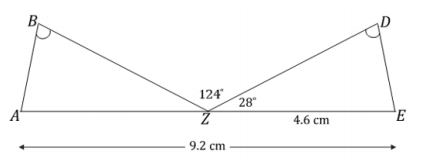
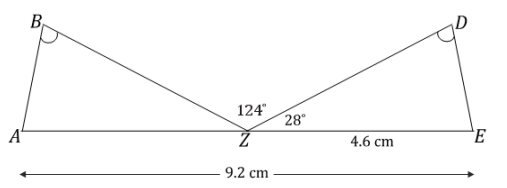
Question 3.
Points A, Z, and E are collinear, and ∠B = ∠D. What can be concluded about △ABZ and △EDZ? Justify your answer.
Eureka Math 7th Grade Module 6 Lesson 10 Problem Set Answer Key 3.1
Answer:
Eureka Math 7th Grade Module 6 Lesson 10 Problem Set Answer Key 3
△ABZ and △EDZ are identical by the two angles and the side opposite a given angle condition. Since segments add, and AE is 9.2 cm and ZE is 4.6 cm, AZ must be 4.6 cm. Since angles on a line sum to 180°, ∠BZD = 124°,
and ∠DZE = 28°, then ∠AZB = 28°. From the diagram, we can see that ∠B = ∠D. The same measurements in both triangles satisfy the two angles and the side opposite a given angle condition, which means they both determine the same unique triangle; thus, they are identical.

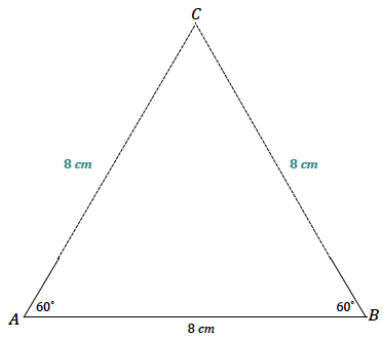
Question 4.
Draw △ABC so that ∠A has a measurement of 60°, ∠B has a measurement of 60°, and \(\overline{A B}\) has a length of 8 cm. What are the lengths of the other sides?
Answer:
Both of the other side lengths are 8 cm.
Eureka Math 7th Grade Module 6 Lesson 10 Problem Set Answer Key 4

Question 5.
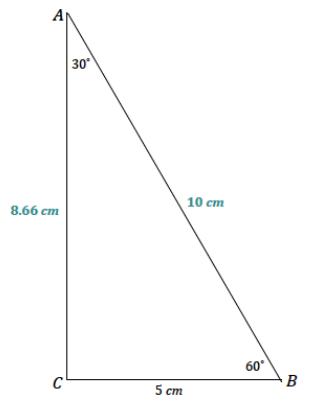
Draw △ABC so that ∠A has a measurement of 30°, ∠B has a measurement of 60°, and \(\overline{B C}\) has a length of 5 cm. What is the length of the longest side?
Answer:
The longest side has a length of 10 cm.
Eureka Math 7th Grade Module 6 Lesson 10 Problem Set Answer Key 5

Eureka Math Grade 7 Module 6 Lesson 10 Exit Ticket Answer Key

Question 1.
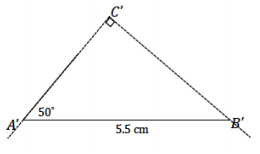
△ABC has angle measures ∠A = 50° and ∠C = 90° and side AB = 5.5 cm. Draw △A’B’C’ under the same condition. Under what condition is △A’B’C’ drawn? Use your construction to explain why △A’B’C’ is or is not identical to △ABC.
Answer:
Eureka Math Grade 7 Module 6 Lesson 10 Exit Ticket Answer Key 1
The condition on △A’B’C’ is the two angles and the side opposite a given angle condition. △A’B’C’ is identical to △ABC. After drawing the given side length, I used the protractor to draw ∠A’ adjacent to \(\overline{A^{\prime} B^{\prime}}\). I drew the angle opposite the given side, ∠B’, on a slip of paper and lined up one ray of the angle on patty paper with one ray of the angle adjacent to the given side. I moved the angle on patty paper along the coinciding rays until the free ray just met the endpoint of \(\overline{A^{\prime} B^{\prime}}\). There is no other way to draw this triangle; therefore, △A’B’C’ must be identical to △ABC.

Question 2.
△PQR has angle measures ∠Q = 25° and ∠R = 40° and included side QR = 6.5 cm. Draw △P’Q’R’ under the same condition. Under what condition is △P’Q’R’ drawn? Use your construction to explain why △P’Q’R’ is or is not identical to △PQR.
Answer:
Eureka Math Grade 7 Module 6 Lesson 10 Exit Ticket Answer Key 2
The condition on △P’Q’R’ is the two angles and included side condition. △P’Q’R’ is identical to △PQR. After drawing the given side length, I used the protractor to draw ∠Q’ adjacent to \(\overline{Q^{\prime} R^{\prime}}\). After drawing the included side length, I used the protractor to draw the provided angle measurements at either endpoint of the included side \(\overline{Q^{\prime} R^{\prime}}\). Since these two angle measurements are fixed, the two remaining side lengths will intersect in one location, which is the third vertex of the triangle, P’. There is no other way to draw this triangle; therefore,
△P’Q’R’ must be identical to △PQR.

Eureka Math Grade 7 Module 6 Lesson 11 Answer Key

Engage NY Eureka Math 7th Grade Module 6 Lesson 11 Answer Key

Eureka Math Grade 7 Module 6 Lesson 11 Exploratory Challenge 1 Answer Key

a. Can any three side lengths form a triangle? Why or why not?
b. Draw a triangle according to these instructions:
✓ Draw segment AB of length 10 cm in your notebook.
✓ Draw segment BC of length 5 cm on one piece of patty paper.
✓ Draw segment AC of length 3 cm on the other piece of patty paper.
✓ Line up the appropriate endpoint on each piece of patty paper with the matching endpoint on segment AB.
✓ Use your pencil point to hold each patty paper in place, and adjust the paper to form △ABC.
c. What do you notice?
d. What must be true about the sum of the lengths of \(\overline{A C}\) and \(\overline{B C}\) if the two segments were to just meet? Use your patty paper to verify your answer.
e. Based on your conclusion for part (d), what if AC = 3 cm as you originally had, but BC = 10 cm. Could you form △ABC?
f. What must be true about the sum of the lengths of \(\overline{A C}\) and \(\overline{B C}\) if the two segments were to meet and form a triangle?
Answer:
a. Possible response: Yes, because a triangle is made up of three side lengths; therefore, any three sides can be put together to form a triangle.
b. Engage NY Math 7th Grade Module 6 Lesson 11 Exploratory Challenge 1 Answer Key 1
c. △ABC cannot be formed because \(\overline{A C}\) and \(\overline{B C}\) do not meet.

d. For \(\overline{A C}\) and \(\overline{B C}\) to just meet, the sum of their lengths must be equal to 10 cm.

e. △ABC can be formed because \(\overline{A C}\) and \(\overline{B C}\) can meet at an angle and still be anchored at A and B.

f. For \(\overline{A C}\) and \(\overline{B C}\) to just meet and form a triangle, the sum of their lengths must be greater than 10 cm.

Eureka Math Grade 7 Module 6 Lesson 11 Exploratory Challenge 2 Answer Key

a. Which of the following conditions determine a triangle? Follow the instructions to try to draw △ABC. Segment AB has been drawn for you as a starting point in each case.
i) Choose measurements of ∠A and ∠B for △ABC so that the sum of measurements is greater than 180°. Label your diagram.
Your chosen angle measurements: ∠A = ∠B =
Were you able to form a triangle? Why or why not?
Engage NY Math 7th Grade Module 6 Lesson 11 Exploratory Challenge 2 Answer Key 1

ii) Choose measurements of ∠A and ∠B for △ABC so that the measurement of ∠A is supplementary to the measurement of ∠B. Label your diagram.
Your chosen angle measurements: ∠A = ∠B =
Were you able to form a triangle? Why or why not?
Engage NY Math 7th Grade Module 6 Lesson 11 Exploratory Challenge 2 Answer Key 1

iii) Choose measurements of ∠A and ∠B for △ABC so that the sum of measurements is less than 180°. Label your diagram.
Your chosen angle measurements: ∠A = ∠B =
Were you able to form a triangle? Why or why not?
Engage NY Math 7th Grade Module 6 Lesson 11 Exploratory Challenge 2 Answer Key 1

b. Which condition must be true regarding angle measurements in order to determine a triangle?
c. Measure and label the formed triangle in part (a) with all three side lengths and the angle measurement for ∠C. Now, use a protractor, ruler, and compass to draw △A’B’C’ with the same angle measurements but side lengths that are half as long.
d. Do the three angle measurements of a triangle determine a unique triangle? Why or why not?
Answer:
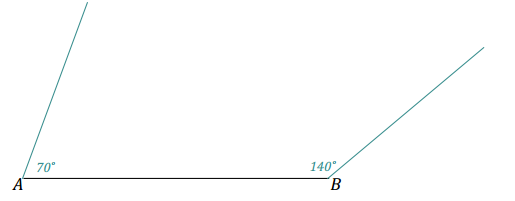
a. i) ∠A = 70° ∠B = 140°
Engage NY Math 7th Grade Module 6 Lesson 11 Exploratory Challenge 2 Answer Key 2
We were not able to form a triangle because the non-horizontal ray of ∠A and the non-horizontal ray of ∠B do not intersect.

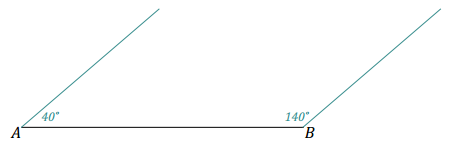
ii) ∠A = 40° ∠B = 140°
Selected angle measurements and the corresponding diagram indicate one possible response.
Engage NY Math 7th Grade Module 6 Lesson 11 Exploratory Challenge 2 Answer Key 3
We were not able to form a triangle because the non-horizontal ray of ∠A and the non-horizontal ray of ∠B do not intersect; the non-horizontal rays look parallel.

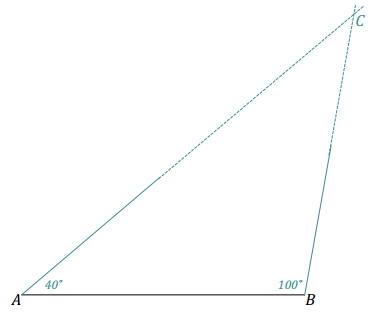
iii) ∠A = 40° ∠B = 100°
Angle measurements and the corresponding diagram indicate one possible response.
Engage NY Math 7th Grade Module 6 Lesson 11 Exploratory Challenge 2 Answer Key 4
We were able to form a triangle because the non-horizontal ray of ∠A and the non-horizontal ray of ∠B intersect.

b. The sum of two angle measurements of a triangle must be less than 180°.

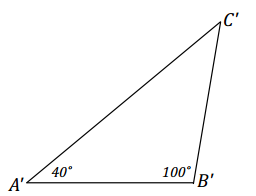
c. Engage NY Math 7th Grade Module 6 Lesson 11 Exploratory Challenge 2 Answer Key 5
Students should begin by drawing any one side length at a length half as much as the corresponding side in
△ABC and then drawing angles at each end of this line segment. Students should recognize that △A’B’C’ is a scale drawing of △ABC. Ask students to mark all length measurements as a means of verifying that they are indeed half as long as the corresponding sides of the original triangle.

d. Three angles do not determine a unique triangle. For a given triangle with three provided angle measurements, another triangle can be drawn with the same angle measurements but with side lengths proportional to those side lengths of the original triangle.

Eureka Math Grade 7 Module 6 Lesson 11 Exercise Answer Key

Exercise 1.
Two sides of △DEF have lengths of 5 cm and 8 cm. What are all the possible whole number lengths for the remaining side?
Answer:
The possible whole-number side lengths in centimeters are 4, 5, 6, 7, 8, 9, 10, 11, and 12.

Exercise 2.
Which of the following sets of angle measurements determines a triangle?
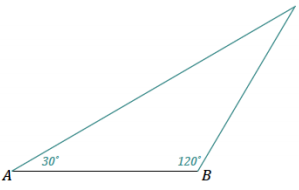
a. 30°, 120°
b. 125°, 55°
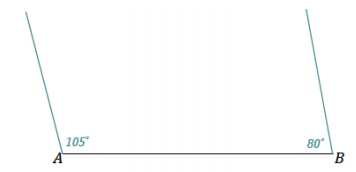
c. 105°, 80°
d. 90°, 89°
e. 91°, 89°
Choose one example from above that does determine a triangle and one that does not. For each, explain why it does or does not determine a triangle using words and a diagram.
Answer:
a. 30°, 120° Determines a triangle
b. 125°, 55° Does not determine a triangle
c. 105°, 80° Does not determine a triangle
d. 90°, 89° Determines a triangle
e. 91°, 89° Does not determine a triangle
Possible response:
The angle measurements in part (a) determine a triangle because the non-horizontal rays of the 30° angle and the 120° angle will intersect to form a triangle
Engage NY Math Grade 7 Module 6 Lesson 11 Exercise Answer Key 1

The angle measurements in part (c) do not determine a triangle because the non-horizontal rays of the 105° angle and the 80° angle will not intersect to form a triangle.
Engage NY Math Grade 7 Module 6 Lesson 11 Exercise Answer Key 2

Eureka Math Grade 7 Module 6 Lesson 11 Problem Set Answer Key

Question 1.
Decide whether each set of three given lengths determines a triangle. For any set of lengths that does determine a triangle, use a ruler and compass to draw the triangle. Label all side lengths. For sets of lengths that do not determine a triangle, write “Does not determine a triangle,” and justify your response.
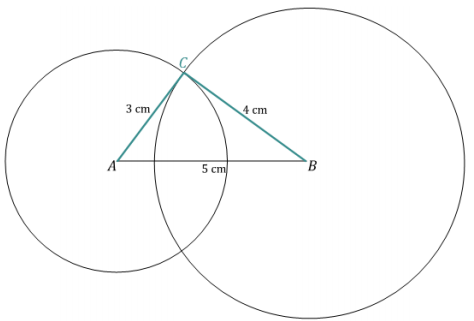
a. 3 cm, 4 cm, 5 cm
b. 1 cm, 4 cm, 5 cm
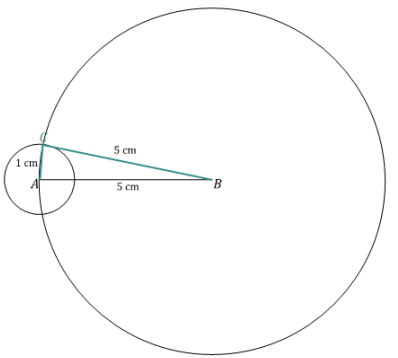
c. 1 cm, 5 cm, 5 cm
d. 8 cm, 3 cm, 4 cm
e. 8 cm, 8 cm, 4 cm
f. 4 cm, 4 cm, 4 cm
Answer:
a. 3 cm, 4 cm, 5 cm
Eureka Math 7th Grade Module 6 Lesson 11 Problem Set Answer Key 3.1

b. 1 cm, 4 cm, 5 cm
Does not determine a triangle. The shorter lengths are too short to form a triangle. They will only form a segment equal to the length of the longest side.

c. 1 cm, 5 cm, 5 cm
Eureka Math 7th Grade Module 6 Lesson 11 Problem Set Answer Key 3

d. 8 cm, 3 cm, 4 cm
Does not determine a triangle. The shorter lengths are too short to form a triangle. They will only form a segment that is shorter than the length of the longest side.

e. 8 cm, 8 cm, 4 cm
Eureka Math 7th Grade Module 6 Lesson 11 Problem Set Answer Key 4

f. 4 cm, 4 cm, 4 cm
Eureka Math 7th Grade Module 6 Lesson 11 Problem Set Answer Key 5

Question 2.
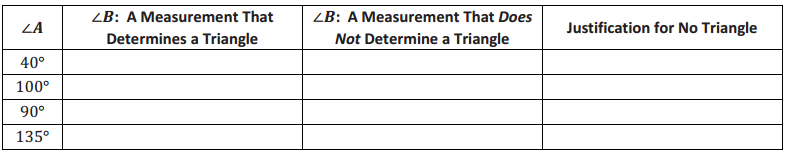
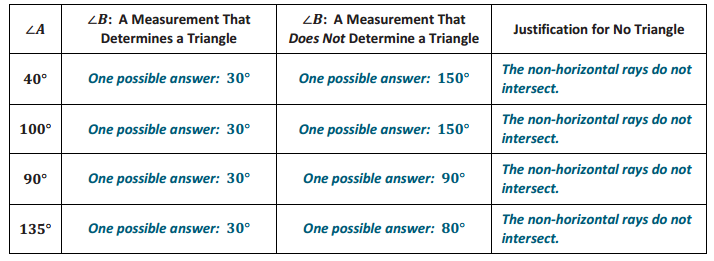
For each angle measurement below, provide one angle measurement that will determine a triangle and one that will not determine a triangle. Provide a brief justification for the angle measurements that will not form a triangle. Assume that the angles are being drawn to a horizontal segment AB; describe the position of the non-horizontal rays of angles ∠A and ∠B.
Eureka Math 7th Grade Module 6 Lesson 11 Problem Set Answer Key 1
Answer:
Eureka Math 7th Grade Module 6 Lesson 11 Problem Set Answer Key 6

Question 3.
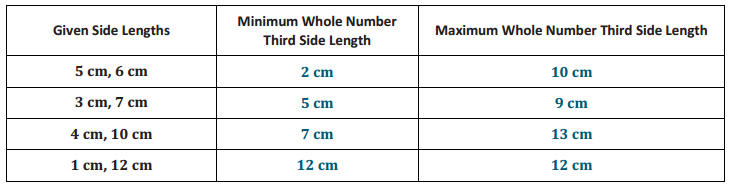
For the given side lengths, provide the minimum and maximum whole number side lengths that determine a triangle.
Eureka Math 7th Grade Module 6 Lesson 11 Problem Set Answer Key 2
Answer:
Eureka Math 7th Grade Module 6 Lesson 11 Problem Set Answer Key 7

Eureka Math Grade 7 Module 6 Lesson 11 Exit Ticket Answer Key

Question 1.
What is the minimum and maximum whole number side length for △XYZ with given side lengths of 3 cm and 5 cm? Please explain why.
Answer:
Minimum: 3 cm. Maximum: 7 cm. Values above this maximum and below this minimum will not satisfy the condition that the longest side length is less than the sum of the other two side lengths.

Question 2.
Jill has not yet studied the angle measurement requirements to form a triangle. She begins to draw side\(\overline{A B}\) as a horizontal segment of △ABC and considers the following angle measurements for ∠A and ∠B. Describe the
non-horizontal rays in the drawing that results from each set.
Eureka Math Grade 7 Module 6 Lesson 11 Exit Ticket Answer Key 1
a. 45° and 135°
b. 45° and 45°
c. 45° and 145°
Answer:
a. 45° and 135°
The non-horizontal rays of ∠A and ∠B will not intersect to form a triangle; the rays will be parallel to each other.

b. 45° and 45°
The non-horizontal rays of ∠A and ∠B will intersect to form a triangle.

c. 45° and 145°
The non-horizontal rays of ∠A and ∠B will not intersect to form a triangle.

Eureka Math Grade 7 Module 6 Lesson 9 Answer Key

Engage NY Eureka Math 7th Grade Module 6 Lesson 9 Answer Key

Eureka Math Grade 7 Module 6 Lesson 9 Exploratory Challenge Answer Key

Question 1.
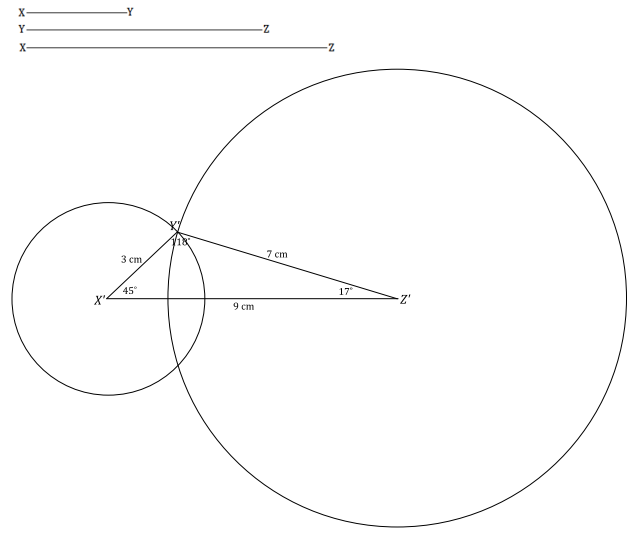
A triangle XYZ exists with side lengths of the segments below. Draw △X’Y’Z’ with the same side lengths as △XYZ. Use your compass to determine the sides of △X’Y’Z’. Use your ruler to measure side lengths. Leave all construction marks as evidence of your work, and label all side and angle measurements.
Under what condition is △X’Y’Z’ drawn? Compare the triangle you drew to two of your peers’ triangles. Are the triangles identical? Did the condition determine a unique triangle? Use your construction to explain why. Do the results differ from your predictions?
X ________________ Y
Y _____________________Z
X ___________________________ Z
Answer:
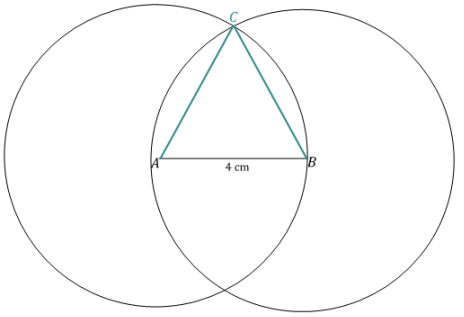
The condition on △X’Y’Z’ is the three side lengths. All of the triangles are identical; the condition determined a unique triangle. After drawing the longest side length, I used the compass to locate the third vertex of the triangle by drawing two circles, one with a radius of the smallest side length and the other with a radius of the medium side length. Each circle was centered at one end of the longest side length. Two possible locations were determined by the intersections of the circles, but both determined the same triangle. One is just a flipped version of the other. The three sides condition determined a unique triangle.
Engage NY Math 7th Grade Module 6 Lesson 9 Exploratory Challenge Answer Key 3

Question 2.
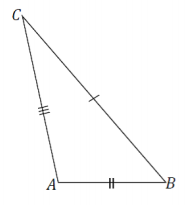
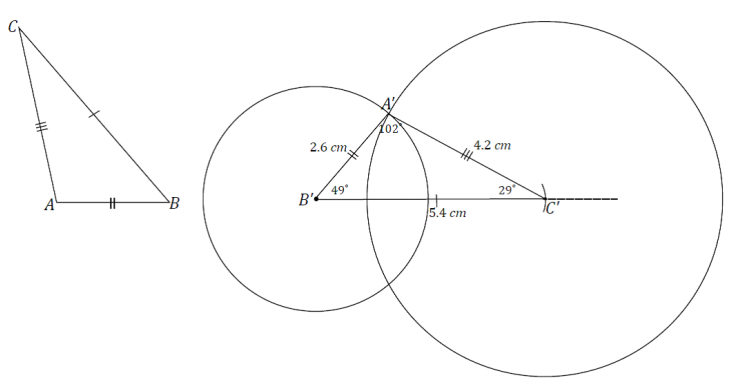
△ABC is located below. Copy the sides of the triangle to create △A’B’C’. Use your compass to determine the sides of △A’B’C’. Use your ruler to measure side lengths. Leave all construction marks as evidence of your work, and label all side and angle measurements.
Under what condition is △A’B’C’ drawn? Compare the triangle you drew to two of your peers’ triangles. Are the triangles identical? Did the condition determine a unique triangle? Use your construction to explain why.
Engage NY Math 7th Grade Module 6 Lesson 9 Exploratory Challenge Answer Key 1
Answer:
The condition on △A’B’C’ is the three side lengths. All of the triangles are identical; the condition determined a unique triangle. After drawing the longest side length, I used the compass to locate the third vertex of the triangle by drawing two circles, one with a radius of the smallest side length and the other with a radius of the medium side length. Each circle was centered at one end of the longest side length. Two possible locations were determined by the intersections of the circles, but both determined the same triangle. One is just a flipped version of the other. The three sides condition determined a unique triangle.
Engage NY Math 7th Grade Module 6 Lesson 9 Exploratory Challenge Answer Key 4

Question 3.
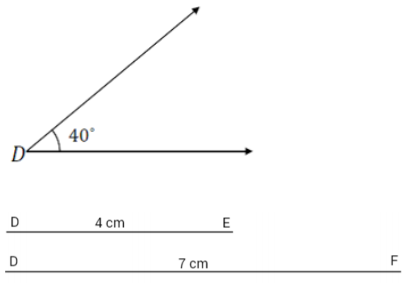
A triangle DEF has an angle of 40° adjacent to side lengths of 4 cm and 7 cm. Construct △D’E’F’ with side lengths
D’ E^’ = 4 cm, D’ F^’ = 7 cm, and included angle ∠D’ = 40°. Use your compass to draw the sides of △D’E’F’. Use your ruler to measure side lengths. Leave all construction marks as evidence of your work, and label all side and angle measurements.
Under what condition is △D’E’F’ drawn? Compare the triangle you drew to two of your peers’ triangles. Did the condition determine a unique triangle? Use your construction to explain why.
Engage NY Math 7th Grade Module 6 Lesson 9 Exploratory Challenge Answer Key 2
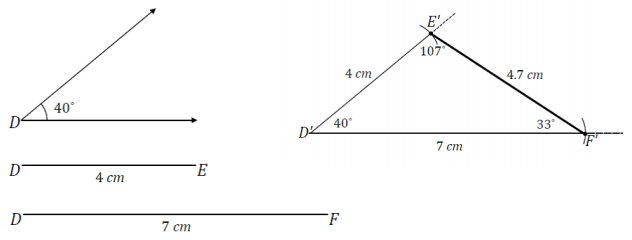
Answer:
The condition on △D’E’F’ is two side lengths and the included angle measurement. All of the triangles are identical; the condition determined a unique triangle. Once the 40° angle is drawn and the 4 cm and 7 cm side lengths are marked off on the rays of the angle, there is only one place the third side of the triangle can be. Therefore, all triangles drawn under this condition will be identical. Switching the 4 cm and 7 cm sides also gives a triangle satisfying the conditions, but it is just a flipped version of the other.
Engage NY Math 7th Grade Module 6 Lesson 9 Exploratory Challenge Answer Key 5

Question 4.
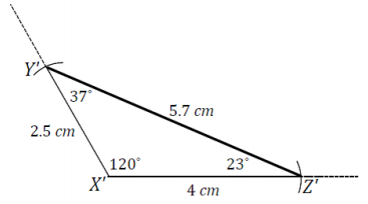
△XYZ has side lengths XY = 2.5 cm, XZ = 4 cm, and ∠X = 120°. Draw △X’Y’Z’ under the same conditions. Use your compass and protractor to draw the sides of △X’Y’Z’. Use your ruler to measure side lengths. Leave all construction marks as evidence of your work, and label all side and angle measurements.
Under what condition is △X’Y’Z’ drawn? Compare the triangle you drew to two of your peers’ triangles. Are the triangles identical? Did the condition determine a unique triangle? Use your construction to explain why.
Answer:
The condition on △X’Y’Z’ is two side lengths and the included angle measurement. The triangle is identical to other triangles drawn under this condition; the conditions produced a unique triangle. Once the 120° angle is drawn and the 2.5 cm and 7 cm side lengths are marked off on the rays of the angle, there is only one place the third side of the triangle can be. Therefore, all triangles drawn under these conditions will be identical. Switching the 2.5 cm and 7 cm sides also gives a triangle satisfying the conditions, but it is just a flipped version of the other.
Engage NY Math 7th Grade Module 6 Lesson 9 Exploratory Challenge Answer Key 6

Eureka Math Grade 7 Module 6 Lesson 9 Problem Set Answer Key

Question 1.
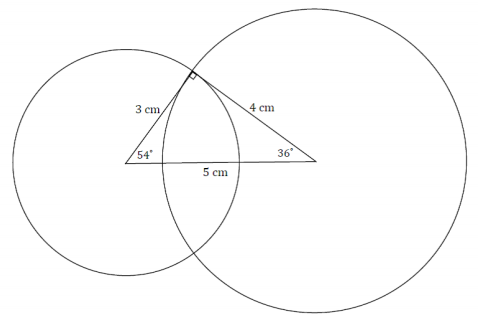
A triangle with side lengths 3 cm, 4 cm, and 5 cm exists. Use your compass and ruler to draw a triangle with the same side lengths. Leave all construction marks as evidence of your work, and label all side and angle measurements.
Under what condition is the triangle drawn? Compare the triangle you drew to two of your peers’ triangles. Are the triangles identical? Did the condition determine a unique triangle? Use your construction to explain why.
Answer:
The triangles are identical; the three sides condition determined a unique triangle. After drawing the longest side length, I used the compass to locate the third vertex of the triangle by drawing two circles, one with a radius of the smallest side length and the other with a radius of the medium side length. Each circle was centered at one end of the longest side length. Two possible locations were determined by the intersections of the circles, but both determined the same triangle; one is just a flipped version of the other. The three sides condition determined a unique triangle.
Eureka Math 7th Grade Module 6 Lesson 9 Problem Set Answer Key 1

Question 2.
Draw triangles under the conditions described below.
a. A triangle has side lengths 5 cm and 6 cm. Draw two nonidentical triangles that satisfy these conditions. Explain why your triangles are not identical.
b. A triangle has a side length of 7 cm opposite a 45° angle. Draw two nonidentical triangles that satisfy these conditions. Explain why your triangles are not identical.
Answer:
a. Solutions will vary; check to see that the conditions are satisfied in each triangle. The triangles cannot be identical because there is no correspondence that will match equal corresponding sides and equal angles between the triangles.
b. Solutions will vary; check to see that the conditions are satisfied in each triangle. The triangles cannot be identical because there is no correspondence that will match equal corresponding sides and equal angles between the triangles.

Question 3.
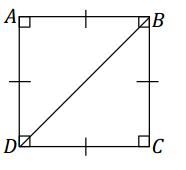
Diagonal \(\overline{B D}\) is drawn in square ABCD. Describe what condition(s) can be used to justify that △ABD is identical to △CBD. What can you say about the measures of ∠ABD and ∠CBD? Support your answers with a diagram and explanation of the correspondence(s) that exists.
Answer:
Two possible conditions can be used to justify that △ABD is identical to △CBD:
△ABD is identical to △CBD by the two sides and included angle condition. Since all four sides of a square are equal in length, AB = CB and AD = CD.
All four angles in a square are right angles; therefore, they are equal in measurement: ∠A = ∠C. The two sides and included angle condition is satisfied by the same measurements in both triangles. Since the two sides and included angle condition determine a unique triangle, △ABD must be identical to △CBD. The correspondence △ABD ↔ △CBD matches corresponding equal sides and corresponding angles. It matches ∠ABD with ∠CBD, so the two angles have equal measure and angle sum of 90°; therefore, each angle measures 45°.
Eureka Math 7th Grade Module 6 Lesson 9 Problem Set Answer Key 2
△ABD is identical to △CBD by the three sides condition. Again, all four sides of the square are equal in length; therefore, AB = CB, and AD = CD. \(\overline{B D}\) is a side to both △ABD and △CBD, and BD = BD. The three sides condition is satisfied by the same measurements in both triangles. Since the three sides condition determines a unique triangle, △ABD must be identical to △CBD. The correspondence △ABD ↔ △CBD matches equal corresponding sides and equal corresponding angles. It matches ∠ABD with ∠CBD, so the two angles have equal measure and angle sum of 90°; therefore, each angle measures 45°.

Question 4.
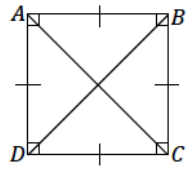
Diagonals \(\overline{B D}\) and \(\overline{A C}\) are drawn in square ABCD. Show that △ABC is identical to △BAD, and then use this information to show that the diagonals are equal in length.
Answer:
Use the two sides and included angle condition to show △ABC is identical to
△BAD; then, use the correspondence △ABC ↔ △BAD to conclude AC = BD.
△ABC is identical to △BAD by the two sides and included angle condition. Since \(\overline{A B}\) and \(\overline{B A}\) determine the same line segment, AB = BA. Since all four sides of a square are equal in length, then BC=AD. All four angles in a square are right angles and are equal in measurement; therefore, ∠B = ∠A. The two sides and included angle condition is satisfied by the same measurements in both triangles. Since the two sides and included angle condition determines a unique triangle, △ABC must be identical to △BAD. The correspondence
△ABC ↔ △BAD matches corresponding equal sides and corresponding equal angles. It matches the diagonals \(\overline{A C}\) and \(\overline{B D}\). Therefore, AC=BD.
Eureka Math 7th Grade Module 6 Lesson 9 Problem Set Answer Key 3

Question 5.
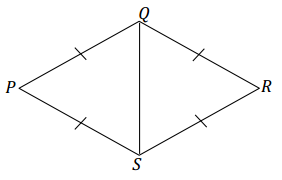
Diagonal \(\overline{Q S}\) is drawn in rhombus PQRS. Describe the condition(s) that can be used to justify that △PQS is identical to △RQS. Can you conclude that the measures of ∠PQS and ∠RQS are the same? Support your answer with a diagram and explanation of the correspondence(s) that exists.
Answer:
△PQS is identical to △RQS by the three sides condition. All four sides of a rhombus are equal in length; therefore, PQ = RQ and PS = RS. \(\overline{Q S}\) is a side to both △PQS and △RQS, and QS = QS. The three sides condition is satisfied by the same measurements in both triangles. Since the three sides condition determines a unique triangle, △PQS must be identical to
△RQS. The correspondence △PQS ↔ △RQS matches equal corresponding sides and equal corresponding angles. The correspondence matches ∠PQS and ∠RQS; therefore, they must have the same measure.
Eureka Math 7th Grade Module 6 Lesson 9 Problem Set Answer Key 4

Question 6.
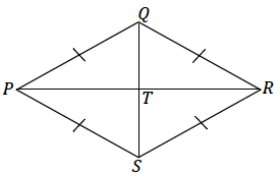
Diagonals \(\overline{Q S}\) and \(\overline{P R}\) are drawn in rhombus PQRS and meet at point T. Describe the condition(s) that can be used to justify that △PQT is identical to △RQT. Can you conclude that the line segments PR and QS are perpendicular to each other? Support your answers with a diagram and explanation of the correspondence(s) that exists.
Answer:
△PQT is identical to △RQT by the two sides and included angle condition. All four sides of a rhombus are equal in length; therefore, PQ = RQ. \(\overline{Q T}\) is a side to both △PQT and △RQT, and QT = QT. Since T lies on segment QS, then ∠PQT = ∠PQS and ∠RQT = ∠RQS. By Problem 5, ∠PQT=∠RQT, and the two sides and included angle condition is satisfied by the same measurements in both triangles. Since the two sides and included angle condition determines a unique triangle, then △PQT must be identical to △RQT. The correspondence △PQT↔△RQT matches equal corresponding sides and equal corresponding angles. The correspondence matches ∠PTQ and ∠RTQ; therefore, they must have the same measure. The angle sum of ∠PTQ and ∠RTQ is 180°; therefore, each angle is 90°, and the diagonals are perpendicular
to each other.
Eureka Math 7th Grade Module 6 Lesson 9 Problem Set Answer Key 5

Eureka Math Grade 7 Module 6 Lesson 9 Exit Ticket Answer Key

Question 1.
Choose either the three sides condition or the two sides and included angle condition, and explain why the condition determines a unique triangle.
In drawing a triangle with three provided side lengths, there is only one way to draw the triangle. After drawing one length, use the other two lengths to draw circles with the lengths as the respective radii of each circle, centered at either end of the segment drawn first. Regardless of which order of segments is used, there is only one unique triangle that can be drawn.
Answer:
In drawing a triangle with two side lengths and included angle provided, there is only one way to draw the triangle. After drawing the angle and marking off the two side lengths on the rays of the angle, there is only one possible place to position the third side of the triangle, which also determines the two remaining angle measures of the triangle. Therefore, the two sides and included angle condition determines a unique triangle.

Eureka Math Grade 7 Module 6 Lesson 8 Answer Key

Engage NY Eureka Math 7th Grade Module 6 Lesson 8 Answer Key

Eureka Math Grade 7 Module 6 Lesson 8 Exercise Answer Key

Exercises 1–2
1. Use your protractor and ruler to draw right triangle DEF. Label all sides and angle measurements.
a. Predict how many of the right triangles drawn in class are identical to the triangle you have drawn.
b. How many of the right triangles drawn in class are identical to the triangle you drew? Were you correct in your prediction?
Answer:
a. Answers will vary; students may say that they should all be the same since the direction is to draw a right triangle.
b. Drawings will vary; most likely few or none of the triangles in the class are identical. Ask students to reflect on why their prediction was incorrect if it was in fact incorrect.

2.
Given the following three sides of △ABC, use your compass to copy the triangle. The longest side has been copied for you already. Label the new triangle A’B’C’, and indicate all side and angle measurements. For a reminder of how to begin, refer to Lesson 6 Exploratory Challenge Problem 10.
A ________________ B
B _____________________C
A ___________________________ C
Answer:
Students must learn how to determine the third vertex of a triangle, given three side lengths. This skill is anchored in the understanding that a circle drawn with a radius of a given segment shows every possible location of one endpoint of that segment (with the center being the other endpoint).
Depending on how challenging students find the task, the following instructions can be provided as a scaffold to the problem. Note that student drawings use prime notation, whereas the original segments do not.
i) Draw a circle with center A’ and radius AB.
ii) Draw a circle with center C’ and radius BC.
iii) Label the point of intersection of the two circles above A’C’ as B’ (the intersection below A’C’ works as well).
Engage NY Math Grade 7 Module 6 Lesson 8 Exercise Answer Key 1
→ How many of the triangles drawn in class are identical?
→ All the drawings should be identical. With three provided side lengths, there is only one way to draw the triangle.

Eureka Math Grade 7 Module 6 Lesson 8 Exploratory Challenge Answer Key

A triangle is to be drawn provided the following conditions: the measurements of two angles are 30° and 60°, and the length of a side is 10 cm. Note that where each of these measurements is positioned is not fixed.
a. How is the premise of this problem different from Exercise 2?
b. Given these measurements, do you think it will be possible to draw more than one triangle so that the triangles drawn will be different from each other? Or do you think attempting to draw more than one triangle with these measurements will keep producing the same triangle, just turned around or flipped about?
c. Based on the provided measurements, draw △ABC so that ∠A = 30°, ∠B = 60°, and AB = 10 cm. Describe how the 10 cm side is positioned.
d. Now, using the same measurements, draw △A’B’C’ so that ∠A’ = 30°, ∠B’ = 60°, and AC = 10 cm. Describe how the 10 cm side is positioned.
e. Lastly, again, using the same measurements, draw △A”B”C” so that ∠A” = 30°, ∠B” = 60°, and B” C” = 10 cm. Describe how the 10 cm side is positioned.
f. Are the three drawn triangles identical? Justify your response using measurements.
g. Draw △A”’B”’C”’ so that ∠B”’ = 30°, ∠C”’ = 60°, and B^”’ C^”’ = 10 cm. Is it identical to any of the three triangles already drawn?
h. Draw another triangle that meets the criteria of this challenge. Is it possible to draw any other triangles that would be different from the three drawn above?
Answer:
a. In that exercise, we drew a triangle with three provided lengths, while in this problem we are provided two angle measurements and one side length; therefore, the process of drawing this triangle will not require a compass at all.

b. Responses will vary. Possible response: I think more than one triangle can be drawn because we only know the length of one side, and the lengths of the two remaining sides are still unknown. Since two side lengths are unknown, it is possible to have different side lengths and build several different triangles.

c. The 10 cm side is between ∠A and ∠B.
Engage NY Math Grade 7 Module 6 Lesson 8 Exploratory Challenge Answer Key 1
d. Now, using the same measurements, draw △A’B’C’ so that ∠A’ = 30°, ∠B’ = 60°, and AC = 10 cm. Described how the 10 cm side is positioned.
The 10 cm side is opposite to ∠B.
Engage NY Math Grade 7 Module 6 Lesson 8 Exploratory Challenge Answer Key 2
e. Lastly, again, using the same measurements, draw △A”B”C” so that ∠A” = 30°, ∠B” = 60°, and B^” C^” = 10 cm. Describe how the 10 cm side is positioned.
The 10 cm side is opposite to ∠A.
Engage NY Math Grade 7 Module 6 Lesson 8 Exploratory Challenge Answer Key 3
f. No. If the triangles were identical, then the 30° and 60° angles would match, and the other angles, ∠C, ∠C’, and ∠C” would have to match, too. The side opposite ∠C is 10 cm. The side opposite ∠C’ is between 11 and 12 cm. The side opposite ∠C” is 20 cm. There is no correspondence to match up all the angles and all the sides; therefore, the triangles are not identical.

g. It is identical to the triangle in part (d).

h. No, it will be identical to one of the triangles above. Even though the same letters may not line up, the triangle can be rotated or flipped so that there will be some correspondence that matches up equal sides and equal angles.

Eureka Math Grade 7 Module 6 Lesson 8 Problem Set Answer Key

Question 1.
Draw three different acute triangles XYZ, X’Y’Z’, and X”Y”Z” so that one angle in each triangle is 45°. Label all sides and angle measurements. Why are your triangles not identical?
Answer:
Drawings will vary; the angle measurements are not equal from triangle to triangle, so there is no correspondence that will match equal angles to equal angles.

Question 2.
Draw three different equilateral triangles ABC, A’B’C’, and A”B”C”. A side length of △ABC is 3 cm. A side length of △A’B’C’ is 5 cm. A side length of △A”B”C” is 7 cm. Label all sides and angle measurements. Why are your triangles not identical?
Answer:
The location of vertices may vary; all angle measurements are 60°. Though there is a correspondence that will match equal angles to equal angles, there is no correspondence that will match equal sides to equal sides.
Eureka Math 7th Grade Module 6 Lesson 8 Problem Set Answer Key 1

Question 3.
Draw as many isosceles triangles that satisfy the following conditions: one angle measures 110°, and one side measures 6 cm. Label all angle and side measurements. How many triangles can be drawn under these conditions?
Answer:
Two triangles
Eureka Math 7th Grade Module 6 Lesson 8 Problem Set Answer Key 2

Question 4.
Draw three nonidentical triangles so that two angles measure 50° and 60° and one side measures 5 cm.
a. Why are the triangles not identical?
b. Based on the diagrams you drew for part (a) and for Problem 2, what can you generalize about the criterion of three given angles in a triangle? Does this criterion determine a unique triangle?
Answer:
a. Though there is a correspondence that will match equal angles to equal angles, there is no correspondence that will match equal sides to equal sides.
Eureka Math 7th Grade Module 6 Lesson 8 Problem Set Answer Key 3
b. No, it is possible to draw nonidentical triangles that all have the same three angle measurements but have different corresponding side lengths.

Eureka Math Grade 7 Module 6 Lesson 8 Exit Ticket Answer Key

Question 1.
A student is given the following three side lengths of a triangle to use to draw a triangle.
______
__________
_______________
The student uses the longest of the three segments as side \(\overline{A B}\) of triangle △ABC. Explain what the student is doing with the two shorter lengths in the work below. Then, complete the drawing of the triangle.
Eureka Math Grade 7 Module 6 Lesson 8 Exit Ticket Answer Key 1
Answer:
The student drew a circle with center A and a radius equal in length to the medium segment and a circle with center B and a radius equal in length to the smallest segment. The points of the circle A are all a distance equal to the medium segment from point A, and the points of the circle B are all a distance equal to the smallest segment from point B. The point where the two circles intersect indicates where both segments would meet when drawn from A and B, respectively.
Eureka Math Grade 7 Module 6 Lesson 8 Exit Ticket Answer Key 2

Question 2.
Explain why the three triangles constructed in parts (c), (d), and (e) of the Exploratory Challenge were nonidentical.
Answer:
They were nonidentical because the two angles and one side length could be arranged in different ways that affected the structure of the triangle. The different arrangements resulted in differences in angle measurements and side lengths in the remaining parts.

Eureka Math Grade 7 Module 6 Lesson 2 Answer Key

Engage NY Eureka Math 7th Grade Module 6 Lesson 2 Answer Key

Eureka Math Grade 7 Module 6 Lesson 2 Example Answer Key

Example 1.
Two lines meet at a point that is also the endpoint of a ray. In a complete sentence, describe the relevant angle relationships in the diagram. Set up and solve an equation to find the value of p and r.
Engage NY Math 7th Grade Module 6 Lesson 2 Example Answer Key 1
Answer:
The angle r° is vertically opposite from and equal to the sum of the angles with measurements 28° and 16°, or a sum of 44°. Angles r° and p° are angles on a line and sum to 180°.
r = 28 + 16
r = 44           Vert. ∠s
p + (44) = 180
p + 44 – 44 = 180 – 44
p = 136          ∠s on a line

Example 2.
Three lines meet at a point. In a complete sentence, describe the relevant angle relationships in the diagram. Set up and solve an equation to find the value of z.
Engage NY Math 7th Grade Module 6 Lesson 2 Example Answer Key 2
Answer:
Let y° be the angle vertically opposite and equal in measurement to 19°.
The angles z° and y° are complementary and sum to 90°.
z + y = 90
z + 19 = 90
z + 19 – 19 = 90 – 19
z = 71 Complementary ∠s

Example 3.
Two lines meet at a point that is also the endpoint of a ray. The ray is perpendicular to one of the lines as shown. In a complete sentence, describe the relevant angle relationships in the diagram. Set up and solve an equation to find the value of t.
Engage NY Math 7th Grade Module 6 Lesson 2 Example Answer Key 3
Answer:
The measurement of the angle formed by adjacent angles of 26° and 90° is the sum of the adjacent angles. This angle is vertically opposite and equal in measurement to the angle t°.
Let y° be the measure of the indicated angle.
y = 116         ∠s add
t = (y)          Vert.∠s
t = 116

Example 4.
Three lines meet at a point. In a complete sentence, describe the relevant angle relationships in the diagram. Set up and solve an equation to find the value of x. Is your answer reasonable? Explain how you know.
Engage NY Math 7th Grade Module 6 Lesson 2 Example Answer Key 4
Answer:
The angle x° is vertically opposite from the angle formed by the right angle that contains and shares a common side with an 8° angle.
x = 90 – 8        ∠s add and vert.∠s
x = 82
The answer is reasonable because the angle marked by x° is close to appearing as a right angle.

Eureka Math Grade 7 Module 6 Lesson 2 Exercise Answer Key

Exercise 1.
Three lines meet at a point. In a complete sentence, describe the relevant angle relationship in the diagram. Set up and solve an equation to find the value of a.
Engage NY Math Grade 7 Module 6 Lesson 2 Exercise Answer Key 1
Answer:
The two a° angles and the angle 144° are angles on a line and sum to 180°.
2a + 144 = 180
2a + 144-144 = 180 – 144
2a = 36
a = 18           ∠s on a line

Exercise 2.
Three lines meet at a point; ∠AOF = 144°. In a complete sentence, describe the relevant angle relationships in the diagram. Set up and solve an equation to determine the value of c.
Engage NY Math Grade 7 Module 6 Lesson 2 Exercise Answer Key 2
Answer:
∠EOB, formed by adjacent angles ∠EOC and ∠COB, is vertical to and equal in measurement to ∠AOF.
The measurement of ∠EOB is c° + 90° (∠s add).
c + 90 = 144
c + 90 – 90 = 144 – 90
c = 54        Vert. ∠s

Exercise 3.
Two lines meet at a point that is also the endpoint of a ray. The ray is perpendicular to one of the lines as shown. In a complete sentence, describe the relevant angle relationships in the diagram. You may add labels to the diagram to help with your description of the angle relationship. Set up and solve an equation to find the value of v.
Engage NY Math Grade 7 Module 6 Lesson 2 Exercise Answer Key 3
Answer:
One possible response: Let x° be the angle vertically opposite and equal in measurement to 46°. The angles x° and v° are adjacent angles, and the angle they form together is equal to the sum of their measurements.
x = 46            Vert.∠s
v = 90 + 46        ∠s add
v = 136

Exercise 4.
Two lines meet at a point that is also the endpoint of two rays. In a complete sentence, describe the relevant angle relationships in the diagram. Set up and solve an equation to find the value of x. Find the measurements of ∠AOB and ∠BOC.
Engage NY Math Grade 7 Module 6 Lesson 2 Exercise Answer Key 4
Answer:
∠AOC is vertically opposite from the angle formed by adjacent angles 90° and 25°.
2x + 3x = 90 + 25
5x = 115
x = 23           ∠s add and vert.∠s

∠AOC = 2(23)° = 46°
∠BOC = 3(23)° = 69°

Exercise 5.
a. In a complete sentence, describe the relevant angle relationships in the diagram. Set up and solve an equation to find the value of x. Find the measurements of ∠AOB and∠BOC.
Engage NY Math Grade 7 Module 6 Lesson 2 Exercise Answer Key 5
b. Katrina was solving the problem above and wrote the equation 7x + 20 = 90. Then, she rewrote this as 7x + 20 = 70 + 20. Why did she rewrite the equation in this way? How does this help her to find the value of x?
Answer:
a. ∠AOB and ∠BOC are complementary and sum to 90°.
5x + (2x + 20) = 90          complementary ∠s
7x + 20 = 90
7x + 20-20 = 90 – 20
7x = 70
x = 10
∠AOB = 5(10)° = 50°
∠BOC = 2(10)° + 20° = 40°

b. She grouped the quantity on the right-hand side of the equation similarly to that of the left-hand side. This way, it is clear that the quantity 7x on the left-hand side must be equal to the quantity 70 on the right-hand side.

Eureka Math Grade 7 Module 6 Lesson 2 Problem Set Answer Key

Question 1.
Two lines meet at a point that is also the endpoint of a ray. Set up and solve an equation to find the value of c.
Eureka Math 7th Grade Module 6 Lesson 2 Problem Set Answer Key 1
Answer:
c + 90 + 17 = 180 ∠s on a line
c + 107 = 180
c + 107 – 107 = 180 – 107
c = 73
Scaffolded solutions:
a. Use the equation above.
b. The angle marked c°, the right angle, and the angle with measurement 17° are angles on a line, and their measurements sum to 180°.
c. Use the solution above. The answer seems reasonable because it looks like it has a measurement a little less than a 90° angle.

Question 2.
Two lines meet at a point that is also the endpoint of a ray. Set up and solve an equation to find the value of a. Explain why your answer is reasonable.
Eureka Math 7th Grade Module 6 Lesson 2 Problem Set Answer Key 2
Answer:
a + 33 = 49     ∠s add and vert.∠s
a + 33 – 33 = 49 – 33
a = 16
The answers seem reasonable because a rounded value of a as 20 and a rounded value of its adjacent angle 33 as 30 yields a sum of 50, which is close to the rounded value of the measurement of the vertical angle.

Question 3.
Two lines meet at a point that is also the endpoint of a ray. Set up and solve an equation to find the value of w.
Eureka Math 7th Grade Module 6 Lesson 2 Problem Set Answer Key 3
Answer:
w + 90 = 125 ∠s add and vert.∠s
w + 90-90 = 125 – 90
w = 35

Question 4.
Two lines meet at a point that is also the vertex of an angle. Set up and solve an equation to find the value of m.
Eureka Math 7th Grade Module 6 Lesson 2 Problem Set Answer Key 4
Answer:
(90 – 68) + 24 = m ∠s add and vert.∠s
m = 46

Question 5.
Three lines meet at a point. Set up and solve an equation to find the value of r.
Eureka Math 7th Grade Module 6 Lesson 2 Problem Set Answer Key 5
Answer:
r + 122 + 34 = 180 ∠s on a line and vert.∠s
r + 156 = 180
r + 156 – 156 = 180 – 156
r = 24

Question 6.
Three lines meet at a point that is also the endpoint of a ray. Set up and solve an equation to find the value of each variable in the diagram.
Eureka Math 7th Grade Module 6 Lesson 2 Problem Set Answer Key 6
Answer:
v = 90-51 Complementary ∠s
v = 39

w + 39 + 51 + 43 = 180        ∠s on a line
w + 133 = 180
w + 133 – 133 = 180 – 133
w = 47

x = 51 + 43   Vert.∠s
x = 94

y = 39       Vert.∠s

z = 47          Vert.∠s

Question 7.
Set up and solve an equation to find the value of x. Find the measurement of ∠AOB and of ∠BOC.
Eureka Math 7th Grade Module 6 Lesson 2 Problem Set Answer Key 7
Answer:
(2x – 15) + 11x = 180      Supplementary ∠s
13x – 15 = 180
13x – 15 + 15 = 180 + 15
13x = 195
x = 15
The measurement of ∠AOB: 2(15)° – 15° = 15°
The measurement of ∠BOC: 11(15)° = 165°
Scaffolded solutions:
a. Use the equation above.
b. The marked angles are angles on a line, and their measurements sum to 180°.
c. Once 15 is substituted for x, then the measurement of ∠AOB is 15° and the measurement of ∠BOC is 165°. These answers seem reasonable since ∠AOB is acute and ∠BOC is obtuse.

Question 8.
Set up and solve an equation to find the value of x. Find the measurement of ∠AOB and of ∠BOC.
Eureka Math 7th Grade Module 6 Lesson 2 Problem Set Answer Key 8
Answer:
x + 8 + 2x = 90       Complementary ∠s
3x + 8 = 90
3x + 8-8 = 90-8
3x = 82
x = 27\(\frac{1}{3}\)
The measurement of ∠AOB: (27\(\frac{1}{3}\))° + 8° = 35\(\frac{1}{3}\)°
The measurement of ∠BOC: 2(27\(\frac{1}{3}\))° = 54\(\frac{2}{3}\)°

Question 9.
Set up and solve an equation to find the value of x. Find the measurement of ∠AOB and of ∠BOC.
Eureka Math 7th Grade Module 6 Lesson 2 Problem Set Answer Key 9
Answer:
4x + 5 + 5x + 22 = 180   ∠s on a line
9x + 27 = 180
9x + 27-27 = 180-27
9x = 153
x = 17
The measurement of ∠AOB: 4(17)° + 5° = 73°
The measurement of ∠BOC: 5(17)° + 22° = 107°

Question 10.
Write a verbal problem that models the following diagram. Then, solve for the two angles.
Eureka Math 7th Grade Module 6 Lesson 2 Problem Set Answer Key 10
Answer:
One possible response: Two angles are supplementary. The measurement of one angle is five times the measurement of the other. Find the measurements of both angles.
10x + 2x = 180
12x = 180
x = 15           Supplementary ∠s
The measurement of Angle 1: 10(15)° = 150°
The measurement of Angle 2: 2(15)° = 30°

Eureka Math Grade 7 Module 6 Lesson 2 Exit Ticket Answer Key

Question 1.
Two lines meet at a point that is also the vertex of an angle. Set up and solve an equation to find the value of x. Explain why your answer is reasonable.
Eureka Math Grade 7 Module 6 Lesson 2 Exit Ticket Answer Key 1
Answer:
65 + (90-27) = x
x = 128
OR
y + 27 = 90
y + 27 – 27 = 90 – 27
y = 63
65 + y = x
65 + (63) = x
x = 128
The answers seem reasonable because a rounded value of y as 60 and a rounded value of its adjacent angle 65 as 70 yields a sum of 130, which is close to the calculated answer.

Eureka Math Grade 7 Module 6 Lesson 7 Answer Key

Engage NY Eureka Math 7th Grade Module 6 Lesson 7 Answer Key

Eureka Math Grade 7 Module 6 Lesson 7 Example Answer Key

Example 1.
Use what you know about drawing parallel lines with a setsquare to draw rectangle ABCD with dimensions of your choice. State the steps you used to draw your rectangle, and compare those steps to those of a partner.
Answer:
Possible steps: Draw \(\overline{A B}\) first. Align the setsquare so that one leg aligns with \(\overline{A B}\), and place the ruler against the other leg of the setsquare; mark a point X, ___ cm away from \(\overline{A B}\). Draw a line parallel to \(\overline{A B}\) through X. Realign the setsquare with \(\overline{A B}\) situate the ruler so that it passes through A, and draw a segment with a length of ___ cm. Mark the intersection of the line through A and the parallel line to \(\overline{A B}\) as D. \(\overline{A D}\) is now drawn perpendicular to \(\overline{A B}\). Repeat the steps to determine C.

Example 2.
Use what you know about drawing parallel lines with a setsquare to draw rectangle ABCD with AB = 3 cm and BC = 5 cm. Write a plan for the steps you will take to draw ABCD.
Engage NY Math 7th Grade Module 6 Lesson 7 Example Answer Key 1
Answer:
Draw \(\overline{A D}\) first. Align the setsquare so that one leg aligns with \(\overline{A D}\), and place the ruler against the other leg of the setsquare; mark a point X 5 cm away from \(\overline{A D}\). Slide the setsquare along the ruler until it aligns with X. Draw a line parallel to \(\overline{A D}\) through X. To create the right angle at A, align the setsquare so that the leg of the setsquare aligns with \(\overline{A D}\), situate the ruler so that the outer edge of the ruler passes through A, and draw a line through A. Mark the intersection of the line through A and the parallel line to \(\overline{A D}\) as D. Repeat the steps to determine C.

Example 3.
Use a setsquare, ruler, and protractor to draw parallelogram PQRS so that the measurement of ∠P is 50°, PQ = 5 cm, the measurement of ∠Q is 130°, and the length of the altitude to \(\overline{P Q}\) is 4 cm.
Answer:
Steps to draw the figure: Draw \(\overline{P Q}\) first. Align the setsquare and ruler so one leg of the setsquare aligns with \(\overline{P Q}\), and mark a point X 4 cm from \(\overline{P Q}\). Slide the setsquare along the ruler so that one side of the setsquare passes through X, and draw a line through X; this line is parallel to \(\overline{P Q}\). Using \(\overline{P Q}\) as one ray of ∠P, draw ∠P so that the measurement of ∠P is 50° and that the ray PS intersects with the line parallel to \(\overline{P Q}\) (the intersection is S). Draw ∠Q so that the measurement of ∠Q is 130°; the ray QR should be drawn to intersect with the line parallel to \(\overline{P Q}\)(the intersection is R).
Engage NY Math 7th Grade Module 6 Lesson 7 Example Answer Key 2

Example 4.
Use a setsquare, ruler, and protractor to draw rhombus ABCD so that the measurement of ∠A = 80°, the measurement of ∠B = 100°, and each side of the rhombus measures 5 cm.
Answer:
Steps to draw the figure: Draw \(\overline{A B}\) first. Using \(\overline{A B}\) as one ray of ∠A, draw ∠A so that the measurement of ∠A is 80°. The other ray, or the to-be side of the rhombus, AD, should be 5 cm in length; label the endpoint of the segment as D. Align the setsquare and ruler so one leg of the setsquare aligns with \(\overline{A B}\) and the edge of the ruler passes through D. Slide the setsquare along the ruler so that the edge of the setsquare passes through D, and draw a line along the edge of the setsquare. This line is parallel to \(\overline{A B}\).

Now align the setsquare and ruler so one leg of the setsquare aligns with \(\overline{A D}\) and the edge of the ruler passes through B. Slide the setsquare along the ruler so that the edge of the setsquare passes through B, and draw a line along the edge of the setsquare. This line is parallel to \(\overline{A D}\). Along this line, measure a segment 5 cm with B as one endpoint, and label the other endpoint C. Join C to D.
Engage NY Math 7th Grade Module 6 Lesson 7 Example Answer Key 3

Eureka Math Grade 7 Module 6 Lesson 7 Exercise Answer Key

Exercise 1.
Use a setsquare, ruler, and protractor to draw parallelogram DEFG so that the measurement of ∠D is 40°, DE = 3 cm, the measurement of ∠E is 140°, and the length of the altitude to \(\overline{D E}\) is 5 cm.
Answer:
Steps to draw the figure: Draw \(\overline{D E}\) first. Align the setsquare and ruler so one leg of the setsquare aligns with \(\overline{D E}\) , and mark a point X 5 cm from \(\overline{D E}\) . Slide the setsquare along the ruler so that one side of the setsquare passes through X, and draw a line through X; this line is parallel to \(\overline{D E}\). Using \(\overline{D E}\) as one ray of ∠D, draw ∠D so that the measurement of ∠D is 40° and that the ray DG intersects with the line parallel to \(\overline{D E}\) (the intersection is G). Draw ∠E so that the measurement of ∠E is 140°; the ray EF should be drawn to intersect with the line parallel to \(\overline{D E}\) (the intersection is F).
Engage NY Math Grade 7 Module 6 Lesson 7 Exercise Answer Key 1

Eureka Math Grade 7 Module 6 Lesson 7 Problem Set Answer Key

Question 1.
Draw rectangle ABCD with AB = 5 cm and BC = 7 cm.
Answer:
Steps to draw the figure: Draw \(\overline{A B}\) first. Align the setsquare so that one leg aligns with \(\overline{A B}\), and place the ruler against the other leg of the setsquare; mark a point X 7 cm away from \(\overline{A B}\). Draw a line parallel to \(\overline{A B}\) through X. To create the right angle at A, align the setsquare so that its leg aligns with \(\overline{A B}\), situate the ruler so that the outer edge of the ruler passes through A, and draw a line through A. Mark the intersection of the line through A and the parallel line to \(\overline{A B}\) as D. Repeat the steps to determine C.

Question 2.
Use a setsquare, ruler, and protractor to draw parallelogram PQRS so that the measurement of ∠P is 65°, PQ = 8 cm, the measurement of ∠Q is 115°, and the length of the altitude to \(\overline{P Q}\) is 3 cm.
Answer:
Steps to draw the figure: Draw \(\overline{P Q}\) first. Align the setsquare and ruler so one leg of the setsquare aligns with \(\overline{P Q}\), and mark a point X 3 cm from \(\overline{P Q}\). Slide the setsquare along the ruler so that one side of the setsquare passes through X, and draw a line through X; this line is parallel to \(\overline{P Q}\). Using \(\overline{P Q}\) as one ray of ∠P, draw ∠P so that the measurement of ∠P is 65° and that the ray PS intersects with the line parallel to \(\overline{P Q}\) (the intersection is S). Draw ∠Q so that the measurement of ∠Q is 115°; the ray QR should be drawn to intersect with the line parallel to \(\overline{P Q}\) (the intersection is R).

Question 3.
Use a setsquare, ruler, and protractor to draw rhombus ABCD so that the measurement of ∠A is 60°, and each side of the rhombus measures 5 cm.
Answer:
Steps to draw the figure: Draw \(\overline{A B}\) first. Using \(\overline{A B}\) as one ray of ∠A, draw ∠A so that the measurement of
∠A is 60°. The other ray, or to-be side of the rhombus, AD, should be 5 cm in length; label the endpoint of the segment as D. Align the setsquare and ruler so one leg of the setsquare aligns with \(\overline{A B}\) and the edge of the ruler passes through D. Slide the setsquare along the ruler so that the edge of the setsquare passes through D, and draw a line along the edge of the setsquare.

This line is parallel to\(\overline{A B}\). Now, align the setsquare and ruler so one leg of the setsquare aligns with \(\overline{A D}\) and the edge of the ruler passes through B. Slide the setsquare along the ruler so that the edge of the setsquare passes through B, and draw a line along the edge of the setsquare. This line is parallel to \(\overline{A D}\). Along this line, measure a segment 5 cm with B as one endpoint, and label the other endpoint C. Join C to D.

The following table contains partial information for parallelogram ABCD. Using no tools, make a sketch of the parallelogram. Then, use a ruler, protractor, and setsquare to draw an accurate picture. Finally, complete the table with the unknown lengths.
Two of the sketches are provided.
Eureka Math 7th Grade Module 6 Lesson 7 Problem Set Answer Key 2

The following table contains partial information for parallelogram ABCD. Using no tools, make a sketch of the parallelogram. Then, use a ruler, protractor, and setsquare to draw an accurate picture. Finally, complete the table with the unknown lengths.
Eureka Math 7th Grade Module 6 Lesson 7 Problem Set Answer Key 3
Answer:
Eureka Math 7th Grade Module 6 Lesson 7 Problem Set Answer Key 4

Question 7.
Use what you know about drawing parallel lines with a setsquare to draw trapezoid ABCD with parallel sides \(\overline{A B}\) and \(\overline{C D}\). The length of \(\overline{A B}\) is 3 cm, and the length of \(\overline{C D}\) is 5 cm; the height between the parallel sides is 4 cm. Write a plan for the steps you will take to draw ABCD.
Answer:
Draw \(\overline{A B}\) (or \(\overline{C D}\)) first. Align the setsquare and ruler so that one leg of the
setsquare aligns with \(\overline{A B}\); mark a point X 4 cm away from \(\overline{A B}\). Draw a line parallel to \(\overline{A B}\) through X. Once a line parallel to \(\overline{A B}\) has been drawn through X, measure a portion of the line to be 3 cm, and label the endpoint on the right as C and the other endpoint D. Join D to A and C to B.
Eureka Math 7th Grade Module 6 Lesson 7 Problem Set Answer Key 5

Question 8.
Use the appropriate tools to draw rectangle FIND with FI = 5 cm and IN = 10 cm.
Answer:
Draw \(\overline{F I}\) first. Align the setsquare so that one leg aligns with \(\overline{F I}\), and place the ruler against the other leg of the
setsquare; mark a point X 10 cm away from \(\overline{F I}\). Draw a line parallel to \(\overline{F I}\) through X. To create the right angle at F, align the setsquare so that its leg aligns with \(\overline{F I}\), and situate the ruler so that its outer edge passes through F, and then draw a line through F. Mark the intersection of the line through F and the parallel line to \(\overline{F I}\) as D. Repeat the steps to determine N.

Question 9.
Challenge: Determine the area of the largest rectangle that will fit inside an equilateral triangle with side length 5 cm.
Answer:
Students will quickly discover that rectangles of different dimensions can be drawn; finding the largest rectangle may take multiple efforts. The maximum possible area is 5.4 cm2.

Eureka Math Grade 7 Module 6 Lesson 7 Exit Ticket Answer Key

Use what you know about drawing parallel lines with a setsquare to draw square ABCD with AB = 5 cm. Explain how you created your drawing.
Answer:
Draw \(\overline{A B}\)(any side will do here) first. Align the setsquare and ruler so that one leg of the setsquare aligns with \(\overline{A B}\); mark a point X 5 cm away from \(\overline{A B}\). Draw a line parallel to \(\overline{A B}\) through X. To create the right angle at A, align the setsquare so that the leg of the setsquare aligns with \(\overline{A B}\), situate the ruler so that the outer edge of the ruler passes through A, and draw a line through A. Mark the intersection of the line through A and the parallel line to \(\overline{A B}\) as D; join A and D. Repeat the steps to determine C, and join B and C.
Eureka Math Grade 7 Module 6 Lesson 7 Exit Ticket Answer Key 1

Eureka Math Grade 7 Module 6 Lesson 6 Answer Key

Engage NY Eureka Math 7th Grade Module 6 Lesson 6 Answer Key

Eureka Math Grade 7 Module 6 Lesson 6 Exploratory Challenge Answer Key

Use a ruler, protractor, and compass to complete the following problems.
Question 1.
Use your ruler to draw three segments of the following lengths: 4 cm, 7.2 cm, and 12.8 cm. Label each segment with its measurement.
Answer:
Engage NY Math 7th Grade Module 6 Lesson 6 Exploratory Challenge Answer Key 1

Question 2.
Draw complementary angles so that one angle is 35°. Label each angle with its measurement. Are the angles required to be adjacent?
Answer:
The complementary angles do not need to be adjacent; the sum of the measurements of the angles needs to be 90°.
Engage NY Math 7th Grade Module 6 Lesson 6 Exploratory Challenge Answer Key 2

Question 3.
Draw vertical angles so that one angle is 125°. Label each angle formed with its measurement.
Answer:
Engage NY Math 7th Grade Module 6 Lesson 6 Exploratory Challenge Answer Key 3

Question 4.
Draw three distinct segments of lengths 2 cm, 4 cm, and 6 cm. Use your compass to draw three circles, each with a radius of one of the drawn segments. Label each radius with its measurement.
Answer:
Due to space restrictions, only the two smaller circles are shown here:
Engage NY Math 7th Grade Module 6 Lesson 6 Exploratory Challenge Answer Key 4

Question 5.
Draw three adjacent angles a, b, and c so that a = 25°, b = 90°, and c = 50°. Label each angle with its measurement.
Answer:
Engage NY Math 7th Grade Module 6 Lesson 6 Exploratory Challenge Answer Key 5

Question 6.
Draw a rectangle ABCD so that AB = CD = 8 cm and BC = AD = 3 cm.
Answer:
Engage NY Math 7th Grade Module 6 Lesson 6 Exploratory Challenge Answer Key 6

Question 7.
Draw a segment AB that is 5 cm in length. Draw a second segment that is longer than \(\overline{A B}\), and label one endpoint C. Use your compass to find a point on your second segment, which will be labeled D, so that CD = AB.
Answer:
Engage NY Math 7th Grade Module 6 Lesson 6 Exploratory Challenge Answer Key 7

Question 8.
Draw a segment AB with a length of your choice. Use your compass to construct two circles:
i) A circle with center A and radius AB.
ii) A circle with center B and radius BA.
Describe the construction in a sentence.
Answer:
Two circles with radius AB are drawn; one has its center at A, and the other has its center at B.
Engage NY Math 7th Grade Module 6 Lesson 6 Exploratory Challenge Answer Key 8

Question 9.
Draw a horizontal segment AB, 12 cm in length.
a. Label a point O on \(\overline{A B}\) that is 4 cm from B.
b. Point O will be the vertex of an angle COB.
c. Draw ray OC so that the ray is above \(\overline{A B}\) and ∠COB = 30°.
d. Draw a point P on \(\overline{A B}\)̅ that is 4 cm from A.
e. Point P will be the vertex of an angle QPO.
f. Draw ray PQ so that the ray is above \(\overline{A B}\) and ∠QPO = 30°.
Answer:
Engage NY Math 7th Grade Module 6 Lesson 6 Exploratory Challenge Answer Key 9

Question 10.
Draw segment AB of length 4 cm. Draw two circles that are the same size, one with center A and one with center B (i.e., do not adjust your compass in between) with a radius of a length that allows the two circles to intersect in two distinct locations. Label the points where the two circles intersect C and D. Join A and C with a segment; join B and C with a segment. Join A and D with a segment; join B and D with a segment.
What kind of triangles are △ABC and △ABD? Justify your response.
Answer:
△ABC and △ABD are identical isosceles triangles. Both circles are the same size (i.e., have the same radius). Furthermore, the point along each circle is the same distance away from the center no matter where you are on the circle; this means the distance from A to C is the same as the distance from B to C (the same follows for D).
A triangle with at least two sides of equal length is an isosceles triangle.
Possible solution:
Engage NY Math 7th Grade Module 6 Lesson 6 Exploratory Challenge Answer Key 10

Question 11.
Determine all possible measurements in the following triangle, and use your tools to create a copy of it.
Engage NY Math 7th Grade Module 6 Lesson 6 Exploratory Challenge Answer Key 11
Answer:
Engage NY Math 7th Grade Module 6 Lesson 6 Exploratory Challenge Answer Key 12

Eureka Math Grade 7 Module 6 Lesson 6 Problem Set Answer Key

Use a ruler, protractor, and compass to complete the following problems.
Question 1.
Draw a segment AB that is 5 cm in length and perpendicular to segment CD, which is 2 cm in length.
Answer:
One possible solution:
Eureka Math 7th Grade Module 6 Lesson 6 Problem Set Answer Key 1

Question 2.
Draw supplementary angles so that one angle is 26°. Label each angle with its measurement.
Answer:
Possible solutions:
Eureka Math 7th Grade Module 6 Lesson 6 Problem Set Answer Key 2

Question 3.
Draw △ABC so that ∠B has a measurement of 100°.
Answer:
One possible solution:
Eureka Math 7th Grade Module 6 Lesson 6 Problem Set Answer Key 3

Question 4.
Draw a segment AB that is 3 cm in length. Draw a circle with center A and radius AB. Draw a second circle with diameter AB.
Answer:
One possible solution:
Eureka Math 7th Grade Module 6 Lesson 6 Problem Set Answer Key 4

Question 5.
Draw an isosceles △ABC. Begin by drawing ∠A with a measurement of 80°. Use the rays of ∠A as the equal legs of the triangle. Choose a length of your choice for the legs, and use your compass to mark off each leg. Label each marked point with B and C. Label all angle measurements.
Answer:
One possible solution:
Eureka Math 7th Grade Module 6 Lesson 6 Problem Set Answer Key 5

Question 6.
Draw an isosceles △DEF. Begin by drawing a horizontal segment DE that is 6 cm in length. Use your protractor to draw ∠D and ∠E so that the measurements of both angles are 30°. If the non-horizontal rays of ∠D and ∠E do not already cross, extend each ray until the two rays intersect. Label the point of intersection F. Label all side and angle measurements.
Answer:
One possible solution:
Eureka Math 7th Grade Module 6 Lesson 6 Problem Set Answer Key 6

Question 7.
Draw a segment AB that is 7 cm in length. Draw a circle with center A and a circle with center B so that the circles are not the same size, but do intersect in two distinct locations. Label one of these intersections C. Join A to C and B to C to form △ABC.
Answer:
One possible solution:
Eureka Math 7th Grade Module 6 Lesson 6 Problem Set Answer Key 7

Question 8.
Draw an isosceles trapezoid WXYZ with two equal base angles, ∠W and ∠X, that each measures 110°. Use your compass to create the two equal sides of the trapezoid. Leave arc marks as evidence of the use of your compass. Label all angle measurements. Explain how you constructed the trapezoid.
Answer:
Eureka Math 7th Grade Module 6 Lesson 6 Problem Set Answer Key 8
Draw segment WX. Use a protractor and segment WX to draw ∠XWZ at a measurement of 110°; do the same to draw ∠WXY. (Note: When drawing \(\overrightarrow{W Z}\) and \(\overrightarrow{X Y}\), length is not specified, so students should have rays long enough so that they can use a compass to mark off lengths that are the same along each ray in the next step.) Place the point of the compass at W, adjust the compass to a desired width, and mark an arc so that it crosses \(\overrightarrow{W Z}\). Label the intersection as Z. Do the same from X along \(\overrightarrow{X Y}\), and mark the intersection as Y. Finally, join Z and Y to form isosceles trapezoid WXYZ.

Eureka Math Grade 7 Module 6 Lesson 6 Exit Ticket Answer Key

Question 1.
Draw a square PQRS with side length equal to 5 cm. Label the side and angle measurements.
Answer:
Eureka Math Grade 7 Module 6 Lesson 6 Exit Ticket Answer Key 1

Question 2.
Draw a segment AB, 6 cm in length. Draw a circle whose diameter is segment AB.
Answer:
Eureka Math Grade 7 Module 6 Lesson 6 Exit Ticket Answer Key 2

Eureka Math Grade 7 Module 6 Lesson 5 Answer Key

Engage NY Eureka Math 7th Grade Module 6 Lesson 5 Answer Key

Eureka Math Grade 7 Module 6 Lesson 5 Example Answer Key

Example 1.
Given the following triangle correspondences, use double arrows to show the correspondence between vertices, angles, and sides.
Engage NY Math 7th Grade Module 6 Lesson 5 Example Answer Key 1
Answer:
Engage NY Math 7th Grade Module 6 Lesson 5 Example Answer Key 2

Example 2.
Two identical triangles are shown below. Give a triangle correspondence that matches equal sides and equal angles.
Engage NY Math 7th Grade Module 6 Lesson 5 Example Answer Key 3
Answer:
△ABC ↔ △TSR

Eureka Math Grade 7 Module 6 Lesson 5 Exercise Answer Key

Exercises 1–7
Use the figure △ABC to fill in the following blanks.
Engage NY Math Grade 7 Module 6 Lesson 5 Exercise Answer Key 1
1. ∠A is ______________ sides \(\overline{A B}\) and \(\overline{A C}\).
2. ∠B is ______________ side \(\overline{A B}\) and to side \(\overline{B C}\).
3. Side \(\overline{A B}\) is ______________ ∠C.
4. Side ______________ is the included side of ∠B and ∠C.
5. ______________ is opposite to side \(\overline{A C}\).
6. Side \(\overline{A B}\) is between ______________ and ______________.
7. What is the included angle of sides\(\overline{A B}\) and \(\overline{B C}\)? ______________.
Answer:
1. between
2. adjacent to
3. opposite to
4. \(\overline{B C}\)
5. ∠ B
6. ∠A and ∠B
7. ∠B

Now that we know what to call the parts within a triangle, we consider how to discuss two triangles. We need to compare the parts of the triangles in a way that is easy to understand. To establish some alignment between the triangles, we pair up the vertices of the two triangles. We call this a correspondence. Specifically, a correspondence between two triangles is a pairing of each vertex of one triangle with one (and only one) vertex of the other triangle. A correspondence provides a systematic way to compare parts of two triangles.
Engage NY Math Grade 7 Module 6 Lesson 5 Exercise Answer Key 2
In Figure 1, we can choose to assign a correspondence so that A matches to X, B matches to Y, and C matches to Z. We notate this correspondence with double arrows: A ↔X, B ↔Y, and C ↔Z. This is just one of six possible correspondences between the two triangles. Four of the six correspondences are listed below; find the remaining two correspondences.
Engage NY Math Grade 7 Module 6 Lesson 5 Exercise Answer Key 3
A simpler way to indicate the triangle correspondences is to let the order of the vertices define the correspondence (i.e., the first corresponds to the first, the second to the second, and the third to the third). The correspondences above can be written in this manner. Write the remaining two correspondences in this way.
△ABC ↔ △XYZ
△ABC ↔ △XZY
△ABC ↔ △ZYX

△ABC ↔ △YXZ
△ABC ↔ △YZX
△ABC ↔ △ZXY

Exercise 8.
Sketch two triangles that have a correspondence. Describe the correspondence in symbols or words. Have a partner check your work.
Answer:
Answers will vary. Encourage students to check for correct use of notation and correctly made correspondences.

Eureka Math Grade 7 Module 6 Lesson 5 Problem Set Answer Key

Given the following triangle correspondences, use double arrows to show the correspondence between vertices, angles, and sides.
Question 1.
Eureka Math 7th Grade Module 6 Lesson 5 Problem Set Answer Key 1
Answer:
Eureka Math 7th Grade Module 6 Lesson 5 Problem Set Answer Key 2

Question 2.
Eureka Math 7th Grade Module 6 Lesson 5 Problem Set Answer Key 3
Answer:
Eureka Math 7th Grade Module 6 Lesson 5 Problem Set Answer Key 4

Question 3.
Eureka Math 7th Grade Module 6 Lesson 5 Problem Set Answer Key 5
Answer:
Eureka Math 7th Grade Module 6 Lesson 5 Problem Set Answer Key 6

Name the angle pairs and side pairs to find a triangle correspondence that matches sides of equal length and angles of equal measurement.
Question 4.
Eureka Math 7th Grade Module 6 Lesson 5 Problem Set Answer Key 7
Answer:
DE = ZX
XY = EF
DF = ZY

∠E = ∠X
∠Z = ∠D
∠F = ∠Y
△DEF ↔ △ZXY

Question 5.
Eureka Math 7th Grade Module 6 Lesson 5 Problem Set Answer Key 8
Answer:
JK = WX
YX = LK
LJ = YW

∠Y = ∠L
∠J = ∠W
∠K = ∠X
△JKL ↔ △WXY

Question 6.
Eureka Math 7th Grade Module 6 Lesson 5 Problem Set Answer Key 9
Answer:
PQ = UT
TV = QR
RP = VU

∠Q = ∠T
∠U = ∠P
∠R = ∠V
△PQR ↔ △UTV

Question 7.
7. Consider the following points in the coordinate plane.
a. How many different (non-identical) triangles can be drawn using any three of these six points as vertices?
Eureka Math 7th Grade Module 6 Lesson 5 Problem Set Answer Key 10
b. How can we be sure that there are no more possible triangles?
Answer:
a. There is a total of 18 triangles but only 4 different triangles. Each triangle is identical with one of these four:
Eureka Math 7th Grade Module 6 Lesson 5 Problem Set Answer Key 11

b. Any other triangle will have a correspondence so that equal sides and angles of equal measurement can be lined up (i.e., one can be laid over another, and the two triangles will match).

Question 8.
Quadrilateral ABCD is identical with quadrilateral WXYZ with a correspondence A ↔W, B ↔X, C ↔Y, and D ↔Z.
a. In the figure above, label points W, X, Y, and Z on the second quadrilateral.
Eureka Math 7th Grade Module 6 Lesson 5 Problem Set Answer Key 12
b. Set up a correspondence between the side lengths of the two quadrilaterals that matches sides of equal length.
c. Set up a correspondence between the angles of the two quadrilaterals that matches angles of equal measure.
Answer:
a. Eureka Math 7th Grade Module 6 Lesson 5 Problem Set Answer Key 13
b. \(\overline{A B}\) ↔(\(\overline{W X}\), \(\overline{B C}\) ↔\(\overline{X Y}\), \(\overline{C D}\) ↔\(\overline{Y Z}\), and \(\overline{A D}\) ↔\(\overline{W Z}\)
c. ∠A ↔∠W, ∠B ↔∠X, ∠C ↔∠Y, and ∠D ↔∠Z

Eureka Math Grade 7 Module 6 Lesson 5 Exit Ticket Answer Key

Question 1.
The following triangles are identical and have the correspondence △ABC ↔ △YZX. Find the measurements for each of the following sides and angles. Figures are not drawn to scale.
Eureka Math Grade 7 Module 6 Lesson 5 Exit Ticket Answer Key 1
AB = ________

________ = ZX

________ = XY

∠A = ________

∠B = ________

________ = ∠X
Answer:
AB = 3 cm
4.7 cm = ZX
2 cm = XY
∠A = 110°
∠B = 20°
50° = ∠X

Question 2.
Explain why correspondences are useful.
Answer:
A correspondence offers a systematic way to compare parts of two triangles. We can make statements about similarities or differences between two triangles using a correspondence, whereas without one, we would not have a reference system to make such comparisons.

Eureka Math Grade 7 Module 6 Lesson 4 Answer Key

Engage NY Eureka Math 7th Grade Module 6 Lesson 4 Answer Key

Eureka Math Grade 7 Module 6 Lesson 4 Example Answer Key

Example 1.
Find the measurements of ∠FAE and ∠CAD.
Engage NY Math 7th Grade Module 6 Lesson 4 Example Answer Key 1
Answer:
2x + 6x + 90 = 170 Vert. ∠s
8x + 90 = 170
8x + 90 – 90 = 170 – 90
8x = 80
(\(\frac{1}{8}\))8x = (\(\frac{1}{8}\))80
x = 10
The measurement of ∠FAE: 2(10)° = 20°
The measurement of ∠CAD: 6(10)° = 60°
Two lines meet at a point. List the relevant angle relationship in the diagram. Set up and solve an equation to find the value of x. Find the measurement of one of the vertical angles.
Engage NY Math 7th Grade Module 6 Lesson 4 Example Answer Key 2
Students use information in the figure and a protractor to solve for x.
i) Students measure a 64° angle as shown; the remaining portion of the angle must be x° (∠s add).
ii) Students can use their protractors to find the measurement of x° and use this measurement to partition the other angle in the vertical pair.
As a check, students should substitute the measured x value into each expression and evaluate; each angle of the vertical pair should be equal to the other. Students can also use their protractor to measure each angle of the vertical angle pair.
With a modified figure, students can write an algebraic equation that they have the skills to solve.
v
2x = 64 Vert.∠s
(\(\frac{1}{2}\))2x = (\(\frac{1}{2}\))64
x = 32

Extension:
3x = x + 64 vert.∠s
3x – x = x – x + 64
2x = 64
(\(\frac{1}{2}\))2x = (\(\frac{1}{2}\))64
x = 32
Measurement of each angle in the vertical pair: 3(32)° = 96°

Example 2.
Three lines meet at a point. List the relevant angle relationships in the diagram. Set up and solve an equation to find the value of b.
Engage NY Math 7th Grade Module 6 Lesson 4 Example Answer Key 4
Answer:
Let b = c.
c + 37 + 43 = 180 ∠s on a line
c + 80 = 180
c + 80 – 80 = 180 – 80
c = 100
Since b = c, b = 100.

Example 3.
The measurement of an angle is \(\frac{2}{3}\) the measurement of its supplement. Find the measurements of the angle and its supplement.
Answer:
angle = \(\frac{2}{3}\)(supplement)
angle = \(\frac{2}{3}\)(180 – angle)
Using a tape diagram:
Engage NY Math 7th Grade Module 6 Lesson 4 Example Answer Key 5
The measurements of the two supplementary angles that satisfy these criteria are 72° and 108°.
The tape diagram model is an ideal strategy for this question. If students are not familiar with the tape diagram model, use a Guess and Check table with them. Here is an example of such a table with two entries for guesses that did not result in a correct answer.
Engage NY Math 7th Grade Module 6 Lesson 4 Example Answer Key 6

Example 4.
Three lines meet at a point that is also the endpoint of a ray. List the relevant angle relationships in the diagram. Set up and solve an equation to find the value of z.
Engage NY Math 7th Grade Module 6 Lesson 4 Example Answer Key 7
Answer:
Let x° be the measurement of the indicated angle.
x + 90 + 29 = 180 ∠s on a line
x + 119 = 180
x + 119 – 119 = 180 – 119
x = 61

z = x + 90 ∠s add
z = 61 + 90
z = 151

Eureka Math Grade 7 Module 6 Lesson 4 Exercise Answer Key

Exercise 1.
Set up and solve an equation to find the value of x. List the relevant angle relationship in the diagram. Find the measurement of one of the vertical angles.
Engage NY Math Grade 7 Module 6 Lesson 4 Exercise Answer Key 1
Answer:
Students use information in the figure and a protractor to solve for x.
i) Measure a 132° angle as shown; the remaining portion of the original angle must be x° (∠s add).
ii) Partition the other angle in the vertical pair into equal angles of x°.
Students should perform a check (as in Example 1) before solving an equation that matches the modified figure.
Engage NY Math Grade 7 Module 6 Lesson 4 Exercise Answer Key 2
Extension:
4x = 132 vert.∠s
(\(\frac{1}{4}\))4x = (\(\frac{1}{4}\))132
x = 33
Measurement of each vertical angle: 5(33)° = 165°
Note: Students can check their answers for any question by measuring each unknown angle with a protractor, as all diagrams are drawn to scale.

Exercise 2.
Two lines meet at a point that is also the endpoint of two rays. List the relevant angle relationships in the diagram. Set up and solve an equation to find the value of b.
Engage NY Math Grade 7 Module 6 Lesson 4 Exercise Answer Key 3
Answer:
b + 95 = 90 + 80 Vert. ∠s
b + 95 = 170
b + 95 – 95 = 170 – 95
b = 75

Exercise 3.
The measurement of an angle is \(\frac{1}{4}\) the measurement of its complement. Find the measurements of the two complementary angles.
Answer:
angle = \(\frac{1}{4}\)(complement)
angle = \(\frac{1}{4}\)(90 – angle)
Using a tape diagram:
Engage NY Math Grade 7 Module 6 Lesson 4 Exercise Answer Key 4
5 units = 90
1 unit = 18
4 units = 72
The measurements of the two complementary angles that satisfy these criteria are 18° and 72°.

Exercise 4.
Two lines meet at a point that is also the vertex of an angle. Set up and solve an equation to find the value of x. Find the measurements of ∠GAF and ∠BAC.
Engage NY Math Grade 7 Module 6 Lesson 4 Exercise Answer Key 5
Answer:
Let y° be the measurement of the indicated angle.
y = 180 – (90 + 36) ∠s on a line
y = 54

4x + y + 5x = 180 ∠s on a line
4x + 54 + 5x = 180
9x + 54 = 180
9x + 54 – 54 = 180 – 54
9x = 126
(\(\frac{1}{9}\))9x = (\(\frac{1}{9}\))126
x = 14
The measurement of ∠GAF: 4(14)° = 56°
The measurement of ∠BAC: 5(14)° = 70°

Eureka Math Grade 7 Module 6 Lesson 4 Problem Set Answer Key

Question 1.
Four rays have a common endpoint on a line. Set up and solve an equation to find the value of c.
Eureka Math 7th Grade Module 6 Lesson 4 Problem Set Answer Key 1
Answer:
59 + d = 90 Complementary ∠s
59 – 59 + d = 90 – 59
d = 31

d + c + 140 = 180 ∠s on a line
31 + c + 140 = 180
c + 171 = 180
c + 171 – 171 = 180 – 171
c = 9

Question 2.
Lines BC and EF meet at A. Set up and solve an equation to find the value of x. Find the measurements of ∠EAH and ∠HAC.
Eureka Math 7th Grade Module 6 Lesson 4 Problem Set Answer Key 2
Answer:
∠BAE + 57 = 90 Complementary ∠s
∠BAE + 57 – 57 = 90 – 57
∠BAE = 33

∠BAE + 3x + 4x = 180 ∠s on a line
33 + 3x + 4x = 180
33 + 7x = 180
33 – 33 + 7x = 180 – 33
7x = 147
(\(\frac{1}{7}\))7x = (\(\frac{1}{7}\))147
x = 21
The measurement of ∠EAH: 3(21)° = 63°
The measurement of ∠HAC: 4(21)° = 84°

Question 3.
Five rays share a common endpoint. Set up and solve an equation to find the value of x. Find the measurements of ∠DAG and ∠GAH.
Eureka Math 7th Grade Module 6 Lesson 4 Problem Set Answer Key 3
Answer:
2x + 36.5 + 36.5 + 2x + 3x = 360 ∠s at a point
7x + 73 = 360
7x + 73 – 73 = 360 – 73
7x = 287
(\(\frac{1}{7}\))7x = (\(\frac{1}{7}\))287
x = 41
The measurement of ∠EAF: 2(41)° = 82°
The measurement of ∠GAH: 3(41)° = 123°

Question 4.
Four lines meet at a point which is also the endpoint of three rays. Set up and solve an equation to find the values of x and y.
Eureka Math 7th Grade Module 6 Lesson 4 Problem Set Answer Key 4
Answer:
2y + 12 + 15 + 90 = 180 ∠s on a line
2y + 117 = 180
2y + 117 – 117 = 180 – 117
2y = 63
(\(\frac{1}{2}\))2y = (\(\frac{1}{2}\))63
y = 31.5

3x = 2y Vert. ∠s
3x = 2(31.5)
3x = 63
(\(\frac{1}{3}\))3x = (\(\frac{1}{3}\))63
x = 21

Question 5.
Two lines meet at a point that is also the vertex of a right angle. Set up and solve an equation to find the value of x. Find the measurements of ∠CAE and ∠BAG.
Eureka Math 7th Grade Module 6 Lesson 4 Problem Set Answer Key 5
Answer:
∠DAB = 4x vert. ∠s
∠DAG = 90 + 15 = 105 ∠s add
4x + 3x = 105
7x = 105 ∠s add
(\(\frac{1}{7}\))7x = (\(\frac{1}{7}\))105
x = 15
The measurement of ∠CAE: 4(15)° = 60°
The measurement of ∠BAG: 3(15)° = 45°

Question 6.
6. Five angles are at a point. The measurement of each angle is one of five consecutive, positive whole numbers.
a. Determine the measurements of all five angles.
b. Compare the expressions you used for the five angles and their combined expression. Explain how they are equivalent and how they reveal different information about this situation.
Answer:
x + (x + 1) + (x + 2) + (x + 3) + (x + 4) = 360
5x + 10 = 360
5x + 10 – 10 = 360 – 10
5x = 350
(\(\frac{1}{5}\))5x = (\(\frac{1}{5}\))350
x = 70
Angle measures are 70°, 71°, 72°, 73°, and 74°.

b. By the commutative and associative laws, x + (x + 1) + (x + 2) + (x + 3) + (x + 4) is equal to (x + x + x + x + x) + (1 + 2 + 3 + 4), which is equal to 5x + 10. The first expression, x + (x + 1) + (x + 2) + (x + 3) + (x + 4), shows the sum of five unknown numbers where the second is 1 degree more than the first, the third is 1 degree more than the second, and so on. The expression 5x + 10 shows the sum of five times an unknown number with 10.

Question 7.
Let x° be the measurement of an angle. The ratio of the measurement of the complement of the angle to the measurement of the supplement of the angle is 1:3. The measurement of the complement of the angle and the measurement of the supplement of the angle have a sum of 180°. Use a tape diagram to find the measurement of this angle.
Answer:
(90 – x):(180 – x) = 1:3
Eureka Math 7th Grade Module 6 Lesson 4 Problem Set Answer Key 7
The measurement of the angle that satisfies these criteria is 45°.

Question 8.
Two lines meet at a point. Set up and solve an equation to find the value of x. Find the measurement of one of the vertical angles.
Eureka Math 7th Grade Module 6 Lesson 4 Problem Set Answer Key 8
Answer:
A solution can include a modified diagram (as shown) and the supporting algebra work:
3x = 117 vert. ∠s
(\(\frac{1}{3}\))3x = (\(\frac{1}{3}\))117
x = 39
Eureka Math 7th Grade Module 6 Lesson 4 Problem Set Answer Key 9
Each vertical angle: 4(39)° = 156°
Solutions may also include the full equation and solution:
4x = x + 117
4x – x = x – x + 117
3x = 117
(\(\frac{1}{3}\))3x = (\(\frac{1}{3}\))117
x = 39

Question 9.
The difference between three times the measurement of the complement of an angle and the measurement of the supplement of that angle is 20°. What is the measurement of the angle?
Answer:
3(90 – x) – (180 – x) = 20
270 – 3x – 180 + x = 20
90 – 2x = 20
90 – 90 – 2x = 20 – 90
– 2x = – 70
( – \(\frac{1}{2}\))( – 2x) = ( – \(\frac{1}{2}\))( – 70)
x = 35
The measurement of the angle is 35°.

Eureka Math Grade 7 Module 6 Lesson 4 Exit Ticket Answer Key

Question 1.
Lines BC and EF meet at A. Rays AG and AD form a right angle. Set up and solve an equation to find the values of x and w.
Eureka Math Grade 7 Module 6 Lesson 4 Exit Ticket Answer Key 1
Answer:
∠BAE = 60 Vert. ∠s
∠BAG = 10     ∠s add

x + ∠BAG = 90         Complementary ∠s
x + 10 = 90
x + 10 – 10 = 90 – 10
x = 80

x + w + 60 = 180     ∠s on a line
80 + w + 60 = 180
140 + w = 180
140 + w – 140 = 180 – 140
w = 40

Eureka Math Grade 7 Module 6 Lesson 3 Answer Key

Engage NY Eureka Math 7th Grade Module 6 Lesson 3 Answer Key

Eureka Math Grade 7 Module 6 Lesson 3 Example Answer Key

Example 1.
Set up and solve an equation to find the value of x.
Engage NY Math 7th Grade Module 6 Lesson 3 Example Answer Key 1
Answer:
x + 90 + 123 = 360 ∠s at a point
x + 213 = 360
x + 213 – 213 = 360 – 213
x = 147
Answer:

Example 2
Four rays meet at a common endpoint. In a complete sentence, describe the relevant angle relationships in the diagram. Set up and solve an equation to find the value of x. Find the measurements of ∠BAC and ∠DAE.
Engage NY Math 7th Grade Module 6 Lesson 3 Example Answer Key 2
Answer:
The sum of the degree measurements of ∠BAC, ∠CAD, ∠DAE and the arc that measures 204° is 360°.
x + 90 + 5x + 204 = 360
6x + 294 = 360
6x + 294 – 294 = 360 – 294
6x = 66
(\(\frac{1}{6}\))6x = (\(\frac{1}{6}\)) 66
x = 11 ∠s at a point
The measurement of ∠BAC: 11°
The measurement of ∠DAE: 5(11)° = 55°

Example 3.
Two lines meet at a point that is also the endpoint of two rays. In a complete sentence, describe the relevant angle relationships in the diagram. Set up and solve an equation to find the value of x. Find the measurements of ∠BAC and ∠BAH.
Engage NY Math 7th Grade Module 6 Lesson 3 Example Answer Key 3
Answer:
∠DAE is formed by adjacent angles ∠EAF and ∠FAD; the measurement of ∠DAE is equal to the sum of the measurements of the adjacent angles. This is also true for the measurement of ∠CAH, formed by adjacent angles ∠CAB and ∠BAH. ∠CAH is vertically opposite from and equal in measurement to ∠DAE.
90 + 30 = 120     ∠DAE, ∠s add
5x + 3x = 8x        ∠CAH, ∠s add

8x = 120 Vert.∠s
(\(\frac{1}{8}\))8x = (\(\frac{1}{8}\))120
x = 15
The measurement of ∠BAC: 5(15)° = 75°
The measurement of ∠BAH: 3(15)° = 45°

Example 4.
Two lines meet at a point. Set up and solve an equation to find the value of x. Find the measurement of one of the vertical angles.
Engage NY Math 7th Grade Module 6 Lesson 3 Example Answer Key 4
Answer:
Students use information in the figure and a protractor to solve for x.
i) Students measure a 30° angle as shown; the remaining portion of the angle must be x° (∠s add).
ii) Students can use their protractor to find the measurement of x° and use this measurement to partition the other angle in the vertical pair.
As a check, students should substitute the measured x value into each expression and evaluate; each angle of the vertical pair should equal the other. Students can also use their protractor to measure each angle of the vertical angle pair.
With a modified figure, students can write an algebraic equation that they have the skills to solve.
Engage NY Math 7th Grade Module 6 Lesson 3 Example Answer Key 5
2x = 30 Vert.∠s
(\(\frac{1}{2}\))2x = (\(\frac{1}{2}\))30
x = 15
Measurement of each angle in the vertical pair: 3(15)° = 45°

Extension: The algebra steps above are particularly helpful as a stepping – stone in demonstrating how to solve the equation that takes care of the problem in one step as follows:
3x = x + 30 Vert.∠s
3x – x = x – x + 30
2x = 30
(\(\frac{1}{2}\))2x = (\(\frac{1}{2}\))30
x = 15
Measurement of each angle in the vertical pair: 3(15)° = 45°

Students understand the first line of this solution because of their knowledge of vertical angles. In fact, the only line they are not familiar with is the second line of the solution, which is a skill that they learn in Grade 8. Showing students this solution is simply a preview.

Eureka Math Grade 7 Module 6 Lesson 4 Exercise Answer Key

Exercise 1.
Five rays meet at a common endpoint. In a complete sentence, describe the relevant angle relationships in the diagram. Set up and solve an equation to find the value of a.
Engage NY Math Grade 7 Module 6 Lesson 3 Exercise Answer Key 1
Answer:
The sum of angles at a point is 360°.
90 + (90 – 21) + a + 143 = 360
302 + a = 360
302 – 302 + a = 360 – 302
a = 58       ∠s at a point

Exercise 2.
Four rays meet at a common endpoint. In a complete sentence, describe the relevant angle relationships in the diagram. Set up and solve an equation to find the value of x. Find the measurement of ∠CAD.
Engage NY Math Grade 7 Module 6 Lesson 3 Exercise Answer Key 2
Answer:
∠BAC, ∠CAD, ∠DAE, and ∠EAB are angles at a point and sum to 360°.
3x + 60 + 12x + 90 = 360
15x + 150 = 360
15x + 150 – 150 = 360 – 150
15x = 210
(\(\frac{1}{15}\))15x = (\(\frac{1}{15}\))210
x = 14 ∠s at a point
The measurement of ∠CAD: 3(14)° = 42°

Exercise 3.
Lines AB and EF meet at a point which is also the endpoint of two rays. In a complete sentence, describe the relevant angle relationships in the diagram. Set up and solve an equation to find the value of x. Find the measurements of ∠DHF and ∠AHD.
Engage NY Math Grade 7 Module 6 Lesson 3 Exercise Answer Key 3
Answer:
The measurement of ∠AHF, formed by adjacent angles ∠AHD and ∠DHF, is equal to the sum of the measurements of the adjacent angles. This is also true for the measurement of ∠EHB, which is formed by adjacent angles ∠EHC and ∠CHB. ∠AHF is vertically opposite from and equal in measurement to ∠EHB.
5x + x = 6x           ∠AHF, ∠s add
42 + 90 = 132      ∠EHB, ∠s add

6x = 132     Vert.∠s
(\(\frac{1}{6}\))6x = (\(\frac{1}{6}\))132
x = 22
The measurement of ∠DHF: 22°
The measurement of ∠AHD: 5(22)° = 110°

Exercise 4.
Set up and solve an equation to find the value of x. Find the measurement of one of the vertical angles.
Engage NY Math Grade 7 Module 6 Lesson 3 Exercise Answer Key 4
Answer:
Students use information in the figure and a protractor to solve for x.
i) Students measure a 54° angle as shown; the remaining portion of the angle must be x (∠s add).
ii) Students can use their protractors to find the measurement of x and use this measurement to partition the other angle in the vertical pair.
Students should perform a check as in Example 4 before solving an equation that matches the modified figure.
Engage NY Math Grade 7 Module 6 Lesson 3 Exercise Answer Key 5
54 = 3x     Vert.∠s
(\(\frac{1}{3}\))54 = (\(\frac{1}{3}\))3x
x = 18
Measurement of each vertical angle: 4(18)° = 72°

Extension:
x + 54 = 4x       Vert.∠s
x – x + 54 = 4x – x
54 = 3x
(\(\frac{1}{3}\))54 = (\(\frac{1}{3}\))3x
x = 18

Eureka Math Grade 7 Module 6 Lesson 3 Problem Set Answer Key

Question 1.
Two lines meet at a point. Set up and solve an equation to find the value of x.
Eureka Math 7th Grade Module 6 Lesson 3 Problem Set Answer Key 1
Answer:
x + 15 = 72 Vert.∠s
x + 15 – 15 = 72 – 15
x = 57

Question 2.
Three lines meet at a point. Set up and solve an equation to find the value of a. Is your answer reasonable? Explain how you know.
Eureka Math 7th Grade Module 6 Lesson 3 Problem Set Answer Key 2
Answer:
Let b = a.        Vert.∠s
78 + b + 52 = 180        ∠s on a line
b + 130 = 180
b + 130 – 130 = 180 – 130
b = 50

Since b = a, a = 50.
The answer seems reasonable since it is similar in magnitude to the 52° angle.

Question 3.
Two lines meet at a point that is also the endpoint of two rays. Set up and solve an equation to find the values of a and b.
Eureka Math 7th Grade Module 6 Lesson 3 Problem Set Answer Key 3
Answer:
a + 32 + 90 = 180 ∠s on a line
a + 122 = 180
a + 122 – 122 = 180 – 122
a = 58

a + b + 90 = 180 ∠s on a line
58 + b + 90 = 180
b + 148 = 180
b + 148 – 148 = 180 – 148
b = 32

Scaffolded solutions:
a. Use the equation above.
b. The angle marked a°, the angle with measurement 32°, and the right angle are angles on a line. Their measurements sum to 180°.
c. The answers seem reasonable because once the values of a and b are substituted, it appears that the two angles (a° and b°) form a right angle. We know those two angles should form a right angle because the angle adjacent to it is a right angle.

Question 4.
Three lines meet at a point that is also the endpoint of a ray. Set up and solve an equation to find the values of x and y.
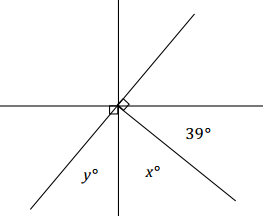
Eureka Math 7th Grade Module 6 Lesson 3 Problem Set Answer Key 4
Answer:
x + 39 + 90 = 180        ∠s on a line
x + 129 = 180
x + 129 – 129 = 180 – 129
x = 51

y + x + 90 = 180      ∠s on a line
y + 51 + 90 = 180
y + 141 = 180
y + 141 – 141 = 180 – 141
y = 39

Question 5.
Two lines meet at a point. Find the measurement of one of the vertical angles. Is your answer reasonable? Explain how you know.
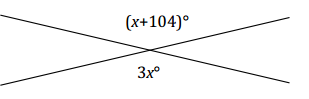
Eureka Math 7th Grade Module 6 Lesson 3 Problem Set Answer Key 5
Answer:
2x = 104 vert.∠s
(\(\frac{1}{2}\))2x = (\(\frac{1}{2}\))104
x = 52

Measurement of each vertical angle: 3(52)° = 156°
The answer seems reasonable because a rounded value of 50 would make the numeric value of each expression 150 and 154, which are reasonably close for a check.
A solution can include a modified diagram, as shown, and the supporting algebra work.
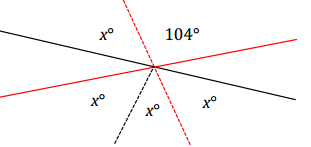
Eureka Math 7th Grade Module 6 Lesson 3 Problem Set Answer Key 6
Solutions may also include the full equation and solution:
3x = x + 104 Vert.∠s
3x – x = x – x + 104
2x = 104
(1/2)2x = (1/2)104
x = 52

Question 6.
Three lines meet at a point that is also the endpoint of a ray. Set up and solve an equation to find the value of y.
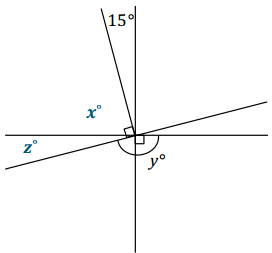
Eureka Math 7th Grade Module 6 Lesson 3 Problem Set Answer Key 7
Answer:
Let x° and z° be the measurements of the indicated angles.
x + 15 = 90          Vert. ∠s
x + 15 – 15 = 90 – 15
x = 75

x + z = 90         Complementary ∠s
75 + z = 90
75 – 75 + z = 90 – 75
z = 15

z + y = 180         ∠s on a line
15 + y = 180
15 – 15 + y = 180 – 15
y = 165

Question 7.
Three adjacent angles are at a point. The second angle is 20° more than the first, and the third angle is 20° more than the second angle.
a. Find the measurements of all three angles.
b. Compare the expressions you used for the three angles and their combined expression. Explain how they are equal and how they reveal different information about this situation.
Answer:
a. x + (x + 20) + (x + 20 + 20) = 360         ∠s at a point
3x + 60 = 360
3x + 60 – 60 = 360 – 60
3x = 300
(\(\frac{1}{3}\))3x = (\(\frac{1}{3}\))300
x = 100
Angle 1: 100°
Angle 2: 100° + 20° = 120°
Angle 3: 100° + 20° + 20° = 140°

b. By the commutative and associative laws, x + (x + 20) + (x + 20 + 20) is equal to (x + x + x) + (20 + 20 + 20), which is equal to 3x + 60. The first expression, x + (x + 20) + (x + 20 + 20), shows the sum of three unknown numbers, where the second is 20 more than the first, and the third is 20 more than the second. The expression 3x + 60 shows the sum of three times an unknown number with 60.

Question 8.
Four adjacent angles are on a line. The measurements of the four angles are four consecutive even numbers. Determine the measurements of all four angles.
Answer:
x + (x + 2) + (x + 4) + (x + 6) = 180       ∠s on a line
4x + 12 = 180
4x + 12 – 12 = 180 – 12
4x = 168
(\(\frac{1}{4}\))4x = (\(\frac{1}{4}\))168
x = 42
The four angle measures are 42°, 44°, 46°, and 48°.

Question 9.
Three adjacent angles are at a point. The ratio of the measurement of the second angle to the measurement of the first angle is 4:3. The ratio of the measurement of the third angle to the measurement of the second angle is 5:4. Determine the measurements of all three angles.
Answer:
Let the smallest measure of the three angles be 3x°. Then, the measure of the second angle is 4x°, and the measure of the third angle is 5x°.
3x + 4x + 5x = 360          ∠s at a point
12x = 360
(1\(\frac{1}{12}\))12x = (\(\frac{1}{12}\))360
x = 30
Angle 1: 3(30)° = 90°
Angle 2: 4(30)° = 120°
Angle 3: 5(30)° = 150°

Question 10.
Four lines meet at a point. Solve for x and y in the following diagram.
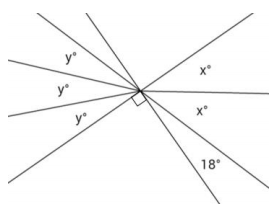
Eureka Math 7th Grade Module 6 Lesson 3 Problem Set Answer Key 10
Answer:
2x + 18 + 90 = 180        ∠s on a line
2x + 108 = 180
2x + 108 – 108 = 180 – 108
2x = 72
(\(\frac{1}{2}\))2x = (\(\frac{1}{2}\))72
x = 36

2x = 3y           Vert. ∠s
2(36) = 3y
72 = 3y
(\(\frac{1}{3}\))72 = (\(\frac{1}{3}\))3y
y = 24

Eureka Math Grade 7 Module 6 Lesson 3 Exit Ticket Answer Key

Question 1.
Two rays have a common endpoint on a line. Set up and solve an equation to find the value of z. Find the measurements of ∠AYC and ∠DYB.
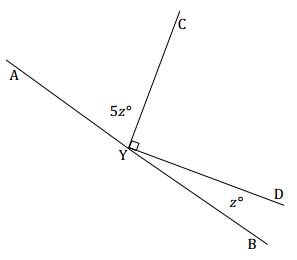
Eureka Math Grade 7 Module 6 Lesson 3 Exit Ticket Answer Key 1
Answer:
5z + 90 + z = 180 ∠s on a line
6z + 90 = 180
6z + 90 – 90 = 180 – 90
6z = 90
(\(\frac{1}{6}\))6z = (\(\frac{1}{6}\))90
z = 15
The measurement of ∠AYC: 5(15)° = 75°
The measurement of ∠DYB: 15°

Scaffolded solutions:
a. Use the equation above.
b. The angle marked z°, the right angle, and the angle with measurement 5z° are angles on a line. Their measurements sum to 180°.
c. The answers seem reasonable because once 15 is substituted in for z, the measurement of ∠AYC is 75°, which is slightly smaller than a right angle, and the measurement of ∠DYB is 15°, which is an acute angle.

Question 2.
Two lines meet at a point that is also the vertex of an angle. Set up and solve an equation to find the value of x. Find the measurements of ∠CAH and ∠EAG.
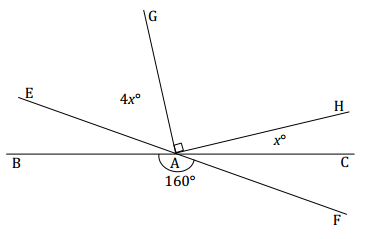
Eureka Math Grade 7 Module 6 Lesson 3 Exit Ticket Answer Key 2
Answer:
4x + 90 + x = 160 vert.∠s
5x + 90 = 160
5x + 90 – 90 = 160 – 90
5x = 70
(\(\frac{1}{5}\))5x = (\(\frac{1}{5}\))70
x = 14

The measurement of ∠CAH: 14°
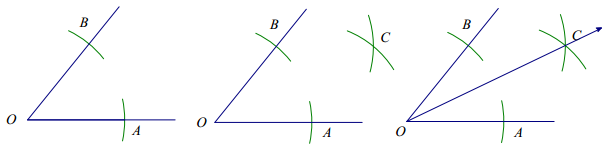
The measurement of ∠EAG: 4(14)° = 56°