Eureka Math Grade 3 Module 6 Lesson 7 Answer Key

Engage NY Eureka Math 3rd Grade Module 6 Lesson 7 Answer Key

Eureka Math Grade 3 Module 6 Lesson 7 Pattern Sheet Answer Key

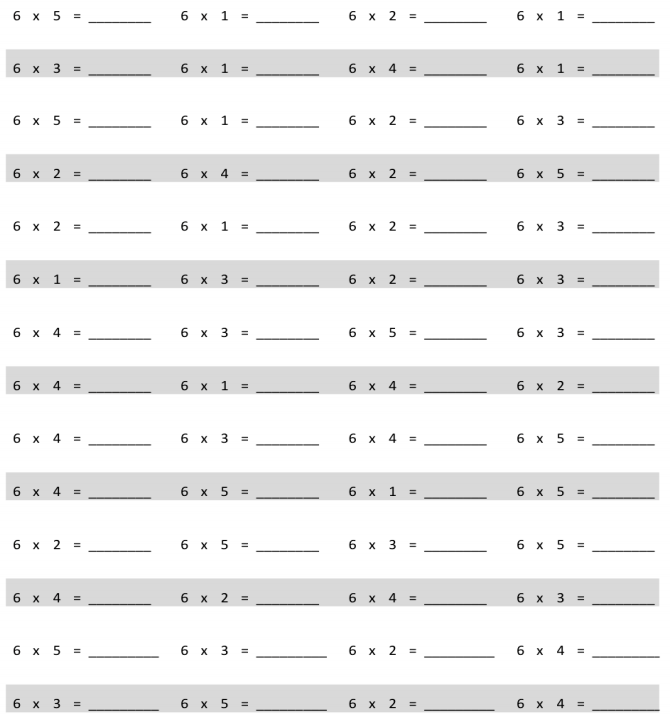
Multiply.

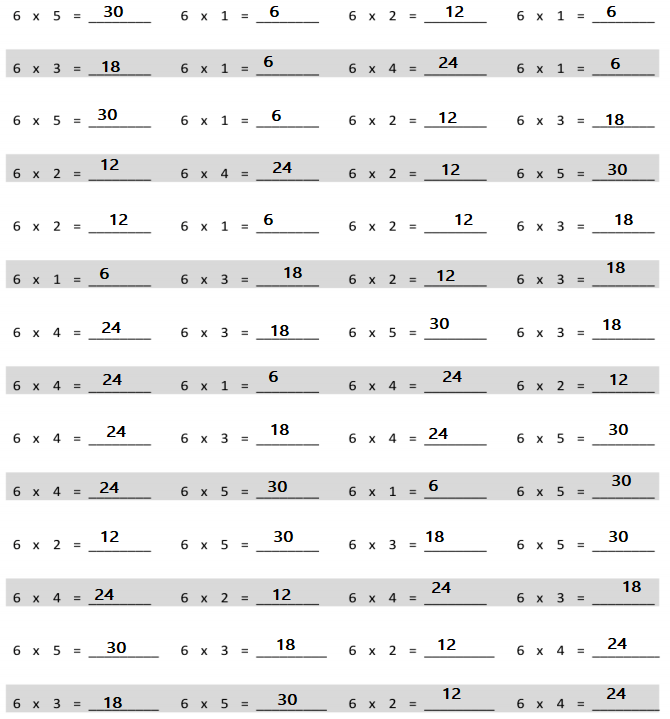
Engage NY Math 3rd Grade Module 6 Lesson 7 Pattern Sheet Answer Key 1
multiply by 6 (6–10)
Answer: -24
Engage-NY-Math-3rd-Grade-Module-6-Lesson-7-Pattern-Sheet-Answer-Key-1

Eureka Math Grade 3 Module 6 Lesson 7 Problem Set Answer Key

Question 1.
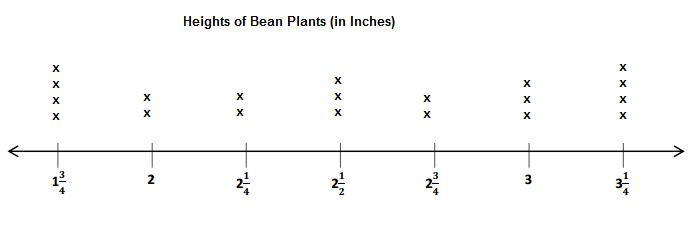
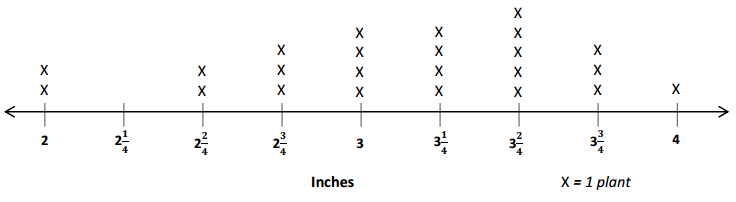
Mrs. Weisse’s class grows beans for a science experiment. The students measure the heights of their bean plants to the nearest \(\frac{1}{4}\) inch and record the measurements as shown below.

Heights of Bean Plants (in Inches)

2\(\frac{1}{4}\)2\(\frac{3}{4}\)3\(\frac{1}{4}\)1\(\frac{3}{4}\)1\(\frac{3}{4}\)
1\(\frac{3}{4}\)32\(\frac{1}{2}\)3\(\frac{1}{4}\)2\(\frac{1}{2}\)
22\(\frac{1}{4}\)33\(\frac{1}{4}\)3
2\(\frac{1}{2}\)3\(\frac{1}{4}\)1\(\frac{3}{4}\)2\(\frac{3}{4}\)2

a. Use the data to complete the line plot below.
Title: ___________________________
Engage NY Math Grade 3 Module 6 Lesson 7 Problem Set Answer Key p 2
Label: __________________________ X =
b. How many bean plants are at least 2\(\frac{1}{4}\) inches tall?
c. How many bean plants are taller than 2\(\frac{3}{4}\) inches?
d. What is the most frequent measurement? How many bean plants were plotted for this measurement?
e. George says that most of the bean plants are at least 3 inches tall. Is he right? Explain your answer.
f. Savannah was absent the day the class measured the heights of their bean plants. When she returns, her plant measures 2\(\frac{2}{4}\) inches tall. Can Savannah plot the height of her bean plant on the class line plot? Why or why not?
Answer:
a. Title: Heights of Bean Plants (in Inches)
Label: Bean Plants  X = 1 bean plant
Engage-NY-Math-Grade-3-Module-6-Lesson-7-Problem-Set-Answer-Key-p-2
b.There are 2 bean plants are at least 2\(\frac{1}{4}\) inches tall
c. There are 2 bean plants that are taller than 2\(\frac{3}{4}\) inches
d. The most frequent measurement is 3\(\frac{1}{4}\) and 1\(\frac{3}{4}\) inches. There are 20 bean plants were plotted for this measurement
e. George says that most of the bean plants are at least 3 inches tall. he is wrong because out of 20 plants only 7 plants were more than and equal to 3 inches.
f. Savannah was absent the day the class measured the heights of their bean plants. When she returns, her plant measures 2\(\frac{2}{4}\) inches tall. Savannah cannot plot the height of her bean plant on the class line plot because there is no space in the plot graph to enter her value

Eureka Math Grade 3 Module 6 Lesson 7 Exit Ticket Answer Key

Question 1.
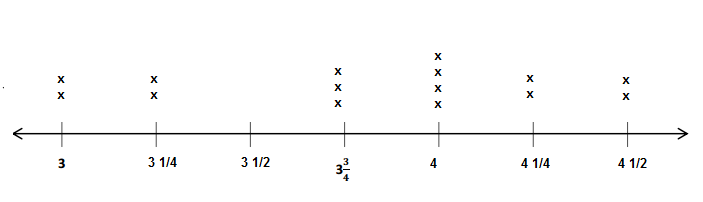
Scientists measure the growth of mice in inches. The scientists measure the length of the mice to the nearest \(\frac{1}{4}\) inch and record the measurements as shown below.

Lengths of Mice (in Inches)

3\(\frac{1}{4}\)33\(\frac{1}{4}\)3\(\frac{3}{4}\)4
3\(\frac{3}{4}\)34\(\frac{1}{2}\)4\(\frac{1}{2}\)3\(\frac{3}{4}\)
44\(\frac{1}{4}\)44\(\frac{1}{4}\)4

Label each tick mark. Then, record the data on the line plot below.
Title: ___________________________
Eureka Math 3rd Grade Module 6 Lesson 7 Exit Ticket Answer Key t 1
Label: ________________________ X = 1 mouse
Answer:
Title: Lengths of Mice (in Inches)
Label: Lengths of Mice  X = 1 mouse Lengths of Mice
Eureka-Math-3rd-Grade-Module-6-Lesson-7-Exit-Ticket-Answer-Key-t-1

Eureka Math Grade 3 Module 6 Lesson 7 Homework Answer Key

Question 1.
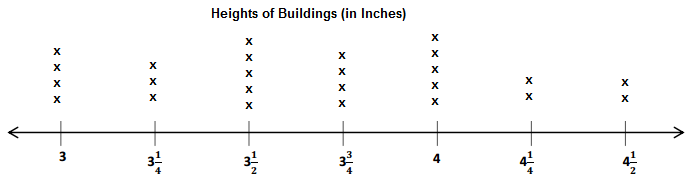
Mrs. Felter’s students build a model of their school’s neighborhood out of blocks. The students measure the heights of the buildings to the nearest \(\frac{1}{4}\) inch and record the measurements as shown below.

Heights of Buildings (in Inches)

3\(\frac{1}{4}\)3\(\frac{3}{4}\)4\(\frac{1}{4}\)4\(\frac{1}{2}\)3\(\frac{1}{2}\)
433\(\frac{3}{4}\)34\(\frac{1}{2}\)
33\(\frac{1}{2}\)3\(\frac{3}{4}\)3\(\frac{1}{2}\)4
3\(\frac{1}{2}\)3\(\frac{1}{4}\)3\(\frac{1}{2}\)43\(\frac{3}{4}\)
34\(\frac{1}{4}\)43\(\frac{1}{4}\)4

a. Use the data to complete the line plot below.
Title: ___________________________
Eureka Math Grade 3 Module 6 Lesson 7 Homework Answer Key h 2
Label: ________________________ X =
b. How many buildings are 4\(\frac{1}{4}\) inches tall?
c. How many buildings are less than 3\(\frac{1}{2}\) inches?
d. How many buildings are in the class model? How do you know?
e. Brook says most buildings in the model are at least 4 inches tall. Is she correct? Explain your thinking.

Answer:
a. Title: Heights of Buildings (in Inches)
Label: Heights of Building  X = 1 building
Eureka-Math-Grade-3-Module-6-Lesson-7-Homework-Answer-Key-h-2
b. There are two buildings with 4\(\frac{1}{4}\) inches tall
c. There are seven buildings that are less than 3\(\frac{1}{2}\) inches
d. There are 25 buildings are in the class model by counting the plotted points
e. Brook says most buildings in the model are at least 4 inches tall. No, she is wrong as out of 25 buildings only 9 buildings are 4 inches tall

Eureka Math Grade 3 Module 6 Answer Key

Eureka Math Grade 3 Module 6 Lesson 6 Answer Key

Engage NY Eureka Math 3rd Grade Module 6 Lesson 6 Answer Key

Eureka Math Grade 3 Module 6 Lesson 6 Pattern Sheet Answer Key

Multiply.
Engage NY Math 3rd Grade Module 6 Lesson 6 Pattern Sheet Answer Key p 1
multiply by 6 (1–5)
Answer:
Engage-NY-Math-3rd-Grade-Module-6-Lesson-6-Pattern-Sheet-Answer-Key-p-1
Multiplying 6 with x
Hear x= 1 to 5
Multiply 6 with 1
6 x 1=6
Multiply 6 with 2
6 x 2=12
Multiply 6 with 3
6 x 3=18
Multiply 6 with 4
6 x 4=24
Multiply 6 with 5
6 x 5=30

Eureka Math Grade 3 Module 6 Lesson 6 Problem Set Answer Key

Question 1.
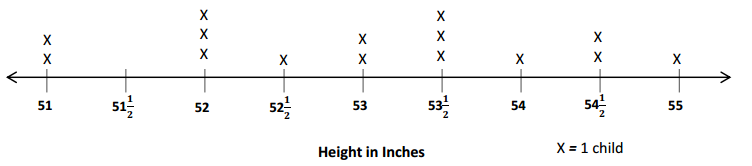
Coach Harris measures the heights of the children on his third-grade basketball team in inches. The heights are shown on the line plot below.
Heights of Children on Third-Grade Basketball Team
Engage NY Math Grade 3 Module 6 Lesson 6 Problem Set Answer Key pr 1
a. How many children are on the team? How do you know?
b. How many children are less than 53 inches tall?
c. Coach Harris says that the most common height for the children on his team is 53 \(\frac{1}{2}\)inches. Is he right? Explain your answer.
d. Coach Harris says that the player who does the tip-off in the beginning of the game has to be at least 54 inches tall. How many children could do the tip-off?
Answer:
a. 15 children
Ther are 15 children inthe team, as it is mentioned in the plot that x is equal to 1 child and there are total 15 x’s in the plot .
b. 6 students are less than 53 inches tall
c. 53 \(\frac{1}{2}\)inches and 52 inches are the 2 most common heights in the team as both the heights has the same number of chldren’s.
52=3 children’s
53\(\frac{1}{2}\)= 3 children’s
d. 4 childern’s can do the tip-off as there are 4 children’s with at least 54 inches hight
54 inches = 1
54\(\frac{1}{2}\) = 2
55 inches = 1

Question 2.
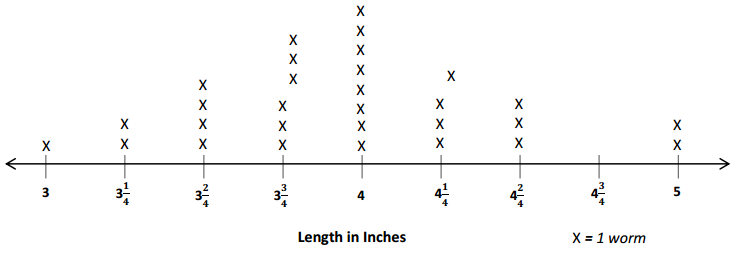
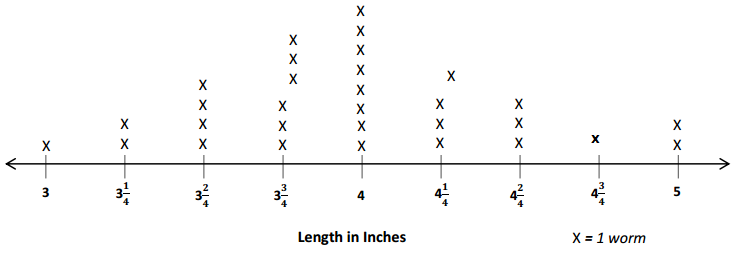
Miss Vernier’s class is studying worms. The lengths of the worms in inches are shown in the line plot below.
Lengths of Worms
Engage NY Math Grade 3 Module 6 Lesson 6 Problem Set Answer Key pr 2
a. How many worms did the class measure? How do you know?
b. Cara says that there are more worms 3 \(\frac{3}{4}\) inches long than worms that are 3\(\frac{2}{4}\) and 4\(\frac{1}{4}\) inches long combined. Is she right? Explain your answer.
c. Madeline finds a worm hiding under a leaf. She measures it, and it is 4\(\frac{3}{4}\) inches long. Plot the length of the worm on the line plot.
Answer:
a.There are 30 worms  that aremeasured, as it is mentioned in the plot that x is equal to 1 worm and there are total 30 x’s in the worms .
b.Cara is wrong
3 \(\frac{3}{4}\) = 6
3\(\frac{2}{4}\) and 4\(\frac{1}{4}\) inches long combined = 4 + 4 = 8
8>6
c.Engage-NY-Math-Grade-3-Module-6-Lesson-6-Problem-Set-Answer-Key-pr-2

Eureka Math Grade 3 Module 6 Lesson 6 Exit Ticket Answer Key

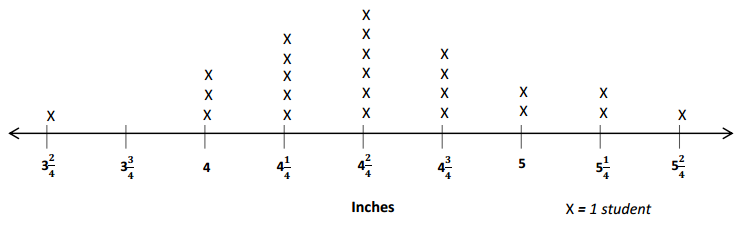
Ms. Bravo measures the lengths of her third-grade students’ hands in inches. The lengths are shown on the line plot below.
Lengths of Hands of Third-Grade Students
Eureka Math 3rd Grade Module 6 Lesson 6 Exit Ticket Answer Key t 1
a. How many students are in Ms. Bravo’s class? How do you know?
b. How many students’ hands are longer than 4\(\frac{2}{4}\) inches?
c. Darren says that more students’ hands are 4\(\frac{2}{4}\) inches long than 4 and 5\(\frac{1}{4}\) inches combined. Is he right? Explain your answer.
Answer:
a.There are 24 students are in Ms. Bravo’s class, as it is mentioned in the plot that x is equal to 1 student and there are total 24 x’s in the students .
b. 9 students hads are longer than 4\(\frac{2}{4}\) inches
4\(\frac{3}{4}\) inches=4
5 inches=2
5 \(\frac{1}{4}\) inches=2
5 \(\frac{2}{4}\) inches=1
Total=4+2+2+1=9
c. Darren is right.
4\(\frac{2}{4}\) inches = 6
4 and 5\(\frac{1}{4}\) inches combined = 5
6>5

Eureka Math Grade 3 Module 6 Lesson 6 Homework Answer Key

Question 1.
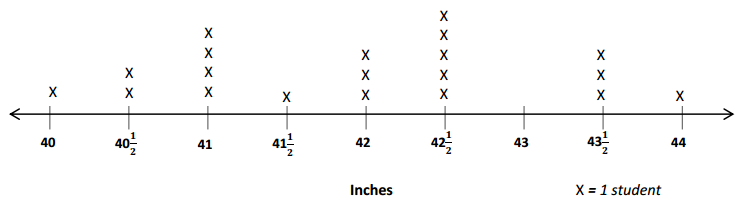
Ms. Leal measures the heights of the students in her kindergarten class. The heights are shown on the line plot below.
Heights of Students in Ms. Leal’s Kindergarten Class
Eureka Math Grade 3 Module 6 Lesson 6 Homework Answer Key h 1
a. How many students in Ms. Leal’s class are exactly 41 inches tall?
b. How many students are in Ms. Leal’s class? How do you know?
c. How many students in Ms. Leal’s class are more than 42 inches tall?
d.Ms. Leal says that for the class picture students in the back row must be at least 42\(\frac{1}{2}\) inches tall. How many students should be in the back row?
Answer:
a. 4 students in Ms. Leal’s class are exactly 41 inches tall
b. There are 20 students are in Ms. Leal’s class, as it is mentioned in the plot that x is equal to 1 student and there are total 20 x’s in the students .
c. 9 students in Ms. Leal’s class are more than 42 inches tall
42\(\frac{1}{2}\)inches=5
43\(\frac{1}{2}\)inches=3
44inches=1
Total = 5 + 3 + 1 = 9
d.9 students should be in the back row
because 42\(\frac{1}{2}\)inches=5
43\(\frac{1}{2}\)inches=3
44inches=1
Total = 5 + 3 + 1 = 9

Question 2.
Mr. Stein’s class is studying plants. They plant seeds in clear plastic bags and measure the lengths of the roots. The lengths of the roots in inches are shown in the line plot below.
Lengths of Plants’ Roots
Eureka Math Grade 3 Module 6 Lesson 6 Homework Answer Key h 2
a. How many roots did Mr. Stein’s class measure? How do you know?
b. Teresa says that the 3 most frequent measurements in order from shortest to longest are 3\(\frac{1}{4}\) inches, 3\(\frac{2}{4}\) inches, and 3\(\frac{3}{4}\) inches. Do you agree? Explain your answer.
c. Gerald says that the most common measurement is 14 quarter inches. Is he right? Why or why not?
Answer:
a. There are 24 roots Mr. Stein’s class measure, as it is mentioned in the plot that x is equal to 1 plant and one plant has one root there by there are total 20 x’s in the roots .
b. Teresa is wrong
because
3\(\frac{1}{4}\) inches =3 inches
they have the same number of roots that is 4
And
3\(\frac{3}{4}\) inches =2 \(\frac{3}{4}\) inches
they have the same number of roots that is 3
There by n order from shortest to longest
3\(\frac{1}{4}\) inches,3 inches =3
3\(\frac{1}{4}\) inches,3 inches =4
3\(\frac{2}{4}\) =5

Eureka Math Grade 3 Module 6 Answer Key

Eureka Math Grade 3 Module 6 Lesson 5 Answer Key

Engage NY Eureka Math 3rd Grade Module 6 Lesson 5 Answer Key

Eureka Math Grade 3 Module 6 Lesson 5 Problem Set Answer Key

Question 1.
Use the ruler you made to measure different classmates’ straws to the nearest inch, \(\frac{1}{2}\) inch, and \(\frac{1}{4}\) inch. Record the measurements in the chart below. Draw a star next to measurements that are exact.

Straw Owner

Measured to the nearest inchMeasured to the nearest \(\frac{1}{2}\)  inch

Measured to the nearest \(\frac{1}{4}\) inchinch

My straw

a. _______________ ’s straw is the shortest straw I measured. It measures _______ inch(es).
b. _______________ ’s straw is the longest straw I measured. It measures _______ inches.
c. Choose the straw from your chart that was most accurately measured with the \(\frac{1}{4}\)-inch intervals on your ruler. How do you know the \(\frac{1}{4}\)-inch intervals are the most accurate for measuring this straw?
Answer:

Straw Owner

Measured to the nearest inchMeasured to the nearest \(\frac{1}{2}\)  inch

Measured to the nearest \(\frac{1}{4}\) inchinch

My straw32\(\frac{1}{2}\) ☆2\(\frac{2}{4}\)☆
Catherine4☆4☆4☆
Doug2☆2☆2☆
Eva44\(\frac{1}{2}\)☆4\(\frac{2}{4}\)☆
Aaron33\(\frac{1}{2}\)3\(\frac{2}{4}\)
Philip66\(\frac{1}{2}\)5\(\frac{3}{4}\)
Karen1☆1☆1☆

a. Karen ’s straw is the shortest straw I measured. It measures 1 inch(es).
b.Philip ’s straw is the longest straw I measured. It measures 5 \(\frac{3}{4}\) inches.
c. Eva’s straw was most accuratly measured with \(\frac{1}{4}\) measurement to the nearest inch and a half only gives close estimates, but the quater inch gives the exact measurmerent

Question 2.
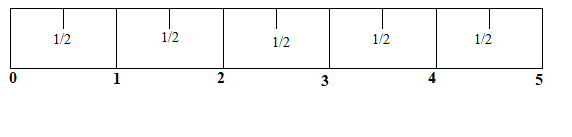
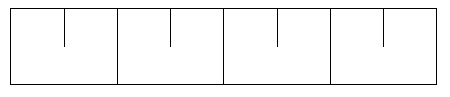
Jenna marks a 5-inch paper strip into equal parts as shown below.
Engage NY Math Grade 3 Module 6 Lesson 5 Problem Set Answer Key p 1
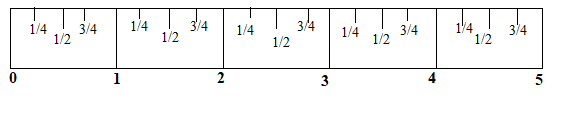
a. Label the whole and half inches on the paper strip.
b. Estimate to draw the \(\frac{1}{4}\)-inch marks on the paper strip. Then, fill in the blanks below.
1 inch is equal to _______ half inches.
1 inch is equal to _______ quarter inches.
1 half inch is equal to _______ quarter inches.
c. Describe how Jenna could use this paper strip to measure an object that is longer than 5 inches.
Answer:
a.Engage-NY-Math-Grade-3-Module-6-Lesson-5-Problem-Set-Answer-Key-p-1
b.Engage-NY-Math-Grade-3-Module-6-Lesson-5-Problem-Set-Answer-Key-p-1
1 inch is equal to 2 half inches.
1 inch is equal to 4 quarter inches.
1 half inch is equal to 2 quarter inches.
c. Jenna can mark the first  5 inches later she can move the paper strip up tothe line 0(Zero) of the ruler wthe mark she made and mesure the object.

Question 3.
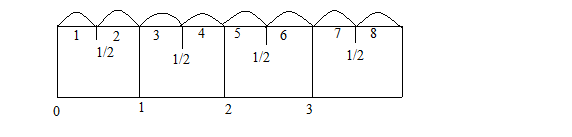
Sari says her pencil measures 8 half inches. Bart disagrees and says it measures 4 inches. Explain to Bart why the two measurements are the same in the space below. Use words, pictures, or numbers.
Answer: Both are same as  4 inches is equal to 8 half inches when measures in half inch
8-2=4
Engage-NY-Math-Grade-3-Module-6-Lesson-5-Problem-Set-Answer-Key-img-2

Eureka Math Grade 3 Module 6 Lesson 5 Exit Ticket Answer Key

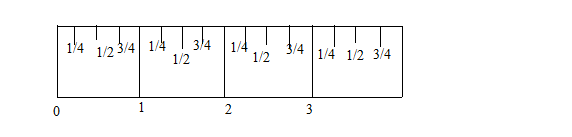
Davon marks a 4-inch paper strip into equal parts as shown below.
Eureka Math 3rd Grade Module 6 Lesson 5 Exit Ticket Answer Key t 1
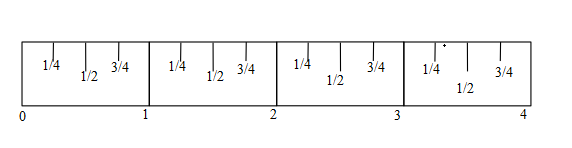
a. Label the whole and quarter inches on the paper strip.
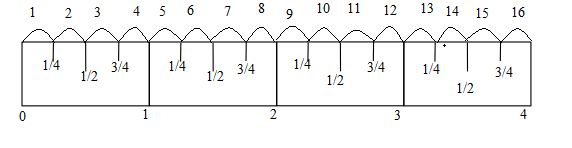
b. Davon tells his teacher that his paper strip measures 4 inches. Sandra says it measures 16 quarter inches. Explain how the two measurements are the same. Use words, pictures, or numbers.
Answer:
a.Eureka-Math-3rd-Grade-Module-6-Lesson-5-Exit-Ticket-Answer-Key-t-1
b. Both are same as as 16 quater inches is the same as 4 inches
.Eureka-Math-3rd-Grade-Module-6-Lesson-5-Exit-Ticket-Answer-Key-t-1

Eureka Math Grade 3 Module 6 Lesson 5 Homework Answer Key

Question 1.
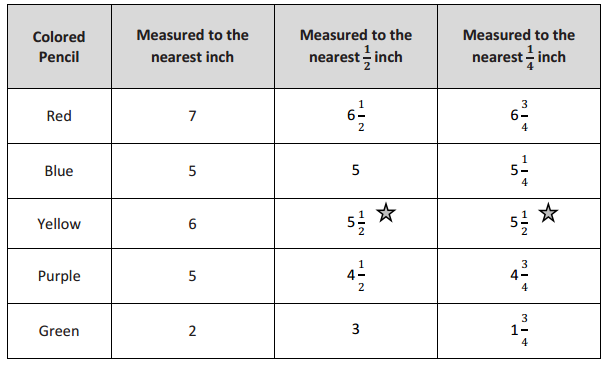
Travis measured 5 different-colored pencils to the nearest inch, \(\frac{1}{2}\) inch, and \(\frac{1}{4}\) inch. He records the measurements in the chart below. He draws a star next to measurements that are exact.
Eureka Math Grade 3 Module 6 Lesson 5 Homework Answer Key h 1
a. Which colored pencil is the longest? _______________________________
It measures ________ inches.
b. Look carefully at Travis’s data. Which colored pencil most likely needs to be measured again? Explain how you know.
Answer:
a.Red colored pencil is the longest
It measures 7 inches.
b. Green colored pencil most likely needs to be measured again as because its half inch and quater inch measurents are not accurate.

Question 2.
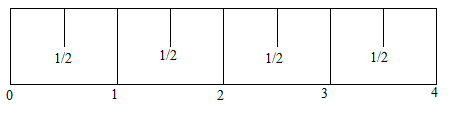
Evelyn marks a 4-inch paper strip into equal parts as shown below.
Eureka Math Grade 3 Module 6 Lesson 5 Homework Answer Key h 2
a. Label the whole and half inches on the paper strip.
b. Estimate to draw the \(\frac{1}{4}\)-inch marks on the paper strip. Then, fill in the blanks below.
1 inch is equal to _______ half inches.
1 inch is equal to _______ quarter inches
1 half inch is equal to _______ quarter inches.
2 quarter inches are equal to _______ half inch.
Answer:
a.Eureka-Math-Grade-3-Module-6-Lesson-5-Homework-Answer-Key-h-2
b.Engage-NY-Math-Grade-3-Module-6-Lesson-5-Problem-Set-Answer-Key-img-2
1 inch is equal to 2 half inches.
1 inch is equal to 4 quarter inches
1 half inch is equal to 2 quarter inches.
2 quarter inches are equal to 1 half inch

Question 3.
Travis says his yellow pencil measures 5\(\frac{1}{2}\) inches. Ralph says that is the same as 11 half inches. Explain how they are both correct.
Answer: 5\(\frac{1}{2}\) inches is same as 11 and half inch as shown below.
Engage-NY-Math-Grade-3-Module-6-Lesson-5-Problem-Set-Answer-Key-

Eureka Math Grade 3 Module 6 Answer Key

Eureka Math Grade 3 Module 6 Lesson 4 Answer Key

Engage NY Eureka Math 3rd Grade Module 6 Lesson 4 Answer Key

Eureka Math Grade 3 Module 6 Lesson 4 Problem Set Answer Key

Question 1.
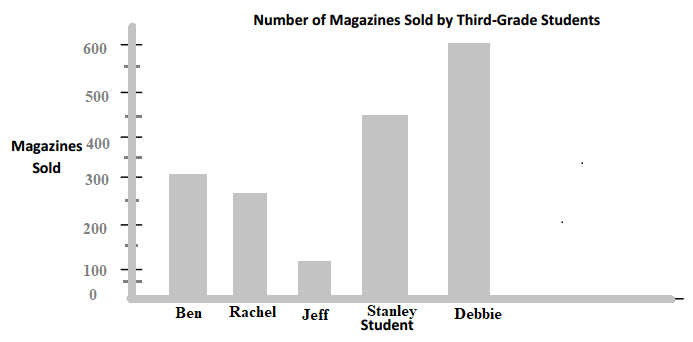
The chart below shows the number of magazines sold by each student.

Student Ben Rachel Jeff StanleyEngage-NY-Math-Grade-3-Module-6-Lesson-4-Problem-Set-Answer-Key-p-1
Magazines Sold300250100450600

a. Use the chart to draw a bar graph below. Create an appropriate scale for the graph.
Engage NY Math Grade 3 Module 6 Lesson 4 Problem Set Answer Key p 1
Answer:
Engage-NY-Math-Grade-3-Module-6-Lesson-4-Problem-Set-Answer-Key-p-1
b. Explain why you chose the scale for the graph.
Answer: The values of magazines are 100,250,300,450,600.
To sort these values we choose the scale of 100 for the graph as most of the values lies on scale of 100 except 250 and 450 which can be placed as mid values

c. How many fewer magazines did Debbie sell than Ben and Stanley combined?
Answer: 150 fewer magazines
Total magazines debbie sold = 600
Total magazines sold by Ben and Stanley = 300 + 450 = 750
750 – 600 = 150

d. How many more magazines did Debbie and Jeff sell than Ben and Rachel?
Answer: 150 more magazines
Debbie and Jeff sold = 600 + 100 = 700
Ben and Rachel sold = 300 + 250 = 550
700 – 550 = 150

Question 2.
The bar graph shows the number of visitors to a carnival from Monday through Friday.
Engage NY Math Grade 3 Module 6 Lesson 4 Problem Set Answer Key p 2
a. How many fewer visitors were there on the least busy day than on the busiest day?
Answer: 240 Fewer visitors
Least busy day was Thursday with 190 visitors
Most busy day was Wednesday with 430 visitors
Total amount of fewer visitors
430 – 190 = 240

b. How many more visitors attended the carnival on Monday and Tuesday combined than on Thursday and Friday combined?
Answer: 80 more visitors
Combined visitors on Monday and Tuesday =340 +300 =640
Combined visitiors on Thursady and Friday = 190 + 370 = 560
640 – 560 = 80

Eureka Math Grade 3 Module 6 Lesson 4 Exit Ticket Answer Key

The graph below shows the number of library books checked out in five days.
Eureka Math 3rd Grade Module 6 Lesson 4 Exit Ticket Answer Key t 1
c. How many books in total were checked out on Wednesday and Thursday?
Answer: Total books checked out on Wednesday and Thursday =  530
Number of libarary books checked out on Wednesday 210
Number of libarary books checked out on Thursday 320
320+210=530

d. How many more books were checked out on Thursday and Friday than on Monday and Tuesday?
Answer:  50 more books were checked out on Thursday and Friday than on Monday and Tuesday
Books checked out on Thursday and Friday = 320 +390 =710
Books checked out on Monday and Tuesday = 350 + 310 = 660
710 – 660 = 50

Eureka Math Grade 3 Module 6 Lesson 4 Homework Answer Key

Question 1.
Maria counts the coins in her piggy bank and records the results in the tally chart below. Use the tally marks to find the total number of each coin.
Eureka Math Grade 3 Module 6 Lesson 4 Homework Answer Key h 1
Answers:
Eureka-Math-Grade-3-Module-6-Lesson-4-Homework-Answer-Key-h-1
a. Use the tally chart to complete the bar graph below. The scale is given.
Eureka Math Grade 3 Module 6 Lesson 4 Homework Answer Key h 2
Answers:
Eureka-Math-Grade-3-Module-6-Lesson-4-Homework-Answer-Key-h-2
b. How many more pennies are there than dimes?
Answer: 11
Maria has 68 Pennies ans 57 dimes
68-57=11
c. Maria donates 10 of each type of coin to charity. How many total coins does she have left? Show your work.
Answer: Total coins left after charity =171
Penny = 68 -10 = 58
Nickel = 62 -10 = 52
Dime = 57-10 =47
Quarter = 24 – 10 =14

Question 2.
Ms. Hollmann’s class goes on a field trip to the planetarium with Mr. Fiore’s class. The number of students in each class is shown in the picture graphs below.
Eureka Math Grade 3 Module 6 Lesson 4 Homework Answer Key h 3
a. How many fewer boys are on the trip than girls?
Answer: 5
Boys are 5 fewer than girls
Total Boys =13 + 14 = 27
Toatl girls = 17 +15 = 32
32 – 27 = 5

b. It costs $2 for each student to attend the field trip. How much money does it cost for all students to attend?
Answer: Total cost = $59
Cost for girls on total = $32
Cost for Boys on total = $27

c. The cafeteria in the planetarium has 9 tables with 8 seats at each table. Counting students and teachers, how many empty seats should there be when the 2 classes eat lunch?
Answer:  Empty seats are 11
Total number of seats avaliable are 72
Total number of students are 59
Total number of Teachers are 2
59 + 2 = 61
Total empty seats are
72 – 61 = 11

Eureka Math Grade 3 Module 6 Answer Key

Eureka Math Grade 3 Module 6 Lesson 3 Answer Key

Engage NY Eureka Math 3rd Grade Module 6 Lesson 3 Answer Key

Eureka Math Grade 3 Module 6 Lesson 3 Sprint Answer Key

A
Multiply or Divide by 6
Engage NY Math 3rd Grade Module 6 Lesson 3 Sprint Answer Key s 1
Question 1.
2 × 6 =
Answer:  12
By multiplying 2 with 6
we get 12

Question 2.
3 × 6 =
Answer: 18
By multiplying 3 with 6
we get 18

Question 3.
4 × 6 =
Answer: 24
By multiplying 4 with 6
we get 24

Question 4.
5 × 6 =
Answer: 30
By multiplying 5 with 6
we get 30

Question 5.
1 × 6 =
Answer: 6
By multiplying 1 with 6
we get 6

Question 6.
12 ÷ 6 =
Answer: 2
By dividing 12 with 6
we get 2

Question 7.
18 ÷ 6 =
Answer: 3
By dividing 18 with 6
we get 3

Question 8.
30 ÷ 6 =
Answer: 5
By dividing 30 with 6
we get 5

Question 9.
6 ÷ 6 =
Answer: 1
By dividing 6 with 6
we get 1

Question 10.
24 ÷ 6 =
Answer: 4
By dividing 24 with 6
we get 4

Question 11.
6 × 6 =
Answer: 36
By multiplying 6 with 6
we get 36

Question 12.
7 × 6 =
Answer: 42
By multiplying 7 with 6
we get 42

Question 13.
8 × 6 =
Answer: 24
By multiplying 8 with 6
we get 24

Question 14.
9 × 6 =
Answer: 54
By multiplying 9 with 6
we get 54

Question 15.
10 × 6 =
Answer: 60
By multiplying 10 with 6
we get 60

Question 16.
48 ÷ 6 =
Answer: 8
By dividing 48 with 6
we get 8

Question 17.
42 ÷ 6 =
Answer: 7
By dividing 42 with 6
we get 7

Question 18.
54 ÷ 6 =
Answer: 9
By dividing 54 with 6
we get 9

Question 19.
36 ÷ 6 =
Answer: 6
By dividing 36 with 6
we get 6

Question 20.
60 ÷ 6 =
Answer: 10
By dividing 60 with 6
we get 10

Question 21.
___ × 6 = 30
Answer: 5
By multiplying 5 with 6
we get 30

Question 22.
___ × 6 = 6
Answer: 1
By multiplying 1 with 6
we get 6

Question 23.
___ × 6 = 60
Answer: 10
By multiplying 10 with 6
we get 60

Question 24.
___ × 6 = 12
Answer: 2
By multiplying 2 with 6
we get 12

Question 25.
___ × 6 = 18
Answer: 3
By multiplying 3 with 6
we get 18

Question 26.
60 ÷ 6 =
Answer: 10
By dividing 60 with 6
we get 10

Question 27.
30 ÷ 6 =
Answer: 5
By dividing 30 with 6
we get 5

Question 28.
6 ÷ 6 =
Answer: 1
By dividing 6 with 6
we get 1

Question 29.
12 ÷ 6 =
Answer: 2
By dividing 12 with 6
we get 2

Question 30.
18 ÷ 6 =
Answer: 3
By dividing 18 with 6
we get 3

Question 31.
___ × 6 = 36
Answer: 6
By multiplying 6 with 6
we get 36

Question 32.
___ × 6 = 42
Answer: 7
By multiplying 7 with 6
we get 42

Question 33.
___ × 6 = 54
Answer: 9
By multiplying 9 with 6
we get 54

Question 34.
___ × 6 = 48
Answer: 8
By multiplying 8 with 6
we get 48

Question 35.
42 ÷ 6 =
Answer: 7
By dividing 42 with 6
we get 7

Question 36.
54 ÷ 6 =
Answer: 9
By dividing 54 with 6
we get 9

Question 37.
36 ÷ 6 =
Answer: 6
By dividing 36 with 6
we get 6

Question 38.
48 ÷ 6 =
Answer: 8
By dividing 48 with 6
we get 8

Question 39.
11 × 6 =
Answer: 66
By multiplying 11 with 6
we get 66

Question 40.
66 ÷ 6 =
Answer: 11
By multiplying 66 with 6
we get 11

Question 41.
12 × 6 =
Answer: 72
By multiplying 12 with 6
we get 72

Question 42.
72 ÷ 6 =
Answer: 12
By dividing 72 with 6
we get 12

Question 43.
14 × 6 =
Answer: 84
By multiplying 14 with 6
we get 84

Question 44.
84 ÷ 6 =
Answer: 14
By dividing 84 with 6
we get 14

B
Multiply or Divide by 6
Engage NY Math 3rd Grade Module 6 Lesson 3 Sprint Answer Key s 2

Question 1.
1 × 6 =
Answer: 6
By multiplying 1 with 6
we get 6

Question 2.
2 × 6 =
Answer: 12
By multiplying 2 with 6
we get 12

Question 3.
3 × 6 =
Answer: 18
By multiplying 3 with 6
we get 18

Question 4.
4 × 6 =
Answer: 24
By multiplying 4 with 6
we get 24

Question 5.
5 × 6 =
Answer: 30
By multiplying 5 with 6
we get 30

Question 6.
18 ÷ 6 =
Answer: 3
By dividing 18 with 6
we get 3

Question 7.
12 ÷ 6 =
Answer: 2
By dividing 12 with 6
we get 2

Question 8.
24 ÷ 6 =
Answer: 4
By dividing 24 with 6
we get 4

Question 9.
6 ÷ 6 =
Answer: 1
By dividing 6 with 6
we get 1

Question 10.
30 ÷ 6 =
Answer: 5
By dividing 30 with 6
we get 5

Question 11.
10 × 6 =
Answer: 60
By multiplying 10 with 6
we get 60

Question 12.
6 × 6 =
Answer: 36
By multiplying 6 with 6
we get 36

Question 13.
7 × 6 =
Answer: 42
By multiplying 7 with 6
we get 42

Question 14.
8 × 6 =
Answer: 48
By multiplying 8 with 6
we get 48

Question 15.
9 × 6 =
Answer: 64
By multiplying 9 with 6
we get 64

Question 16.
42 ÷ 6 =
Answer: 7
By dividing 42 with 6
we get 7

Question 17.
36 ÷ 6 =
Answer: 6
By dividing 36 with 6
we get 6

Question 18.
48 ÷ 6 =
Answer: 8
By dividing 48 with 6
we get 8

Question 19.
60 ÷ 6 =
Answer: 10
By dividing 60 with 6
we get 10

Question 20.
54 ÷ 6 =
Answer: 9
By dividing 54 with 6
we get 9

Question 21.
___ × 6 = 6
Answer: 1
By multiplying 1 with 6
we get 6

Question 22.
___ × 6 = 30
Answer: 5
By multiplying 5 with 6
we get 30

Question 23.
___ × 6 = 12
Answer: 2
By multiplying 2 with 6
we get 12

Question 24.
___ × 6 = 60
Answer: 10
By multiplying 10 with 6
we get 60

Question 25.
___ × 6 = 18
Answer: 3
By multiplying 3 with 6
we get 18

Question 26.
12 ÷ 6 =
Answer: 2
By dividing 12 with 6
we get 2

Question 27.
6 ÷ 6 =
Answer: 1
By dividing 6 with 6
we get 1

Question 28.
60 ÷ 6 =
Answer: 10
By dividing 60 with 6
we get 10

Question 29.
30 ÷ 6 =
Answer: 5
By dividing 30 with 6
we get 5

Question 30.
18 ÷ 6 =
Answer: 3
By dividing 18 with 6
we get 3

Question 31.
___ × 6 = 18
Answer: 3
By multiplying 3 with 6
we get 18

Question 32.
___ × 6 = 24
Answer: 4
By multiplying 4 with 6
we get 24

Question 33.
___ × 6 = 54
Answer: 9
By multiplying 9 with 6
we get 54

Question 34.
___ × 6 = 42
Answer: 7
By multiplying 7 with 6
we get 42

Question 35.
48 ÷ 6 =
Answer: 8
By dividing 48 with 6
we get 8

Question 36.
54 ÷ 6 =
Answer: 9
By dividing 54 with 6
we get 9

Question 37.
36 ÷ 6 =
Answer: 6
By dividing 36 with 6
we get 6

Question 38.
42 ÷ 6 =
Answer: 7
By dividing 42 with 6
we get 7

Question 39.
11 × 6 =
Answer: 66
By multiplying 11 with 6
we get 66

Question 40.
66 ÷ 6 =
Answer: 11
By dividing 66 with 6
we get 11

Question 41.
12 × 6 =
Answer: 2
By multiplying 12 with 6
we get 72

Question 42.
72 ÷ 6 =
Answer: 12
By dividing 72 with 6
we get 12

Question 43.
13 × 6 =
Answer: 78
By multiplying 12 with 6
we get 78

Question 44.
78 ÷ 6 =
Answer: 13
By dividing 78 with 6
we get 13

Eureka Math Grade 3 Module 6 Lesson 3 Problem Set Answer Key

Question 1.
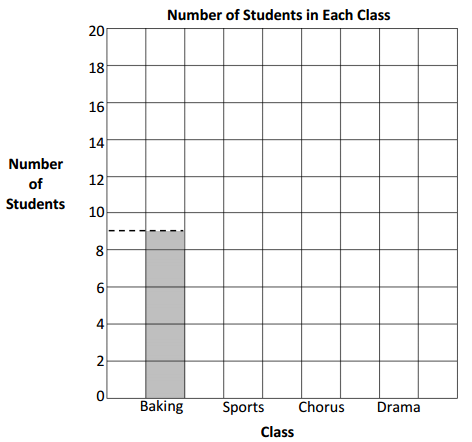
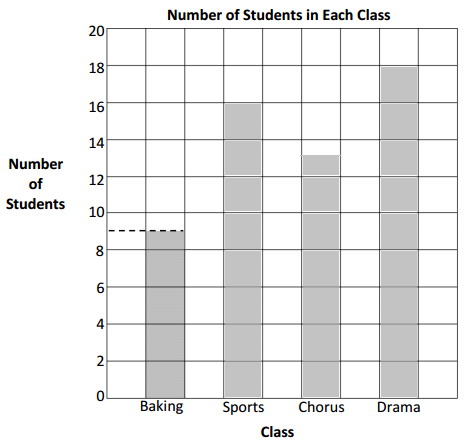
This table shows the number of students in each class.

Number of Students in Each Class

ClassNumber of Students
Baking9
Sports16
Chorus13
Drama18

Use the table to color the bar graph. The first one has been done for you.
Engage NY Math Grade 3 Module 6 Lesson 3 Problem Set Answer Key p 1
a. What is the value of each square in the bar graph?
b. Write a number sentence to find how many total students are enrolled in classes.
c. How many fewer students are in sports than in chorus and baking combined? Write a number sentence to show your thinking.
Answer:
Engage-NY-Math-Grade-3-Module-6-Lesson-3-Problem-Set-Answer-Key-p-1
a. The value of each square in the bar graph is 2
b. The number sentence to find how many total students are enrolled in classes is
9+16+13+18= 56
c. Six fewer students are in sports than in chorus and baking combined.
sports has  16 students chorus and baking combined has 22 students
so 22-16 we get 6 students

Question 2.
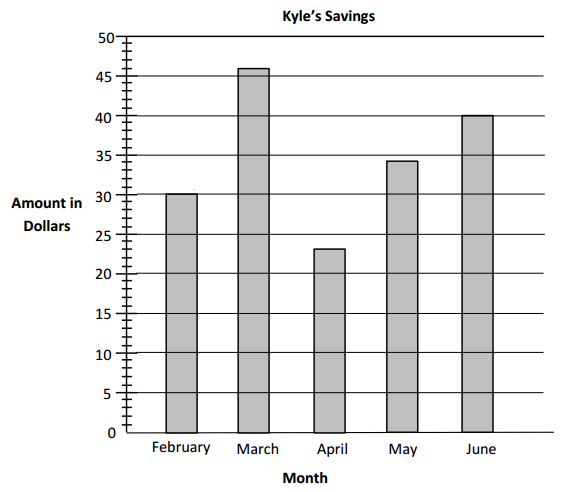
This bar graph shows Kyle’s savings from February to June. Use a straightedge to help you read the graph.
Engage NY Math Grade 3 Module 6 Lesson 3 Problem Set Answer Key p 2
a. How much money did Kyle save in May?
b. In which months did Kyle save less than $35?
c. How much more did Kyle save in June than April? Write a number sentence to show your thinking.
d. The money Kyle saved in _______ was half the money he saved in _______.
Answer:
a. 34 dollars of money  Kyle save in May
b. In May month Kyle saves less than $35 that is 34 dollars
c. Kyle saved 63 dollars in June than April.
The number sentence is june savings 40 $ April savings were 23 $ by adding both 40 $ + 23 $ we get 63 dollers
d. The money Kyle saved in April was half the money he saved in March.

Question 3.
Complete the table below to show the same data given in the bar graph in Problem 2.

 MonthsFebruary MarchAprilMayJune
 Amount  Saved in Dollars30 $46 $23 $34 $40 $

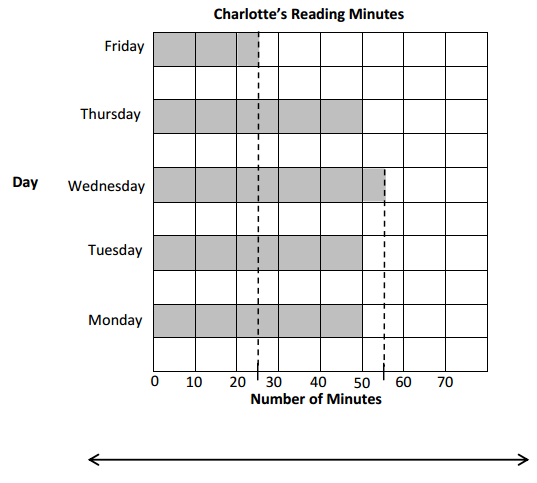
This bar graph shows the number of minutes Charlotte read from Monday through Friday.
Engage NY Math Grade 3 Module 6 Lesson 3 Problem Set Answer Key p 3
Answer: the number of minutes Charlotte read from Monday through Friday is 230 minutes

Question 4.
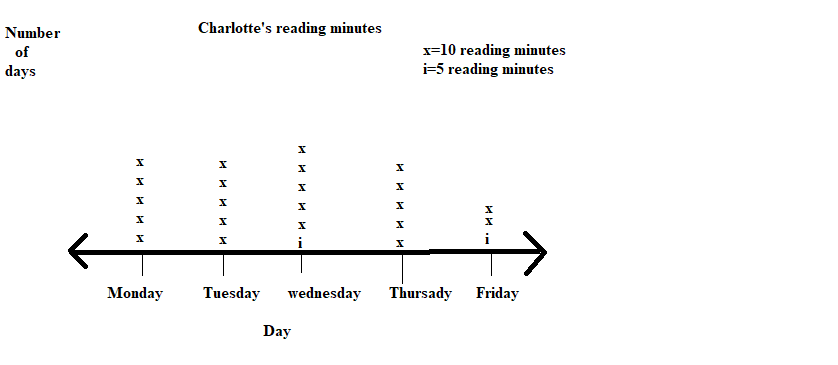
Use the graph’s lines as a ruler to draw in the intervals on the number line shown above. Then plot and label a point for each day on the number line.
Answer:
Engage-NY-Math-3rd-Grade-Module-6-End-of-Module-Assessment img 4

Question 5.
Use the graph or number line to answer the following questions.
a. On which days did Charlotte read for the same number of minutes? How many minutes did Charlotte read on these days?
b. How many more minutes did Charlotte read on Wednesday than on Friday?
Answer:
a.  On Monday Tuesday and Wednesday Charlotte read for the same number of minutes
Charlotte read 50 minutes on these days
b. 30 more minutes
On Wednesday = 55 minutes
On Friday = 25 minutes
55-25 =30

Eureka Math Grade 3 Module 6 Lesson 3 Exit Ticket Answer Key

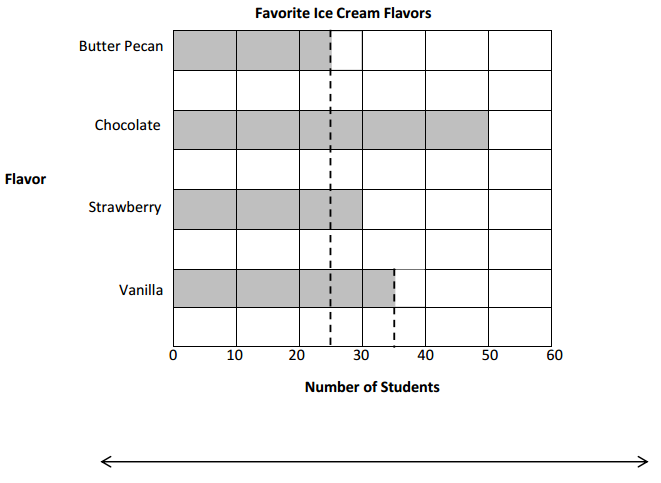
The bar graph below shows the students’ favorite ice cream flavors.
Eureka Math 3rd Grade Module 6 Lesson 3 Exit Ticket Answer Key t 1
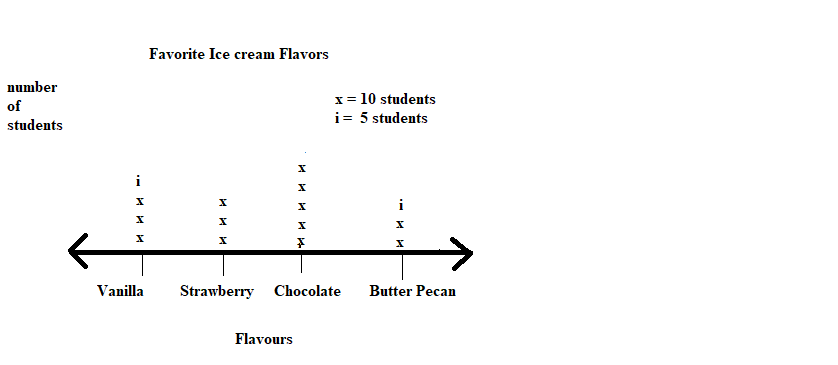
a. Use the graph’s lines as a ruler to draw intervals on the number line shown above. Then plot and label a point for each flavor on the number line.
b. Write a number sentence to show the total number of students who voted for butter pecan, vanilla, and chocolate.
Answer:
a.Engage-NY-Math-3rd-Grade-Module-6-End-of-Module-Assessment img 5
b.110
Explination:
Given:
Butter pecan =25
Vanilla = 35
Chocolate =50
so
50+25+35=110

Eureka Math Grade 3 Module 6 Lesson 3 Homework Answer Key

Question 1.
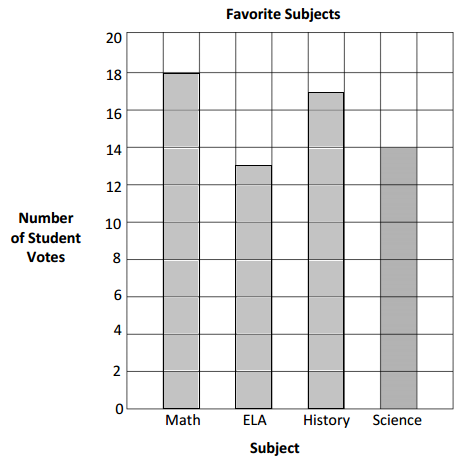
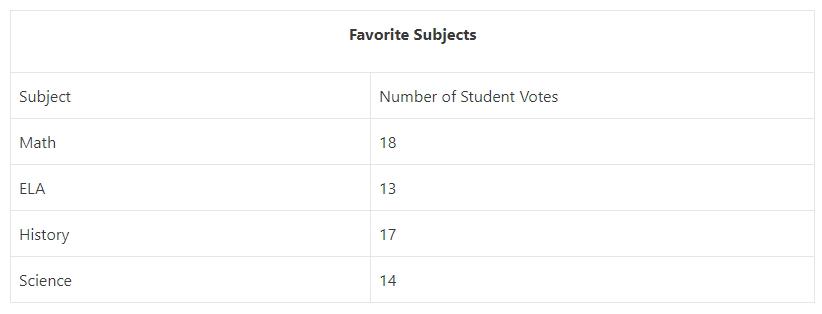
This table shows the favorite subjects of third graders at Cayuga Elementary.

Favorite Subjects

SubjectNumber of Student Votes
Math18
ELA13
History17
Science?

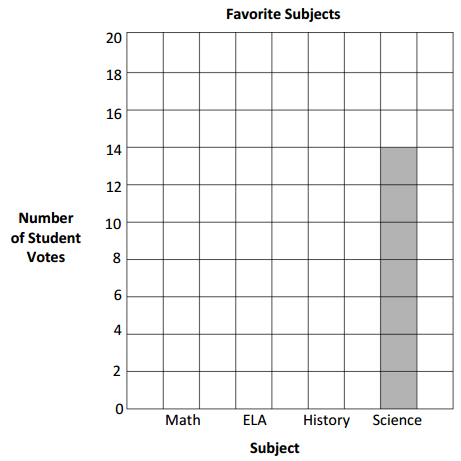
Use the table to color the bar graph.
Eureka Math Grade 3 Module 6 Lesson 3 Homework Answer Key h 1
a. How many students voted for science?
b. How many more students voted for math than for science? Write a number sentence to show your thinking.
c. Which gets more votes, math and ELA together or history and science together? Show your work.
Answer:
Eureka-Math-Grade-3-Module-6-Lesson-3-Homework-Answer-Key-h-1
a. 14
Engage-NY-Math-3rd-Grade-Module-6-End-of-Module-Assessment img 2

b. 4 students
18-14=4
c.Both are equal
Explination:
Math and ELA combined =18 + 13=31
History and Science combined  = 17 + 14 =31
31=31

Question 2.
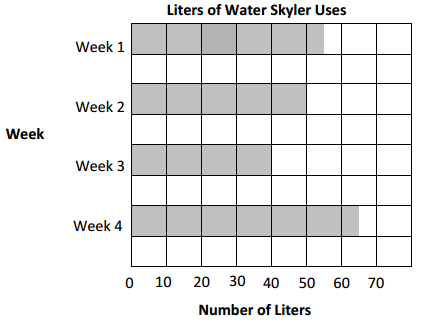
This bar graph shows the number of liters of water Skyler uses this month.
Eureka Math Grade 3 Module 6 Lesson 3 Homework Answer Key h 2
a. During which week does Skyler use the most water? _______
The least? ______
b. How many more liters does Skyler use in Week 4 than Week 2?
c. Write a number sentence to show how many liters of water Skyler uses during Weeks 2 and 3 combined.
d. How many liters does Skyler use in total?
e. If Skyler uses 60 liters in each of the 4 weeks next month, will she use more or less than she uses this month? Show your work.
Answer:
a. The most water used was on week 4 with 65 liters of water
The least water used was on week 3 withh 40 liters of water
b. 15 more liters does Skyler use in Week 4 than Week 2
In week 4 =65
In week 2 =50
65-50=15
c. 90 liters
Explination:
Given:
Week 2 = 50 liters of water
Week 3 = 40 liters of water
50+40 =90
d. 210
Explination:
Given;
Week 1 = 55 liters
Week 2 = 50 liters
Week 3= 40 liters
Week 4= 65 liters
Total water used :
Week 1+ Week 2+Week 3+Week 4=55+50+40+65 = 210
e. 30 more liters of water
Explination:
When using water as 60 liters for each week total water used = 60+60+60+60 =240
Water used as of now = Week 1+ Week 2+Week 3+Week 4=55+50+40+65 = 210
240-210=30

Question 3.
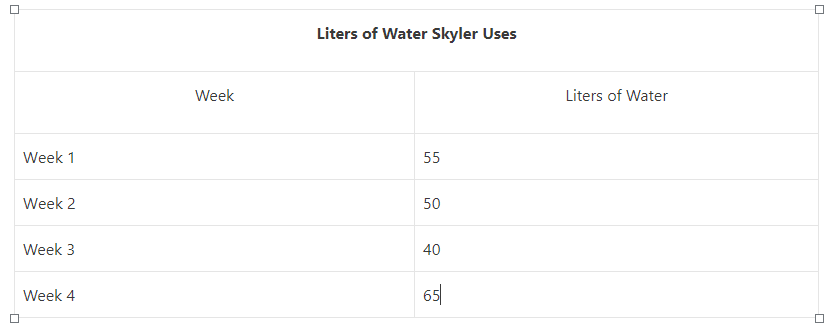
Complete the table below to show the data displayed in the bar graph in Problem 2.

Liters of Water Skyler Uses

Week

Liters of Water

Answer:
Engage-NY-Math-3rd-Grade-Module-6-End-of-Module-Assessment img 6

Eureka Math Grade 3 Module 6 Answer Key

Eureka Math Grade 3 Module 6 Lesson 2 Answer Key

Engage NY Eureka Math 3rd Grade Module 6 Lesson 2 Answer Key

Eureka Math Grade 3 Module 6 Lesson 2 Problem Set Answer Key

Question 1.
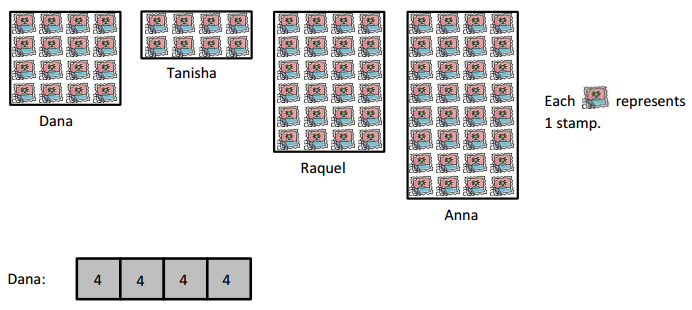
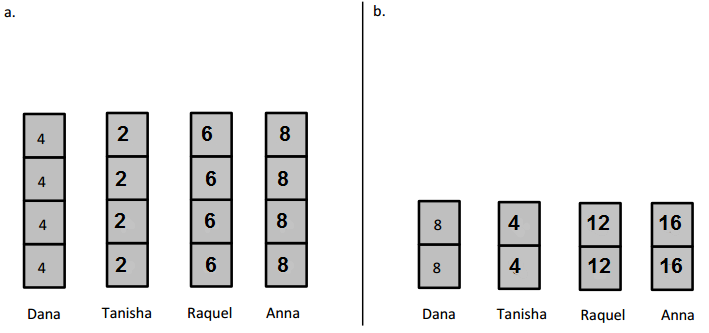
Find the total number of stamps each student has. Draw tape diagrams with a unit size of 4 to show the number of stamps each student has. The first one has been done for you.
Engage NY Math Grade 3 Module 6 Lesson 2 Problem Set Answer Key p 1
Tanisha:
Raquel:
Anna:

Answer:
Tanisha:    Engage-NY-Math-Grade-3-Module-6-Lesson-2-Problem-Set-Answer-Key-p-1
Raquel:     Engage-NY-Math-Grade-3-Module-6-Lesson-2-Problem-Set-Answer-Key-p-1 1
Anna:       Engage-NY-Math-Grade-3-Module-6-Lesson-2-Problem-Set-Answer-Key-p-1 1

Question 2.
Explain how you can create vertical tape diagrams to show this data.
Answer:
Tape diagrams are visual models that use rectangles to represent the parts of a ratio
this problem Dana has 4:4  Tanisha has 2:4  Raquel has 6:4  Anna has 8:4

Question 3.
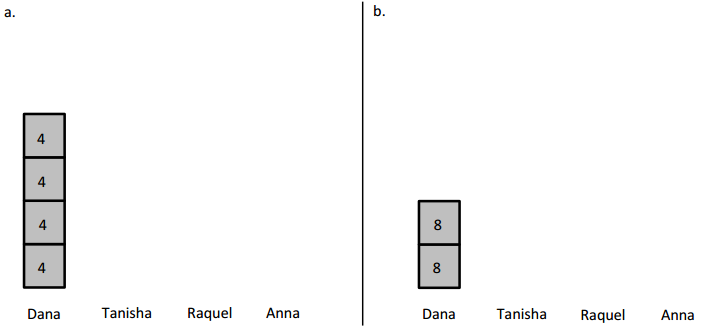
Complete the vertical tape diagrams below using the data from Problem 1.
Engage NY Math Grade 3 Module 6 Lesson 2 Problem Set Answer Key p 2
c. What is a good title for the vertical tape diagrams?
d. How many total units of 4 are in the vertical tape diagrams in Problem 3(a)?
e. How many total units of 8 are in the vertical tape diagrams in Problem 3(b)?
f. Compare your answers to parts (d) and (e). Why does the number of units change?
g. Mattaeus looks at the vertical tape diagrams in Problem 3(b) and finds the total number of Anna’s and Raquel’s stamps by writing the equation 7 × 8 = 56. Explain his thinking.
Answer:
Engage-NY-Math-Grade-3-Module-6-Lesson-2-Problem-Set-Answer-Key-p-2
c. A good title for the vertical tape diagrams is Favorite Recess Activities.
d. total units of 4 are in the vertical tape diagrams in Problem 3(a) is 1
e. total units of 8 are in the vertical tape diagrams in Problem 3(b) is 1
f. Compare your answers to parts (d) and (e).  the number of units changes Units of measurement give standards so that the numbers from our measurements refer to the same thing. Measurement is a process that uses numbers to describe a physical quantity.
g. Mattaeus looks at the vertical tape diagrams in Problem 3(b) and finds the total number of Anna’s and Raquel’s stamps by writing the equation
7 × 8 = 56.

Eureka Math Grade 3 Module 6 Lesson 2 Exit Ticket Answer Key

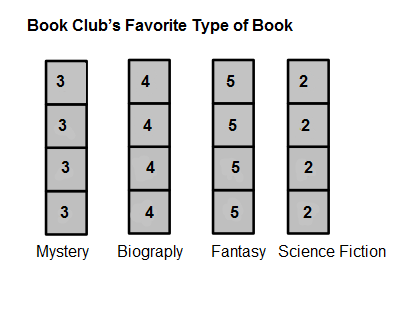
The chart below shows a survey of the book club’s favorite type of book.

Book Club’s Favorite Type of Book

Type of Book

Number of Votes

Mystery12
Biography16
Fantasy20
Science Fiction8

a. Draw tape diagrams with a unit size of 4 to represent the book club’s favorite type of book.
b. Use your tape diagrams to draw vertical tape diagrams that represent the data.
Answer:
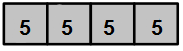
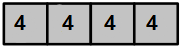
a. The tape diagrams with a unit size of 4 to represent the book club’s favorite type of book.
Engage-NY-Math-Grade-3-Module-6-Lesson-2-Problem-Set-Answer-Key-p-2 c
b. Use your tape diagrams to draw vertical tape diagrams that represent the data.
Engage-NY-Math-Grade-3-Module-6-Lesson-2-Problem-Set-Answer-Key-p-2 b

Eureka Math Grade 3 Module 6 Lesson 2 Homework Answer Key

Question 1.
Adi surveys third graders to find out their favorite fruits. The results are in the table below.

Favorite Fruits of Third Graders

Fruit

Number of Student Votes

Banana8
Apple16
Strawberry12
Peach4

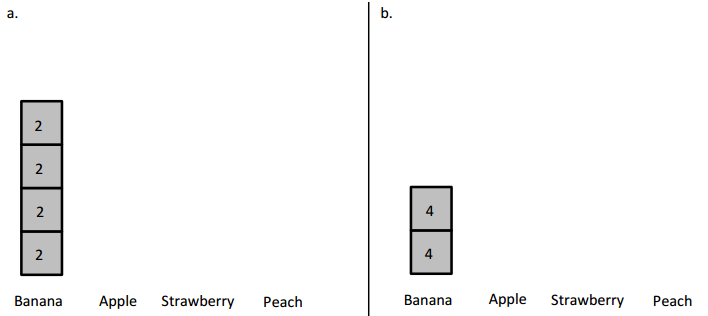
Draw units of 2 to complete the tape diagrams to show the total votes for each fruit. The first one has been done for you.
Banana:
Apple:
Strawberry:
Peach:
Answer:
Apple:         Engage-NY-Math-Grade-3-Module-6-Lesson-2-Problem-Set-Answer-Key-p-2 aa
Strawberry: Engage-NY-Math-Grade-3-Module-6-Lesson-2-Problem-Set-Answer-Key-p-2 aa
Peach:         Engage-NY-Math-Grade-3-Module-6-Lesson-2-Problem-Set-Answer-Key-p-2 aa

Question 2.
Explain how you can create vertical tape diagrams to show this data.
Answer:
Tape diagrams are visual models that use rectangles to represent the parts of a ratio.

Question 3.
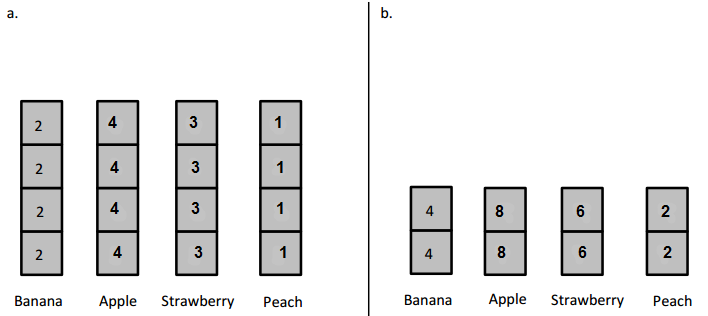
Complete the vertical tape diagrams below using the data from Problem 1.
Eureka Math Grade 3 Module 6 Lesson 2 Homework Answer Key h 3
c. What is a good title for the vertical tape diagrams?
d. Compare the number of units used in the vertical tape diagrams in Problems 3(a) and 3(b). Why does the number of units change?
e. Write a multiplication number sentence to show the total number of votes for strawberry in the vertical tape diagram in Problem 3(a).
f. Write a multiplication number sentence to show the total number of votes for strawberry in the vertical tape diagram in Problem 3(b).
g. What changes in your multiplication number sentences in Problems 3(e) and (f)? Why?
Answer:
Eureka-Math-Grade-3-Module-6-Lesson-2-Homework-Answer-Key-h-3
c. A good title for the vertical tape diagrams is Favorite Recess Activities.
d. Compare the number of units used in the vertical tape diagrams in Problems 3(a) and 3(b).
the number of units changes Units of measurement give standards so that the numbers from our measurements refer to the same thing.                 Measurement is a process that uses numbers to describe a physical quantity.
e. The multiplication number sentence to show the total number of votes for strawberry in the vertical tape diagram in Problem 3(a)
is 3 × 4 we get 12
f. The multiplication number sentence to show the total number of votes for strawberry in the vertical tape diagram in Problem 3(b).
is 6 × 2 we get 12
g. What changes in your multiplication number sentences in Problems 3(e) and (f)
The multiplication number sentence to show the total number of votes for strawberry in the vertical tape diagram in Problem 3(a)
is 3 × 4 we get 12. The multiplication number sentence to show the total number of votes for strawberry in the vertical tape diagram in Problem 3(b). is 6 × 2 we get 12

Eureka Math Grade 3 Module 6 Answer Key

Eureka Math Grade 3 Module 6 Lesson 1 Answer Key

Engage NY Eureka Math 3rd Grade Module 6 Lesson 1 Answer Key

Eureka Math Grade 3 Module 6 Lesson 1 Problem Set Answer Key

Question 1.
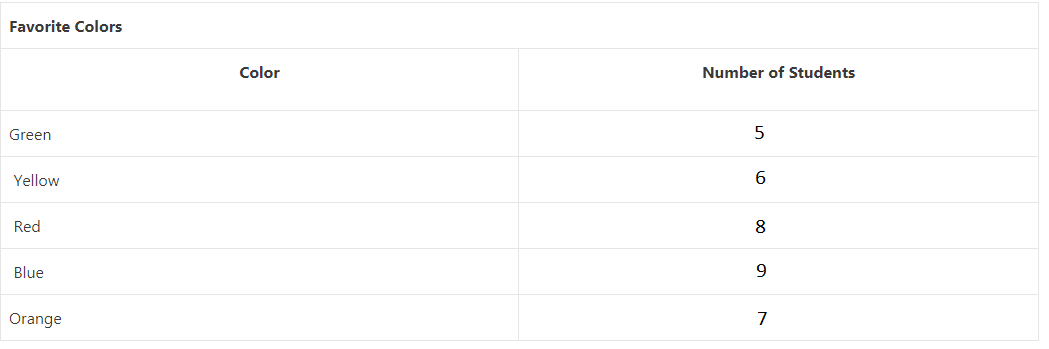
“What is your favorite color?” Survey the class to complete the tally chart below.

Favorite Colors
Color

Number of Students

Green
 Yellow
 Red
 Blue
Orange

Answer:
Engage-NY-Math-Grade-3-Module-6-Lesson-1-Problem-Set-Answer-Key-p-1 1

Question 2.
Use the tally chart to answer the following questions.
a. How many students chose orange as their favorite color?
b. How many students chose yellow as their favorite color?
c. Which color did students choose the most? How many students chose it?
d. Which color did students choose the least? How many students chose it?
e. What is the difference between the number of students in parts (c) and (d)? Write a number sentence to show your thinking.
f. Write an equation to show the total number of students surveyed on this chart.
Answer:
a. 7 students chose orange as their favorite color.
b. 6 students chose yellow as their favorite color
c. Blue color students choose the most. total 9 students choose blue color.
d. Green color students choose the least. 5 students chose it.
e. the difference between the number of students in parts (c) and (d) is Blue color students choose the most. total 9 students choose blue color.
and Green color students choose the least. 5 students chose it.
f. the total number of students surveyed on this chart
add all the numbers who choose the colors green yellow red blue orange is 5+6+8+9+7 we get 35

Question 3.
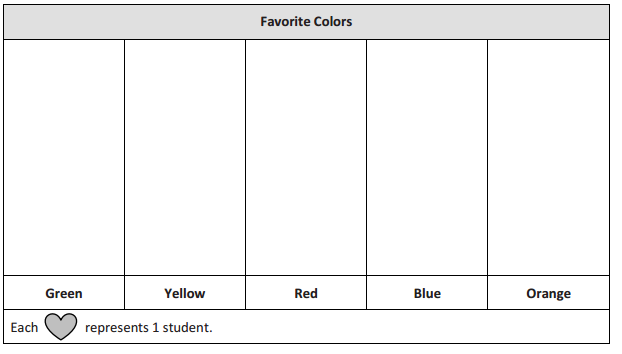
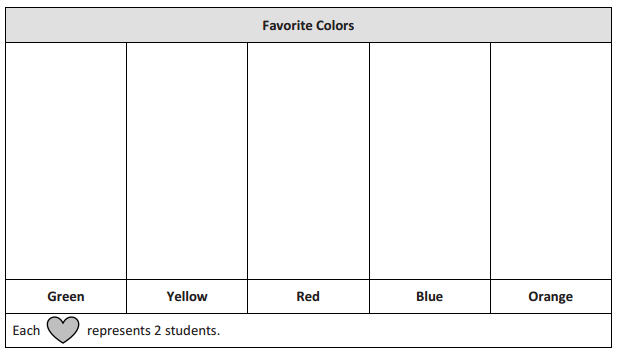
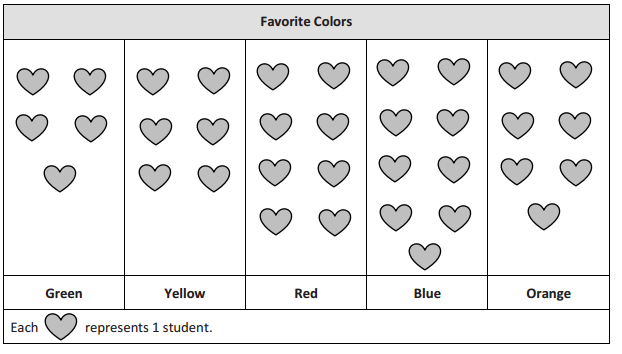
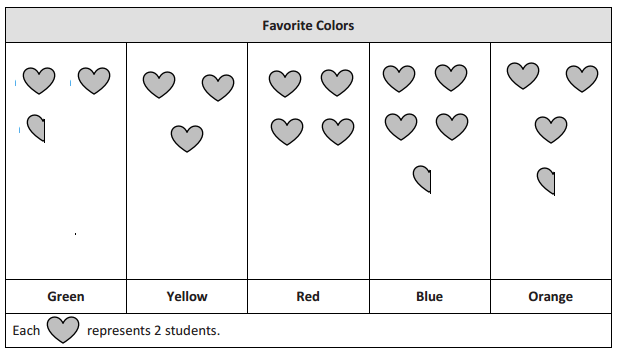
Use the tally chart in Problem 1 to complete the picture graphs below.
a.
Engage NY Math Grade 3 Module 6 Lesson 1 Problem Set Answer Key p 1
b.
Engage NY Math Grade 3 Module 6 Lesson 1 Problem Set Answer Key p 2
Answer:
a.
Engage-NY-Math-Grade-3-Module-6-Lesson-1-Problem-Set-Answer-Key-p-1

b.
Engage-NY-Math-Grade-3-Module-6-Lesson-1-Problem-Set-Answer-Key-p-2

Question 4.
Use the picture graph in Problem 3(b) to answer the following questions.
a. What does each Engage NY Math Grade 3 Module 6 Lesson 1 Problem Set Answer Key p 3 represent?
b. Draw a picture and write a number sentence to show how to represent 3 students in your picture graph.
c. How many students does Engage NY Math Grade 3 Module 6 Lesson 1 Problem Set Answer Key p 4 represent? Write a number sentence to show how you know.
d. How many more Engage NY Math Grade 3 Module 6 Lesson 1 Problem Set Answer Key p 3 did you draw for the color that students chose the most than for the color that students chose the least? Write a number sentence to show the difference between the number of votes for the color that students chose the most and the color that students chose the least.
Answer:
a. Each Engage-NY-Math-Grade-3-Module-6-Lesson-1-Problem-Set-Answer-Key-p-3represents 2 students.
b. Draw a picture and write a number sentence to show how to represent 3 students in your picture graph.
Engage-NY-Math-Grade-3-Module-6-Lesson-1-Problem-Set-Answer-Key-p-3 c
Each represents  Engage-NY-Math-Grade-3-Module-6-Lesson-1-Problem-Set-Answer-Key-p-32 students Engage-NY-Math-Grade-3-Module-6-Lesson-1-Problem-Set-Answer-Key-p-3-crepresents 1 student.
c.  Engage-NY-Math-Grade-3-Module-6-Lesson-1-Problem-Set-Answer-Key-p-4represents  14 students.
we know each Engage-NY-Math-Grade-3-Module-6-Lesson-1-Problem-Set-Answer-Key-p-3represents 2 students. as given in question we have 7 Engage-NY-Math-Grade-3-Module-6-Lesson-1-Problem-Set-Answer-Key-p-3so 7×2 we get 14 students
d. total 9 students choose blue color.
and Green color students choose the least. 5 students chose it.

Eureka Math Grade 3 Module 6 Lesson 1 Exit Ticket Answer Key

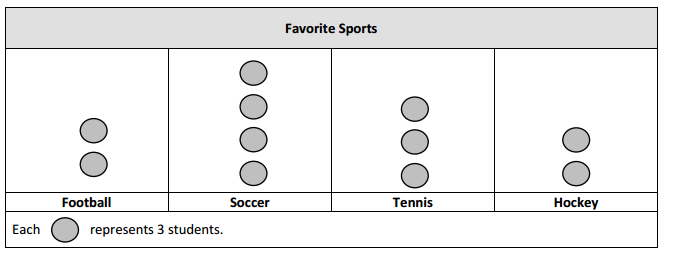
The picture graph below shows data from a survey of students’ favorite sports.
Eureka Math 3rd Grade Module 6 Lesson 1 Exit Ticket Answer Key t 1
a. The same number of students picked ________ and ________ as their favorite sport.
b. How many students picked tennis as their favorite sport?
c. How many more students picked soccer than tennis? Use a number sentence to show your thinking.
d. How many total students were surveyed?
Answer:
a. The same number of students picked Hockey and Football as their favorite sport.
b. 3 students picked tennis as their favorite sport
c. one student picked soccer than tennis
Total students who picked Soccer is 4 and the total number of students who picked tennis is 3
d. total of 11 students were surveyed

Eureka Math Grade 3 Module 6 Lesson 1 Homework Answer Key

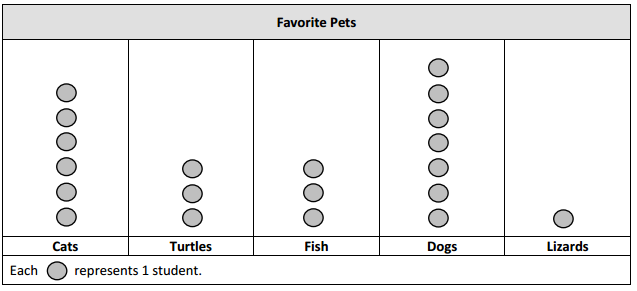
Question 1.
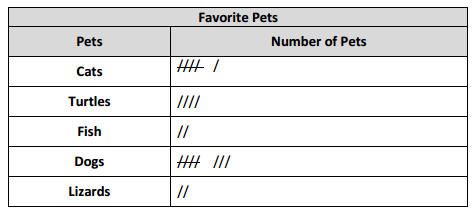
The tally chart below shows a survey of students’ favorite pets. Each tally mark represents 1 student.
Eureka Math Grade 3 Module 6 Lesson 1 Homework Answer Key h 1
The chart shows a total of _______ students.
Answer: The chart shows a total of 22 students.
Explanation:
Cats 7 students
Turtles 4 students
Fish 2 students
Dogs 8 students
Lizards 2 students
By adding we get a total of 22 students.

Question 2.
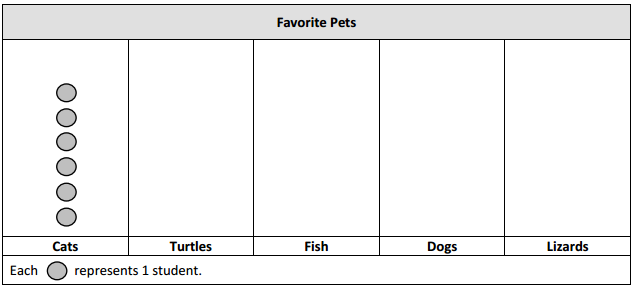
Use the tally chart in Problem 1 to complete the picture graph below. The first one has been done for you.
Eureka Math Grade 3 Module 6 Lesson 1 Homework Answer Key h 2
a. The same number of students picked _______ and _______ as their favorite pet.
b. How many students picked dogs as their favorite pet?
c. How many more students chose cats than turtles as their favorite pet?
Answer:
Eureka-Math-Grade-3-Module-6-Lesson-1-Homework-Answer-Key-h-2
a. The same number of students picked Turtles and Fish as their favorite pet.
b. Total 7 students picked dogs as their favorite pet
c. 3 more students chose cats than turtles as their favorite pet

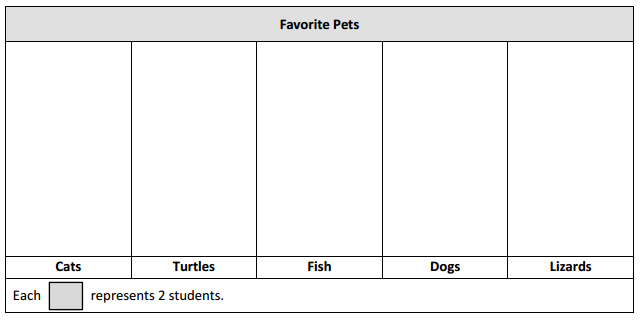
Question 3.
Use the tally chart in Problem 1 to complete the picture graph below.
Eureka Math Grade 3 Module 6 Lesson 1 Homework Answer Key h 3
a. What does each Eureka Math Grade 3 Module 6 Lesson 1 Homework Answer Key h 4 represent?
b. How many students does Eureka Math Grade 3 Module 6 Lesson 1 Homework Answer Key h 5 represent? Write a number sentence to show how you know.
c. How many more Eureka Math Grade 3 Module 6 Lesson 1 Homework Answer Key h 4 did you draw for dogs than for fish? Write a number sentence to show how many more students chose dogs than fish.
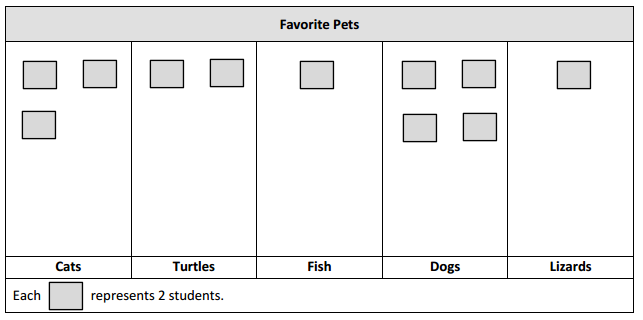
Answer:
Eureka-Math-Grade-3-Module-6-Lesson-1-Homework-Answer-Key-h-3
a. Each Eureka-Math-Grade-3-Module-6-Lesson-1-Homework-Answer-Key-h-4 represent 2 students
b. 10 students does Eureka-Math-Grade-3-Module-6-Lesson-1-Homework-Answer-Key-h-5 represent.   number sentence to show how we know is
there area 5 Eureka-Math-Grade-3-Module-6-Lesson-1-Homework-Answer-Key-h-4each box represents 2 students so 5 × 2 we get 10 students
c. 3 more did we draw for dogs than for fish. The number sentence to show how many more students chose dogs than fish.
is there is 2 fish and 8 dogs were chosen by the students

Eureka Math Grade 3 Module 6 Answer Key

Eureka Math Grade 4 Module 2 Answer Key | Engage NY Math 4th Grade Module 2 Answer Key

eureka-math-grade-4-module-2-answer-key

EngageNY Math Grade 4 Module 2 Answer Key | Eureka Math 4th Grade Module 2 Answer Key

Eureka Math Grade 4 Module 2 Unit Conversions and Problem Solving with Metric Measurement

Eureka Math Grade 4 Module 2 Topic A Metric Unit Conversions

Engage NY Math 4th Grade Module 2 Topic B Application of Metric Unit Conversions

Eureka Math Grade 4 Module 2 End of Module Assessment Answer Key

Eureka Math Grade 4 Module 2 End of Module Assessment Answer Key

Engage NY Eureka Math 4th Grade Module 2 End of Module Assessment Answer Key

Eureka Math Grade 4 Module 2 End of Module Assessment Task Answer Key

Question 1.
Complete the conversion charts.

Length

3 km

         3,000              m

9 km

          9,000             m

6 km 435 m

        6,435               m

12 km 12 m

        12,012               m

Explanation:
Given 3 km as 1 kilometer = 1,000 meter
so 3 km = 3 X 1,000 m = 3,000 m,

9 km = 9 X 1,000 m = 9,000 m,

6 km 435 m = 6 X 1,000 m + 435 m =
6,000 m + 435 m = 6,435m,

12 km 12 m = 12 X 1,000 m + 12 m =
12,000 m + 12 m = 12,012 m.

Mass

3 kg

            3000           g

20 kg 300 g

         20,300              g
1 kg 74 g

      1,074                 g

403 kg 4 g

         403,004              g

Explanation:
Given 3 kg as 1 kilogram = 1,000 gram,
so 3 kg = 3 X 1,000 g = 3,000 g,

20 kg 300 g  = 20 X 1,000 g + 300 g =
20,000 g + 300 g = 20,300 g,

1 kg 74 g = 1 X 1,000 g + 74 g =
1,000 g + 74 g = 1,074 g,

403 kg 4 g = 403 X 1,000 g + 4 g =
403,000 g + 4 g = 403,004 g.

Capacity

4 L

       4,000                mL

48 L 808 mL

          48,808             mL
2 L 20 mL

         2,020              mL

639 L 6 mL

        639,006               mL

Explanation:
Given 4 L as 1 liter = 1,000 milliliters,
So 4 L = 4 X 1,000 mL = 4,000 mL,

48 L 808 mL = 48 X 1,000 mL =
48,000 mL, + 808 mL = 48,808 mL,

2 L 20 mL = 2 X 1,000 mL + 20 mL =
2,000 mL + 20 mL = 2,020 mL,

639 L 6 mL = 639 X 1,000 mL + 6 mL =
639,000 mL + 6 mL = 639,006 mL.

Question 2.
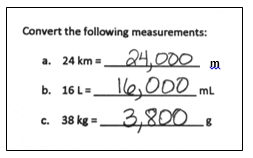
A student completed the problem below. Check his work.
Explain how you know if each solution is correct or incorrect.
Engage NY Eureka Math 4th Grade Module 2 End of Module Assessment Answer Key 1

a. 24 km = 24,000 m, solution is correct,
b. 16 L = 16,000 mL, solution is correct,
c. 38 kg = 38,000 kg not 3,800 g so solution is incorrect,

Explanation:
Given a student completed the problem as shown above.
Checking his work as below
a. 24 km = 24,000 m, solution is correct because
24 km = 24 X 1000 m = 24,000 m,

b. 16 L = 16,000 mL, solution is correct because
16 L = 16 X 1000 mL = 16,000 mL,

c. 38 kg = 38,000 kg not 3,800 g so solution is incorrect
because 38 kg = 38 X 1000 g = 38,000 g not 3,800 g.

Question 3.
Find the sum or difference.
a. 493 km 43 m + 17 km 57 m

b. 25 kg 32 g – 23 kg 83 g

c. 100 L 99 mL + 2,999 mL

a. 493 km 43 m + 17 km 57 m = 510 km 100 m

Explanation:
Given 493 km 43 m + 17 km 57 m as
493 km 43 m = 493 X 1000 m + 43 m =
493000 m + 43 m = 493,043 m and
17 km 57 m = 17 X 1000 m + 57 m =
17,000 m + 57 m = 17,057 m
So 493,043 m + 17,057 m = 510,100 m or
510,100 m ÷ 1000 = 510 km 100 m,
therefore, 493 km 43 m + 17 km 57 m =510,100 m or 510 km 100 m.

b. 25 kg 32 g – 23 kg 83 g = 1,949 g or 1 kg 949 g,

Explanation:
Given 25 kg 32 g – 23 kg 83 g as
25 kg 32 g = 25 X 1000 g + 32 g = 25,032 g and
23 kg 83 g = 23 X 1000 g + 83 g = 23,083 g,
Now 25,032 g – 23,083 g = 1,949 g or 1,949 g ÷ 1000 =
1 kg 949 g, therefore 25 kg 32 g – 23 kg 83 g = 1,949 g or 1 kg 949 g.

c. 100 L 99 mL + 2,999 mL = 103,098 mL or 103 L 098 mL,

Explanation:
Given 100 L 99 mL + 2,999 mL as
100 L  99 mL = 100 X 1000 mL + 99 mL =
100,000 mL + 99 mL = 100,099 mL ,
So 100,099 mL + 2,999 mL = 103,098 mL or
103,098 mL ÷ 1000 = 103 L 098 mL,
therefore 100 L 99 mL + 2,999 mL = 103,098 mL or 103 L 098 mL.

Question 4.
Billy is training for a half marathon. For the problems below,
use tape diagrams, numbers, and words to explain each answer.
a. Each day, Billy runs on the treadmill for 5 kilometers and
runs on the outdoor track for 6,000 meters.
In all, how many meters does Billy run each day?
b. Since Billy has started training, he has also been
drinking more water. On Saturday, he drank
2 liters 755 milliliters of water. On Sunday,
he drank some more. If Billy drank a total of
4 liters 255 milliliters of water on Saturday and Sunday,
how many milliliters of water did Billy drink on Sunday?
c. Since he began exercising so much for his half marathon,
Billy has been losing weight. In his first week of training, he lost 2 kilograms 530 grams. In the following two weeks of training,
he lost 1 kilogram 855 grams each week.
Billy now weighs 61 kilograms 760 grams.
What was Billy’s weight, in grams, before he started training?
Explain your thinking.
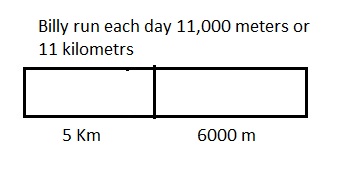
a. Billy run each day 11,000 meters or 11 kilometrs,
Eureka Math Grade 4 Module 2 End of Module Assessment Answer Key-1
Statement : Billy run each day eleven thousand meters or eleven kilometers,

b. Number of milliliters of water did Billy drink on Sunday
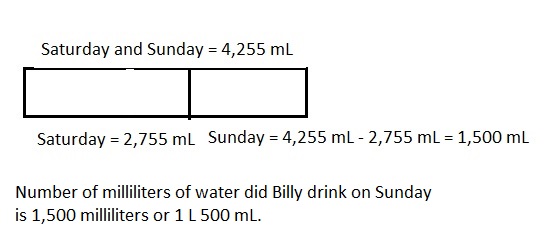
is 1,500 milliliters or 1 L 500 mL,
Eureka Math Grade 4 Module 2 End of Module Assessment Answer Key-2
Statement : Number of milliliters of water did Billy drink on Sunday
is fifteen hundred milliliters or one Liter five hunderd milliliters,

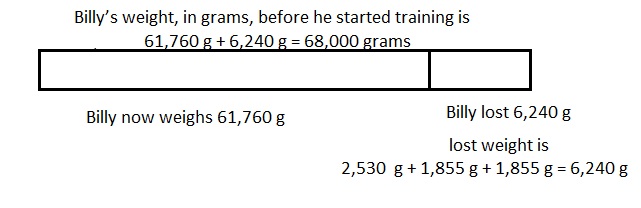
c. Billy’s weight, in grams, before he started training 68,000 grams,
Eureka Math Grade 4 Module 2 End of Module Assessment Answer Key-3
Statement: Billy’s weight, in grams, before he started training is
sixty eight thousand grams,

Explanation:
Given Billy is training for a half marathon.
a. Each day, Billy runs on the treadmill for 5 kilometers and
runs on the outdoor track for 6,000 meters.
In all, Billy run each day is 5 km + 6,000 meters as
5 km = 5 X 1000 m = 5,000 m So 5,000 m + 6,000 m =
11,000 m or 11,000 m ÷ 1,000 = 11 km,
used a tape diagrams to show problem as shown above,
therefore Billy run each day 11,000 meters or 11 kilometrs.

b. Since Billy has started training, he has also been
drinking more water. On Saturday, he drank
2 liters 755 milliliters of water. On Sunday,
he drank some more. If Billy drank a total of
4 liters 255 milliliters of water on Saturday and Sunday,
number of milliliters of water did Billy drink on Sunday is
4 L 255 mL – 2 L 755 mL as 4 L 255 mL = 4 X 1000 mL + 255 mL =
4,255 mL and 2 L 755 mL = 2 X 1000 mL + 755 mL = 2,755 mL,
therefore 4,255 mL – 2,755 mL = 1,500 mL or 1,500 mL ÷ 1,000 =
1 L 500 mL, used a tape diagrams to show problem as shown above,
therefore Number of milliliters of water did Billy drink on Sunday
is 1,500 milliliters or 1 L 500 mL.

c. Since he began exercising so much for his half marathon,
Billy has been losing weight. In his first week of training, he lost 2 kilograms 530 grams. In the following two weeks of training,
he lost 1 kilogram 855 grams each week.
Billy lost in three weeks is 2 kg 530 g + 1 kg 855 g + 1 kg 855 kg
as 2 kg 530 g = 2 X 1000 g + 530 g = 2,530 g
1 kg 855 g = 1 X 1000 g + 855 g = 1,855 g
So lost weight is 2,530  g + 1,855 g + 1,855 g = 6,240 g,
Billy now weighs 61 kilograms 760 grams.
Billy’s weight, in grams, before he started training is
61 kg 760 g + 6,240 g as 61 kg 760 g = 61 X 1000 g + 760 g =
61,760 g so 61,760 g + 6,240 g = 68,000 grams,
used a tape diagrams to show problem as shown above,
therefore, Billy’s weight, in grams, before he started training 68,000 grams.

Eureka Math Grade 4 Module 2 Answer Key

Eureka Math Grade 4 Module 2 Lesson 4 Answer Key

Engage NY Eureka Math 4th Grade Module 2 Lesson 4 Answer Key

Eureka Math Grade 4 Module 2 Lesson 4 Pattern Sheet Answer Key

Write in meters and centimeters
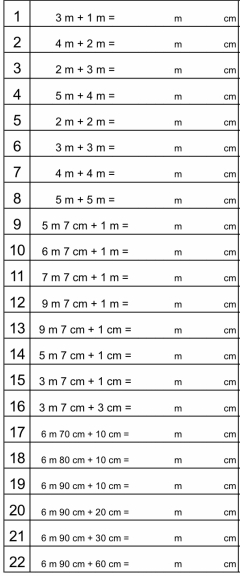
Engage NY Math Grade 4 Module 2 Lesson 4 Pattern Sheet Answer Key 31
Engage NY Math Grade 4 Module 2 Lesson 4 Pattern Sheet Answer Key 32

Eureka Math Grade 4 Module 2 Lesson 4 Answer Key-1
Eureka Math Grade 4 Module 2 Lesson 4 Answer Key-2

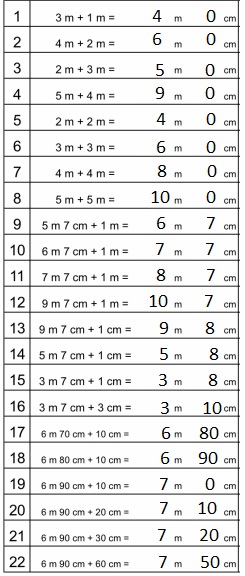
Question 1.
3 m + 1 m = 4 m 0 cm,

Explanation:
Given 3 m + 1 m adding 3 m to 1 m we get
4 m and 0 cm as
3 m 0 cm
+1 m 0 cm
4 m 0 cm

Question 2.
4 m + 2 m = 6 m 0 cm,

Explanation:
Given 4 m + 2 m adding 4 m to 2 m we get
6 m and 0 cm as
4 m 0 cm
+2 m 0 cm
6 m 0 cm

Question 3.
2 m + 3 m = 5 m 0 cm,

Explanation:
Given 2 m + 3 m adding 2 m to 3 m we get
5 m and 0 cm as
2 m 0 cm
+3 m 0 cm
5 m 0 cm

Question 4.
5 m + 4 m = 9 m 0 cm,

Explanation:
Given 5 m + 4 m adding 5 m to 4 m we get
9 m and 0 cm as
5 m 0 cm
+4 m 0 cm
9 m 0 cm

Question 5.
2 m + 2 m = 4 m 0 cm,

Explanation:
Given 2 m + 2 m adding 2 m to 2 m we get
4 m and 0 cm as
2 m 0 cm
+2 m 0 cm
4 m 0 cm

Question 6.
3 m + 3 m = 6 m 0 cm,

Explanation:
Given 3 m + 3 m adding 3 m to 3 m we get
6 m and 0 cm as
3 m 0 cm
+3 m 0 cm
6 m 0 cm

Question 7.
4 m + 4 m = 8 m 0 cm,

Explanation:
Given 4 m + 4 m adding 4 m to 4 m we get
8 m and 0 cm as
4 m 0 cm
+ 4 m 0 cm
8 m 0 cm

Question 8.
5 m + 5 m = 10 m  0 cm,

Explanation:
Given 5 m + 5 m adding 5 m to 5 m we get
10 m and 0 cm as
5 m 0 cm
+5 m 0 cm
10 m 0 cm

Question 9.
5 m 7 cm + 1 m = 6 m 7 cm,

Explanation:
Given 5 m  7 cm + 1 m adding 5 m  7 cm to 1 m we get
6 m and 7 cm as
5 m 7 cm
+1 m 0 cm
6 m 7 cm

Question 10.
6 m 7 cm + 1 m = 7 m 7 cm,

Explanation:
Given 6 m 7 cm + 1 m adding 6 m 7 cm to 1 m we get
7 m and 7 cm as
6 m 7 cm
+1 m 0 cm
7 m 7 cm

Question 11.
7 m 7 cm + 1 m = 8 m 7 cm,

Explanation:
Given 7 m 7 cm + 1 m adding 7 m 7 cm to 1 m we get
8 m and 7 cm as
7 m 7 cm
+1 m 0 cm
8 m 7 cm

Question 12.
9 m 7 cm + 1 m = 10 m 7 cm,

Explanation:
Given 9 m  7 cm + 1 m adding 9 m 7 cm to 1 m we get
10 m and 7 cm as
9 m 7 cm
+1 m 0 cm
10 m 7 cm

Question 13.
9 m 7 cm + 1 cm = 9 m 8 cm,

Explanation:
Given 9 m  7 cm + 1 cm adding 9 m 7 cm to 1 cm we get
9 m and 8 cm as
9 m 7 cm
+0 m 1 cm
9 m 8 cm

Question 14.
5 m 7 cm + 1 cm = 5 m 8 cm,

Explanation:
Given 5 m  7 cm + 1 cm adding 5 m 7 cm to 1 cm we get
5 m and 8 cm as
5 m 7 cm
+0 m 1 cm
5 m 8 cm

Question 15.
3 m 7 cm + 1 cm = 3 m 8 cm,

Explanation:
Given 3 m 7 cm + 1 cm adding 3 m 7 cm to 1 cm we get
3 m and 8 cm as
3 m 7 cm
+0 m 1 cm
3 m 8 cm

Question 16.
3 m 7 cm + 3 cm = 3 m 10 cm,

Explanation:
Given 3 m  7 cm + 3 cm adding 3 m 7 cm to 3 cm we get
3 m and 10 cm as
3 m 7 cm
+0 m 3 cm
3 m 10 cm

Question 17.
6 m 70 cm + 10 cm = 6 m 80 cm,

Explanation:
Given 6 m  70 cm + 10 cm adding 6 m 70 cm to 10 cm we get
6 m and 80 cm as
6 m 70 cm
+0 m 10 cm
6 m 80 cm

Question 18.
6 m 80 cm + 10 cm = 6 m 90 cm,

Explanation:
Given 6 m  80 cm + 10 cm adding 6 m 80 cm to 10 cm we get
6 m and 90 cm as
6 m 80 cm
+0 m 10 cm
6 m 90 cm

Question 19.
6 m 90 cm + 10 cm = 7 m 0 cm or 6 m 100 cm,

Explanation:
Given 6 m  90 cm + 10 cm adding 6 m 90 cm to 10 cm we get
7 m and 0 cm  or 6 m 100 cm as
6 m 90 cm
+0 m 10 cm
6 m 100 cm
or we know 1 meter is equal to 100 cm
so 6 m + 100 cm ÷ 100 = 6 m+ 1 m = 7 m 0 cm.

Question 20.
6 m 90 cm + 20 cm = 7 m 10 cm,

Explanation:
Given 6 m  90 cm + 10 cm adding 6 m 90 cm to 20 cm we get
7 m and 10 cm  or 7 m 10 cm as
6 m 90 cm
+0 m 20 cm
6 m 110 cm
or we know 1 meter is equal to 100 cm
so 6 m + 110 cm ÷ 100 = 6 m+ 1 m + 10 cm = 7 m 10 cm.

Question 21.
6 m 90 cm + 30 cm = 6 m 120 cm or 7 m 20 cm,

Explanation:
Given 6 m  90 cm + 30 cm adding 6 m 90 cm to 30 cm we get
7 m and 20 cm  or 6 m 120 cm as
6 m 90 cm
+0 m 30 cm
6 m 120 cm
or we know 1 meter is equal to 100 cm
so 6 m + 120 cm ÷ 100 = 6 m+ 1 m + 20 cm = 7 m 20 cm.

Question 22.
6 m 90 cm + 60 cm =  6 m 150 cm or 7 m 50 cm,

Explanation:
Given 6 m  90 cm + 60 cm adding 6 m 90 cm to 60 cm we get
7 m and 50 cm  or 7 m 150 cm as
6 m 90 cm
+0 m 60 cm
6 m 150 cm
or we know 1 meter is equal to 100 cm
so 6 m + 150 cm ÷ 100 = 6 m+ 1 m + 50 cm = 7 m 50 cm.

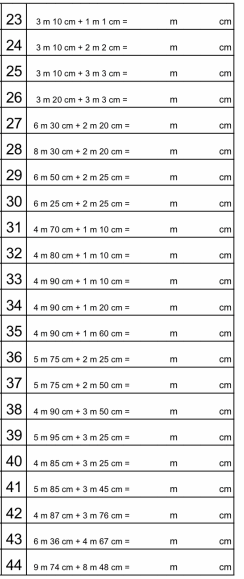
Question 23.
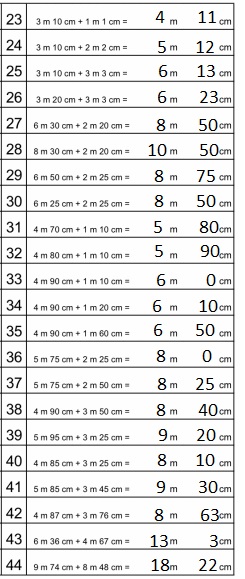
3 m 10 cm + 1 m 1 cm = 4 m 11 cm,

Explanation:
Given 3 m 10 cm + 1 m 1 cm adding 3 m 10 cm to 1 m 1 cm we get
4 m and 11 cm as
3 m 10 cm
+1 m 1 cm
4 m 11 cm 

So, 3 m 10 cm + 1 m 1 cm = 4 m 11 cm.

Question 24.
3 m 10 cm + 2 m 2cm = 5 m 12 cm,

Explanation:
Given 3 m 10 cm + 2 m 2 cm adding 3 m 10 cm to 2 m 2 cm
we get 5 m and 12 cm as
3 m 10 cm
+2 m 2 cm
5 m 12 cm 

So, 3 m 10 cm + 2 m 2 cm = 5 m 12 cm.

Question 25.
3 m 10 cm + 3 m 3 cm = 6 m 13 cm,

Explanation:
Given 3 m 10 cm + 3 m 3 cm adding 3 m 10 cm to 3 m 3 cm we get
6 m and 13 cm as
3 m 10 cm
+3 m 3 cm
6 m 13 cm 

So, 3 m 10 cm + 3 m 3 cm = 6 m 13 cm.

Question 26.
3 m 20 cm + 3 m 3 cm = 6 m 23 cm,

Explanation:
Given 3 m 20 cm + 3 m 3 cm adding 3 m 20 cm to 3 m 3 cm we get
6 m and 23 cm as
3 m 20 cm
+3 m 3 cm
6 m 23 cm 

So, 3 m 20 cm + 3 m 3 cm = 6 m 23 cm.

Question 27.
6 m 30 cm + 2 m 20 cm = 8 m 50 cm,

Explanation:
Given 6 m 30 cm + 2 m 20 cm adding 6 m 30 cm to 2 m 20 cm we get
8 m and 50 cm as
6 m 30 cm
+2 m 20 cm
8 m 50 cm 

So, 6 m 30 cm + 2 m 20 cm = 8 m 50 cm.

Question 28.
8 m 30 cm + 2 m 20 cm =  10 m 50 cm,

Explanation:
Given 8 m 30 cm + 2 m 20 cm adding 8 m 30 cm to 2 m 20 cm we get
10 m and 50 cm as
8 m 30 cm
+2 m 20 cm
10 m 50 cm 

So, 8 m 30 cm + 2 m 20 cm = 10 m 50 cm.

Question 29.
6 m 50 cm + 2 m 25 cm = 8 m 75 cm,

Explanation:
Given 6 m 50 cm + 2 m 25 cm adding 6 m 50 cm to 2 m 25 cm
we get 8 m and 75 cm as
6 m 50 cm
+2 m 25 cm
8 m 75 cm 

So, 6 m 50 cm + 2 m 25 cm = 8 m 75 cm.

Question 30.
6 m 25 cm + 2 m 25 cm = 8 m 50 cm,

Explanation:
Given 6 m 25 cm + 2 m 25 cm adding 6 m 25 cm to 2 m 25 cm
we get 8 m and 50 cm as
6 m 25 cm
+2 m 25 cm
8 m 50 cm 

So, 6 m 25 cm + 2 m 25 cm = 8 m 50 cm.

Question 31.
4 m 70 cm + 1 m 10 cm = 5 m 80 cm,

Explanation:
Given 4 m 70 cm + 1 m 10 cm adding 4 m 70 cm to 1 m 10 cm
we get 5 m and 80 cm as
4 m 70 cm
+1 m 10 cm
5 m 80 cm 

So, 4 m 70 cm + 1 m 10 cm = 5 m 80 cm.

Question 32.
4 m 80 cm + 1 m 10 cm = 5 m 90 cm,

Explanation:
Given 4 m 80 cm + 1 m 10 cm adding 4 m 80 cm to 1 m 10 cm
we get 5 m and 90 cm as
4 m 80 cm
+1 m 10 cm
5 m 90 cm 

So, 4 m 80 cm + 1 m 10 cm = 5 m 90 cm.

Question 33.
4 m 90 cm + 1 m 10 cm =  5 m 100 cm or 6 m 0 cm,

Explanation:
Given 4 m 90 cm + 1 m 10 cm adding 4 m 90 cm to 1 m 10 cm
we get 5 m and 100 cm or 6 m 0 cm as
4 m 90 cm
+1 m 10 cm
5 m 100 cm
or we know 1 meter is equal to 100 cm
5 m + 100 cm ÷ 100 = 6 m 0 cm,
So, 4 m 90 cm + 1 m 10 cm = 5 m 100 cm or  6 m 0 cm.

Question 34.
4 m 90 cm + 1 m 20 cm = 5 m 110 cm or 6 m 10 cm,

Explanation:
Given 4 m 90 cm + 1 m 20 cm adding 4 m 90 cm to 1 m 20 cm
we get 5 m and 110 cm or 6 m 10 cm as
4 m 90 cm
+1 m 20 cm
5 m 110 cm
or we know 1 meter is equal to 100 cm
5 m + 110 cm ÷ 100 = 6 m 10 cm,
So, 4 m 90 cm + 1 m 20 cm = 5 m 110 cm or  6 m 10 cm.

Question 35.
4 m 90 cm + 1 m 60 cm = 5 m 150 cm or 6 m 50 cm,

Explanation:
Given 4 m 90 cm + 1 m 60 cm adding 5 m 150 cm to 6 m 50 cm
we get 5 m and 150 cm or 6 m 50 cm as
4 m 90 cm
+1 m 60 cm
5 m 150 cm
or we know 1 meter is equal to 100 cm
5 m + 150 cm ÷ 100 = 6 m 50 cm,
So, 4 m 90 cm + 1 m 60 cm = 5 m 150 cm or  6 m 50 cm.

Question 36.
5 m 75 cm + 2 m 25 cm = 7 m 100 cm, 8 m 0 cm,

Explanation:
Given 5 m 75 cm + 2 m 25 cm adding 7 m 100 cm to 8 m 0 cm
we get 7 m and 100 cm or 8 m 0 cm as
5 m 75 cm
+2 m 25 cm
7 m 100 cm
or we know 1 meter is equal to 100 cm
7 m + 100 cm ÷ 100 = 8 m 0 cm,
So, 5 m 75 cm + 2 m 25 cm = 7 m 100 cm or  8 m 0 cm.

Question 37.
5 m 75 cm + 2 m 50 cm = 7 m 125 cm or 8 m 25 cm,

Explanation:
Given 5 m 75 cm + 2 m 50 cm adding 5 m 75 cm to 2 m 50 cm
we get 7 m and 125 cm or 8 m 25 cm as
5 m 75 cm
+2 m 50 cm
7 m 125 cm
or we know 1 meter is equal to 100 cm
7 m + 125 cm ÷ 100 = 8 m 25 cm,
So, 5 m 75 cm + 2 m 50 cm = 7 m 125 cm or  8 m 25 cm.

Question 38.
4 m 90 cm + 3 m 50 cm = 7 m 140 cm or 8 m 40 cm,

Explanation:
Given 4 m 90 cm + 3 m 50 cm adding 7 m 140 cm to 8 m 40 cm
we get 7 m and 140 cm or 8 m 40 cm as
4 m 90 cm
+3 m 50 cm
7 m 140 cm
or we know 1 meter is equal to 100 cm
7 m + 140 cm ÷ 100 = 8 m 40 cm,
So, 4 m 90 cm + 3 m 50 cm = 7 m 140 cm or 8 m 40 cm.

Question 39.
5 m 95 cm + 3 m 25 cm = 8 m 120 cm or 9 m 20 cm,

Explanation:
Given 5 m 95 cm + 3 m 25 cm adding 5 m 95 cm to 3 m 25 cm
we get 8 m and 120 cm or 9 m 20 cm as
5 m 95 cm
+3 m 25 cm
8 m 120 cm
or we know 1 meter is equal to 100 cm
8 m + 120 cm ÷ 100 = 9 m 20 cm,
So, 5 m 95 cm + 3 m 25 cm = 8 m 120 cm or  9 m 20 cm.

Question 40.
4 m 85 cm + 3 m 25 cm = 7 m 110 cm or 8 m 10 cm,

Explanation:
Given 4 m 85 cm + 3 m 25 cm adding 4 m 85 cm to 3 m 25 cm
we get 7 m and 110 cm or 8 m 10 cm as
4 m 85 cm
+3 m 25 cm
7 m 110 cm
or we know 1 meter is equal to 100 cm
7 m + 110 cm ÷ 100 = 8 m 10 cm,
So, 4 m 85 cm + 3 m 25 cm = 7 m 110 cm or 8 m 10 cm.

Question 41.
5 m 85 cm + 3 m 45 cm = 8 m 130 cm or 9 m 30 cm,

Explanation:
Given 5 m 85 cm + 3 m 45 cm adding 5 m 85 cm to 3 m 45 cm
we get 8 m and 130 cm or 9 m 30 cm as
5 m 85 cm
+3 m 45 cm
8 m 130 cm
or we know 1 meter is equal to 100 cm
8 m + 130 cm ÷ 100 = 9 m 30 cm,
So, 5 m 85 cm + 3 m 45 cm = 8 m 130 cm or 9 m 30 cm.

Question 42.
4 m 87 cm + 3 m 76 cm = 7 m 163 cm or 8 m 63 cm,

Explanation:
Given 4 m 87 cm + 3 m 76 cm adding 4 m 87 cm to 3 m 76 cm
we get 7 m and 163 cm or 8 m 63 cm as
4 m 87 cm
+3 m 76 cm
7 m 163 cm
or we know 1 meter is equal to 100 cm
7 m + 163 cm ÷ 100 = 8 m 63 cm,
So, 4 m 87 cm + 3 m 76 cm = 7 m 163 cm or 8 m 63 cm.

Question 43.
6 m 36 cm + 4 m 67 cm = 10 m 103 cm or 11 m 3 cm,

Explanation:
Given 6 m 36 cm + 4 m 67 cm adding 6 m 36 cm to 4 m 67 cm
we get 10 m and 103 cm or 11 m 3 cm as
6 m 36 cm
+4 m 67 cm
10 m 103 cm
or we know 1 meter is equal to 100 cm
10 m + 103 cm ÷ 100 = 11 m 3 cm,
So, 6 m 36 cm + 4 m 67 cm = 10 m 103 cm or 11 m 3 cm.

Question 44.
9 m 74 cm + 8 m 48 cm = 17 m 122 cm or 18 m 22 cm,

Explanation:
Given 9 m 74 cm + 8 m 48 cm adding 9 m 74 cm to 8 m 48 cm
we get 17 m and 122 cm or 18 m 22 cm as
9 m 74 cm
+8 m 48 cm
17 m 122 cm
or we know 1 meter is equal to 100 cm
17 m + 122 cm ÷ 100 = 18 m 22 cm,
So, 9 m 74 cm + 8 m 48 cm = 17 m 122 cm or 18 m 22 cm.

Eureka Math Grade 4 Module 2 Lesson 4 Problem Set Answer Key

Question 1.
Complete the table.

Smaller UnitLarger UnitHow Many Times as Large as?
onehundred100
centimetermeter100
onethousand1,000
gramkilogram1,000
meterkilometer1,000
          milliliter            liter              1,000
centimeterkilometer100,000

Explanation:
Completed the table as shown above as
smaller unit one is 100 times than larger unit hundred,
1 X 100 = hundred,
smaller unit centimeter is 100 times than larger unit meter,
1 centimeter X 100 = 1 meter,
smaller unit one is 1,000 times than larger unit thousand,
1 X 1,000 = 1 thousand,
smaller unit gram is 1,000 times than larger unit kilogram,
1 gram X 1,000 = 1 kilogram,
smaller unit meter is 1,000 times than larger unit kilometer,
1 meter X 1,000 = 1 kilometer,
smaller unit milliliter is 1,000 times than larger unit liter,
1 milliliter X 1,000 = 1 liter,
smaller unit centimeter is 100,000 times than larger unit kilometer,
1 centimeter X 100,000 = 1 kilometer.

Question 2.
Fill in the units in word form.
a. 429 is 4 hundreds 29 _ones__
b. 429 cm is 4 _meter_ 29 centimeter.
c. 2,456 is 2 _thousand_ 456 ones.
d. 2,456 m is 2 _kilometer_ 456 meter.
e. 13,709 is 13 _thousand_ 709 ones.
f. 13,709 g is 13 kilogram 709 _gram_

a. 429 is 4 hundred 29 ones,

Explanation:
Units in word form for 429 = 4 X 100 + 29 X 1 = 4 hundred 29 ones,

b. 429 cm is 4 meter 29 centimeter,

Explanation:
Units in word form for 429 cm as 1 meter is equal to 100 cm
so 4 x 100 cm + 29 cm = 4 meter 29 centimeter.

c. 2,456 is 2 thousand 456 ones,

Explanation:
Units in word form for 2,456 = 2 X 1000 + 456 X 1 =
2 thousand 456 ones.

d. 2,456 m is 2 kilometer 456 meter,

Explanation:
Units in word form for 2,456 m is 2 X 1000 m + 456 m =
2 kilometer 456 meter.

e. 13,709 is 13 thousand 709 ones,

Explanation:
Units in word form for 13,709 = 13 X 1000 + 709 X 1 =
13 thousand 709 ones.

f. 13,709 g is 13 kilogram 709 gram,

Explanation:
Units in word form for 13,709 g is 13 X 1000 g + 709 g =
13 kilogram 709 gram.

Question 3.
Fill in the unknown number.
a. 456,829__ is 456 thousands 829 ones.
b. _456,829_ mL is 456 L 829 mL.

a. 456,829 is 456 thousands 829 ones,

Explanation:
Given 456 thousands 829 ones unknown number is
456 X 1,000 + 829 x 1 = 456,000 + 829 = 456,829.
Therefore, 456,829 is 456 thousands 829 ones.

b. 456,829 mL is 456 L 829 mL,

Explanation:
Given 456 L 829 mL unknow number in mL is
as 1 L = 1,000 mL so 456 X 1,000 mL + 829 mL =
456,000 mL + 829 mL = 456,829 mL.
Therefore, 456,829 mL is 456 L 829 mL.

Question 4.
Use words, equations, or pictures to show and
explain how metric units are like and unlike place value units.

They are like because one kilometer is one thousand times
more than one meter like one thousand is one thousand times
more than one.
They are different because metric units are for
measurement/volume/mass and place value units
are for counting/numbers.

The metric system is a system of measurement that uses the meter, liter, and gram as base units of length (distance), capacity (volume), and weight (mass) respectively.

To measure smaller or larger quantities, we use units derived from the metric units
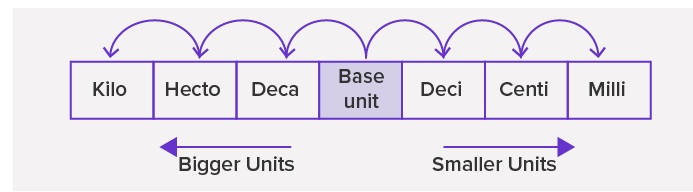
Eureka Math Grade 4 Module 2 Lesson 4 Answer Key-3The given figure shows the arrangement of the metric units, which are smaller or bigger than the base unit.The units to the right of the base unit are smaller than the base unit. As we move to the right, each unit is 10 times smaller or one-tenth of the unit to its left. So, a ‘deci’ means one-tenth of the base unit, ‘centi’ is one-tenth of ‘deci’ or one-hundredth of the base unit and ‘milli’ is one-tenth of ‘centi’ or one-thousandth of the base unit.The units to the left of the base unit are bigger than the base unit. As we move to the left, each unit is 10 times greater than the unit to its right. So, a ‘deca’ means ten times of the base unit, ‘hecto’ is ten times of ‘deca’ or hundred times of the base unit and ‘killo’ is ten times of ‘hecto’ or thousand times of the base unit.

Kilo Hecto Deca Base Unit Deci Centi Milli
 1000 100 10 1 1/10 1/100 1/1000

So, the units for length, weight (mass) and capacity(volume) in the metric system are:

Length: Millimeter (mm), Decimeter (dm), Centimeter (cm), Meter (m), and Kilometer (km) are used to measure how long or wide or tall an object is.

Examples include measuring the thickness or length of debit card, length of cloth, or distance between two cities.

 Kilometer

(km)

 Hectometer

(hm)

 Decameter

(dam)

 Meter

(m)

 Decimeter

(dm)

 Centimeter

(cm)

 Millimeter

(mm)

 1000 100 10 1 1/10 1/100 1/1000

Weight: Gram (g) and Kilogram(kg) are used to measure how heavy an object, using instruments.

Examples include measuring weight of fruits or, our own body weight.

 Kilogram

(kg)

 Hectogram

(hg)

 Decagram

(dag)

 Gram

(g)

 Decigram

(dg)

 Centigram

(cg)

 Milligram

(mg)

 1000 100 10 1 1/10 1/100 1/1000
Capacity: Milliliter (ml) and Liter (l) are used to measure how much quantity of liquid an object can hold.
Examples include measuring the amount of juice in a juice can, or amount of water of in a water tank.
 Kiloliter

(kl)

 Hectoliter

(hl)

 Decaliter

(dal)

 Liter

(l)

 Deciliter

(dl)

 Centiliter

(cl)

 Milliliter

(ml)

 1000 100 10 1 1/10 1/100 1/1000
Time: Second is the base unit for time. The other metric units of time are:
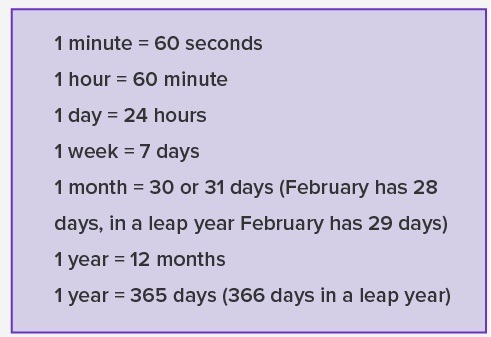
Eureka Math Grade 4 Module 2 Lesson 4 Answer Key-4
Metric Conversions: Meters, grams and liters are considered the base units of length, weight and volume, respectively.
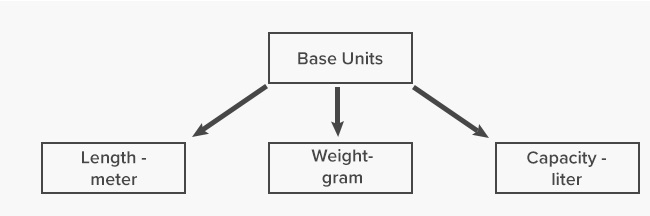
Eureka Math Grade 4 Module 2 Lesson 4 Answer Key-5
We can multiply or divide for making metric conversions.
To convert a bigger unit to the smaller unit, we move left to write,
we multiple by 10. Moving right to left, from smaller unit to bigger,
we divide by 10.
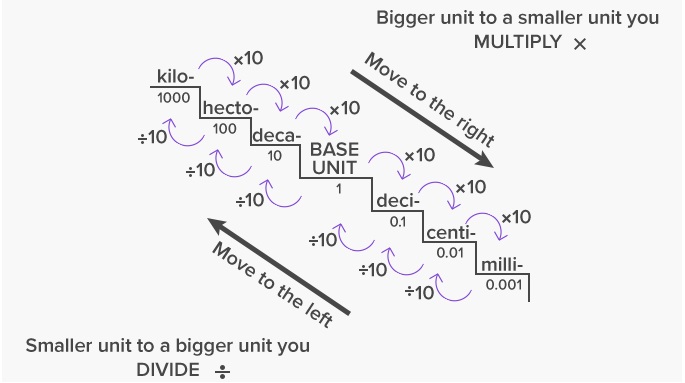
Eureka Math Grade 4 Module 2 Lesson 4 Answer Key-6
Some examples of converting from one unit to another.Example 1: Convert 5 km to m.
As 1 km = 1000 m
Therefore, 5 km = 5 × 1000 = 5000 m,Example 2: Convert 250 kg to milligrams.
We know, 1 g = 1000 mg and 1 kg = 1000 g
So, we first convert the kg to g as:
1 kg = 1000 g
Therefore, 250 kg = 250 × 1000 g = 250,000 g
Now, converting g to mg:
1 g = 1000 mg, therefore: 250,000 g = 250,000 × 1000 mg =
250,000,000 mgExample 3: Convert 250 ml to liters.
1 liter = 1000 ml
Therefore, 450 ml = 450 ÷ 1000 = 0.45 literQuestion 5.

Compare using >, <, or =.
a. 893,503 mL Eureka Math Grade 4 Module 2 Lesson 4 Problem Set Answer Key 6 89 L 353 mL
b. 410 km 3 m Eureka Math Grade 4 Module 2 Lesson 4 Problem Set Answer Key 6 4,103 m
c. 5,339 m Eureka Math Grade 4 Module 2 Lesson 4 Problem Set Answer Key 6 533,900 cm

a. 893,503 mL > 89 L 353 mL,

Explanation:
Given 893,503 mL and  89 L 353 mL now as
89 L 353 mL = 89 X 1000 mL + 353 mL =
89,000 mL + 353 mL = 89,353 mL now
on comparing  893, 503 mL, 89,353 mL
893, 503 mL is greater than 89,353 mL so
893,503 mL > 89 L 353 mL.

b. 410 km 3 m > 4,103 m,

Explanation:
Given 410 km 3 m and  4,103 now as
410 km 3 m = 410 X 1000 m + 3 m =
410,000 m + 3 m = 410,003 m now
on comparing  410,003 m, 4,103 m
410,003 m is greater than 4,103 m so
410 km 3 m > 4,103 m.

c. 5,339 m = 533,900 cm,

Explanation:
Given 5,339 m and 533,900 now as
5,339 m = 5,339 X 100 cm = 533,900 cm now
on comparing  533,900 cm with 533,900 cm
both are equal so 5,339 m = 533,900 cm.

Question 6.
Place the following measurements on the number line:
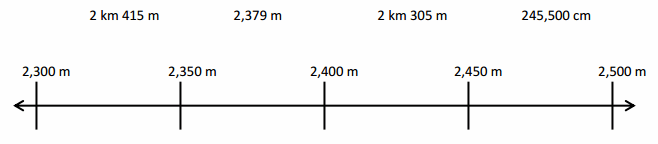
Eureka Math Grade 4 Module 2 Lesson 4 Problem Set Answer Key 10

Eureka Math Grade 4 Module 2 Lesson 4 Answer Key-7
Explanation:
Placed the given following measurements on the number line
as shown above,
2 km 415 m = 2 X 1000 m + 415 m = 2000 m + 415 m =
2,415 m so placed between 2,400 m and 2,450 m,
2,379 m placed in between 2,350 m and 2,400 m,
2 km 305 m = 2 X 1000 m + 305 m = 2000 m + 305 m =
2,305 m so placed in between 2,300 m and 2,350 m,
and 245,500 cm = 245,500 ÷ 100 = 2,455 m so
placed in between 2,450 m and 2,500 m.

Question 7.
Place the following measurements on the number line.
Eureka Math Grade 4 Module 2 Lesson 4 Problem Set Answer Key 11

Eureka Math Grade 4 Module 2 Lesson 4 Answer Key-8
Explanation:
Placed the given following measurements on the number line
as shown above,
2 kg 900 g so placed between 2 kg and 3 kg,
3,500 g = 3 kg 500 g placed in between 3 kg and 4 kg,
1 kg 500 g so placed in between 1 kg and 2 kg,
2,900 g = 2 kg 900 g so placed in between 2 kg and 3 kg,
750 g placed in between 0 kg and 1 kg.

Eureka Math Grade 4 Module 2 Lesson 4 Exit Ticket Answer Key

Question 1.
Fill in the unknown unit in word form.
a. 8,135 is 8 _thousand_ 135 ones.
b. 8,135 kg is 8 _kg_ 135 g.

a. 8,135 is 8 thousand 135 ones,

Explanation:
Given 8,135 unknown number is
8 X 1,000 + 135 x 1 = 8 thousand 135 ones
Therefore, 8,135 is 8 thousand 135 ones.

b. 8,135 kg is 8 _kg_ 135 g,

Explanation:
Given 8,135 kg unknow number in mL is
as 1 kg = 1,000 g so 8 X 1,000 g + 135 g =
8 kg + 135 g = 8 kg 135 g,
Therefore,8,135 kg = 8 kg 135 g.

Question 2.
__ mL is equal to 342 L 645 mL.
342,645 mL is equal to 342 L 645 mL,

Explanation:
Given __ mL is equal to 342 L 645 mL unknown number in mL is
342 X 1000 mL + 645 mL = 342000 mL + 645 mL = 342,000 mL,
Therefore, 342,645 mL is equal to 342 L 645 mL.

Question 3.
Compare using >, <, or =.
a. 23 km 40 m Engage NY Math 4th Grade Module 2 Lesson 4 Exit Ticket Answer Key 15 2,340 m
b. 13,798 mL Engage NY Math 4th Grade Module 2 Lesson 4 Exit Ticket Answer Key 15 137 L 980 mL
c. 5,607 m Engage NY Math 4th Grade Module 2 Lesson 4 Exit Ticket Answer Key 15 560,701 cm

a. 23 km 40 m > 2,340 m,

Explanation:
Given 23 km 40 m, 2,340 m as
23 km 40 m = 23 X 1000 m + 40 m =
23,000 m + 40 m = 23,040 m now
on comparing  23,040 m, 2,340 m
23,040 m is greater than 2,340 m so
23 km 40 m > 2,340 m.

b. 13,798 mL < 137 L 980 mL,

Explanation:
Given 13,798 mL, 137 L 980 mL as
137 L 980 mL = 137 X 1000 mL + 980 mL =
137,000 mL + 980 mL =137,980 mL now
on comparing  13,798 mL, 137,980 mL
13,798 mL is lesser than 137,980 mL so
13,798 mL < 137 L 980 mL.

c. 5,607 m < 560,701 cm,

Explanation:
Given 5,607 m and 560,701 now as
5,607 m = 5,607 X 100 cm = 560,700 cm now
on comparing  560,700 cm with 560,701 cm
560,700 cm is lesser than 560,701 cm,
So, 5,607 m < 560,701 cm.

Question 4.
Place the following measurements on the number line
Engage NY Math 4th Grade Module 2 Lesson 4 Exit Ticket Answer Key 16

Eureka Math Grade 4 Module 2 Lesson 4 Answer Key-9
Explanation:
Placed the given following measurements on the number line
as shown above,
33 kg 100 g so placed between 33 kg and 34 kg,
31,900 g = 31 kg 900 g placed in between 31 kg and 32 kg,
32 kg 350 g so placed in between 32 kg and 33 kg,
30 kg 500 g  so placed in between 30 kg and 31 kg.

Eureka Math Grade 4 Module 2 Lesson 4 Homework Answer Key

Question 1.
Complete the table.

Smaller UnitLarger Unit

How Many Times as Large as?

centimeter

meter100
             one

hundred

             100

meter

kilometer1,000

gram

kilogram1,000
onethousand

1,000

milliliterliter

1,000

one

hundred thousand

100,000

Explanation:
Completed the table as shown above as
smaller unit centimeter is 100 times than larger unit meter,
1 centimeter X 100 = 1 meter,
smaller unit one is 100 times than larger unit hundred,
1 X 100 = hundred,
smaller unit meter is 1,000 times than larger unit kilometer,
1 meter X 1,000 = 1 kilometer,
smaller unit gram is 1,000 times than larger unit kilogram,
1 gram X 1,000 = 1 kilogram,
smaller unit one is 1,000 times than larger unit thousand,
1 X 1,000 = 1 thousand,
smaller unit milliliter is 1,000 times than larger unit liter,
1 milliliter X 1,000 = 1 liter,
smaller unit one is 100,000 times than larger unit hundred thousand,
1 X 100,000 = 1 hundred thousand.

Question 2.
Fill in the unknown unit in word form.
a. 135 is 1 _hundred_ 35 ones.
b. 135 cm is 1 meter_ 35 cm.
c. 1,215 is 1 _thousand_ 215 ones.
d. 1,215 m is 1 km__ 215 m.
e. 12,350 is 12 thousand__ 350 ones.
f. 12,350 g is 12 kg 350 _g_,

a.135 is 1 _hundred_ 35 ones.

Explanation:
Units in word form for 135 = 1 X 100 + 35 X 1 = 1 hundred 35 ones,

b. 135 cm is 1 meter 35 centimeter,

Explanation:
Units in word form for 135 cm as 1 meter is equal to 100 cm
so 1 x 100 cm + 35 cm = 1 meter 35 centimeter.

c. 1,215 is 1 thousand 215 ones,

Explanation:
Units in word form for 1,215 = 1 X 1000 + 215 X 1 =
1 thousand 215 ones.

d. 1,215 m is 1 kilometer 215 meter,

Explanation:
Units in word form for 1,215 m is 1 X 1000 m + 215 m =
1 kilometer 215 meter.

e. 12,350 is 12 thousand 350 ones,

Explanation:
Units in word form for 12,350 = 12 X 1000 + 350 X 1 =
12 thousand 350 ones.

f. 12,350 g is 12 kilogram 350 gram,

Explanation:
Units in word form for 12,350 g is 12 X 1000 g + 350 g =
12 kilogram 350 gram.

Question 3.
Write the unknown number.
a. __ is 125 thousands 312 ones.
b. __ mL is 125 L 312 mL.

a. 125,312 is 125 thousands 312 ones,

Explanation:
Given 125 thousands 312 ones unknown number is
125 X 1,000 + 312 x 1 = 125,000 + 312 = 125,312.
Therefore, 125,312 is 125 thousands 312 ones.

b. 125,312 mL is 125 L 312 mL,

Explanation:
Given 125 L 312 mL unknow number in mL is
as 1 L = 1,000 mL so 125 X 1,000 mL + 312 mL =
125,000 mL + 312 mL = 125,312 mL.
Therefore, 125,312 mL is 125 L 312 mL.

Question 4.
Fill in each with >, <, or =.
a. 890, 353 mL Eureka Math 4th Grade Module 2 Lesson 4 Homework Answer Key 18 89 L 353 mL
b. 2 km 13 m Eureka Math 4th Grade Module 2 Lesson 4 Homework Answer Key 18 2,103 m

a. 890,353 mL > 89 L 353 mL,

Explanation:
Given 890,353 mL, 89 L 353 mL as
89 L 353 mL = 89 X 1000 mL + 353 mL =
89,000 mL + 353 mL =89,353 mL now
on comparing  890,353 mL, 89,353 mL
890,353 mL is greater than 89,353 mL so
890,353 mL < 89 L 353 mL.

b. 2 km 13 m < 2,103 m,

Explanation:
Given 2 km 13 m, 2,103 m as
2 km 13 m = 2 X 1000 m + 13 m =
2,000 m + 13 m = 2,013 m now
on comparing  2,013 m, 2,103 m
2,013 m is lesser than 2,103 m so
2,013 m < 2,103 m.

Question 5.
Brandon’s backpack weighs 3,140 grams. Brandon weighs
22 kilograms 610 grams more than his backpack.
If Brandon stands on a scale wearing his backpack,
what will the weight read?

The weight will read 25,750 grams or 25 kg 750 g,

Explanation:
Given Brandon’s backpack weighs 3,140 grams.
Brandon weighs 22 kilograms 610 grams more than his
backpack. If Brandon stands on a scale wearing his
backpack, the weight will read 22 kg 610 g + 3,140 g =
as 22 kg 610 g = 22 X 1000 g + 610 g = 22,000 + 610 g =
22,610 g + 3,140 g = 25,750 g or 25,750 ÷ 1,000 = 25 kg 750 g,
therefore, the weight will read 25,750 grams or 25 kg 750 g.

Question 6.
Place the following measurements on the number line:
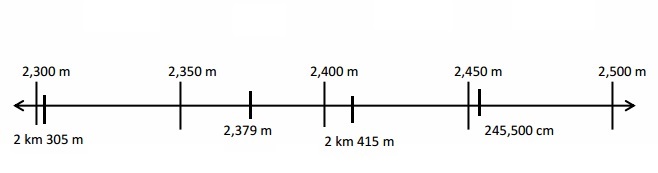
Eureka Math 4th Grade Module 2 Lesson 4 Homework Answer Key 20

Eureka Math Grade 4 Module 2 Lesson 4 Answer Key-10
Explanation:
Placed the given following measurements on the number line
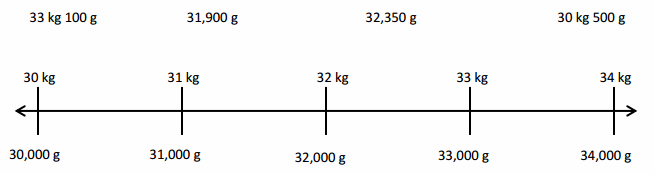
as shown above,
3 km 275 m = 3 X 1,000 m + 275 m = 3,000 m + 275 m =
3,275 m so placed between 3,250 m and 3,500 m,
3,500 m placed on 3,500 m,
3 km 5 m = 3 X 1,000 m + 5 m = 3,000 m + 5 m =
3,005 m so placed in between 3,000 m and 3,250 m,
and 394,000 cm = 394,000 ÷ 100 = 3,940 m so
placed in between 3,750 m and 4,000 m.

Question 7.
Place the following measurements on the number line:
Eureka Math 4th Grade Module 2 Lesson 4 Homework Answer Key 21
Eureka Math Grade 4 Module 2 Lesson 4 Answer Key-11
Explanation:
Placed the given following measurements on the number line
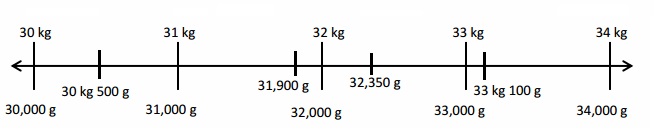
as shown above,
1 kg 379 g = 1 X 1,000 g + 379 g = 1,379 g,
so placed 1,379 g in between 0 g and 1,000 g,
3,079 g  placed in between 3,000 g and 4,000 g,
2 kg 79 g = 2 X 1,000 g + 79 g = 2,000 g + 79 g = 2,079 g
so placed in between 2,000 g and 3,000 g,
3,579 g placed in between 3,000 g and 4,000 g and
579 g placed comes in between 0 g and 1,000 g.
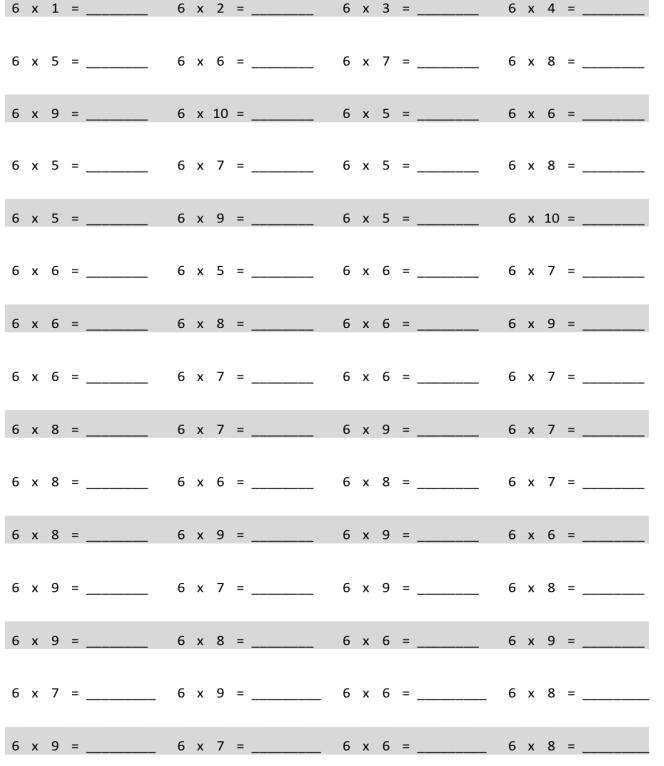
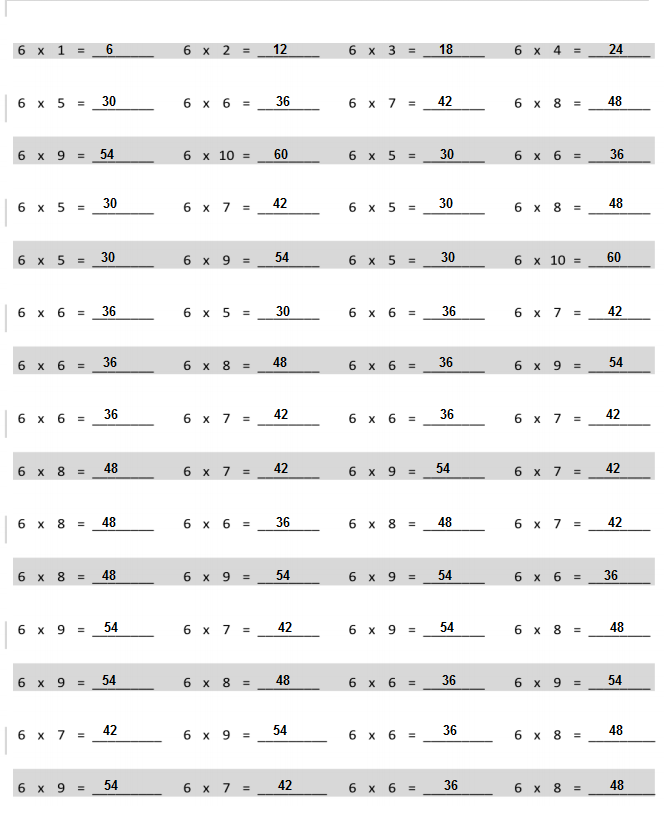
Eureka Math Grade 4 Module 2 Answer Key

Eureka Math Grade 4 Module 2 Lesson 3 Answer Key

Engage NY Eureka Math 4th Grade Module 2 Lesson 3 Answer Key

Eureka Math Grade 4 Module 2 Lesson 3 Problem Set Answer Key

Question 1.
Complete the conversion table.

Liquid Capacity

L

mL

1

1,000

5

5,000
38

38,000

49

49,000

54

54,000

92

92,000

Explanation:
Completed the conversion table as shown above,
We know 1 liter  = 103 or 1000 ml,
So 1 L = 1,000 mL .

5 L = 5,000 mL,
5 L = 5 X 1000 mL= 5,000 mL .

38 L = 38,000 mL,
38 L = 38 X 1000 mL= 38,000 mL .

49 L = 49,000 ml,
49 L = 49 X 1000 mL = 49,000 mL .

54,000 mL = 54 L,
as 54,000 mL ÷ 1000 mL = 54 L.

92,000 mL = 92 L,
as 92,000 mL ÷ 1000 mL = 92 L.

Question 2.
Convert the measurements.
a. 2 L 500 mL = ______2,500_______ mL
b. 70 L 850 mL = _____70,850________ mL
c. 33 L 15 mL = ______33,015_______ mL
d. 2 L 8 mL = ______2,008_______ mL
e. 3,812 mL = __3___ L ___812____ mL
f. 86,003 mL = __86___ L __003_____ mL

a. 2 L 500 mL = 2,500 mL,

Explanation:
2 L 500 mL
as 1 L = 103 mL = 1000 mL,
2 X 1000 mL + 500 mL= 2,500 mL .

b. 70 L 850 mL = 70,850 mL,

Explanation:
70 L 850 mL
as 1 L = 103 mL = 1000 mL,
70 X 1000 mL + 850 mL = 70,850 mL .

c. 33 L 15 mL = 33,015 mL,

Explanation:
33 L 15 mL
as 1 L = 103 mL = 1000 mL,
33 X 1000 mL + 15 mL = 33,015 mL .

d. 2 L 8 mL = 2,008 mL,

Explanation:
2 L 8 mL
as 1 L = 103 mL = 1000 mL,
2 X 1000 mL + 8 mL = 2,008 mL .

e. 3,812 mL = 3 L 812 mL,

Explanation:
3,812 mL
as 1 L = 103 mL = 1000 mL,
3,812 ÷ 1000 mL = 3 L 812 mL .

f. 86,003 mL = 86 L 003 mL,

Explanation:
86,003 mL
as 1 L = 103 mL = 1000 mL,
86,003 ÷ 1000 mL = 86 L 003 mL .

Question 3.
Solve.
a. 1,760 mL + 40 L
b. 7 L – 3,400 mL
c. Express the answer in the smaller unit:
25 L 478 mL + 3 L 812 mL
d. Express the answer in the smaller unit:
21 L – 2 L 8 mL
e. Express the answer in mixed units:
7 L 425 mL – 547 mL
f. Express the answer in mixed units:
31 L 433 mL – 12 L 876 mL

Use a tape diagram to model each problem.
Solve using a simplifying strategy or an algorithm
and write your answer as a statement.

a. 1,760 mL + 40 L =
1,760 mL + 40 L = 41 L 760 mL or 41,760 mL,
Eureka Math Grade 4 Module 2 Lesson 3 Answer Key-1

Statement : one thousand seven hundred sixty liter plus
forty liter is equal to forty one liter seven hundred sixty milliliter or
forty one thousand seven hundred and sixty milliliters.

Explanation:
Given  1,760 mL + 40 L =
as 40 L = 40 X 1000 mL = 40,000 mL,
40,000 mL
+1760 mL
41,760 mL
Used a tape diagram to model the problem.
Solved using a simplifying strategy and wrote
my answer as a statement one thousand seven hundred sixty liter plus
forty liter is equal to forty one liter seven hundred sixty milliliter or
forty one thousand seven hundred and sixty milliliters.

b. 7 L – 3,400 mL
7 L – 3,400 mL = 3,600 mL or 3 L 600 mL,
Eureka Math Grade 4 Module 2 Lesson 3 Answer Key-2
Statement : seven liters minus three thousand four
hundred milliliter is equal to three thousand
six hundred milliliters or three liters six hundred milliliter,

Explanation:
Given  7 L – 3,400 mL =
as 7 L = 7 X 1000 mL = 7,000 mL,
7,000 mL
-3,400 mL
3,600 mL
Used a tape diagram to model the problem.
Solved using a simplifying strategy and wrote
my answer as a statement seven liter minus three thousand
four hundred milliliter is equal to three thousand six
hundred milliliters or three liters six hundred milliliter.

c. Express the answer in the smaller unit: 25 L 478 mL + 3 L 812 mL,
25 L 478 mL + 3 L 812 mL = 29 L 290 mL or 29,290 mL,
Eureka Math Grade 4 Module 2 Lesson 3 Answer Key-3

Statement : twenty five liter and four hundred
seventy eight milliliters plus three liters eight hundred
and twelve milliliters  is equal to twenty nine liter and
two ninety milliliter or twenty nine thousand and
two ninety milliliters,

Explanation:
Given  25 L 478 mL + 3 L 812 mL =
As 25 L  478 mL = 25 X 1000 mL + 478 mL =
25000 mL + 478 mL = 25478 mL,
3 L 812 mL = 3 X 1000 mL + 812 mL = 3000 mL + 812 mL = 3812 mL,
25,478 mL
+3812 mL
29,290 mL
The smaller unit as 1 liter is equal to 1,000 milliliter,
So 29,290 mL = 29,290 ÷ 1000 = 29 L 290 mL, 
Used a tape diagram to model the problem.
Solved using a simplifying strategy and wrote
my answer as a statement twenty five liter and four hundred
seventy eight milliliters plus three liters eight hundred
and twelve milliliters  is equal to twenty nine liter and
two ninety milliliter or twenty nine thousand and
two ninety milliliters.

d. Express the answer in the smaller unit: 21 L – 2 L 8 mL
21 L – 2 L 8 mL = 18 L 992 mL or 18,992 mL,
Eureka Math Grade 4 Module 2 Lesson 3 Answer Key-4
Statement : twenty one liter minus two liters and
eight milliliters is equal to eighteen liter and
nine hundred ninety two milliliter or eighteen thousand and
nine hundred ninety two milliliters,

Explanation:
Given  21 L – 2 L 8 mL =
As 21 L = 21 X 1000 mL = 21,000 mL,
2 L 8 mL = 2 X 1000 mL + 8 mL = 2000 mL + 8 mL = 2,008 mL,
21,000 mL
-2,008 mL
18,992 mL
The smaller unit as 1 liter is equal to 1,000 milliliter,
So 18,992 mL = 18,992 ÷ 1000 = 18 L 992 mL, 
Used a tape diagram to model the problem.
Solved using a simplifying strategy and wrote
my answer as a statement twenty one liter minus two liters and
and eight milliliters is equal to eighteen liter and
nine hundred ninety two milliliter or eighteen thousand and
nine hundred ninety two milliliters.

e. Express the answer in mixed units: 7 L 425 mL – 547 mL
7 L 425 mL – 547 mL = 6,878 mL or 6 L 878 mL,
Eureka Math Grade 4 Module 2 Lesson 3 Answer Key-5
Statement : seven liter four hundred twenty five milliliters minus
five hundred and forty seven milliliters is equal to six thousand and
eight hundred seventy eight milliliters or six liters and
eight hundred seventy eight milliliters,

Explanation:
Given  7 L 425 mL – 547 mL =
As 7 L 425 mL = 7 X 1000 mL + 425 mL = 7000 mL + 425 mL = 7,425 mL
7,425 mL
-547 mL
6,878 mL
The answer in mixed units is
So 6,878 mL = 6878 ÷ 1000 = 6 L 878 mL, 
Used a tape diagram to model the problem.
Solved using a simplifying strategy and wrote
my answer as a statement seven liter four hundred
twenty five milliliters minus five hundred and
forty seven milliliters is equal to six thousand and
eight hundred seventy eight milliliters or six liters and
eight hundred seventy eight milliliters.

f. Express the answer in mixed units: 31 L 433 mL – 12 L 876 mL
31 L 433 mL – 12 L 876 mL = 18,557 mL or 18 L 557 mL,
Eureka Math Grade 4 Module 2 Lesson 3 Answer Key-6
Statement : thirty one liter four hundred thirty three milliliters minus
twelve liters and eight hundred and seventy six milliliters is equal to  eighteen thousand and five hundred fifty seven milliliters or
eighteen liters and five hundred fifty seven milliliters,

Explanation:
Given 31 L 433 mL – 12 L 876 mL
As 31 L 433 mL = 31 X 1000 mL + 433 mL =
31000 mL + 433 mL = 31,433 mL and
12 L 876 mL = 12 X 1000 mL + 876 mL =
12000 mL + 876 mL = 12,876 mL,
31,433 mL
-12,876 mL
18,557 mL
The answer in mixed units is
So 18,557 mL = 18,557 ÷ 1000 = 18 L 557 mL, 
Used a tape diagram to model the problem.
Solved using a simplifying strategy and wrote
my answer as a statement  thirty one liter four hundred
thirty three milliliters minus twelve liters and eight hundred
and seventy six milliliters is equal to  eighteen thousand and
five hundred fifty seven milliliters or
eighteen liters and five hundred fifty seven milliliters.

Question 4.
To make fruit punch, John’s mother combined
3,500 milliliters of tropical drink, 3 liters 95 milliliters
of ginger ale, and 1 liter 600 milliliters of pineapple juice.
a. Order the quantity of each drink from least to greatest.
b. How much punch did John’s mother make?

a. The quantity of order of each drink from least to greatest is
1,600 mL pineapple <  3,095 mL ginger ale < 3,500 mL tropical drink,

Explanation:
Given John’s mother combined 3,500 milliliters of tropical drink,
3 liters 95 milliliters of ginger ale and 1 liter 600 milliliters of pineapple juice. As 3 L 95 mL = 3 X 1000 mL + 95 mL = 3,095 mL ginger ale,
1 L 600 mL = 1 X 1000 mL + 600 mL = 1,600 mL pineapple,
Now all are in milliliters comparing we get
1,600 mL pineapple < 3,095 mL ginger ale < 3,500 mL tropical drink
Therefore, The quantity of order of each drink from least to greatest is
1,600 mL pineapple < 3,095 mL ginger ale < 3,500 mL tropical drink.

b. John’s mother has made 8,195 mL of fruit punch or 8 L 195 mL,

Explanation:
Given John’s mother combined 3,500 milliliters of tropical drink,
3 liters 95 milliliters of ginger ale and 1 liter 600 milliliters of pineapple juice. As 3 L 95 mL = 3 X 1000 mL + 95 mL = 3,095 mL ginger ale,
1 L 600 mL = 1 X 1000 mL + 600 mL = 1,600 mL pineapple,
now in total we have 3,500 mL + 3,095 mL + 1,600 mL =
3,500 mL
3,095 mL
+1,600 mL
8,195 mL
or 8,195 ÷ 1000 = 8 L 195 mL .
Therefore, John’s mother has made 8,195 mL of fruit punch or 8 L 195 mL .

Question 5.
A family drank 1 liter 210 milliliters of milk at breakfast.
If there were 3 liters of milk before breakfast,
how much milk is left?

Milk left is 1,790 mL or 1 L 790 mL,

Explanation:
Given A family drank 1 liter 210 milliliters of milk at breakfast.
If there were 3 liters of milk before breakfast, So milk left is
3 L – 1 L 210 mL =
as  3 L = 3 X 1000 mL = 3000 mL and
1 L 210 mL = 1 X 1000 mL + 210 mL = 1,210 mL,
now 3000 mL – 1,210 mL =
3000 mL
-1,210 mL
1,790 mL
or 1,790 ÷ 1000 = 1 L 790 mL,
Therefore, Milk left is 1,790 mL or 1 L 790 mL .

Question 6.
Petra’s fish tank contains 9 liters 578 milliliters of water.
If the capacity of the tank is 12 liters 455 milliliters of water,
how many more milliliters of water does she need to fill the tank?
Eureka Math Grade 4 Module 2 Lesson 3 Problem Set Answer Key 1
Petra’s need more 2,877 milliliters of water to fill the tank,

Explanation:
Given Petra’s fish tank contains 9 liters 578 milliliters of water.
If the capacity of the tank is 12 liters 455 milliliters of water,
So more milliliters of water does she needs to fill the tank is
12 L 455 mL – 9 L 578 mL =
as 12 L 455 mL = 12 X 1000 mL + 455 mL = 12,455 mL,
9 L 578 mL = 9 X 1000 mL + 578 mL = 9,578 mL,
12,455 mL
– 9,578 mL
2,877 mL
Therefore, Petra’s need more 2,877 milliliters of water to fill the tank.

Eureka Math Grade 4 Module 2 Lesson 3 Exit Ticket Answer Key

Question 1.
Convert the measurements.
a. 6 L 127 mL = ____6,127___ mL
b. 706 L 220 mL = ___706,220__ mL
c. 12 L 9 mL = ____12,009______mL
d. ___906___ L __010_____ mL = 906,010 mL

a. 6 L 127 mL
6 L 127 mL = 6,127 mL

Explanation:
6 L 127 mL = 6 X 1000 mL + 127 mL = 6,127 mL .

b. 706 L 220 mL =
706 L 220 mL = 706,220 mL,

Explanation:
706 L 220 mL = 706 X 1000 mL + 220 mL = 706,220 mL .

c. 12 L 9 mL =
12 L 9 mL = 12,009 mL,
Explanation:

12 L 9 mL = 12 X 1000 mL + 9 mL = 12000 mL  + 9 mL = 12,009 mL .

d. ____________= 906,010 mL,
906 L 010 mL = 906,010 mL,

Explanation:
____________= 906,010 mL, As 906,010 mL ÷ 1000 =
906 L 010 mL .

Question 2.
Solve.
81 L 603 mL – 22 L 489 mL

Use a tape diagram to model the following problem. Solve using a simplifying strategy or an algorithm, and write your answer as a statement.

81 L 603 mL – 22 L 489 mL = 59,114 mL or 59 L 114 mL,
Eureka Math Grade 4 Module 2 Lesson 3 Answer Key-7
Statement : eighty one liter and six hundred three milliliters
minus twenty two liters four hundred eighty nine milliliter is
equal to fifty nine thousand one hundred fourteen milliliters or
fifty nine liters and one hundred fourteen milliliters,

Explanation:
81 L 603 mL – 22 L 489 mL
as 81 L 603 mL = 81 X 1000 mL + 603 mL = 81,603 mL and
22 L 489 mL = 22 X 1000 mL + 489 mL = 22,489 mL
81,603 mL
-22,489 mL
59,114 mL 
or 59,114 ÷ 1000 = 59 L 114 mL,
Used a tape diagram to model the problem.
Solved using a simplifying strategy and wrote
my answer as a statement eighty one liter and six hundred
three milliliters minus twenty two liters four hundred eighty
nine milliliter is equal to fifty nine thousand one hundred
fourteen milliliters or fifty nine liters and one hundred
fourteen milliliters.

Question 3.
The Smith’s hot tub has a capacity of 1,458 liters.
Mrs. Smith put 487 liters 750 milliliters of water in the tub.
How much water needs to be added to fill the hot tub completely?

Smith needs to add 970,250 milliliters or 970 L 250 mL of water
to completely fill the hot tub,

Explanation:
Given the Smith’s hot tub has a capacity of 1,458 liters.
Mrs. Smith put 487 liters 750 milliliters of water in the tub.
Water needed to be added to fill the hot tub completely is
1,458 liters – 487 liters 750 milliliters =
as 1,458 liters = 1,458 X 1000 mL = 1,458,000 mL and
487 liters 750 milliliters = 487 X 1000 mL + 750 mL =
487000 mL + 750 mL = 487,750 mL, So
1,458,000 mL
-487,750 mL
970,250 mL
or 970,250 ÷ 1000 = 970 L 250 mL,
Therefore, Smith needs to add 970,250 milliliters or
970 L 250 mL of water to completely fill the hot tub.

Eureka Math Grade 4 Module 2 Lesson 3 Homework Answer Key

Question 1.
Complete the conversion table.

Liquid Capacity

L

mL

1

1,000

8

8,000
27

27,000

                          39

39,000

68

68,000

102

102,000

Explanation:
Completed the conversion table as shown above,
We know 1 liter  = 103 or 1000 ml,
So 1 L = 1,000 mL .

8 L = 8,000 mL,
8 L = 8 X 1000 mL= 8,000 mL .

27 L = 27,000 mL,
27 L = 27 X 1000 mL= 27,000 mL .

39,000 mL = 39 L,
as 39,000 mL ÷ 1000 mL = 39 L.

68 L = 68,000 ml,
68 L = 68 X 1000 mL = 68,000 mL .

102,000 mL = 102 L,
as 102,000 mL ÷ 1000 mL = 102 L.

Question 2.
Convert the measurements.
a. 5 L 850 mL = ______5,850_______ mL
b. 29 L 303 mL = _____29,303________ mL
c. 37 L 37 mL = _____37,037________ mL
d. 17 L 2 mL = ______17,002_______ mL
e. 13,674 mL = __13___ L __674____ mL
f. 275,005 mL = __275___ L __005____ mL

a. 5 L 850 mL = 5,850 mL,

Explanation:
5 L 850 mL
as 1 L = 103 mL = 1000 mL,
5 X 1000 mL + 850 mL= 5,850 mL .

b. 29 L 303 mL = 29,303 mL,

Explanation:
29 L 303 mL
as 1 L = 103 mL = 1000 mL,
29 X 1000 mL + 303 mL = 29 mL .

c. 37 L 37 mL = 37,037 mL,

Explanation:
37 L 37 mL
as 1 L = 103 mL = 1000 mL,
37 X 1000 mL + 37 mL = 37,037 mL .

d. 17 L 2 mL= 17,002 mL,

Explanation:
17 L 3 mL
as 1 L = 103 mL = 1000 mL,
17 X 1000 mL + 3 mL = 17,003 mL .

e. 13,674 mL  = 13 L 674 mL,

Explanation:
13,674 mL
as 1 L = 103 mL = 1000 mL,
13,674 ÷ 1000 mL = 13 L 674 mL .

f. 275,005 mL = 275 L 005 mL,

Explanation:
275,005 mL
as 1 L = 103 mL = 1000 mL,
275,005 ÷ 1000 mL = 275 L 005 mL .

Question 3.
Solve.
a. 545 mL + 48 mL
b. 8 L – 5,740 mL
c. Express the answer in the smaller unit:
27 L 576 mL + 784 mL
d. Express the answer in the smaller unit:
27 L + 3,100 mL
e. Express the answer in mixed units:
9 L 213 mL – 638 mL
f. Express the answer in mixed units:
41 L 724 mL – 28 L 945 mL

Use a tape diagram to model each problem. Solve using a simplifying strategy or an algorithm, and write your answer as a statement.

a. 545 mL + 48 mL
545 mL + 48 mL = 593 mL,
Eureka Math Grade 4 Module 2 Lesson 3 Answer Key-8
Statement : five hundred forty five milliliter plus
forty eight milliliter is equal to five hundred ninety three milliliters,

Explanation:
Given  545 mL + 48 mL =
545 mL
+48 mL
593 mL
Used a tape diagram to model the problem.
Solved using a simplifying strategy and wrote
my answer as a statement five hundred forty five milliliter plus
forty eight milliliter is equal to five hundred ninety three milliliters.

b. 8 L – 5,740 mL
8 L – 5,740 mL = 2,260 mL or 2 L 260 mL,
Eureka Math Grade 4 Module 2 Lesson 3 Answer Key-9
Statement : eight liters minus five thousand seven
hundred forty milliliter is equal to two thousand
two hundred sixty milliliters or two liters two hundred
sixty milliliter,

Explanation:
Given  8 L – 5,740 mL =
as 8 L = 8 X 1000 mL = 8,000 mL,
8,000 mL
-5,740 mL
2,260 mL
or 2,260 ÷ 1000 = 2 L 260 mL,
Used a tape diagram to model the problem.
Solved using a simplifying strategy and wrote
my answer as a statement eight liters minus five thousand
seven hundred forty milliliter is equal to two thousand
two hundred sixty milliliters or two liters two hundred
sixty milliliter.

c. Express the answer in the smaller unit: 27 L 576 mL + 784 mL
27 L 576 mL + 784 mL =  28 L 360 mL or 28,360 mL,
Eureka Math Grade 4 Module 2 Lesson 3 Answer Key-10
Statement : twenty seven liter and five hundred
seventy six milliliters plus seven hundred
eighty four milliliters is equal to twenty eight liter and
and three hundred sixty milliliter or twenty eight thousand and
three hundred sixty milliliters,

Explanation:
Given  27 L 576 mL + 784 mL =
As 27 L  576 mL = 27 X 1000 mL + 576 mL =
27000 mL + 576 mL = 27,576 mL,
27,576 mL
+ 784 mL
28,360 mL
The smaller unit as 1 liter is equal to 1,000 milliliter,
So 28,360 mL = 28,360 ÷ 1000 = 28 L 360 mL, 
Used a tape diagram to model the problem.
Solved using a simplifying strategy and wrote
my answer as a statement twenty seven liter and five hundred
seventy six milliliters plus seven hundred
eighty four milliliters is equal to twenty eight liter and
and three hundred sixty milliliter or twenty eight thousand and
three hundred sixty milliliters.

d. Express the answer in the smaller unit: 27 L + 3,100 mL
27 L + 3,100 mL = 30 L 100 mL or 30,100 mL,
Eureka Math Grade 4 Module 2 Lesson 3 Answer Key-11
Statement : twenty seven liter plus three liters and
one hundred milliliters is equal to thirty liter and
one hundred milliliters or thirty thousand and
one hundred milliliters,

Explanation:
Given  27 L + 3,100 mL =
As 27 L = 27 X 1000 mL = 27,000 mL,
27,000 mL
+3,100 mL
30,100 mL
The smaller unit as 1 liter is equal to 1,000 milliliter,
So 30,100 mL = 30,100 ÷ 1000 = 30 L 100 mL, 
Used a tape diagram to model the problem.
Solved using a simplifying strategy and wrote
my answer as a statement twenty seven liter plus
three liters and one hundred milliliters is equal to
thirty liter and one hundred milliliters or thirty
thousand and one hundred milliliters.

e. Express the answer in mixed units: 9 L 213 mL – 638 mL
9 L 213 mL – 638 mL = 8,575 mL or 8 L 575 mL,
Eureka Math Grade 4 Module 2 Lesson 3 Answer Key-12
Statement : nine liter two hundred thirteen milliliters minus
six hundred and thirty eight milliliters is equal to eight thousand
and five hundred seventy five milliliters or eight liters and
five hundred seventy five milliliters,

Explanation:
Given  9 L 213 mL – 638 mL =
As 9 L 213 mL = 9 X 1000 mL + 213 mL = 9000 mL + 213 mL = 9,213 mL
9213 mL
– 638 mL
8,575 mL
The answer in mixed units is
8,575 mL = 8,575 ÷ 1000 = 8 L 575 mL, 
Used a tape diagram to model the problem.
Solved using a simplifying strategy and wrote
my answer as a statement nine liter two hundred
thirteen milliliters minus six hundred and
thirty eight milliliters is equal to eight thousand
and five hundred seventy five milliliters or eight liters
and five hundred seventy five milliliters.

f. Express the answer in mixed units: 41 L 724 mL – 28 L 945 mL
41 L 724 mL – 28 L 945 mL = 12,779 mL or 12 L 779 mL,
Eureka Math Grade 4 Module 2 Lesson 3 Answer Key-13
Statement : forty one liter seven hundred twenty four milliliters
minus twenty eight liter nine hundred and forty five milliliters
is equal to  twelve thousand and seven hundred
seventy nine milliliters or twelve liters and seven hundred
seventy nine milliliters,

Explanation:
Given  41 L 724 mL – 28 L 945 mL =
As 41 L 724 mL = 41 X 1000 mL + 724 mL =
41000 mL + 724 mL = 41,724 mL and
28 L 945 mL = 28 X 1000 mL + 945 mL =
28000 mL + 945 mL = 28,945 mL,
41,724 mL
-28,945 mL
12,779 mL
The answer in mixed units is
12,779 mL = 12,779 ÷ 1000 = 12 L 779 mL, 
Used a tape diagram to model the problem.
Solved using a simplifying strategy and wrote
my answer as a statement forty one liter seven hundred
twenty four milliliters minus twenty eight liter nine hundred
and forty five milliliters is equal to  twelve thousand and
seven hundred seventy nine milliliters or twelve liters and
seven hundred seventy nine milliliters.

Question 4.
Sammy’s bucket holds 2,530 milliliters of water.
Marie’s bucket holds 2 liters 30 milliliters of water.
Katie’s bucket holds 2 liters 350 milliliters of water.
Whose bucket holds the least amount of water?

Marie’s bucket holds the least amount of water of
2 liters 30 milliliters or 2,030 mL of water,

Explanation:
Given Sammy’s bucket holds 2,530 milliliters of water.
Marie’s bucket holds 2 liters 30 milliliters of water.
Katie’s bucket holds 2 liters 350 milliliters of water.
The least amount of water bucket is
Sammy’s bucket 2,530 mL, Marie’s bucket 2 L 30 mL means
2 X 1000 mL + 30 mL = 2,030 mL and Katie’s bucket holds
2 L 350 mL = 2 X 1000 mL + 350 mL = 2,350 mL,
Now upon comparing 2,030 mL < 2,350 mL < 2,530 mL,
Marie < Katie < Sammy’s ,
So Marie’s bucket holds the least amount of water of
2 liters 30 milliliters or 2,030 mL of water.

Question 5.
At football practice, the water jug was filled with
18 liters 530 milliliters of water. At the end of practice,
there were 795 milliliters left. How much water did the team drink?

The team drank 17,735 milliliters or 17 liters 735 milliliters,

Explanation:
At football practice, the water jug was filled with
18 liters 530 milliliters of water. At the end of practice,
there were 795 milliliters left.
So amount of water did the team drank is 18 L 530 mL –
795 mL, 18 L 530 mL = 18 X 1000 mL + 530 mL = 18,530 mL,
18,530 mL
–   795 mL
17,735 mL
or 17,735 ÷ 1000 = 17 L 735 mL
Therefore, the team drank 17,735 milliliters or 17 liters 735 milliliters.

Question 6.
27,545 milliliters of gas were added to a car’s empty gas tank.
If the gas tank’s capacity is 56 liters 202 milliliters,
how much gas is needed to fill the tank?

Gas needed to fill the tank is 28,657 milliliters or 28 liters 657 milliliters,

Explanation:
Given 27,545 milliliters of gas were added to a car’s
empty gas tank. If the gas tank’s capacity is
56 liters 202 milliliters, The gas needed to fill the tank is
56 L 202 mL – 27,545 mL =
as 56 L 202 mL = 56 X 1000 mL + 202 mL = 56,202 mL,
56,202 mL
-27,545 mL
28,657 mL
or 28,657 ÷ 1000 = 28 L 657 mL
Therefore, Gas needed to fill the tank is 28,657 milliliters or
28 liters 657 milliliters.

Eureka Math Grade 4 Module 2 Answer Key

Eureka Math Grade 4 Module 2 Lesson 2 Answer Key

Engage NY Eureka Math 4th Grade Module 2 Lesson 2 Answer Key

Eureka Math Grade 4 Module 2 Lesson 2 Problem Set Answer Key

Question 1.
Complete the conversion table.

Mass

kg

g

1

1,000

3

3,000

4

4,000

17

                      17,000
20

20,000

300

300,000

Explanation:
Converted the conversion table as shown above as
We know 1 kg = 103 or 1000 g,
So 1 kg = 1,000 g.
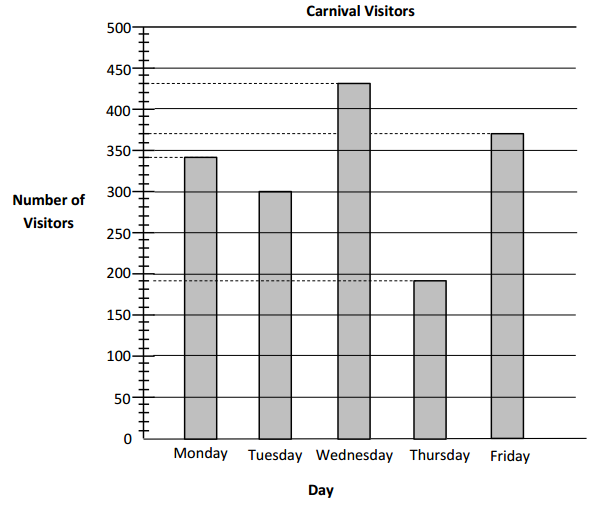
3 kg = 3,000 g as
3 kg = 3 X 10³ g = 3 X 1000g = 3,000 g.

4 kg = 4,000 g as
4 kg = 4 X 10³ g = 4 X 1000 = 4,000 g.

17000 g = 17,000 ÷ 103 kg = 17 kg,
So 17 kg = 17,000 g.

20 kg = 20,000 g as
20 kg = 20 X 103 g = 20 X 1000 = 20,000 g

300 kg = 300,000 g as
300 kg = 300 X 103 g =  300 X 1000 = 300,000 g.

Question 2.
Convert the measurements.
a. 1 kg 500 g = ______1500___ g
b. 3 kg 715 g = _____3715____ g
c. 17 kg 84 g = _____17,084___ g
d. 25 kg 9 g = _____25,009___ g
e. __7___ kg __481__ g = 7,481 g
f. 210 kg 90 g = ___210,090___ g

a. 1 kg 500 g = 1500 g

Explanation:
1 kg 500 g  as 1 kg = 103 g= 1000 g,
1 X 1000 g + 500 g= 1500 g.

b. 3 kg 715 g = 3715 g,

Explanation:
3 kg 715 g  as 1 kg = 103 g= 1000 g,
3 X 1000 g + 715  g = 3000 g + 715 g= 3715 g.

c. 17 kg 84 g = 17,084 g,

Explanation:
17 kg 84 g  as 1 kg = 103 g= 1000 g,
17 X 1000 g+ 84 g= 17000 g + 84 g= 17,084 g.

d. 25 kg 9 g = 25,009 g,

Explanation:
25 kg 9 g  as 1 kg = 103 g= 1000 g,
25 X 1000 g + 9 g = 25000 g + 9 g = 25,009 g.

e. 7,481 g = 7 kg 481 g,

Explanation:
As 1000 g = 1 kg,
So 7481 g = 7481 kg ÷ 1000 g= 7 kg 481 g.

f. 210 kg 90 g = 210,090 g,

Explanation:
210 kg 90 g  as 1 kg = 103 g= 1000 g,
210 X 1000 g + 90 g = 210000 g + 90 g = 210,090 g.

Question 3.
Solve.
a. 3,715 g – 1,500 g
b. 1 kg – 237 g
c. Express the answer in the smaller unit:
25 kg 9 g + 24 kg 991 g
d. Express the answer in the smaller unit:
27 kg 650 g – 20 kg 990 g
e. Express the answer in mixed units:
14 kg 505 g – 4,288 g
f. Express the answer in mixed units:
5 kg 658 g + 57,481 g

Use a tape diagram to model each problem. Solve using a simplifying strategy or an algorithm, and write your answer as a statement.

a. 3,715 g – 1,500 g
3,715 g – 1,500 g = 2,215 g,
Eureka Math Grade 4 Module 2 Lesson 2 Answer Key-1
Statement : Three thousand seven hundred fifteen grams minus
fifteen hundred grams is equal to two thousand and two hundred
fifteen grams,

Explanation:
Given  3,715 g – 1,500 g =
3715 g
-1500 g
2,215  g
Used a tape diagram to model the problem.
Solved using a simplifying strategy and wrote
my answer as a statement three thousand seven hundred
fifteen grams minus  fifteen hundred grams is equal to
two thousand and two hundred fifteen grams.

b. 1 kg – 237 g
1 kg – 237 g = 763 g,
Eureka Math Grade 4 Module 2 Lesson 2 Answer Key-2
Statement : One thousand grams minus two hundred
thirty seven grams is equal to seven hundred sixty three grams,

Explanation:
Given  1 kg – 237 g =
As 1 kg = 1 X 1000 g = 1000 g – 237 g =
1000 g
– 237 g
763 g
Used a tape diagram to model the problem.
Solved using a simplifying strategy and wrote
my answer as a statement one thousand grams minus
two hundred thirty seven grams
is equal to seven hundred sixty three grams.

c. Express the answer in the smaller unit:
25 kg 9 g + 24 kg 991 g,
25 kg 9 g + 24 kg 991 g = 500,000 g or 500,000,000 milligrams,
Eureka Math Grade 4 Module 2 Lesson 2 Answer Key-3
Statement : Twenty five kilograms and 9 grams plus
twenty four kilograms nine hundred and ninety one grams
is equal to five lakhs grams or five hundred milligrams,

Explanation:
Given  25 kg 9 g + 24 kg 991 g =
As 25 kg 9 g = 25 X 1000 g + 9 g = 25000 g + 9 g = 25009 g,
24 kg 991 g = 24 X 1000 g + 991 g = 24000 g + 991 g = 24991 g,
25009 g
+24991 g
500,000 g
The smaller unit as 1 gram is equal to 1,000 milligrams,
So 500,000 g = 500,000 X 1000 = 500,000,000 milligrams, 
Used a tape diagram to model the problem.
Solved using a simplifying strategy and wrote
my answer as a statement twenty five kilograms and 9 grams plus
twenty four kilograms nine hundred and ninety one grams is equal to
five lakhs grams or five hundred milligrams.

d. Express the answer in the smaller unit:
27 kg 650 g – 20 kg 990 g,
27 kg 650 g – 20 kg 990 g = 6 kg 660 g or 6,660 g or
6,660,000 milligrams,
Eureka Math Grade 4 Module 2 Lesson 2 Answer Key-4
Statement : Twenty seven kilogram six hundred fifty grams minus
twenty kilogram nine hundred ninety grams is equal to
six kilogram six sixty grams or six thousand six hundred
sixty grams or sixty six lakhs sixty thousand milligrams,

Explanation:
Given 27 kg 650 g – 20 kg 990 g =
As 27 kg 650 g = 27 X 1000 g + 650 g = 27000 g + 650 g = 27650 g,
20 kg 990 g = 20 X 1000 g + 990 g = 20000 g + 990 g = 20990 g,
27650 g
-20990 g
6,660 g
The smaller unit as 1 gram is equal to 1,000 milligrams,
So 6,660 g = 6,660 X 1000 = 6,660,000 milligrams, 
Used a tape diagram to model the problem.
Solved using a simplifying strategy and wrote
my answer as a statement Twenty seven kilogram
six hundred fifty grams minus  twenty kilogram
nine hundred ninety grams is equal to
six kilogram six sixty grams or six thousand six hundred
sixty grams or sixty six lakhs sixty thousand milligrams.

e. Express the answer in mixed units:
14 kg 505 g – 4,288 g,
14 kg 505 g – 4,288 g = 10,217 g in mixed units is
10 kg 217 g,
Eureka Math Grade 4 Module 2 Lesson 2 Answer Key-5
Statement : Fourteen kilograms five hundred and five minus four thousand
and two hundred eighty eight equals to ten kilograms two
hundred and seventeen grams,

Explanation:
Given 14 kg 505 g – 4288 g =
As 14 kg 505 g = 14 X 1000 g + 505 g = 14000 g + 505 g = 14505 g,
14505 g
– 4288 g
10,217 g
The mixed unit 10,217 grams is equal to 10 kg 217 grams,
as 10217 g = 10217 ÷ 1000 kg = 10 kg 217 grams, 
Used a tape diagram to model the problem.
Solved using a simplifying strategy and wrote
my answer as a statement fourteen kilograms five
hundred and five minus four thousand
and two hundred eighty eight equals to ten kilograms
two hundred and seventeen grams.

f. Express the answer in mixed units:
5 kg 658 g + 57,481 g
5 kg 658 g + 57,481 g = 63,139 g or 63 kg 139 g,
Eureka Math Grade 4 Module 2 Lesson 2 Answer Key-6
Statement : Five kilograms six hundred fifty eight grams plus
fifty seven four hundred eighty one grams is equal to
sixty three kilograms and one hundred thirty nine grams,

Explanation:
Given 5 kg 658 g + 57481 g =
As 5 kg 658 g = 5 X 1000 g + 658 g = 5000 g + 658 g = 5658 g,
5658 g
+57481 g
63,139 g
The mixed unit 63,139 grams is equal to 63 kg 139 grams,
as 63139 g = 631390 ÷ 1000 kg = 63 kg 139 grams, 
Used a tape diagram to model the problem.
Solved using a simplifying strategy and wrote
my answer as a statement five kilograms six hundred
fifty eight grams plus fifty seven four hundred
eighty one grams is equal to sixty three kilograms and
one hundred thirty nine grams.

Question 4.
One package weighs 2 kilograms 485 grams.
Another package weighs 5 kilograms 959 grams.
What is the total weight of the two packages?
Eureka Math Grade 4 Module 2 Lesson 2 Problem Set Answer Key 1
The total two packages weight is 8,444 grams or 8 kilograms 444 grams,

Explanation:
Given one package weighs 2 kilograms 485 grams.
Another package weighs 5 kilograms 959 grams.
The total weight of the two packages is
2 kilograms 485 grams + 5 kilograms 959 grams =
2 X 1000 + 485 = 2000 + 485 = 2485 g
5 X 1000 + 959 = 5000 + 959 = 5959 g
2485 g
5959 g
8,444 g
8,444 g = 8,444 ÷ 1000 = 8 kilograms 444 grams,
Therefore, the total two packages weight is 8,444 grams or
8 kilograms 444 grams.

Question 5.
Together, a pineapple and a watermelon weigh
6 kilograms 230 grams. If the pineapple weighs
1 kilogram 255 grams, how much does the watermelon weigh?

The watermelon weigh’s 4975 grams or 4 kilograms 975 grams,

Explanation:
Given together, a pineapple and a watermelon weigh
6 kilograms 230 grams. If the pineapple weighs
1 kilogram 255 grams, so the watermelon weigh’s
6 kilograms 230 grams – 1 kilogram 255 grams =
6 kilograms 230 grams = 6 X 1000 g + 230 g = 6230 g,
1 kilogram 255 grams = 1 X 1000 g + 255 g = 1255 g,
Now 6230 g – 1255 g =
6230 g
-1255 g
4975 g

Therefore, The watermelon weigh’s 4975 grams or
4975 g = 4975 ÷ 1000 = 4 kilograms 975 grams.

Question 6.
Javier’s dog weighs 3,902 grams more than Bradley’s dog.
Bradley’s dog weighs 24 kilograms 175 grams.
How much does Javier’s dog weigh?

Javier’s dog weigh’s 28,077 grams or 28 kilograms 77 grams,

Explanation:
Given Javier’s dog weighs 3,902 grams more than Bradley’s dog.
Bradley’s dog weighs 24 kilograms 175 grams.
So Javier’s dog weigh’s 24 kg 175 g + 3902 g =
24 kg 175g = 24 X 1000 g + 175 g = 24175 g
Now 24175 g + 3902 g =
24175 g
+3902 g
28077 g
Therefore, Javier’s dog weigh’s 28,077 grams or
28,077 ÷ 1000 = 28 kilograms 77 grams.

Question 7.
The table to the right shows the weight of three
Grade 4 students. How much heavier is Isabel than
the lightest student?

Student

Weight

Isabel

35 kg

Irene

29 kg 38 g

Sue

29,238 g

5762 g or 5 kg 762 g heavier is Isabel than the lightest student Sue,

Explanation:
Given the weight of three Grade 4 students, From it
Isabel weight is 35 kg and the lightest student is Sue
29,238 g, So heavier is Isabel than the lightest student is
35 kg – 29,238 g = 35 X 1000 g – 29,238 g =
35,000 g – 29,238 g =
35,000 g
29,238 g
5,762 g
5,762 g = 5762 ÷ 1000 = 5 kilogram 762 g,
Therefore, 5762 g or 5 kg 762 g heavier is Isabel
than the lightest student Sue.

Eureka Math Grade 4 Module 2 Lesson 2 Exit Ticket Answer Key

Question 1.
Convert the measurements.
a. 21 kg 415 g = _21,415_ g
b. 2 kg 91 g = __2,091__ g
c. 87 kg 17 g = ___87,017_ g
d. _96_ kg _20__ g = 96,020 g

Use a tape diagram to model the following problem.
Solve using a simplifying strategy or an algorithm and
write your answer as a statement.

a. 21 kg 415 g = 21,415 g,
Eureka Math Grade 4 Module 2 Lesson 2 Answer Key-7
Statement : twenty one kilograms 415 grams is equal to
twenty one thousand four hundred fifteen grams,

Explanation:
Given to convert 21 kg 415 g,
as 1 kg = 103 g= 1000 g so 21 kg 415 g =
21 X 1000 g + 415 g = 21000 g + 415 g = 21415 g,
Used a tape diagram to model the following problem,
Solved using a simplifying strategy and wrote my answer
as a statement twenty one kilograms 415 grams is equal to
twenty one thousand four hundred fifteen grams.

b. 2 kg 91 g = 2,091 g,
Eureka Math Grade 4 Module 2 Lesson 2 Answer Key-8
Statement : Two kilograms 91 grams is equal to
two thousand and ninety one grams,

Explanation:
Given to convert 2 kg 91 g,
as 1 kg = 103 g= 1000 g so 2 kg 91 g =
2 X 1000 g + 91 g = 2000 g + 91 g = 2091 g,
Used a tape diagram to model the following problem,
Solved using a simplifying strategy and wrote my answer
as a statement two kilograms 91 grams is equal to
two thousand ninety one grams.

c. 87 kg 17 g = 87,017 g,
Eureka Math Grade 4 Module 2 Lesson 2 Answer Key-9
Statement : Eighty seven kilograms 17 grams is equal to
eighty seven thousand and seventeen grams,

Explanation:
Given to convert 87 kg 17 g,
as 1 kg = 103 g= 1000 g so 87 kg 17 g =
87 X 1000 g + 17 g = 87000 g + 17 g = 87,017 g,
Used a tape diagram to model the following problem,
Solved using a simplifying strategy and wrote my answer
as a statement eighty seven kilograms 17 grams is equal to
eighty seven thousand and seventeen grams.

d. 96 kg 20 g = 96,020 g,
Eureka Math Grade 4 Module 2 Lesson 2 Answer Key-10
Statement : Ninety six kilograms twenty grams is equal to
ninety six thousand and twenty grams,

Explanation:
Given to convert 96,020 g,
as 1 g = 1 ÷ 103 kg so 96,020 g =
96000 ÷ 1000 g + 20 g = 96 kg + 20 g = 96,020 g,
Used a tape diagram to model the following problem,
Solved using a simplifying strategy and wrote my answer
as a statement ninety six kilograms twenty grams is equal
to ninety six thousand and twenty grams.

Question 2.
The table to the right shows the weight of three dogs. How much more does the Great Dane weigh than the Chihuahua?

Dog

Weight

Great Dane

59 kg
Golden Retriever

32 kg 48 g

Chihuahua

1,329 g

The Great Dane weigh’s 57 kg 671 g or 57,671 g more than the Chihuahua,

Explanation:
Given the table to the right shows the weight of three dogs.
More the Great Dane weigh than the Chihuahua is
59 kg -1,329 g = 59 X 1000 g = 59000 g – 1329 g =
57,671 g or 57,671 g ÷ 1000 = 57 kg 671 g,
Therefore, the Great Dane weigh’s 57 kg 671 g or 57,671 g
more than the Chihuahua.

Eureka Math Grade 4 Module 2 Lesson 2 Homework Answer Key

Question 1.
Complete the conversion table.

Mass

kg

g

1

1,000

6

6,000

8

8,000
15

15000

24

24,000

550

550,000

Explanation:
Converted the conversion table as shown above as
We know 1 kg = 103 or 1000 g,
So 1 kg = 1,000 g.
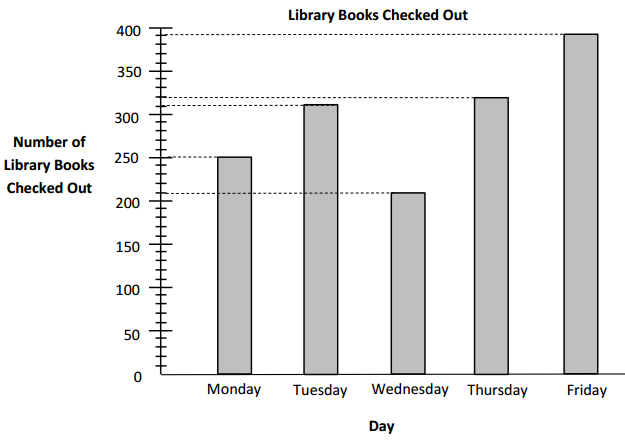
6 kg = 6,000 g as
6 kg = 6 X 10³ g = 6 X 1000g = 6,000 g.
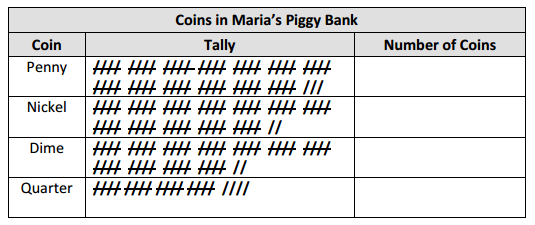
8 kg = 8,000 g as
8 kg = 8 X 10³ g = 8 X 1000 = 8,000 g.
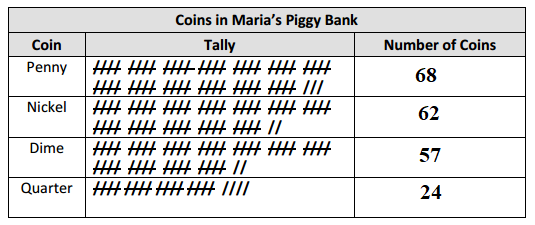
15000 g = 15,000 kg ÷ 103 g = 15 kg,
So 15 kg = 15,000 g.
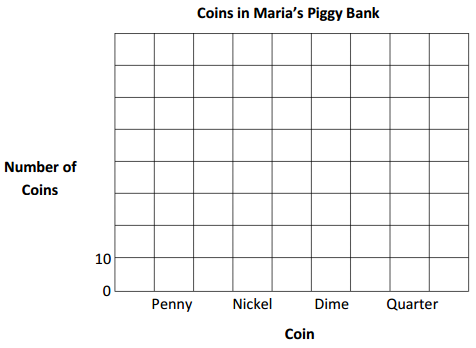
24 kg = 24,000 g as
24 kg = 24 X 103 g = 24 X 1000 g = 24,000 g

550 kg = 550,000 g as
550 kg = 550 X 103 g = 550 X 1000 g = 550,000 g.
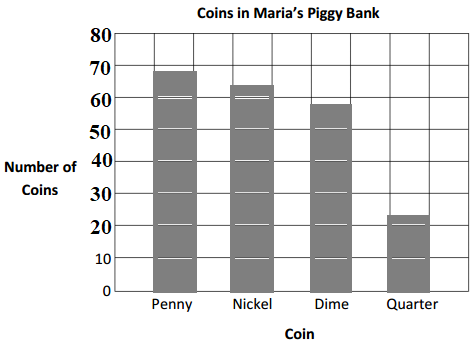
Question 2.
Convert the measurements.
a. 2 kg 700 g = ____2,700_______ g
b. 5 kg 945 g = ______5,945_____ g
c. 29 kg 58 g = ______29,058____ g
d. 31 kg 3 g = _____31,003________ g
e. 66,597 g = __66___ kg __597_____ g
f. 270 kg 41 g = _____270,041_______ g

a. 2 kg 700 g = 1500 g

Explanation:
2 kg 700 g  as 1 kg = 103 g= 1000 g,
2 X 1000 g + 700 g = 2700 g.
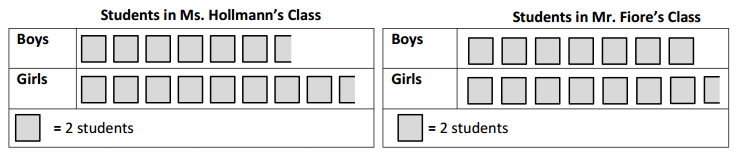
b. 5 kg 945 g = 5945 g,

Explanation:
5 kg 945 g  as 1 kg = 103 g= 1000 g,
5 X 1000 g + 945 g= 5000 g + 945 g= 5945 g.
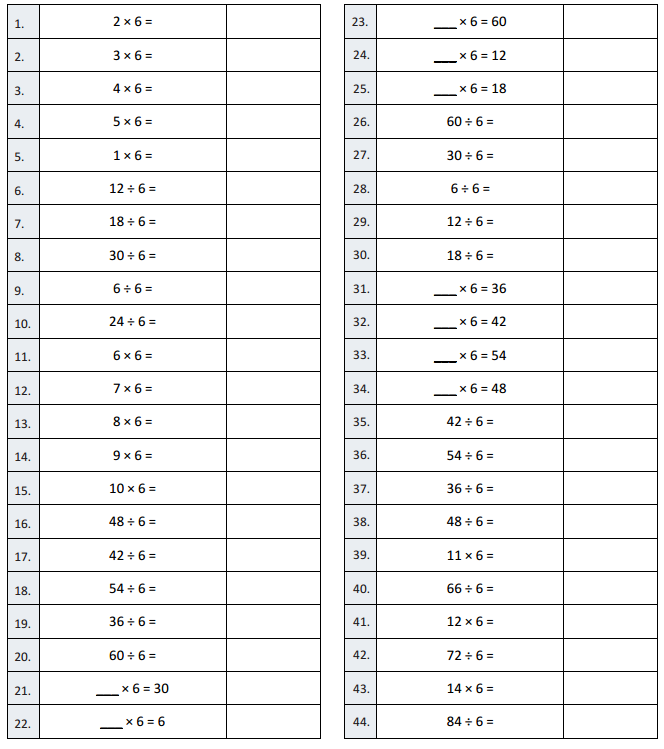
c. 29 kg 58 g = 29,058 g,
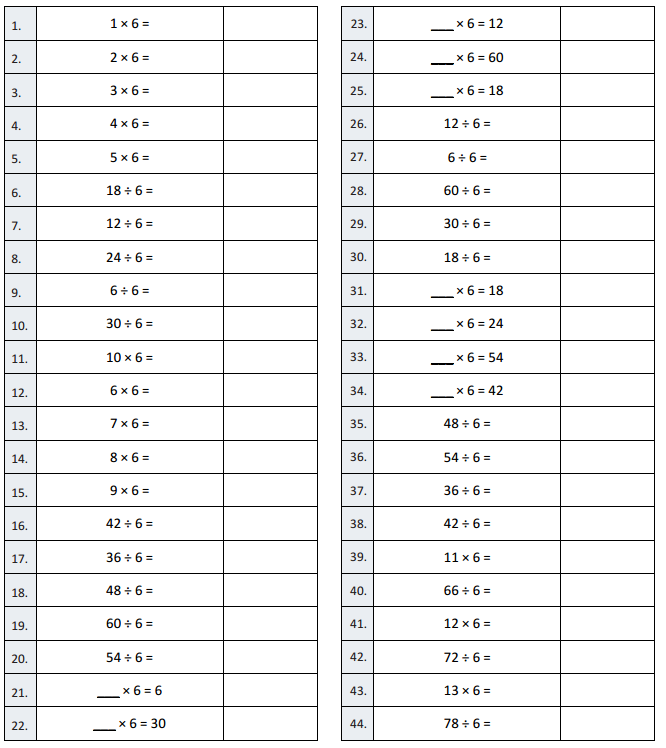
Explanation:
29 kg 58 g  as 1 kg = 103 g= 1000 g,
29 X 1000 g + 84 g = 29000 g + 58 g = 29,058 g.

d. 31 kg 3 g = 31,003 g,

Explanation:
31 kg 3 g  as 1 kg = 103 g= 1000 g,
31 X 1000 g + 3 g = 31000 g + 3 g = 31,003 g.

e. 66,597 g= 66 kg 597 g,

Explanation:
As 1000 g = 1 kg,
So 66,597 g =66,597 kg ÷ 1000 g = 66 kg 597 g.

f. 270 kg 41 g = 270,041 g

Explanation:
270 kg 41 g  as 1 kg = 103 g= 1000 g,
270 X 1000 g + 41 g = 270000 g + 41 g = 270,041 g.

Question 3.
Solve.
a. 370 g + 80 g
b. 5 kg – 730 g
c. Express the answer in the smaller unit:
27 kg 547 g + 694 g
d. Express the answer in the smaller unit:
16 kg + 2,800 g
e. Express the answer in mixed units:
4 kg 229 g – 355 g
f. Express the answer in mixed units:
70 kg 101 g – 17 kg 862 g

Use a tape diagram to model each problem. Solve using a simplifying strategy or an algorithm, and write your answer as a statement.

a. 370 g + 80 g =
370 g + 80 g = 450 g,
Eureka Math Grade 4 Module 2 Lesson 2 Answer Key-11
Statement : Three hundred seventy grams plus
eighty grams is equal to four hundred fifty grams.
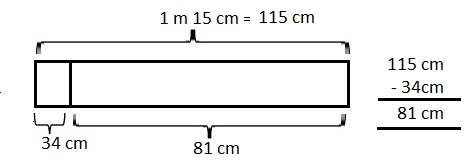
Explanation:
Given  370 g + 80 g =
370 g
+80 g
450  g
Used a tape diagram to model the problem.
Solved using a simplifying strategy and wrote
my answer as a statement three hundred seventy grams plus
eighty grams is equal to four hundred fifty grams.
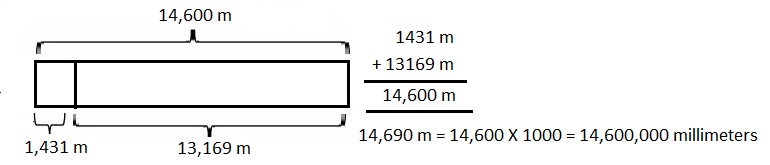
b. 5 kg – 730 g =
5 kg – 730 g = 4,270 g,
Eureka Math Grade 4 Module 2 Lesson 2 Answer Key-12
Statement : Five kilograms minus seven hundred

thirty grams is equal to four thousand two hundred seventy grams,

Explanation:
Given  5 kg – 730 g =
As 5 kg = 5 X 1000 g = 5000 g,
5000 g
– 730 g
4,270 g
Used a tape diagram to model the problem.
Solved using a simplifying strategy and wrote
my answer as a statement five kilograms minus seven hundred
thirty grams is equal to four thousand two hundred seventy grams.

c. Express the answer in the smaller unit:
27 kg 547 g + 694 g
27 kg 57 g + 694 g = 28 kg 241 g or 28,241 g or
28,241,000 milligrams,
Eureka Math Grade 4 Module 2 Lesson 2 Answer Key-13
Statement : twenty seven kilogram fifty seven grams plus
six hundred ninety four is equal to twenty eight kilograms
two hundred forty one grams or Twenty eight hundred two lakh
forty one thousand milligrams,

Explanation:
Given  27 kg 547 g + 694 g =
As 27 kg 547 g = 27 X 1000 g + 547 g = 27000 g + 547 g = 27,547 g,
27547 g
+694 g
28,241 g
The smaller unit as 1 gram is equal to 1,000 milligrams,
So 28,241 g = 28,241 X 1000 = 28,241,000 milligrams, 
Used a tape diagram to model the problem.
Solved using a simplifying strategy and wrote
my answer as a statement twenty seven kilogram fifty seven grams plus
six hundred ninety four is equal to twenty eight kilograms
two hundred forty one grams or twenty eight hundred two lakh
forty one thousand milligrams.

d. Express the answer in the smaller unit:
16 kg + 2,800 g
16 kg + 2800 g = 18 kg 800 g  or 18,800 g or
18,800,000 milligrams,
Eureka Math Grade 4 Module 2 Lesson 2 Answer Key-14
Statement : sixteen kilogram plus two thousand eight hundred grams
twenty kilogram nine hundred ninety grams is equal to
eighteen kilogram eight hundred grams or eighteen thousand eight hundred grams or eighteen hundred eight lakh milligrams,

Explanation:
Given 16 kg + 2800 g  =
As 16 kg = 16 X 1000 g = 16000 g = 16,000 g,
16000 g
+2800 g
18,800 g
The smaller unit as 1 gram is equal to 1,000 milligrams,
So 18,800 g = 18,800 X 1000 = 18,800,000 milligrams, 
Used a tape diagram to model the problem.
Solved using a simplifying strategy and wrote
my answer as a statement sixteen kilogram plus two thousand eight hundred grams twenty kilogram nine hundred ninety grams is equal to
eighteen kilogram eight hundred grams or eighteen thousand eight hundred grams or eighteen hundred eight lakh milligrams.

e. Express the answer in mixed units:
4 kg 229 g – 355 g,
4 kg 229 g – 355 g = 3,874 g in mixed units is 3 kg 874 g,
Eureka Math Grade 4 Module 2 Lesson 2 Answer Key-15
Statement : four kilograms two hundred twenty nine minus three
hundred fifty five grams equals to three kilograms eight
hundred and seventy four grams,

Explanation:
Given 4 kg 229 g – 355 g =
As 4 kg 229 g = 4 X 1000 g + 229  = 4000 g + 229 g = 4,229 g,
4229 g
– 355 g
3,874 g
The mixed unit 3,874 grams is equal to 3 kg 874 grams,
as 3874 g = 3874 ÷ 1000 kg = 3 kg 874 grams, 
Used a tape diagram to model the problem.
Solved using a simplifying strategy and wrote
my answer as a statement four kilograms two hundred
twenty nine minus three hundred fifty five grams equals
to three kilograms eight hundred and seventy four grams.

f. Express the answer in mixed units:
70 kg 101 g – 17 kg 862 g
70 kg 101 g – 17 kg 862 g = 52,239 g in mixed units is 52 kg 239 g,
Eureka Math Grade 4 Module 2 Lesson 2 Answer Key-16
Statement : seventy kilograms one hundred one gram minus
seventeen kilograms eight hundred sixty two grams is equal to
fifty two thousand two hundred thirty nine grams or
fifty two kilograms two hundred thirty nine grams,

Explanation:
Given 70 kg 101 g – 17 kg 862 g =
70 kg 101 g = 70 X 1000 g + 101 g = 70000 g + 101 g = 70,101 g,
17 kg 862 g = 17 X 1000 g + 862 g = 17000 g + 862 g = 17,862 g,
70101 g
– 17862 g
52,239 g
The mixed unit 52,239 grams is equal to 52 kg 239 grams,
as 52,239 g = 52,239 ÷ 1000  = 52 kg 239 grams, 
Used a tape diagram to model the problem.
Solved using a simplifying strategy and wrote
my answer as a statement seventy kilograms one hundred
one gram minus seventeen kilograms eight hundred sixty
two grams is equal to fifty two thousand two hundred
thirty nine grams or fifty two kilograms two hundred
thirty nine grams.

Question 4.
One suitcase weighs 23 kilograms 696 grams.
Another suitcase weighs 25 kilograms 528 grams.
What is the total weight of the two suitcases?

The total weight of the two suitcases is 49 kilograms 224 grams or
49,224 grams,

Explanation:
Given one suitcase weighs 23 kilograms 696 grams and
another suitcase weighs 25 kilograms 528 grams.
The total weight of the two suitcases is
23 kg 696 g + 25 kg + 528 g =
As 1 Kg = 1000 g, so 23 kg 696 g =
23 X 1000 g + 696 g = 23,696 g and
25 kg 528 g = 25 X 1000 g + 528 g = 25,528 g,
23,696 g
+ 25,528 g
49,224 g
or 49,224 g ÷ 1000  = 49 kg 224 g,
So, The total weight of the two suitcases is 49 kilograms 224 grams
or 49,224 grams.

Question 5.
A bag of potatoes and a bag of onions combined
weigh 11 kilograms 15 grams. If the bag of potatoes
weighs 7 kilograms 300 grams, how much does
the bag of onions weigh?

The bag of onions weigh’s 3,715 grams or 3 kilograms 715 grams,

Explanation:
Given a bag of potatoes and a bag of onions combined
weigh 11 kilograms 15 grams. If the bag of potatoes
weighs 7 kilograms 300 grams, So the bag of onions weigh
11 kg 15 g – 7 kg 300 g =
as 1 Kg = 1000 g, 11 kg 15 g = 11 X 1000 g + 15 g =
11,000 g + 15 g = 11,015 g and
7 kg 300 g = 7 X 1000 g + 300 g =
7000 g + 300 g = 7,300 g, Now
11,015 g
-7,300 g
3,715 g
or 3,715 g ÷ 1000  = 3 kg 715 g ,
Therefore, the bag of onions weigh’s 3,715 grams
or 3 kilograms 715 grams.

Question 6.
The table to the right shows the weight of three dogs.
What is the difference in weight between the heaviest
and lightest dog?

Dog

Weight

Lassie

21 kg 249 g
Riley

23 kg 128 g

Fido

21,268 g

The difference in weight between the heaviest
and lightest dog is 1,879 grams or 1 kilogram 879 grams,

Explanation:
Given the table to the right shows the weight of three dogs.
More the heaviest dog among three is
Riley 23 kg 128 g weigh and the lightest dog among the
three is Lassie 21 kg 249 g, So now the difference in
weight between the heaviest and lightest dog is
23 kg 128 g – 21 kg 249 g =
So 23 X 1000 g + 128 g = 23,128 g and
21 kg 249 g = 21 X 100 + 249 g = 21,249 g now
23,128 g
-21,249 g
1,879 g
or 1,879 ÷ 1000 = 1 kg 879 g,
Therefore, the difference in weight between the heaviest
and lightest dog is 1,879 grams or 1 kilogram 879 grams.

Eureka Math Grade 4 Module 2 Answer Key

Eureka Math Grade 4 Module 2 Lesson 1 Answer Key

Engage NY Eureka Math 4th Grade Module 2 Lesson 1 Answer Key

Eureka Math Grade 4 Module 2 Lesson 1 Problem Set Answer Key

Question 1.
Convert the measurements.
a. 1 km = _______1000________ m
b. 4 km = _______4000________ m
c. 7 km = ________7000_______ m
d. ___18_______ km = 18,000 m
e. 1 m = _______100________ cm
f. 3 m = _______300________ cm
g. 80 m = ______8000_________ cm
h. ____120____ m = 12,000 cm

a. 1 km = 1000 m,

Explanation:
1 km is equal to 103 meter,
1 km = 1 X 10 X 10 X 10 = 1000 meter,
So 1 km = 1000 m.

b. 4 km = 4000 km,

Explanation:
4 km is equal to 4 X 10³ meter,
4 km = 4 X 10 X 10 X 10 = 4000 meter,
So 1 km = 4000 m.

c. 7 km = 7000 km,

Explanation:
7 km is equal to 7 X 10³ meter,
7 km = 7 X 10 X 10 X 10 = 7000 meter,
So 7 km = 7000 m.

d. 18 km = 18000 km,

Explanation:
18 km is equal to 18 X 103 meter,
18 km = 18 X 10 X 10 X 10 = 18000 meter,
So 18 km = 18000 m.

e. 1 m = 100cm,

Explanation:
1 m is equal to 102 centimeter,
1 m = 1 X 10 X 10 = 100 centimeter,
So 1 m = 100 cm.

f. 3 m = 300cm,

Explanation:
3 m is equal to 3 X 10² centimeter,
3 m = 3 X 10 X 10 = 100 centimeter,
So 3 m = 300 cm.

g. 80 m = 8000 cm,

Explanation:
80 m is equal to  80 X 102 centimeter,
80 m = 80 X 10 X 10 = 8000 centimeter,
So 80 m = 8000 cm.

h. 120 m = 12,000 cm,

Explanation:
120 m is equal to 120 X 102 centimeter,
120 m = 120 X 10 X 10 = 12,000 centimeter,
So 120 m = 12,000 cm.

Question 2.
Convert the measurements.
a. 3 km 312 m = _____3,312__________ m
b. 13 km 27 m = ______13,027_________ m
c. 915 km 8 m = _______9,15,008________ m
d. 3 m 56 cm = ________3,56_______ cm
e. 14 m 8 cm = _________1,408______ cm
f. 120 m 46 cm = _______12,046________ cm

a. 3 km 312 m = 3,312 m,

Explanation:
As we know 1 km is equal to 103 meter,
So 3 km 312 m = 3 X 10³ + 312 = 3,312 meter,
Therefore 3 km 312 m = 3,312 m.

b. 13 km 27 m = 13,027 m,

Explanation:
As we know 1 km is equal to 103 meter,
So 13 km 27 m = 13 X 103 + 27 = 13,027 meter,
Therefore 13 km 27 m = 13,027 m.

c. 915 km 8 m = 9,15,008 m,

Explanation:
As we know 1 km is equal to 103 meter,
So 915 km 8 m = 915 X 103 + 8 = 9,15,008 meter,
Therefore 915 km 8 m = 9,15,007 m.

d. 3 m 56 cm = 3,56 cm

Explanation:
As we know 1 m is equal to 102 centimeter,
3 m 56 cm = 3 X 10² + 56 = 300 + 56 = 3,56 centimeter,
So 3 m 56 cm = 3,56 cm.

e.  14 m 8 cm = 1,408 cm,

Explanation:
As we know 1 m is equal to 102 centimeter,
14 m 8 cm = 14 X 102 + 8 = 1400 + 8 = 1,408 centimeter,
So 14 m 8 cm = 1,408 cm.

f. 120 m 46 cm = 12,046 cm,

Explanation:
As we know 1 m is equal to 102 centimeter,
120 m 46 cm = 120 X 102 + 46 = 12000 + 46 = 12,046 centimeter,
So 120 m 46 cm = 12,046 cm.

Question 3.
Solve.
a. 4 km − 280 m
b. 1 m 15 cm – 34 cm
c. Express your answer in the smaller unit:
1 km 431 m + 13 km 169 m
d. Express your answer in the smaller unit:
231 m 31 cm − 14 m 48 cm
e. 67 km 230 m + 11 km 879 m
f. 67 km 230 m − 11 km 879 m

Use a tape diagram to model each problem.
Solve using a simplifying strategy or an algorithm, and
write your answer as a statement.

a. 4 km − 280 m
4 km – 280 m = 3,720 m
Eureka Math Grade 4 Module 2 Lesson 1 Answer Key-1
4 kilometers minus 280 meters is equal to 3,720 meters,

Explanation:
Given 4 km − 280 m as
4 km = 4 X 10³ m = 4,000 m,
Used a tape diagram to model 4 km – 280 m = 3,720 m
as shown above in the picture,
so 4000 m
     -280 m 
    3,720 m
Statement is 4 kilometers minus 280 meters is
equal to 3,720 meters.

b. 1 m 15 cm – 34 cm
1 m 15 cm – 34 cm =81 cm
Eureka Math Grade 4 Module 2 Lesson 1 Answer Key-2
1 meter 15 centimeters minus 34 centimeter
is equal to 81centimeters,

Explanation:
Given 1 m 15 cm − 34 cm as
1 m 15 cm = 1 X 10² + 15 = 100 + 15 = 115 cm,
Used a tape diagram to model 115 cm – 34 cm = 81 cm
as shown above in the picture,
so 115 cm
     – 34 cm 
       81 cm
Statement is 1 meter 15 centimeters minus
34 centimeters is equal to 81 centimeters.

c.1 km 431 m + 13 km 169 m
1 km 431 m + 13 km 169 m = 14,600 m
or 14,600,000,000 mm,
Eureka Math Grade 4 Module 2 Lesson 1 Answer Key-3
1 kilometer and 431 meters plus 13 kilometers and
169 meters is 14,600 meters or 14,600,000 millimeters,

Explanation:
Given 1 km 431 m + 13 km 169 m as
1 km 431 m = 1 X 10³ + 431 = 1000 + 431 = 1,431 m
and 13 km 169 m = 13 X 103 + 169 =13,169 m
Used a tape diagram to model 1431 m + 13169 m =
14,600 m as shown above in the picture,
001431 m
+13169 m
14,600 m
Now 14,600 m in the smaller unit in millimeter is as
1 meter is equal to 1000 millimeter,
So 14,600 X 1000 = 14,600,000 millimeters.
Statement : 1 kilometer and 431 meters plus 13 kilometers
169 meters gives 14,600,000 millimeters.

d. 231 m 31 cm − 14 m 48 cm
231 m 31 cm – 14m 48 cm = 21,683 cm
or 2,16,830 millimeter
Eureka Math Grade 4 Module 2 Lesson 1 Answer Key-4
231 meter and 31 centimeters minus 14 meters
48 centimeters gives 216,830 millimeters,

Explanation:
Given 231 m 31 cm – 14 m 48 cm as
231 m 31 cm = 231 X 102 + 31 = 23100 + 31 = 23,131 cm
and 14 m 48 cm = 14 X 102 + 48 =1,448 cm
Used a tape diagram to model 23,131 cm – 1,448 cm =
21,683 cm as shown above in the picture,
23134 cm
– 1448 cm
21,683 cm
Now 21,683 cm in the smaller unit millimeters is as
1 centimeter is equal to 10 millimeter,
So 21,683 X 10 = 216,830 millimeters.
Statement : 231 meter and 31 centimeters minus 14 meters
48 centimeters gives 216,830 millimeters.

e. 67 km 230 m + 11 km 879 m
67 km 230 m + 11 km 879 m = 79,109 m
Eureka Math Grade 4 Module 2 Lesson 1 Answer Key-5

67 kilometer and 230 meters plus 11 kilometers and
879 meters is 79,109 meters,

Explanation:
Given 67 km 230 m + 11 km 879 m as
67 km 230 m = 67 X 103 + 230 = 67000 + 230 = 67,230 m
and 11 km 879 m = 11 X 103 + 879 =11,879 m
Used a tape diagram to model 67230 m + 11879 m =
79,109 m as shown above in the picture,
67230 m
+11879 m
79,109 m
So  67 km 230 m + 11 km 879 m = 79,109 m,
Statement : 67 kilometer and 230 meters plus 11 kilometers and
879 meters is 79,109 meters.

f. 67 km 230 m − 11 km 879 m
67 km 230 m – 11 km 879 m = 55,351 m
Eureka Math Grade 4 Module 2 Lesson 1 Answer Key-667 kilometer and 230 meters minus 11 kilometers and
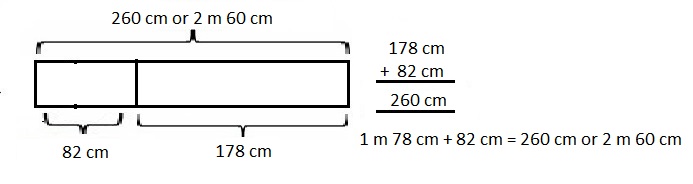
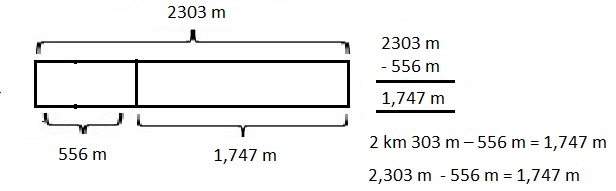
879 meters is 55,351 meters,

Explanation:
Given 67 km 230 m – 11 km 879 m as
67 km 230 m = 67 X 103 + 230 = 67000 + 230 = 67,230 m
and 11 km 879 m = 11 X 103 + 879 =11,879 m
Used a tape diagram to model 67230 m – 11879 m =
55,351 m as shown above in the picture,
67230 m
-11879 m
55,351 m
So  67 km 230 m – 11 km 879 m = 55,351 m,
Statement : 67 kilometer and 230 meters minus 11 kilometers and
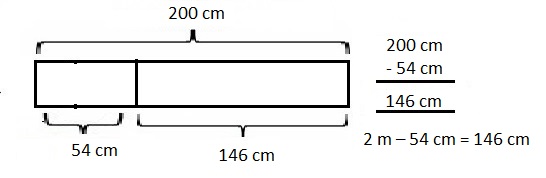
879 meters is 55,351 meters.

Question 4.
The length of Carter’s driveway is 12 m 38 cm.
His neighbor’s driveway is 4 m 99 cm longer.
How long is his neighbor’s driveway?

Neighbor’s drive is 17 m 37 cm or 1737 cm,

Explanation:
Given The length of Carter’s driveway is 12 m 38 cm and
his neighbor’s driveway is 4 m 99 cm longer.
So neighbor’s drive is 12 m 38 cm plus 4 m 99 cm
we know  1 m is equal to 102 centimeter,
12 m 38 cm = 12 X 102 + 38 = 1238 cm
and 4 m 99 cm = 4 X 10² + 99 = 499 cm,
now 1238 cm + 499 cm =
1238 cm
+499 cm
1737 cm
Therefore, Neighbor’s drive is 17 m 37 cm or 1737 cm.

Question 5.
Enya walked 2 km 309 m from school to the store.
Then, she walked from the store to her home.
If she walked a total of 5 km, how far was it from
the store to her home?

It is 2691 m from the store to her home,

Explanation:
Given Enya walked 2 km 309 m from school to the store.
Then, she walked from the store to her home.
If she walked a total of 5 km, it is 5 km – 2 km 309m from
the store to her home, So 5 km means 5 X 10³  – (2 X 10³ + 309) =
5000 m – 2309 m =
5000 m
-2309 m
2691 m
Therefore, It is 2691 m from the store to her home.

Question 6.
Rachael has a rope 5 m 32 cm long that she cut
into two pieces. One piece is 249 cm long.
How many centimeters long is the other piece of rope?

The other piece of rope 283 cm long,

Explanation:
Given Rachael has a rope 5 m 32 cm long that she cut
into two pieces and one piece is 249 cm long.
The other piece of rope is 5 m 32 cm minus 249 cm long,
So, 5 m 32 cm – 249 cm = 5 X 10² + 32 – 249 = 532 – 249 = 283 cm,
therefore, the other piece of rope 283 cm long.

Question 7.
Jason rode his bike 529 fewer meters than Allison.
Jason rode 1 km 850 m. How many meters did Allison ride?

Allison rode 2 km 379 meters or 2379 meters,

Explanation:
Given Jason rode his bike 529 fewer meters than Allison.
Jason rode 1 km 850 m. Number of meters Allison rode is
1 km 850 m + 529 m = 1 X 10³ + 850 + 529 = 1850 + 529 =
2379 meters. Therefore Allison rode 2 km 379 meters or 2379 meters.

Eureka Math Grade 4 Module 2 Lesson 1 Exit Ticket Answer Key

Question 1.
Complete the conversion table.

Distance

71 km___71,000___ m
______30____ km30,000 m
81 m____8,100______ cm
____4______ m400  cm

Explanation:
71 km is equal to 71 X  103 = 71 X 1000 = 71,000 m,
so 71 km = 71,000 m.

30 km is equal to 30 X 103 = 30 X 1000 = 30,000 m,
so 30 km = 30,000 m.

81 m is equal to 81 X 102 = 81 X 100 = 8,100 cm,
so 81 m = 8,100 cm.

4 m is equal to 4 X 102 = 4 X 100 = 400 cm,
so 4 m = 400 cm.

Question 2.
13 km 20 m = ____13020___ m
13 km 20 m = 13,020 m

Explanation:
Given 13 km 20 m as 1 km is equal to 103 m so
13 km 20 m = 13 X 103+ 20 m = 13 X 1000 + 20 =
13000 + 20 = 13020, therefore 13 km 20 m = 13,020 m.

Question 3.
401 km 101 m – 34 km 153 m = _366,948 m or 366 km 948 m__
401 km 101 m – 34 km 153 m = 366,948 m or 366 km 948 m,

Explanation:
Given 401 km 101 m – 34 km 153 m as
401 km 101 m = 401 X 103 + 101 = 401000 + 101 = 401,101 m
and 34 km 153 m = 34 X 103 + 153 = 34153 m
Now 401,101 – 34,153 =
401101 m
-34153 m
366,948 m
So, 401 km 101 m – 34 km 153 m = 366,948 m or 366 km 948 m.

Question 4.
Gabe built a toy tower that measured 1 m 78 cm.
After building some more, he measured it, and
it was 82 cm taller. How tall is his tower now?
Draw a tape diagram to model this problem.
Use a simplifying strategy or an algorithm to solve
and write your answer as a statement.

Gabe toy tower is 260 cm or 2 m 60 cm tall,
Eureka Math Grade 4 Module 2 Lesson 1 Answer Key-7
Statement: Gabe tower is 2 meter 60 centimeter tall or 260 centimeter tall,

Explanation:
Given Gabe built a toy tower that measured 1 m 78 cm.
After building some more, he measured it, and
it was 82 cm taller. So Gabe tower is 1 m 78 cm + 82 cm =
1 X 10² + 78 cm + 82 cm = 178 cm + 82 cm  =
178 cm
+ 82 cm
260 cm
tall.
Drawn a tape diagram to model this problem.
Used a simplifying strategy to solve
and wrote my statement as Gabe tower is 2 meter 60 centimeter tall or
260 centimeter tall.

Eureka Math Grade 4 Module 2 Lesson 1 Homework Answer Key

Question 1.
Find the equivalent measures.
a. 5 km = ______5,000_________ m
b. 13 km = _____13,000__________ m
c. _____17__________ km = 17,000 m
d. 60 km = ______60,000_________ m
e. 7 m = ________700_______ cm
f. 19 m = _______1,900________ cm
g. ______24_________ m = 2,400 cm
h. 90 m = _____9,000______ cm

a. 5 km = 5000 m,

Explanation:
1 km is equal to 103 meter,
5 km = 5 X 10 X 10 X 10 = 5000 meter,
So 5 km = 5000 m.

b. 13 km = 13,000 km,

Explanation:
1 km is equal to 103 meter,
13 km = 13 X 10 X 10 X 10 = 13000 meter,
So 13 km = 13,000 m.

c. _______________ km = 17,000 m,
17 km = 17,000 m,

Explanation:
1 m is equal to 1 ÷ 103 km,
17,000 m = 17,000 ÷ 10 X 10 X 10 = 17000 ÷ 1000 = 17 km,
So 17 km = 17,000 m.

d. 60 km = 60,000 m,

Explanation:
1 km is equal to 103 meter,
60 km = 60 X 10 X 10 X 10 = 60,000 meter,
So 60 km = 60,000 m.

e. 7 m = 700 cm,

Explanation:
1 m is equal to 102 centimeter,
7 m = 7 X 10 X 10 = 700 centimeter,
So 7 m = 700 centimeter.

f. 19 m = 1,900 cm,

Explanation:
1 m is equal to 102 centimeter,
19 m = 19 X 10 X 10 = 1,900 centimeter,
So 19 m = 1,900 centimeter.

g. ____________ m = 2,400 cm,

Explanation:
1 cm is equal to 1 ÷ 102 m,
2,400 cm = 2,400 ÷ 10 X 10 = 2400 ÷ 100 = 24 m,
So 24 m = 2,400 cm.

h. 90 m = 9,000 cm,

Explanation:
90 m is equal to 102 centimeter,
90 m = 90 X 10 X 10 = 9,000 centimeter,
So 90 m = 9,000 centimeter.

Question 2.
Find the equivalent measures.
a. 7 km 123 m = _______7,123________ m
b. 22 km 22 m = ______22,022_________ m
c. 875 km 4 m = _______875,004________ m
d. 7 m 45 cm = _______745________ cm
e. 67 m 7 cm = ________6707_______ cm
f. 204 m 89 cm = ____204,89__________ cm

a. 7 km 123 m = 7,123 m,

Explanation:
1 km is equal to 103 meter,
7 km 123 m = 7 X 10 X 10 X 10 + 123 = 7,000 + 123 = 7,123 meter,
So, 7 km 123 m = 7,123 m.

b. 22 km 22 m = 22,022 m,

Explanation:
1 km is equal to 103 meter,
22 km 22 m = 22 X 10 X 10 X 10 + 22 = 22,000 + 22 = 22,022 meter,
So, 22 km 22 m = 22,022 m.

c. 875 km 4 m = 875,004 m,

Explanation:
1 km is equal to 103 meter,
875 km 4 m = 875 X 10 X 10 X 10 + 4 =
875,000 + 4 = 875004 meter,
So, 875 km 4 m = 875,004 m.

d. 7 m 45 cm =745 cm,

Explanation:
1 m is equal to 102 meter,
7 m 45 cm =  7 X 10 X 10 + 45 = 745 cm,
So, 7 m 45 cm =745 cm.

e. 67 m 7 cm = 6,707 cm,

Explanation:
1 m is equal to 102 meter,
67 m 7 cm =  67 X 10 X 10 + 7 = 6700 + 7 = 6,707 cm,
So, 67 m 7 cm = 6,707 cm.

f. 204 m 89 cm = 204,89 cm,

Explanation:
1 m is equal to 102 meter,
204 m 89 cm =  204 X 10 X 10 + 89 = 20400 + 89 = 204,89 cm,
So, 204 m 89 cm = 204,89 cm.

Question 3.
Solve.
a. 2 km 303 m – 556 m
b. 2 m – 54 cm
c. Express your answer in the smaller unit:
338 km 853 m + 62 km 71 m
d. Express your answer in the smaller unit:
800 m 35 cm – 154 m 49 cm
e. 701 km – 523 km 445 m
f. 231 km 811 m + 485 km 829 m

Use a tape diagram to model each problem. Solve using a simplifying strategy or an algorithm, and write your answer as a statement.

a. 2 km 303 m – 556 m
2 km 303 m – 556 m = 1,747 m,
Eureka Math Grade 4 Module 2 Lesson 1 Answer Key-8
2 kilometers 303 m minus 556 meters is equal to 1,747 meters,

Explanation:
Given 2 km 303 m − 556 m as
2 km 303 m = 2 X 10³ m + 303 m = 2,303 m,
Used a tape diagram to model 2,303 m  – 556 m = 1,747 m
as shown above in the picture,
2303 m
– 556 m 
 1,747 m
Statement is 2 kilometers 303 m minus 556 meters is
equal to 1,747 meters.

b. 2 m – 54 cm
2 m – 54 cm = 146 cm,
Eureka Math Grade 4 Module 2 Lesson 1 Answer Key-9
2 meters minus 54 cm is equal to 146 centimeters,

Explanation:
Given 2 m − 54 cm as
2 m =  2 X 102 cm so 200 cm – 54 cm = 146 cm,
Used a tape diagram to model 200 cm  – 54 cm = 146 cm
as shown above in the picture,
200 cm
   –  54 cm 
     146 cm
Statement is 2 meters minus 54 centimeters is
equal to 146 centimeters.

c. Express your answer in the smaller unit:
338 km 853 m + 62 km 71 m,
338 km 853 m + 62 km 71m = 400,924 m
or 400,924,000 mm,
Eureka Math Grade 4 Module 2 Lesson 1 Answer Key-10
338 kilometer and 853 meters plus 62 kilometers and
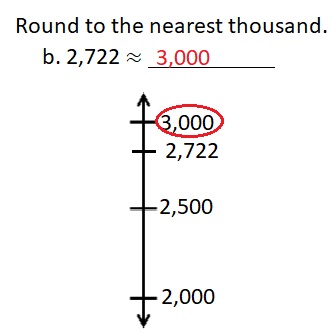
71 meters is 400,924 meters or 400,924,000 millimeters,

Explanation:
Given 338 km 853 m + 62 km 71 m as
338 km 853 m = 338 X 103 + 853 = 338000 + 853 = 338853 m
and 62 km 71 m = 62 X 103 + 71 =62000 + 71 m = 62071 m
Used a tape diagram to model 338853 m + 62071 m = 400,924 m
as shown above in the picture,
338853 m
+62071 m
400,924 m
Now 400,924 m in the smaller unit in millimeter is as
1 meter is equal to 1000 millimeter,
So 400,924 X 1000 = 400,924,000 millimeters.
Statement : 338 kilometer and 853 meters plus 62 kilometers and
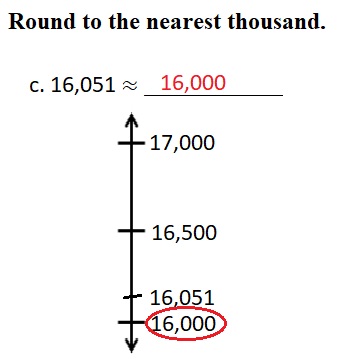
71 meters is 400,924 meters or 400,924,000 millimeters,

d. Express your answer in the smaller unit:
800 m 35 cm – 154 m 49 cm
800 m 35 cm – 154 m 49 cm = 64,586 cm
or 645,860 millimeter,
Eureka Math Grade 4 Module 2 Lesson 1 Answer Key-11
800 meter and 35 centimeters minus 154 meters
49 centimeters gives 645,860 millimeters,

Explanation:
Given 800 m 35 cm – 154 m 49 cm as
800 m 35 cm = 800 X 102 + 35 = 80000 + 35 = 80,035 cm
and 154 m 49 cm = 154 X 102 + 49 =15,449 cm
Used a tape diagram to model 80,035 cm – 15,449 cm =
64,586 cm as shown above in the picture,
80,035 cm
– 15449 cm
64,586 cm
Now 64,586 cm in the smaller unit millimeters is as
1 centimeter is equal to 10 millimeter,
So 64,586 X 10 = 645,860 millimeters.
Statement :  800 meter and 35 centimeters minus 154 meters
49 centimeters gives 64,586 cm or 645,860 millimeters.

e. 701 km – 523 km 445 m
701 km – 523 km 445 m =
Eureka Math Grade 4 Module 2 Lesson 1 Answer Key-12

701 kilometers minus 523 kilometers 445 meters
is equal to 177,555 meters,

Explanation:
Given 701 km − 523 km 445 m,
701 km = 701 X 103 m = 701000 m,
and 523 km 445 m = 523 X 103 m + 445 m = 523445 m
Used a tape diagram to model 701000 m  – 523445 m = 177,555 m
as shown above in the picture,
701000 m
-523445 m 
 177,555 m
Statement is 701 kilometers minus 523 kilometers 445 meters
is equal to 177,555 meters.

f. 231 km 811 m + 485 km 829 m
231 km 811 m + 485 km 829 m = 717,640 m,
Eureka Math Grade 4 Module 2 Lesson 1 Answer Key-13
231 kilometers 811 meters plus 485 kilometers 829 meters
is equal to 717,640 meters,

Explanation:
Given 231 km 811 m + 485 km 829 m,
231 km 811 m = 231 X 103 m =231000 m + 811 m = 231811m
and 485 km 829 m = 485 X 103 m + 829 m = 485829 m
Used a tape diagram to model 231811 m + 485829 m = 717640 m
as shown above in the picture,
231811 m
+485829 m 
  717640 m
Statement is 231 kilometers 811 meters plus
485 kilometers 829 meters is equal to 717,640 meters,

Question 4.
The length of Celia’s garden is 15 m 24 cm.
The length of her friend’s garden is 2 m 98 cm more than Celia’s.
What is the length of her friend’s garden?

The length of Celia’s friend garden is 1822 cm or 18 m 22 cm,

Explanation:
Given the length of Celia’s garden is 15 m 24 cm,
the length of her friend’s garden is 2 m 98 cm
more than Celia’s. So the length of her friend’s garden
is 15 m 24 cm + 2 m 98 cm =
1 m = 102 cm, 15 m 24 cm = 15 X 102 + 24 cm =
1500 + 24 = 1524 cm and 2 m 98 cm = 2 X 10² + 98 cm =
200 + 98 = 298 cm, Now 1524 cm + 298 cm =
1524 cm
+298 cm
1822 cm
Therefore, the length of Celia’s friend garden is
1822 cm or 18 m 22 cm.

Question 5.
Sylvia ran 3 km 290 m in the morning. Then, she ran
some more in the evening. If she ran a total of 10 km,
how far did Sylvia run in the evening?

Sylvia ran 6 km 710 m or 6710 m in the evening,

Explanation:
Sylvia ran 3 km 290 m in the morning. Then, she ran
some more in the evening. If she ran a total of 10 km,
So Sylvia ran in the evening is 10 km – 3 km 290 m =
as 1 km = 103 m so 10 km = 10000 m and 3 km 290 m =
3 X 10³ m + 290 m =3290 m
10000 m
-3290 m
 6710 m
Therefore, Sylvia ran 6 km 710 m or 6710 m in the evening.

Question 6.
Jenny’s sprinting distance was 356 meters shorter than Tyler’s.
Tyler sprinted a distance of 1 km 3 m.
How many meters did Jenny sprint?

Jenny sprint distance is 647 m,

Explanation:
Given Jenny’s sprinting distance was 356 meters
shorter than Tyler’s. Tyler sprinted a distance of 1 km 3 m.
So number of meters did Jenny sprint is 1 km 3 m – 356 m =
1 km = 103 m so 1 km 3 m = 1 X 103 m +3 m = 1000 + 3 = 1003 m,
Now 1003 m – 356 m
1003 m
-356 m
647 m
Therefore, Jenny sprint distance is 647 m.

Question 7.
The electrician had 7 m 23 cm of electrical wire.
He used 551 cm for one wiring project.
How many centimeters of wire does he have left?

The electrician is left with 172 cm electrical wire,

Explanation:
Given the electrician had 7 m 23 cm of electrical wire.
He used 551 cm for one wiring project.
So number of centimeters of wire left is
7 m 23 cm – 551 cm =
as 1 m = 102 cm So 7 m 23 cm = 7 X 102 + 23 =
700 + 23 = 723 cm – 551 cm =
723 cm
-551 cm
172 cm
therefore, the electrician is left with 172 cm electrical wire.

Eureka Math Grade 4 Module 2 Answer Key

Eureka Math Grade 4 Module 1 Answer Key | Engage NY Math 4th Grade Module 1 Answer Key

eureka-math-grade-4-module-1-answer-key

EngageNY Math Grade 4 Module 1 Answer Key | Eureka Math 4th Grade Module 1 Answer Key

Eureka Math Grade 4 Module 1 Place Value, Rounding, and Algorithms for Addition and Subtraction

Eureka Math Grade 4 Module 1 Topic A Place Value of Multi-Digit Whole Numbers

Eureka Math 4th Grade Module 1 Topic B Comparing Multi-Digit Whole Numbers

Engage NY Math 4th Grade Module 1 Topic C Rounding Multi-Digit Whole Numbers

Eureka Math Grade 4 Module 1 Mid Module Assessment Answer Key

EngageNY Math Grade 4 Module 1 Topic D Multi-Digit Whole Number Addition

4th Grade Eureka Math Module 1 Topic E Multi-Digit Whole Number Subtraction

Engage NY Grade 4 Module 1 Topic F Addition and Subtraction Word Problems

Eureka Math Grade 4 Module 1 End of Module Assessment Answer Key

Eureka Math Grade 4 Module 1 Lesson 10 Answer Key

Engage NY Eureka Math 4th Grade Module 1 Lesson 10 Answer Key

Eureka Math Grade 4 Module 1 Lesson 10 Sprint Answer Key

A
Round to the Nearest 10,000
Eureka Math Grade 4 Module 1 Lesson 10 Sprint Answer Key 1
Eureka Math Grade 4 Module 1 Lesson 10 Sprint Answer Key 2

Question 1.
21,000 ≈
Answer:
21,000 ≈ 20,000

Question 2.
31,000 ≈
Answer:
31,000 ≈ 30,000

Question 3.
41,000 ≈
Answer:
41,000 ≈ 40,000

Question 4.
541,000 ≈
Answer:
541,000 ≈ 540,000

Question 5.
49,000 ≈
Answer:
49,000 ≈ 50,000

Question 6.
59,000 ≈
Answer:
59,000 ≈  60,000

Question 7.
69,000 ≈
Answer:
69,000 ≈  70,000

Question 8.
369,000 ≈
Answer:
369,000 ≈ 370,000

Question 9.
62,000 ≈
Answer:
62,000 ≈  60,000

Question 10.
712,000 ≈
Answer:
712,000 ≈ 710,000

Question 11.
28,000 ≈
Answer:
28,000 ≈ 30,000

Question 12.
37,000 ≈
Answer:
37,000 ≈  40,000

Question 13.
137,000 ≈
Answer:
137,000 ≈ 140,000

Question 14.
44,000 ≈
Answer:
44,000 ≈ 40,000

Question 15.
56,000 ≈
Answer:
56,000 ≈  60,000

Question 16.
456,000 ≈
Answer:
456,000 ≈ 460,000

Question 17.
15,000 ≈
Answer:
15,000 ≈  20,000

Question 18.
25,000 ≈
Answer:
25,000 ≈ 30,000

Question 19.
35,000 ≈
Answer:
35,000 ≈ 40,000

Question 20.
235,000 ≈
Answer:
235,000 ≈ 240,000

Question 21.
75,000 ≈
Answer:
75,000 ≈ 80,000

Question 22.
175,000 ≈
Answer:
175,000 ≈ 180,000

Question 23.
185,000 ≈
Answer:
185,000 ≈ 190,000

Question 24.
85,000 ≈
Answer:
85,000 ≈ 90,000

Question 25.
95,000 ≈
Answer:
95,000 ≈ 100,000

Question 26.
97,000 ≈
Answer:
97,000 ≈ 100,000

Question 27.
98,000 ≈
Answer:
98,000 ≈  100,000

Question 28.
198,000 ≈
Answer:
198,000 ≈ 200,000

Question 29.
798,000 ≈
Answer:
798,000 ≈ 800,000

Question 30.
31,200 ≈
Answer:
31,200 ≈ 30,000

Question 31.
49,300 ≈
Answer:
49,300 ≈  50,000

Question 32.
649,300 ≈
Answer:
649,300 ≈  650,000

Question 33.
64,520 ≈
Answer:
64,520 ≈ 60,000

Question 34.
164,520 ≈
Answer:
164,520 ≈ 160,000

Question 35.
17,742 ≈
Answer:
17,742 ≈ 20,000

Question 36.
917,742 ≈
Answer:
917,742 ≈ 920,000

Question 37.
38,396 ≈
Answer:
38,396 ≈ 40,000

Question 38.
64,501 ≈
Answer:
64,501 ≈  60,000

Question 39.
703,280 ≈
Answer:
703,280 ≈ 700,000

Question 40.
239,500 ≈
Answer:
239,500 ≈ 240,000

Question 41.
708,170 ≈
Answer:
708,170 ≈ 710,000

Question 42.
188,631 ≈
Answer:
188,631 ≈ 190,000

Question 43.
777,499 ≈
Answer:
777,499 ≈ 780,000

Question 44.
444,919 ≈
Answer:
444,919 ≈ 440,000

B
Round to the Nearest 10,000
Eureka Math Grade 4 Module 1 Lesson 10 Sprint Answer Key 3
Eureka Math Grade 4 Module 1 Lesson 10 Sprint Answer Key 4

Question 1.
11,000 ≈
Answer:
11,000 ≈ 10,000

Question 2.
21,000 ≈
Answer:
21,000 ≈ 20,000

Question 3.
31,000 ≈
Answer:
31,000 ≈ 30,000

Question 4.
531,000 ≈
Answer:
531,000 ≈ 530,000

Question 5.
39,000 ≈
Answer:
39,000 ≈  40,000

Question 6.
49,000 ≈
Answer:
49,000 ≈ 50,000

Question 7.
59,000 ≈
Answer:
59,000 ≈  60,000

Question 8.
359,000 ≈
Answer:
359,000 ≈ 360,000

Question 9.
52,000 ≈
Answer:
52,000 ≈ 50,000

Question 10.
612,000 ≈
Answer:
612,000 ≈ 610,000

Question 11.
18,000 ≈
Answer:
18,000 ≈ 20,000

Question 12.
27,000 ≈
Answer:
27,000 ≈ 30,000

Question 13.
127,000 ≈
Answer:
127,000 ≈ 130,000

Question 14.
34,000 ≈
Answer:
34,000 ≈ 30,000

Question 15.
46,000 ≈
Answer:
46,000 ≈ 50,000

Question 16.
346,000 ≈
Answer:
346,000 ≈  350,000

Question 17.
25,000 ≈
Answer:
25,000 ≈ 30,000

Question 18.
35,000 ≈
Answer:
35,000 ≈ 40,000

Question 19.
45,000 ≈
Answer:
45,000 ≈ 50,000

Question 20.
245,000 ≈
Answer:
245,000 ≈ 250,000

Question 21.
65,000 ≈
Answer:
65,000 ≈  70,000

Question 22.
165,000 ≈
Answer:
165,000 ≈ 170,000

Question 23.
185,000 ≈
Answer:
185,000 ≈ 190,000

Question 24.
85,000 ≈
Answer:
85,000 ≈  90,000

Question 25.
95,000 ≈
Answer:
95,000 ≈ 100,000

Question 26.
96,000 ≈
Answer:
96,000 ≈ 100,000

Question 27.
99,000 ≈
Answer:
99,000 ≈ 100,000

Question 28.
199,000 ≈
Answer:
199,000 ≈ 200,000

Question 29.
799,000 ≈
Answer:
799,000 ≈  800,000

Question 30.
21,200 ≈
Answer:
21,200 ≈ 20,000

Question 31.
39,300 ≈
Answer:
39,300 ≈  40,000

Question 32.
639,300 ≈
Answer:
639,300 ≈ 640,000

Question 33.
54,520 ≈
Answer:
54,520 ≈ 50,000

Question 34.
154,520 ≈
Answer:
154,520 ≈ 150,000

Question 35.
27,742 ≈
Answer:
27,742 ≈ 30,000

Question 36.
927,742 ≈
Answer:
927,742 ≈ 930,000

Question 37.
28,396 ≈
Answer:
28,396 ≈  30,000

Question 38.
54,501 ≈
Answer:
54,501 ≈  50,000

Question 39.
603,280 ≈
Answer:
603,280 ≈ 600,000

Question 40.
139,500 ≈
Answer:
139,500 ≈ 140,000

Question 41.
608,170 ≈
Answer:
608,170 ≈ 610,000

Question 42.
177,631 ≈
Answer:
177,631 ≈ 180,000

Question 43.
888,499 ≈
Answer:
888,499 ≈ 890,000

Question 44.
444,909 ≈
Answer:
444,909 ≈ 440,000

Eureka Math Grade 4 Module 1 Lesson 10 Problem Set Answer Key

Question 1.
Round 543,982 to the nearest
a. thousand: ___________________________________.
b. ten thousand: ___________________________________.
c. hundred thousand: ___________________________________.
Answer:
Engage-NY-Eureka-Math-4th-Grade-Module-1-Lesson-10-Answer-Key-Eureka-Math-Grade-4-Module-1-Lesson-10-Problem-Set-Answer-Key-Question-1

Question 2.
Complete each statement by rounding the number to the given place value.
a. 2,841 rounded to the nearest hundred is _________________________.
Answer:
Engage-NY-Eureka-Math-4th-Grade-Module-1-Lesson-10-Answer-Key-Eureka-Math-Grade-4-Module-1-Lesson-10-Problem-Set-Answer-Key-Question-2-a
b. 32,851 rounded to the nearest hundred is _________________________.
Answer:
Engage-NY-Eureka-Math-4th-Grade-Module-1-Lesson-10-Answer-Key-Eureka-Math-Grade-4-Module-1-Lesson-10-Problem-Set-Answer-Key-Question-2-b
c. 132,891 rounded to the nearest hundred is _________________________.
Answer:
Engage-NY-Eureka-Math-4th-Grade-Module-1-Lesson-10-Answer-Key-Eureka-Math-Grade-4-Module-1-Lesson-10-Problem-Set-Answer-Key-Question-2-c
d. 6,299 rounded to the nearest thousand is _________________________.
Answer:
Engage-NY-Eureka-Math-4th-Grade-Module-1-Lesson-10-Answer-Key-Eureka-Math-Grade-4-Module-1-Lesson-10-Problem-Set-Answer-Key-Question-2-d
e. 36,599 rounded to the nearest thousand is _________________________.
Answer:
Engage-NY-Eureka-Math-4th-Grade-Module-1-Lesson-10-Answer-Key-Eureka-Math-Grade-4-Module-1-Lesson-10-Problem-Set-Answer-Key-Question-2-e
f. 100,699 rounded to the nearest thousand is _________________________.
Answer:
Engage-NY-Eureka-Math-4th-Grade-Module-1-Lesson-10-Answer-Key-Eureka-Math-Grade-4-Module-1-Lesson-10-Problem-Set-Answer-Key-Question-2-f
g. 40,984 rounded to the nearest ten thousand is _________________________.
Answer:
Engage-NY-Eureka-Math-4th-Grade-Module-1-Lesson-10-Answer-Key-Eureka-Math-Grade-4-Module-1-Lesson-10-Problem-Set-Answer-Key-Question-2-g
h. 54,984 rounded to the nearest ten thousand is _________________________.
Answer:
Engage-NY-Eureka-Math-4th-Grade-Module-1-Lesson-10-Answer-Key-Eureka-Math-Grade-4-Module-1-Lesson-10-Problem-Set-Answer-Key-Question-2-h
i. 997,010 rounded to the nearest ten thousand is _________________________.
Answer:
Engage-NY-Eureka-Math-4th-Grade-Module-1-Lesson-10-Answer-Key-Eureka-Math-Grade-4-Module-1-Lesson-10-Problem-Set-Answer-Key-Question-2-i
j. 360,034 rounded to the nearest hundred thousand is _________________________.
Answer:
Engage-NY-Eureka-Math-4th-Grade-Module-1-Lesson-10-Answer-Key-Eureka-Math-Grade-4-Module-1-Lesson-10-Problem-Set-Answer-Key-Question-2-j
k. 436,709 rounded to the nearest hundred thousand is _________________________.
Answer:
Engage-NY-Eureka-Math-4th-Grade-Module-1-Lesson-10-Answer-Key-Eureka-Math-Grade-4-Module-1-Lesson-10-Problem-Set-Answer-Key-Question-2-k
l. 852,442 rounded to the nearest hundred thousand is _________________________.
Answer:
Engage-NY-Eureka-Math-4th-Grade-Module-1-Lesson-10-Answer-Key-Eureka-Math-Grade-4-Module-1-Lesson-10-Problem-Set-Answer-Key-Question-2-l

Question 3.
Empire Elementary School needs to purchase water bottles for field day. There are 2,142 students. Principal Vadar rounded to the nearest hundred to estimate how many water bottles to order. Will there be enough water bottles for everyone? Explain.
Answer:
Number of students = 2,142 students.
Principal Vadar rounded to the nearest hundred to estimate the order of water bottles for the fields day.
Engage-NY-Eureka-Math-4th-Grade-Module-1-Lesson-10-Answer-Key-Eureka-Math-Grade-4-Module-1-Lesson-10-Problem-Set-Answer-Key-Question-3
if Principal Vadar rounded to 2,100 their won’t be enough water bottles for everyone on the fields day. As their will a shortage of 142 bottles.But if Principal Vadar rounded to 2,200 then their would be enough water bottles for everyone on the fields day. 58 more bottles would be ordered.

Question 4.
Opening day at the New York State Fair in 2012 had an attendance of 46,753. Decide which place value to round 46,753 to if you were writing a newspaper article. Round the number and explain why it is an appropriate unit to round the attendance to.
Answer:
Opening day at the New York State Fair in 2012 had an attendance of 46,753
if i were writing a newspaper article i would round the number to the highest place value of the given number 46,753
The highest place value of 46,753 is ten thousand.
So, I would round it to 50,000 and write it in the newspaper article.

Question 5.
A jet airplane holds about 65,000 gallons of gas. It uses about 7,460 gallons when flying between New York City and Los Angeles. Round each number to the largest place value. Then, find about how many trips the plane can take between cities before running out of fuel.
Answer:
Number of gallons of gas A jet airplane holds is =  65,000
Number of gallons used when flying between New York City and Los Angeles is = 7,460
Engage-NY-Eureka-Math-4th-Grade-Module-1-Lesson-10-Answer-Key-Eureka-Math-Grade-4-Module-1-Lesson-10-Problem-Set-Answer-Key-Question-5
According to the rounding the plane can take 10 trips between cities before running out of fuel.

Eureka Math Grade 4 Module 1 Lesson 10 Exit Ticket Answer Key

Question 1.
There are 598,500 Apple employees in the United States.
a. Round the number of employees to the given place value.
thousand: ________________________________
ten thousand: _____________________________
hundred thousand: __________________________
Answer:
Engage-NY-Eureka-Math-4th-Grade-Module-1-Lesson-10-Answer-Key-Eureka-Math-Grade-4-Module-1-Lesson-10- Exit-Ticket-Answer-Key-Question-1-a
b. Explain why two of your answers are the same.
Answer:
The 9 in the ten thousand place when rounds to 10 which is then shifted to hundred thousands place making 6 hundred thousand 600,000. The 5 in the hundred thousand place gets rounds to 6 hundred thousand as their is 9 in the ten thousand place.

Question 2.
A company developed a student survey so that students could share their thoughts about school. In 2011, 78,234 students across the United States were administered the survey. In 2012, the company planned to administer the survey to 10 times as many students as were surveyed in 2011. About how many surveys should the company have printed in 2012? Explain how you found your answer.
Answer:
Number of students across the United States who administered the survey in 2011 are = 78,234
78,234 i s rounded to nearest ten thousand 80,000
In 2012
The company planned to administer the survey to 10 times as many students as were surveyed in 2011
10 × 80,000  =  800,000.

Eureka Math Grade 4 Module 1 Lesson 10 Homework Answer Key

Question 1.
Round 845,001 to the nearest
a. thousand: ________________________________________.
b. ten thousand: ______________________________________.
c. hundred thousand: ___________________________________.
Answer:
Engage-NY-Eureka-Math-4th-Grade-Module-1-Lesson-10-Answer-Key-Eureka-Math-Grade-4-Module-1-Lesson-10-Homework-Answer-Key-Question-1-a

Question 2.
Complete each statement by rounding the number to the given place value.
a. 783 rounded to the nearest hundred is ________________________________.
Answer:
Engage-NY-Eureka-Math-4th-Grade-Module-1-Lesson-10-Answer-Key-Eureka-Math-Grade-4-Module-1-Lesson-10-Homework-Answer-Key-Question-2-a
b. 12,781 rounded to the nearest hundred is ______________________________.
Answer:
Engage-NY-Eureka-Math-4th-Grade-Module-1-Lesson-10-Answer-Key-Eureka-Math-Grade-4-Module-1-Lesson-10-Homework-Answer-Key-Question-2-b
c. 951,194 rounded to the nearest hundred is _____________________________.
Answer:

Engage-NY-Eureka-Math-4th-Grade-Module-1-Lesson-10-Answer-Key-Eureka-Math-Grade-4-Module-1-Lesson-10-Homework-Answer-Key-Question-2-c
d. 1,258 rounded to the nearest thousand is _______________________________.
Answer:
Engage-NY-Eureka-Math-4th-Grade-Module-1-Lesson-10-Answer-Key-Eureka-Math-Grade-4-Module-1-Lesson-10-Homework-Answer-Key-Question-2-d
e. 65,124 rounded to the nearest thousand is ______________________________.
Answer:
Engage-NY-Eureka-Math-4th-Grade-Module-1-Lesson-10-Answer-Key-Eureka-Math-Grade-4-Module-1-Lesson-10-Homework-Answer-Key-Question-2-e
f. 99,451 rounded to the nearest thousand is _______________________________.
Answer:
Engage-NY-Eureka-Math-4th-Grade-Module-1-Lesson-10-Answer-Key-Eureka-Math-Grade-4-Module-1-Lesson-10-Homework-Answer-Key-Question-2-f
g. 60,488 rounded to the nearest ten thousand is _____________________________.
Answer:
Engage-NY-Eureka-Math-4th-Grade-Module-1-Lesson-10-Answer-Key-Eureka-Math-Grade-4-Module-1-Lesson-10-Homework-Answer-Key-Question-2-g
h. 80,801 rounded to the nearest ten thousand is _____________________________.
Answer:
Engage-NY-Eureka-Math-4th-Grade-Module-1-Lesson-10-Answer-Key-Eureka-Math-Grade-4-Module-1-Lesson-10-Homework-Answer-Key-Question-2-h
i. 897,100 rounded to the nearest ten thousand is _____________________________.
Answer:
Engage-NY-Eureka-Math-4th-Grade-Module-1-Lesson-10-Answer-Key-Eureka-Math-Grade-4-Module-1-Lesson-10-Homework-Answer-Key-Question-2-i

j. 880,005 rounded to the nearest hundred thousand is _________________________.
Answer
Engage-NY-Eureka-Math-4th-Grade-Module-1-Lesson-10-Answer-Key-Eureka-Math-Grade-4-Module-1-Lesson-10-Homework-Answer-Key-Question-2-j
k. 545,999 rounded to the nearest hundred thousand is _________________________.
Answer:
Engage-NY-Eureka-Math-4th-Grade-Module-1-Lesson-10-Answer-Key-Eureka-Math-Grade-4-Module-1-Lesson-10-Homework-Answer-Key-Question-2-k
l. 689,114 rounded to the nearest hundred thousand is _________________________.
Answer:
Engage-NY-Eureka-Math-4th-Grade-Module-1-Lesson-10-Answer-Key-Eureka-Math-Grade-4-Module-1-Lesson-10-Homework-Answer-Key-Question-2-l

Question 3.
Solve the following problems using pictures, numbers, or words.
a. In the 2011 New York City Marathon, 29,867 men finished the race, and 16,928 women finished the race. Each finisher was given a t-shirt. About how many men’s shirts were given away? About how many women’s shirts were given away? Explain how you found your answers.
Answer:
Number of men finished the race in the 2011 New York City Marathon are = 29,867
Number of women finished the race in the 2011 New York City Marathon are = 16,928
Engage-NY-Eureka-Math-4th-Grade-Module-1-Lesson-10-Answer-Key-Eureka-Math-Grade-4-Module-1-Lesson-10-Homework-Answer-Key-Question-3-a
I have rounded the number to the nearest thousands place 30,000 and 17,000 as you can see the value in the image  are above the mid points.
b. In the 2010 New York City Marathon, 42,429 people finished the race and received a medal. Before the race, the medals had to be ordered. If you were the person in charge of ordering the medals and estimated how many to order by rounding, would you have ordered enough medals? Explain your thinking.
Answer:
Number of people finished the race and received a medal in the 2010 New York City Marathon are = 42,429
If i rounded the number to the nearest thousand it would be 42,000 which won’t be enough. If we round the number to the nearest then thousand it would be 40,000 and this value also won’t be enough too.

c. In 2010, 28,357 of the finishers were men, and 14,072 of the finishers were women. About how many more men finished the race than women? To determine your answer, did you round to the nearest ten thousand or thousand? Explain.
Answer:
Number of men who finished the race in 2010 = 28,357
Number of women who finished the race in 2010 = 14,072
28,357 ~ 30,000
14,072 ~ 10,000
30,000 – 10,000 = 20,000 more men finished the race than women.
Rounded the number to the nearest ten thousands. I used this place because i could use mental math.

Eureka Math Grade 4 Module 1 Answer Key