Eureka Math Grade 6 Module 2 End of Module Assessment Answer Key

Engage NY Eureka Math 6th Grade Module 2 End of Module Assessment Answer Key

Eureka Math Grade 6 Module 2 End of Module Assessment Answer Key

Question 1.
LB. Johnson Middle School held a track and field event during the school year. The chess club sold various drink and snack items for the participants and the audience. Altogether, they sold 486 items that totaled $2,673.
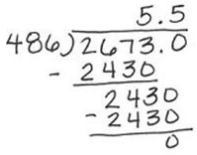
a. If the chess club sold each item for the same price, calculate the price of each item.
Answer:
Eureka Math Grade 6 Module 2 End of Module Assessment Answer Key 2
Each item’s price is $5.50

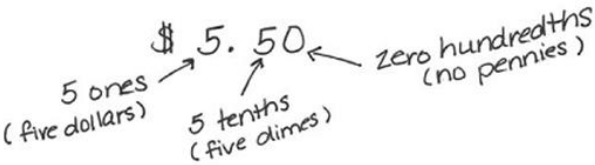
b. Explain the value of each digit in your answer to 1(a) using place value terms.
Answer:
Eureka Math Grade 6 Module 2 End of Module Assessment Answer Key 3

Question 2.
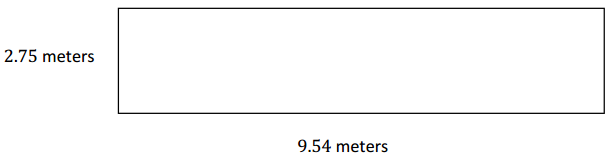
The long-jump pit was recently rebuilt to make it level with the runway. Volunteers provided pieces of
wood to frame the pit. Each piece of wood provided measures 6 feet, which is approximately 1.8287
meters.
Eureka Math Grade 6 Module 2 End of Module Assessment Answer Key 1
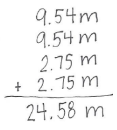
a. Determine the amount of wood, in meters, needed to rebuild the frame.
Answer:
Eureka Math Grade 6 Module 2 End of Module Assessment Answer Key 4

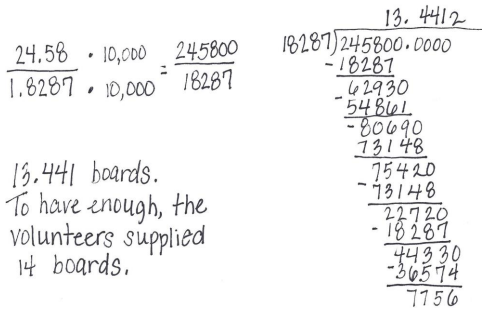
b. How many boards did the volunteers supply? Round your calculations to the nearest hundredth, and then provide the whole number of boards supplied.
Answer:
Eureka Math Grade 6 Module 2 End of Module Assessment Answer Key 5

Question 3.
Andy runs 436.8 meters in 62.08 seconds.
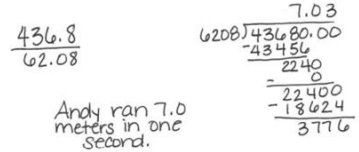
a. If Andy runs at a constant speed, how far does he run in one second? Give your answer to the nearest tenth of a second.
Answer:
Eureka Math Grade 6 Module 2 End of Module Assessment Answer Key 6

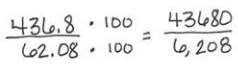
b. Use place value, multiplication with powers of 10, or equivalent fractions to explain what is happening mathematically to the decimal points in the divisor and dividend before dividing.
Answer:
Eureka Math Grade 6 Module 2 End of Module Assessment Answer Key 7
When you write the problem as a fraction, multiply the numerator and denominator by 100. Multiplying each by 100 resulted in both numbers being whole numbers.
436.8 ÷ 62.08 is the same as 43,680 ÷ 6,208.

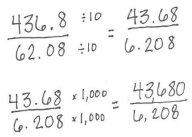
c. In the following expression, place a decimal point in the divisor and the dividend to create a new problem with the same answer as in 3(a). Then, explain how you know the answer will be the same.
43.68 ÷ 6.208
Answer:
Eureka Math Grade 6 Module 2 End of Module Assessment Answer Key 8
Multiplying or dividing the dividend and divisor by the same power of ten yields the same quotient.

Question 4.
The PTA created a cross-country trail for the meet.
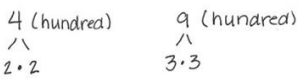
a. The PTA placed a trail marker in the ground every four hundred yards. Every nine hundred yards, the PTA set up a water station. What is the shortest distance a runner will have to run to see both a water station and trail marker at the same location?
Answer:
Eureka Math Grade 6 Module 2 End of Module Assessment Answer Key 9
LCM 2 . 2 . 3 . 3 = 36 hundred
36 hundred yards

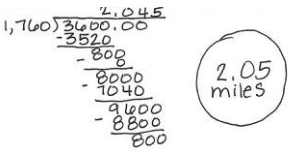
b. There are 1,760 yards in one mile. About how many miles will a runner have to run before seeing both a water station and trail marker at the same location? Calculate the answer to the nearest hundredth of a mile.
Answer:
Eureka Math Grade 6 Module 2 End of Module Assessment Answer Key 10

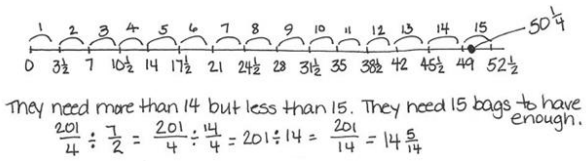
c. The PTA wants to cover the wet areas of the trail with wood chips. They find that one bag of wood
chips covers a 3\(\frac{1}{2}\)-yard section of the trail. If there is a wet section of the trail that is approximately 50\(\frac{1}{4}\) yards long, how many bags of wood chips are needed to cover the wet section of the trail?
Answer:
Eureka Math Grade 6 Module 2 End of Module Assessment Answer Key 11

Question 5.
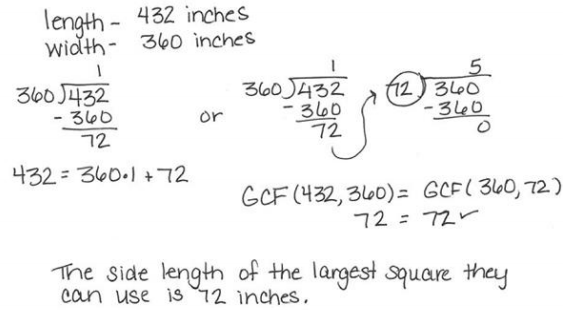
The Art Club wants to paint a rectangle-shaped mural to celebrate the winners of the track and field meet. They design a checkerboard background for the mural where they will write the winners’ names. The rectangle measures 432 inches in length and 360 inches in width. Apply Euclid’s algorithm to determine the side length of the largest square they can use to fill the checkerboard pattern completely without overlap or gaps.
Answer:
Eureka Math Grade 6 Module 2 End of Module Assessment Answer Key 12

Eureka Math Grade 6 Module 2 Lesson 19 Answer Key

Engage NY Eureka Math 6th Grade Module 2 Lesson 19 Answer Key

Eureka Math Grade 6 Module 2 Lesson 19 Opening Exercise Answer Key

Euclid’s algorithm is used to find the greatest common factor (GCF) of two whole numbers.
1. Divide the larger of the two numbers by the smaller one.
2. If there is a remainder, divide it into the divisor.
3. Continue dividing the last divisor by the last remainder until the remainder is zero.
4. The final divisor is the GCF of the original pair of numbers.

383 ÷ 4 =
Answer:
95.75

432 ÷ 12 =
Answer:
36

403 ÷ 13 =
Answer:
31

Eureka Math Grade 6 Module 2 Lesson 19 Example Answer Key

Example 1:
Euclid’s Algorithm Conceptualized
Eureka Math Grade 6 Module 2 Lesson 19 Example Answer Key 1
Answer:
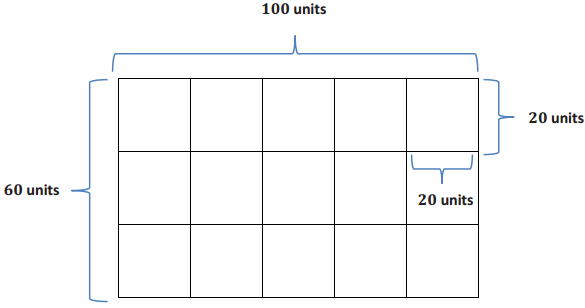
→ Notice that we can use the GCF of 20 to create the largest square tile that covers the rectangle without any overlap or gaps. We used a 20 × 20 tile.
→ But, what if we did not know that? We could start by guessing. What is the biggest square tile that we can guess?
60 × 60

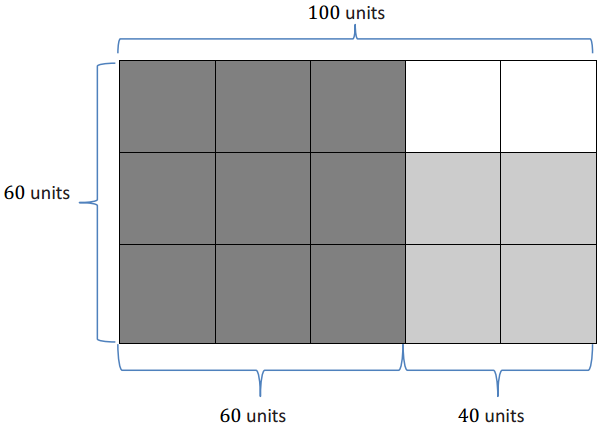
Display the following diagram:
Eureka Math Grade 6 Module 2 Lesson 19 Example Answer Key 2

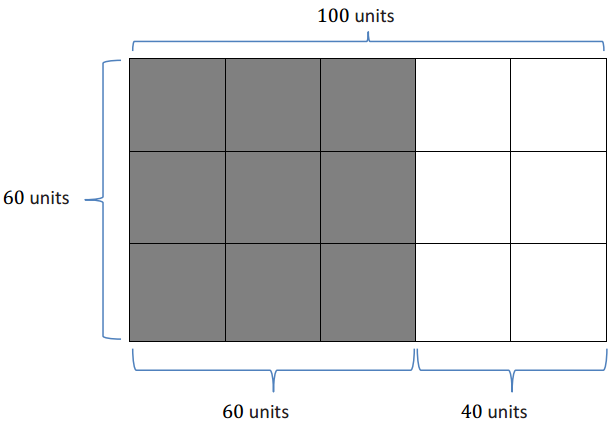
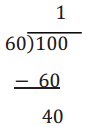
→ It fits, but there are 40 units left over. Do the division problem to prove this.
→ What is the leftover area?
60 × 40
→ What is the largest square tile that we can fit in the leftover area?
40 × 40
Eureka Math Grade 6 Module 2 Lesson 19 Example Answer Key 3

Display the following diagram:
Eureka Math Grade 6 Module 2 Lesson 19 Example Answer Key 4

→ What is the leftover area?
20 × 40
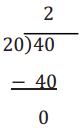
→ What is the largest square tile that we can fit in the leftover area? 20)40
20 × 20
→ When we divide 40 by 20, there is no remainder. So, we have tiled the entire rectangle.
→ If we had started tiling the whole rectangle with squares, the largest square we could have used would be 20 by 20.
Eureka Math Grade 6 Module 2 Lesson 19 Example Answer Key 5

Example 2.
a. Let’s apply Euclid’s algorithm to some of the problems from our last lesson.
i. What is the GCF of 30 and 50?
Answer:
10

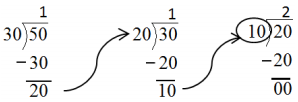
ii. Using Euclid’s algorithm, we follow the steps that are listed In the Opening Exercise.
Answer:
Eureka Math Grade 6 Module 2 Lesson 19 Example Answer Key 6
When the remainder is zero, the final divisor is the GCF.

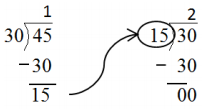
b. Apply Euclid’s algorithm to find the GCF (30, 45).
Answer:
Eureka Math Grade 6 Module 2 Lesson 19 Example Answer Key 7
15

Example 3.
Larger Numbers
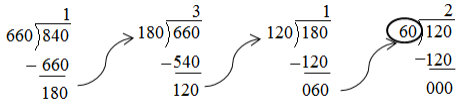
GCF (96, 144)
Answer:
Eureka Math Grade 6 Module 2 Lesson 19 Example Answer Key 8

Example 4:
Area Problems
The greatest common factor has many uses. Among them, the GCF lets us find out the maximum size of squares that cover a rectangle. When we solve problems like this, we cannot have any gaps or any overlapping squares. Of course, the maximum size squares is the minimum number of squares needed.

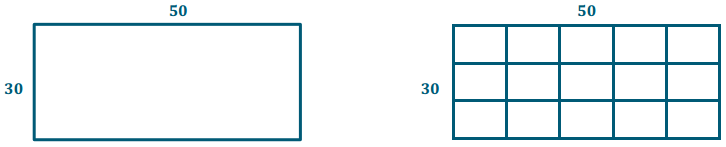
A rectangular computer table measures 30 inches by 50 inches. We need to cover it with square tiles. What is the side length of the largest square tile we can use to completely cover the table without overlap or gaps?
Answer:
Eureka Math Grade 6 Module 2 Lesson 19 Example Answer Key 9

a. If we use squares that are 10 by 10, how many do we need?
Answer:
3 . 5, or 15 squares

b. If this were a giant chunk of cheese ¡n a factory, would ¡t change the thinking or the calculations we just did?
Answer:
No

c. How many 10 inch × 10 inch squares of cheese could be cut from the giant 30 inch × 50 inch slab?
Answer:
15

Eureka Math Grade 6 Module 2 Lesson 19 Problem Set Answer Key

Question 1.
Use Euclid’s algorithm to find the greatest common factor of the following pairs of numbers:
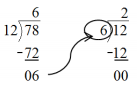
a. GCF(12, 78)
Answer:
Eureka Math Grade 6 Module 2 Lesson 19 Problem Set Answer Key 10
GCF (12, 78) = 6

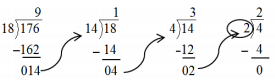
b. GCF(18, 176)
Answer:
11Eureka Math Grade 6 Module 2 Lesson 19 Problem Set Answer Key 10
GCF (18, 176) = 2

Question 2.
Juanita and Samuel are planning a pizza party. They order a rectangular sheet pizza that measures 21 inches by 36 inches. They tell the pizza maker not to cut it because they want to cut it themselves.
a. All pieces of pizza must be square with none left over. What is the side length of the largest square pieces into which Juanita and Samuel can cut the pizza?
Answer:
GCF (21, 36) = 3 They can cut the pizza into 3 inch by 3 inch squares.

b. How many pieces of this size can be cut?
Answer:
7. 12 = 84 Juanita and Samuel can cut 84 pieces.

Question 3.
Shelly and Mickelle are making a quilt. They have a piece of fabric that measures 48 inches by 168 inches.
a. All pieces of fabric must be square with none left over. What is the side length of the largest square pieces into which Shelly and Mickelle can cut the fabric?
Answer:
GCF (48, 168) = 24

b. How many pieces of this size can Shelly and Mickelle cut?
Answer:
2 . 7 = 14 They can cut 14 pieces.

Eureka Math Grade 6 Module 2 Lesson 19 Exit Ticket Answer Key

Question 1.
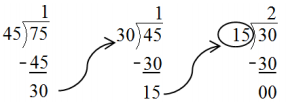
Use Euclid’s algorithm to find the greatest common factor of 45 and 75.
Answer:
11Eureka Math Grade 6 Module 2 Lesson 19 Problem Set Answer Key 11
GCF (45, 75) = 15

Eureka Math Grade 6 Module 2 Lesson 18 Answer Key

Engage NY Eureka Math 6th Grade Module 2 Lesson 18 Answer Key

Eureka Math Grade 6 Module 2 Lesson 18 Example Answer Key

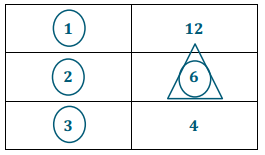
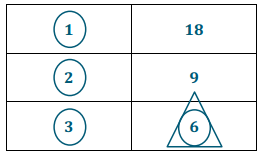
Find the greatest common factor of 12 and 18.
→ Listing these factor pairs in order helps ensure that no common factors are missed. Start with 1 multiplied by the number.
→ Circle all factors that appear on both lists.
→ Place a triangle around the greatest of these common factors.
GCF (12, 18)

12

Eureka Math Grade 6 Module 2 Lesson 18 Example Answer Key 1
Answer:
Eureka Math Grade 6 Module 2 Lesson 18 Example Answer Key 2

18
Eureka Math Grade 6 Module 2 Lesson 18 Example Answer Key 3
Answer:
Eureka Math Grade 6 Module 2 Lesson 18 Example Answer Key 4

Example 2.
Least Common Multiple
Find the least common multiple of 12 and 18.
LCM (12, 18)
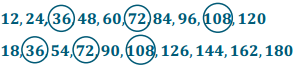
Write the first 10 multiples of 12.
Answer:
12, 24, 36, 48, 60, 72, 84, 96, 108, 120

Write the first 10 multiples of 18.
Answer:
18, 36, 54, 72, 90, 108, 126, 144, 162, 180

Circle the multiples that appear on both lists.
Answer:
Eureka Math Grade 6 Module 2 Lesson 18 Example Answer Key 5

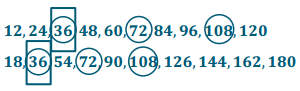
Put a rectangle around the least of these common multiples.
Answer:
Eureka Math Grade 6 Module 2 Lesson 18 Example Answer Key 6

Eureka Math Grade 6 Module 2 Lesson 18 Exercise Answer Key

Exercise 1.
Station 1: Factors and GCF
Choose one of these problems that has not yet been solved. Solve It together on your student page. Then, use your marker to copy your work neatly on the chart paper. Use your marker to cross out your choice so that the next group solves a different problem.
GCF (30, 50)
Answer:
Factors of 30: 1, 2, 3, 5, 6, 10, 15, 30                       Factors of 50: 1, 2, 5, 10, 25, 50
Common Factors: 1, 2, 5, 10                                   Greatest Common Factor: 10

GCF (30, 45)
Answer:
Factors of 30: 1, 2, 3, 5, 6, 10, 15, 30                        Factors of 45: 1, 3, 5, 9, 15, 45
Common Factors: 1, 3, 5, 15                                     Greatest Common Factor: 15

GCF (45, 60)
Answer:
Factors of 45: 1, 3, 5, 9, 15, 45                        Factors of 60: 1, 2, 3, 4, 5, 6, 10, 12, 15, 20, 30, 60
Common Factors: 1, 3, 5, 15                           Greatest Common Factor: 15

GCF (42, 70)
Answer:
Factors of 42: 1, 2, 3, 6, 7, 14, 21, 42                       Factors of 70: 1, 2, 5, 7, 10, 14, 35, 70
Common Factors: 1, 2, 7, 14                                   Greatest Common Factor: 14

GCF (96, 144)
Answer:
Factors of 96: 1, 2, 3, 4, 6, 8, 12, 16, 24, 32, 48, 96                       Factors of 144: 1, 2, 3, 4, 6, 8, 9, 12, 16, 18, 24, 36, 48, 72, 144
Common Factors: 1, 2, 3, 4, 6, 8, 12, 16, 24, 48                            Greatest Common Factor: 48

Next, choose one of these problems that has not yet been solved:

a. There are 18 girls and 24 boys who want to participate in a Trivia Challenge. If each team must have the same ratio of girls and boys, what is the greatest number of teams that can enter? Find how many boys and girls each team would have.
Answer:
6 teams can enter the Trivia Challenge, each having 3 girls and 4 boys.

b. Ski Club members are preparing Identical welcome kits for new skiers. The Ski Club has 60 hand-warmer packets and 48 foot-warmer packets. Find the greatest number of identical kits they can prepare using all of the hand-warmer and foot-warmer packets. How many hand-warmer packets and foot-warmer packets would each welcome kit have?
Answer:
There would be 12 welcome kits, each having 5 hand-warmer packets and 4 foot-warmer packets.

c. There are 435 representatives and 100 senators serving in the United States Congress. How many Identical groups with the same numbers of representative and senators could be formed from all of Congress if we want the largest groups possible? How many representatives and senators would be In each group?
Answer:
5 identical groups with the same numbers of representatives and senators can be formed, each group with 87 representatives and 20 senators.

d. Is the GCF of a pair of numbers ever equal to one of the numbers? Explain with an example.
Answer:
Yes. Valid examples should show a pair of numbers where the lesser of the two numbers is a factor of the greater number; the greater of the two numbers is a multiple of the lesser number.

e. Is the GCF of a pair of numbers ever greater than both numbers? Explain with an example.
Answer:
No. Factors are, by definition, less than or equal to the number. Therefore, the GCF cannot be greater than both numbers.

Station 2: Multiples and LCM
Choose one of these problems that has not yet been solved. Solve it together on your student page. Then, use your marker to copy your work neatly on the chart paper. Use your marker to cross out your choice so that the next group solves a different problem.
LCM (9, 12)
Answer:
Multiples of 9: 9, 18, 27, 36                                                                    Multiples of 12: 12, 24, 36
Least Common Multiple: 36

LCM (8, 18)
Multiples of 8: 8, 16, 24, 32, 40, 48, 56, 64, 72                                         Multiples of 18: 18, 36, 54, 72
Least Common Multiple: 72

LCM (4, 30)
Multiples of 4: 4, 8, 12, 16, 20, 24, 28, 32, 36, 40, 44, 48, 52, 56, 60         Multiples of 30: 30, 60
Least Common Multiple: 60

LCM (12, 30)
Multiples of 12: 12, 24, 36, 48, 60                                                              Multiples of 30: 30 ,60
Least Common Multiple: 60

LCM (20, 50)
Multiples of 20: 20, 40, 60, 80, 100                                                             Multiples of 50: 50, 100
Least Common Multiple: 100

Next, choose one of these problems that has not yet been solved. Solve it together on your student page. Then, use your marker to copy your work neatly on this chart paper and to cross out your choice so that the next group solves a different problem.

a. Hot dogs come packed 10 in a package. Hot dog buns come packed 8 in a package. If we want one hot dog for each bun for a picnic with none left over, what is the least amount of each we need to buy? How many packages of each item would we have to buy?
Answer:
Four packages of hot dogs = 40 hot dogs. Five packages of buns = 40 buns. LCM (8, 10) = 40.

b. Starting at 6:00 a.m., a bus stops at my street corner every 15 minutes. Also starting at 6:00 a.m., a taxi cab comes by every 12 minutes. What is the next time both a bus and a taxi are at the corner at the same time?
Answer:
Both o bus and a taxi arrive at the corner at 7:00 a.m., which is 60 minutes after 6:00 a.m.
LCM (12, 15) = 60.

c. Two gears in a machine are aligned by a mark drawn from the center of one gear to the center of the other. If the first gear has 24 teeth, and the second gear has 40 teeth, how many revolutions of the first gear are needed until the marks line up again?
Answer:
The first gear needs five revolutions. During this time, 120 teeth pass by. The second gear revolves three times. LCM(24, 40) = 120.

d. Is the LCM of a pair of numbers ever equal to one of the numbers? Explain with an example.
Answer:
Yes. Valid examples should show of a pair of numbers where the lesser of the two numbers is a factor of the greater number; the greater of the two numbers is a multiple of the lesser number.

e. Is the LCM of a pair of numbers ever less than both numbers? Explain with an example.
Answer:
No. Multiples are, by definition, equal to or greater than the number.

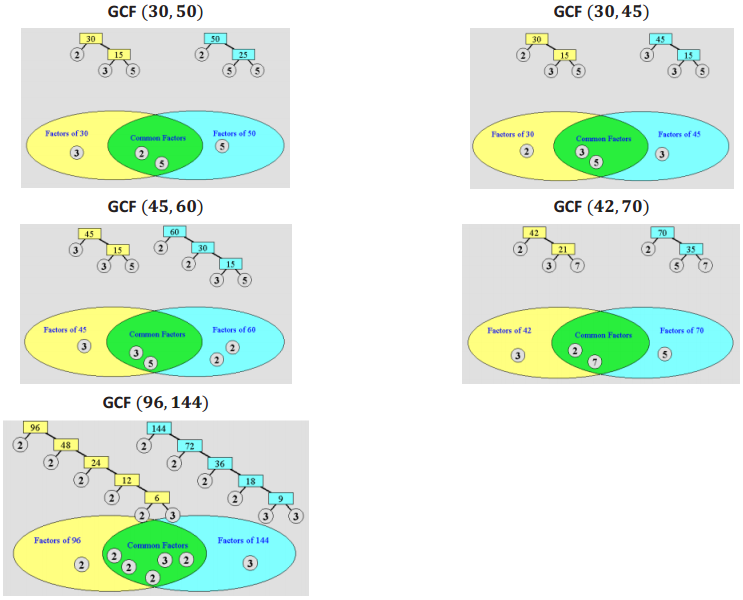
Station 3: Using Prime Factors to Determine GCF
Choose one of these problems that has not yet been solved. Solve it together on your student page. Then, use your marker to copy your work neatly on the chart paper and to cross out your choice so that the next group solves a different problem.
Eureka Math Grade 6 Module 2 Lesson 18 Exercise Answer Key 7

Next, choose one of these problems that has not yet been solved:

a. Would you rather find all the factors of a number or find all the prime factors of a number? Why?
Answer:
Accept opinions. Students should defend their answer and use accurate mathematical terms in their response.

b. Find the GCF of your original pair of numbers.
Answer:
See answers listed in Exploratory Challenge 1.

c. Is the product of your LCM and GCF less than, greater than, or equal to the product of your numbers?
Answer:
In all cases, GCF (a, b) . LCM (a, b) = a . b.

d. Glenn’s favorite number is very special because it reminds him of the day his daughter, Sarah, was born. The factors of this number do not repeat, and all of the prime numbers are less than 12. What is Glenn’s number? When was Sarah born?
Answer:
2 . 3 . 5 . 7 . 11 = 2,310 Sarah’s birth date is 2/3/10.

Station 4: Applying Factors to the Distributive Property

Choose one of these problems that has not yet been solved. Solve it together on your student page. Then, use your marker to copy your work neatly on the chart paper and to cross out your choice so that the next group solves a different problem.

Find the GCF from the two numbers, and rewrite the sum using the distributive property.

1. 12 + 18 =
Answer:
6(2) + 6(3) = 6(2 + 3) = 6(5) = 30

2. 42 + 14 =
Answer:
7(6) + 7(2) = 7(6 + 2) = 7(8) = 56

3. 36 + 27 =
Answer:
9(4) + 9(3) = 9(4 + 3) = 9(7) = 63

4. 16 + 72 =
Answer:
8(2) + 8(9) = 8(2 + 9) = 8(11) = 88

5. 44 + 33 =
Answer:
11(4) + 11(3) = 11(4 + 3) = 11(7) = 77

Next, add another example to one of these two statements applying factors to the distributive property.

Choose any numbers for n, a, and b.

n(a) + n(b) = n(a + b)
Answer:
Accept all mathematically correct responses.

n(a) – n(b) = n(a – b)
Answer:
The distributive property holds for addition as well as subtraction. Accept all mathematically correct responses.

Eureka Math Grade 6 Module 2 Lesson 18 Problem Set Answer Key

Station 1: Factors and GCF
Choose one of these problems that has not yet been solved. Solve it together on your student page. Then, use your marker to copy your work neatly on the chart paper and to cross out your choice so that the next group solves a different problem.
Find the greatest common factor of one of these pairs: 30, 50; 30, 45; 45, 60; 42, 70; 96, 144.
Answer:

Next, choose one of these problems that has not yet been solved:
a. There are 18 girls and 24 boys who want to participate in a Trivia Challenge. If each team must have the same ratio of girls and boys, what is the greatest number of teams that can enter? Find how many boys and girls each team would have.
Answer:

b. Ski Club members are preparing identical welcome kits for new skiers. The Ski Club has 60 hand-warmer packets and 48 foot-warmer packets. Find the greatest number of identical kits they can prepare using all of the hand-warmer and foot-warmer packets. How many hand-warmer packets and foot-warmer packets would each welcome kit have?
Answer:

c. There are 435 representatives and loo senators serving in the United States Congress. How many identical groups with the same numbers of representatives and senators could be formed from all of Congress if we want the largest groups possible? How many representatives and senators would be in each group?
Answer:

d. Is the GCF of a pair of numbers ever equal to one of the numbers? Explain with an example.
Answer:

e. Is the GCF of a pair of numbers ever greater than both numbers? Explain with an example.
Answer:

Station 2: Multiples and LCM
Choose one of these problems that has not yet been solved. Solve it together on your student page. Then, use your marker to copy your work neatly on the chart paper and to cross out your choice so that the next group solves a different problem.
Find the least common multiple of one of these pairs: 9, 12; 8, 18; 4, 30; 12, 30; 20, 50.
Answer:

Next, choose one of these problems that has not yet been solved:
a. Hot dogs come packed 10 in a package. Hot dog buns come packed 8 in a package. If we want one hot dog for each bun for a picnic, with none left over, what is the least amount of each we need to buy? How many packages of each item would we have to buy?
Answer:

b. Starting at 6:00 a.m., a bus stops at my street corner every 15 minutes. Also starting at 6:00 a.m., a taxi cab comes by every 12 minutes. What is the next time both a bus and a taxi are at the corner at the same time?
Answer:

c. Two gears in a machine are aligned by a mark drawn from the center of one gear to the center of the other. If the first gear has 24 teeth, and the second gear has 40 teeth, how many revolutions of the first gear are needed until the marks line up again?
Answer:

d. Is the LCM of a pair of numbers ever equal to one of the numbers? Explain with an example.
Answer:

e. Is the LCM of a pair of numbers ever less than both numbers? Explain with an example.
Answer:

Solve it together on your student page. Then, use your marker to copy your work neatly on this chart paper and to cross out your choice so that the next group solves a different problem.

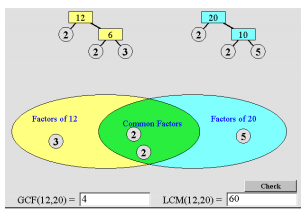
Station 3: Using Prime Factors to Determine GCF
Eureka Math Grade 6 Module 2 Lesson 18 Problem Set Answer Key 8
Choose one of these problems that has not yet been solved. Solve it together on your student page. Then, use your marker to copy your work neatly on the chart paper and to cross out your choice so that the next group solves a different problem.

Use prime factors to find the greatest common factor of one of the following pairs of numbers:
30, 50 30, 45 45, 60 42, 70 96, 144
Answer:

Next choose one of these problems that has not yet been solved:
a. Would you rather find all the factors of a number or find all the prime factors of a number? Why?
Answer:

b. Find the GCF of your original pair of numbers.
Answer:

c. Is the product of your LCM and GCF less than, greater than, or equal to the product of your numbers?
Answer:

d. Glenn’s favorite number is very special because it reminds him of the day his daughter, Sarah, was born. The factors of this number do not repeat, and all of the prime numbers are less than 12. What is Glenn’s number? When was Sarah born?
Answer:

Station 4: Applying Factors to the Distributive Property
Study these examples of how factors apply to the distributive property.

8 + 12 = 4(2) + 4(3) = 4(2 + 3) = 20
4(2) + 4(3) = 4(5) = 20

15 + 25 = 5(3) + 5(5) = 5(3 + 5) = 40
5(3) + 5(5) = 5(8) = 40

36 – 24 = 4(9) – 4(6) = 4(9 – 6) = 12
4(9) – 4(6) = 4(3) = 12

Choose one of these problems that has not yet been solved. Solve it together on your student page. Then, use your marker to copy your work neatly on the chart paper and to cross out your choice so that the next group solves a different problem.

Find the GCF from the two numbers, and rewrite the sum using the distributive property.
Question 1.
12 + 18 =
Answer:

Question 2.
42 + 14 =
Answer:

Question 3.
36 + 27 =
Answer:

Question 4.
16 + 72 =
Answer:

Question 5.
44 + 33 =
Answer:

Next, add another example to one of these two statements applying factors to the distributive property.
Choose any numbers for n, a, and b.
n(a) + n(b) = n(a + b)
Answer:

n(a) – n(b) = n(a – b)
Answer:

Eureka Math Grade 6 Module 2 Lesson 18 Exit Ticket Answer Key

Question 1.
Find the LCM and GCF of 12 and 15.
Answer:
LCM: 60; GCF: 3

Question 2.
Write two numbers, neither of which is 8, whose GCF is 8.
Answer:
Answers will vary (e.g., 16 and 24, or 24 and 32).

Question 3.
Write two numbers, neither of which is 28, whose LCM is 28.
Answer:
Answers will vary (e.g., 4 and 14, or 4 and 7).

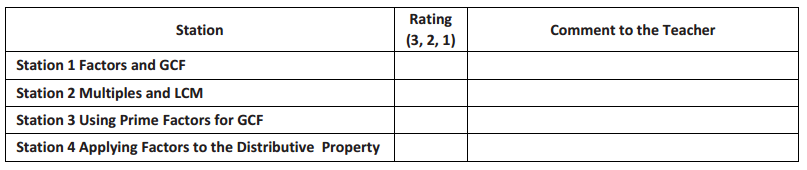
Rate each of the stations you visited today. Use this scale:
3 – Easy – I’ve got It, I don’t need any help.
2 – Medium – I need more practice, but I understand some of It.
1 – Hard – I’m not getting this yet.

Complete the following chart:
Eureka Math Grade 6 Module 2 Lesson 18 Exit Ticket Answer Key 9

Eureka Math Grade 6 Module 2 Lesson 17 Answer Key

Engage NY Eureka Math 6th Grade Module 2 Lesson 17 Answer Key

Eureka Math Grade 6 Module 2 Lesson 17 Opening Exercise Answer Key

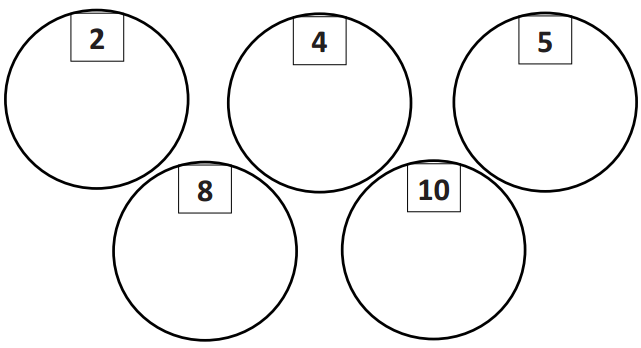
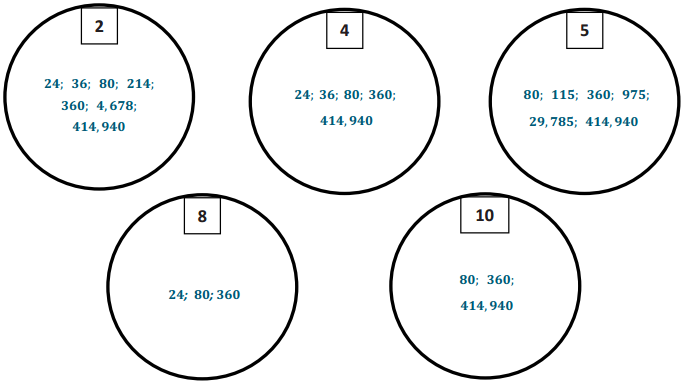
Below is a list of 10 numbers. Place each number in the circle(s) that is a factor of the number. Some numbers can be placed in more than one circle. For example, if 32 were on the list, it would be placed in the circles with 2, 4, and 8 because they are all factors of 32.
24; 36; 80; 115; 214; 360; 975; 4,678; 29,785; 414, 940
Eureka Math Grade 6 Module 2 Lesson 17 Opening Exercise Answer Key 1
Answer:
Eureka Math Grade 6 Module 2 Lesson 17 Opening Exercise Answer Key 2

Discussion:

Divisibility rule for 2: If and only if its unit digit is 0, 2, 4, 6, or 8

Divisibility rule for 4: If and only if its last two digits are a number divisible by 4

Divisibility rule for 5: If and only if its unit digit is 0 or 5

Divisibility rule for 8: If and only if its last three digits are a number divisible by 8

Divisibility rule for 10: If and only if its unit digit is 0

Decimal numbers with fraction parts do not follow the divisibility tests:
Students learn two new divisibility rules today. The rules are used to determine if numbers are divisible by 3 or 9. Start with students who already know the factors of 3 and 9, so they can see that the rule works.

→ What do the numbers 12, 18, 30, 66, and 93 all have in common?
Each is divisible by 3.

→ Calculate the sum of the digits for each given number. For example, the sum of the digits in the number 12 is 3 because 1 + 2 = 3.

Give students time to find the sums. Record the sums on the board.
→ What do these sums have in common?
They are divisible by 3.

→ When the sum of a number’s digits is divisible by 3, the entire number is divisible by 3. Now let’s examine a different set of numbers: 27, 36, 54, 72, and 99. What do these numbers have in common?
They are divisible by 9.

→ Calculate the sum of the digits for each given number.
Provide time for students to find the sums. Record the sums on the board.

→ What do all the sums have in common?
They are divisible by 9.

→ When the sum of the digits is divisible by 3 and 9, the entire number is divisible by 9. Let’s use this knowledge to determine if a large number is divisible by 3, 9, or both. The number 765 is divisible by both 3 and 9.

→ We can use what we know about the distributive property to prove that 765 is divisible by 3 and by 9.
→ Let’s begin by expanding 765.

Display the following progression.
→ We can represent 765 as:
7 × 100 + 6 × 10 + 5 × 1

→ We can further decompose the numbers that are easily seen as divisible by 3 and 9.
→ Let’s decompose 100 to 99 + 1. Why would we do this?
Because we already know that 99 is divisible by 3 and 9.
7(99 + 1) + 6 × 10 + 5

→ We can also decompose 10 to 9 + 1. Why would we do this?
Because we already know that 9 is divisible by 3 and 9.
7(99 + 1) + 6(9+ 1) + 5

→ Let’s use the distributive property further to distribute the factor 7 in the expression. We can represent 7
times the quantity (99 + 1) as 7(99) + 7 × 1, or 7(99) + 7.
7(99) + 7+ 6(9 + 1) + 5

→ We can distribute the factor 6 in the same fashion. How can we distribute the factor 6 in the expression?
We can represent 6 times the quantity (9 + 1) as 6(9) + 6 × 1, or 6(9) + 6.
7(99) + 7 + 6(9) + 6 + 5

→ Since we know that 9 is divisible by both 3 and 9, let’s factor the 9 out of the expression. We can use the commutative and associative properties to easily see this.
7(99) + 7 + 6(9) + 6 + 5
7(9 × 11) + 6(9 × 1) + 7 + 6 + 5
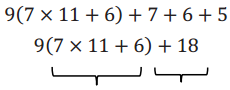
9(7 × 11 + 6) + 7 + 6 + 5

→ Let’s investigate our current expression. Obviously the product of 9(7 × 11 + 6) is divisible by 9 since the 9 is already factored out.

→ What about the sum of 7 + 6 + 5? What is the sum? Is this sum divisible by 3 and 9?
7 + 6 + 5 = 18.
This sum is divisible by 3 and 9.

→ Are 3 and 9 both factors of 18?
Yes

→ What do you notice about the addends 7 + 6 + 5?
They are the digits of our original number 765.

Let’s look once more at the expression:
Eureka Math Grade 6 Module 2 Lesson 17 Opening Exercise Answer Key 3

→ Since the first term is divisible by 3 and 9, the number 765 is divisible by 3 and 9 if and only if 7 + 6 + 5 is also divisible by 3 and 9.
→ This process can be used for any decimal whole number!
Introduce the divisibility rules for 3 and 9. Have students record the rules in their student materials.

Divisibility rule for 3: If the sum of the digits is divisible by 3, then the number is divisible by 3.

Divisibility rule for 9: If the sum of the digits is divisible by 9, then the number is divisible by 9.

Eureka Math Grade 6 Module 2 Lesson 17 Example Answer Key

Example 1.
This example shows how to apply the two new divisibility rules we just discussed.
Explain why 378 is divisible by 3 and 9.

a. Expand 378.
Answer:
300 + 70 + 8
3 × 100 + 7 × 1o + 8

b. Decompose the expression to factor by 9.
Answer:
3(99 + 1) + 7(9 + 1) + 8
3(99) + 3 + 7(9) + 7 + 8

c. Factor the 9.
Answer:
3(9 × 11) + 3 + 7(9 × 1) + 7 + 8
9(3 × 11 + 7) + 3 + 7 + 8

d. What is the sum of the three digits?
Answer:
3 + 7 + 8 = 18; the sum of the three digits is 18.

e. Is 18 divisible by 9?
Answer:
Yes

f. Is the entire number 378 divisible by 9? Why or why not?
Answer:
The number 378 is divisible by 9 because the sum of the digits is divisible by 9.

g. Is the number 378 divisible by 3? Why or why not?
Answer:
Three is a factor of 378 because if 9 is a factor of 378, then 3 will also be a factor. OR
The number 378 is divisible by 3 because the sum of the digits is divisible by 3.

Example 2.
Is 3,822 divisible by 3 or 9? Why or why not?
Answer:
The number 3,822 is divisible by 3 but not by 9 because the sum of the digits is 3 + 8 + 2 + 2 = 15, and 15 is divisible by 3 but not by 9.

Eureka Math Grade 6 Module 2 Lesson 17 Exercise Answer Key

Circle ALL the numbers that are factors of the given number. Complete any necessary work in the space provided.

Exercise 1.
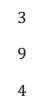
2,838 is divisible by
Eureka Math Grade 6 Module 2 Lesson 17 Exercise Answer Key 4
Answer:
Eureka Math Grade 6 Module 2 Lesson 17 Exercise Answer Key 5

Explain your reasoning for your choice(s).
Answer:
The number 2,838 is divisible by 3 because 3 is a factor of 2,838. I know this because the sum of the digits is 21, which is divisible by 3. The number 2,838 is not divisible by 9 because 21 is not divisible by 9, and 2,838 is not divisible by 4 because the last two digits (38) are not divisible by 4.

Exercise 2.
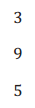
34,515 is divisible by
Eureka Math Grade 6 Module 2 Lesson 17 Exercise Answer Key 6
Answer:
Eureka Math Grade 6 Module 2 Lesson 17 Exercise Answer Key 7

Explain your reasoning for your choice (s).
Answer:
The number 34,515 is divisible by 3 and 9 because both 3 and 9 are factors of 34,515. I know this because the sum of the digits is 18, and 18 is divisible by both 3 and 9. The number 34,515 is also divisible by 5 because the unit digit is a 5.

Exercise 3.
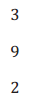
10,534,341 is divisible by
Eureka Math Grade 6 Module 2 Lesson 17 Exercise Answer Key 8
Answer:
Eureka Math Grade 6 Module 2 Lesson 17 Exercise Answer Key 9

Explain your reasoning for your choice(s).
Answer:
The number 10,534,341 is divisible by 3 but not 9 because 3 is afactor of 10,534,341, but 9 is not. I know this because the sum of the digits is 21, which is divisible by 3 but not 9. The number 10, 534, 341 is not divisible by 2 because it does not end with 0, 2, 4, 6, or 8.

Exercise 4.
4,320 is divisible by
Eureka Math Grade 6 Module 2 Lesson 17 Exercise Answer Key 10
Answer:
Eureka Math Grade 6 Module 2 Lesson 17 Exercise Answer Key 11

Explain your reasoning for your choice(s).
Answer:
The number 4,320 is divisible by 3 and 9 because 3 and 9 are factors of 4,320. I know this because the sum of the digits is 9, which is divisible by 3 and 9. The number 4,320 is also divisible by 10 because 10 is a factor of 4,320. I know this because the unit digit is 0.

Exercise 5.
6,240 is divisible by
Eureka Math Grade 6 Module 2 Lesson 17 Exercise Answer Key 12
Answer:
Eureka Math Grade 6 Module 2 Lesson 17 Exercise Answer Key 13

Explain your reasoning for your choice(s).
Answer:
The number 6,240 is divisible by 3 but not divisible by 9 because 3 is a factor of 6,240, but 9 is not. I know this because the sum of the digits is 12, which is divisible by 3 but not divisible by 9. The number 6,240 is divisible by 8 because the last three digits (240) is divisible by 8.

Eureka Math Grade 6 Module 2 Lesson 17 Problem Set Answer Key

Question 1.
Is 32, 643 divisible by both 3 and 9? Why or why not?
Answer:
The number 32,643 is divisible by both 3 and 9 because the sum of the digits is 18, which is divisible by 3 and 9.

Question 2.
Circle all the factors of 424,380 from the list below.
Answer:
Eureka Math Grade 6 Module 2 Lesson 17 Problem Set Answer Key 14

Question 3.
Circle all the factors of 322,875 from the list below.
Answer:
Eureka Math Grade 6 Module 2 Lesson 17 Problem Set Answer Key 15

Question 4.
Write a 3-digit number that ¡s divisible by both 3 and 4. Explain how you know this number is divisible by 3 and 4.
Answer:
Answers will vary. Possible student response: The sum of the digits is divisible by 3, and that’s how I know the number is divisible by 3. The last 2 digits are divisible by 4, so the entire number is divisible by 4.

Question 5.
Write a 4-digit number that Is divisible by both 5 and 9. Explain how you know this number Is divisible by 5 and 9.
Answer:
Answers will vary. Possible student response: The number ends with a 5 or 0, so the entire number is divisible by 5. The sum of the digits is divisible by 9, so the entire number is divisible by 9.

Eureka Math Grade 6 Module 2 Lesson 17 Exit Ticket Answer Key

Question 1.
Is 26, 341 divisible by 3? If it is, write the number as the product of 3 and another factor. If not, explain.
Answer:
The number 26,341 is not divisible by 3 because the sum of the digits is 16, which is not divisible by 3.

Question 2.
Is 8,397 divisible by 9? If it is, write the number as the product of 9 and another factor. If not, explain.
Answer:
The number 8,397 is divisible by 9 because the sum of the digits is 27, which is divisible by 9. Nine is a factor of 8,397 because 9 × 933 = 8,397.

Question 3.
Explain why 186,426 is divisible by both 3 and 9.
Answer:
The number 186, 426 is divisible by both 3 and 9 because the sum of the digits is 27, which is divisible by both 3 and 9.

Eureka Math Grade 6 Module 2 Lesson 16 Answer Key

Engage NY Eureka Math 6th Grade Module 2 Lesson 16 Answer Key

Eureka Math Grade 6 Module 2 Lesson 16 Opening Exercise Answer Key

a. What is an even number?
Answer:
Possible student responses:
An integer that can be evenly divided by 2
A number whose unit digit is 0, 2, 4, 6, or 8
All the multiples of 2

b. List some examples of even numbers.
Answer:
Answers will vary.

c. What is an odd number?
Answer:
Possible student responses:
An integer that CANNOT be evenly divided by 2
A number whose unit digit is 1, 3, 5, 7, or 9
All the numbers that are NOT multiples of 2

d. List some examples of odd numbers.
Answer:
Answers will vary.

What happens when we add two even numbers? Do we always get an even number?
Answer:
Before holding a discussion about the process to answer the following questions, have students write or share their predictions.

Eureka Math Grade 6 Module 2 Lesson 16 Exercise Answer Key

Exercise 1.
Why is the sum of two even numbers even?
a. Think of the problem 12 + 14. Draw dots to represent each number.
Answer:
Eureka Math Grade 6 Module 2 Lesson 16 Exercise Answer Key 1

b. Circle pairs of dots to determine if any of the dots are left over.
Answer:
Eureka Math Grade 6 Module 2 Lesson 16 Exercise Answer Key 2

c. Is this true every time two even numbers are added together? Why or why not?
Answer:
Since 12 is represented by 6 sets of two dots, and 14 is represented by 7 sets of two dots, the sum is 13 sets of two dots. This is true every time two even numbers are added together because even numbers never have dots left over when we are circling pairs. Therefore, the answer is always even.

Exercise 2.
Why is the sum of two odd numbers even?
a. Think of the problem 11 + 15. Draw dots to represent each number.
Answer:
Eureka Math Grade 6 Module 2 Lesson 16 Exercise Answer Key 3

b. Circle pairs of dots to determine if any of the dots are left over.
Answer:
Eureka Math Grade 6 Module 2 Lesson 16 Exercise Answer Key 4
When we circle groups of two dots, there is one dot remaining in each representation because each addend is an odd number. When we look at the sum, however, the two remaining dots can form a pair, leaving us with a sum that is represented by groups of two dots. The sum is, therefore, even. Since each addend is odd, there is one dot for each addend that does not have a pair. However, these two dots can be paired together, which means there are no dots without a pair, making the sum an even number.

c. Is this true every time two odd numbers are added together? Why or why not?
Answer:
This is true every time two odd numbers are added together because every odd number has one dot remaining when we circle pairs of dots. Since each number has one dot remaining, these dots can be combined to make another pair. Therefore, no dots remain, resulting in an even sum.

Exercise 3.
Why is the sum of an even number and an odd number odd?
a. Think of the problem 14 + 11. Draw dots to represent each number.
Answer:
Students draw dots to represent each number. After circling pairs of dots, there is one dot left for the number 11, and the number 14 has no dots remaining. Since there is one dot left over, the sum is odd because not every dot has a pair.

b. Circle pairs of dots to determine if any of the dots are left over.
Answer:
Students draw dots to represent each number. After circling pairs of dots, there is one dot left for the number 11, and the number 14 has no dots remaining. Since there is one dot left over, the sum is odd because not every dot has a pair.

C. Is this true every time an even number and an odd number are added together? Why or why not?
Answer:
This is always true when an even number and an odd number are added together because only the odd number will have a dot remaining after we circle pairs of dots. Since this dot does not have a pair, the sum is odd.

d. What if the first addend is odd and the second is even? Is the sum still odd? Why or why not? For example, If we had 11 + 14, would the sum be odd?
Answer:
The sum is still odd for two reasons. First, the commutative property states that changing the order of an addition problem does not change the answer. Because an even number plus an odd number is odd, then an odd number plus an even number is also odd. Second, it does not matter which addend is odd; there is still one dot remaining, making the sum odd.

Let’s sum it up:
Answer:
→ “Even” + “even” = “even”
→ “Odd” + “odd” = “even”
→ “Odd” + “even” = “odd”

Exploratory Challenge/Exercises 4-6

Exercise 4.
The product of two even numbers is even.
Answer:
Answers will vary, but one example answer is provided.

Using the problem 6 × 14, students know that this is equivalent to six groups of fourteen, or
14 + 14 + 14 + 14 + 14 + 14. Students also know that the sum of two even numbers is even; therefore, when adding the addends two at a time, the sum is always even. This means the sum of six even numbers is even, making the product even since It is equivalent to the sum.

Using the problem 6 × 14, students can use the dots from previous examples.
Eureka Math Grade 6 Module 2 Lesson 16 Exercise Answer Key 6
From here, students can circle dots and see that there are no dots remaining, so the answer must be even.

Exercise 5.
The product of two odd numbers is odd.
Answer:
Answers will vary, but an example answer is provided.
Using the problem 5 × 15, students know that this is equivalent to five groups of fifteen, or
15 + 15 + 15 + 15 + 15. Students also know that the sum of two odd numbers is even, and the sum of an odd and even number is odd. When adding two of the addends together at a time, the answer rotates between even and odd. When the final two numbers are added together, one is even and the other odd. Therefore, the sum is odd, which makes the product odd since it is equivalent to the sum.

Using the problem 5 × 15, students may also use the dot method.
Eureka Math Grade 6 Module 2 Lesson 16 Exercise Answer Key 6
After students circle the pairs of dots, one dot from each set of 15 remains, for a total of 5 dots. Students can group these together and circle more pairs, as shown below.
Eureka Math Grade 6 Module 2 Lesson 16 Exercise Answer Key 8
Since there is still one dot remaining, the product of two odd numbers is odd.

Exercise 6.
The product of an even number and an odd number is even.
Answer:
Answers will vary, but one example is provided.
Using the problem 6 × 7, students know that this is equivalent to the sum of six sevens, or 7 + 7 + 7 + 7 + 7 + 7.
Students also know that the sum of two odd numbers is even, and the sum of two even numbers is even. Therefore, when adding two addends at a time, the result is an even number. The sum of these even numbers is also even, which means the total sum is even. This also Implies the product is even since the sum and product are equivalent.

Using the problem 6 × 7, students may also use the dot method.
Eureka Math Grade 6 Module 2 Lesson 16 Exercise Answer Key 8
After students circle the pairs of dots, one dot from each set of 7 remains, for a total of 6 dots. Students can group these together and circle more pairs, as shown below.
Eureka Math Grade 6 Module 2 Lesson 16 Exercise Answer Key 9
Since there are no dots remaining, the product of an even number and an odd number is even.

Eureka Math Grade 6 Module 2 Lesson 16 Problem Set Answer Key

Without solving, tell whether each sum or product Is even or odd. Explain your reasoning.

Question 1.
346 + 721
Answer:
The sum is odd because the sum of an even and an odd number is odd.

Question 2.
4,690 × 141
Answer:
The product is even because the product of an even and an odd number is even.

Question 3.
1,462,891 × 745,629
Answer:
The product is odd because the product of two odd numbers is odd.

Question 4.
425,922 + 32,481,064
Answer:
The sum is even because the sum of two even numbers is even.

Question 5.
32 + 45 + 67 + 91 + 34 + 56
Answer:
The first two addends are odd because an even and an odd is odd.
Odd number +67 is even because the sum of two odd numbers is even.
Even number +91 is odd because the sum of an even and an odd number is odd.
Odd number +34 is odd because the sum of an odd and an even number is odd.
Odd number +56 is odd because the sum of an odd andan even number is odd.
Therefore, the final sum is odd.

Eureka Math Grade 6 Module 2 Lesson 16 Exit Ticket Answer Key

Determine whether each sum or product is even or odd. Explain your reasoning.

Question 1.
56,426+17,895
Answer:
The sum is odd because the sum of an even number and an odd number is odd.

Question 2.
317,362 × 129,324
Answer:
The product is even because the product of two even numbers is even.

Question 3.
104,81 + 4,569
Answer:
The sum is even because the sum of two odd numbers is even.

Question 4.
32,457 × 12,781
Answer:
The product is odd because the product of two odd numbers is odd.

Question 5.
Show or explain why 12 + 13 + 14 + 15 + 16 results in an even sum.
Answer:
12 + 13 is odd because even + odd is odd.
Odd number +14 is odd because odd + even is odd.
Odd number +15 is even because odd + odd is even.
Even number +16 is even because even + even is even.
OR
Students may group even numbers together, 12 + 14 + 16, which results in an even number. Then, when students combine the two odd numbers, 13 + 15, the result is another even number. We know that the sum of two evens results in another even number.

Eureka Math Grade 8 Module 2 Lesson 5 Answer Key

Engage NY Eureka Math 8th Grade Module 2 Lesson 5 Answer Key

Eureka Math Grade 8 Module 2 Lesson 5 Exercise Answer Key

Exercise 1.
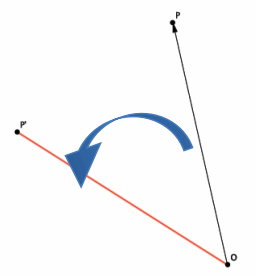
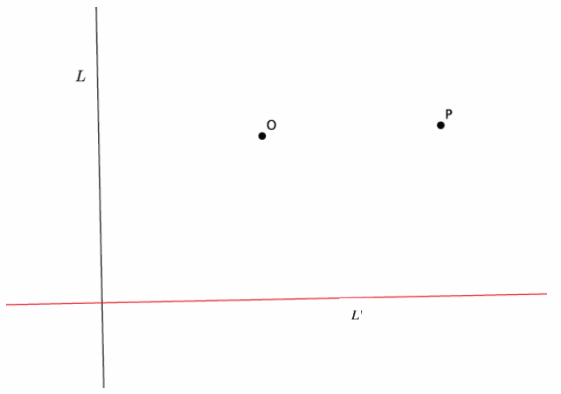
Let there be a rotation of d degrees around center O. Let P be a point other than O. Select d so that d≥0. Find P’ (i.e., the rotation of point P) using a transparency.
Eureka Math Grade 8 Module 2 Lesson 5 Exercise Answer Key 1
Answer:
Verify that students have rotated around center O in the counterclockwise direction.
Eureka Math Grade 8 Module 2 Lesson 5 Exercise Answer Key 1.1

Exercise 2.
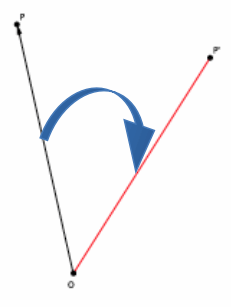
Let there be a rotation of d degrees around center O. Let P be a point other than O. Select d so that d<0. Find P’ (i.e., the rotation of point P) using a transparency.
Eureka Math Grade 8 Module 2 Lesson 5 Exercise Answer Key 1.2
Answer:
Verify that students have rotated around center O in the clockwise direction.
Eureka Math Grade 8 Module 2 Lesson 5 Exercise Answer Key 2

Exercise 3.
Which direction did the point P rotate when d≥0?
Answer:
It rotated counterclockwise, or to the left of the original point.

Exercise 4.
Which direction did the point P rotate when d<0?
Answer:
It rotated clockwise, or to the right of the original point.

Exercises 5–6

Exercise 5.
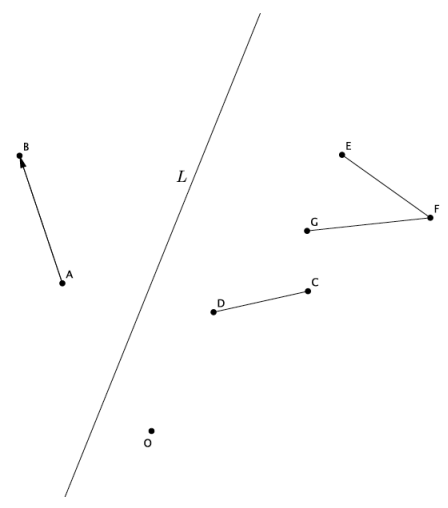
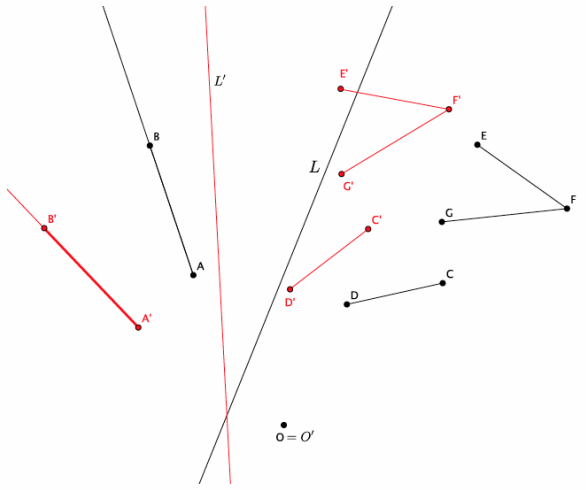
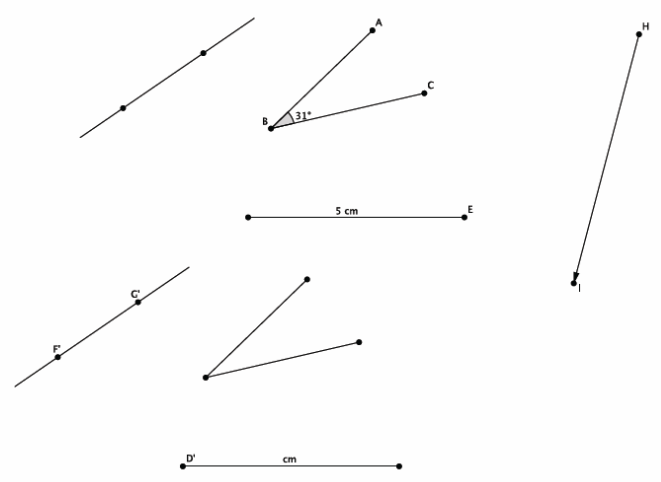
Let L be a line, \(\overrightarrow{A B}\) be a ray, \(\overline{\boldsymbol{C D}}\) be a segment, and ∠EFG be an angle, as shown. Let there be a rotation of d degrees around point O. Find the images of all figures when d≥0.
Eureka Math Grade 8 Module 2 Lesson 5 Exercise Answer Key 10
Answer:
Eureka Math Grade 8 Module 2 Lesson 5 Exercise Answer Key 10.1
Verify that students have rotated around center O in the counterclockwise direction.

Exercise 6.
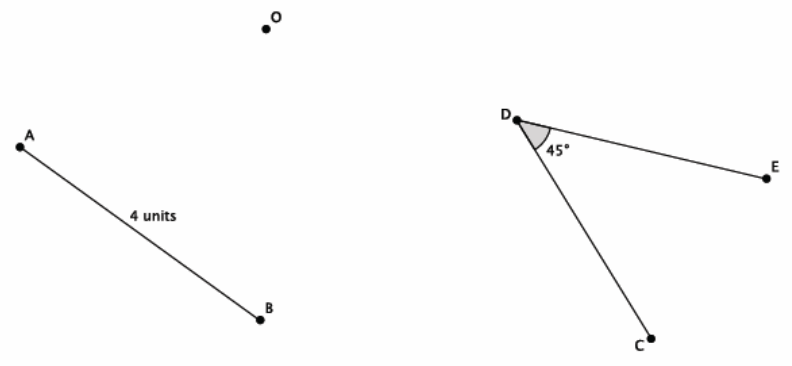
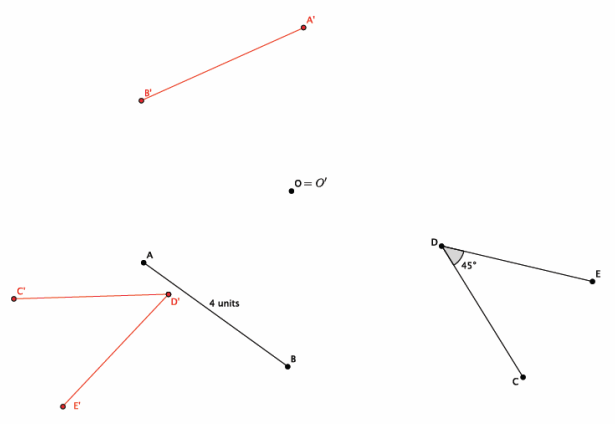
Let \(\overline{A B}\) be a segment of length 4 units and ∠CDE be an angle of size 45°. Let there be a rotation by d degrees, where d<0, about O. Find the images of the given figures. Answer the questions that follow.
Eureka Math Grade 8 Module 2 Lesson 5 Exercise Answer Key 11
Answer:
Eureka Math Grade 8 Module 2 Lesson 5 Exercise Answer Key 11.1
Verify that students have rotated around center O in the clockwise direction.

a. What is the length of the rotated segment Rotation(AB)?
Answer:
The length of the rotated segment is 4 units.

b. What is the degree of the rotated angle Rotation (∠CDE)?
Answer:
The degree of the rotated angle is 45°.

Exercises 7–8

Exercise 7.
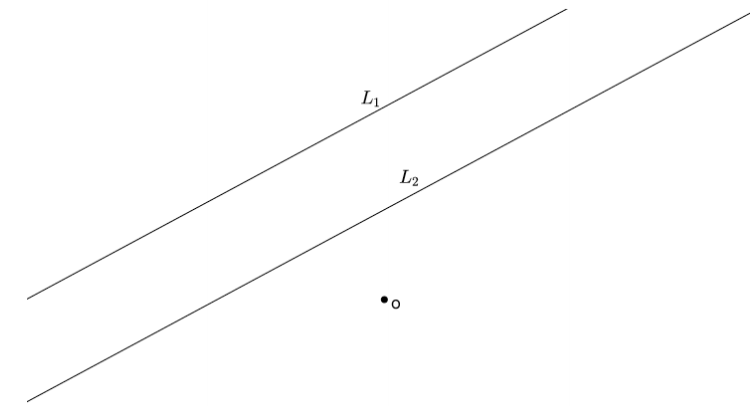
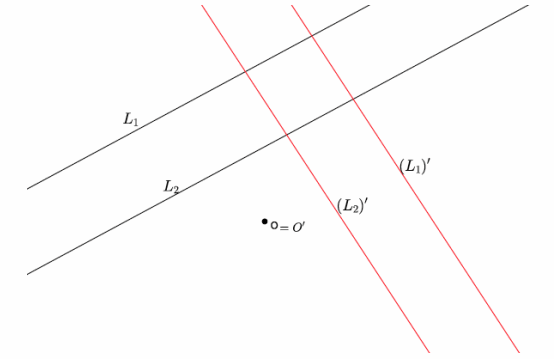
Let L1 and L2 be parallel lines. Let there be a rotation by d degrees, where -360<d<360, about O.
Is (L1 )’∥(L2)’?
Eureka Math Grade 8 Module 2 Lesson 5 Exercise Answer Key 20
Answer:
Eureka Math Grade 8 Module 2 Lesson 5 Exercise Answer Key 20.1
Verify that students have rotated around center O in either direction. Students should respond that (L1)’ || (L2)’.

Exercise 8.
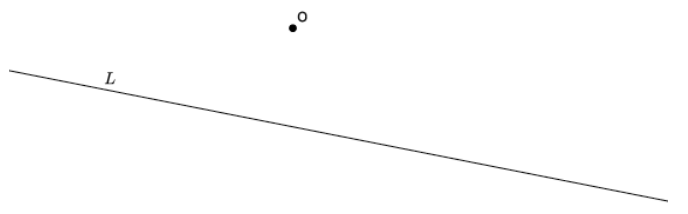
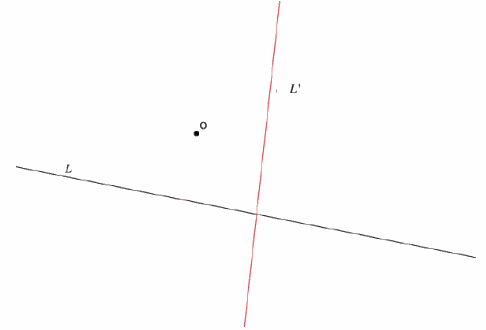
Let L be a line and O be the center of rotation. Let there be a rotation by d degrees, where d≠180 about O. Are the lines L and L’ parallel?
Eureka Math Grade 8 Module 2 Lesson 5 Exercise Answer Key 21
Answer:
Eureka Math Grade 8 Module 2 Lesson 5 Exercise Answer Key 21.1
Verify that students have rotated around center O in either direction any degree other than 180. Students should respond that L and L’ are not parallel.

Eureka Math Grade 8 Module 2 Lesson 5 Exit Ticket Answer Key

Question 1.
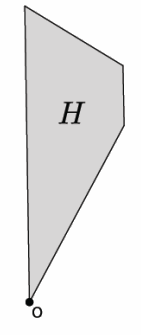
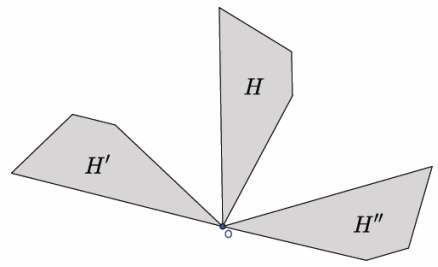
Given the figure H, let there be a rotation by d degrees, where d≥0, about O. Let Rotation(H) be H’.
Engage NY Math 8th Grade Module 2 Lesson 5 Exit Ticket Answer Key 22
Answer:
Engage NY Math 8th Grade Module 2 Lesson 5 Exit Ticket Answer Key 22.1
Sample rotation shown above. Verify that the figure H’ has been rotated counterclockwise with center O.

Question 2.
Using the drawing above, let Rotation1 be the rotation d degrees with d<0, about O. Let Rotation_1 (H) be H”.
Answer:
Sample rotation shown above. Verify that the figure H” has been rotated clockwise with center O.

Eureka Math Grade 8 Module 2 Lesson 5 Problem Set Answer Key

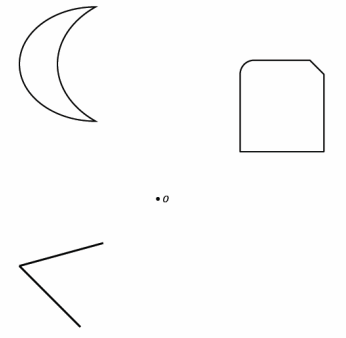
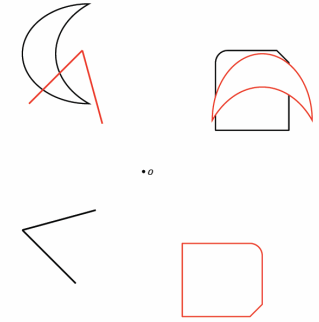
Question 1.
Let there be a rotation by -90° around the center O.
Eureka Math Grade 8 Module 2 Lesson 5 Problem Set Answer Key 23
Answer:
Rotated figures are shown in red.
Eureka Math Grade 8 Module 2 Lesson 5 Problem Set Answer Key 23.1

Question 2.
Explain why a rotation of 90 degrees around any point O never maps a line to a line parallel to itself.
Answer:
A 90-degree rotation around point O will move a given line L to L’. Parallel lines never intersect, so it is obvious that a 90-degree rotation in either direction does not make lines L and L’ parallel. Additionally, we know that there exists just one line parallel to the given line L that goes through a point not on L. If we let P be a point not on L, the line L’ must go through it in order to be parallel to L. L’ does not go through point P; therefore, L and L’ are not parallel lines. Assume we rotate line L first and then place a point P on line L’ to get the desired effect (a line through P). This contradicts our definition of parallel (i.e., parallel lines never intersect); so, again, we know that line L is not parallel to L’.
Eureka Math Grade 8 Module 2 Lesson 5 Problem Set Answer Key 24.1

Question 3.
A segment of length 94 cm has been rotated d degrees around a center O. What is the length of the rotated segment? How do you know?
Answer:
The rotated segment will be 94 cm in length. (Rotation 2) states that rotations preserve lengths of segments, so the length of the rotated segment will remain the same as the original.

Question 4.
An angle of size 124° has been rotated d degrees around a center O. What is the size of the rotated angle? How do you know?
Answer:
The rotated angle will be 124°. (Rotation 3) states that rotations preserve the degrees of angles, so the rotated angle will be the same size as the original.

Eureka Math Grade 8 Module 2 Lesson 3 Answer Key

Engage NY Eureka Math 8th Grade Module 2 Lesson 3 Answer Key

Eureka Math Grade 8 Module 2 Lesson 3 Exercise Answer Key

Exercise 1.
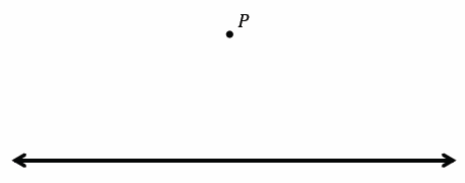
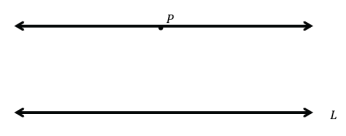
Draw a line passing through point P that is parallel to line L. Draw a second line passing through point P that is parallel to line L and that is distinct (i.e., different) from the first one. What do you notice?
Eureka Math Grade 8 Module 2 Lesson 3 Exercise Answer Key 1
Answer:
Eureka Math Grade 8 Module 2 Lesson 3 Exercise Answer Key 1.1
Students should realize that they can only draw one line through point P that is parallel to L.

Exercises 2–4 (9 minutes)
Students complete Exercises 2–4 independently in preparation for the discussion that follows.

Exercise 2.
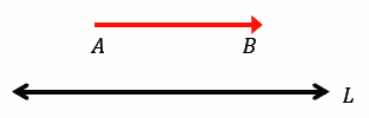
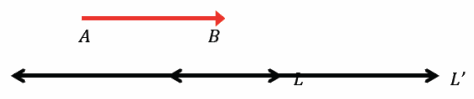
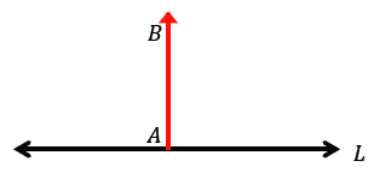
Translate line L along the vector \(\overrightarrow{A B}\). What do you notice about L and its image, L’?
Eureka Math Grade 8 Module 2 Lesson 3 Exercise Answer Key 2
Answer:
Eureka Math Grade 8 Module 2 Lesson 3 Exercise Answer Key 2.1
L and L’ coincide. L=L’.

Exercise 3.
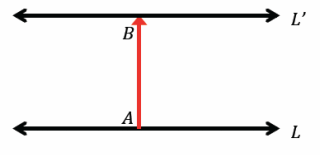
Line L is parallel to vector \(\overrightarrow{A B}\). Translate line L along vector (AB) ⃗. What do you notice about L and its image, L’?
Eureka Math Grade 8 Module 2 Lesson 3 Exercise Answer Key 3
Answer:
Eureka Math Grade 8 Module 2 Lesson 3 Exercise Answer Key 3.1
L and L’ coincide, again. L=L’.

Exercise 4.
Translate line L along the vector \(\overrightarrow{A B}\). What do you notice about L and its image, L’?
Eureka Math Grade 8 Module 2 Lesson 3 Exercise Answer Key 4
Answer:
Eureka Math Grade 8 Module 2 Lesson 3 Exercise Answer Key 4.1
L || L’

Exercises 5–6 (5 minutes)
Students complete Exercises 5 and 6 in pairs or small groups.

Exercise 5.
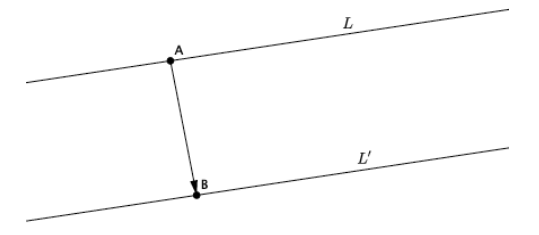
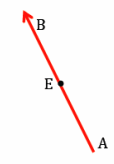
Line L has been translated along vector \(\overrightarrow{A B}\), resulting in L’. What do you know about lines L and L’?
Eureka Math Grade 8 Module 2 Lesson 3 Exercise Answer Key 5
Answer:
L || T(L)

Question 6.
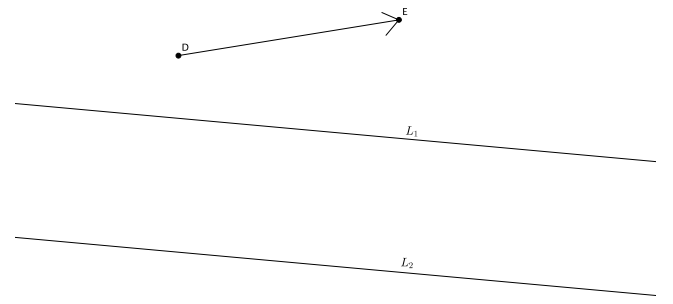
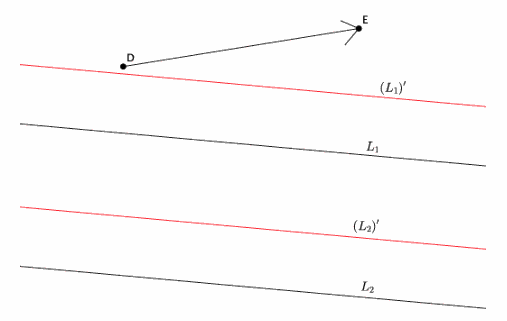
Translate L1 and L2 along vector \(\overrightarrow{D E}\). Label the images of the lines. If lines L1 and L2 are parallel, what do you know about their translated images?
Eureka Math Grade 8 Module 2 Lesson 3 Exercise Answer Key 6
Answer:
Eureka Math Grade 8 Module 2 Lesson 3 Exercise Answer Key 6.1
Since L1 || L1, then (L1)’ || (L2)’.

Eureka Math Grade 8 Module 2 Lesson 3 Exit Ticket Answer Key

Question 1.
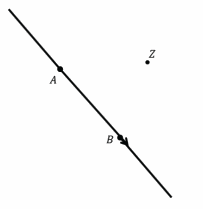
Translate point Z along vector \(\overrightarrow{A B}\). What do you know about the line containing vector \(\overrightarrow{A B}\) and the line formed when you connect Z to its image Z’?
Eureka Math Grade 8 Module 2 Lesson 3 Exit Ticket Answer Key 10
Answer:
The line containing vector \(\overrightarrow{A B}\) and ZZ’ is parallel.

Question 2.
Using the above diagram, what do you know about the lengths of segment ZZ’ and segment AB?
Answer:
The lengths are equal: |ZZ’|=|AB|.

Question 3.
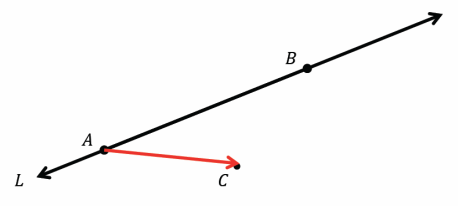
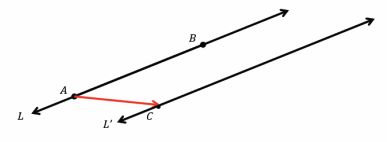
Let points A and B be on line L and the vector \(\overrightarrow{A C}\) be given, as shown below. Translate line L along vector \(\overrightarrow{A C}\). What do you know about line L and its image, L’? How many other lines can you draw through point C that have the same relationship as L and L’? How do you know?
Eureka Math Grade 8 Module 2 Lesson 3 Exit Ticket Answer Key 8
Answer:
Eureka Math Grade 8 Module 2 Lesson 3 Exit Ticket Answer Key 8.1
L and L’ are parallel. There is only one line parallel to line L that goes through point C. The fact that there is only one line through a point parallel to a given line guarantees it.

Eureka Math Grade 8 Module 2 Lesson 3 Problem Set Answer Key

Question 1.
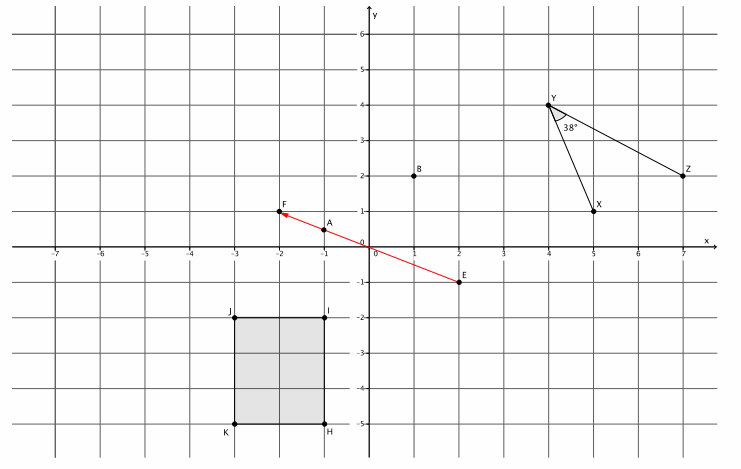
Translate ∠XYZ, point A, point B, and rectangle HIJK along vector \(\overrightarrow{E F}\). Sketch the images, and label all points using prime notation.
Eureka Math Grade 8 Module 2 Lesson 3 Problem Set Answer Key 50
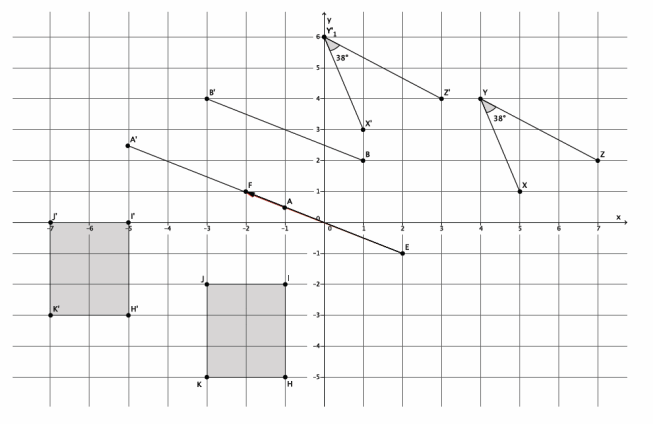
Answer:
Eureka Math Grade 8 Module 2 Lesson 3 Problem Set Answer Key 50.1

Question 2.
What is the measure of the translated image of ∠XYZ? How do you know?
Answer:
The measure is 38°. Translations preserve angle measure.

Question 3.
Connect B to B’. What do you know about the line that contains the segment formed by BB’ and the line containing the vector \(\overrightarrow{E F}\)?
Answer:
\(\overleftrightarrow{\boldsymbol{B B}^{\prime}} \| \overleftrightarrow{\boldsymbol{E F}}\)

Question 4.
Connect A to A’. What do you know about the line that contains the segment formed by AA’ and the line containing the vector \(\overrightarrow{\boldsymbol{E F}}\)?
Answer:
\(\overleftrightarrow{A A^{\prime}}\) and \(\overleftrightarrow{\boldsymbol{E F}}\) coincide.

Question 5.
Given that figure HIJK is a rectangle, what do you know about lines that contain segments HI and JK and their translated images? Explain.
Answer:
Since HIJK is a rectangle, I know that \(\overleftrightarrow{\boldsymbol{H} \boldsymbol{I}}\) || \(\overleftrightarrow{\boldsymbol{J K}}\). Since translations map parallel lines to parallel lines, then \(\overleftrightarrow{\boldsymbol{H}^{\prime} \boldsymbol{I}^{\prime}}\)||\(\overleftrightarrow{\boldsymbol{J}^{\prime} \boldsymbol{K}^{\prime}}\).

Eureka Math Grade 8 Module 2 Lesson 2 Answer Key

Engage NY Eureka Math 8th Grade Module 2 Lesson 2 Answer Key

Eureka Math Grade 8 Module 2 Lesson 2 Exercise Answer Key

Exercise 1.
Draw at least three different vectors, and show what a translation of the plane along each vector looks like. Describe what happens to the following figures under each translation using appropriate vocabulary and notation as needed.
Eureka Math Grade 8 Module 2 Lesson 2 Exercise Answer Key 1
Answer:
Answers will vary.

Exercise 2.
The diagram below shows figures and their images under a translation along \(\overrightarrow{H I}\). Use the original figures and the translated images to fill in missing labels for points and measures.
Eureka Math Grade 8 Module 2 Lesson 2 Exercise Answer Key 2
Answer:
Solutions are in red, below.
Eureka Math Grade 8 Module 2 Lesson 2 Exercise Answer Key 2.1

Eureka Math Grade 8 Module 2 Lesson 2 Exit Ticket Answer Key

Question 1.
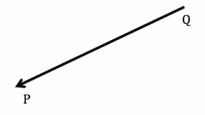
Name the vector in the picture below.
Eureka Math Grade 8 Module 2 Lesson 2 Exit Ticket Answer Key 3
Answer:
\(\overrightarrow{Q P}\)

Question 2.
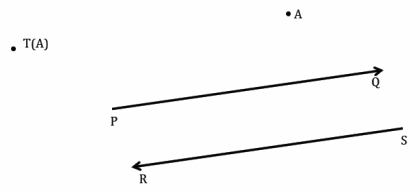
Name the vector along which a translation of a plane would map point A to its image T(A).
Eureka Math Grade 8 Module 2 Lesson 2 Exit Ticket Answer Key 4
Answer:
\(\overrightarrow{S R}\)

Question 3.
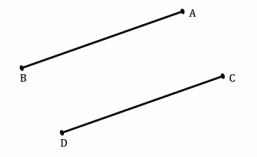
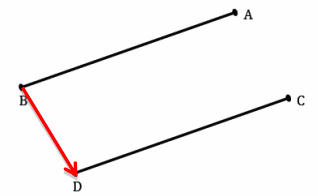
Is Maria correct when she says that there is a translation along a vector that maps segment AB to segment CD? If so, draw the vector. If not, explain why not.
Eureka Math Grade 8 Module 2 Lesson 2 Exit Ticket Answer Key 5.1
Answer:
Eureka Math Grade 8 Module 2 Lesson 2 Exit Ticket Answer Key 5
Yes. Accept any vector that would translate the segment AB to segment CD. A possible vector is shown in red, above.

Question 4.
Assume there is a translation that maps segment AB to segment CD shown above. If the length of segment CD is 8 units, what is the length of segment AB? How do you know?
Answer:
The length of CD must be 8 units in length because translations preserve the lengths of segments.

Eureka Math Grade 8 Module 2 Lesson 2 Problem Set Answer Key

Question 1.
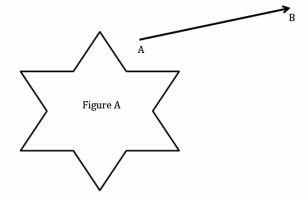
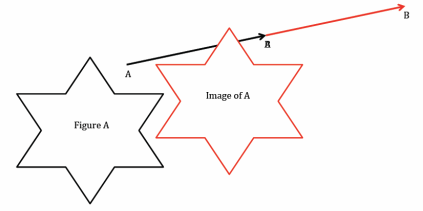
Translate the plane containing Figure A along \(\overrightarrow{A B}\). Use your transparency to sketch the image of Figure A by this translation. Mark points on Figure A, and label the image of Figure A accordingly.
Eureka Math Grade 8 Module 2 Lesson 2 Problem Set Answer Key 6
Answer:
Marked points will vary. Verify that students have labeled their points and images appropriately.
Eureka Math Grade 8 Module 2 Lesson 2 Problem Set Answer Key 6.1

Question 2.
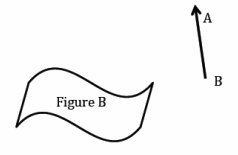
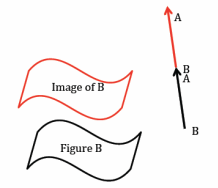
Translate the plane containing Figure B along \(\overrightarrow{B A}\). Use your transparency to sketch the image of Figure B by this translation. Mark points on Figure B, and label the image of Figure B accordingly.
Eureka Math Grade 8 Module 2 Lesson 2 Problem Set Answer Key 7
Answer:
Marked points will vary. Verify that students have labeled their points and images appropriately.
Eureka Math Grade 8 Module 2 Lesson 2 Problem Set Answer Key 7.1

Question 3.
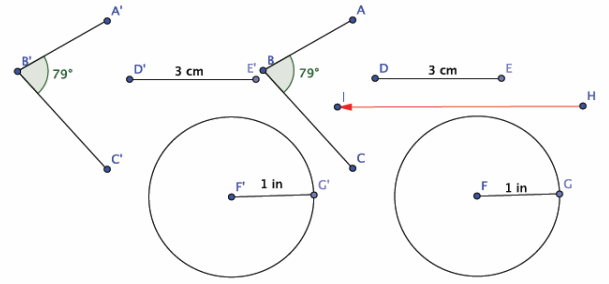
Draw an acute angle (your choice of degree), a segment with length 3 cm, a point, a circle with radius 1 in., and a vector (your choice of length, i.e., starting point and ending point). Label points and measures (measurements do not need to be precise, but your figure must be labeled correctly). Use your transparency to translate all of the figures you have drawn along the vector. Sketch the images of the translated figures and label them.
Answer:
Drawings will vary. Note: Drawing is not to scale.
Eureka Math Grade 8 Module 2 Lesson 2 Problem Set Answer Key 8

Question 4.
What is the length of the translated segment? How does this length compare to the length of the original segment? Explain.
Answer:
The length is 3 cm. The length is the same as the original because translations preserve the lengths of segments.

Question 5.
What is the length of the radius in the translated circle? How does this radius length compare to the radius of the original circle? Explain.
Answer:
The length is 1 in. The length is the same as the original because translations preserve lengths of segments.

Question 6.
What is the degree of the translated angle? How does this degree compare to the degree of the original angle? Explain.
Answer:
Answers will vary based on the original size of the angle drawn. The angles will have the same measure because translations preserve degrees of angles.

Question 7.
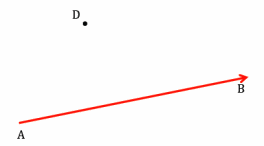
Translate point D along vector \(\overrightarrow{A B}\), and label the image D’. What do you notice about the line containing vector \(\overrightarrow{A B}\) and the line containing points D and D’? (Hint: Will the lines ever intersect?)
Eureka Math Grade 8 Module 2 Lesson 2 Problem Set Answer Key 20
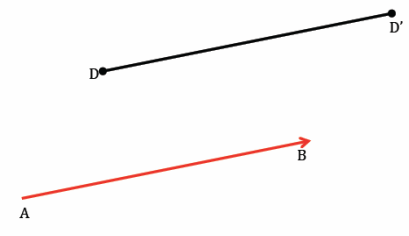
Answer:

Eureka Math Grade 8 Module 2 Lesson 2 Problem Set Answer Key 20.1
The lines will be parallel.

Question 8.
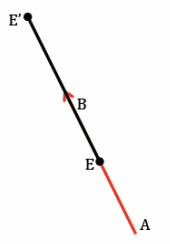
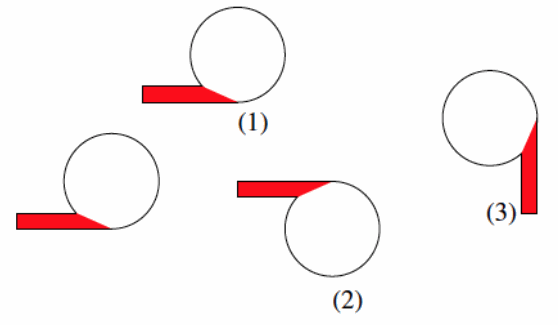
Translate point E along vector \(\overrightarrow{A B}\), and label the image E’. What do you notice about the line containing vector \(\overrightarrow{A B}\) and the line containing points E and E’?
Eureka Math Grade 8 Module 2 Lesson 2 Problem Set Answer Key 21
Answer:
Eureka Math Grade 8 Module 2 Lesson 2 Problem Set Answer Key 21.1
The lines will coincide.

Eureka Math Grade 8 Module 2 Lesson 1 Answer Key

Engage NY Eureka Math 8th Grade Module 2 Lesson 1 Answer Key

Eureka Math Grade 8 Module 2 Lesson 1 Exploratory Challenge Answer Key

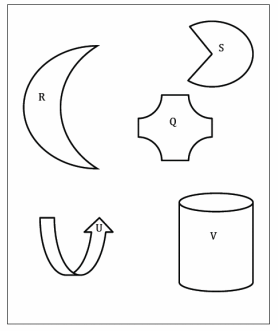
a. Describe, intuitively, what kind of transformation is required to move the figure on the left to each of the figures (1)–(3) on the right. To help with this exercise, use a transparency to copy the figure on the left. Note: Begin by moving the left figure to each of the locations in (1), (2), and (3).
Eureka Math Grade 8 Module 2 Lesson 1 Exploratory Challenge Answer Key 1
Answer:
Slide the original figure to the image (1) until they coincide. Slide the original figure to (2), and then flip it so they coincide. Slide the original figure to (3), and then turn it until they coincide.

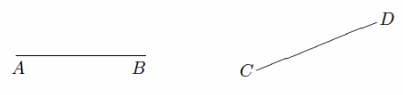
b. Given two segments AB and CD, which could be very far apart, how can we find out if they have the same length without measuring them individually? Do you think they have the same length? How do you check? In other words, why do you think we need to move things around on the plane?
Eureka Math Grade 8 Module 2 Lesson 1 Exploratory Challenge Answer Key 2
Answer:
We can trace one of the segments on the transparency and slide it to see if it coincides with the other segment. We move things around in the plane to see if they are exactly the same. This way, we don’t have to do any measuring.

Eureka Math Grade 8 Module 2 Lesson 1 Problem Set Answer Key

Question 1.
Using as much of the new vocabulary as you can, try to describe what you see in the diagram below.
Eureka Math Grade 8 Module 2 Lesson 1 Problem Set Answer Key 3
Answer:
There was a transformation, F, that moved point A to its image F(A) and point B to its image F(B). Since a transformation preserves distance, the distance between points A and B is the same as the distance between points F(A) and F(B).

Question 2.
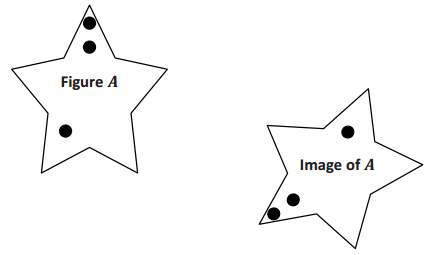
Describe, intuitively, what kind of transformation is required to move Figure A on the left to its image on the right.
Eureka Math Grade 8 Module 2 Lesson 1 Problem Set Answer Key 30
Answer:
First, I have to slide Figure A so that the point containing two dots maps onto the Image of A in the same location; next, I have to turn (rotate) it so that Figure A maps onto Image of A; finally, I have to flip the figure over so the part of the star with the single dot maps onto the image.

Eureka Math Grade 8 Module 2 Lesson 1 Exit Ticket Answer Key

First, draw a simple figure and name it Figure W. Next, draw its image under some transformation (i.e., trace your
Figure W on the transparency), and then move it. Finally, draw its image somewhere else on the paper.
Describe, intuitively, how you moved the figure. Use complete sentences.
Answer:
Accept any figure and transformation that is correct. Check for the same size and shape. Students should describe the movement of the figure as sliding to the left or right, turning to the left or right, or flipping, similar to how they described the movement of figures in the exercises of the lesson.

Eureka Math Grade 8 Module 1 End of Module Assessment Answer Key

Engage NY Eureka Math 8th Grade Module 1 End of Module Assessment Answer Key

Eureka Math Grade 8 Module 1 End of Module Assessment Task Answer Key

Question 1.
You have been hired by a company to write a report on Internet companies’ Wi-Fi ranges. They have requested that all values be reported in feet using scientific notation.

Ivan’s Internet Company boasts that its wireless access points have the greatest range. The company claims that you can access its signal up to 2,640 feet from its device. A competing company, Winnie’s Wi-Fi, has devices that extend to up to 2\(\frac{1}{2}\) miles.

a. Rewrite the range of each company’s wireless access devices in feet using scientific notation, and state which company actually has the greater range (5,280 feet =1 mile).
Answer:
Ivan’s Range: 2,640 = 2.64 × 103 ft.
Winner’s Range: (2.5)5280 = 13200 = 1.32 × 104 ft.
Winner’s wi-fi has the greater range.

b. You can determine how many times greater the range of one Internet company is than the other by writing their ranges as a ratio. Write and find the value of the ratio that compares the range of Winnie’s wireless access devices to the range of Ivan’s wireless access devices. Write a complete sentence describing how many times greater Winnie’s Wi-Fi range is than Ivan’s Wi-Fi range.
Answer:
winnie to ivan’s ratio – (1.32 × 10⁴) : (2.64 × 10³)
Value of ratio – \(\frac{1.32 \times 10^{4}}{2.64 \times 10^{3}}\) = \(\frac{1.32}{2.64}\) × \(\frac{10^{4}}{10^{3}}\) = \(\frac{1}{2}\) × 10 = 5
winnie’s wi-fi is 5 times greater in range than ivan’s internet company.

c. UC Berkeley uses Wi-Fi over Long Distances (WiLD) to create long-distance, point-to-point links. UC Berkeley claims that connections can be made up to 10 miles away from its device. Write and find the value of the ratio that compares the range of Ivan’s wireless access devices to the range of Berkeley’s WiLD devices. Write your answer in a complete sentence.
Answer:
(10)5280 = 52800 = 5.28 × 10⁴
Ivan’s to berkeley ratio: (2.64 × 10³): (5.28 × 10⁴)
Value of ratio- \(\frac{2.64 \times 10^{3}}{5.28 \times 10^{4}}\) = \(\frac{2.64}{5.28}\)×\(\frac{10^{3}}{10^{4}}\)= \(\frac{1}{2}\)×\(\frac{1}{10}\)= \(\frac{1}{20}\)
Ivan’s internet devices have a range \(\frac{1}{20}\) the range of UC Berkeley wild devices.

Question 2.
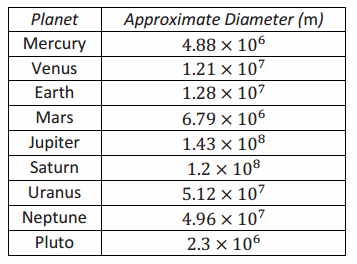
There is still controversy about whether or not Pluto should be considered a planet. Although planets are mainly defined by their orbital path (the condition that prevented Pluto from remaining a planet), the issue of size is something to consider. The table below lists the planets, including Pluto, and their approximate diameters in meters.
Eureka Math Grade 8 Module 1 End of Module Assessment Task Answer Key 30
a. Name the planets (including Pluto) in order from smallest to largest.
Answer:
Pluto, mercury, mars, venus, earth, neptune, uranus, saturn, jupiter.

b. Comparing only diameters, about how many times larger is Jupiter than Pluto?
Answer:
\(\frac{1.43 \times 10^{8}}{2.3 \times 10^{6}}\) = \(\frac{1.43}{2.3}\) × \(\frac{10^{8}}{10^{6}}\)
≈ 0.622 × 10²
≈ 62.2
The diameter of jupiter is about 62 times larger than pluto.

c. Again, comparing only diameters, find out about how many times larger Jupiter is compared to Mercury.
Answer:
\(\frac{1.43 \times 10^{8}}{4.88 \times 10^{6}}\) = \(\frac{1.43}{4.88}\) × \(\frac{10^{8}}{10^{6}}\)
≈ 0.293 × 10²
≈ 29.3
The diameter of jupiter is about 29 times larger than mercury.

d. Assume you are a voting member of the International Astronomical Union (IAU) and the classification of Pluto is based entirely on the length of the diameter. Would you vote to keep Pluto a planet or reclassify it? Why or why not?
Answer:
I would vote to reclassify it. Knowing that jupiter is 29 times larger than mercury means mercury is pretty small. Jupiter is 42 times larger than pluto, which means pluto is even. Smaller than mercury. For that reason vote that the length of the diameter of pluto is too small compared to other planets (Even the small one).

e. Just for fun, Scott wondered how big a planet would be if its diameter was the square of Pluto’s diameter. If the diameter of Pluto in terms of meters were squared, what would the diameter of the new planet be? (Write answer in scientific notation.) Do you think it would meet any size requirement to remain a planet? Would it be larger or smaller than Jupiter?
Answer:
(2.3 × 10⁶)2 = 2.32 × (106)2
= 5.29 × 10¹²
Yes, 5.29 × 10¹² would likely meet any size requirement for planets. It would be larger than jupiter.

Question 3.
Your friend Pat bought a fish tank that has a volume of 175 liters. The brochure for Pat’s tank lists a “fun fact” that it would take 7.43×10¹⁸ tanks of that size to fill all the oceans in the world. Pat thinks the both of you can quickly calculate the volume of all the oceans in the world using the fun fact and the size of her tank.

a. Given that 1 liter =1.0×10⁻¹² cubic kilometers, rewrite the size of the tank in cubic kilometers using scientific notation.
Answer:
175 litres = 175(1.0×10⁻¹²) cubic kilometers
= 175 ×10-12 km3
= 1.75 × 10⁻¹⁰ km3

b. Determine the volume of all the oceans in the world in cubic kilometers using the “fun fact.”
Answer:
(1.75 × 10⁻¹⁰)(7.43×10¹⁸) = (1.75× 7.43)(10-10×1018)
= 13.0025×108
= 1.30025×10⁹
The volume of all the oceans in the world is (1.30025×10⁹)km3.

c. You liked Pat’s fish so much you bought a fish tank of your own that holds an additional 75 liters. Pat asked you to figure out a different “fun fact” for your fish tank. Pat wants to know how many tanks of this new size would be needed to fill the Atlantic Ocean. The Atlantic Ocean has a volume of 323,600,000 cubic kilometers.
Answer:
Tank: 175+75 = 250 liters
250 liters = 250(1.0×10⁻¹²) km3
= 2.50 ×10-12
= 2.5 × 10⁻¹⁰
Atlantic ocean: 323,600,000
= 3.236 × 10⁸ km3

\(\frac{3.236 \times 10^{8}}{2.5 \times 10^{-10}}\) = \(\frac{3.236}{2.5}\) × \(\frac{10^{8}}{10^{-10}}\)
= 1.2944×10¹⁸
It would take 1.2944×10¹⁸ tanks (of size 250 liters) to fill the atlantic ocean.

Eureka Math Grade 8 Module 1 Mid Module Assessment Answer Key

Engage NY Eureka Math 8th Grade Module 1 Mid Module Assessment Answer Key

Eureka Math Grade 8 Module 1 Mid Module Assessment Task Answer Key

Question 1.
The number of users of social media has increased significantly since the year 2001. In fact, the approximate number of users has tripled each year. It was reported that in 2005 there were 3 million users of social media.

a. Assuming that the number of users continues to triple each year, for the next three years, determine the number of users in 2006, 2007, and 2008.
Answer:
2006-9 MILLION
2007-27 MILLION
2008-81 MILLION

b. Assume the trend in the numbers of users tripling each year was true for all years from 2001 to 2009. Complete the table below using 2005 as year 1 with 3 million as the number of users that year.
Eureka Math Grade 8 Module 1 Mid Module Assessment Task Answer Key 1
Answer:
Eureka Math Grade 8 Module 1 Mid Module Assessment Task Answer Key 6

c. Given only the number of users in 2005 and the assumption that the number of users triples each year, how did you determine the number of users for years 2, 3, 4, and 5?
Answer:
I MULTIPLIED THE PRECEDING YEAR’S NUMBER OF USERS BY 3.

d. Given only the number of users in 2005 and the assumption that the number of users triples each year, how did you determine the number of users for years 0, -1, -2, and -3?
Answer:
I Divided The Next Year’s Number of users by 3.

e. Write an equation to represent the number of users in millions, N, for year t, t≥-3.
Answer:
N=3t

f. Using the context of the problem, explain whether or not the formula N=3t would work for finding the number of users in millions in year t, for all t≤0.
Answer:
We only know that the number of users has tripled each year in the time frame of 2001 to 2009. For that reason, we cannot rely on the formula, N = 3t, to work for all t≤0, just to t=-3, which is the year 2001.

g. Assume the total number of users continues to triple each year after 2009. Determine the number of users in 2012. Given that the world population at the end of 2011 was approximately 7 billion, is this assumption reasonable? Explain your reasoning.
Answer:
2012 is t=8, so when t=8 in N=6,561,000,000. The number of users in 2012, 6,561,000,000. Does not exceed the world population of 7 billion, therefore it is possible to have that number of users. But 6,561,000,000 is Approximately 94%. of the world’s population. The number of users is likely less than that due to poverty, illness, infancy, etc. The Assumption is possible, but not reasonable.

Question 2.
Let m be a whole number.
a. Use the properties of exponents to write an equivalent expression that is a product of unique primes, each raised to an integer power.
\(\frac{6^{21} \cdot 10^{7}}{30^{7}}\)
Answer:
\(\frac{(3 \cdot 2)^{21} \cdot 10^{7}}{(3 \cdot 10)^{7}}\)=\(\frac{3^{21} \cdot 2^{21} \cdot 10^{7}}{3^{7} \cdot 10^{7}}\)
= 321-7.221.107-7
= 314.221.100
= 314.221

b. Use the properties of exponents to prove the following identity:
\(\frac{6^{3 m} \cdot 10^{m}}{30^{m}}\) = 23m.32m
Answer:
\(\frac{6^{3 m} \cdot 10^{m}}{30^{m}}\) = \(\frac{(3.2)^{3 m} \cdot 10^{m}}{(3 \cdot 10)^{m}}\)
= \(\frac{3^{3 m} \cdot 2^{3 m} \cdot 10^{m}}{3^{m} \cdot 10^{m}}\)
= 33m-3.23m.10m-m
= 32m.23m
= 23m.32m

c. What value of m could be substituted into the identity in part (b) to find the answer to part (a)?
Answer:
23m.32m = 221.314
3m = 21
m = 7
2m = 14
m = 7
Therefore, m = 7

Question 3.
Jill writes 23 ∙43 =86 and the teacher marked it wrong. Explain Jill’s error.
Answer:
Jill multiplied the bases, 2 and 4, and added the exponents. You can only add the exponents when the bases being multiplied are the same.

b. Find n so that the number sentence below is true:
23 ∙43 =23 ∙2n =29
Answer:
43 = 4.4.4
= (2.2)(2.2)(2.2)
= 26
Therefore
23.43 = 23.26 = 29
so
n = 6

c. Use the definition of exponential notation to demonstrate why 23 ∙43 =29 is true.
Answer:
43=26, 23.43 = 29 is equivalent to 23.26 = 29
By definition of exponential notation:
Eureka Math Grade 8 Module 1 Mid Module Assessment Task Answer Key 8

d. You write 75 ∙7-9 =7-4 . Keisha challenges you, “Prove it!” Show directly why your answer is correct without referencing the laws of exponents for integers; in other words, xa ∙xb =xa+b for positive numbers x and integers a and b.
Answer:
75.7-9 = 75.\(\frac{1}{7^{9}}\) by definition
= \(\frac{7^{5}}{7^{9}}\) by product formula
= \(\frac{7^{5}}{7^{5.7^{4}}}\) by xm.xn = xm+n for x>0, m,n≥0
= \(\frac{1}{7^{4}}\) by equivalent fractions
= 7-4 by definition.

Eureka Math Grade 8 Module 1 Lesson 13 Answer Key

Engage NY Eureka Math 8th Grade Module 1 Lesson 13 Answer Key

Eureka Math Grade 8 Module 1 Lesson 13 Exercise Answer Key

Exercise 1.
The Fornax Dwarf galaxy is 4.6×10⁵ light-years away from Earth, while Andromeda I is 2.430×10⁶ light-years away from Earth. Which is closer to Earth?
Answer:
2.430×106=2.430×10×105=24.30×10⁵
Because 4.6<24.30, then 4.6×10⁵<24.30×10⁵, and since 24.30×105=2.430×10⁶, we know that 4.6×10⁵<2.430×10⁶. Therefore, Fornax Dwarf is closer to Earth.

Exercise 2.
The average lifetime of the tau lepton is 2.906×10⁻¹³ seconds, and the average lifetime of the neutral pion is 8.4×10⁻¹⁷ seconds. Explain which subatomic particle has a longer average lifetime.
Answer:
2.906×10-13=2.906×104×10-17=29,060×10-17
Since 8.4<29,060, then 8.4×10⁻¹⁷<29,060×10-17, and since 29,060×10-17=2.906×10⁻¹³, we know that 8.4×10⁻¹⁷< 2.906×10⁻¹³. Therefore, tau lepton has a longer average lifetime.
This problem, as well as others, can be solved using an alternate method. Our goal is to make the magnitude of the numbers we are comparing the same, which will allow us to reduce the comparison to that of whole numbers.
Here is an alternate solution:
8.4×10-17=8.4×10-4×10-13=0.000 84×10-13.
Since 0.00084<2.906, then 0.000 84×10-13<2.906×10⁻¹³, and since 0.000 84×10-13=8.4×10⁻¹⁷, we know that 8.4×10⁻¹⁷< 2.906×10⁻¹³. Therefore, tau lepton has a longer average lifetime.

Exploratory Challenge 1/Exercise 3.
THEOREM: Given two positive numbers in scientific notation, a×10m and b×10n, if m<n, then a×10m<b×10n.

Prove the theorem.
If m<n, then there is a positive integer k so that n=k+m.
By the first law of exponents (10) in Lesson 5, b×10n=b×10k×10m=(b×10k)×10m. Because we are comparing with a×10m, we know by (1) that we only need to prove a<(b×10k). By the definition of scientific notation, a<10 and also (b×10k)≥10 because k≥1 and b≥1, so that (b×10k)≥1×10=10. This proves a<(b×10k), and therefore, a×10m<b×10n.
Explain to students that we know that a<10 because of the statement given that a×10m is a number expressed in scientific notation. That is not enough information to convince students that a<b×10k; therefore, we need to say something about the right side of the inequality. We know that k≥1 because k is a positive integer so that n=k+m. We also know that b≥1 because of the definition of scientific notation. That means that the minimum possible value of b×10k is 10 because 1×101=10. Therefore, we can be certain that a<b×10k.
Therefore, by (1), a×10m<(b×10k)×10m. Since n=k+m, we can rewrite the right side of the inequality as
b×10n, and finally a×10m<b×10n.

Exercise 4.
Compare 9.3×1028 and 9.2879×1028.
Answer:
We only need to compare 9.3 and 9.2879. 9.3×104=93,000 and 9.2879×104=92,879, so we see that
93,000>92,879. Therefore, 9.3×1028>9.2879×1028.

Exercise 5.
Chris said that 5.3×1041<5.301×1041 because 5.3 has fewer digits than 5.301. Show that even though his answer is correct, his reasoning is flawed. Show him an example to illustrate that his reasoning would result in an incorrect answer. Explain.
Answer:
Chris is correct that 5.3×1041<5.301×1041, but that is because when we compare 5.3 and 5.301, we only need to compare 5.3×10³ and 5.301×10³ (by (1) above). But, 5.3×10³<5.301×10³ or rather 5,300<5,301, and this is the reason that 5.3×1041<5.301×1041. However, Chris’s reasoning would lead to an incorrect answer for a problem that compares 5.9×1041 and 5.199×1041. His reasoning would lead him to conclude that
5.9×1041<5.199×1041, but 5,900>5,199, which is equivalent to 5.9×10³>5.199×10³. By (1) again, 5.9>5.199, meaning that 5.9×1041>5.199×1041.

Exploratory Challenge 2/Exercise 6.
You have been asked to determine the exact number of Google searches that are made each year. The only information you are provided is that there are 35,939,938,877 searches performed each week. Assuming the exact same number of searches are performed each week for the 52 weeks in a year, how many total searches will have been performed in one year? Your calculator does not display enough digits to get the exact answer. Therefore, you must break down the problem into smaller parts. Remember, you cannot approximate an answer because you need to find an exact answer. Use the screen shots below to help you reach your answer.
Eureka Math Grade 8 Module 1 Lesson 13 Exercise Answer Key 20
Answer:
First, I need to rewrite the number of searches for each week using numbers that can be computed using my calculator.
35 939 938 877=35 939 000 000+938 877
=35 939×106+938 877
Next, I need to multiply each term of the sum by 52, using the distributive law.
(35 939×106+938 877)×52=(35 939×106)×52+(938 877×52)
By repeated use of the commutative and associative properties, I can rewrite the problem as
(35 939×52)×106+(938 877×52).
According to the screen shots, I get
1 868 828×106+48 821 604=1 868 828 000 000+48 821 604
=1 868 876 821 604.
Therefore, 1,868,876,821,604 Google searches are performed each year.

Yahoo! is another popular search engine. Yahoo! receives requests for 1,792,671,335 searches each month. Assuming the same number of searches are performed each month, how many searches are performed on Yahoo! each year? Use the screen shots below to help determine the answer.
Eureka Math Grade 8 Module 1 Lesson 13 Exercise Answer Key 25
Answer:
First, I need to rewrite the number of searches for each month using numbers that can be computed using my calculator.
1 792 671 335=1 792 000 000+671 335
=1 792×106+671 335.
Next, I need to multiply each term of the sum by 12, using the distributive law.
(1 792×106+671 335)×12=(1 792×106)×12+(671 335×12).
By repeated use of the commutative and associative properties, I can rewrite the problem as
(1 792×12)×106+(671 335×12)
According to the screen shots, I get
21 504×106+8 056 020=21 504 000 000+8 056 020
=21 512 056 020
Therefore, 21,512,056,020 Yahoo! searches are performed each year.

Eureka Math Grade 8 Module 1 Lesson 13 Exit Ticket Answer Key

Question 1.
Compare 2.01×10¹⁵ and 2.8×10¹³. Which number is larger?
Answer:
2.01×1015=2.01×102×1013=201×1013
Since 201>2.8, we have 201×1013>2.8×10¹³, and since 201×1013=2.01×10¹⁵, we conclude 2.01×10¹⁵>2.8×10¹³.

Question 2.
The wavelength of the color red is about 6.5×10^-9 m. The wavelength of the color blue is about 4.75×10⁻⁹ m. Show that the wavelength of red is longer than the wavelength of blue.
Answer:
We only need to compare 6.5 and 4.75:
6.5×10-9=650×10-7 and 4.75×10-9=475×10-7, so we see that 650>475.
Therefore, 6.5×10⁻⁹>4.75×10⁻⁹.

Eureka Math Grade 8 Module 1 Lesson 13 Problem Set Answer Key

Question 1.
Write out a detailed proof of the fact that, given two numbers in scientific notation, a×10n and b×10n, a<b, if and only if a×10n<b×10n.
Answer:
Because 10n>0, we can use inequality (A) (i.e., (1) above) twice to draw the necessary conclusions. First, if a<b, then by inequality (A), a×10n<b×10n. Second, given a×10n<b×10n, we can use inequality (A) again to show an<b×10n by 10-n.

a. Let A and B be two positive numbers, with no restrictions on their size. Is it true that A×10-5<B×105?
Answer:
No, it is not true that A×10-5<B×105. Using inequality (A), we can write
A×10-5×10⁵<B×105×105, which is the same as A<B×1010. To disprove the statement, all we would need to do is find a value of A that exceeds B×1010.

b. Now, if A×10-5 and B×105 are written in scientific notation, is it true that A×10-5<B×105? Explain.
Answer:
Yes, since the numbers are written in scientific notation, we know that the restrictions for A and B are
1≤A<10 and 1≤B<10. The maximum value for A, when multiplied by 10-5, will still be less than 1. The minimum value of B will produce a number at least 105 in size.

Question 2.
The mass of a neutron is approximately 1.674927×10⁻²⁷ kg. Recall that the mass of a proton is
1.672622×10⁻²⁷ kg. Explain which is heavier.
Answer:
Since both numbers have a factor of 10-27, we only need to look at 1.674927 and 1.672622. When we multiply each number by 106, we get
1.674927×10⁶ and 1.672622×10⁶,
which is the same as
1,674,927 and 1,672,622.
Now that we are looking at whole numbers, we can see that 1,674,927>1,672,622 (by (2b) above), which means that 1.674927×10⁻²⁷>1.672622×10⁻²⁷. Therefore, the mass of a neutron is heavier.

Question 3.
The average lifetime of the Z boson is approximately 3×10-25 seconds, and the average lifetime of a neutral rho meson is approximately 4.5×10⁻²⁴ seconds.
a. Without using the theorem from today’s lesson, explain why the neutral rho meson has a longer average lifetime.
Answer:
Since 3×10-25=3×10-1×10-24, we can compare 3×10-1×10-24 and 4.5×10⁻²⁴. Based on Example 3 or by use of (1) above, we only need to compare 3×10⁻¹ and 4.5, which is the same as 0.3 and 4.5. If we multiply each number by 10, we get whole numbers 3 and 45. Since 3<45, then
3×10-25<4.5×10⁻²⁴. Therefore, the neutral rho meson has a longer average lifetime.

b. Approximately how much longer is the lifetime of a neutral rho meson than a Z boson?
Answer:
45:3 or 15 times longer

Rapid White Board Exchange: Operations with Numbers Expressed in Scientific Notation

Question 1.
(5×10⁴)2=
Answer:
2.5×10⁹

Question 2.
(2×10⁹)4=
Answer:
1.6×1037

Question 3.
\(\frac{\left(1.2 \times 10^{4}\right)+\left(2 \times 10^{4}\right)+\left(2.8 \times 10^{4}\right)}{3}\)=
Answer:
2×10⁴

Question 4.
\(\frac{7 \times 10^{15}}{14 \times 10^{9}}\) =
Answer:
5×10⁵

Question 5.
\(\frac{4 \times 10^{2}}{2 \times 10^{8}}\)=
Answer:
2×10⁻⁶

Question 6.
\(\frac{\left(7 \times 10^{9}\right)+\left(6 \times 10^{9}\right)}{2}\)=
Answer:
6.5×10⁹

Question 7.
(9×10⁻⁴)2=
Answer:
8.1×10⁻⁷

Question 8.
(9.3×10¹⁰)-(9×10¹⁰)=
Answer:
3×10⁹

Eureka Math Grade 8 Module 1 Lesson 12 Answer Key

Engage NY Eureka Math 8th Grade Module 1 Lesson 12 Answer Key

Eureka Math Grade 8 Module 1 Lesson 12 Exercise Answer Key

Exercise 1.
A certain brand of MP3 player will display how long it will take to play through its entire music library. If the maximum number of songs the MP3 player can hold is 1,000 (and the average song length is 4 minutes), would you want the time displayed in terms of seconds-, days-, or years-worth of music? Explain.
Answer:
It makes the most sense to have the time displayed in days because numbers such as 240,000 seconds-worth of music and \(\frac{5}{657}\) of a year are more difficult to understand than about 2.8 days.

Exercise 2.
You have been asked to make frosted cupcakes to sell at a school fundraiser. Each frosted cupcake contains about 20 grams of sugar. Bake sale coordinators expect 500 people will attend the event. Assume everyone who attends will buy a cupcake; does it make sense to buy sugar in grams, pounds, or tons? Explain.
Answer:
Because each cupcake contains about 20 grams of sugar, we will need 500×20 grams of sugar. Therefore, grams are too small of a measurement, while tons are too large. Therefore, the sugar should be purchased in pounds.

Exercise 3.
The seafloor spreads at a rate of approximately 10 cm per year. If you were to collect data on the spread of the seafloor each week, which unit should you use to record your data? Explain.
Answer:
The seafloor spreads 10 cm per year, which is less than 1 cm per month. Data will be collected each week, so it makes the most sense to measure the spread with a unit like millimeters.

Exercise 4.
Show that the mass of a proton is 0.938 \(\frac{\mathrm{GeV}}{c^{2}}\).
Answer:
Let x represent the number of gigaelectronvolts equal to the mass of a proton.
x(\(\frac{\mathrm{GeV}}{c^{2}}\))=mass of proton
x(1.783×10⁻²⁷)=1.672622×10⁻²⁷
x=(1.672622×10⁻²⁷)/(1.783×10-27)
=\(\frac{1.672622}{1.783}\)
≈0.938

Exercise 5.
The distance of the nearest star (Proxima Centauri) to the sun is approximately 4.013 336 473×1013 km. Show that Proxima Centauri is 4.2421 light-years from the sun.
Answer:
Let x represent the number of light-years Proxima Centauri is from the sun.
x(9.46073×10¹²)=4.013336473×10¹³
x=\(\frac{4.013336473 \times 10^{13}}{9.46073 \times 10^{12}}\)
=\(\frac{4.013336473}{9.46073}\)×10
=0.424210021×10
≈4.2421

Exercise 6.
What new unit might you introduce in order to discuss the differences in diameter measurements?
Answer:
There are several answers that students could give for their choice of unit. Accept any reasonable answer, provided the explanation is clear and correct. Some students may choose 10-12 as their unit because all measurements could then be expressed without exponential notation. Other students may decide that 10-8 should be the unit because two measurements are already of that order of magnitude. Still, other students may choose 10-10 because that is the average of the powers.

Exercise 7.
Name your unit, and explain why you chose it.
Answer:
Students can name their unit anything reasonable, as long as they clearly state what their unit is and how it will be written. For example, if a student chooses a unit of 10-10, then he or she should state that the unit will be represented with a letter. For example, Y, then Y=10-10.

Exercise 8.
Using the unit you have defined, rewrite the five diameter measurements.
Answer:
Using the unit Y=10-10, then:
Eureka Math Grade 8 Module 1 Lesson 12 Exercise Answer Key 25

Eureka Math Grade 8 Module 1 Lesson 12 Exploratory Challenge Answer Key

Exploratory Challenge 1.
Finally, let us look at an example involving the masses of the planets in our solar system. They range from Mercury’s 3.3022×10²³ kg to Jupiter’s 1.8986×1027 kg. However, Earth’s mass is the fourth heaviest among the eight planets3, and it seems reasonable to use it as the point of reference for discussions among planets. Therefore, a new unit is ME, the mass of the Earth, or 5.97219×1024 kg.
Suggested white-board activity: Show students the table below, leaving the masses for Mercury and Jupiter blank. Demonstrate how to rewrite the mass of Mercury in terms of the new unit, ME. Then, have students rewrite the mass of Jupiter using the new unit. Finally, complete the chart with the rewritten masses.

Mercury: Let x represent the mass of Mercury in the unit ME. We want to determine what number times the new unit is equal to the mass of Mercury in kilograms. Since ME=5.97219×1024, then:
(5.97219×1024 )x=3.3022×10²³
x=\(\frac{3.3022 \times 10^{23}}{5.97219 \times 10^{24}}\)
= \(\frac{3.3022}{5.97219}\) × \(\frac{10^{23}}{10^{24}}\)
≈0.553×101-
=0.0553.
Mercury’s mass is 0.0553 ME.

Jupiter: Let x represent the mass of Jupiter in the unit ME. We want to determine what number times the new unit is equal to the mass of Jupiter in kilograms. Since ME=5.97219×1024, then:
(5.97219×1024 )x=1.8986×1027
x=\(\frac{1.8986 \times 10^{27}}{5.97219 \times 10^{24}}\)
=\(\frac{1.8986}{5.97219}\)×\(\frac{10^{27}}{10^{24}}\)
≈0.318×103
=318.
Jupiter’s mass is 318 ME.
Eureka Math Grade 8 Module 1 Lesson 12 Exploratory Challenge Answer Key 500

Exploratory Challenge 2.
Suppose you are researching atomic diameters and find that credible sources provided the diameters of five different atoms as shown in the table below. All measurements are in centimeters.
Eureka Math Grade 8 Module 1 Lesson 12 Exploratory Challenge Answer Key 20

Eureka Math Grade 8 Module 1 Lesson 12 Exit Ticket Answer Key

Question 1.
The table below shows an approximation of the national debt at the beginning of each decade over the last century. Choose a unit that would make a discussion about the growth of the national debt easier. Name your unit, and explain your choice.
Engage NY Math 8th Grade Module 1 Lesson 12 Exit Ticket Answer Key 26
Answer:
Students will likely choose 1011 as their unit because the majority of the data is of that magnitude. Accept any reasonable answer that students provide. Verify that they have named their unit.

Question 2.
Using the new unit you have defined, rewrite the debt for years 1900, 1930, 1960, and 2000.
Answer:
Let D represent the unit 1011. Then, the debt in 1900 is 0.021D, in 1930 it is 0.16D, in 1960 it is 2.9D, and 57D in 2000.

Eureka Math Grade 8 Module 1 Lesson 12 Problem Set Answer Key

Question 1.
Verify the claim that, in terms of gigaelectronvolts, the mass of an electron is 0.000511.
Answer:
Let x represent the number of gigaelectronvolts equal to the mass of an electron.
Eureka Math Grade 8 Module 1 Lesson 12 Problem Set Answer Key 28

Question 2.
The maximum distance between Earth and the sun is 1.52098232×10⁸ km, and the minimum distance is 1.47098290×10⁸ km. What is the average distance between Earth and the sun in scientific notation?
Answer:

Eureka Math Grade 8 Module 1 Lesson 12 Problem Set Answer Key 21

Question 3.
Suppose you measure the following masses in terms of kilograms:
Eureka Math Grade 8 Module 1 Lesson 12 Problem Set Answer Key 22
What new unit might you introduce in order to aid discussion of the masses in this problem? Name your unit, and express it using some power of 10. Rewrite each number using your newly defined unit.
Answer:
A very motivated student may search the Internet and find that units exist that convert large masses to reasonable numbers, such as petagrams (1012 kg), exagrams (1015 kg), or zetagrams (1018 kg). More likely, students will decide that something near 1020 should be used as a unit because many of the numbers are near that magnitude. There is one value, 1.8×10¹², that serves as an outlier and should be ignored because it is much smaller than the majority of the data. Students can name their unit anything reasonable. The answers provided are suggestions, but any reasonable answers should be accepted.
Let U be defined as the unit 1020.
Eureka Math Grade 8 Module 1 Lesson 12 Problem Set Answer Key 23

Eureka Math Grade 8 Module 1 Lesson 11 Answer Key

Engage NY Eureka Math 8th Grade Module 1 Lesson 11 Answer Key

Eureka Math Grade 8 Module 1 Lesson 11 Example Answer Key

Example 1.
The advantage of the scientific notation becomes even more pronounced when we have to compute how many times heavier a proton is than an electron. Instead of writing the value of the ratio, r, as
Engage NY Math 8th Grade Module 1 Lesson 11 Example Answer Key 1
we express it as
r=\(\frac{1.672622 \times 10^{-27}}{9.10938291 \times 10^{-31}}\)

→ Should we eliminate the power of 10 in the numerator or denominator? Explain.
→ Using the theorem on generalized equivalent fractions, we can eliminate the negative power of 10 in the numerator and denominator to see what we are doing more clearly. Anticipating that 10-31×1031=1, we can multiply the numerator and denominator of the (complex) fraction by 1031
Engage NY Math 8th Grade Module 1 Lesson 11 Example Answer Key 5
Using the first law of exponents (10) presented in Lesson 5, we get
Engage NY Math 8th Grade Module 1 Lesson 11 Example Answer Key 6
Note that since we are using scientific notation, we can interpret an approximate value of r right away. For example, we see
Engage NY Math 8th Grade Module 1 Lesson 11 Example Answer Key 7
so that r is approximately \(\frac{1}{5}\) ×10,000, which is 2,000. Thus, we expect a proton to be about two thousand times heavier than an electron.

Example 2.
The U.S. national debt as of March 23, 2013, rounded to the nearest dollar, is $16,755,133,009,522. According to the 2012 U.S. census, there are about 313,914,040 U.S. citizens. What is each citizen’s approximate share of the debt?
\(\frac{1.6755 \times 10^{13}}{3.14 \times 10^{8}}\) = \(\frac{1.6755}{3.14}\) × \(\frac{10^{13}}{10^{8}}\)
=\(\frac{1.6755}{3.14}\)×105
=0.533598…×105
≈0.5336×105
=53360
Each U.S. citizen’s share of the national debt is about $53,360.

Eureka Math Grade 8 Module 1 Lesson 11 Exercise Answer Key

Exercise 1.
The mass of a proton is
0.000 000 000 000 000 000 000 000 001 672 622 kg.
In scientific notation it is
Answer:
1.672622×10⁻²⁷ kg.

Exercise 2.
The mass of an electron is
0.000 000 000 000 000 000 000 000 000 000 910 938 291 kg.
In scientific notation it is
Answer:
9.10938291×10⁻³¹ kg.

Exercise 3.
Write the ratio that compares the mass of a proton to the mass of an electron.
Answer:
Ratio: (1.672622×10⁻²⁷ ) : (9.10938291×10⁻³¹)

Exercise 4.
Compute how many times heavier a proton is than an electron (i.e., find the value of the ratio). Round your final answer to the nearest one.
Answer:
Let r= the value of the ratio, then:
Eureka Math Grade 8 Module 1 Lesson 11 Exercise Answer Key 15

Exercise 5.
The geographic area of California is 163,696 sq.mi., and the geographic area of the U.S. is 3,794,101 sq.mi. Let’s round off these figures to 1.637×10⁵ and 3.794×10⁶. In terms of area, roughly estimate how many Californias would make up one U.S. Then compute the answer to the nearest ones.
Answer:
\(\frac{3.794 \times 10^{6}}{1.637 \times 10^{5}}\) = \(\frac{3.794}{1.637}\) × \(\frac{10^{6}}{10^{5}}\)
= \(\frac{3.794}{1.637}\)×10
=2.3176…×10
≈2.318×10
=23.18
It would take about 23 Californias to make up one U.S.

Exercise 6.
The average distance from Earth to the moon is about 3.84×10⁵ km, and the distance from Earth to Mars is approximately 9.24×10⁷ km in year 2014. On this simplistic level, how much farther is traveling from Earth to Mars than from Earth to the moon?
Answer:
9.24×10⁷-3.84×105=924×105-3.84×105
=(924-3.84)×105
=920.16×105
=92 016 000
It is 92,016,000 km further to travel from Earth to Mars than from Earth to the moon.

Eureka Math Grade 8 Module 1 Lesson 11 Problem Set Answer Key

Question 1.
There are approximately 7.5×10¹⁸ grains of sand on Earth. There are approximately 7×1027 atoms in an average human body. Are there more grains of sand on Earth or atoms in an average human body? How do you know?
Answer:
There are more atoms in the average human body. When comparing the order of magnitude of each number,
27>18; therefore, 7×1027>7.5×10¹⁸.

Question 2.
About how many times more atoms are in a human body compared to grains of sand on Earth?
Answer:
\(\frac{7 \times 10^{27}}{7.5 \times 10^{18}}\) = \(\frac{7}{7.5}\)×\(\frac{10^{27}}{10^{18}}\)
≈1×1027-18
≈1×10⁹
≈109
There are about 1,000,000,000 times more atoms in the human body compared to grains of sand on Earth.

Question 3.
Suppose the geographic areas of California and the U.S. are 1.637×10⁵ and 3.794×10⁶ sq.mi., respectively. California’s population (as of 2012) is approximately 3.804×10⁷ people. If population were proportional to area, what would be the U.S. population?
Answer:
We already know from Exercise 5 that it would take about 23 Californias to make up one U.S. Then the population of the U.S. would be 23 times the population of California, which is
23×3.804×107=87.492×107
=8.7492×108
=874,920,000.

Question 4.
The actual population of the U.S. (as of 2012) is approximately 3.14×10⁸. How does the population density of California (i.e., the number of people per square mile) compare with the population density of the U.S.?
Answer:
Population density of California per square mile:
\(\frac{3.804 \times 10^{7}}{1.637 \times 10^{5}}\) = \(\frac{3.804}{1.637}\) ×\(\frac{10^{7}}{10^{5}}\)
=2.32376…×102
≈2.32×102
=232
Population density of the U.S. per square mile:
\(\frac{3.14 \times 10^{8}}{3.794 \times 10^{6}}\) = \(\frac{3.14}{3.794}\)×\(\frac{10^{8}}{10^{6}}\)
≈0.83×102
=83
Population density of California compared to the population density of the U.S.:
\(\frac{232}{83}\)=2.7951…
≈2.8
California is about 3 times as dense as the U.S. in terms of population.

Eureka Math Grade 8 Module 1 Lesson 11 Exit Ticket Answer Key

Question 1.
Two of the largest mammals on earth are the blue whale and the elephant. An adult male blue whale weighs about 170 tonnes or long tons. (1 tonne = 1000 kg)
Show that the weight of an adult blue whale is 1.7×10⁵ kg.
Answer:
Let x (or any other symbol) represent the number of kilograms an adult blue whale weighs.
170×1000=x
1.7×105=x

Question 2.
An adult male elephant weighs about 9.07×10³ kg.
Compute how many times heavier an adult male blue whale is than an adult male elephant (i.e., find the value of the ratio). Round your final answer to the nearest one.
Answer:
Let r be the value of the ratio.
r=\(\frac{1.7 \times 10^{5}}{9.07 \times 10^{3}}\)
=\(\frac{1.7}{9.07}\)×102
=0.18743×102
=18.743
≈19
The blue whale is 19 times heavier than the elephant.

Eureka Math Grade 8 Module 1 Lesson 10 Answer Key

Engage NY Eureka Math 8th Grade Module 1 Lesson 10 Answer Key

Eureka Math Grade 8 Module 1 Lesson 10 Exercise Answer Key

Exercise 1.
The speed of light is 300,000,000 meters per second. The sun is approximately 1.5×10¹¹ meters from Earth. How many seconds does it take for sunlight to reach Earth?
Answer:
300 000 000=3×10⁸
\(\frac{1.5 \times 10^{11}}{3 \times 10^{8}}\) = \(\frac{1.5}{3}\)×\(\frac{10^{11}}{10^{8}}\)
=0.5×103
=0.5×10×102
=5×10²
It takes 500 seconds for sunlight to reach Earth.

Exercise 2.
The mass of the moon is about 7.3×10²² kg. It would take approximately 26,000,000 moons to equal the mass of the sun. Determine the mass of the sun.
Answer:
26 000 000=2.6×10⁷
(2.6× 10⁷)(7.3×10²²)=(2.6×7.3)(107×1022)
=18.98×1029
=1.898×10×1029
=1.898×1030
The mass of the sun is 1.898×1030 kg.

Exercise 3.
The mass of Earth is 5.9×1024 kg. The mass of Pluto is 13,000,000,000,000,000,000,000 kg. Compared to Pluto, how much greater is Earth’s mass than Pluto’s mass?
Answer:
13 000 000 000 000 000 000 000=1.3×10²²
5.9×1024-1.3×1022=(5.9×102)×1022-1.3×1022
=(590-1.3)×1022
=588.7×1022
=5.887×102×1022
=5.887×1024
The mass of Earth is 5.887×1024 kg greater than the mass of Pluto.

Exercise 4.
Using the information in Exercises 2 and 3, find the combined mass of the moon, Earth, and Pluto.
Answer:
7.3×10²²+1.3×10²²+5.9×1024=(7.3×10²²+1.3×10²²)+5.9×1024
=8.6×10²²+5.9×1024
=(8.6+590)×1022
=598.6×1022
=5.986×102×1022
=5.986×1024
The combined mass of the moon, Earth, and Pluto is 5.986×1024 kg.

Exercise 5.
How many combined moon, Earth, and Pluto masses (i.e., the answer to Exercise 4) are needed to equal the mass of the sun (i.e., the answer to Exercise 2)?
Answer:
\(\frac{1.898 \times 10^{30}}{5.986 \times 10^{24}}\) = \(\frac{1.898}{5.986}\) × \(\frac{10^{30}}{10^{24}}\)
=0.3170…×106
≈0.32×106
=0.32×10×105
=3.2×10⁵
It would take 3.2×10⁵ combined masses of the moon, Earth, and Pluto to equal the mass of the sun.

Eureka Math Grade 8 Module 1 Lesson 10 Problem Set Answer Key

Have students practice operations with numbers written in scientific notation and standard notation.

Question 1.
The sun produces 3.8×1027 joules of energy per second. How much energy is produced in a year? (Note: a year is approximately 31,000,000 seconds).
Answer:
31 000 000=3.1×10⁷
(3.8×1027)(3.1×10⁷)=(3.8×3.1)(1027×107)
=11.78×1034
=1.178×10×1034
=1.178×1035
The sun produces 1.178×1035 joules of energy in a year.

Question 2.
On average, Mercury is about 57,000,000 km from the sun, whereas Neptune is about 4.5×10⁹ km from the sun. What is the difference between Mercury’s and Neptune’s distances from the sun?
Answer:
57 000 000=5.7×10⁷
4.5×10⁹-5.7×107=(4.5×102)×107-5.7×107
=450×107-5.7×107
=(450-5.7)×107
=444.3×107
=4.443×102×107
=4.443×10⁹
The difference in the distance of Mercury and Neptune from the sun is 4.443×10⁹ km.

Question 3.
The mass of Earth is approximately 5.9×1024 kg, and the mass of Venus is approximately 4.9×1024 kg.
a. Find their combined mass.
Answer:
5.9×1024+4.9×1024=(5.9+4.9)×1024
=10.8×1024
=1.08×10×1024
=1.08×1025
The combined mass of Earth and Venus is 1.08×1025 kg.

b. Given that the mass of the sun is approximately 1.9×1030 kg, how many Venuses and Earths would it take to equal the mass of the sun?
Answer:
\(\frac{1.9 \times 10^{30}}{1.08 \times 10^{25}}\)=\(\frac{1.9}{1.08} \times \frac{10^{30}}{10^{25}}\)
=1.75925…×105
≈1.8×10⁵
It would take approximately 1.8×10⁵ Venuses and Earths to equal the mass of the sun.

Eureka Math Grade 8 Module 1 Lesson 10 Exit Ticket Answer Key

Question 1.
The speed of light is 3×10⁸ meters per second. The sun is approximately 230,000,000,000 meters from Mars. How many seconds does it take for sunlight to reach Mars?
Answer:
230 000 000 000=2.3×10¹¹
\(\frac{2.3 \times 10^{11}}{3 \times 10^{8}}\)=\(\frac{2.3}{3}\)×\(\frac{10^{11}}{10^{8}}\)
=0.7666…×103
≈0.77×10×102
≈7.7×10²
It takes approximately 770 seconds for sunlight to reach Mars.

Question 2.
If the sun is approximately 1.5×10¹¹ meters from Earth, what is the approximate distance from Earth to Mars?
Answer:
(2.3×10¹¹)-(1.5×10¹¹)=(2.3-1.5)×1011
=0.8×1011
=0.8×10×1010
=8×10¹⁰
The distance from Earth to Mars is 8×10¹⁰ meters.